Militarized vision

Before I started my odyssey through Grégoire Chamayou‘s Théorie du drone (which will continue next week), I had discussed multiple ways of thinking about the relations between visualities, political technologies of vision and drones.  Much of the work that I pointed to takes place in the borderlands between investigative journalism and visual art: hence my interest in (for example) James Bridle, Omer Fast, and Trevor Paglen (for a quick review and further links, see here).

Two additional essays have crossed my screen, appropriately enough, which contribute to these discussions.

The first is Matt Delmont‘s ‘Drone encounters: Noor Behram, Omer Fast and visual critiques of drone warfare’ [American Quarterly 65 (1) (2013) 193-202]:

‘Drones draw their deadly power from …  twin claims to visual superiority: the ability to see and to resist being seen.  At the same time, however, artists, scholars, and human rights activists have used the visual to contest the expansion of the drone program.’

The first of these, as Tim Mitchell showed in his classical expositions of what, following Heidegger, he called ‘the-world-as-exhibition’ (which has continued to haunt much of my work since Geographical Imaginations), is a profoundly – and appropriately – colonial/imperial impulse.  You can find a suggestive discussion of Heidegger’s original exposition of ‘the conquest of the world as picture’ directed specifically at today’s drone wars in Joseph Pugliese‘s ‘Prosthetics of law and the anomic violence of drones’ [Griffith Law Review 20 (2011) 931-61] and, eventually (!), an extended account in The everywhere war.

What interests Matt is the critical ability to reverse the impulse – to make the unseen seen/scene – and turn the visual back on itself, and that’s exactly the point sharpened in exquisite detail in Henrik Gustafsson‘s ‘Foresight, hindsight and state secrecy in the American West: the geopolitical aesthetics of Trevor Paglen’ [Journal of visual culture 12 (2013) 148-164]:

‘Combining geographic research and artistic practice, self-professed ‘experimental photographer’ Trevor Paglen implements such a dialectical method in his ongoing project to map and photograph the sprawling black sites of the US military and intelligence community. Paglen’s images rarely show human agents, other than the blurry figures boarding an unmarked aircraft, or the blackened-out faces on fake passports. It is concerned, instead, with the agency of space. Moving between imaginative geographies and what Paglen refers to as ‘facts on the ground’, it investigates how the former produces the latter, how imaginative geographies materialize.’

It’s a beautifully realised reading that pays particular attention to what geographer Don Mitchell famously called ‘the lie of the land‘.  In Don’s terms, this was the extraordinary capacity of the landscape – as at once material fabrication and enframed visuality – to conceal through its very physicality the work involved and embodied in its production.  In much the same way, Henrik suggests, Trevor’s work offers a series of strategic reversals, détournements, of the ‘dark geography’ of the national security state inscribed in and on the landscape (and the skyscape).
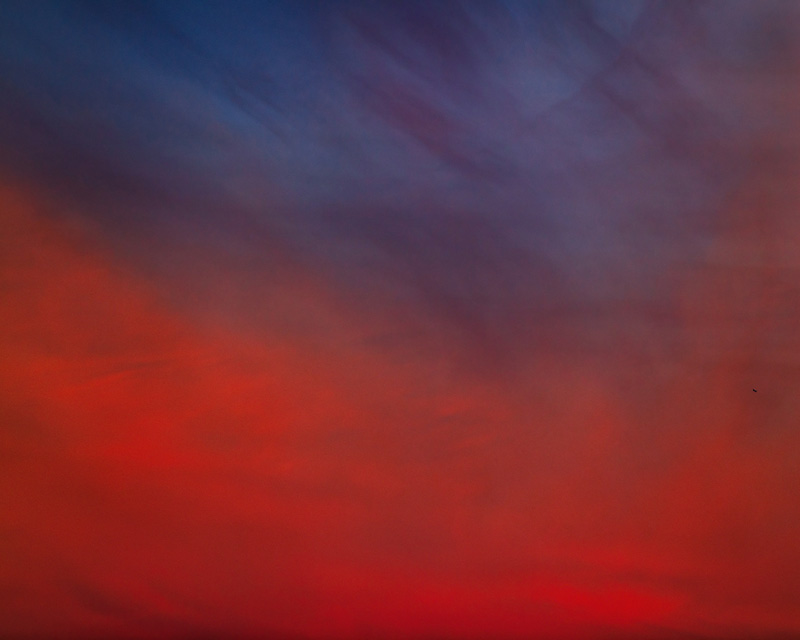
Paglen Untitled (Reaper Drone)

As my last post showed, I hope, my interest in the aesthetic-imaginative has not diminished my commitment to the archival-documentary (or my admiration for projects like these or Oppenheimer’s The Art of Killing that so artfully bleed the one into the other).

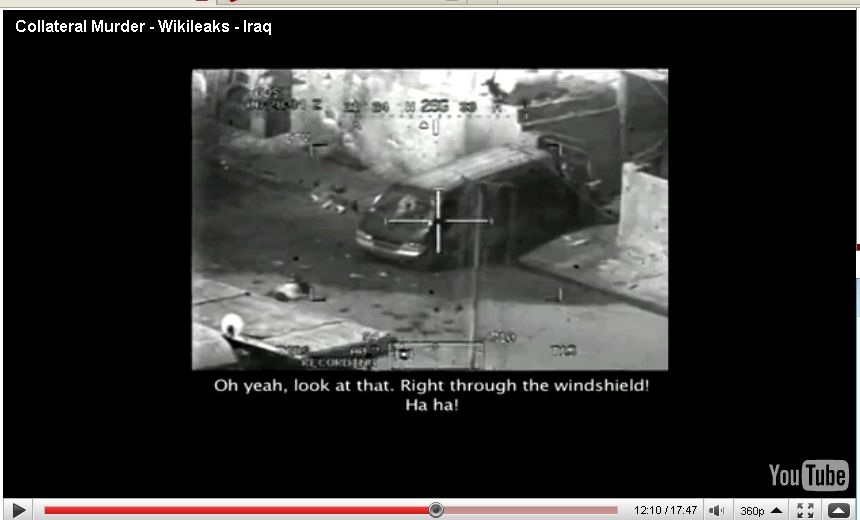
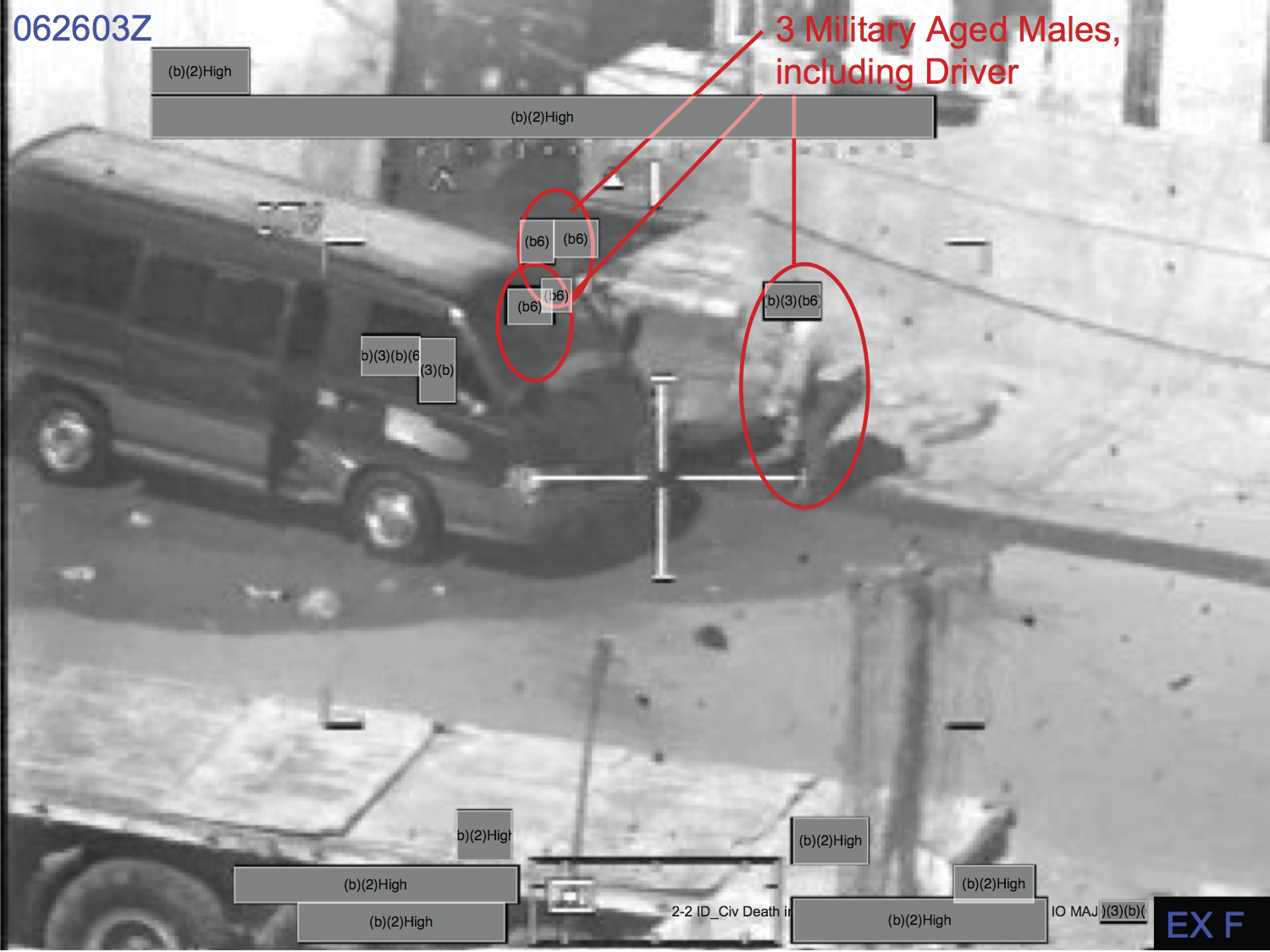
In that vein, I’ve returned to the incident I discussed last time – the US combat helicopter attack on unarmed civilians in New Baghdad in July 2007 – and started to compare what happened there with the even deadlier attack on three vehicles carrying civilians down a dusty mountain road in Uruzgan, Afghanistan in February 2010 which I discussed in “From a view to a kill” (DOWNLOADS tab) (that strike was also carried out by US attack helicopters, but the vital ‘visual responsibility’ was the work of a surveillant Predator crew.)
Collateral Murder2

My intention is to work towards an extended essay on ‘Militarized vision‘ that will, I hope, take critiques of the politics of vision beyond the full motion video feeds from drones. I’m working my way through transcripts of both incidents, the video clip of the Baghdad attack released by Wikileaks, and the military’s own investigations of both incidents.  The interrogations and conclusions from the investigations are crucial, I think, not only for providing additional information and even insight, but also for adding an understanding of the juridical layer involved in the scopic regimes at work.  The reports have much to tell us about what flight crews and ground troops saw (and didn’t see) on the days in question (above) and about what is possible for the military to see (and not see) after the event (below).  I’d already worked my way through the Uruzgan investigation in detail for The everywhere war, but re-reading it alongside what Wikileaks called “Collateral Murder” is proving to be an illuminating exercise.
New Baghdad %22MAM%22

More later, though my next posts on Chamayou (and what will be a separate post on the juridical individuation of later modern war) will provide some of the necessary context.
Amnesia and acts of killing

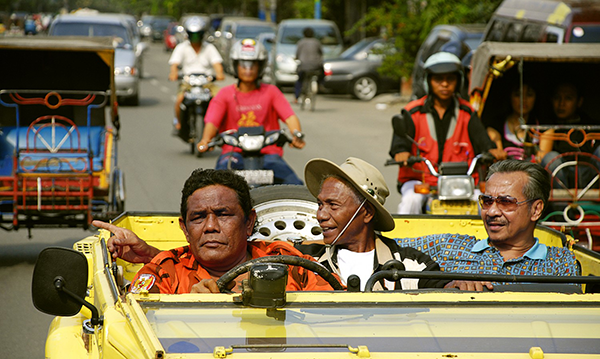
pretext_for_mass_murderI’ve discussed Joshua Oppenheimer‘s The Act of Killing – about paramilitary death-squads in Indonesia in 1965-6 – in an earlier post.  Larry Rohter provided a short backgrounder in the New York Times at the end of last week (much more here):

The events initially addressed in “The Act of Killing” are little known in the West: the slaughter of as many as a million people in Indonesia following the military’s seizure of power there in 1965. The victims were labeled Communists but included labor leaders, ethnic Chinese and intellectuals, with paramilitary groups carrying out the killings at the behest of the Indonesian Army and with the support of the United States and its allies, who worried that Indonesia, like Vietnam, would fall into Communist hands.

In Indonesia, the killings were “a kind of open secret, kept discreetly hidden so that if you wanted to, you could pretend it wasn’t happening,” said John Roosa, a scholar of Indonesian history at the University of British Columbia and the author of “Pretext for Mass Murder,” the leading book about the 1965 massacres. “So this film has become a provocation, an impetus for Indonesians to go back to the perpetrators and say, ‘Tell us exactly what happened.’ ”

Guernica now has a new interview (by Emma Myers) with Oppenheimer in which he talks at length about the background to the film and the process of filming itself:

‘I was developing experimental performative documentary methods in London and was asked to make a film [what would become The Globalization Tapes] by the International Union of Food Workers in a place where unions had been previously outlawed. I could have been sent to India, Colombia, Malaysia… but I was sent to Indonesia. I knew nothing about the country, but found myself in a plantation community outside of Medan. The biggest obstacle the workers had in organizing a union, I found, was fear: fear that stemmed from the fact that their parents, grandparents, aunts, and uncles had had a strong union until 1965, but were accused of being leftists and either killed or put in concentration camps for decades as a result. That was the first I had heard about the 1965-1966 genocide and it was clear to me that it had to be in the film. But even talking about it turned out to be scary for them, because the people who committed atrocities against their relatives were living all around them in this village. So I made the film with the plantation workers but realized I had to come back. I felt very close to this community. They were saying, “Please make a film about the genocide and how it has affected us.” I returned six months later to start working with them and found the process to be unsafe for them; the best way around this was to film the killers—who were much more willing to talk—instead of the victims.’

The Act of Killing

He talks in particular about the performative force of storytelling, the ethics of staging the killers’ fantasies (they were paid a small per diem sanctioned by the Arts & Humanities Research Council), and ends with a wonderfully sharp remark from Werner Herzog (one of his co-producers) about the political possibilities of art.

There’s now also an extended essay by another of the film’s co-producers, Errol Morris, over at Slate, in which he asks: ‘Is this a story about Indonesia or also a story about us?’  His answer takes that little clause in Rohter’s commentary – ‘Indonesia, like Vietnam‘ – and unpacks it to devastating effect.  His journey takes him back to his own film, The Fog of War, to Secretary of Defense Robert McNamara, and to the Vietnam War: the coup in Indonesia, he realises, took place in 1965, the same year that President Johnson escalated the war in Vietnam.  It’s a brilliant road-trip – a mix of interviews and scholarly research, of geopolitical critique and cultural sensibility.

You can see some clips from the film, and hear Herzog and Morris discuss it in this video from Vice.

Finally, there’s a commentary on the film by Slavoj Zizek at the New Statesman here. His starting-point is a familiar one:

The protective screen that prevented a deeper moral crisis was the cinematic screen: as in their real killings and torture, the men experienced their role play as a re-enactment of cinematic models: they experienced reality itself as a fiction. During their massacres, the men, all admirers of Hollywood (they started their careers as controllers of the black market in cinema tickets), imitated Hollywood gangsters, cowboys and even a musical dancer.

Here the “big other” enters: what kind of society publicly celebrates a monstrous orgy of torture and killing decades after it took place, not by justifying it as an extraordinary, necessary crime for the public good but as an ordinary, acceptable pleasurable activity? The trap to be avoided here is the easy one of putting the blame on either Hollywood or on the “ethical primitiveness” of Indonesia. The starting point should rather be the dislocating effects of capitalist globalisation which, by undermining the “symbolic efficacy” of traditional ethical structures, creates such a moral vacuum.

But he then spirals off into his own (I almost wrote ‘magical mystery’) tour d’horizon that ultimately brings The Act of Killing into the intimacy of our own, deeply personal spaces and their (non-)relation to an increasingly eviscerated and compromised public space.

For all that, I much prefer Morris’s take – and I greatly admire his method.  In the end, he asks a series of questions that are not about celebration or banalisation, important though they are, but about amnesia.

Safe bombs and refusing pilots

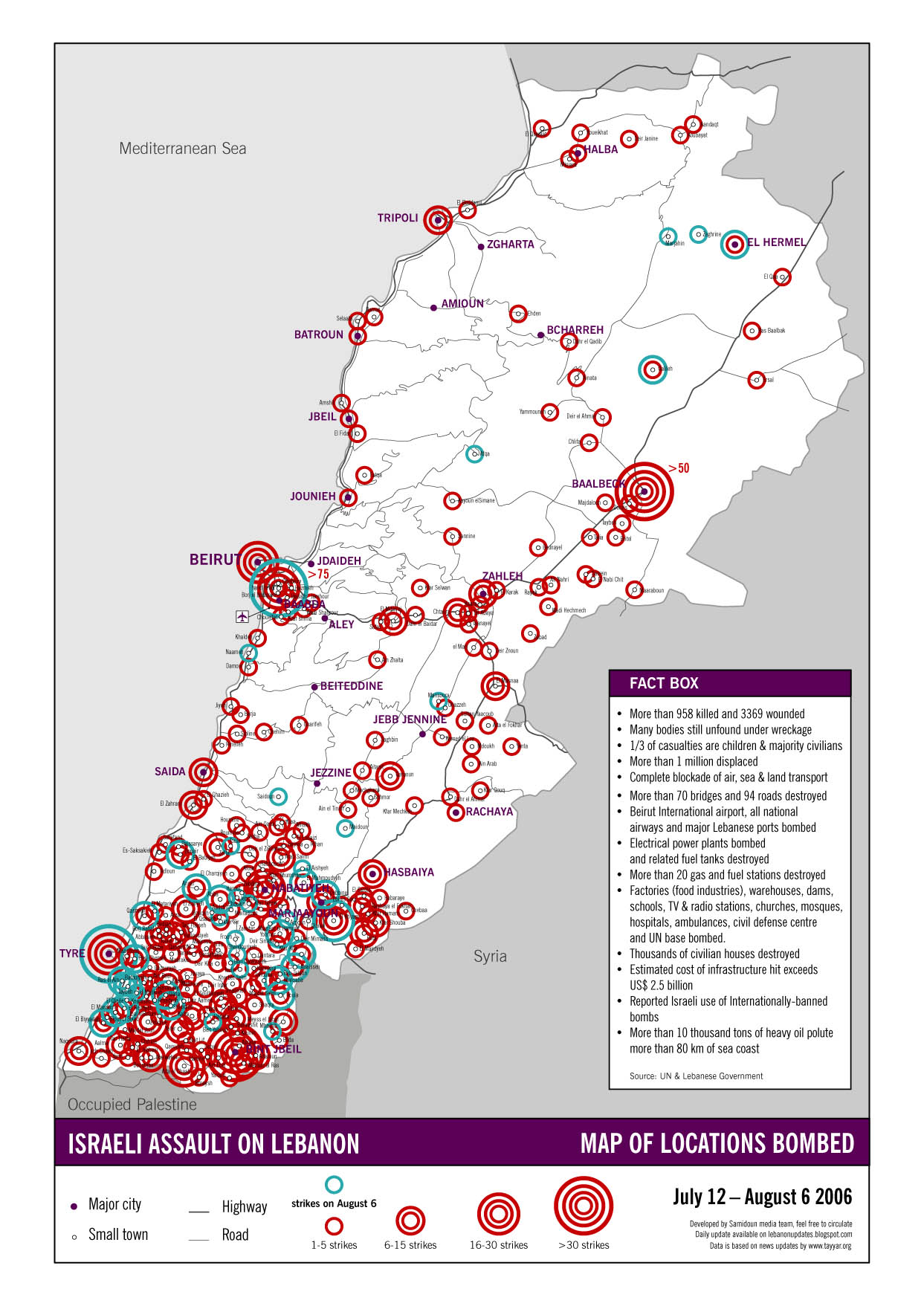
lebanon_map_jul12-Aug06My first attempt to think through the histories and geographies of bombing from the air was, appropriately enough, a plenary address to the Arab World Geographer conference in Beirut in 2006 – a meeting which had had to be postponed until December as a result of Israel’s summer-long attack on Lebanon.  Registrations fell away, especially from the United States and the U.K., but we had a wonderfully lively meeting.

I eventually turned my presentation – which, under the title “The death of the civilian”, developed the twin genealogies of the target and the civilian to address Israel’s bombing of southern Lebanon and Beirut – into an essay for the journal: “In another time zone, the bombs fall unsafely: Targets, civilians and late modern war” (published in 2007: see DOWNLOADS tab).

I began like this:

My title comes from a poem by Blake Morrison, ‘Stop’, which was reprinted in an anthology to aid children’s charities in Lebanon compiled by Anna Wilson after the Israeli assault on that country during the summer of 2006.  The poem speaks directly to the ideology of late modern war – to what Christopher Coker praises as the ‘re-enchantment’ of war through its rhetorical erasure of death– and to its dissonance from ‘another’ time and space where bombs continue to ‘fall unsafely’.  It begins like this:

 ‘As of today, the peace process will be intensified

through war.  These are safe bombs, and any fatalities

will be minors.  The targets are strictly military

or civilian.  Anomalies may occur, but none

out of the ordinary.  This release has been prepared by

official Stop.’

 Morrison perfectly captures the hypocrisy of war – the malevolent twisting of words to mean the opposite of what they say, the cosmetic face of public war put on to conceal the harrowing face of private death – and also the intimacy of the furtive, fugitive relationship between ‘targets’ and ‘civilians’ in late modern war. In what follows, I will try to lay that relationship bare by reconstructing its historical geography.  In doing so, I will also show how our meeting in Beirut to discuss ‘the European-Arab encounter’, less than six months after Israel’s war on Lebanon, must confront the connections between the political and military strategies mobilized during the summer of 2006 and a series of colonial encounters between Europe and the Arab world in the years surrounding the First World War. 

That remains one of the primary motivations for my Killing Space project.

But 2006 was not the first time that Israel had sent its fighter-bombers into the skies over Lebanon.  What I did not know when I prepared my presentation was that during the bloody invasion of Lebanon in 1982 a number of Israeli Air Force pilots had refused to bomb ‘non-military targets’.  Now there is still fierce debate over the distinction between ‘military’ and ‘non-military’ targets, and over the civilian casualties that may nevertheless result from bombing ostensibly ‘military’ targets, both in principle and in practice, and it’s an argument which is conducted on legal and ethical terrains (though we hear much more of the former than the latter).  But here I’m particularly interested in the act of refusal itself: less in the application of abstract, formal principles – important though these are – and more in the personal, rational and affective moment of abjuration.

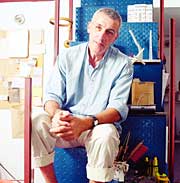
Hagai TamirIn 2002 Ha’aretz published interviews by Avihai Becker with three IAF officers who had formally refused; the testimonies of two of them were already known, but it’s the third that I want to describe here. Hagai Tamir, a major in the IAF, grew up as one of what he calls ‘the lyric pilots’, consummating a love of flight itself:

“I wanted to feel like a bird. The whole idea of the plane as a war machine was much less appealing to me. The concept of a plane as a platform for weapons was foreign to me so I enjoyed the aerobatics much more than I did dropping ordnance. Even during my compulsory service as a young pilot, I didn’t derive any pleasure from it.”

After his compulsory military service and his move to the reserves, Tamir trained as an architect and this enhanced his sense of unease, even disengagement.

“Who knows better than me, an architect, how hard it is to build a city? So at least, don’t rejoice when you destroy houses. It takes a lot longer to build a city than it does to strike a target.”

In June 1982, one week into the invasion of Lebanon, Tamir was flying over the port city of Saida (Sidon), near the Ain El Helweh refugee camp:

“We flew in tandem above the place. The liaison officer who was with the ground forces informed me of the target, a large building on top of a hill. I looked at it and to the best of my judgment, the structure could have only been one of two things – a hospital or a school. I questioned the officer and asked why I was being given that target. His reply was that they were shooting from there. There were a thousand reasons why I didn’t think I should bomb the building. I asked him if he knew what the building was. He said he didn’t. I insisted that he find out. He got back to me with some vague answers.”

Tamir was not satisfied by the response, reported a ‘malfunction’, cut off radio contact and did not release his bombs (on some accounts, he dropped them into the sea).

The episode is significant for several reasons.  The first is that this was an intensely personal decision: Tamir did not publicise it (though the IAF did investigate the incident), and it made no material difference to the outcome since the accompanying aircraft went ahead and levelled the building (which was indeed a secondary school for boys).  Even so, Tamir was not alone; others refused similar orders, and although it’s difficult to gauge how far the ripples caused by these refusals travelled into 2006 and beyond – see Asher Kaufman‘s thoughtful discussion in Shadows of war: a social history of silence in the twentieth century here – twenty years later Tamir did join 24 other active, reserve and retired Air Force officers in signing a public letter refusing to carry out air strikes in occupied Palestine (and who were roundly abused for doing so: see here and more on the Courage to Refuse movement here).

The second is that, even though Tamir confided what happened over Saida only to his family and close friends, the story spread through the town, embellished in the telling and re-telling: so how did the people know, and what significance did they see in it?

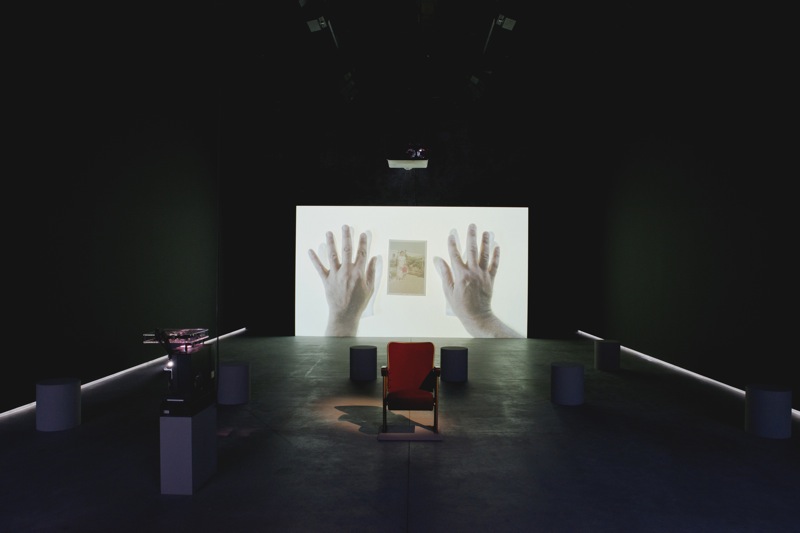
The third is that the story has become the subject of a remarkable multimedia installation by Beiruti artist Akram Zaatari, Letter to a refusing pilot, which is the only artwork representing Lebanon at the 55th Venice Biennale this year.  Zaatari describes himself as

‘an architect, a documentary filmmaker, and an ethnographer working in the art world, so I use the tools and approaches that I have learned from those three disciplines. I have no particular method to apply, otherwise it would make my work too simple. I enjoy reflecting on complex social and political issues particularly related to geographies.’

You can find images and a commentary on the Biennale installation here and here, but Zaatari explains his project like this:

“The importance of the story is that it gives the pilot a human face. It gives what he is about to bomb, which is considered terrorist ground, it also gives that a human face. I think it’s important to remember in times of war that everyone is a human being. Taking it to this level humanizes it completely, and we’re not used to this at all.”

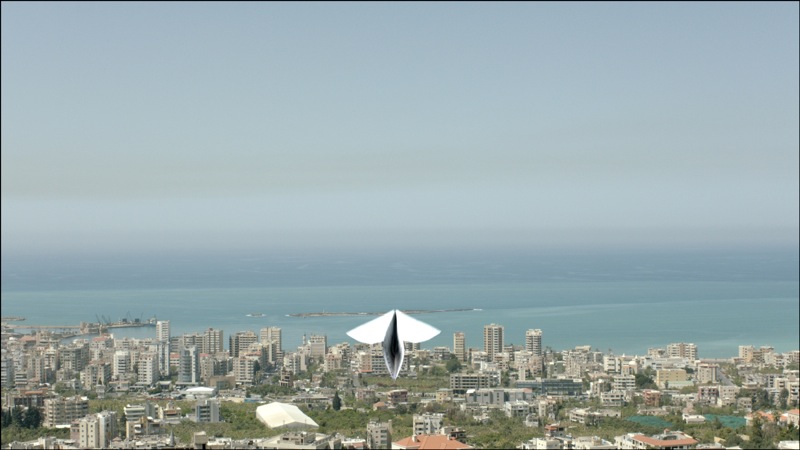
Zaatari was born in Saida – in fact his father founded the school that was the target of the IAF attack – and the film that is the heart of the art-work is, like Tamir’s decision, an intensely personal one whose resonances reach far and wide.  Zaatari met with Tamir, and the film affirms the Israeli pilot’s original impulse to fly: hands draw paper aeroplanes and, at the end of the film, two boys climb up to the roof of the school and launch them into the air.  The film is cut with family photographs and Zaatari’s own diary entries from the invasion too: you can find copies of the film on You Tube starting here.

ZAATARI Letter to a refusing pilot

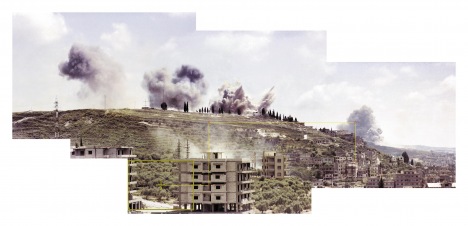
On the opposite wall, separated and joined by a single red cinema seat, another (shorter) film silently projects the hillside overlooking Said being systematically bombed.  The sequence derives from a series of photographs Zaatari took in 1982.

ZAATARI Saida 6 June 1982

From that seat, the viewer is invited to watch only that film, facing away from the more personal, vividly human story being told by the first film.  Negar Azimi provides a fuller discussion of the installation here, and she concludes that ‘by placing each one of us, alone, within the generous frame of the work, it seems to remind us that, not unlike the pilot, we are sometimes caught up in vexed circumstances beyond our control.’ Certainly the title of the work directly addresses the pilot and so, by extension, perhaps the pilot-observer that late modern war has invited those of us who watch wars from a safe distance to become.

5367

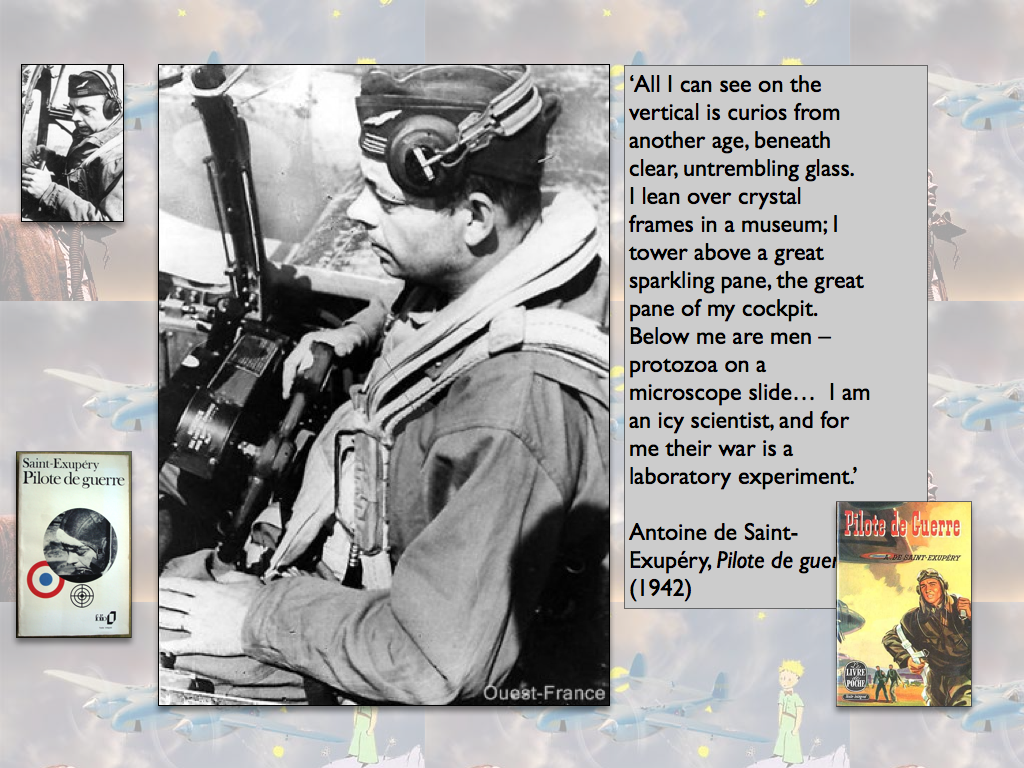
Perhaps.  But this is a multi-layered work, and there are other readings.  Near the beginning of the personal memory-film, and before the title appears on the screen, gloved hands turn the pages of Antoine de Saint-Exupéry‘s The Little Prince, which Negar describes as a ‘much-adored 1943 tale of youthful existentialism’.  The point here, I take it, is to reinforce or reinscribe the acknowledged affinities between Zaatari’s work and Albert Camus‘s Letters to a German friend (“I should like to be able to love my country and still love justice.”)

But, as she also, notes Saint-Exupéry was ‘a famous war-time aviator’, and in that role he had a decidedly different view of things that speaks directly to (or rather from) the object record-film of the bombing:

Saint-Exupéry.001

Much of Zaatari’s work, as he confirms in this exceptionally rich conversation with Chad Elias for the Tate in 2011, asks us to ‘rethink what it means to witness, survive, or even document a war’. With that in mind, in gazing at the image stream of bombs, with our backs to the lifeworld that was also for many a deathworld, is it not possible that we are also being invited from that single red chair to adopt the position of Walter Benjamin‘s Angel of History?

Black spots and blank spots

Over at Guernica, Trevor Paglen has a short essay on the rise of what he calls ‘the terror state’ that connects the dots between several recent posts:

For more than a decade, we’ve seen the rise of what we might call a “Terror State,” of which the NSA’s surveillance capabilities represent just one part. Its rise occurs at a historical moment when state agencies and programs designed to enable social mobility, provide economic security and enhance civic life have been targeted for significant cuts. The last three decades, in fact, have seen serious and consistent attacks on social security, food assistance programs, unemployment benefits and education and health programs. As the social safety net has shrunk, the prison system has grown. The United States now imprisons its own citizens at a higher rate than any other country in the world.

While civic parts of the state have been in retreat, institutions of the Terror State have grown dramatically. In the name of an amorphous and never-ending “war on terror,” the Department of Homeland Security was created, while institutions such as the CIA, FBI and NSA, and darker parts of the military like the Joint Special Operations Command (JSOC) have expanded considerably in size and political influence. The world has become a battlefield—a stage for extralegal renditions, indefinite detentions without trial, drone assassination programs and cyberwarfare. We have entered an era of secret laws, classified interpretations of laws and the retroactive “legalization” of classified programs that were clearly illegal when they began. Funding for the secret parts of the state comes from a “black budget” hidden from Congress—not to mention the people—that now tops $100 billion annually. Finally, to ensure that only government-approved “leaks” appear in the media, the Terror State has waged an unprecedented war on whistleblowers, leakers and journalists. All of these state programs and capacities would have been considered aberrant only a short time ago. Now, they are the norm.

This ought to be depressingly familiar stuff, though it is important to connect those dots.  I highlight Trevor’s argument here (which radiates far beyond the paragraphs I’ve extracted above) for two reasons.

PAGLEN BLank Spots on the MapFirst, the practices that Trevor disentangles work through distinctively different geographies, at once material and virtual. Trevor’s own work addresses different dimensions of what he’s also called the Blank Spots on the Map – here definitely be dragons! though there’s a delicious irony in the US finding Edward Snowden’s whereabouts (at least this morning) to be one of them. There’s some small comfort to be had in the raging impotence of the state apparatus, which is evidently neither all-seeing nor all-knowing.  As part of his project, Trevor has done much to bring into (sometimes long-distance) focus the prying eyes of the ‘terror state’ – see for example here – but I’m particularly interested in the differential modalities of ‘watching’ and ‘acting’.  The US Air Force has become preoccupied with the predicament of ‘swimming in sensors, drowning in data‘, for example, which makes it exceptionally difficult to convert its enhanced capacity for intelligence, surveillance and reconnaissance into focused strikes and, as I noted earlier, this is only one version of a wider divergence outlined by Peter Scheer:

The logic of warfare and intelligence have flipped, each becoming the mirror image of the other. Warfare has shifted from the scaling of military operations to the selective targeting of individual enemies. Intelligence gathering has shifted from the selective targeting of known threats to wholesale data mining for the purpose of finding hidden threats.

The resulting paradigms, in turn, go a long way to account for our collective discomfort with the government’s activities in these areas. Americans are understandably distressed over the targeted killing of suspected terrorists because the very individualized nature of the drone attacks converts acts of war into de facto executions — and that in turn gives rise to demands for high standards of proof and adjudicative due process.

Similarly, intelligence activities that gather data widely, without fact-based suspicions about specific individuals to whom the data pertain, are seen as intrusive and subject to abuse.

TREVOR PAGLEN Keyhole 12-3 Optical reconnaissance satelliteThis is an interesting suggestion, a simple schematic to think with, and at present I’m working through its implications (and complications) for other dimensions of later modern war – specifically the geographies of cyberwarfare that I briefly outlined in my early essay on ‘The everywhere war’ (DOWNLOADS tab).  So for the book I’m splicing  cyberwarfare into the now explosive debate over surveillance in cyberspace, and the transformation of James Gibson‘s Fordist version of ‘Technowar’ into its post-Fordist incarnation.  In a report for Vanity Fair Michael Joseph Gross calls cyberwarfare ‘silent war’ and ‘war you cannot see’, and yet it too (as Trevor’s work implies) is material as well as virtual, not only in its consequences but also in its very architecture: see, for example, here and here (and the wonderful graphic that accompanies the report).  So, with patience, skill and effort, it can indeed be seen.  And, contrary to Thomas Rid‘s Cyber war will not take place (2013), there is a crucial sense – one which my dear friend Allan Pred constantly emphasised – in which these capacities and activities do indeed take place… More soon.

There’s a second reason for noting Trevor’s essay (he was, not incidentally, a student of Allan’s): it originates from Creative Time Reports edited by Marisa Mazria Katz:

Creative Time Reports strives to be a global leader in publishing the unflinching and provocative perspectives of artists on the most challenging issues of our times. We distribute this content to the public and media free of charge.

Asserting that culture and the free exchange of ideas are at the core of a vibrant democracy, Creative Time Reports aims to publish dispatches that speak truth to power and upend traditional takes on current issues. We believe that artists play a crucial role as thought leaders in society, and are uniquely capable of inspiring and encouraging a more engaged and informed public, whether they are addressing elections or climate change, censorship or immigration, protest movements or politically motivated violence.

In an era of unprecedented interconnectedness, Creative Time Reports provides artists with a space to voice analysis and commentary on issues too often overlooked by mainstream media. We believe in the importance of highlighting cultural producers’ distinctive viewpoints on world events and urgent issues of social justice to ensure a livelier, more nuanced and more imaginative public debate.

Given everything I’ve said about the importance of the arts to creative critical research the relevance of this will, I hope, be obvious: art not simply as a means to represent the results of research but rather as a medium through which to conduct research.  Good to think with, as Lévi-Strauss might have said, but also good to act with.  (More on Creative Time here; they are holding a ‘summit’ on Art, Place and Dislocation in the 21st Century City in New York, 25-26 October 2013).

Drones.

The Center for the Study of the Drone at Bard College has just posted video of a performance work “Drones.” developed by undergraduates at the College in March this year.  The Center was established in 2012 by Arthur Holland Michel, Daniel Gettinger, and a group of faculty members including Thomas Keenan, Gregory Moynahan, Roger Berkowitz, Maria Cecire, Peter Rosenblum, and Keith O’Hara:

The Center for the Study of the Drone is an interdisciplinary research and art community working to understand unmanned and autonomous vehicles. By bringing together research from diverse academic and artistic perspectives which have, up until now, remained fairly silent on the issue, we aim to encourage new creative thinking and, ultimately, inform the public debate. We want to encourage dialogue between the tech world and the non-tech world, and explore new vocabularies. This is an online space for people to follow the latest news, encounter disparate views, access good writing and art, find resources for research, and engage a diverse community of thinkers and practitioners with the shared goal of understanding the drone.

“Drones.” was created by Rose Falvey, Riley Destefano DeLuise, Julia Wallace, Christina Miliou-Theocharaki, Eamon Goodman, Megan Snyder, and Catalin Moise.  Here’s the video (the music is Massive Attack’s Paradise Circus [Zeds Dead Remix]):

The Center’s website explains:

‘What the video captures best of all is the enormous influence that drones play on our imagination. Except for the name, the video makes no overt references to drones. And yet, the name alone frames the video so that every image, every movement, is connected in the viewer’s mind to UAVs, targeted killing, aerial bombing. Because of the context, the video becomes parody, dialogue, debate, and protest. The piece exercises a kind of restraint and subtlety that is absent from much of the public discourse; and yet,  ”Drones.” forcefully demonstrates the impact of the idea of the drone on aesthetic vocabularies.’

See what you think.

Drones and the Quiet Americans

quiet-disposition

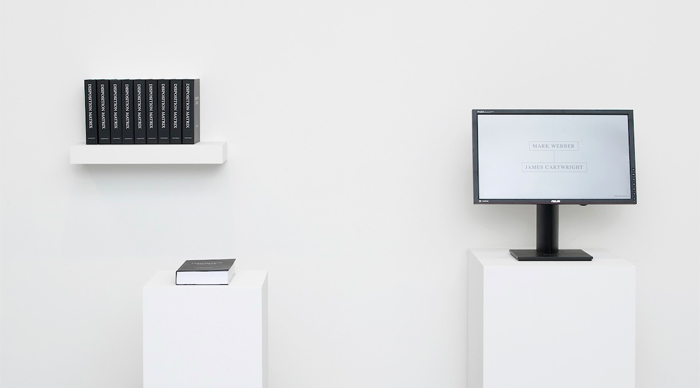
Following on from the Coded Conduct exhibition in London in April, James Bridle’s new work A Quiet Disposition opens at the Corcoran in Washington DC later this month, running from 19 June to 7 July.  He explains the background to his ongoing project on networked technologies and the in/visibility of military violence like this (my emphases):

“The Disposition Matrix” is the term used by the US Government for its intelligence-gathering and targetting processes. Overseen by the National Counterterrorism Center and in development for some time, the Matrix is usually described as a database for generating capture and “kill lists”, but the criteria for both adding to and acting on the information in the database is not public. One of the outcomes of the process is the ongoing, undeclared CIA drone war in Pakistan, Yemen and elsewhere. These attacks have killed an estimated 3105 people in Pakistan alone since June 2004, including 535 confirmed civilians and 175 children. (Sources: The Bureau of Investigative Journalism, New America Foundation.)

The architectural theorist Keller Easterling uses the term “disposition” in other contexts, to refer to the propensity or temperament of forms which produce actions. Disposition is found not in activity itself, but in the relationships or relative positions of the objects that produce action. Consider a motorway: you can describe the movement of the cars, but the active form is immanent in the concrete itself; the motorway has a disposition. If such forms can be said to have a disposition, to what extent can they be said to possess agency?

For Easterling, architectures and infrastructures perform aspects of their being: not merely spatial objects, they shape the world around them on many levels: legal, political, technological. The sociologist Erving Goffman in turn uses the term “disposition” to describe the entire performance, including – in human terms – gesture, posture, expression and intent. These subtexts are capable of overwhelming what is being merely said: the distinction between the aesthetics of what is being depicted, and what is actually being done.

Drones – the armed, unmanned planes in action around the world – are dispositional. Their significance is not wholly in their appearance, but in how they transform the space around them; both the physical space (the privileged view of the weaponised surveillance camera at 50,000 feet) and the legal, national and diplomatic spaces that as a result permits new kinds of warfare and assassination. And the Disposition Matrix is an organising principle: not a thing, not a technology, not an object, but an active form, a reorientation of intent into another dimension or mode of expression. In another sense, the Disposition Matrix is the network itself, the internet and us, an abstract machine, intangible but effective. Finally, the Disposition Matrix is an attitude and a performance.

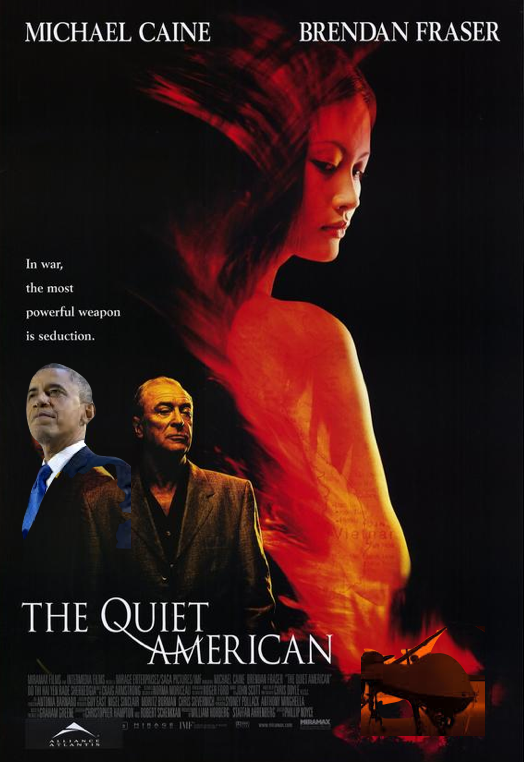
Quiet AmericanAnd the quiet disposition?  The central insight that animates much of James’s recent work around the New Aesthetic is, as he says in the lecture posted below, that ‘drones … shorten time and space very effectively but instead of using those same networked technologies to make things clearer or to bring empathy they use it to obfuscate and hide.’  You can see this – or rather not see it – in the extraordinary secrecy that cloaks so many of the sites of air attack.  160 years after the dawn of mass-mediated warfare, it is (as he says) sobering to think that we know less about what is happening in Waziristan today than the British public knew about the campaign in the Crimea. Hence Dronestagram and similar projects.  Even though the drone ‘has almost become synonymous with America and with a certain way of prosecuting war’, however, James prefers to see drones as shells or, better, prostheses, ‘extensions of  the network itself’.  For this reason The Quiet Disposition seeks to turn the network on itself, a sort of auto-immune cyberattack, through an intelligence-gathering software system (like the Obama administration’s ‘disposition matrix‘) that lives online, constantly scanning the web for reports about the drone programme and using AI to effect connections between them.

War tourism

531852_10152763437810085_650007389_n

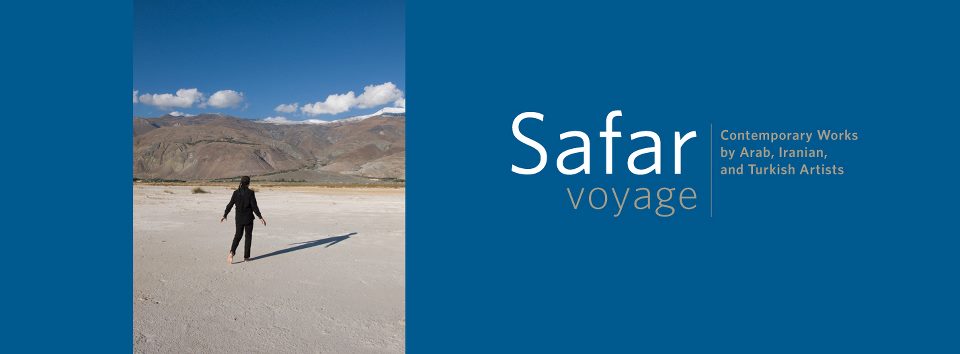
I spent part of the week-end at UBC’s Museum of Anthropology, which is currently hosting Safar/Voyage: contemporary works by Arab, Iranian and Turkish artists (until 15 September).  I’d written an essay for the accompanying catalogue – “Middle of What?  East of Where?”, which you can find under the DOWNLOADS tab – and I was at MOA on Saturday afternoon for a lively and appropriately wide-ranging public conversation (billed as a”Global Dialogue”) on “Nomadic aesthetics and the importance of place” with Jian Ghomeshi, artist Jayce Salloum and curator Jill Baird.

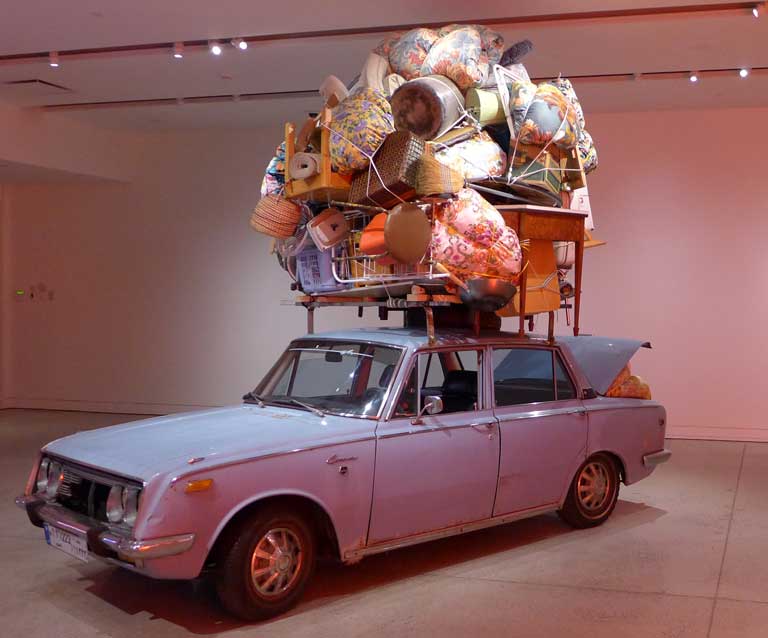
destinationx1While I was at MOA I spent some time with the artworks on display and in the company of a brilliant app that provides all sorts of information and context; for such a compact exhibition they are thrillingly diverse, speaking to one another in a multiplicity of ways, and disrupting common stereotypes of the region as somehow homogeneous.  Two exhibits are likely to be of particular interest to readers of this blog.  The first, artfully parked outside the second, is Lebanese artist Ayman Baalbaki‘s Destination X (originally 2010, but recreated for MOA in 2013):

Destination X is an old car piled high with the hastily gathered belongings of a refugee family: luggage, everyday objects, and colourful cloth bundles tied to the roof. During the Lebanese civil war these floral fabrics, regional and postcolonial at the same time, replaced fabrics embroidered with local peasant motifs, mirroring the lost agricultural “paradise.” The overloaded car suggests movement and absence, urgency and wandering. The letter X symbolizes forced flight into exile to places unknown. Distance is swallowed in an aimless journey, when time and duration become vague. The journey and its hardships, the risk of leaving home, the difficulty of resettling.

You can find images of earlier versions here, where the artist explains that, while the work had its origins in the Lebanese civil war, it speaks to many other situations and peoples: “Other nationalities can sympathise…Many of the elder generations, it echoes with them…either from Bosnia or from World War II.”

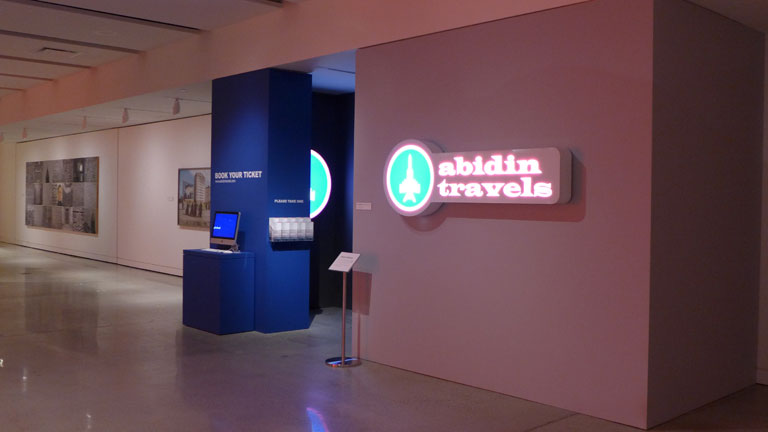
ATinstallThe second is Adel Abidin‘s mixed-media installation, Abidin’s Travels (2006), set up as a travel agent’s office, complete with posters, brochures and video, and its nemesis (a website: how many travel agents are there these days?)

I came up with the idea when I visited Iraq in 2004 and was greeted at a checkpoint by an American soldier, who said, “Welcome to Baghdad!” I realized I was being welcomed by an occupier of my own city. This experience made me think about cities in war and their messy transformations.

After the occupation and gentrification of a city in a conflict zone, you would need a guide, even if you grew up there. This is what I saw happening in Baghdad. So I created a travel agency, using “holiday travel” as a point of departure and Iraq as a destination, to explore the idea of tourism and consumerism in general, and how these generic models break down when applied to a country ripped apart by war. I created this work to draw attention to the new Iraq, “the democratic Iraq,” a mythical place where, in reality, possibility and opportunity barely exist.

You can find a short, interesting commentary by Laura Marks here.

longstillset

Baghdad has obviously changed in the last six or seven years, but in case you think tourism has been ‘normalised’ check out Wikitravel‘s current guide, which reads as though it was written by the artist (“The easiest way to stay safe in Baghdad is not to go there in the first place”).  Still more revealing, look at the hotel reviews (yes) on Trip Advisor here.  Like all reviews on the site, they tell you as much about the reviewer as they do the place – I was particularly taken by this review of one hotel, which was never far from the headlines during the invasion and occupation, and which displays what I hope is a rare sensitivity to the lot of ordinary people in Baghdad:

The problems start with the lack of amenities. The pool wasn’t fit to swim in, the hotel doesn’t have a bar, there isn’t a gym, nothing. The service was appalling. The food was always cold & generally dreadful, the bathrooms are fitted out with full bottles of head and shoulders, Colgate, dove soap, bic razors and gilette shaving foam. There is no room service, no laundry service and all that for $300 a night….One plus. It’s safe, which is saying something for Baghdad…

Not much global dialogue there then.

Situational awareness

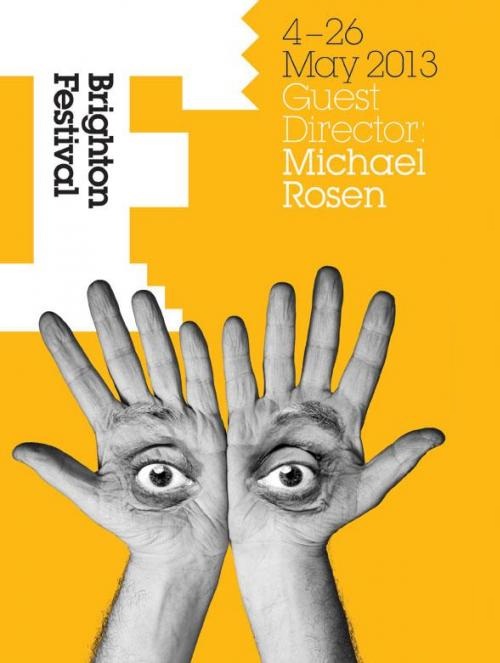
brighton-festival-2013Two art projects from Lighthouse at the Brighton Festival in the UK this month (4-26 May); thanks to Sam Hind for the information.

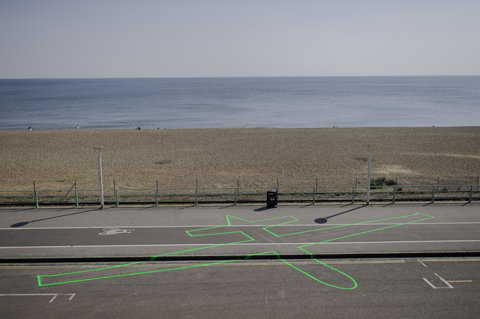
 James Bridles work will be familiar to most readers, and in Brighton he’s reprising his Under the shadow of the drone, which is a true-to-scale rendering of a Reaper, this time on the seafront:

The stark marking out in an unexpected public space of a Reaper drone’s silhouette brings the reality of these technologies into our daily lives. The work critiques the way that contemporary networked technologies, while enabling the digitally saturated culture of the 21st century, can also obscure and distance us from political and moral responsibility.

Bridle explains:

“Drones are just the latest in a long line of military technologies augmenting the process of death-dealing, but they are among the most efficient, the most distancing, the most invisible. These qualities allow them to do what they do unseen.

“We all live under the shadow of the drone, although most of us are lucky enough not to live under its direct fire. But the attitude they represent – of technology used for obscuration and violence; of the obfuscation of morality and culpability; of the illusion of omniscience and omnipotence; of the lesser value of other people’s lives; of, frankly, endless war – should concern us all.”

And Lighthouse adds: ‘By superimposing a large-scale drawing of the shadow of a drone in an urban location in Brighton, Bridle brings these chilling machines uncomfortably close to us, embedding them into our daily lives, and in the process perhaps making the reality of the daily occurrence of deadly drone strikes more tangible.’

BRIDLE Under the shadow of the drone, Brighton

For me, some of Bridle’s other projects – like Dronestagram – are more effective in bringing the strikes (rather than the technology) down to earth and into the spaces of everyday life, but it’s still an arresting project.  Size and scale matter; I remember visiting the RAF Museum at Hendon and being truly astonished at how small a Lancaster bomber was – and yet how vast the bomb door in its belly.  If you’re in Brighton, you can find Bridle’s rendering 5 minutes/500 metres walk east from the Brighton Wheel on Marine Parade, towards Yellowave Beach Sports Venue; then look down to Madeira Drive.

primary-1

The second is Mariele Neudecker‘s The air itself is one vast library (a quotation from Charles Babbage), originally shown in 2010:

… an exhibition of startling images that explore the disturbing, and often invisible, technologies of war. In dramatic contrast with her more familiar depictions of landscape and the sublimity of nature, this highly topical study brings us face to face with weapons of mass destruction.

Neudecker’s artistic strategy is rooted in ‘ground truth’, a term used in remote sensing to describe data collected on location. Works created whilst on site at the historic Nike missile facility in the US are emblematic of Neudecker’s determination to go beyond mere representation. Her extraordinary graphite rubbings of vast Hercules missiles physically capture the object, making what is otherwise abstract and monstrous, tactile and present. Other works investigate military imaging and tactical communication, which provide us with new ways of detecting what is intended to be camouflaged and out of view.

You can see this at Lighthouse, 28 Kensington Street, Brighton, and preview images here.

For more on artworks, invisible military technologies and ‘geographies of seeing’, I thoroughly recommend honor harger‘s excellent reflections on Unmanned Aerial Ecologies here, which includes a series of brilliant images and commentaries on the work of Trevor Paglen and Marko Peljhan.  The latter is new to me and very interesting: the title for this post is taken not only from the military, which is appropriate enough, but also from one of Peljhan’s projects featured in honor’s essay.

Where Souls Dwell

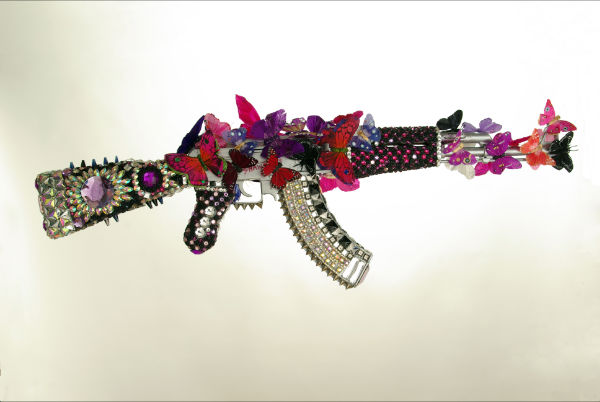
Laila Shawa: Where souls dwell 4

I’ve had a message from Laila Shawa, whose work I noted earlier, enclosing one of her latest projects (and generously allowing me to show her work here).  Where Souls Dwell (above) is from her Gun series and speaks directly to one of my very first posts (on the arms trade); it shows the AK-47, and Leila explains it like this:

Next to Drones, this gun is the biggest killing machine in the World. Due to its cheap production by everyone, it is in the hands of everyone, including children!! The Butterflies (in World mythology) represent the souls killed by this gun, and their return to the place (or cause) of their death.

I provided a brief bibliography of work on the AK-47 and the trade in ‘small arms’ in my original post, but I wasn’t aware of the way in which artists had engaged with this deadly weapon.  Last September Laila’s work was featured as part of the AKA Peace Exhibition at the Institute for Contemporary Art in London.

The exhibition was conceived by an ex-soldier who challenged 23 contemporary artists to incorporate decommissioned AK-47 assault rifles into their work. You can see some of the results, including those by Antony Gormley and Damien Hirst, here, here and here.  Laila adds:

“The challenge of altering and removing the raison d’êtres of an AK-47 is irresistible. I turned my guns into jewelled objects that can only be useless!!! In no way was I trying to glorify lethal weapons that are responsible for the death of hundreds of thousands of people.

I feel that artists must speak out against the arms race, wars, and the Arms Industry,which drives countries to create unnecessary wars.

According to mythology, the souls of people killed return as butterflies to the place where they were killed. The butterflies in this work represent those souls. 

My first AK-47, was commissioned by Peace One Day, a peace organization under the patronage of the United Nations, and was exhibited at the ICA London in October 2012 under the title ‘AKA Peace.’ Later it was sold in a public auction to raise money forPeace One Day. 20 British artists participated in this show amongst which were Damien Hirst, Anthony Gormley, Gavin Turk and the Chapman Brothers. The AK-47 (Kalashnikov) is the most produced gun in the world, in various versions. There are over 200 million AK-47s in circulation, quite often, and most irresponsibly, in the hands of children.”

There are many implications arising from all this – the most direct, of course, about these killing machines.  But these interventions also underscore the need for those of us working in the humanities and social sciences to engage with the work of creative artists, not only as critics and commentators but also as interlocutors interested in exploring other media in which to develop our arguments.

Dronesong

shawa-cast-lead‘In 1990,’ Palestinian pop-artist Laila Shawa recalls, ‘I had breast cancer.’

While undergoing radiotherapy, I watched on television the precision bombing of Baghdad by US airplanes, forever linking the two events in my mind and in my art. The body woman and the body land amalgamate; the invasion of one is equated with the invasion of the other and the implicit fact that both leave scars.”

Jo Long made a parallel, beautifully nuanced argument in her ‘Border Anxiety’ essay in Antipode in 2006, but you can literally see what Laila Shaw means in the extraordinary Cast Lead (2011; above left).

Laila is probably still best known for her silkscreen cycle Walls of Gaza (1992-95)a different take on graffiti to most geographers’, since she insists that the situation was unique:

I believe the Gaza Graffiti differs completely from urban graffiti that one sees in big cities around the world. In Gaza, graffiti on the wall was the only method available to Palestinians to communicate with each other. The Israeli occupiers banned any form of media in Gaza, such as newspapers, radio, or television. The writing is cursive, spontaneous and hurried. It changed almost daily to update whatever was happening in Gaza.

In the Walls cycle she juxtaposed images of Palestinian children and graffiti from Gaza to expose the trauma of war and occupation, a theme to which she returned in Target (2009), a variation on an iconic panel from Walls, in which a photograph of a young child is superimposed against a graffiti-covered wall with a cross-hair centred on his face.  ‘War deprives children of their childhood,’ she says.

Much of her work depends on mixed media juxtapositions like this, which she mobilizes to brilliant effect. She explains:

‘Today, when we are desensitized by the surfeit of media violence, new strategies are needed to overcome people’s apathy and weariness for compassion.’

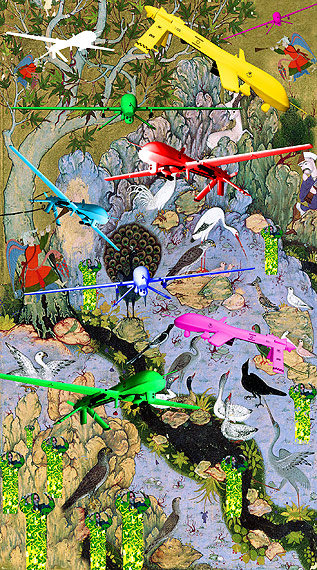
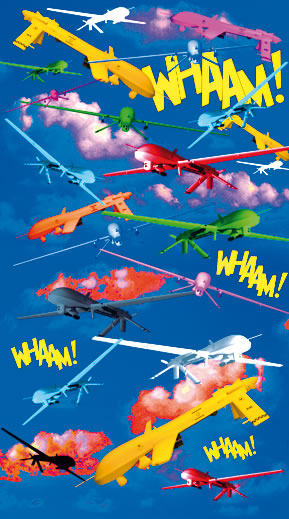
Last year she had an exhibition at London’s October Gallery, The Other Side of Paradise, which was in part provoked by a documentary on a female suicide bomber but which also included the extraordinary images shown below, Birds of Paradise and Gaza Sky, which speak directly to my previous post about other ways of visualizing drones.

SHAWA Birds of Paradise

SHAWA Gaza Sky

Laila was born in Gaza, but Gaza Sky strikes me as problematic; Israel doesn’t use Predators, so far as I know, but manufactures its own Heron drones and leases/sells them to other states.  Still, the image captures occupied Palestine since – for me – the reference isn’t only to Roy Lichtenstein‘s Whaam but also to Mahmoud Darwish‘s moving poem The earth is closing on us (which Edward Said used for his collaboration with Jean Mohr, After the last sky):

Where should we go after the last border? Where should the birds fly after the last sky?

I’m left wondering about how to draw together my first and last paragraphs – how to bring these ‘birds’ and the bodies on which they feed into the same frame.  This isn’t a compositional problem for my writing; it’s a political-aesthetic one.  So I start to think about Laila’s Target again.  For The social life of bombs, I plan to end the performance-work with a back-projected image of three children asleep under a checkered counterpane; all you you can hear is the rhythmic sound of their breathing.  As the camera moves in, it becomes clear that each checkered square is in motion; the sound gets louder.  Closer still, and each square becomes a video feed from a drone. Closer still, and one square fills the whole screen: the compound in which the children are sleeping, seen from high above (and far away).  By now the sound of breathing is incredibly loud; suddenly, an even louder explosion.  When the smoke clears, the sound dies away, and the lights slowly come up, we see three small figures, clutching the remains of their bedding – a re-staging and reworking of Noor Behram‘s to me iconic photograph of the three Bismullah children, the sole survivors of a drone strike in Waziristan.  But it could, of course, be Gaza.  Or Yemen.  Or Somalia…