The optics of urban ruination

Ishikawa Kōyō

News from David Fedman of a new article co-authored with Cary Karacas, ‘The optics of urban ruination‘, which complements their previous, vital work on the cartographic imaginary of bombing.  It’s published in the Journal of Urban History but you can access it here.

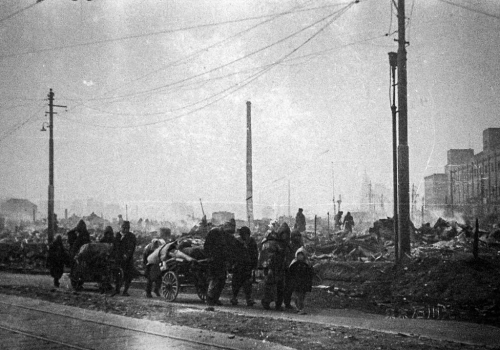
World War II yielded many photographs of bombed-out cities. In this paper we telescope between two sets and scales of images that represent the principal frames through which the American and Japanese publics have memorialized the incendiary bombings that laid waste to urban Japan: aerial photographs taken by the US Army Air Forces during its wartime planning, prosecution, and assessment of the raids; and the ground-level images captured by Ishikawa Kōyō, a photographer working on behalf of the Tokyo Metropolitan Police. By means of a detailed examination of the production, circulation, and consumption of these photographs— what some scholars have called an “archaeological approach” to images of ruination—we explore not only the visual rhetoric and reality of the destruction of Japan’s cities, but also how that destruction is situated in history, memory, and visual culture.

As always with their work, it’s exquisitely written, intellectually savvy and a very powerful argument.  They juxtapose the photographic ‘view from above’ that was instrumental in the planning and execution of the American air raids with Ishikawa Kōyō’s ground-level perspective.  His work is virtual unknown outside Japan and yet, as they say, has become ‘the principal visual testimony in Japan for public memory of the incendiary air raids as they were experienced on the ground’:

What followed were, according to Ishikawa, scenes from hell. His detailed account of that evening indeed repeatedly invokes infernal metaphors to describe Tokyo’s destruction. The “demon’s wings”(akuma no tsubasa) rained fire that carbonized corpses which “flowed through the streets like rapids.”  The elements also conspired against the city to whip up the red winds (akakaze) that fanned the firestorms: “immense incandescent vortices,” he wrote, “rose in a number of places, swirling, flattening, sucking whole blocks of houses into a maelstrom of fire.”

Widespread chaos, intense heat, and the realization of the need to save his own life pre-vented Ishikawa from taking any photographs. His Chevrolet destroyed by flames, he slowly made his way on foot back to the Metropolitan Police Headquarters. After resting his fatigued body, at around 2 P.M. on March 10 Ishikawa set out to document the aftermath. He saw bodies “piled like mountains” (shitai no yama o kizuiteita) and corpses burnt to the point that “you could no longer discern the sex of the body” (danjyo no kubetsu mo tsukanai shitai).

Ishikawa first told himself not to photograph such upsetting images, but then, recalling his responsibilities to capture the “reality of the scenes,” he began to snap the shutter.That day Ishikawa took thirty-three photographs of the aftermath of what came to be called the Great Tokyo Air Raid.

You can find more at Japan Air Raids, a brilliant bilingual archive, and a (harrowing) selection of Ishikawa’s images here.  If you do click on that link, heed their warning:

While photographs such as [these] provide an intimate sense of the bodily pain that was inflicted by the firebombing, they also require much of the viewer. It is one thing to look at such photographs; it is another thing altogether to comprehend or attach meaning to the actual suffering it exposes.

And – do I have to say this? – it’s worth thinking about other scenes of urban ruination.

Legitimate targets?

I’ve been thinking about the description of Gaza as a space of exception in my last post, and I will elaborate (and qualify) that discussion shortly: in many ways the Israeli offensive against Gaza reinforces Achille Mbembe‘s arguments about necropolitics but, as I’ll try to show, suggests the need for a reworking of Giorgio Agamben‘s claims about the exception.

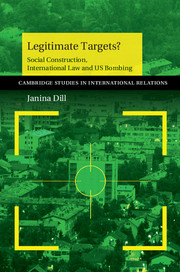
En route, I’ve been greatly taken by the work of Janina Dill (Politics and International Relations, Oxford) – particularly her discussion of Israel’s development of ‘Lawfare 2.0’ in relation to Gaza – and, as I say, I’ll have much more to say about that shortly.  But I’ve also discovered she has a book due out from Cambridge in the fall which, like her (I imagine summary) chapter in The American Way of Bombing, speaks to my own work on genealogies and geographies of bombing: Legitimate Targets? Social construction, international law and US bombing.

DILL Legitimate targets?Based on an innovative theory of international law, Janina Dill’s book investigates the effectiveness of international humanitarian law (IHL) in regulating the conduct of warfare. Through a comprehensive examination of the IHL defining a legitimate target of attack, Dill reveals a controversy among legal and military professionals about the ‘logic’ according to which belligerents ought to balance humanitarian and military imperatives: the logics of sufficiency or efficiency. Law prescribes the former, but increased recourse to IHL in US air warfare has led to targeting in accordance with the logic of efficiency. The logic of sufficiency is morally less problematic, yet neither logic satisfies contemporary expectations of effective IHL or legitimate warfare. Those expectations demand that hostilities follow a logic of liability, which proves impracticable. This book proposes changes to international law, but concludes that according to widely shared normative beliefs on the twenty-first-century battlefield there are no truly legitimate targets.

Introduction
Part I. A Constructivist Theory of International Law:
1. The challenge
2. The theory
Part II. The Definition of a Legitimate Target of Attack in International Law:
3. Positive law
4. Customary law
Part III. An Empirical Study of International Law in War:
5. The rise of international law in US air warfare
6. The changing logic of US air warfare
7. The behavioural relevance of international law in US air warfare
Part IV. An Evaluation of International Law in War:
8. The lack of normative success of international law in US air warfare
9. The impossibility of normative success for international law in war
Conclusion.

The Death Zone

9780804778336I’ve praised Laleh Khalili‘s Time in the shadows before, and Jadaliyya has now reprinted an excerpt that is of renewed urgency in the face of the Israeli assault on Gaza.  Laleh explains:

I wrote Time in the Shadows in order to puzzle out why the counterinsurgency practices of enormously powerful state militaries—the US and Israel at the time I was writing the book—so often invoked law and humanitarianism, rather than naked force. And why so much of their war-fighting pivoted around the mass confinement not only of combatants but civilians. I was also struck by the similarities in the practices of confinement not only between Israel and the US but with historical accounts of colonial confinement effected by Britain and France.

For me, what was striking, insidious, devastating, was the less flashy, less visible, practices that were foundational to detention of suspected combatants and incarceration—whether in situ or through resettlement—of troublesome civilians. These practices—law, administration, demographic and anthropological mapping, offshoring—all sounded so dry, so rational, and yet they were grist to the mill of liberal counterinsurgents in so many ways. And the other similarity across a century and several continents seemed to be the repetition ad nauseam of the language of “protection” and of “security” to frame or rename or euphemise atrocities.

Among the technologies that best embody this language of protection used to violently pacify a population in counterinsurgencies are the separation wall and the various “protective” zones invented by the Israeli military to fragment the Palestinian territories and ensure panopticon-like surveillance and monitoring capability over these fragmented zones. These technologies have specific histories and are mirrored in so many different contexts. The following excerpt is an attempt at situating the wall and the various zones in both a longer historical continuum with colonial practices, while also reflecting on the settler-colonial specificities of their present form.

Laleh describes seam zones, security zones until, finally, she arrives at death zones:

Brigadier General Zvika Fogel, the former head of Southern Command, explained that after the Second Intifada, the Southern Command unofficially declared death zones in Gaza, where anyone entering could be shot: “We understood that in order to reduce the margin of error, we had to create areas in which anyone who entered was considered a terrorist.”

Asked about the legal basis for this, Fogel said:

“When you want to use something, you have no problem finding the justification, especially when we hit those we wanted to hit when we used them at the start of the events. If at the beginning we could justify it operationally, then even if there were personnel from the Advocate General’s Office or from the prosecution, it was easy to bend them in the face of the results…

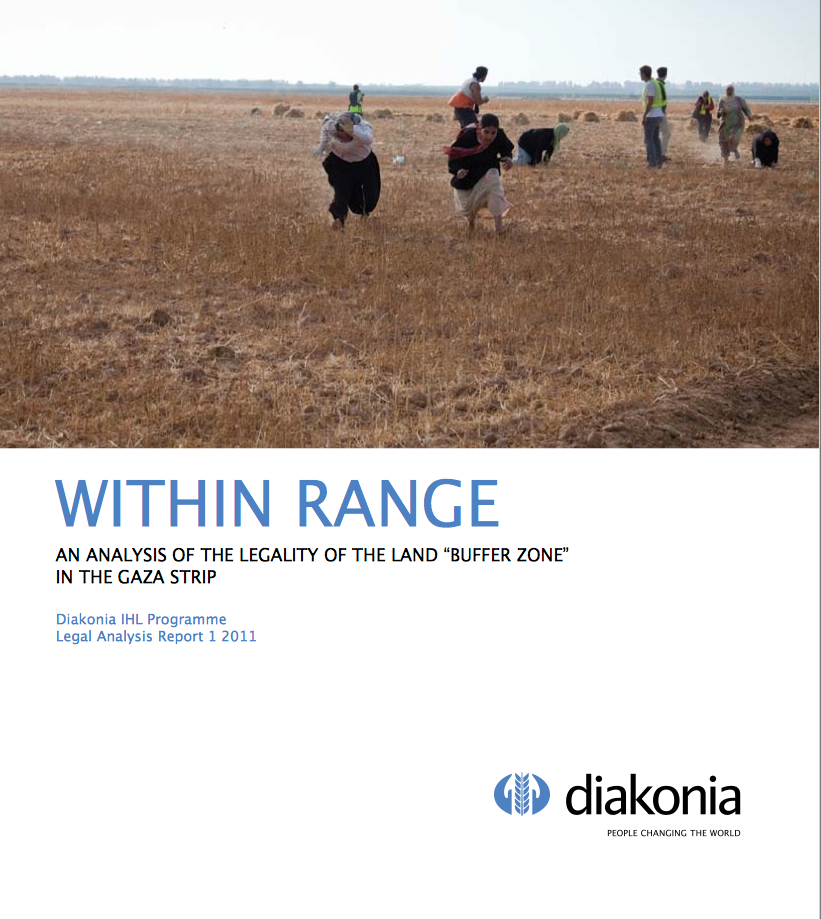
Within Range DIAKONIAAccording to the Internal Displacement Monitoring Centre,  the Israeli military unilaterally implemented an undefined “no-go” zone inside Gaza in 2000.  It started to level lands near the border fence (which had been put in place in 1994), particularly around Rafeh, and ‘by mid-2006 Israel was leveling lands 300 to 500 meters from the fence.’  In 2010 the World Food Programme in collaboration with OCHA produced a report, ‘Between the Fence and a Hard Place‘, documenting the hardships and the horrors and in 2011 Diakonia produced a detailed report on the (il)legal armature of the buffer zone, ‘Within Range‘.  It concluded:

The use of force based on military necessity must be engaged in good faith and consistent with other rules of IHL, in particular the principles of distinction and proportionality and precautions in and during attack. This does not appear to be the case in the “buffer zone” as the violations to IHL are flagrant, frequent and grave. Israel remains the Occupying Power in the Gaza Strip. In this capacity, it must protect the safety and well-being of the Palestinian population and take Palestinian needs into account. In addition, Israel must also protect Israeli civilians and soldiers, but it is not allowed to do so at disproportionate expense to Palestinian civilian lives and property.

While acknowledging Israel’s security concerns regarding attacks on Israel from the Gaza Strip, the facts and information available show that the unilateral expansion of the “buffer zone” and its enforcement regime result in violations of international humanitarian law and grave infringement of a number of rights of Palestinians.

In 2012 OCHA estimated that up to 35 per cent of Gaza’s agricultural land had been affected by these restrictions at various times, and the Gazan economy had sustained a loss of around 75,000 MT of agricultural produce each year ($50 million p.a.)

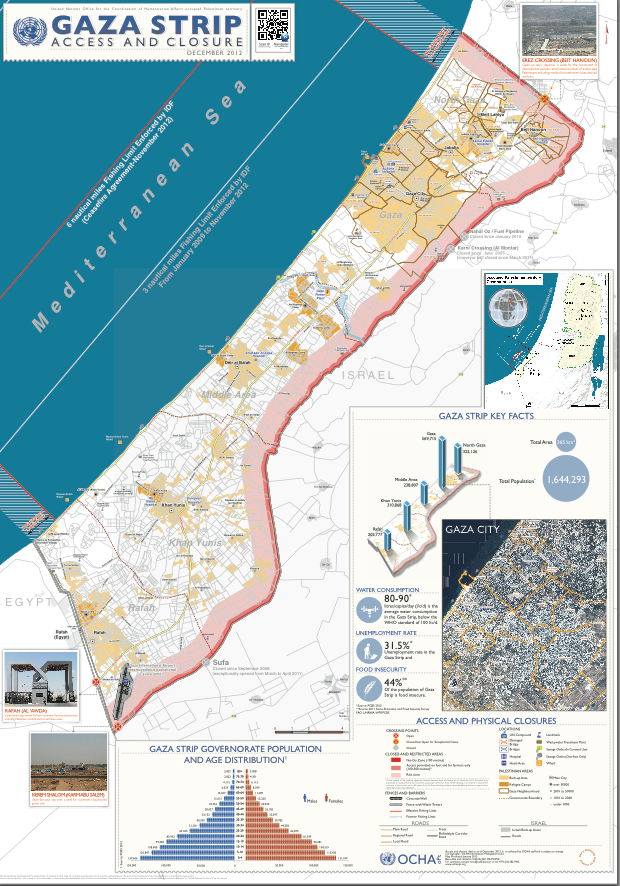
The situation in December 2012 is set out on the map below, which shows what the Israeli military defined as ‘Access Restricted Areas’ (ARA) which, on the landward side, comprised three zones:

(1) A ‘No-Go Zone’, 100 metres wide, which was cleared of all vegetation and all built structures;

(2) A ‘restricted zone’, a further 100-300 metres wide, where access was permitted on foot and for farmers only;

(3) A ‘risk zone’…

GAZA December 2012 OCHA1

You can download a hi-res version here (see also Léopold Lambert‘s maps and commentary here).  In practice, the UN Office of the Commissioner for Human Rights explained, ‘the “no go zone’’ on land was at times enforced a few hundred metres beyond this, with a “high risk zone” extending sometimes up to 1,500 metres.’  In November 2012 these restrictions were supposed to be eased, as part of the agreement ending the Israeli offensive earlier that month.  But as the Commissioner reported, ‘there has been an increased level of uncertainty regarding the access restrictions imposed on land since this date.’  In the spring UN monitoring teams reported that in most cases farmers could not enter lands within 300 metres of the fence and that the Israeli military fired warning shots if they attempted to do so, that in some places the exclusion zone extended beyond 300 metres, and that there was continued concern about the presence of unexploded ordnance in the border areas. The map produced by Gisha: Legal Center for Freedom and Movement for September 2013, ‘Mapping movement and access‘, reflects these realities, and you can find a detailed report from the Palestinian Center for Human Rights and the IDMC, Under Fire: Israel’s enforcement of access restricted areas in the Gaza Strip (February 2014) here.

under-fire-cover-small

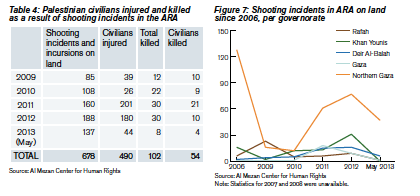
Unexploded ordnance is a matter of grave concern, but there has also been a history of live-fire incidents (see the graph below).  Since December 2013 and before the current Israeli offensive the number of live-fire casualties near the fence was increasing again. In a ten week period between December 2013 and March 2014 B’Tselem field researcher Muhammad Sabah documented 55 civilians injured near the fence: 43 by live fire; 10 by rubber bullets; and two hit by teargas canisters [I can’t link to the report at the moment because the B’Tselem website is under attack and has been taken off the grid; I can now – it’s here].

Shooting incidents in ARA, Gaza

These live-fire incidents are sometimes carried out from remote-controlled stations; the system is called ‘Spot and Strike‘.  Michael Morpurgo, the creator of “War Horse”, saw its effects when he visited Gaza in November 2010 as a representative of Save the Children:

“I stood in among the ruins watching the kids at work, coming and going with their donkeys and carts. They didn’t seem worried, so I wasn’t worried… I heard the shots, then the screaming, saw the kids running to help their wounded friends. Now I really was outside the comfort zone of fiction. A doctor from Medecins Sans Frontieres told me that the shots were not fired by snipers from the watchtowers on the wall, as I had supposed, but that these scavengers were routinely targeted, electronically from Tel Aviv, which was over 25 kilometres away – ‘Spot and Strike’, the Israelis call it.

“It was like a video game – a virtual shooting, only it wasn’t: there was blood, his trousers were soaked in it, the bullets were real. I saw the boy close to, saw his agony as the cart rushed by me. Many like him, the doctor told me, ended up maimed for life. Here was a child, caged and under siege, being deliberately targeted, his right to survival, the most basic of all children’s rights, being utterly ignored. Unicef says that 26 children were shot like this in 2010. The boy I saw was called Shamekh, I discovered. He lives in a house with 15 family members, and was out there earning what money he could, in the only way he knew how.’

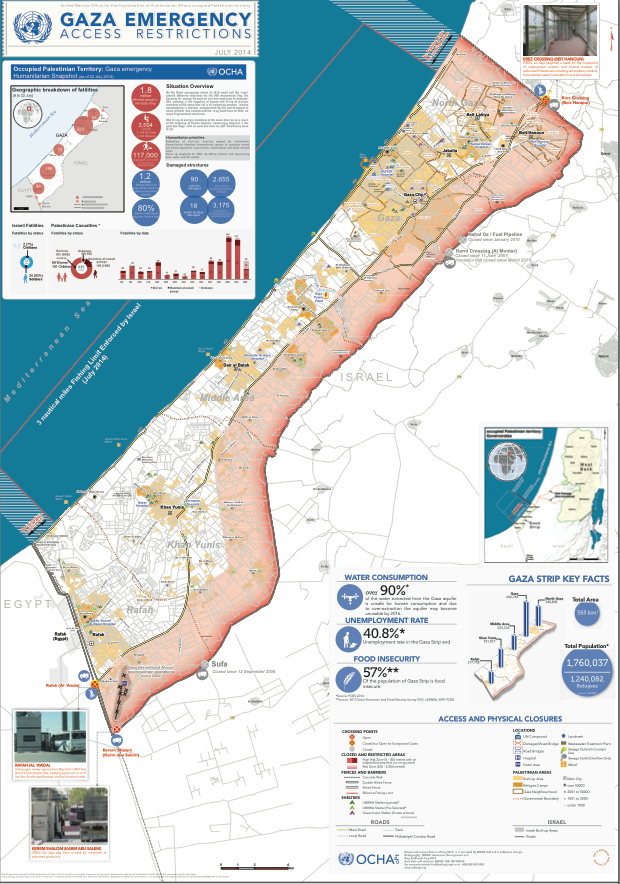
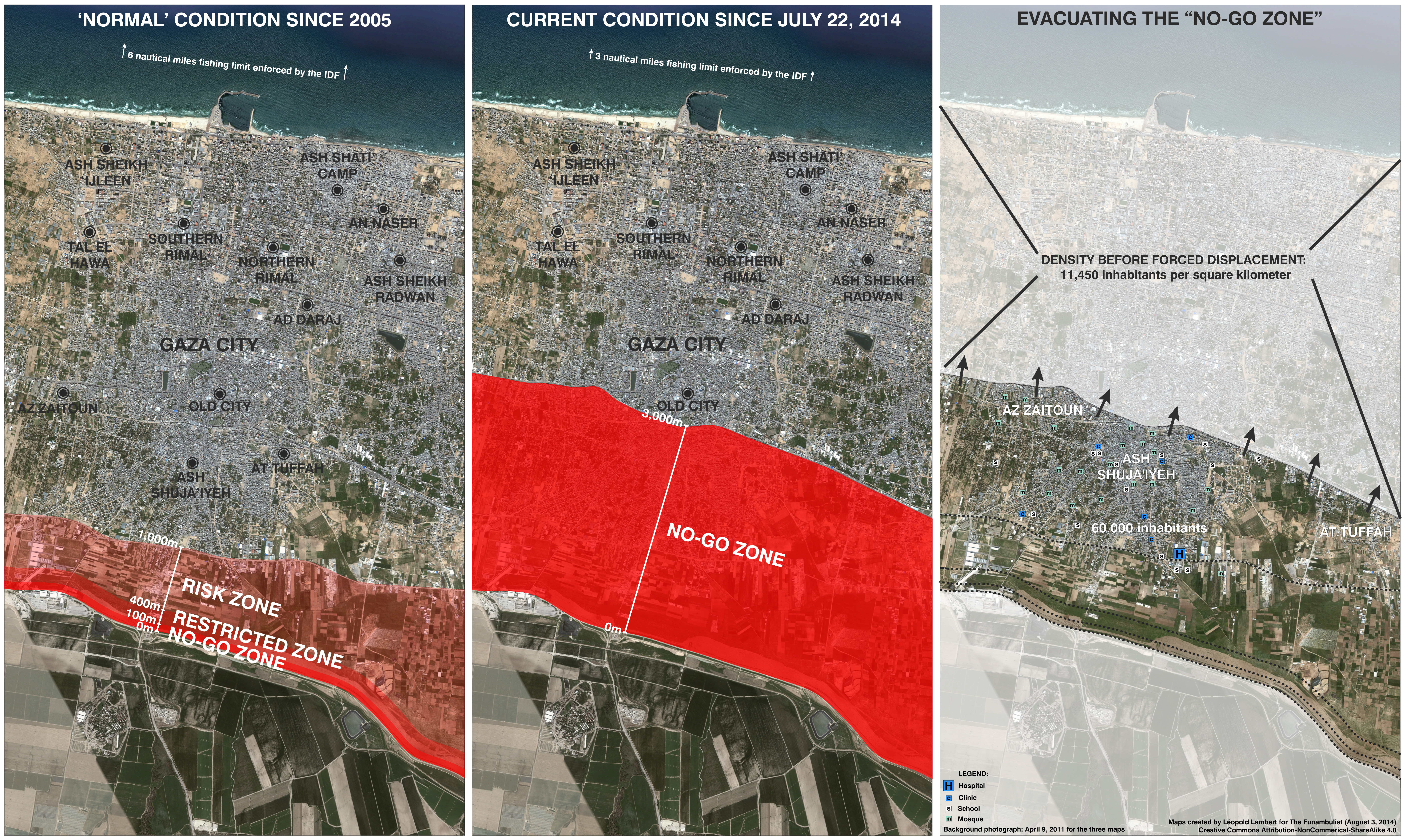
Today, there is a palpable sense in which the whole of Gaza has become a death zone.  First, Israel has declared a three-kilometre ‘buffer zone’ inside Gaza’s borders which now effectively places 44 per cent of the territory off limits (you can download the OCHA map below here; the second map makes the situation clearer, though it inevitably sacrifices detail).  Compare this with the previous map by following the line of the road south-north.

GAZA Access Restrictions JULY 2014

ocha_opt_gaza_access_and_closure_map_december_2012_geopdf_mobile_buffer

Léopold Lambert has provided this close-in triptych which exposes the enormity of the expansion and the knock-on effects of the forced displacement:

Gaza

Mohammed Omer reports:

Anyone within the zone has been warned by the Israeli military to leave or risk being bombed.

This buffer zone has only exacerbated Gaza’s siege. To the east, Palestinians in Gaza are fenced in by Israeli artillery tanks, mortars, cannon shells and snipers. On Gaza’s western side, Israeli warships form a blockade and allow only a three-mile fishing zone. To the north resides more military checkpoints and soldiers. To the south, the Egyptian military has closed off the Rafah border.

The buffer zone has tightened the Israeli chokehold around Gaza’s small strip of land.

Damage in the Gaza stripThis is, as Jesse Rosenfed reports, a ‘No Man’s Land’ in exactly the expanded sense proposed by Noam Leshem and Al Pinkerton:

What that means on the ground is scenes of extraordinary devastation in places like the Al Shajaya district approaching Gaza’s eastern frontier, and Beit Hanoun in the north. These were crowded neighborhoods less than three weeks ago. Now they have been literally depopulated, the residents joining more than 160,000 internally displaced people in refuges and makeshift shelters. Apartment blocks are fields of rubble, and as I move through this hostile landscape the phrase that keeps ringing in my head is “scorched earth.”

It’s not like Israel didn’t plan this. It told tens of thousands of Palestinians to flee so its air force, artillery and tanks could create this uninhabitable no-man’s land of half-standing, burned-out buildings, broken concrete and twisted metal. During a brief humanitarian ceasefire some Gazans were able to come back to get their first glimpse of the destruction this war has brought to their communities, and to sift through their demolished homes to gather clothes or other scattered bits of their past lives. But many were not even able to do that.

Satellite imagery has confirmed the scale of the devastation; the map (right) is based on just three areas within the expanded ‘buffer zone’ and was compiled from imagery taken before the intensification of the onslaught.  You can find details of the UNITAR/UNOSAT programme and image files here.  If you can bear to get closer, there are photographs taken on the ground here and here.

Second, the Israeli military have not confined their operations to the expanded buffer zone, and those who have – somehow – found sanctuary outside its limits (but of necessity still within the closed and shuttered confines of Gaza) have found that they are pursued by aircraft and tanks.  The image below, taken from the same source (and same date) used to compile the map above, shows a wide arc of damage in central Gaza far beyond the ‘zone’ (see also my previous posts herehere and here; you can also find a detailed interactive photo-map of the whole territory from the New York Times here).

Damage Assessment Gaza City 25 July 2014

‘The problem,’as one young resident explained to Anne Barnard, ‘is that when we are fleeing from the shelling, we still find the shelling around us.’  Stories abound of families seeking refuge only to find death waiting for them.  One man told Alexandra Zavis that his brother, four sisters, brother-in-law and five young children escaped from eastern Gaza to what they thought was a safe place in central Gaza City, only to be killed when the top floors of the building collapsed after an Israeli air strike the very next day.  Others tell similar stories – one family moving twice before eventually ten of them were killed.  And then there are all those who have sought refugee in UNRWA camps, many of them schools, or who have been rushed to hospitals for treatment, only to be bombed and shelled there too.

Ha’aretz‘s headline on 31 July says it all: ‘The Gaza battlefield is crowded with the displaced and the homeless.’  So it is.  And still they are bombed and shelled.  As UNRWA’s Chris Gunness put it, ‘Gaza is unique in the annals of modern warfare in being a conflict zone with a fence around it, so civilians have no place to flee.’

In his seminal essay on ‘Necropolitics‘, written more than ten years ago, Achille Mbembe had this to say:

Late-modern colonial occupation differs in many ways from early-modern occupation, particularly in its combining of the disciplinary, the biopolitical, and the necropolitical. The most accomplished form of necropower is the contemporary colonial occupation of Palestine… 

Entire populations are the target of the sovereign. The besieged villages and towns are sealed off and cut off from the world. Daily life is militarized… The besieged population is deprived of their means of income. Invisible killing is added to outright executions…

I have put forward the notion of necropolitics and necro-power to account for the various ways in which, in our contemporary world, weapons are deployed in the interest of maximum destruction of persons and the creation of death-worlds, new and unique forms of social existence in which vast populations are subjected to conditions of life conferring upon them the status of living dead.

Gaza has been systematically turned not only into a prison, then, but also into a camp: and the lives of those within have been have been subjected to a ruthless bio-political programme that, at the limit, has become a calculated exercise in necro-politics.  This confirms Paul Di Stefano‘s claim that that, for the Israeli military, Gaza has been transformed into ‘a state of exception where normal rights do not apply. Within this liminal space, Palestinian bodies are viewed as obstacles to be destroyed or controlled in the maintenance of the colonial order.’

Darkness Descending

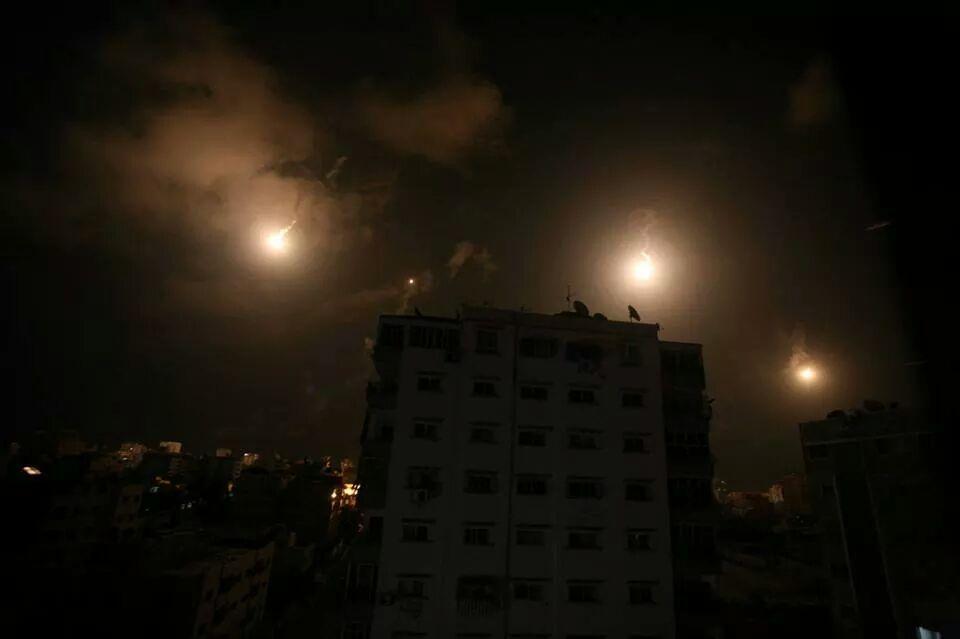
I woke this morning to media reports of the continued carnage in Gaza and to headlines recycled from Associated Press announcing that Israel had struck ‘symbols of Hamas power’.  Front and centre in the frenzied assault was an attack on Gaza’s only power station: but its importance is hardly ‘symbolic’.

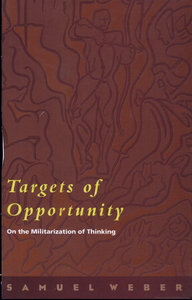
1509120862In Targets of opportunity Samuel Weber wrote: ‘Every target is inscribed in a network or chain of events that inevitably exceeds the opportunity that can be seized or the horizon that can be seen.’

In ‘In another time-zone…’ (DOWNLOADS tab) I elaborated his comment in relation to so-called ‘deliberative targeting’, which ‘places a logistical value on targets through their carefully calibrated, strategic position within the infrastructural networks that are the very fibres of modern society’:

The complex geometries of these networks then displace the pinpoint co-ordinates of ‘precision’ weapons and ‘smart bombs’ so that their effects surge far beyond any immediate or localised destruction. Their impacts ripple outwards through the network, extending the envelope of destruction in space and time, and yet the syntax of targeting – with its implication of isolating an objective – distracts attention from the cascade of destruction deliberately set in train. In exactly this spirit, British and American attacks on Iraqi power stations in 2003 were designed to disrupt not only the supply of electricity but also the pumping of water and the treatment of sewage that this made possible, with predictable (and predicted) consequences for public health. Similarly, on 28 June 2006, during the IDF’s Operation Summer Rains, Israeli missiles destroyed all six transformers of Gaza’s only power station (which provided over half of Gaza’s power). Being powerless in Gaza was as devastating as in Iraq:

‘The lack of electricity means sewage cannot be treated, increasing the risk of disease spreading, and hospitals cannot function normally. It means ordinary Gazans cannot keep perishable food because their fridges do not work. At night, they are plunged into complete darkness when the electricity cuts off. They rely on candles and paraffin lamps. Many residents have also been left with an irregular water supply as they need electricity to pump water up from nearby wells or from ground floor level to higher floors in blocks of flats.’

In attacking the power station – a repeated and familiar target, and so not one struck ‘by accident’ – the IDF knows very well that in the days, weeks and months to come hundreds, even thousands of people will get sick or even die as sewage plants and water pumps fail, as refrigeration systems stop, and as essential surgeries and life-support systems are interrupted.

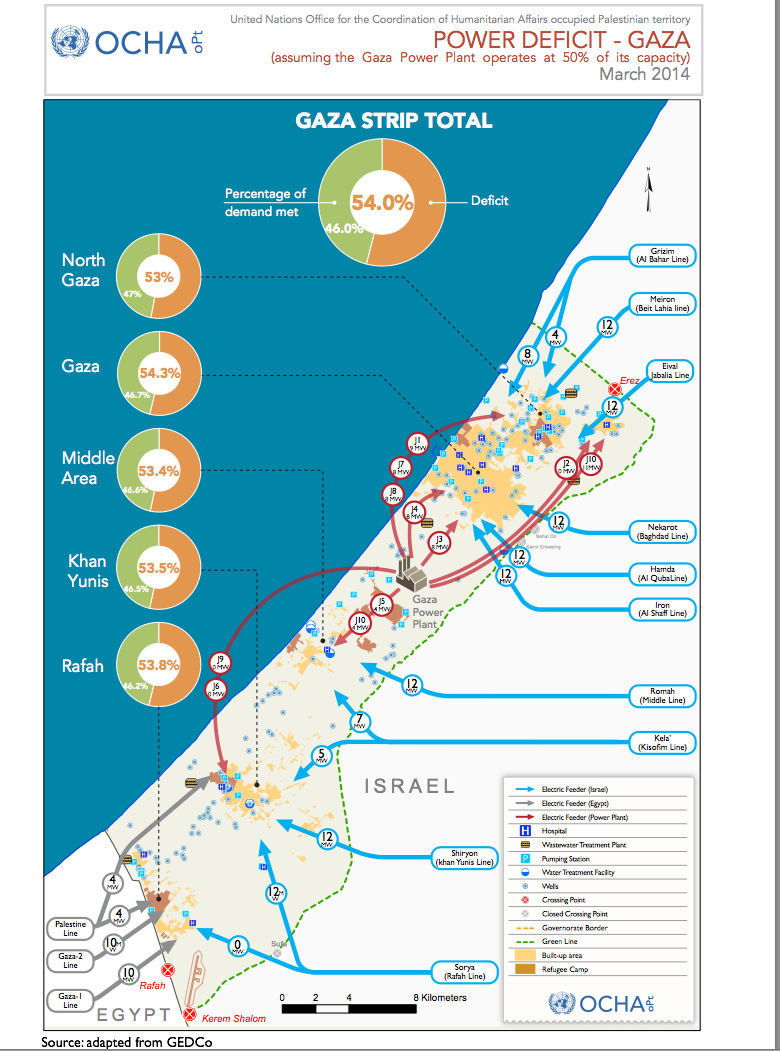
The situation before the latest Israeli offensive was highly precarious, as the map below shows; you can download a hi-res version here (if you have power), and the accompanying one-page report spells out the implications.  Israeli restrictions on the importation of spare parts mean that the power plant has never been restored to full capacity after the previous attacks, and since June 2013 the situation has been exacerbated by ‘the halt in the smuggling of Egyptian-subsidized fuel used to operate the [power plant] via the tunnels’ (last year the differential was 3.2 shekels/litre compared with 7.1 shekels/litre for fuel imported from Israel).

GAZA power deficit

At full capacity, Fares Akram reports, the power station should supply 80 megawatts of electricity; before the most recent Israeli offensive it was already degraded, producing at most only 50-60 megawatts.  It was damaged by Israeli shelling three times last week, and the effects tore into what was left of the fabric of everyday life.  Listen to Atef Abu Saif, writing in his ‘Diary of a Palestinian’ on Saturday 26 July (and read the whole thing: it is an astonishing and eloquent testimony to the depravity of the onslaught):

It has now been 40 hours with no electricity. The water was also cut off yesterday. Electricity is a constant issue in Gaza. Since the Strip’s only power station was bombed in 2008, Gazans have had at best 12 hours of electricity a day. These 12 hours could be during the day, or while you are fast asleep; it’s impossible to predict. Complaining about it gets you nowhere. For three weeks we’ve barely had two or three hours a day. And right now, we would be happy with just one.

These blackouts affect every part of your life. Your day revolves around that precious moment the power comes back on. You have to make the most of every last second of it. First, you charge every piece of equipment that has a battery: your mobile, laptop, torches, radio, etc. Second, you try not to use any equipment while it’s being charged – to make the most of that charge. Next you have to make some hard decisions about which phone calls to take, which emails or messages to reply to. Even when you make a call, you have to stop yourself from straying into any “normal” areas of conversation – they’re a waste of power.

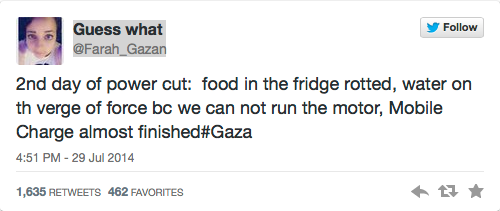
And remember that without those mobiles and laptops much of what the IDF has done would not reach the outside world: see this report , for example, which describes how 16 year old Farah Baker (@Farah_Gazan), ‘one of Gaza’s most powerful online voices’ with over 70,000 Twitter followers, was abruptly silenced when she was unable to charge her phone.

Gaza tweet power cut

Last night the power plant was hit by Israeli tank shells again – the IDF spokesman insists that the plant ‘was not a target’: just how many times do you have to strike something before you recognise what it is? – and now it has been forced to shut down completely.  You can watch a video interview with Sara Badiei, an ICRC water and sanitation engineer in Gaza, who describes the knock-on effects of the power shut-down here:

‘If there is no electricity, there is no water, and I want to make that clear… Water needs to be pushed down the lines, down these tubes, you need pumps to be able to run to bring the water out of the well, to push it down the line and to deliver it to the population.  If there’s no electricity, that can’t happen…’

Gaza also relies on 10 power lines from Israel and Egypt to provide an additional 120 megawatts but 8 of these have been cut by Israeli shelling.  In the interview, Sara explains that it takes 5-7 days to repair each line and it is, of course, extremely dangerous work in a war-zone under constant Israeli shelling.

This is not ‘symbolic’: it is infrastructural war of the most vicious kind, waged without restraint or remorse.  In the past, some Israeli politicians have demanded that Israel shut off the power (and water) supply to Gaza – for some of the international legal considerations, see Kevin Jon Heller’s careful review for Opinio Juris – but what has happened today isn’t about turning switches on or off.  Here is Harriet Sherwood in the Guardian:

The power plant is finished,” said its director, Mohammed al-Sharif, signalling a new crisis for Gaza’s 1.7 million people, who were already enduring power cuts of more than 20 hours a day.

Amnesty International said the crippling of the power station amounted to “collective punishment of Palestinians”. The strike on the plant will worsen already severe problems with Gaza’s water supply, sewage treatment and power supplies to medical facilities.

“We need at least one year to repair the power plant, the turbines, the fuel tanks and the control room,” said Fathi Sheik Khalil of the Gaza energy authority. “Everything was burned.”

Since I published the original version of this post, Human Rights Watch has documented – on 10 August – the cascading effects of the strike on the power plant:


It has drastically curtailed the pumping of water to households and the treatment of sewage, both of which require electric power. It also caused hospitals, already straining to handle the surge of war casualties, to increase their reliance on precarious generators. And it has affected the food supply because the lack of power has shut off refrigerators and forced bakeries to reduce their bread production.

“If there were one attack that could be predicted to endanger the health and well-being of the greatest number of people in Gaza, hitting the territory’s sole electricity plant would be it,” said , deputy Middle East and North Africa director at Human Rights Watch. “Deliberately attacking the power plant would be a war crime.”…

Ribhi al-Sheikh, deputy head of the Palestine Water Authority, said the lack of electricity had idled wells – except where generators were able to provide some back-up power – as well as water treatment and desalination plants. Idling wells endangers crops that require water at the hottest time of year.

Most urban households in Gaza need electricity to pump water to rooftop tanks. Ghada Snunu, a worker for a nongovernmental organization, said on August 4 that her home in Gaza City had been without electricity since the attack on the power plant, forcing her family to buy water in jerry cans and to conserve the used household water to empty the toilets. The collapse of electricity service meant that many Gazans lacked access to the 30 liters of water that is the estimated amount needed per capita daily for drinking, cooking, hygiene and laundering, said Mahmoud Daher, head of the Gaza office of the UN World Health Organization.

This is how Israel exercises its ‘right to defend itself’ and how ‘the most moral army in the world’ is set loose on civilians.

BttGzghCcAAwxuT.jpg-large

In the case of targeted killing (see ‘Drone geographies’, DOWNLOADS tab), the same network effects obtain:

‘…by fastening on a single killing – through a ‘surgical strike’ – all the other people affected by it are removed from view. Any death causes ripple effects far beyond the immediate victim, but to those that plan and execute a targeted killing the only effects that concern them are the degradation of the terrorist or insurgent network in which the target is supposed to be implicated. Yet these strikes also, again incidentally but not accidentally, cause immense damage to the social fabric of which s/he was a part – the extended family, the local community and beyond – and the sense of loss continues to haunt countless (and uncounted) others.’

This tactic, too, has been honed by the IDF, though not exactly refined.  Last year Craig Jones noted:

Since September 29th 2000, Israel has killed 438 Palestinians using the method of targeted killing. Of these, 279 were the ‘object’ of attack, meaning that Israel intentionally targeted them. The other 159 were ‘collateral damage’, chalked up to accidental or incidental consequences of targeting the other 279.

Rummaging around today, I’ve discovered another version of Sam Weber’s thesis with which I began, thanks to Jon Cogburn.  It’s a poem by the late (nationalist) Israeli poet Yehuda Amichai (who died in 2000) called ‘The Diameter of the Bomb’ (translated here by Chana Bloch):

The diameter of the bomb was thirty centimeters
and the diameter of its effective range about seven meters,
with four dead and eleven wounded.
And around these, in a larger circle
of pain and time, two hospitals are scattered
and one graveyard. But the young woman
who was buried in the city she came from,
at a distance of more than a hundred kilometers,
enlarges the circle considerably,
and the solitary man mourning her death
at the distant shores of a country far across the sea
includes the entire world in the circle.
And I won’t even mention the crying of orphans
that reaches up to the throne of God and
beyond, making a circle with no end and no God.

The poem was written in 1972, and in 2006 was the inspiration for a documentary film, also called The Diameter of the Bomb, about the aftermath of a suicide bombing in Jerusalem.  But its power reaches beyond place and time.  And that, in case anyone is wondering, is symbolic.

Scoping Afghanistan

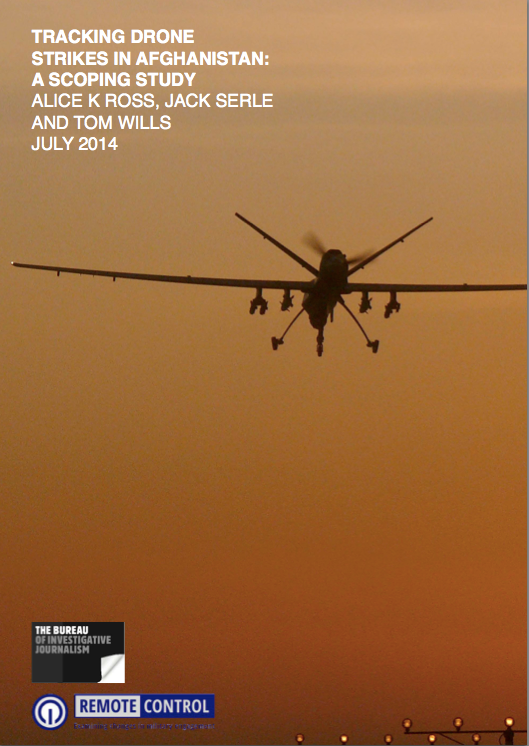
BOIJ Tracking drone strikes in AfghanistanThe marvellous Bureau of Investigative Journalism has just published a preliminary report on its new study  of drone strikes in Afghanistan, ‘the most heavily drone-bombed country in the world.’  The study, carried out with the support of the Remote Control Project, has been prompted by analyses which show that ISAF has persistently under-estimated civilian casualties from its strikes (‘“We only count that which we see… You can do a tremendous amount of forensics … [but] seldom do we see the actual bodies.”)

I have my doubts about the wisdom of severing ‘drone strikes’ from air strikes carried out by conventional aircraft that are networked in to ISR feeds from drones; I’ve elaborated this before, and it is a crucial part of my own work on militarised vision, where I’m working through the military investigations into air strikes in Kunduz, Sangin and Uruzgan.  I’ll start posting about this work next month.

The irony, I think, is not (quite) that we know so little about the ostensibly ‘public’ strikes in Afghanistan compared with the ‘covert’ campaigns in Pakistan, Yemen, Somalia and elsewhere: it is, rather, that we know a lot about how the USAF (though not the RAF) conducts strikes in Afghanistan but remarkably little about the victims, whereas in Pakistan we know much less about how the strikes are carried out (apart from the bureaucratisation of ‘kill lists’ in Washington) and, thanks to the work of the Bureau, much more about the victims.

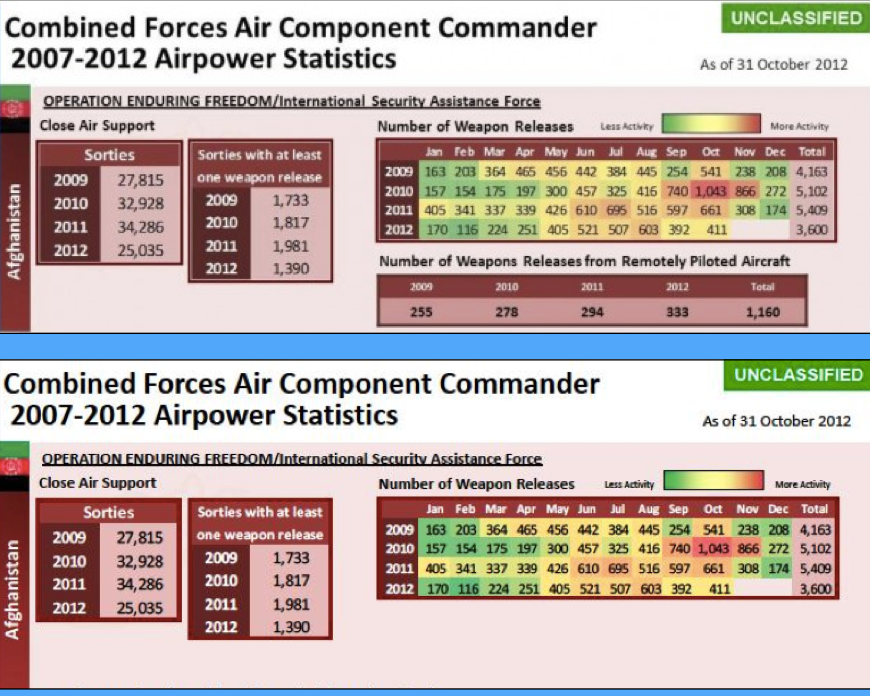
It is true, though, that while the official US military investigations released through FOIA requests are often immensely informative, even in redacted form (more on this next month), there is often also a remarkable reluctance to release even basic information to the public.  Spot the difference between these two tables; the first release (on top) was subsequently overwritten by the second (below)…

Airpower statistics 2007-2012

As I say, more to come.  In the meantime, the ‘scoping study ‘ from the Bureau is here, and well worth reading.

Corpographies

I’ve been scribbling some notes for a short essay Léopold Lambert has invited me to write for his Funambulist Papers.  The brief is to write ‘something about the body – nothing too complicated’, so I’ve decided to say something more about the idea of corpography I sketched in ‘Gabriel’s Map’ (DOWNLOADS tab), which will in turn – so I hope – prepare the ground for the long-form version of ‘The nature(s) of war’ for a special issue of Antipode devoted to the work of Neil Smith [next on my to-do list].

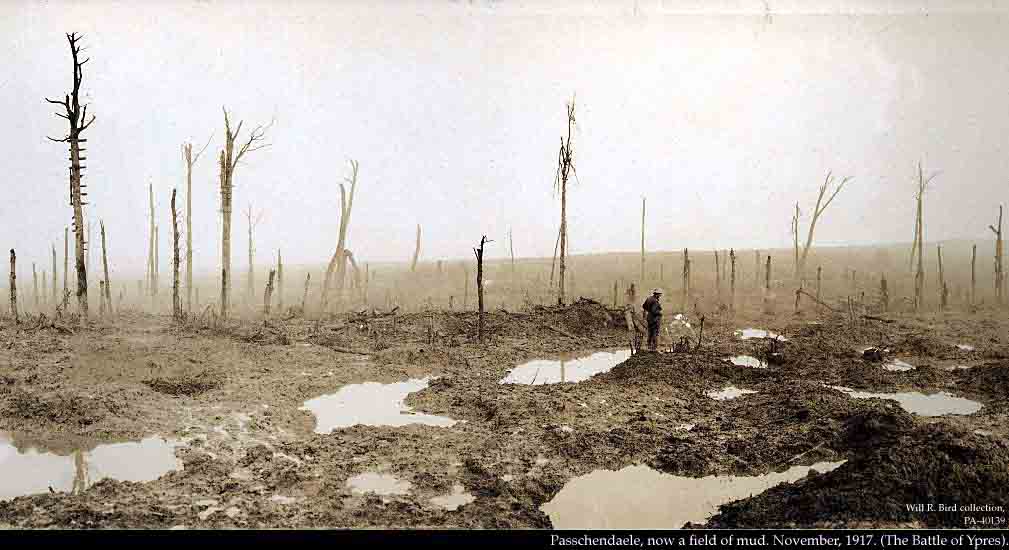
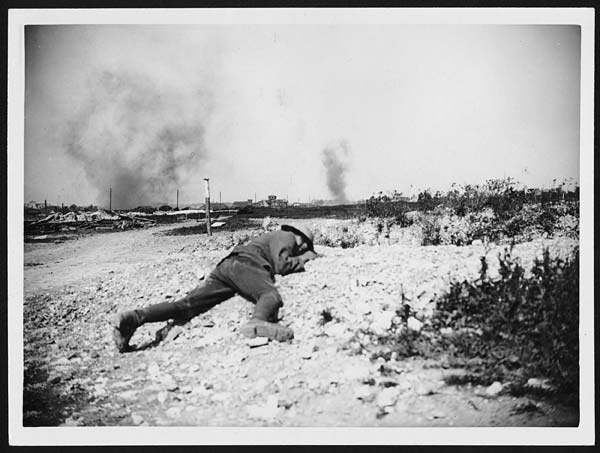
In ‘Gabriel’s Map’ (and in a preliminary sketch here) I contrasted the cartographic imaginary within which so much of the First World War was planned with a corpography improvised by soldiers caught up in the maelstrom of military violence on the ground; unlike the ‘optical war’ that relied, above all, on aerial reconnaissance, projected onto the geometric order of the map and the mechanical cadence of the military timetable – a remarkably abstract space, though its production was of course profoundly embodied – this was a way of apprehending the battle space through the body as an acutely physical field in which the senses of sound, smell and touch were increasingly privileged in the construction of a profoundly haptic or somatic geography.
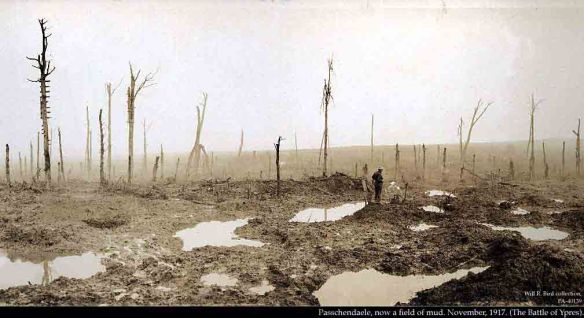
passchendale1917vj0

This is hardly original; you can find intimations of all this in classics like Eric Leed‘s No Man’s Land, and once you start digging in to the accounts left by soldiers you find supporting evidence on page after page.  What I’ve tried to do is show that this constituted more than a different way of experiencing war: it was also a different way of knowing and ordering (or, as Allan Pred would surely have said, of re-cognising) the space of military violence.  These knowledges were situated and embodied – ‘local’, even – but they were also transmissable and mobile.

On the Western front, corpographies were at once an instinctive, jarring, visceral response to military violence –

‘When sound is translated into a blow on the nape of the neck, and light into a flash so bright that it actually scorches the skin, when feeling is lost in one disintegrating jar of every nerve and fibre … the mind, at such moments, is like a compass when the needle has been jolted from its pivot’ [‘A Corporal’, Field Ambulance Sketches (1919)]

– and an improvisational, learned accommodation to it:

‘We know by the singing of a shell when it is going to drop near us, when it is politic to duck and when one may treat the sound with contempt. We are becoming soldiers. We know the calibres of the shells which are sent over in search of us. The brute that explodes with a crash like that of much crockery being broken, and afterwards makes a “cheering” noise like the distant echoes of a football match, is a five-point-nine.The very sudden brute that you don’t hear until it has passed you, and rushes with the hiss of escaping steam, is a whizz-bang… The funny little chap who goes tonk-phew-bong is a little high-velocity shell which doesn’t do much harm… The thing which, without warning, suddenly utters a hissing sneeze behind us is one of our own trench-mortars. The dull bump which follows, and comes from the middle distance out in front, tells us that the ammunition is “dud.” The German shell which arrives with the sound of a woman with a hare-lip trying to whistle, and makes very little sound when it bursts, almost certainly contains gas.

‘We know when to ignore machine-gun and rifle bullets and when to take an interest in them. A steady phew-phew-phew means that they are not dangerously near. When on the other hand we get a sensation of whips being slashed in our ears we know that it is time to seek the embrace of Mother Earth’ [A.M. Burrage, War is war]
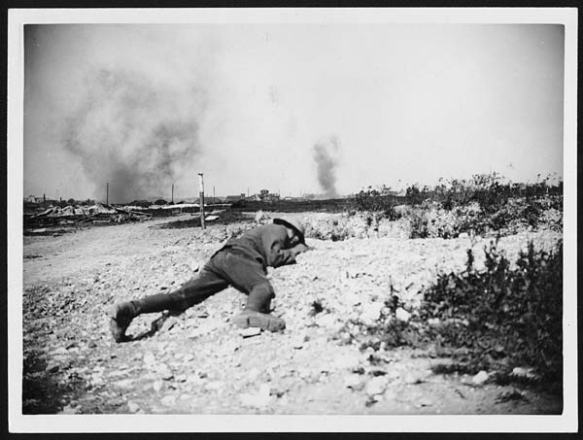
National Library of Scotland (Tom Aitken)

This was not so much a re-setting of the compass, as the anonymous stretcher-bearer had it, as the formation of a different bodily instrument altogether.  As Burrage’s last sentence shows, corpographies were at once re-cognitions of a butchered landscape – one that seemed to deny all sense – and reaffirmations of an intimate, intensely sensible bond with the earth:

‘To no man does the earth mean so much as to the soldier. When he presses himself down upon her, long and powerfully, when he buries his face and his limbs deep in her from the fear of death by shell-fire, then she is his only friend, his brother, his mother; he stifles his terror and his cries in her silence and her security…. ’ [Erich Remarque, All quiet on the Western Front]

And corpographies were not only a means through which militarised subjects accommodated themselves to the warscape – providing a repertoire of survival of sorts – but also a way of resisting at least some its impositions and affirming, in the midst of what so many of them insisted was ‘murder not war’, what Santanu Das calls a ‘tactile tenderness’ between men.  This, he argues,

‘must be seen as a celebration of life, of young men huddled against long winter nights, rotting corpses, and falling shells. Physical contact was a transmission of the wonderful assurance of being alive, and more sex-specific eroticism, though concomitant, was subsidiary. In a world of visual squalor, little gestures – closing a dead comrade’s eyes, wiping his brow, or holding him in one’s arms – were felt as acts of supreme beauty that made life worth living.’
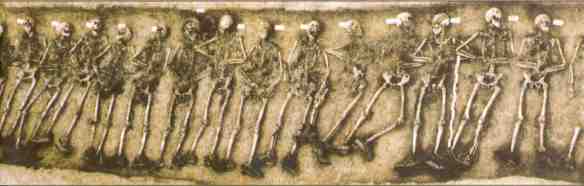
grimsbychums

A hundred years later, I have no doubt that much the same is true in Afghanistan, Iraq, Syria and elsewhere, and so my interest in corpography is also part of my refusal to acquiesce to the thoroughly disingenuous de-corporealization of today’s ‘virtuous war’.

In fleshing out these ideas I’ve been indebted to a stream of work on the body in human geography. Most of it has been remarkably silent about war, even though Kirsten Simonsen once wrote about ‘the body as battlefield‘, but it’s now difficult for me to read her elegant essay ‘In quest of a new humanism: Embodiment, experience and phenomenology as critical geography’ [Progress in human geography 37 (1) (2013): open access here] – especially Part III where she discusses ‘Thinking the body’ and ‘Orientation and disorientation’ – without peopling it with bodies in khaki, blue or field grey tramping towards the front-line trenches, clambering over the top, or crawling from shell-hole to shell-hole in No Man’s Land.

That is partly down to the suggestiveness of Kirsten’s prose, but it’s also the result of my debt to the work of Santanu Das [Touch and intimacy in First World War literature], Ken MacLeish [especially Chapter 2 of his Making War at Fort Hood; the dissertation version is here] and Kevin McSorley [whose introduction to War and the body is here] which directly addresses military violence.  I wish I’d been able to attend the Sensing War conference that Kevin co-organised in London last month; I had to turn down the invitation because I was marooned on my mountaintop in Umbria, but the original Call For Papers captured some of the ways in which the materialities and corporealities of war in the early twentieth century continue to inhabit later modern war:

War is a crucible of sensory experience and its lived affects radically transform ways of being in the world. It is prosecuted, lived and reproduced through a panoply of sensory apprehensions, practices and ‘sensate regimes of war’ (Butler 2012) – from the tightly choreographed rhythms of patrol to the hallucinatory suspicions of night vision; from the ominous mosquito buzz of drones to the invasive scrape of force-feeding tubes; from the remediation of visceral helmetcam footage to the anxious tremors of the IED detector; from the desperate urgencies of triage to the precarious intimacies of care; from the playful grasp of children’s war-toys to the feel of cold sweat on a veteran’s skin.

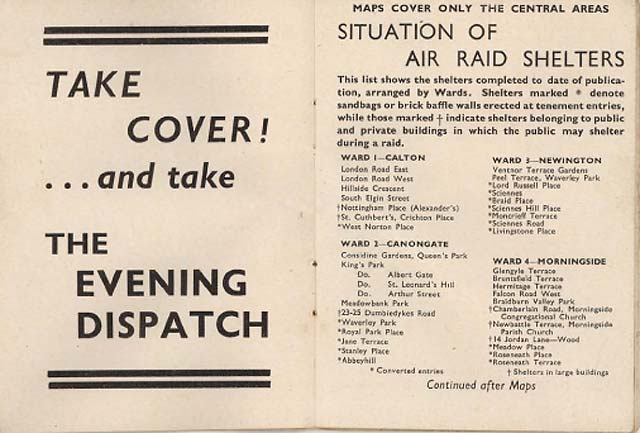
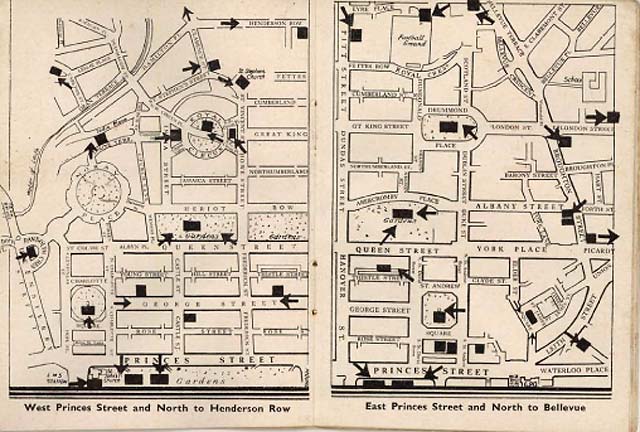
Thus far, like most of the writers I’ve drawn from here, I’ve been thinking about corpographies in relation to the soldier’s body, but as the (in)distinctions between combatant and civilian multiply I’ve started to think about the knowledges that sustain civilians caught up in military and paramilitary violence too. Some of them are undoubtedly cartographic – formal and informal maps of shelters (the images below are for Edinburgh during the Second World War), camps, checkpoints and roadblocks – and some of them rely on visual markers of territory: barriers and wires, posters and graffiti. Today much of this information is shared by social media (as the battle space has become both digital and physical).
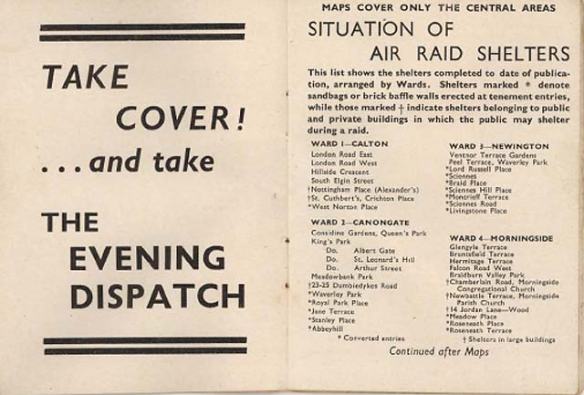
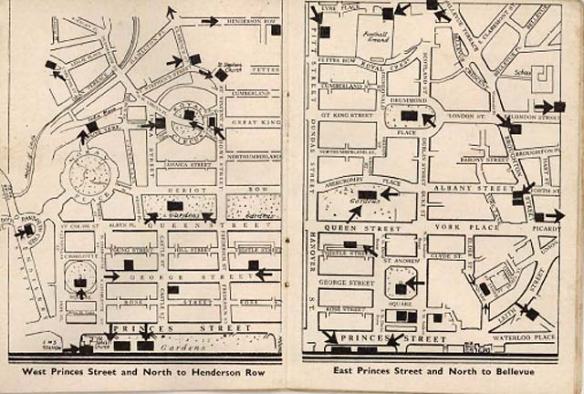
Guide to Edinburgh Air Raid Shelters WW2


0_books_-_edinburgh_air_raid_shelters_p12+p13

But much of this knowledge is also, as it has always been, corpographic.  Pete Adey once wrote – beautifully – about what he called ‘the private life of an air raid’, drawing on the files of Mass Observation during the Second World War to sketch a geography of ‘stillness’ even as the urban landscape was being violently ‘un-made’.  ‘Stillness in this sense,’ he explained,

‘denotes apprehending and anticipating spaces and events in ways that sees the body enveloped within the movement of the environment around it; bobbing along intensities that course their way through it; positioned towards pasts and futures that make themselves felt, and becoming capable of intense forms of experience and thought.’

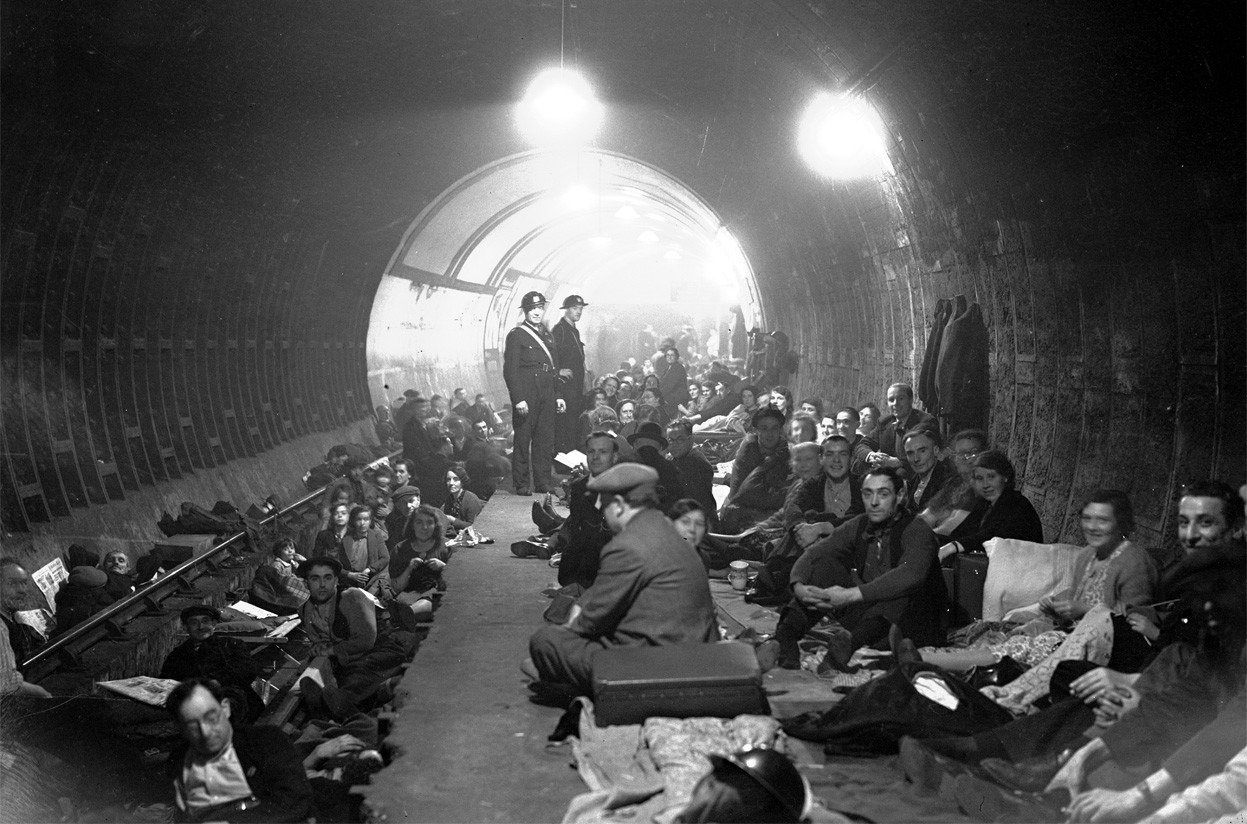
This was a corpo-reality, and one in which – as he emphasised – sound played a vital role: ‘Waves of sound disrupted fragile tempers as they passed through the waiting bodies in the physical language of tensed muscles and gritted teeth.’  But, as he also concedes, this was also a ‘not-so private’ life – there was also a social life under the bombs – and we need to think about how these experiences were shared by and with other bodies.  These apprehensions of military violence, then as now, were not only modalities of being but also modes of knowing: as Elizabeth Dauphinée suggests, in a different but closely related context, ‘pain is not an invisible interior geography’ but rather ‘a mode of knowing (in) the world – of knowing and making known’  [‘The politics of the body in pain’, Security dialogue 38 (2) (2007) 139-55]. During an air raid these knowledges could be shared by talking with others – the common currency of comfort and despair, advice and rumour – but they also arose from making cognitive sense of physical sensations: the hissing and roaring of the bombs, the suction and compression from the blast, the stench of ruptured gas mains or sewage pipes.
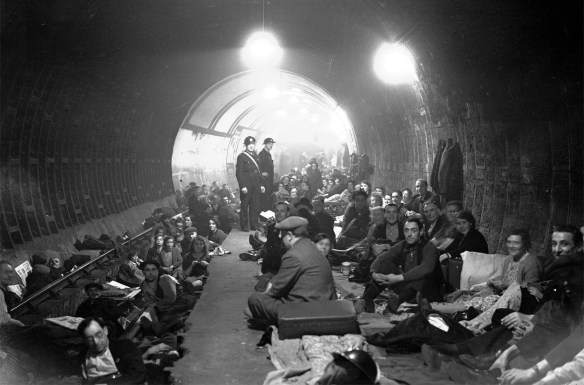
London air raid shelter

Steven Connor once suggested that air raids involve a ‘grotesquely widened bifurcation of visuality and hearing’, in which the optical-visual production of a target contrasts with ‘the absolute deprivation of sight for the victims of the air raid on the ground, compelled as they are to rely on hearing to give them information about the incoming bombs.’  Those crouching beneath the bombs have ‘to learn new skills of orientating themselves in this deadly auditory field without clear coordinates or dimensions but in which the tiniest variation in pitch and timbre can mean obliteration.’  What then can you know – and how can you know – when your world contracts to a room, a cellar, the space under the bed?  When you can’t go near a window in case it shatters and your body is sliced by the splinters?  When all you have to go on, all you can trust, are your ears parsing the noise or your fingers scrabbling at the rubble?
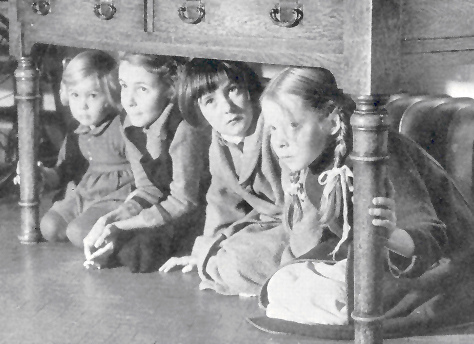
Air raid drill in children's home WW2

Here too none of this is confined to the past, and so I start to think about the thanatosonics of Israel’s air strikes on Gaza.  Sound continues to function as sensory assault; here is Mohammed Omer:

‘At just 3 months old, my son Omar cries, swaddled in his crib. It’s dark. The electricity and water are out. My wife frantically tries to comfort him, shield him and assure him as tears stream down her face. This night Omar’s lullaby is Israel’s rendition of Wagner’s Ride of the Valkyries, with F-16s forming the ground-pounding percussion, Hellfire missiles leading the winds and drones representing the string section. All around us crashing bombs from Israeli gunships and ground-based mortars complete the symphony, their sound as distinct as the infamous Wagner tubas…. Above, the ever-present thwup-thwup of hovering Apache helicopters rock Omar’s cradle through vibration. Warning sirens pierce the night—another incoming missile from an Israeli warship.’

And, as before, sound can also be a source of knowledge.  Here is Wasseem el Sarraj, writing from Gaza in November 2012:

In our house we have become military experts, specializing in the sounds of Israeli and Palestinian weapons. We can distinguish with ease the sound of Apaches, F-16 missiles, drones, and the Fajr rockets used by Hamas. When Israeli ships shell the coast, it’s a distinct and repetitive thud, marked by a one-second delay between the launch and the impact. The F-16s swoop in like they are tearing open the sky, lock onto their target and with devastating precision destroy entire apartment blocks. Drones: in Gaza, they are called zananas, meaning a bee’s buzz. They are the incessant, irritating creatures. They are not always the harbingers of destruction; instead they remain omnipresent, like patrolling prison guards. Fajr rockets are absolutely terrifying because they sound like incoming rockets. You hear them rarely in Gaza City and thus we often confuse them for low-flying F-16s. It all creates a terrifying soundscape, and at night we lie in our beds hoping that the bombs do not drop on our houses, that glass does not shatter onto our children’s beds. Sometimes, we move from room to room in an attempt to feel some sense of safety. The reality is that there is no escape, neither inside the house nor from the confines of Gaza.

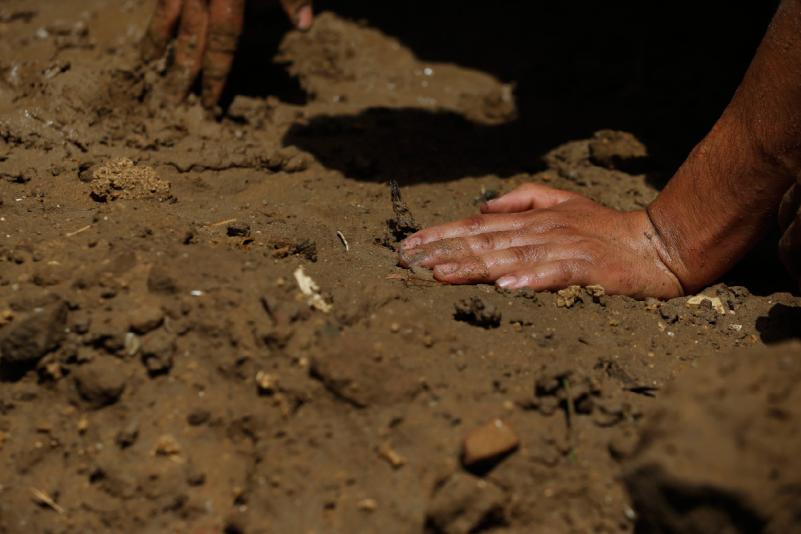
The last haunting sentences are a stark reminder that knowledge, cartographic or corpographic, is no guarantee of safety. But military and paramilitary violence is always more than a mark on a map or a trace on a screen, and the ability to re-cognise its more-than-optical dimensions can be a vital means of navigating the wastelands of war.  As in the past, so today rescue from the rubble often involves a heightened sense of sound and smell, and survival is often immeasurably enhanced by the reassuring touch of another’s body.  And these fleshy affordances – which you can find in accounts of air raids from Guernica to Gaza – are also a powerful locus for critique.
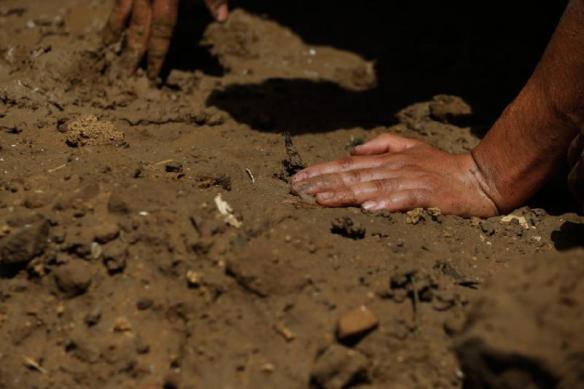
Gaza Hands and Grave

So: corpographies.  I thought I’d made the word up, but as I completed ‘Gabriel’s Map’ I discovered that Joseph Pugliese uses ‘geocorpographies’ to designate ‘the violent enmeshment of the flesh and blood of the body within the geopolitics of war and empire’ in his State violence and the execution of law (New York: Routledge, 2013; p. 86). This complements my own study, though I’ve used the term to confront the optical privileges of cartography through an appeal to the corporeal (and to the corpses of those who were killed in the names of war and empire).

And I’ve since discovered that the term has a longer history and multiple meanings that intersect, in various ways, with what I’m trying to work out.  Perhaps not surprisingly, it also serves as a medical term: cranio-corpography is a procedure devised by Claus-Frenzen Claussen in 1968 to capture in a visual trace the longitudinal and lateral movements of a patient’s body in order to detect and calibrate disorders of the ‘equilibrium function’.  More recently, corpography has also been used by dance theorists and practitioners, including Francesca Cataldi and Sebastian Prantl, to describe a critical, creative practice: a ‘dance of things’ in which the body is thoroughly immersed as a’ land.body.scape’, as Prantl puts it.  Meanwhile, Allan Parsons has proposed a ‘psycho-corpography’ – explicitly not a psycho-geography – as a way of ‘tracing the experience of living-a-body’.  Elsewhere,  Alex Chase attends to specific bodies-in-the-world, those of cultural ‘figures’ (Artaud, Bataille, Foucault, Genet, Jarman and Mishima among them), that resist normalization – hence emphatically  ‘queer’ bodies – and which figure bodies as events.  ‘I hope to develop a methodology of “corpography”,’ he says, ‘which would write between biography and textual analysis, material lived bodies and fictional work, life and representation, in order to work through other queer concepts such as temporality, space, and ethics.’

It would of course be absurd to summon all of these different usages onto a single conceptual terrain. But they do take me back to Kirsten’s essay (and to long-ago memories of an enthralling seminar in Roskilde which she introduced through her dance teacher), to ways of apprehending the danse macabre on the Western Front as both a cartography and a corpography whose junction was to be found, perhaps, in a choreography, and to think about the ways in which the sentient bodies of soldiers were at once habituated to and resisted the forceful normalizations of military violence.  They also make me wonder about civilian corpographies – about the multiple ways in which violence is inflicted on the body and yet may be resisted through the body – and in doing so they direct my steps from the past to the present and to the fragile bodies that continue to lie at the heart of today’s conflicts.  If that is to speak with Walter Benjamin, I want to insist that the ‘tiny, fragile human body’ does not only lie ‘in a field of force of destructive torrents and explosions’, as he wrote in 1936: for the body is a vector as well as a victim of military and paramilitary violence.  And it can also be a means of undoing its effects.

I suspect that these ideas will eventually thread their way into my new project on the evacuation of combatant and civilian casualties (and the sick) from war zones, 1914-2014, where it’s already clear to me that cartography and corpography are tightly locked together.  All of this is highly provisional, as you’ll realise, and as always I would welcome comments and suggestions.
The Federal Administration of Military Violence

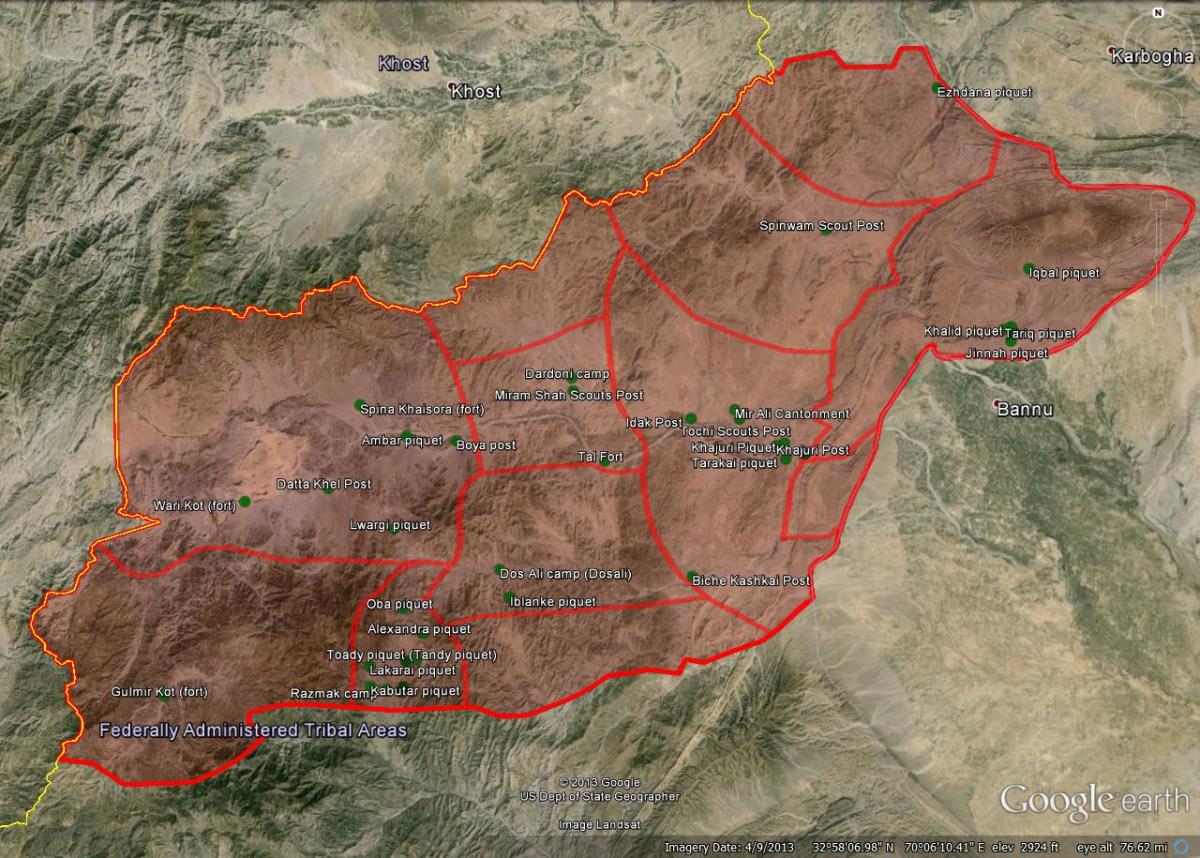
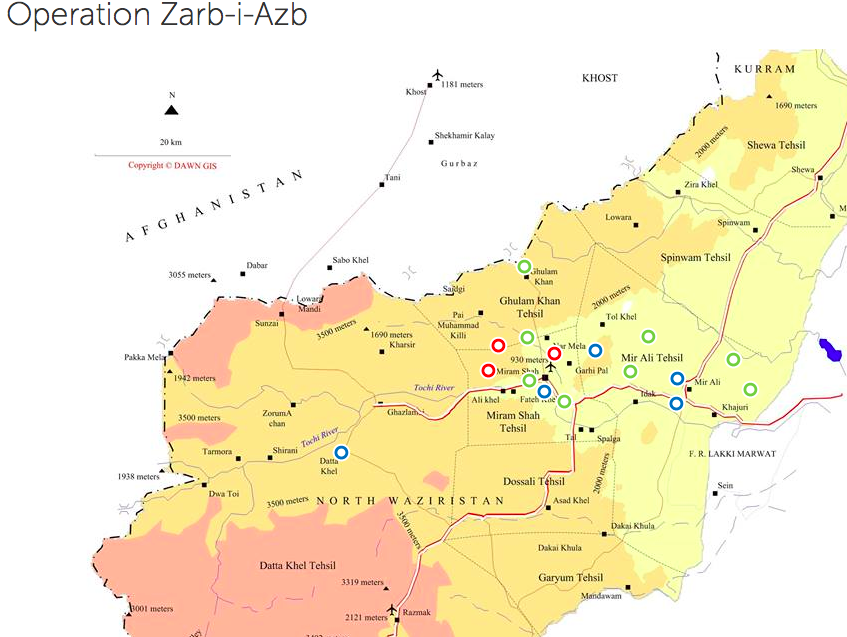
On 15 June – one week after the attack on Karachi’s international airport by the Pakistan Taliban (Tehrik-i-Taliban or TTP) and the Islamic Movement of Uzbekistan (UMI) – the Pakistan military announced its ‘comprehensive’ Operation Zarb-i-Azb in the Federally Administered Tribal Areas (FATA).  From their bases in North Waziristan, the statement announced, militants had ‘waged a war against the state of Pakistan’ and the military had been ‘tasked to eliminate these terrorists regardless of hue and color, along with their sanctuaries.’  Although the press release insisted that ‘these enemies of the state will be denied space anywhere across the country’ the epicentre of the operation was and remains North Waziristan.

NWA_PakMil_locations_all_1200

There are reportedly 60,000 troops in the region, and the main Pakistan military installations in North Waziristan are shown on the map above (taken from the AEI spinoff site, Critical Threats), but the prelude to ground operations was a concerted attack by the Pakistan Air Force on eight targets linked to planning the assault on Karachi airport.

Green Ground Red Drones Blue PAF strikes DAWN 20 June 2014

‘Operation Zarb-i-Azb’ refers to Mohammed’s sword, and its political imagery is artfully dissected by Afiya Shehrbano Zia:

‘It refers to the (‘sharp/cutting’) sword of the prophet of Islam and is a brilliant usurpation of the religious metaphor. It upstages the religious imaginary for which the Tehreek e Taliban Pakistan (TTP) claim to be fighting. After all, who would dare to vanquish the Prophet’s metaphorical sword? The appellation justifies its cause for the defense of the Islamic state, and quells the lesser purpose of the Taliban in one fell swoop. As in all cases in the instrumentalisation of religion as a propaganda tool, it also excites nationalists and seeks to rationalise another round of military operations, killings and displacements that will follow.’

There’s much more of value in her commentary, but – as Zia also acknowledges – the genealogy and geography of the offensive is no less complicated (my map comes from Dawn, 20 June 2014; green circles are Pakistan military land operations; blue are Pakistan Air Force strikes; red are US drone strikes).

First, it’s not clear whether the Pakistan military finally has the Afghan Taliban in its sights too – regarded by Islamabad as the ‘good Taliban’ because, far from threatening the state of Pakistan, it has long been used by both the military and (particularly) the intelligence service as a counter to any Indian influence over Kabul once US and ISAF forces complete their withdrawal.  And it is of course the Afghan Taliban (along with the Haqqani network) which is the principal concern of the United States.

Second, the Pakistan military – and especially the Air Force – has a long history of offensive operations in the FATA, as I’ve discussed in detail before: see here and here.  Now other commentators have noticed this: the Bureau of Investigative Journalism has tracked 15 Pakistan Air Force strikes carried out by helicopter gunships and F-16 fighters between 19 December 2013 and 15 June 2014, which killed 291-540 people (including 16-112 civilians).

The significance of this is not only that it precedes the current offensive but also that it coincides with the so-called ‘pause’ in CIA-directed drone strikes against targets in the FATA.  Chris Woods notes that PAF strikes are ‘generating casualties far in excess of any caused by CIA drones strikes’, and one resident of Mir Ali recited a grim military timetable:

“It’s like doomsday for people in Mir Ali, where death is everywhere since Saturday… They start the day with artillery shelling early in the morning. Gunship helicopters come for shelling during the day and jets strike at around 2:00-2:30 in the night.”

The military denies all reports of civilian casualties but this beggars belief, and the Bureau reports that some residents have even concluded that the drone strikes were preferable:

‘The difference between the drone strikes and the military strikes is that drones target specifically who they want to target… the wanted terrorists… people are saying that drone attacks were good compared to the military strikes.  Personally I agree, because I have seen drones, they are in the air 24 hours and they don’t attack as randomly… the place of the attack was always an area where the Taliban or terrorists were living.’

But whatever one makes of this – a calculation that would imply that the CIA had abandoned its anonymous ‘signature strikes’ – drones have not been absent from the skies over Waziristan. Pakistan has its own reconnaissance drones, and they have repeatedly been used to direct strike aircraft onto their targets (though with what accuracy it is impossible to know) and to support ground operations: the PAF boasted of their use in May, when hundreds of houses and shops were destroyed in Machis Camp and in the bazaar at Mir Ali.  And – the third complication – the US resumed its drone war on 11 and 12 June when two UAVs fired six missiles at compounds near Miram Shah, supposedly killing ten members of UMI and the Haqqani network, and again on 18 June when three compounds near Dargah Mandi were hit.  Whether these strikes were co-ordinated with Pakistan is unclear – the Foreign Office has issued its ritual denial, but it’s difficult to believe they were not connected to Pakistan’s own military operations, and here too there is a long history of what I’ve called ‘dirty dancing‘ between Washington and Islamabad that continued until at least the end of 2011.  It seems highly unlikely that the dance has ended.

_75732447_75732446

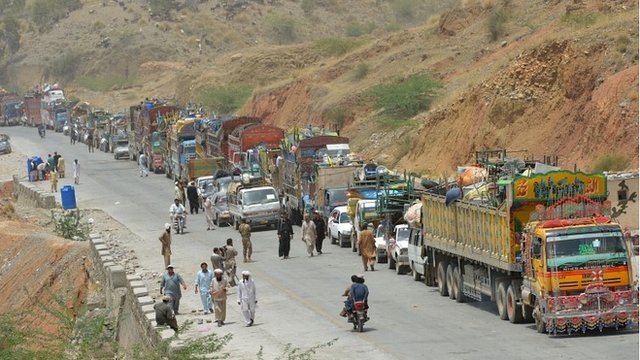
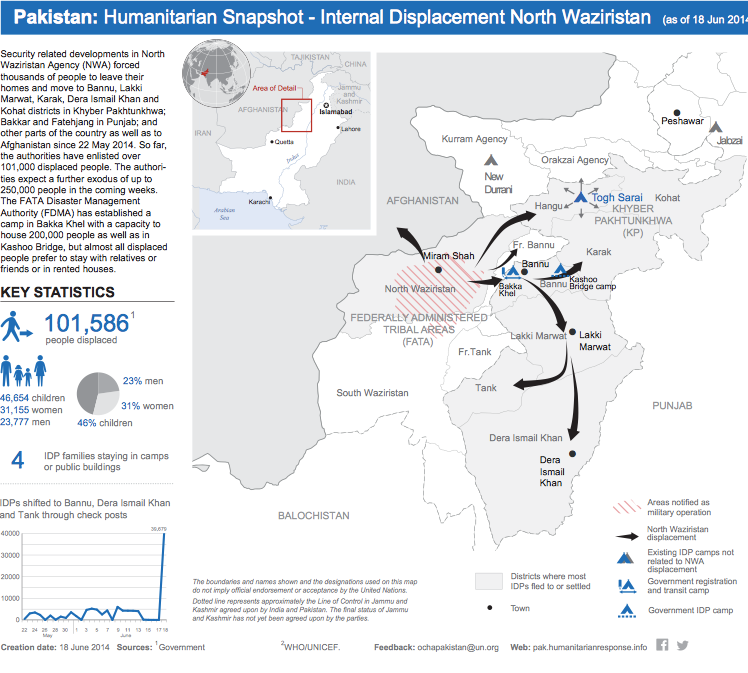
Finally, the shock waves from these various operations ripple far beyond their ostensible targets. Hundreds of thousands of people have fled, some in advance of military operations (which had been telegraphed for months), many more when the military temporarily loosened its curfew on the region. As on previous occasions, most of them fled to Bannu, some to government camps (‘Only the poorest of the poor would go to a camp in such hot and humid weather‘) but the majority to stay with family members, while some refugees have even crossed into Khost in Afghanistan to seek sanctuary. The map below is an early trace (18 June), and it shows only those who are officially registered so it excludes those lodging with their extended families; but even this anticipates hundreds of thousands more displaced people to come.

Pakistan Displaced Persons June 2014

There is also the real fear that, as Ismail Khan and Declan Walsh reported earlier this month, Taliban reprisals will focus on the Punjab, the electoral base of Prime Minister Nawaz Sharif.

All of this suggests the importance of unravelling the intimate connections between the political constitution of the Federally Administered Tribal Areas and the administration of military violence there.  This is clearly not limited to CIA-directed drone strikes, and here Zia’s reflections on a question posed by a feminist friend are worth repeating:

‘She wonders, “why this obsession with drones?” Obviously, the interest is due to a host of factors, but her query reflects the difference in modes of analysis. Her position reflects the views of women’s rights/human rights groups who consider specific military operations in one part of Pakistan as just one cog in a broader narrative about the source of the conflict. For them, this has been the cosy nexus and mutually beneficial relationship between the military establishment and the jihadi groups.

Those like Imran Khan, who foreground drones in their analysis of ‘conflict’, consider US intervention and occupation of Afghanistan as the drivers of conflict in Pakistan. But local progressive groups argue that even if militants in FATA are subdued, or US interventions are resisted, unless the policy of patronage and nurturing of jihadi groups in the rest of Pakistan is dismantled and buried, conflict at all levels will never end – drones or no drones.

This doesn’t mean that military technologies are unimportant nor that drone strikes are of marginal concern (inside or outside an ‘area of active hostilities‘): it means that we need to direct our attention to the larger matrix of political and military violence within which they are deployed, transnational and national, and to its genealogies and geographies.

Deadly improvisations

There is nothing refined about killing, but the war in Syria has shown that both sides have resorted to improvisational tactics.  I say ‘both sides’ as a short-hand: this is hardly a two-party conflict, since the anti-Assad forces are far from united and a number of external powers – not only Iran and Saudi Arabia – are plainly using the parties as players in a proxy war.

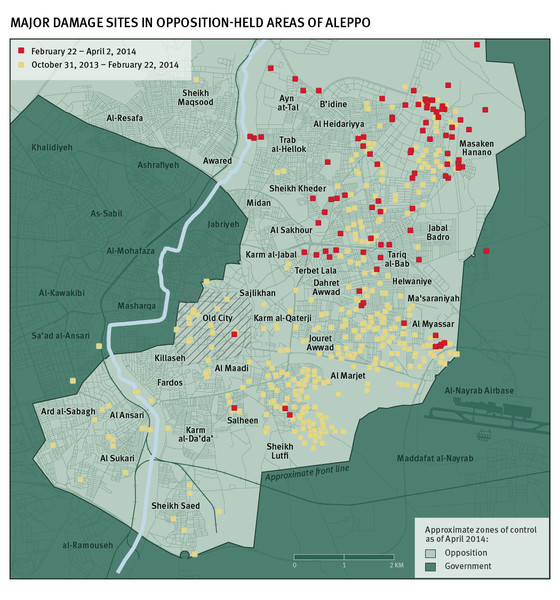
One of the first signs was the Syrian Air Force’s use of so-called ‘barrel bombs’: in effect, these are improvised explosive devices made from oil barrels filled with crude explosive and, on occasion, metal shrapnel and even chemicals like chlorine, which are then dropped from helicopters.  At first, they were dropped from low altitudes – which, according to Richard Lloyd at least, made them accurate enough to strike particular targets – but once the rebels were equipped with rocket-launchers (MANPADs) the helicopters had to fly much higher (near 7,000 feet) with a corresponding diminution in accuracy.  The first attacks took place against the city of Homs in August 2012, but the locus then shifted to rebel-held areas in Aleppo – the map below comes from Human Rights Watch‘s forensic analysis of strikes against that city between October 2013 and April 2014; some of the sites identified may have been struck by other munitions, HRW concedes, including conventional bombs, mortars and artillery shells, but the vast majority reveal the characteristic signature of the indiscriminate deployment of barrel bombs.  The Syrian National Council estimates that 20,000 people have been killed by barrel bombs thus far.

Aleppo Barrel Bombs (Human Rights Watch)

Since the Syrian Air Force has been supplied with conventional bombs by both Russia and Iran, many commentators have concluded that the recourse to crude barrel bombs is not the result of any munitions shortage but is rather a determined attempt to spread indiscriminate terror.  For we need to remember that there’s nothing special about barrel bombs; they are probably less effective – certainly less accurate – than conventional munitions.  In short, they are, as I’ve said, an improvisation – what the indefatigable Eliot Higgins (of Brown Moses fame: an absolutely indispensable source for all this) calls ‘a piece of crap’.  But they are also unequivocal evidence that the regime is ‘interested in no path forward other than by killing.’
The result has been captured in a sobering video from Syrian Zero, showing barrel bomb attacks on Darayya, a neighbourhood in Damascus during the last week of January (below; you can find a brief, helpful exposition and commentary on the video here).

Barrel bombs have also been used by the Sudanese Air Force in Southern Kordofan and Blue Nile states, and most recently by the Iraqi Air Force against Fallujah.

A second tactic used in Syria – this time by opposition forces – hearkens back to the First World War. Earlier this month, and in part as a counter to the crude air war against the rebel-held areas of Aleppo, the Islamic Front detonated a vast underground mine packed with explosives beneath the city’s Carlton Hotel, which was used as a base by the Syrian Army.  Video of the construction of the 75 metre tunnel had previously been uploaded to YouTube:

According to the BBC the explosion, just outside the Citadel, levelled the hotel and seriously damaged many surrounding buildings; there has been no official estimate of casualties, but it seems that dozens were killed or injured.  In the last few days  a much longer (850 metre) tunnel, which reportedly took 7 months to excavate, was used to detonate 60 tonnes of explosive packed under a Syrian Army base at Wadi al-Deif, also in the north of Syria.  The base, outside the town of Maarrat al-Nu’man, occupies a strategic location on the main route linking Damascus and Aleppo, and had been besieged by rebel forces for over a year.  Dozens of soldiers were killed in the attack.

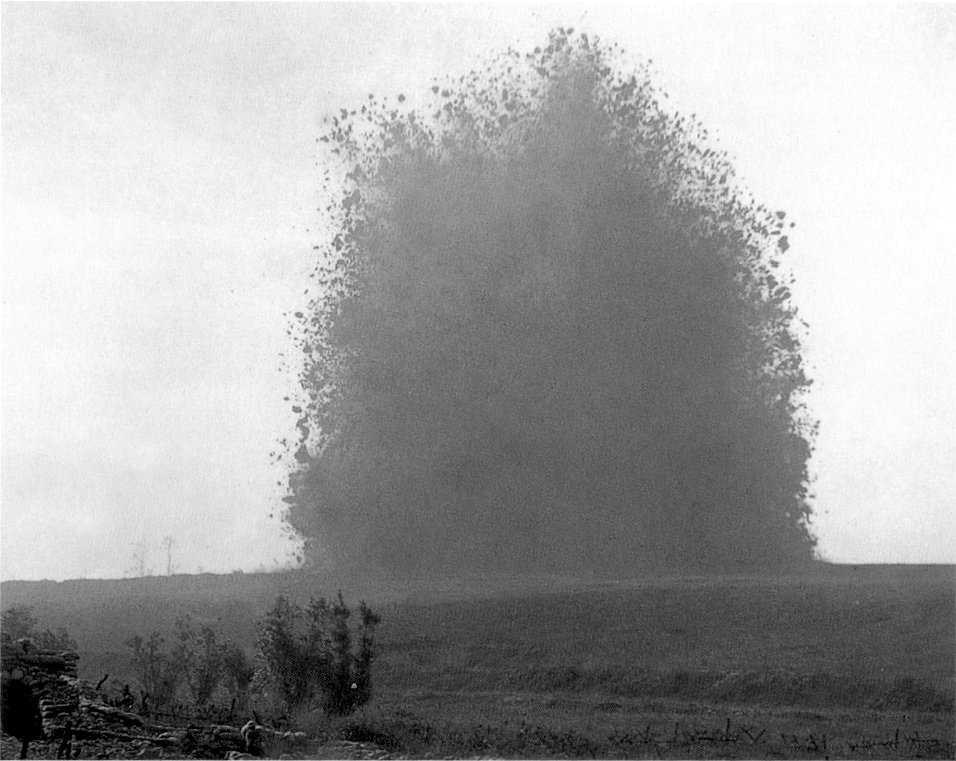
Tunnels, then, can be used not only to break sieges and blockades – as in those that keep the economy of Gaza supplied against the Israeli stranglehold: in effect, lifelines (if you want more on this, try the brilliant documentary Gaza: Tunnels to Nowhere and Nicolas Pelham, ‘Gaza’s tunnel phenomenon’, Journal of Palestine Studies 41 (4) 2012, pp. 6-31).  They can also be deathlines, dug for directly offensive purposes.  The tactic had been used to devastating effect on the Western Front, as I noted in a previous post on 3-D war: the image below is Ernest Brooks‘s famous photograph of the detonation of the British mine underneath the German lines at Hawthorn Ridge on the first day of the Battle of the Somme on 1 July 1916.  You can find video of the explosion here.

Hawthorn Ridge 1916

Then as now, as Jane Burgess argues in a dispatch from the frontlines of  ‘The Battle for Aleppo’, they are deadly improvisations in a war of attrition.

Both of these developments/reversions – the barrel bombs and the mines – obviously reinforce Stuart Elden‘s discussion of attempts to ‘secure the volume’.  But they also speak directly to a bleak politics of insecurity.

Eternal Harvest

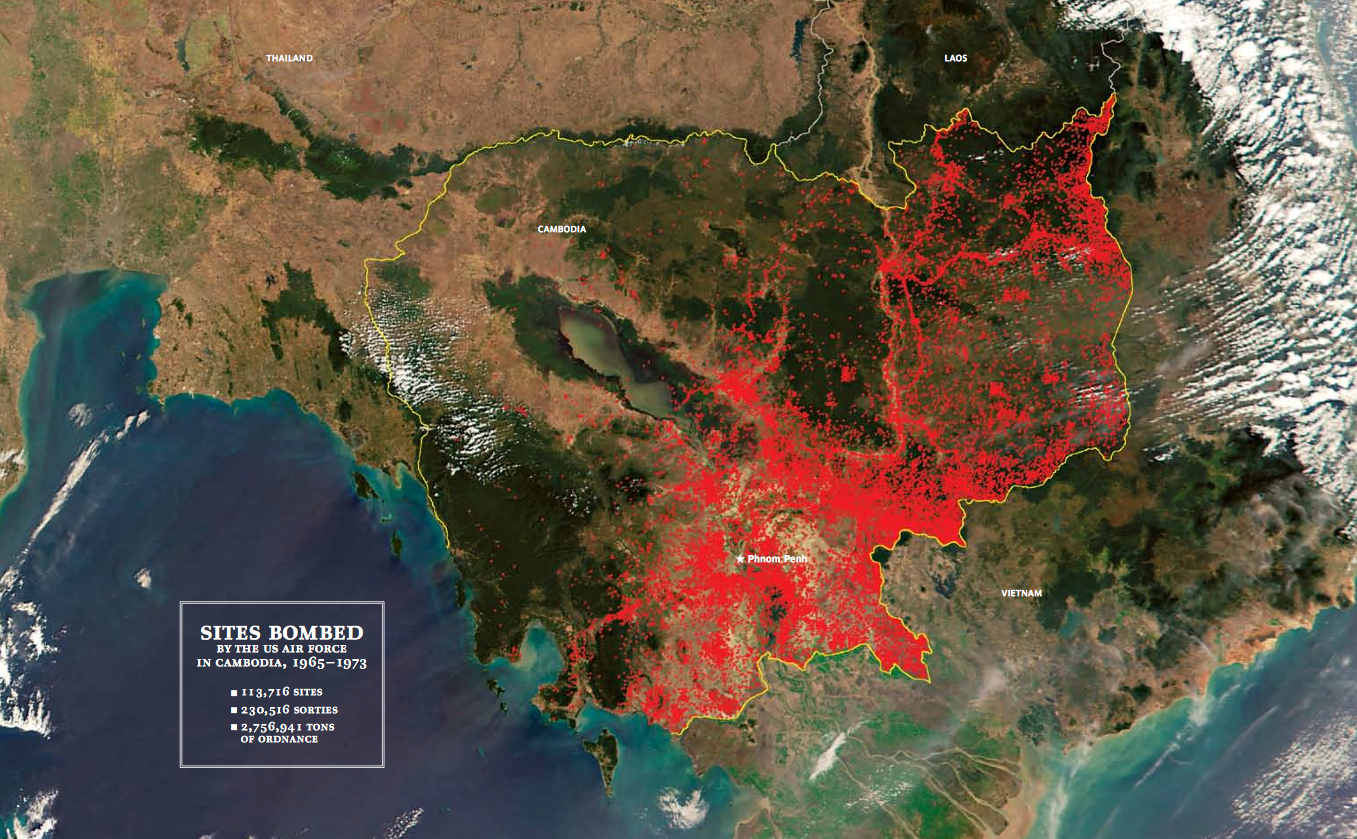
Many readers will know the remarkable work that’s been done to reconstruct the US bombing of Cambodia during the ‘Vietnam’ War: I’m thinking of Taylor Owen and Ben Kiernan‘s ‘Bombs over Cambodia’ which appeared in The Walrus in 2006: available here and here.

The still-incomplete database (it has several “dark” periods) reveals that from October 4, 1965, to August 15, 1973, the United States dropped far more ordnance on Cambodia than was previously believed: 2,756,941 tons’ worth, dropped in 230,516 sorties on 113,716 sites. Just over 10 percent of this bombing was indiscriminate, with 3,580 of the sites listed as having “unknown” targets and another 8,238 sites having no target listed at all. The database also shows that the bombing began four years earlier than is widely believed—not under Nixon, but under Lyndon Johnson. The impact of this bombing, the subject of much debate for the past three decades, is now clearer than ever. Civilian casualties in Cambodia drove an enraged populace into the arms of an insurgency that had enjoyed relatively little support until the bombing began, setting in motion the expansion of the Vietnam War deeper into Cambodia, a coup d’état in 1970, the rapid rise of the Khmer Rouge, and ultimately the Cambodian genocide.

US bombing of Cambodia

The contemporary significance of these air strikes includes, of course, what Rob Nixon calls the ‘slow violence’ of the unexploded ordnance that still haunts the Cambodian landscape today.  But they also have implications for recent bombing campaigns in Afghanistan, as Ben and Taylor discuss in ‘Roots of U.S. Troubles in Afghanistan: Civilian Bombing Casualties and the Cambodian Precedent’  here, and for today’s cross-border (though rather less covert) drone strikes in Pakistan, as Henry Grabar argued last year in The Atlantic here.

Eternal HarvestThe conflict in Vietnam spilled across into Laos too, and a new book by Karen Coates (with photographs by Jerry Redfern) documents the effects of this even more shocking campaign in depth and detail: Eternal Harvest: the legacy of American bombs in Laos.  The short animation below, just 98 seconds of your time, prepared by Jerry for Mother Jones, shows each bombing run:

The nearly 600,000 bombing runs delivered a staggering amount of explosives: The equivalent of a planeload of bombs every eight minutes for nine years, or a ton of bombs for every person in the country—more than what American planes unloaded on Germany and Japan combined during World War II. Laos remains, per capita, the most heavily bombed country on earth.

There’s a much longer version at vimeo here, which comes with this rider:

This video shows the US Air Force bombing campaign in Laos, from 1965 to 1973. The data comes from the website of the National Regulatory Authority of Lao PDR (NRA), which oversees UXO clearance in that country. They received the data from the US Embassy in Vientiane in 2000, from records originally created by the Department of Defense and stored at the National Archives.

The NRA data sets include information on the number and types of aircraft flown, types of bombs dropped, target conditions and after-action reports. For this graphic, only the dates, latitude and longitude, and the number of bombs dropped per mission are used.

The US Air Force began bombing Laos in June 1964. Many branches of the US, Thai, Lao, South Vietnamese and other forces also conducted aerial missions. But this graphic reflects only bombing missions noted in the NRA data, which show US Air Force missions beginning on October 1, 1965.
There’s much more information, plus photographs from the book, at the website that accompanies the book.

COVER MAKER 5.5X8.25.inddIf you want a quick overview of the geography of bombing Laos, Peter Larson also has a useful survey which includes some helpful maps here; he’s constructed his own animation here.

‘Animation’ is hardly the verb for such appalling carnage, I realise; the classic English-language account giving voices to the survivors (and victims) is Fred Branfman‘s brilliant Voices from the Plain of Jars: life under an air war, first published in 1972 and republished last year with an introduction by Alfred McCoy and available as an e-book.

When war comes home

After the US invasion of Iraq there were all sorts of artistic interventions that sought to bring home to Americans what was happening in Baghdad.  I described some of them in ‘War and peace’ (DOWNLOADS tab), noting that many of them seemed to take their cue from Martha Rosler‘s double photomontage of ‘Bringing the war home’, in which she re-staged first Vietnam and then the Iraq war in American domestic interiors:

Captives are paraded around gleaming kitchens on leashes, combat troops stalk in living rooms, while beyond the drapes fires flicker, a grieving woman slumps on the deck, and an Army patrol files by. Domestic critics have frequently noted the interchange between security regimes inside and outside the United States; they insist that the ‘war on terror’ ruptures the divide between inside and outside, and draw attention to its impact not only ‘there’ but also ‘here’. But Rosler’s sharper point is to goad her audience beyond what sometimes trembles on the edge of a critical narcissism (‘we are vulnerable too’) to recognise how often ‘our’ wars violate ‘their’ space: her work compels us to see that what she makes seem so shocking in ‘our’ space is all too terrifyingly normal in ‘theirs’.

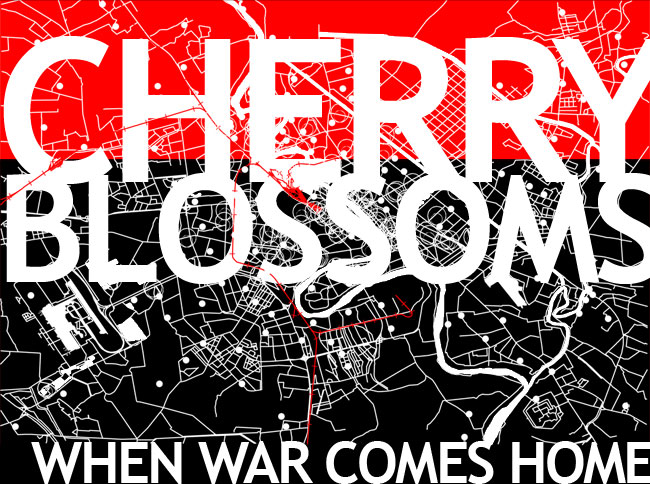
Several projects made cartographic transpositions or mash-ups: superimposing the bombing of Baghdad on San Francisco (Paula Levine‘s Shadows from another place) or Boston (Alyssa Wright‘s Cherry Blossoms), for example, or choreographing a situationist tour of Baghdad in Brooklyn.  I’ve been more hesitant about these interventions; I know that these three projects were linked to – and in the last case depended on – ground performances, and I know too that it’s possible to undo the abstractness of conventional cartography, to turn it against itself (here I’m thinking of elin o’Hara slavick‘s brilliant Bomb after bomb).

WRIGHT Cherry Blossoms

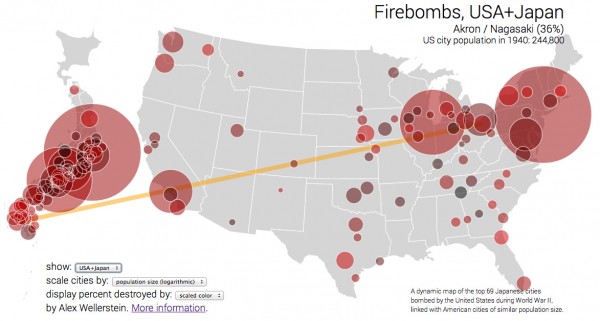
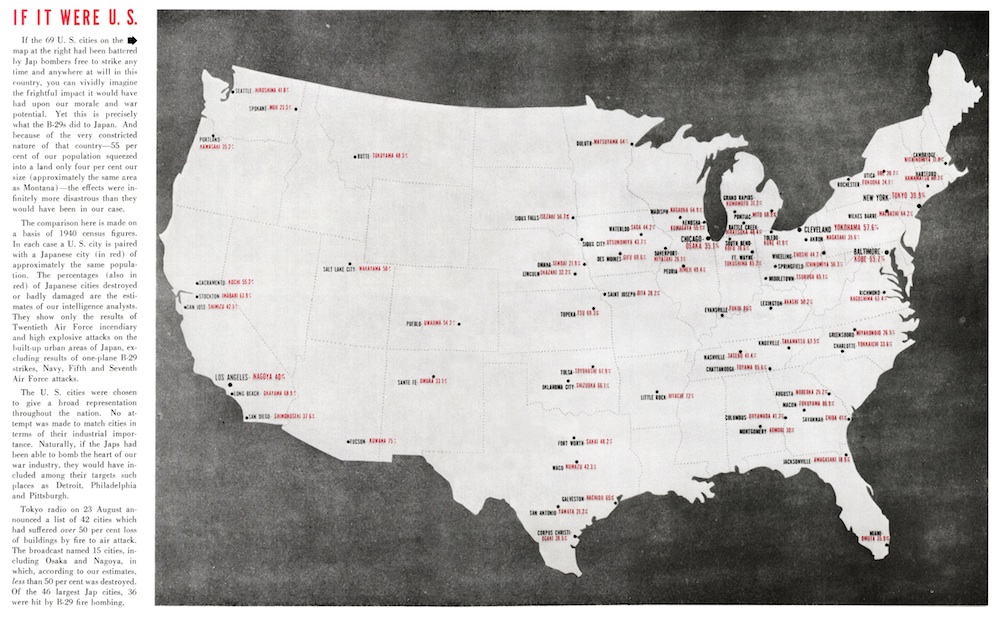
I’ve now seen a different cartographic transposition that dramatizes the firebombing of Japan during the Second World War by juxtaposing a map of the United States with a map of Japan.  Almost as soon as the war was over there were several visualizations of a nuclear attack on US cities.  The image below comes from Collier’s Magazine in 1950, for a cover story called ‘Hiroshima, USA’; you can access the original here and read more here.  But projects like these still deflect the critical gaze from the horror of what happened there to the horror of what might happen here.  Indeed, that was precisely the point, as Joseph Masco shows in his brilliant essay, ‘”Survival is Your Business”: Engineering ruins and affect in nuclear America’, Cultural Anthropology 23:2 (2008) 361-98; reprinted in Ann Laura Stoler (ed), Imperial debris: on ruins and ruination (Duke, 2013).
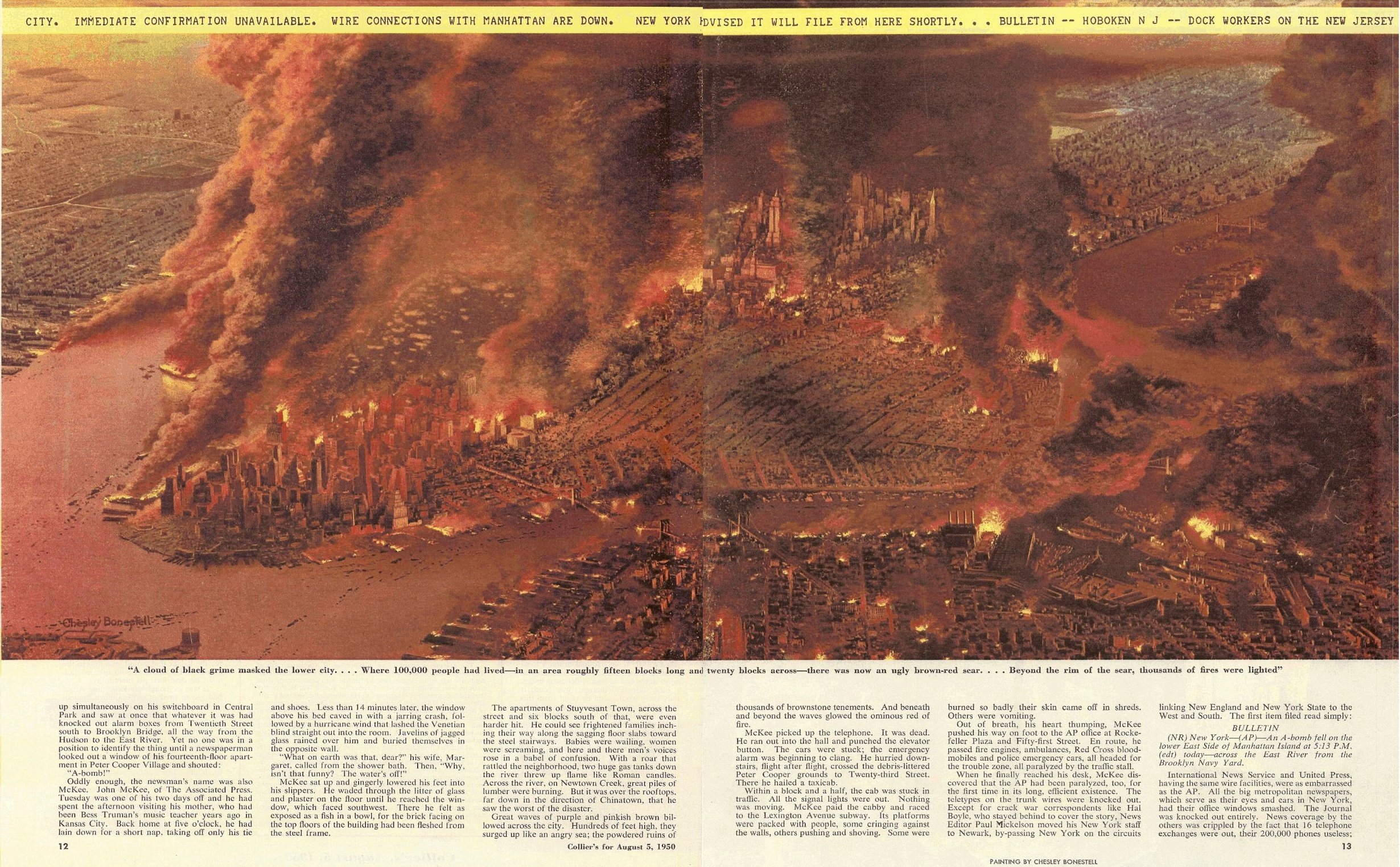
Colliers-03-04-1

The problem is redoubled in the case of Hiroshima and Nagasaki, because those two hideous mushroom clouds have so often blocked our view of the firebombing of Japanese cities that preceded the two nuclear attacks.  Here the work of David Fedman and Cary Karacas on bombing Japan is indispensable, not least for its illuminating discussion of the central role of cartography (see Cary’s bilingual historical archive here).

In fact in 1945 the United States Air Force produced a map in which the earlier bombing campaign was projected on to a map of the United States:

FirebombsMapFinal-1.jpg.CROP.original-original

And this was the starting-point for Alex Wellerstein‘s remarkable intervention, whose critical force comes precisely from its juxtaposition (rather than simple superimposition) of the two maps: what happened in Japan is visibly there, magnified rather than marginalized through the map of the continental United States.  In fact, when you click on the interactive a line appears linking an American city to its equivalent target-city in Japan:

Firebombs-USA-interactive-600x321