Vertical

Vertical_Cover-90b43d704855b7adb88eb5048b187a67

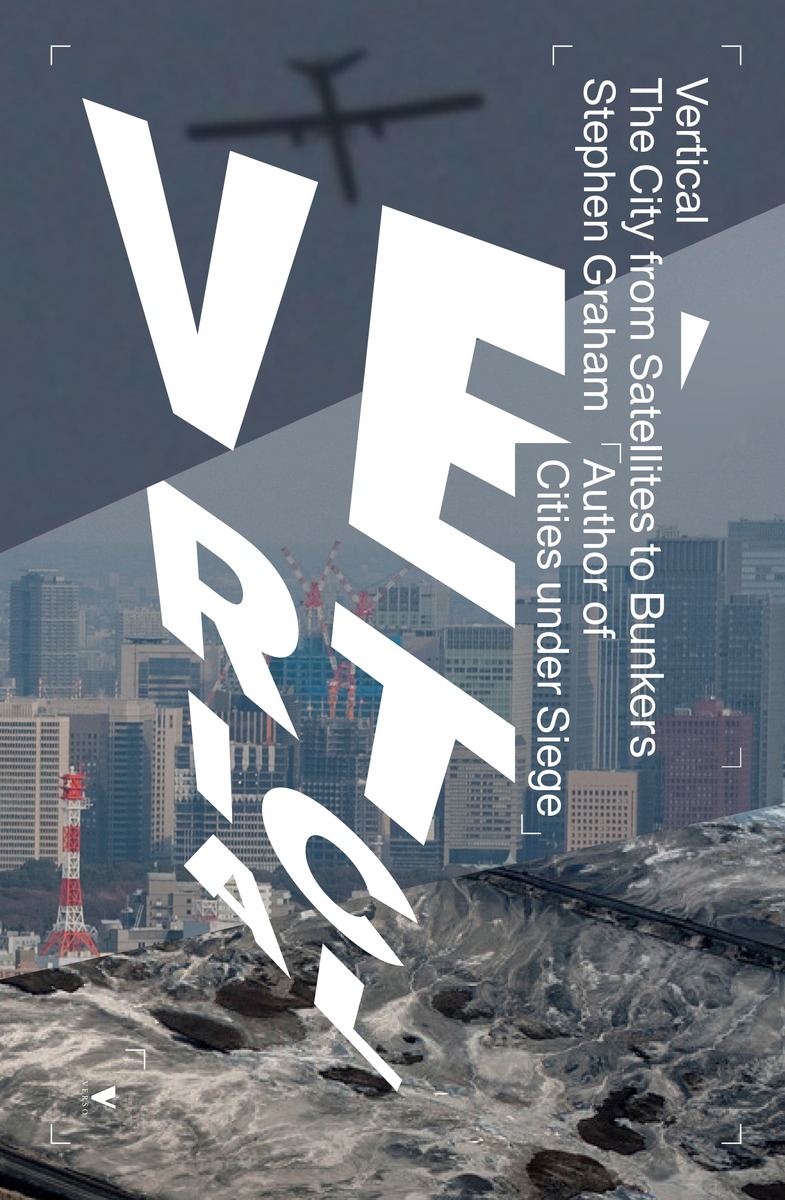
Steve Graham has kindly sent me the page proofs of his new book, Vertical: the city from satellites to tunnels, due from Verso and Penguin/Random House in October/November (it’s already available as an e-book from Amazon).  The subtitle varies depending on where you look – the proofs have both ‘from satellites to tunnels’ and ‘from satellites to bunkers’, and you can find both in the ads – but whatever version they settle on it’s clear that this is yet another tour (sic) de force.

From the penthouse to the sewers—the political geography of the vertical city

Vertical is a brilliant re-imagining of the world we live in. Today we live in a world that can no longer be read as a two-dimensional map. In Vertical Stephen Graham rewrites the city at every level, calling for a a new understanding of our surroundings that takes into account above and below: why Dubai has been built to be seen from GoogleEarth; how the superrich in Sao Paulo live their penthouse lives far from the street; why London billionaires build vast subterranean basements rather than move house. Vertical will make you look at the city anew: from the viewfinders of drones, satellites, from the top of skyscrapers, at street-level and from underground bunkers: this is a new politics of space and geography.

It’s composed of an introduction (‘Going vertical’) and 15 essays:

Part One: Above

1 Satellite: Enigmatic presence

2 Bomber: Death from above

3 Drone: Robot imperium

4 Helicopter: Direct arrival

5 Favela: Tenuous city

6 Elevator/Lift: Going up

7 Skyscraper: Vanity and violence

8 Housing: Luxified skies

9 Skywalk/Skytrain/Skydeck: Multilevel cities

10 Air: Lethal domes

Part Two: Below

11 Ground: Making geology

12 Basement/cellar: Urban undergrounds

13 Sewer: Sociology and shit

14 Bunker/tunnel: Subsurface sanctuaries

15 Mine: Extractive imperialism on the deep frontier


How everything became war

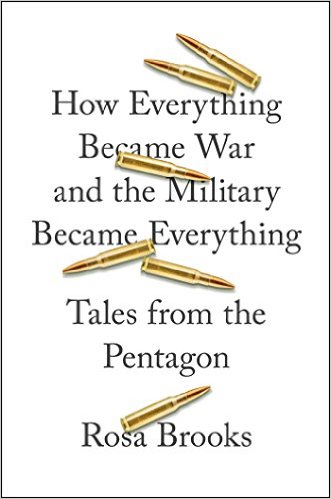
Apologies for the long silence: the last month has been full of horrors, but it’s good to be back and there’s lots to catch up.  First – I’m easing myself back into this! – is a new book by Rosa Brooks, How everything became war and the military became everything, out next month:

The first serious book to examine what happens when the ancient boundary between war and peace is erased.

BROOKS How everything became warOnce, war was a temporary state of affairs—a violent but brief interlude between times of peace. Today, America’s wars are everywhere and forever: our enemies change constantly and rarely wear uniforms, and virtually anything can become a weapon. As war expands, so does the role of the US military. Today, military personnel don’t just “kill people and break stuff.” Instead, they analyze computer code, train Afghan judges, build Ebola isolation wards, eavesdrop on electronic communications, develop soap operas, and patrol for pirates. You name it, the military does it.

Rosa Brooks traces this seismic shift in how America wages war from an unconventional perspective—that of a former top Pentagon official who is the daughter of two anti-war protesters and a human rights activist married to an Army Green Beret. Her experiences lead her to an urgent warning: When the boundaries around war disappear, we risk destroying America’s founding values and the laws and institutions we’ve built—and undermining the international rules and organizations that keep our world from sliding towards chaos. If Russia and China have recently grown bolder in their foreign adventures, it’s no accident; US precedents have paved the way for the increasingly unconstrained use of military power by states around the globe. Meanwhile, we continue to pile new tasks onto the military, making it increasingly ill-prepared for the threats America will face in the years to come.

By turns a memoir, a work of journalism, a scholarly exploration into history, anthropology and law, and a rallying cry, How Everything Became War and the Military Became Everything transforms the familiar into the alien, showing us that the culture we inhabit is reshaping us in ways we may suspect, but don’t really understand. It’s the kind of book that will leave you moved, astonished, and profoundly disturbed, for the world around us is quietly changing beyond recognition—and time is running out to make things right.

More here.

‘Dearer to the Vultures’

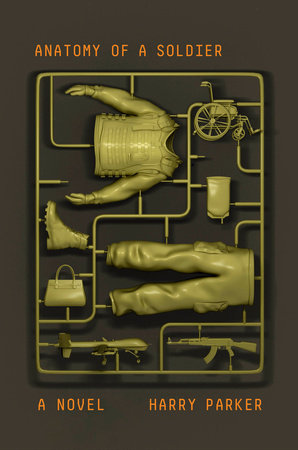
Over at the Paris Review Scott Beauchamp has a beautiful short essay that complements my own reading of Harry Parker‘s Anatomy of a Soldier: ‘Dearer to the Vultures‘.

Here’s how it begins:

My memories of war are fractured: faces disappear like smoke while literal plumes of smoke, their specific shapes and forms, linger on vividly for years. I remember the mesh netting, concrete, and dust smell of tower guard, but the events of entire months are completely gone. I remember the sound of a kid’s voice, but not anything he actually said. I guess that’s what Tim O’Brien meant when he wrote about Vietnam, “What sticks to memory, often, are those odd little fragments that have no beginning or end.”

Parker Anatomy of a soldierMemories of people, too complex to carry through the years, fall apart. It’s easier to find purchase on memories of objects. The weapon I was assigned on my first deployment to Iraq was an M249 SAW, or what we would colloquially and inaccurately refer to as the “Squad Assault Weapon.” I remember the way it felt to disassemble—the slight give of the heat-shield assembly, its tiny metal pincers clinging to the barrel. I remember the sound of the feed tray snapping shut on a belt of ammunition. And I remember the tiny rust deposits on the legs of my weapon’s bipod, which would never go away, no matter how hard I scrubbed with CLP (Cleaner, Lubricant, and Protectant oil). I remember my SAW’s voice and the things it said.

During my second deployment, I served as the gunner in a Bradley Fighting Vehicle. We ran over two Soviet-era landmines that had been stacked on top of each other. Besides a few bruises and perforated eardrums, everyone in the crew was fine. When I would try to tell people the story back home, civilians would get caught up on the descriptions of objects they had never heard of, objects that were integral to understanding my experience of the event. “Were you hurt?” Not really, I’d say, but my head slammed against the ISU, and since we had the BFT mounted in a weird place, that sort of got in the way. “What’s an ISU and a BFT?”

I came to realize that the barrier in explaining my injuries to civilians wasn’t quite phenomenological so much as it was ontological. Everyone has experienced pain, fear, and frustration, but not everyone knows what an Integrated Sight Unit is or has had their face slammed into one. Even in just trying to narrate the events to family members, it seemed like any understanding of my trauma would have to come through a knowledge of the materials around me that made the trauma possible: the ISU, the Bradley Fighting Vehicle, the way the tracks moved, the type of soil underneath the tracks, how the mine mechanism worked, the radios we used to call in the explosion to base.

Harry Parker, a former British Army Captain, recently published Anatomy of a Soldier, a novel that puts forward an object-oriented ontology of war: an assertion that the material objects sharing the battleground with humans play an equal role in the composition of reality itself.

And the rest is equally worth reading, including some interesting reflections on ‘the rush from the intimate to the inanimate’ –and its limitations.

I first wrote about Anatomy of a Soldier here, followed it up with a notice of an interview with Harry Parker at the Imperial War Museum here (where I’m currently working, deep in the Research Room), and finally summarised my conference presentation on the book and its implications in San Francisco here (‘Object Lessons’: the presentation slides are available under the DOWNLOADS tab).

The machinery of (writing about) bombing

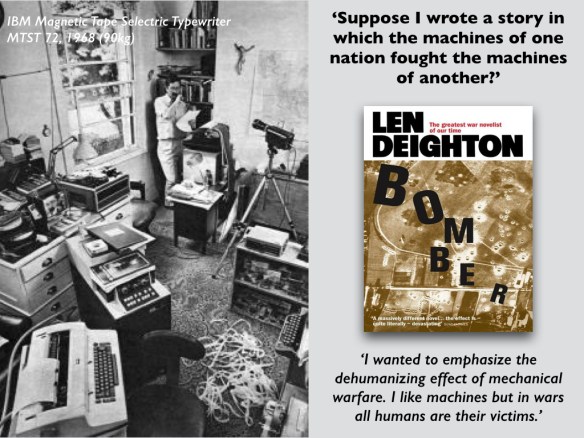
I began the first of my Tanner Lectures – Reach from the Sky – with a discussion of the machinery of bombing, and I started by describing an extraordinary scene: the window of a Georgian terrace house in London being popped out – but not by a bomb.  The year was 1968, and the novelist Len Deighton was taking delivery of the first word-processor to be leased (not even sold) to an individual.

As Matthew Kirschenbaum told the story in Slate:

The IBM technician who serviced Deighton’s typewriters had just heard from Deighton’s personal assistant, Ms. Ellenor Handley, that she had been retyping chapter drafts for his book in progress dozens of times over. IBM had a machine that could help, the technician mentioned. They were being used in the new ultramodern Shell Centre on the south bank of the Thames, not far from his Merrick Square home.

A few weeks later, Deighton stood outside his Georgian terrace home and watched as workers removed a window so that a 200-pound unit could be hoisted inside with a crane. The machine was IBM’s MTST (Magnetic Tape Selectric Typewriter).

It was a lovely story, because the novel Deighton was working on – almost certainly the first to be written on a word-processor – was his brilliant account of bombing in the Second World War, Bomber.  It had started out as a non-fiction book (and Deighton has published several histories of the period) but as it turned into a novel the pace of research never slackened.

Deighton recalls that he had shelved his original project until a fellow writer, Julian Symons, told him that he was ‘the only person he could think of who actually liked machines’:

I had been saying that machines are simply machines… That conversation set me thinking again about the bombing raids. And about writing a book about them. The technology was complex but not so complex as to be incomprehensible. Suppose I wrote a story in which the machines of one nation fought the machines of another? The epitome of such a battle must be the radar war fought in pitch darkness. To what extent could I use my idea in depicting the night bombing war? Would there be a danger that such a theme would eliminate the human content of the book? The human element was already a difficult aspect of writing such a story.

And so Bomber was born.

The novel describes the events surrounding an Allied attack during the night of 31 June (sic) 1943 – the planned target was Krefeld, but the town that was attacked, a ‘target of opportunity’, was ‘Altgarten’.  And like the bombing raid, it was a long haul.  As Deighton explained:

I am a slow worker so that each book takes well over a year—some took several years—and I had always ‘constructed’ my books rather than written them. Until the IBM machine arrived I used scissors and paste (actually Copydex one of those milk glues) to add paras, dump pages and rearrange sections of material. Having been trained as an illustrator I saw no reason to work from start to finish. I reasoned that a painting is not started in the top left hand corner and finished in the bottom right corner: why should a book be put together in a straight line?

Deighton’s objective, so he said, was ‘to emphasize the dehumanizing effect of mechanical warfare. I like machines but in wars all humans are their victims.’

I pulled all this together in this slide:
Len Deighton BOMBER (Tanner Lecture 1).001

I then riffed off Deighton’s work in two ways.

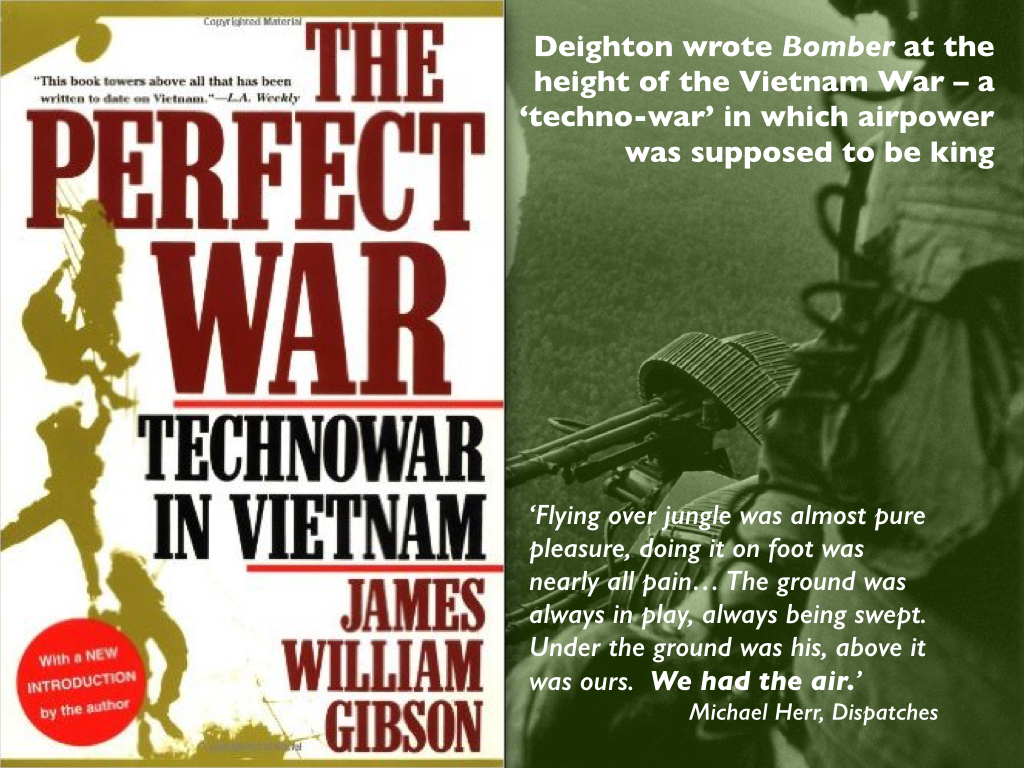
First, I noted that Bomber was written at the height of the Vietnam War, what James Gibson calls ‘techno-war’:
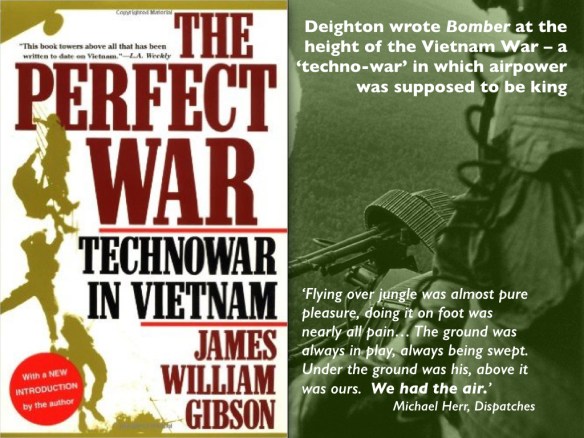
Len Deighton TECHNOWAR (Tanner 2).001

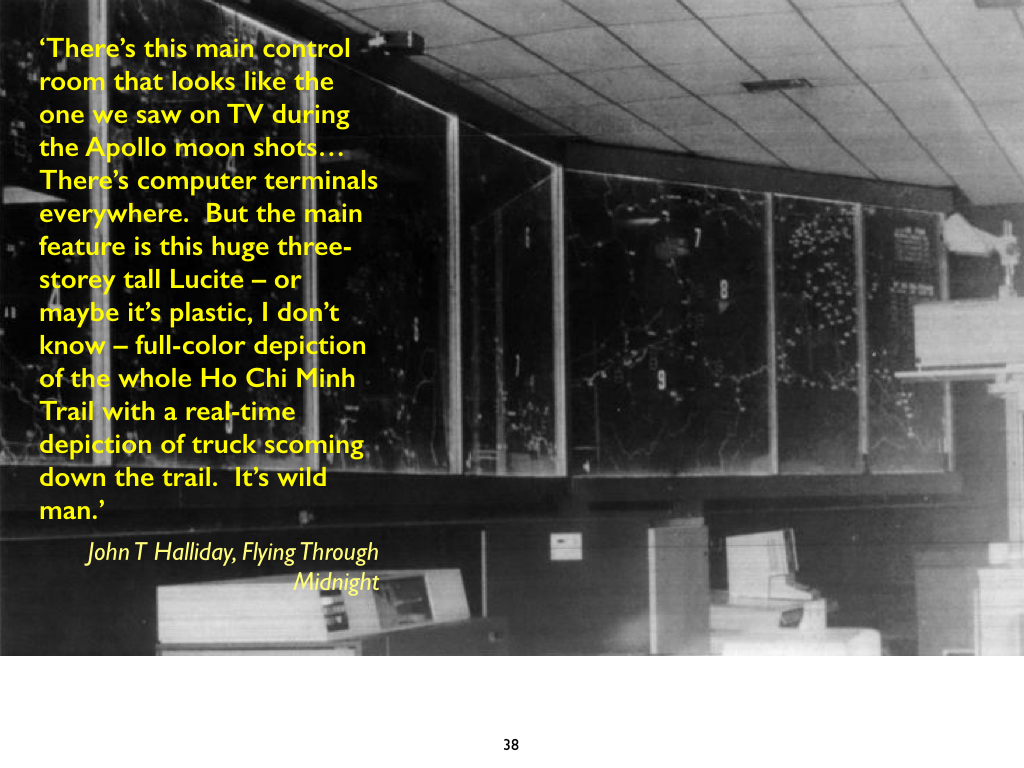
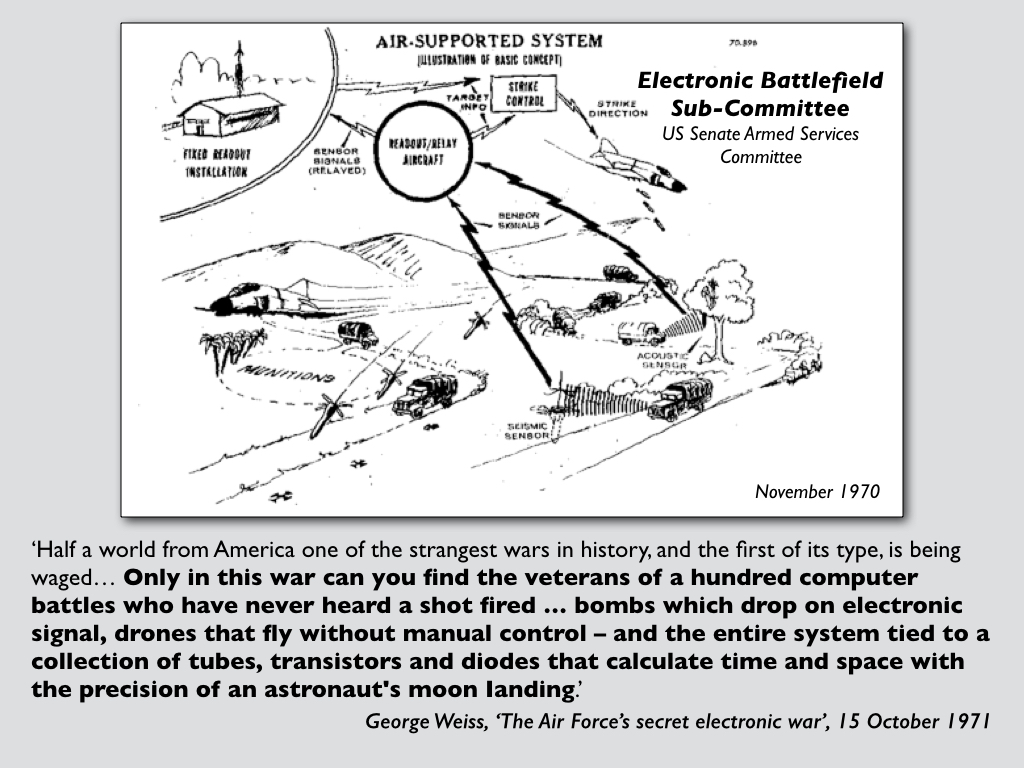
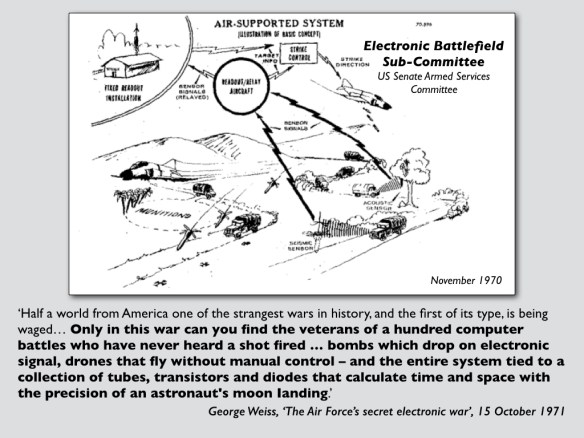
I focused on the so-called ‘electronic battlefield’ that I had discussed in detail in ‘Lines of descent’ (DOWNLOADS tab), and its attempt to interdict the supply lines that snaked along the Ho Chi Minh Trail by sowing it with sensors and automating bombing:
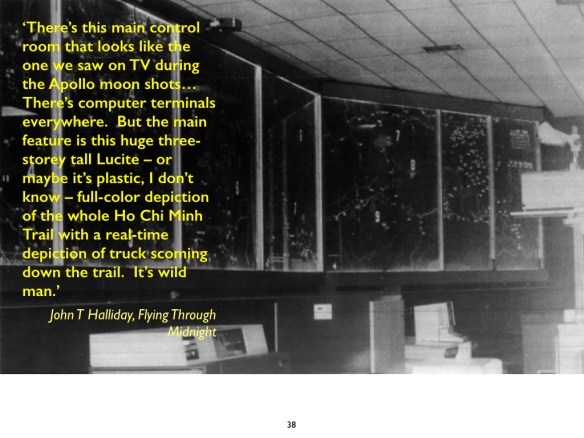
Electronic battlefield 1 (Tanner Lectures).001 Electronic battlefield 2 (Tanner Lectures).001

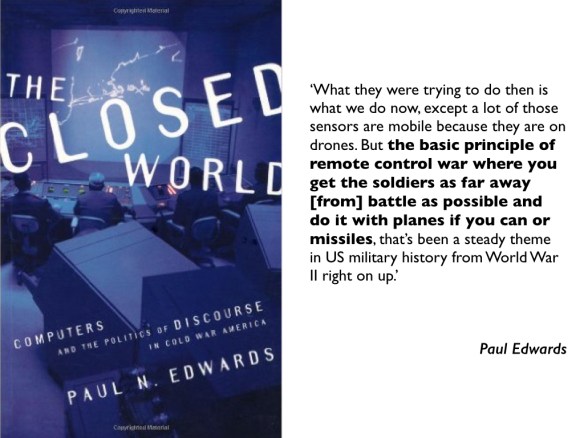
The system was an expensive failure – technophiles and technophobes alike miss that sharp point – but it prefigured the logic that animates today’s remote operations:
Electronic battlefield 3 (Tanner Lectures).001

Second – in fact, in the second lecture – I returned to Bomber and explored the relations between Deighton’s ‘men and machines’.  There I emphasised the intimacy of a bomber crew in the Second World War (contrasting this with the impersonal shift-work that characterises today’s crews operating Predators and Reapers).  ‘In the air’, wrote John Watson in Johnny Kinsman, ‘they were component parts of a machine, welded together, dependent on each other.’  This was captured perfectly, I think, in this photograph by the inimitable Margaret Bourke-White:

Men-machines (BOURKE-WHITE) Tanner Lectures).001

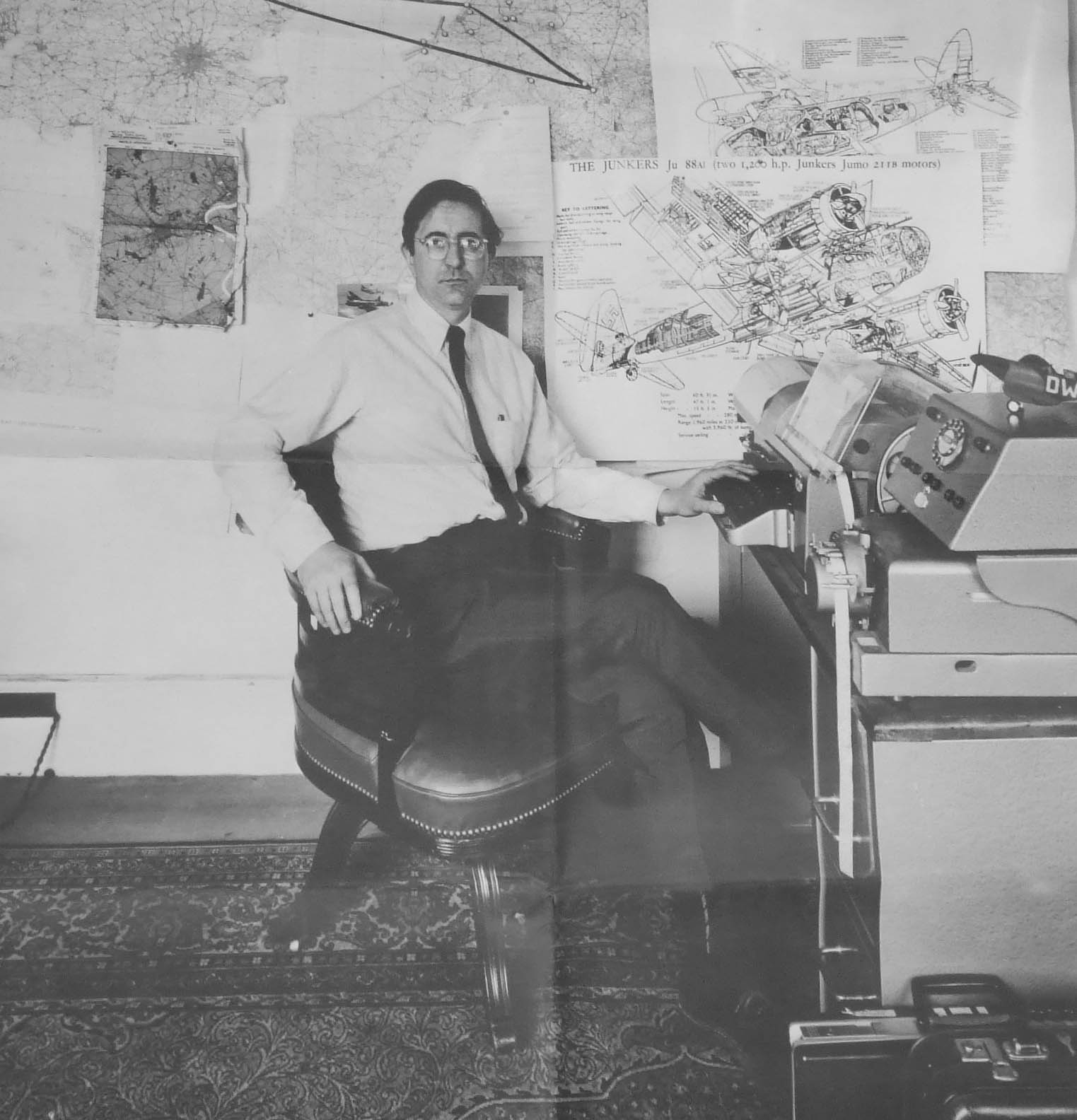
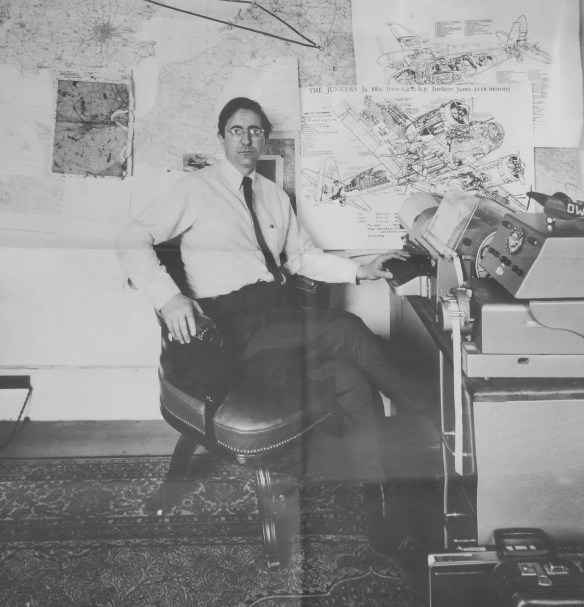
Much to say about the human, the machine and the cyborg, no doubt, but what has brought all this roaring back is another image of the entanglements between humans and machines that returns me to my starting-point.  In a fine essay in The Paris Review, ‘This faithful machine‘, Matthew Kirschenbaum revisits the history of word-processing.  It’s a fascinating read, and it’s headed by this photograph of Len Deighton working on Bomber in his study:
deighton-home-office-1

Behind him you can see giant cut-away diagrams of British and German bombers, and on the left a Bomber Command route map to ‘the target for tonight’ (the red ribbon crossing the map of Europe), and below that a target map.  ‘Somber things,’ he called them in Bomber:

‘inflammable forest and built-up areas defined as grey blocks and shaded angular shapes.  The only white marks were the thin rivers and blobs of lake.  The roads were purple veins so that the whole thing was like a badly bruised torso.’

More on all that in my ‘Doors into nowhere’ (DOWNLOADS tab), and much more on the history of word-processign in Matthew’s Track Changes: A Literary History of Word Processing just out from Harvard University Press:

The story of writing in the digital age is every bit as messy as the ink-stained rags that littered the floor of Gutenberg’s print shop or the hot molten lead of the Linotype machine. During the period of the pivotal growth and widespread adoption of word processing as a writing technology, some authors embraced it as a marvel while others decried it as the death of literature. The product of years of archival research and numerous interviews conducted by the author, Track Changes is the first literary history of word processing.

Matthew Kirschenbaum examines how the interests and ideals of creative authorship came to coexist with the computer revolution. Who were the first adopters? What kind of anxieties did they share? Was word processing perceived as just a better typewriter or something more? How did it change our understanding of writing?

Track Changes balances the stories of individual writers with a consideration of how the seemingly ineffable act of writing is always grounded in particular instruments and media, from quills to keyboards. Along the way, we discover the candidates for the first novel written on a word processor, explore the surprisingly varied reasons why writers of both popular and serious literature adopted the technology, trace the spread of new metaphors and ideas from word processing in fiction and poetry, and consider the fate of literary scholarship and memory in an era when the final remnants of authorship may consist of folders on a hard drive or documents in the cloud.

And, as you’d expect, it’s available as an e-book.

The sense of war

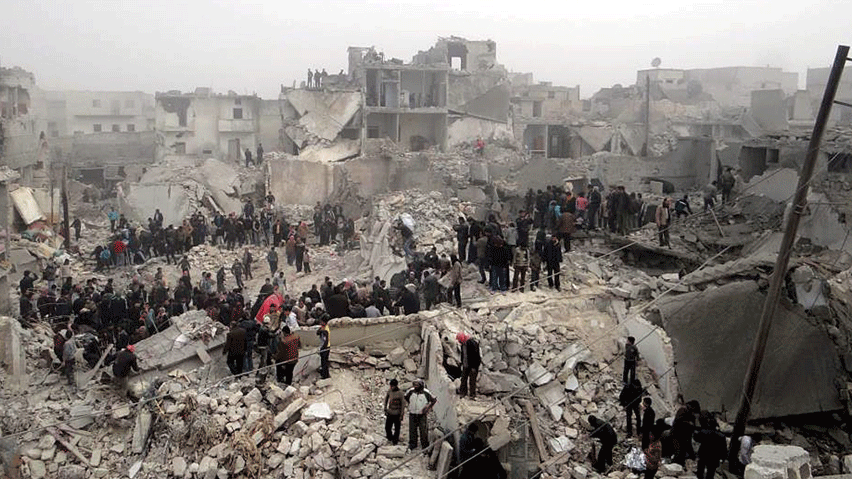
aleppo-2

In the face – often literally so – of  attempts to render later modern war as somehow bodiless, a project that contorts itself into grotesque formations around the spectacularly contradictory vocabulary of ‘surgical strikes’ against the cancerous cells of insurgency and terrorism, I continue to be drawn to attempts to convey the  corporeality of its violence.  I started down this road in ‘The natures of war‘ and continue it in my attempts to think about what I call ‘corpographies‘ (see DOWNLOADS tab for both, and also here, here and here), and it is a constant concern in my current work on casualty evacuation from war zones.

So I was taken with a short extract from Janine di Giovanni‘s The Morning They Came for Us: Dispatches from Syria (2016) that appears in Harper‘s.  It’s called ‘The Sense of War‘ (in another register so often another oxymoron):

The morning they came for usWhat does war sound like? The whistling sound of the bombs falling can only be heard seconds before impact—enough time to know that you are about to die, but not enough time to flee.

What does the war in Aleppo smell of? It smells of carbine, of wood smoke, of unwashed bodies, of rubbish rotting, of . . . fear. The rubble on the street—the broken glass, the splintered wood that was once somebody’s home. On every corner there is a destroyed building that may or may not have bodies still buried underneath. Your old school is gone; so are the mosque, your grandmother’s house and your office. Your memories are smashed…

War is empty shell casings on the street, smoke from bombs rising up in mushroom clouds, and learning to determine which thud means what kind of bomb. Sometimes you get it right, sometimes you don’t.

War is the destruction, the skeleton and the bare bones of someone else’s life.

Anand Gopal thinks her prose is ‘overwrought’, though I don’t think that’s entirely surprising, and when Sebastian Junger says that she ‘has described war in a way that almost makes me think it never needs to be described again’, even in this short passage you can see – feel – what he means.  You can find other reviews here and here.

Hidden in plane sight

negpub06

Just out: Negative Publicity: artefacts of extraordinary rendition by Edmund Clark and Crofton Black, with an essay by Eyal Weizman:

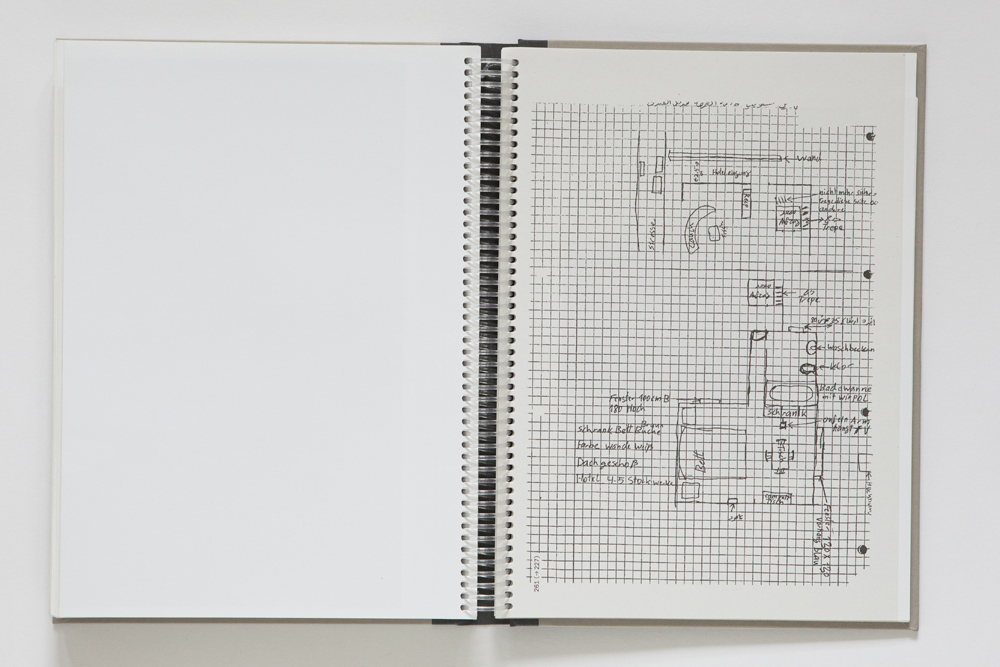
British photographer Edmund Clark and counterterrorism investigator Crofton Black have assembled photographs and documents that confront the nature of contemporary warfare and the invisible mechanisms of state control. From George W. Bush’s 2001 declaration of the “war on terror” until 2008, an unknown number of people disappeared into a network of secret prisons organized by the U.S. Central Intelligence Agency—transfers without legal process known as extraordinary renditions. No public records were kept as detainees were shuttled all over the globe. Some were eventually sent to Guantánamo Bay or released without charge, while others remain unaccounted for.

The paper trail assembled in this volume shows these activities via the weak points of business accountability: invoices, documents of incorporation, and billing reconciliations produced by the small-town American businesses enlisted in detainee transportation. Clark has traveled worldwide to photograph former detention sites, detainees’ homes, and government locations. He and Black recreate the network that links CIA “black sites,” and evoke ideas of opacity, surface, and testimony in relation to this process—a system hidden in plain sight. Negative Publicity: Artefacts of Extraordinary Rendition, copublished with the Magnum Foundation, its creation supported by Magnum Foundation’s Emergency Fund, raises fundamental questions about the accountability and complicity of our governments, and the erosion of our most basic civil rights.

2016-02-29-NP-BOOK-9762

Here is how the always absorbing We make money not art describes the project:

Photographer Edmund Clark spent 4 years spent hunting for sites of extraordinary rendition and photographing any location associated with the programme. None of the photo printed in the book shows any clear evidence of torture, kidnapping or any other human right abuse. There is nothing spectacular to witness here, just mundane places such as the entrance to a Libyan intelligence service detention facility, the corridors connecting cells to interrogation rooms, anonymous streets or the bedroom of the son of a man formerly imprisoned in a CIA black site. Clark calls the making of these photographs “an act of testimony.”

However, the images start to bear a chilling significance when coupled with the paper trail and extracts of interview patiently compiled by Crofton Black, an investigative journalist whose research focuses on extraordinary rendition and black site cases. Over the course of his inquiry, Black has amassed incriminating documents that range from satellite maps to landing records, from border guard patrol logs to testimonies of people tortured in CIA ‘black sites’, from invoices to CIA documents released after freedom of information act litigation by the American Civil Liberties Union. He managed to give them meaning by organizing them into engrossing episodes that give a glimpse of the building and unraveling of the extraordinary rendition network.

And VICE has an interview with the authors here.  Here is their description of the origins of the project:

Edmund Clark: In 2011, while I was working on a body of work on Guantanamo Bay, I was in contact with Clive Stafford Smith at Reprieve and found out that they were doing work on extraordinary rendition. I met Crofton and discovered that was what he was also researching. I became interested in doing something on extraordinary rendition as a progression of my work on Guantanamo Bay.
Crofton Black: When he first came to me I’d been out in Lithuania, looking at this weird site—a warehouse that had been built in the woods in the middle of nowhere, on the site of a former riding school. I was building a court case around it, so when [Clark] got in touch I said, ‘Oh, you should go to Lithuania and take some photos of this strange, peculiar place.’ Which he did. After that we started formulating a more complex and ambitious scheme of trying to document the black-site network through documents, images, and prose. We spent a long time working out how to fit it all together.

Former CIA Black Site, Lithuania

Former CIA Black Site, Lithuania

Crofton explains why he was drawn to the visual:

I was aware that I had all this material, that there were remarkable stories and images and documents that were bizarre, and spoke beyond what was immediately visible in them. I knew I wanted to do something with it that was less dry than legal cases, which are quite dull. There was an opportunity to do something that spoke to a different, and bigger, audience.

And they both emphasise the banality of bureaucracy in the service of violence (an argument that resonates with what – in relation to targeting for nuclear war – Henry Nash called ‘the bureaucratization of homicide’, which I discuss here):

Black: Obviously, post-Hannah Arendt, “the banality of evil” has become a standardized phrase. For me, one of the places you see it most strongly is in bureaucracy: in these documents, in the way they are written, the way certain forms of interrogation are described, or flight routes are detailed. I wanted to make that point. None of these things would be possible without a complex bureaucratic system enabling them. In theory, the idea of a bureaucracy is that everything has its place and gets done by the right person. But in practice it often means that no one is responsible for anything. And that’s what we found in Eastern Europe—no one was responsible. There’s no one in Poland or Lithuania who is responsible for any of this stuff!
Clark: That’s something we wanted to bring out: the ordinariness, the banality of it all. When she spoke of the banality of evil, Hannah Arendt was talking about the bureaucracy of National Socialism. Here, we are talking about a mosaic of small companies—small to medium enterprises—earning a buck.

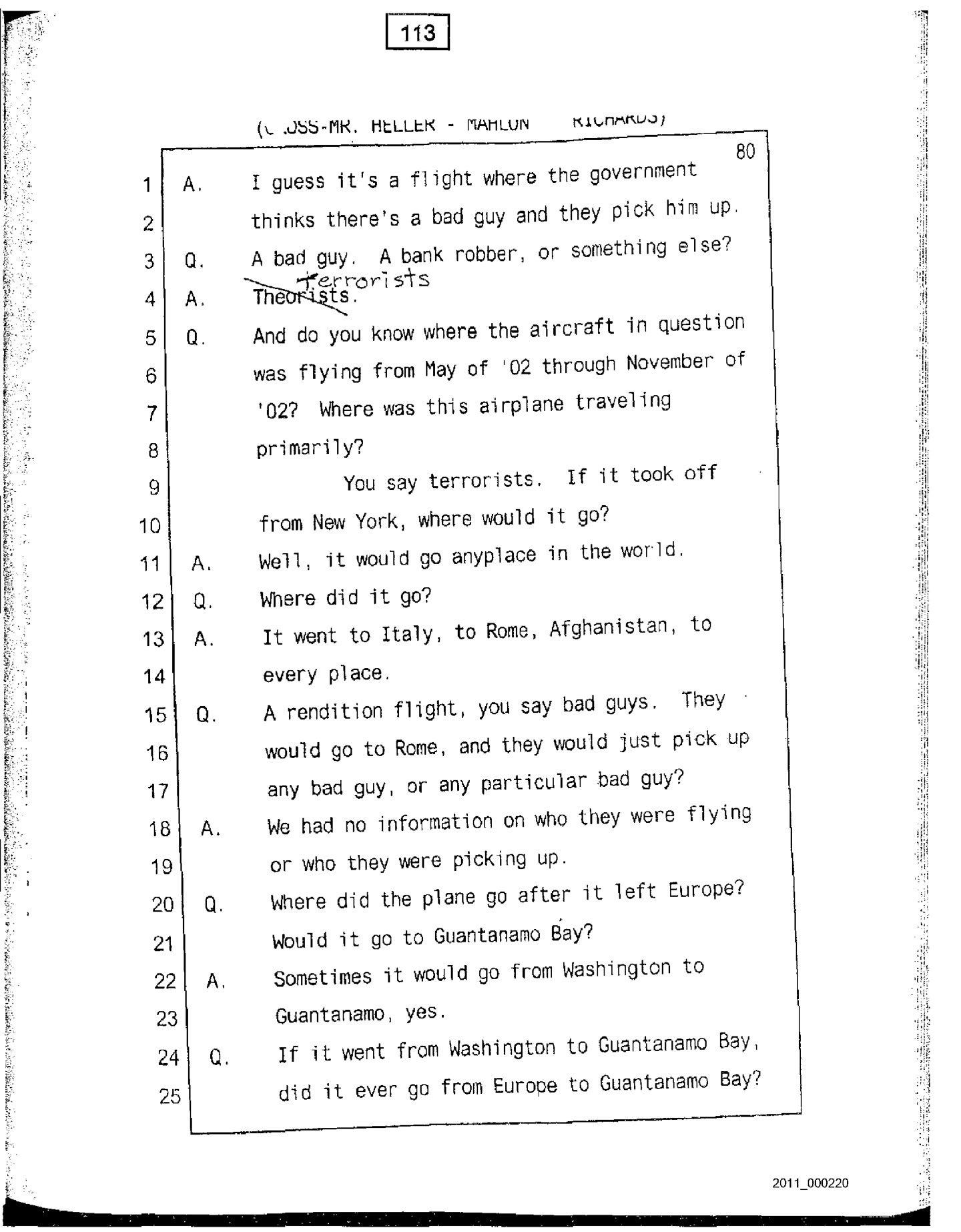
CLAcrossexamRK_09

Note the glorious correction above.

And one final comment about the geography of this sprawling bureaucracy which explains why my title is not a mis-spelling:

Black: Most of the paperwork in the book is from other entities or other countries [than the US]. If they wanted to have an entirely secret prison system, they shouldn’t have invented one that involved flying prisoners all over the world. You simply can’t fly a plane from A to B without leaving a gigantic paper trail. You just can’t, otherwise planes would be bumping into each other. They could have just held their 119 prisoners in Afghanistan and we would probably have found it an awful lot more difficult to find out about it. But the peculiarities of how they wanted—or, at times, were forced to—use different locations… that made it detectable.

All of this, of course, parallels Trevor Paglen‘s work in interesting and complementary ways: see my post here, which connects Trevor’s project to Crofton’s work on ‘the boom and bust of the CIA’s torture sites‘ and his involvement in the Rendition Project.

‘Nothing ever dies’

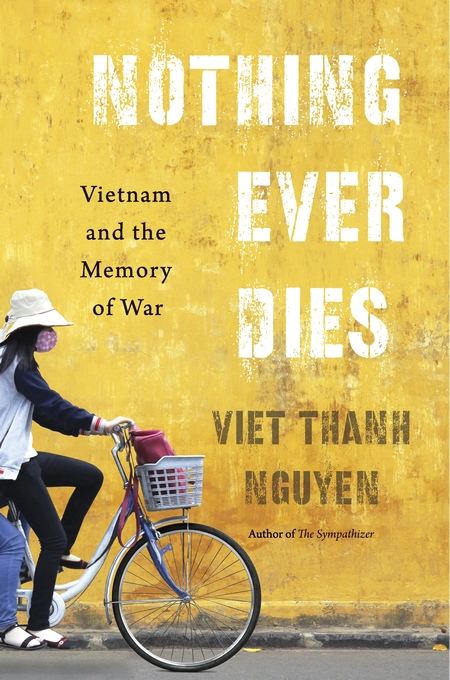
Nothing ever dies

I’m just starting Viet Thanh Nguyen‘s Nothing ever dies: Vietnam and the memory of war (just out from Harvard):

All wars are fought twice, the first time on the battlefield, the second time in memory. From the author of the bestselling novel The Sympathizer comes a searching exploration of the conflict Americans call the Vietnam War and Vietnamese call the American War – a conflict that lives on in the collective memory of both nations.

From a kaleidoscope of cultural forms – novels, memoirs, cemeteries, monuments, films, photography, museum exhibits, video games, souvenirs, and more – Nothing Ever Dies brings a comprehensive vision of the war into sharp focus. At stake are ethical questions about how the war should be remembered by participants that include not only Americans and Vietnamese but also Laotians, Cambodians, South Koreans, and Southeast Asian Americans. Too often, memorials valorize the experience of one’s own people above all else, honoring their sacrifices while demonizing the “enemy” – or, most often, ignoring combatants and civilians on the other side altogether. Visiting sites across the United States, Southeast Asia, and Korea, Viet Thanh Nguyen provides penetrating interpretations of the way memories of the war help to enable future wars or struggle to prevent them.

Drawing from this war, Nguyen offers a lesson for all wars by calling on us to recognize not only our shared humanity but our ever-present inhumanity. This is the only path to reconciliation with our foes, and with ourselves. Without reconciliation, war’s truth will be impossible to remember, and war’s trauma impossible to forget.

Here is the table of contents:

Prologue
Just Memory
Ethics
1. On Remembering One’s Own
2. On Remembering Others
3. On the Inhumanities
Industries
4. On War Machines
5. On Becoming Human
6. On Asymmetry
Aesthetics
7. On Victims and Voices
8. On True War Stories
9. On Powerful Memory
Just Forgetting
Epilogue

You can find an interview with the author at the LA Review of Books here: among other things, it addresses his doubled (and doubly admirable) interest in fiction and non-fiction.  There’s another with Tavis Smiley on PBS here and, since he’s just won a Pulitzer for his novel The Sympathizer – which also deals with Vietnam and the US – I’m sure there’ll be lots more….

Object Lessons

I was supposed to give a shortened version of ‘Little boys and blue skies‘ at the AAG Annual Meeting in San Francisco (about drones and atomic war: available under the DOWNLOADS tab) and fully intended to do so.  But in the event – and as I implied in a previous post – I decided to talk instead about Harry Parker‘s Anatomy of a soldier.  It was a spur of the moment decision, though it had been pricking away in my mind ever since I read the novel, and I only decided to do it at 10.30 the night before: madness.  But it was much closer to the theme of the sessions organised by Kate Kindervater and Ian Shaw on ‘Objects of Security and War: Material Approaches to Violence and Conflict‘ than my original presentation would have been.

I’ve added the presentation to those available under the DOWNLOADS tab (scroll right down).

I hope that most of it will be self-explanatory, but some notes might help.  I started out by invoking Tim O’Brien‘s twin accounts of the Vietnam War, The things they carried and If I should die in a combat zone, which provide vivid reminders of the weight – physical and emotional – borne by ground troops and the toll they impose on the soldier’s body.

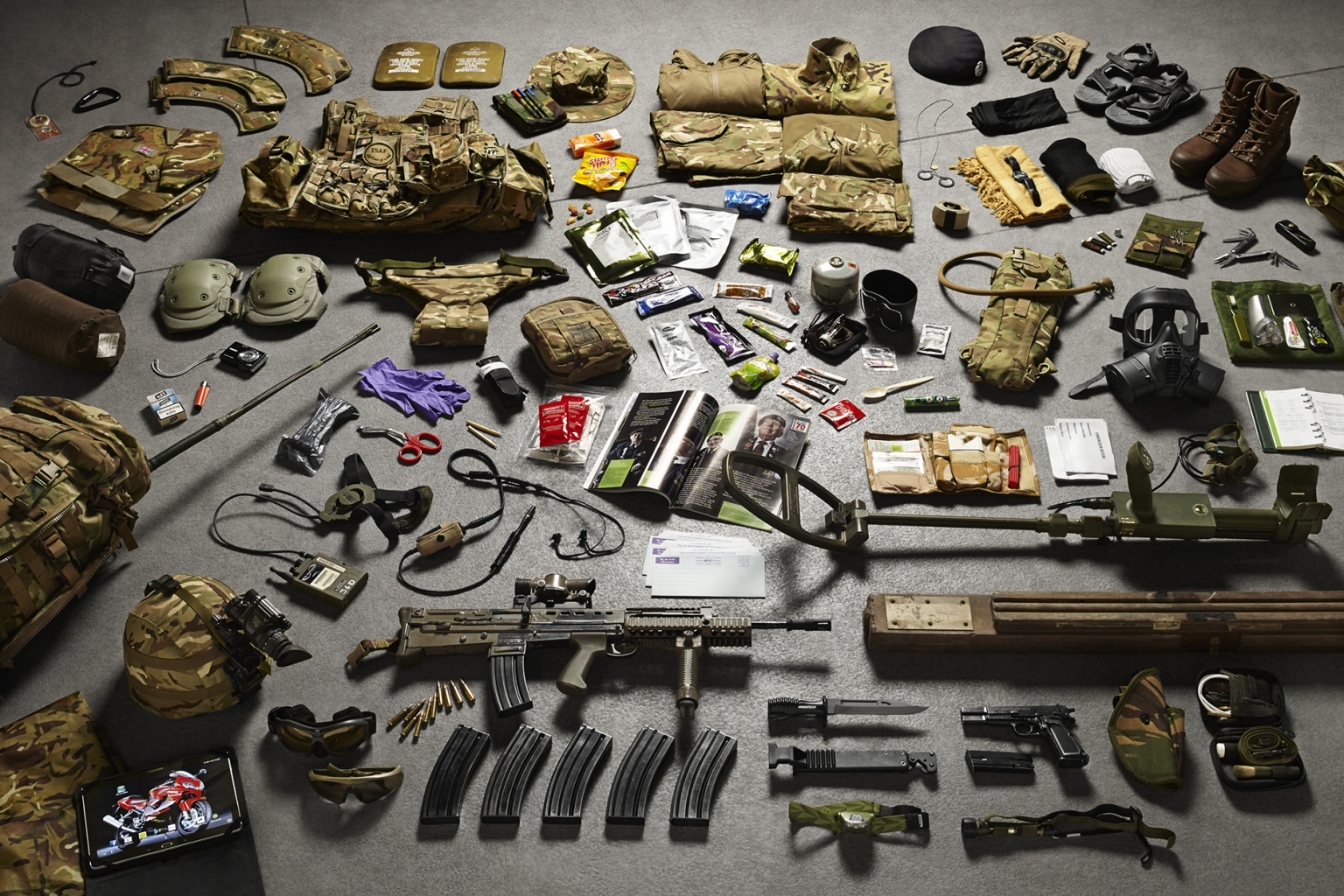
I talked about this in ‘The natures of war‘ (also under the DOWNLOADS tab) and – following in the footsteps of that essay – I sketched a brief history of the objects soldiers carried in to the killing fields: from the Somme in 1916 through Arnhem in 1944 to Helmand in Afghanistan in 2014 [shown below].  My source for these images was photographer Thom Atkinson‘s portfolio of Soldiers’ Inventories.

KIT Helmand 2014

But I was more interested now in the objects that carried the soldiers, so to speak, which is why I turned to Anatomy of a soldier.  

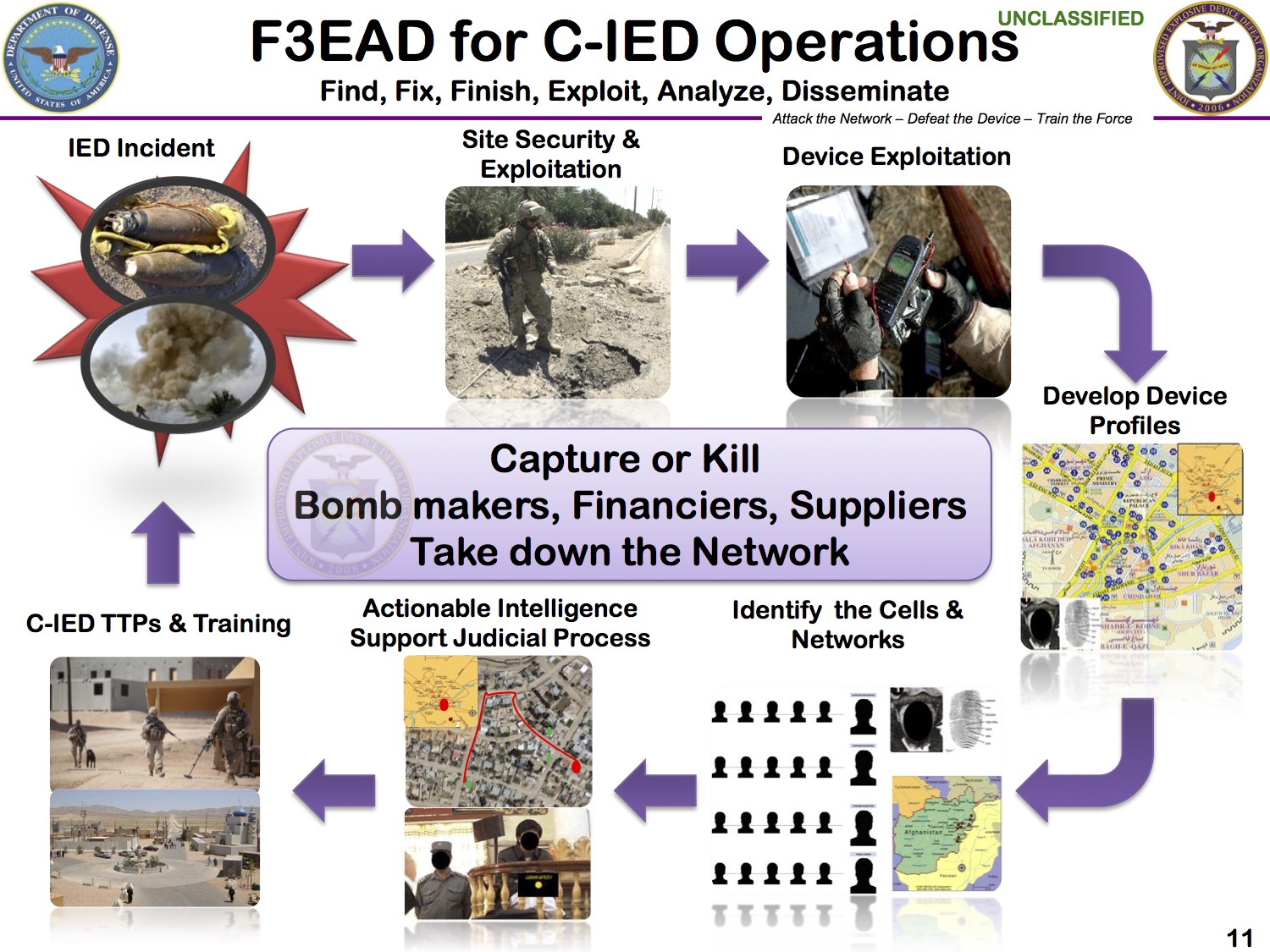
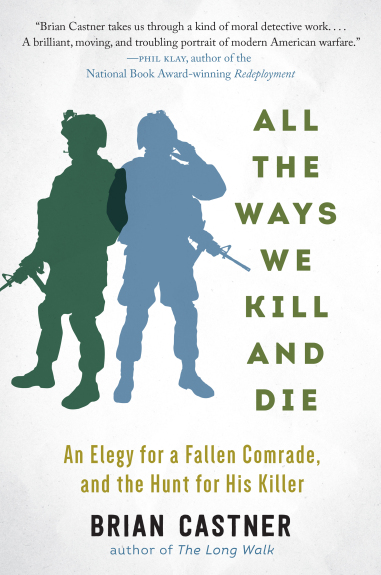
In order to throw the novel into even sharper relief, I outlined some of the other ways in which IED blasts in Afghanistan have been narrated.  These ranged from the US Army’s own schematics [the image below is taken from a presentation by Captain Frederick Gaghan here]  to Brian Castner’s truly brilliant non-fiction All the ways we kill and die, in which he describes his investigation into the death of his friend Matt Schwartz from an IED blast in Helmand in January 2012. (This book has taught me more about the war in Afghanistan than anything – I mean anything – I’ve ever read).

GAGHAN Attacking the IED Network jpegs

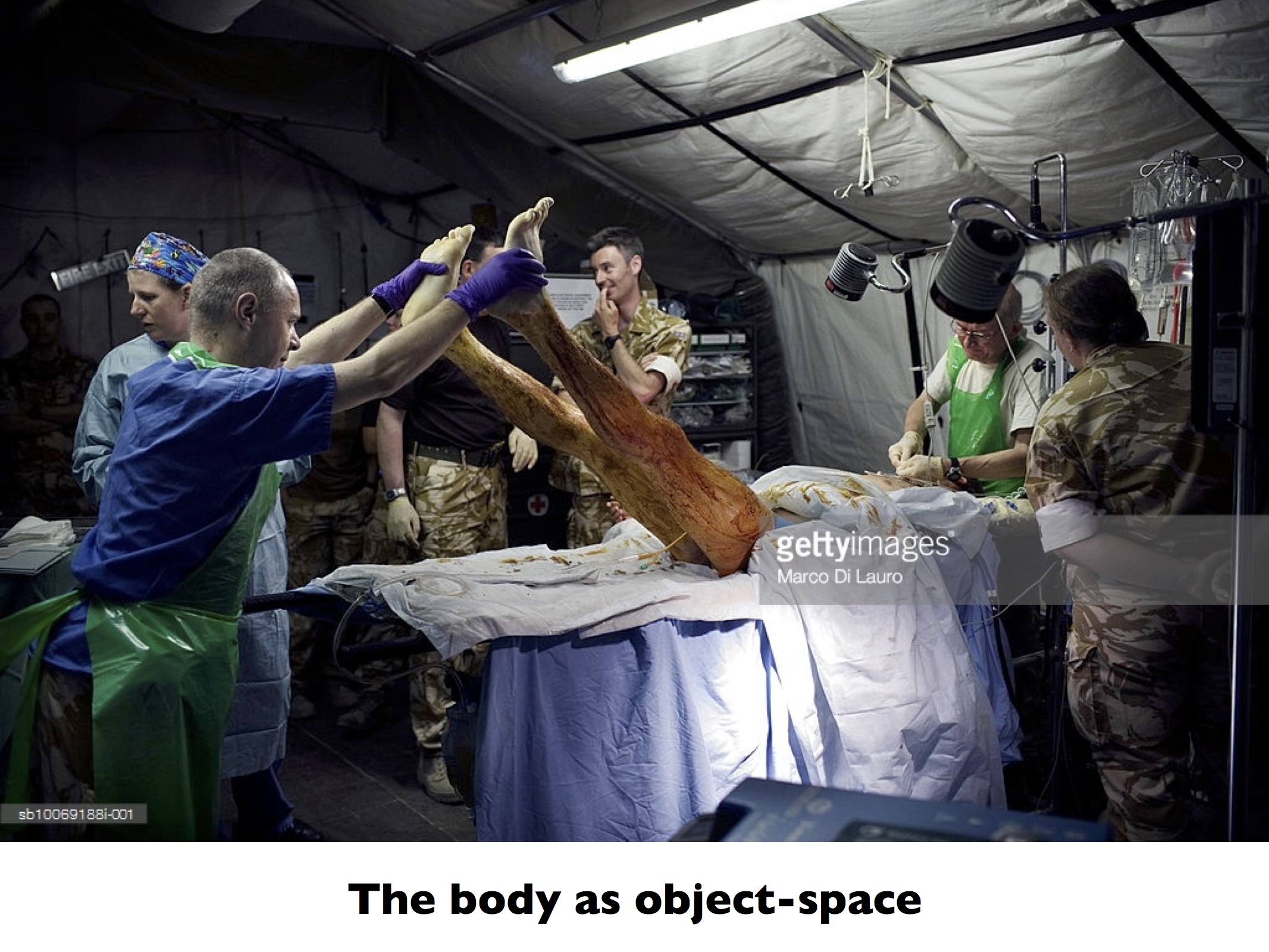
All of this prepared the ground for Parker’s novel which tells the story of a young British officer in Helmand, Tom Barnes, who loses his legs to an IED blast – told in 45 short chapters by the different objects involved.  Not all of the chapters are wholly successful, but many of them are utterly compelling and immensely affecting.  The overall effect is to emphasize at once the corporeality of war – ‘virtually every object-fragment that is proximate to Barnes is impregnated with his body: its feel – its very fleshiness – its sweat, its smell, its touch’ – and the object-ness of military violence.

GREGORY The body as object-space

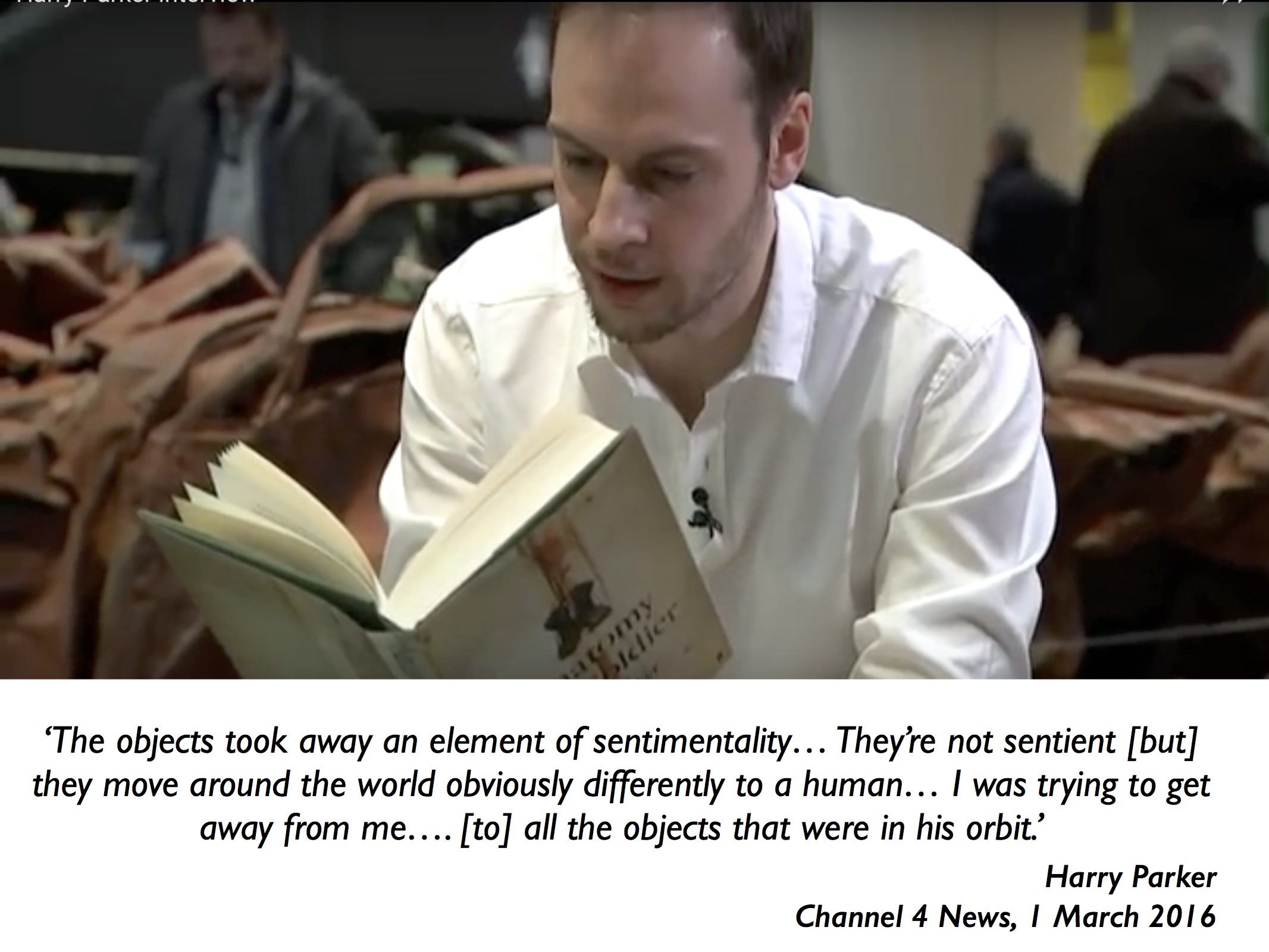
I juxtaposed the novel to Parker’s own story – he too lost his legs to an IED in Afghanistan in July 2009.  Yet he constantly emphasises that he never wanted the novel to be about him.

Harry Parker reading from Anatomy of a Soldier, IWM, LOndon

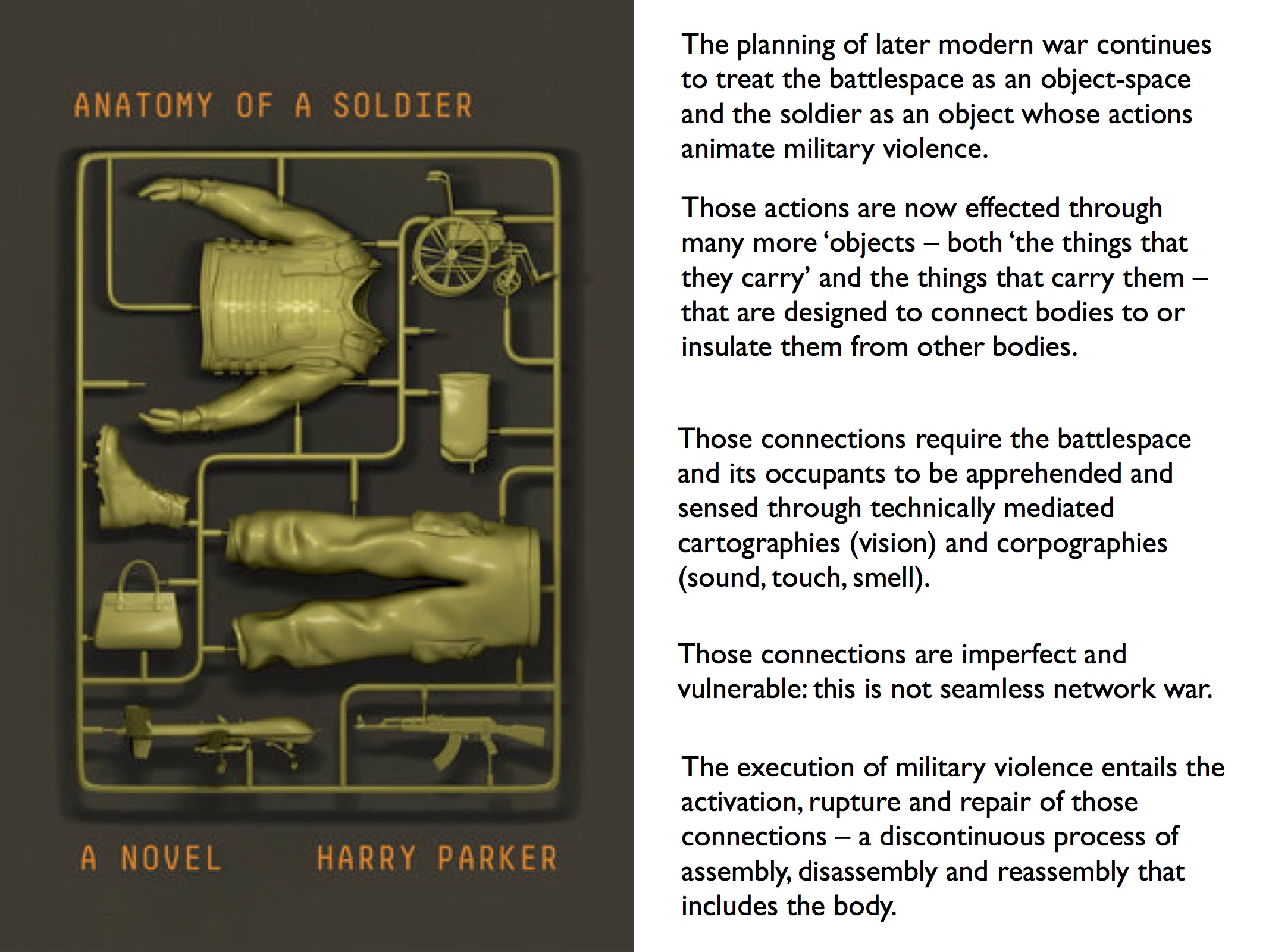
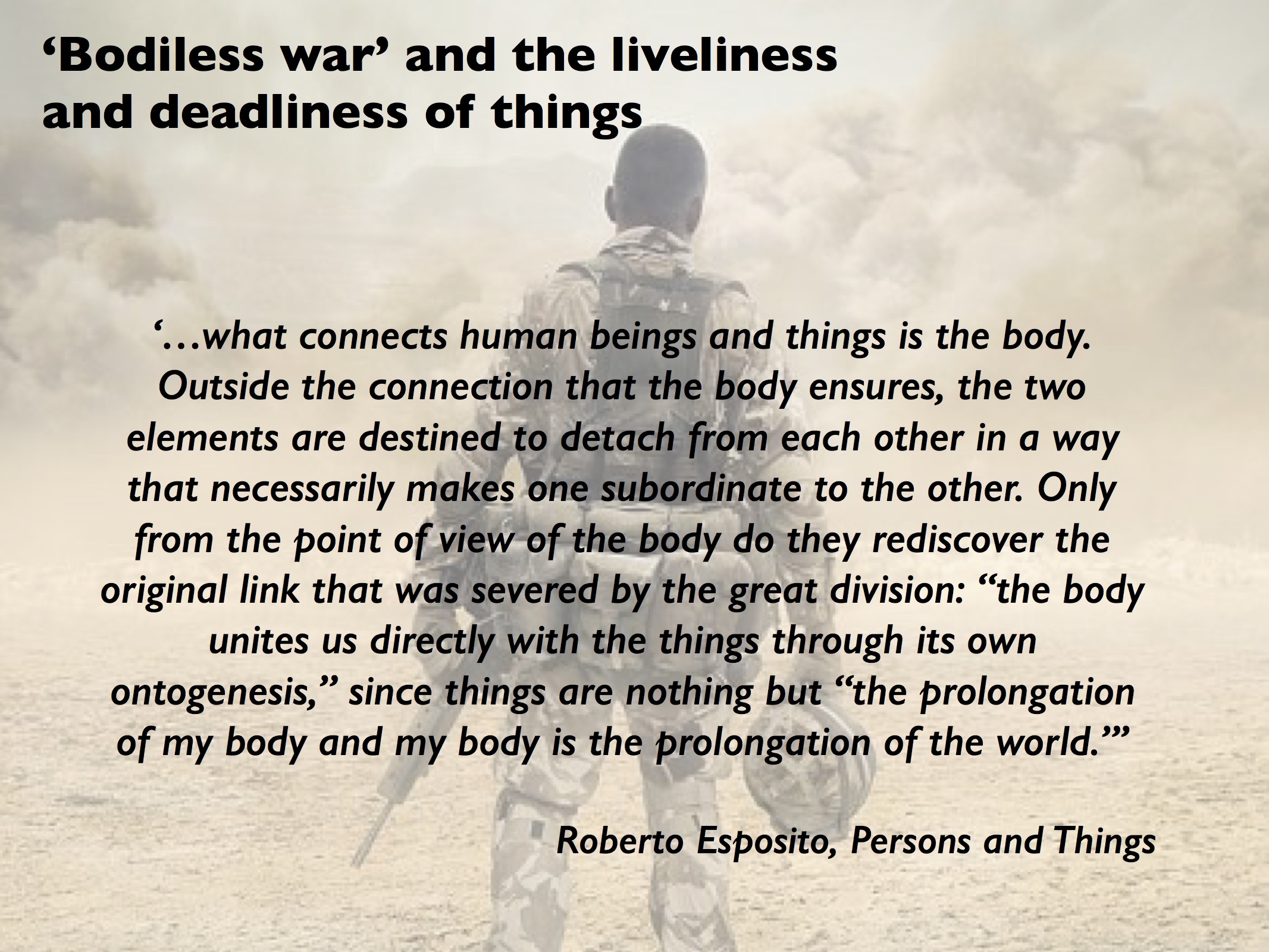
Still, the body is central to all this – Parker’s body and Barnes’s body – and so finally I drew on Roberto Esposito‘s Persons and Things to draw the wider lesson and, in particular, to nail the treacherous lie of ‘bodiless war’:

GREGORY The things that carry them

GREGORY Bodiless war

All the ways we kill and die

all-the-ways-we-kill-and-die-cover

I’ve noticed Brian Castners astonishing work before – see my post here – and I’m now deep into his latest book (published on my birthday).  I’ll write a detailed response when I’m finished, but it is so very good that I wanted to give readers advance notice of it.  It’s called All the ways we kill and die (Arcade, 2016):

The EOD—explosive ordnance disposal—community is tight-knit, and when one of their own is hurt, an alarm goes out. When Brian Castner, an Iraq War vet, learns that his friend and EOD brother Matt has been killed by an IED in Afghanistan, he goes to console Matt’s widow, but he also begins a personal investigation. Is the bomb maker who killed Matt the same man American forces have been hunting since Iraq, known as the Engineer?

In this nonfiction thriller Castner takes us inside the manhunt for this elusive figure, meeting maimed survivors, interviewing the forensics teams who gather post-blast evidence, the wonks who collect intelligence, the drone pilots and contractors tasked to kill. His investigation reveals how warfare has changed since Iraq, becoming individualized even as it has become hi-tech, with our drones, bomb disposal robots, and CSI-like techniques. As we use technology to identify, locate, and take out the planners and bomb makers, the chilling lesson is that the hunters are also being hunted, and the other side—from Al-Qaeda to ISIS— has been selecting its own high-value targets.

This is how Brian himself describes the book:

In January of 2012, a good friend of mine–Matt Schwartz from Traverse City, Michigan–was killed in Afghanistan. Matt was an Explosive Ordnance Disposal technician. We had the same job, but while I had done my two tours in Iraq and went home, Matt deployed again and again and again. He was shot on his second tour, and died on his sixth.

I realize now that I was bound to do an investigation into his death; my training demanded it. But instead of asking “what” killed him–we knew immediately it was a roadside bomb–I asked “who” killed him. It’s a question that would not have made any sense in past wars, not even at the start of this one. But we have individualized the war, we target specific people in specific insurgent organizations, and in the course of my research, I discovered the leaders on the other side do the same in reverse to us.

This is the story of an American family at war, and the men and women who fight this new technology-heavy and intelligence-based conflict. I interviewed intel analysts, biometrics engineers, drone pilots, special operations aircrew, amputees who lost their legs, and the contractors hired to finish the job. They are all hunting a man known as al-Muhandis, The Engineer, the brains behind the devices that have killed so many soldiers in Iraq and Afghanistan.

You can read an excerpt at VICE (‘The problem with biometrics at war‘) and another at Foreign Policy (‘You will know the Bomber by his designs).

Reading this in counterpoint to Harry Parker‘s  Anatomy of a soldier (see my post here) – both deal with the aftermath of an IED in Afghanistan – is proving to be a rich and truly illuminating experience.

The last Bastion

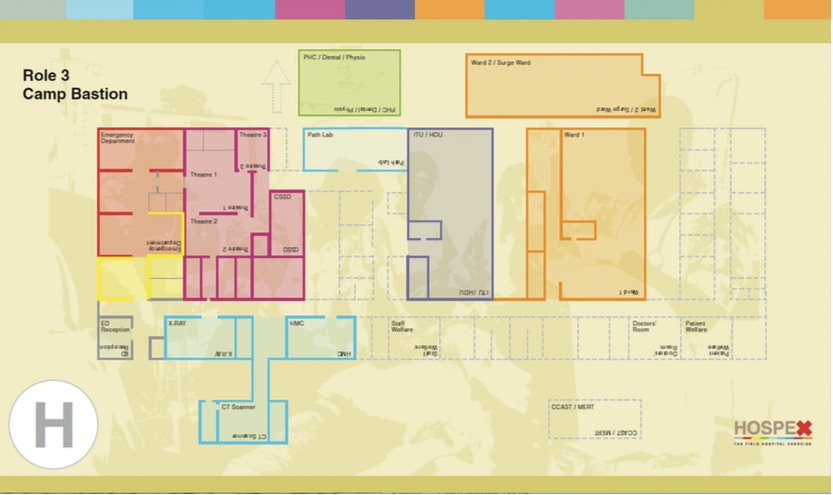
Camp Bastion Role 3 hospital (2008-9)

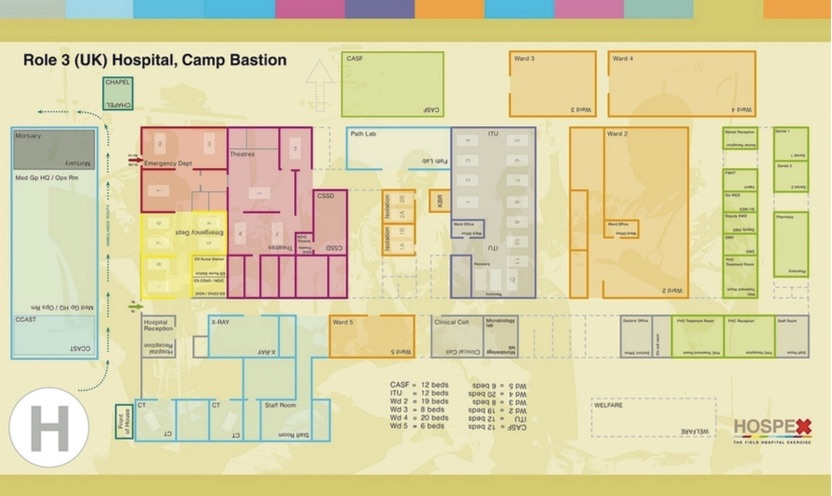
Camp Bastion Role 3 hospital (late 2010)

In between my other projects, I’m battling my way back to my current research on casualty evacuation.  Reading about the military hospital at Camp Bastion in Afghanistan – you can find a bare-bones’ (sic) summary of its development in a series of linked reports from David Vassallo here, here and here (the plans above document its expansion from 2008 to 2010) – I came across the ethnographic work of Mark de Rond:

Cornell University Press are publishing a monograph based on his work later this year – Doctors at war: an ethnographer’s account of life and death in a field hospital – though so far I’ve been unable to track down any more details of what promises to be an essential study of combat casualty care (and Mark’s key interest, ‘teamwork’ – hence his study of the Cambridge Boat Race crew).

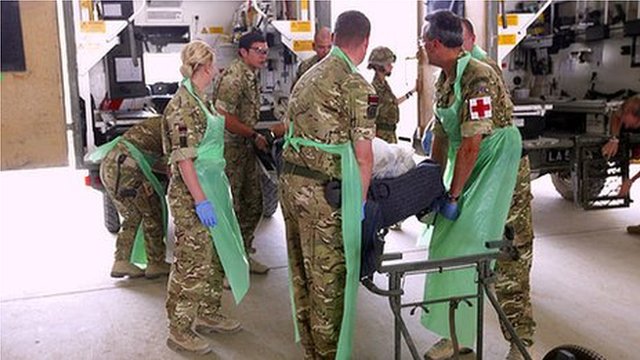
Bastion casualty arrival

In the meantime, you can get a sense of what he calls ‘field work beyond the comfort zone’ from an essay, ‘Soldier, surgeon, photographer, fly’ that appeared in Strategic Organization 10 (3) (2012) 256-262, available open access here:

To treat major trauma effectively requires surgeons and anaesthetists to align their efforts in a context where the margin for error is small and the stakes matters of life and death. Yet even such close cooperation does not rule out rivalry. For leave these surgeons with little or nothing to do work-wise and they may turn on each other instead. Unable to sit still, some begin to interfere in the affairs of others or to compete for work. As one of the surgeons admitted: ‘He is fighting for work. I am fighting for work, each of us hoping the other will be late.’ Sebastian Junger described the troops he embedded himself with as so bored on occasion that ‘they prayed for contact [with the enemy] as farmers pray for rain’ (Hetherington, 2010: 15). Even when work is plentiful, surgeons may compete for the most interesting jobs.

As in Junger’s Korengal Valley, in Camp Bastion’s hospital periods of great intensity follow periods of boredom in which it is however impossible to relax or to put oneself to productive use; surgeons and warriors alike intentionally objectify casualties yet can feel callous for not caring more than they do. It is here that the extremes of busyness and boredom, significance and futility can change rapidly and unpredictably, and shift the balance between altruism and selfishness, pleasure and guilt, the thrill of warfare and cowardice. ‘In this kind of war’, wrote McCullin, ‘you are on a schizophrenic trip. You cannot equate what is going on with anything else in life. . . . None of the real world judgments seem to apply. What’s peace, what’s war, what’s dead, what’s living, what’s right, what’s wrong? You don’t know the answers’ (2002: 100–1).

I’m looking forward to reading Mark’s account alongside the remarkable work of David Cotterrell that I described in ‘Bodies on the line’ here.