‘Our daily threat’

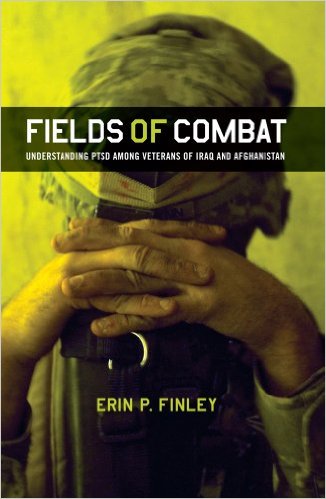
41Oi3YngcQL._SX324_BO1,204,203,200_For the longest time the only victims of Post-Traumatic Stress Disorder from the wars in Afghanistan who were accorded any media attention in Europe and North America were ground troops,  drone pilots and on occasion foreign civilians who worked in the combat zone. And much of that discussion focussed on the ways in which, as  Sebastian Junger put it, the effects of PTSD ripple far beyond the battlefield:

[Veterans] return from wars that are safer than those their fathers and grandfathers fought, and yet far greater numbers of them wind up alienated and depressed. This is true even for people who didn’t experience combat. In other words, the problem doesn’t seem to be trauma on the battlefield so much as re-entry into society.

But what about those denied re-entry into ‘normal’ society, those for whom war long ago became the ‘new normal’?  Apart from the odd glance at other combatants – ‘Do the Taliban get PTSD?Newsweek once asked – the plight of local people trapped in the battlefield, living and dying every day in the shadows of military and paramilitary violence, has been largely ignored.

There have been exceptions, like Anna Badkhen‘s report for the Pulitzer Center on Afghanistan as ‘PDSTland’ that also offered a more general commentary:

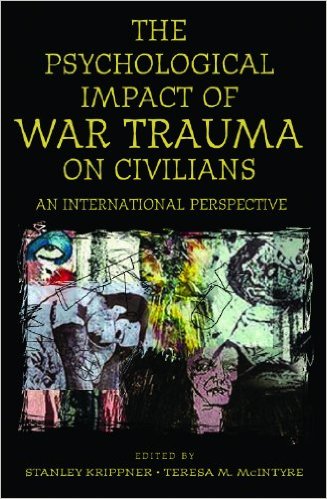
Psychological impact of war trauma on civiiliansCompared with research into the effects of conflict on U.S. war veterans, studies of combat trauma among civilians are few. But there is a growing understanding among medical scientists and conflict experts that the emotional toll of war on noncombatants is more significant than had been assumed. During World War I, when military physicians described soldiers’ traumatic reactions to war as “shell shock,” about nine out of 10 war casualties were fighters. But after nearly 50 years of the Cold War and more than 10 years of the war on terror, the way we wage war is more personal. Terrorism battlefields recognize no front lines. Vicious sectarian rampages pit neighbor against neighbor. Victims of genocidal campaigns often know their attackers by name. In the most current conflicts, at least nine out of 10 war casualties are believed to be civilians, writes psychologist Stanley Krippner in his book The Psychological Impact of War Trauma on Civilians [This is a collection of essays Krippner co-edited with Maria McIntyre]. In Iraq, where as many as 1 million people may have died since 2003, the rate might be even higher. No one kept track of civilian casualties in Afghanistan between 2001 and 2007, and estimates vary widely; given the United Nations’ tally of almost 12,000 civilian deaths since the beginning of 2007, a rough guess of between 20,000 and 30,000 civilian casualties since 2001 seems reasonable.

Communal psychological wounds – what medical anthropologist Arthur Kleinman has called “social suffering” – permeate the lives of survivors scraping by in unimaginable poverty amid collapsed infrastructure, the common afterbirth of modern combat. According to the Centers for Disease Control and Prevention, between 30 and 70 percent of people who have lived in war zones bear the scars of post-traumatic stress disorder and depression.
Over the years I’ve read endless reports about the ways in which the US military in particular is exploring new therapies for PTSD – including experiments in Virtual Reality as a way of helping victims re-live and ultimately come to terms with trauma, like Virtually Better‘s Bravemind staged in ‘Virtual Afghanistan’ (see below; also here, here, here and here).
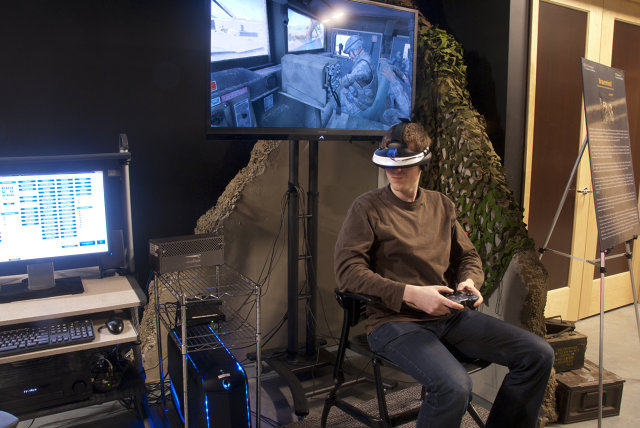
bravemind

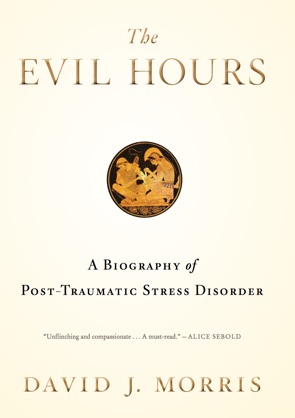
This doesn’t mean that progress is rapid or solutions straightforward, and David Morris‘s The Evil Hours ought to banish any such complacency.  Here is Tom Ricks:

From battlefields and cultural responses to traumatized warriors throughout world history to the internecine corridors of the San Diego V.A. hospital and the modern psychology establishment, Morris gives sight to the blind examining the PTSD elephant, offering up a clear understanding of what the beast is as well as the path it’s traveled across the landscape of warfare. He draws from a seemingly inexhaustible well of experience. Herding a cast that includes Hemingway, Klosterman, Sassoon, a host of anthropologists and neurologists, and the soldiers and veterans he met throughout his own odyssey, Morris accomplishes the necessary work of identifying all the necessary aspects of PTSD and still finds a way to magnify the nuances of how it affects individuals and societies.

Evil Hours Cover Final-1The “out-of-body” experience and the recurring memory of traumatic events are familiar to those afflicted by PTSD. Many describe it as watching a movie on repeat from every possible angle. It’s the mind’s vain attempt to challenge trauma like a call in a football game, gathering the referees around a screen to watch the replay over and over until the past can be rewritten in favor of justice. Others who have attempted books about PTSD have floundered in this conceit. Morris avoids that and maintains his place at the commentators’ desk — close enough to call the play-by-play, but far enough away to keep perspective. Instead of raging at length about the process of enrolling in the V.A. care system (whose bureaucracy he declares forces veterans to run “a patience marathon”), he reflects on its problematic advocacy of “large, scalable, Evidence-Supported Treatments.” Morris unearths troubling aspects in the character of these treatments as he traces the history of PTSD therapy. He finds that they are highly impersonal … and make the afflicted feel more like they’re being treated as lab rats than patients. He observes that these methods are a profound departure from the type of treatments discovered and evolved by W.H.R. Rivers during WWI and, later, Vietnam veterans groups during the 1970s. Though Morris’s own experience with prolonged exposure treatment met with poor results and he expresses misgivings about similar therapeutic methods, he remains objective about their efficacy. Rather, he takes a more important and less scrutinized view of how treatments are vetted in the first place. Questioning the practice of excluding patients who drop out of test programs from data sets instead of listing them as showing no signs of improvement, Morris asks if reports inaccurately portray success rates. This leaves the V.A.’s dogmatic insistence on evidence-based methods particularly vulnerable to skewed numbers…  His exploration of the pharmaceutical approach to PTSD reaches similar conclusions. As Morris writes, “‘Evidence-supported’ and ‘evidence-based’ mostly means that a lot of doctors happen to like it, oftentimes for reasons that have less to do with the actual value of a therapeutic protocol than with trendiness.”
So PTSD has become a medical-psychological-psychiatric and even -technological minefield, and the figure of what Roy Scranton calls ‘the trauma hero‘ still casts a long shadow over its deformations (and even contributes to them).

But when you compare these avowedly fraught therapeutic interventions with the often forcible recourse of many Afghan victims of PTSD to shrines, a radically divergent medical geography comes into view (much as it does when you compare the differential treatment for catastrophic injury: see my commentary on ‘The prosthetics of military violence’ here).  Anna writes:

Most Afghans turn for comfort to religious shrines – small mausoleums or simply fenced, coffin-sized ziggurats, painted green and laced with shreds of shiny cloth that sparkle along country roads and hillsides like jewels. Pilgrims come to kneel or lie prostrate next to the metal palisades, seeking delivery from the djinns that possess them – evil spirits that trigger sudden violent outbursts and long bouts of melancholia, that bedevil their sleepless nights with nightmares and turn their days into lethargic slogs.

This doubly dreadful world is portrayed in a new film by Jamie Doran and Najibullah Quraishi for Al Jazeera, Living beneath the drones (which you can also access on YouTube if the embedded video fails).

This is not the first time that the trauma of living beneath the ‘persistent presence’ of Predators and Reapers has been brought to critical attention, most vividly in the NYU/Stanford study Living Under Drones: Death, injury and trauma to civilians from US drone practices in Pakistan (2012).  But this is the first time I’ve seen such a detailed investigation of the impact of military violence on the people of Afghanistan.  As I’ve noted before, it’s taken a remarkably long time for investigators to examine the role of remote warfare in Afghanistan  – ‘remote’ in more ways than one – and Living beneath the Drones includes the standard interviews with David Deptula and Peter Singer who offer their usual contrasting views about its effects.
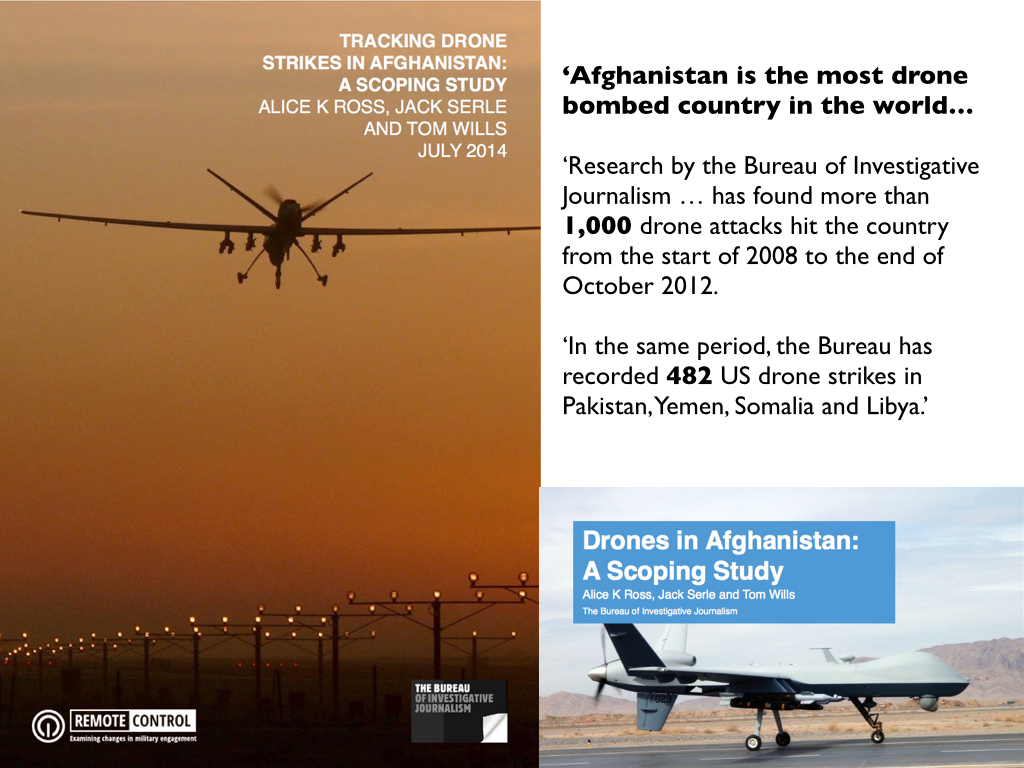
Afghanistan drone bombings BOIJ.001

But for me this is the least important contribution of the film; it’s the intimate exposure of the treatment meted out to traumatised victims of military and paramilitary violence that is most unsettling.  In fact, it’s not easy to disentangle the impact of Predators and Reapers from the larger matrix of violence in which they are enmeshed.  True, many of those interviewed describe how their lives are haunted by the drones, but this is a country where the dogs of war have prowled for four generations or more and trauma has never been rationed.  As Kevin Sieff’s report for the Washington Post in October 2012 showed, it’s usually impossible to fasten on a single incident or even to get an adequate history:

No one here knows the man whose left leg is shackled to the wall of cell No. 5. Last week, he finished tearing his mattress to shreds and then moved onto his clothes, ripping his shirt and pants off before falling asleep naked…

The man’s brothers drove him here from southern Kandahar province two weeks ago, drawn by the same belief that has attracted families from across Afghanistan for more than two centuries. Legend has it that those with mental disorders will be healed after spending 40 days in one of the shrine’s 16 tiny concrete cells. They live on a subsistence diet of bread, water and black pepper near the grave of a famous pir, or spiritual leader, named Mia Ali Sahib.

Every year, hundreds of Afghans bring mentally ill relatives here rather than to hospitals, rejecting a clinical approach to what many here see as a spiritual deficiency. The treatment meted out at the shrine and a handful of others like it nationwide might be archaic, but the symptoms are often a response to 21st-century warfare: 11 years of night-time raids, assassinations and suicide bombings.

For over a decade, Western donors have helped train Afghan psychiatrists, who diagnose many of their patients as having an ailment with a distinctly modern acronym: PTSD, or post-traumatic stress disorder. Mental health departments in Afghanistan are plastered with posters detailing the disorder’s symptoms. Pharmacies are stocked with antipsychotic drugs.

But many of those suffering from the disorder never see doctors or pharmacists. Instead, they are taken on the long, unmarked dirt road, through a village of mud huts, that leads to an L-shaped agglomeration of cells.

The brothers of the man in cell No. 5 drove back to Kandahar, more than 400 miles away, once the shackles were in place. They left an indecipherable phone number on a scrap of paper. They paid $20 for the treatment, as all patients must. If they told anyone the name of the man, no one remembers.

“What will I do with this man?” asked Shafiq, the shrine’s director and a descendant of Sahib. “Who is this man?”

Shafiq wondered: Was the man’s mental state a product of war? Was he a former soldier? A civilian who had seen too much horror?
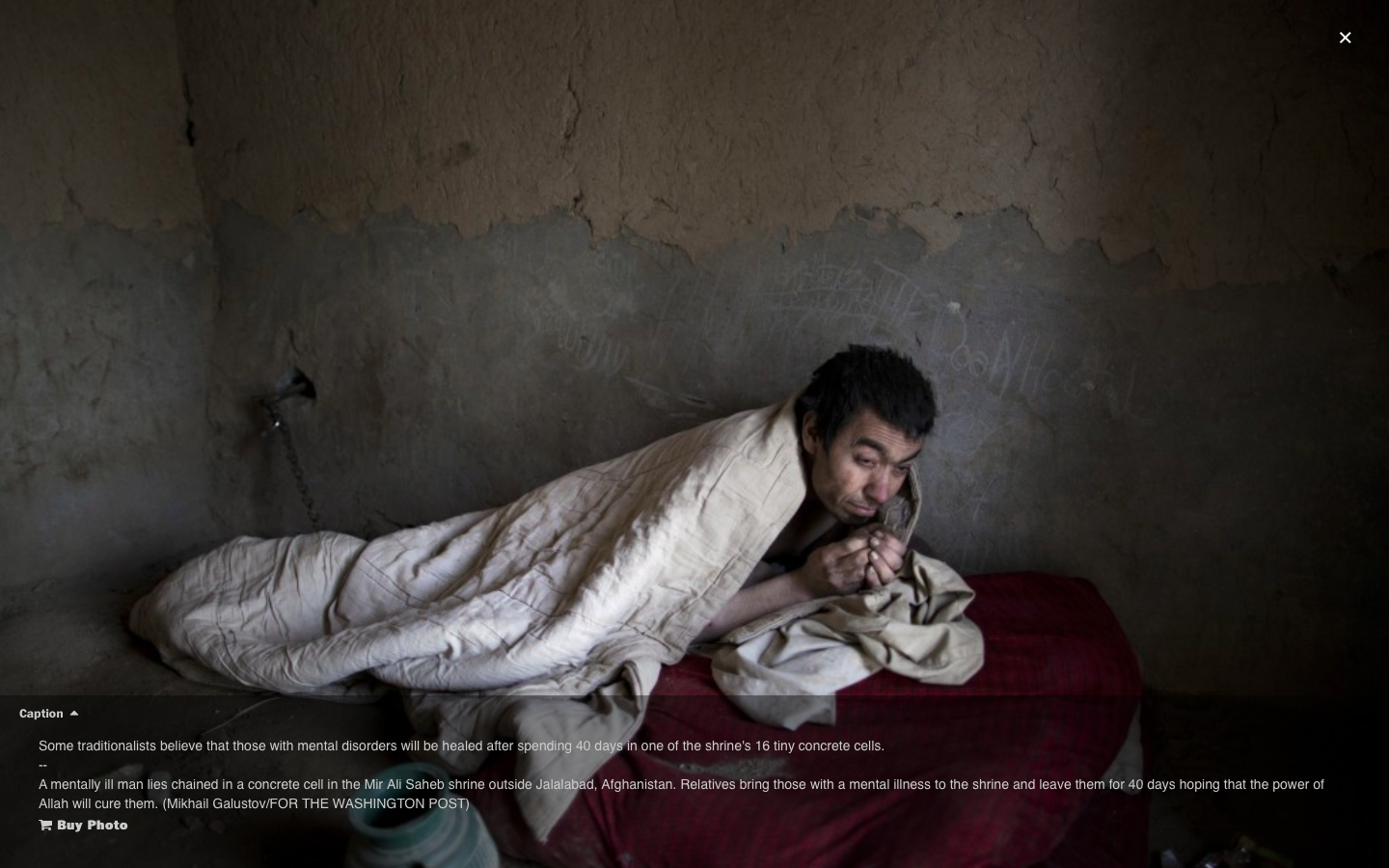
Afghan shrine:Mikhail Galustov

And so here is Emma Reynolds on what I take to be the central message of Living beneath the drones:

When a Western soldier suffers from post-traumatic stress disorder, there are doctors and organisations who can help them recover from the heartbreaking legacy of war.

When it is someone from Afghanistan, where bombings regularly wreak devastation and tear families apart, you are unlikely to find any assistance, since there is little understanding of mental illness in the country.

“The most common treatment is to take your loved one to a religious shrine where they are chained to walls or trees for up to 40 days, fed stale bread, water and ground pepper, and read dubious lines from the Qur’an by individuals with no medical or, for that matter, religious training,” documentary-makers Jamie Doran and Najibullah Quraishi [said]…

Many of the shrines are nothing more than money-making enterprises run by con artists with little or no religious training…

You might have thought that civilians and soldiers living in war zones would become hardened to this life, and find it almost normal. In fact, the pervasive atmosphere of violence and fear takes a bitter toll, and this terrible truth can be seen most clearly in Afghanistan, the site of the longest war ever for Australia and the US. “When you talk to them, there is little joy in their words any more,” said UK-based director Doran…  “Anyone with a family, children, someone you love, is forever in fear of losing them. You can see it in their worn faces.”

Hope and confidence in the future had steadily dissolved, with millions now thought to be suffering from PTSD, with little hope of treatment. Only one hospital in the entire country is dedicated to mental health, despite official estimates indicating that 60 to 70 per cent of the country’s population now suffer from some mental health problem. Unofficial estimates go as high as 95 per cent. This is the real human impact of living with the daily threat of death.

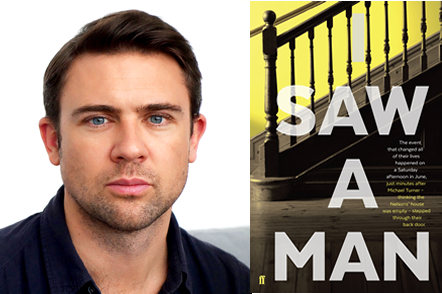
I saw a man

SHEERS I saw a man N Am ednLast week I was in Bloomington for the drones conference – more on that later – but while I was there I managed to finish Owen Sheers‘ new novel, I saw a man.  All of the reviews I’ve seen so far (and they have been very, very good: see here, here and here, for example) praise the way in which Owen so beautifully recovers the circles of grief that spiral from a drone strike on the Afghanistan-Pakistan border that accidentally killed a party of foreign journalists, including Caroline, the wife of the book’s narrator.  ‘Despite its “fire and forget” name tag,’ we are assured, ‘once a Hellfire had been released there would always be someone who never would.’

In fact, Owen and I had corresponded about the details of drone strikes and casualty investigations while he was working on the book, and he certainly treats mourning and memory with extraordinary skill and empathy.  Restricting the victims to those outside the region, apart from a local driver and interpreter, may make the task easier – much of the story plays out in Hampstead – but it’s still formidably difficult.

Owen-Sheers-I-Saw-a-Man

Yet the book is also, equally centrally, about distancing.  Michael is an author with a reputation for effacing himself from his narratives.  Towards the end, in a phrase that powers the book’s meta-fictional twist (and which in some editions is captured on a cover from which Sheers’ own name is absent), Michael is told:

 “Isn’t that what you’re always saying? You need distance to see anything clearly? To become your own editor.”

Even when he tries to lose himself in his fencing lessons, his instructor insists:

“DISTANCE! DISTANCE MICHAEL! It’s your best defence!”

And it is of course distance that is focal to the fateful drone strike.  Those most directly involved in the kill-chain are soon effaced from the official narrative:

“A U.S. drone strike.” That was all the press release said. No mention of Creech, screeners, Intel coordinator, an operator, a pilot. It was as if the Predator had been genuinely unmanned. As if there had been no hand behind its flight, no eye behind its cameras.

And those who were killed are artfully turned into the authors of their own destruction (a tactic that is routinely used on Afghan and Pakistani victims too), even sacrificed for a greater good (international humanitarian law’s vengeful doctrine of ‘necessity’):

[T]he Pentagon statement also made mention of the journalists “working undercover,” of “entering a high-risk area.” They had known, it was implied, the dangers of their actions. And, the same statement reminded the world, an influential terrorist had been successfully targeted. The weight of blame, Michael knew, from the moment it happened, was being dissipated, thinned.

But distance is not a moral absolute (one of the most egregious mistakes of critics of drone warfare: if you think it wrong to kill someone from 7,000 miles away, over what distance do you think it is acceptable?).  In a narrative arc that will be familiar to many readers, the pilot of the drone (Daniel) is haunted by what happened, and by the dismal intimacy of death.
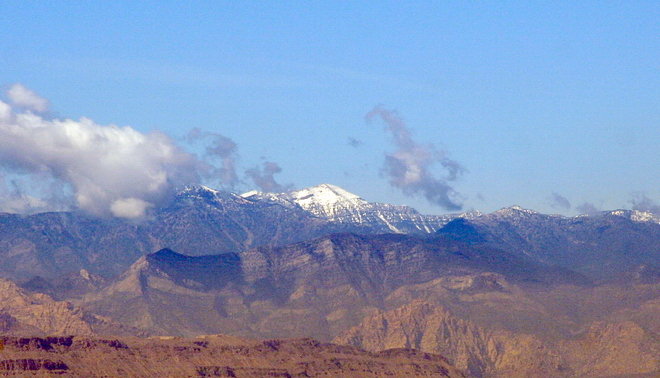
Charleston Mountains NV

Each morning, as he sets off from his home outside Las Vegas to drive to Creech Air Force Base, Daniel reflects on the similarity of the distant Charleston mountains to those over which he would soon be flying his Predator or Reaper.  It’s a common trope, actually: George Brant makes much of it in his play Grounded.  ‘Despite their proximity,’ though, Daniel hadn’t been into them and didn’t really know them.

They were his daily view but not yet his landscape, a feature of his geography but not yet his territory. Unlike those other mountains, 8,000 miles away. Those mountains Daniel knew intimately. He’d never climbed in them, either, but he was still familiar with the villages silted into their folds, the shadows their peaks threw at evening and the habits of the shepherds marshalling their flocks along their lower slopes. Recently he’d even been able to anticipate, given the right weather conditions, at what time the clouds would come misting down the higher peaks into the ravines of the valleys. Over the last few months he’d begun to feel an ownership over them. Were they not as much his workplace as that of those shepherds? For the troops operating in the area they were simply elevation, exhaustion, fear. They were hostile territory. But for Daniel they were his hunting ground, and as such it was his job not just to know them but to learn them, too. To love them, even, so that from the darkness of his control station in Creech, he might be able to move through their altitudes as naturally as the eagles who’d ridden their thermals for centuries.

It’s a brilliant paragraph, reflective and revealing, that captures the ways in which the pilot’s optical knowledge is transmuted into ‘ownership’, knowledge pinned to power, and distanced from the corpographies of troops on the ground for whom the mountains meant only ‘elevation, exhaustion, fear’ [see also here].  Daniel was freed from all that, soaring high above them, precisely because his territory appeared elsewhere.  If, as Stuart Elden suggests, territory can be conceived as a political technology that asserts a claim over bodies-in-spaces, then one of the most perceptive passages in I saw a man is the description of Daniel scanning ‘the territory of his screen (my emphasis)’…

Screen Shot 2015-07-11 at 12.48.14 PM

Distance, intimacy, experience: all mediated by political technology and in consequence highly conditional and always partial.  That is how the pilot is made free to pursue what Grégoire Chamayou calls his ‘man-hunting‘: because what appears on the screen is a target – not a man or a woman.

Or, as the book’s epigraph says: ‘I saw a man who wasn’t there….’

Afterwar(d)s

I’ve been working my way through the proofs of ‘The natures of war’, in which (among other things) I try to show that soldiers are not only vectors of military violence but also victims of it.  My analysis fastens on the Western Front in the First World War, Northern Africa in the Second World War, and Vietnam – the final draft is under the DOWNLOADS tab and the published version should be up on the Antipode website later this month – but I hope it will be clear to readers that the implications of this claim , and the others in the essay, extend into our own present.  They also intersect with my current research on casualty evacuation from war zones, 1914-2014.

So I’ve been interested in three recent contributions that detail the aftermath of war for those who fight them.

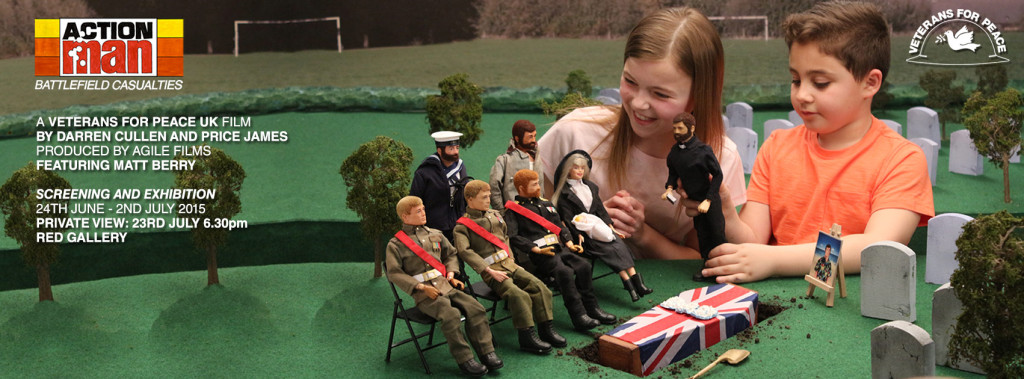
First, Veterans for Peace UK have worked with Darren Cullen to produce a short film, Action Man: Battlefield Casualties [see the clip above] in an attempt, as Charlie Gilmour explains over at Vice,

‘to show the shit beneath the shine of polished army propaganda. Featuring PTSD Action Man (“with thousand-yard stare action”), Paralysed Action Man (“legs really don’t work”) and Dead Action Man (“coffin sold separately”)…’ [see also my post on ‘The prosthetics of military violence‘]

Actionman-1024x379

In keeping with the project’s authors, Charlie insists – I think properly – that many of those who were sent to Afghanistan from the UK were child soldiers (and here I also recommend Owen Sheers‘ brilliant Pink Mist for an unforgettable portrayal of what happens when boys who grow up ‘playing war’ end up fighting it: see also here and here).  As the project’s web site notes:

The UK is one of only nineteen countries worldwide, and the only EU member, that still recruits 16 year olds into its armed forces, (other nations include Iran and North Korea). The vast majority of countries only recruit adults aged 18 and above, but British children, with the consent of their parents, can begin the application process to join the army aged just 15…

It is the poorest regions of Britain that supply large numbers of these child recruits. The army has said that it looks to the youngest recruits to make up shortfalls in the infantry, by far the most dangerous part of the military. The infantry’s fatality rate in Afghanistan has been seven times that of the rest of the armed forces.

Forces Watch JPEG

Child Soldiers International JPEG

A study by human rights groups ForcesWatch and Child Soldiers International in 2013 found that soldiers who enlisted at 16 and completed training were twice as likely to die in Afghanistan as those who enlisted aged 18 or above, even though younger recruits are, for the most part, not sent to war until they are 18.

You can find another thoughtful reflection on child soldiers by Malcolm Harris over at the indispensable Aeon here. He doesn’t include the British Army in his discussion, but once you do you can see that the implications of this passage extend beyond its ostensible locus (Nigeria):

But can a child truly volunteer to join an army? Even when they enlist by choice, child soldiers do so under a set of constraining circumstances. UNICEF makes the choices sound easy: war or dancing, war or games, war or be a doctor. No rational child would pick the former for themselves, and that’s posed as evidence that their freedom has been taken from them. But when the choice is ‘soldier or victim’, voluntarism takes on a different meaning.

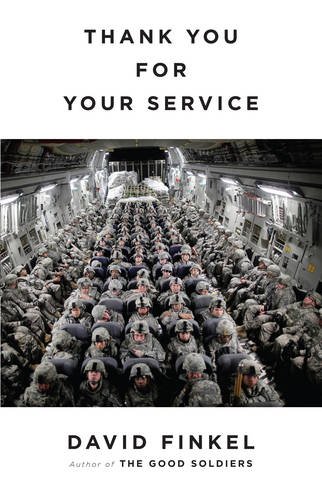
FINKEL Thank you for your service

Second, moving across the Atlantic and providing an extended riff on the ‘thank you for your service’ gesture, the latest issue of New Left Review includes an essay by Joan Wypijewski, ‘Home Alone‘, that describes the journey home faced by many US veterans.  She begins by putting David Finkel‘s compelling book in context:

The term ‘Thank You for Your Service’ developed early on in the long wars. Like ‘Support the Troops’, it was a way for a sheltered people to perform unity. In towns across America yellow ribbons, yellow lawn signs, balloons and car decals sprouted like team colours on game day. War would be a sport, the people spectators, and ‘Thank you for your service’ the high-five to combatants after quick and decisive victory. When that proved a vain hope, team spirit settled into the rhythms of commerce. ‘Support the Troops’ appeared the way ‘Buy American’ once had—a slogan on shop windows, billboards, bumper stickers. War was an enterprise, security its product, the people consumers, the soldiers trained workers and ‘Thank you for your service’ a kind of tip. As the enterprise (though hardly the business) failed, the signs faded, sometimes replaced by an image of folded hands, ‘Pray for Our Troops’. War had become a problem, the soldiers exhausted, the people clueless and ‘Thank you for your service’ a bit of empty etiquette, or a penance. By the time Finkel was writing [his book was published in October 2013], what remained among civilians was a desire to move on, and among soldiers, bitterness. ‘They wouldn’t be fucking thanking me if they knew what I did’, many would say, in almost exactly the same words.

Joan works her way through Finkel’s account, and then turns to Laurent Bécue-Renard’s Of Men and War, a documentary film – five years in the making, and the second instalment in a trilogy devoted to a ‘genealogy of wrath‘ – of Trauma Group sessions at a treatment centre in the Napa Valley:

‘What we have is embarrassing as shit’, a thick, tight young white man says in the Trauma Group. ‘You feel small—you feel defective.’ And so it goes, and so men trained for toughness talk of being weak and scared and monstrous, or just diligent. Of working in Mortuary Affairs: ‘breaking the rigour down’ to get the corpse of a 19-year-old who killed himself flat enough for a body bag, or untangling the remains of a group of faceless soldiers burned in a truck who are fused ‘like a bunch of rope’. They talk of their dreams, of their frightened wives. Maybe she moved out and got a restraining order before he came home, or maybe she has the divorce papers but is holding back as long as he’s getting help. ‘I have no clue what it’s like to be a woman married to a man twice your size and that’s lethal, in the military, and takes his rage out on you—someone that’s supposed to love you’, a former medic says. He is slim, white, deer-like. You don’t know his war story yet, and you don’t know when you’ll find out, if you’ll find out, but you listen as he and one after another after another deals with a world of pain. And maybe men balk, and maybe they storm out of the room, and maybe Gusman, whom you’ve also never really met but who is always there, has to remind them that ‘being a hostage to the war zone is not a life’. You follow them out of the room, taking smokes, meditating, visiting their wives or parents, calling on locals, trying to be well or pass for well, knowing they’re not. You watch their children doing typical childlike things, running, laughing in a high-pitched scream, and you feel anxious for everyone in the room. You itch to get back to the Trauma Group and, amazingly, don’t feel like a voyeur, because this isn’t war porn; this is the shit, as they say.

It isn’t beautiful or horrible, it just is. And you don’t like all of these people, but that isn’t the point. They are all struggling to be human again, and you have to ask yourself if you know what that means.

Not so much dressing but ‘addressing their wounds is a revolution’, Bécue-Renard insists, and you can see – literally so – what he means.  Joan’s commentary ends with other, perhaps also revolutionary reflections.  In America, she argues,

… there has been no serious debate on, let alone demand for, a universal draft as a democratic check against offensive war. We talk against empire, but are beneficiaries of the imperial state’s professional and technological adjustments to the anti-war movement’s past victories. We talk about the invisible draft but, perhaps encouraged by the bravery of Iraq Veterans Against the War, still hope that soldiers whose food, clothing, shelter, families and identity depend on the job of war-fighting will mutiny en masse. We talk, from time to time, about the culture of abuse in basic training and on military posts, but are silent on the regimens of discipline that are being hyper-enforced in anticipation of downsizing, in other words layoffs. And for the one thing the military, however twistedly, provides—belonging, solidarity, a sense of honour and family-feeling as against loneliness—we have no alternatives at all.

Finally, Duke University Press has announced that Zoe Wool‘s book, After War: the weight of life at Walter Reed, will be out soon:

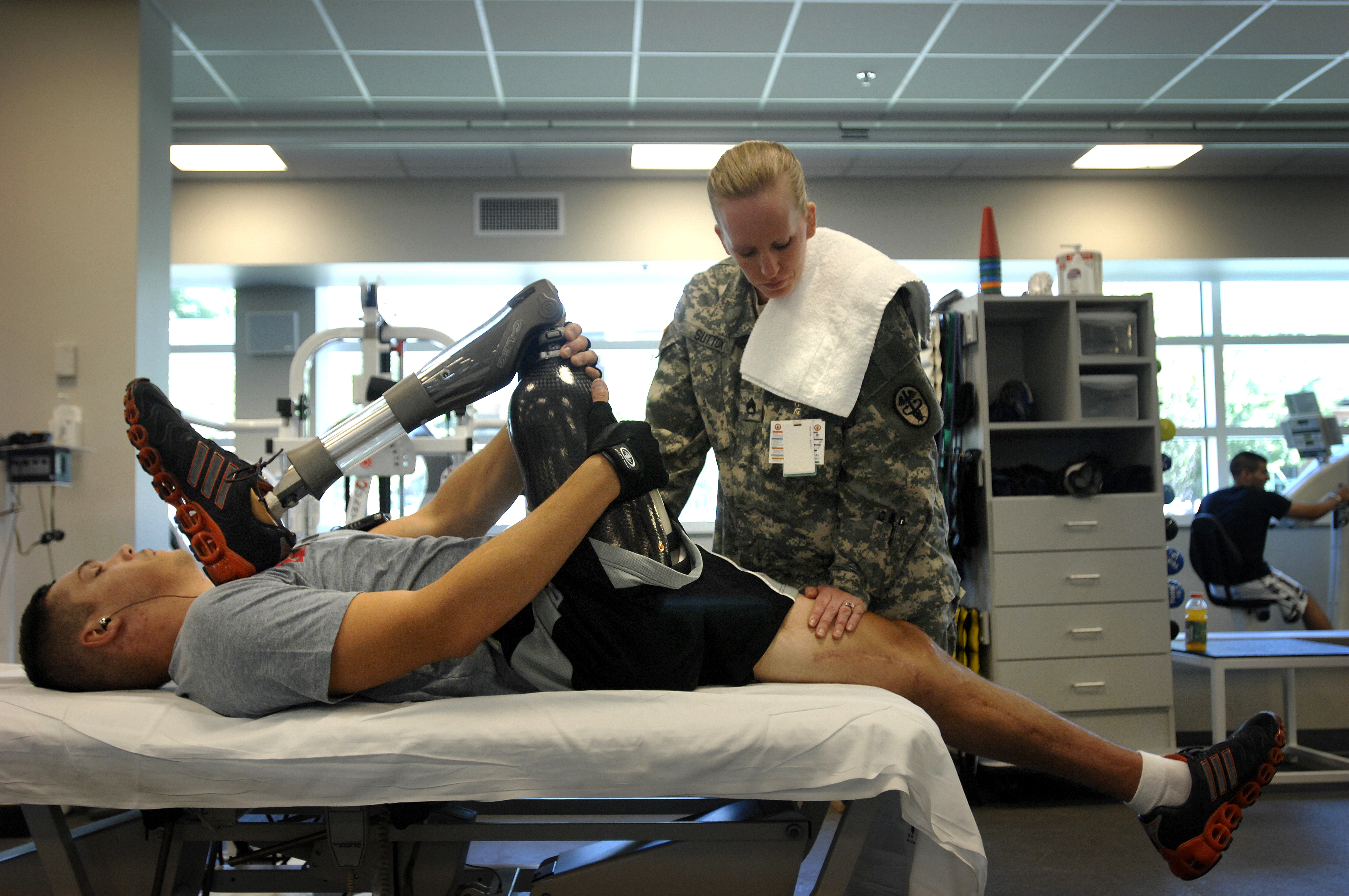
In After War Zoë H. Wool explores how the American soldiers most severely injured in the Iraq and Afghanistan wars struggle to build some kind of ordinary life while recovering at Walter Reed Army Medical Center from grievous injuries like lost limbs and traumatic brain injury. Between 2007 and 2008, Wool spent time with many of these mostly male soldiers and their families and loved ones in an effort to understand what it’s like to be blown up and then pulled toward an ideal and ordinary civilian life in a place where the possibilities of such a life are called into question. Contextualizing these soldiers within a broader political and moral framework, Wool considers the soldier body as a historically, politically, and morally laden national icon of normative masculinity. She shows how injury, disability, and the reality of soldiers’ experiences and lives unsettle this icon and disrupt the all-too-common narrative of the heroic wounded veteran as the embodiment of patriotic self-sacrifice. For these soldiers, the uncanny ordinariness of seemingly extraordinary everyday circumstances and practices at Walter Reed create a reality that will never be normal.

20080721-D-1852B-014

Here are two of the endorsements:

“Hollywood films and literary memoirs tend to transform wounded veterans into tragic heroes or cybernetic supercrips. Zoë H. Wool knows better. In her beautifully written and deeply empathic study of veterans of Iraq and Afghanistan at Walter Reed, Wool shows us the long slow burn of convalescence and how the ordinary textures of domestic life unfold in real time. An important and timely intervention.” — David Serlin, author of Replaceable You: Engineering the Body in Postwar America.

“This brilliant and absorbing ethnography reveals how the violence of war is rendered simultaneously enduring and ephemeral for wounded American soldiers. Zoë H. Wool accounts for the frankness of embodiment and the unstable yet ceaseless processes through which the ordinary work of living is accomplished in the aftermath of serious injury. After War is a work of tremendous clarity and depth opening new sightlines in disability and the critical politics of the human body.” — Julie Livingston, author of Improvising Medicine: An African Oncology Ward in an Emerging Cancer Epidemic.

Legal battles

DoD Law of War ManualFollowing up my comments on the Pentagon’s new Law of War Manual, issued last month: commentaries are starting to appear (it’s not surprising these are taking so long: the new version runs to 1200 pages).

Just Security is hosting a forum on the Manual, organised by Eric Jensen and Sean Watts.  They are both deeply embedded in the debate: Eric is a Professor at Brigham Young Law School and was formerly Chief of the Army’s International Law Branch and Legal Advisor to US military forces in Iraq and Bosnia, while Sean is a Professor at Creighton University Law School and on the Department of Law faculty at the United States Military Academy at West Point; he is also Senior Fellow at the NATO Cooperative Cyber Defence Centre of Excellence and served in the US Army’s Judge Advocate General’s Corps.

In the opening salvo, Sean focuses on the Manual‘s identification of three core principles:

“Three interdependent principles – military necessity, humanity, and honor – provide the foundation for other law of war principles, such as proportionality and distinction, and most of the treaty and customary rules of the law of war.”

The implications of this formulation are more far reaching than you might think.  Necessity, proportionality and distinction have long been watchwords, but the inclusion – more accurately, Sean suggests, the resurrection – of ‘humanity’ and ‘honor’ is more arresting: in his view, the first extends the protection from ‘unnecessary suffering’ while the second ‘marks an important, if abstract revival of good faith as a legal restraint on military operations’.

Watch that space for more commentaries, inside and outside the armed camp.

Others have already taken a much more critical view of the Manual.

Claire Bernish draws attention to two particularly disturbing elements here.  First, like several other commentators, she notes passages that allow journalists to be construed as legitimate targets.  While the Manual explains that ‘journalists are civilians’ it also insists there are cases in which journalists may be ‘members of the armed forces […] or unprivileged belligerents.’   Apparently, Claire argues,

‘reporters have joined the ranks of al-Qaeda in this new “unprivileged belligerent” designation, which replaces the Bush-era term, “unlawful combatants.” What future repercussions this categorization could bring are left to the imagination, even though the cited reasoning—the possibility terrorists might impersonate journalists—seems legitimate. This confounding label led a civilian lawyer to say it was “an odd and provocative thing for them to write.”‘

Other commentators, mindful of incidents in which the US military has been accused of targeting independent (non-embedded) journalists, have read this as far more than provocation.  Like other claims registered in the Manual, this has implications for other armed forces – and in this particular case, for example, Ken Hanly points out that ‘what is allowed for NATO and the US is surely legitimate for Israel.’

This is not as straightforward as he implies, though.  Eric Jensen agrees that

‘[T]he writers had to be aware this manual would also be looked to far beyond the US military, including by other nations who are formulating their own law of war (LOW) policies, allies who are considering US policy for purposes of interoperability during combined military operations, transnational and international organizations such as the International Committee of the Red Cross (ICRC) who look to such manuals when considering the development of customary practice, and even national and international tribunals who adjudicate LOW questions with respect to the criminality of individual actions.

While Eric acknowledges ‘the inevitable use of [the Manual] in the determination of customary practice.’ however, he also argues that the authors of the Manual go out of their way to preclude this possibility: they ‘wanted to be very clear that they did not anticipate they were writing into law the US position on the law of war.’

Second, Claire draws attention to a list of weapons with specific rules on use’ (Section 6.5.1), which includes cluster munitions, herbicides and explosive ordnance, and a following list of other ‘lawful weapons’ (Section 6.5.2) for which ‘there are no law of war rules specifically prohibiting or restricting the following types of weapons by the U.S. armed forces’; the list includes drones and Depleted Uranium munitions.  These designations are all perfectly accurate, but Claire’s commentary fastens on the fact that at least two of these weapons have been outlawed by many states.  She draws attention to the hideous consequences of DU and cluster bombs, and explains that cluster bombs:

‘are delineated in the manual as having “Specific Rules on Use”— notably, such weapons’ use “may reflect U.S. obligations under international law” [emphasis added]. While this is technically apt, cluster bombs have been banned by the 2008 Convention on Cluster Munitions—which was agreed to by 116 countries around the world. The U.S. stands out in joining infamous human rights violator, Saudi Arabia, in its refusal to sign. These insidious munitions leave unexploded ordnance for months, or even decades, after the originating bomb was dropped. Children are often maimed or killed when they unwittingly mistake them for toys.’

Meanwhile, also at Just Security but seemingly not part of the Forum, Adil Ahmad Haque has attacked the Manual‘s discussion of ‘human shields’:

The Defense Department apparently thinks that it may lawfully kill an unlimited number of civilians forced to serve as involuntary human shields in order to achieve even a trivial military advantage. According to the DOD’s recently released Law of War Manual, harm to human shields, no matter how extensive, cannot render an attack unlawfully disproportionate. The Manual draws no distinction between civilians who voluntarily choose to serve as human shields and civilians who are involuntarily forced to serve as human shields. The Manual draws no distinction between civilians who actively shield combatants carrying out an attack and civilians who passively shield military objectives from attack. Finally, the Manual draws no distinction between civilians whose presence creates potential physical obstacles to military operations and civilians whose presence creates potential legal obstacles to military operations. According to the Manual, all of these count for nothing in determining proportionality under international law.

If true, this would dramatically qualify the discussion of ‘humanity’ and ‘honor’ above; but, not surprisingly, Charles Dunlap will have none of it.  He objects not only to Adil’s reading of the Manual, but also the logic that lies behind his criticism:

Killing those who do the vast majority of the killing of civilians can save lives. It really can be that simple.

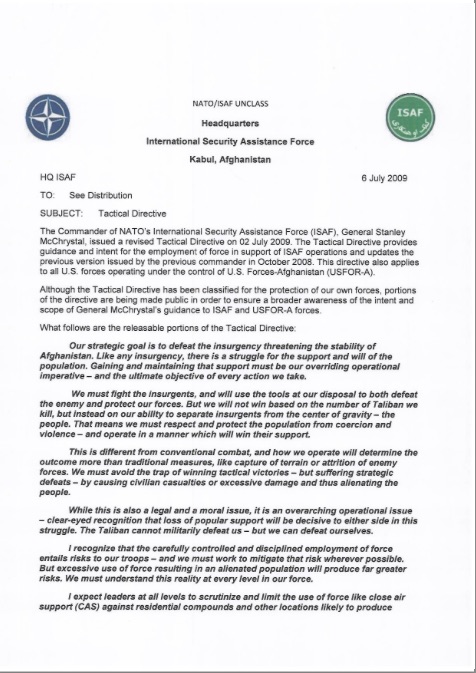
Experience shows that well-meaning efforts to curb the use of force can have disastrous effects on civilians. Think about the restrictions on airstrikes imposed by Gen. Stanley McChrystal in Afghanistan in mid-2009. The result? By the time he was fired a year later in June 2010, civilian casualties had jumped a heart-rending 31% entirely because of increased killings by anti-government forces. (In addition, casualties among friendly troops hit an all-time high in 2010.)

McChrystal Tactical Directive 1

[The unclassified section of McChrystal’s Tactical Directive (above) is here]

When Gen. David Petraeus took command in mid-2010, he took a different, more aggressive approach. While still scrupulously adhering to the law of war, he clarified the rules of engagement in a way that produced a tripling of the number of airstrikes. The result? The increase in civilian casualties was cut in half to 15% by the end of 2010. Under Petraeus’ more permissive interpretation of the use of force against the Taliban and other anti-government forces, the increase the following year was cut almost in half again to 8% (and losses of friendly troops fell 20%). To reiterate, although counterintuitive to some critics, restricting force by law or policy can actually jeopardize the lives of the civilians everyone wants to protect.

Michael O’Hanlon at the Brookings Institue makes exactly the same argument about the Manual here (scroll down), but Dunlap’s sense is much sharper: the Manual, he says, ‘is designed to win wars in a lawful way that fully internalizes, as it says itself on several occasions, the “realties of war.”’  This is immensely important because in effect it acknowledges that neither the Manual nor the laws of war are above the fray.  If the Manual ‘is designed to win wars in a lawful way’ that is precisely because law is in the army’s baggage train, fully incorporated into the juridification of later modern war.  Law is at once a powerful weapon and a moving target.

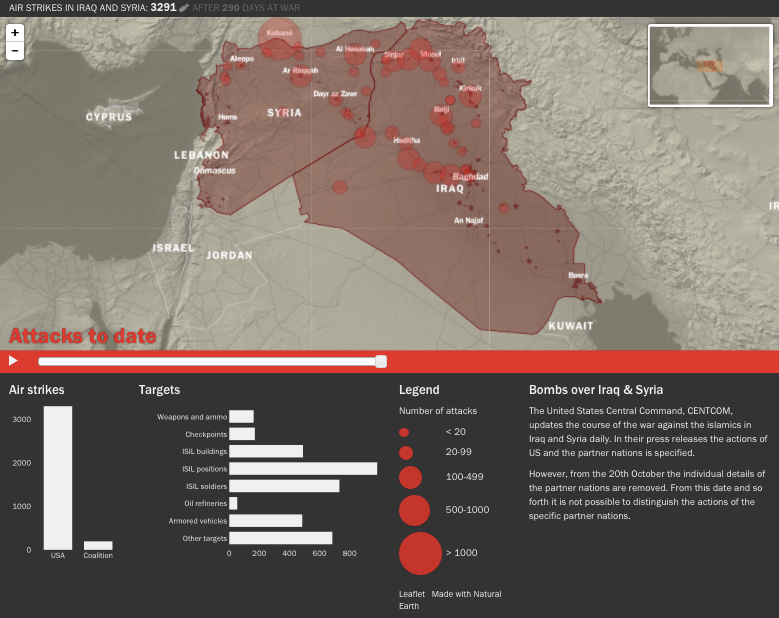
Airwars

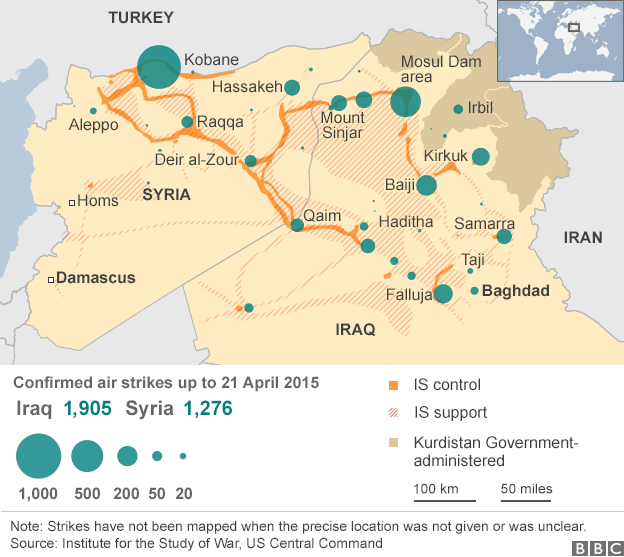
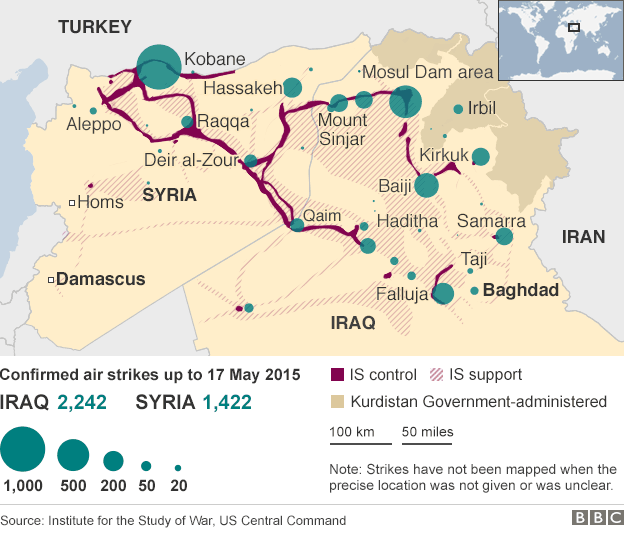
Air strike sin Iraq and Syria to April 2015

Air strikes in Iraq and Syria to 17 May 2015

I’ve taken the maps above from the BBC, which rely on reports from the Institute for the Study of War and news releases from US Central Command on ‘Operation Inherent Resolve‘.

For readers wanting to follow and analyse the US-led air campaign in Iraq and Syria in more detail, I recommend Chris Woods‘ new project, Airwars.  Chris is a veteran of the Bureau of Investigative Journalism’s Drone War Project and the author of Sudden Justice: America’s secret drone wars (2015) – which really is the gold standard for analysis of US remote operations.

Airwars.org is a collaborative, not-for-profit transparency project aimed both at tracking and archiving the international air war against Islamic State (Daesh), in both Iraq and Syria. We also seek to highlight – and follow up where possible – those cases in which claims of civilian non-combatant casualties from coalition airstrikes have been indicated by credible monitoring agencies. In addition we track reported ‘friendly fire’ incidents.

The site includes tabulations and also an interactive, zoomable map (see the screenshot below).  You can find a detailed discussion of sources and methodology here.

AIRWARS 25 May 2015

I’m tracking all this for The everywhere war…  In case you are wondering why that is taking so long to finish: The colonial present started out as an essay on 9/11 and the US invasion of Afghanistan; I then realised that Sharon was taking advantage of the ‘war on terror’ to ramp up Israeli dispossession and repression of the Palestinian people, and so started work on a second essay (I’m ashamed to say that at the time I knew as little about the West Bank and Gaza as I did about Afghanistan on 11 September 2001).  Then the US invaded Iraq…  Much the same is happening with The everywhere war, but I do have the end in my sights.  I hope.


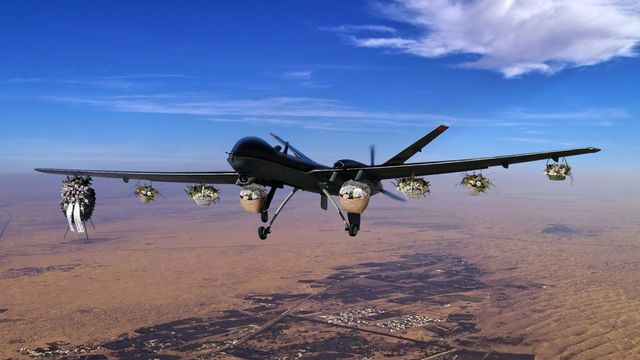
M2-Griever

M2 Griever

From The Onion:

In an effort to limit the fallout from any unintended collateral damage, the Pentagon has dispatched a fleet of unmanned aerial vehicles to the Middle East specially designed to express condolences for the civilian casualties of U.S. drone airstrikes, sources confirmed Wednesday.

The remotely piloted aircraft, known as the M2-Griever, have reportedly targeted bereaved individuals in Afghanistan, Pakistan, Iraq, and other restive regions. Military officials confirmed that the state-of-the-art drones have already flown hundreds of covert condolence missions in an effort to convey the U.S. government’s official regrets to those mourning the death of innocents caught in the midst of American combat operations…

“The Griever represents the future of warfare damage control,” said U.S. Air Force general Mitchell Holt… “From our command center in Nevada, we possess the tactical capability to project compassion anywhere in the world,” he added.

It’s worth reading the whole thing.

Medical neutrality and modern war

md_p0361-memory-solferinoI expect most readers know how the International Committee of the Red Cross had its origins in Henry Dunant‘s horror at the unrelieved suffering he witnessed in the aftermath of the Battle of Solferino in 1859 (see my earlier post here).

In A Memory of Solferino (1862) he asked: ‘Would it not be possible, in time of peace and quiet, to form relief societies for the purpose of having care given to the wounded in wartime by zealous, devoted and thoroughly qualified volunteers?’

Dunant’s vision of an impartial relief society to provide aid to those wounded in time of war led to the formation of a series of national relief societies and, as John Hutchinson shows in Champions of Charity: War and the rise of the Red Cross, these national societies soon became entangled with nationalism.  ‘Gripped by the passions of patriotism,’ he writes, by the time of the First World War these national societies ‘undertook to perform whatever repair work the armies required of them.’

And yet, even with these entanglements, a key principle was defended: medical neutrality.  According to Physicians for Human Rights, medical neutrality requires:

  1. The protection of medical personnel, patients, facilities, and transport from attack or interference;
  2. Unhindered access to medical care and treatment;
  3. The humane treatment of all civilians; and
  4. Nondiscriminatory treatment of the sick and injured.

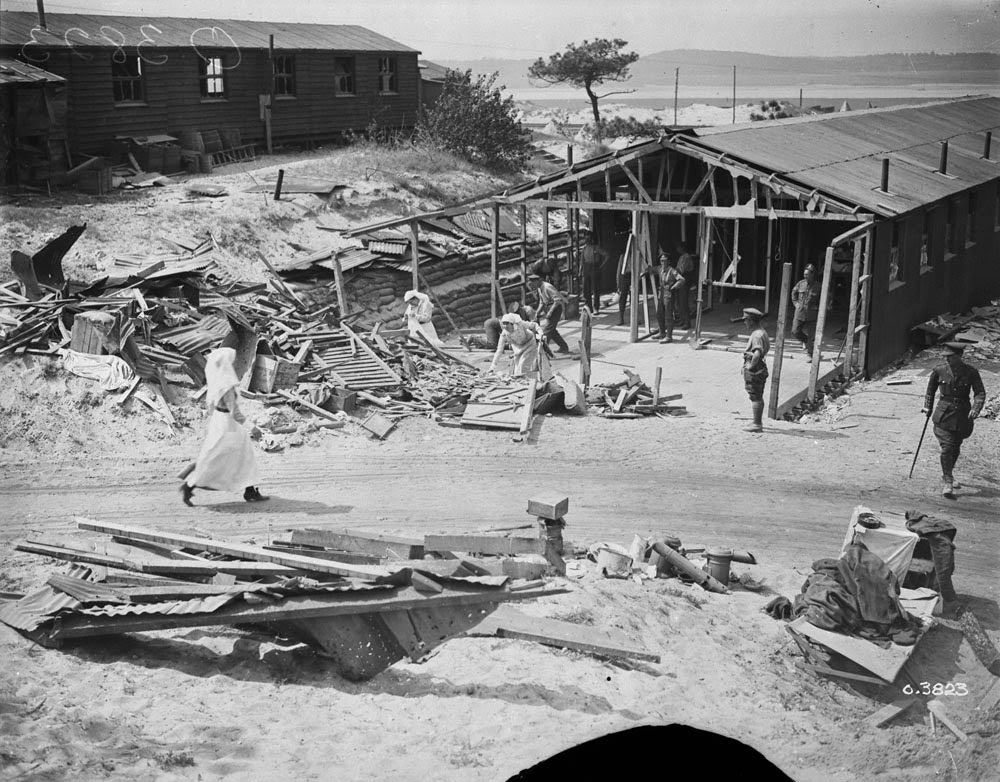
During the First World war there were complaints that the principle had been sporadically violated: that stretcher-bearers had been attacked by snipers when they sought to recover the wounded or that military hospitals had been deliberately shelled or bombed.  Here, for example, is the aftermath of one of several air raids targeting base hospitals at Etaples on the French coast between May and August 1918 (supposedly in retaliation for a British air raid on Cologne):

Lowe_Field_Hospital_bombed_LAC_PA_003747_a003747_v8.jpg_pv4a5fab25f240997c

But in the last decade of our own century such violations have become increasingly systematic. And, as more and more civilians have become trapped and even targeted in conflict zones whose ‘battlefields’ know no bounds, so those violations have extended far beyond attacks on military-medical infrastructure and personnel.

Last summer I detailed the attacks made by the Israeli military on medical facilities and emergency systems in Gaza, and I drew attention to the work of Physicians for Human Rights in documenting the precariousness of medical care there.  But the calculated production of these spaces of exception is not exceptional, and attacks like these have become part of the arsenal of later modern war.  “Instead of being protected,” says Donna McKay, executive director of PHR, “medical care is actually a target.”

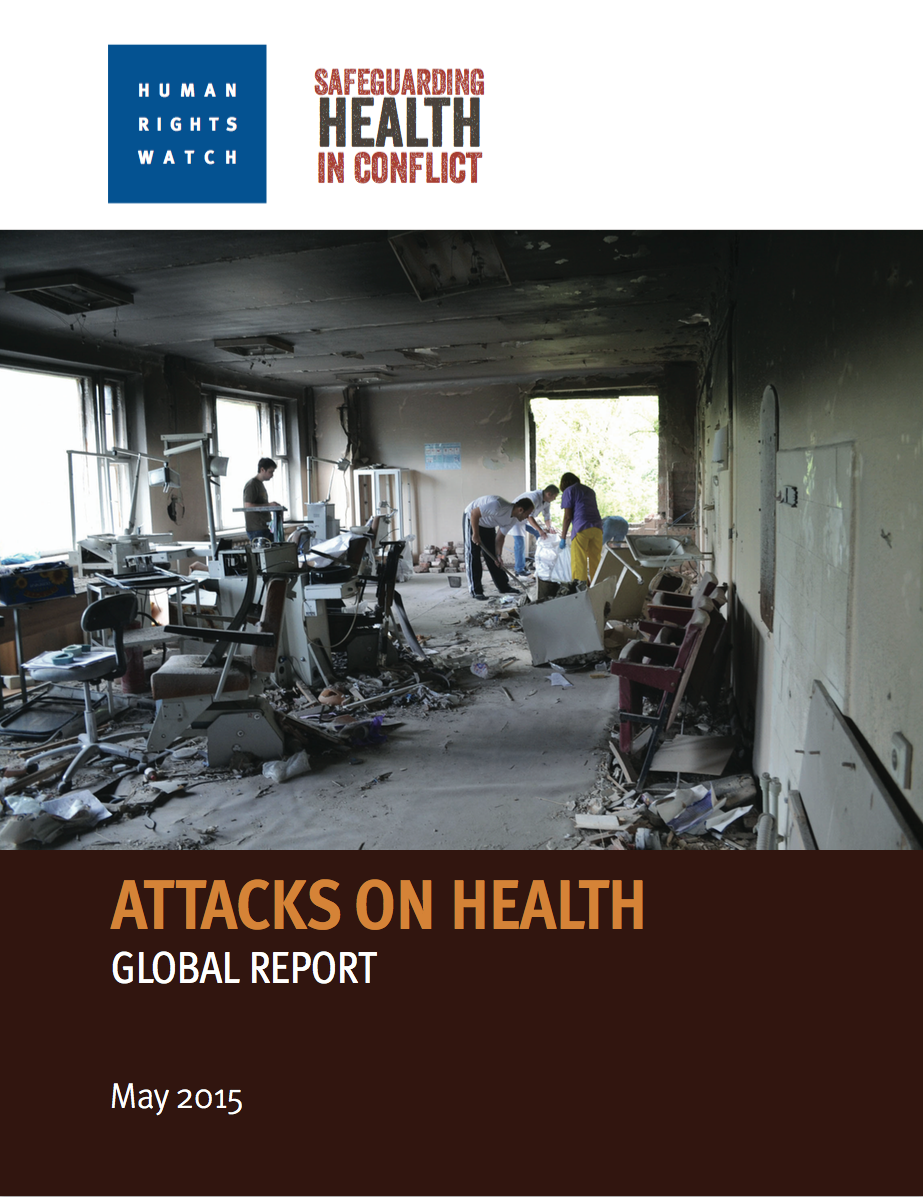
HRW Attacks on Health

Physicians for Human Rights is part of the Safeguarding Health in Conflict Coalition which has now joined with Human Rights Watch to publish Attacks on Health: a Global Report (2015) that summarises attacks on health care facilities and health care workers around the world:

Over the past year armed groups have attacked hospitals, clinics, and health personnel in 41 incidents in Afghanistan and deliberately killed over 45 health workers, primarily polio vaccinators, in Nigeria and Pakistan. In Syria, where medical facilities in Aleppo have been hit with government barrel bombs, 194 medical personnel have been killed and 104 medical facilities attacked since 2014….

The organizations described attacks in South Sudan, where 58 people were killed in four hospitals in a series of attacks in early 2014, and in eastern Ukraine, where it is estimated that 30 to 70 percent of health workers have fled the region because of insecurity. In Yemen, Al-Qaeda in the Arabian Peninsula (AQAP) militants carried out attacks on health facilities in early 2014, and the 10-country Saudi-led coalition conducted air strikes that hit hospitals and interrupted medical supplies during the conflict in early 2015. Relying on data from Insecurity Insight’s Security in Numbers Database, the report also shows trends in attacks on health care over the course of a decade in South Sudan and Central African Republic.

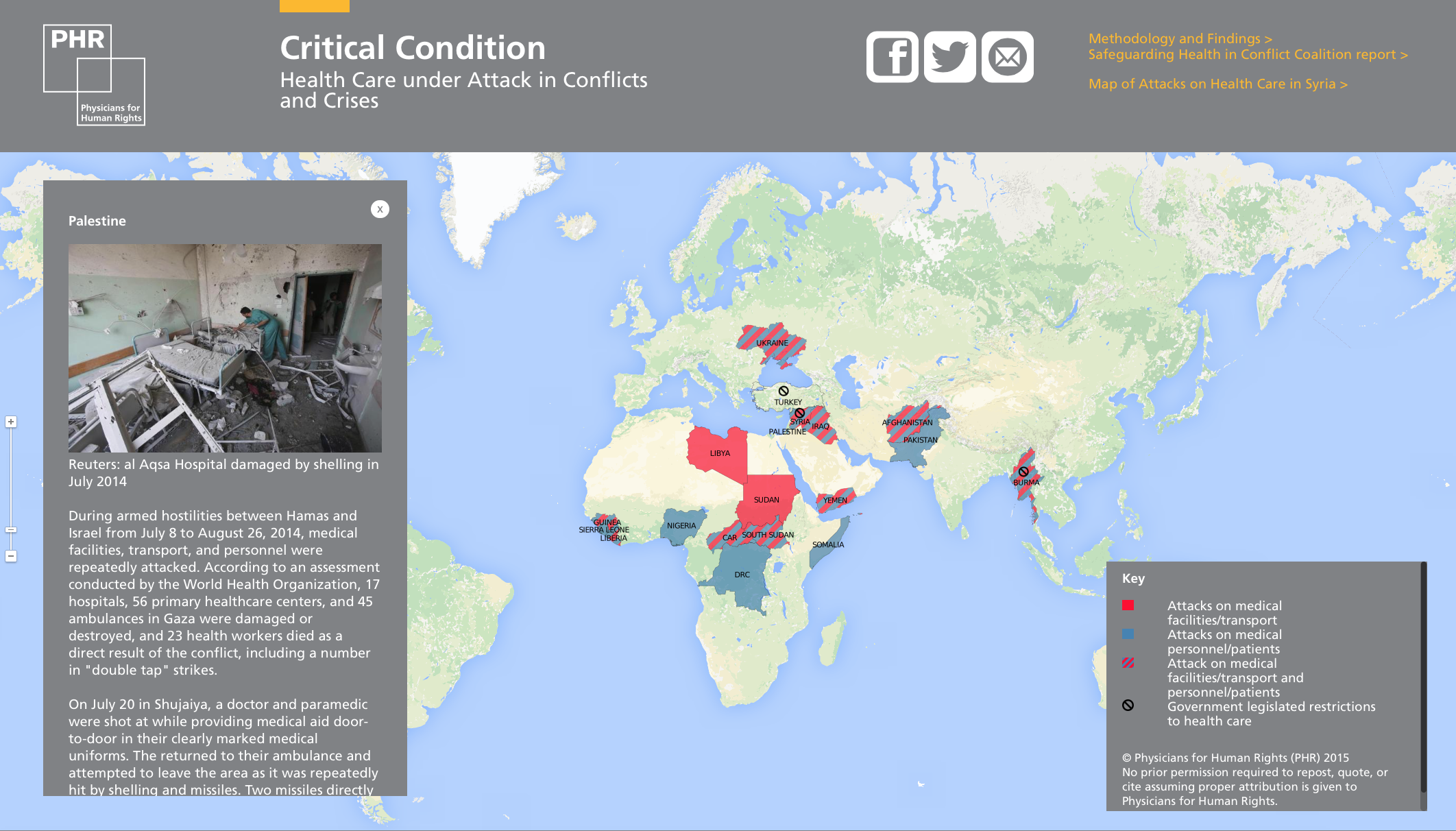
PHR Critical Condition

In close concert with the report Physicians for Human Rights have produced an interactive online map of attacks on health care around the world between January 2014 and April 2015 (see the screenshot above).

PHR Attacks on health care in Syria

The organisation has also produced a detailed map of attacks on health care systems – or what’s left of them – in Syria (see the screenshot above), which you can access here.  It needs to be supplemented by PHR’s Doctors in the crosshairs: four years of attacks on health care in Syria, which was published in March:

The symbols of the Red Cross and Red Crescent have been turned from a shield of protection into crosshairs on the backs of those who knowingly risk their lives to save others.

You can find more on the violation of medical neutrality in Syria in an open-access article by Ravi S. Katari in the Journal of global health here and in a short essay by Sasha Zients and Dylan Okabe-Jawdat for the Columbia Political Review (May 2015) here.

And you can find more on the systematic violation of medical neutrality in Bahrein and elsewhere here.

Playing a blinder

A characteristically smart post from Larry Lewis at War on the Rocks about Obama’s promise to investigate the mistakes made in the CIA-directed drone strike that unwittingly killed two hostages in Pakistan in January 2015.  ‘We’ve been on that path before, in Afghanistan,’ he writes, ‘and we know where it leads: more promises followed by a repeat of similar mistakes.’

Larry explains that the US military was causing an ‘unacceptable number’ of civilian casualties in Afghanistan between 2006 and 2009:

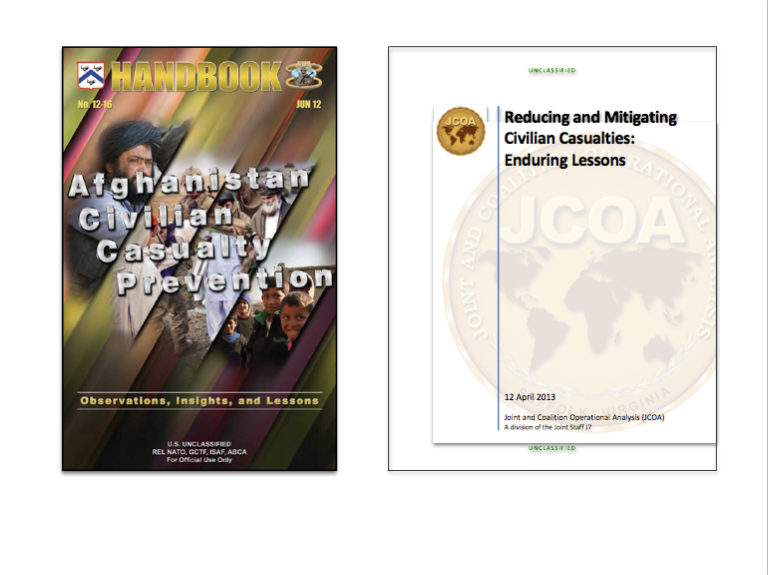
JCCSWhen an incident occurred, they investigated the incident, made changes to guidance, and promised to keep such an incident from happening again. But these incidents kept happening. So the military repeated this ineffective review process again and again. This “repeat” cycle was only broken when military leaders approved the Joint Civilian Casualty Study, a classified outside review requested by General Petraeus. This effort had two key differences from earlier efforts. First, it was independent, so it was able to overcome false assumptions held by operating forces that contributed to their challenges. And second, the study looked at all potential civilian casualty incidents over a period of years, not just the latest incident. This approach helped identify systemic issues with current tactics and policies as the analysis examined the forest and not just the nearest tree. This study also considered different sets of forces operating within Afghanistan and their relative propensity for causing civilian casualties.

You can access the unclassified Executive Summary – co-written by Larry with Sarah Sewell – here.  I’ve noted Larry’s important work on civilian casualties before – here, here and here – but his short Op-Ed raises two issues that bear emphasis.

The first is that it is a mistake to abstract strikes carried out by a Predator or a Reaper from air strikes carried out from conventional platforms; the latter are often facilitated and even orchestrated by a UAV – as in the ‘signature’ case of the Uruzgan strike in 2010 – but, pace some drone activists, our central concern should surely be the wider matrix of military violence.  This also implies the need to articulate any critique of CIA-directed drone strikes in Pakistan with the use of air power in Afghanistan (and not only because USAF pilots fly the ‘covert’ missions across the border).  Here General Stanley McChrystal‘s Tactical Directive issued in July 2009 that directly addressed civilian casualties is a crucial divide.   As Chris Woods emphasizes in Sudden Justice,

‘Radically different tactics were now being pursued on either side of the “AfPak” border…. Even as Stanley McChrystal was cutting back on airstrikes in Afghanistan, the CIA was escalating its secret air war in Pakistan’s tribal areas.’

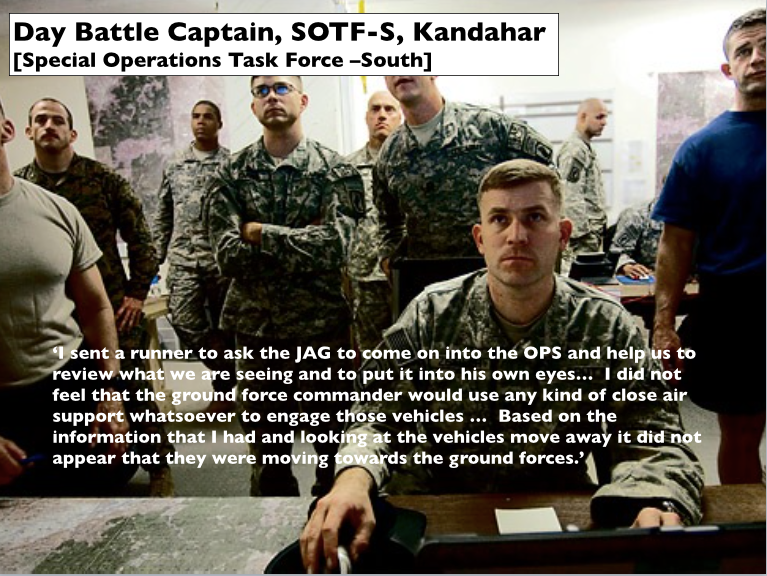
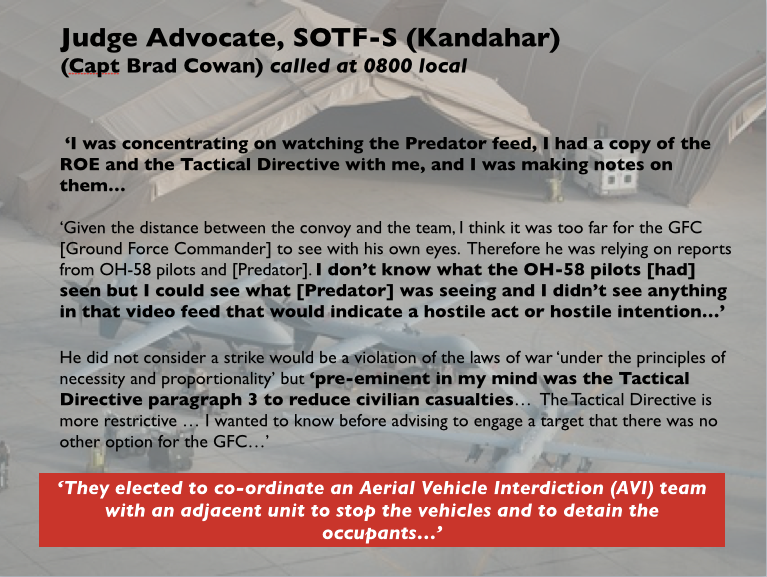
The second issue is the extraordinary partitions – blinkers might be more accurate – that seem to be imposed on military operations and investigations.  In the case of the Uruzgan attack, for example, a military lawyer was called in at the eleventh hour to monitor the video feeds from the Predator as it tracked a ‘convoy’ (a term surely as leading as ‘Military-Aged Male’) in the early morning.  As the next two slides show, taken from my ‘Angry Eyes’ presentation, the JAG knew the Rules of Engagement (ROE) and the Tactical Directive; he obviously also knew the legal requirements of proportionality,  distinction and the rest.

Angry Eyes:1

Angry Eyes:2

Knowing the ROE, the Tactical Directive and the formal obligations of international law is one thing (or several things): but what about ‘case law’, so to speak?  What about knowledge of other, similar incidents that could have informed and even accelerated the decision-making process?  In this case, before the alternative course of action could be put into effect and an ‘Aerial Vehicle Interdiction’ set in motion – using helicopters to halt the three vehicles and determine what they were up to – two attack helicopters struck the wholly innocent ‘convoy’ and killed 15-21 civilians.  Fast forward to the subsequent, I think forensic Army investigation.  This is the most detailed accounting of a ‘CIVCAS’ incident I have read (and you’ll be able to read my analysis of it shortly), and yet here too – even with senior military legal advisers and other ‘subject experts’ on the investigating team – there appears to be no reference to other, similar incidents that could have revealed more of the ‘systemic issues’ to which Larry so cogently refers.

This is made all the stranger because there is no doubt – to me, anyway – that the US military takes the issue of civilian casualties far more seriously than many of its critics allow.

CIVCAS


Asymmetric law

1425285643_9e0a120e-3716-468a-ba00-e976b29db2851421848906

Breaking the Silence has just published a major report into the Israeli military’s tactics during its most recent offensive against Gaza and its people, so-called ‘Operation Protective Edge’ (see my posts herehere, here and here).

Based on interviews with 65 IDF soldiers, the report includes Background, Testimonies (‘This is how we fought in Gaza‘), and a media gallery.

Writing in today’s Guardian, Peter Beaumont reports:

Describing the rules that meant life and death in Gaza during the 50-day war – a conflict in which 2,200 Palestinians were killed – the interviews shed light for the first time not only on what individual soldiers were told but on the doctrine informing the operation.

Despite the insistence of Israeli leaders that it took all necessary precautions to protect civilians, the interviews provide a very different picture. They suggest that an overarching priority was the minimisation of Israeli military casualties even at the risk of Palestinian civilians being harmed….

Post-conflict briefings to soldiers suggest that the high death toll and destruction were treated as “achievements” by officers who judged the attrition would keep Gaza “quiet for five years”.

The tone, according to one sergeant, was set before the ground offensive into Gaza that began on 17 July last year in pre-combat briefings that preceded the entry of six reinforced brigades into Gaza.

“[It] took place during training at Tze’elim, before entering Gaza, with the commander of the armoured battalion to which we were assigned,” recalled a sergeant, one of dozens of Israeli soldiers who have described how the war was fought last summer in the coastal strip.

“[The commander] said: ‘We don’t take risks. We do not spare ammo. We unload, we use as much as possible.’”

“The rules of engagement [were] pretty identical,” added another sergeant who served in a mechanised infantry unit in Deir al-Balah. “Anything inside [the Gaza Strip] is a threat.  The area has to be ‘sterilised,’ empty of people – and if we don’t see someone waving a white flag, screaming: “I give up” or something – then he’s a threat and there’s authorisation to open fire … The saying was: ‘There’s no such thing there as a person who is uninvolved.’ In that situation, anyone there is involved.”

“The rules of engagement for soldiers advancing on the ground were: open fire, open fire everywhere, first thing when you go in,” recalled another soldier who served during the ground operation in Gaza City. The assumption being that the moment we went in [to the Gaza Strip], anyone who dared poke his head out was a terrorist.”

1425285424_2bdb2aee-c3f8-4679-a375-d6682afb701a1421848849

You can find an impassioned, detailed commentary on the report by Neve Gordon – who provides vital context, not least about the asymmetric ethics pursued by supposedly ‘the most ethical army in the world’ – over at the London Review of Books here, and a shorter commentary by Kevin Jon Heller at Opinio Juris here.  Kevin notes:

The soldiers’ descriptions are disturbingly reminiscent of the notorious “free fire” zones in Vietnam and the US government’s well-documented (and erroneous) belief that signature strikes directed against “military-age men in an area of known terrorist activity” comply with IHL’s principle of distinction. The testimonials are, in a word, stunning — and put the lie to oft-repeated shibboleths about the IDF being “the most moral army in the world.” As ever, the stories told by the IDF and the Israeli government are contradicted by the soldiers who actually have to do the killing and dying.

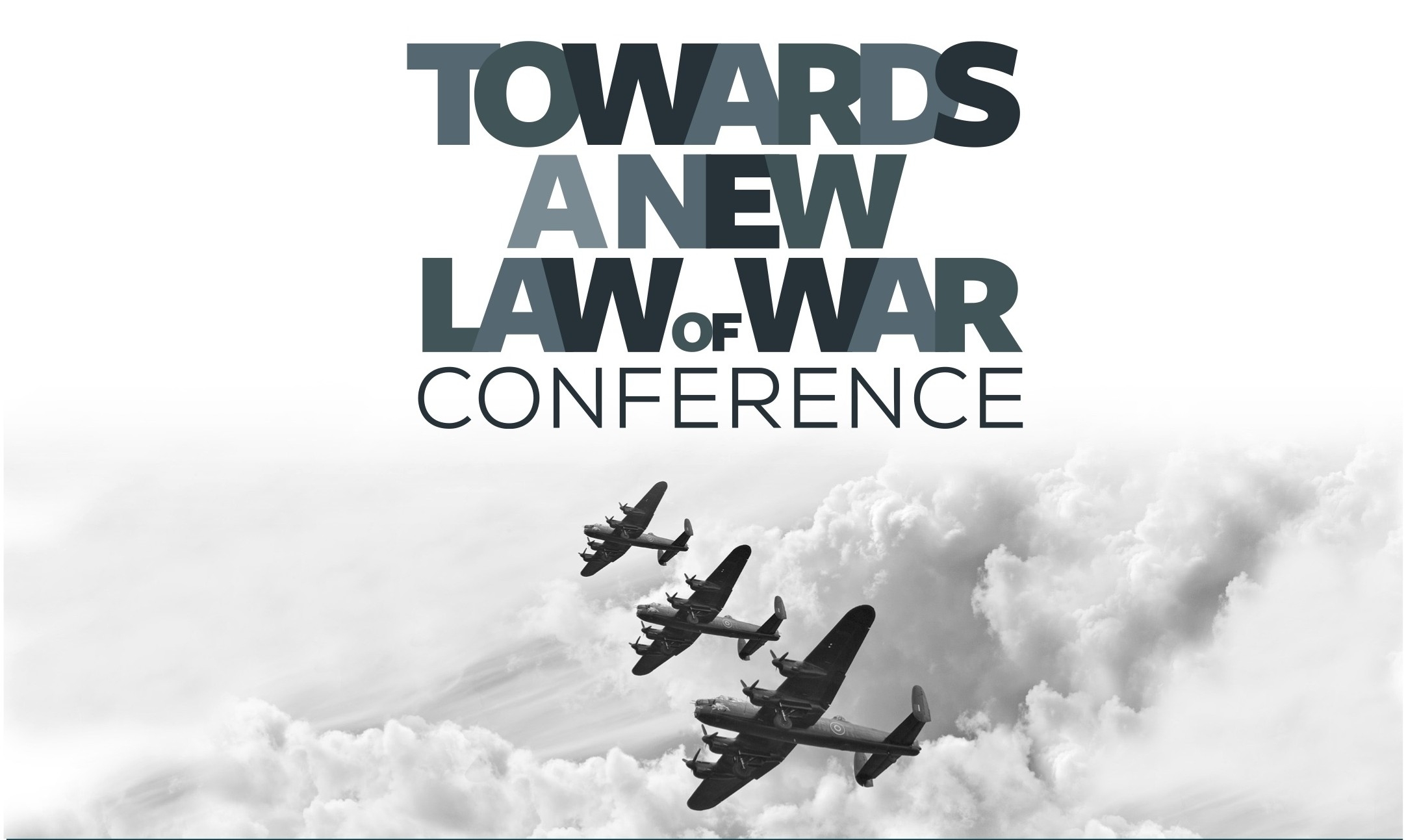
The legal and ethical framework pursued by the Israeli military – and ‘pursued’ is the mot (in)juste, since its approach to international law and ethics is one of aggressive intervention – is in full view at a conference to be held in Jerusalem this week: ‘Towards a New Law of War‘.

poster-A2_3-2480x35071-e1427212477619-2164x1293

‘The goal of the law of war conference,’ say the organisers, ‘is to influence the direction of legal discourse concerning issues critical to Israel and her ability to defend herself. The law of war is mainly unwritten and develops on the basis of state practice.’

You can find the full program here, dominated by speakers from Israel and the US, but notice in particular the session on ‘Proportionality: Crossing the line on civilian casualties‘:

CIvilian Casualties

As this makes clear, and as Ben White reports in the Middle East Monitor, law has become the target (see also my post here):

After ‘Operation Cast Lead’, Daniel Reisner, former head of the international law division (ILD) in the Military Advocate General’s Office, was frank about how he hoped things would progress.

If you do something for long enough, the world will accept it. The whole of international law is now based on the notion that an act that is forbidden today becomes permissible if executed by enough countries….International law progresses through violations.

Similarly, in a “moral evaluation” of the 2008/’09 Gaza massacre, Asa Kasher, author of the IDF’s ‘Code of Ethics’, expressed his hope that “our doctrine” will ultimately “be incorporated into customary international law.” How?

The more often Western states apply principles that originated in Israel to their own non-traditional conflicts in places like Afghanistan and Iraq, then the greater the chance these principles have of becoming a valuable part of international law.

Now Israel’s strategy becomes clearer… Israel’s assault on the laws of war takes aim at the core, guiding principles in IHL – precaution, distinction, and proportionality – in order to strip them of their intended purpose: the protection of civilians during armed conflict. If successful, the victims of this assault will be in the Occupied West Bank and Gaza Strip, Lebanon – and in occupations and war zones around the world.

Divisions of Life

Journeys from No Man's Land.001

My main presentation at the AAG in Chicago was part of a session organised by Noam Leshem and Alasdair Pinkerton on Remnants of No Man’s Land: history, theory and excess (more on their larger project here).  Here is an extended summary of what I had to say, together with some of my slides, but bear in mind that this all had to be done in 20 minutes so there wasn’t much room for nuance.  Neither was there time to discuss civilian entanglements, both volunteers and victims, nor the sick: the presentation focuses on the wounded, even though the problems of trench foot, ‘trench flu’, and a host of other diseases were also extremely important.  They do all receive attention in the larger project from which this is extracted.  One last, geographical qualification: my discussion is limited to the evacuation of British and imperial troops from the Western Front.

My starting-point was the strange disappearance of the wounded from the field of battle.  As John Keegan wrote in The Face of Battle, in most histories the ‘wounded apparently dematerialize as soon as they are struck down’; he was writing specifically about General Sir William Napier’s account of the battle of Albuera in 1811, but the point is a sharp one that can be enlisted as part of a more general critique of military history.

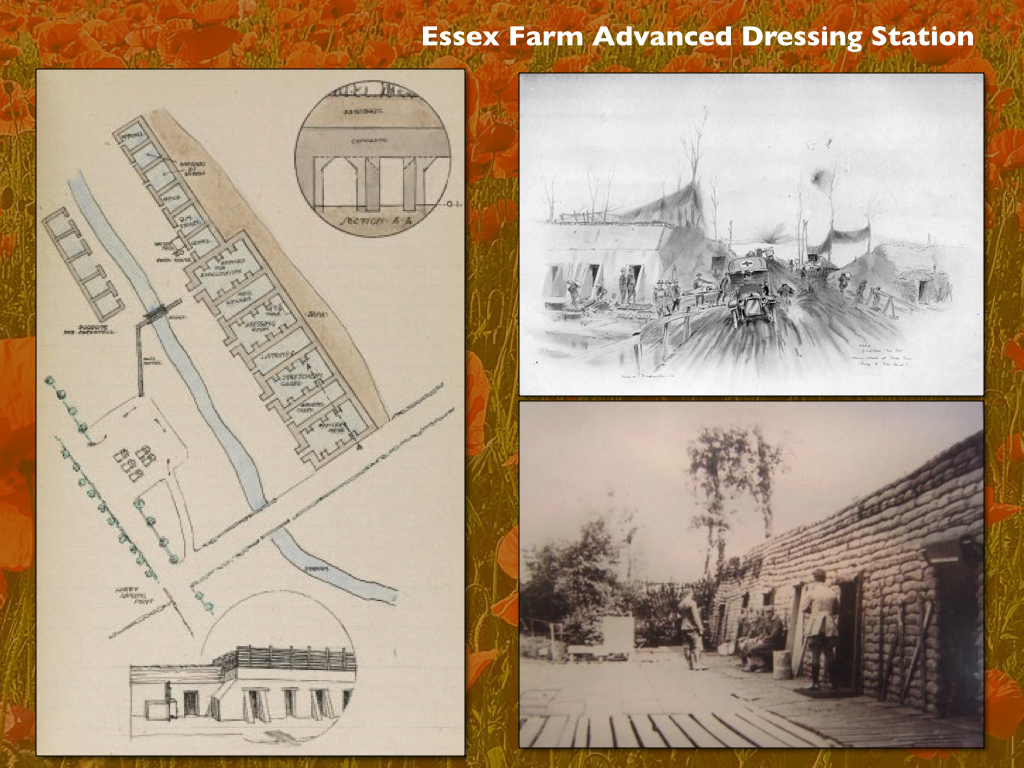
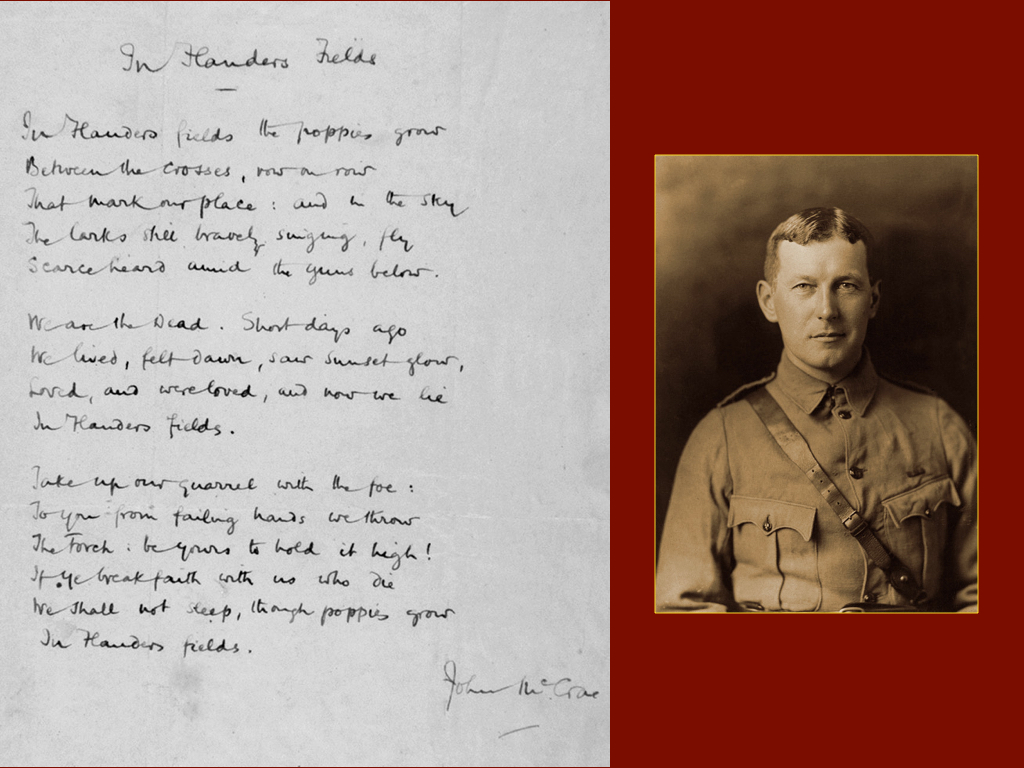
In the case of the First World War, the emphasis on those who lost their lives – on the dead not the wounded – derives not only from the sheer scale of the slaughter but also from the enduring landscape of memorialisation and commemoration.  When John McCrae‘s elegaic poem ‘In Flanders Fields’ is recited every Remembrance Day – ‘In Flanders fields the poppies grow, between the crosses, row on row’ – it is all too easy to forget that he wrote those lines not only to commemorate the death of a close friend but that he did so at Essex Farm Advanced Dressing Station:

Journeys from No Man's Land.003

Journeys from No Man's Land.004

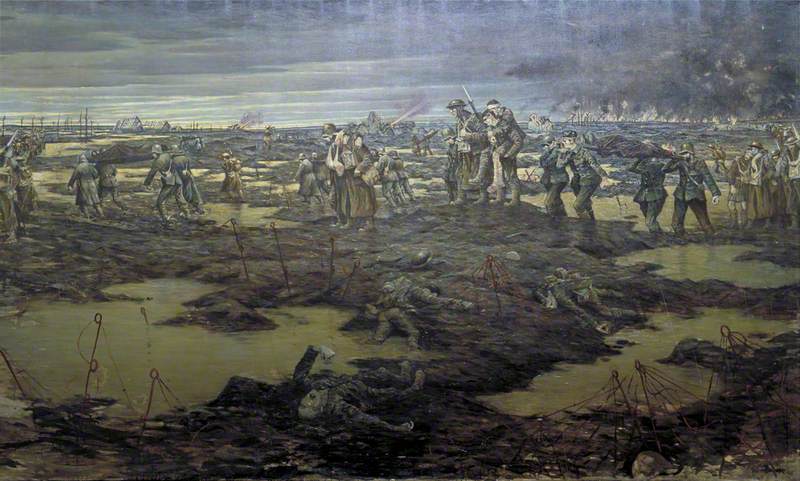
What lies behind those haunting lines – and that medical outpost – is a vast canvas of wounded men, which Christopher Nevinson captured as ‘The Harvest of Battle’ (below).  The dead occupy the foreground, but behind them is the endless, moving panorama of the wounded whose precarious journeys took most of them far beyond ‘No Man’s Land’.

(c) IWM (Imperial War Museums); Supplied by The Public Catalogue Foundation

In fact, as Emily Mayhew reminds us, ‘being wounded was one of the most common experiences of the Great War’: on the Western Front, she writes, ‘almost every other British soldier could expect to become a casualty’.

But, perhaps not surprisingly, for the first six months of the war the British Expeditionary Force was unprepared for the scale of casualties, and even with the help of civilian volunteers and aid societies – Nevinson briefly served as a medical orderly with the Friends Ambulance Unit, for example – the remarkably long time it took to evacuate the wounded combined with the perilous nature of their improvised journeys to increase the mortality rate.

Journeys from No Man's Land.007

Journeys from No Man's Land.008

And so what Mark Harrison called the military-medical machine had to be speeded up – and moved closer to the field of battle.

Journeys from No Man's Land.016

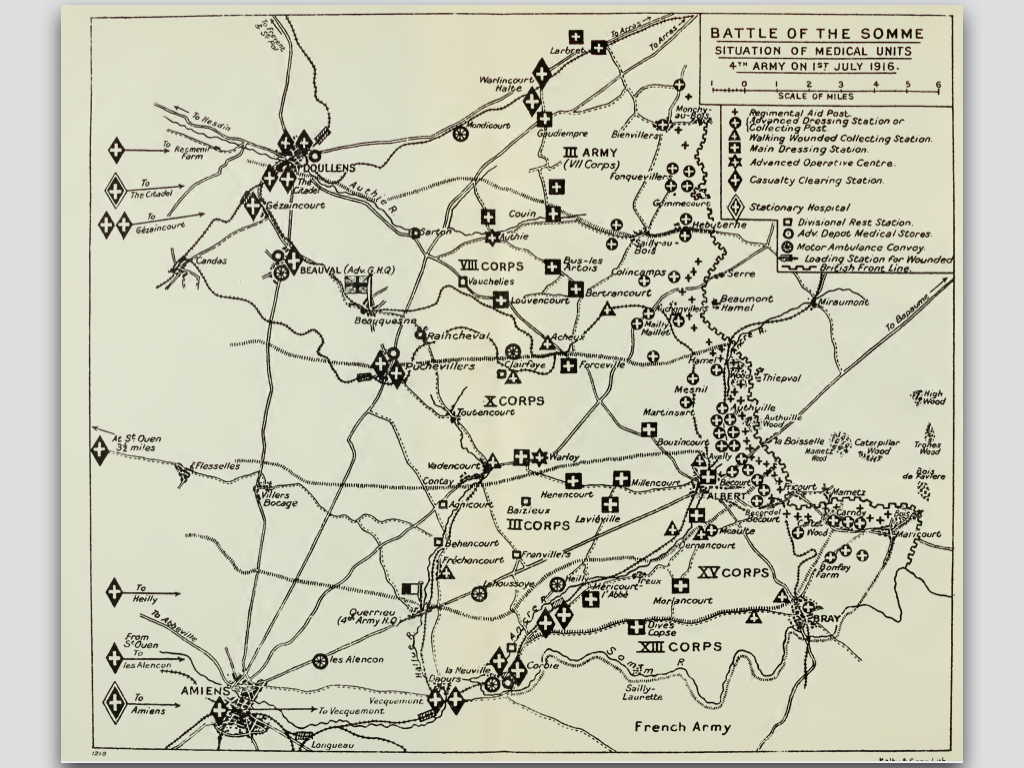
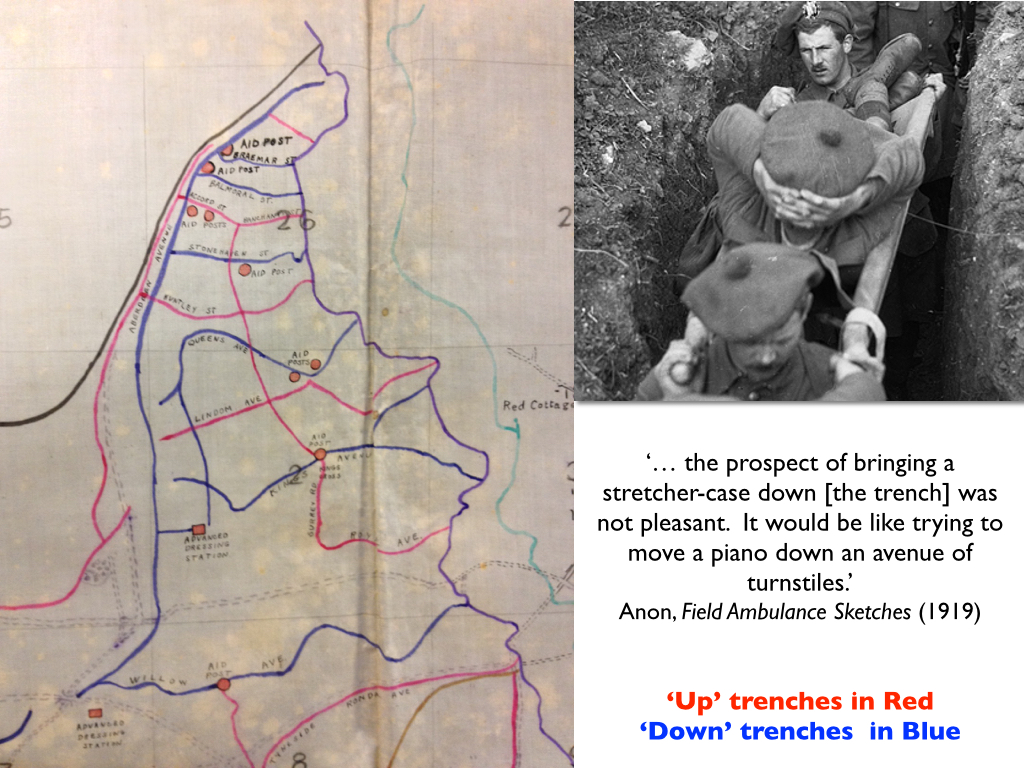
Before every major offensive elaborate plans for medical support were prepared: casualties were ‘cleared’ down the line as far and as fast as possible to make room for the newly injured, casualty clearing hospitals moved closer to the line, ambulances and stretcher-bearers made ready, and ‘down’ trenches designated for the efficient removal of the wounded (below).

Journeys from No Man's Land.017

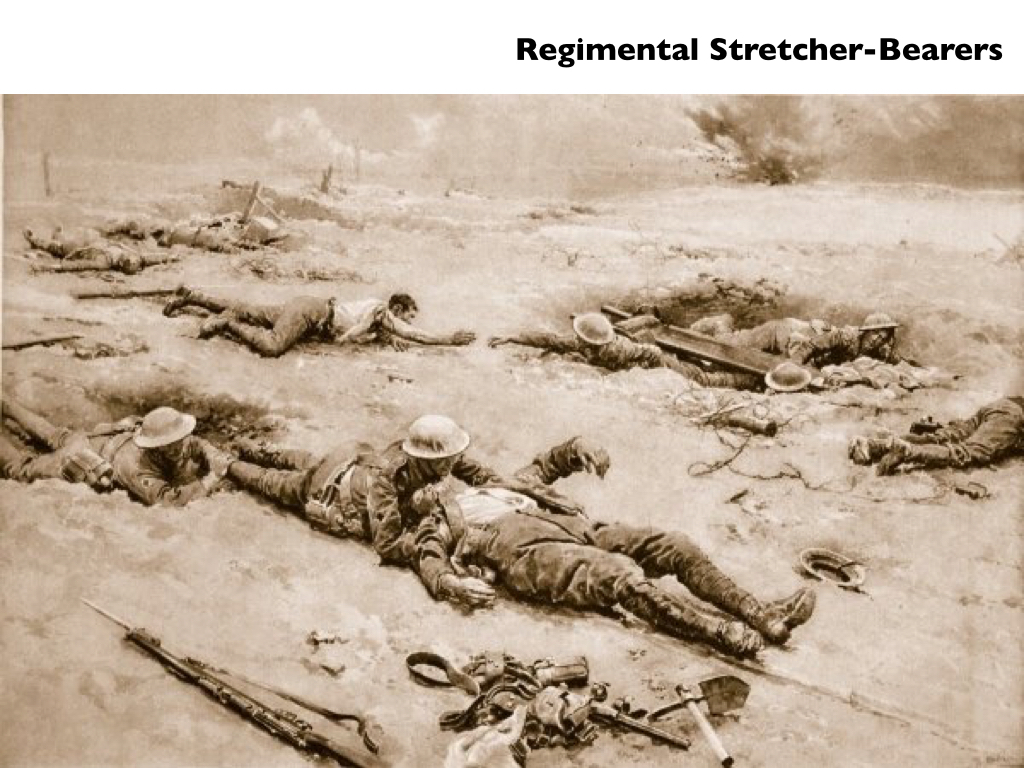
Soldiers wounded in ‘No Man’s Land’ – a term never recognised by the British General Staff, who insisted that they controlled the field of battle right up to the enemy front lines – were often immobilised and disoriented; some crawled into shell holes, seeking refuge below the field of fire, but it could take hours, even days before they were discovered and rescued (I’ll devote a later post to a detailed discussion of some of those cases).

Journeys from No Man's Land.022

Journeys from No Man's Land.023

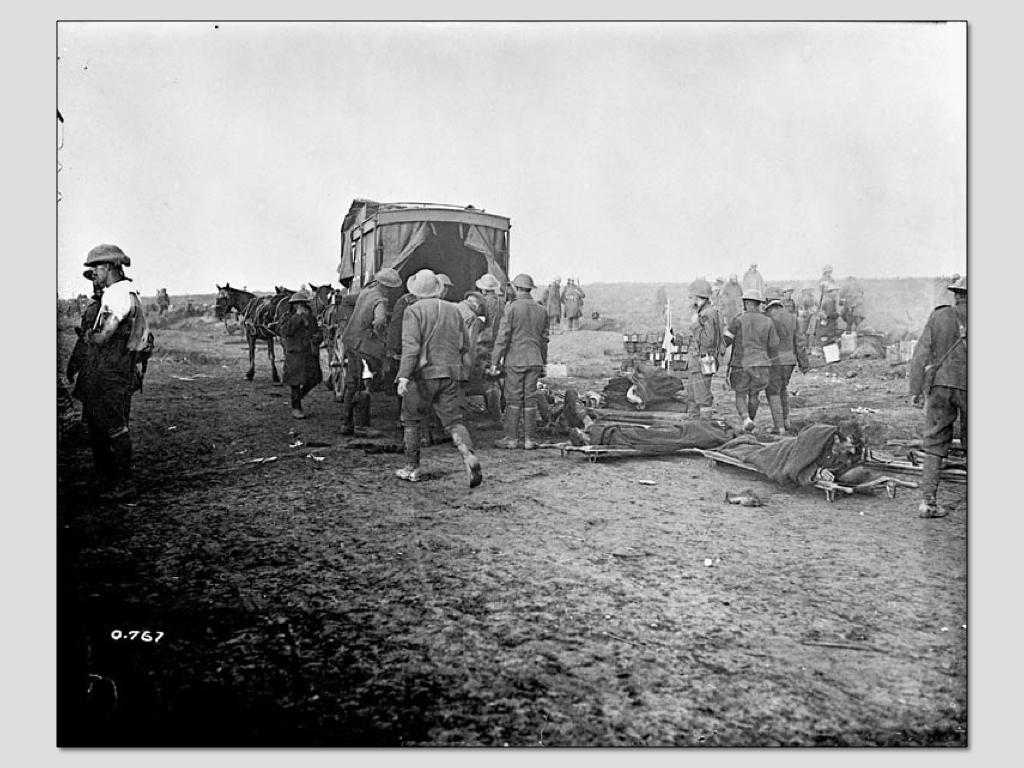
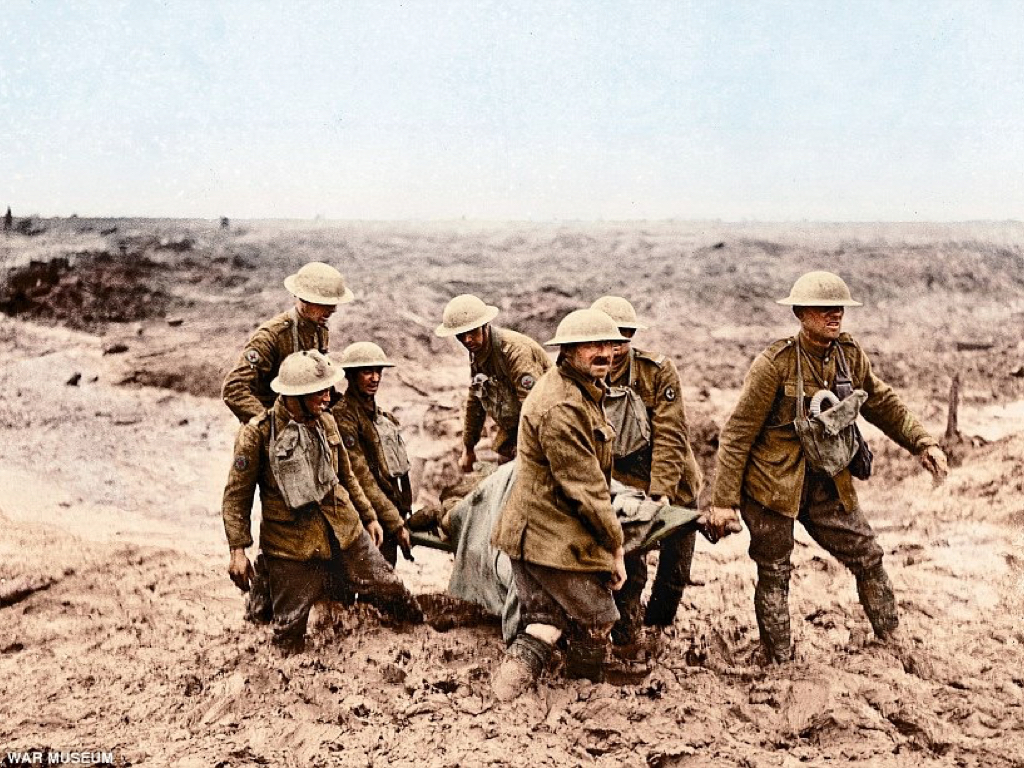
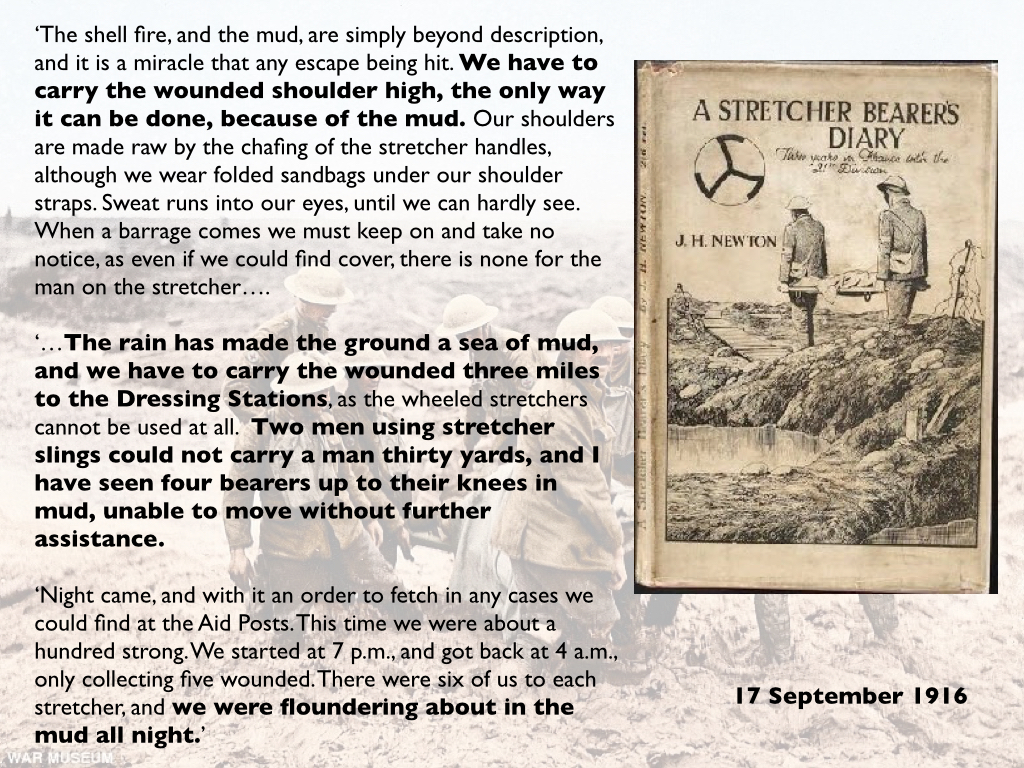
Sometimes their mates came to their rescue, sometimes the regimental stretcher bearers.  But they too had to find their way through a dangerous and devastated terrain, often with no landmarks to guide them and on occasion made virtually impassable by the thick, cloying mud that was always –  disconcertingly – much more than mud.

Journeys from No Man's Land.024

By now, they were in the care of the Royal Army Medical Corps’s Field Ambulance, and their first objective was an Advanced Dressing Station.  

Journeys from No Man's Land.026

Treatment at ADS 1917

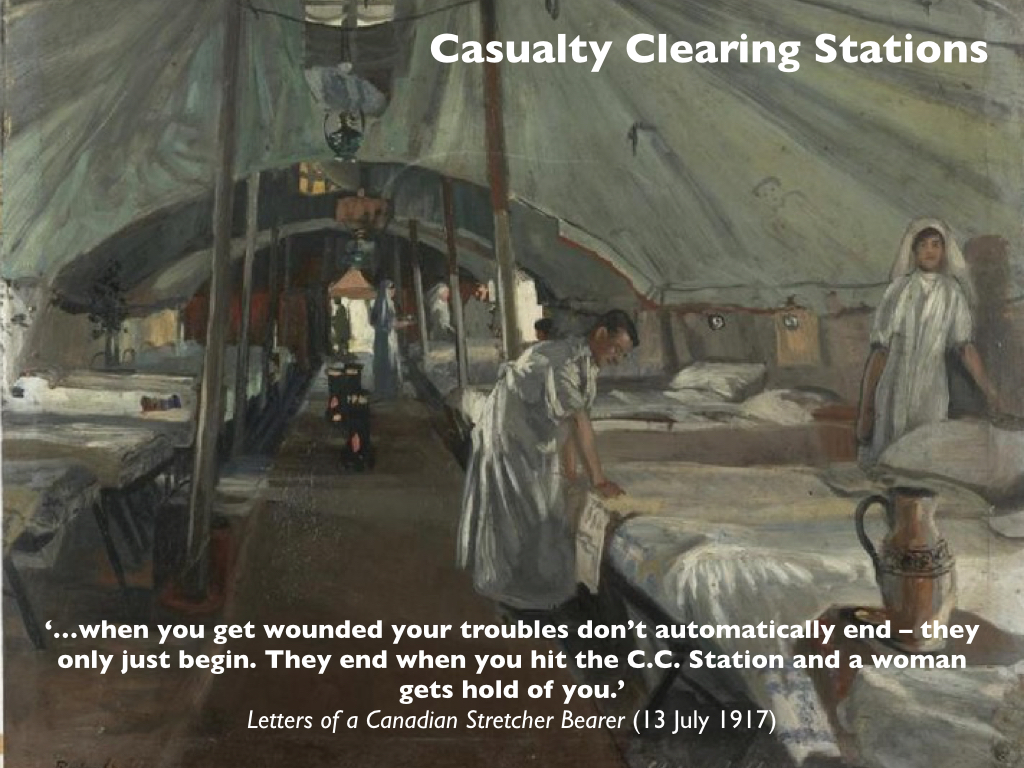
Those that needed anything beyond simple treatment or emergency surgery were sent on by horse or motor ambulance to a Casualty Clearing Station (a field hospital).

Journeys from No Man's Land.027

Journeys from No Man's Land.030

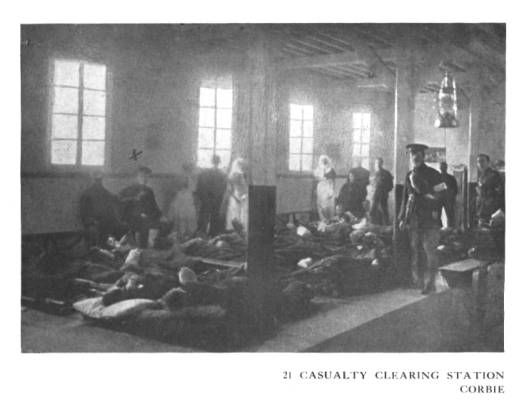
It was usually here that their first surgeries took place.  The journalist Philip Gibb was shown around a CCS at Corbie and the experience haunted him for years:

After a visit there I had to wipe cold sweat from my forehead, and found myself trembling in a queer way. It was the medical officer—a colonel—who called it that name. “This is our Butcher’s Shop,” he said, cheerily. “Come and have a look at my cases. They’re the worst possible; stomach wounds, compound fractures, and all that. We lop off limbs here all day long, and all night. You’ve no idea!”

CCS Corbie

I had no idea, but I did not wish to see its reality. The M.O. could not understand my reluctance to see his show. He put it down to my desire to save his time—and explained that he was going the rounds and would take it as a favor if I would walk with him. I yielded weakly, and cursed myself for not taking to flight. Yet, I argued, what men are brave enough to suffer I ought to have the courage to see… I saw and sickened. These were the victims of “Victory” and the red fruit of war’s harvest-fields. A new batch of “cases” had just arrived. More were being brought in on stretchers. They were laid down in rows on the floor-boards. The colonel bent down to some of them and drew their blankets back, and now and then felt a man’s pulse. Most of them were unconscious, breathing with the hard snuffle of dying men. Their skin was already darkening to the death-tint, which is not white. They were all plastered with a gray clay and this mud on their faces was, in some cases, mixed with thick clots of blood, making a hard incrustation from scalp to chin. “That fellow won’t last long,” said the M. O., rising from a stretcher. “Hardly a heart-beat left in him. Sure to die on the operating-table if he gets as far as that… Step back against the wall a minute, will you?” We flattened ourselves against the passage wall while ambulance-men brought in a line of stretchers. No sound came from most of those bundles under the blankets, but from one came a long, agonizing wail, the cry of an animal in torture. “Come through the wards,” said the colonel. “They’re pretty bright, though we could do with more space and light.” In one long, narrow room there were about thirty beds, and in each bed lay a young British soldier, or part of a young British soldier. There was not much left of one of them. Both his legs had been amputated to the thigh, and both his arms to the shoulder-blades. “Remarkable man, that,” said the colonel. “Simply refuses to die. His vitality is so tremendous that it is putting up a terrific fight against mortality… There’s another case of the same kind; one leg gone and the other going, and one arm. Deliberate refusal to give in. ‘You’re not going to kill me, doctor,’ he said. ‘I’m going to stick it through.’ What spirit, eh?”…

“Bound to come off,” said the doctor as we passed to another bed. “Gas gangrene. That’s the thing that does us down.” In bed after bed I saw men of ours, very young men, who had been lopped of limbs a few hours ago or a few minutes, some of them unconscious, some of them strangely and terribly conscious, with a look in their eyes as though staring at the death which sat near to them, and edged nearer. “Yes,” said the M. O., “they look bad, some of ’em, but youth is on their side. I dare say seventy-five per cent. will get through. If it wasn’t for gas gangrene—“

He jerked his head to a boy sitting up in bed, smiling at the nurse who felt his pulse. “Looks fairly fit after the knife, doesn’t he? But we shall have to cut higher up. The gas again. I’m afraid he’ll be dead before to-morrow. Come into the operating-theater. It’s very well equipped.”

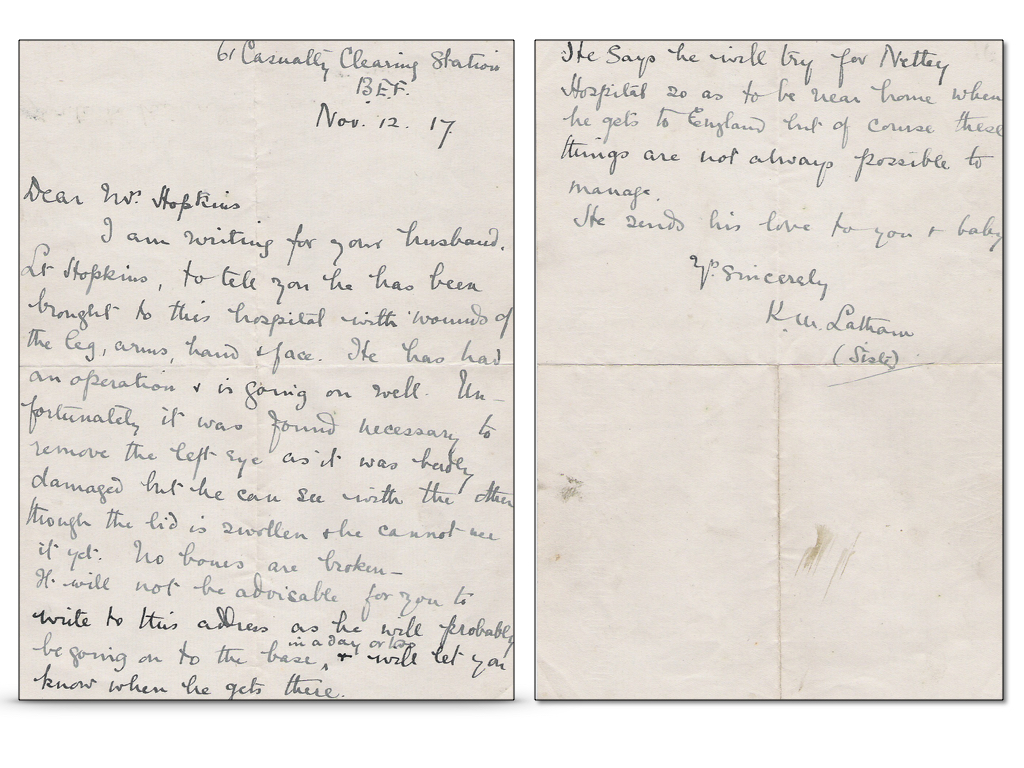
By now the bureaucratic machine had been activated: labels had been attached to the wounded and field medical cards (‘tickets’) completed; telegrams had been sent to advise families, and nurses had often written letters home on their patients’ behalf.

Journeys from No Man's Land.035Journeys from No Man's Land.036

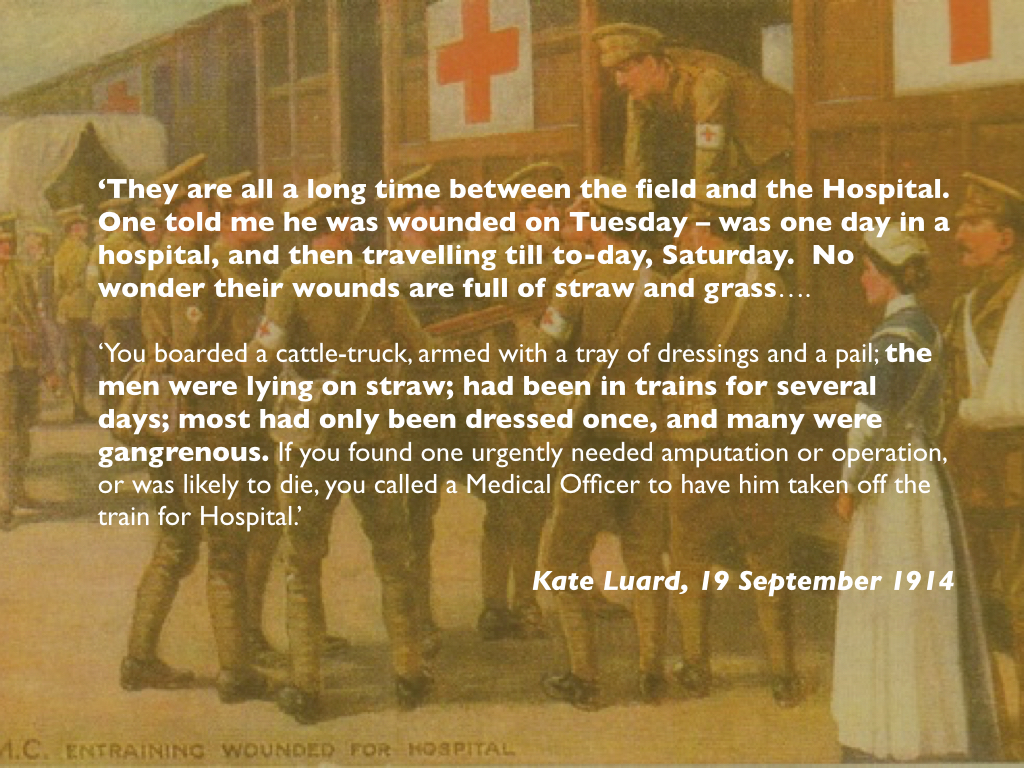
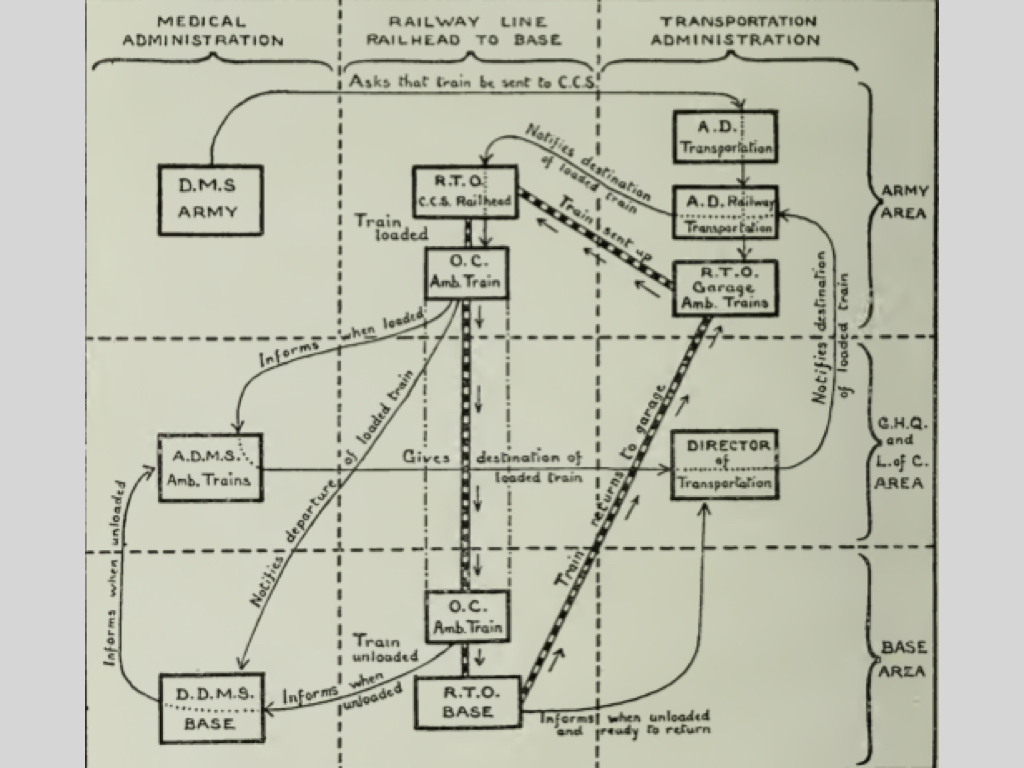
The next stage for the most seriously wounded was evacuation by ambulance train to  a base hospital on the French coast.  There was a considerable bureaucracy involved in planning these movements, but for all the neatness and symmetry of the organisational diagrams – part of Clausewitz‘s ‘paper war’ – there were all sorts of delays.

Journeys from No Man's Land.038

Journeys from No Man's Land.040

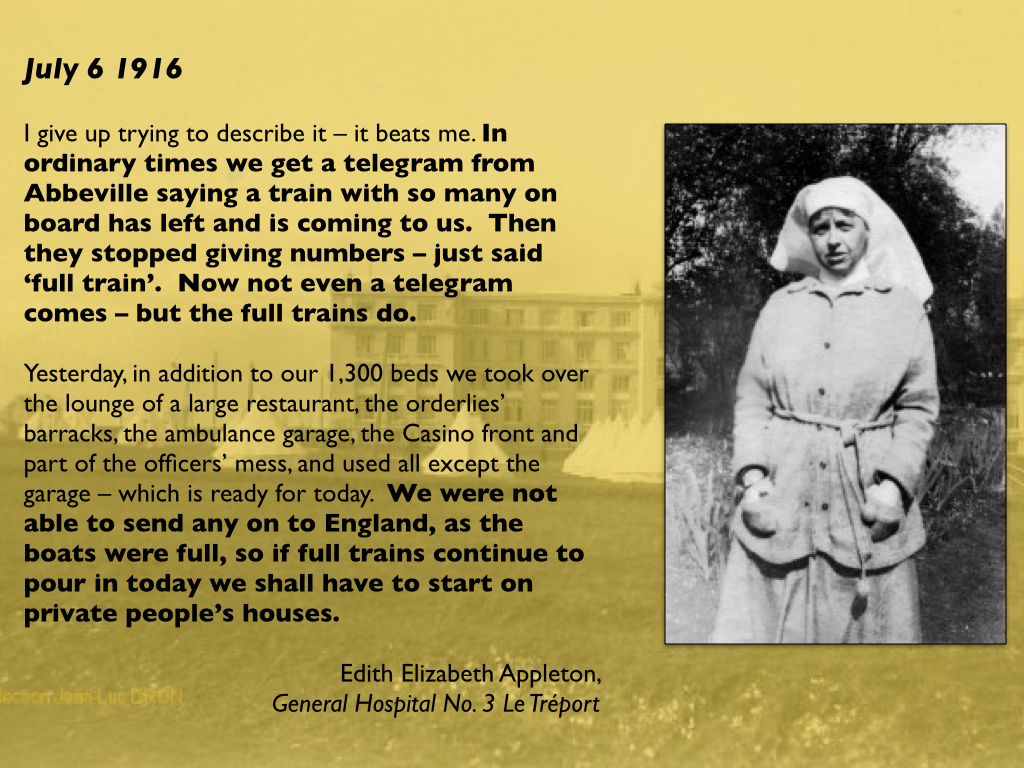
Priority was given to trains rushing reinforcements, supplies and ammunition to the front, and ambulance trains were frequently marooned in sidings waiting for them to pass so that journeys that might have taken hours could take days.  It was not uncommon for an ambulance train to arrive at a base hospital to find that there was little or no room for new patients and all but the most grievous cases had to travel on to the next.

Journeys from No Man's Land.041

Journeys from No Man's Land.042

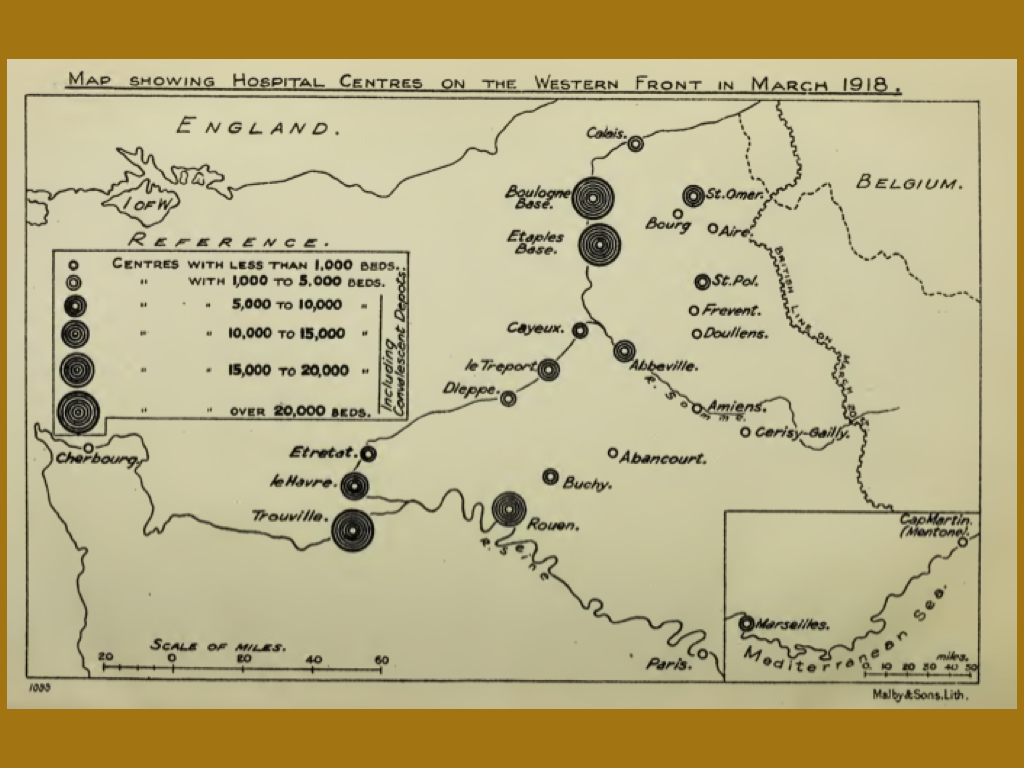
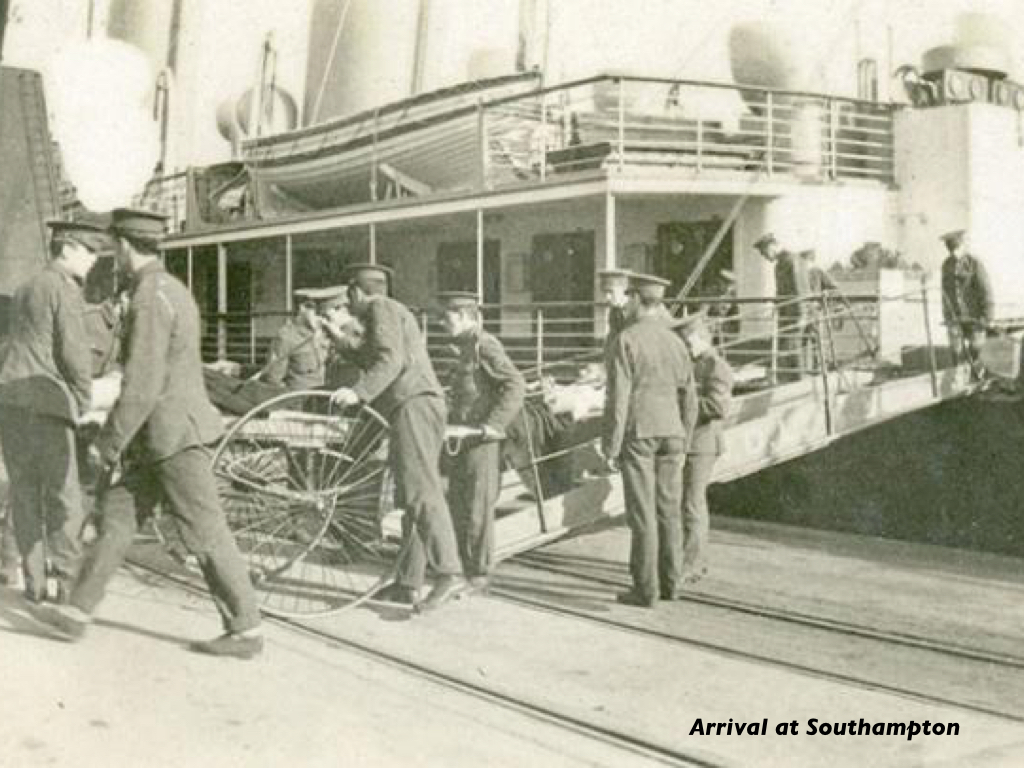
Many patients were treated at the base hospitals, but those with more serious wounds were evacuated by hospital ship to Britain.  This stage of the journey was no less dangerous than the previous one: as the war continued, there was an increasing danger of mines and submarines in the Channel.

Journeys from No Man's Land.043

Journeys from No Man's Land.044

Journeys from No Man's Land.046

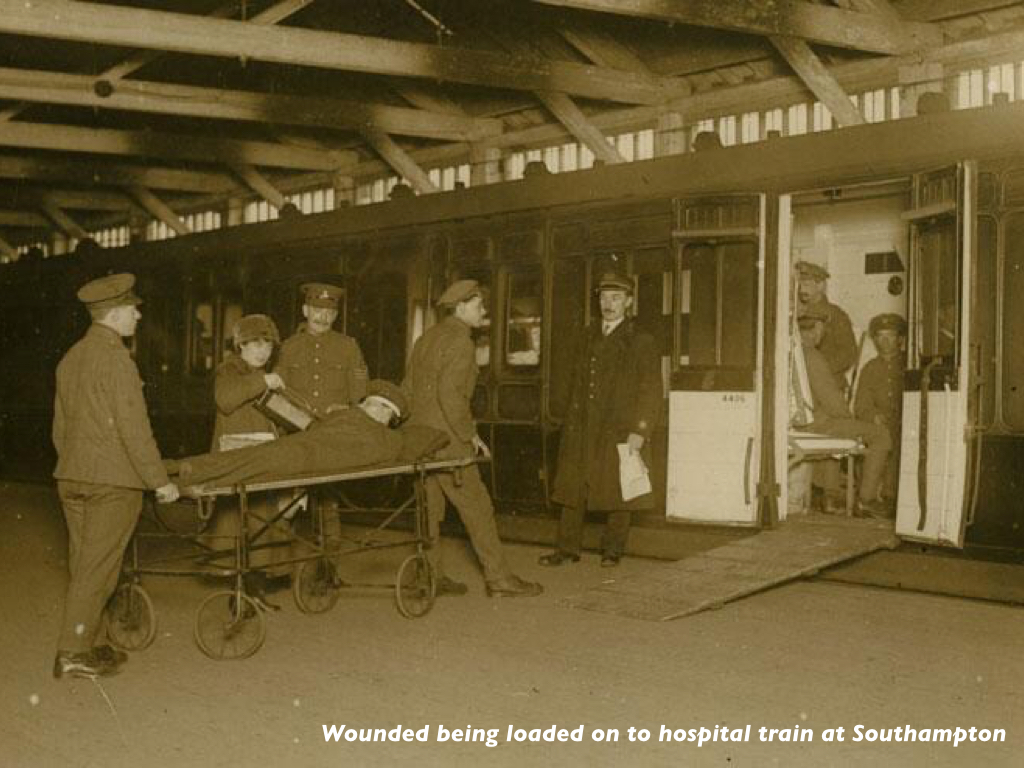
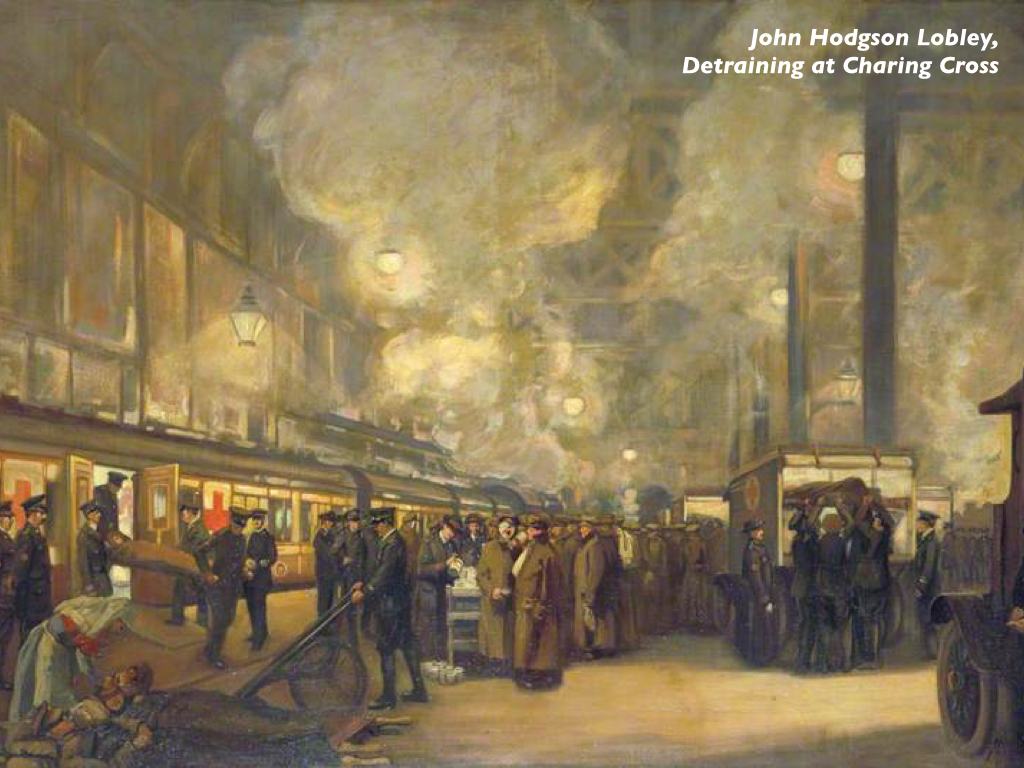
A distinctive  geography of the wounded emerged.  If they arrived at Southampton, the most critical cases were taken by train straight to the Royal Victoria Military Hospital at Netley, which treated as many as 50,000 patients during the war.  According to Lyn McDonald,

 ‘Those who could not be accommodated, and those who were seriously wounded but likely to survive a longer journey, were sent on by train to Birmingham, Bristol, Exeter, Leicester, Norwich and Plymouth.  But seven out of every ten hospital trains were directed to London, and during the first days of the Somme they rolled in almost every hour to Charing Cross and Paddington stations.’
Journeys from No Man's Land.047

Journeys from No Man's Land.048

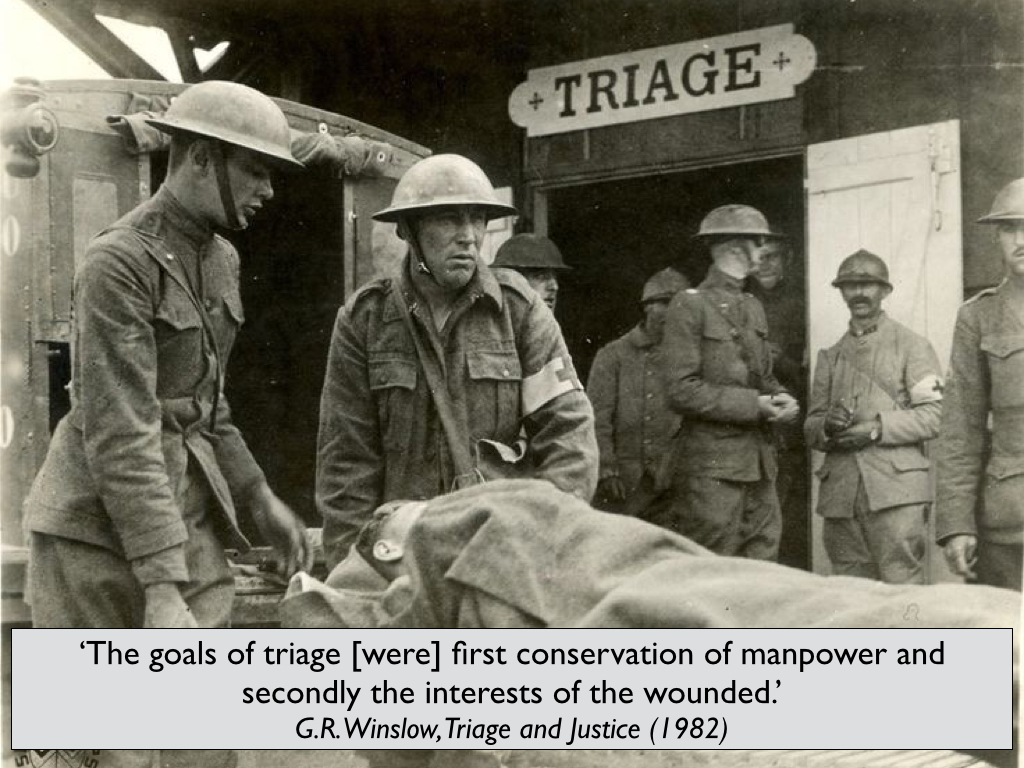
This is, of course, a highly abbreviated account of the casualty evacuation chain, and in the larger project from which this is derived I provide many more details.  But I think I’ve said enough to show that the chain was, in effect, a production line with an elaborate division of labour (again, in the larger study I show how class – or more accurately, rank – gender and race segmented the chain in various ways).  Indeed, in The Politics of Wounds Ana Carden-Coyne argues that what she calls ‘the Taylorist approach in modern war’ – and remember that this was industrial war on the grand (guignol) scale – ‘was particularly evident in the assembly-line style of evacuation and triage.’

Journeys from No Man's Land.012

This prompts two concluding observations.

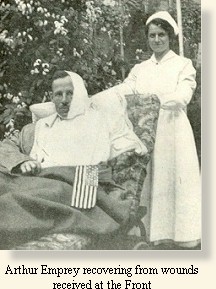
First, what was the instrumental logic that animated the evacuation chain?  After all, it was an expensive undertaking, as Arthur Empey (himself wounded on the Western Front) realised in this re-calculation of the chain:

It may sound heartless and inhuman, but it is a fact, nevertheless, that from a military stand-point it is better for a man to be killed than wounded.

EmpeyIf a man is killed he is buried, and the responsibility of the government ceases, excepting for the fact that his people receive a pension. But if a man is wounded it takes three men from the firing line, the wounded man and two men to carry him to the rear to the advanced first-aid post. Here he is attended by a doctor, perhaps assisted by two R.A.M.C. men. Then he is put into a motor ambulance, manned by a crew of two or three. At the field hospital, where he generally goes under an anaesthetic, either to have his wounds cleaned or to be operated on, he requires the services of about three to five persons. From this point another ambulance ride impresses more men in his service, and then at the ambulance train, another corps of doctors, R.A.M.C. men, Red Cross nurses, and the train’s crew. From the train he enters the base hospital or Casualty Clearing Station, where a good-sized corps of doctors, nurses, etc., are kept busy. Another ambulance journey is next in order — this time to the hospital ship. He crosses the Channel, arrives in Blighty — more ambulances and perhaps a ride for five hours on an English Red Cross train with its crew of Red Cross workers, and at last he reaches the hospital. Generally he stays from two to six months, or longer, in this hospital. From here he is sent to a convalescent home for six weeks.

If by wounds he is unfitted for further service, he is discharged, given a pension, or committed to a Soldiers’ Home for the rest of his life, — and still the expense piles up. When you realize that all the ambulances, trains, and ships, not to mention the man-power, used in transporting a wounded man, could be used for supplies, ammunition, and reinforcements for the troops at the front, it will not appear strange that from a strictly military standpoint, a dead man is sometimes better than a live one (if wounded).

Hence, for example, the orders recorded by A.M. Burrage:

The instructions given to stretcher-bearers are rather harsh. “ If you find two men wounded, and can take only one away, take away the one more likely to make a fit soldier again.” Therefore the one more urgently in need of attention must be left to die, because he would walk with a limp and would never again be able to carry a pack. Sound business, of course, but just a little hard.
Kate Luard captured another dimension of this when she wrote in January 1915:

‘The ambulance trains do so much bringing the British Army from the field that I hope some other  trains are busy bringing the British Army to the field, or there can’t be many left in the field…’

And Emily Mayhew provides this bleak vignette from a medical orderly that captures the seemingly insatiable drive of industrial war:

An ordinary train, similar to the one that had brought him to the front, was at one end unloading reinforcements, while at the other end it was filling up with wounded men.

The logic, then, was one of ‘salvage’; four out of every five men wounded on the Western Front were returned to the fighting, which was the over-riding objective of the military-medical machine.

Journeys from No Man's Land.055

Second, the division of labour was also a division of life: the dead from the wounded, the dying from the ‘salvageable’, and the wounded from the unwounded or yet-to-be-wounded.  The last was not the least.  For breaching that separation could have the most unsettling consequences of all:

Journeys from No Man's Land.057

Journeys from No Man's Land.058

 ***

What started me on this journey was Emily Mayhew‘s brilliantly conceived Wounded and an excellent series of articles by Martin Bricknell in the Journal of the Royal Army Medical Corps: see in particular here.

You can also find more on the casualty evacuation chain from the Western Front at Beyond the Trenches here and here, the Long, Long Trail here, the Medical Front here, and the Royal Army Medical Corps site here.

My larger project examines the evacuation of casualties, combatant and civilian, from four combat zones 1914-2014: the Western Front during the First World War, the deserts of North Africa during the Second World War, Vietnam, and Afghanistan.