Project Z

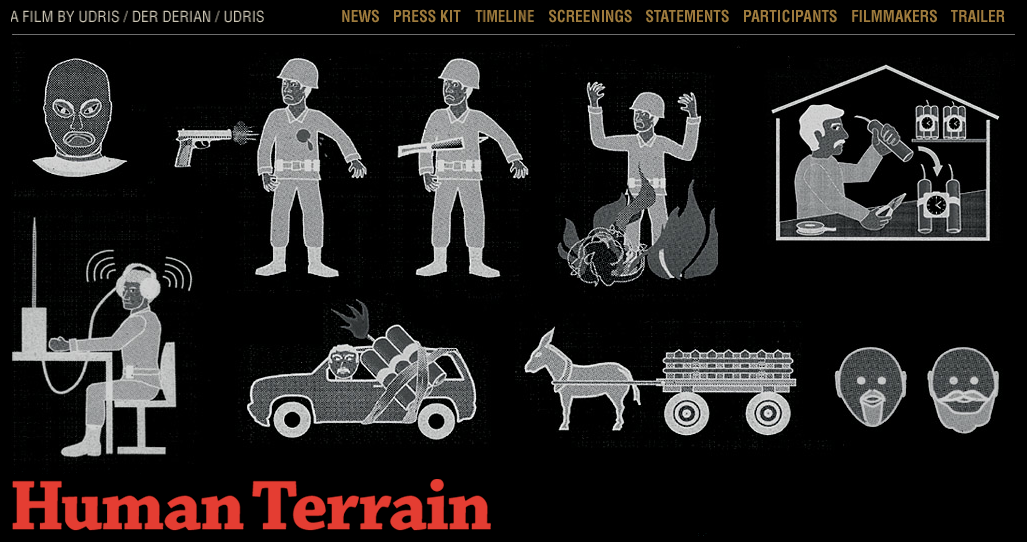
In 2010 James Der Derian (with David and Michael Udris) released Human Terrain, a film that explored the US Army’s Human Terrain Teams and its projected ‘cultural turn’ in counterinsurgency.

Human Terrain

‘Human Terrain’ is two stories in one. The first exposes a new Pentagon effort to enlist the best and the brightest in a struggle for hearts and minds. Facing long wars in Iraq and Afghanistan, the U.S. military initiates ‘Human Terrain Systems’, a controversial program that seeks to make cultural awareness the centerpiece of the new counterinsurgency strategy. Designed to embed social scientists with combat troops, the program swiftly comes under attack as a misguided and unethical effort to gather intelligence and target enemies.   Gaining rare access to wargames in the Mojave Desert and training exercises at Quantico and Fort Leavenworth, ‘Human Terrain’ takes the viewer into the heart of the war machine and a shadowy collaboration between American academics and the military.

The other story is about a brilliant young scholar who leaves the university to join a Human Terrain team. After working as a humanitarian activist in the Western Sahara, Balkans, East Timor and elsewhere, and winning a Marshall Scholarship to study at Oxford, Michael Bhatia returns to Brown University to take up a visiting fellowship.  In the course of conducting research on military cultural awareness, he is recruited by the Human Terrain program and eventually embeds with the 82nd Airborne in eastern Afghanistan.  On the way to mediate an intertribal dispute, Bhatia is killed when his humvee hits a roadside bomb.

War becomes academic, academics go to war, and the personal tragically merges with the political, raising new questions about the ethics, effectiveness, and high costs of counterinsurgency.

Der Derian has now released a new film project, completed with Philip Gara, Project Z: the final global event.  The trailer (below) was released last month – at 11:11:11 on 11/11/11 – and according to a press notice, its release was ‘in acknowledgement of a cascading series of related dates – from the 11/ fall of the Berlin Wall, to the 9/11 attacks in the US, to the Arab Spring’s 2/11/11 removal of Egyptian President Hosni Mubarak from power.’

“If we don’t learn from these events, we’re headed for the final global event,” says head of the Global Media Project (GMP), James Der Derian, who is producing the film. Directed by Phil Gara ’08, a first-time filmmaker coming out of the GMP, the documentary features some of the world’s leading policy thinkers, military strategists, and critical theorists in an entirely new context, which they have embraced in the spirit of producing innovative global interest media that can reach new audiences.

And yes, “Z” stands for “Zombie.” As in, “we need to stop going around like the undead, wake up, and start making the tough decisions about how we want to live in a global community,” Der Derian says.

Trailer is here:

http://vimeo.com/31926822

I’m grateful to Cathy Lutz for the information.

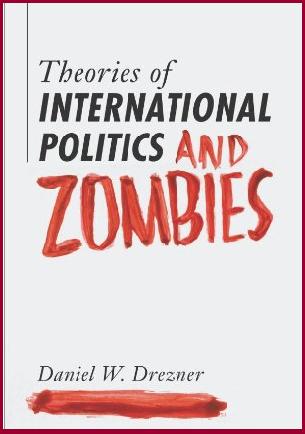
Drezner International politics and zombiesIn posting this, I’m mindful not only of Rob Sullivan‘s critical response to Trevor Paglen‘s The Last Pictures (incidentally, the URL gloriously converts Paglen to “Pagen”….) and all those interested in ‘zombie geographies‘… For a different take that none the less loops back to Der Derian’s concerns in both his films, see Gaston Gordillo‘s perceptive commentary on Marc Forster’s forthcoming film World Revolution Z, based on Max Brooks‘s novel:

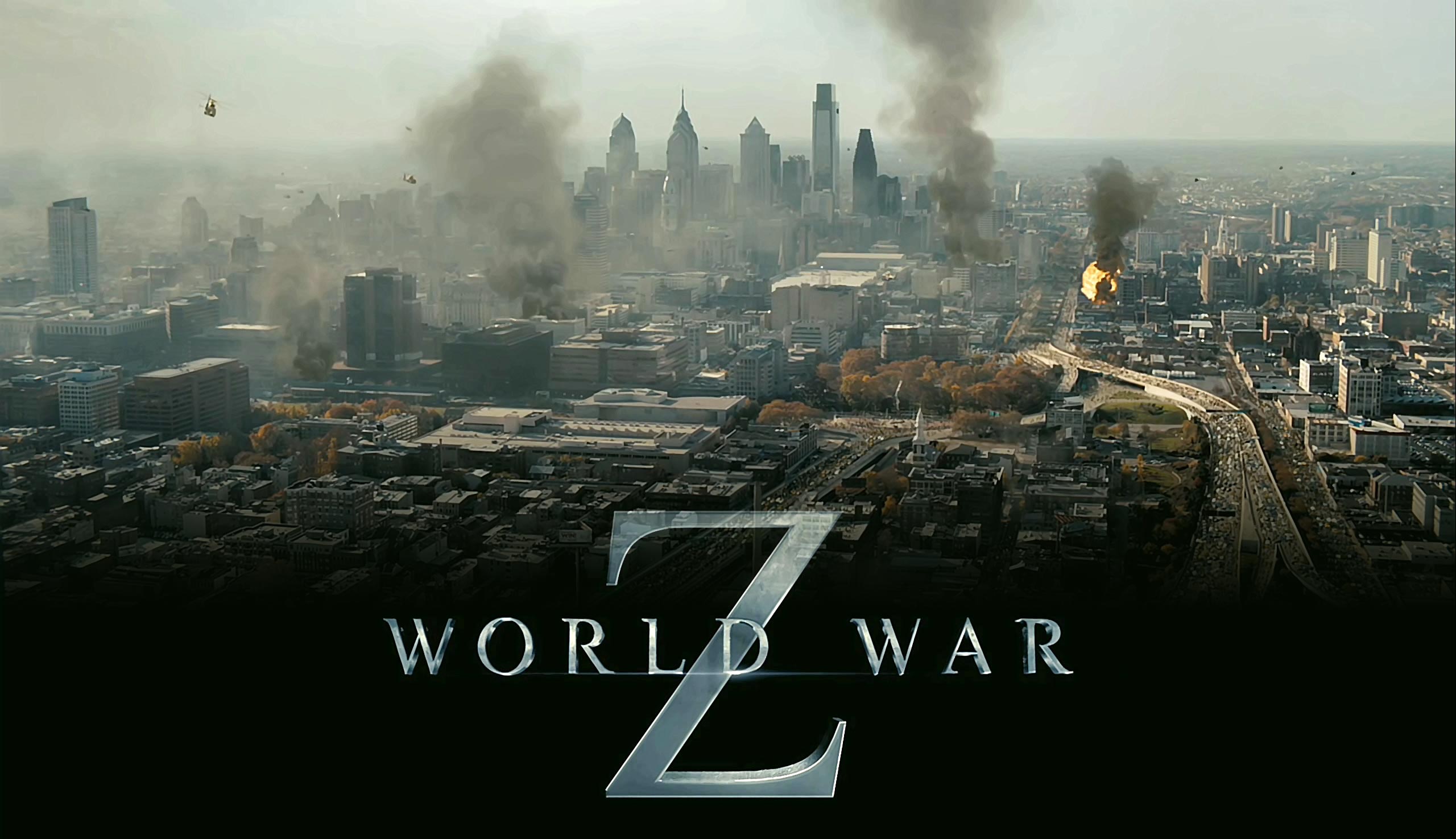
Zombie epidemics and revolutionary situations share a similar spatiality: a territorial disintegration through which multitudes that do not take orders from the state dissolve state-controlled spaces. InWorld War Z and also on the hugely popular TV show The Walking Dead, the zombie multitudes create, through this territorial dissolution, an overwhelming spatial void that is first generated in urban centers and subsequently expands outwardly. As Lefebvre insisted, in an increasingly urbanized world the most radical insurrections are (and will be) urban phenomena. This is why the panoptic surveillance of urban space is a key priority of the imperial security apparatus, as Stephen Graham demonstrates in Cities under Siege. In The Walking Dead, the urban nature of the zombie insurrection is particularly apparent in the opening episodes, when the zombie takeover of the city of Atlanta forces survivors to flee to rural areas. In one scene, attack helicopters bombard the city with napalm, the epitome of counter-insurgency weapons. In subsequent episodes, the spatial voiding created by the collapse of the state acquires a particularly haunting presence. For months on end, the small band of survivors lives on the run, in hiding, always on the edge and with their weapons at the ready, suffocated by the spatial emptiness that surrounds them —a voiding not unlike the one experienced by imperial troops in terrains controlled by local insurgencies, be that of the jungles of South America in the 1600s or the mountains of Afghanistan today.

World War Z

‘The cartography of one man’s consciousness’

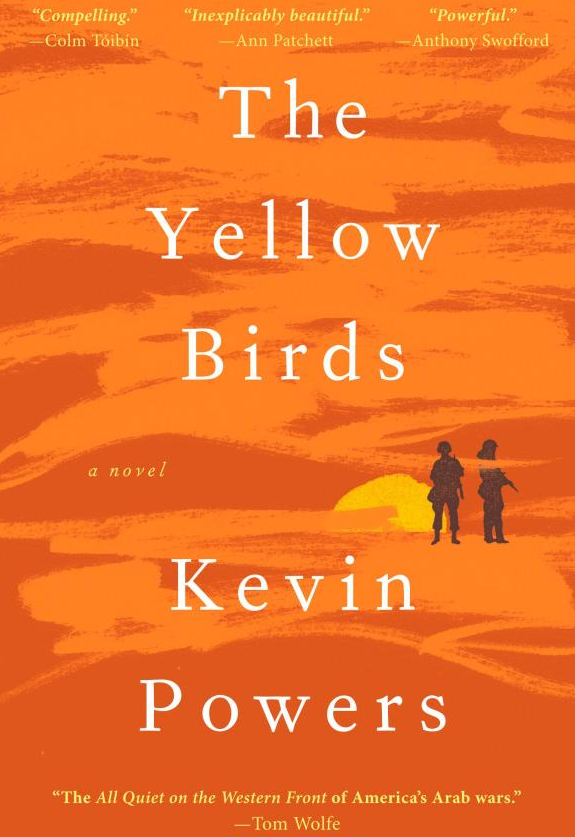
POWERS The Yellow BirdsKevin Powers has won the Guardian‘s First Book Award for The Yellow Birds, widely praised as one of the finest American novels to have come out of the Iraq War.   Powers enlisted when he was just 17 and served as a machine-gunner in Iraq in 2004-5; the title of this post comes from the novel, but the title of the novel comes from a US Army marching song:

 “A yellow birdWith a yellow bill/

Was perched upon/ my windowsill.

“I lured him in/With a piece of bread/

And then I smashed/His fucking head.”

Writing in Time, Nate Rawlings begins his interview with Powers with an observation that speaks to my own work on war at a distance:

War has always been a strange and distant endeavor, brought home from the battlefields in letters, photographs and stories after the guns fell silent. Then beginning with the war in Vietnam, images of battlefield violence were beamed into our homes; you’d be hard pressed to find an American with a television who hasn’t seen images of troops battling in Iraq and Afghanistan. But after 11 years of war, the challenge is to make people truly understand that experience.

That was Powers’ starting-point too: he wanted to find an answer to the question he was constantly being asked: ‘What was it like over there?’  Yet he soon determined that, even in fictional form, he couldn’t do it: ‘War is only like itself’, he writes.  That terse phrase circles back to an inquiry into war and representation – representations in war and representations of war – that is focal to any understanding of contemporary conflict: an inquiry that will, inevitably, need to confront the labile limits of representation itself.  (And that is not a surreptitious bugle call for non-representational theory to gallop over the horizon to the rescue).

Minimally, The Yellow Birds is about memory and violence, about the landscape of death and the lingering foulness of war.  The protagonist of the novel is Private John Bartle, who promises the mother of Private John Murphy that he will bring him back alive…  There are thoughtful reviews from the Guardian’s John Burnside here, from Elizabeth Samet here – she’s a professor of English at the US Military Academy – and from Benjamin Percy here, and a (better) interview with Powers here.

At Slate, Jacob Silverman locates The Yellow Birds alongside three other novels from the wars in Iraq and Afghanistan.  He doesn’t like its lyricism – Powers is a poet, and it shows – but he makes a more telling point about all four novels:

‘These new American wars have bred manifold types of isolation. Here, actual indigenous peoples are rare, whether enemy or civilian; the one named Iraqi that appears in The Yellow Birds is killed almost as soon as he’s introduced. There is little attempt to explore the perspectives of the very people these wars are being waged upon.’

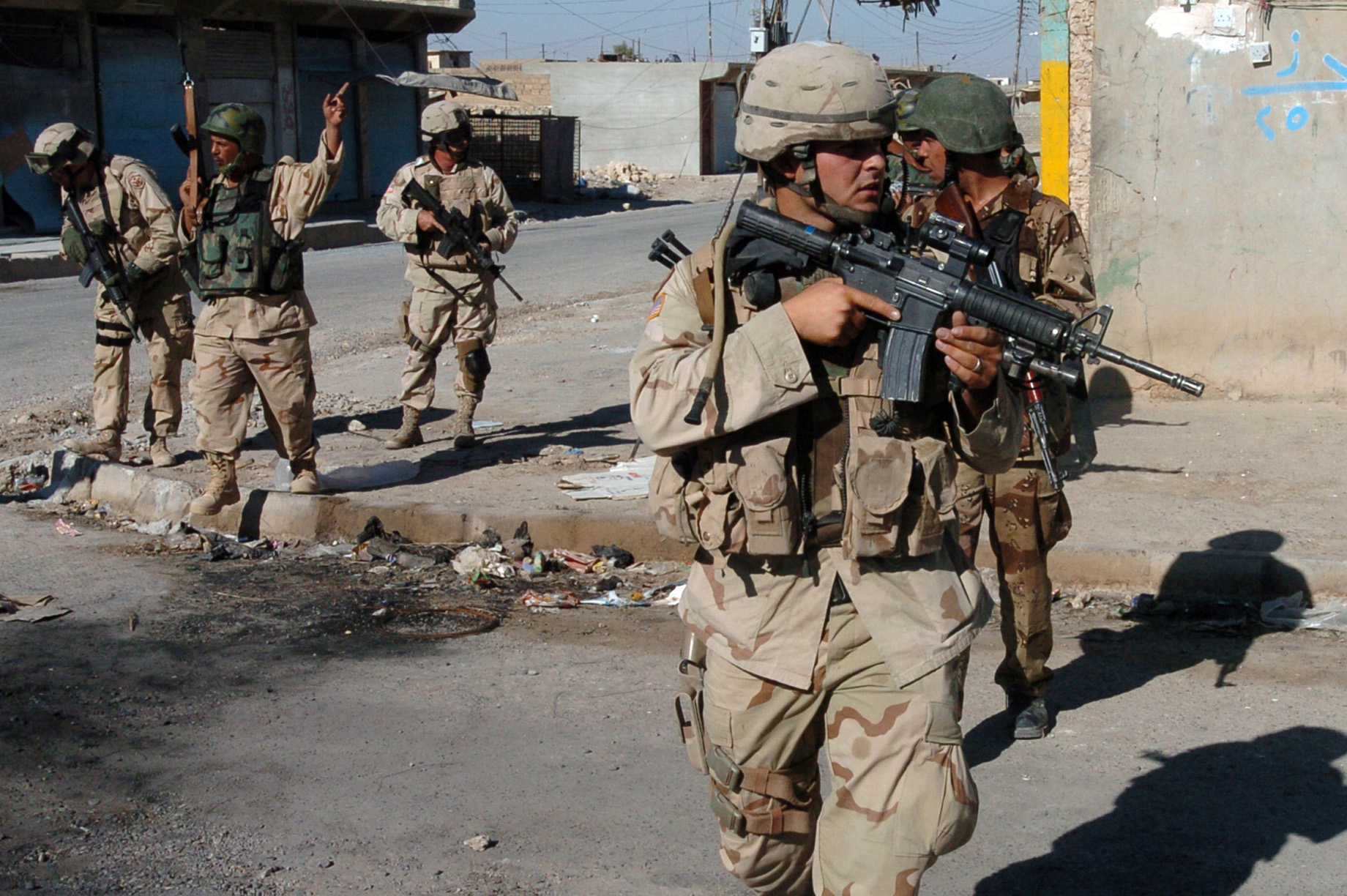
US patrol in Tal Afar, September 2005

That’s true of so many novels from other wars too, but the point is all the sharper because Powers’ novel takes place, in part, in Tal Afar: one of the key sites from which the US Army traced the ‘cultural turn’ that was to be enshrined in its new counterinsurgency strategy.  Powers left there in the spring of 2005, by which time Tal Afar was being described as ‘the next Fallujah’.  But – according to George Packer at any rate – the tide was about to turn.   In one of his Letters from Iraq, ‘The Lesson of Tal Afar‘, Packer recorded the words of one US officer who, twelve months on, had been working the fragile contact zone between the US Army and different groups in the local population:

“History teaches you that war, at its heart, is a human endeavor. And if you ignore the human side — yours, the enemy’s, and the civilians’ — you set yourself up for failure. It’s not about weapons. It’s about people.”

War is about apprehending those ‘people’ in distinctive and differentiated ways, to be sure, but it’s also about apprehending the landscape in embodied ways that transcend the maps and jottings of today’s Human Terrain Teams.  Here The Yellow Birds excels, and for a reflection on the sensuous, visceral landscape of an earlier Iraq war, one described in Anthony Swofford‘s Jarhead, you can’t do better than read Geoffrey Wright‘s fine essay, a sort of corpo-cartography of the combat zone, in  ‘The desert of experience: Jarhead and the geography of the Persian Gulf War’, PMLA 124 (2009) 1677-1689.  He addresses the later Iraq War in ‘The geography of the combat narrative: unearthing identity, narrative and agency in the Iraq War’, Genre XLIII (2010) 163-90.

And I do recommend reading The Yellow Birds too…

Targeted killings and signature strikes

And so what Tom Junod calls the lethal presidency continues…  though it surely would have done whoever occupied the White House for the next four years.

Much of the discussion of US targeted killing has centred on both its status under international law and on the quasi-judicial armature through which various government agencies, including the Pentagon and the Central Intelligence Agency, draw up and adjudicate their kill lists of named individuals who are liable to a ‘personality strike’. But the majority of US targeted killings turn out to be ‘signature strikes’.

Signature strikes were initiated under President George W. Bush, who authorised more permissive rules of engagement in January/February 2008.  According to Eric Schmitt and David Sanger, writing in the New York Times,

[A] series of meetings among President Bush’s national security advisers resulted in a significant relaxation of the rules under which American forces could aim attacks at suspected Qaeda and Taliban fighters in the tribal areas near Pakistan’s border with Afghanistan.

The change, described by senior American and Pakistani officials who would not speak for attribution because of the classified nature of the program, allows American military commanders greater leeway to choose from what one official who took part in the debate called “a Chinese menu” of strike options.

Instead of having to confirm the identity of a suspected militant leader before attacking, this shift allowed American operators to strike convoys of vehicles that bear the characteristics of Qaeda or Taliban leaders on the run, for instance, so long as the risk of civilian casualties is judged to be low.

Under Obama signature strikes increased in frequency, and Micah Zenko notes that the President’s initial reluctance soon yielded to endorsement:

According to Daniel Klaidman, when Obama was first made aware of signature strikes, the CIA’s deputy director clarified: “Mr. President, we can see that there are a lot of military-age males down there, men associated with terrorist activity, but we don’t necessarily know who they are.” Obama reacted sharply, “That’s not good enough for me.” According to one adviser describing the president’s unease: “‘He would squirm … he didn’t like the idea of kill ‘em and sort it out later.’” Like other controversial counterterrorism policies inherited by Obama, it did end up “good enough,” since he allowed the practice to stand in Pakistan, and in April authorized the CIA and JSOC to conduct signature strikes in Yemen as well.

Today signature strikes are frequently triggered not on the fly – a sudden response to an imminent threat – but by a sustained ‘pattern of life’ that arouses the suspicion of distant observers and operators. This depends on persistent surveillance – on full motion video feeds and a suite of algorithms that decompose individual traces and networks – some of which involve a weaponized version of Hägerstrand’s time-geography: see, for example, GeoTime 5 here.

We know even less about the legal authority for these attacks, but Kevin Jon Heller has a new essay on their legality up at the wonderful open access resource that is SSRN [Social Science Research Network]  here, and there are preliminary responses at Opinio Juris here.  This is the abstract:

The vast majority of drone attacks conducted by the U.S. have been signature strikes – strikes that target “groups of men who bear certain signatures, or defining characteristics associated with terrorist activity, but whose identities aren’t known.” In 2010, for example, Reuters reported that of the 500 “militants” killed by drones between 2008 and 2010, only 8% were the kind “top-tier militant targets” or “mid-to-high-level organizers” whose identities could have been known prior to being killed. Similarly, in 2011, a U.S. official revealed that the U.S. had killed “twice as many ‘wanted terrorists’ in signature strikes than in personality strikes.” 

Despite the U.S.’s intense reliance on signature strikes, scholars have paid almost no attention to their legality under international law. This article attempts to fill that lacuna. Section I explains why a signature strike must be justified under either international humanitarian law (IHL) or international human rights law (IHRL) even if the strike was a legitimate act of self-defence under Article 51 of the UN Charter. Section II explores the legality of signature strikes under IHL. It concludes that although some signature strikes clearly comply with the principle of distinction, others either violate that principle as a matter of law or require evidence concerning the target that the U.S. is unlikely to have prior to the attack. Section III then provides a similar analysis for IHRL, concluding that most of the signature strikes permitted by IHL – though certainly not all – would violate IHRL’s insistence that individuals cannot be arbitrarily deprived of their right to life.

The most interesting section (for me) is Kevin’s discussion of ‘evidentiary adequacy’.  Most of the examples he discusses appear to be derived from CIA-directed strikes in Pakistan – drawing on the Stanford/NYU report on Living under drones – and, for that very reason, are remarkably limited. But we know much more about problems of evidence – and inference – from strikes conducted by the US military in Afghanistan…

The first point to make, then, is that targeted killings are also carried out by the US military – indeed, the US Air Force has advertised its ability to put ‘warheads on foreheads‘ – and a strategic research report written by Colonel James Garrett for the US Army provides a rare insight into the process followed by the military in operationalising its Joint Prioritized Effects List (JPEL). Wikileaks has provided further information about JSOC’s Task Force 373 – see, for example, here and here – but the focus of Garrett’s 2008 report is the application of the legal principles of necessity and proportionality (two vital principles in the calculus of International Humanitarian Law (IHL) discussed by Kevin) in counterinsurgency operations.  Garrett describes ‘time-sensitive targeting procedures’ used by the Joint Targeting Working Group to order air strikes on ‘high-value’ Taliban and al-Qaeda leaders in Afghanistan, summarised in this diagram:

Notice that the members included representatives from both Combined Joint Special Operations Task Force (CJSOTF) and the CIA (‘Other Government Agency’, OGA).  This matters because Joint Special Operations Command (JSOC) – once commanded by General Stanley McChrystal – and the CIA, even though they have their own ‘kill lists’, often co-operate in targeted killings and are both involved in strikes outside Afghanistan.  Indeed, there have been persistent reports that many of the drone strikes in Pakistan attributed to the CIA – even if directed by the agency – have been carried out by JSOC.  Here is Jeremy Scahill citing a ‘military intelligence source’:

“Some of these strikes are attributed to OGA [Other Government Agency, intelligence parlance for the CIA], but in reality it’s JSOC and their parallel program of UAVs [unmanned aerial vehicles] because they also have access to UAVs. So when you see some of these hits, especially the ones with high civilian casualties, those are almost always JSOC strikes.”

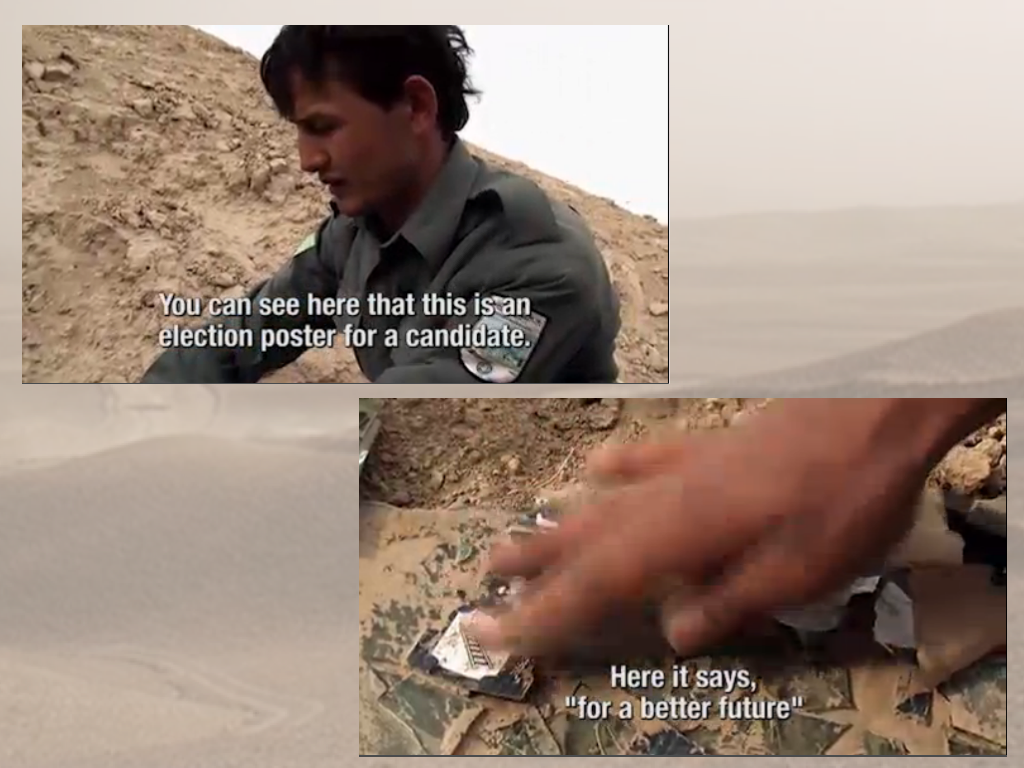
Garrett’s discussion clearly refers to ‘personality strikes’, but – second – the distinction between the evidential/inferential apparatus used for a ‘personality strike’ and for a ‘signature strike’ is by no means clear-cut.  Kate Clark‘s report for the Afghan Analysts Network describes the attempted killing of Muhammad Amin, the Taliban deputy shadow governor of Takhar province.  On 2 September 2010 ISAF announced that a ‘precision air strike’ earlier that morning had killed him and ‘nine other militants’.  The target had been under persistent surveillance from remote platforms – what Petraeus later called ‘days and days of the unblinking eye’ – until two strike aircraft repeatedly bombed the convoy in which he was travelling.  Two attack helicopters were then ‘authorized to re-engage’ the survivors. The victim was not the designated target, however, but Zabet Amanullah, the election agent for a parliamentary candidate; nine other campaign workers died with him. Clark’s painstaking analysis clearly shows that one man had been mistaken for the other, which she attributed to an over-reliance on ‘technical data’ – on remote signatures.  Special Forces had concentrated on tracking cell phone usage and constructing social networks. ‘We were not tracking the names,’ she was told, ‘we were targeting the telephones.’

This is unlikely to be an isolated incident.  Here for example is Gareth Porter:

‘…the link analysis methodology employed by intelligence analysis is incapable of qualitative distinctions among relationships depicted on their maps of links among “nodes.” It operates exclusively on quantitative data – in this case, the number of phone calls to or visits made to an existing JPEL target or to other numbers in touch with that target. The inevitable result is that more numbers of phones held by civilian noncombatants show up on the charts of insurgent networks. If the phone records show multiple links to numbers already on the “kill/capture” list, the individual is likely to be added to the list.’

In the Takhar case, despite informed protests to the contrary, ISAF insisted that they had killed their intended target (added emphases are mine):

PBS/Frontline screened a Stephen Grey/Dan Edge documentary on the Takhar incident last year, Kill/Capture, from which the images below are taken (reworked for my presentation on Lines of descent) and which, like Kate Clark’s remarkable report on which it drew, gave the lie to the ISAF statement; the film included an Afghan Police video of the aftermath of the attack: more here, video here, and transcript here.

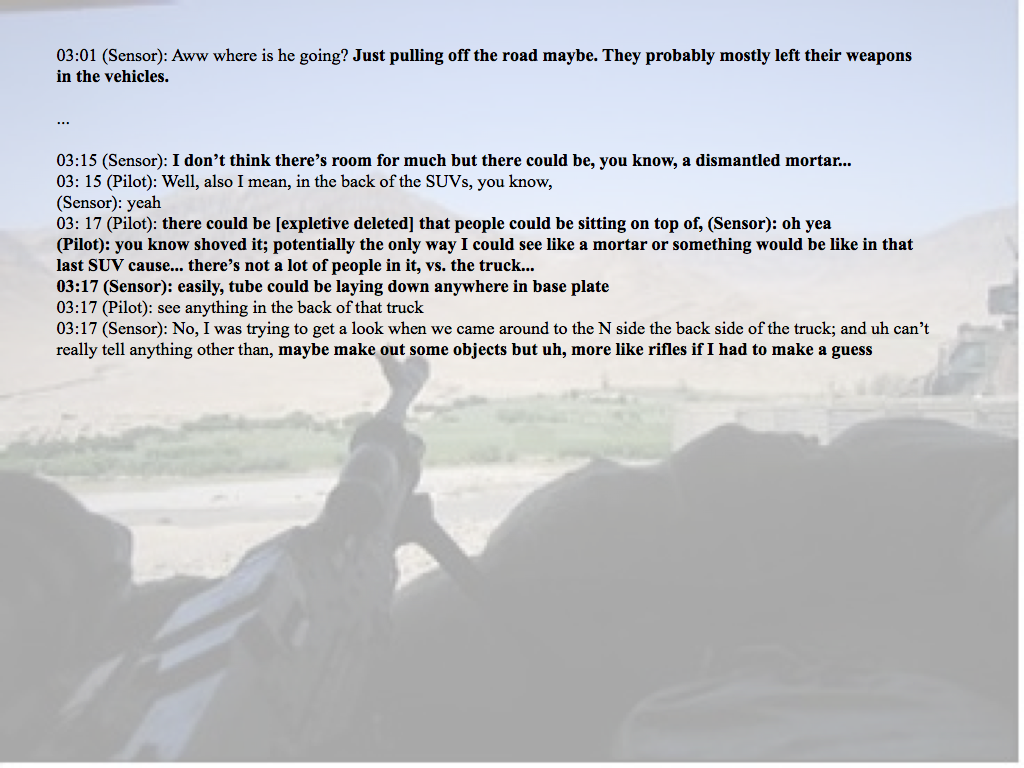
Finally, there is a persistent propensity to read hostile intent into innocent actions. In ‘From a view to a kill’ (DOWNLOADS tab) I describe in detail an attack launched on 21 October 2010 near Shahidi Hassas in Uruzgan province in central Afghanistan.  In the early morning a Predator was tasked to track three vehicles travelling down a mountain road, several miles away from a Special Forces unit moving in to search a village for an IED factory.

The Predator crew in Nevada had radio contact with the Special Forces Joint Terminal Attack Controller and they were online with image analysts at the Air Force’s Special Operations Command headquarters in Florida. At every turn the flight crew converted their observations into threat indicators: thus the two SUVs and a pick-up truck became a ‘convoy’, cylindrical objects ‘rifles’, adolescents ‘military-aged males’ and praying a Taliban signifier (‘seriously, that’s what they do’).

After three hours’ surveillance two Kiowa helicopters were called in, and during the attack at least 23 people were killed and more than a dozen wounded.  Only after the smoke had cleared did the horrified Predator crew re-cognize the victims as civilians, including women and children.

I’m including a much fuller account in The everywhere war, based on a close reading of the redacted investigative report by Major General Timothy McHale released under a FOI request (the images above are all taken from my Keynote presentation based on the report), and you can also find David McCloud‘s spine-chilling analysis for the LA Times here.  But even in this abbreviated form it’s clear that the cascade of (mis)interpretations offered by the flight crew mimics Kevin’s list of ‘signatures’, where some would be categorised as ‘possibly adequate’ and others as ‘inadequate’.

All of these materials relate to air strikes inside a war zone, so that their modalities are different – in Afghanistan remote platforms like the Predator and the Reaper are one element in a networked ‘killing machine’, and they work in close concert with ground forces and conventional strike aircraft – and the legal parameters are not as contentious as those that govern ‘extra-territorial’ strikes in Pakistan, Somalia or Yemen (which are Kevin’s primary concern).  But they all raise questions about the evidential and inferential practices that are incorporated into the kill-chain that are clearly capable of wider application and concern.

Those questions raise other issues too.  It seems clear, from the examples I’ve given, that to isolate a single platform (the drone) is to contract the scrutiny of military and paramilitary violence that, under the conditions of late modern war, is typically networked.  And to determine the legal status of targeted killing must not foreclose on wider political and ethical decisions: to accept late modern war’s avowed reflexivity is too often to equate legality with legitimacy.

COIN tossing

Anyone who has read Washington Post journalist Rajiv Chandrasekaran‘s Imperial Life in the Emerald City: Inside Iraq’s Green Zone (Vintage, 2006) or his Little America: the war within the war in Afghanistan (Knopf, 2012) – and even those who haven’t – will enjoy David Johnson‘s interview with him at the Boston Review.
In it Chandrasekaran draws some illuminating parallels (in two words: ‘strategic failure’) and provocative contrasts between the two campaigns:

I surely saw far more imperialistic overtones in Iraq than in Afghanistan. The bulk of my narrative in Little America focuses on how the Obama administration attempted to deal with the situation there. Though they pursued, in my view, a flawed strategy, they did approach it with some degree of humility. I certainly wouldn’t ascribe imperialist aims to the United States in Afghanistan from 2009 onward or even before that. I don’t ever think that we really went about it in that way. Whereas, one can look at what occurred in Iraq, particularly in the early years, and come to a very different conclusion.

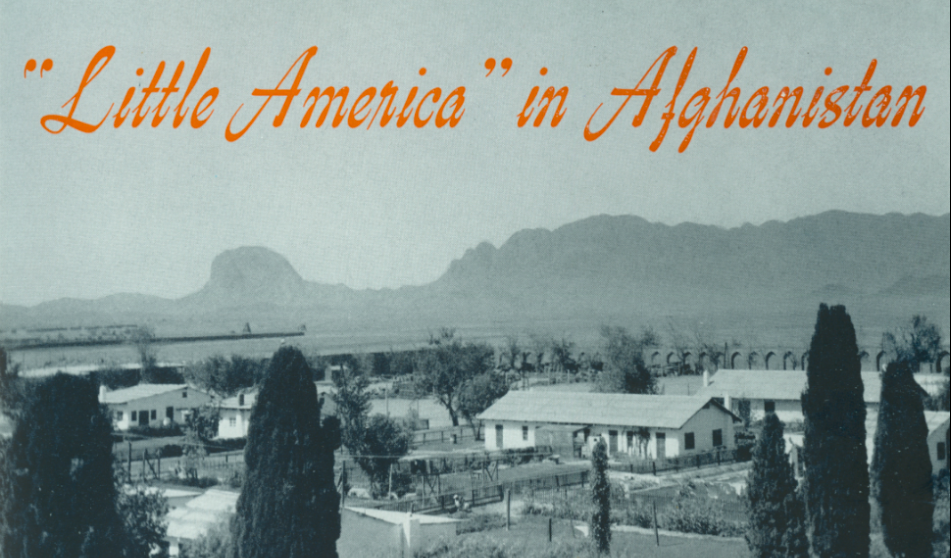
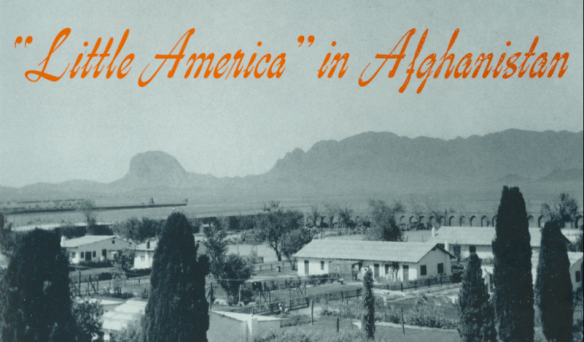
Chandrasekaran has some important things to say about the so-called ‘development-security’ nexus, not least through a comparison with USAID projects in Helmand in the 1950s. You know he’s on to something when Max Boot dismisses it: that was when local people started calling the area ‘Little America’, but Boot says that’s ‘far removed’ from the present situation.  I think Chandresekaran is right; certainly when I was writing the Afghanistan chapters of The colonial present I learned much from Nick Cullather, ‘Damming Afghanistan: modernization in a buffer state’, Journal of American History 89 (2002) 512-37 – a preliminary study researched and written, as he notes, ‘between the beginning of the bombing campaign in late September and the mopping up [sic] of Taliban resistance around Tora Bora in early December 2001.’  Chandresekaran relied on an early version of the essay, and you can now access a later version as Chapter 4 [‘We shall release the waters’] of Cullather’s The hungry world: America’s Cold War battle against poverty in Asia (Harvard, 2010).  Little America loops back to where it began, with one farmer – whose father had been drawn to Helmand by the promise of the new dam – telling Chandresekaran: ‘We are waiting for you Americans to finish what you started.’

This is also the epitaph for what Chandrasekaran sees as ‘the good war turned bad’: too few people were invested in seeing it through.  In the book he paints vivid portraits of those on the ground who were committed to staying the course, but concludes that they were the exception:

‘It wasn’t Obama’s war, and it wasn’t America’s war.  

‘For years we dwelled on the limitations of the Afghans.  We should have focused on ours.’

Not surprisingly, Boot doesn’t care for Chandrasekaran’s take on counterinsurgency either, though his own view is spectacularly devoid of the historical and geographical sensitivity that distinguishes Little America. Boot describes COIN as ‘just the accumulated wisdom of generations of soldiers of many nationalities who have fought guerrillas’ (really) and insists that it (singular) ‘has worked in countries as diverse as the Philippines (during both the war with the U.S. in 1899-1902 and the Huk Rebellion in 1946-54), Malaya, El Salvador, Northern Ireland, Colombia and Iraq.’ Perhaps it all depends on what you mean by ‘worked’…

In fact, Chandrasekaran focuses relentlessly on the work of counterinsurgency.  Little America begins with the sequestered imagery of ‘America abroad’ that will be familiar to readers of Imperial Life in the Emerald City –
– but soon moves far beyond such enclaves to document operations on the ground. In the interview he provides a pointed evaluation of US counterinsurgency (or lack of it) in Afghanistan:

I think the big lesson of Afghanistan is that we can’t afford to do this. COIN may be a great theory, but it probably will be irrelevant for the United States for the foreseeable future because it’s just too damned expensive and time consuming. You have to understand the value of the object you are trying to save with counterinsurgency—essentially your classic cost-benefit analysis. Even starting in 2009, if we’d mounted a real full-on COIN effort, we probably could have gotten to a better point today. We shouldn’t kid ourselves that what we did was full-on COIN—that would have involved more troops, more money, more civilian experts. But would all of that have been worth it? Was what we’ve already spent on this effort worth it? Particularly given the other national security challenges we face? The economic stagnation at home?  So, the debate over COIN I think misses a key point: it’s not whether it works or not. It’s whether it’s a worthwhile expenditure or not.

(Little America reports that the cost of keeping one US service member in Afghanistan for a year is $1 million… though there are, of course, many other non-monetary costs that fall on many other people).

Chandrasekaran offers a more detailed and nuanced discussion of counterinsurgency in Afghanistan in a fine interview with Peter Munson at the Small Wars Journal.

I described Chandrasekaran as a journalist but he’s (even) more: his website records his residencies as a public policy scholar at the Woodrow Wilson International Center and the Center for a New American Security – which is where he converted his ‘sand-encrusted notebooks’ into the manuscript of Little America – and the International Reporting Project at the Johns Hopkins School for Advanced International Studies.
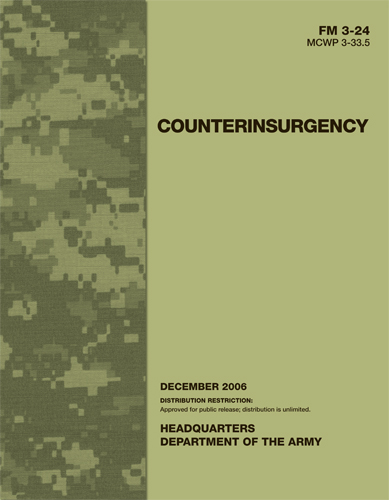
I’m making so much of Chandresekaran’s emphasis on the conduct of counterinsurgency and the connections between reporting and reflection because the academic critique of contemporary counterinsurgency has drawn a bead on the doctrine so vigorously advertised by the US Army and Marine Corps in 2006.  When I wrote “Rush to the intimate” (DOWNLOADS tab) the new field manual FM 3-24 had just been released, and I was interested in how this – together with changes in pre-deployment training, technology and the rest – described a ‘cultural turn’ of sorts that seemed to be addressed as much to the American public as it was to the American military.  (In later work I’ve explored the bio-political dimensions of counterinsurgency too, and I’m presently revising those discussions for the book).

Since then there has been a stream of detailed examinations of the doctrine and its genealogy, and I’d particularly recommend:

Ben Anderson, ‘Population and affective perception: biopolitics and antiicpatory action in US counterinsurgency doctrine’, Antipode 43 (2) (2011) 205-36

Josef Teboho Ansorge, ‘Spirits of war: a field manual’, International political sociology 4 (2010) 362-79

Alan Cromartie, ‘Field Manual 3-24 and the heritage of counterinsurgency theory’, Millennium 41 (2012) 91-111

Marcus Kienscherf, ‘A programme of global pacification: US counterinsurgency doctrine and the biopolitics of human (in)security’, Security dialogue 42 (6) (2012) 517-35

Patricia Owens, ‘From Bismarck to Petraeus:the question of the social and the social question in counterinsurgency’, European journal of international relations [online early: March 2012]

There is indeed something odd about a mode of military operations that advertises itself as ‘the graduate level of war’ (one of Petraeus’s favourite conceits about counterinsurgency) and yet describes a ‘cultural turn’ that is decades behind the cultural turns within the contemporary humanities and the social sciences.  There’s also been a vigorous debate about the enlistment of the social sciences, particularly anthropology, in the doctrinal ‘weaponizing’ of culture – though I sometimes worry that this contracts to a critique of weaponizing anthropology.  (I don’t mean the latter is unimportant – as David Price‘s important work demonstrates – and there are obvious connections between the two.  But disciplinary purity is the least of our problems).

That said, the discussion of counterinsurgency surely can’t be limited to a single text, its predecessors and its intellectual credentials. If there has been a ‘cultural turn’, then its codification now extends far beyond FM 3-24 (which is in any case being revised); if the domestic audience was an important consideration in 2006, the public has certainly lost interest since then (and, if the US election is any guide, in anything other than an air strike on Iran); and whatever the attractions of large-scale counterinsurgency operations in the recent past, Obama’s clear preference is for a mix of drone strikes, short-term and small-scale Special Forces operations, and cyberwar.

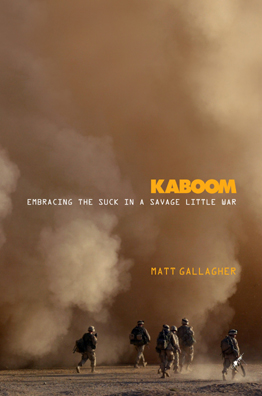
But – Chandresekaran’s sharp point (and Clausewitz’s too) – there’s also a difference between ‘paper war’ and ‘real war’.  Here are just two passages from former Lieutenant Matt Gallagher‘s Kaboom: embracing the suck in a savage little war (Da Capo, 2010) that dramatise the difference between the Field Manual and the field:
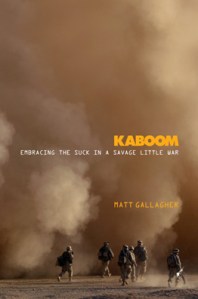
‘There was a brief pause and then [Staff Sergeant Boondock] continued. “Think I’ll be able to bust Cultural Awareness out on one of the hajjis now?” he said, referring to the stun gun he carried on his ammo pack… we were all waiting for the day that some Iraqi did something to warrant its electric kiss’ (p. xi). 

‘In this malleable, flexible world, creativity and ingenuity replaced firepower and overwhelming force as the central pillars of the army’s output. Ideally, a decentralized army struck like a swarm of killer bees rather than a lumbering elephant… In conventional warfare, the order of war dissolved into anarchy as time yielded more and more blood. Unconventional, decentralized warfare was the exact opposite. In fluid theory and historical practice, victorious counterinsurgencies served as a shining inverse to … conventionality, because through anarchy and bloodshed, order could eventually be established. This was the war I had trained for, brooded over, and studied. Then there was the war I fought’ (p. 175) 

There’s also a particularly telling passage in David Finkel‘s The good soldiers (Farrar, Straus & Giroux, 2009) that speaks directly to COIN spinning, to its address to the American public and, more particularly, to the body politic:

‘Soldiers such as Kauzlarich might be able to talk about the war as it was playing out in Iraq, but after crossing the Atlantic Ocean from one version of the war to the other, Petraeus had gone to Washington to talk about the war as it was playing out in Washington‘ (p. 130),

I’ve been gathering lots more examples from accounts like these – some of which, like Gallagher’s, started out as military blogs – but one of Chandresekaran’s many achievements is to show what can (must) be achieved when we to turn to an examination of practice.

There have been other studies of counterinsurgency operations – some from within the military, some from within the academy, and some at the nexus between the two – but the need to explore the connections between theory and practice (which are always two-way: the military constantly seeks to incorporate what it calls ‘lessons learned’ into its training) has never been greater.

This isn’t limited to counterinsurgency either: it’s one thing to demand to know what the ‘rules’ governing drone strikes are, for example, but quite another to monitor their implementation.

For academics, none of this is straightforward.  We aren’t war correspondents – and my own debt to courageous journalists like Chandresekaran is immense – and I suspect most of us would be unwilling to enlist in Human Terrain Teams.  There’s a long history to geography‘s military service; today some geographers undertake (critical) field work in war zones – Jennifer Fluri, Philippe le Billon, Michael Watts and others – and no doubt many more geographers live in them.
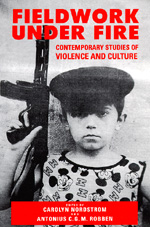
There’s also a particularly rich anthropology written from war zones. I’m thinking in particular of the work of Sverker Finnström (Living with bad surroundings, Duke, 2008), Danny Hoffman (The war machines, Duke, 2011), and Carolyn Nordstrom (especially A different kind of war story, SBS, 2002  and Shadows of war, University of California Press, 2004).

All of these studies approach ‘fieldwork under fire’ from a radically different position to David Kilcullen‘s ‘conflict ethnography’ (which is placed directly at the service of counterinsurgency operations) but, as Neil Whitehead showed, they still raise serious ethical questions about witnessing violence and, indeed, the violence of what he called ‘ethnographic interrogation’ that is often aggravated in a war zone.  (For more, see Fieldwork under fire (left) and Sascha Helbardt, Dagmar Hellmann-Rajanayagam and Rüdiger Korff, ‘War’s dark glamour’, Cambridge Review of International Affairs 23 (2) (2010) 349-69).

To be sure, there is important work to be done ‘off stage’ and in the vicinity of war, as Wendy Jones insists in ‘Lives and deaths of the imagination in war’s shadow’, Social anthropology 19 (2011) 332-41, and overtly techno-cultural modes of remote witnessing have their own dilemmas. But the dangers involved in venturing beyond our screens – and outside our emerald cities – are more than corporeal: they are also intellectual and ethical.

Chandresekaran’s principled combination of reporting and reflection shows how necessary it is to face them down.
Military/Policing and the US/Mexico border

The US/Mexico borderlands was one of the sites I discussed in ‘The everywhere war’ (see DOWNLOADS tab), along with the Afghanistan/Pakistan borderlands and cyberspace.  It’s also another zone where the blurring of policing and military operations is highly visible.

For the book I plan to separate these three into three chapters, which I’m hoping will produce a more nuanced, certainly less cartoonish discussion – inevitable, I suppose, in such a short essay (and written – for me – in an unusually short time, though editor Klaus Dodds may not have seen it quite like that…).  So I’ve been gathering materials, and en route found a short, sharp documentary from Real Television News [‘No advertising, no corporate funding’ – and really excellent] that debunks claims of  ‘spillover violence’, at least from Mexico into the US.  It asks ‘Is the Arizona/Mexico border a war zone?’

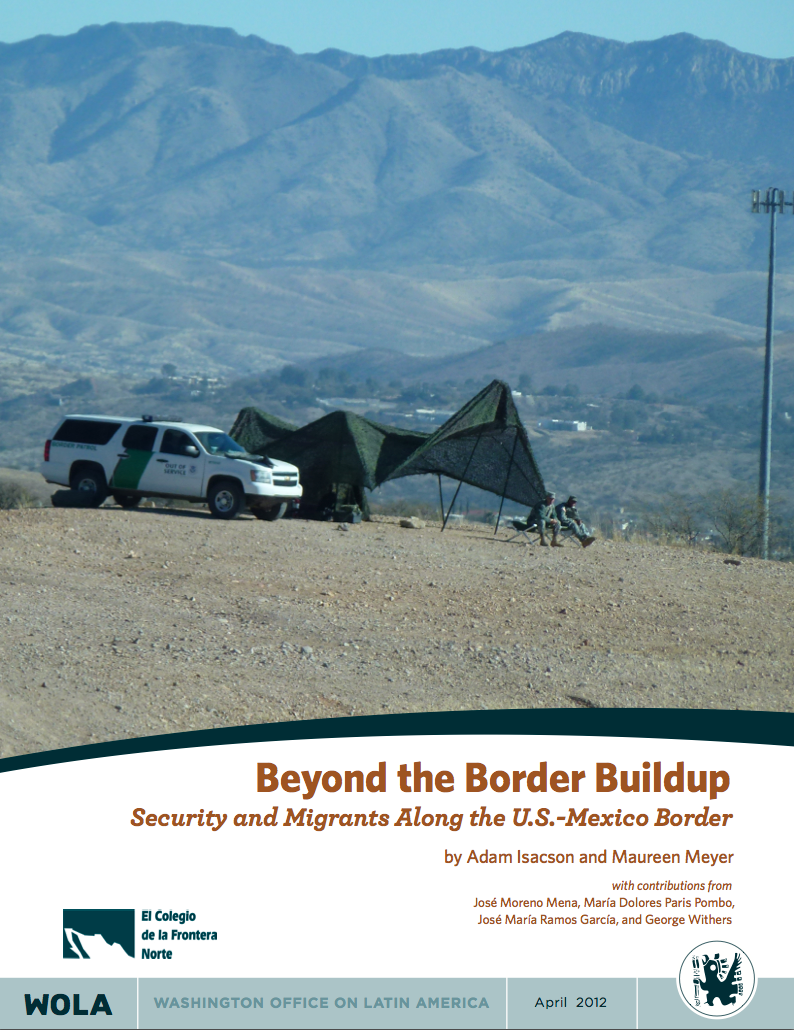
The Washington Office on Latin America, an NGO ‘promoting human rights, democracy and social justice’ founded in response to the military coup in Chile in 1973, has a fact-checking blog on the securitization of the border, and this year published Beyond the Border Buildup: Security and migrants along the US Mexico border.

The study finds a dramatic buildup of U.S. security forces along the southern border – a fivefold increase of the Border Patrol in the last decade, an unusual new role for U.S. soldiers on U.S. soil, drones and other high-tech surveillance, plus hundreds of miles of completed fencing – without a clear impact on security. For instance, the study finds that despite the security buildup, more drugs are crossing than ever before.
 
Furthermore, the study reveals that security policies that were designed to combat terrorism and drug trafficking are causing a humanitarian crisis and putting migrants in increasing danger. Migrants are often subject to abuse and mistreatment while in U.S. custody, and face higher risks of death in the desert than in previous years. Also, certain deportation practices put migrants at risk. For example, migrants can be deported at night and/or to cities hundreds of miles from where they were detained. These same cities are also some of the border region’s most dangerous, where migrants may fall prey to – or be recruited by – criminal groups. In Mexico, approximately 20,000 migrants are kidnapped a year; many others face other abuses.
 
WOLA found that any further increase in the security buildup will yield diminishing returns. Contrary to common opinion, the report documents a sharp drop in migrant crossings. Since 2005, the number of migrants apprehended by the Border Patrol has plummeted by 61 percent, to levels not seen since Richard Nixon was president. Today, twenty migrants are apprehended per border patrol agent per year, down from 300 per agent per year in 1992.
 
Finally, the study finds that violence in Mexico is not spilling over to the U.S. side of the border. U.S. border cities experience fewer violent crimes than the national average, or even the averages of the border states. WOLA recommends that before making further investments in border security, the U.S. government should stop and take stock of what is and isn’t working in order to create a comprehensive strategy that takes addresses the real threats while respecting the human rights of migrants.

Then I turn to the pages of the latest Military Review, where Christopher Martinez elaborates on Mexico’s transnational criminal organisations – the drug cartels – as constituting a commercial insurgency: ‘They seek to influence the four primary elements of national power — the economy, politics, the military, and the information media — to form an environment that enables an illicit trafficking industry to thrive and operate with impunity.’  Martinez is not the first, and he certainly won’t be the last, to describe Mexico’s militarized ‘war on drugs’ in terms of insurgency and counterinsurgency and, as I showed in ‘The everywhere war’, this rhetoric slides easily into the armature of a ‘border war’ in which the United States is fully invested as part of its boundless ‘war on terror’.

But what is most interesting about the MR essay is its author: Major Martinez is described as ‘the senior military intelligence planner for the U.S. Southwest Regional Support team at Joint Task Force North, Fort Bliss, TX’ who ‘serves as an advisor and partner to federal, state, and local law enforcement agencies in Arizona and California.’

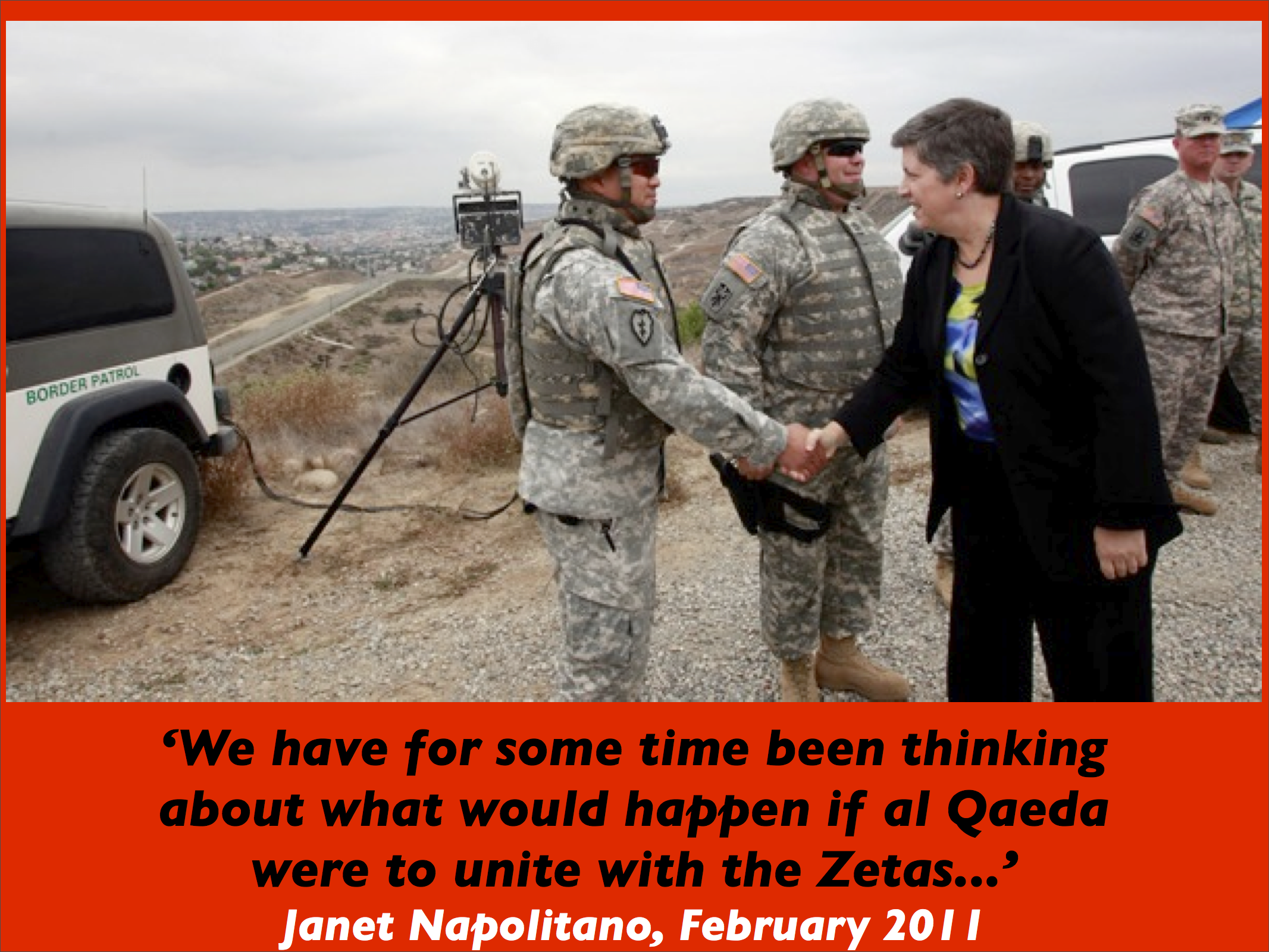
JTF-North, part of US Northern Command, provides military support to federal law enforcement agencies.  Described as a ‘force multiplier’ by one Border Patrol officer, the function of its ground troops – like the unarmed Predators deployed by the Border Patrol – is limited to surveillance and under the Posse Comitatus Act the US military is not allowed to ‘execute the laws’ without express Congressional approval.  As one Army officer explained, therefore, in a recent exercise troops ‘used their state-of-the-art surveillance equipment to identify and report the suspected illegal activities they observed and vectored border patrol agents in to make the arrests and drug seizures.’  But the practices, co-ordinated from a tactical operations center like the one shown on the left, are portable and even interchangeable:

While providing the much needed support to the nation’s law enforcement agencies, the JTF North support operations provide the volunteer units with real-world training opportunities that are directly related to their go-to-war missions.

“This type of experience is impossible to replicate in a five- or 10-day field exercise back home,” said Lt. Col. Kevin Jacobi, squadron commander. “Where else can we operate over an extended period of time, in an extended operating environment, against a thinking foe who is actively trying to counter us by actively trying to hide, in order to make us work hard to find him?” asked Jacobi.

Not surprisingly, there have been elaborate circulations between the Afghanistan/Pakistan borderlands and the US/Mexico border: Predators, personnel and procedures.  All of which provides another disquieting answer to the question posed in the RTN video…

Does this also return us to the world mapped by Mark Neocleous from my previous post?  He concludes:

‘From a critical perspective, the war-police distinction is irrelevant, pandering as it does to a key liberal myth. Holding on to the idea of war as a form of conflict in which enemies face each other in clearly defined militarized ways, and the idea of police as dealing neatly with crime, distracts us from the fact that it is far more the case that the war power has long been a rationale for the imposition of international order and the police power has long been a wide-ranging exercise in pacification.’

The two security-state solution

So Mitt Romney insists that ‘the Palestinians have no interest whatsoever in establishing peace‘…. Given the scale of illegal Israeli settlement in the West Bank (see the meticulous reports from the Foundation for Middle East Peace), the brutality of the Israeli occupation, and the chokehold Israel maintains on Gaza, Palestinians have no interest in peace??

The contours of the Israeli security state’s impress on the Palestinian people ought to be well known – though evidently they aren’t – but hard on the tawdry heels of Romney’s offensive assertion comes a brilliant essay at Jadailiyya from Lisa Bhungalia that details the operation of the American security state in Palestine.

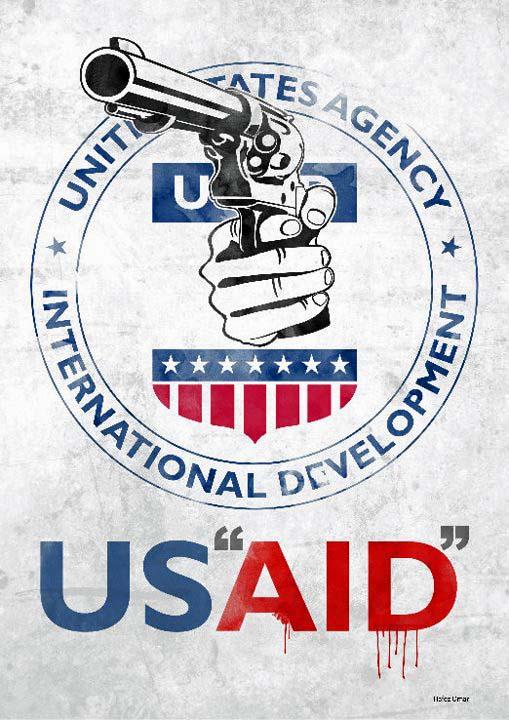
Invoking Laleh Khalili‘s work on occupied Palestine’s position within global counterinsurgency – I’ve drawn attention to this before – Lisa examines ‘the ways in which practices of colonial subjugation and management are being mobilized through the less sensational, seemingly mundane spaces and practices of aid governance’: to be precise, through the United States Agency for International Development (USAID).  She shows how its elaborate certification of NGOs and private agencies works not just to channel financial assistance but also to channel information back to the US and Israeli governments. Like collateral damage estimation in military targeting, this civilian regime works through an extended chain of calculation-calibration-certification. This is Eyal Weizman‘s ‘humanitarian present’ with a vengeance: ‘If a decision to accept USAID funds is undertaken, one must fundamentally operate within a framework that affords little flexibility in terms of negotiating the security priorities set out by Washington and Tel Aviv.’

It is also part of the tightening development-security nexus:

‘What we are seeing, in effect, is a proliferation of sites and diversity of means through which US political and economic power is being articulated. Alongside its military and diplomatic interventions, the US is simultaneously extending its reach through a host of “development experts,” humanitarian agents and “democracy promoters” charged with filtering, sorting and policing the Palestinian civilian population. While taking a new and perhaps more sophisticated form, these contemporary practices and strategies must not be dissociated from a longer history of counterinsurgency in Palestine…. The aid regime that has taken form in recent decades is part and parcel of the refinement and evolution of techniques that Khalili speaks of.’

The poster above is the work of Hafez Omar here and here, and Lisa’s essay derives from her doctoral research whose working title is ‘Negotiating a Colonial Present: Aid and its fragmentary states in Palestine’ .

Learning to eat soup with a silver spoon

John Nagl,  one of the principal architects of the revised US counterinsurgency strategy – and the author of Learning to eat soup with a knife: counterinsurgency lessons from Malaya and Vietnam (the title is a riff on T.E. Lawrence) – retired from the US Army in 2008 and became a Fellow at the Center for a New American Security, and its President in 2009.  In January 2012 he was elected to the Minerva Chair at the US Naval Academy.  There are more than a dozen of these Minerva Chairs: Montgomery “Mitzie” (sic) McFate, another advocate-publicist of the ‘cultural turn’ in counterinsurgency, holds one at the Naval War College.   But it’s now been announced that from July 2013 Nagl will be stepping down (or up) to become the ninth headmaster of Haverford, an exclusive prep school in Philadelphia that “prepares boys for life”.

None of this would matter very much, except that some commentators see in this the final nail in the coffin of counterinsurgency (COIN).  Over at the American Conservative, Kelley Beaucar Vlahos claims that ‘there is no better symbol for the dramatic failure of COIN, the fading of the COINdinistas and the loss that is U.S war policy in Afghanistan’ than Nagl’s move to Haverford.

Vlahos contributes to Fox ‘News’ and to antiwar.com, and her ability to walk on both sides of the street gives her an interesting perspective on counterinsurgency and the Center for a New American Security.  Three years ago she quoted – with evident approval – one retired colonel: “You will hear the same things at the Center for a New American Security as you will at the American Enterprise Institute. Nation-building at gunpoint, democracy at gunpoint. What’s the difference?”  And she concluded:

‘COIN has yet to be fully tested or even legitimated by any success outside of the [Iraq] surge narrative. So while one well-connected think tank gets top billing in Washington, the people of Iraq and Afghanistan — as well as the American men and women serving dutifully there — remain “long-term” guinea pigs. If it doesn’t work, an office on Pennsylvania Avenue might shut, but the implications for the world could be catastrophic.’

Certainly Obama has little appetite for future counterinsurgency campaigns.  He’s made his preference for a mix of covert-ish drone strikes, special forces operations and cyberwar perfectly clear: war by any other name.

But the revision of Army FM 3.24 – the new COIN Bible issued in 2006 (Nagl wrote an extended foreword for the University of Chicago Press edition) – has been under way since the end of last year.  And the US Army Combined Arms Center is no less clear on its aspirations:  ‘Simply put, the revised FM 3-24, informed by the many lessons learned after a decade of sustained land combat operations, will allow US ground forces to continue to address irregular threats in an uncertain future.’  You can download some of the preliminary briefing papers here – including notes on “Clear-Hold-Build” – and, if you’re so inclined, submit your own reflections through a questionnaire.  The process is to be completed by August 2013, and there have already been two conferences at Fort Leavenworth to discuss the revisions.

So the game is far from over, and while Ms Vlahos may be right,  I’m not convinced that the Pentagon is ready to put away these particular knives.  Or that the soup will be any easier to eat.

Human Geography Summit

As the calls for papers for the Annual Meeting of the Association of American Geographers in Los Angeles next April fly backwards and forwards, I thought readers would be interested in another meeting (and, for the most part, another geography).

The Institute for Defense and Government Advancement (IDGA) – which describes itself as ‘a non-partisan information based organization dedicated to the promotion of innovative ideas in public service and defense’  and which ‘is not affiliated with the US government or any branch of the Armed Services’ – is holding a Human Geography Summit in Washington DC, 12-14 November 2012.  Subtitled ‘Maximizing force efficiency through intelligence in the human domain’, the brochure explains:

“The environment in which we operate is complex and demands that we employ every weapon in our arsenal, both kinetic and non-kinetic. To fully utilize all approaches, we must understand the local culture and history; Learn about the tribes, formal and informal leaders, governmental and religious structures, and local security forces. We must understand how the society functions so we can enable [Iraqis] to build a stable, self-reliant nation.” 

This Summit will bring to light the future of the Human Domain in warfare and opportunities for Military and Industry cooperation and coordination.

Operation Iraqi Freedom and Operation Enduring Freedom (OIF & OEF) in Iraq and Afghanistan created a need for a fundamental shift in the way we fight wars. It became very clear very quick that conventional warfare was doomed to failure in this particular set of operations. We were being beaten by an unconventional force that had no state backing and did not play by the rules.

In order to adapt, many hybrid theories of war have been thought up and put into place. Throughout this, one aspect that was previously overlooked has come to the fore front. Knowing who you are fighting and where you are fighting. Not simple identification and geographic data, but personality profiles, daily schedules/routines, language/dialect, cultural identities, weather patterns, market places, potential hideouts, and places of cultural and religious significance. Truly understanding the enemy, how they differ from the civilian population they are embedded in and what will make our forces either comply with their culture or blend in as they do.

The Summit will be preceded by a ‘Social and Cultural Human Geography and Intelligence Focus Day’ with four specialist workshops:

  • Maintaining connections with the local population in support of operationally directed research
  • Thinking like the Natives: Cultural immersion for US Special Operations
  • Understanding the local culture and history of Target Populations
  • Cultural and Economical Human Geography: a case study

The Summit will include presentations from the US Army Geospatial Center, the National Geospatial-Intelligence Agency,the US Army Corps of Engineers, Human Terrain Systems (US Army) and US Northern and Southern Commands.

You’ll also have the chance ‘to meet, network and engage with top government and industry professionals in the human geography space’ (sic) – a steal at $1,598 (military) or $1,835 (industry).  Uniform or business casual.

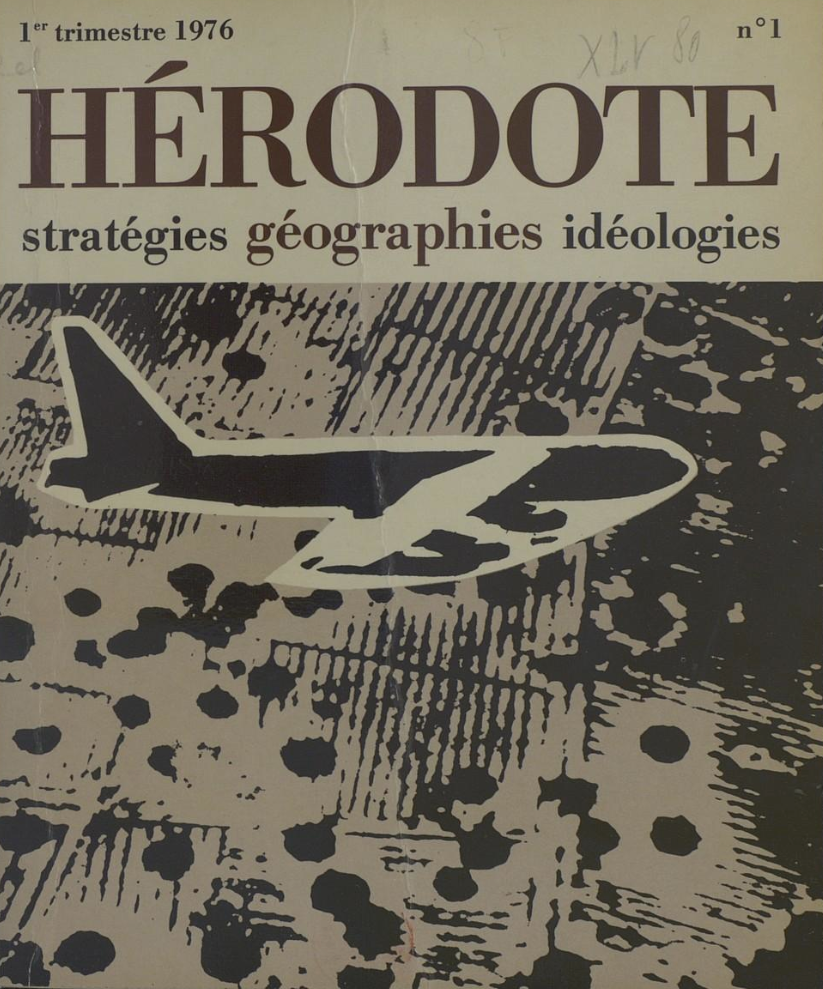
It’s thirty-odd years since Yves Lacoste insisted that La géographie, ça sert, d’abord, à fair la guerre (1976) and, as Gavin Bowd and Daniel Clayton show in “Geographical warfare in the tropics: Yves Lacoste and the Vietnam War”, he knew what he was talking about (he was also the editor of Hérodote, left): their remarkably rich essay was published in Early View by the Annals of the Association of American Geographers earlier this year.  As I say, another geography.

But these are not matters of disciplinary history alone; that is, of course, important – the terrific work of  Trevor Barnes in particular has done much to illuminate the entanglements of modern geography in the Second World War and the Cold War – but it’s also vital to pursue the ways in which geographical knowledges and practices continue to enter into the conduct of war and military violence.  In 1963 William Bunge and Bill Warntz started work on a book to be called Geography: the innocent science, a prospectus for their vision of the ‘new geography’ as spatial science.  It was far from innocent, to be sure, and in his later work – notably the Nuclear War Atlas but also what he called his ‘peace book’, Fitzgerald: geography of a revolution – Bunge displayed another side to his radical temper.  But what Trevor calls ‘the mangle’ between power and knowledge, geography and war, still includes the models and methods of spatial science – and it evidently also mangles much that lies far beyond them.

Kilcullen, counterinsurgency and the cultural turn

David Kilcullen‘s role in the development and implementation of US counterinsurgency will be familiar to many readers, and I’ve already noted his subsequent project to drive ‘military humanism’ still deeper into the ‘humanitarian present’.   Here he is at Columbia University’s Hertog Global Strategy Initiative in May 2012 on “The future of conflict and everything else”:

“Everything else” turns out to be a grab-bag geography.   Kilcullen starts by rehearsing Obama’s determination not to embark on major counterinsurgency or large-scale, prolonged ‘stability operations’ [which is how Obama characterises Afghanistan and Iraq], but insists that the sort of ‘overseas contingencies’ in which the US involves itself cannot be reduced to presidential will and that they have, historically, involved regular interlacings of military and civilian intervention.  (In fact, Kilcullen’s Caerus Associates joined with the Center for a New American Security to map US civilian intervention in crises and disasters since the end of the Cold War).

Then he turns to the environment in which the US ‘is likely to be operating’ in the near future. Kilcullen emphasizes the importance of urbanization, ‘littoralization’ (‘a fancy geographer’s term’, apparently) and networking in shaping future conflicts [Olivier Kramsch at Nijmegen takes a bow at 18.04 for – unless I’m mis-hearing – predicting in 2006 the geography of the Arab uprisings].  It’s an extraordinarily schematic and impressionistic set of mappings that recalls the Models in Geography diagrams of the mid-60s.  The master-diagram is copyright (wait until you see it), but you can download the Powerpoint slide here: just scroll down to NIC Blog – Kilcullen.

Now fast forward to 1.03.25: During the Q&A Kilcullen concedes that the criticisms of COIN and in particular the Human Terrain System made by the American Anthropology Association “have been quite justified in a lot of cases”, and that “There’s a clear role for the academy in making sure that people in the military don’t do stupid shit…” (1.04.12).

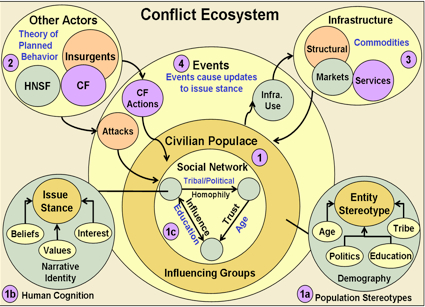
Perhaps they (we) might start by reminding them of the follies of 1960s spatial science.  As Oliver Belcher knows better than me, the US military have become ever more interested in that style of modelling and its successors – if you want a taste, purse your lips and check out the Cultural Geography Model, which is derived from Kilcullen’s earlier construction of a ‘conflict ecosystem’ thus:

The Cultural Geography Model (from Jonathan K. Alt, Leroy Jackson and Stephen Lieberman, ‘The Cultural Geography Model: an agent-based model for analysis of the impact of culture in irregular warfare’

Counterinsurgency and the humanitarian present

Laleh Khalili – whose work on the new and old classics of counterinsurgency,  on the gendering of counterinsurgency, and on the location of Palestine in global counterinsurgency – is indispensable, has just alerted me to the fate (Fate?) of one of its principal architects, David Kilcullen.

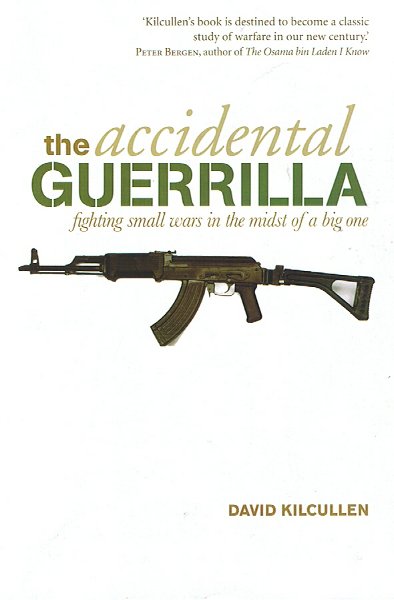
In The accidental guerilla and other writings, Kilcullen – Petraeus’s Senior Counterinsurgency Adviser in Iraq – repeatedly turned to bio-medical analogies to advance a bio-political vision of counterinsurgency: insurgency as a ‘social pathology’ whose prognosis can be traced through the stages of infection, contagion, intervention and rejection (‘immune response’).  In an interview with Fast Company, Kilcullen now explains that he

“came out of Iraq with a real conviction that we tend to think that a bunch of white guys turning up with a solution fixes all the problems. It doesn’t work like that. You actually have to really build a collaborative relationship with the people on the ground if you want to have any hope of understanding what’s going on.”

Kilcullen’s contract ended when the Obama administration came into office, and he founded Caerus Associates.  The company advertises itself as ‘a strategy and design firm’ that works to ‘help governments, global enterprises, and local communities thrive in complex, frontier environments.’  It claims to ‘bring the system into focus’ by providing ‘strategic design for a world of overlapping forces — urbanization, new market horizons, resource scarcity and conflict — to build resilience and capacity.’   The company explains its ‘strategic design process’ here, and Kilcullen’s vision of systems analysis is sketched here.  This may sound like the rapid-fire buzz-words that corporate start-ups typically shoot at their clients, but Kilcullen provides Fast Company with a sawn-off version (it’s really hard to avoid these metaphors…):

“We’re two-thirds tech, one-thirds social science, with a dash of special operations… We can go out in a community and say, ‘Let’s map who owns what land,’ or ‘Let’s map who owes the local warlord money,’ or ‘Let’s map the areas in the city where you don’t feel safe.'”

This chimes with Kilcullen’s famous description of contemporary counterinsurgency as ‘armed social work’, and in an interview with the International Review of the Red Cross published in September 2011 Kilcullen extended his vision of ‘military humanism’ beyond insurgency thus:

‘The methods and techniques used by illegal armed groups of all kinds are very similar, irrespective of their political objectives. So whether you’re talking about a gang in the drug business in Latin America, or organized crime in the gun-running or human smuggling business, or whether you’re talking about an insurgency or perhaps even a civil war involving tribes, you will see very similar approaches and techniques being used on the part of those illegal armed groups. That’s one of the reasons why I believe counter-insurgency isn’t a very good concept for the work that the international community is trying to do. I think that the idea of complex humanitarian emergencies is actually a lot closer to the reality on the ground. You almost never see just one insurgent group fighting an insurgency against the government anymore. What you typically see is a complex, overlapping series of problems, which includes one or more or dozens of armed groups. And the problem is one of stabilizing the environment and helping communities to generate peace at the grassroots level – a bottom-up peace-building process. And that’s not a concept that really fits very well with traditional counter-insurgency, which is about defeating an insurgent movement and is a top-down, state-based approach. What you have to do is create an environment where existing conflicts can be dealt with in a non-violent way.’

This is a remarkable passage for several reasons: the focus on ‘techniques’ not ‘objectives’, which works to de-politicize and de-contextualize a range of different situations in order to generalize about them, the appeal to a collective “international community” whose only interest is a generic “peace”, and hence the passage to what Eyal Weizman calls ‘the humanitarian present’. I think that’s also a colonial present, not surprisingly: ‘humanitarianism’ was often the velvet glove wrapped around the iron fist of colonialism.  But what Weizman sees as novel about the present is the way in which its ‘economy of violence is calculated and managed’ by a series of moral technologies (the term is Adi Ophir‘s) that work to continue and legitimize its operation.  In other words, there is today an intimate collusion of the ‘technologies of humanitarianism, human rights and humanitarian law with military and political powers’.

Despite  the reference to ‘special operations’ in the Fast Company interview – something which makes me think that Obama would have found Kilcullen’s continued advice invaluable – Kilcullen insists that it’s a collaborative process:

“We specialize in working with communities that are under the threat of violence in frontier environments, and I think to some extent that distinguishes us a little bit from other people. Sure we can give a slick presentation in a hotel room, but what we can also do is walk the street in dangerous places, engage with communities, and figure out what needs to happen. It’s not us figuring it out, it’s them telling us, but often we find that no one’s ever been there and asked them before.”

‘Dangerous places’, ‘frontiers’: this is still the language of adventurism.  It recalls Zygmunt Bauman‘s ‘planetary frontierland’, and even more Mark Duffield on the ‘global borderlands’:

‘The idea of the borderlands … does not reflect an empirical reality.  It is a metaphor for an imagined geographical space where, in the eyes of many metropolitan actors and agencies, the characteristics of brutality, excess and breakdown predominate.  It is a terrain that has been mapped and re-mapped in innumerable aid and academic reports where wars occur through greed and sectarian gain, social fabric is destroyed and developmental gains reversed, non-combatants killed, humanitarian assistance abused and all civility abandoned.’

It’s not surprising, then, that in the IRC interview Kilcullen should make so much of establishing ‘the rule of law’: ‘It’s a set of rules which has predictable consequences and allows the population to feel safe, and helps them know what they need to do in order to be in a safe place.’  He makes it clear that, in many (perhaps most) circumstances ‘bottom-up, community-based law, which can be transitional justice, or customary law, applied by traditional courts or religious courts, is as effective and possibly even more effective in the initial stages than central-state structures.’   But this ignores the multiple ways in which law (including international humanitarian law) is not apart from conflict but is almost always a part of conflict: as Weizman has it, ‘international law develops through its violation.  In modern war, violence legislates.’

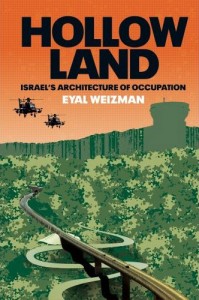
One could say much the same about maps.  Mapping is not a neutral, objective exercise; mapping is performative and its material effects depend on the constellation of powers and practices within which it is deployed. Kilcullen’s injunction – “Let’s map” – glosses over who the ‘us’ is, who is included and who is excluded, and the process through which some mappings are accorded legitimacy while others are disavowed.  This is also one of Weizman’s central claims, not least in his exposure of the torturous mappings that issued in the  Hollow Land of occupied Palestine.

Weizman’s particular focus in his discussion of the humanitarian present is Gaza, and this winds me back to Laleh Khalili’s work which brilliantly re-reads counterinsurgency in occupied Palestine contrapuntally with US counterinsurgency practices elsewhere.  Her Essential Reading on Counterinsurgency was published by Jadaliyya, and her forthcoming book, Time in the shadows: Confinement in Counterinsurgencies (Stanford University Press, October 2012),  engages with a Medusa’s raft of counterinsurgency adviser-survivors, including Kilcullen and Andrew Exum (Abu Muqawama).

And so a final question: how would ‘strategic design’ and a ‘collaborative process’ help the people of Gaza?  Whose ‘rule of law’ is to be established?  And which maps chart a road not only to peace but to justice for the people of Palestine?