Theory of the drone

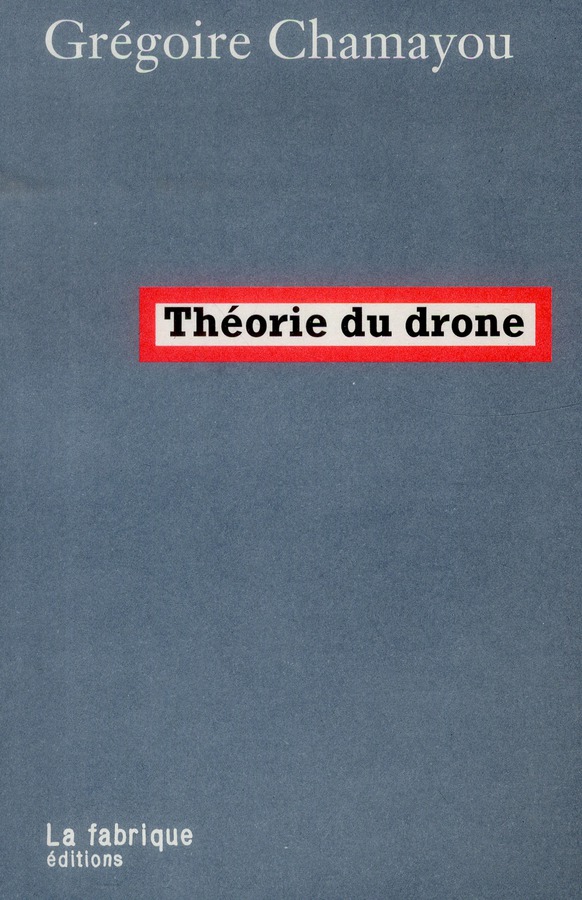
Theorie du droneI’ve been contacted by L’actualité for an interview on drones, which led me to a new book by French philosopher Grégoire Chamayou (CNRS): Théorie du drone (La fabrique, 2013).  I’ve only just ordered it, so this post is advance notice, the product of some rummaging around the web, and I’ll post a considered discussion as soon as I’ve read it.

Chamayou has translated Clausewitz into French, and readers may know one of his earlier texts, I think the only one to be translated into English thus far, Manhunts: a philosophical history (Princeton 2012; original French publication, Les chasses à l’homme: histoire et philosophie du pouvoir cynegetique (La fabrique, 2010); reviewed in English translation at Books & Ideas here).  If you want a good sense of Chamayou’s style, check out this video of a lecture in New York in 2011, ‘Hunter vs. Hunted’, artfully organised around film clips.

Manhunts doesn’t address targeted killing and drone warfare, but you can read a related essay from Radical Philosophy (169/2011) on ‘The manhunt doctrine’ that does here:

George W. Bush had warned us early on: the United States has launched itself into a new kind of war, a ‘war that requires us to be on an international manhunt’… The doctrine of the manhunt breaks with conventional warfare, which rests on the concepts of fronts, linear battles and face-to-face opposition. In 1916, General Pershing launched a large military offensive on Mexican territory to seize the revolutionary Pancho Villa. The massive deployment of force drew a blank. For the American strategists who cite this historic precedent as a counter-example, it is a question of reversing the polarity: faced with the ‘asymmetrical extremes’ posed by small mobile groups of ‘non-state actors’, one must employ small flexible units in a logic of targeted attacks. Contrary to Clausewitz’s classic definition, such cynegetic war is not, in its fundamental structure, a duel. The structure does not involve two fighters facing off, but something else: a hunter who advances and a prey who flees or who hides…

The prey who wants to escape his pursuers tries to become undetectable or inaccessible. But inaccessibility is not only a function of physical geography – such as an inextricable bush or deep crevice. The theorists of manhunting remind us that the ‘political and legal restrictions, especially in the form of jurisdictional boundaries’, are an eminent part of the ‘set of constraints that shape the rules of the game’. From this point of view, it is clear that ‘sovereign borders are among the greatest allies’ that a fugitive can have. The hunter’s power has no regard for borders. It allows itself the right of universal trespassing, in defiance of territorial integrity of sovereign states. It is an invasive power which, unlike the imperial manoeuvres of the past, is based less on a notion of right of conquest than of a right of pursuit….

In cynegetic war, armed violence seeks to pursue the prey wherever it might be. The place of hostilities is no longer defined by the locatable space of an effective combat zone, but by the simple presence of the hunted individual who carries with him everywhere a kind of little halo denoting a personal hostility zone. In this way of thinking, the very notion of armed conflict occurring in a distinct geographical space tends to vanish. Here, on the one hand, the combat zone tends to be reduced to the body of the enemy, which must then, according to the principle of distinction, be the only space that is targeted; but, on the other hand, it is believed that this mobile micro-space can be targeted wherever it happens to be. The paradox is that the principle of targeting is accompanied by a limitless virtual extension of the conflict zone: the world becomes the battlefield. Thus the classical distinction is erased between armed conflict zones, in which the use of weapons of war is allowed, and other zones in which they are not allowed…

Cynegetic war bears an ideal of non-confrontation with death, and of domination without real combat. While a duel involves a reciprocal relation of exposure to death – each participant bearing his chest to the enemy – in the hunt, on the contrary, the master barely ever confronts his prey directly. He uses intermediaries, beaters or the pack. Everything is done so that his life is never in danger, to assure him maximum protection. The use of predator drones and of Hellfire missiles, operated at a distance from American soil, illustrates this principle of absolute preservation of the life of the hunter by the mediation of hunting auxiliaries.

So far, so familiar. Chamayou treats the drone as ‘the emblem of contemporary cynegetic war’, which is to say war that ‘bears an ideal of non-confrontation with death, and of domination without real combat’: hence the new book which, like my own work, explores the complex field of death at a distance and, in a direct line of descent from Manhunts, embeds the drone into the apparatus of a new predatory state (Etat-chasseur) emphasised in this review in Le Devoir.  Here is a listing of the contents:

Theory of the drone

Prelude  — 9
Introduction — 21

I. Techniques and tactics — 33

Methodologies in a hostile environment — 35
Genealogy of the Predator— 41
Theoretical principles of the manhunt— 47
To watch and to annihilate — 57
Pattern of life analysis — 69
Kill box — 79
Counterinsurgency from the air — 91
Vulnerabilities— 109

II. Ethos et psyche— 119

Drones and the kamikazi (suicide attacks) — 121
‘That others should die’ — 131
A crisis in military ethics— 137
Psycho-pathologies of the drone— 151
Killing at a distance— 162

III. Necro-ethics — 177

Combatant immunity— 179
The humanitarian weapon — 190
Precision — 197

IV. Legal philosophy of killing— 211

Thoughtless assassins — 213
War without combat — 220
Licence to kill — 231

V. Political bodies— 241

In war and in peace — 243
Democratic militarism— 254
The essence of warriors — 269
The production of political robots — 285

Epilogue. War, at a distance — 309

21 February 2010 Uruzgan CIVCASYou can find a short extract from Théorie du drone here. This is of particular interest to me since it includes a transcript of an air strike mediated but not directly carried out by a Predator crew and its associated network/assemblage in Uruzgan province, Afghanistan on 21 February 2010, which killed 23 civilians and wounded 8 others.  It’s the mediation that is crucial, though I’m not (yet) sure that what Chayamou means by ‘intermediaries’ in the passage from RP above is quite what I have in mind: we’ll see.  In any event, I discussed the strike and Major General Timothy McHale’s subsequent investigation in ‘From a view to a kill’ (DOWNLOADS tab) and I’ve now provided a much more detailed discussion, with longer extracts from the transcript Chamayou uses here, in The everywhere war (due to be finished, please God, this summer). Chamayou uses this incident as a Prelude to his main argument which – unlike so much philosophical reflection on later modern war, and as he makes clear in his Introduction is in part inspired by the example of Simone Weil – evidently engages directly with the material conduct of military violence.

There’s another extract from the book available here. There are also many  interviews with Chamayou available, but a succinct yet wide-ranging one is available here in which, amongst other things, he assails those American and Israeli philosophers who have defended the use of drones as ‘ethical’, ‘humane’, and even as vehicles for a newly humanitarian mode of war.  He doesn’t name them, but one of those he surely has in his sights is Bradley Jay Strawser (see here,  here and here), whose edited collection on Killing by remote control: the ethics of an unmanned military was published last month by Oxford University Press.  Appropriately, you can buy a Kindle edition from Amazon in just one click.

UPDATE:  For a succinct overview of Chamayou’s work, see Kieran Aarons, ‘Cartographies of capture’, Theory & Event 16 (2) (2013).

Spaces of constructed (in)visibility

ICGFurther to my previous posts on air strikes in Pakistan here and here, the International Crisis Group today published a new report, Drones: Myths and Reality in Pakistan.

From ICG’s media release:

‘The report’s major findings and recommendations are:

  • Pakistan’s new civilian leadership under PML-N leader Nawaz Sharif must make the extension of the state’s writ in FATA the centrepiece of its counter-terrorism agenda, bringing violent extremists to justice and thus diminishing Washington’s perceived need to conduct drone strikes in Pakistan’s tribal belt.
  • Drones are not a long-term solution to the problem they are being deployed to address, since the jihadi groups in FATA will continue to recruit as long as the region remains an ungoverned no-man’s land.
  • The U.S., while pressuring the Pakistan military to end all support to violent extremists, should also support civilian efforts to bring FATA into the constitutional and legal mainstream.
  • The lack of candour from the U.S. and Pakistan governments on the drone program undermines efforts to assess its legality or its full impact on FATA’s population. The U.S. refuses to officially acknowledge the program; Pakistan portrays it as a violation of national sovereignty, but ample evidence exists of tacit Pakistani consent and, at times, active cooperation.
  • Pakistan must ensure that its actions and those of the U.S. comply with the principles of distinction and proportionality under international humanitarian law. Independent observers should have access to targeted areas, where significant military and militant-imposed barriers have made accurate assessments of the program’s impact, including collateral damage, nearly impossible.
  • The U.S. should cease any practices, such as “signature strikes”, that do not comply with international humanitarian law. The U.S. should develop a legal framework that defines clear roles for the executive, legislative and judicial branches, converting the drone program from a covert CIA operation to a military-run program with a meaningful level of judicial and Congressional oversight.

“The core of any Pakistani counter-terrorism strategy in this area should be to incorporate FATA into the country’s legal and constitutional mainstream”, says Samina Ahmed, Crisis Group’s Senior Asia Adviser. “For Pakistan, the solution lies in overhauling an anachronistic governance system so as to establish fundamental constitutional rights and genuine political enfranchisement in FATA, along with a state apparatus capable of upholding the rule of law and bringing violent extremists to justice”.

FATA and NWFP mapThe report speaks directly to claims that the Federally Administered Tribal Areas (FATA) are treated by both Washington and Islamabad as a space of exception, subject to special legal dispensations that expose their inhabitants to military violence and, ultimately, death.  And it also repeats much of the argument I made earlier about the close collaboration between Washington and Islamabad based, in part, on the Wikileaks cables.

But there’s nothing about the air strikes carried out in the FATA by the Pakistan Air Force.  Since the report is specifically about the CIA-directed counter-terrorism campaign, you may think the silence unsurprising.  But I think it’s important not to contract the focus in this way – I say that not to exempt the US from criticism (far from it) but as a reminder that this is a space of constructed visibility that is also (as always) a space of constructed invisibility.  The inhabitants of FATA deserve to have the wider landscape of military violence exposed to the public gaze.

As part of that process, this passage is immensely important, given the difficulty of reporting from or carrying out field work in the FATA:

‘Islamabad has a constitutional and international obligation to protect the lives of citizens and non-citizens alike on its territory. Even if it seeks U.S. assistance against individuals and groups at war with the state, Pakistan is still obliged to ensure that its actions and those of the U.S. comply with the principles, among others, of distinction and proportionality under International Humanitarian Law, and ideally to give independent observers unhindered access to the areas targeted.’

The ICG’s very first recommendation, therefore, is to lift ‘all travel and other restrictions on independent observers, national and foreign, to the targeted areas in FATA.’  In short, it’s not enough to demand that Washington be transparent in the procedures it follows (whatever Obama might say in his advertised speech on Thursday); it’s also vital for observers to be able to witness and report what is happening on the ground in Waziristan (and elsewhere).  Here is Madiha Tahir:

‘I do think these stories would look quite different if they were being told by people from the countries in question. It would shift perspective, and it would highlight as well as marginalize different aspects of the issue. As it is, the conversation is had among largely American, largely white, largely male voices, and the only real options for the rest of us are either to enter that conversation by agreeing or disagreeing, or risk irrelevance.

… [T]he intense focus on the government’s narrative lets journalists and the media off-the-hook for not doing the hard work of actually reporting the stories of those on the receiving end of America’s war in Pakistan.’

Situational awareness

brighton-festival-2013Two art projects from Lighthouse at the Brighton Festival in the UK this month (4-26 May); thanks to Sam Hind for the information.

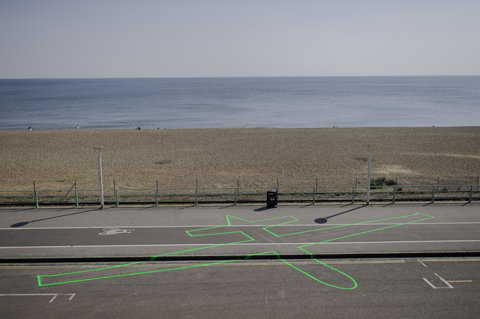
 James Bridles work will be familiar to most readers, and in Brighton he’s reprising his Under the shadow of the drone, which is a true-to-scale rendering of a Reaper, this time on the seafront:

The stark marking out in an unexpected public space of a Reaper drone’s silhouette brings the reality of these technologies into our daily lives. The work critiques the way that contemporary networked technologies, while enabling the digitally saturated culture of the 21st century, can also obscure and distance us from political and moral responsibility.

Bridle explains:

“Drones are just the latest in a long line of military technologies augmenting the process of death-dealing, but they are among the most efficient, the most distancing, the most invisible. These qualities allow them to do what they do unseen.

“We all live under the shadow of the drone, although most of us are lucky enough not to live under its direct fire. But the attitude they represent – of technology used for obscuration and violence; of the obfuscation of morality and culpability; of the illusion of omniscience and omnipotence; of the lesser value of other people’s lives; of, frankly, endless war – should concern us all.”

And Lighthouse adds: ‘By superimposing a large-scale drawing of the shadow of a drone in an urban location in Brighton, Bridle brings these chilling machines uncomfortably close to us, embedding them into our daily lives, and in the process perhaps making the reality of the daily occurrence of deadly drone strikes more tangible.’

BRIDLE Under the shadow of the drone, Brighton

For me, some of Bridle’s other projects – like Dronestagram – are more effective in bringing the strikes (rather than the technology) down to earth and into the spaces of everyday life, but it’s still an arresting project.  Size and scale matter; I remember visiting the RAF Museum at Hendon and being truly astonished at how small a Lancaster bomber was – and yet how vast the bomb door in its belly.  If you’re in Brighton, you can find Bridle’s rendering 5 minutes/500 metres walk east from the Brighton Wheel on Marine Parade, towards Yellowave Beach Sports Venue; then look down to Madeira Drive.

primary-1

The second is Mariele Neudecker‘s The air itself is one vast library (a quotation from Charles Babbage), originally shown in 2010:

… an exhibition of startling images that explore the disturbing, and often invisible, technologies of war. In dramatic contrast with her more familiar depictions of landscape and the sublimity of nature, this highly topical study brings us face to face with weapons of mass destruction.

Neudecker’s artistic strategy is rooted in ‘ground truth’, a term used in remote sensing to describe data collected on location. Works created whilst on site at the historic Nike missile facility in the US are emblematic of Neudecker’s determination to go beyond mere representation. Her extraordinary graphite rubbings of vast Hercules missiles physically capture the object, making what is otherwise abstract and monstrous, tactile and present. Other works investigate military imaging and tactical communication, which provide us with new ways of detecting what is intended to be camouflaged and out of view.

You can see this at Lighthouse, 28 Kensington Street, Brighton, and preview images here.

For more on artworks, invisible military technologies and ‘geographies of seeing’, I thoroughly recommend honor harger‘s excellent reflections on Unmanned Aerial Ecologies here, which includes a series of brilliant images and commentaries on the work of Trevor Paglen and Marko Peljhan.  The latter is new to me and very interesting: the title for this post is taken not only from the military, which is appropriate enough, but also from one of Peljhan’s projects featured in honor’s essay.

Unmanned twice over

UnmannedI’m going to the CASAR Conference on Transnational American Studies at the American University in Beirut in January.  I’ve been to these meetings before, and I’m looking forward to returning to the city and meeting many old friends.  I’ll be presenting another version of “Drones, spaces of exception and the everywhere war”; the programme includes a keynote address from Judith Butler and  a performance of Robert Myers‘ play Unmanned.

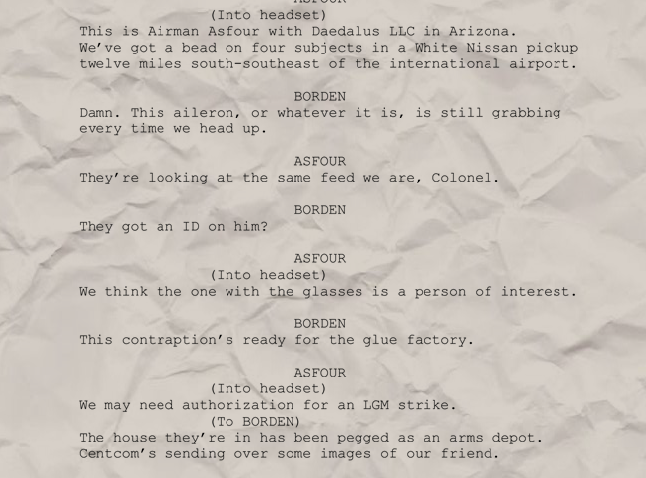
Myers is a Professor of English and Creative Writing at UAB and a former Director of CASAR, and he developed the play while he was a visiting artist at the International Institute for U.S. Studies at the University of Illinois last spring.  It’s a two-hander, involving a drone pilot and a sensor operator, and Myers sets the scene like this:

The play takes place principally in a single-wide trailer painted with desert camouflage in the desert in the American West. Other scenes take place in an automobile and in other locations, which should be created with music and light. The play is written so that it may be staged with two office chairs. The set should be minimal. There is no reason to create a realistic “cockpit” since the flyers are not really in a cockpit and they are not flying. Their workspace resembles the cubicles of millions of other office workers. Outside the trailer, Stage Left, is a sign with a series of crudely painted arrows, which say: Kandahar 6792, Las Vegas 473, Mogadishu 5712, Phoenix 173, etc. Several actual props are introduced in the course of the play—a couple of unmarked white milk shake cups with straws, a fox stole etc.—and the two characters could wear minimalist headsets with microphones so as not to create confusion about when they are talking to Central Command. However, since the play is – among other things – about the relationship between the real world and the virtual world, all other machines, including phones, computers, navigational equipment, monitors should be mimed and/or created with light. 

I do like that last sentence.  You can download an excerpt from the play here.

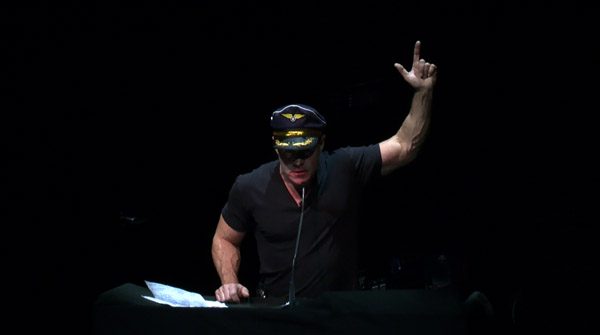
unmanned1SMThere have been several other drama-works that deal with drones (in different ways), including Jordan Crandall‘s performance work also called Unmanned:

Unmanned is about the changing nature of masculinity in the face of automated technologies of war. It focuses on the unmanned aerial system, or drone, as a site of investigation. Rather than taking a conventional analytical approach, however, the work is performed live as “philosophical theater”: a blend of performance art, political allegory, philosophical speculation, and intimate reverie. Jordan Crandall conducts a series of monologues in the guise of seven different characters, supplemented with stage action, video, and sound. Each character is an archetype of masculine identity struggling with its own agency and role in the field of deployment — historically the most complex issue in the field of military endeavor.

The drone becomes a figure for a reorganization of masculinity — one that dissipates the structuring forces of modern military identity, its standards of adequacy and scales of worth. Yet at the same time, in a much larger sense, the drone becomes a figure for a much larger condition: a reorganization of agency and skill, within a data-intensive environment of distributed and embedded intelligence, where network computing has become integrated into all manner of objects, spaces, and infrastructures. This reorganization not only challenges conventional identifications, however gendered, but the very status of the human.s about the changing nature of masculinity in the face of automated technologies of war. It focuses on the unmanned aerial system, or drone, as a site of investigation. Rather than taking a conventional analytical approach, however, the work is performed live as “philosophical theater”: a blend of performance art, political allegory, philosophical speculation, and intimate reverie. Jordan Crandall conducts a series of monologues in the guise of seven different characters, supplemented with stage action, video, and sound. Each character is an archetype of masculine identity struggling with its own agency and role in the field of deployment — historically the most complex issue in the field of military endeavor.

The drone becomes a figure for a reorganization of masculinity — one that dissipates the structuring forces of modern military identity, its standards of adequacy and scales of worth. Yet at the same time, in a much larger sense, the drone becomes a figure for a much larger condition: a reorganization of agency and skill, within a data-intensive environment of distributed and embedded intelligence, where network computing has become integrated into all manner of objects, spaces, and infrastructures. This reorganization not only challenges conventional identifications, however gendered, but the very status of the human.

I’m continuing to work on my own performance-work, The social life of bombs, though – as I’ve noted before – it ends with a drone strike but begins a hundred years earlier…

Homing in

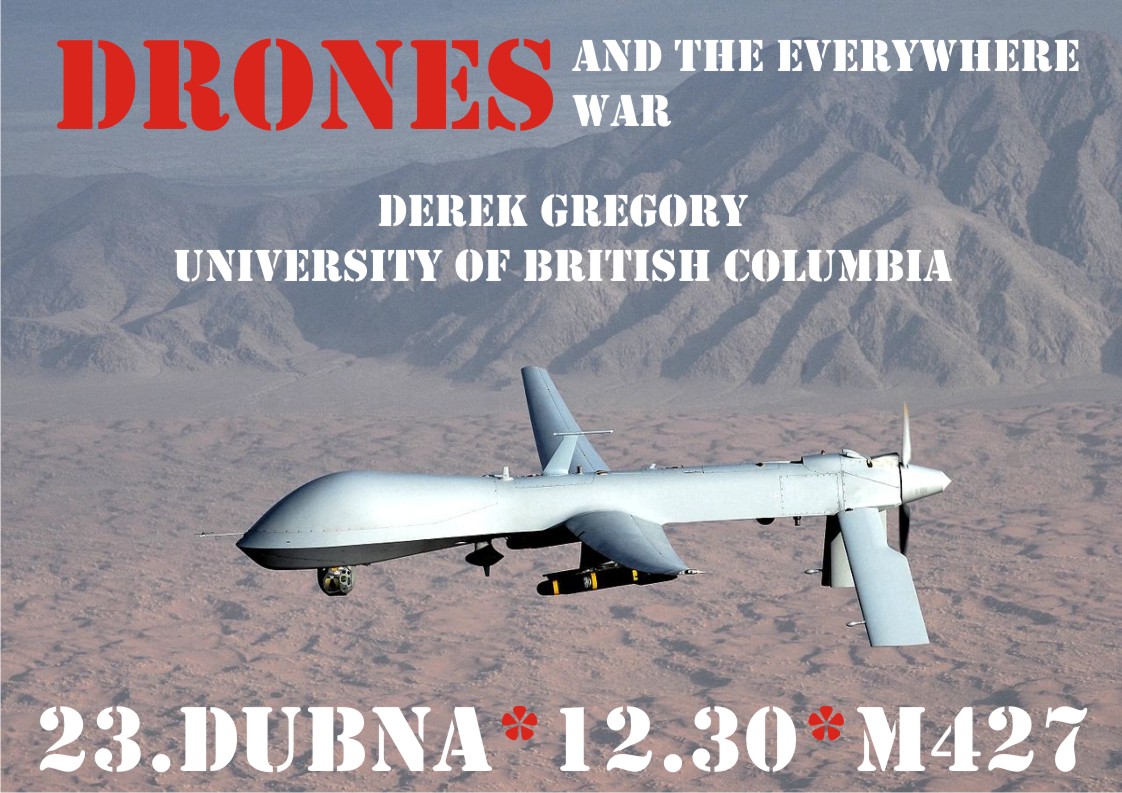
I’m finally home from Europe – a strange sentence, I think, since I always feel so much at home when I return to Europe.  I spent the last week in the Czech Republic, where I was a guest of the Department of Human Geography and Regional Development in Ostrava: I’m deeply grateful (once again) to all the faculty and graduate students, and most of all to  Tomáš Drobík, Přemysl Mácha, Tadeusez Siwek and Monika Šumberová, for their warm hospitality and lively discussions.

drones_gregory96dpi

While I was there I gave a version of “Drones, spaces of exception and the everywhere war” (abstract below) and, as always, learned much from the questions and a subsequent workshop with graduate students.  A version of this will eventually appear in a new collection edited by Lisa Parks, Life in the age of drones, and parts of it will be re-worked for my own book.

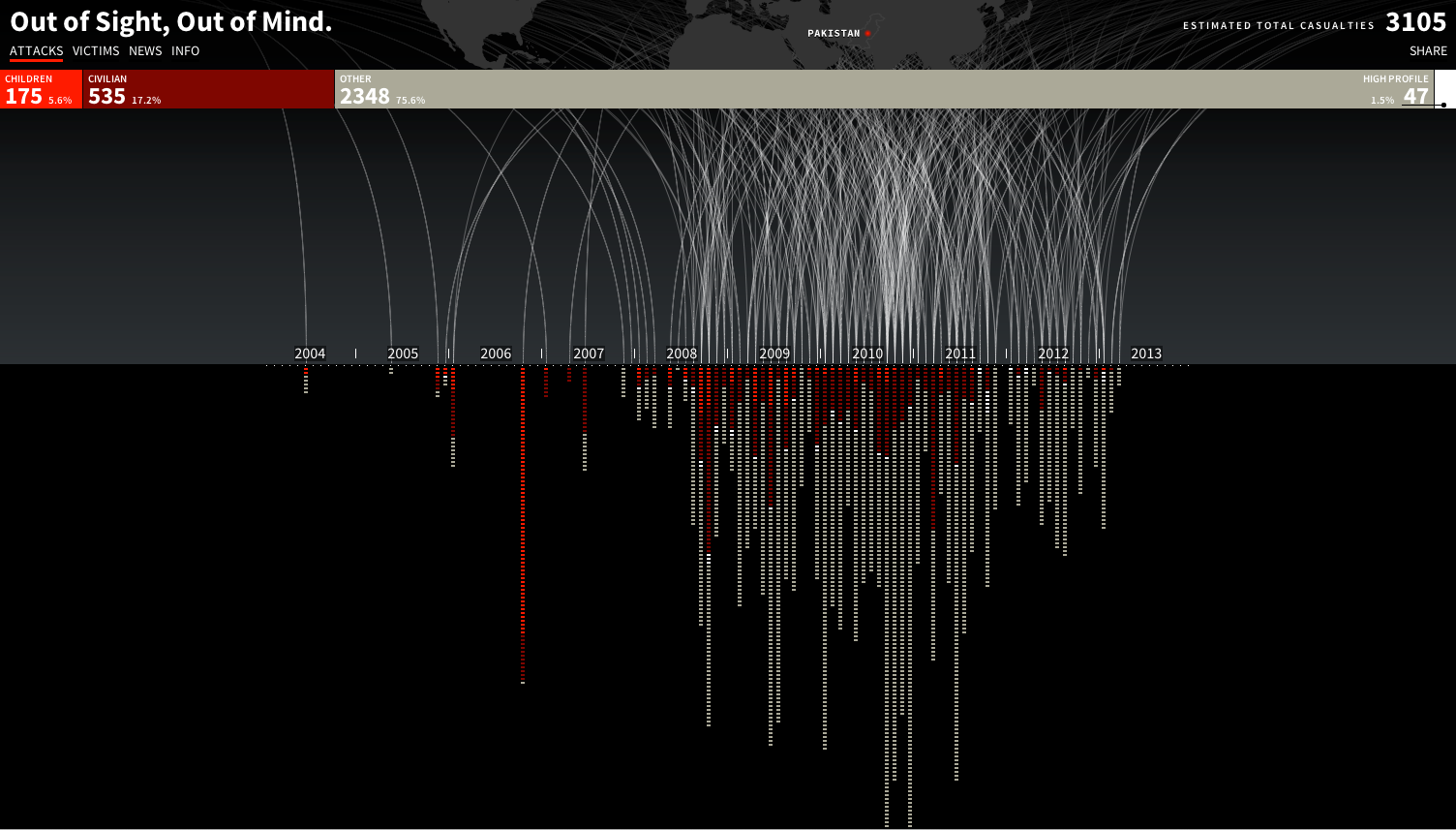
There have been many compelling visualizations of drone strikes in Pakistan – most recently, Out of Sight, Out of Mind, whose artful rendering of the database compiled by the Bureau of Investigative Journalism went viral in March 2013. But the infographic is confined to a temporal plot: it is, in a significant sense, also out of site, and a primary purpose of this essay is to show that the geography of these strikes is not incidental to their politics.

 In fact, multiple geographies are inscribed in them

 First, it is necessary to insert US-directed strikes into the matrix of state violence in the Federally Administered Tribal Areas. This means showing how Pakistan’s Frontier Crimes Regulations (even in their amended form) work in concert with the Actions (in Aid of Civil Power) Regulations (2011) to constitute the FATA as an exceptional space in something like the sense specified by Giorgio Agamben: a zone whose inhabitants are exposed to military and paramilitary violence and ultimately death through the law. This licenses air strikes by the Pakistan Air Force as part of continuing military offensives against militants and insurgents: in short, the people of the FATA are not only “Living Under Drones.

 This receives remarkably little attention in most critical discussions, which fasten on the ways in which the people of the FATA are also exposed to state violence through a second, transnational legal geography – the US assertion of its (contested) right to carry its war in Afghanistan across the border into Pakistan. This will be dissected in depth; but these are, of course, more than legal formations. Most US air strikes are confined to the FATA but PAF strikes are not, and the reasons for this doubled geography will be described and the incidence of both US and PAF strikes mapped in as much detail as the data allow.

 A second step is then to document the tactical co-operation between the US and Pakistan militaries in orchestrating the drone strikes (and, on occasion, co-ordinating them with Pakistan ground offensives). We now know that this co-operation started with the very first US-directed strike in the FATA: Mark Mazzetti has shown that the targeted killing of Nek Muhammad in June 2004 was undertaken as a favour to the Pakistan government, which regarded him as an enemy of the state, to gain access to Pakistan’s airspace so that the US could hunt down its own cross-border enemies.  We also know from the US diplomatic cables released by Wikileaks, and from a series of reports by investigative journalists, that this deadly alliance has continued – despite repeated denials and protests by Islamabad. This analysis extends the network in which US remote operations are usually inserted – launch sites in Afghanistan and Pakistan, CENTCOM’s Combined Air and Space Operations Center in Qatar, and video analysts, pilots, lawyers and commanders at multiple sites inside the continental United States – beyond purely US assemblages.

 But a third step is to show how the drone strikes in the FATA spiral out into an even wider matrix of military and paramilitary violence – the ‘everywhere war’ prosecuted in Yemen, Somalia, Mali, and elsewhere – whose contours map a profound transformation in the very nature and meaning of war itself.

Regular readers will recognise that this draws on a series of posts where I sketched out parts of the argument.

The discussions that followed my presentation in Ostrava were immensely helpful.  I began outside Pakistan, exploring in detail the anatomy of a drone strike in Afghanistan, and there was considerable interest in the narrative (some of which you’ll find in “From a view to a kill” under the DOWNLOADS tab; I’ve extended this analysis for my book too) and in the techno-cultural construction of the killing space.

But once I moved to the CIA-directed strikes in Pakistan, and the question of targeted killing,  attention focused on trade-offs between the simultaneous contraction of the target space through the provision of high-resolution video feeds and ‘weaponeering’ to reduce the blast radius – these strikes are a far cry from bombing missions during the Second World War or the B-52 offensives over Vietnam, Laos and Cambodia – and the lowering of the threshold for military and paramilitary violence: the argument that damage and death can be contained all too readily becomes (to its protagonists) an argument for  sending in the drones.  This in turn spiralled into a debate about transparency – about the limits to knowledge in democratic societies – and about the artful direction of debate to Washington (‘what rules are being followed?’) and away from the scene of violence in Waziristan.

Finally, we talked about the dissonance between this ‘optical war’ and the more haptic-sensuous war experienced on the ground (by both armed actors and civilians) – which I hope in some way helped prepare for their next visitor, anthropologist Tim Ingold.

Dronesong

shawa-cast-lead‘In 1990,’ Palestinian pop-artist Laila Shawa recalls, ‘I had breast cancer.’

While undergoing radiotherapy, I watched on television the precision bombing of Baghdad by US airplanes, forever linking the two events in my mind and in my art. The body woman and the body land amalgamate; the invasion of one is equated with the invasion of the other and the implicit fact that both leave scars.”

Jo Long made a parallel, beautifully nuanced argument in her ‘Border Anxiety’ essay in Antipode in 2006, but you can literally see what Laila Shaw means in the extraordinary Cast Lead (2011; above left).

Laila is probably still best known for her silkscreen cycle Walls of Gaza (1992-95)a different take on graffiti to most geographers’, since she insists that the situation was unique:

I believe the Gaza Graffiti differs completely from urban graffiti that one sees in big cities around the world. In Gaza, graffiti on the wall was the only method available to Palestinians to communicate with each other. The Israeli occupiers banned any form of media in Gaza, such as newspapers, radio, or television. The writing is cursive, spontaneous and hurried. It changed almost daily to update whatever was happening in Gaza.

In the Walls cycle she juxtaposed images of Palestinian children and graffiti from Gaza to expose the trauma of war and occupation, a theme to which she returned in Target (2009), a variation on an iconic panel from Walls, in which a photograph of a young child is superimposed against a graffiti-covered wall with a cross-hair centred on his face.  ‘War deprives children of their childhood,’ she says.

Much of her work depends on mixed media juxtapositions like this, which she mobilizes to brilliant effect. She explains:

‘Today, when we are desensitized by the surfeit of media violence, new strategies are needed to overcome people’s apathy and weariness for compassion.’

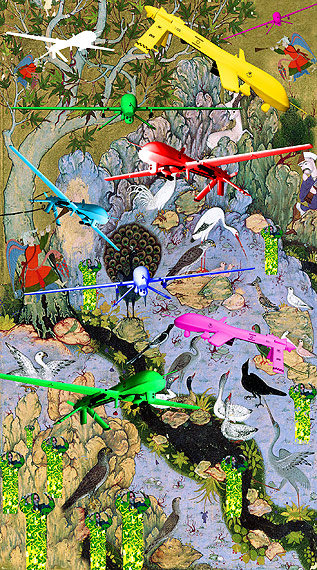
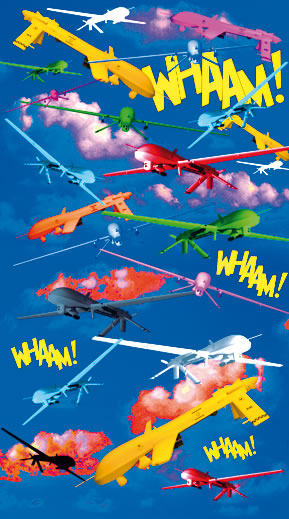
Last year she had an exhibition at London’s October Gallery, The Other Side of Paradise, which was in part provoked by a documentary on a female suicide bomber but which also included the extraordinary images shown below, Birds of Paradise and Gaza Sky, which speak directly to my previous post about other ways of visualizing drones.

SHAWA Birds of Paradise

SHAWA Gaza Sky

Laila was born in Gaza, but Gaza Sky strikes me as problematic; Israel doesn’t use Predators, so far as I know, but manufactures its own Heron drones and leases/sells them to other states.  Still, the image captures occupied Palestine since – for me – the reference isn’t only to Roy Lichtenstein‘s Whaam but also to Mahmoud Darwish‘s moving poem The earth is closing on us (which Edward Said used for his collaboration with Jean Mohr, After the last sky):

Where should we go after the last border? Where should the birds fly after the last sky?

I’m left wondering about how to draw together my first and last paragraphs – how to bring these ‘birds’ and the bodies on which they feed into the same frame.  This isn’t a compositional problem for my writing; it’s a political-aesthetic one.  So I start to think about Laila’s Target again.  For The social life of bombs, I plan to end the performance-work with a back-projected image of three children asleep under a checkered counterpane; all you you can hear is the rhythmic sound of their breathing.  As the camera moves in, it becomes clear that each checkered square is in motion; the sound gets louder.  Closer still, and each square becomes a video feed from a drone. Closer still, and one square fills the whole screen: the compound in which the children are sleeping, seen from high above (and far away).  By now the sound of breathing is incredibly loud; suddenly, an even louder explosion.  When the smoke clears, the sound dies away, and the lights slowly come up, we see three small figures, clutching the remains of their bedding – a re-staging and reworking of Noor Behram‘s to me iconic photograph of the three Bismullah children, the sole survivors of a drone strike in Waziristan.  But it could, of course, be Gaza.  Or Yemen.  Or Somalia…

Drone imaginaries

While everyone’s attention this week seems to have been captured by Pitch Interactive’s remarkable graphic of US drone strikes in Pakistan, Out of sight, Out of mindElspeth Van Veeren provides a timely reminder that there are other ways to visualise done warfare – all the more important given the central role that visual feeds play in the ‘dwell-detect-destroy’ assemblage.

2In a succinct and helpful online review she brings together several of the art projects I’ve written about in previous posts, including Omar Fast‘s video Five Thousand Feet Is The Best, Noor Behram‘s photographs from Waziristan and James Bridle‘s Dronestagram, and provides a suggestive argument about the visual politics involved:

If drones are to be understood and debated, we need to pay attention to the ways in which visual politics plays into these debates. How are drones visualized? How are the politics of drone warfare made sensible? Drones as things enter into our world through the ways in which they are talked about, but also the way they are represented, repeated and circulated. They become objects and images through which we think. Their different perspectives – drone thing, drone vision, dronestream, and droneshadow – offer different and in some ways competing imaginaries of drones…. 

 Paying closer attention to these visual practices, to the sensible politics of drone warfare, offers a way to think through the many ways in which security and insecurity are produced. These drone imaginaries make drones visible and sensible, and in so doing they also tune us into the different people and identities that are connected with this technology. Imagining a drone also means imagining a viewpoint and there is more than one way to imagine a drone.

You can find other examples here – from which I’ve borrowed the image above – and in Craig Jones‘s post here.

Elspeth develops her argument about visualization and politics  in depth and detail in a paper she is presenting in a panel on Visualizing insecurity at the ISA Convention in San Francisco next month, ‘Drone imaginaries: There is more than one way to imagine a drone’, and you can download a working draft here (registration required).  She also has a book in the works from Routledge, Security collisions.

Exceptions R Us

tumblr_mkc2q1MRtU1s9d11ko1_250Alex Vasudevan writes to alert me to this all-too-relevant site, Agamben Toys or Toys for the State of Exception

Most of the baubles on offer are decidedly for play in the global North, but for older kids with global (in)sensibilities there’s always this model Predator…. and plenty more like it (for example here and here).  Commentary – and comments (you’ll see what I mean) – here and (from Infowars) here.

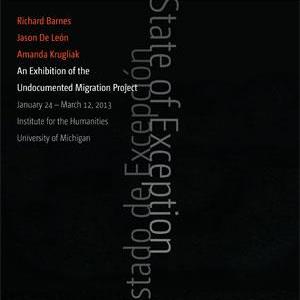
Toys appeared in a radically different way in an exhibition at the University of Michigan’s College of Literature, Science and the Arts (LSA) earlier this year called State of Exception:

166510_475567315838743_1025941788_nLSA Professor of Anthropology Jason De León has spent long hours in the Sonoran environs, cataloging and collecting the items migrants leave behind as they attempt to cross into the United States. Water jugs. Shoes. Small kids’ toys. It looks like trash, but these objects, collected through his Undocumented Migrant Project (UMP), become data to help construct a record of people who are unknown, whose journeys rarely come to light.

Many of these objects are now on display through LSA’s Institute for the Humanities exhibit titled State of Exception. This exhibit considers the complexity and ambiguity of the found objects and what they may or may not reveal in terms of transition, human experience, culture, violence, and accountability.

This is the first major curation of De León’s work since UMP began in 2009, and is a combination of objects, installation, and video shot by photographer Richard Barnes along the U.S./Mexico border.

The exhibition closed earlier this month but you can still access the catalogue/brochure online here.

All of this reminds me that there’s a reason we spell ‘us’ the way we do…

Watching the drones

An interesting interview over at the Huffington Post with Wesley Grubbs, one of the visual designers at Berkeley-based Pitch Interactive responsible for the infographic of drone strikes in Pakistan that was released on Monday and has since gone viral.  I drew attention to it in my discussion of the geography of those strikes, but that dimension doesn’t appear in this otherwise compelling infographic (screenshot below).  The project is called Out of Sight, Out of Mind which certainly speaks to the politics of drone warfare but it’s also out of site, and the geography of these strikes, as I tried to show, is not incidental to those politics.

Drone strikes in Pakistan PITCH INTERACTIVE

I think that the political-aesthetic effect of this visualization – which is considerable, otherwise why so much attention? The numbers aren’t new to anyone who’s followed the Bureau of Investigative Journalism‘s painstaking work –  is bound up less with the raw numbers and more with those silver-grey arcs of light falling to the ground line: it’s a much more sobering (and I dare say thrilling) effect than a lifeless (sic) table.  As I watch them descend, I’m drawn back to images of much earlier bombings, and the lights exploding against a velvet sky.  And a visualization is doubly appropriate to a weapon that depends so much on visual apprehension – full-motion video feeds – and yet whose operation in the borderlands is shrouded in such semi-secrecy.  Grubbs told the Bureau that their intention was ‘to cause people to pause for a moment and say “Wow I’ve never seen this in that light before”.’

The site is live  – it will be updated in real time – and the same design group is intent on developing similar visualizations for drone strikes in Yemen and Somalia.

The Bureau’s work, the primary basis for the interactive, is so careful and considered that this attempt to downplay and even dismiss Pitch Interactive’s project is either simply ignorant or just plain silly.  The author objects that the numbers ‘aren’t exact’ and wants to see the full spreadsheet – but the Bureau has made its detailed databases available and discussed their limitations in depth and detail: what better (‘exact’) sources does she have in mind?  Perhaps she should try here.

I’m not sure that this is much better.  Its author concludes: ‘Put simply, the visualization is implying that of 3,105 drone-strike casualties, only 47 are known to be legitimate kills. This is nonsense.’ Actually, what is nonsense is to misread and mis-represent the infographic in this way; what the website clearly says is that less than 2 per cent of the victims (a total of 47 people) have been ‘high profile targets’ (the original object of Sylvan Magnolia, the code-name for the covert war).

Not incidentally, less than twenty per cent of those killed in the strikes have been named, and the Bureau has just released a short video to crowd-source funding so that their raw numbers are finally turned into names:

You can donate here.

Dirty dancing and spaces of exception in Pakistan

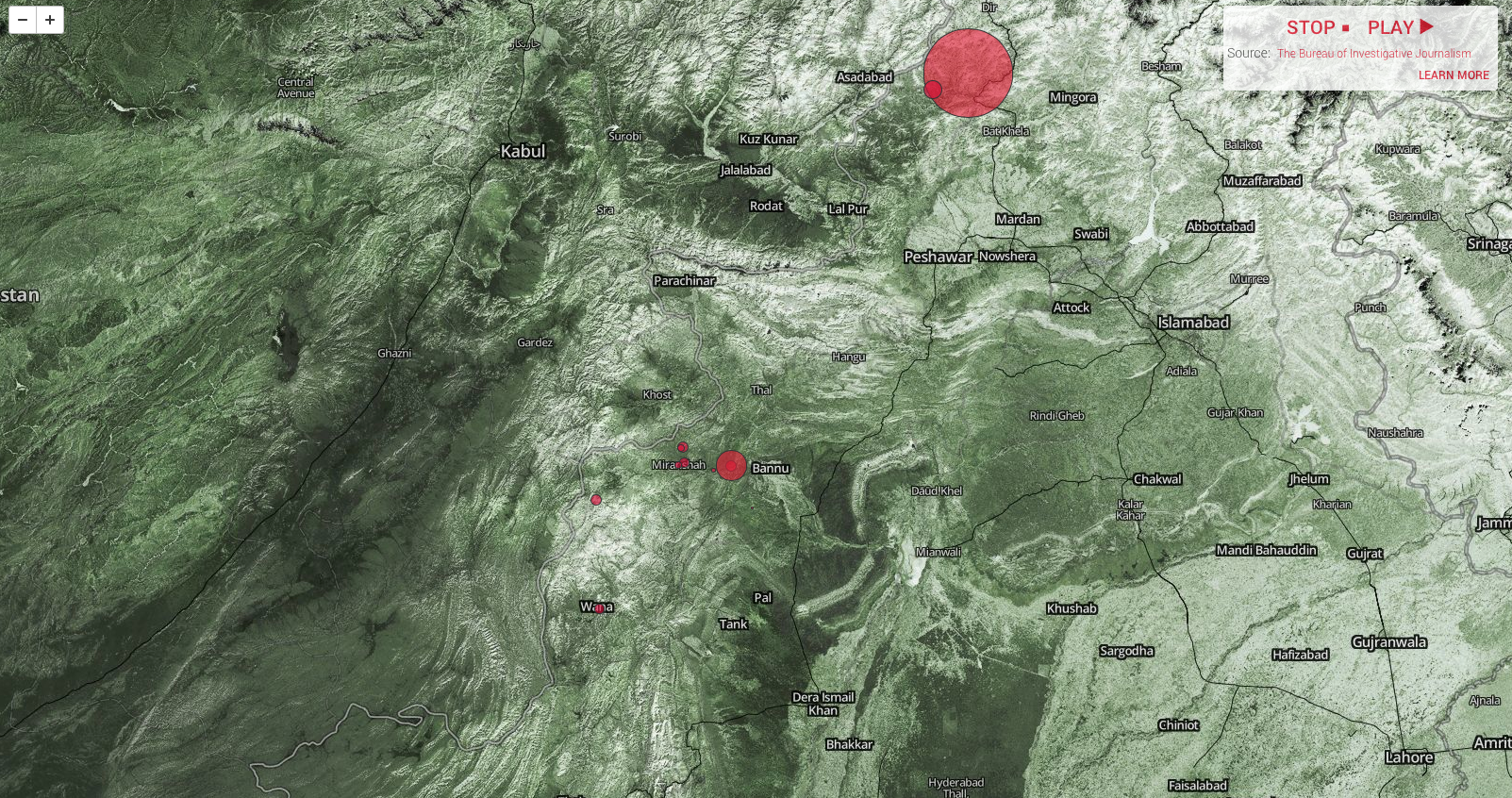
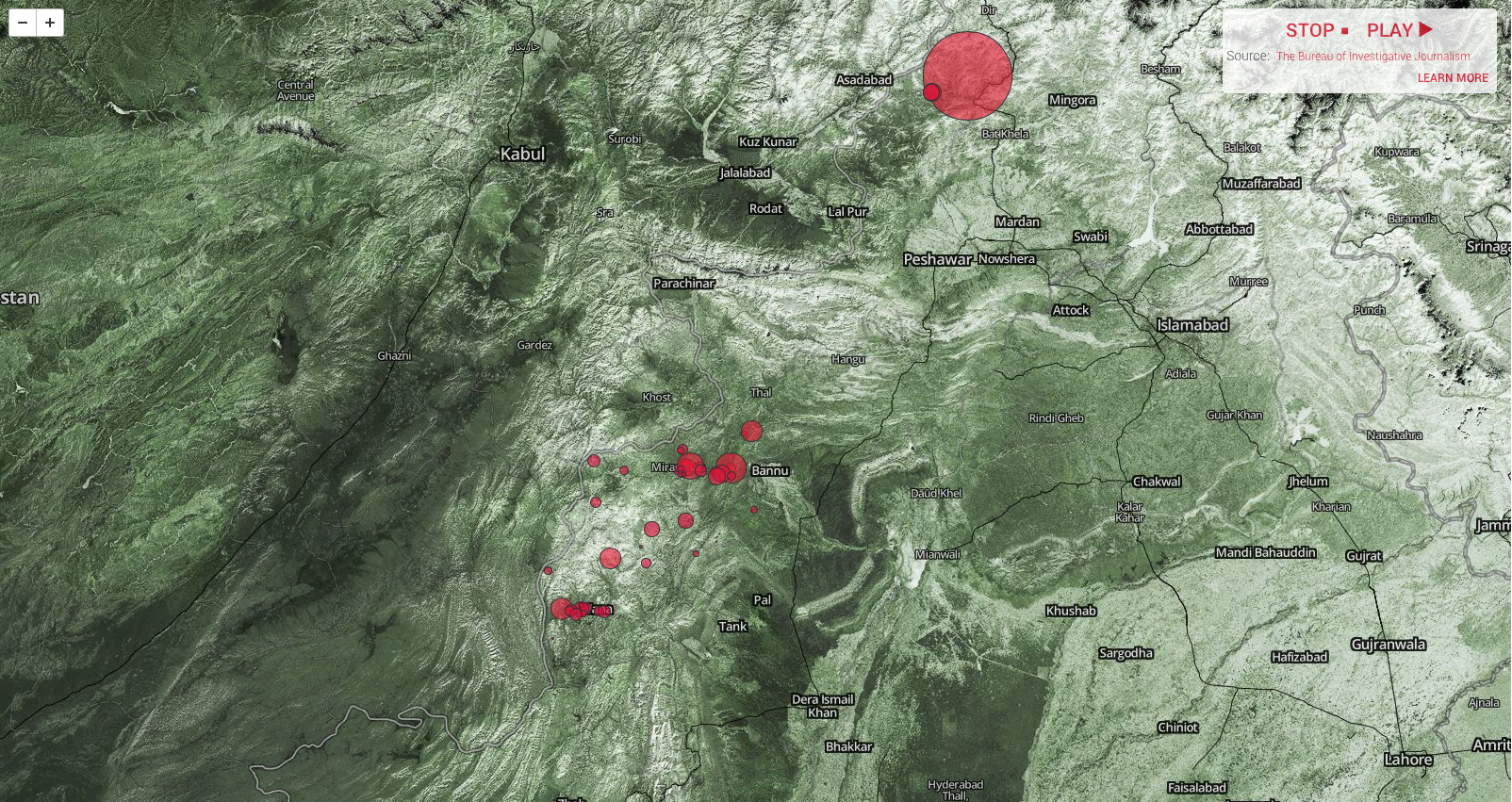
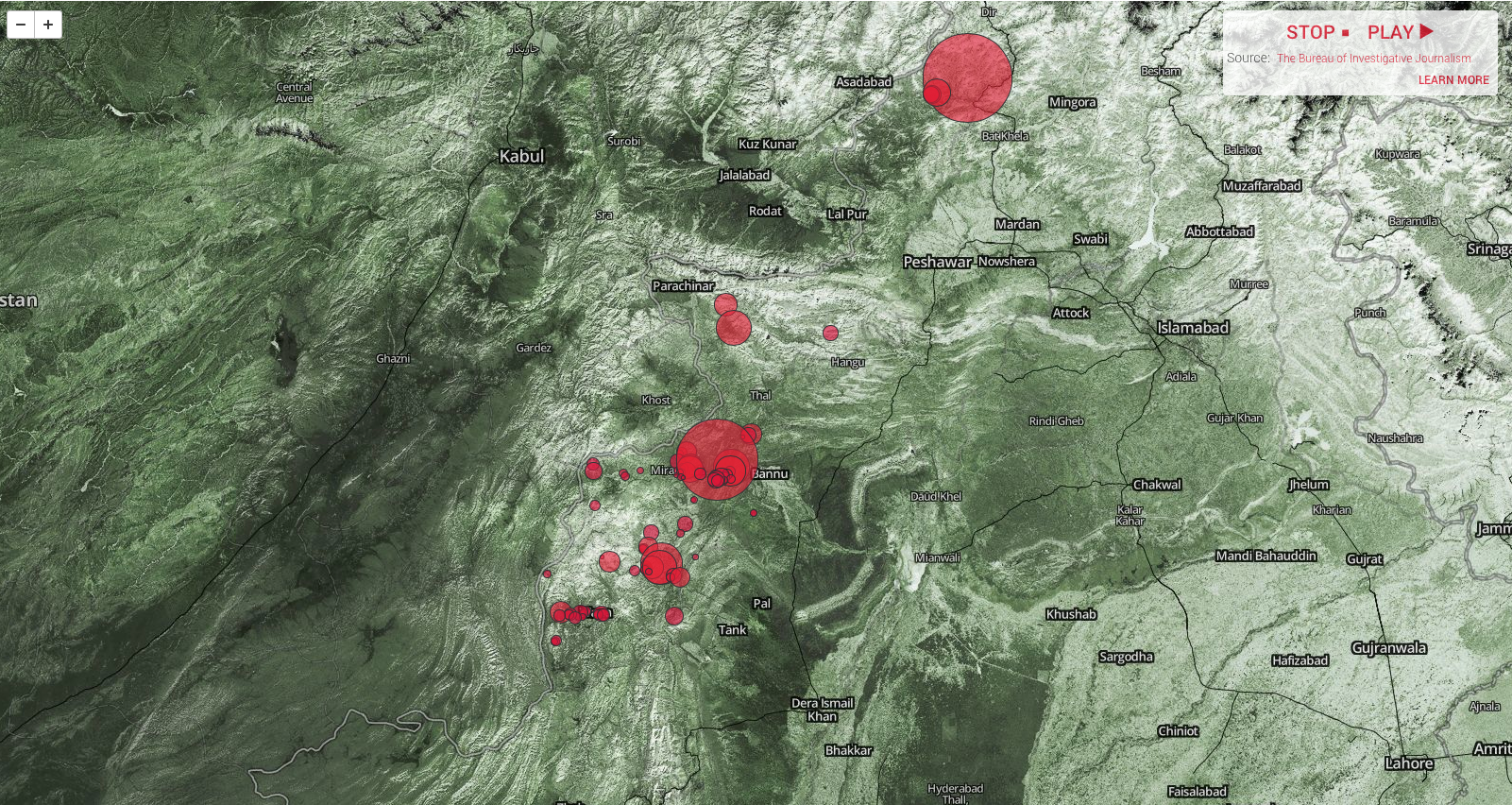
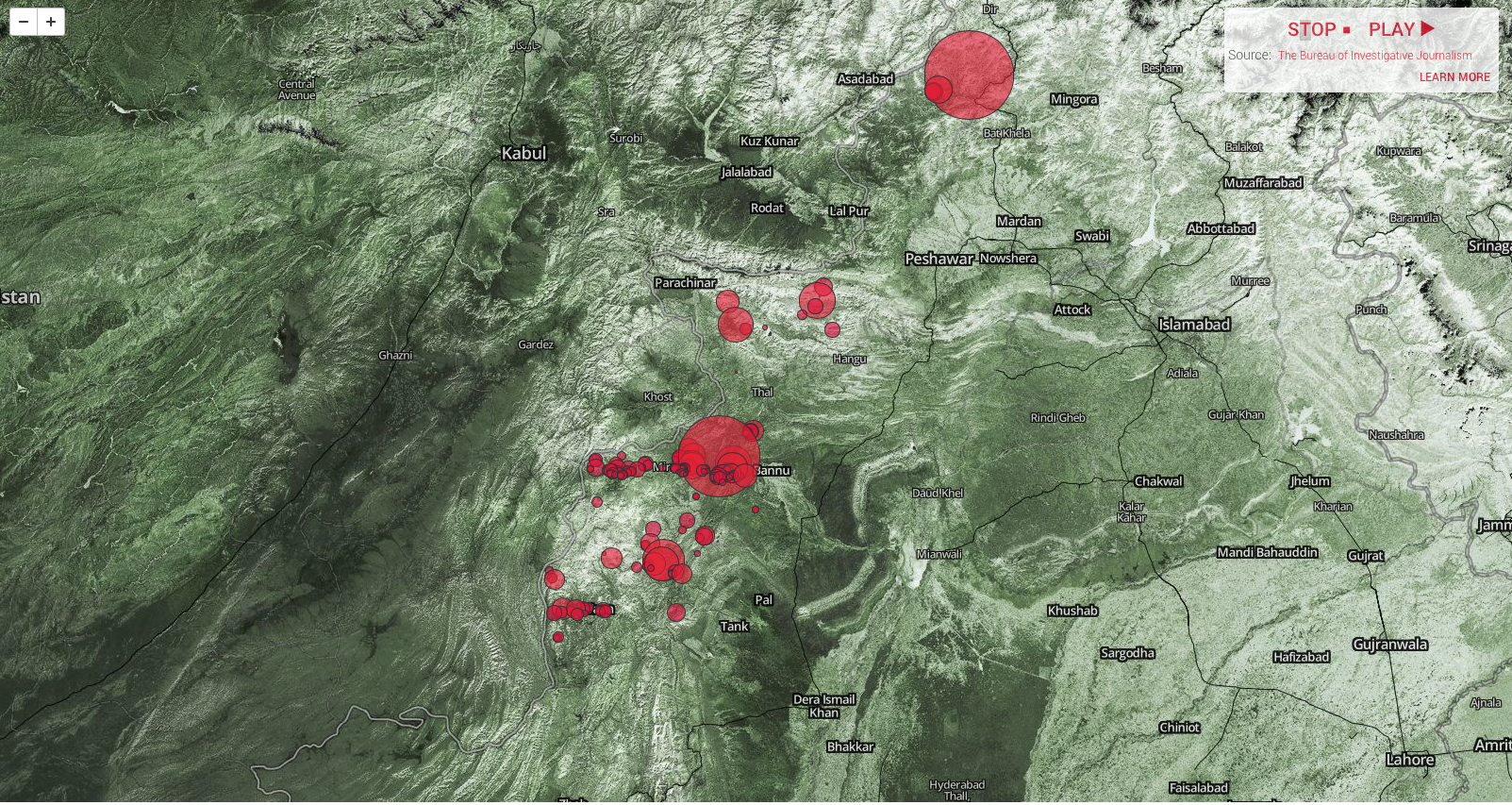
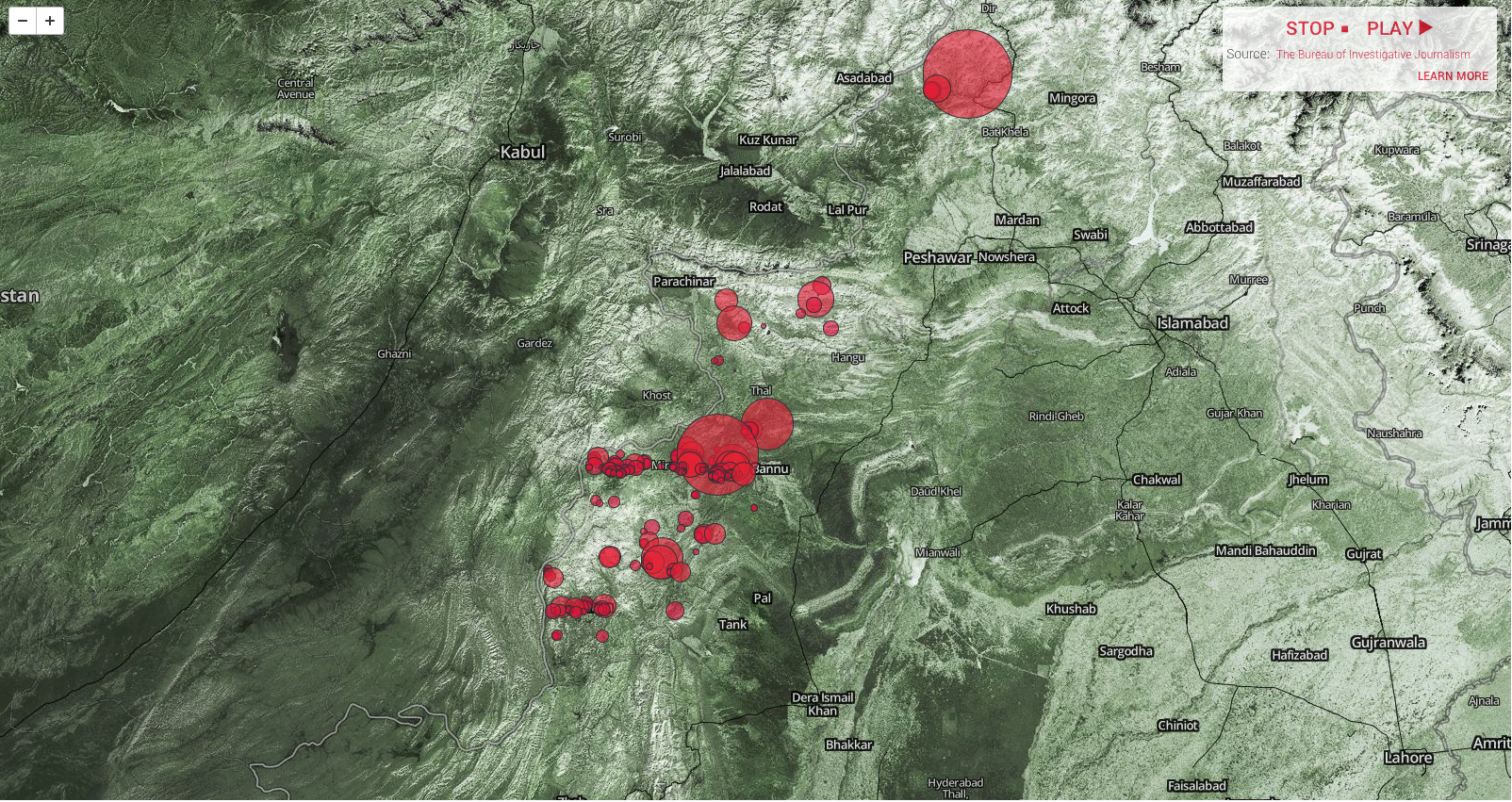
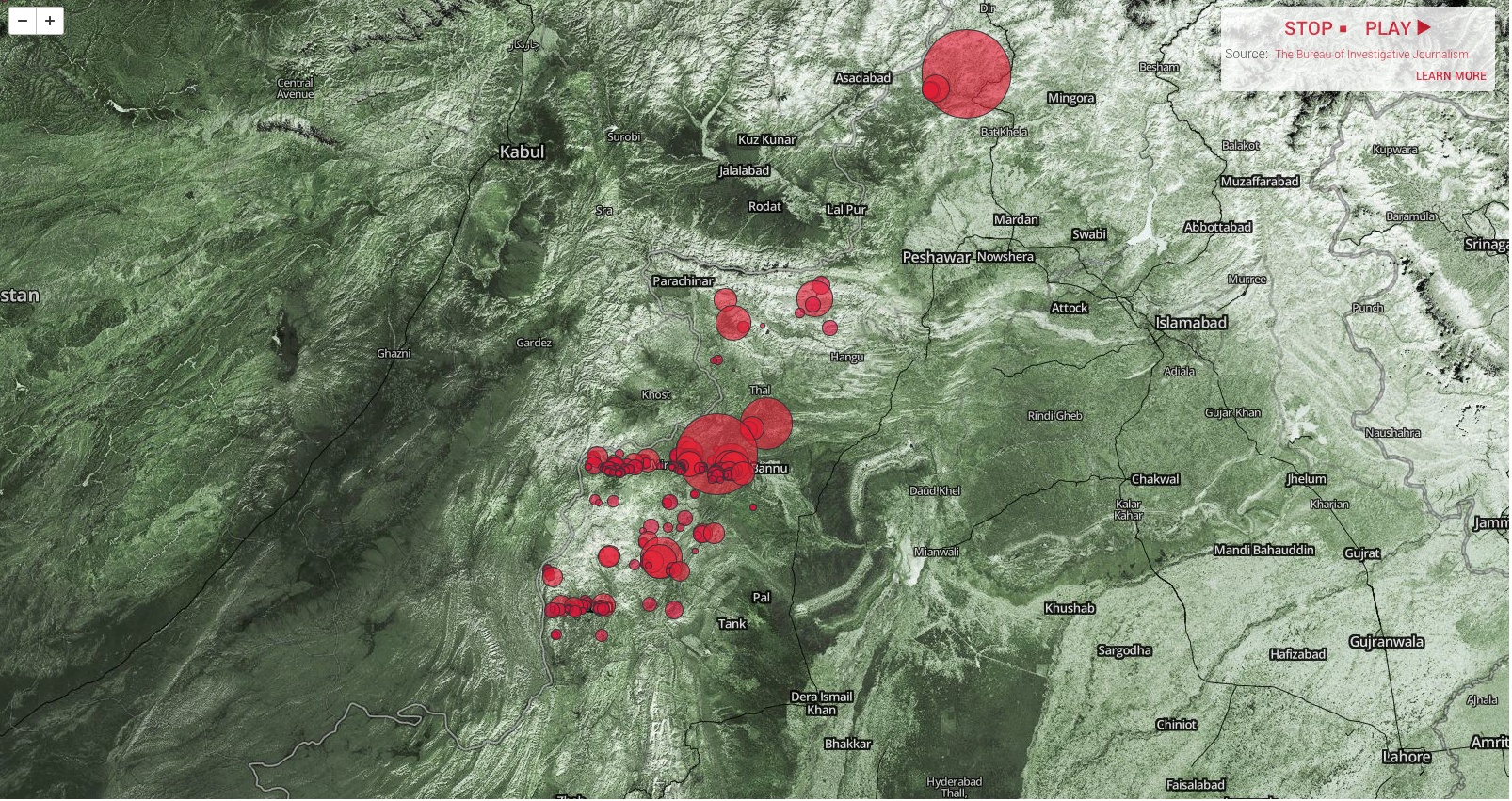
Following up my post on the air campaigns waged by the United States and by Pakistan inside the Federally Administered Tribal Territories and the North-West Frontier Province (now Khyber Pakhtunkhwa), here are some screenshots from Chris Herwig‘s remarkable cartographic animation of casualties from US drone strikes from 2004 through to the present (data from the Bureau of Investigative Journalism):
Casualties from US drone strikes to end December 2007
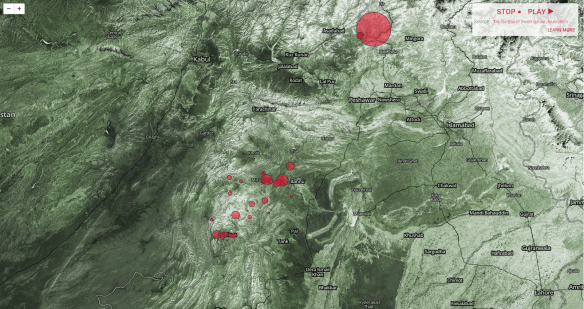
Casualties from US drone strikes to end December 2007

Casualties from US drone strikes to end December 2008
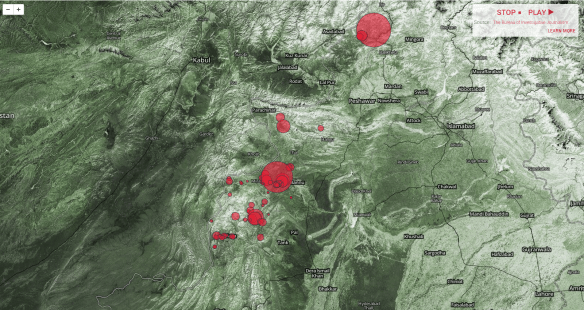
Casualties from US drone strikes to end December 2008

Casualties from US drone strikes to end December 2009
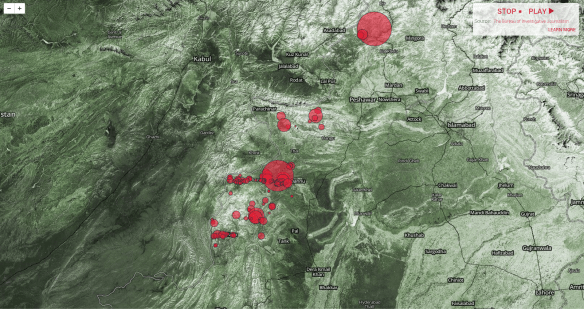
Casualties from US drone strikes to end December 2009

Casualties from US drone strikes to end December 2010
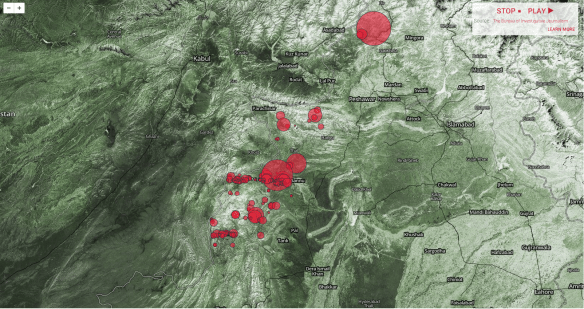
Casualties from US drone strikes to end December 2010

Casualties from US drone strikes to end December 2011
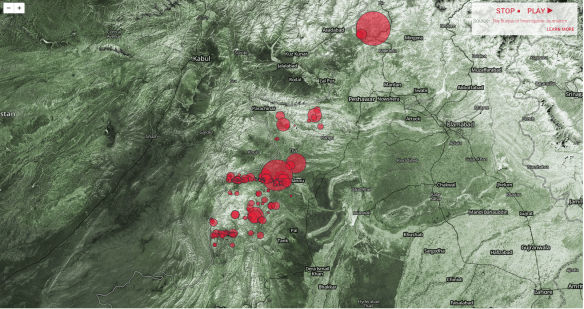
Casualties from US drone strikes to end December 2011

Casualties from US drone strikes to end December 2012

Casualties from US drone strikes to end December 2012

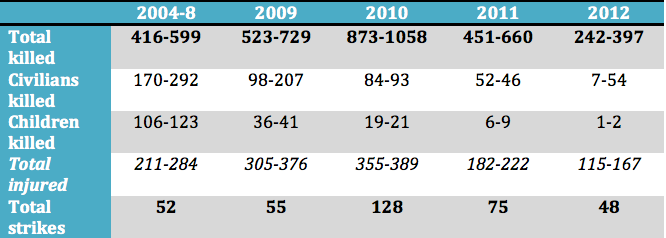
You can see the rapid escalation of strikes in 2009-2010 and their contraction in 2011-2012.  There is also a tendency for later strikes to cause fewer casualties; the Bureau suggests that this may have been the result of a deliberate decision to limit civilian casualties (the CIA was already reported to be using new, smaller missiles with a restricted blast field and minimal shrapnel by the spring of 2010, so the later change is likely to be down to a mix of better intelligence and greater circumspection) and, more recently, of a switch away from ‘signature strikes’ – the two are of course related – and John Brennan, who was one of the main boosters of the programme’s expansion, now claims that drone strikes are a weapon ‘of last resort’.  Maybe; most sources agree that even as the numbers of deaths dwindled, so too did their tactical significance.  By February 2011 it was clear that fewer and fewer were so-called ‘high-value targets’ and more and more were simply foot-soldiers.

Here are the Bureau’s raw figures:
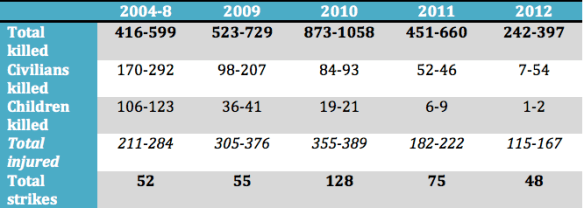
Drone strikes in Pakistan (BoJ)

You can find an interactive animation of the Bureau’s tabulations from Pitch Interactive here (thanks to Steve Legg for the tip); the screenshot below doesn’t do justice to the political-aesthetic effect of seeing this in full motion (or of clicking on each strike for the details):
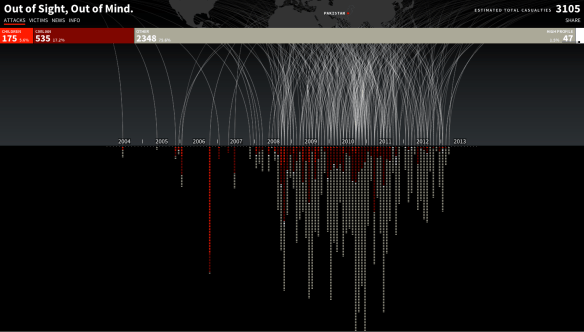
Drone strikes in Pakistan PITCH INTERACTIVE

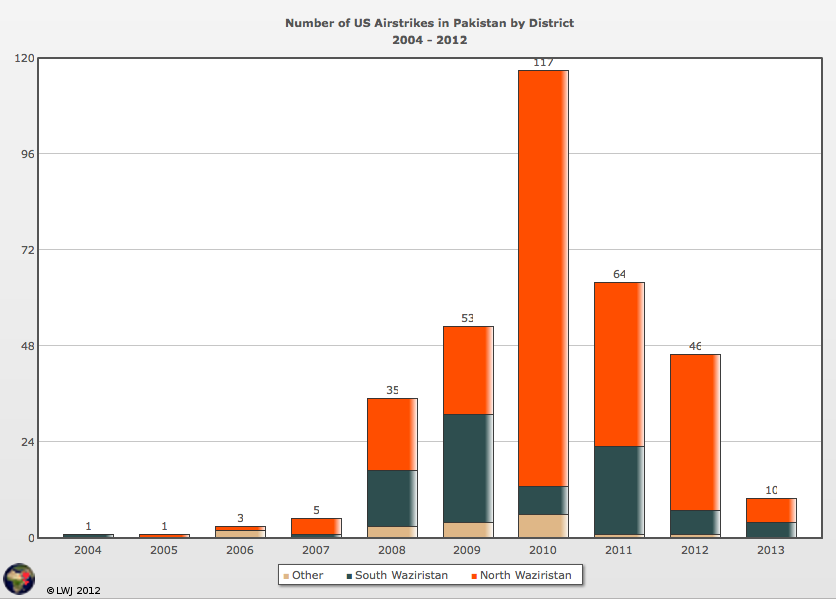
The maps also show that the strikes have been concentrated on North Waziristan, increasingly so since 2010, the locus of the Haqqani Network (which is a longstanding ally of Pakistan’s Inter Services Intelligence), with a secondary concentration on South Waziristan (a key locus of Tehrik-i-Taliban).  Here’s a tabulation from the Long War Journal, and although the strike numbers are marginally different from the Bureau’s the geographical concentration is clear:
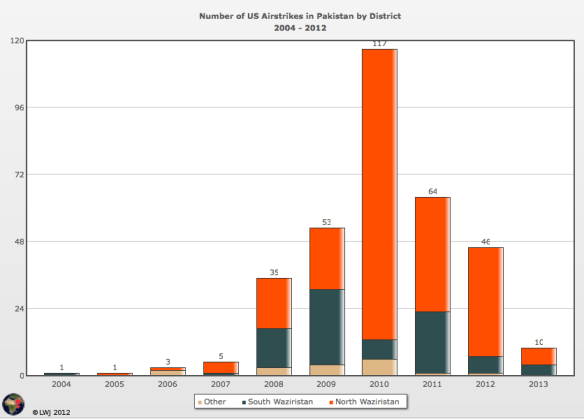
US air strikes in FATA by district

What the maps can’t convey is the intricate, inconstant gavotte between Pakistan’s various military campaigns and US air strikes in the borderlands since 2004.  In the wake of 9/11 and the US-led invasion of Afghanistan, and in response to increasing pressure from Washington, the Pakistan Army launched a number of offensives against militants in the Federally Administered Tribal Areas (FATA).  In April 2004, after fierce fighting in the mountains of South Waziristan, Islamabad concluded a peace accord with Nek Muhammad, a key militant leader in the agency.  But he was killed just two months later, the first casualty of a US drone strike in Pakistan, and the agreement immediately collapsed.   In 2005 similar, fragile agreements were negotiated with Baitullah Mehsud, Nek’s successor, and other militant leaders, but these were soon broken.  Accords were also signed in North Waziristan in 2006 and 2007 but these too were short-lived.  In 2008 a peace accord was signed with the Tehrik-i-Taliban but heavy fighting continued, with major ground and air operations in the agencies to the north of the Khyber Pass.  In 2009 Pakistan’s military campaign became even more aggressive. Much of its effort was focused on the northern districts, especially around the Swat Valley, but attention then switched back to South Waziristan.  During the summer the Pakistan Air Force carried out regular air strikes in the region; in August 2009 Baitullah Mehsud was killed in a US drone strike.  In October 30,000 ground troops entered the region, and US drone strikes in South Waziristan immediately juddered to a (temporary) halt.  These operations drove large numbers of militants into Orakzai, which in recent years has been a major target of air strikes by the Pakistan Air Force.

The previous paragraph is little more than a caricature of a highly complex and evolving battlespace, but the gavotte I’ve described has been artfully – if intermittently – choreographed by the US and by Pakistan in fraught concert: so much so that Joshua Foust writes of the ‘Islamabad drone dance’.

This may surprise some readers; earlier this month Ben Emmerson QC, the UN Special Rapporteur on Counterterrorism and Human Rights, concluded a three-day visit to Pakistan by reaffirming what he described as ‘the position of the government of Pakistan’ that drone strikes in the FATA ‘are a violation of Pakistan’s sovereignty and territorial integrity.’  Emmerson met with officials from the Ministry of Foreign Affairs, the Ministry of Defence and the Secretariat of the FATA – but not, significantly, with anyone from the military or the ISI – who told him that ‘reports of continuing tacit consent by Pakistan to the use of drones on its territory by any other State are false’ and that ‘a thorough search of Government records had revealed no indication of such consent having been given.’ Certainly, the government has repeatedly protested the strikes in public, and the National Assembly passed resolutions in May 2011 and April 2012 condemning them.  But Foust insists that Emmerson has been an unwitting participant in the dance.

We know, from the Wikileaks cache of diplomatic cables from the US Embassy in Islamabad, that in August 2008 Prime Minister Yousaf Raza Gillani told the Ambassador that he approved of the drone strikes as part of ongoing offensives in the FATA – ‘I don’t care if they do it as long as they get the right people’ – and that ‘We’ll protest it in the National Assembly and then ignore it.’  But this was more than ‘tacit consent’.  Foust reminds us that, until comparatively recently, US drones were being launched or supported from at least six different air bases inside Pakistan, shown below, including Islamabad, Jacobabad, Peshawar, Quetta and Tarbela Ghazi; the US was ordered to leave Shamsi and had its lease terminated in December 2011.
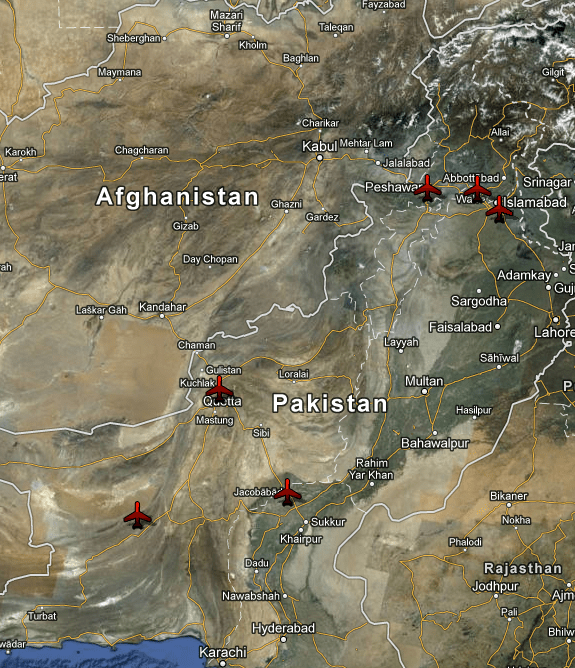
US bases inside Pakistan

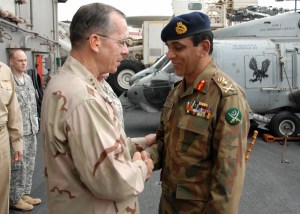
Admiral Mullen greets General Kayani, August 2008But there’s more. Pakistan had agreed that the focus of the US strikes would be North and South Waziristan.  Earlier that same year, March 2008, the Chairman of the Joint Chiefs of Staff Admiral Mullen asked General Kayani, Pakistan’s Chief of Army Staff,  for help in approving ‘a third Restricted Operating Zone for US aircraft over the FATA’, and writing in the Washington Post in November 2010 Greg Miller confirmed that these ‘flight boxes’ were confined to North and South Waziristan (although the US had unsuccessfully pressed for permission to extend the flights over Quetta, outside the FATA).  The geometry of those boxes is not known, though it would not be difficult to superimpose two likely rectangles over the previous map sequence. Operational details are, not surprisingly, far from clear.  According to a report in the Wall Street Journal on 26 September 2012, the CIA sends a fax to the ISI every month detailing strike zones and intended targets – replies apparently stopped early last year, but the US interprets the silence as ‘tacit consent’ since Pakistan immediately de-conflicts the air space to allow the Predators to carry out their surveillance – and a report in the New York Times earlier this month claimed that the US still provides the Pakistan military with 30 minutes notice of an imminent strike in South Waziristan (but no advance notice for strikes in North Waziristan because the Haqqani Network enjoys such close ties with the ISI that the CIA fears their targets would be warned of the attack).

The focus on the FATA follows not only from the militant groups that are based there; it also derives from the exceptional legal status of the borderlands.  Under British colonial rule, this was a buffer zone whose inhabitants were allowed a measure of nominal autonomy; colonial power was exercised indirectly through the authority vested in tribal leaders (who received subsidies from the British), and the special Frontier Crimes Regulations – in practice corrupt and draconian – were codified by Lord Curzon in 1901.  After partition and independence in 1947 Pakistan retained the 1901 Regulations, so that the President – who has direct executive control of the FATA – appoints a Political Agent for each agency who has absolute authority to adjudicate criminal and civil affairs; ordinary Acts of Parliament do not apply to the FATA unless the President expressly declares that they do. Limited reforms were introduced in August 2011, including the right to political mobilisation, but some commentators raised doubts about their implementation.  Preventive detention and collective punishment remain in force and the writ of the courts is still severely restricted.
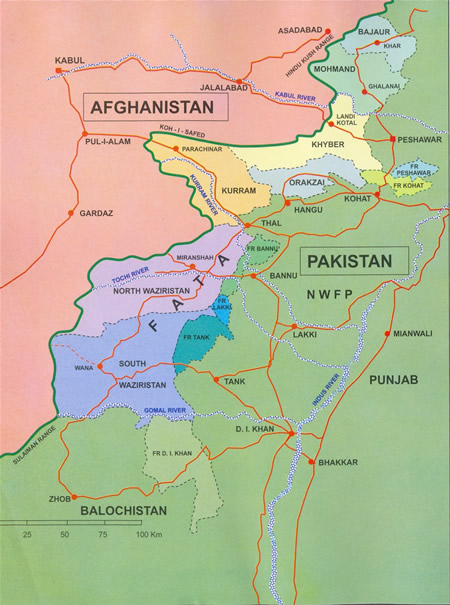
FATA and NWFP map

AMNESTY The Hands of Cruelty Abuses by Armed Forces and Taliban in Pakistan s Tribal AreasThese special measures were reinforced by the simultaneous passage of the Actions (in Aid of Civil Power) Regulations in 2011, a quid pro quo demanded by the military, which allowed the Pakistan Armed Forces to carry out ‘law enforcement duties [and] to conduct law enforcement operations’, granted them sweeping powers of pre-emptive arrest and detention without charge, and forbade the high court from intervening.  According to one local politician, these new Regulations are ‘even more dangerous’ than the Frontier Crimes Regulations: ‘It is a system of martial law over the Tribal Areas.’  A new report from Amnesty International (from which I’ve taken these accounts) borrows its title, The Hands of Cruelty, from a despairing claim made by a lawyer from Peshawar: ‘The hands of cruelty extend to the Tribal Areas, but the hands of justice cannot reach that far.’

(Given the – I think abusive – attack on Amnesty’s report by Abdullah Mansoor at Global Research as ‘malicious’ and ‘misinformation’ that virtually ignores the violence perpetrated by the Taliban and other militant groups, I should also draw readers’ (and his) attention to Amnesty’s previous report, As if Hell fell on me, which provides a detailed indictment of exactly that).

In short, the FATA constitute a space of exception in precisely the sense given to that term by Giorgio Agamben: the normal rights and protections under the law are withdrawn from a section of the population by the law.  To see what this has to do with the geography of US drone strikes we can turn to an attack on 19 November 2008 on a residential compound in Indi Khel, 22 miles outside Bannu and about two hours by road from Peshawar.  Five alleged militants were killed and four civilians injured: not a large toll compared to other strikes, and yet the public reaction across Pakistan was extraordinary.
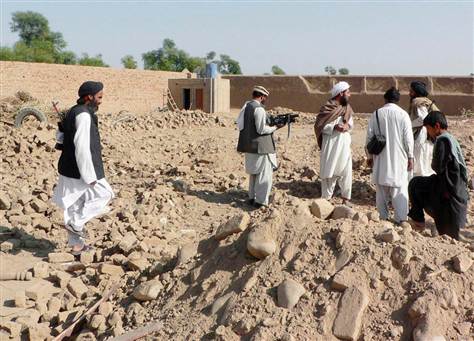
Drone strike at Indi Khel, Bannu, 19 November 2008

A diplomatic cable from US Ambassador Anne Patterson on 24 November explained the widening gap between what she called ‘private GOP [Government of Pakistan] acquiescence and public condemnation for U.S. action’:

‘According to local press, the alleged U.S. strike in Bannu on November 19 marked the first such attack in the settled areas of the Northwest Frontier Province, outside of the tribal areas. The strike drew a new round of condemnation by Prime Minister Gilani, coalition political parties, opposition leaders, and the media.

‘According to Pakistani press, the strike killed four people, including a senior Al-Qaida member, and injured five others. The first strike within “Pakistan proper” is seen as a watershed event, and the media is suggesting this could herald the spread of attacks to Peshawar or Islamabad. Even politicians who have no love lost for a dead terrorist are concerned by strikes within what is considered mainland Pakistan.’

The language is truly extraordinary, with its distinction between the FATA and ‘Pakistan proper’, even ‘mainland Pakistan’. In short: (imaginative) geography matters.  Not for nothing are the FATA known in Urdu as ilaqa ghair, which means ‘alien’ or ‘foreign’ lands.

The plight of the people in the FATA is exacerbated by the forceful imposition of a second, transnational legal regime: the right asserted by the United States to carry its fight against al Qaeda and its war against the Taliban across the border from the ‘hot’ zone in Afghanistan into militant sanctuaries in Pakistan.  This is part of a larger argument about the advanced deconstruction of the traditional, bounded battlefield – here Frédéric Megret‘s work is indispensable – and the production of a global battlespace, processes that have been accelerated by the remote operations permitted by drones.  But it remains both an assertion and an argument.  Although international law is not a deus ex machina, a neutral court of appeal above the fray, it nonetheless has a developed body of precepts that are supposed to regulate armed conflicts between states, and there are also protocols and tribunals that govern armed conflicts between governments and non-state actors within the territorial boundaries of a state (the former Yugoslavia or Ruanda, for example).  But conflicts between states and transnational non-state actors pose new and difficult questions, and perhaps even map a ‘legal void’.  Significantly, as Eyal Benvenisti points out in the Duke Journal of International and Comparative Law,

Concurrently with the successful efforts to impose restraints on intra-state asymmetric warfare, we have been witnessing efforts by the same powerful countries that pressed for intra-state conflict regulation to deregulate inter-state asymmetric warfare or what may be called “transnational” warfare.

I will leave a review of these debates, at once legal and political, for another day; among the most relevant recent contributions are Kenneth Anderson, ‘Targeted killing and drone warfare: how we came to debate whether there is a legal geography of war’ (2011), available here; Laurie Blank, ‘Defining the battlefield in contemporary conflict and counterterrorism: understanding the parameters of the zone of combat’, Georgia Journal of International and Comparative Law 39  (1) (2010-11), available here; Jennifer Daskal, ‘The geography of the battlefield: a framework for detention and targeting outside the “hot” conflict zone’ (2012), available here;  Noam Lubell and Nathan Derejko, ‘A global battlefield? Drones and the geographical scope of armed conflict’, Journal of International Criminal Justice 11 (1) (2013) 65-88 (abstract here).  In this twilight zone, where Washington at once admits its actions through a never-ending string of off-the-record briefings and yet denies any responsibility for their collateral outcomes, there are no inquiries into ‘mistakes’, no culpability for wrong-doing, and no compensation or restitution for the innocent victims.

Whatever you make of the rights and wrongs of all this, what matters for my present purposes is that these two legal regimes, one national and the other transnational, work in concert to expose the people of the Federally Administered Tribal Areas to military and paramilitary violence and, ultimately, death.

It’s more than a matter of law, of course (and in any case we shouldn’t confuse legality with legitimacy).  Within these exceptional spaces there has been active, tactical collaboration between the US and Pakistan.  Another diplomatic cable reported a meeting on 22 January 2008 with General Kayani, who asked US Central Command to provide ‘continuous Predator coverage of the conflict area’ in South Waziristan, but was offered only Joint Terminal Attack Controllers to direct PAF air strikes by F-16s – an offer which was refused because of a reluctance to allow US ground forces to operate inside Pakistan.  But in September and October 2009 small teams of US Special Forces were deployed to provide intelligence, surveillance and reconnaissance (ISR) support to the Pakistan Army, which included a ‘live downlink of unmanned aerial vehicle (UAV) full motion video.’ (What is interesting about all these exchanges is the degree of collaboration they reveal not only between the US and Pakistan but also between the CIA and the US military, especially Joint Special Operations Command; this is not surprising, given the hybridisation of military and paramilitary violence and the close involvement of the military in supplying, servicing and even flying the drones used in CIA-directed strikes).

There have been several reports of continuing collaboration between American and Pakistani intelligence operatives working on the ground in Pakistan, and one source – who purported to run a network of agents and ‘spotters’ in North and South Waziristan – told Reuters in January 2012 that ‘Our working relationship is a bit different from our political relationship.  It’s more productive.’  He claimed that the US and Pakistan agreed priority target lists between them, and that it took little more than two or three hours between the location of a targeted individual and the firing of missiles.  These claims are impossible to verify, but the emphasis on a working relationship rings true.

FATA flagPerhaps the most chilling of the Wikileaks cables is this (redacted) message sent from Islamabad in February 2009, reporting a discussion with a senior member of the FATA Secretariat, who enthusiastically recommended the practice of ‘double tap‘ – follow-up strikes targeting rescuers – and endorses the rationale for signature strikes against unknown, un-named targets:

9.  (S)  XXXXXXXXXXXX remains a strong advocate of U.S. strikes. In fact, he suggested to PO that the U.S. consider follow-on attacks immediately after an initial strike.  He explained that after a strike, the terrorists seal off the area to collect the bodies; in the first 10-24 hours after an attack, the only people in the area are terrorists, so “you should hit them again-there are no innocents there at that time.”  His sources report that the reported September 29 strike in South Waziristan had been particularly successful; “you will see that you hit more than has been reported in the press both in terms of quantity and quality.”  XXXXXXXXXXXX also drew a diagram essentially laying out the rationale for signature strikes…

Here you can see two perspectives on administrative killing, one from Pakistan and the other from the United States, converging onto a single target.

The cables from which I’ve quoted are all four or five years old, but this reflects the shutters coming down after the subsequent assault on Wikileaks and the arrest of  Bradley Manning – the reports from seasoned investigative journalists are much more recent.  I suppose you might conclude that none of them contradicts that artful word that does so much silent work in the official statement repeated by Emmerson, in which Pakistan denies reports of continuing tacit consent.  But given what I’ve shown about the deadly dance over those five years, do you really think the music has stopped?