Spinning in the rain

Listen 0.24 in:

Here, at the start of his tour of SE Asia, President Obama, winner of the Nobel Peace Prize, defended Israel’s attack on Gaza – the always asymmetric ‘right to self-defence’ to which Craig Jones has drawn attention – by declaring that ‘There’s no country on earth that would tolerate missiles raining down on citizens from outside its borders.’  Really.

Epicentre of the drone war

In the middle of the (understandable) concern at US drone attacks in Pakistan, Yemen and Somalia, I’ve been stubbornly insisting for months now that we should not overlook the significance of Afghanistan.  That’s precisely why I wrote ‘From a view to a kill’ (DOWNLOADS tab).  Now Noah Shachtman at Danger Room reports:

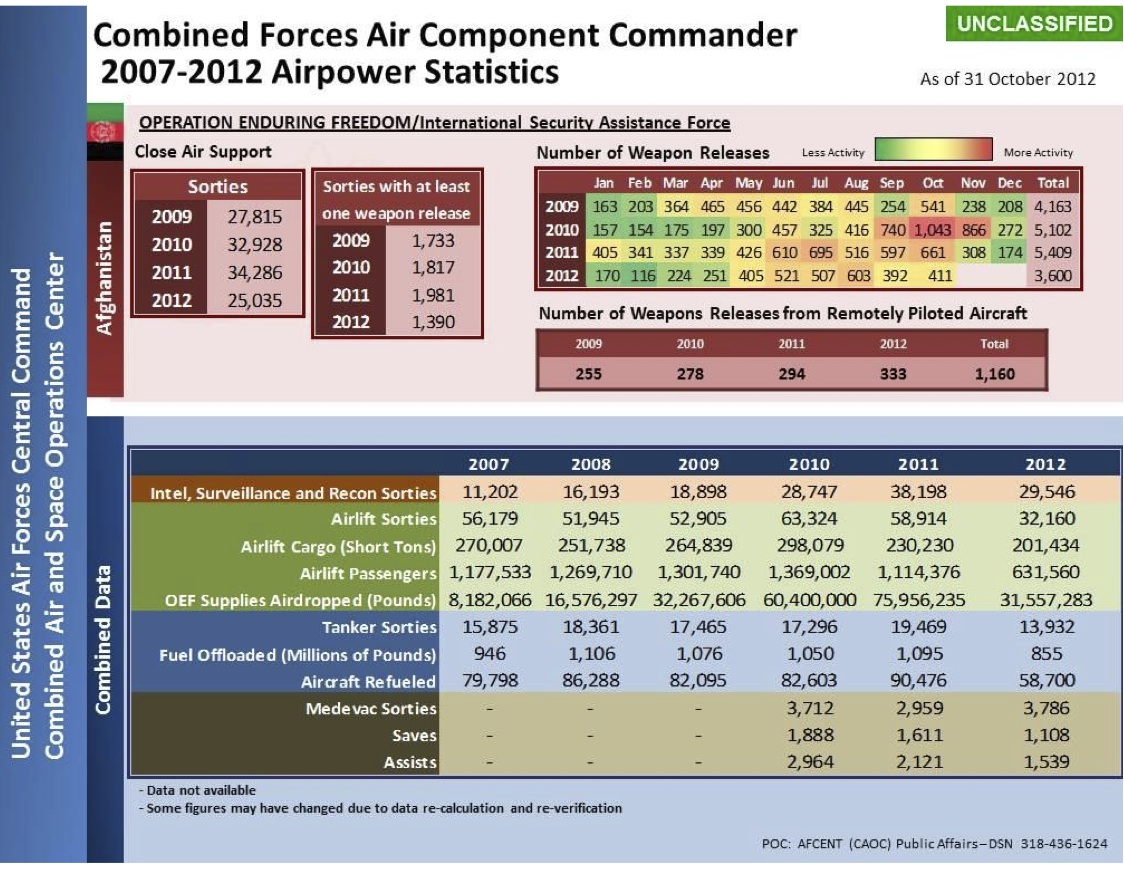
The American military has launched 333 drone strikes this year in Afghanistan. That’s not only the highest total ever, according to U.S. Air Force statistics. It’s essentially the same number of robotic attacks in Pakistan since the CIA-led campaign there began nearly eight years ago.

You can access monthly airpower summaries here.  These show that these strikes are intensifying even as ground operations are being scaled back:

The U.S. military is now launching more drone strikes — an average of 33 per month — than at any moment in the 11 years of the Afghan conflict. It’s a major escalation from just last year, when the monthly average was 24.5. And it’s happening while the rest of the American war effort is winding down.

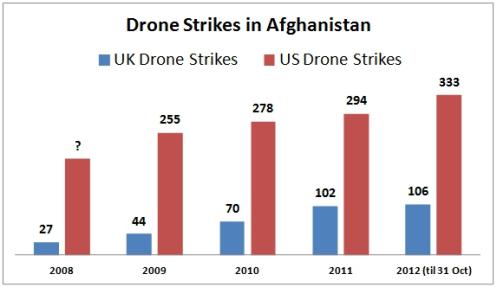
The UK is markedly reluctant to provide detailed information on its remote operations – and Drone Wars UK has raised serious questions about the accuracy of some of its returns (and much more besides) – but  Global Research gives this breakdown between US and UK strikes:

Shachtman points out that the protocols governing USAF operations in Afghanistan are different from those followed for CIA-directed strikes elsewhere,and so they are.  He’s right to emphasise the importance of these remote platforms for providing close air support to ‘troops in contact’, often as part of a networked attack.  But what he doesn’t note is the increased propensity for civilian casualties in these situations – literally in the heat of the moment – nor the fact that the US military has its own disposition matrix for killing targets on its own hit list.  As I noted here,  these are crucial considerations.

Drone’s eye view

I expect many readers will remember  that Apple rejected NYU grad student Josh Begley‘s Drones+ app last August.  It did so three times and for a multiplicity of confusing – and frankly shifty – reasons.  Apparently it was neither ‘useful’ nor ‘entertaining’; then it presented ‘excessively objectionable’ content (something to take up with the Pentagon and the CIA, surely?). As Danger Room explained, the app was bare bones stuff:

When a drone strike occurs, Drones+ catalogs it, and presents a map of the area where the strike took place, marked by a pushpin. You can click through to media reports of a given strike that the Bureau of Investigative Reporting compiles, as well as some basic facts about whom the media thinks the strike targeted.

All the more ironic, really, since the US military makes extensive use of smart phone technology – including its own (restricted) apps for the iPhone.  More on that here and here and here.

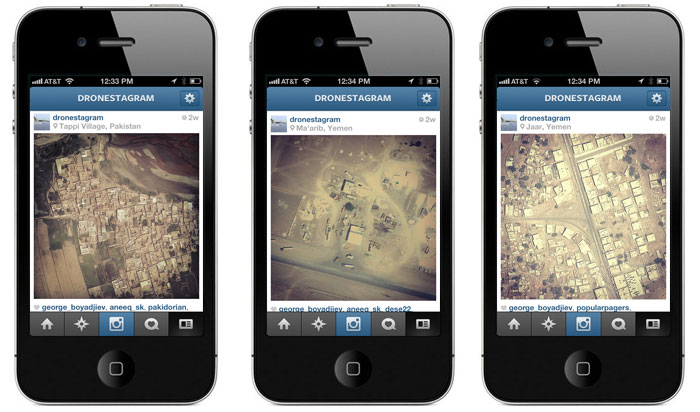
But for the past several weeks James Bridle – of New Aesthetic fame – has been posting satellite images of the distant places where drone strikes are recorded by the Bureau of Investigative Journalism to Instagram: and, as the image below shows, you can view these on your iPhone…

There are, of course, difficulties in pinpointing the locations of drone strikes– and James is evidently very well aware of them – but on his Dronestagram website he explains his desire to convert abstract targets into physical places in terms that resonate beautifully with the arguments I’m trying to develop in Deadly embrace:

The political and practical possibilities of drone strikes are the consequence of invisible, distancing technologies, and a technologically-disengaged media and society. Foreign wars and foreign bodies have always counted for less, but the technology that was supposed to bring us closer together is used to obscure and obfuscate. We use military technologies like GPS and Kinect for work and play; they continue to be used militarily to maim and kill, ever further away and ever less visibly.

Yet at the same time we are attempting to build a 1:1 map of the world through satellite and surveillance technologies, that does allow us to see these landscapes, should we choose to go there. These technologies are not just for “organising” information, they are also for revealing it, for telling us something new about the world around us, rendering it more clearly.

History, like space, is coproduced by us and our technologies: those technologies include satellite mapping, social photo sharing from handheld devices, and fleets of flying death robots. We should engage with them at every level. These are just images of foreign landscapes, still; yet we have got better at immediacy and intimacy online: perhaps we can be better at empathy too.

You can follow the images here and in much more detail via tumblr here.  More information here.

This comes at an opportune moment since I’ve been talking this week with Susan Schuppli and Eyal Weizman at Forensic Architecture about a collaborative, interactive project to bring together all the available data on drone strikes.

The real McCoy and the politics of verticality

Oliver‘s favourite historian, Alfred McCoy, recently co-edited a fine new collection, Endless Empire: Spain’s retreat, Europe’s eclipse, America’s decline (University of Wisconsin Press, 2012), and there’s an excellent taster of McCoy’s argument at both Tomdispatch and Guernica.  The title – ‘Beyond bayonets and battleships’ – is not only a rejoinder to Romney’s complaint during the last Presidential debate; it’s also a reply to Obama and his predecessors.

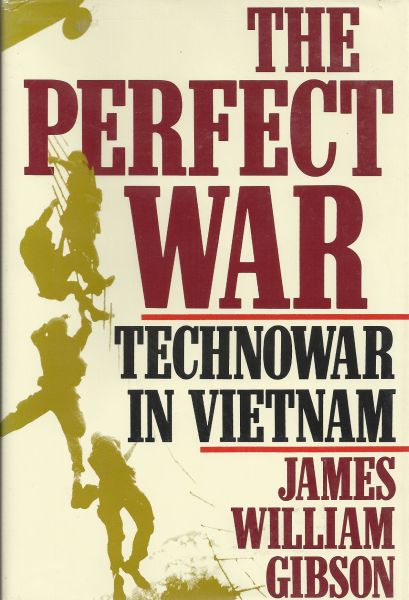
McCoy traces the long historical curve of what, in another age, was called America’s techno-war: the phrase comes from James Gibson’s stunning The perfect war: technowar in Vietnam (Monthly Review Press, 1986; Atlantic, 2000), and like Gibson McCoy insists on the importance of the wars in Indochina for the matrix within which late modern war is now conducted.

Many of his themes resonate with my own work – the key elements for today’s remote operations were assembled over the skies of Vietnam, Laos and Cambodia, and these have been radically extended by biometric identification, electronic surveillance and cyberwarfare – and McCoy also peers into a not-do-distant but desperately dark future in which the contemporary politics of verticality and what Stuart Elden describes as projects to ‘secure the volume‘ will be dwarfed by a triple-tier canopy (‘Just how high is national sovereignty? … Some puckish Pentagon lawyer might reply: only as high as you can enforce it’):

It’s 2025 and an American “triple canopy” of advanced surveillance and armed drones fills the heavens from the lower- to the exo-atmosphere.  A wonder of the modern age, it can deliver its weaponry anywhere on the planet with staggering speed, knock out an enemy’s satellite communications system, or follow individuals biometrically for great distances.  Along with the country’s advanced cyberwar capacity, it’s also the most sophisticated militarized information system ever created and an insurance policy for U.S. global dominion deep into the twenty-first century.  It’s the future as the Pentagon imagines it; it’s under development; and Americans know nothing about it.

I’m drafting the introduction to The everywhere war now, and this is a superb essay for me to engage – if you read one thing this week, make it this.

Targeted killings and signature strikes

And so what Tom Junod calls the lethal presidency continues…  though it surely would have done whoever occupied the White House for the next four years.

Much of the discussion of US targeted killing has centred on both its status under international law and on the quasi-judicial armature through which various government agencies, including the Pentagon and the Central Intelligence Agency, draw up and adjudicate their kill lists of named individuals who are liable to a ‘personality strike’. But the majority of US targeted killings turn out to be ‘signature strikes’.

Signature strikes were initiated under President George W. Bush, who authorised more permissive rules of engagement in January/February 2008.  According to Eric Schmitt and David Sanger, writing in the New York Times,

[A] series of meetings among President Bush’s national security advisers resulted in a significant relaxation of the rules under which American forces could aim attacks at suspected Qaeda and Taliban fighters in the tribal areas near Pakistan’s border with Afghanistan.

The change, described by senior American and Pakistani officials who would not speak for attribution because of the classified nature of the program, allows American military commanders greater leeway to choose from what one official who took part in the debate called “a Chinese menu” of strike options.

Instead of having to confirm the identity of a suspected militant leader before attacking, this shift allowed American operators to strike convoys of vehicles that bear the characteristics of Qaeda or Taliban leaders on the run, for instance, so long as the risk of civilian casualties is judged to be low.

Under Obama signature strikes increased in frequency, and Micah Zenko notes that the President’s initial reluctance soon yielded to endorsement:

According to Daniel Klaidman, when Obama was first made aware of signature strikes, the CIA’s deputy director clarified: “Mr. President, we can see that there are a lot of military-age males down there, men associated with terrorist activity, but we don’t necessarily know who they are.” Obama reacted sharply, “That’s not good enough for me.” According to one adviser describing the president’s unease: “‘He would squirm … he didn’t like the idea of kill ‘em and sort it out later.’” Like other controversial counterterrorism policies inherited by Obama, it did end up “good enough,” since he allowed the practice to stand in Pakistan, and in April authorized the CIA and JSOC to conduct signature strikes in Yemen as well.

Today signature strikes are frequently triggered not on the fly – a sudden response to an imminent threat – but by a sustained ‘pattern of life’ that arouses the suspicion of distant observers and operators. This depends on persistent surveillance – on full motion video feeds and a suite of algorithms that decompose individual traces and networks – some of which involve a weaponized version of Hägerstrand’s time-geography: see, for example, GeoTime 5 here.

We know even less about the legal authority for these attacks, but Kevin Jon Heller has a new essay on their legality up at the wonderful open access resource that is SSRN [Social Science Research Network]  here, and there are preliminary responses at Opinio Juris here.  This is the abstract:

The vast majority of drone attacks conducted by the U.S. have been signature strikes – strikes that target “groups of men who bear certain signatures, or defining characteristics associated with terrorist activity, but whose identities aren’t known.” In 2010, for example, Reuters reported that of the 500 “militants” killed by drones between 2008 and 2010, only 8% were the kind “top-tier militant targets” or “mid-to-high-level organizers” whose identities could have been known prior to being killed. Similarly, in 2011, a U.S. official revealed that the U.S. had killed “twice as many ‘wanted terrorists’ in signature strikes than in personality strikes.” 

Despite the U.S.’s intense reliance on signature strikes, scholars have paid almost no attention to their legality under international law. This article attempts to fill that lacuna. Section I explains why a signature strike must be justified under either international humanitarian law (IHL) or international human rights law (IHRL) even if the strike was a legitimate act of self-defence under Article 51 of the UN Charter. Section II explores the legality of signature strikes under IHL. It concludes that although some signature strikes clearly comply with the principle of distinction, others either violate that principle as a matter of law or require evidence concerning the target that the U.S. is unlikely to have prior to the attack. Section III then provides a similar analysis for IHRL, concluding that most of the signature strikes permitted by IHL – though certainly not all – would violate IHRL’s insistence that individuals cannot be arbitrarily deprived of their right to life.

The most interesting section (for me) is Kevin’s discussion of ‘evidentiary adequacy’.  Most of the examples he discusses appear to be derived from CIA-directed strikes in Pakistan – drawing on the Stanford/NYU report on Living under drones – and, for that very reason, are remarkably limited. But we know much more about problems of evidence – and inference – from strikes conducted by the US military in Afghanistan…

The first point to make, then, is that targeted killings are also carried out by the US military – indeed, the US Air Force has advertised its ability to put ‘warheads on foreheads‘ – and a strategic research report written by Colonel James Garrett for the US Army provides a rare insight into the process followed by the military in operationalising its Joint Prioritized Effects List (JPEL). Wikileaks has provided further information about JSOC’s Task Force 373 – see, for example, here and here – but the focus of Garrett’s 2008 report is the application of the legal principles of necessity and proportionality (two vital principles in the calculus of International Humanitarian Law (IHL) discussed by Kevin) in counterinsurgency operations.  Garrett describes ‘time-sensitive targeting procedures’ used by the Joint Targeting Working Group to order air strikes on ‘high-value’ Taliban and al-Qaeda leaders in Afghanistan, summarised in this diagram:
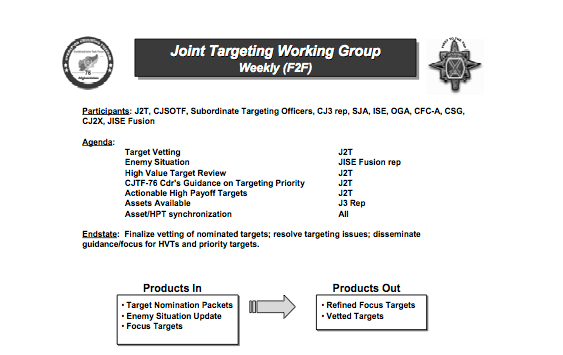
Notice that the members included representatives from both Combined Joint Special Operations Task Force (CJSOTF) and the CIA (‘Other Government Agency’, OGA).  This matters because Joint Special Operations Command (JSOC) – once commanded by General Stanley McChrystal – and the CIA, even though they have their own ‘kill lists’, often co-operate in targeted killings and are both involved in strikes outside Afghanistan.  Indeed, there have been persistent reports that many of the drone strikes in Pakistan attributed to the CIA – even if directed by the agency – have been carried out by JSOC.  Here is Jeremy Scahill citing a ‘military intelligence source’:

“Some of these strikes are attributed to OGA [Other Government Agency, intelligence parlance for the CIA], but in reality it’s JSOC and their parallel program of UAVs [unmanned aerial vehicles] because they also have access to UAVs. So when you see some of these hits, especially the ones with high civilian casualties, those are almost always JSOC strikes.”

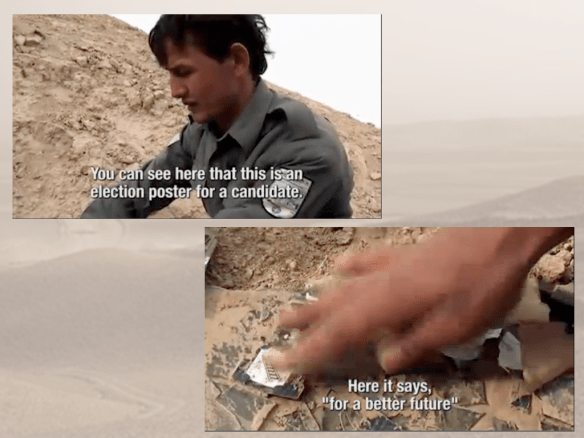
Garrett’s discussion clearly refers to ‘personality strikes’, but – second – the distinction between the evidential/inferential apparatus used for a ‘personality strike’ and for a ‘signature strike’ is by no means clear-cut.  Kate Clark‘s report for the Afghan Analysts Network describes the attempted killing of Muhammad Amin, the Taliban deputy shadow governor of Takhar province.  On 2 September 2010 ISAF announced that a ‘precision air strike’ earlier that morning had killed him and ‘nine other militants’.  The target had been under persistent surveillance from remote platforms – what Petraeus later called ‘days and days of the unblinking eye’ – until two strike aircraft repeatedly bombed the convoy in which he was travelling.  Two attack helicopters were then ‘authorized to re-engage’ the survivors. The victim was not the designated target, however, but Zabet Amanullah, the election agent for a parliamentary candidate; nine other campaign workers died with him. Clark’s painstaking analysis clearly shows that one man had been mistaken for the other, which she attributed to an over-reliance on ‘technical data’ – on remote signatures.  Special Forces had concentrated on tracking cell phone usage and constructing social networks. ‘We were not tracking the names,’ she was told, ‘we were targeting the telephones.’

This is unlikely to be an isolated incident.  Here for example is Gareth Porter:

‘…the link analysis methodology employed by intelligence analysis is incapable of qualitative distinctions among relationships depicted on their maps of links among “nodes.” It operates exclusively on quantitative data – in this case, the number of phone calls to or visits made to an existing JPEL target or to other numbers in touch with that target. The inevitable result is that more numbers of phones held by civilian noncombatants show up on the charts of insurgent networks. If the phone records show multiple links to numbers already on the “kill/capture” list, the individual is likely to be added to the list.’

In the Takhar case, despite informed protests to the contrary, ISAF insisted that they had killed their intended target (added emphases are mine):

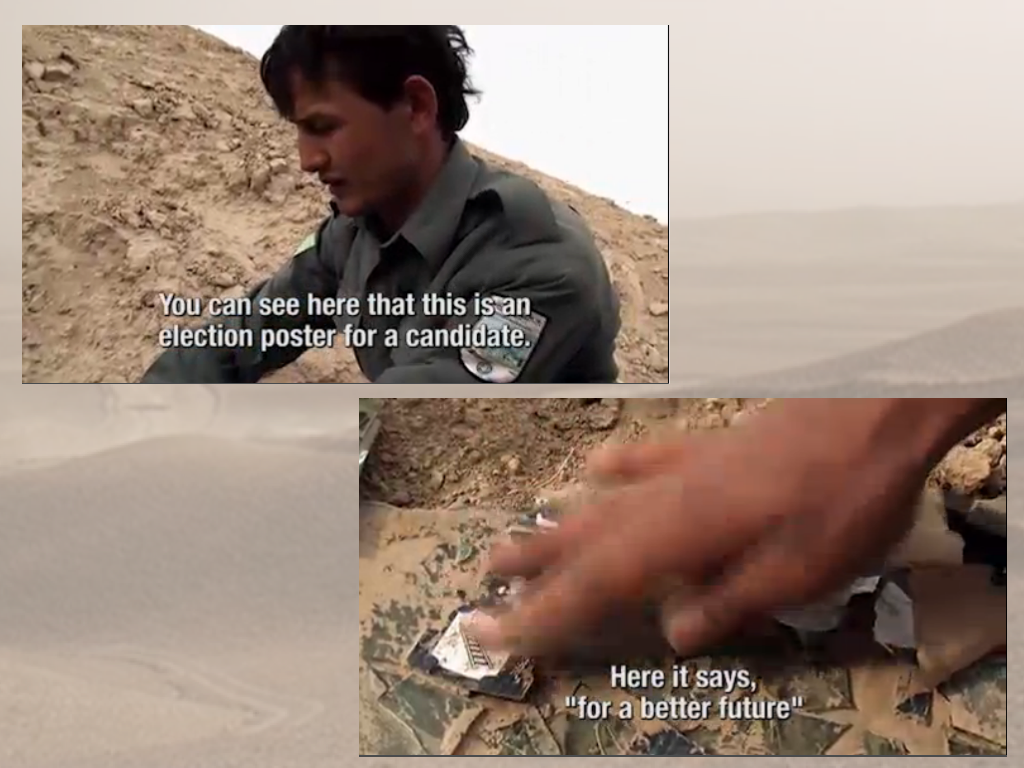
PBS/Frontline screened a Stephen Grey/Dan Edge documentary on the Takhar incident last year, Kill/Capture, from which the images below are taken (reworked for my presentation on Lines of descent) and which, like Kate Clark’s remarkable report on which it drew, gave the lie to the ISAF statement; the film included an Afghan Police video of the aftermath of the attack: more here, video here, and transcript here.
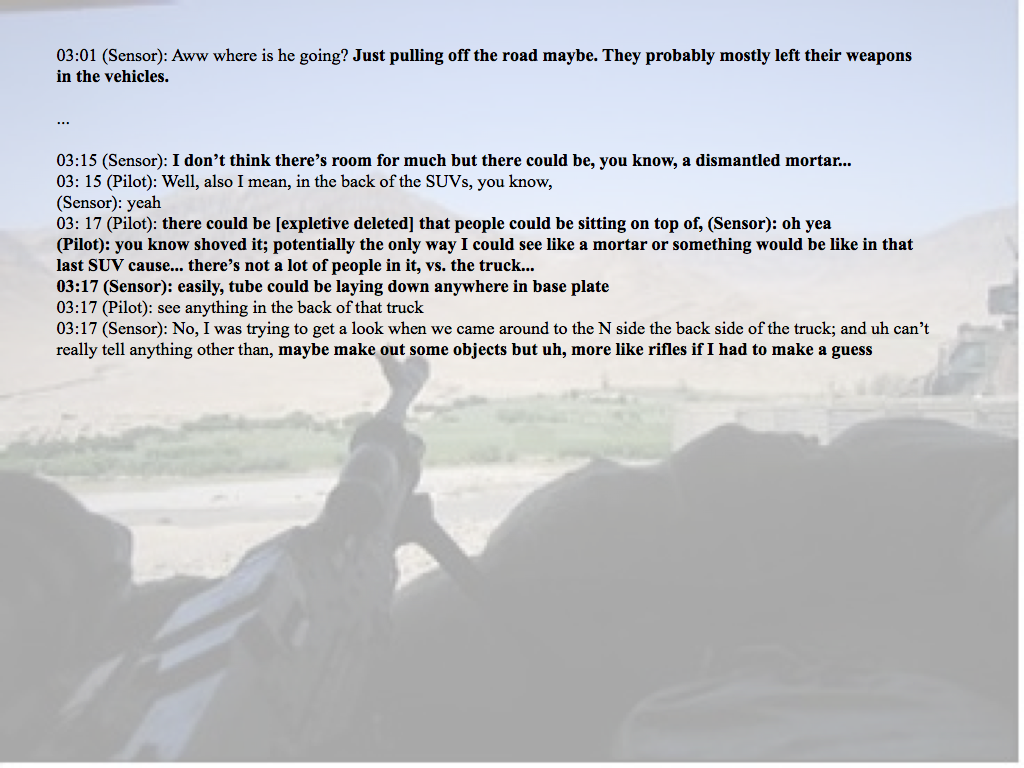
Finally, there is a persistent propensity to read hostile intent into innocent actions. In ‘From a view to a kill’ (DOWNLOADS tab) I describe in detail an attack launched on 21 October 2010 near Shahidi Hassas in Uruzgan province in central Afghanistan.  In the early morning a Predator was tasked to track three vehicles travelling down a mountain road, several miles away from a Special Forces unit moving in to search a village for an IED factory.
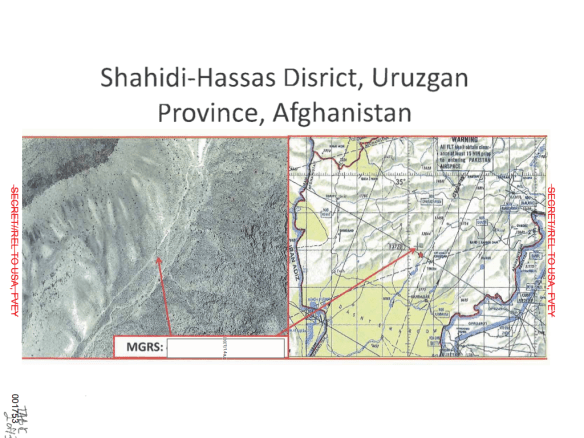
The Predator crew in Nevada had radio contact with the Special Forces Joint Terminal Attack Controller and they were online with image analysts at the Air Force’s Special Operations Command headquarters in Florida. At every turn the flight crew converted their observations into threat indicators: thus the two SUVs and a pick-up truck became a ‘convoy’, cylindrical objects ‘rifles’, adolescents ‘military-aged males’ and praying a Taliban signifier (‘seriously, that’s what they do’).
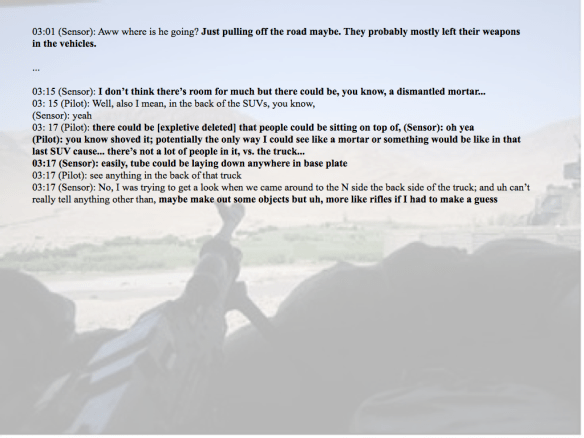
After three hours’ surveillance two Kiowa helicopters were called in, and during the attack at least 23 people were killed and more than a dozen wounded.  Only after the smoke had cleared did the horrified Predator crew re-cognize the victims as civilians, including women and children.

I’m including a much fuller account in The everywhere war, based on a close reading of the redacted investigative report by Major General Timothy McHale released under a FOI request (the images above are all taken from my Keynote presentation based on the report), and you can also find David McCloud‘s spine-chilling analysis for the LA Times here.  But even in this abbreviated form it’s clear that the cascade of (mis)interpretations offered by the flight crew mimics Kevin’s list of ‘signatures’, where some would be categorised as ‘possibly adequate’ and others as ‘inadequate’.

All of these materials relate to air strikes inside a war zone, so that their modalities are different – in Afghanistan remote platforms like the Predator and the Reaper are one element in a networked ‘killing machine’, and they work in close concert with ground forces and conventional strike aircraft – and the legal parameters are not as contentious as those that govern ‘extra-territorial’ strikes in Pakistan, Somalia or Yemen (which are Kevin’s primary concern).  But they all raise questions about the evidential and inferential practices that are incorporated into the kill-chain that are clearly capable of wider application and concern.

Those questions raise other issues too.  It seems clear, from the examples I’ve given, that to isolate a single platform (the drone) is to contract the scrutiny of military and paramilitary violence that, under the conditions of late modern war, is typically networked.  And to determine the legal status of targeted killing must not foreclose on wider political and ethical decisions: to accept late modern war’s avowed reflexivity is too often to equate legality with legitimacy.
A shower of balls

Patrick Cockburn has an interesting historical take on targeted killing by drones at the Independent:

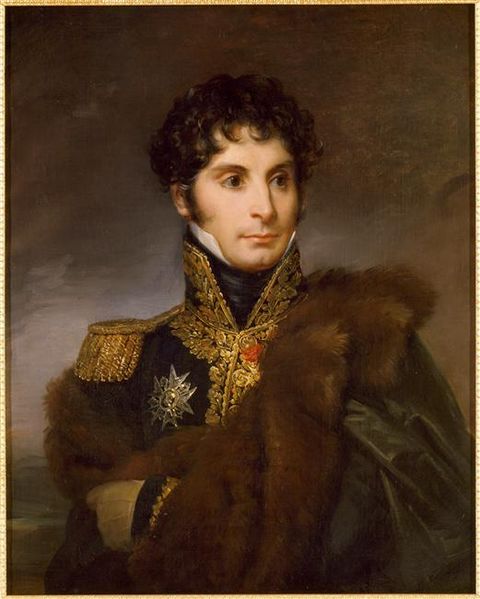
‘In 1812, the governor of Moscow, Count Rostopchin [right], devised a plan to get a hot-air balloon to hover over the French lines at Borodino and drop an explosive device on Napoleon. The source for this is the memoirs of the French writer, traveller and politician Chateaubriand and I have not read it anywhere else, but the story illustrates how, from the first moment man took to the air, he has seen it as a means of assassination.

‘President Barack Obama thinks much the same way as Rostopchin did 200 years ago. The enhanced and secret use of unmanned drones is one of the most striking features of his foreign policy.’

What Chateaubriand actually wrote was this:

[Rostopchin’s] vengeance promised to drop from heaven: a huge balloon, constructed at great expense, was to float above the French army, pick out the Emperor among his thousands, and fall on his head in a shower of fire and steel. In trial, the wings of the airship broke; forcing him to renounce his bombshell from the clouds…

Quite how the balloon was to ‘pick out the Emperor among his thousands’ was not disclosed – it’s still a problem for today’s remote operators – but Chateaubriand may have taken the account from Count Philippe de Ségur‘s History of the expedition to Russia, first published in two volumes in 1824 and translated into many European languages:

At the same time a prodigious balloon was constructed, by command of [Emperor] Alexander, not far from Moscow, under the direction of a German artificer. The destination of this winged machine was to hover over the French army, to single out its chief, and destroy him by a shower of balls and fire.

Ségur accompanied the expedition so this was an eyewitness account, of sorts, composed years after the event: Mark Danner has a beautiful essay on Ségur’s memoir – and some of its other modern echoes – here.

There’s also a modern and more detailed version of the story from Lee Croft, first as a blog comment:

Tsar Alexander’s secret project to construct a hydrogen-filled, rotor-wing-powered, aerostat (balloon) from which to drop timed-fuse explosives on Napoleon and his army … [was] entrusted to the administration of Moscow Governor-General Fyodor Rostopchin, and through Rostopchin to German physician George Anton Schaeffer, was designed by a mysterious German-speaking “balloon master” named Franz Leppich (1776-1818), who had actually tried previously, in 18ll, to sell the project to Napoleon. The killer balloon, which was shaped to resemble a shark, failed to ascend on the day of the Battle of Borodino (August 26 on the Russian Calendar, September 7 on the French, 1812) and was evacuated to Nizhnii Novgorod to the east on the Volga using over 130 confiscated Moscow city fire carts and horse teams, thus severely handicapping attempts subsequently to manage the destructive Moscow fire.

You can find a more detailed version in Croft’s self-published book earlier this year, George Anton Schaeffer: Killing Napoleon from the air (Lulu, 2012) (I’m no marketing expert, but I suspect switching title and subtitle could only boost sales).

Napoleon was no stranger to balloons in his military adventures –  he used balloons for observation during the Italian campaign in 1796 and had the balloon corps accompany him to Egypt in 1798 but their equipment was destroyed by the British at Aboukir; later  the French launched a hot air balloon in occupied Cairo, but the Egyptians were conspicuously unimpressed and dismissed it a child’s toy.
All that said, I don’t think the lines of descent are quite as direct as Cockburn makes out, but it’s an arresting start to an essay that otherwise treads familiar ground. Balloons have a long history of military applications, but after the first attempts at bombing from aircraft in the Italian-Turkish war of 1911-12 most of the early military uses for the new flying machines focused on reconnaissance and surveillance (and spotting for artillery): more on this soon!

Droning on

Here’s a selection of recent reports on drone strikes from around the web plus commentary:

Craig Whitlock completes the Washington Post‘s three-part series on ‘Permanent War’ – started by Greg Miller‘s report on the US ‘disposition matrix‘ for targeted killing – with a remarkable account of what he calls ‘the US military’s first permanent drone war base’ at Camp Lemonnier, just (barely) outside Djibouti City.  It’s ‘the busiest Predator drone base outside the Afghan war zone’, from which Predators are launched around the clock, sixteen times a day, to conduct missions in Somalia and Yemen.  Nominally overseen by US Africa Command (AFRICOM) – ‘the primary base of operations for US Africa Command in the Horn of Africa‘ – Whitlock mades it clear that it’s Joint Special Operations Command (JSOC) that calls the shots.  What is remarkable about Whitlock’s report is his artful piecing together of a jigsaw of information from construction solicitations, contracts and plans, submissions to Congress, planning memoranda, Air Force journals, and Predator accident investigation reports, some in the public domain and countless others obtained through FOI requests.  More on drone wars in East Africa from Somalia Report (which also provided the image of Camp Lemonnier below) and on what David Axe calls ‘America’s secret drone war in Africa’ from Wired‘s Danger Room.

Alex Kane at Mondoweiss reprises the Columbia report on Counting Drone Strike Deaths issued earlier this month – which is sharply critical of the estimates of civilian casualties in Pakistan reported by both the New America Foundation and the Long War Journal and endorses those provided by the Bureau of Investigative Journalism – and then follows up with an interview with Naureen Shah, Acting Director of the Human Rights Clinic and the Associate Director of the Counter-terrorism and Human Rights Project at Columbia:

… all of these estimates, including our estimate, are just based on news reports, news reports filed in that region where journalists have very limited access to the scene of the crime, if you will.

It’s not like journalists, for the most part, are going to where the drone strike happened and talking to witnesses, doing a bit of, almost a forensic analysis, being able to see what happened with their own eyes. This [Pakistan’s Federally Administered Tribal Areas] is a region where few journalists, even Pakistani journalists, can really get there. We’re talking about media reports that are often based on the word of anonymous, Pakistani government officials who have an interest in telling a story of, “drone strikes kill only militants.” We’re not going to see anonymous government officials admitting that many of the people killed are civilians. So it’s a stacked deck.’

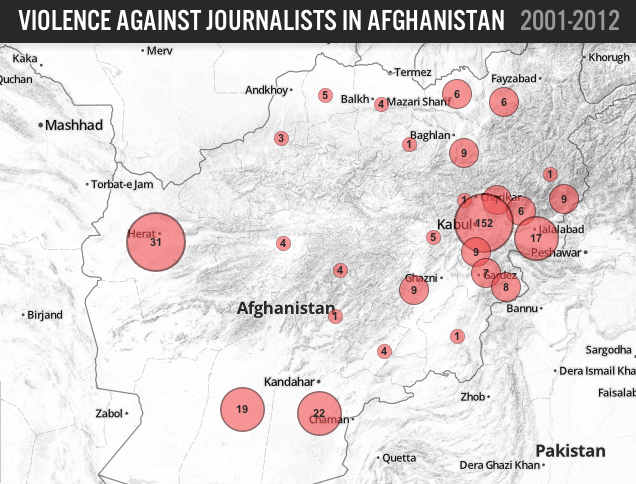
All true.  But there is a striking geographical absence from the kerfuffle over civilian casualties caused by drone strikes: Afghanistan.  The situation there is no less fraught: as the map below shows, journalists in Afghanistan also work in highly dangerous circumstances. (More on the map here and more from the Committee to Protect Journalists here).

The politico-technical matrix is also more complicated: in Afghanistan Predators and Reapers are part of an extended network in which aircraft are linked to ground forces and through which remote operators carry out persistent surveillance while, on occasion, leaving attacks to conventional strike aircraft (though they certainly also launch them from their own platforms too).  This makes it more difficult to disentangle drones from the wider apparatus of military violence – but why on earth should they be?  Afghanistan is part of a recognised ‘war zone’ – but does that make civilian casualties there any less grievable than those that take place across the border?

In the Mondoweiss interview Shah draws attention to the perpetual fear induced by the persistent presence of the drones:

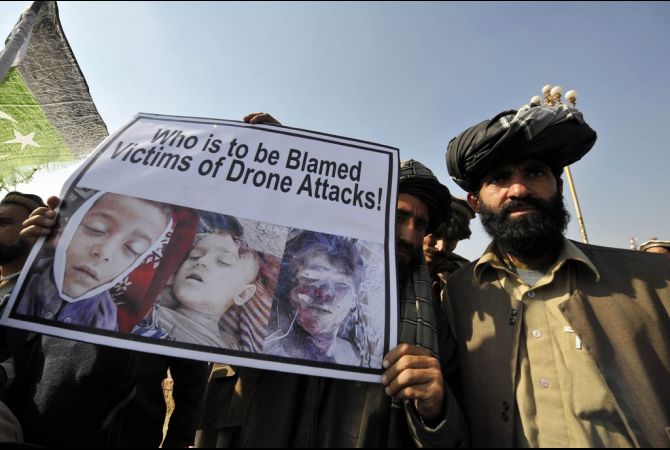
We’re talking about planes hovering over head for hours every single day, and really the casualty of that, the human casualty, is peace of mind for the people who live there. We see reports that parents don’t want to send their kids out to school, that people don’t know what’s going to get them killed by a drone strike. Imagine living in that kind of fear, and we’re talking about communities that are already ravaged by war.

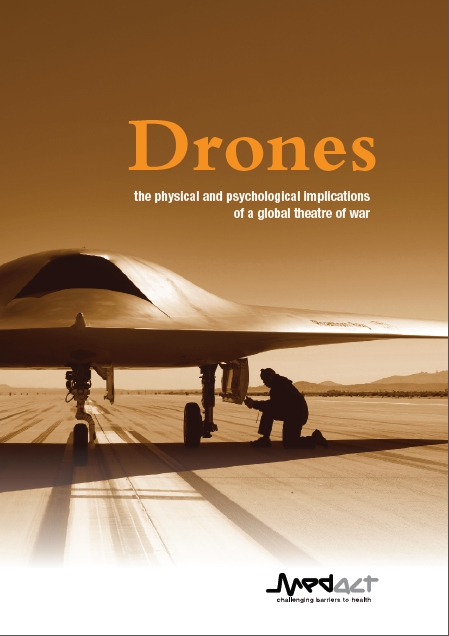
For more on this, turn to UK-based Medact’s report on Drones: the physical and psychological implications of a global theatre of war, also issued earlier this month.  Free download here.

Women are disproportionately affected by drones. What little control they have over their lives is further eroded by a weapon they know could strike at any time. Their lives and those of the children they try to protect are under constant threat. While men can sublimate their grief and anger to some degree by becoming fighters – one of the terrible consequences of drone warfare – women have no such outlet. And if their menfolk are killed in a drone strike, they may have to endure the continuing presence of the drone just overhead.

The report is a survey of surveys, short and to the point, but it adds a British dimension to the debate – important at a time when the RAF is doubling its Reaper fleet and moving control from Creech AFB in Nevada to RAF Waddington in Lincolnshire – and too briefly brings Israel’s use of drones in Gaza into the general discussion.  That last point desperately needs to be sharpened, given the global prominence of the Israeli drone industry and the filiations between US and Israeli practices of targeted killing.  Another depressing blank on the drone debate map.

(I hadn’t heard of Medact before, but it claims to speak out ‘for countless people across the globe whose health, wellbeing and access to proper health care are severely compromised by the effects of war, poverty and environmental damage’, and it’s associated with the journal Medicine, conflict and survival – a source which deserves close attention).

Haymarket Books has just published (pb and e-book versions) a collection of Nick Turse‘s columns on drones and Obama’s other signature modes of warfare, The changing face of empire: see here for an adapted version of the conclusion (extract below) and here for the book.

Several times this year, [General Martin Dempsey], the other joint chiefs, and regional war-fighting commanders have assembled at the Marine Corps Base in Quantico to conduct a futuristic war-game-meets-academic-seminar about the needs of the military in 2017. There, a giant map of the world, larger than a basketball court, was laid out so the Pentagon’s top brass could shuffle around the planet — provided they wore those scuff-preventing shoe covers — as they thought about “potential U.S. national military vulnerabilities in future conflicts” (so one participant told the New York Times). The sight of those generals with the world underfoot was a fitting image for Washington’s military ambitions, its penchant for foreign interventions, and its contempt for (non-U.S.) borders and national sovereignty.

And lastly, on an almost lighter note, Teo Ballvé at Territorial Masquerades has an artful post on ‘Writing like a drone’.  Following up on the ‘New Aesthetic‘, he describes a robotic graffiti writer that can write text massages ‘on such high risk/high profile targets as the U.S. Capitol Building’ and ‘can be deployed in any highly controlled space or public event from a remote location.’  It’s the remoteness that presumably prompts Teo to call this a ‘graffiti drone’, but there are two other (remote) connections to the real thing.

The project comes from the Institute for Applied Autonomy, which also hosts Trevor Paglen‘s captivating (sic) Terminal Air, a satirical version of the CIA’s extraordinary rendition flights –  the ‘capture’ side of the kill/capture regime that uses drones for the ‘kill’.

Former US Ambassador Kurt Volker adds a gloss to this in an Op-Ed in the Washington Post following up the ‘Permanent War’ reports:

More people have been killed in U.S. drone attacks than were ever incarcerated at Guantanamo Bay. Can we be certain there were no cases of mistaken identity or innocent deaths? Those detained at Guantanamo at least had a chance to establish their identities, to be reviewed by an oversight panel and, in most cases, to be released. Those who remain at Guantanamo have been vetted and will ultimately face some form of legal proceeding. Those killed in drone strikes, whoever they were, are gone. Period.

What he doesn’t quite say is that most of those incarcerated at Guantanamo were, on the US government’s own admission, never al Qaeda fighters.  More on the implications of these intelligence failures for the US targeted killing programme from the Stanford/NYU report on Living under drones here (scroll down).

Finally, back to Theo’s ‘graffiti drone’:  one of several synonyms for graffiti writing – particularly at night – is bombing…

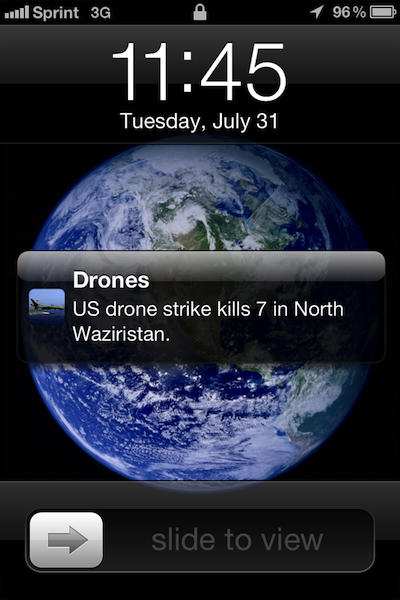
I don’t like Tuesdays….

More on history…  In a commentary on Greg Miller‘s Washington Post article on the ‘disposition matrix‘ now used by the Obama administration to further its targeted killing programme, Ian Shaw suggests that this reveals ‘the changing face of state violence: the decentralization of targeted killings across the globe and the simultaneous centralization of state power in the executive branch of government.’

Even before the process was streamlined by the introduction of the matrix, Jo Becker and Scott Shane reporting for the New York Times described the President’s ‘immersion’ in the process, which they too thought ‘unprecedented’:

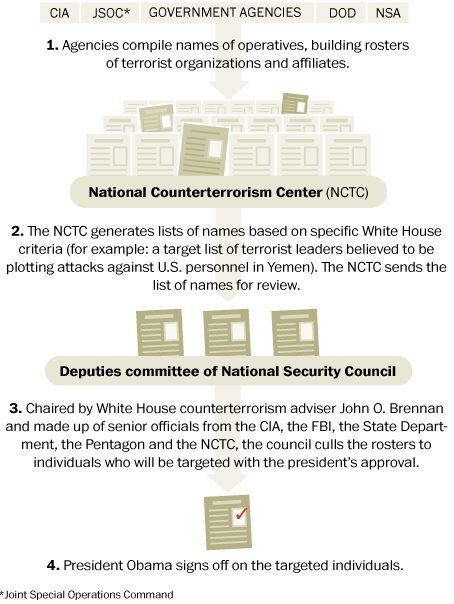
It is the strangest of bureaucratic rituals: Every week or so, more than 100 members of the government’s sprawling national security apparatus gather, by secure video teleconference, to pore over terrorist suspects’ biographies and recommend to the president who should be the next to die.

This secret “nominations” process is an invention of the Obama administration, a grim debating society that vets the PowerPoint slides bearing the names, aliases and life stories of suspected members of Al Qaeda’s branch in Yemen or its allies in Somalia’s Shabab militia.

The video conferences are run by the Pentagon… [and] a parallel, more cloistered selection process at the C.I.A. focuses largely on Pakistan.

The nominations go to the White House, where by his own insistence and guided by Mr. Brennan, Mr. Obama must approve any name. He signs off on every strike in Yemen and Somalia and also on the more complex and risky strikes in Pakistan — about a third of the total.

John Whitehead also saw this as a dramatic – and ominous – departure: ‘Should we fail to recognize and rectify the danger in allowing a single individual to declare himself the exception to the rule of law and assume the role of judge, jury, and executioner, we will have no one else to blame when we plunge once and for all into the abyss that is tyranny.’

Claims like these not only resonate with Giorgio Agamben‘s mapping of the space of exception; they also intersect with the debate over the ‘unitary executive’ that was renewed (and radicalised) during the Bush administration.

But if we narrow the focus there is in fact an historical precedent for what Becker and Shane called the ‘Terror Tuesday’ meetings and the close control exerted by the executive over air strikes  – and this also took place on a Tuesday.

During the Vietnam War President Lyndon Johnson personally decided targets for the ‘Rolling Thunder’ campaign of air strikes againt North Vietnam, famously boasting that ‘they can’t even bomb an outhouse without my approval.’

Targets were first proposed by the Air Force and submitted to the Commander-in-Chief Pacific Command (CINPAC), whose office reviewed and forwarded a target list to the Joint Chiefs of Staff who in turn reviewed and forwarded their revised list to the Pentagon.  There officials analysed the targets in relation to the probable impact of a strike and the likelihood of civilian casualties, and the Secretary of Defense coordinated the modified list with the Secretary of State. By this stage the folder for each numbered target had been reduced to a sheet of paper with just four columns: military advantage; risk to US aircraft and crew; estimated civilian casualties; and danger to third-country nationals (Russian and Chinese advisers).

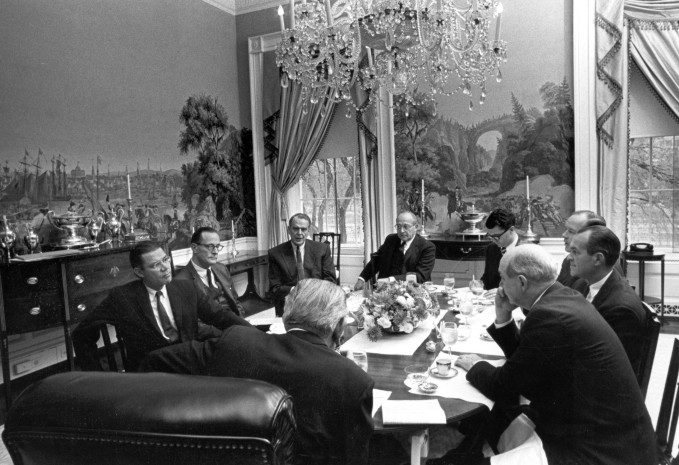
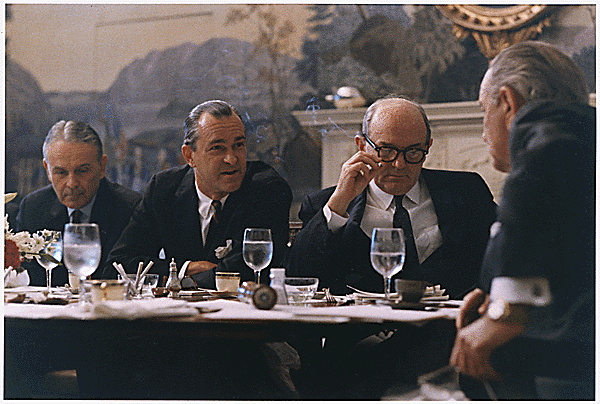
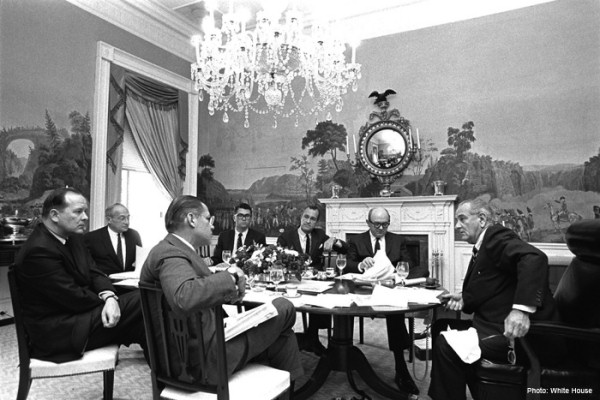
The final target list was decided during the President’s Tuesday luncheon at the White House.  This was not a casual affair; it followed a meeting of the National Security Council, and those attending the luncheon – the Secretaries of State and Defense, the President’s special assistant for national security affairs, and (significantly) the President’s press secretary – were briefed before grading each target. Their grades were combined and averaged and then reviewed by the President who made the final selection.  His decision was delivered to the NSC in the evening and transmitted to CINCPAC through the Joint Chiefs for immediate execution. The instructions included not only the number of sorties to be conducted against each target but also in the early stages of the campaign the timing of the attacks and the ordnance to be used.

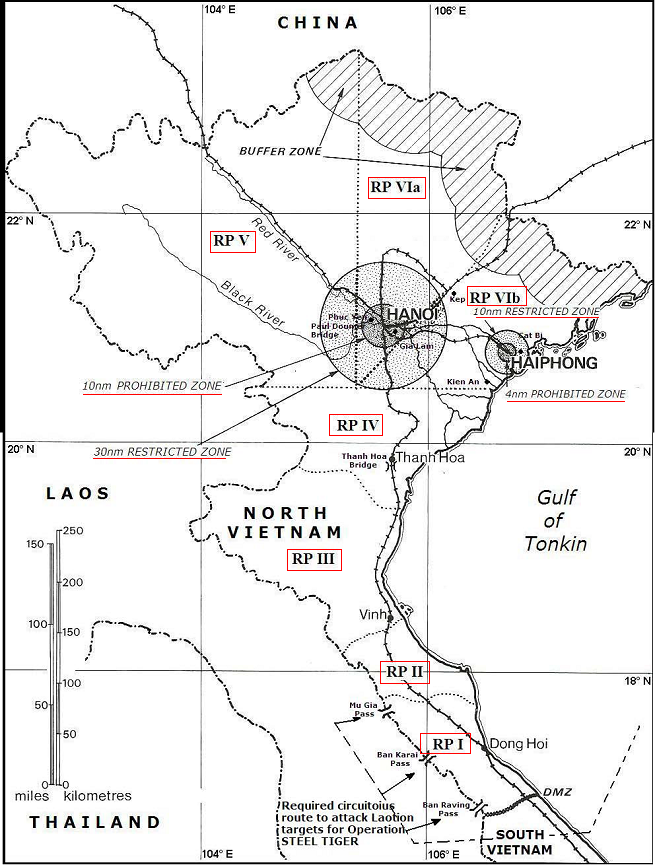
Remarkably, no military officers were invited to the Tuesday luncheon until October 1967, and in at least in the first phase of Rolling Thunder the political consistently trumped the military.  As targets worked their way up the command hierarchy to Washington, their priority order was reversed; the bomb line slowly advanced northward as strikes worked their way up from the bottom of the strategic list. In addition to selecting targets, Johnson stipulated strict Rules of Engagement – so stringent that one airman described them as ‘rules of defeat’ – that prohibited air strikes within 30 miles of the Chinese border, 30 miles from the centre of Hanoi and 10 miles from the centre of Haiphong, and imposed a complex, constantly changing web of regulation whose details had to be incorporated into every day’s operational order.

The paragraphs above are culled from my ‘Lines of descent’ (DOWNLOADS tab) and they describe an ideal-typical sequence of decision-making, but the most detailed published account is David Humphreys, ‘On the Tuesday Lunch at the Johnson White House: a preliminary assessment’, Diplomatic History 8 (1984) 81-101; see also David Barrett, ‘Doing “Tuesday Lunch” at Lyndon Johnson’s White House: new archival evidence on decision-making’, PS: Political science and politics 24 (4) (1991) pp. 676-9, Kevin Mulcahy, ‘Rethinking Groupthink: Walt Rostow and the National Security advisory processin the Johnson administration’, Presidential Studies Quarterly 25 (1995) 237-50,  and Johanna Kephart, ‘Presidential decision-making and war: testing the evolution model’, MA thesis, Georgetown University (2010) here (especially pp. 8-27).

Pakistan is not Vietnam, of course, and there are obvious differences between the two campaigns – as well as remarkable ‘lines of descent’ – but the role of the sovereign in asserting ‘the right to take life or let live’ is a grim constant.

I don’t like Tuesdays: Some of you will remember the Boomtown Rats song ‘I don’t like Mondays’ written by Bob Geldorf after a shooting at a school playground in San Diego; the shooter, a 16-year old girl, explained: “I don’t like Mondays.  This livens them up.”

Administrative geographies and killing fields

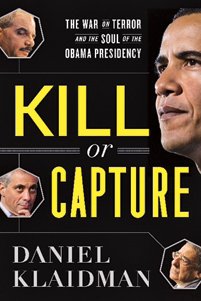
Daniel Klaidman‘s chilling account of the Obama administration’s ‘Kill or Capture’ counterterrorism programme, published in June this year, has been updated.  Klaidman added a new dimension to the frequent jibe that the use of Predators and Reapers has turned war into a videogame when he described how target lists were drawn up in Washington:

‘As many as seventy-five officials from across the counterterrorism bureaucracy and the White House took part in the SVTS, government-speak for a secure video teleconference. It was killing by committee.’

According to Klaidman, the process deeply disturbed Harold Koh, the Legal Adviser to the State Department (this was before he addressed the American Society of International Law on the legality of targeted killing in March 2010):

‘Koh took in the videoconference with morbid fascination… There was also an inexorable quality to the meeting, a machinelike pace that left him feeling more like an observer than a participant. He was unsettled by the bloodless euphemisms the military used to talk about violent death. A targeted killing became a “direct action” or a “kinetic strike.” Code names for the hunted militants were bland and impersonal, drawn from the names of provincial American cities. At the time, JSOC [Joint Special Operations Command] was working its way through Ohio. Koh understood the need to “objectify” the enemy.  The “operators” had to separate themselves from the brutality of their actions. But as a human rights lawyer, he was trained to do the opposite. “I kept slipping back and forth between the view of the predator and the view of the prey,” he later told a friend.’

But the videoconferences have been discontinued, and in today’s Washington Post Greg Miller provides the  first of three reports on the creation of a so-called ‘disposition matrix’ to ‘streamline’ targeted killing and boost the role of the National Counter-Terrorism Center and its Director, John Brennan.

At least three geographies are embedded in the process.  First, Miller shows that the close co-operation between the Pentagon (particularly through JSOC) and the CIA continues to gather momentum, not least because the Arab uprisings have changed the calculus of co-operation with other agencies:

The Arab spring has upended U.S. counterterrorism partnerships in countries including Egypt where U.S. officials fear al-Qaeda could establish new roots. The network’s affiliate in North Africa, al-Qaeda in the Islamic Maghreb, has seized territory in northern Mali and acquired weapons that were smuggled out of Libya. “Egypt worries me to no end,” a high-ranking administration official said. “Look at Libya, Algeria and Mali and then across the Sahel. You’re talking about such wide expanses of territory, with open borders and military, security and intelligence capabilities that are basically nonexistent.”

Other relationships have been strengthened, of course, not least with regimes regrettably undisturbed by the uprisings – notably Saudi Arabia:

“If he’s in Saudi Arabia, pick up with the Saudis,” the former official said. “If traveling overseas to al-Shabaab [in Somalia] we can pick him up by ship. If in Yemen, kill or have the Yemenis pick him up.”

The disposition matrix is supposed ‘to go beyond existing kill lists, mapping plans for the “disposition” of suspects beyond the reach of American drones.’  But as the menu of geopolitical options narrows, so the range of drone strikes is destined to increase – with no end in sight.

Miller’s focus, like that of most reporters, is on the routinisation of the process – what one intelligence analyst described, for a different kill-chain an age ago, as ‘the bureaucratization of homicide‘: Ian Shaw‘s ‘bureaucratic present‘ has a long history – and, not altogether surprisingly, Robert Chesney over at Lawfare doesn’t think there’s much of a story here at all:

It certainly is a good thing to create an information management tool that makes certain that officials across agencies and departments can have real-time, comprehensive understanding of the options available (practically, legally, diplomatically, etc.) in the event specific persons turn up in specific places.

But the administration of lethal violence using these ‘management tools’ involves more than mapping the geopolitical portfolio I sketched above.  There is a second, doubled geography at work.

Those who carry out drone missions – either calling in conventional strike aircraft or combat helicopters or carrying out the strikes from their own platforms – frequently insist that they are only ‘eighteen inches from the battlefield’ (the distance from eye to screen) so that there is, for them, a new and chilling intimacy to these ‘remote’ operations.  It is, to be sure, a qualified intimacy, as I’ve shown in several essays: those involved in these missions are immersed in the evolving situation – in this sense theirs is a ‘videogame war’ since videogames are profoundly immersive, something most critics seem to lose sight of – but even when they are required to remain on station to carry out a post-strike inventory of body parts – which is common – the visual field remains one in which the landscape of the enemy Other (and the identity between the two is rarely questioned) is profoundly alien.

But to those who order these strikes – and perhaps to a wider political circle – the administrative process renders the ‘remoteness’ of such operations absolute. Here is Micah Zenko:

‘Recently, I spoke to a military official with extensive and wide-ranging experience in the special operations world, and who has had direct exposure to the targeted killing program. To emphasize how easy targeted killings by special operations forces or drones has become, this official flicked his hand back over and over, stating: “It really is like swatting flies. We can do it forever easily and you feel nothing. But how often do you really think about killing a fly?”’

And finally, the comment-storm created by Miller’s report (and remarks likes these) continues to focus public attention on the theatre of secrecy in Washington rather than the killing-fields where the executions are carried out.

Over the top

I’ve had several inquiries about my recent posts on bombing in the First World War (here and here), all of which want to know why I’ve gone back so far.  Isn’t it all so remote? they ask.   I’d hoped I’d started to answer that in my previous posts, but Tami Davis Biddle – the author of Rhetoric and reality in air warfare (Princeton University Press, 2004) – provides a succinct answer in her ‘Learning in real time: the development and implementation of air power in the First World War’ (in Sebstian Cox and Peter Gray, eds., Air power history: turning points from Kitty Hawk to Kosovo):

‘Virtually every important manifestation of twentieth-century air power was envisioned and worked out in at least rudimentary form between 1914 and 1918.’

She has in mind many of the practices I’ve described in my previous posts – and there’s more to come – but I’ve just stumbled upon one that neither of us anticipated.  And, yes, it is ‘remote’…

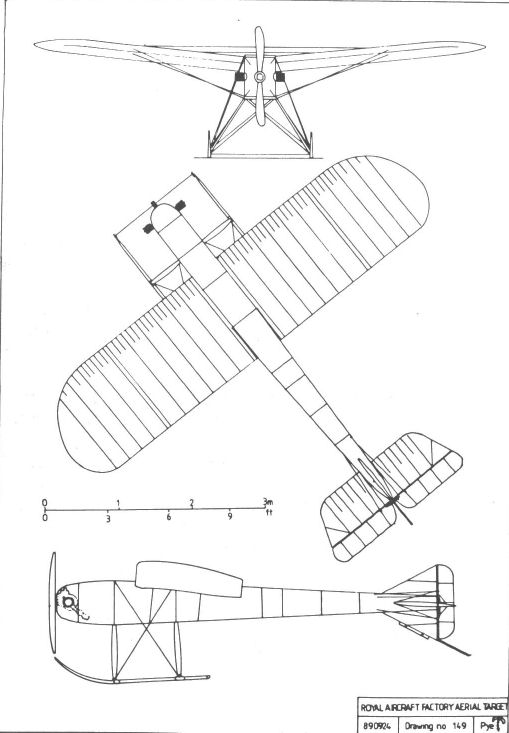
Gary Warne has a remarkable post, ‘The Predator’s ancestors: UAVs in the Great War’, in which he describes Captain Archibald Low’s Aerial Target project.  The codename was a deliberate distraction, Warne explains, because the plan was to develop a pilotless aircraft as a flying bomb, guided  by wireless from an accompanying manned aircraft to attack Zeppelins and ground targets. The fullest discussion of Low’s work that I’ve been able to find is by Paul Hare here; some of the back-story is provided by Hugh Driver in The birth of military aviation 1903-1914 (Boydell and Brewer, 1997) and there’s a wider historical discussion in Chapter 2 of Denis Larm‘s thesis here.

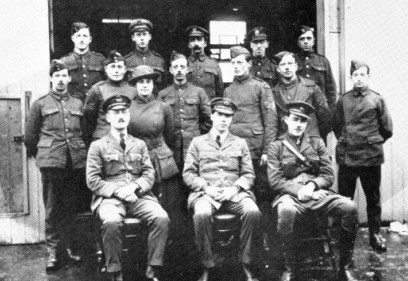
When the war started ‘Professor’ Low, as he styled himself, was already at work on artillery range-finding and, newly commissioned, was soon at the forefront of the Royal Flying Corps’s Experimental Works (below; Low is in the centre of the front row), supervising a team of 30, including jewellers, carpenters and engineers first at a Chiswick garage and later at Brooklands.

The noise of the aircraft engine interfered with the wireless transmissions, and the first demonstration flight of the Aerial Target was a disaster.  According to Steven Shaker and Alan Wise in War without Men: robots on the future battlefield (Pergamon-Brassey, 1988), ‘during a test flight for a gathering of important Allied dignitaries, the AT went astray and dove upon the guests, who scattered in every direction.’  All together six prototypes were constructed in 1917, but none of them saw combat.

That last verb is spot on, however, because in March 1914 Low had successfully demonstrated what he called TeleVista, an early version of television, and the Times reported that ‘if all goes well with this invention, we shall soon be able, it seems, to see people at a distance’ – a capability that, over 50 years later, would be integral to the USAF’s experiments with reconnaissance drones over North Vietnam (see ‘Lines of descent’, DOWNLOADS tab) and, of course, to today’s Predators and Reapers.  As the Times continued, it was an open question ‘whether Dr Low will be regarded as a benefactor, or the opposite.’

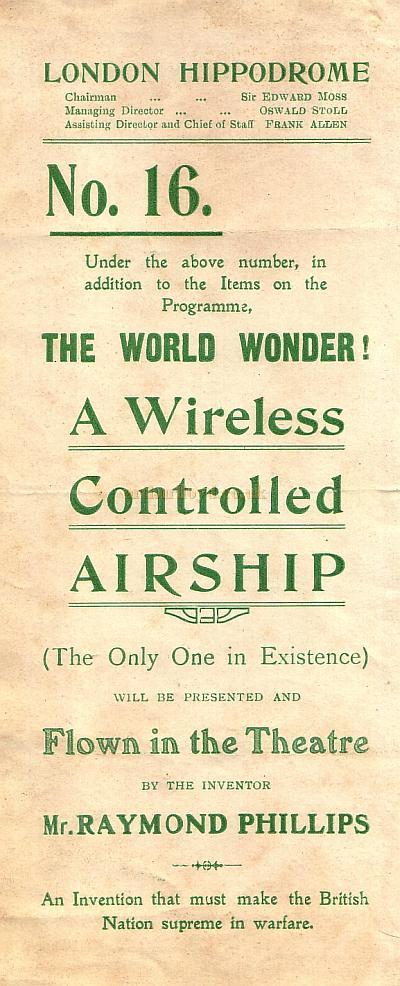
Low never linked his two projects, but in fact the prospect of seeing a distant target had been mooted before the war.  In 1910 Raymond Phillips used a twenty-foot model Zeppelin to demonstrate his wireless-controlled ‘aerial torpedo’ before an entranced crowd at the London Hippodrome. According to the New York Times (22 May 1910):

‘He claims to be able, sitting at a transmitter in London, to send a dirigible balloon through the air at any height and almost any distance.  He can load his balloon with dynamite bombs, he claims, and without leaving his office can send it over a city and wipe the city out.’

He told his audience:

I don’t want to brag, but I feel sure that if England purchases my aerial torpedo she will make short work of the enemy’s fleets and cities in any future war.  Why, I can sit in an armchair in London and drop bombs in Manchester or Paris or Berlin.’

Given the first city on his list it’s scarcely surprising that there should have been questions about navigation.  Asked how he would know that his airship was over ‘the town you purpose to destroy’, Phillips replied that he might work with a large-scale map or a ‘telephotographic lens’.  ‘I think it will do away altogether with existing methods of warfare,’ he predicted.  Much more here (scroll down).

But one of his rivals in the audience had spotted a weakness in the system.  ‘I believe that it would be possible for another operator to interfere with Mr Raymond Phillips’ control,’ speculated Harry Grindell Matthews, using what one newspaper called ‘hostile electric currents’, and he predicted that he could, ‘by manipulating an instrument of my own, compel it [the airship] to turn round and return to the place from which it was sent.’  The two men agreed to a duel between their devices, but I’ve been unable to find any record of the outcome – though the spectre that Matthews raised remains a concern for today’s remotely piloted operations.  Incidentally, Matthews would later claim to have invented a ‘death ray’…. More on him here and here.

The theatricalization of these early projects, with Phillips’s airship nosing its way around the Hippodrome – which was originally designed as a circus and had only been remodelled the previous year – and releasing its load of paper birds forty feet above the stalls, is all of a piece with the ‘bombing competitions‘ and the air displays of the pre-war years.

Here is Flight magazine on 7 May 1910:

‘There is no accounting for popular taste in the matter of public entertainment, but we must confess one could scarcely expect to witness the spectacle of a fairly big model dirigible sailing about the auditorium of the London Hippodrome, where at the moment it constitutes one of the star turns….

‘As an indication of a phase of aeronautics that is quite likely, indeed, we might as well say quite certain, to figure in the future, this display at the Hippodrome is a thoroughly interesting and instructive turn, and brings before many hundreds of people a visual demonstration of a scientific subject that in the ordinary course of events they would only be likely to read about at the best.’

Yet another instance of the theatre of war.

Phillips persisted with his dream, and in September 1913 the Illustrated London News devoted a whole page to ‘torpedoes of the air’ – what it called ‘bomb-droppers directed by wireless’ – and Robinson’s drawing was based on ‘materials provided by Mr Raymond Phillips.’

PHILLIPS Aerial Torpedo in ILN September 1913