Blurring the lines

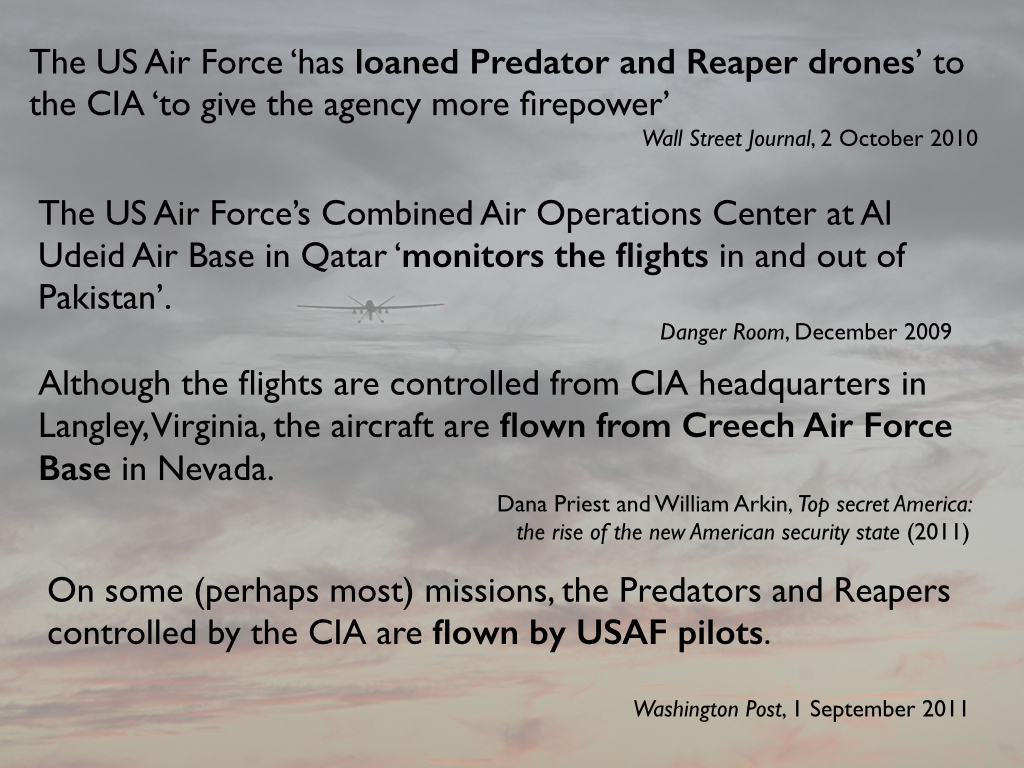
In the short-form version of ‘The everywhere war’ (DOWNLOADS tab) I emphasised the blurring of the lines between the increasingly paramilitary but nominally civilian CIA and the US military, and for the last several years I’ve been including this slide in most of my presentations about CIA-directed drone strikes in Pakistan (and I’ve been very careful to use precisely that description: ‘CIA-directed’):
CIA:USAF.001

Today’s Guardian (online) carries a report that lends support to these claims and concerns:

17th Reconnaissance SquadronA regular US air force unit based in the Nevada desert is responsible for flying the CIA’s drone strike programme in Pakistan, according to a new documentary to be released on Tuesday.

The film – which has been three years in the making – identifies the unit conducting CIA strikes in Pakistan’s tribal areas as the 17th Reconnaissance Squadron, which operates from a secure compound in a corner of Creech Air Force Base, 45 miles from Las Vegas in the Mojave desert.

Several former drone operators have claimed that the unit’s conventional air force personnel – rather than civilian contractors – have been flying the CIA’s heavily armed Predator missions in Pakistan, a 10-year campaign which according to some estimates has killed more than 2,400 people.
The film is Tonje Schei‘s documentary Drone, which has its premiere tomorrow.  You can read an interview with her about the drone wars here.  In an overlapping interview for Pakistani media, she explains:

DRONE investigates the human consequences of the US drone war. Through unique access to voices on both sides of this new technology, DRONE offers new insights into the nature of drone warfare. DRONE juxtaposes the realities of drone victims in Waziristan to drone pilots who struggle to come to terms with the new warfare. The film covers diverse and integral ground from the recruitment of young pilots at gaming conventions and the re-definition of “going to war”, to the moral stance of engineers behind the technology, the world leaders giving the secret “greenlight” to engage in the biggest targeted killing program in history, and the people willing to stand up against the violations of civil liberties and fight for transparency, accountability and justice.

You can watch a clip on Youtube, which I’ve also embedded here, in which Chris Woods (senior reporter at the Bureau of Investigative Journalism) explains why this blurring of the lines between the CIA and the military matters:

http://www.youtube.com/watch?v=cp7aCHlntQs

Schei’s original source was Brandon Bryant, a former USAF sensor operator who had already gone public with his own account of the traumatic business of targeted killing (see also here and here).  He decided to add to his testimony when the Obama administration proposed transferring control of the targeted killing program from the CIA to the military, a plan that has faced Congressional opposition:

“There is a lie hidden within that truth. And the lie is that it’s always been the air force that has flown those missions. The CIA might be the customer but the air force has always flown it. A CIA label is just an excuse to not have to give up any information. That is all it has ever been.”

Bryant’s account has apparently been corroborated by another six former crew members, who claimed that the 17th transitioned to its ‘new customer’ in 2004.
Sudden-Justice_webChris Woods provides much more in Sudden Justice: America’s secret drone wars, forthcoming from Hurst at the end of this year, but – for now – here is what I said in ‘The everywhere war’ in 2011 (and I can now say much more in The everywhere war!):

These considerations radically transform the battlespace as the line between the CIA and the military is deliberately blurred. Obama’s recent decision to appoint Panetta as Secretary of Defense and have General David Petraeus take his place as Director of the CIA makes at least that much clear. So too do the braiding lines of responsibility between the CIA and Special Forces in the killing of Osama bin Laden in Abbottabad in May 2011, which for that reason (and others) was undertaken in what Axe (2011) portrays as a ‘legal grey zone’ between two US codes, Title 10 (which includes the Uniformed Code of Military Justice) and Title 50 (which authorises the CIA and its covert operations) (Stone 2003). The role of the CIA in this not-so-secret war in Pakistan thus marks the formation of what Engelhardt and Turse (2010) call ‘a new-style [battlespace] that the American public knows remarkably little about, and that bears little relationship to the Afghan War as we imagine it or as our leaders generally discuss it’.
 

When I wear my alligator boots

When I wear my alligator bootsI left at the crack of dawn the very next day for Madison, so I couldn’t post about this before: last Wednesday Shaylih Muehlmann gave a reading from her new book, When I wear my alligator boots: Narco-culture in the US-Mexico borderlands (University of California Press, 2014) at the Peter Wall Institute for Advanced Studies (where she was an Early Career Scholar last year).

Her reading was beautifully judged – a series of exquisitely written (and read) extracts that re-traced the narrative arc of the book, explained her own take on ethnography (and its writing), and sparked a lively discussion.  Thanks to Gaston Gordillo‘s generosity, I was able to devour the book on the flight to Madison; since I had to get up at 3 a.m., that was no mean feat and speaks volumes about the book.

When I Wear My Alligator Boots examines how the lives of dispossessed men and women are affected by the rise of narcotrafficking along the U.S.-Mexico border. In particular, the book explores a crucial tension at the heart of the “war on drugs”: despite the violence and suffering brought on by drug cartels, for the rural poor in Mexico’s north, narcotrafficking offers one of the few paths to upward mobility and is a powerful source of cultural meanings and local prestige.

In the borderlands, traces of the drug trade are everywhere: from gang violence in cities to drug addiction in rural villages, from the vibrant folklore popularized in the narco-corridos of Norteña music to the icon of Jesús Malverde, the “patron saint” of narcos, tucked beneath the shirts of local people. In When I Wear My Alligator Boots, the author explores the everyday reality of the drug trade by living alongside its low-level workers, who live at the edges of the violence generated by the militarization of the war on drugs. Rather than telling the story of the powerful cartel leaders, the book focuses on the women who occasionally make their sandwiches, the low-level businessmen who launder their money, the addicts who consume their products, the mules who carry their money and drugs across borders, and the men and women who serve out prison sentences when their bosses’ operations go awry.

Read it to find out much more about the intersections between popular culture, the ‘drug wars’ , and the borderlands than the usual cartel-talk.  A central theme of the book is not so much the narco-corridors snaking across the border as the narco-corridos, folk-ballads telling stories of the men and women who work the drug business.  These are also the subject of Shaul Shwarz‘s prize-winning documentary Narcocultura (2013); I’ve embedded the trailer below, and you find out more here and read a thoughtful review here.

Shaylih’s subjects, then, are the low-level players who are, in their way, also being played.  For this very reason, their construction and celebration of narco-culture is also a real challenge to the corruptions, exactions and violences of the state.  Shaylih unravels the connections between prohibition, poverty and addiction in northern Mexico, and en route her gift for narrative – for telling their stories – provides a powerful analytical lens:

‘The people whose lives are chronicled in this book reveal the extent to which the war on drugs ultimately pushes many of the costs of trafficking – the deaths, the vulnerability, and the risk – over the border into Mexico and particularly onto the Mexican poor.  These are the people who run the risks of the business, experience the brunt of the violence, and serve the prison sentences that the wealthy cartel bosses largely avoid…  In the stories that follow, we will see that those who become involved in the narco-economy do so precisely because the Mexican and U.S. governments have declared war against it.  And as their stories show, for a long time this war was already being waged against them.’

Read it, too, for an object lesson in writing prose that doesn’t hobble the flight of the intellectual imagination – as even the chapter titles show:

Introduction: Life at the Edges of the War on Drugs
1. Narco-Wives, Beauty Queens, and a Mother’s Bribes
2. “When I Wear My Alligator Boots”
3. “A Narco without a Corrido Doesn’t Exist”
4. The View from Cruz’s Throne
5. Moving the Money When the Bank Accounts Get Full
6. “Now They Wear Tennis Shoes”: Social Debts and Calculated Risks
Conclusion: Puro pa’delante Mexico

You can access the first chapter here (box, top right). The marvellous title is easily explained:

‘Javier … wore alligator boots like a badge of his past smuggling work… He said that while you may see people dressed as cheros, the alligator boots are how you know if they are really narcotraficantes.’

Watching The Act of Killing

The Act of Killing continues to attract considerable attention – see also my posts here and here – even if it missed winning the Oscar for Best Documentary.

The latest issue of Critical Asian Studies [46: 1 (2014)] includes a major section (pp. 145-247) devoted to commentary from scholars and activists; first page pull below.

14672715.2014.863601.fp.png_v03

Dirty wars and stained maps

I’m still in Beirut where I’ve had a wonderful time at the Transnational American Studies conference at AUB.  Yesterday morning I chaired a panel on ‘Geographies of War‘, which featured Laleh Khalili (on Kuwait, military logistics and private contractors: abstract here), Lisa Hajjar (on the (il)legal strictures and injustices at Guantanamo; she changed her paper so I can’t link to an abstract), and Jeremy Scahill (‘The world is America’s battlefield’: abstract here).

In the evening Jeremy showed the film of Dirty Wars, co-written with David Riker and directed by Rick Rowley.  Bear with me here; I’ll return to those ‘geographies’ in a moment.  Seeing the film for a second time (the first was in Toronto in the fall with Jaimie and Jorge) I have to say I found it less satisfactory – I much prefer the book, but it’s not only because the written version is (inevitably) more detailed and more nuanced.  I think it has something to do with the film being less an act of investigative journalism than a reconstruction of investigative journalism, a noir docudrama in which the investigator (no less inevitably) becomes the central figure: Sam Spade with a notebook.  For that reason, I think Michael O’Sullivan is simply wrong to say that ‘the film is a documentary pure and simple.’

Dirty Wars

You can see that most obviously in the section that deals with a Special Forces night raid in February 2010 on a compound in Gardez, Afghanistan, where much of the ground-breaking reporting was done by another journalist, Jerome Starkey.  But these scenes have incredible dramatic force, none the less, and the incorporation of cellphone footage of the raid and the unmasking of the Special Forces commander are genuinely and profoundly arresting (if only that were literally true).

Dirty Wars Gardez

I’m less convinced by the sections that treat the targeted killing of Anwar al-Awlaki, probably because I’m still dismayed that it was the killing of a U.S. citizen that sparked so much public outrage in the United States rather than the killing of all the others.  Certainly in the film, far more so than the book, there’s an unwavering focus on the ‘Americanness’ of al-Awlaki, and especially of his transparently innocent teenage son, murdered by a drone strike just two weeks later.  Home videos, games, clothes, a whole series of images are put to work to show not that ‘they’ are just like ‘us’ but that in some substantial sense ‘they’ are ‘us’.   I was left wondering about those who don’t qualify for these sort of identifications, who can’t provide similarly legible identity papers: how are we to recognise and acknowledge their lives as grievable too?  There’s also something unsettling about Jeremy’s epiphany that he’s come to Yemen ‘to apologise’: I’m still trying to figure out how he could, and what position he would have had to occupy for that to mean very much to al-Awlaki’s grandparents and cousins in Sa’ana.  

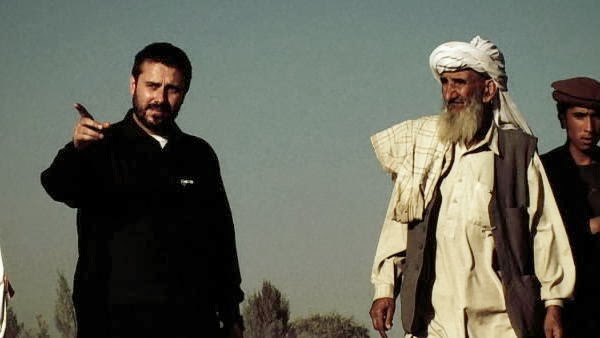
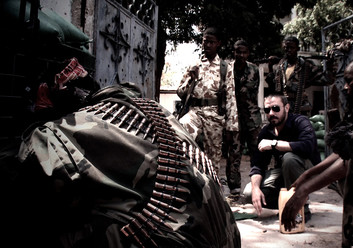
Dirty Wars SomaliaFinally, the extended passage through a war-ravaged town in Somalia, crouching alongside militias and interviewing a warlord who gives very little away, seems to run into the sand.  I was left with the uncomfortable feeling that these sequences had been retained primarily for Mohamed Afrah Qanyare‘s assertion (about his paymasters) that ‘America knows war… They are the war masters.’  

And yet, of course,  America doesn’t know war: Bush and Cheney famously avoided Vietnam, most of the war managers view the results of their military and paramilitary violence on screens and spreadsheets, and most of the public turns the other way.  As Kamila Shamsie says in Burnt Shadows, the United States fights ‘more wars than anyone else; because you understand war least of all’ (see also my draft introduction to The everywhere war here; scroll down).

That’s precisely why investigative journalism and documentary films are so urgently necessary – and why we need these different forms – but I’m not sure that rendering Jeremy’s courageous and principled investigations in the black and white tones of a Hollywood thriller is the best way to bring ‘what is hidden in plain sight’ into public view.  (For a different take, that pays close attention to the visual codes in the film, see Mike Hill‘s very smart essay over at Feedback here).  I do know that films have to be different from books, that they have different grammars if you like, and I also understand that one of the most effective ways of soliciting an audience’s response is through story-telling – academic prose would be considerably less deadly if it had more narrative force – but in the end I’m with Roger Ebert:  

‘Scahill is so respected and convincing that he doesn’t need such propping up, so the flashy directing and editing makes it feel as though “Dirty Wars” is trying too hard to sell things that might have sold themselves just fine without the hot box approach.’ 

Other (non-film) critics have objected to the way in which the history of clandestine/covert war is foreshortened in Dirty Wars, so that the CIA is left in the shadows.  But that’s surely because in the wake of 9/11 the CIA was, in some crucial respects, pushed out of the limelight and a vastly aggrandised Joint Special Operations Command took centre stage to play for Cheney and Rumsfeld. And it’s the combination of a para-militarized CIA and JSOC that is instrumental in pushing the boundaries of the everywhere war.

socommap4_large

  • Red markers: U.S. Special Operations Forces deployment in 2013.
  • Blue markers: U.S. Special Operations Forces working with/training/advising/conducting operations with indigenous troops in the U.S. or a third country during 2013.
  • Purple markers: U.S. Special Operations Forces deployment in 2012.
  • Yellow markers: U.S. Special Operations Forces working with/training/advising/conducting operations with indigenous troops in the U.S. or a third country during 2012.

US Special Operations Deployments, 2012-2013

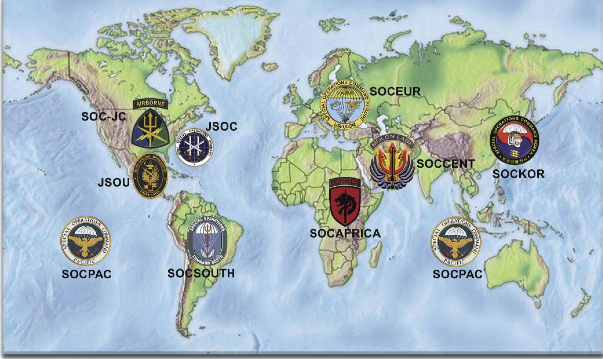
While I was writing this, a new report from Nick Turse popped on to my screen, charting the extraordinary global geography of JSOC (above) and its entanglements with other militaries and agencies like USAID.  JSOC has set up its own shadow system of subcommands mirroring the Pentagon’s division of the globe into unified combatant commands like US Central Command, each assigned to a different geographical region:

JSOC sub-commands

US Special Operations Command – Subcommands

I’ve taken the map above from US Special Operations Command’s own ‘Factbook‘, though it’s so reluctant to disclose any information that here too, as you’ll see if you read Nick’s article, part of the story is getting the story.  If you read this alongside Steve Niva‘s brilliant essay, ‘Disappearing violence: JSOC and the Pentagon’s new cartography of networked warfare’, Security dialogue 44 (3) (2013) 185-202, and in conjunction with the gritty detail (and vivid prose) of Dirty Wars, you’ll have a desperately disturbing sense of one of the modalities that is producing these new geographies of war.  As Scott Horton tells Jeremy in Dirty Wars, ‘suddenly the theatre of war has become the entire globe – it’s become everywhere.’

Unseen war

I’m off to Beirut in early January for CASAR’s conference on Transnational American Studies, where I’ll be talking about CIA-directed drone strikes in the Federally Administered Tribal Areas.  Even though Judith Butler had to cancel, it’s still an excellent program, including Paul Amar, Lisa Bhungalia, Brian Edwards, Keith Feldman, Waleed Hazbun, Craig Jones, Amy Kaplan, Laleh Khalileh, Vijay Prashad, Jeremy Scahill (and a screening of Dirty Wars), and an evening performance of Robert Myers‘s drone play, Unmanned.

I have about a week to get my own act together, so it’s welcome news that the Tactical Technology Collective has released a series of short films, Exposing the Invisible, the most recent of which – Unseen War – focuses on the FATA.

Unseen war

There are also transcripts of the full interviews that make up the 7 ‘chapters’  of the film: Sadaf Baig from the Centre for International Media Ethics (CIME) at the London School of Economics; Taha Siddiqui, an independent journalist in Islamabad; Safdar DawarAlice Ross from the Bureau of Investigative Journalism; Noortje Marres from Goldsmiths, University of London; and James Bridle (who needs no introduction for readers of this blog).

Sadaf and Safdar are both very informative about FATA, and James provides an excellent introduction to his stream of work on drones.

Unmanned and unmoored

Robert Greenwald‘s feature-length documentary film Unmanned: America’s drone wars is being released on 30 October: it will be streaming online for a limited time, but if you sign up here you will be able to watch it thanks to Brave New Foundation free of charge (and no, this isn’t piracy).  Thanks to Jorge Amigo and Sara Koopman for the heads-up.

As I noted last summer, Greenwald prepared the video to accompany the Stanford/NYU report Living under Drones, and you can find more about the background to the film in George Zornick‘s article for the Nation here.  Like the crew that made Madiha Tahir‘s Wounds of Waziristan, Greenwald travelled to Pakistan, but the twist here is that Greenwald is bringing some of the witnesses to Capitol Hill this week:

“What we’ve been able to do is put a face to policy. Bring over living, breathing, human beings who can look the camera, or the congresspeople, or reporters, in the eye and say, ‘Yes, my grandmother was in the field. She was killed by a drone,’ ” he explained. “ ‘My mother, who I miss every day, was killed by a drone. How could she possibly, under any set of circumstances, be called a terrorist?’”

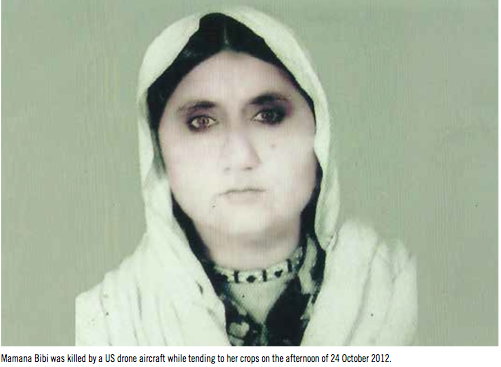
For more details on the project to bring them to the United States and the horrors that they witnessed, see Ryan Devereux‘s chilling report here about the murder of Mamana Bibi.

Mamana Bibi

Zubair, now 13, said the sky was clear the day his grandmother died. He had just returned home from school. Everyone had been in high spirits for the holiday, Zubair said, though above their heads aircraft were circling. Not airplanes or helicopters, Zubair said.

“I know the difference,” Zubair said, explaining the different features and sounds the vehicles make. “I am certain that it was a drone.” Zubair recalled a pair of “fireballs” tearing through the clear blue sky, after he stepped outside. After the explosion there was darkness, he said, and a mix of smoke and debris.

“When it first hit, it was like everyone was just going crazy. They didn’t know what to make of it,” Zubair said. “There was madness.” A piece of shrapnel ripped into the boy’s left leg, just above his kneecap. A scar approximately four inches in length remains. “I felt like I was on fire,” he said. The injury would ultimately require a series of costly operations.

Nabeela, the little girl, was collecting okra when the missiles struck. “My grandma was teaching me how you can tell if the okra is ready to be picked,” she said. “All of the sudden there was a big noise. Like a fire had happened.

“I was scared. I noticed that my hand was hurting, that there was something that had hit my hand and so I just started running. When I was running I noticed that there was blood coming out of my hand.”

Nabeela continued running. The bleeding would not stop. She was eventually scooped up by her neighbors. “I had seen my grandmother right before it had happened but I couldn’t see her after. It was just really dark but I could hear [a] scream when it had hit her.”

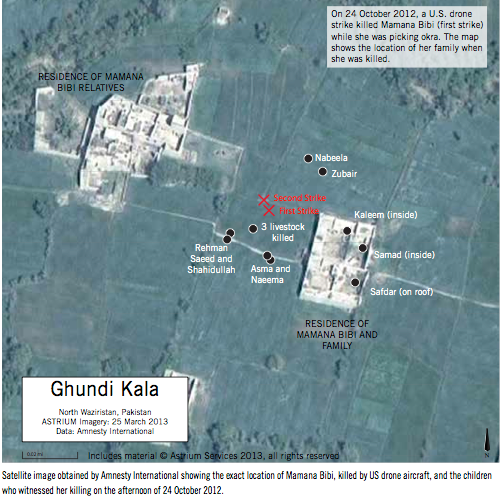
This is the same attack detailed in Amnesty’s report, Will I be next? last week.  Amnesty’s account of the strike, on Ghundi Kala in North Waziristan on 24 October 2012, included this photograph showing the position of Mamana Bibi‘s family when the drone struck while she was working in the fields:

Ghundi Kala drone killing October 2012

This is exactly that I meant when I said that all these targeted killings – and this was one which surely went hideously wrong (though I’m not sure what going right would look like) – have effects that reach far beyond the individual victim.  The ‘individuation of warfare‘ is never confined to an individual; and in this case, like so many others, it’s not warfare either.

More soon.

UPDATE:  The Independent carries an early report of the testimony of Mamana Bibi’s son here and the Guardian here (‘Bibi’ simply means ‘grandmother’ and is an honorific – the family name is Rehman).

“Nobody has ever told me why my mother was targeted that day,” Rehman said, through a translator. “Some media outlets reported that the attack was on a car, but there is no road alongside my mother’s house. Others reported that the attack was on a house. But the missiles hit a nearby field, not a house. All of them reported that three, four, five militants were killed.”

Instead, he said, only one person was killed that day: “Not a militant but my mother.”

“In urdu we have a saying: aik lari main pro kay rakhna. Literally translated, it means the string that holds the pearls together. That is what my mother was. She was the string that held our family together. Since her death, the string has been broken and life has not been the same. We feel alone and we feel lost.”

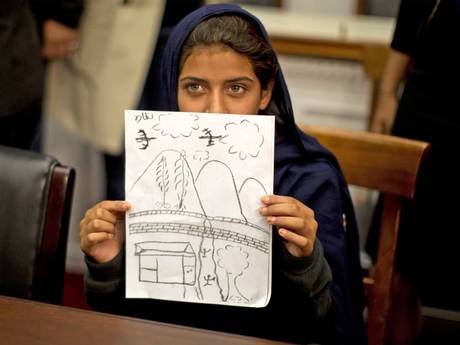
In the image below, her grand-daughter is holding her drawing of the attack.

Nabila Rehman

Read this alongside Kenneth Anderson and Benjamin Wittes here – with their double-act doublespeak of Amnesty International’s ‘coyness’ and its ‘blithe claims’ (do they know what these words mean??) – and retch.


Precarious life

Just back from a wonderful trip to Toronto and York, where (among other things) I gave a new presentation on “Drones and the everywhere war“.  It turned out to have been timely: there’s been a flurry of revelations and reports about the US campaign of targeted killing in Pakistan and Yemen, and I managed to incorporate some of them into the argument.

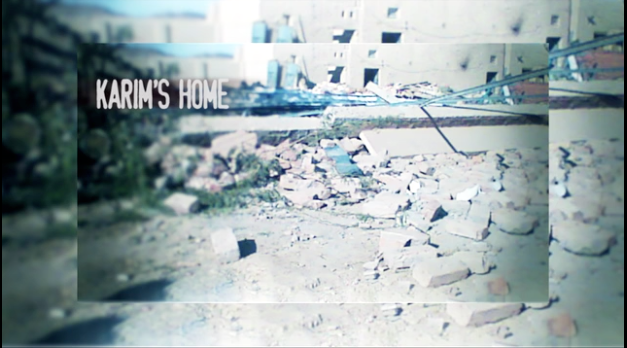
Karim's Home

I’ll be posting about all this shortly, but in the meantime – and directly related – news from Madiha Tahir that Wounds of Waziristan premieres on VICE Motherboard on line for a limited period today.

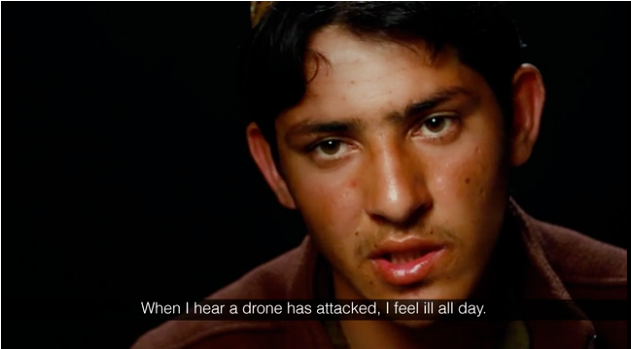
It’s smart and stunning, and addresses a swath of vital issues about the drone strikes in just 25 minutes: from their colonial antecedents in ‘air policing’ and the special laws imposed on the Federally Administered Tribal Areas by the British state through extraordinary testimony from survivors to the collusion between the US and Pakistan in exposing the population of FATA to military violence.

Waziristan I feel sick all day

The testimony should be read alongside the reports from Amnesty International [“WIll I Be Next? Drone strikes in Pakistan“] and Human Rights Watch [“Between a drone and al-Qaeda“, on Yemen]  issued earlier this week.  There’s a short video from AI on their report:

Reading and thinking about these testimonies has helped convince me that the root problem with drones is not that they enable killing from a distance: as I’ve said before, if you object to killing someone 7,500 miles away, over what distance do you think it is acceptable?   In fact, although Predators and Reapers are controlled from the continental United States they have to be deployed close to their targets: these are not weapons of global reach.  One of the most fundamental issues is that they can only be used in uncontested air space, so that they are limited to haunting the skies over some of the most vulnerable and marginal populations on earth, whose own governments care little about them and where the distinction between a combatant and a civilian is made to count for precious little.  One of my next tasks is to revise “Moving targets and violent geographies” (DOWNLOADS tab) to incorporate these reports and to emphasise this conclusion.

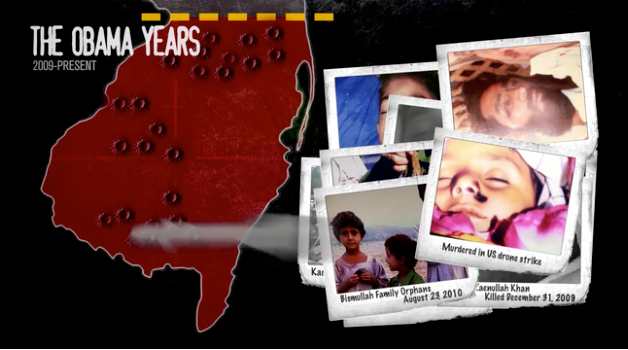
In one sequence, repeating a tactic which has been used by other artists in Iraq in particular, “Wounds” projects US drone strikes in Waziristan onto a map of Madiha’s home state, New Jersey:

Obama Years

Madiha also appears on a panel on “Life Under Drones” at the Drones & Aerial Robotics Conference in New York earlier this month, with Wazhmah Osman, Chris Rogers and Tara McKelvey, also now up at YouTube:

Unfinished business

I’m sorry for the long silence: the past two weeks have been unusually busy, with a stream of wonderful visitors to the Peter Wall Institute for Advanced Studies, including Philippe Descola, Anne-Christine Taylor and Bruno Latour.  More on this soon, but during a series of conference presentations – in which, more or less in passing, I mentioned Joshua Oppenheimer‘s The act of killing (2012) (see here and here) – I was told of another, related project that readers will find interesting.

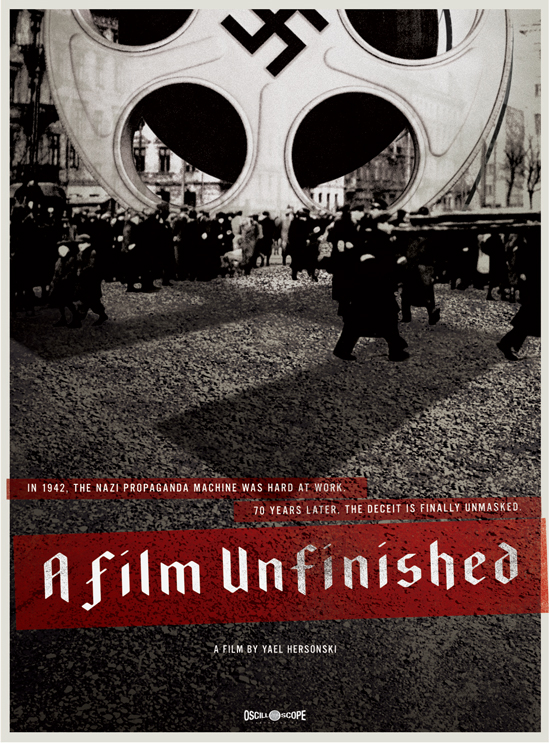
This is Yael Hersonski‘s A Film Unfinished [Shtikat Haarchion] (2010).  The centre of the documentary – you can hardly say its ‘heart’ – is an unfinished propaganda film shot by the Nazis in 1942, Das Ghetto, which purported to portray the Warsaw Ghetto.  It was found in an archive in East Germany in 1954, but in 1988 two discarded film cans containing 30 minutes of outtakes were discovered – scenes left on the cutting room floor – which radically transformed the interpretation of the film and revealed the elaborate staging of its scenes.  You can obtain another overview of the project here, which includes a number of stills from A Film Unfinished.

A film unfinished

The parallel with Oppenheimer’s project is drawn by Hersonski’s re-staging of an interview with one of the original cameramen, Willy Wist (he died in 1999 but Hersonski works from a transcript she found by chance in an archive in Ludwigsburg), and by her decision to invite five survivors of the Ghetto to watch the out-takes and to record their reactions.

This is from Jeannette Catsoulis‘s thoughtful review in the New York Times:

What if I see someone I know?jpg“What if I see someone I know?” one woman asks [she does], hardly daring to look. As the flickering atrocities play across the survivors’ faces — one film observing another — Ms. Hersonski silently creates space for memories. More than just valuable reality checks (“When did you ever see a flower? We would have eaten a flower!”), these recollections anchor the past to the present, and the images to human experience, in a way that shifts our perception of the Warsaw film. Whether cringing at the sight of naked men and women being forced at gunpoint into a ritual bath, or contemptuously dismissing the Nazis’ efforts to highlight Jewish privilege (“My mother wore her beautiful coat, and sometimes a hat. So what?”), the survivors seem to speak for those who cannot.

Here is the trailer.  The whole film is available on YouTube but I can’t embed it because it has a restricted rating, so you need to confirm you are old enough to watch it: here.

Catsoulis suggests that the film is concerned with the difference between watching and seeing, and in this sense the other obvious parallel is with Giorgio Agamben‘s philosophico-ethical probings of the witness and the camp.  Hersonski herself says that her film ‘first emerged out of my theoretical preoccupation with the notion of the “archive”, and the unique nature of the witnessing it bears.’ (She elaborates this in an interview with Max Goldberg here and there is also a really excellent interview with Lalev Melamed, ‘A Film Unraveled’, in the International journal of politics, culture and society 26 (13) 9-19, which includes an interesting comparison between Hersonski and Harun Farocki).

Witnessing is of more than historical significance, of course, and in an extended interview with Clyde Fitch – in which he asks her about complicity and guilt – Hersonski deflects his question from the past to our own present:

I’m asking myself a different question. I’m asking myself: What is my ethical position when I’m sitting very comfortably in my living room and seeing whatever is happening a few kilometers from my city in the occupied territories?…

What can I do? No, it’s not a rhetorical question. I’m seeing this and other events unfold — I’m watching it, I know about it, I know it’s there. I’m not talking about politics right now, by the way, just images of people suffering. And, as the images of people suffering in my own country go, you become a witness. Then what do you do as a witness? It’s a terrible question — it’s a haunting, torturing question. It’s our essential question.

I think that it was also a major reason why I made this film — because the Holocaust not only confronted humanity with an inconceivable horror but it also did mark the very beginning of the systematic implementation on film of that horror. And I think that something changed in our perception — I don’t know even how to define this something — after we saw images from the camps, something that we hadn’t witnessed before. It seems that documentation became more technically advanced, more massive, since then.

Well, as long as this bombardment of images becomes more intense, we will become more and more incapable of really seeing suffering, or war.

Fitch describes the film as ‘an act of anthropology’ – something which our three guests at the Wall would surely recognise too.

‘Un-Manning’

I don’t imagine that anyone who has seen it will ever forget the cockpit video of US Apache attack helicopters mowing down two Reuters journalists and ten other civilians in Baghdad in July 2007.  It was part of the cache that the principled and courageous Bradley Manning gave to Wikileaks, which released the full, unedited clip as Collateral Murder in 2010, and earlier this month Manning’s lawyers opened their defence with a showing of the same video.

The transcript of the video is here, and a redacted copy of the US Army’s investigation report (with annotated video stills) is here.

The incident has been the subject of two short documentary films, linked by a common figure, Ethan McCord, a US soldier who arrived at the scene minutes after the shooting began (more here).

The first is Shuchen Tan‘s Permission to engage, which won the Prix Europa for the best European TV investigation in 2012.  Here’s the trailer:

http://www.youtube.com/watch?v=6PlsG0p-PQA

And here is the full (brilliant) film:

http://www.youtube.com/watch?v=YnF5X7xF8zc

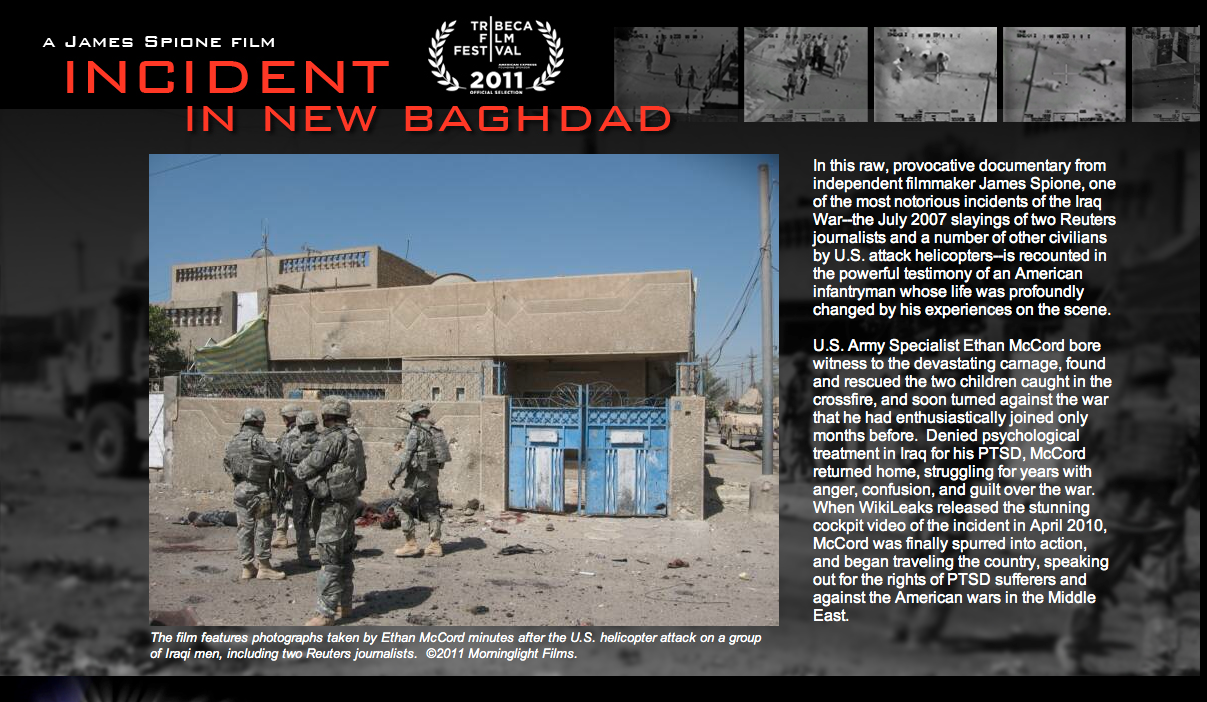
The second is James Spione‘s  Incident in New Baghdad, which won the prize for the best documentary short at the Tribeca Film Festival in 2011 and for best picture and best documentary short at the Fargo Film Festival in 2012.

Incident in New Baghdad

This is how Spione introduces his film:

Psychologists call it “psychic numbing.” Tell someone that tens of thousands of civilians have been killed in the Iraq conflict, or that thousands of U.S. veterans of our Mideast wars suffer from crippling PTSD, and their eyes will likely glaze over. Most people simply cannot comprehend the meaning of such vast numbers, nor are they likely to show any particular concern. Conversely, however, the tale of a single tragic incident can create great empathy in the same person–and greater understanding of the wider effects of war.

On April 5th, 2010, the controversial website WikiLeaks released a grainy black-and-white video that stunned the world. Recorded from the gunsight camera of an U.S. Army attack
helicopter during one of the most chaotic and deadly periods of the Iraq War, the footage depicts the violent deaths of two Iraqi journalists, Namir Noor-Eldeen and Saeed Chmagh,
along with at least eight other mostly unarmed individuals on the streets of Baghdad in July 2007. Minutes later on the video, when the driver of a passing van attempts to come to the aid of the mortally wounded Chmagh, a second helicopter attack occurs that destroys the van and kills several more people, wounding two small children in the process…

My short film INCIDENT IN NEW BAGHDAD examines what happened that day from the first-hand perspective of an American infantryman whose life was profoundly changed by his experiences on the scene. U.S. Army Specialist Ethan McCord bore witness to the devastating carnage, found and rescued the two children caught in the crossfire, and soon turned against the war that he had enthusiastically joined only months before. Denied psychological treatment in Iraq for his PTSD, McCord returned home, struggling for years with anger, confusion, and guilt over the war. When Wikileaks released the video of the incident, McCord was finally spurred into action, and began traveling the country, speaking out for the rights of PTSD sufferers and against the American wars in the Middle East.

However, there is so much more to the story, and I am now developing a more in-depth, feature-length examination of this incident that will include the perspectives of many more people involved in this incident: the infantry on the ground; the families of both Noor-Eldeen and Chmagh; the children, whose father was killed in front of them in the van, as well as their mother; and if possible, the 1-8 Cavalry Airborne gunner who pulled the trigger. My hope is that, by hearing from all of the first-hand participants of this tragic event, we may come to better understand the profoundly damaging consequences that ripple out through the lives of survivors over many years from just one so-called “engagement” in a war. And when we learn from all involved that this incident was not an aberration, but a commonplace occurrence over the course of many years, perhaps then we will start to understand those mind-numbing statistics, and feel the true moral scale of the damage, the wounds, the folly of a war of choice that never needed to happen.

I rehearse all this now for two reasons other than the shadow of sentencing that now hangs over Manning (though that is reason enough) .

First, the video at the dark heart of this incident – and these films – was not captured by a Predator or Reaper thousands of feet in the air and fed back to pilots, screeners and commanders thousands of miles away in the continental United States: this was close-in and immediate, and this raises important questions about scopic regimes and military violence that spiral far beyond the usual (and I think narrowly framed) debate over drones.

Approximate Target

Second, Incident in New Baghdad was part-financed by Carol Grayson, who became one of the film’s executive producers.  She is clearly a remarkable woman in all sorts of ways, not least because she has spent much (I suspect most) of her time since then working on a new documentary film project, The Approximate Target that charts ‘the human cost of remote control killing, the dangers of covert government policy and unaccountability in modern warfare.’  It’s been a long, difficult and continuing journey with seemingly no end of obstacles and obstructions: you can read more on her blog here.

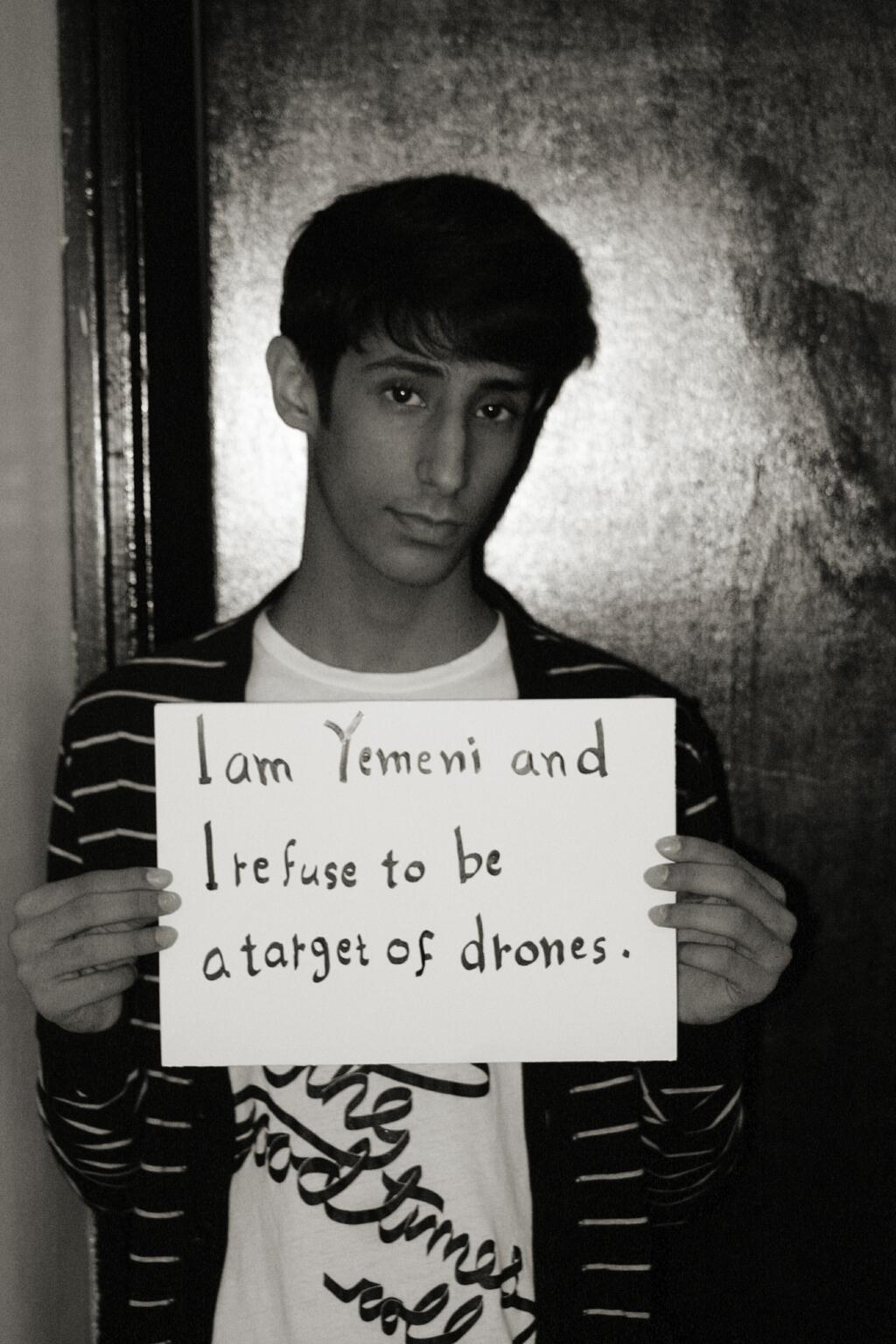
BJCiq-vCMAAgpWe-1From what I’ve been able to discover – which is not as much as I’d like – the focus of the The Approximate Target appears to be on CIA-directed strikes in Waziristan.  But Carol’s most recent posting (today) includes a letter from a Yemeni civilian to President Obama and Yemen’s President Hamadi on the eve of their meeting at the White House.  The letter was released today by Reprieve.  In it, Faisal bin Ali Jabera,  young engineer who lost two of his relatives in a drone strike on Hadhramout last summer, writes:

Our family are not your enemy. In fact, the people you killed had strongly and publicly opposed al-Qa’ida. Salem was an imam. The Friday before his death, he gave a guest sermon in the Khashamir mosque denouncing al-Qa’ida’s hateful ideology. It was not the first of these sermons, but regrettably, it was his last…

Our town was no battlefield. We had no warning – our local police were never asked to make any arrest. My young cousin Waleed was a policeman, before the strike cut short his life…

Your silence in the face of these injustices only makes matters worse. If the strike was a mistake, the family – like all wrongly bereaved families of this secret air war – deserve a formal apology. To this day I wish no vengeance against the United States or Yemeni governments. But not everyone in Yemen feels the same. Every dead innocent swells the ranks of those you are fighting.

The war you don’t see

On the day that Bradley Manning has been found guilty, here is John Pilger‘s celebrated film on the mediatization of modern war: a timely reminder of what, without people like Manning, we would never see and never know: