Just looking?

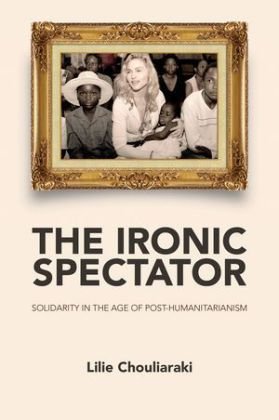
Most readers interested in the politics of humanitarianism and what Eyal Weizman calls ‘the humanitarian present‘ will know Lilie Chouliaraki‘s work, notably The spectatorship of Suffering (Sage, 2006).  She has a new book out now, The ironic spectator: solidarity in the age of post-humanitarianismCHOULIARAKI The ironic spectator (Polity, 2012/13):

This path-breaking book explores how solidarity towards vulnerable others is performed  in our media environment. It argues that stories where famine is described through our own experience of dieting  or or where solidarity with Africa translates into wearing a cool armband tell us about much more than the cause that they attempt to communicate. They tell us something about the ways in which we imagine the world outside ourselves.

By showing historical change in Amnesty International and Oxfam appeals, in the Live Aid and Live 8 concerts, in the advocacy of Audrey Hepburn and Angelina Jolie as well as in earthquake news on the BBC,  this far-reaching book shows how solidarity has today come to be not about conviction but choice, not vision but lifestyle, not others but ourselves – turning us into the ironic spectators of other people’s suffering.

This intersects with my own interest in the modern and late modern spectatorship of war, though in complex and far from straightforward ways (I have particularly in mind the contemporary ‘consumption’ of war), so I was excited to read this description of Lilie’s current research:

My current work focuses on the mediation of war, where I explore the various public genres through which war has been mundanely communicated in our culture, from photojournalism to films and from memoirs to news. The aim is to better understand how our collective imagination of the battlefield and its sufferings, what we may call our ‘war imaginary’, has been shaping the moral tissue of public life, in the course of the past century (1914-2012).

As part of this project, she has an essay forthcoming in Visual communication later this year, ‘The humanity of war: iconic photojournalism, 1914-2012’, which will also appear in extended form in  Nick Couldry, Mirca Madianou and Amit Pinchevski (eds) The Ethics of Media (Palgrave, 2013).

Bodies on the wire

Last week I had a wonderful time at the Eisenberg Institute for Historical Studies at the University of Michigan in Ann Arbor, and came away with a host of new ideas and fresh lines of inquiry.
One of these concerns the role of the telegraph in modern war.  When I was doing my first researches I discovered several writers emphasised its importance in reporting the Crimean War (1853-1856), a campaign that saw the first appearance of the war correspondent in the person of W.H. Russell, whose despatches for the Times won him a central place in both political and media history.

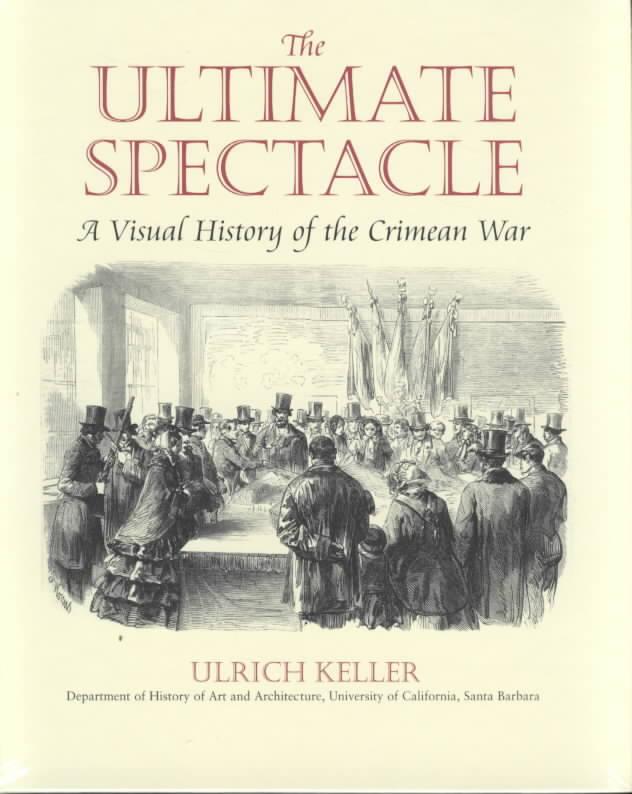
In The Ultimate Spectacle: a visual history of the Crimean War (Routledge, 2001) Ulrich Keller argued that:

‘Throughout the campaign the domestic front continuously inscribed itself on the military front, and vice versa; nothing could happen in one sphere without immediate repercussions in the other. It was of course the steamship, the telegraph and the news-press with its swift coverage of events, which created the interdependence of the two arenas.

‘Without the dramatic improvement of communication technologies during the first half of the nineteenth century, the Crimean events, evolving at a distance of 3000 miles from London, could never have become an object of constant, close and emotional public scrutiny at home…’

Russell’s reports were of tremendous significance, and the telegraph was important for the conduct of the war.  Indeed, Orlando Figes in Crimea: the last Crusade (Allen Lane, 2010) treats the Crimean War as

‘the first example of a truly modern war – with new industrial technologies, modern rifles, steamships and railways, novel forms of logistics and communication like the telegraph .. and war reporters and photographers directly on the scene.’

But it is important not to confuse the two.  The British Army had a field telegraph whose 24 mile network connected Lord Raglan’s headquarters with eight stations in the field.  The illustration below comes from Steven Roberts‘s Distant Writing which is a tremendous source of information on British telegraph companies from 1838 to 1868:
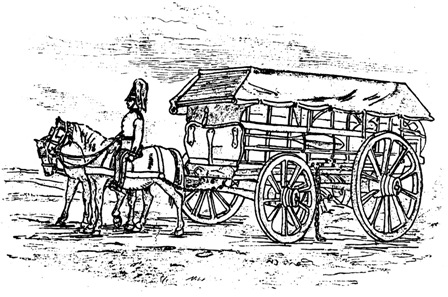
Electric Telegraph Company’s War Wagon in the Crimea, 1854

In addition, Army dispatches were sent 300 miles across the Black Sea to Varna and then overland to Bucharest (a journey of 60 hours) where they were telegraphed to London; by April 1855 a temporary submarine cable from Balaklava to Varna had reduced the overall transmission time to London to 5 hours, and the press used the same line for sending short despatches to London.  One periodical was so excited at the new proximity of war that it held out the fantasy

‘that it would not now be difficult, by some little farther novelty of invention, to cause the reverberation of the very cannons themselves, as it were, to be transmitted, in the shape of electric vibration, through the 3000 miles of intervening wire, and heard, in still continuous vibrations, finally communicated to some acoustic apparatus in the British Houses of Parliament…. There is no physical reason why the public should not know every morning, noon and night, what is at these very times going on in the seat of war.’
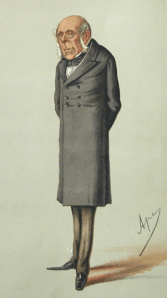
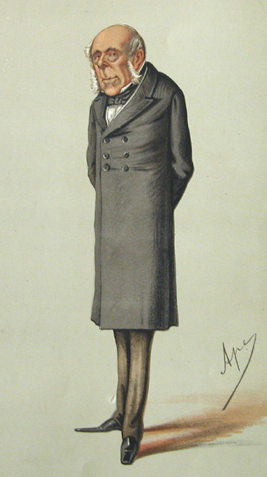
But Russell’s detailed despatches went by sea via Constantinople and took 20 days to reach London: his famous report of the Charge of the Light Brigade on 25 October 1854 was not published in the Times until 13 November, though an initial notice had appeared on 2 November.  And so it was not Russell that the Earl of Clarendon, the Foreign Secretary [right], had in his sights when he wrote to the British Ambassador in Constantinople on 23 September 1854, a month before that epic encounter (and in fact before any of Russell’s reports had been published), to complain about the press:

‘Our “own correspondents” have certainly contrived to keep our enemy informed of all he must want to know – his only disadvantage is 8 hours delay which is the time for transmitting to St P[etersburg] all that the newspapers contain and they generally publish as much as the Government knows for in one way or another some correspondent at Hd Qrs generally discovers and transmits every secret order or intended movement as well as every disaster and disharmony and the patriotic editors never think of keeping back anything injurious to the public service but on the contrary hasten to publish it all in proof of their superior means of intelligence.  The press and the telegraph are enemies we had not taken into account but as they are invincible there is no use complaining about them.’
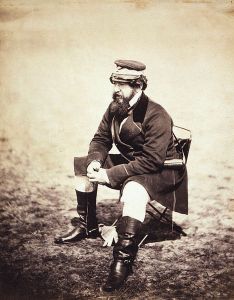
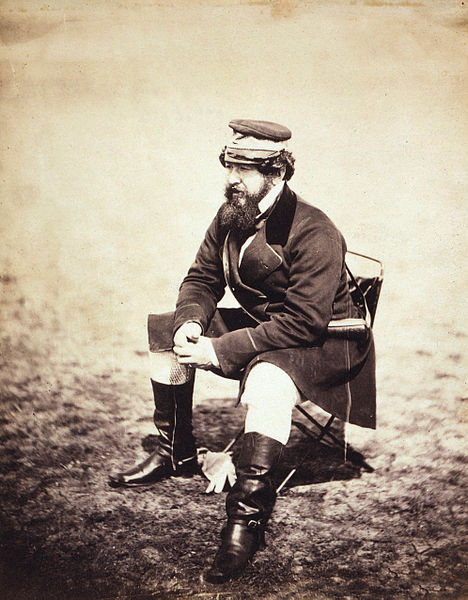
What he had in mind were the brief telegraphic despatches that were mined by all the leading newspapers in Britain. The Times was no exception, but it prided itself on its exclusive reports from Russell [left], as it explained on 21 October 1854:

The letters of our special correspondent from the scene of war, although naturally a few days in arrear of those leading communications which reach us through the agency of the telegraph, are always replete with interest, and are calculated indeed to serve far more important purposes than those of momentary amusement.  In those circumstantial descriptions of an eye-witness – in those details of actual experience and personal observation – we obtain an inexhaustible source of information…  We not only learn step by step what the army really did, and where it went, but we follow it in its march, and collect the opinions, the hopes and the feelings current among the soldiery from hour to hour.’

It may be true to say, as Andrew Lambert wrote for the BBC,  that ‘the electric telegraph enabled news to travel across the continent in hours, not weeks’ so that during the Crimea ‘war became much more immediate – a massive leap forward on the way to our age of instant global coverage by satellite.’  But beyond Europe reporting was still agonisingly slow.  In Australia, as Peter Putnis and Sarah Ailwood have shown,  ‘just when news from Europe was most eagerly wanted’, steamship services from Britain were diverted to supply troop ships for the war,  and the replacement sailing packets were so much slower and less reliable that colonial insecurities were heightened.  And even within Europe Lambert’s ‘immediacy’ was produced by terse and not always reliable telegraphic despatches that editors combined with long-form reports from their correspondents and others in the field.  The most vivid images of the war were produced by Russell’s despatches and by Roger Fenton‘s striking photographs.

For this reason, until now I had thought of the American Civil War (1861-1865) as ‘the first telegraph war‘, since the telegraph was demonstrably important both for the conduct of the war (which included military communications and, since cables were intercepted, military intelligence) and for its more detailed reporting.

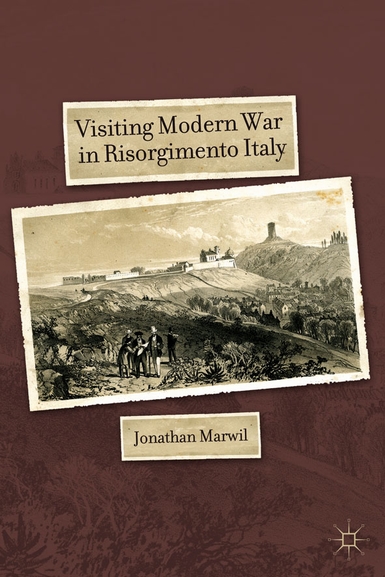
But at Ann Arbor I met the redoubtable Jonathan Marwil who directed my attention to the Second Italian War of Independence (sometimes called the Franco-Austrian War) of 1859.  His Visiting modern war in Risorgimento Italy (Palgrave, 2010), which I’ve devoured on my Kindle, is a superb account of the mediatization of modern war.  By 1859, he writes,

‘armies could not expect to wage wars without journalists in attendance.  Their stories, composed from what they saw, what they were told, and what they imagined, would be read soon after they were written, given the proximity of the seat of war to the major capitals and the presence of the telegraph wire.  Those watching a war from afar were now kept abreast of events almost while they were happening. News of the first Napoleon’s victories in Italy had taken days to reach Paris; reports of his nephew’s expected triumphs would arrive in hours.  A day after a major battle in early June, a French lieutenant would write his uncle assuming that he already knew more about the battle than did the nephew who had fought in it.’

[That last remark, incidentally, recalls one of the core arguments of Jan Mieszkowski‘s Watching War (Stanford University Press, 2012): that one of the crucial dilemmas of modern war is the disconnect between the participant’s sensory disorientation (‘To be under fire is to experience the loss of control of one’s own signifying practices’) and the abstraction (or ‘perspective’) of distant observers.]

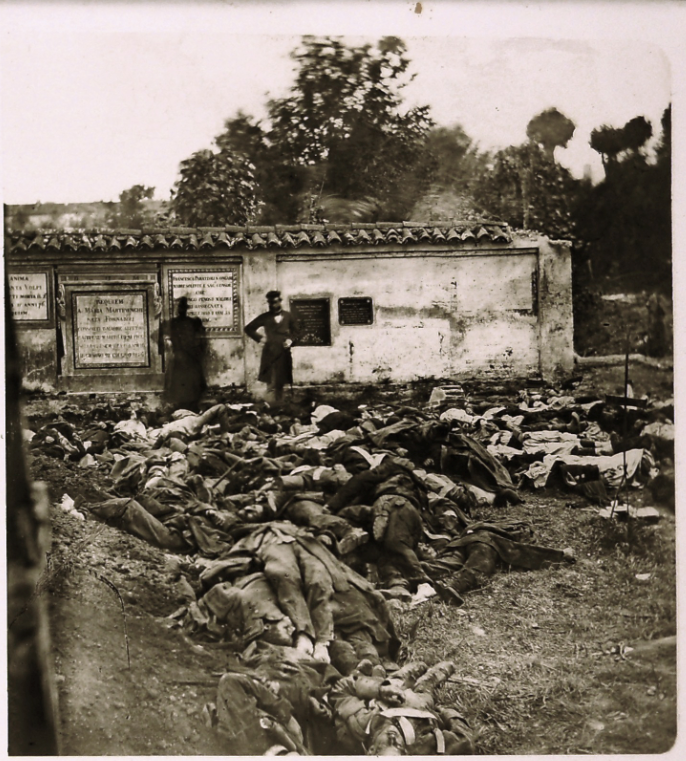
The Italian War was a war of truly awful proportions: you can find a stark description of ‘combat photography’ during the war, together with some examples, at Bill Johnson‘s Hold History in Your Hand here.  At the battle of Solferino some 40,000 were killed or injured in 15 hours, and the sight of the unrelieved suffering prompted a Swiss observer, Henry Dunant, to memorialise the scene in A memory of Solferino.  Within months of its publication in 1862 a committee started work on Dunant’s vision of an impartial relief society that would provide aid to those wounded in time of war: this would eventually become the International Committee of the Red Cross.
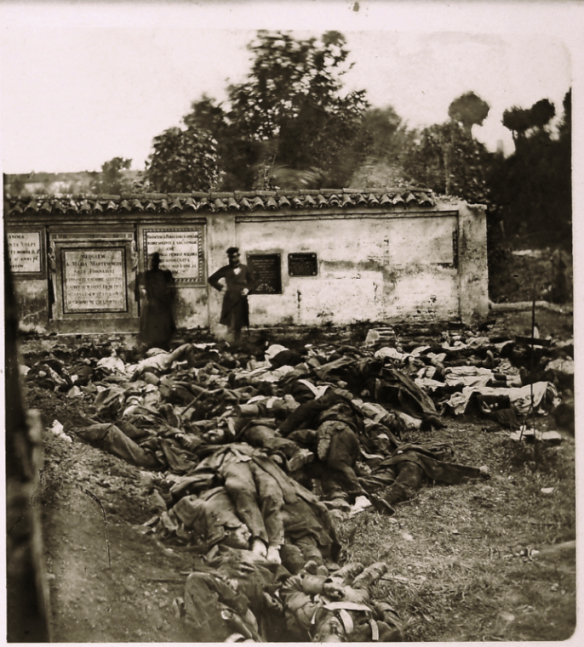
Cemetery at Melegnano, June 1859

The Times was horrified at what it called ‘the wanton and prodigal waste of life’ too, but in an editorial on 2 June 1859 it also reflected on the intimate conjuncture of killing and technological advance:

‘… revolting as war always is, it never presented itself in a form more repulsive than that which it now wears in the Italian Peninsula…   War also seems to have become more hideous from its closer contact with the greatest triumphs of our modern civilization.  The butchery of Casteggio was fed by a succession of railway trains, which disgorged their cargoes close to the human shambles, just as they carry the cattle, the sheep, and the calves which feed the daily hunger of London.

‘Science is degraded into an instrument for .. destruction…  While rival hosts are encountering each other with a ferocity which the Huns and the Vandals might envy, news of every particular of the butchery is carried by the delicate and beautiful machinery of the electric telegraph, and the pulse with which all nature throbs communicates, with a fidelity and despatch unknown to the Scourge of Mankind in former ages, every circumstance and detail of destruction.


The Code breakers

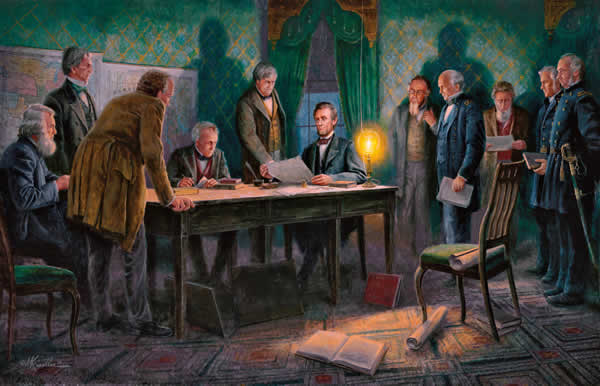
Lincoln signing General Order No. 100 (Mort Künstler)

In 1863, under the authority of Abraham Lincoln, the United States published Instructions for the Government of the Armies of the United States in the Field, General Order 100.  It was drawn up by a law professor at Columbia, Francis Lieber, and approved by a committee of Union officers, and sought to codify the practices of customary international law.  It was signed by Lincoln on 24 April 1863, and the full text is here.

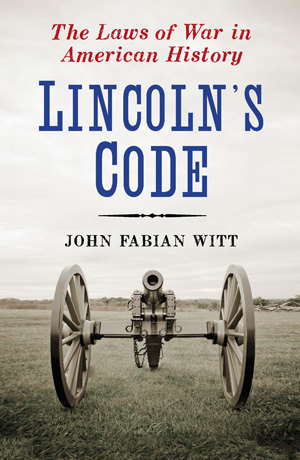
The Lieber Code, as it became known (Lieber himself called it ‘Old Hundred’), continues to casts its spell over international law and its historians.  Its most recent incantation is John Fabian Witt‘s artfully titled Lincoln’s Code: the laws of war in American History (Free Press, 2012). It’s a superb historical monograph, beautifully written and richly illustrated, that travels from the American Revolution via the fulcrum of the Civil War to the eve of the First World War – Witt is both a professor of Law at Yale and a member of the History department – but, not surprisingly, it’s the book’s contemporary echoes that have resonated with many readers.  (Witt once hailed Lincoln as ‘probably our most important law-of-war president, having crafted the very rules that George W. Bush and his Justice Department tried to destroy’).

In an interview in today’s New York Times, however, Witt insists that the Bush administration – in its assault on the Geneva Conventions, its establishment of GITMO, and its elaborate parsing of what does and does not legally constitute torture – did not mark a departure from historical precedent:

“It’s not an aberration that American lawyers closely tied to the administration went to work on transforming the laws of war to suit the felt strategic imperatives of the moment,” he said. “That is the kind of thing we see going all the way back.”

The Lieber Code, he argues, was not a neutral instrument: it was ‘developed by a side for the purpose of helping it win a war.’  And so while Witt documents its role as what he calls a ‘humanitarian shield’ defending ‘civilized war’ – the Code enshrined a distinction between combatants and civilians (or ‘private citizens’), and proscribed assassination, torture and poisons – he argues that it was also designed to function offensively as ‘an instrument of justice.’  The Code itself proclaimed that ‘the more vigorously wars are pursued the better it is for for humanity.  Sharp wars are brief.’ (This was before the age of air power – though balloons were used during the Civil War – but it was exactly this belief in ‘sharpening’ war that underwrote the later faith in bombing as an alternative to the protracted carnage of the trenches).

Now ‘justice’ is a weasel-word,  especially in the mouths of weasels in the White House – it’s no surprise that Max Boot is such a fan of Witt’s cheerleading for ‘the United States’s long history of leadership in creating the laws of war’.  It turns out that among the practices that escaped the Lieber Code’s censure were the starvation of civilians and the bombardment of towns without warning (‘Surprise may be a necessity’), and most of its other provisions and protections could be set aside on grounds of ‘military necessity’.  Eric Posner provides an incisive dissection of those implications in relation to Sherman’s infamous march through Georgia and South Carolina and much more besides in Slate here.

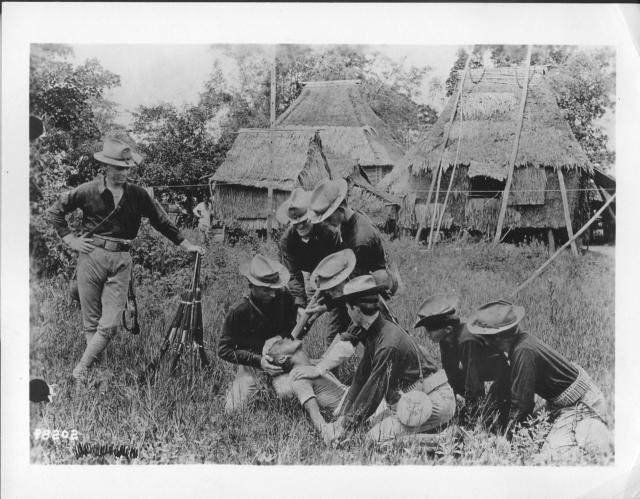
The climax of the book is certainly not its epilogue but Witt’s discussion of the exemplary violence displayed by the United States during the Philippine War (1899-1902).  Here ‘Old Hundred’ was cited to justify extraordinarily brutal measures.  General James Bell made clear his preference for ‘a short and severe war’ over ‘a benevolent war infinitely prolonged’, and some – perhaps many – officers treated this as a declaration of open season on their prisoners of war.  The most shocking method of interrogation was the ‘water cure’ (shown below) – the contemporary resonances don’t need any amplification from me – and yet torture was expressly outlawed under the Lieber Code.  A number of commanders were successfully prosecuted for the offence, including Major Edwin Glenn, who openly prided himself on leading a mobile team of ‘water cure’ experts.

So does this mean that the Code’s ‘defensive shield’ tempered its aggressive sword? In 1914 Glenn was selected by the War Department to be the lead author to update its field manual on the laws of war, and it was that version of the Rules of Land Warfare that guided military operations in World War I and World War II and was cited time and time again at Nuremberg.  ‘No one noted that they had been crafted by a convicted torturer,’ Witt observes, ‘a man whom we would today … call a war criminal.’

Yet Witt is quick to strike down the low-hanging fruit, the easy conclusion that the laws of war are thus ‘shot through with hypocrisy’:

‘For the most striking thing about Glenn’s Rules of Land Warfare is not the identity of its author but the restraint of its terms.  The manual bore few traces of its author’s terrible past….

‘Glenn adopted Lieber’s term “war crime”s for the first time in an official American document.  And as for torture, Glenn faithfully reproduced precisely the section of the 1863 Code that Judge Advocate General Davis had cited when he recommended that the president uphold Glenn’s own conviction and sentence. “Military necessity”, the Rules of Land Warfare stated, “does not admit of … torture to extort confessions.” Following Lieber’s Old Hundred, the Rules banned coercive means to obtain information from prisoners of war.

A draft 2011 statement on ‘Lincoln’s Code’ prepared by Witt for a Harvard workshop is here, and you can access 70 images from his book (from which I took the image above) together with its bibliography here.  His February 2011 Inaugural Lecture as the Allen H. Duffy Class of 1960 Professor of Law at Yale – Lincoln’s Code: the puzzling history of the laws of war – is available on vimeo here.

Police/military/city

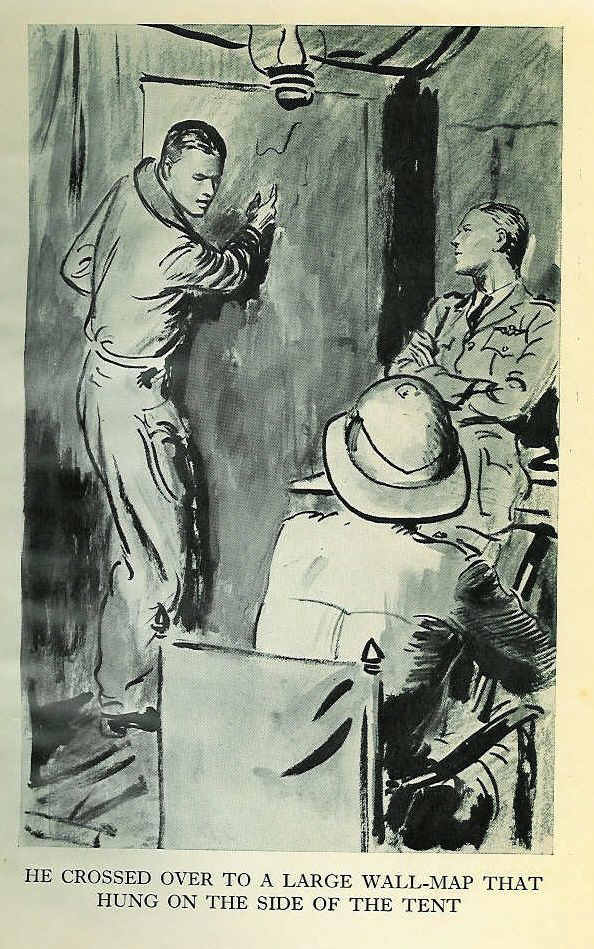
There is growing interest in thinking through the contemporary blurring of policing and military violence.  When, I wonder, did we start referring to “security forces“?  The earliest entry in the OED is from 1973 and refers to Britain’s military/police operations in Northern Ireland, but the practice is evidently much older than that. Those who grew up in Britain with Biggles (or perhaps in spite of Biggles) will surely remember Captain W.E. Johns‘s creation of the Special Air Police after the Second World War – and, as my illustration (left) from Biggles Flies East implies, these operations were about the violent production of particular spatialities –  but ‘air control’ was developed as an important police/military modality of British colonial power immediately after the First World War, when its prized sphere of operations was the Middle East and India’s North West Frontier (notably Waziristan).

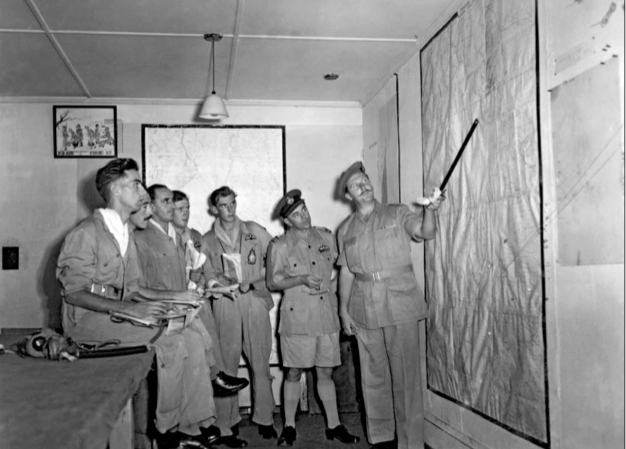
In the 1950s Britain applied similar (il)logics to the the Mau Mau insurgency in Kenya, as Clive Barnett notes here (with another, rather more serious nod to Biggles), and to the Malayan Emergency.  Bombing was a routine tactic in all these pre- and post-war campaigns – the image on the right is of an RAF briefing in Kenya in 1954 – and Britain’s ‘aerial supremacy’ was, of course, uncontested in these colonial theatres of war.  Other colonial powers used it too.  No doubt the interest shown by the US Border Patrol and US police forces in (at present, unarmed) drones can be situated within this techno-political history of air policing, though I’m aware that the lines of descent are more complicated than my cartoons can suggest.

Mark Neocleous has outlined a careful (and still longer) genealogy of the very idea of ‘policing’ that speaks directly to these issues in ‘The Police of Civilization: The War on Terror as Civilizing Offensive’, International Political Sociology 5 (2011) 144-159:

The monopoly over the means of violence that is fundamental to the fabrication of social order is the core of the police power. Although such a formal monopoly over the means of violence does not exist in the international realm—which is the very reason why so many people have found it difficult to develop the concept of ‘‘international police’’—the violence through which this realm has been structured is obvious. It has traditionally been cast under the label ‘‘war.’’… 

To say that police and war conjointly form the key activity of the project of civilization is to say nothing other than violence has remained intrinsic to the process in question. Thus, central to the idea of civilization is military-police terror (albeit, as ‘‘civilization,’’ a terror draped in law and delivered with good manners)…

The attempt to hold on to categorical distinctions between ‘‘police’’ or ‘‘military’’ for analytical, legal, and operational reasons runs the risk of losing what is at stake in the fabrication of international order: the way war imbricates itself into the fabric of social relations as a form of ordering the world, diffracting into a series of micro-operations and regulatory practices to ensure that nebulous target ‘‘security,’’ in such a way that makes war and police resemble one another. 

If, as I’ve suggested, these formulations have a direct bearing on counterinsurgency – and not only British practices: see Neocleous on Vietnam here – and on the modalities of modern colonial power more generally, they are also revealed with remarkable clarity in the contemporary city: what Steve Graham calls ‘Foucault’s boomerang’, as colonial tactics are repatriated to the metropolis.

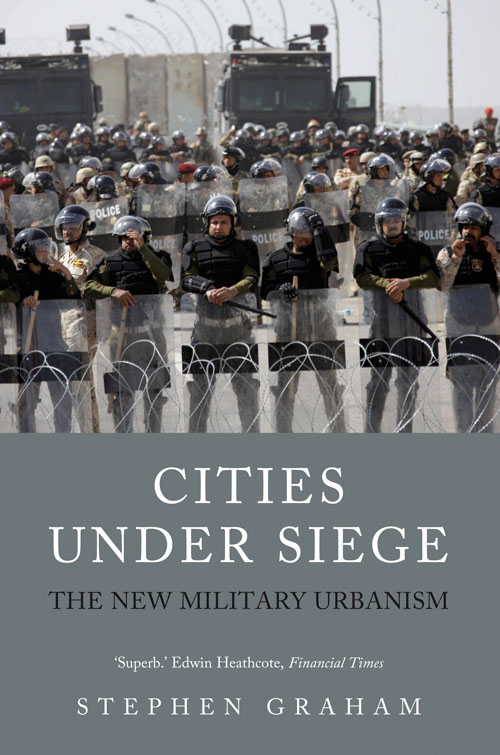
As Steve shows in exemplary detail in Cities under siege: the new military urbanism (Verso, 2010; paperback out now), a vital zone of convergence between police and military violence – what Neocleous calls their ‘violent fabrication of the world’, their ordering of it in every sense of the verb – is the city:

‘As security politics centre on anticipation and profiling as means of separating risky from risk-free people and circulations inside and outside the territorial limits of nations, a complementary process is underway.  Policing, civil law enforcement and security services are melding into a loosely, and internationally, organized set of (para)militarized security forces.  A “policization of the military” proceeds in parallel with the “militarization of the police”.’

So here is welcome news of a Live Web Seminar from Harvard’s Program on Humanitarian Policy and Conflict Research, Dangerous Cities: Urban violence and the militarization of law enforcement, 2 October 2012 0930-1100 (Eastern).

More than half of the world’s population is concentrated in urban areas. According to UNFPA, this number is expected to rise to 5 billions by 2030, reaching 2/3 of the world population, with the largest cities emerging in Africa and Asia. Regrettably, along with this mass urbanization has come an unprecedented level of violence and crime in densely populated slums and shantytowns. Cities like Baghdad, Kingston, Rio de Janeiro, Guatemala, Ciudad Juarez and Mogadishu have become the battlegrounds of contemporary conflicts.
 
In many countries, particularly in Latin America, this emerging form of violence is considered one of the greatest threats to national security. Indeed, urban violence can be as deadly and costly as traditional armed conflicts. In a 2007 report, the UNODC pointed out that the levels of violence in El Salvador in 1995 were higher than during the civil war of the 1980s.
 
To curb the violence, states have responded by deploying specially trained military units when traditional law enforcement has failed to restore security. These instances of ongoing urban violence engaging organized criminal networks, coupled with the use of military force, increasingly resemble to situations of armed conflicts.
While the militarization of law enforcement may be unavoidable when traditional law enforcement institutions lack the resources and expertise to contain urban violence, the legal and policy framework for the conduct of such operations needs yet to be developed. The regulation of the use of military force represents a major challenge in urban environments, even more so when humanitarian law is formally inapplicable and the enforcement of international human rights is weak. Such environment may require adaptation of military doctrine, training, and equipment in order to minimize abuses against civilians, detainees and those no longer engaged in violent acts.
 
Furthermore, the humanitarian sector faces formidable difficulties in the context of urban violence. First, humanitarian actors must assess whether involvement in these complex situations is appropriate under their respective mandates. Second, humanitarians must develop objective criteria to determine whether the level of violence and human suffering warrants intervention in view of the specific security and policy risks. And third, humanitarian actors must adapt to these situations and identify priority areas of humanitarian action on a case-by-case basis.
 
In light of these considerations, this Live Web Seminar will shed light on the tensions and challenges arising out of the application of humanitarian principles in urban violence. Expert panelists and participants will explore the following questions:
 
–       Whether instances of urban violence can be characterized as armed conflicts? If so, what are the advantages and disadvantages of applying International Humanitarian Law (IHL) to these situations?
–       To what extent is it necessary to develop a legal framework that incorporates both humanitarian and human rights considerations tailored to situations of urban violence?
–       What strategies and policy tools can be put in place in order to minimize human suffering and, at the same time, address the security concern of states in urban conflicts?
What is the proper role of humanitarian actors in urban conflicts? 

Registration is required: go here.

As should be obvious from the pre-seminar summary, this isn’t quite the agenda that Neocleous has in mind – but it’s also clear that his suggestions should also animate continuing discussions of our so-called ‘humanitarian present‘…

The two security-state solution

So Mitt Romney insists that ‘the Palestinians have no interest whatsoever in establishing peace‘…. Given the scale of illegal Israeli settlement in the West Bank (see the meticulous reports from the Foundation for Middle East Peace), the brutality of the Israeli occupation, and the chokehold Israel maintains on Gaza, Palestinians have no interest in peace??

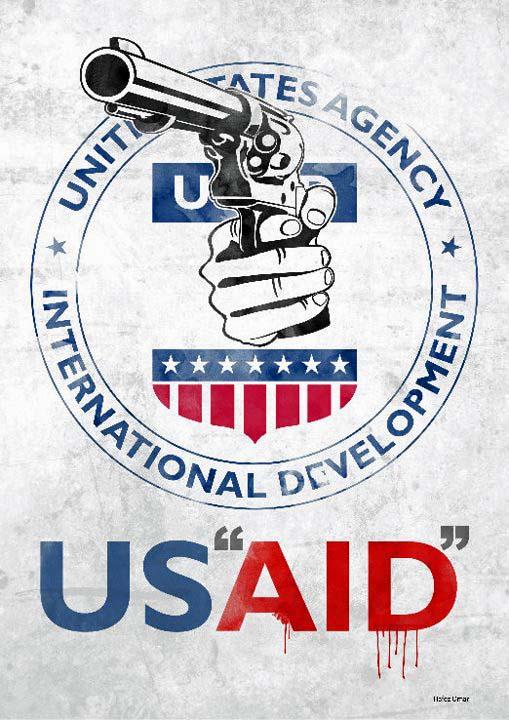
The contours of the Israeli security state’s impress on the Palestinian people ought to be well known – though evidently they aren’t – but hard on the tawdry heels of Romney’s offensive assertion comes a brilliant essay at Jadailiyya from Lisa Bhungalia that details the operation of the American security state in Palestine.

Invoking Laleh Khalili‘s work on occupied Palestine’s position within global counterinsurgency – I’ve drawn attention to this before – Lisa examines ‘the ways in which practices of colonial subjugation and management are being mobilized through the less sensational, seemingly mundane spaces and practices of aid governance’: to be precise, through the United States Agency for International Development (USAID).  She shows how its elaborate certification of NGOs and private agencies works not just to channel financial assistance but also to channel information back to the US and Israeli governments. Like collateral damage estimation in military targeting, this civilian regime works through an extended chain of calculation-calibration-certification. This is Eyal Weizman‘s ‘humanitarian present’ with a vengeance: ‘If a decision to accept USAID funds is undertaken, one must fundamentally operate within a framework that affords little flexibility in terms of negotiating the security priorities set out by Washington and Tel Aviv.’

It is also part of the tightening development-security nexus:

‘What we are seeing, in effect, is a proliferation of sites and diversity of means through which US political and economic power is being articulated. Alongside its military and diplomatic interventions, the US is simultaneously extending its reach through a host of “development experts,” humanitarian agents and “democracy promoters” charged with filtering, sorting and policing the Palestinian civilian population. While taking a new and perhaps more sophisticated form, these contemporary practices and strategies must not be dissociated from a longer history of counterinsurgency in Palestine…. The aid regime that has taken form in recent decades is part and parcel of the refinement and evolution of techniques that Khalili speaks of.’

The poster above is the work of Hafez Omar here and here, and Lisa’s essay derives from her doctoral research whose working title is ‘Negotiating a Colonial Present: Aid and its fragmentary states in Palestine’ .

The humanitarian present, humanitarian reason and imperialism

More from my continuing reflections on the humanitarian present: first, a recent interview with Jean Bricmont, the author of Humanitarian Imperialism: using human rights to sell war (Monthly Review Press, 2006) at Counterpunch here.

If you don’t know the book but the name seems familiar: Bricard co-authored Fashionable Nonsense: postmodern intellectuals’ abuse of science (Picador, 1998) with Alan Sokal (yes, that Alan Sokal).

And if the idea of ‘humanitarian imperialism’ seems to echo Noam Chomsky‘s ‘military humanism’ – remember his The new military humanism: Lessons from Kosovo (Common Courage Press, 2009), and if you do see also his A new generation draws the line: humanitarian intervention and the “responsibility to protect” today (new edition, Paradigm, 2011) – then here is Chomsky on Bricard and ‘the new doctrine of imperial right’.

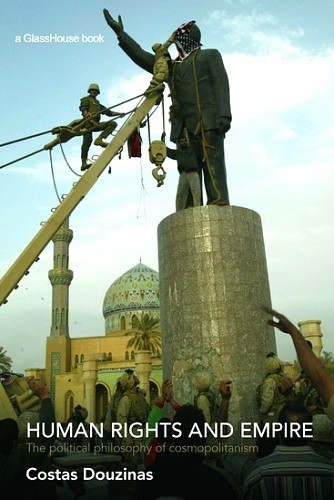
All that said, Bricard’s (and Chomsky’s) vision is considerably narrower than the sense in which Eyal Weizman develops the idea of a ‘humanitarian present‘ that involves the entanglement of military violence, international humanitarian law and NGOs. Here I think some of the sharpest contributions have come from Costas Douzinas, Professor of Law at Birkbeck, University of London.  His relevant essays have appeared all over the place, but the core arguments are assembled in his Human Rights and Empire (Routledge, 2007).

The significance of Douzinas’s project was beautifully captured by Umut Özsu writing in the European journal of international law 19 (2008):

If rights are to retain their emancipatory edge in an age that is increasingly prone to couching its wars of retribution and occupation as necessary evils en route to the attainment of perpetual peace, a considerable measure of vigilance is required to keep them from being subsumed beneath the rubric of the new arsenal of governmental techniques with which the ‘post-9/11’ West has armed itself. After all, what presents itself as a bold acceptance of responsibility may, on closer inspection, prove to be substantially indistinguishable from accommodationist opportunism. Douzinas’ work is invaluable in this regard, laying the groundwork for a form of cosmopolitanism which neither clings unquestioningly to the humanitarian tradition nor permits itself to be captured by the machinery of an ostensibly mature and conscientious pragmatism. 

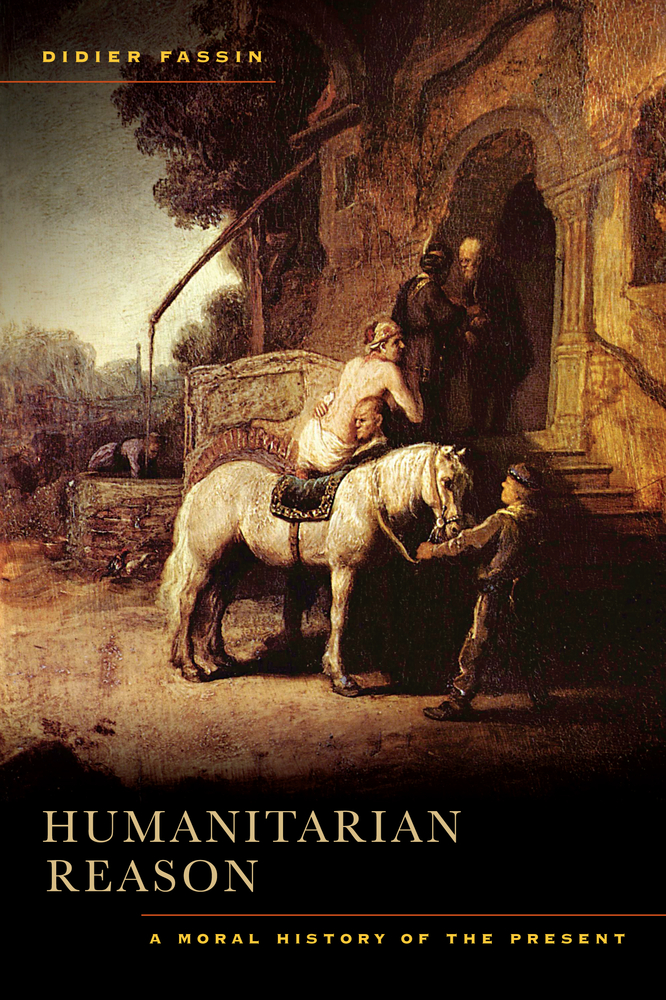
And for a genealogy of humanitarianism it’s hard to better Didier Fassin‘s monumental Humanitarian reason: a moral history of the present (University of California Press, 2011).  Trained successively in medicine, in public health and in social science in Paris, Fassin’s career spans a world of field investigations and social responsibilities, including service as Vice-President of the French National Committee on AIDS and Vice-President of Médecins Sans Frontières.  Fassin co-edited (with Mariella Pandolfi) an indispensable collection of essays, Contemporary states of emergency: the politics of military and humanitarian interventions (Zone, 2010), but Humanitarian reason is his magnum opus (in every sense of the word) – so far, at any rate.

If you don’t know his work, one of the best introductions is Fassin’s lecture on the Critique of Humanitarian Reason on 17 February 2010 at the Institute for Advanced Study at Princeton:

Humanitarianism, which can be defined as the introduction of moral sentiments into human affairs, is a major component of contemporary politics — locally and globally — for the relief of poverty or the management of disasters, in times of peace as well as in times of war. But how different is the world and our understanding of it when we mobilize compassion rather than justice, call for emotions instead of rights, consider inequality in terms of suffering, and violence in terms of trauma? What is gained — and lost — in this translation? In this lecture, Didier Fassin, James D. Wolfensohn Professor in the School of Social Science, attempts to comprehend humanitarian government, to make sense of its expansion, and to assess its ethical and political consequences.

And here he is:

For a detailed, thoughtful and compelling review of Humanitarian Reason see Steven Lukes, ‘The politics of sacred life’, in Public Books (August, 2012) here.  An extract:

The inequalities resulting from humanitarian government are, moreover, at work on the global scale, as evidenced by the contrast between refugees, gathered, protected, and assisted in huge camps in the South, and asylum seekers, subject in the North to decisions “parsimoniously made about which of them may be granted protection under the law.” For this to work the territorial and moral boundaries between the two worlds must be tightly sealed and policed, for example, “preventing refugees from the South from claiming the prerogatives granted to asylum seekers in the North.” As for the latter, if they are admitted, it is on humanitarian grounds rather than as of a right.

However, the heart of Fassin’s critique of humanitarian reason lies, not in the exposure of the disjunction between fantasy and harsh realities, but rather in the analysis of the ways in which humanitarian discourse functions to render this disjunction less visible and less troubling than it might otherwise be, thereby inhibiting possible effective practical and political interventions. Indeed, there is the suggestion here that moral discourse itself may serve to displace a more adequate understanding, deflecting attention from the deeper and wider sources of misery and suffering, thus rendering action to reduce them less feasible.

We need, Fassin writes, “to understand how this language has become established today as the most likely to generate support among listeners or readers, and to explain why people often prefer to speak about suffering and compassion than about interests or justice, legitimizing actions by declaring them to be humanitarian.” The social sciences are themselves part of this story, lending credit to the new political discourse by focusing on exclusion and misfortune, suffering and trauma, providing “the new lexicon of moral sentiments” that “has perceptible effects both in public action and in individual practices.” What, he asks, “ultimately, is gained, and what lost, when we use the terms of suffering to speak of inequality, when we invoke trauma rather than recognizing violence, when we give residence rights to foreigners with health problems but restrict the conditions for political asylum, more generally when we mobilize compassion rather than justice?”

Violence in the humanitarian present

Further to my musings on the humanitarian present, a Call For Papers for the Association of American Geographers Conference in Los Angeles next year, 9-13 April 2012:

On the Question of Violence in the Humanitarian Present

Organizers: Lisa Bhungalia (Syracuse University) and Tish Lopez (University of Washington)

Discussant: Craig Jones (University of British Columbia, Vancouver)

 Humanitarianism has long had its place within colonial legacies serving often, as Derek Gregory (2012) puts it, as the “velvet glove wrapped around the iron fist of colonialism.” The recent emphasis in U.S. counterinsurgency doctrine on non-kinetic and humanitarian measures as a means of undermining insurgency would appear to confirm this point. Indeed, the lines between humanitarian and military are increasingly rendered indistinct. But more than simply a blurring or collapse we should ask: What is the relationship between humanitarianism and violence? Moreover, in what ways does humanitarianism serve as a means of managing and modulating violence? This inquiry has been at the fore of Eyal Weizman’s (2011) recent work in which he suggests that an “economy of violence is calculated and managed” through various humanitarian, moral and legal technologies that legitimate and underwrite the continued operation of violence. It is the collusion of these humanitarian technologies with military and political powers that form what he calls the “humanitarian present.”

This paper session invites theoretical and/or empirical research that engages the “humanitarian present” from a diverse range of approaches and perspectives. It explores the ways in which humanitarianism is mobilized discursively and materially as a means for modulating contemporary violence and for governing the displaced. What are the specificities and limits of the concept of the “humanitarian present?” How are displaced populations or those living in zones of ongoing war and occupation negotiating the humanitarian regimes that govern their lives? We invite papers that engage such questions through a broad range of approaches and lenses that may include but are not limited to:

–       Empirical or theoretical engagements with the relationship between humanitarianism and violence

–       Humanitarianism, modern war and biopolitics

–       Post-World War II legal regimes, international humanitarian law and human rights

–       Genealogies of humanitarianism

–       Economies of violence

–       Counterinsurgency

–       Constructions of conflict, crisis and zones of intervention

–       Geopolitics of aid

–       Colonial and post-colonial governance

–       Militarism and everyday life

Please submit abstracts of 250 words to organizers Lisa Bhungalia (lbhungal@maxwell.syr.edu) and Tish Lopez (maoquai@uw.edu) (you can also follow her here) before October 10, 2012.

Humanitarian space and the humanitarian present

Today (19 August: WordPress is 8 hours ahead of me!) has been designated World Humanitarian Day by the United Nations General Assembly  ‘to coincide with the anniversary of the 2003 bombing of the United Nations headquarters in Baghdad, Iraq, which killed 22 UN staff’.  From The Colonial Present:

The old Canal Hotel had been used as a base by UN weapons inspectors and sanctions monitors before the war – it became known as “the Sanctions Building” – and it remained a soft target after the UN mission moved in.  Its local secretariat had refused high-level security in order to distance the mission from the fortified compounds of the occupying power.  On August 19 a massive truck bomb exploded outside, devastating the building and a nearby hospital.  At least 23 people were killed, including the UN special representative in Iraq, Sergio Vieira de Mello, and more than 100 injured, many of them seriously.  Most Iraqis were appalled by the mass murder of civilians from many different countries, and there was considerable speculation about the identities and motives of those responsible for the atrocity.  Although there were several reasons why the United Nations could have been the object of such an attack (UN-mandated sanctions and UN Security Council Resolution 1483 to name but two), the real target seemed to be the occupation itself.  For the attack was a hideous reversal of the coalition’s own strategy of “shock and awe”.  What one journalist described as “the horrifying spectacle of a major building in the capital blown apart” was designed not only to demonstrate the strength of the opposition but also to isolate the coalition through intimidation.  Baghdad was already a city under siege, but the blast heightened the sense of impotence and vulnerability.  The primary objective was to deter others from coming to the assistance of the coalition and hence to increase the burden of the occupation upon the United States.

This year’s World Humanitarian Day campaign is called “I was here” but, as that awful anniversary ought to remind readers in the United States, the United Kingdom and elsewhere, “we were there too – and the main burden of the occupation fell upon the people of Iraq.   

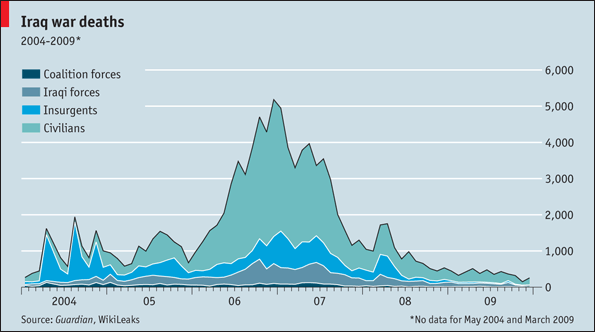
Iraq Body Count estimates that from 1 January 2003 through to 11 July 2012 (the latest date today for which figures are available) there were between 108,183 and 118,224 documented civilian deaths.  IBC notes that ‘full analysis of the Iraqi War Logs released by Wikileaks may add 13,000 civilian deaths’.  There have been several other projects that have tried to count and/or estimate deaths in Iraq, but the War Logs are particularly useful for suggesting the breakdown of total deaths:

The vast majority of casualties were indeed civilians, and the geography of their deaths was plotted on a number of websites from the Wikileaks data: Visualising data reviewed a number of these maps (with further links), and SpatialKey provided its own series of sobering maps.  (For an interactive map of coalition casualties – pairing locations in Iraq with hometowns in the USA – see here).  And Luke Condra, Jacob Shapiro and their colleagues have provided detailed quantitative analysis – using the IBC database and SIGACTS reports – in a series of papers, including”Who takes the blame?  The strategic effects of collateral damage”, American Journal of Political Science 56 (1) (2012) 167-87 and currently available on open access here.

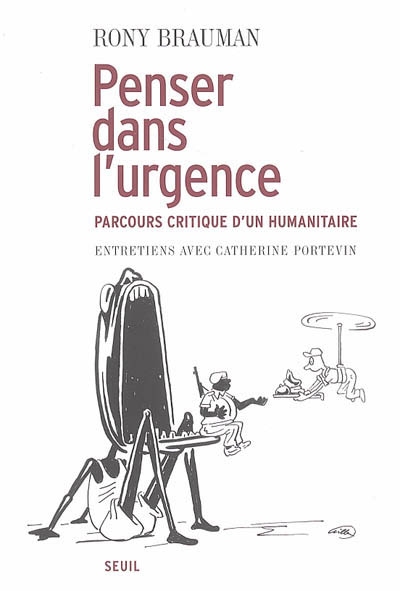
The UN website for World Humanitarian Day continues: ‘Every day humanitarian aid workers help millions of people around the world, regardless of who they are and where they are. World Humanitarian Day is a global celebration of people helping people.’  I contemplate this hard on the heels of reading Eyal Weizman on the humanitarian present in The least of all possible evils: Humanitarian violence from Arendt to Gaza (London: Verso, 2012).  I noted this book in a previous post; Weizman’s concept of ‘the humanitarian present’ emerged via a series of interviews and conversations with Rony Brauman, the former president of Médecins san Frontières and currently professeur associé at Sciences-Po Paris.  Brauman’s alternative conception of ‘humanitarian space’ is radically different from the spatial imaginary of UN agencies where, Weizman explains,

‘humanitarian spaces are clusters of extraterritorial enclaves and the protected corridors that connect them with infrastructure and transport centres.  These kinds of humanitarian spaces are often marked as circles on maps around the areas where relief operations take place – at “the internal peripheries of war”‘ (pp. 56-7).

These are the sites of the humanitarian present: platforms for the operation of those ‘moral technologies’ through which humanitarian agencies and humanitarian law work in concert with military and political power to calibrate the contemporary economy of violence and to govern ‘the displaced, the enemy and the unwanted’ (p. 4).  (Jennifer Hyndman‘s brilliant work on the politics of aid, humanitarianism and securitization speaks directly to these claims, and for a parallel critique of UN peacekeeping, see Paul Higate and Marsha Henry’s Insecure spaces: peacekeeping, power and performance in Haiti, Kosovo and Liberia (London: Zed Books, 2009)).

Against this, Brauman advances a conception of humanitarian space not as a territorial zone – thus sans frontières, without borders – but rather as what Weizman glosses as ‘a set of operational categories, or space-bound circumstantial conditions, that make independent humanitarian work possible’ – that ‘hold relief work at a distance from political and military practice’ (pp. 56-7).

There are critiques of Brauman’s views – see note (2) below – and Weizman is no camp-follower: he has important things to say about the radicalization of humanitarian space so that ‘the politics of humanitarianism’ can give ground to ‘the politics of the displaced’ (p. 61).  But in tragic measure this was exactly what motivated Sergio Vieira de Mello too: to distance his work in Baghdad from Bush’s ‘armies of compassion’ and Blair’s ‘military-humanitarian mission’.

Further notes

(1) Ashley Jackson reports that the annual incidence of major attacks against aid workers worldwide has more than doubled since 2003.

(2) For critical discussions and elaborations of ‘humanitarian space’ see D. Robert DeChaine, ‘Humanitarian space and the social imaginary: Médecins Sans Frontières/Doctors Without Borders and the rhetoric of global community’, Journal of communications inquiry 26 (4) (2002) 354-69; Dorothea Hilhorst and Bram Jansen, ‘Humanitarian space as arena: a perspective on the everyday politics of aid’, Development & Change 41 (6) (2010) 1117-39; Margo Kleinfeld, ‘Misreading the post-tsunami political landscape in Sri Lanka: the myth of humanitarian space’, Space & Polity 11 (2) (2007) 169-84; Adi Ophir, ‘The sovereign, the humanitarian and the terrorist’ (2003); Benjamin Perrin (ed), Modern warfare: armed groups, private militaries, humanitarian organizations and the law (Vancouver: UBC Press, 2012) (see Part Three: “The Humanitarian Space debate”); Maurya Wickstrom, Performances in the blockades of neoliberalism: Thinking the political anew (Houndmills: Palgrave-Macmillan, 2012) (Ch. 3 includes a discussion of Brauman and Ophir that speaks directly to Weizman’s project).

Humanitarianism: Past, present and future

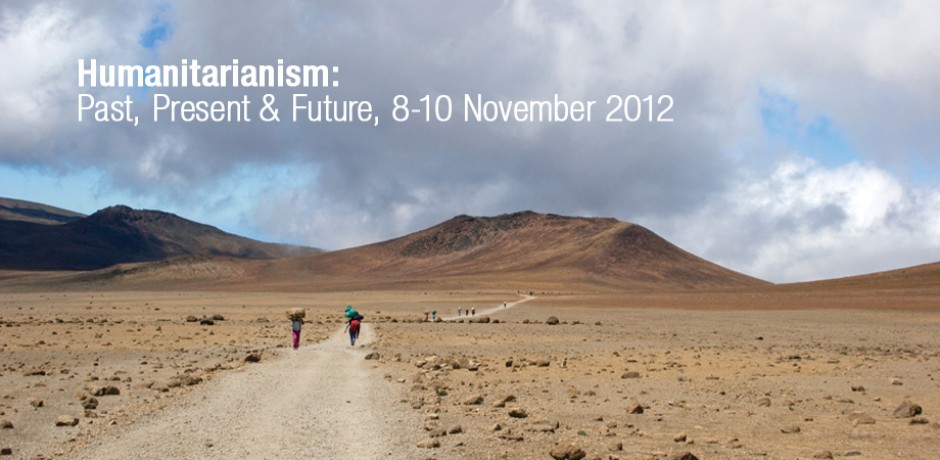
While I was thinking about  Eyal Weizman‘s reflections on what he calls ‘the humanitarian present’, I stumbled across what looks set to be a fascinating conference organised by the University of Manchester’s Humanitarian and Conflict Response Institute, 8-10 November 2012:

The provisional programme includes keynotes from (among others) Mark Duffield, ‘How did we become unprepared? From modernist to post-modernist conceptions of disaster’, Mary Kaldor, ‘The evolution of humanitarian intervention’ [with a response from Maja Zehfuss] and Janice Gross Stein and Michael Barnett, ‘The globalization of humanitarianism’, and papers from (among others) Simon Reid-Henry, ‘Humanitarian Reason, Moral Geography and the contemporary Will-to-Care’, Michael Givoni, ‘Gazing back: local perceptions and humanitarian knowledge’, Larissa Fast, ‘Aid and violence: reaffirming “Humanity” in Humanitarianism’, Gary Blank, ‘Framing Third World Victimhood: Oxfam, the “Biafra Lobby”, and the politics of famine in Britain 1968-1970’, Roland Bleier, ‘The visual dehumanization of refugees’, James Thompson, ‘Humanitarian performance’ and Kathleen Coppens, ‘Long-term conflicts and humanitarian aid’. My selections just scratch the surface, but what’s particularly interesting is the mix of presenters – scholars, professionals and activists.

Counterinsurgency and the humanitarian present

Laleh Khalili – whose work on the new and old classics of counterinsurgency,  on the gendering of counterinsurgency, and on the location of Palestine in global counterinsurgency – is indispensable, has just alerted me to the fate (Fate?) of one of its principal architects, David Kilcullen.

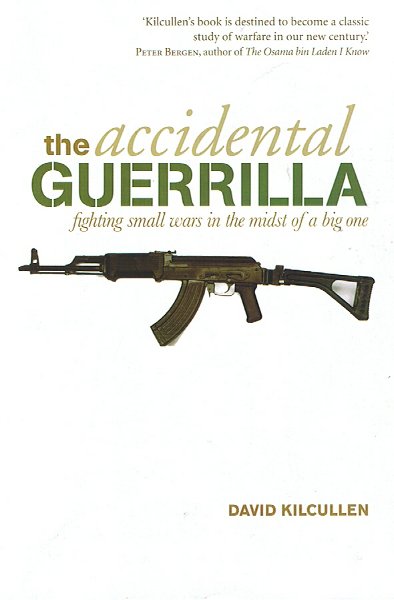
In The accidental guerilla and other writings, Kilcullen – Petraeus’s Senior Counterinsurgency Adviser in Iraq – repeatedly turned to bio-medical analogies to advance a bio-political vision of counterinsurgency: insurgency as a ‘social pathology’ whose prognosis can be traced through the stages of infection, contagion, intervention and rejection (‘immune response’).  In an interview with Fast Company, Kilcullen now explains that he

“came out of Iraq with a real conviction that we tend to think that a bunch of white guys turning up with a solution fixes all the problems. It doesn’t work like that. You actually have to really build a collaborative relationship with the people on the ground if you want to have any hope of understanding what’s going on.”

Kilcullen’s contract ended when the Obama administration came into office, and he founded Caerus Associates.  The company advertises itself as ‘a strategy and design firm’ that works to ‘help governments, global enterprises, and local communities thrive in complex, frontier environments.’  It claims to ‘bring the system into focus’ by providing ‘strategic design for a world of overlapping forces — urbanization, new market horizons, resource scarcity and conflict — to build resilience and capacity.’   The company explains its ‘strategic design process’ here, and Kilcullen’s vision of systems analysis is sketched here.  This may sound like the rapid-fire buzz-words that corporate start-ups typically shoot at their clients, but Kilcullen provides Fast Company with a sawn-off version (it’s really hard to avoid these metaphors…):

“We’re two-thirds tech, one-thirds social science, with a dash of special operations… We can go out in a community and say, ‘Let’s map who owns what land,’ or ‘Let’s map who owes the local warlord money,’ or ‘Let’s map the areas in the city where you don’t feel safe.'”

This chimes with Kilcullen’s famous description of contemporary counterinsurgency as ‘armed social work’, and in an interview with the International Review of the Red Cross published in September 2011 Kilcullen extended his vision of ‘military humanism’ beyond insurgency thus:

‘The methods and techniques used by illegal armed groups of all kinds are very similar, irrespective of their political objectives. So whether you’re talking about a gang in the drug business in Latin America, or organized crime in the gun-running or human smuggling business, or whether you’re talking about an insurgency or perhaps even a civil war involving tribes, you will see very similar approaches and techniques being used on the part of those illegal armed groups. That’s one of the reasons why I believe counter-insurgency isn’t a very good concept for the work that the international community is trying to do. I think that the idea of complex humanitarian emergencies is actually a lot closer to the reality on the ground. You almost never see just one insurgent group fighting an insurgency against the government anymore. What you typically see is a complex, overlapping series of problems, which includes one or more or dozens of armed groups. And the problem is one of stabilizing the environment and helping communities to generate peace at the grassroots level – a bottom-up peace-building process. And that’s not a concept that really fits very well with traditional counter-insurgency, which is about defeating an insurgent movement and is a top-down, state-based approach. What you have to do is create an environment where existing conflicts can be dealt with in a non-violent way.’

This is a remarkable passage for several reasons: the focus on ‘techniques’ not ‘objectives’, which works to de-politicize and de-contextualize a range of different situations in order to generalize about them, the appeal to a collective “international community” whose only interest is a generic “peace”, and hence the passage to what Eyal Weizman calls ‘the humanitarian present’. I think that’s also a colonial present, not surprisingly: ‘humanitarianism’ was often the velvet glove wrapped around the iron fist of colonialism.  But what Weizman sees as novel about the present is the way in which its ‘economy of violence is calculated and managed’ by a series of moral technologies (the term is Adi Ophir‘s) that work to continue and legitimize its operation.  In other words, there is today an intimate collusion of the ‘technologies of humanitarianism, human rights and humanitarian law with military and political powers’.

Despite  the reference to ‘special operations’ in the Fast Company interview – something which makes me think that Obama would have found Kilcullen’s continued advice invaluable – Kilcullen insists that it’s a collaborative process:

“We specialize in working with communities that are under the threat of violence in frontier environments, and I think to some extent that distinguishes us a little bit from other people. Sure we can give a slick presentation in a hotel room, but what we can also do is walk the street in dangerous places, engage with communities, and figure out what needs to happen. It’s not us figuring it out, it’s them telling us, but often we find that no one’s ever been there and asked them before.”

‘Dangerous places’, ‘frontiers’: this is still the language of adventurism.  It recalls Zygmunt Bauman‘s ‘planetary frontierland’, and even more Mark Duffield on the ‘global borderlands’:

‘The idea of the borderlands … does not reflect an empirical reality.  It is a metaphor for an imagined geographical space where, in the eyes of many metropolitan actors and agencies, the characteristics of brutality, excess and breakdown predominate.  It is a terrain that has been mapped and re-mapped in innumerable aid and academic reports where wars occur through greed and sectarian gain, social fabric is destroyed and developmental gains reversed, non-combatants killed, humanitarian assistance abused and all civility abandoned.’

It’s not surprising, then, that in the IRC interview Kilcullen should make so much of establishing ‘the rule of law’: ‘It’s a set of rules which has predictable consequences and allows the population to feel safe, and helps them know what they need to do in order to be in a safe place.’  He makes it clear that, in many (perhaps most) circumstances ‘bottom-up, community-based law, which can be transitional justice, or customary law, applied by traditional courts or religious courts, is as effective and possibly even more effective in the initial stages than central-state structures.’   But this ignores the multiple ways in which law (including international humanitarian law) is not apart from conflict but is almost always a part of conflict: as Weizman has it, ‘international law develops through its violation.  In modern war, violence legislates.’

One could say much the same about maps.  Mapping is not a neutral, objective exercise; mapping is performative and its material effects depend on the constellation of powers and practices within which it is deployed. Kilcullen’s injunction – “Let’s map” – glosses over who the ‘us’ is, who is included and who is excluded, and the process through which some mappings are accorded legitimacy while others are disavowed.  This is also one of Weizman’s central claims, not least in his exposure of the torturous mappings that issued in the  Hollow Land of occupied Palestine.

Weizman’s particular focus in his discussion of the humanitarian present is Gaza, and this winds me back to Laleh Khalili’s work which brilliantly re-reads counterinsurgency in occupied Palestine contrapuntally with US counterinsurgency practices elsewhere.  Her Essential Reading on Counterinsurgency was published by Jadaliyya, and her forthcoming book, Time in the shadows: Confinement in Counterinsurgencies (Stanford University Press, October 2012),  engages with a Medusa’s raft of counterinsurgency adviser-survivors, including Kilcullen and Andrew Exum (Abu Muqawama).

And so a final question: how would ‘strategic design’ and a ‘collaborative process’ help the people of Gaza?  Whose ‘rule of law’ is to be established?  And which maps chart a road not only to peace but to justice for the people of Palestine?