On the road – and off it

I’ll be travelling for the next several weeks so postings will probably be light until the end of the month. I’ll be spending most of my time in North Africa and Eastern Europe, with a stop-over at King’s College London for a seminar in Geography & War Studies (another outing for “Gabriel’s Map”, and I’m really looking forward to the discussion).

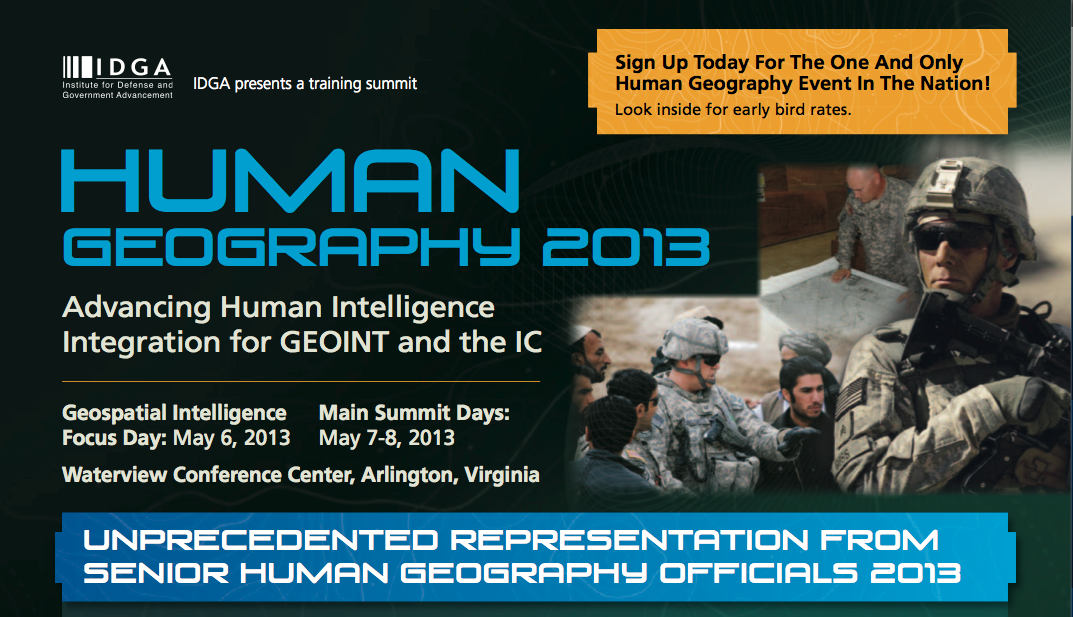
This means I’ll miss the Annual Meeting of the Association of American Geographers which starts today, but I thought readers would like to know about an event billed as “the one and only Human Geography event in the nation“… Really.  It takes place in Arlington, Virginia next month, and like its counterpart last year is organised by the Institute for Defense & Government Advancement.

IDGA Human Geography 2013:1

The letter of invitation from Tyler Baylis, IDGA’s Program Director, explains:

With an annual operating budget of $18 billion, DoD Military Intelligence programs have been instrumental in the war on terror. Human Geography has been at the forefront of these intelligence programs, often embodied in the Human Terrain Systems program which, with successful implementation, has recently increased from 22-31 operating teams in Afghanistan. In order for the US Military to operate in theatres where conventional warfare is not effective, Human Geography must be readily understood and utilized.

In advancing Human Geography, we must look too increased socio-cultural and language training to provide accurate and reliable data generated by on-the- ground research on the specific social groups in the supported unit’s operating environment. IDGA holds this event to service as a platform for you to learn about these areas through expert presentations from the CENTCOM, USMC Center for Irregular Warfare and the Air Force Culture and Language Center and as well as many other key players in the field.

Human Geography 2013 will deliver: • Unparalleled access to the latest SOCOM and Intelligence perspectives • Insights from former Human Terrain Analysts, and anecdotal success stories • Exclusive look into the future of Human Geography’s technological capabilities Plus, presentations and round table discussions will cover Human Terrain Systems, Big Data and Cloud Solutions, HUMINT and GEOINT, Advanced Socio-Cultural Training, Foreign Language Training, the Future of Human Geography in the Intelligence Community and more.

It’s an interesting and innovative time in the implementation of human geography into the Intelligence Community and Special Operations Warfare. Come participate in defining the future of the US military, and establish yourself in this exciting field at the only Human Geography event this year.

More information and the full brochure here.  For readers concerned at the escalating costs of conferences, an all-access pass for this three-day event comes in at $1, 498.

As I said last year, another meeting, and for the most part another geography.  But I do recognise one speaker, Alex Murphy, who is down to lead a session on ‘Using GEOINT for mapping and battlefield visualization’.

The fog-horn of war

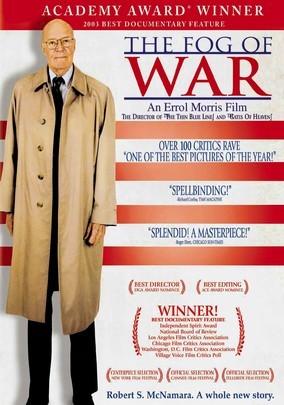
I suspect most people attribute the metaphoric “fog of war” to Clausewitz’s critical reflections on the Napoleonic wars and then fast-forward to Erroll Morris‘s brilliant 2003 film about Robert Strange (sic) McNamara, The Fog of War, which centres on the Second World War and Vietnam.

Carl von Clausewitz  (1780-1831)Both turn out to be more problematic than they seem. First, although Clausewitz mentioned ‘fog’ several times in his manuscript On War he never used the phrase “fog of war”; this is the sentence that probably comes closest to the contemporary meaning:

‘War is the realm of uncertainty; three quarters of the factors on which action is based are wrapped in a fog of greater or lesser uncertainty’ [Der Krieg ist das Gebiet der Ungewißheit; drei Vierteile derjenigen Dinge, worauf das Handeln im Kriege gebaut wird, liegen im Nebel einer mehr oder weniger großen Ungewißheit’].

In a brief commentary, Eugenia Kiesling suggests that Clausewitz made much more of ‘the friction of war’ than ‘fog’ (and was right to do so) and, more originally, that he gave it a peculiar moral force.  In fact, the two are closely connected: Victor Rosello had already noted that following ‘the metaphorical path of Clausewitzian fog-shrouded battlefields which defy attempts at penetration owing to insurmountable uncertainty’ led directly to ‘the ascendancy of the moral domain’:

‘These moral influences are the role of chance; the imponderables of fog and friction and their effects on the reliability of information; the limitation inherent in observation; the inability to penetrate the mind of the adversary; the dominance of preconception over fact; and the limitations of intelligence analysis.

ERROLL MORRIS's film "The Fog of War"And, second, here is McNamara, at the very end of Morris’s film (from the transcript):

We all make mistakes. We know we make mistakes. I don’t know any military commander, who is honest, who would say he has not made a mistake. There’s a wonderful phrase: “the fog of war.”  What “the fog of war” means is: war is so complex it’s beyond the ability of the human mind to comprehend all the variables. Our judgment, our understanding, are not adequate. And we kill people unnecessarily.

This isn’t quite what Clausewitz meant, but in any case even at the age of 85 McNamara had lost none of his ability to manufacture his own fog: as Fred Kaplan asked at the time, ‘What’s true and what’s a lie in The Fog of War?’ In effect, McNamara turns Clausewitz on his head and uses ‘the fog of war’ as an ethical defence (or, more accurately perhaps, distraction).

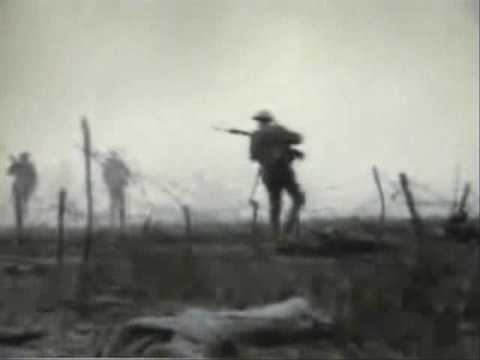
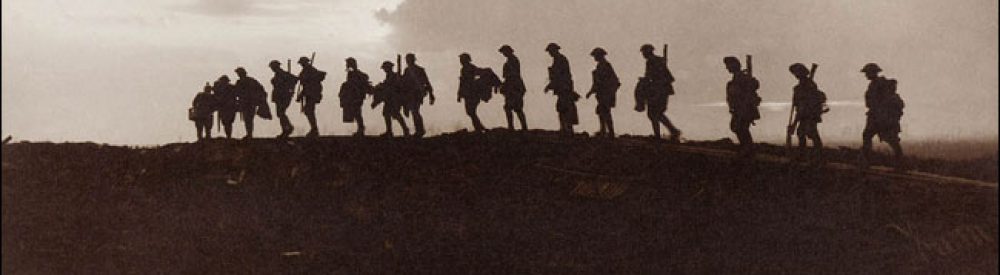
I’ve been led down these pathways by my continuing preoccupation with the First World War.  I’ve noted before the metricization of the battlefield on the Western Front: the meticulous planning of what Clausewitz would have called ‘paper war’ on the abstract spaces of maps.  No matter how frequently these were updated, revised and annotated, their purchase on the course of combat was ineluctably limited once the infantry went over the top.  On the British side, telephone and telegraph lines snaked back from the front lines to an ascending series of headquarters in the rear (an appropriate location in more ways than one), but as John Keegan wrote in The Face of Battle, these lines of communication, however imperfect, had one further, disabling limitation: they stopped at the end of no man’s land.

On the Somme, he wrote,

Over the top, Western Front‘Once the troops left their trenches, as at 7.30 a.m. on July 1st, they passed beyond the carry of their signals system into the unknown. The army had provided them with some makeshifts to indicate their position: rockets, tin triangles sewn to the backs of their packs as air recognition symbols, lamps and flags, and some one-way signalling expedients, Morse shutters, semaphore flags and carrier pigeons; but none were to prove of real use on July 1st.

‘That a party could disappear so completely, not in the Antarctic wastes but at a point almost within visual range of their own lines, seems incomprehensible today, so attuned are we to thinking of wireless providing instant communication across the battlefield. But the cloud of unknowing which descended on a First World War battlefield at zero hour was accepted as one of its hazards by contemporary generals. Since the middle of the nineteenth century, the width of battlefields had been extending so rapidly that no general could hope to be present, as Wellington had made himself, at each successive point of crisis; since the end of the century the range and volume of small-arms fire had been increasing to such an extent that no general could hope to survey, as Wellington had done, the line of battle from the front rank. The main work of the general, it had been accepted, had now to be done in his office, before the battle began.’

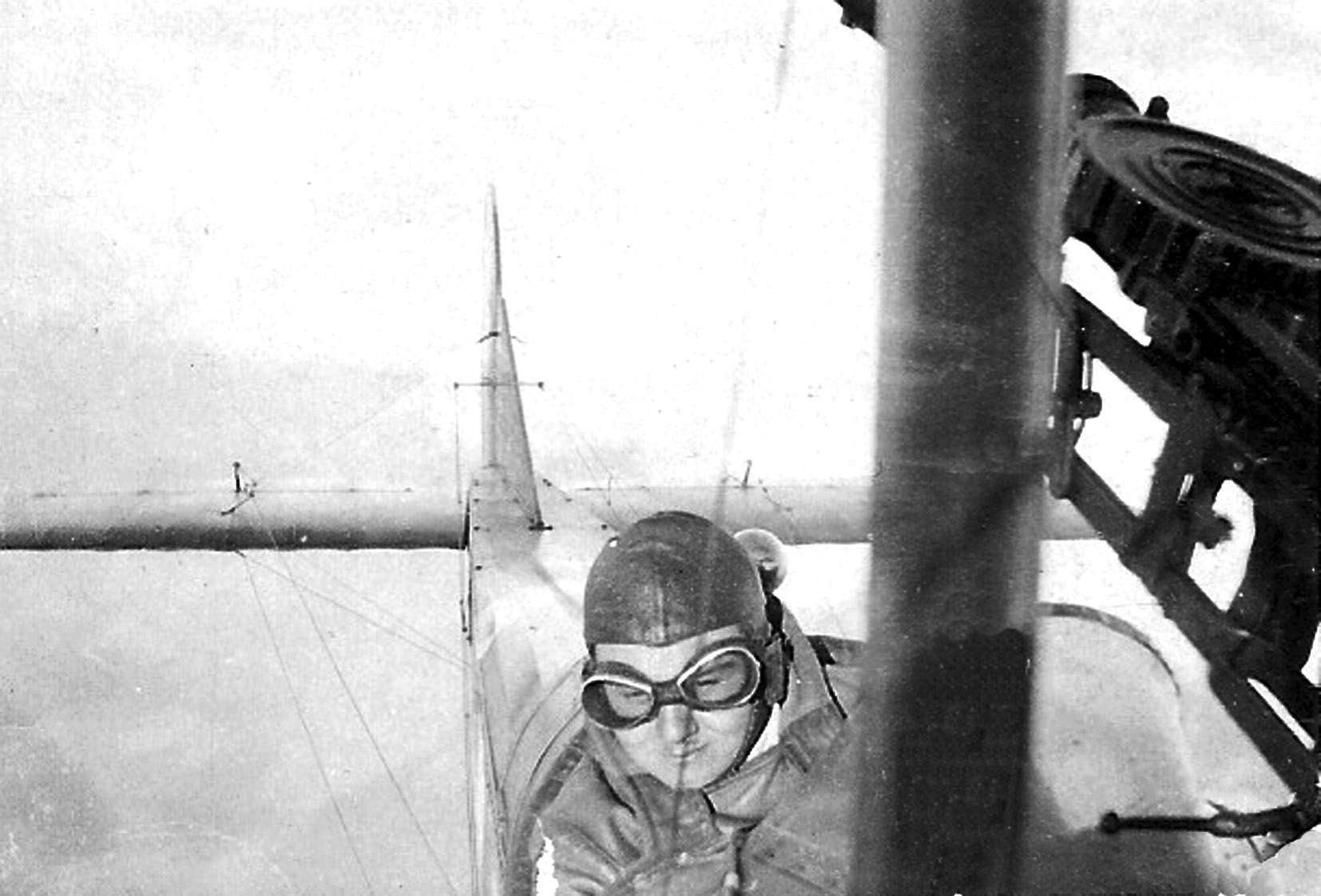
As Keegan says, there were various attempts to allow GHQ to monitor the progress of the battle. Here is one of the most fanciful, not included in his list, which involved re-imposing cartographic vision – what Edmund Blunden called in Undertones of war its ‘innocuous arrows’ and ‘matter-of-fact symbols’ – on the obdurately physical, all-too-corporeal battefield.  In Somme success: the Royal Flying Corps and the Battle of the Somme, Peter Hart reproduces this report from 2nd Liuetenant Cecil Lewis, describing a so-called ‘contact patrol’:

Aerial observation, Western Front‘We had all our contact patrol technique perfected and we went right down to 3,000 feet to see what was happening.  We had a klaxon horn on the undercarriage of the Morane – a great big 12 volt klaxon, and I had a button which I used to press out a letter to tell the infantry we wanted to know where they were.  When they heard us hawking them from above, they had little red Bengal flares, they carried them in their pockets, they would put a match to their flares.  All along the line wherever there was a chap there would be a flare, and we would note those flares down on the map and Bob’s your uncle!’

Not difficult to see why A.M. Burrage gloomily wrote in War is war that the infantry were ‘the little flags which the General sticks on the war-map to show the position of the front line’…  But, Lewis continued,

‘It was one thing to practice this but quite another for them to really do it when they were under fire, and particularly when things began to go a bit badly. Then they jolly well wouldn’t light anything and small blame to them because it drew the fire of the enemy on to them at once.’

Incendiary knowledges

Yesterday in my course on Cities, space and power (see TEACHING) I was talking about Alexandria and urbanism in the post-Alexandrian world.  Part of the discussion centred on the Museum and Library (the Museion) as both a community of scholars that was at once religious and academic (Museion means “Home of the Muses”) and a material constellation of power-knowledge. The marvellous Andrew Erskine, in his essay on ‘Culture and power in early Ptolemaic Egypt‘, captures the political purpose behind the imperial project:

‘A Graeco-Macedonian surface was imposed on Egypt, but this surface lacked a unifying tradition – except for a common Greekness. Setting up the Museum and the Library is the setting up of a centre of Greek cultural and intellectual life in the city. It helps to fill the cultural vacuum that exists within the city. Adopting the practices of Aristotle’s school [which was also centred on a Museum], studying the texts of Homer, acquiring the official texts of the Greek tragedies all help to establish some sense of continuity with a Greek past.’ 

But more than this, like other versions of what Ernest Gellner once called an agro-literate polity, this was about exclusion as much as inclusion:

‘The more Greeks can indulge in their own culture, the more they can exclude non-Greeks, in other words Egyptians, the subjects whose land has been taken over. The assertion of Greek culture serves to enforce Egyptian subjection. So the presence in Alexandria of two institutions devoted to the preservation and study of Greek culture acts as a powerful symbol of Egyptian exclusion and subjection. Texts from other cultures could be kept in the library, but only once they had been translated, that is to say, Hellenized.’ 
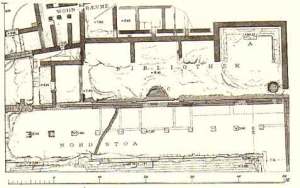
And this was about more than Greek culture and identity, and the orbit of exclusion extended far beyond Ptolemaic Egypt.  When the Ptolemies sought to bring the knowledge of the known world under their own control they had a particular interest in strategic knowledges like engineering, medicine – and, of course, geography.  Their collecting was aggressive: they confiscated scrolls from travellers, seized others from ships in the Great Harbour, and failed to return scrolls borrowed from other repositories for transcription.  And when the king of Pergamon [modern: Bergama] proposed to build his own collection [left], they forbade the export of papyrus to forestall their rival (which, according to some historians, prompted a series of experiments that issued in the discovery of parchment (‘pergamena‘) as an alternative recording medium).

Fast-forwarding, this is still on my mind for two reasons.  The first is a marvellous essay on ‘Shadow Libraries by Lawrence Liang: if, like me, you still relish the physical space and sensibility of the conventional library, this is a must-read (even if you have to do it online).

What was special about the Library of Alexandria was the fact that until then the libraries of the ancient world were either private collections of an individual or government storehouses where legal and literary documents were kept for official reference. By imagining a space where the public could have access to all the knowledge of the world, the library also expressed a new idea of the human itself. While the library of Alexandria is rightfully celebrated, what is often forgotten in the mourning of its demise is another library—one that existed in the shadows of the grand library but whose whereabouts ensured that it survived Caesar’s papyrus destroying flames.

According to the Sicilian historian Diodorus Siculus, writing in the first century BC, Alexandria boasted a second library, the so-called daughter library, intended for the use of scholars not affiliated with the Museion. It was situated in the south-western neighborhood of Alexandria, close to the temple of Serapis, and was stocked with duplicate copies of the Museion library’s holdings. This shadow library survived the fire that destroyed the primary library of Alexandria but has since been eclipsed by the latter’s myth.

That ‘public’, as Erskine would surely insist, was in fact a carefully delineated and privileged public.  And if this was library as utopia then, like so many utopias, access was restricted.  Liang closes with some thoughts on the library, instead, as a heterotopia (like Stuart Elden, I continue to be astonished at the attention Michel Foucault’s ‘published unpublished’ essay continues to attract, though unlike him not in a good way):

If the utopian ideal of the library was to bring together everything that we know of the world then the length of its bookshelves was coterminous with the breadth of the world. But like its predecessors in Alexandria and Babel the project is destined to be incomplete haunted by what it necessarily leaves out and misses. The library as heterotopia reveals itself only through the interstices and lays bare the fiction of any possibility of a coherent ground on which a knowledge project can be built.

Again, this surely isn’t a purely epistemological dilemma: there is a politics of what is to count as knowledge, after all, and this – my second reason for thinking about these issues – has often intersected with political and military violence.  That ‘ground’ is vulnerable to more than philosophical reflection.  As Matthew Battles reminds us in his Library: an unquiet history (W.W. Norton, 2003),  ‘Libraries are as much about losing the truth as preseving it– satisfying the inner barbarians of princes, presidents and pretenders – as about discovering it.’

Much closer to us than the serial burnings of the Library at Alexandria is the ritualised burning of books organised by the National Socialist German Student’s Association in May and June 1933. From the US Holocaust Memorial Museum:

On April 6, 1933, the Nazi German Student Association’s Main Office for Press and Propaganda proclaimed a nationwide “Action against the Un-German Spirit,” to climax in a literary purge or “cleansing” (Säuberung) by fire. Local chapters were to supply the press with releases and commissioned articles, offer blacklists of “un-German” authors, sponsor well-known Nazi figures to speak at public gatherings, and negotiate for radio broadcast time. On April 8 the students’ association also drafted its twelve “theses”—a deliberate evocation of Martin Luther’s 95 Theses: declarations which described the fundamentals of a “pure” national language and culture. Placards publicized the theses, which attacked “Jewish intellectualism,” asserted the need to “purify” the German language and literature, and demanded that universities be centers of German nationalism….

In a symbolic act of ominous significance, on May 10, 1933, university students burned upwards of 25,000 volumes of “un-German” books, presaging an era of state censorship and control of culture. On the evening of May 10, in most university towns, right-wing students marched in torchlight parades “against the un-German spirit.” The scripted rituals called for high Nazi officials, professors, university rectors, and university student leaders to address the participants and spectators. At the meeting places, students threw the pillaged and “unwanted” books onto bonfires with great ceremony, band-playing, and so-called “fire oaths.”
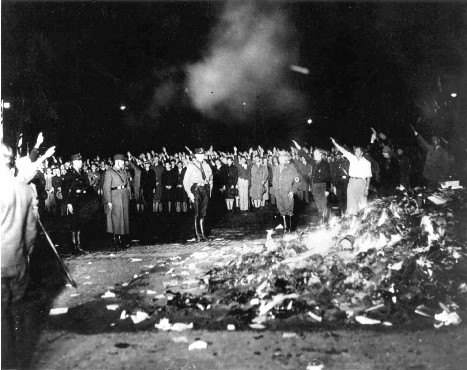
Among the thousands of titles consigned to the flames was Erich Maria Remarque‘s All Quiet on the Western Front, ‘a betrayal of soldiers of the Great War’, and Ernest Hemingway‘s Farewell to Arms.  And, as the US Holocaust Memorial Museum notes,

Also among those works burned were the writings of beloved nineteenth-century German Jewish poet Heinrich Heine, who wrote in his 1820-1821 play Almansor the famous admonition, “Dort, wo man Bücher verbrennt, verbrennt man am Ende auch Menschen“: “Where they burn books, they will also ultimately burn people.”

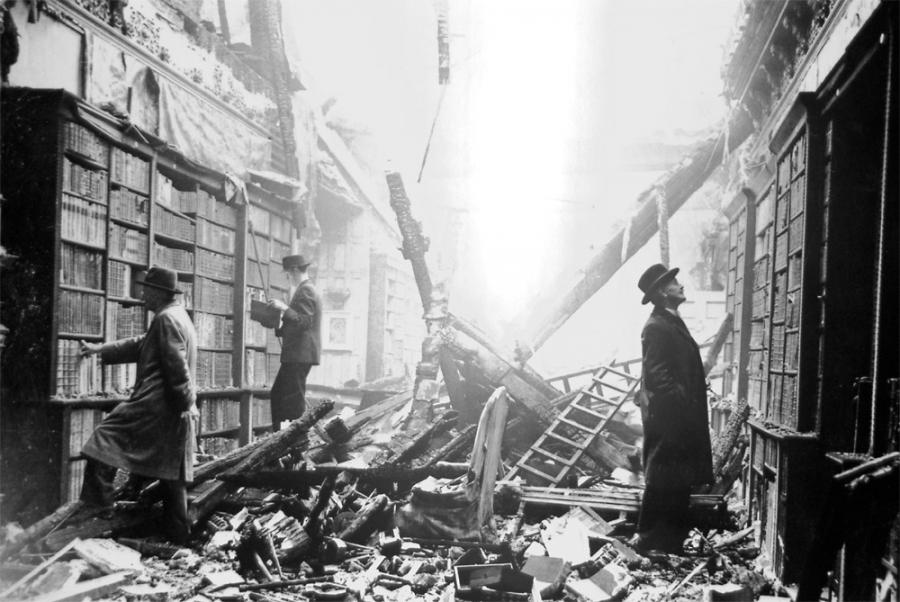
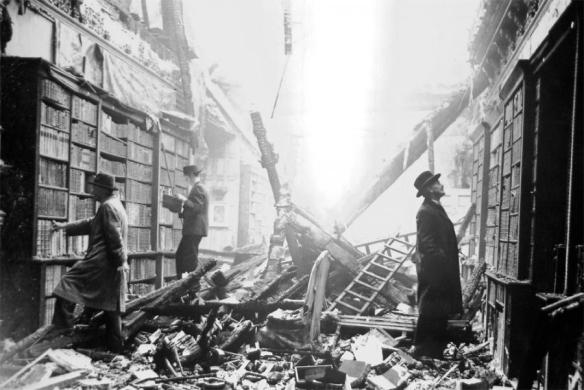
I realise that most of this will be well-known to readers (sic), but my point here is not about the vulnerability of libraries, though both Rebecca Knuth‘s Libricide (Praeger, 2003) and Lucien Polastron‘s Books on Fire (Thames and Hudson, 2010) provide a depressingly rich catalogue of historical examples of their calculated destruction.  One of the most famous images of the Blitz in 1940 is surely this photograph taken after the London Library was hit in 1940 – given the inaccuracy of the bombing, it was surely not deliberately targeted – but it testifies as much to the durability of reading as to its fragility:
What I am starting to think about is the way in which the military is inserted/insinuated in the hyphen between ‘power’ and ‘knowledge’.  In Discipline and punish Foucault artfully reverse engineers this, and provides a seminal discussion of the army in the eighteenth century as an exemplary formation of disciplinary power.  But this isn’t quite what I mean, not least because of the co-presence of sovereign and disciplinary power in military formations, and Nina Taunton, also inspired by Foucault, provides a compelling discussion of the early modern military camp (which, in its later version, also makes a fleeting appearance in Discipline and punish) and Shakespeare’s Henry V here that sets the stage – literally so – for what I have in mind.

She focuses on what she calls an ‘epistemology of command’ and ‘a whole culture of watchfulness’ and in doing so, not incidentally, also enlarges our understanding of the ‘theatre of war‘ as a visual metaphoric.  (See also her ‘Unlawful presences: the politics of military space and the problem of women in Tamburlaine‘ in Andrew Gordon and Bernhard Klein (eds), Literature, mapping and the politics of space in early modern Britain, Cambridge University Press, 2001 and her own book, 1590s drama and militarism, Ashgate, 2001).

Clearly the epistemological principles underlying the set-out of the camp make for the ‘new knowledge’ of surveillance as a one-way process, adapted to the exigencies of observation of the enemy on the one hand and the anxiety on the other to impede the enemy’s observation of you. Exposure to enemy strength can be forestalled by reinforcing the power that resides in ocular knowledge. This is achieved by spatially organising the way it is constituted in the camp so that it functions in equal balance with the power inherent in another kind of knowledge – that to do with strategies of secrecy, of keeping the enemy in the dark about your manoeuvres whilst being fully apprised of his. This is exemplified in the organisation of the watch through spying and reconnaissance – major strategies of surveillance.

Taunton writes about the dangers of both ‘the enemy within’ and ‘the enemy without’ – no stranger to ISAF in Afghanistan – but we should be wary of superficial parallels, especially as our histories enter a digital though no less material world.  (For exactly this reason I’m leery of those who think that Foucault’s lectures in 1975-6 uncannily prefigured war thirty years later – as though the concrete particulars are somehow incidental, when Foucault’s own way of working was so densely empirical).

What haunts me at present is the modern constitution of ‘the enemy’ as a mobile object of military knowledge, at once watched and watching. The questions multiply far beyond the delineation of political technologies of vision and scopic regimes that have informed much of my work to date. What are the relays through which (particularly local) knowledges have been militarised?  What are the vulnerabilities – what Taunton describes as the ‘doubleness of discourses that articulate and represent powerlessness through the models of [power/knowledge] in surveillance that they describe’ – that have been written in to the prospect of military violence?  How have militaries responded to being watched by the enemy and by the media (assuming they distinguish between them)?  What are the relations between surveillance, spatiality and secrecy within modern military ‘cultures of watchfulness’?  And how have those cultures responded to the demands of military occupation?  More – I hope – later.
Project Thor and the history of bombing

In a previous post I wrote about the US Bombing Encyclopedia of the World, designed as a global database of potential targets, but for more on a different but related project that I also previewed, a database of US bombs dropped from the closing stages of the First World War to the present, see this video from the US Air Force on its Project Thor [Theater History of Operations Reports]:

http://www.youtube.com/watch?v=mG9A-F1mDtw

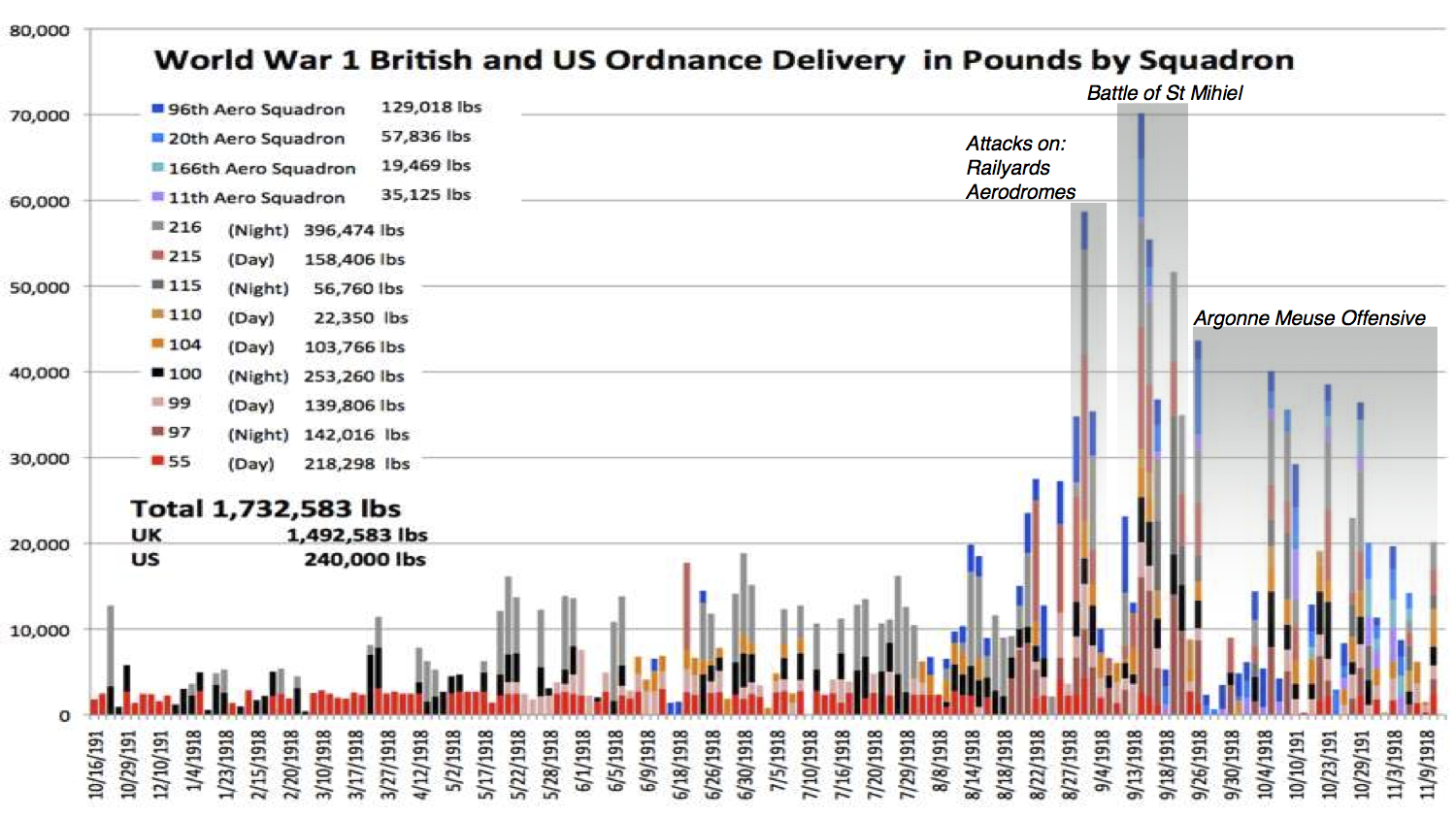
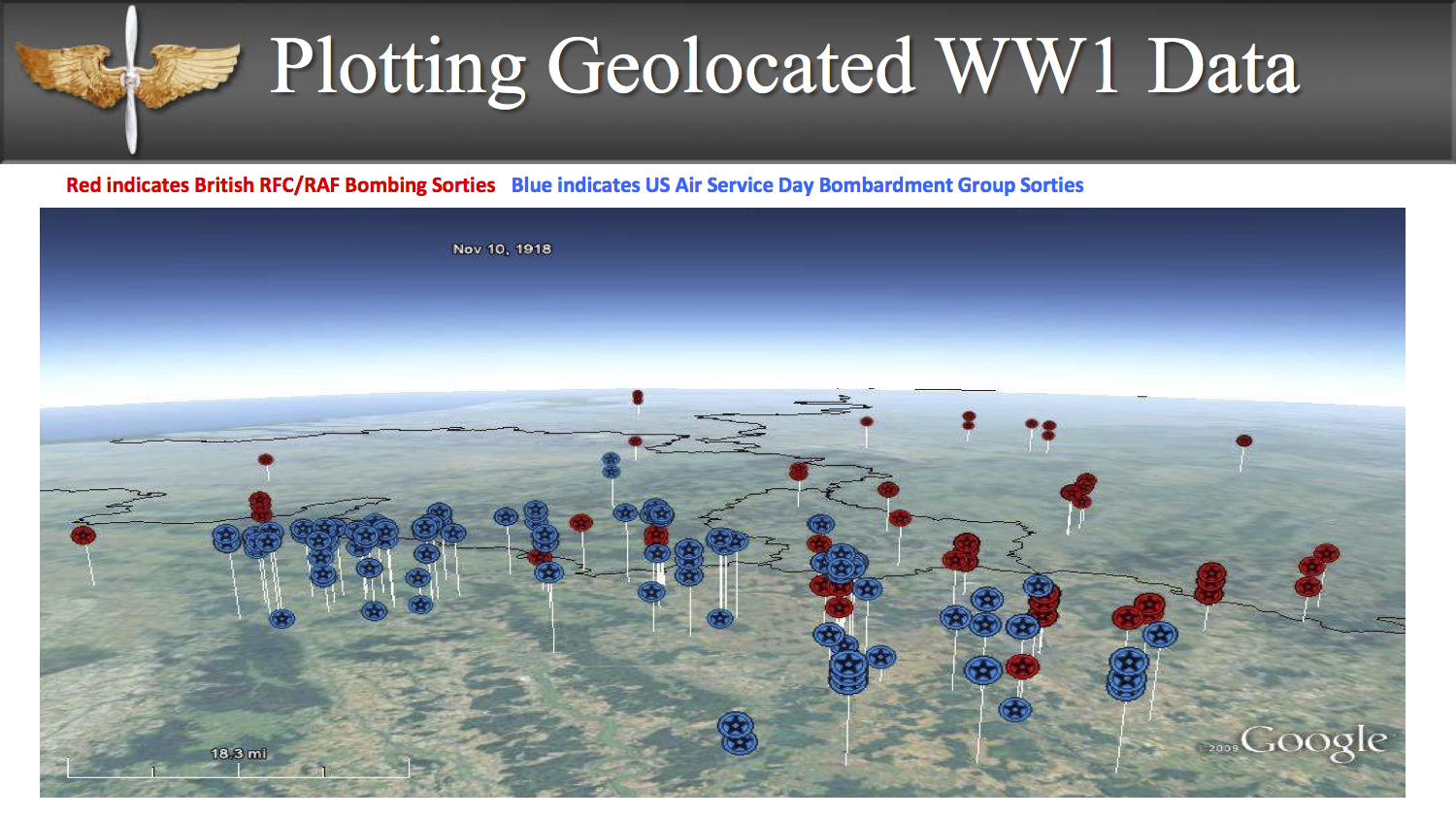
For the background to the project, look here.  And for a preview of its possibilities – the intention is apparently for the database to be open access in the near-ish future – here are two extracts from the World War I (1918) database:


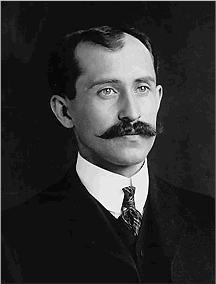
Although my own work focuses on the combined bomber offensive in World War II, the air wars over Indochina and the ‘drone wars’ over Afghanista, Pakistan and beyond, it’s not limited to these air wars, and I’ve been examining other periods and other theatres.  I’ll say more about my interest in World War I (and hence the reason for the extracts above) in a later post, but it was prompted by Orville Wright‘s arguments about the future of air war.  ‘I have never considered bomb-dropping as the most important function of the airplane,’ he told the New York Times in July 1917, ‘and I have no reason to change this opinion now that we have entered the war.’  For him – though he did not altogether discount the importance of striking particular targets, like the Krupp works at Essen – the key role of the aeroplane was reconnaissance (‘scouting’) for ground forces, including artillery:  ‘About all that has been accomplished by either side from bomb dropping has been to kill a few non-combatants, and that will have no bearing on the result of the war.’  (The use of the term ‘bomb-dropping’ rather than bombing was accurate – unlike the practice it described – and while there were air raids on towns and cities, carried out from aircraft and from Zeppelins, most air strikes during the War were tactical).

As we’ll see, aircraft were much more valuable for reconnaissance missions – here I’ve been learning much from Terrence Finnegan‘s Shooting the Front: Allied aerial reconnaissance and photographic interpretation (The History Press, 2011; first edition 2007) (reviewed for the CIA [really] here) –but Wright seemed in two minds about it insofar (in his view) it had prolonged the war:

“Did you ever stop to think that there is a very definite reason why the present war in Europe has dragged along nearly three years with neither side gaining much advantage over the other?  The reason, as I figure it out, is the airplanes.  In consequence of the scouting work done by the flying machines, each side knows exactly what the opposing forces are doing.

“There is little chance for one army to take another by surprise.  Napoleon won his wars by massing his troops at unexpected places.  The airplane has made that impossible.  It has equalized information.  Each side has such complete knowledge of the other’s movements that both sides are obliged to crawl into trenches and fight by means of slow, tedious routine rather than by quick, spectacular dashes.”

Ironically, it was precisely the subsequent rise of strategic bombing (what Mark Clodfelter calls ‘beneficial bombing’) that was hailed by its advocates as a way of bringing war to a speedy end and avoiding the carnage of the trenches.  Here is Clodfelter’s quick summary of a complex and convoluted argument (from Beneficial Bombing: the Progressive foundations of American air power, 1917-1945, University of Nebraska Press, 2010; see also his essay in Joint Forces Quarterly 49 (2008) 24-31 here):

‘The devastation and ugly realism of World War I ended the progressive era for most Americans…  Yet for Army Air Service officers like Edgar Gorrell and William “Billy” Mitchell, the carnage and waste that they witnessed on the Western Front sparked the beginning of a progressive effort that was unique – an attempt to reform war by relying on its own destructive technology as the instrument of change.  They were convinced that the airplane – used as a bombing platform – offered the means to make wars much less lethal than conflicts waged by armies or navies….

‘Aircraft would destroy the vital centers [of the enemy] by precision bombing – sophisticated technology would guarantee that bombs hit only the intended targets, and few lives would be lost in the process.  The finite destruction would end wars quickly … and thus bombing would actually serve as a beneficial instrument of war.’

My own project is, in part, designed to give the lie to these arguments and their successors.  And perhaps it will even be possible to enlist Project Thor to silence these dread thunderbolts (and Hellfire missiles).

Patches, the Pentagon and Pakistan

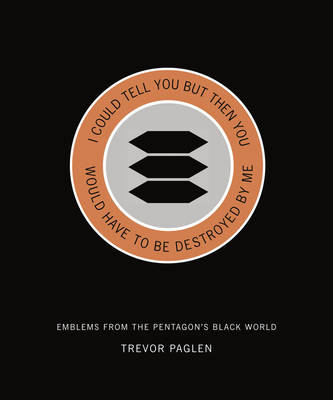
In 2010 artist-geographer-writer (and an old friend) Trevor Paglen published a collection of unofficial US military patches that showed the fraying fringes of the Pentagon’s secret operations: I could tell you but then you would have to be destroyed by me: emblems from the Pentagon’s Black World (Melville House, 2010).

As Steven Heller wrote in the New York Times,  ‘issuing patches for a covert operation sounds like a joke . . . but truth be told, these days everything is branded. Military symbols are frequently replete with heraldic imagery — some rooted in history, others based on contemporary popular arts that feature comic characters — but these enigmatic dark-op images, in some cases probably designed by the participants themselves, are more personal, and also more disturbing, than most.’

Danger Room posted several selections from Trevor’s collection here (and follow the links back for eight – yes eight – more) and here; there are also more here from MilSpecMonkey

Trevor’s wryly serious research has resurfaced twice this week.  Lowen Liu at Slate tried to unpick the stitches from one patch, from the agency that designs, builds and operates America’s intelligence satellites, the National Reconnaissance Office (“Vigilance from Above”), to investigate its use of an anagram from the movie Sneakers – “Setec Astronomy” (Too Many Secrets).  Trevor drew his attention to a 2008 memo from NRO:

Recently, two journalists compiled an article mentioning how symbols used in unclassified logos and patches can reveal information about National Reconnaissance Office (NRO) satellite identities and missions that are otherwise classified. … All briefed personnel are reminded … [of] the grave responsibility of protecting that information from improper and unauthorized disclosure and compromise. Failure to comply with these obligations can result in irreparable harm to the nation.

Liu was left wondering whether Sneakers took “Setec Astronomy” from the NRO… Who knows?

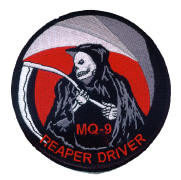
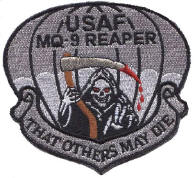
You might also shrug your shoulders and think “Who cares?”, except that those patches can indeed disclose information about the projects they simultaneously conceal and reveal.  And this week Chris Cole at Drone Wars UK published a selection of patches worn by USAF and RAF drone pilots. Described as “morale patches“, designed to raise the morale of the units they represent, most of these don’t tell us anything we didn’t already know about their remote operations – the casual way they turn killing into a cartoon is remarkable, but it’s there in the names of the aircraft they fly:

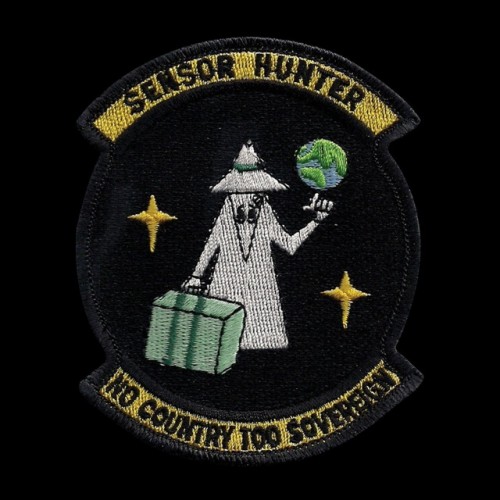
And Trevor has one other that speaks more directly to American drone operations in Pakistan and beyond than anything else I’ve seen:

Human Geography Summit

As the calls for papers for the Annual Meeting of the Association of American Geographers in Los Angeles next April fly backwards and forwards, I thought readers would be interested in another meeting (and, for the most part, another geography).

The Institute for Defense and Government Advancement (IDGA) – which describes itself as ‘a non-partisan information based organization dedicated to the promotion of innovative ideas in public service and defense’  and which ‘is not affiliated with the US government or any branch of the Armed Services’ – is holding a Human Geography Summit in Washington DC, 12-14 November 2012.  Subtitled ‘Maximizing force efficiency through intelligence in the human domain’, the brochure explains:

“The environment in which we operate is complex and demands that we employ every weapon in our arsenal, both kinetic and non-kinetic. To fully utilize all approaches, we must understand the local culture and history; Learn about the tribes, formal and informal leaders, governmental and religious structures, and local security forces. We must understand how the society functions so we can enable [Iraqis] to build a stable, self-reliant nation.” 

This Summit will bring to light the future of the Human Domain in warfare and opportunities for Military and Industry cooperation and coordination.

Operation Iraqi Freedom and Operation Enduring Freedom (OIF & OEF) in Iraq and Afghanistan created a need for a fundamental shift in the way we fight wars. It became very clear very quick that conventional warfare was doomed to failure in this particular set of operations. We were being beaten by an unconventional force that had no state backing and did not play by the rules.

In order to adapt, many hybrid theories of war have been thought up and put into place. Throughout this, one aspect that was previously overlooked has come to the fore front. Knowing who you are fighting and where you are fighting. Not simple identification and geographic data, but personality profiles, daily schedules/routines, language/dialect, cultural identities, weather patterns, market places, potential hideouts, and places of cultural and religious significance. Truly understanding the enemy, how they differ from the civilian population they are embedded in and what will make our forces either comply with their culture or blend in as they do.

The Summit will be preceded by a ‘Social and Cultural Human Geography and Intelligence Focus Day’ with four specialist workshops:

  • Maintaining connections with the local population in support of operationally directed research
  • Thinking like the Natives: Cultural immersion for US Special Operations
  • Understanding the local culture and history of Target Populations
  • Cultural and Economical Human Geography: a case study

The Summit will include presentations from the US Army Geospatial Center, the National Geospatial-Intelligence Agency,the US Army Corps of Engineers, Human Terrain Systems (US Army) and US Northern and Southern Commands.

You’ll also have the chance ‘to meet, network and engage with top government and industry professionals in the human geography space’ (sic) – a steal at $1,598 (military) or $1,835 (industry).  Uniform or business casual.

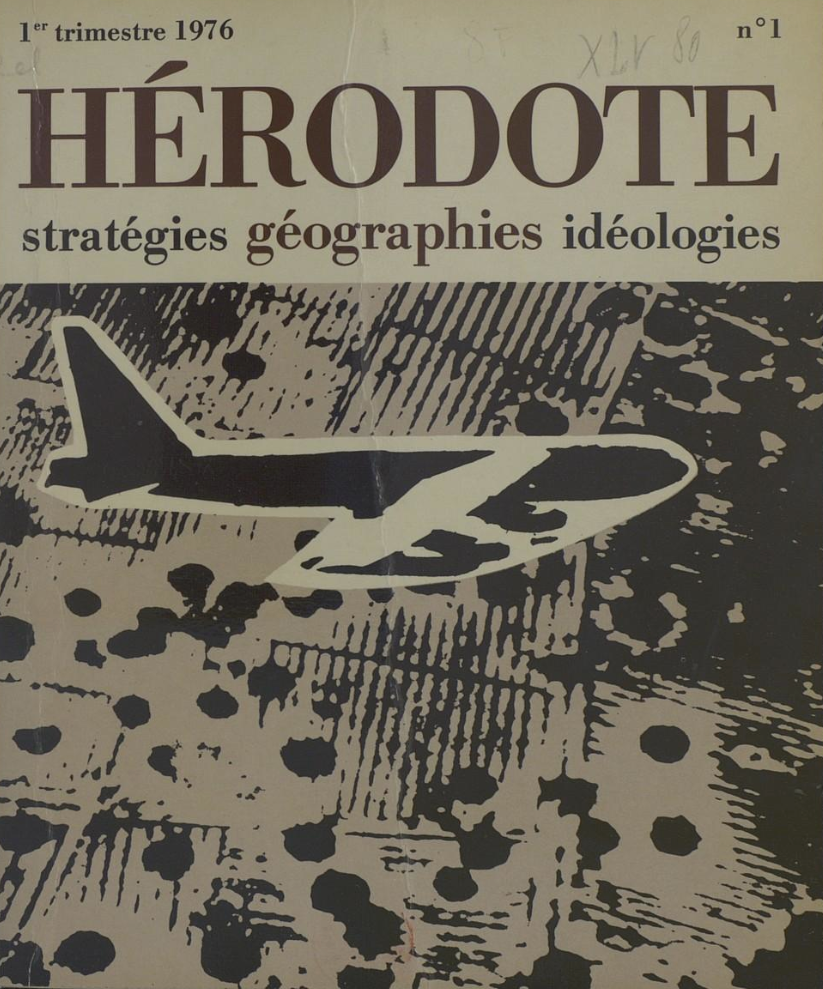
It’s thirty-odd years since Yves Lacoste insisted that La géographie, ça sert, d’abord, à fair la guerre (1976) and, as Gavin Bowd and Daniel Clayton show in “Geographical warfare in the tropics: Yves Lacoste and the Vietnam War”, he knew what he was talking about (he was also the editor of Hérodote, left): their remarkably rich essay was published in Early View by the Annals of the Association of American Geographers earlier this year.  As I say, another geography.

But these are not matters of disciplinary history alone; that is, of course, important – the terrific work of  Trevor Barnes in particular has done much to illuminate the entanglements of modern geography in the Second World War and the Cold War – but it’s also vital to pursue the ways in which geographical knowledges and practices continue to enter into the conduct of war and military violence.  In 1963 William Bunge and Bill Warntz started work on a book to be called Geography: the innocent science, a prospectus for their vision of the ‘new geography’ as spatial science.  It was far from innocent, to be sure, and in his later work – notably the Nuclear War Atlas but also what he called his ‘peace book’, Fitzgerald: geography of a revolution – Bunge displayed another side to his radical temper.  But what Trevor calls ‘the mangle’ between power and knowledge, geography and war, still includes the models and methods of spatial science – and it evidently also mangles much that lies far beyond them.