War against the people

I’ve long admired Jeff Halper‘s work with the Israeli Committee Against House Demolitions (though to me, haunted by the passages from The poetics of place that Edward Said invokes in Orientalism,  ‘home demolition’s would carry even more resonance: it’s so much more than buildings that the Israelis so brutally turn to rubble).

ICAHD

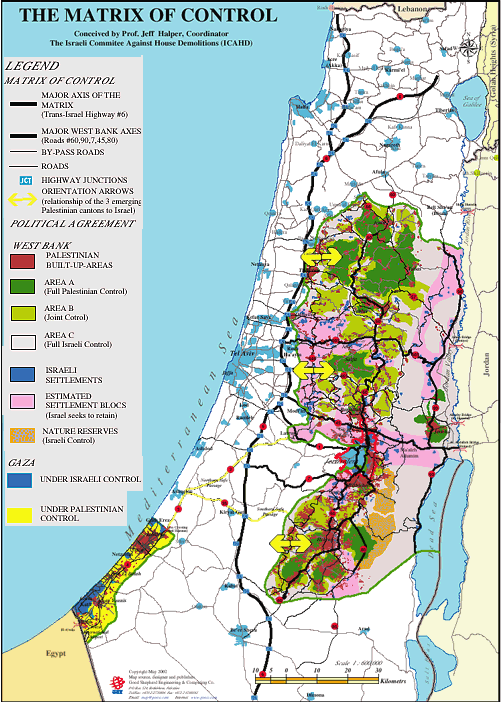
Jeff’s classic, even canonical essay on ‘the matrix of control‘ (see also here) was a constant reference point for my chapters on occupied Palestine in The Colonial Present, and on my first visit to the West Bank I was part of a group that Jeff generously spent a day showing the materialities of military occupation and illegal colonisation: you think you know what you’re going to see, but all the reading in the world can’t prepare you for what Israel has done – and continues to do – to the people of Palestine.

the-matrix-of-control

So I’m really pleased to hear from Jeff that his new book, War against the people: Israel, the Palestinians and global pacification, will be out in September (from Pluto Press in the UK and via the University of Chicago Press in the USA):

Modern warfare has a new form. The days of international combat are fading. So how do major world powers maintain control over their people today?

HALPER War against the peopleWar Against the People is a disturbing insight into the new ways world powers such as the US, Israel, Britain and China forge war today. It is a subliminal war of surveillance and whitewashed terror, conducted through new, high-tech military apparatuses, designed and first used in Israel against the Palestinian population. Including hidden camera systems, sophisticated sensors, information databases on civilian activity, automated targeting systems and, in some cases, unmanned drones, it is used to control the very people the nation’s leaders profess to serve.
Drawing from years of research, as well as investigations and interviews conducted at international arms fairs, Jeff Halper reveals that this practice is much more insidious than was previously thought. As Western governments tighten the grip on their use of private information and claw back individual liberties, War Against the People is a timely reminder that fundamental human rights are being compromised for vast sections of the world, and that this is a subject that should concern everyone.

I’ve noted before the ways in which Israel has used its continuing occupation of Palestine as a laboratory to test new technologies of military violence – and as a series of test cases designed to push the envelope of what is permissible under international humanitarian law and even international human rights law – but here Jeff radicalises the argument to develop a deeply disturbing vision of what he calls ‘securocratic wars in global battlespace’.  It’s vitally necessary to remember that later modern war is not the exclusive artefact of the United States and its military-academic-industrial-media (MAIM) complex, and that what happens in Israel/Palestine has desperately important implications for all of us.

Many commentators have claimed – I think wrongly – that one of the new characteristics of war in the twenty-first century is that it has become ‘war amongst the people’: as though No Man’s Land on the Western Front was somehow roped off from the gas attacks and shells that assaulted farms, villages and towns behind the front lines, for example, and air raids were limited to exclusively military-industrial targets.  Even if we confine ourselves to the trajectory of ostensibly modern warfare and track forward through the Second World War, Korea, Malaya, Vietnam, Laos and Cambodia…. the story is the same: modern war has long been fought amongst the people (though increasingly amongst ‘their’ people).  The deconstruction of the battlefield, as Frédéric Mégret calls it, is clearly visible in Palestine and is inseparable from its globalization.  It’s hardly surprising, then, that ‘war amongst the people’ should so easily turn into what Jeff describes as ‘war against the people’.

Here is the list of contents:

Introduction : How Does Israel Get Away With It?

Part I: The Global Pacification Industry
1. Enforcing Hegemony: Securocratic Wars in Global Battlespace

Part II: A Pivotal Israel
2. Why Israel? The Thrust Into Global Involvement
3. Niche-Filling in a Global Matrix of Control

Part III: Weaponry of Hybrid Warfare and Securocratic Control (Niche 1)
4. Niche 1: Weaponry of Hybrid Warfare and Securocratic Control
5. Dominant Maneuver
6. Precision Engagement

Part IV: Securitization and “Sufficient Pacification” (Niche 2)
7. Niche 2: The Securocratic Dimension: A Model of “Sufficient Pacification”
8. Operational Doctrines and Tactics

Part V: Serving Hegemons Throughout the World-System
9. Serving the Hegemons on the Peripheries: The “Near” Periphery
10. Security Politics on the “Far” Periphery
11. The Private Sector

Part VI: Domestic Securitization and Policing
12. Serving the Core’s Ruling Classes “At Home”

Conclusions: Mounting Counterhegemonic Challenges and Resisting Pacification
Resisting Capitalist Hegemony and Pacification: The Need for Infrastructure
Resistance to Pacification: Focusing on the MISSILE Complex

Disposable futures

EVANS and GIROUX Disposable futures

News from Brad Evans of a new book co-authored with Henry Giroux, Disposable futures: the seductions of violence in the age of spectacle (out next month from City Lights).

Disposable Futures makes the case that we have not just become desensitized to violence, but rather, that we are being taught to desire it.

From movies and other commercial entertainment to “extreme” weather and acts of terror, authors Brad Evans and Henry Giroux examine how a contemporary politics of spectacle–and disposability–curates what is seen and what is not, what is represented and what is ignored, and ultimately, whose lives matter and whose do not.

Disposable Futures explores the connections between a range of contemporary phenomena: mass surveillance, the militarization of police, the impact of violence in film and video games, increasing disparities in wealth, and representations of ISIS and the ongoing terror wars. Throughout, Evans and Giroux champion the significance of public education, social movements and ideas that rebel against the status quo in order render violence intolerable.

You can read the preface and an excerpt from the first chapter here, and you can get a taste of their argument from their op-ed for Truthout in June 2014 here, where they explain why they decided

‘…to develop a paradigm that focused on the intensification of what we called the politics of disposability. This requires taking our analysis beyond 20th century frames of analysis to look at the ways in which more and more individuals and groups are now considered excess by the onslaught of global forces that no longer offer the possibility of alternative futures. It talks precisely to those contemporary forms of disposability that have become so normalized; the burden of the guilt is placed on the shoulders of the victims, while the most pernicious of systemic abuses continues to hide things in plain sight. And it develops a critical angle of vision that goes well beyond the mere authentication of lives as simply born vulnerable to question the systemic design for oppression and exploitation that produces humans as some expendable category…

‘There is something, however, more at stake here than the contemporary plight of those millions forced to live in intolerable conditions. What makes the contemporary forms of disposability so abhorrent is precisely the way it shapes disposable futures. The future now appears to us as a terrain of endemic catastrophe and disorder from which there is no viable escape except to draw upon the logics of those predatory formations that put us there in the first place. Devoid of any alternative image of the world, we are merely requested to see the world as predestined and catastrophically fated. Frederic Jameson‘s claim then that it is easier to “imagine the end of the world than it is the end of capitalism” is more than a reflection on the poverty of contemporary imaginations. It is revealing of the nihilism of our times that forces us to accept that the only world conceivable is the one we are currently forced to endure: a world that is brutally reproduced and forces us all to become witness to its spectacles of violence that demand we accept that all things are ultimately insecure by design. In this suffocating climate, the best we can hope for is to be connected to some fragile and precarious life support system that may be withdrawn from us at any moment. Hope has dissolved into the pathology of social and civil death and the quest for mere survival. For if there is a clear lesson to living in these times, it is precisely that the lights can go out at any given moment, without any lasting concern for social responsibility. This is simply the natural order of things (so we are told) and we need to adapt our thinking accordingly.’

And, as always, you can find much more on these themes over at Brad’s History of Violence project (and particularly the Disposable Life series of lectures here).

Future imperfect and tense

A clutch of forthcoming books on war that seek, in different ways, to illuminate dimensions of what I’ve been calling ‘later modern war’:

Antonia ChayesBorderless Wars (due in August at an eye-popping price from Cambridge University Press):

9781107109346In 2011, Nasser Al-Awlaki, a terrorist on the US ‘kill list’ in Yemen, was targeted by the CIA. A week later, a military strike killed his son. The following year, the US Ambassador to Pakistan resigned, undermined by CIA-conducted drone strikes of which he had no knowledge or control. The demands of the new, borderless ‘gray area’ conflict have cast civilians and military into unaccustomed roles with inadequate legal underpinning. As the Department of Homeland Security defends against cyber threats and civilian contractors work in paramilitary roles abroad, the legal boundaries of war demand to be outlined. In this book, former Under Secretary of the Air Force Antonia Chayes examines these new ‘gray areas’ in counterinsurgency, counter-terrorism and cyber warfare. Her innovative solutions for role definition and transparency will establish new guidelines in a rapidly evolving military-legal environment.

Christopher Coker‘s Future War (due in September from Polity):

COKER Future WarWill tomorrow’s wars be dominated by autonomous drones, land robots and warriors wired into a cybernetic network which can read their thoughts? Will war be fought with greater or lesser humanity? Will it be played out in cyberspace and further afield in Low Earth Orbit? Or will it be fought more intensely still in the sprawling cities of the developing world, the grim black holes of social exclusion on our increasingly unequal planet? Will the Great Powers reinvent conflict between themselves or is war destined to become much ‘smaller’ both in terms of its actors and the beliefs for which they will be willing to kill?

In this illuminating new book Christopher Coker takes us on an incredible journey into the future of warfare. Focusing on contemporary trends that are changing the nature and dynamics of armed conflict, he shows how conflict will continue to evolve in ways that are unlikely to render our century any less bloody than the last. With insights from philosophy, cutting-edge scientific research and popular culture, Future War is a compelling and thought-provoking meditation on the shape of war to come.

Brian Massumi‘s Ontopower: War, Powers, and the State of Perception (due in September from Duke University Press):

MASSUMI OntopowerColor coded terror alerts, invasion, drone war, rampant surveillance: all manifestations of the type of new power Brian Massumi theorizes in Ontopower. Through an in-depth examination of the War on Terror and the culture of crisis, Massumi identifies the emergence of preemption, which he characterizes as the operative logic of our time. Security threats, regardless of the existence of credible intelligence, are now felt into reality. Whereas nations once waited for a clear and present danger to emerge before using force, a threat’s felt reality now demands launching a preemptive strike. Power refocuses on what may emerge, as that potential presents itself to feeling. This affective logic of potential washes back from the war front to become the dominant mode of power on the home front as well. This is ontopower—the mode of power embodying the logic of preemption across the full spectrum of force, from the “hard” (military intervention) to the “soft” (surveillance). With Ontopower, Massumi provides an original theory of power that explains not only current practices of war but the culture of insecurity permeating our contemporary neoliberal condition.

Wastelands

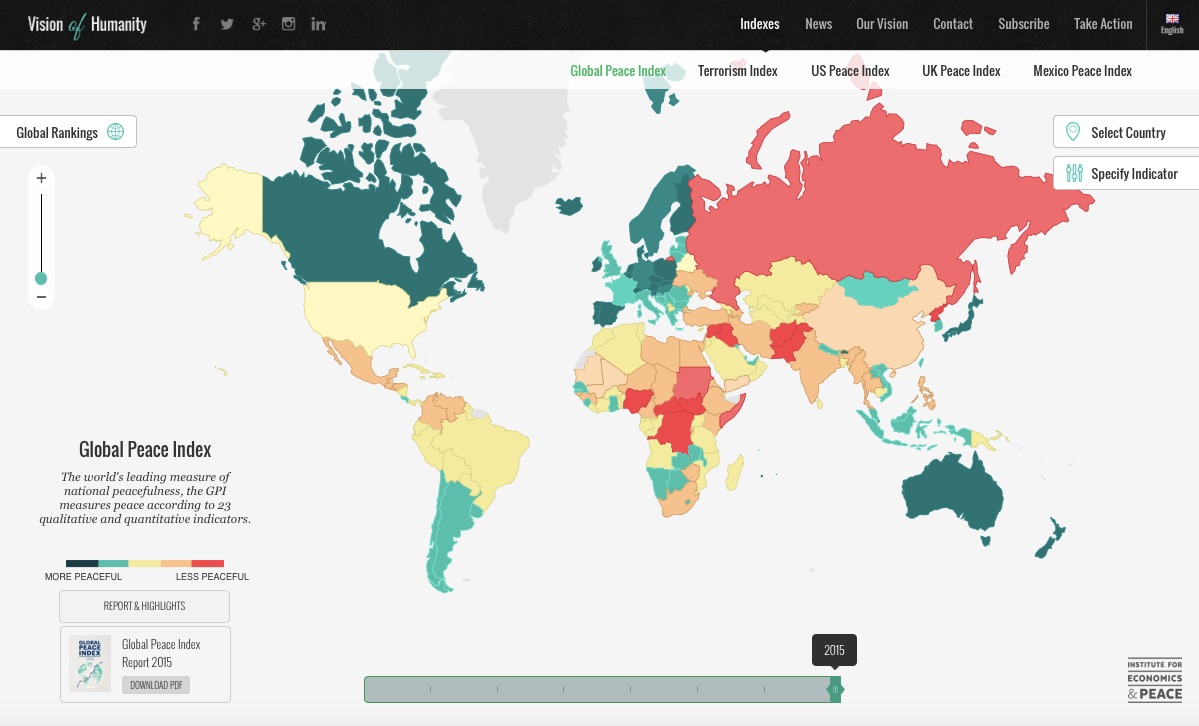
Global Peace Index 2015 JPEG The Institute for Economics and Peace has issued its Global Peace Index for 2014.  There are all sorts of problems in calculating indices like these – and interpreting them (as you can see if you read some of the press releases and reports surrounding the publication of the GPI) – and in this case:

The Global Peace Index is a composite index comprised of 23 qualitative and quantitative indicators that gauge the level of peace in 162 countries. These indicators can be grouped into three broad themes: the level of safety and security in a society, the number of international and domestic conflicts and the degree of militarisation.

Crunching the numbers,  the Institute concludes that

Syria remains the world’s least peaceful country, followed by Iraq and Afghanistan. The country that suffered the most severe deterioration in peace was Libya, which now ranks 149th of 162 countries. Ukraine suffered the second largest deterioration…

Its President, Steve Killelea, explained that:

2014 was marked by contradictory trends: on the one hand many countries in the OECD achieved historically high levels of peace, while on the other, strife-torn nations, especially in the Middle East, became more violent.

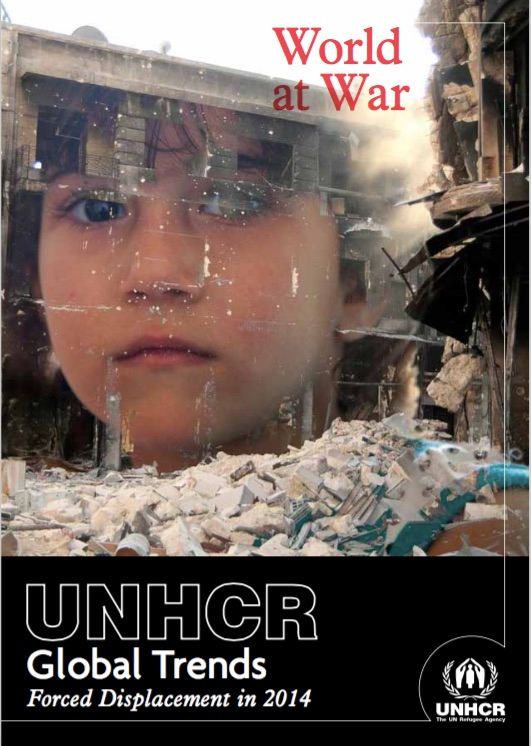
What the Report doesn’t pursue are the close links between those two trends; and when you look at the map you will soon realise that being ‘peaceful’ is not the same thing as not being belligerent… But the Report does emphasise the absurdist cost of all this violence (while noting that much more is at stake than money): ‘The economic impact of violence reached a total of US$14.3 trillion or 13.4% of global GDP last year.’ You can download the full Report here or find the interactive map (screenshot at the head of this post) here. UNHCR World at War 2014 JPEG On the same day, the United Nations High Commissioner for Refugees published different maps in World at War that provide a radically different calculus of the cost of such violence.  Writing in the New York Times Somini Sengupta reports:

Nearly 60 million people have been driven from their homes by war and persecution, an unprecedented global exodus that has burdened fragile countries with waves of newcomers and littered deserts and seas with the bodies of those who died trying to reach safety. 0745631649The new figures, released Thursday by the United Nations refugee agency, paint a staggering picture of a world where new conflicts are erupting and old ones are refusing to subside, driving up the total number of displaced people to a record 59.5 million by the end of 2014, the most recent year tallied. Half of the displaced are children. Nearly 14 million people were newly displaced in 2014, according to the annual report by the Office of the United Nations High Commissioner for Refugees. In other words, tens of thousands of people were forced to leave their homes every day and “seek protection elsewhere” last year, the report found. That included 11 million people who scattered within the borders of their own countries, the highest figure ever recorded in the agency’s 50-year history. Tens of millions of others fled in previous years and remain stuck, sometimes for decades, unable to go home or find a permanent new one, according to the refugee agency. They include the more than 2.5 million displaced in the Darfur region of Sudan, and the 1.5 million Afghans still living in Pakistan.

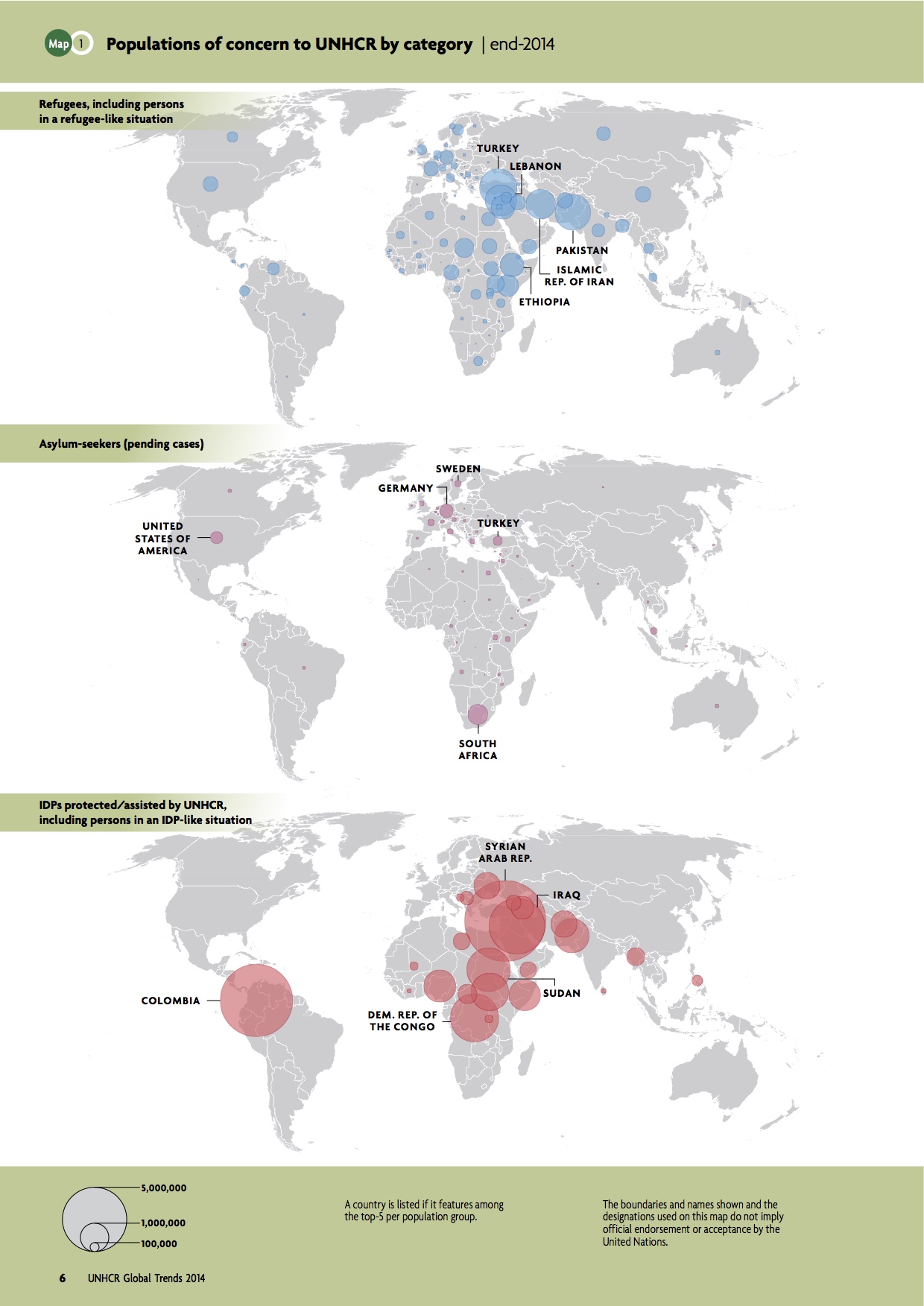
Populations of concern to UNHCR to end 2014 And the map reveals a starkly different bi-polar geography to the division highlighted by the GPI:

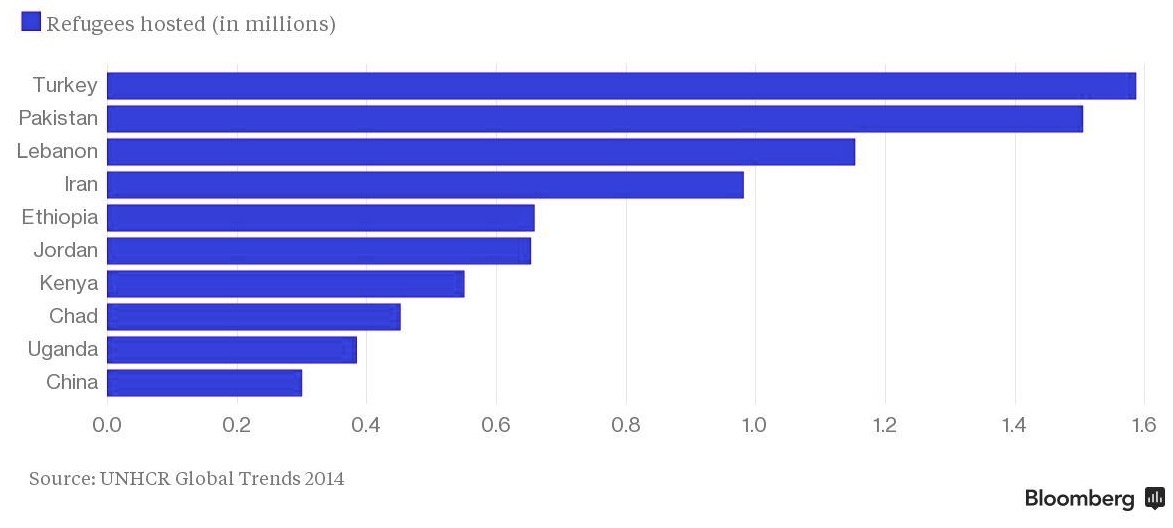
When refugees flee their own countries, most of them wind up in the world’s less-developed nations, with Turkey, Iran and Pakistan hosting the largest numbers. One in four refugees now finds shelter in the world’s poorest countries, with Ethiopia and Kenya taking many more refugees than, say, Britain and France. As the report states, “the global distribution of refugees remains heavily skewed away from wealthier nations and towards the less wealthy.”

Refugees hosted 2014 JPEG You can download World at War here.

A world of proliferated drones

CNAS A world of proliferated dronesA new report from Kelley Sayler at the Center for a New American Security, A world of proliferated drones, starts to map what she calls ‘the likely contours of a drone-saturated world’.  The report emphasises that the United States does not have a monopoly on drones  – more than 90 states and non-state actors have them – but unusually the report pays close attention to the repurposing of small, commercial off-the-shelf drones.  It begins by summarising their capability for intelligence, surveillance and reconnaissance:

‘Current commercial drone technologies – available for purchase in either pre-assembled or customizable, component form – enable a number of high-end capabilities that were formerly the monopoly of major military powers.

Many commercial off-the-shelf (COTS) drones – including the best-selling model, the DJI Phantom – are now equipped with GPS and waypoint navigation systems. These systems enable the drone to accurately determine and hold its position, in turn removing the need for line-of-sight communications and allowing for autonomous flight… Operators of pre-assembled systems can also take advantage of smartphone-based control systems, dramatically improving ease of use. Such systems enable the user to navigate the drone simply by selecting a destination on a map or even by merely tilting the user’s phone…

High-definition video cameras are also widely available on COTS drones and, when combined with video downlinks, can provide real-time intelligence, surveillance, and reconnaissance (ISR) capabilities to multilocation receivers, though these capabilities are often limited by range and battery life.’

The report emphasises the potential weaponisation of these small drones for what it calls ‘overmatch’, in effect reversing the terms of asymmetric warfare, through (for example) the development of ‘flying IEDs‘:

‘While such systems may not appear sophisticated in a traditional military sense, ground-emplaced IEDs have caused thousands of American deaths in Iraq and Afghanistan and proved profoundly hard to defeat. Drones will enable airborne IEDs that can actively seek out U.S. forces, rather than passively lying in wait. Indeed, low-cost drones may lead to a paradigm shift in ground warfare for the United States, ending more than a half- century of air dominance in which U.S. ground forces have not had to fear attacks from the air.  Airborne IEDs could similarly be used in a terrorist attack against civilians or in precision strikes against high-profile individuals or landmarks.’

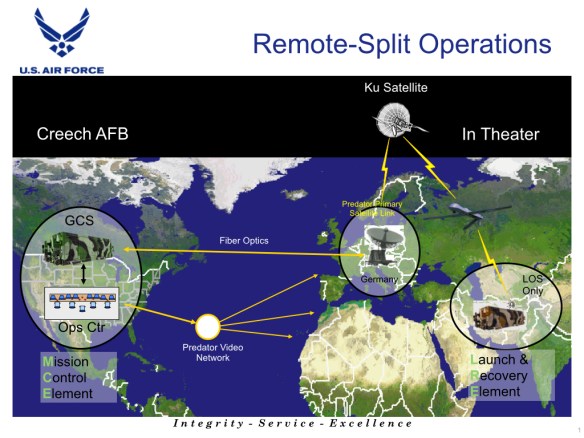
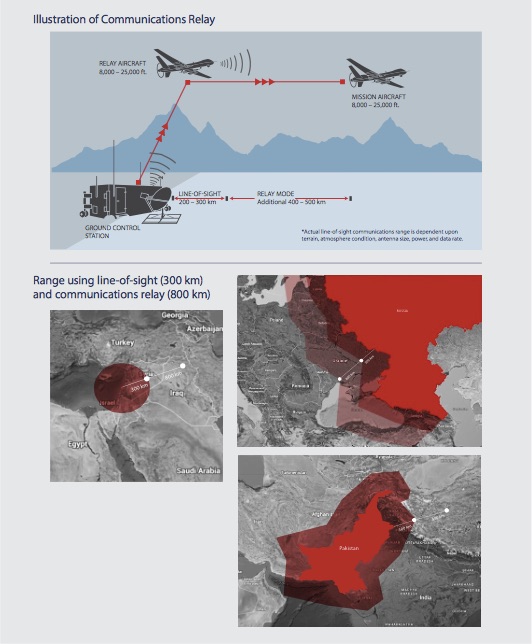
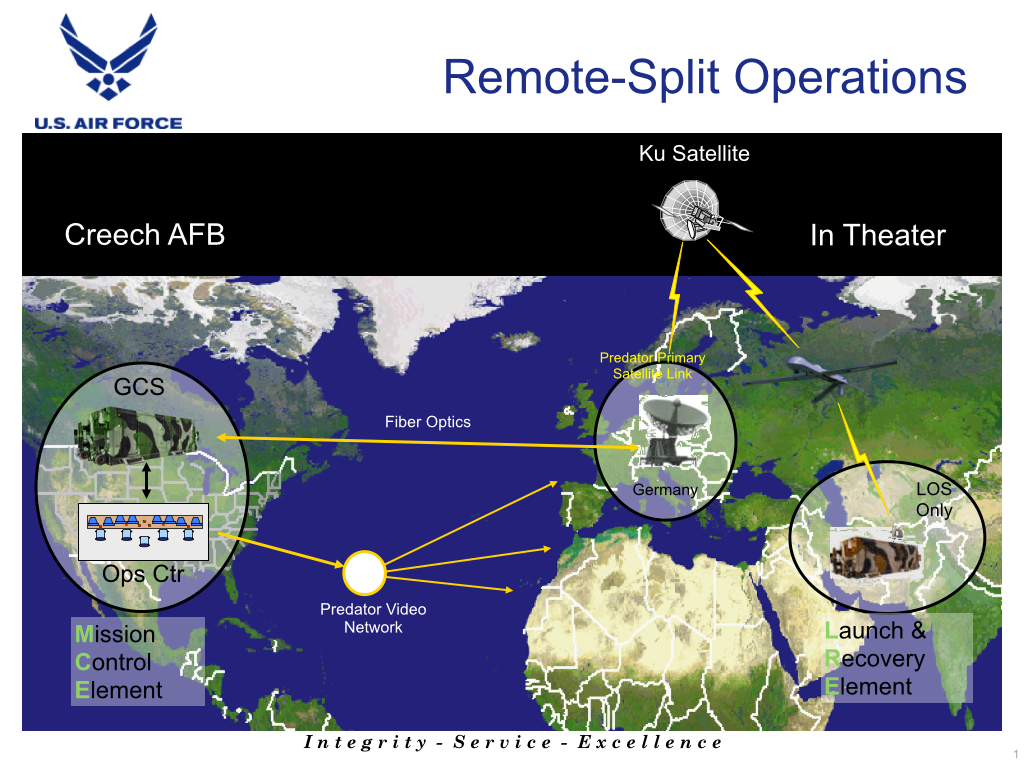
But the report also makes much of the US’s continued military-industrial investment in high-end drones.  Here various forms of stealth technology make much of the running, or at least issue most of the promissory notes, since today’s Predators and Reapers can only operate in more or less undefended air space – which is another way of saying they can only be used against the weak and/or with the complicity of other states (as in Pakistan and Yemen) – and face immense difficulties in what the US Air Force calls A2/AD [anti-access/area-denial] environments (see here and here). But I’m particularly interested in what the report has to say about the use of large military drones to act as communications relays.  Here the emphasis is on the ability of these remote relays to integrate what is otherwise often remarkably un-networked warfare and to extend the range of operational control and transmissable data.

Drones as communication relays (CNAS)

‘Large military-specific systems offer a number of additional improvements in communications capabilities. Many include wide-band satellite communications (SATCOM) that expand the amount and extend the range of transmittable data, providing distant ground stations with real-time ISR. Like some baseline systems, high-end systems are generally capable of line-of-sight communi- cations with other platforms operating in their area and, for this reason, are often employed as communications relays. Perhaps the most vivid example of the force-multiplying effects of such capabilities is the EQ-4 – what is essentially an RQ-4 Global Hawk outfitted with the Battlefield Airborne Communications Node (BACN). BACN serves as a universal translator for a diverse set of U.S. aircraft that are not otherwise capable of communicating with each other due to incompatible data links – providing a vital connection between, for example, fourth-generation F-16 fighter jets, B-1 bombers, and stealthy, fifth-generation F-22s [BACN is also used on conventional platforms: see here for its role in co-ordinating an air strike in Afghanistan]. Communications relay capabilities will also allow states to operate drones at extended ranges (300 to 800 kilometers) without satellite communications, allowing significant penetration into neighboring countries or contested areas’ (my emphasis).

Steve Graham and I are presently working on an essay on drones and satellite communications: so much of the discussion of geospatial intelligence has focused on satellite imagery, but the geographies of satellite communications (and, crucially, bandwidth) play a major role in the deployment of drones and in the highly variable quality of the imagery they transmit to users across the network.

Wars over the laws of war

DoD Law of War Manual

The Pentagon has just published a new edition of its Law of War Manual: you can download all 1200 pages here.  From the Foreword by Stephen Preston, the Pentagon’s General Counsel:

The law of war is a part of our military heritage, and obeying it is the right thing to do. But we also know that the law of war poses no obstacle to fighting well and prevailing. Nations have developed the law of war to be fundamentally consistent with the military doctrines that are the basis for effective combat operations. For example, the self-control needed to refrain from violations of the law of war under the stresses of combat is the same good order and discipline necessary to operate cohesively and victoriously in battle. Similarly, the law of war’s prohibitions on torture and unnecessary destruction are consistent with the practical insight that such actions ultimately frustrate rather than accomplish the mission.

Thanks to Marty Lederman at Just Security: watch that space for more commentary (I think….)

W Hays Parks 2003In the meantime, for some of the politics involved in the protracted publication process of the new manual (and an explanation of the title of Marty’s post), see Edwin Williamson and Hays Parks [right] writing in the neo-conservative standard bearer the Weekly Standard in July 2013 here, who – even as they insist on their non-partisan, apolitical and thoroughly objective perspective – nailed their colours to the mast in no uncertain terms:

From the outset it was agreed that the manual would be apolitical—it would be based on the law rather than political arguments inconsistent with the law of war. For example, the working group rejected arguments by some Bush administration officials that the law of war did not protect captured al Qaeda and that “enhanced interrogation procedures,” including waterboarding, should not be banned.

Obama administration political appointees, though, have aggressively sought changes in the manual to conform to their political philosophies or legal arguments in detainee litigation, pushing for rules and principles that vary from longstanding law of war treaty-based terminology and norms previously accepted by Republican and Democratic administrations.

One of the more egregious changes proposed by State Department political appointees and human rights activists on the National Security Council was the removal of a paragraph acknowledging that the law of war is lex specialis—the controlling law in armed conflict. Denying the lex specialis status of the law of war would enable activists to inject human rights law into the manual and onto the battlefield. Deletion of the lex specialis text was apparently not sought on the basis that it was legally incorrect, but, we suspect, because it was inconsistent with their political agenda.

Such a change would impose restrictions on U.S. forces in combat so that deadly force could be used only against an enemy who had refused a surrender opportunity or who posed an “imminent threat.” These requirements would place our fighters on a footing comparable to a police officer in the United States in a peacetime environment and at an extreme and unprecedented risk of being killed by the enemy or facing “war crimes” allegations by human rights activists.

Justice Department efforts toward the draft manual echo its continued post-9/11 view of the battle with al Qaeda entirely (and incorrectly) from a law enforcement perspective. It seeks to bring the manual text into conformity with terms and arguments it uses in court (many of which are inconsistent with the law of war).

A change Justice Department lawyers sought involved civilians on the battlefield. Under the law of war, a civilian loses immunity from direct attack if he or she “takes a direct part in hostilities.” The working group agreed that this participation does not, however, necessarily constitute criminal activity. Without consulting with working group experts or senior DoD or State policymakers, Justice Department attorneys have asserted that it does. This extreme (and incorrect) position would place at risk of enemy prosecution the substantial number of U.S. and foreign civilians who accompany our armed forces in the field in time of war and whose support is a major basis for the way in which the United States—with congressional approval—determines its military force structure. Justice Department lawyers created new law to enable the department to win its cases against al Qaeda, disregarding battlefield consequences for civilians lawfully accompanying our own forces.

More from Charles Kels here.

Medical neutrality and modern war

md_p0361-memory-solferinoI expect most readers know how the International Committee of the Red Cross had its origins in Henry Dunant‘s horror at the unrelieved suffering he witnessed in the aftermath of the Battle of Solferino in 1859 (see my earlier post here).

In A Memory of Solferino (1862) he asked: ‘Would it not be possible, in time of peace and quiet, to form relief societies for the purpose of having care given to the wounded in wartime by zealous, devoted and thoroughly qualified volunteers?’

Dunant’s vision of an impartial relief society to provide aid to those wounded in time of war led to the formation of a series of national relief societies and, as John Hutchinson shows in Champions of Charity: War and the rise of the Red Cross, these national societies soon became entangled with nationalism.  ‘Gripped by the passions of patriotism,’ he writes, by the time of the First World War these national societies ‘undertook to perform whatever repair work the armies required of them.’

And yet, even with these entanglements, a key principle was defended: medical neutrality.  According to Physicians for Human Rights, medical neutrality requires:

  1. The protection of medical personnel, patients, facilities, and transport from attack or interference;
  2. Unhindered access to medical care and treatment;
  3. The humane treatment of all civilians; and
  4. Nondiscriminatory treatment of the sick and injured.

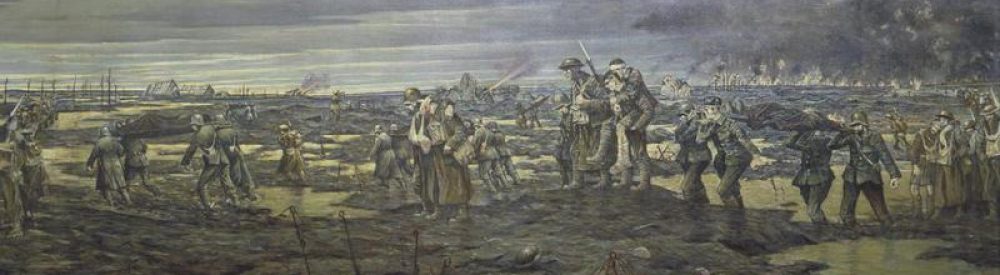
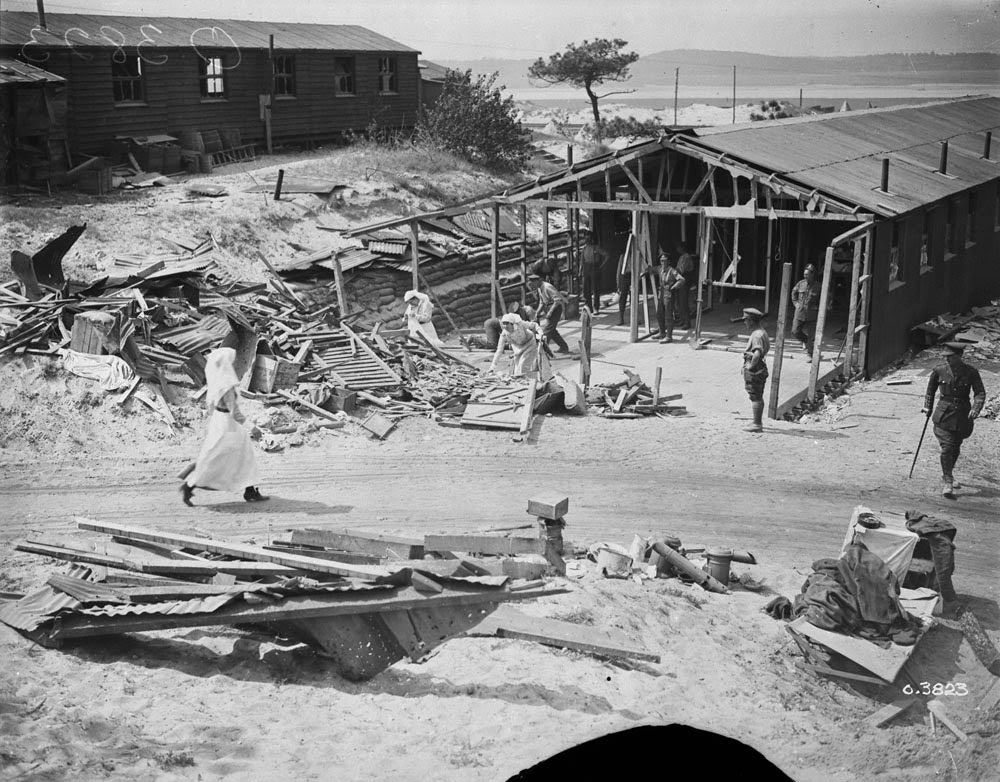
During the First World war there were complaints that the principle had been sporadically violated: that stretcher-bearers had been attacked by snipers when they sought to recover the wounded or that military hospitals had been deliberately shelled or bombed.  Here, for example, is the aftermath of one of several air raids targeting base hospitals at Etaples on the French coast between May and August 1918 (supposedly in retaliation for a British air raid on Cologne):

Lowe_Field_Hospital_bombed_LAC_PA_003747_a003747_v8.jpg_pv4a5fab25f240997c

But in the last decade of our own century such violations have become increasingly systematic. And, as more and more civilians have become trapped and even targeted in conflict zones whose ‘battlefields’ know no bounds, so those violations have extended far beyond attacks on military-medical infrastructure and personnel.

Last summer I detailed the attacks made by the Israeli military on medical facilities and emergency systems in Gaza, and I drew attention to the work of Physicians for Human Rights in documenting the precariousness of medical care there.  But the calculated production of these spaces of exception is not exceptional, and attacks like these have become part of the arsenal of later modern war.  “Instead of being protected,” says Donna McKay, executive director of PHR, “medical care is actually a target.”

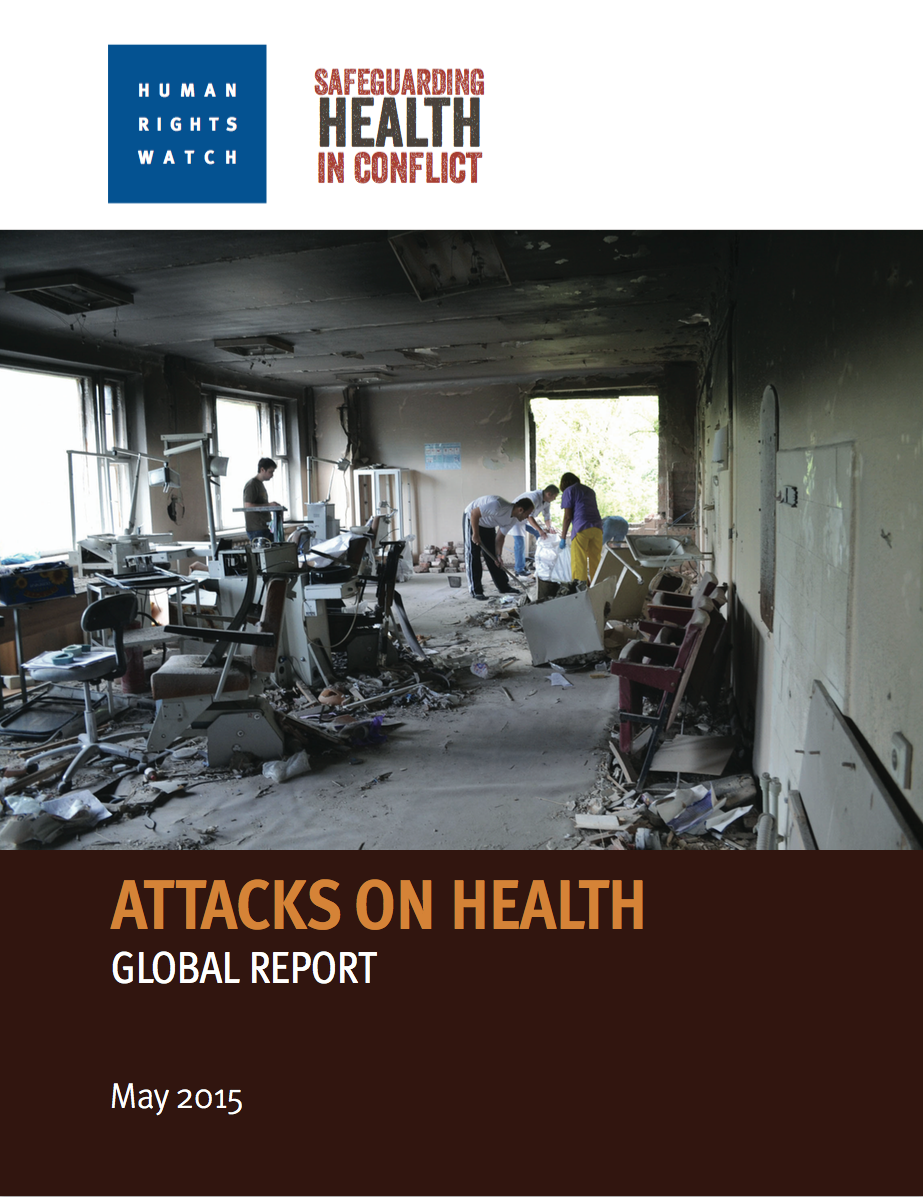
HRW Attacks on Health

Physicians for Human Rights is part of the Safeguarding Health in Conflict Coalition which has now joined with Human Rights Watch to publish Attacks on Health: a Global Report (2015) that summarises attacks on health care facilities and health care workers around the world:

Over the past year armed groups have attacked hospitals, clinics, and health personnel in 41 incidents in Afghanistan and deliberately killed over 45 health workers, primarily polio vaccinators, in Nigeria and Pakistan. In Syria, where medical facilities in Aleppo have been hit with government barrel bombs, 194 medical personnel have been killed and 104 medical facilities attacked since 2014….

The organizations described attacks in South Sudan, where 58 people were killed in four hospitals in a series of attacks in early 2014, and in eastern Ukraine, where it is estimated that 30 to 70 percent of health workers have fled the region because of insecurity. In Yemen, Al-Qaeda in the Arabian Peninsula (AQAP) militants carried out attacks on health facilities in early 2014, and the 10-country Saudi-led coalition conducted air strikes that hit hospitals and interrupted medical supplies during the conflict in early 2015. Relying on data from Insecurity Insight’s Security in Numbers Database, the report also shows trends in attacks on health care over the course of a decade in South Sudan and Central African Republic.

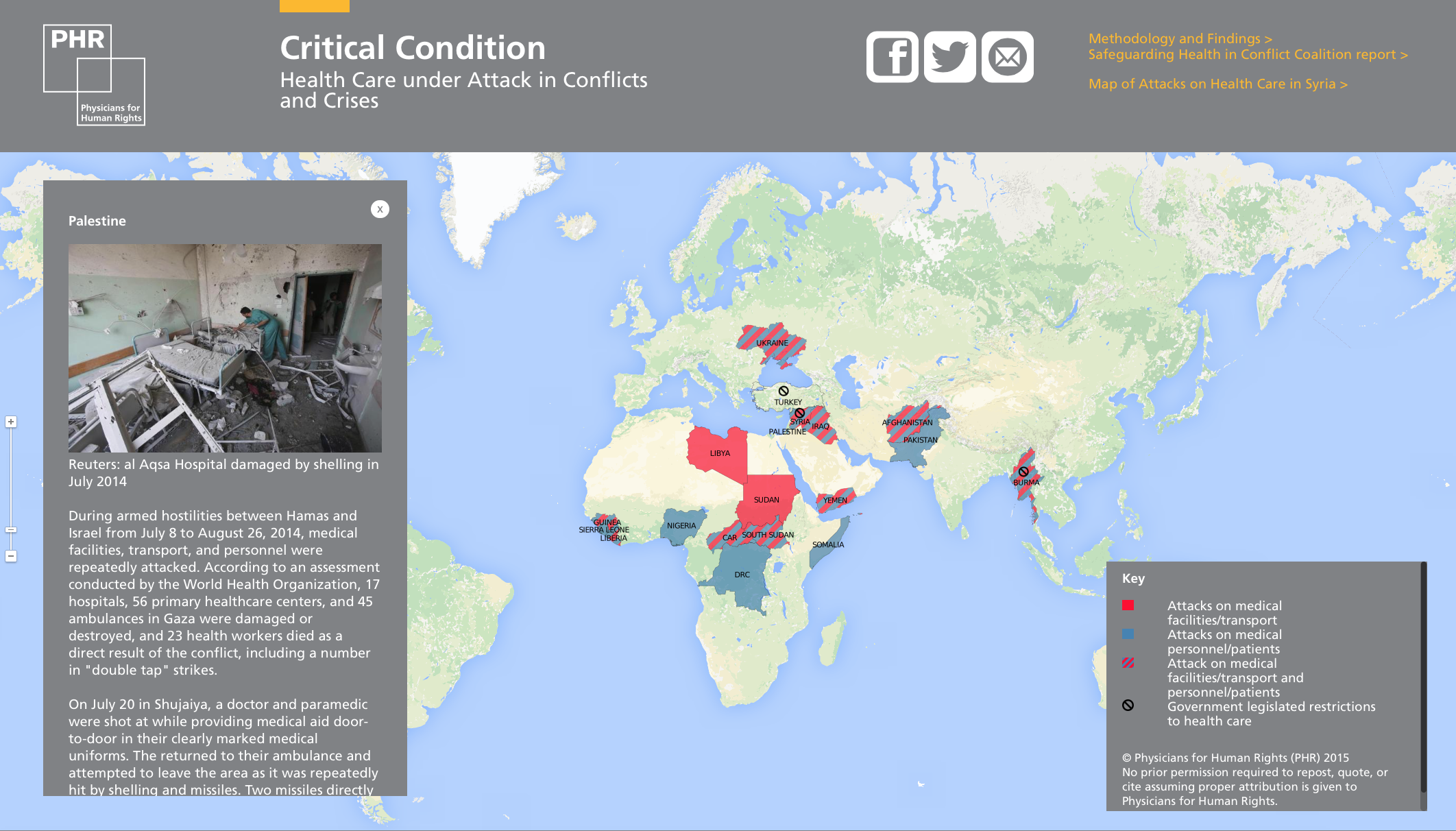
PHR Critical Condition

In close concert with the report Physicians for Human Rights have produced an interactive online map of attacks on health care around the world between January 2014 and April 2015 (see the screenshot above).

PHR Attacks on health care in Syria

The organisation has also produced a detailed map of attacks on health care systems – or what’s left of them – in Syria (see the screenshot above), which you can access here.  It needs to be supplemented by PHR’s Doctors in the crosshairs: four years of attacks on health care in Syria, which was published in March:

The symbols of the Red Cross and Red Crescent have been turned from a shield of protection into crosshairs on the backs of those who knowingly risk their lives to save others.

You can find more on the violation of medical neutrality in Syria in an open-access article by Ravi S. Katari in the Journal of global health here and in a short essay by Sasha Zients and Dylan Okabe-Jawdat for the Columbia Political Review (May 2015) here.

And you can find more on the systematic violation of medical neutrality in Bahrein and elsewhere here.

Playing a blinder

A characteristically smart post from Larry Lewis at War on the Rocks about Obama’s promise to investigate the mistakes made in the CIA-directed drone strike that unwittingly killed two hostages in Pakistan in January 2015.  ‘We’ve been on that path before, in Afghanistan,’ he writes, ‘and we know where it leads: more promises followed by a repeat of similar mistakes.’

Larry explains that the US military was causing an ‘unacceptable number’ of civilian casualties in Afghanistan between 2006 and 2009:

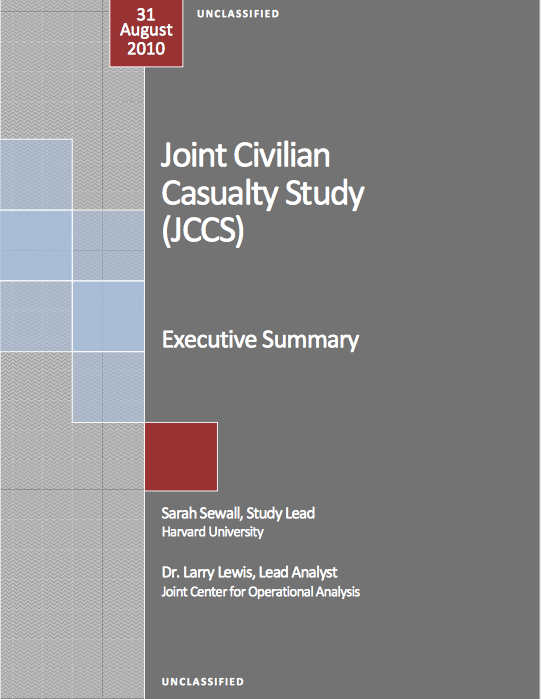
JCCSWhen an incident occurred, they investigated the incident, made changes to guidance, and promised to keep such an incident from happening again. But these incidents kept happening. So the military repeated this ineffective review process again and again. This “repeat” cycle was only broken when military leaders approved the Joint Civilian Casualty Study, a classified outside review requested by General Petraeus. This effort had two key differences from earlier efforts. First, it was independent, so it was able to overcome false assumptions held by operating forces that contributed to their challenges. And second, the study looked at all potential civilian casualty incidents over a period of years, not just the latest incident. This approach helped identify systemic issues with current tactics and policies as the analysis examined the forest and not just the nearest tree. This study also considered different sets of forces operating within Afghanistan and their relative propensity for causing civilian casualties.

You can access the unclassified Executive Summary – co-written by Larry with Sarah Sewell – here.  I’ve noted Larry’s important work on civilian casualties before – here, here and here – but his short Op-Ed raises two issues that bear emphasis.

The first is that it is a mistake to abstract strikes carried out by a Predator or a Reaper from air strikes carried out from conventional platforms; the latter are often facilitated and even orchestrated by a UAV – as in the ‘signature’ case of the Uruzgan strike in 2010 – but, pace some drone activists, our central concern should surely be the wider matrix of military violence.  This also implies the need to articulate any critique of CIA-directed drone strikes in Pakistan with the use of air power in Afghanistan (and not only because USAF pilots fly the ‘covert’ missions across the border).  Here General Stanley McChrystal‘s Tactical Directive issued in July 2009 that directly addressed civilian casualties is a crucial divide.   As Chris Woods emphasizes in Sudden Justice,

‘Radically different tactics were now being pursued on either side of the “AfPak” border…. Even as Stanley McChrystal was cutting back on airstrikes in Afghanistan, the CIA was escalating its secret air war in Pakistan’s tribal areas.’

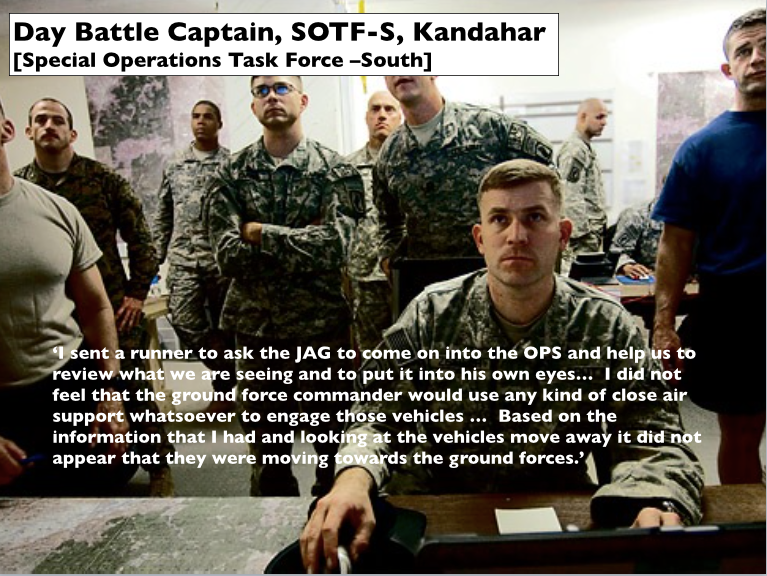
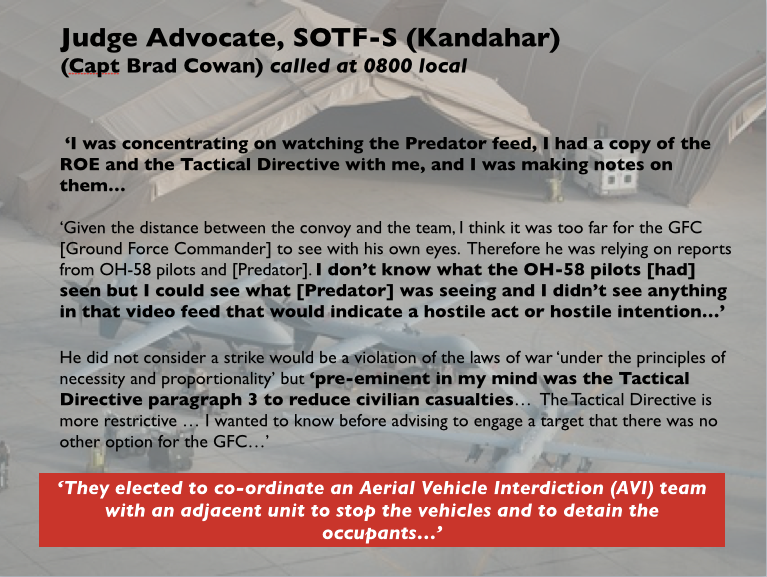
The second issue is the extraordinary partitions – blinkers might be more accurate – that seem to be imposed on military operations and investigations.  In the case of the Uruzgan attack, for example, a military lawyer was called in at the eleventh hour to monitor the video feeds from the Predator as it tracked a ‘convoy’ (a term surely as leading as ‘Military-Aged Male’) in the early morning.  As the next two slides show, taken from my ‘Angry Eyes’ presentation, the JAG knew the Rules of Engagement (ROE) and the Tactical Directive; he obviously also knew the legal requirements of proportionality,  distinction and the rest.

Angry Eyes:1

Angry Eyes:2

Knowing the ROE, the Tactical Directive and the formal obligations of international law is one thing (or several things): but what about ‘case law’, so to speak?  What about knowledge of other, similar incidents that could have informed and even accelerated the decision-making process?  In this case, before the alternative course of action could be put into effect and an ‘Aerial Vehicle Interdiction’ set in motion – using helicopters to halt the three vehicles and determine what they were up to – two attack helicopters struck the wholly innocent ‘convoy’ and killed 15-21 civilians.  Fast forward to the subsequent, I think forensic Army investigation.  This is the most detailed accounting of a ‘CIVCAS’ incident I have read (and you’ll be able to read my analysis of it shortly), and yet here too – even with senior military legal advisers and other ‘subject experts’ on the investigating team – there appears to be no reference to other, similar incidents that could have revealed more of the ‘systemic issues’ to which Larry so cogently refers.

This is made all the stranger because there is no doubt – to me, anyway – that the US military takes the issue of civilian casualties far more seriously than many of its critics allow.

CIVCAS


Asymmetric law

1425285643_9e0a120e-3716-468a-ba00-e976b29db2851421848906

Breaking the Silence has just published a major report into the Israeli military’s tactics during its most recent offensive against Gaza and its people, so-called ‘Operation Protective Edge’ (see my posts herehere, here and here).

Based on interviews with 65 IDF soldiers, the report includes Background, Testimonies (‘This is how we fought in Gaza‘), and a media gallery.

Writing in today’s Guardian, Peter Beaumont reports:

Describing the rules that meant life and death in Gaza during the 50-day war – a conflict in which 2,200 Palestinians were killed – the interviews shed light for the first time not only on what individual soldiers were told but on the doctrine informing the operation.

Despite the insistence of Israeli leaders that it took all necessary precautions to protect civilians, the interviews provide a very different picture. They suggest that an overarching priority was the minimisation of Israeli military casualties even at the risk of Palestinian civilians being harmed….

Post-conflict briefings to soldiers suggest that the high death toll and destruction were treated as “achievements” by officers who judged the attrition would keep Gaza “quiet for five years”.

The tone, according to one sergeant, was set before the ground offensive into Gaza that began on 17 July last year in pre-combat briefings that preceded the entry of six reinforced brigades into Gaza.

“[It] took place during training at Tze’elim, before entering Gaza, with the commander of the armoured battalion to which we were assigned,” recalled a sergeant, one of dozens of Israeli soldiers who have described how the war was fought last summer in the coastal strip.

“[The commander] said: ‘We don’t take risks. We do not spare ammo. We unload, we use as much as possible.’”

“The rules of engagement [were] pretty identical,” added another sergeant who served in a mechanised infantry unit in Deir al-Balah. “Anything inside [the Gaza Strip] is a threat.  The area has to be ‘sterilised,’ empty of people – and if we don’t see someone waving a white flag, screaming: “I give up” or something – then he’s a threat and there’s authorisation to open fire … The saying was: ‘There’s no such thing there as a person who is uninvolved.’ In that situation, anyone there is involved.”

“The rules of engagement for soldiers advancing on the ground were: open fire, open fire everywhere, first thing when you go in,” recalled another soldier who served during the ground operation in Gaza City. The assumption being that the moment we went in [to the Gaza Strip], anyone who dared poke his head out was a terrorist.”

1425285424_2bdb2aee-c3f8-4679-a375-d6682afb701a1421848849

You can find an impassioned, detailed commentary on the report by Neve Gordon – who provides vital context, not least about the asymmetric ethics pursued by supposedly ‘the most ethical army in the world’ – over at the London Review of Books here, and a shorter commentary by Kevin Jon Heller at Opinio Juris here.  Kevin notes:

The soldiers’ descriptions are disturbingly reminiscent of the notorious “free fire” zones in Vietnam and the US government’s well-documented (and erroneous) belief that signature strikes directed against “military-age men in an area of known terrorist activity” comply with IHL’s principle of distinction. The testimonials are, in a word, stunning — and put the lie to oft-repeated shibboleths about the IDF being “the most moral army in the world.” As ever, the stories told by the IDF and the Israeli government are contradicted by the soldiers who actually have to do the killing and dying.

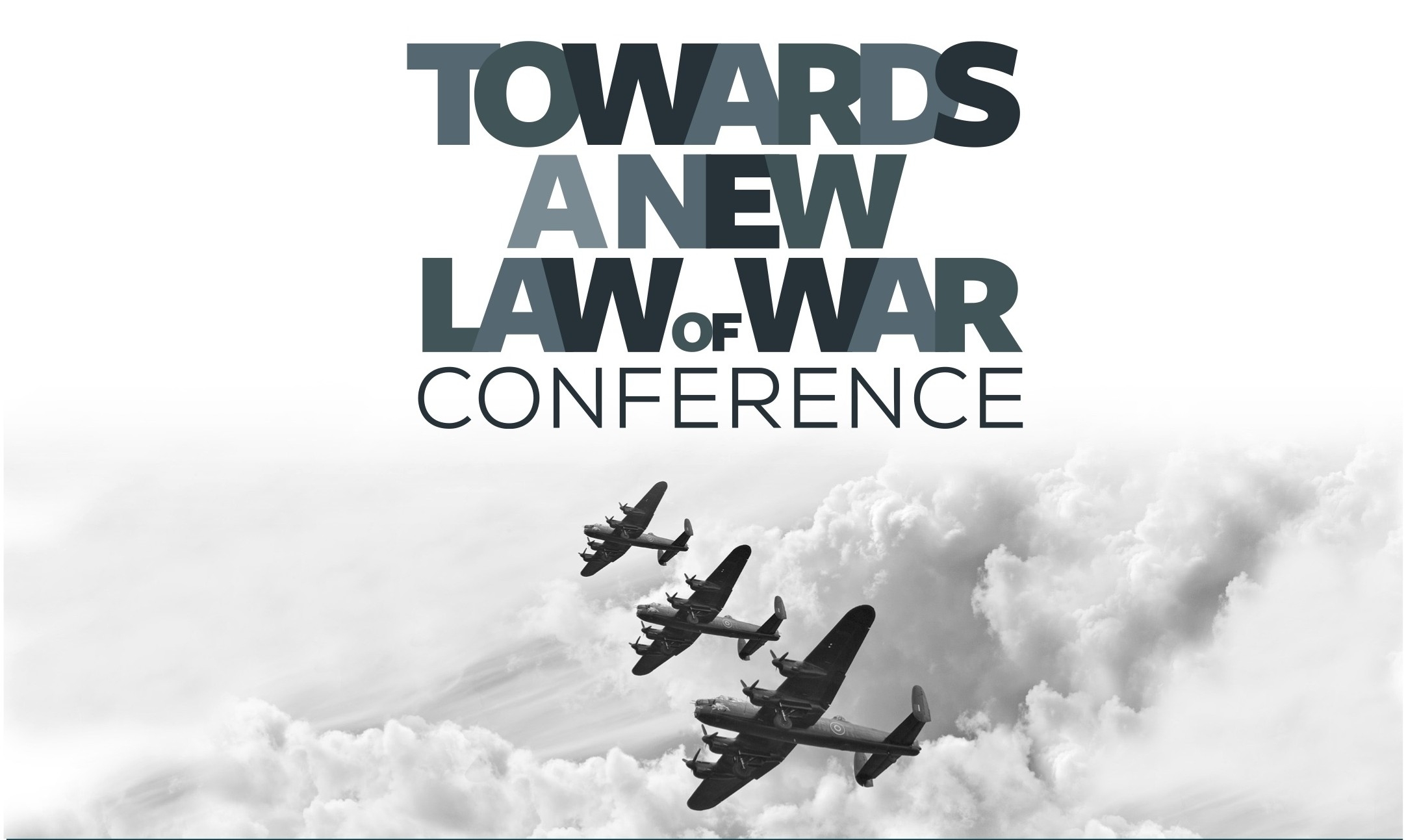
The legal and ethical framework pursued by the Israeli military – and ‘pursued’ is the mot (in)juste, since its approach to international law and ethics is one of aggressive intervention – is in full view at a conference to be held in Jerusalem this week: ‘Towards a New Law of War‘.

poster-A2_3-2480x35071-e1427212477619-2164x1293

‘The goal of the law of war conference,’ say the organisers, ‘is to influence the direction of legal discourse concerning issues critical to Israel and her ability to defend herself. The law of war is mainly unwritten and develops on the basis of state practice.’

You can find the full program here, dominated by speakers from Israel and the US, but notice in particular the session on ‘Proportionality: Crossing the line on civilian casualties‘:

CIvilian Casualties

As this makes clear, and as Ben White reports in the Middle East Monitor, law has become the target (see also my post here):

After ‘Operation Cast Lead’, Daniel Reisner, former head of the international law division (ILD) in the Military Advocate General’s Office, was frank about how he hoped things would progress.

If you do something for long enough, the world will accept it. The whole of international law is now based on the notion that an act that is forbidden today becomes permissible if executed by enough countries….International law progresses through violations.

Similarly, in a “moral evaluation” of the 2008/’09 Gaza massacre, Asa Kasher, author of the IDF’s ‘Code of Ethics’, expressed his hope that “our doctrine” will ultimately “be incorporated into customary international law.” How?

The more often Western states apply principles that originated in Israel to their own non-traditional conflicts in places like Afghanistan and Iraq, then the greater the chance these principles have of becoming a valuable part of international law.

Now Israel’s strategy becomes clearer… Israel’s assault on the laws of war takes aim at the core, guiding principles in IHL – precaution, distinction, and proportionality – in order to strip them of their intended purpose: the protection of civilians during armed conflict. If successful, the victims of this assault will be in the Occupied West Bank and Gaza Strip, Lebanon – and in occupations and war zones around the world.