Je ne suis pas Charlie

Once you decide you want to engage with audiences beyond the academy – one of my reasons for starting this blog, which also spirals in to my presentations and (I hope) my other writing – you run the risk of accepting invitations to comment on issues that lie far beyond your competence.  Even supposed ‘experts’ can be caught out, of course: think of  Steven Emerson‘s extraordinary claim earlier this week on Fox News (where else?) that in the UK ‘there are actual cities like Birmingham that are totally Muslim where non-Muslims just simply don’t go in…’  Emerson is the founder and Executive Director of the Investigative Project on Terrorism, and ‘is considered one of the leading authorities on Islamic extremist networks, financing and operations’ – or so he says on his website – and he subsequently apologised for his ‘inexcusable error’.

Emerson was being interviewed as part of Fox News’s continuing coverage of the murders at the office of Charlie Hebdo and a kosher supermarket in Paris on 7 January, and specifically about the supposed proliferation of what he called ‘no-go zones … throughout Europe’.

A good rule is to treat areas you know nothing about as ‘no-go zones’ until you’ve done the necessary research.

Academics need to take that seriously too, especially as universities become ever busier pumping up their public affairs, boosting their media profiles and offering journalists ready access to the specialised knowledge of their faculty.  Don’t get me wrong: I believe passionately in the importance of public geography, especially with a little g, and I also understand how producers and journalists racing to meet a deadline need talking heads.  But we need to be careful about the simulation of expertise.

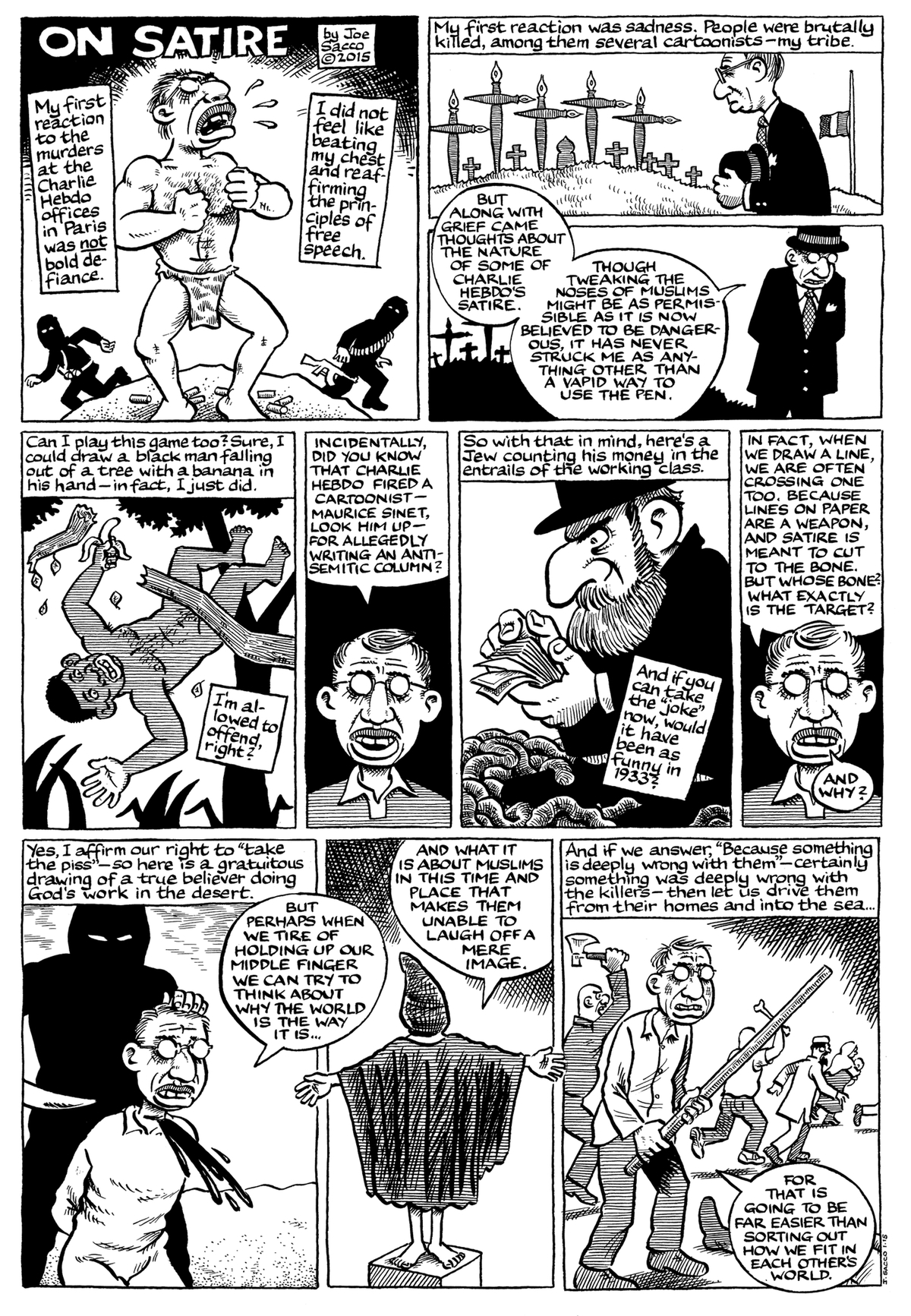
This is, in part, why I haven’t said anything so far about the murders in Paris.  But on Thursday I was invited to lead a lunch-time discussion about them at the Peter Wall Institute for Advanced Studies; one of the many wonderful things about the place is the trust that emerges out of a commitment to the irredeemably social nature of intellectual work, and so – beyond the cameras, the microphones and the notebooks – I tried to sort out what I had been reading and thinking.    In many ways, it was an extended riff on Joe Sacco‘s cartoon that appeared in the Guardian just two days after the attacks (if you want to know the reactions of Arab cartoonists, then see Jonathan Guyer here and here):
joesaccoonsatire1200

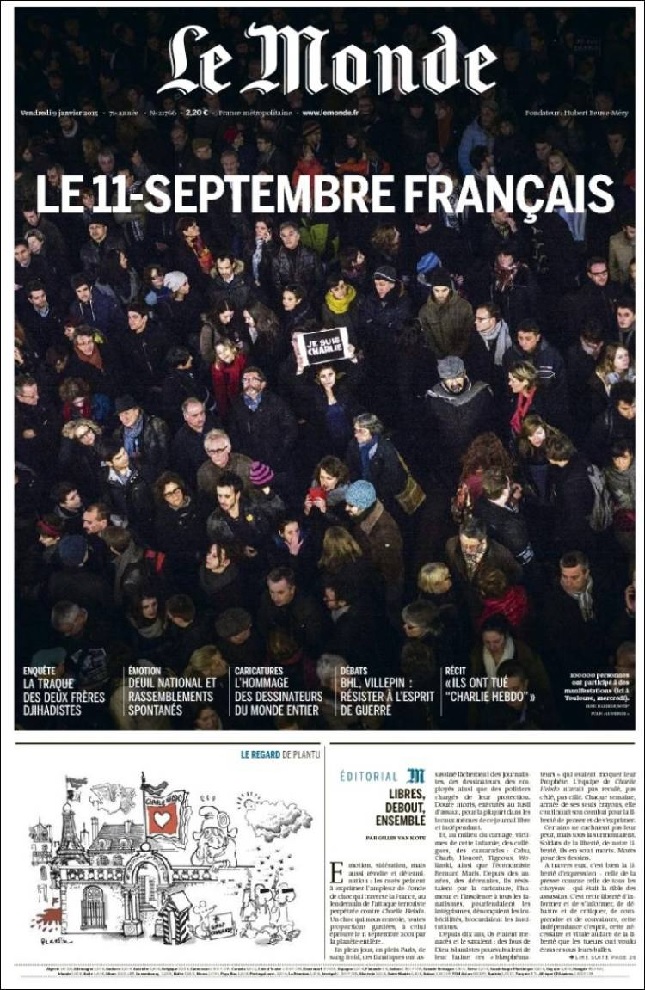
My starting-points were provided by The colonial present.  First, many commentators have suggested that the attacks were ‘France’s 9/11’; Le Monde‘s banner headline declared emphatically ‘Le 11 Septembre Français’.
le_monde_11_septembre

I think this absurd for many reasons, but there are several senses in which the comparison is worth pursuing, particularly if we focus on the response to the attacks in New York and Paris.  Both events, or more accurately television and video feeds of the developing situations, were relayed to watching audiences in real time.  This sense of immediacy is important, because it says something about the ways in which viewers were drawn in to the visual field and interpellated as subjects who were enjoined to respond – and crucially to feel – in particular ways.

Since this is emphatically not what Dominique Moisi, author of The geopolitics of emotion, had in mind when he insisted that ‘the attacks in Paris and in New York share the same essence’, that both cities ‘incarnate a similar universal dream’ of ‘light and freedom’, perhaps a different comparison will clarify what I mean.  Think of the killing of hundreds, even thousands of people by Boko Haram in Baga in northern Nigeria two weeks ago; reports began to appear in Europe and North America just one day after the murders in Paris, but the focus on France remained relentless.  There were surely many reasons for that (see Maeve Shearlaw‘s discussion here and Samira Sawlani‘s here), but the contrast between the live feeds from Paris and the scattered, inchoate and verbal reports from Baga is part of it – particularly when you realise that the scale of that distant atrocity was eventually  ‘laid bare’, as the Guardian put it, by satellite photographs released by Amnesty International showing more than 3,000 houses (‘structures’) burned or razed in Baga and Doron Baga.  For all the importance of surveillant witnessing in otherwise difficult to reach locations, the distance between bodies and buildings, an ordinary camera and a satellite, and live television and static imagery is telling, and sustains an affective geopolitics that is at once divided and divisive.

(Imagery is important to the Paris attacks in another sense too: when the murderers stormed in to the offices of Charlie Hebdo the focus of their rage was a series of cartoons mocking Mohammed – but they were radicalised by quite other documentary images, including coverage of the wars in Iraq and photographs showing the atrocities committed by American troops in Abu Ghraib: see here and here, and look at Joe Sacco’s cartoon again).

My second borrowing from The colonial present was a re-borrowing of Terry Eagleton‘s spirited invocation of ‘the terrible twins’, amnesia and nostalgia: ‘the inability to remember and the incapacity to do anything else’.  In the book I suggested that these are given a special significance within the colonial memory theatre, where the violence of colonialism is repressed and replaced by a yearning for the culture of domination and deference that it sought to instill.   And in much (fortunately not all) of the commentary on the Paris attacks, France’s colonial past has been effaced.  But here is Tim Stanley writing in the Telegraph:

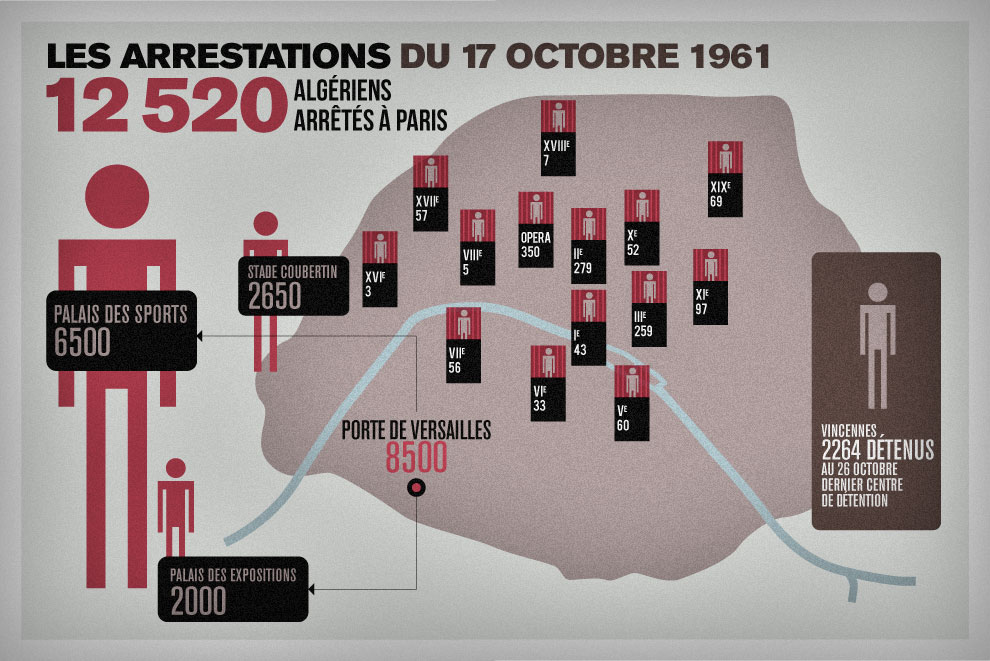
The ability of a society to forget its recent past is like the amnesia that follows an accident – the body’s way of protecting itself against trauma. Yet in the 1950s and 1960s, as France tried to cling on to its African colonial possessions, political violence was far more common than today. Muslim Algerian nationalists (their race and religion regarded as interchangeable by the French) bombed the mainland, assassinated officials and killed colonialists en masse. The reaction of the state was shocking. In 1961, 12,000 Algerian immigrants were arrested in Paris and held in a football stadium [and at other sites: see the map below]. Many were tortured; more than a hundred disappeared. For days, bodies were found floating in the Seine.
Carte.ParisAlgerie1961Bis

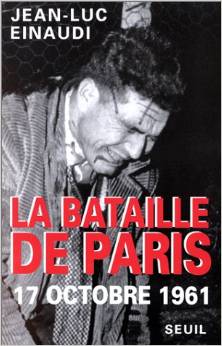
EINAUDI Bataille de ParisYou can find more on the events of 17 October 1961 – on the arrests, torture and summary executions following a mass rally to protest against a curfew imposed on Algerians in Paris – here and here, but the definitive account remains Jean-Luc Einaudi‘s Bataille de Paris (1991).
DIKEÇ BadlandsThis is but one episode in a violent and immensely troubled colonial history.  To point to this past – as Robert Fisk also did, in much more detail, in the Independent – is to loop back to 9/11 again, when attempts to provide similar contextual explanations were dismissed (or worse) as ‘exoneration’.  To be sure, one must be careful: although Chérif and Said Kouachi were the Paris-born sons of Algerian immigrants, Arthur Asseraf is right to reject attempts to draw a straight line between violence in the past and violence in the present.  But can the continued marginalisation of Muslims in metropolitan France, particularly young men in Paris’s banlieus, be ignored?  (Here there is no better place to start than Mustafa Dikeç‘s work, especially Badlands of the Republic).  Doesn’t it matter that more than 60 per cent of prisoners in French jails are Muslims? For the Economist all this means is that jihadists ‘share lives of crime and violence‘ so that structural violence disappears from view, but Tithe Bhattacharya provides a different answer in which the ghosts of a colonial past continue to haunt the colonial present.

And doesn’t the responsive assertion of a ‘freedom of expression’ that is, again, highly particularistic seek to absolutize a nominally public sphere whose exclusions would have been only too familiar to France’s colonial subjects?  Ghasan Hage reads its triumphalist restatement in the aftermath of the Paris murders as a colonial narcissism – a sort of colonial nostalgia through the looking-glass – fixated on what he calls a strategy of ‘phallic distinction’ in which ‘freedom of expression’ is flashed at radicalised Muslims to tell them: ‘look what we have and you haven’t, or at best yours is very small compared to ours.’  (And whose governments have done so much to prop up authoritarian regimes in the Arab world and beyond that thrive on the suppression and punishment of free speech?)

There are, as Joe Sacco’s cartoon makes clear, real limitations on what can be said or shown in France too, including how somebody can present themselves in public – think of the arguments over the veil and the headscarf.  There are also limitations elsewhere in the world, of course, which is why the sacularisation of Charlie Hebdo and, in particular, the march in Paris on 11 January seemingly headed by politicians from around the world, arm in arm (in some cases arms in arms would be more accurate), processing down the Boulevard Voltaire (symbolism is everything), was a scene that, as Seumas Milne noted, was beyond satire:

from Nato war leaders and Israel’s Binyamin Netanyahu to Jordan’s King Abdullah and Egypt’s foreign minister, who between them have jailed, killed and flogged any number of journalists while staging massacres and interventions that have left hundreds of thousands dead, bombing TV stations from Serbia to Afghanistan as they go.

True enough, but here too appearance is everything: the photograph was artfully staged (even before one ‘newspaper’ airbrushed the women from the frame) and took place in an otherwise empty side-street.
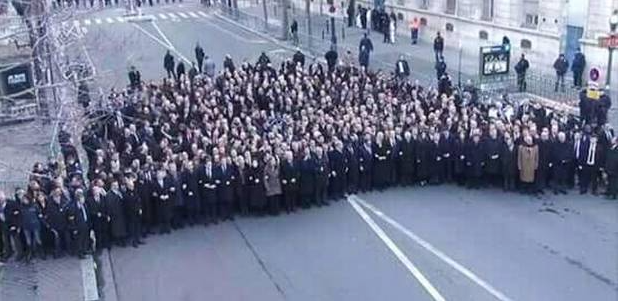
Paris photo-op PNG

If I can make one last nod to The colonial present, not surprisingly many of these politicians have also used the murders to justify the continued violence of the wars being fought in the shadows of 9/11; if you are in the mood to reverse the looking-glass, then Markha Valenta‘s sobering reflection at Open Democracy is indispensable:

[E]verything that might be said about revolutionary Islamist movements – when it comes to global violence – could be said about global Americanism and US foreign policy. It has been ruthless, cruel, illiberal, anti-democratic. It has wreaked havoc, killed innocents, raped women, men and youths, tortured viciously, violated the rule of law and continues to do so…

It does so in our name. In the name of democracy. And those who expose this … are shut up ruthlessly, cruelly and in ways designed to degrade. (Yet we did not march then.)

This matters because it clarifies what our condition is today, the condition under which last week’s violence took place: an extended and expanding global war between those who claim the right to intervention, brutality and terror in the name of democracy and those who do so in the name of Islam.

No less predictably, one of the immediate and dismally common responses to the murders, amidst the clamour for freedom of speech, was a renewed call for more state surveillance and regulation.  As Teju Cole wrote in the New Yorker,

The only person in prison for the C.I.A.’s abominable torture regime is John Kiriakou, the whistle-blower. Edward Snowden is a hunted man for divulging information about mass surveillance. Chelsea Manning is serving a thirty-five-year sentence for her role in WikiLeaks. They, too, are blasphemers, but they have not been universally valorized, as have the cartoonists of Charlie Hebdo.

But it’s not only politicians who are guilty of appropriation.  Putting on one (far) side the extraordinary attempts to turn “Je suis Charlie” to commercial account – to ‘trademark the tragedy and its most resonant refrain‘ – there are other, less venal and more complicated appropriations.
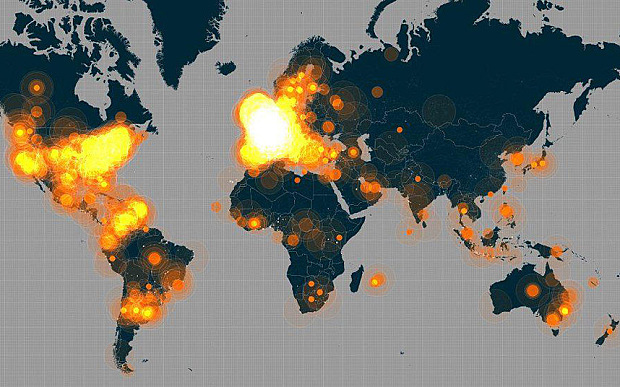
B67GP_yCYAA_mce.jpg

Heat map of #jesuischarlie hashtag; animation is available here

So back to the looking-glass.  You might think that “Je suis Charlie” is an affirmative gesture born of anger and horror but also of sympathy and compassion, a simple human reflex that has become virtually commonplace – comparable to, say, “We are all Palestinians“.  That was my first thought too. But the trouble is that such a rhetorical claim comes with a lot of baggage.  David Palumbo-liu suggests that  “I am Charlie” can be an assertion of empathy, solidarity or identification.  Even empathy is far from straightforward – why do we extend our fellow feeling to these people and not those? – but, as he shows, the other two progressively raise the stakes.    Sarah Keenan and Nadine El-enany wire this to appropriation with exquisite clarity in a short essay at Critical Legal Thinking:

The #JesuisCharlie hashtag and its social media strategy of solidarity through identification with the victim is … an appropriation of what was a creative and subversive tool for fighting structural violence and racist oppression, perhaps most famously in the “I am Trayvon Martin” campaign. When young black men stood up and said “I am Trayvon Martin”, they were demonstrating the persistent and deeply entrenched demonisation of black men which not only sees them killed in the street on their way to the local shop, but also deems their killers innocent of any wrongdoing. When predominantly white people in France and around the world declare “Je Suis Charlie”, they are not coming together as fellow members of a structurally oppressed and marginalised community regularly subjected to violence, poverty, harassment and hatred. Rather, they are banding together as members of the majority, as individuals whose identification with Charlie Hebdo, however well-​meaning, serves to reproduce the very structures of oppression, marginalisation and demonisation that allowed the magazine’s most offensive images to be consumed and celebrated in the first place.

As the invocations of Voltaire should have demonstrated, there is a substantial difference between defending the right to draw a cartoon and celebrating what is drawn.  Too many commentators clearly want to elide the difference, but there is another distinction to be made too.  A Muslim friend who lives in Paris was distraught at the murders, but when he heard the calls for the cartoons to be re-published immediately after the killings he told me he felt brutalised all over again.  Those who made such demands, who casually sneered at the ‘cowardice’ of those who failed to comply, either forgot or chose to ignore the existence of a far, far larger Muslim audience than the terrorists against whom they vented their spleen: or, still worse, it never occurred to them that there is a difference between the two.

So: je ne suis pas Charlie; I think I’d rather ‘be’ Joe.

***

I am grateful to my friends and colleagues who helped me think through these issues – I realise there’s a lot more thinking to be done, so please treat this as a first, fumbling attempt – and to Jaimie.
Novel wars

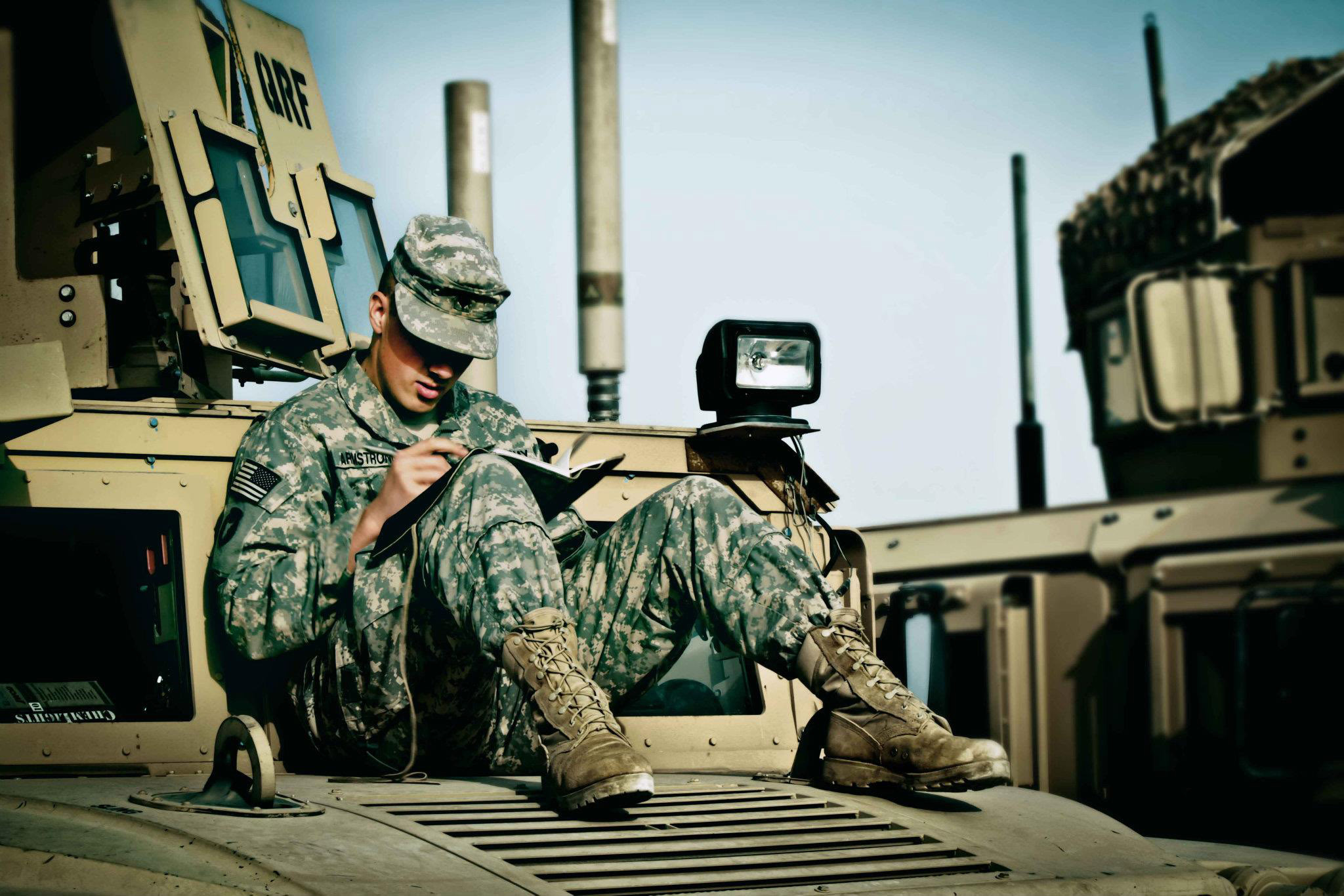
Since I added ‘The Natures of War’ to the DOWNLOADS section several people have asked me about my use of novels, especially in relation to Vietnam, while others have asked me to recommend writings – both novels and memoirs – that treat contemporary conflicts, especially Afghanistan.

Writing letters to home

The first part is easy.  To say things too quickly, I think the usual distinction between ‘fiction’ and ‘non-fiction’ is much more problematic than it seems (don’t we all know this? and in any case where exactly do you place a ‘memoir’ in such a strangely bifurcated landscape?).  I also believe that there are some insights – truths, if you prefer – that are best conveyed in ostensibly fictional form.  For that reason I suspect it’s significant that it’s my appeal to (for example) Karl Marlantes‘s magnificent Matterhorn in the Vietnam section that seems to trouble some readers much more than my use of poetry in the section on the Western Desert in the Second World War.  Yet both emerged through their authors’ reflections on their experiences of modern war in those places.  That doesn’t mean that one can ignore literary conventions or linguistic devices – no text is a transparent reflection of the world, after all – but this surely also holds for nominally factual accounts too (and that goes for military blogs, which have created their own conventions).  In other ‘fictional’ cases I can think of – like Tom McCarthy‘s C, which I drew upon in ‘Gabriel’s Map’ to characterise the battlefields of the Western Front  – the narrative is clearly embedded in intensive and immensely thoughtful research.  In fact, I’d push this further: hence my interest in documentary drama as part of – not simply a product of – the research process.

The second question is more difficult, but there are some recent guides which might help.  A good place to start is George Packer‘s ‘Home Fires: how soldiers write their wars‘ which appeared in the New Yorker last spring.  Packer tries to pin down what is distinctive about writing that seeks to capture the wars fought in the shadows of 9/11:

‘The first wave of literature by American combatants in these long, inconclusive wars has begun to appear—poems, memoirs, short stories, novels. Their concerns are the same as in all war writing: bravery and fear, the thin line between survival and brutality, the maddening unknowability of the enemy, tenderness, brotherhood, alienation from a former self, the ghosts of the past, the misfit of home.

But Iraq was also different from other American wars… Without a draft, without the slightest sacrifice asked of a disengaged public, Iraq put more mental distance between soldiers and civilians than any war of its duration that I can think of. The war in Iraq, like the one in Vietnam, wasn’t popular; but the troops, at least nominally, were—wildly so. (Just watch the crowd at a sports event if someone in uniform is asked to stand and be acknowledged.) Both sides of the relationship, if they were being honest, felt its essential falseness.’

Given this disconnect, he concludes, ‘it’s not surprising that the new war literature is intensely interested in the return home.’  But when it deals with the soldiers’ experience of war, he continues,

‘It deals in particulars, which is where the heightened alertness of combatants has to remain, and it’s more likely to notice things. To most foreign observers, the landscape of Iraq is relentlessly empty and ugly, like a physical extension of the country’s trauma. But in the poetry and the prose of soldiers and marines the desert comes to life with birdsong and other noises, the moonlit sand breeds dreams and hallucinations.’

It’s that struggle to turn the experience of land into its evocation that interests me.  But Packer makes surprisingly little of it, and his gaze is focused almost unwaveringly on Iraq rather than Afghanistan (not surprising, given his own war reporting).

Writing in the New York TimesMichiko Kakutani identifies a series of writings on the human costs of what Dexter Filkins called ‘the forever war’:

‘War cracks people’s lives apart, unmasks the most extreme emotions, fuels the deepest existential questions. Even as the wars in Iraq and Afghanistan morph into shapeless struggles with no clear ends in sight, they have given birth to an extraordinary outpouring of writing that tries to make sense of it all: journalism that has unraveled the back story of how and why America went to war, and also a profusion of stories, novels, memoirs and poems that testify to the day-to-day realities and to the wars’ ever-unspooling human costs.

‘All war literature, across the centuries, bears witness to certain eternal truths: the death and chaos encountered, minute by minute; the bonds of love and loyalty among soldiers; the bad dreams and worse anxieties that afflict many of those lucky enough to return home. And today’s emerging literature … both reverberates with those timeless experiences and is imprinted with the particularities of the conflicts in Afghanistan and Iraq: changes in technology, the increased presence of female soldiers and, most importantly, the all-volunteer military, which has opened a chasm between soldiers (“the other 1 percent”) and civilians.’

Here too there is an attempt to see how today’s writing differs from the established canon of war literature.  En route, Kakutani makes some good suggestions for reading, but she says very little about the differences – those dense ‘particulars’ again – between Iraq and Afghanistan.

afghan1

She leaves that to Brian Castner‘s outstanding essay for the LA Review of Books, ‘Afghanistan: a stage without a play.’

Castner did two tours in Iraq, and his own account of that experience (and, just as important, what followed) in The Long Walk is a tour de force in every sense of the phrase.  But he is also remarkably perceptive in his readings of Afghanistan (‘the Undescribed War’, he calls it) and – of particular interest to me, given my interest in ‘the natures of war’ or what my good friend Gastón Gordillo would prefer me to call ‘terrain‘ – its land and landscapes.  Castner also draws several illuminating comparisons with Vietnam (not least through a double parallel with the US’s ‘Indian Wars’ of the nineteenth century).

Kevin Maurer covered both wars, and always found

“Afghanistan far more riveting than Iraq because it’s a whole different world. Baghdad is a Middle Eastern city, but it is a modern city. In Afghanistan that barely exists. I’ve always been able to turn my brain into Afghanistan mode and out, while Iraq blurs.”

The influence of the terrain, especially its beauty, is clear: while a few descriptions of colorful Iraqi skies creep into the literature, it was mostly an ugly urban war fought along the New York State Thruway, rest stop to rest stop. “Afghanistan always had that Vietnam vibe to it,” Maurer said, “because you can go get lost in Afghanistan, you can be on some hill on some outpost. In Iraq you were never that far out.”

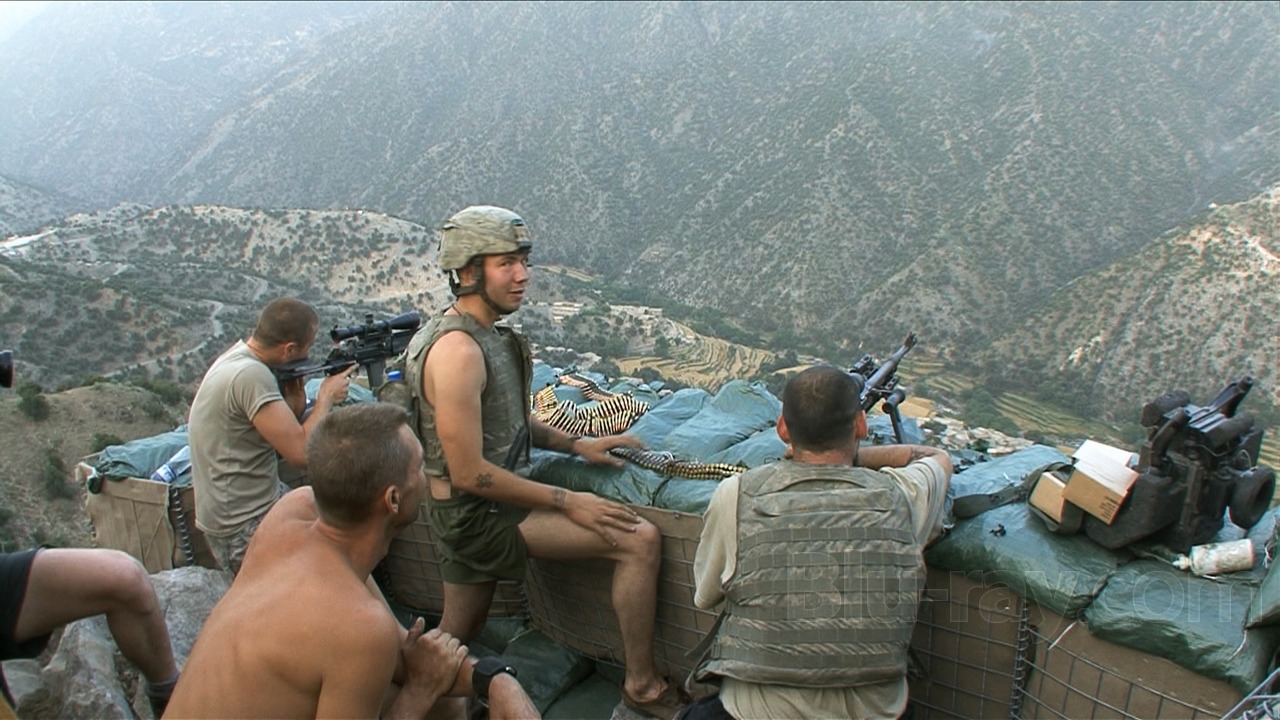
Korengal

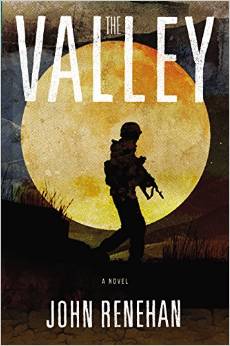
And for that very reason the terrain was always more than beautiful.  You can see that in a film like Restrepo – and even more clearly in Koregal (above) – but according to Castner you can also see it in John Renehan’s forthcoming novel, The Valley.  And here too Vietnam continues to haunt the imaginative landscape:

RENEHAN The ValleyThe landscape acts as an omnipresent consciousness, an apparition always in the corner of [Lieutenant] Black’s eye, and Renehan attaches to it layers of reverence and dread and unknowable quasi-mysticism; the valley is capable of anything. This infection spreads slowly for the reader, and Renehan says his writing process followed a similar path. “I more or less thought I was setting out to write a mystery story that happened to be set in a war. But as I started writing it I realized it was growing into something different in my mind, and it changed on paper too.” A detective story becomes a heroin- and concussion-fueled dreamscape that crosses genres. “Going After Cacciato gave me comfort in writing the parts of The Valley that become almost surreal,” Renehan said. “It reassured me that this sort of thing is okay, because it’s a war novel, right?”

What I need to think more about – the process I started in ‘Gabriel’s Map’ and continued in ‘The Natures of War’ – is how, despite Castner’s title, the stage is always part of the play.  And novels and poems will continue to help me do so.

POSTSCRIPT  Just after I finished drafting this post, I stumbled across ‘s Peter Molin‘s excellent blog: Time Now: the Iraq and Afghan wars in art, film and literature which also discusses the three reviews I list here.  Peter is a US Army officer who served in Afghanistan in 2008-9, and his posts are rich in ideas, insights and resources: well worth bookmarking.

Kill Chain

COCKBURN Kill chain 1

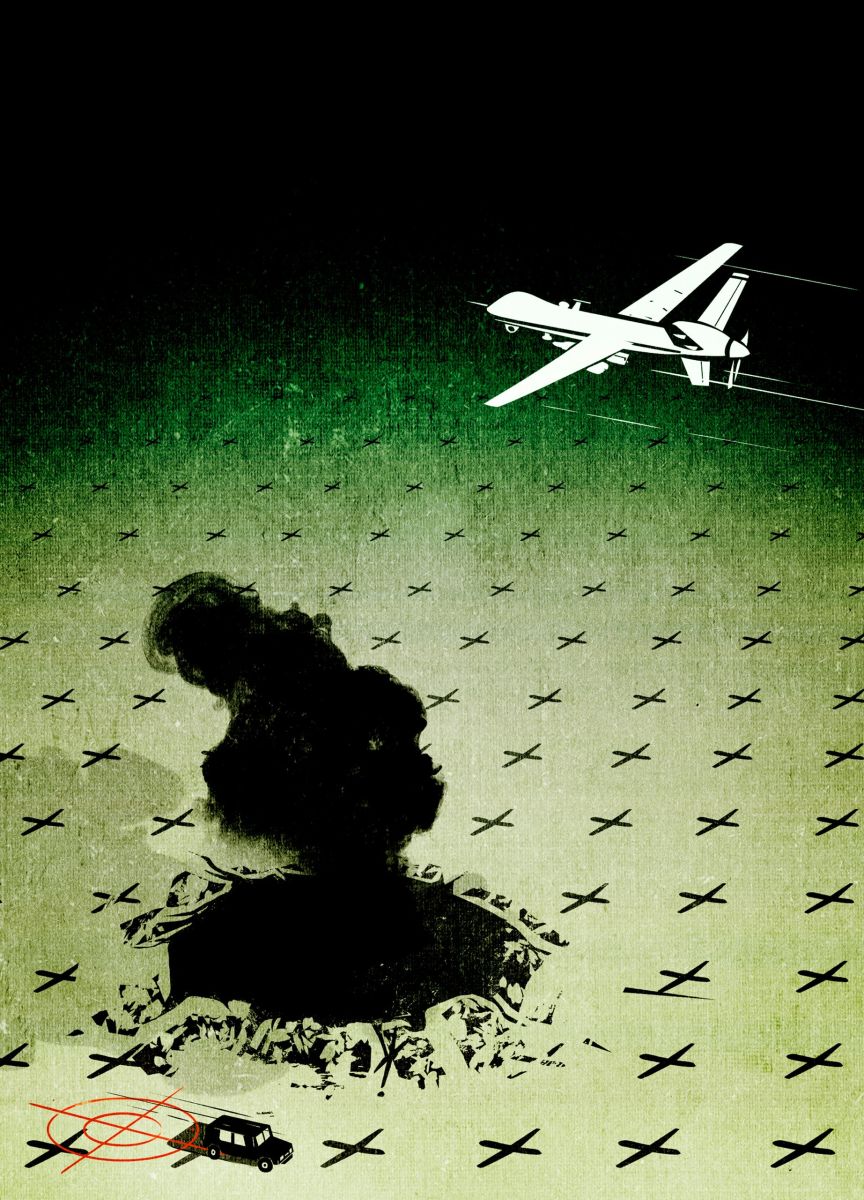
Yet more on targeted killing/assassination: new from Verso and Henry Holt in March, Andrew Cockburn‘s Kill Chain: the rise of the high-tech assassins.

Kill Chain uncovers the real and extraordinary story of drone warfare, its origins in long-buried secret programs, the breakthroughs that made drone operations possible, the ways in which the technology works, and, despite official claims, does not work. Through the well-guarded world of national security, the book reveals the powerful interests—military, CIA, and corporate—that have led the drive to kill individuals by remote control. Most importantly of all, the book describes what has really happened when the theories underpinning the strategy—and the multi billion-dollar contracts they spawn—have been put to the test.

Andrew is the author of the brilliant Rumsfeld: an American disaster, and he’s also been writing around the issue of military and paramilitary violence for some time.  There’s an early review of Kill Chain from Kirkus here, and Andrew discusses writing the book in a short audio clip here.

If you can’t wait until March, there’s a taster in ‘Drones, baby, drones‘, which appeared in the London Review of Books (8 March 2012); if you aren’t a subscriber you can obtain 24-hour access free of charge.

Time and again, the military has claimed that advances in technology have finally made warfare predictable and precise. That was the promise of Igloo White in Vietnam [see my ‘Lines of descent’: DOWNLOADS tab], the video-game spectacle of the Gulf War, the war for Kosovo and the counter-guerrilla wars of the past ten years. Time and again, the military’s claims have been disproved. Will drones change everything? Robert Gates, secretary of defence from 2006 to 2011, expressed the official view in his address to the CIA Officers Memorial Foundation annual dinner last March. Confessing that he hadn’t initially done enough to quash resistance to innovation from ‘flyboys in silk scarves’, Gates said: ‘From now on, it’s drones, baby, drones.’

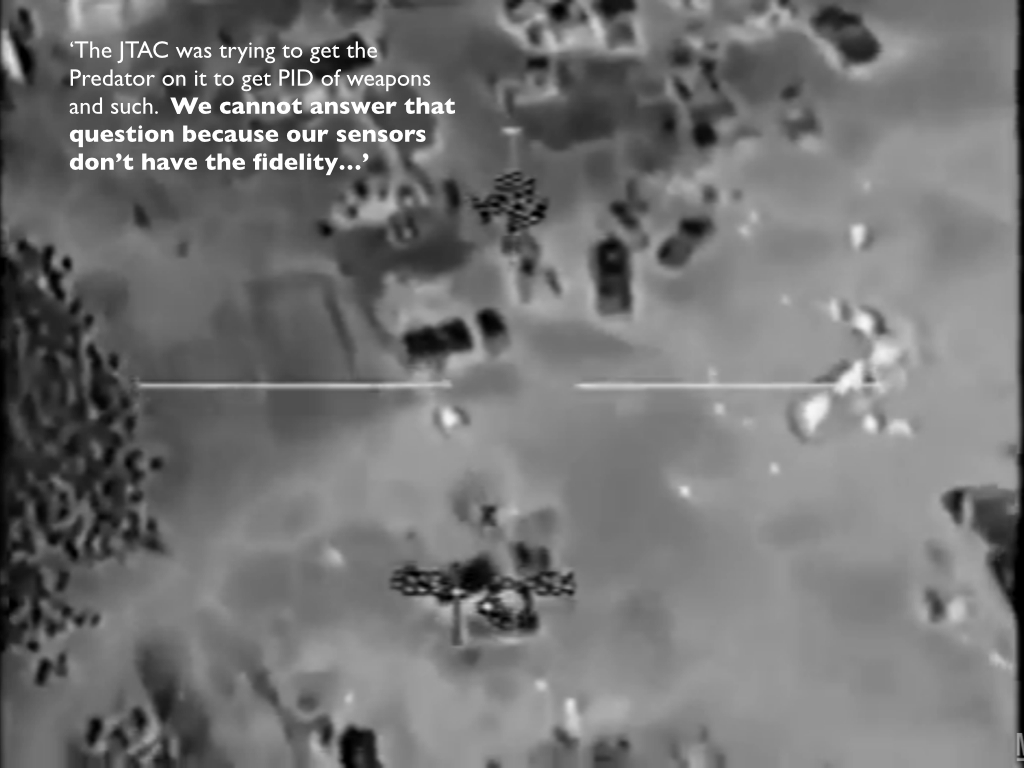
In the audio clip Andrew insists that the full-motion video feeds from Predators and Reapers are far less clear than most commentators make out, and in subsequent contributions Andrew has perceptively linked the fantasies of the God-trick with militarized vision more generally: see, for example, his ‘Tunnel vision‘ (about the comparative merits of the A10 and the B1 bomber) which appeared in Harper’s in February 2014 and ‘Flying Blind‘, which appeared on Harper’s blog in September.

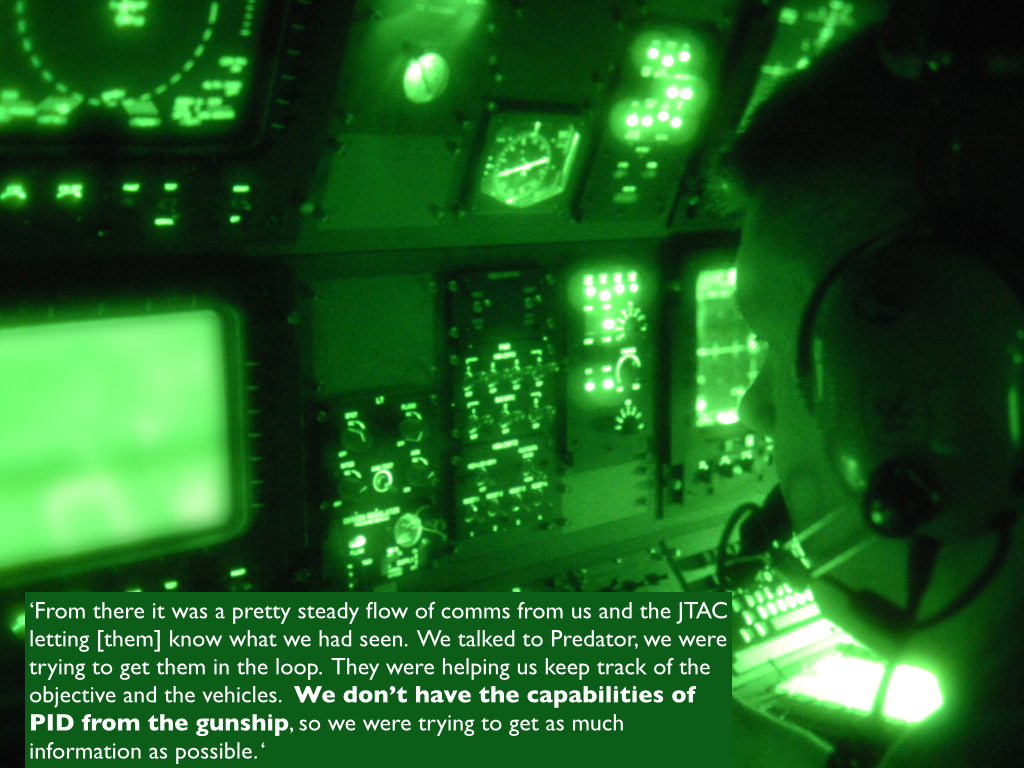
I’m not convinced that the A-10 is able to ‘observe the battleground with such precision, and safely to target enemy forces a stone’s throw away from friendly troops’ as Andrew maintains, but his more general point is a sharp one.  Too often we forget that other aircraft rely on optical sensors and video screens too, not only Predators and Reapers, and that these political technologies differ from platform to platform, as the following slides from ‘Angry eyes’ indicate (where the captain of an AC-130 gunship in fact defers to the crew of a Predator):

Angry eyes VISION.001

Angry eyes VISION.002

And, as Andrew also makes clear, these technologies produce their own interpellations:

Video will often supply a false clarity to preconceived notions. One A-10 pilot described to me an afternoon he spent circling high over southern A ghanistan in May 2010, watching four people—tiny figures on his cockpit screen—clustering at the side of a road before they retreated across a field to- ward a house. Everything about their movements suggested a Taliban I.E.D.- laying team. Then the door to the house opened and a mother emerged to hustle her children in to supper.

“On the screen,” he explained, “the only way to tell a child from an adult is when they are standing next to each other. Otherwise everyone looks the same.”

“We call the screens face magnets,” remarked another veteran, Lieutenant Colonel Billy Smith, a former A-10 squadron commander who flew tours over Bosnia, Iraq, and Afghanistan. “They tend to suck your face into the cockpit, so you don’t pay attention to what’s going on outside.”

All of this intersects with my continuing work on militarized vision, and in the next several weeks I’ll be uploading a series of new essays that deal with drone strikes in Pakistan [based on my ‘Dirty dancing‘ presentations], the Sangin Valley in Afghanistan (a ‘friendly fire’ incident), and an air strike in Uruzgan in Afghanistan that was orchestrated by a drone [based on my ‘Angry Eyes’ presentations]. So watch this space…

Incidentally, ‘kill chain’ is both the extended, networked apparatus that leads from air targeting to execution – for all platforms, remote and conventional – and the injunction that is typed into US military chat rooms (mIRC) to close down ‘chatter’ that might distract pilots once they are cleared to engage (see my discussion here).

Untargeted killing

Back in November 2012 I explained that the debate over CIA-directed targeted killing in Pakistan, Yemen, Somalia and elsewhere risked overlooking the conduct of targeted killing by the US military and its coalition partners in Afghanistan:

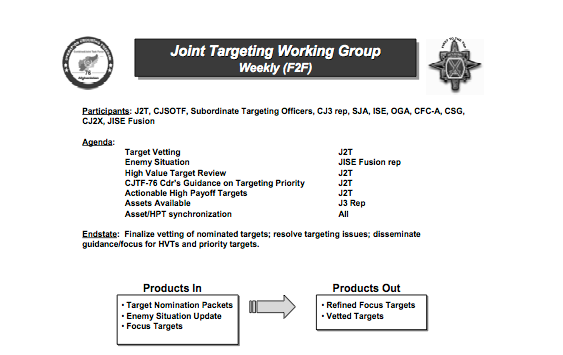
Targeted killings are also carried out by the US military – indeed, the US Air Force has advertised its ability to put ‘warheads on foreheads’ – and a strategic research report written by Colonel James Garrett for the US Army [‘Necessity and Proportionality in the Operation Enduring Freedom VII Campaign‘] provides a rare insight into the process followed by the military in operationalising its Joint Prioritized Effects List (JPEL). Wikileaks has provided further information about JSOC’s Task Force 373 – see, for example, here and here – but the focus of Garrett’s 2008 report is the application of the legal principles of necessity and proportionality (two vital principles in the calculus of International Humanitarian Law (IHL)) in counterinsurgency operations. Garrett describes ‘time-sensitive targeting procedures’ used by the Joint Targeting Working Group to order air strikes on ‘high-value’ Taliban and al-Qaeda leaders in Afghanistan, summarised in this diagram:

joint-targeting-working-group

Notice that the members included representatives from both Combined Joint Special Operations Task Force (CJSOTF) and the CIA (‘Other Government Agency’, OGA). This matters because Joint Special Operations Command (JSOC) – once commanded by General Stanley McChrystal – and the CIA, even though they have their own ‘kill lists’, often co-operate in targeted killings and are both involved in strikes outside Afghanistan. Indeed, there have been persistent reports that many of the drone strikes in Pakistan attributed to the CIA – even if directed by the agency – have been carried out by JSOC.

Now Spiegel Online has provided new, detailed information about the Joint Prioritized Effects List and targeted killing in Afghanistan.  Its base materials – some of which come from the Snowden cache – cover the period 2009-2011 and include an anonymised version of the JPEL (extract below).

JPEL Afghanistan PNG

The Spiegel team explains:

[This is] the first known complete list of the Western alliance’s “targeted killings” in Afghanistan. The documents show that the deadly missions were not just viewed as a last resort to prevent attacks, but were in fact part of everyday life in the guerilla war in Afghanistan.

The list, which included up to 750 people at times, proves for the first time that NATO didn’t just target the Taliban leadership, but also eliminated mid- and lower-level members of the group on a large scale. Some Afghans were only on the list because, as drug dealers, they were allegedly supporting the insurgents.

As I’ve said, the JPEL was maintained through close collaboration between the CIA and the US military, including Joint Special Operations Command, so it is not surprising that the list is not confined to Afghanistan but also includes Pakistanis who were located inside Pakistan.

We already know that targeted killings inside Pakistan’s Federally Administered Tribal Areas involved signal intelligence from the NSA, Britain’s GCHQ and Australia’s Pine Gap facility.  Spiegel‘s cache of documents shows that coalition states outside the ‘Five Eyes’ (US, UK, Canada, Australia and New Zealand) were included in the wider Center Ice platform that also supplied geospatial intelligence for tracking and targeting.  Taken together:

Predator drones and Eurofighter jets equipped with sensors were constantly searching for the radio signals from known telephone numbers tied to the Taliban. The hunt began as soon as the mobile phones were switched on.

Britain’s GCHQ and the US National Security Agency (NSA) maintained long lists of Afghan and Pakistani mobile phone numbers belonging to Taliban officials. A sophisticated mechanism was activated whenever a number was detected. If there was already a recording of the enemy combatant’s voice in the archives, it was used for identification purposes. If the pattern matched, preparations for an operation could begin. The attacks were so devastating for the Taliban that they instructed their fighters to stop using mobile phones.

The document also reveals how vague the basis for deadly operations apparently was. In the voice recognition procedure, it was sufficient if a suspect identified himself by name once during the monitored conversation. Within the next 24 hours, this voice recognition was treated as “positive target identification” and, therefore, as legitimate grounds for an airstrike. This greatly increased the risk of civilian casualties…

[In addition]  Center Ice was not just used to share intelligence about mobile phone conversations, but also information about targets.

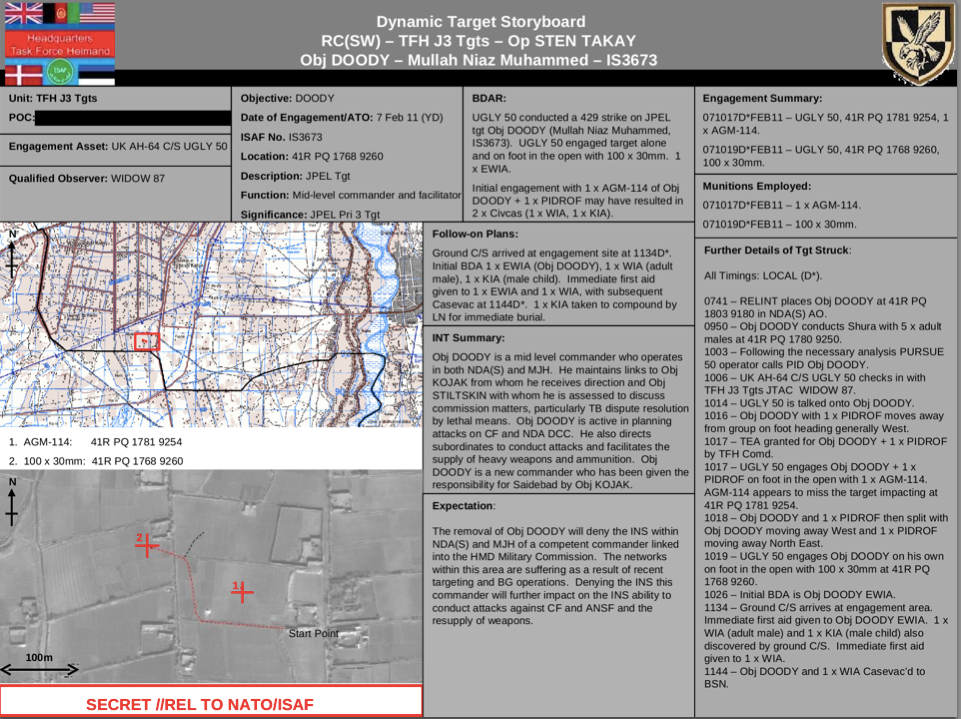
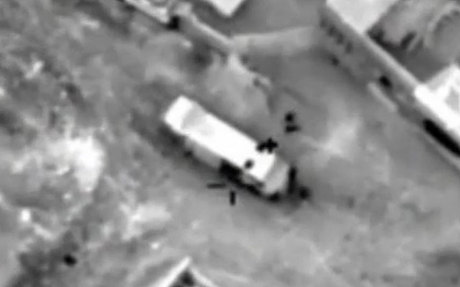
Finally – and directly relevant to that penultimate paragraph – Spiegel includes a detailed post-strike ‘Dynamic Target Storyboard‘ that explains how one mission executed by a British AH-60 helicopter (callsign/codename UGLY 50) armed with Hellfire missiles missed its target (‘Objective DOODY’, a mid-level Taliban commander called Mullah Niaz Muhammed categorised as JPEL ‘level 3’) on its first pass and then, coming in for a second attack, seriously wounded an innocent father and killed his child:

Dynamic Targeting Storyboard PNG

To navigate the storyboard – a standard ‘after action’ report – you need to wade through an alphabet soup of acronyms, some of which I know and others I don’t.  Working left to right along the top line, the mission was under the control of TFH – ISAF’s Task Force Helmand – whose main component was provided by the UK military; under BDAR (Battle Damage Assessment and Repair) the AH-64 attack helicopter is identified as operating under ISAF Rules of Engagement 429 (the details of all these ROEs remain classified).  The Intelligence Summary shown below identifies the target as ‘Objective DOODY’, provides skeletal details of his activities, and links him with two other targets on the JPEL, ‘KOJAK’ and ‘STILTSKIN’ (presumably part of the military’s standard social network analysis).

The far right column provides further information about the attack.  At 0741 intelligence (ELINT is electronic intelligence, but RELINT is not included in the Ministry of Defence’s acronym list) places ‘DOODY’ in Nad-e-Ali (South); by 0950 he is holding a meeting with five other men, and at 1003 a ‘PURSUE 50 operator’ [how I would like to know more about what means] confirms positive identification (PID) which denotes ‘reasonable certainty that this is a legitimate military target’. Shortly afterwards, a Joint Terminal Attack Controller (JTAC), listed as a ‘Qualified Observer’ with the grim call sign WIDOW 87,  contacts the helicopter crew and talks them on to the target: once they have him in their field of view they are ready to attack.  What isn’t clear from all this is whether the JTAC is relying on a video feed from a drone – this seems the most likely source, and an aerial view is included on the storyboard, tracking the target’s movements once the attack is under way – or whether s/he is on the ground (unlikely, I think, since ground troops take more than an hour to arrive on site after the attack: see ‘Follow-on Plans’ box).

When the target walks away from the meeting, accompanied by one man, the helicopter crew is cleared to engage both of them (TEA) (I’ve explained PID but if anyone knows what PIDROF means please let me know since that seems to authorise killing his unknown and unnamed companion).

According to a supplementary page on the storyboard file, shown below, the AH-64 makes its initial run but fails to engage and returns for a second attempt; in doing so, the crew loses visual identification of the target, what the military usually calls the ‘visual chain of custody’, and at 1017 fires a Hellfire missile which misses the nominated target and instead causes fragmentation injuries to two civilians nearby (marked 1 on the aerial view).  The helicopter returns again; by then ‘DOODY’ and his companion have parted company, and the crew fires 100 rounds from its 30 mm cannon at ‘DOODY’, leaving him seriously wounded (EWIA: ‘enemy wounded in action’; marked 2 on the aerial view).

Assessment
Over an hour later, at 1134, ground troops arrive to capture ‘DOODY’ – but they also find one other seriously wounded man and the body of his young son.  The boy is buried by his family, and the casualties are airlifted to the military hospital at Camp Bastion (BSN);  ‘DOODY’ is later transferred to Kandahar for further treatment for a serious head wound.
ISAF launched an investigation into the incident, but no details have been released.

So: two innocent, unnamed bystanders killed.  As more evidence unfolds of the inaccuracies of ‘targeted killing’, even when the target is supposedly named and identified (so not a ‘signature strike’), it seems that we should start talking about the prevalence of untargeted killing…

Psycho-geographies of violence

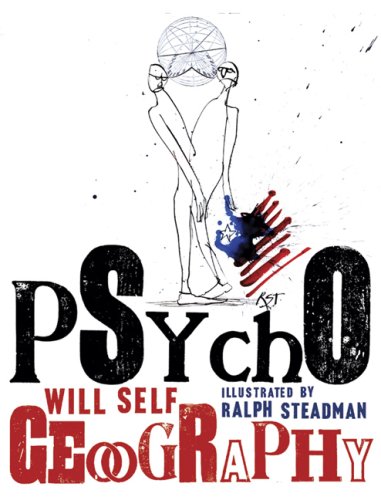
0747590338Will Self‘s series of columns for the Independent on ‘psycho-geography’ attracted considerable attention (they were published between 2003 and 2007 and then collected in the book shown on the left).  In its original form, of course, psychogeography can be traced back to the Lettrist International and the Situationists, and David Pinder‘s Visions of the city: utopianism, power and politics remains one of the most eye-opening introductions to these and similar experiments.

But in today’s Guardian Self turns to a far from utopian prospect to consider what in less avant-garde and more demotic terms would probably also count as a ‘psycho-geography’ of sorts:  ‘We are passive consumers of the pornography of violence‘.

He begins with a devastating imaginative reconstruction of one of the executions carried out by IS/IS/IL: seen not from the point of view of the video-viewing (or not-viewing) public, or even the executioner, but the victim.  He’s aware of the objections:

Surely, at the end of a year in which the public arena has been fully booked for grand guignol, the last thing anyone needs is such an intrusive – and arguably insensitive – speculation? May we not take this opportunity, on the verge of a new year, to sit back, relax, and turn away from the theatre of horrors – not, of course, because we don’t care about all this suffering, all this hideously violent discorporation, but because at least we know this much about ourselves: we may not be the most ethically motivated, caring, community-minded people around; however, we aren’t like them – we aren’t like those men in Raqqa who beat and burn and stone and rape and enslave and shoot and chop and cut: we aren’t evil. And surely, in the opinionated maelstrom we can all at least agree with David Cameron and Barack Obama on this: to cut off someone’s head is an act of such maleficence that it necessarily, in and of itself, renders those who do it evil; if by evil is understood a will-to-absolute-negation, a nihilism that metastasises through the failing body politic, leaving in its necrotic wake only dead-eyed zombies incapable of any authentic feeling.

And yet I wonder: what I wrote above was an active attempt on my part to sympathise with Abdul-Rahman Peter Kassig, Alan Henning, Steven Sotloff, James Foley and David Haines in the last moments of their lives. It was painful to write because I needed to try and put myself in their heads – possibly it was uncomfortable to read for the same reason; yet reading it was also an activity, requiring the translation of marks on page or screen into ideas, images and sensations. Some attempts to understand these perverse and evil actions are similarly engaged, but for the most part our response to the hostage crisis that unfolded over 2014 was necessarily passive. Passive in part because our government wishes to retain its monopoly both on what it sees as the legitimate exercise of violence, and on the prerogative of mercy as well: there will be no ransoms paid for British hostages, while the knife wielded by the man who has been called Jihadi John will be parried – or so they assure us – by targeted air strikes against Islamic State forces, while our “commitment to the region” is re-emphasised in other ways.

So, our passivity – the passivity of civilians who depend on a professional army to assert our moral will, and the passivity in my case – and quite possibly yours – of citizens who have long since recoiled from the spectacle of this interminable conflict worthy of Orwell’s 1984: the so-called “war on terror”.

There’s more – much more – that takes in themes that will be familiar to many readers but here given new urgency by the torsions of Self’s imagination and the sharpness his prose.  It’s an extraordinary ride, and it grips intellectually, politically and ethically.  One of Self’s central arguments is that even as we are reduced to the status of ‘passive consumers’ of this execrable violence (one that is, as he shows, far from absent from our own history) we are – those of us that live in the United States, Canada, the UK, France and elsewhere – also profoundly implicated not only in what is being staged by IS but also in the administration of military violence by the states that make up the latest ‘coalition’.

‘… we are all kneeling in the desert, staring at the serrations on that knife; the very personal and intimate nature of these murderous beheadings calls to our attention – try as we might to repress it – the cold impersonality of the murders committed in our name; for, just as in recent decades the west found it profitable to outsource manufacturing production to low-wage economies, so our own moral accounting has in the short term benefited from a form of outsourcing: western governments no longer find it expedient to perpetrate violence closer to home (it makes for bad PR and restive electorates); yet in a globalised world the exercise of “legitimate” violence is the one monopoly they continue to operate. Perhaps one way of looking at the Middle East is that it’s one of the most productive “bloodshops” we have, a reliable supplier of conflicts that give the west a showroom within which to demonstrate its overwhelming firepower.’

As I say, there’s much, much more, and Self’s reflections on the braiding threads between imagery, passivity , disembodiment and military and paramilitary violence make this the one essay I’d urge everyone to read and reflect on this week, even this month.  And probably all next year.

Theories and counter-theories of the drone

CROGAN Gameplay modeI expect many readers will know Patrick Crogan‘s Gameplay mode: war, simulation and technoculture (Minnesota, 2011).  He has now uploaded what I think is a draft of Drones and global technicity: automation and (dis)individuation at academia.  Here’s the extended abstract:

This paper (for General Organology conference [held last month at the University of Kent]) will explore the expansion of military drone usage by Western powers in the “war on terror” over the last decade or so in relation to Bernard Stiegler’s organological approach to questions concerning human historical, cultural and technological becoming.. Theorists approaching drones from different fields such as Grégoire Chamayou, Derek Gregory and Eyal Weizman have argued that the systematic and growing deployment of unmanned aerial vehicles should be understood as the “avant-garde” of a general movement toward remote and increasingly autonomous robotic systems by all branches of the armed forces of the U.S. and many of allies and competitors. These developments put into question all established cultural political, legal and ethical framings of war, peace, territory, civilian and soldier in the societies of the “advanced powers” on behalf of which these systems are deployed. Animating this indetermination is what Chamayou calls the “tendency inherent in the material development of drones” leading to this profound undoing of cultural and geopolitical moorings. I will explore the organological nature of this tendency inherent in drone materiality and technology, concentrating on the virtualizing, realtime digital developments in remotely controlled and increasingly automated robotic systems.

The projection of a simulational model of the contested space over the inhabited world is a constitutive part of this tendency. Indeed, the inhabitants of the spaces of concern in the war on terror—which in principle and increasingly in practice are everywhere—are better understood as environmental elements or “threats” in what simulation engineer and theorist Robert Sargent has called the “problem space” the computer simulation designer seeks to model conceptually in order to make the simulation serve as an effective solution. A specifically designed spatio-temporality is enacting a performative, “operational” and automated reinvention of the lived experience of both inhabiting and contesting the control of space in time.

If, as the above writers have shown, this projection of and over “enemy territory” has clear precedents in European colonialist strategies and procedures, what is unprecedented today is the digitally-enabled expansion and intensification of this spatio-temporal reanimation of the world. This reanimation must be understood as key contributor to a transformative and extremely problematic pathway toward the automation of military force projection across the globe. This essay will analyse the nature and implications of these transformative digital modellings of the enemy in and as milieu, a milieu as tiny as the space around a single ‘target’ and as large as the world, existing both in a brief “window of opportunity” and within a permanent realtime of preemptive pan-spectrum surveillance.

From an organological perspective developments in drone technics must also be approached as a particularly pressing political and ethical challenge of the global transformations of human technicity in the digital “epoch”—or rather, in the generalised crisis of epochality and spatio-temporal orientation that Stiegler sets out to thematise and respond to in his “philosophical activism”. If as Stiegler provocatively suggests in Technics and Time 1: The Fault of Epimetheus) human being had a “second origin” in the historical development of the West which achieved its culmination its “worldwide extension”, it is one whose epoch has led us tendentially and increasingly rapidly to the crisis of ethnocultural idiomatic differentiation and specificity (as he argues in Technics and Time 2: Disorientation). The history of Western techno-capitalist, imperial colonisations, wars and subsequent post-colonial globalisation is attaining its full extent and its exacerbation, readable in the above noted indeterminations of war, peace, sovereignty, citizenship and so on. What goes with this is a doubled movement (which Virilio termed “endocolonisation”) of intensification of the reorganisation of social and individual surveillance, control and regulation via realtime, pervasive digital technical regimes. The systematic deployment of computational abstraction, simulational virtualisation and anticipatory, realtime preemptive materialisation of this doubled movement is perceivable in all its cultural-political, conceptual and technological complexity in drone technics. Indeed, drones are a major driver of research and development in automation and AI for the spectrum of what the U.S.A.F calls the “perceive and act vector”, as well as for “big data” processing in realtime to handle ever-growing monitoring and surveillance feeds.

Today a voluntarist and cynical (and nihilist in Stiegler’s view) adoption of the automatising potentials of digital technics supports the rapid advances in drone systems (and I have proposed that an “elective naivety” sustains this in the academy, across scientific and humanities disciplinary contexts). From Stiegler’s organological perspective, I will argue that the autonomy of human agency is always composed with various automated functions that form part of our material, prosthetic conditions of existence. By addressing some of the inherent contradictions arising from the proposed development of fully autonomous military robotic systems, I hope to contribute toward the urgently needed “redoubling” of the first adoption of the possibilities of digital automation evidenced in drone technics (as the “logical” outcome in strategic-political terms of the latest advances of computer technology). To “re-double” technocultural becoming reflectively, critically, in the name of a less inhuman potential of automated digital technics is the responsibility of those able to read and write, to reflect and respond to the accelerating epochal transformation of the world in this “our” era of the permanent war on terror. This is the horizon in which “we” maintain the possibility of a non-inhuman future (or further “re-birth”) for contemporary humanity. For, as Stiegler has argued in What Makes Life Worth Living, this is a better way to think the present and future than that implied in the term “post-human”, for the human remains a project and a projection and not a superceded entity.

ac_bernard_stiegler_1200_02

Bernard Stiegler (above) was a keynote speaker at the conference, and if you want some tantalising glimpses into some of the other possibilities opened out by his ideas for the analysis of drones, I’d recommend James Ash, ‘Technology and affect: Towards a theory of inorganically organised objects’, Emotion, space and society (in press, 2014) – incidentally, James reviews Gameplay mode in Cultural politics 8 (3) (2012) 495-497 – and Sam Kinsley‘s ‘The matter of virtual geographies’, Progress in human geography (2014) 38 (3) (2014) 364-84.

As you can see from the abstract, Patrick also engages with my work and, crucially, Gregoire Chamayou‘s, and since the English-language translation of Theory of the drone is published at the end of this month I thought it might be helpful to list and link to my detailed commentaries on the book in one place, so here they are:

theory_of_the_drone_final

Theory of the drone 1: Genealogies

Theory of the drone 2: Hunting

Theory of the drone 3: Killing grounds

Theory of the drone 4: Pennies from heaven [on counterinsurgency/COIN]

 Theory of the drone 5: Vulnerabilities

Theory of the drone 6: Sacrifice, suicide and drones

Theory of the drone 7: Historical precedents and postcolonial amnesia

Theory of the drone 8: From invisibility to vulnerability

Theory of the drone 9: Psychopathologies of the drone

Theory of the drone 10: Killing at a distance

Theory of the drone 11: Necro-ethics

Theory of the drone 12: ‘Killing well’?

You can also find my essay on ‘Drone geographies’ from Radical Philosophy (2014) under the DOWNLOADS tab.

Jean-Baptiste Jeangène Vilmer‘s combative review of Theory of the drone, ‘Ideology of the drone’, is here and my extended commentary on that review is here.  Simon Labrecque provides another review here, invoking the USAF’s own description of its remote missions: ‘Projeter du pouvoir sans projeter de vulnérabilité.’

Meanwhile over at the Funambulist Papers, Stuart Elden suggested one way of wiring Grégoire’s previous book Manhunts to Theory of the drone here, while Grégoire’s own postscript (which suggests another route) is here.

Expect more commentary once the English edition is out.

A short history of schematic bodies

While I was in Irvine last month for the Secrecy and Transparency workshop, I had a series of rich conversations with Grégoire Chamayou — who also made a brief but brilliant presentation on targeting, signature strikes and time-space tracking.  He now writes to say that he has elaborated his ideas in a longer contribution to Léopold Lambert‘s Funambulist papers: ‘A very short history of schematic bodies‘.

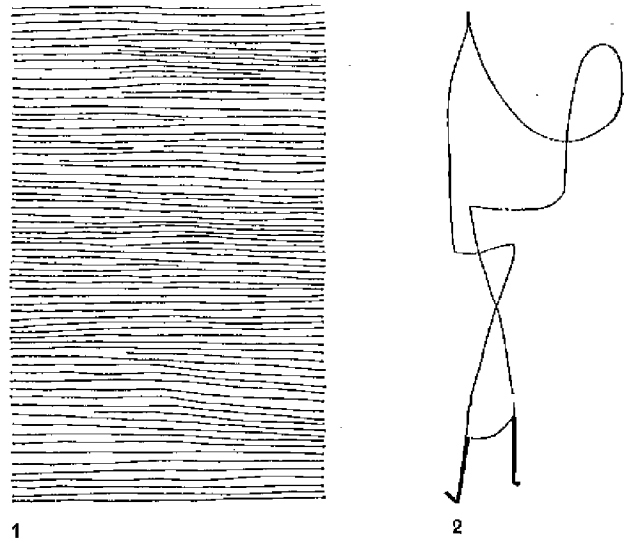
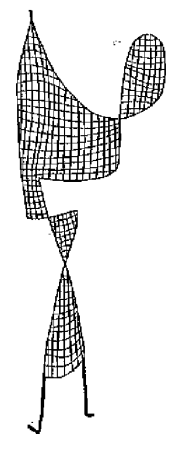
(Even more) briefly, Grégoire connects Torsten Hågerstrand‘s time geography – which Anne Buttimer once saw as a danse macabre – to the activity-based intelligence that supposedly ‘informs’ CIA-directed drone strikes [see my ‘Lines of descent’ essay: DOWNLOADS tab] via three diagrams drawn from Paul Klee.

16

The first two (above) distinguish (1) ‘dividuals‘ from (2) ‘individuals‘: so, following Deleuze, Grégoire distinguishes (1) ‘societies of control articulated through the dyad of “dividuals” and databanks’ from (2) ‘disciplinary societies structured around a relationship between the individual and the mass.’ Seen thus, Hagerstrand’s project mapped the reverse move from (1) to (2), from ‘statistical dividuality’ to ‘chronospatial individuality’.

But Grégoire suggests that targeting involves a third fabrication, a co-construction of (1) and (2), thus:

17

He writes:

The corresponding object of power here is neither the individual taken as an element in a mass, nor the dividual appearing with a code in a databank, but something else: a patterned individuality that is woven out of statistical dividualities and cut out onto a thread of reticular activities, against which it progressively silhouettes in time as a distinctive perceptible unit in the eyes of the machine.

The production of this form of individuality belongs neither to discipline nor to control, but to something else: to targeting in its most contemporary procedures, whose formal features are shared today among fields as diverse as policing, military reconnaissance and marketing. It might well be, for that matter, that we are entering targeted societies.

This speaks directly to current theses about the individuation of military violence as one (and only one) modality of later modern war, but we need to remember that targeting appears at the interface of the market and the military, as Sam Weber shows in Targets of opportunity.  

It’s also important to think through the ‘body’ that is made to appear in the sights and as a sight; it’s not a fleshy body but a digital-statistical trace that is literally ‘touched’ by the cross-hairs (the apparatus of the drone as prosthesis).  As I wrote in ‘Drone geographies’ (DOWNLOADS tab),

[People] are brought within the militarized field of vision through the rhythmanalysis and network analysis of a suspicious ‘pattern of life’, a sort of weaponized time-geography… 

Killing is made the culmination of a natural history of destruction – in precisely not the sense intended by W.G. Sebald – and the targets are rendered as ‘individuals’ in a calculative rather than corporeal register.

Here Ian Hacking‘s ideas about ‘making up people‘ are also relevant.  In his classic British Academy lecture, ‘Kinds of people: moving targets‘, he described how ‘a new scientific classification may bring into being a new kind of person’ – in this case, the target – and how ‘a classification may interact with the people classified.’  A signature strike is surely the deadliest version of this ‘interaction’…

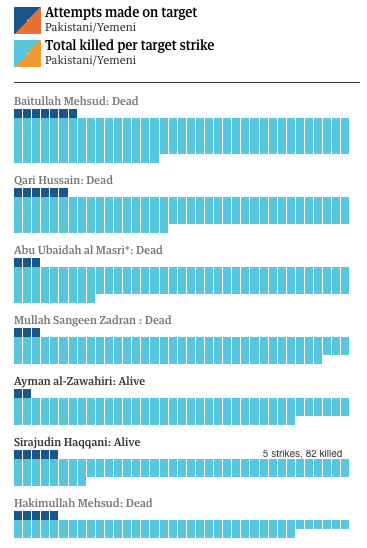
Incidentally, anyone who thinks that so-called ‘personality strikes’ are somehow less deadly needs to read REPRIEVE‘s latest report, You only die twice: multiple kills in the US drone program.  Spencer Ackerman has a good summary (and graphic, extracted below) here, describing the multiple deaths involved in the search for specific, named targets:

'Personality strikes' in Pakistan


Laboratories and assemblages

I’m on my way home from Bergen, where I was taking part in the Norsk Sakprosafestival (loosely, ‘Non-Fiction Festival’).  I gave a sawn-off version of ‘Angry eyes’, followed by a conversation with the ever-interesting Kristin Bergtora Sandvik, and took part in a panel discussion on ‘Freedom’ with Astri Suhrke, Kareem Amer, Jonny Steinberg, Ilan Pappe and Hilde Sandvik.  I had a marvellous time, and I’m deeply grateful to my hosts and especially Oyvind Vagnes for their warm welcome and generous hospitality.  This was the first time the festival has been held outside Oslo, and I hope it continues for many years to come.  It certainly deserves to do so.

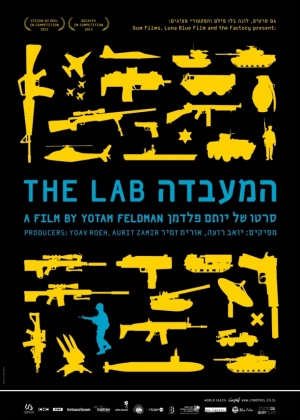
the-lab-poster_for_internet

Over dinner, Ilan (whose new book is on ‘the largest prisons in the world’, Gaza and the West Bank) reminded me of an excellent film that I’d neglected to write about when it first came out – and given my previous post, and the horror of Gaza over the summer, it’s not too late to do so.

The film is Yotam Feldman‘s The Lab, which was released in North America in August.  Feldman writes:

The Lab is a cinematic investigation into the lure of Israeli weapons in the international arms trade. Why are countries all over the world lining up to buy Israeli arms? And how did such a small country become one of the biggest military exporters in the world? Israeli salesmen and executives in huge arms corporations seem eager to promote their products and pride themselves on their booming business. Profits have never been better — sales are doubling every year, and the potential seems unlimited.

But the product they are selling is unique. Rather than rifles, rockets or bombs, the Israeli companies sell their experience. The long-running conflict with the Palestinians has created a unique and unrivalled laboratory for testing technologies and ideas relating to “asymmetric warfare” — a conflict between a state and civil or irregular resistance. In this manner the Israeli conflict with the Palestinians may be seen as a national asset — rather than a burden…

While making the film, I witnessed the relationship between a network of military generals, politicians and private business; the use of current military operations as a promotional device for private business; the brutal employment of the Israeli experience, and the blurred lines between what is legitimate and forbidden in this line of business.

http://vimeo.com/65082874

You can read Jonathan Cook’s characteristically perceptive take on the film’s central argument here, from which I’ve taken the following extract:

The title relates to the film’s central argument: that Israel has rapidly come to rely on the continuing captivity of Palestinians in what are effectively the world’s largest open-air prisons.

The reason is that there are massive profits to be made from testing Israeli military innovations on the more than four million Palestinians in Gaza and the West Bank.

According to Feldman, that trend began with Operation Defensive Shield, Israel’s re-invasion of the West Bank and Gaza in 2002, which formally reversed the process of Israeli territorial withdrawals initiated by the Oslo accords.

Following that operation, many army officers went into private business, and starting in 2005 Israel’s arms industry started to break new records, at $2 billion a year.

But the biggest surge in sales followed Operation Cast Lead, Israel’s month-long assault on Gaza in winter 2008-09, which killed more than 1,400 Palestinians and 13 Israelis. Record sales in the wake of that attack reached $6 billion.

These military operations, including the most recent against Gaza, last year’s Pillar of Cloud, the film argues, serve as little more than laboratory-style experiments to evaluate and refine the effectiveness of new military approaches, both strategies and weaponry.

Gaza, in particular, has become the shop window for Israel’s military industries, allowing them to develop and market systems for long-term surveillance, control and subjugation of an “enemy” population.

But Feldman’s still sharper point is that this means that the claim ‘we are all Palestinians’ has a greater purchase than most of us realise:

The effects of Israeli theory and technology on other countries can hardly be overestimated. Forces choosing to employ Israeli-cultivated military techniques ultimately begin to alter their political and social circumstances. Therefore, countries all over the world are increasingly “Palestinizing” (or “Israelizing”) their conditions. Both sides — seller and buyer — become partners in the development of a form of future war between the state and civil resistance groups.

War, police and assemblages of intervention

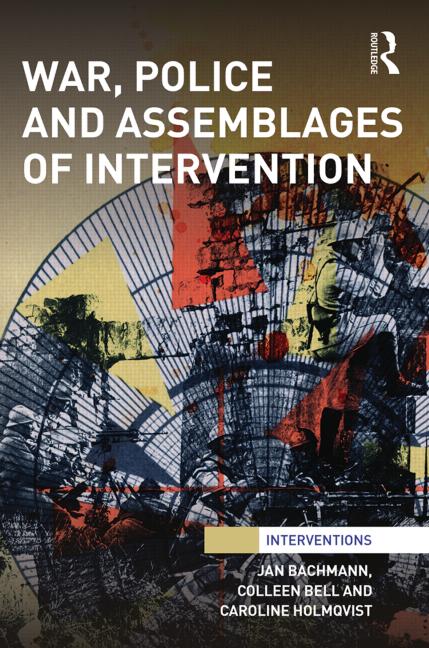
This needs to be added to the mix when we (re)think about contemporary war/police assemblages – which is an appropriate note for me to cheer the publication today of War, police and assemblages of intervention, edited by Jan BachmannColleen Bell and Caroline Holmqvist.

This book reflects on the way in which war and police/policing intersect in contemporary Western-led interventions in the global South. The volume combines empirically oriented work with ground-breaking theoretical insights and aims to collect, for the first time, thoughts on how war and policing converge, amalgamate, diffuse and dissolve in the context both of actual international intervention and in understandings thereof.

The book uses the caption WAR:POLICE to highlight the distinctiveness of this volume in presenting a variety of approaches that share a concern for the assemblage of war-police as a whole. The volume thus serves to bring together critical perspectives on liberal interventionism where the logics of war and police/policing blur and bleed into a complex assemblage of WAR:POLICE. Contributions to this volume offer an understanding of police as a technique of ordering and collectively take issue with accounts of the character of contemporary war that argue that war is simply reduced to policing. In contrast, the contributions show how – both historically and conceptually – the two are ‘always already’ connected. Contributions to this volume come from a variety of disciplines including international relations, war studies, geography, anthropology, and law but share a critical/poststructuralist approach to the study of international intervention, war and policing.

Here’s what it contains (and you can see that The Lab adds a really important dimension to the discussion):

Assemblages of War:Police – An Introduction, Jan Bachmann, University of Gothenburg, Colleen Bell, University of Saskatchewan, Caroline Holmqvist, Swedish National Defence College

Part I: Ordering
1.The Police Power in Counterinsurgencies: Discretion, Patrolling, and Evidence, Colleen Bell, University of Saskatchewan

2. Policing Africa – The US Military and Visions of Crafting ‘Good Order’, Jan Bachmann, University of Gothenburg

3. Security Sector Reform (SSR) and the War:Police Assemblages of International Interventions, Marc Doucet, St. Mary’s University and Miguel de Larrinaga, University of Ottawa

Part II: Othering

4. The Enemy Live: A Genealogy, Laurence McFalls, University of Montreal and Mariella Pandolfi, University of Montreal

5. The Utility of Proxy Detentions in Counterinsurgencies, Laleh Khalili, School of Oriental and African Studies, University of London

6. Tribal Militias, Neo-Orientalism and the US Military’s Art of Coercion, Oliver Belcher, University of Oulu, Finland

7. Checkpoints and the Gendered Policing of ‘Civilized’ Nation-State Boundaries in Southern Thailand, Ruth Streicher, Free University of Berlin

Part III: Spatializing

8. A Mediterranean Police Assemblage, Barry J Ryan, Keele University

9. Air Power as Police Power, Mark Neocleous, Brunel University

10. Intervention and Ontological Politics: Security, Pathologization, and the Failed State Effect in Goma, Peer Schouten, University of Gothenburg and Kai Koddenbrock, University of Duisburg-Essen

Afterword: War and Crime, Military and Police: The Assemblage of Violence by Security? Didier Bigo, King’s College, University of London and Sciences Po

Wounding the world

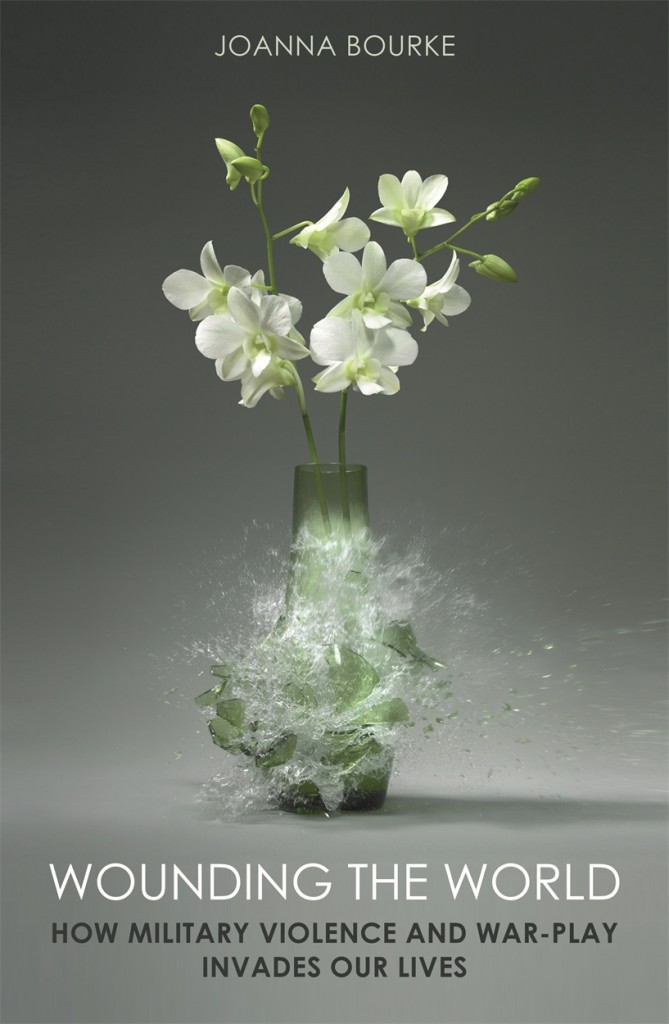
BOURKE Wounding the world

Joanna Bourke‘s new book, Wounding the world, has just been published in the UK by Virago (the North American edition, re-titled Deep Violence: Military Violence, War Play, and the Social Life of Weapons, is due from Counterpoint early next year).

Wars are frequently justified ‘in our name’. Militarist values and practices co-opt us, permeating our language, invading our dream space, entertaining us at the movies or in front of game consoles. Our taxes pay for those war machines. Our loved ones are killed and maimed.

With killing now an integral part of the entertainment industry in video games and Hollywood films, war has become mainstream.

2014 marks the 100th anniversary of the declaration of the First World War, and with it comes a deluge of books, documentaries, feature films and radio programmes. We will hear a great deal about the horror of the battlefield. Bourke acknowledges wider truths: war is unending and violence is deeply entrenched in our society. But it doesn’t have to be this way. This book equips readers with an understanding of the history, culture and politics of warfare in order to interrogate and resist an increasingly violent world.

Here is the list of chapters:

PART ONE: WAR WITHOUT END

Introduction

PART TWO: THE SOCIAL LIFE OF WEAPONS

It’s only words

The circulation of violence

PART THREE: INCITEMENT TO MURDER

Kind-hearted Gunmen

Wounding the Innocent

The Dark Art of Ballistics

PART FOUR: MILITAINMENT

Playing War

Violent Gaming

PART FIVE: THE END OF WAR

Protest

You can read the introduction here, from which I’ve snipped this extract:

Our garrisons are maintained throughout the world and yet the military campaigns we wage abroad seem as real to most of us as the metaphorical wars on drugs or obesity. It is not uncommon to hear people waxing lyrical about the sanctity of life – including that of the two-cell embryo – while revering the troops on Remembrance Day. Militarist incursions into our ways of thinking, talking and enjoying ourselves are barely acknowledged. The blurring of entertainment and war, the infiltration of ‘violence-as-fun’ into the popular imagination (‘militainment’) and the advent of warbots – a generic term for drones, robotic weapons, unmanned vehicles, and suchlike – have led many of us to take for granted that war is without end and without borders. Unwittingly, we have effectively been turned into citizen-soldiers.

We have inherited a toxic genealogy. Its names are legion but its purpose is singular: violence. It is precisely its everyday nature – the way it creeps up on us by stealth – that makes it so powerful. But we are not merely passive observers, in thrall to a set of amorphous, militaristic ideologies or corrupting institutions. We are involved in the production of violence: it constitutes who we are and might be and, as such, can be resisted.

There is an early review by Yvonne Roberts in today’s Guardian here.

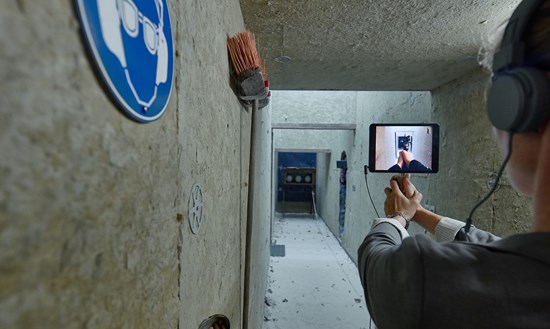
rimini_protokoll_situation_rooms_2_jo_rg_baumann

It’s a timely book in all sorts of ways, but I’m particularly pleased it’s available now because next month I’ll be in Berlin as part of Hebbel am Ufer’s Waffenlounge (Weapons Lounge):

After the USA and Russia, Germany is the third largest arms exporter in the world. The global market constantly demands better, more effective and ‘cleaner’ weapons. This month HAU Hebbel am Ufer is presenting a new production by Hans-Werner Kroesinger, “Exporting War,” as well as the Berlin premiere of “Situation Rooms,” a groundbreaking installation by Rimini Protokoll, created in co-production with HAU. Both works take up the paradoxical relationships that societies maintain to weapons, and both make use of personal biographies, current military conflicts as well as historical and political contexts. Under the motto “Weapons Lounge” HAU will also be presenting performances, installations, expert talks, and a project by the Houseclub with Kreuzberg pupils.

I’ll be talking about drones, but I’ve been thinking about what Joanna calls ‘the social life of weapons’ and also about the global arms trade (see my early post on ‘The death merchants’ here), so I’m looking forward to reading what she has to say.

Keeping up with the Drones

Patrick Svensson:Unblinking stare

Several recent contributions on military drones – what Forensic Architecture calls Unmanned Aerial Violence – you might be interested in.

First, Steve Coll has a long essay in the latest New Yorker on ‘The Unblinking Stare‘ (and, yes, I do know that those watching the screens blink.  Duh) about the drone war in Pakistan.  Many readers will remember that it was the New Yorker that published Jane Mayer‘s classic essay on ‘The Predator War‘ (26 October 2009), so it’s high time for an up-date since so much has happened since then.  It’s a very helpful survey.  Much of it will not be news, but Steve does provide some interesting background to the deadly gavotte between the US and Pakistan (what I’ve called ‘dirty dancing‘; see also here):

Pakistan’s generals and politicians, who come mainly from the country’s dominant, more developed province of Punjab, treated Waziristan’s residents “as if they were tribes that were living in the Amazon,” the journalist Abubakar Siddique, who grew up in the region and is the author of “The Pashtun Question,” told me.

In 2002, Musharraf sent Pakistan’s Army into South Waziristan to quell Al Qaeda and local sympathizers. In 2004, the Army intensified its operations, and, as violence spread, Musharraf allowed the C.I.A. to fly drones to support Pakistani military action. In exchange, Musharraf told me, the Bush Administration “supplied us helicopters with precision weapons and night-operating capability.” He added, “The problem was intelligence collection and targeting. . . . The Americans brought the drones to bear.”

Musharraf allowed the C.I.A. to operate drones out of a Pakistani base in Baluchistan. He told me that he often urged Bush Administration officials, “Give the drones to Pakistan.” That was not possible, he was told, “because of high-technology transfer restrictions.”

We know that close co-operation and even co-ordination between Washington and Islamabad was still the order of the day until at least 2011.  We know, too, that local people live under a double threat, and the essay reports on a group interview in Islamabad with half a dozen young men, mainly university students, from Waziristan.  On one side, recalling the Stanford/NYU ‘Living under dronesreport:

Being attacked by a drone is not the same as being bombed by a jet. With drones, there is typically a much longer prelude to violence. Above North Waziristan, drones circled for hours, or even days, before striking. People below looked up to watch the machines, hovering at about twenty thousand feet, capable of unleashing fire at any moment, like dragon’s breath. “Drones may kill relatively few, but they terrify many more,” Malik Jalal, a tribal leader in North Waziristan, told me. “They turned the people into psychiatric patients. The F-16s [of the Pakistan Air Force] might be less accurate, but they come and go.”

On the other side:

Families in North Waziristan typically live within large walled compounds. Several brothers, their parents, and their extended families might share a single complex. Each compound may contain a hujra, or guesthouse, which usually stands just outside the main wall. In the evening, men gather there to eat dinner and talk war and politics. A rich man signals his status by building a large hujra with comfortable guest rooms for overnight visitors. The less well-heeled might have a hujra with just two rooms, carpets, rope cots, and cushions.

Taliban and Al Qaeda commanders moved from hujra to hujra to avoid detection. The available records of drone strikes make clear that the operators would regularly pick up commanders’ movements, follow them to a hujra attached to a private home, watch for hours—or days—and then fire. Many documented strikes took place after midnight, when the target was presumably not moving, children were asleep, and visitors would have returned home.

North Waziristan residents and other Pakistanis I spoke with emphasized how difficult it would be for a drone operator to distinguish between circumstances where a Taliban or Al Qaeda commander had been welcomed into a hujra and where the commander had bullied or forced his way in. If the Taliban “comes to my hujra and asks for shelter, you have no choice,” Saleem Safi, a journalist who has travelled extensively in Waziristan, told me. “Now a potential drone target is living in a guest room or a guesthouse on your compound, one wall away from your own house and family.”

“You can’t protect your family from a strike on a hujra,” another resident of North Waziristan said. “Your children will play nearby. They will even go inside to play.” The researcher in Islamabad said, “There is always peer pressure, tribal pressure, to be hospitable.” He went on, “If you say no, you look like a coward and you lose face. Anyway, you can’t say no to them. If a drone strike does take place, you are a criminal in the courts of the Taliban,” because you are suspected of espionage and betrayal. “You are also a criminal to the government, because you let the commander sleep in your hujra.” In such a landscape, the binary categories recognized by international law—combatant or noncombatant—can seem inadequate to describe the culpability of those who died. Women, children, and the elderly feel pressure from all sides. A young man of military age holding a gun outside a hujra might be a motivated Taliban volunteer, a reluctant conscript, or a victim of violent coercion.

This speaks directly to a general point made by Christiane Wilke: in today’s wars the requirement that combatants identify themselves as combatants (a standard obligation of international humanitarian law) has effectively been transferred to civilians, so that it becomes their responsibility to make themselves known as non-combatants.  Even to an unblinking eye at 20,000 feet.

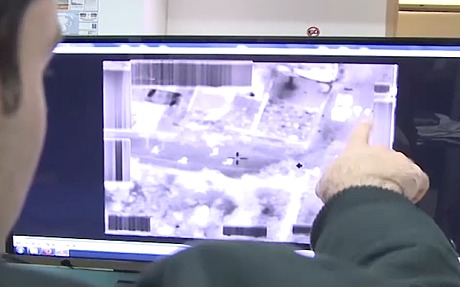
Screen_shot_2014-1_3111155c

Second, this week the Telegraph carried a video and an interview with ‘Major Yair’, the pseudonym for the pilot of a Israeli Heron TP drone based near Tel Aviv.  He reports that roughly 65 per cent of Israeli air operations are conducted by drones.  ‘Yair’ served in all three Israeli assaults on Gaza and he says nothing about Israel’s targeted killing – the focus is on the provision of Close Air Support.  But the claims he makes will be all too familiar to those familiar with USAF air strikes in Afghanistan:

As Israeli ground units pressed into Gaza, they would call Major Yair for close air support. “They’d be saying ‘we keep getting fire from within those buildings’ and I’m sitting at a distance – on a neat floorspace with screens and air conditioning systems – but you’re sweating and it’s ‘what do I do, what do I do’? How do I not cause more damage than help?”

I’ve repeatedly noted the affinity – even proximity – USAF crews working out of Creech Air Force Base in Nevada feel with troops on the ground in Afghanistan.  But ‘Yair’ doesn’t elaborate on the Israeli ground assault.  Instead, remarkably, persistently – unblinkingly, you might say – he circles around his own last sentence:

Major Yair stressed how he was constrained by rules of engagement designed to avoid innocent deaths. Hamas operatives, he added, routinely exploited this restraint by hiding behind civilians. One sequence shot by a Heron showed four men preparing to launch a salvo of rockets under a screen of trees. Seconds later, the men were shown running to a nearby street filled with children.

“They’re untouchable now,” said Major Yair, pointing at the screen. “I know that no mission commander, under current directions given by the chief of staff, will engage in this situation. No way.”

He added: “It is sometimes frustrating because you feel that you’re fighting with your hands tied. There are a lot of situations where you see your targets, but you will not engage because they’re next to kindergartens, because they’re driving with their wives and their kids.”

drone2_3111097c

David Blair presses him on the large number of Palestinian civilians killed in Gaza, including children, only to be told:

“We do make mistakes… but it’s nature. People make mistakes. We learn from those mistakes. You’ll see no smiling face after an incident where kids were killed. None of us wants to be in a position where he does these mistakes. We learn and try to avoid this as much as we can.”…

“You learn to live with it,” he said. “It’s not easy. I’ve made mistakes that, for many years, will come back at me. But it’s something that people have to do. It’s not easy. We do not shove it back somewhere in our minds and try to avoid talking about it. We talk about it, we support each other.”

And so, as so often happens in the United States (and elsewhere) too, our gaze is directed away from the victims and towards the torment suffered by those who inflict military violence from the air.

But, third, Corporate Watch has just published the fifth in its series of reports on living under drones in Gaza.  These eyewitness reports are indispensable because there are serious problems in using satellite imagery to reconstruct drone strikes.  Nobody is better at doing so than Forensic Architecture, but as they note, there is a threshold of detectability:

IMG_0076rsSome drone-fired missiles can drill a hole through the roof before burrowing their way deep into buildings, where their warheads explode. The size of the hole the missile leaves is smaller than the size of a single pixel in the highest resolution to which publicly-available satellite images are degraded [a square that translate sin to 50 cm by 50 cm of terrain].  The hole is thus at the “threshold of visibility” and might appear as nothing more than a slight color variation, a single darker pixel perhaps. This has direct implications for the documentation of drone strikes in satellite imagery, which is often as close to the scene as most investigators can get. When the figure dissolves into the ground of the image, it is the conditions—legal, political, technical—that degrade the image, or that keep it at a lower resolution that become the relevant material for forensic investigations.

The Corporate Watch report also includes a remarkable tabulation from the Al Mezan Centre for Human Rights in Gaza, showing the numbers of people killed by the Israeli military in Gaza (col. 2) and the proportion killed by drone strikes (col. 3):

Israeli drone strikes in Gaza

I’m not sure what the sources for these tabulations might be: as Craig Jones has emphasised in a vitally important post, it’s exceptionally difficult to parse Israel’s targeted killings in occupied Palestine, and while these tabulations clearly include many other situations I have no idea how you begin to separate different killing machines in what is, after all, a networked mode of military violence in which drones are likely to perform vital surveillance operations for strikes carried out from other platforms. But the increased reliance on drones chimes with the report from David Blair.