Blurring the lines

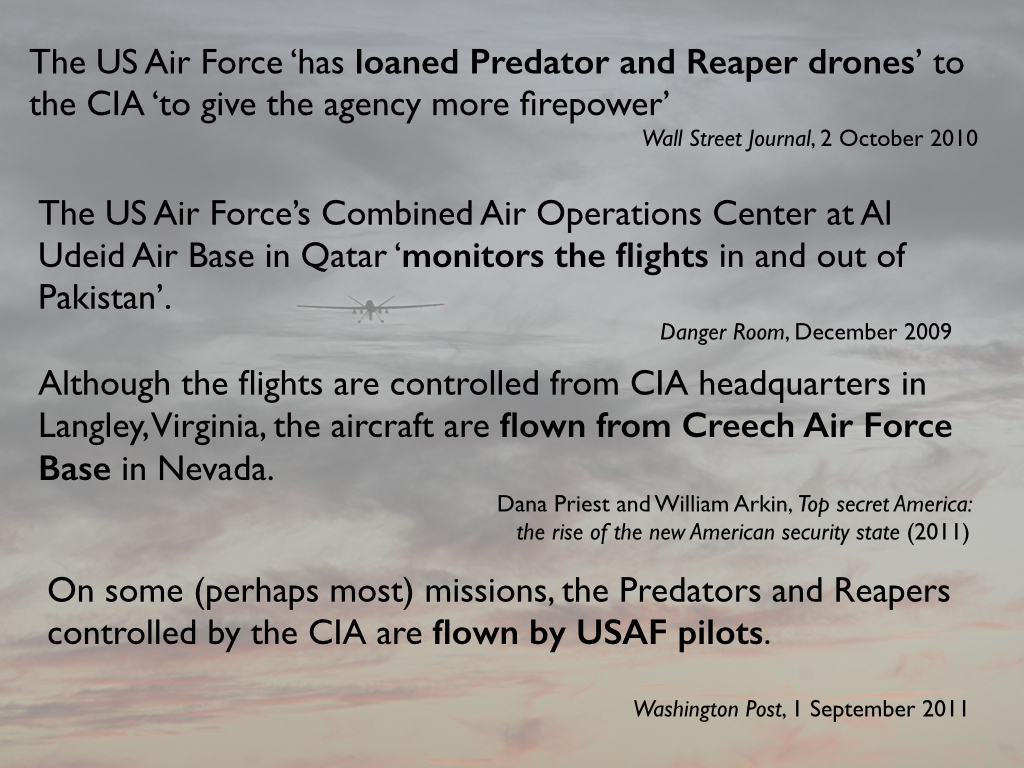
In the short-form version of ‘The everywhere war’ (DOWNLOADS tab) I emphasised the blurring of the lines between the increasingly paramilitary but nominally civilian CIA and the US military, and for the last several years I’ve been including this slide in most of my presentations about CIA-directed drone strikes in Pakistan (and I’ve been very careful to use precisely that description: ‘CIA-directed’):

CIA:USAF.001

Today’s Guardian (online) carries a report that lends support to these claims and concerns:

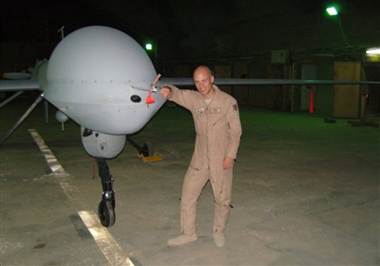
17th Reconnaissance SquadronA regular US air force unit based in the Nevada desert is responsible for flying the CIA’s drone strike programme in Pakistan, according to a new documentary to be released on Tuesday.

The film – which has been three years in the making – identifies the unit conducting CIA strikes in Pakistan’s tribal areas as the 17th Reconnaissance Squadron, which operates from a secure compound in a corner of Creech Air Force Base, 45 miles from Las Vegas in the Mojave desert.

Several former drone operators have claimed that the unit’s conventional air force personnel – rather than civilian contractors – have been flying the CIA’s heavily armed Predator missions in Pakistan, a 10-year campaign which according to some estimates has killed more than 2,400 people.

The film is Tonje Schei‘s documentary Drone, which has its premiere tomorrow.  You can read an interview with her about the drone wars here.  In an overlapping interview for Pakistani media, she explains:

DRONE investigates the human consequences of the US drone war. Through unique access to voices on both sides of this new technology, DRONE offers new insights into the nature of drone warfare. DRONE juxtaposes the realities of drone victims in Waziristan to drone pilots who struggle to come to terms with the new warfare. The film covers diverse and integral ground from the recruitment of young pilots at gaming conventions and the re-definition of “going to war”, to the moral stance of engineers behind the technology, the world leaders giving the secret “greenlight” to engage in the biggest targeted killing program in history, and the people willing to stand up against the violations of civil liberties and fight for transparency, accountability and justice.

You can watch a clip on Youtube, which I’ve also embedded here, in which Chris Woods (senior reporter at the Bureau of Investigative Journalism) explains why this blurring of the lines between the CIA and the military matters:

http://www.youtube.com/watch?v=cp7aCHlntQs

Schei’s original source was Brandon Bryant, a former USAF sensor operator who had already gone public with his own account of the traumatic business of targeted killing (see also here and here).  He decided to add to his testimony when the Obama administration proposed transferring control of the targeted killing program from the CIA to the military, a plan that has faced Congressional opposition:

“There is a lie hidden within that truth. And the lie is that it’s always been the air force that has flown those missions. The CIA might be the customer but the air force has always flown it. A CIA label is just an excuse to not have to give up any information. That is all it has ever been.”

Bryant’s account has apparently been corroborated by another six former crew members, who claimed that the 17th transitioned to its ‘new customer’ in 2004.

Sudden-Justice_webChris Woods provides much more in Sudden Justice: America’s secret drone wars, forthcoming from Hurst at the end of this year, but – for now – here is what I said in ‘The everywhere war’ in 2011 (and I can now say much more in The everywhere war!):

These considerations radically transform the battlespace as the line between the CIA and the military is deliberately blurred. Obama’s recent decision to appoint Panetta as Secretary of Defense and have General David Petraeus take his place as Director of the CIA makes at least that much clear. So too do the braiding lines of responsibility between the CIA and Special Forces in the killing of Osama bin Laden in Abbottabad in May 2011, which for that reason (and others) was undertaken in what Axe (2011) portrays as a ‘legal grey zone’ between two US codes, Title 10 (which includes the Uniformed Code of Military Justice) and Title 50 (which authorises the CIA and its covert operations) (Stone 2003). The role of the CIA in this not-so-secret war in Pakistan thus marks the formation of what Engelhardt and Turse (2010) call ‘a new-style [battlespace] that the American public knows remarkably little about, and that bears little relationship to the Afghan War as we imagine it or as our leaders generally discuss it’.


Drones, militarized vision and civilian casualties

I’m just back from the AAG Conference in Tampa, and there’s a lot to catch up on.

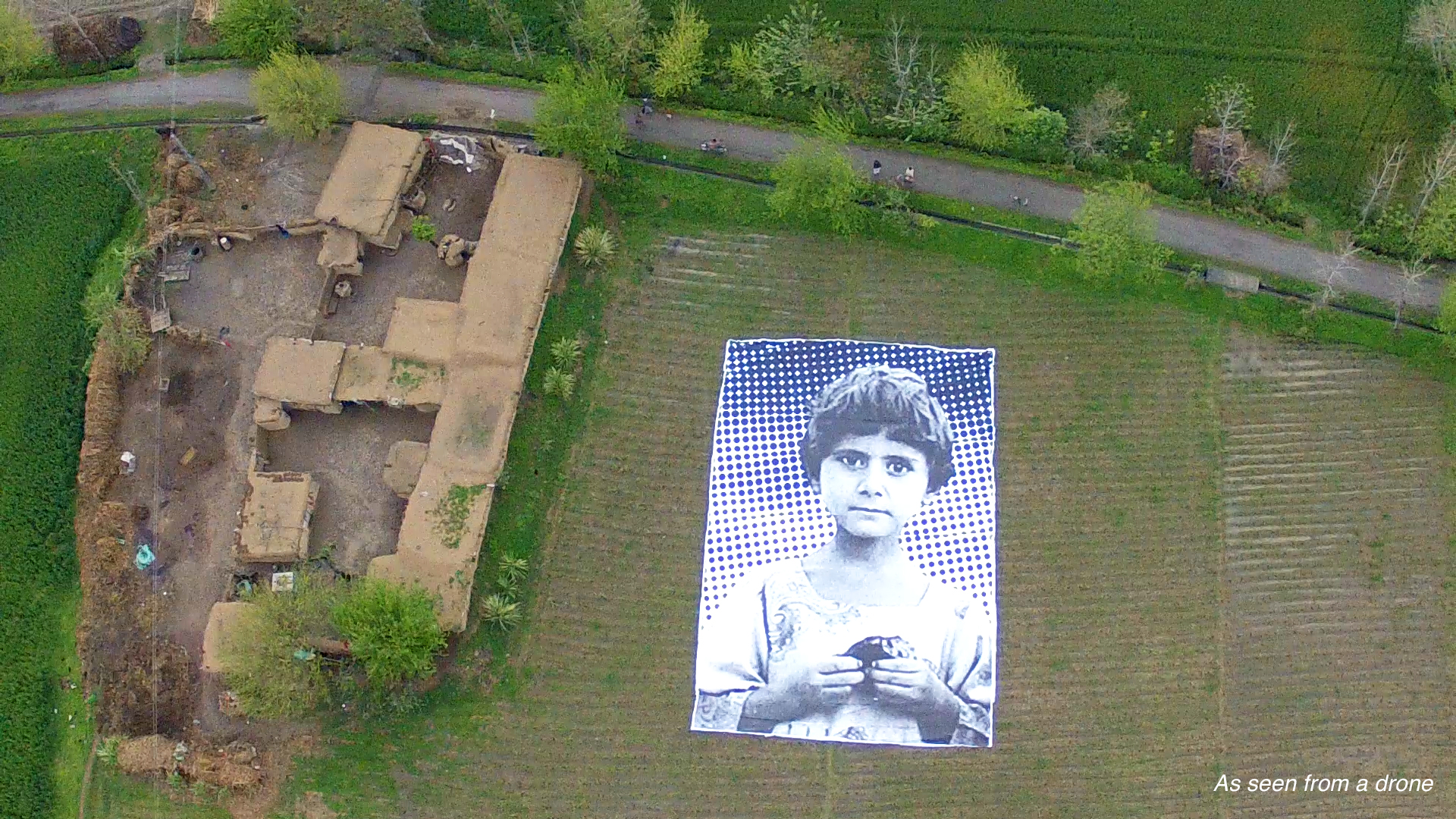
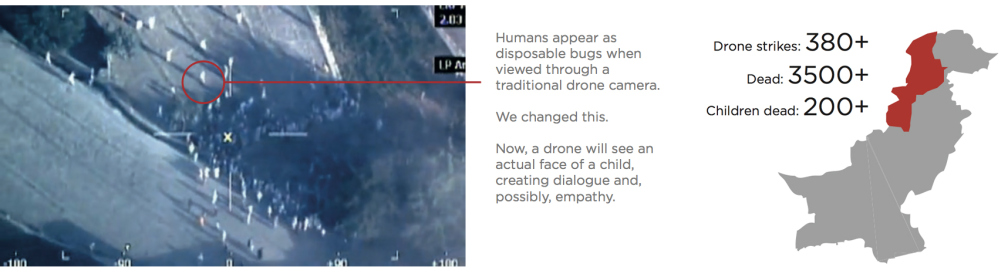
First, an art installation in Pakistan called #NotABlugSplat that reverses the paramilitary gaze and ‘targets Predator drone operators sitting thousands of miles away who refer to kills as BugSplats.’  Now they’ll see on their screens the face of a child who lost her parents and two young siblings in a drone strike.

jr_kpk_full

It’s a collaboration between Pakistani and American artists, working with Reprieve and the Foundation for Fundamental Rights, who also designed it ‘to be captured by satellites in order to make it a permanent part of the landscape on online mapping sites.’

667989206390250307

It’s an arresting project – but if you scroll through the comments that followed gizmodo‘s report you’ll see that ‘hope’ and ’empathy’ remain dismally distant for many people.

LEWIS Drone strikes in PakistanPerhaps some of them would benefit from a new report for the Center of Naval Analyses (CNA) by Larry Lewis, Drone strikes in Pakistan: reasons to assess civilian casualties.  I’ve noted his (largely classified) work on Drone strikes and civilian casualties in Afghanistan before, and in this – unclassified – report he leverages what we know about US military drone strikes in Afghanistan to address the cross-border attacks directed by the CIA.  Lewis makes two key points.

First, he notes that the US government’s claims about civilian casualties for its supposedly covert operations in Pakistan are significantly lower than ‘nearly every other estimate available’.  (En route, he draws attention to something that is usually overlooked in these calculations: under International Humanitarian Law, ‘the burden of proof is to determine whether a casualty is a combatant’, and where in doubt the casualty must be regarded and recorded as a civilian).  Based on his previous work in Afghanistan, Lewis suggests three overlapping reasons – apart from a disinclination to tell the truth – that ‘complicate the estimation process’:

  • An irregular enemy –  it is exceptionally difficult to distinguish combatants from civilians in irregular warfare, and this is exacerbated by combatants ‘co-locating with the local population’;
  • Misidentifications – ‘US forces mistakenly believe civilians to be enemy combatants’; I’m not sure how this is different from the first, but Lewis provides two examples that suggest he has in mind specific rather than general characteristics: mistaking men digging drainage ditches for militants burying an IED, for example, or assuming all those in close proximity to an engagement were involved (‘guilt by association’);
  • Battle Damage Assessments (BDA) based on aerial surveillance – determining the consequences of an air strike without ‘boots on the ground’ is likely to be defective

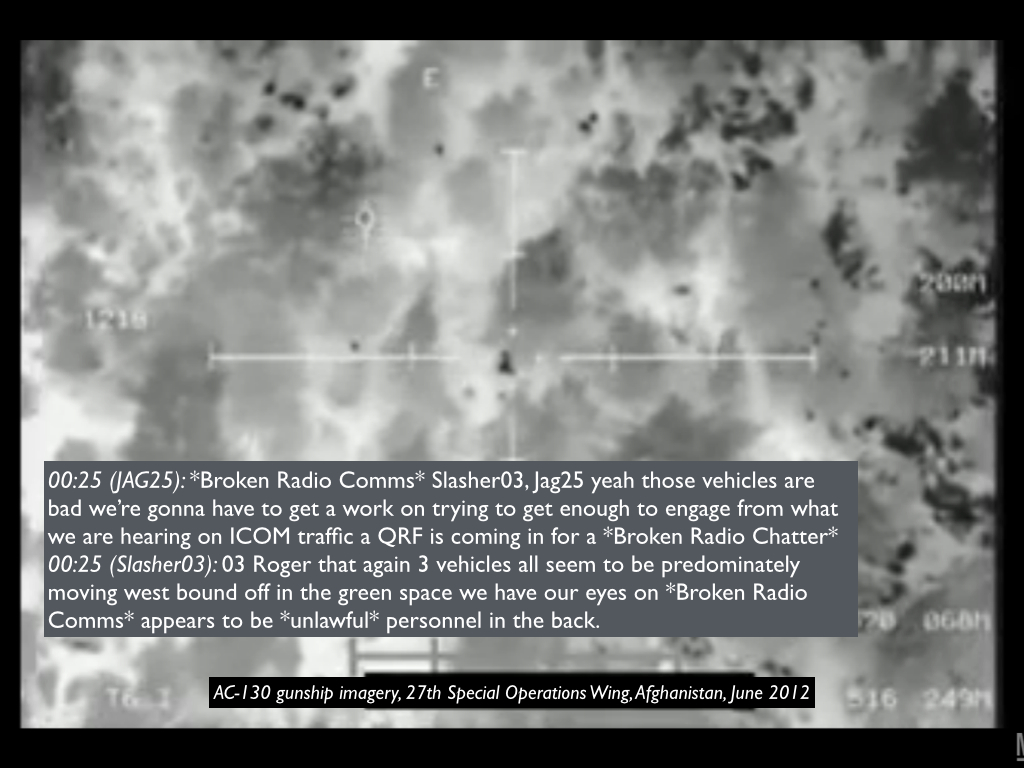
Of all of these, Lewis suggests that it is misidentification that is likely to be ‘the basis for the majority of civilian casualty incidents’ and cites the case that I discussed in detail in Tampa: the strike carried out by two attack helicopters following persistent surveillance from a Predator of a ‘convoy’ of three vehicles in Uruzgan province in Afghanistan in February 2010.  I’ll post my version of events shortly, since I think it is a mistake to collapse this episode into a monotonic ‘Predator vision’; there were other eyes in the sky [see the image below], and – still more significantly – military vision is not a uniquely technical process (which is why the concept of visuality is so important) and in this case involved different interpretations of the Full Motion Video Feed from the drone by different people at different locations. In short, there was a de-centralized, distributed and dispersed geography of militarized vision that was never resolved into a plenary (still less totalizing) frame.

AC 130 Gunship Imagery Afghanistan.001


That said, Lewis’s second point is about process not platform.  He has no truck with claims like Avery Plaw’s – ‘Where civilian casualties cannot be avoided they must be minimized.  This is what drone strikes do’ – because they mistake ‘platform precision for a comprehensive process that minimizes civilian casualties’ and are in fact ‘contradicted by operational data’.  He cites his earlier analysis of 2010-2011 data from Afghanistan, which ‘showed that several forms of attack, including engagements by manned air platforms, were less likely to cause civilian casualties than drone strikes’ (my emphasis; see my earlier discussion here). In his view, then, ‘minimizing civilian casualties is less a matter of platform or ordnance selection as it is using an approach that considers factors that lead to civilian casualties and then effectively takes them into account.’

The point is sharpened by Mark Gubrud in a response to a report from Charli Carpenter at the Duck of Minerva:

‘…drones use the same targeting pods and precision-guided weapons as the manned platforms they replace; in fact, the quality of imagery from the drones is degraded by the limited bandwidth and frequent interruptions of satellite links, as well as the transmission delay which can frustrate last-moment aborts. On top of the “soda straw” vision as compared with low-flying aircraft in close air support, these factors mean that, if anything, the drones are actually inherently less discriminate.’

Again, all of these factors were in play in the Uruzgan attack: degradations and interruptions of both video and audio transmissions were of critical importance – again, see the image from my Tampa presentation above – but even more significant was the way in which the military field of view expanded, contracted and even closed at different locations as the episode unfolded.  More to come.

Thatcher’s Gift: law and ordering

Datta Khel strike satellite analysis

Following on from my last post…  The failure of the anonymous US official to recognise what I called the operative presence of customary law is symptomatic of a structural condition: Pakistan’s borderlands, the Federally Administered Tribal Areas, must be construed as ‘lawless’ in order for law (which is to say ‘order’) to be imposed from the outside, through military and paramilitary violence shrouded, as it so often is, in the cloak of law itself.

Talking with Michael Smith yesterday – who is busy co-editing a special issue of Society & Space on legal geographies with Craig Jones  – I suggested that this effectively repeated the canonical double gesture of Orientalism, in which the space of the Other is summoned as a space of the bizarre, the exotic and at the limit the monstrous (‘a living tableau of queerness’, Edward Said called it), that must be imperatively normalised – straightened out, if you prefer – through the imposition of the order it has been deemed to lack.  In this case, the ordering is imposed through a deadly dance choreographed in Washington and Islamabad.

Michael then provided me with this remarkable quotation from Peter Fitzpatrick‘s ‘Racism and the innocence of law’ from the Journal of Law and Society 14 (1) (1987) 119-132 (p. 129):

“It is hardly surprising, then, that the resort to law as a symbol of race and nation should be so facile, so common and so effective. Thus, to return to the stratagem of the telling instance and to Thatcher’s contribution, she precisely echoes the imperialist claim to law as a gift we gave them, gave those “people with a different culture”, people who did not have law, who did not give it to the world and who in remaining essentially alien have failed to assimilate the gift adequately.”

The reference is to a speech given by Margaret Thatcher in January 1978, in which she praised Britain’s contribution to law (‘throughout the world’) and sympathised with those who feared that immigration would see this ‘swamped’ – submerged, drowned – ‘by people with a different culture’.

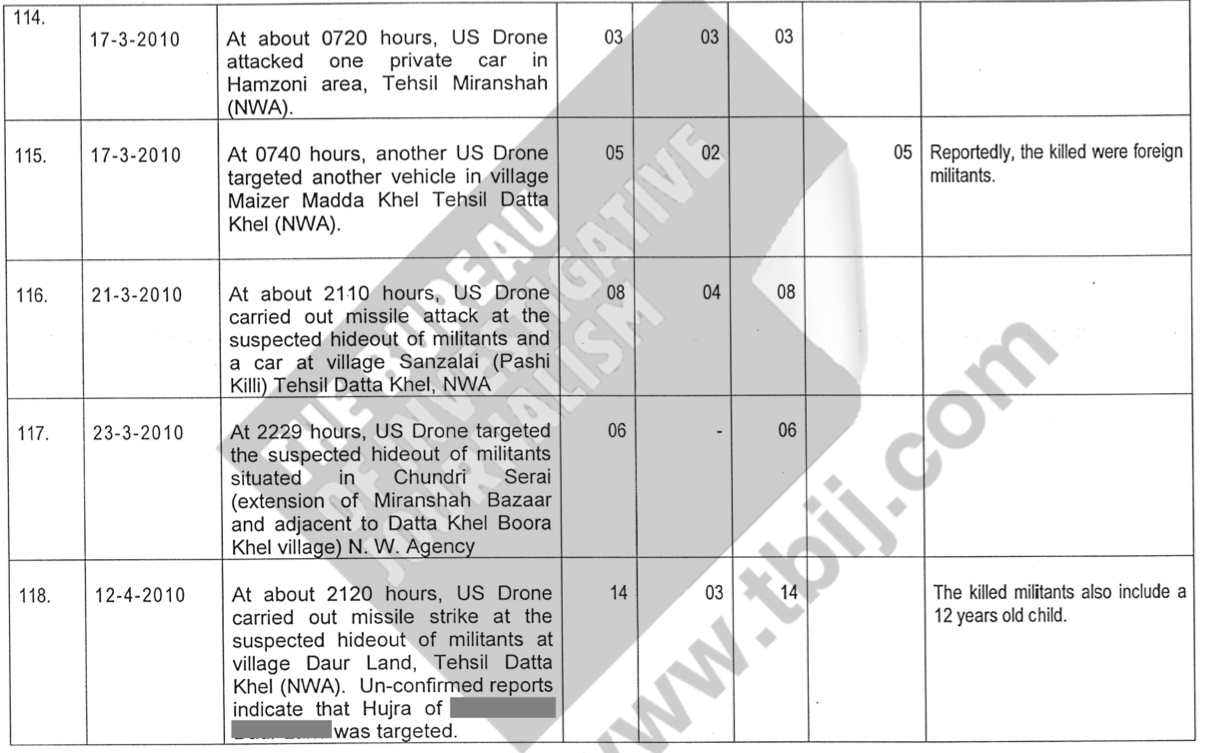
Datta Khel strike BoJ PNG

So, in the telling instance of Datta Khel [the image above is from an official Pakistani transcript published by the Bureau of Investigative Journalism; there is also a detailed report here – scroll down to 17 March) colonial and imperial power redux: Midnight’s Children being ‘ordered’ by Thatcher’s….. It would have been better if the Jirga targeted by the drone had been a ‘charity car-wash’ – but that distant prospect was evidently (and I think necessarily) construed as even less likely than its being a properly constituted legal assembly.

In case this is misunderstood, to insist on the operative presence of customary law is emphatically not to deny that people in these areas are subject to extraordinary violence from the air and from the ground, by the CIA, the Pakistan military, and the Taliban and other groups – but it is to acknowledge how what Michael called ‘liberal legality’s denigration of its others (tradition, custom, customary law)’ is a vital, constitutive moment in the imposition of those violent exactions.

The scene of the crime: customary law and forensic architecture

I returned from a wonderful visit to Glasgow last week – thanks so much to Jo Sharp, who ensured I had a criminally good time – and I’ve spent this week trying to catch up.  It rained most of the time I was there, and in fact my first impression of the University was of a quadrangle turned into a quagmire: a case of mire in the flood, you might say.  But nothing could dampen my spirits, and in the gaps between marvellous restaurants, coffee shops that would make anyone in Vancouver (or Seattle) green with envy, the best lunch ever, and truly excellent conversation, I gave two talks: one on my skeletal ideas about my new project on Medical-military machines and casualties of war, 1914-2014, and the other a more formal affair on ‘Dirty dancing: drone strikes, spaces of exception and the everywhere war.’ The purpose of the first talk was to explore, largely for graduate students, how I work; it generated a lively discussion, so I thought I would try to do the same in this post but in relation to the second presentation.  And in doing so, I’ll also have more to say about the scene of a real crime.

I’d prepared my formal presentation before I left Vancouver, and as I’ve explained before I now never read from a written text: I design the slides carefully (see my ‘Rules’ here) and talk to them, so that I retain as much flexibility as possible.  It’s a sort of semi-scripted improv, I suppose, and it also means that the argument can develop from one presentation to the next.

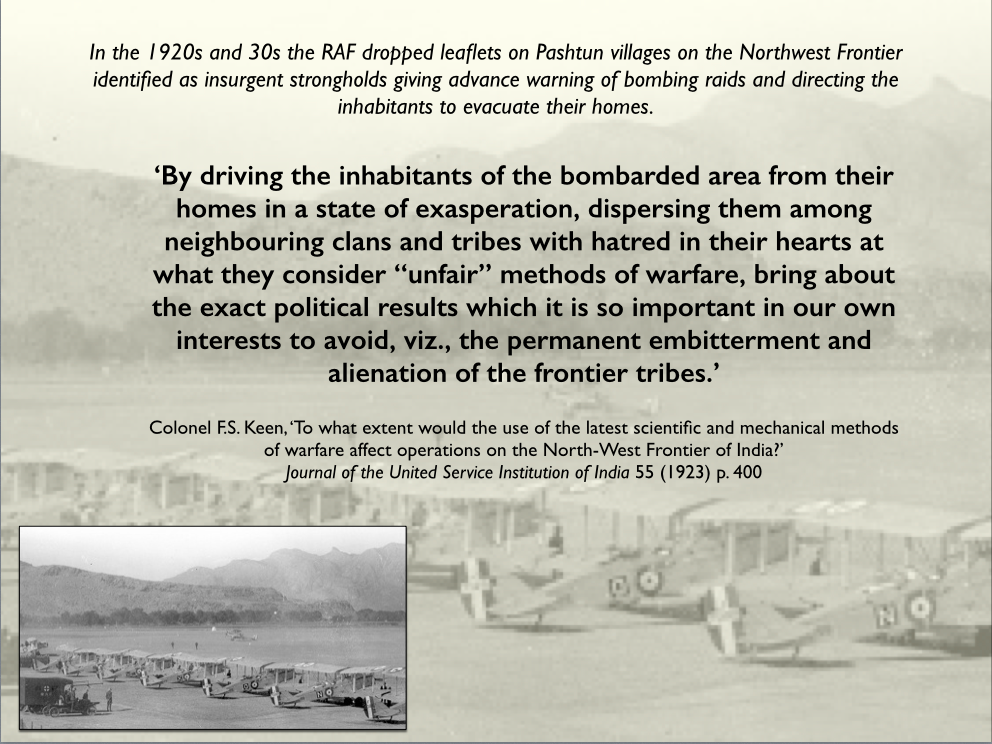
On the train up from London I started to think some more about the air strikes on the Federally Administered Tribal Areas (see also herehere and here).  Part of my purpose was to trace a narrative of air attack that, for those now ‘living under drones’, stretched back (at least in memory) to British air control and counterinsurgency on the North West Frontier in the 1920s and the 1930s.

Waziristan bombing 1920s and 30s PNG

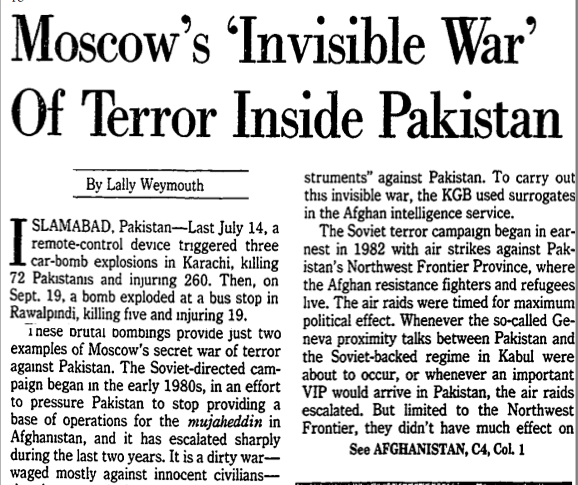
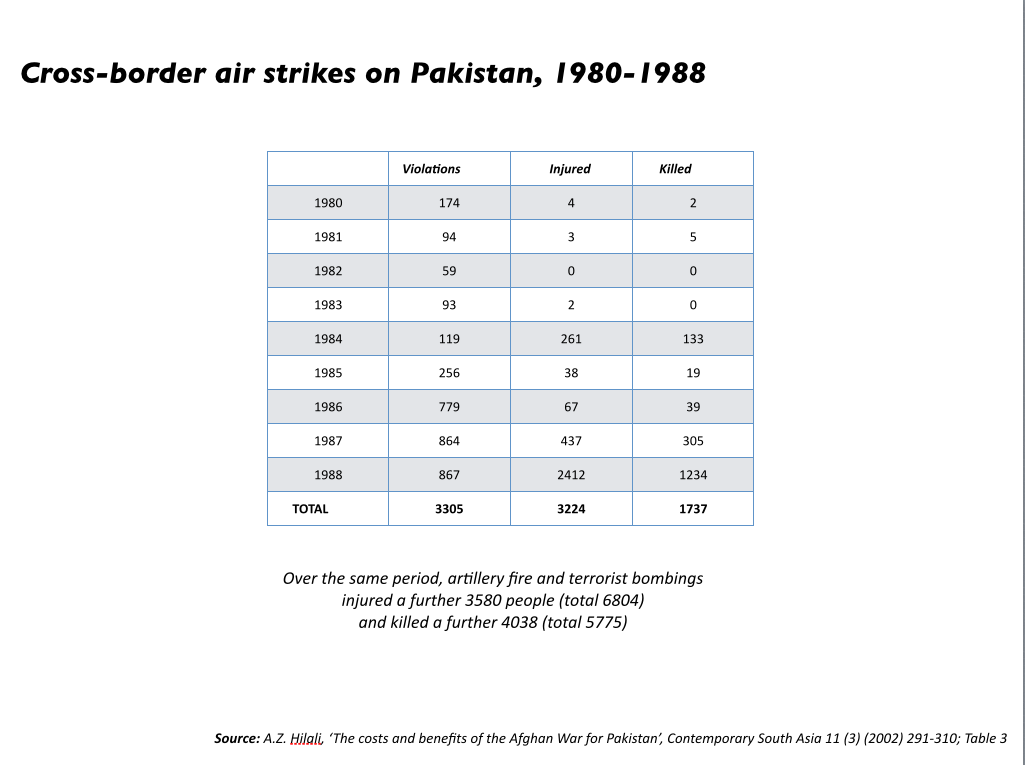
War of Terror inside Pakistan PNGI’d made this point before, and sharpened it during an earlier version of the presentation in Beirut, but I’d since realised that the narrative was resumed by the Soviet and Afghan Air Forces striking mujaheddin bases in Pakistan during the Soviet occupation of Afghanistan.  I hadn’t paid much attention to this in The colonial present, where my focus was on the aid provided by the CIA to mujaheddin striking across the border in the opposite direction, but these air raids were described by the Washington Post on 13 March 1988 as part of the USSR’s “war of terror” (really).  They are an important moment in the genealogy of air strikes and counterinsurgency in the FATA, and I’d managed to unearth some estimates of the number of cross-border violations of Pakistani air space and the number skilled and injured in the strikes:

Afghan:Soviet cross-border air strikes 1980-88

Then, in one of the ironic twists of our post 9/11 world, the (il)logic of air war was revived and ramped up by the CIA-directed drone strikes that have convulsed the borderlands since 2004.

I wanted to show, as I’ve argued in previous posts, that this narrative was more than a cross-border affair and that the Pakistan Air Force has been also actively involved in a series of domestic air campaigns: since 2008 it has carried out thousands of air strikes against what it describes as militants, insurgents and terrorists in the FATA.  In fact, the offensive was resumed earlier this year, when F-16 aircraft and helicopter gunships attacked targets in North Waziristan, driving thousands of people from their homes.

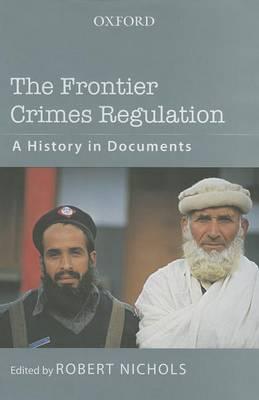
the-frontier-crimes-regulationIn some measure, all of these air campaigns raise the spectre of colonial power, but so too does the legal status of the FATA and its exceptional relation to the rest of Pakistan.  This is usually traced back to Lord Curzon’s Frontier Crimes Regulations (1901), which were retained by Pakistan after independence in 1947.  They were minimally revised in 2011, but the FATA are still under the direct executive control of the President through his appointed Political Agents who have absolute authority to decide civil and criminal matters. The exceptional status of the FATA was confirmed by the Actions (in Aid of Civil Power) Regulations in 2011 which exclude the high court from jurisdiction on fundamental rights issues in any area where the Pakistan armed forces have been deployed ‘in aid of the civil power’.

All of this indicates that the FATA constitute a ‘space of exception’ in something like Giorgio Agamben‘s sense of the term: a space in which particular people are knowingly exposed to death through the juridical or quasi-juridical removal of legal protections from them.  This was, in part, my argument, but I was also concerned to show that this was not a matter of a legal void: rather, military and paramilitary violence was orchestrated, as it almost always is, through the law.

But there is quite another sense in which the FATA is not a legal void, despite all the rhetoric about them being ‘lawless’ lands.  So I started to think through the intersections between these formal legal geographies (and the state violence they sanction) and the system of customary law known as Pashtunwali (loosely, “the way of the Pashtuns”).  The system is far from static, but it still governs many areas of life among Pashtuns on both sides of the Afghanistan-Pakistan border whose cultures and communities were bisected when the Durand Line was drawn in 1893.  I’d been reading as much as I could by anthropologists and others to help me understand its contemporary relevance: for recent surveys, see Tom Ginsburg‘s ‘An economic interpretation of the Pashtunwali’ from the University of Chicago Legal Forum (2011) here,  Lutz Rzehak‘s ‘Doing Pashto’ here, and Thomas Ruttig‘s qualifications in relation to the Taliban here.  For a sense of how the US military understands Pashtunwali, as part of its ‘cultural turn’, see Robert Ross‘s thesis here.

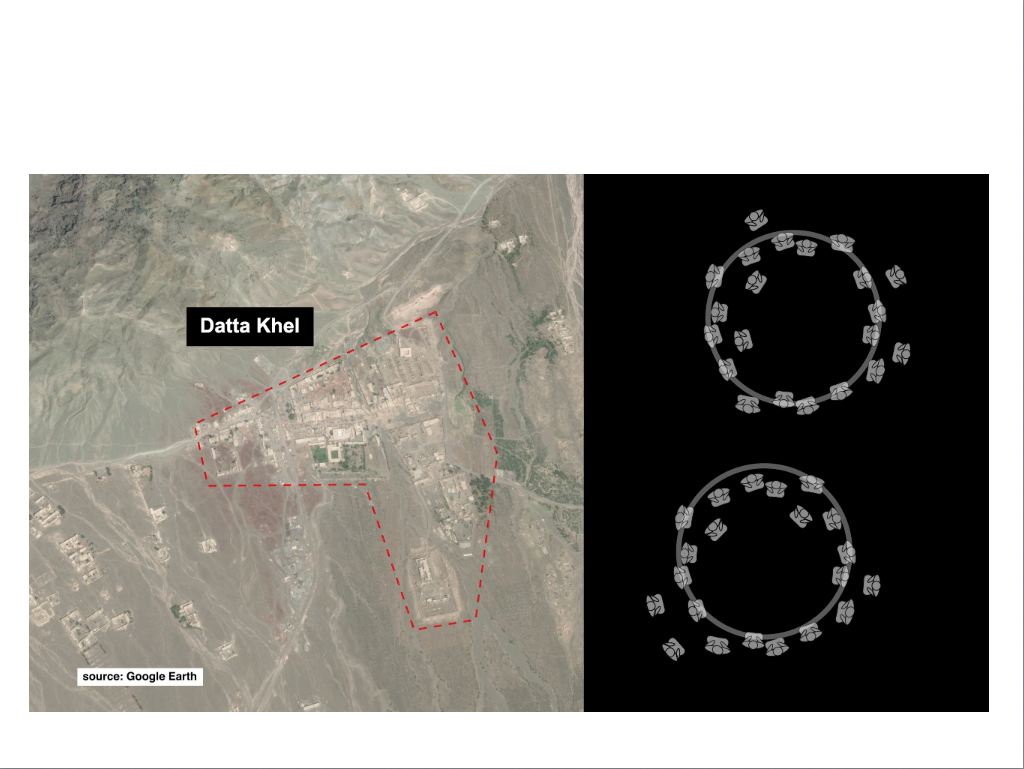
Pashtunwali is more than a legal system, of course, but I was particularly interested in its legal force and how this is put into practice.  Many commentators have shown that Pashtunwali is precisely the sort of ‘mobile’ legal system that you would expect to find among (originally) nomadic peoples, for whom the fixed statutes of a centralised state had neither appeal nor purchase.  It includes obligations of hospitality and protection, asylum and refuge, and revenge and restitution, and provides for a system of resolution through a council (or Jirga).  Within its patriarchal and masculinist framework, the system is resolutely non-hierarchical: the men who compose the Jirga sit in a circle and each, as a symbol of authority and equality, carries a gun.

Sitting in a circle, the Jirga has no speaker, no president, no secretary or convener. There are no hierarchical positions and required status of the participants. All are equal and everyone has the right to speak and argue, although, regard for the elders is always there without any authoritarianism or privileged rights attached to it. The Jirga system ensures maximum participation of the people in administering justice and makes sure that justice is manifestly done.

On my way over to the UK I’d read an extremely interesting essay in the International Review of Law and Economics 37 (2014) 108-20 – stored on Good Reader on my iPad – in which Bruce Benson and Zafar Siddiqui argued that the system works not only to provide a decentralised, local and regional system of order and regulation – so Hobbes was wrong: without the state people do not automatically revert to a ‘state of nature’ (Tom Ginsburg is very good on this) – but also to defend the Pashtun from the incursions of the central state.  Indeed, the Frontier Crimes Regulations specifically recognised the validity and autonomy of the Jirga: much more here.  The message from all this was clear: ‘The Pashtun tribes who inhabit the rugged mountains between Afghanistan and Pakistan are neither lawless nor defenceless.’

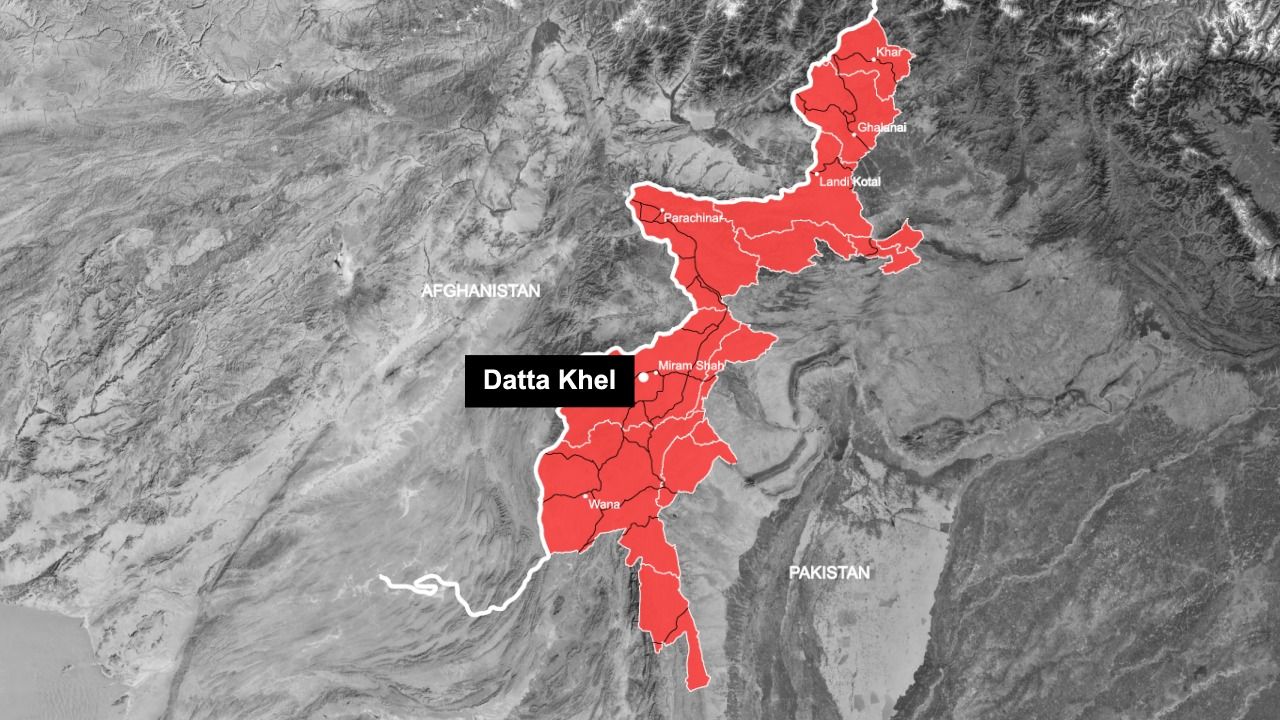
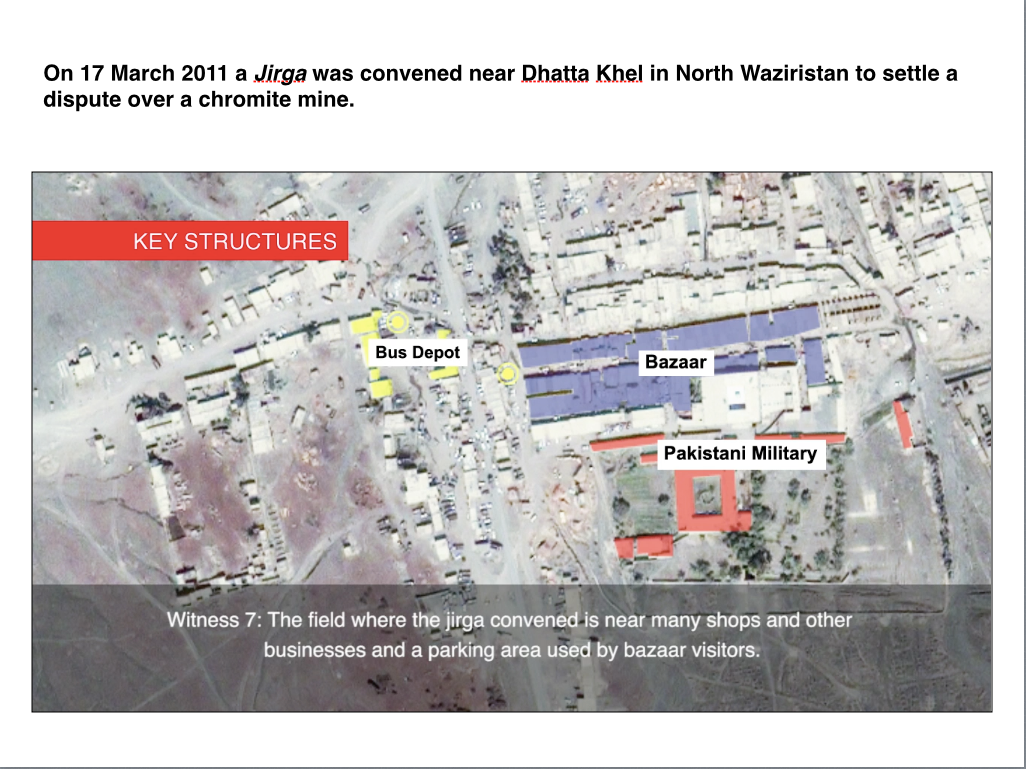
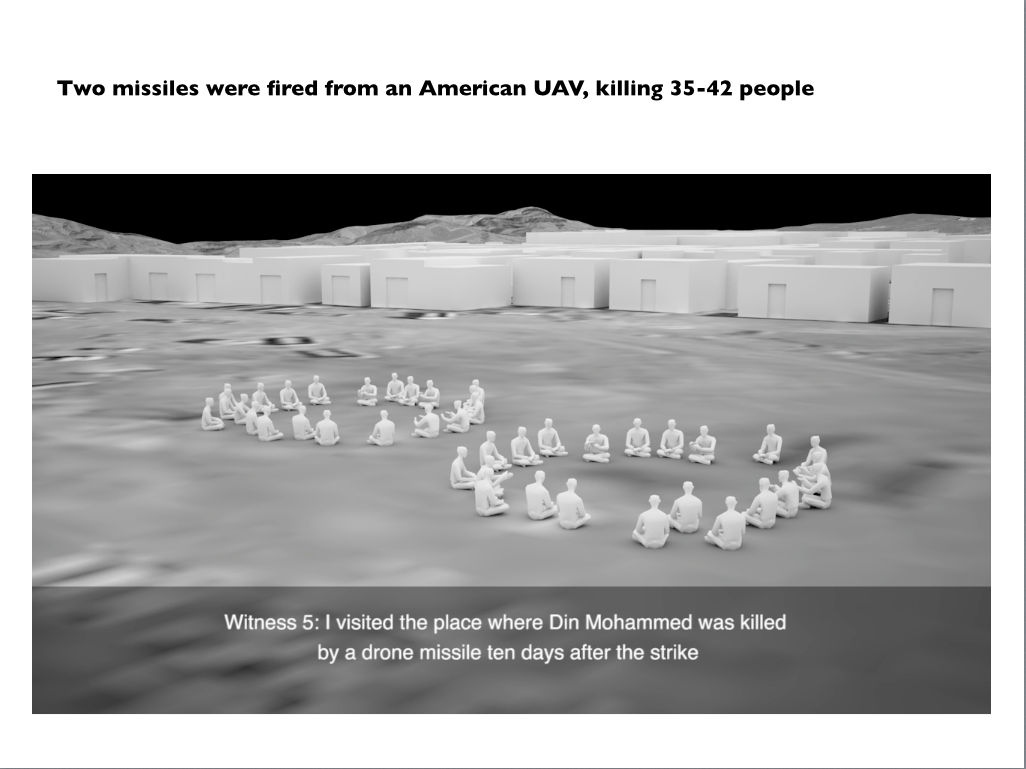
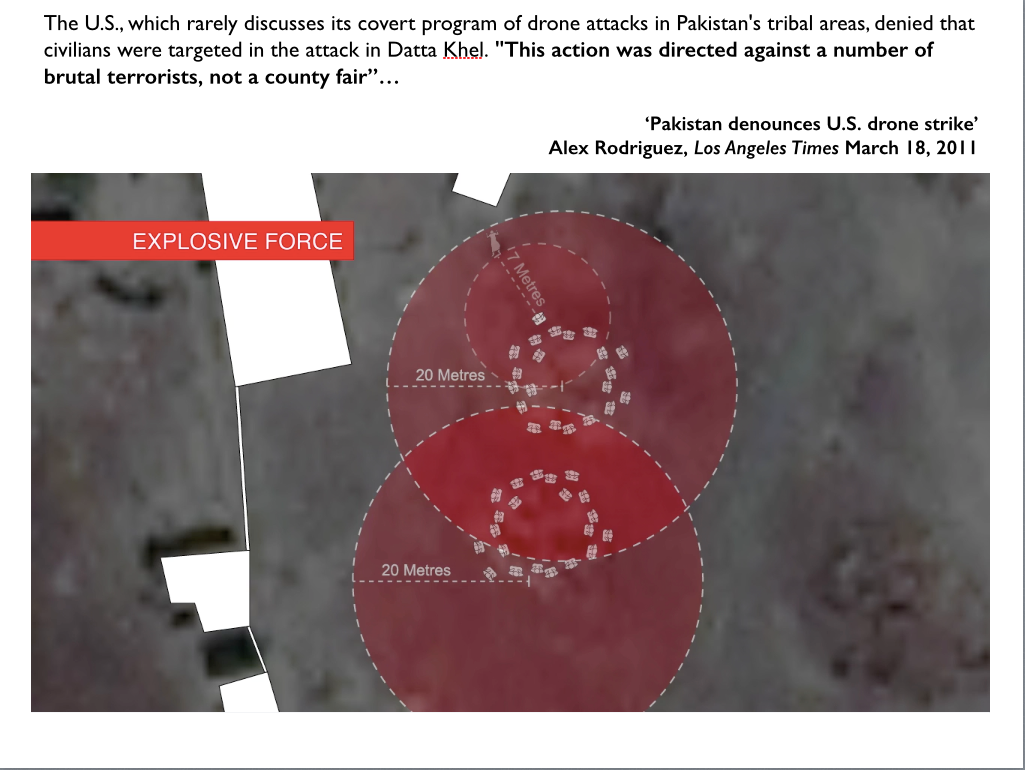
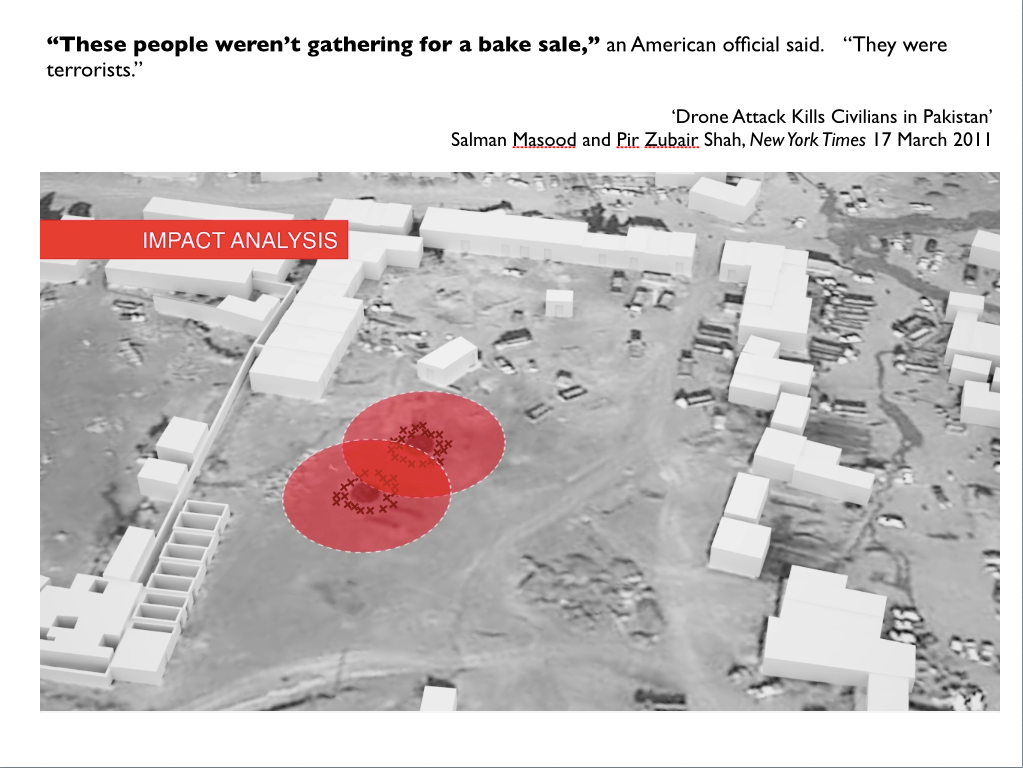
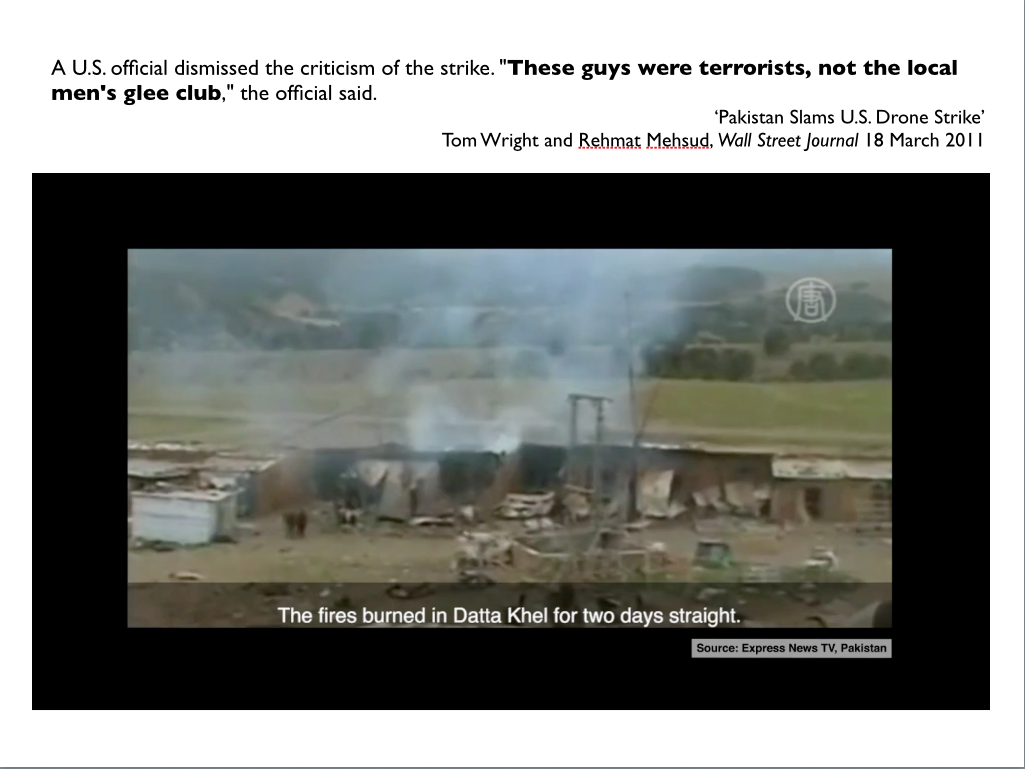
The Pakistan Taliban know this very well, not surprisingly, and in many instances work with Pashtunwali to mediate disputes in the FATA.  In fact, as the train curved around the Lake District I remembered reading about a Jirga being convened in Datta Khel in March 2011 to resolve a dispute over a chromite mine.  It’s odd how some things stick in your mind, like burrs on your jeans, but this incident had stayed with me because the Jirga had been targeted by the CIA and two Hellfire missiles were launched from a drone, killing more than 40 people.  In itself, that probably wouldn’t have been enough for me to remember it in any detail since it was all too common – but the usual faceless and anonymous US official, speaking off the record because he was not authorised to comment in his official capacity, had offered a series of ever more bizarre justifications for the strike: and I remembered those (as you’ll see in a moment, you could hardly forget them).

uekEs60GsR-YpEwf3VWpqOYckWFvgZ-CMcsK2DT0grQ

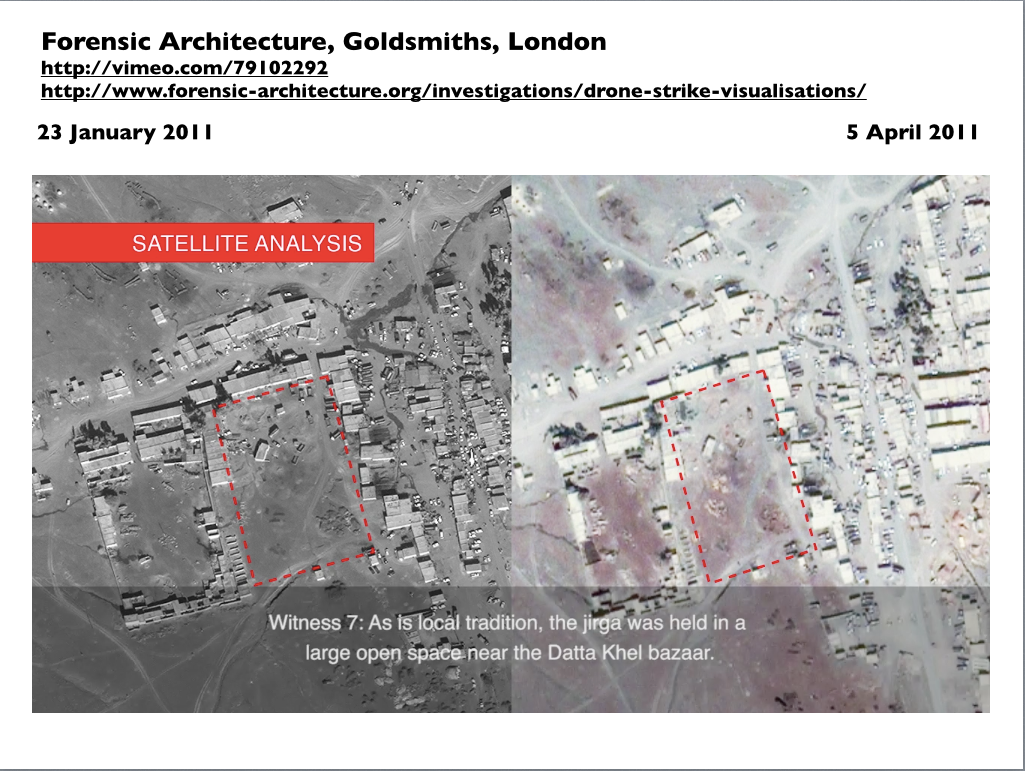
So I started to dig some more – WiFi on the train – and discovered that Eyal Weizman and his brilliant colleagues at Goldsmith’s Forensic Architecture had reconstructed this very strike (the image above is from their work):

‘In the absence of on-the-ground photographic or video documentation, and with no visible impact on buildings, this investigation unfolded by cross-referencing witness testimonies with satellite imagery. An examination of before and after satellite imagery indicated two areas with surface disturbance consistent with the reported missile strikes, thus allowing us to confirm the location of the strike. From the testimonies of survivors and eye-witnesses, we harvested spatial information that helped us to generate a 3D model of the site of the drone strike on the Jirga.’

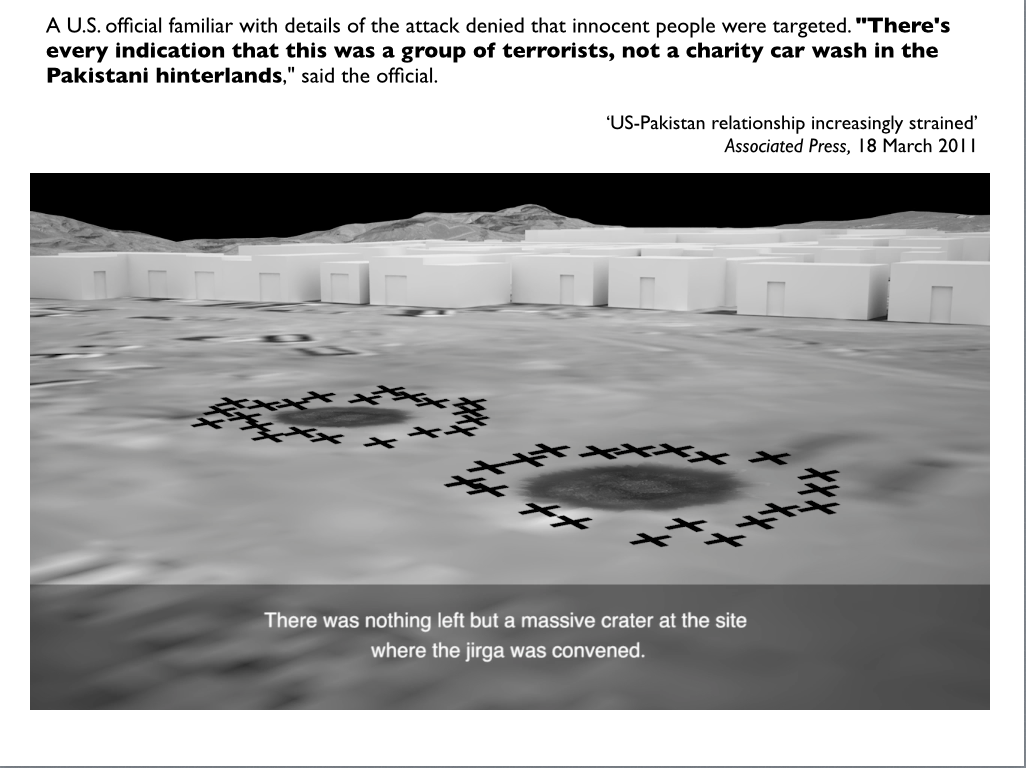
Then all (!) I had to do was go back in to my e-files (each morning I work my way through the press, copying and pasting reports and commentaries into a series of files so that I have my own searchable archive), recover the glosses provided by that anonymous official, and put them together with the reconstruction.  Here’s the result:

Dhatta Khel 1 PNGDhatta Khel 2 PNGDhatta Khel 3 PNG

Dhatta Khel 4 PNGDhatta Khel 5 PNGDhatta Khel 6 PNGDhatta Khel 7 PNGDhatta Khel 8 PNG

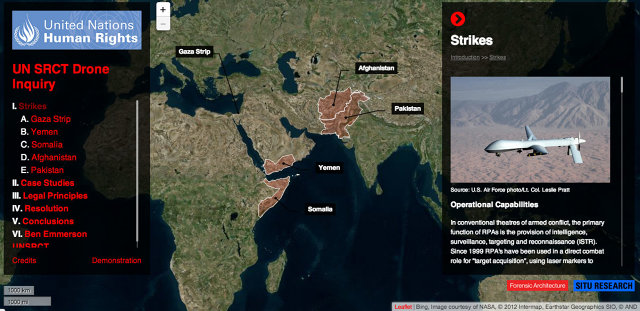
You can read more about these reconstructions here (‘The forensics of a lethal drone attack’).  This strike is one of several investigated by the UN’s Special Rapporteur Ben Emmerson, and you can find much more information at the interactive website produced in collaboration with Forensic Architecture and SITU Research that accompanies his written report to the United Nations (28 February 2014) (the Datta Khel incident is summarised in paragraph 50, but the website provides a far richer understanding).  You can also download hi-res versions of Forensic Architecture’s stills and videos here.

3027475-inline-i-un-srct-drone-inquiry

What I find so significant is that the anonymous official provided a series of different and, as I’ve said, bizarre (even offensive) descriptions of what the assembly in Datta Khel was not: but he was clearly incapable of recognising what it was.  This was certainly another performance of the space of exception, but it was plainly not a legal ‘black hole’, as some commentators gloss Agamben.  The only ‘black holes’ were the craters in the ground and the conspicuous failure to recognise the operative presence of customary law.

Death, drones and Camp Delta

When I wrote ‘The Black Flag’ (DOWNLOADS tab), exploring the idea of Guantanamo Bay as a space of exception, three young men had just committed suicide in the war prison.  This is how I started:

In the early morning of 10 June 2006 three prisoners held at the military detention facility at the US Naval Station at Guantánamo Bay, Cuba, two from Saudi Arabia and one from Yemen, were found dead in their cells. Although the three men had been detained without trial for several years and none of them had court cases or military commissions pending (none of them had even been charged), the commander of the prison dismissed their suicides as ‘not an act of desperation but an act of asymmetric warfare against us’. Although the three men had been on repeated hunger strikes which ended when they were strapped into restraint chairs and force- fed by nasal tubes, the US Deputy Assistant Secretary of State for Public Diplomacy described their deaths as ‘a Public Relations move to draw attention’ – to what, she did not say – and complained that since detainees had access to lawyers, received mail and had the ability to write to families, ‘it was hard to see why the men had not protested about their situation’. Although by presidential decree prisoners at Guantánamo are subject to indefinite detention and coercive interrogation while they are alive, when President George W. Bush learned of the three deaths he reportedly stressed the importance of treating their dead bodies ‘in a humane and culturally sensitive manner’. 

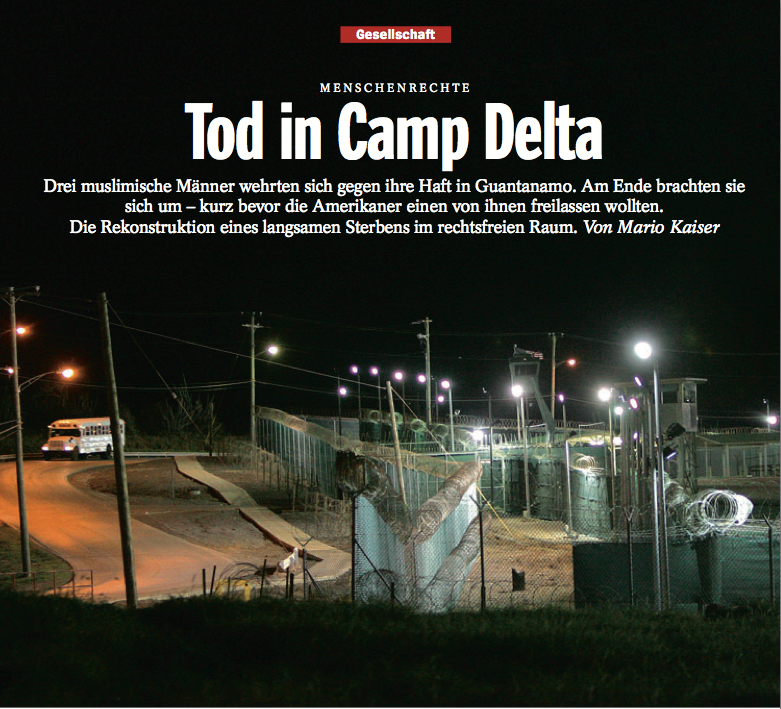
KAISER Tod in Camp Delta

After ‘The Black Flag’ was published, I read a remarkable account of the despair and desperation of these three men by Mario Kaiser.  His original essay has now been updated and translated into English as ‘Death in Camp Delta‘ at Guernica.  Here is an extract:

At some point during their captivity, these three men began to retreat. They no longer touched the food the guards pushed through the holes in the doors of their cells. Their bodies dwindled. Their lives hung on thin yellow tubes shoved down their nostrils each morning to let a nutrient fluid drip into their stomachs. In their minds, nothing changed. They didn’t want to stay, and one night, on June 9, 2006, they decided to leave Guantánamo. They climbed on top of the sinks in their cells and hanged themselves.

In the Pentagon’s view, the men hanging from the walls of their cells were assassins whose suicides were attacks on America. The Pentagon struck back.

The story of the lives and deaths of these prisoners is an odyssey of three young men who left for Afghanistan and ended up in Cuba. It is the story of a war against a terror that is difficult to define, a war that the United States government wages even in the cells of its prisoners. It is about a place, Camp Delta, that exposes the asymmetry of this war, and it leads to the front lines—and the American lawyers standing between them, struggling to defend presumed enemies of their country. It is the story of the internal and external battle over Guantánamo.

Nobody but the dead knows the whole truth. But there are places where the story can be pieced together. There are files and letters, people who distinctly remember these prisoners. There are places where the strands of this story intersect. A law firm in Washington. A mosque in London. A living room in North Carolina. A cell in Guantánamo.

This is on my mind today for three reasons.  The first is that Kaiser describes himself as

‘a writer who combines in-depth reporting with literary storytelling. Taking on issues of social transformation and human rights, Kaiser’s stories are based on long-term immersion in environments that are difficult to access. His hope is that this approach provides a fuller understanding of the ways in which policies and social change affect people’s lives and long-term prospects.’

It’s worth reflecting on those aspirations if you read his essay (which I urge you to do) because they raise important questions about the lazy distinction between ‘fact’ and ‘fiction’, and about the ability of researchers to produce and animate publics through their (our) work.  There’s something there, too, about the power (and, yes, the seductions) of story-telling: so much academic writing still seems to substitute and so privilege our own narrative (‘I did this… then I did that .. I thought this…. then I felt that’) for the stories of others.  And, as Kaiser shows in that brief extract, those stories are often multi-sited.

AGAMBEN State of exceptionThe second reason Kaiser’s work matters to me is that I’m revisiting ‘The Black Flag’ for The everywhere war (more on this later) and, partly in consequence, thinking again about spaces of exception.  I’m in Mexico this week, and I’ve been re-reading Giorgio Agamben‘s Homo sacer and The state of exception.  I was originally doing this to sharpen my arguments about the Federally Administered Tribal Areas as a space of exception for air strikes by the CIA/JSOC and the Pakistan Air Force – I’ll be talking about this in Glasgow early next month, and I’ll post the presentation slides as soon as I’ve finished – but as I’ve worked my way through these texts still wider issues have emerged.

One of the central elements of Homo sacer (and Remnants of Auschwitz – though here too the differences between the two texts are suggestive) is the deliberate exposure of bodies to death: outcasts from whom the protections of the law have been stripped so that their death is no crime.  But in The state of exception Agamben’s focus is on the genealogy of the ‘force of law’ through which this takes place: the victims are nowhere in sight.  Throughout the short text Agamben makes much of the proximity of war and, for the ’emergency’ that activates the modern state of exception, of the First World War, but war and its developing armature of (international) law is never subjected to critical scrutiny.

Yet war (and its casualties) can reveal something else about spaces of exception.  On the battlefield – and let us immediately agree with Frédéric Mégret that ‘the battlefield’ is a highly unstable conceptual constellation – soldiers are at once vectors and victims of violence.  Here the usual restrictions on killing are removed; they can kill, provided they do so ‘lawfully’, without risk of punishment (‘combatant immunity’).  The other side of the contract, of course, is that those who might kill them are not subject to  legal sanction either.

This is not what Agamben means by the state of exception, and apart from repeated references to a contemporary ‘global civil war’ (and to Guantanamo) the transnational rarely appears in his writing and international law disappears into the margins.  His thumb-nail history of the state of exception is framed by the state and its sovereign.

But for reasons that I’ll set out in a later post, the proximity of the exceptional space of  the ‘battlefield’, of war zones and killing fields, to the ultimate reductions of bare life, is far from accidental.  In fact, that’s one of the links between the three deaths in Guantanamo Bay and air strikes and targeted killings in the Federally Administered Tribal Areas of Pakistan which, as I’ll want to show, requires a radically enlarged view of spaces of exception and their historical geographies.  (In the case of the FATA, the Obama administration insists it requires a radically enlarged juridical conception of the ‘battlefield’ in time and space too).

To be continued.

(in)Humanity and drones

SATIA Spies in ArabiaThe latest issue of Humanity: an international journal of human rights, humanitarianism and development 5 (1) (2014) – see my previous post here – contains a wonderful dossier on Drones between past and present.  It includes Priya Satia, whose work I’ve admired ever since I read her wonderful Spies in Arabia: The Great War and the Cultural Foundations of Britain’s Covert Empire in the Middle East, on ‘Drones: a history from the Middle East’ (pp. 1-31), Anna Chotzen on ‘Beyond bounds: Morocco’s Rif War and the limits of international law’ (pp. 33-54: ‘From a legal standpoint, the United States’ drone offensives are eerily similar to Spain’s chemical war in Morocco a century ago’), and a Photo Esssay from Trevor Paglen (pp. 57-71), introduced by Nicholas Guilhot (pp. 55-56).

Priya’s essay is of particular interest to me, since it recovers the genealogy and, crucially, what she calls ‘the cultural history of bombardment’ that connects colonial practices of ‘air control’ to the ideologies that activate the drone strikes prosecuted by the US in Afghanistan, Pakistan and elsewhere.  She’s more sanguine about the transparency of those carried out by the USAF in Afghanistan than I am:

‘… in my conversations with military officers, it is clear how strongly the USAF wishes to distinguish its use of drones from ‘‘other agencies’ ’’ use of them, even while acknowledging that tactics are shared. The USAF’s drone strikes in Afghanistan are transparent; a JAG (judge advocate) assesses the proportionality of the action and the likelihood of collateral damage; official casualty figures line up well with independent counts.’

I now suspect it’s more than ‘tactics’ that are shared, and the lines between the USAF and the CIA are more blurred than – I agree – most military officers would wish.  And my project on ‘Militarized vision‘ is trying to identify the parameters within which the USAF’s transparency and its visual mediations operate.  But as she goes on to say, ‘However, all of this hardly matters politically, given the older and more recent history of aerial counterinsurgency in these regions.’  And she provides a rich and compelling account of that history and its traces in present memories and (para)military practices.

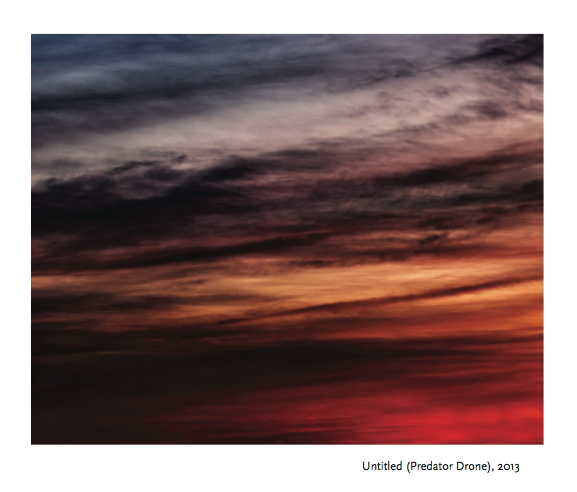
PAGLEN Untitled (Predator drone) 2013

More dirty dancing

As I work on turning my Beirut talk on drone strikes in the Federally Administered Tribal Areas (FATA) into a long-form version – which includes a detailed and critical engagement with Giorgio Agamben‘s characterisation of the state/space of exception – I’ll post some of the key arguments here.  But for now, two important developments.

Document-excerpt

First, the Bureau of Investigative Journalism has just published a list of 330 drone strikes  between 2006 and July 2013 (data for the five strikes that took place in 2007 are missing) compiled by the Pakistan government (see extract above); this is an update of a partial release from the Bureau last summer.  The source is a series of reports filed each evening by Political Agents in the field to the FATA secretariat, and while it’s not a comprehensive listing – and Islamabad relies on other sources too – the document closely follows the Bureau’s own database compiled from other independent sources.  It also allows for a more accurate mapping of the strikes – more to come on this.

But one key difference between the list and the Bureau’s database is that, following the election of Obama, the official reports no longer attempted to classify the victims as combatants or civilians: and the coincidence may not be coincidental.  According to Chris Woods,

‘One of my sources, a former Pakistani minister, has indicated that local officials may have come under pressure to play down drone civilian deaths following the election of Barack Obama. It’s certainly of concern that almost all mention of non-combatant casualties simply disappears from this document after 2009, despite significant evidence to the contrary.’

One of the most egregious omissions is the drone strike on 24 October 2012 that killed Mamana Bibi, a grandmother tending the fields with her grandchildren.  The case was documented extensively by Amnesty International and yet, as the Bureau notes, while the date and location of the strike is recorded the report from the political agent is remarkably terse and makes nothing of her evident civilian status.

‘If a case as well-documented as Mamana Bibi’s isn’t recorded as a civilian death, that raises questions about whether any state records of these strikes can be seen as reliable, beyond the most basic information,’ said Mustafa Qadri, a researcher for Amnesty International…. ‘It also raises questions of complicity on the part of the Pakistan state – has there been a decision to stop recording civilians deaths?’

These are important questions, and in fact one of the central objectives of my own essay is to document the close, covert co-operation between the US and Pakistani authorities: what I called, in an earlier post, dirty dancing, trading partly on Jeremy Scahill’s inventory of ‘dirty wars’ and partly on Joshua Foust‘s calling out of the ‘Islamabad drone dance’.

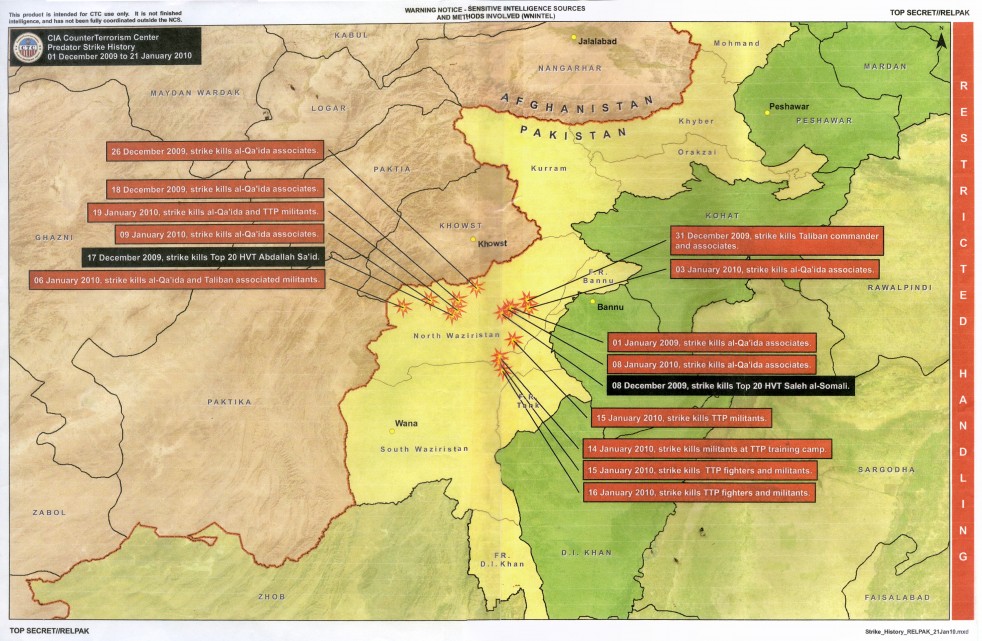
We now know that this collaboration continued at the very least until late 2011.  The CIA’s Counterterrorism Center routinely prepared reports that included maps (see below) and pre- and post-strike imagery that were briefed by the Deputy Director to Husain Haqqani, the Pakistani ambassador in Washington, and subsequently transmitted to Islamabad.

US_Pakistan_Panorama21382550661-1

And consistent with the reports from Political Agents to the FATA Secretariat, Greg Miller and Bob Woodward note that in these briefings:

Although often uncertain about the identities of its targets, the CIA expresses remarkable confidence in its accuracy, repeatedly ruling out the possibility that any civilians were killed.  One table estimates that as many as 152 “combatants” were killed and 26 were injured during the first six months of 2011. Lengthy columns with spaces to record civilian deaths or injuries contain nothing but zeroes.

The collaboration is important, because it has major implications for how one thinks about the Federally Administered Tribal Areas as a ‘space of exception’: there are multiple legal regimes through which the people who live in these borderlands are knowingly and deliberately ‘exposed to death’, as Agamben would have it.  More on this later, but for now there is a second, more substantive point to be sharpened.

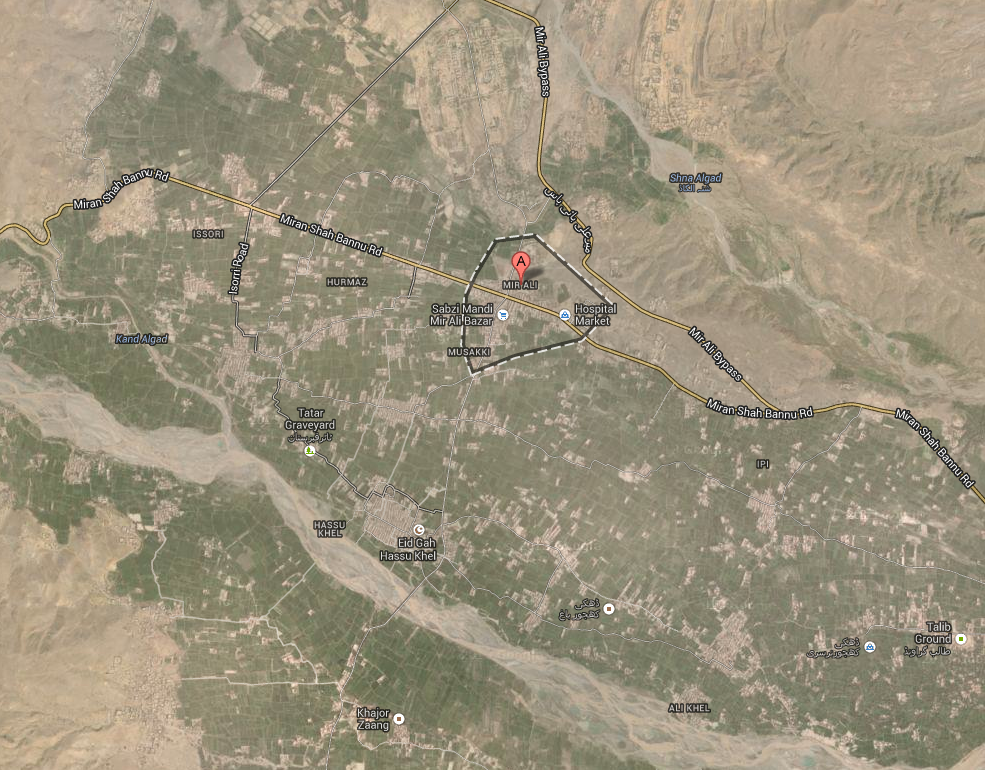
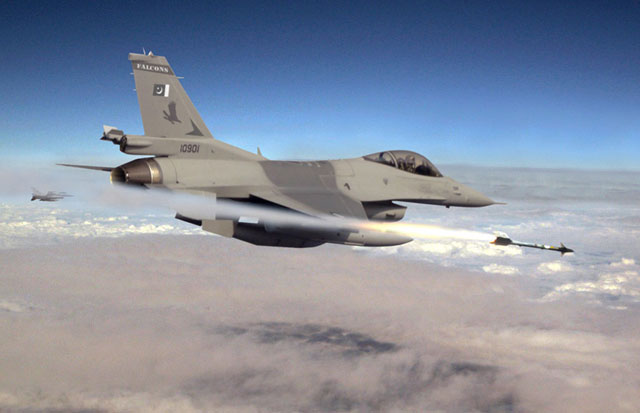
I’ve previously emphasised that the people of FATA are not only ‘living under drones‘, as the Stanford/NYU legal team put it last year, but also under the threat of air strikes from the Pakistan Air Force.  Last week the PAF resumed air strikes against leaders of the Tehrik-i-Taliban Pakistan (TTP) in North Waziristan, using first F-16 aircraft and then helicopter gunships to attack what were described as ‘eight major targets’ in the villages of Mir Ali (Hamzoni, Issori, Khadi and Nawana). Although the Air Force described the operation as a ‘blitz’, it initially claimed that only two people were killed.  A different story soon emerged.

MIR ALI

According to Pakistan’s International News, the air raids started just before midnight on 20 January, and people ‘left their homes in desperation and spent the night in the open along with children when the jets started bombing.’

There were conflicting reports about the identity of those killed. Military authorities said all the 40 people killed in the overnight aerial strikes were hardcore militants or their relatives and family members.

However, tribesmen in Mir Ali subdivision insisted that some local villagers, including women, children and elderly people, were also killed in the bombing by the PAF’s fighter aircraft and Pakistan Army’s helicopter gunships as residential areas were attacked.

848700893_1390366252

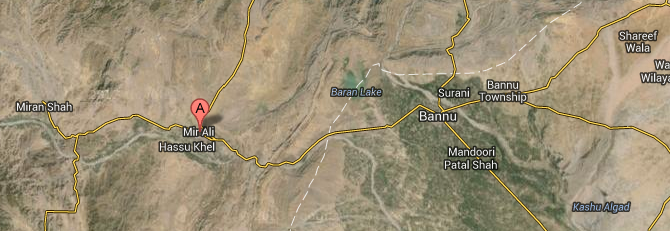
Several days later there were reports of hundreds – even thousands – of people fleeing the area in anticipation of continuing and intensifying military operations.  On 25 January the Express Tribune reported:

“Most of the families of Mir Ali Bazaar and adjacent areas have been leaving,” Abdullah Wazir, a resident of Spin Wam told The Express Tribune, adding, “women and children have been leaving with household materials, but livestock and larger items of belongings are being abandoned by these families.”

“It is difficult to find shelter in Bannu,” said Janath Noor, aged 38, who travelled there with her family. “There are problems at home and here in Bannu too.” She added that the families were forced to act independently as the political administrations in North Waziristan and Bannu have not made arrangements for the fleeing families. Some families reportedly spent the night under the open sky in Bannu town, waiting for any available shelter.

Some IDPs have also faced problems such as harassment at the hands of the police, requests for bribes, soaring rates of transport from Mir Ali and inflated rents for houses in Bannu. Some families, suspected of being militants, have had problems finding accommodation in Bannu district.

Mir Ali:Bannu

By 27 January the government estimated that 8,000 people had arrived in Bannu, while many others unable to find shelter and unwilling to sleep in the open had hone on to Peshawar and elsewhere.  But the head of the FATA Disaster Management Authority declared that ‘No military operation has been announced in the tribal area so there are no instructions to make arrangements for the internally displaced people.’

Most local people were clearly sceptical about that and, certainly, there were authoritative claims that Pakistan was being put ‘on a war footing’ to counter the surging power of the TTP.  In the same week that the air strikes were launched, Islamabad promulgated an amended Protection of Pakistan Ordinance (PPO), modelled on the imperial Rowlatt Act of 1919, that included provisions for secret courts, greater shoot-to-kill license for the police, house raids without warrants and the detention of terror suspects without charge. Rana Sanaullah, Minister for Law, Parliamentary Affairs and Public Prosecution in the Punjab and a close confidant of Prime Minister Nawaz Sharif, told the Guardian: ‘I think what will be done will be no worse than what has happened in Guantánamo Bay.’  Not surprisingly, he also offered support for the US drone strikes:

‘We believe that drone attacks damage the terrorists, very much… Inside, everyone believes that drone attacks are good; but outside, everyone condemn because the drones are American.’

And, as I’ll try to show in a later post, it’s a different inside/outside indistinction that plays a vital role in producing the FATA as a space of exception.

Unseen war

I’m off to Beirut in early January for CASAR’s conference on Transnational American Studies, where I’ll be talking about CIA-directed drone strikes in the Federally Administered Tribal Areas.  Even though Judith Butler had to cancel, it’s still an excellent program, including Paul Amar, Lisa Bhungalia, Brian Edwards, Keith Feldman, Waleed Hazbun, Craig Jones, Amy Kaplan, Laleh Khalileh, Vijay Prashad, Jeremy Scahill (and a screening of Dirty Wars), and an evening performance of Robert Myers‘s drone play, Unmanned.

I have about a week to get my own act together, so it’s welcome news that the Tactical Technology Collective has released a series of short films, Exposing the Invisible, the most recent of which – Unseen War – focuses on the FATA.

Unseen war

There are also transcripts of the full interviews that make up the 7 ‘chapters’  of the film: Sadaf Baig from the Centre for International Media Ethics (CIME) at the London School of Economics; Taha Siddiqui, an independent journalist in Islamabad; Safdar DawarAlice Ross from the Bureau of Investigative Journalism; Noortje Marres from Goldsmiths, University of London; and James Bridle (who needs no introduction for readers of this blog).

Sadaf and Safdar are both very informative about FATA, and James provides an excellent introduction to his stream of work on drones.

Theory of the drone 12: ‘Killing well’?

This is the 12th in a series of extended posts on Grégoire Chamayou‘s Théorie du drone and covers the final chapter in Part III: Necro-ethics, called ‘Précisions’; in French the singular means accuracy, as you might expect, but the plural means ‘details’ – which is, of course, where the devil is to be found…

One of the most common claims advanced by those who defend the use of armed drones is that they reduce ‘collateral damage’ because they are so precise.  Following directly from his previous critique of Bradley Jay Strawser, Chamayou cites him again here: ‘Drones, for all their current and potential misuse, have the potential for tremendous moral improvement over the aerial bombardments of earlier eras.’  But he dismisses this as a misleading comparison: if Dresden or Hiroshima are taken as the yardstick against which accuracy is to be measured – or, for that matter, as the standard against which military ethics are to be judged – then virtually any subsequent military operation would pass both tests with flying colours.

The comparison confuses form with function.  Compared to Lancaster bombers and Flying Fortresses (even with their famous Norden bombsights: for Malcolm Gladwell on the ‘moral importance’ of the bombsight to Norden, a committed Christian, see here and here; for more on the bombsight, see here), the Predator and the Reaper are evidently more accurate.  But Chamayou insists that the real comparison ought to be with other tactical means currently available to achieve the same objective.
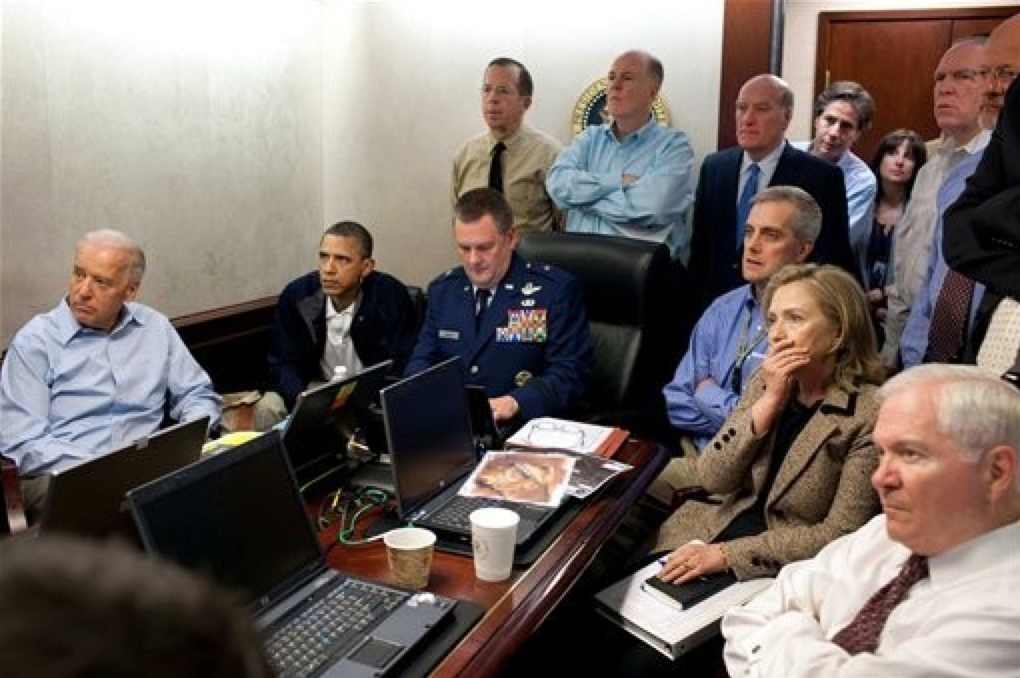
Situation Room

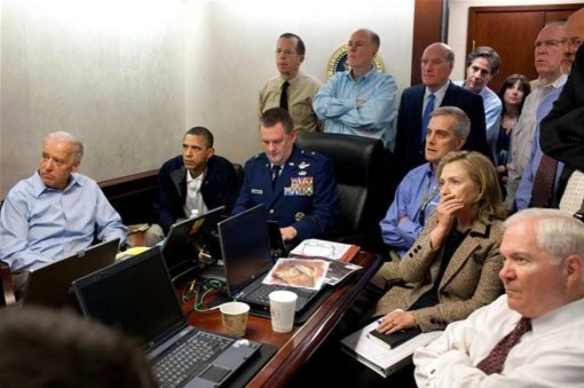
In the kill/capture raid against Osama Bin Laden on 1 May 2011 (assuming ‘capture’ was ever on the agenda), he argues that the choice was between drones and Special Forces not between drones and re-staging Dresden in Abbotabad.  This doesn’t quite work, since the raid was carried out by US Navy Seals who swept in from Bagram via Jalalabad by helicopter, but the mission also depended on real-time imagery from an RQ-170 stealth drone (‘the Beast of Kandahar’).  This was the source of the live video feed watched by Obama and members of his administration in the famous ‘Situation Room’ photograph [on which, see Keith Feldman on ‘Empire’s Verticality’ in Comparative American Studies 9 (4) (2011) 325-41].

The RQ-170 is an unarmed platform, but its role should remind us that drones are part of networked warfare – even when strikes are carried out by other means, the enhanced intelligence, surveillance and reconnaissance capabilities provided by the long dwell-times of these remote platforms mean that they are instrumental in the activation of the kill-chain.  This holds for military operations far beyond targeted killing: in Afghanistan between 2009 and 2011 drones were directly responsible for only 5-6 per cent of weapons released by the US Air Force, but they no doubt played a vital role in the release of many of the others.
Night raidStill, Chamayou’s basic point is a sharp one – and I rehearsed similar arguments in my discussion of The politics of drone wars last year – but readers of Jeremy Scahill‘s Dirty Wars may still reasonably object that the civilian casualties resulting from JSOC’s infamous night raids in Afghanistan cast doubt on the precision and accuracy of ground forces too.  Gareth Porter has estimated that more than 1,500 civilians were killed in night raids in just ten months in 2010-11, making them ‘by far the largest cause of civilian casualties in the war in Afghanistan.’  Indeed, Afghan protests have frequently centred on the civilian toll exacted by drones and night raids.

Even if the appropriate comparison is between different modalities of military violence in the present, Chamayou argues that the discussion is bedevilled by another series of confusions about ‘accuracy’ or ‘precision’.   In fact, though he doesn’t say so, the the two terms aren’t interchangeable. Strictly speaking,  accuracy refers to the deviation from the aiming point, precision to the dispersion of the strike:
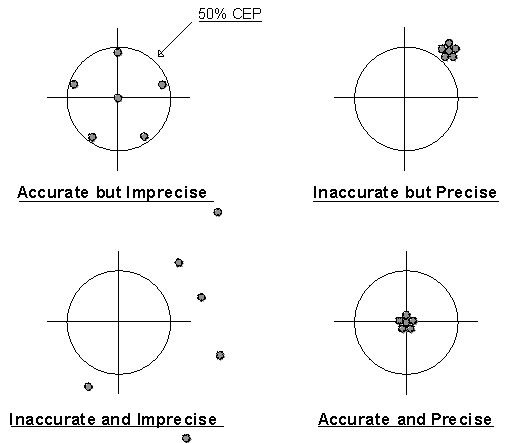
Accuracy and precision

CEP in the diagram above refers to the Circular Error Probable, once described by the Pentagon as ‘an indicator of the delivery accuracy of a weapon system’, which is a circle of radius n described around the aiming point.  Assuming a bivariate normal distribution, then – all other things being equal (which they rarely are) – 50% of the time a bomb, missile or round will land within the circle: which of course means that the other half of the time it won’t, even under ideal experimental conditions.  As this is a normal distribution, then 93 per cent should land within 2n and more than 99 per cent within 3n.

Chamayou doesn’t refer to the CEP directly, only briefly to the ‘accuracy of fire’,  but – to revert to the comparison he refuses – the CEP of bombing from the air has contracted dramatically since the Second World War when it was around 3,000 feet (though this improved over time): so much so that David Deptula, when he was USAF Deputy Chief of Staff for ISR, used to talk of crossing a ‘cultural divide of precision and information’.  The image below, taken from one of his presentations, shows the contraction (notice that the aim point is the Pentagon….).
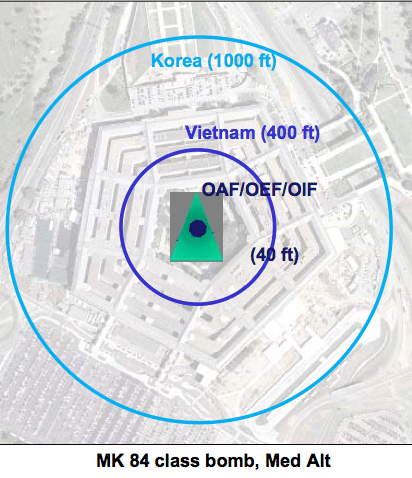
Target mensuration (USAF)

Interestingly, the most recent Joint Publication (3-60) from the Joint Chiefs of Staff on Targeting (January 2013) has explicitly removed the concept from its Terms and Definitions, citing as its authority the Department of Defense’s Dictionary of Military and Associated Terms (it was still there on 31 January 2011, but no longer).  I haven’t been able to discover the reasons for the change, though there is longstanding scepticism about the validity of the measure: see, for a specific example, Donald MacKenzie‘s classic discussion in Inventing accuracy: a historical sociology of nuclear missile guidance (1993, pp. 352-7).  I’ve seen several comments to the effect that the measure isn’t useful for ‘smart bombs’ because they don’t display the same spread as ‘dumb bombs’.  (There’s a quick primer on the emergence of smart bombs during the Vietnam War here, and an account of the evolution of ‘precision strike’ since then here; for more detail, try David Koplow‘s Death by moderation: the US military’s quest for useable weapons (2009)).

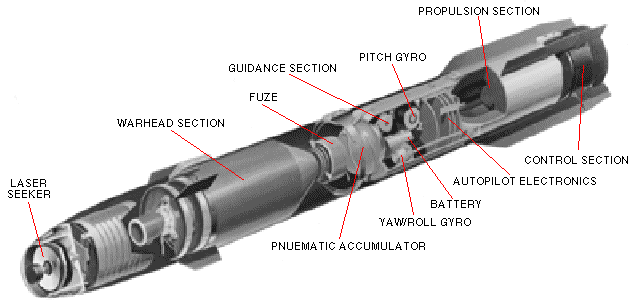
The MQ-1 Predator carries two AGM-114 Hellfire missiles [shown below, top; for acronyphiles, AGM designates an Air-to-Ground Missile, while the ‘Hellfire’ was originally developed as a ‘Helicopter-Launched Fire-and-Forget Missile’; its main platform is still an attack helicopter], while the MQ-9 Reaper can carry four AGM-114 Hellfire Missiles or replace two of them with GBU-12 Paveway II bombs [GBU = Guided Bomb Unit; shown below, bottom].
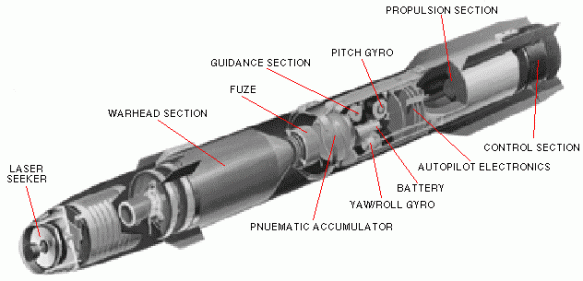

hellfire

GBU-12_xxl

Both weapons systems are laser-guided; the sensor operator, sitting beside the pilot in the Ground Control Station, uses a laser targeting marker (LTM) to ‘paint’ the target – this can also be done by ground troops in conventional combat zones – but its accuracy can be compromised by cloud, smoke, fog or dust.  (This is why the Air Force also uses GPS-guided weapons; they are less accurate but unaffected by these environmental conditions).  Once the necessary clearances have been obtained from mission commanders and military lawyers, the pilot fires the missile and the sensor operator guides it on to its target.

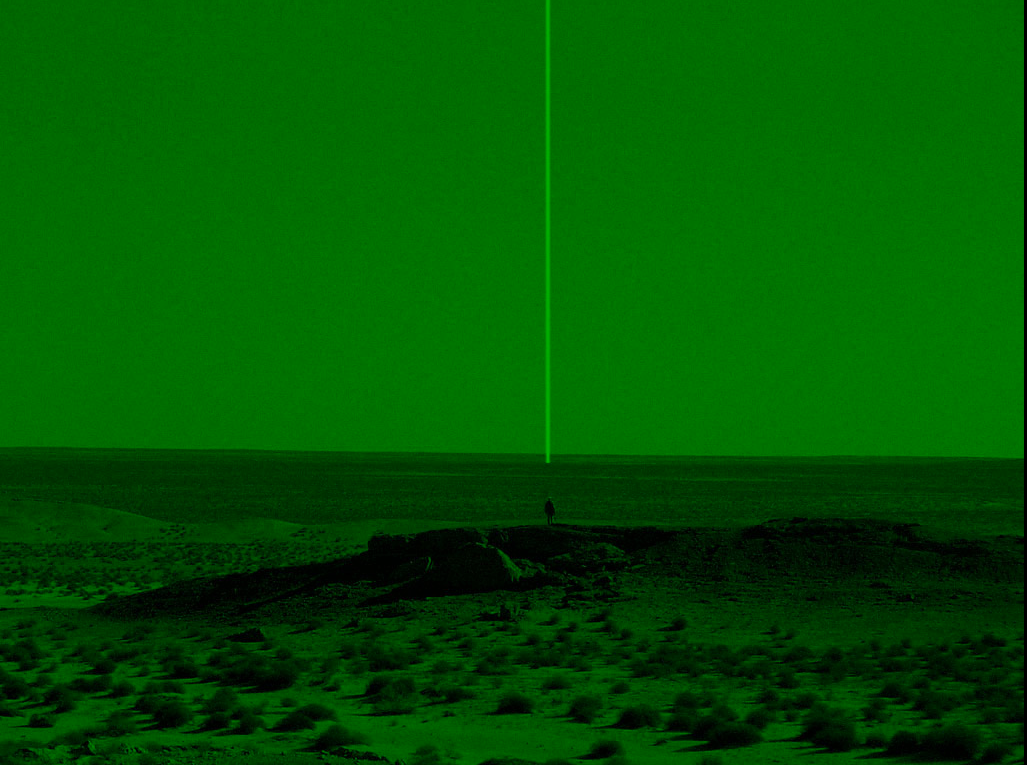
Omer Fast‘s interview with a sensor operator (‘Brandon’ –  whether this is a pseudonym or really Brandon Bryant is hard to know) for 5,000 Feet is the Best provides a series of insights into the operation in Afghanistan and Iraq.  You can’t see the beam with the naked eye, but American ground troops can see it with their infrared goggles.  According to ‘Brandon’, they call it the ‘Light of God’ (really); the image below is James Bridle‘s replication of the effect based on laser targeting night systems and a CC-licensed photograph of the Iraqi desert by Rob Bakker.
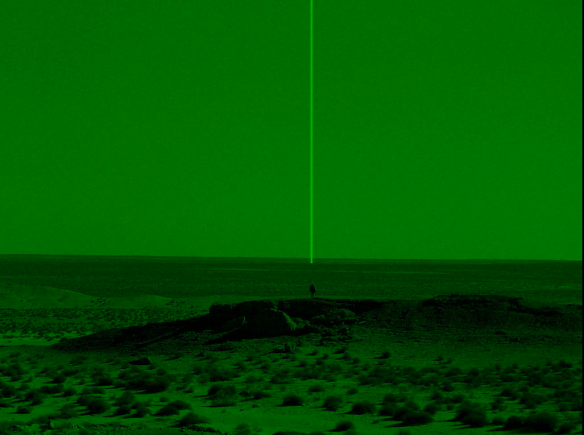
JAMES BRIDLE Light of God

‘Brandon’:

‘Usually the laser track is about half the size of this [hotel] room.  Poof!  By the time it hits the ground… a lot of times it turns into a square for some reason…  It could be anywhere from ten feet by ten feet to twenty feet by twenty feet… It starts off small and you watch it kind of open up’

This is not exactly putting ‘warheads on foreheads‘, but ‘Brandon’ explains that the crew is also required to identify a secondary ‘abort’ target.

‘… some of the contingencies we have to worry about are: if we’re firing at a building and somebody crosses – maybe – who knows, a group of children starts crossing in front of the building, we need a second site once that missile is already off the rails.  To go ahead and drop that missile so that we don’t harm the children  So usually we’ll choose an alternate site a couple hundred feet to a couple of hundred yards away.  It might be an empty field.  And we use that as the backup…

So let’s  say we get the missile off the rail and a group of kids comes into play: I call “abort” and I’ll start moving that laser over to an empty site so that we can detonate there and not cause any additional loss of life.’

Predator and Brandon Bryant

Sounds good, but the real Brandon Bryant (above) has a different story to tell; it turns out that there is an eight-second window in which the missile can be diverted:

With seven seconds left to go, there was no one to be seen on the ground. Bryant could still have diverted the missile at that point. Then it was down to three seconds. Bryant felt as if he had to count each individual pixel on the monitor. Suddenly a child walked around the corner, he says.

Second zero was the moment in which Bryant’s digital world collided with the real one in a village between Baghlan and Mazar-e-Sharif.

Bryant saw a flash on the screen: the explosion. Parts of the building collapsed. The child had disappeared. Bryant had a sick feeling in his stomach.

“Did we just kill a kid?” he asked the man sitting next to him.

“Yeah, I guess that was a kid,” the pilot replied.

“Was that a kid?” they wrote into a chat window on the monitor.

Then, someone they didn’t know answered, someone sitting in a military command center somewhere in the world who had observed their attack. “No. That was a dog,” the person wrote.

They reviewed the scene on video. A dog on two legs?

Even then, think about that blossoming square, twenty feet by twenty feet.  Then factor in the Circular Error Probable of a Hellfire missile, which is usually calculated at between 9 and 24 feet. The ‘pinpoint’ accuracy of the missile is starting to blur and the ‘surgical’ strike beginning to blunt.  In fact, the development of the Hellfire missile suggests another narrative.  In 1991 the Pentagon was already advertising the Hellfire as capable of ‘pinpoint’ accuracy, and since then it has been upgraded more than half a dozen times, each version promising greater accuracy: as Matthew Nasuti asks in his catalogue of Hellfire errors, what can be more accurate than ‘pinpoint accurate’?

In any case, narrowing the discussion to the CEP misses two things.  First, as former USAAF officer Peter Goodrich points out in his discussion of ‘The surgical precision myth‘, this ‘totally disregards what happens after the bomb explodes’.  What Goodrich has in mind is the blast and fragmentation radius, which Chamayou calls ‘the kill radius’.  Fast’s ‘Brandon’ insists

‘All of us are taught about how far those Hellfire missiles go, how far their frag goes.  And “danger close” as we call it when you have troops that are very close or civilians that are present.  They’re just factors that  you have to work in to bring down the percentages of the harm that could be done.’

In the targeting cycle the US Air Force enters those ‘factors’ into both collateral damage estimation and ‘weaponeering’, modifying the missile or bomb to restrict its blast and fragmentation radius. Chamayou reports that the Hellfire missile has a ‘kill radius’ of 50 feet (15 metres) and a ‘wounding radius’ of 65 feet (20 metres); the GBU-12 Paveway II has a ‘casualty radius’ of between 200 and 300 feet (within which 50 per cent of people will be killed).   These calculations aren’t exactly equivalent – and it’s difficult to obtain precise and comparable figures – but nothing about this is as precise as the rhetoric  implies.  As Chamayou asks:

‘In what fictional world can killing an individual with an anti-tank missile [the Hellfire] that kills every living thing within a radius of 15 metres and wounds everyone else within a radius of 20 metres be seen as “more precise”?’

All those who are killed or wounded within the casualty radius are presumably guilty by proximity.

This is Chamayou’s second rider, which relates to what happens before the bomb or missile is released: to the production – the US military sometimes calls it the ‘prosecution’ – of the target.  In this sense, the technical considerations I’ve just described are beside the point (sic).  All of the calibrations I’ve set out in such detail apply to missiles and bombs irrespective of the platform used to deliver them; what is supposed to distinguish a Predator or a Reaper from a conventional strike aircraft or attack helicopter is that it combines ‘hunter’ and ‘killer’ in a single platform and, specifically, that its real-time full-motion video feeds enable crews (and others in the loop) to see what they are doing in unprecedented detail.
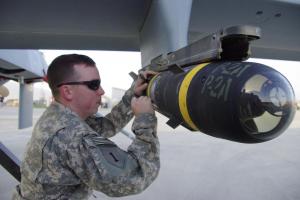
Signing a Hellfire missile attached to a MQ1-C (Gray Eagle) UAV at BagramDoes this political technology of vision make it possible, as advocates claim, to distinguish between combatants and civilians more effectively than ever before?  Here Chamayou rehearses common criticisms: that in standard US military practice ‘combatant’ morphs into ‘militant’, even ‘presumed militant’ and, at the hideous limit, into ‘military-aged male’ – counting ‘all military-age males in a strike zone as combatants … unless there is explicit intelligence posthumously proving them innocent’ – and that this process of (so to speak, performative) militantisation as Chamayou calls it is underwritten by a techno-judicial probabilisation (again his term) whose ‘epistemology of suspicion’ allows signature strikes that target un-named and unknown people on the basis of their ‘pattern of life‘.

But both these procedures and, indeed, the criticisms of them, obscure what is for Chamayou, the fundamental paradox, what he calls the ‘profound contradiction’.  International law defines a combatant and thus a legitimate target in terms of direct participation in hostilities and an imminent threat.  It’s more complicated than that, as I’ll show later, but this is enough for Chamayou to fire off two key questions: How can anyone be participating in hostilities if there is no longer any combat? How can there be any imminent threat if there are no troops on the ground?  The drone, praised for its forensic ability to distinguish between combatant and non-combatant, in fact abolishes the condition necessary for such a distinction: combat itself (p. 203; also p. 208).

It’s an artful claim, but it oversimplifies the situation.  Chamayou has (once again) confined the discussion to targeted killing but, as I’ve repeatedly emphasised, Predators and Reapers have also been used for other purposes in Iraq and Afghanistan, including the provision of ‘armed overwatch’ and close air support to ground troops.  Outside these war-zones – in the Federally Administered Tribal Areas of Pakistan, Yemen, Somalia and elsewhere – the critique is a powerful one (which is not to say that Obama’s lawyers have not claimed a legal warrant for their supposedly covert drone strikes in these areas: more on this later too).  Still, Chamayou’s argument loops back to earlier discussions about the intrinsic non-reciprocity of drone warfare.

And here Chamayou closes with a powerful argument.  If ethics is classically about how to live well and die well, he suggests that necro-ethics is a doctrine of ‘killing well’.  He notes that critics of the covert drone wars demand, time and time again, transparency.  They want to know the legal armature and adjudicative apparatus for the strikes, the rules and procedures that are followed, and the lists of casualties.  But he argues that their demands turn the issue into an arid juridico-administrative formalism endorsed by bureaucratic Reason.  In the kill zones, he says ruefully, there are no legal memoranda, no columns of numbers or ballistics reports (p. 207): these are the very formularies of necro-ethics.  And, as I’ve noted, there are no air-raid warnings, no anti-aircraft defences and no air-raid shelters either.

It’s in that spirit that Chamayou closes the chapter with an extended quotation from Madiha Tahir’s Louder than bombs‘:
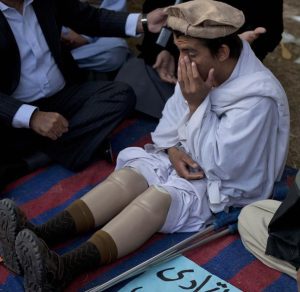
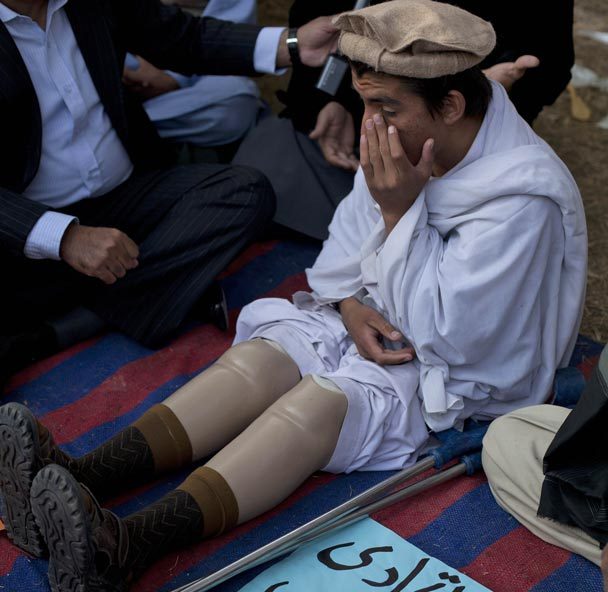
Saudallah WazirWhat is the dream?

I dream that my legs have been cut off, that my eye is missing, that I can’t do anything … Sometimes, I dream that the drone is going to attack, and I’m scared. I’m really scared.

After the interview is over, Sadaullah Wazir pulls the pant legs over the stubs of his knees till they conceal the bone-colored prostheses.

The articles published in the days following the attack on September 7, 2009, do not mention, this poker-faced, slim teenage boy who was, at the time of those stories, lying in a sparse hospital in North Waziristan, his legs smashed to a pulp by falling debris, an eye torn out by shrapnel. nor is there a single word about the three other members of his family killed: his wheelchair-bound uncle, Mautullah Jan and his cousins Sabr-ud-Din Jan and Kadaanullah Jan.  All of them were scripted out of their own story till they tumbled off the edge of the page.

Did you hear it coming?

No.

What happened?

I fainted. I was knocked out.

As Sadaullah, unconscious, was shifted to a more serviceable hospital in Peshawar where his shattered legs would be amputated, the media announced that, in all likelihood, a senior al-Qaeda commander, Ilyas Kashmiri, had been killed in the attack. The claim would turn out to be spurious, the first of three times when Kashmiri would be reported killed.

Sadaullah and his relatives, meanwhile, were buried under a debris of words: “militant,” “lawless,” “counterterrorism,” “compound,” (a frigid term for a home). Move along, the American media told its audience, nothing to see here.

Some 15 days later, after the world had forgotten, Sadaullah awoke to a nightmare.

Do you recall the first time you realized your legs were not there?

I was in bed, and I was wrapped in bandages. I tried to move them, but I couldn’t, so I asked, “Did you cut off my legs?” They said no, but I kind of knew.

When you ask Sadaullah or Karim or S. Hussein and others like them what they want, they do not say “transparency and accountability.” They say they want the killing to stop. They want to stop dying. They want to stop going to funerals — and being bombed even as they mourn. Transparency and accountability, for them, are abstract problems that have little to do with the concrete fact of regular, systematic death.’

And Madiha adds this: ‘The technologies to kill them move faster than the bureaucracies that would keep more of them alive: a Hellfire missile moves at a thousand miles per hour; transparency and accountability do not.’

Indeed they don’t; Sadaullah died last year, Mirza Shahzad Akbar reports, ‘without receiving justice or even an apology.’  Not even killing well, then.