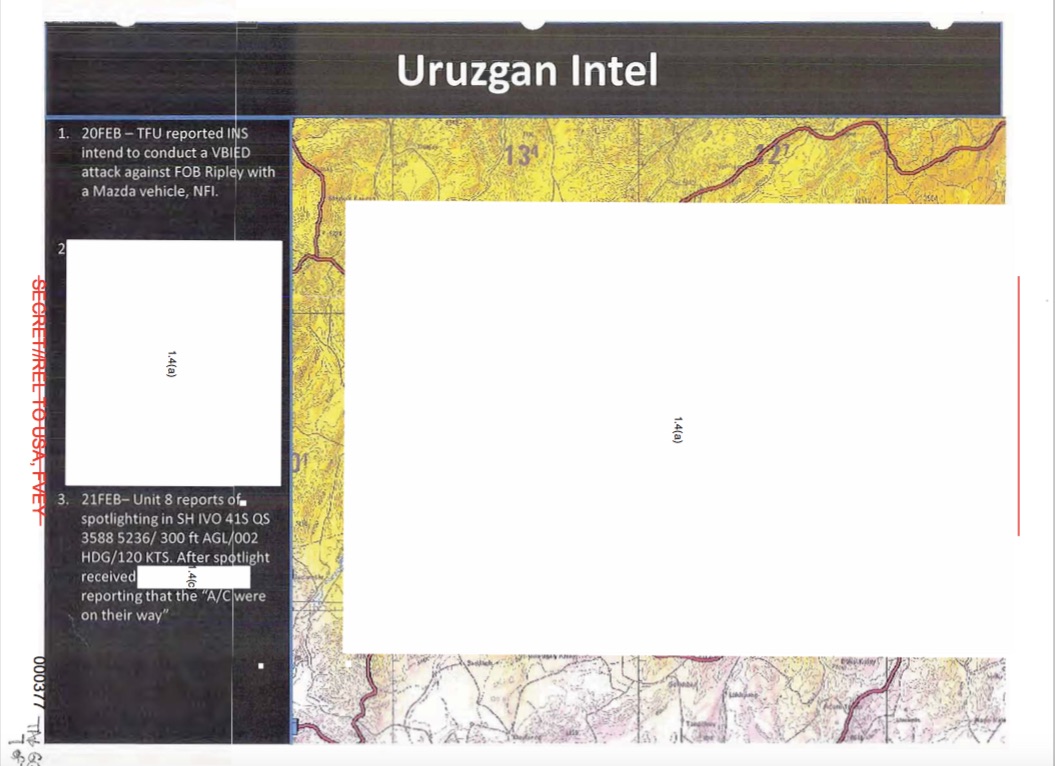
Much of my work on has had to with documents that have been heavily like this – not only text but as you can see also .
There’s a discussion of by over at here. For further discussion, I’d recommend ‘s ‘Beyond the ‘ available here (if you’re ).
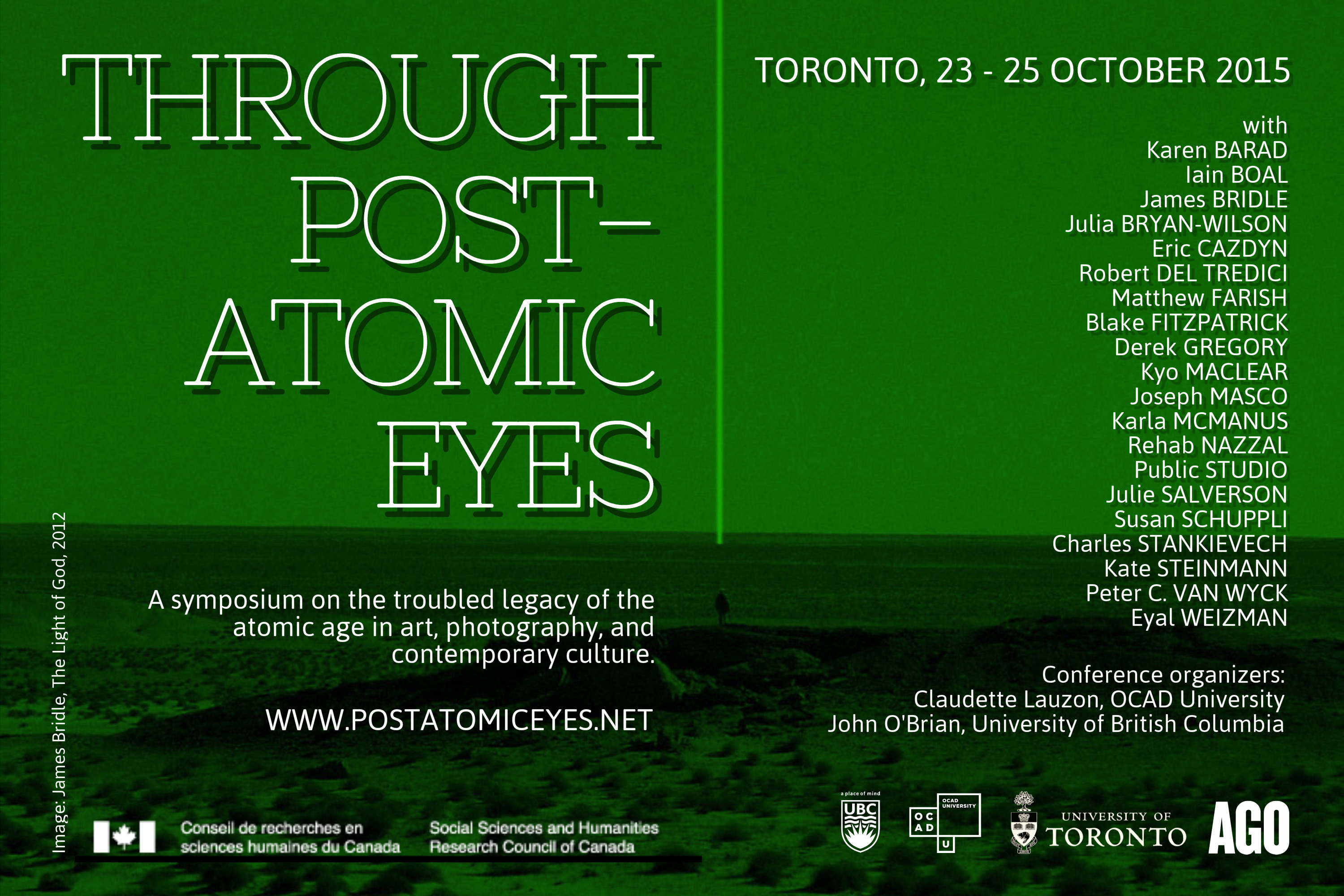
I’m speaking at a conference called “Through Post-Atomic Eyes” in Toronto next month.
Through Post-Atomic Eyes brings together an interdisciplinary group of artists and scholars to explore the complex legacy of the atomic age in contemporary art and culture. In what ways do photography and other lens-based art practices shed light on this legacy in the 21st century, and how has atomic culture shaped contemporary intersections of photography, nuclear industries, and military techno-cultures? Join us as we explore some of the most urgent issues of our time, from climate change and the Anthropocene to surveillance culture and the advent of drone warfare, through a post-atomic lens.
Through Post-Atomic Eyes is scheduled to coincide with John O’Brian’s groundbreaking exhibition, Camera Atomica, the first substantial exhibition of nuclear photography to encompass the postwar period from the bombings of Hiroshima and Nagasaki in 1945 to the meltdown at Fukushima in 2011. Now on view at the Art Gallery of Ontario (until November 15, 2015).
(John’s exhibition at the AGO follows a successful showing in London late last year: see my post here).
I confess that when I received the Toronto invitation I was at a loss: how was I supposed to view drone warfare through post-atomic eyes? At first sight, any comparison between America’s nuclear war capability and its drone strikes in Afghanistan, Iraq, Pakistan, Somalia, Syria and Yemen seems fanciful. The scale of investment, the speed and range of the delivery systems, the nature of the targets, the blast radii and precision of the munitions, and the time and space horizons of the effects are so clearly incommensurable. So I dragged my feet, accepting the invitation because the other presenters (see the poster above) include so many people whose work I admire, but not making much progress.
Eventually I realised that the root problem was that, while I had extensive research on genealogies of bombing under my belt, I knew next to nothing about The Bomb. So, while I’ve been burrowing away in the archives in London for my project on casualty evacuation 1914-2014 and also inching my “Dirty Dancing’ essay into the home straight, I’ve also been reading and reading and reading. So much wonderful, sobering material out there, some of which surfaced in my recent posts on Hiroshima and the metastases of nuclear weapons since then.
And, as I’ll try to show in detail in my next post, I’ve found a startling series of coincidences, convergences and transformations. I now have a rough shape for my presentation, which I’m calling “Little Boys and Blue Skies“: a title which, as you’ll soon see, traces an arc from bombing Hiroshima to bombing Waziristan. Watch this space.
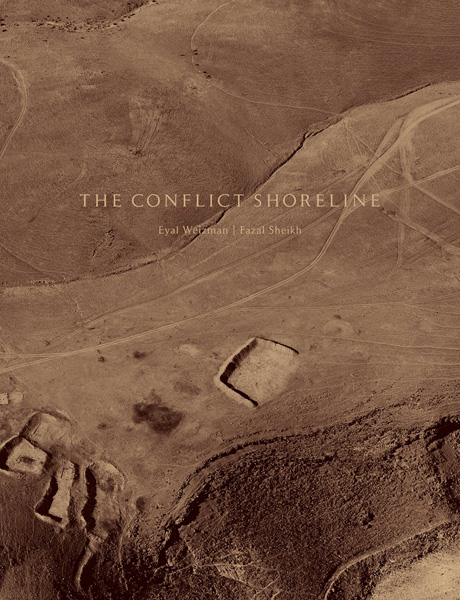
When Eyal Weizman was in Vancouver last March – joining us for Gaston Gordillo‘s workshop on Space, materiality and violence at the Peter Wall Institute for Advanced Studies – he delivered a public lecture on The Conflict Shoreline: Colonialism as Climate Change.
It’s now available as an extended essay (96 pp) from Steidl in association with Cabinet Books:
The village of al-‘Araqib has been destroyed and rebuilt more than seventy times in the “battle over the Negev,” an ongoing Israeli state campaign to uproot the Bedouins from the northern threshold of the desert. Unlike other frontiers fought over during the Israel–Palestine conflict, however, this threshold is not demarcated by fences and walls but advances and recedes in response to cultivation, colonization, displacement, urbanization, and climate change.
The fate of al-‘Araqib, like that of other Bedouin villages along the desert’s threshold, its “aridity line,” is bound up with deep environmental changes. But whereas even the most committed environmentalists today conceive of climate change as an accidental and unintentional side effect of modernity, Israeli architect and theorist Eyal Weizman argues that from the point of view of colonial history, climate change has never been simply collateral damage. It has always been a stated goal; “making the desert bloom” is, in effect, “changing the climate.”
In examining this history, Weizman outlines attempts—from the Ottoman era through the period of European colonization to the present—to scientifically define, measure, and map the threshold of the desert. Such efforts have been important because imperial and, later, national governments—whose laws have never recognized property rights in the desert—aimed to push back this threshold as they tried to expand the limits of arable land and bring the nomads under state control. In the Negev, the displacement of the weather and the displacement of the Bedouins have gone hand in hand. But while the desert edge, and the Bedouins, have been driven further and further south, global climate change today acts as a major counterforce. Predictably, the Bedouins are caught in the middle.
Brilliantly researched and argued, Weizman’s text—part detective story, part history lesson, and part scientific analysis—explores the changing threshold of the Negev through the extraordinary contemporary photographs of American artist Fazal Sheikh, as well as an array of documents, maps, and images, including historical aerial imagery, remote sensing data, state plans, court testimonies, and nineteenth-century travelers’ accounts. Together, these disparate forms of evidence establish the “conflict shoreline” as a border along which climate change and political contestation are deeply, perilously entangled.
You can find some of the background, and the relation to Eyal’s Forensic Architecture project, in an interview earlier this year:
I’m mostly trying to establish forensic architecture as a critical field of practice and as an agency that produce and disseminate evidence about war crimes in urban context. Recent forensic investigations in Guatemala and in the Israeli Negev involved the intersection of violence and environmental transformations, even climate change. For trials and truth commissions, we analyze the extent to which environmental transformation intersect with conflict.
The imaging of this previously invisible types of violence—‘environmental violence’ such as land degradation, the destruction of fields and forests (in the tropics), pollution and water diversion, and also long term processes of desertification—we use as new type of evidence of processes dispersed across time and space. There are other conflicts that unfold in relation to climatic and environmental transformations and in particular in relation to environmental scarcity.
Conflict has reciprocal interaction with environment transformation: environmental change could aggravate conflict, while conflict tends to generate further environmental damage. This has been apparent in Darfur, Sudan where the conflict was aggravated by increased competition over arable due to local land erosion and desertification. War and insurgency have occurred along Sahel—Arabic for ‘shoreline’—on the southern threshold of the Sahara Desert, which is only ebbing as million of hectares of former arable land turn to desert. In past decades, conflicts have broken out in most countries from East to West Africa, along this shoreline: Eritrea, Ethiopia, Somalia, Sudan, Chad, Niger, Mali, Mauritania, and Senegal. In 2011 in the city of Daraa, farmers’ protests, borne out of an extended cycle of droughts, marked the beginning of the Syrian civil war. Similar processes took place in the eastern outskirts of Damascus, Homs, al-Raqqah and along the threshold of the great Syrian and Northern Iraqi Deserts. These transformations impact upon cities, themselves a set of entangled natural/man-made environments. The conflict and hardships along desertification bands compel dispossessed farmers to embark upon increasingly perilous paths of migrations, leading to fast urbanization at the growing outskirts of the cities and slams.
I’m trying to understand these processes across desert thresholds. There has been a very long colonial debate about what is the line beyond which the desert begins. Most commonly it was defined as 200 mm rain per annum. Cartographers were trying to draw it, as it represented, to a certain extent, the limit of imperial control. From this line on, most policing was done through bombing of tribal areas from the air. Since the beginning, the emergence of the use of air power in policing in the post World War I period—aerial control, aerial government—took form in places that were perceived, at the time, as lying beyond the thresholds or edges of the law. The British policing of Iraq, the French in Syria, and Algeria, the Italians in Libya are examples where control would hover in air.
Up to now I was writing about borders that were physical and manmade: walls in the West Bank or Gaza and the siege around it—most notably in Hollow Land (2007). Now I started to write about borders that are made by the interaction of people and the environment—like the desert line—which is not less violent and brutal. The colonial history of Palestine has been an attempt to push the line of the desert south, trying to make it green or bloom—this is in Ben Gurion’s terms—but the origins of this statement are earlier and making the desert green and pushing the line of the desert was also Mussolini’s stated aim. On the other hand, climate change is now pushing that line north.
Following not geopolitical but meteorological borders, helps me cut across a big epistemological problem that confines the writing in international relations or geopolitics within the borders organize your writing. Braudel is an inspiration but, for him, the environment of the Mediterranean is basically cyclically fixed. The problem with geographical determinism is that it takes nature as a given, cyclical, milieu which then affects politics—but I think we are now in a period where politics affects nature in the same way in which nature affects politics. The climate is changing in the same speed as human history.

The conflict shoreline was originally commissioned in response to Fazal Sheikh’s Desert Bloom series (part of his remarkable Erasure trilogy: see image stream above, and also here).
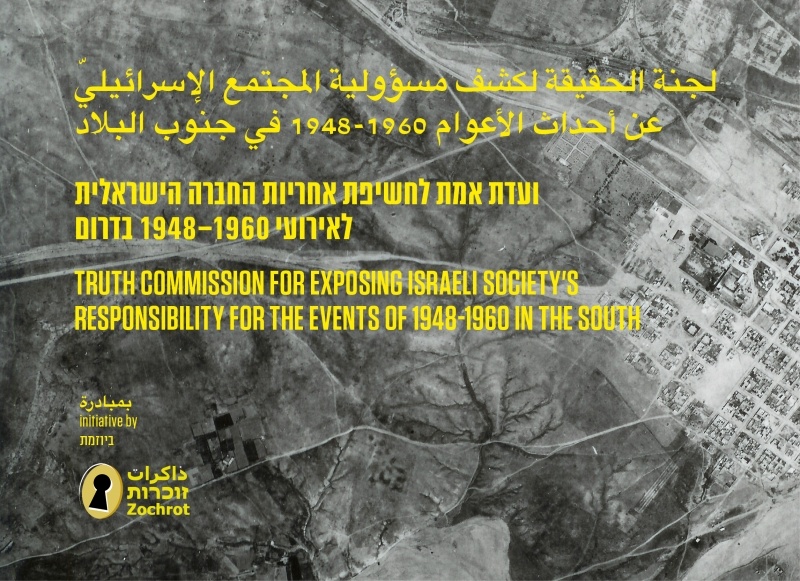
It has also been submitted as evidence for Zochrot‘s project on transitional justice, the Truth Commission on the responsibility of Israeli society for the events of 1948–1960 in the South.
Transitional justice mechanisms address the needs of communities and countries in conflict to cope with systematic abuses and structural injustices in order to facilitate reconciliation. Communities in conflict, both victims and victimizers, have developed a variety of innovative approaches to addressing the needs that result from ongoing conflicts. Hitherto, practices informed by the transitional justice paradigm have been used mainly to accompany and heal societies and communities in political transitions such as from totalitarian to democratic rule, or from an apartheid regime as in South Africa to an egalitarian democratic regime. Usually, these practices have been applied after a violent conflict had ended in a peace agreement, as in the former Yugoslavia, or in an armistice, as in Cyprus or Northern Ireland.
Many activists around the world have demonstrated time and again that silencing and ignoring the past prevent conflict resolution and the attainment of true reconciliation. Therefore, even in situations of seemingly intractable conflicts, several initiatives by civil society organizations, trade union or social religious organizations similar to state-sponsored mechanisms of transitional justice have sprung around the world. For the past 40 years, these initiatives have acted without government backing to bring resolve violent conflicts.
The Truth Commission established by Zochrot now joins these initiatives. The first of its kind in Israel/Palestine, the Commission is unique in that … it is active while the conflict is still ongoing, and against the background of the regime’s evasion of responsibility to the events of the Nakba, which began in 1948 and is still ongoing [the Nakba or ‘catastrophe’ refers to the forced eviction and dispossession of the Palestinian people set in motion by the war of 1948]. The Truth Commission for Exposing Israeli Society’s Responsibility for the Events of 1948-1960 in the South which started its deliberations in late October 2014…
The Commission seeks to expose the events of the Nakba during those years – events that have profound implications for the ongoing Nakba experienced by the Palestinian Bedouins to this day. The Commission examines testimonies by Palestinian displaced persons and refugees, as well as Jews who lived in the south and Jewish fighters who took part in displacement and expulsion operations in the area. In addition, the Commission peruses relevant archive materials. The Commission’s report will be designed to encourage the Jewish society in Israel to accept responsibility for past injustices in the south, with reference to the ongoing Nakba, and for redressing them.
You can also read Tom Pessah‘s report for +972 here.

Two short, accessible essays on bombing that appeared in the New York Times recently; they resonate with my work on the genealogies and geographies of aerial violence, and they are both beautifully composed and immensely suggestive.
First, Teju Cole on ‘The Unquiet Sky‘:
A view from a great height is irresistible. It is twinned with the ancient dream of flight. For millenniums, we have imaginatively soared above our material circumstances and dramatized this desire in tales from Icarus to Superman. Things look different from way up there. What was invisible before becomes visible: how one part of the landscape relates to another, how nature and infrastructure unfold. But with the acquisition of this panoptic view comes the loss of much that could be seen at close range. The face of the beloved is but one invisible detail among many.
The essay closes with a reflection on two aerial photographic projects, the collection of drone-shot images exhibited at Dronestagram and James Bridle‘s reconstruction of drone-strike imagery at Dronestagram:
The two Dronestagrams, the sanguine and the melancholic, add to our ever increasing archive of possible landscapes. Imagine all those pictures stitched together into a single image. In this ideal aerial view, neither the pervasive violence nor the sometimes cloying prettiness would be visible. Conquest and sentimentality would both be irrelevant. In other words, the image might be like the ‘‘blue marble’’ photograph of Earth, taken from the Apollo 17 spacecraft in 1972. It is our world, serene and self-contained, seen in one glance. It is not a view that excites us into plans for bombing our enemies, for it includes us as well. It is a view that reminds us of how mighty we are, how fragile, how delicately connected and how beautiful.
Actually, I don’t see the ‘blue marble’ photograph in that way at all: as I argued in Geographical Imaginations, this is the global North inspecting the global South (it was, after all, shot from a NASA platform). But Teju’s penultimate sentence is key, and it intersects with thoughts suggested by the second essay.
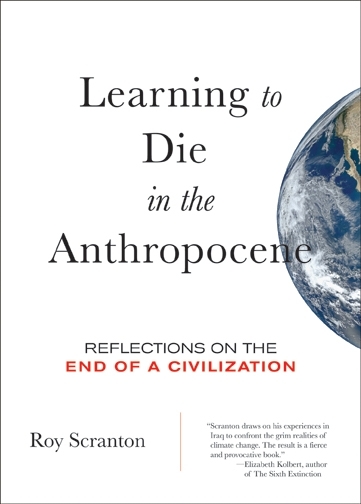 Second, then, Paul Saint-Amour‘s ‘Waiting for the bomb to drop‘. Spiralling through some of my favourite authors, Paul ends with a reflection on Roy Scranton‘s ‘Learning how to die in the Anthropocene‘ (see here and here too), which he suggests may be the equivalent of Virginia Woolf‘s ‘“Thoughts on Peace in an Air Raid” for our day’:
[I]n scaling up from one person to all humanity, we pass through a middle range — the social and political, Woolf’s home turf — where both connections and distinctions between people come into play. Yes, we are all at risk in climate change. But like our exposure to military violence, that risk is distributed unevenly. It falls disproportionately on those with the least protection from extreme weather, rising sea levels, hunger, drought, disease, displacement and the conflicts that can arise from all of these. Simply put, it falls most heavily on the poor.
With philosophy’s help, I am prepared to tell myself, “I must learn how to die.” I may even be ready to say to humanity, “We as a species must learn how to die.” But it is a different thing altogether to say to another person, “Because of how I live, or because of actions undertaken in my name, you need to learn how to die more than I do. And you must bear, more than I do, the cognitive and emotional burdens of a life lived in the shadow of imminent death.” This is what the rich are saying every day to the poor. It’s what whites in the United States and elsewhere are saying every day to people of color. It’s what citizens of drone states are saying to those a hemisphere away, under the drones.
Most readers will know Eyal Weizman‘s searing account of the cruel intersections between the politics of visibility and the politics of verticality in occupied Palestine, Hollow Land: Israel’s architecture of occupation.
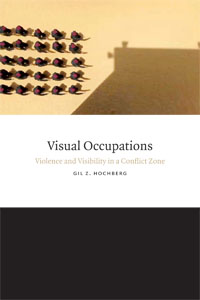
But there are other, no less intimate and intrusive dimensions to the politics of visibility for a people under military (and civilian) occupation that amount to what Gil Hochberg calls an ‘uneven distribution of “visual rights”‘. In her brilliant new book from Duke University Press, Visual occupations: violence and visibility in a conflict zone, she explores ‘the political importance of various artistic attempts to redistribute the visible’ (my emphasis) and, in effect, to put in place a counter-politics of visuality.
In Visual Occupations Gil Z. Hochberg shows how the Israeli Occupation of Palestine is driven by the unequal access to visual rights, or the right to control what can be seen, how, and from which position. Israel maintains this unequal balance by erasing the history and denying the existence of Palestinians, and by carefully concealing its own militarization. Israeli surveillance of Palestinians, combined with the militarized gaze of Israeli soldiers at places like roadside checkpoints, also serve as tools of dominance. Hochberg analyzes various works by Palestinian and Israeli artists, among them Elia Suleiman, Rula Halawani, Sharif Waked, Ari Folman, and Larry Abramson, whose films, art, and photography challenge the inequity of visual rights by altering, queering, and manipulating dominant modes of representing the conflict. These artists’ creation of new ways of seeing—such as the refusal of Palestinian filmmakers and photographers to show Palestinian suffering or the Israeli artists’ exposure of state manipulated Israeli blindness —offers a crucial gateway, Hochberg suggests, for overcoming and undoing Israel’s militarized dominance and political oppression of Palestinians.
Here’s the Contents List:
Introduction. Visual Politics at a Conflict Zone
Part I. Concealment
1. Visible Invisibility: On Ruins, Erasure, and Haunting
2. From Invisible Spectators to the Spectacle of Terror: Chronicles of a Contested CitizenshipPart II. Surveillance
3. The (Soldier’s) Gaze and the (Palestinian) Body: Power, Fantasy, and Desire in the Militarized Contact Zone
4. Visual Rights and the Prospect of Exchange: The Photographic Event Placed under DuressPart III. Witnessing
5. “Nothing to Look At”; or, “For Whom Are You Shooting?”: The Imperative to Witness and the Menace of the Global Gaze
6. Shooting War: On Witnessing One’s Failure to See (on Time)Closing Words
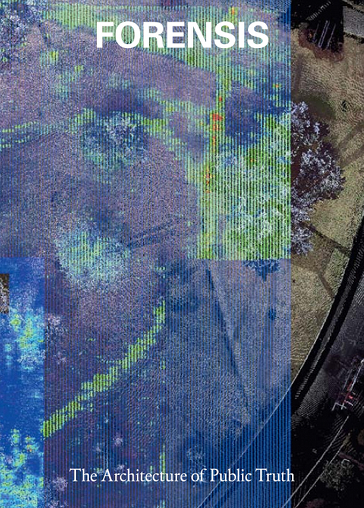 It’s a compelling book, and I’m struck by another parallel with Eyal’s work. In Hollow Land Eyal showed the central role that architecture and architects play in Israel’s illegal occupation of the West Bank, but in subsequently developing his collaborative Forensic Architecture project he effectively reverse-engineers architecture’s dominant imaginary to use built forms and spatial formations as a way of revealing prior trajectories of violence to a public forum. That too is a counter-politics of visuality.
I’ve taken this map from a Situation Report issued by the World Health Organisation on 6 May, which superimposes new cases of Ebola virus disease (EVD) over total confirmed cases throughout the epidemic in West Africa:
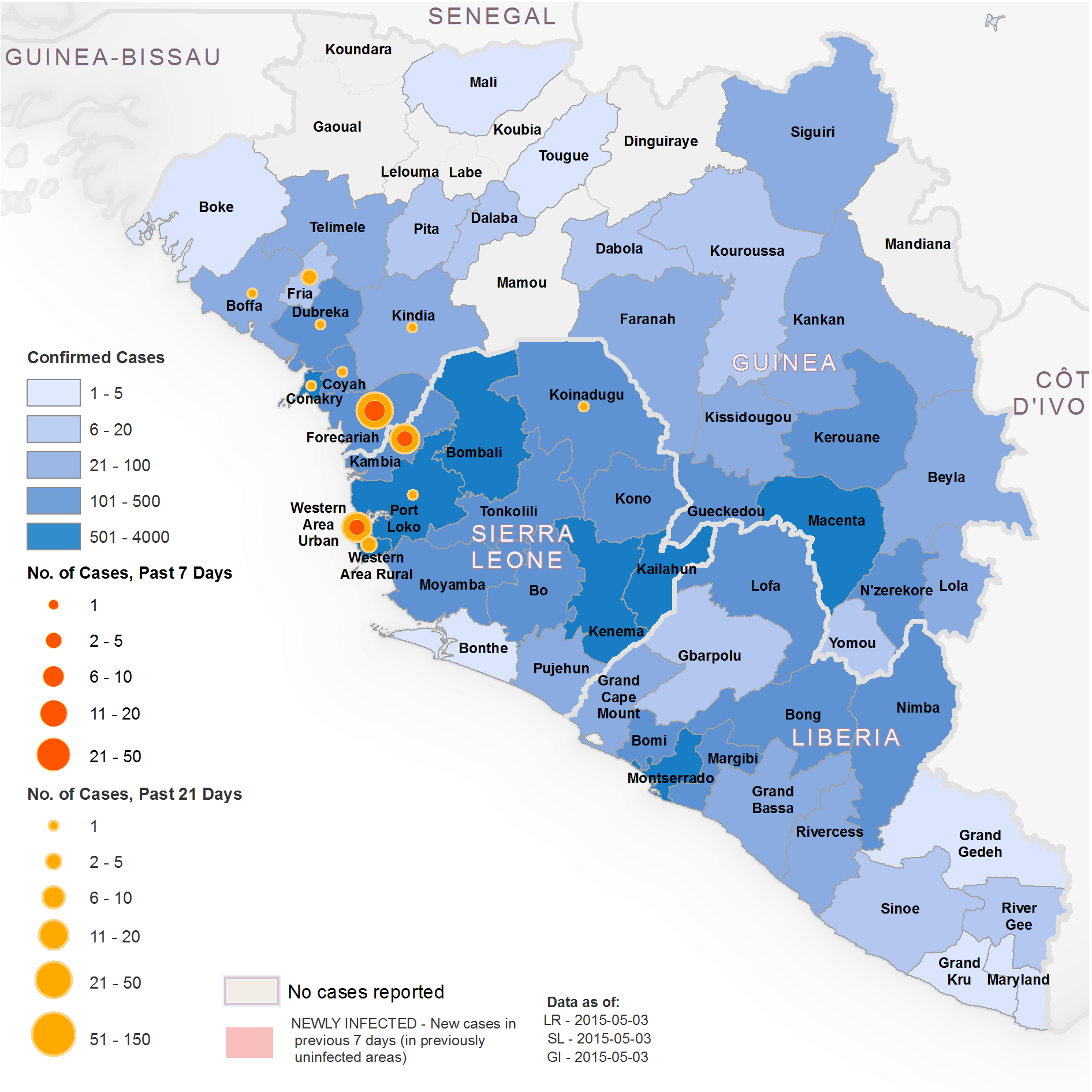
Three days later the WHO declared Liberia to be free of Ebola:
Forty-two days have passed since the last laboratory-confirmed case was buried on 28 March 2015. The outbreak of Ebola virus disease in Liberia is over.
Interruption of transmission is a monumental achievement for a country that reported the highest number of deaths in the largest, longest, and most complex outbreak since Ebola first emerged in 1976. At the peak of transmission, which occurred during August and September 2014, the country was reporting from 300 to 400 new cases every week.
During those 2 months, the capital city Monrovia was the setting for some of the most tragic scenes from West Africa’s outbreak: gates locked at overflowing treatment centres, patients dying on the hospital grounds, and bodies that were sometimes not collected for days.
So it’s high time I redeemed my promise to return to the ‘war on Ebola‘.
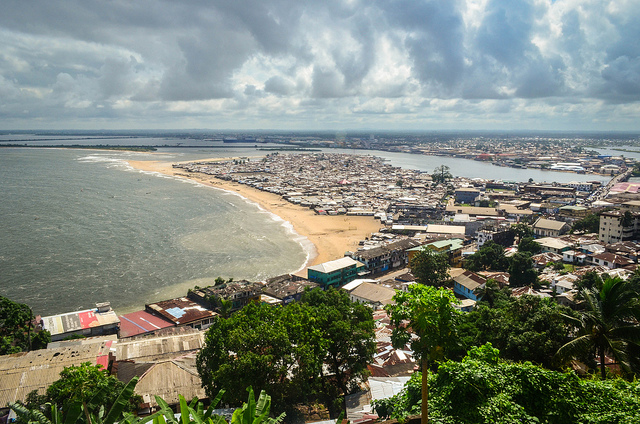
In previous commentaries I discussed the militarisation of the epidemic and, in particular, the mission of the US military under the direction of US Africa Command. But the ‘West Point’ in my title is thousands of miles from the US Military Academy in upstate New York… It’s a sprawling informal settlement in Monrovia, the capital of Liberia (below).
In an extended essay in the New Yorker earlier this year, ‘When the fever breaks‘, Luke Mogelson told the story of Omu Fahnbulleh and her husband Abraham. They lived with their three children in Robertsport in northern Liberia. Last summer Fahnbulleh tested positive for Ebola; by the time an ambulance arrived Abraham was sick too, and they were both loaded into the back and driven off.
Fahnbulleh and her husband believed that they were going to a hospital. Instead, several hours later, the ambulance turned onto a narrow lane that ran past low-slung shops and shanties. Fahnbulleh realized that they were in West Point, Monrovia’s largest slum. A police officer opened a metal gate, and the ambulance stopped inside a compound enclosed by tall walls. In the middle of the compound stood a schoolhouse. The driver helped Fahnbulleh and Abraham through a door, down a hall, and into a classroom. A smeared chalkboard hung on one of the walls, which were painted dark blue. Dim light filtered through a latticed window. On the concrete floor, ailing people were lying on soiled mattresses. When Fahnbulleh lay down, she saw that the two men beside her were dead.
This was the only school in West Point, originally built by USAID, and it had been converted into a ‘holding centre’ for Ebola patients; the only ‘treatment’ on offer was provided by a man in a biohazard suit spraying the floor, the walls and the patients with chlorine. Two nights later Abraham died, and as soon as it was light Fahnbulleh – convinced she would die too if she stayed – determined to escape.
At daybreak, after spending the night in the other classroom, she walked out of the school. Policemen loitered in the yard. When Fahnbulleh reached the gate, they let her pass, afraid to touch her.
After several nights of sleeping rough she was taken to an Ebola Treatment Unit at a government hospital, from where she was eventually discharged.
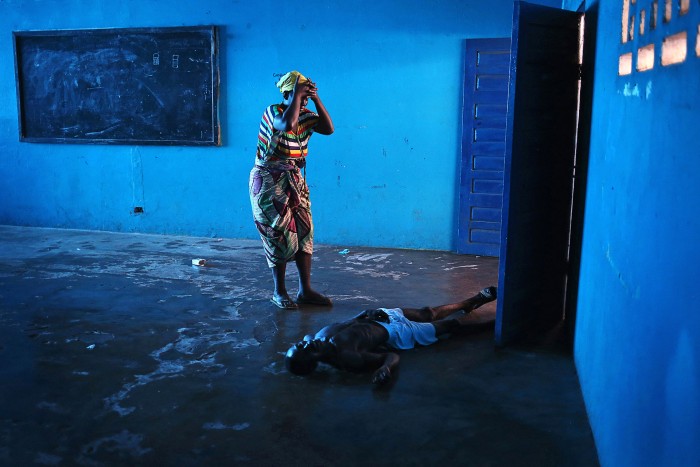
It’s a heart-breaking story, made all the more extraordinary by a photograph taken by John Moore which shows ‘Omu Fereneh’ standing over the body of her husband ‘Ibrahim’ on 15 August in the schoolhouse. The image was widely reproduced – see also here, for example – and raises important questions about the mediatisation as well as the militarisation of the crisis. Moore’s work won him the title of L’Iris d’Or /Sony World Photography Awards’ Photographer of the Year:
John Moore’s photographs of this crisis show in full the brutality of people’s daily lives torn apart by this invisible enemy. However, it is his spirit in the face of such horror that garners praise. His images are intimate and respectful, moving us with their bravery and journalistic integrity. It is a fine and difficult line between images that exploit such a situation, and those that convey the same with heart, compassion and understanding, which this photographer has achieved with unerring skill. Combine this with an eye for powerful composition and cogent visual narrative, and good documentary photography becomes great.
I’m not sure that Omu Fereneh is Omu Fahnbulleh, or Ibrahim Abraham, but it would be a remarkable coincidence if they were not the same people.
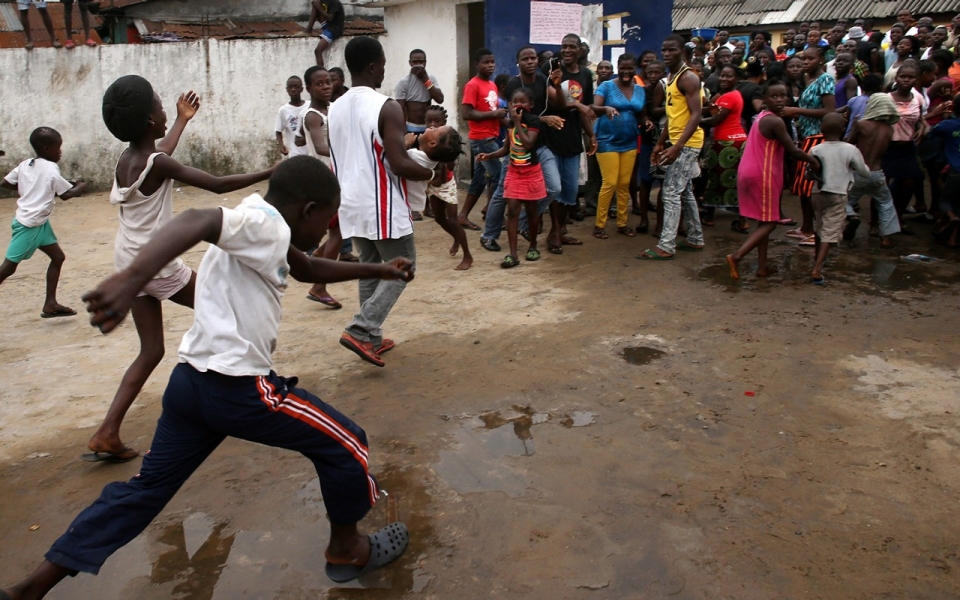
In any event, soon after the photograph was taken and soon after Fahnbulleh escaped, the situation in West Point changed dramatically. Realising that their community had become a dumping ground for Ebola victims from all over Liberia, local residents stormed the schoolhouse and demanded it be closed. They ransacked the building, making off with mattresses and sheets, and evicted over 20 patients who they claimed had been brought in from outside West Point.
Two days later the state called in its security forces which had urged the imposition of mass quarantine. Joe Shute takes up the story:
On August 20, President Ellen Johnson Sirlief ordered the only road leading in to the slum be sealed off, and the entire community placed under quarantine. As the army moved in, many of the city’s vagrants who slept in the slum at night were trapped inside.
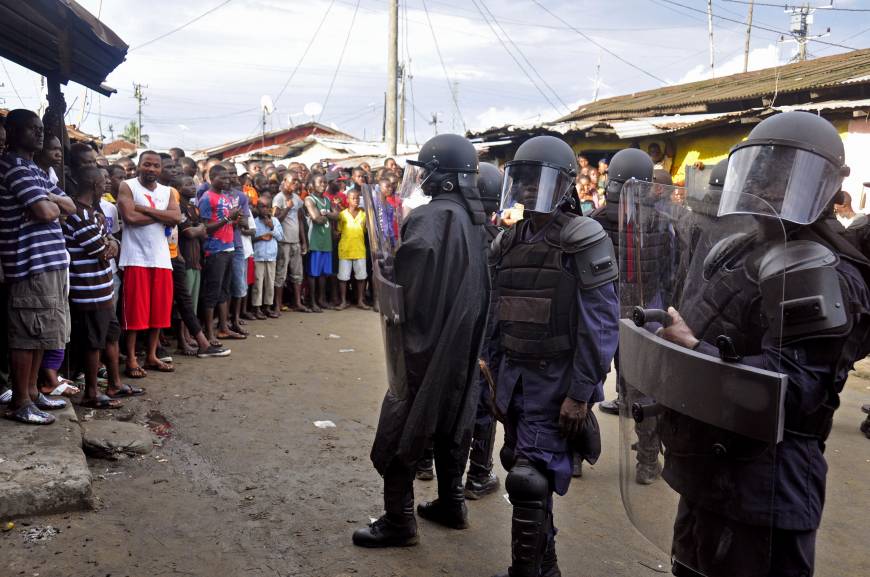
West Point was surrounded by barricades and barbed wire; police in helmets and riot-shields stopped people going out into the city; gunships patrolled the water front, and a nightly curfew was imposed on the district’s 70,000 residents. There was, Joe reports, ‘a desperate clamour to escape, some people even trying to swim around the peninsula to enter the city’s port.’
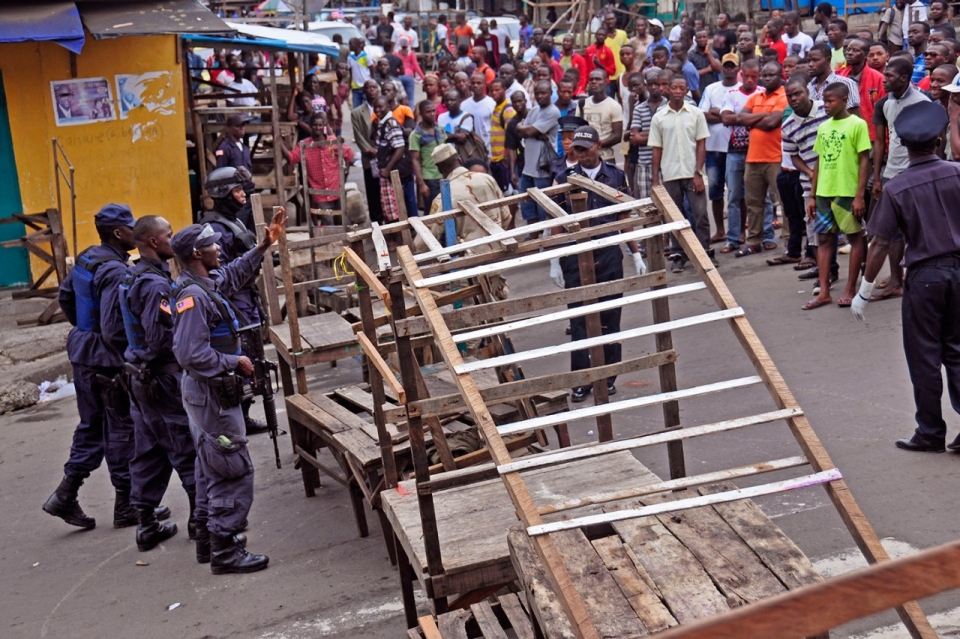
The imposition of a militarised quarantine was a double mis-step.
First, it exacerbated the already precarious position of West Point residents. Many of them were refugees and child soldiers from Liberia’s civil wars; they were crowded together in makeshift corrugated-iron shacks, almost all of them without plumbing or running water. The district is threaded by narrow sand alleys – there is only one paved road – and by open sewers. In 2009 the UN Office for the Coordination of Humanitarian Affairs reported there were only four public toilets in West Point; to use them cost 2-3 cents, and many chose to use the beach instead.
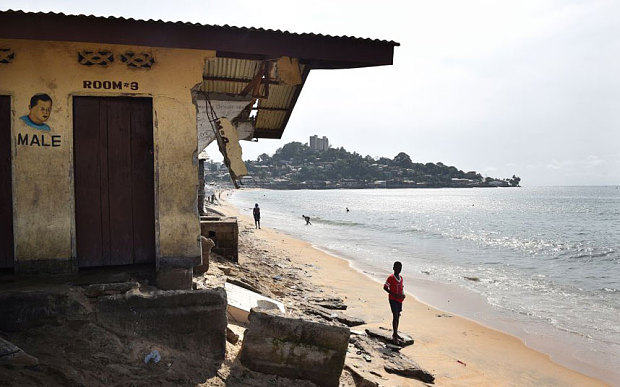
Most of West Point’s residents were dependent on access to the city and the ocean for their livelihood, but with the imposition of the blockade food supplies dwindled and food prices sky-rocketed. As the Institute for Development Studies argued in a Practice Paper on ‘Urbanisation, per-urban growth and zoonotic disease‘ earlier this year:
Poor peri-urban residents, with no money to purchase and store in bulk, buy essentials daily. When lock-down, intended to halt disease spread, occurs, shops, markets and transport facilities are closed, reducing opportunities for peri-urban residents to work and earn cash for food. Many of their activities continue clandestinely, undermining the health intervention. During attempts in West Point to contain the spread of Ebola, people found new ways of moving through the area quarantined in August 2014. Their concern was not exposure to Ebola, but their inability to access food and water.
Some bribed the police to let them out; others, still more desperate, even swam around the point. Here is a report from Norimitsu Onishi writing in the New York Times:
“We suffering! No food, Ma, no eat. We beg you, Ma!” one man yelled at Ms. Johnson Sirleaf as she visited West Point … surrounded by concentric circles of heavily armed guards, some linking arms and wearing surgical gloves.
“We want to go out!” yet another pleaded. “We want to be free, Mama, please.”
Quarantine has to be seen as a political, even a biopolitical response. As the IDS insists,
In the face of Ebola, and with the pressure on governments to act, the peri-urban area becomes an attractive place to intervene. The deployment of the military and the police to quarantine the peri-urban is a tangible manifestation of state power that is oppressive for residents. Thus quarantine-related activities fulfil the political role of assuaging the urban elite’s fears of contagion – ‘cleaning up’ the peri-urban by excluding the poor, rather than helping them or addressing the key challenges of the disease.
And, as Onishi also explained, the political implications were not lost on local residents:
“Putting the police and the army in charge of the quarantine was the worst thing you could do,” said Dr. Jean-Jacques Muyembe, a Congolese physician who helped identify the Ebola virus in the 1970s, battled many outbreaks in Central Africa and has been visiting Monrovia to advise the government. “You must make the people inside the quarantine zone feel that they are being helped, not oppressed.”
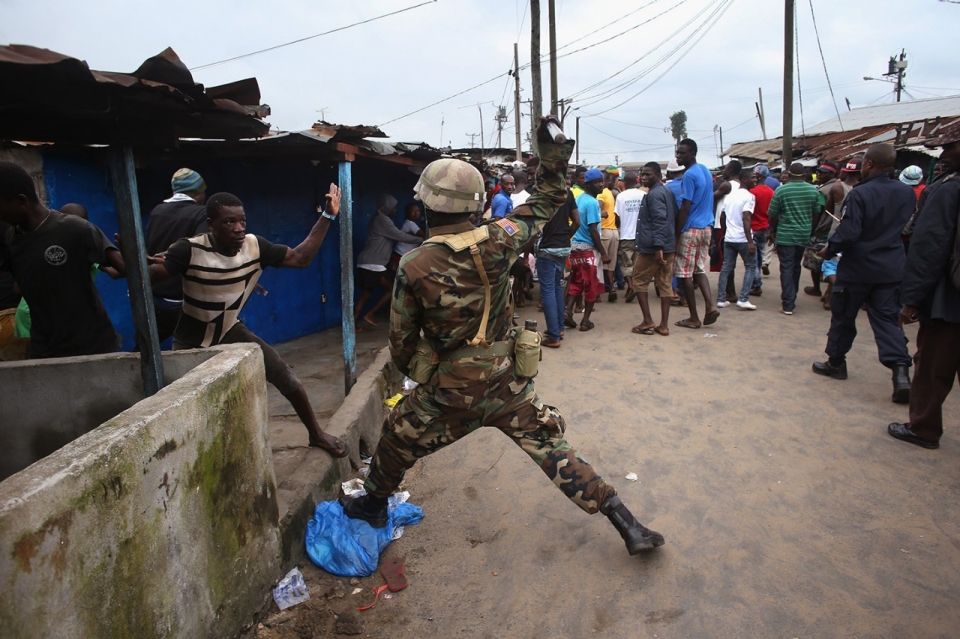
Not surprisingly, the imposition of quarantine provoked concerted collective protest. Hundreds of young men tried to storm the barricades and force their way through the makeshift checkpoint. Soldiers and police opened fire, killing a fifteen-year-old boy.
As Clare Macdougall reported:
“The force was disproportionate, they were already using batons, sticks, they had access to teargas and equipment to things to control an unarmed crowd,” said Counsellor Tiawan Gongloe, Liberia’s most prominent human rights lawyer. “I find it difficult to believe that there was any justification for shooting a 15-year-old boy who was unarmed. This is not a militarized conflict, it is a disease situation and a biological problem.”
Second, as this implies, quarantine is not an effective counter-measure and may well be counter-productive. Sealing off ‘plague towns’ was a medieval and early modern response to infectious disease – remember your Foucault! – but as one commentator noted, ‘isolating a small group of unhealthy people with a large group of healthy residents can cause more harm than good if they don’t get access to food, water and medical care — all of which are in increasingly short supply.’ In fact, transmission of Ebola occurs through bodily fluids once a patient shows symptoms of the disease, which means that the most effective response is not mass quarantine but the isolation of individual cases. This places a premium on contact tracing (you can find another image gallery from John Moore here, tracking a tracing coordinator in West Point; see also my previous post for more details and links on contact tracing).
Following negotiations with community leaders, the government eventually agreed to lift the quarantine. ‘We are out of jail!” declared one triumphant resident.
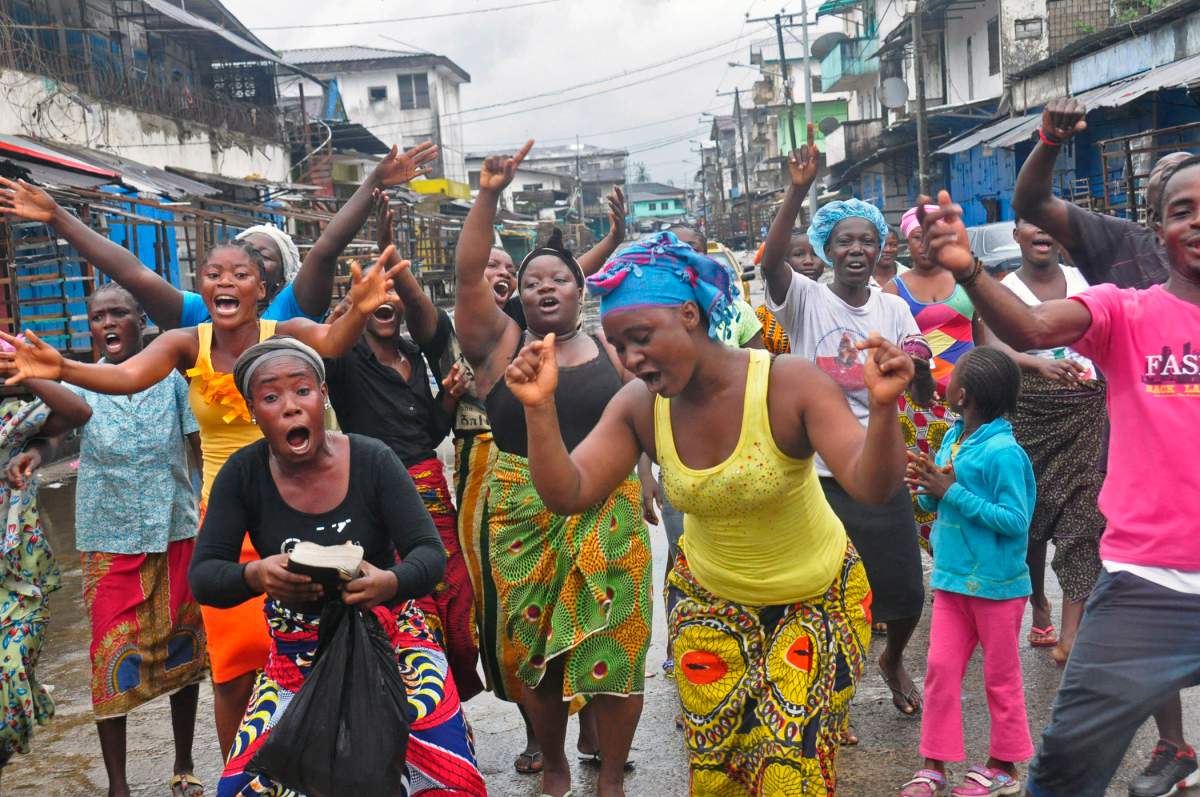
People celebrate in a street outside of West Point slum in Monrovia, Liberia, Saturday, Aug. 30, 2014. Crowds cheer and celebrate in the streets after Liberian authorities reopened a slum where tens of thousands of people were barricaded amid the countryís Ebola outbreak. The slum of 50,000 people in Liberia’s capital was sealed off more than a week ago, sparking unrest and leaving many without access to food or safe water. (AP Photo/Abbas Dulleh)
Now people started to mobilise in other ways. In return for removing the barriers and barbed wire, Luke Mogelson explained, community leaders implemented other containment measures:
identifying sick people, removing them from the community, quarantining their houses, tracking down their recent contacts, and monitoring those contacts for twenty-one days—the maximum amount of time the virus has been known to incubate before manifesting symptoms. Previously, all this was the responsibility of highly trained specialists…
In West Point, the job fell to the neighborhood. “We had to guarantee that the things that needed to be done would be done by ourselves,” Archie Gbessay, another local leader, who worked with Martu to carry out the interventions, told me one afternoon in November. We were walking down the main road that snakes through West Point. Gbessay wore a knapsack filled with case-investigation forms and kept his thumbs hooked on the chest-strap clipped across his sternum. He is twenty-eight years old but exudes a quiet force that seems to have accrued over a much longer life; his face quivers with intensity when he talks about Ebola. “If we didn’t do this, nobody was going to do it for us,” he said.
To build a network of active case-finders who could cover all of West Point, Gbessay recruited three volunteers from each of the slum’s thirty-five blocks. Most of them were young and had a degree of social clout—“credible people,” Gbessay called them. The quarantine had done little to alleviate popular skepticism of the government’s Ebola-containment policies, however, and, for a while, hostility persisted. “At first, the cases were skyrocketing,” Gbessay said. “We used to see seventy, eighty cases a day. But by the middle of September everyone started to think, Look, I better be careful. Today, you talk to your friend—tomorrow, you hear the guy is gone. So they started to pay attention.”
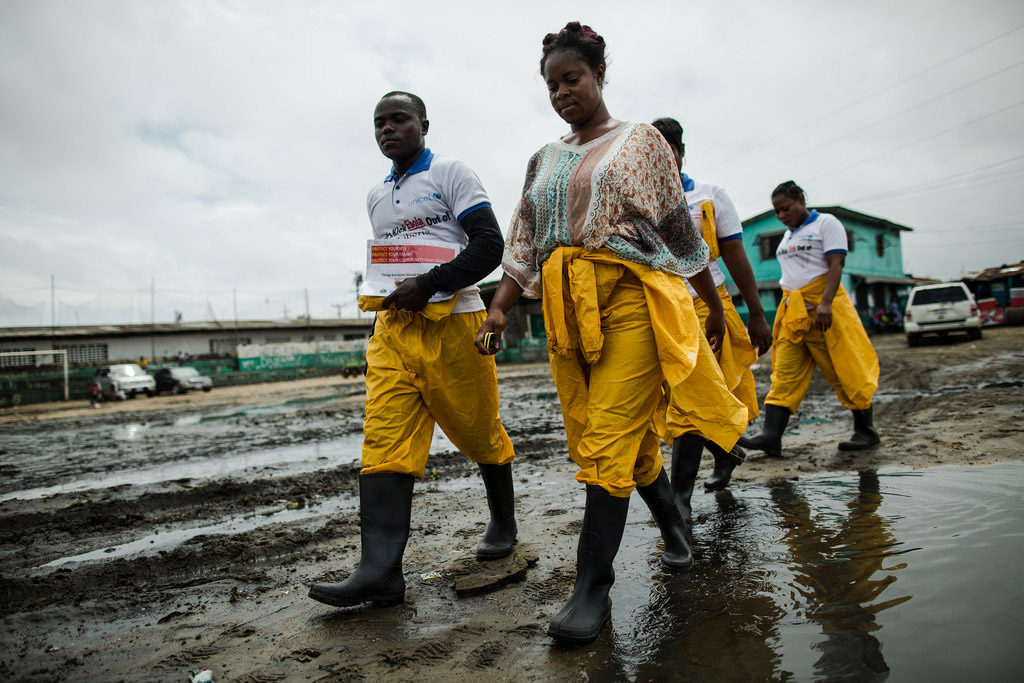
Otis Bundor, a contact tracer in West Point, described his day’s work and emphasised the importance of a trust that depended on local knowledge and on being known:
At the beginning of the outbreak, people were afraid to tell us if their family members were sick. They worried about stigmatization, and they were frightened that their wife or sister or son would go to the hospital and never come back. Some people thought that health workers were injecting patients with poison. As a contact tracer, you need to have the intellectual prowess to convince doubters that Ebola is real…
At first, family members hid bodies and buried them under the cover of darkness. This is one of the reasons that the disease became an epidemic. Attitudes changed only when people noticed that in almost all of the houses where someone died, another person later got sick. In one household, more than seven people died after they vehemently prevented contact tracers from entering.
But gradually contact tracing – or, more accurately, the contact tracers – became accepted as something other than policing. By the time Luke Mogelson visited West Point the holding centre in the schoolhouse had reopened as a transit centre:
Now, when residents of the slum felt unwell, they came here to be diagnosed and, if necessary, wait for an ambulance that was staffed by West Pointers and managed by Martu. The average wait time had become a matter of minutes, rather than days.
In September, at the height of the outbreak in Monrovia, the C.D.C. warned that Ebola could infect 1.4 million West Africans by late January. The prediction assumed that no “changes in community behavior” would occur. By November, that assumption was obsolete in West Point. Gbessay’s active case-finders had largely prevailed on their neighbors to come forward with symptoms and observe basic precautions such as avoiding physical contact with each other and washing their hands several times a day at the hundreds of chlorine buckets stationed throughout the city. As a result, cases were waning. “Every day, patients come,” the supervisor of the transit center told me. “But it’s going down. It’s getting less and less.”
And as Lenny Bernstein noted, this turn-around ‘has occurred without the provision of a single treatment bed by the U.S. military, which has promised to build 17 Ebola facilities containing 100 beds each across Liberia.’
To mark the 70th anniversary of the liberation of Auschwitz-Birkenau concentration camp, there has been widespread interest in a haunting video shot for the BBC using a commercial drone:
For once, the emptiness of the scene – just buildings, fences and railway tracks – is desperately affecting. It’s surely impossible to watch this without thinking of the millions of people whose lives were so brutally effaced by the murderous regime of the Third Reich. The only sign of a human presence in the video is a glimpse over the wall of trucks racing by: a reminder that Auschwitz was (and disconcertingly remains) at the centre of a small town (see also my post on Auschwitz here).
There are at least two other films that ought to be seen too.
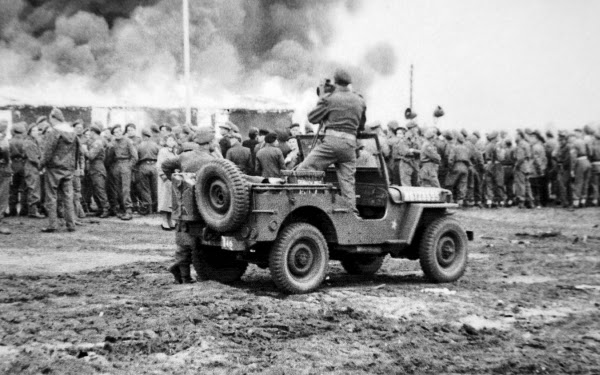
The first is a documentary commissioned in 1945 by the Psychological Warfare Film Section of the Supreme Headquarters Allied Expeditionary Force to document the liberation of Bergen-Belsen. The producer was Sidney Bernstein, for Britain’s Ministry of Information; Alfred Hitchcock was drafted in as a ‘treatment adviser’. The working title was German Concentration Camps: Factual Survey; it was never shown in its entirety (though Billy Wilder turned the footage into a short, Death Mills), and the Imperial War Museum notes:
From the start of the project, there were a number of problems including the practical difficulties of international co-operation and the realities of post-war shortages. These issues delayed the film long enough to be overtaken by other events including the completion of two other presentations of concentration camp footage to the German people and the evolution of occupation policy, where the authorities no longer considered a one-hour compilation of atrocity material appropriate. The last official action on the film was a screening of an incomplete rough-cut on 29 September 1945, after which the film was shelved, unfinished.
The footage has now been incorporated into a stunning HBO documentary, Night Will Fall, directed by André Singer, who was an Executive Producer for Act of Killing (see my posts here, here and here).

There are all sorts of stories about why the full version was never shown – see the Guardian‘s report here – but the fullest discussions are Kay Gladstone‘s ‘Separate intentions’ in Toby Haggith and Joanna Newman (eds) Holocaust and the moving image (2005) (see also Haggith’s ‘Filming the liberation of Bergen-Belsen here) and her ‘Memory of the Camps: the rescue of an abandoned film’, in Griselda Pollock and Max Silverman (eds) Concentrationary cinema (2011).
The second film returns to the aerial view and to Auschwitz: Harun Farocki’s Images of the world and the Inscription of War. Shockingly and sadly, Farocki died last summer at the age of 70, and Images is widely regarded as his masterpiece (see Thomas Voltzenlogel‘s wide-ranging and appreciative discussion of ‘Dialectics in images’ here). The central motif is an image taken from a series of aerial photographs of Auschwitz shot by the Allies between April 1944 and January 1945 (see also here and here).

This image was taken on 4 April 1944 by Lt Charles Barry flying a Mosquito from 60 Photo Reconnaissance Squadron of the South African Air Force. From the film’s commentary [available in Discourse 5(3) (1993) 78-92]:
American aircraft had taken off in Foggia, Italy, and flown towards targets in Silesia – factories for synthetic petrol and rubber – known as Buna.
On the flightover the IG Farben company factory still under construction, a pilot clicked his camera shutter and took photographs of the Auschwitz concentration camp.
First picture of Auschwitz taken at 7,000 meters altitude.
The pictures taken in April 1944 in Silesia arrived for evaluation in Medmenham, England [the RAF’s Central Intelligence Unit concerned with air photograph interpretation].
The analysts discovered a power station, a carbide factory, a factory under construction for Buna and another for petrol hydrogenation.
They were not under orders to look for the Auschwitz camp, and thus they did not find it.
How close the one is to the other: the industry – the camp.
It was not until 1977 that two employees of the CIA [Dino Brugioni and Robert Poirer: see their detailed report here] went through the archives to find and evaluate the photographs of Auschwitz. It was not until thirty-three years later that the following words were inscribed:
Tower and Commandant’s house and
Registration Building and Headquarters and Administration and
Fence and execution wall and Block 11 and the word “Gas chamber” was inscribed.

Kaja Silverman adds this gloss [‘What is a camera?’ Discourse 5 (30 (1993) 3-56]:
Not only does the camera here manifestly “apprehend” what the human eye cannot, but the latter seems strikingly handicapped by its historical and institutional placement, as if to suggest that military control attempts to extend beyond behavior, speech, dress,and bodily posture to the very sensory organs themselves. This sequence indicates, in other words,that military discipline and the logic of warfare function to hyperbolize the distance separating look from gaze and to subordinate the former completely to the latter.
These are similar issues that haunt my own discussions of the video feeds from Predators and Reapers over Afghanistan and Iraq. In another commentary, Christa Blümingler writes:
The vanishing point of Images of The World is the conceptual image of the ‘blind spot’ of the evaluators of aerial footage of the IG Farben industrial plant taken by the Americans in 1944. Commentaries and notes on the photographs show that it was only decades later that the CIA noticed what the Allies hadn’t wanted to see [my emphasis]: that the Auschwitz concentration camp is depicted next to the industrial bombing target.
 The claim that the ‘Allies didn’t want to see’ spirals through an important debate about whether the Allies could or should have bombed Auschwitz (see, in addition to the symposium on the right, here and here). In fact, as Christa observes later,
In … 1944, the allies bombed not Auschwitz, but the IG Farben factory nearby the death camp. Drawing on analyses of these events, how and why the allies didn’t act on their knowledge of the mass destruction of the Jews, Farocki … decodes a host of military images, focusing on two visual dispositives: American pilots in 1944 and CIA agents in 1977 offering two different [readings] of the aerial photographs of Auschwitz.
In this instance, Farocki developed an epistemological field of technological history — measurement and surveillance in a period of rapid automatization. At the end of the film, a blind spot in the photographic act, referring back to the reality of the concentration camp, becomes visible.
The final shots further emphasize details of the American pilots’ aerial photos, which are picked up in the sweep of the film several times, framed and arranged in different ways. At the end of the film, through a permutative movement of cuts, the extreme enlargement of the photographs reminds us once again of their materiality. Farocki shows these images in precisely the spaces where visual thought takes place, and in connection to specific techniques of reproduction and distribution (in albums, archives, institutions). Whenever he used marginal and hard-to-access image materials from specialized archives, he sought to consider these conditions of visibility in his analysis.

What particularly interests me, and the reason I juxtapose these two films, is an interview with Chris Darke in 2003 in which Farocki artfully tracks between the eye-witness and the aerial shot:
Chris Darke: In Images of the World and the Inscription of War there is this repeated phrase: “Beside the real world there is a second world, a world of pure military fiction”. I was very strongly reminded of Colin Powell at the UN Security Council presenting degraded military surveillance images as proof and justification for military action.
HF: Yes, it reminded me so much of the Auschwitz sequences in Images of the World, the way they involved aerial reconnaissance images that you had to be a specialist to read. Who knows what they are telling you? Who knows what happened there? What is so interesting is that the personal witness of two people who had escaped from the camps was so important. It was the way that traditional history was always written. You need an eye-witness, a narrative, otherwise you’ll never believe in it. And it turns out that our imaginative minds are still very old-fashioned. We don’t understand modernist strategies such as those used by the Americans in the first Gulf War. You really want to see these terrible, dirty images of burning streets and wounded people in the same way that psychoanalysis knows that you need dirty thoughts for the imagination, just as for love you need dirty images. The audience is not prepared for this automatically recorded history that more or less happens already, where everything is recorded; so there has to be an old-fashioned drama made out of it.
There are at least two other detailed commentaries on the film that address the question of visuality in depth: Thomas Keenan‘s ‘Light weapons’, in Documents 1/2 (1992) 147-58 and Nora Alter‘s ‘The political im/perceptible in the essay film: Farocki’s Images of the world and the inscription of war‘, in New German Critique 68 (1996). More generally, I also recommend the special issue of e-flux on Farocki’s work here, including a commentary by Trevor Paglen on Farocki’s ‘operative images’, and David Cox‘s brief commentary here.
Note: Belinda Gomez writes (in relation to the commentary for Images of the World):
“Fence and execution wall and Block 11 and the word “Gas chamber” was inscribed….” But that’s not quite accurate. Brugioni and Poirier didn’t write that in 1977. The gas chamber didn’t have a sign. That they were able to locate the gas chamber and crematoria was due to their superior technology and they knew what they were looking for. The pilot/photographers in 1944 took photos of the factory and what was taken as a workers camp. To say that they didn’t see Auschwitz because they weren’t told to look for it is more of a hind-sight interpretation.
 Melanie Richter-Montpetit has an essay at The disorder of things, ‘Why Torture When Torture Does Not Work? Orientalism, Anti-Blackness and the Persistence of White Terror‘, which repays careful reading.
[L]ocating the findings of the Senate Torture Report within the racial-sexual grammars of chattel slavery and its afterlife opens up our analyses beyond explanatory and moral frameworks such as failed intelligence-gathering, “state of exception” or “human rights abuses” towards a more comprehensive understanding of seemingly illiberal security practices in the War on Terror. This genealogy indicates the fundamental role and value of force for the consolidation of the sovereign authority of the U.S. settler imperial formation ‘at home’ and abroad, and suggests the stubborn persistence of certain racial-sexual grammars of legitimate violence and suffering in this age of “post-racial triumph.” For “[w]ithout the capacity to inspire terror, whiteness no longer signifies the right to dominate.”
The immediate provocation for her essay, which is rooted in her recent York PhD thesis Beyond the Erotics of Orientalism: Homeland Security, Liberal War and the Pacification of the Global Frontier, was the Senate Torture Report (see my earlier post on ‘Tortured geographies’ here).
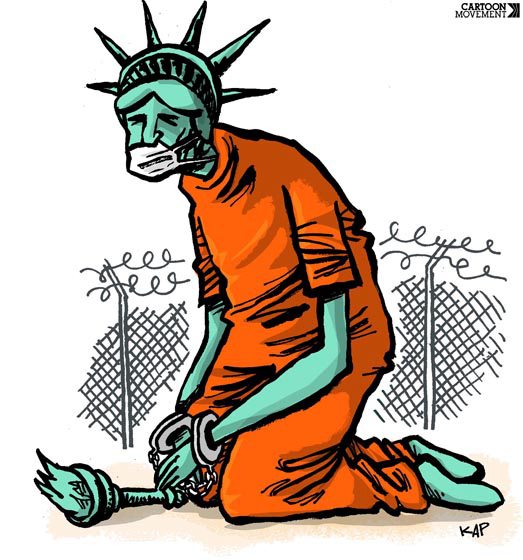 At Just Security Jameel Jaffer has a brief, important post about the release of these documents – and, crucially, the Obama administration’s attempt to prevent the publication of photographs documenting the abuse of detainees at US military facilities – that loops back to the debate over the Charlie Hebdo cartoons. He argues that it is at the very least ironic that some of the same voices calling for the freedom to publish cartoons whatever their consequences are now demanding the suppression of other images ‘because of the possibility that their release will provoke violence’…
And speaking of violence and torture in the global war prison, Mohamedou Ould Slahi‘s Guantanamo Diary, which is being serialised in the Guardian and was published in book form earlier this week, provides more evidence of its routinised, banalised practice.
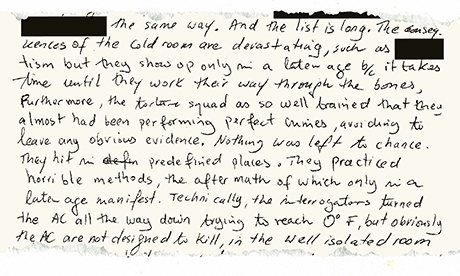
Slahi is still incarcerated at Guantanamo even though he was approved for release in 2010. Spencer Ackerman reports:
Slahi’s manuscript was subjected to more than 2,500 redactions before declassification, ostensibly to protect classified information, but with the effect of preventing readers from learning the full story of his ordeal. The book is being published with all the censor’s marks in place, and the publishers – Canongate in the UK and Little, Brown in the US – hope they will be able to publish an uncensored edition when Slahi is eventually released.
The full manuscript is available here. You can find Tim Stanley‘s review at the Telegraph here (‘a necessary book’ that ‘reminds us that the evil we’re fighting can be found in ourselves as well as in our enemies’), Mark Danner‘s extended review at the New York Times here (‘Slahi’s memoirs are filled with numbingly absurd exchanges that could have been lifted whole cloth from “The Trial”’), and Deborah Perlstein‘s review at the Washington Post here (‘Slahi’s descriptions of … torture are the book’s most compelling, and difficult, passages [and] … are closely consistent with descriptions in official investigations of the treatment of other U.S.-held detainees’.)
In the face of these horrors, it’s necessary to consider this blunt reminder from Peter Beinart:
Torture, declared President Obama … in response to the newly released Senate report on CIA interrogation, is “contrary to who we are.” Maine Senator Angus King added that, “This is not America. This is not who we are.” According to Kentucky Congressman John Yarmuth, “We are better than this.”
No, actually, we’re not. There’s something bizarre about responding to a 600-page document detailing systematic U.S. government torture by declaring that the real America—the one with good values—does not torture. It’s exoneration masquerading as outrage. Imagine someone beating you up and then, when confronted with the evidence, declaring that “I’m not really like that” or “that wasn’t the real me.” Your response is likely to be some variant of: “It sure as hell seemed like you when your fist was slamming into my nose.” A country, like a person, is what it does.
And in the face of evasion and denial – and redaction and suppression – here is Chase Madar from February’s Bookforum:
Though the [Senate] report has blacked out the names of the torturers, refusing even to use pseudonyms, torture watchers have been able to identify one of the agents, a model for Maya in Zero Dark Thirty. Her record of malfeasance, misrepresentation, incompetence, and gratuitous participation in waterboarding was blisteringly detailed by NBC News and [Jane Mayer at] the New Yorker, though neither outlet would name her. But far from being sanctioned or even demoted, she has risen to the civilian-rank equivalent of general inside the CIA. She has, unbelievably, served as the recent head of the agency’s “global jihad unit.”
It’s tempting to compare this to Latin American–style police impunity, but that would be unfair to the societies that have punished at least some of the abuses of their past dictatorships. In the same week that the SSCI released its report, Brazil published its own investigation into state torture of political dissidents under its long dictatorship. Indeed, one of that torture regime’s victims, Dilma Rousseff, is now the head of state. Latin American nations have been chipping away at, or simply ignoring, the amnesty deals made with the authoritarian rulers of the ’70s and ’80s and have brought many of their torturers to justice.
The United States would face a very different reckoning with its record of torture, should it elect to take a genuine, closer look at it. In our case, the impact of torture has largely been muffled by the military adventurism that has underwritten it…
The more I think about corpography (see also ‘Corpographies under the DOWNLOADS tab) – especially as part of my project on casualty evacuation from war zones – the more I wonder about Grégoire Chamayou‘s otherwise artful claim that with the advent of armed drones the ‘body becomes the battlefield’. He means something very particular by this, of course, as I’ve explained before (see also here).
But let me describe the journey I’ve been taking in the last week or so that has prompted this post. Later this month I’m speaking on ‘Wounds of war, 1914-2014‘, where I plan to sketch a series of comparisons between casualty evacuation on the Western Front (1914-18) and casualty evacuation from Afghanistan. I’ve already put in a lot of work on the first of these, which will appear on these pages in the weeks and months ahead, but it was time to find out more about the second.

En route I belatedly discovered the truly brilliant work of David Cotterrell who is, among many other things, an installation artist and Professor of Fine Art at Sheffield Hallam University. He became interested in documenting the British military casualty evacuation chain from Afghanistan, and in 2007 secured access to the Joint Medical Forces’ operations at Camp Bastion in Helmand. He underwent basic training, a course in even more basic battlefield first-aid, and then found himself on an RAF transport plane to Bastion. The Role 3 Hospital was, as he notes, a staging-ground. ‘Field hospitals are islands between contrasting environments,’ he wrote in his diary, ‘between the danger and dirt of the Forward Operating Bases and the order and convention of civilian healthcare.’ You can read a long, illustrated extract from the diary (3 – 26 November 2007) here, follow the photo-essay as a slideshow here, and explore David’s many other projects on his own website here.
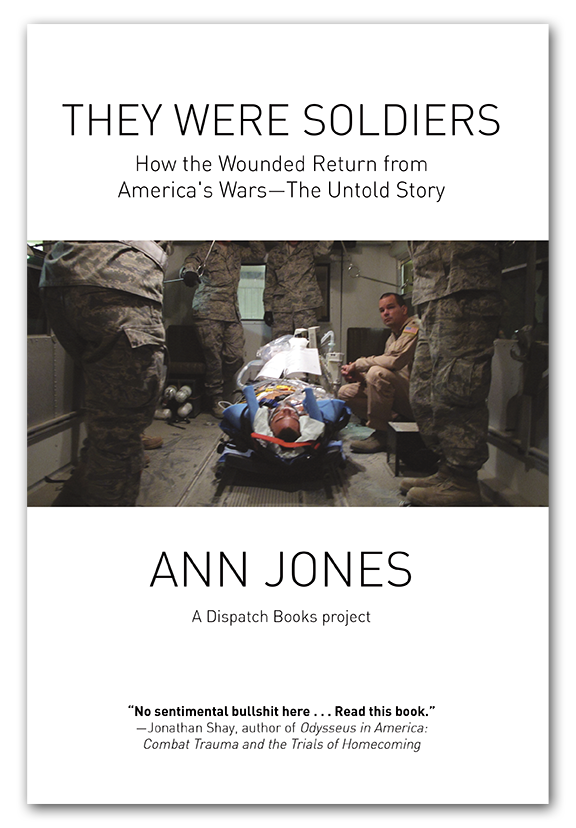 The diary is immensely interesting and informative in its own right, not least about the exceptional personal and professional difficulties involved in documenting the evacuation process. Here there’s a helpful comparison to be made with journalist Ann Jones‘s no less brilliant They were soldiers: how the wounded return from America’s wars (more on this in a later post), which starts at the US military’s own Level III Trauma Center, the Craig Joint Theater Hospital at Bagram, and moves via Landstuhl Regional Medical Center in Germany, the largest US hospital outside the United States, to the Walter Reed Army Medical Center in Washington DC.
David’s visual record is even more compelling, as you would expect from a visual artist, not only in its documentary dimension but also in the installations that have been derived from it. In Serial Loop, for example, we are confronted with a looped film showing the endless arrival of casualties at Bastion: ‘The sound of a continuously arriving and departing Chinook helicopter accompanies images of a bleak and wasted landscape; the banality of the film’s fixed perspective masks the dramas that unfold within the ambulances as they travel to triage.’
9-liner explores what David calls ‘the abstraction of experience within conflict’:
9-Liner explores the dislocation between the parallel experiences of casualties within theatre. It is a quiet study of a dramatic event: the attempt to bring an injured soldier to the tented entrance of the desert field hospital. The screens show apparently unrelated information. JCHAT – a silent scrolling codified message – runs on a central screen. Our interpretation of it is enabled through its relationship between one of two radically different but equally accurate views of the same event. To the left we see the Watchkeeper – a soldier manning phones and reading computer screens in a crowded office. On the right we view the MERT flight – the journey of the Medical Emergency Response Team in a Chinook helicopter.
SHU’s REF submission includes this summary of David’s work (one of the very few useful things to come out of that otherwise absurdist exercise):
The research made clear that soldiers recovering from life-changing injuries had limited means of reconstructing the narrative of their transformative experiences. From the time of wounding through to secondary operations in the UK, many soldiers remained sedated or unconscious for a period of up to five days. The radical physical transformation that had occurred during this period was not adequately reconciled through medical notes, and the embargo on photographic documentation of incident and subsequent medical procedures served further to obscure this period of lost memory.
A culture of secrecy meant that medical professionals were unable to access documentation of the expanded care pathway with which they, and their colleagues, were engaged. This fragmentation of experience and understanding within the process of evacuation, treatment and rehabilitation meant that the assessment of the contradictions and disorientation experienced by casualties and medical practitioners was denied to front-line staff.
Family members, colleagues and members of the public outside the immediate environment of the military were unable to visualise or understand the transformative effects of conflict on directly affected civilians and soldiers. Partly as a result, the scope for public debate to engage meaningfully with the longer term societal cost of contemporary conflict was limited.
The submission goes on to list an impressive series of debriefings, presentations to military and medical professionals, major exhibitions, and follow-through research in Birmingham.

And it’s one of those follow-throughs that prompted me to think some more about corpographies. I’d noted the connection between corpography and choreography in my original post, but David’s extraordinary collaboration with choreographer Rosie Kay and her dance company gives that a much sharper edge. Again, there’s a comparison to be drawn – this time with Owen Sheers‘s impressively researched and executed body of work, not only the astonishing Pink Mist but also The Two Worlds of Charlie F (2012), which was a stage play based on the experiences of wounded soldiers who also made up the majority of the cast (see my discussion of these two projects here).
5 Soldiers started life as a stage presentation in 2010 (watch some extracts here):
A dance theatre work with 5 dancers, it looks at how the human body is essential to, and used in, warfare. 5 SOLDIERS explores the physical training that prepares you for war, as well as the possible effects on the body, and the injury caused by warfare.
Featuring Kay’s trademark intense physicality and athleticism, 5 SOLDIERS weaves a journey of physical transformation, helping us understand how soldiers are made and how war affects them.
5 SOLDIERS is a unique collaboration between award-winning choreographer Rosie Kay, visual artist David Cotterrell and theatre director Walter Meierjohann. It follows an intense period of research, where Rosie learnt battle training with The 4th Battalion The Rifles and David spent time in Helmand Province with the Joint Forces Medical Group.
Rosie explained her commitment to the project (and her training with The Rifles) like this:
“I wanted to look at how the physicality of a soldier’s job defines them –like a dancer, the soldier is drilled, trained, their responses becoming automatic, but can anything prepare you for the realities of war? It is young soldiers and their bodies that are the ultimate weapon in war – their strength and weaknesses may win or lose a battle, their ability to harm or injure others is key to victory. While war is surrounded with weaponry, uniforms, history and ceremony, the real business is human, dirty, messy, painful and happening right now.”
(She is, not coincidentally, an affiliate of the School of Anthropology at Oxford).
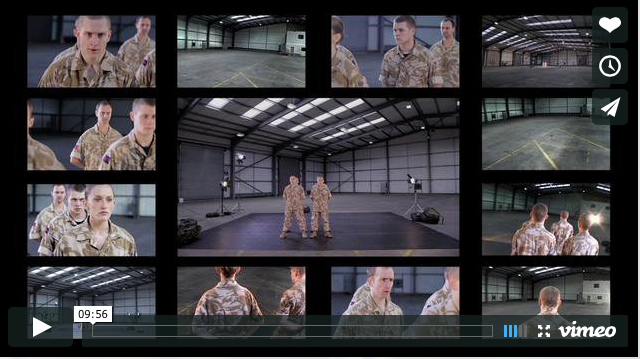
And now there’s a film version that works as a multi-screen installation (screen shot above).
Instead of just creating a short film, the team wanted the web user to get a truly interactive way to watch dance, and actually feel that they can go inside the minds and the body of the work. The 80-minute work was cut to just 10 minutes long, and the company spent one week filming in a huge aircraft hangar at Coventry Airport…
Using a variety of cutting edge filming techniques, the collaborative team have created a 13 angle edit that takes you into the heart of the work, follows each of the dancers, and zooms out so that the performers appear to be like ants in a huge empty landscape.
You can see the interactive, multi-perspectival version here. This relied on helmetcams, and there’s a fine, more general commentary on this in Kevin McSorley‘s ‘Helmetcams, militarized sensation and “somatic war”‘ here. But here’s the short, ‘director’s cut’ version:
And look at the tag-line: ‘The body is the frontline’. It’s not only drones that make it so.
I’ll be in Berlin in December for a conversation with James Bridle about drone wars and related issues, and I’m already looking forward to it since I’m a great admirer of his work. I particularly admire the way in which he challenges so many of our assumptions about ‘looking’ through his presentations about militarised vision and violence, and I’ve noted before the filiations between his various projects and Josh Begley‘s.
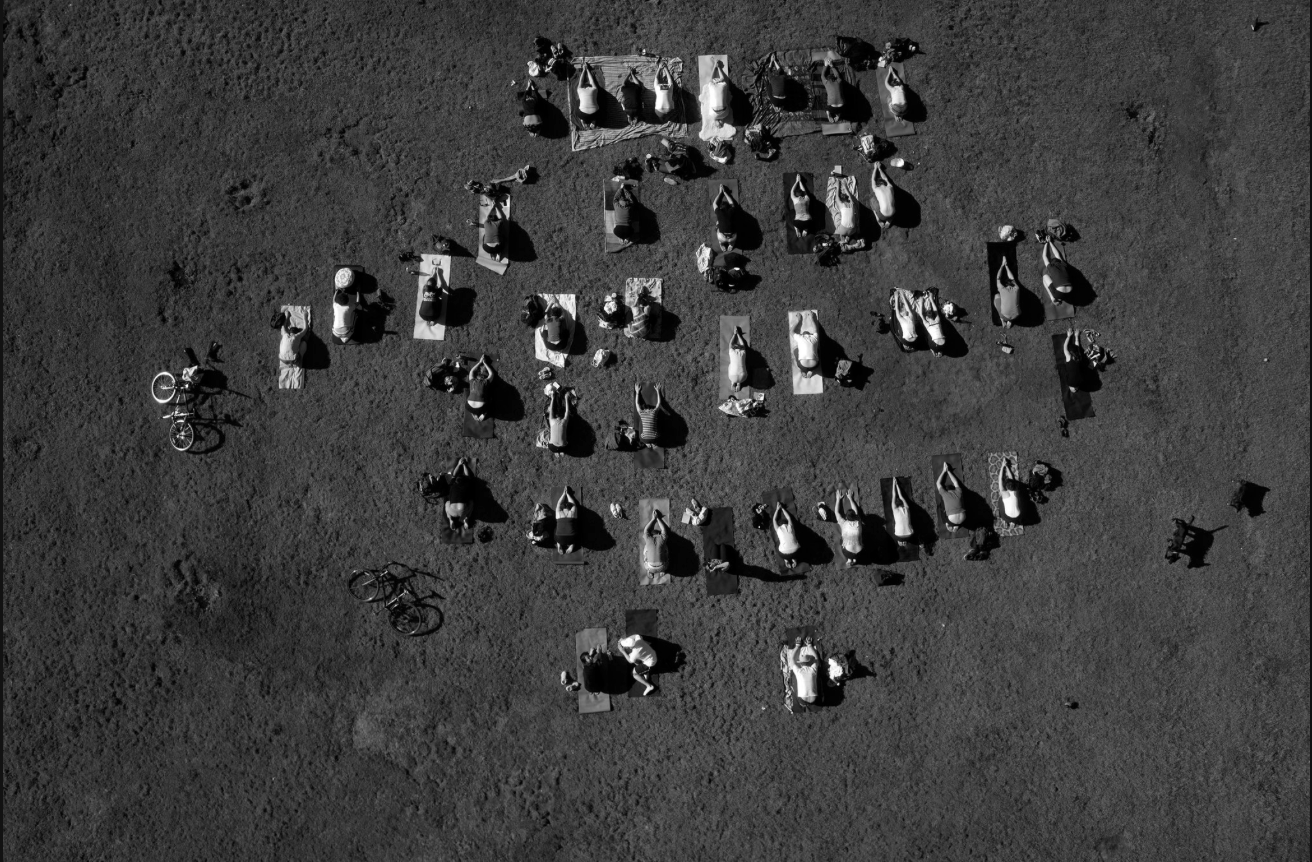
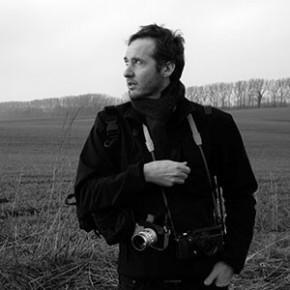 So I was interested to read about photographer Tomas van Houtryve‘s (right) project Blue Sky Days. He begins with an arresting observation with which both James and Josh would be only too familiar:
‘Although a huge amount of [full motion video] footage has been collected [by US drones], the program is classified, and few people have ever seen images of the drone war and its casualties. This seems like a paradox in our thoroughly media-connected age. How can America be involved in a decade-long war where the sky is buzzing with cameras, and yet the public remains totally in the dark?’
But his response to the question is distinctly different: he repatriates the drone wars from Pakistan to the United States (here the most appropriate comparison is with Omar Fast‘s 5,000 Feet is the Best).
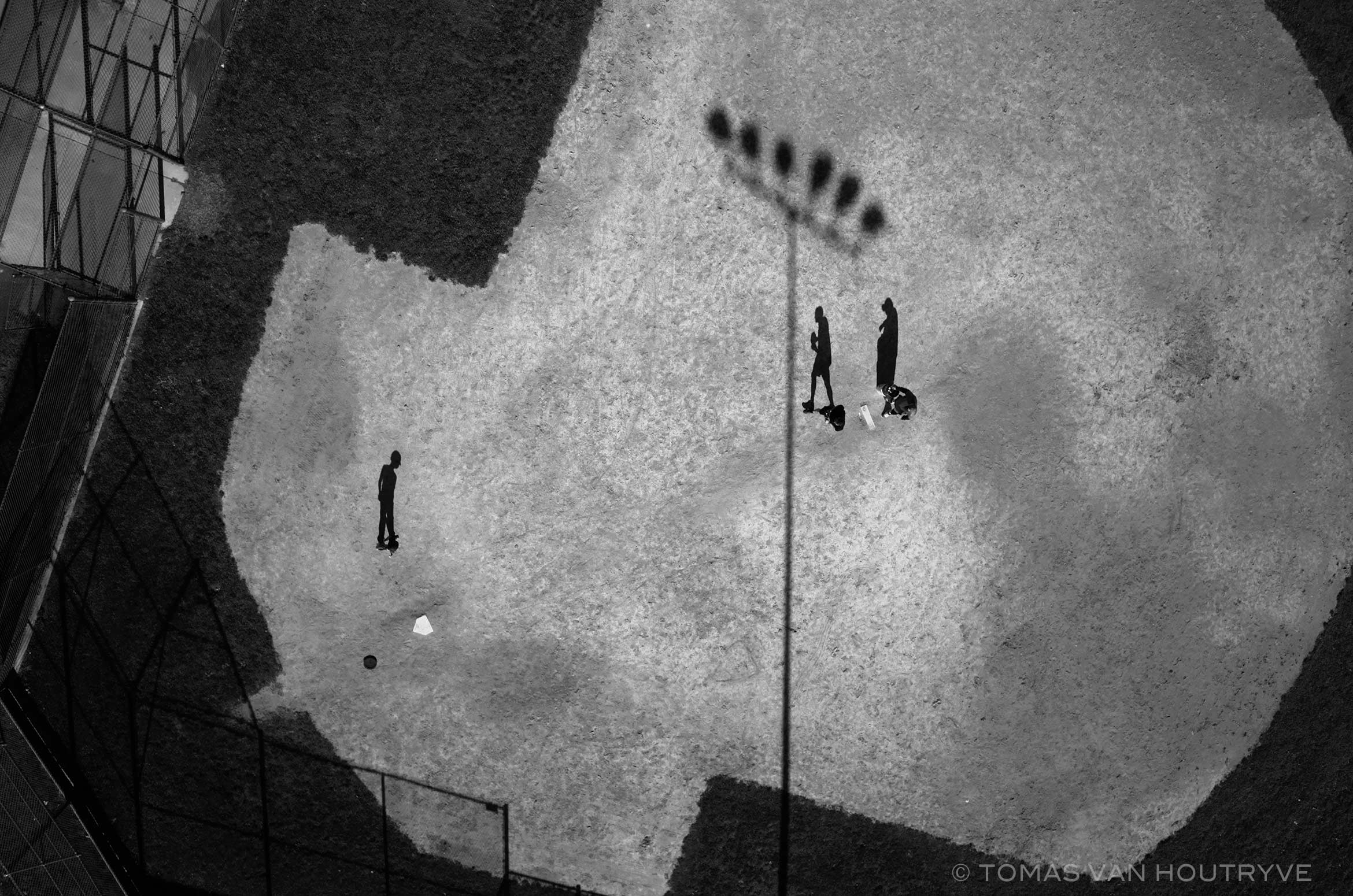
To do so, Tomas travelled across America with a small quadcopter drone bought from Amazon.com attached to his camera. His concept was simple, Rena Silverman explains in the New York Times:
Take the idea of foreign drone strikes and instead target similar domestic situations, putting them under surveillance using his drone in public spaces. He made a list of hundreds of different strike reports, gleaning as many details about the circumstances…
He rented a black car with tinted windows and placed himself, his drones, his batteries and lists in the car. He spent six weeks in late 2013 averaging between seven and 10 drone flights daily, sleeping in a different town every night. He would pull the car into an empty lot, get out, launch the drone for about five to 10 minutes — about as long as its power lasted — take footage, land the drone, drive away and recharge the batteries while en route to the next location…
He followed his list carefully, trying to imitate “signature strikes,” referring to a May 2012 New York Times article in which some State Department officials complained about the lax criteria for identifying a terrorist “signature.” The joke was that “three guys doing jumping jacks” could be enough suspicious activity for the C.I.A. to conclude it could be a terrorist training camp. In other words, targeting people based on behavior rather than identity.
He photographed people exercising in Philadelphia, their shadows long and pinned against the grid of a park. He noticed more “signature” behavior while driving through San Francisco, where he encountered a group doing yoga [above]. When Mr. van Houtryve recently printed the image, he asked viewers if they thought the subjects were praying or exercising. It was a toss-up.
Although these images are not quite ‘what drone attacks in America would look like’, as Pete Brook suggested in WIRED – Tomas’s drone was flying much lower (‘only about six stories high’) and these images are pin-point sharp: there’s none of the ambiguity of infra-red heat signatures here – none the less that last sentence really says it all. Images do not speak for themselves and interpretation counts for everything – which is why, as I’ve repeatedly argued, it matters so much what pilots, sensor operators and image analysts are pre-disposed to see.
It turns out that a particular incident provoked Tomas’s project – the murder of Mamana Bibi at Ghunda Kala in North Waziristan on 24 October 2012, which I described here – and also gives it its title.
In October 2012, a drone strike in northeast Pakistan killed a 67-year-old woman picking okra outside her house. At a briefing held in 2013 in Washington, DC, the woman’s 13-year-old grandson, Zubair Rehman, spoke to a group of five lawmakers. “I no longer love blue skies,” said Rehman, who was injured by shrapnel in the attack. “In fact, I now prefer gray skies. The drones do not fly when the skies are gray.”
There’s more from Tomas at Harper’s here, which originally co-sponsored the project with the Pulitzer Center, and you can see more of his drone’s eye view images at the National Geographic here.
There’s also a revealing interview conducted by Bard College’s Center for the Study of the Drone here; it contains all sorts of interesting observations, but one in particular resonated. Asked about the tension between the beauty of his photographic compositions and the horror of what he is seeking to convey, Tomas says this:
‘The base subject that I’m trying to raise awareness about and get people to think about in less abstract terms is the foreign drone war. If you take the time to read through the particular airstrikes, a lot of them are quite horrifying. But on the other hand, as a photographer, I know that beauty is one of the tools that we use to get people to look at a picture. Beauty has a lot of power, so there’s a tension between trying to seduce people with the language of photography, which is beautiful composition, and trying to reveal something that might be uncomfortable or difficult to digest, once people fully grasp it.’
Another of my art icons, elin o’Hara slavick, says something very similar about her mesmerising sequence of aerial images of places bombed by the US, Bomb after bomb (see also Brian Howe‘s discussion here and my own in ‘Doors in to Nowhere’ [DOWNLOADS tab], from which I’ve taken this passage):
‘She adopts an aerial view—the position of the bombers—in order to stage and to subvert the power of aerial mastery. The drawings are made beautiful “to seduce the viewer,” she says, to draw them into the deadly embrace of the image only to have their pleasure disrupted when they take a closer look. “Like an Impressionist or Pointillist painting,” slavick explains, “I wish for the viewer to be captured by the colors and lost in the patterns and then to have their optical pleasure interrupted by the very real dots or bombs that make up the painting.”’
A tart reminder that there are multiple ways of ‘just looking‘.

 geographical imaginations