Paris of/in the Middle East

Paris:Peace

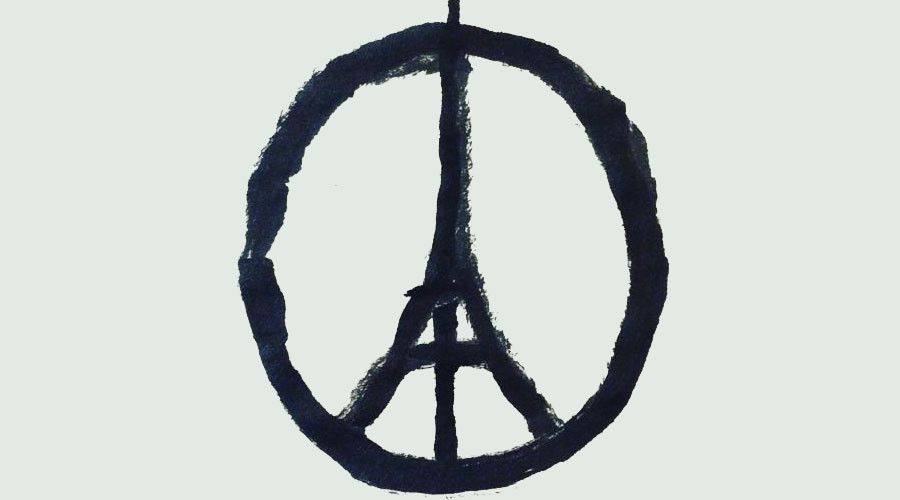
Islamic State has claimed responsibility for last night’s co-ordinated terrorist attacks in Paris, calling them the ‘first of the storm’ and castigating the French capital as ‘the capital of prostitution and obscenity’.   Walter Benjamin‘s celebrated ‘capital of the nineteenth century’ has been called many things, of course, and as I contemplated the symbol that has now gone viral (above), designed by Jean Jullien, I realised that Paris had been the stage for the 1919 Peace Conference that not only established the geopolitical settlement after the First World War but also accelerated the production of today’s ‘Middle East’ by awarding ‘mandates’ to both Britain and France and crystallising the secret Sykes-Picot agreement struck between the two powers in 1916 (more on that from the Smithsonian here).

Margaret MacMillan has a spirited summary of the conference here, with some lively side-swipes at the astonishing lack of geographical knowledge displayed by the principal protagonists.  Much on my mind was the French mandate for Syria and Lebanon:
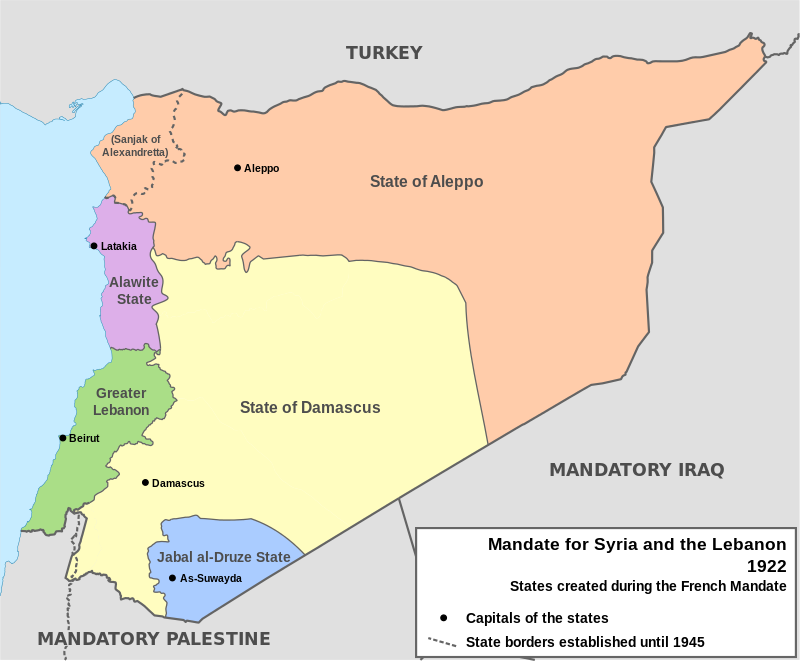
French Mandate for Syria and Lebanon

For as I watched Friday night’s terrifying events in Paris unfold, I had also been reminded of the horrors visited upon Beirut the evening before.

Two suicide bombers detonated their explosives in Burj el-Barajneh in the city’s southern suburbs; the attacks were carefully timed for the early evening, when the streets were full of families gathering after work and crowds were leaving mosques after prayers: they killed 43 people and injured more than 200 others.

Islamic State issued a statement saying that ’40 rafideen– a pejorative term for Shiite Muslims used by Sunni Islamists – were killed in the “security operation”’ and claimed the attacks were in retaliation for Hezbollah’s role in the Syrian war.
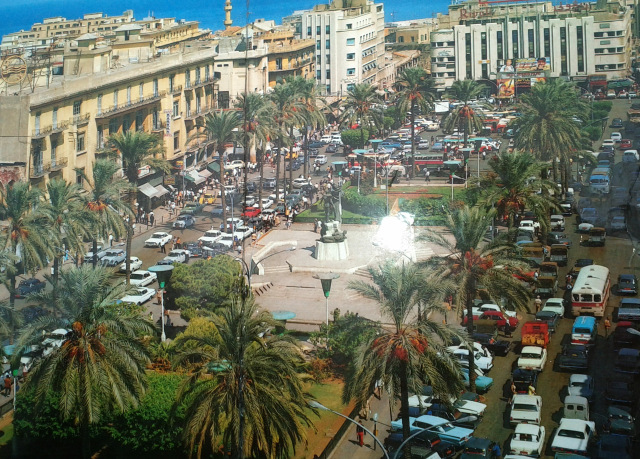
beirut60s

In the 1950s and 60s Beirut was known as ‘the Paris of the Middle East’ (above) – widely seen as more chic, more cosmopolitan than the ‘Paris-on-the-Nile’ created by Francophile architects and planners west of the old city of Cairo in the late nineteenth and early twentieth centuries.

Now I’ve always been troubled by these city switchings – the ‘Venice of the North’ is another example – because they marginalise what is so distinctive about the cities in question and crush the creativity that is surely at the very heart of their urbanity.

And yet, after last night, I can see a different point in the politics of comparison (from Kennedy’s Ich bin ein Berliner to the post 9/11 insistence that “we are all New Yorkers…”).  More accurately, in the politics of non-comparison: as Chris Graham asks (and answers): why the silence over what happened in Beirut on Thursday?  Why no mobilisation of the news media and no interruptions to regular programmes on TV or radio?  Why no anguished personal statements from Obama, Cameron or, yes, Hollande?
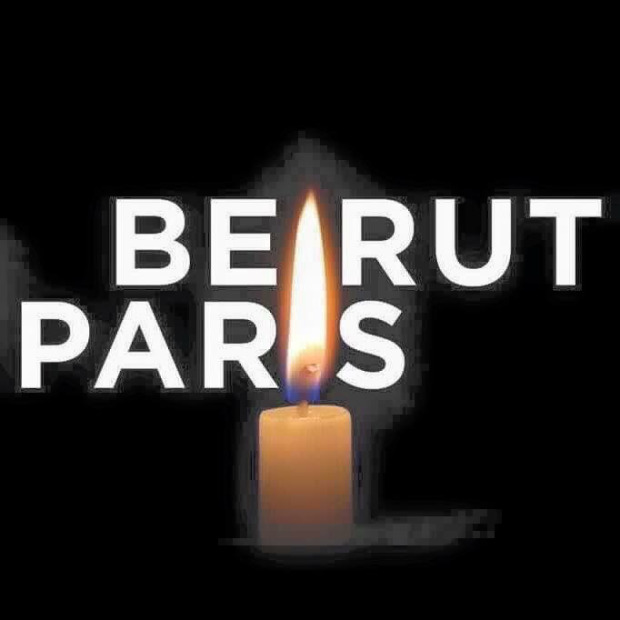
Beirut:Paris

Nobody has put those questions with more passion and justice than Elie Fares writing from Beirut:

I woke up this morning to two broken cities. My friends in Paris who only yesterday were asking what was happening in Beirut were now on the opposite side of the line. Both our capitals were broken and scarred, old news to us perhaps but foreign territory to them….

Amid the chaos and tragedy of it all, one nagging thought wouldn’t leave my head. It’s the same thought that echoes inside my skull at every single one of these events, which are becoming sadly very recurrent: we don’t really matter.

When my people were blown to pieces on the streets of Beirut on November 12th, the headlines read: explosion in Hezbollah stronghold, as if delineating the political background of a heavily urban area somehow placed the terrorism in context.

When my people died on the streets of Beirut on November 12th, world leaders did not rise in condemnation. There were no statements expressing sympathy with the Lebanese people. There was no global outrage that innocent people whose only fault was being somewhere at the wrong place and time should never have to go that way or that their families should never be broken that way or that someone’s sect or political background should never be a hyphen before feeling horrified at how their corpses burned on cement. Obama did not issue a statement about how their death was a crime against humanity; after all what is humanity but a subjective term delineating the worth of the human being meant by it?

Here we might pause to remind ourselves that most of the victims of Islamic State have been Muslims (see, for example, here and here).

Here Hamid Dabashi‘s reflections are no less acute:

In a speech expressing his solidarity and sympathy with the French, US President Barack Obama said, “This is an attack not just on Paris, it’s an attack not just on the people of France, but this is an attack on all of humanity and the universal values that we share.”

Of course, the attack on the French is an attack on humanity, but is an attack on a Lebanese, an Afghan, a Yazidi, a Kurd, an Iraqi, a Somali, or a Palestinian any less an attack “on all of humanity and the universal values that we share”? What is it exactly that a North American and a French share that the rest of humanity is denied sharing?

In his speech, UK Prime Minister David Cameron, speaking as a European, was emphatic about “our way of life”, and then addressing the French he added: “Your values are our values, your pain is our pain, your fight is our fight, and together, we will defeat these terrorists.”

What exactly are these French and British values? Can, may, a Muslim share them too – while a Muslim? Or must she or he first denounce being a Muslim and become French or British before sharing those values?

These are loaded terms, civilisational terms, and culturally coded registers. Both Obama and Cameron opt to choose terms that decidedly and deliberately turn me and millions of Muslims like me to their civilisational other.

They make it impossible for me to remain the Muslim that I am and join them and millions of other people in the US and the UK and the EU in sympathy and solidarity with the suffering of the French.

As a Muslim I defy their provincialism, and I declare my sympathy and solidarity with the French; and I do so, decidedly, pointedly, defiantly, as a Muslim.

When Arabs or Muslims die in the hands of the selfsame criminal Islamic State of Iraq and the Levant (ISIL) gangs in Afghanistan, Iraq, Syria, or Lebanon, they are reduced to their lowest common denominator and presumed sectarian denominations, overcoming and camouflaging our humanity. But when French or British or US citizens are murdered, they are raised to their highest common abstractions and become the universal icons of humanity at large.

Why? Are we Muslims not human? Does the murder of one of us not constitute harm to the entire body of humanity?
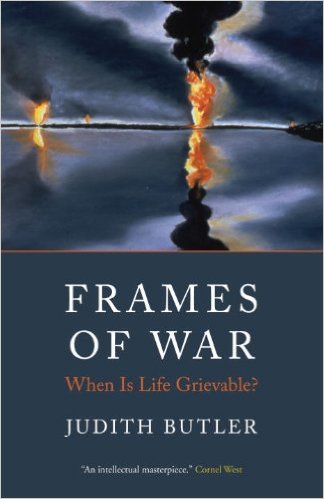
BUTLER Frames of WarElie’s and Hamid’s questions are multiple anguished variations of Judith Butler‘s trenchant demand: why are these lives deemed grievable and not those others?

To ask this is not to minimise the sheer bloody horror of mass terrorism in Paris nor to marginalise the terror, pain and suffering inflicted last night on hundreds of innocents – and also affecting directly or indirectly thousands and thousands of others.

In fact the question assumes a new urgency in the wake of what happened in Paris – where I think the most telling comparison is with Beirut and not with the attacks on Charlie Hebdo (see my commentary here) – because the extreme right (the very same people who once elected to stuff “Freedom Fries” down their throats) has lost no time in using last night’s events to ramp up their denigration of Syrian refugees and their demands for yet more bombing (and dismally failing to see any connection between the two).  You can see something of what I mean here.

And so I suggest we reflect on Jason Burke‘s commentary on Islamic State’s decision to ‘go global’ and its tripartite strategy of what he calls ‘terrorise, mobilise, polarise’.  The three are closely connected, but it’s the last term that is crucial:

In February this year, in a chilling editorial in its propaganda magazine, Dabiq, Isis laid out its own strategy to eliminate what the writer, or writers, called “the grey zone”.

This was, Isis said, what lay between belief and unbelief, good and evil, the righteous and the damned. It was home, too, to all those who had yet to commit to the forces of either side.

The grey zone, Isis claimed, had been “critically endangered [since] the blessed operations of September 11th”, as “these operations showed the world” the two camps that mankind must choose between.

Over the years, since successive violent acts had narrowed the grey zone to the point where by the end of 2014 “the time had come for another event to … bring division to the world and destroy the grey zone everywhere”.
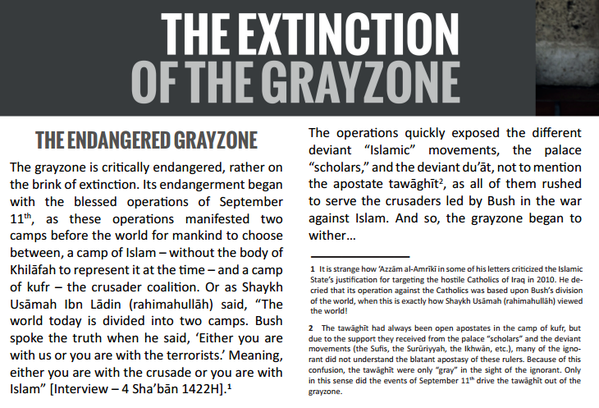
extinction-of-the-grayzone

More from Ben Norton here.  The imaginative geographies of Islamic State overlap with those spewed by the extreme right in Europe and North America and, like all imaginative geographies, they have palpable effects: not fifty shades of grey but fifty versions of supposedly redemptive violence.

UPDATE (1):  For more on these questions – and the relevance of Butler’s work– see Carolina Yoko Furusho‘s essay ‘On Selective Grief’ at Critical Legal Thinking here.

As it happens, Judith is in Paris, and posted a short reflection on Verso’s blog here.  She ends with these paragraphs:

My wager is that the discourse on liberty will be important to track in the coming days and weeks, and that it will have implications for the security state and the narrowing versions of democracy before us. One version of liberty is attacked by the enemy, another version is restricted by the state. The state defends the version of liberty attacked as the very heart of France, and yet suspends freedom of assembly (“the right to demonstrate”) in the midst of its mourning and prepares for an even more thorough militarization of the police. The political question seems to be, what version of the right-wing will prevail in the coming elections? And what now becomes a permissable right-wing once le Pen becomes the “center”. Horrific, sad, and foreboding times, but hopefully we can still think and speak and act in the midst of it.

Mourning seems fully restricted within the national frame. The nearly 50 dead in Beirut from the day before are barely mentioned, and neither are the 111 in Palestine killed in the last weeks alone, or the scores in Ankara. Most people I know describe themseves as “at an impasse”, not able to think the situation through. One way to think about it may be to come up with a concept of transversal grief, to consider how the metrics of grievability work, why the cafe as target pulls at my heart in ways that other targets cannot. It seems that fear and rage may well turn into a fierce embrace of a police state. I suppose this is why I prefer those who find themselves at an impasse. That means that this will take some time to think through. It is difficult to think when one is appalled. It requires time, and those who are willing to take it with you – something that has a chance of happening in an unauthorized “rassemblement” [gathering].

UPDATE (2): At Open Democracy Nafeez Mossadeq Ahmed has a helpful essay, ‘ISIS wants to destroy the “grey zone”: Here’s how we defend it’: access here.

‘The superpower’s dilemma’

I’m on the magical island of Sicily for the 9th Pan-European Conference on International Relations: Worlds of Violence (you can find abstracts and even some papers here though presumably not for ever).

I’ve never been to one of these things before, not even the ISA (though I must do something about that) so there’s a  learning curve – not only about IR but about how people in a different field who all seem to know one another comport themselves (or don’t).  There are lots of geographers here too, though Philippe Le Billon and Simon Springer, who organised a series of sessions on Geographies of Violence, never made it (fortunately not felled by violence).

I’m giving what I hope is more or less the final version of ‘Angry Eyes‘ (updates here and here) on the Uruzgan drone strike so I’ve been attending several sessions on drones to see what other analysts have been up to beyond the range of my targeting sensors trained on ssrn and Academia [This is perhaps the place to say I don’t post anything on either platform, since all my texts are available on this website under DOWNLOADS: but maybe I should?].

web-syria-drone-epa

Yesterday Lisa Hajjar spoke on ‘Drone warfare and the superpower’s dilemma‘.  She explains the title like this:

The United States has been in a continuous—or, at least, uninterrupted—state of armed conflict since 2001, and there is no end in sight. The strategies and technologies, as well as the locales of engagement and designated enemies of this “’global’ war on terror” have changed considerably over the past fourteen years. Nevertheless, the US government still relies on the Authorization for Use of Military Force (AUMF), passed by Congress on 14 September 2001 (three days after the 9/11 terrorist attacks), as the legal authority to bomb people in Afghanistan, Pakistan, Yemen, and Somalia, in Iraq since the occupation (the 2003 invasion was authorized under a different AUMF), in Libya since 2012, and most recently in Syria. This expanding conflict is not actually the same in any empirical sense, but the 2001 AUMF continues to be relied on because of the plasticity of the label of terrorism and the fact that the war against it has neither been won nor lost. This ability to continue fighting without losing and the inability to stop without winning could be described as “the superpower’s dilemma.”

‘The most significant change over the course of the “war on terror”’, she continues, ‘is the escalating use of armed drones (unmanned aerial vehicles, or UAVs) to target geographically diffuse and unconventional enemies.’

My analysis highlights three main issues: 1) why drone strikes for targeted killing have superseded capture and combat in US counter-terrorism strategy; 2) how officials explain and justify the strategic logic of remote killing; and 3) why drones seem to provide a technological answer to the superpower dilemma of how the United States can continue to “stay in the fight” without a significant commitment of “boots on the ground.” The conclusion is that bombing operations and aerial campaigns are incapable of achieving the declared security goals that their use aims to serve. On the contrary, drone warfare has been an important factor in the continuation of the “war on terror.”

My ability to report all this is not down to phenomenal powers of recall or a crash course in shorthand: you can read the full essay in two parts at Jadaliyya here and here.

(If you wonder about the image above, by the way, you can find the answer to its symbolic significance here and here).

_85425907_raf_strike_grab_976

Meanwhile, other states are operating drones too – notably over Iraq and Syria – including Russia (more here and here) and the UK (see here and read here).  I’m keeping my eyes on those developments too, but right now it’s Angry Eyes that holds my attention (not least because it reminds us that military drones are used for far more than targeted killing).  There are discussants for my own presentation, so I’ve prepared a paper summarising the argument and conclusions in lieu of a real paper – the long-form version is still in preparation – and I’ll post that soon.  But now I must away to think myself into my part….

Airwars

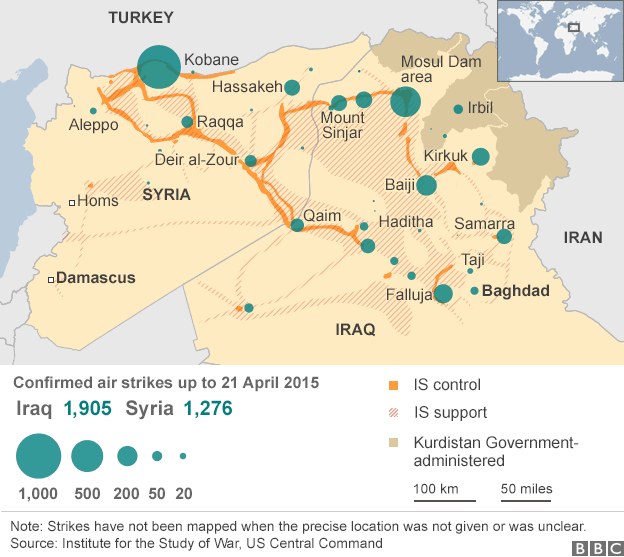
Air strike sin Iraq and Syria to April 2015

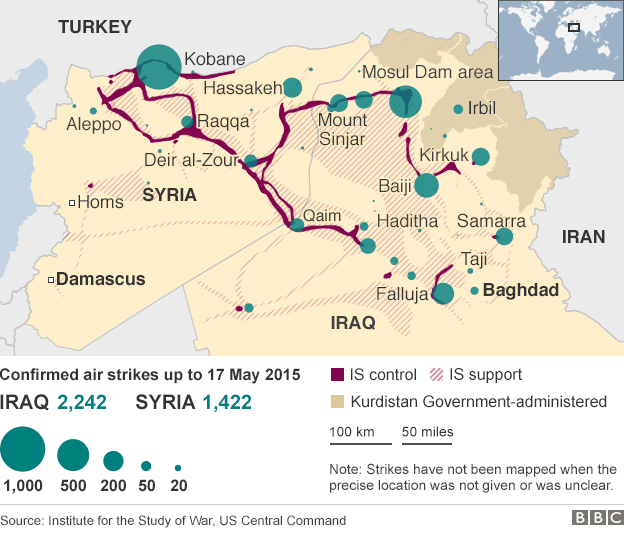
Air strikes in Iraq and Syria to 17 May 2015

I’ve taken the maps above from the BBC, which rely on reports from the Institute for the Study of War and news releases from US Central Command on ‘Operation Inherent Resolve‘.

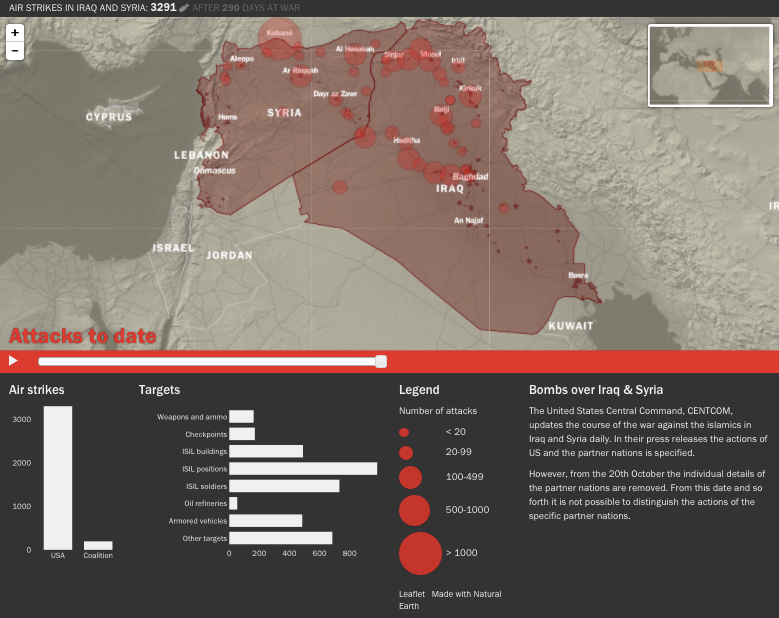
For readers wanting to follow and analyse the US-led air campaign in Iraq and Syria in more detail, I recommend Chris Woods‘ new project, Airwars.  Chris is a veteran of the Bureau of Investigative Journalism’s Drone War Project and the author of Sudden Justice: America’s secret drone wars (2015) – which really is the gold standard for analysis of US remote operations.

Airwars.org is a collaborative, not-for-profit transparency project aimed both at tracking and archiving the international air war against Islamic State (Daesh), in both Iraq and Syria. We also seek to highlight – and follow up where possible – those cases in which claims of civilian non-combatant casualties from coalition airstrikes have been indicated by credible monitoring agencies. In addition we track reported ‘friendly fire’ incidents.

The site includes tabulations and also an interactive, zoomable map (see the screenshot below).  You can find a detailed discussion of sources and methodology here.

AIRWARS 25 May 2015

I’m tracking all this for The everywhere war…  In case you are wondering why that is taking so long to finish: The colonial present started out as an essay on 9/11 and the US invasion of Afghanistan; I then realised that Sharon was taking advantage of the ‘war on terror’ to ramp up Israeli dispossession and repression of the Palestinian people, and so started work on a second essay (I’m ashamed to say that at the time I knew as little about the West Bank and Gaza as I did about Afghanistan on 11 September 2001).  Then the US invaded Iraq…  Much the same is happening with The everywhere war, but I do have the end in my sights.  I hope.


Medical neutrality and modern war

md_p0361-memory-solferinoI expect most readers know how the International Committee of the Red Cross had its origins in Henry Dunant‘s horror at the unrelieved suffering he witnessed in the aftermath of the Battle of Solferino in 1859 (see my earlier post here).

In A Memory of Solferino (1862) he asked: ‘Would it not be possible, in time of peace and quiet, to form relief societies for the purpose of having care given to the wounded in wartime by zealous, devoted and thoroughly qualified volunteers?’

Dunant’s vision of an impartial relief society to provide aid to those wounded in time of war led to the formation of a series of national relief societies and, as John Hutchinson shows in Champions of Charity: War and the rise of the Red Cross, these national societies soon became entangled with nationalism.  ‘Gripped by the passions of patriotism,’ he writes, by the time of the First World War these national societies ‘undertook to perform whatever repair work the armies required of them.’

And yet, even with these entanglements, a key principle was defended: medical neutrality.  According to Physicians for Human Rights, medical neutrality requires:

  1. The protection of medical personnel, patients, facilities, and transport from attack or interference;
  2. Unhindered access to medical care and treatment;
  3. The humane treatment of all civilians; and
  4. Nondiscriminatory treatment of the sick and injured.

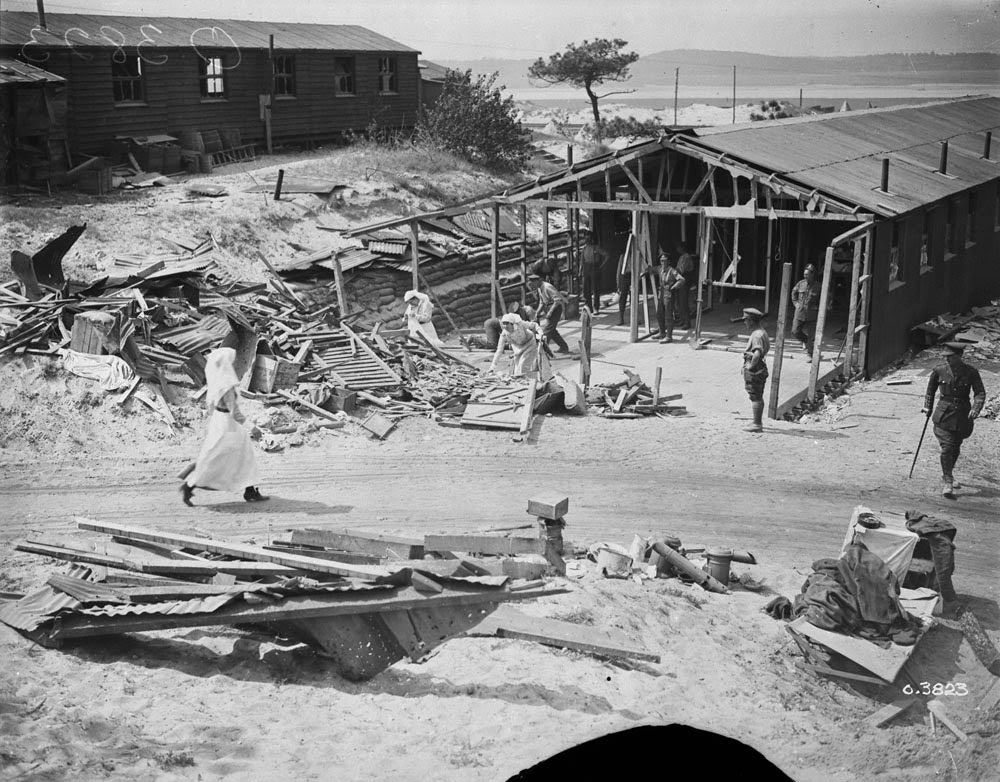
During the First World war there were complaints that the principle had been sporadically violated: that stretcher-bearers had been attacked by snipers when they sought to recover the wounded or that military hospitals had been deliberately shelled or bombed.  Here, for example, is the aftermath of one of several air raids targeting base hospitals at Etaples on the French coast between May and August 1918 (supposedly in retaliation for a British air raid on Cologne):

Lowe_Field_Hospital_bombed_LAC_PA_003747_a003747_v8.jpg_pv4a5fab25f240997c

But in the last decade of our own century such violations have become increasingly systematic. And, as more and more civilians have become trapped and even targeted in conflict zones whose ‘battlefields’ know no bounds, so those violations have extended far beyond attacks on military-medical infrastructure and personnel.

Last summer I detailed the attacks made by the Israeli military on medical facilities and emergency systems in Gaza, and I drew attention to the work of Physicians for Human Rights in documenting the precariousness of medical care there.  But the calculated production of these spaces of exception is not exceptional, and attacks like these have become part of the arsenal of later modern war.  “Instead of being protected,” says Donna McKay, executive director of PHR, “medical care is actually a target.”

HRW Attacks on Health

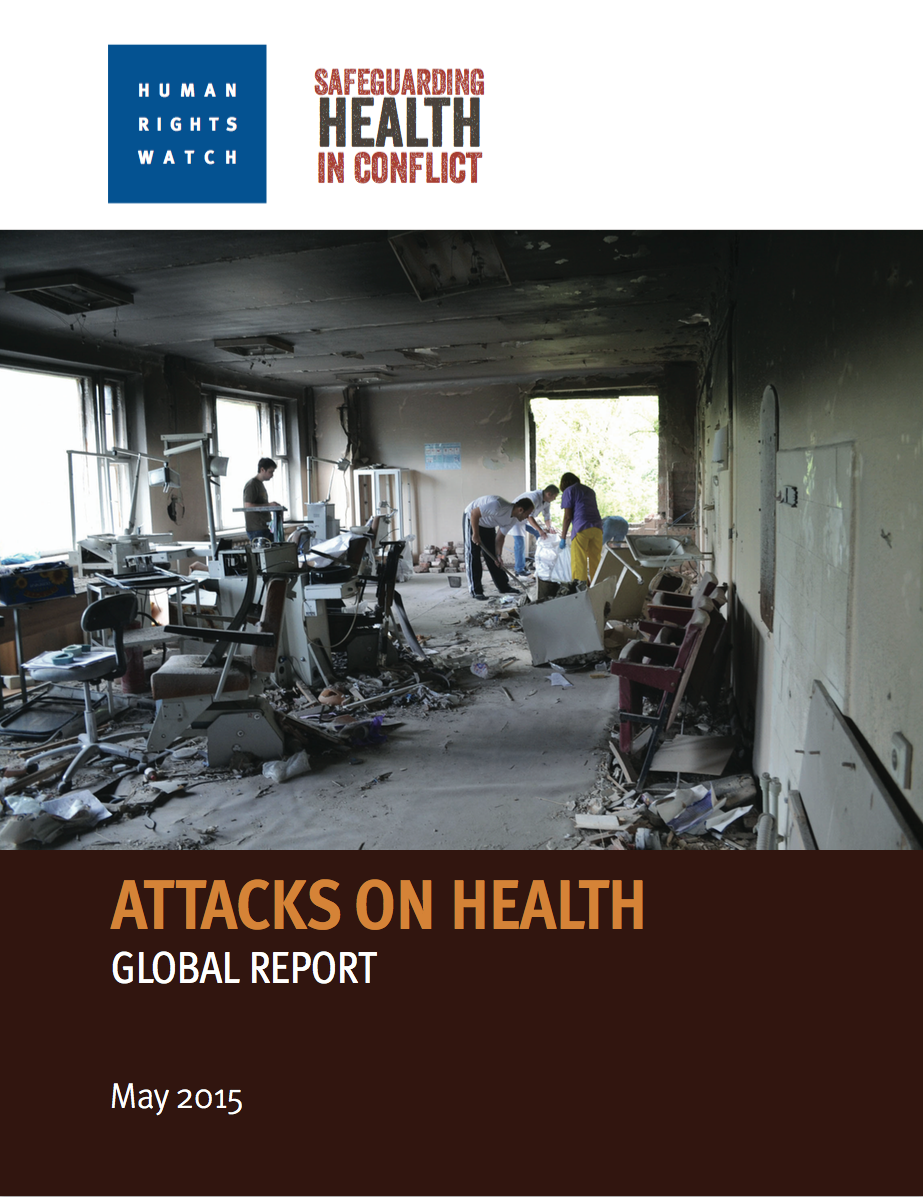
Physicians for Human Rights is part of the Safeguarding Health in Conflict Coalition which has now joined with Human Rights Watch to publish Attacks on Health: a Global Report (2015) that summarises attacks on health care facilities and health care workers around the world:

Over the past year armed groups have attacked hospitals, clinics, and health personnel in 41 incidents in Afghanistan and deliberately killed over 45 health workers, primarily polio vaccinators, in Nigeria and Pakistan. In Syria, where medical facilities in Aleppo have been hit with government barrel bombs, 194 medical personnel have been killed and 104 medical facilities attacked since 2014….

The organizations described attacks in South Sudan, where 58 people were killed in four hospitals in a series of attacks in early 2014, and in eastern Ukraine, where it is estimated that 30 to 70 percent of health workers have fled the region because of insecurity. In Yemen, Al-Qaeda in the Arabian Peninsula (AQAP) militants carried out attacks on health facilities in early 2014, and the 10-country Saudi-led coalition conducted air strikes that hit hospitals and interrupted medical supplies during the conflict in early 2015. Relying on data from Insecurity Insight’s Security in Numbers Database, the report also shows trends in attacks on health care over the course of a decade in South Sudan and Central African Republic.

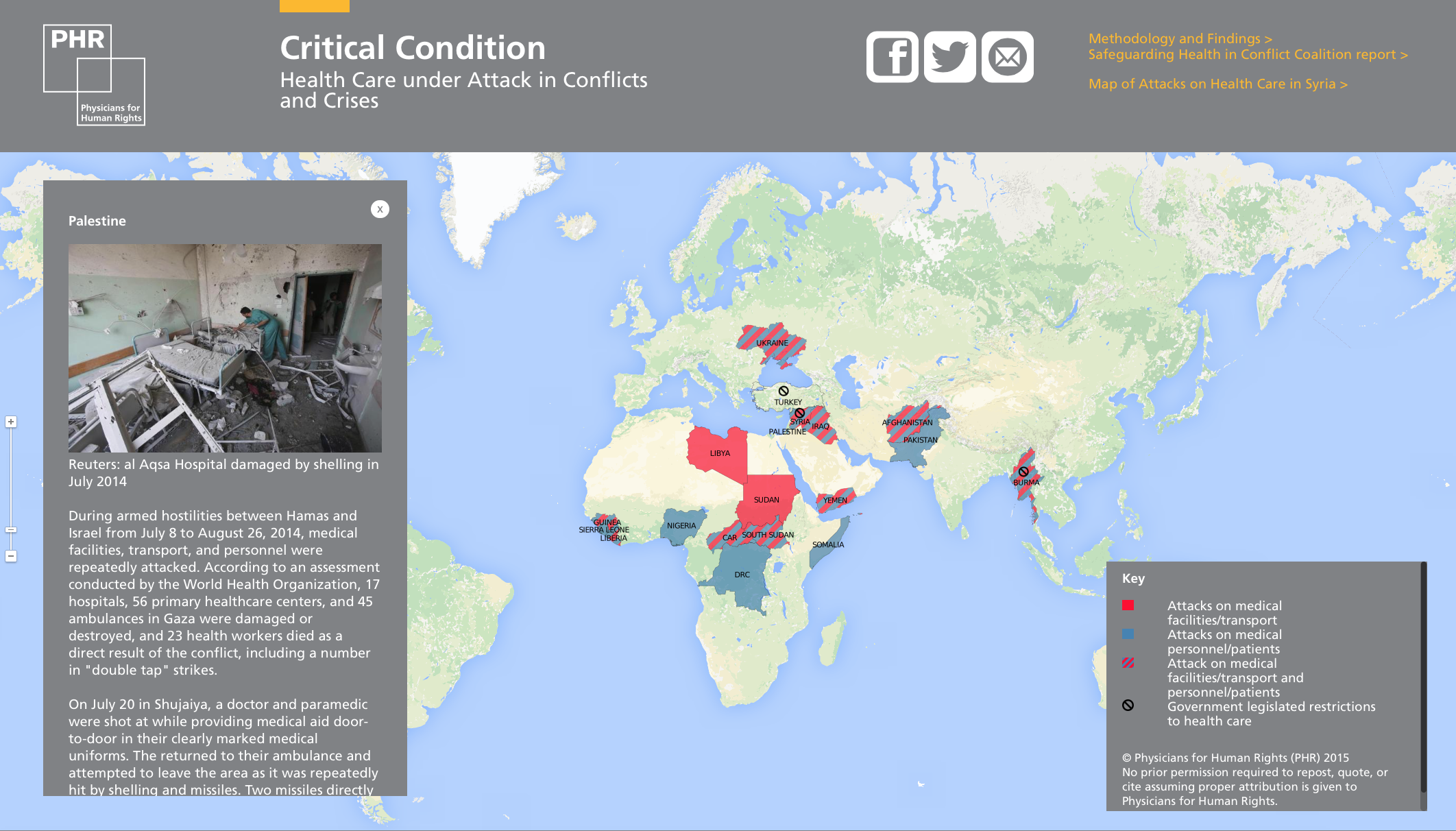
PHR Critical Condition

In close concert with the report Physicians for Human Rights have produced an interactive online map of attacks on health care around the world between January 2014 and April 2015 (see the screenshot above).

PHR Attacks on health care in Syria

The organisation has also produced a detailed map of attacks on health care systems – or what’s left of them – in Syria (see the screenshot above), which you can access here.  It needs to be supplemented by PHR’s Doctors in the crosshairs: four years of attacks on health care in Syria, which was published in March:
The symbols of the Red Cross and Red Crescent have been turned from a shield of protection into crosshairs on the backs of those who knowingly risk their lives to save others.

You can find more on the violation of medical neutrality in Syria in an open-access article by Ravi S. Katari in the Journal of global health here and in a short essay by Sasha Zients and Dylan Okabe-Jawdat for the Columbia Political Review (May 2015) here.

And you can find more on the systematic violation of medical neutrality in Bahrein and elsewhere here.

Psycho-geographies of violence

0747590338Will Self‘s series of columns for the Independent on ‘psycho-geography’ attracted considerable attention (they were published between 2003 and 2007 and then collected in the book shown on the left).  In its original form, of course, psychogeography can be traced back to the Lettrist International and the Situationists, and David Pinder‘s Visions of the city: utopianism, power and politics remains one of the most eye-opening introductions to these and similar experiments.

But in today’s Guardian Self turns to a far from utopian prospect to consider what in less avant-garde and more demotic terms would probably also count as a ‘psycho-geography’ of sorts:  ‘We are passive consumers of the pornography of violence‘.

He begins with a devastating imaginative reconstruction of one of the executions carried out by IS/IS/IL: seen not from the point of view of the video-viewing (or not-viewing) public, or even the executioner, but the victim.  He’s aware of the objections:

Surely, at the end of a year in which the public arena has been fully booked for grand guignol, the last thing anyone needs is such an intrusive – and arguably insensitive – speculation? May we not take this opportunity, on the verge of a new year, to sit back, relax, and turn away from the theatre of horrors – not, of course, because we don’t care about all this suffering, all this hideously violent discorporation, but because at least we know this much about ourselves: we may not be the most ethically motivated, caring, community-minded people around; however, we aren’t like them – we aren’t like those men in Raqqa who beat and burn and stone and rape and enslave and shoot and chop and cut: we aren’t evil. And surely, in the opinionated maelstrom we can all at least agree with David Cameron and Barack Obama on this: to cut off someone’s head is an act of such maleficence that it necessarily, in and of itself, renders those who do it evil; if by evil is understood a will-to-absolute-negation, a nihilism that metastasises through the failing body politic, leaving in its necrotic wake only dead-eyed zombies incapable of any authentic feeling.

And yet I wonder: what I wrote above was an active attempt on my part to sympathise with Abdul-Rahman Peter Kassig, Alan Henning, Steven Sotloff, James Foley and David Haines in the last moments of their lives. It was painful to write because I needed to try and put myself in their heads – possibly it was uncomfortable to read for the same reason; yet reading it was also an activity, requiring the translation of marks on page or screen into ideas, images and sensations. Some attempts to understand these perverse and evil actions are similarly engaged, but for the most part our response to the hostage crisis that unfolded over 2014 was necessarily passive. Passive in part because our government wishes to retain its monopoly both on what it sees as the legitimate exercise of violence, and on the prerogative of mercy as well: there will be no ransoms paid for British hostages, while the knife wielded by the man who has been called Jihadi John will be parried – or so they assure us – by targeted air strikes against Islamic State forces, while our “commitment to the region” is re-emphasised in other ways.

So, our passivity – the passivity of civilians who depend on a professional army to assert our moral will, and the passivity in my case – and quite possibly yours – of citizens who have long since recoiled from the spectacle of this interminable conflict worthy of Orwell’s 1984: the so-called “war on terror”.

There’s more – much more – that takes in themes that will be familiar to many readers but here given new urgency by the torsions of Self’s imagination and the sharpness his prose.  It’s an extraordinary ride, and it grips intellectually, politically and ethically.  One of Self’s central arguments is that even as we are reduced to the status of ‘passive consumers’ of this execrable violence (one that is, as he shows, far from absent from our own history) we are – those of us that live in the United States, Canada, the UK, France and elsewhere – also profoundly implicated not only in what is being staged by IS but also in the administration of military violence by the states that make up the latest ‘coalition’.

‘… we are all kneeling in the desert, staring at the serrations on that knife; the very personal and intimate nature of these murderous beheadings calls to our attention – try as we might to repress it – the cold impersonality of the murders committed in our name; for, just as in recent decades the west found it profitable to outsource manufacturing production to low-wage economies, so our own moral accounting has in the short term benefited from a form of outsourcing: western governments no longer find it expedient to perpetrate violence closer to home (it makes for bad PR and restive electorates); yet in a globalised world the exercise of “legitimate” violence is the one monopoly they continue to operate. Perhaps one way of looking at the Middle East is that it’s one of the most productive “bloodshops” we have, a reliable supplier of conflicts that give the west a showroom within which to demonstrate its overwhelming firepower.’

As I say, there’s much, much more, and Self’s reflections on the braiding threads between imagery, passivity , disembodiment and military and paramilitary violence make this the one essay I’d urge everyone to read and reflect on this week, even this month.  And probably all next year.

The War Corps

The US Congressional Research Service recently released a report, Instances of Use of United States Armed Forces Abroad, 1798-2014:

The instances differ greatly in number of forces, purpose, extent of hostilities, and legal authorization. Eleven times in its history the United States has formally declared war against foreign nations. These 11 U.S. war declarations encompassed 5 separate wars: the war with Great Britain declared in 1812; the war with Mexico declared in 1846; the war with Spain declared in 1898; the First World War, during which the United States declared war with Germany and with Austria-Hungary during 1917; and World War II, during which the United States declared war against Japan, Germany, and Italy in 1941, and against Bulgaria, Hungary, and Rumania in 1942.

Some of the instances were extended military engagements that might be considered undeclared wars. These include the Undeclared Naval War with France from 1798 to 1800; the First Barbary War from 1801 to 1805; the Second Barbary War of 1815; the Korean War of 1950-1953; the Vietnam War from 1964 to 1973; the Persian Gulf War of 1991; global actions against foreign terrorists after the September 11, 2001, attacks on the United States; and the war with Iraq in 2003. With the exception of the Korean War, all of these conflicts received congressional authorization in some form short of a formal declaration of war. Other, more recent instances often involve deployment of U.S. military forces as part of a multinational operation associated with NATO or the United Nations.

Barbara Salazar Torreon, who compiled the report, adds:

The list does not include covert actions or numerous instances in which U.S. forces have been stationed abroad since World War II in occupation forces or for participation in mutual security organizations, base agreements, or routine military assistance or training operations. Because of differing judgments over the actions to be included, other lists may include more or fewer instances.

5875790-1x1-700x700

abc news has now provided an interactive that maps the data set here, together with a discussion of the original report.

Degrees of intimacy

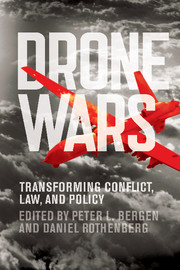
Drone warsNext month Cambridge University Press is publishing a book of essays edited by Peter Bergen and Daniel Rothenberg, Drone wars: transforming conflict, law and policy, due out from Cambridge University Press at the end of the year.  Here’s the blurb:

Drones are the iconic military technology of many of today’s most pressing conflicts, a lens through which U.S. foreign policy is understood, and a means for discussing key issues regarding the laws of war and the changing nature of global politics. Drones have captured the public imagination, partly because they project lethal force in a manner that challenges accepted rules, norms, and moral understandings. Drone Wars presents a series of essays by legal scholars, journalists, government officials, military analysts, social scientists, and foreign policy experts. It addresses drones’ impact on the ground, how their use adheres to and challenges the laws of war, their relationship to complex policy challenges, and the ways they help us understand the future of war. The book is a diverse and comprehensive interdisciplinary perspective on drones that covers important debates on targeted killing and civilian casualties, presents key data on drone deployment, and offers new ideas on their historical development, significance, and impact on law and policy. Drone Wars documents the current state of the field at an important moment in history when new military technologies are transforming how war is practiced by the United States and, increasingly, by other states and by non-state actors around the world.

And here is the Contents List:

Part I. Drones on the Ground:

1. My guards absolutely feared drones: reflections on being held captive for seven months by the Taliban David Rohde
2. The decade of the drone: analyzing CIA drone attacks, casualties, and policy Peter Bergen and Jennifer Rowland
3. Just trust us: the need to know more about the civilian impact of US drone strikes Sarah Holewinski
4. The boundaries of war?: Assessing the impact of drone strikes in Yemen Christopher Swift
5. What do Pakistanis really think about drones? Saba Imtiaz

Part II. Drones and the Laws of War:

6. It is war at a very intimate level USAF pilot
7. This is not war by machine Charles Blanchard
8. Regulating drones: are targeted killings by drones outside traditional battlefields legal? William Banks
9. A move within the shadows: will JSOC’s control of drones improve policy? Naureen Shah
10. Defending the drones: Harold Koh and the evolution of US policy Tara McKelvey
Part III. Drones and Policy Challenges:
11. ‘Bring on the magic’: using drones in combat Michael Waltz
12. The five deadly flaws of talking about emerging military technologies and the need for new approaches to law, ethics, and war P. W. Singer
13. Drones and cognitive dissonance Rosa Brooks
14. Predator effect: a phenomenon unique to the war on terror Meg Braun
15. Disciplining drone strikes: just war in the context of counterterrorism David True
16. World of drones: the global proliferation of drone technology Peter Bergen and Jennifer Rowland

Part IV. Drones and the Future of Warfare:

17. No one feels safe Adam Khan
18. ‘Drones’ now and what to expect over the next ten years Werner Dahm
19. From Orville Wright to September 11: what the history of drone technology says about the future Konstantin Kakaes
20. Drones and the dilemma of modern warfare Richard Pildes and Samuel Issacharoff
21. How to manage drones, transformative technologies, the evolving nature of conflict and the inadequacy of current systems of law Brad Allenby
22. Drones and the emergence of data-driven warfare Daniel Rothenberg

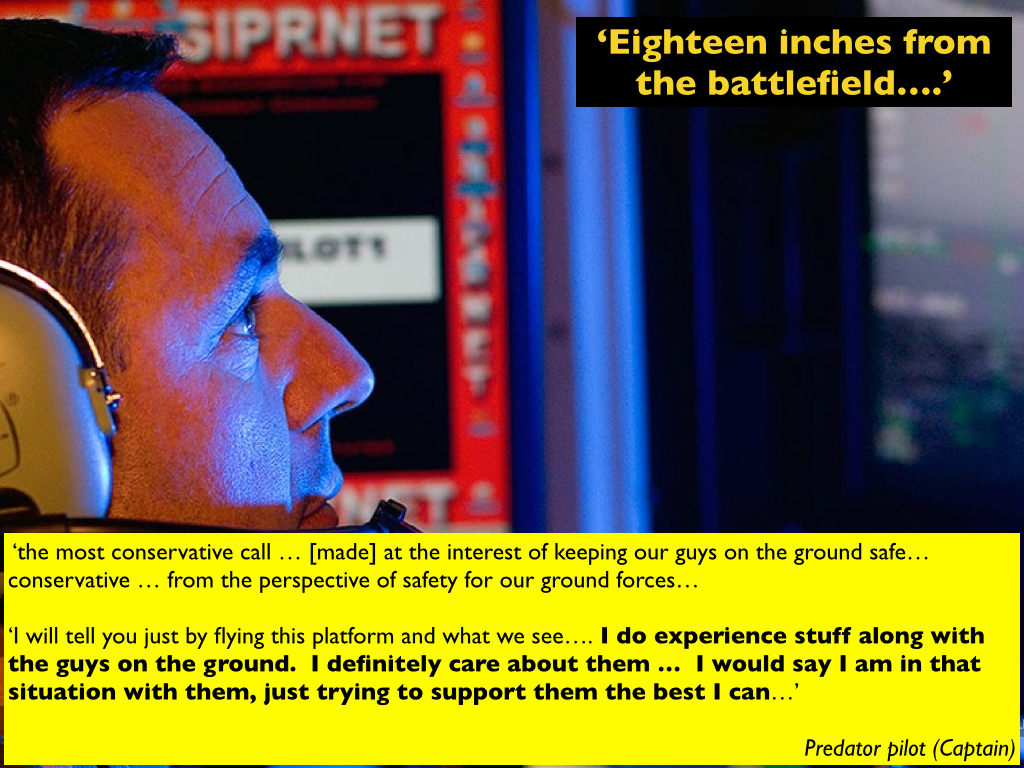
Over at Foreign Policy you can find an early version of Chapter 6, which is an interview with a drone pilot conducted by Daniel Rothenberg.  There are two passages in the interview that reinforce the sense of the bifurcated world inhabited by drone crews that I described in ‘From a view to a kill’ and ‘Drone geographies’ (DOWNLOADS tab).  On the one side the pilot confirms the inculcation of an intimacy with ground troops, particularly when the platforms are tasked to provide Close Air Support, which is in some degree both reciprocal and verbal:

“Because of the length of time that you’re over any certain area you’re able to engage in lengthy communications with individuals on the ground. You build relationships. Things are a little more personal in an RPA than in an aircraft that’s up for just a few hours. When you’re talking to that twenty year old with the rifle for twenty-plus hours at a time, maybe for weeks, you build a relationship. And with that, there’s an emotional attachment to those individuals.

“You see them on a screen. That can only happen because of the amount of time you’re on station. I have a buddy who was actually able to make contact with his son’s friend over in the AOR [area of responsibility]. If you don’t think that’s going to make you focus, then I don’t know what will.

“Many individuals that have been over there have said, ‘You know, we were really happy to see you show up’; ‘We knew that you were going to keep us from being flanked’; ‘We felt confident in our ability to move this convoy from ‘A’ to ‘B’ because you were there.’ The guy on the ground and the woman on the ground see how effective we are. And it gives them more confidence.”

GREGORY Angry Eyes Extract.001

[The image above is taken from my ‘Angry Eyes’ presentation; the Predator pilot in this instance was involved in orchestrating the air strike in Uruzgan province, Afghanistan on 21 February 2010, and the quotation is taken from the US Army investigation into the incident.  I’m converting the presentation into the final chapter for The everywhere war, and I’ll post the draft as soon as I’m finished.]

But when the pilot in Rothenberg’s interview goes on to claim that ‘Targeting with RPAs is very intimate’ and that ‘It is war at a very intimate level’, he reveals on the other side an altogether different sense of intimacy: one that is strictly one-sided, limited to the visual, and which resides in a more abstracted view:

“Flying an RPA, you start to understand people in other countries based on their day-to-day patterns of life. A person wakes up, they do this, they greet their friends this way, etc. You become immersed in their life. You feel like you’re a part of what they’re doing every single day. So, even if you’re not emotionally engaged with those individuals, you become a little bit attached. I’ve learned about Afghan culture this way. You see their interactions. You’re studying them. You see everything.”

The distinction isn’t elaborated, but the claims of ‘immersion’ and becoming ‘part of what they’re doing every day’ are simply astonishing, no?  You can find more on the voyeurism of ‘pattern of life analysis’ and the remarkable conceit that ‘you see everything’ here.

GREGORY Drones and the everywhere war 2014 Homeland insecurities.001

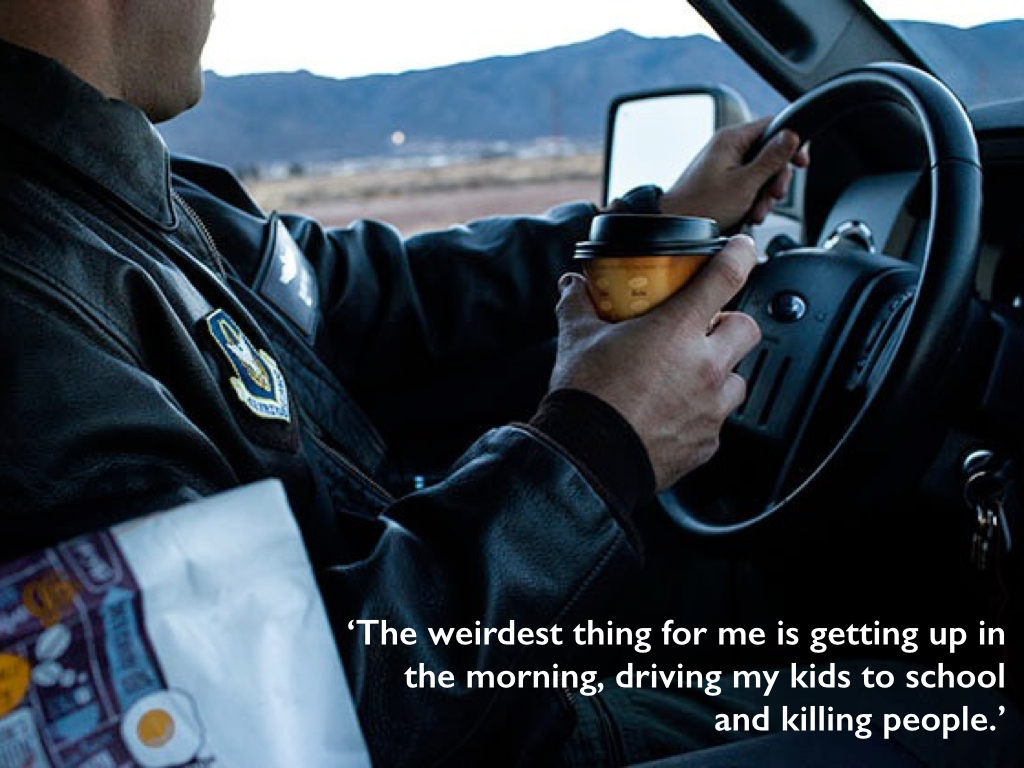
[The image above is taken from my ‘Drone geographies’ presentation]

The interview emphasises a different bifurcation, which revolves around the alternation between ‘work’ and ‘home’ when remote operations are conducted from the United States:

“”When you’re doing RPA operations, you’re mentally there, wherever there is. You’re flying the mission. You’re talking to folks on the ground. You’re involved in kinetic strikes. Then you step out the ground control station (GCS) and you’re not there anymore…

“Those are two very, very different worlds. And you’re in and out of those worlds daily. I have to combine those two worlds. Every single day. Multiple times a day. So, I am there and then I am not there and then I am there again. The time between leaving the GCS [Ground Control Station] and, say, having lunch with my wife could be as little as ten minutes. It’s really that fast.”

You can find much more on these bifurcations in my detailed commentary on Grégoire Chamayou‘s Théorie du drone here and in ‘Drone geographies’ (DOWNLOADS tab).

There’s one final point to sharpen.  In my developing work on militarized vision, and especially the ‘Angry eyes’ presentation/essay,  I’ve tried to widen the focus beyond the strikes carried out by Predators and Reapers to address the role they play in networked operations where the strikes are carried out by conventional strike aircraft.  Here is what Rothenberg’s pilot says about what I’ve called the administration of military violence (where, as David Nally taught me an age ago, ‘administration’ has an appropriately double meaning):

‘”Flying an RPA is more like being a manager than flying a traditional manned aircraft, where a lot of times your focus is on keeping the shiny side up; keeping the wings level, putting the aircraft where it needs to be to accomplish the mission. In the RPA world, you’re managing multiple assets and you’re involved with the other platforms using the information coming off of your aircraft.

“You could use the term ‘orchestrating’; you are helping to orchestrate an operation.”

***

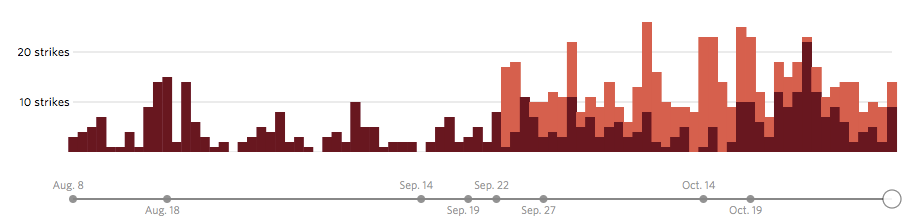
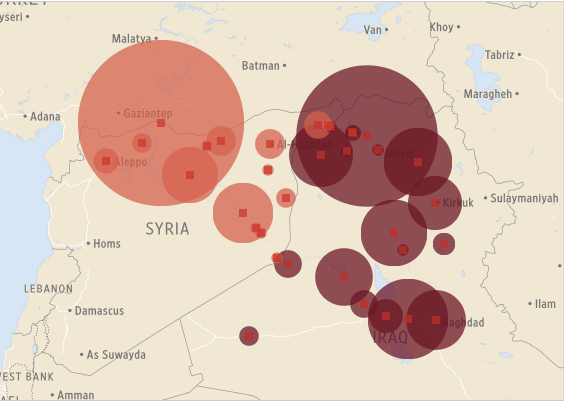
Drone wars appears just as remote operations over Iraq and Syria are ramping up: you can find an excellent review by Chris Cole at Drone Wars UK here, ‘Drones in Iraq and Syria: What we know and what we don’t.’  The images below are from the Wall Street Journal‘s interactive showing all air strikes reported by US Central Command 8 August through 3 November 2014:

Air strikes in Iraq and Syria

During this period  769 coalition air strikes were reported: 434 in Syria (the dark columns), including 217 on the besieged border city of Kobane, and 335 in Iraq (the light columns), including 157 on Mosul and the Mosul Dam.

Air strikes in Iraq and Syria August-November 2014

But bear in mind these figures are for all air strikes and do not distinguish between those carried out directly by drones and those carried out by conventional strike aircraft.  As Chris emphasises:

‘Since the start of the bombing campaign, US drones have undertaken both surveillance and strike missions in Iraq and Syria but military spokespeople have refused to give details about which aircraft are undertaking which strikes repeatedly using the formula “US military forces used attack, fighter, bomber and remotely-piloted aircraft to conduct airstrikes.”’

Although the USAF has used a mix of MQ-1 (Predator) and MQ-9 (Reaper) drones, F-15E, F-16, F/A-18 and F-22 fighters, B-1 bombers, AC-130 gunships and AH-64 Apache helicopters in these operations, it seems likely that its capacity to use remote platforms to provide intelligence, surveillance and reconnaissance is limited by its continuing commitments in Afghanistan (though Britain’s Royal Air Force has now deployed its Reapers for operations in both Iraq and Syria).

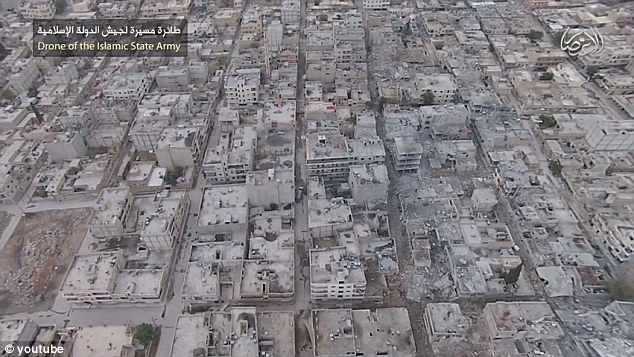
IS (Islamic State) claims to have its own drones too.  In February it released video of its aerial surveillance of Fallujah in Iraq, taken from a DJI Phantom FC40 quadcopter, in August it released video of Taqba air base in Syria taken from the same platform, tagged as ‘a drone of the Islamic State army’, and in September a propaganda video featuring hostage John Cantile showed similar footage of Kobane (below).

1414438887900_wps_7_IS_have_released_a_new_vi

These image streams are all from commercial surveillance drones, but in September the Iranian news agency Fars reported that Hezbollah had launched an air strike from Lebanon against a command centre of the al-Nursra Front outside Arsal in Syria using an armed (obviously Iranian) drone.

You can find Peter Bergen’s and Emily Schneiders view on those developments here, and a recent survey of the proliferation of drone technologies among non-state actors here.

The details of both the state and non-state air strikes remain murky, but I doubt that much ‘intimacy’ is claimed for any of them.

Conflicts without borders

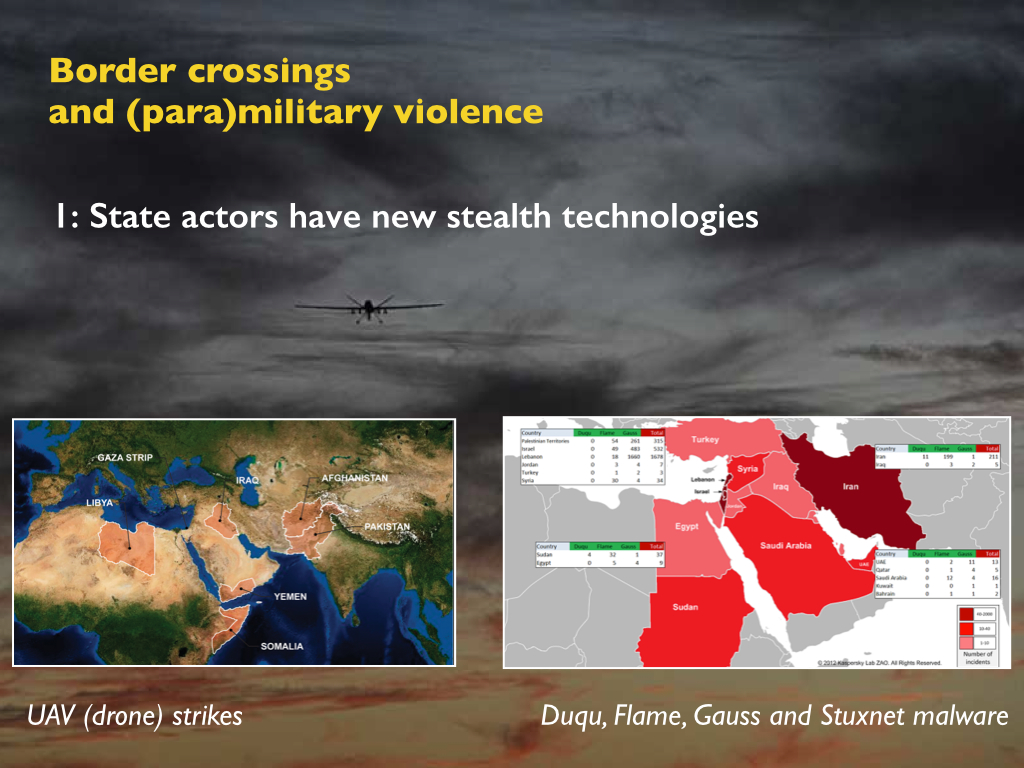
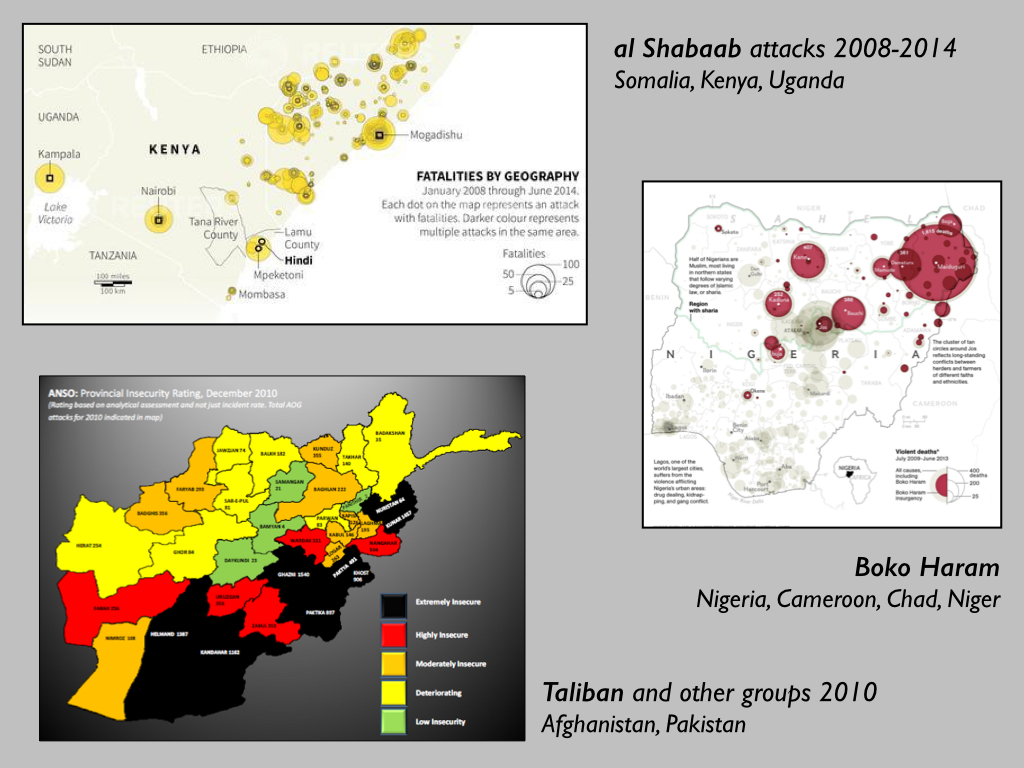
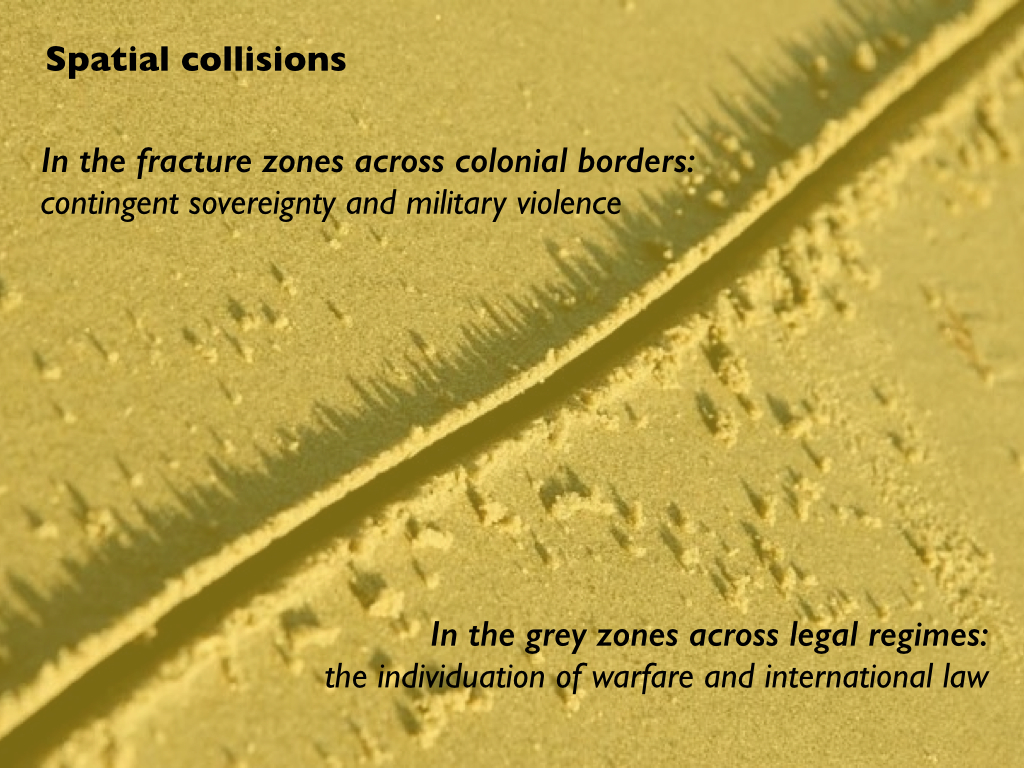
In Finland last month I gave a presentation on Law, violence and b/ordering, in which I began by making two preliminary points about border crossings and (para)military violence: trans-border incursions and transgressions have been facilitated by (i) new stealth technologies deployed by state actors and (ii)  the rise of new non-state and para-state actors.  Here are the relevant slides:

GREGORY 2 Law, violence and b:ordering.001

GREGORY 2 Law, violence and b:ordering.002

GREGORY 2 Law, violence and b:ordering.003

GREGORY Law, violence and b:ordering.003

I derived the map showing the advance of IS(IS)/ISIL from the Institute for the Study of War; say what you like about their politics (this is the Kagans we are talking about), their maps and summaries are extremely helpful.

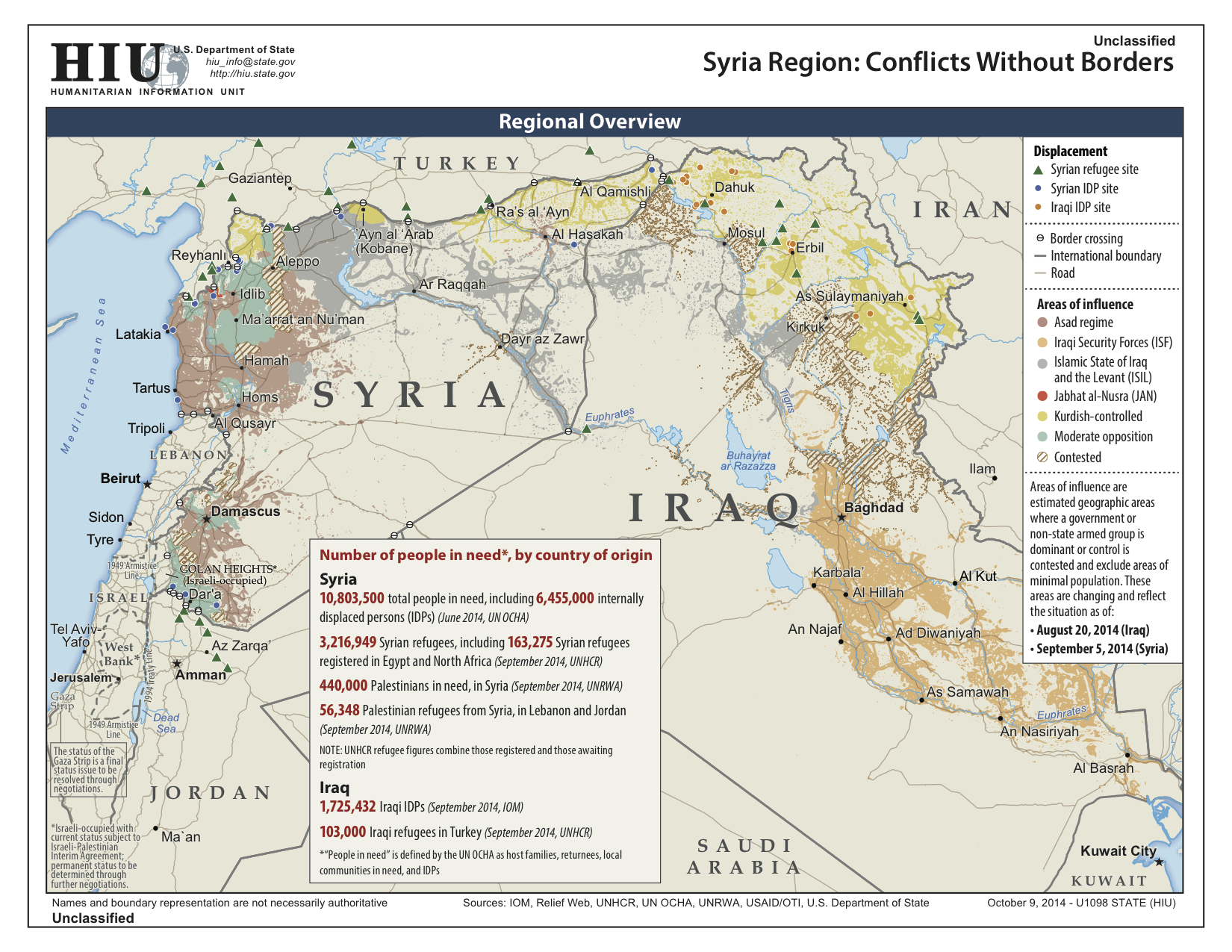
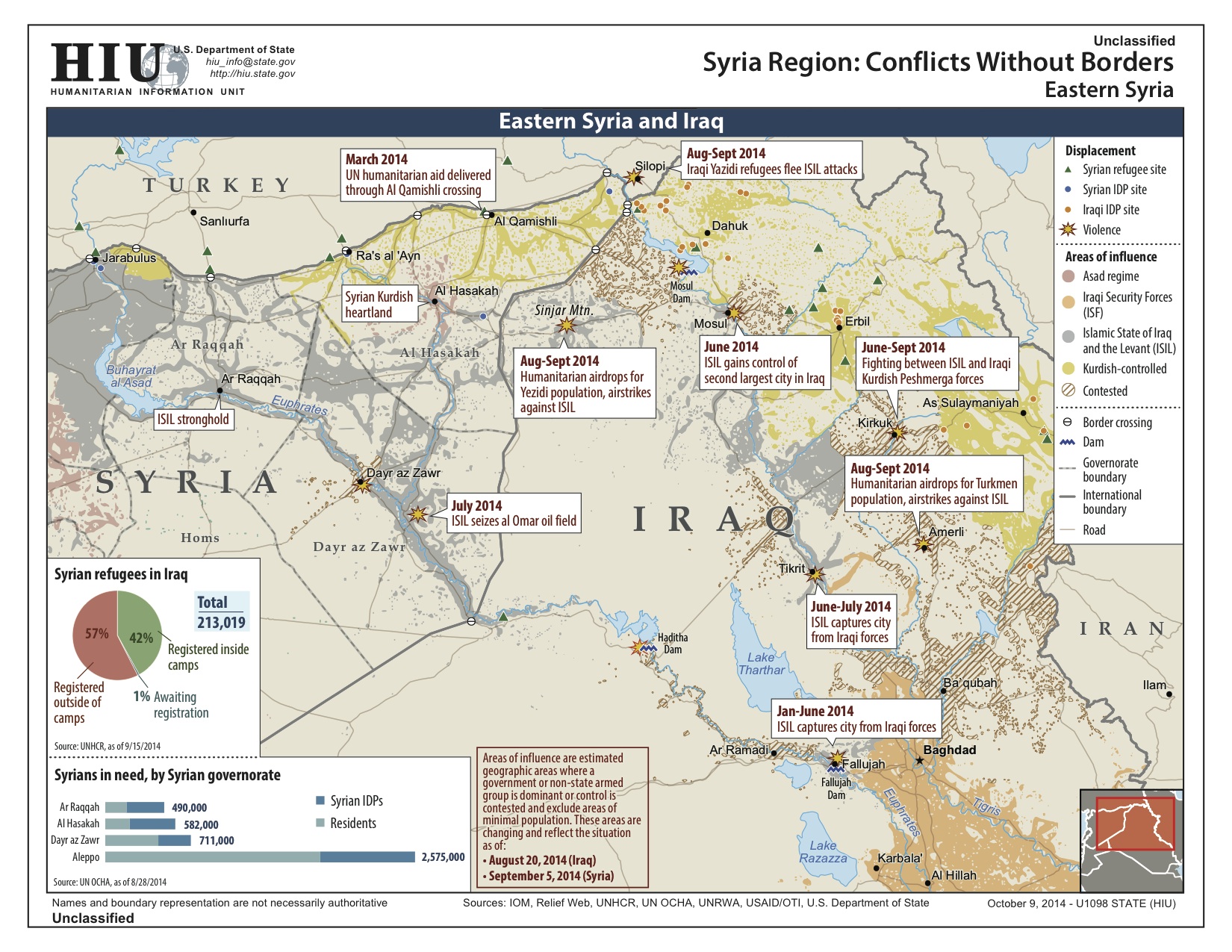
Now Public Intelligence has just published a series of (unclassified) maps of Iraq, Syria, Lebanon and Jordan produced by the Humanitarian Information Unit of the US State Department called Conflicts Without Borders:

‘Conflicts Without Borders refers to a conflict in one country that draws in other governments and non-state actors, exacerbates stresses and conflicts in the neighbouring countries, and generates displacement across borders.’

That’s a definition to think about; there are obvious ironies in the US offering a definition that I suspect is intended to exclude its own part in initiating conflicts (if so, it doesn’t work), and there is the interesting attribution of causal powers to conflicts (which ‘draw in’ other actors like so many black holes).

This map series is dated 9 October 2014; the maps provide a Regional Overview (the first map below) and then show Northern Syria and Turkey, Western Syria and Lebanon, Southern Syria and Jordan and Eastern Syria and Iraq (the second map below).

DoS-Syria-ISIL

DoS-Iraq and Syria-ISIL

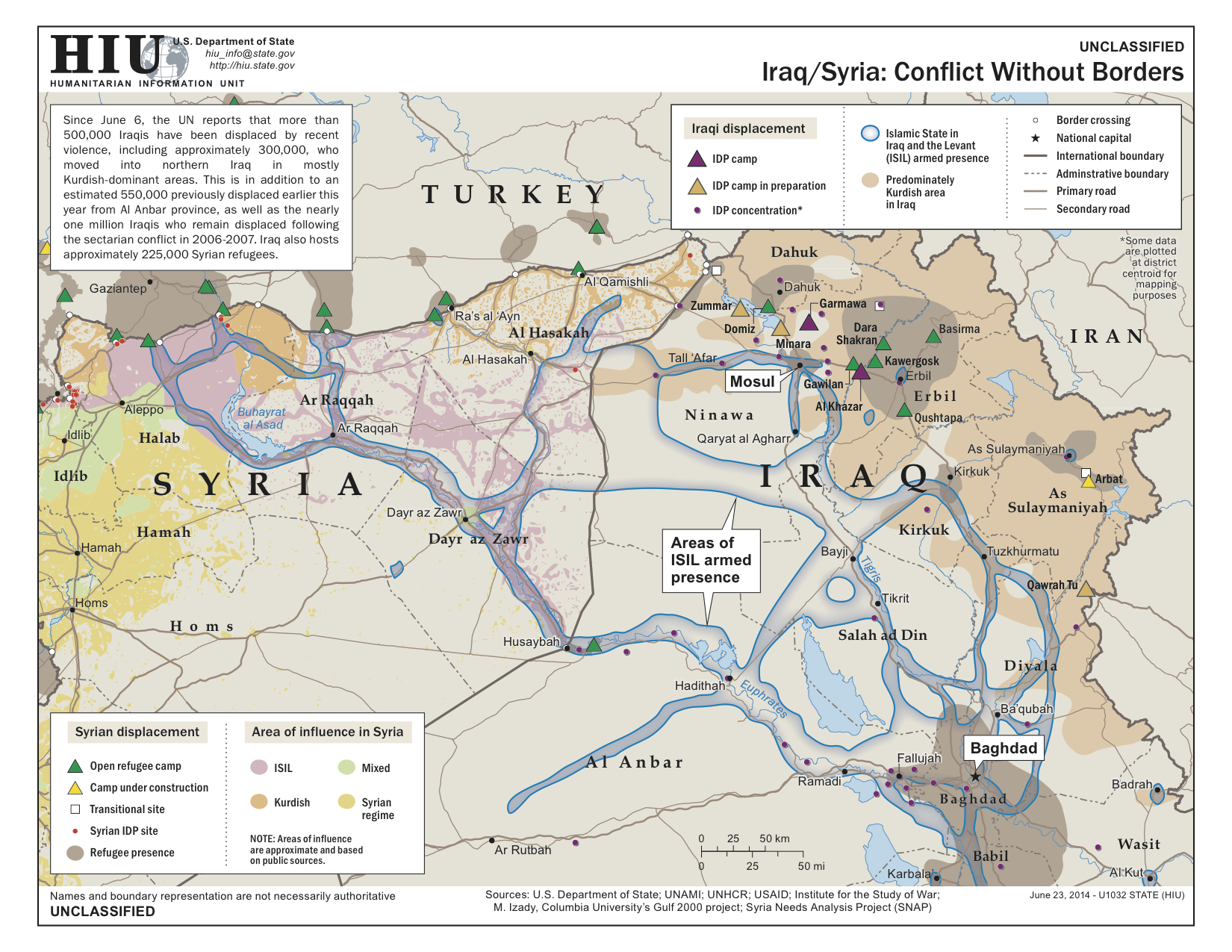
You can access a single summary map for late June here (shown below):

DoS Iraq Syria Conflict June 2014

Missing maps

Missing Maps ProjectA postscript (of sorts: a postpost?) to my previous discussion of the use of satellite imagery by humanitarian organisations.

Today’s Guardian includes a notice by Chris Michael of the Missing Maps project, an open, collaborative venture between Médecins sans Frontières, the American Red Cross, the British Red Cross and the Humanitarian OpenStreetMap Team (HOT) to map what MSF calls ‘the most crisis-prone parts of the developing world.’

It is, says Michael, ‘nothing less than a human genome project for the world’s cities.’  Less hyperbolically, mapping is of vital importance in any emergency, and MSF’s experience in providing medical aid after the Haiti earthquake in 2010 alerted the organisation to the importance of accurate and reliable geo-locational data.

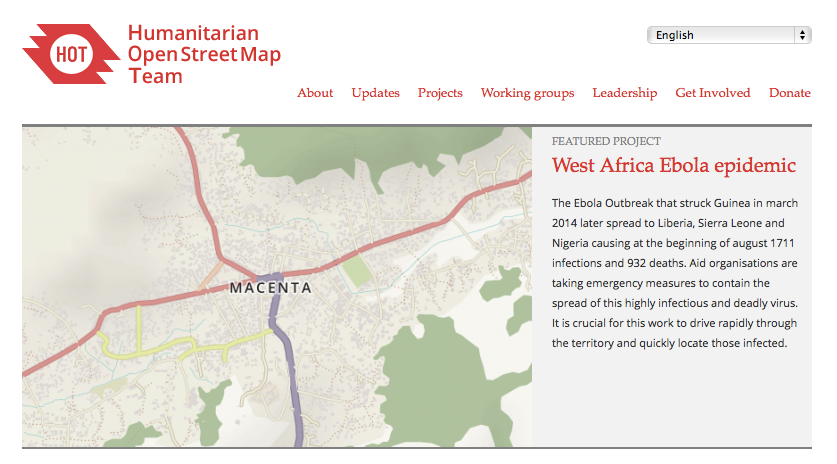
HOT Ebola

The base will be satellite imagery but, unlike HOT’s existing disaster response mapping [see its response to the Ebola epidemic in West Africa (above) here and here], the new project is intended to be pre-emptive.  And in case you are wondering what’s wrong with Google Maps, the answer is: a lot.  Michael again:

Crowdsourcing … gives the open-source project an advantage over Google Maps, which is engaged in its own effort to build proprietary maps for cities in Africa and the developing world. By harnessing the aggregated individual acts volunteered by everyday people, Missing Maps can make its scope truly planetary. Google has similarly been asking people to voluntarily flesh out Google Maps, following criticism that the company was ignoring places where there was no advertising money to be made. After all, there’s no Starbucks in a slum. And Google Maps is, like the rest of Google’s projects (whatever their current openness and freedom of use), privately owned and subject to fees at any time they might choose to start charging.

“The point of the project is that the maps will all be open source,” says Missing Maps coordinator Pete Masters. “It will be illegal for anyone to charge anyone to [have access to OpenStreetMap.org] – meaning local people will have total access to them, not just to look at, but to edit and develop.”

That idea more than any other has fired the imaginations of the people in unmapped places, says Gayton. “It’s legally impossible for someone to steal it, to close off and own the data. It’s created by genuine volunteer labour, and belongs to everyone. And the question everyone asks me is: ‘Why?’ They couldn’t believe it.”

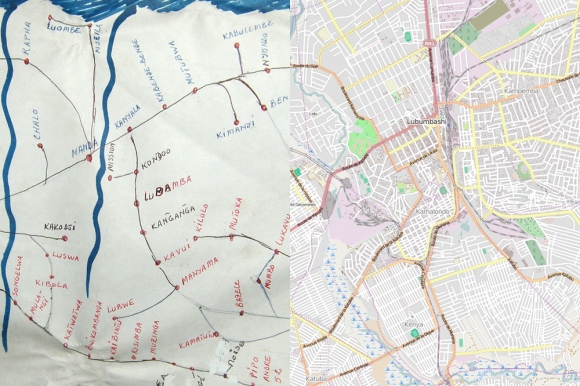
katanga_and_lubumbashi_map

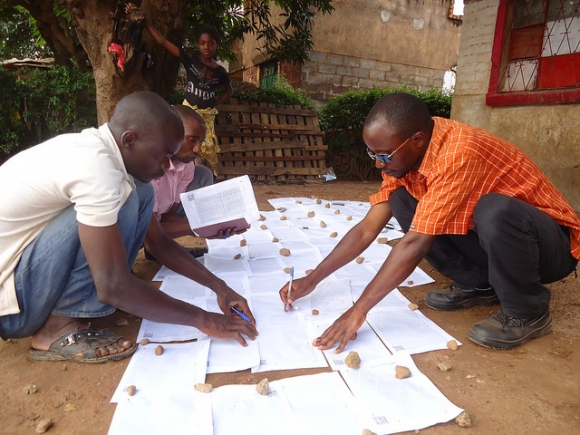
To give you an idea of what is envisaged, the image above juxtaposes a hand-drawn MSF map in Katanga (DRC) with a map of Lubumbashi (DRC) made by local university students and others (see below) supported by the Humanitarian Open Street Map team.

13586731953_9084950df6_z

I’ve borrowed both images from MSF, and you can find more information about the project and how to get involved from MSF here, via the project’s wiki here, and on Facebook here.

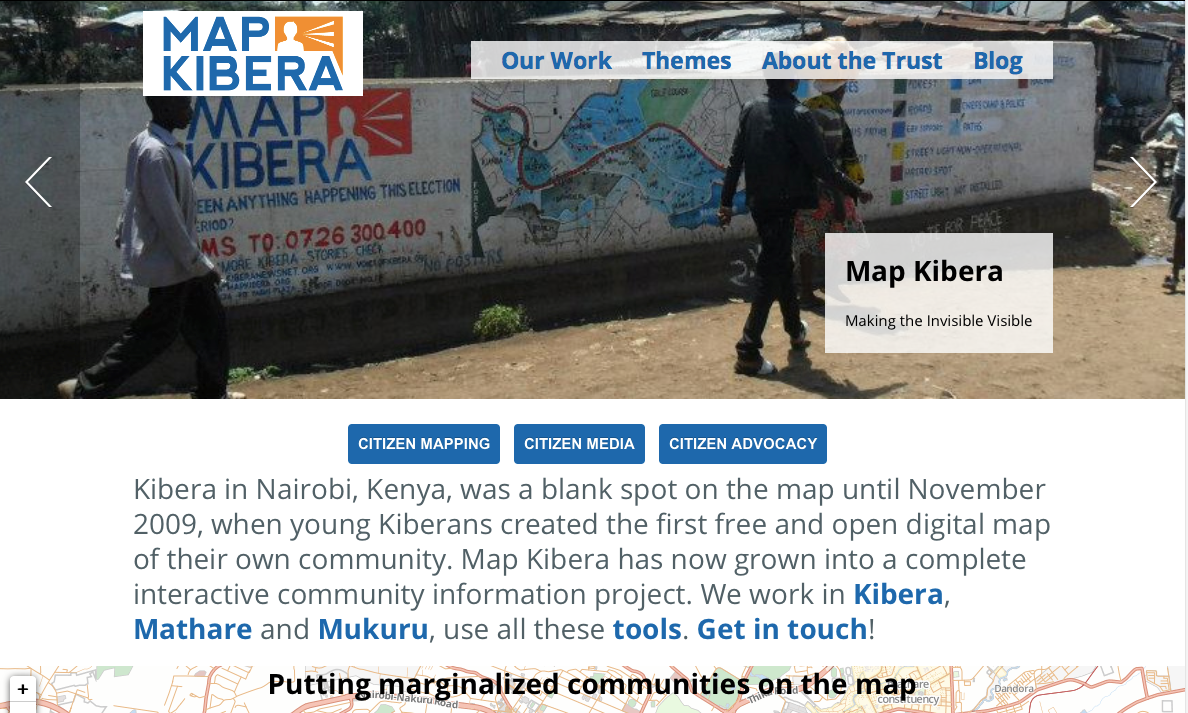
I realise that there’s nothing new about participatory mapping: have a look at Map Kibera, which has successfully put a marginalised zone of Nairobi on the map and morphed into an interactive community information project.

Map Kibera

And there are risks and dangers in being ‘put on the map’ too.  The OpenStreetMaps community has produced constantly evolving maps of Syria, for example [follow the link for some animations], and while I don’t dispute Eric Fischer‘s claim at Mapbox that ‘this data is of vital importance to humanitarian workers on the ground’, I suspect it’s also valuable to others on the ground – and, for all I know, in the air too.

But even if you don’t want to or can’t get involved in Missing Maps, reading this project alongside parallel ventures by MapAction (which this year alone has had field teams in Iraq, Liberia, Paraguay, Serbia and south Sudan), together with other established work in participatory mapping and GIS (like the Rainforest Foundation‘s Mapping for Rights project) and counter-mapping and counter-cartography is highly instructive.

Deadly improvisations

There is nothing refined about killing, but the war in Syria has shown that both sides have resorted to improvisational tactics.  I say ‘both sides’ as a short-hand: this is hardly a two-party conflict, since the anti-Assad forces are far from united and a number of external powers – not only Iran and Saudi Arabia – are plainly using the parties as players in a proxy war.

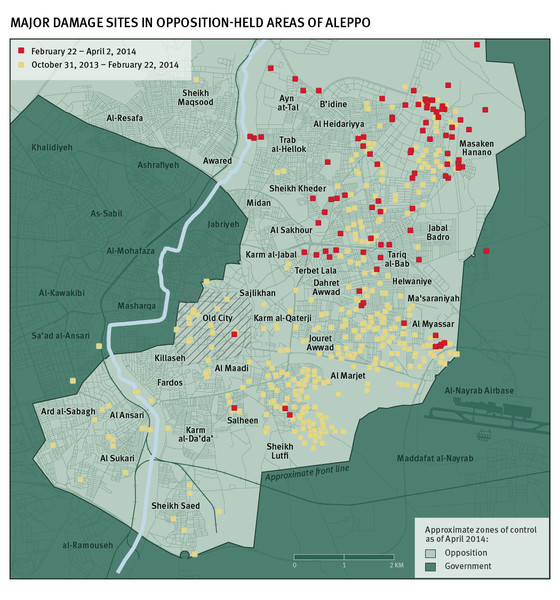
One of the first signs was the Syrian Air Force’s use of so-called ‘barrel bombs’: in effect, these are improvised explosive devices made from oil barrels filled with crude explosive and, on occasion, metal shrapnel and even chemicals like chlorine, which are then dropped from helicopters.  At first, they were dropped from low altitudes – which, according to Richard Lloyd at least, made them accurate enough to strike particular targets – but once the rebels were equipped with rocket-launchers (MANPADs) the helicopters had to fly much higher (near 7,000 feet) with a corresponding diminution in accuracy.  The first attacks took place against the city of Homs in August 2012, but the locus then shifted to rebel-held areas in Aleppo – the map below comes from Human Rights Watch‘s forensic analysis of strikes against that city between October 2013 and April 2014; some of the sites identified may have been struck by other munitions, HRW concedes, including conventional bombs, mortars and artillery shells, but the vast majority reveal the characteristic signature of the indiscriminate deployment of barrel bombs.  The Syrian National Council estimates that 20,000 people have been killed by barrel bombs thus far.

Aleppo Barrel Bombs (Human Rights Watch)

Since the Syrian Air Force has been supplied with conventional bombs by both Russia and Iran, many commentators have concluded that the recourse to crude barrel bombs is not the result of any munitions shortage but is rather a determined attempt to spread indiscriminate terror.  For we need to remember that there’s nothing special about barrel bombs; they are probably less effective – certainly less accurate – than conventional munitions.  In short, they are, as I’ve said, an improvisation – what the indefatigable Eliot Higgins (of Brown Moses fame: an absolutely indispensable source for all this) calls ‘a piece of crap’.  But they are also unequivocal evidence that the regime is ‘interested in no path forward other than by killing.’

The result has been captured in a sobering video from Syrian Zero, showing barrel bomb attacks on Darayya, a neighbourhood in Damascus during the last week of January (below; you can find a brief, helpful exposition and commentary on the video here).

Barrel bombs have also been used by the Sudanese Air Force in Southern Kordofan and Blue Nile states, and most recently by the Iraqi Air Force against Fallujah.

A second tactic used in Syria – this time by opposition forces – hearkens back to the First World War. Earlier this month, and in part as a counter to the crude air war against the rebel-held areas of Aleppo, the Islamic Front detonated a vast underground mine packed with explosives beneath the city’s Carlton Hotel, which was used as a base by the Syrian Army.  Video of the construction of the 75 metre tunnel had previously been uploaded to YouTube:

According to the BBC the explosion, just outside the Citadel, levelled the hotel and seriously damaged many surrounding buildings; there has been no official estimate of casualties, but it seems that dozens were killed or injured.  In the last few days  a much longer (850 metre) tunnel, which reportedly took 7 months to excavate, was used to detonate 60 tonnes of explosive packed under a Syrian Army base at Wadi al-Deif, also in the north of Syria.  The base, outside the town of Maarrat al-Nu’man, occupies a strategic location on the main route linking Damascus and Aleppo, and had been besieged by rebel forces for over a year.  Dozens of soldiers were killed in the attack.

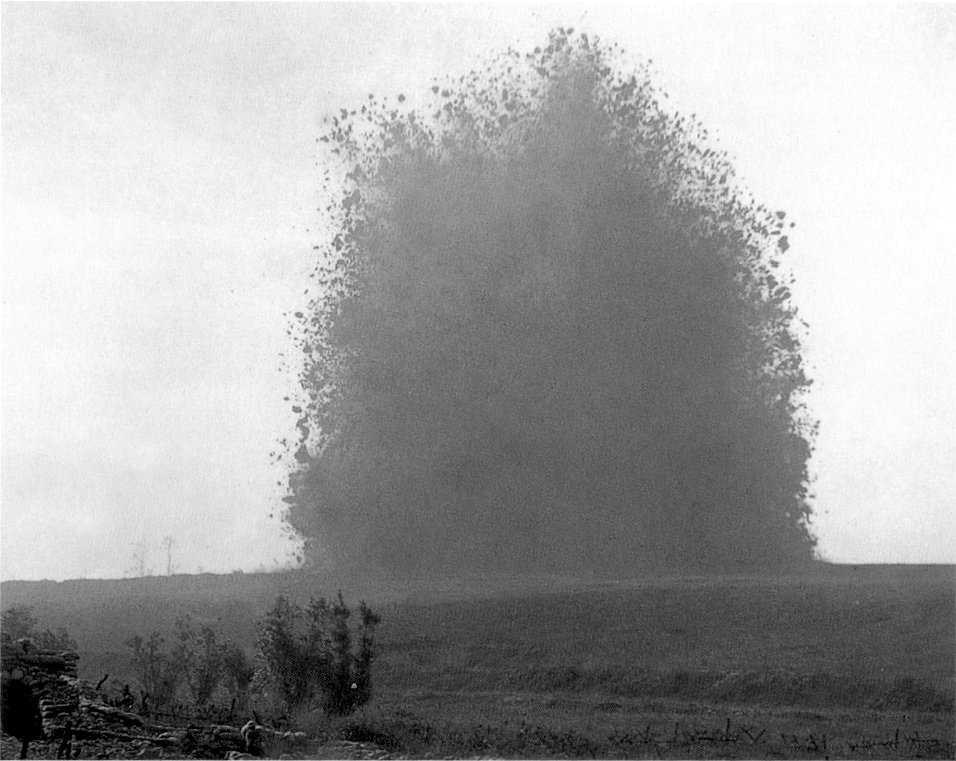
Tunnels, then, can be used not only to break sieges and blockades – as in those that keep the economy of Gaza supplied against the Israeli stranglehold: in effect, lifelines (if you want more on this, try the brilliant documentary Gaza: Tunnels to Nowhere and Nicolas Pelham, ‘Gaza’s tunnel phenomenon’, Journal of Palestine Studies 41 (4) 2012, pp. 6-31).  They can also be deathlines, dug for directly offensive purposes.  The tactic had been used to devastating effect on the Western Front, as I noted in a previous post on 3-D war: the image below is Ernest Brooks‘s famous photograph of the detonation of the British mine underneath the German lines at Hawthorn Ridge on the first day of the Battle of the Somme on 1 July 1916.  You can find video of the explosion here.

Hawthorn Ridge 1916

Then as now, as Jane Burgess argues in a dispatch from the frontlines of  ‘The Battle for Aleppo’, they are deadly improvisations in a war of attrition.

Both of these developments/reversions – the barrel bombs and the mines – obviously reinforce Stuart Elden‘s discussion of attempts to ‘secure the volume’.  But they also speak directly to a bleak politics of insecurity.