Degrees of intimacy

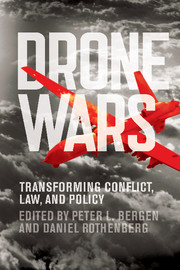
Drone warsNext month Cambridge University Press is publishing a book of essays edited by Peter Bergen and Daniel Rothenberg, Drone wars: transforming conflict, law and policy, due out from Cambridge University Press at the end of the year.  Here’s the blurb:

Drones are the iconic military technology of many of today’s most pressing conflicts, a lens through which U.S. foreign policy is understood, and a means for discussing key issues regarding the laws of war and the changing nature of global politics. Drones have captured the public imagination, partly because they project lethal force in a manner that challenges accepted rules, norms, and moral understandings. Drone Wars presents a series of essays by legal scholars, journalists, government officials, military analysts, social scientists, and foreign policy experts. It addresses drones’ impact on the ground, how their use adheres to and challenges the laws of war, their relationship to complex policy challenges, and the ways they help us understand the future of war. The book is a diverse and comprehensive interdisciplinary perspective on drones that covers important debates on targeted killing and civilian casualties, presents key data on drone deployment, and offers new ideas on their historical development, significance, and impact on law and policy. Drone Wars documents the current state of the field at an important moment in history when new military technologies are transforming how war is practiced by the United States and, increasingly, by other states and by non-state actors around the world.

And here is the Contents List:

Part I. Drones on the Ground:

1. My guards absolutely feared drones: reflections on being held captive for seven months by the Taliban David Rohde
2. The decade of the drone: analyzing CIA drone attacks, casualties, and policy Peter Bergen and Jennifer Rowland
3. Just trust us: the need to know more about the civilian impact of US drone strikes Sarah Holewinski
4. The boundaries of war?: Assessing the impact of drone strikes in Yemen Christopher Swift
5. What do Pakistanis really think about drones? Saba Imtiaz

Part II. Drones and the Laws of War:

6. It is war at a very intimate level USAF pilot
7. This is not war by machine Charles Blanchard
8. Regulating drones: are targeted killings by drones outside traditional battlefields legal? William Banks
9. A move within the shadows: will JSOC’s control of drones improve policy? Naureen Shah
10. Defending the drones: Harold Koh and the evolution of US policy Tara McKelvey
Part III. Drones and Policy Challenges:
11. ‘Bring on the magic’: using drones in combat Michael Waltz
12. The five deadly flaws of talking about emerging military technologies and the need for new approaches to law, ethics, and war P. W. Singer
13. Drones and cognitive dissonance Rosa Brooks
14. Predator effect: a phenomenon unique to the war on terror Meg Braun
15. Disciplining drone strikes: just war in the context of counterterrorism David True
16. World of drones: the global proliferation of drone technology Peter Bergen and Jennifer Rowland

Part IV. Drones and the Future of Warfare:

17. No one feels safe Adam Khan
18. ‘Drones’ now and what to expect over the next ten years Werner Dahm
19. From Orville Wright to September 11: what the history of drone technology says about the future Konstantin Kakaes
20. Drones and the dilemma of modern warfare Richard Pildes and Samuel Issacharoff
21. How to manage drones, transformative technologies, the evolving nature of conflict and the inadequacy of current systems of law Brad Allenby
22. Drones and the emergence of data-driven warfare Daniel Rothenberg

Over at Foreign Policy you can find an early version of Chapter 6, which is an interview with a drone pilot conducted by Daniel Rothenberg.  There are two passages in the interview that reinforce the sense of the bifurcated world inhabited by drone crews that I described in ‘From a view to a kill’ and ‘Drone geographies’ (DOWNLOADS tab).  On the one side the pilot confirms the inculcation of an intimacy with ground troops, particularly when the platforms are tasked to provide Close Air Support, which is in some degree both reciprocal and verbal:

“Because of the length of time that you’re over any certain area you’re able to engage in lengthy communications with individuals on the ground. You build relationships. Things are a little more personal in an RPA than in an aircraft that’s up for just a few hours. When you’re talking to that twenty year old with the rifle for twenty-plus hours at a time, maybe for weeks, you build a relationship. And with that, there’s an emotional attachment to those individuals.

“You see them on a screen. That can only happen because of the amount of time you’re on station. I have a buddy who was actually able to make contact with his son’s friend over in the AOR [area of responsibility]. If you don’t think that’s going to make you focus, then I don’t know what will.

“Many individuals that have been over there have said, ‘You know, we were really happy to see you show up’; ‘We knew that you were going to keep us from being flanked’; ‘We felt confident in our ability to move this convoy from ‘A’ to ‘B’ because you were there.’ The guy on the ground and the woman on the ground see how effective we are. And it gives them more confidence.”
GREGORY Angry Eyes Extract.001

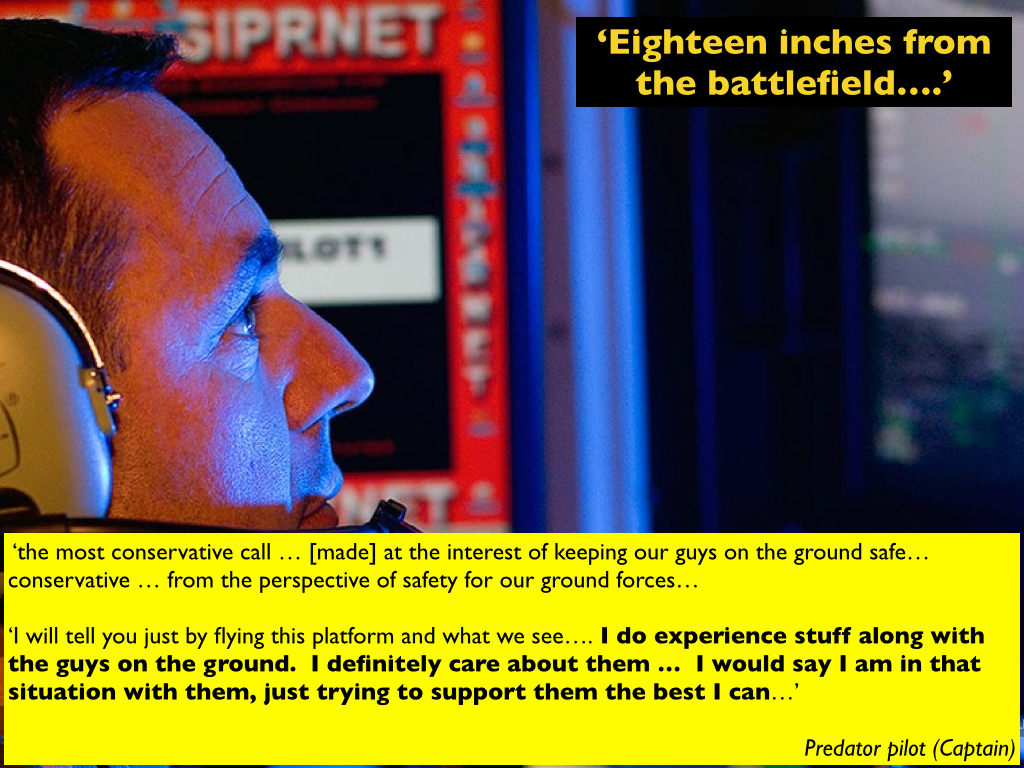
[The image above is taken from my ‘Angry Eyes’ presentation; the Predator pilot in this instance was involved in orchestrating the air strike in Uruzgan province, Afghanistan on 21 February 2010, and the quotation is taken from the US Army investigation into the incident.  I’m converting the presentation into the final chapter for The everywhere war, and I’ll post the draft as soon as I’m finished.]

But when the pilot in Rothenberg’s interview goes on to claim that ‘Targeting with RPAs is very intimate’ and that ‘It is war at a very intimate level’, he reveals on the other side an altogether different sense of intimacy: one that is strictly one-sided, limited to the visual, and which resides in a more abstracted view:

“Flying an RPA, you start to understand people in other countries based on their day-to-day patterns of life. A person wakes up, they do this, they greet their friends this way, etc. You become immersed in their life. You feel like you’re a part of what they’re doing every single day. So, even if you’re not emotionally engaged with those individuals, you become a little bit attached. I’ve learned about Afghan culture this way. You see their interactions. You’re studying them. You see everything.”

The distinction isn’t elaborated, but the claims of ‘immersion’ and becoming ‘part of what they’re doing every day’ are simply astonishing, no?  You can find more on the voyeurism of ‘pattern of life analysis’ and the remarkable conceit that ‘you see everything’ here.
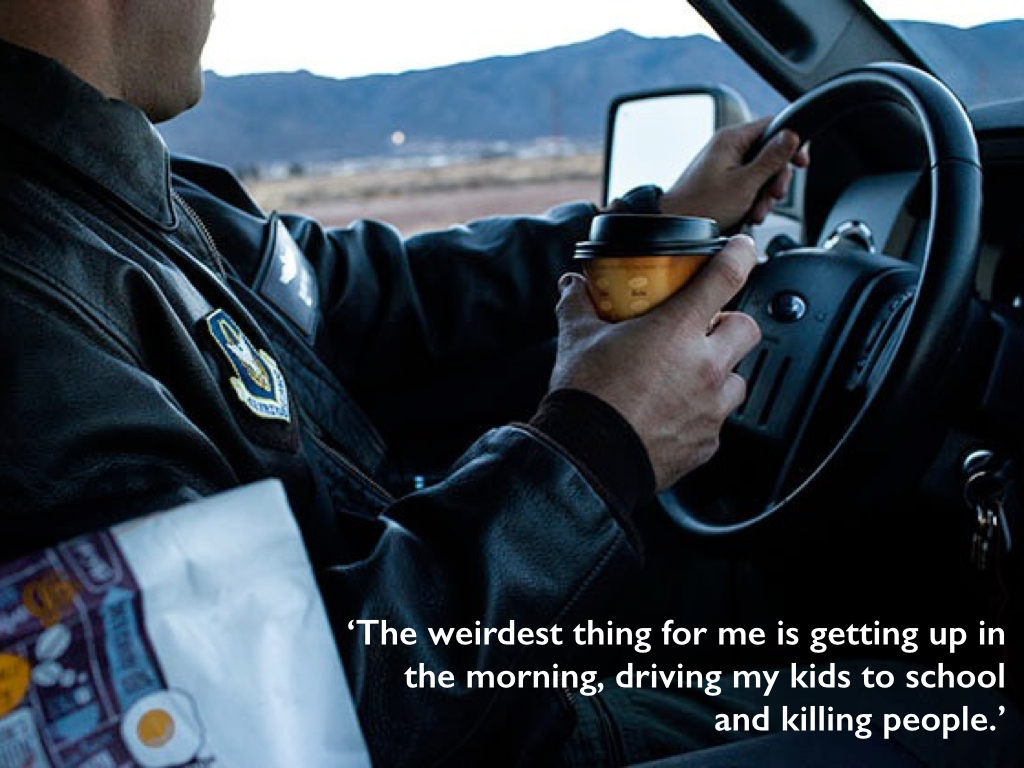
GREGORY Drones and the everywhere war 2014 Homeland insecurities.001

[The image above is taken from my ‘Drone geographies’ presentation]

The interview emphasises a different bifurcation, which revolves around the alternation between ‘work’ and ‘home’ when remote operations are conducted from the United States:

“”When you’re doing RPA operations, you’re mentally there, wherever there is. You’re flying the mission. You’re talking to folks on the ground. You’re involved in kinetic strikes. Then you step out the ground control station (GCS) and you’re not there anymore…

“Those are two very, very different worlds. And you’re in and out of those worlds daily. I have to combine those two worlds. Every single day. Multiple times a day. So, I am there and then I am not there and then I am there again. The time between leaving the GCS [Ground Control Station] and, say, having lunch with my wife could be as little as ten minutes. It’s really that fast.”

You can find much more on these bifurcations in my detailed commentary on Grégoire Chamayou‘s Théorie du drone here and in ‘Drone geographies’ (DOWNLOADS tab).

There’s one final point to sharpen.  In my developing work on militarized vision, and especially the ‘Angry eyes’ presentation/essay,  I’ve tried to widen the focus beyond the strikes carried out by Predators and Reapers to address the role they play in networked operations where the strikes are carried out by conventional strike aircraft.  Here is what Rothenberg’s pilot says about what I’ve called the administration of military violence (where, as David Nally taught me an age ago, ‘administration’ has an appropriately double meaning):

‘”Flying an RPA is more like being a manager than flying a traditional manned aircraft, where a lot of times your focus is on keeping the shiny side up; keeping the wings level, putting the aircraft where it needs to be to accomplish the mission. In the RPA world, you’re managing multiple assets and you’re involved with the other platforms using the information coming off of your aircraft.

“You could use the term ‘orchestrating’; you are helping to orchestrate an operation.”

***

Drone wars appears just as remote operations over Iraq and Syria are ramping up: you can find an excellent review by Chris Cole at Drone Wars UK here, ‘Drones in Iraq and Syria: What we know and what we don’t.’  The images below are from the Wall Street Journal‘s interactive showing all air strikes reported by US Central Command 8 August through 3 November 2014:
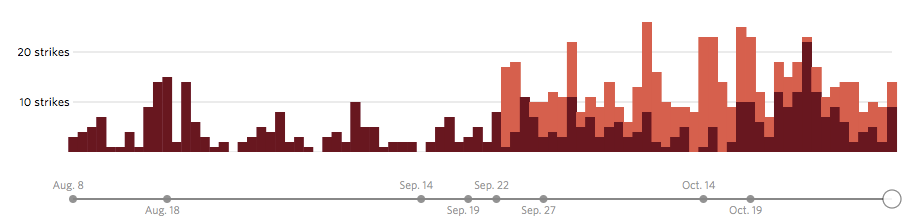
Air strikes in Iraq and Syria

During this period  769 coalition air strikes were reported: 434 in Syria (the dark columns), including 217 on the besieged border city of Kobane, and 335 in Iraq (the light columns), including 157 on Mosul and the Mosul Dam.
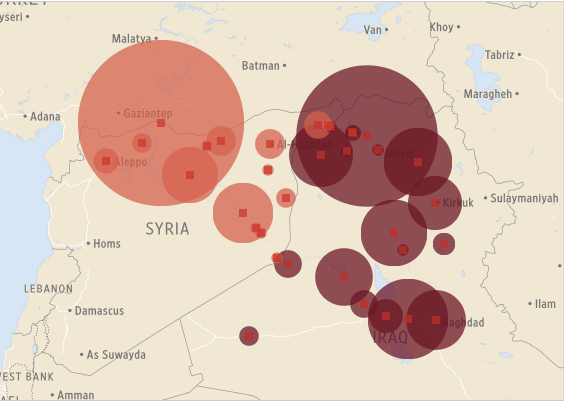
Air strikes in Iraq and Syria August-November 2014

But bear in mind these figures are for all air strikes and do not distinguish between those carried out directly by drones and those carried out by conventional strike aircraft.  As Chris emphasises:

‘Since the start of the bombing campaign, US drones have undertaken both surveillance and strike missions in Iraq and Syria but military spokespeople have refused to give details about which aircraft are undertaking which strikes repeatedly using the formula “US military forces used attack, fighter, bomber and remotely-piloted aircraft to conduct airstrikes.”’

Although the USAF has used a mix of MQ-1 (Predator) and MQ-9 (Reaper) drones, F-15E, F-16, F/A-18 and F-22 fighters, B-1 bombers, AC-130 gunships and AH-64 Apache helicopters in these operations, it seems likely that its capacity to use remote platforms to provide intelligence, surveillance and reconnaissance is limited by its continuing commitments in Afghanistan (though Britain’s Royal Air Force has now deployed its Reapers for operations in both Iraq and Syria).

IS (Islamic State) claims to have its own drones too.  In February it released video of its aerial surveillance of Fallujah in Iraq, taken from a DJI Phantom FC40 quadcopter, in August it released video of Taqba air base in Syria taken from the same platform, tagged as ‘a drone of the Islamic State army’, and in September a propaganda video featuring hostage John Cantile showed similar footage of Kobane (below).
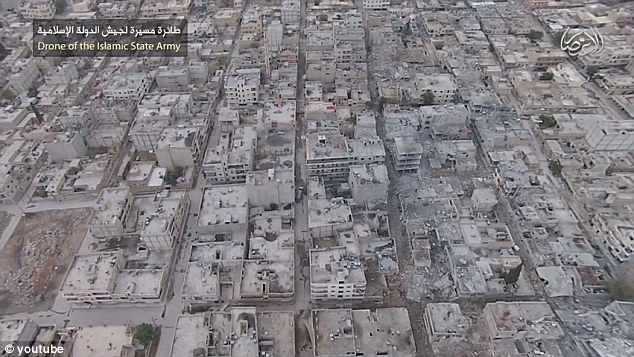
1414438887900_wps_7_IS_have_released_a_new_vi

These image streams are all from commercial surveillance drones, but in September the Iranian news agency Fars reported that Hezbollah had launched an air strike from Lebanon against a command centre of the al-Nursra Front outside Arsal in Syria using an armed (obviously Iranian) drone.

You can find Peter Bergen’s and Emily Schneiders view on those developments here, and a recent survey of the proliferation of drone technologies among non-state actors here.

The details of both the state and non-state air strikes remain murky, but I doubt that much ‘intimacy’ is claimed for any of them.
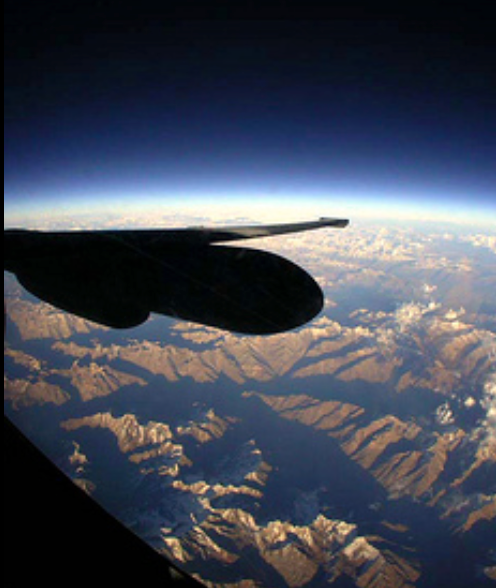
I still haven’t found what I’m looking for

U2 (USAF photograph)

Rummaging around for more people working on militarized vision, I encountered a forum on Military optics and Bodies of difference held at Berkeley’s Center for Race and Gender earlier this year, and through that the research of Katherine Chandler, who holds a Townsend Center for the Humanities Dissertation Fellowship in the Department of Rhetoric.  Her dissertation in progress is entitled Drone Flight and Failure: the United States’ Secret Trials, Experiments and Operations in Unmanning, 1936 – 1973, which promises to fill in a crucial gap in conventional genealogies of today’s remote operations.

As you’ll see if you visit her website here, Katherine is an accomplished artist as well as researcher and critic.  You can read her essay on ‘System Failures’, which includes a discussion of Trevor Paglen‘s Drone Vision and Omer Fast‘s 5,000 Feet is the Best, at The New Inquiry (August 2012) here, and find a fuller discussion of Fast’s video situated within what Katherine calls the ‘knowledge politics’ and political ecologies of remote operations on pp. 63-74 of Knowledge politics and intercultural dynamics here.

Here is the abstract for her talk at the forum, Unmanning Politics: Aerial Surveillance 1960-1973:

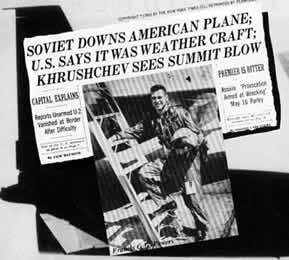
u2_spy_plane_incident_newspaper_clippingOn May 1, 1960, Francis Gary Powers’ U-2 plane was shot down over the Soviet Union while on a secret reconnaissance mission. The ensuing diplomatic fallout caused the cancellation of the Paris Summit between Dwight Eisenhower and Nikita Khrushchev. Less well known, in April 1960, Robert Schwanhausser, an engineer for Ryan Aeronautical, briefed the United States Air Force on the possibility that its Firebee target drone, used at the time for air defense training, might be re-engineered as an unmanned reconnaissance plane. In the weeks following the Powers incident, the Air Force began wholesale negotiations with Ryan Aeronautical to develop a pilotless spy plane and, on July 8, 1960, the company was given funding to begin the project. Among the noted advantages were: “political risk is minimized due to the absence of a possible prisoner” (“Alternative Reconnaissance System,” 1960). I investigate the resulting Lightning Bugs, flown for three-thousand reconnaissance missions in Southeast Asia between 1964 and 1973. 

Researching how aircraft were unmanned during the Cold War is instructive both in the ways they mimic contemporary unmanned combat aerial vehicles and trouble assumptions about them. I follow how unmanned systems operated within the logics of American Cold War politics and their perceived usefulness geopolitically – crossing borders as spy aircraft, collecting and jamming electronic signals, and gathering battlefield reconnaissance. I ask how conquest, and the ensuing assumptions of empire, colonialism and race, underlie the unmanning of military aircraft, even while these aspects were purposefully, although, unsuccessfully occluded through the idea that technologies could mitigate political risks. Moreover, unmanned reconnaissance projects were cancelled at the end of the Vietnam War and their failure provides clues about what might be left out of visions of aerial control and the ways politics, and human vulnerabilities, persisted in spite of efforts to engineer systems that would suggest otherwise.

The legitimacy of contemporary drone strikes relies on the ability of unmanned aircraft to “see” enemy targets. Yet, as Isabel Stengers has argued, any representation gives value. Looking at the few available images from these early unmanned reconnaissance flights, I move between what is seen and unseen to examine how values, particularly, secrecy and control, are formed through unmanned reconnaissance. Claiming to produce a mechanical, rather than political, view of the territories surveyed, I show how the supposedly apolitical lens of the drone occludes how politics, industry and military come together to privilege certain positions and target others.

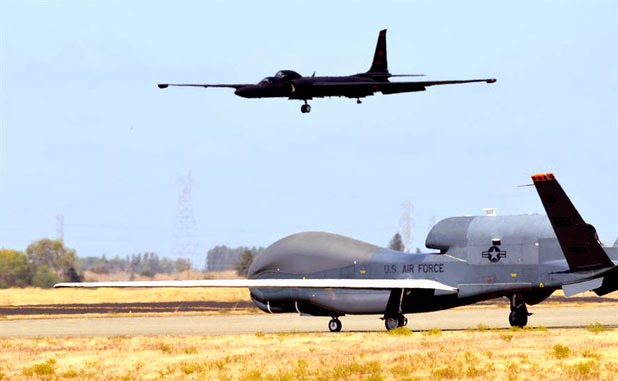
Interesting stuff – especially that first paragraph linking ‘un-manning’ to the U-2.  There is a strange irony here, because until this year the US Air Force had in fact favoured its fleet of 33 U-2 (‘Dragon Lady’) aircraft [one of which is shown at the top of the photograph] over the high-altitude Global Hawk [shown at the bottom], so much so that it had asked for permission to cancel its orders for the new Block 30 Global Hawks and place others in storage.

GlobalHawk_USAFAirmanFirstClassBobbyCummings

You may be surprised to discover that the U-2 is still flying, but the airframe has been repeatedly modified and so too has the network in which it is embedded.  One pilot explained:

“The U-2 started out only carrying a wet-film camera. Now, with today’s technology, I’m alone up there, but I may be carrying 40 to 50 Airmen via data link who are back at a (deployable ground station).”

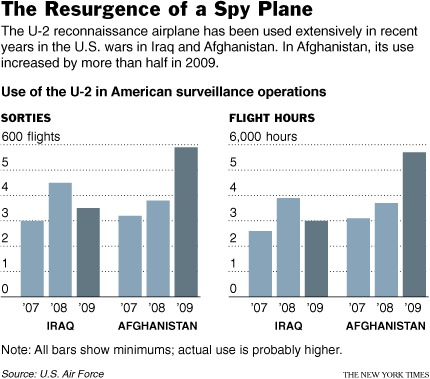
U-2 flying hours in Afghanistan and Iraq (New York Times)It’s important to remember that Predators and Reapers are not the only platforms streaming imagery to the Air Force’s Distributed Common Ground System.  The U-2 was given a new lease of life by the Gulf War in 1991, when nine U-2s flying out of the UAE  provided 50 per cent of all imagery and over 90 per cent of all ground forces targeting imagery.  During the invasion of Iraq in 2003 U-2s flew only 19 percent of the air reconnaissance missions, but they provided more than 60 per cent of the signals intelligence and 88 per cent of battlefield imagery.  The continuing wars in Afghanistan and Iraq confirmed that the U-2’s original, strategic significance had been eclipsed by its new tactical role.  Chris Pocock explains:

“The U-2 today is more a tactical intelligence gatherer…  It supports ground operations on a daily basis, flying over Afghanistan, flying around Korea, flying in the eastern Mediterranean, doing all those things every day and it’s actually not only providing intelligence that is analyzed for the benefit of those ground troops, but it’s actually in contact with those ground troops in real time.”

And that close contact – akin to the intimacy remote operators in the continental United States claim when they say they are not 7,000 miles but 18 inches from the battlespace, the distance from eye to screen – takes its toll on the U-2 pilots too.  In addition to the extraordinary pressures flying the U-2 imposes on their bodies, one USAF physician insisted that ’emotionally… they’re wrung out from that… When you’re talking to somebody on the radio and there’s gunfire in the background… you’re not taking a nap while that’s happening.’

Writing in the New York Times, Christopher Drew provided a revealing example:

Major Shontz said he was on the radio late last year with an officer as a rocket-propelled grenade exploded. “You could hear his voice talking faster and faster, and he’s telling me that he needs air support,” Major Shontz recalled. He said that a minute after he relayed the message, an A-10 gunship was sent to help.

In fact, that last clause can be generalised; the U-2 has often been deployed in close concert with other platforms, including Predators and Reapers.  Drew again:

The U-2’s altitude [70,000 feet or more], once a defense against antiaircraft missiles, enables it to scoop up signals from insurgent phone conversations that mountains would otherwise block.  As a result, Colonel Brown said, the U-2 is often able to collect information that suggests where to send the Predator and Reaper drones, which take video and also fire missiles. He said the most reliable intelligence comes when the U-2s and the drones are all concentrated over the same area, as is increasingly the case.

Part of the reason for that is that the U-2 has such an advanced imagery system:

Even from 13 miles up its sensors can detect small disturbances in the dirt, providing a new way to find makeshift mines [IEDs] that kill many soldiers.  In the weeks leading up to the [2010] offensive in Marja, military officials said, several of the … U-2s found nearly 150 possible mines in roads and helicopter landing areas, enabling the Marines to blow them up before approaching the town.

Marine officers say they relied on photographs from the U-2’s old film cameras, which take panoramic images at such a high resolution they can see insurgent footpaths, while the U-2’s newer digital cameras beamed back frequent updates on 25 spots where the Marines thought they could be vulnerable.

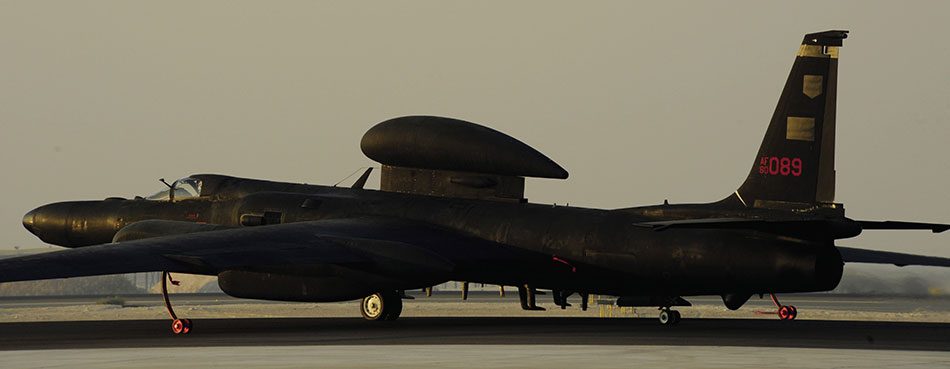
U-2 preparing for takeoff 'in SW Asia' (USAF/Eric Harris)

For all that,  in the last two years the Air Force’s plan to cut the Global Hawk program was repeatedly over-ridden by Congress, in response to an extraordinary campaign waged by Northrop Grumman, which launched what Mark Thompson called ‘its own ISR – intelligence, surveillance and reconnaissance – mission over Capitol Hill to decide where to strategically target cash-bombs to keep its plane, and more of them, flying for another day’: you can find a  full report at the Center for Public Integrity here.

The Air Force has now accepted the retirement of Lockheed Martin’s ageing Cold warrior, because (so it says) the cost per flying hour of the Hawk has now fallen below that of the U-2 ($24,000 vs. $32,000).  ‘U2 shot down by budget cuts’, is how PBS put it, while the Robotics Business Review triumphantly announced ‘Here comes automated warfare’.

Even so, cost per flying hour is not the whole story, as Amy Butler explains.  Part of the problem is logistical and, by extension, geopolitical: ‘Global Hawks based in Guam have to transit for hours just to reach North Korea, whereas the U-2, based at Osan air base, South Korea, has a shorter commute’ (details of the Hawk’s global basing can be found here).

A second issue is reliability, which bedevils all major UAVs and makes cost per flying hour a dubious index:

‘Intelligence, surveillance and reconnaissance collection is in high demand, and aircraft downtime is extremely worrisome for combatant commanders. In the Pacific, 55% of Global Hawk’s missions were canceled in fiscal 2013; 96% of the U-2’s missions were achieved. The U-2 was also scheduled for nearly three times as many missions. Global Hawk lacks anti-icing equipment and is not able to operate in severe weather.’

Finally, critics continue to complain that the sensors on the U-2 remain superior to those on the Hawk and provide a wider field of view.  According to a report from Eric Beidel,

The Global Hawk carries Raytheon’s Enhanced Integrated Sensor Suite, which includes cloud-penetrating radar, a high-resolution electro-optical digital camera and an infrared sensor. But the U-2’s radar can see farther partly because the plane can fly at altitudes over 70,000 feet, about 10,000 feet higher than a Global Hawk. A longer focal length also gives the U-2’s camera an edge, experts said…

Air Force Chief of Staff Gen. Norton Schwartz has said that the drone’s sensors just weren’t cutting it. Further, the U-2 can carry a larger payload, up to 5,000 pounds compared to 3,000 pounds for the Global Hawk.

“Some of the most useful sensors are simply too big for Global Hawk,” said Dave Rockwell, senior electronics analyst at Teal Group Corp. He referred to an optical bar camera on the U-2 that uses wet film similar to an old-fashioned Kodak. “It’s too big to fit on Global Hawk even as a single sensor.”

All of these technical considerations are also political ones, as Katherine’s abstract indicates, and none of them answers the other questions she poses about what can and cannot be seen…

Biometric war

The US military’s obsession with biometrics is, in part, the product of its phantasmatic desire to make the battlespace fully transparent, as its incorporation within the targeting cycle makes clear:

afghan-biometrics-cycle-1

But it’s also a vital means of furthering the profoundly biopolitical project embedded in later modern war (something that intersects, in various ways, with Mark Neocleous‘s arguments about military violence – war power/police power – and ‘ordering’):

The stated goal of the Afghan effort is no less than the collection of biometric data for every living person in Afghanistan. At a conference with Afghan officials in 2010, the commander of the U.S. Army’s Task Force Biometrics Col. Craig Osborne told the attendees that the collection of biometric data is not simply about “identifying terrorists and criminals,” but that “it can be used to enable progress in society and has countless applications for the provision of services to the citizens of Afghanistan.”

CALL-AfghanBiometrics-1I touched on some of this in a different context in ‘The biopolitics of Baghdad’ DOWNLOADS tab), and Public Intelligence has just released the U.S. Army Commander’s Guide to Biometrics in Afghanistanfrom which I’ve taken the image above, and which provides a much more detailed accounting.

The release also includes an illuminating short essay, ‘Identity dominance: the U.S. Military’s biometric war in Afghanistan‘, that provides a gloss on and a guide to the program:

In a section titled “Population Management,” the U.S. Army’s guide recommends that “every person who lives within an operational area should be identified and fully biometrically enrolled with facial photos, iris scans, and all ten fingerprints (if present).” The soldiers must also record “good contextual data” about the individual such as “where they live, what they do, and to which tribe or clan they belong.” According to the guide, popuation management actions “can also have the effect of building good relationships and rapport” by sending the message that the “census” is intended to protect them from “the influence of outsiders and will give them a chance to more easily identify troublemakers in their midst.”

For a wider, wonderfully critical commentary on biometric war, see Colleen Bell, ‘Grey’s Anatomy goes South: Global racism and suspect identities in the colonial present’, in the Canadian journal of sociology 38 (4) (2013) 465-486 available open access here.

In media res

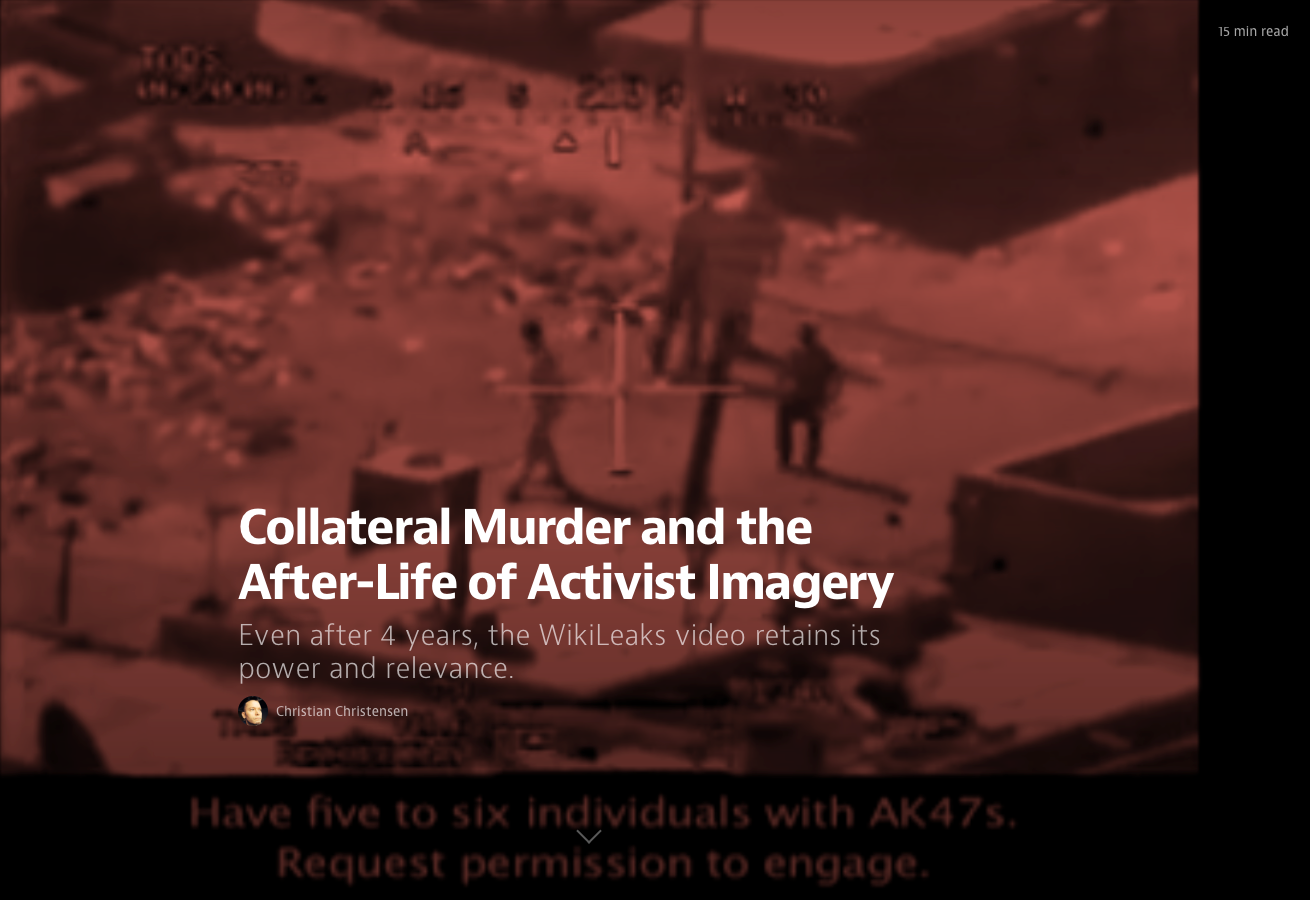
Two short essays that address the public circulation of supposedly secret information.  The first, “Collateral Murder and the After-Life of Activist Imagery”, is by Christian Christensen, and concerns the video clip released by Wikileaks as Collateral Murder in April 2010.  I’ve discussed this edited video of a US Apache helicopter attack in New Baghdad in 2007 before, together with the two documentary films that it provoked, and it forms part of my ‘Militarized Vision’ project (you can find links to the clip and to subsequent commentary in that original post).

CHRISTENSEN Collateral Murder

Christian doesn’t explore the content of the video so much as its inscription and re-inscription within public debates, part of the mediatization of later modern war.  He does make a sharp point about the status of the imagery:

One could argue that the repeated use of this imagery (and corresponding audio) has created an entirely new genre of military reporting. It is a genre with specific, often disturbing conventions: the grainy images of those on the ground, the flat, bland coloring, the “narration” of the aircraft operators which swings between the clinical and the cynical, the silence of those under surveillance or attack, the sound of the weaponry as it is discharged, and, importantly, the “overtness” of the technology, by which I mean the way in which the screen is filled with evidence of the technology being used in the form of the cross-hairs in the middle and data visible at the top and the bottom of the screen…

The Collateral Murder video not only shatters the mythology of humane warfare and benevolent US power, but also causes us to question the notion of neutral technology at the service of human development: a theme which has regained a central space in public debate in recent years.

But he also thinks there is another, no less sharp point to be made about the very act of reporting:

Within this context, the killing of two Reuters employees by the US military was particularly poignant. At the most basic level, this was the symbolic killing of Journalism (with a capital “J”) by a military unaccustomed to critical coverage or investigation at home. The killings, of course, then went unreported until Manning leaked the material and WikiLeaks published it: itself an act of journalism. With Collateral Murder, there is a layering and re-layering of meaning, and, for me, journalism lies at the heart of the clip. These are humans first, of course, and most of those killed or wounded in the attack were not journalists. But, in addition to the tragedy of human death, there is also the tragedy of what is symbolically destroyed: Transparency. Democracy. Knowledge. Critical thinking. And it took an act of journalism to bring these tragedies to light, an act of which has now itself been subjected to the full force of the state via the imprisonment of Manning, and the threat of criminal charges being brought against Assange in the US.

Incidentally, the essay is the text of Christian’s presentation to the ‘Image Operationsconference held at the Institute of Cultural Inquiry (ICI) in Berlin earlier this month; the program is here.

Image Operations

The second essay is Adam Morris‘s wide-ranging review of ‘The geopolitics of the Snowden Files‘ at the Los Angeles Review of Books.  Its immediate provocation is the publication of the Obama administration’s self-serving ‘NSA Report’:

The-NSA-Report-243x366The NSA Report — commissioned by the White House in August, published on its website in December, and now available in print via Princeton University Press— was authored by the President’s Review Group on Intelligence and Communications Technologies. As suggested by its official title, “Liberty and Security in a Changing World,” the Report was intended to advise President Obama on how to reform the data collection practices of the Intelligence Community (IC), in particular the NSA. Its authors include such veterans of the US security sector as Richard A. Clarke, Michael J. Morrell, and Peter Swire. This insiders’ perspective, in theory, is balanced by the addition to the group of constitutional lawyers Geoffrey R. Stone and Cass Sunstein. The unofficial purpose of the Report, however, was the Obama administration’s attempt to put a lid on the NSA scandal by pretending to be interested in reform. As Luke Harding points out in The Snowden Files, the Review Group was working out of the offices of the Director of National Intelligence, currently occupied by the felonious General James Clapper, w _ho knowingly lied in Congressional testimony about the bulk collection of Americans’ communication data.

The essay provides a fine, critical reading of the Report –

‘The anodyne language of these and other recommendations signals the imperial agenda out of which they are born: The NSA Report is obsessed with framing the debate over surveillance around the neopositivist vocabulary of “risk management,” but we know from history that political liberty will always suffer when a dominant regime deems a nation, its leadership or its population a “national security threat”…’

– but it also spirals off into a vigorous mapping of the context in which the NSA set about its covert operations and Edward Snowden‘s principled decision to go public (Adam also provides a commentary on Luke Harding‘s The Snowden Files: for another review, see Daniel Soar at the London Review of Books here).  And here too, of course, investigative journalism is a vital, enabling and even empowering practice.

Seeing Machines

VIRILIO Vision machineIn a series of posts on photography Trevor Paglen provides some ideas that intersect with my own work on Militarized Vision and ‘seeing like a military’.  First, riffing off Paul Virilio, Trevor develops the idea of photography as a ‘seeing machine‘:

‘Seeing machines is an expansive definition of photography. It is intended to encompass the myriad ways that not only humans use technology to “see” the world, but the ways machines see the world for other machines. Seeing machines includes familiar photographic devices and categories like viewfinder cameras and photosensitive films and papers, but quickly moves far beyond that. It embraces everything from iPhones to airport security backscatter-imaging devices, from electro-optical reconnaissance satellites in low-earth orbit, to QR code readers at supermarket checkouts, from border checkpoint facial-recognition surveillance cameras to privatized networks of Automated License Plate Recognition systems, and from military wide-area-airborne-surveillance systems, to the roving cameras on board legions of Google’s Street View” cars.

What’s more, the idea of seeing machines I’m sketching out here isn’t confined to the imaging devices and systems I’ve described in broad strokes. The definition extends to include the images (or data) produced by such imaging systems, the digital metadata associated with those images, as well as additional systems for storage, archiving, search and interpretation (either human or algorithmic). Finally, and crucially, seeing machines encompasses not only imaging systems, search, and storage capacities, it encompasses something a bit more abstract, namely the “styles” or “practices” of seeing that different imaging systems enable (i.e. the difference between what a view camera and an automated license-plate reading camera “want” to do and how they see the world differently).  Crucially, the definition of photography I’m proposing here encompasses imaging devices (“cameras” broadly understood), the data (“images” being one possible manifestation of that data) they produce, and the seeing-practices with which they are enmeshed.’

In a subsequent post on Geographies of Photography Trevor then links these seeing-practices to what he calls the production of space (and what I now prefer to think of as performances of space), and uses the example of the Reaper to illustrate what he has in mind:

What exactly is a Reaper drone? In essence, it’s a camera attached to a remote-controlled airplane. Sometimes it carries missiles. What’s particular about a Reaper drone (and other drones in its larger family, including the Predator and the Sentinel) is that airplane, pilot, navigator, analysts, and commander don’t have to be in the same place. The aircraft might be flying a combat mission in Yemen by a pilot based in Nevada, overseen by a manager in Virginia, and supported by intelligence officers in Tampa (geographer Derek Gregory has written about what he calls “Drone Geographies.”) The drone creates its own “relative” geographies, folding several noncontiguous spaces around the globe into a single, distributed, “battlefield.” The folding of space-time that the Reaper drone system enables is a contemporary version of what Marx famously called the “annihilation of space with time,” i.e. the ability to capitalize on the speed of new transportation and communications technologies to bring disparate spaces “closer” together, relatively speaking.

I think that’s more or less right: these new, networked political technologies of vision have been instrumental in the production of a non-linear and discontinuous battlespace, threaded by wormholes that connect one site to another.  But, as I’ll try to show when I eventually get to my post on Uruzgan, the process is far from seamless, the folds are more fragile than most of us realise, and the discontinuities and ruptures are as important as the connections for the administration of military violence.

Endless War and the machine

When I wrote ‘Seeing Red: Baghdad and the event-ful city’ (DOWNLOADS tab) I was intrigued by the way in which the US military apprehended the city as a field of events:

‘In Baghdad, these security practices performed a continuous audit that compiled reports of events (Significant Activity Reports or SIGACTS) and correlated the incidence of ‘enemy-initiated attacks’ and other ‘enemy actions’ with a series of civil, commercial and environmental indicators of the population at large: moments in the production of what Dillon and Lobo-Guerrero call a generalized bio-economy.’  

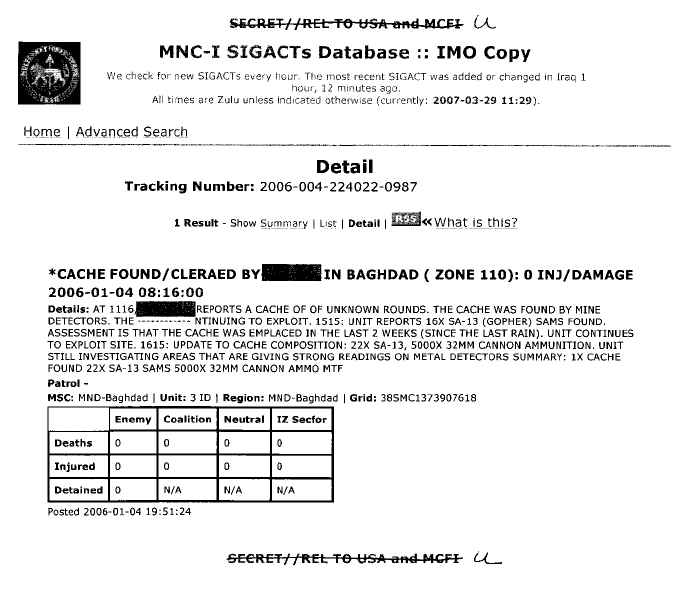
The animating core of the system was the SIGACT  – shown below – and these were eventually fed into a single reporting and analysis platform, the Combined Information Data Network Exchange (CIDNE).

SIGACT

‘The primary transcription of an event, its constitution as a SIGACT, with all its uncertainties and limitations, was transmitted downstream to be digitized and visualized, correlated and ‘cleansed’, so that it could be aggregated to show trends or mapped to show distributions.  All the systems for SIGACT recording and analysis interfaced with visualization and presentation software, which was used to generate ‘storyboards’ at every level in the chain.’

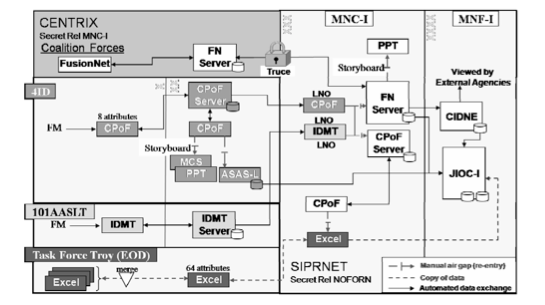
The chain as it was constituted in Iraq in May 2006 is shown below; CENTRIX (top left) is the Combined Enterprise Regional Information Exchange System that provided information exchange across the US-led coalition;  CPoF (scattered across the centre field) is the Command Post of the Future, a distributed GIS system I discussed in the original essay that provided a command-level visualization of the battlespace as a field of events (a system that has since been upgraded multiple times); and at the centre right you can see the key automated data exchanges to and from CIDNE:

MNF-I Event Reporting, May 2006 (Wortman)

Since I wrote, scholars have used SIGACT reports much more systematically to analyse the connective tissue between ethno-sectarian violence and the ‘surge’ – see, for example, Stephen Biddle, Jeffrey Friedman and Jacob Shapiro, ‘Testing the surge’, International Security 37 (1) (2012) 7-40; Nils Weidmann and Idean Saleyhan, ‘Violence and ethnic segregation: a computational model applied to Baghdad‘, International Studies Quarterly 57 (2013) 52-64 – to explore the political dynamics of civilian casualties – see, for example, Luke Condra and Jacob Shapiro, ‘Who takes the blame?  The strategic effects of collateral damage’, American Journal of Political Science 56 (1) (2012) 167-87 – and to conduct more general evaluations of counterinsurgency in Iraq: see, for example, Eli Berman, Jacob Shapiro and Joseph Felter, ‘Can hearts and minds be bought? The economics of counterinsurgency in Iraq’, Journal of political economy 119 (4) (2011) 766-819.

I’ve been revisiting these modelling exercises for The everywhere war, because they require me to rework my essay on ‘The biopolitics of Baghdad’ (though not, I think, to change its main argument).  I’m struck by the idiom they use – my critique of spatial science written in another age would have been substantially different had it been less preoccupied with the detecting of spatial pattern, had its methods been applied more often to issues that matter, and had its architects been less convinced of the self-sufficiency of their methods.

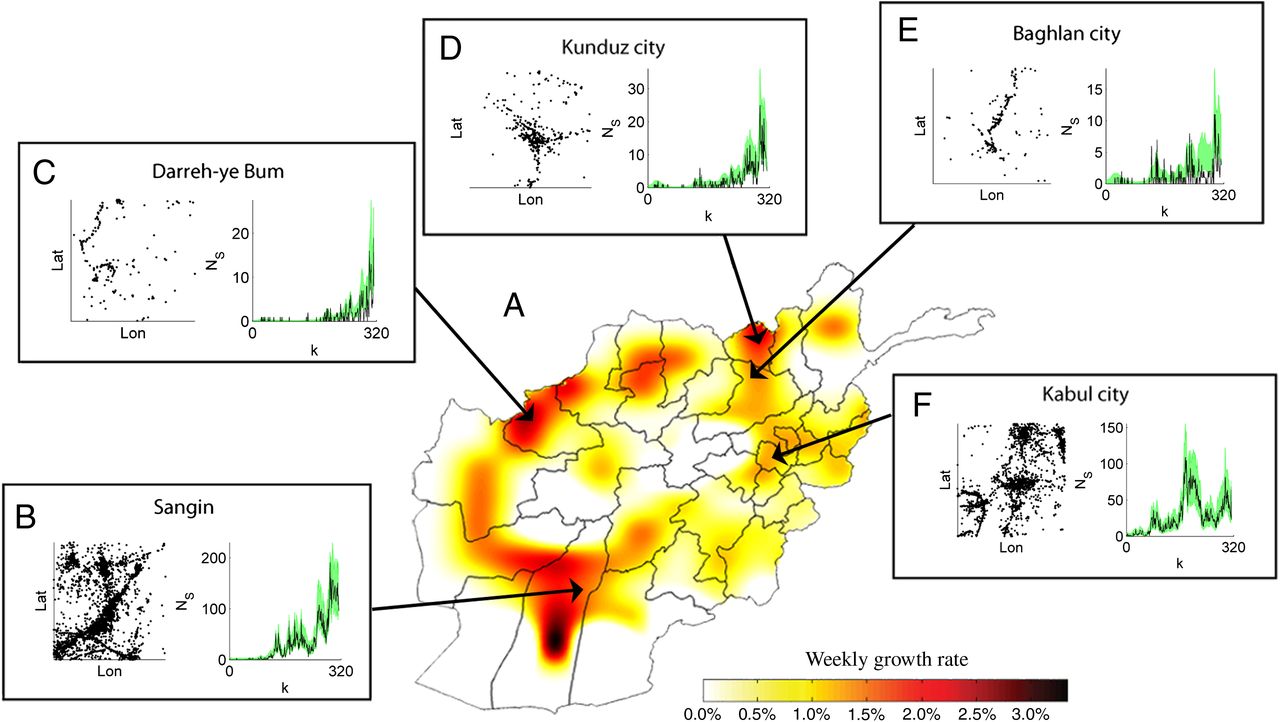
But I’m also struck by the idiom of the SIGACT itself.  We’ve since become much more accustomed to its staccato rhythm through Wikileaks’ release of the Afghan and Iraq War Diaries, whose key source was CIDNE.  Again, these have been visualised and analysed in all sorts of ways: see, for example, herehere, here and here (and especially Visualizing Data and its links here).  The image below comes from Andrew Zammit-Mangion, Michael Dewar, Visakan Kadirkamanathan and Guido Sanguinetti,’Point-process modelling of the Afghan War Diaries’, Proceedings of the National Academy of Sciences 109 (31) (2012) and shows the time-space incidence of events recorded in the Diaries (here I suspect I’m channelling half-remembered conversations with Andrew Cliff….)

F2.large

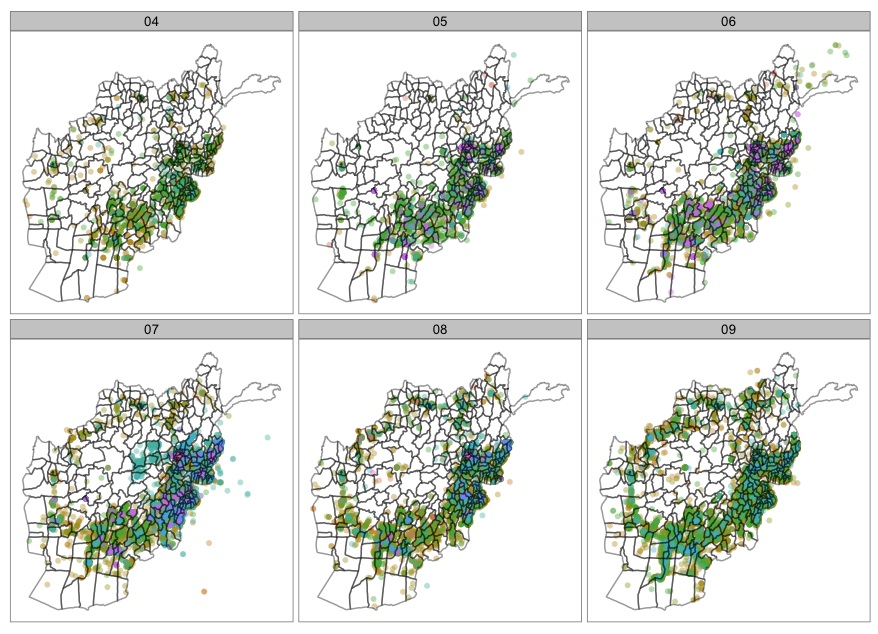
And here, rather more prosaically, is another version – by Drew Conway and Mike Dewar – that provides a time-sequence of the mounting intensity of the war 2004-2009 (for Danger Room‘s discussion and gloss, see here):

events_by_label_map

Now David Pinder has kindly drawn my attention to an extraordinarily suggestive essay by Graham Harwood,Endless War: on the database structure of armed conflict’ over at rhizome, and to the art-work that is it subject, which together have returned me to my original interest in the ‘event-field’ of later modern war and the automated interactions between its data platforms.

Graham’s central question is deceptively simple: ‘How does the way war is thought relate to how it is fought?’ SIGACTS populate the digital battlespace with events and invite a calculative and algorithmic apprehension of the field of military violence.  To show what this means, Graham and his partner Matsuko Yokokoji (who together compose YoHa: English translation ‘aftermath’) joined with his Goldsmith’s colleague Matthew Fuller to produce an intriguing artwork, Endless War.

It processes the WikiLeaks Afghan War Diary data set as a collection of analytic viewpoints, both machine and human. A software-driven system, Endless War reveals the structure of these viewpoints by using N-gram fingerprints, a method that allows sorting of the text as an anonymous corpus without having to impose predetermined categories on it. Presented as a gallery installation, the system includes a computer that processes the data in real time, projections of the results, and coil pick-up microphones on the central processing unit that sonify the inner working of the machine.

The torrent files released by WikiLeaks in 2010 are the residue of the system that created them, both machine and human. They seem to hint at the existence of a sensorium, an entire sensory and intellectual apparatus of the military body readied for battle, an apparatus through which the Afghan war is both thought and fought.

You can get a sense of the result from vimeo’s record of the installation at the Void Gallery in Derry:

This is a video, obviously, but Endless War isn’t a video.  As the artists explain in a note added to the vimeo clip:

Just as an algorithm is an ‘effective procedure’, a series of logical steps required to complete a task, the Afghan War Diary shows war as it is computed, reduced to an endless permutation of jargon, acronyms, procedure recorded, cross-referenced and seen as a sequence or pattern of events.

Endless War is not a video installation but a month-long real-time processing of this data seen from a series of different analytical points of view. (From the point of view of each individual entry; in terms of phrase matching between entries; and searches for the frequency of terms.) As the war is fought it produces entries in databases that are in turn analysed by software looking for repeated patterns of events, spatial information, kinds of actors, timings and other factors. Endless War shows how the way war is thought relates to the way it is fought. Both are seen as, potentially endless, computational processes. The algorithmic imaginary of contemporary power meshes with the drawn out failure of imperial adventure.

This computational assemblage (think not only of the cascading algorithms but also of the people and the handshakes between the machines: a political technology ‘full of hungry operators’, as Graham has it) is performative: it is at once an inventory – an archive – and a machine for producing a particular version of the military future. Graham again:

‘A SigAct necessarily retains evidential power that reflects its origin outside of the system that will now preserve it, but once isolated from blood and guts, sweat and secretions of the theatre of action (TOA), the SigActs are reassembled through a process of data atomisation. This filter constructs a domain where the formal relation, set theory, and predicate logic has priority over the semantic descriptions of death, missile strikes, or the changing of a tank track and the nuts and bolts needed…

This system of record keeping can be seen as a utopia of war. It is idealized, abstracted, contained; time can be rolled back or forward at a keystroke, vast distances traversed in a query, a Foucauldian placeless place that opens itself up behind the surface of blood-letting and hardware maintenance and the ordering of toilet rolls. A residue that casts a shadow to give NATO visibility to itself. As the ensemble of technical objects and flesh congeal, they create an organ to collectively act to rid itself of some perceived threat—this time from Al Qaeda or the Taliban—faulty vehicles, bad supplies, or invasive politics. This organ also allows NATO’s human souls to imagine themselves grasping the moment, the contingency of now. All of the war, all of the significant events, all of the time, all of the land, coming under the symbolic control of a central administration through the database, affording governance to coerce down the chain of command.’

This is a much more powerful way of capturing – and, through the physical installation itself, conveying – what I originally and imperfectly argued in ‘Seeing Red’:

‘… optical detachment is threatened by a battle space that is visibly and viscerally alive with death; biopolitics bleeds into necropolitics. And yet the Press Briefings that are parasitic upon these visualizations move in a dialectical spiral, and their carefully orchestrated parade of maps, screens and decks reinstates optical detachment. For even as the distancing apparatus of the world-as-exhibition is dissolved and the map becomes the city, so the city becomes the map: and in that moment – in that movement – Baghdad is transformed into an abstract geometry of points and areas and returned to the field of geopolitics. And as those maps are animated, the body politic is scanned, and the tumours visibly shrink, so Baghdad is transformed into a biopolitical field whose ‘death-producing activities [are hidden] under the rhetoric of making live’ (Dauphinee and Masters 2007: xii). In this looking-glass world bodies are counted but they do not count; they become the signs of a pathological condition and the vector of recovery. These processes of abstraction are, of course, profoundly embodied. This is not algorithmic war, and behind every mark on the map/city is a constellation of fear and terror, pain and grief. For that very reason our disclosure of the infrastructure of insight cannot be limited to the nomination of the visible.’

Forensis

I’m putting together my presentation on ‘Seeing like a military‘ for the AAG Conference in Tampa next week, but – prompted in part by my interest in forensic architecture (see also here and here) – I’ve also been thinking about other ways of seeing (perhaps ‘re-viewing’ would be better) military violence.

2014_cover_publication_forensis_imgsize_SSo I’ve been interested to read a report over at rhizome on Forensis, an exhibition and installation curated by Anselm Franke and Eyal Weizman at the Haus der Kulteren der Welt in Berlin, on ‘Constructions of Truth in a Drone Age’:

Any act of looking or being looked at is mediated by technology. This is true of any scientific process too, where each tool or method of looking is developed with a purpose in mind which influences the data that it produces. This is precisely what forensic investigation reveals: not only the reality of an event, but also the intention of a viewing mechanism and the political weight of that intention once made visible. Representations of warfare illustrate this as successfully as any art object.

As part of the exhibition Forensis, now on view at Haus der Kulteren der Welt in Berlin, Forensic Architecture and SITU Research investigate drone strikes in situations where state-mandated degradation and pixelation of publicly available surveillance footage is a legal regulation rather than a visual constraint, and drones are designed to evade the digital image. Missiles are developed that burrow through targeted buildings, leaving holes that are smaller than a low resolution pixel. Attacking at “the threshold of visibility,” the legal, political, and technical conditions equally attempt to remain invisible. The job of forensics is then to recover them.

Anselm and Eyal traffic in the roots between forensics and the Roman forum, which they envisage as a ‘multi-dimensional space of negotiation and truth-finding in which humans and objects participated together in politics, law and the economy.’  The underlying argument of Forensis, the report suggests, is that ‘the object of forensics should be as much the looker and the act of looking as the looked-upon’ – which will be precisely my point in Tampa.

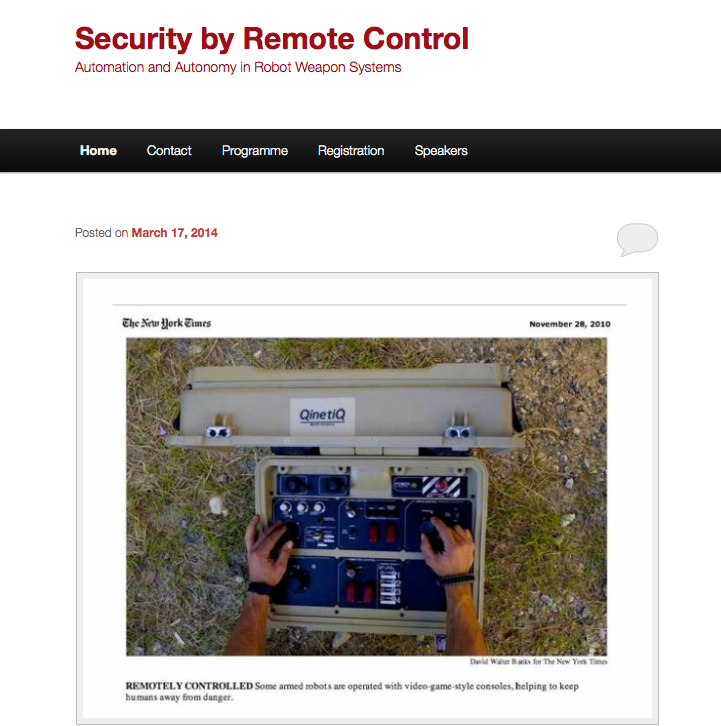
Security by remote control

Security by remote control

News from Lucy Suchman that the website for the Security by Remote Control conference at Lancaster, 22-23 May, is now live here.  It will be enhanced and updated as the symposium approaches – including programme details: I’m still thinking over what I might present – but registration is open now.

Despite investment in new technologies, the legitimacy and efficacy of actions taken in the name of security is increasingly in question. In April of 2013 a coalition led by Human Rights Watch initiated a campaign in favour of a legally binding prohibition on the development, production and use of fully autonomous weapon systems. Simultaneously, some military and robotics experts argue that equipping robots with the capacity to make ethical judgments is an achievable technological goal. Within these debates, the ‘human in the loop’ is posited alternately as the safeguard against illegitimate killing, or its source. Implicit across the debate is the premise of a moment of decision in which judgements of identification and appropriate response are made. This symposium will focus on on the troubling space between automation and autonomy, to understand more deeply their intimate relations, and the inherent contradictions that conjoin them.

Hiding in the pixels

FA_UN_DRONES_FIG_2

For more on the role of forensic architecture in the analysis of drone strikes, which I discussed earlier this week, see Rebecca Chao‘s report – including an interview with Eyal Weizman – at TechPresident here.  The report includes an interesting qualification about the limitations of satellite imagery:

The drone analysis videos are not only evidential, however. They are also instructional. “These videos,” says Weizman, “do three things. We undertake the investigation while telling viewers how we do what we do and in the end we also reflect on how confident we are about the results.”

The purpose is to teach human rights activists or journalists how to conduct their own forensic architectural investigations. For example, the highest resolution satellite imagery comes from private American companies that cost $1,000 per image, which Weizman says is relatively affordable since an analysis would usually require just two: one right before the strike and one after.

There are certainly limitations to the data they obtain, however. With satellite imagery, for example, even the highest resolution images degrade to a pixel that translates to 50 cm by 50 cm of actual terrain. This means that a drone could easily hide undetected in one of those pixels, says Weizman…. [It] also hides the damage caused by drone strikes. When asked if this an uncanny coincidence, Weizman explains, that while there is prerogative for states and militaries to maintain an advantage, that pixel is also proportioned to hide a human and the private companies issuing such data are cognizant of privacy issues. Even so, this allows countries to deny drone strikes, says Weizman, because drones are beyond the threshold of detectability in the available satellite imagery.

And while I’m on the subject of architecture, the Guardian reports that on 19 March the Royal Institute of British Architects called for the suspension of the Israeli Association of United Architects from the International Union of Architects for its complicity in the construction of illegal settlements in occupied Palestine: what Israel consistently calls ‘the facts on the ground‘.  And those dismal ‘facts‘ aren’t hiding in the pixels.

Cloud computing

Just caught up with this: a fine essay over at the Deterritorial Investigations Unit – ‘Instead of building a genealogy of neoliberalism, we must build a cartography of the system’ – called  “The sage speaks of what he sees”: War Games and the New Spirit of Capitalism.

It’s a provocative Deleuzian take on the intersections between systems technology, military violence and the production of code/space, that starts with World War II and tracks on into the present (so in fact it combines genealogy and geography).

Developments in aviation technology, such as the capability for flying at higher altitudes and more complex bomb and weapon systems, led to profound problems in fire-control: in high-speed warfare, it was necessary for gunners to be able to respond immediately to actions in the combat environment and to hit their targets with a greater degree of accuracy. In order to deal with this new machinic vision of warfare (which extends beyond the fire-control issue itself, as larger programs like the Manhattan Project indicate), militaries were quickly investing millions of dollars into scientific research in an effort to find mastery over combat theaters. Through science, the command structures of the military were seeking an orderly control over the environment. 

SAGE

A central part in the narrative is played by the Semi-Automated [sometimes ‘Automatic’] Ground Environment (SAGE – hence in part the title) and its successor projects, including civilian derivatives like SABRE that revolutionised air travel ticketing (and Travelocity).  On that tangled web, see Jordan Crandall on ‘tracking’ here (also here) and here.

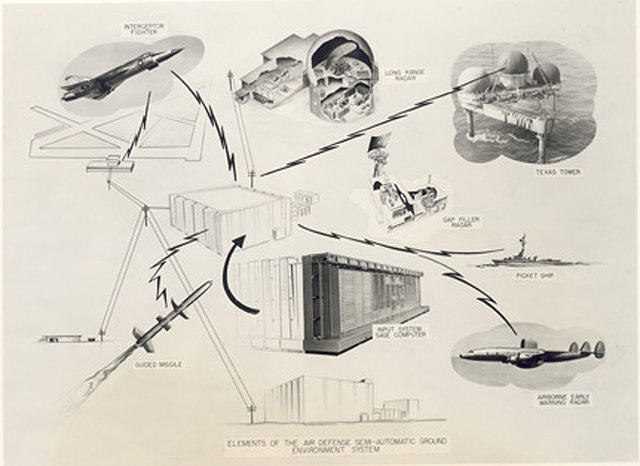
As George Valley and Jay Forrester (later of Urban dynamics fame) conceived of SAGE in 1953, the system would consist of

(1) a net of radars and other data sources and (2) digital computers that (a) receive the radar and other information to detect and tract aircraft, (b) process the track data to form a complete air situation, and (c) guide weapons to destroy enemy aircraft.

SAGE_diagram_of_systems

The system was developed at MIT’s Lincoln Laboratory (at a greater cost than the Manhattan Project, incidentally), and this is how the Lab summarises SAGE:

 A large network of radars would automatically detect a hostile bomber formation as it approached the U.S. mainland from any direction. The radar detections would be transmitted over telephone lines to the nearest SAGE direction center, where they would be processed by an AN/FSQ-7 computer. The direction center would then send out notification and continuous targeting information to the air bases best situated to carry out interception of the approaching bombers, as well as to a set of surface-to-air missile batteries. The direction center would also send data to and receive data from adjoining centers, and send situational awareness information to the command centers.  As the fighters from the air bases scrambled and became airborne, the direction center would continue to process track data from multiple radars and would transmit updated target positions in order to vector the intercepting aircraft to their targets. After the fighter aircraft intercepted the approaching bombers, they would send raid assessment information back to the direction center to determine whether additional aircraft or missile intercepts were necessary.

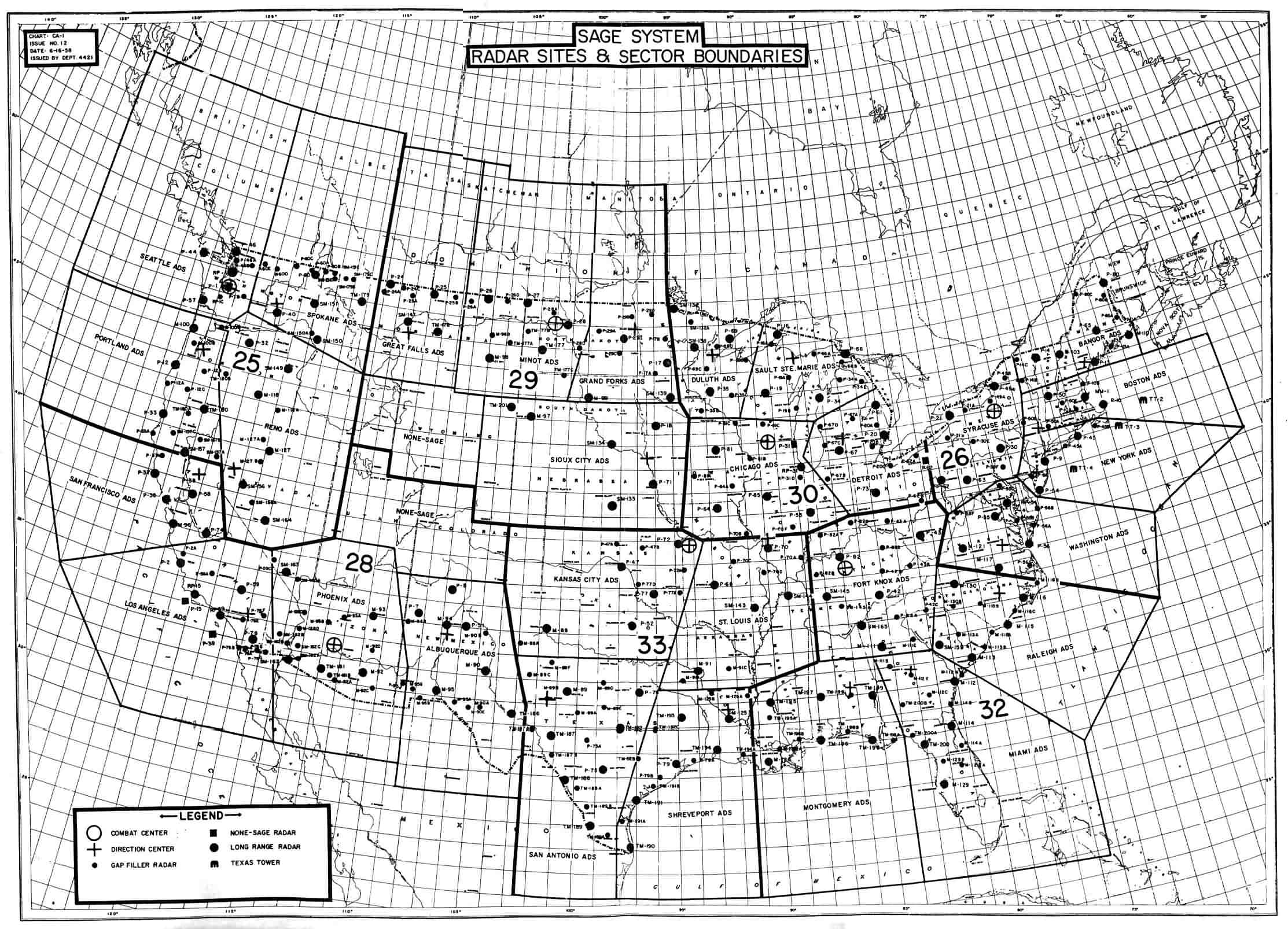
The network as envisaged in 1958 is shown below (more details here):

SAGE network plan 1958

FARISH Contours of America's Cold WarThis plainly reaches back to the air defence systems set up by Britain and Germany during the Second World War, but more significantly for my purposes it intersects with the sensor-shooter system that was at the deadly centre of the ‘electronic battlefield’ during the Vietnam war and with a stream of subsequent tactical (rather than purely strategic) developments.  If you want to know more about SAGE and its spiralling military trajectory, I recommend Matt Farish‘s brilliant chapter in The contours of America’s Cold War (Minnesota, 2010), ‘The cybernetic continent: North America as defense laboratory’.

More recently still, there’s Jeremy Packer and Joshua Reeves, ‘Romancing the drone: military desire and anthropophobia from SAGE to swarm’, Canadian Journal of Communication 38 (2013) 309-31.  And, as their title suggests, all of this feeds into my continuing interest in the networks that make today’s drone wars possible, to which I’ll return shortly.