A world of proliferated drones

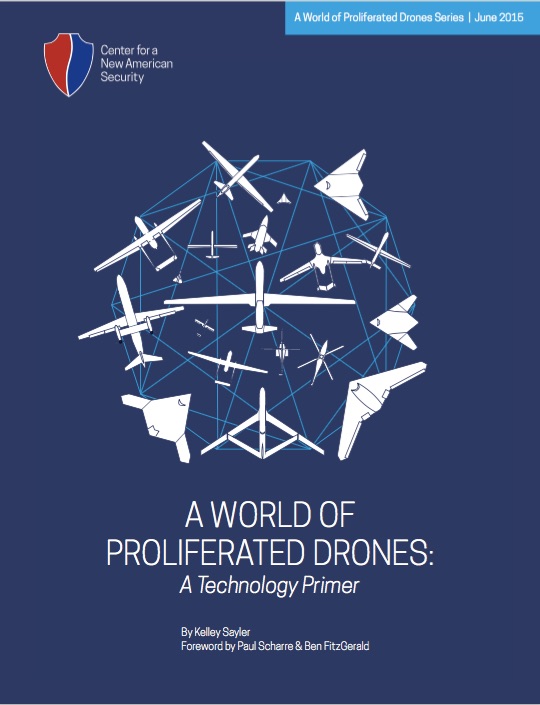
CNAS A world of proliferated dronesA new report from Kelley Sayler at the Center for a New American Security, A world of proliferated drones, starts to map what she calls ‘the likely contours of a drone-saturated world’.  The report emphasises that the United States does not have a monopoly on drones  – more than 90 states and non-state actors have them – but unusually the report pays close attention to the repurposing of small, commercial off-the-shelf drones.  It begins by summarising their capability for intelligence, surveillance and reconnaissance:

‘Current commercial drone technologies – available for purchase in either pre-assembled or customizable, component form – enable a number of high-end capabilities that were formerly the monopoly of major military powers.

Many commercial off-the-shelf (COTS) drones – including the best-selling model, the DJI Phantom – are now equipped with GPS and waypoint navigation systems. These systems enable the drone to accurately determine and hold its position, in turn removing the need for line-of-sight communications and allowing for autonomous flight… Operators of pre-assembled systems can also take advantage of smartphone-based control systems, dramatically improving ease of use. Such systems enable the user to navigate the drone simply by selecting a destination on a map or even by merely tilting the user’s phone…

High-definition video cameras are also widely available on COTS drones and, when combined with video downlinks, can provide real-time intelligence, surveillance, and reconnaissance (ISR) capabilities to multilocation receivers, though these capabilities are often limited by range and battery life.’

The report emphasises the potential weaponisation of these small drones for what it calls ‘overmatch’, in effect reversing the terms of asymmetric warfare, through (for example) the development of ‘flying IEDs‘:

‘While such systems may not appear sophisticated in a traditional military sense, ground-emplaced IEDs have caused thousands of American deaths in Iraq and Afghanistan and proved profoundly hard to defeat. Drones will enable airborne IEDs that can actively seek out U.S. forces, rather than passively lying in wait. Indeed, low-cost drones may lead to a paradigm shift in ground warfare for the United States, ending more than a half- century of air dominance in which U.S. ground forces have not had to fear attacks from the air.  Airborne IEDs could similarly be used in a terrorist attack against civilians or in precision strikes against high-profile individuals or landmarks.’

But the report also makes much of the US’s continued military-industrial investment in high-end drones.  Here various forms of stealth technology make much of the running, or at least issue most of the promissory notes, since today’s Predators and Reapers can only operate in more or less undefended air space – which is another way of saying they can only be used against the weak and/or with the complicity of other states (as in Pakistan and Yemen) – and face immense difficulties in what the US Air Force calls A2/AD [anti-access/area-denial] environments (see here and here). But I’m particularly interested in what the report has to say about the use of large military drones to act as communications relays.  Here the emphasis is on the ability of these remote relays to integrate what is otherwise often remarkably un-networked warfare and to extend the range of operational control and transmissable data.

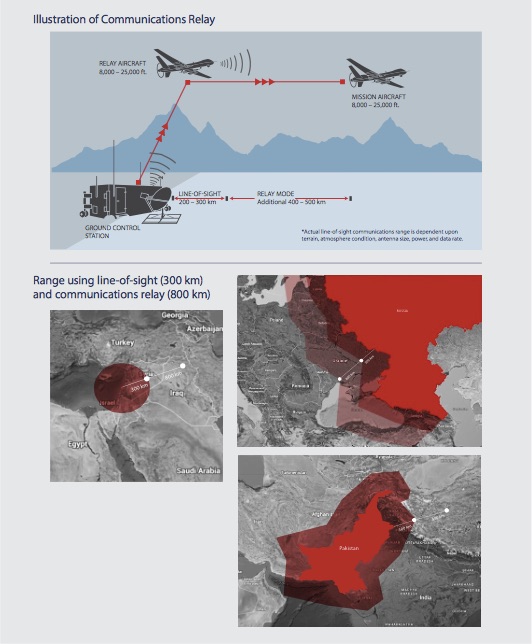
Drones as communication relays (CNAS)

‘Large military-specific systems offer a number of additional improvements in communications capabilities. Many include wide-band satellite communications (SATCOM) that expand the amount and extend the range of transmittable data, providing distant ground stations with real-time ISR. Like some baseline systems, high-end systems are generally capable of line-of-sight communi- cations with other platforms operating in their area and, for this reason, are often employed as communications relays. Perhaps the most vivid example of the force-multiplying effects of such capabilities is the EQ-4 – what is essentially an RQ-4 Global Hawk outfitted with the Battlefield Airborne Communications Node (BACN). BACN serves as a universal translator for a diverse set of U.S. aircraft that are not otherwise capable of communicating with each other due to incompatible data links – providing a vital connection between, for example, fourth-generation F-16 fighter jets, B-1 bombers, and stealthy, fifth-generation F-22s [BACN is also used on conventional platforms: see here for its role in co-ordinating an air strike in Afghanistan]. Communications relay capabilities will also allow states to operate drones at extended ranges (300 to 800 kilometers) without satellite communications, allowing significant penetration into neighboring countries or contested areas’ (my emphasis).

Steve Graham and I are presently working on an essay on drones and satellite communications: so much of the discussion of geospatial intelligence has focused on satellite imagery, but the geographies of satellite communications (and, crucially, bandwidth) play a major role in the deployment of drones and in the highly variable quality of the imagery they transmit to users across the network.

Dirty Dancing online

I had a wonderful time at the Balsillie School at Waterloo last week – good company, constructive conversations and endless hospitality – and I’m truly grateful to Simon Dalby, Jasmin Habib and all the graduate students who made my visit so enjoyable.  I finished by giving one of the Centre for Global Governance Innovation (CIGI)’s Signature Lectures.

This was the latest (and near-final) version of “Dirty dancing: drones and death in the borderlands”.   The argument has developed considerably since my first presentations; I’ll upload the written version once it’s finished, but CIGI has posted the lecture and Q&A online here.  I’ve also embedded the YouTube version below, but if that doesn’t work try here.

My thanks to the AV technicians who made this possible: their help with the production followed by their assured and rapid-fire editing beats anything I’ve encountered anywhere.

In this version, I begin with two CIA-directed drone strikes in Pakistan’s Federally Administered Tribal Areas, one on Baitullah Mehsud (the leader of Tehrik-i-Taliban) and the other on ‘Mamana’ Bibi, an innocent grandmother and midwife, and ask what it is that makes strikes like these – which is to say strikes as unlike these – possible.  My answer turns on the kinds of space the FATA been made out to be: in particular, a space of exception in which people are knowingly and deliberately exposed to death, and a territory conceived as a political technology through which power lays claim to bodies-in-space.

Unlike Giorgio Agamben‘s original formulation, though, my discussion of the space of exception focuses not on violence authorised through the suspension of the law but rather violence that operates inside the law: so I look at the legal regimes, both international and national, that affect military and paramilitary violence in the FATA.  A further difference is that this exceptional state of affairs is provoked not by an event but by a margin: by the construction of the FATA as a liminal zone, borderlands that are outside ‘Pakistan proper’ or ‘mainland Pakistan’.  Many commentators (including me) trace the origin of aerial violence to the British Raj, its Frontier Crimes Regulations and its ‘policing’ of the North-West Frontier.  This is important, but the line of descent to today’s air strikes is not direct.  In particular, it is important to bring into view the cross-border incursions made by Soviet and Afghan aircraft during the occupation of Afghanistan.  Thousands of people were killed and injured during these attacks, and this constitutes an important horizon of memory, but no less important is the response of the Pakistan Air Force: their US-supplied jets intercepted incoming aircraft and either escorted them out of Pakistani air space or, towards the end of the 1980s, engaged them in combat.  This begs an obvious question: if Pakistan objects to the US strikes – carried out by drones that are slow, noisy and sluggish – why does its Air Force not shoot them down?  Since today’s drones cannot be used in contested air space – bluntly, they can only be used against defenceless people – why does Pakistan elect to render the people of FATA defenceless?  This immediately brings into view the other source of aerial violence in the borderlands: the ongoing offensives in the FATA launched by the Pakistan Air Force (in concert with large-scale ground operations).  Even though the Pakistan Air Force has its own reconnaissance drones, some of which are now armed, these are not attempts to put ‘warheads on foreheads’, as the US Air Force would have it, but wide-area assaults conducted by conventional strike aircraft and attack helicopters – as I show in the case of Mir Ali and Miran Shah during Operation Zarb-i-Azb (see here and here and here).

To complete the sequence and add the US drone strikes, I trace the intimate collaboration between both the CIA and the US Air Force and between Washington and Islamabad.  The diplomatic cables released by Wikileaks show time and time again that many of the negotiations about access to ‘flight boxes’ over North and South Waziristan were conducted by the Chairman of the Joint Chiefs of Staff and the commander of US Central Command.  I show, too, how the collaboration between Washington and Islamabad continued until at least 2013.

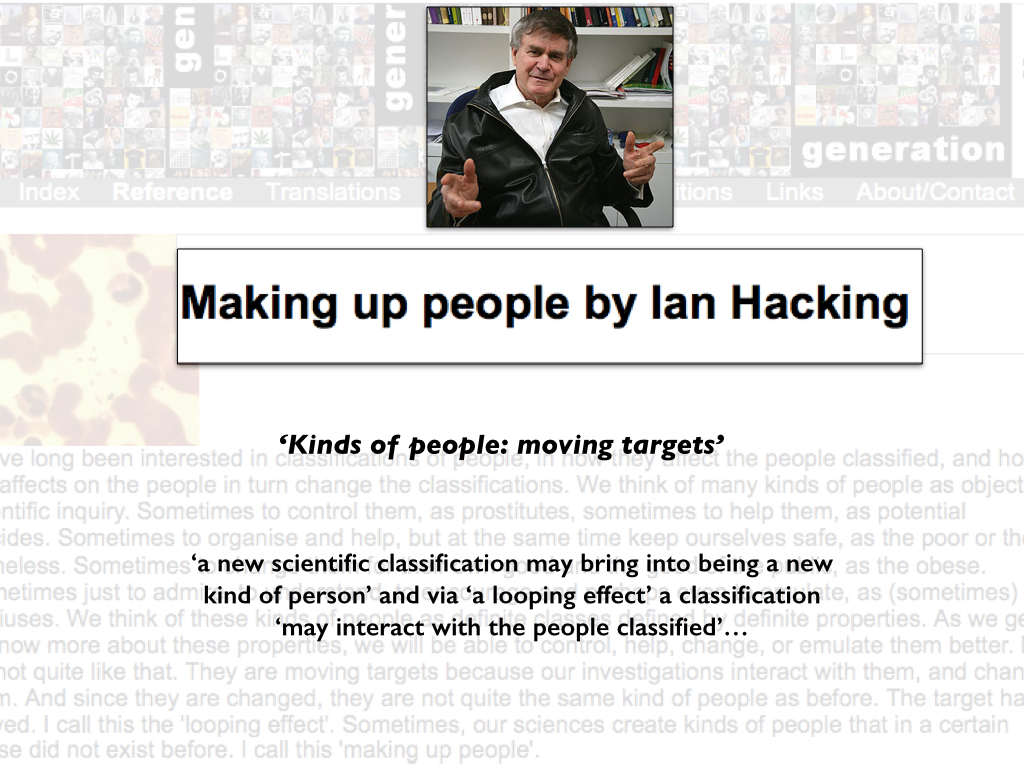
Hacking.001

In order for the CIA-directed strikes to be possible, however, the FATA must also be turned into a territory in something like the sense proposed by Stuart Elden.  So I describe the multiple ways in which data is harvested by the NSA and other agencies to produce what Rob Kitchin and Martin Dodge call code/space: the algorithmic combination of sensors, traces and intercepts to summon into being a body-as-target (for more, see here: scroll down), and to produce the space of the target where fleshy bodies disappear and are replaced by codes, co-ordinates and cross-hairs.  This is another version of what Ian Hacking calls ‘making up people’: there is an important sense, then, in which the supposed ‘individuation’ of later modern war depends on the selective and active production (and destruction) of an ‘individual’.

The questions and comments after the lecture were immensely helpful, and as I turn this into its final, written version I’d be grateful for any further comments if you watch the video.

War at a distance

Porter-The-Global-Village-Myth-webNews from Patrick Porter of a new book due out in March, The global village myth: distance, war and the limits of power (from Hurst in the UK/Georgetown University Press in the US):

According to security elites, revolutions in information, transport, and weapons technologies have shrunk the world, leaving the United States and its allies more vulnerable than ever to violent threats like terrorism or cyberwar. As a result, they practice responses driven by fear: theories of falling dominoes, hysteria in place of sober debate, and an embrace of preemptive war to tame a chaotic world.

Patrick Porter challenges these ideas. In The Global Village Myth, he disputes globalism’s claims and the outcomes that so often waste blood and treasure in the pursuit of an unattainable “total” security. Porter reexamines the notion of the endangered global village by examining Al-Qaeda’s global guerilla movement, military tensions in the Taiwan Strait, and drones and cyberwar, two technologies often used by globalists to support their views. His critique exposes the folly of disastrous wars and the loss of civil liberties resulting from the globalist enterprise. Showing that technology expands rather than shrinks strategic space, Porter offers an alternative outlook to lead policymakers toward more sensible responses—and a wiser, more sustainable grand strategy.

You can get a preliminary preview of Patrick’s basic argument at War on the Rocks here.

Divided societies and connected spaces

Following my last post, Mustafa Dikeç has sent me a link to his brilliant reflections on ‘Hate’ at the Society & Space website here.  Written from Paris, it takes us to the heart of modern French society and its divided spaces:

DIKEÇ Badlands… if we are troubled about what has happened, troubled enough to take a hard look at, rather than falling in love with, ourselves, then it is important to inquire about the conditions that made such a mobilisation of hate possible. In the highly emotional aftermath of the incidents, it is hard not to feel moved by the extraordinary mobilisation of citizens. Newspapers are full of comments about how proud we should be as French citizens, how a united and solidaristic people we are, how the spirit of May 1968 continues despite the attack on its inheritors, how we value equality and freedom of expression, and so on. If all were nice and dandy, then what made such radicalisation of these three French-born and raised citizens possible? Why, a decade ago, did 300 cities go up in flames for two weeks, and what has been done since? How is it that the extreme right has become the second major political force in this land of freedom, equality and fraternity? …

This is not at all to suggest that the murderers’ actions can be justified by the circumstances. But to warn that despite the timely and admirable display of unity under an alleged one and indivisible republic, the French society is deeply divided, owing to its long history of discrimination and the increasing hostility towards immigrants – a poisonous mix of xenophobia and Islamophobia that several French politicians, endowed with the authority of the state, have unashamedly mobilised for their political ends. Muslims are the most stigmatised group of this divided society, spared neither by satire nor political discourse and action.

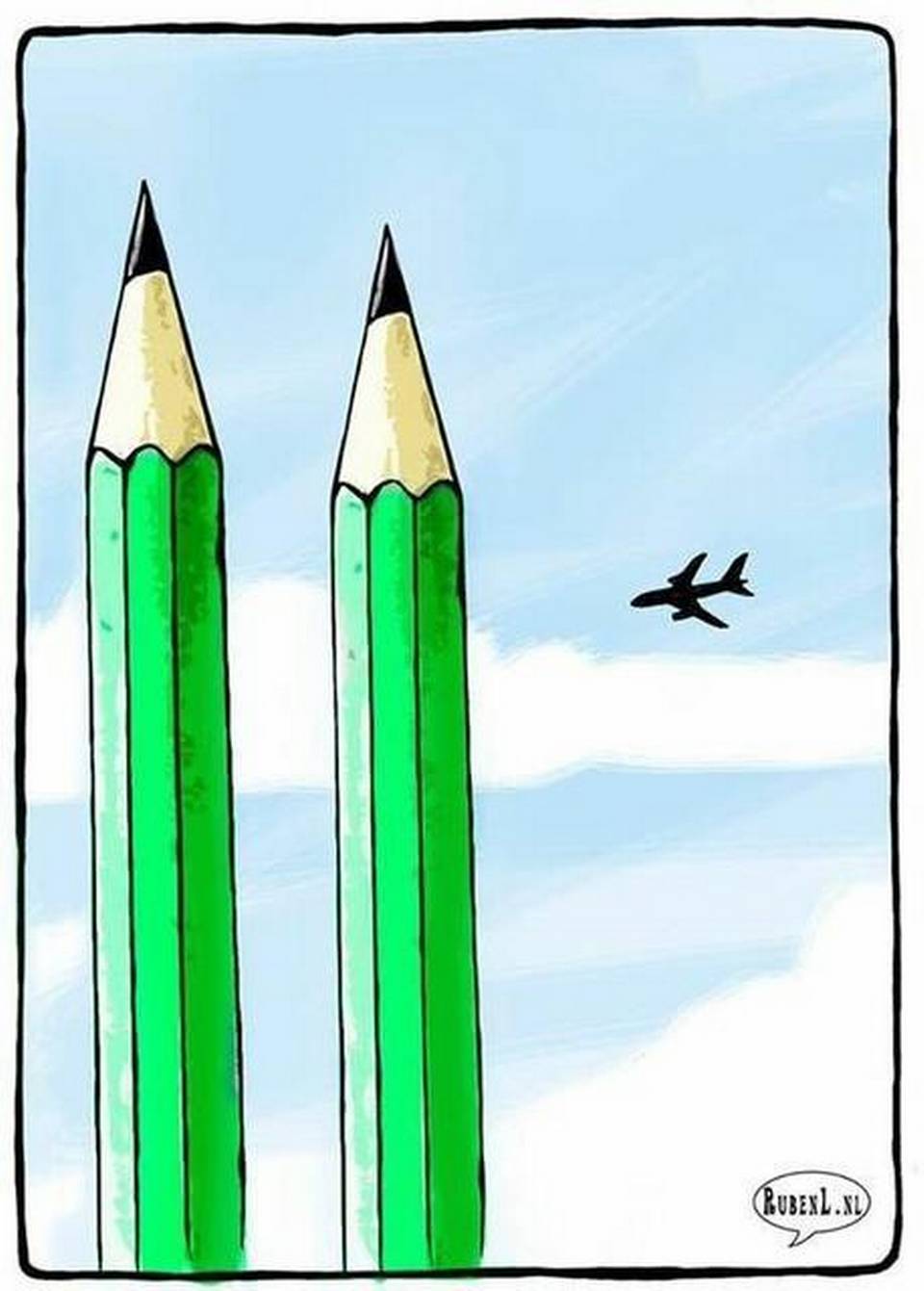
thursdaytoonMustafa’s essay begins not with the murders in Paris but with a bomb explosion in Yemen, and a second e-mail from Tim Raeymaekers has alerted me to his equally indispensable post ‘”Us” against “Them”‘ over at Liminal Geographies here.  Tim moves in the opposite direction to Mustafa, zooming out above the arc of that explosion to provide a contrapuntal geography that reads the murders in Paris in concert with the global violence of contemporary wars, most of them fought under the tattered banners of counter-terrorism, undeclared in their particulars and less than covert in their killing.  He ends with this reminder from Teju Cole‘s incandescent essay on ‘Unmournable bodies’ at the New Yorker:

BUTLER Precarious LifeFrance is in sorrow today, and will be for many weeks to come. We mourn with France. We ought to.

But it is also true that violence from “our” side continues unabated. By this time next month, in all likelihood, many more “young men of military age” and many others, neither young nor male, will have been killed by U.S. drone strikes in Pakistan and elsewhere. If past strikes are anything to go by, many of these people will be innocent of wrongdoing. Their deaths will be considered as natural and incontestable as deaths like Menocchio’s, under the Inquisition. Those of us who are writers will not consider our pencils broken by such killings. But that incontestability, that unmournability, just as much as the massacre in Paris, is the clear and present danger to our collective liberté.

Je ne suis pas Charlie

Once you decide you want to engage with audiences beyond the academy – one of my reasons for starting this blog, which also spirals in to my presentations and (I hope) my other writing – you run the risk of accepting invitations to comment on issues that lie far beyond your competence.  Even supposed ‘experts’ can be caught out, of course: think of  Steven Emerson‘s extraordinary claim earlier this week on Fox News (where else?) that in the UK ‘there are actual cities like Birmingham that are totally Muslim where non-Muslims just simply don’t go in…’  Emerson is the founder and Executive Director of the Investigative Project on Terrorism, and ‘is considered one of the leading authorities on Islamic extremist networks, financing and operations’ – or so he says on his website – and he subsequently apologised for his ‘inexcusable error’.

Emerson was being interviewed as part of Fox News’s continuing coverage of the murders at the office of Charlie Hebdo and a kosher supermarket in Paris on 7 January, and specifically about the supposed proliferation of what he called ‘no-go zones … throughout Europe’.

A good rule is to treat areas you know nothing about as ‘no-go zones’ until you’ve done the necessary research.

Academics need to take that seriously too, especially as universities become ever busier pumping up their public affairs, boosting their media profiles and offering journalists ready access to the specialised knowledge of their faculty.  Don’t get me wrong: I believe passionately in the importance of public geography, especially with a little g, and I also understand how producers and journalists racing to meet a deadline need talking heads.  But we need to be careful about the simulation of expertise.

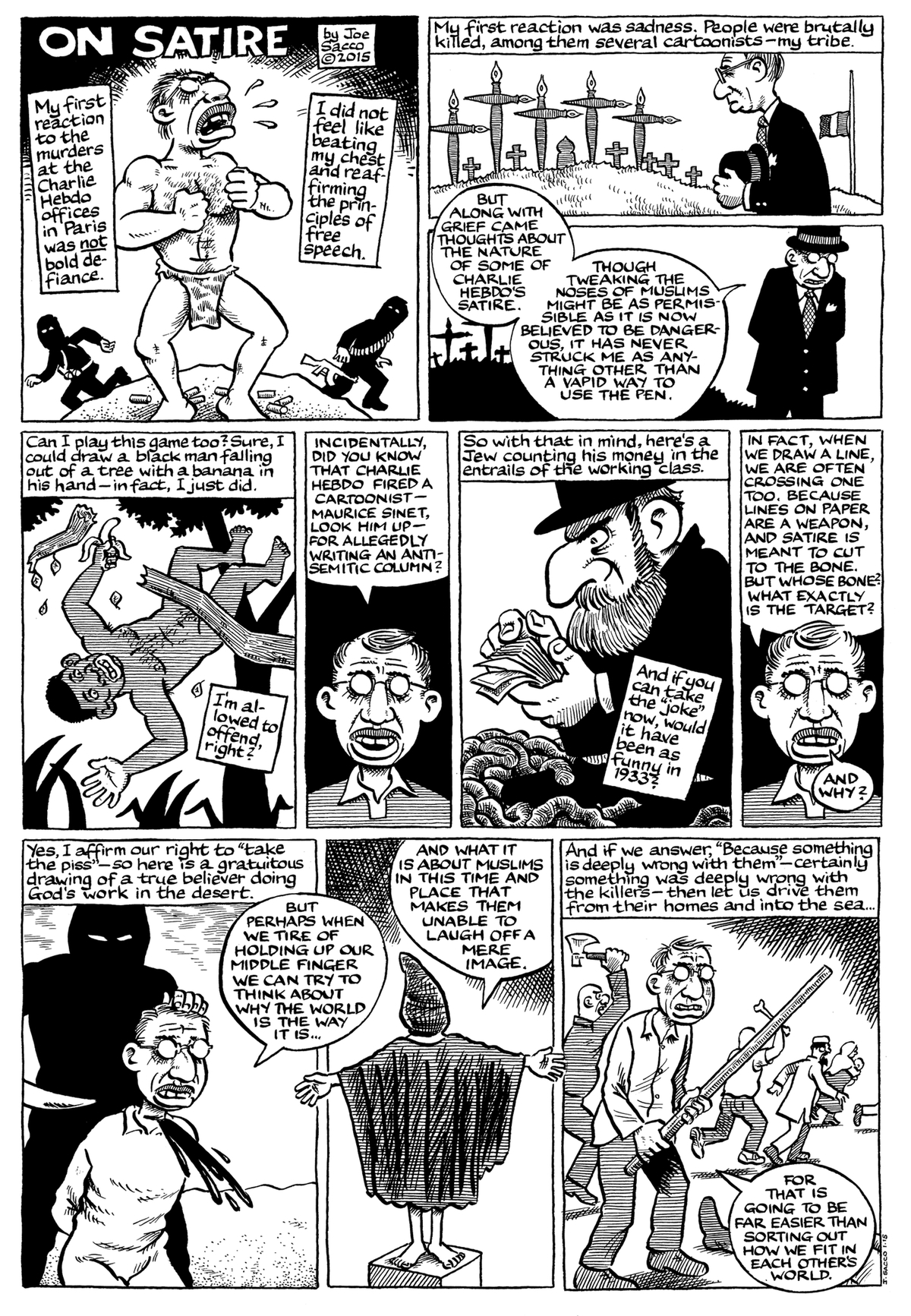
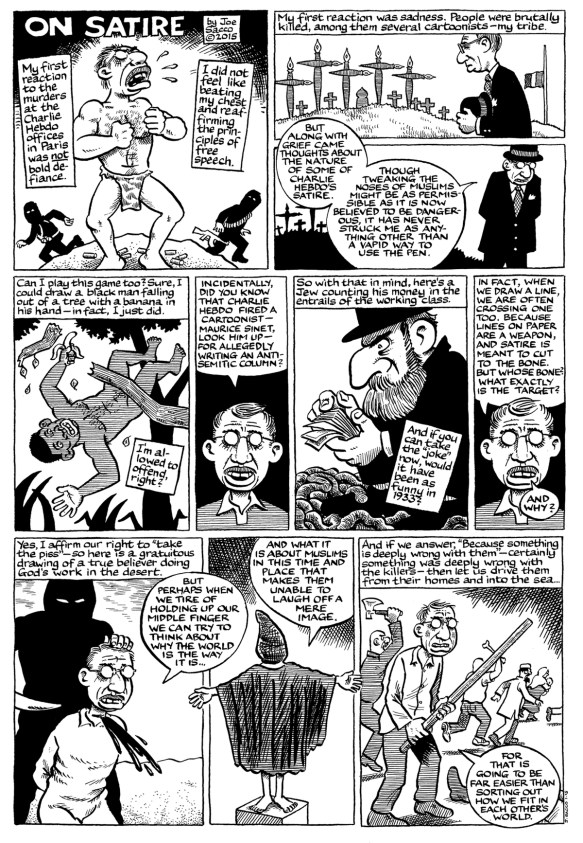
This is, in part, why I haven’t said anything so far about the murders in Paris.  But on Thursday I was invited to lead a lunch-time discussion about them at the Peter Wall Institute for Advanced Studies; one of the many wonderful things about the place is the trust that emerges out of a commitment to the irredeemably social nature of intellectual work, and so – beyond the cameras, the microphones and the notebooks – I tried to sort out what I had been reading and thinking.    In many ways, it was an extended riff on Joe Sacco‘s cartoon that appeared in the Guardian just two days after the attacks (if you want to know the reactions of Arab cartoonists, then see Jonathan Guyer here and here):
joesaccoonsatire1200

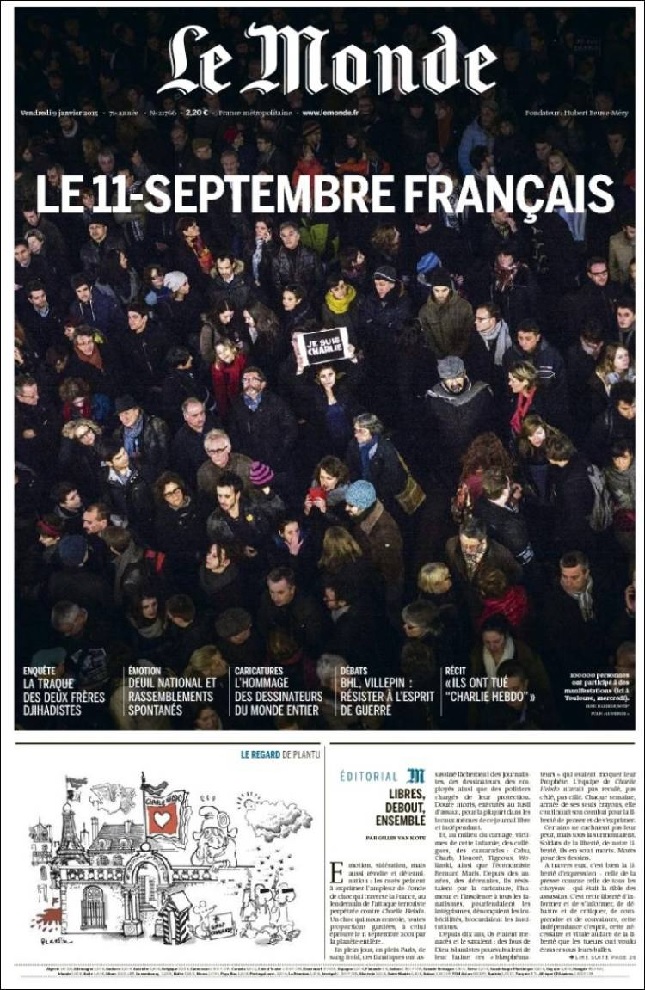
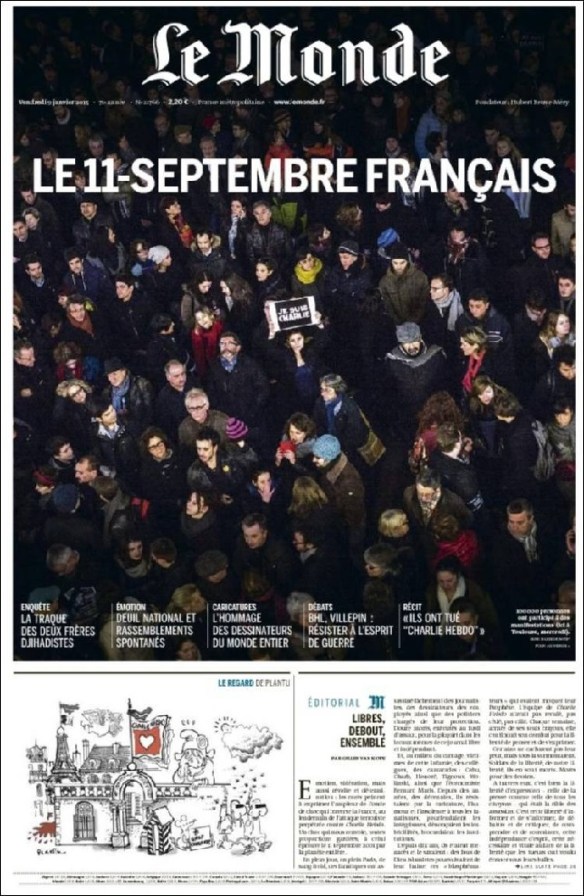
My starting-points were provided by The colonial present.  First, many commentators have suggested that the attacks were ‘France’s 9/11’; Le Monde‘s banner headline declared emphatically ‘Le 11 Septembre Français’.
le_monde_11_septembre

I think this absurd for many reasons, but there are several senses in which the comparison is worth pursuing, particularly if we focus on the response to the attacks in New York and Paris.  Both events, or more accurately television and video feeds of the developing situations, were relayed to watching audiences in real time.  This sense of immediacy is important, because it says something about the ways in which viewers were drawn in to the visual field and interpellated as subjects who were enjoined to respond – and crucially to feel – in particular ways.

Since this is emphatically not what Dominique Moisi, author of The geopolitics of emotion, had in mind when he insisted that ‘the attacks in Paris and in New York share the same essence’, that both cities ‘incarnate a similar universal dream’ of ‘light and freedom’, perhaps a different comparison will clarify what I mean.  Think of the killing of hundreds, even thousands of people by Boko Haram in Baga in northern Nigeria two weeks ago; reports began to appear in Europe and North America just one day after the murders in Paris, but the focus on France remained relentless.  There were surely many reasons for that (see Maeve Shearlaw‘s discussion here and Samira Sawlani‘s here), but the contrast between the live feeds from Paris and the scattered, inchoate and verbal reports from Baga is part of it – particularly when you realise that the scale of that distant atrocity was eventually  ‘laid bare’, as the Guardian put it, by satellite photographs released by Amnesty International showing more than 3,000 houses (‘structures’) burned or razed in Baga and Doron Baga.  For all the importance of surveillant witnessing in otherwise difficult to reach locations, the distance between bodies and buildings, an ordinary camera and a satellite, and live television and static imagery is telling, and sustains an affective geopolitics that is at once divided and divisive.

(Imagery is important to the Paris attacks in another sense too: when the murderers stormed in to the offices of Charlie Hebdo the focus of their rage was a series of cartoons mocking Mohammed – but they were radicalised by quite other documentary images, including coverage of the wars in Iraq and photographs showing the atrocities committed by American troops in Abu Ghraib: see here and here, and look at Joe Sacco’s cartoon again).

My second borrowing from The colonial present was a re-borrowing of Terry Eagleton‘s spirited invocation of ‘the terrible twins’, amnesia and nostalgia: ‘the inability to remember and the incapacity to do anything else’.  In the book I suggested that these are given a special significance within the colonial memory theatre, where the violence of colonialism is repressed and replaced by a yearning for the culture of domination and deference that it sought to instill.   And in much (fortunately not all) of the commentary on the Paris attacks, France’s colonial past has been effaced.  But here is Tim Stanley writing in the Telegraph:

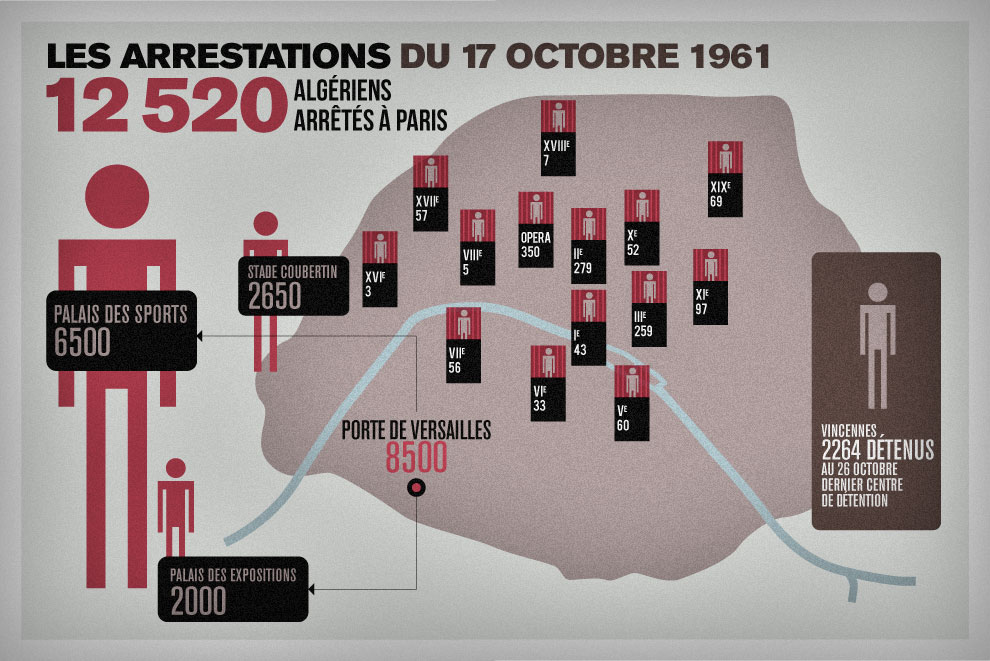
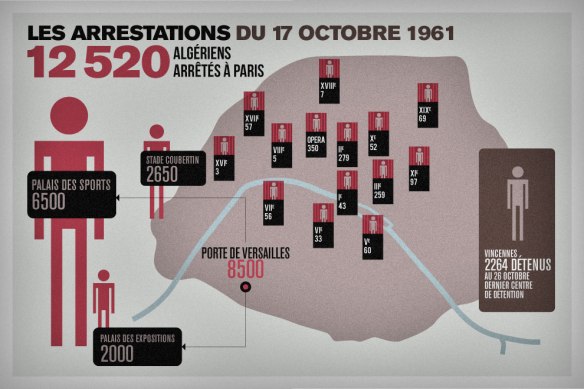
The ability of a society to forget its recent past is like the amnesia that follows an accident – the body’s way of protecting itself against trauma. Yet in the 1950s and 1960s, as France tried to cling on to its African colonial possessions, political violence was far more common than today. Muslim Algerian nationalists (their race and religion regarded as interchangeable by the French) bombed the mainland, assassinated officials and killed colonialists en masse. The reaction of the state was shocking. In 1961, 12,000 Algerian immigrants were arrested in Paris and held in a football stadium [and at other sites: see the map below]. Many were tortured; more than a hundred disappeared. For days, bodies were found floating in the Seine.
Carte.ParisAlgerie1961Bis

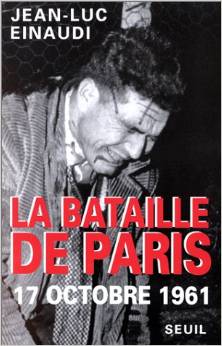
EINAUDI Bataille de ParisYou can find more on the events of 17 October 1961 – on the arrests, torture and summary executions following a mass rally to protest against a curfew imposed on Algerians in Paris – here and here, but the definitive account remains Jean-Luc Einaudi‘s Bataille de Paris (1991).
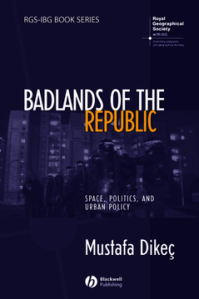
DIKEÇ BadlandsThis is but one episode in a violent and immensely troubled colonial history.  To point to this past – as Robert Fisk also did, in much more detail, in the Independent – is to loop back to 9/11 again, when attempts to provide similar contextual explanations were dismissed (or worse) as ‘exoneration’.  To be sure, one must be careful: although Chérif and Said Kouachi were the Paris-born sons of Algerian immigrants, Arthur Asseraf is right to reject attempts to draw a straight line between violence in the past and violence in the present.  But can the continued marginalisation of Muslims in metropolitan France, particularly young men in Paris’s banlieus, be ignored?  (Here there is no better place to start than Mustafa Dikeç‘s work, especially Badlands of the Republic).  Doesn’t it matter that more than 60 per cent of prisoners in French jails are Muslims? For the Economist all this means is that jihadists ‘share lives of crime and violence‘ so that structural violence disappears from view, but Tithe Bhattacharya provides a different answer in which the ghosts of a colonial past continue to haunt the colonial present.

And doesn’t the responsive assertion of a ‘freedom of expression’ that is, again, highly particularistic seek to absolutize a nominally public sphere whose exclusions would have been only too familiar to France’s colonial subjects?  Ghasan Hage reads its triumphalist restatement in the aftermath of the Paris murders as a colonial narcissism – a sort of colonial nostalgia through the looking-glass – fixated on what he calls a strategy of ‘phallic distinction’ in which ‘freedom of expression’ is flashed at radicalised Muslims to tell them: ‘look what we have and you haven’t, or at best yours is very small compared to ours.’  (And whose governments have done so much to prop up authoritarian regimes in the Arab world and beyond that thrive on the suppression and punishment of free speech?)

There are, as Joe Sacco’s cartoon makes clear, real limitations on what can be said or shown in France too, including how somebody can present themselves in public – think of the arguments over the veil and the headscarf.  There are also limitations elsewhere in the world, of course, which is why the sacularisation of Charlie Hebdo and, in particular, the march in Paris on 11 January seemingly headed by politicians from around the world, arm in arm (in some cases arms in arms would be more accurate), processing down the Boulevard Voltaire (symbolism is everything), was a scene that, as Seumas Milne noted, was beyond satire:

from Nato war leaders and Israel’s Binyamin Netanyahu to Jordan’s King Abdullah and Egypt’s foreign minister, who between them have jailed, killed and flogged any number of journalists while staging massacres and interventions that have left hundreds of thousands dead, bombing TV stations from Serbia to Afghanistan as they go.

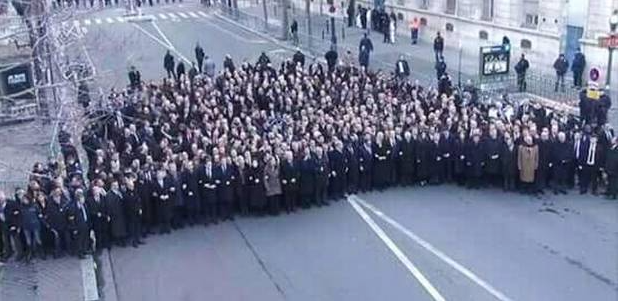
True enough, but here too appearance is everything: the photograph was artfully staged (even before one ‘newspaper’ airbrushed the women from the frame) and took place in an otherwise empty side-street.
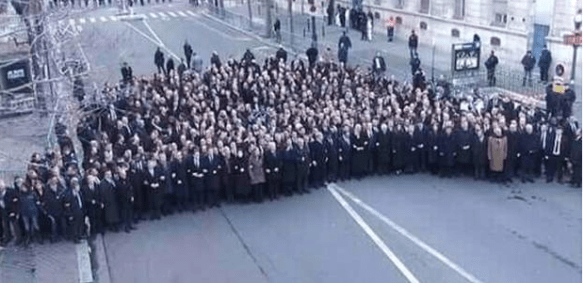
Paris photo-op PNG

If I can make one last nod to The colonial present, not surprisingly many of these politicians have also used the murders to justify the continued violence of the wars being fought in the shadows of 9/11; if you are in the mood to reverse the looking-glass, then Markha Valenta‘s sobering reflection at Open Democracy is indispensable:

[E]verything that might be said about revolutionary Islamist movements – when it comes to global violence – could be said about global Americanism and US foreign policy. It has been ruthless, cruel, illiberal, anti-democratic. It has wreaked havoc, killed innocents, raped women, men and youths, tortured viciously, violated the rule of law and continues to do so…

It does so in our name. In the name of democracy. And those who expose this … are shut up ruthlessly, cruelly and in ways designed to degrade. (Yet we did not march then.)

This matters because it clarifies what our condition is today, the condition under which last week’s violence took place: an extended and expanding global war between those who claim the right to intervention, brutality and terror in the name of democracy and those who do so in the name of Islam.

No less predictably, one of the immediate and dismally common responses to the murders, amidst the clamour for freedom of speech, was a renewed call for more state surveillance and regulation.  As Teju Cole wrote in the New Yorker,

The only person in prison for the C.I.A.’s abominable torture regime is John Kiriakou, the whistle-blower. Edward Snowden is a hunted man for divulging information about mass surveillance. Chelsea Manning is serving a thirty-five-year sentence for her role in WikiLeaks. They, too, are blasphemers, but they have not been universally valorized, as have the cartoonists of Charlie Hebdo.

But it’s not only politicians who are guilty of appropriation.  Putting on one (far) side the extraordinary attempts to turn “Je suis Charlie” to commercial account – to ‘trademark the tragedy and its most resonant refrain‘ – there are other, less venal and more complicated appropriations.
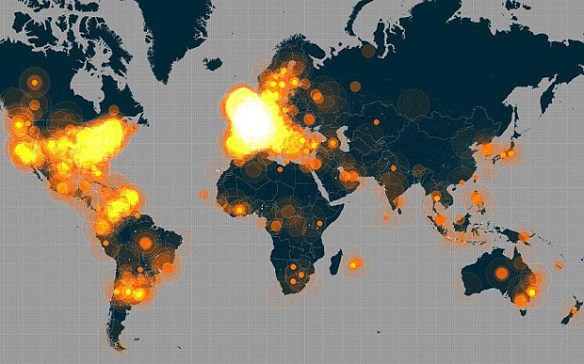
B67GP_yCYAA_mce.jpg

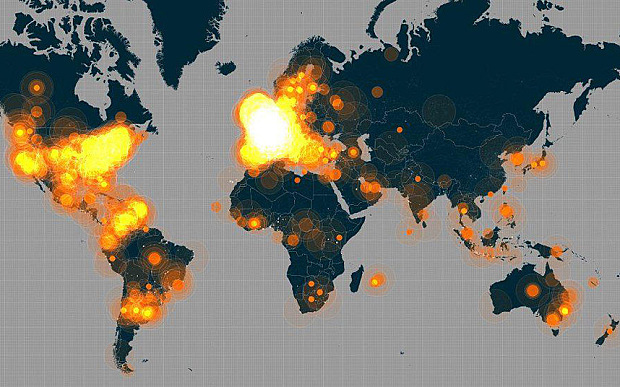
Heat map of #jesuischarlie hashtag; animation is available here

So back to the looking-glass.  You might think that “Je suis Charlie” is an affirmative gesture born of anger and horror but also of sympathy and compassion, a simple human reflex that has become virtually commonplace – comparable to, say, “We are all Palestinians“.  That was my first thought too. But the trouble is that such a rhetorical claim comes with a lot of baggage.  David Palumbo-liu suggests that  “I am Charlie” can be an assertion of empathy, solidarity or identification.  Even empathy is far from straightforward – why do we extend our fellow feeling to these people and not those? – but, as he shows, the other two progressively raise the stakes.    Sarah Keenan and Nadine El-enany wire this to appropriation with exquisite clarity in a short essay at Critical Legal Thinking:

The #JesuisCharlie hashtag and its social media strategy of solidarity through identification with the victim is … an appropriation of what was a creative and subversive tool for fighting structural violence and racist oppression, perhaps most famously in the “I am Trayvon Martin” campaign. When young black men stood up and said “I am Trayvon Martin”, they were demonstrating the persistent and deeply entrenched demonisation of black men which not only sees them killed in the street on their way to the local shop, but also deems their killers innocent of any wrongdoing. When predominantly white people in France and around the world declare “Je Suis Charlie”, they are not coming together as fellow members of a structurally oppressed and marginalised community regularly subjected to violence, poverty, harassment and hatred. Rather, they are banding together as members of the majority, as individuals whose identification with Charlie Hebdo, however well-​meaning, serves to reproduce the very structures of oppression, marginalisation and demonisation that allowed the magazine’s most offensive images to be consumed and celebrated in the first place.

As the invocations of Voltaire should have demonstrated, there is a substantial difference between defending the right to draw a cartoon and celebrating what is drawn.  Too many commentators clearly want to elide the difference, but there is another distinction to be made too.  A Muslim friend who lives in Paris was distraught at the murders, but when he heard the calls for the cartoons to be re-published immediately after the killings he told me he felt brutalised all over again.  Those who made such demands, who casually sneered at the ‘cowardice’ of those who failed to comply, either forgot or chose to ignore the existence of a far, far larger Muslim audience than the terrorists against whom they vented their spleen: or, still worse, it never occurred to them that there is a difference between the two.

So: je ne suis pas Charlie; I think I’d rather ‘be’ Joe.

***

I am grateful to my friends and colleagues who helped me think through these issues – I realise there’s a lot more thinking to be done, so please treat this as a first, fumbling attempt – and to Jaimie.
Global terrorism

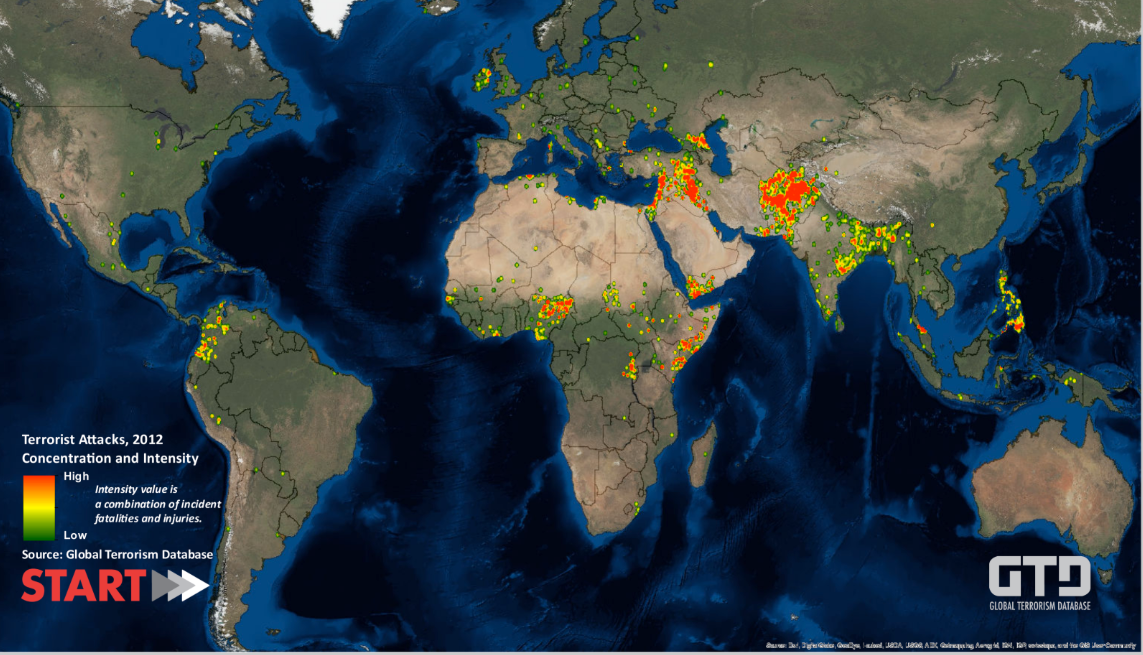
With all the usual caveats about the notoriously contentious definition(s) of ‘terrorism’,  the National Consortium for the Study of Terrorism and Responses to Terrorism (START), which has been up and running at the University of Maryland since 2005, has now geocoded its Global Terrorism Database – at least for 2012 – and from its list of more than 8,400 terrorist attacks that killed over  15,400 people its has produce this map of terrorist attacks last year:

START Terrorist attacks 2012

‘Although terrorism touched 85 countries in 2012, just three – Pakistan, Iraq and Afghanistan – suffered more than half of 2012’s attacks (54%) and fatalities (58%)… The next five most frequently targeted countries were India, Nigeria, Somalia, Yemen and Thailand.’

You can download a hi-res and zoomable version here, and you can find out more about START here.

Of course, it’s a moving map:

‘In the 1970s, most attacks occurred in Western Europe. In the 1980s, Latin America saw the most terrorist acts. Beginning with the 1990s, South Asia, North Africa and the Middle East have seen steadily rising numbers of attacks, a trend that has accelerated in recent years.’

And since START is a ‘Center of Excellence of the US Department of Homeland Security’ then, no, the map doesn’t include US drone strikes or attacks on civilians carried out by US allies.

Ideology of the drone

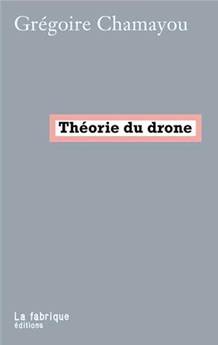
9782130583516Jean-Baptiste Jeangène Vilmer has published an extended critique of Grégoire Chamayou‘s Théorie du drone at La vie des idées under the title ‘Ideology of the drone’.  Some of the essays from that site are eventually translated into English and appear on the mirror site Books & Ideas, but I have no idea when or even whether this one will be, so I thought it would be helpful to provide a summary.

First, some background.  Vilmer has travelled via Montréal, Yale and War Studies at King’s College London to his present position at Sciences Po in Paris, where he teaches ethics and the law of war; he also teaches at the military academy at Saint-Cyr, and is a policy adviser on security issues to the Ministry of Foreign Affairs.  Vilmer is the author of more than a dozen books, of which La Guerre au nom de l’humanité : tuer ou laisser mourir (2012) is probably the best known.  If you’re not familiar with his work, here’s an English-language interview with him about La Guerre au nom de l’humanité via France 24 and the Daily Motion:

http://www.dailymotion.com/video/xpsqs8_jean-baptiste-jeangene-vilmer-author-of-war-in-the-name-of-humanity-kill-or-let-die_news

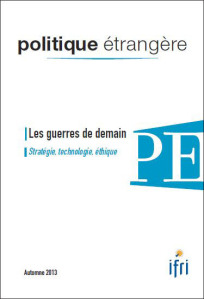
pe-3-2013I should note, too, that Vilmer’s critique trades in part on an essay published earlier this year, ‘Légalité et légitimité des drones armés’ [‘Legality and legitimacy of armed drones’], in Politique étrangère 3 (2013) 119-32, in which he rehearses a number of criticisms of Chamayou.  There Vilmer insists that the use of drones is perfectly compatible with the principles of international humanitarian law (this is about principle not practice, though, and he doesn’t address the implications of international human rights law which many critics and NGOs believe is the operative body of law for drone strikes outside war zones, like those carried out by the US in the Federally Administered Tribal Areas of Pakistan).

He also has no time for critics who turn the distance between the drone operator and the target into a moral absolute (though I don’t think Chamayou does that at all: instead, as I tried to show previously, he provides a nuanced discussion of the concept of distance).  Still, Vilmer is right to insist that the history of modern war is the history of killing the enemy from ever greater distances, and those who cling to the ‘nobility’ of hand-to-hand fighting are blind to an historical record reaching back over centuries.  If distance is a ‘moral buffer’, this is hardly unique to today’s remote operations, where in any case the greater physical distance is counterbalanced by a compression of what Vilmer calls ‘epistemic distance’ through the real-time full-motion video feeds transmitted from the drone.  The difference between the crew of a Lancaster bomber over Germany and the drone operator controlling an aircraft over Afghanistan is that the latter sees his victim.  And if conducting strikes by computer is ‘dehumanising’, the machetes used at close quarters in the Rwandan genocide were hardly less so.  What is more, Vilmer suggests, those video feeds are not only remote witnesses of the target; there is an important sense in which they also function as remote witnesses of the crew, providing a vital record for any subsequent military-judicial investigation and thus inviting and even institutionalising a regularised monitoring of ‘the conduct of conduct’.

la-theorie-du-droneNow to the extended critique of Chamayou.  Vilmer notes that Théorie du drone follows directly from Chamayou’s previous book, Chasses à l’homme [Manhunts], and in fact that’s his main problem with it: he says that Théorie reduces the function of drones to ‘hunting’, specifically to the US campaign of targeted killing, and identifies the one so closely with the other that the force of his analysis is blunted.  Vilmer thinks this is playing to the crowd: there is a considerable audience opposed to the use of drones who find Chamayou’s arguments convincing because they confirm their own views.

Indeed, Chamayou makes it plain that one of his express intentions is to provide the critics with useful tools to advance their political work.  Yet at the same time he presents Théorie as a philosophical investigation – and it is that, Vilmer concedes, erudite and at times brilliant – but in his view the objective is less to provide understanding than to provoke indignation.  In fact,  Chamayou has said in press interviews that what provoked him in the first place was the sight of philosophers collaborating with the military – and Vilmer freely admits to being one of them (though in France rather than the United States or Israel).

It’s important to examine the practice of targeted killing, Vilmer agrees, because it raises crucial ethical and legal questions.  But it’s also important not to confuse the ends with the means.  As I’ve noted in my own commentaries on Théorie, there are other ways of carrying out targeted killing (as Russian dissidents on the streets of London or Iranian scientists on the streets of Tehran have discovered to their cost) and there are many other military uses for drones.  Targeted killing gets the most publicity because it’s so controversial, Vilmer argues, but it’s far less important than the provision of intelligence, surveillance and reconnaissance (though ISR is central to lethal strikes carried out by conventional aircraft and ground troops too).

Vilmer is breezily confident about the use of drones in war-zones, where he says they are no more problematic than any other observation platform or weapons system.  Contrary to Chamayou’s assertion that drones only save ‘our’ lives, Vilmer insists that they have saved the lives of others – ‘their’ lives – in Afghanistan, Iraq, Libya and Mali.  Yet Chamayou isn’t interested in these cases; instead his ‘theory of the drone’ reduces its role to CIA-directed targeted killings in Pakistan, Yemen and Somalia, which Vilmer complains is like calling a book on Russian cyber-attacks Theory of the computer.

aJeangène VilmerThat said, he thinks Chamayou’s critique of signature strikes is ‘excellent’, and he deeply regrets the migration of the American campaign away from ‘personality strikes’ against High Value Targets. The widening of the target lists and the ‘industrialisation’ of targeted killing deserves condemnation – and Vilmer notes that the Obama administration, responsible for ramping up the attacks, has since cut them back in response to criticisms – but in his view this only shows that Predators and Reapers ‘have been used in an imprecise way’ not that they are intrinsically less accurate than other systems.

When Chamayou seeks to show, to the contrary, that drones are ‘inhumane’ he advances two arguments that Vilmer flatly rejects.  (I have to say that I think Chamayou’s arguments are considerably more subtle than Vilmer allows: see here and here).  The first – the claim that ‘unmanned’ aircraft are by definition ‘inhuman’ – he dismisses as sophistry, not because each operation involves almost 200 people but because the bombers that destroyed Hamburg and levelled Dresden were ‘manned’: he says that Chamayou would hardly describe the results of their missions as ‘humane’. The second – that machines dedicated to killing cannot be ‘humane’ – is an absolutism that doesn’t engage with those (like Vilmer) who argue that some weapons are more humane than others. That, after all, is precisely why some weapons are banned by international law.  And unlike Chamayou, Vilmer insists that drones allow for a greater degree of compliance with principles of distinction because they are more than weapons systems: they also provide enhanced ISR.

Vilmer agrees that it is wrong to compare drone strikes with bombing missions in the Second World War, Korea or Vietnam, but he disagrees with the contemporary alternative canvassed by Chamayou: ground troops armed with grenades.  In the case of Pakistan, Yemen or Somalia this isn’t a realistic option, he argues, and in the absence of drones the only alternative would be a Kosovo-like bombing campaign or a rain of Tomahawk missiles – neither of which would be as accurate as a Hellfire missile.  But this is to substitute one absolutism for another.  Hellfire missiles are not confined to Predators and Reapers but are also carried by conventional strike aircraft and attack helicopters; and in any case cruise missiles have been launched from US Naval vessels to attack targets in Yemen, and Special Forces have been deployed on the ground in all three killing fields.  Perhaps more to the point, however, Vilmer knows very well that conventional operations involving ground troops do not typically minimise civilian casualties.  He points to the invasions of Afghanistan and Iraq as reasons for Obama’s greater reliance on remote operations and a ‘lighter footprint’, and he also emphasises (as Chamayou does not) the casualties caused by Pakistan’s own military operations in the Federally Administered Tribal Areas (see my discussions here and here).

This last brings Vilmer to a key objection, which is that Chamayou provides no detailed discussion of the reasons behind the US drone strikes.  It’s not enough to attribute them to American imperialism tout court, he insists, because this is a reductive argument that turns terrorists and insurgents into freedom fighters and fails to acknowledge let alone analyse the real dangers posed, both locally and trans-nationally, by al-Qaeda and its associates.  Théorie doesn’t simply ‘disappear’ the terrorists, Vilmer writes, it turns them into victims: like so many rabbits put back in the magician’s hat.  The imagery is almost Chamayou’s – he claims that ‘one no longer fights the enemy, one eliminates them like rabbits’ – but Vilmer prefers another one.  He says that Chamayou’s talk of the predator (or Predator) advancing, the prey fleeing, makes it seem as though the drones are targeting Bambi’s mother…

Bambi's mother

It’s another clever phrase (and Vilmer excels in them), but I think Chamayou is much more sensitive to civilian casualties – and to the plight of all those innocents living under the perpetual threat of attack – than Vilmer.  There are snares and dangers out there, to be sure; but there are also an awful lot of Bambis and their mothers.

Finally, Vilmer turns to France’s decision to buy Reapers, which Chamayou contends has caused no outcry in France only because the public is badly informed about drones. On the contrary, Vilmer replies: it’s because they can tell the difference between buying the technology and using it like the Americans. Vilmer has much more to say about this in a recent open access interview in Politique étrangère, where he explains that the Air Force had deployed four unarmed drones, a version of Israel’s Heron called the Harfang, in Afghanistan, Libya and Mali, but that from the end of this year France will start to take delivery of 12 MQ-9 Reapers: these too will be unarmed.  He also speculates about the future development of drones.  Among other things, there will be a lot more of them (so he does worry about their proliferation); he also thinks they will be faster and stealthier, more lethal and more autonomous, and that they will fly in swarms.  He also believes that aircraft of the future will increasingly be produced in two versions: either conventional operations with pilots onboard or remote operations with pilots in a Ground Control Station.

Please bear in mind that this is only a summary of Vilmer’s critique, which is vulnerable to its own simplifications and caricatures, though I obviously haven’t been able to keep entirely silent.  But I’ll reserve a fuller engagement until I’ve finished my own extended commentary on Théorie du drone.

Nomadikon

MITCHELL Cloning terror

Henrik Gustafsson writes with an interesting supplement to my previous post on Image Wars. Last year Nomadikon, the Bergen Center for Visual Culture, convened an online discussion around ‘Image Wars’, centring on W.J.T. Mitchell’s argument in Cloning Terror: the war of images, 9/11 to the present (there’s a short extract from the opening chapter over at Berfrois here).

There are extended contributions from:

Toby MillerImperial Wars

Mikkel Bolt RasmussenThe Spectacle of State Terror and Fear

Jill CasidThe Imperative Mood

Chris Hables GrayImage War in the Age of Digital (Re)Production

Max LiljeforsNotes on ‘Image Wars’

Joanna ZylinskaLife in the battlefield of vision

And excellent untitled contributions from Marita Sturken, Jill Bennett, Iain Chambers and Kari Andén-Papadopoulos.  

There’s also a rich response (‘Image War’) from Mitchell himself:

W.J.T. Mitchell… this might be the place to make clear my own sense of limits, by insisting that the notion of image war, of a war of images, is itself an image, a metaphor, and perhaps a metapicture—that is, a second-order picture of the way that pictures operate.   A war of images is not literally a war.  Images do not go into battle and kill each other; human beings do. Images do not plan invasions, massacre populations, and shatter bodies.  That requires people.  Images are more like animals than humans, in this respect.  Animals fight and kill each other, but the mass mobilization of violence known as war seems a uniquely human institution, unless we anthropomorphize the natural behavior of certain species such as warrior ants, or the learned behavior of the war horse, image of the heroic cavalry of pre-modern warfare.  Images are “agents” of war in the sense that a “secret agent” works for a foreign power, or an “agency” is an instrument of a state.  Images are thus like machines, extensions and agents of human powers.  Which is to say that they can go out of control, go “rogue,” and be turned against their creators.   If images are agents, then, perhaps they should be thought of as double agents, capable of switching sides, capable of being “flipped” by acts of clever detournement, appropriation, and seizure for purposes quite antithetical to the intentions of their creators.   (Think here of George W. Bush’s “Mission Accomplished” photo op; or the trophy photos taken at Abu Ghraib prison).    My attribution of agency and affect and desire to images, as Max Liljefors notes, “runs the risk” of “mystifying pictures,” but I don’t think we can track the volatile lives of images without running this risk.   We cannot, in my view, utterly destroy the mystification of images, their tendency to take on the status of totems, fetishes, and idols.  In fact, the fantasy of a sovereign iconoclastic power, one that would annihilate falsely mystified images once and for all simply winds up mimicking the idolatry that it seeks to displace.

You can read the whole thing here.