Tracking and targeting

News from Lucy Suchman of a special issue of Science, Technology and Human Values [42 (6) (2017)]  on Tracking and targeting: sociotechnologies of (in)security, which she’s co-edited with Karolina Follis and Jutta Weber.

Here’s the line-up:

Lucy Suchman, Karolina Follis and Jutta Weber: Tracking and targeting

This introduction to the special issue of the same title sets out the context for a critical examination of contemporary developments in sociotechnical systems deployed in the name of security. Our focus is on technologies of tracking, with their claims to enable the identification of those who comprise legitimate targets for the use of violent force. Taking these claims as deeply problematic, we join a growing body of scholarship on the technopolitical logics that underpin an increasingly violent landscape of institutions, infrastructures, and actions, promising protection to some but arguably contributing to our collective insecurity. We examine the asymmetric distributions of sociotechnologies of (in)security; their deadly and injurious effects; and the legal, ethical, and moral questions that haunt their operations.

Karolina Follis: Visions and transterritory: the borders of Europe

This essay is about the role of visual surveillance technologies in the policing of the external borders of the European Union (EU). Based on an analysis of documents published by EU institutions and independent organizations, I argue that these technological innovations fundamentally alter the nature of national borders. I discuss how new technologies of vision are deployed to transcend the physical limits of territories. In the last twenty years, EU member states and institutions have increasingly relied on various forms of remote tracking, including the use of drones for the purposes of monitoring frontier zones. In combination with other facets of the EU border management regime (such as transnational databases and biometrics), these technologies coalesce into a system of governance that has enabled intervention into neighboring territories and territorial waters of other states to track and target migrants for interception in the “prefrontier.” For jurisdictional reasons, this practice effectively precludes the enforcement of legal human rights obligations, which European states might otherwise have with regard to these persons. This article argues that this technologically mediated expansion of vision has become a key feature of post–cold war governance of borders in Europe. The concept of transterritory is proposed to capture its effects.

Christiane Wilke: Seeing and unmaking civilians in Afghanistan: visual technologies and contested professional visions

While the distinction between civilians and combatants is fundamental to international law, it is contested and complicated in practice. How do North Atlantic Treaty Organization (NATO) officers see civilians in Afghanistan? Focusing on 2009 air strike in Kunduz, this article argues that the professional vision of NATO officers relies not only on recent military technologies that allow for aerial surveillance, thermal imaging, and precise targeting but also on the assumptions, vocabularies, modes of attention, and hierarchies of knowledges that the officers bring to the interpretation of aerial surveillance images. Professional vision is socially situated and frequently contested with communities of practice. In the case of the Kunduz air strike, the aerial vantage point and the military visual technologies cannot fully determine what would be seen. Instead, the officers’ assumptions about Afghanistan, threats, and the gender of the civilian inform the vocabulary they use for coding people and places as civilian or noncivilian. Civilians are not simply “found,” they are produced through specific forms of professional vision.

Jon Lindsay: Target practice: Counterterrorism and the amplification of data friction

The nineteenth-century strategist Carl von Clausewitz describes “fog” and “friction” as fundamental features of war. Military leverage of sophisticated information technology in the twenty-first century has improved some tactical operations but has not lifted the fog of war, in part, because the means for reducing uncertainty create new forms of it. Drawing on active duty experience with an American special operations task force in Western Iraq from 2007 to 2008, this article traces the targeting processes used to “find, fix, and finish” alleged insurgents. In this case they did not clarify the political reality of Anbar province but rather reinforced a parochial worldview informed by the Naval Special Warfare community. The unit focused on the performance of “direct action” raids during a period in which “indirect action” engagement with the local population was arguably more appropriate for the strategic circumstances. The concept of “data friction”, therefore, can be understood not simply as a form of resistance within a sociotechnical system but also as a form of traction that enables practitioners to construct representations of the world that amplify their own biases.

M.C. Elish: Remote split: a history of US drone operations and the distributed labour of war

This article analyzes US drone operations through a historical and ethnographic analysis of the remote split paradigm used by the US Air Force. Remote split refers to the globally distributed command and control of drone operations and entails a network of human operators and analysts in the Middle East, Europe, and Southeast Asia as well as in the continental United States. Though often viewed as a teleological progression of “unmanned” warfare, this paper argues that historically specific technopolitical logics establish the conditions of possibility for the work of war to be divisible into discreet and computationally mediated tasks that are viewed as effective in US military engagements. To do so, the article traces how new forms of authorized evidence and expertise have shaped developments in military operations and command and control priorities from the Cold War and the “electronic battlefield” of Vietnam through the Gulf War and the conflict in the Balkans to contemporary deployments of drone operations. The article concludes by suggesting that it is by paying attention to divisions of labor and human–machine configurations that we can begin to understand the everyday and often invisible structures that sustain perpetual war as a military strategy of the United States.

I’ve discussed Christiane’s excellent article in detail before, but the whole issue repays careful reading.

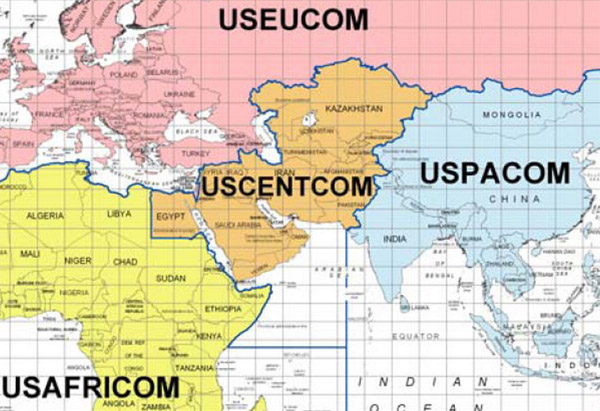
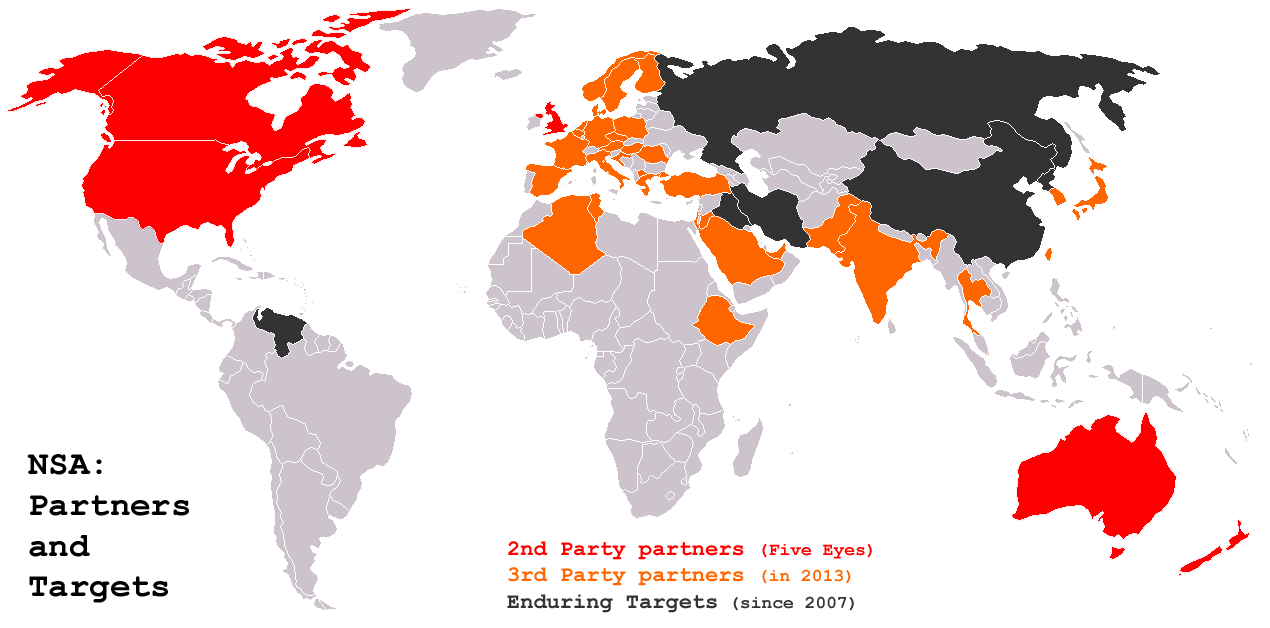
And if you’re curious about the map that heads this post, it’s based on the National Security Agency’s Strategic Mission List (dated 2007 and published in the New York Times on 2 November 2013), and mapped at Electrospaces: full details here.

Hersey Wars

I have very nearly finished the long-form version of ‘Little Boys and Blue Skies‘ (really), and en route I’ve re-read John Hersey‘s stunning essay on Hiroshima that took up a whole issue of the New Yorker in 1946 (you can read it online here).

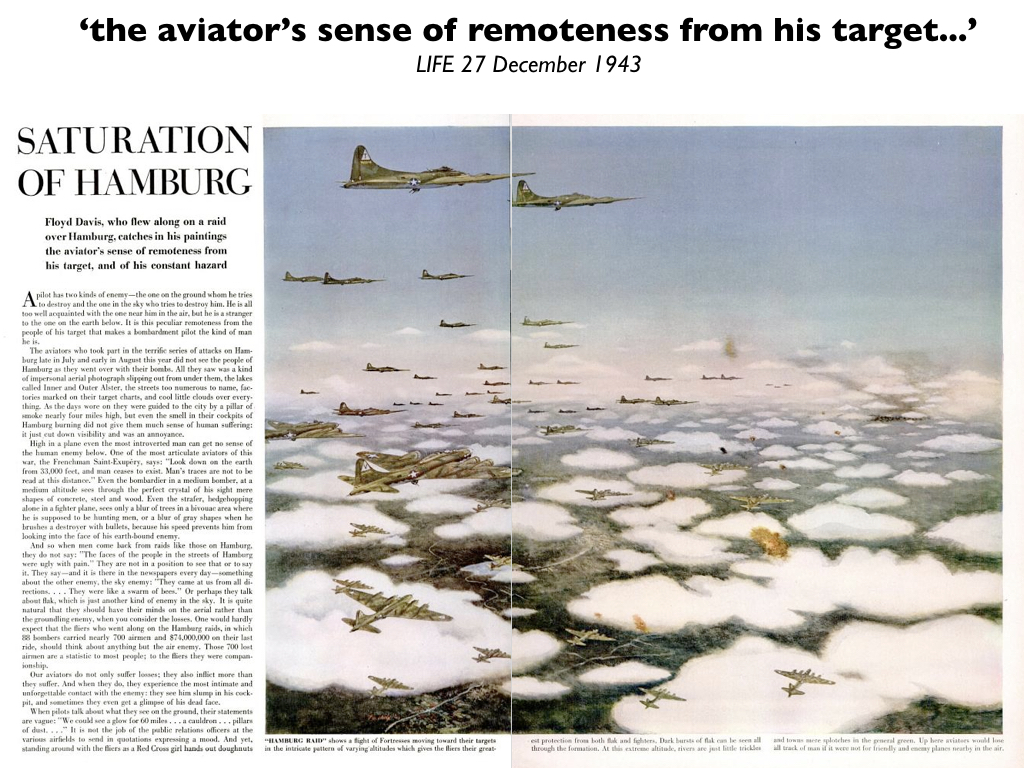
As so often happens, to me anyway, I was lured down all sorts of other paths while I was digging around.  One of them, which looped back to my wider work on aerial violence, led me to another essay by Hersey.  In several of my presentations on bombing I’ve used this image from Life magazine on 27 December 1943:

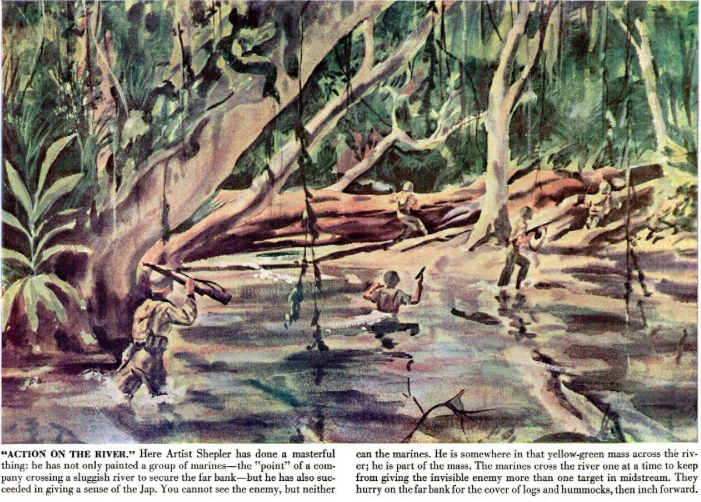
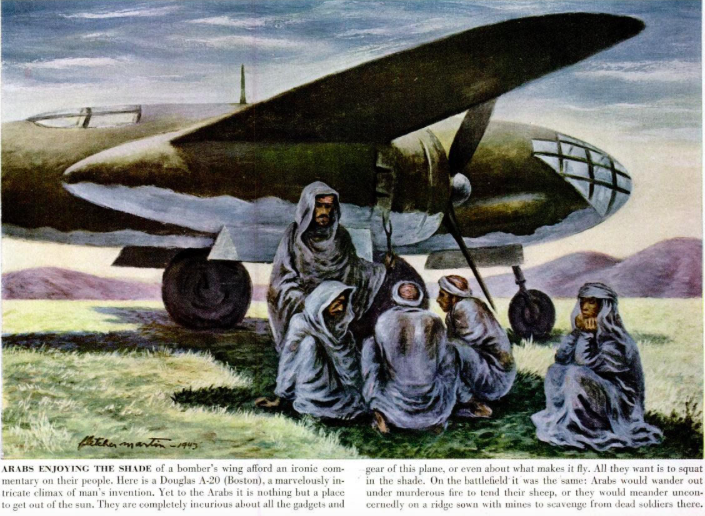
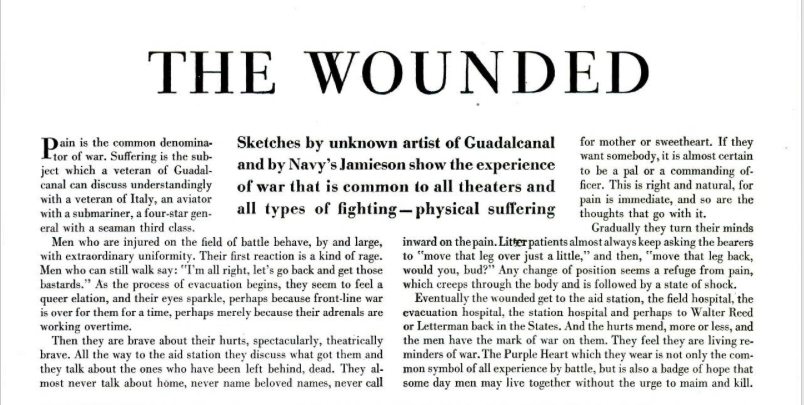
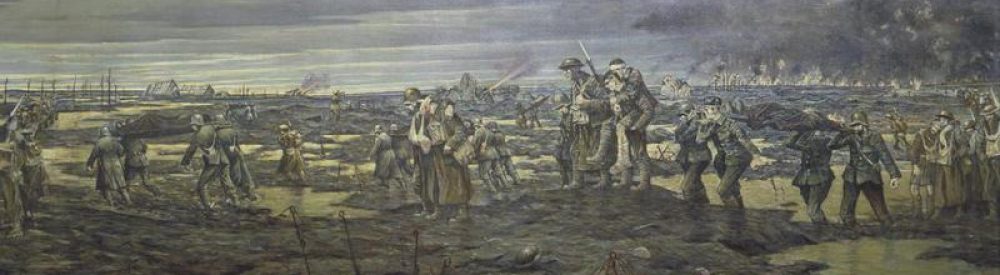
But what I had missed was the author of the essay wrapped around Floyd Davis‘s image: it was John Hersey.  Called ‘Experience by Battle’ it accompanied a 32-page portfolio of paintings by six American war artists of different theatres of war.  ‘Each battleground and each type of warfare has a distinctive effect on the men it involves,’ Hersey wrote.  ‘The pictures bring out the differences.  They are universal war, but they are also particular war.’

Hersey explained that he wasn’t interested in artistic technique – he probably wasn’t the person to write about that – but in a combination of memory and mood.  In his view, a painting was ‘a kind of memory – of an event, of a place, of an idea – and if it is good, it will give the person who sees it a pang quite like that of a vivid memory.’

In order the theatres and artists were:

Guadalcanal (Dwight Shepler):

Submarine warfare (Paul Sample):

Hill 609 in Tunisia (Fletcher Martin):

The saturation bombing of Hamburg (Floyd Davis; shown at the top of this post)

Rendova (Aaron Bohrod):

Sicily (Mitchell Jamieson):

Hersey was a master at conveying the experience of war – it was precisely that gift that he used to such extraordinary effect in ‘Hiroshima’, and at a time when so many American writers and artists had turned their eyes away from Japan to imagine instead ‘Hiroshima USA’….

He also had a remarkable ability to imagine military violence  from both sides.  In the text that accompanies Davis’s painting of the saturation bombing of Hamburg, Hersey had this to say:

‘It was not for our fliers to see in their minds’ eyes that Hamburg was as bad as the seventh circle of Dante’s hell, where flakes of fire fell on naked sinners.  They could not afford to spend too much time imagining the scene in the tunnel under the Elbe River, where thousands of people had taken shelter, at the moment when a bomb burst one end and the water rushed in.  As fliers with an important job to do they could not afford to have nightmares about people driven from shelters by heat into an ocean of flame outside; or about the city gradually dying – water no longer running, gas gone out of the mains, telephones silent, buses stopped, food distribution crippled – finally a city populated by people either dead or blank in the face.’

It’s a remarkable passage, conjuring up what Hersey acknowledges the aircrews could not see and dared not imagine.  He later explained that in ‘Hiroshima’ he wanted to ‘write about what happened not to buildings but to bodies’…

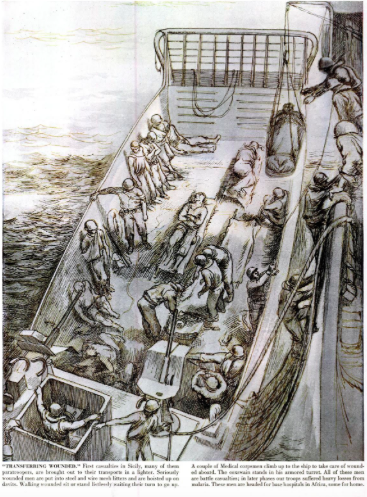
And the final panel of the Life portfolio returns me to my current work on wounded bodies:

In case you are wondering – you can access the full run of Life via Google Books: it is a truly excellent resource.

Drones and atomic bombs

I’ve had my head down these past few weeks writing the long-form version of ‘Little Boys and Blue Skies’ (see here and here for preliminary notes), and en route I’ve been doing some more digging into the entanglements between nuclear weapons and drones.  And, as you’ll see, I ended up in Korea.

Until now I’ve focused on the US Air Force‘s use of B-17 drones flown by remote control from ground stations and accompanying director aircraft to sample the atomic clouds produced by tests at Bikini Atoll in the Marshall Islands from 1946, and its Project Brass Ring in the early 1950s designed to convert a B-47 Stratojet into a similarly remotely operated carrier capable of delivering the next generation of thermonuclear (hydrogen) bombs.

But the US Navy was no bystander.

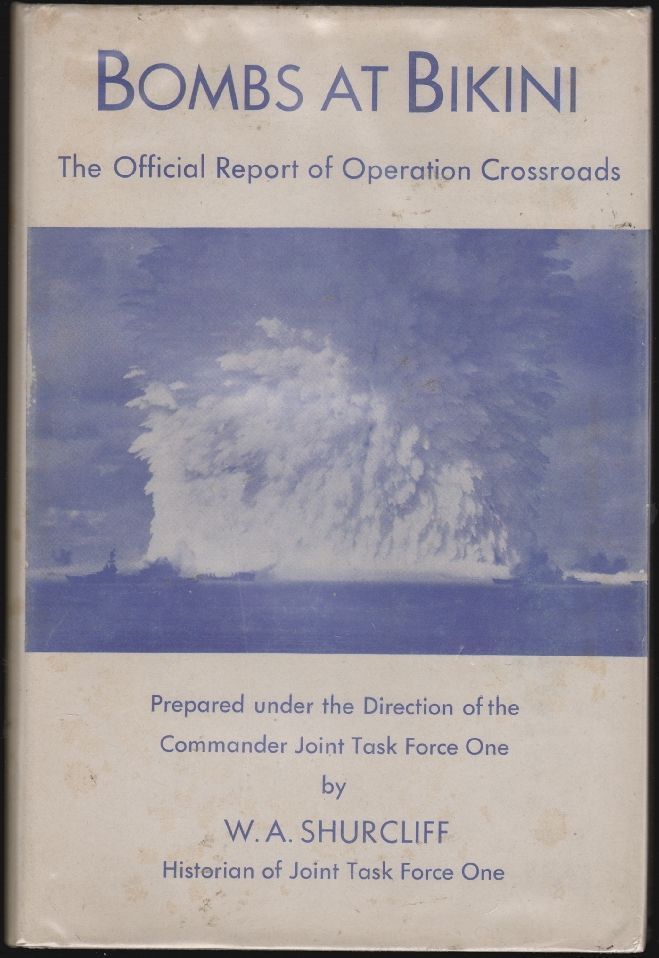
In fact, the first series of postwar atomic tests, Operation Crossroads in July 1946, was an attempt by the Navy to move centre stage after Hiroshima and Nagasaki – when the Air Force had played the leading role – and to establish that sea power was still relevant in the atomic age.  The target for the bombs was a fleet of 95 ships (ironically readied at Pearl Harbor) and now anchored in the Bikini lagoon. But critics inside and outside Congress doubted the value of the tests: the bombs would be of the same type as ‘Fat Man’, dropped over Nagasaki, so no development in weapons technology was involved, and in any event surface ships were unlikely to be the targets of such devastating weapons.   They dismissed Crossroads as an expensive, purely theatrical extravaganza. And certainly, despite the remote location, 4,000 miles from San Francisco, every effort was made to attract international attention, both public and professional; the official record trumpeted that ‘never before had a nation fanfared its most secret weapon so closely before the eyes of the world’ [the official ‘pictorial record’ is here].

As far as the Air Force was concerned, however, Crossroads would be ‘a laboratory test’ not a ‘bomb-versus-battleship stunt’ [Sidney Shalett, ‘Atomic bomb test no “stunt” to AAF’, New York Times, 21 February 1946].  It would involve not only bomb delivery by one of its bombers but also cloud monitoring by drones.   ‘Almost as dramatic as the flight of the B-29 bomber’, General W.E. Kepner told reporters, ‘will be the plunge of the unpiloted but mothered drone planes into the sky-reaching, irradiated cloud.’  ‘Where men cannot go,’ he added, ‘the drone will take electronic and other recording instruments.’  Vice-Admiral William Blaney told reporters that ‘robot aircraft will dive into the atomic blast to gather scientific data’ and ‘uncover facts of radioactive phenomena as well as supply data on blast effects on airborne aircraft.’

As I noted in my earlier post, both the Air Force and the Navy supplied the drones.
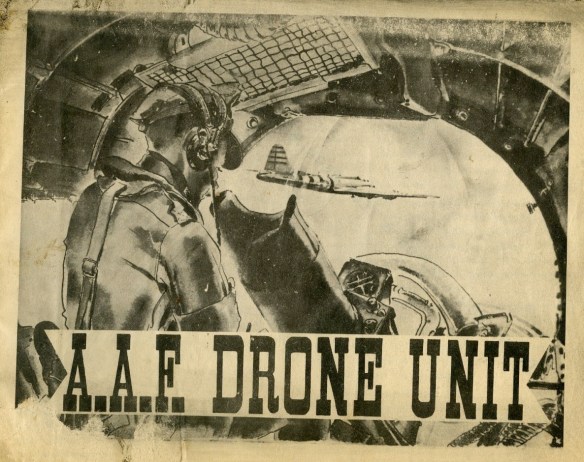
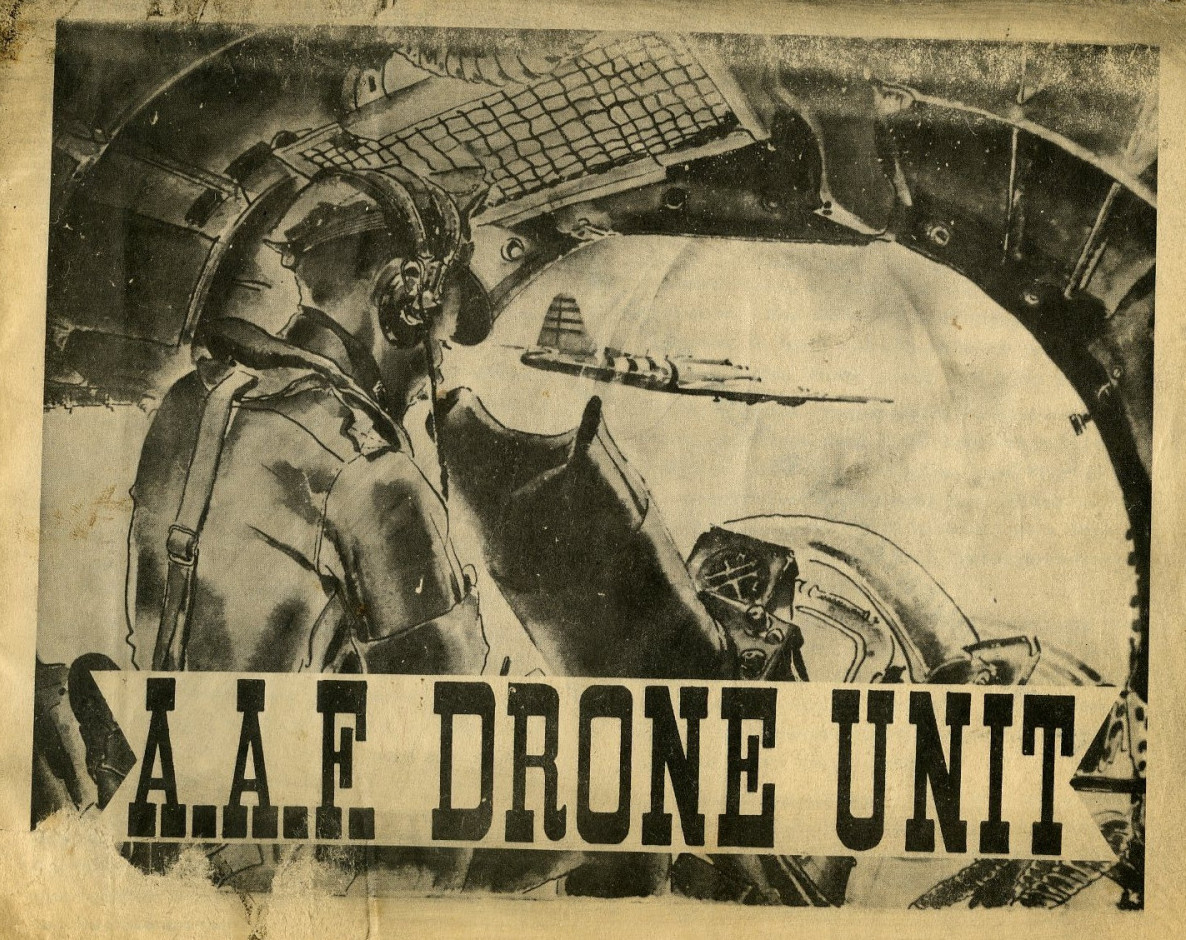
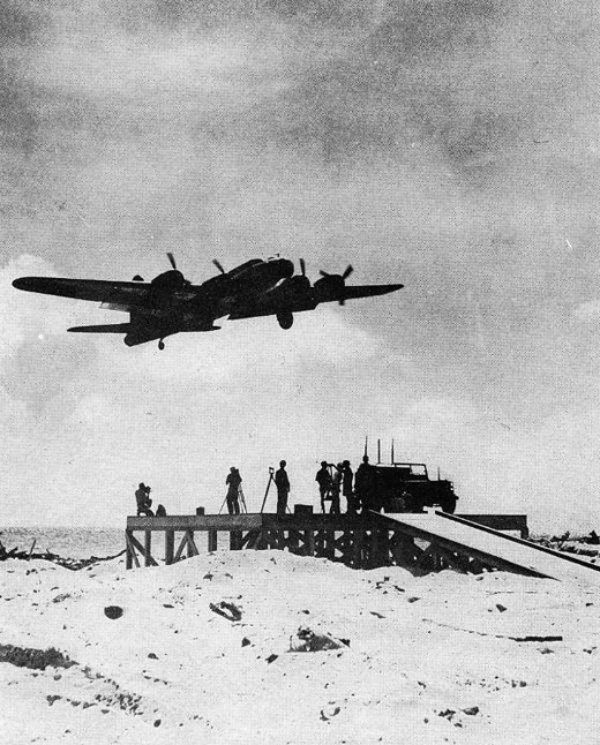
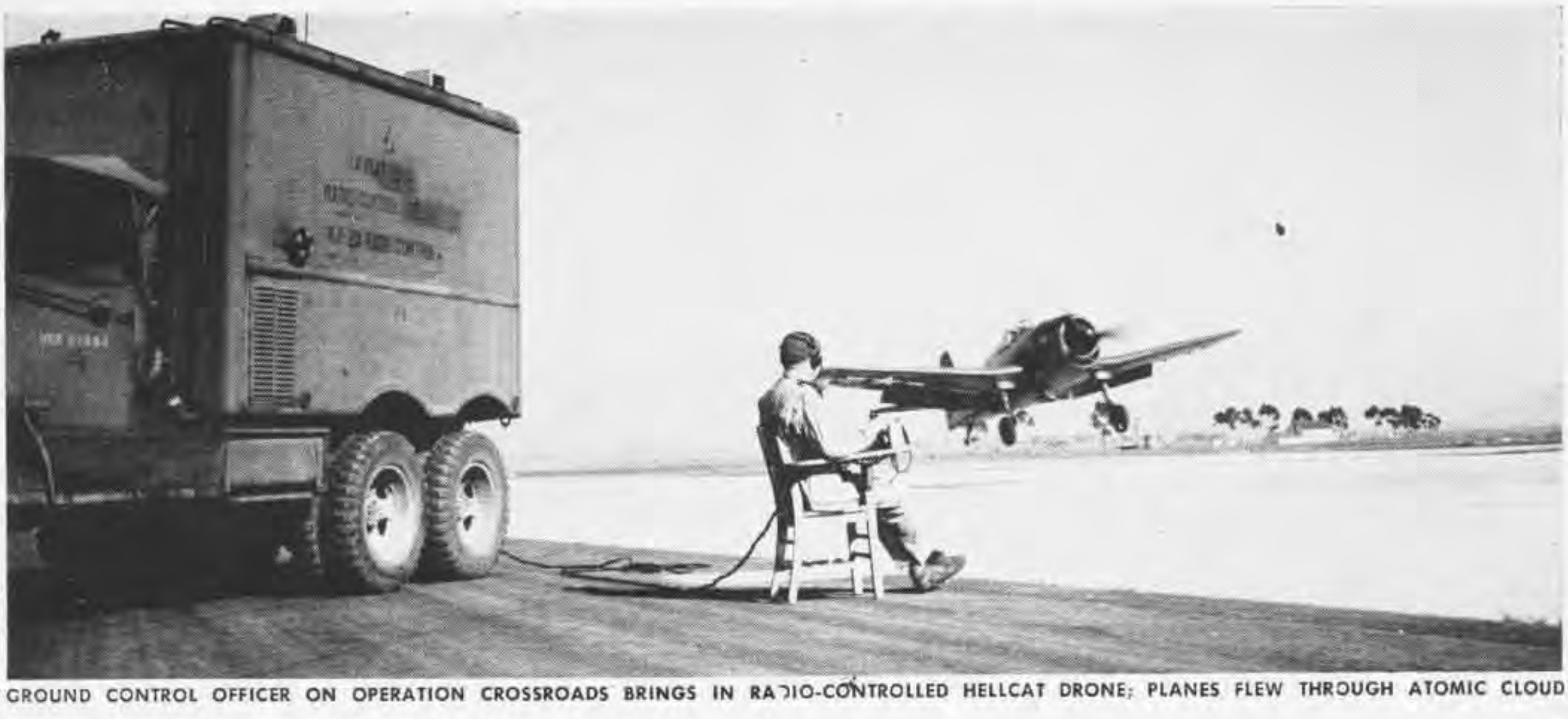
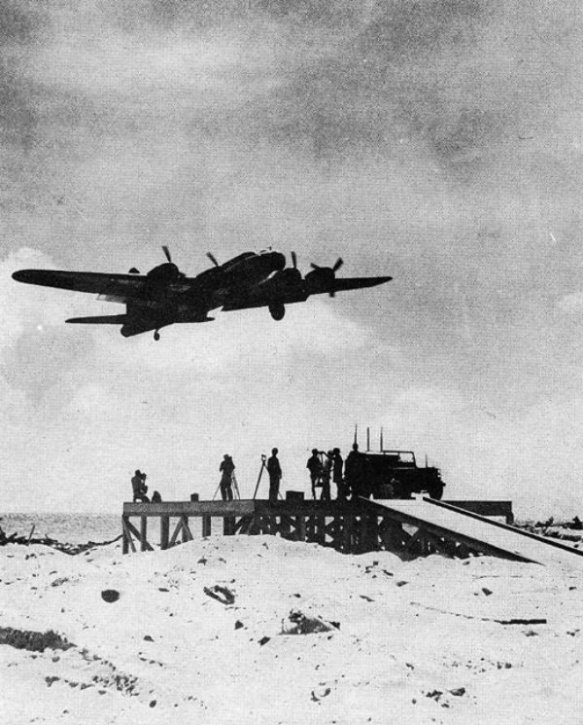
For its part, the Air Force retained its love affair with the heavy bombers that had driven its ill-fated Project Aphrodite in the dog days of the war, in which war-weary B-17 Flying Fortresses were filled with high explosives and flown from an accompanying director aircraft into enemy targets in Occupied Europe. This time its Drones Unit utilised new B-17s: four were converted into drones operated by radio-control from four others flying at a safe distance, while one acted as the master control aircraft.  The drones were stripped of all their defensive armaments and fitted with radio and television equipment; air filters were fixed to their top turrets to trap particles from the cloud and collection bags installed in their bomb bays.  Ground controllers launched the drones from control jeeps and then handed off to the airborne controllers (‘beeper pilots’) on board the accompanying B-17s who directed the aircraft into the cloud before returning them to the ground controllers who managed the landing.

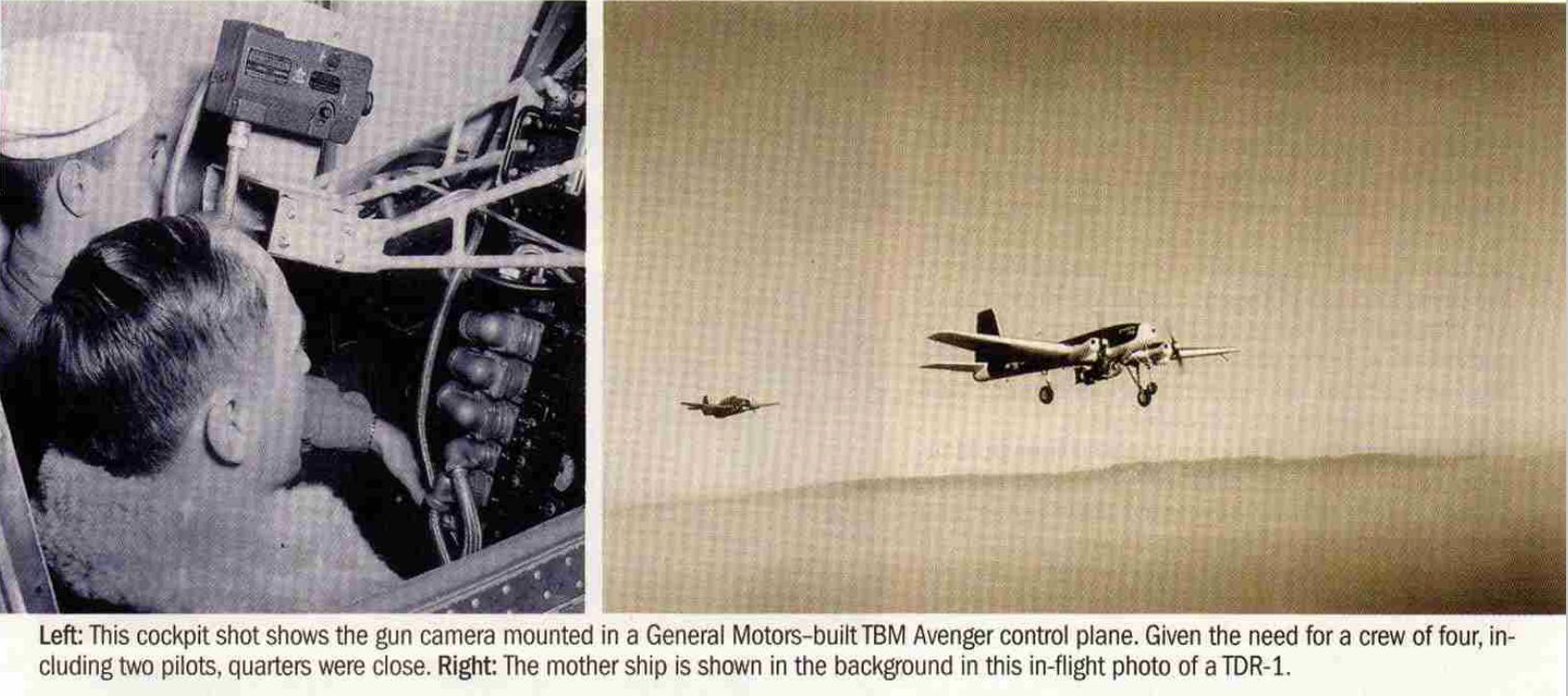
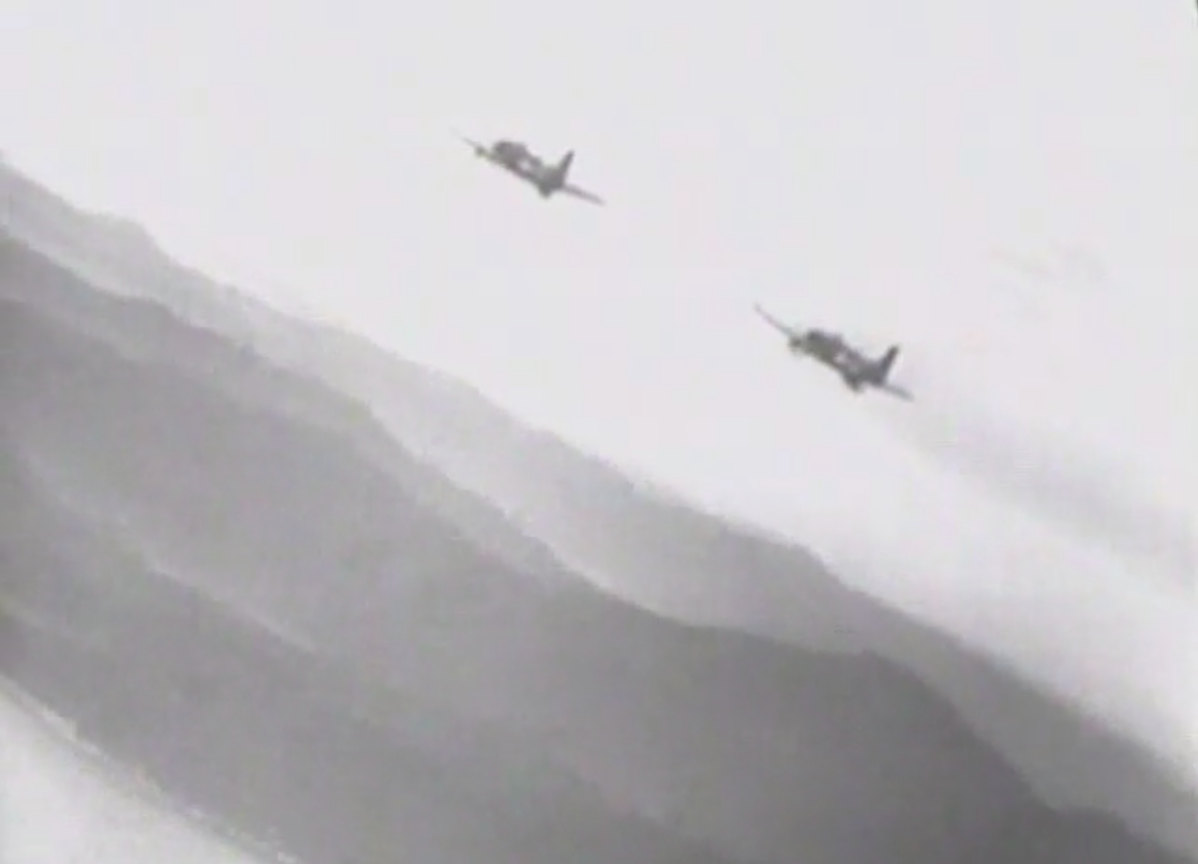
But the Navy had experimented with its smaller, carrier-based aircraft during the war too.  Its Project Option had used TDR-1 drones loaded with 500-2000 lb bombs with nose-mounted TV cameras controlled from the back seat of an Avenger Torpedo bomber.

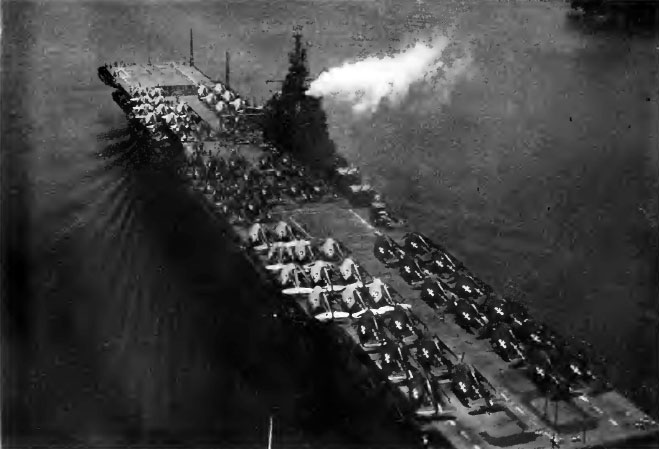
As it happens, one of the first missions of the Special Task Air Group (STAG-1) had been to deploy its drones in support of a US assault on the Marshall Islands, but the Marines landed long before the planned invasion date; the Group was then tasked with attacking targets of opportunity throughout the Solomon Islands.  In a single month, between 27 September and 26 October 1944, STAG-1 launched 46 drones, of which 29 successfully destroyed their targets.  This was a short-lived project in another sense.  As with Aphrodite, these were all in effect kamikaze missions in which the unoccupied aircraft plunged into its targets and exploded:  James Hall provides a pilot’s view in his American Kamikaze, and you can find an exquisite analysis of the project in the second chapter of Katherine Chandler‘s thesis, Drone flight and failure: the United States’ secret trials, experiments and operations in unmanning, 1936-1973.  For Crossroads, less than two years later, the Navy used carrier-based Grumman F6F-5 Hellcat fighter aircraft as drones and as control aircraft, mustering 30 drones and 26 control aircraft (below, the USS Shangri-La en route to Bikini with the drones on the flight deck).

The first shot in the series, codenamed Able, took place on 1 July 1946. At 0900 Dave’s Dream dropped the bomb over the target fleet, but the result was not the thrilling spectacle that had been advertised [below: Able shot from Enyu Island].  Visually it was a damp squib.  Judged by its own Broadway razzamatazz, one reporter jibed, it was a complete flop: ‘Operation Chloroform, the logical sequel to Operation Build-Up and Handout.’

Scientifically it was not much better.  Although Vice-Admiral Blaney initially declared that the bomb was dropped ‘with very good accuracy’, in fact it detonated off-target, exploding over one of the instrumentation vessels and compromising the readings from many others.  Even most of the high-speed cameras missed the shot. One critic concluded that ‘from the standpoint of pure science no test was ever more haphazard’ [more in Jonathan Weisgall, Operation Crossroads: the atomic tests at Bikini Atoll (1994) and Keith Parsons and Robert Zabella, Bombing the Marshall islands:a Cold War tragedy (2017)].

Against this catalogue of errors, which was glossed over in the official report, the aerial sampling missions were judged a considerable success.

(When the Partial Nuclear Test Ban Treaty put an end to atmospheric testing in 1963 you might think the need for aerial sampling disappeared with the cloud.  But the US still operates two sampling aircraft as the ‘Constant Phoenix’ program that acts as a supplement to the satellite sensor network of the US Atomic Energy Detection System: earlier this year Constant Phoenix flew sampling missions to assess North Korea’s claim to have detonated a hydrogen bomb).

Back to the future.  As soon as the bomb was released over Bikini the first B-17 control aircraft turned its huge drone (Fox) into the cloud at an altitude of 24,000 feet; Fox was then switched to its automatic pilot, entering the cloud eight minutes after the explosion, while the control (or “beeper”) aircraft raced around the cloud and resumed control when the drone emerged on the other side.  Fox was followed by George (at 30,000 feet), How (at 18,000 feet) and Love (at 12,000 feet).  All four drones were directed back to Eniwetok atoll where they were handed back to the ground controllers in jeeps at the end of the runway who taxied them to the radiological safe area where the filters and bags were removed and flown to Los Alamos Laboratory for analysis (below).
The Navy launched four of its drones from the Shangri-La, but only three of them – Yellow, White and Blue – sampled the cloud at 5,000, 10,000 and 15,000 feet before being directed back to Roi island for a ground landing and sample recovery (below).
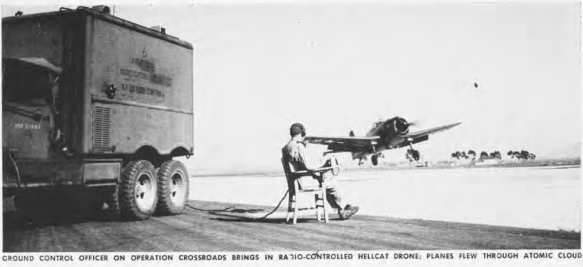
The official report emphasised that this was a notable first. ‘At Hiroshima and Nagasaki,’ it declared, ‘a few photographs and pressure measurements were made of the explosions, but almost nothing of value to physicists was learned.’ Crossroads had changed that; ‘for the first time samples had been taken from an atomic cloud’ during what one military engineer hailed as ‘the most hugely instrumented experiment in history’.
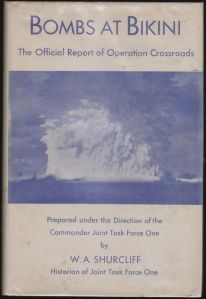
To the Air Force its drones had made crucial contributions not only to the aerial sampling programme but also to the development of remote operations more generally: ‘For the first time, four-motored drone aircraft had been flown without a safety pilot aboard.’  The author of the official report was equally impressed.  ‘With no one aboard,’ he marvelled, ‘these great planes were radio-guided through their prescribed flights across the target area, a unique and impressive feat.’  In a footnote he continued:

‘A number of Army Air Forces officials believe that the drone-plane program undertaken for Crossroads advanced the science of drone-plane operations by a year or more… Operation Crossroads was the first operation in which take-off, flight, and landing were accomplished with no one aboard.  The feat was an impressive one; many experts had thought it could never be accomplished with planes of this size.’

These were the experiments that captured the imagination of  Hanson Baldwin, a military affairs correspondent for the New York Times and Life magazine.  He had already predicted that ‘robot planes, rockets, television and radar bombing and atomic bombs will do the work today done by fleets of thousands of piloted bombers.’  Now he saw the future materialising in front of him.  ‘Today,’ he wrote in the New York Times for 25 August 1946, ‘planes without crews can be flown from almost anywhere, and can even survive… the atomic cloud.’  At Bikini the drones were controlled over a distance of eight miles or less, but Baldwin had been told that remote control up to fifty and perhaps even 100 miles was possible.  These were what today would be called line-of-sight operations, so their range was limited and Baldwin stressed that ‘an unmanned drone cannot be sent careening into a target in Europe by an operator standing at his “beep box” on La Guardia field in New York’.   But he was also adamant that a threshold had been crossed:

‘In the Pacific so much experience in the handling of drones was accumulated during the summer and the operations were so far in advance of drone operations during the war that it is safe to say that a simplified and reliable system of drone control – with all that implies – has been achieved…. Drones thus add a new and dangerous instrument to the growing armory of Mars, increase the power of the offensive and further complicate the tasks of the defensive’ [Hanson W. Baldwin, ‘The “Drone”: portent of a push-button war’, New York Times, 25 August 1946].

He was right, and the lines of descent from these post-war experiments to today’s remote operations by the US Air Force reveal continuing entanglements with nuclear weapons.

The official report of Crossroads makes no mention of the implications for remote operations of the smaller Navy drones.  Yet the Navy retained an interest in their development, and here too the connections with weapons of mass destruction are more than marginalia.
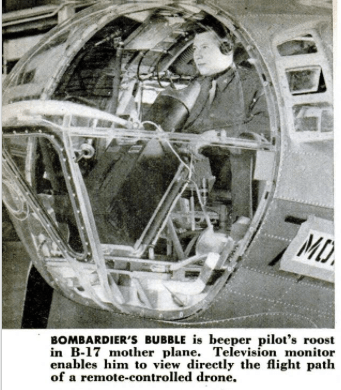
In April 1952 Herbert Johansen, an associate editor for Popular Mechanics, was invited to observe a flight of four F6F-5K Hellcats – though ‘they could just as well be our fastest jets’ – converted to drone operations at the Navy’s Pilotless Aircraft Laboratory and controlled from a single aircraft off the Atlantic coast.  Although the caption to a photograph noted that ‘Big Fellows’ – the Air Force’s Flying Fortresses – ‘can also be radio-controlled’ (see right), it was the smaller drones that got this reporter’s attention.

The Navy was ‘tight-lipped’ about its plans for the Hellcat drones, but Johansen had no difficulty imagining a future in which they would ‘carry atomic warheads and crash-dive as projectiles of destruction’ [‘No Live Operator Aboard’, Popular Mechanics 160 (4) (1952)].

Perhaps this was Johansen’s own, wild conjecture; perhaps not.  Bruce Cumings has shown that Washington had contemplated the use of nuclear weapons ‘from the first days of the Korean war’.  General MacArthur had requested atomic bombs to support ground operations as early as July 1950; in November President Truman, in response to a reporter’s question, insisted that their use was on the table, and Strategic Air Command was told that aircraft despatched to the Pacific theatre (based on Guam and Okinawa) should have ‘atomic capabilities’.  Cumings argues that ‘the US came closest to using nuclear weapons’ in April 1951, when the Pentagon prepared for immediate ‘atomic retaliation’ against any Chinese or Russian escalation; nine Mark IV bombs were transferred to the Air Force, and the President authorised their use against North Korean and Chinese targets.  But these were enormous bombs destined for the Air Force’s B-29s – each weighed 11,000 lbs and was far beyond the capacity of the Navy’s Hellcats (though not its AJ-1 bombers) – and they were never used.  Still, the Pentagon continued to consider the nuclear option, and in September and October 1951 flights of B-29s carried out simulated runs over the North, dropping dummy atomic bombs to assess their utility as battlefield weapons [see Bruce Cumings, ‘On the strategy and morality of American policy in Korea, 1950 to the present’, Social Science Japan Journal 1 (1) (1998) 57-70; see also here; Daniel Calingaert, ‘Nuclear weapons and the Korean War’, Journal of strategic studies 11 (2) (1988) 177-202; and here).

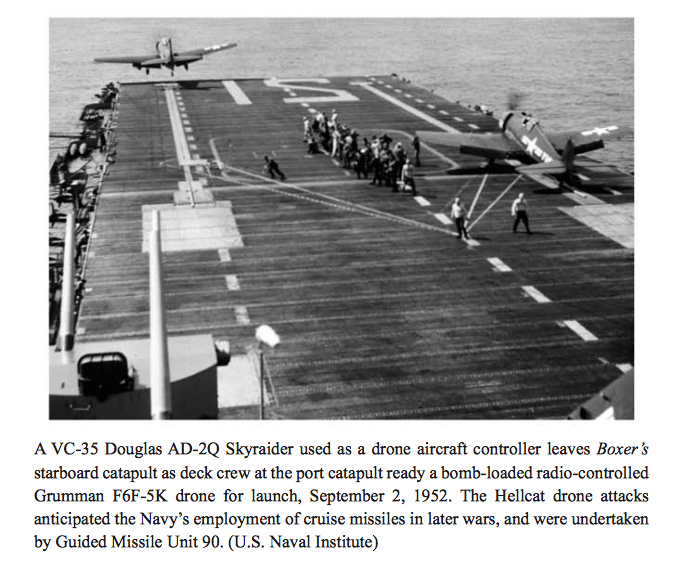
One year later the same bleak prospect as Johansen’s was conjured up by a naval officer much closer to the conflict, who was overseeing an experimental flight of Navy drones against targets in North Korea. Between 28 August and 2 September six Hellcat drones on the carrier USS Boxer were loaded with 2000 lb bombs and, with TV pods slung under their wings, yoked to director aircraft – AD-2Q Skyraiders this time – whose pilots used TV screens to guide what were now described as ‘robot missiles’ on to their targets.
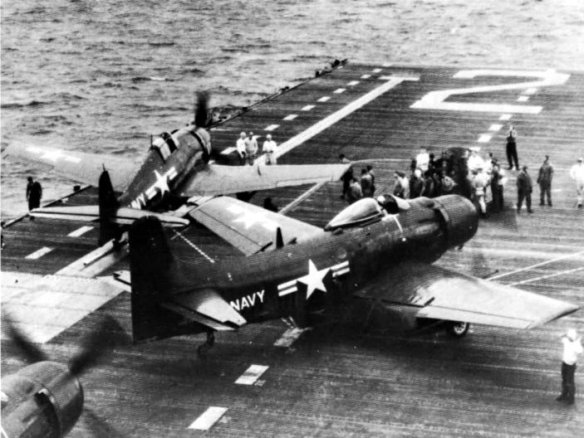
The test roared on to the front pages.  An American correspondent cabled a vivid description of what he called ‘one of the most dramatic and historical events of the Korean War’:

‘We watched a guided missile roar off a catapult, climb north-westward in a sweeping turn and head for a dangerous flak-ridden communist target in North Korea more than 150 miles away.
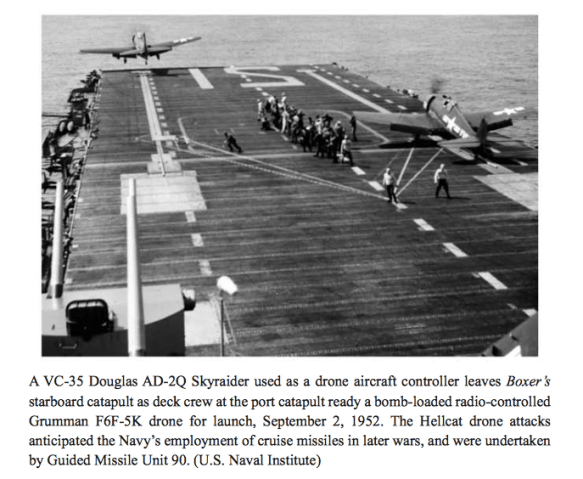
‘As the doomed craft streaked towards its target, grim-faced electronic experts, in a secret room on this ship, rode with the missile, mile by mile, through wondrous electronic instruments.  On their dials in the secret room, the experts crossed the Sea of Japan and watched the jagged peaks of Eastern Korea loom in the distance and grow larger.  Far from the missile, an automatic device transmitted every dying moment of the missile’s last hour to the USS Boxer.

‘The target – an enemy concentration in a valley between two shadowy hills – was indicated on the receiving instrument – a real flak-ridden trap for any hapless Allied pilot.

‘A second to go now – the signal of the instruments grew stronger as the guided missile dived straight at the target at hundreds of miles an hour.  Then the instruments went suddenly blank.  The screaming dive had ended squarely on the target and the missile had crashed to oblivion’ [His dispatch was dated 1 September but delayed and censored; it was published in several regional newspapers in the United States and in the Australian press almost three weeks later: ‘United States ready for push-button warfare’, Canberra Times, 19 September 1952].

With that blank screen, he continued, those on board the Boxer knew that ‘here at last in actual combat, was a new era of battle’, when ‘electronic brains will ride in tough, dangerous places, saving the lives of American pilots.’  Or, as one observing officer marvelled, ‘It’s a nice way to fight a war’ [More from Jeremy Hsu, ‘When US Navy suicide drones went to war’, here].

Although observers were ‘amazed at the drone’s sensitive response to remote control’ and the TV screen supposedly ‘enabled the controlling officer to keep the drone “on the target” until the last second, giving the missile unbelievable accuracy’, only one of the six hit its target [‘Navy uses robot missiles against targets in Korea’, New York Times, 18 September 1952].  The others recorded near-misses, but this was enough for Lt-Cdr Lawrence Kurtz, the (less than tight-lipped) commander of Guided Missile Unit 90 responsible for the trial, to boast that the United States had enough of them to ‘launch and sustain a large-scale robot campaign’.  And he then added this ominous rider: some of the ‘missile planes’ were ‘capable of carrying an atomic bomb from one continent to another’ [ ‘United States ready for push-button warfare’; ‘Guided missiles in Korean War: Deadly new US technique’, Sydney Morning Herald, 19 September 1952].

Agency reports of his comments were played down in the United States, where they evidently incurred the wrath of his superiors. Rear Admiral John Sides described the use of the Hellcat drones as an ‘interim measure’ before the development of ‘more effective guided missiles’, conceding that ‘it wouldn’t take much imagination to realize that there are better ways of doing this job.’  But he would give no further details: the Navy was ‘investigating the use of classified information in news dispatches on the employment of pilotless bombers in Korea’, but refused to elaborate [‘Korea robot raids “interim measure”’, New York Times, 19 September 1952].  Instead, Sides switched the focus from the aircraft to American lives.  The  object of the experimental programme observed by the Popular Mechanics correspondent earlier in the year was ‘to obtain air kills by individuals operating from beyond the range of the enemy’s armament’, he emphasised, and in Korea ‘a controller sitting in relative safety’ outside the range of anti-aircraft defences ‘had been able to direct an effective drop on the enemy positions.’ The previous Times report had already underlined the significance: ‘The planes were sacrificed but, of course, not a man was lost.’

On 22 September NBC broadcast a short Department of Defense film describing what it called the dawn of ‘a new era in warfare’ in Korea but which made no mention of nuclear weapons.  Instead the commentary emphasised that the pilot of the ‘robot bomber’ was ‘safely out of range’ and that these ‘guided missiles’ might ‘someday eliminate the human element’ altogether :

‘The carrier USS Boxer launches guided missiles for the first time in combat, bringing the push-button war of tomorrow into present day reality. Defense Department films show the first mission of the robot bombers, weapons that may someday eliminate the human element from air war.

The robot missile is catapulted aloft. It is a semi-obsolete Hell Cat, carrying a one-ton bomb load and a television camera instead of a pilot.
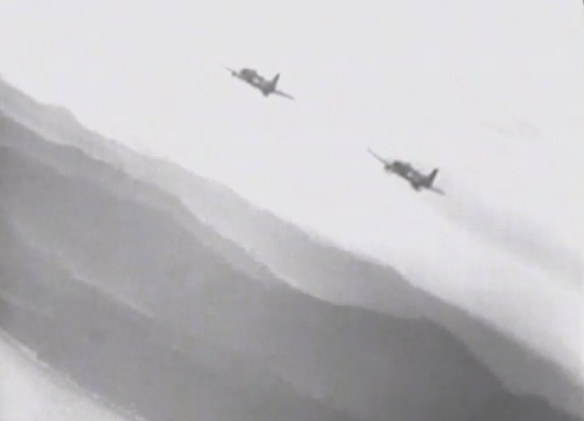
Already in the air is the mother plane, with an observer who flies the drone by remote control. Side by side, missile and mother plane head for the target. Then the pilot, safely out of range of interception and anti-aircraft fire, guides the robot directly into the target with unerring accuracy.’

And this was, of course, the larger and sharper point.  The reason drones were originally used to fly through the atomic cloud (though they were later replaced by crewed missions); the reason the Air Force needed a remotely operated aircraft to drop the next generation of nuclear weapons; the reason the Navy wanted ‘offensive drones’ and ‘robot missiles’ to attack heavily defended targets was to save the lives of American crews.  It is the same mission that continues today in the US prosecution of what are its avowedly asymmetric wars: to ‘project power without vulnerability’.
Periscope

Articles that have recently caught my eye through their intersections with various projects I’m working on (so forgive what may otherwise seem an idiosyncratic selection!):

Bogdan Costea and Kostas Amiridis, ‘Ernst Jünger, total mobilization and the work of war’, Organization 24 (4) (2017) 475-490 – I keep encountering Jünger’s work, first when I was writing ‘The natures of war‘ (he served on the Western Front in the First World War: see his remarkable Storm of Steel, still available as a Penguin Classic in a greatly improved translation) and much more recently while preparing a new lecture on occupied Paris in the Second World War (he was stationed there for four years and confided a series of revealing and often critical observations to his diaries).  But his reflections on the ‘destruction line’ of modern war are no less interesting.  For parallel reflections, see:

Leo McCann, ‘Killing is our business and business is good”: The evolution of war managerialism from body counts to counterinsurgency’, Organization 24 (4) (2017) 491-515 – I’ve written about what Freeman Dyson called ‘the bureaucratization of homicide‘ before, in relation to aerial violence, but this essay provides a wider angle.

Laura Pitkanen, Matt Farish, ‘Nuclear landscapes’, Progress in human geography [Online First: 31 August 2017] (‘Places such as New Mexico’s Trinity Site have become iconic, at least in the United States, and a study of nuclear landscapes must consider the cultural force of spectacular weapons tests and related origin stories. But critical scholars have also looked beyond and below the distractions of mushroom clouds, to additional and alternative landscapes that are obscured by secrecy and relative banality’).

I’m still haunted by the reading I did for ‘Little Boys and Blue Skies‘, much of it inspired by Matt’s work (see especially here on ‘Atomic soldiers and the nuclear battlefield’); this essay should be read in conjunction with:

Becky Alexis-Martin and Thom Davis, ‘Towards nuclear geography: zones, bodies and communities’, Geography Compass [Online early: 5 September 2017] (‘We explore the diverse modes of interaction that occur between bodies and nuclear technology and point towards the scope for further research on nuclear geographies. We bring together different strands of this nascent discipline and, by doing so, highlight how nuclear technology interacts across a spectrum of geographic scales, communities, and bodies. Although nuclear geographies can be sensational and exceptionalising, such as the experiences of nuclear accident survivors and the creation of “exclusion zones,” they can also be mundane, everyday and largely unrecognised, such as the production of nuclear energy and the life-giving nature of radioactive medicine.’)

Simon Philpott, ‘Performing Mass Murder: constructing the perpetrator in documentary film’, International Political Sociology 11 (3) (2017) 257–272 – an insightful critique of Joshua Oppenheimer‘s The Act of Killing (see my posts here and here).

José Ciro Martinez and Brett Eng, ‘Struggling to perform the state: the politics of bread in the Syrian civil war’, International Political Sociology 11 (20 (2017) 130-147 – a wonderfully suggestive analysis that has the liveliest of implications for my own work on attacks on hospitals and health-care workers in Syria (notably: ‘The provision of bread to regime-controlled areas has gone hand in hand with targeted efforts to deprive rebel groups of the essential foodstuff and, by extension, their ability to perform the state. Since 2012, the regime has bombed nascent opposition-administered attempts to provide vital public services and subsistence goods, thereby presenting itself as the only viable source of such necessities.’)  But it also has far wider implications for debates about ‘performing the state’ and much else.  And in a similar vein:

Jeannie Sowers, Erika Weinthal and Neda Zawahiri, ‘Targeting environmental infrastructures, international law and civilians in the new Middle Eastern wars’, Security Dialogue 2017 [Online early] (”We focus on better understanding the conflict destruction of water, sanitation, waste, and energy infrastructures, which we term environmental infrastructures, by drawing on an author-compiled database of the post-2011 wars in the Middle East and North Africa… Comparatively analyzing the conflict zones of Libya, Syria, and Yemen, we show that targeting environmental infrastructure is an increasingly prevalent form of war-making in the MENA, with long-term implications for rebuilding states, sustaining livelihoods, and resolving conflicts.’)

Will Todman, ‘Isolating Dissent, Punishing the Masses: Siege Warfare as Counter-Insurgency,’ Syria Studies 9 (1) (2017) 1-32 – Syria Studies is an open-acess journal from the Centre for Syrian Studies at St Andrews.

Sarah El-Kazaz and Kevin Mazur, ‘The unexceptional Middle Eastern City’, City & Society 29 (1) (2017) 148-161 – a really useful introduction to a themed section, much on my mind as this term I’ll be doing my best to jolt my students out of lazy caricatures of ‘the Islamic city’ (‘The study of Middle Eastern cities has been constrained in its analytical and methodological focus by a genealogy shaped by a triad of regional exceptions–Islam, oil, and authoritarianism–and … this special section move[s] beyond those constraints in important ways. Focusing on geographical places and time periods that have remained peripheral to the study of Middle Eastern cities, the three articles ethnographically historicize the planned and unplanned processes through which cities in the region transform to transcend a genealogy of exceptionalism and the constraints it has created. They highlight the global and local connections that shape these processes to offer new perspectives on the study of scale, verticality and sensoriums in the shaping of urban transformation around the globe.’)

Rasul Baksh Rais, ‘Geopolitics on the Pakistan-Afghanistan borderland’, Geopolitics [online early: 11 August 2017] – a helpful historical review particularly for anyone interested in the exceptional construction of the Federally Administered Tribal Areas by both Washington and Islamabad.

Katharine Hall Kindervater, ‘Drone strikes, ephemeral sovereignty and changing conceptions of territory’, Territory, politics, governance (2017) 207-21 – Kate engages with her characteristic breadth of vision with some of the problems that preoccupied me in ‘Dirty dancing’ and urges a topological engagement with territory (DOWNLOADS tab) (‘This article examines the US legal frameworks for drone-targeting operations, and in particular the conceptions of territory they draw upon, to argue that contemporary strikes reflect less a disappearance of the importance of territory and sovereignty to justifications of the use of force than a reconfiguration of their meanings. Grounded in an understanding of territory that is more networked and dynamic, drone strikes reflect the emergence of a new landscape of mobile and ephemeral sovereignty.’)

Georgina Ramsay, ‘Incommensurable futures and displaced lives: sovereignty as control over time’, Public culture 29 (3) (2017) 515-38 (‘The recent mass displacement of refugees has been described internationally as a “crisis.” But crisis implies eventfulness: a distinct problem that can be solved. The urgency of solving this problem of displacement has seen the use of expansive techniques of sovereignty across Europe, the epicenter of the crisis. Focusing exclusively on the formation of sovereignty through the analytical locus of crisis continues, however, to reproduce the trope of the “refugee” as a category of exception. This essay considers the experiences of people who were resettled as refugees in Australia and whose displacement has ostensibly been resolved. Drawing attention to their continuing experiences of violence, it considers how the temporal framing of displacement is itself a way to conceal formations of sovereignty embedded in the very processes designed to resolve displacement. Doing so opens up new ways to think about control over time as a technique of sovereignty.’)

For an equally trenchant and invigorating critique of crisis-talk, see Joseph Masco‘s brilliant ‘The Crisis in Crisis’, Current Anthropology 58 Supplement 17 (2017) S65-S76, available on open access here. (‘In this essay I consider the current logics of crisis in American media cultures and politics. I argue that “crisis” has become a counterrevolutionary idiom in the twenty-first century, a means of stabilizing an existing condition rather than minimizing forms of violence across militarism, economy, and the environment. Assessing nuclear danger and climate danger, I critique and theorize the current standing of existential crisis as a mode of political mobilization and posit the contemporary terms for generating non-utopian but positive futurities.’)

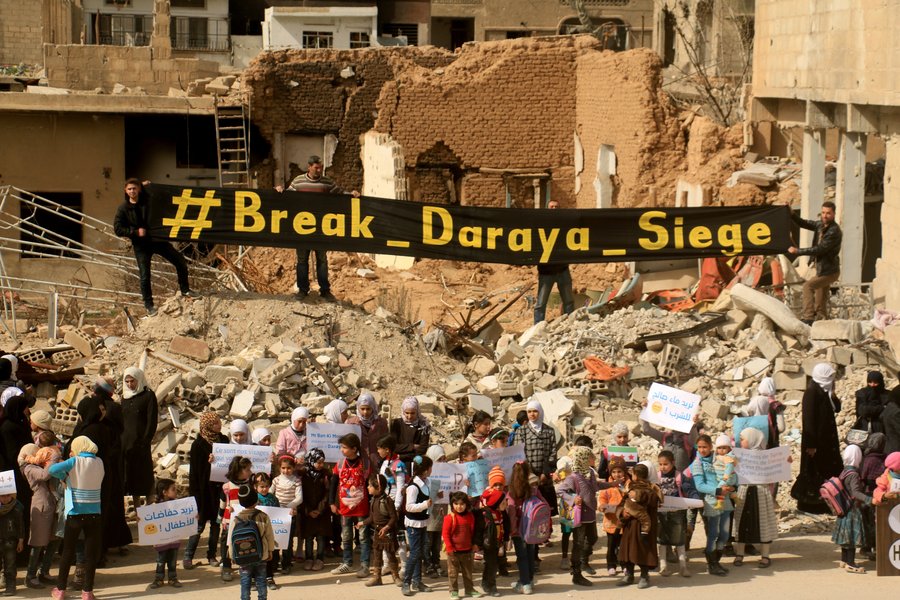
Dima Saber and Paul Long, ‘”I will not leave, my freedom is more precious than my blood”: From affect to precarity – crowd-sourced citizen archives as memories of the Syrian war’, Archives and Records 38 (1) (2017) (‘Based on the authors’ mapping of citizen-generated footage from Daraa, the city where the Syria uprising started in March 2011, this article looks at the relation between crowd-sourced archives and processes of history making in times of war. It describes the ‘migrant journey’ of the Daraa archive, from its origins as an eyewitness documentation of the early days of the uprising, to its current status as a digital archive of the Syrian war. It also assesses the effects of digital technologies for rethinking the ways in which our societies bear witness and remember. By so doing, this article attempts to address the pitfalls attending the representation and narrativisation of an ongoing conflict, especially in the light of rising concerns on the precariousness and disappearance of the digital archives. Finally, by engaging with scholarship from archival studies, this article attempts to address the intellectual rift between humanities and archival studies scholars, and is conceived as a call for more collaboration between the two disciplines for a more constructive research on archival representations of conflict.’)

Aerial violence and the death of the battlefield

UBC’s term started last week, but I was in Nijmegen so I’ve started this week.  I’ve posted the revised outlines and bibliographies for my two courses this term under the TEACHING tab.

I was primarily in Nijmegen to give a ‘Radboud Reflects’/Humboldt Lecture.  As usual, I had a wonderful time; I’ve pasted the abstract below – though this was written before I had put the presentation together, so it doesn’t incorporate the closing section at all (“Geographies of the Remote”).  It draws, in part, on my Tanner Lectures, “Reach from the sky“, but it also incorporates new material [see, for example, my reflections on the Blackout here].

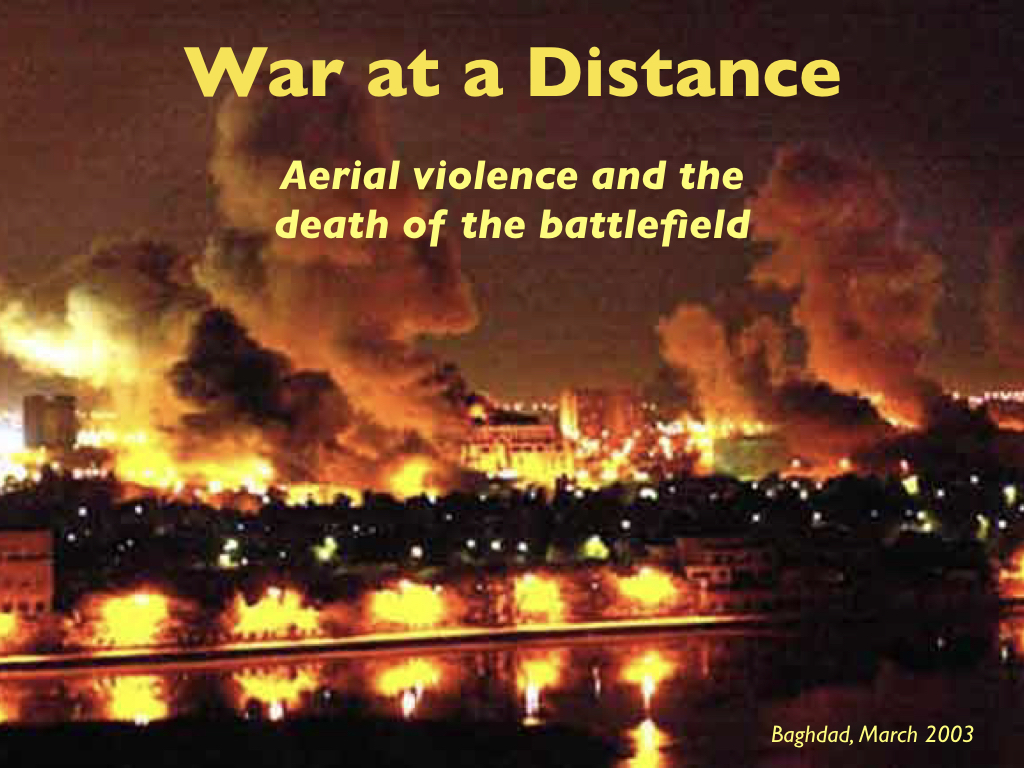
You can download the slides as a pdf here: GREGORY War at a distance Aerial violence and the death of the battlefield [this version includes several slides that I subsequently cut to bring the thing within bounds], and the video version will be available online shortly.

War at a distance: aerial violence and the death of the battlefield

Christopher Nolan’s film “Dunkirk” is remarkable for many reasons, but prominent among them is the fact that, as the director himself notes, ‘we don’t see the Germans in the film… it’s approached from the mechanics of survival rather than the politics of the event.’ This raises a series of important questions, but central to any understanding of aerial violence is precisely what can be seen and what cannot be seen: what can those crouching under the bombs see of the perpetrators, and what can those carrying out the strikes see of their targets? You might think this becomes even more important when war is conducted at a distance, but the history of military violence shows that ‘distance’ is a complicated thing…

The first large-scale use of aircraft for offensive purposes (rather than surveillance) was on the Western Front during the First World War, when aircraft were used to ‘spot’ targets for artillery and eventually to conduct bombing operations on the battlefield. But more consequential was the use of aircraft and airships to conduct bombing raids far beyond the battlefield, on cities like London and Paris, because this brought civilians directly into the line of fire and in doing so started to dissolve the idea of the battlefield [what Frédéric Mégret calls ‘the deconstruction of the battlefield‘] and to assault the very concept of a civilian. The bombing offensives of the Second World War, especially in Europe and Japan, accelerated this dismal process, but they also reveal a deadly dialectic between intimacy and domesticity (the effects on everyday life on the ‘home’ front) and abstraction (the way in which targets were produced and made visible to bomber crews).e

That same dialectic reappears in today’s drone operations over Afghanistan, Iraq, Syria, Somalia, Yemen and elsewhere. But these new technologies of ‘war at a distance’ have their own history that overlaps and intersects with the story of manned flight. Indeed, the dream of ‘unmanned’ flight soared in lockstep with the dream of those extraordinary flying machines. This too goes back to the First World War, when inventors proposed ingenious aerial vehicles whose ‘bomb-dropping’ would be controlled by radio. These proved impractical until after the Second World War, when drones were used by the US to photograph and collect samples from atomic clouds in the Marshall Islands and Nevada [see here and here]. The over-arching principle was to protect American lives by keeping operators at a safe distance from their targets, and this is one of the logics animating contemporary drone strikes (‘projecting power without vulnerability’). But for this to work new technologies of target recognition as well as mission control were required; these were first developed during the Vietnam War, when the US Air Force tried to ‘wire’ the Ho Chi Minh Trail and connect its sensor systems to computers that would direct aircraft onto their targets (or, rather, target boxes).

The Pentagon looked forward to the installation of an ‘automated battlefield’ on a global scale [see my ‘Lines of Descent’, DOWNLOADS tab]. Although its plans were premature, the subsequent development of targeted killing using Predators and Reapers has since completed the dissolution of a distinctive battlefield: the United States Air Force boasts that it can put ‘warheads on foreheads’ and the US has claimed the right to pursue its targets wherever they go, so that (in Grégoire Chamayou’s words) ‘the body becomes the battlefield.’ These targeted bodies are at once abstract – reduced to digital traces, the products of a global system of intelligence, surveillance and reconnaissance – and yet at the same time, by virtue of the high-resolution full-motion video feeds used to track them, peculiarly intimate to those that kill them. Drone pilots operate their aircraft from thousands of miles away, yet they are much ‘closer’ to their targets than pilots of conventional strike aircraft: previously, the only aerial vehicles to approach this level of intimacy, and then but fleetingly, were the Zeppelins of the First World War. But this intimacy is conditional and even illusory, and case studies [see here, here and here] show that as the battlefield transforms into the multi-dimensional battlespace the very idea of the civilian [see here and here] is put at increased risk.

All of this will appear, in extended and elaborated form, in my new book, also called “Reach from the sky”.

Attachments to War

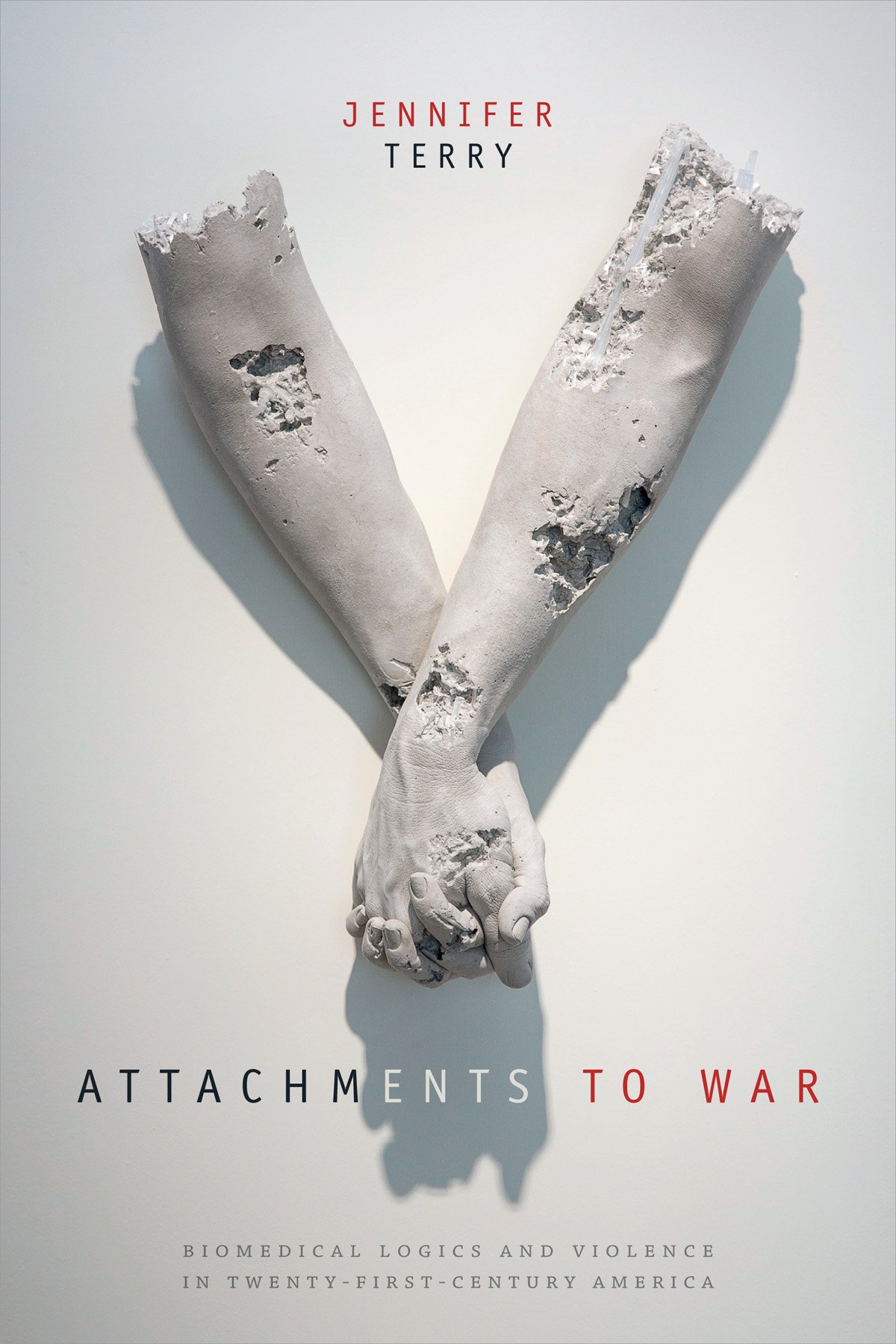
And in lockstep with my last post and my continuing interest in the prosthetics of military violence…   A new book from Jennifer Terry, Attachments to War: biomedical logics and violence in twenty-first century America, also due from Duke University Press in November:

In Attachments to War Jennifer Terry traces how biomedical logics entangle Americans in a perpetual state of war. Focusing on the Afghanistan and Iraq wars between 2002 and 2014, Terry identifies the presence of a biomedicine-war nexus in which new forms of wounding provoke the continual development of complex treatment, rehabilitation, and prosthetic technologies. At the same time, the U.S. military rationalizes violence and military occupation as necessary conditions for advancing medical knowledge and saving lives. Terry examines the treatment of war-generated polytrauma, postinjury bionic prosthetics design, and the development of defenses against infectious pathogens, showing how the interdependence between war and biomedicine is interwoven with neoliberal ideals of freedom, democracy, and prosperity. She also outlines the ways in which military-sponsored biomedicine relies on racialized logics that devalue the lives of Afghan and Iraqi citizens and U.S. veterans of color. Uncovering the mechanisms that attach all Americans to war and highlighting their embeddedness and institutionalization in everyday life via the government, media, biotechnology, finance, and higher education, Terry helps lay the foundation for a more meaningful opposition to war.

Contents:

Introduction
1. The Biomedicine-War Nexus
2. Promises of Polytrauma: On Regenerative Medicine
3. We Can Enhance You: On Bionic Prosthetics
4. Pathogenic Threats: On Pharmaceutical War Profiteering
Epilogue

And here is the (equally brilliant) Laleh Khalili:

This brilliant book is a thoughtful and profoundly original study of how war becomes an object of attachment and support in the United States. Jennifer Terry’s discussion of wounding, injury, trauma, and prosthetics is one of the most fascinating, moving, and intensely generative studies I have read about how war is normalized, made everyday, and embedded in practices and beliefs and affect(ion)s of ordinary folks.

You can read the Introduction over at Catalyst: feminism, theory, technoscience here, and watch presentations on ‘Militarization, medicalization, responsibility’ (from 2015) by Jennifer and Nadia Abu el-Haj on You Tube here.

The Bomb

I first encountered Eric Schlosser’s brilliant Command and Control while I was working on the multiple intersections between drones and atomic bombs – ‘Little Boys and Blue Skies‘; the long form version will be finished soon – and Netflix has now added The Bomb to its listings; it’s also available on iTunes.

The Bomb is an experimental documentary Eric made with Kevin Ford and Smriti Keshari.  Here’s the trailer from YouTube:

This is how Claire Spellberg describes the project:

The 56 minutes prior are made up entirely of carefully collected footage of Cold War information, bomb testings, nuclear explosions, and modern news clips from around the world. There’s no narration to explain what we’re seeing; instead, the filmmakers rely on loud electro-rock music from The Acid. The combined effect is jarring; the beat pulsates steadily as one bomb explodes after another, destroying homes, people, and ecosystems.

Ford, Keshari, and Schlosser first premiered The Bomb at the 2016 Tribeca Film Festival as a complete multimedia experience. The filmmakers set up multiple 30-foot-high screens and The Acid accompanied the film with live music, creating what was sure to be an incredibly jarring effect. If you weren’t previously concerned about the very real threat posed by nuclear weapons, being surrounded by screens showing a nuclear bomb decimate a rural town as deafening music plays probably changed your mind.

Even without all the bells and whistles, the version of The Bomb on Netflix is sure to resonate with viewers.

Especially now.

There has been an explosion (sic) of commentary on Trump’s light-sabre rattling over North Korea – the more sober-sided are downplaying the possibility of a nuclear strike, though the death and destruction wrought by a conventional strike would surely be catastrophic – but a detailed analysis that speaks directly to the issues raised by ‘Command and Control’ is Garrett Graff on ‘The Madman and the Bomb‘ over at Politico.

The crock at the end of the rainbow

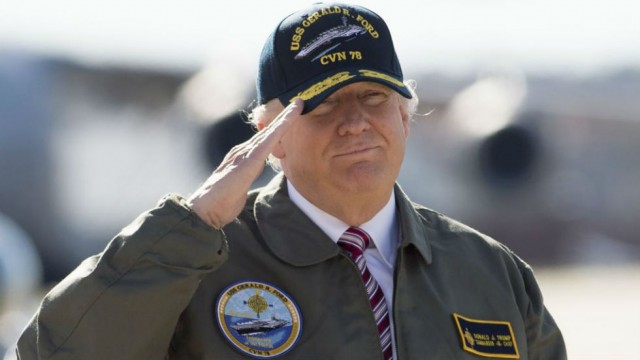
In these bleak times, this should bring an appropriately savage smile to your face: River Clegg at the New Yorker imagines Trump as a soldier…. here.

I’m glad I’m not serving with any trans people, otherwise I would forget how to do soldier stuff. Like fighting! Fighting is the main thing I do as a soldier, O.K.? I carry a machine gun for fighting, and it’s the best machine gun. But I would forget how to shoot it if I were near a trans person.

But I’m very pro-trans, believe me. Maybe the most pro-trans person in history. Not only that, I’m pro all the other letters in “L.G.B.T.Q.” I’m pro-lesbian, I’m pro-gluten, I’m probiotic. I’m pro everything except trans people being treated like regular, non-trans people. That’s where I draw the line.

If you want more commentary on Trump’s odious proposed ban, and the viper’s nest of prejudice that surrounded it, try here and here and here.

Posted in USA

The Long War

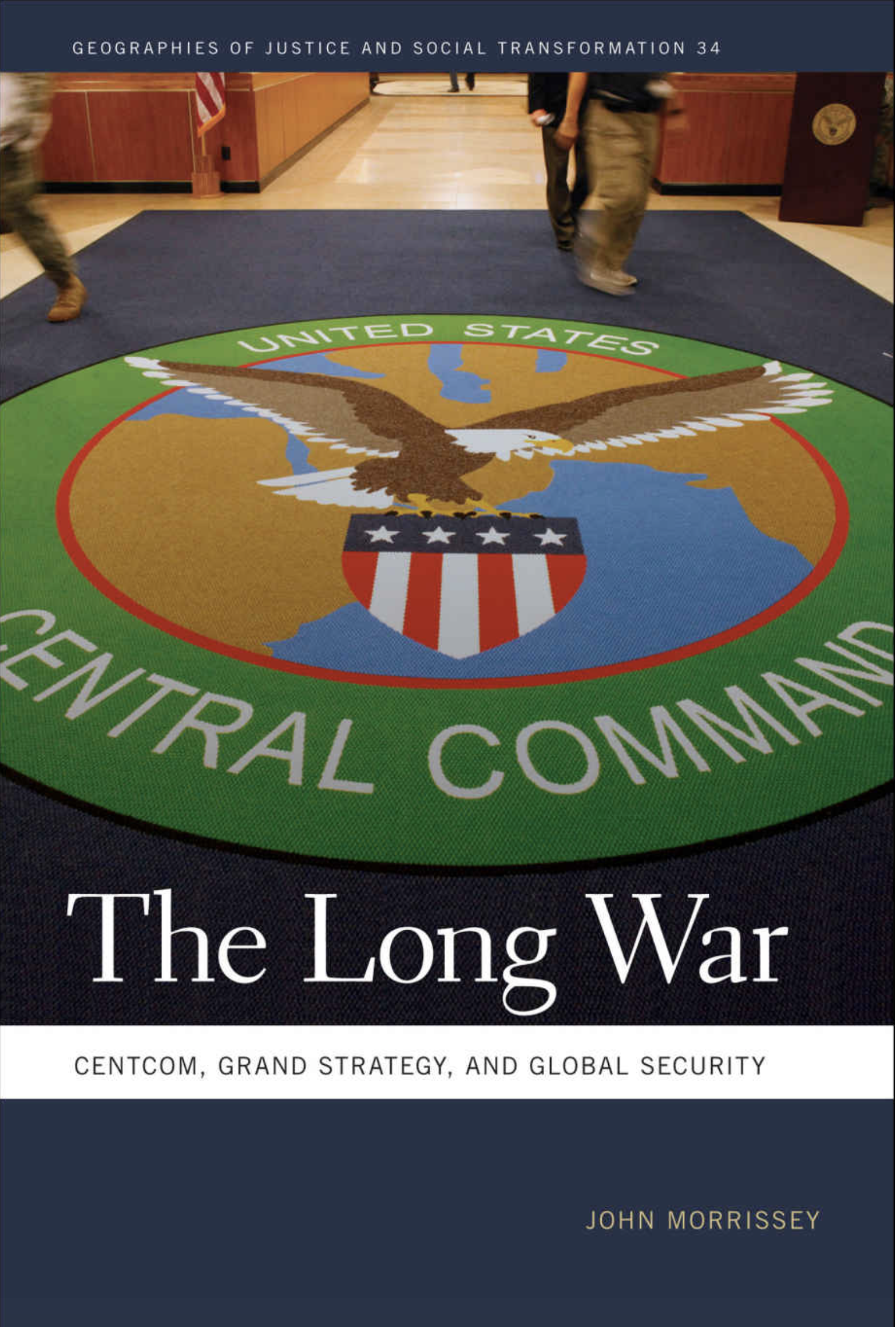
I’m just back from much needed R&R in Croatia – hence the long silence – and I’m hoping to resume normal service now…  Waiting for me on my return was a copy of John Morrissey‘s new book, The Long War: CENTCOM, grand strategy and global war, published by the University of Georgia Press in its Geographies of Justice and Social Transformation series.

Many readers will be familiar with John’s penetrating essays on US Central Command – and if you’re not a visit to Google Scholar will do the trick – but this is a plenary edition:

Nowhere has the U.S. military established more bases, lost more troops, or spent more money in the last thirty years than in the Middle East and Central Asia. These regions fall under the purview of United States Central Command (CENTCOM); not coincidentally, they include the most energy-rich places on earth. From its inception, CENTCOM was tasked with the military and economic security of this key strategic area, the safeguarding of commercial opportunities therein, and ultimately the policing of a pivotal yet precarious space in the broader global economy. CENTCOM calls this mission its “Long War.” This book tells the story of that long war: a war underpinned by a range of entangled geopolitical and geoeconomic visions and involving the use of the most devastating Western interventionary violence of our time.

Starting with a historical perspective, John Morrissey explores CENTCOM’s Cold War origins and evolution, before addressing key elements of the command’s grand strategy, including its interventionary rationales and use of the law in war. Engaging a wide range of scholarship on neoliberalism, imperialism, geopolitics, and Orientalism, the book then looks in-depth at the military interventions CENTCOM has spearheaded and critically assesses their consequences in terms of human geography.

Recent books on CENTCOM have focused on command structures, intelligence issues, and interpersonal rivalries. In contrast, The Long War asks critical questions about CENTCOM’s leading role in shaping and enacting U.S. foreign policy over the last thirty years. The book positions CENTCOM pivotally in the story of U.S. global ambition over this period by documenting its efforts to oversee a global security strategy defined in military-economic terms and enabled via specific legal-territorial tactics. This is an important new study on the blurring of war and economic aims on a global scale.

Here are two endorsements.  First, Simon Dalby (Balsillie School):

“This book is a compelling geographic analysis of the role of law and its geopolitical correlates in the current American global security policy that perpetuates so many violent practices in the ‘distant’ places of South West Asia.”

Second, Rosalind Petchesky (CUNY):

“Morrissey’s impeccably researched history of CENTCOM uncovers the roots of ‘national security’ as the sacred mantra of U.S. foreign and domestic policy—roots that long predate Donald Trump or even the post-9/11 ‘war on terror.’ The Long War not only sheds critical light on why the U.S. has remained bogged down for a quarter-century in the Middle East and Central Asia in unending war and fossil fuel mania, it also helps us to understand why an ex-CEO of Exxon became U.S. Secretary of State and why Israel remains the U.S.’s closest and perhaps last strategic partner in the disastrous global security game. An invaluable book for today.”

And the Contents List:

1  Shaping the Central Region for the 21st Century: CENTCOM’s Long War

2  CENTCOMN Activates: Cold War geopolitics and global ambition

3  Envisioning the Middle East: New imperial regimes of truth

4  Posturing for global security: Territory, law fare, and biopolitics

5  Military-economic securitization: Closing the neoliberal gap

6  No Endgame: the long war for global security

Solatia

Many readers will know Emily Gilbert‘s stunning work on the financialization of the battlespace through consolation payments made by the US and their allies to victims of military violence (‘solatia’).  If you’re not among them, see her ‘The gift of war: cash, counterinsurgency and “collateral damage“‘ in Security Dialogue 46 (2015) 403-21; also her essay on ‘Tracing military compensation’ available here.

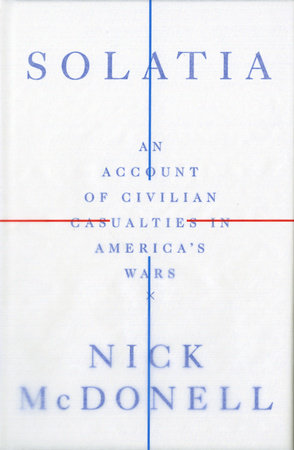
In a similar vein (I imagine) is a forthcoming book by journalist and novelist Nick McDonell: Solatia: an account of civilian casualties in America’s wars:

Since 2003, America’s wars in Iraq and Afghanistan have killed hundreds of thousands of civilians — by some counts, more than a million — and the number continues to grow. Of the many questions arising from these deaths — for which no one assumes responsibility, and which have been presented, historically, as unavoidable — perhaps the most fundamental question, for Americans, is this: if all men are created equal, why are we willing to kill foreign civilians?

Solatia (the term for money the U.S. pays to the families of civilian dead), sets out to answer that question. In all its wars, the United States both condemns and causes civilian casualties. But what exactly constitutes a civilian casualty? Why do they occur? What do our officials know of those reasons? How do they decide how many people they are willing to kill “by accident” — in a night raid, or drone strike, or invasion? And who, exactly, gets to decide?

Solatia is a globe-trotting, decade-spanning exploration into one of the most fundamental issues of our time. Following an array of officials, combatants, and civilians trying to survive — spies and senators, police chiefs and accountants caught in air strikes, orphaned street kids and widowed mothers, Iranian milita leaders, Taliban spokesmen and Marine special forces operators — Solatia confronts the U.S.’ darkest history abroad, illuminates its ongoing battles, and offers an original view of what it means to be a citizen of America at war.

It’s due in March from Penguin/Random House.