Rendering the (in)visible

Holland Cotter has a good essay at the New York Times on art and the First World War: a commentary on World War I and American Art currently on show at the Pennsylvania Academy of the Fine Arts (PAFA) in Philadelphia.

You might think it’s difficult to say something new about that (and it is), but this is an interesting – and in places even arresting – reflection:

With World War I, invisibility became a deadly weapon. Submarines turned oceans into minefields. Airplanes, used in regular combat for the first time, killed through stealth and distance. Silent death emerged: poisonous gases enveloped victims, blinding them, eating their flesh, leaving them to drown in their own fluids. Add to these grisly innovations the high-power guns that, dronelike, pulverize bodies outside the range of vision, and you can see how warfare became depersonalized. It felt like a scientific experiment, not a human engagement.

So how, he asks, did artists make this new form of war visible?

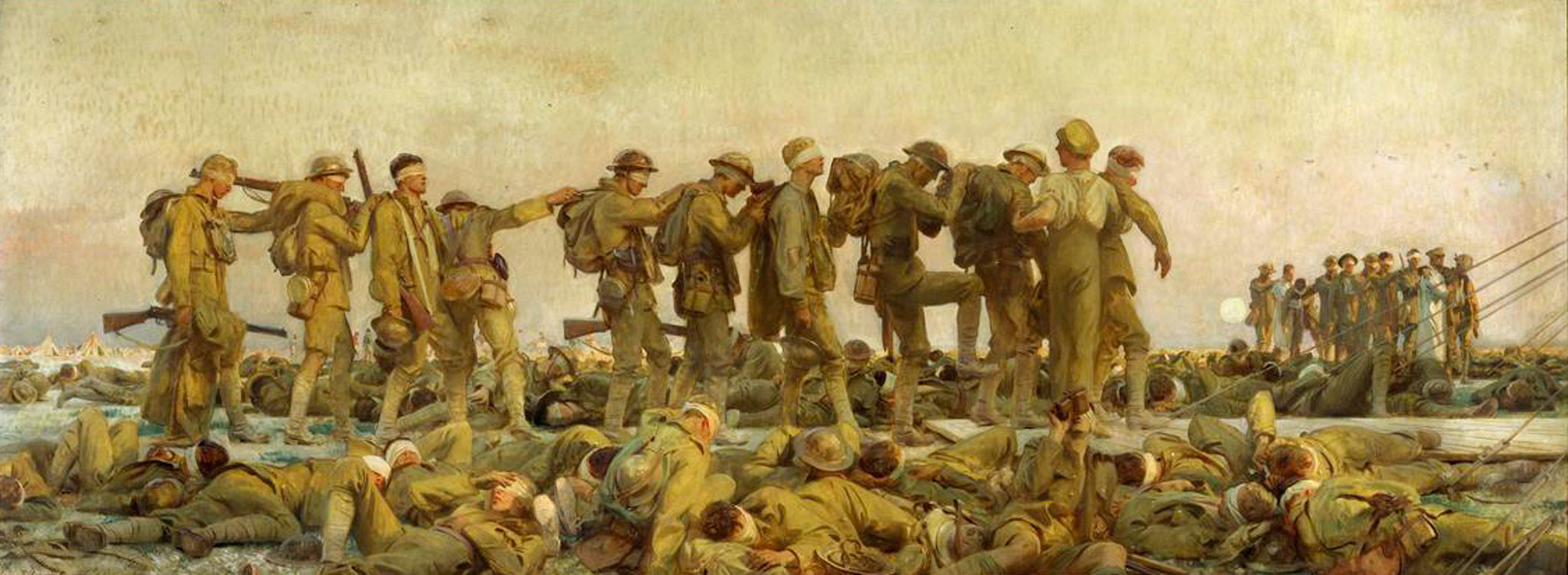
No simple answer, of course, but Cotter’s commentary on John Singer Sargent‘s iconic Gassed sharpens a point that confronts all artistic attempts to render war and its effects, the aestheticisation of violence:

The tableau is often compared to ancient Classical friezes. And like such images, based on themes of history and myth, it elevates and softens tragedy through formal beauty. That beauty is the big weakness of Sargent’s magisterially painted image. It glamorizes profound human damage. It glosses over the criminal meanness and fraudulence of a media-fed war that was “trivial, for all its vastness,” as Bertrand Russell, who lived through it, wrote.

gassed

Others have seen Gassed differently, to be sure.  Here is Michael Glover:

When it was done and displayed – it was nominated picture of the year by the Royal Academy – not everyone liked it. E M Forster thought it too heroic by half. Forster has missed the point, surely. It is indeed on a heroic scale, and its gigantism – including the fact that it is so much wider than it is high –adds a kind of plangent cinematic forcefulness to the scene, but its theme, all the same, is the brokenness, the helplessness of humanity in the face of barbarous devices. Terrible things are often slightly serio-comic too, and so it is here. This is a kind of strange perversion of blind’s man’s bluff, isn’t it? And yet these bandages are for real. These men may never see again. They may not even survive at all.

They are being led, with their eyes swathed in lint, towards a treatment tent – see those guy ropes. There is more than one line of men. They are converging from several directions. And, meanwhile, other things are going on too. In the far distance, a game of football is being played. Back left, we can see tents. There is a hanging moon. The light is a strangely grainy mustardy yellow – with just a tint of rose – that suffuses everything. We can almost smell the air.

Heroism? That jumble of broken and helpless men that occupies the entire foreground of the painting, and continues behind the stepping men, makes that claim even less credible. All this is human flotsam and jetsam, done down by the nastiness of war.

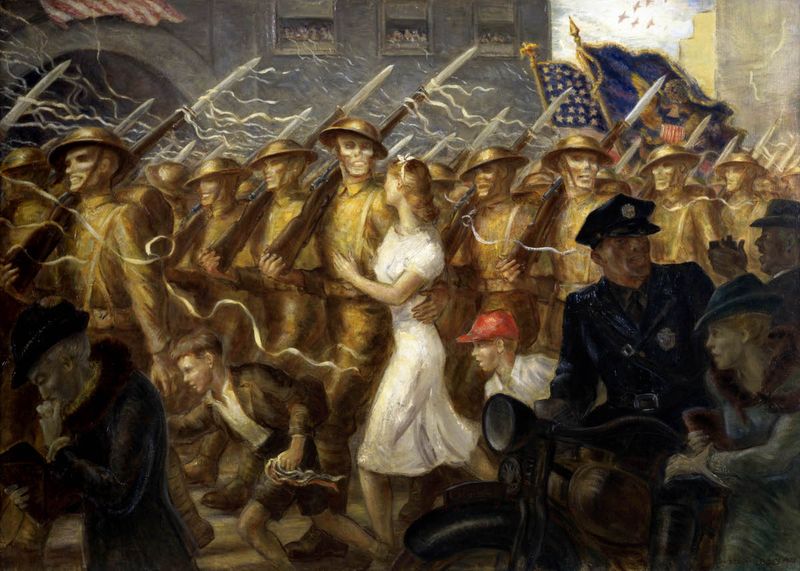
I also like Cotter’s summary of John Steuart Curry‘s Parade to War, Allegory, completed in 1938:

It shows troops [American doughboys from the First World War] marching in tight formation down a city street. Excited schoolboys run along beside them. A young woman, a sister or sweetheart, embraces a soldier as she keeps pace with him. In the foreground, a spectator cheers, but a policeman seems to be holding back another one, a distressed older woman. Maybe she sees what no one else does: All the soldiers have skulls for faces.

curry-parade-to-war

Bombing lists

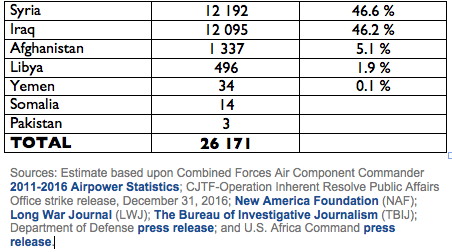
It’s the time of year for endless – and often unimportant or uninformative – statistics to be released.  But this one is important, even if its meaning is less than clear.  Micah Zenko has published this tabulation showing the geographical distribution of bombing by the US Air Force in 2016 (from all platforms, including remotely piloted aircraft):

screen-shot-2017-01-06-at-12-02-44

The problem comes in knowing how the figures (‘numbers of bombs dropped’) have been derived, since the Air Force reports numbers of ‘strikes’ not munitions dropped.  Here is US Central Command:

A strike, as defined in the CJTF [Combined Joint Task Force for Operation Inherent Resolve] releases, means one or more kinetic events that occur in roughly the same geographic location to produce a single, sometimes cumulative effect for that location.

So having a single aircraft deliver a single weapon against a lone ISIL vehicle is one strike, but so is multiple aircraft delivering dozens of weapons against a group of buildings and vehicles and weapon systems in a compound, for example, having the cumulative effect of making that facility (or facilities) harder or impossible to use.

Accordingly, CJTF-OIR does not report the number or type of aircraft employed in a strike, the number of munitions dropped in each strike, or the number of individual munition impact points against a target.

You can find a comparison with 2015 here.

global-strike-challenge-usafjpg

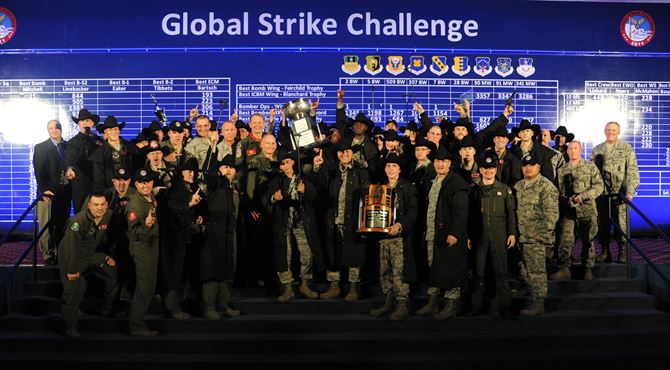
Tabulations are often competitive, of course, and irregular readers may be surprise to discover that there is a long history of bombing competitions: you can find an account of the bombing competitions sponsored by the Michelin brothers before the First World War here and of the ‘Bomb Comp‘ hosted by US Strategic Air Command (‘The World Series of Bombing’) here (and a detailed listing here).

This all weighs heavily on my mind at the moment because I’m finishing the written version of my Tanner Lectures, ‘Reach from the Sky‘, which discusses those extraordinary attempts to treat bombing as a sport….  I’ll post the final version as soon as it’s ready.

Fragments

The flu has restricted me to not so much light reading as lighter-than-air reading, so here are some short contributions and notices that appeared during the Christmas break and which address various aspects of (later) modern war and military violence:

Peter Schwartzstein on ‘The explosive secrets of Egypt’s deserts‘ – the recovery of military maps, aerial photographs, personal journals and sketchbooks from the Second World War to plot the vast minefields that continue to haunt ‘one of the most hotly contested killing fields of the twentieth century’.  You can find more in Aldino Bondesan‘s ‘Between history and geography: The El Alamein Project’, in Jill Edwards (ed) El Alamein and the struggle for North Africa (Oxford, 2012).

I discussed those minefields in ‘The natures of war’ (DOWNLOADS tab), and that essay intersects in all sorts of ways with my good friend Gastòn Gordillo‘s project on terrain, so here is a short reflection from him entitled Terrain, forthcoming in Lexicon for an Anthropocene Yet Unseen.

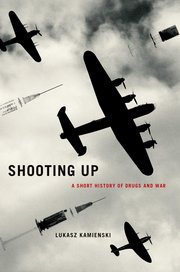
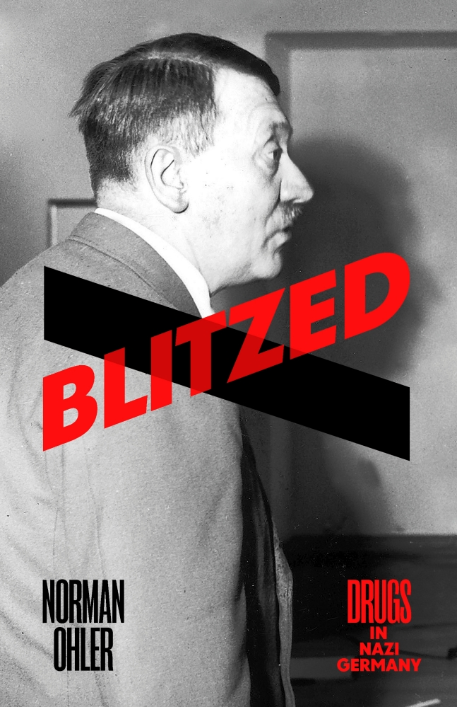
Not the ‘war on drugs’ but the war through drugs: Mike Jay‘s sharp review essay (‘Don’t fight sober’) on Łukasz Kamieński‘s brilliantly titled Shooting Up: a short history of drugs and war and Norman Ohler‘s over-the-top Blitzed: drugs in Nazi Germany (for another, equally critical take on Ohler, see Richard J Evans‘s splenetic review here; more – and more appreciative – from Rachel Cooke‘s interview with Ohler here).

Here’s an extract from Mike’s review:

9780190263478In Shooting Up, a historical survey of drugs in warfare that grew out of his research into future military applications of biotechnology, Łukasz Kamieński lists some of the obstacles to getting the facts straight. State authorities tend to cloak drug use in secrecy, for tactical advantage and because it frequently conflicts with civilian norms and laws. Conversely it can be exaggerated to strike fear into the enemy, or the enemy’s success and morale can be imputed to it. When drugs are illegal, as they often are in modern irregular warfare, trafficking or consumption is routinely denied. The negative consequences of drug use are covered up or explained away as the result of injury or trauma, and longer-term sequels are buried within the complex of post-traumatic disorders. Soldiers aren’t fully informed of the properties and potency of the drugs they’re consuming. Different perceptions of their role circulate even among participants fighting side by side.

Kamieński confines the use of alcohol in war to his prologue and wisely so, or the rest of the book would risk becoming a footnote to it. A historical sweep from the Battle of Hastings to Waterloo or ancient Greece to Vietnam suggests that war has rarely been fought sober. This is unsurprising in view of the many different functions alcohol performs. It has always been an indispensable battlefield medicine and is still pressed into service today as antiseptic, analgesic, anaesthetic and post-trauma stimulant. It has a central role in boosting morale and small-group bonding; it can facilitate the private management of stress and injury; and it makes sleep possible where noise, discomfort or stress would otherwise prevent it. After the fighting is done, it becomes an aid to relaxation and recovery.

All these functions are subsidiary to its combat role and Kamieński’s particular interest, the extent to which drugs can transform soldiers into superhuman fighting machines. ‘Dutch courage’ – originally the genever drunk by British soldiers during the Thirty Years’ War – has many components. With alcohol, soldiers can tolerate higher levels of pain and hardship, conquer fear and perform acts of selfless daring they would never attempt without it. It promotes disinhibition, loosens cultural taboos and makes troops more easily capable of acts that in civilian life would be deemed criminal or insane. The distribution of alcohol and other drugs by medics or superior officers has an important symbolic function, giving soldiers permission to perform such acts and to distance themselves from what they become when they’re intoxicated.

Opium, cannabis and coca all played supporting roles on the premodern battlefield but it was only with the industrialisation of pharmaceutical production that other drugs emerged fully from alcohol’s shadow. Morphine was widely used for the first time in the American Civil War and the 19th-century cocaine boom began with research into its military application. Freud was first alerted to it by the work of the army surgeon Theodor Aschenbrandt, who in 1883 secretly added it to the drinking water of Bavarian recruits and found that it made them better able to endure hunger, strain and fatigue. During the First World War cocaine produced in Java by the neutral Dutch was exported in large quantities to both sides. British forces could get it over the counter in products such as Burroughs Wellcome’s ‘Forced March’ tablets, until alarms about mass addiction among the troops led to a ban on open sales under the Defence of the Realm Act in 1916.

cover-jpg-rendition-460-707During the 1930s a new class of stimulants emerged from the laboratory, cheap to produce, longer-acting and allegedly less addictive. Amphetamine was first brought to market in the US by Smith, Kline and French in 1934 in the form of a bronchial inhaler, Benzedrine, but its stimulant properties were soon recognised and it was made available in tablet form as a remedy for narcolepsy and a tonic against depression. As with cocaine, one of its first applications was as a performance booster in sport. Its use by American athletes during the Munich Olympic Games in 1936 brought it to the attention of the German Reich and by the end of the following year the Temmler pharmaceutical factory in Berlin had synthesised a more powerful variant, methamphetamine, and trademarked it under the name Pervitin. As Norman Ohler relates in Blitzed, research into its military applications began almost immediately; it was used in combat for the first time in the early stages of the Second World War. Ohler’s hyperkinetic, immersive prose evokes its subjective effects on the German Wehrmacht far more vividly than any previous account, but it also blurs the line between myth and reality.

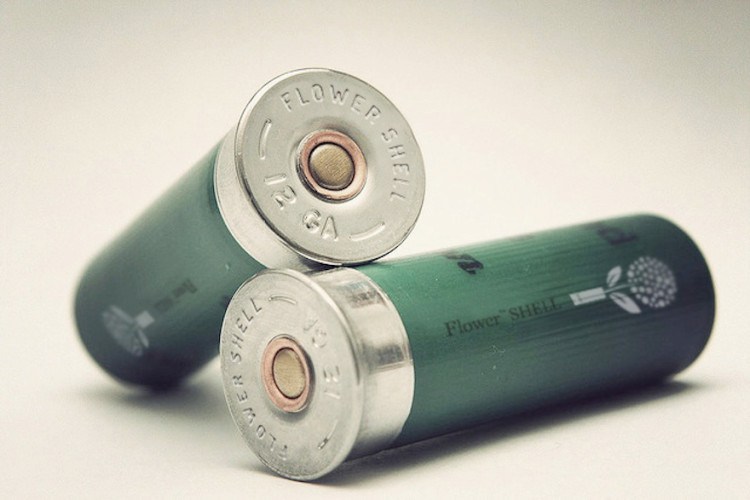
This too blurs the line between myth and reality, or so you might think.  Geoff Manaugh‘s ever-interesting BldgBlog reports that the US Department of Defense ‘is looking to develop “biodegradable training ammunition loaded with specialized seeds to grow environmentally beneficial plants that eliminate ammunition debris and contaminants”.’  Sustainable shooting.  But notice this is ammunition only for use in proving grounds…

shotgun

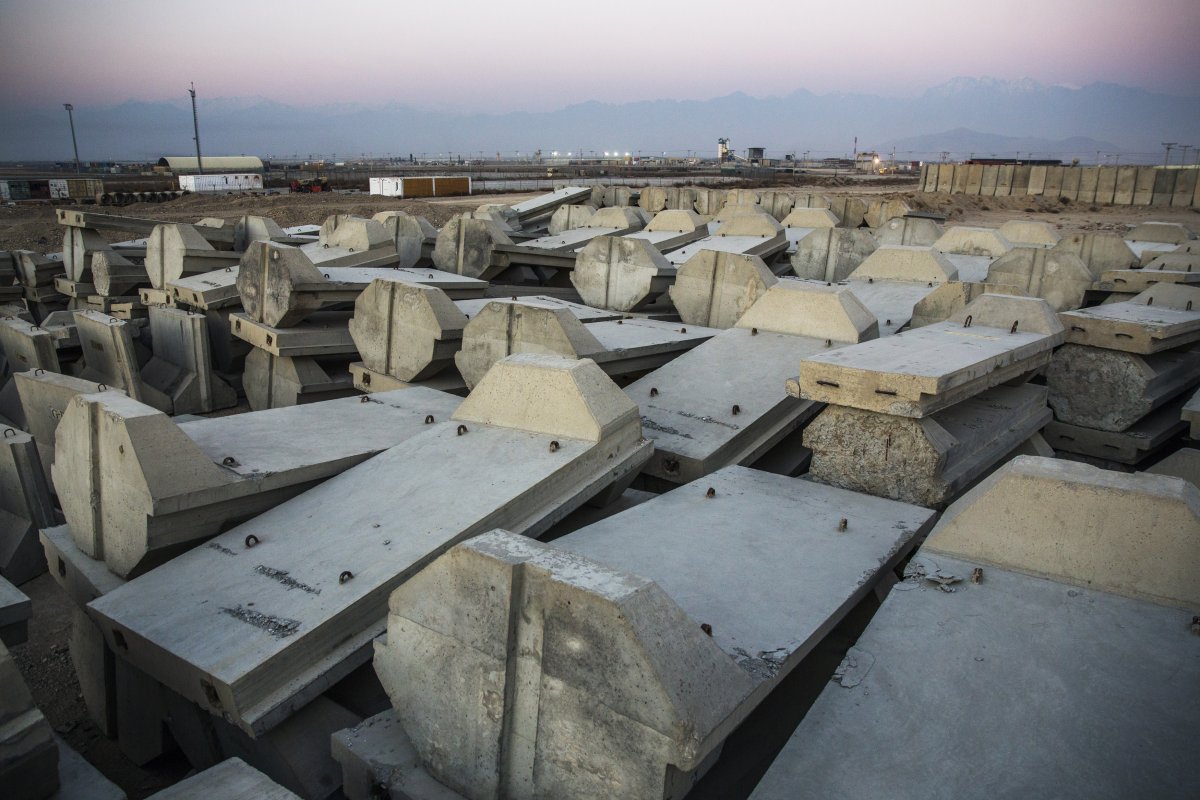
At the other end of the sustainable spectrum, John Spencer suggests that ‘The most effective weapon on the modern battlefield is concrete‘.  To put it simply, you bring today’s liquid wars to a juddering halt – on the ground at any rate – by turning liquidity into solidity and confounding the mobility of the enemy:

Ask any Iraq War veteran about Jersey, Alaska, Texas, and Colorado and you will be surprised to get stories not about states, but about concrete barriers. Many soldiers deployed to Iraq became experts in concrete during their combat tours. Concrete is as symbolic to their deployments as the weapons they carried. No other weapon or technology has done more to contribute to achieving strategic goals of providing security, protecting populations, establishing stability, and eliminating terrorist threats. This was most evident in the complex urban terrain of Baghdad, Iraq. Increasing urbanization and its consequent influence on global patterns of conflict mean that the US military is almost certain to be fighting in cities again in our future wars. Military planners would be derelict in their duty if they allowed the hard-won lessons about concrete learned on Baghdad’s streets to be forgotten.

When I deployed to Iraq as an infantry soldier in 2008 I never imagined I would become a pseudo-expert in concrete, but that is what happened—from small concrete barriers used for traffic control points to giant ones to protect against deadly threats like improvised explosive devices (IEDs) and indirect fire from rockets and mortars. Miniature concrete barriers were given out by senior leaders as gifts to represent entire tours. By the end my deployment, I could tell you how much each concrete barrier weighed. How much each barrier cost. What crane was needed to lift different types. How many could be emplaced in a single night. How many could be moved with a military vehicle before its hydraulics failed.
Baghdad was strewn with concrete—barriers, walls, and guard towers. Each type was named for a state, denoting their relative sizes and weights. There were small barriers like the Jersey (three feet tall; two tons), medium ones like the Colorado (six feet tall; 3.5 tons) and Texas (six feet, eight inches tall; six tons), and large ones like the Alaska (12 feet tall; seven tons). And there were T-walls (12 feet tall; six tons), and actual structures such as bunkers (six feet tall; eight tons) and guard towers (15 to 28 feet tall).

concrete-barriers-stored-at-bagram-afb-january-2015

But it’s nor only a matter of freezing movement:

Concrete also gave soldiers freedom to maneuver in urban environments. In the early years of the war, US forces searched for suitable spaces in which to live. Commanders looked for abandoned factories, government buildings, and in some situations, schools. Existing structures surrounded by walled compounds of some type were selected because there was little in the environment to use for protection—such as dirt to fill sandbags, earthworks, or existing obstacles. As their skills in employing concrete advanced, soldiers could occupy any open ground and within weeks have a large walled compound with hardened guard towers.

Now up into the air.  My posts on the US Air Force’s Bombing Encyclopedia (here and here) continue to attract lots of traffic; I now realise that the project – a targeting gazetteer for Strategic Air Command – needs to be understood in relation to a considerable number of other texts.  Elliott Child has alerted me to the prisoner/defector interrogations that provided vital intelligence for the identification of targets – more soon, I hope – while those targets also wound their way into the President’s Daily Brief (this was an era when most Presidents read the briefs and took them seriously, though Nixon evidently shared Trump’s disdain for the CIA: see here.)  James David has now prepared a National Security Archive Electronic Briefing Book (No 574) which provides many more details based on redacted releases of Briefs for the period 1961-77.

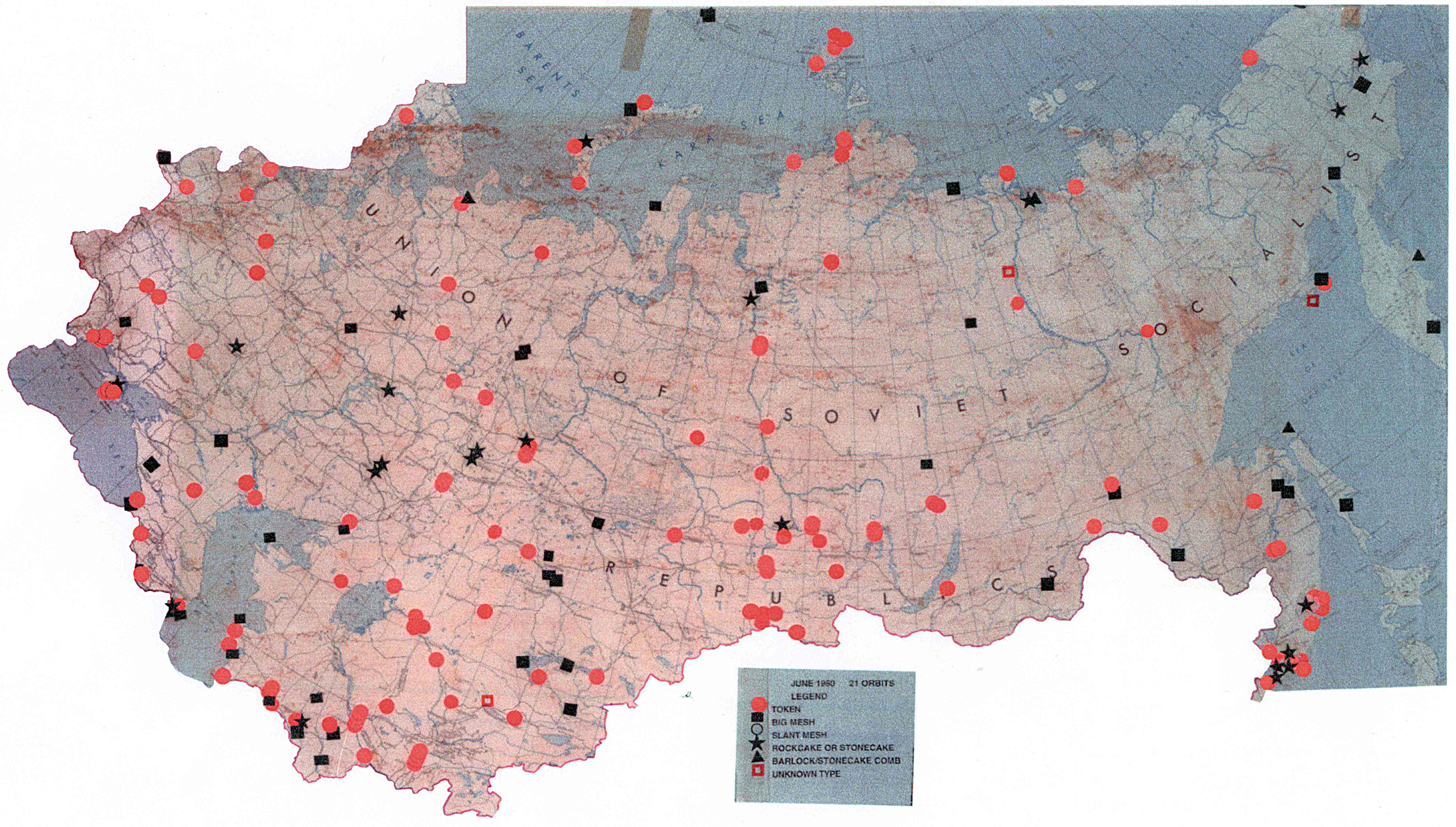
Two of the most critical intelligence targets throughout the Cold War were Soviet missile and space programs. U.S. intelligence agencies devoted a huge amount of resources to acquiring timely and accurate data on them. Photoreconnaissance satellites located launch complexes and provided data on the number and type of launchers, buildings, ground support equipment, and other key features. They located R&D centers, manufacturing plants, shipyards, naval bases, radars, and other facilities and obtained technical details on them. The satellites also occasionally imaged missiles and rockets on launch pads. There were four successful photoreconnaissance satellite programs during the four administrations in question. CORONA, a broad area search system, operated from August 1960 until May 1972. The first successful high resolution system, GAMBIT-1, flew from 1963-1967. The improved GAMBIT-3 high resolution satellite was launched from 1966-1984. HEXAGON, the broad area search successor to CORONA, operated from 1971-1984. High-resolution ground photography of missiles and rockets displayed at Moscow parades and other events also proved valuable at times.

sigint-targets-ussr

Signals intelligence platforms [above] also contributed greatly to understanding Soviet missile and space programs. Satellites such as GRAB (1960-1962), POPPY (1962-1971), and AFTRACK payloads (1960-1967) located and intercepted air defense, anti-ballistic missile, and other radars and added significantly to U.S. knowledge of Soviet defensive systems and to the development of countermeasures. Other still-classified signals intelligence satellites launched beginning around 1970 reportedly intercepted telemetry and other data downlinked from missiles, rockets, and satellites to Soviet ground stations, and commands uplinked from the stations to these vehicles. Antennas at intercept sites also recorded this downlinked data. During the latter stages of missile and rocket tests to the Kamchatka Peninsula and the Pacific, ships and aircraft also intercepted telemetry and acquired optical data of the vehicles. Analysis of the telemetry and other data enabled the intelligence agencies to determine the performance characteristics of missiles, rockets, and satellites and helped establish their specific missions. Radars at ground stations detected launches, helped determine missile trajectories, observed the reentry of vehicles, and assisted in estimating the configuration and dimensions of missiles and satellites. Space Surveillance Network radars and optical sensors detected satellites and established their orbital elements. The optical sensors apparently also photographed satellites.

And for a more recent take on sensors and shooters, coming from Yale in the Spring: Christopher J Fuller‘s See It/Shoot It: The secret history of the CIA’s lethal drone program:

An illuminating study tracing the evolution of drone technology and counterterrorism policy from the Reagan to the Obama administrations.

This eye-opening study uncovers the history of the most important instrument of U.S. counterterrorism today: the armed drone. It reveals that, contrary to popular belief, the CIA’s covert drone program is not a product of 9/11. Rather, it is the result of U.S. counterterrorism practices extending back to an influential group of policy makers in the Reagan administration.

Tracing the evolution of counterterrorism policy and drone technology from the fallout of Iran-Contra and the CIA’s “Eagle Program” prototype in the mid-1980s to the emergence of al-Qaeda, Fuller shows how George W. Bush and Obama built upon or discarded strategies from the Reagan and Clinton eras as they responded to changes in the partisan environment, the perceived level of threat, and technological advances. Examining a range of counterterrorism strategies, he reveals why the CIA’s drones became the United States’ preferred tool for pursuing the decades-old goal of preemptively targeting anti-American terrorists around the world.

You can get a preview of the argument in his ‘The Eagle Comes Home to Roost: The Historical Origins of the CIA’s Lethal Drone Program’ in Intelligence & National Security 30 (6) (2015) 769-92; you can access a version of that essay, with some of his early essays on the US as what he now calls a ‘post-territorial empire’, via Academia here.

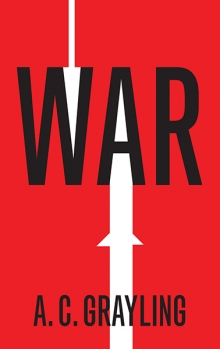
Finally, also forthcoming from Yale, a reflection on War by A.C. Grayling (whose Among the Dead Cities was one of the inspirations for my own work on bombing):

grayling-warFor residents of the twenty-first century, a vision of a future without warfare is almost inconceivable. Though wars are terrible and destructive, they also seem unavoidable. In this original and deeply considered book, A. C. Grayling examines, tests, and challenges the concept of war. He proposes that a deeper, more accurate understanding of war may enable us to reduce its frequency, mitigate its horrors, and lessen the burden of its consequences.

Grayling explores the long, tragic history of war and how warfare has changed in response to technological advances. He probes much-debated theories concerning the causes of war and considers positive changes that may result from war. How might these results be achieved without violence? In a profoundly wise conclusion, the author envisions “just war theory” in new moral terms, taking into account the lessons of World War II and the Holocaust and laying down ethical principles for going to war and for conduct during war.

Kill Boxes

161119killboxes-cover-front-draft-2-final-643x1024

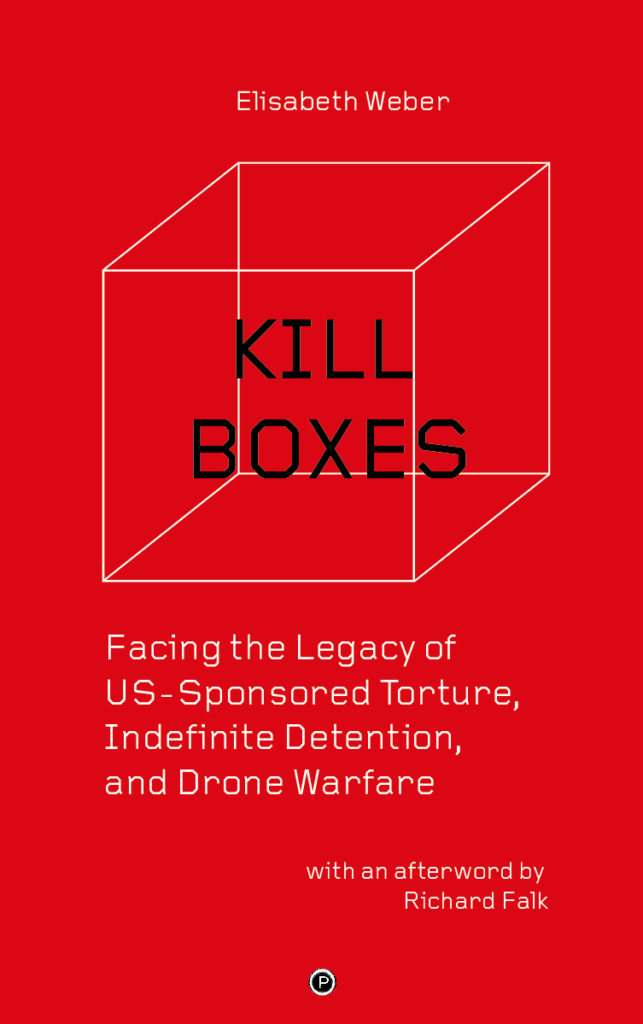
As 2016 lurches towards its end, I’ve received notice of a number of books that once I would have hoped would be of purely historical interest.  No longer.  So we’ll start with Elisabeth Weber‘s Kill-boxes: facing the legacy of US-sponsored torture, indefinite detention and drone warfare coming soon from Punctum Books:

Kill Boxes addresses the legacy of US-sponsored torture, indefinite detention, and drone warfare by deciphering the shocks of recognition that humanistic and artistic responses to violence bring to consciousness if readers and viewers have eyes to face them.

Beginning with an analysis of the ways in which the hooded man from Abu Ghraib became iconic, subsequent chapters take up less culturally visible scenes of massive violations of human rights to bring us face to face with these shocks and the forms of recognition that they enable and disavow. We are addressed in the photo of the hooded man, all the more so as he was brutally prevented, in our name, from returning the camera’s and thus our gaze. We are addressed in the screams that turn a person, tortured in our name, into howling flesh. We are addressed in poems written in the Guantánamo Prison camp, however much American authorities try to censor them, in our name. We are addressed by the victims of the US drone wars, however little American citizens may have heard the names of the places obliterated by the bombs for which their taxes pay. And we know that we are addressed in spite of a number of strategies of brutal refusal of heeding those calls.

Providing intensive readings of philosophical texts by Jean Améry, Jacques Derrida, and Christian Thomasius, with poetic texts by Franz Kafka, Paul Muldoon, and the poet-detainees of Guantánamo Bay Prison Camp, and with artistic creations by Sallah Edine Sallat, the American artist collective Forkscrew and an international artist collective from Pakistan, France and the US, Kill Boxes demonstrates the complexity of humanistic responses to crimes committed in the name of national security. The conscious or unconscious knowledge that we are addressed by the victims of these crimes is a critical factor in discussions on torture, on indefinite detention without trial, as practiced in Guantánamo, and in debates on the strategies to circumvent the latter altogether, as practiced in drone warfare and its extrajudicial assassination program.

The volume concludes with an Afterword by Richard Falk.

You can read the Introduction here.

Fighting over Kunduz

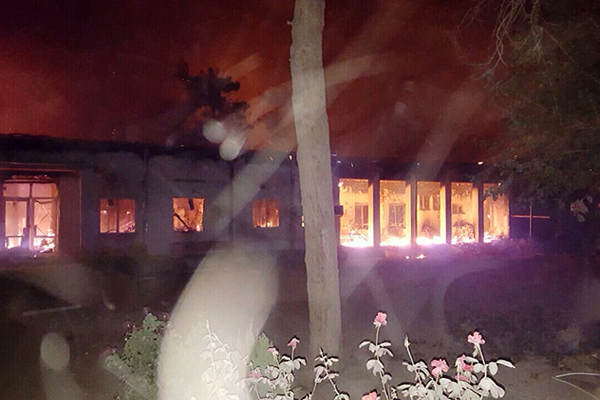
This is the third in a new series of posts on military violence against hospitals and medical personnel in conflict zones. It examines some of the key issues arising from the US attack on the Trauma Centre run by Médecins Sans Frontières (MSF) in Kunduz on 3 October 2015; it follows directly from my detailed analysis of the attack here and prepares the ground for a still more detailed analysis of attacks on hospitals, doctors and casualties in Syria to follow.

There are at least four main issues arising from the US attack on the MSF Trauma Centre in Kunduz that spiral out into a wider argument about what I will later call ‘The Death of the Clinic’.  I’m treating ‘the clinic’ here as a topological figure that extends from the body of the wounded through the evacuation chain to the hospital itself.  The clinic has been accorded a privileged status within the space of exception that is the modern conflict zone – a complicated, fractured space in which killing is made permissible subject to the protocols of international humanitarian law –  so that the clinic becomes an exception to the exception and its inhabitants granted a conditional immunity from attack.
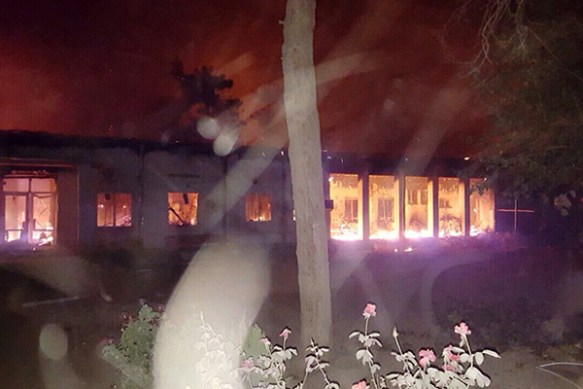
msf-trauma-centre-burning

It’s important to understand that this legal armature is not immutable, and that changes (and challenges) to it arise through both (geo)political and military actions; international humanitarian law is not a deus ex machina, somehow above the fray, but is thoroughly entangled with the prosecution of military violence.  More on this to come, but for now it will be enough to list some of the major protections accorded to the clinic in war-time.

The first Geneva Convention (1864) (‘the Red Cross Convention’):

Ambulances and military hospitals shall be acknowledged to be neuter, and, as such, shall be protected and respected by belligerents so long as any sick or wounded may be therein.  Such neutrality shall cease if the ambulances or hospitals should be held by a military force … A distinctive and uniform flag shall be adopted for hospitals, ambulances and evacuations.

Under the Hague Regulations (1899/1907) that were in force during the hospital raids in France at the end of the First World War:

… all necessary steps must be taken to spare, as far as possible, … hospitals, and places where the sick and wounded are collected, provided they are not being used at the time for military purposes. It is the duty of the besieged to indicate the presence of such buildings or places by distinctive and visible signs, which shall be notified to the enemy beforehand.
Geneva Conventions 1949 care of woundedUnder the Geneva Conventions (1949) – whose provisions applied to the attack on the MSF Trauma Centre a hundred years later – there is a similar immunity granted to the military-medical machine:

The protection to which fixed establishments and mobile medical units of the Medical Service are entitled shall not cease unless they are used to commit, outside their humanitarian duties, acts harmful to the enemy. Protection may, however, cease only after a due warning has been given, naming, in all appropriate cases, a reasonable time limit and after such warning has remained unheeded.

And this is explicitly extended beyond the military-medical machine to institutions like the MSF Trauma Centre:

Civilian hospitals organized to give care to the wounded and sick, the infirm and maternity cases, may in no circumstances be the object of attack but shall at all times be respected and protected by the Parties to the conflict.

The protection to which civilian hospitals are entitled shall not cease unless they are used to commit, outside their humanitarian duties, acts harmful to the enemy. Protection may, however, cease only after due warning has been given, naming, in all appropriate cases, a reasonable time limit and after such warning has remained unheeded.

In so doing the treatment of hostile combatants is also explicitly provided for and protected:

The fact that sick or wounded members of the armed forces are nursed in these hospitals, or the presence of small arms and ammunition taken from such combatants and not yet been handed to the proper service, shall not be considered to be acts harmful to the enemy.

The language and specifications change, but there is nevertheless a consistent thread running through these provisions.  It has been stretched – and perhaps broken – by the attack on the MSF Trauma Centre, and here I’ll focus on four issues that have proved contentious.  First, the visual identification of the Trauma Centre; second, the alleged breach of its conditional immunity; third, the construal of the attack as a war crime; and fourth, the putative rejection of medical neutrality altogether.

(1) Visual identification

International humanitarian law (IHL) requires those responsible for hospitals ‘to indicate their presence’ – the language varies – in order to ensure their protection, and here the US military investigation made this finding (all page numbers in brackets refer to the redacted report):

The center roof of the MSF Trauma Center was marked with two rectangular MSF flags… The front and sides of the MSF hospital were marked from the street view and a MSF flag flew in the courtyard.  The MSF Trauma Center was not marked with any internationally recognized symbols such as a red cross, red crescent or a red “H”.  If it had been marked with these symbols, it is possible the Trauma Center would not have been engaged. (082)

This counterfactual does not loom large in the report or its recommendations, but Charles Dunlap (at Lawfire) has seized upon it to berate MSF:

Ask yourself: wasn’t it a mistake for [MSF] – and a serious one – not to have marked its facility in accordance with Protocol III to the Geneva Conventions which designates “the only emblems recognized by nations signifying the protected status of individuals or objects bearing them during armed conflict”?  Had, for example, the hospital been marked with large Red Crosses/Red Crescents or one of the other internationally-recognized symbols (as the U.S. does) or something that would make its protected use clear from the air, isn’t it entirely plausible that the aircrew (or someone) might have recognized the error and stopped the attack before it began?

Put another way, isn’t it foreseeable that in an exceptionally chaotic combat situation (where a belligerent is making use of civilian buildings to conduct combat operations) that mistakes could occur in identifying a protected structure absent Protocol III markings or at least something to make it identifiable at a distance, especially when it’s known that attacking aircraft are being used?  Wouldn’t reasonably prudent persons have marked their medical facility with an internationally-recognized symbol or something of similar clarity to the warring parties?  Wouldn’t due care demand it in that situation?

In accusing MSF of ‘imprudence’ and even recklessness Dunlap applies a double standard.  He repeatedly insists that the US and the Afghan militaries confronted ‘an extraordinarily intense situation’ in Kunduz, that they faced ‘terrible urgency’ and ‘enormous pressure’ as they operated ‘in the turmoil of a war zone’ – all of which is undoubtedly true – but he uses this to excuse their mistakes while refusing to extend the same privilege to MSF.

_85907418_85907417

Let me remind you of Dr Kathleen Thomas‘s account of working in the ER (above) once the city had fallen to the Taliban:

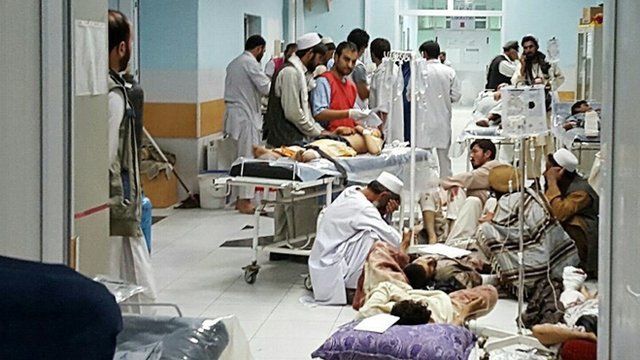
The first day was chaos – more than 130 patients poured through our doors in only a few hours. Despite the heroic efforts of all the staff, we were completely overwhelmed. Most patients were civilians, but some were wounded combatants from both sides of the conflict. When I reflect on that day now, what I remember is the smell of blood that permeated through the emergency room, the touch of desperate people pulling at my clothes to get my attention begging me to help their injured loved ones, the wailing, despair and anguish of parents of yet another child lethally injured by a stray bullet whom we could not save, my own sense of panic as another and another and another patient was carried in and laid on the floor of the already packed emergency department, and all the while in the background the tut-tut-tut-tut of machine guns and the occasional large boom from explosions that sounded way too close for comfort.

In any case, MSF had clearly ‘indicated their presence’ to both the US and Afghan authorities by providing them with the GPS co-ordinates of the Trauma Centre (see my previous discussion here). Dunlap finds this ‘commendable’ but ‘legally problematic’.

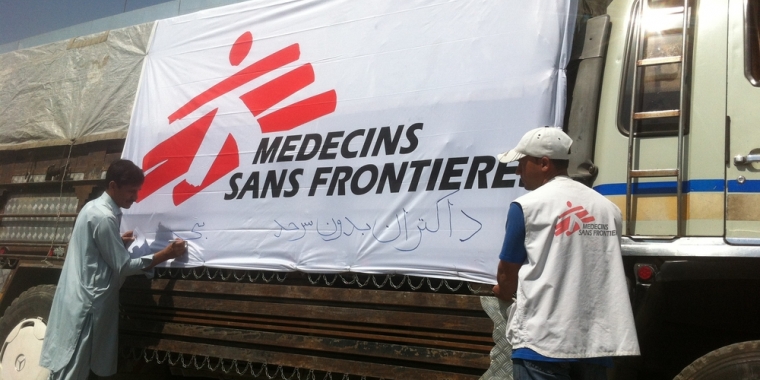
Instead, he is fixated on the absence of a Red Cross flag from the roof, in which case he might reflect on another passage from the report.  On 2 October, the day before the air strike, MSF phoned the Special Operations Task Force in Bagram to develop a contingency plan: while the Taliban were respecting the neutrality of the Trauma Centre and ‘treating the government casualties well’, they wanted to know the feasibility of extracting their patients should conditions deteriorate.  During that conversation they were advised to ‘take the signs normally affixed to the sides of the trucks and to install them on the top of the vehicles for easy identification by aircraft during this or any future MSF resupply operations‘ (503; my emphasis).  This surely makes it clear that the US military anticipated no difficulty in recognising MSF’s flag and logo as symbols of medical neutrality.
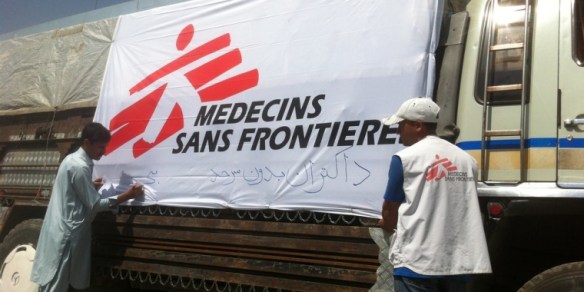
msf153147

(2)  Conditional immunity

IHL makes it clear that treating wounded combatants does not compromise the protections afforded to a medical facility; that occurs only if it is used as a base from which ‘to commit, outside their humanitarian duties, acts harmful to [one of the belligerents]’.  I’ll address the intervening clause – ‘outside their humanitarian duties’ – under (4) and confine my discussion here to the alleged militarisation of the clinic.

msf153705-1

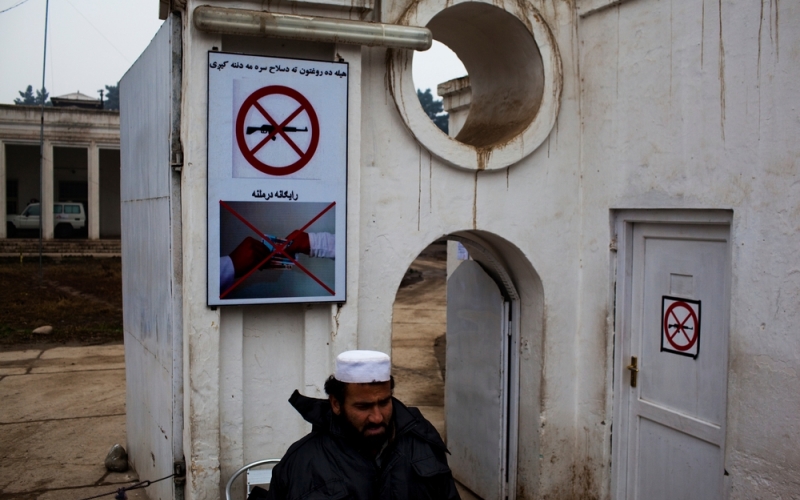
MSF’s internal review found that its unambiguous ‘no weapons‘ policy was adhered to:

All of the MSF staff reported that the no weapons policy was respected in the Trauma Centre. [Since the KTC opened, there were some rare exceptions when a patient was brought to the hospital in a critical condition and the gate was opened to allow the patient to be delivered to the emergency room without those transporting the patient being first searched. In each of these instances, the breach of the no weapon policy was rapidly rectified.]  In the week prior to the airstrikes, the ban of weapons inside the MSF hospital in Kunduz was strictly implemented and controlled at all times and all MSF staff positively reported in their debriefing on the Taliban and Afghan army compliance with the no-weapon policy.

The US military investigation accepted this was indeed the case:

Evidence provided to the investigation team supports the MSF internal initial report’s characterization that their no-weapons policy was adhered to with rare exceptions (038, note 15).
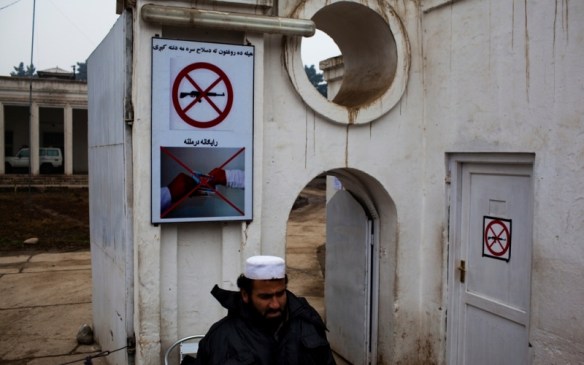
msf112743

Mathieu Aikins‘s interviewees also confirmed the absence of weapons from the Trauma Centre:

Though the MSF hospital was crowded with fighters, whether patients or caretakers (each patient was allowed one), staff members and civilians who were present said the insurgents respected the rules. They left their weapons outside or handed them over at the gun lockers at the entrance. One employee recalled seeing a fighter give up his weapon but forget his ammunition vest; when the employee nervously approached the fighter about it, the man apologized profusely and handed it over. “We had respect for the hospital, as they were serving the people,” said Shahid, the Taliban commander. “I myself went there once when one of our men was wounded, and before entering we submitted our weapons outside.”

Aikins goes on to report that patients were allowed to retain their cellphones, and some of their caretakers retained hand-held radios whose transmissions were intercepted by Afghan special forces.  They in turn concluded that not only were the Taliban inside the hospital but were using it as a base: ‘They had raised their flag and established their headquarters there.’  On 1 October, presumably in response to these reports, the Pentagon contacted MSF in New York to ask whether ‘they had a large number of Taliban “holed up”’ in the Trauma Centre, and were assured that the only Taliban inside the hospital were wounded patients.

But the suspicions clearly remained, and festered to such a degree that some of those on the ground were convinced that the hospital had been overrun by Taliban fighters.  Associated Press reported that the radio intercepts prompted US analysts to request ‘specific intelligence-gathering flights over the hospital’ – their outcome has never been disclosed – and on 1 October a senior Special Forces commander (whether in Kabul or in Kunduz is unclear) wrote in his daily log that the Trauma Centre was under Taliban control and that he planned to clear it in the coming days.   At least some of the Green Berets in Kunduz agreed with his assessment: ‘They were using it as a C2 node … They had already removed and ransomed the foreign doctors, and they had fired on partnered personnel from there.’  Indeed, after the attack a senior US officer in Kabul was told – by whom has been redacted – that ‘there were three dead Military-Aged Males near the hospital, identified as Taliban by the local population.  They were using the hospital as a command post (using its protected status)’ (275).
observations-from-ac-130-001

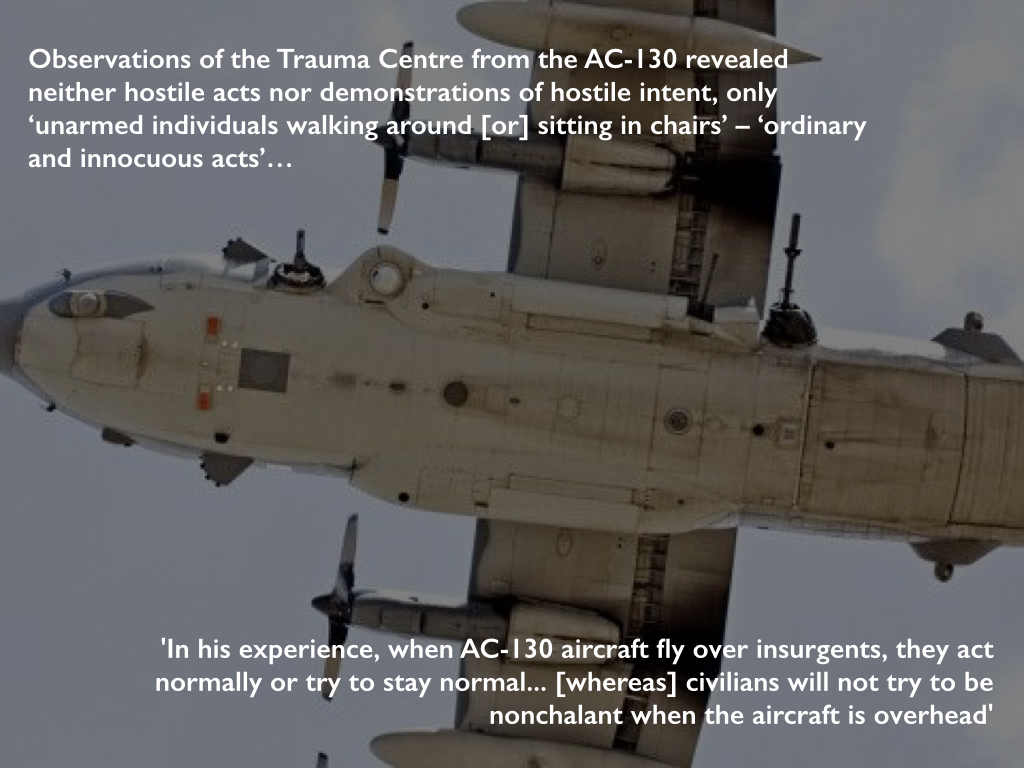
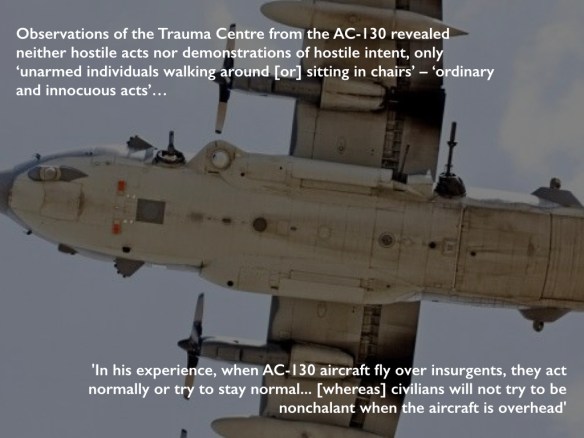
But all of this was fantasy, and the investigation discounted it.  Although US intelligence reported that insurgents were present at the hospital at the time of the strike, the investigation accepted that this was for medical treatment and they could trace ‘no specific intelligence reports that confirm[ed] insurgents were using the MSF Trauma Center as an operational  C2 [command and control] node, weapons cache or base of operations’ (085).  In addition, they determined that observations made from the AC-130 revealed neither substantive hostile acts nor demonstrations of hostile intent –  only ‘unarmed individuals walking around [or] sitting in chairs’ (085).  The report describes these as ‘ordinary and innocuous acts’ (055), but to at least one member of the aircrew that was in itself grounds for suspicion: ‘In his experience, when AC-130 aircraft fly over insurgents, they act normally or try to stay normal… [whereas] civilians will not try to be nonchalant when the aircraft is overhead’ (093, note 304).  Damned if you do, and damned if you don’t: when everything is construed as hostile, even the most innocent acts are transformed into somcething sinister.

The claims made by Afghan forces were even wilder.  Here is May Jeong in The Intercept:

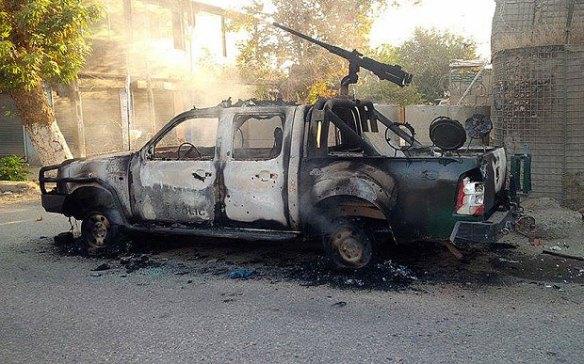
On the night of the hospital strike, a unit commander with the Ministry of Defense special forces was at the police headquarters taking fire from the direction of the hospital. “Vehicles were coming out of there, engaging, then retreating,” he told me. When I pointed out that he couldn’t have seen the gate of the hospital from where he was, several hundred meters away, he said that he was sure because he had personally interrogated a cleaner who told him that the hospital was full of “armed men using it as a cover.” The cleaner told the commander that there were Pakistani generals using the hospital as a recollection point and that they had set up a war room there. When I challenged his line of vision again, he responded, “Anyone can claim anything. The truth is different.”
afghanistan_kunduz_3459341b

[Amrullah] Saleh, [former head of the National Security Directorate and] the author of the 200-page Afghan commission report on the fall of Kunduz … believed that the “hospital sanctity had been violated” and held out as evidence 130 hours of recorded conversations with more than 600 interlocutors. “I spoke with the MSF country director,” Saleh told me recently. “They don’t deny that the hospital was infiltrated by the Taliban.”

But of course they did deny it: repeatedly, emphatically and convincingly.

(3) War crimes?

The US military investigation was unequivocal: it found multiple violations of the military’s own Rules of Engagement and of international humanitarian law.

The first rule of customary international humanitarian law, now codified in the Additional Protocols to the Geneva Conventions, is distinction:

The parties to the conflict must at all times distinguish between civilians and combatants. Attacks may only be directed against combatants. Attacks must not be directed against civilians.

The investigation found that both the Ground Force Commander (GFC) and the aircraft commander failed to exercise this core principle:

Neither commander distinguished between combatants and civilians nor a military objective and protected property. Each commander had a duty to know, and available resources to know that the targeted compound was protected property’ (075-6).

A second core principle is proportionality:

Launching an attack which may be expected to cause incidental loss of civilian life, injury to civilians, damage to civilian objects, or a combination thereof, which would be excessive in relation to the concrete and direct military advantage anticipated, is prohibited.

The investigation found this to have been disregarded too:

The GFC and the aircraft commander failed to exercise the principle of proportionality in relation to the direct military advantage (076).

Both principles are deceptively simple, and in ‘The Passions of Protection: Sovereign Authority and Humanitarian War’ Anne Orford reminds us that IHL ‘immerses its addressees in a world of military calculations.’  In practical terms the distinction between civilians and combatants in today’s conflicts is rarely straightforward, but in this case the No-Strike List plainly recognised the protected status of the Trauma Centre and there is no convincing evidence that its immunity had been compromised.  In addition, the balance between loss of civilian life and military advantage is weighed on the military’s own scales – ‘expected’; ‘excessive’; ‘anticipated’: these are not self-evident calculations – but even if the GFC or the aircraft commander had grounds to believe the Taliban were firing from the hospital the Pentagon’s own Law of War Manual (which is not without its own controversies: see here and, specifically on proportionality, here and here) advises under §7.10.3.2 that

The obligation to refrain from use of force against a medical unit acting in violation of its mission and protected status without due warning does not prohibit the exercise of the right of self-defense. There may be cases in which, in the exercise of the right of self-defense, a warning is not “due” or a reasonable time limit is not appropriate. For example, forces receiving heavy fire from a hospital may exercise their right of self-defense and return fire.  Such use of force in self-defense against medical units or facilities must be proportionate.

Not only was there was no evidence of hostile let alone ‘heavy fire’ from the Trauma Centre but the AC-130 was also monitoring the progress of the Afghan Special Forces convoy that it was tasked with protecting and knew perfectly well that it was still within the perimeter of the airfield.  This was not a time-sensitive target (the report makes that crystal clear) and neither the GFC nor the aircraft commander had reason to believe that any putative threat to Afghan or US forces was so grave and so sustained that it called for an air strike involving multiple passes by the AC-130 – over 30 minutes according to the US military, an hour according to MSF – delivering such intense fires that the building was virtually destroyed.

For these reasons many commentators – and MSF (‘Under the clear presumption that a war crime has been committed, MSF demands that a full and transparent investigation into the event be conducted by an independent international body’) – have insisted that the attack was a war crime.


not-a-war-crime-3-jpeg

not-a-war-crime-2-jpeg

But others (including the US military) have concluded that it was not.  US Central Command’s initial summary – produced before the redacted report was released – accepted that there had been breaches of both the Rules of Engagement and of IHL (‘the law of armed conflict’) but noted that

the investigation did not conclude that these failures amounted to a war crime.  The label “war crimes” is typically reserved for intentional acts – intentionally targeting of civilians or intentionally targeting protected objects.  The investigation found that the tragic incident resulted from a combination of unintentional human errors, process errors and equipment failures, and that none of the personnel knew that they were striking a medical facility.

The report has been so heavily redacted so that this legal discussion is unavailable (see also the commentary by Sarah Knuckey and two of her students here).  We do know that the investigation team included an unnamed legal advisor from US Central Command (CENTCOM) and that its report was subject to legal review by the Staff Judge Advocate, who accepted its findings as ‘legally sufficient’ with several, redacted exceptions  – though there is no way of knowing what they were (007-009).  We know too that General John Campbell, who ordered the investigation as commander of US Forces in Afghanistan, subsequently disapproved a number of findings and recommendations ‘not related to the proximate cause of the strike’ (002) but, again, the details have been excised.

General Votel at Pentagon press briefing on MSF attack

General Joseph Votel, commander of CENTCOM, repeated the summary statement’s disavowal of war crimes at a Pentagon Press Briefing on 29 April 2016, and in responding to a storm of questions from plainly incredulous reporters (above) he elaborated:

… an unintentional action takes it out of the realm of actually being a deliberate war crime against persons or protected locations…. They were absolutely trying to do the right thing; they were trying to support our Afghan partners; there was no intention on any of their parts to take a short cut, or to violate any rules that were laid out for them. And they were attempting to do the right thing.  Unfortunately, they made a wrong judgment in this particular case…

Jens David Ohlin explains the disputation (which Faye Donnelly helpfully re-casts as one between two contending narratives whose speech-acts struggle to realize their performative force):

The problem is that the killing of the innocent civilians was not intentional, it was accidental. As a matter of criminal law, it was either reckless or negligent … but the civilian killings were not performed with purpose.

The Rome Statute of the International Criminal Court provides for war crimes prosecutions for ‘intentionally directing’ or ‘intentionally launching’ attacks that contravene international humanitarian law (in effect, criminalizing the rules of IHL).  Jens discusses this in relation to attacks on civilians, but the Statute also proscribes ‘intentionally directing attacks against buildings, material, medical units and personnel’ or against ‘personnel, installations, material, units or vehicles involved in a humanitarian assistance or peacekeeping mission’.

In every case the emphasis is on intentionality, and yet intentionality – as philosophers have demonstrated time and time again – is not the simple, settled matter some legal scholars assume it to be.  Jens’s central point is that common-law cultures identify intentionality with purpose or knowledge whereas civil-law cultures widen its sphere to include a conscious disregard of risk or ‘recklessness’.  The full argument is here – including an intricate disection of the (geo)politics involved in drafting the Geneva Conventions and the Additional Protocols – but the sharp conclusion is that (for Jens, at least) the strike on the Trauma Centre would not constitute a war crime under the first count (he accepts that neither the GFC nor the aircraft commander possessed the knowledge or the purpose) but could under the second (their actions, and those of others, were reckless).  I should add that he recommends the recognition of a new war crime to explicitly address the second count and thereby signal ‘the moral difference between intentionally killing civilians and recklessly killing them.’
kunduz-msf-a-tragedy-of-errors-001


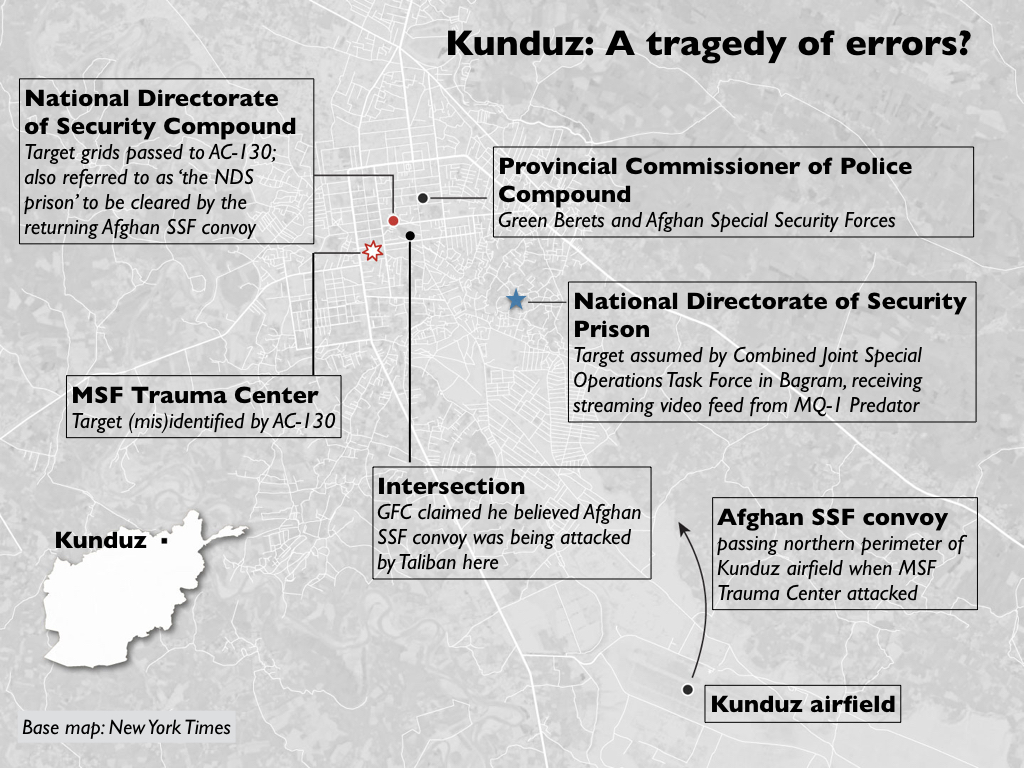
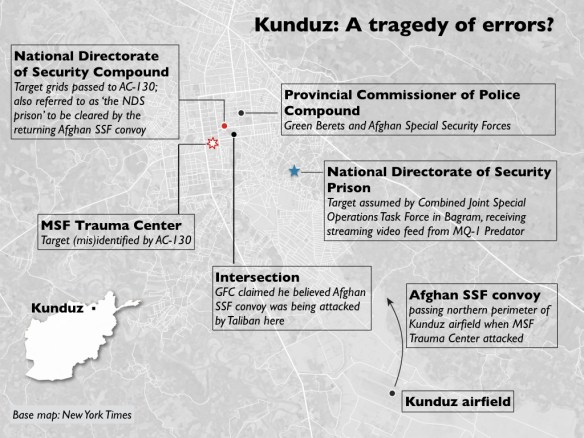
The investigation report provides endless, explicit examples of a thoroughly compromised ‘risk management process’ by multiple actors at multiple sites, and this dispersal of responsibility in Kunduz (see map above) and Bagram further complicates the legal situation.  Peter Margulies – who does not accept that ‘the lack of intent among US personnel is determinative’ – concedes that ‘the cascading systemic errors in the hospital attack impede the attribution of culpable awareness to one or more specific individuals.’ In his view,

CENTCOM would have been better served by acknowledging that intent was not required [for the commitment of a war crime], but that awareness of risk was distributed among many organizational components, without full awareness concentrated in one or more individuals who could be charged criminally.

Adil Ahmad Haque notes that Additional Protocol I to the Geneva Conventions requires attackers to do ‘everything feasible’ to verify that their target is a military objective and instructs them in cases of doubt to presume that it is civilian – the Law of War Manual doesn’t follow this standard, but the investigation report does –  and here there is such clear evidence of recklessness on the part of many of the US forces involved (whose evidence is shot through with technical failures and radical uncertainty) that, in his view, their decision to press on with the attack ‘was unlawful, irrespective of their good faith.’

(4) Medical neutrality at risk

I noted above that hospitals only lose their protected status if they are used ‘to commit, outside their humanitarian duties, acts harmful to [one of the belligerents]’.  It’s a telling provision because its intermediate clause can be read as a tacit acknowledgement that those humanitarian duties – treating the sick and wounded – could otherwise be construed as acts harmful to their enemies.

And there is evidence that this is exactly how both the Afghan government and its military viewed MSF’s activities.  When Mathieu Aikins visited Kunduz after the air strike he reported:

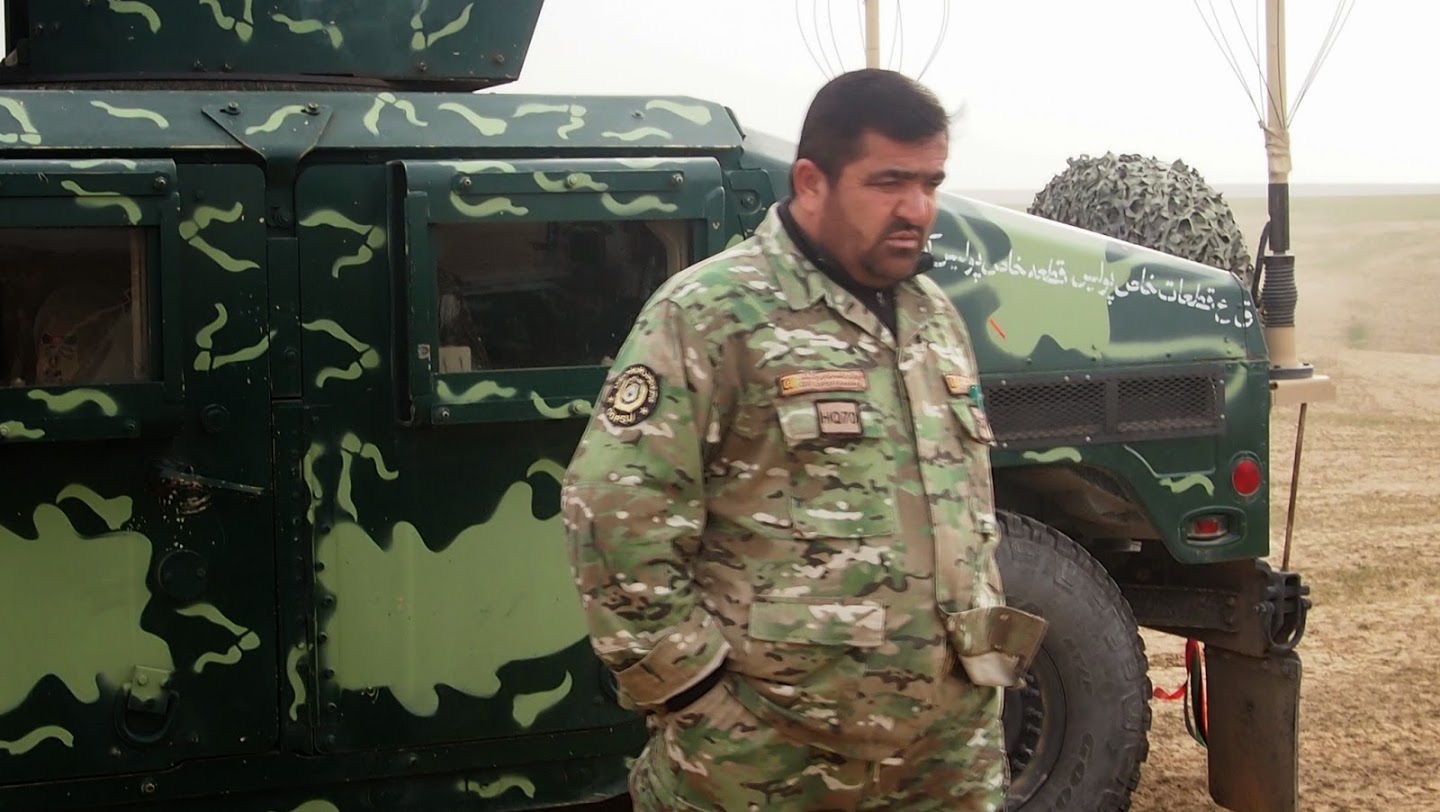
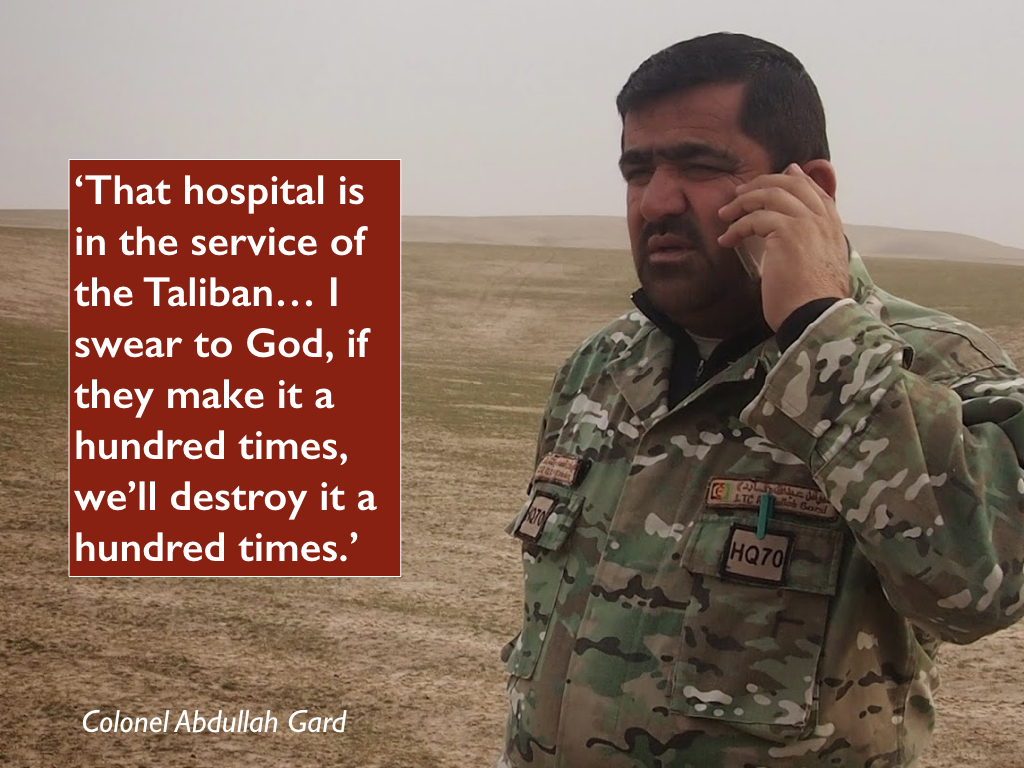
Some members of the Afghan government and security forces there had little respect for MSF’s neutrality and resented its treatment of wounded Taliban. When I visited Kunduz in November, their anger was still surprisingly raw, despite the recent destruction of the hospital. “They give them medicine; they transport and treat their injured,” [Colonel Abdullah] Gard, the commander of the [Ministry of Interior’s] quick-reaction force, told me. “Their existence is a big problem for us…. The people that work there are traitors, all of them.”
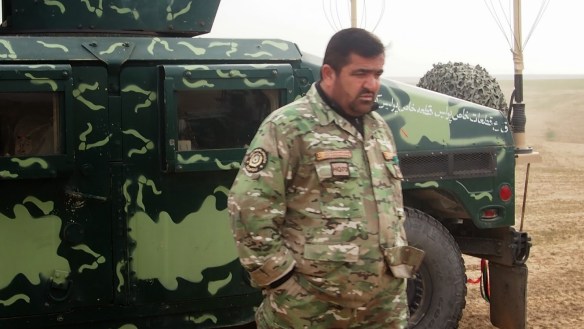
abdullah-gard

Gard (seen above) and one of his colleagues told May Jeong exactly the same:

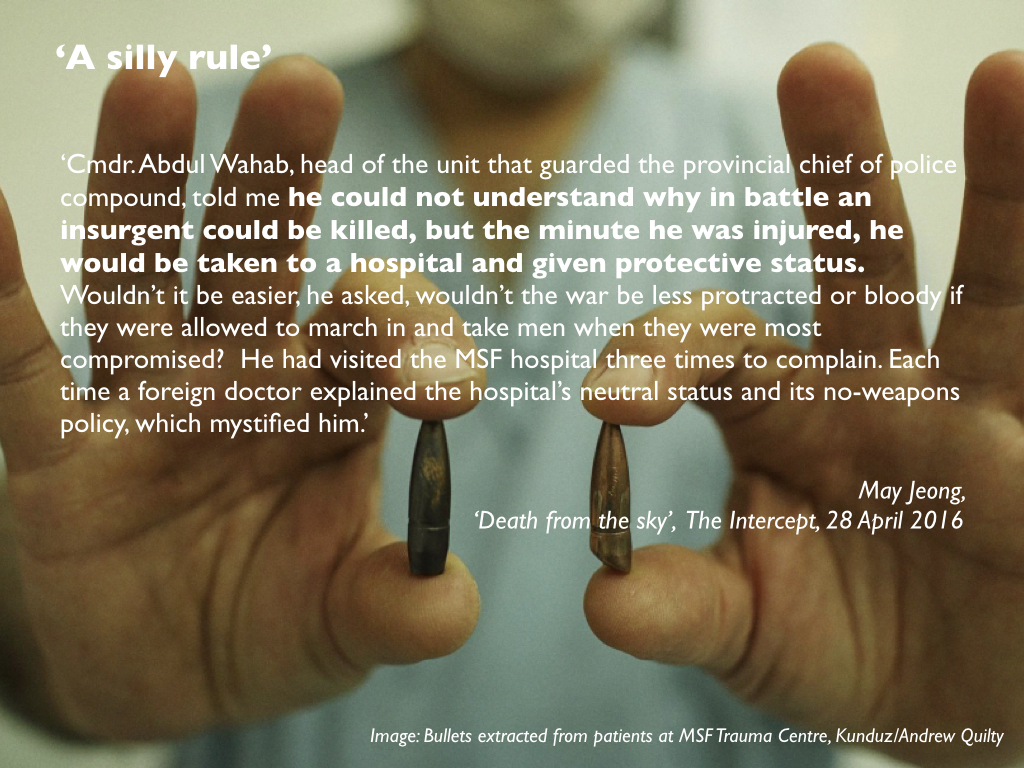
Gard spoke of MSF with the personal hatred reserved for the truly perfidious. He accused the group of “patching up fighters and sending them back out,” a line I heard repeatedly. Cmdr. Abdul Wahab, head of the unit that guarded the provincial chief of police compound, told me he could not understand why in battle an insurgent could be killed, but the minute he was injured, he would be taken to a hospital and given protective status. Wouldn’t it be easier, he asked, wouldn’t the war be less protracted or bloody if they were allowed to march in and take men when they were most compromised? He had visited the MSF hospital three times to complain. Each time a foreign doctor explained the hospital’s neutral status and its no-weapons policy, which mystified him.

In short, it seems that some (perhaps many) in the Afghan security forces – particularly after the humiliation of being forced out of Kunduz – believed that the Taliban were legitimate targets wherever they were and that the fight against them was being hamstrung by what one officer described to Jeong as a ‘silly rule’.

kunduz-a-silly-rule-001

This becomes material because, as I showed previously, the intended target for the air strike was a National Directorate of Security compound whose co-ordinates had been passed to Major Michael Hutchinson, the Ground Force Commander, by Afghan Special Security Forces (who, like him, were unfamiliar with the city): they had identified the NDS compound as a Taliban command and control node, and planned to clear it on their return from the airfield following a casualty evacuation.  The AC-130 was supposed to provide Close Air Support, but a series of technical difficulties compromised the accuracy of its sensors and several hours after the Afghan Special Security Forces had left in an armoured convoy with their three casualties the aircrew were still unsure of the location of the target and so requested a verbal description of the NDS compound.  This was provided by Afghan forces still inside the Provincial Chief of Police compound: their description matched the MSF Trauma Centre much more closely than the NDS compound, and the aircrew fixed on this as their target.
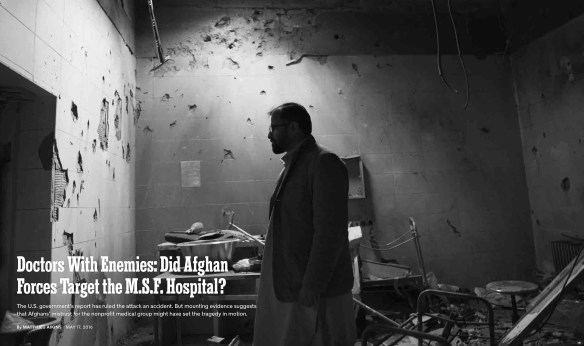
doctors-with-enemies-nyt

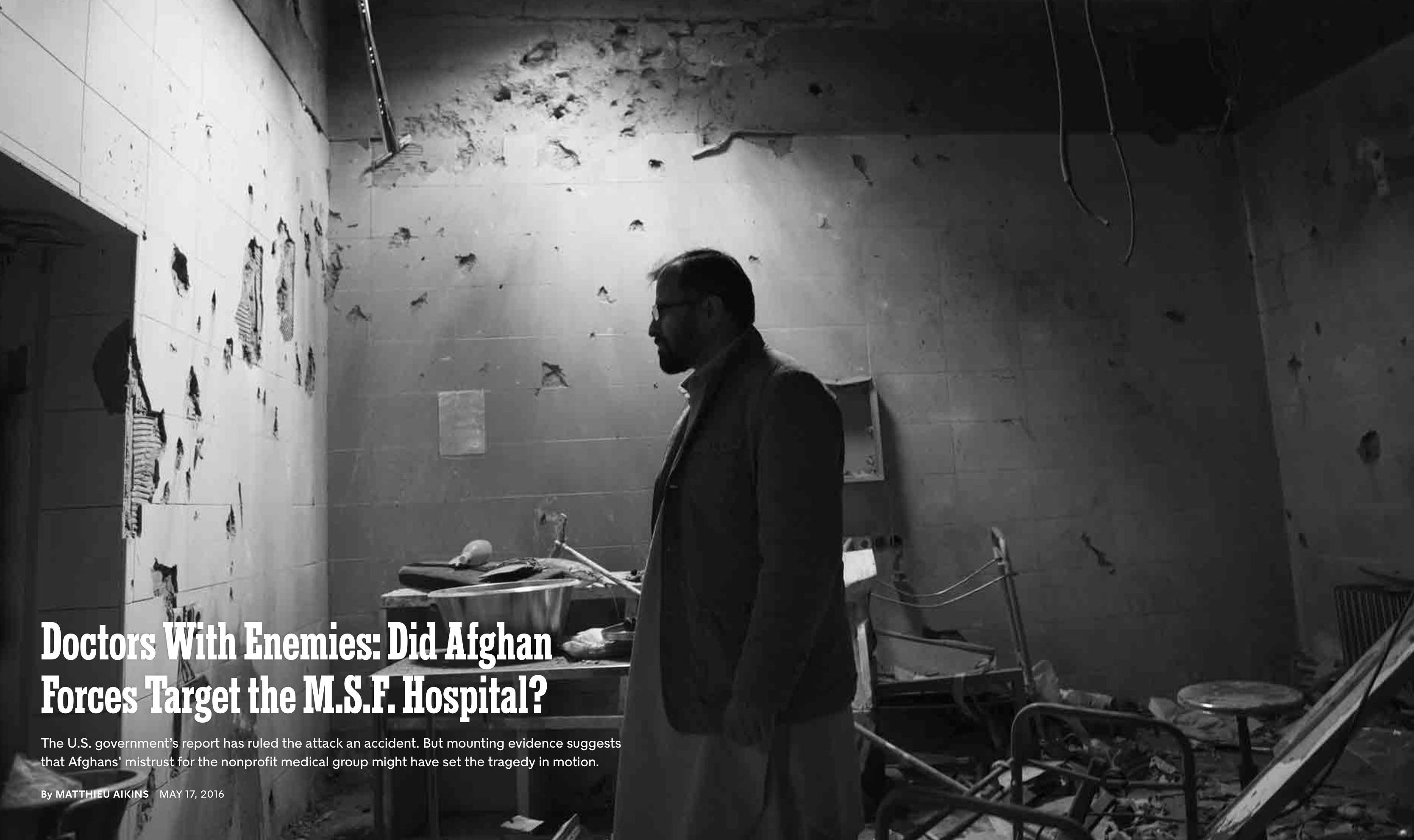
It’s impossible to know whether this was a mistake or misdirection, and the report fails to identify who provided the description.  Hutchinson was shown various photographs but explained that ‘it was dark when everything happened’; he couldn’t remember the name of the Afghan liaison officer and – the redactions make his responses difficult to follow at this point – he wasn’t always sure who he was talking to since he had to rely on interpreters (387-8).  But the description obviously had to come from someone who knew the city (which would include Gard and Wahab), and both Aikins and Jeong clearly believe that misdirection is not only possible but also extremely likely.  ‘That hospital is in the service of the Taliban,’ Gard told Aikins. ‘I swear to God, if they make it a hundred times, we’ll destroy it a hundred times.’  Hence the headline for Aikins’s searching New York Times report (above): ‘Doctors with enemies: did Afghan forces target the MSF hospital?‘ I should note that David Glazier dismisses all this as ‘highly speculative’ and insists that ‘it simply defies logic’.  While the claim is speculative it surely doesn’t defy logic, and Aikins and Jeong make at least a plausible if not definitive case).  They are clearly not alone in their suspicions: MSF’s very first question in response to the investigation report was this:

‘What was the physical description of the intended target provided by the Afghan forces and how did it match the description of the MSF hospital?’

gard-that-hospital-is-in-the-service-of-the-taliban-001

The studied refusal to recognise medical neutrality – if that is what this was – emerges from a long history of friction between MSF and the government in Kabul, and it threads its way out into a wider history and geography of deliberate attacks against medical facilities elsewhere in Afghanistan, and – among other recent places – in Gaza (by the Israeli military), in Syria (primarily by the Russian and Syrian Arab Air Forces) and in Yemen (primarily by the Saudi-led coalition which is advised by the United Kingdom on targeting).  In February 2014 Thanassis Cambanis was already writing that ‘medical care is now a tool of war’, and in a report issued in May 2016 the World Health Organisation counted almost 600 attacks against medical facilities, doctors and nurses in 19 countries since then.  These shocking statistics, which are inevitably imperfect, include attacks by non-state actors, among them the Taliban and Islamic State, but I have emphasised the complicity of state actors – including leading members of the UN Security Council – because it is their actions that determine the course of international humanitarian law and because they are ultimately responsible for what MSF’s president Joanne Liu saw in the wake of the attack on its Trauma Centre in Kunduz as  ‘not just an attack on our hospital’ but ‘an attack on the Geneva Conventions.’

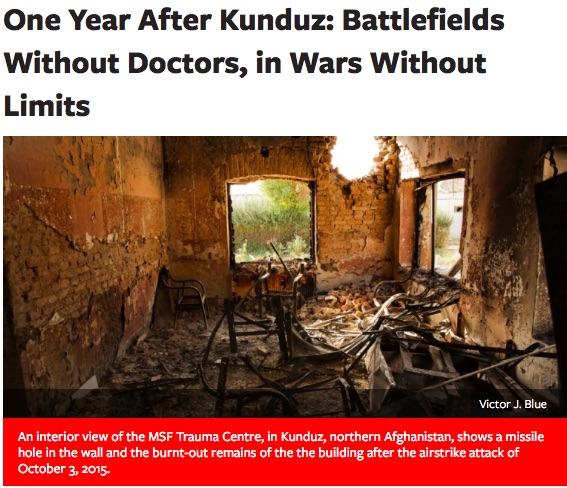
msf-kunduz-battlefields-without-doctors

In a letter to the UN Security Council issued on 22 September 2016, after a direct and deliberate attack on a humanitarian convoy delivering aid to eastern Aleppo, more than 100 humanitarian organisations noted that:

‘Each [head of state] that accepts a lack of accountability for perpetrators and facilitators of war crimes colludes in the ongoing dissolution of international humanitarian law.’

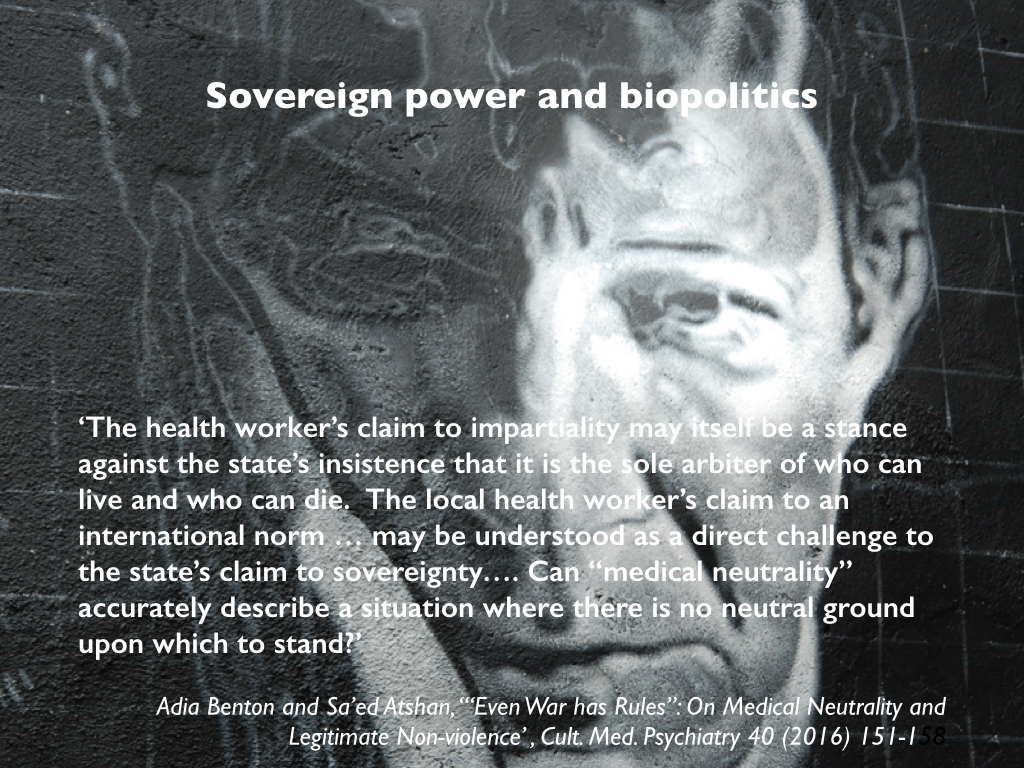
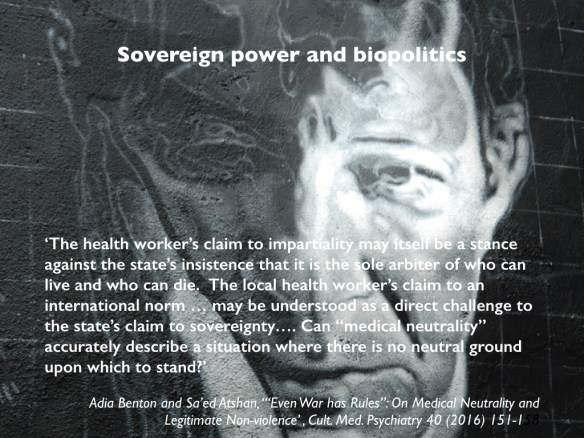
That dissolution can be seen as a defiant reassertion of the absolutism of sovereign power, because ‘medical neutrality’ is not a neutral claim.  Adia Benton and Sa’ed Ashtan persuasively argue that:

The health worker’s claim to impartiality may itself be a stance against the state’s insistence that it is the sole arbiter of who can live and who can die. The local health worker’s claim to an international norm … may be understood as a direct challenge to the state’s claim to sovereignty…. Can ‘‘medical neutrality’’ accurately describe a situation where there is no neutral ground upon which to stand? (‘‘‘Even War has Rules’’: On Medical Neutrality and Legitimate Non-violence’ , Cult. Med. Psychiatry 40 (2016) 151-158).

As the spectral presence of Giorgio Agamben in my slide below implies, this has the liveliest implications for how we are to understand the space of exception and the refusal of its victims to be reduced to the passivity of ‘bare life’.
medical-neutrality-sovereign-power-and-biopolitics-001

As I will show in the next post in this series, Syria is the most egregious contemporary case.  If some members of the Afghan security forces wilfully misled the Americans into targeting the MSF Trauma Centre in Kunduz, then it seems clear that they objected to the protection extended by IHL to wounded Taliban combatants and those who treat them (though many of those killed in the attack were civilians, despite Alan Dershowitz‘s tawdry attempt to suggest that MSF ‘favoured Taliban fighters over civilian patients’: see Kevin Jon Heller’s magisterial response here).  But in Syria not only has the provision of medical aid to those in rebel-held areas been explicitly criminalised by the state’s new Counterterrorism Law which came into effect in July 2012 – the space of exception is far from being a ‘legal “black hole” – but the ban extends to those providing medical aid to sick or wounded civilians.  And make no mistake: there have been no mistakes.  The murder of doctors and nurses and the bombing of hospitals and clinics in Syria has been deliberate and systematic.  The exception to the exception contracts to its vanishing point.

To be continued.
 

Liberties and Republicans

On this terrible morning, with Donald Trump elected as President-designate of the United States, what to say?  Wrestling with sleeplessness last night, I started to think about the Statue of Liberty (bear with me).  I wrote about its multiple valences more than twenty years ago in Geographical Imaginations:  

Frédéric-Auguste Bartholdi‘s original proposal was for a lighthouse in the likeness of a woman to be raised at the Mediterranean entrance to the Suez Canal as a symbol of the nineteenth-century expansion of Europe.  Its title, Egypt carrying light to Asia, was intended to assert the historical mission of Europe – with a colonized Egypt acting as its handmaiden – to bring “enlightenment” to the Orient.  Bartholdi spent two years making plans and models but in 1869 – the year the Canal opened – the Khedive Ismail withdrew his support and it was not until 1871 that Bartholdi was able to reactivate his scheme.

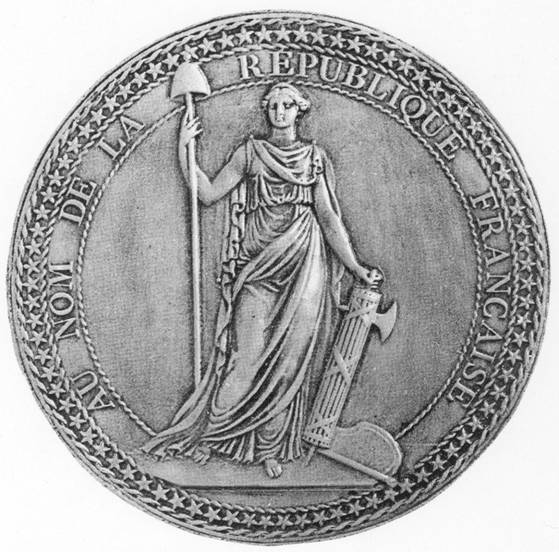
By then, in the wake of the Pais Commune, the project had been transformed and relocated.  One of his patrons, Édouard de Laboulaye, suggested that a monument be raised on the shores of the New World to symbolize Liberty Enlightening the World.  The representation of Liberty as a woman derived from classical antiquity, but this ‘whole allegorical apparatus’, as Maurice Agulhon called it, had been codified in France in the late seventeenth century.  When the Revolution occurred, Liberty already had an established iconographical status and a decree of 1792 adopted her as the seal of the republic: ‘the image of France in the guise of a woman, dressed in the style of Antiquity, standing upright, her right hand holding a pike surrounded by a Phyrgian cap or cap of liberty.’
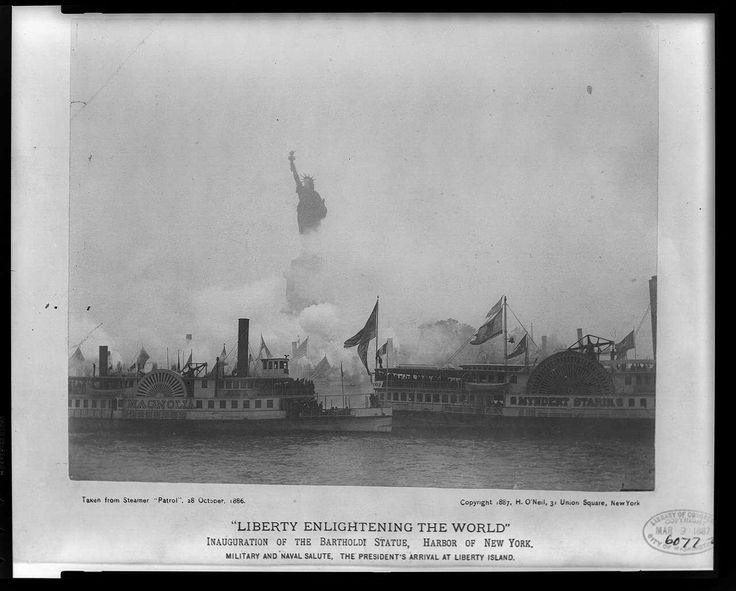
image064

By the opening decades of the nineteenth century the use of ‘Marianne’ as a symbol of both Liberty and the Republic had become a commonplace.  This was true in the most literal of senses.  “Where was this woman to be seen?” ask Agulhon.  The answer: “all over the place”.  Paris had two statues of her, in the Place de la Concorde and the Place Vendôme, and many other towns had their own effigies.  In 1848 she appeared on the second seal of the Republic, wearing a diadem of corn with seven rays of the sun encircling her head in a spiked halo.

sceau_de_la_republique

The resemblance to the head of the American statue is striking, but a sunburst was also the Bartholdi family emblem and, still more significantly, it was intimately associated with the reign of Louis XIV, the ‘Sun King’.  To adorn Liberty with a sunburst was thus in a sense ‘to “crown” her’, Kaja Silverman argues, ‘and thereby align her with a tradition of stable and conservative government.’

That Liberty should be represented by a woman was clearly not without irony.  In practice, Joan Landes remarks,

the assault on paternalism was limited by force … and by the redirection of women’ public and sentimental existence into a new allegory of republican, virtuous family life.  Liberty herself is a profoundly ironic symbol, a public representation of a polity that sanctioned a limited domestic role for women … If Liberty represented woman, surely it was as an abstract emblem of male power and authority.

The power of patriarchy was reasserted still more forcibly after the fall of the Commune with the triumph of the bourgeois republic and its cult of respectability.  As Roger Magraw observed, ‘the official Mariannes who adorned town halls by the 1880s wore a halo of flowers and the motto Concorde, moving towards that anodyne statue which France sent to her fellow capitalist republic as the State of Liberty.’  Anodyne indeed: Silverman argues that Bartholdi virtually erased the corporeality of the body.  Thus he ‘completely buries the female form beneath hear classic drapery’ and ‘any thought that a body might nevertheless lurk beneath those folds is abruptly put to flight by the possibility of entering the statue and climbing up inside it.’  She is well aware of the sexual connotations of such a reading, of course, and moves quickly to foreclose them.  ‘Liberty is precisely an extension of the desire to “return” to the inside of the fantastic mother’s body,’ she proposes, ‘without having to confront her sexuality in any way.’  Viewed in this light, therefore, Liberty is rendered non-threatening and even ‘safe’.

It was thus from within a many-layered iconographical tradition that Laboulaye’s proposal was made.  He was Professor of Comparative Law at the Collège de France and although he never crossed the Atlantic he was regarded as France’s greatest expert on the United States.  Like many other republicans at the time, he regarded the United States as a model of the ideal society and he and his companions were convinced that a Statue of Liberty, given by France to America, would symbolize their most cherished principles.  For this reason Bartholdi was urged to ensure that the statue should ‘not be liberty in a red cap, striding across corpses with her pike at the port’ – a reference to Delacroix’s famous Liberty guiding the people to the barricades (below) –  but ‘the American liberty whose torch is held high not to inflame but to enlighten.’  Bartholdi agreed.  ‘Revolutionary Liberty cannot evoke American Liberty,’ he declared, ‘which after a hundred years of uninterrupted existence, should not appear as an intrepid young girl but as a woman of mature years, calm, advancing with the light but sure step of progress.’

Delacroix Liberty leading the people

For all there enthusiasm of the projects initiators, however, public subscriptions were slow – even Gounod conducting La liberté éclairant le monde at the Paris Opéra brought in a mere 8,000 francs – and in American they were slower still.  Bartholdi made a show of offering the statue to Philadelphia and Boston; other American cities submitted bids until at last prominent subscribers in New York were goaded into action.

In 1875 Bartholdi started work in his Paris atelier:

Statue Of Liberty In Bartholdi Workshop

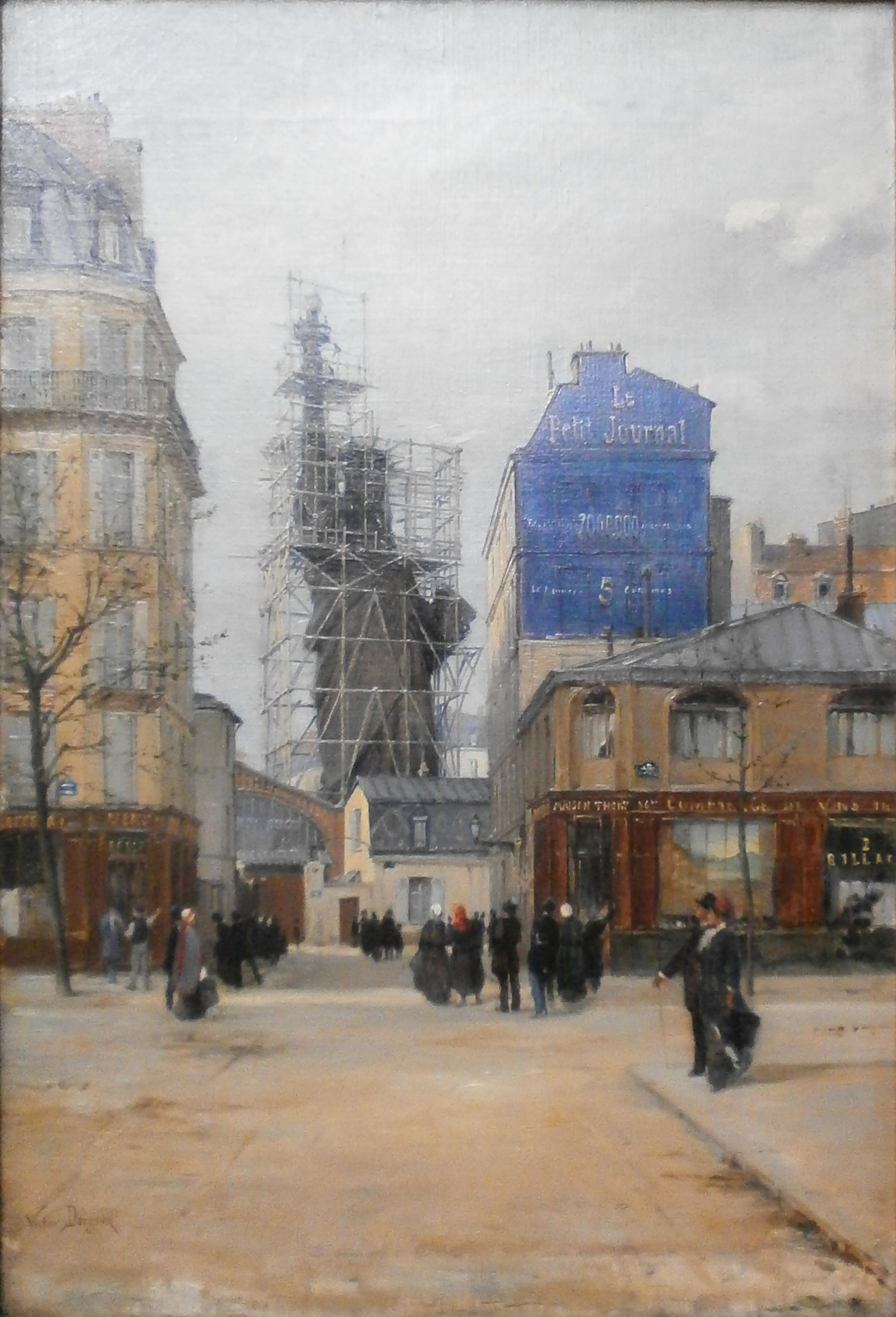
He soon realized the magnitude of the task  and invited Gustave Eiffel to design the wrought-iron bracing needed to support the copper sheets that would form the outer skin of the sculpture.  It took several years to complete the disembodied sections of the statue, but by the spring of 1883 Bartholdi was at last ready to assemble them.  By the end of the year, as Victor Dargaud‘s canvas shows, the statue still surrounded by its scaffolding was looming about the rue de Chazelles.

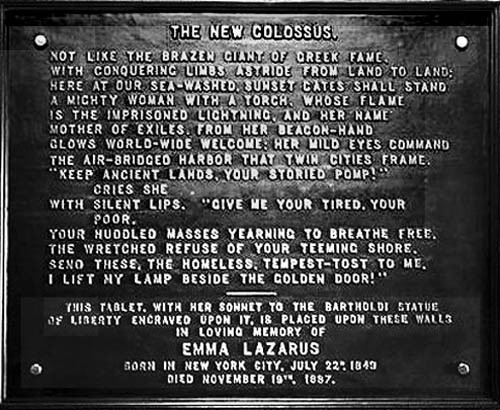
That same year Emma Lazarus published ‘The New Colossus’ to raise money for the statue’s plinth; its famous lines were eventually mounted inside the lower level:

the-new-colossus

The government of France presented the Statue of Liberty to the United States on the Fourth of July 1884, and five months later it was dismantled, shipped across the Atlantic and reassembled on Bedloe’s Island in New York harbour.

2-statue-of-liberty-1886-granger

Astonishingly when the inauguration ceremony was held in October 1886, all women were barred except for the wives of the French delegation (led by Bartholdi).  American suffragists held their own simultaneous ceremony, and issued this pointed declaration: ‘In erecting a Statue of Liberty embodied as a woman in a land where no woman has political liberty, men have shown a delightful inconsistency which excites the wonder and admiration of the opposite sex.’

378ea56a2613fd744d571e5d9f7fac58

This is only a partial narrative but its echoes this morning are only too sonorous – not least the casual Orientalism, the overpowering whiteness, the complicated sexism and (in blessed counterpoint) Lazarus’s defiant acceptance of the exile and the refugee.

And so, for all the baggage carried by Liberty, if I could draw her now I would show an endless line of refugees; at the very back, a woman in a long flowing dress, her crown askew, using her battered torch as a crutch as she limps along in the dust, hoping against hope to be allowed to cross the border; and on an island in New York Harbor a new, glittering faux-gold statue of a man raising his searchlight in his tiny hands, and on the base Dante‘s immortal instruction: ‘Abandon hope, all ye who enter here….’

Yet today of all days we surely cannot afford to abandon hope.  Never has it been more urgent for scholars to reach out far beyond the academy, to create and engage new publics, and to help revitalize a critical and participatory political and intellectual culture – one in which knowledge trumps ignorance, compassion hostility and solidarity selfishness.

Seeing machines


graham-drone-cover

The Transnational Institute has published a glossy version of a chapter from Steve Graham‘s Vertical – called Drone: Robot Imperium, you can download it here (open access).  Not sure about either of the terms in the subtitle, but it’s a good read and richly illustrated.

Steve includes a discussion of the use of drones to patrol the US-Mexico border, and Josh Begley has published a suggestive account of the role of drones but also other ‘seeing machines’ in visualizing the border.

One way the border is performed — particularly the southern border of the United States — can be understood through the lens of data collection. In the border region, along the Rio Grande and westward through the desert Southwest, Customs and Border Protection (CBP) deploys radar blimps, drones, fixed-wing aircraft, helicopters, seismic sensors, ground radar, face recognition software, license-plate readers, and high-definition infrared video cameras. Increasingly, they all feed data back into something called “The Big Pipe.”

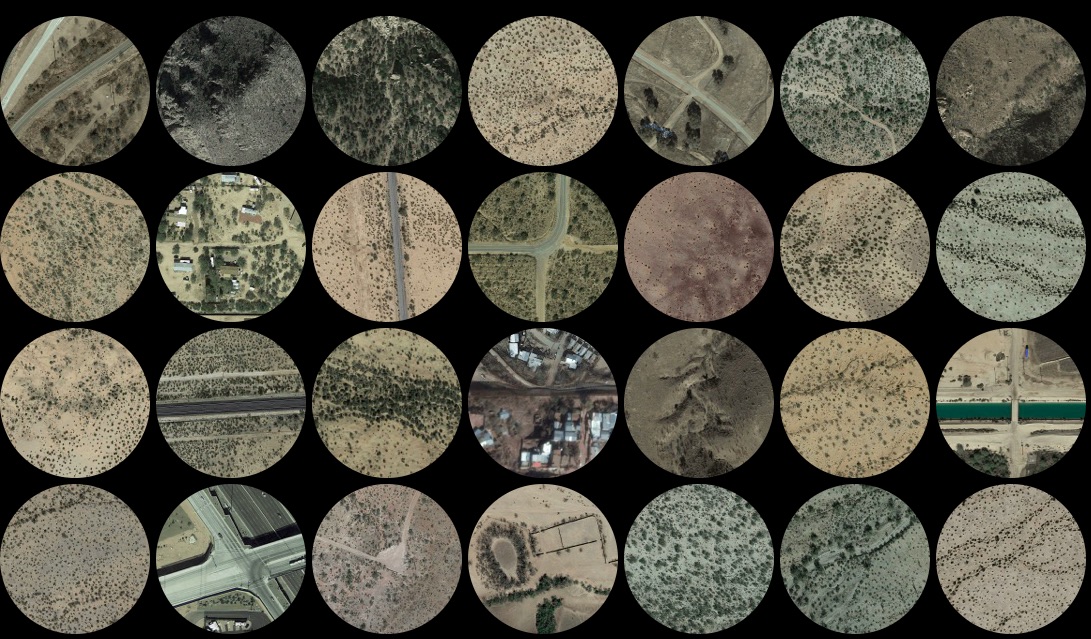
Josh downloaded 20,000 satellite images of the border, stitched them together, and then worked with Laura Poitras and her team at Field of Vision to produce a short film – Best of Luck with the Wall – that traverses the entire length of the border (1, 954 miles) in six minutes:

The southern border is a space that has been almost entirely reduced to metaphor. It is not even a geography. Part of my intention with this film is to insist on that geography.

By focusing on the physical landscape, I hope viewers might gain a sense of the enormity of it all, and perhaps imagine what it would mean to be a political subject of that terrain.

begley-fatal-migrations-1

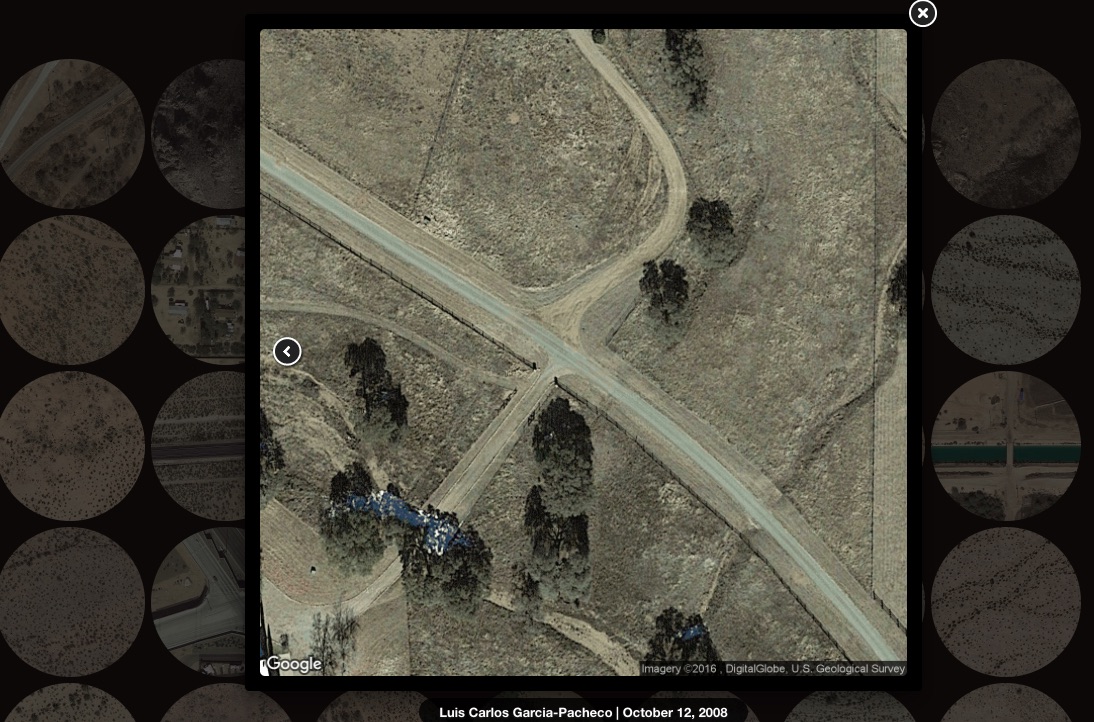
If you too wonder about that last sentence and its latent bio-physicality – and there is of course a rich stream of work on the bodies that seek to cross that border – then you might visit another of Josh’s projects, Fatal Migrations, 2011-2016 (see above and below).

begley-fatal-migrations-2

There’s an interview with Josh that, among other things, links these projects with his previous work.

I have a couple of projects that are smartphone centered. One of them is about mapping the geography of places around the world where the CIA carries out drone strikes—mostly in Pakistan, Yemen, and Somalia. Another was about looking at the geography of incarceration in the United States—there are more than 5,000 prisons—and trying to map all of them and see them through satellites. I currently have an app that is looking at the geography of police violence in the United States. Most of these apps are about creating a relationship between data and the body, where you can receive a notification every time something unsettling happens. What does that mean for the rest of your day? How do you live with that data—data about people? In some cases the work grows out of these questions, but in other cases the work really is about landscape….

There’s just so much you can never know from looking at satellite imagery. By definition it flattens and distorts things. A lot of folks who fly drones, for instance, think they know a space just from looking at it from above. I firmly reject that idea. The bird’s eye view is never what it means to be on the ground somewhere, or what it means to have meaningful relationships with people on the ground. I feel like I can understand the landscape from 30,000 feet, but it is not the same as spending time in a space.

Anjali Nath has also provided a new commentary on one of Josh’s earlier projects, Metadata, that he cites in that interview – ‘Touched from below: on drones, screens and navigation’, Visual Anthropology 29 (3) (2016) 315-30.

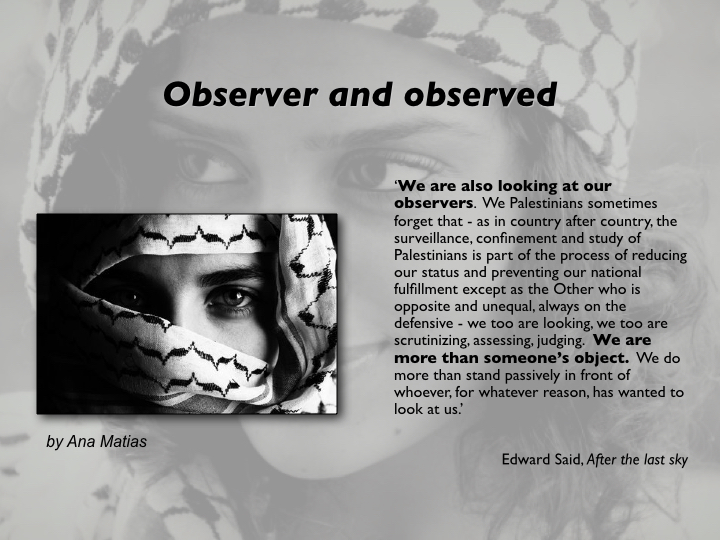
It’s part of a special issue on ‘Visual Revolutions in the Middle East’, and as I explore the visual interventions I’ve included in this post I find myself once again thinking of a vital remark by Edward Said:

we-are-also-looking-at-our-observers-001

That’s part of the message behind the #NotaBugSplat image on the cover of Steve’s essay: but what might Said’s remark mean more generally today, faced with the proliferation of these seeing machines?


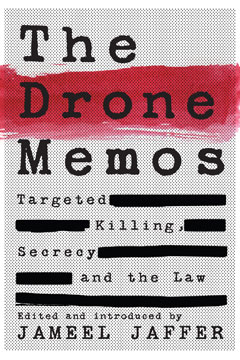
The Drone Memos

jaffer-drone-memos

From the New Press on 15 November, Jameel Jaffers The Drone Memos: targeted killing, secrecy and the law:

The Drone Memos collects for the first time the legal and policy documents underlying the U.S. government’s deeply controversial practice of “targeted killing”—the extrajudicial killing of suspected terrorists and militants, typically using remotely piloted aircraft or “drones.” The documents—including the Presidential Policy Guidance that provides the framework for drone strikes today, Justice Department white papers addressing the assassination of an American citizen, and a highly classified legal memo that was published only after a landmark legal battle involving the ACLU, the New York Times, and the CIA—together constitute a remarkable effort to legitimize a practice that most human rights experts consider to be unlawful and that the United States has historically condemned.

In a lucid and provocative introduction, Jameel Jaffer, who led the ACLU legal team that secured the release of many of the documents, evaluates the “drone memos” in light of domestic and international law. He connects the documents’ legal abstractions to the real-world violence they allow, and makes the case that we are trading core principles of democracy and human rights for the illusion of security.

From Jameel’s introduction:

This book is possible because the secrecy surrounding American drone strikes has begun, at the margins, to erode. The documents collected here shed light on how a president committed to ending the abuses associated with the Bush administration’s “war on terror” came to dramatically expand one of the practices most identified with that war, and they supply a partial view of the legal and policy framework that underlies that practice. But while many of the documents collected here were meant to be defenses of the drone campaign, ultimately they complicate, at the very least, the government’s oft-repeated argument that the campaign is lawful.

To be sure, even the existence of these documents is an indication of the extent to which the drone campaign is saturated with the language of law. Perhaps no administration before this one has tried so assiduously to justify its resort to the weapons of war. But the rules that purportedly limit the government’s actions are imprecise and elastic; they are cherry picked from different legal regimes; the government regards some of them to be discretionary rather than binding; and even the rules the government concedes to be binding cannot, in the government’s view, be enforced in any court. If this is law, it is law without limits—law without constraint.

Ryan Goodman provides ’10 Questions to Ask Yourself When Reading Jameel Jaffer’s “The Drone Memos”’ here.  For me, the two most crucial on the list – which anyone writing about drones and limiting the discussion to targeted killing needs to ask themselves (and rarely does) – are these:

Despite the title of the book, how much of the discussion and issues raised are really about drones per se? How much applies to cruise missiles, night raids, and other forms of direct lethal action? What analytic or rhetorical work is being done by focusing on “drones”?

Despite the title of the book, how much of the discussion and issues raised are limited to pre-planned targeted killing? What about dynamic strikes when a moment of opportunity arises, or so-called signature strikes? What analytic or rhetorical work is being done by focusing on “targeted killing”?

UPDATE:  For an excerpt from Jameel’s introduction, see this article, ‘How the US justifies drone strikes: targeted killing, secrecy and the law‘, from The Guardian:

As the 2016 presidential primaries were getting under way, sporadic and sketchy reports of strikes in remote regions of the world provided a kind of background noise – a drone in a different sense of the word – to which Americans had become inured.

Senior officials in the administration of President Barack Obama variously described drone strikes as “precise,” “closely supervised,” “effective,” “indispensable,” and even the “only game in town” – but what they emphasized most of all is that the drone strikes they authorized were lawful.

In this context, though, “lawful” had a specialized meaning. Except at the highest level of abstraction, the law of the drone campaign had not been enacted by Congress or published in the US Code. No federal agency had issued regulations relating to drone strikes, and no federal court had adjudicated their legality. Obama administration officials insisted that drone strikes were lawful, but the “law” they invoked was their own. It was written by executive branch lawyers behind closed doors, withheld from the public and even from Congress, and shielded from judicial review…

Now the lethal bureaucracy whose growth Obama personally oversaw will be turned over to a new administration. The powers Obama claimed will be wielded by another president. Perhaps as significant is the jarring fact that the practice of targeted killing – assassination, as it would once have been called, without a second thought – no longer seems remarkable, and the fact that the United States now boasts a legal and bureaucratic infrastructure to sustain this practice. Eight years ago the targeted-killing campaign required a legal and bureaucratic infrastructure, but now that infrastructure will demand a targeted-killing campaign. The question the next president will ask is not whether the powers Obama claimed should be exploited, but where, and against whom.

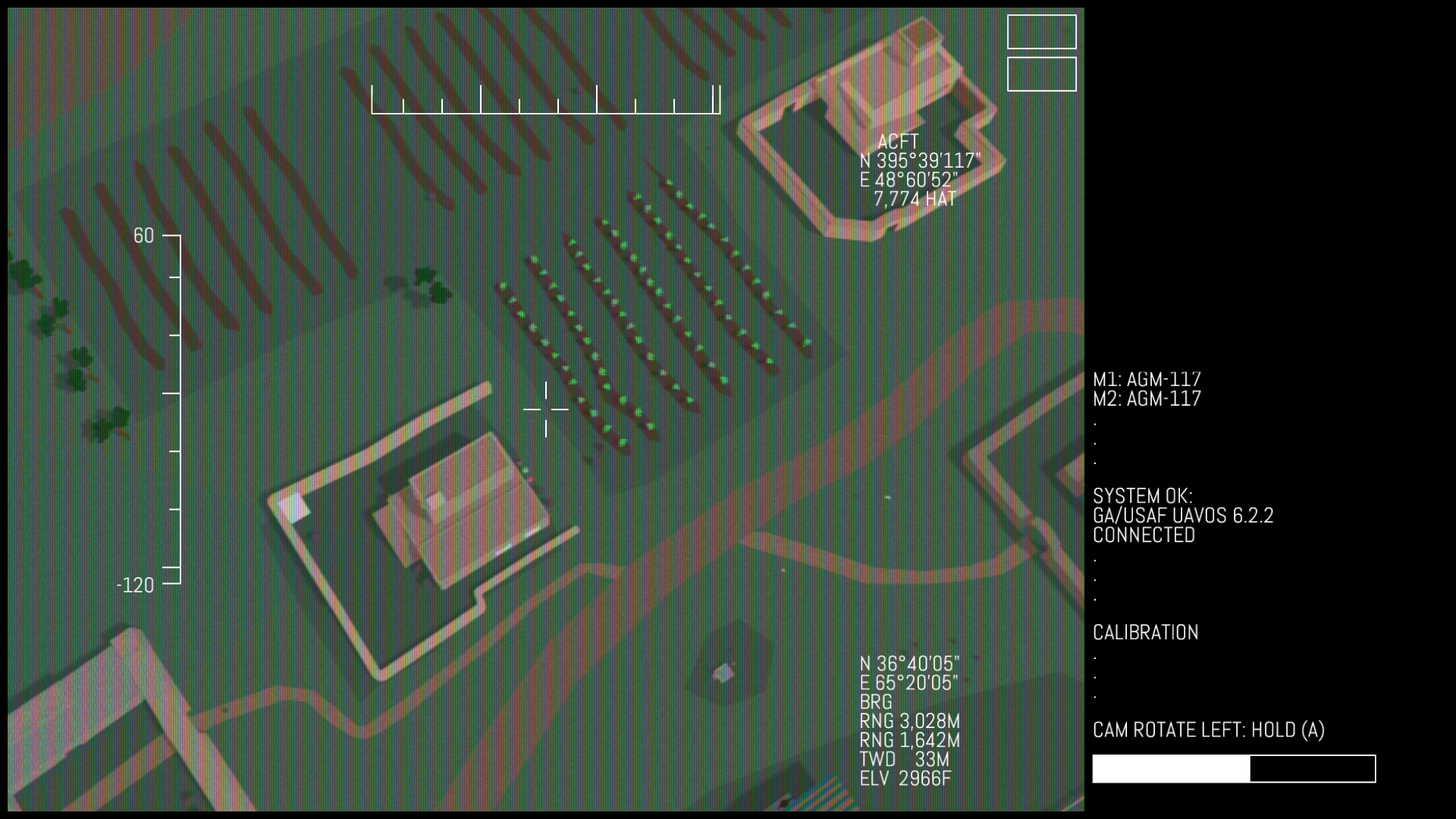
POV in the killbox

Killbox Player 1

An update on Joe DeLappe‘s Killbox project (my original post, with links to more info on the concept of a killbox, is here).

Over at Quartz, Ananya Bhattacharya provides more details about the latest iteration of the simulation:

Killbox, an online two-player game named after the military term for an area targeted for destruction, serves as a critique of drone warfare. One player is a civilian exploring her surroundings with few instructions. The second player is guided with tasks, leading up to the administration of a drone strike. Even if the drone pilot player refuses to deploy the weapons, autopilot kicks in and carries out the attack. When it hits, the drone pilot can see the extent of the destruction on the ground but hear nothing. Meanwhile, the child on the ground is barraged by sound. And just in case the first strike doesn’t demolish enough, a second strike is administered—the classic “double-tap” attack to stop rescuers from getting help to the injured and retrieving the deceased.

The game is modelled – in some measure, at least – on the drone strike that killed Mamana Bibi as she gathered okra from the fields around her home in North Waziristan:

The characters in the game aren’t realistic though—they look like odd-shaped blobs. At first, non-human avatars seem less effective, but there’s meaning behind the simplistic design: “We were looking at the map where the drone strike killed people and these maps identified victims with little dots,” said DeLappe. “Almost like map pins, like they’ve been symbolically degraded in some way.”

Killbox player 2

I opened my essay on drone strikes in the Federally Administered Tribal Areas – and on the constitution of the FATA as a space of exception (see “Dirty Dancing” under the DOWNLOADS tab) – with a comparison between this strike, the murder of an innocent grandmother as she worked in the fields with her grandchildren,  and the targeted killing of Baitullah Mehsud, the leader of the Pakistan Taliban, in South Waziristan in 2009 (see also my posts here and here).

In Drone: remote control warfare Hugh Gusterson opens with exactly the same comparison but to a different effect – and one that resonates with Killbox.  Drawing on Jane Mayer‘s account of the assassination of Mehsud, based on testimony from those who watched the video feed from the Predator, he writes:

A technology that is almost magical gives its owners, who are looking on the scene from high in the sky, a godlike power over life and death. The observation of the scene is simultaneously intimate and remote. It is also deeply asymmetrical: Mehsud, unaware of his exposure, is watched by faraway drone operators who can see him as if close up, reclining on the roof of his house on a hot evening as his wife attends to his medical needs. They get to frame the picture while he does not even realize he is in it. Without warning, he is killed as if by a god’s thunderbolt from the sky. Seen from Virginia, the drone strike is quick, clean, and bloodless. Mehsud’s death is instant. Nor, described unambiguously as a terrorist, does he seem undeserving of death. Twelve people die altogether, but the narrative marks only Mehsud’s death as significant. The other deaths are almost outside the frame. And in a way that amplifies the strange mix of distance and intimacy, the scene is mediated entirely through a single sense—vision. The attack has no sound, smell, taste, or texture. And we are invited to experience it through a narrative of mastery and control—of the cool, righteous exercise of overwhelming power.

gusterson-drone-cover

Drawing on testimony from Mamana Bibi’s family before a virtually empty Congressional hearing, Hugh writes:

This account is from the point of view of the victims, not the executioners. We share the experience of those who do not even realize that they are in the crosshairs until they are attacked. The account emphasizes the sudden incomprehensible eruption of violent force, literally out of the blue, in a warm scene of familial togetherness on an important holy day. We are led to experience the drone strike through multiple senses, of which sight may be the least salient: we are told about the blackness of the smoke, the sound of the screaming, the smell of the explosion, the sensation of the ground trembling, and the pain of shrapnel wounds. Unlike the first account, the narrative does not end shortly after the drone strike but dwells on the aftermath—the physical pain of the survivors, the enduring grief over the loss of the person “that held our family together.” Above all, this account foregrounds what is absent in the view from CIA headquarters—the psychological suffering of those on the ground, especially children, and the sense that the safe predictability of life has been permanently destroyed. It is a narrative of helplessness, terror, and injustice. The drone operators’ perspective was remote and objectifying, but this narrative is so affecting that it made the translator break down in tears.

The special effects created by privileging the visual are explored with skill and sensitivity in Nasser Hussain‘s brilliant essay, ‘The sound of terror: phenomenology of a drone strike‘, here.

[I]n order to widen our vision, I provide a phenomenology of drone strikes, examining both how the world appears through the lens of a drone camera and the experience of the people on the ground. What is it like to watch a drone’s footage, or to wait below for it to strike? What does the drone’s camera capture, and what does it occlude?

…  Although the pilots can hear ground commands, there is no microphone equivalent to the micro-scopic gaze of the drone’s camera. This mute world of dumb figures moving about on a screen has particular consequences for how we experience the image. As Michel Chion notes in The Voice in Cinema, although sound or voice is easily swallowed up by the image, it nonetheless structures the image: “only the creators of a film’s sound—recordist, sound effects person, mixer, director—know that if you alter or remove these sounds, the image is no longer the same.” In the case of the drone strike footage, the lack of synchronic sound renders it a ghostly world in which the figures seem unalive, even before they are killed. The gaze hovers above in silence. The detachment that critics of drone operations worry about comes partially from the silence of the footage.

… If drone operators can see but not hear the world below them, the exact oppositeis true for people on the ground. Because drones are able to hover at or above 30 thousand feet, they are mostly invisible to the people below them. But they can be heard. Many people from the tribal areas of Pakistan (FATA) describe the sound as a low-grade, perpetual buzzing, a signal that a strike could occur at any time. The locals call the drones machar, mosquitos. Because the drone can surveil the area for hours at a time, and because each round of surveillance may or may not result in a strike, the fear and anxiety among civilians is diffuse and chronic.

That sense of optical power is not necessarily one of detachment.  For we surely know how vision, power and desire can be commingled; and today I learned – from Theodor Nadelson‘s Trained to kill: soldiers at war – that (some) US Marines describe setting their sights on a human target as ‘eye fucking’…

War Stories

The video from our War Stories event in Vancouver last month – including Farah Nosh‘s narration of her wonderful photographs, a superb capsule genealogy of PTSD from Ann Jones, my discussion of casualty evacuation over the last hundred years, a drama staged by veterans from Afghanistan and directed by George Belliveau, Contact! Unload!, and a lively Q&A with the audience moderated by Peter Klein is now available here.

war_stories3b-page-001

My lecture, Precarious journeys, has also been carved out for the Peter Wall Institute website here. The idea behind the event was, in large measure, to think through the multiple ways in which modern war is narrated, which is why we had such a rich and diverse portfolio of performers and why I take the turns I do…  Regular readers will probably recognize that the arc of my presentation draws on my current research on evacuation from the Western Front in the First World War, on evacuation from Afghanistan today, and on my admiration for Harry Parker‘s Anatomy of a Soldier (see my ‘Object lessons’ here and the slides available under the DOWNLOADS tab).

More in an interview with Charlie Smith from the Georgia Straight here.