Popeye the Weatherman

On 18 March 1971 most readers of the Washington Post were taken aback by Jack Anderson‘s latest column:

‘Air Force rainmakers, operating secretly in the skies over the Ho Chi Minh Trail, have succeeded in turning the weather against the North Vietnamese.  These strange weather warriors seed the clouds during the monsoons in an attempt to concentrate more rainfall on the trails and wash them out…

‘Their monthly reports, stamped “Top Secret (Specat)” (Special Category), have claimed success in creating man-made cloudbursts over the trail complex.  These assertedly have caused flooding conditions along the trails, making them impassable…

‘The same cloudbursts that have flooded the Ho Chi Minh Trail reportedly also have washed out some Laotian villages.  This is the reason, presumably, that the air force has kept its weather-making triumphs in Indochina so secret.’

Among the Post‘s astonished readers was Dennis Doolin, Deputy Assistant Secretary of Defense for East Asia and Pacific Affairs.  Three years later he testified before a subcommittte of the Senate Committee on Foreign Relations that this was the first he had heard of the operation.  When he asked about it he had been assured that it had not affected agriculture in ‘friendly countries’ in the region, and told not to pursue the matter: information ‘was held in a special channel and access was very, very limited’ as a result of the ‘sensitivity of the operation.’

In fact Secretary for Defense Melvin Laird had categorically denied Anderson’s ‘wild tales’, but rumours continued to circulate and on 3 July 1972 the New York Times splashed Seymour Hersh‘s detailed report over its first two pages: ‘Rainmaking is used as Weapon by U.S.’  Based on ‘an extensive series of interviews’ with officials who declined to be named – sounds familiar, no? – Hersh claimed that the experiments had been initiated by the CIA in 1963 and that by 1967 the Air Force had been drawn in (though ‘the agency was calling all the shots’).  And if that sounds familiar too, then so will the cautious, even critical response of the State Department: its officials protested that the program would be illegal if it caused ‘unusual suffering or disproportionate damage’, and that its wider political and ecological consequences had been left unexamined.  Undeterred, advocates demanded: ‘What’s worse – dropping bombs or rain?’
Although Hersh claimed that the program – which he identified as Operation Popeye – was ‘the first confirmed use of meteorological warfare’ there was a back-story and a history. In 1872 the US Congress authorised the Secretaries of War and the Navy to test the relationship between artillery fire and rain propagation proposed by Edward Powers in his War and the weather (1871). Experiments in rainmaking continued into the twentieth century, but the military interest in weather and war was primarily concerned with the adverse effects of the one on the other: most famously in planning the D-Day invasion of Normandy (see here and here, and Giles Foden‘s novel, Turbulence).

But after the Second World War the prospect of ‘weaponising the weather’ re-enchanted the US military.  James Rodger Fleming (‘The pathological history of weather and climate modification’, Historical studies in the physical and biological sciences 37 (1) (2006) 3-25; see also here, and his Fixing the sky: the checkered history of weather and climate control (Columbia University Press, 2010)) describes how research on cloud seeding at the General Electric Research Laboratory in Schenectady, New York had been transferred to the US military in 1946:

‘Planners generated scenarios that included hindering the enemyʼs military campaigns by causing heavy rains or snows to fall along lines of troop movement and on vital airfields, taming the winds in the service of an all-weather air force, or, on a larger scale, perhaps disrupting (or improving) the agricultural economy of nations and altering the global climate for strategic purposes. Other possibilities included dissipating cloud decks to enable visual bombing attacks on targets, opening airfields closed by low clouds or fog, relieving aircraft icing conditions, or using controlled precipitation as a delivery system for chemical, biological, or radiological agents. The military regarded cloud seeding as the trigger that could release the violence of the atmosphere against an enemy or tame the winds in the service of an all-weather air force.’
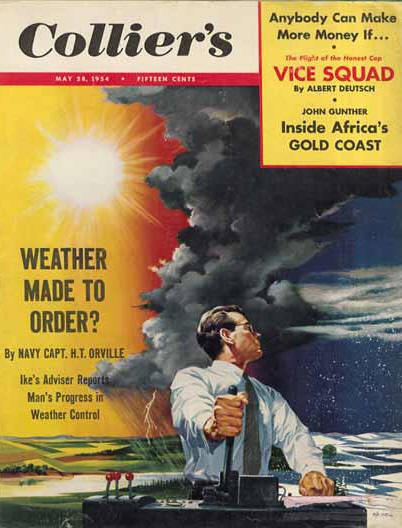
In May 1954 Howard Orville, who had been the US Navy’s chief weather officer during the Second World War and was now chairman of President Eisenhower’s newly formed Advisory Committee on Weather Control, went public with the implications of the research in an article in Collier’s:

‘It is even conceivable that we could use weather as a weapon of war, creating storms or dissipating them as the tactical situation demands.  We might deluge an enemy with rain tp hamper a military movement or strike at his food supplies by withholding needed rain from his crops.’

Not surprisingly, results were at best equivocal, but Fleming argues that ‘weather modification took a macro-pathological turn between 1967 and 1972 in the jungles over North and South Vietnam, Laos and Cambodia’.

It was part of what John Prados (The bloody road: the Ho Chi Minh Trail and the Vietnam War, Wiley, 1998) calls the ‘wizard war’ waged by the United States to disrupt the main supply lines running from North Vietnam along the Ho Chi Minh Trail (or Duong Truong Road) through Laos and Cambodia to South Vietnam; other projects included the ‘electronic battlefield’ whose acoustic and seismic sensors detected movement along the trail network and triggered air strikes on target boxes (see ‘Lines of descent’, DOWNLOADS tab).

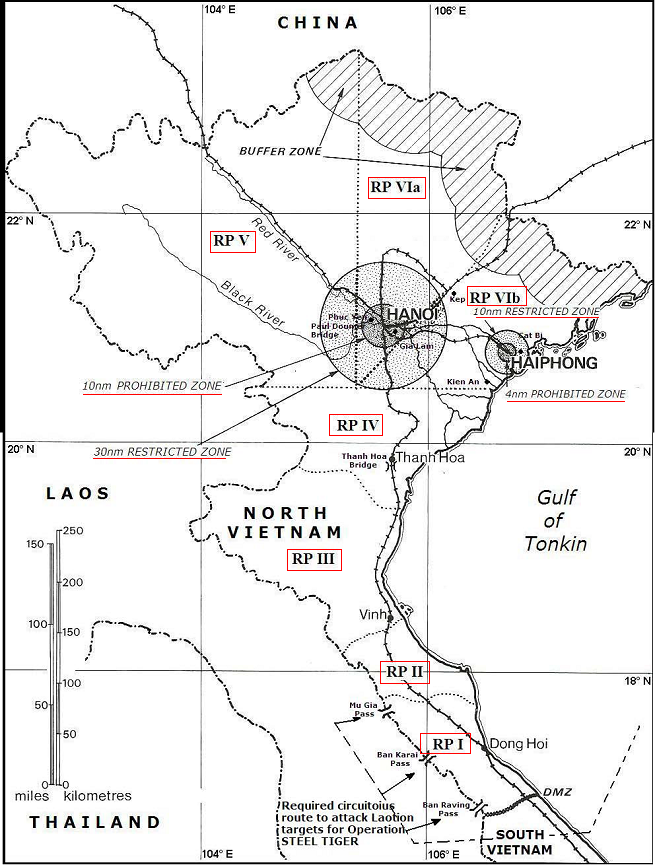
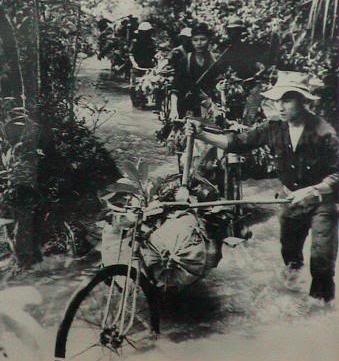
The Trail was in reality a complex, braiding network of roads and tracks, paths and trails, of which perhaps 3,500 kilometres was ‘motorable’.  Although the system was maintained by 40-50,000 engineers, drivers and labourers, who used heavy equipment and gravel and corduroy surfaces to smooth the passage for trucks, most of the roads were dirt and virtually impassable during the south-west monsoon (May-September), so that the supply chain was highly seasonal:
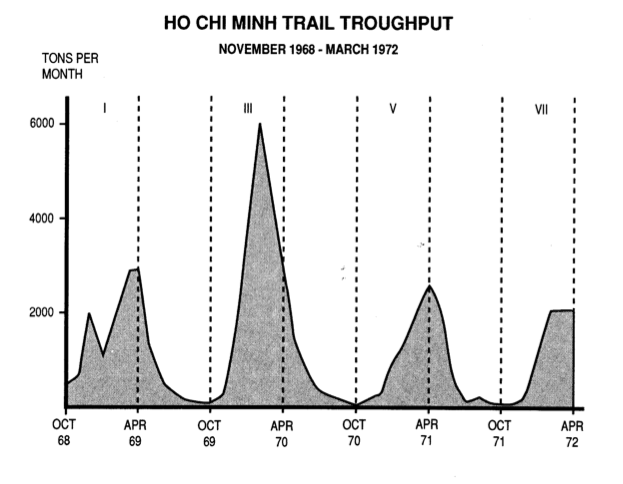
(Image from Herman Gilster, The air war in southeast Asia, Air University Press, 1993)

By 1966 it was becoming clear that efforts to interdict movement along the trail through conventional bombing had been unsuccessful (though this did little to halt the bombing).  Pentagon scientists realised that if they could increase rainfall in selected areas this would not only soften roads, trigger landslides and wash out river crossings but also – the object of the exercise – continue these effects over an extended saturation period.  From transcripts of a classified hearing by a subcommittee of the Senate Committee on Foreign Relations in March 1974 we know that the US Office of Defense Research and Engineering initiated an experimental cloud-seeding program over the Laos panhandle in October 1966.  Intelligence briefings blithely insisted that this would impose little or no additional hardship on the civilian population:

‘The sparsely populated areas over which seeding was to occur had a population very experienced in coping with the seasonal heavy rainfall conditions.  Houses in the area are built on stilts, and about everyone owns a small boat.  The desired effects of rainfall on lines of communication are naturally produced during the height of the monsoon season just by natural rainfall.  The objective was to extend these effects over a longer period.’

56 pilot ‘seedings’ were carried out as Operation Popeye, and the military concluded that this was such a ‘valuable tactical weapon’ that the program should be continued over a wider area. According to Milton Leitenberg, in an unpublished study of Military R&D and Weapons Development prepared for Sweden’s Ministry of Foreign Affairs, in November President Johnson’s Scientific Advisory Committee came down against the military use of rainmaking techniques for both technical reasons (the results were inconclusive) and political ones (using meteorological techniques as weapons might jeopardise international scientific collaboration).

But in December the Joint Chiefs of Staff submitted three plans for future military operations in Indochina to the President, and all three involved extending Operation Popeye to ‘reduce trafficability along infiltration routes’.
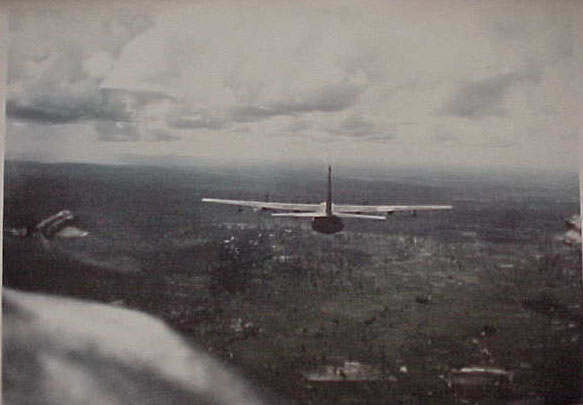
The operational phase (sometimes referred to as ‘Motorpool‘) began in March 1967, using three WC-130 aircraft – one of which is shown above, returning to Udorn Air Force Base in Thailand – and two RF-4C aircraft, all fitted with silver iodide ejectors.  The aircraft displayed the standard Southeast Asia camouflage colours and markings but no unit identifiers, presumably because the operation was top secret.  Although the missions were flown by the USAF’s Air Weather Service, and logged as standard ‘weather reconnaissance flights’, secret reports were forwarded to the Pentagon and the crews all had special clearance.  Here is Howard Kidwell:

 I kept hearing the call sign “Motorpool” used by two of crews in the 14th. When I inquired what they did, I got the usual reply that it was Top Secret and no one knew. I knew the crews and they wouldn’t say zip. This grows on a guy, and I had to find out what was going on. So, dummy me, I volunteered. Well, in a little while I was interviewed and told they would get a higher security clearance for me. In a few short weeks and I was told to come to Motorpool Ops for a briefing. (I found out later that friends and relatives in the states were contacted about me).  The Lt Col in charge said the room had been swept for monitoring devices, etc., and I had one last chance to withdraw my volunteer statement.  I had fleeting thoughts of flying over China, working for the CIA, you name it… but what the heck.  I signed the statement and found out that I was going to make rain!  Geez!  I thought they were kidding!

Leitenberg claims that responsibility for the program was assigned to the office of the Special Assistant for Counterinsurgency and Special Activities, an agency with close operating links to the CIA (in fact U Dorn was also the operating base for the CIA’s Air America that supported covert operations in Indochina). Consistent with this security classification, the governments of Thailand and Laos were not informed about the operations: Doolin testified that the Lao government ‘had given approval for interdiction efforts against the trail system and we considered this to be part of the interdiction effort.’

By June the US Ambassador to Laos was enthusiastically reporting that:

‘Vehicle traffic has ground virtually to a halt… Our road-watch teams report that in many stretches … ground water has already reached saturation point and standing water has covered roads.’

By then, Motorpool had been  joined by another covert operation, Commando Lava, described as an ‘experiment in soil destabilisation’.  C-130 aircraft dropped pallet-loads of chelating compounds (’emulsifiers’) at choke points along the Trail in Laos to magnify the effect of the rains and, again, to extend the saturation period.  The Ambassador was thrilled.  Convinced that this ‘could prove a far more effective road interdictive device (at least in rainy season) than iron bombs and infinitely less costly’,  he cabled Washington:

‘If we could combine these techniques with techniques of Operation Popeye, we might be able to make enemy movement among the cordillera of the Annamite chain almost prohibitive.  In short, chelation may prove better than escalation.  Make mud, not war!’

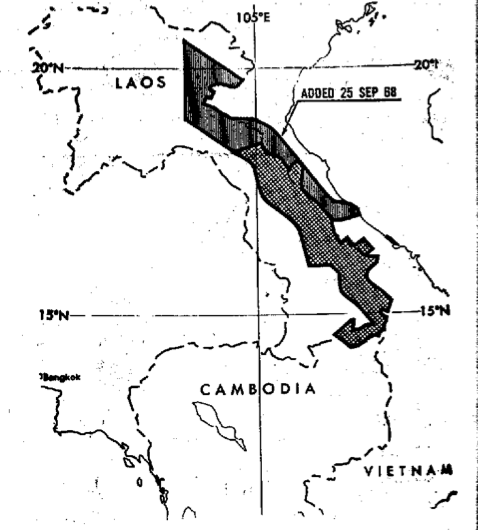
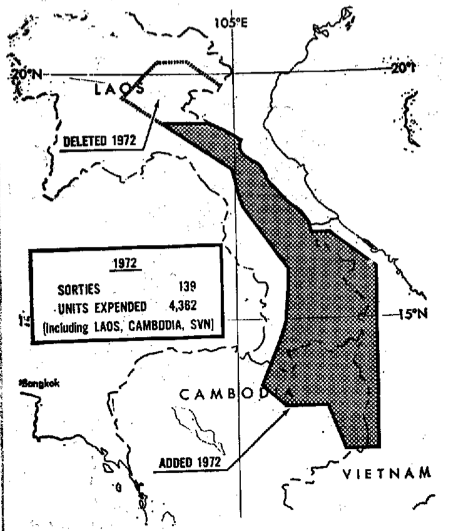
But Commando Lava was a failure, and Westmoreland cancelled it in October.  The results for Popeye/Motorpool were far from conclusive either – the Defense Intelligence Agency later estimated that rainfall may have been increased by up to 30 per cent in limited areas – but the mission was regularly extended.  Its coverage was constantly adjusted, and all seeding above North Vietnam was ended on 1 November 1968 when Johnson called a halt to the Rolling Thunder bombing campaign:
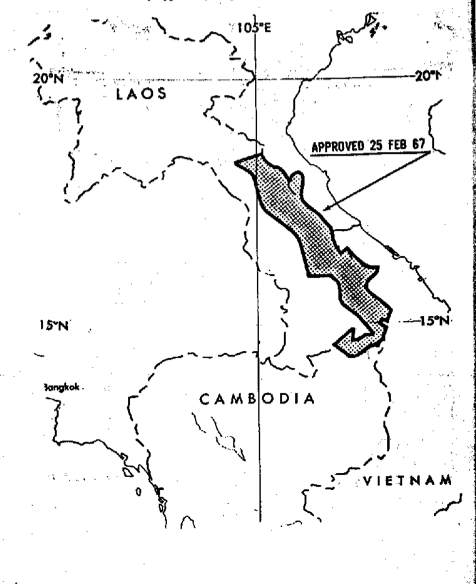
Initial area of operations, 1967
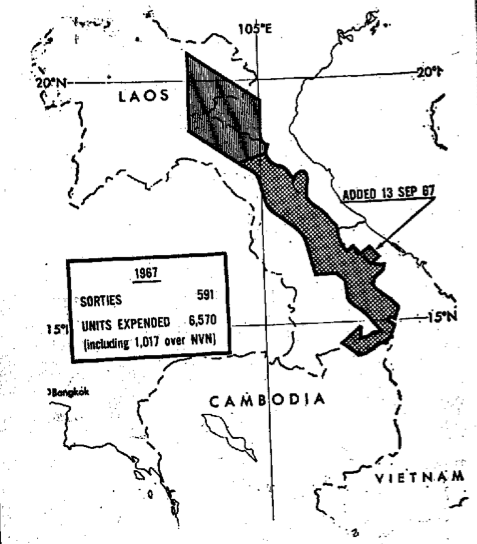
Expanded area of operations, 1967

Area of operations, 1968

Area of operations, 1972

By the time the operation was ended 2,602 individual sorties had been flown.  Prompted in part by a Senate resolution in 1973 that urged the US government to secure an international agreement outlawing ‘any use of an environmental or geophysical modification activity as a weapon of war’, and by the public release of the transcript of the secret Congressional hearings in 1974, the UN General Assembly adopted the Convention on the Prohibition of Military or Any Other Hostile Use of Environmental Modification Techniques (or ENMOD) in 1976.  It came into force in October 1978: more here and here.

There were, of course, other, better known and hideously more effective versions of ecological warfare in Indochina: defoliating huge swathes of mangrove and rainforest with Agent Orange and other chemical sprays, and bombing the dikes in North Vietnam.  But these weather operations, which combined minimum success with scandalous recklessness, now have a renewed significance.  As late as 1996 the US Air Force was still describing weather as a ‘force multiplier’ and, by 2025, planning to deploy UAVs for ‘weather modification operations’ at the micro- and meso-scale so that the United States could ‘own’ the weather (strikingly, there is no discussion of any legal restrictions).

But today the equation has been reversed, and the US military has to contend not only with its projected capacity to change the weather but also – as I’ll discuss in a later post – with the effects of global climate change on its operations.
The real McCoy and the politics of verticality

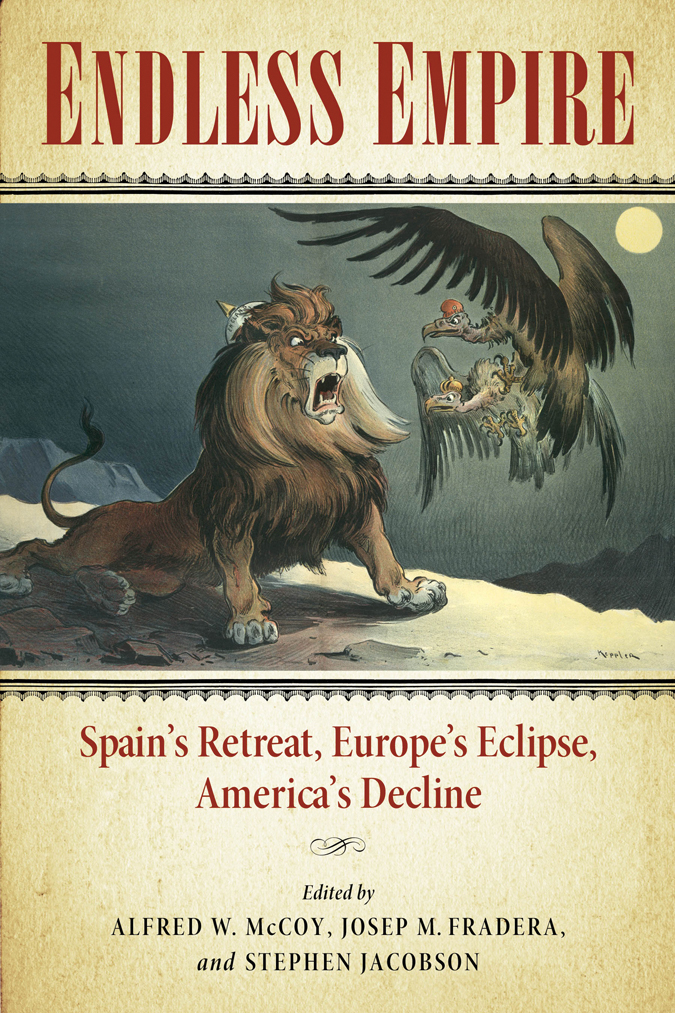
Oliver‘s favourite historian, Alfred McCoy, recently co-edited a fine new collection, Endless Empire: Spain’s retreat, Europe’s eclipse, America’s decline (University of Wisconsin Press, 2012), and there’s an excellent taster of McCoy’s argument at both Tomdispatch and Guernica.  The title – ‘Beyond bayonets and battleships’ – is not only a rejoinder to Romney’s complaint during the last Presidential debate; it’s also a reply to Obama and his predecessors.

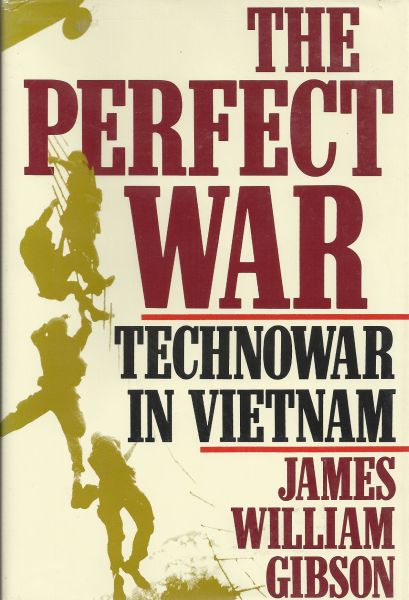
McCoy traces the long historical curve of what, in another age, was called America’s techno-war: the phrase comes from James Gibson’s stunning The perfect war: technowar in Vietnam (Monthly Review Press, 1986; Atlantic, 2000), and like Gibson McCoy insists on the importance of the wars in Indochina for the matrix within which late modern war is now conducted.

Many of his themes resonate with my own work – the key elements for today’s remote operations were assembled over the skies of Vietnam, Laos and Cambodia, and these have been radically extended by biometric identification, electronic surveillance and cyberwarfare – and McCoy also peers into a not-do-distant but desperately dark future in which the contemporary politics of verticality and what Stuart Elden describes as projects to ‘secure the volume‘ will be dwarfed by a triple-tier canopy (‘Just how high is national sovereignty? … Some puckish Pentagon lawyer might reply: only as high as you can enforce it’):

It’s 2025 and an American “triple canopy” of advanced surveillance and armed drones fills the heavens from the lower- to the exo-atmosphere.  A wonder of the modern age, it can deliver its weaponry anywhere on the planet with staggering speed, knock out an enemy’s satellite communications system, or follow individuals biometrically for great distances.  Along with the country’s advanced cyberwar capacity, it’s also the most sophisticated militarized information system ever created and an insurance policy for U.S. global dominion deep into the twenty-first century.  It’s the future as the Pentagon imagines it; it’s under development; and Americans know nothing about it.

I’m drafting the introduction to The everywhere war now, and this is a superb essay for me to engage – if you read one thing this week, make it this.

Masters of Non-War

Following up my post on the music of war, Nadia Abu-Zahra has kindly directed me to an excellent website devoted to thousands of anti-war, pacifist and anti-militarist songs here.  It includes a searchable database, downloads and videos, and is a marvellous resource.

The curators explain the origins of the project, which went online the day the US-led war on Iraq started:

When rumours of a new war against Iraq started spreading more and more insistently, the members of two Italian Usenet newsgroups, it.fan.musica.gucciniand it.fan.musica.de-andre, and of two other mailing lists dedicated to Italian songwriters, “Fabrizio”and “Bielle” spontaneously began to collect a great number of antiwar songs which were posted every day… So, this site originates from the spontaneous reaction of a number of people, who have chosen to witness their opposition to this war, and to any war, by collecting antiwar songs and by putting them at everyone’s disposal.

(If you just want to see a quick list, try this one from Stop the War‘s ‘anti-war song of the week’: everything from Vera Lynn  – admittedly with Johnny Cash – to Radiohead).

I’ve also been digging around for materials on music and the Vietnam War, and here I can recommend David James, ‘The Vietnam War and American music’, Social text 22 (1989) 122-43 and Kenneth Bindas and Craig Houston, ‘”Takin’ Care of Business”: Rock music, Vietnam and the protest myth’, The Historian 52 (1989) 1-23: both of which may leave your illusions blowin’ in the wind…

UPDATE Dan Clayton adds this excellent suggestion: Kim Herzinger, ‘The soundtrack of Vietnam’, in A. Wiest, M. Barbier and G. Robbins (eds), America and the Vietnam War: re-examining the culture and history of a generation (Routledge, 2010), 255–71

Sound targets

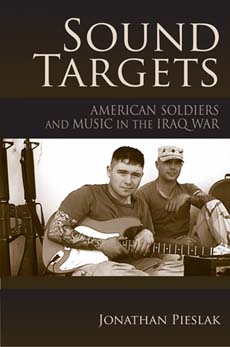
It seems an age since I talked about sound and war, but I haven’t been still(ed).  I’ve just finished Jonathan Pieslak‘s Sound Targets (Indiana, 2009), which adds another dimension to the discussion:

Though a part of American soldiers’ lives since the Revolutionary War, by World War II music could be broadcast to the front. Today it accompanies soldiers from the recruiting office to the battlefield. For this book, Jonathan Pieslak interviewed returning veterans to learn about the place of music in the Iraq War and in contemporary American military culture in general. Pieslak describes how American soldiers hear, share, use, and produce music both on and off duty. He studies the role of music from recruitment campaigns and basic training to its use “in country” before and during missions. Pieslak explores themes of power, chaos, violence, and survival in the metal and hip-hop music so popular among the troops, and offers insight into the daily lives of American soldiers in the Middle East.

As the blurb suggests, there’s a rich history to be traced here and I’ve only just started digging.

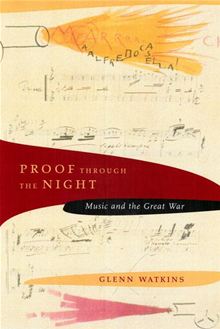
So far I’ve also enjoyed Glenn Watkins‘s Proof through the night: Music and the Great War (University of California Press, 2002) – the title is a line from the ‘Star-spangled banner’ – whose cover shows a Stravinsky manuscript on which the music for his four-hand Marche  (1914) is accompanied by percussive blasts from cannon roughed in by the composer himself.

‘Music in every nation gave “proof through the night” – ringing evidence during the dark hours of the war – not only of its historic role in the definition of nationhood and of nationalist resolve but also of its power on distant battlefields to recall home and hearth and to commemorate loss long after the guns had been stilled.’

So much is probably obvious, but there’s little else that is in this rewarding collection of essays/studies that constantly surprises by its engagements with a wider cultural politics and the sombre refrains of military violence.

High on the ‘to be read’ pile is Christina Baade’s Victory through harmony: the BBC and popular music in World War II (Oxford University Press, 2011), which has an accompanying website with music clips (but only if you’ve got the book so I haven’t included a link here).  The same publisher has also announced Annegret Fauser‘s Sounds of war: music in the United States during World War II for 1913, which apparently argues that ‘it was the role assigned specifically to classical music that truly distinguished musical life in the wartime United States’, so this may be rather narrower in scope than it looks.  Doesn’t look as though there will be much space for swing, jazz and bebop (or even Glenn Miller).

I’ve also rifled through Lee Andresen’s Battle notes: Music of the Vietnam War (Savage, 2003), which I retrieved from a bin in a second-hand bookstore, but I rapidly realised why it was where it was – so if anyone has any good suggestions for articles or books on what is such an obvious theme I’d be really Grateful (and not as in Dead).

I don’t like Tuesdays….

More on history…  In a commentary on Greg Miller‘s Washington Post article on the ‘disposition matrix‘ now used by the Obama administration to further its targeted killing programme, Ian Shaw suggests that this reveals ‘the changing face of state violence: the decentralization of targeted killings across the globe and the simultaneous centralization of state power in the executive branch of government.’

Even before the process was streamlined by the introduction of the matrix, Jo Becker and Scott Shane reporting for the New York Times described the President’s ‘immersion’ in the process, which they too thought ‘unprecedented’:

It is the strangest of bureaucratic rituals: Every week or so, more than 100 members of the government’s sprawling national security apparatus gather, by secure video teleconference, to pore over terrorist suspects’ biographies and recommend to the president who should be the next to die.

This secret “nominations” process is an invention of the Obama administration, a grim debating society that vets the PowerPoint slides bearing the names, aliases and life stories of suspected members of Al Qaeda’s branch in Yemen or its allies in Somalia’s Shabab militia.

The video conferences are run by the Pentagon… [and] a parallel, more cloistered selection process at the C.I.A. focuses largely on Pakistan.

The nominations go to the White House, where by his own insistence and guided by Mr. Brennan, Mr. Obama must approve any name. He signs off on every strike in Yemen and Somalia and also on the more complex and risky strikes in Pakistan — about a third of the total.

John Whitehead also saw this as a dramatic – and ominous – departure: ‘Should we fail to recognize and rectify the danger in allowing a single individual to declare himself the exception to the rule of law and assume the role of judge, jury, and executioner, we will have no one else to blame when we plunge once and for all into the abyss that is tyranny.’

Claims like these not only resonate with Giorgio Agamben‘s mapping of the space of exception; they also intersect with the debate over the ‘unitary executive’ that was renewed (and radicalised) during the Bush administration.

But if we narrow the focus there is in fact an historical precedent for what Becker and Shane called the ‘Terror Tuesday’ meetings and the close control exerted by the executive over air strikes  – and this also took place on a Tuesday.

During the Vietnam War President Lyndon Johnson personally decided targets for the ‘Rolling Thunder’ campaign of air strikes againt North Vietnam, famously boasting that ‘they can’t even bomb an outhouse without my approval.’

Targets were first proposed by the Air Force and submitted to the Commander-in-Chief Pacific Command (CINPAC), whose office reviewed and forwarded a target list to the Joint Chiefs of Staff who in turn reviewed and forwarded their revised list to the Pentagon.  There officials analysed the targets in relation to the probable impact of a strike and the likelihood of civilian casualties, and the Secretary of Defense coordinated the modified list with the Secretary of State. By this stage the folder for each numbered target had been reduced to a sheet of paper with just four columns: military advantage; risk to US aircraft and crew; estimated civilian casualties; and danger to third-country nationals (Russian and Chinese advisers).

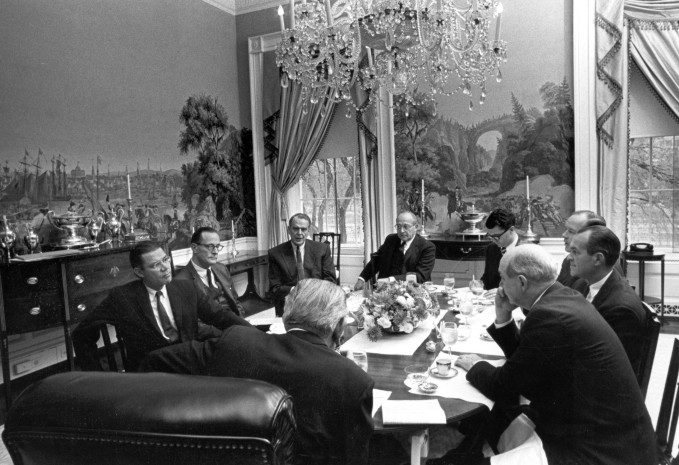
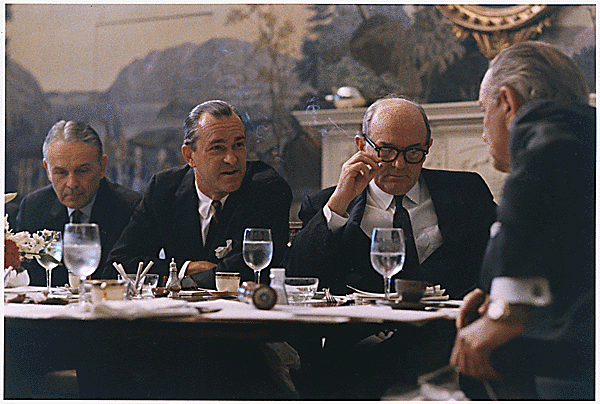
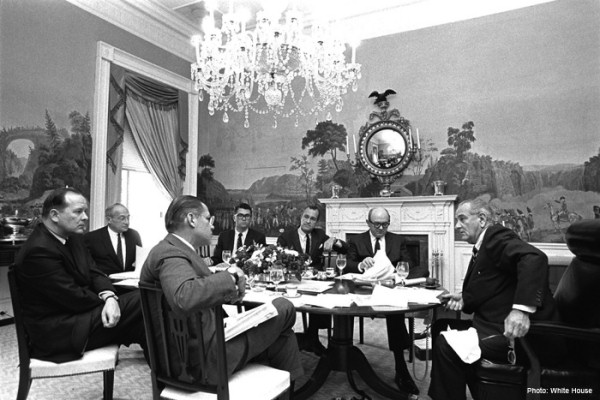
The final target list was decided during the President’s Tuesday luncheon at the White House.  This was not a casual affair; it followed a meeting of the National Security Council, and those attending the luncheon – the Secretaries of State and Defense, the President’s special assistant for national security affairs, and (significantly) the President’s press secretary – were briefed before grading each target. Their grades were combined and averaged and then reviewed by the President who made the final selection.  His decision was delivered to the NSC in the evening and transmitted to CINCPAC through the Joint Chiefs for immediate execution. The instructions included not only the number of sorties to be conducted against each target but also in the early stages of the campaign the timing of the attacks and the ordnance to be used.

Remarkably, no military officers were invited to the Tuesday luncheon until October 1967, and in at least in the first phase of Rolling Thunder the political consistently trumped the military.  As targets worked their way up the command hierarchy to Washington, their priority order was reversed; the bomb line slowly advanced northward as strikes worked their way up from the bottom of the strategic list. In addition to selecting targets, Johnson stipulated strict Rules of Engagement – so stringent that one airman described them as ‘rules of defeat’ – that prohibited air strikes within 30 miles of the Chinese border, 30 miles from the centre of Hanoi and 10 miles from the centre of Haiphong, and imposed a complex, constantly changing web of regulation whose details had to be incorporated into every day’s operational order.

The paragraphs above are culled from my ‘Lines of descent’ (DOWNLOADS tab) and they describe an ideal-typical sequence of decision-making, but the most detailed published account is David Humphreys, ‘On the Tuesday Lunch at the Johnson White House: a preliminary assessment’, Diplomatic History 8 (1984) 81-101; see also David Barrett, ‘Doing “Tuesday Lunch” at Lyndon Johnson’s White House: new archival evidence on decision-making’, PS: Political science and politics 24 (4) (1991) pp. 676-9, Kevin Mulcahy, ‘Rethinking Groupthink: Walt Rostow and the National Security advisory processin the Johnson administration’, Presidential Studies Quarterly 25 (1995) 237-50,  and Johanna Kephart, ‘Presidential decision-making and war: testing the evolution model’, MA thesis, Georgetown University (2010) here (especially pp. 8-27).

Pakistan is not Vietnam, of course, and there are obvious differences between the two campaigns – as well as remarkable ‘lines of descent’ – but the role of the sovereign in asserting ‘the right to take life or let live’ is a grim constant.

I don’t like Tuesdays: Some of you will remember the Boomtown Rats song ‘I don’t like Mondays’ written by Bob Geldorf after a shooting at a school playground in San Diego; the shooter, a 16-year old girl, explained: “I don’t like Mondays.  This livens them up.”

The whites of our eyes

I’ve been re-reading Keith Feldman‘s essay on ‘Empire’s verticality’ (Comparative American Studies 9 [4] 2011 325-41), which raises a series of incisive questions about what he calls ‘racialization from above’ in the Afghanistan-Pakistan borderlands.  Keith was working on this while I was working on ‘From a view to a kill’ (see DOWNLOADS tab), and we exchanged ideas en route, but Keith’s essay provides a different and invaluable perspective.  He begins with the famous Situation Room photograph by Pete Scott in which Obama and his senior advisors gaze at a live-feed from Abbotabad on 1 May 2011: since ‘the target of imperial retribution remains just outside the visual field’ – we see no images of the raid – Keith notes that ‘we are drawn to witness the witnessing of Bin Laden’s assassination.’  He focuses on the visual identification of a Muslim Other that is supposed to be precise and yet always remains blurred.

The scopic regime of late modern war is placed under even greater pressure when ‘signature strikes’ are conducted – when the target is not a named individual but a ‘person of interest’ whose ‘pattern of life’ has roused the suspicions of the distant watchers – and this has even more serious implications for civilian casualties.

There’s a short post from Kevin Jon Heller at Opinio Juris that addresses the issue by juxtaposing two quotations.  The first is from a report in the New York Times on 29 May 2012 by Jo Becker and Scott Shane on ‘Obama’s Secret “Kill List”…’ and the CIA-controlled Predator strikes in Pakistan:

“… Mr. Obama embraced a disputed method for counting civilian casualties that did little to box him in.  It in effect counts all military-age males in a strike zone as combatants, according to several administration officials, unless there is explicit intelligence posthumously proving them innocent.  Counterterrorism officials insist this approach is one of simple logic: people in an area of known terrorist activity, or found with a top Qaeda operative, are probably up to no good.”

The second comes from Richard Falk‘s ‘Law and responsibility in warfare: the Vietnam experience’, where he quotes the man who ordered the My Lai massacre, Lt William Caley:

“If those people weren’t all VC [Viet Cong] then prove it to me. Show me that someone helped us and fought the VC. Show me that someone wanted us: one example only! I didn’t see any… Our task force commander’s staff said it’s a VC area and everyone there was a VC or a VC sympathizer. And that’s because he just isn’t young enough or old enough to do anything but sympathize.”

Heller doesn’t use the phrase, for obvious reasons, but this is another Catch-22…

But there’s another Vietnam parallel that I think is even more striking.  In Lines of descent (DOWNLOADS tab) I described the creation of ‘free bomb zones’ or ‘free fire zones’ in South Vietnam.

 In August 1965 [General] Westmoreland was authorized to order strikes in five free bomb zones that were ‘configured to exclude populated areas except those in accepted VC [Viet Cong] bases’.  Within these zones the designation of target boxes dispensed with precise co-ordinates and detailed intelligence altogether, so that they became black boxes in every sense of the phrase, and approval was given in advance ‘for execution when appropriate’. Westmoreland was perfectly clear that ‘anybody who remained had to be considered an enemy combatant’ and so strikes could proceed ‘without fear of civilian casualties’.

With this in mind, here is a section that never made it in to the final version of ‘Lines of descent’, concerning the principle of distinction (the legal requirement to discriminate between combatants and non-combatants).  My Lai makes an appearance here too, as a crucial moment after which the Pentagon agreed to provide military operations with a legal armature.  And yet, as I tried to show in both my essays, incorporating lawyers into the kill-chain provides less protection for civilians than may at first appear: the balance between concrete military advantage and ‘collateral damage’ is still calibrated on the military’s own scales.  I’m not saying that nothing has changed since Vietnam – the lines of descent are complex and tangled – but, as the final paragraph below shows, there are none the less disturbing parallels.  ‘Blind bombing’ may well belong to the past, superseded by near real-time, high-resolution full-motion video feeds from Predators and Reapers, and yet – to return to Feldman – in scanning these images we continue to privilege the whites of our own eyes.

Distinction and the air war in Vietnam

The difficulty of distinguishing between ground troops, enemy forces and non-combatants was exacerbated by the use of air power in a non-linear battlespace, the ‘war without fronts’, because ‘the absence of clearly discernible bomb lines created a fluid environment in which it was not always possible to distinguish friendly from enemy forces.’  From the air, Schlight continued, ‘all soldiers looked alike and guerrillas were indistinguishable from non-combatants.’ [1]  He insists that there was an acute sensitivity to ‘accidental loss of life’.  In Westmoreland’s (public) view, ‘one mishap, one innocent civilian killed, one civilian wounded or one dwelling needlessly destroyed, is one too many’, and this supposedly translated into ‘stringent’ rules of engagement.  In particular, strikes on hamlets and villages required political clearance from Vietnamese authorities at least at a provincial level, they had to be directed by a Forward Air Controller or radar to minimize civilian casualties, and warnings had to be issued if the attacks were not in conjunction with ground forces; if this were impossible, the ground commander could designate the target, and in ‘specified strike zones’ (whose designation was held to ‘constitute prior political clearance’) pilots ‘could use their own judgement in hitting targets.’ [2]  In this, more or less official view, air strikes still killed civilians but every effort was made to minimize the loss of innocent lives.

Others see it differently.  For some, it was a technical matter.  When van Creveld writes of ‘the American airmen’s near-complete inability to distinguish between combatants and noncombatants’, he is simply echoing McNamara’s own post-war admission that it ‘proved difficult to distinguish combatants from noncombatants’ and that Westmoreland’s heavy reliance on bombing ‘produced more and more civilian casualties’: for both men this was an inherent limitation of air power in counterinsurgency. [3]  It was inevitably compounded by the electronic battlefield, as Senator McGovern noted: ‘If ground troops sometimes will not, and usually cannot, distinguish between enemy and innocent in a guerrilla war, we know that aerial bombardment never can.  The sensor which detects body heat, the aircraft thousands of feet in the air, the computer complex many miles distant, are completely neutral and indiscriminate.’  [4]  For others, as McGovern’s first clause implies, the lack of discrimination was too often a considered decision.  The rules of engagement were elastic (in practice Vietnamese political clearance was readily obtained) and riddled with exceptions (there were many cases where clearance could be dispensed with altogether, including military necessity and specified strike zones).  Clodfelter points out that this was in marked contrast to the bombing of North Vietnam where ‘detailed restrictions [were] placed on bombing targets’ because there the American political calculus included civilian casualties.  This was not only true of the Johnson administration’s micro-management of Rolling Thunder; when President Nixon resumed the bombing of North Vietnam in 1972 he loosened the previous restrictions and returned operational control of these Linebacker campaigns to the military, but even his terror bombing of targets around the capital was circumscribed. ‘I want the people of Hanoi to hear the bombs,’ he instructed Strategic Air Command, ‘but minimize damage to the civilian population.’ In South Vietnam, however, where there were few restrictions or political restraints, Clodfelter concludes that ‘indiscriminate bombing contributed significantly to an estimated 1.16 million South Vietnamese civilian casualties during the war.’ [5]  The vital point is that many, perhaps even most of these injuries and deaths were not accidental, often not even incidental  ­– the ‘collateral damage’ that international law accepts may result from attacking military targets – but the victims of deliberate and indiscriminate attack.

Discrimination has two meanings, one strategic and the other legal.  For Kalyvas, violence against civilians is a central feature of insurgency and counterinsurgency, where historically both sides often targeted civilians to force them to comply, but it can be discriminate – directed against specific targets – or indiscriminate, based on collective attributes like place of residence. [6]  Kocher, Pepinsky and Kalyvas argue that bombing in South Vietnam was indiscriminate because it was typically directed at areas, boxes or zones: ‘it could not target individual VC supporters while sparing government supporters or the uncommitted, even when intelligence was good’.  They concede that this was, in part, a technical matter – target identification was often hit-or-miss and until Paveway laser-guided bombs were used in the Linebacker campaigns the delivery of ordnance was ‘inherently inaccurate’ – but in many cases they suggest that exposing civilian populations to aerial violence was a tactical choice.  One leaflet drop warned people that ‘when the plane returns to sow death, you will have no more time to choose’, and many commanders welcomed the bombing of civilians: when he was asked if he was worried by the civilian casualties caused by bombing and shelling, Westmoreland himself airily replied, ‘Yes, but it does deprives the enemy of population, doesn’t it?’ [7]  This is perhaps unsurprising; bombing had been an established method of colonial ‘air control’ much earlier in the century. It turned out to be as counterproductive in Vietnam as it had been in Mesopotamia and the North West Frontier. Targeting collectives means that individuals ‘cannot avoid being victimized simply by refusing to participate in the insurgency’, and bombing the South clearly increased Viet Cong control in the affected areas. [8]

Discrimination also carries a legal charge, but it has a complicated history.  After the Second World War there was an attempt to incorporate ‘protection of civilian persons in times of war’ into the Geneva Conventions, but these largely failed to address the vulnerability of civilian populations to military violence in general and to air strikes in particular. [9]  In 1956 the International Committee of the Red Cross produced a series of Draft Rules that prohibited direct attacks on the civilian population and, in particular, attacks ‘without distinction’ on areas where military targets were close to the civilian population.  This was an express attempt to outlaw area bombing, and it met with forceful opposition. In 1965 the ICRC reaffirmed the prohibition on direct attacks against the civilian population, and insisted on discrimination between those taking part in hostilities and civilians who should ‘be spared as much as possible’, and in December 1968 these basic principles were endorsed in UN Resolution 2444 on Respect for Human Rights in Armed Conflicts.  In 1972 the Pentagon confirmed that it regarded these principles as declaratory of customary international law but added two riders. The United States insisted that it was permissible to attack military targets even if there were a risk of collateral damage, and in such cases the responsibility for distinguishing military objectives from civilian devolved upon ‘the party controlling the population.’ [10] These were expedient qualifications in the (arc) light of South Vietnam, where insurgents swam in the sea of the population.  In fact MACV’s legal advisor blamed the suffering of Vietnamese civilians on the law itself, which he claimed was ‘inadequate to protect victims in wars of insurgency and counterinsurgency’ because it drew on ‘examples from World War II which simply did not fit in Vietnam’ where ‘the hazy line between civilian and combatant became even vaguer’. [11]  Another judge advocate said much the same: In Vietnam ‘the battlefield was anywhere and everywhere, with no identifiable front lines and no safe area. This meant that innocent civilians could not easily avoid the war or its suffering.’  He was silent about the responsibility of those conducting the war to avoid innocent civilians – justice, like much of the bombing, was blind – and limited his discussion to compensation payments where ‘loss or damage was caused by reckless or wanton conduct by U.S. forces.’ [12]  Not surprisingly, what is now called operational law remained strikingly undeveloped.  Judge advocates at MACV were not consulted about air operations; one judge advocate attended meetings at Seventh Air Force headquarters, but these reviewed the previous week’s operations and ‘no one consulted him about future operations, the lawfulness of striking selected targets, or compliance with the rules of engagement’; tactical air control centers had no place for judge advocates who ‘had almost no contact with the people who planned or executed air operations’, and provided neither briefings nor advice on the laws of war or the rules of engagement.  The single exception was a judge advocate based at the US Embassy in Thailand who scrutinized some target lists in North Vietnam. [13]

In fact, it was only after the publicity surrounding the My Lai massacre, in November 1974, that the Pentagon directed the armed services to implement a program to prevent violations of the Law of War; only then did the US military begin to incorporate legal oversight into its operations. [14]  Most legal scrutiny of the air war in Vietnam was after the event – hence the essays by Hays Parks on Rolling Thunder and Linebacker that conclude that both were fully consistent with (in the case of Rolling Thunder even unduly sensitive to) international law – and, no less significantly, did not address the conduct of the air war in the South. [15]  The crucial issue there is the distinction between civilians and combatants, and here Richard Falk, while granting that the law of armed conflict was inadequate and needed revision, none the less insisted that, in its promulgation of ‘free bomb zones’, in B-52 ‘pattern raids’, and much else, the US violated customary international law routinely and serially: ‘the overall American conduct of the war involve[d] a refusal to differentiate between combatants and noncombatants and between military and nonmilitary targets.’ [16]

[1] John Schlight, The war in South Vietnam: The years of the offensive, 1965-1968 (Office of Air Force History, 1969) War, p. 258.  A bombline is ‘an imaginary line arranged, if possible, to follow well-defined geographical features, prescribed by the troop commander and coordinated with the Air Force commander, forward of which air forces are free to attack targets without danger or reference to the ground forces; behind this line all attacks must be coordinated with the appropriate troop commander’: John Pearse, ‘Air power in the kill-box: Fire support co-ordination and airspace deconfliction in the future non-linear battlespace’, Thesis, School of Advanced Air and Space Studies, Maxwell Air Force Base, 2003: p. 22.

[2] Schlight, War, pp. 258-9.

[3] Martin van Creveld, The age of airpower (New York: Public Affairs, 2011) p. 199; Robert McNamara, In retrospect: the tragedy and lessons of Vietnam (New York: Vintage, 1995) p. 243.

[4] McGovern’s speech was delivered on 14 December 1971 and is excerpted in ‘Automated warfare’ (January 1972) p.2, Folder 01, Box 02, Douglas Pike Collection: Unit 03 – Technology, The Vietnam Center and Archive, Texas Tech University.

[5] Mark Clodfelter, ‘A strategy based on faith: the enduring appeal of progressive American airpower’, Joint Forces Quarterly 49 (2008) 24-31, 150-160: 31.  Clodfelter’s figure includes those wounded and killed 1965-1974, and is derived from estimates presented in Guenter Lewy, America in Vietnam (New York: Oxford University Press, 1978) p. 446.  These estimates are probably conservative, and Lewy is much more reluctant to attribute these totals to ‘allied bombing’, but he does accept that the ‘lavish use of [US] firepower’ caused ‘a large number of civilian casualties’ in the South (p. 230).  Despite the restrictions US bombing also caused casualties in the North: Lewy estimates around 65,000 civilians were killed, and other estimates run into the hundreds of thousands.

[6] Stathis Kalyvas, The logic of violence in civil wars (Cambridge: Cambridge University Press, 2006) p. 142 and passim.

[7] Matthew Kocher, Thomas Pepinsky and Stathis Kalyvas, ‘Aerial bombing and counterinsurgency in the Vietnam War’, American Journal of Political Science 55 (2011) 201-18: 205; Westmoreland’s remark was made in summer 1966 and is cited in David Halberstam, The best and the brightest (New York: Ballantine, 1969) p. 550, who adds: ‘The American command was aware of it was doing, and sanctioned it… MACV knew about it, it didn’t want to know too much, it would look the other way if possible, but it knew it was all going on out there.’

[8] Kocher, Pepinsky and Kalyvas, ‘Aerial bombing’, 203, 215.  A 1968 RAND survey found that bombing increased support for the Viet Cong, but it was never released: Robert Smith, ‘Report compiled in 68 says excessive Allied bombing in South Vietnam stirred hostility to regime’, New York Times, 22 January 1970.

[9] ‘The most conspicuous sufferers from bombing, Germany and Japan, were unable to put their case, while the bombing specialists, the USA and the UK, had every reason for preventing the case being out’: Geoffrey Best, War and law since 1945 (Oxford: Clarendon Press, 1994) p. 115.

[10] Hays Parks, ‘Air war’, 65-71.

[11] MG George Prugh, Law at war, Vietnam 1964-1973 (Washington DC: Department of the Army, 1975) p. 89.  He also conceded that there was no effective mechanism to enforce compliance.

[12] Frederic Borch, Judge Advocates in Vietnam: Army Lawyers in Southeast Asia, 1959-1975 (Combat Studies Institute, 2003) p. 92.

[13] LTC Terrie Gent, ‘The role of Judge Advocates in a Joint Air Operations Center’, Air Power Journal, Spring 1999

[14] My Lai was the scene of a massacre of hundreds of civilians by US troops on 16 March 1968; it was not widely reported until November 1969, and the subsequent courts-martial were not completed until March 1971. The problem was much wider and more pervasive than this focus suggests, however, and Greiner, War without fronts, p. 18, writes of an ‘endemic contempt’ for international law on the part of the US.  Dunlap identifies a ‘revolution in military legal affairs’, after Vietnam, beginning in 1989 with the involvement of judge advocates in planning US military operations in Panama and becoming much more visible during the first Gulf War: Charles Dunlap. ‘The revolution in military legal affairs: Air Force legal professionals in 21st century conflicts’, Air Force Law Review 51 (2001) 293-309.  Consistent with his later preoccupation with ‘lawfare’, he places particular emphasis not on advances in military technology, however, but on changes in communications technology that worked to enable media organizations to bring ‘the raw images of war’ to publics around the world ‘before leaders can censor or shape it’ (p. 294).

[15] W. Hays Parks, ‘Rolling Thunder and the law of war’, Air University Review, January-February 1982 athttp://www.airpower.maxwell.af.mil/airchronicles/aureview/1982/jan-feb/parks.html; ‘Linebacker and the law of war’, Air University Review January-February 1983 at http://www.airpower.maxwell.af.mil/airchronicles/aureview/1983/jan-feb/parks.html.

[16] Richard Falk, ‘Son My: war crimes and individual responsibility’, University of Toledo Law Review 21 (1971) 21-41:23.

Human Geography Summit

As the calls for papers for the Annual Meeting of the Association of American Geographers in Los Angeles next April fly backwards and forwards, I thought readers would be interested in another meeting (and, for the most part, another geography).

The Institute for Defense and Government Advancement (IDGA) – which describes itself as ‘a non-partisan information based organization dedicated to the promotion of innovative ideas in public service and defense’  and which ‘is not affiliated with the US government or any branch of the Armed Services’ – is holding a Human Geography Summit in Washington DC, 12-14 November 2012.  Subtitled ‘Maximizing force efficiency through intelligence in the human domain’, the brochure explains:

“The environment in which we operate is complex and demands that we employ every weapon in our arsenal, both kinetic and non-kinetic. To fully utilize all approaches, we must understand the local culture and history; Learn about the tribes, formal and informal leaders, governmental and religious structures, and local security forces. We must understand how the society functions so we can enable [Iraqis] to build a stable, self-reliant nation.” 

This Summit will bring to light the future of the Human Domain in warfare and opportunities for Military and Industry cooperation and coordination.

Operation Iraqi Freedom and Operation Enduring Freedom (OIF & OEF) in Iraq and Afghanistan created a need for a fundamental shift in the way we fight wars. It became very clear very quick that conventional warfare was doomed to failure in this particular set of operations. We were being beaten by an unconventional force that had no state backing and did not play by the rules.

In order to adapt, many hybrid theories of war have been thought up and put into place. Throughout this, one aspect that was previously overlooked has come to the fore front. Knowing who you are fighting and where you are fighting. Not simple identification and geographic data, but personality profiles, daily schedules/routines, language/dialect, cultural identities, weather patterns, market places, potential hideouts, and places of cultural and religious significance. Truly understanding the enemy, how they differ from the civilian population they are embedded in and what will make our forces either comply with their culture or blend in as they do.

The Summit will be preceded by a ‘Social and Cultural Human Geography and Intelligence Focus Day’ with four specialist workshops:

  • Maintaining connections with the local population in support of operationally directed research
  • Thinking like the Natives: Cultural immersion for US Special Operations
  • Understanding the local culture and history of Target Populations
  • Cultural and Economical Human Geography: a case study

The Summit will include presentations from the US Army Geospatial Center, the National Geospatial-Intelligence Agency,the US Army Corps of Engineers, Human Terrain Systems (US Army) and US Northern and Southern Commands.

You’ll also have the chance ‘to meet, network and engage with top government and industry professionals in the human geography space’ (sic) – a steal at $1,598 (military) or $1,835 (industry).  Uniform or business casual.

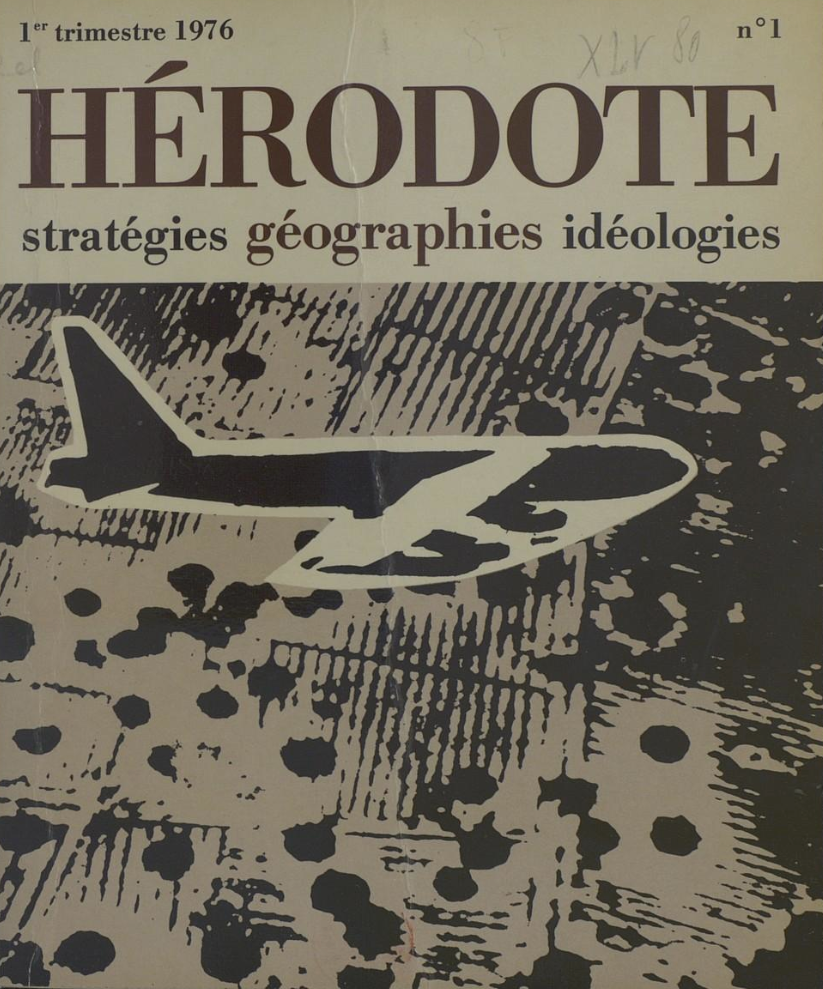
It’s thirty-odd years since Yves Lacoste insisted that La géographie, ça sert, d’abord, à fair la guerre (1976) and, as Gavin Bowd and Daniel Clayton show in “Geographical warfare in the tropics: Yves Lacoste and the Vietnam War”, he knew what he was talking about (he was also the editor of Hérodote, left): their remarkably rich essay was published in Early View by the Annals of the Association of American Geographers earlier this year.  As I say, another geography.

But these are not matters of disciplinary history alone; that is, of course, important – the terrific work of  Trevor Barnes in particular has done much to illuminate the entanglements of modern geography in the Second World War and the Cold War – but it’s also vital to pursue the ways in which geographical knowledges and practices continue to enter into the conduct of war and military violence.  In 1963 William Bunge and Bill Warntz started work on a book to be called Geography: the innocent science, a prospectus for their vision of the ‘new geography’ as spatial science.  It was far from innocent, to be sure, and in his later work – notably the Nuclear War Atlas but also what he called his ‘peace book’, Fitzgerald: geography of a revolution – Bunge displayed another side to his radical temper.  But what Trevor calls ‘the mangle’ between power and knowledge, geography and war, still includes the models and methods of spatial science – and it evidently also mangles much that lies far beyond them.