Eyes in the Skies

eyes_in_the_skies_pic

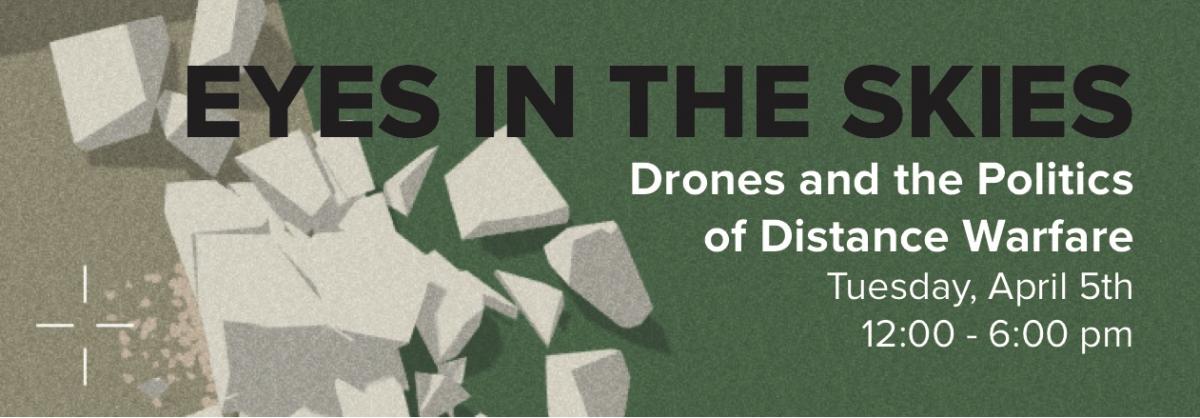
I’m just back from a wonderful time at UC Davis, where I was speaking at a symposium called “Eyes in the skies: drones and the politics of distance warfare.”  It was a creative program, packed with insights from Caren Kaplan and Andrea Miller, Priya Satia and Joe Delappe.

On my way back to Vancouver on Wednesday I received an invitation from Britain’s Guardian (in fact, the Sunday version, the Observer) to write something around that very question using the Gavin Hood film “Eyes in the sky” as a peg.

It’s just been published and you can find it here.
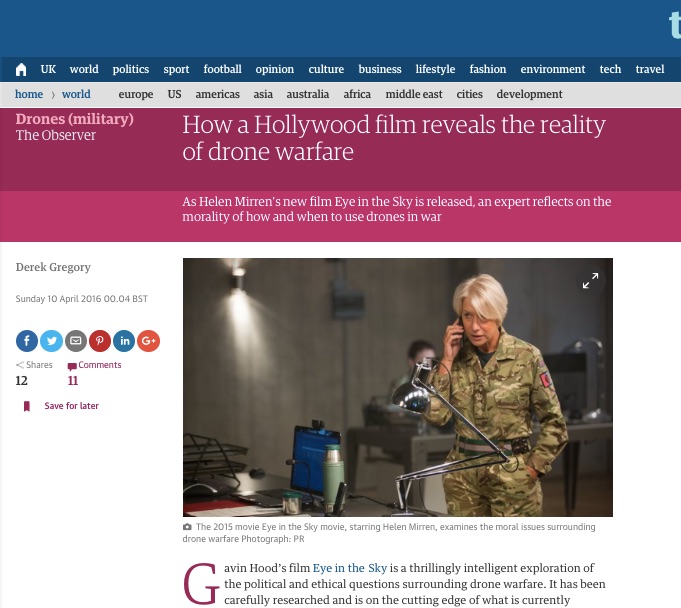
GREGORY Observer

At Davis I’d been giving what I think will be my final presentation of “Angry Eyes” (see here and here), so I was still preoccupied with remote platforms and close air support – not the contradiction it sounds – rather than targeted killing (which is the focus of the film).  The published version has, inevitably, been edited, so I’m pasting the full-length version below and added some links that might help.  There are still lots of short-cuts and elisions, necessarily so for anything of this length, so I hope readers will forgive the inevitable simplifications.

***

Gavin Hood’s Eye in the Sky is a thrillingly intelligent exploration of the political and ethical questions surrounding drone warfare. It’s been carefully researched and is on the cutting-edge of what is currently possible. But there’s a longer history and a wider geography that casts those issues in a different light.  As soon as the Wright Brothers demonstrated the possibility of human flight, others were busy imagining flying machines with nobody on board.  In 1910 Raymond Phillips captivated crowds in the London Hippodrome with a remotely controlled airship that floated out over the stalls and, when he pressed a switch, released hundreds of paper birds on the heads of the audience below. When he built the real thing, he promised, the birds would be replaced with bombs. Sitting safely in London he could attack Paris, Berlin – or Manchester (a possibility that understandably prompted questions about navigation).

There has always been something hideously theatrical about bombing, from the Hendon air displays in the 1920s featuring attacks on ‘native villages’ to the Shock and Awe visited on the inhabitants of Baghdad in 2003. The spectacle now includes the marionette movements of Predators and Reapers whose electronic strings are pulled from thousands of miles away. And it was precisely the remoteness of the control that thrilled the crowds in the Hippodrome. But what mattered even more was surely the prospect Phillips made so real: bombing cities and attacking civilians far from any battlefield.

Remoteness’ is in any case an elastic measure. Human beings have been killing other human beings at ever greater distances since the invention of the dart, the spear and the slingshot. Pope Urban II declared the crossbow illegal and Pope Innocent II upheld the ban in 1139 because it transformed the terms of encounter between Christian armies (using it against non-Christians was evidently a different matter). The invention of firearms wrought another transformation in the range of military violence, radicalized by the development of artillery, and airpower another. And yet today, in a world selectively but none the less sensibly shrunken by the very communications technologies that have made the deployment of armed drones possible, the use of these remote platforms seems to turn distance back into a moral absolute.

But if it is wrong to kill someone from 7,500 miles away (the distance from Creech Air Force Base in Nevada to Afghanistan), over what distance is it permissible to kill somebody?  For some, the difference is that drone crews are safe in the continental United States – their lives are not on the line – and this has become a constant refrain in the drone debates. In fact, the US Air Force has been concerned about the safety of its aircrews ever since its high losses during the Second World War. After Hiroshima and Nagasaki the Air Force experimented with using remotely controlled B-17 and B-47 aircraft to drop nuclear bombs without exposing aircrews to danger from the blast, and today it lauds its Predators and Reapers for their ability to ‘project power without vulnerability’.

It’s a complicated boast, because these remote platforms are slow, sluggish and easy to shoot down – they won’t be seen over Russian or Chinese skies any time soon. They can only be used in uncontested air space – against people who can’t fight back – and this echoes Britain’s colonial tactic of ‘air policing’ its subject peoples in the Middle East, East Africa and along the North-West Frontier (which, not altogether coincidentally, are the epicentres of todays’ remote operations). There are almost 200 people involved in every combat air patrol – Nick Cullather once described these remote platforms as the most labour intensive weapons system since the Zeppelin – and most of them are indeed out of harm’s way. It’s only a minor qualification to say that Predators and Reapers have a short range, so that they have to be launched by crews close to their targets before being handed off to their home-based operators. This is still remote-control war, mediated by satellite links and fiber-optic cables, but in Afghanistan the launch and recovery and the maintenance crews are exposed to real danger. Even so, Grégoire Chamayou insists that for most of those involved this is hunting not warfare, animated by pursuit not combat [see here, here and here].

Yet it’s important not to use this aperçu to lionize conventional bombing. There is an important sense in which virtually all aerial violence has become remarkably remote. It’s not just that bombing has come to be seen as a dismal alternative to ‘boots on the ground’; advanced militaries pick their fights, avoid symmetrical warfare and prefer enemies whose ability to retaliate is limited, compromised or degraded. When he was Secretary of Defense Robert Gates acknowledged that the US had not lost a pilot in air combat for forty years. ‘The days of jousting with the enemy in the sky, of flirting daily with death in the clouds, are all but over,’ writes the far-from-pacifist Mark Bowden, ‘and have been for some time.’ The US Air Force goes to war ‘virtually unopposed’. In short, the distance between the pilot in the box at Creech and the pilot hurtling through the skies over Afghanistan is less than you might think. ‘Those pilots might as well be in Nevada’, says Tom Engelhardt, ‘since there is no enemy that can touch them.’

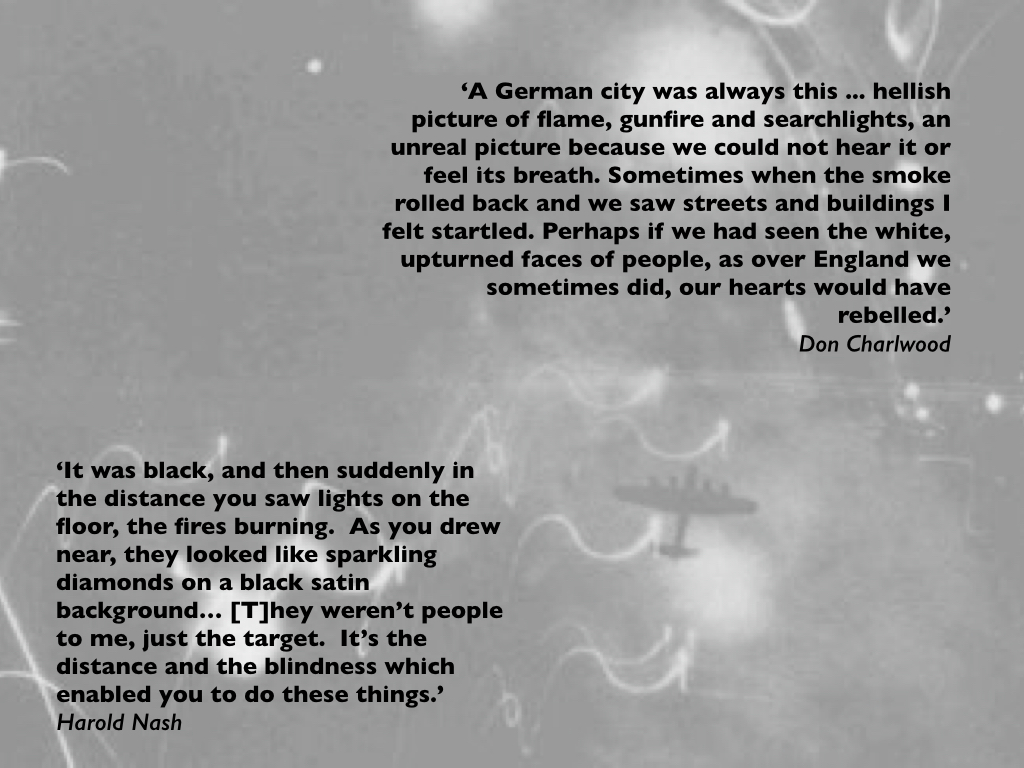
This suggests that we need to situate armed drones within the larger matrix of aerial violence.  Bombing in the major wars of the twentieth century was always dangerous to those who carried it out, but those who dropped bombs over Hamburg or Cologne in the Second World War or over the rainforests of South Vietnam in the 1960s and 70s were, in a crucial sense, also remote from their targets. Memoirs from Bomber Command crews confirm that the target cities appeared as lights sparkling on black velvet, ‘like a Brocks firework display.’ ‘The good thing about being in an aeroplane at war is that you never touch the enemy’, recalled one veteran. ‘You never see the whites of their eyes. You drop a four-thousand-pound cookie and kill a thousand people but you never see a single one of them.’ He explained: ‘It’s the distance and the blindness that enables you to do these things.’ The crews of B-52 bombers on Arc Light missions dropped their loads on elongated target boxes that were little more than abstract geometries. ‘Sitting in their air-conditioned compartments more than five miles above the jungle’, the New York Times reported in 1972, the crews ‘knew virtually nothing about their targets, and showed no curiosity.’ One of them explained that ‘we’re so far away’ that ‘it’s a highly impersonal war for us.’

Distance no longer confers blindness on those who operate today’s drones. They have a much closer, more detailed view of the people they kill. The US Air Force describes their job as putting ‘warheads on foreheads’, and they are required to remain on station to carry out a battle damage assessment that is often an inventory of body parts.  Most drone crews will tell you that they do not feel thousands of miles away from the action: just eighteen inches, the distance from eye to screen.

Their primary function is to provide intelligence, surveillance and reconnaissance. This was exactly how the Wright brothers thought military aircraft would be used – in July 1917 Orville insisted that ‘bomb-dropping’ would be at best a minor role and almost certainly useless, though he was speaking before the major air offensives in the final year of the war and could have had no inkling of what was to come in the Second World War. The Predator and its precursors were designed to identify targets for conventional strike aircraft over the Balkans in the 1990s, and thirty years later it is still those ‘eyes in the sky’ that make the difference. Although drones have been armed since 2001, until late 2012 they were directly responsible for only 5-10 per cent of all air strikes in Afghanistan. But they were involved in orchestrating many more. Flying a Predator or a Reaper ‘is more like being a manager’, one pilot explained to Daniel Rothenberg: ‘You’re managing multiple assets and you’re involved with the other platforms using the information coming off of your aircraft.’ In principle it’s not so different from using aircraft to range targets for artillery on the Western Front, but the process has been radicalized by the drone’s real-time full-motion video feeds that enable highly mobile ‘targets of opportunity’ to be identified and tracked. In the absence of ground intelligence, this becomes crucial: until drones were relocated in sufficient numbers from Afghanistan and elsewhere to enable purported IS-targets in Syria to be identified, most US aircraft were returning to base without releasing their weapons.

Armed drones are used to carry out targeted killings, both inside and outside areas of ‘active hostilities’, and to provide close air support to ground troops. Targeted killing has spurred an intense critical debate, and rightly so – this is the focus of Eye in the sky too – but close air support has not been subject to the same scrutiny. In both cases, video feeds are central, but it is a mistake to think that this reduces war to a video game – a jibe that in any case fails to appreciate that today’s video games are often profoundly immersive.   In fact, that may be part of the problem. Several studies have shown that civilian casualties are most likely when air strikes are carried out to support troops in contact with an enemy, and even more likely when they are carried out from remote platforms. I suspect that drone crews may compensate for their physical rather than emotional distance by ‘leaning forward’ to do everything they can to protect the troops on the ground. This in turn predisposes them to interpret every action in the vicinity of a ground force as hostile – and civilians as combatants – not least because these are silent movies: the only sound, apart from the clacking of computer keys as they talk in secure chat rooms with those watching the video feeds, comes from radio communications with their own forces.

In contrast to those shown in Eye in the Sky, those feeds are often blurry, fuzzy, indistinct, broken, compressed -– and, above all, ambiguous. How can you be sure that is an insurgent burying an IED and not a farmer digging a ditch?  The situation is more fraught because the image stream is watched by so many other eyes on the ground, who all have their own ideas about what is being shown and what to do about it.  Combining sensor and shooter in the same (remote) platform may have ‘compressed the kill-chain’, as the Air Force puts it, and this is vital in an era of ‘just-in-time’, liquid war where everything happens so fast. Yet in another sense the kill-chain has been spectacularly extended: senior officers, ground force commanders, military lawyers, video analysts all have access to the feeds. There’s a wonderful passage in Brian Castner‘s All the ways we kill and die that captures the dilemma perfectly. ‘A human in the loop?’, Castner’s drone pilot complains.

‘Try two or three or a hundred humans in the loop. Gene was the eye of the needle, and the whole war and a thousand rich generals must pass through him… If they wanted to fly the fucking plane, they could come out and do it themselves.’

This is the networked warfare, scattered over multiple locations around the world, shown in Eye in the Sky. But the network often goes down and gets overloaded – it’s not a smooth and seamlessly functioning machine – and it is shot through with ambiguity, uncertainty and indecision.  And often those eyes in the sky multiply rather than disperse the fog of war.
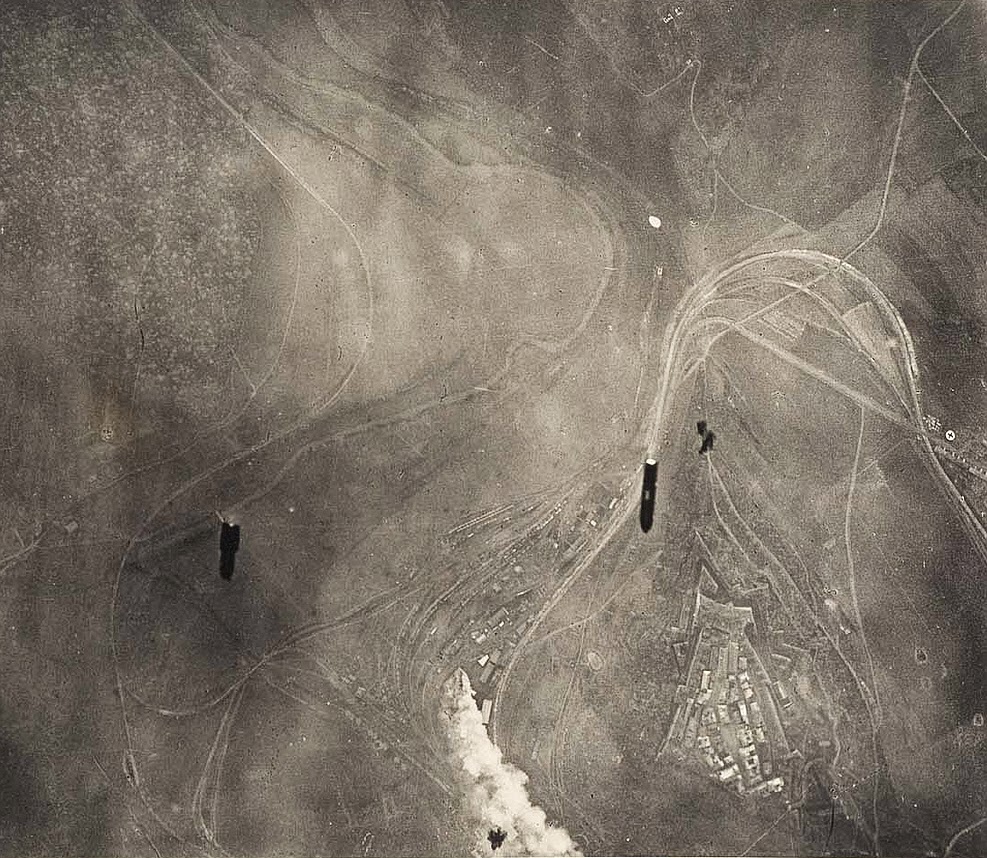
Industrialised war

Bombs falling on Montmedy and marshalling yards

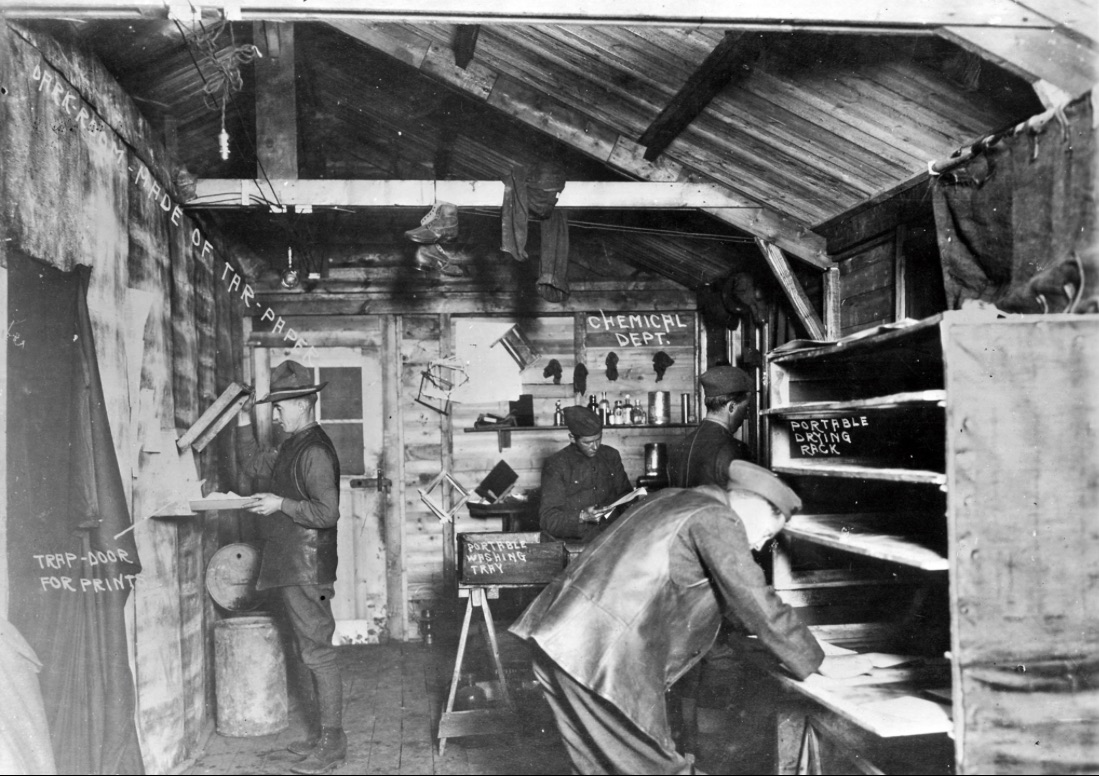
As I work on the text of “Reach from the Sky”, I’ve been revisiting the role of Edward Steichen in the development (in fact, the industrialisation) of air photography on the Western Front.  As I noted, all too briefly, in ‘Gabriel’s map’ (DOWNLOADS tab), Steichen commanded the photographic division of the American Expeditionary Forces. He organised the 55 officers and 1,111 men under his command into what Paul Virilio described as ‘a factory-style output of war information’ that ‘fitted perfectly with the statistical tendencies of this first great military-industrial conflict’.

Steichen 5th Photographic section at work on Western Front

The classic source on Steichen’s assembly-line methods of reproduction (and much more) is Allen Sekula‘s essay, ‘The instrumental image: Steichen at war’, in Artforum 14 (1975) 26-35 [see also the image above]:

The establishment of this method of production grew out of demands for resolution, volume, and immediacy. No method of reproduction but direct printing from the original negative would hold the detail necessary for reconnaissance purposes. Large numbers of prints from a single negative had to be made for distribution throughout the hierarchy of command. In addition, the information in prints dated very rapidly. Under these circumstances, efficiency depended on a thorough-going division of labor and a virtually continuous speedup of the work process. Printers worked in unventilated, makeshift darkrooms; 20 workers might produce as many as 1,500 prints in an hour, working 16-hour shifts.

Analytically the essay has never been surpassed, but now there is a new book that fills in the biographical details of Steichen’s service during the First World War: Von Hardesty‘s Camera Aloft: Edward Steichen in the Great War (Cambridge, 2016):

Von Hardesty Camera AloftEdward Steichen (1879–1973) played a key role in the development of photography in the twentieth century. He is well known for his varied career as an artist, a celebrated photographer, and museum curator. However, Steichen is less known for his pivotal role in shaping America’s first experiments in aerial photography as a tool for intelligence gathering in what may be called his “lost years.” In Camera Aloft, Von Hardesty tells how Steichen volunteered in 1917 to serve in the American Expeditionary Forces (AEF). He rose rapidly in the ranks of the Air Service, emerging as Chief of Air Photography during the dramatic final offensives of the war. His photo sections were responsible for the rapid processing of aerial images gained through the daily and hazardous sorties over the front and in the enemy rear areas. What emerged in the eighteen months of his active service was a new template for modern aerial reconnaissance. The aerial camera, as with new weapons such as the machine gun, the tank, and the airplane, profoundly transformed modern warfare.
Here is the table of contents:

Foreword: taking the camera aloft
1. War and exile
2. A new life in the military
3. Over there
4. The world of air observation
5. Taking charge
6. Over the front
7. War and photography
Appendix: life at the cutting edge: the photo sections.

The book includes stunning reproductions of photographs (from which I’ve borrowed the annotated image of the Photographic Section above): you can see a selection from the book here.  Other Steichen aerial imagery from the period is here and here.

As you’ll be able to see when I’m finished, I’m no less interested in Steichen’s work during the Second World War, and in particular the various photographic projects he directed in the Pacific that captured – and celebrated – the masculinism and homosociality of modern war (here the work of Horace Bristol is especially revealing).

But right now it’s the industrialisation of aerial imagery that is capturing my attention.  It’s a commonplace that the First World War was industrial warfare on the grand scale, of course, but often our attention is distracted by the killing machines and mechanisms themselves – the gas, the tanks, the aircraft – and we lose sight of the assembly-line logic that animated the slaughter not only during but also before and after.

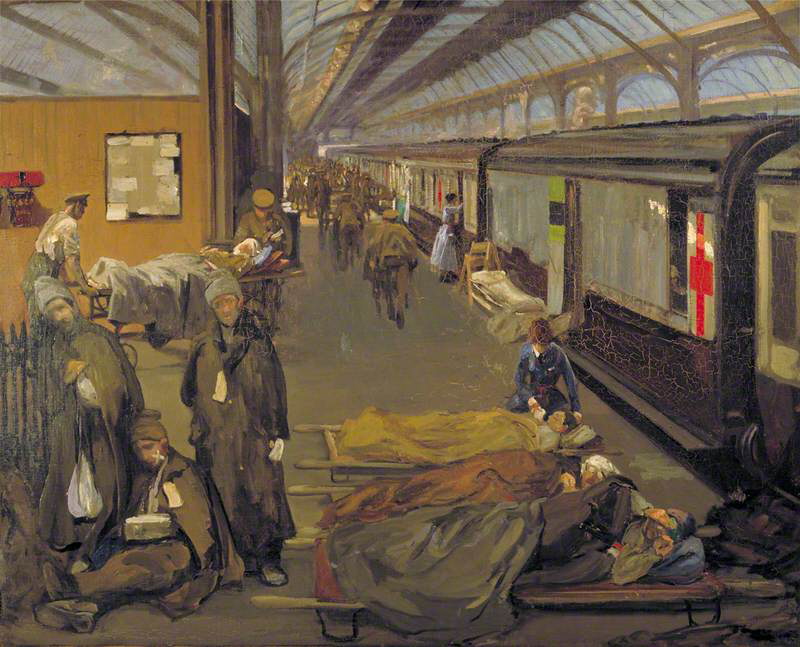
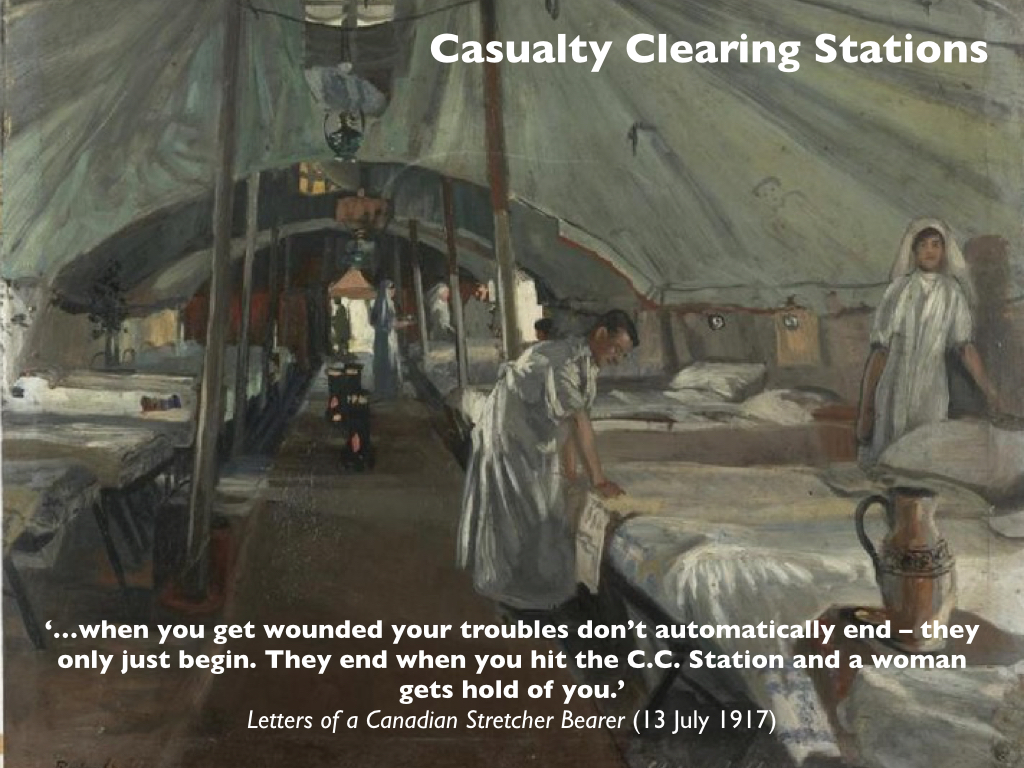
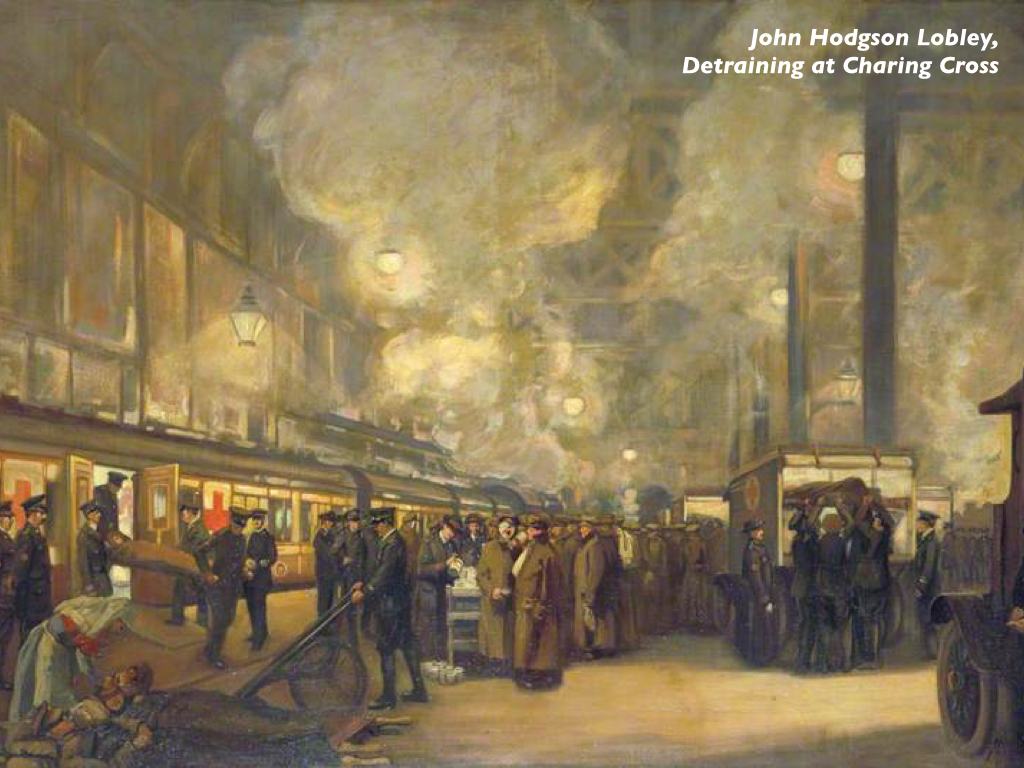
LOBLEY Reception of wounded at 1st CCS, Le Chateau October 1918

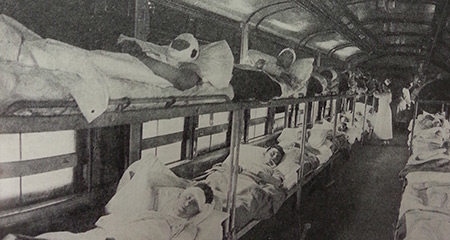
You can see it in Steichen’s production line, but there are countless other examples.  Last summer I was working in the Friends’ Library in London, recovering the role of the Quakers in providing medical care on the Western Front as part of my research on casualty evacuation, when I encountered this extraordinary passage that speaks directly to the relentless motion of the killing machine (see also my ‘Divisions of Life’ here).  It’s a medical orderly’s account of loading an ambulance train, written some time in 1915:

Down in a hedged field at the end of the straggling mining village lies the casualty clearing station, some two-score large tents… Since midday the [casualty] clearing station has been full to overflowing, but still an endless line of motor ambulances moves down along the crowded road from the fighting line, through the village and into the muddy field. It is night now, starless and dark as pitch, and a lashing rain is driven hard in your face before a bitter and rising wind; but still the cars are discharging their pitiful loads in dreary succession when the train is brought into the siding which serves this desolate little camp.

day2day-amb2

From the train itself you can scarcely see anything of the clearing station tonight; only the headlights of the cars as they turn in through the gate, and a few hurricane lamps flickering here and there. Near one end of the train, at the wooden footbridge which crosses the stream separating the camp from the railway track, there stands a powerful acetylene flare, casting a circle of vivid light on the deep mud of the path. Save for three or four feeble oil-lamps on the ground beside the long darkened train, this is the only light at the loading place. A few moments of uncertain waiting, and the first stretcher comes down, its weary bearers slithering and stumbling in the watery mire. As you watch the flare you see them emerge suddenly from the utter blackness beyond into the fierce glare of the light; they halt for a moment, while a cloaked officer standing on the bridge raises the waterproof sheet which protects the wounded man’s face from the beating rain; a name is given and noted; the covering is dropped over the head, and the bearers move on again, seeing to vanish as if by magic as they pass with their burden out of the light into the enveloping blackness. A pause, another stretcher enters the circle of light; the same words pass, the same motions, and it too move son, blotted out as suddenly as it appeared. Watching this time after time, you feel as if a picture were being cast on a screen and flashed off, over and over again: for there is something cruelly mechanical about it all.

(c) Rosenstiel's; Supplied by The Public Catalogue Foundation

‘Reach from the sky’ ONLINE

Tanner_Lecture_2016_FINAL

The video of my two Tanner Lectures, Reach from the sky: aerial violence and the everywhere war, delivered in Cambridge last month, is now available on the Clare Hall website.  The first, ‘Good bomb, bad bomb’ is here, and the second, ‘Killing Space’, is here, while the responses from Grégoire Chamayou, Jochen von Bernstorff and Chris Woods are here.

I’m immensely grateful to the video team, who were exceptionally helpful and remarkably accomplished.

I’m now hard at work on the long-form version…  And yes, I have – just! – notice the mistake on the poster.  It was indeed ‘Reach from the sky.’  Per ardua….

There’s also a short and kind reflection on the lectures from Alex Jeffrey over at Placing Law here.

A long day’s journey…

Anti-landscape of the Western Front.001

A note from Antipode to say that the latest edition is now available online and, unless I’ve mis-read things, is open access (for now, at any rate).  It includes what the editors say ‘might well be Antipode‘s longest ever paper’ – pp. 3-56! – my ‘Natures of war’ essay here.

JARMAN Sand.001

Still reaching from the skies…

Sorry for the long silence – I’ve had my head down since soon after Christmas preparing the Tanner Lectures which I gave this past week in Cambridge [‘Reach from the sky: aerial violence and the everywhere war’].  The lectures were recorded and the video will be available on the Clare Hall website in a fortnight or so: more when I know more.

In outline – and after a rare panic attack the night before, which had me working until 2.30 in the morning –  I organised the two Lectures like this:

ONE

Prelude: The historical geography of bombing

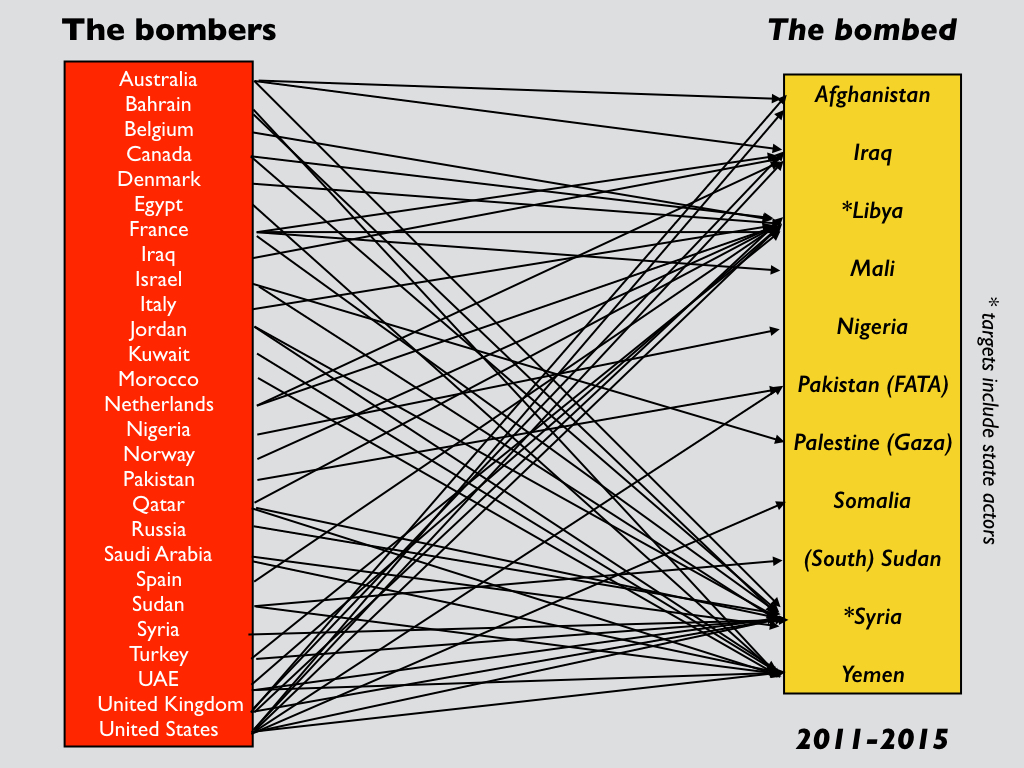
Bombing is back in the headlines but it never really left – and yet those who remain advocates of aerial violence don’t seem to have learned from its dismal history.  They also ignore the geographies that have been intrinsic to its execution, both the division between ‘the bombers and the bombed’ (the diagram below is an imperfect and fragmentary example of what I have in mind) and the pulsating spaces through which bombing is performed.

The bombers and the bombed.001

Good bomb, bad bomb

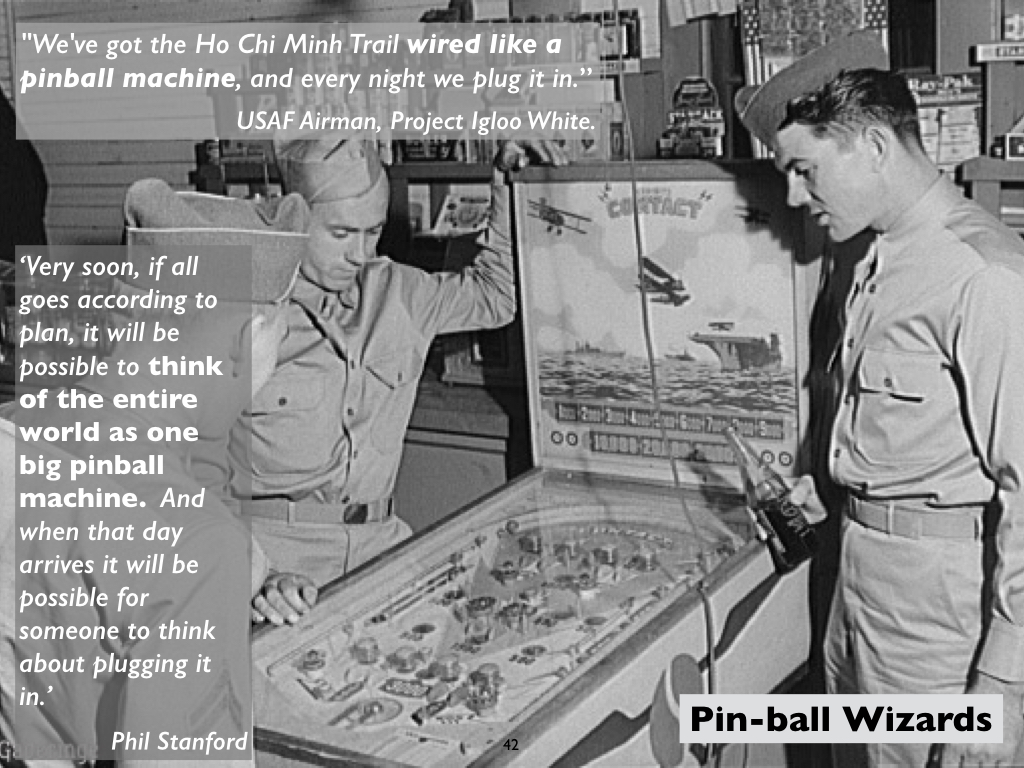
(with apologies to Mahmood Mamdani….)  In the first part I traced The machinery of bombing from before the First World War through to today’s remote operations.  Even though most early commentators believed that the primary role of military aircraft would be in reconnaissance, it was not long before they were being used to orchestrate artillery fire and to conduct bombing from the air. This sequence parallels the development of the Predator towards the end of the twentieth century.  In fact, almost as soon as the dream of flight had been realised the possibility of ‘unmanned flight’ took to the air.  Perhaps the most significant development, though, because it directs our attention to the wider matrix within which aerial violence takes place, was the development of the electronic battlefield in Laos and Cambodia. I’ve written about this in detail in ‘Lines of Descent‘ (DOWNLOADS tab); the electronic battlefield was important not because of what it did – the interdiction program on the Ho Chi Minh Trail was a spectacular failure (something which too many historians have failed to recognise)  – but because of what it showed: it conjured up an imaginative landscape, an automated killing field, in which sensors and shooters were linked through computer systems and automatic relays.  Contemporaries described the system as a vast ‘pinball machine’ (see the image below: you can have no idea how long it took me to track it down…).

Pinball wizards.001

The analogy allowed me to segue into the parallel but wholly inadequate characterisation of today’s remote operations as reducing military violence to a video game.

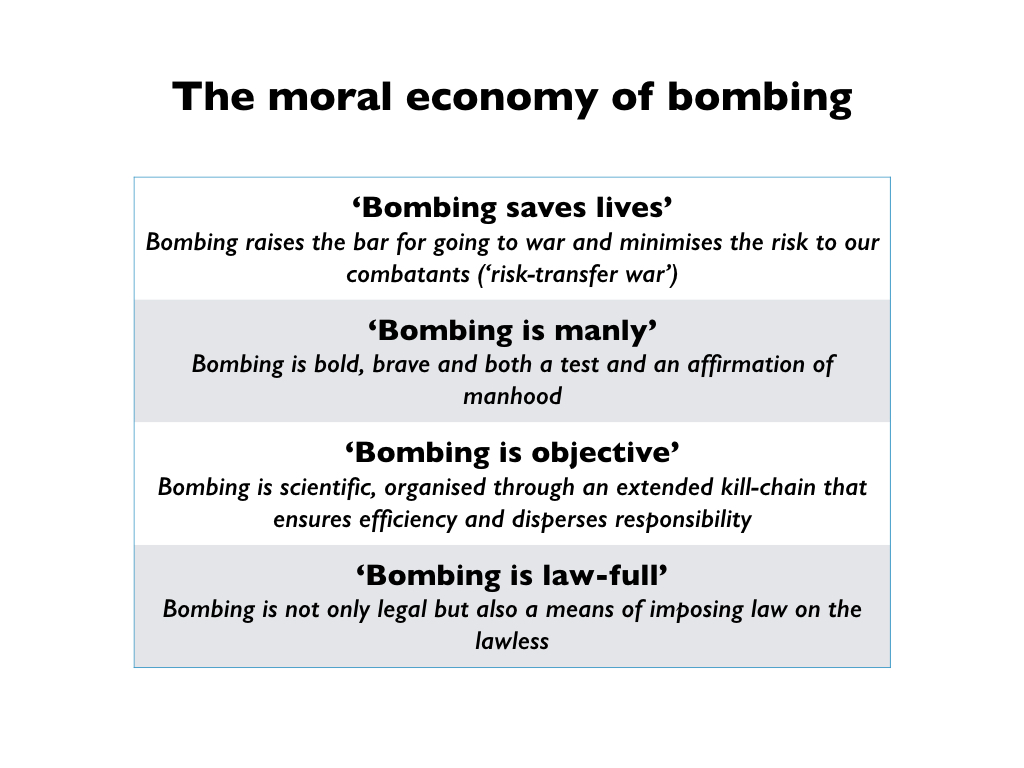
That is an avowedly ethical objection, of course, so I then turned to The moral economy of bombing.  Here I dissected four of the main ways in which bombing has been justified.  These have taken different forms at different times, and they intersect and on occasion even collide.  But they have been remarkable persistent, so in each case I tracked the arguments involved and showed how they have been radicalised or compromised by the development of Predators and Reapers.

Moral economy of bombing.001

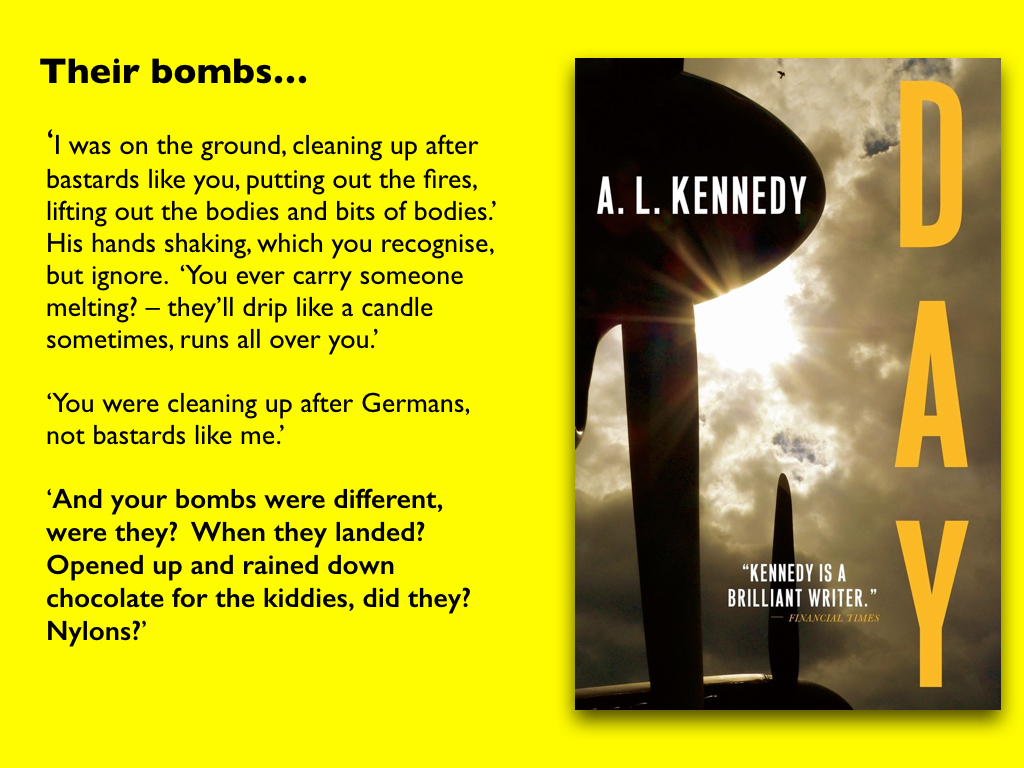
All of these justifications applied to ‘our bombs’, needless to say, which become ‘good bombs’, not to ‘their bombs’ – the ‘bad bombs’.

Their bombs.001

TWO

Killing Space

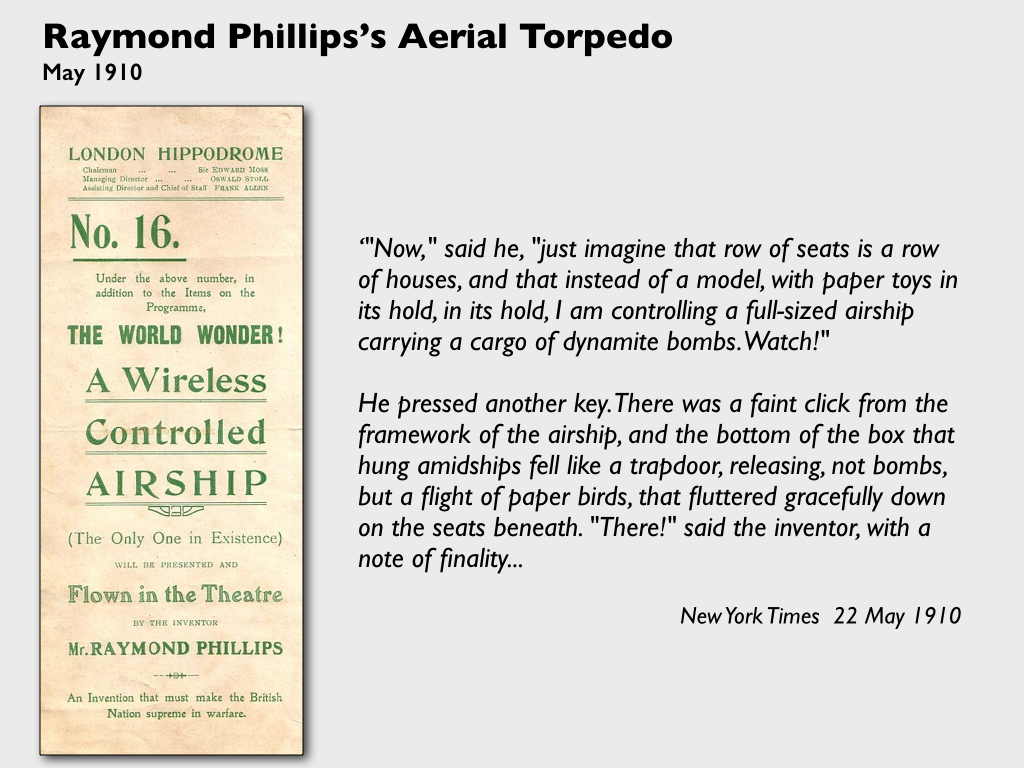
Phillips' Aerial Torpedo.001

I started the second lecture by discussing The deconstruction of the battlefield; the wonder of Raymond Phillips’s fantasies of ‘aerial torpedoes‘ before the First World War was not so much their promise of ‘bomb-dropping by wireless’ but the targets:

Phillips' bomb-dropping by wireless.001

It was this radical extension of the battle space that counted.  In the event,  it was not British airships that dropped bombs on Berlin but German Zeppelins that bombed London and Paris, but the lesson was clear:

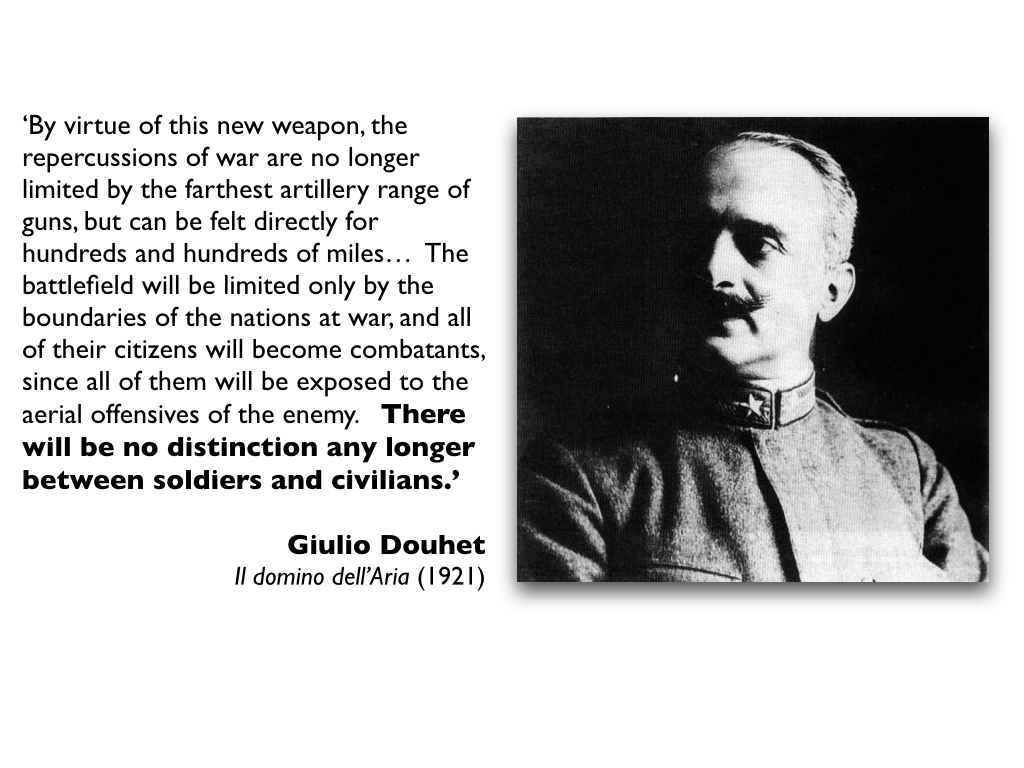
Douhet.001

To explore the formations and deformations of the battlespace in more detail, I used the image of The dark heart of bombing to describe a battlespace that alternately expanded and contracted.  So Allied bombing in the Second World war extended its deadly envelope beyond Germany, Italy and Japan into Belgium, Bulgaria, Denmark, France, the Netherlands, Norway and Romania; later the United States would bomb North Vietnam but reserved most of its ordnance for South Vietnam, Laos and Cambodia; and US air strikes in Afghanistan and Iraq would eventually spill over into Pakistan, Syria and elsewhere.  In the course of those air wars, the accuracy of targeting improved until it was possible to aim (if not always to hit) point-targets – individual buildings and eventually individual people – but this contraction of the killing space was accompanied by its expansion.  These ‘point-targets’ were selected because they were vital nodes that made possible the degradation or even destruction of an entire network.  Hence, for example, the Israeli attack on the Gaza power station (more in a previous post here):

Gaza Power Strip.001

A similar argument can be made about the US Air Force’s boast that it can now put ‘warheads on foreheads’, and I linked the so-called individuation of warfare to the US determination to target individuals wherever they go – to what Jeremy Scahill and others describe as the production of a newly expanded ‘global battlefield’.  What lies behind this is more than the drone, of course, since these killing fields rely on a global system of surveillance orchestrated by the NSA, and I sketched its contours and showed how they issued in the technical production of an ‘individual’ not as a fleshy, corporeal person but as a digital-statistical-spatial artefact (what Ian Hacking once called ‘making people up’ and what Grégoire Chamayou calls ‘schematic bodies‘).

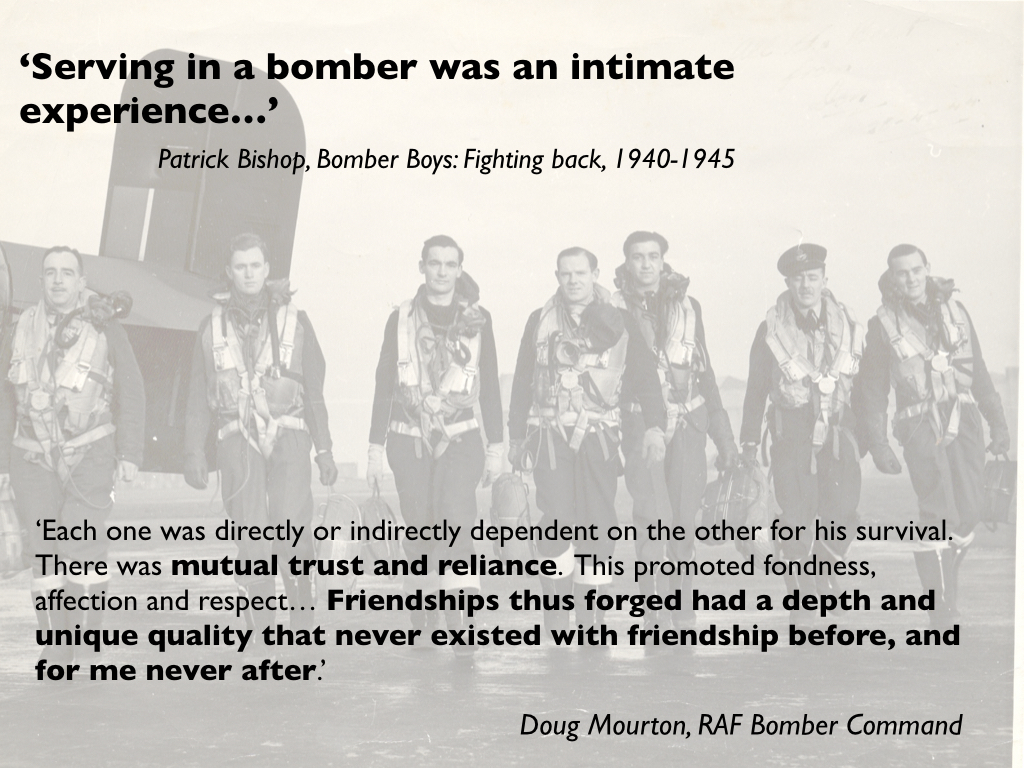
Next I explored a different dialectical geography of the battlespace: Remote splits: intimacy and detachment.  I started with RAF Bomber Command and traced in detail the contrast between the intimacy between members of bomber crews (a mutual dependence reinforced by the bio-convergence between their bodies and the machinery of the bomber itself) and the distance and detachment through which they viewed their targets.

Bioconvergence and the bomber crew.001

Intimacy in Bomber Command.001

The Good Wife.001

Cockpit dials.001

Distance and blindness.001

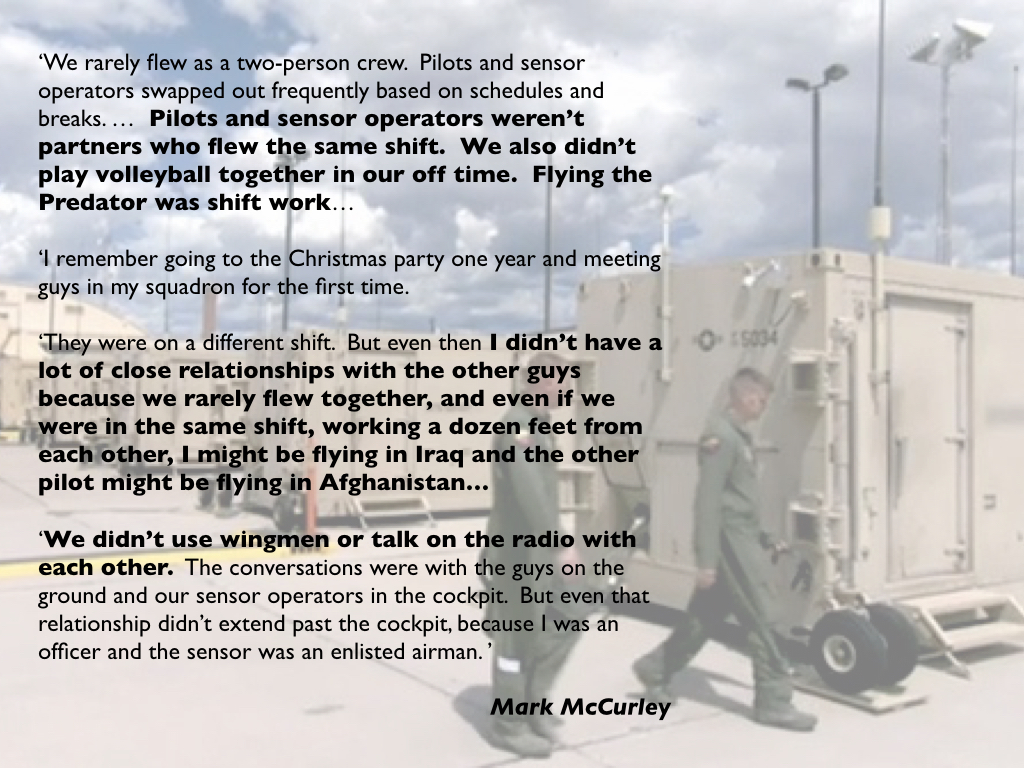
There’s much more on this in ‘Doors into nowhere‘ (DOWNLOADS tab), though I think my discussion in the Lectures breaks new ground. All of this is in stark contrast to today’s remote operations, where – as Lucy Suchman reminds us – there remains a remarkable (though different) degree of bioconvergence and yet now a persistent isolation and anomie is felt by many pilots and sensor operators who work in shifts:

Anomie and the drone.001

This is thrown into relief by the closeness remote operators feel to the killing space itself, an immersion made possible through the near real-time full-motion video feeds, the internet relay chatter and the radio communications with troops on the ground (where there are any). In contrast to the bomber crews of the Second World War – or those flying over the rainforests of Vietnam, Laos and Cambodia – there is a repeated insistence on a virtualized proximity to the target.

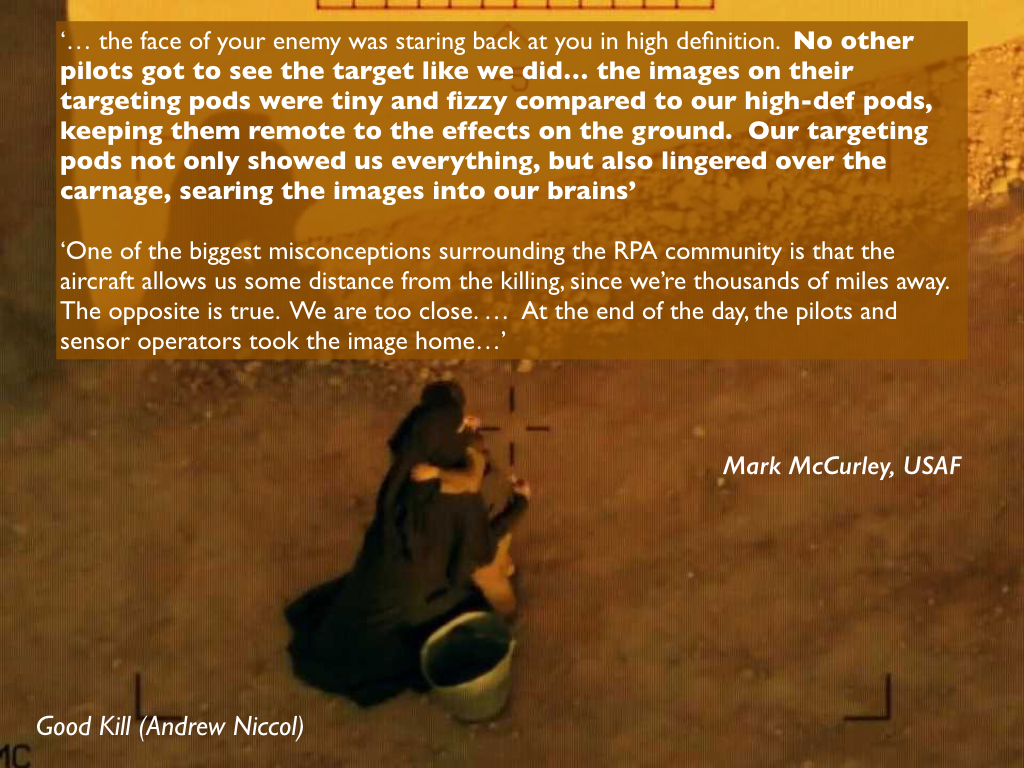
Good Kill in high-definition.001

But I used a discussion of Andrew Niccol‘s Good Kill to raise a series of doubts about what drone crews really can see, as a way into the next section, Sweet target, which provided an abbreviated presentation of the US air strike in Uruzgan I discuss in much more (I hope forensic) detail in Angry Eyes (see here and here).  That also allowed me to bring together many of the key themes I had isolated in the course of the two lectures.

As I approached my conclusion, I invoked Thomas Hippler‘s Le gouvernement du ciel: Histoire globale des bombardements aériens, (I’ve just discovered that Verso will publish the English-language version later this year or early next: Governing from the skies: a global history of aerial bombing):

Hippler Neo-douhetism.001

I’m not convinced that the military and paramilitary violence being visited on people today is all ‘low-intensity’ (Gaza? Afghanistan? Iraq? Syria? Yemen?).  But neither do I think it’s ‘de-territorialised’, unless the word is flattened into a conventionally Euclidean frame.  Hence, following Stuart Elden‘s lead, I treated territory as a political-juridical technology whose calibrations and enclosures assert, enable and enforce a claim over bodies-in-spaces.  And it was those ‘bodies-on-spaces’ that brought me, finally, to The loneliest space of all:  the irreducible, truly dreadful loneliness of death and grief:

Counting the dead.001

Behind the body-counts and the odious euphemisms of collateral damage and the rest lies the raw, inconsolable loss so exquisitely, painfully rendered in ‘Sky of Horoshima‘…

In the coming days I’ll post some of the key sections of the Lectures in more detail, which I’ll eventually develop into long-form essays.

I learned a lot from the expert and wonderfully constructive commentaries after the Lectures from Grégoire Chamayou, Jochen von Bernstorff and Chris Woods, and I’ll do my best to incorporate their suggestions into the final version.

In his response Grégoire traced my project on military violence in general and bombing/drones in particular back to a series of arguments I’d developed in Geographical imaginations in 1994 about vision, violence and corporeality; I had overlooked these completely, full of the conceit that my work had never stood still…. I shall go back, re-read and think about that some more, since some of the ideas that Grégoire recovered (and elaborated) may be even more helpful to me now.  Jochen and Chris also gave me much food for thought, so I shall be busy in the coming months, and I’m immensely grateful to all three of them.

War Material

SARGENT Two soldiers at Arras

I’m thrilled to say that the (very!) long-form version of The Natures of War, the 1st Neil Smith Lecture which I gave at the University of St Andrews in November 2013, is now online (‘Early View’) at Antipode, all 54 pages of it.

Here is the abstract:

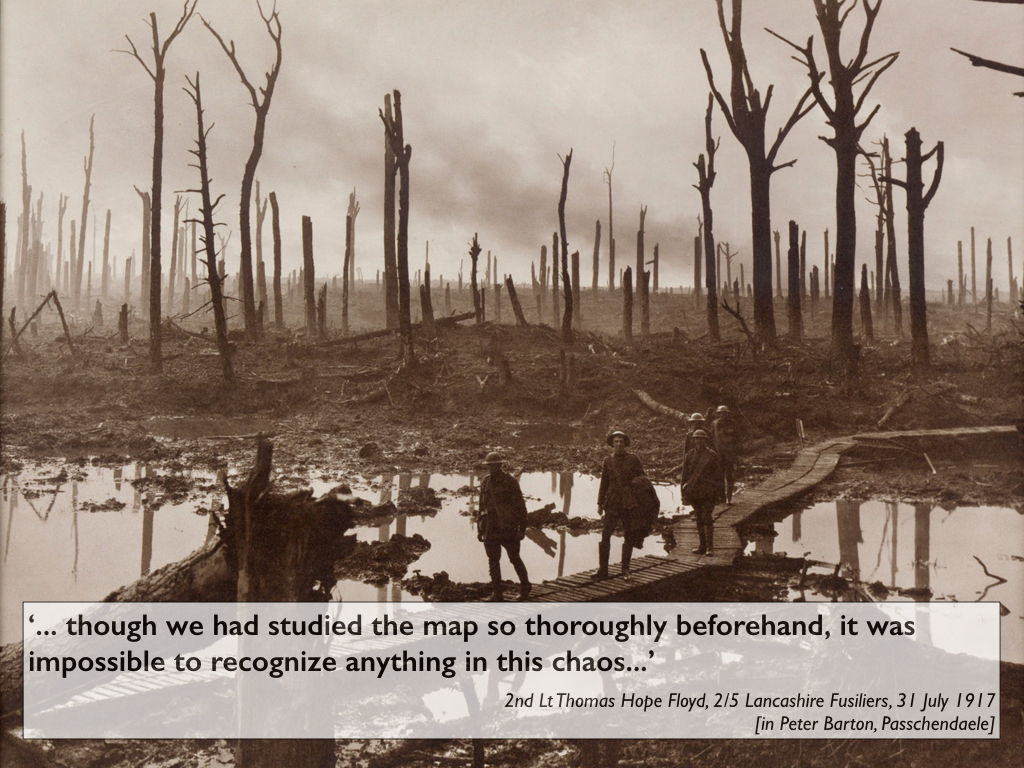
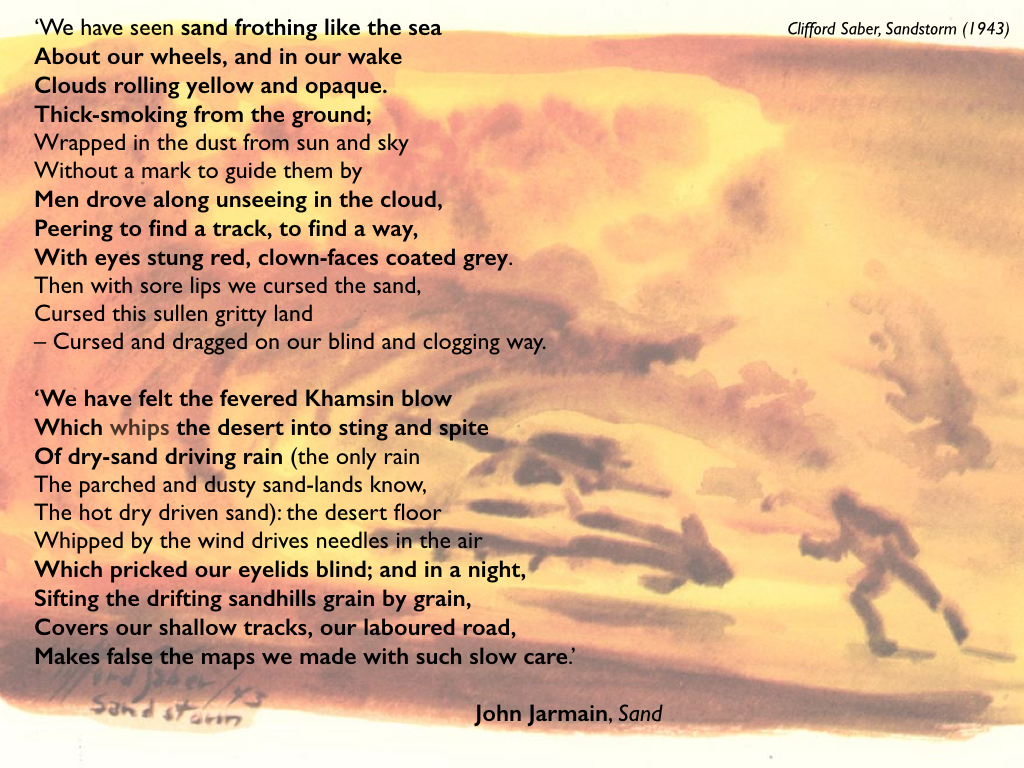
“Nature” is more than a resource bank whose riches can trigger armed conflict and finance its depredations; it is also a medium through which military and paramilitary violence is conducted. The militarisation of nature is part of a dialectic in which earthy, vibrant matter shapes the contours of conflict and leaves its marks on the bodies of soldiers who are both vectors and victims of military violence. Three case studies identify some of the central bio-physical formations that became entangled with armed conflict in the twentieth century: the mud of the Western Front in the First World War, the deserts of North Africa in the Second World War, and the rainforests of Vietnam. Taken together, these reveal vital connections between the materiality and corporeality of modern war and their continued relevance to its contemporary transformations.

You can still find the original, non-Harvard style version under the DOWNLOADS tab – and I’m truly grateful to Andy Kent for relieving me of the task of converting my original MS into the Harvard system.

The image above, incidentally, is John Singer Sargent‘s Two soldiers at Arras (1917), and is a perfect illustration of this passsage from the essay:

In the face of these horrors, some soldiers came to regard themselves as having become as “un-natural” as the militarised, industrialised natures in which they were embedded. The Tommy “will soon be like nothing on earth”, wrote one officer on the Somme in January 1916. “If only we could be clothed in rubber all over and fed through a tube I think some real progress in our equipment might have been made”. He was only half-joking. The next phase in the emergence of this cyborg warrior can be seen in the tank battles that raged across the deserts of North Africa during the Second World War. But, as I must now show, even in the midst of this more fully mechanised warfare, bio-physical entanglements remained immensely powerful—and the human body intensely vulnerable.

I then do the same for Vietnam.

My plan is to rework this version: to incorporate as many of the images I used in the Vietnam extracts I posted online here and here (together with others from the Western Front and the Western Desert), to add a fourth case study of Afghanistan, and to include the revised version in a new book of essays that I’m calling War material.

The plan looks like this (in each case the original essays, apart from the intro, are available under the DOWNLOADS tab too; I’m re-working those versions, planing away any overlaps, and adding more images):

Chapter 1: War material

Chapter 2: Gabriel’s map

Chapter 3: The Natures of War

Chapter 4: Doors into Nowhere

Chapter 5: Lines of Descent

These are all more or less ready to go, apart from the introduction, but I’m debating whether to add a sixth chapter, called ‘Wounds of war’, which would parallel ‘The Natures of War’ in many ways and chart the changing geographies of casualty evacuation from war zones, 1914-2014.

Each of the essays in the book, even in their present form, has something to say about the way in which the conduct of modern war has – and has not – changed over the last hundred years, but the title also tilts at those who seem to think that everything we need to know about modern military violence was uncannily anticipated by Michel Foucault in his (I too think brilliant) Paris lectures in the 1970s so that this absolves them of the need for any research or even reading into the materialities of war (a strangely non-Foucauldian assumption, given his own frequent immersion in the archive and his densely empirical way of working).

I’d be grateful for any comments or suggestions.

Divisions of Life

Journeys from No Man's Land.001

My main presentation at the AAG in Chicago was part of a session organised by Noam Leshem and Alasdair Pinkerton on Remnants of No Man’s Land: history, theory and excess (more on their larger project here).  Here is an extended summary of what I had to say, together with some of my slides, but bear in mind that this all had to be done in 20 minutes so there wasn’t much room for nuance.  Neither was there time to discuss civilian entanglements, both volunteers and victims, nor the sick: the presentation focuses on the wounded, even though the problems of trench foot, ‘trench flu’, and a host of other diseases were also extremely important.  They do all receive attention in the larger project from which this is extracted.  One last, geographical qualification: my discussion is limited to the evacuation of British and imperial troops from the Western Front.

My starting-point was the strange disappearance of the wounded from the field of battle.  As John Keegan wrote in The Face of Battle, in most histories the ‘wounded apparently dematerialize as soon as they are struck down’; he was writing specifically about General Sir William Napier’s account of the battle of Albuera in 1811, but the point is a sharp one that can be enlisted as part of a more general critique of military history.

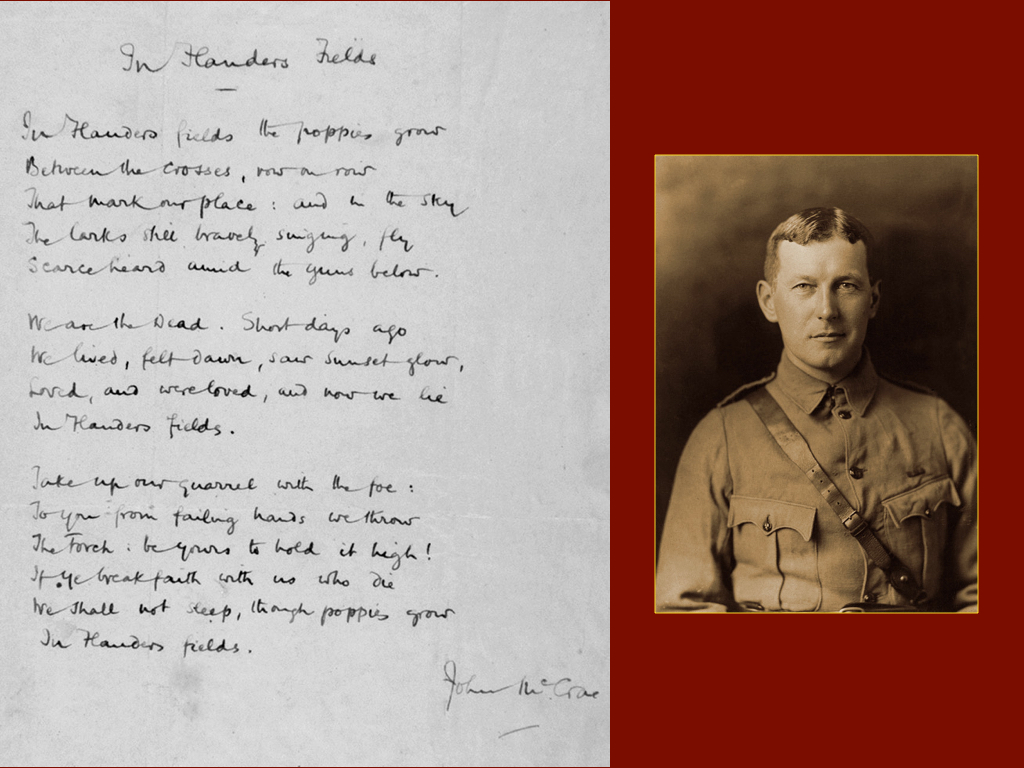
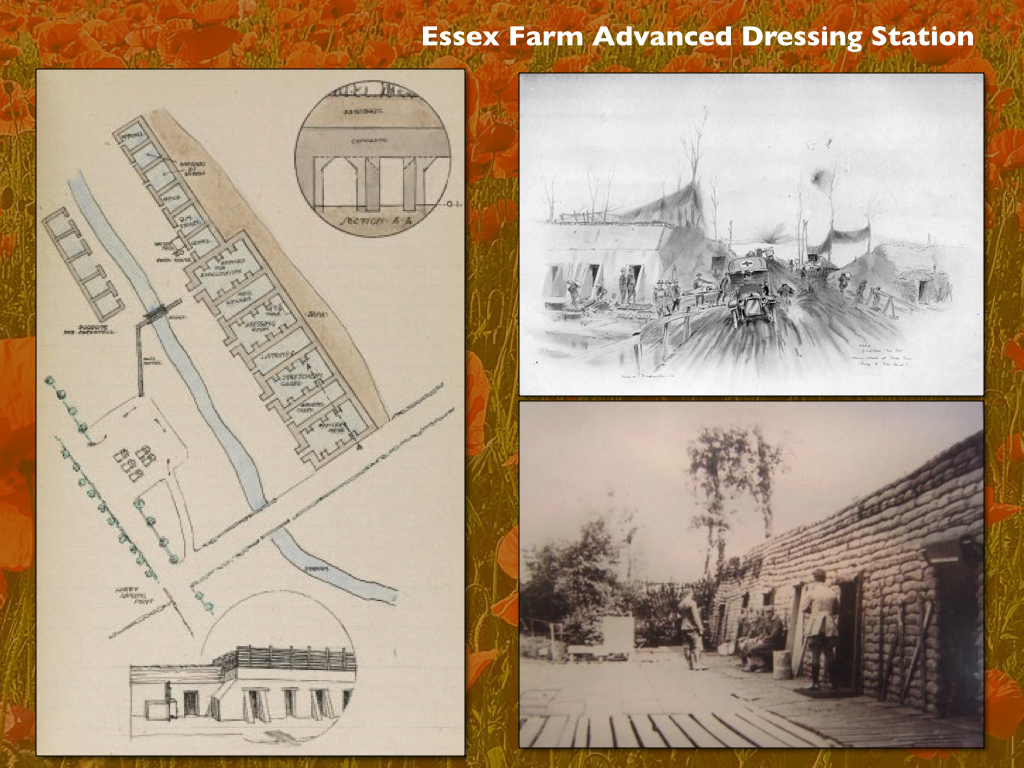
In the case of the First World War, the emphasis on those who lost their lives – on the dead not the wounded – derives not only from the sheer scale of the slaughter but also from the enduring landscape of memorialisation and commemoration.  When John McCrae‘s elegaic poem ‘In Flanders Fields’ is recited every Remembrance Day – ‘In Flanders fields the poppies grow, between the crosses, row on row’ – it is all too easy to forget that he wrote those lines not only to commemorate the death of a close friend but that he did so at Essex Farm Advanced Dressing Station:

Journeys from No Man's Land.003

Journeys from No Man's Land.004

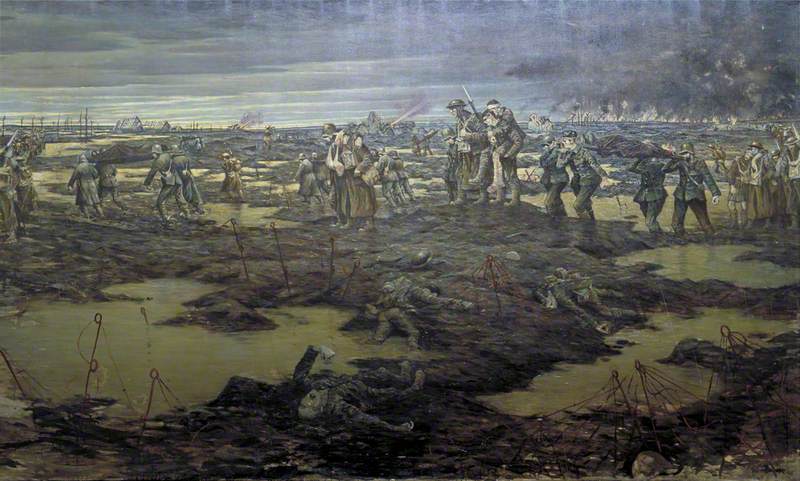
What lies behind those haunting lines – and that medical outpost – is a vast canvas of wounded men, which Christopher Nevinson captured as ‘The Harvest of Battle’ (below).  The dead occupy the foreground, but behind them is the endless, moving panorama of the wounded whose precarious journeys took most of them far beyond ‘No Man’s Land’.

(c) IWM (Imperial War Museums); Supplied by The Public Catalogue Foundation

In fact, as Emily Mayhew reminds us, ‘being wounded was one of the most common experiences of the Great War’: on the Western Front, she writes, ‘almost every other British soldier could expect to become a casualty’.

But, perhaps not surprisingly, for the first six months of the war the British Expeditionary Force was unprepared for the scale of casualties, and even with the help of civilian volunteers and aid societies – Nevinson briefly served as a medical orderly with the Friends Ambulance Unit, for example – the remarkably long time it took to evacuate the wounded combined with the perilous nature of their improvised journeys to increase the mortality rate.

Journeys from No Man's Land.007

Journeys from No Man's Land.008

And so what Mark Harrison called the military-medical machine had to be speeded up – and moved closer to the field of battle.

Journeys from No Man's Land.016

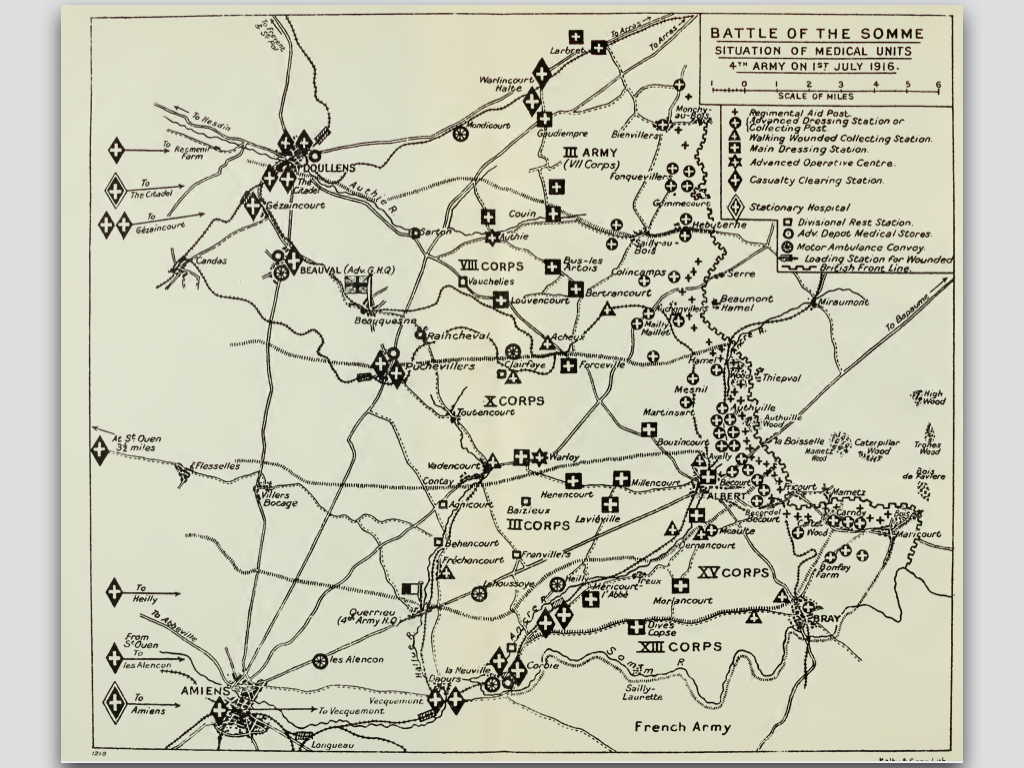
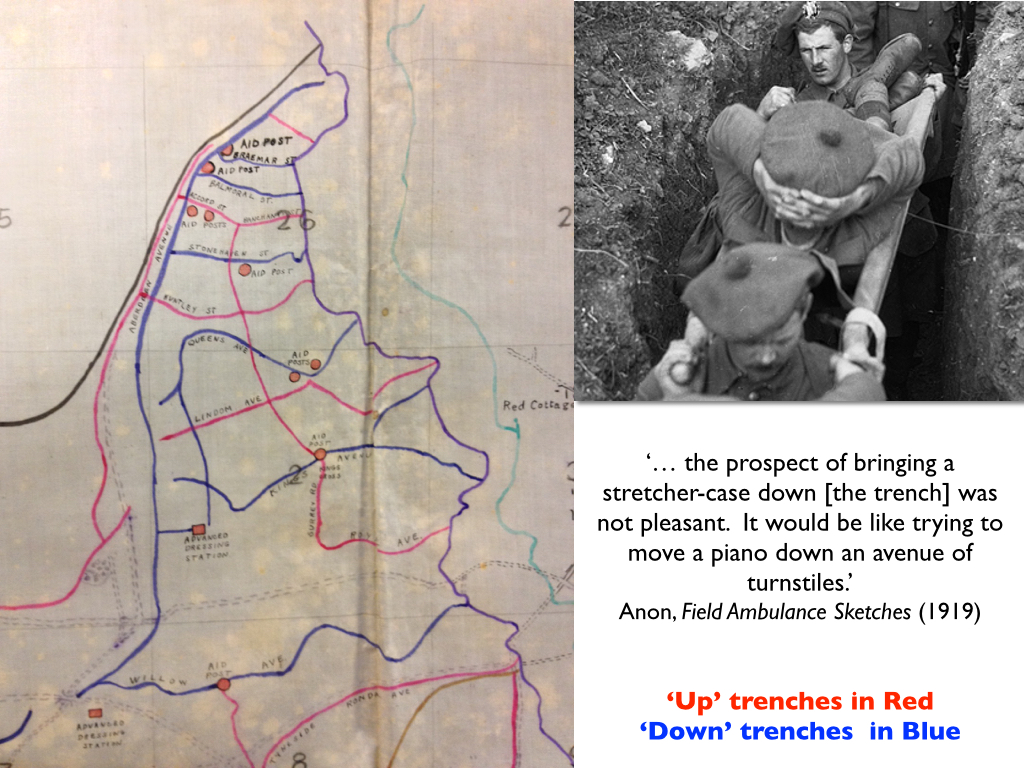
Before every major offensive elaborate plans for medical support were prepared: casualties were ‘cleared’ down the line as far and as fast as possible to make room for the newly injured, casualty clearing hospitals moved closer to the line, ambulances and stretcher-bearers made ready, and ‘down’ trenches designated for the efficient removal of the wounded (below).

Journeys from No Man's Land.017

Soldiers wounded in ‘No Man’s Land’ – a term never recognised by the British General Staff, who insisted that they controlled the field of battle right up to the enemy front lines – were often immobilised and disoriented; some crawled into shell holes, seeking refuge below the field of fire, but it could take hours, even days before they were discovered and rescued (I’ll devote a later post to a detailed discussion of some of those cases).

Journeys from No Man's Land.022

Journeys from No Man's Land.023

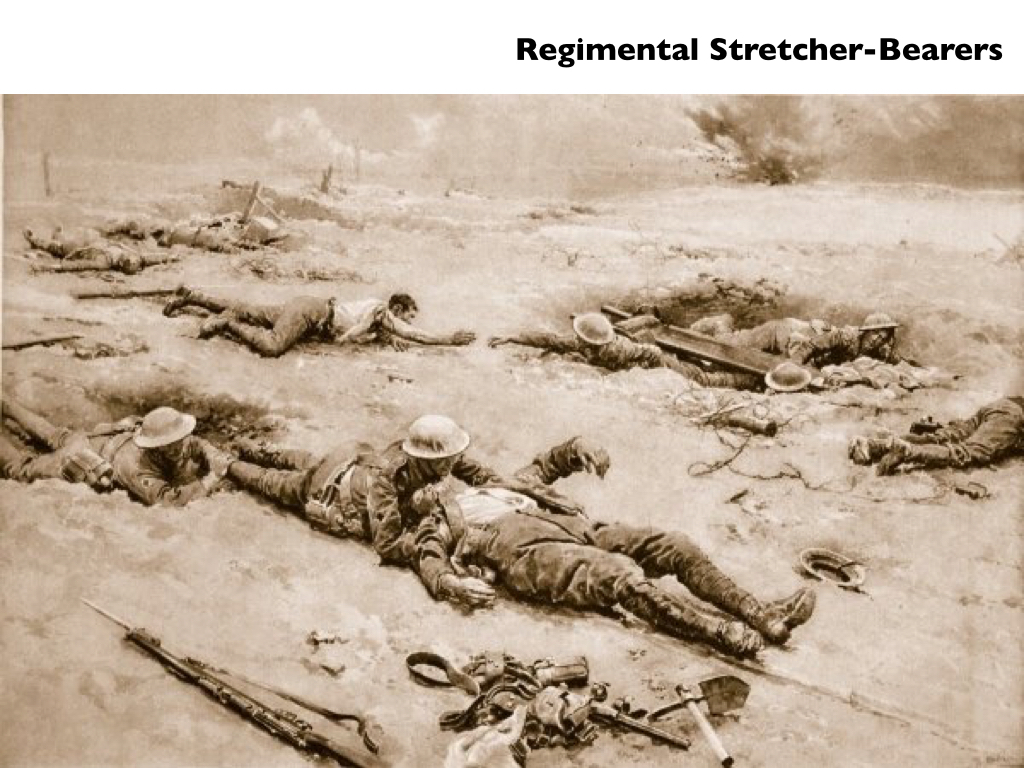
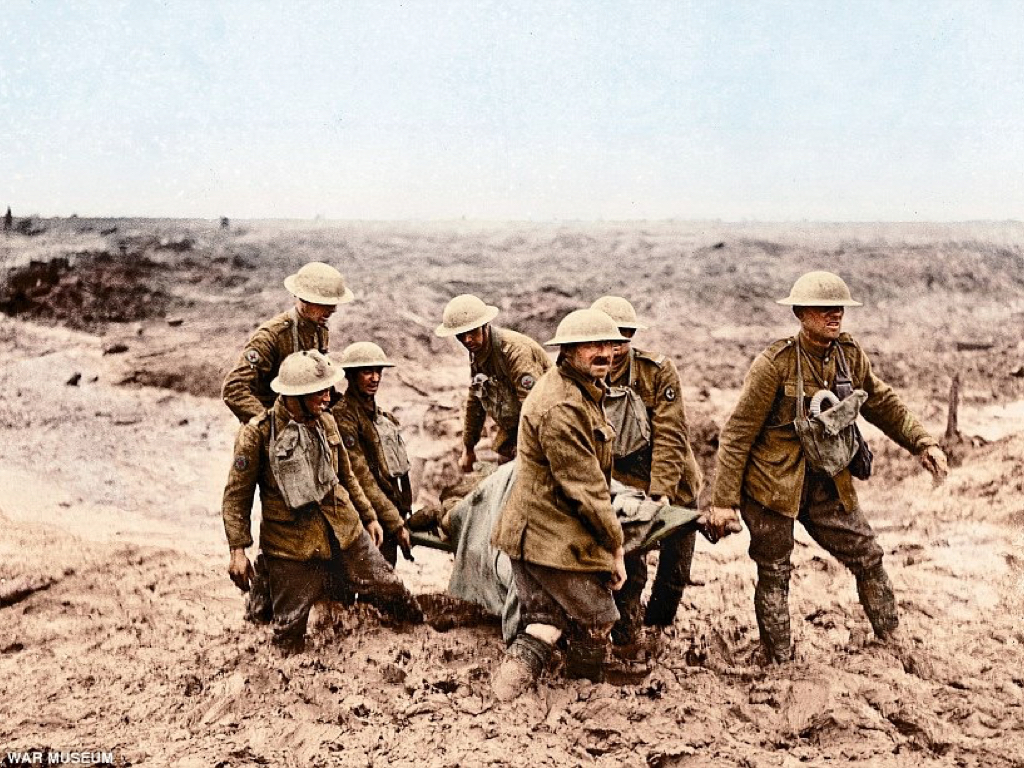
Sometimes their mates came to their rescue, sometimes the regimental stretcher bearers.  But they too had to find their way through a dangerous and devastated terrain, often with no landmarks to guide them and on occasion made virtually impassable by the thick, cloying mud that was always –  disconcertingly – much more than mud.

Journeys from No Man's Land.024

By now, they were in the care of the Royal Army Medical Corps’s Field Ambulance, and their first objective was an Advanced Dressing Station.  

Journeys from No Man's Land.026

Treatment at ADS 1917

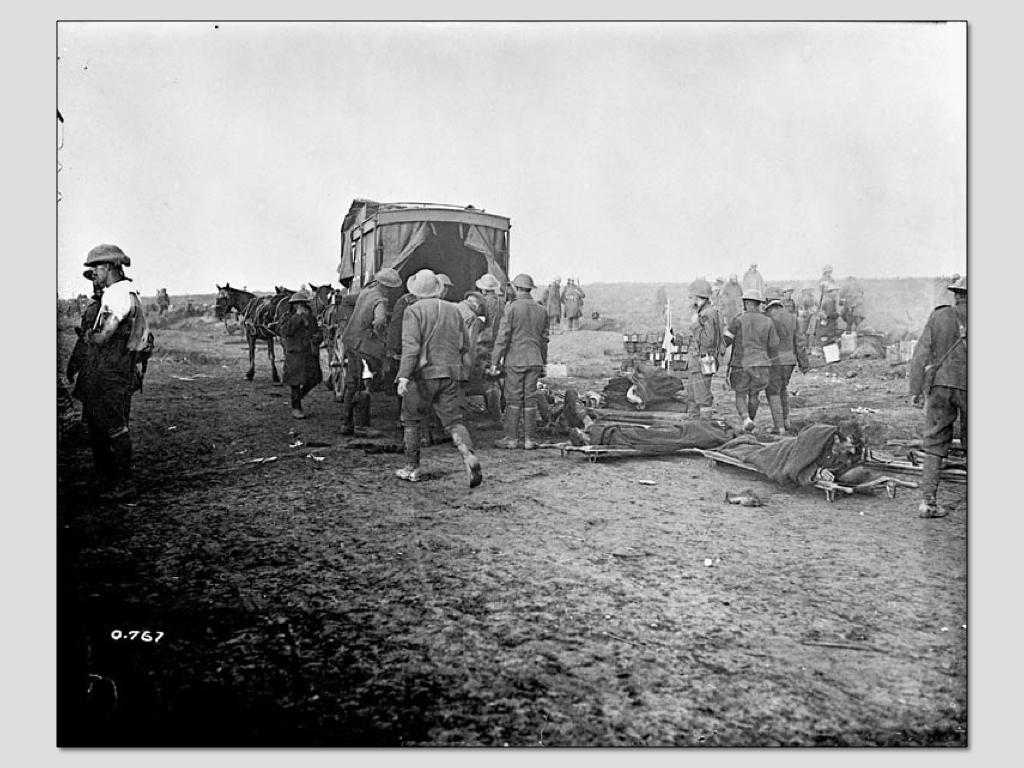
Those that needed anything beyond simple treatment or emergency surgery were sent on by horse or motor ambulance to a Casualty Clearing Station (a field hospital).

Journeys from No Man's Land.027

Journeys from No Man's Land.030

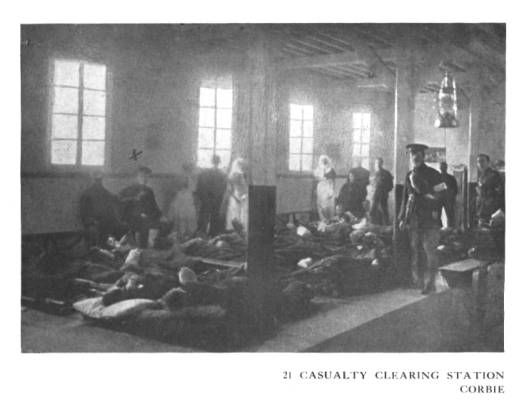
It was usually here that their first surgeries took place.  The journalist Philip Gibb was shown around a CCS at Corbie and the experience haunted him for years:

After a visit there I had to wipe cold sweat from my forehead, and found myself trembling in a queer way. It was the medical officer—a colonel—who called it that name. “This is our Butcher’s Shop,” he said, cheerily. “Come and have a look at my cases. They’re the worst possible; stomach wounds, compound fractures, and all that. We lop off limbs here all day long, and all night. You’ve no idea!”

CCS Corbie

I had no idea, but I did not wish to see its reality. The M.O. could not understand my reluctance to see his show. He put it down to my desire to save his time—and explained that he was going the rounds and would take it as a favor if I would walk with him. I yielded weakly, and cursed myself for not taking to flight. Yet, I argued, what men are brave enough to suffer I ought to have the courage to see… I saw and sickened. These were the victims of “Victory” and the red fruit of war’s harvest-fields. A new batch of “cases” had just arrived. More were being brought in on stretchers. They were laid down in rows on the floor-boards. The colonel bent down to some of them and drew their blankets back, and now and then felt a man’s pulse. Most of them were unconscious, breathing with the hard snuffle of dying men. Their skin was already darkening to the death-tint, which is not white. They were all plastered with a gray clay and this mud on their faces was, in some cases, mixed with thick clots of blood, making a hard incrustation from scalp to chin. “That fellow won’t last long,” said the M. O., rising from a stretcher. “Hardly a heart-beat left in him. Sure to die on the operating-table if he gets as far as that… Step back against the wall a minute, will you?” We flattened ourselves against the passage wall while ambulance-men brought in a line of stretchers. No sound came from most of those bundles under the blankets, but from one came a long, agonizing wail, the cry of an animal in torture. “Come through the wards,” said the colonel. “They’re pretty bright, though we could do with more space and light.” In one long, narrow room there were about thirty beds, and in each bed lay a young British soldier, or part of a young British soldier. There was not much left of one of them. Both his legs had been amputated to the thigh, and both his arms to the shoulder-blades. “Remarkable man, that,” said the colonel. “Simply refuses to die. His vitality is so tremendous that it is putting up a terrific fight against mortality… There’s another case of the same kind; one leg gone and the other going, and one arm. Deliberate refusal to give in. ‘You’re not going to kill me, doctor,’ he said. ‘I’m going to stick it through.’ What spirit, eh?”…

“Bound to come off,” said the doctor as we passed to another bed. “Gas gangrene. That’s the thing that does us down.” In bed after bed I saw men of ours, very young men, who had been lopped of limbs a few hours ago or a few minutes, some of them unconscious, some of them strangely and terribly conscious, with a look in their eyes as though staring at the death which sat near to them, and edged nearer. “Yes,” said the M. O., “they look bad, some of ’em, but youth is on their side. I dare say seventy-five per cent. will get through. If it wasn’t for gas gangrene—“

He jerked his head to a boy sitting up in bed, smiling at the nurse who felt his pulse. “Looks fairly fit after the knife, doesn’t he? But we shall have to cut higher up. The gas again. I’m afraid he’ll be dead before to-morrow. Come into the operating-theater. It’s very well equipped.”

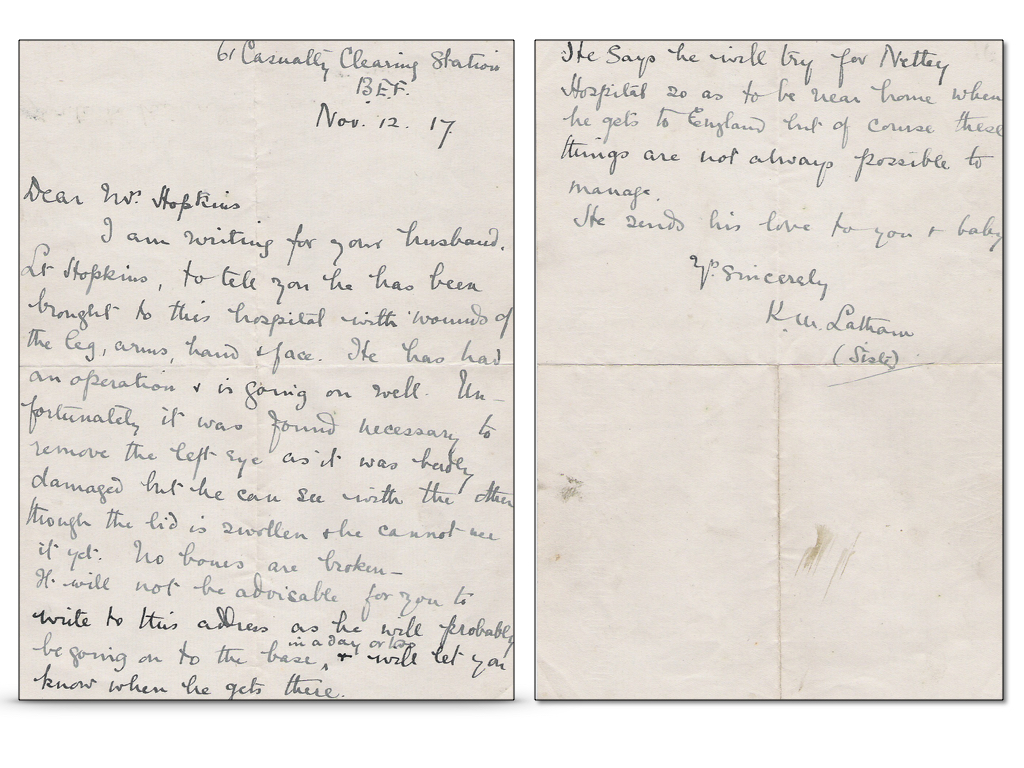
By now the bureaucratic machine had been activated: labels had been attached to the wounded and field medical cards (‘tickets’) completed; telegrams had been sent to advise families, and nurses had often written letters home on their patients’ behalf.

Journeys from No Man's Land.035Journeys from No Man's Land.036

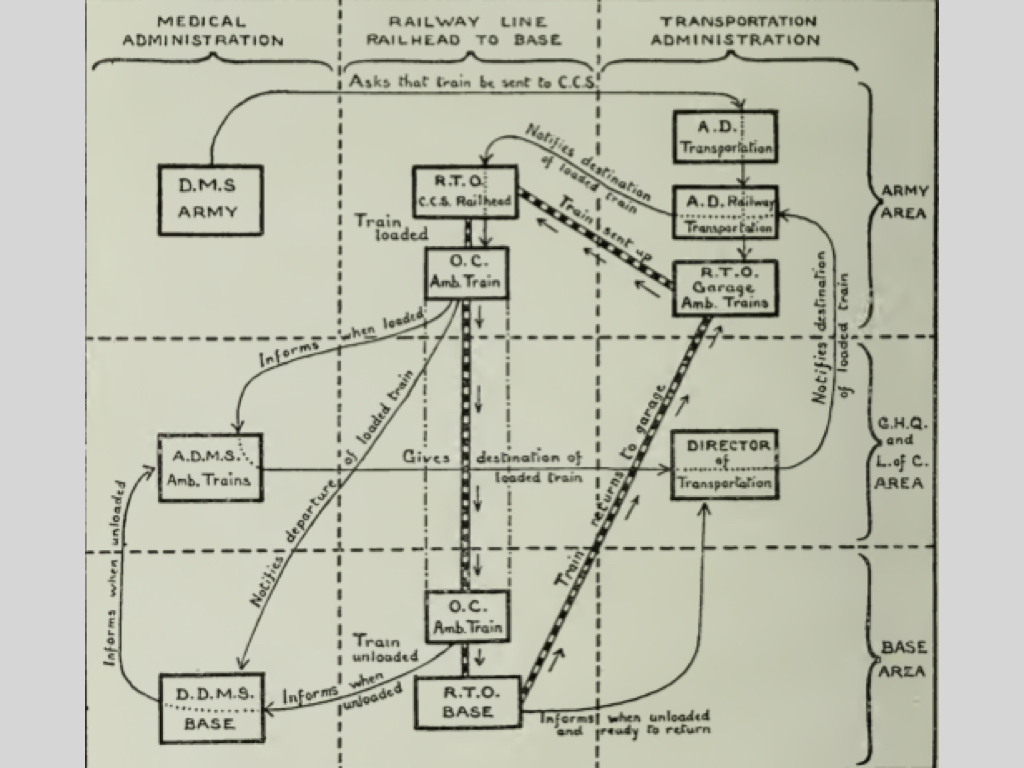
The next stage for the most seriously wounded was evacuation by ambulance train to  a base hospital on the French coast.  There was a considerable bureaucracy involved in planning these movements, but for all the neatness and symmetry of the organisational diagrams – part of Clausewitz‘s ‘paper war’ – there were all sorts of delays.

Journeys from No Man's Land.038

Journeys from No Man's Land.040

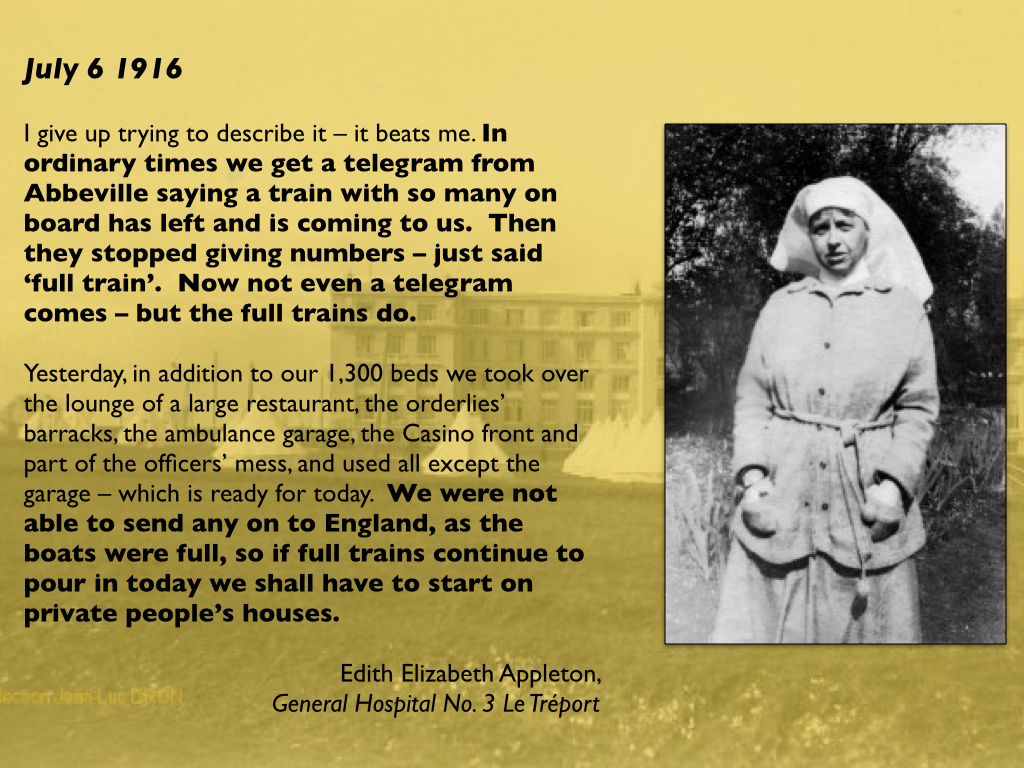
Priority was given to trains rushing reinforcements, supplies and ammunition to the front, and ambulance trains were frequently marooned in sidings waiting for them to pass so that journeys that might have taken hours could take days.  It was not uncommon for an ambulance train to arrive at a base hospital to find that there was little or no room for new patients and all but the most grievous cases had to travel on to the next.

Journeys from No Man's Land.041

Journeys from No Man's Land.042

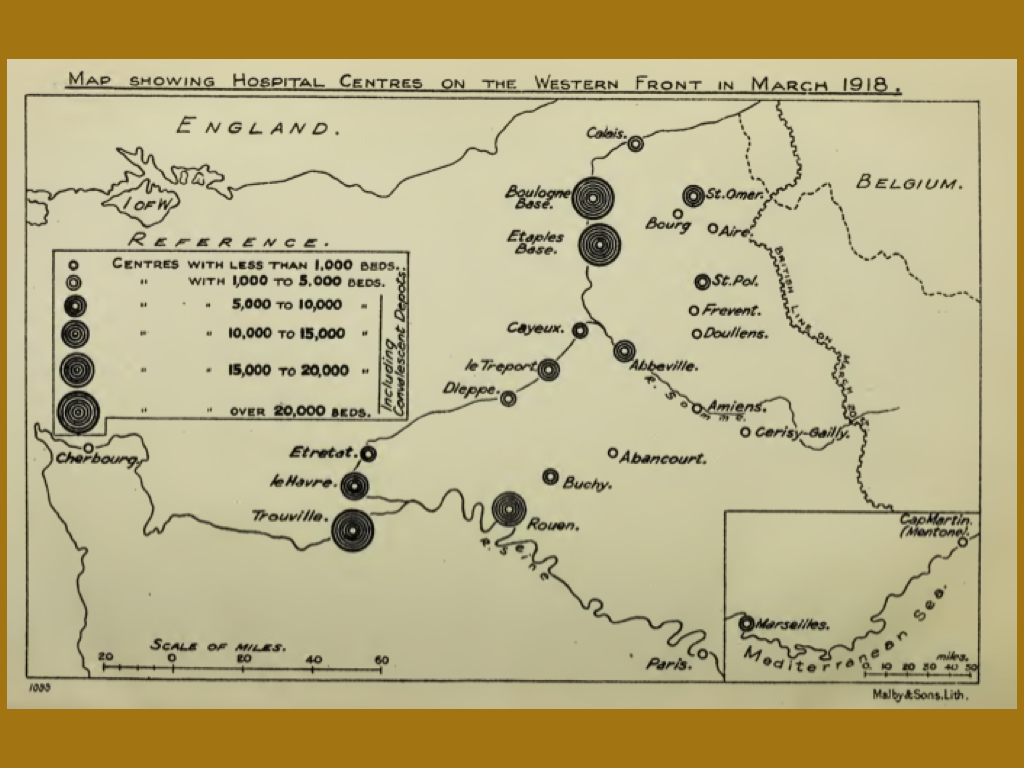
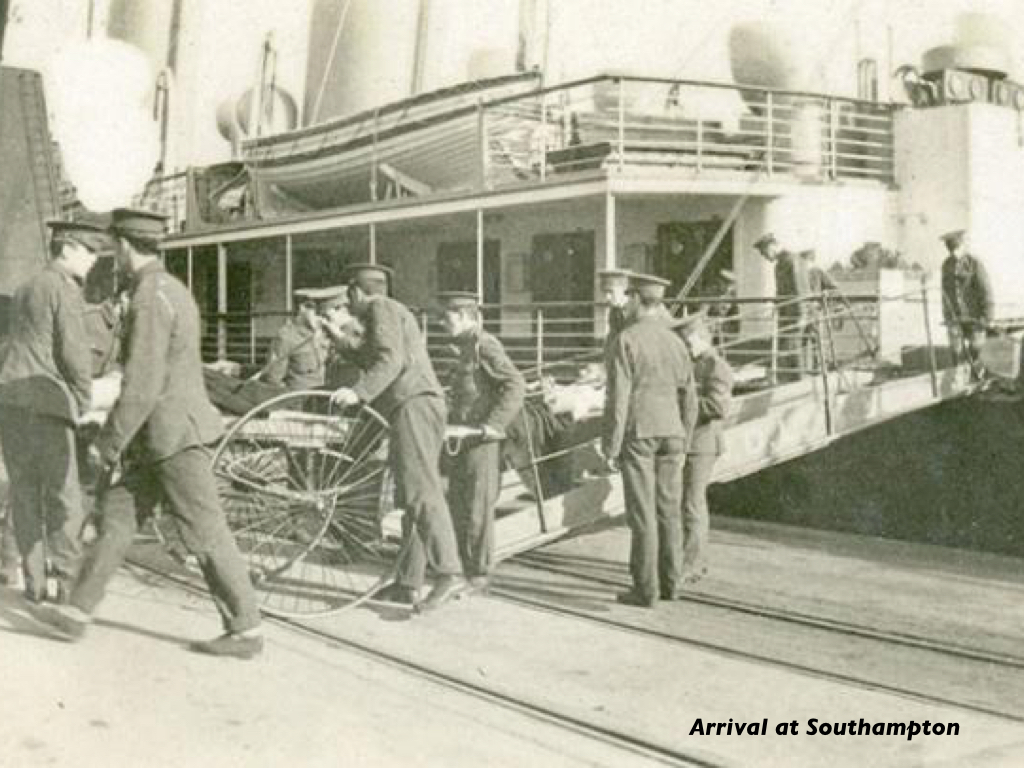
Many patients were treated at the base hospitals, but those with more serious wounds were evacuated by hospital ship to Britain.  This stage of the journey was no less dangerous than the previous one: as the war continued, there was an increasing danger of mines and submarines in the Channel.

Journeys from No Man's Land.043

Journeys from No Man's Land.044

Journeys from No Man's Land.046

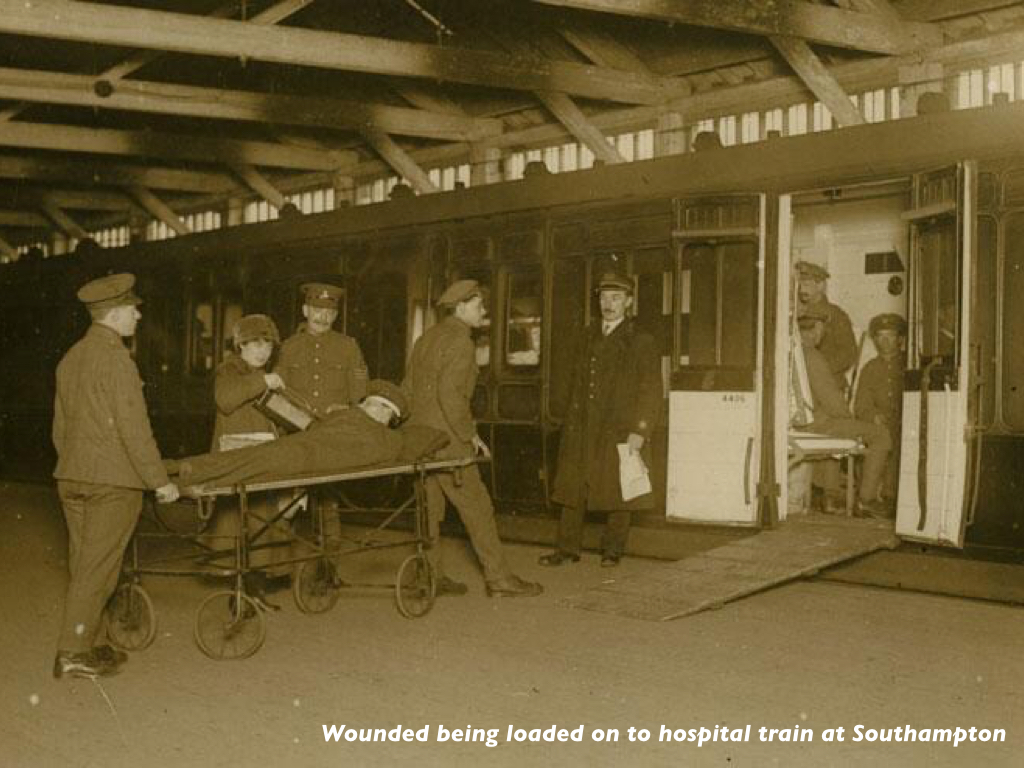
A distinctive  geography of the wounded emerged.  If they arrived at Southampton, the most critical cases were taken by train straight to the Royal Victoria Military Hospital at Netley, which treated as many as 50,000 patients during the war.  According to Lyn McDonald,
 ‘Those who could not be accommodated, and those who were seriously wounded but likely to survive a longer journey, were sent on by train to Birmingham, Bristol, Exeter, Leicester, Norwich and Plymouth.  But seven out of every ten hospital trains were directed to London, and during the first days of the Somme they rolled in almost every hour to Charing Cross and Paddington stations.’

Journeys from No Man's Land.047

Journeys from No Man's Land.048

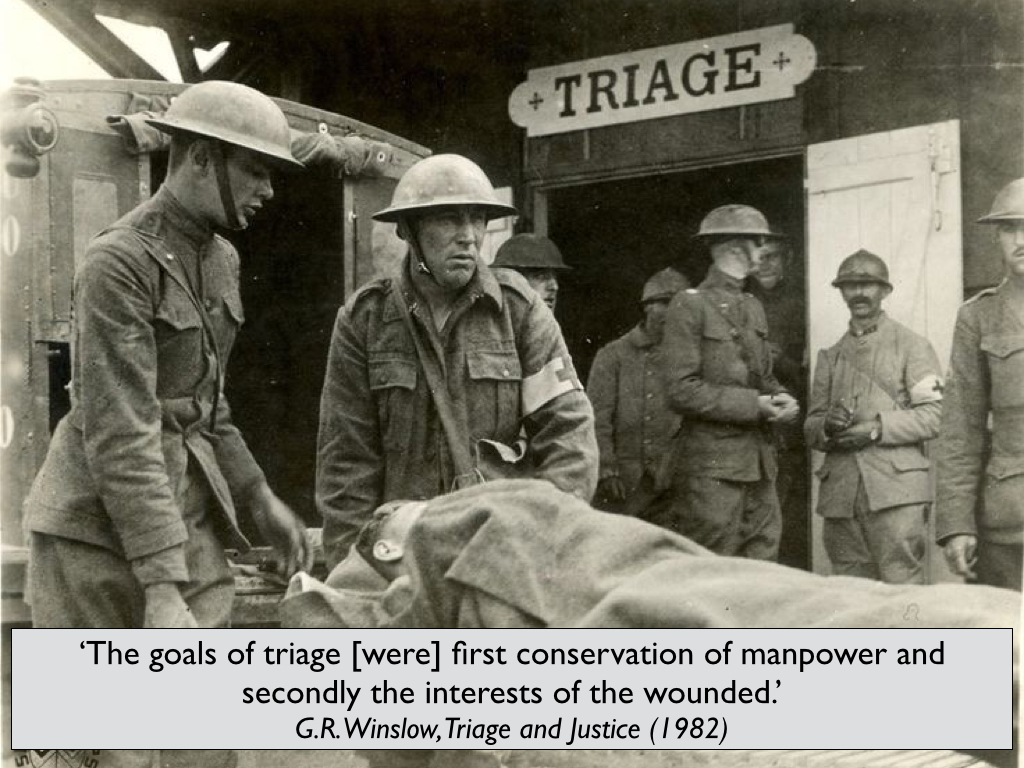
This is, of course, a highly abbreviated account of the casualty evacuation chain, and in the larger project from which this is derived I provide many more details.  But I think I’ve said enough to show that the chain was, in effect, a production line with an elaborate division of labour (again, in the larger study I show how class – or more accurately, rank – gender and race segmented the chain in various ways).  Indeed, in The Politics of Wounds Ana Carden-Coyne argues that what she calls ‘the Taylorist approach in modern war’ – and remember that this was industrial war on the grand (guignol) scale – ‘was particularly evident in the assembly-line style of evacuation and triage.’

Journeys from No Man's Land.012

This prompts two concluding observations.

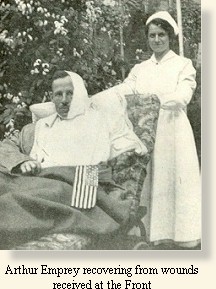
First, what was the instrumental logic that animated the evacuation chain?  After all, it was an expensive undertaking, as Arthur Empey (himself wounded on the Western Front) realised in this re-calculation of the chain:

It may sound heartless and inhuman, but it is a fact, nevertheless, that from a military stand-point it is better for a man to be killed than wounded.

EmpeyIf a man is killed he is buried, and the responsibility of the government ceases, excepting for the fact that his people receive a pension. But if a man is wounded it takes three men from the firing line, the wounded man and two men to carry him to the rear to the advanced first-aid post. Here he is attended by a doctor, perhaps assisted by two R.A.M.C. men. Then he is put into a motor ambulance, manned by a crew of two or three. At the field hospital, where he generally goes under an anaesthetic, either to have his wounds cleaned or to be operated on, he requires the services of about three to five persons. From this point another ambulance ride impresses more men in his service, and then at the ambulance train, another corps of doctors, R.A.M.C. men, Red Cross nurses, and the train’s crew. From the train he enters the base hospital or Casualty Clearing Station, where a good-sized corps of doctors, nurses, etc., are kept busy. Another ambulance journey is next in order — this time to the hospital ship. He crosses the Channel, arrives in Blighty — more ambulances and perhaps a ride for five hours on an English Red Cross train with its crew of Red Cross workers, and at last he reaches the hospital. Generally he stays from two to six months, or longer, in this hospital. From here he is sent to a convalescent home for six weeks.

If by wounds he is unfitted for further service, he is discharged, given a pension, or committed to a Soldiers’ Home for the rest of his life, — and still the expense piles up. When you realize that all the ambulances, trains, and ships, not to mention the man-power, used in transporting a wounded man, could be used for supplies, ammunition, and reinforcements for the troops at the front, it will not appear strange that from a strictly military standpoint, a dead man is sometimes better than a live one (if wounded).

Hence, for example, the orders recorded by A.M. Burrage:

The instructions given to stretcher-bearers are rather harsh. “ If you find two men wounded, and can take only one away, take away the one more likely to make a fit soldier again.” Therefore the one more urgently in need of attention must be left to die, because he would walk with a limp and would never again be able to carry a pack. Sound business, of course, but just a little hard.

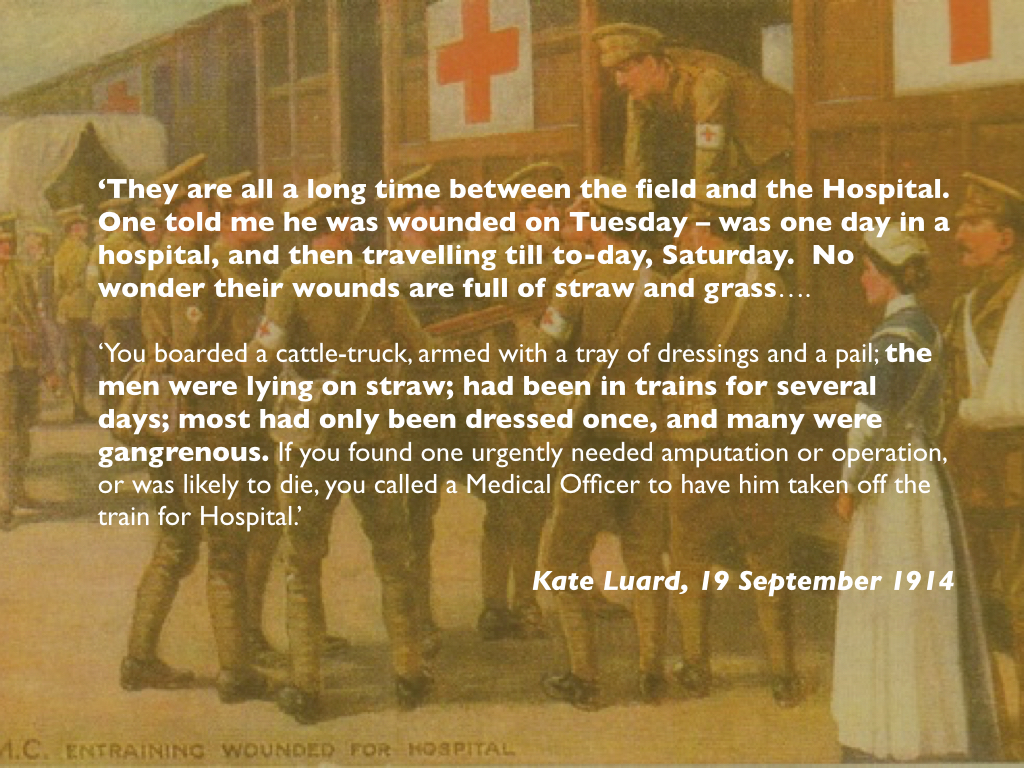
Kate Luard captured another dimension of this when she wrote in January 1915:

‘The ambulance trains do so much bringing the British Army from the field that I hope some other  trains are busy bringing the British Army to the field, or there can’t be many left in the field…’

And Emily Mayhew provides this bleak vignette from a medical orderly that captures the seemingly insatiable drive of industrial war:

An ordinary train, similar to the one that had brought him to the front, was at one end unloading reinforcements, while at the other end it was filling up with wounded men.

The logic, then, was one of ‘salvage’; four out of every five men wounded on the Western Front were returned to the fighting, which was the over-riding objective of the military-medical machine.

Journeys from No Man's Land.055

Second, the division of labour was also a division of life: the dead from the wounded, the dying from the ‘salvageable’, and the wounded from the unwounded or yet-to-be-wounded.  The last was not the least.  For breaching that separation could have the most unsettling consequences of all:

Journeys from No Man's Land.057

Journeys from No Man's Land.058

 ***

What started me on this journey was Emily Mayhew‘s brilliantly conceived Wounded and an excellent series of articles by Martin Bricknell in the Journal of the Royal Army Medical Corps: see in particular here.

You can also find more on the casualty evacuation chain from the Western Front at Beyond the Trenches here and here, the Long, Long Trail here, the Medical Front here, and the Royal Army Medical Corps site here.

My larger project examines the evacuation of casualties, combatant and civilian, from four combat zones 1914-2014: the Western Front during the First World War, the deserts of North Africa during the Second World War, Vietnam, and Afghanistan.

There’s something in the air…

Gas attack Somme

In ‘The Natures of War’ I include a brief discussion of the ways in which chemical gas attacks on the Western Front militarised the atmosphere:

Gas warfare turned the very air the soldier breathed into a potential enemy and, to Peter Sloterdijk, inaugurated a ‘new “ecologized” war’, a battle ‘conducted in the atmospheric environment [that] was about conquering the respiratory “potentials” of hostile parties’.  Here the French and the Germans led the way. The French were the first to use toxic gas shells on a large scale but these discharged tear gas which in most cases was not lethal, and when the Germans used similar shells against the British in October 1914 at Neuve Chapelle they too proved largely ineffective.  These were ‘Lilliputian efforts’, according to Peter Bull, and experiments by both sides with other systems were aimed at a greater harvest.

They yielded their first (poisoned) fruit on 22 April when the Germans launched the first lethal gas attack at Ypres. Unlike those earlier attempts this did not involve artillery – which is how the High Command persuaded themselves they were not violating the 1899 Hague agreement that prohibited the ‘use of projectiles the sole use of which is the diffusion of asphyxiating or noxious gases’  – and instead released chlorine gas from specially adapted industrial storage containers hidden in the German trenches and then relied on the wind to disperse the gas cloud. On that first, fateful evening more than 5,000 cylinders discharged 150 tons of chlorine gas. It billowed into a yellow-green cloud nearly six kilometres wide and 600-900 meters deep, which was then carried on a north-easterly wind towards two French divisions at 2-3 meters a second. The gas attacked the bronchial tubes and victims suffocated by drowning in their own fluids. German infantry advanced behind the gas cloud which had breached the French lines, and while they did not press home their advantage all sides concluded that gas was the way ‘to break the “riddle of the trenches”’ by flushing troops from cover and ending ‘the stalemate that had confounded all.’  But the reliance on wind as a dispersal vector was risky, not least because the prevailing wind on the Front was from the west – the initial attack had been postponed time and time again until conditions were favourable – and on 25 September the British launched their own gas cloud attack at Loos. This too went awry as a result of changing wind direction, and soon both sides had reverted to artillery delivery systems. They also developed deadlier agents (all derived from chlorine), and from 1916 gas of more than 60 types was in every engagement by artillery on all sides for both offensive and defensive purposes.

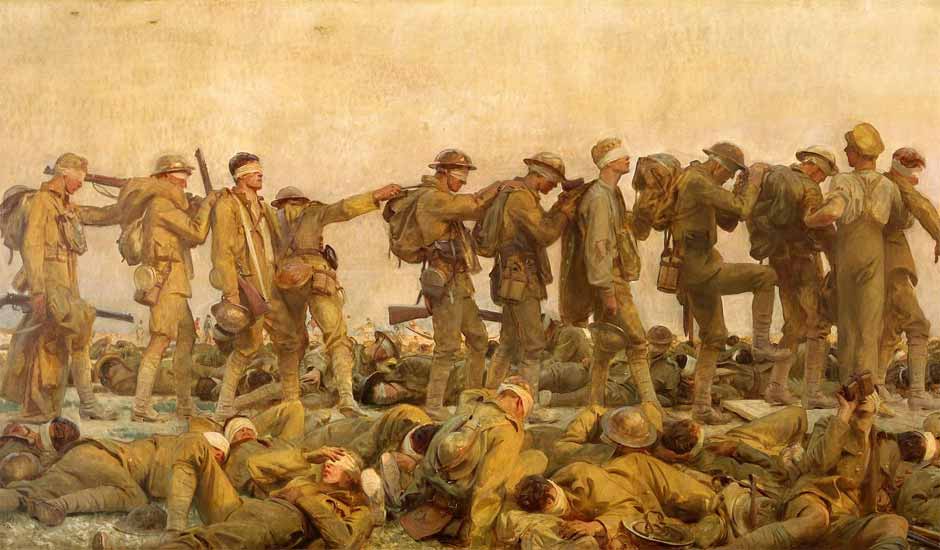
These gases affected more than the surface environment because they were all heavier than air. Chlorine and the far more deadly phosgene seeped into craters and shell holes, ‘corrupting the very areas of relative safety where men took refuge’. Mustard gas lingered even longer. It was designed to disable not kill – a blistering agent, it burned the skin and caused (usually temporary) blindness [see John Singer Sargent‘s famous Gassed, below] – and repeated intermittent exposure deadened the sense of smell so a man could no longer detect it. Since mustard gas remained dormant for days, it ‘consigned the soldier to a state of permanent unease’ in which ‘every puddle [became] an imagined trap’; in the winter of 1917-1918 there were reports of soldiers tracking frozen mud contaminated with mustard gas into their dugouts where it melted and gassed their companions.  Here too, the psychological effects of this militarised nature were as significant as their physiological ones. Gas turned out not to be the decisive weapon of the war; it accounted for around 1 per cent of British deaths but caused disproportionately more casualties. One of its main purposes, Tim Cook concludes, became disruption: spreading surprise, uncertainty, and fear on the battlefield. By 1918 gas made up 20-40 per cent of all shells within the artillery dumps on both sides and ‘all soldiers on the Western Front lived in an environment where gas was a daily fact of life…’

John Singer Sergeant, Gassed (1919)

The bibliographic references are in the draft text under the DOWNLOADS tab, but I rehearse all this because Sarah Everts has a richly illustrated and informative new essay on ‘When chemicals became weapons of war’ here – it’s an excellent survey.

The trauma hero

wwi-trauma

Following up my earlier post on novels, memoirs and narratives of war, there’s a thoughtful discussion by Roy Scranton at the LA Review of Books on what he calls ‘the myth of the trauma hero’.

A boy goes to war, his head full of romantic visions of glory, courage, and sacrifice, his heart yearning to achieve heroic deeds, but on the field of battle he finds only death and horror. He sees, suffers, and causes brutal and brutalizing violence. Such violence wounds the soldier’s very soul.

After the war the boy, now a veteran and a man, returns to the world of peace haunted by his experience, wracked by the central compulsion of trauma and atrocity: the struggle between the need to bear witness to his shattering encounter with violence, and the compulsion to repress it. The veteran tries to make sense of his memory but finds it all but impossible. Most people don’t want to hear the awful truths that war has taught him, the political powers that be want to cover up the shocking reality of war, and anybody who wasn’t there simply can’t understand what it was like.

The truth of war, the veteran comes to learn, is a truth beyond words, a truth that can only be known by having been there, an unspeakable truth he must bear for society.

This is probably the place to say that Roy served in the US Army in Iraq 2002-2006, studied at the New School for Social Research, and in 2010 embarked on a doctorate in English at Princeton – although, as you will soon see, this runs the very real risk of claiming that ‘he knows what he writes’ by virtue of these experiences.

Roy traces the myth of the trauma hero to eighteenth-century European Romanticism, and argues that it achieved its mature form in the twentieth century.  Accordingly he follows its development through Wilfred Owen in the First World War, Ernest Hemingway in the Second and Tim O’Brien in Vietnam until he reaches its contemporary form in Afghanistan and Iraq – and, in our own immediate present, in a film like Eastwood’s American Sniper.

It’s a beautifully composed contribution, and it’s made me re-think the basis for my ‘Gabriel’s Map’ and ‘Natures of War’ essays (DOWNLOADS tab) because Roy’s central thesis turns on a critique of the sacralization of trauma in ways that, at first sight, collide with my own attempts to develop what I’ve called a corpography (also DOWNLOADS tab) that can make us attentive to the corporeality and materiality of modern war:

‘Most Americans seem to believe that war can only be known through direct, physical, sensory experience on the battlefield, such as the moment of vision Owen describes in “Dulce et Decorum Est.” Ernest Hemingway, who in contrast to Owen’s long front-line service lasted only a few weeks as a noncombatant before being wounded and returning to the US, stands in American letters as the high priest of combat gnosticism. In Hemingway’s work, the emphasis on physicality, embodiment, and materiality we see in Owen’s representations of the soldier’s truth opens into a metaphysical bias against representation itself.’

d34387b998ba1136a34e9cc9e03515eeIn effect, Roy suggests, ‘being there’ becomes a privileged position from which truth cannot be communicated – only felt, and so only shared between those who were there.  The assertion of ethnographic privilege run through multiple fields from anthropology to journalism, of course, and it bedevils any attempt at historical reconstruction, but here it is heightened by the appeal to the supposedly inexpressible experience of trauma.  This could be developed still further through the reflections of, say, Elaine Scarry or Giorgio Agamben.  I take this very seriously, and yet if you work your way through the letters, diaries and memoirs of those who returned from the wars there is, I think, a sustained (and diverse) attempt to convey the corporeal – viscerally traumatising – experience of military violence.

But Roy’s point, I take it, is that this dilemma can function – can even be invoked – to exclude commentary and criticism.  And he concludes by emphasising the work that the ‘trauma hero’ continues to perform hors de combat:

‘[The most troubling consequence of our faith in the revelatory truth of combat experience and our sanctification of the trauma hero [is] that by focusing so insistently on the psychological trauma American soldiers have had to endure, we allow ourselves to forget the death and destruction those very soldiers are responsible for… Understanding the problem of American political violence demands recognizing soldiers as agents of national power, and understanding what kind of work the trauma hero is doing when he comes bearing witness in his bloody fatigues.’

I understand this concern too; there are – as I’ve argued in ‘The Natures of War’ – moments in many memoirs, novel and poems that reach towards the redemptive, even the exculpatory.  But I’ve also been deeply affected by those that disclose a more complex sense of the soldier as victim and vector of military violence: one of the recurrent motifs of the texts from the Western Front that I’ve worked with, for example, is the description of the fighting as ‘murder’.

So, much to think about – not least for the ways in which Roy’s ideas about the contemporary trauma hero complicate theses about a supposed transition to ‘post-heroic war’.  Those claims have a special resonance in the drone debates where, as I’ve noted elsewhere, Grégoire Chamayou has suggested that the trauma reportedly suffered by drone operators is ‘being mobilised to restore to war the ethico-heroic temper [critics] insisted it had lost through trauma’.

Evil Hours Cover Final

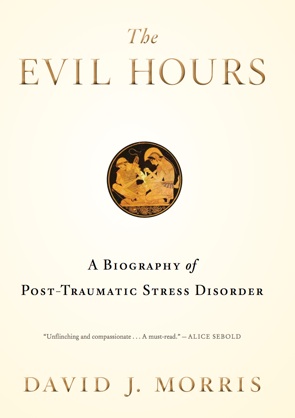
If you want to know more about the genealogy of post-traumatic stress, I recommend David J. Morris, The evil hours: a biography of post-traumatic stress disorder (Eamon Dolan/Houghton Mifflin Harcourt, 2015).   You can read an extract over at Salon here.  The book is particularly relevant to this discussion because it suggests that where trauma was once mediated through philosophy and literature it is now constituted through psychology and psychiatry.  David is very good on the arguments that raged over ‘shell-shock’ during the First World War, but if you want a ‘biography’ of that then you should turn to Michèle Barratt‘s Casualty figures: how five men survived the First World War (Verso, 2007).

Finally, Roy’s Learning to die in the Anthropocene is due from City Lights in the fall; you can get a taste of it from his essay in the New York Times with the same title here; this was the final installment of a five-part series on War and the city in which Roy retraced his footsteps from civilian to soldier to civilian.

The Natures of War

Frank-Hurley-2008-Photographing-the-First-World-War-Hurley-Document-Name-06-copy sm

I have – at last – uploaded what I hope is the final version of ‘The Natures of War’ (DOWNLOADS tab).  It’s the long-form version of the first Neil Smith Lecture I gave at St Andrew’s (Neil’s alma mater) almost exactly a year ago (you can access the online video here).  The basic argument remains the same, but the written version is substantively different (and much longer).  If you do have any comments or suggestions, or you spot any egregious errors, please let me know.  Here’s the introduction:

***

In his too short life, Neil Smith had much to say about both nature and war: from his seminal discussion of ‘the production of nature’ in his first book, Uneven development, to his dissections of war in the twentieth and early twenty-first centuries in American Empire – where he identified the end of the First World World and the end of the Second as crucial punctuations in the modern genealogy of globalisation – and its coda, The endgame of globalization, a critique of America’s wars conducted in the shadows of 9/11. And yet, surprisingly, he never linked the two. He was of course aware of their connections. He always insisted that the capitalist production of nature, like that of space, was never – could not be – a purely domestic matter, and he emphasised that the modern projects of colonialism and imperialism depended upon often spectacular displays of military violence. But he did not explore those relations in any systematic or substantive fashion.

He was not alone. The great Marxist critic Raymond Williams once famously identified ‘nature’ as ‘perhaps the most complex word in the [English] language.’ Since he wrote, countless commentators have elaborated on its complexities, but few of them have paused to note that ‘war’ was not one of Williams’s keywords (though ‘violence’ – ‘often now a difficult word’ – was). Williams was radicalised by the rise of European fascism; he joined the British Army in 1941 and served as a tank commander during the Second World War. Yet at its end he found the world had turned, and it was for that very reason that he sought to find the terms for a post-war world in which, seemingly, ‘war’ had no place.
‘In 1945, after the ending of the wars with Germany and Japan, I was released from the Army to return to Cambridge. University term had already begun, and many relationships and groups had been formed. It was in any case strange to travel from an artillery regiment on the Kiel Canal to a Cambridge college. I had been away only four and a half years, but in the movements of war had lost touch with all my university friends. Then, after many strange days, I met a man I had worked with in the first year of the war, when the formations of the 1930s, though under pressure, were still active. He too had just come out of the Army. We talked eagerly, but not about the past. We were too much preoccupied with this new and strange world around us. Then we both said, in effect simultaneously: ‘the fact is, they just don’t speak the same language’.’

I want to track backwards and forwards from Williams’s war-time experience to trace three different co-productions of nature and military violence: the soiled earth of the Western Front during the First World War, the deserts of North Africa during the Second World War (an armoured campaign very different from the European theatre in which Williams served), and the rainforests of Vietnam. My accounts can only be sketches, but they share a way of thinking of ‘nature’ (in all its complexity) as a modality that is intrinsic to the execution of military and paramilitary violence. In much the same way that ‘space’ is not only a terrain over which wars are waged – the fixation on territory that remains at the heart of modern geopolitics – but also a medium through which military and paramilitary violence is conducted, so ‘nature’ is more than a resource bank whose riches can trigger armed conflict and finance its depredations: the problematic of resource wars and conflict commodities. The spoils of war include the short-term bludgeoning of landscapes and the long-term toxicity of contamination (what Rob Nixon calls ‘slow violence’), but it is also important to trace the bio-physical formations – the conditions, provided the term is understood in the most active of senses – that are centrally involved in the militarisation of ‘nature’. For nature too is a medium through which military and paramilitary violence is conducted.

I speak of ‘co-productions’ and ‘formations’ in order to signal in advance three issues that will reappear across all three studies. First, each of these wars was in large measure what Paul Saint-Amour calls, in relation to the first of them, an optical war: they depended on geo-spatial intelligence, surveillance and reconnaissance which in its various forms provided the essential basis for the maps, plans and orders that activated the war machine. And yet the remote orderings of military violence were never autonomous projections onto a pure plane; they also depended on the bodies of soldiers whose apprehension of the battle space was always more than visual. In part, this was a matter of affect, but it was also a matter of knowledge – of a corpography rather than a cartography – whose materialities also inflected imaginative geographies of militarised nature. Second, those diverse stocks of knowledge about the battle space were invested in the co-production of a ‘trickster nature’. It was commonplace to describe the Western Front as a surreally empty landscape in which the capacity for military violence was hidden from view once men withdrew into the troglodyte world of the trenches. But I have in mind a more pervasive sense of uncertainty instilled by a militarised nature: one where the earth and air could kill through an infected wound, a buried mine or a cloud of gas, and whose camouflaged landscapes could wreak havoc with the military gaze to dissemble and distract, lure and entrap. Third, this was a hideously hybrid ‘cyborg nature’ whose terrain and life-forms were saturated with the debris of violent conflict: burned-out vehicles and bombed-out buildings, barbed wire and exploded munitions, discarded weapons and abandoned supplies, toxic residues and body parts. So far so familiar, except that none of these entanglements was inert; they shaped the military operations that took place through them. In all three ways each of these battle spaces was composed of ‘vibrant matter’ that was often also deadly matter.
***

This version is so long I’ve cut all the illustrations, but I have uploaded the original lecture slides too (DOWNLOADS tab); I’ve already posted early versions of some of the sections – and those were illustrated – here and here.