Writing the wounds of war

ramc-ypres-1915

Apart from trying to keep up with developments in Syria and Iraq – on which more shortly – I’ve also been continuing my reading on medical care on the Western Front.  I’ve now finished The Backwash of War, and what a bleak little book it is.  There’s very little about medical care – largely because in many respects there seems to have been very little of it in Ellen La Motte‘s field hospital – and much of the discussion is a deeply disturbing account of the cynicism of military violence: the generals who visit only to pin medals on the blankets of the dying, the contempt between medical orderlies and patients (who have no time for those who are not serving on the front lines), and the seemingly endless, agonising deaths of patients.  But that was precisely what gave the author her title:

The sketches were written in 1915 and 1916, when the writer was in a French military field hospital, a few miles behind the lines, in Belgium. War has been described as “months of boredom, punctuated by moments of intense fright.” During this time at the Front, the lines moved little, either forward or backward, but were deadlocked in one position. Undoubtedly, up and down the long reaching kilometers of “Front” there was action, and “moments of intense fright” which produced fine deeds of valor, courage and nobility. But where there is little or no action there is a stagnant place, and in that stagnant place is much ugliness. Much ugliness is churned up in the wake of mighty, moving forces, and this is the backwash of war. Many little lives foam up in this backwash, loosened by the sweeping current, and detached from their environment. One catches a glimpse of them—often weak, hideous or repellent. There can be no war without this backwash.

In some part, perhaps, La Motte’s account reflects differences between British and French medical provision.  Lyn Macdonald‘s The roses of no man’s land (which contains all sorts of insights into the geographies of medical evacuation and provision en passant) suggests that ‘Lying wounded on the battlefield [at Verdun] a French soldier was as good as dead, for there was little chance of his being brought in, and if he had the good luck to be rescued and taken to a hospital there was only one chance in three that he would leave it alive.’   By the end of the war, she continues, of France’s 1,300,000 war dead more than 400,000 had died of their wounds: ‘a proportion that was larger by far than those of any other nation and was due in considerable measure to the makeshift conditions and lack of skilled care in all but a few of the hospitals.’
The politics of wounds

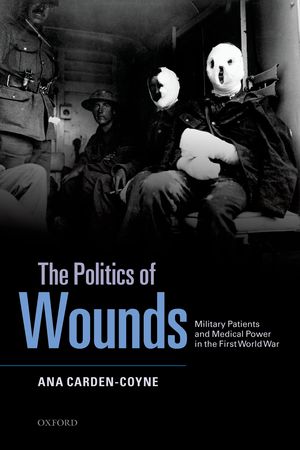
This isn’t to romanticise the experience of those wounded in other armies, of course, but it adds another dimension to what Ana Carden-Coyne calls ‘the politics of wounds’.   Her new book, due out in the fall, The politics of wounds: military patients and medical power in the First World War (Oxford University Press), is high on my reading list for my new research project:

The Politics of Wounds explores military patients’ experiences of frontline medical evacuation, war surgery, and the social world of military hospitals during the First World War. The proximity of the front and the colossal numbers of wounded created greater public awareness of the impact of the war than had been seen in previous conflicts, with serious political consequences.

Frequently referred to as ‘our wounded’, the central place of the soldier in society, as a symbol of the war’s shifting meaning, drew contradictory responses of compassion, heroism, and censure. Wounds also stirred romantic and sexual responses. This volume reveals the paradoxical situation of the increasing political demand levied on citizen soldiers concurrent with the rise in medical humanitarianism and war-related charitable voluntarism. The physical gestures and poignant sounds of the suffering men reached across the classes, giving rise to convictions about patient rights, which at times conflicted with the military’s pragmatism. Why, then, did patients represent military medicine, doctors and nurses in a negative light? The Politics of Wounds listens to the voices of wounded soldiers, placing their personal experience of pain within the social, cultural, and political contexts of military medical institutions. The author reveals how the wounded and disabled found culturally creative ways to express their pain, negotiate power relations, manage systemic tensions, and enact forms of ‘soft resistance’ against the societal and military expectations of masculinity when confronted by men in pain. The volume concludes by considering the way the state ascribed social and economic values on the body parts of disabled soldiers though the pension system.

But all this is about military patients: what of civilians who are wounded or become ill in war zones?  The BackWash of War provides one vignette that is worth reporting in full.  It’s titled ‘The Belgian Civilian’:

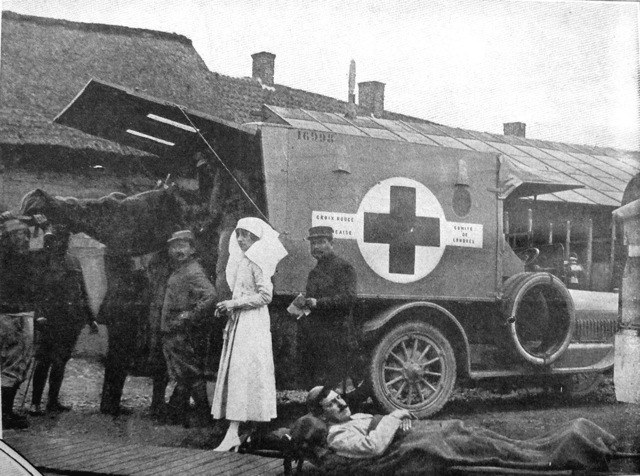
‘A big English ambulance drove along the high road from Ypres, going in the direction of a French field hospital, some ten miles from Ypres. Ordinarily, it could have had no business with this French hospital, since all English wounded are conveyed back to their own bases, therefore an exceptional case must have determined its route. It was an exceptional case—for the patient lying quietly within its yawning body, sheltered by its brown canvas wings, was not an English soldier, but only a small Belgian boy, a civilian, and Belgian civilians belong neither to the French nor English services. It is true that there was a hospital for Belgian civilians at the English base at Hazebrouck, and it would have seemed reasonable to have taken the patient there, but it was more reasonable to dump him at this French hospital, which was nearer. Not from any humanitarian motives, but just to get rid of him the sooner. In war, civilians are cheap things at best, and an immature civilian, Belgian at that, is very cheap. So the heavy English ambulance churned its way up a muddy hill, mashed through much mud at the entrance gates of the hospital, and crunched to a halt on the cinders before the Salle d’Attente, where it discharged its burden and drove off again.
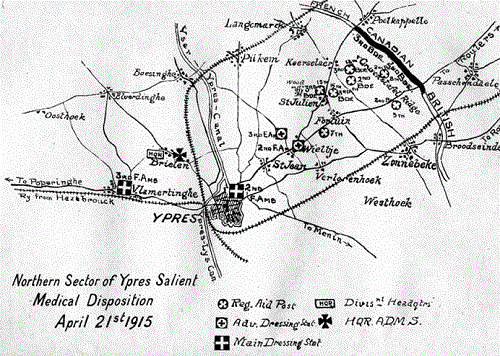
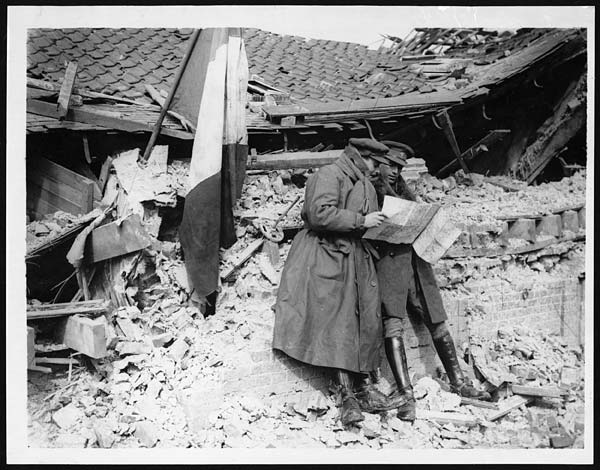
Medical Provision, Ypres, 1915

‘The surgeon of the French hospital said: “What have we to do with this?” yet he regarded the patient thoughtfully. It was a very small patient. Moreover, the big English ambulance had driven off again, so there was no appeal. The small patient had been deposited upon one of the beds in the Salle d’Attente, and the French surgeon looked at him and wondered what he should do. The patient, now that he was here, belonged as much to the French field hospital as to any other, and as the big English ambulance from Ypres had driven off again, there was not much use in protesting….

‘A Belgian civilian, aged ten. Or thereabouts. Shot through the abdomen, or thereabouts. And dying, obviously. As usual, the surgeon pulled and twisted the long, black hairs on his hairy, bare arms, while he considered what he should do. He considered for five minutes, and then ordered the child to the operating room, and scrubbed and scrubbed his hands and his hairy arms, preparatory to a major operation. For the Belgian civilian, aged ten, had been shot through the abdomen by a German shell, or piece of shell, and there was nothing to do but try to remove it. It was a hopeless case, anyhow. The child would die without an operation, or he would die during the operation, or he would die after the operation….

‘After a most searching operation, the Belgian civilian was sent over to the ward, to live or die as circumstances determined. As soon as he came out of ether, he began to bawl for his mother. Being ten years of age, he was unreasonable, and bawled for her incessantly and could not be pacified. The patients were greatly annoyed by this disturbance, and there was indignation that the welfare and comfort of useful soldiers should be interfered with by the whims of a futile and useless civilian, a Belgian child at that. The nurse of that ward also made a fool of herself over this civilian, giving him far more attention than she had ever bestowed upon a soldier. She was sentimental, and his little age appealed to her—her sense of proportion and standard of values were all wrong. The Directrice appeared in the ward and tried to comfort the civilian, to still his howls, and then, after an hour of vain effort, she decided that his mother must be sent for. He was obviously dying, and it was necessary to send for his mother, whom alone of all the world he seemed to need. So a French ambulance, which had nothing to do with Belgian civilians, nor with Ypres, was sent over to Ypres late in the evening to fetch this mother for whom the Belgian civilian, aged ten, bawled so persistently.

‘She arrived finally, and, it appeared, reluctantly. About ten o’clock in the evening she arrived, and the moment she alighted from the big ambulance sent to fetch her, she began complaining. She had complained all the way over, said the chauffeur…. She had been dragged away from her husband, from her other children, and she seemed to have little interest in her son, the Belgian civilian, said to be dying. However, now that she was here, now that she had come all this way, she would go in to see him for a moment, since the Directrice seemed to think it so important….

‘She saw her son, and kissed him, and then asked to be sent back to Ypres. The Directrice explained that the child would not live through the night. The Belgian mother accepted this statement, but again asked to be sent back to Ypres. The Directrice again assured the Belgian mother that her son would not live through the night, and asked her to spend the night with him in the ward, to assist at his passing. The Belgian woman protested.

“If Madame la Directrice commands, if she insists, then I must assuredly obey. I have come all this distance because she commanded me, and if she insists that I spend the night at this place, then I must do so. Only if she does not insist, then I prefer to return to my home, to my other children at Ypres.”

‘However, the Directrice, who had a strong sense of a mother’s duty to the dying, commanded and insisted, and the Belgian woman gave way. She sat by her son all night, listening to his ravings and bawlings, and was with him when he died, at three o’clock in the morning. After which time, she requested to be taken back to Ypres. She was moved by the death of her son, but her duty lay at home. Madame la Directrice had promised to have a mass said at the burial of the child, which promise having been given, the woman saw no necessity for remaining.

“My husband,” she explained, “has a little estaminet, just outside of Ypres. We have been very fortunate. Only yesterday, of all the long days of the war, of the many days of bombardment, did a shell fall into our kitchen, wounding our son, as you have seen. But we have other children to consider, to provide for. And my husband is making much money at present, selling drink to the English soldiers. I must return to assist him.”
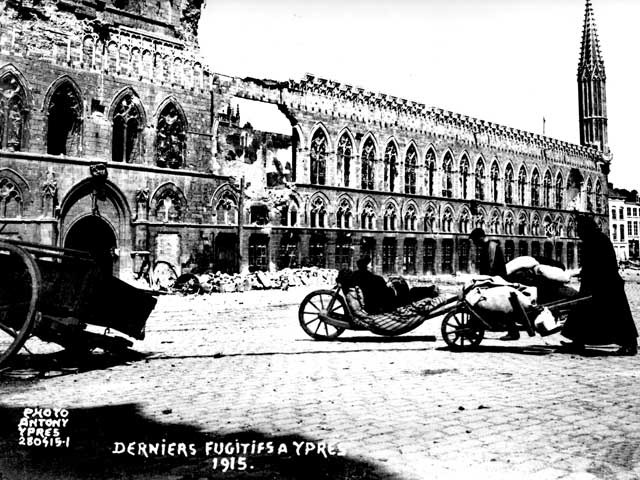
YPRES 1915

‘So the Belgian civilian was buried in the cemetery of the French soldiers, but many hours before this took place, the mother of the civilian had departed for Ypres. The chauffeur of the ambulance which was to convey her back to Ypres turned very white when given his orders. Everyone dreaded Ypres, and the dangers of Ypres. It was the place of death. Only the Belgian woman, whose husband kept an estaminet, and made much money selling drink to the English soldiers, did not dread it. She and her husband were making much money out of the war, money which would give their children a start in life. When the ambulance was ready she climbed into it with alacrity, although with a feeling of gratitude because the Directrice had promised a mass for her dead child.

“These Belgians!” said a French soldier. “How prosperous they will be after the war! How much money they will make from the Americans, and from the others.”‘

It would obviously be absurd to generalise from one vignette, but there’s clearly a different politics at work in this narrative,  and a complex set of political geographies too.  For a careful reading of La Motte’s account, in parallel with Mary Borden‘s The forbidden zone, you could do no better than Margaret Higonnet‘s introduction to her Nurses at the front: writing the wounds of the great war.  I’ve now started on a series of accounts about the work of field ambulances, and one which resonates with the events described in La Motte’s vignette is William Boyd‘s letters from 7 March to 15 August 1915 published as With a field ambulance at Ypres (1916), which you can download free here.

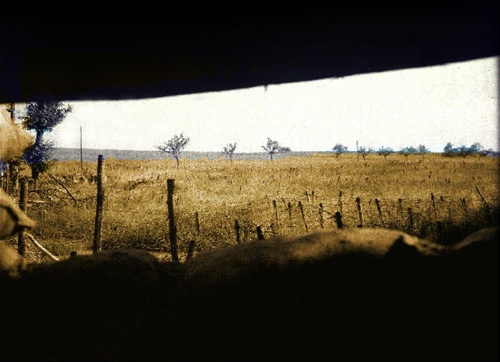
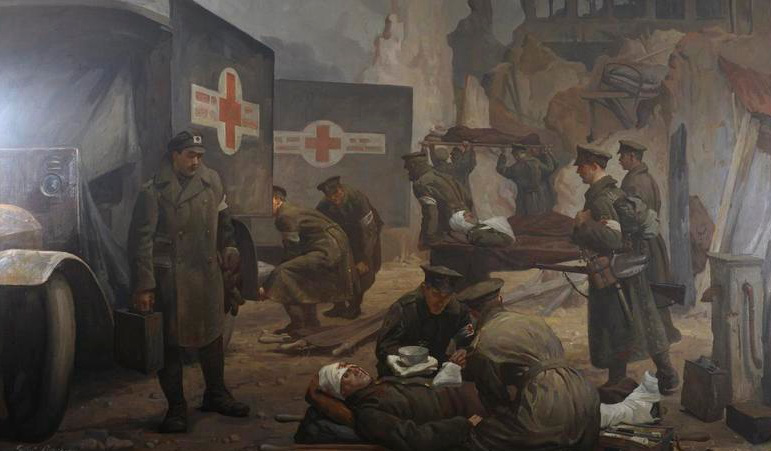
But all this – important – talk about writing the wounds of war should not blind us (me) to the role of visualising the wounds of war, and to the work done by artfully composed (and surely sanitised) images like the one that heads this post…
Behind the lines

I’m sorry for the long silence – I’ve been in the UK, giving a new presentation on the Uruzgan air strike of February 2010, and learning much en route in Lancaster, Lincoln and Bristol.  I’ll try to post extracts from the (developing) presentation in the next several weeks as I think about turning it into an essay, but I’ll still be on the road – or, more accurately, on vacation, so things will be irregular for some time to come.  I expect regular postings to resume in early July, when I’ll be back in Vancouver.

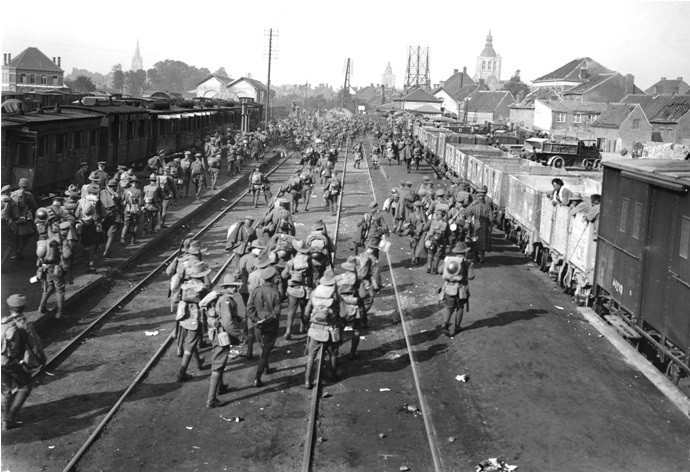
POPERINGE railhead

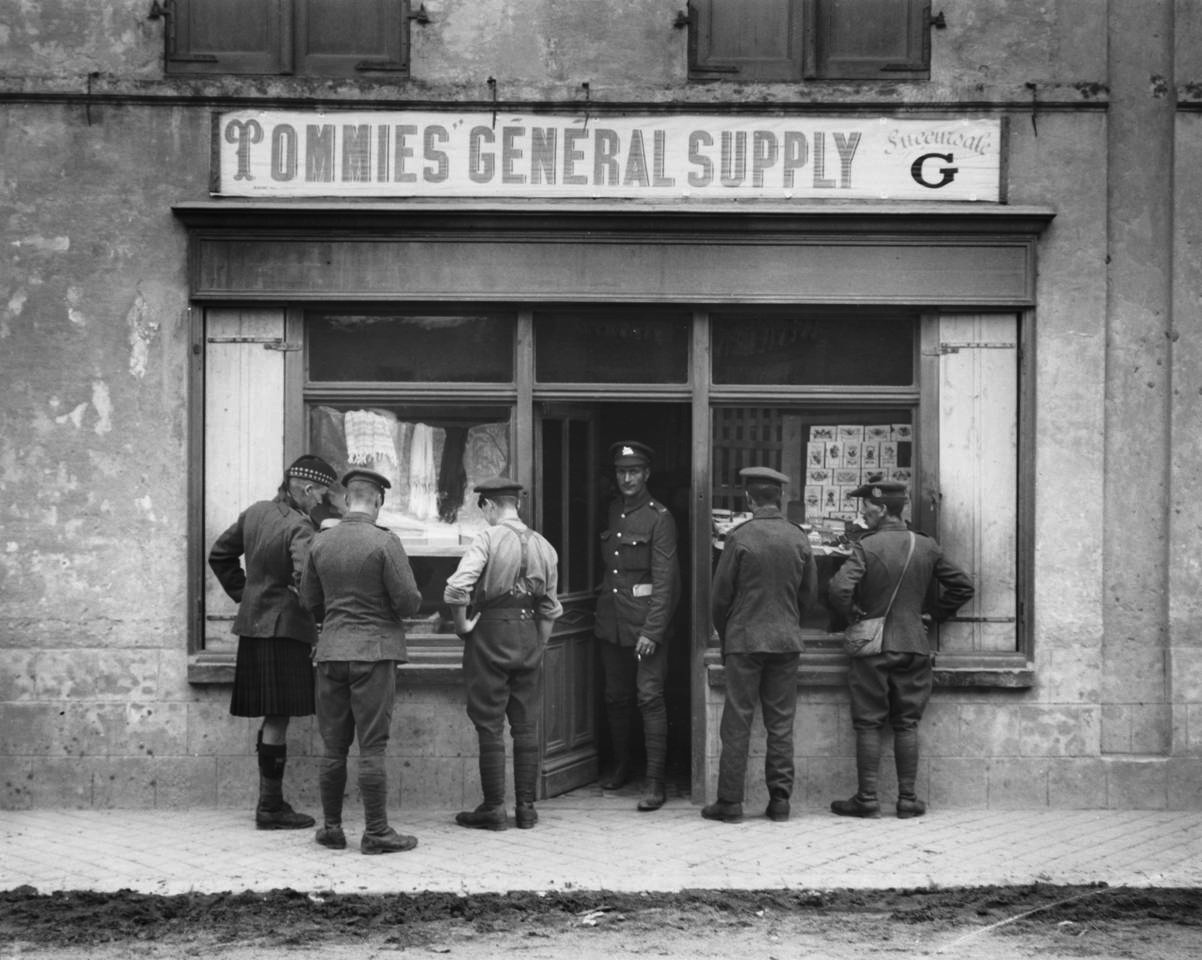
I’ve also spent several days in Flanders, visiting some of the major sites associated with the First World War.  We based ourselves in Poperinge, which was sufficiently far from the devastated and levelled town of Ypres to serve as a major staging post for munitions, supplies and men arriving at its station [see the image above], and for casualties being shipped back to the coast or to Britain (a slower and much more difficult journey).  It was also the place (known to the British as “Pop”, supposedly the Paris of the Front, at least around Ypres) where soldiers on leave from the Ypres Salient went to have as good a time as possible, in the shops, bars, restaurants and brothels.

Poperinge Tommy Supply

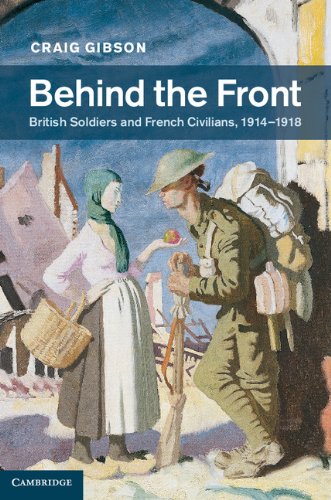
All of this has made me start to explore even more closely the military-civilian interactions behind the lines.  There’s surprisingly little work on this, but waiting for me at home is a new book by Craig Gibson, Behind the Front: British soldiers and French civilians 1914-1918 (Cambridge University Press, 2014), which despite the subtitle appears to include the war in Flanders too:

Until now scholars have looked for the source of the indomitable Tommy morale on the Western Front in innate British bloody-mindedness and irony, not to mention material concerns such as leave, food, rum, brothels, regimental pride, and male bonding. However, re-examining previously used sources alongside never-before consulted archives, Craig Gibson shifts the focus away from battle and the trenches to times behind the front, where the British intermingled with a vast population of allied civilians, whom Lord Kitchener had instructed the troops to ‘avoid’. Besides providing a comprehensive examination of soldiers’ encounters with local French and Belgian inhabitants which were not only unavoidable but also challenging, symbiotic and uplifting in equal measure, Gibson contends that such relationships were crucial to how the war was fought on the Western Front and, ultimately, to British victory in 1918. What emerges is a novel interpretation of the British and Dominion soldier at war.

GIBSON Behind the FrontThe Contents List is topical and – to my regret – doesn’t seem to include anything on the overlapping and sometimes confounding geographies of military and civilian medical care, but it still looks like an excellent survey:

Part I. Mobile Warfare, 1914:
1. The first campaign
Part II. Trench Warfare, 1914–1917:
2. Land
3. Administration
4. Billet
5. Communication
6. Friction
7. Farms
8. Damages
9. Money
10. Discipline
11. Sex
Part III. Mobile Warfare, 1918:
12. The final campaign

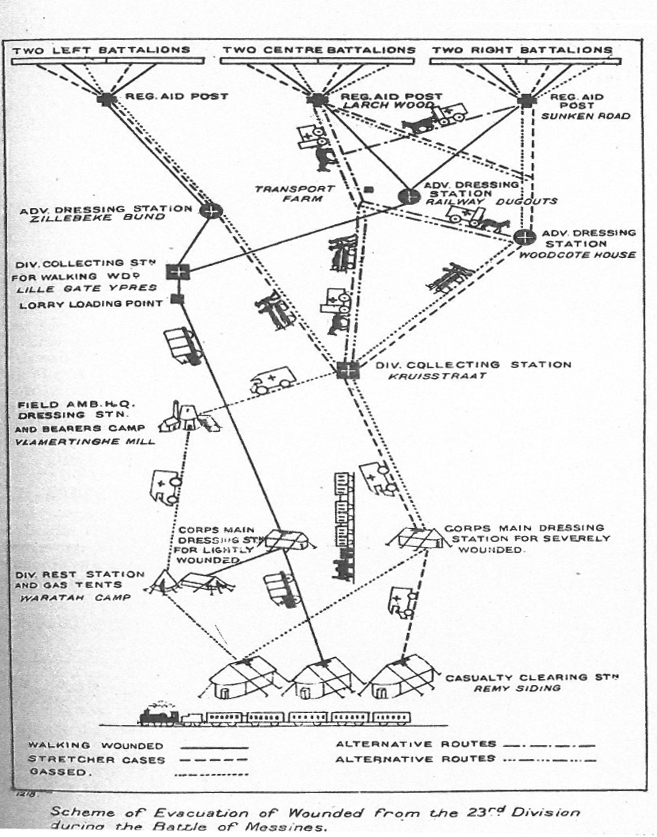
And while I’m on the subject of medical-military machines, Britain’s Arts & Humanities Research Council has a new website, Beyond the Trenches, which is devoted to recent research on the First World War.  One of its opening (short) essays is by Jessica Meyer on The long trip home: medical evacuations from the Front, which coincides with the first phase of my new research project.  It’s a skeletal account of the casualty chain, or rather chains, and doesn’t flesh out these precarious journeys like Emily Mayhew‘s marvellous social history, Wounded: from battlefield to Blighty, 1914-1918 (see here).  But it’s an interesting introduction to some of the logistical issues.

Diagram-of-evacuation-plan-Messine

The essay has been prompted by a new BBC drama series, The Crimson Field, set in a British field hospital, which in its turn was apparently inspired by Ellen Newbold La Motte‘s first-hand account of a French field hospital, The backwash of war: The Human Wreckage of the Battlefield as Witnessed by an American Hospital Nurse (1916).  This is now sitting on my Kindle (and you can also download it free from Project Gutenberg here): its ‘warts-and-all’ portrayal was so vivid that it was banned by the American government when the United States entered the war in 1917.  La Motte worked under Mary Borden, incidentally, who recorded her own experiences in The forbidden zone (more on the two women here, you can read the book here, and there is a helpful essay by Ariela Freedman, ‘Mary Borden’s Forbidden Zone: women’s writing from No Man’s Land’ in Modernism/modernity 9 (1) (2002) 109-124).

unloading-the-wounded-mary-borden

The book is organised in 14 vignettes, which were published regularly in the Atlantic Monthly, and at one point La Motte includes this observation:

“These Belgians!” said a French soldier. “How prosperous they will be after the war! How much money they will make from the Americans, and from the others who come to see the ruins!”

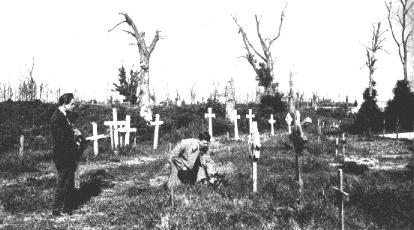
Having just returned from doing just that, I have to say that I saw remarkably few signs of crass commercialisation or opportunism: I was struck again and again by the dignified way in which the hideous events of those years have been recovered and commemorated.  There was refreshingly little jingoism too: just a quiet sense of the enormity of it all. One of the most poignant exhibits I saw was a photograph of families visiting the war graves shortly after the Armistice, trying to find the site where a husband, a brother or a son was buried or, failing that, the place where he had been killed (since the graves of countless thousands were unknown).  By then, the graves were being systematised and the cemeteries organised (see here), but the surroundings were still hauntingly raw: there had been no time for the ravaged landscape to recover, the blasted stumps to be torn out, and the trenches to be ploughed over.  It was sobering to imagine families, already burdened with grief, seeing for themselves a landscape which must have revealed, at least in part, something of the horror of the war that had been for so long hidden from them.

lillegatecem

‘The land of rotting men’

No man's land

Noam Leshem and Alasdair Pinkerton have embarked on a fascinating new project, Re-inhabiting No Man’s Land: from dead zones to living spaces here:

Nearing the centenary of the First World War, this project explores the ongoing relevance of no-man’s lands in the 21st century. Rather than merely empty, divisive spaces, the project considers the material substance of no-man’s lands, their changing social-cultural meaning and their relevance as productive political and geopolitical spaces.

As a figure of speech, No-Man’s Land is applied to anywhere from derelict inner-city districts and buffer-zones to ‘ungovernable’ regions and tax havens. But what is no-man’s land? What are the conditions that produce it? How is it administered? What sort of human activities do no-man’s lands harbour? These are the questions that prompt us to think about the no-man’s lands not as dead zones, but as living spaces.

WWI consulting a map

News of this arrived from Noam just as I finished the long-form version of Gabriel’s Map: cartography and corpography in modern war, which you can now find under the DOWNLOADS tab (scroll down).  Most of the essay is about the First World War on the Western Front (I explain the title at the start of the essay; it comes from William Boyd‘s Ice-Cream War and, in particular, the First World War in East Africa, and the title of this post comes from Edward Lynch‘s Somme Mud: the experiences of an infantryman in France, 1916-1919), but I also end with these reflections on the 21st century:

In this essay I have been concerned with the First World War but, as we approach its centenary, it is worth reflecting on the ways in which modern warfare has changed – and those in which it has not. Through the constant circulation of military imagery and its ghosting in video games, many of us have come to think of contemporary warfare as optical war hypostatised: a war fought on screens and through digital images, in which full motion video feeds from Predators and Reapers allow for an unprecedented degree of remoteness from the killing fields. In consequence, perhaps, many of us are tempted to think of the wars waged by advanced militaries, in contrast to the First World War, as ‘surgical’, even body-less. These are wars without fronts, whose complex geometries have required new investments in cartography and satellite imagery, and there have been major advances in political technologies of vision and in the development of a host of other sensors that have dramatically increased the volume of geo-spatial intelligence on which the administration of later modern military violence relies. All of this has transformed but not replaced the cartographic imaginary.

And yet, for all of their liquid violence, these wars are still shaped and even confounded by the multiple, acutely material environments through which they are fought. In Sebastian Junger’s remarkable despatch from Afghanistan, he notes that for the United States and its allies ‘the war diverged from the textbooks because it was fought in such axle-breaking, helicopter-crashing, spirit-killing, mind-bending terrain that few military plans survive intact for even an hour.’ If that sounds familiar, then so too will Kenneth MacLeish’s cautionary observations about soldiers as both vectors and victims of military violence:

‘The body’s unruly matter is war’s most necessary and most necessarily expendable raw material. While many analyses of US war violence have emphasized the technologically facilitated withdrawal of American bodies from combat zones in favour of air strikes, smart bombs, remotely piloted drones, and privately contracted fighting forces, the wars in Iraq and Afghanistan could not carry on without the physical presence of tens of thousands of such bodies…

In consequence, the troops have had to cultivate an intrinsically practical knowledge that, while its operating environment and technical armature are obviously different, still owes much to the tacit bodily awareness of the Tommy or the Poilu:

‘In the combat zone there is a balance to be struck, a cultivated operational knowledge, that comes in large part from first-hand experience about what can hurt you and what can’t… So you need not only knowledge of what the weapons and armor can do for you and to you but a kind of bodily habitus as well – an ability to take in the sensory indications of danger and act on them without having to think too hard about it first. When you hear a shot, is it passing close by? Is it accurate or random? Is it of sufficient caliber to penetrate your vest, the window of your Humvee or the side of your tank?’

In the intricate nexus formed by knowledge, space and military power, later modern war still relies on cartographic vision – and its agents still produce their own corpographies.

The notes contain various references to No Man’s Land in the First World War, though I’m increasingly interested in what lies on either side.  One of the reasons so many commentators seem to think that ‘war among the people’ is a recent development is that the imagery of the Western Front draws the eye again and again to No Man’s Land, but behind the front lines on either side were farms, fields, villages and small towns where people continued to live and work amongst the shelling, the gas attacks, and the billeted troops.

As usual, I’d welcome any comments/criticisms/suggestions on the (I hope near final) draft of the essay: an extended version will appear in War material.

Deadly improvisations

There is nothing refined about killing, but the war in Syria has shown that both sides have resorted to improvisational tactics.  I say ‘both sides’ as a short-hand: this is hardly a two-party conflict, since the anti-Assad forces are far from united and a number of external powers – not only Iran and Saudi Arabia – are plainly using the parties as players in a proxy war.

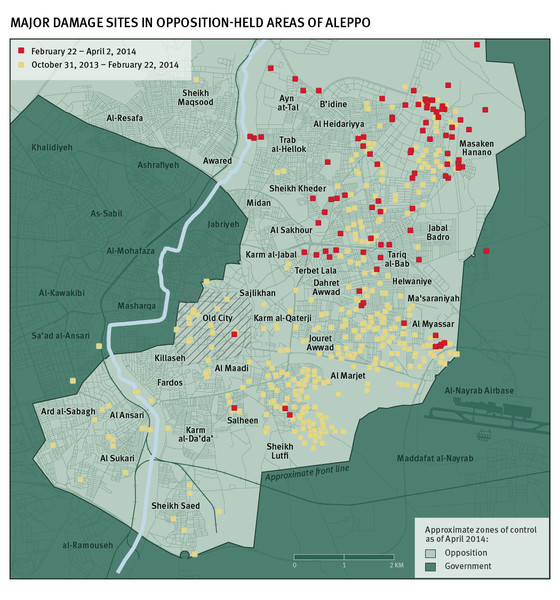
One of the first signs was the Syrian Air Force’s use of so-called ‘barrel bombs’: in effect, these are improvised explosive devices made from oil barrels filled with crude explosive and, on occasion, metal shrapnel and even chemicals like chlorine, which are then dropped from helicopters.  At first, they were dropped from low altitudes – which, according to Richard Lloyd at least, made them accurate enough to strike particular targets – but once the rebels were equipped with rocket-launchers (MANPADs) the helicopters had to fly much higher (near 7,000 feet) with a corresponding diminution in accuracy.  The first attacks took place against the city of Homs in August 2012, but the locus then shifted to rebel-held areas in Aleppo – the map below comes from Human Rights Watch‘s forensic analysis of strikes against that city between October 2013 and April 2014; some of the sites identified may have been struck by other munitions, HRW concedes, including conventional bombs, mortars and artillery shells, but the vast majority reveal the characteristic signature of the indiscriminate deployment of barrel bombs.  The Syrian National Council estimates that 20,000 people have been killed by barrel bombs thus far.

Aleppo Barrel Bombs (Human Rights Watch)

Since the Syrian Air Force has been supplied with conventional bombs by both Russia and Iran, many commentators have concluded that the recourse to crude barrel bombs is not the result of any munitions shortage but is rather a determined attempt to spread indiscriminate terror.  For we need to remember that there’s nothing special about barrel bombs; they are probably less effective – certainly less accurate – than conventional munitions.  In short, they are, as I’ve said, an improvisation – what the indefatigable Eliot Higgins (of Brown Moses fame: an absolutely indispensable source for all this) calls ‘a piece of crap’.  But they are also unequivocal evidence that the regime is ‘interested in no path forward other than by killing.’

The result has been captured in a sobering video from Syrian Zero, showing barrel bomb attacks on Darayya, a neighbourhood in Damascus during the last week of January (below; you can find a brief, helpful exposition and commentary on the video here).

Barrel bombs have also been used by the Sudanese Air Force in Southern Kordofan and Blue Nile states, and most recently by the Iraqi Air Force against Fallujah.

A second tactic used in Syria – this time by opposition forces – hearkens back to the First World War. Earlier this month, and in part as a counter to the crude air war against the rebel-held areas of Aleppo, the Islamic Front detonated a vast underground mine packed with explosives beneath the city’s Carlton Hotel, which was used as a base by the Syrian Army.  Video of the construction of the 75 metre tunnel had previously been uploaded to YouTube:

According to the BBC the explosion, just outside the Citadel, levelled the hotel and seriously damaged many surrounding buildings; there has been no official estimate of casualties, but it seems that dozens were killed or injured.  In the last few days  a much longer (850 metre) tunnel, which reportedly took 7 months to excavate, was used to detonate 60 tonnes of explosive packed under a Syrian Army base at Wadi al-Deif, also in the north of Syria.  The base, outside the town of Maarrat al-Nu’man, occupies a strategic location on the main route linking Damascus and Aleppo, and had been besieged by rebel forces for over a year.  Dozens of soldiers were killed in the attack.

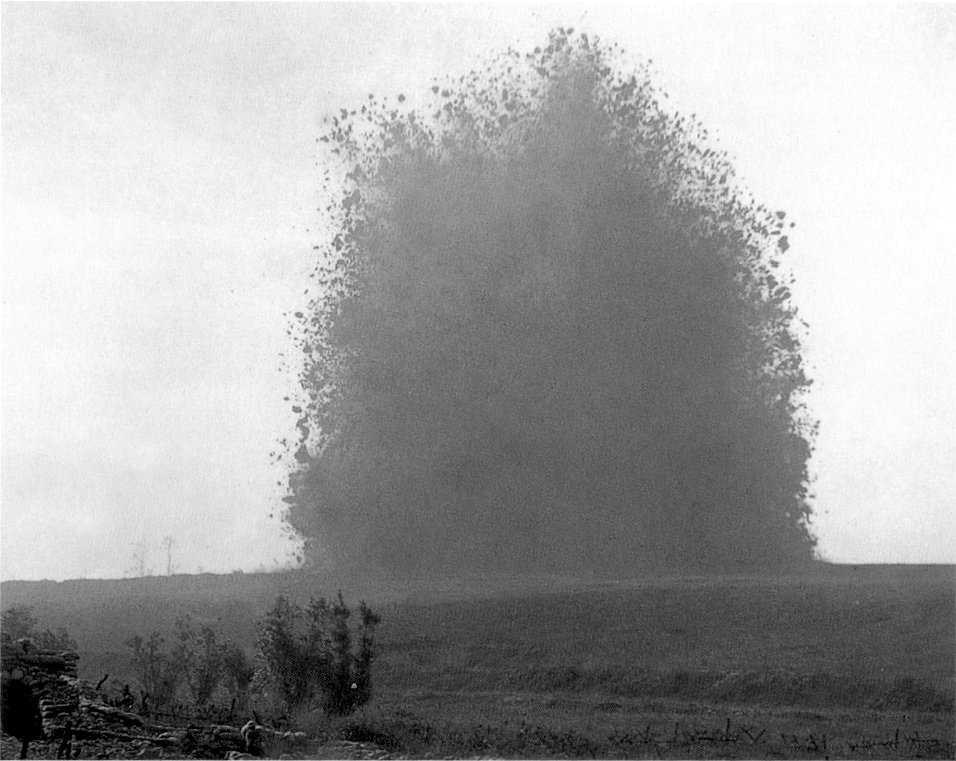
Tunnels, then, can be used not only to break sieges and blockades – as in those that keep the economy of Gaza supplied against the Israeli stranglehold: in effect, lifelines (if you want more on this, try the brilliant documentary Gaza: Tunnels to Nowhere and Nicolas Pelham, ‘Gaza’s tunnel phenomenon’, Journal of Palestine Studies 41 (4) 2012, pp. 6-31).  They can also be deathlines, dug for directly offensive purposes.  The tactic had been used to devastating effect on the Western Front, as I noted in a previous post on 3-D war: the image below is Ernest Brooks‘s famous photograph of the detonation of the British mine underneath the German lines at Hawthorn Ridge on the first day of the Battle of the Somme on 1 July 1916.  You can find video of the explosion here.

Hawthorn Ridge 1916

Then as now, as Jane Burgess argues in a dispatch from the frontlines of  ‘The Battle for Aleppo’, they are deadly improvisations in a war of attrition.

Both of these developments/reversions – the barrel bombs and the mines – obviously reinforce Stuart Elden‘s discussion of attempts to ‘secure the volume’.  But they also speak directly to a bleak politics of insecurity.

In the literary trenches

Barbusse2

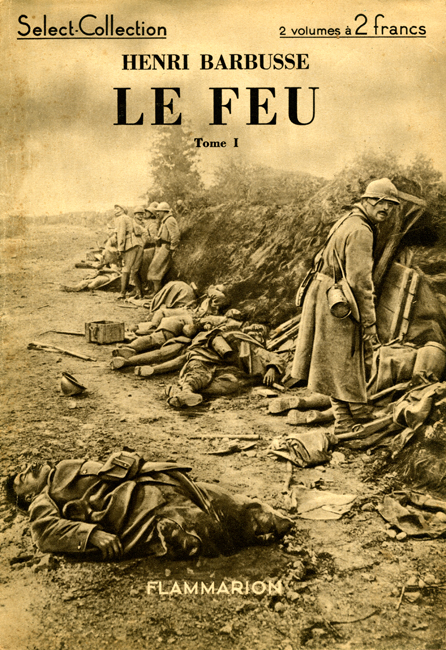
Until now, my knowledge of the French experience on the Western Front has been largely confined to Henri Barbusse’s Under Fire.  I was particularly taken by his striking evocation of the materiality of war – of the ‘slimescape’ – which features in ‘Gabriel’s Map’ and ‘The Natures of War’ (both soon to be available in written form):

The earth! It is a vast and water-logged desert that begins to take shape under the long-drawn desolation of daybreak. There are pools and gullies where the bitter breath of earliest morning nips the water and sets it a-shiver; tracks traced by the troops and the convoys of the night in these barren fields, the lines of ruts that glisten in the weak light like steel rails, mud-masses with broken stakes protruding from them, ruined trestles, and bushes of wire in tangled coils. With its slime-beds and puddles, the plain might be an endless gray sheet that floats on the sea and has here and there gone under. Though no rain is falling, all is drenched, oozing, washed out and drowned, and even the wan light seems to flow. Now you can make out a network of long ditches where the lave of the night still lingers. It is the trench. It is carpeted at bottom with a layer of slime that liberates the foot at each step with a sticky sound; and by each dug-out it smells of the night’s excretions. The holes themselves, as you stoop to peer in, are foul of breath. I see shadows coming from these sidelong pits and moving about, huge and misshapen lumps, bear-like, that flounder and growl. They are “us.”

Or again:

We begin to flow again in one direction. No doubt it is a movement planned up there, back yonder, by the chiefs. We trample soft bodies underfoot, some of which are moving and slowly altering their position; rivulets and cries come from them. Like posts and heaps of rubbish, corpses are piled anyhow on the wounded, and press them down, suffocate them, strangle them. So that I can get by, I must push at a slaughtered trunk of which the neck is a spring of gurgling blood.

The ground is so full of dead that the earth-falls uncover places that bristle with feet, with half-clothed skeletons, and with ossuaries of skulls placed side by side on the steep slope like porcelain globe-jars. In the ground here there are several strata of dead and in many places the delving of the shells has brought out the oldest and set them out in display on the top of the new ones. The bottom of the ravine is completely carpeted with debris of weapons, clothing, and implements. One tramples shell fragments, old iron, loaves and even biscuits that have fallen from knapsacks and are not yet dissolved by the rain. Mess-tins, pots of jam, and helmets are pierced and riddled by bullets—the scrapings and scum of a hell-broth; and the dislocated posts that survive are stippled with holes.

It’s a clunky old translation, but the power of Barbusse’s prose still shines through.  Small wonder that he later confided: ‘I once used to think that the worst hell in war was the flame of shells; and then for long I thought it was the suffocation of the caverns which eternally confine us. But it is neither of these. Hell is water.’ (If you want more on these imaginative geographies, incidentally, I recommend Susan Grayzel‘s short essay on Barbusse and, more generally, Claire Keith‘s ‘Pilgrims in a toxic land: Writing the Trenches of the French Great War’ in Jeff Persels‘s collection, The environment in French and Francophone Literature and Film (2013) pp. 69-85).

BARTHAS Poilu

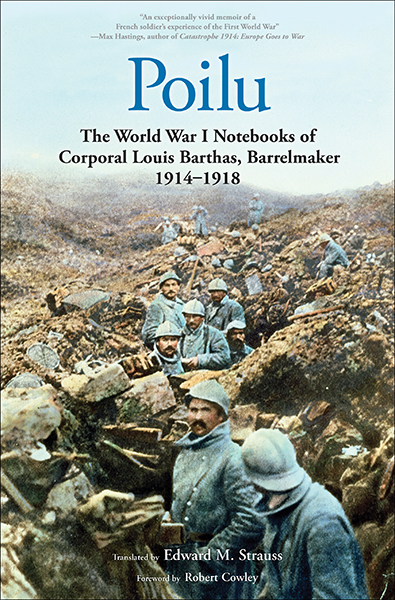
I’ve spent the last several days reading two other accounts by French authors.  The first, Louis Barthas‘s Poilu, has only recently been made available in English translation (it was first published in France in 1978).  ‘Poilu’ means ‘hairy one’, but probably the closest English-language equivalent is the much more recent ‘grunt’, for Poilu presents  the view of the (not so) common soldier.  It’s a carefully assembled account, as Robert Cowley explains in his helpful introduction:

‘Few documents from the Great War are as remarkable as the war notebooks of Louis Barthas, published in English for the first time in Edward M. Strauss’s fine translation. They are special for a number of reasons. Their author left a record of four years of service at the front, an unusual span of survival. He was not an officer but a common soldier, a corporal, a man approaching middle age who in civilian life had been a barrelmaker from the Languedoc region of France, a wine-growing center…. After he was mustered out in February 1919, Barthas began to assemble a narrativeRead more at describing his time on the Western Front that would eventually run to nineteen notebooks. He would work on it after he finished a long day of barrel-making, fleshing out the original diaries with quotes from letters home, official reports and orders that he had kept, and accounts by fellow soldiers that he had written down at the time, as well as with ephemera such as postcards and newspaper clippings. Those sources he put together in the book you read here, one that is part diary, part memoir.’

It’s been praised to the skies – see, for example, this review in the New York Times and this review at the Daily Beast – and Barthas’s spirited socialism and pacifism make it all the more interesting.  But, for me at least, it doesn’t capture the slimescape with the same intensity as my second book: Gabriel Chevallier‘s Fear.

CHEVALLIER Fear

I confess to being taken aback by its very existence.  In another life – in grammar school – my French teacher, a wonderful man called Robert Bratcher, recommended Chevallier’s Clochemerle as a way, I now suspect, of teaching us what ‘Rabelaisian’ meant without actually having to read Rabelais.  It’s a brilliantly comic novel (or at least it seemed so to this fifteen year-old), shot through with word play, artful phrases and visually, almost viscerally immediate staging in which the body – and the fear of/fascination with  its functions – loomed large.

It turns out that the same sensibilities run through Fear, which is a novelisation grounded in Chavellier’s own experiences. Malcolms Imrie‘s fine translation was made available in the UK in 2012, but the New York Times is now publishing a US edition.  ‘At times,’ Neil Fitzgerald wrote in the TLS (in a review tellingly entitled ‘When the body takes charge’),

reading Fear feels like being led through the damnation panel of Bosch’s “The Garden of Earthly Delights”, the front line “blazing like some infernal factory where monstrous crucibles melted human flesh into a bloody lava”. There are wince-inducing close-ups of mutilated men and corpses. Chevallier’s turn of phrase, brilliantly rendered in Malcolm Imrie’s translation, makes this distant war feel horrifying and close. Dartemont’s ultimate triumph, beside surviving, is in never having allowed himself to become dehumanized.

It turns out that others were also taken aback by its very existence.  Fear was originally published in 1930, as Tobias Grey explains, and the French officer class rose up against Chevallier’s merciless assault (which you can also find in Barthas):

Subsequent criticism of “Fear” meant that it was withdrawn from circulation in France on the eve of World War II and did not reappear until 1951. Chevallier, who had scored a big hit with his satirical novel “Clochemerle” (1934) in the meantime, declined to kick up a fuss. “Once war has come, the time has passed for warning that it is a disastrous venture with unforeseeable consequences,” Chevallier reasoned in the preface of “Fear.” “That is something that must be understood earlier, and acted on accordingly.” When “Fear” was recently re-published in France after many years out of print, one critic still felt it necessary to point out that pages like the ones he had just read “would have had the author shot during the war.”

As I’ve indicated, central to Chevallier’s account is the human body and the hapticity of war: its sensual, physical apprehension and its corporeal inscription.  Grey concludes:

… above all “Fear” is a novel whose most indelible passages describe the sensory degradation of war on the human body. These baroque descriptions are generously translated into English by Malcolm Imrie without a hint of stiltedness [in fact, Imrie won the Scott Moncrieff Prize for his translation]. A face is described as seeming to “acquire a dull, gray coating, as if someone had forgotten to dust it, and the beard, drawing strength from the compost of unhealthy flesh, spread rapidly, seeming to drive out life, like ivy takes light from the front of a house.” It is the kind of powerful prose that helps to make Chevallier’s long-neglected novel one of the most effective indictments of war ever written.

All of this reading is in part preparation for a trip later this month with an old friend to the battlefields of the Western Front (we’re still arguing over which of us is Blackadder and which is Baldrick, but it’s really no contest): watch this space for a report.

Digital trenches

banner

I’ve mentioned the opening skirmishes for the centenary of the First World War before, and recommended europeana‘s curated website devoted to untold stories and official histories of World War I.  I’ve since also become entranced by the extraordinarily rich website developed by the University of Oxford:

World War I Centenary: Continuations and Beginnings is building a substantial collection of learning resources available for global reuse. A rich variety of materials, including expert articles, audio and video lectures, downloadable images, interactive maps and ebooks are available under a set of cross-disciplinary themes that seek to reappraise the War in its cultural, social, geographical and historical contexts. Many of these resources have been specially created by the University of Oxford and partner academics for this website.

It’s an Open Educational Resource, so that everything is released under an open content/commons licence.

The site is organised around a series of themes, including Body and Mind (read the brilliant Santanu Das on ‘The Dying Kiss‘, revised and extracted from his Touch and intimacy in First World War literature: ‘It is a great irony that the world’s first industrial war, which brutalized the male body on such an unprecedented scale, also nurtured the most intense and intimate of male bonds’) and Machine (for those of us interested in the administration of military violence, in the double sense of that term, Christopher Phillips has an insightful vignette about General Haig: ‘Far from being a ‘donkey’, he was the centralizing force responsible for overseeing the entire ‘business’ on the Western Front…. the ‘General Manager of War’’.)

And there is also a section entitled ‘From Space to Place‘ that includes Das again on ‘slimescapes’ (which is what triggered my work on ‘The natures of war’, soon to be completed for Antipode) and Matt Leonard on the war underground.

Many of the contributions come from PhD students, which gives the whole project a remarkable freshness.

Headings

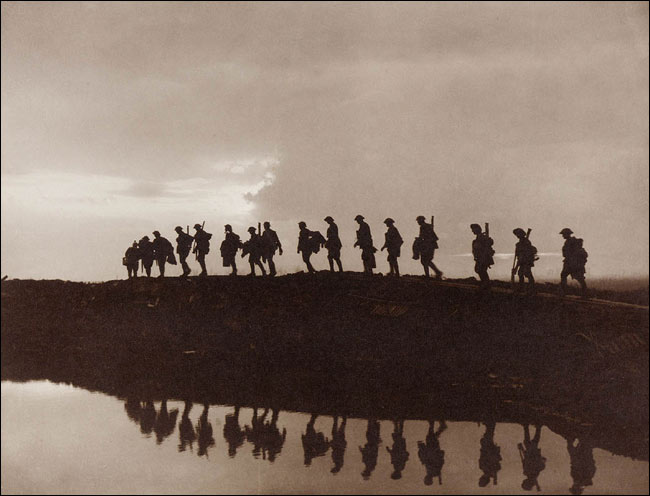
I’ve changed the header for this site; the original was cropped from a famous Frank Hurley image – perhaps the most famous Frank Hurley image – showing Australian infantry moving up to the front near Hooge in October 1917:

forward

I’ve written about Hurley before, and it turns out that this may be one of his many manipulated images: see Bob Meade‘s detective work here (though see the cautionary notes in the comments too).

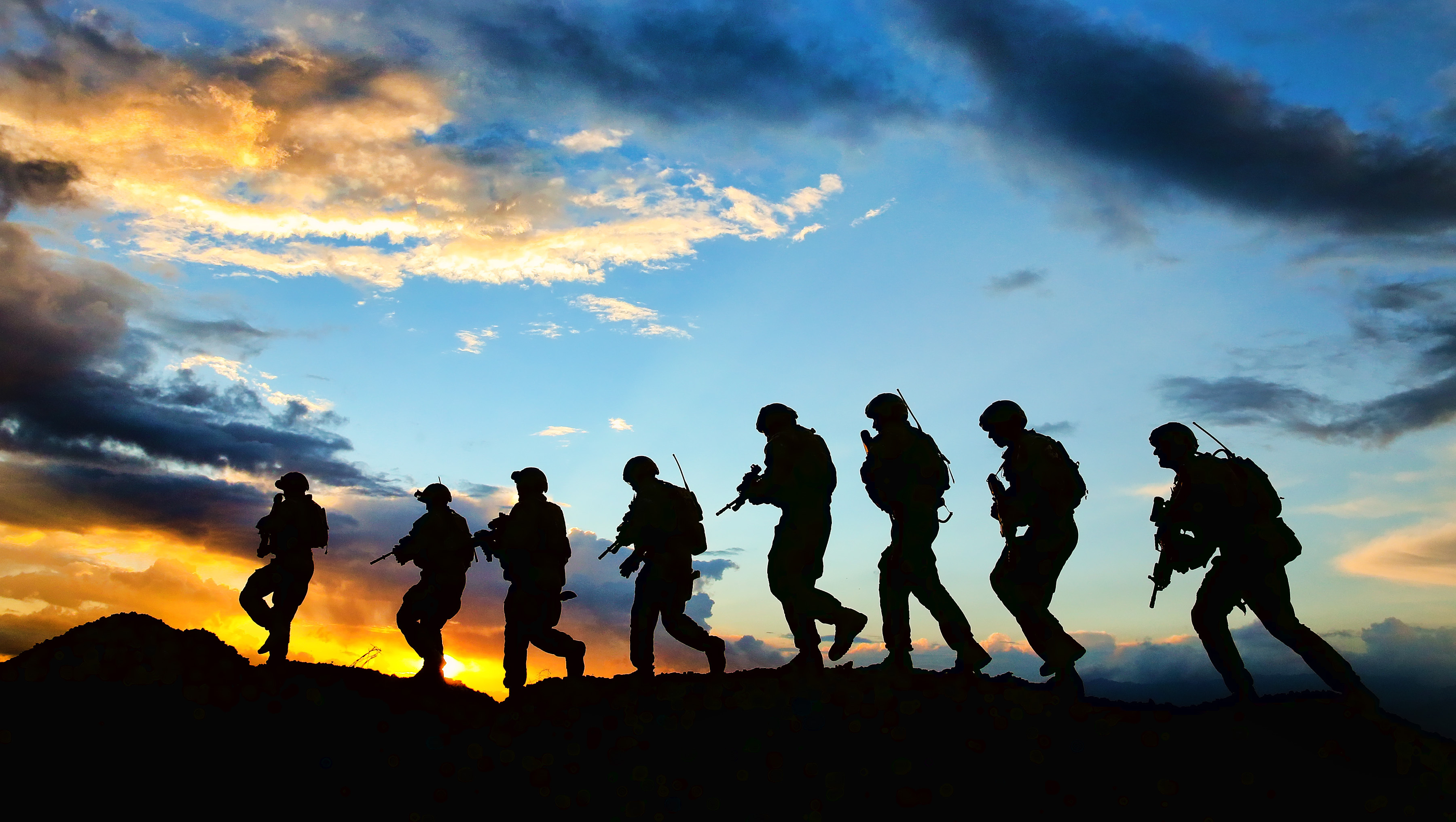
While I was doing some image research for my presentation at the Association of American Geographers in Tampa, I discovered the parallel, contemporary  image I’ve substituted.  Here is the uncropped image, taken by Mark Doran, which shows soldiers from the 7th Battalion Royal Australian Regiment at sunset at Tarin Kot (Uruzgan, Afghanistan) in 2013:

Sunset shadows in Uruzgan


The radio-controlled television plane

I’ve written before about the long history of drones (UAVs or RPAs, if you prefer – and the Air Force does prefer), and the unrealised intersections between remotely-controlled aircraft and early television: I’m thinking of Archibald Low‘s experiments with what he called Televista in 1914 and his trial pilotless aircraft (codenamed ‘Aerial Target”) in the dog days of the First World War.  I had assumed that the connections did not materialise – and even then in very precarious ways – until the closing stages of the Second World War with the US Project Aphrodite, which I discussed briefly in ‘Lines of Descent’ (DOWNLOADS tab).

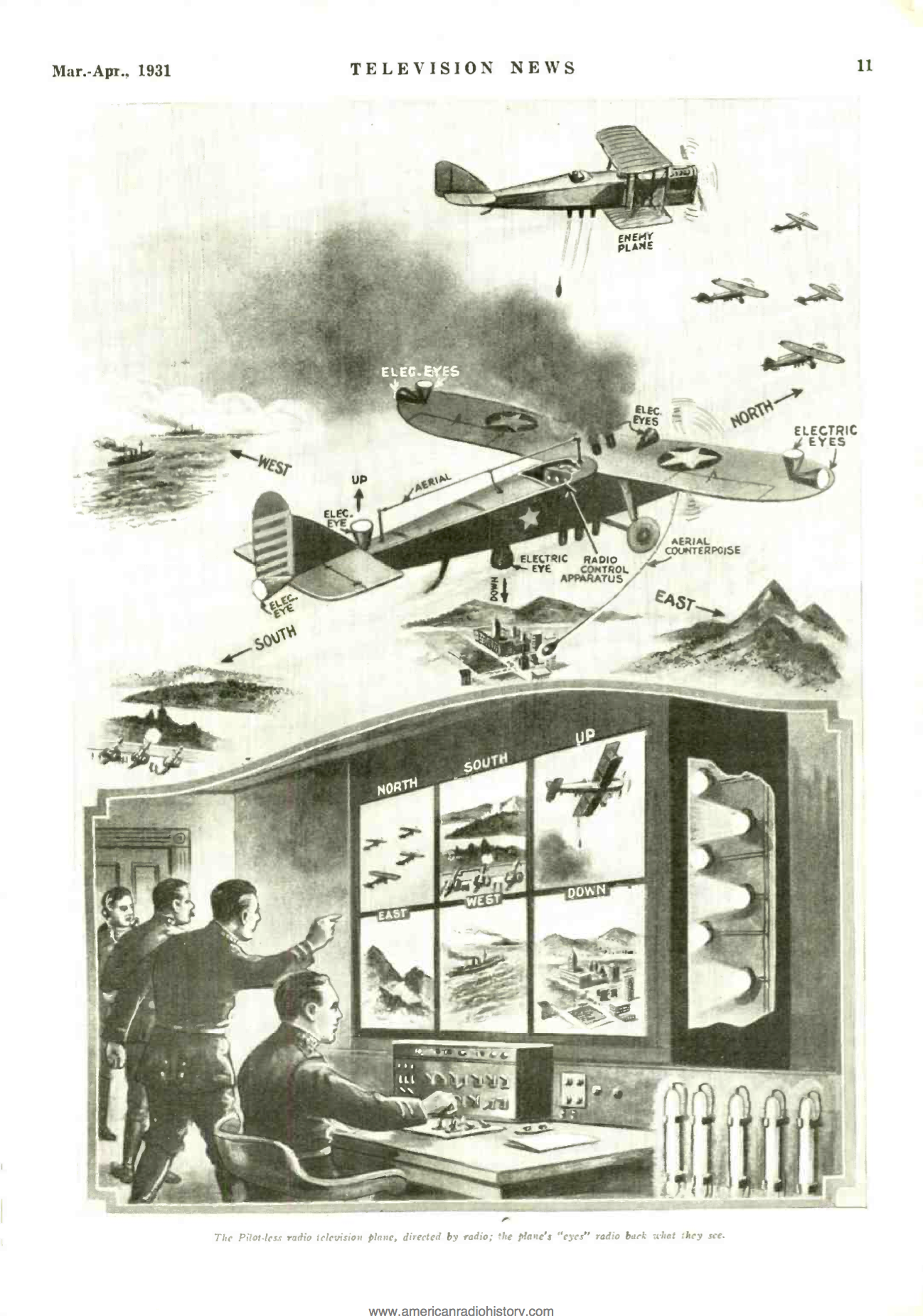
But now, via Gizmodo, I discover another way-station that was put in place in 1924.  First published in The Experimenter magazine, and then republished in Television News in 1931 in its March-April issue, an article by Hugo Gernsback described the military operation of a ‘radio-controlled television plane’, directed by radio and navigated using ‘electric eyes’ that would enable ‘the control operator, although 50, 100 or possibly 500 miles away, [to] see exactly what goes on around the plane, just the same as if he himself were seated in the cockpit; with the further advantage that, sitting before a screen, he can scan six directions all at once, which no human aviator can do.’

Television-News-1931-Mar-Apr

And, just like Project Aphrodite and its modern descendants, this would be a hunter-killer mission:

‘The radio-controlled television airplane can then be directed to the spot where it is supposed to drop its bombs. Moreover, the distant-control operator can see exactly when his machine arrives over a given spot. A sighting arrangement can be attached to the plane in such a manner that, when the object to be bombed comes over the cross-wires in the range-finder, the bomb or bombs are dropped at the exact moment.’

But as the illustration indicates – and in contrast to today’s Predators and Reapers – it was assumed that the aircraft would be able to operate in contested air space – and even more effectively than a conventional aircraft:

If, for instance, an enemy airplane suddenly comes out of a cloud and starts dropping bombs on our machine below, the control operator sees this enemy machine quicker 500 miles away, than if an aviator sat in the cockpit one-quarter of a mile away from or below the enemy bomber. The control operator will send a radio signal that will immediately discharge a smoke screen from his radio television plane, hiding his craft in smoke.

Explaining the decision to republish the article, Gernsback accepted that when it first appeared ‘the ideas set forth therein might have appeared more or less fantastic’ – but ‘they are no longer considered so today’:

‘As a matter of fact, the radio-controlled airplane is with us today.  Several of the leading governments have already in their possession airplanes that can now fly and stay aloft for any length of time, within reason, without a pilot or any human being on board.

‘The television adjunct will follow as a matter of course.’

tvglasses

Gernsback was an extraordinary man.  Sometimes hailed as the father of science fiction – hence the Hugo Awards – he was keenly interested in turning his imaginative ideas into material fact.  Even before the First World War he had invented a home radio set.  Matthew Lasar explains:

Gernsback’s “Telimco Wireless” didn’t receive the signals of any broadcast radio stations,  since there were almost none before 1920. But it did ring a bell in an adjacent room without any connecting wires. Such was the sensation the device made that local police demanded a demonstration, following up on a fraud complaint. Satisfied that it worked, the Telimco was subsequently sold in many department stores … until the first World War, when the government banned amateur wireless transmission.

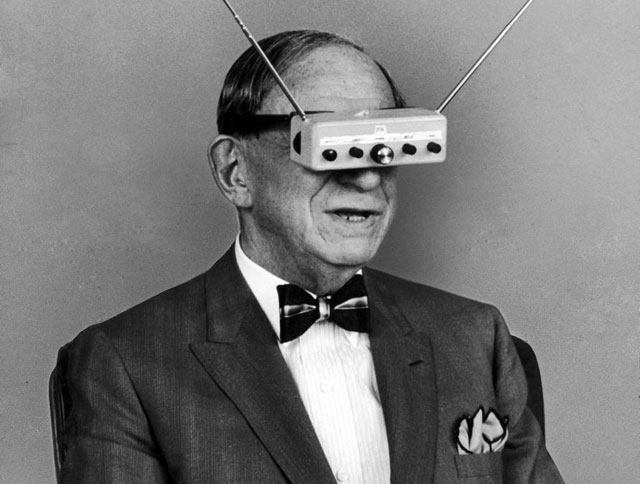
But he was soon fascinated by television; he launched Radio News and then move on to Television News as platforms for his ideas and enthusiasms.  The image above shows him in 1963 wearing his ‘television glasses’.  He died the following year, or he might have invented Google Glass too.

Not cricket

DB-OHWHATALOVELYWAR-casualties

As the centenary of the outbreak of the First World War approaches, the guns have already been firing in Britain.  Michael Gove, the Secretary of State for Education, has sharply criticised those historians, artists, actors and commentators – in fact, pretty much everyone – who thinks the First World War (for Gove, it surely is ‘the Great War’) as a ‘catastrophe’.

The dangerous (‘unpatriotic’) left-wing spectacles he has in his crooked sights include Joan Littlewood‘s Theatre Workshop production/Richard Attenborough‘s film, Oh! what a lovely war! and the final series of Blackadder (on which see David Mitchell‘s wonderful commentary here, and the response to Gove from Tony Robinson – who played Baldrick – here).  Now, presumably, the villains also include the avowedly conservative historian Niall Ferguson, who recently described Britain’s decision to go to war as ‘the biggest error in modern history’.  I particularly enjoyed historian Richard Evans‘s dismissal of Gove as ‘a donkey who pretends to be a lion‘ (perhaps that should read ‘alien’?).

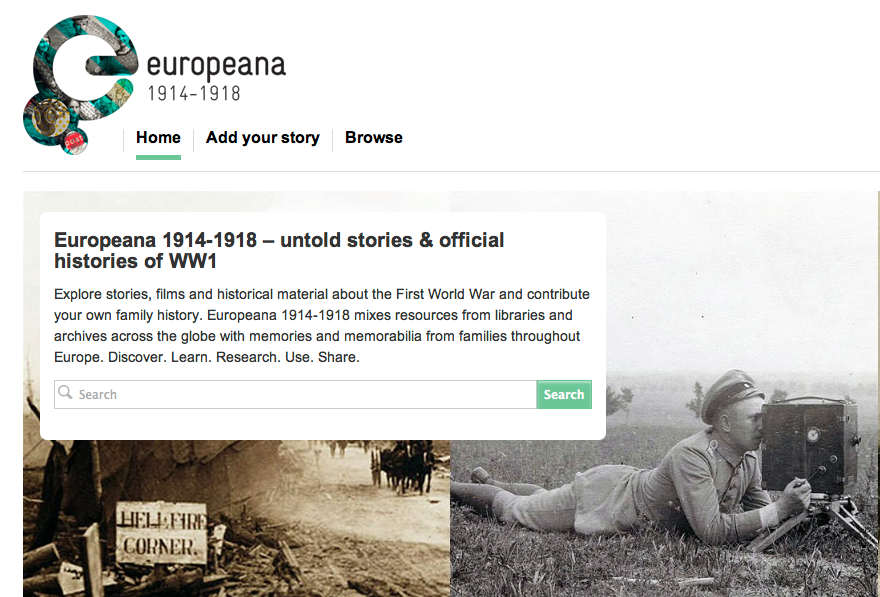
I rehearse all this because, as a welcome antidote to Gove’s shrill jingoism, europeana has just (re)launched europeana 1914-1918 (‘untold stories and official histories’), which brings together digital materials including letters, diaries, reports, photographs and film from libraries and archives around the world.  It really is a stunning resource: Mr Gove could profitably learn from both its mission and its content.

europeana 1914-1918

I notice, though, that the only ‘fronts’ singled out for systematic attention are the Western Front, the Eastern Front, the Italian Front and the Home Front.  Perhaps this is to be expected from ‘Europeana’, but I hope that other theatres of war (not least the Middle East and Africa) will be added…

When soldiers fall

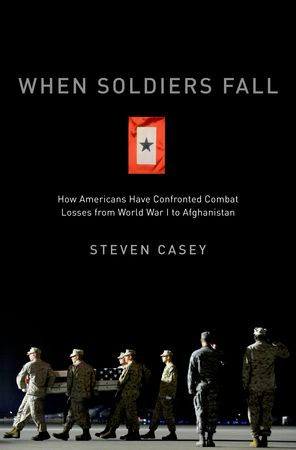
CASEY When soldiers fallNews of an important new book that feeds directly into my new project on medical-military machines and casualties of war, 1914-2014: Steven Casey‘s When Soldiers Fall: How Americans Have Confronted Combat Losses from World War I to Afghanistan (OUP, January 2014).  My own project is concerned with the precarious journeys of those wounded in war-zones (combatants and civilians) rather than those killed and the politics of ‘body-counts’, but Casey’s work presents a vigorous challenge to the usual assumptions about public responses to combat deaths:

The extent to which combat casualties influence the public’s support for war is one of the most frequently and fiercely debated subjects in current American life and has cast an enormous shadow over both the Iraq and Afghanistan conflicts. The common assumption, based largely on U.S. experience in past wars, is that the public is in some way casualty averse or casualty shy, and that as losses increase its support for a war will inexorably decline. Yet this assumption has been adopted as conventional wisdom without any awareness of one of the most important dimensions of the issue: how has the public become aware of the casualties sustained during particular wars? To what extent has the government tried to manipulate or massage the figures? When and why have these official figures been challenged by opportunistic political opponents or aggressive scoop-seeking reporters?

As Steven Casey demonstrates, at key moments in most wars what the public actually receives is not straightforward and accurate casualty totals, but an enormous amount of noise based on a mixture of suppression, suspicion, and speculation. This book aims to correct this gap in information by showing precise what casualty figures the government announced during its various wars, the timing of these announcements, and any spin officials may have placed upon these, using a range of hitherto untapped primary documents. Among the nuggets he has uncovered is that during World War I the media depended on Axis figures and that the Army and Navy did not announce casualty figures for an entire year during World War II. Organized chronologically, the book addresses the two world wars, the limited wars in Korea and Vietnam, and the recent conflicts that are part of the War on Terror. Using sources such as the private military command papers of Generals Patton, MacArthur, and Westmoreland, and previously unopened New York Times archives, it offers the first analysis of how the U.S. government has publicized combat casualties during these wars, and how these official announcements have been debated and disputed by other voices in the polity. Casey discusses factors such as changes of presidential administration, the improvement of technology, the sending of war correspondents to cover multiple conflicts, and the increasing ability to identify bodies. Casey recreates the complicated controversies that have surrounded key battles, and in doing so challenges the simplicity of the oft-repeated conventional wisdom that “as casualties mount, support decreases.” By integrating military and political history, he presents a totally new interpretation of U.S. domestic propaganda since 1917, filling a major gap left by a spate of recent books. Finally, it provides a fresh and engaging new perspective on some of the biggest battles in recent American history, including the Meuse-Argonne, D-Day, the Battle of the Bulge, China’s intervention in the Korean War, the Tet Offensive, and the recent campaigns in Iraq and Afghanistan.

Amazon has temporarily withdrawn its Kindle edition because there are technical issues that it is working with OUP to resolve: I hope this is sorted out soon…  But for now you can read an extract over at Salon, ‘How Richard Nixon reinvented American warfare (…and paved the way for Iraq and Afghanistan)’:

Determined to prop up South Vietnam in an election year, Nixon’s casualty sensitivity had not extended beyond American lives to enemy noncombatants. “Now, we won’t deliberately aim for civilians,” he told his senior advisers at one point in 1972, “but if a few bombs slop over, that’s just too bad.” In Nixon cold calculation the American electorate was principally concerned with U.S. losses; it cared far less about what happened to civilians….

In the wake of defeat, the U.S. government tried to learn the appropriate lessons. As well as reconsidering military-media relations, officials thought long and hard about the conditions under which the public would support the use of force—and the prospect of casualties—in the future. Sometimes, they looked back beyond Vietnam to an earlier era when the media had appeared more manageable and the public less skeptical. Of course, even during the two world wars and Korea, the government had always faced searching questions about the veracity of its casualty information. But Vietnam had clearly changed the rules of the game. Trust in government was much lower. The media was even keener to probe for the story behind the official narrative. And the whole debate was now even more sensitive to the human cost of war. These were all legacies that the two Bushes would have to grapple with in the post–Cold War era, as they took the United States into war against a new set of enemies.