Medical-military machines and casualties of war 1914-2014

SABER, Desert Rat Sketchbook

As promised, I’ve added the outline of my proposed new research programme on the casualties of war to the DOWNLOADS page (scroll way down).  I’ve omitted all the pages in the formal application that drove me to distraction – knowledge mobilisation plan (sic), budget justification, ‘expected outcomes’ and the rest – but if you do look at this ‘Detailed Description’ (as it has to be called), please bear in mind that:

(a) this is still very preliminary, and my work is in the earliest of stages (this is a grant application, after all);

(b) everything had to fit into a prescribed, very limited space (leaving no room for nuance); and

(c) I was more or less required to use the Harvard reference system, the enemy of all good writing.

I’ve added a few lines of clarification and a series of illustrations to liven things up (no room for those in the original), but I hope this gives you some idea of what I’m up to.  And, as always, I’d welcome any comments or suggestions – preferably by e-mail to avoid the spam filters.

In working on this, I’ve stumbled into a series of unusually rich primary sources and secondary literatures, and since I’ve mentioned good writing I want to flag two texts that have kept me going throughout this process.

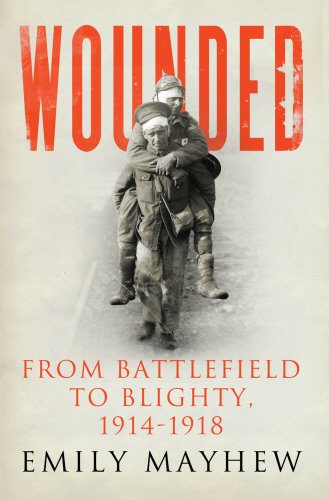
MAYHEW WoundedThe first is Emily Mayhew‘s Wounded: from Battlefield to Blighty 1914-1918, which I noted in an earlier post; for editions outside the UK the subtitle becomes A new history of the Western Front.  I’ve now read it, and admire its substance but also its style enormously.  It’s based on painstaking research, literally so, and yet the main chapters read like a novel, and the analytical-bibliographic apparatus has been artfully moved to the Notes where it becomes a model of clear, concise and thought-provoking commentary rather than a cage that hobbles the narrative.

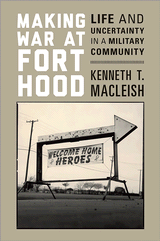
MacLeish Making war at Fort HoodThe second is Ken MacLeish‘s Making war at Fort Hood: life and uncertainty in a military community.  I met Ken at a workshop in Paris last year, and if you read anything better this year – in style and substance – than his Chapter 2 (‘Heat, weight, metal, gore, exposure’) I’ d like to know about it.  The combination of ethnographic sensitivity, elegant prose, and a theoretical sensibility that Ken wears with confidence and displays with the lightest of touch is simply stunning.

Since I’m off to York next week I’ll be spending the next few days preparing a new presentation on ‘Drones and the everywhere war’.  I hope this will also give me  time to return to my posts on Grégoire Chamayou‘s Théorie du drone which I had to put on hold while I trekked from Flanders to Afghanistan for my grant application…

A different sort of hell

I’ve been in Grant Writing Hell for most of last week and right through this long week-end. Everything has to be in by tomorrow morning, and I’ll post the final version of what has become Medical-military machines and casualties of war 1914-2014 once it’s done and I am in recovery (for an early preview see here).  If only I could track down whoever persuaded the Social Science and Humanities Research Council (and the rest of the world for that matter) that drop-down menus achieve consistency and save time… They don’t; apart from the time taken to scroll through endless lists the pre-selected categories never seem to quite fit so you have to click “Other” AND THEN TYPE IT IN ANYWAY.

SACCO The Great War

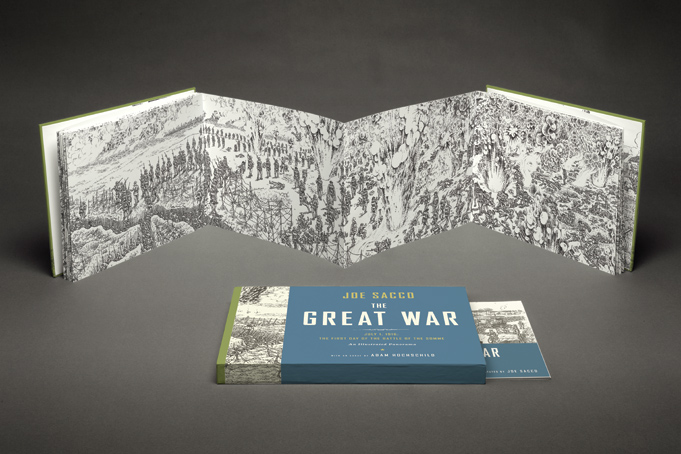
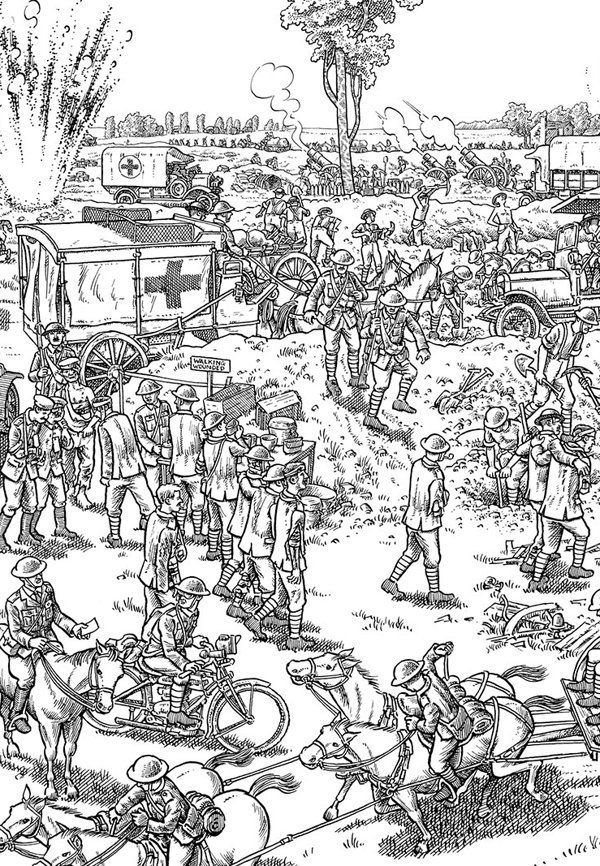
But I must stick my head above the parapet to notice Joe Sacco‘s forthcoming book The Great War, July 1, 1916, due out at the end of this month/early next.  It depicts the first day of the Battle of the Somme, which for Sacco represents ‘the point where the common man could have no more illusions about the nature of modern warfare’, and I’ve selected (below) panels that speak directly to Medical-military machines.  Writing in the Guardian, Steve Rose explains:

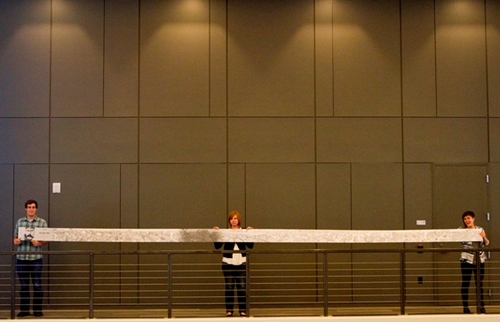
Technically it’s not a book at all: The Great War is actually one continuous drawing, a 24ft-long panorama narrating the British forces’ experience of 1 July 1916, spatially and chronologically, from orderly morning approach to chaotic battlefield engagement to grim aftermath. There are no boxes of text or speech bubbles, no individuated characters, instead Sacco portrays a mass event in painstaking, monochrome, almost technical detail. It’s like a cross between Hergé and the Chapman brothers; the Bayeux Tapestry as a silent movie.

SACCO The Great War

It took Sacco eight months, working in part from photographs held at the Imperial War Museum in London.  ‘When you’re drawing,’ he told Rose,

‘it makes you experience things at a deeper level. Because you kind of inhabit the whole scene … You inhabit each person you draw. You have to give some individuality to each figure, no matter how small they are. I’m leading them to war, and in a way I’m killing them. It’s a very intimate experience.’

In  a departure from Sacco’s previous works there are no words – remember Walter Benjamin: ‘I have nothing to say only to show’ (though he was writing about literary montage) – though there is an accompanying essay by historian Adam Hochschil (adapted from his own book, To end all wars).  In an author’s note Sacco explains:

The Great War is modeled in part on Mateo Pericoli‘s wordless Manhattan Unfurled, a beautiful, accordion-style foldout drawing of the city’s skyline. As a comic book artist, however, I felt impelled to provide a narrative, so the Bayeux Tapestry, which tells the story of the Norman invasion of England, was my touchstone. In the interest of making the drawing compact, I referenced medieval art in other, stylistic ways, namely by dispensing with realistic perspective and proportion. Thus a few inches in the drawing might represent a hundred yards or a mile of reality. However, I have tried to get the details — the field kitchens, the horse ambulances — right.

Making The Great War wordless made it impossible to indict the high command or laud the sacrifice of the soldiers. It was a relief not to do these things. All I could do was show what happened between the general and the grave, and hope that even after a hundred years the bad taste has not been washed from our mouths.

He’s also cited other influences – the late Joe Colquhoun‘s Charley’s War [there’s an excellent and probably unique interview here], Jacques Tardi‘s It was the war of the trenches (see here).

The physical scale of the project is extraordinary – a day a foot, you might say – and NPR unfolded the panorama in its newsroom:

NPR unfolds Sacco

Here it is in a jerky video from Vimeo:

http://vimeo.com/71895305

Laura Sneddon has an interesting report from Sacco’s appearance at the Edinburgh International Book Festival earlier this year, where he situated The Great War in relation to his previous work (notably, for me anyway, Palestine and Footnotes in Gaza) and described his take on his combination of listening-drawing-reporting.

I like the description of Sacco as a graphic journalist, and if you want to know more about his work there’s a short overview by Hannah Sender, a thoughtful review of Sacco’s Journalism by Rob Clough at The Comics Journal,  and a fine short article by Reed Johnson published by the Los Angeles Times to coincide with Footnotes.  In it, Sacco said he was at the point of thinking it was time ‘to walk away from battlefields…’  I’m glad he didn’t.

If you’re in London later this month he’s appearing at the LRB Bookshop on Monday 28 October  in conversation with David Boyd Hancock.

SACCO The Great War 2

Perhaps I should have drawn my application…

Lightning strikes

THOR

I’ve posted about this remarkable project before.  The Air Force Research Institute has now made available online its historical database of air strikes.  Although a USAF project, the Theater History of Operations Reports is not confined to US airstrikes but includes allied strikes; the main focus is on World War I (from June 1916), World War II and Vietnam (from 1965-1969, though I haven’t yet checked whether this includes Laos and Cambodia).

The original description of the Project included the Korean War, Desert Storm (1991), Allied Force (1999), Afghanistan (2001 on) and Iraq (2003-11), but these are still classified and not yet available online.  Here is the architect of the project, Lt Col Jenns Roberston, explaining the background:

http://www.youtube.com/watch?v=mG9A-F1mDtw&feature=youtu.be

That was a year ago.  There’s now a Quick Start Guide here, and you can download the full, unclassified database and also ‘Grab and Go’ files for Google Earth.  Latest background information here.

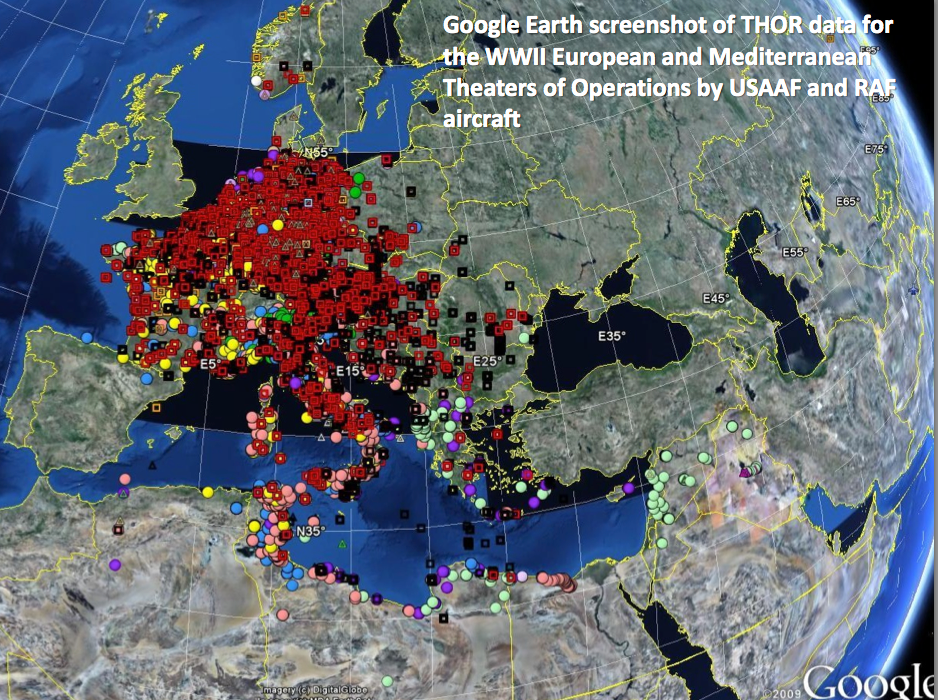
Here’s a grab of Allied bombing in Europe and the Mediterranean during World War II, though the key here is obviously to disaggregate and refine the data – which is precisely what the database allows.  The red squares on the map are B-17 strikes but these overlay (for example) the orange squares of Wellington bombers so the impression at this scale is not particularly helpful.

THOR screenshot USAAF and RAF bombing in Europe WWII

And while we’re on the subject of World War II, don’t forget the Bomb Sight project, which maps the London Blitz in extraordinary detail: more here.

It’s important to look beyond Europe, of course.  Roberston, who started work on the database in 2006, told the Air Force Times that he was surprised at the level of Allied bombing in the Pacific theater:

“We were blown away – no pun intended – by the level of bombing that was taking place, not only in the South Pacific  but also in Burma, which is something that nobody looks at; Formosa, currently known as Taiwan; and the Philippines – how heavily those regions were bombed in the lead-up to bombing Japan proper.”

http://www.youtube.com/watch?v=EqWq0LIkF90

On bombing ‘Japan proper’ in World War II, as I’ve noted previously, the very best source is Japan Air Raids.org.

If anyone else is working through the disaggregated database too, do let me know how you get on.

Theory of the drone 7: Historical precedent and postcolonial amnesia

This is the seventh in a series of posts on Grégoire Chamayou‘s Théorie du drone; this one covers the second chapter of Part II, Ethos and psyche.

2. ‘That others may die’
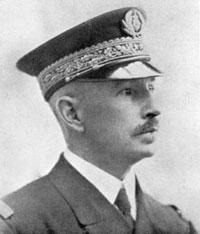
Raoul CASTEXChamayou opens with a quotation from a French naval officer, Raoul Castex, on early submarine warfare.  Castex was a naval strategist of the first water (he rose to the rank of Admiral, though he was a captain when he wrote the essay Chamayou cites).  His views were canvassed as widely as those of Alfred Thayer Mahan, and they were set out in detail in his five-volume Théories strategiques published by the Société d’Editions Géographiques, Maritimes et Coloniales between 1929 and 1935.  This was hailed as recently as 1995 in a report prepared for US Navy Doctrine Command by James Tritten as ‘perhaps the most complete theoretical survey of maritime strategy to ever appear.’

Castex was not fêted so enthusiastically in the 1920s, however, when his ‘synthesis on submarine warfare’ was seen as a defence of unrestricted German submarine attacks during the First World War.  The first attacks had been against warships, but by early 1915 – and in large measure as a response to Britain’s naval blockade – the focus switched to merchant shipping.  In the course of the war Britain lost over 12 million tons of merchant shipping to U-boats.  In Castex’s view, the success of these attacks showed that the submarine was the instrument that would overturn Britain’s naval supremacy.
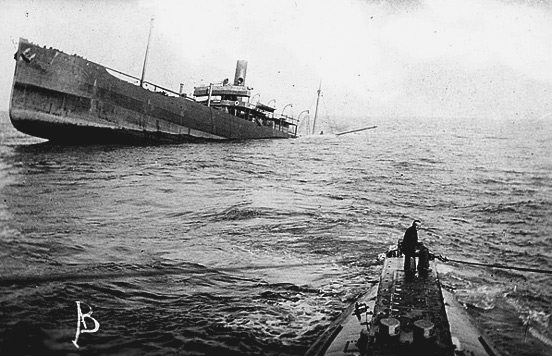
Tramp steamer sinking after U-boat attack

Britain bridled at the suggestion, and Castex’s supposedly exculpatory views were quoted in (mis)translation by Britain’s First Lord of the Admiralty at the Committee on Limitation of Armaments in Washington in December 1921; they were repudiated by the senior French naval delegate and provoked a fierce political and public controversy in Britain.  The British delegation had gone to the Washington conference to demand the total abolition of submarine warfare: submarines were virtually impossible to detect, and there was little defence against them (depth charges became available in early 1916, but these had minimal effect).  Before the War, Admiral Sir Arthur Wilson had denounced submarines as “unfair, underhand, and damned un-British”, and during the war there were repeated condemnations of the sinking of merchantmen (and arguments over their ‘noncombatant’ status).   By 1921 the focus of debate had switched back to military targets, and the Admiralty was gravely concerned that the ‘battlefleets of the world” – crucially, of course, those of the Royal Navy – “would be at the mercy of  flotillas of submarines of improved design.”  Britain’s position was opposed by France, Italy and Japan, and the attempt at abolition failed.  Chamayou doesn’t bother with any of this detail – it’s all back-story and you can find much more here – but its relevance for drone warfare and campaigns against it should be obvious.

In his synthesis Castex noted that the practitioners of submarine warfare believed that it had finally realised the dream of risk-less warfare. Here is the passage that Chamayou cites (and its prefiguration of Chamayou’s hunting thematic could not be plainer):

‘They were invulnerable.  War should be a game for them, a sport, a kind of hunting, where, having delivered and spread murder, all that would be left for them to do would be to revel in the sight of their victims’ agony.  Meanwhile they would be safe from retaliation and, once back in port, they would busy themselves with stories of their hunting prowess.’

In Chamayou’s view, drones have reincarnated this myth – and these sentiments – in even stronger terms.  They have transformed the meaning of ‘going to war’; the traditional model of combat is now being displaced by an altogether different ‘state of violence’ that degenerates into slaughter or hunting.  One no longer fights the enemy, Chamayou contends, the enemy is simply eliminated as though one were shooting rabbits.

In the sixteenth century Chamayou says that the iconography of Death often portrayed a soldier fighting a skeleton – most famously in Holbein’s Dance of Death – in a struggle that was always pointless because Death mocked his adversary and always triumphed in the end.   The imagery has now been appropriated in this unofficial patch produced for Reaper crews, where the soldier now assumes the position of Death itself (and becomes synonymous with the MQ-9 Reaper); the slogan – which is in fact a parody of “That others may live”, used as a patch by the USAF’s Pararescue teams  – gives Chamayou the title for his chapter.
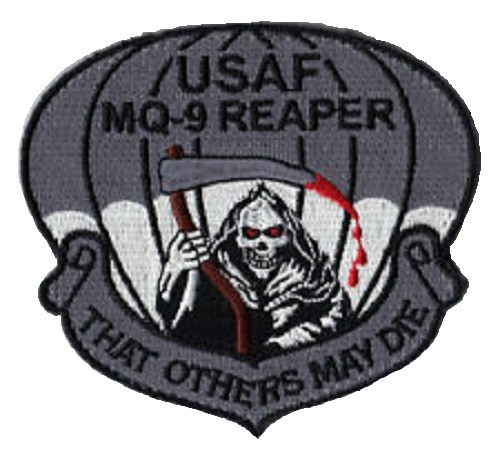
That others might die

In a sense, then, both the submarine and the drone trumpet asymmetry as virtue.  And as that parallel implies, the pursuit of asymmetry is by no means novel.  Here is Sebastian Junger:
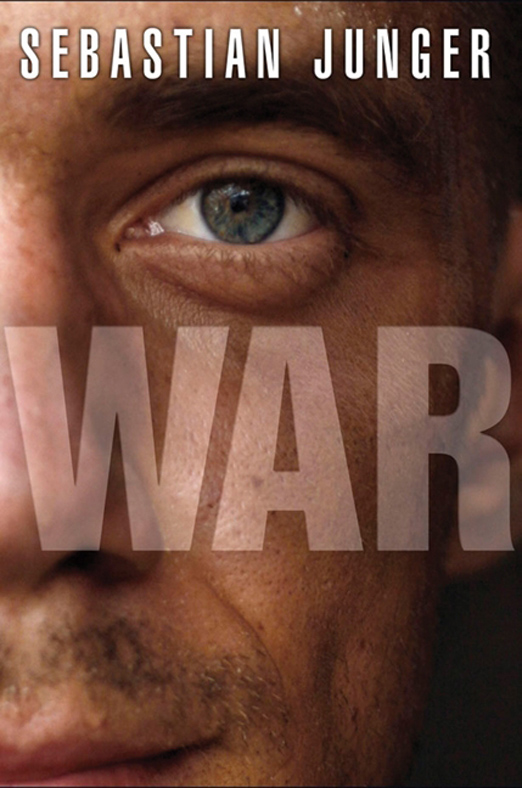
JUNGER WarA man with a machine gun can conceivably hold off a whole battalion, at least for a while, which changes the whole equation of what it means to be brave in battle…. Machine guns forced infantry to disperse, to camouflage themselves, and to fight in small and independent units. All that promoted stealth over honor and squad loyalty over blind obedience….

As a result much of modern military tactics is geared toward maneuvering the enemy into a position where they can essentially be massacred from safety. It sounds dishonorable only if you imagine that modern war is about honor: it’s not. It’s about winning, which means killing the enemy on the most unequal terms possible. Anything less simply results in the loss of more of your own men.

Historical precedent cannot issue an ethical warrant, however, and Junger admits as much.  Yet Chamayou notes that this is exactly the strategy used time and time again to justify drone warfare and to silence its critics.  His example is an essay by David Bell directed at what he called ‘the increasingly vocal critics who doubt the morality, effectiveness, and political implications of “remote control warfare.”‘

‘[C]ritics tend to present this new frontier of warfare as something largely novel — a sinister science fiction fantasy come to life, and one that has the power to radically change the political dynamics of warfare. But if our current technology is new, the desire to take out one’s enemies from a safe distance is anything but. There is nothing new about military leaders exploiting technology for this purpose. And, for that matter, there is nothing new about criticizing such technology as potentially immoral or dishonorable.  In fact, both remote control warfare, and the queasy feelings it arouses in many observers, are best seen as parts of a classic, and very old history.’

This is perfectly true, as far as it goes, and in my own work I have traced the historical curve of ‘killing at a distance’.  I accept, too, that it is reasonable to ask those who object to killing from (say) 7,500 miles away to stipulate the distance from which they do consider it acceptable to kill (though I’m not sure how Chamayou would respond to such a question).  As Bell wryly remarks, ‘None of today’s critics, as far as I know, have expressed any nostalgia for the pike, or other hand-to-hand weapons.’
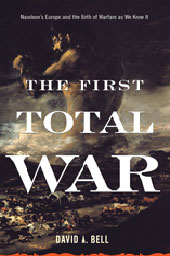
BELL First Total WarBell is a professor of history at Princeton, and I greatly admire his revisionist account of The first total war which troubles the usual identification of ‘total war’ with the bloody twentieth century and insists, instead, on Napoleon as the midwife of ‘warfare as we know it’.  In fact, I’ve drawn on Bell’s work for my exploration of the French occupation of Egypt at the end of the eighteenth century.

But that’s the irony: Chamayou argues that it was precisely Europe’s colonial wars that epitomised the desire to kill others from a safe distance, whereas these are conspicuously absent from Bell’s defence of drone warfare.  They don’t loom large in The first total war either, where Bell anticipates Chamayou’s challenge.  He accepts that The first total war deals ‘only rarely with the world beyond Europe’ – the principal exception is indeed Egypt – and he acknowledges that ‘colleagues often suggested to me that the origins of modern total war are surely to be found on the early modern impperial frontier’:

‘Surely it was here, long before the French Revolution, that Europeans first dispensed with notions of chivalric restraint and waged brutal wars of extermination against supposed “savages”.  Did not Europeans learn their worst behavior from imperial encounters in Asia, Africa, and the Americas?’

His answer, in fact, is no:

‘The horrendous slaughters of the Reformation-era wars of religion began well before most European empires had developed much beyond trading posts, and the worst examples occurred in the German states, which had no colonies.  The development of the French and British overseas empires coincided with the introduction of relative moderation and restraint into European warfare, not with their disappearance.’

Bell attributes this state of affairs to the ‘dependence’ of Europeans on indigenous populations. When later imperial armies embarked on Kipling’s ‘savage wars of peace’ in the nineteenth and early twentieth centuries, he argues, ‘the colonial setting mostly offered Europeans a laboratory for testing their own preexisting ideas about war’:  ideas that had been honed, so he insists, by the Napoleonic wars that are the focus of his book.

These are convenient and far from uncontroversial claims, but three riders are necessary that, taken together, reinstate the importance of colonial and imperial modalities of power.

First, Bell’s book glosses over the extraordinary violence of the French occupation of Egypt between 1798 and 1801, including the terrible victory at the Battle of the Pyramids and the French army’s savage and exemplary response to two insurrections in Cairo (he’s not alone: remarkably, Edward Said does much the same in Orientalism).  The violence included close-quarter butchery but also stand-off artillery bombardments that rained shells down onto the city from the Citadel above.  Here is an eye-witness account of the first insurrection:

‘The situation worsened by the time of the afternoon prayer.  Violence and the atmosphere of siege increased.  At that point (the French) fired their guns and bombarded the houses and the quarters, aiming especially at al-Azhar.  They trained cannons and mortars on it, as well as on the positions of the fighters close to it, such as Ghawriya Market and al-Fahhamin.  When this bombardment fell on the people, it was something which they had never witnessed in their whole life… ’ 

Second, whatever the origins of those ‘ideas about war’ – and they were, I think, clearly multiple – they were put into often spectacular effect during the colonial wars of the nineteenth and early twentieth centuries.  And it is those wars that show the most direct continuity with the places and the peoples who are now condemned to live and die under the shadow of the drone.

Third, as Chamayou shows in his discussion of ‘Counterinsurgency from the Air’, so-called ‘air control’ in the early twentieth century was an intrinsically colonial doctrine.  The first experiments in bombing from aircraft took place over Libya before the First World War, and while bombing of civilian targets in Britain, France and Germany took place in the last years of the war, the use of airpower against peoples who had no capacity to strike back was a cornerstone of British policy in Iraq, Afghanistan and on the North-West Frontier of British India.

Chamayou argues that defenders of drone warfare who invoke the ‘nothing new under the sun’ argument do so in an attempt to relativise, even sedate contemporary violence.  They invoke historical precedent – in effect: ‘This has happened time and time again before, so why all the fuss now?’ – but then fail to describe the bloody continuity that yokes past to present.  Hence, as Chamayou concludes: ‘The drone is the weapon of an amnesiac post-colonial violence.’

My own inclination is to press this further.  In The Colonial Present I suggested that what Chamayou describes here as a version of postcoloniality – I still think that term sadly premature – is haunted by Terry Eagleton‘s  ‘terrible twins’: amnesia and nostalgia.  Or, as Eagleton put it, ‘the inability to remember and the incapacity to do anything else.’   Drone strikes in Pakistan, Yemen, Somalia and elsewhere not only suppress the wretched consequences of previous ‘air control’ regimes but also yearn for the swagger and seemingly effortless domination that they imposed.
Unknown soldiers

Diary of an unknown soldier STILL

Via the Funambulist I’ve stumbled across an early film by the young Peter Watkins, The diary of an unknown soldier.  Made in 1959 when Watkins was just 24, six years before The War Game, it recounts – in what was to become Watkins’ signature documentary style – the last, desperate hours before a young soldier on the Western Front goes into combat for the first time.

This is how Watkins himself tells the story behind the film:

In the mid 1950s, I underwent compulsory military service in Britain. Managing to avoid being sent on a draft to fight the Mau-Mau in Kenya, I landed a clerical post in Canterbury, Kent, where I fortunately met a group of people running an amateur theatre group called ‘Playcraft’. This group regularly staged a series of very clever productions in the small living room of Alan and June Gray – with Alan and Anne Pope, Stan and Phyllis Mercer, and other friends who acted, helped with designs and sets, and invited the local audience to the twenty or so seats tightly crammed into the room. A drama student bitten by the ‘acting bug’ in London before my military service, I acted in several of Playcraft’s productions – including in R.C. Sheriff’s anti-war drama, Journey’s End, set in the trenches during World War I. Immediately following my release from the army, I was bitten by another – amateur filmmaking – ‘bug’, and acquired a Bolex spring-driven 8mm camera…

By 1959, while Watkins was working as an assistant film editor at ‘World Wide Pictures’, alongside a number of documentary filmmakers from the old Crown Film Unit, he wrote the script for ‘The Diary of an Unknown Soldier’.  Here it is (the narrator is Watkins himself):

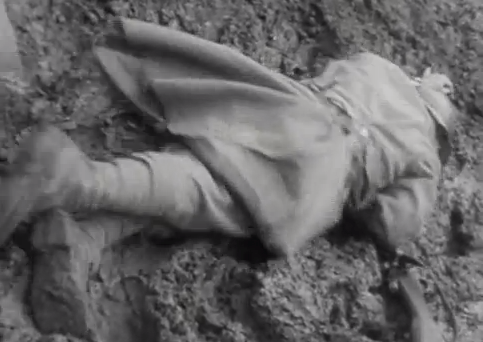
The film is remarkably effective at conveying the visceral nature of the landscape of fear confronting the anonymous young man – the shattered branches that turn into sharp bayonets – but above at showing the materiality and corporeality of the violence that was to come.  As Léopold Lambert notes, ‘the way the body is filmed and described in the script is remarkable as it heavily insists on the fact that war for soldiers — in opposition to high-rank[ing] officers — is essentially a matter of bodies: their movement, their combination with the bullets and bombs trajectories and their relationship to the ground — in that case, the mud.’

Watkins was hired by the BBC’s documentary department in 1963, and the rest is indeed history…

The connections with “Gabriel’s Map” are very clear (at least to me: there are several sequences in which a young subaltern annotates his map).  But what about the other ‘unknown soldier’ (or, rather, soldiers)?

The origins of this iconic memorial go back to 1916, when a British Army chaplain serving on the Western front, David Railton, saw one of countless graves on the battlefield at Armentières, this one marked by a simple cross bearing the words: “An unknown British soldier.”  He became determined that those un-named soldiers from all over the British Empire who had fallen on the Front should be honoured by a single public memorial in Britain.

Finally, in early November 1920 the body of an un-named soldier was exhumed from each of the four major battlefields – the Aisne, Arras, the Somme and Ypres – and one of them was placed in a coffin and transported to London.  On 11 November, two years after the Armistice, the ‘Unknown Warrior’ was re-buried in Westminster Abbey:

Similar memorials were constructed in other European countries, Australia and the United States.

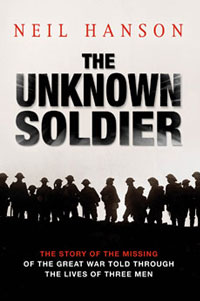
HANSON The unknown soldierYou can find the full, much richer story in Neil Hanson‘s beautifully written and carefully researched  The Unknown Soldier (2005), which splices the story of the iconic ‘unknown soldier’ with the stories of three others – British, French and German – who were declared missing during the War.

The classic discussion of some of the wider issues remains Jay Winter‘s Sites of memory, sites of mourning: the Great War in European cultural history (1998), while later this year David Crane promises to provide an account of the personalities and the politics involved in the construction of war graves in Empires of the Dead (2013).

Wandering in the ruins

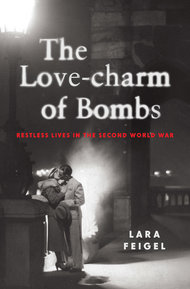
Love-charm of bombsI’ve noted Lara Feigel‘s wonderful The love-charm of bombs before, and now there’s a short interview with her at the New York Times Arts blog here:

I was originally planning to write an academic study of war literature. But I kept finding that I was reading about the writers’ lives, rather than reading about their books, and especially about their passionate wartime love affairs. Once I had spent time in their archives and read their wartime letters and diaries, I started to think that it’s impossible fully to understand classic novels like Graham Greene’s “The End of the Affair” or Bowen’s “The Heat of the Day” without knowing about their lives, and seeing these books as urgent messages, written to lovers, and written out of an extraordinary time. A lot of parallels and shared experiences were emerging in the research, so it seemed obvious to tell the stories simultaneously, threading them together as in a novel.

Lara explains that, although she was trained as a literary critic and historian,

I enjoyed the challenge of acquiring new kinds of knowledge in researching this book. I read a few military accounts of the war, but I learned a lot of the war news from reading contemporary diaries and newspapers. I wanted only to convey as much as well-informed people knew at the time. After all, my writers weren’t military experts, just people who found themselves living through a complicated and long-drawn-out war.

I know just what she means (and for more on another project in which Lara crosses established boundaries, see this meeting of minds between neuroscientists, artists, philosophers and analysts, which she co-organized with Lisa Apignanesi).  In a similar sort of way I’m a geographer ‘by training’, whatever that might mean, but I’m content with the description largely because it gives me the freedom to pursue ideas and issues wherever they take me, often far beyond the bounds of any recognisable or at any rate nominal ‘geography’ – except that I always remember Dick Chorley‘s frequently repeated injunction when I was an undergraduate at Cambridge: “To ask, ‘Is that Geography?’ is the most un-geographical of questions.”  So I think geography is a discipline in the Foucauldian sense – it works to produce disciplinary subjects through a network of formal institutions (including university departments) and journals, through a canon of texts, and through a systematic series of examinations – but that’s about it.  I don’t think this makes Geography any different from a host of other ‘disciplines’, needless to say: it’s a route of entry into a rich and constantly changing intellectual-practical world, and unlike Richard Hartshorne and others of his ilk I insist that there’s a lot to be said for deviating from the path (or rather Path) and acquiring those ‘new kinds of knowledge’ that Lara talks about.

With that sort of license comes responsibility, too, of course, but that doesn’t mean conformity.  I’ve always liked E.P. Thompson‘s image of himself, working for the first time on early eighteenth- rather than ninteenth-century Britain in Whigs and Hunters – his best book – as a parachutist landing in occupied territory (occupied not least by Jack Plumb), burying his silk under a tree and night after night moving stealthily through the surrounding landscape, gradually coming to know it better and better: but on his own terms.  Perhaps he was channelling his late brother Frank who parachuted into Bulgaria during the Second World War to provide support to the partisans and who was summarily executed for his pains.

PIETTE Imagination at warWhich brings me back to Lara.  Asked to recommend a book about literature during the Second World War, she suggests Adam Piette‘s Imagination at war: British fiction and poetry 1939-1945 (1995): ‘a wonderful account of the oddness of the literary responses to the Second World War.’  D.J. Taylor wasn’t so sure, though I found Adam’s discussion of the war in the desert very helpful in enlarging my own view of those campaigns for ‘The natures of war’.

I know the sequel better, The Literary Cold War, 1945 to Vietnam (2009), which includes an invigorating discussion of Graham Greene‘s The Quiet American amongst many other good things (a novel much on my mind of late).  Adam runs the Cultures of the Cold War network whose website opens with a rapid-fire quotation from E.L. Doctorow:  ‘The bomb first was our weapon. Then it became our diplomacy. Next it became our economy. Now it’s become our culture. We’ve become the people of the bomb.’ Unfortunately, it appears the website then ran out of energy (sic), though there’s a useful Bibliography.

For me, the book I most admire is Patrick Deer‘s Culture in Camouflage: war, empire and modern British literature (2009).  He paints on a larger canvas than Imagination at war – the book covers the period 1914-1945, and there are definite advantages in doing so – and he seems to have read everything and to have thought about it all in depth and detail.  I was first drawn to it by his chapters on the Second World War, but as I re-work “Gabriel’s Map” for what I think, hope and pray will be a second new book (really), provisionally called War material, I’ve plunged back into his earlier accounts of the First World War.  They are brimful of incisive readings and artful insights.

“Gabriel’s Map” is all about the dialectic between the scopic regime constructed through the topographic map, the aerial photograph and the field sketch on the Western Front (‘cartography’) and the sensuous, haptic and thoroughly embodied knowledge of the troops on – and in – the ground (‘corpography’).  Here’s Patrick:  ‘If the emblematic figure for the collapse of vision was No Man’s Land, it was the strategist’s map that came to represent the struggle to recapture oversight, to survey and order the mud, chaos and horror of battle.’ So I’m now thinking much more about the very idea of No Man’s Land and the multiple ways in which soldiers apprehended its gouged terrain.

More on all that very soon, but here I just want to say that Culture in camouflage is gloriously intellectually promiscuous and also a rattling good read.  If you want to explore the idea of ‘war culture’ I’d recommend starting here, and returning to it again and again.  But pack Lara’s book for the journey because she also has much to show us not only about how to travel but also how to write.

Writing at a dead-line

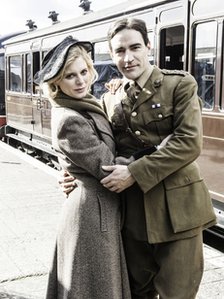
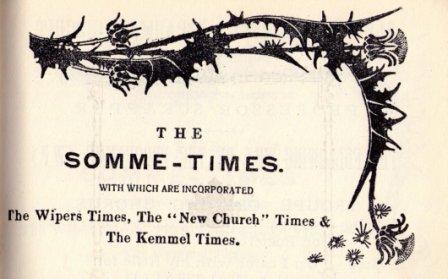
BBC2 The Wipers TimesBack in the trenches again, revising “Gabriel’s Map”, and I see that the former President of the Royal Geographical Society – rather better known as Michael Palin (“This President is no more!  He has ceased to be…. This is an EX-PRESIDENT!!”) – appears in a new BBC2 drama [also starring Ben Chaplin and Emilia Fox, left] based on the story of The Wipers Times, a trench newspaper written and printed on the Western Front during the First World War.

This is Palin’s first dramatic role in twenty years (other then being President of the RGS).  Many readers will no doubt immediately think of the far from immortal Captain Blackadder in Blackadder Goes Forth (in which case see this extract from J.F. RobertsThe true history the Blackadder – according to Rowan Atkinson, “Of all the periods we covered it was the most historically accurate” – and compare it with this interview with Pierre Purseigle).

But since the script for The Wipers Times has been co-written by Ian Hislop (with Nick Newman) the Times is inevitably being described as a sort of khaki Private Eye: Cahal Milmo in the Independent says that ‘its rough-and-ready first edition was a masterclass in the use of comedy against industrialised death and military officialdom.’

So it was, but the appropriate critical comparison is with Punch, which Esther MacCallum-Stewart pursues in ingenious depth here.  The French satirical magazine Le canard enchaîné (which is in many ways much closer to the Eye) started publication in 1915 and was much more critical.  But for most of the war, MacCullum-Stewart says, Punch enforced ‘a strict code of “comedy as usual” interspersed by patriotic statements which hardly pastiched anything except an enduring capacity for the British to show a stiff upper lip to all comers.’

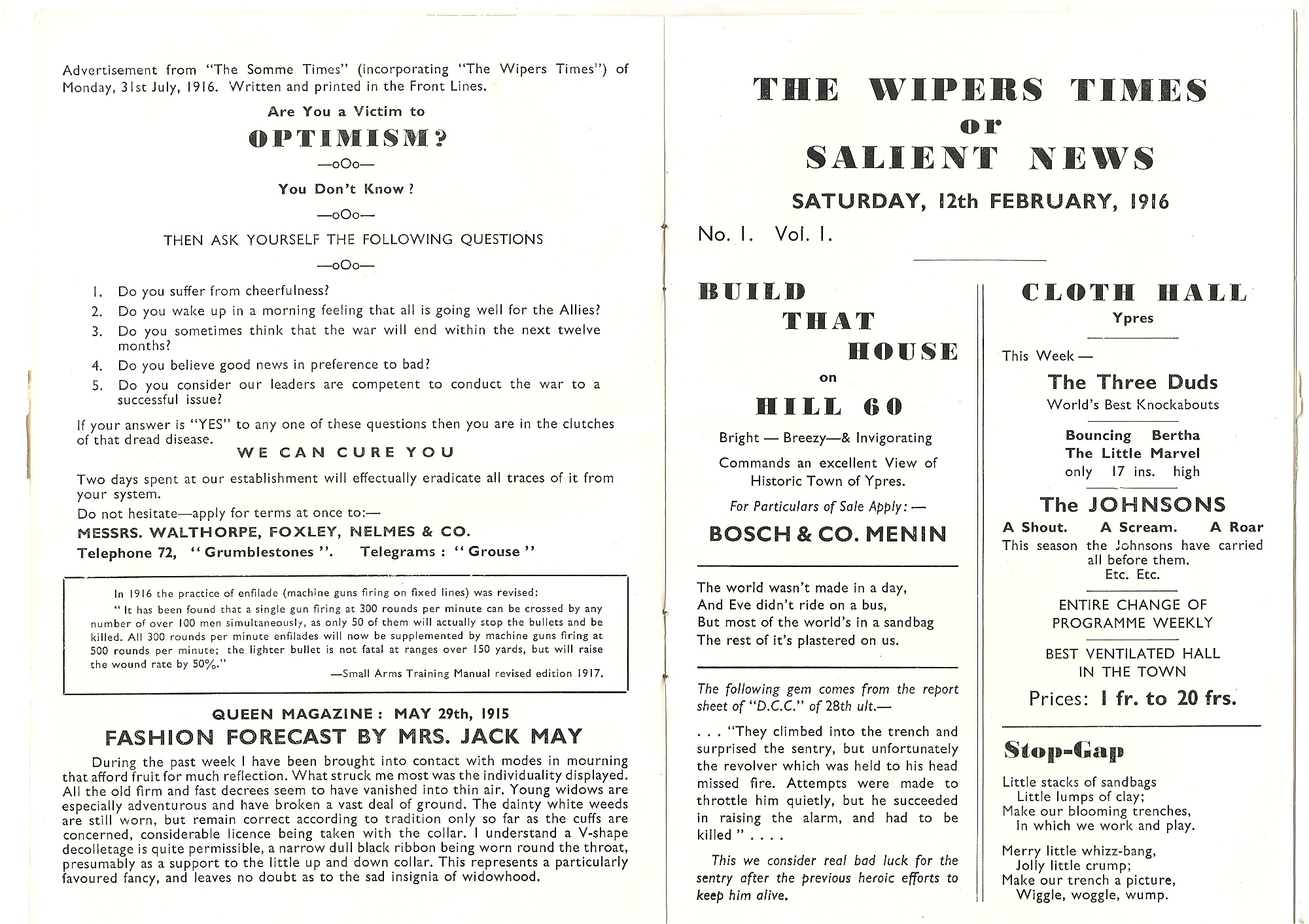
That soon wore thin on the Western Front, and when Captain Fred Roberts – played by Chaplin – found a printing-press amongst the rubble of Ypres (“Wipers”) in February 1916 the Times was born (though a shortage of vowels meant that only one page could be set up and printed at a time).

Wipers Times No 1

The title of the paper changed as the Division was re-deployed time and time(s) again.  It had many targets in its sights, including the warrior poets:

‘We regret to announce that an insidious disease is affecting the Division, and the result is a hurricane of poetry. Subalterns have been seen with a notebook in one hand, and bombs in the other absently walking near the wire in deep communication with their muse.’

This is one of the most widely quoted passages in the paper, but MacCallum-Stewart explains that this is precisely because it could be squared with the mythology of the war which so many other contributions worked to undermine.

You can find other extracts here but my favourite – given how mud works its way into a central place in “Gabriel’s Map” and into one of the vignettes in “The nature of war” – is this satirical version of Rudyard Kipling‘s If (Kipling wrote the original in 1909 as advice to his son –”If you can keep your head when all about you are losing theirs…”: celebrated by the Daily Mail here):

If you can drink the beer the Belgians sell you,
And pay the price they ask with ne’er a grouse,
If you believe the tales that some will tell you,
And live in mud with ground sheet for a house,
If you can live on bully and a biscuit.
And thank your stars that you’ve a tot of rum,
Dodge whizzbangs with a grin, and as you risk it
Talk glibly of the pretty way they hum,
If you can flounder through a C.T. nightly
That’s three-parts full of mud and filth and slime,
Bite back the oaths and keep your jaw shut tightly,
While inwardly you’re cursing all the-time,
If you can crawl through wire and crump-holes reeking
With feet of liquid mud, and keep your head
Turned always to the place which you are seeking,
Through dread of crying you will laugh instead,
If you can fight a week in Hell’s own image,
And at the end just throw you down and grin,
When every bone you’ve got starts on a scrimmage,
And for a sleep you’d sell your soul within,
If you can clamber up with pick and shovel,
And turn your filthy crump hole to a trench,
When all inside you makes you itch to grovel,
And all you’ve had to feed on is a stench,
If you can hang on just because you’re thinking
You haven’t got one chance in ten to live,
So you will see it through, no use in blinking
And you’re not going to take more than you give,
If you can grin at last when handing over,
And finish well what you had well begun,
And think a muddy ditch’ a bed of clover,
You’ll be a soldier one day, then, my son.

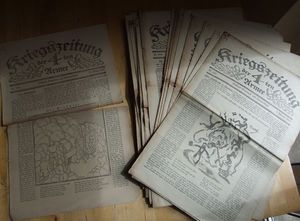
Wipers_Times_4 German 4th Army trench newspapers

There were many other trench newspapers produced by the different armies on both sides. On the Allied side there were 100 or so British ones, for example, and perhaps four times as many French ones; there were perhaps 30 Canadian ones, and more Australian ones. Graham Seal has just published the first full-length study of Allied trench newspapers: The soldier’s press: Trench journals in the First World War (Palgrave-Macmillan 2013); you can sneak an extensive peak on Google Books (though contrary to what it says there, an e-edition is available at a ruinous price).  As you can see from the image above, there were also trench newspapers on the other side too: see Robert Nelson, German soldiers newspapers of the First World War (Cambridge University Press, 2011).  He also wrote a more general and thoroughly accessible survey of trench newspapers in War & History [2010] which is available here.

In the final edition of the Times, published after the end of the war, Roberts – by then a Lieutenant-Colonel – wrote this:

“Although some may be sorry it’s over, there is little doubt that the linemen are not, as most of us have been cured of any little illusions we may have had about the pomp and glory of war, and know it for the vilest disaster that can befall mankind.”

War wounds

London last week, Warsaw at the weekend and now Ostrava this week…  More on the last two soon, but while I was in London I gave a new version of “Gabriel’s Map” to Geography and War Studies at King’s College London.  A large and lively crowd, and I learned much from it all: many thanks to Nick Clifford and Richard Schofield for the invitation and the excellent hospitality.

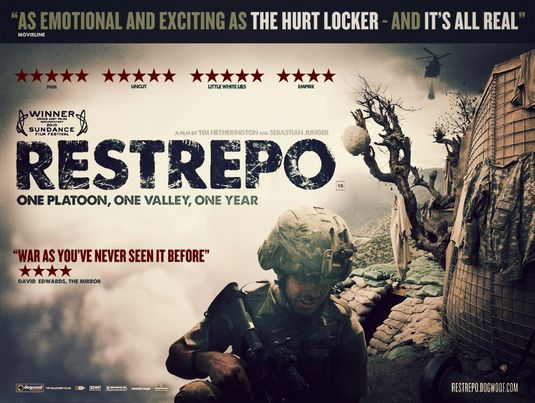
Amongst other things, I had the opportunity to explain the continuities I see between the argument I’ve developed around the First World War and my research on the war in Afghanistan.  Many protagonists have come to represent contemporary war (‘later modern war’) as the hypostatisation of the ‘optical war’ I described on the Western Front, involving a reliance on visual imagery at every level (from the full-motion video feeds provided by remote platforms to the digital displays in command centres down to hand-held devices) and the virtual (sic) erasure of the body: you can see this in arguments as diverse as those proposed by Christopher Coker and James Der Derian.  Der Derian is rightly suspicious of all this, of course, and I tried to show in “Gabriel’s Map” that on the Western Front there co-existed a radically different apprehension of the battlefield – a haptic geography that relied on a bodily habitus and on sound and touch.  This is no less true of ground troops in Afghanistan today; it takes different forms, to be sure, but it’s clear from military blogs and memoirs that for most of those beyond the Forward Operating Bases war is as intimate, as corporeal and as visceral as it ever was.  I’m working my way through a series of memoirs and other materials now and, for all its problems (on which Nick Turse is exactly right), Sebastian Junger‘s War/Restrepo duo (the latter produced with Tim Hetherington) speaks directly to this question.

restrepo_ver2

This has the liveliest of political and ethical implications, but I’ve had other reasons not to leave the trenches behind… Jasper Humphreys at KCL’s Marjan Centre has proposed an extremely interesting project as part of next year’s commemoration of the outbreak of the First World War, drawing on the riches of KCL’s Liddell Hart Centre for Military Archives.  The working title is the same – “Gabriel’s Map” – and the aim is to provide a different narrative of the war that develops the themes I sketched in the presentation, using video and social media to capture the attention of young people (and, I hope, the not-so-young…!).  This is exciting stuff, and I’ll keep you posted.

First World War centenaryThe centenary is itself an interesting project. According to the Guardian, the British government anticipates “unprecedented public interest” and, for once, they may have got something right (as opposed to Right); Andrew Murrison, the minister responsible for the commemorations, has both acknowledged the lively debates that continue to swirl around the conflict and expressed the hope that a central motif will be how the war played out at the ‘intimate level’.

More from the Imperial War Museum (itself being remodelled) here and from the excellent Australian War Memorial here.

The natures of war

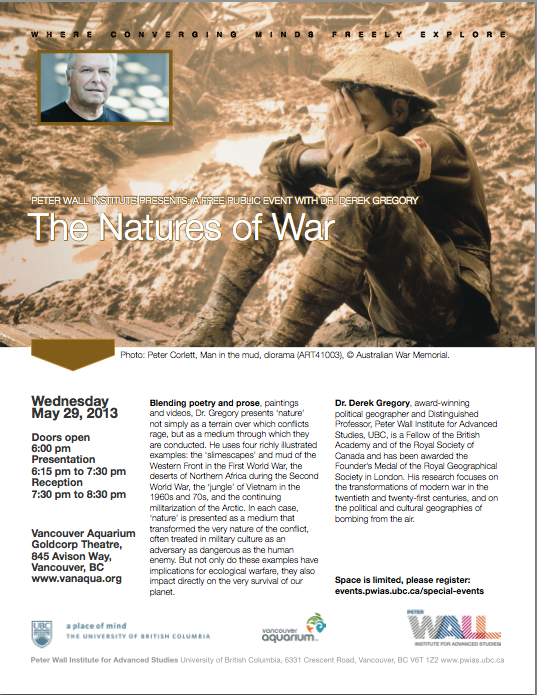
Natures of War

Just about to leave the High Atlas and Morocco, so something like normal service will resume once I’m back in London on Wednesday.  I’ve just received a near-final draft of the poster (above) for my Vancouver talk next month, “The natures of war“.  I’ll explain more of what I’m trying to work out in this presentation in a later post.  You’ll see that the venue is sort of appropriate – though I’ll leave my flippers at home.

More information and registration details here.

Homogeneous (war) time

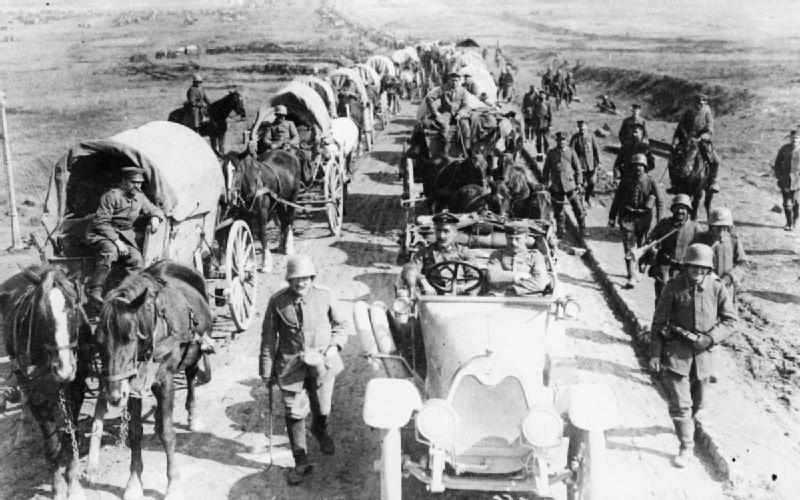
I’ve posted before about the ways in which the First World War involved the calibration and even mathematisation of the battle space, and it’s an important part of my argument in Gabriel’s Map (as you can see from the slides under the DOWNLOADS tab), but this in its turn required an elaborate choreography of time.  This is clearest in the co-ordination of artillery and infantry, particularly in the calculations required for a ‘creeping barrage’ in support of an advance, and eventually involved co-ordination with air support too, but it extended back far beyond the front lines; the re-supply and re-deployment of troops along narrow, crowded roads or narrow-gauge railways also required elaborate timetables, as Ernst Jünger makes clear in this passage from Storm of Steel:

‘The roads were choked with columns of marching men, innumerable guns and an endless supply column.  Even so, it was all orderly, following a carefully worked-out plan by the general staff.  Woe to the outfit that failed to keep to its allotted time and route; it would find itself elbowed into the gutter and having to wait for hours till another slot fell vacant’ (pp. 222-3).

German transport column on Albert-Bapaume road, March 1918 (IWM)

But how, exactly, were these offensive and logistical timetables orchestrated?  What was the mechanism for what Billy Bishop called ‘clockwork warfare’?

Jünger himself provides just one (German) example: ‘‘To keep everyone synchronised, on the dot of noon every day a black ball was lowered from the observation balloons, which disappeared at ten past twelve.’  This was presumably a battlefield adaptation of the ‘time-balls’ that had been developed by the British and then the US navies in the nineteenth century, but other ways of marking time on the Front seem to have been more common.

Two technologies were pressed into service by the Allies; they can both be seen in this synchronisation instruction contained in Operation Order (no 233) from the 112th Infantry Brigade on 10 October 1918:

O.C. No.2 Section, 41st Divisional Signal Company, will arrange for EIFFEL TOWER Time to be taken at 11.49 on “J” minus one day [“J” was the day of the attack] and afterwards will synchronise watches throughout the Brigade Group by a “rated” watch.

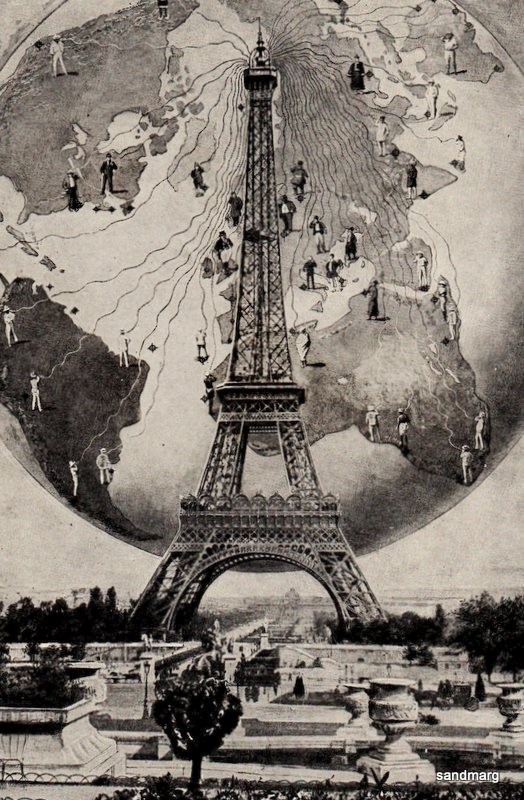
The first was the Eiffel Tower – or, more accurately, the time-signal transmitted from the Eiffel Tower throughout the war.  In 1909 the original twenty-year lease for the Tower was about to expire, and many Parisians loathed it (Maupassant famously had lunch there every day because it was the one place in the city from which it couldn’t be seen) so that its demolition seemed imminent.  But it was saved in large measure because the French military was persuaded of its strategic value as a navigation and wireless beacon. Eiffel had allowed the Minister of War to place antennas at the top in 1903, and the Bureau des Longitudes (under the direction of Henri Poincaré) urged the development of the military radio-telegraphic station to broadcast time-signals twice daily.  The original intention was to enable mariners to set their chronometers, but the project had a wider strategic, scientific and symbolic  significance. ‘Wireless simultaneity’, writes Peter Galison, ‘had become a military as well as a civilian priority’.

Eiffel Tower transmissions 1913

An experimental service started in 1909, and the French Army began broadcasts on 23 May 1910; by June 1913 a regular time service (based on transmissions from the master-clock at the Paris Observatory to the Tower) was in operation.  This continued throughout the war and in to the 1920s; the ‘ordinary time signals’, which were broadcast each day at 10.45 a.m., 10.47 a.m. and 10.49 a.m. and again at 11.45 p.m., 11.47 p.m. and 11.49 p.m., enabled ‘an expert observer, under the most favourable circumstances, to take the time to nearly 0.1 second’.  There’s more technical information than you could possible want here, but the meat of the story is in Peter Galison’s brilliant Einstein’s clocks, Poincaré’s maps: empires of time (2003) (for a discussion and overview see here).

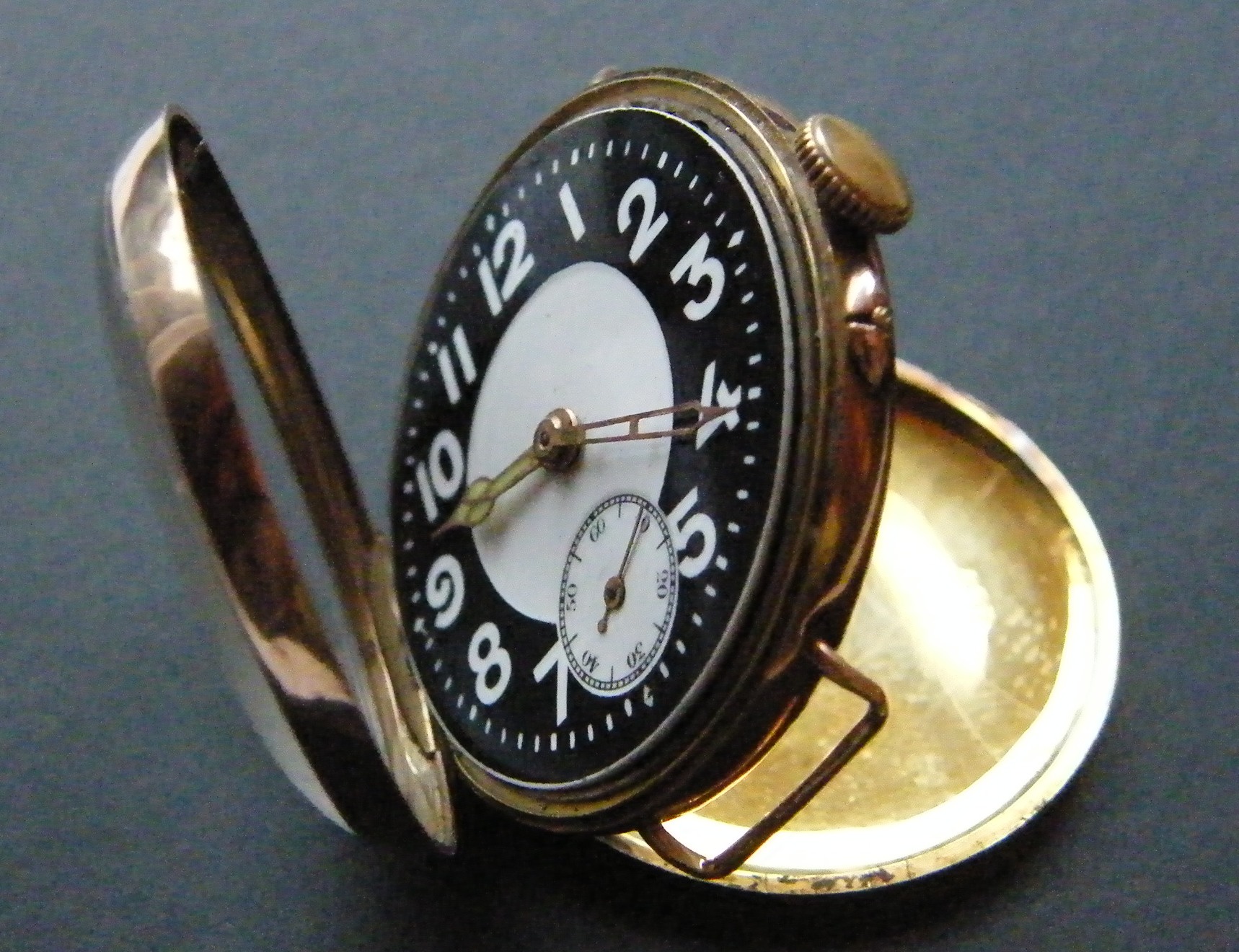
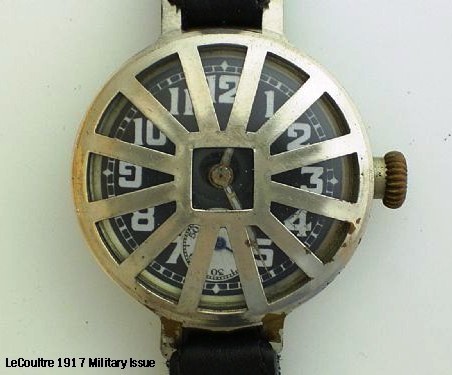
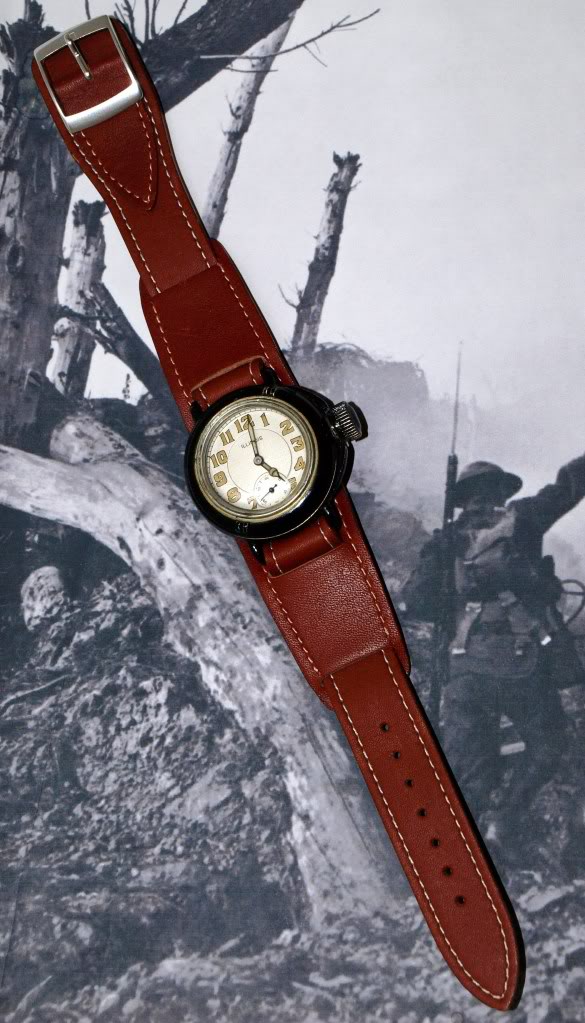
Trench watch c. 1916The second requirement for choreographing time in the battlespace was the wristwatch.  Originally wristwatches were designed for women (the first “wristlet” was made by Philippe Patek in 1868), and although the Kaiser had 2,000 wristwatches made for his naval officers in 1880 – and there is some evidence of their use in the Boer War – men continued to favour pocket-watches until the First World War.  Both soldiers and aviators needed a hands-free way of telling the time, and so the “trench watch” was born.  In Knowledge for War: Every officer’s handbook for the front, published in 1916, a wristwatch headed the kit list, above even a revolver and field glasses, and in the same year one manufacturer claimed that ‘one soldier in every four’ was already wearing a wristwatch ‘and the other three mean to get one as soon as they can.’

The first models had hinged covers (above), and often simply added lugs to existing small pocket-watches; wristwatches were widely advertised and bought commercially, but from 1917 the War Department began to procure and issue trench watches to officers for field trials.  Trench watches usually had luminous dials, for obvious reasons, and many models had ‘shrapnel guards’ (below).

Trench watch with shrapnel guard

If you want to know more, the Military Watch Resource (really) is the place to go; there’s also Konrad Knirim‘s 800 pp  British Military Timepeieces

The military importance of the wristwatch was captured in this essay in Stars and Stripes, published on 15 February 1918:

Trench watch‘I am the wrist watch…

From the general down to the newly-arrived buck private, they all wear me, they all swear by me instead of at me.

On the wrist of every line officer in the front line trenches, I point to the hour, minute and second at which the waiting men spring from the trenches to the attack.

I … am the final arbiter as to when the barrage shall be laid down, when it shall be advanced, when it shall case, when it shall resume.  I need but point with my tiny hands and the signal is given that means life or death to thousands upon thousands.

My phosphorous glow soothes and charms the chilled sentry, as he stands, waist deep in water amid the impenetrable blackness, and tells him how long he must watch there before his relief is due.

‘I mount guards, I dismiss guards.  Everything that is done in the army itself, that is done for the army behind the lines, must be done according to my dictates.  True to the Greenwich Observatory, I work over all men in khaki my rigid and imperious sway…  

I am in all and of all, at the heart of every move in this man’s war.  I am the witness of every action, the chronicler of every second that the war ticks on… I am, in this way, the indispensable, the always-to-be-reckoned-with.

I am the wrist watch.’

There were two ways in which watches were synchronised. Usually Signals Officers or orderlies were ordered to report to headquarters, as in this Instruction from the 169th Infantry Brigade on 14 August 1914:

Units will synchronise watches by sending orderlies to be at Brigade Headquarters with watches to receive the official time on “Y” day at the following hours:- 9 a.m, 5 p.m., 8 p.m

And again, in this Operation Order from the 89th Infantry Brigade on 29 July 1916:

One Officer from each Company will report to Battalion Headquarters in the SUNKEN ROAD at 2.30 a.m. 30th July, to synchronise watches.

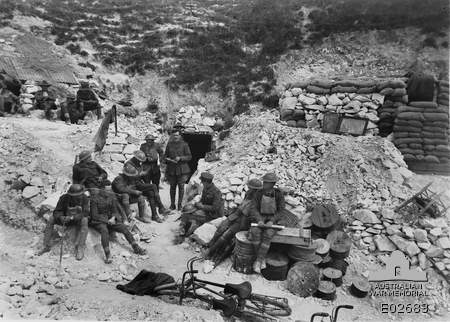
Intelligence officers from 4th Brigade AIF synchronising watches near Hamelet, 3 July 1918 (Australian War Memorial)

Intelligence officers from 4th Brigade AIF synchronising watches near Hamelet, 3 July 1918 (Australian War Memorial)

But centralisation also requires re-distribution, so to speak, as this order from 112 Infantry Brigade later in October 1918 makes clear:

Watches will be synchronised at 0630, 20th inst. Brigade Signal Officer will send watch round Units.

Edmund Blunden describes the practice in Undertones of War: ‘Watches were synchronized and reconsigned to the officers’; and again: ‘A runner came round distributing our watches, which had been synchronized at Bilge Street [‘battle headquarters’]’.

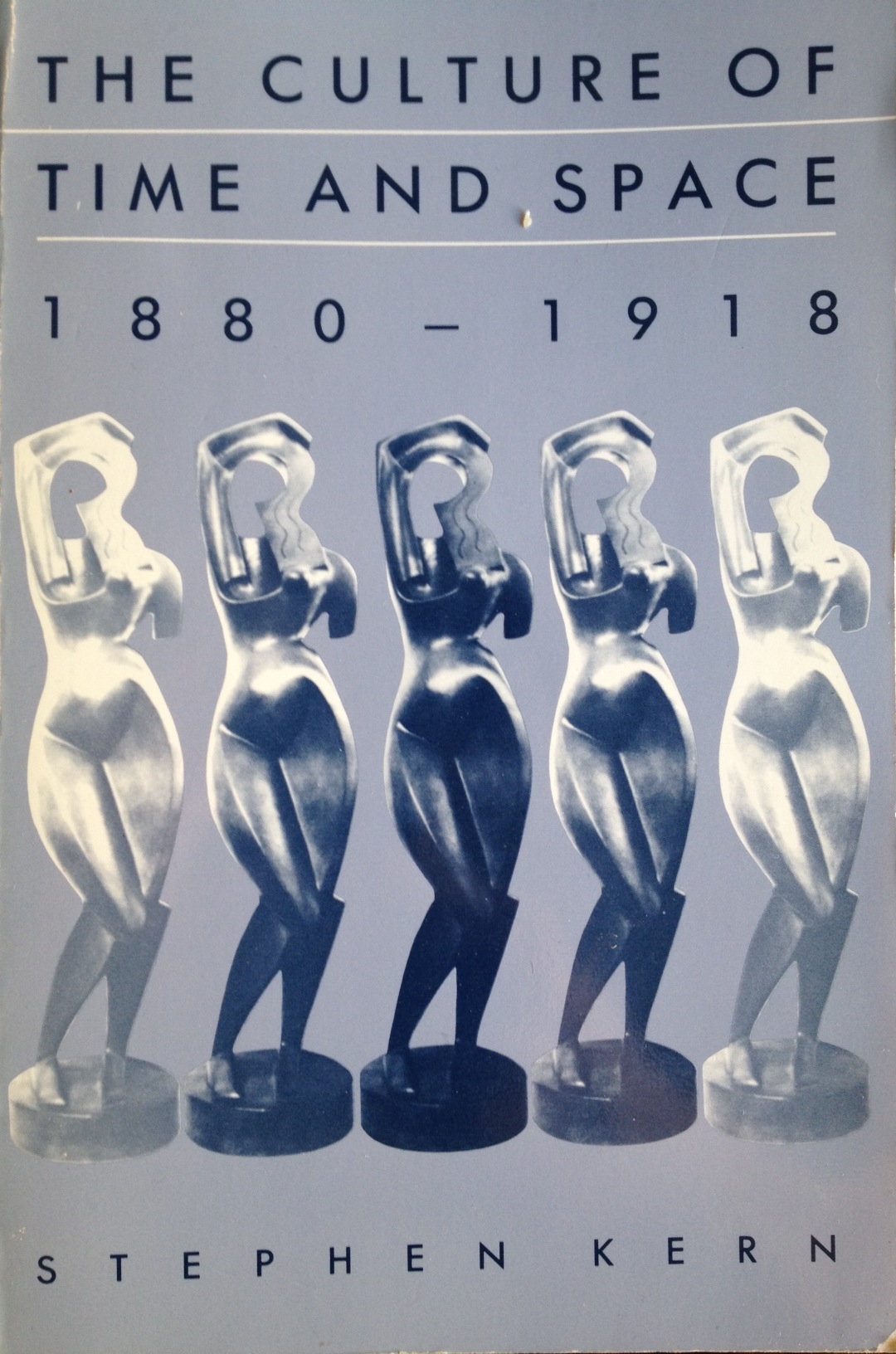
KERN Culture of time and spaceBy these various means, then, as Stephen Kern put it in The culture of time and space, 1880-1918,

‘The war imposed homogeneous time… The delicate sensitivity to private time of Bergson and Proust had no place in the war. It was obliterated by the overwhelming force of mass movements that regimented the lives of millions of men by the public time of clocks and wrist watches, synchronized to maximize the effectiveness of bombardments and offensives.’

That’s surely an over-statement: just as the ‘optical war’ produced through a profoundly cartographic vision was supplemented, subverted and even resisted by quite other, intimately sensuous geographies – what I’ve called a ‘corpography’ – so, too, must the impositions and regimentations of the hell of Walter Benjamin‘s ‘homogeneous, empty time’ have been registered and on occasion even refused in the persistence of other, more personal temporalities.

Note: For indispensable help in thinking through these issues, I’m indebted to contributors to the Great War Forum who patiently and generously responded to my original question: ‘When watches were synchronised what, exactly, were they synchronised to, and how was it done?’