Empire, faith and war

My time in the archives at the Imperial War Museum this summer was very productive and I made considerable headway in completing my work on casualty evacuation from the Western Front in the First World War and from North Africa in the Second – more on that later.  In the letters and diaries written from Belgium and France I found many, scattered references to the presence of non-Caucasian troops, especially from North Africa and India; as I’ve noted before, it was not all white on the Western Front.


Soldier_map

But apart from the heroic work of scholars like Santanu Das there have been few attempts to piece these fragments together.  I’ve now discovered a website, Empire, Faith and War, that aims to put the contribution of Sikhs literally on the map (though it’s much more than an exercise in cartography):

As the world turns its attention to the centenary of the Great War of 1914-18, the ‘Empire, Faith & War’ project aims to commemorate the remarkable but largely forgotten contribution and experiences of the Sikhs during this epochal period in world history.

From the blood-soaked trenches of the Somme and Gallipoli, to the deserts and heat of Africa and the Middle East, Sikhs fought and died alongside their British, Indian and Commonwealth counterparts to serve the greater good, gaining commendations and a reputation as fearsome and fearless soldiers.

Although accounting for less than 2% of the population of British India at the time, Sikhs made up more than 20% of the British Indian Army at the outbreak of hostilities. They and their comrades in arms proved to be critical in the early months of the fighting on the Western Front, helping save the allies from an early and ignominious defeat.

Wartime generations and their stories fading fast, and current and future generations losing vital links to this monumental past.

There’s probably not a single Sikh in the UK who doesn’t have a military connection in their family history. It is often because of those links to the armies of the British Raj that many Sikhs now reside in the UK.

And yet the role of Sikhs in World War One is a largely unknown aspect of the Allied war effort and indeed of the British story.

By revealing these untold stories we aim to help shed much needed light on both their sacrifice, but also on the contribution of all of the non-white allied forces from across the British Empire.

This is possibly our last opportunity to discover and record the stories of how one of the world’s smaller communities played such a disproportionately large role in the ‘war to end all wars’.

Apoorva Sripathi has a good account of the background to the project here.

Offshoring

Offshoring military violence

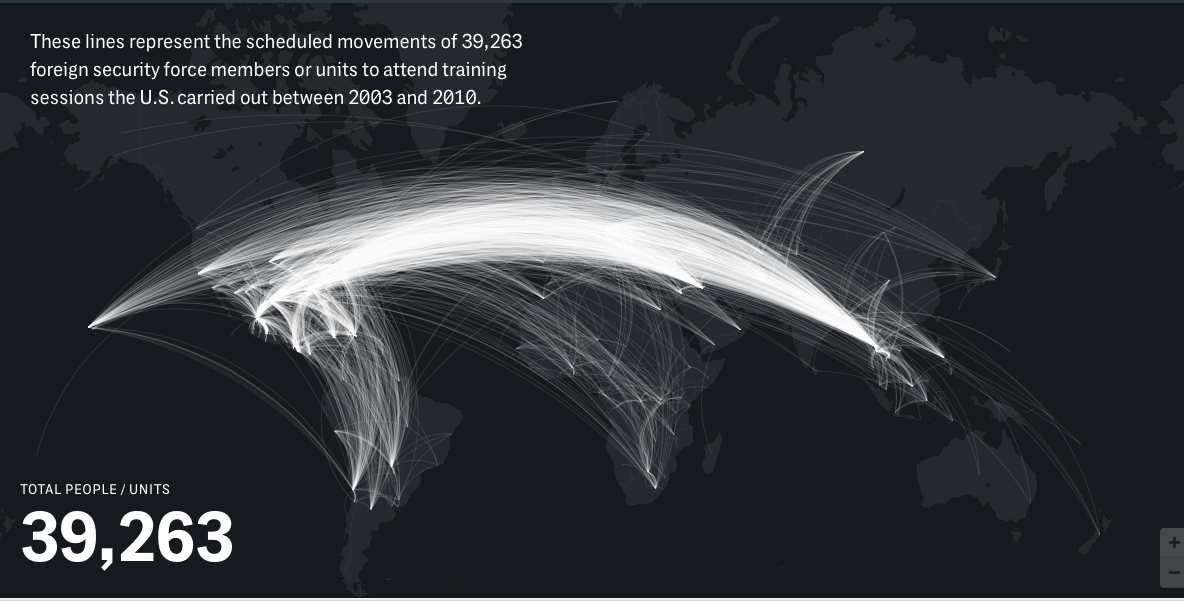
I’ve written about US military bases overseas before – via David Vine‘s brilliant, painstaking work (see here and here) – but a new study from The Intercept has revealed another, much less visible geography of ‘offshoring’ military violence: the training of foreign military, police and security personnel by the United States.

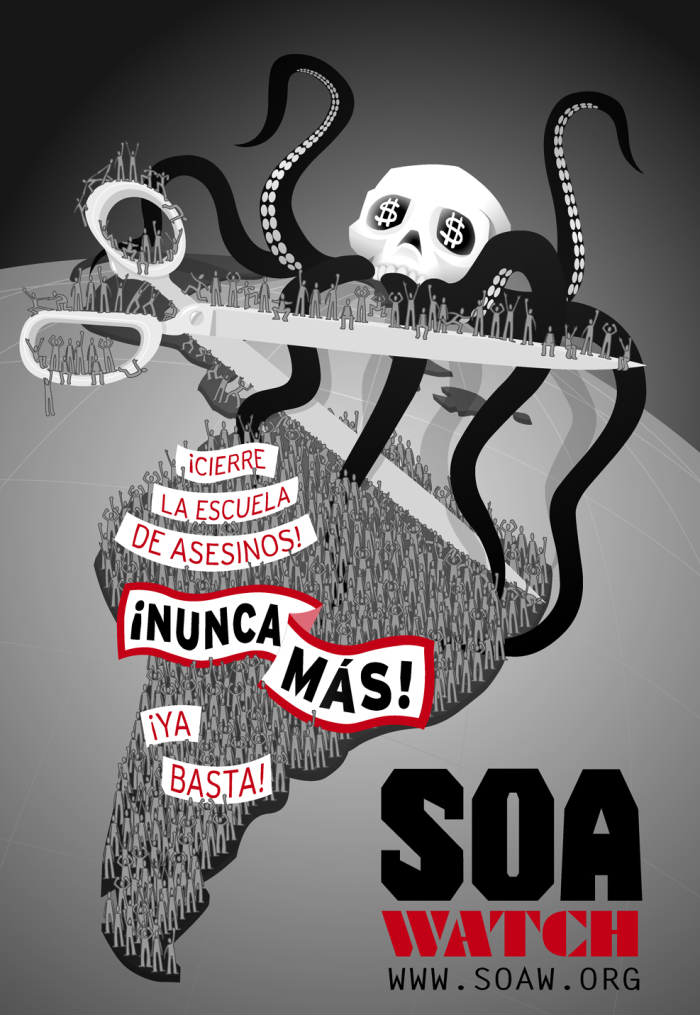
soaI imagine most readers will know of the infamous ‘School of the Americas‘ at Fort Benning (since renamed the ‘Western Hemisphere Institute for Security Cooperation’) – if you don’t, read Juanita Sundberg in Antipode 39 (1) (2007) 144-66 or Sara Koopman in Antipode 40 (5) (2008) 825-47 on transnational protests against the School –  but the network of global military and paramilitary collaboration is much more extensive:

The data show training at no fewer than 471 locations in 120 countries — on every continent but Antarctica — involving, on the U.S. side, 150 defense agencies, civilian agencies, armed forces colleges, defense training centers, military units, private companies, and NGOs, as well as the National Guard forces of five states. Despite the fact that the Department of Defense alone has poured some $122 billion into such programs since 9/11, the breadth and content of this training network remain virtually unknown to most Americans.

The contours of this sprawling system were discovered by analyzing 6,176 diplomatic cables that were released by WikiLeaks in 2010 and 2011. While the scope of the training network may come as a surprise, the most astounding fact may be that it is even larger than the available data show, because the WikiLeaks cables are not comprehensive. They contain, for example, little information on training efforts in Colombia, the single-largest recipient of U.S. training covered by the human rights vetting process that produced these records. Other large recipients of U.S. security assistance, such as Pakistan, are vastly underrepresented in the cables for reasons that remain unclear.

My image at the top of this post is just a screenshot and you really should visit the original because it’s an interactive and you can use your mouse to get much more detail.

Zombie law

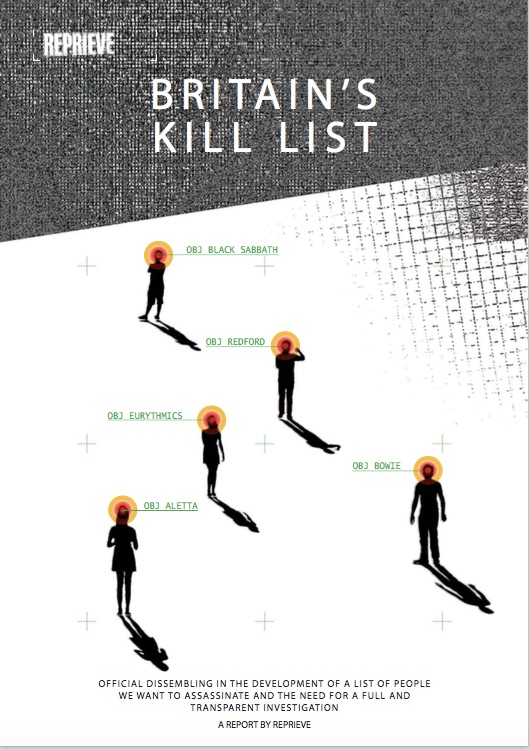
Britain's Kill List cover JPEGOver at ESIL [European Society of International Law] Reflections [5 (7) 2016], Jochen von Bernstorff has a succinct commentary on ‘Drone strikes, terrorism and the zombie: on the construction of an administrative law of transnational executions‘.

His starting-point is the UK report on the government’s policy on the use of drones for targeted killing that was published in May 2016 in response to the killing of Reyad Khan in Syria last August: you can find more in REPRIEVE’s report on Britain’s Kill List (April 2016) and in two commentaries at Just Security from Noam Lubell here and Kate Martin here.

In Jochen’s view, the UK has effectively endorsed the policies of the Obama administration and in doing so has hollowed out fundamental legal regimes that supposedly constrain state violence.

First is the concerted attempt to legitimise the unilateral killing of suspected terrorists outside ‘hot’ battlefields – in the Federally Administered Tribal Areas of Pakistan, for example – as a new form of pre-emptive self-defence to be invoked whenever the state whose sovereignty is transgressed is ‘unwilling or unable’ to take appropriate counter-measures.  I discuss other dimensions of this in ‘Dirty dancing’ (DOWNLOADS tab), and pay attention to its colonial genealogy, but Jochen emphasises another even more starkly colonial inflection:

‘The main protagonists in this discursive effort take it for granted that the new legal regime will not be applied among us, which is among Western states and the five permanent Security Council members. There will be no US-drone attacks in Brussels or Paris to kill ISIS-terrorists without the consent of the Belgian or French government, even if these governments proved to be unable to find and arrest terrorists. The new regime is a legal framework for what can be called the “semi-periphery”, consisting of states that do not belong to the inner circle or are not powerful enough to resist the application of the regime.’

Second, and closely connected, is the claim that armed conflict follows the suspect – that the individuation of warfare (‘the body becomes the battlefield’, as Grégoire Chamayou has it) licenses the everywhere war: simply, wherever the suspect seeks refuge s/he becomes a legitimate target of military violence.  But there is nothing ‘simple’ about it, Jochen contends, because this involves a wholesale exorbitation of the very meaning of armed conflict that completely trashes the role of international human rights law in limiting violence against those suspected of criminal wrong-doing.

Finally, Jochen concludes that the arguments adduced by the UK and the USA (and, I would add, Israel) demonstrate that international law is so often transformed through its violation: in Eyal Weizman‘s ringing phrase, ‘violence legislates‘.  Here is Jochen:

 ‘The Zombie is created by a fundamental reconceptualization of the notion of self- defence and armed conflict in international law with the aim to get rid of all legal constraints on state violence imposed by the law enforcement paradigm. Is this a new legal regime? Are we really moving towards an administrative law of transnational executions? It is an inherent problem of international legal discourse that measures of Great Powers violating the law will often be reformulated as an evolving new legal regime and legal scholars should be extremely sceptical of any such claims, since whoever says “emerging” in an international legal context very likely wants to cheat.’

The things they carried

Britain_war-xlarge_trans++ZgEkZX3M936N5BQK4Va8RWtT0gK_6EfZT336f62EI5U

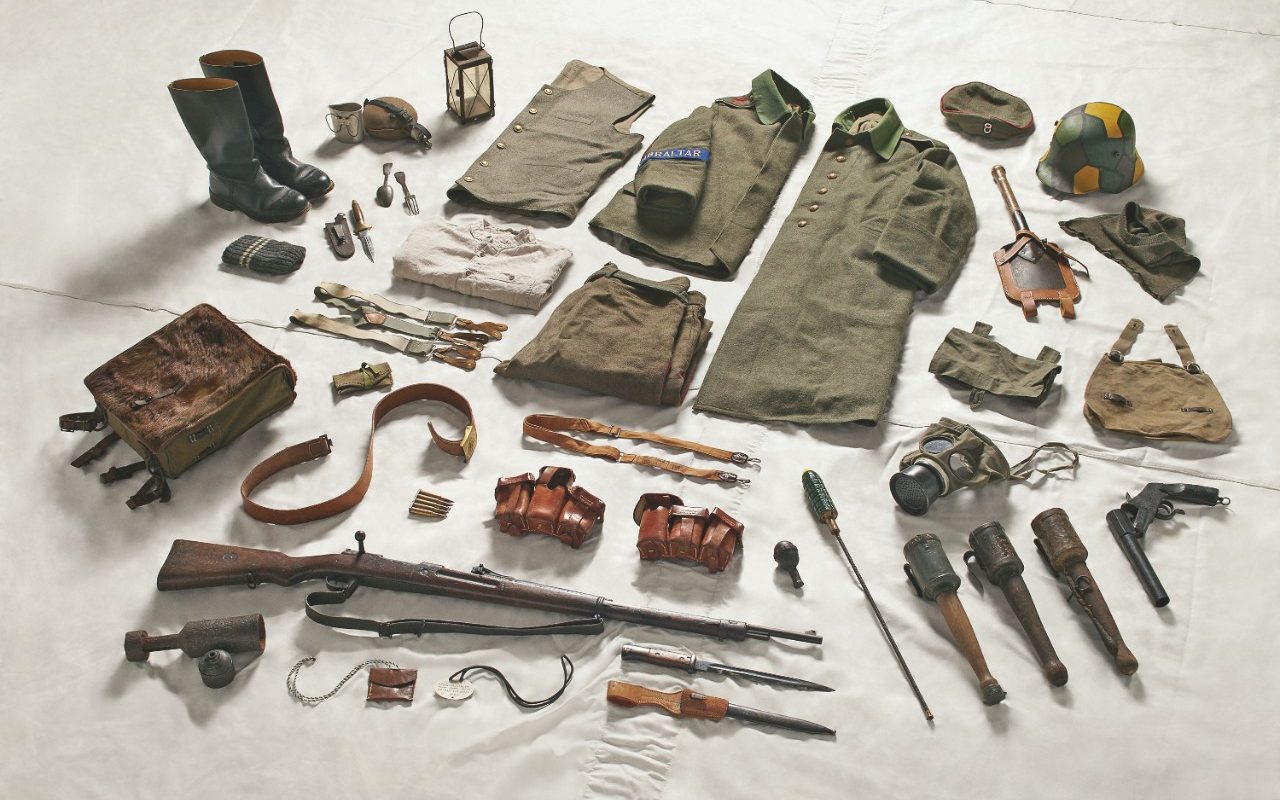
I’ve drawn attention to Thom Atkinson‘s brilliant documentation of ‘the things they carried’ – the equipment carried by infantry into battle from 1066 to 2014 – several times before (here and here): see his Soldiers’ Inventories here.

He’s now returned to the theme with a new portfolio comparing the kit issued to soldiers from Britain (above), France, Germany (below), Russia and the United States during the First World War.  You can access the images, plus a commentary from Christopher Howsehere.

War_2-xlarge_trans++gsaO8O78rhmZrDxTlQBjdPv9UtmGs4_E1E6Q7ZFHy1w

More terror from the skies

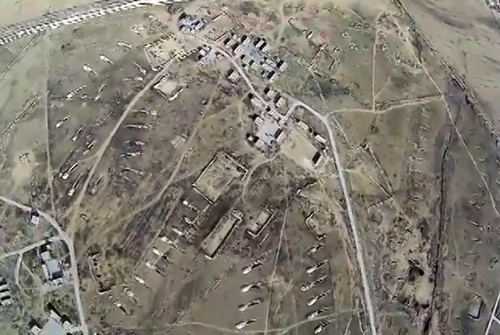
IS drone imagery Syria

Commentators have been worrying away at the likelihood of terrorist groups turning to small commercial drones not only for surveillance – IS have been doing that for some time now (see the image above) – but also for air strikes (see, for a recent example, Robert J Bunker‘s report for the US Army War College here).  The surveillance capabilities of quadcopters have been used to direct attacks by IS ground forces, including vehicles carrying suicide bombs, but the Pentagon now reports that the drones have also been equipped with improvised explosive devices (IEDs).

In response, the Pentagon has asked for $20 million for its Joint Improvised-Threat Defeat Agency to develop counter-measures: to ‘identify, acquire, integrate and conduct testing’ of methods that are able to ‘counter the effects of unmanned aerial systems and the threats they pose to U.S. forces.’

Perhaps they should also look closer to home.  Two men in Connecticut have contested the right of the Federal Aviation Administration to investigate their use of ‘recreational drones’ equipped with a handgun and a flamethrower.  Here’s a video clip:

And other commentators are already looking beyond war zones: systems like these enable groups like IS – and individuals – to carry the fight far beyond the territory they control and into the heart of cities in North America, Europe and elsewhere.

How everything became war

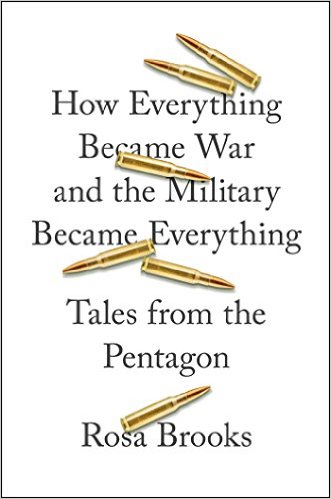
Apologies for the long silence: the last month has been full of horrors, but it’s good to be back and there’s lots to catch up.  First – I’m easing myself back into this! – is a new book by Rosa Brooks, How everything became war and the military became everything, out next month:

The first serious book to examine what happens when the ancient boundary between war and peace is erased.

BROOKS How everything became warOnce, war was a temporary state of affairs—a violent but brief interlude between times of peace. Today, America’s wars are everywhere and forever: our enemies change constantly and rarely wear uniforms, and virtually anything can become a weapon. As war expands, so does the role of the US military. Today, military personnel don’t just “kill people and break stuff.” Instead, they analyze computer code, train Afghan judges, build Ebola isolation wards, eavesdrop on electronic communications, develop soap operas, and patrol for pirates. You name it, the military does it.

Rosa Brooks traces this seismic shift in how America wages war from an unconventional perspective—that of a former top Pentagon official who is the daughter of two anti-war protesters and a human rights activist married to an Army Green Beret. Her experiences lead her to an urgent warning: When the boundaries around war disappear, we risk destroying America’s founding values and the laws and institutions we’ve built—and undermining the international rules and organizations that keep our world from sliding towards chaos. If Russia and China have recently grown bolder in their foreign adventures, it’s no accident; US precedents have paved the way for the increasingly unconstrained use of military power by states around the globe. Meanwhile, we continue to pile new tasks onto the military, making it increasingly ill-prepared for the threats America will face in the years to come.

By turns a memoir, a work of journalism, a scholarly exploration into history, anthropology and law, and a rallying cry, How Everything Became War and the Military Became Everything transforms the familiar into the alien, showing us that the culture we inhabit is reshaping us in ways we may suspect, but don’t really understand. It’s the kind of book that will leave you moved, astonished, and profoundly disturbed, for the world around us is quietly changing beyond recognition—and time is running out to make things right.

More here.

The Last Dance

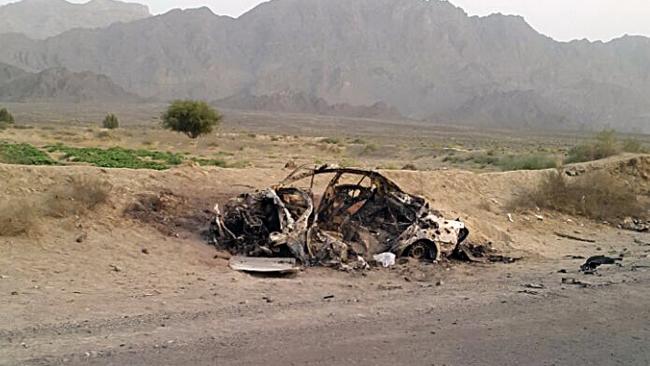
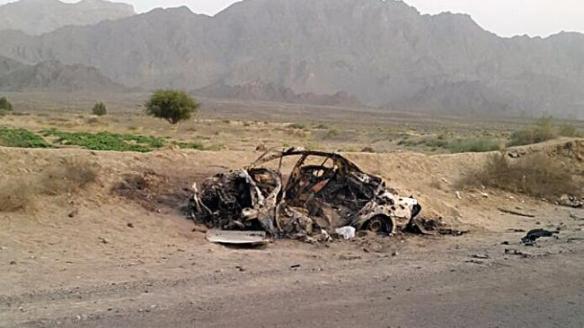
Mansour strike photo

I have – at long last – finished the longform version of “Dirty dancing: drones and death in the borderlands“, which analyses drone strikes in Pakistan’s Federally Administered Tribal Areas and situates them within a wider context of military violence in the region.  You can find it under the DOWNLOADS tab, but I’ve pasted the conclusion below; there’s also a video of the last presentation I gave under that title here.

To make sense of the conclusion, I should explain that the essay opens by juxtaposing the killing of two people, Baitullah Mehsud (leader of the Pakistan Taliban) and Mamana Bibi (a village midwife), to pose the question: what kinds of spaces are the FATA made to be for incidents like these – incidents as unlike as these – to be possible?

My answer works with two framing devices.

The first is the space of exception – a space in which people are knowingly and deliberately exposed to death through the political-juridical removal of legal protections and affordances that would otherwise be available to them.  My version of this is different from that proposed by Giorgio Agamben, and far from invoking a suspension of the law I explore three legal geographies that have been used to prepare the ground for aerial violence in the borderlands.

The second is the space of execution; here I riff off Owen Sheers‘ perceptive remark about ‘the territory of the screen’ (as I note, ‘Killing somebody with a Hellfire missile controlled from thousands of miles away depends upon a screen – or more accurately a series of screens – on which the image of a human body will eventually be touched by the cross-hairs of a targeting pod’).  Owen’s phrase is much more than metaphor, so I treat ‘territory’ as a (bio)political technology whose calibrations enable states to assert, enact and enforce a claim over bodies-in-space (you can no doubt hear the echoes of Stuart Elden) and then explore the technicity involved in three of its screen elements that jointly transform the FATA into a space of execution: kill lists, signals intercepts and visual feeds.

***
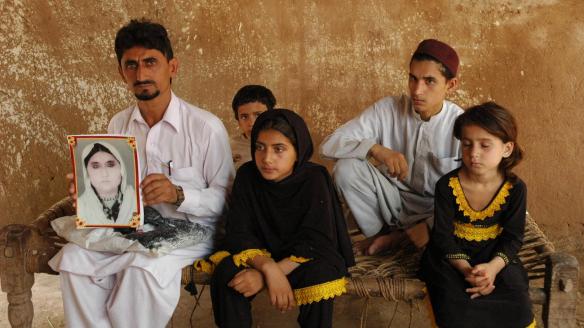
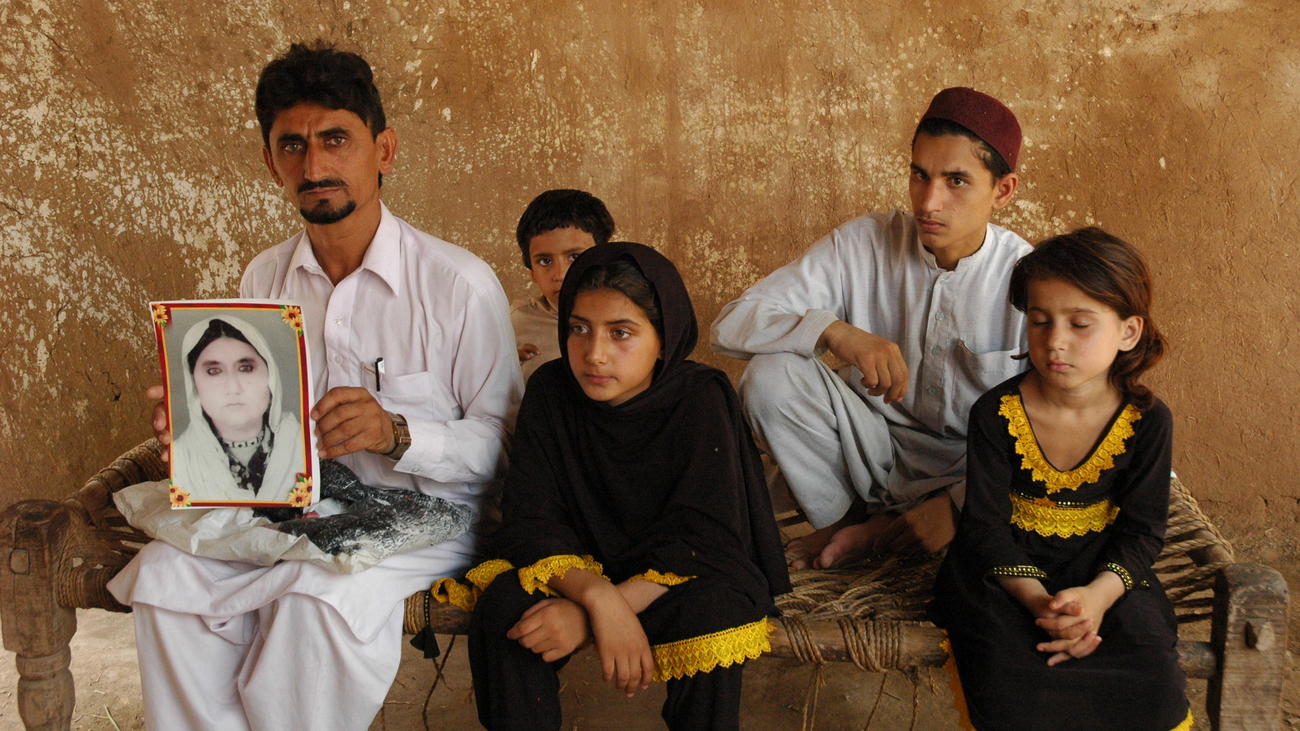
Mamana Bibi's surviving family

Here, then, is the conclusion:

The production of the borderlands as spaces of exception and spaces of execution are attempts to force those who live there into particular subject-positions as a means of subjugation. These positions are partial and precarious but the project to establish them as legitimate and rational has consequences that are material and affective. They clearly affect those targeted – people like Baitullah Mehsud – whose political agency exceeds in terrifying ways the normative space allowed them by the state of Pakistan and the United States and in so doing brings their actions to the attention of both. But they also impact the rest of the population in the FATA, constricting their mobilities and stoking their fears to such a degree that ‘normal life’ for many of them threatens to become a memory or a fantasy. Their existence is rendered more precarious because the subject-positions to which they are so brutally assigned are racialized. These are ‘tribal peoples’, different from those who inhabit ‘mainland Pakistan’, while the United States writes off their incidental deaths as ‘collateral damage’ whose anonymity confers on them no individuality only a collective ascription. When a CIA-directed drone strike on a compound in the Shawal Valley of South Waziristan on 15 January 2015 was found to have killed not only a deputy leader of al-Qaeda in the Indian subcontinent and a local Taliban commander but also two hostages, an American development contractor and an Italian aid worker, a ‘grim-faced’ and ‘visibly moved’ Obama made a personal and public apology. [i] The rarity of the gesture is revealing. For the value of their lives was acknowledged and their deaths were made grievable in ways that others – which is to say Others – were not. Nobody has ever accepted responsibility or apologised for the death of Mamana Bibi or any of the other innocent victims of aerial violence.

For this reason it is important to resist those versions of the space of exception that are complicit in the denial of agency to those who live within its confines. The state of Pakistan administers the inhabitants of the FATA through Political Agents: but this does not remove (though it does diminish) their own political agency. Pakistan’s armed forces conduct clearing operations that ruthlessly drive people from their homes and into camps for displaced persons: but this does not turn the FATA into one vast ‘camp’. The presence of US drones strips those who live under them of their well-being and dignity: but this does not reduce them to ‘bare life’. Similarly, the emergent subject that is produced within the space of execution, apprehended as a network trace, a sensor signature and a screen image, is a cipher that stands in for – and in the way of – a corporeal actor whose existence is not measured by the calculative alone.

***

This version, or something very much like it, will appear in a collection edited by Caren Kaplan and Lisa Parks, Life in the Age of Drones.  But an (even longer!) version will eventually appear in my own book, with images and maps (you can find many of them scattered through my previous posts: for example here, here and here), so I really would welcome any comments or suggestions if you have time to read the full thing: derek.gregory@ubc.ca.
 

‘Dearer to the Vultures’

Over at the Paris Review Scott Beauchamp has a beautiful short essay that complements my own reading of Harry Parker‘s Anatomy of a Soldier: ‘Dearer to the Vultures‘.

Here’s how it begins:

My memories of war are fractured: faces disappear like smoke while literal plumes of smoke, their specific shapes and forms, linger on vividly for years. I remember the mesh netting, concrete, and dust smell of tower guard, but the events of entire months are completely gone. I remember the sound of a kid’s voice, but not anything he actually said. I guess that’s what Tim O’Brien meant when he wrote about Vietnam, “What sticks to memory, often, are those odd little fragments that have no beginning or end.”

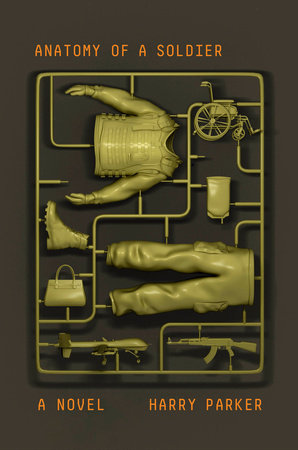
Parker Anatomy of a soldierMemories of people, too complex to carry through the years, fall apart. It’s easier to find purchase on memories of objects. The weapon I was assigned on my first deployment to Iraq was an M249 SAW, or what we would colloquially and inaccurately refer to as the “Squad Assault Weapon.” I remember the way it felt to disassemble—the slight give of the heat-shield assembly, its tiny metal pincers clinging to the barrel. I remember the sound of the feed tray snapping shut on a belt of ammunition. And I remember the tiny rust deposits on the legs of my weapon’s bipod, which would never go away, no matter how hard I scrubbed with CLP (Cleaner, Lubricant, and Protectant oil). I remember my SAW’s voice and the things it said.

During my second deployment, I served as the gunner in a Bradley Fighting Vehicle. We ran over two Soviet-era landmines that had been stacked on top of each other. Besides a few bruises and perforated eardrums, everyone in the crew was fine. When I would try to tell people the story back home, civilians would get caught up on the descriptions of objects they had never heard of, objects that were integral to understanding my experience of the event. “Were you hurt?” Not really, I’d say, but my head slammed against the ISU, and since we had the BFT mounted in a weird place, that sort of got in the way. “What’s an ISU and a BFT?”

I came to realize that the barrier in explaining my injuries to civilians wasn’t quite phenomenological so much as it was ontological. Everyone has experienced pain, fear, and frustration, but not everyone knows what an Integrated Sight Unit is or has had their face slammed into one. Even in just trying to narrate the events to family members, it seemed like any understanding of my trauma would have to come through a knowledge of the materials around me that made the trauma possible: the ISU, the Bradley Fighting Vehicle, the way the tracks moved, the type of soil underneath the tracks, how the mine mechanism worked, the radios we used to call in the explosion to base.

Harry Parker, a former British Army Captain, recently published Anatomy of a Soldier, a novel that puts forward an object-oriented ontology of war: an assertion that the material objects sharing the battleground with humans play an equal role in the composition of reality itself.

And the rest is equally worth reading, including some interesting reflections on ‘the rush from the intimate to the inanimate’ –and its limitations.

I first wrote about Anatomy of a Soldier here, followed it up with a notice of an interview with Harry Parker at the Imperial War Museum here (where I’m currently working, deep in the Research Room), and finally summarised my conference presentation on the book and its implications in San Francisco here (‘Object Lessons’: the presentation slides are available under the DOWNLOADS tab).

Vertical fields

I’ve just been reading and thinking about Lisa Parks‘s short but immensely suggestive essay, ‘Drones, Vertical Mediation, and the Targeted Class’, in Feminist Studies 42 (2016) 227-35. Lisa develops her ideas about vertical mediation but at the end of the essay she illustrates them through an art installation staged in Beirut last spring. This is what she says:

In an effort to publicize the drone’s vertical mediations—the way the technology uses the vertical field in efforts to materially reform life on earth—I collaborated with a group of Lebanese and Slovenian artists (Marc Abou Farhat, Tadej Fius, Elie Mouhanna, and Miha Vipotnik) to create a multimedia installation titled Spectral Configuration. The installation was part of the Vertical Collisions exhibition at the Station Art Gallery in Beirut in May 2015. The installation’s centerpiece is a massive, elevated, four-meter-long, supine human body, hand-crocheted out of thin aluminum wire. As it soars in mid-air, the wiry surface of this colossal corpse turns translucent as multiple media projections, made from video footage leaked from the US military-industrial complex, flicker around and upon it. These electromagnetic projections envelop the silvery drone-like body within the luminous footprint of world his- tory and militarization, cycling through a series of spectral suspects, framed targets, and aerial strikes that appear in visible light and infrared.

Circumnavigating the earth on an endless flight path, this “spectral configuration” not only captures and reflects light and heat waves, it remediates life on earth, altering one’s disposition to the sky, the ground, and the skin…  To make Spectral Configuration, we used the same global information networks, geospatial images, and video-capture technologies utilized each day by US drone operators. The difference, however, was that we commandeered these devices to conceptualize and produce a form and an event that would question the militarization of the vertical field by enacting it on a micro-scale and trying to make its effects intelligible and palpable to publics beyond drone war. By staging the militarization of the vertical field in a country adjacent to, yet not subject to drone war (Lebanon), Spectral Configuration also spoke to the exploitation of borders and associative relations by US drone operators and aroused concerns about the usage of the technology in the region.

‘Empire of the Globe’

Klementinum Library, Prague

A quick heads-up: the latest issue of Millennium [44 (3) (2016) 305-20] includes Bruno Latour‘s, ‘Onus Orbis Terrarum: About a Possible Shift in the Definition of Sovereignty’, a keynote address that – amongst many other targets – goes after the globe and geopolitics….  To give you a taste:

To put it more dramatically, the concept of the Globe allows geopolitics to unfold in just the same absolute space that was used by physicists before Einstein. Geopolitics remains stubbornly Newtonian. All loci might be different, but they are all visualised and pointed to on the same grid. They all differ from one another, but in the same predictable way: by their longitude and latitude.

What is amazing if you look at geopolitical textbooks, is that, apparently, the Globe remains a universal, unproblematic, and uncoded category that is supposed to mean the same thing for everybody. But for me, this is just the position that marks, without any doubt, the imperial dominion of the European tradition that is now shared, or so it seems, by everyone else.

I want to argue that the problem raised by the link between Europe and the Globe is that of understanding, as Peter Sloterdijk suggests, why it is that the onus orbis terrarum has been spread so efficiently that it has become the only space for geopolitics to unfold. Why is it that the res extensa, to use a Latin term that pertains to the history of art as well as of science and of philosophy, has been extended so much?

Instead of asking what vision of the Globe Europe should develop, it seems to me that the question should be: is Europe allowed to think grandly and radically enough to get rid of ‘the Globe’ as the unquestioned space for geopolitics? If it is the result of European invention and European dominion, this does not mean that it should remain undisputed. If there is one thing to provincialise, in addition to Europe, it is the idea of a natural Globe itself. We should find a way to provincialise the Globe, that is, to localise the localising system of coordinates that is used to pinpoint and situate, relative to one another, all the entities allowed to partake in geopolitical power grabs. This is the only way, it seems to me, to detach the figure of the emerging Earth from that of the Globe.

Geopolitics limited to absolute space?  The Globe as the ‘unquestioned space’ for geopolitics (and a geopolitics that is indifferent to, even silent about ‘the Earth’)?  Really?

MINCA and ROWAN Schmitt and SpaceIn an interview with Mark Salter and William Walters, which appears as a coda to the issue, there is also a lot about Carl Schmitt and the Nomos of the Earth (and a pointed rejection of the interpretation offered by Claudio Minca and Rory Rowan), and this passage on drones that loops back to the discussion of sovereignty:

The point, I think, is that ‘sovereign’ has one very precise meaning, which is: a referee. So, is there a referee or not? In my understanding of Schmitt, in the two great ideas of his – the ones on politics and the ones in Nomos – there is no referee, precisely. And so, you have to do politics, which means you have to have enemies and friends. Not because of any sort of war-like attitude (even though there is some talk of that in Schmitt as well). But because, precisely, if you have no referee, then you have to doubt; you have to risk that the others might be right, and that you might be wrong. You don’t know your value; you are not in a police operation. OK, so that defines the state now, because the state goes, all the way down, to a police operation. If there is a police operation and not war, then there is a State, in some ordinary sense. That is how we can understand the first hegemon of the United States, entering the First World War as a police operation, no question. The drone, now, flowing over [and] … moving on top of the space of the land, is a police operation because the one who sent it has no doubt that he or she acts as referee. So, the first thing is to draw the extent of that hegemon. How we would do that, I don’t know. Certainly, there would have been a book by Schmitt a few days after the first drone, about this new definition of the State, extending above air its police operation everywhere.

Good knock-about stuff, but I’m not convinced about any of this either (and exasperated by the current preoccupation with the hypostatisation of ‘policing’)…