The Geopolitics of Dominion

SANSOM Dominion

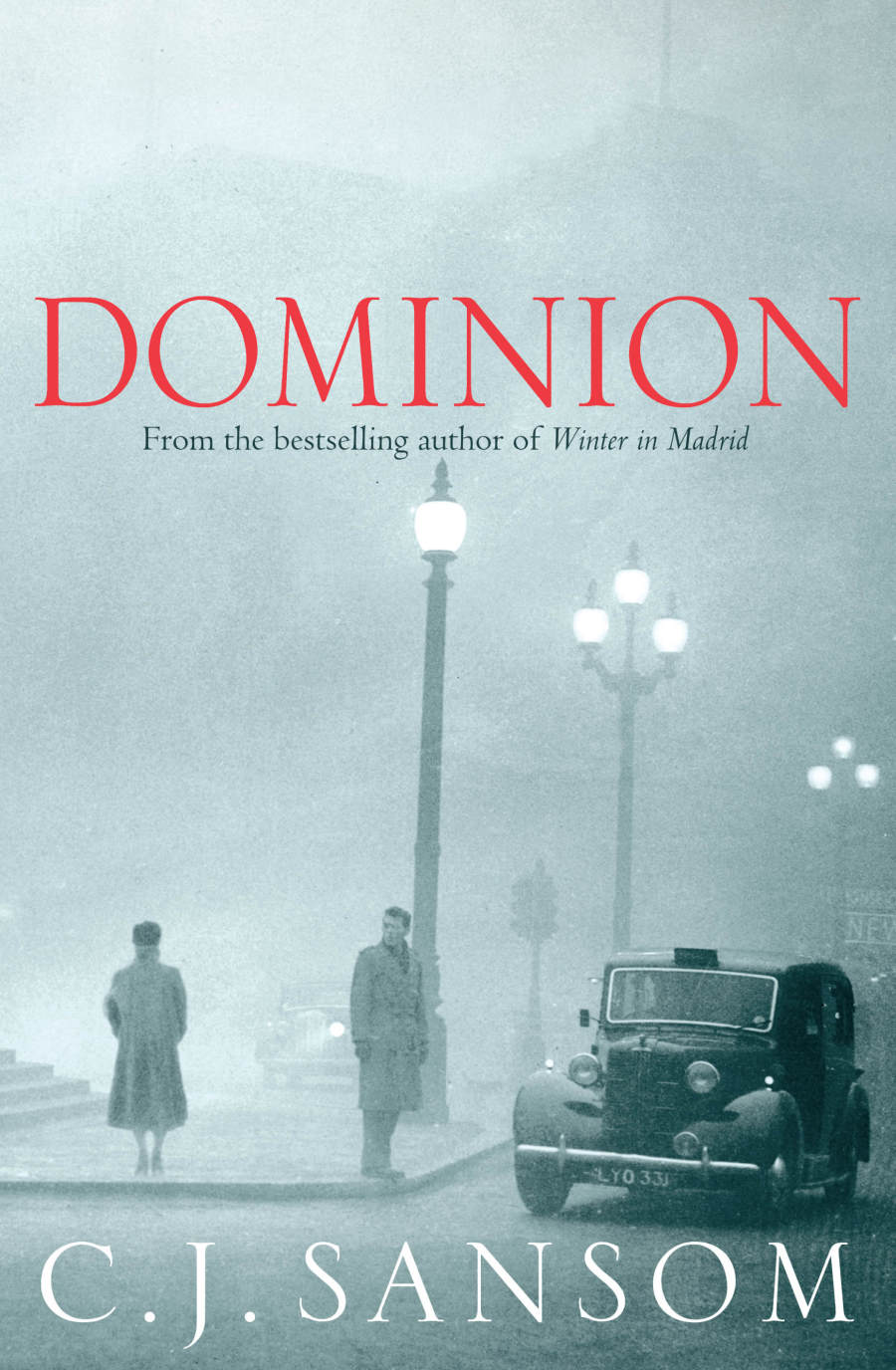
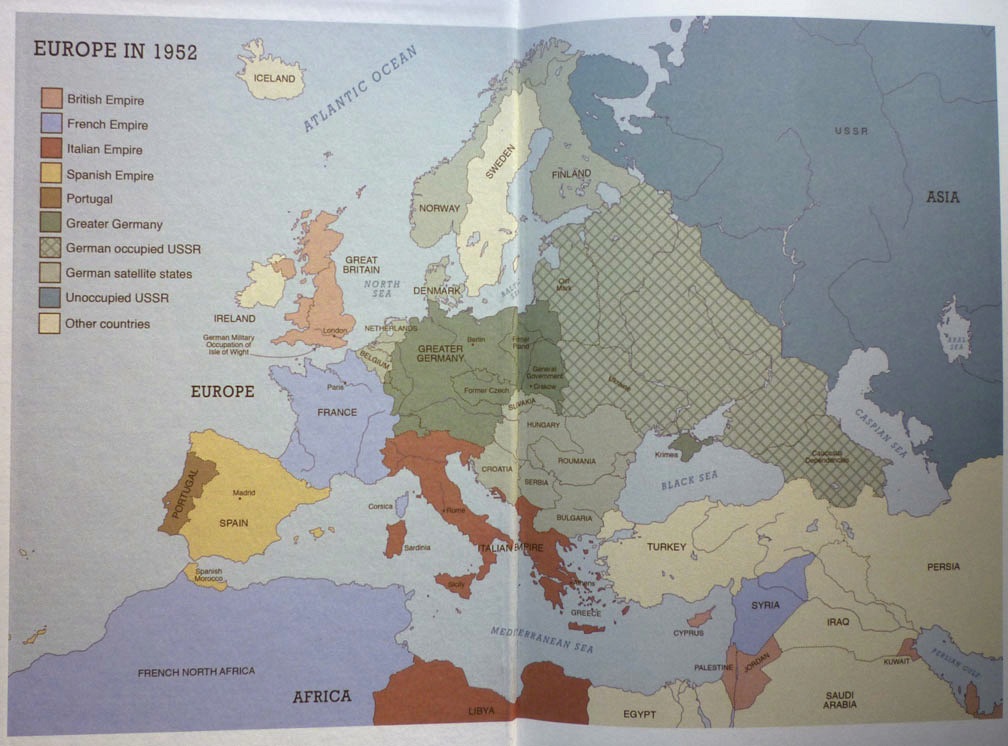
It’s been a long time since I read a novel with maps… and I don’t think I’ve ever read one that ends with an essay explaining its geopolitics.  I’ve just finished C.J. Sansom‘s Dominion (Pan/Macmillan, 2012), which is set in an alternative Britain in 1952.  The premiss is that Churchill never became Prime Minister in May 1940; instead, the British government under Lord Halifax sued for peace with Hitler.  In Sansom’s chillingly plausible vision, Britain became a German satellite state  but retained its nominal independence; it was not placed under military occupation but its government (and especially its police apparatus) became overwhelmingly fascist.  Germany was given carte blanche in Europe, and continued a relentless, remorseless but ultimately unwinnable war against what was left of the Soviet Union; Britain retained its Empire – which, apart from South Africa, became increasingly restive at the absolutist politics that festered at its heart – and the United States remained isolationist until the election of Adlai Stevenson in 1952.

Sansom_Dominion_map1

One of the pleasures of the book (and of Sansom’s closing essay) is his explanation for the historical figures he manoeuvres onto (and off) his stage and the political and geopolitical formations their movements bring into view: Beaverbrook (whom Clement Attlee described as the only evil person he had ever met) as the collaborationist Prime Minister, Oswald Moseley as Home Secretary, Rab Butler as Foreign Secretary, and Enoch Powell (who else?)  as Secretary for India; Churchill, together with Attlee and Harold Macmillan, as key figures in the Resistance; and the appearance of a host of minor figures in the world of ‘light entertainment’, dimly remembered from my childhood (I was born a year before Sansom): Isobel Barnett, Frankie Howerd and, a marvellous conceit, Fanny Craddock showing her audience how to cook sauerkraut….

It is in these minor-key details, in the richly imagined world of a post-war Britain in which – since the Blitz never took place – bomb shelters are relicts of an unrealized past, and everyday life re-assumes the drab mantle of the 1930s – that the genius of the novel lies.  Sansom conveys with a rare sensibility the banality of Fascism (and, yes, of evil): not only its grotesque monumentality (like Sansom I suspect, I take a grim satisfaction in the University of London’s Senate House becoming the new German Embassy), not only the vile exactions of anti-Semitism (a leitmotif of the book, flickering in and out of view in the smog that grips the capital, is the round-up of Britain’s Jews),  but the thousand and one accommodations and submissions made by ordinary people to the extraordinary.

All of this, perhaps inevitably, makes me wonder what I would have done in such circumstances: I’ve been thinking about this ever since I started my history/geography of bombing.  Would I have had the courage to join the RAF and bomb Germany?  Or would I have had the courage to refuse? But Sansom’s novel – which acknowledges its debt to Len Deighton’s SS-GB –  adds another dimension because Dominion is animated not only by its repugnance towards fascism but also, as that closing essay makes clear, by a studied contempt for European nationalisms.

Security and development

Stability coverMany readers will already know of Taylor & Francis’s Conflict, security and development and perhaps of Oxford’s Journal of conflict and security law  (whose recent issue focuses on Cyberwar and International Law and includes time-limited open access articles from Mary Ellen O’Connell and Michael Schmitt, who have made prominent – and different! – contributions to the current debate over drones).

Now there’s a new entrant to this rapidly expanding field. Started late last year, Stability: international journal of security and development is available on open access here; the journal publishes contributions on a continuous basis, grouped into two issues at the end of May and the end of November.  The international editorial board includes Mary Kaldor.

Contributions to the second issue have now started to appear.  The editors write:

Stability: International Journal of Security & Development is a fundamentally new kind of journal. Open-access, it publishes research quickly and free of charge in order to have a maximal impact upon policy and practice communities. It fills a crucial niche. Despite the allocation of significant policy attention and financial resources to a perceived relationship between development assistance, security and stability, a solid evidence base is still lacking. Research in this area, while growing rapidly, is scattered across journals focused upon broader topics such as international development, international relations and security studies. Accordingly, Stability’s objective is to foster an accessible and rigorous evidence base, clearly communicated and widely disseminated, to guide future thinking, policymaking and practice concerning communities and states experiencing widespread violence and conflict.

The journal will accept submissions from a wide variety of disciplines, including development studies, international relations, politics, economics, anthropology, sociology, psychology and history, among others. In addition to focusing upon large-scale armed conflict and insurgencies, Stability will address the challenge posed by local and regional violence within ostensibly stable settings such as Mexico, Brazil, Russia, India, Indonesia and elsewhere.

Stability is an open-access and peer-reviewed journal. It cultivates research and informed analysis and makes it available free of charge and without the delays commonly encountered in traditional journal publishing.  Stability’s content combines the best of academic research with insights from policy-makers and practitioners in order to have a tangible and timely impact.  The journal features research into those interventions, including stabilisation, peacekeeping, state building, crime prevention, development cooperation and humanitarian assistance, which address conflict, criminality, violence and other forms of instability.

I’m interested in the content, obviously, but also in the continuing search for new platforms that seek to reach wider audiences than conventional academic journals.

The programmable city

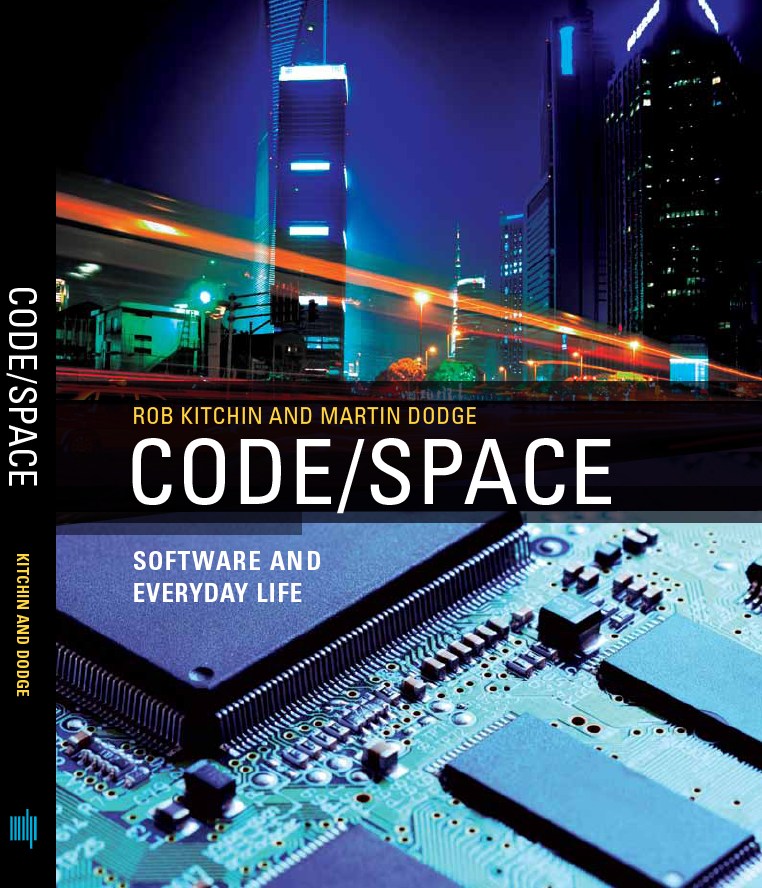
Code/SpaceNews from Rob Kitchin of a treasure trove of postdocs and PhD positions at the National University of Ireland – Maynooth as part of his prestigious Advanced Grant from the European Research Council:

I’ve been awarded an ERC Advanced Investigator award for a project entitled ‘The Programmable City’. The project will run over 5 years and be staffed by myself, 4 postdocs and 4 PhD students. The project is essentially an empirical extension of the Code/Space book (MIT Press, 2011), focusing on the intersection of smart urbanism, ubiquitous computing and big data from a software studies/critical geography perspective, comparing Dublin and Boston and other locales.

We have just advertised two 5 year postdocs and the four 4 year doctoral positions… The posts are not restricted in discipline and I’d really like to put together an interesting interdisciplinary team…  The remaining two 4 year postdocs will be advertised later in the year.

Prospective candidates can find out more via these links:

Postdoctoral Researchers:

Closing date for applications 22nd March 2013
Further details available here.

Funded PhDs:
Closing date for applications 12th April 2013
Further details available here.

You can find out much more about Rob’s vision – and the visual analytics – of the programmable city via his curated cornucopia at Scoop here.

Programmable City

The continuing explosion of interest in cyberwarfare – most recently tracing the genealogy of the US/Israeli Stuxnet/Olympic Games attack on Iran’s nuclear programme back to 2005, and digitally fingering a specialist unit of the Chinese Army based in Shanghai as a major source of cyberattacks on US commercial organisations and government agencies – makes this project all the more interesting: a sort of “Re-programmable city”, I suppose.  I’ve been tracking these developments as part of the revision of my journal essay “The everywhere war” for the book version, which will have a separate chapter devoted to them.  Much of this was anticipated by Steve Graham in his discussion of “Switching cities of off” – incorporated into the brilliant Cities under Siege: the new military urbanism (Verso, 2010) – and Code/Space is a rich source for thinking about the wider ramifications.  I don’t know whether there is room for any of this in Rob’s grand project, but I hope there is.

War, theatre and performance

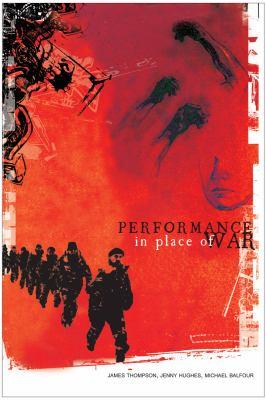
performance-in-place-of-warWhile I was away I managed to get much further into planning my “Social Life of Bombs” performance-work than I’d imagined – though there’s still a long way to go – so I was very interested to learn (from Dan Clayton) of James Thompson‘s update on the In place of war theatre project.  James explains how the two main questions that framed the project emerged from his travels in war-torn Sri Lanka in 200, namely:

‘…why in war zones do people continue to make theatre, and why do academics assume that they do not?

These questions led to a major Arts and Humanities Research Council grant for 2004-07 documenting theatre and performance programmes in war zones internationally. This was followed by another project, supported by the Leverhulme Trust, running seminars for war-zone artists. And finally the current stage, funded again by the AHRC, developing an online platform where war- and disaster-zone artists can save and share their work.’

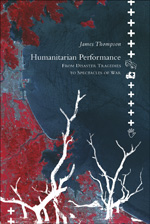
THOMPSON Humanitarian performanceI’ve written about this and the theatre of war before, but here James goes on to describe his more recent collaborative work with Children in Crisis in the Congo, and the ways in which his life in England and his harrowing experience in the war-zone folded in to one another: as he emphasises, the ‘place’ of war ‘is both specific and ubiquitous’.

I’m assuming that some of this will appear in extended form in his next book, Humanitarian performance: from disaster tragedies to spectacles of war, forthcoming from Seagull Books/University of Chicago Press in the brilliant Enactments series in September.  (You can get a taste of some of James’s arguments in his “Humanitarian performance and the Asian Tsunami” in TDR: The Drama Review 55 (1) (2011) 70-83.)

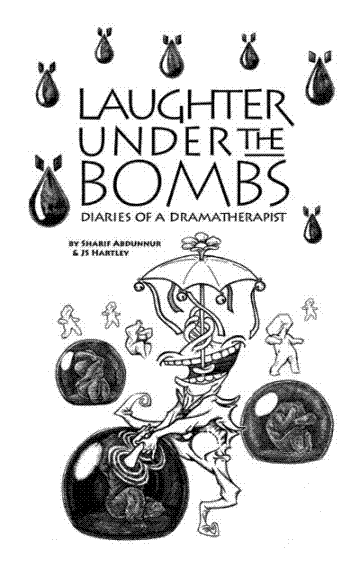
Laughter under the bombsBut what also caught my eye, given my present work, was James’s passing reference to Laughter Under the Bombs (Dahk Taht Al-Qasf), a performance work that emerged out of a series of workshops with kids and young adults organised by Sharif Abdunnur during the Israeli assault on Beirut in 2006.

‘The show went on literally under the bombs, the area was under threat – it was announced each night about two hours before the show as planes dropped fliers to say that the area would be targeted that night… and yet… the play opened to a full house and the laughter drowned out the deafening noise of the bombing right outside the doors of the theatre.’

You can find the translated script here, and a detailed account in the book by Sharif Abdunnur and Jennifer Hartley, Laughter under the bombs: diaries of a dramatherapist (AuthorHouse, 2007).  There’s also an extended discussion in James Thompson, Jenny Hughes and Michael Balfour, Performance in place of war (Seagull Books/University of Chicago Press, 2009) (pp. 38-46).

What I have in mind is very different – I’m working on this in the safety of Vancouver, after all, and what happens to those crouching under the bombs will not be shown until the very last, I hope awful minutes – but I clearly have much to learn from projects like these.  And, as you can see from several recent posts, I’ve become increasingly drawn to ways of developing (not simply conveying or representing) arguments about war through media other than conventional academic platforms.

Geographies of War: Iraq revisited

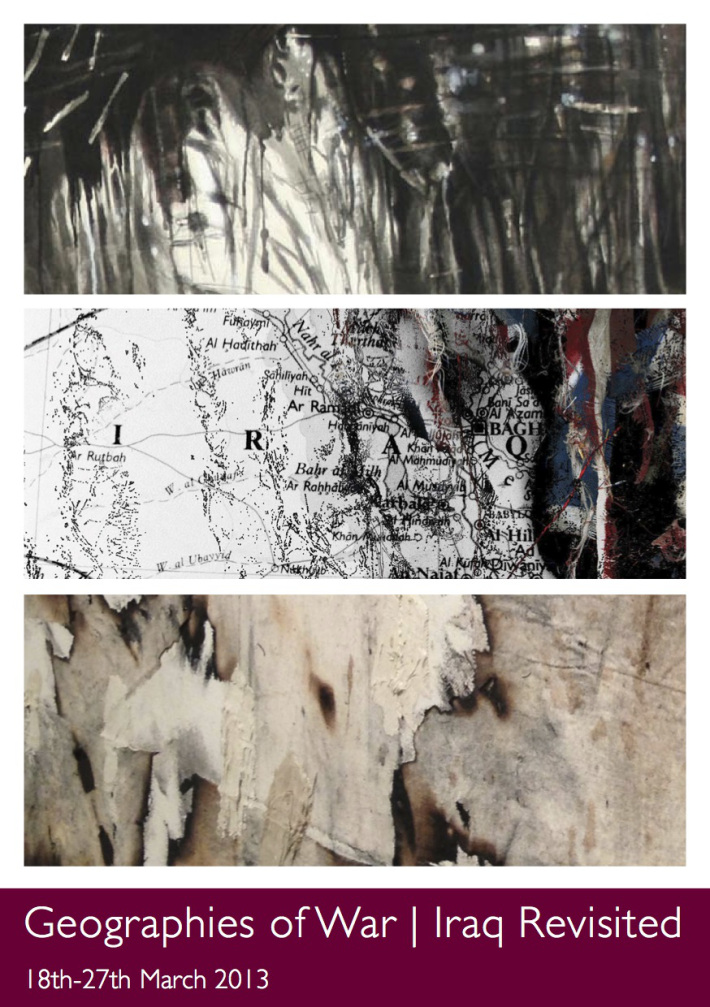
geographies-of-war-iraq-revisited-a5-flier1As we approach the anniversary of the invasion of Iraq, British Foreign Secretary William Hague has reportedly advised his coalition colleagues not to discuss the war…  Fortunately we have people like Alan Ingram to help us revisit and re-imagine the war, and I’ve drawn attention to his important Art & War: responses to Iraq project before.

Now Alan has curated an exhibition, Geographies of War: Iraq revisited, which runs from 18-27 March at North Lodge, University College London, Gower Street, 11 a.m. to 6 p.m. every day.

‘This exhibition explores how artists with diverse practices and perspectives experienced the invasion and occupation of Iraq, an dhow they responded to it by engaging with questions of space, place, landscape and territory.  Bringing together artists from Iraq and Britain it shows six works that give material form to the violence, anxiety and ruin of war but which also raise questions about resistance, survival and dreams of peace.  Opening in the week of the tenth anniversary of the invasion, the exhibition presents alternative perspectives on the conflict and challenges our ways of seeing war.’

The featured artists include the indispensable Peter Kennard and Cat Phillips – you will surely have seen their photomontage of a leering Tony Blair photographing himself in front of a huge explosion – and one of my favourite Iraqi artists Hanaa Malallah.

There’s also a series of other events associated with the exhibition: a day of talks and discussions with artists and writers, ‘Art, war and peace: responses to the invasion and occupation of Iraq’ on 22 March, and a workshop on ‘Beyond the geographies of war: exploring art and peace’ on 27 March.

More information here.

In digestion

SHARP Condensing the Cold WarWe’ve been in Mexico for the last two weeks – hence the silence – so there’s lots to catch up on and with.

While I was away Joanne Sharp wrote with news of her experience with CNN…  Reader’s Digest is in trouble, and readers will surely know of Jo’s Condensing the Cold War: Reader’s Digest and American Identity (University of Minnesota Press, 2000).  So CNN asked her for a commentary, which you can find here; here’s the conclusion:

Perhaps the decline of Reader’s Digest’s fortunes was inevitable with the longer-term social and political influences of 60s counterculture, the failure of general interest magazines, the rise of global media targeted at specific niches and the advent of the internet. But of equal importance was the end of the Soviet threat: With the fall of its arch enemy, the Evil Empire, there was no mirror against which it could present an alternative image of America and its historic mission.

As Jo ruefully notes, there is an irony in all this (and not only in being asked to condense her Condensing, if you see what I mean): ‘something that was rushed together between 1 and 4am (in Helsinki – I didn’t even have my notes!) – has reached a far larger audience than anything I’ve spent months sweating over.’  But, as she also notes, some of the online comments would provide material for another essay….

A picture that is worth a million words

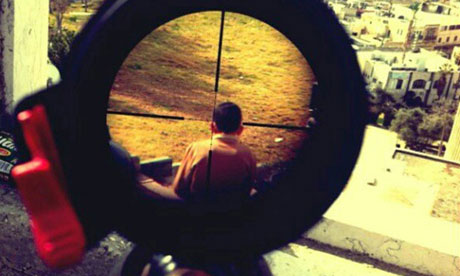
Israeli soldier posts disturbing Instagram photo of child in crosshairs of his rifle

Or perhaps four million (roughly the Palestinian population in the Occupied Territories).  I’ve posted about the use of Instagram by the IDF and IDF soldiers before, but this vile image – which 20 year-old IDF sniper Mor Ostrovski claims he just “found on the Internet” – serves to bring into focus (sic) both the indiscriminate violence of the occupation, its casual, stomach-churning “because I can” arrogance, and the parallels between targeted killing from remote and near platforms.

More from the electronic intifada here.

Soldier exposures

News from Zoe Wool of a rich and ambitious series of short image-essays she has curated for Public Culture‘s Public Books (‘a curated monthly review devoted to spirited debate about books and the arts’) under the title Soldier exposures and technical publics.  Here’s an excerpt from the introduction:

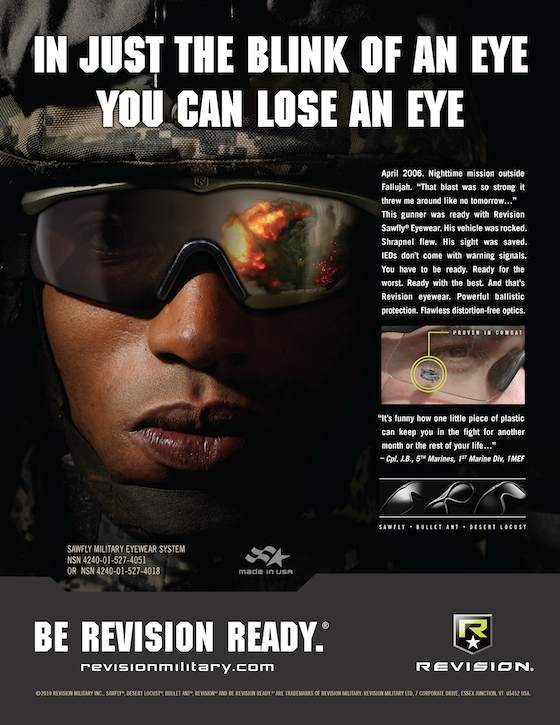
866f8d39-4206-47d9-b55e-33df2d2c026dIn this collaborative visual essay, edited by Zoë H. Wool, we consider an idiosyncratic assemblage of pictures of American soldiers. These are not iconic images that “speak for themselves” but less conventional ones that suggest both the technical expertise involved in producing and managing war’s violence and the vulnerability of soldiers at the heart of war. In considering these images as technical, we highlight the many forms of war’s material and technical expertise, expertise that is often disarticulated from the social, political, and ethical fields on which war equally relies.

The images range from grainy World War I–era photographs, recovered from cluttered archives, to digitally generated contemporary images that depict the results of war’s embrace of high technology. Their material qualities reflect something of their intended publics: the curled edges of a Vietnam War snapshot tucked away inside a shoebox (Jauregui); the high resolution of an advertisement that speaks to contemporary soldiers’ special knowledge of explosive force and special role as savvy gear consumers (MacLeish); the directed gaze of soldiers whose bodies bear the weight of innovations in prosthetics and weapons systems, both of which technologically extend the body (Serlin, Lawrie, Kaplan); and the precise composition of images used to display soldiers’ special prowess to medical or technical experts or else to cultivate such technical readings in a broader public (Linker, Masco, Wool).

In presenting these images, we take seriously Walter Benjamin’s warning that photographs unmoored from the historical arrangements of life that produce them are politically hazardous capitulations to fashion, “arty journalism” that “cannot grasp a single one of the human connexions in which [they] exist.” And so we inscribe each image with a caption, anchoring it in a world of human connections and gendered and racialized bodies. These captions rearticulate the relationship between technical expertise and ethics, reconnecting the matériel and personnel of war with the social and political worlds they entail.

These captions describe a material history of soldiers’ bodies whose themes recur across time. The unromantic vulnerability of the soldier on which war making depends (Jauregui, MacLeish, Masco); the technological and prosthetic interventions to which soldiers are subject and from which soldierly life itself is inseparable (Lawrie, Masco, MacLeish, Serlin, Wool); the forms of display involved in making soldiers into certain kinds of biopolitical subjects (Lawrie, Linker, Serlin, Wool); the way war remaps geographic and affective terrain (Kaplan, Masco); and the intimate relationship between place and feeling that war also exposes, binding homelands and homefronts to death zones while producing spaces of homosocial or national intimacy (Jauregui, Linker, Masco).

As we address these un-iconic soldier images to the politics of displaying vulnerable bodies, or rendering them resilient, we also incur collateral effects. In maintaining our focus on images of American soldiers, for instance, we contribute to the ignorance of other kinds of war-bound bodies and lives, from civilians to foreign belligerents to kinds of American soldiers—notably women—who are not pictured here. By displaying medical images of men whose names and lives we do not know, we contribute to the disabling history of what poet Eli Clare has called “gawking, gaping, and staring.” We are not innocent of these consequences. In pointing them out we show only how inseparable they are from many ongoing conversations about aesthetics, ethics, and the American warscape.

By focusing on some of the nooks and crannies of the American warscape, rarified spaces of technical expertise, we hope to incite new and shared modes of reading and recognizing martial imagery and new approaches to thinking about how pictures of soldiers are made and made meaningful in some ways and not others at specific material, social, and ethical conjunctures.

The portfolio includes these images and brief commentaries:

— David Serlin: How to Be Yourself in Public

— Zoë H. Wool: This Is a Picture of an Injured Soldier

— Joseph Masco: Atomic Soldiers
— Caren Kaplan: Drone Sight
— Kenneth MacLeish: In the Blink of an Eye

There are also many other sparkling contributions on the Public Book site

Hide and Seek – and Show

Ever since I heard Isla Forsyth give one of her marvellous presentations on camouflage I’ve been fascinated by the subject – all the more so since it intersects so artfully (and, as Isla would quite rightly insist, scientifically) with my work on aerial reconnaissance, bombing and modern war.  You can get an early sense of Isla’s work from this presentation, ‘Shadow chasers: exploring the vertical and angular geometries of camouflage‘, which includes a gallery of images.  Isla’s Glasgow PhD thesis, From Dazzle to the Desert: A Cultural-Historical Geography of Camouflage, was completed last year – and I hope will appear in book form.
FrontPageCamoufleur

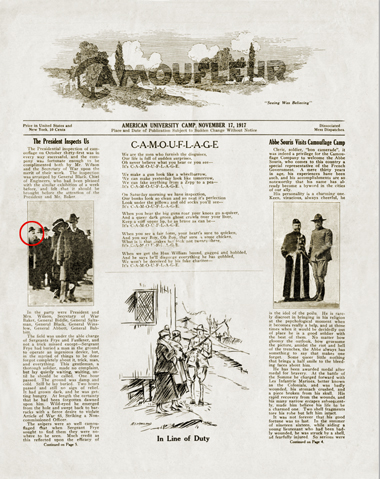
There’s a great blog on camouflage – Camoupedia – which includes an appreciative notice of Isla’s work and, amongst a feast of deceptive riches, a stunning series of posters by graphic design students to advertise a talk by Claudia Covert (that really is her splendid name) on dazzle ship camouflage in World War I, a post about the newspaper of the American Camouflage Corps in 1917 (above), and a remarkable extract from a letter from Reginald Farrer later published as The Void of War: letters from three fronts (1918):
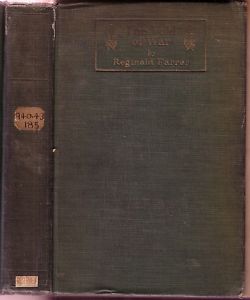
FARRER Void of WarThe real thing about the human side of the war is the sheer fun of it. In certain aspects the war is nothing but a glorious, gigantic game of hide and seek—camouflage is nothing else. It is not only the art of making things invisible, but also of making them look like something else. Even the art of inconspicuousness is subtle and exciting. What glory it must be to splash your tents and lorries all over with wild waggles of orange and emerald and ochre and umber, in a drunken chaos, until you have produced a perfect futurist masterpiece which one would think would pierce the very vaults of heaven with its yells..

But disguise is an even higher branch of the art: you go on to make everything look like something else. Hermit crabs and caddis worms become our masters. Down from the sky peers the microscopic midget of a Boche plane: he sees a tree—but it may be a gun: he sees a gun—but it may be only a tree. And so the game of hide and seek goes on, in a steady acceleration of ingenuity on both sides, till at last the only logical outcome will be to have no camouflage at all. You will simply put out your big guns fair and square in the open, because nobody will ever believe, by that time,  that anything really is what it looks like. As far as the guns go, the war is developing into a colossal fancy dress ball, with immunity for the prize: wolves in sheep’s clothing are nothing to these gentle shepherdesses of the countryside. The more important they are, the more meekly do they shrink from notice under dominos of boughs or sods, or strawberry-netting tagged over with fluffets of green and brown rags. And sometimes they lurk under some undiscoverable knoll in a coppice, and do their barking through a little hole from which you would only expect rabbits, not shells..

And, of course, this fun sense of his [the individual] has full play in this new warfare. It is all “I spy,” on terms of life and death: the other fellow must not spy, or you hear of it instantly, through your skull. Think how it must sharpen up the civilization-sodden intelligence of a man, to have to depend for dear life on noticing every movement in a bush and every opening in a bank. Now we are getting back with one hand what we had lost by giving up the other to machinery. We are growing to make the best of both worlds, the mechanical and the human, without giving up our mental balance by relying exclusively on either. I only wish I could give you an idea of the devices and ingenuities that these grown-up hide-and-seekers have elaborated. All sorts of ludicrously simple things, the more ludicrously simple the better

Every blank-faced trench rampart of sandbags has its hidden eyes—eyes perfectly wide awake all the time, and winking at you wickedly with a rifle. But for your life you could not spot them, until you had had weeks of training, and learned the real meaning of every tiny unevenness or discoloration or bit of darkness. And even then you have to learn to guess which of these is harmless—so as to blind the others with your own fire. Or there is an innocent, untidy, earthy bank, a dump of old boots and tins and bottles and teapots without spouts. But any one of those forlorn oddments may also be the eyelid of a rifle. Only you do not know which—until you have found out! In the beginning of the war you did not find out. Everything was neat and tidy and civilized and well arranged: so you merely got killed.

I’ve quoted this at length because it seems such a radically different view of the new geometries of the First World War to that taken (as I noted here) by Charles Nevinson in his early paintings of the Western Front – at least in its celebratory temper.  And yet, in its acknowledgement of the entanglements of the machine and the human, it’s also subversively the same.  (Not surprisingly, both Isla and the author of the blog – Roy Behrens, who also wrote the book Camoupedia (2009) – pay close attention to camouflage artists, and there’s also a brief blog post on Camouflage as Futurism that notes Nevinson’s work).

All of this is on my mind today for two reasons.  The first is that Farrer’s letter was published in part under the title ‘Hide and Seek‘, which is also the title of a brilliant book on camouflage I’ve belatedly discovered (perhaps that’s appropriate): Hanna Rose ShellHide and Seek: Camouflage, Photography and the Media of Reconnaissance, published by the ever -inventive Zone Books in March last year.  The more books I buy from Zone, the more I realise that this is a wonderful platform for books that depend on images – not surprising since they are edited by Jonathan Crary,Michel Feher, Hal Foster and Ramona Nadaff.
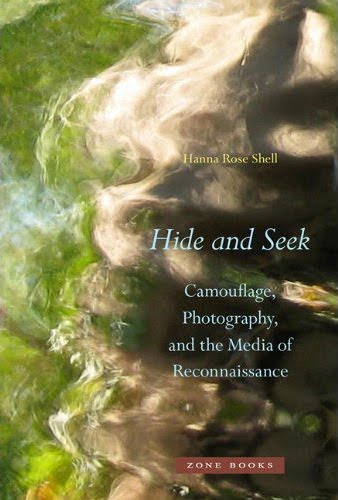
SHELL Hide and seek

You can get a sense of Hanna’s (early) work from this essay, ‘The crucial moment of deception’, in Cabinet.  There’s also an excellent article on her work in the Paris Review here , another at rhizome here, and a short interview with Hanna here:

The main focus of my book is on the period between the late 19th century and World War II, but I also show how photographic camouflage is present in military research today. What I call an enduring “chameleonic impulse” continues to motivate military R&D of wearable camouflage technologies. There is also an ongoing quest to develop “invisible cloaks” to serve simultaneously as skins and … screens onto which one’s visual environment might be projected.

Many times, people’s first association with camouflage is with the natural world — it’s often the story of the evolution of the “peppered moth” that schoolchildren learn in biology class. But it’s only when humans had to hide from the camera and other optical devices that animal protective concealment began to fascinate people … and then became a model for the development of new human technologies.
Camouflage Project

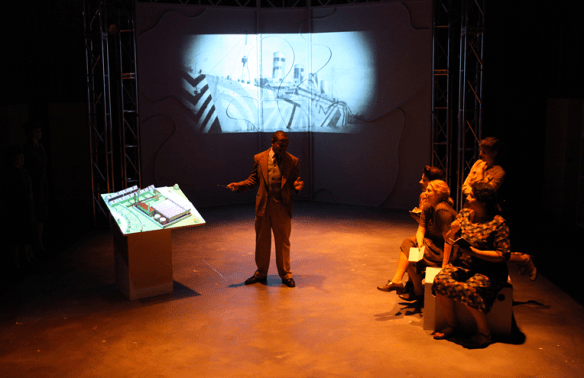
There’s a second reason.  I’m presently developing a performance work, provisionally called “The social life of bombs“, where I want (among other things) to integrate the performing and visual arts into the research process (as part of my Killing Space project).  My inspiration is in part Gerry Pratt’s Nanay, but more proximately Boca del Lupo‘s Photog, based on the experiences of four combat photographers and using cutting-edge visual technologies to mesmerising effect (I’m going to talk with them next month), and in part Ohio State University’s  The Camouflage Project (above).  The project involved OSU’s Department of Theater and the Mershon Center for International Security Studies:
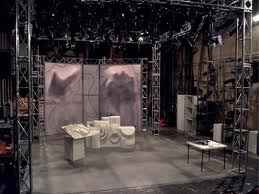
The camouflage project/2The goal of The Camouflage Project is to create, organize and execute a three-part interdisciplinary endeavor linked to the theme of secret agents, camouflage, deception and disguise in World War II, specifically the F section (France) of the Special Operations Executive (SOE). The three parts are as follows:

Performance: To devise a new performance work as a collaboration between Ohio State University Theatre and the Advanced Computing Center for the Arts and Design (ACCAD). This will be a multi-media work combining digital animations and video projections with experimental use of 3D printing, 3D scanning and projection mapping.

Exhibition: To create a visual environment parallel to the performance space, which will have a second life as an installation/exhibition. The installation will feature historical background (interviews and soldier training films) on the science and art of camouflage in both World Wars organized around a visual study of selected SOE (principally female) agents and espionage circuits in France, examples of military equipment, devices, disguises, gadgets and weapons of deception.

Symposium: To organize and host an international symposium on the multiple artistic and instrumental meanings of camouflage, to be held in May 2011. The symposium will feature panels of Ohio State and international experts from military history, political science, and the Imperial War Museum addressing the subject of camouflage and the SOE.

The project offers a fresh meaning to the expression ‘theatre of war.’ On one level it theatricalizes the history of military camouflage, particularly the SOE and the role played by women agents in its espionage activity. On another it reveals the artistic dimensions of these activities: a variety of theatre artists—scenic, costume, make-up designers, and vaudeville magicians—were employed to use their theatrical skills to deceive and fool the enemy. Rather than tales of derring-do and spying, this project seeks to look at different and often hidden aspects of the war: the use and creation of camouflage, both literally and metaphorically, by people who had to work secretly behind enemy lines. The performance storyline will highlight the work of women agents, many of whose accomplishments have been concealed, erased or obscured for a variety of reasons. A narrative strategy will be to include elements of the training process involved in preparing agents for the field and the often-disastrous consequences of strategic decisions made by the SOE leadership.

This all came together in May 2011, though the performance work has subsequently been on tour; the programme for the symposium and performance is here, a review of the 90-minute performance here.  My subject is different, of course, but I’m really taken by the tripartite structure of the project and its collaborative nature.  Perhaps I have nothing to say, only to show…
Initial thoughts

CSI - Newcastle

Joining GPS (Geopolitics and Security) from Royal Holloway – at the enterprising e-International Relations site – is a new blog CSI  (Culture, Security, Identity) from faculty and graduate students at Newcastle.

It’s obviously not only the US military that has a thing about acronyms!