From hotels to hostilities

I’m just back from a wonderful time at Ohio State giving the Taafe Lecture, and still trying to catch my breath: lots of good conversation and good company.  More on this later – as always, I learned much from the discussions, and I’m particularly grateful to Mat Coleman, Kevin Cox, Nancy Ettlinger, Ed Malecki, Becky Mansfield, Kendra McSweeney, Mary Thomas, Joel Wainwright and a stimulating crowd of graduate students for the warmth of their welcome and the range of their questions.

While I’ve been on the road, I learned of two new blogs whose most recent posts, when read together, prompt me to think about the multiple, terrible connections between military violence in Beirut and in Gaza – not least through the IDF’s so-called Dahiyah Doctrine, named after Beirut’s southern suburb that was devastated in the summer of 2006 , which calls for the use of overwhelming and disproportionate force and the deliberate targeting of government and civilian infrastructure (more on the legal armature from Richard Falk and Raji Sourani here).

Sara Fregonese and Adam Ramadan have started Everyday Geopolitics – it’s been running since October but I’ve only just caught up, and Sara’s most recent post on Beirut is a front-line report on her work on hotels and geopolitics.  If that seems a strange combination – and it isn’t – then check out her comments and photographs, and her essay ‘Between a refuge and a battleground: Beirut’s discrepant cosmopolitanisms’, Geographical Review, 102 (2012) 316–336.

Craig Jones has started War, Law and Space that opens with an important reflection on the ongoing Israeli assault on Gaza, the parallels with ‘Operation Cast Lead‘ in 2008, and the differential granting of the ‘right to self-defence’.

Incidentally, for anyone who thinks Israel ‘withdrew’ from Gaza in 2005, I particularly recommend the following:

Lori Allen, ‘The scales of occupation: Operation Cast Lead and the targeting of the Gaza Strip’, Critique of anthropology 32 (2012) 261-84;

Lisa Bhungalia, ‘Im/mobilities in a “Hostile Territory”: Managing the Red line’, Geopolitics 17 (2012) 256-75;

Shane Darcy and John Reynolds, ‘An enduring occupation: the status of the Gaza Strip from the perspective of International Humanitarian Law’, Journal of conflict and security law 15 (2010) 211-43;

Darryl Li, ‘The Gaza Strip as laboratory: notes in the wake of disengagement’, Journal of Palestine Studies 35 (2) (2006) 38-55;

Helga Tawil-Souri, ‘Digital occupation: Gaza’s hi-tech enclosure’, Journal of Palestine Studies 41 (2) (2012) 27-43.

If you don’t have time, then at least read Samera Esmeir on ‘Colonial experiments in Gaza’ at Jadaliyya here.  In the midst of the latest, horrific attacks, it’s vitally important to realise that violence can take many forms, and that Israel’s assaults on Gaza run even deeper than the overt and spectacular violence it metes out in its spasmodic military operations.  More on this soon too, and on Israel’s ongoing air strikes.

Epicentre of the drone war

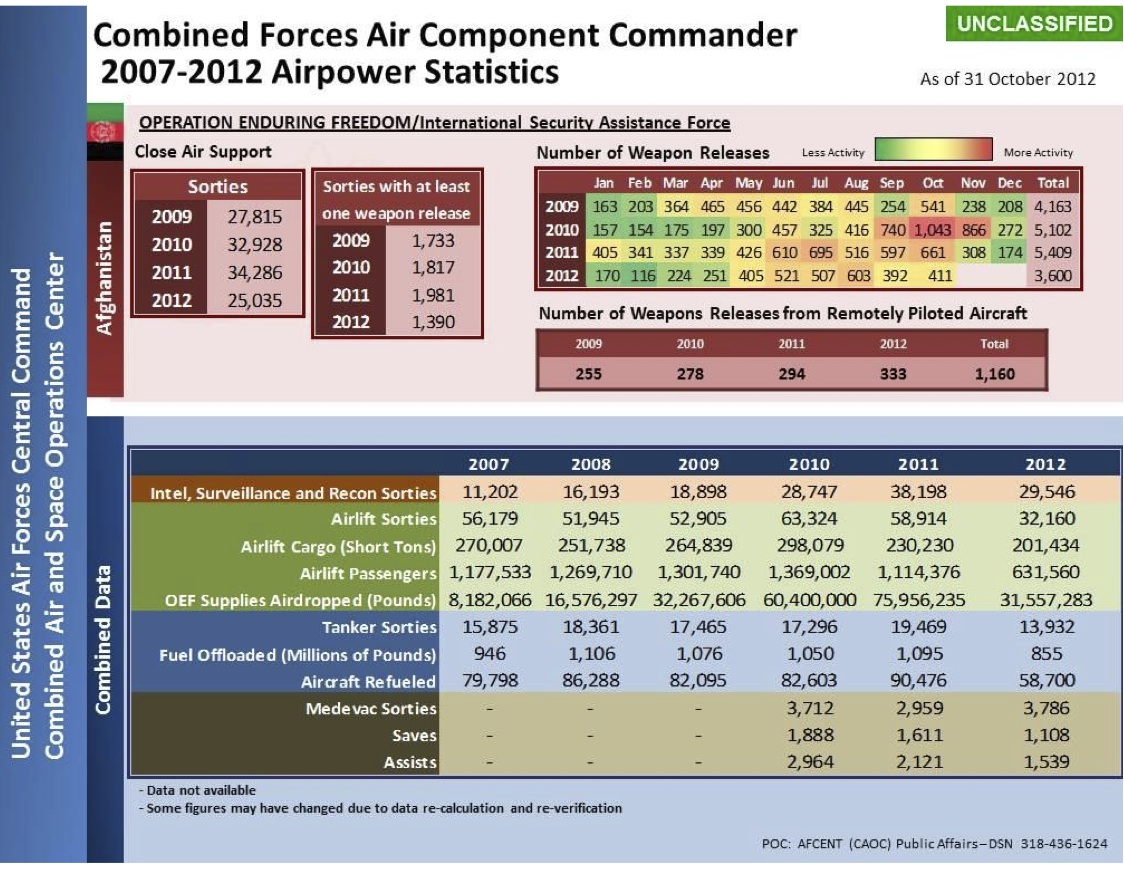
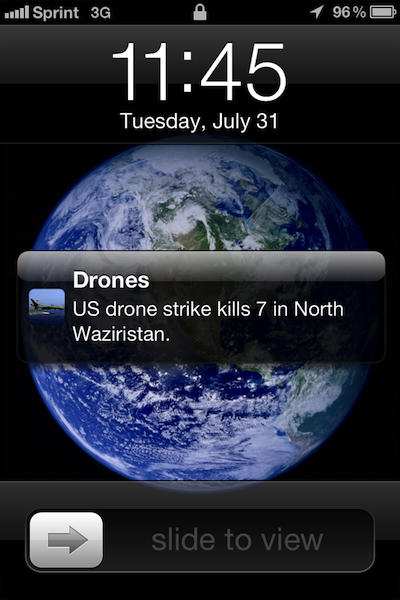
In the middle of the (understandable) concern at US drone attacks in Pakistan, Yemen and Somalia, I’ve been stubbornly insisting for months now that we should not overlook the significance of Afghanistan.  That’s precisely why I wrote ‘From a view to a kill’ (DOWNLOADS tab).  Now Noah Shachtman at Danger Room reports:

The American military has launched 333 drone strikes this year in Afghanistan. That’s not only the highest total ever, according to U.S. Air Force statistics. It’s essentially the same number of robotic attacks in Pakistan since the CIA-led campaign there began nearly eight years ago.

You can access monthly airpower summaries here.  These show that these strikes are intensifying even as ground operations are being scaled back:

The U.S. military is now launching more drone strikes — an average of 33 per month — than at any moment in the 11 years of the Afghan conflict. It’s a major escalation from just last year, when the monthly average was 24.5. And it’s happening while the rest of the American war effort is winding down.

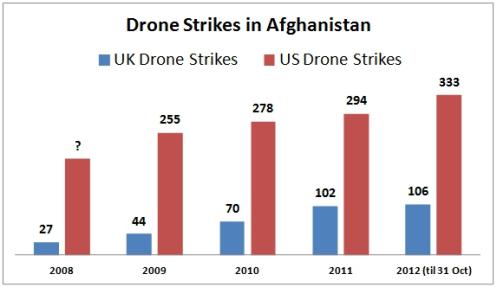
The UK is markedly reluctant to provide detailed information on its remote operations – and Drone Wars UK has raised serious questions about the accuracy of some of its returns (and much more besides) – but  Global Research gives this breakdown between US and UK strikes:

Shachtman points out that the protocols governing USAF operations in Afghanistan are different from those followed for CIA-directed strikes elsewhere,and so they are.  He’s right to emphasise the importance of these remote platforms for providing close air support to ‘troops in contact’, often as part of a networked attack.  But what he doesn’t note is the increased propensity for civilian casualties in these situations – literally in the heat of the moment – nor the fact that the US military has its own disposition matrix for killing targets on its own hit list.  As I noted here,  these are crucial considerations.

Drone’s eye view

I expect many readers will remember  that Apple rejected NYU grad student Josh Begley‘s Drones+ app last August.  It did so three times and for a multiplicity of confusing – and frankly shifty – reasons.  Apparently it was neither ‘useful’ nor ‘entertaining’; then it presented ‘excessively objectionable’ content (something to take up with the Pentagon and the CIA, surely?). As Danger Room explained, the app was bare bones stuff:

When a drone strike occurs, Drones+ catalogs it, and presents a map of the area where the strike took place, marked by a pushpin. You can click through to media reports of a given strike that the Bureau of Investigative Reporting compiles, as well as some basic facts about whom the media thinks the strike targeted.

All the more ironic, really, since the US military makes extensive use of smart phone technology – including its own (restricted) apps for the iPhone.  More on that here and here and here.

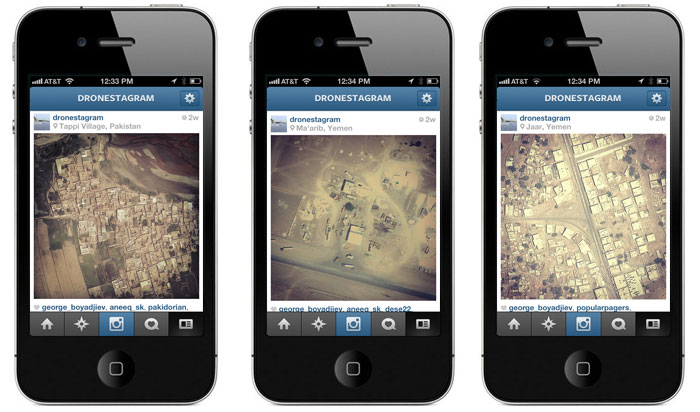
But for the past several weeks James Bridle – of New Aesthetic fame – has been posting satellite images of the distant places where drone strikes are recorded by the Bureau of Investigative Journalism to Instagram: and, as the image below shows, you can view these on your iPhone…

There are, of course, difficulties in pinpointing the locations of drone strikes– and James is evidently very well aware of them – but on his Dronestagram website he explains his desire to convert abstract targets into physical places in terms that resonate beautifully with the arguments I’m trying to develop in Deadly embrace:

The political and practical possibilities of drone strikes are the consequence of invisible, distancing technologies, and a technologically-disengaged media and society. Foreign wars and foreign bodies have always counted for less, but the technology that was supposed to bring us closer together is used to obscure and obfuscate. We use military technologies like GPS and Kinect for work and play; they continue to be used militarily to maim and kill, ever further away and ever less visibly.

Yet at the same time we are attempting to build a 1:1 map of the world through satellite and surveillance technologies, that does allow us to see these landscapes, should we choose to go there. These technologies are not just for “organising” information, they are also for revealing it, for telling us something new about the world around us, rendering it more clearly.

History, like space, is coproduced by us and our technologies: those technologies include satellite mapping, social photo sharing from handheld devices, and fleets of flying death robots. We should engage with them at every level. These are just images of foreign landscapes, still; yet we have got better at immediacy and intimacy online: perhaps we can be better at empathy too.

You can follow the images here and in much more detail via tumblr here.  More information here.

This comes at an opportune moment since I’ve been talking this week with Susan Schuppli and Eyal Weizman at Forensic Architecture about a collaborative, interactive project to bring together all the available data on drone strikes.

Popeye the Weatherman

On 18 March 1971 most readers of the Washington Post were taken aback by Jack Anderson‘s latest column:

‘Air Force rainmakers, operating secretly in the skies over the Ho Chi Minh Trail, have succeeded in turning the weather against the North Vietnamese.  These strange weather warriors seed the clouds during the monsoons in an attempt to concentrate more rainfall on the trails and wash them out…

‘Their monthly reports, stamped “Top Secret (Specat)” (Special Category), have claimed success in creating man-made cloudbursts over the trail complex.  These assertedly have caused flooding conditions along the trails, making them impassable…

‘The same cloudbursts that have flooded the Ho Chi Minh Trail reportedly also have washed out some Laotian villages.  This is the reason, presumably, that the air force has kept its weather-making triumphs in Indochina so secret.’

Among the Post‘s astonished readers was Dennis Doolin, Deputy Assistant Secretary of Defense for East Asia and Pacific Affairs.  Three years later he testified before a subcommittte of the Senate Committee on Foreign Relations that this was the first he had heard of the operation.  When he asked about it he had been assured that it had not affected agriculture in ‘friendly countries’ in the region, and told not to pursue the matter: information ‘was held in a special channel and access was very, very limited’ as a result of the ‘sensitivity of the operation.’

In fact Secretary for Defense Melvin Laird had categorically denied Anderson’s ‘wild tales’, but rumours continued to circulate and on 3 July 1972 the New York Times splashed Seymour Hersh‘s detailed report over its first two pages: ‘Rainmaking is used as Weapon by U.S.’  Based on ‘an extensive series of interviews’ with officials who declined to be named – sounds familiar, no? – Hersh claimed that the experiments had been initiated by the CIA in 1963 and that by 1967 the Air Force had been drawn in (though ‘the agency was calling all the shots’).  And if that sounds familiar too, then so will the cautious, even critical response of the State Department: its officials protested that the program would be illegal if it caused ‘unusual suffering or disproportionate damage’, and that its wider political and ecological consequences had been left unexamined.  Undeterred, advocates demanded: ‘What’s worse – dropping bombs or rain?’

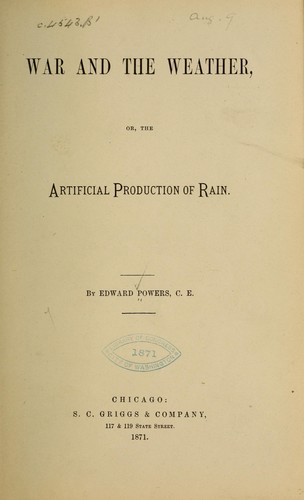
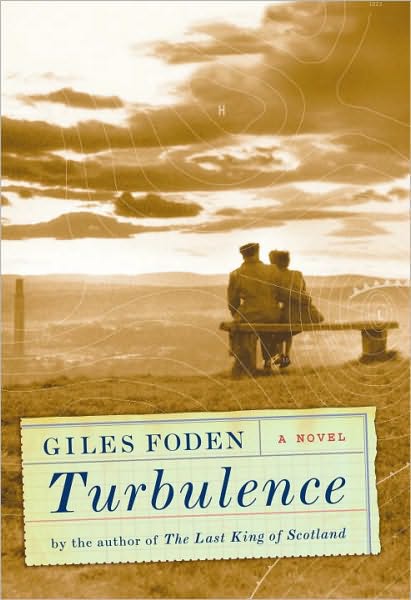
Although Hersh claimed that the program – which he identified as Operation Popeye – was ‘the first confirmed use of meteorological warfare’ there was a back-story and a history. In 1872 the US Congress authorised the Secretaries of War and the Navy to test the relationship between artillery fire and rain propagation proposed by Edward Powers in his War and the weather (1871). Experiments in rainmaking continued into the twentieth century, but the military interest in weather and war was primarily concerned with the adverse effects of the one on the other: most famously in planning the D-Day invasion of Normandy (see here and here, and Giles Foden‘s novel, Turbulence).

But after the Second World War the prospect of ‘weaponising the weather’ re-enchanted the US military.  James Rodger Fleming (‘The pathological history of weather and climate modification’, Historical studies in the physical and biological sciences 37 (1) (2006) 3-25; see also here, and his Fixing the sky: the checkered history of weather and climate control (Columbia University Press, 2010)) describes how research on cloud seeding at the General Electric Research Laboratory in Schenectady, New York had been transferred to the US military in 1946:

‘Planners generated scenarios that included hindering the enemyʼs military campaigns by causing heavy rains or snows to fall along lines of troop movement and on vital airfields, taming the winds in the service of an all-weather air force, or, on a larger scale, perhaps disrupting (or improving) the agricultural economy of nations and altering the global climate for strategic purposes. Other possibilities included dissipating cloud decks to enable visual bombing attacks on targets, opening airfields closed by low clouds or fog, relieving aircraft icing conditions, or using controlled precipitation as a delivery system for chemical, biological, or radiological agents. The military regarded cloud seeding as the trigger that could release the violence of the atmosphere against an enemy or tame the winds in the service of an all-weather air force.’

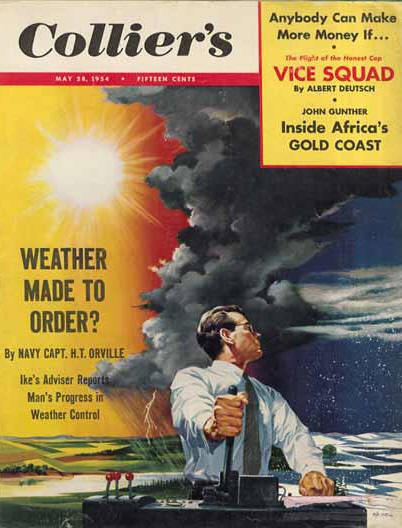
In May 1954 Howard Orville, who had been the US Navy’s chief weather officer during the Second World War and was now chairman of President Eisenhower’s newly formed Advisory Committee on Weather Control, went public with the implications of the research in an article in Collier’s:

‘It is even conceivable that we could use weather as a weapon of war, creating storms or dissipating them as the tactical situation demands.  We might deluge an enemy with rain tp hamper a military movement or strike at his food supplies by withholding needed rain from his crops.’

Not surprisingly, results were at best equivocal, but Fleming argues that ‘weather modification took a macro-pathological turn between 1967 and 1972 in the jungles over North and South Vietnam, Laos and Cambodia’.

It was part of what John Prados (The bloody road: the Ho Chi Minh Trail and the Vietnam War, Wiley, 1998) calls the ‘wizard war’ waged by the United States to disrupt the main supply lines running from North Vietnam along the Ho Chi Minh Trail (or Duong Truong Road) through Laos and Cambodia to South Vietnam; other projects included the ‘electronic battlefield’ whose acoustic and seismic sensors detected movement along the trail network and triggered air strikes on target boxes (see ‘Lines of descent’, DOWNLOADS tab).

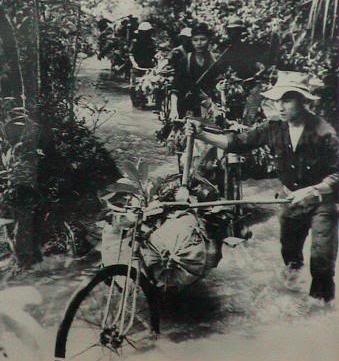
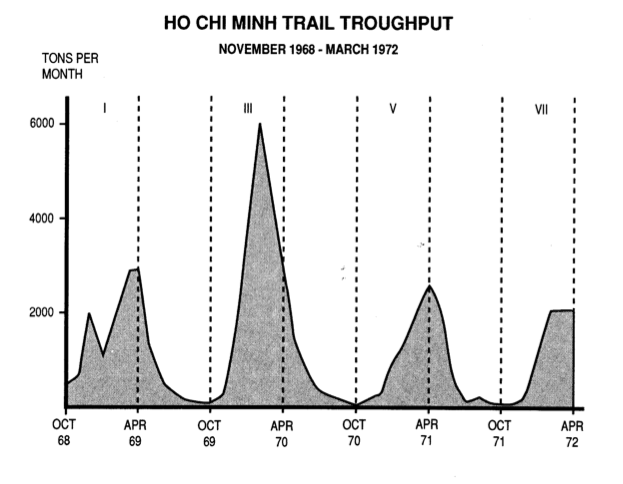
The Trail was in reality a complex, braiding network of roads and tracks, paths and trails, of which perhaps 3,500 kilometres was ‘motorable’.  Although the system was maintained by 40-50,000 engineers, drivers and labourers, who used heavy equipment and gravel and corduroy surfaces to smooth the passage for trucks, most of the roads were dirt and virtually impassable during the south-west monsoon (May-September), so that the supply chain was highly seasonal:

(Image from Herman Gilster, The air war in southeast Asia, Air University Press, 1993)

By 1966 it was becoming clear that efforts to interdict movement along the trail through conventional bombing had been unsuccessful (though this did little to halt the bombing).  Pentagon scientists realised that if they could increase rainfall in selected areas this would not only soften roads, trigger landslides and wash out river crossings but also – the object of the exercise – continue these effects over an extended saturation period.  From transcripts of a classified hearing by a subcommittee of the Senate Committee on Foreign Relations in March 1974 we know that the US Office of Defense Research and Engineering initiated an experimental cloud-seeding program over the Laos panhandle in October 1966.  Intelligence briefings blithely insisted that this would impose little or no additional hardship on the civilian population:

‘The sparsely populated areas over which seeding was to occur had a population very experienced in coping with the seasonal heavy rainfall conditions.  Houses in the area are built on stilts, and about everyone owns a small boat.  The desired effects of rainfall on lines of communication are naturally produced during the height of the monsoon season just by natural rainfall.  The objective was to extend these effects over a longer period.’

56 pilot ‘seedings’ were carried out as Operation Popeye, and the military concluded that this was such a ‘valuable tactical weapon’ that the program should be continued over a wider area. According to Milton Leitenberg, in an unpublished study of Military R&D and Weapons Development prepared for Sweden’s Ministry of Foreign Affairs, in November President Johnson’s Scientific Advisory Committee came down against the military use of rainmaking techniques for both technical reasons (the results were inconclusive) and political ones (using meteorological techniques as weapons might jeopardise international scientific collaboration).

But in December the Joint Chiefs of Staff submitted three plans for future military operations in Indochina to the President, and all three involved extending Operation Popeye to ‘reduce trafficability along infiltration routes’.

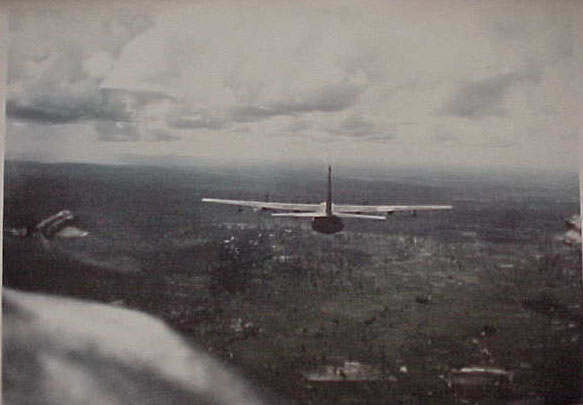
The operational phase (sometimes referred to as ‘Motorpool‘) began in March 1967, using three WC-130 aircraft – one of which is shown above, returning to Udorn Air Force Base in Thailand – and two RF-4C aircraft, all fitted with silver iodide ejectors.  The aircraft displayed the standard Southeast Asia camouflage colours and markings but no unit identifiers, presumably because the operation was top secret.  Although the missions were flown by the USAF’s Air Weather Service, and logged as standard ‘weather reconnaissance flights’, secret reports were forwarded to the Pentagon and the crews all had special clearance.  Here is Howard Kidwell:

 I kept hearing the call sign “Motorpool” used by two of crews in the 14th. When I inquired what they did, I got the usual reply that it was Top Secret and no one knew. I knew the crews and they wouldn’t say zip. This grows on a guy, and I had to find out what was going on. So, dummy me, I volunteered. Well, in a little while I was interviewed and told they would get a higher security clearance for me. In a few short weeks and I was told to come to Motorpool Ops for a briefing. (I found out later that friends and relatives in the states were contacted about me).  The Lt Col in charge said the room had been swept for monitoring devices, etc., and I had one last chance to withdraw my volunteer statement.  I had fleeting thoughts of flying over China, working for the CIA, you name it… but what the heck.  I signed the statement and found out that I was going to make rain!  Geez!  I thought they were kidding!

Leitenberg claims that responsibility for the program was assigned to the office of the Special Assistant for Counterinsurgency and Special Activities, an agency with close operating links to the CIA (in fact U Dorn was also the operating base for the CIA’s Air America that supported covert operations in Indochina). Consistent with this security classification, the governments of Thailand and Laos were not informed about the operations: Doolin testified that the Lao government ‘had given approval for interdiction efforts against the trail system and we considered this to be part of the interdiction effort.’

By June the US Ambassador to Laos was enthusiastically reporting that:

‘Vehicle traffic has ground virtually to a halt… Our road-watch teams report that in many stretches … ground water has already reached saturation point and standing water has covered roads.’

By then, Motorpool had been  joined by another covert operation, Commando Lava, described as an ‘experiment in soil destabilisation’.  C-130 aircraft dropped pallet-loads of chelating compounds (’emulsifiers’) at choke points along the Trail in Laos to magnify the effect of the rains and, again, to extend the saturation period.  The Ambassador was thrilled.  Convinced that this ‘could prove a far more effective road interdictive device (at least in rainy season) than iron bombs and infinitely less costly’,  he cabled Washington:

‘If we could combine these techniques with techniques of Operation Popeye, we might be able to make enemy movement among the cordillera of the Annamite chain almost prohibitive.  In short, chelation may prove better than escalation.  Make mud, not war!’

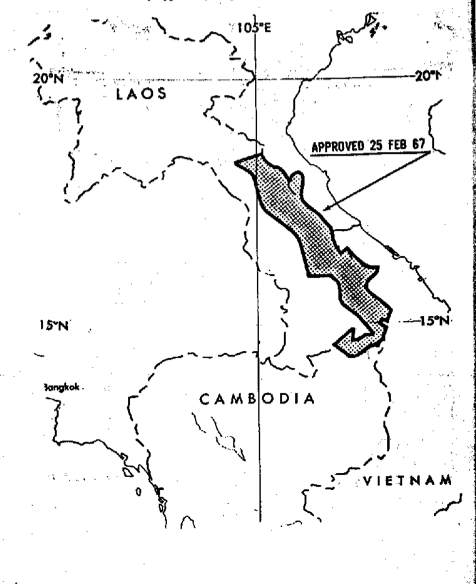
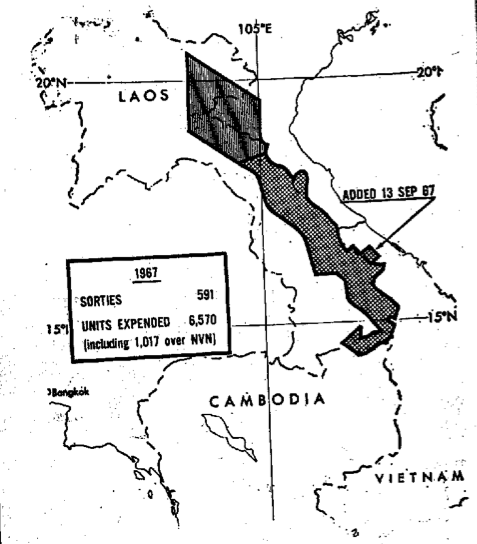
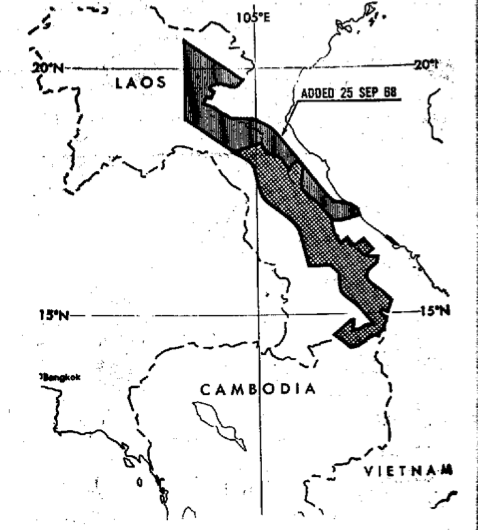
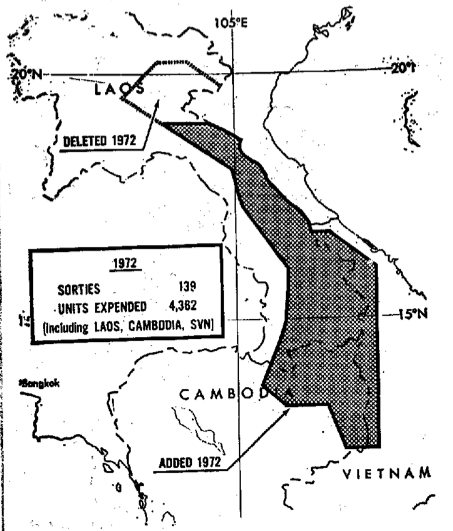
But Commando Lava was a failure, and Westmoreland cancelled it in October.  The results for Popeye/Motorpool were far from conclusive either – the Defense Intelligence Agency later estimated that rainfall may have been increased by up to 30 per cent in limited areas – but the mission was regularly extended.  Its coverage was constantly adjusted, and all seeding above North Vietnam was ended on 1 November 1968 when Johnson called a halt to the Rolling Thunder bombing campaign:

Initial area of operations, 1967

Expanded area of operations, 1967

Area of operations, 1968

Area of operations, 1972

By the time the operation was ended 2,602 individual sorties had been flown.  Prompted in part by a Senate resolution in 1973 that urged the US government to secure an international agreement outlawing ‘any use of an environmental or geophysical modification activity as a weapon of war’, and by the public release of the transcript of the secret Congressional hearings in 1974, the UN General Assembly adopted the Convention on the Prohibition of Military or Any Other Hostile Use of Environmental Modification Techniques (or ENMOD) in 1976.  It came into force in October 1978: more here and here.

There were, of course, other, better known and hideously more effective versions of ecological warfare in Indochina: defoliating huge swathes of mangrove and rainforest with Agent Orange and other chemical sprays, and bombing the dikes in North Vietnam.  But these weather operations, which combined minimum success with scandalous recklessness, now have a renewed significance.  As late as 1996 the US Air Force was still describing weather as a ‘force multiplier’ and, by 2025, planning to deploy UAVs for ‘weather modification operations’ at the micro- and meso-scale so that the United States could ‘own’ the weather (strikingly, there is no discussion of any legal restrictions).

But today the equation has been reversed, and the US military has to contend not only with its projected capacity to change the weather but also – as I’ll discuss in a later post – with the effects of global climate change on its operations.

The real McCoy and the politics of verticality

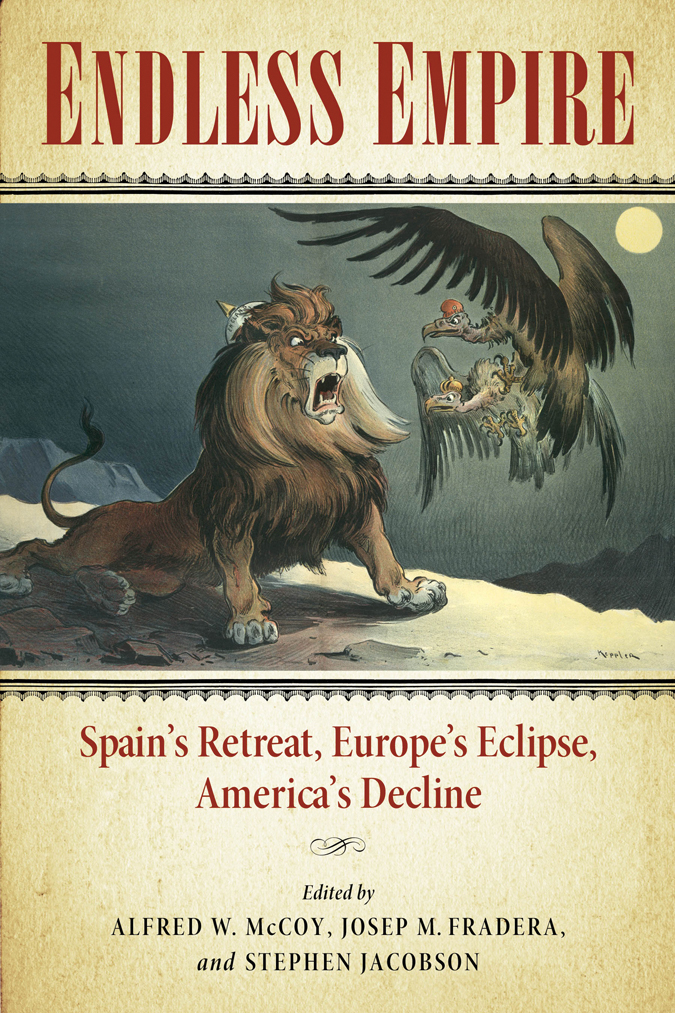
Oliver‘s favourite historian, Alfred McCoy, recently co-edited a fine new collection, Endless Empire: Spain’s retreat, Europe’s eclipse, America’s decline (University of Wisconsin Press, 2012), and there’s an excellent taster of McCoy’s argument at both Tomdispatch and Guernica.  The title – ‘Beyond bayonets and battleships’ – is not only a rejoinder to Romney’s complaint during the last Presidential debate; it’s also a reply to Obama and his predecessors.

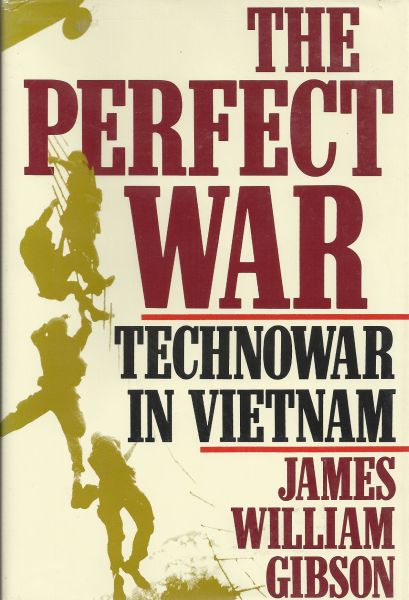
McCoy traces the long historical curve of what, in another age, was called America’s techno-war: the phrase comes from James Gibson’s stunning The perfect war: technowar in Vietnam (Monthly Review Press, 1986; Atlantic, 2000), and like Gibson McCoy insists on the importance of the wars in Indochina for the matrix within which late modern war is now conducted.

Many of his themes resonate with my own work – the key elements for today’s remote operations were assembled over the skies of Vietnam, Laos and Cambodia, and these have been radically extended by biometric identification, electronic surveillance and cyberwarfare – and McCoy also peers into a not-do-distant but desperately dark future in which the contemporary politics of verticality and what Stuart Elden describes as projects to ‘secure the volume‘ will be dwarfed by a triple-tier canopy (‘Just how high is national sovereignty? … Some puckish Pentagon lawyer might reply: only as high as you can enforce it’):

It’s 2025 and an American “triple canopy” of advanced surveillance and armed drones fills the heavens from the lower- to the exo-atmosphere.  A wonder of the modern age, it can deliver its weaponry anywhere on the planet with staggering speed, knock out an enemy’s satellite communications system, or follow individuals biometrically for great distances.  Along with the country’s advanced cyberwar capacity, it’s also the most sophisticated militarized information system ever created and an insurance policy for U.S. global dominion deep into the twenty-first century.  It’s the future as the Pentagon imagines it; it’s under development; and Americans know nothing about it.

I’m drafting the introduction to The everywhere war now, and this is a superb essay for me to engage – if you read one thing this week, make it this.

Masters of Non-War

Following up my post on the music of war, Nadia Abu-Zahra has kindly directed me to an excellent website devoted to thousands of anti-war, pacifist and anti-militarist songs here.  It includes a searchable database, downloads and videos, and is a marvellous resource.

The curators explain the origins of the project, which went online the day the US-led war on Iraq started:

When rumours of a new war against Iraq started spreading more and more insistently, the members of two Italian Usenet newsgroups, it.fan.musica.gucciniand it.fan.musica.de-andre, and of two other mailing lists dedicated to Italian songwriters, “Fabrizio”and “Bielle” spontaneously began to collect a great number of antiwar songs which were posted every day… So, this site originates from the spontaneous reaction of a number of people, who have chosen to witness their opposition to this war, and to any war, by collecting antiwar songs and by putting them at everyone’s disposal.

(If you just want to see a quick list, try this one from Stop the War‘s ‘anti-war song of the week’: everything from Vera Lynn  – admittedly with Johnny Cash – to Radiohead).

I’ve also been digging around for materials on music and the Vietnam War, and here I can recommend David James, ‘The Vietnam War and American music’, Social text 22 (1989) 122-43 and Kenneth Bindas and Craig Houston, ‘”Takin’ Care of Business”: Rock music, Vietnam and the protest myth’, The Historian 52 (1989) 1-23: both of which may leave your illusions blowin’ in the wind…

UPDATE Dan Clayton adds this excellent suggestion: Kim Herzinger, ‘The soundtrack of Vietnam’, in A. Wiest, M. Barbier and G. Robbins (eds), America and the Vietnam War: re-examining the culture and history of a generation (Routledge, 2010), 255–71

Targeted killings and signature strikes

And so what Tom Junod calls the lethal presidency continues…  though it surely would have done whoever occupied the White House for the next four years.

Much of the discussion of US targeted killing has centred on both its status under international law and on the quasi-judicial armature through which various government agencies, including the Pentagon and the Central Intelligence Agency, draw up and adjudicate their kill lists of named individuals who are liable to a ‘personality strike’. But the majority of US targeted killings turn out to be ‘signature strikes’.

Signature strikes were initiated under President George W. Bush, who authorised more permissive rules of engagement in January/February 2008.  According to Eric Schmitt and David Sanger, writing in the New York Times,

[A] series of meetings among President Bush’s national security advisers resulted in a significant relaxation of the rules under which American forces could aim attacks at suspected Qaeda and Taliban fighters in the tribal areas near Pakistan’s border with Afghanistan.

The change, described by senior American and Pakistani officials who would not speak for attribution because of the classified nature of the program, allows American military commanders greater leeway to choose from what one official who took part in the debate called “a Chinese menu” of strike options.

Instead of having to confirm the identity of a suspected militant leader before attacking, this shift allowed American operators to strike convoys of vehicles that bear the characteristics of Qaeda or Taliban leaders on the run, for instance, so long as the risk of civilian casualties is judged to be low.

Under Obama signature strikes increased in frequency, and Micah Zenko notes that the President’s initial reluctance soon yielded to endorsement:

According to Daniel Klaidman, when Obama was first made aware of signature strikes, the CIA’s deputy director clarified: “Mr. President, we can see that there are a lot of military-age males down there, men associated with terrorist activity, but we don’t necessarily know who they are.” Obama reacted sharply, “That’s not good enough for me.” According to one adviser describing the president’s unease: “‘He would squirm … he didn’t like the idea of kill ‘em and sort it out later.’” Like other controversial counterterrorism policies inherited by Obama, it did end up “good enough,” since he allowed the practice to stand in Pakistan, and in April authorized the CIA and JSOC to conduct signature strikes in Yemen as well.

Today signature strikes are frequently triggered not on the fly – a sudden response to an imminent threat – but by a sustained ‘pattern of life’ that arouses the suspicion of distant observers and operators. This depends on persistent surveillance – on full motion video feeds and a suite of algorithms that decompose individual traces and networks – some of which involve a weaponized version of Hägerstrand’s time-geography: see, for example, GeoTime 5 here.

We know even less about the legal authority for these attacks, but Kevin Jon Heller has a new essay on their legality up at the wonderful open access resource that is SSRN [Social Science Research Network]  here, and there are preliminary responses at Opinio Juris here.  This is the abstract:

The vast majority of drone attacks conducted by the U.S. have been signature strikes – strikes that target “groups of men who bear certain signatures, or defining characteristics associated with terrorist activity, but whose identities aren’t known.” In 2010, for example, Reuters reported that of the 500 “militants” killed by drones between 2008 and 2010, only 8% were the kind “top-tier militant targets” or “mid-to-high-level organizers” whose identities could have been known prior to being killed. Similarly, in 2011, a U.S. official revealed that the U.S. had killed “twice as many ‘wanted terrorists’ in signature strikes than in personality strikes.” 

Despite the U.S.’s intense reliance on signature strikes, scholars have paid almost no attention to their legality under international law. This article attempts to fill that lacuna. Section I explains why a signature strike must be justified under either international humanitarian law (IHL) or international human rights law (IHRL) even if the strike was a legitimate act of self-defence under Article 51 of the UN Charter. Section II explores the legality of signature strikes under IHL. It concludes that although some signature strikes clearly comply with the principle of distinction, others either violate that principle as a matter of law or require evidence concerning the target that the U.S. is unlikely to have prior to the attack. Section III then provides a similar analysis for IHRL, concluding that most of the signature strikes permitted by IHL – though certainly not all – would violate IHRL’s insistence that individuals cannot be arbitrarily deprived of their right to life.

The most interesting section (for me) is Kevin’s discussion of ‘evidentiary adequacy’.  Most of the examples he discusses appear to be derived from CIA-directed strikes in Pakistan – drawing on the Stanford/NYU report on Living under drones – and, for that very reason, are remarkably limited. But we know much more about problems of evidence – and inference – from strikes conducted by the US military in Afghanistan…

The first point to make, then, is that targeted killings are also carried out by the US military – indeed, the US Air Force has advertised its ability to put ‘warheads on foreheads‘ – and a strategic research report written by Colonel James Garrett for the US Army provides a rare insight into the process followed by the military in operationalising its Joint Prioritized Effects List (JPEL). Wikileaks has provided further information about JSOC’s Task Force 373 – see, for example, here and here – but the focus of Garrett’s 2008 report is the application of the legal principles of necessity and proportionality (two vital principles in the calculus of International Humanitarian Law (IHL) discussed by Kevin) in counterinsurgency operations.  Garrett describes ‘time-sensitive targeting procedures’ used by the Joint Targeting Working Group to order air strikes on ‘high-value’ Taliban and al-Qaeda leaders in Afghanistan, summarised in this diagram:

Notice that the members included representatives from both Combined Joint Special Operations Task Force (CJSOTF) and the CIA (‘Other Government Agency’, OGA).  This matters because Joint Special Operations Command (JSOC) – once commanded by General Stanley McChrystal – and the CIA, even though they have their own ‘kill lists’, often co-operate in targeted killings and are both involved in strikes outside Afghanistan.  Indeed, there have been persistent reports that many of the drone strikes in Pakistan attributed to the CIA – even if directed by the agency – have been carried out by JSOC.  Here is Jeremy Scahill citing a ‘military intelligence source’:

“Some of these strikes are attributed to OGA [Other Government Agency, intelligence parlance for the CIA], but in reality it’s JSOC and their parallel program of UAVs [unmanned aerial vehicles] because they also have access to UAVs. So when you see some of these hits, especially the ones with high civilian casualties, those are almost always JSOC strikes.”

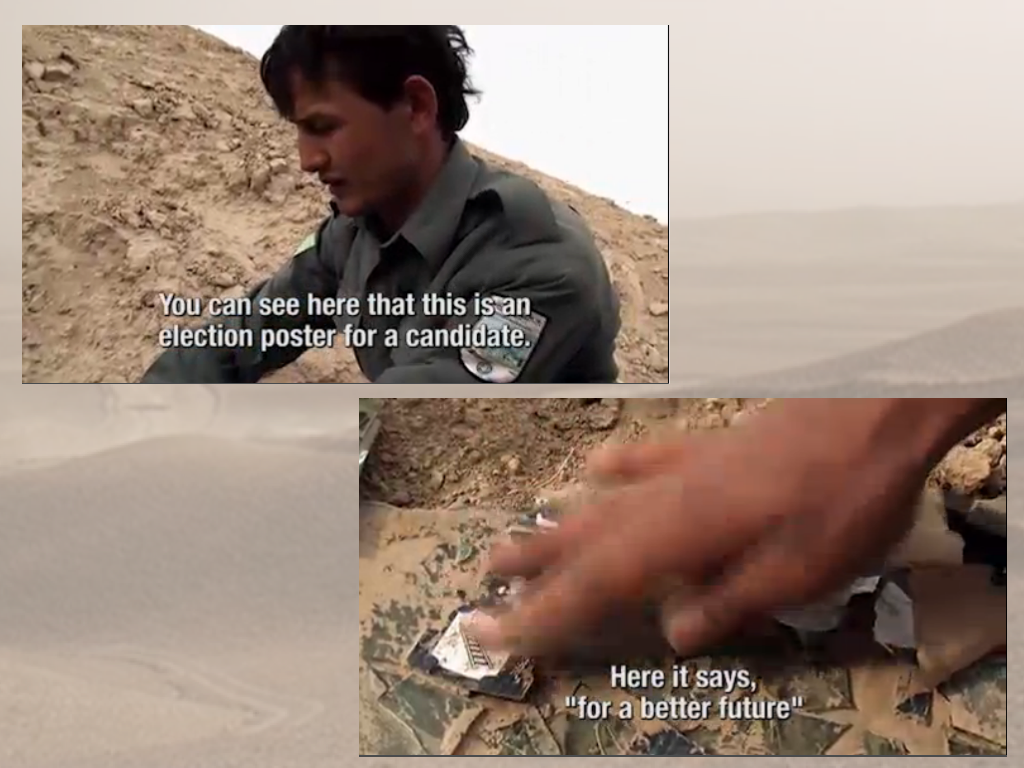
Garrett’s discussion clearly refers to ‘personality strikes’, but – second – the distinction between the evidential/inferential apparatus used for a ‘personality strike’ and for a ‘signature strike’ is by no means clear-cut.  Kate Clark‘s report for the Afghan Analysts Network describes the attempted killing of Muhammad Amin, the Taliban deputy shadow governor of Takhar province.  On 2 September 2010 ISAF announced that a ‘precision air strike’ earlier that morning had killed him and ‘nine other militants’.  The target had been under persistent surveillance from remote platforms – what Petraeus later called ‘days and days of the unblinking eye’ – until two strike aircraft repeatedly bombed the convoy in which he was travelling.  Two attack helicopters were then ‘authorized to re-engage’ the survivors. The victim was not the designated target, however, but Zabet Amanullah, the election agent for a parliamentary candidate; nine other campaign workers died with him. Clark’s painstaking analysis clearly shows that one man had been mistaken for the other, which she attributed to an over-reliance on ‘technical data’ – on remote signatures.  Special Forces had concentrated on tracking cell phone usage and constructing social networks. ‘We were not tracking the names,’ she was told, ‘we were targeting the telephones.’

This is unlikely to be an isolated incident.  Here for example is Gareth Porter:

‘…the link analysis methodology employed by intelligence analysis is incapable of qualitative distinctions among relationships depicted on their maps of links among “nodes.” It operates exclusively on quantitative data – in this case, the number of phone calls to or visits made to an existing JPEL target or to other numbers in touch with that target. The inevitable result is that more numbers of phones held by civilian noncombatants show up on the charts of insurgent networks. If the phone records show multiple links to numbers already on the “kill/capture” list, the individual is likely to be added to the list.’

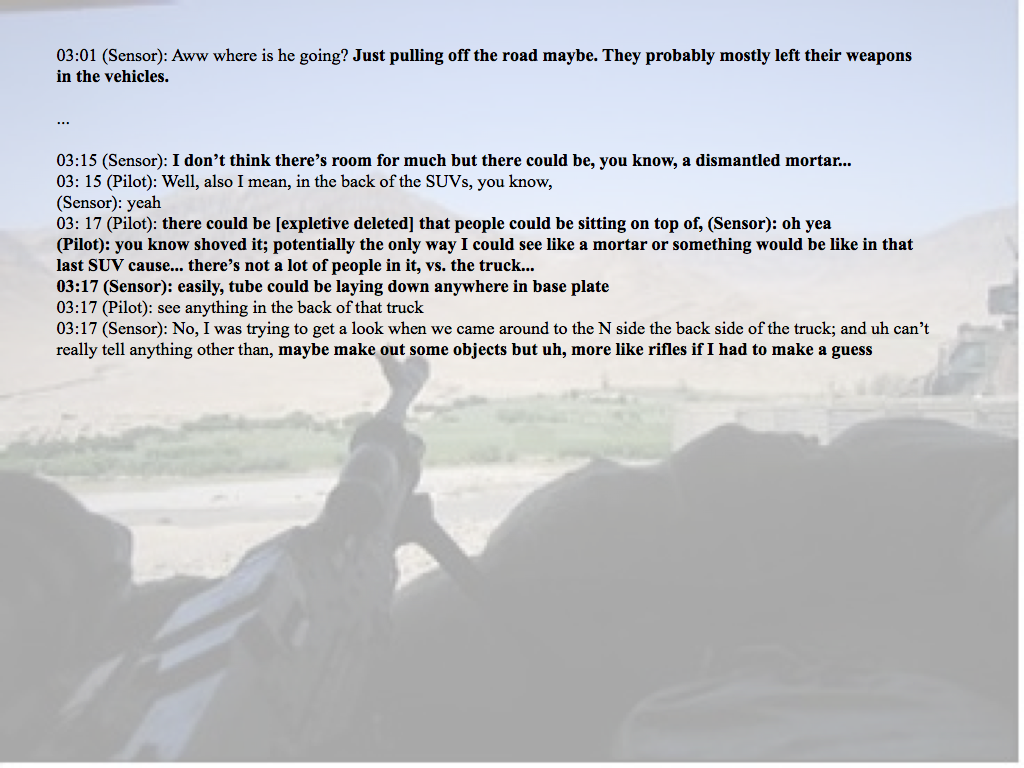
In the Takhar case, despite informed protests to the contrary, ISAF insisted that they had killed their intended target (added emphases are mine):

PBS/Frontline screened a Stephen Grey/Dan Edge documentary on the Takhar incident last year, Kill/Capture, from which the images below are taken (reworked for my presentation on Lines of descent) and which, like Kate Clark’s remarkable report on which it drew, gave the lie to the ISAF statement; the film included an Afghan Police video of the aftermath of the attack: more here, video here, and transcript here.

Finally, there is a persistent propensity to read hostile intent into innocent actions. In ‘From a view to a kill’ (DOWNLOADS tab) I describe in detail an attack launched on 21 October 2010 near Shahidi Hassas in Uruzgan province in central Afghanistan.  In the early morning a Predator was tasked to track three vehicles travelling down a mountain road, several miles away from a Special Forces unit moving in to search a village for an IED factory.

The Predator crew in Nevada had radio contact with the Special Forces Joint Terminal Attack Controller and they were online with image analysts at the Air Force’s Special Operations Command headquarters in Florida. At every turn the flight crew converted their observations into threat indicators: thus the two SUVs and a pick-up truck became a ‘convoy’, cylindrical objects ‘rifles’, adolescents ‘military-aged males’ and praying a Taliban signifier (‘seriously, that’s what they do’).

After three hours’ surveillance two Kiowa helicopters were called in, and during the attack at least 23 people were killed and more than a dozen wounded.  Only after the smoke had cleared did the horrified Predator crew re-cognize the victims as civilians, including women and children.

I’m including a much fuller account in The everywhere war, based on a close reading of the redacted investigative report by Major General Timothy McHale released under a FOI request (the images above are all taken from my Keynote presentation based on the report), and you can also find David McCloud‘s spine-chilling analysis for the LA Times here.  But even in this abbreviated form it’s clear that the cascade of (mis)interpretations offered by the flight crew mimics Kevin’s list of ‘signatures’, where some would be categorised as ‘possibly adequate’ and others as ‘inadequate’.

All of these materials relate to air strikes inside a war zone, so that their modalities are different – in Afghanistan remote platforms like the Predator and the Reaper are one element in a networked ‘killing machine’, and they work in close concert with ground forces and conventional strike aircraft – and the legal parameters are not as contentious as those that govern ‘extra-territorial’ strikes in Pakistan, Somalia or Yemen (which are Kevin’s primary concern).  But they all raise questions about the evidential and inferential practices that are incorporated into the kill-chain that are clearly capable of wider application and concern.

Those questions raise other issues too.  It seems clear, from the examples I’ve given, that to isolate a single platform (the drone) is to contract the scrutiny of military and paramilitary violence that, under the conditions of late modern war, is typically networked.  And to determine the legal status of targeted killing must not foreclose on wider political and ethical decisions: to accept late modern war’s avowed reflexivity is too often to equate legality with legitimacy.

COIN tossing

Anyone who has read Washington Post journalist Rajiv Chandrasekaran‘s Imperial Life in the Emerald City: Inside Iraq’s Green Zone (Vintage, 2006) or his Little America: the war within the war in Afghanistan (Knopf, 2012) – and even those who haven’t – will enjoy David Johnson‘s interview with him at the Boston Review.
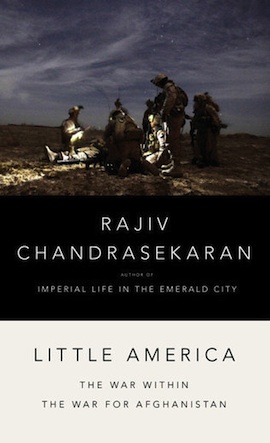
In it Chandrasekaran draws some illuminating parallels (in two words: ‘strategic failure’) and provocative contrasts between the two campaigns:

I surely saw far more imperialistic overtones in Iraq than in Afghanistan. The bulk of my narrative in Little America focuses on how the Obama administration attempted to deal with the situation there. Though they pursued, in my view, a flawed strategy, they did approach it with some degree of humility. I certainly wouldn’t ascribe imperialist aims to the United States in Afghanistan from 2009 onward or even before that. I don’t ever think that we really went about it in that way. Whereas, one can look at what occurred in Iraq, particularly in the early years, and come to a very different conclusion.

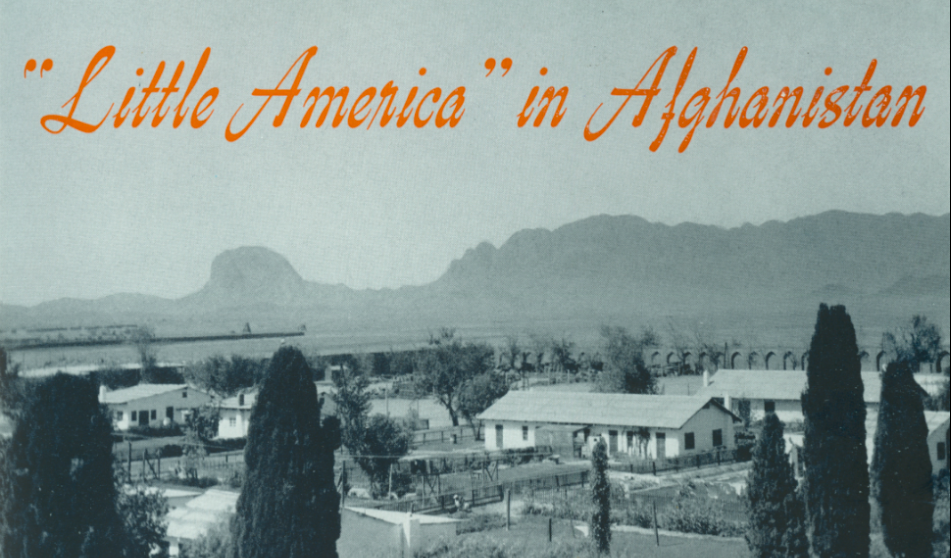
Chandrasekaran has some important things to say about the so-called ‘development-security’ nexus, not least through a comparison with USAID projects in Helmand in the 1950s. You know he’s on to something when Max Boot dismisses it: that was when local people started calling the area ‘Little America’, but Boot says that’s ‘far removed’ from the present situation.  I think Chandresekaran is right; certainly when I was writing the Afghanistan chapters of The colonial present I learned much from Nick Cullather, ‘Damming Afghanistan: modernization in a buffer state’, Journal of American History 89 (2002) 512-37 – a preliminary study researched and written, as he notes, ‘between the beginning of the bombing campaign in late September and the mopping up [sic] of Taliban resistance around Tora Bora in early December 2001.’  Chandresekaran relied on an early version of the essay, and you can now access a later version as Chapter 4 [‘We shall release the waters’] of Cullather’s The hungry world: America’s Cold War battle against poverty in Asia (Harvard, 2010).  Little America loops back to where it began, with one farmer – whose father had been drawn to Helmand by the promise of the new dam – telling Chandresekaran: ‘We are waiting for you Americans to finish what you started.’

This is also the epitaph for what Chandrasekaran sees as ‘the good war turned bad’: too few people were invested in seeing it through.  In the book he paints vivid portraits of those on the ground who were committed to staying the course, but concludes that they were the exception:

‘It wasn’t Obama’s war, and it wasn’t America’s war.  

‘For years we dwelled on the limitations of the Afghans.  We should have focused on ours.’

Not surprisingly, Boot doesn’t care for Chandrasekaran’s take on counterinsurgency either, though his own view is spectacularly devoid of the historical and geographical sensitivity that distinguishes Little America. Boot describes COIN as ‘just the accumulated wisdom of generations of soldiers of many nationalities who have fought guerrillas’ (really) and insists that it (singular) ‘has worked in countries as diverse as the Philippines (during both the war with the U.S. in 1899-1902 and the Huk Rebellion in 1946-54), Malaya, El Salvador, Northern Ireland, Colombia and Iraq.’ Perhaps it all depends on what you mean by ‘worked’…

In fact, Chandrasekaran focuses relentlessly on the work of counterinsurgency.  Little America begins with the sequestered imagery of ‘America abroad’ that will be familiar to readers of Imperial Life in the Emerald City –
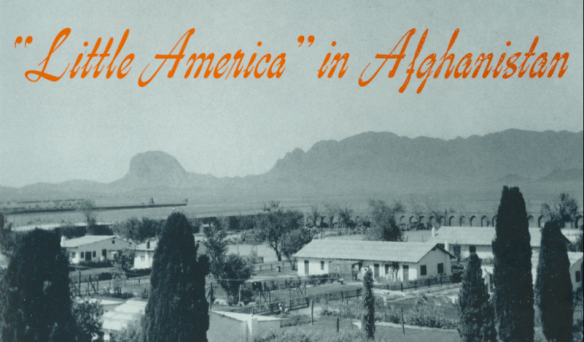
– but soon moves far beyond such enclaves to document operations on the ground. In the interview he provides a pointed evaluation of US counterinsurgency (or lack of it) in Afghanistan:

I think the big lesson of Afghanistan is that we can’t afford to do this. COIN may be a great theory, but it probably will be irrelevant for the United States for the foreseeable future because it’s just too damned expensive and time consuming. You have to understand the value of the object you are trying to save with counterinsurgency—essentially your classic cost-benefit analysis. Even starting in 2009, if we’d mounted a real full-on COIN effort, we probably could have gotten to a better point today. We shouldn’t kid ourselves that what we did was full-on COIN—that would have involved more troops, more money, more civilian experts. But would all of that have been worth it? Was what we’ve already spent on this effort worth it? Particularly given the other national security challenges we face? The economic stagnation at home?  So, the debate over COIN I think misses a key point: it’s not whether it works or not. It’s whether it’s a worthwhile expenditure or not.

(Little America reports that the cost of keeping one US service member in Afghanistan for a year is $1 million… though there are, of course, many other non-monetary costs that fall on many other people).

Chandrasekaran offers a more detailed and nuanced discussion of counterinsurgency in Afghanistan in a fine interview with Peter Munson at the Small Wars Journal.

I described Chandrasekaran as a journalist but he’s (even) more: his website records his residencies as a public policy scholar at the Woodrow Wilson International Center and the Center for a New American Security – which is where he converted his ‘sand-encrusted notebooks’ into the manuscript of Little America – and the International Reporting Project at the Johns Hopkins School for Advanced International Studies.
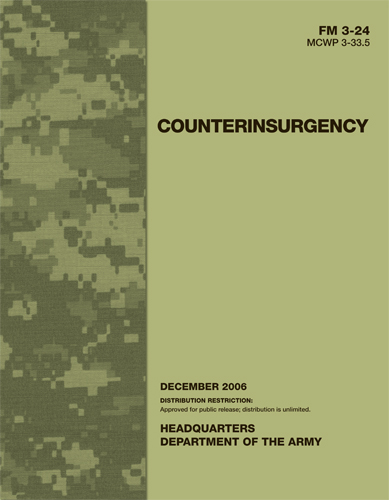
I’m making so much of Chandresekaran’s emphasis on the conduct of counterinsurgency and the connections between reporting and reflection because the academic critique of contemporary counterinsurgency has drawn a bead on the doctrine so vigorously advertised by the US Army and Marine Corps in 2006.  When I wrote “Rush to the intimate” (DOWNLOADS tab) the new field manual FM 3-24 had just been released, and I was interested in how this – together with changes in pre-deployment training, technology and the rest – described a ‘cultural turn’ of sorts that seemed to be addressed as much to the American public as it was to the American military.  (In later work I’ve explored the bio-political dimensions of counterinsurgency too, and I’m presently revising those discussions for the book).

Since then there has been a stream of detailed examinations of the doctrine and its genealogy, and I’d particularly recommend:

Ben Anderson, ‘Population and affective perception: biopolitics and antiicpatory action in US counterinsurgency doctrine’, Antipode 43 (2) (2011) 205-36

Josef Teboho Ansorge, ‘Spirits of war: a field manual’, International political sociology 4 (2010) 362-79

Alan Cromartie, ‘Field Manual 3-24 and the heritage of counterinsurgency theory’, Millennium 41 (2012) 91-111

Marcus Kienscherf, ‘A programme of global pacification: US counterinsurgency doctrine and the biopolitics of human (in)security’, Security dialogue 42 (6) (2012) 517-35

Patricia Owens, ‘From Bismarck to Petraeus:the question of the social and the social question in counterinsurgency’, European journal of international relations [online early: March 2012]

There is indeed something odd about a mode of military operations that advertises itself as ‘the graduate level of war’ (one of Petraeus’s favourite conceits about counterinsurgency) and yet describes a ‘cultural turn’ that is decades behind the cultural turns within the contemporary humanities and the social sciences.  There’s also been a vigorous debate about the enlistment of the social sciences, particularly anthropology, in the doctrinal ‘weaponizing’ of culture – though I sometimes worry that this contracts to a critique of weaponizing anthropology.  (I don’t mean the latter is unimportant – as David Price‘s important work demonstrates – and there are obvious connections between the two.  But disciplinary purity is the least of our problems).

That said, the discussion of counterinsurgency surely can’t be limited to a single text, its predecessors and its intellectual credentials. If there has been a ‘cultural turn’, then its codification now extends far beyond FM 3-24 (which is in any case being revised); if the domestic audience was an important consideration in 2006, the public has certainly lost interest since then (and, if the US election is any guide, in anything other than an air strike on Iran); and whatever the attractions of large-scale counterinsurgency operations in the recent past, Obama’s clear preference is for a mix of drone strikes, short-term and small-scale Special Forces operations, and cyberwar.

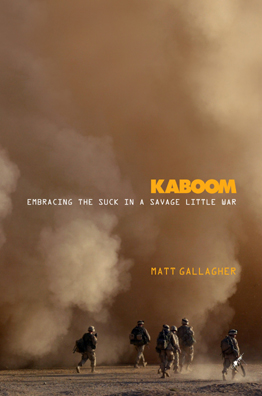
But – Chandresekaran’s sharp point (and Clausewitz’s too) – there’s also a difference between ‘paper war’ and ‘real war’.  Here are just two passages from former Lieutenant Matt Gallagher‘s Kaboom: embracing the suck in a savage little war (Da Capo, 2010) that dramatise the difference between the Field Manual and the field:
‘There was a brief pause and then [Staff Sergeant Boondock] continued. “Think I’ll be able to bust Cultural Awareness out on one of the hajjis now?” he said, referring to the stun gun he carried on his ammo pack… we were all waiting for the day that some Iraqi did something to warrant its electric kiss’ (p. xi). 

‘In this malleable, flexible world, creativity and ingenuity replaced firepower and overwhelming force as the central pillars of the army’s output. Ideally, a decentralized army struck like a swarm of killer bees rather than a lumbering elephant… In conventional warfare, the order of war dissolved into anarchy as time yielded more and more blood. Unconventional, decentralized warfare was the exact opposite. In fluid theory and historical practice, victorious counterinsurgencies served as a shining inverse to … conventionality, because through anarchy and bloodshed, order could eventually be established. This was the war I had trained for, brooded over, and studied. Then there was the war I fought’ (p. 175) 

There’s also a particularly telling passage in David Finkel‘s The good soldiers (Farrar, Straus & Giroux, 2009) that speaks directly to COIN spinning, to its address to the American public and, more particularly, to the body politic:

‘Soldiers such as Kauzlarich might be able to talk about the war as it was playing out in Iraq, but after crossing the Atlantic Ocean from one version of the war to the other, Petraeus had gone to Washington to talk about the war as it was playing out in Washington‘ (p. 130),

I’ve been gathering lots more examples from accounts like these – some of which, like Gallagher’s, started out as military blogs – but one of Chandresekaran’s many achievements is to show what can (must) be achieved when we to turn to an examination of practice.

There have been other studies of counterinsurgency operations – some from within the military, some from within the academy, and some at the nexus between the two – but the need to explore the connections between theory and practice (which are always two-way: the military constantly seeks to incorporate what it calls ‘lessons learned’ into its training) has never been greater.

This isn’t limited to counterinsurgency either: it’s one thing to demand to know what the ‘rules’ governing drone strikes are, for example, but quite another to monitor their implementation.

For academics, none of this is straightforward.  We aren’t war correspondents – and my own debt to courageous journalists like Chandresekaran is immense – and I suspect most of us would be unwilling to enlist in Human Terrain Teams.  There’s a long history to geography‘s military service; today some geographers undertake (critical) field work in war zones – Jennifer Fluri, Philippe le Billon, Michael Watts and others – and no doubt many more geographers live in them.
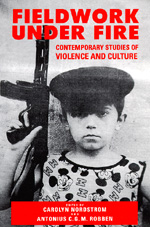
There’s also a particularly rich anthropology written from war zones. I’m thinking in particular of the work of Sverker Finnström (Living with bad surroundings, Duke, 2008), Danny Hoffman (The war machines, Duke, 2011), and Carolyn Nordstrom (especially A different kind of war story, SBS, 2002  and Shadows of war, University of California Press, 2004).

All of these studies approach ‘fieldwork under fire’ from a radically different position to David Kilcullen‘s ‘conflict ethnography’ (which is placed directly at the service of counterinsurgency operations) but, as Neil Whitehead showed, they still raise serious ethical questions about witnessing violence and, indeed, the violence of what he called ‘ethnographic interrogation’ that is often aggravated in a war zone.  (For more, see Fieldwork under fire (left) and Sascha Helbardt, Dagmar Hellmann-Rajanayagam and Rüdiger Korff, ‘War’s dark glamour’, Cambridge Review of International Affairs 23 (2) (2010) 349-69).

To be sure, there is important work to be done ‘off stage’ and in the vicinity of war, as Wendy Jones insists in ‘Lives and deaths of the imagination in war’s shadow’, Social anthropology 19 (2011) 332-41, and overtly techno-cultural modes of remote witnessing have their own dilemmas. But the dangers involved in venturing beyond our screens – and outside our emerald cities – are more than corporeal: they are also intellectual and ethical.

Chandresekaran’s principled combination of reporting and reflection shows how necessary it is to face them down.
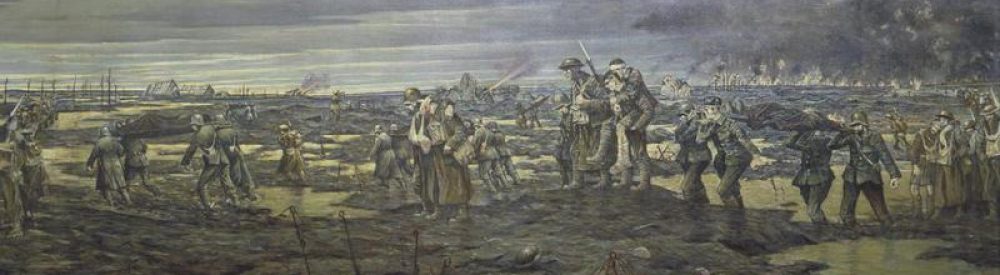
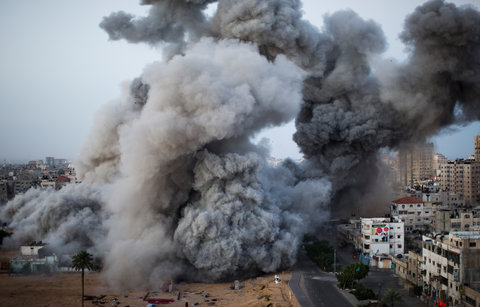
Sound targets

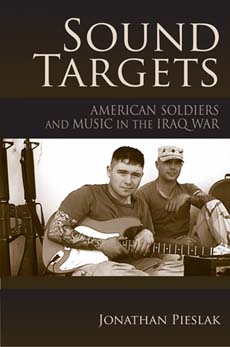
It seems an age since I talked about sound and war, but I haven’t been still(ed).  I’ve just finished Jonathan Pieslak‘s Sound Targets (Indiana, 2009), which adds another dimension to the discussion:

Though a part of American soldiers’ lives since the Revolutionary War, by World War II music could be broadcast to the front. Today it accompanies soldiers from the recruiting office to the battlefield. For this book, Jonathan Pieslak interviewed returning veterans to learn about the place of music in the Iraq War and in contemporary American military culture in general. Pieslak describes how American soldiers hear, share, use, and produce music both on and off duty. He studies the role of music from recruitment campaigns and basic training to its use “in country” before and during missions. Pieslak explores themes of power, chaos, violence, and survival in the metal and hip-hop music so popular among the troops, and offers insight into the daily lives of American soldiers in the Middle East.

As the blurb suggests, there’s a rich history to be traced here and I’ve only just started digging.

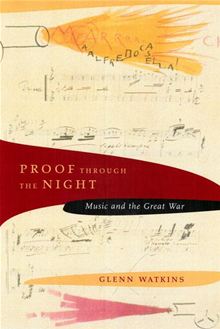
So far I’ve also enjoyed Glenn Watkins‘s Proof through the night: Music and the Great War (University of California Press, 2002) – the title is a line from the ‘Star-spangled banner’ – whose cover shows a Stravinsky manuscript on which the music for his four-hand Marche  (1914) is accompanied by percussive blasts from cannon roughed in by the composer himself.

‘Music in every nation gave “proof through the night” – ringing evidence during the dark hours of the war – not only of its historic role in the definition of nationhood and of nationalist resolve but also of its power on distant battlefields to recall home and hearth and to commemorate loss long after the guns had been stilled.’

So much is probably obvious, but there’s little else that is in this rewarding collection of essays/studies that constantly surprises by its engagements with a wider cultural politics and the sombre refrains of military violence.

High on the ‘to be read’ pile is Christina Baade’s Victory through harmony: the BBC and popular music in World War II (Oxford University Press, 2011), which has an accompanying website with music clips (but only if you’ve got the book so I haven’t included a link here).  The same publisher has also announced Annegret Fauser‘s Sounds of war: music in the United States during World War II for 1913, which apparently argues that ‘it was the role assigned specifically to classical music that truly distinguished musical life in the wartime United States’, so this may be rather narrower in scope than it looks.  Doesn’t look as though there will be much space for swing, jazz and bebop (or even Glenn Miller).

I’ve also rifled through Lee Andresen’s Battle notes: Music of the Vietnam War (Savage, 2003), which I retrieved from a bin in a second-hand bookstore, but I rapidly realised why it was where it was – so if anyone has any good suggestions for articles or books on what is such an obvious theme I’d be really Grateful (and not as in Dead).