About Derek Gregory

I'm Peter Wall Distinguished Professor and Professor of Geography at the University of British Columbia in Vancouver.

War, law and visibilities

Two more forthcoming books on war.
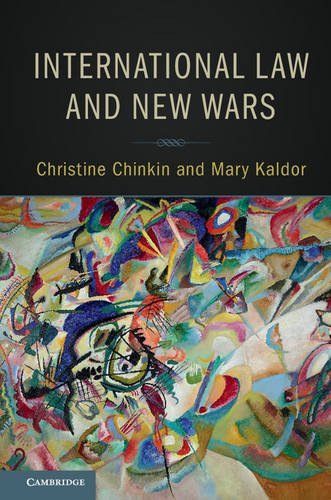
Coming in May from Cambridge University Press, a book Richard Falk hails as ‘the most significant book on international law published in the last decade’, International law and New Wars by Christine Chinkin and Mary Kaldor:

International Law and New Wars examines how international law fails to address the contemporary experience of what are known as ‘new wars’ – instances of armed conflict and violence in places such as Syria, Ukraine, Libya, Mali, the Democratic Republic of Congo and South Sudan. International law, largely constructed in the nineteenth and twentieth centuries, rests to a great extent on the outmoded concept of war drawn from European experience – inter-state clashes involving battles between regular and identifiable armed forces. The book shows how different approaches are associated with different interpretations of international law, and, in some cases, this has dangerously weakened the legal restraints on war established after 1945. It puts forward a practical case for what it defines as second generation human security and the implications this carries for international law.

At 595 pages it’s clearly a blockbuster.  Here is the detailed Contents list:

Part I. Conceptual Framework:
1. Introduction
2. Sovereignty and the authority to use force
3. The relevance of international law
Part II. Jus ad Bellum:
4. Self-defence as a justification for war: the geopolitical and war on terror models
5. The humanitarian model for recourse to use force
Part III. Jus in Bello:
6. How force is used
7. Weapons
Part IV. Jus Post-Bellum:
8. ‘Post-conflict’ and governance
9. The liberal peace: peacemaking, peacekeeping and peacebuilding
10. Justice and accountability
Part V. The Way Forward:
11. Second generation human security
12. What does human security require of international law?

Coming in June from Rutgers University Press, In/Visible War: the culture of war in twenty-first century Americaedited by John Louis Lucaites and Jon Simons:

In/Visible War addresses a paradox of twenty-first century American warfare. The contemporary visual American experience of war is ubiquitous, and yet war is simultaneously invisible or absent; we lack a lived sense that “America” is at war. This paradox of in/visibility concerns the gap between the experiences of war zones and the visual, mediated experience of war in public, popular culture, which absents and renders invisible the former. Large portions of the domestic public experience war only at a distance. For these citizens, war seems abstract, or may even seem to have disappeared altogether due to a relative absence of visual images of casualties. Perhaps even more significantly, wars can be fought without sacrifice by the vast majority of Americans.
Yet, the normalization of twenty-first century war also renders it highly visible. War is made visible through popular, commercial, mediated culture. The spectacle of war occupies the contemporary public sphere in the forms of celebrations at athletic events and in films, video games, and other media, coming together as MIME, the Military-Industrial-Media-Entertainment Network.

Here’s the main Contents List:

Part I: Seeing War

Chapter 1: How Photojournalism Has Framed the War in Afghanistan – David Campbell Chapter 2: Returning Soldiers and the In/visibility of Combat Trauma – Christopher J. Gilbert and John Louis Lucaites Chapter 3: (Re)fashioning PTSD’s Warrior Project – Jeremy G. Gordon Chapter 4: Unremarkable Suffering: Banality, Spectatorship, and War’s In/visibilities – Rebecca A. Adelman and Wendy Kozol “War Is Fun,” a Photo-Essay – Nina Berman Chapter 5: Laying bin Laden to Rest: A Case Study of Terrorism and the Politics of Visibility – Jody Madeira

Part II: Not Seeing War

Chapter 6: Digital War and the Public Mind: Call of Duty Reloaded, Decoded – Roger Stahl Chapter 7: A Cinema of Consolation: Post-9/11 Super Invasion Fantasy – De Witt Douglas Kilgore Chapter 8: Differential Configurations: In/visibility through the Lens of Kathryn Bigelow’s The Hurt Locker (2008) – Claudia Breger Chapter 9: Canine Rescue, Civilian Casualties, and the Long Gulf War – Purnima BosePart III:

Theorizing the In/visibility of War 

Chapter 10: The In/visibility of Liberal Peace: Perpetual Peace and Enduring Freedom – Jon Simons Chapter 11: Why War? Baudrillard, Derrida, and the Absolute Televisual Image – Diane Rubenstein Chapter 12: War in the Twenty-first Century: Visible, Invisible, or Superpositional? – James Der Derian
Bombing Raqqa

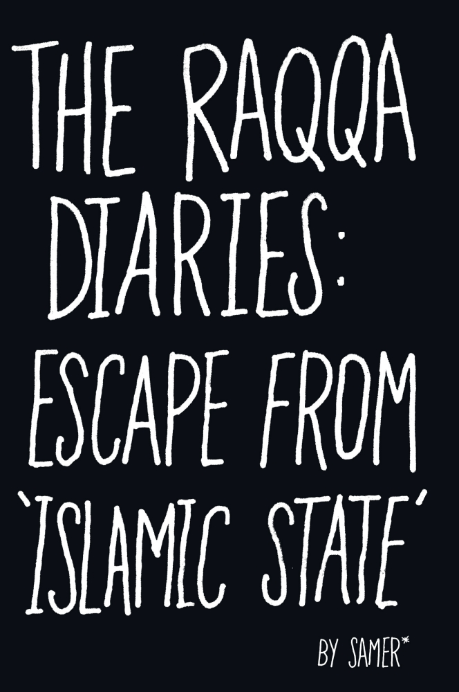
I picked up a copy of The Raqqa Diaries while I was in the UK; you can read extracts here and here, but they were originally broadcast on BBC Radio 4’s Today program and you can find more extracts (and videos) here and here.

The diaries were written by a young man, a member of an activist group, who courageously describes the horrors and humiliations inflicted by Islamic State on ordinary people.  He explains:

I had the idea just before the revolution began, when the Arab Spring started unfolding. Syrian people knew that the winds of change were approaching, but the idea truly manifested itself after Islamic State took over Raqqa. Diaries are normally private, and are mostly only read after the passing of the diarist. But, as I detail in my diaries, because of the crimes and oppression that Isis were committing against our people, I felt I had to fight back by telling the world what they are continuing to do to us.

But those who cheer the war from the air might also reflect on this passage:

My brothers, sisters and I had planned a small party for Mother’s Day. It was a cold March morning and I heard the sound of warplanes. I immediately set out for home.

As the taxi got closer, clouds of smoke filled the air. The regime’s planes had hit our street. Our neighbour’s roof had collapsed on to ours. There were ambulances everywhere, and people running around carrying the dead and the injured.

One of my neighbours told me that my parents were hurt and had been taken to the general hospital. The feeling I had was indescribable. Judging by the way our house looked, I was expecting the worst. The top floor was completely destroyed and much of the ground floor was badly damaged too. Our neighbour’s house was in a similar state.

When my brothers, sisters and I arrived at the hospital, the smell of blood and death filled the place. We were asked to look at the bodies laid out in front of us to see if our parents were among them.

I was in such a state of shock at that moment that I suddenly couldn’t remember anything. As I stood beside my father, it was like nothing that had happened before that moment mattered. There was my dad. His body was littered with injuries. They had covered most of his corpse with a white sheet, but his face was still showing. I could see blood seeping through the sheet from numerous cuts. The telltale sign of shrapnel wounds.

I was overwhelmed with a sense of absolute loneliness and collapsed on the floor. I had lost my mentor, my guide in life, the man who always had an answer to everything. This was one of the darkest moments of my life. My father’s death has continued to haunt me. It’s changed something in me.

“Your mother is being treated in here,” a voice said quietly, “but don’t go in yet.” Two hours passed and finally a doctor came out. I told him that I was her son. “I’ve managed to save her life, but she’s very sick,” he said.

Samer describes a raid by the Syrian Arab Air Force but, as one exile now living in Turkey told the Guardian in November 2015:

“Can someone really be happy if his city is bombed by everyone? No,” Abu Ahmad said, with the bleak humour that many exiles share. “Everybody bombed Raqqa. Anyone who was just annoyed by their wife decided to come and bomb Raqqa. Jordan, UAE, US, Russia, France.”

NOTE: My cascade of posts on Syria does not mean I’m ignoring the unremitting Us-led coalition airstrikes on Mosul and their civilian toll: I’ll post on that as soon as I can.

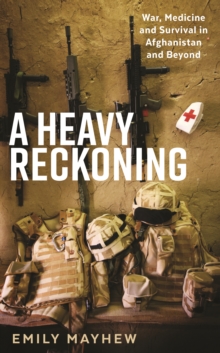
A heavy reckoning

Emily Mayhew‘s Wounded was one of the catalysts for my present research project on medical care and casualty evacuation in war zones.  The original idea was to complete four case studies – the Western Front in the First World War, the deserts of North Africa in the Second, Vietnam and Afghanistan – but since then it has expanded to include a detailed analysis of attacks on hospitals and healthcare in Syria and elsewhere.  But running throughout these investigations is an interest in what Emily called ‘precarious journeys‘ – and a determination to break away from the usual academic voice (see here) –  so an announcement of her new book is extremely welcome.

It’s due from Profile in May:

What happens when you reach the threshold of life and death – and come back? As long as humans have lived together on the planet, there have been wars, and injured soldiers and civilians. But today, as we engage in wars across the globe with increasingly sophisticated technology, we are able to bring people back from ever closer encounters with death. But how do we do it, and what happens next? Here, historian Emily Mayhew explores the modern reality of medicine and injury in wartime, from the trenches of World War One to the dusty plains of Afghanistan and the rehabilitation wards of Headley Court in Surrey. Mixing vivid and compelling stories of unexpected survival and giving astonishing insights into the frontline of medicine, A Heavy Reckoning is a book about how far we have come in saving, healing and restoring the human body. But what are the costs involved in this hardest of journeys back from the brink? From the plastic surgeon battling to restore function to a blasted hand to the double amputee learning to walk again on prosthetic legs, Mayhew gives us a new understanding of the limits of human life and the extraordinary costs paid both physically and mentally by casualties all over the world in the twenty-first century.

The book is published in conjunction with the Wellcome Collection, and I should note that Emily has also co-curated the current exhibition Wounded: Conflict, Casualties and Care at London’s Science Museum (more information here and here).  I spent a fascinated couple of hours there when I was in London last month – it is well worth a visit, though the parallels it draws between the Western Front and Afghanistan were too abbreviated for me.

Mapping Syria

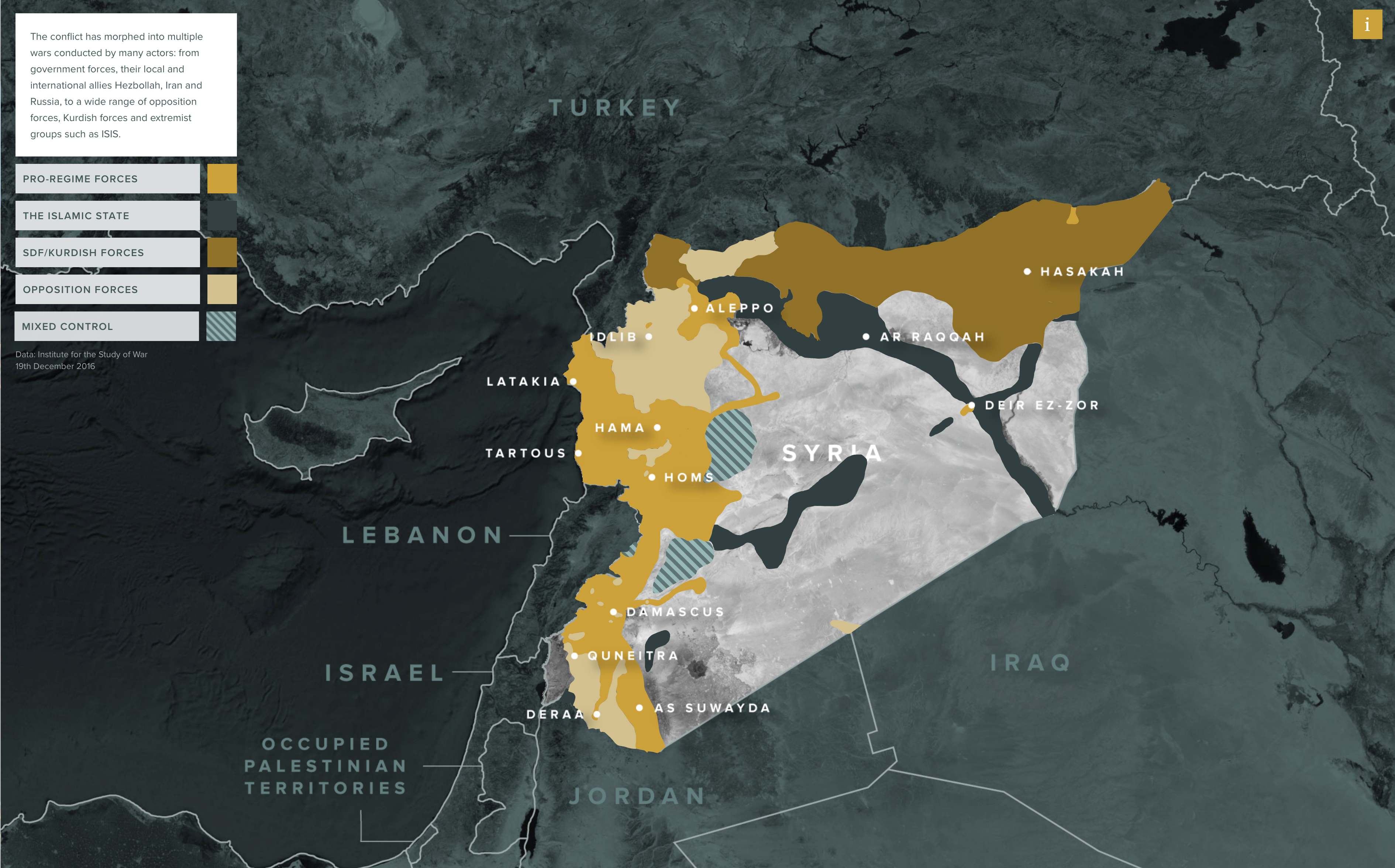
I’ve had several e-mails about maps of the conflict in Syria.  For a quick introduction, a good place to start is Chatham House‘s interactive series here.  It’s illuminating and impressive: scroll down and you’ll see what I mean.

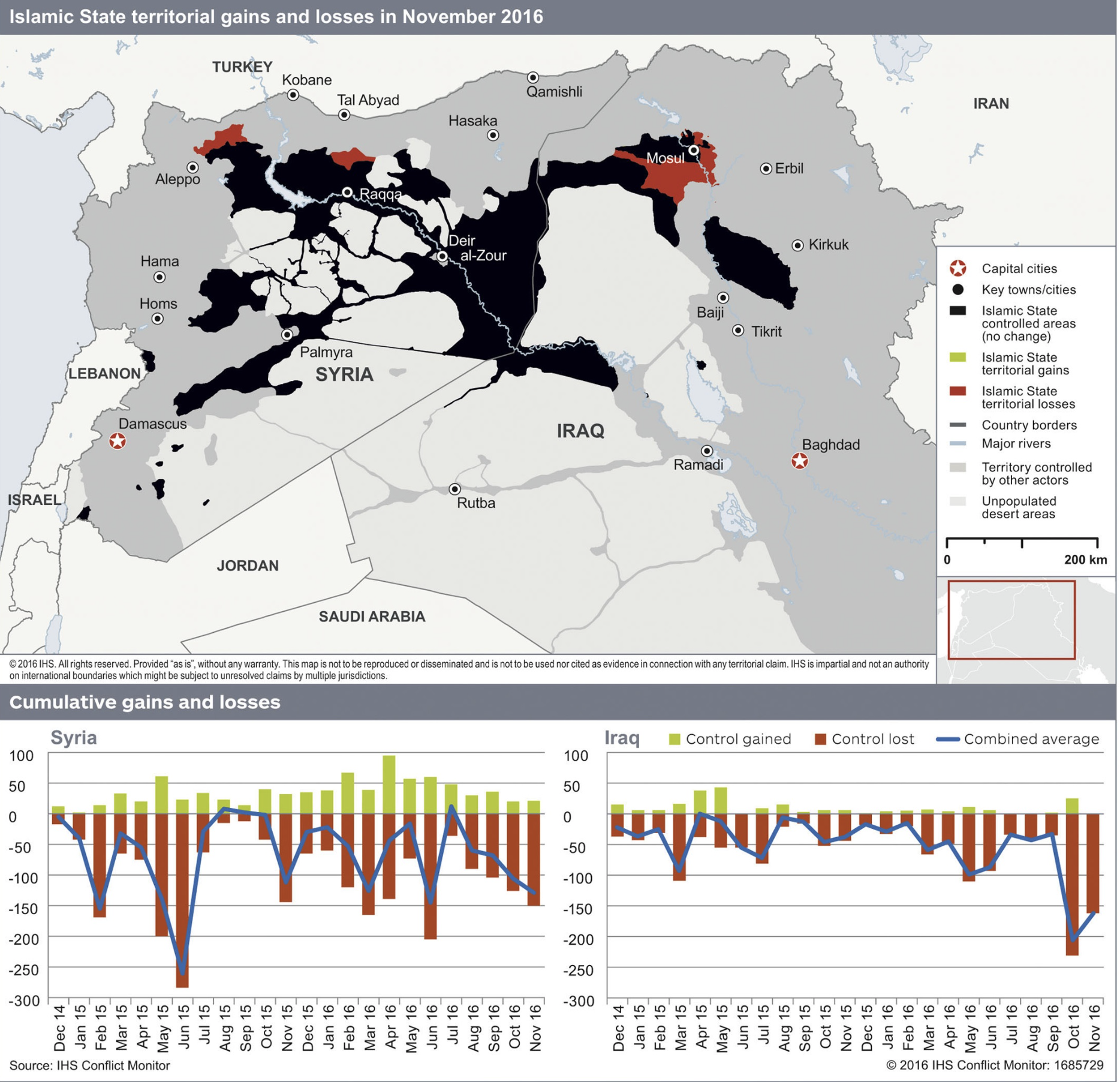
Most press maps – including those in the Guardian and the New York Times – use multiple sources for their mapping projects, but most of them incorporate data from the IHS Conflict Monitor and the Institute for the Study of War.

IHS Conflict Monitorproduced by  IHS (Information Handling Services: Jane’s is a subsidiary), combines geospatial intelligence and social media monitoring.  It’s been particularly effective in tracing the territorial extent of IS and other insurgent groups in Syria:

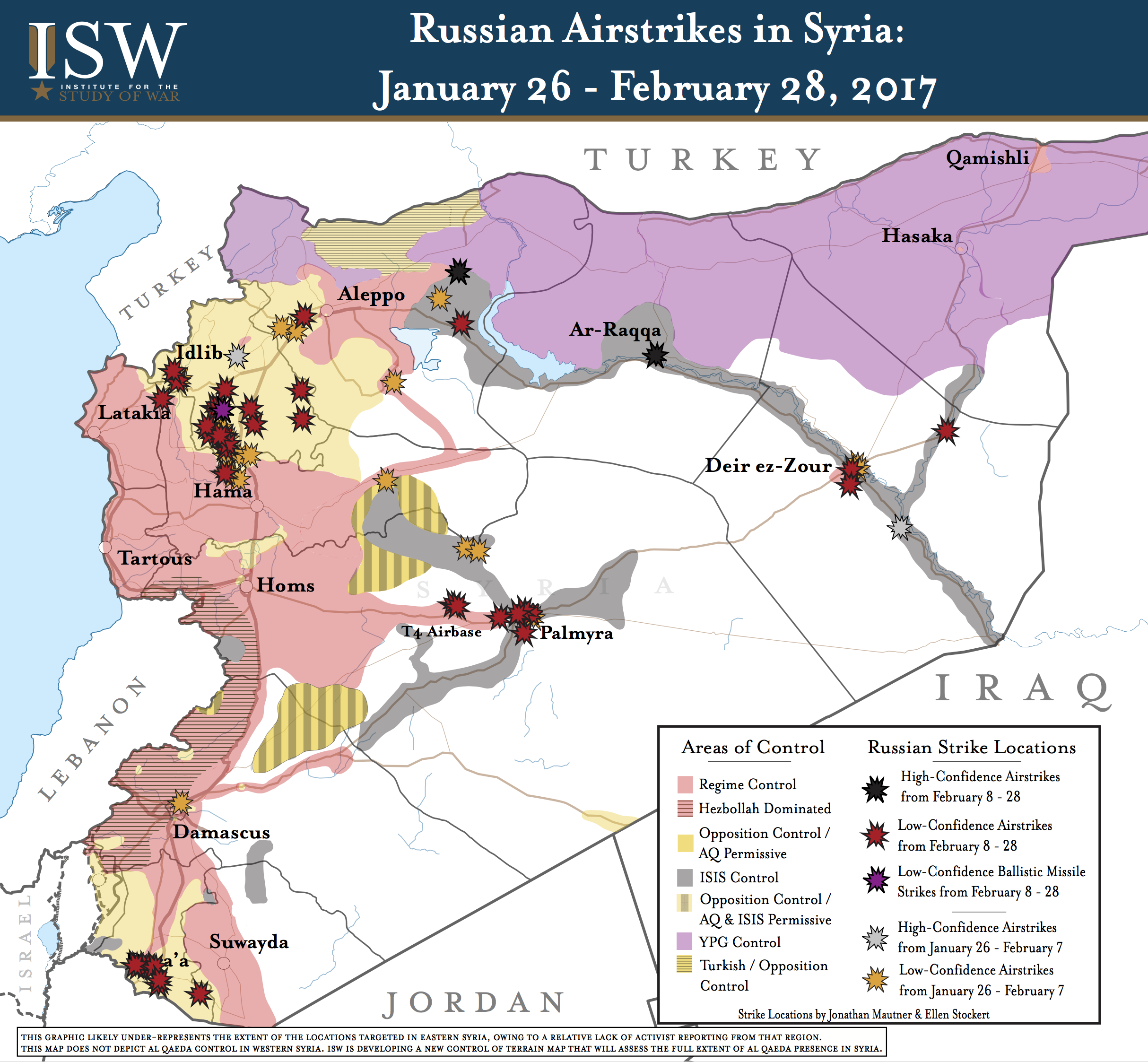
The credentials of the Institute for the Study of War are thoroughly neo-conservative (it was established by Kimberly Kagan in 2007), but its maps have drawn users of all stripes  – and stars – to them: you can find an assessment by Evan Lewis at GeoCurrents here.  The map below plots Russian airstrikes – for comparable data on US-led airstrikes you need Airwars – but what the press are usually most interested in is the background data on shifting areas of control.

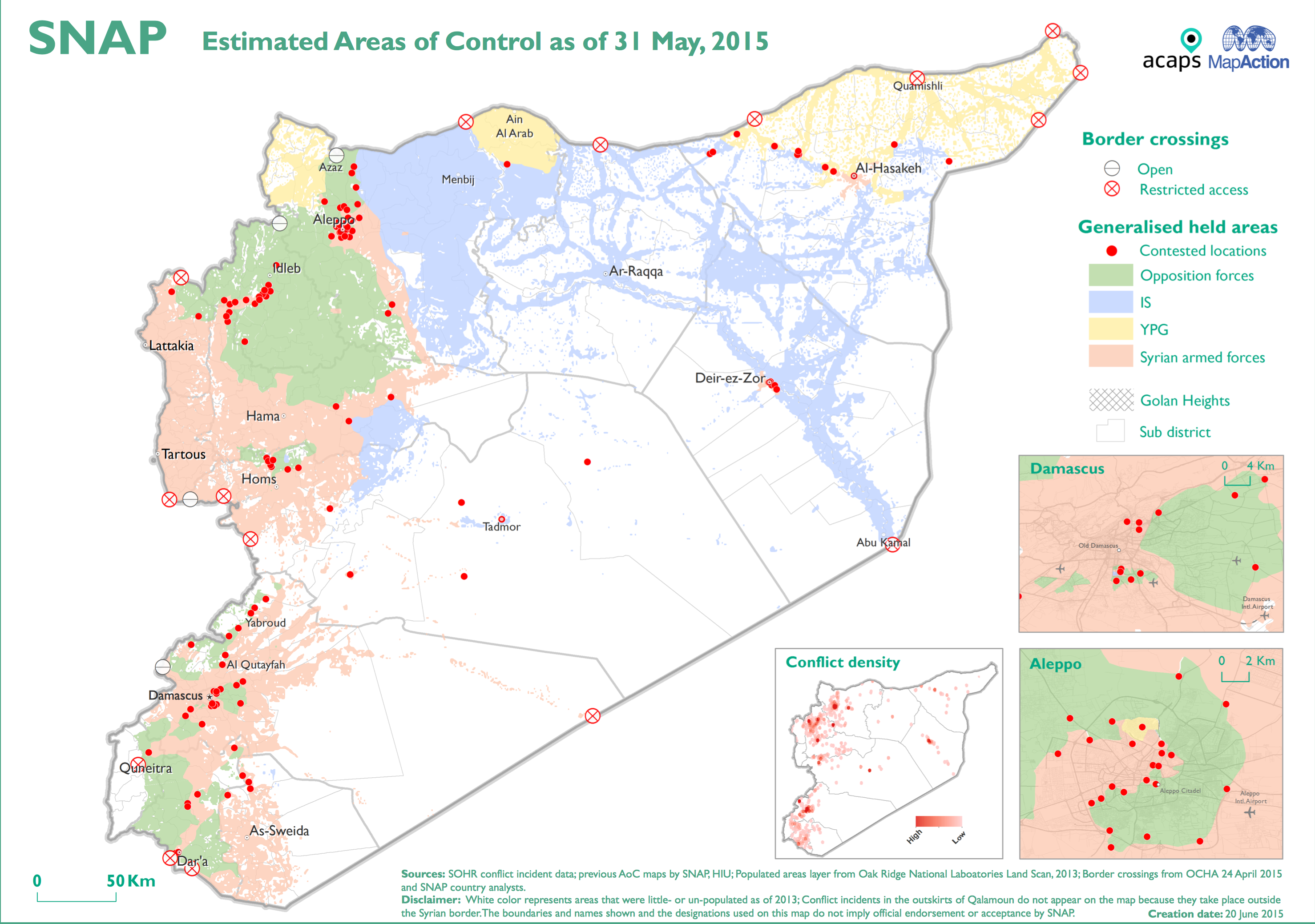
From December 2012 until it closed in June 2015 ACAP‘s Syria Needs Analysis Project (SNAP) also provided a series of maps plotting the changing areas of control:

Still ongoing, the Carter Center’s Conflict Resolution Program has an invaluable mapping project that issues weekly conflict reports:

Since 2012, the Syria Conflict Mapping Project has worked to analyze open source information related to the Syrian conflict in as much detail as possible, with the goal of assisting mediators and humanitarian responders. Using these publicly available resources, as well as regular consultations with stakeholders in the country, the Center has documented and mapped over 70,000 conflict events in Syria (including clashes, aerial bombardments, artillery shelling, etc.), the changing relations between thousands of armed groups, movements of internally displaced people, and humanitarian conditions.

Analyzed together, this information allows The Carter Center to provide mediators and humanitarian responders with up-to-date, detailed analysis on developments throughout Syria. Additionally, the Center maintains a near real-time, auto-updating map of areas of control throughout Syria. All of this information is analyzed and is shared directly with mediators and humanitarian organizations through a software tool provided by Palantir Technologies.

Regular readers (if not of this blog then of The Intercept) will detect the irony of the involvement of Peter Thiel‘s Palantir (for its enlistment in the NSA’s global surveillance, see here; for its function as the engine of Trump’s ‘deportation machine’, see here).  But the Carter Centre’s maps are really helpful, not least for the historical sequence they provide, monthly from January 2015.  I’ve grabbed a screenshot below, and you can access the full sequence here.

You wouldn’t guess it from the corporate-speak in the paragraph I quoted, but these maps draw heavily from social media too.  As Kane Farabaugh explains:

Despite a gap in media coverage, a then-enterprising intern discovered reliable information was available, hiding in plain sight, due largely to the fact the Syrian conflict unfolded in a part of the world where many are connected, digitally.

“Syrians, and people in the Middle East in general, are two to four times more likely to share information about politics, and religious views online,” said that former intern, Christopher McNaboe, citing a Pew Research Center study on social media habits of those living in the Middle East.

“In the case of Syria, there’s just too much. Videos, Facebook posts, tweets, blogs, photos, you name it…Syrians are very active and passionate about getting information out,” he said….

“The information available online ranges anywhere from political statements, and defections, and armed group formations, to footage of the actual fighting, and humanitarian relief efforts; you name it,” says McNaboe.

“I think the Syrian conflict represents a major paradigm shift, a major change in the way in which conflict plays out,” he adds. “Previous conflicts did not take place in connected environments like Syria. There wasn’t YouTube. There wasn’t Twitter.”

Finally, over at the National Geographic Gael Cérez and Chris O’Brien provide an illuminating survey of several online cartographers (Cartography 2.0 in action) – including the remarkable Robert Cross, one of the founders of the Institute for United Conflict Analysts – and append a list noting those cartographers who are ‘pro-rebel’, ‘pro-government’ and ‘pro-Kurd’.  More on crowd-sourcing maps of the conflict from Aleszu Bajek here.

The Good Drone

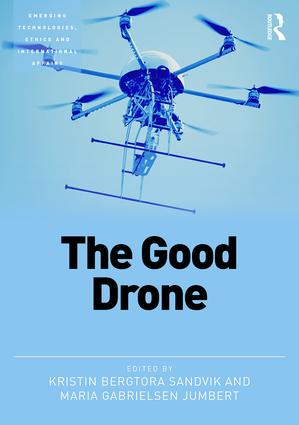
Returning to Vancouver and my stuffed mailbox after several weeks away, I found a copy of The Good Drone edited by Kristin Bergtora Sandvik and Maria Gabrielsen Jumbert (thank you both!).  I’ve known Kristin for several years now, and always learned much from her insightful and imaginative work, and it’s wonderfully refreshing to find a book that has so many new things to say about drones:

While the military use of drones has been the subject of much scrutiny, the use of drones for humanitarian purposes has so far received little attention. As the starting point for this study, it is argued that the prospect of using drones for humanitarian and other life-saving activities has produced an alternative discourse on drones, dedicated to developing and publicizing the endless possibilities that drones have for “doing good”. Furthermore, it is suggested that the Good Drone narrative has been appropriated back into the drone warfare discourse, as a strategy to make war “more human”.

This book explores the role of the Good Drone as an organizing narrative for political projects, technology development and humanitarian action. Its contribution to the debate is to take stock of the multiple logics and rationales according to which drones are “good”, with a primary objective to initiate a critical conversation about the political currency of “good”. This study recognizes the many possibilities for the use of drones and takes these possibilities seriously by critically examining the difference the drones’ functionalities can make, but also what difference the presence of drones themselves – as unmanned and flying objects – make. Discussed and analysed are the implications for the drone industry, user communities, and the areas of crisis where drones are deployed.

Here are the substantive chapters (following a sparkling introduction by the editors):

1: Susanne Krasmann – Targeted ‘Killer Drones’ and the Humanitarian Discourse: On a Liaison

2: John Karlsrud and Frederik Rosén – Lifting the Fog of War? Opportunities and Challenges of Drones in UN Peace Operations

3: Kristoffer Lidén and Kristin Bergtora Sandvik – Poison Pill or Cure-All: Drones and the Protection of Civilians

4: Maria Gabrielsen Jumbert – Creating the EU Drone: Control, Sorting, and Search and Rescue at Sea

5: Kristin Bergtora Sandvik – The Public Order Drone: Proliferation and Disorder in Civil Airspace

6: Brad Bolman– A Revolution in Agricultural Affairs: Dronoculture, Precision, Capital

7: Serge Wich, Lorna Scott, and Lian Pin Koh – Wings for Wildlife: the use of Conservation Drones, challenges and opportunities

8: Mareile Kaufmann – Drone/Body: the Drone’s Power to Sense and Construct Emergencies

It’s available as an e-book, which brings the otherwise usurious price within reach, but if you want a preview of Kristin’s work I recommend her essay (with Kjersti Lohne) on ‘The rise of the humanitarian drone’ in Millennium 43 (1) (2014) 145-164.

The Walled Off Hotel

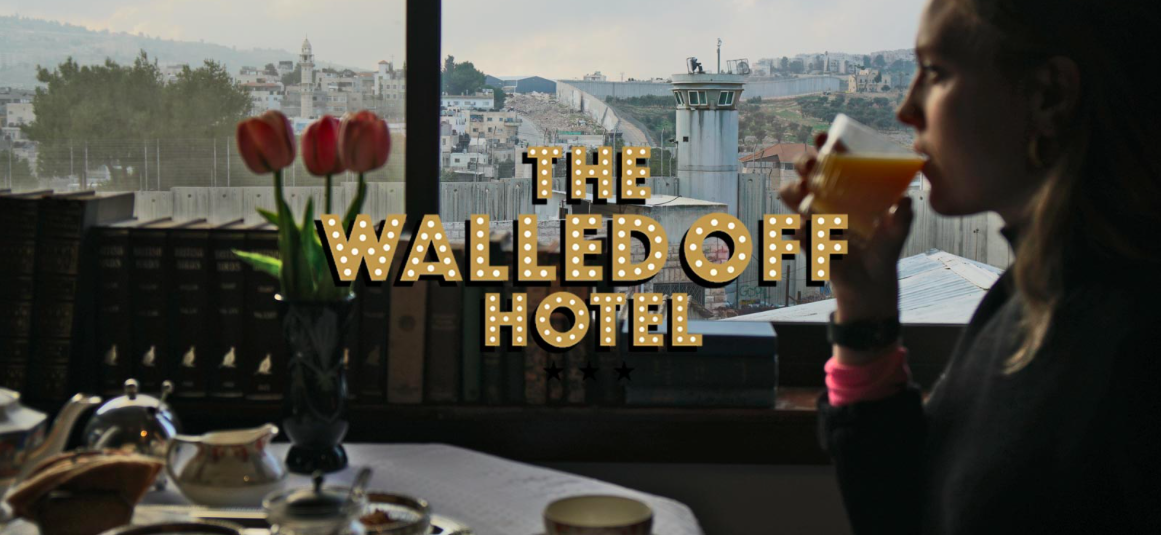
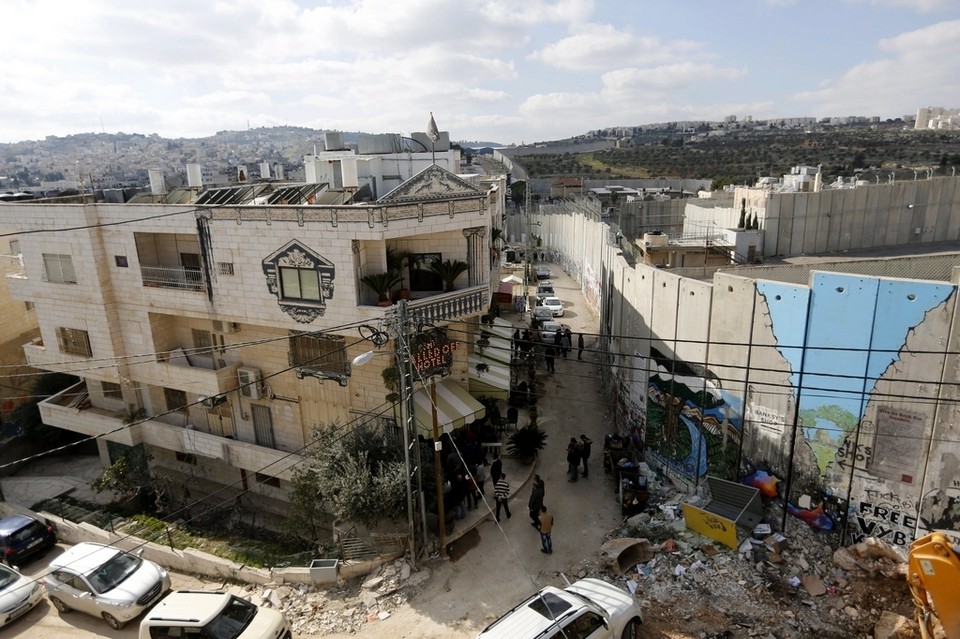
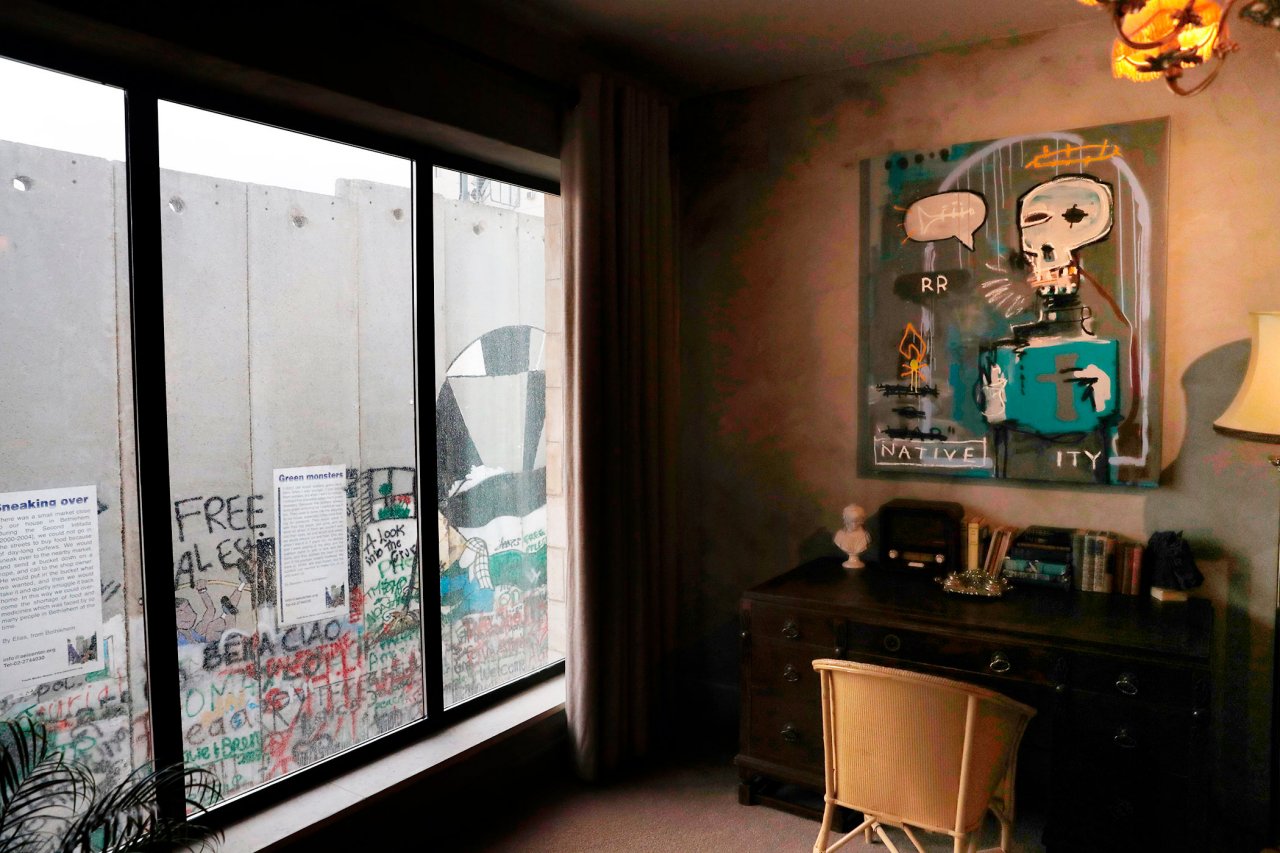
Many readers will already know of Banksy‘s most recent project – the Walled Off [not Waldorf!] Hotel on Caritas Street in occupied Bethlehem, which opened earlier this month.  The hotel’s website is here, and this is extracted from the FAQ:

 The hotel is located in a bustling area fully open to tourists from across the world. It has all the restaurants, bars and taxis you’d expect. We’re 500 metres from the checkpoint to Jerusalem and a mile from the centre of Bethlehem…

You don’t need a visa to enter Israel as a tourist and you can stay for up to 3 months. Visitors entering via Tel Aviv airport are given an entry card in their passport. So, unlike the locals, you’ll be permitted to travel wherever you wish.

The Walled Off Hotel is an entirely independent leisure facility set up and financed by Banksy. It is not aligned to any political movement or pressure group. The aim is to tell the story of the wall from every side and give visitors the opportunity to discover it for themselves. We offer an especially warm welcome to young Israelis.

The artist paid for the installation costs and has now handed it over as an independent local business. The aim is to break even and put any profits back into local projects.

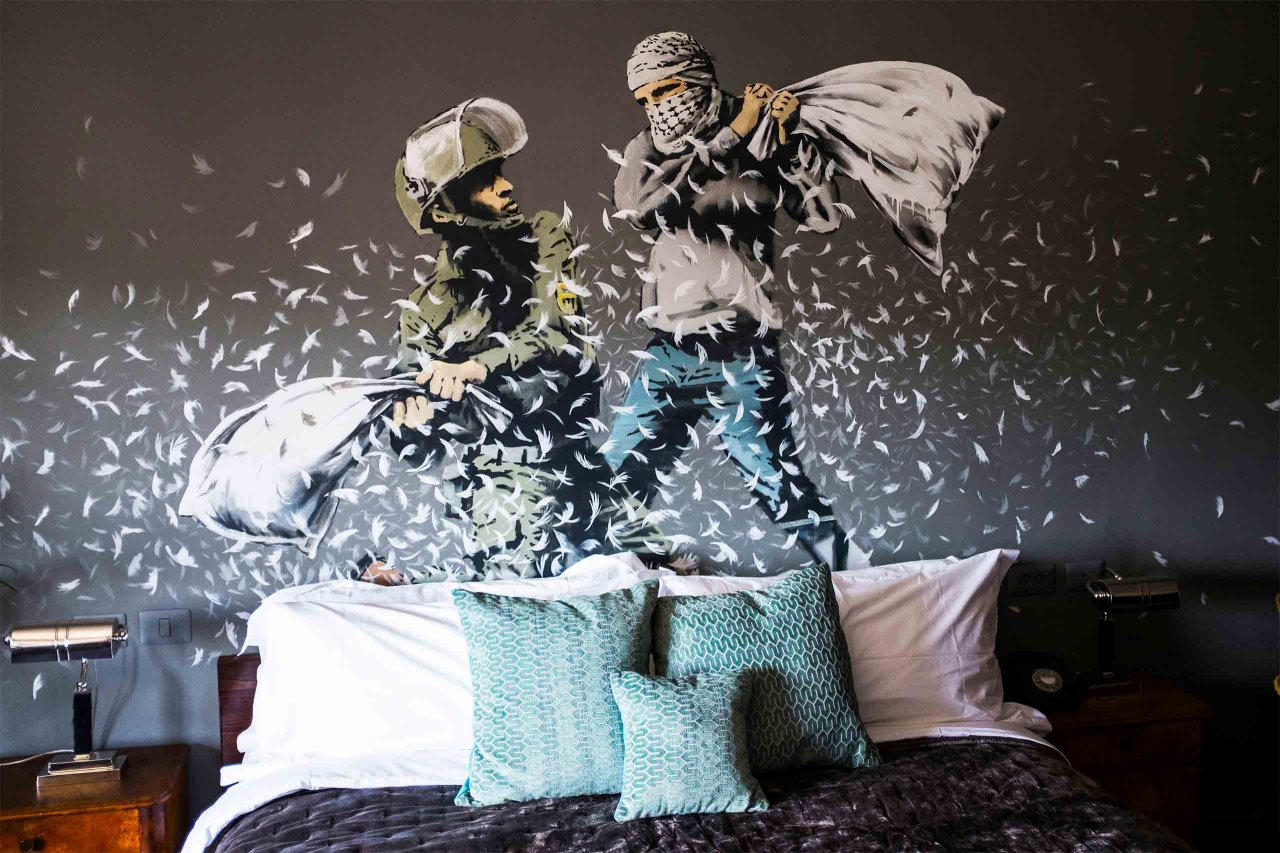
You can find more images here.

Jamil Khader provided an insightful commentary on the project – especially the resonances with the colonial architecture of the Balfour Declaration and, amongst the installation-hotel’s many internal installations, the Gaza Memorial – for al Jazeera here.  And now Jamil has provided a longer, spellbinding commentary over at the Middle East Research and Information Project (MERIP) here.  Here’s a key extract in which he discusses what he calls ‘Occu-tourism and the commodification of Palestinian suffering’:

Instead of culturalizing the political struggle and coopting it in the language of multicultural tolerance, Banksy draws attention to the contradictions of Palestine’s captive economy under occupation, and especially the sociopolitical effects of occu-tourism on the commodification of Palestinian suffering and oppression. For Banksy, no political solution is viable without sustainable economic independence.

The Walled Off Hotel itself was allegedly planned to help reinvigorate the local economy in the Bethlehem area, by providing employment opportunities for local residents struggling for decent living under conditions of scarcity. However, it is not clear how such revenues can be generated and how sustainable they can be given the low daily rate charged for the limited number of rooms on offer. While other businesses in the same area have fallen off a cliff as a result of the wall, it is also unclear how this business can survive and thrive. And this is the point.

The installation-hotel thus becomes a parody of the many occu-touristic commercial ventures and other forms of alternative tourism and entrepreneurial activities that have developed around the occupation and apartheid wall in Palestine, both by Palestinians and international solidarity movement activists. However, some of these occu-tourism enterprises can collapse into staged spectacles for the entertainment of vacationing international travelers, who enjoy the adrenaline of confrontations with the Israeli military. Moreover, occu-tourism elevates Palestinian suffering into an ontological condition and erases histories of Palestinian agency and resistance. Rebecca Gould has thus correctly pointed out that “suffering is nowhere as globally implicated or heavily interpolated into the global public sphere as it is in Palestine.”

Nonetheless, the installation-hotel aims to move occu-tourists and other international travelers out of their comfort zone and educate them in the Palestinian struggle for freedom. First, Banksy invades the private space of these visitors by reworking a classic Western pastoral painting, in which he inserts a futuristic or cubistic bulldozer into the private space of a European family. He thus turns the idyllic rural European scene from Western art into a horror scene which is all too common in Palestine.

Furthermore, the installation-hotel provides ample opportunities for these visitors to educate themselves about the Palestinian struggle…. Many high quality photographs and posters present facts about the settlements, the wall, and checkpoints. In one interesting glass case, a cross-section from the earth reveals the contrast between the Palestinian and Israeli underground water distribution systems: The narrow rusty iron pipes used in Palestine pale in comparison to the thick, wide copper pipes that Israel uses in controlling the water resources and consumption in the West Bank.

A section of the wall in the educational area also pays tribute to the boycott, divestment and sanctions (BDS) movement. It presents a sample of some major products, including Coca-Cola cans, Sabra salads and Ahava Dead Sea personal care items—all of which have been the target of the BDS. There is also information about BDS’ impact and reception around the world. In an adjacent section, a video loop plays the testimonies of former Israeli soldiers, detailing their daily violations of Palestinian human rights.

More importantly, Banksy situates occu-tourism within the contradictions of the Palestinian captive economy under occupation and the global capitalist economy in general. According to early reports, Banksy has also placed Israeli products in the hotel rooms, including Dead Sea bath minerals, in a clear statement about the ironies of Palestinians ultimately financing their own occupation.

Do read the whole essay (Jamil is particularly good on the image I’ve reproduced below).

There is, incidentally, another hotel – often known as the Banksy Guest House – in Bethlehem, and for a discussion of local (critical) reactions to the project see here.  The issue is not only about the impact on the local economy (to which the FAQ above respond effectively, I think) but also the more general issue confronting so many artistic interventions:

“I see how [Banksy’s] work brings a lot of people to Bethlehem to see the wall and the city,” says Ayed Arafah, another local artist. “But now all the people who come to take photos of the paintings and graffiti… it’s become like Disneyland. Like you are living in a zoo.”

But I also think Jamer’s commentary squares that vicious circle too.  See what you think.

The weaponisation of health care

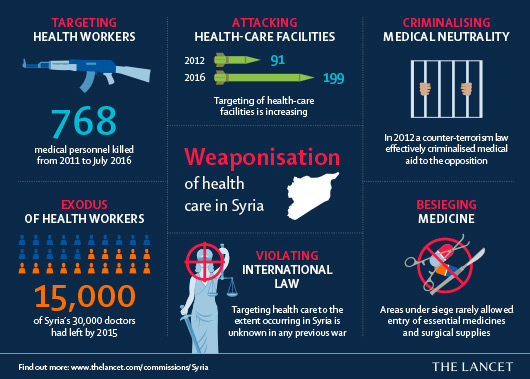
I’m continuing to work on attacks on hospitals and health care workers in conflict zones – see ‘The Death of the Clinic’ here for a general discussion – and I’ve just finished reading the preliminary report on the weaponisation of health care from The Lancet-American University of Beirut Commission on Syria.  You can find out more on the Commission here and download the open access report here.

The authors propose the ‘weaponisation of health care’ to capture ‘the phenomenon of large-scale use of violence to restrict or deny access to care as a weapon of war’:

Weaponisation is multi-dimensional and includes practices such as attacking health-care facilities, targeting health workers, obliterating medical neutrality, and besieging medicine. Through large-scale violations of international humanitarian laws, weaponisation of health care amounts to what has been called a “war-crime strategy”. Weaponisation of health care in the Syria conflict is manifested most notably in the targeting of health workers and facilities.

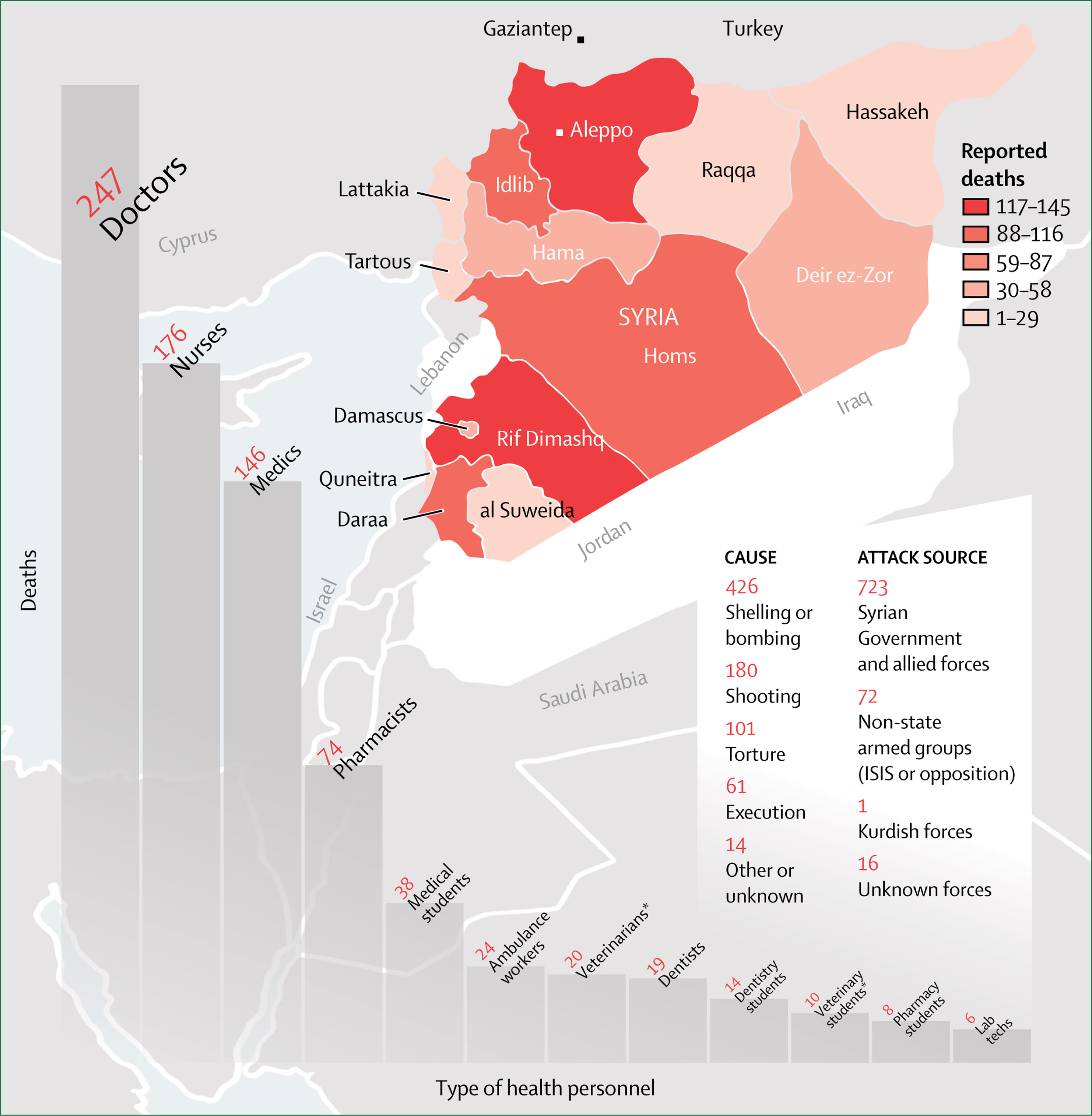
They trace the targeting of health-care workers by pro-government forces in Syria back to the earliest weeks of protest against the regime, but the ‘substantial militarisation’ that followed – especially after the ‘military surge’ that began in September 2015 when Russia joined the Syrian government forces – made those attacks ever more aggressive and ever more systematic.  This map, based on the work of Physicians for Human Rights, provides a minimal accounting of attacks on doctors, nurses and other healthcare workers:

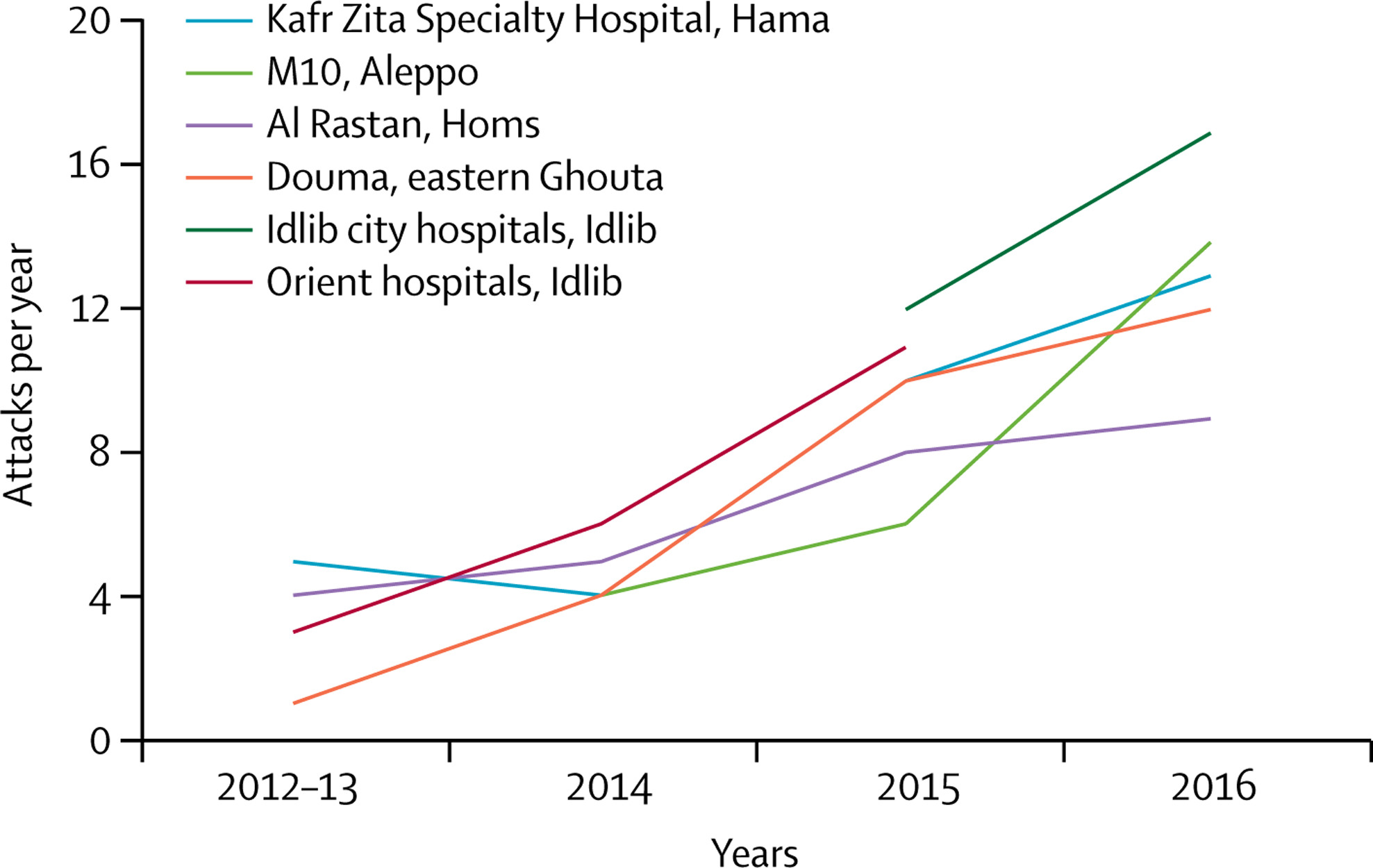
Attacks on hospitals – some of which I described in detail in a previous post – became not only more systematic but even repetitive, on a scale which the authors is wholly unprecedented.

‘Examination of attacks since 2012 on health facilities has revealed a distinct pattern of weaponisation.Analysis of attacks over several years in important opposition-held areas of Aleppo, Hama, Idlib, eastern Ghouta, and Homs reveals a pattern of repeated targeting with intention to shut access to health care, whether to impede opposition forces or to force civilian displacement.’

They list the effects of these attacks on healthcare in areas outside the control of the Syrian government – ‘rebel-held areas’ – but they also sketch the situation in areas under the control of the Islamic State:

Efforts to recruit foreign doctors through social media have reportedly helped IS to develop a functioning health system with modern facilities and equipment, qualified health workers, and a medical school in Raqqa where students train for free. But this health system is exclusive to IS, and foreign doctors are only permitted to provide care for IS members. For the rest of Raqqa’s civilians, over 1 million people, there are only 33 specialist doctors including just three obstetricians and one ophthalmologist, and just two public hospitals. Anecdotal reports indicate that health workers are forced to deliver care at gunpoint while others are arrested, abducted, or even executed for refusing to deliver care. To stop the exodus of health workers, IS uses the threat of seizure of homes and clinics in case of absence from work. Gender separation in these areas means that female health providers are subject to additional stress and restrictions, being forced to abide by IS dress code and to treat only female patients.

And for the benefit of the useful idiots inside the academy who deny these predations by the Syrian government on its own people, I should add that the report also discusses the situation inside government-controlled areas:

The bulk of Syria’s remaining health workers are in government-controlled areas, where there is variability in the capacity of health facilities and personnel. Workers from these areas have also reported challenges, but of a different nature to those working in non-government- controlled areas. Indiscriminate mortar attacks from rebel areas have adversely affected daily life and the public’s sense of security. Many health workers report facing multiple security checkpoints for their daily trip to a hospital or clinic. The collapsing economy has eroded living standards and restricted school and career options for offspring of health workers. Medical students fear the military draft and the risk of being sent to the battlefield. To avoid that fate, many seek whatever residency training positions are available upon graduation, irrespective of specialty. However, with the emigration of many experienced senior academics, fewer high-quality specialists are available to supervise the training of younger doctors. Travel restrictions due to sanctions and the need for leave permits from the government leave few choices for these doctors. Some doctors in these areas have indicated that the international media pay little attention to their plight. Others report being forced to breach ethical principles under unbearable pressure.

You can find an elaboration of these claims in personal testimonials here, which include this:

In November 2011, Dr. Zaki [a pseudonym], a military anaesthetist, was sent to Aleppo Military Hospital. This hospital usually received injured Syrian army combatants, but from the start of 2012, it began receiving civilian patients injured by pro-government forces during the peaceful demonstrations taking place in Idleb and Aleppo. Notably there was no conflict at this time in either city. These civilian patients were interrogated and tortured — either directly through electric shocks or beatings with rubber hoses, or indirectly, by leaving gunshot wounds or open fractures untreated,. A few days prior to the visit to the hospital by the UN-Arab League Special Envoy, who insisted on visiting all patients, Dr. Zaki was ordered by his superiors to find a way to keep these patients silent. The subtext of the order, issued by three generals, the first in charge of the hospital, the second, the head of military intelligence, and the third, head of the military secret police in Aleppo, was clear: “we know exactly who your family are and your wife’s family, and they will be arrested unless you comply” Under those conditions, Dr. Zaki used a combination of anaesthetic agents to sedate over 60 patients, so their wounds and shackles could literally be covered up, and no patient would be able to describe the torture and conditions of their confinement to the Special Envoy. Shortly after this, Dr. Zaki defected and fled to Turkey, along with his entire family and his wife’s family.

I urge you to read the whole report (it’s only 11 Lancet pages).

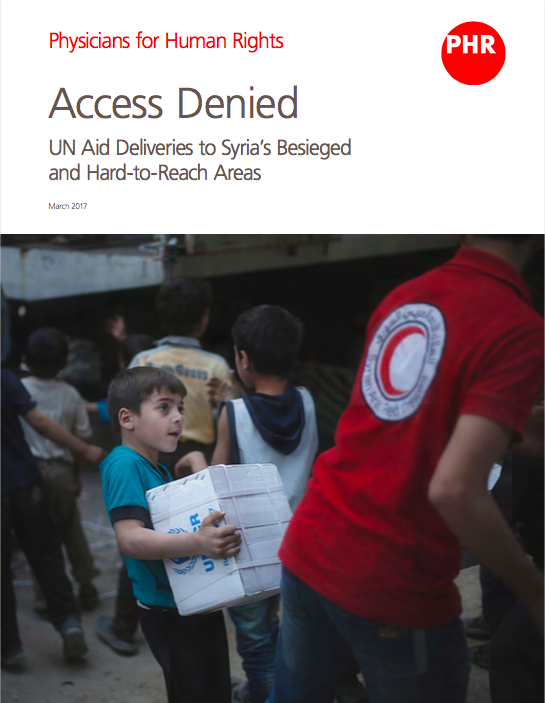
The report describes what it calls ‘siege medicine’, and for an update you can turn to another new report, this one from Physicians for Human Rights: Access Denied: UN aid deliveries to Syria’s besieged and hard-to-reach areas.

This is how it begins:

Death by infection because security forces do not allow antibiotics through checkpoints.

Death in childbirth because relentless bombing blocks access to clinics.

Death from diabetes and kidney disease because medicines to treat chronic illnesses ran out months ago.

Death from trauma because snipers stand between injured children and functioning hospitals.

And – everywhere – slow, painful death by starvation.

This is what one million besieged people – trapped mostly by their own government – face every day in Syria.

This is the unseen suffering – hidden under the shadow of barrel bombs and car bombs – that plagues the Syrian people as they enter a seventh grim year of conflict.

This is murder by siege.

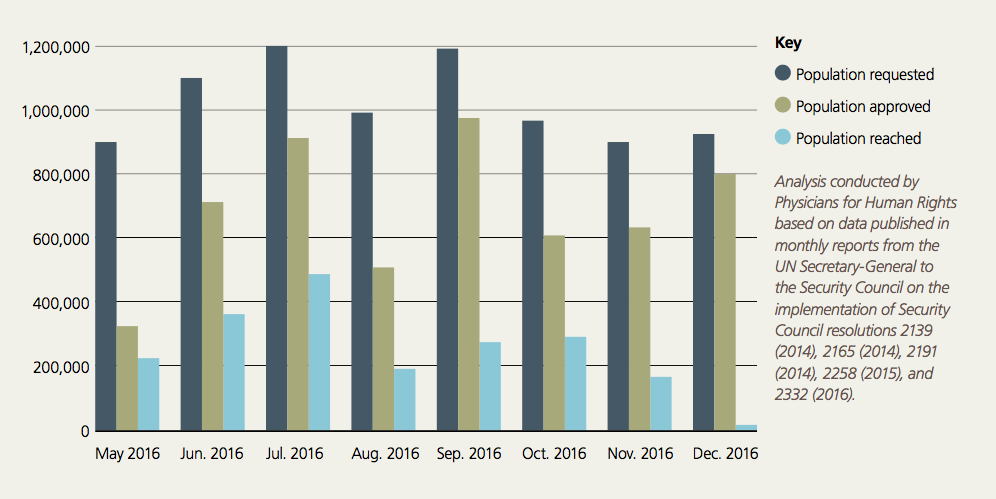
The report is limited to ‘the failure of the two-step approval process in ensuring the completion of UN interagency humanitarian convoys to besieged and hard-to-reach areas across Syria’; this excludes operations outside that approval process, but it still makes for remarkably grim reading.  Here are the raw figures tabulating aid deliveries requested, approved and completed under the two-step process:

Even within these diminished envelopes there were further specific restrictions on medical supplies:

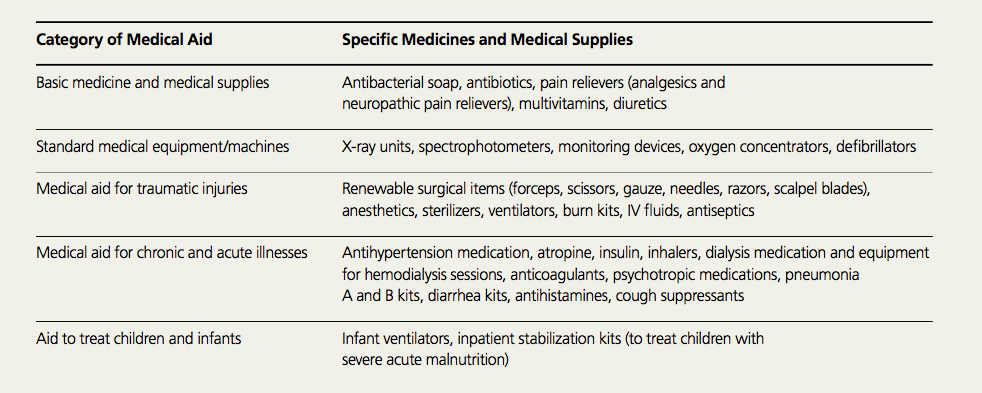
Throughout 2016, Syrian authorities specifically restricted medical aid to besieged and hard-to-reach areas, in direct violation of international humanitarian law.From February through December 2016, Syrian authorities prevented the delivery of more than 300,000 medical treatments to besieged and hard-to-reach areas.28 There is no clear definition of what constitutes a “medical treatment,” nor is there publicly available data on how much of each type of aid was removed from convoys. However, as [the examples in the tabulation below show], the disallowed medical aid included basic medicine, supplies, and equipment needed to treat traumatic, chronic, and acute conditions resulting from or aggravated by the sieges. In addition, it included medical aid speci cally meant to treat infants and children. Some of the disallowed medical aid could have been reused repeatedly to treat numerous people, thus its exclusion likely a ected large populations for prolonged periods of time.

In one particularly egregious example, Syrian government forces turned away an entire aid convoy as it was about to enter besieged Daraya in May 2016 because it contained medical aid and infant formula. Ironically, Syrian authorities in Damascus had limited the type of aid allowed on that convoy speci cally to medical aid, infant formula, and school supplies.

Unimaginative geographies

In my commentary on the terrorist attacks in Beirut and Paris in November 2015, I drew attention to Islamic State’s desire to extinguish what it called ‘the grey zone’.  As Jason Burke explained at the time:

In February this year, in a chilling editorial in its propaganda magazine, Dabiq, Isis laid out its own strategy to eliminate what the writer, or writers, called “the grey zone”.

This was, Isis said, what lay between belief and unbelief, good and evil, the righteous and the damned. It was home, too, to all those who had yet to commit to the forces of either side.

The grey zone, Isis claimed, had been “critically endangered [since] the blessed operations of September 11th”, as “these operations showed the world” the two camps that mankind must choose between.

Over the years, since successive violent acts had narrowed the grey zone to the point where by the end of 2014 “the time had come for another event to … bring division to the world and destroy the grey zone everywhere”.

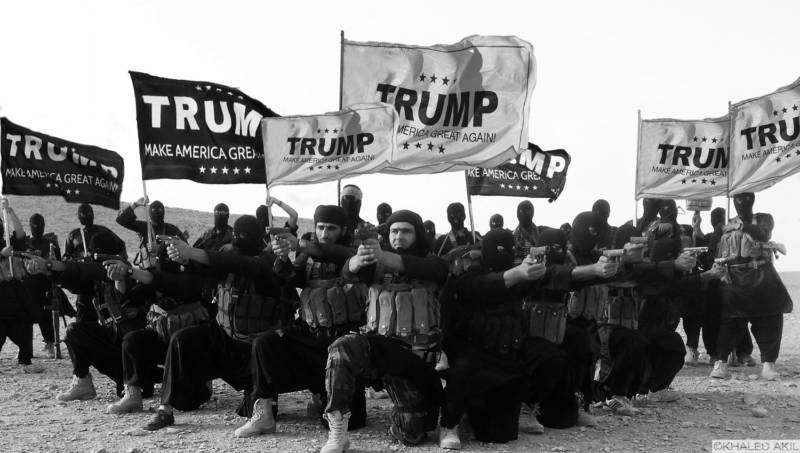
I noted then that ‘The imaginative geographies of Islamic State overlap with those spewed by the extreme right in Europe and North America and, like all imaginative geographies, they have palpable effects: not fifty shades of grey but fifty versions of supposedly redemptive violence.’

Syrian artist Khaled Akil has captured this congruence perfectly in “Hate Loves Hate“:

khaled-akil-hate-loves-hate

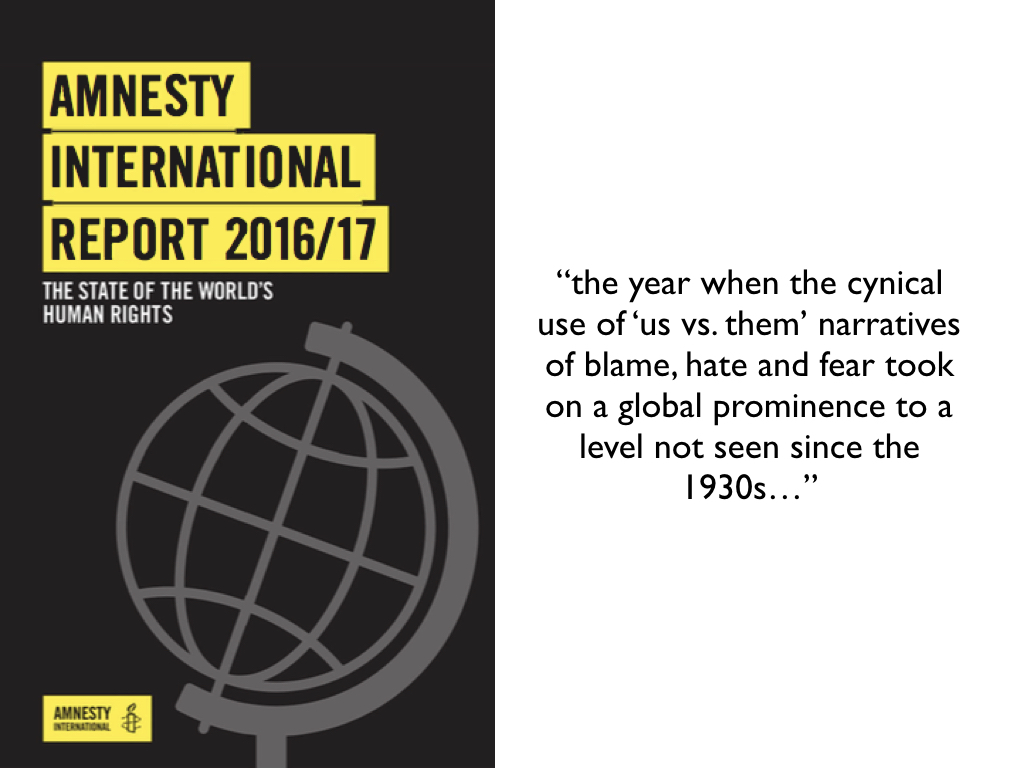
Amnesty International‘s latest report (2016/17) on Human Rights around the world confirms that this is fast becoming generalised:

Politicians wielding a toxic, dehumanizing “us vs them” rhetoric are creating a more divided and dangerous world, warned Amnesty International today as it launched its annual assessment of human rights around the world.

The report, The State of the World’s Human Rights, delivers the most comprehensive analysis of the state of human rights around the world, covering 159 countries. It warns that the consequences of “us vs them” rhetoric setting the agenda in Europe, the United States and elsewhere is fuelling a global pushback against human rights and leaving the global response to mass atrocities perilously weak.

“2016 was the year when the cynical use of ‘us vs them’ narratives of blame, hate and fear took on a global prominence to a level not seen since the 1930s. Too many politicians are answering legitimate economic and security fears with a poisonous and divisive manipulation of identity politics in an attempt to win votes,” said Salil Shetty, Secretary General of Amnesty International.

2016-us-vs-them-001

“Divisive fear-mongering has become a dangerous force in world affairs. Whether it is Trump, Orban, Erdoğan or Duterte, more and more politicians calling themselves anti-establishment are wielding a toxic agenda that hounds, scapegoats and dehumanizes entire groups of people.

“Today’s politics of demonization shamelessly peddles a dangerous idea that some people are less human than others, stripping away the humanity of entire groups of people. This threatens to unleash the darkest aspects of human nature.”…

“In 2016, these most toxic forms of dehumanization became a dominant force in mainstream global politics. The limits of what is acceptable have shifted. Politicians are shamelessly and actively legitimizing all sorts of hateful rhetoric and policies based on people’s identity: misogyny, racism and homophobia.

“The first target has been refugees and, if this continues in 2017, others will be in the cross-hairs. The reverberations will lead to more attacks on the basis of race, gender, nationality and religion. When we cease to see each other as human beings with the same rights, we move closer to the abyss.”

Deconstructing the map

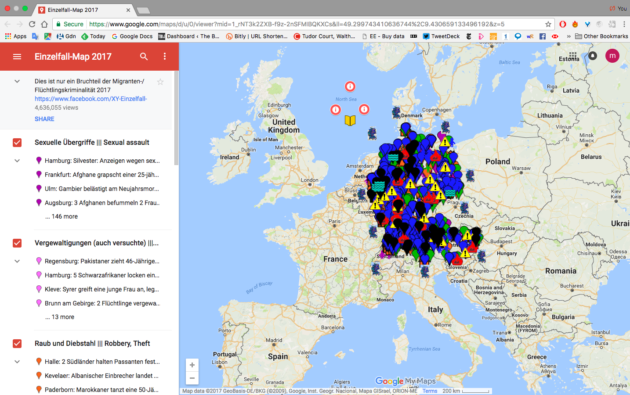
515-00-wcbl-_sx331_bo1204203200_In the wake of the Trump administration’s shock at the non-existent Bowling Green Massacre, its fabricated comments on immigrants, refugees and crime in Sweden (for the record, I’ve been to Rinkeby in the company of Nordic geographers, and I also have Allan Pred‘s brilliant Even in Sweden on my shelves: and I’d also recommend Gavan Titley‘s elegant ‘Swedens of the mind‘ over at Critical Legal Thinking), and – in spectacular contrast – Trump’s sullen silence over attacks on immigrants, refugees and Muslims that did happen,  The Bureau of Investigative Journalism has just published an important and incisive take-down of a map that went viral (the mot juste) in 2016.

Its reporters explain:

Last year, an anonymously-produced map started to make its way around German social media. It claimed to show viewers the spread of “refugee and migrant crime” throughout Germany.

Unlike some of the lurid tales of migrant depravity that have circulated in Germany in recent months and turned out to be false, the interactive map seemed professionally put together. Each pin on it correlated to a police or media report of a crime (“we don’t document cases simply on the basis of hearsay”, its makers claimed).

The map, called XY-Einzelfall (a sarcastic riposte to the idea each migrant crime is simply an ‘isolated case’ – Einzelfall in German) was viewed more than four million times.

screen-shot-2017-02-26-at-14-12-15

One of the XY-Einzelfall (XYE) social media followers tweeted over 80 times as new crimes were added to the map: “The time’s coming when Germans will need to carry guns for self-protection.”

But analysis of the map’s methodology by the Bureau of Investigative Journalism shows that it is systematically misleading, often attributing crimes to migrants or refugees on the basis of nothing more than a witness statement that the perpetrator was “dark-skinned” or “southern”. On top of this, the project vastly overstates the figures on migrant crime through skewed use of statistics.

Tracing the map’s presence on social media also shows it to be far from politically neutral. An account in XYE’s name on the Russian social media site VKontakte is rife with the kind of pro-Trump pro-Putin memes which have become the signature of the global alt-right. These are also the dominant affiliations of the Twitter accounts promoting the map. Overtly racist and xenophobic memes are also commonplace.

Most readers – especially those familiar with the stream of work set in motion by Brian Harley – will not be surprised to find that the map’s authors summon the supposed objectivity and facticity of cartography as a legitimating device:

The map’s creators like to portray their approach as scientific, mimicking the language of academics and think tanks. In January they released a “7-day analysis of published police reports”, with a breakdown of crimes by groups of different origins and a headline suggesting that 84% of crimes were committed by migrants.

In fact, the 84% figure is completely misleading. The map makers have stripped out all crimes in which the perpetrators’ background is not mentioned from their calculation. The true percentage of crimes in this period committed by migrants – according to XYE’s own data – is 13%. There is a further 13% of crimes which the XYE say are ‘probably’ committed by migrants.

We looked at how XYE decide that each pin on the map represents a crime which could have been committed by migrants. They comb police and media reports and pull out descriptions of perpetrators. We found that almost two-thirds of their reported offenders fell into the categories of “dark-skinned”, “southern-looking”, “foreigner” or “refugee”.

We then selected a random sample of 100 reports within each of these four categories for closer analysis. We found that in nearly all cases where the perpetrator was described as “dark-skinned” or “southern”, there was no evidence in the sources positively identifying them as a migrant or refugee. This was also true of the overwhelming majority of cases where the offender was described as a “foreigner”.

I’m en route to Vancouver, so forgive the brevity of this notice of such an important issue.

Intelligence and War

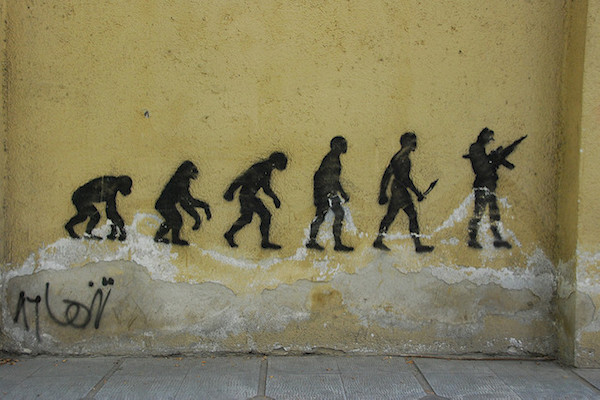
Vue d’artiste de l’évolution de l’Homme peinte sur un mur, stencil graffiti on Vali-ye-Asr Avenue in central Tehran. By Paul Keller, 4 November 2007

A new edition of the ever-interesting Mediatropes is now online (it’s open access), this time on Intelligence and War: you can access the individual essays (or download the whole issue) here.  Previous issues are all available here.

The issue opens with an editorial introduction (‘Intelligence and War’ by Stuart J Murray, Jonathan Chau, Twyla Gibson.  And here is Stuart’s summary of the rest of the issue:

Michael Dorland’s “The Black Hole of Memory: French Mnemotechniques in the Erasure of the Holocaust” interrogates the role of memory and memorialization in the constitution of post-World War II France. Dorland hones in on the precarity of a France that grapples with its culpability in the Vel’ d’Hiv Round-up, spotlighting the role of the witness and the perpetually problematized function of testimony as key determinants in challenging both the public memory and the historical memory of a nation.

Sara Kendall’s essay, “Unsettling Redemption: The Ethics of Intra-subjectivity in The Act of Killing” navigates the problematic representation of mass atrocity. Employing Joshua Oppenheimer’s investigation of the Indonesian killings of 1965–1966, Kendall unsettles the documentary’s attempts to foreground the practices of healing and redemption, while wilfully sidestepping any acknowledgment of the structural dimensions of violence. To Kendall, the documentary’s focus on the narratives of the perpetrators, who function as proxies for the state, makes visible the aporia of the film, substituting a framework based on affect and empathy in place of critical political analyses of power imbalances.

Kevin Howley is concerned with the spatial ramifications of drone warfare. In “Drone Warfare: Twenty-First Century Empire and Communications,” Howley examines the battlefield deployment of drones through the lens of Harold Innis’s distinction between time-biased and space-biased media. By considering the drone as a space-biased technology that can transmit information across vast distances, yet only remain vital for short periods of time, Howley sees the drone as emblematic of the American impulse to simultaneously and paradoxically collapse geographical distance while expanding cultural differences between America and other nations.

Avital Ronell’s essay, entitled “BIGLY Mistweated: On Civic Grievance,” takes direct aim at the sitting US president, offering a rhetorical analysis of what she calls “Trumpian obscenity.” Ronell exposes the foundations of the current administration, identifying a government bereft of authority, stitched together by audacity, and punctuated by an almost unfathomable degree of absurdity. In her attempt to make sense of the fundamentally nonsensical and nihilistic discourse that Trump represents, Ronell walks alongside Paul Celan, Melanie Klein, and especially Jacques Derrida, concluding with a suggestive, elusive, and allusive possibility for negotiating the contemporary, Trumpian moment.

In “The Diseased ‘Terror Tunnels’ in Gaza: Israeli Surveillance and the Autoimmunization of an Illiberal Democracy,” Marouf Hasian, Jr. explains how Israel’s state-sanctioned use of autoimmunizing rhetorics depict the lives of Israelis as precarious and under threat. Here, the author’s preoccupation is with the Israeli strategy of rhetorically reconfiguring smuggling tunnels as “terror tunnels” that present an existential threat to Israeli citizens. In doing so, he shows how the non-combatant status of Gazan civilians is dissolved through the intervening effects of these media tropes.

Derek Gregory’s essay, “The Territory of the Screen,” offers a different perspective on drone warfare. Gregory leverages Owen Sheers’s novel, I Saw a Man, to explore the ways in which modern combat is contested through a series of mediating layers, a series of screens through which the United States, as Gregory argues, dematerializes the corporeality of human targets. For Gregory, drone warfare’s facilitation of remote killings is predicated on technical practices that reduce the extinguishing of life to technological processes that produce, and then execute, “killable bodies.”

But how is the increasingly unsustainable illusion of intelligence as being centralized and definitive maintained? Julie B. Wiest’s “Entertaining Genius: U.S. Media Representations of Exceptional Intelligence” identifies the media trope of exceptionally intelligent characters across mainstream film and television programs as key to producing and reinforcing popular understandings of intelligence. Through her analysis of such fictional savants, Wiest connects these patterns of representation to the larger social structures that reflect and reinforce narrowly defined notions of intelligence, and those who are permitted to possess it.

We end this issue with a poem from Sanita Fejzić, who offers a perspective on the human costs of war that is framed not by technology, but through poetic language.

My own essay is a reworked version of the penultimate section of “Dirty Dancing” (DOWNLOADS tab) which we had to cut because it really did stretch the length limitations for Life in the Age of Drone Warfare; so, as Stuart notes, I re-worked it, adding an extended riff on Owen Sheers‘ luminous I saw a man and looping towards the arguments I since developed in ‘Meatspace?