Afterwar(d)s

I’ve been working my way through the proofs of ‘The natures of war’, in which (among other things) I try to show that soldiers are not only vectors of military violence but also victims of it.  My analysis fastens on the Western Front in the First World War, Northern Africa in the Second World War, and Vietnam – the final draft is under the DOWNLOADS tab and the published version should be up on the Antipode website later this month – but I hope it will be clear to readers that the implications of this claim , and the others in the essay, extend into our own present.  They also intersect with my current research on casualty evacuation from war zones, 1914-2014.

So I’ve been interested in three recent contributions that detail the aftermath of war for those who fight them.

First, Veterans for Peace UK have worked with Darren Cullen to produce a short film, Action Man: Battlefield Casualties [see the clip above] in an attempt, as Charlie Gilmour explains over at Vice,

‘to show the shit beneath the shine of polished army propaganda. Featuring PTSD Action Man (“with thousand-yard stare action”), Paralysed Action Man (“legs really don’t work”) and Dead Action Man (“coffin sold separately”)…’ [see also my post on ‘The prosthetics of military violence‘]

Actionman-1024x379

In keeping with the project’s authors, Charlie insists – I think properly – that many of those who were sent to Afghanistan from the UK were child soldiers (and here I also recommend Owen Sheers‘ brilliant Pink Mist for an unforgettable portrayal of what happens when boys who grow up ‘playing war’ end up fighting it: see also here and here).  As the project’s web site notes:

The UK is one of only nineteen countries worldwide, and the only EU member, that still recruits 16 year olds into its armed forces, (other nations include Iran and North Korea). The vast majority of countries only recruit adults aged 18 and above, but British children, with the consent of their parents, can begin the application process to join the army aged just 15…

It is the poorest regions of Britain that supply large numbers of these child recruits. The army has said that it looks to the youngest recruits to make up shortfalls in the infantry, by far the most dangerous part of the military. The infantry’s fatality rate in Afghanistan has been seven times that of the rest of the armed forces.

Forces Watch JPEG

Child Soldiers International JPEG

A study by human rights groups ForcesWatch and Child Soldiers International in 2013 found that soldiers who enlisted at 16 and completed training were twice as likely to die in Afghanistan as those who enlisted aged 18 or above, even though younger recruits are, for the most part, not sent to war until they are 18.

You can find another thoughtful reflection on child soldiers by Malcolm Harris over at the indispensable Aeon here. He doesn’t include the British Army in his discussion, but once you do you can see that the implications of this passage extend beyond its ostensible locus (Nigeria):

But can a child truly volunteer to join an army? Even when they enlist by choice, child soldiers do so under a set of constraining circumstances. UNICEF makes the choices sound easy: war or dancing, war or games, war or be a doctor. No rational child would pick the former for themselves, and that’s posed as evidence that their freedom has been taken from them. But when the choice is ‘soldier or victim’, voluntarism takes on a different meaning.

FINKEL Thank you for your service

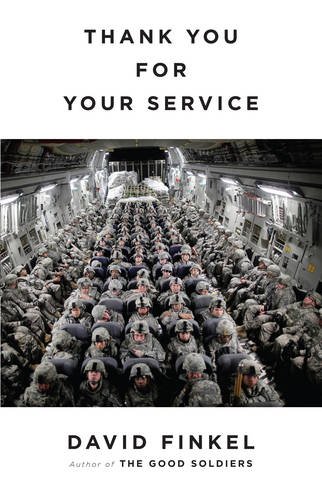
Second, moving across the Atlantic and providing an extended riff on the ‘thank you for your service’ gesture, the latest issue of New Left Review includes an essay by Joan Wypijewski, ‘Home Alone‘, that describes the journey home faced by many US veterans.  She begins by putting David Finkel‘s compelling book in context:

The term ‘Thank You for Your Service’ developed early on in the long wars. Like ‘Support the Troops’, it was a way for a sheltered people to perform unity. In towns across America yellow ribbons, yellow lawn signs, balloons and car decals sprouted like team colours on game day. War would be a sport, the people spectators, and ‘Thank you for your service’ the high-five to combatants after quick and decisive victory. When that proved a vain hope, team spirit settled into the rhythms of commerce. ‘Support the Troops’ appeared the way ‘Buy American’ once had—a slogan on shop windows, billboards, bumper stickers. War was an enterprise, security its product, the people consumers, the soldiers trained workers and ‘Thank you for your service’ a kind of tip. As the enterprise (though hardly the business) failed, the signs faded, sometimes replaced by an image of folded hands, ‘Pray for Our Troops’. War had become a problem, the soldiers exhausted, the people clueless and ‘Thank you for your service’ a bit of empty etiquette, or a penance. By the time Finkel was writing [his book was published in October 2013], what remained among civilians was a desire to move on, and among soldiers, bitterness. ‘They wouldn’t be fucking thanking me if they knew what I did’, many would say, in almost exactly the same words.

Joan works her way through Finkel’s account, and then turns to Laurent Bécue-Renard’s Of Men and War, a documentary film – five years in the making, and the second instalment in a trilogy devoted to a ‘genealogy of wrath‘ – of Trauma Group sessions at a treatment centre in the Napa Valley:

‘What we have is embarrassing as shit’, a thick, tight young white man says in the Trauma Group. ‘You feel small—you feel defective.’ And so it goes, and so men trained for toughness talk of being weak and scared and monstrous, or just diligent. Of working in Mortuary Affairs: ‘breaking the rigour down’ to get the corpse of a 19-year-old who killed himself flat enough for a body bag, or untangling the remains of a group of faceless soldiers burned in a truck who are fused ‘like a bunch of rope’. They talk of their dreams, of their frightened wives. Maybe she moved out and got a restraining order before he came home, or maybe she has the divorce papers but is holding back as long as he’s getting help. ‘I have no clue what it’s like to be a woman married to a man twice your size and that’s lethal, in the military, and takes his rage out on you—someone that’s supposed to love you’, a former medic says. He is slim, white, deer-like. You don’t know his war story yet, and you don’t know when you’ll find out, if you’ll find out, but you listen as he and one after another after another deals with a world of pain. And maybe men balk, and maybe they storm out of the room, and maybe Gusman, whom you’ve also never really met but who is always there, has to remind them that ‘being a hostage to the war zone is not a life’. You follow them out of the room, taking smokes, meditating, visiting their wives or parents, calling on locals, trying to be well or pass for well, knowing they’re not. You watch their children doing typical childlike things, running, laughing in a high-pitched scream, and you feel anxious for everyone in the room. You itch to get back to the Trauma Group and, amazingly, don’t feel like a voyeur, because this isn’t war porn; this is the shit, as they say.

It isn’t beautiful or horrible, it just is. And you don’t like all of these people, but that isn’t the point. They are all struggling to be human again, and you have to ask yourself if you know what that means.

Not so much dressing but ‘addressing their wounds is a revolution’, Bécue-Renard insists, and you can see – literally so – what he means.  Joan’s commentary ends with other, perhaps also revolutionary reflections.  In America, she argues,

… there has been no serious debate on, let alone demand for, a universal draft as a democratic check against offensive war. We talk against empire, but are beneficiaries of the imperial state’s professional and technological adjustments to the anti-war movement’s past victories. We talk about the invisible draft but, perhaps encouraged by the bravery of Iraq Veterans Against the War, still hope that soldiers whose food, clothing, shelter, families and identity depend on the job of war-fighting will mutiny en masse. We talk, from time to time, about the culture of abuse in basic training and on military posts, but are silent on the regimens of discipline that are being hyper-enforced in anticipation of downsizing, in other words layoffs. And for the one thing the military, however twistedly, provides—belonging, solidarity, a sense of honour and family-feeling as against loneliness—we have no alternatives at all.

Finally, Duke University Press has announced that Zoe Wool‘s book, After War: the weight of life at Walter Reed, will be out soon:

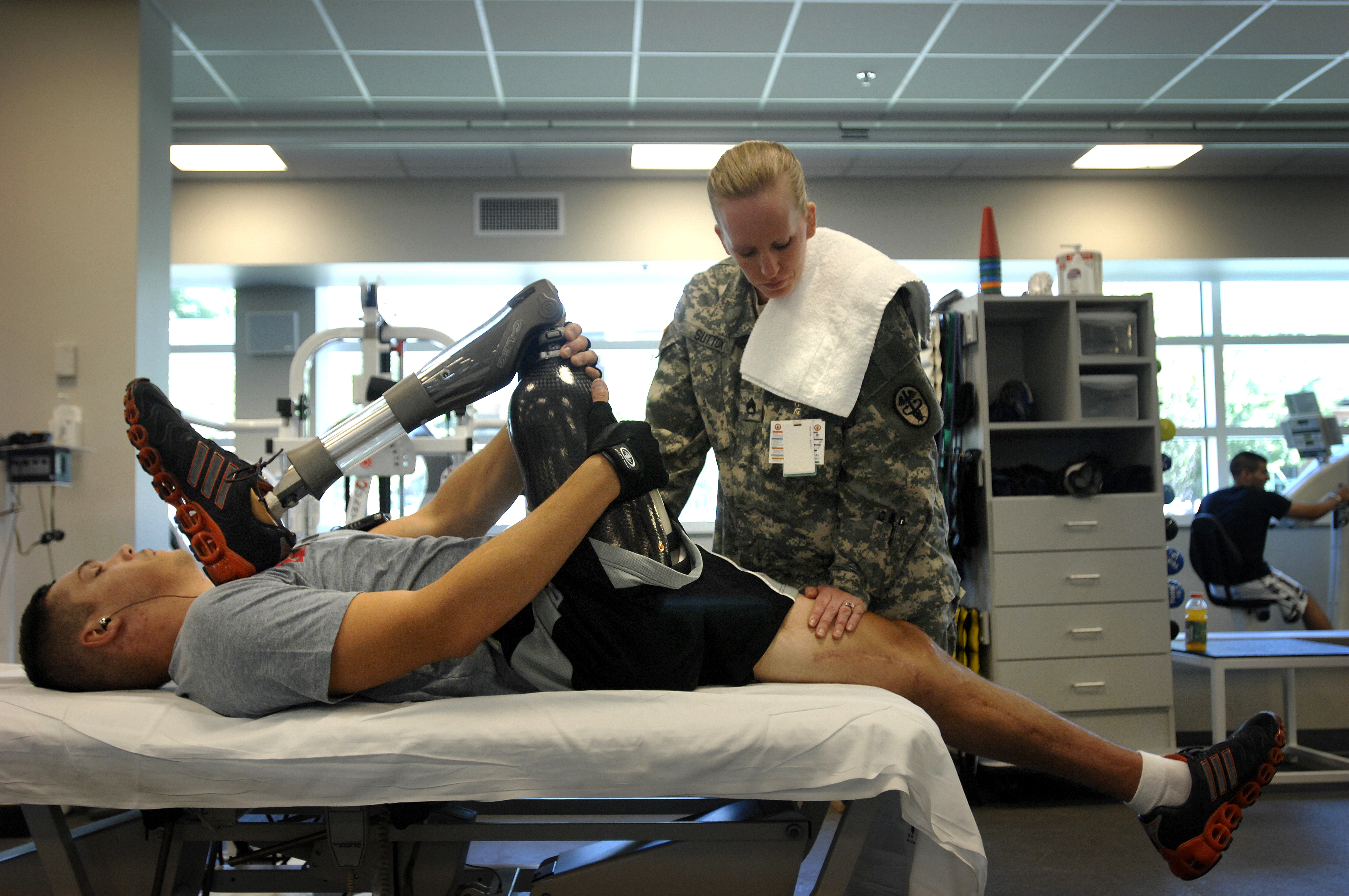
In After War Zoë H. Wool explores how the American soldiers most severely injured in the Iraq and Afghanistan wars struggle to build some kind of ordinary life while recovering at Walter Reed Army Medical Center from grievous injuries like lost limbs and traumatic brain injury. Between 2007 and 2008, Wool spent time with many of these mostly male soldiers and their families and loved ones in an effort to understand what it’s like to be blown up and then pulled toward an ideal and ordinary civilian life in a place where the possibilities of such a life are called into question. Contextualizing these soldiers within a broader political and moral framework, Wool considers the soldier body as a historically, politically, and morally laden national icon of normative masculinity. She shows how injury, disability, and the reality of soldiers’ experiences and lives unsettle this icon and disrupt the all-too-common narrative of the heroic wounded veteran as the embodiment of patriotic self-sacrifice. For these soldiers, the uncanny ordinariness of seemingly extraordinary everyday circumstances and practices at Walter Reed create a reality that will never be normal.

20080721-D-1852B-014

Here are two of the endorsements:

“Hollywood films and literary memoirs tend to transform wounded veterans into tragic heroes or cybernetic supercrips. Zoë H. Wool knows better. In her beautifully written and deeply empathic study of veterans of Iraq and Afghanistan at Walter Reed, Wool shows us the long slow burn of convalescence and how the ordinary textures of domestic life unfold in real time. An important and timely intervention.” — David Serlin, author of Replaceable You: Engineering the Body in Postwar America.

“This brilliant and absorbing ethnography reveals how the violence of war is rendered simultaneously enduring and ephemeral for wounded American soldiers. Zoë H. Wool accounts for the frankness of embodiment and the unstable yet ceaseless processes through which the ordinary work of living is accomplished in the aftermath of serious injury. After War is a work of tremendous clarity and depth opening new sightlines in disability and the critical politics of the human body.” — Julie Livingston, author of Improvising Medicine: An African Oncology Ward in an Emerging Cancer Epidemic.

Legal battles

DoD Law of War ManualFollowing up my comments on the Pentagon’s new Law of War Manual, issued last month: commentaries are starting to appear (it’s not surprising these are taking so long: the new version runs to 1200 pages).

Just Security is hosting a forum on the Manual, organised by Eric Jensen and Sean Watts.  They are both deeply embedded in the debate: Eric is a Professor at Brigham Young Law School and was formerly Chief of the Army’s International Law Branch and Legal Advisor to US military forces in Iraq and Bosnia, while Sean is a Professor at Creighton University Law School and on the Department of Law faculty at the United States Military Academy at West Point; he is also Senior Fellow at the NATO Cooperative Cyber Defence Centre of Excellence and served in the US Army’s Judge Advocate General’s Corps.

In the opening salvo, Sean focuses on the Manual‘s identification of three core principles:

“Three interdependent principles – military necessity, humanity, and honor – provide the foundation for other law of war principles, such as proportionality and distinction, and most of the treaty and customary rules of the law of war.”

The implications of this formulation are more far reaching than you might think.  Necessity, proportionality and distinction have long been watchwords, but the inclusion – more accurately, Sean suggests, the resurrection – of ‘humanity’ and ‘honor’ is more arresting: in his view, the first extends the protection from ‘unnecessary suffering’ while the second ‘marks an important, if abstract revival of good faith as a legal restraint on military operations’.

Watch that space for more commentaries, inside and outside the armed camp.

Others have already taken a much more critical view of the Manual.

Claire Bernish draws attention to two particularly disturbing elements here.  First, like several other commentators, she notes passages that allow journalists to be construed as legitimate targets.  While the Manual explains that ‘journalists are civilians’ it also insists there are cases in which journalists may be ‘members of the armed forces […] or unprivileged belligerents.’   Apparently, Claire argues,

‘reporters have joined the ranks of al-Qaeda in this new “unprivileged belligerent” designation, which replaces the Bush-era term, “unlawful combatants.” What future repercussions this categorization could bring are left to the imagination, even though the cited reasoning—the possibility terrorists might impersonate journalists—seems legitimate. This confounding label led a civilian lawyer to say it was “an odd and provocative thing for them to write.”‘

Other commentators, mindful of incidents in which the US military has been accused of targeting independent (non-embedded) journalists, have read this as far more than provocation.  Like other claims registered in the Manual, this has implications for other armed forces – and in this particular case, for example, Ken Hanly points out that ‘what is allowed for NATO and the US is surely legitimate for Israel.’

This is not as straightforward as he implies, though.  Eric Jensen agrees that

‘[T]he writers had to be aware this manual would also be looked to far beyond the US military, including by other nations who are formulating their own law of war (LOW) policies, allies who are considering US policy for purposes of interoperability during combined military operations, transnational and international organizations such as the International Committee of the Red Cross (ICRC) who look to such manuals when considering the development of customary practice, and even national and international tribunals who adjudicate LOW questions with respect to the criminality of individual actions.

While Eric acknowledges ‘the inevitable use of [the Manual] in the determination of customary practice.’ however, he also argues that the authors of the Manual go out of their way to preclude this possibility: they ‘wanted to be very clear that they did not anticipate they were writing into law the US position on the law of war.’

Second, Claire draws attention to a list of weapons with specific rules on use’ (Section 6.5.1), which includes cluster munitions, herbicides and explosive ordnance, and a following list of other ‘lawful weapons’ (Section 6.5.2) for which ‘there are no law of war rules specifically prohibiting or restricting the following types of weapons by the U.S. armed forces’; the list includes drones and Depleted Uranium munitions.  These designations are all perfectly accurate, but Claire’s commentary fastens on the fact that at least two of these weapons have been outlawed by many states.  She draws attention to the hideous consequences of DU and cluster bombs, and explains that cluster bombs:

‘are delineated in the manual as having “Specific Rules on Use”— notably, such weapons’ use “may reflect U.S. obligations under international law” [emphasis added]. While this is technically apt, cluster bombs have been banned by the 2008 Convention on Cluster Munitions—which was agreed to by 116 countries around the world. The U.S. stands out in joining infamous human rights violator, Saudi Arabia, in its refusal to sign. These insidious munitions leave unexploded ordnance for months, or even decades, after the originating bomb was dropped. Children are often maimed or killed when they unwittingly mistake them for toys.’

Meanwhile, also at Just Security but seemingly not part of the Forum, Adil Ahmad Haque has attacked the Manual‘s discussion of ‘human shields’:

The Defense Department apparently thinks that it may lawfully kill an unlimited number of civilians forced to serve as involuntary human shields in order to achieve even a trivial military advantage. According to the DOD’s recently released Law of War Manual, harm to human shields, no matter how extensive, cannot render an attack unlawfully disproportionate. The Manual draws no distinction between civilians who voluntarily choose to serve as human shields and civilians who are involuntarily forced to serve as human shields. The Manual draws no distinction between civilians who actively shield combatants carrying out an attack and civilians who passively shield military objectives from attack. Finally, the Manual draws no distinction between civilians whose presence creates potential physical obstacles to military operations and civilians whose presence creates potential legal obstacles to military operations. According to the Manual, all of these count for nothing in determining proportionality under international law.

If true, this would dramatically qualify the discussion of ‘humanity’ and ‘honor’ above; but, not surprisingly, Charles Dunlap will have none of it.  He objects not only to Adil’s reading of the Manual, but also the logic that lies behind his criticism:

Killing those who do the vast majority of the killing of civilians can save lives. It really can be that simple.

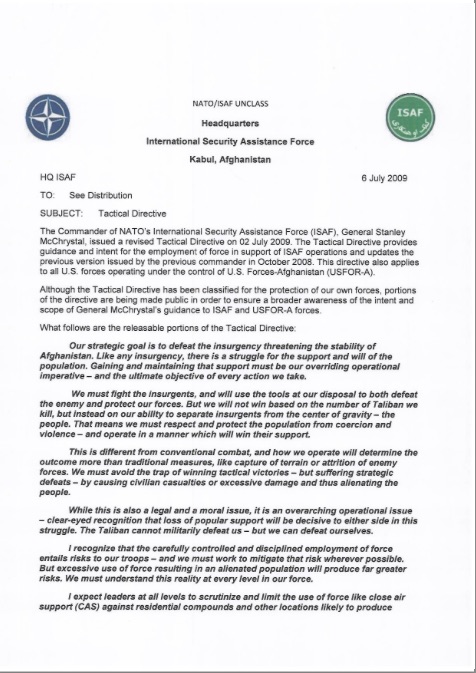
Experience shows that well-meaning efforts to curb the use of force can have disastrous effects on civilians. Think about the restrictions on airstrikes imposed by Gen. Stanley McChrystal in Afghanistan in mid-2009. The result? By the time he was fired a year later in June 2010, civilian casualties had jumped a heart-rending 31% entirely because of increased killings by anti-government forces. (In addition, casualties among friendly troops hit an all-time high in 2010.)

McChrystal Tactical Directive 1

[The unclassified section of McChrystal’s Tactical Directive (above) is here]

When Gen. David Petraeus took command in mid-2010, he took a different, more aggressive approach. While still scrupulously adhering to the law of war, he clarified the rules of engagement in a way that produced a tripling of the number of airstrikes. The result? The increase in civilian casualties was cut in half to 15% by the end of 2010. Under Petraeus’ more permissive interpretation of the use of force against the Taliban and other anti-government forces, the increase the following year was cut almost in half again to 8% (and losses of friendly troops fell 20%). To reiterate, although counterintuitive to some critics, restricting force by law or policy can actually jeopardize the lives of the civilians everyone wants to protect.

Michael O’Hanlon at the Brookings Institue makes exactly the same argument about the Manual here (scroll down), but Dunlap’s sense is much sharper: the Manual, he says, ‘is designed to win wars in a lawful way that fully internalizes, as it says itself on several occasions, the “realties of war.”’  This is immensely important because in effect it acknowledges that neither the Manual nor the laws of war are above the fray.  If the Manual ‘is designed to win wars in a lawful way’ that is precisely because law is in the army’s baggage train, fully incorporated into the juridification of later modern war.  Law is at once a powerful weapon and a moving target.

Base lines and military projections

David Vine has updated his map of the global footprint of the US military over at Politico.

VINE US military bases

I used an early version for my ‘War and Peace’ essay (DOWNLOADS tab), and that map – like this one – was drawn primarily from the annual Base Structure Report, a summary of the US military’s ‘real property inventory’ (all sites owned and managed by the Pentagon).  It’s an unwieldy document which uses a high threshold to filter inclusion:

To qualify for individual entry in the BSR, a DoD site located in the United States must be larger than 10 acres AND have a Plant Replacement Value (PRV) greater than $10 million. If the site is located in a foreign country, it must be larger than 10 acres OR have a PRV greater than $10 million to be shown as a separate entry. Sites that do not meet these criteria are aggregated as an “Other” location within each state or country.

Iraq doesn’t appear in these tabulations – though it is shown on the map – yet the continuing US involvement in the conflict there and across the all-but-erased border in Syria has surely extended its footprint.  As David notes,

‘There were 505 bases at the U.S. occupation’s height, but the Iraqi parliament rejected the Pentagon’s wish to keep 58 “enduring” bases after the 2011 withdrawal. U.S. forces have occupied at least five bases since 2014 and are considering more installations.’

Afghanistan is absent too: ‘By the end of 2014 … the U.S. military will have closed, deconstructed, or vacated most of what were once around 800 military installations, ranging from small checkpoints to larger combat outposts to city-sized bases.’  But the US military retains a significant presence there, and its drones are still based there to support continuing military operations and to attack targets across the border in Pakistan.

There are also strategic omissions.  There’s no mention in the Base Structure Report of Al Udeid Air Base in Qatar, for example, which is the location of US Central Command’s Combined Air and Operations Center.

(You can find more from David on the history of America’s ‘infrastructure for war’ in the Middle East here and on its ‘lily-pad’ strategy here).

There are all sorts of issues involved in measuring a ‘military footprint’ – see my post here and Josh Begley here (who works from the previous year’s Base Structure Report for FY 2013 to produce a radically different visualization) – but for all its uncertainties, David’s map is a sobering snapshot, and he relies on supplementary sources to conclude:

Despite recently closing hundreds of bases in Iraq and Afghanistan, the United States still maintains nearly 800 military bases in more than 70 countries and territories abroad—from giant “Little Americas” to small radar facilities. Britain, France and Russia, by contrast, have about 30 foreign bases combined.

By my calculation, maintaining bases and troops overseas cost $85 to $100 billion in fiscal year 2014; the total with bases and troops in warzones is $160 to $200 billion.

VINE Base Nation

When I first contacted David, his original map formed part of his scorching investigation into Diego Garcia: Island of Shame: the secret history of the US military base on the island of Diego Garcia (Princeton, 2009; paperback 2011: all royalties went to the Chagossians); the new version forms part of an even more ambitious project, Base Nation: how US military bases abroad harm America and the world (Metropolitan Books, 2015):

American military bases encircle the globe. More than two decades after the end of the Cold War, the U.S. still stations its troops at nearly a thousand locations in foreign lands. These bases are usually taken for granted or overlooked entirely, a little-noticed part of the Pentagon’s vast operations. But in an eye-opening account, Base Nation shows that the worldwide network of bases brings with it a panoply of ills–and actually makes the nation less safe in the long run.

As David Vine demonstrates, the overseas bases raise geopolitical tensions and provoke widespread antipathy towards the United States. They also undermine American democratic ideals, pushing the U.S. into partnerships with dictators and perpetuating a system of second-class citizenship in territories like Guam. They breed sexual violence, destroy the environment, and damage local economies. And their financial cost is staggering: though the Pentagon underplays the numbers, Vine’s accounting proves that the bill approaches $100 billion per year.

For many decades, the need for overseas bases has been a quasi-religious dictum of U.S. foreign policy. But in recent years, a bipartisan coalition has finally started to question this conventional wisdom. With the U.S. withdrawing from Afghanistan and ending thirteen years of war, there is no better time to re-examine the tenets of our military strategy. Base Nation is an essential contribution to that debate.

There is a long history of struggles against the presence of US military bases overseas – Catherine Lutz‘s edited collection, The bases of empire: the global struggle against US military posts (New York University Press, 2009) remains an indispensable starting-point.

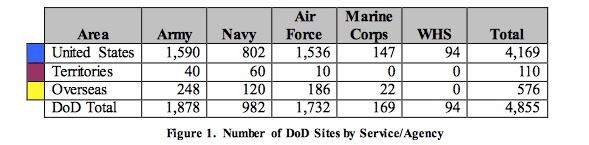
Of course, the US military is also omnipresent in the United States, with installations in all 50 states and seven territories.  The Base Structure Report includes this summary:

DoD sites JPEG

And these bases have brought their own problems and spawned their own protests too.


Medical neutrality and modern war

md_p0361-memory-solferinoI expect most readers know how the International Committee of the Red Cross had its origins in Henry Dunant‘s horror at the unrelieved suffering he witnessed in the aftermath of the Battle of Solferino in 1859 (see my earlier post here).

In A Memory of Solferino (1862) he asked: ‘Would it not be possible, in time of peace and quiet, to form relief societies for the purpose of having care given to the wounded in wartime by zealous, devoted and thoroughly qualified volunteers?’

Dunant’s vision of an impartial relief society to provide aid to those wounded in time of war led to the formation of a series of national relief societies and, as John Hutchinson shows in Champions of Charity: War and the rise of the Red Cross, these national societies soon became entangled with nationalism.  ‘Gripped by the passions of patriotism,’ he writes, by the time of the First World War these national societies ‘undertook to perform whatever repair work the armies required of them.’

And yet, even with these entanglements, a key principle was defended: medical neutrality.  According to Physicians for Human Rights, medical neutrality requires:

  1. The protection of medical personnel, patients, facilities, and transport from attack or interference;
  2. Unhindered access to medical care and treatment;
  3. The humane treatment of all civilians; and
  4. Nondiscriminatory treatment of the sick and injured.

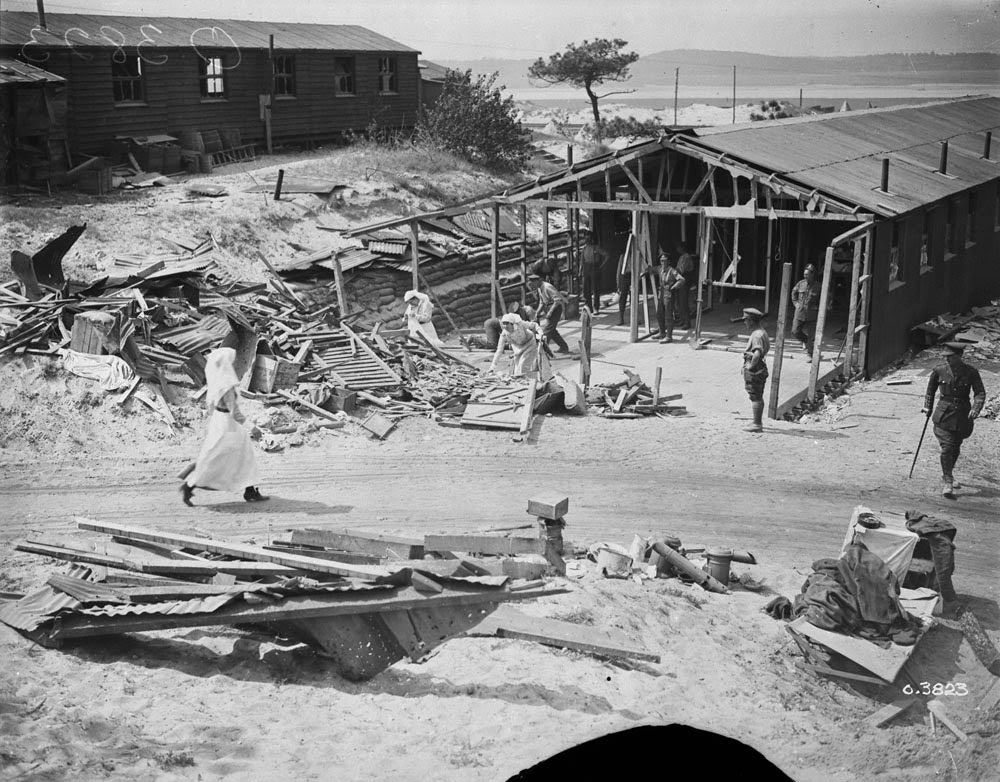
During the First World war there were complaints that the principle had been sporadically violated: that stretcher-bearers had been attacked by snipers when they sought to recover the wounded or that military hospitals had been deliberately shelled or bombed.  Here, for example, is the aftermath of one of several air raids targeting base hospitals at Etaples on the French coast between May and August 1918 (supposedly in retaliation for a British air raid on Cologne):

Lowe_Field_Hospital_bombed_LAC_PA_003747_a003747_v8.jpg_pv4a5fab25f240997c

But in the last decade of our own century such violations have become increasingly systematic. And, as more and more civilians have become trapped and even targeted in conflict zones whose ‘battlefields’ know no bounds, so those violations have extended far beyond attacks on military-medical infrastructure and personnel.

Last summer I detailed the attacks made by the Israeli military on medical facilities and emergency systems in Gaza, and I drew attention to the work of Physicians for Human Rights in documenting the precariousness of medical care there.  But the calculated production of these spaces of exception is not exceptional, and attacks like these have become part of the arsenal of later modern war.  “Instead of being protected,” says Donna McKay, executive director of PHR, “medical care is actually a target.”

HRW Attacks on Health

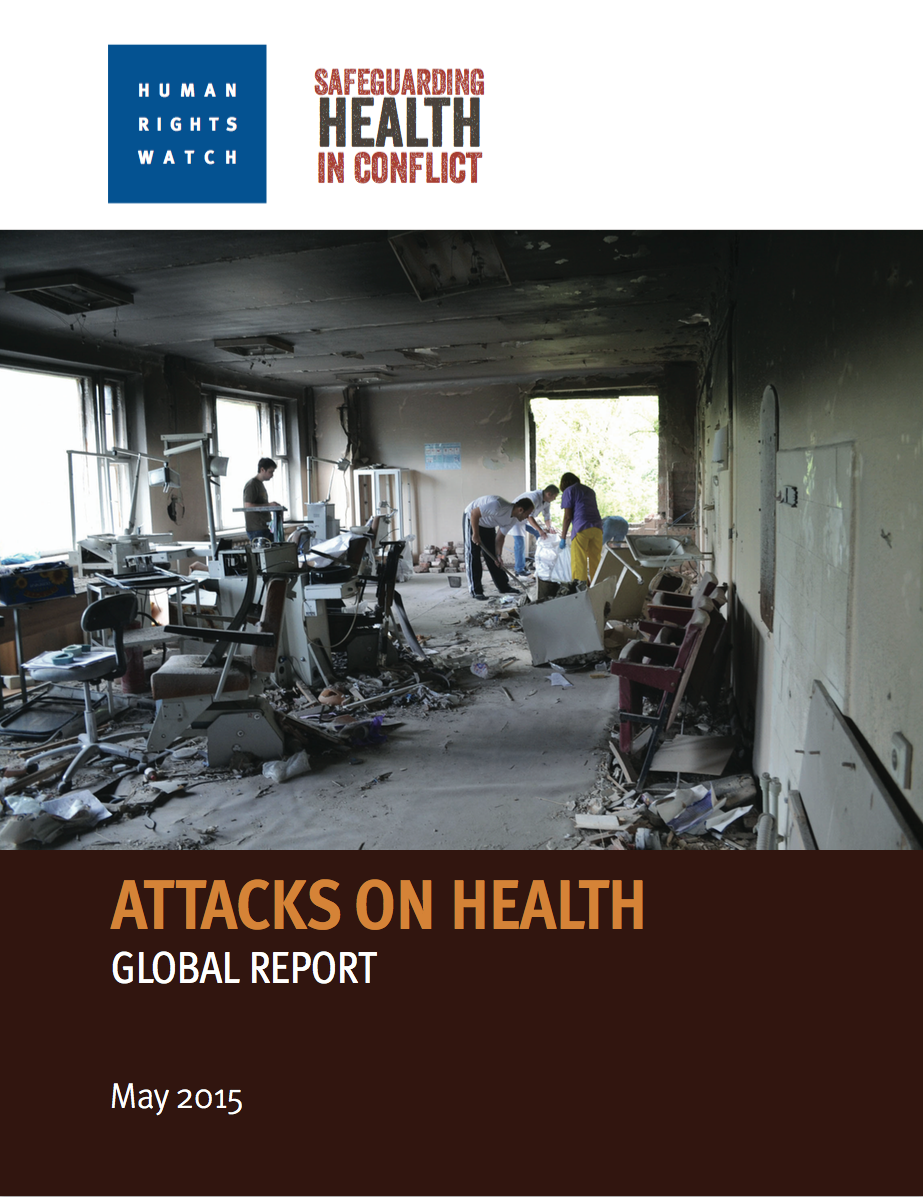
Physicians for Human Rights is part of the Safeguarding Health in Conflict Coalition which has now joined with Human Rights Watch to publish Attacks on Health: a Global Report (2015) that summarises attacks on health care facilities and health care workers around the world:

Over the past year armed groups have attacked hospitals, clinics, and health personnel in 41 incidents in Afghanistan and deliberately killed over 45 health workers, primarily polio vaccinators, in Nigeria and Pakistan. In Syria, where medical facilities in Aleppo have been hit with government barrel bombs, 194 medical personnel have been killed and 104 medical facilities attacked since 2014….

The organizations described attacks in South Sudan, where 58 people were killed in four hospitals in a series of attacks in early 2014, and in eastern Ukraine, where it is estimated that 30 to 70 percent of health workers have fled the region because of insecurity. In Yemen, Al-Qaeda in the Arabian Peninsula (AQAP) militants carried out attacks on health facilities in early 2014, and the 10-country Saudi-led coalition conducted air strikes that hit hospitals and interrupted medical supplies during the conflict in early 2015. Relying on data from Insecurity Insight’s Security in Numbers Database, the report also shows trends in attacks on health care over the course of a decade in South Sudan and Central African Republic.

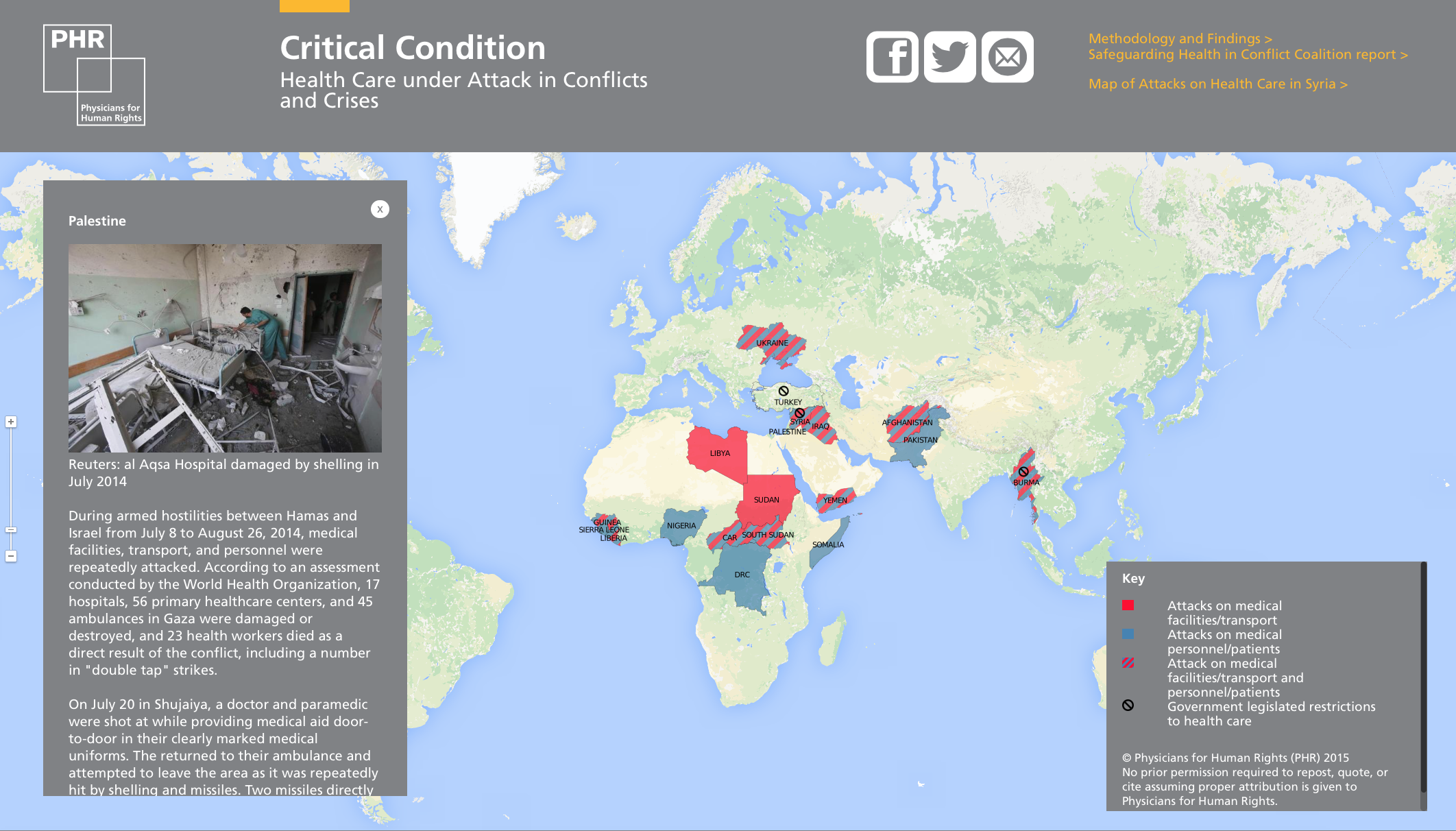
PHR Critical Condition

In close concert with the report Physicians for Human Rights have produced an interactive online map of attacks on health care around the world between January 2014 and April 2015 (see the screenshot above).

PHR Attacks on health care in Syria

The organisation has also produced a detailed map of attacks on health care systems – or what’s left of them – in Syria (see the screenshot above), which you can access here.  It needs to be supplemented by PHR’s Doctors in the crosshairs: four years of attacks on health care in Syria, which was published in March:

The symbols of the Red Cross and Red Crescent have been turned from a shield of protection into crosshairs on the backs of those who knowingly risk their lives to save others.

You can find more on the violation of medical neutrality in Syria in an open-access article by Ravi S. Katari in the Journal of global health here and in a short essay by Sasha Zients and Dylan Okabe-Jawdat for the Columbia Political Review (May 2015) here.

And you can find more on the systematic violation of medical neutrality in Bahrein and elsewhere here.

Playing a blinder

A characteristically smart post from Larry Lewis at War on the Rocks about Obama’s promise to investigate the mistakes made in the CIA-directed drone strike that unwittingly killed two hostages in Pakistan in January 2015.  ‘We’ve been on that path before, in Afghanistan,’ he writes, ‘and we know where it leads: more promises followed by a repeat of similar mistakes.’

Larry explains that the US military was causing an ‘unacceptable number’ of civilian casualties in Afghanistan between 2006 and 2009:

JCCSWhen an incident occurred, they investigated the incident, made changes to guidance, and promised to keep such an incident from happening again. But these incidents kept happening. So the military repeated this ineffective review process again and again. This “repeat” cycle was only broken when military leaders approved the Joint Civilian Casualty Study, a classified outside review requested by General Petraeus. This effort had two key differences from earlier efforts. First, it was independent, so it was able to overcome false assumptions held by operating forces that contributed to their challenges. And second, the study looked at all potential civilian casualty incidents over a period of years, not just the latest incident. This approach helped identify systemic issues with current tactics and policies as the analysis examined the forest and not just the nearest tree. This study also considered different sets of forces operating within Afghanistan and their relative propensity for causing civilian casualties.

You can access the unclassified Executive Summary – co-written by Larry with Sarah Sewell – here.  I’ve noted Larry’s important work on civilian casualties before – here, here and here – but his short Op-Ed raises two issues that bear emphasis.

The first is that it is a mistake to abstract strikes carried out by a Predator or a Reaper from air strikes carried out from conventional platforms; the latter are often facilitated and even orchestrated by a UAV – as in the ‘signature’ case of the Uruzgan strike in 2010 – but, pace some drone activists, our central concern should surely be the wider matrix of military violence.  This also implies the need to articulate any critique of CIA-directed drone strikes in Pakistan with the use of air power in Afghanistan (and not only because USAF pilots fly the ‘covert’ missions across the border).  Here General Stanley McChrystal‘s Tactical Directive issued in July 2009 that directly addressed civilian casualties is a crucial divide.   As Chris Woods emphasizes in Sudden Justice,

‘Radically different tactics were now being pursued on either side of the “AfPak” border…. Even as Stanley McChrystal was cutting back on airstrikes in Afghanistan, the CIA was escalating its secret air war in Pakistan’s tribal areas.’

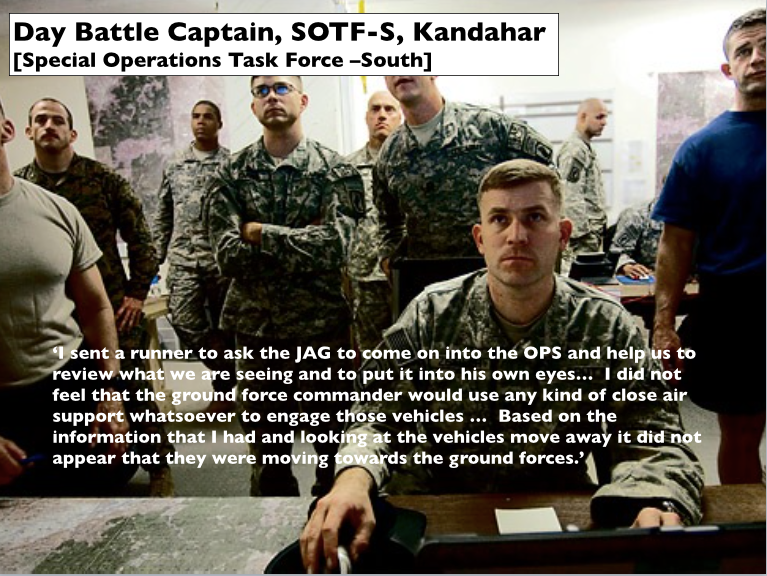
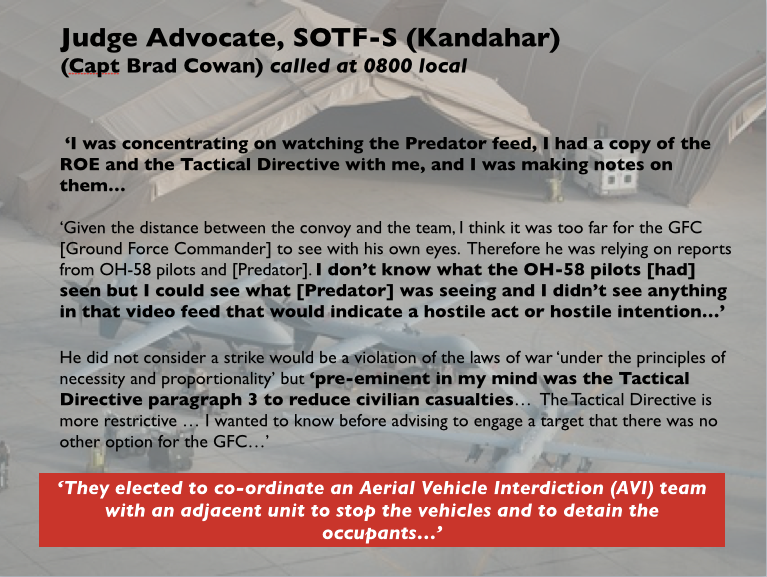
The second issue is the extraordinary partitions – blinkers might be more accurate – that seem to be imposed on military operations and investigations.  In the case of the Uruzgan attack, for example, a military lawyer was called in at the eleventh hour to monitor the video feeds from the Predator as it tracked a ‘convoy’ (a term surely as leading as ‘Military-Aged Male’) in the early morning.  As the next two slides show, taken from my ‘Angry Eyes’ presentation, the JAG knew the Rules of Engagement (ROE) and the Tactical Directive; he obviously also knew the legal requirements of proportionality,  distinction and the rest.

Angry Eyes:1

Angry Eyes:2

Knowing the ROE, the Tactical Directive and the formal obligations of international law is one thing (or several things): but what about ‘case law’, so to speak?  What about knowledge of other, similar incidents that could have informed and even accelerated the decision-making process?  In this case, before the alternative course of action could be put into effect and an ‘Aerial Vehicle Interdiction’ set in motion – using helicopters to halt the three vehicles and determine what they were up to – two attack helicopters struck the wholly innocent ‘convoy’ and killed 15-21 civilians.  Fast forward to the subsequent, I think forensic Army investigation.  This is the most detailed accounting of a ‘CIVCAS’ incident I have read (and you’ll be able to read my analysis of it shortly), and yet here too – even with senior military legal advisers and other ‘subject experts’ on the investigating team – there appears to be no reference to other, similar incidents that could have revealed more of the ‘systemic issues’ to which Larry so cogently refers.

This is made all the stranger because there is no doubt – to me, anyway – that the US military takes the issue of civilian casualties far more seriously than many of its critics allow.

CIVCAS


‘By our algorithms we shall know them’

191webcoverweb

Radical Philosophy 191 is out now, including two contributions of particular interest to me as I continue to grapple with the surveillance apparatus that (mis)informs US drone strikes in the Federally Administered Tribal Areas.  This has come into sharper view after Obama’s rare admission of not only a strike in the FATA but of a mistake in targeting – though his statement was prompted by the death of an American and Italian hostage not by the previous deaths of innocent Pakistanis.

First, Grégoire Chamayou‘s ‘Oceanic enemy: a brief philosophical history of the NSA‘ which traces a path from the sonic surveillance of submarines off Barbados in 1962 to ‘pattern of life’ analysis in Afghanistan, Iraq and Pakistan, and which – not surprisingly – intersects with his Theory of the drone in all sorts of ways:

‘The premiss is the same as before: ‘in environments where there is no visual difference between friend and enemy, it is by their actions that enemies are visible.’ Today the task of establishing a distinction between friend and enemy is once again to be entrusted to algorithms.’

Second, Claudia Aradau‘s ‘The signature of security: big data, anticipation, surveillance‘ shatters the crystal balls of the intelligence agencies:

‘We are not crystal ball gazers. We are Intelligence Agencies’, noted the former GCHQ director Iain Lobban in a public inquiry on privacy and security by the Intelligence and Security Committee of the UK Parliament (ISC) in the wake of the Snowden revelations about mass surveillance….

I argue here that the disavowal of ‘crystal ball gazing’ is as important as the image of finding the clue through the data deluge in order to locate potential dangerous events or individuals in the future. Intelligence work is no stranger to the anticipation of the future – rather, it justifies itself precisely through the capacity to peer into the future in order to prevent or pre-empt future events from materializing. Big data has intensified the promise of anticipating the future and led to ‘exacerbat[ing] the severance of surveillance from history and memory’, while ‘the assiduous quest for pattern-discovery will justify unprecedented access to data’. ‘Knowledge discovery’ through big-data mining, and prediction through the recording of datafied traces of social life, have become the doxa of intelligence and security professionals. They claim that access to the digital traces that we leave online through commercial transactions or social interactions can hold a reading of the future. They repeat the mantra of data scientists and private corporations that the ‘digital bread crumbs’ of the online world ‘give a view of life in all its complexity’ and ‘will revolutionize the study of human behaviour’.

Unlike statistical technologies of governing populations, big data scientists promise that through big data ‘we can escape the straightjacket of group identities, and replace them with more granular predictions for each individual’. To resist their unreasonable promise of predicting crises, preventing diseases, pre-empting terrorist attacks and overall reshaping society and politics, I recast it as divination rather than detection. Big-data epistemics has more in common with the ‘pseudo-rationality’ of astrology than the method of clues. As such, it renders our vocabularies of epistemic critique inoperative…

‘There is nothing irrational about astrology’, concluded Adorno, ‘except its decisive contention that these two spheres of rational knowledge are interconnected, whereas not the slightest evidence of such an interconnection can be offered.’ The irrationality of big-data security is not in the data, its volume or messiness, but in how a hieroglyph of terrorist behaviour is produced from the data, without any possibility of error.

You can obtain the pdfs of both essays by following the links above – but they are time-limited so do it now.

Drone networks

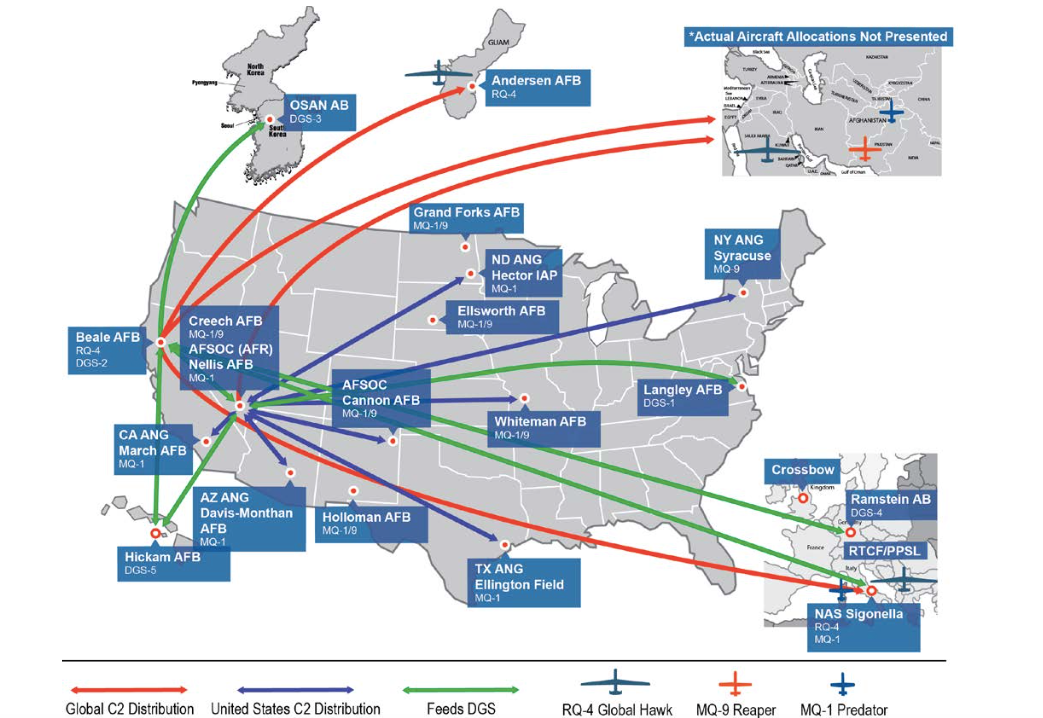
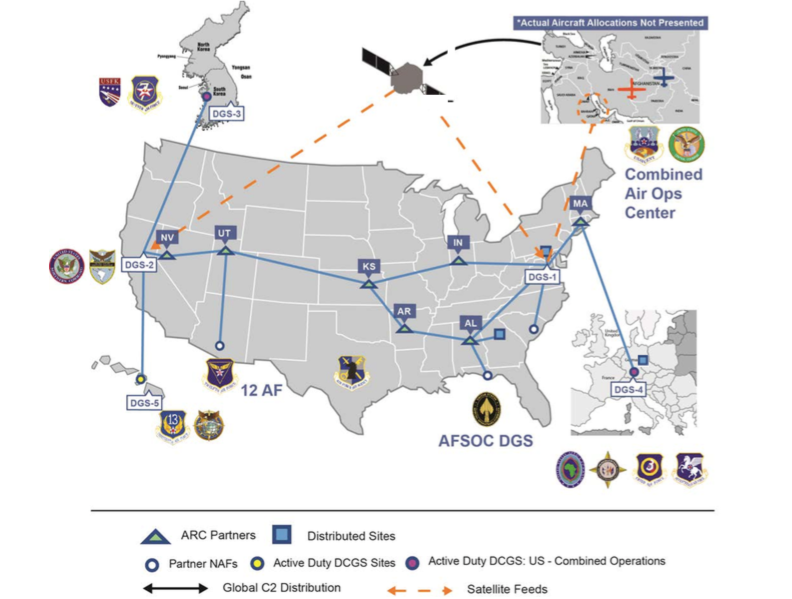
Three contributions to the debates over drones and military violence.  First, my friends at the Bard Center for the Study of the Drone have published Dan Gettinger‘s essay on ‘Drone Geography: mapping a system of intelligence‘.  It’s a superb sketch of the intelligence network in which the US Air Force’s drones are embedded (you can read my complementary take on ‘Drone geographies’ under the DOWNLOADS tab).  Let me add just one map to the illustrations that stud his essay.  It’s taken from the Air Force’s RPA Vector report for 2013-28, published last February, and it shows the architecture of remote split operations within and beyond the United States.  It’s helpful (I hope) because it shows how the Ground Control Stations in the continental United States feed in to the Distributed Common Ground System that provides image analysis and exploitation (shown in the second map, which appears in a different form in Dan’s essay).  I’m having these two maps combined, and I’ll post the result when it’s finished.

RSO architecture (USAF) 1

Distributed Common Ground System (USAF) 2

Dan is right to emphasise the significance of satellite communications; much of the discussion of later modern war and its derivatives has focused on satellite imagery, and I’ve discussed some of its complications in previous posts, but satellite communications materially shape the geography of remote operations.  The Pentagon has become extraordinarily reliant on commercial providers (to such an extent that Obama’s ‘pivot to the Pacific’ may well be affected), and limitations of bandwidth have required full-motion video streams from Predators and Reapers (which are bandwidth hogs) to be compressed and image quality to be degraded.  Steve Graham and I are currently working on a joint essay about these issues.

One caveat: this is not the only network in which US remote operations are embedded.  In my essay on ‘Dirty Dancing’ (now racing towards the finish line) I argue that the CIA-directed program of targeted killing in the Federally Administered Tribal Areas of Pakistan cannot be severed from the multiple ways in which the FATA have been configured as both borderlands and battlefields and, in particular, from the cascade of military operations that have rendered the FATA as a space of exception (in something both more and less than Agamben’s sense of the term).  Here I’ve learned much from an excellent essay by Elizabeth Cullen Dunn and Jason Cons, ‘Aleatory sovereignty and the rule of sensitive spaces’, Antipode 46 (1) (2014) 92-109).  They complicate the claim that spaces of exception always derive from a single locus of sovereign power (or ‘the sovereign decision’).  Instead, they  suggest that borderlands are ‘contested spaces’ where ‘competing’ powers ‘collide’.  In the FATA multiple powers have been involved in the administration of military violence, but on occasion – and crucially – they have done so in concert and their watchword has been a qualified and covert collaboration. In particular, the FATA have been marked by a long and chequered gavotte between the militaries and intelligence services of the United States and Pakistan which, since the 1980s, has consistently put at risk the lives of the people of the borderlands.  And in my essay on ‘Angry Eyes’ (next on my screen) I argue that the US military’s major use of Predators and Reapers in Afghanistan – orchestrating strikes by conventional aircraft and providing close air support to ‘troops in contact’ – depends on communication networks with ground troops in theatre, and that this dispersed geography of militarised vision introduces major uncertainties into the supposedly ‘precise’ targeting process.

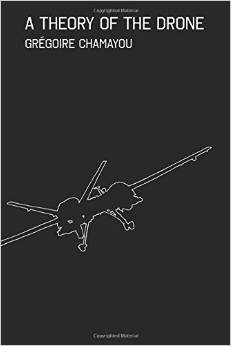
CHAMAYOU Theory of the droneSecond: Elliott Prasse-Freeman has an extended review of the English translation of Grégoire Chamayou‘s Theory of the drone – called ‘Droning On‘ – over at the New Inquiry (you can access my own commentaries on the French edition here: scroll down).  His central criticism is this:

While his title promises theory, we instead are treated to a digression on the military and social ethics of attacks from the air, in which Chamayou asks without irony, “can counterinsurgency rise to the level of an aero-policy without losing its soul?” What offends Chamayou is the “elimination, already rampant but here absolutely radicalized, of any immediate relation of reciprocity” in warfare. This, we are told, is the problem.

Promised a theory of the drone, how do we arrive at a theory of the noble soldier?…

And so, dispatching with the dream of the drone … Chamayou assumes the concerns not of the brutalized but of military leaders and soldiers.

He continues in terms that resonate with my argument in ‘Dirty Dancing’:

By combining knowing (intelligence, surveillance, reconnaissance), sighting (targeting in movement and in the moment), and eliminating (“putting warheads on foreheads”), the drone constitutes an assemblage of force (as drone-theorist Derek Gregory puts it) that promises a revolution in control and allows the US war apparatus to imagine space and politics in new ways. Because the body of the accused can ostensibly be precisely seen, it can be seen as itself carving out a body-sized exception to state sovereignty over the territory on which that body moves. In this way, eliminating the body does not constitute an assault on the territory of the state, as these bodies are presented as ontologically (and hence quasi-legally) disconnected from that territory.  Geographer Stuart Elden in Terror and Territory (2009) points out the significant overlap between who are labeled ‘terrorists’ and movements fighting for their own political spaces – which hence necessarily violate extant states’ ‘territories’ (and hence the entire international order of states): to violate territory is to terrorize. The US is hence remarkably concerned in its arrogation of a position of supra-sovereignty to ensure that it overlaps with ‘classic’ state sovereignty, and by no means violates the norm of territorial integrity (well-defined borders): by harboring or potentially harboring unacceptable transnational desires, the militant uproots himself, and risks being plucked out and vaporized in open space that belongs only to him. The exception to sovereignty provides the drone the opportunity to extend this exception into temporal indefiniteness: wars are not declared, aggressions are not announced—the fleet, fusing police and military functions, merely watches and strikes, constantly pruning the ground of human weeds.

In ‘Dirty Dancing’ I’m trying to prise apart – analytically, at least – the space of exception, conceived as one in which a particular group of people is knowingly and deliberately exposed to death through the political-juridical removal of legal protections and affordances that would otherwise be available to them, and territory conceived (as Stuart suggests) as a political-juridical technology, a series of calculative practices that seeks to calibrate and register a claim over bodies-in-spaces.  That’s why Dan Gettinger’s essay is so timely too, and why I’ve been thinking about the FATA as a performance of what Rob Kitchin and Martin Dodge call ‘code/space’, why I’ve been working my way through the files released by Edward Snowden, and why I’ve been thinking so much about Louise Amoore‘s superb critique of The politics of possibility: risk and security beyond probability (2013).

Screen Shot 2015-01-07 at 10.03.16 AM

Although Louise doesn’t address drone strikes directly, her arguments are full of vital insights into the networks that are mobilised through them.  ‘The sovereign strike is always something more, something in excess of a single flash of decision’, she insists, and when she writes that —

those at risk (which is to say those who are to be put at risk by virtue of their inferred riskiness) are ‘not strictly “included by means of their own exclusion”, as Agamben frames the exception, they are more accurately included by means of a dividuated and mobile drawing of risk fault lines’

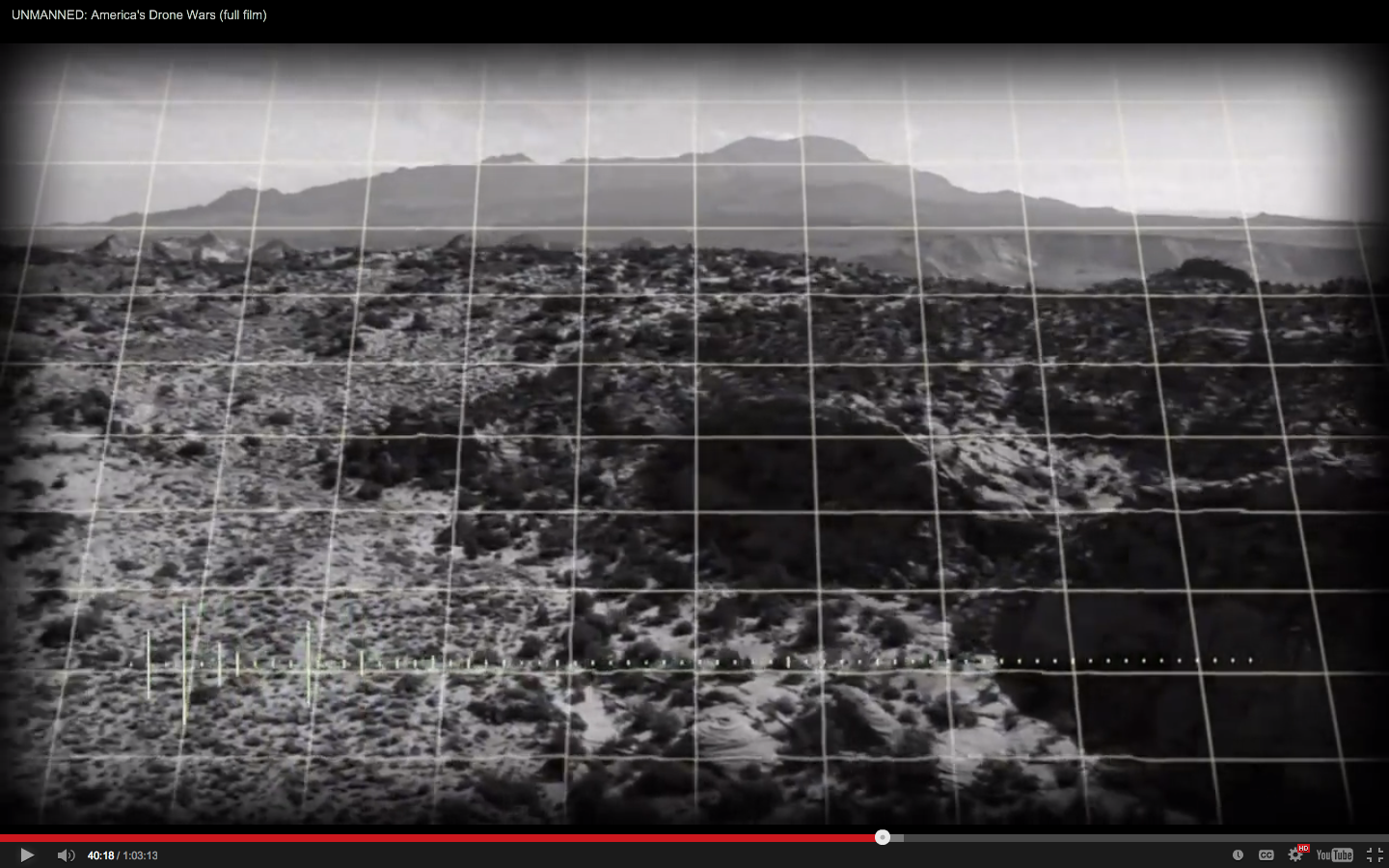
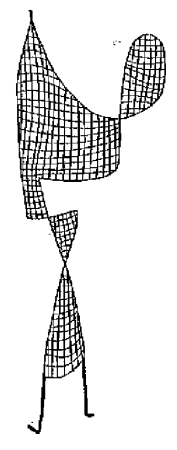
17— it’s a very short journey back to Grégoire Chamayou‘s reflections on the strange (in)dividual whose ‘schematic body’ emerges on the targeting screen of the Predator or Reaper.  Louise writes of ‘the appearance of an emergent subject’, which is a wonderfully resonant way of capturing the performative practices through which targets are produced: ‘pixelated people’, she calls them, that emerge on screens scanning databanks but which also appear in the crosshairs…

And finally, Corporate Watch has just published a report by Therezia Cooper and Tom Anderson, Gaza: life beneath the drones.  This brings together a series of interviews conducted in 2012 – when ‘drones killed more people in Gaza than any other aircraft’ – that were first published in serial form in 2014.  The report includes a tabulation of deaths from Israeli military action in Gaza and those killed directly by drones (2000-2014) and a profile of some of the companies involved in Israel’s military-industrial complex.

On the road

Angry Eyes QML 1

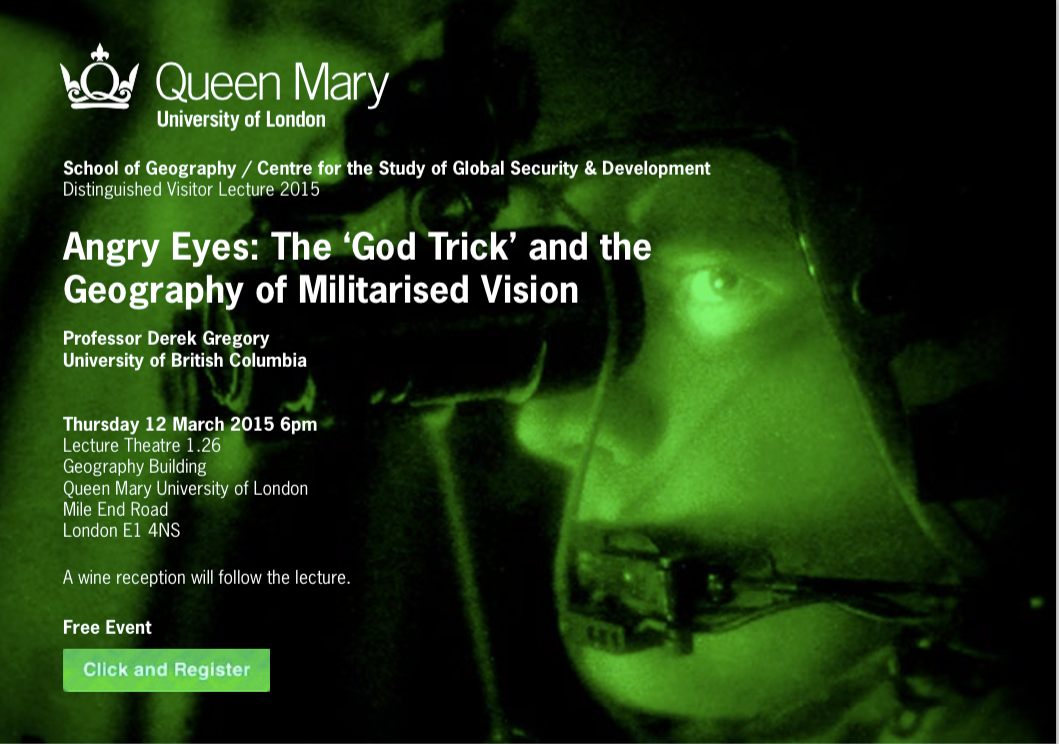
I’m in Mexico with wayward WiFi, which is why I’ve been so quiet lately.  The other reason is that I’ve been writing away (more on that soon).  Next month I really am on the road, as opposed to the beach, and I’ll be giving a series of talks in the UK at Durham (3-4 March), Newcastle (5-6 March), Exeter (9-10 March) and – as you can see from the posters above and below – Queen Mary London (12 March).

Durham gets a different talk (‘Dirty Dancing’, the latest version of my analysis of drone strikes and military violence in Pakistan, which I’m busy turning into an essay right now), but the rest involve the final version of ‘Angry Eyes’, which will also be ready in essay-form soon (which is to say once I’ve got feedback from these presentations).

Angry Eyes QML B

If any readers are near any of these talks, it would be good to see you.

Exeter poster

The prosthetics of military violence

Neve Gordon‘s review of Grégoire Chamayou‘s A theory of the drone on Al-Jazeera is now available in a more extended form at Counterpunch here.  It’s a succinct summary of the book’s main theses, though there’s not much critical engagement with them (you can access my own series of commentaries here [scroll down]).  He closes his review like this:

Because drones transform warfare into a ghostly teleguided act orchestrated from a base in Nevada or Missouri, whereby soldiers no longer risk their lives, the critical attitude of citizenry towards war is also profoundly transformed, altering, as it were, the political arena within drone states.

Drones, Chamayou says, are a technological solution for the inability of politicians to mobilize support for war. In the future, politicians might not need to rally citizens because once armies begin deploying only drones and robots there will be no need for the public to even know that a war is being waged. So while, on the one hand, drones help produce the social legitimacy towards warfare through the reduction of risk, on the other hand, they render social legitimacy irrelevant to the political decision making process relating to war. This drastically reduces the threshold for resorting to violence, so much so that violence appears increasingly as a default option for foreign policy. Indeed, the transformation of wars into a risk free enterprise will render them even more ubiquitous than they are today.

Neve is the author of the indispensable Israel’s occupation, and while these paragraphs closely follow A theory of the drone the title of the book is in the singular – and so I’m left wondering about military violence that isn’t orchestrated from Nevada or Missouri and what other ‘theories of the drone’ are needed to accommodate a ‘drone state’ like Israel (not that I’m sure what a ‘drone state’ is…)?
Shoot and Strike

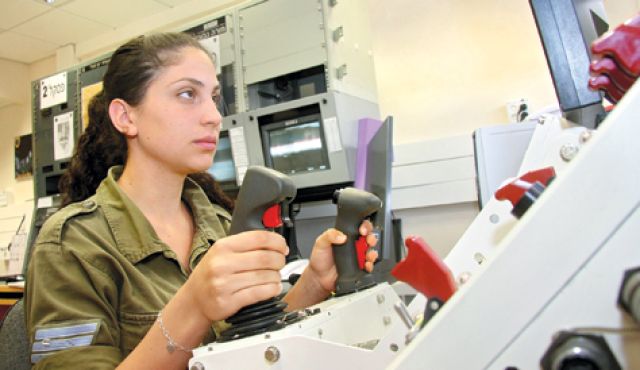
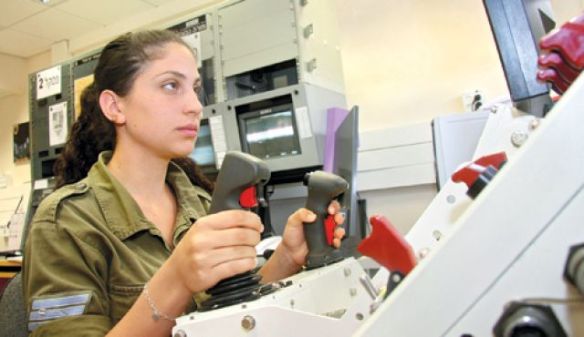
The Israeli military is no stranger to what, following Joseph Pugliese, I’ll call prosthetic violence. While Israel remains a leading manufacturer of drones (see here and here), and routinely deploys them over the occupied territories, it also enforces its ‘Death Zone‘ in Gaza through an automated, ground-based ‘Spot and Strike’ shooting system:

The soldiers, trainees in the course for the “Spot and Strike” system, sit in a tower facing the wilderness of the southern Negev, at the far edge of the Field Intelligence School at the Sayarim base, not far from Ovda. Between their tower and the wide-open desert stands another tower topped by a metal dome. With the press of a button the dome opens to reveal a heavy machine gun. Small tweaks of the joystick aim the barrel. To the right of the gun is a camera, which transmits a clear picture of the target onto a screen opposite the soldier. A press of the button and the figure in the crosshairs is hit by a 0.5-inch bullet.

This dovetails (wrong bird) with a discussion of online shooting in A theory of the drone, but here is risk-transfer war waged over extremely short distances.  ‘Remoteness’ is as much an imaginative as a physical condition, and one that is constantly manipulated so that the threat from Hamas’s rockets and tunnels becomes ‘danger close’ even as the hideous consequences of Israel’s own military offensives become distanced (unless, of course, you choose to turn killing into a spectator sport).  In Israel, it seems, these prosthetic assemblages – of which drones are a vital part – serve to animate a deeply militarised society in which evidence of a martial stance is precisely a prerequisite for its claims to legitimacy.

PUGLIESE State violence

So we clearly need a more inclusive analysis of the prosthetics of military violence – the bio-technical means by which its range is extended – that acknowledges the role of drones for more than ‘targeted killing’ and which incorporates other emergent modalities altogether, including cyberwarfare.  One of the best places to start thinking through these issues, in relation to drones at any rate, is Joseph’s tour de force, State violence and the execution of law (2013), which emphasises how ‘through a series of instrumental mediations, the biological human actor becomes coextensive with the drone that she or he pilots from the remote ground control station’ (p. 184) (I connected this to Grégoire’s theses here).

The experience may be more conditional than this allows, though.  Timothy Cullen‘s study of USAF crews training to operate the MQ-9 Reaper found that the sense of ‘co-extension’ – or bioconvergence – was much stronger among sensor operators than pilots:

After a couple hundred hours of flight experience and a sense of comfort with the modes, interfaces, and capabilities of the sensor ball, sensor operators began to feel like they were a part of the machine. With proficiency as a “sensor,” sensor operators found themselves shifting and straining their bodies in front of the [Heads Up Display] to look around an object.  As pilots flew closer to a target, the transported operators tilted their heads in anticipation of the camera’s [redacted].  Feelings of remote presence helped sensor operators move their bodies, and instructors believed that operators who felt as if they were “flying the sensor” could hold their attention longer on a scene…

Both pilots and sensor operators said pilots did not transport themselves conceptually into the machine to the same extent as a sensor operator. Nor did pilots attain similar feelings of connection and control with Reaper as they did with their previous aircraft.

The term ‘prosthetics’ implies these are at once extensions and embodiments of a military violence whose prosthetics also assume more mundane bioconvergent forms.  This is an obvious but in most cases strangely overlooked point.  Joseph mentions it in passing, juxtaposing his ‘mobilisation of the prosthetic trope’ with ‘the material literality of prosthetics: drones as the militarized prosthetics of empire inherently generate civilian amputees in need of prosthetic limbs’ (p. 214).  There’s also a suggestive discussion in Jennifer Fluri‘s ‘States of (in)security’, which devotes a whole section to what she calls ‘prosthetics biopower’ and the multiply corporeal geographies of contemporary wars [Environment and Planning D: Society & Space 32 (2014) 795-814].  Although Jennifer doesn’t directly connect these intimacies to distant vectors of military violence, the implication (and invitation) is clearly there.

So let me try to supplement her observations, drawing in part on my project on military-medical machines that treats (among other theatres of war) the evacuation of injured soldiers and civilians in Afghanistan.  It’s important to trace the two pathways, as I’ll show in a moment (and I’ll say much more about this in a later post), but it’s also necessary to remember, as Sarah Jain crisply observes in her classic essay on ‘The prosthetic imagination‘ (p. 36), that ‘it usually is not the same body that is simultaneously extended and wounded’  [Science, technology and human values 24 (1) (1999) 31-54].  That said, there is a distinctively corporeal geography to those that are.
US military Limb amutations in Afghanistan and Iraq PNG

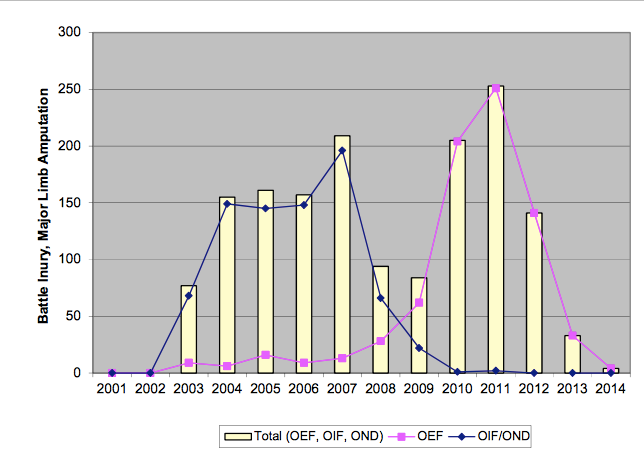
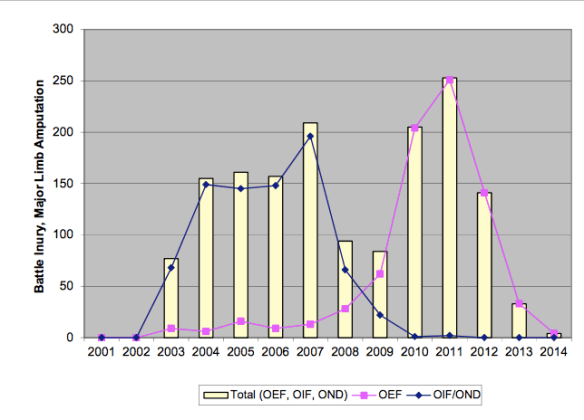
Major limb amputations (US military) in Iraq (OIF) and Afghanistan (OEF) 2001-2014 (Source: Congressional Research Services US Military Casualty Statistics, November 2014)

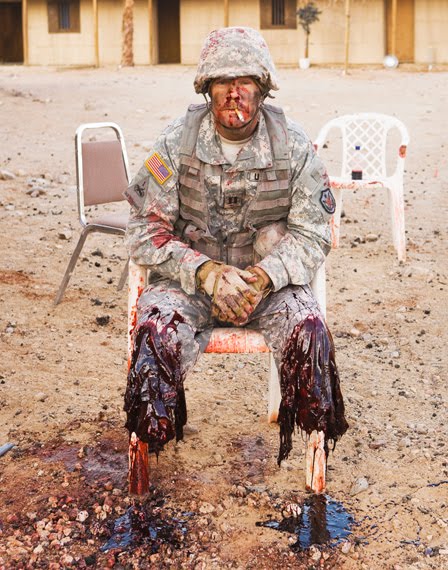
The incidence of devastating injuries to the limbs of troops in Iraq and Afghanistan (see the graph above; for comparable UK figures, see here) – mainly from IEDs – has been acknowledged in the role played by amputees in mission rehearsal exercises and pre-deployment training since 2005 (see here for an excellent general account).
Peter Bohler:Fort Irwin training

Private contractors like Amputees in Action pride themselves on providing ‘de-sensitising’ exposure to ‘catastrophic injury amputations’ and replicating the latest field injuries for these exercises.  There is a risk in re-enrolling war veterans, as the company concedes:

Every amputee is vetted and put through specialist training beforehand to see if they are up to the job. For some it is too close to the mark, too realistic. The last thing we want to do is traumatize someone, stymie their rehabilitation.

These simulations have been used to prepare ordinary soldiers for the situations they will face – today it’s not only the ‘golden hour’ between injury and surgery that is crucial but also (and much more so) the ‘platinum ten minutes’ immediately following the incident, so the first response is vital. They have also been used to ready trauma teams for the war zone: the BBC has a report on the Royal Army Medical Corps’s mock ‘Camp Bastion’ at Strenshall in Yorkshire here.

These various exercises incorporate the latest advances in evacuation and trauma care, which have meant that today’s soldiers are far more likely to survive even the most life-threatening wounds than those who fought in previous conflicts, but the horrors experienced by young men and women in the military who lose arms and legs – sometimes all of them – are truly hideous:  read, for example, Anne Jones‘s mesmerising and deeply moving account of  They Were Soldiers: How the wounded return from America’s wars (you can get an idea from her ‘Star-spangled Baggage’ here).  Their road to rehabilitation is far longer, and infinitely more painful, than the precarious journey through which they returned to the United States (see also my ‘Bodies on the line‘).
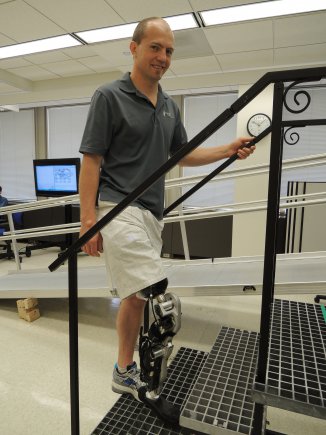
Zac Vawter at the Rehabilitation Institute of Chicago

Researchers unveiled the world’s first thought-controlled bionic leg  on 25 September 2013  funded through the US Army Medical Research and Materiel Command’s (USAMRMC) Telemedicine and Advanced Technology Research Center (TATRC) and developed by researchers at the Rehabilitation Institute of Chicago (RIC) Center for Bionic Medicine. 

There is some light in the darkness – ongoing experiments with state-of-the-art, ‘bionic’ prosthetics animated by microprocessors in the US, the UK and elsewhere that restore far more stability, mobility and movement than would have been possible even five years ago (see above, and here and here for the US, here and here for the UK).  In the 1980s less than 2 per cent of US soldiers who had suffered major limb amputations returned to duty; by 2006 that had increased to over 16 per cent (see also here and here).  There are several reasons for the change, but in 2012 Jason Koebler reported:

According to the Army, at least 167 soldiers who have had a major limb amputation (complete loss of an arm, leg, hand, or foot) have remained on active duty since the start of the Afghanistan and Iraq wars, with some returning to battle. Many others have returned overseas to work in support roles behind the lines.

“When we have someone we know wants to return, their rehab is geared that way,” says John Fergason, chief of prosthetics at the Army Center for the Intrepid at Fort Sam in Houston, Texas.

Kevin Carroll, vice president of Prosthetics at Hanger, a company that makes artificial limbs, says prosthetics have become more comfortable to wear and closer in range of motion to natural limbs.  “Unfortunately, when you have war, you have casualties, but with that comes innovation,” he says. Artificial joints are getting better at approximating the knee, elbow, wrist, and ankle, and microprocessors embedded in prostheses are able to pick up and adjust for impacts from walking, running, jumping, and climbing.

“The person doesn’t have to worry about the prosthetic device, they’re worrying about the task in front of them,” Carroll says. “If they want to go back to be with their troops, that’s an option for many soldiers these days.”

Notice, though, that these advances in prosthetic design and manufacture are part of an intimate conjunction between military violence and military medicine, in which materials science, bio-engineering, electronics and computer science simultaneously provide new means of bodily injury and new modalities of bodily repair.  This is captured in the title of David Serlin‘s thought-provoking essay, ‘The other arms race’ [in Lennard Davis (ed), The Disability Studies Reader (second edition, 2006) 49-65; this essay is not included in the latest edition, but see also the collection David edited with Katherine OttArtificial parts, practical lives: modern histories of prosthetics (2002) and his own Replaceable You: engineering the body in postwar America (2004)].  You can also find an excellent brief historical review of ‘Prosthetics under trials of war’ here.
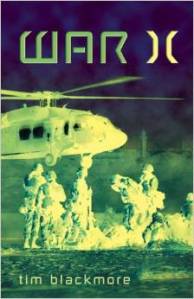
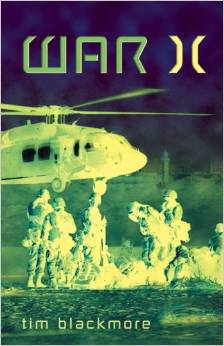
War XAnd, given the circuits within the military-medical machine, there may be more to come.  There are those who anticipate a future in which prosthetics will not only reinstate but also increase a soldier’s capabilities.  Koebler cites Jonathan Moreno, a bioethicist at the University of Pennsylvania, who ‘talks about a future where prosthetics are “enhancers” that allow soldiers to be stronger, faster, and more durable than their peers.’  These fantasies feed through the masculinist imaginary of the post-human cyborg soldier (sketched an age ago by Chris Hables Gray and revisited here) to the prosthetics of military violence with which I began. Here Tim Blackmore‘s War X: Human extensions in battlespace (2011) is also relevant.

But Koebler is quick to add that all this is still a distant prospect:

“I know the question is often, ‘How close are we to true bionic or having artificial limbs that are more versatile than natural ones?'” Fergason says. “Frankly, we’re not that close. You’re not going to see anyone decide, ‘Boy, I think I’d like to get a bionic leg because they’re so fantastic.’

“We love to read about the super-soldier, but that’s not the case right now. Amputation is so complex in what it does to your body that it’s a very long recovery,” he adds.

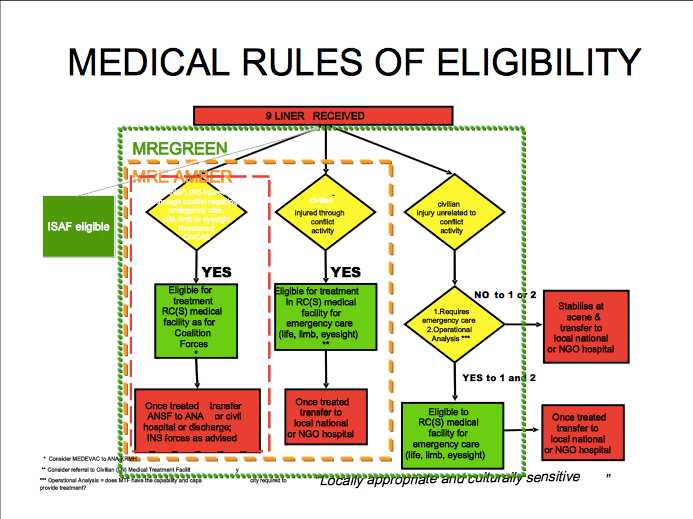
So what, then, of civilians?  Under ISAF’s Medical Rules of Eligibility Afghan civilians who were injured during military operations and/or needed ‘life, limb or eyesight saving care’ could be admitted to the international medical system, and were eligible for emergency casualty evacuation and treatment at one of the Category III advanced trauma centres at Bagram or Camp Bastion.
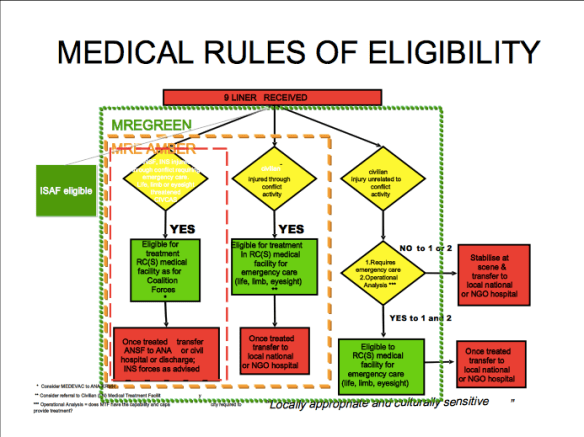
Medical Rules of Eligibility PNG

As soon as possible, however, Afghans were to be treated by Afghans and so, after surgical intervention they had to be transferred to the local healthcare system.  The same applied to the Afghan National Army and police.  In consequence, the drawdown of international forces – which also includes their medevac and trauma teams – has left the local population desperately vulnerable to the after-effects of continuing and residual military and paramilitary violence (see here and here).

The inadequacies and insufficiencies of the Afghan healthcare system have prompted a number of NGOs to fill the gap between the radically different systems, and they have done – and continue to do –  immensely important work.

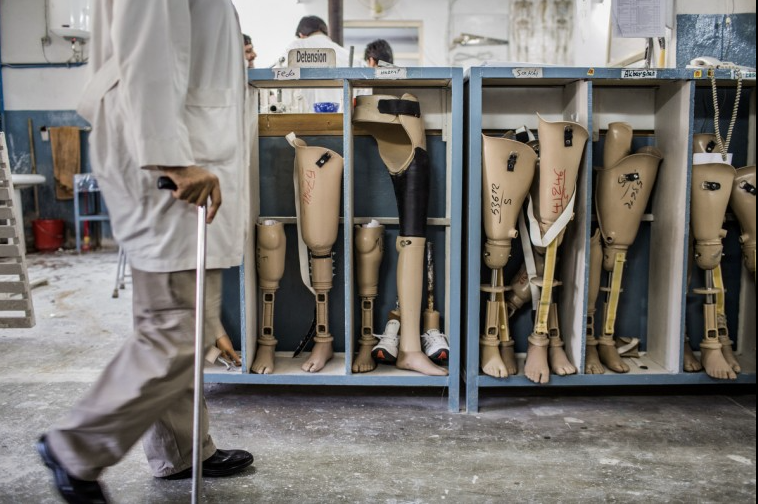
But compare the prosthetics available to US soldiers with those supplied to Afghan civilians.  I don’t mean to minimise the invaluable work done by hard-pressed and underfunded NGOs, but the image below is from the ICRC‘s Orthopedic Center in Kabul (see also here).  There are other centres supported by the ICRC in Faizabad, Gulbahar, Herat, Jalalabad, Lashkar Gah, and Mazar-e-Sharif, together with a manufacturing facility in Kabul, and other NGOs are active elsewhere  – Médecins sans Frontières runs a similar facility in Kunduz, for example.
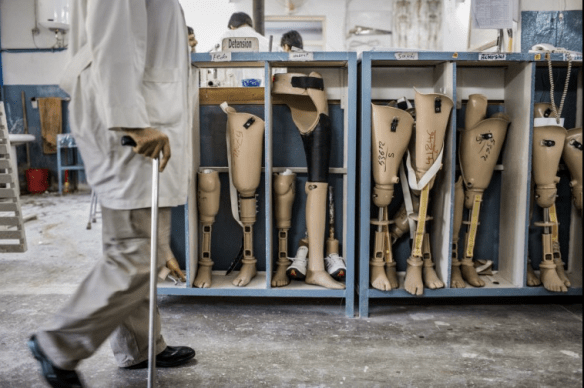
ICRC Orthopedic Center Kabul PNG

In addition to these facilities, there have been some ingenious work-arounds.  Carmen Gentile describes how US soldiers at Forward Operating Base Kasab in Kandahar were moved by the plight of Mohammed Rafiq, an eight-year old boy whose legs were blown off by an IED.  ‘Since we couldn’t get a supply of commercially made legs, we decided that maybe we could make them ourselves,’ explained Major Brian Egloff, a US Army surgeon at the base.

Using scrap tubing and some ingenuity, Egloff fitted Rafiq with small prosthetic legs. Rafiq was now able to get around the village…

Egloff did not end his work with Rafiq. He knew there must be other amputees living in the area…  Soldiers on patrol had noticed “a lot of guys with amputations that had no prosthetic legs and were reduced to crawling around on the ground and relying on the charity of strangers just to get by,” he says.  Afghans heard about what was done for Rafiq and asked for help for others. Egloff made the legs from material readily available in any welding shop, he says, mostly scrap aluminum tubing for the legs and aluminum plates for the prosthetic feet. A spring-loaded hinge served as the ankle joint.  “It’s a very simple design, nothing complicated,” he says.

These legs were intended to be temporary replacements until ‘a professionally fitted prosthetic’ was available, but the same report notes that ‘getting to a provincial capital, where most hospitals are located, is not easy for many Afghans and the routes are dangerous.’  There’s much more about inaccessibility in MSF’s Between rhetoric and reality: the ongoing struggle to access healthcare in Afghanistan (February 2014).

Like Mohammed – and many ISAF and Afghan soldiers – many of these amputees are the victims of IEDs or even land mines left over from the Soviet occupation (for a global review of the rehabilitation of people maimed by the explosive remnants of war [ERW], see this 2014 report from the International Campaign to Ban Landmines–Cluster Munition Coalition).

But some of them will be the victims of air strikes from or orchestrated by Predators and Reapers: in recent years Afghanistan has been the most heavily ‘droned’ theatre of operations in the world.  In some cases they were caught in the blast, but in others they were the victims of what Rob Nixon calls ‘slow violence‘.  According to a report by Sune Engel Rasmussen in the Guardian:

Since 2001, the coalition has dropped about 20,000 tonnes of ammunition over Afghanistan. Experts say about 10% of munitions do not detonate: some malfunction, others land on sandy ground. In rural areas, children often bring in vital income to households, but collecting scrap metal or herding animals can be fraught with unpredictable risks. Of all Afghans killed and maimed by unexploded ordnance, 75% are children…

Their future is usually bleak.  Erin Cunningham reports that ‘even as the population of Afghans who are missing limbs grows, amputees face discrimination and the harsh stigma of being disabled.’

“Socially and financially, their lives are destroyed,” Emanuele Nannini, program director at the Italian nonprofit Emergency, which operates health-care centers across Afghanistan, said of Afghan amputees.

From January to June [2014], Emergency’s Center for War Trauma Victims in Lashkar Gah, the capital of Helmand province in southern Afghanistan, performed 69 amputations. The fiercest fighting between the two sides usually takes place in the warmer summer months.

Emergency then sends the amputees to the nearby International Committee for the Red Cross orthopedic facility for long-term rehabilitation. The patients receive vocational training and other support to reintegrate them into society. The ICRC said that between April and June this year, it admitted 351 amputee patients to its facilities across Afghanistan.

But for the most part, amputees “are completely dependent on their families, and they become a huge burden,” said Nannini, who is based in Kabul. “The real tragedy starts when they go home. If they don’t have a strong family, they become beggars.”

Emergency runs two other surgical centers, in Kabul and Anabah, as well as a number of clinics and first aid posts in the villages; at Lashkar Gah six out of every ten admissions are victims of bombs, land mines or bullets.

The story is, if anything, even worse across the border in Pakistan’s Federally Administered Tribal Areas, whose inhabitants are also subject to explosive violence from the Taliban and other groups, and from CIA-directed drone strikes and air and ground attacks by Pakistan’s military.  As Madiha Tahir has shown, the victims usually disappear from public attention, at least in the United States:

What is the dream?

I dream that my legs have been cut off, that my eye is missing, that I can’t do anything … Sometimes, I dream that the drone is going to attack, and I’m scared. I’m really scared.

After the interview is over, Sadaullah Wazir pulls the pant legs over the stubs of his knees till they conceal the bone-colored prostheses.

The articles published in the days following the attack on September 7, 2009, do not mention this poker-faced, slim teenage boy who was, at the time of those stories, lying in a sparse hospital in North Waziristan, his legs smashed to a pulp by falling debris, an eye torn out by shrapnel….

Did you hear it coming?

No.

What happened?

I fainted. I was knocked out.
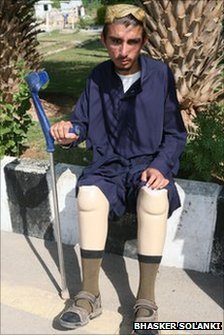
sadulla1As Sadaullah, unconscious, was shifted to a more serviceable hospital in Peshawar where his shattered legs would be amputated, the media announced that, in all likelihood, a senior al-Qaeda commander, Ilyas Kashmiri, had been killed in the attack. The claim would turn out to be spurious, the first of three times when Kashmiri would be reported killed.

Sadaullah and his relatives, meanwhile, were buried under a debris of words: “militant,” “lawless,” “counterterrorism,” “compound,” (a frigid term for a home). Move along, the American media told its audience, nothing to see here. Some 15 days later, after the world had forgotten, Sadaullah awoke to a nightmare.

Do you recall the first time you realized your legs were not there?

I was in bed, and I was wrapped in bandages. I tried to move them, but I couldn’t, so I asked, “Did you cut off my legs?” They said no, but I kind of knew.

Zeeshan-ul-hassan Usmani and Hira Bashir listed some of the long-term implications in a report completed last December for the Costs of War project:

Drone injuries are catastrophic ones.  Wounded survivors of drone attacks have often lost limbs and are usually left with intense and unmanaged pain, and some desire death. Those who survive with severe disabilities face a difficult situation given lack of accommodation for people with disabilities in Pakistan. FATA is an extremely difficult terrain for a disabled person. A walk out for the morning naan (traditional bread) may require navigating through a twisty mud track, with regular dips and bumps. The traditional mud houses of the area themselves have a mud floored haweli (an open-air area onto which all the rooms usually open up). A person with a leg amputation cannot use a regular wheel chair, go to school or hospital, or even use a toilet on his own. Disability of the primary breadwinner can change the course of life for an entire family, since most village jobs are physical ones.

Here too the barriers are more than physical.  In 2011 Farooq Rathore and Peter New described how disability remains a stigma in many sectors of Pakistani society, and rehabilitation medicine is still underdeveloped.

The leading prosthetics center is the Armed Forces Institute for Rehabilitation Medicine at Rawalpindi – whose rehabilitation services for injured soldiers are reportedly ‘the best in the country‘ – but it ‘still manufactures prostheses and orthoses with wood, leather, and metal.’  For injured civilians, the outlook is still more grim.  In 2012 a plan was announced to appoint orthotic specialists and physiotherapists at district hospitals throughout the FATA:

The prolonged United States-led war against terrorism has left a large number of people disabled in Pakistan, compelling the government to institute a rehabilitation plan that will include imparting vocational skills…

“We plan to enhance the physical rehabilitation services for the victims of terrorism to save them from permanent disability,” [Mahboob ur Rehman, head of the physiotherapy department at the Hayatabad Medical Complex (HMC)in Peshawar] told IPS.

The decade-long armed conflict has resulted in injuries to thousands of people from blasts, shelling and drone attacks, with the majority of the victims needing prosthetic and orthotic management to help regain the ability to walk, he said.

But it turns out that the emphasis is as much on ‘wheelchairs and sewing machines’ as it is on even the most basic prosthetics.

Once again, NGOs have provided vital services in the most difficult circumstances.  In 1979 the ICRC established a Paraplegic Rehabilitation Center in Peshawar for victims of the Afghan war, for example, which was subsequently transferred to the control of the Khyber-Pakhtunkhwa provincial government.  It has achieved some notable successes, but here too the focus is on physical therapy and it is outside the FATA so that access is difficult for many people.

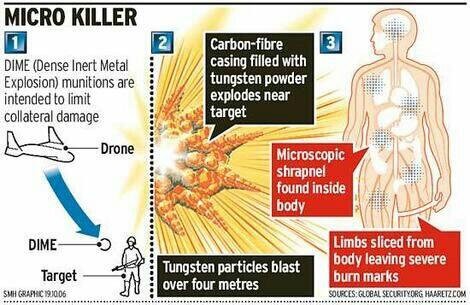
And so, finally, to Gaza.  Here the differences with Afghanistan and Pakistan are striking.  Throughout the Israeli assault last summer, as I showed in detail here, medical services were severely compromised, and hospitals and medical centres actively targeted.  The only rehabilitation hospital, El-Wafa, was destroyed.  The injuries were also aggravated by the use of Dense Inert Metal Explosives (DIME) – developed for the US Air Force in 2006 – and which, according to a Briefing Note issued by the Palestinian human rights organisation Al-Haq, were fired from Israeli drones.
DIME blast injuries

These experimental weapons are supposed to decrease collateral damage by constricting the lethal blast radius.  But inside that perimeter the explosive blast is concentrated and magnified:

The injuries of victims who have been in contact with experimental DIME weapons are distinguishable from injuries sustained by non-experimental weapons. While signs of solid shrapnel or metal fragments are typical of amputations sustained from traditional explosives, physicians in the Gaza Strip are witnessing gruesome amputations caused by a metal vapor or residue which indicate the detonation of an extreme force in a small radius. In fact, as a result of these weapons, reported cases in the Gaza Strip include entire bodies cut in half, shattered bones, and skin, muscle and bones turned into charcoal due to the destructive burns associated with the weaponry’s extreme force and high temperature.

The lacerations are so severe that many victims bleed out and die.

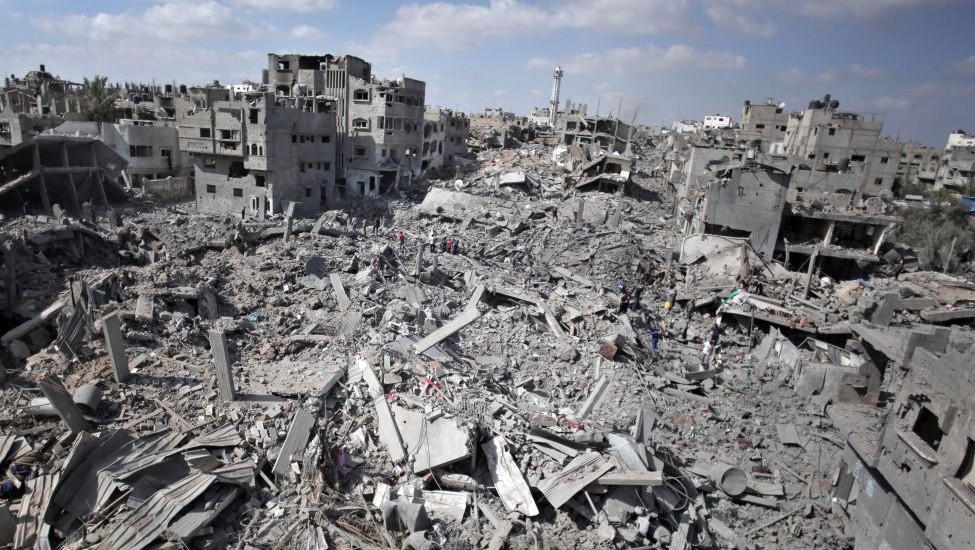
The scale of destruction in Gaza also presents a radically different landscape for survivors of blast injuries.  If the terrain in FATA is formidably difficult for anyone using prosthetics or in a wheelchair, imagine what it must be like to be confronted with this:
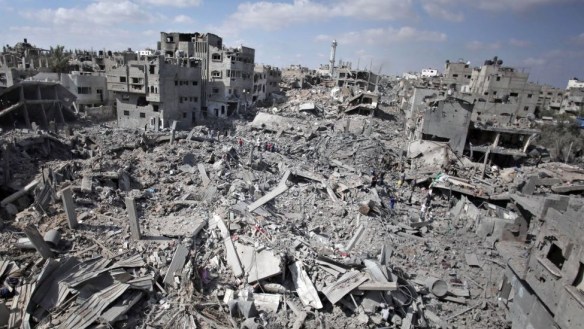
al Shejaiya Gaza 2014

When you look at that, bear in mind that when the assault came to an end there were still around 7,000 unexploded bombs and other explosive remnants of war beneath the rubble.

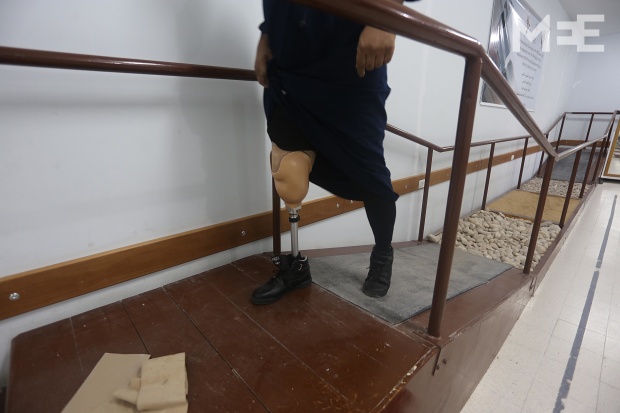
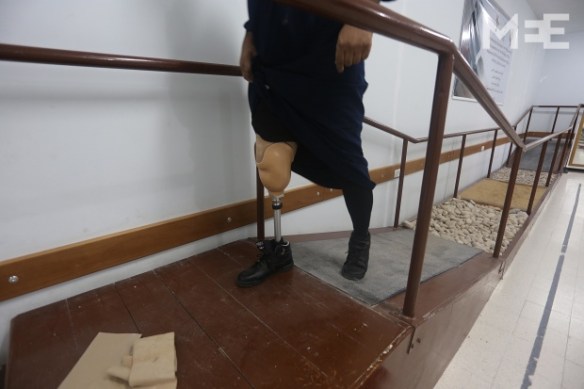
These are all dreadful effects and yet, compared to Afghanistan and Pakistan, the situation for prosthetics and rehabilitation seems somewhat better.  The prosthetics are more advanced, and some patients have been able to travel to Beirut, Amman and on occasion into Israel for treatment.  But there are still formidable obstacles in the essential provision of continuing local care.  Bayan Abdel Wahad reports from the Artificial Limb Centre, the only one of it kind in Gaza:

The number of patients who have benefited from the service of prosthetic replacement which the Centre provides for free is about 300 people who have been injured as a result of the Israeli bombardments in the past five years. However, a number of people injured in the last war – Operation Protective Edge – have not been able to come to the center yet because they are still bed-ridden due to several injuries whose treatment takes precedence over prosthetic replacement…. The technical coordinator at the center, Nivine al-Ghusain, said that “despite all the difficulties we face in funding and getting the materials necessary to manufacture the artificial limbs, we will continue in our work.” She [said] that the Centre takes upon itself the maintenance of the prosthesis from time to time “in addition to changing it based on the patients’ needs.”
15_0

The Centre relies on the ICRC for components and raw materials from France, Germany, Switzerland and the United States, but there are continuing difficulties in importing these via Israel or Egypt.  In December 2014 the Center was treating around 950 amputees.

Reports about the cultural and social response to these visible victims of military violence are mixed. Guillaume Zerr, who directs Handicap International’s operations in Gaza, told Reuters that ‘there can be less acceptance of their condition than in other regions of the world’, whereas one young man – a double amputee – insisted that ‘I feel more love, support and sympathy from people now than before my injuries, and Gazan society is non-discriminating toward me.’  Perhaps this is, at least in part, because he, like others wounded in Gaza, can provide an unambiguous narrative, ‘to tell the story behind the loss of his legs’.  I remember Omar Dewachi explaining to me how patients from Iraq, Libya or Syria who are treated in Beirut for their wounds have to return home with a narrative that can explain what happened to them in terms that will satisfy whichever side in those civil wars might call them to account.  Such narratives are important not only for their rehabilitation (and here they are vital) but also for their very survival.  This is presumably more straightforward in Gaza, but this ‘politics of the wound’ is also always a geopolitics of the wound.

One last thought.  I’m struck by how often the term ‘asymmetric war’ is used to imply that conflicts of this sort are somehow unfair – to those who possess overwhelming firepower.  But war is about more than firepower, more even than killing, and I hope I’ve shown that the differences between the continuing care and rehabilitation available to those who are maimed in these wars reveal not only a different prosthetics of military violence but also a new and grievous asymmetry in its enduring consequences.

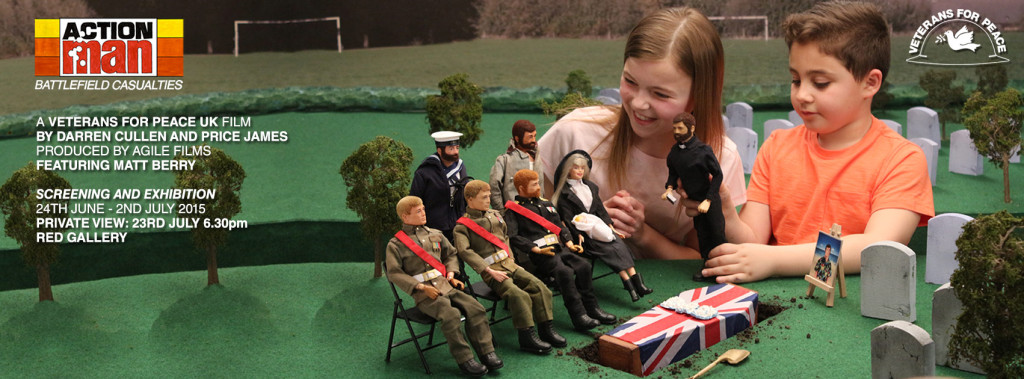
The trauma hero

wwi-trauma

Following up my earlier post on novels, memoirs and narratives of war, there’s a thoughtful discussion by Roy Scranton at the LA Review of Books on what he calls ‘the myth of the trauma hero’.

A boy goes to war, his head full of romantic visions of glory, courage, and sacrifice, his heart yearning to achieve heroic deeds, but on the field of battle he finds only death and horror. He sees, suffers, and causes brutal and brutalizing violence. Such violence wounds the soldier’s very soul.

After the war the boy, now a veteran and a man, returns to the world of peace haunted by his experience, wracked by the central compulsion of trauma and atrocity: the struggle between the need to bear witness to his shattering encounter with violence, and the compulsion to repress it. The veteran tries to make sense of his memory but finds it all but impossible. Most people don’t want to hear the awful truths that war has taught him, the political powers that be want to cover up the shocking reality of war, and anybody who wasn’t there simply can’t understand what it was like.

The truth of war, the veteran comes to learn, is a truth beyond words, a truth that can only be known by having been there, an unspeakable truth he must bear for society.

This is probably the place to say that Roy served in the US Army in Iraq 2002-2006, studied at the New School for Social Research, and in 2010 embarked on a doctorate in English at Princeton – although, as you will soon see, this runs the very real risk of claiming that ‘he knows what he writes’ by virtue of these experiences.
Roy traces the myth of the trauma hero to eighteenth-century European Romanticism, and argues that it achieved its mature form in the twentieth century.  Accordingly he follows its development through Wilfred Owen in the First World War, Ernest Hemingway in the Second and Tim O’Brien in Vietnam until he reaches its contemporary form in Afghanistan and Iraq – and, in our own immediate present, in a film like Eastwood’s American Sniper.
It’s a beautifully composed contribution, and it’s made me re-think the basis for my ‘Gabriel’s Map’ and ‘Natures of War’ essays (DOWNLOADS tab) because Roy’s central thesis turns on a critique of the sacralization of trauma in ways that, at first sight, collide with my own attempts to develop what I’ve called a corpography (also DOWNLOADS tab) that can make us attentive to the corporeality and materiality of modern war:

‘Most Americans seem to believe that war can only be known through direct, physical, sensory experience on the battlefield, such as the moment of vision Owen describes in “Dulce et Decorum Est.” Ernest Hemingway, who in contrast to Owen’s long front-line service lasted only a few weeks as a noncombatant before being wounded and returning to the US, stands in American letters as the high priest of combat gnosticism. In Hemingway’s work, the emphasis on physicality, embodiment, and materiality we see in Owen’s representations of the soldier’s truth opens into a metaphysical bias against representation itself.’

d34387b998ba1136a34e9cc9e03515eeIn effect, Roy suggests, ‘being there’ becomes a privileged position from which truth cannot be communicated – only felt, and so only shared between those who were there.  The assertion of ethnographic privilege run through multiple fields from anthropology to journalism, of course, and it bedevils any attempt at historical reconstruction, but here it is heightened by the appeal to the supposedly inexpressible experience of trauma.  This could be developed still further through the reflections of, say, Elaine Scarry or Giorgio Agamben.  I take this very seriously, and yet if you work your way through the letters, diaries and memoirs of those who returned from the wars there is, I think, a sustained (and diverse) attempt to convey the corporeal – viscerally traumatising – experience of military violence.

But Roy’s point, I take it, is that this dilemma can function – can even be invoked – to exclude commentary and criticism.  And he concludes by emphasising the work that the ‘trauma hero’ continues to perform hors de combat:

‘[The most troubling consequence of our faith in the revelatory truth of combat experience and our sanctification of the trauma hero [is] that by focusing so insistently on the psychological trauma American soldiers have had to endure, we allow ourselves to forget the death and destruction those very soldiers are responsible for… Understanding the problem of American political violence demands recognizing soldiers as agents of national power, and understanding what kind of work the trauma hero is doing when he comes bearing witness in his bloody fatigues.’

I understand this concern too; there are – as I’ve argued in ‘The Natures of War’ – moments in many memoirs, novel and poems that reach towards the redemptive, even the exculpatory.  But I’ve also been deeply affected by those that disclose a more complex sense of the soldier as victim and vector of military violence: one of the recurrent motifs of the texts from the Western Front that I’ve worked with, for example, is the description of the fighting as ‘murder’.

So, much to think about – not least for the ways in which Roy’s ideas about the contemporary trauma hero complicate theses about a supposed transition to ‘post-heroic war’.  Those claims have a special resonance in the drone debates where, as I’ve noted elsewhere, Grégoire Chamayou has suggested that the trauma reportedly suffered by drone operators is ‘being mobilised to restore to war the ethico-heroic temper [critics] insisted it had lost through trauma’.

Evil Hours Cover Final

If you want to know more about the genealogy of post-traumatic stress, I recommend David J. Morris, The evil hours: a biography of post-traumatic stress disorder (Eamon Dolan/Houghton Mifflin Harcourt, 2015).   You can read an extract over at Salon here.  The book is particularly relevant to this discussion because it suggests that where trauma was once mediated through philosophy and literature it is now constituted through psychology and psychiatry.  David is very good on the arguments that raged over ‘shell-shock’ during the First World War, but if you want a ‘biography’ of that then you should turn to Michèle Barratt‘s Casualty figures: how five men survived the First World War (Verso, 2007).

Finally, Roy’s Learning to die in the Anthropocene is due from City Lights in the fall; you can get a taste of it from his essay in the New York Times with the same title here; this was the final installment of a five-part series on War and the city in which Roy retraced his footsteps from civilian to soldier to civilian.