Kunduz and ‘seeing like a military’

Seeing like a military

I’ll be talking about ‘Seeing like a military‘ at the Association of American Geographers’ Annual Meeting in Tampa (home of Joint Special Operations Command!) 8-12 April 2014, and here’s the abstract:

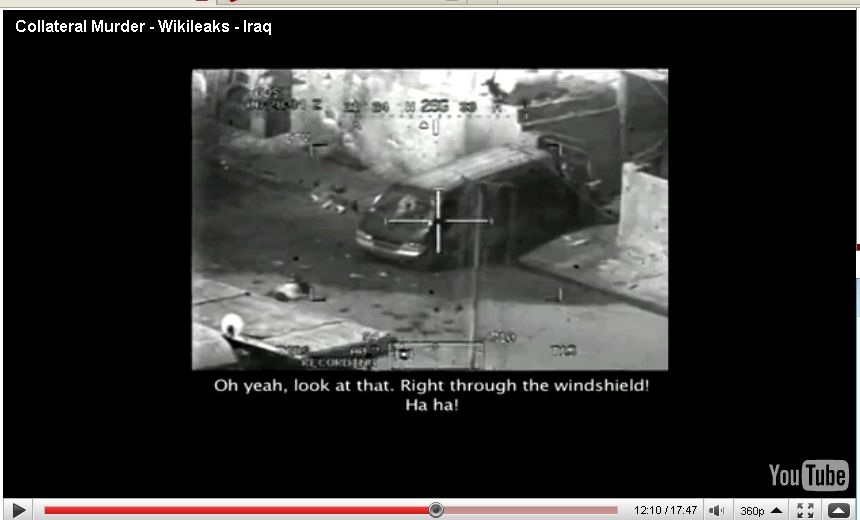
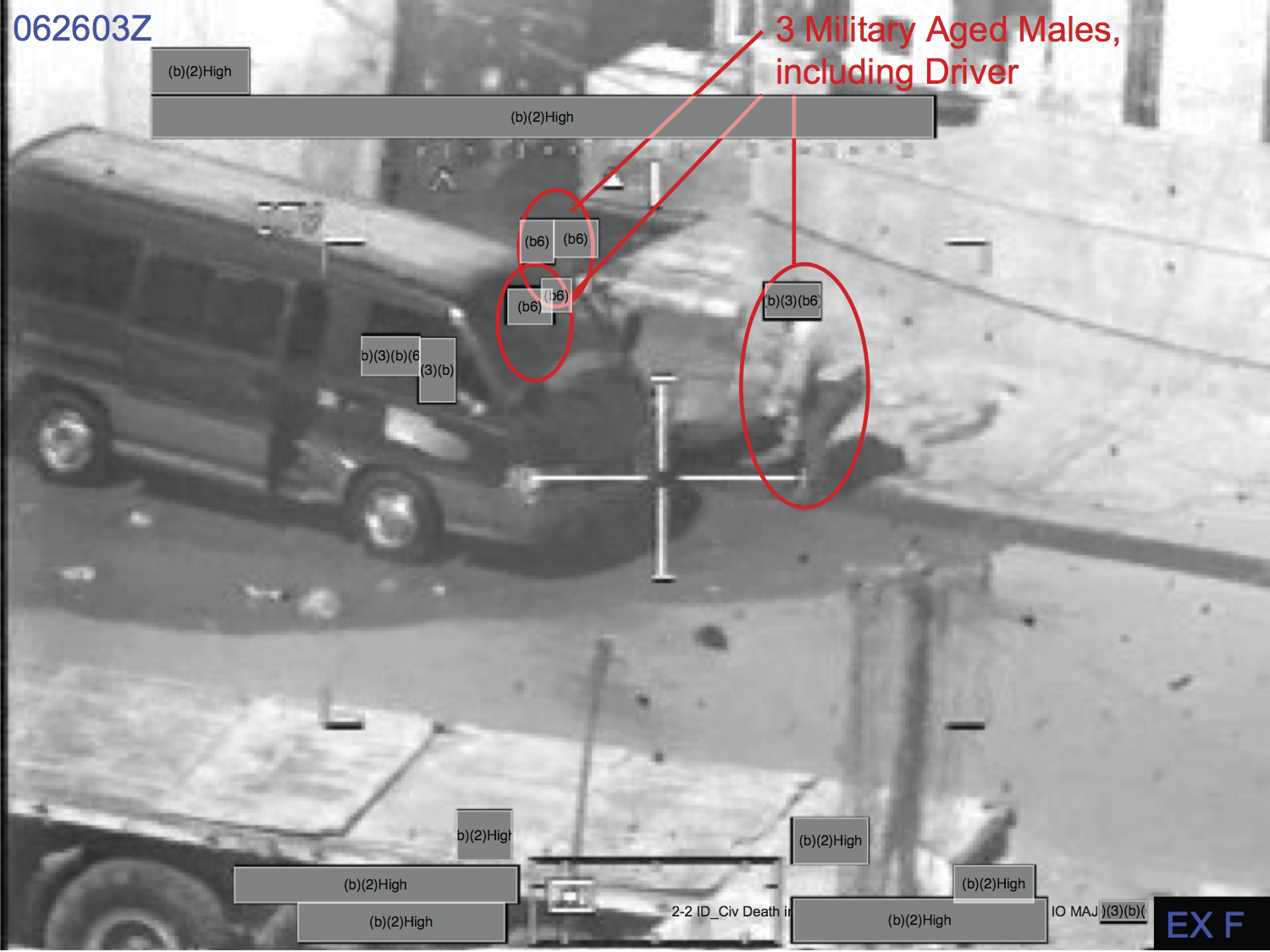
3064Modern war has long placed a premium on visuality, but later modern war deploys new political technologies of vision and incorporates them into distinctive modes of the mediatization and juridification of military violence. This paper sketches those general contours and then examines two episodes in more detail. Both were carried out by the US military. The first is a combat helicopter attack on unarmed civilians in New Baghdad in July 2007, the subject of a military investigation, a Wikileaks release (‘Collateral Murder’), and two documentary films (‘Permission to Engage’ and ‘Incident in New Baghdad’). The second is another combat helicopter attack, but this time facilitated by the crew of a MQ-1 Predator, on three civilian vehicles in Uruzgan province, Afghanistan in February 2010, which was the subject of a military investigation that has been documented in detail. I use these incidents to extend the debate about militarized vision beyond dominant discussions of ‘seeing like a drone’, and to raise a series of questions about witnessing and military violence under the sign of later modern war.

The title is obviously a riff on James C. Scott‘s Seeing like a state  – not least his opening claim that ‘certain forms of knowledge and control require a narrowing of vision’ and the abstract is really just a summary of previous posts on Militarized Vision (see also ‘Unmanning’ here), but I’ll provide updates as the work progresses.

I’m deep into the detailed investigation of the Uruzgan incident.  Previously I’d worked from a transcript of communications between the Predator crew, the ground forces commander and others – hence ‘From a view to a kill’ (DOWNLOADS tab) – but the detailed investigation files are eye-opening and are beginning to suggest a different narrative.

I’ve also widened the scope of the project (which, as the abstract suggests, was already about much more than the full motion video from Predators and Reapers).  Although I won’t be talking about this in Tampa, I’m also examining another incident, an air strike on two tankers hijacked by the Taliban near Omar Kheil in Kunduz, Afghanistan in September 2009.  The strike was carried out by USAF jets on the orders of the German Army (the Bundeswehr) from its Forward Operating Base at Camp Kunduz.  It’s a complicated story that needs some background about (1) the Bundeswehr in Afghanistan and (2) air strikes and civilian casualties.

Bad Kunduz: the Bundeswehr and Afghanistan

After 9/11 and the US-led invasion of Afghanistan, Germany provided the third largest contingent of troops to NATO’s International Security Assistance Force (ISAF), but Bonn saw its primary role as stabilisation and reconstruction – in fact, the government refused to describe its military operations in Afghanistan as a war at all – and following this mandate Camp Kunduz [below] served as the base for a Provincial Reconstruction Team which was instructed to maintain a ‘light footprint’: so much so that troops jokingly referred to the base as ‘Bad Kunduz‘  (‘Spa Kunduz’) because it was so removed from the fighting.
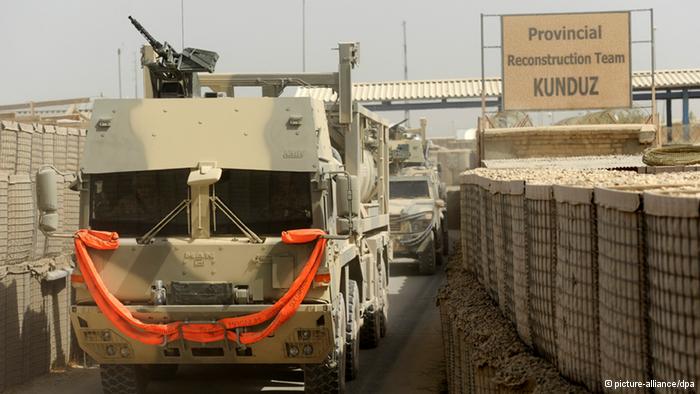
Camp Kunduz PRT

But the security situation deteriorated, and Taliban attacks on German patrols and bases intensified.  By 2007 the Bundeswehr had formed Task Force 47, made up of regular soldiers and elite troops from the Kommando Spezialkräfte or Special Forces, to adopt a more offensive posture and, in particular, to identify Taliban commanders who would be placed on ISAF’s Joint Prioritized Effects List (JPEL) for kill/capture missions.  A detachment from Task Force 47 was also stationed at Camp Kunduz.

Still, in August 2009 Der Spiegel ran a story on ‘How the Taliban are taking control in Kunduz‘, and interviewed the base commander, Colonel Georg Klein, who described what the newspaper called the new ‘logic of the war’:

‘Kunduz has changed…  I really don’t want to shoot at other people.  They’re people too, after all.  But if I don’t shoot, they’ll kill my soldiers.’

This ‘new logic’ would be demonstrated with hideous clarity a fortnight later.  Yet – in principle, at least – it was constrained by a new Tactical Directive issued by General Stanley McChrystal in response to civilian casualties caused by coalition air strikes.

Air strikes and civilian casualties

Bombing had played a major role in the invasion of Afghanistan, and air strikes continued to be of decisive importance as the war with the Taliban continued (for more information, see here and here).  They were also the main source of civilian casualties caused by coalition military operations; as the air war was stepped up and the body count soared so public hostility increased.
50a84756-5c28-11de-aea3-00144feabdc0.img

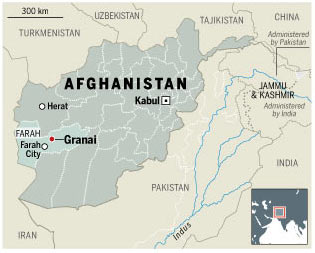
On 4 May 2009, just four months before the Kunduz air strike, there was yet another serious incident in which, according to a field investigation by the International Committee of the Red Cross, at least 89 civilians were killed in a series of air strikes near the village of Garani (sometimes spelled Gerani or even Granai) in the district of Bala Baluk in Farah province.  Afghan forces had moved to engage the Taliban, supported by ISAF advisers, and as the fighting intensified they were reinforced by a detachment of US Marines.  Close Air Support (CAS) was requested, and the first air strikes were carried out by F/A-18F jets (shown as #F1-4 in the graphic below).  In the early evening their fuel reserves became too low to continue, and they were replaced by a B-1 bomber which made three further strikes (#B1-3).  In the first strike, three 500 lb GPS-guided bombs were dropped; in the second, two 500 lb and two 2,000 lb bombs were dropped; and in the third a single 2,000 lb bomb was dropped.  You can find images of the aftermath at Guy Smallman‘s gallery here.
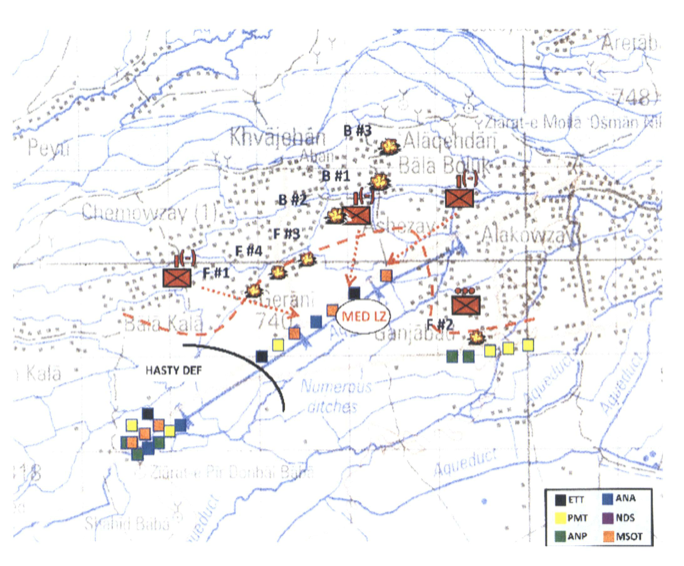
Gerani air strikes

The ICRC report on the incident has never been published, in accordance with its usual practice, but Wikileaks released a cable from the US Ambassador in Kabul describing his meeting with the ICRC’s Head of Mission on 13 June to discuss the results.  The ambassador praised the Head of Mission as ‘one of the most credible sources for unbiased and objective information in Afghanistan’ and accepted that the investigation was ‘certainly exhaustive’.  But the casualty estimates were considerably higher than those made by ISAF’s own military investigation, from which I’ve taken the map above.
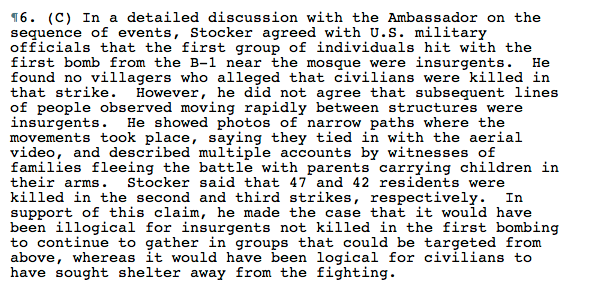
Wikileaks cable:ICRC

According to the Executive Summary prepared for US Central Command, ‘we will never be able to determine precisely how many civilian casualties resulted from this operation’. The military investigation concluded that 26 civilians had been killed but did ‘not discount the possibility’ that there were many more, and its authors also noted the ‘balanced, thorough investigation’ carried out by the Afghan Independent Human Rights Commission that cited ‘as many as 86 civilian casualties’.  Other reports claim as many as 147 civilians were killed.

The details of the military’s own investigation remain classified; General David Petraeus promised to show the strike video from the B-1 bomber in a press briefing (see also here), but it has never been released, though Wikileaks reportedly had an encrypted version in its possession (the issue formed part of the US government’s case against Bradley/Chelsea Manning).  Although the CENTCOM report of 18 June ‘validated the lawful military nature of the strike’, it also expressed grave concern at ‘the inability to discern the presence of civilians and assess the potential collateral damage of those strikes’, and its recommendations included an immediate review of guidance ‘for employment of kinetic weapons, to include CAS, in situations involving the potential for civilian casualties.’

On 2 July McChrystal updated the existing Tactical Directive of October 2008 with a revised Tactical Directive – parts of it remained classified, but the ‘releasable’ version is here – which insisted that

‘We must avoid the trap of winning tactical victories – but suffering strategic defeats – by causing civilian casualties or excessive damage and thus alienating the people.’  

Among other provisions, the directive specifically instructed commanders to ‘weigh the gain of using CAS against the cost of civilian casualties’.  This is, of course, a requirement under international humanitarian law, but McChrystal went further and tightened the Rules of Engagement to such a degree that David Wood could write of the US Air Force ‘holding fire over Afghanistan’.  Lessons from the incident were also incorporated into US Marine pre-deployment briefings (here; scroll down) and it was also used as the basis for a ‘tactical decision-making’ module in the US Army’s Afghanistan Civilian Casualty Prevention Handbook (June 2012)  (pp. 58-67).  But these lessons hadn’t been learned in time to prevent the tragedy that took place near Kunduz on the night of 3/4 September 2009.

The Kunduz air strike
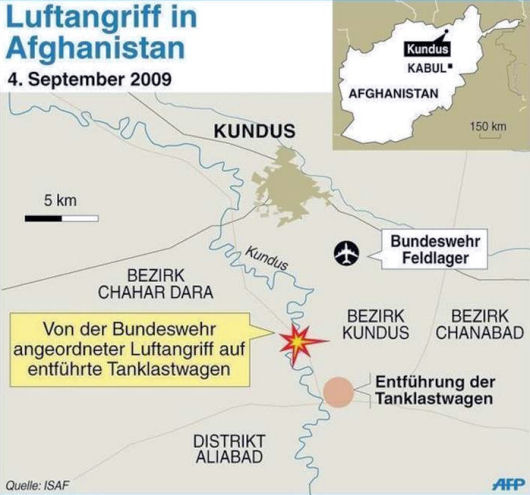
kunduz-luftangriff

At 8 p.m. on 3 September Colonel Klein received a report that two tanker trucks had been hijacked by the Taliban as they drove south through Kunduz province (‘Entführung der Tanklastwagen’ on the map above).  Thomas Ruttig provides an excellent overview of how what the Bundeswehr called ‘the Incident at Coordinate 42S VF 8934 5219’ unfolded here:

‘ The trucks were owned by an Afghan private company and contracted to deliver airplane fuel to ISAF forces. When the two hijacked lorries got stuck crossing a shallow riverbed at the border between Aliabad and Chahrdara districts, away from the main road, in the middle of a night in Ramadan, the Taliban mobilised the inhabitants of nearby villages more or less under their control to pump the fuel out and get the lorries going again. A large number took the offer up. Meanwhile, with the help of ISAF air reconnaissance, the immobilised trucks were located. This was done by a B-1 bomber which had cameras on board so strong they could even identify the weapons carried by the hijackers.’
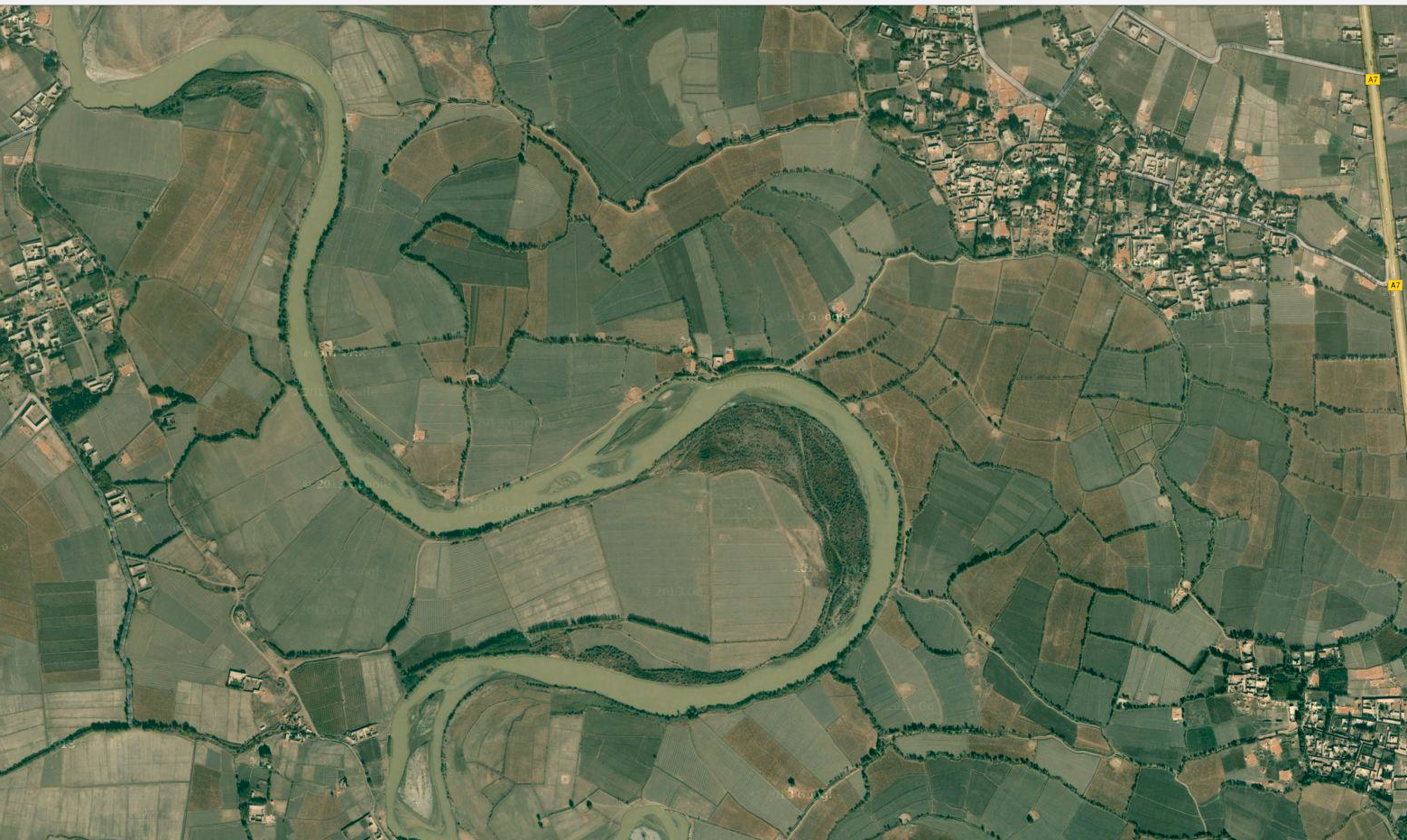
KUNDUZ Airstrike AERIAL 2

The B-1 had to withdraw in the early hours of the morning because it was running low on fuel, and according to some reports the US Air Force was unwilling to provide replacement aircraft unless there were ‘Troops in Contact’ (TIC) with the Taliban.  Klein decided to confirm a TIC – even though his troops were not at the scene – and two F-15E fighter jets flew right over his Forward Operating Base and then took up their station near the tankers at 0108.  These aircraft (the two shown below were photographed over eastern Afghanistan) are operated by two crew members, a pilot and a weapons systems officer, and are equipped with Forward-Looking Infrared Sensors that, as Rutting notes, ‘portrayed people on the ground only as black spots.’  The two jets eventually carried out an airstrike at 0150.
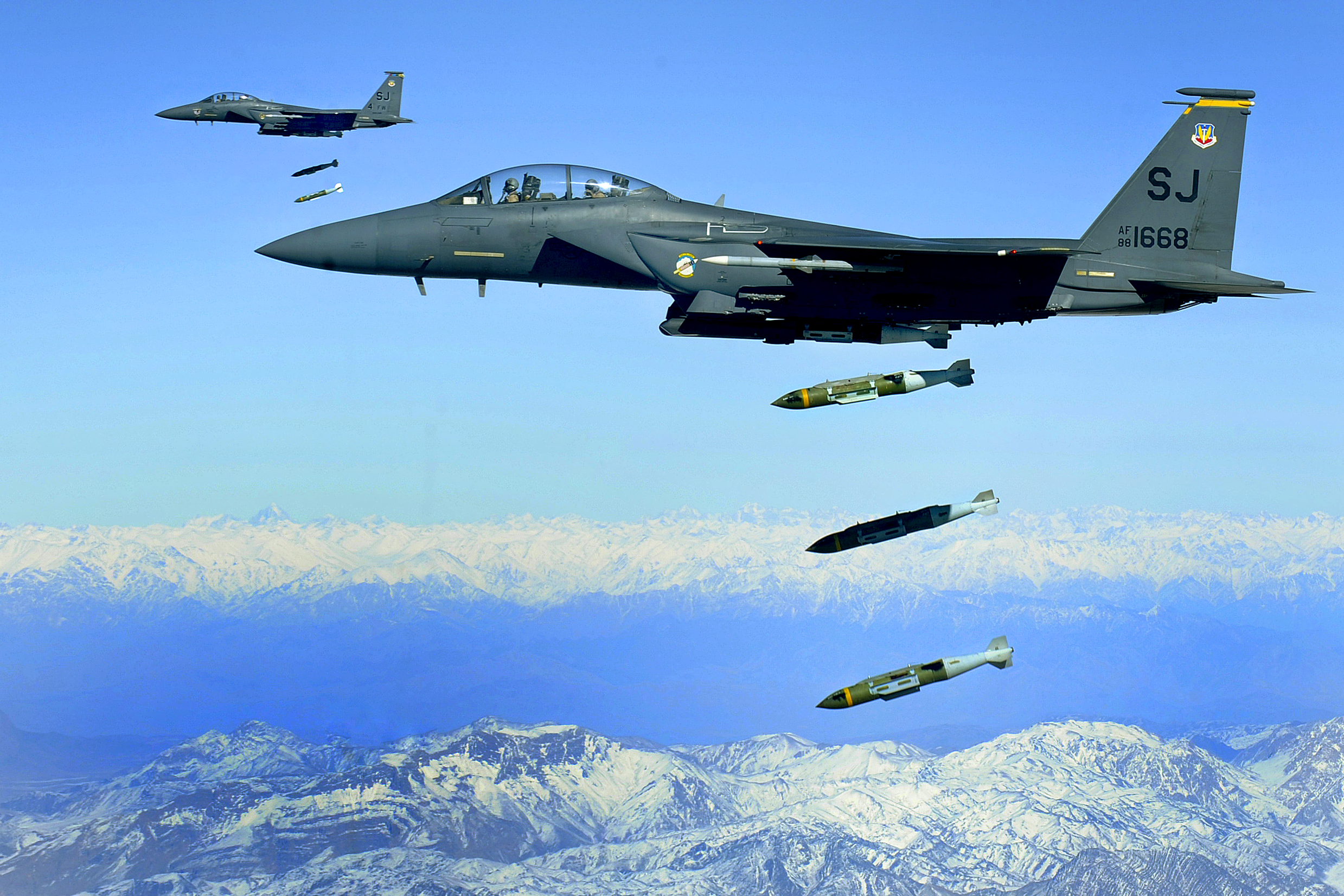
Operation Enduring Freedom

What is particularly interesting about all this is that – in the wake of McChrystal’s revised Tactical Directive and tightened Rules of Engagement – the American pilots of the two F15-Es were markedly reluctant to strike.  They were eventually persuaded to do so by Klein, yet he had no direct ‘eyes’ on the events as they unfolded.  He was relying on a visual feed from the strike aircraft to a Remote Operated Video Enhanced Receiver [ROVER] terminal and on ground reporting from a single Afghan informant – classified as C-3, the lowest grade for ‘actionable intelligence’ – who was communicating by telephone with other ‘sub-contacts’ at the scene; there were apparently five intermediaries between the local source and Klein.   At least one of them was a Special Forces intelligence officer from Task Force 47 who was with Klein in the Tactical Operations Center; some reports suggest that he believed that four Taliban leaders on the JPEL were at the scene.
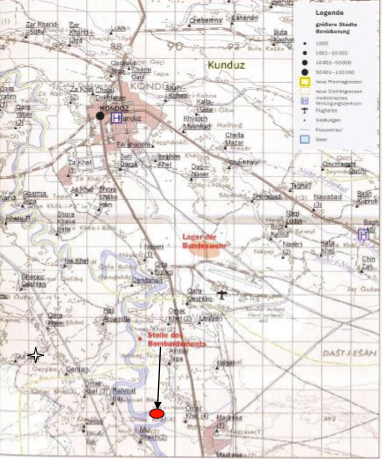
Camp Kunduz and site of air strike

The 15-page (redacted) cockpit transcript is here; all times shown there are Zulu (i.e. GMT), but here I revert to local time to reconstruct what happened.  Klein is with his Forward Air Controller codenamed ‘Red Baron’ – what the USAF calls a Joint Terminal Attack Controller or JTAC, which is how he appears in the transcript – in the Tactical Operations Centre at Camp Kunduz (marked as Lager der Bundeswehr on the map above and referred to as PRT KDZ in the SIGACT report below).

The JTAC first asks the pilots to ‘stay as high as possible’ so that they can transmit a wide-shot video of the scene to his ROVER-3 screen – although this isn’t the latest model the JTAC wants ‘the best picture possible to give the commander [Klein] the possibility to make a decision’ – and they paint the target with infrared.  They are confident this won’t alert the people on the ground: ‘We got no friendlies in the vicinity of the target and I don’t believe the insurgents got N[ight] V[ision] G[oggles] to see the IR.’

The picture is poor and so the pilots fly lower; they offer to provide ‘a show of force’, which is a standard tactic in Afghanistan accounting for 10 per cent of all Close Air Support sorties (though, as this map shows, it was less common in Kunduz compared to the south; I’ve borrowed the map from the remarkable work of Jason Lyall that I noted in a previous post on air strikes in Afghanistan).
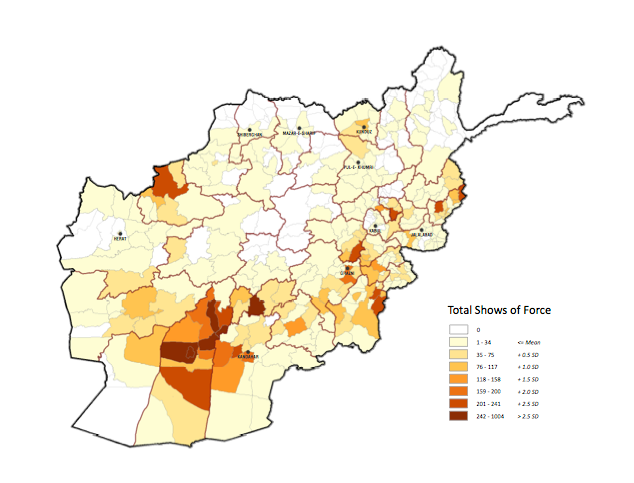
JASON LYALL Shows of Force Afghanistan 2006-11

The JTAC declines, saying ‘I want you to hide’, so that the people on the ground will have no warning of an impending attack, which leaves the pilots wondering ‘how we’d be able to drop anything on that as far as current ROE [Rules of Engagement] and stuff like that…’  They’re not sure that this meets the criteria for a TIC, which would allow them to engage, because they can’t see any German troops (‘friendlies’) on the ground: ‘We’ve got 50 to 100 people down there all claiming to be insurgents but I’m not seeing any imminent threat…’

One pilot accepts that the JTAC might have better information, but wants to ‘dig a little more’:

‘I’m really looking to find out status of the people inside [a nearby building 200 metres away] and then what’s inside the trucks.  And then we can “show of force”, scatter the people, and then blow up the trucks.’

Again he offers to make a show of force but tells the JTAC they are ‘showing no CDE [collateral damage estimate] concerns within about 200 metres of that target.’  The pilots agree that Camp Kunduz is ‘pretty far away’ from the scene so that it is not visibly in imminent danger, and they wonder if ‘there is anyone else we can talk to’ before committing to a strike.  They even contemplate contacting US Central Command’s Combined Air Operations Center in Qatar for clearance.

The pilots ask for confirmation that there would be ‘no civilians in the vicinity of the fragmentations’ from their two 500 lb GBU-38 bombs dropped on the tankers – ‘is that possible with no C[ollateral] D[amage] E[stimate]?’ the lead pilot queries – and again they ask the JTAC to confirm that everyone on the scene is ‘hostile’:

‘That’s affirmative.  We got the intel information that everyone down there is hostile.’

9-line CASMore vehicles are arriving on the scene and the JTAC insists that this is now a ‘time-sensitive target’.  He then passes the pilots the standard 9-line briefing for a strike (see left).  The first three lines are ‘not applicable’ because the aircraft are already on the scene, but the JTAC specifies the altitude, the target (‘insurgents on sandbank with 2 stolen trucks’), target location and mark, repeats ‘no friendly forces in area’, and asks them to remain on station for a Battle Damage Assessment.

As the target is designated by the pilots, they ask the JTAC whether he is ‘trying to take out the vehicles or are you trying to take out the pax [people]?’

‘We’re trying to take out the pax.’

They again ask the JTAC to confirm that there are no friendlies in the vicinity, and he reports that they are all ‘safe’ at Camp Kunduz ‘roughly fifteen click to the east.’  (In fact, the base is about 8 km to the north east, but the tankers are facing in the opposite direction and Ruttig estimates it would have taken them an hour or so to reach the base on the rough, unpaved roads of the region).

The pilots still have misgivings: ‘something doesn’t feel right but I can’t put my thumb on it.’  They debate between themselves whether ‘in accordance with our ROE right now’ they should obtain higher-level clearance.  If troops are not in imminent danger clearance is required from ISAF Headquarters in Kabul, and if there is a risk of civilian casualties clearance would need to be obtained from NATO’s Joint Force Command. Before they can reach a decision the JTAC jumps back in:

‘Clearance approved by commander he is right next to me.’

They’re not convinced.  ‘The ground commander is clearing us hot but I don’t know if it meets the [hostile] intent or not.’
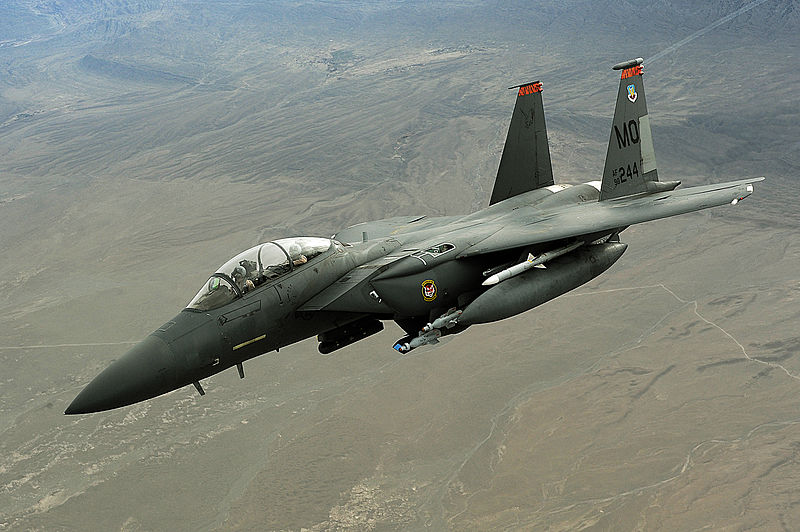
F15-E

Still reluctant to strike – one pilot asks the other if ‘you’re saying it’s no imminent threat even though the JTAC said it was’ – the lead pilot tells the JTAC that they would prefer ‘to get down low, scatter the pax and blow up the vehicles’.

It then emerges that ‘ISR’ is en route, which presumably means a Predator with higher definition sensors, but before the remote platform can arrive the JTAC responds to the pilot’s repeated suggestion to scatter the people and then hit the trucks:

‘Negative, I want you to strike directly.’

Still no contact with the remote platform, and the lead pilot asks ‘one last [time]’ for confirmation that this is an imminent threat.

‘Yeah, those pax are an imminent threat, so those insurgents are trying to get all the gasoline off the tanks and after that they will regroup and we’ve got intel information about current ops so probably attacking Camp Kunduz.’

At 1.51 a.m. local time Klein gives the order: ‘Weapons release!’  The F-15Es are again ‘cleared hot’.  Two 500lb GBU-38 bombs are released.

Here’s the strike video:

And here are the first military reports of the action (SIGACT or Significant Act) via Wikileaks:

KUNDUZ Air strike September 2009 FULL SIGACT

From the ground

In contrast to these distanced observations, this is how the attack was described to Der Spiegel by one of the tanker drivers:

‘I can’t say how many airplanes there were or what type there were. But, starting at around 10 p.m., you could hear the sound of aircraft, though it was very faint. The plane must have been flying very high. But, yes, in Afghanistan, we recognize the sound of fighter jets. Some of the people around the trucks must have certainly heard the sound as well, but the majority of them were just jockeying to get fuel more quickly.

The armed men were getting nervous. They started making lots of phone calls again. I thought they were calling their leaders and asking for advice, asking what they were supposed to do now. At a certain point, some of them started shouting and waving their weapons around. They were screaming at the people to get away from the trucks because bombs were about to start falling. But no one wanted to miss an opportunity to get some free fuel. Then, some of the armed men even started running away…. I was sitting with some of the armed men along the river quite a way away from the trucks, maybe 50 meters (164 feet). The men were arguing over whether they should kill me right away or use me as a hostage to try to extort money from my company. I was very afraid — also of a possible bombardment.

At first, there was a loud droning, like what you hear when a generator short-circuits. Then there was a bright flash. I just let myself fall forward and went down underwater. Even from there, I could feel the shock wave. For a few seconds, it was as bright as day. Even the water was heating up. When I came out of the water, the whole area around the tanker trucks was on fire. It looked like the ground was spitting up fire, though it was just the fuel from the trucks. It was unbearably hot. There were bodies lying everywhere; they were completely carbonized.’

And this is how the scene was described to Amnesty International by another Afghan eyewitness:

“When we heard the planes flying everyone was scared and people began to flee the area at around 10.00 or 11.00 pm but then when people saw that the planes were only flying [and not bombarding] they returned to take the fuel. The number of the people were increasing every minute but after midnight the number started to decrease as many people obtained enough fuel and didn’t have enough containers to carry more fuel. It was around 1.00-1.30 am when the planes disappeared…

At about 1.45am we heard the planes return from our village. I tried to call my brother who was still at the scene. I knew that something was wrong if the planes returned but it seemed that the planes had blocked the telecommunication systems and we couldn’t get through to our relatives to call them to come back. Then I saw a big fire coming from plane and a big explosion with fire every where. I could see it from our village. Flames were very high and everyone rushed to the scene because most of the families had their children and family members out there.

As we arrived at the scene we could see nothing but flames and smoke. At that time it was almost around 3.00 [am] we saw the bodies burned and unidentifiable, others were badly injured and crying. The planes reappeared and then everyone fled in fear of being attacked and targeted. Some people got their family members’ bodies but not everyone. We couldn’t take the wounded people with us because the planes were still flying and we had to leave them there. As the planes disappeared, we went back and it was very early in the morning – everywhere were many bodies we couldn’t identify them at the time. Then every one carried the bodies to the villages and we had to bury some without knowing who they were. There were at least 20 children among the dead.”

Here is AFP video of the aftermath:

Ghaith Abdul-Ahad provide another extraordinary account in the Guardian:

What followed is one of the more macabre scenes of this or any war. The grief-stricken relatives began to argue and fight over the remains of the men and boys who a few hours earlier had greedily sought the tanker’s fuel. Poor people in one of the world’s poorest countries, they had been trying to hoard as much as they could for the coming winter.

“We didn’t recognise any of the dead when we arrived,” said Omar Khan, the turbaned village chief of Eissa Khail. “It was like a chemical bomb had gone off, everything was burned. The bodies were like this,” he brought his two hands together, his fingers curling like claws. “There were like burned tree logs, like charcoal.

“The villagers were fighting over the corpses. People were saying this is my brother, this is my cousin, and no one could identify anyone.”

So the elders stepped in. They collected all the bodies they could and asked the people to tell them how many relatives each family had lost.

A queue formed. One by one the bereaved gave the names of missing brothers, cousins, sons and nephews, and each in turn received their quota of corpses. It didn’t matter who was who, everyone was mangled beyond recognition anyway. All that mattered was that they had a body to bury and perform prayers upon.

If anybody still thinks that later modern war is somehow de-corporealized, they should read Abdul-Ahad’s full report.  Ruttig takes up the story:

The number of people and specifically the number of civilians who were not ‘participating in hostilities’ killed in the strike is unclear to this day. It differs depending on the investigation report, some of which are published, while others remain classified. The still classified report by the then ISAF commander, General Stanley McChrystal – parts of which are cited in the report of the investigation committee of the German parliament, the Bundestag, that was published on 25 October 2011 – says “between 17 and 142 people” were killed. It does not seem to refer to killed civilians directly, but quotes local elders saying that possibly 30 to 40 civilians were killed. A report authored by a German military policeman who conducted an investigation at the location of the airstrike avoids stating whether there were what he called “non-involved civilians” among the dead …

The lawyers who brought the case before the Bonn court claim 137 people died, “undeniably many dozens of civilians”. An Afghan investigation commission, sent by President Hamed Karzai and led by police general Mirza Muhammad Yarmand, that was in the area between 4 and 10 September 2009, stated that 69 Taleban and 30 local residents – a term that leaves it open whether they were perceived as non-involved civilians or civilians that were supporting the Taleban in an operation – were killed.

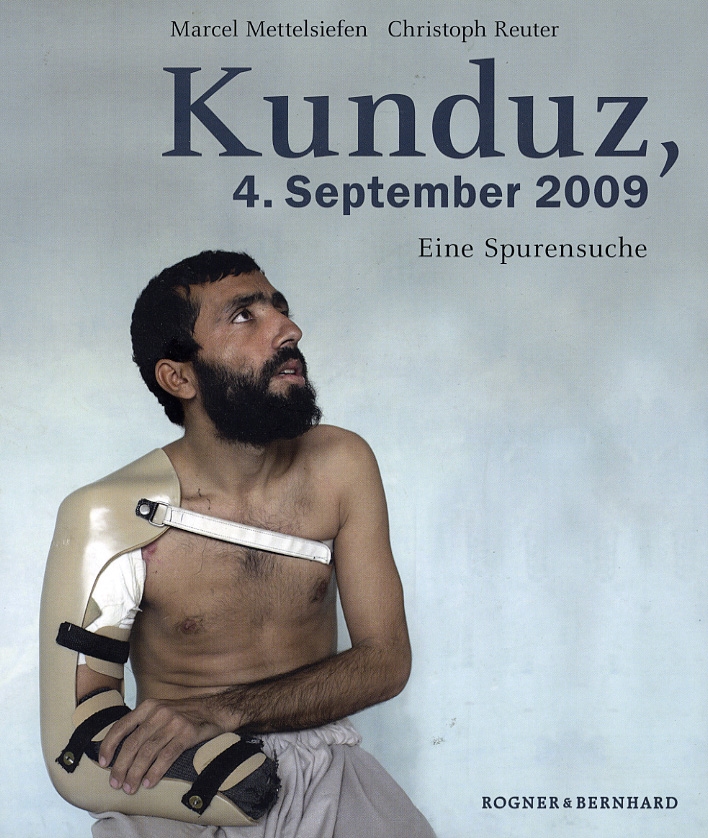
METTELSIEFEN and REUTER Kunduz

An Afghan human rights group, Afghanistan Rights Monitor, which also conducted interviews with victims in the area, said on 7 September that 60 to 70 civilians were killed. Finally, UNAMA, as stated in its 2009 Protection of Civilians report (on p 18), after its own investigation, said that 74 civilians, including many children, had been killed. One of the problems, said UNAMA, was that the fireball produced by dropping munitions on the fuel tankers incinerated many of the bodies, making their identification impossible. However, according to probably the most extensive investigation, carried out by two Germans, Christoph Reuter, a journalist and occasional AAN author, and Marcel Mettelsiefen, a photographer, who repeatedly travelled to the region interviewing families and community members, ninety civilians “from children to old men” were killed. Reuter and Mettelsiefen published a moving book [Kunduz – above], naming the victims they had confirmed as having been killed and featuring photographs – ID documents, family photos and such – of each of the victims and their relatives. It was a powerful way to humanise the numbers of those killed and the scale of the loss to the community.
Military investigations and mediatizations

Immediately after the strike a senior ISAF officer made it clear that ‘The most important thing is for local official[s] to refute CIVCAS (civilian casualties).’  This is a leitmotif in ISAF’s response to incidents like this – CIVCAS reporting (or the lack of it) was a major preoccupation of the Uruzgan investigation – as the military battles to ‘control the narrative’ before the Taliban provide their own version of events.  When McChrystal heard about the strike, however, he was reportedly furious:

He had just tightened up the rules for air strikes in the Afghanistan conflict. Bombs should only be dropped in the cases of acute danger to ISAF soldiers, in order to create the necessary trust in the foreign troops. The Kunduz air strike did not fit into this picture at all….

“Freely admit what we don’t know and say we are investigating,” he ordered the Germans. He assumed the first assessement that there had been no civilian victims had been incorrect. There was no way one could have made that determination from the air. The angered ISAF chief said he was “deeply disappointed.” The first statements from the Germans had been “foolishness.” He also said he had doubts that the rules of engagement had been followed and asked why soldiers were first sent to the scene three hours after the first accusations in the media of civilian casualties.
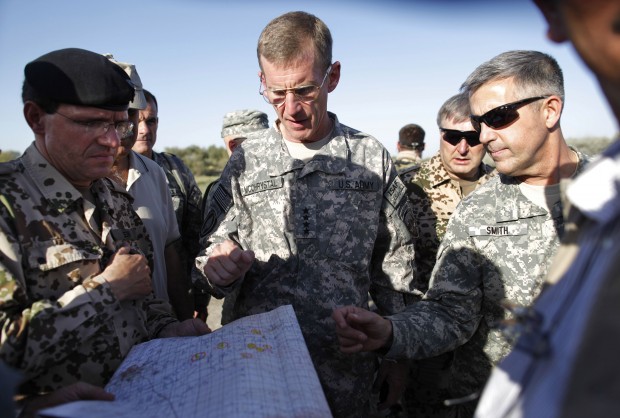
McChrystal visits Kunduz strike site  Sept 2009

McChrystal was on the scene the next day – though Klein urged him not to go in case he was shot at – demanding to know  why the Bundeswehr had waited so long to send a team to the strike site to conduct a ‘boots on ground’ Battle Damage Assessment and to provide a casualty report. On 9 September he announced the establishment of a Joint Investigation Board, which included a Canadian major-general (ISAF’s Air Component Element Director), officers from the USAF and the Bundeswehr, and military legal advisers (McChrystal’s detailed instructions to the Board are here).

Franz Josef Jung, Germany’s Minister of Defence, was soon on the offensive.  He insisted that the Taliban’s seizure of the tankers ‘posed an acute threat to our soldiers’, that the strike was ‘absolutely necessary’ and that his officers had ‘very detailed information’ that the Taliban had planned to use the tankers to launch an attack.   He was clearly displeased at McChrystal’s attitude (and determination), and five days after the strike had his Ministry set up a special task force (‘Group 85’) both to exploit an inside track to the investigation and to create a ‘positive image’ of the events.  By then, an internal Bundeswehr inquiry had been completed.  Its brief report described the incident as ‘Close Air Support’, determined that the Rules of Engagement for a ‘time-sensitive target’ had been followed and that Klein had the authority to order the strike, which was deemed ‘appropriate’, and declined to say whether ‘non-involved civilians’ had been killed alongside the Taliban.

But the subsequent, much more extensive report from ISAF’s Joint Investigation Board (75 pages plus 500 pages of attachments) flatly contradicted the German versions of what had taken place.  According to Der Spiegel, which had seen the leaked report, the Board concluded that

‘Klein relied on only one person for “intelligence gathering,” which, even when combined with the aerial video images, was “inadequate to evaluate the various conditions and factors in such a difficult and complex target area.”

The report states it was not clear “what ROE (rule of engagement) was applied during the airstrike,” and that there was a “lack of understanding” by the German commander and his forward air controller (JTAC), “which resulted in actions and decisions inconsistent” with ISAF procedures and directives. Moreover, the report concludes, intelligence summaries and specific intelligence “provided by HUMINT (human intelligence) did not identify a specific threat” to the camp in Kunduz that night — the mandatory condition for an airstrike.’

In short, Klein knew that there were no ‘troops in contact’ but ‘believed that by declaring a “TIC” he would get the air support he wanted.’

cover_646Ironically, in 2008 Human Rights Watch had published a report showing that the likelihood of civilian casualties from air strikes in Afghanistan increased in TIC situations:

‘…we found that civilian casualties rarely occur during planned airstrikes on suspected Taliban targets… High civilian loss of life during airstrikes has almost always occurred during the fluid, rapid-response strikes, often carried out in support of ground troops after they came under insurgent attack. Such unplanned strikes included situations where US special forces units — normally small numbers of lightly armed personnel — came under insurgent attack; in US/NATO attacks in pursuit of insurgent forces that had retreated to populated villages; and in air attacks where US “anticipatory self- defense” rules of engagement applied.’

In any event, Klein’s own account was markedly different.  In a two-page report ‘for German eyes only’, der Spiegel revealed,

Klein portrays himself as the person who tried to rein in the American fighter jets. He wrote that he called for smaller bombs to be used “contrary to the recommendation of the B-1B and F-15E pilots.” The German colonel also says that he limited the use of force to the tanker trucks and people in the immediate vicinity and forbade strikes on people elsewhere on the river bank. He wrote that the bombs were dropped solely on the sandbank “in order to definitively exclude the possibility of collateral damage in the neighboring villages.”

In January 2010 a Bundestag committee started to investigate how such different versions emerged and to determine who was responsible for the strike.  Its final report is here and supporting documents here.  ISAF still refused to release its own report, even to the parliamentary  investigation:
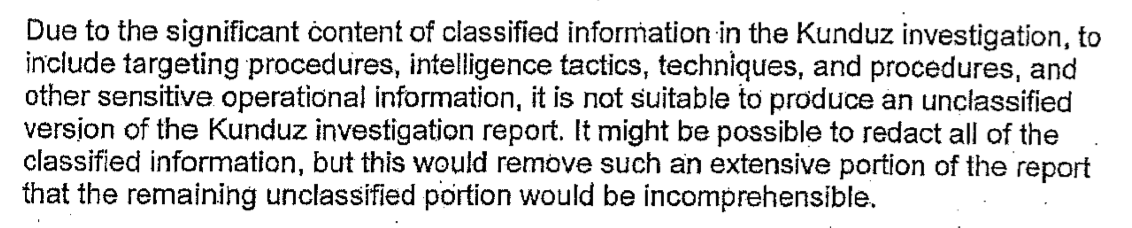
Declassification of JIB Report

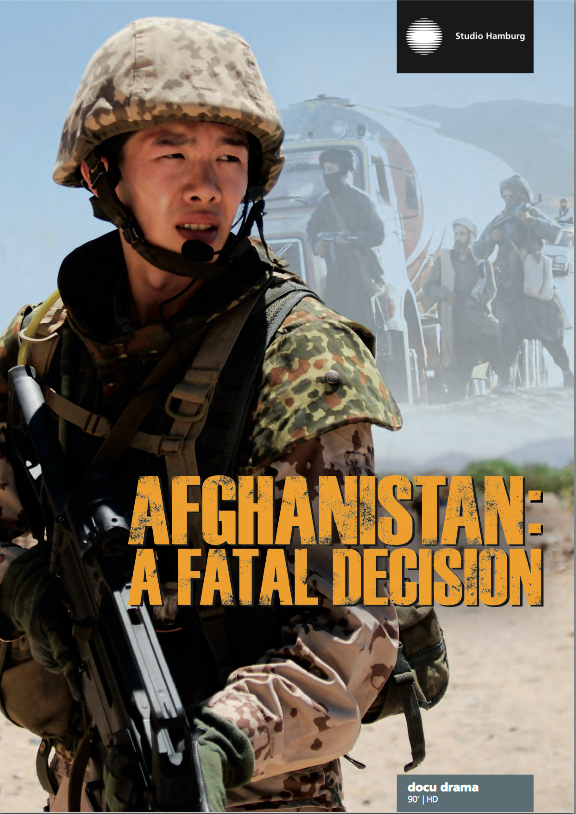
Afghanistan A fatal decisionThere are many other ways of ‘seeing’ what happened, of course, and the strike has been the subject of at least two films.  The first, Raymond Ley’s Eine mörderische Entscheidung (2013), A fatal decision, is a docu-drama shot for German television.  You can watch the trailer with English-language subtitles here.  The full German-language film is available on YouTube here: it’s long, but if you start at 1:13:10 you’ll pick up the story as the informant is phoning in to the Forward Operating Base; the immediate prelude to the strike starts at 1:22:37.  There’s an English-language discussion by Verena Nees here, which translates the title as A murderous decision but gives a good extended synopsis of the film.  (The production company uses both English-language titles, but ‘fatal‘ is a better representation of the tenor of the film).
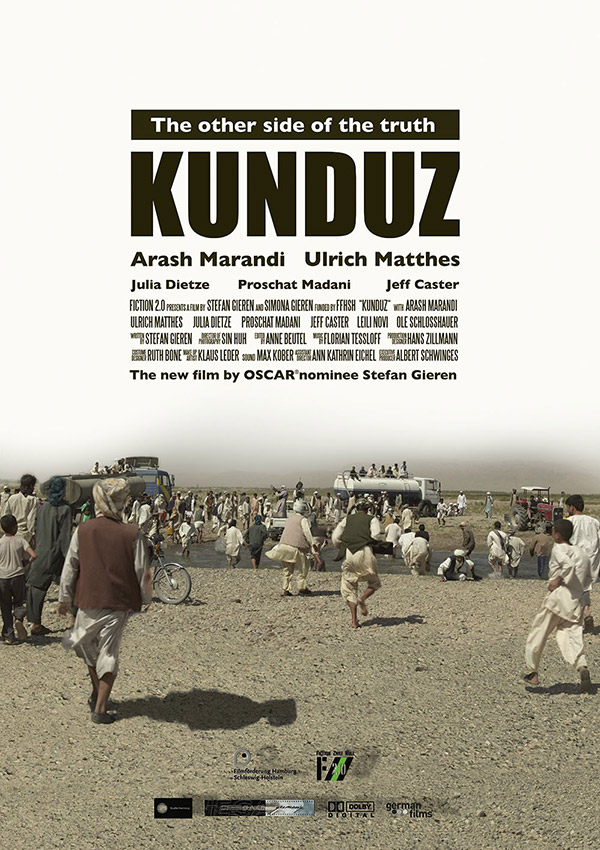
referenz-kunduzThe second is Stefan and Simona Gieren‘s Kunduz (2012), a short film which builds on eyewitness reports to create a fictionalised German-Afghan photographer who witnessed the strike and tells his story to German doctors as he is is flown out from the area.  You can see the trailer on vimeo here.

Preliminary observations

I still need to work my way through the Bundestag report in detail, but already several lines of inquiry are emerging that bear on my other case studies of ‘Militarized vision’.

(1) Militarized vision is not a constant.  It’s an obvious point, but it can be sharpened because I don’t mean to confine this to the mundane (but still important) observation that political technologies of vision are constantly changing.  So they are, but it’s clear that the ability of militaries to ‘see’ is differently and differentially distributed; there is a geography to militarized vision, and what Klein and his advisers saw on their screen was not what the F15E pilots saw – and that in turn was different to what the crew of the B-1 were able to see.  This is about more than the resolution level of different imaging technologies, because:

(2) The politico-cultural construction of a wider ‘landscape of threat’ is crucial to the production and performance of a specific ‘space of the target’.  In this case, the transition of the Bundeswehr‘s operational posture – the powerful sense of increasing and even impending Taliban attacks and the determination to take the offensive – clearly shaped the way in which Klein and those advising him (mis)read the developing situation.  This in turn is shaped by developing legal geographies:

(3) The use of military force is clearly governed by international law which, as I’ve noted elsewhere, has an intimate relationship with technologies of vision.  This extends beyond the requirements imposed by proportionality and distinction – including the US military’s ‘prosecution of the target’ and the ‘visual chain of custody’, though in this case it is notable that no military lawyers were involved in authorising the strike – because the legal armature that surrounds military violence is located at the intersection of international law, military law and domestic law.  The relevance of McChrystal’s updated Tactical Directive and revised Rules of Engagement to the pilots’ field of vision is clear enough, but the refusal by Bonn to describe its military operations in Afghanistan as ‘war’ materially affected the way in which German law was brought to bear on Klein’s actions: his criminal prosecution was dropped soon after the government determined that the Kunduz affair was indeed a punctuation point – in fact an exclamation mark – in an armed conflict.

(4) And – to return to my first point from a different direction – what military investigations ‘see’ after an incident (and what they allow the public to see) is often radically different from what those caught up in the event-scene were able to see…

More to come.

Readings

There is a commentary on the strike by  Constantin Schüßler and Yee-Kuang Heng,’The Bundeswehr and the Kunduz air strike 4 September 2009: Germany’s post-heroic moment?’, in European security 22 (30 (2013) 355-75.  They explore not only the doctrine of force protection (in which risk is transferred to others in the field of view – see the still from Fatal Decision below – as I discussed in my commentary on what Grégoire Chamayou calls ‘necro-ethics’) but also the legal and media apparatus that enveloped the incident.  For a more detailed treatment of the (il)legality of the strike, see Andreas Fischer-Lescano and Steffen Kommer, ‘Entschädigung für Kollateralschäden? Rechtsfragen anlässlich des Luftangriffs bei Kunduz im September 2009’, Archiv des Völkerrechts 50 (2) (2012) 156-990, which makes extensive use of the Bundestag investigation, and Lesley Wexler, ‘International Humanitarian Law transparency’, Illinois Public Law and Legal Theory Research Papers Series 14-11 (2013) available via ssrn here.

Fatal Decision still

For a discussion of the political landscape within which the strike took place, see Timo Noetzel, ‘The German politics of war: Kunduz and the war in Afghanistan‘, International Affairs 87 (2) (2011) 397-417; Thomas Rid and Martin Zapfe, ‘Mission command without amission: German military adaptation in Afghanistan’, in Theo Farrell, Frans Osinga and James A. Russell (eds), Military adaptation in Afghanistan (2013) 192-218.  For the ethical perspective,  Anya Topolksi has an extremely interesting essay, ‘Relationality: an ethical response to the tensions of network enabled operations in the Kunduz airstrikes’ forthcoming in the Journal of military ethics.  Finally, Christine G. van Burken has an essay on ‘The non-neutrality of technology‘ in Military Review XCIII (3) (2013) 39-47 that spirals around the Kunduz strike and some of the issues that are central to my own focus on the political technologies involved.
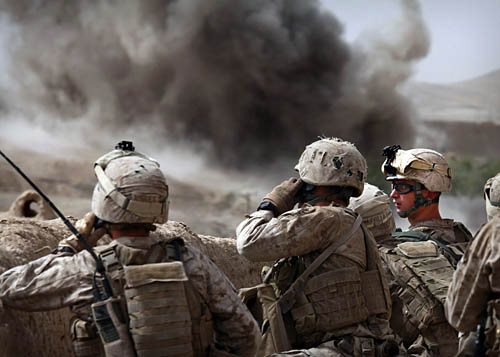
Digital airstrikes and physical casualties

Afghanistan

The US military defines Close Air Support (CAS) as ‘air action by fixed-wing and rotary-wing aircraft against hostile targets that are in close proximity to friendly forces, and [it] requires detailed integration of each air mission with the fire and movement of those forces.’  It’s a difficult and dangerous business, and not only for the intended targets.

The technologies of CAS have been transformed but, according to the the Defense Advanced Research Projects Agency, its fundamentals haven’t changed since the First World War.

‘Pilots and dismounted ground agents must ensure they hit only the intended target using just voice directions and, if they’re lucky, a common paper map. It can often take up to an hour to confer, get in position and strike—time in which targets can attack first or move out of reach.’

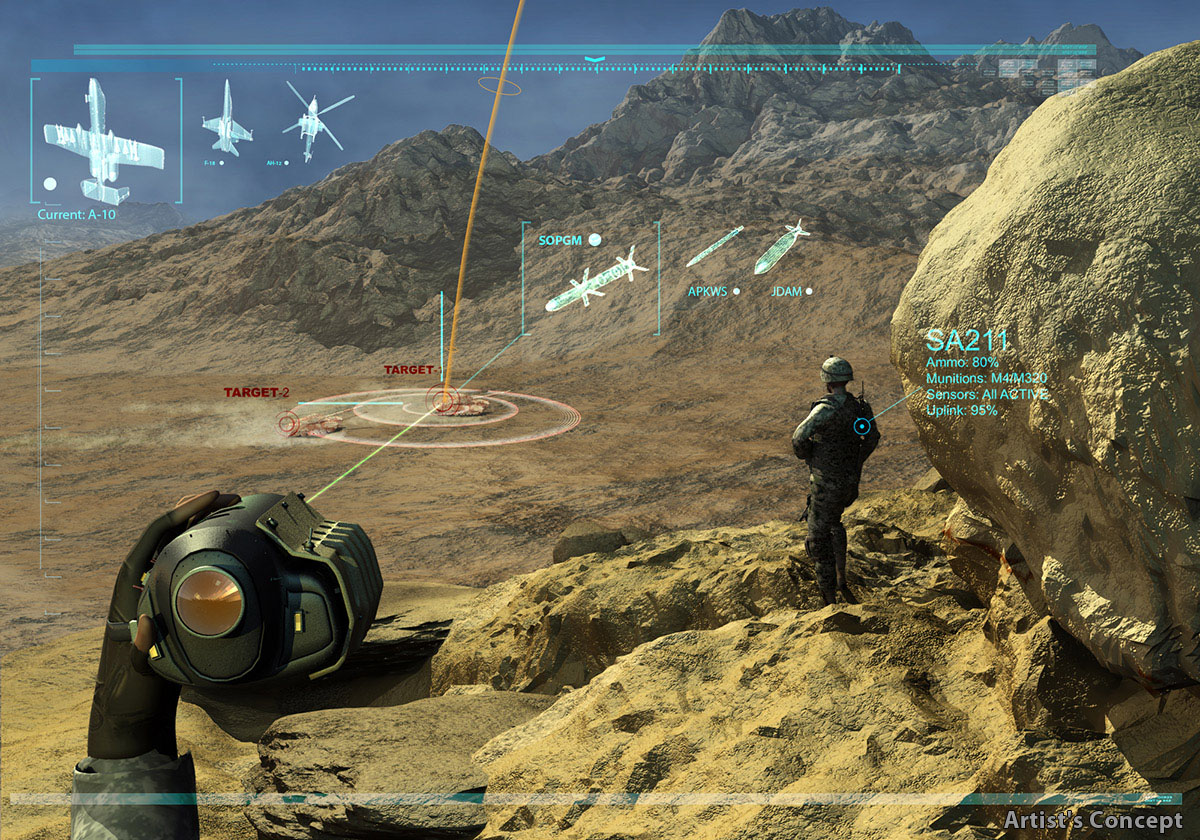
To achieve what is in effect the time-space compression of the kill-chain, DARPA is developing its Persistent Close Air Support program to provide an all-digital system.  The system ‘lets a Joint Tactical Air Controller call up CAS from a variety of sources, such as aircraft or missile platforms, to engage multiple, moving and simultaneous targets,’ explains David Szondy (from whom I’ve borrowed the short-hand ‘digital airstrikes’). ‘By eliminating all the radio chatter and map fumbling, the exercise is much faster and more accurate with reduced risk of friendly fire incidents.’  The program manifesto, for want of a better word, includes these aims and specifications:

The program seeks to leverage advances in computing and communications technologies to fundamentally increase CAS effectiveness, as well as improve the speed and survivability of ground forces engaged with enemy forces.

The program envisions numerous benefits, including:

  • Reducing the time from calling in a strike to the weapon hitting the target by a factor of 10, from up to 60 minutes down to just 6 minutes 
  • Direct coordination of airstrikes by a ground agent from manned or unmanned air vehicles
  • Improved speed and survivability of ground forces engaged with enemy forces
  • Use of smaller, more precise munitions against smaller and moving targets in degraded visual environments
  • Graceful degradation of services—if one piece of the system fails, warfighters would still retain CAS capability

PCAS_ProgramPage_Image

PCAS has two components:

The first is PCAS-Air, which … involves the use of internal guidance systems, weapons and engagement management systems, and communications using either the Ethernet or aircraft networks for high-speed data transmission and reception. PCAS-Air processes the data received, and provides aircrews via aircraft displays or tablets with the best travel routes to the target, which weapons to use, and how best to use them.

The other half is PCAS-Ground, intended for improved mobility, situational awareness and communications for fire coordination. Soldiers on the ground can use an HUD eyepiece wired to a tablet that displays tactical imagery, maps, digital terrain elevation data, and other information [the image above is an artist’s impression of the Heads-Up Display]. This means they can receive tactical data from PCAS without having to keep looking at a computer screen.

PCAS-Ground has been deployed in Afghanistan since December 2012.  The original plan, as the emphasis on ‘persistent’ implies, was to integrate the system with drones, but after the cancellation of the US Air Force’s MQ-X (‘Avenger’) program Raytheon announced that PCAS would be developed using a conventional A-10 Thunderbolt.

There is of course a long history to the digitisation and automation of the battlespace, and that reference to the First World War was not an anachronism.  There were such intimate links between mapping, aerial photography and artillery ranging on the Western Front – whose cascade of updated imagery and intelligence underwrote the seeming stasis of trench warfare – that Peter Chasseaud described the result as ‘a sophisticated three-dimensional fire-control data base’ through which ‘in effect, the battlefield had been digitised.’  It was also, in a sense, automated; I discuss this in detail in ‘Gabriel’s Map’, but it’s captured perfectly in Tom McCarthy‘s novel C.

More obvious way stations to the present include the Vietnam-era Electronic Battlefield, whose sensor-shooter system I described in ‘Lines of descent’ (DOWNLOADS tab) as a vital precursor to today’s remote operations:

Another was the development of the PowerScene digital terrain simulation that was used to identify target imagery transmitted by proto-Predators over Bosnia-Hercegovina and to rehearse NATO bombing missions.

PowerScene at Wright-Dayton AFBRemarkably, it was also used at Wright-Patterson Air Force Base during the negotiations that led to the Dayton peace accords. As one US officer explained:  ‘It’s an instrument of war but we’ll use it for peace because you are willing to come to the table’.  The system was used to explore proposals for potential boundaries, but the sub-text was clear: if agreement could not be reached, NATO had a detailed military knowledge of terrain and targets.  (For more, see James Hasik‘s Arms and innovation: entrepreneurship and alliances in the twenty-first century defense industry (2008) Ch. 6: ‘Mountains Miles Apart’; Richard Johnson‘s ‘Virtual Diplomacy’ report here; and a precocious paper by Mark Corson and Julian Minghi here, from which I’ve taken the image on the left).

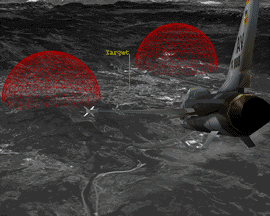
powerscene2PowerScene was later used by USAF pilots rehearsing simulated bombing missions against Baghdad in the 1990s (see right) – the system fixed target co-ordinates and red ‘bubbles’ displayed threats calibrated on the range of surface-to-air missile systems – and when Anteon Corporation and Lockheed Martin introduced TopScene air strikes over Afghanistan in 2001 were also rehearsed over digital terrain.

But there is another side to all this, because digital platforms can also be used to enable others to display and interrogate the geography of air strikes.  I’ve discussed this before in relation to the CIA-directed program of targeted killing in Pakistan here and here, but impressive progress has also been made in plotting air strikes across the border in Afghanistan.

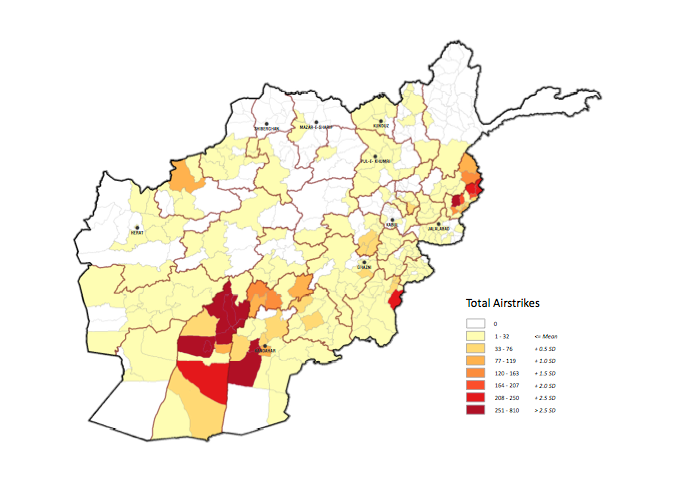
The most remarkable use of USAF/ISAF data that I know is Jason Lyall‘s work in progress on what he calls ‘Dynamic coercion in civil wars’ – ‘Are airstrikes an effective tool of coercion against insurgent organizations?’ – which focuses on air strikes in Afghanistan between 2006 and 2011. This is part of a book project, Death from above: the effects of airpower in small wars; the most recent version of the relevant analysis is here.  The map below is Jason’s summary of air strikes in Afghanistan 2006-11, but as I’ll explain in a moment, it gives little idea of the critical digital power that lies behind it.

JASON LYALL Air strikes in Afghanistan 2006-2011

First, the original USAF/ISAF data was in digital form, but transforming it into a coherent and consistent geo-coded database has involved a truly extraordinary enterprise:

We draw on multiple sources to construct a dataset of nearly 23,000 airstrikes and shows of force in Afghanistan during 2006-11. The bulk of the dataset stems from newly-declassified data from the Air Forces Central’s (AFCENT) Combined Air Operations Center (CAOC) in Southwest Asia, which recorded the location, date, platform, and type/number of bombs dropped for January 2008 to December 2011 in Afghanistan. These data required extensive cleaning to ensure that a consistent standard for each type of air operation was maintained and duplicates dropped. These data were supplemented by declassified data from the International Security Assistance Force’s (ISAF) Combined Information Data Exchange Network (CIDNE) for the January 2006 to December 2011 time period. Finally, additional records from press releases by the Air Force’s Public Affairs Office (the “Daily Airpower Summary,” or DAPS) were also incorporated. … Each air operations’ intended target was confirmed using at least two independent coders drawing on publicly available satellite imagery. Merging of these records was extremely labor intensive, not least because of the near total absence of overlap between CAOC, CIDNE, and DAPS records. Only 448 events were found in all three datasets, underscoring the problems inherent in single-sourcing data, even official data, in conflict settings (my emphasis).
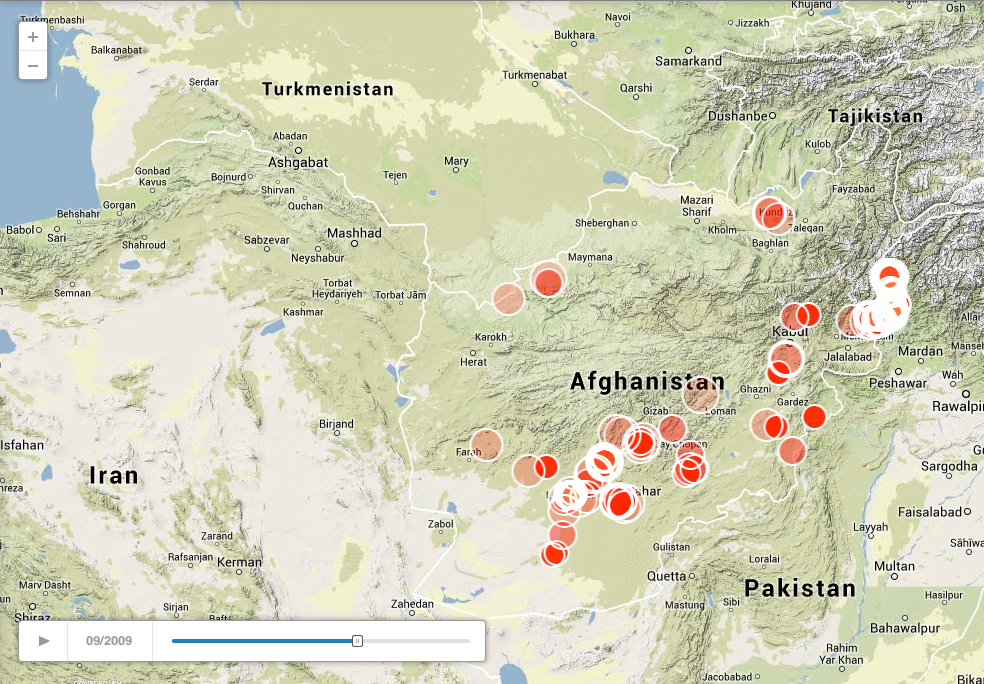
Second, to get the full visual effect of Jason’s analysis you absolutely need to see the animation that he’s made available on his website here; the image below is just a screenshot for September 2009 (I’ll explain why I chose that month in my next post).

JASON LYALL Air strikes in Afghanistan 09:2009

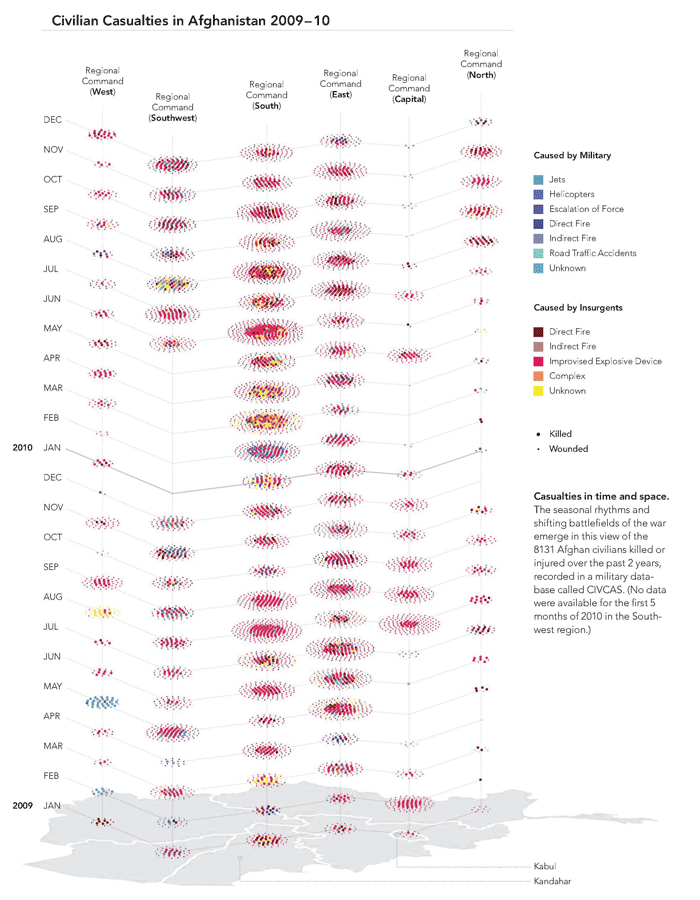
But what about casualty figures?  Josh includes a summary map of 216 air strikes involving acknowledged civilian casualties, taken from the same military databases (with all their limitations), and in January 2011 the US military released its data on ‘CIVCAS’ for the previous two years to the journal Science.  They included casualties from all parties to the conflict:

The numbers show that 2,537 Afghans civilians were killed and 5,594 were wounded in the past two years. Most of the deaths – 80 percent – are attributed to insurgents, with 12 percent caused by coalition forces, a 26 percent drop.

Here is Science‘s visualization of the CIVCAS data, designed to capture the time-space rhythms of violence from multiple causes:

F2.medium

You can access the interactive version here.

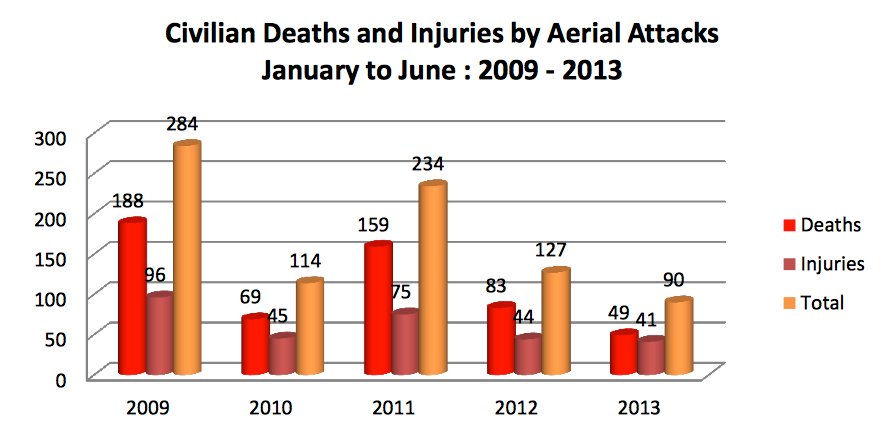
But other sources (notably the Afghan Rights Monitor and the UN Mission in Afghanistan, UNAMA, which produces six-monthly Reports on the protection of civilians in armed conflict) using different methodologies came up with much higher figures; here is a graph from the most recent UNAMA report showing casualties from air strikes 2009-13:

UNAMA Civilian casualties from air attacks 2009-13

UNAMA added this comment:

UNAMA welcomes the reduction in civilian casualties from aerial operations but reiterates its concern regarding several operations that caused disproportionate loss of civilian life and injury. UNAMA also raises concerns with the lack of transparency and accountability about several aerial operations carried out by international military forces that resulted in civilian casualties.

You can find the full analysis by John Bohannon, which includes a discussion of both databases, at Science (open access) here.

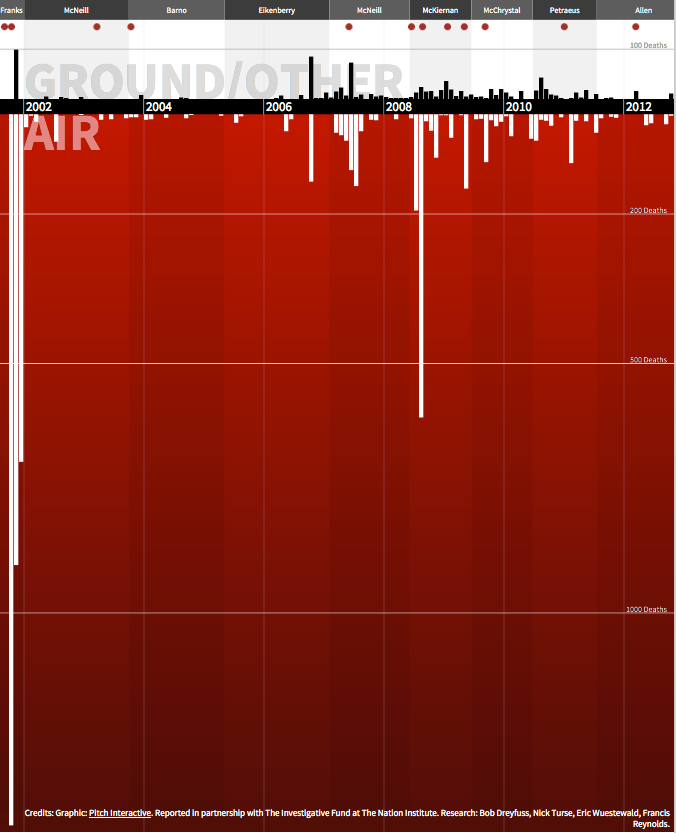
To be sure, counting casualties is always a contentious (and often dangerous) affair.  Getting information from the government of Afghanistan isn’t any more straightforward, as Nick Turse has shown: as he adds, ‘neither is it cheap’.  But he persevered, and the wonderful Pitch Interactive (a data visualization studio that also produced the haunting representation of deaths from drone strikes in Pakistan) collaborated with The Nation to produce a stunning interactive of ‘civilian deaths that have occurred in Afghanistan as a result of war-related actions by the United States, its allies and Afghan government forces.’  Here’s a screenshot:

Civilian fatalities in Afghanistan 2001-2012

You will see running along the top the military commanders during each period; the red dots mark major events.  It’s common knowledge – or should be – that the US-led invasion of Afghanistan in 2001 was spearheaded by an intensive high-level bombing campaign (I described this in The Colonial Present), shown along that desperately deep left margin.  But I suspect fewer people have grasped the reliance that ISAF has continued to place on air power.  What stands out from the image above, clearly, is the disproportionate (sic) number of deaths attributed to air strikes (5, 622) compared with ground operations (794) throughout the period: the UNAMA data above suggest that this only started to change in 2013. You can read more about this in the essay by Bob Dreyfuss and Nick Turse that accompanied the interactive, ‘America’s Afghan victims’, here, and – as always – the tireless work of Marc Herold is indispensable.

And to forestall a stream of comments, my title is not intended to suggest that digital technologies or the airstrikes they facilitate are somehow ‘immaterial’; nothing could be further from the truth.  Or the killing fields.

Theory of the drone 12: ‘Killing well’?

This is the 12th in a series of extended posts on Grégoire Chamayou‘s Théorie du drone and covers the final chapter in Part III: Necro-ethics, called ‘Précisions’; in French the singular means accuracy, as you might expect, but the plural means ‘details’ – which is, of course, where the devil is to be found…

One of the most common claims advanced by those who defend the use of armed drones is that they reduce ‘collateral damage’ because they are so precise.  Following directly from his previous critique of Bradley Jay Strawser, Chamayou cites him again here: ‘Drones, for all their current and potential misuse, have the potential for tremendous moral improvement over the aerial bombardments of earlier eras.’  But he dismisses this as a misleading comparison: if Dresden or Hiroshima are taken as the yardstick against which accuracy is to be measured – or, for that matter, as the standard against which military ethics are to be judged – then virtually any subsequent military operation would pass both tests with flying colours.

The comparison confuses form with function.  Compared to Lancaster bombers and Flying Fortresses (even with their famous Norden bombsights: for Malcolm Gladwell on the ‘moral importance’ of the bombsight to Norden, a committed Christian, see here and here; for more on the bombsight, see here), the Predator and the Reaper are evidently more accurate.  But Chamayou insists that the real comparison ought to be with other tactical means currently available to achieve the same objective.

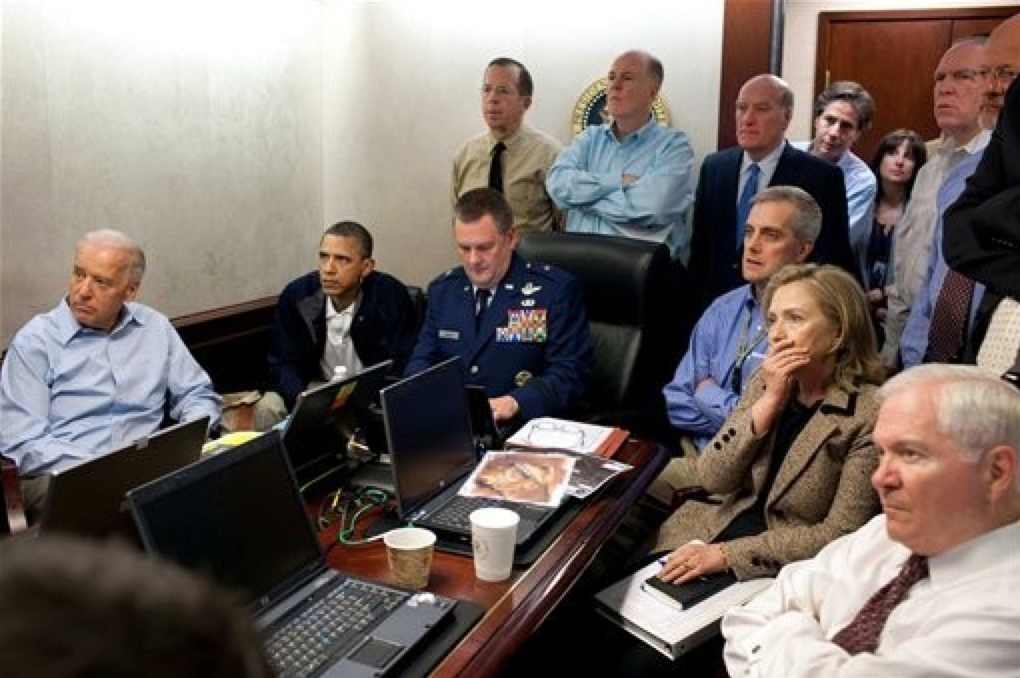
Situation Room

In the kill/capture raid against Osama Bin Laden on 1 May 2011 (assuming ‘capture’ was ever on the agenda), he argues that the choice was between drones and Special Forces not between drones and re-staging Dresden in Abbotabad.  This doesn’t quite work, since the raid was carried out by US Navy Seals who swept in from Bagram via Jalalabad by helicopter, but the mission also depended on real-time imagery from an RQ-170 stealth drone (‘the Beast of Kandahar’).  This was the source of the live video feed watched by Obama and members of his administration in the famous ‘Situation Room’ photograph [on which, see Keith Feldman on ‘Empire’s Verticality’ in Comparative American Studies 9 (4) (2011) 325-41].

The RQ-170 is an unarmed platform, but its role should remind us that drones are part of networked warfare – even when strikes are carried out by other means, the enhanced intelligence, surveillance and reconnaissance capabilities provided by the long dwell-times of these remote platforms mean that they are instrumental in the activation of the kill-chain.  This holds for military operations far beyond targeted killing: in Afghanistan between 2009 and 2011 drones were directly responsible for only 5-6 per cent of weapons released by the US Air Force, but they no doubt played a vital role in the release of many of the others.

Night raidStill, Chamayou’s basic point is a sharp one – and I rehearsed similar arguments in my discussion of The politics of drone wars last year – but readers of Jeremy Scahill‘s Dirty Wars may still reasonably object that the civilian casualties resulting from JSOC’s infamous night raids in Afghanistan cast doubt on the precision and accuracy of ground forces too.  Gareth Porter has estimated that more than 1,500 civilians were killed in night raids in just ten months in 2010-11, making them ‘by far the largest cause of civilian casualties in the war in Afghanistan.’  Indeed, Afghan protests have frequently centred on the civilian toll exacted by drones and night raids.

Even if the appropriate comparison is between different modalities of military violence in the present, Chamayou argues that the discussion is bedevilled by another series of confusions about ‘accuracy’ or ‘precision’.   In fact, though he doesn’t say so, the the two terms aren’t interchangeable. Strictly speaking,  accuracy refers to the deviation from the aiming point, precision to the dispersion of the strike:

Accuracy and precision

CEP in the diagram above refers to the Circular Error Probable, once described by the Pentagon as ‘an indicator of the delivery accuracy of a weapon system’, which is a circle of radius n described around the aiming point.  Assuming a bivariate normal distribution, then – all other things being equal (which they rarely are) – 50% of the time a bomb, missile or round will land within the circle: which of course means that the other half of the time it won’t, even under ideal experimental conditions.  As this is a normal distribution, then 93 per cent should land within 2n and more than 99 per cent within 3n.

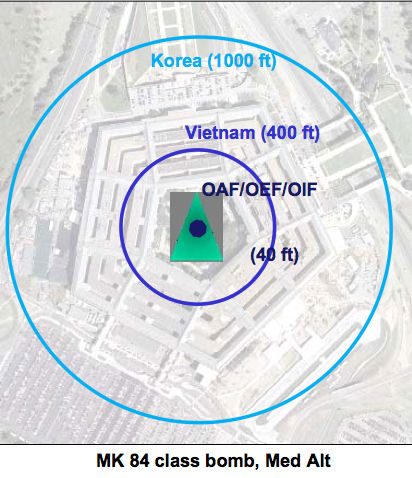
Chamayou doesn’t refer to the CEP directly, only briefly to the ‘accuracy of fire’,  but – to revert to the comparison he refuses – the CEP of bombing from the air has contracted dramatically since the Second World War when it was around 3,000 feet (though this improved over time): so much so that David Deptula, when he was USAF Deputy Chief of Staff for ISR, used to talk of crossing a ‘cultural divide of precision and information’.  The image below, taken from one of his presentations, shows the contraction (notice that the aim point is the Pentagon….).

Target mensuration (USAF)

Interestingly, the most recent Joint Publication (3-60) from the Joint Chiefs of Staff on Targeting (January 2013) has explicitly removed the concept from its Terms and Definitions, citing as its authority the Department of Defense’s Dictionary of Military and Associated Terms (it was still there on 31 January 2011, but no longer).  I haven’t been able to discover the reasons for the change, though there is longstanding scepticism about the validity of the measure: see, for a specific example, Donald MacKenzie‘s classic discussion in Inventing accuracy: a historical sociology of nuclear missile guidance (1993, pp. 352-7).  I’ve seen several comments to the effect that the measure isn’t useful for ‘smart bombs’ because they don’t display the same spread as ‘dumb bombs’.  (There’s a quick primer on the emergence of smart bombs during the Vietnam War here, and an account of the evolution of ‘precision strike’ since then here; for more detail, try David Koplow‘s Death by moderation: the US military’s quest for useable weapons (2009)).

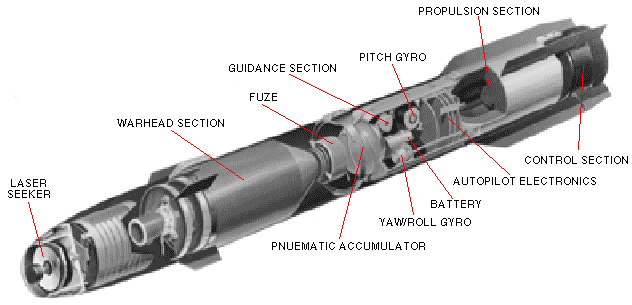
The MQ-1 Predator carries two AGM-114 Hellfire missiles [shown below, top; for acronyphiles, AGM designates an Air-to-Ground Missile, while the ‘Hellfire’ was originally developed as a ‘Helicopter-Launched Fire-and-Forget Missile’; its main platform is still an attack helicopter], while the MQ-9 Reaper can carry four AGM-114 Hellfire Missiles or replace two of them with GBU-12 Paveway II bombs [GBU = Guided Bomb Unit; shown below, bottom].

hellfire

GBU-12_xxl

Both weapons systems are laser-guided; the sensor operator, sitting beside the pilot in the Ground Control Station, uses a laser targeting marker (LTM) to ‘paint’ the target – this can also be done by ground troops in conventional combat zones – but its accuracy can be compromised by cloud, smoke, fog or dust.  (This is why the Air Force also uses GPS-guided weapons; they are less accurate but unaffected by these environmental conditions).  Once the necessary clearances have been obtained from mission commanders and military lawyers, the pilot fires the missile and the sensor operator guides it on to its target.

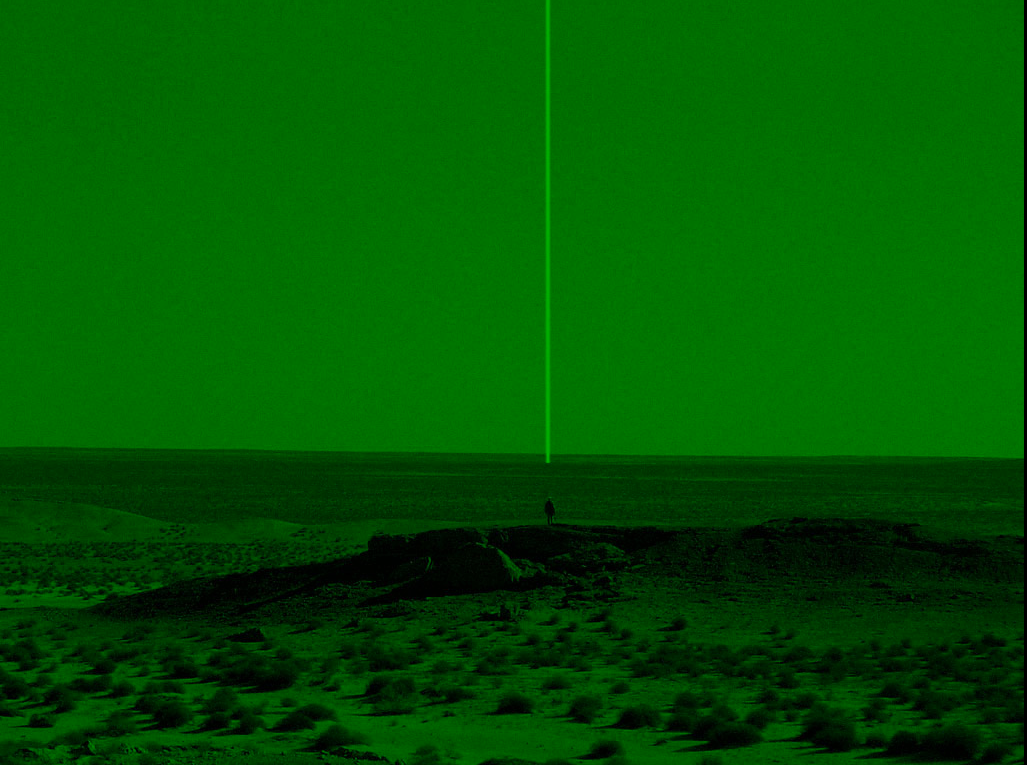
Omer Fast‘s interview with a sensor operator (‘Brandon’ –  whether this is a pseudonym or really Brandon Bryant is hard to know) for 5,000 Feet is the Best provides a series of insights into the operation in Afghanistan and Iraq.  You can’t see the beam with the naked eye, but American ground troops can see it with their infrared goggles.  According to ‘Brandon’, they call it the ‘Light of God’ (really); the image below is James Bridle‘s replication of the effect based on laser targeting night systems and a CC-licensed photograph of the Iraqi desert by Rob Bakker.

JAMES BRIDLE Light of God

‘Brandon’:

‘Usually the laser track is about half the size of this [hotel] room.  Poof!  By the time it hits the ground… a lot of times it turns into a square for some reason…  It could be anywhere from ten feet by ten feet to twenty feet by twenty feet… It starts off small and you watch it kind of open up’

This is not exactly putting ‘warheads on foreheads‘, but ‘Brandon’ explains that the crew is also required to identify a secondary ‘abort’ target.

‘… some of the contingencies we have to worry about are: if we’re firing at a building and somebody crosses – maybe – who knows, a group of children starts crossing in front of the building, we need a second site once that missile is already off the rails.  To go ahead and drop that missile so that we don’t harm the children  So usually we’ll choose an alternate site a couple hundred feet to a couple of hundred yards away.  It might be an empty field.  And we use that as the backup…

So let’s  say we get the missile off the rail and a group of kids comes into play: I call “abort” and I’ll start moving that laser over to an empty site so that we can detonate there and not cause any additional loss of life.’

Predator and Brandon Bryant

Sounds good, but the real Brandon Bryant (above) has a different story to tell; it turns out that there is an eight-second window in which the missile can be diverted:

With seven seconds left to go, there was no one to be seen on the ground. Bryant could still have diverted the missile at that point. Then it was down to three seconds. Bryant felt as if he had to count each individual pixel on the monitor. Suddenly a child walked around the corner, he says.

Second zero was the moment in which Bryant’s digital world collided with the real one in a village between Baghlan and Mazar-e-Sharif.

Bryant saw a flash on the screen: the explosion. Parts of the building collapsed. The child had disappeared. Bryant had a sick feeling in his stomach.

“Did we just kill a kid?” he asked the man sitting next to him.

“Yeah, I guess that was a kid,” the pilot replied.

“Was that a kid?” they wrote into a chat window on the monitor.

Then, someone they didn’t know answered, someone sitting in a military command center somewhere in the world who had observed their attack. “No. That was a dog,” the person wrote.

They reviewed the scene on video. A dog on two legs?

Even then, think about that blossoming square, twenty feet by twenty feet.  Then factor in the Circular Error Probable of a Hellfire missile, which is usually calculated at between 9 and 24 feet. The ‘pinpoint’ accuracy of the missile is starting to blur and the ‘surgical’ strike beginning to blunt.  In fact, the development of the Hellfire missile suggests another narrative.  In 1991 the Pentagon was already advertising the Hellfire as capable of ‘pinpoint’ accuracy, and since then it has been upgraded more than half a dozen times, each version promising greater accuracy: as Matthew Nasuti asks in his catalogue of Hellfire errors, what can be more accurate than ‘pinpoint accurate’?

In any case, narrowing the discussion to the CEP misses two things.  First, as former USAAF officer Peter Goodrich points out in his discussion of ‘The surgical precision myth‘, this ‘totally disregards what happens after the bomb explodes’.  What Goodrich has in mind is the blast and fragmentation radius, which Chamayou calls ‘the kill radius’.  Fast’s ‘Brandon’ insists

‘All of us are taught about how far those Hellfire missiles go, how far their frag goes.  And “danger close” as we call it when you have troops that are very close or civilians that are present.  They’re just factors that  you have to work in to bring down the percentages of the harm that could be done.’

In the targeting cycle the US Air Force enters those ‘factors’ into both collateral damage estimation and ‘weaponeering’, modifying the missile or bomb to restrict its blast and fragmentation radius. Chamayou reports that the Hellfire missile has a ‘kill radius’ of 50 feet (15 metres) and a ‘wounding radius’ of 65 feet (20 metres); the GBU-12 Paveway II has a ‘casualty radius’ of between 200 and 300 feet (within which 50 per cent of people will be killed).   These calculations aren’t exactly equivalent – and it’s difficult to obtain precise and comparable figures – but nothing about this is as precise as the rhetoric  implies.  As Chamayou asks:

‘In what fictional world can killing an individual with an anti-tank missile [the Hellfire] that kills every living thing within a radius of 15 metres and wounds everyone else within a radius of 20 metres be seen as “more precise”?’

All those who are killed or wounded within the casualty radius are presumably guilty by proximity.

This is Chamayou’s second rider, which relates to what happens before the bomb or missile is released: to the production – the US military sometimes calls it the ‘prosecution’ – of the target.  In this sense, the technical considerations I’ve just described are beside the point (sic).  All of the calibrations I’ve set out in such detail apply to missiles and bombs irrespective of the platform used to deliver them; what is supposed to distinguish a Predator or a Reaper from a conventional strike aircraft or attack helicopter is that it combines ‘hunter’ and ‘killer’ in a single platform and, specifically, that its real-time full-motion video feeds enable crews (and others in the loop) to see what they are doing in unprecedented detail.

Signing a Hellfire missile attached to a MQ1-C (Gray Eagle) UAV at BagramDoes this political technology of vision make it possible, as advocates claim, to distinguish between combatants and civilians more effectively than ever before?  Here Chamayou rehearses common criticisms: that in standard US military practice ‘combatant’ morphs into ‘militant’, even ‘presumed militant’ and, at the hideous limit, into ‘military-aged male’ – counting ‘all military-age males in a strike zone as combatants … unless there is explicit intelligence posthumously proving them innocent’ – and that this process of (so to speak, performative) militantisation as Chamayou calls it is underwritten by a techno-judicial probabilisation (again his term) whose ‘epistemology of suspicion’ allows signature strikes that target un-named and unknown people on the basis of their ‘pattern of life‘.

But both these procedures and, indeed, the criticisms of them, obscure what is for Chamayou, the fundamental paradox, what he calls the ‘profound contradiction’.  International law defines a combatant and thus a legitimate target in terms of direct participation in hostilities and an imminent threat.  It’s more complicated than that, as I’ll show later, but this is enough for Chamayou to fire off two key questions: How can anyone be participating in hostilities if there is no longer any combat? How can there be any imminent threat if there are no troops on the ground?  The drone, praised for its forensic ability to distinguish between combatant and non-combatant, in fact abolishes the condition necessary for such a distinction: combat itself (p. 203; also p. 208).

It’s an artful claim, but it oversimplifies the situation.  Chamayou has (once again) confined the discussion to targeted killing but, as I’ve repeatedly emphasised, Predators and Reapers have also been used for other purposes in Iraq and Afghanistan, including the provision of ‘armed overwatch’ and close air support to ground troops.  Outside these war-zones – in the Federally Administered Tribal Areas of Pakistan, Yemen, Somalia and elsewhere – the critique is a powerful one (which is not to say that Obama’s lawyers have not claimed a legal warrant for their supposedly covert drone strikes in these areas: more on this later too).  Still, Chamayou’s argument loops back to earlier discussions about the intrinsic non-reciprocity of drone warfare.

And here Chamayou closes with a powerful argument.  If ethics is classically about how to live well and die well, he suggests that necro-ethics is a doctrine of ‘killing well’.  He notes that critics of the covert drone wars demand, time and time again, transparency.  They want to know the legal armature and adjudicative apparatus for the strikes, the rules and procedures that are followed, and the lists of casualties.  But he argues that their demands turn the issue into an arid juridico-administrative formalism endorsed by bureaucratic Reason.  In the kill zones, he says ruefully, there are no legal memoranda, no columns of numbers or ballistics reports (p. 207): these are the very formularies of necro-ethics.  And, as I’ve noted, there are no air-raid warnings, no anti-aircraft defences and no air-raid shelters either.

It’s in that spirit that Chamayou closes the chapter with an extended quotation from Madiha Tahir’s Louder than bombs‘:

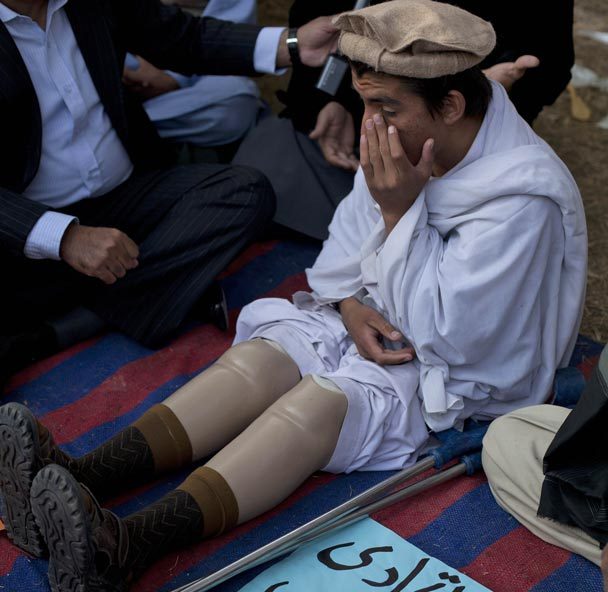
Saudallah WazirWhat is the dream?

I dream that my legs have been cut off, that my eye is missing, that I can’t do anything … Sometimes, I dream that the drone is going to attack, and I’m scared. I’m really scared.

After the interview is over, Sadaullah Wazir pulls the pant legs over the stubs of his knees till they conceal the bone-colored prostheses.

The articles published in the days following the attack on September 7, 2009, do not mention, this poker-faced, slim teenage boy who was, at the time of those stories, lying in a sparse hospital in North Waziristan, his legs smashed to a pulp by falling debris, an eye torn out by shrapnel. nor is there a single word about the three other members of his family killed: his wheelchair-bound uncle, Mautullah Jan and his cousins Sabr-ud-Din Jan and Kadaanullah Jan.  All of them were scripted out of their own story till they tumbled off the edge of the page.

Did you hear it coming?

No.

What happened?

I fainted. I was knocked out.

As Sadaullah, unconscious, was shifted to a more serviceable hospital in Peshawar where his shattered legs would be amputated, the media announced that, in all likelihood, a senior al-Qaeda commander, Ilyas Kashmiri, had been killed in the attack. The claim would turn out to be spurious, the first of three times when Kashmiri would be reported killed.

Sadaullah and his relatives, meanwhile, were buried under a debris of words: “militant,” “lawless,” “counterterrorism,” “compound,” (a frigid term for a home). Move along, the American media told its audience, nothing to see here.

Some 15 days later, after the world had forgotten, Sadaullah awoke to a nightmare.

Do you recall the first time you realized your legs were not there?

I was in bed, and I was wrapped in bandages. I tried to move them, but I couldn’t, so I asked, “Did you cut off my legs?” They said no, but I kind of knew.

When you ask Sadaullah or Karim or S. Hussein and others like them what they want, they do not say “transparency and accountability.” They say they want the killing to stop. They want to stop dying. They want to stop going to funerals — and being bombed even as they mourn. Transparency and accountability, for them, are abstract problems that have little to do with the concrete fact of regular, systematic death.’

And Madiha adds this: ‘The technologies to kill them move faster than the bureaucracies that would keep more of them alive: a Hellfire missile moves at a thousand miles per hour; transparency and accountability do not.’

Indeed they don’t; Sadaullah died last year, Mirza Shahzad Akbar reports, ‘without receiving justice or even an apology.’  Not even killing well, then.

Survivable life

Just back from St Andrews – the video of the Neil Smith Lecture will be available online shortly, and I’ll post a notice when it’s ready – and so much to catch up on it’s not easy to work out where to start.

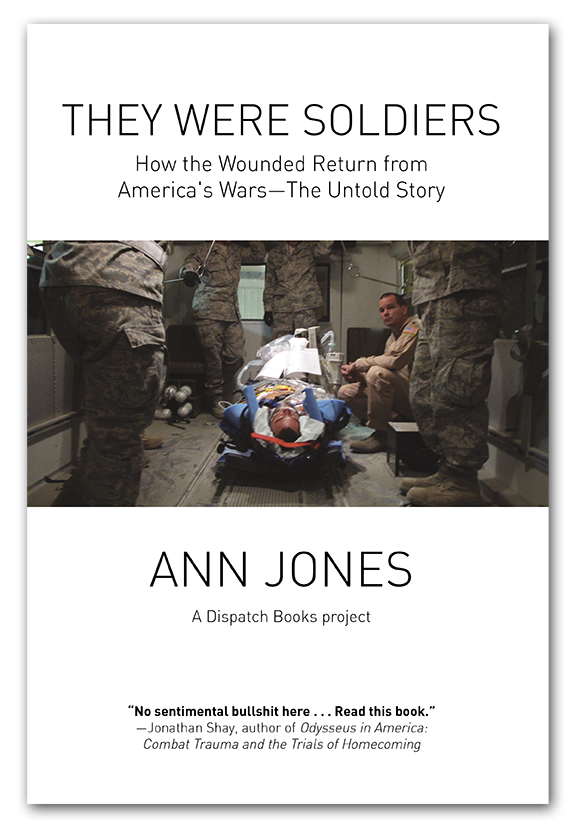
THEY-WERE-SOLDIERS_by-Ann-Jones_72

But this is as good a place as any: Ann Jones‘s new book, They were soldiers: how the wounded return from America’s wars (Haymarket, 2013):

After the American invasion of Afghanistan in 2001, Ann Jones spent a good part of a decade there working with Afghan civilians—especially women—and writing about the impact of war on their lives: the subject of Kabul in Winter (2006). That book revealed the yawning chasm between America’s promises to Afghans and its actual performance in the country. Meanwhile, Jones was pondering another evident contradiction: between the U.S. military’s optimistic progress reports to Americans and its costly, clueless failures in Afghanistan as well as Iraq. In 2010-2011, she decided to see for herself what that “progress” in Afghanistan was costing American soldiers. She borrowed some body armor and embedded with U.S. troops. On forward operating bases she saw the row of photographs of “fallen” soldiers hung on the headquarters’ wall lengthen day by day.

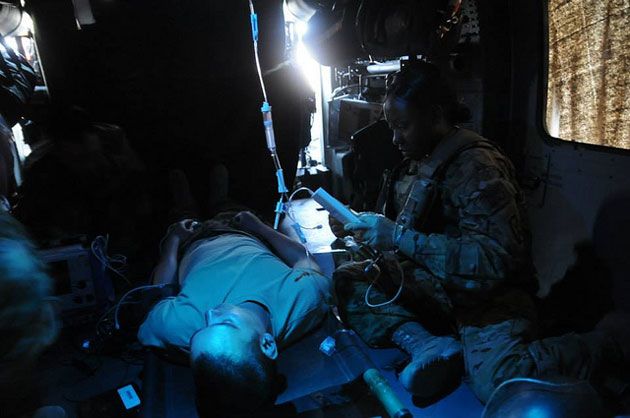
At the trauma hospital at Bagram Air Base she watched the grievously wounded carried from medevac helicopters to the emergency room and witnessed the toll that life-saving surgeries took on the doctors who performed them. She accompanied the wounded on medevac flights from Bagram to Landstuhl Regional Medical Center in Germany, then on to Walter Reed Hospital in Washington, and finally—for those who made it—back to all-American homes where, often enough, more troubles followed: violence against wives, girlfriends, children, and fellow soldiers; Big Pharma-induced drug addiction; murder, suicide, and the terrible sorrow of caretaker moms and dads who don’t know what happened to their kids. They Were Soldiers is a powerful account of how official American promises—this time to “Support Our Troops”—fall victim to the true costs of war.

Medevac

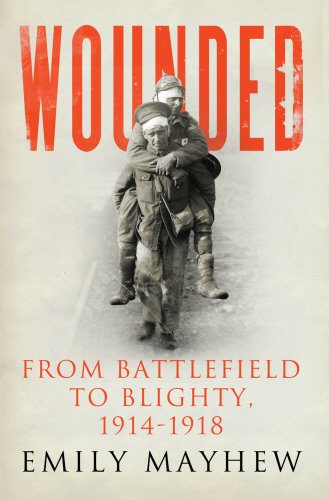
This dovetails perfectly with what I hope will be my new research project on caring for those wounded by war – combatants and civilians – between 1914 and 2014 and their precarious journeys away from the killing zones (see DOWNLOADS tab and scroll down).  As I’ve noted before, much of the critical commentary on modern war has been preoccupied with those killed – which is of course important – but the other casualties of war have all too often been marginalised.  It’s high time to supplement inquiries into what Judith Butler calls the constitution of  a ‘grievable life’ with others into the constitution of a ‘survivable life’.

Hence the vital importance of Ann’s book.  There’s an interview with Amy Goodman at Democracy Now here, and another with Truthout here, in which she deftly rejects the lazy politics in which the left supposedly cares only for ‘their’ civilians while the right cares for ‘our’ troops:

We worry – if at all – about how vets are treated when they return because of our mistaken notion that Vietnam vets suffered mightily from not being greeted as heroes. What Vietnam veterans truly suffered from was not their reception, but the war. That fact we tend to forget. Consequently, we think we can resolve all the possible nasty consequences of war by waving flags at airports as troops return. The deeper problem is that none of these veterans of the wars of choice in Iraq and Afghanistan – not one of them – should ever have been sent to war. But without a draft that can potentially strike any family in the country, those who have no fear that a family member may be compelled to serve are free to ignore the whole political and public relations process by which leaders drag the country into war and carry it on. War can be left to a supposedly “all volunteer” standing army – those poor kids with no job options or a shot at college – which is precisely what the founding fathers warned against, believing that a standing army would be used by autocrats to destroy democracy. That volunteer army, of course, is shadowed by a larger privatized for-profit army of mercenary contractors. The standing army of the poor and patriotic is alienated from the general public and left at the mercy of the president. Our recent presidents and their cronies, who hold a nearly unblemished record of evading military service, have thrown kids into war with an enthusiasm undampened by any real knowledge of what war is, while the most influential segments of the general public, feeling both grateful and guilty that their kids are safe, make no effort to restrain those war-loving leaders.

You can read an extract from They were soldiers, with a very helpful prefatory note from Nick Turse, at TomDispatch here:

In 2010, I began to follow U.S. soldiers down a long trail of waste and sorrow that led from the battle spaces of Afghanistan to the emergency room of the trauma hospital at Bagram Air Base, where their catastrophic wounds were surgically treated and their condition stabilized.  Then I accompanied some of them by cargo plane to Ramstein Air Base in Germany for more surgeries at Landstuhl Regional Medical Center, or LRMC (pronounced Larm-See), the largest American hospital outside the United States.

Once stabilized again, those critical patients who survived would be taken by ambulance a short distance back to Ramstein, where a C-17 waited to fly them across the Atlantic to Dover Air Base in Delaware. There, tall, multilayered ambulances awaited the wounded for the last leg of their many-thousand-mile journey to Walter Reed Army Medical Center in Washington D.C. or the Naval Hospital at Bethesda, Maryland, where, depending upon their injuries, they might remain for a year or two, or more.

Now, we are in Germany, halfway home.  This evening, the ambulance from LRMC heading for the flight line at Ramstein will be full of critical-care patients, so I leave the hospital early and board the plane to watch the medical teams bring them aboard.  They’ve done this drill many times a week since the start of the Afghan War.  They are practiced, efficient, and fast, and so we are soon in the air again. This time, with a full load.

 Two rows of double bunks flank an aisle down the center of the C-17, all occupied by men tucked under homemade patchwork quilts emblazoned with flags and eagles, the handiwork of patriotic American women. Along the walls of the fuselage, on straight-backed seats of nylon mesh, sit the ambulatory casualities from the Contingency Aeromedical Staging Facility (CASF), the holding ward for noncritical patients just off the flight line at Ramstein.
At the back of the plane, slung between stanchions, are four litters with critical care patients, and there among them is the same three-man CCAT (Critical Care Air Transport) team I accompanied on the flight from Afghanistan. They’ve been back and forth to Bagram again since then, but here they are in fresh brown insulated coveralls, clean shaven, calm, cordial, the doctor busy making notes on a clipboard, the nurse and the respiratory therapist checking the monitors and machines on the SMEEDs. (A SMEED, or Special Medical Emergency Evacuation Device, is a raised aluminum table affixed to a patient’s gurney.) Designed to bridge the patient’s lower legs, a SMEED is now often used in the evacuation of soldiers who don’t have any.
Here again is Marine Sergeant Wilkins, just as he was on the flight from Afghanistan: unconscious, sedated, intubated, and encased in a vacuum spine board. The doctor tells me that the staff at LRMC removed Wilkins’s breathing tube, but they had to put it back. He remains in cold storage, like some pod-person in a sci-fi film. You can hardly see him in there, inside the black plastic pod. You can’t determine if he is alive or dead without looking at the little needles on the dials of the machines on the SMEED. Are they wavering? Hard to tell.

They were soldiers is available as an e-book if, like me, you can’t wait.

Ghosts of Bagram

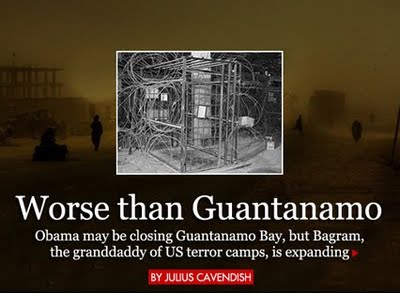
bagram_worse_than_guantanamo

I’ve written about ‘haunting’ before, but Asim Rafiqui has an elegaic photo-essay over at Warscapes on The Ghosts of Bagram that adds other dimensions and deserves the widest audience.  Over the last several months I’ve been compiling what has turned into a fat dossier to help me revise my essay on Guantanamo, “The Black Flag” (DOWNLOADS tab), for The everywhere war; in particular, I’m determined to  incorporate other sites in the global war prison – notably Bagram in Afghanistan – because the (in)constant attention focused on Guantanamo artfully distracts the public gaze from these other sites.

No doubt Obama will say he is as ‘haunted‘ by his failure to close Guantanamo as he is by the killing of civilians by US drones in Waziristan.  But here is Rafiqui on the other ghosts from Pakistan:

‘They are ghosts, and I have spent nearly two months trying to find any evidence of them. They are the 40 Pakistani men who remain imprisoned, without charge or evidence, by the Americans at the Bagram Air Base in Afghanistan. They have not been see or heard by anyone other than their immediate families who are granted carefully monitored and heavily censored telephone and internet video call access. Some of the men have been in Bagram, often called one of America’s most notorious prisons, for over 11 years. Denied access to the press, human rights organizations, and legal representation, these men have been silenced and erased, the evidence and rationale for their incarceration beyond the eyes, ears and focus of the public and the media. This is intentional and part of a process of systemic dehumanization that enables the unjust detention and cruel prison conditions the men face. Until 2012, their own government refused to recognize them as citizens of Pakistan. I have spent two months traveling across Pakistan trying to discover something, anything, about them.’

In 2008 the US Supreme Court in Boumedienne vs. Bush extended the right of habeas corpus protections to non-citizens detained at Guantanamo.  But those incarcerated at Bagram, many of them not only from Afghanistan and Pakistan but also from Iraq, central Africa and south east Asia, are beyond the reach of the writ: see Andrew Tutt on ‘Boumedienne’s wake’ here and, for a more comprehensive analysis,  Janet Cooper Alexander on ‘The law free zone and back again’ here.   If you need background on Bagram, try Lisa Hajjar on Bagram as ‘Obama’s GITMO’ here, and for the global war prison more generally Laleh Khalili‘s Time in the Shadows.

Medical-military machines and casualties of war 1914-2014

SABER, Desert Rat Sketchbook

As promised, I’ve added the outline of my proposed new research programme on the casualties of war to the DOWNLOADS page (scroll way down).  I’ve omitted all the pages in the formal application that drove me to distraction – knowledge mobilisation plan (sic), budget justification, ‘expected outcomes’ and the rest – but if you do look at this ‘Detailed Description’ (as it has to be called), please bear in mind that:

(a) this is still very preliminary, and my work is in the earliest of stages (this is a grant application, after all);

(b) everything had to fit into a prescribed, very limited space (leaving no room for nuance); and

(c) I was more or less required to use the Harvard reference system, the enemy of all good writing.

I’ve added a few lines of clarification and a series of illustrations to liven things up (no room for those in the original), but I hope this gives you some idea of what I’m up to.  And, as always, I’d welcome any comments or suggestions – preferably by e-mail to avoid the spam filters.

In working on this, I’ve stumbled into a series of unusually rich primary sources and secondary literatures, and since I’ve mentioned good writing I want to flag two texts that have kept me going throughout this process.

MAYHEW WoundedThe first is Emily Mayhew‘s Wounded: from Battlefield to Blighty 1914-1918, which I noted in an earlier post; for editions outside the UK the subtitle becomes A new history of the Western Front.  I’ve now read it, and admire its substance but also its style enormously.  It’s based on painstaking research, literally so, and yet the main chapters read like a novel, and the analytical-bibliographic apparatus has been artfully moved to the Notes where it becomes a model of clear, concise and thought-provoking commentary rather than a cage that hobbles the narrative.

MacLeish Making war at Fort HoodThe second is Ken MacLeish‘s Making war at Fort Hood: life and uncertainty in a military community.  I met Ken at a workshop in Paris last year, and if you read anything better this year – in style and substance – than his Chapter 2 (‘Heat, weight, metal, gore, exposure’) I’ d like to know about it.  The combination of ethnographic sensitivity, elegant prose, and a theoretical sensibility that Ken wears with confidence and displays with the lightest of touch is simply stunning.

Since I’m off to York next week I’ll be spending the next few days preparing a new presentation on ‘Drones and the everywhere war’.  I hope this will also give me  time to return to my posts on Grégoire Chamayou‘s Théorie du drone which I had to put on hold while I trekked from Flanders to Afghanistan for my grant application…

Theory of the drone 10: Killing at a distance

This is the tenth in a series of extended posts on Grégoire Chamayou‘s Théorie du drone and covers the fifth and final chapter in Part II, Ethos and psyche.

Gulf_war_target_camChamayou begins with a lecture given by German artist and film-maker Harun Farocki in Karlsruhe in 2003 called  ‘Phantom Images‘.  A ‘phantom image’, Farocki explained, is a view that is otherwise inaccessible to a human being – like the ‘bomb’s-eye view’ that became so familiar during the Gulf War (‘a suicidal camera’).  Like so many other ‘technical representations which maintain that they only represent the operative principle of a process’ these are, of course, techno-cultural performances.  They are techno-cultural because they produce a constructed and constrained space – in the Gulf War images that Farocki used to frame his argument, the battle space appears empty of people, a landscape without figures, an odyssey of destruction based on an object-ontology – and they are performances because they are what Farocki called ‘operative images’ that ‘do not represent an object but are part of an operation‘ (my emphasis).

You can find more on Farocki’s fascination with the virtual/real and Immersion here and on Images of War (at a distance) here.  Both ideas – immersion and distance – are central to Chamayou’s argument, but his starting-point is the idea of an operative image.  He wants to think of militarized vision as a ‘sighting’ that works not only to represent an object but also to act upon it and, in the case that most concerns both of us, this is the mainspring of the production of the target.

This has a long (techno-cultural) history, but drones use a video image to fix and execute the target: ‘You can click, and when you click, you kill.’  There’s something almost magical about it, Chamayou says: a hi-tech form of voodoo violence, like sticking pins into a wax doll, in which bringing someone into view – ‘pinning’ the target in the viewfinder – transports them into the killing space.

GROSSMAN On KillingBut what sort of space is it?  Chamayou considers a simple diagram from Dave Grossman‘s On Killing. For readers unfamiliar with his work, here is how Grossman describes himself on the website of his Killology Research Group:

Col. Grossman is a former West Point psychology professor, Professor of Military Science, and an Army Ranger who has combined his experiences to become the founder of a new field of scientific endeavor, which has been termed “killology.” In this new field Col. Grossman has made revolutionary new contributions to our understanding of killing in war, the psychological costs of war, the root causes of the current “virus” of violent crime that is raging around the world, and the process of healing the victims of violence, in war and peace. 

And here is the diagram, which summarises Grossman’s views on the relationship between ‘resistance to killing’ and distance from the target:

Resistance to killing as a function of distance

Grossman’s basic argument is that distance increases indifference and, as the annotations imply, there appears to be an historical sequence to all this.  Grossman’s book was published before the advent of the drone, but – given these two axes – the Predator and the Reaper presumably ought to appear on the extreme right of the diagram, representing the radicalisation of killing at a distance.

In fact, Grossman provides a discussion of videogames in which he says that the screen acts as a barrier between the player and the violence s/he unleashes in the game, making it easier to ‘kill’: exactly the argument advanced by those who claim that drones induce a ‘Playstation mentality’ to killing.

And yet, as I’ve explained in ‘From a view to a kill’ (DOWNLOADS tab), modern videogames are profoundly immersive, and the high-resolution full motion video feeds from the drones induce such an extraordinary sense of proximity, even intimacy – remember that crews frequently claim to be 18 inches from the combat zone, the distance from eye to screen – that drones are surely also pulled towards towards the extreme left of Grossman’s diagram.

Chamayou doesn’t quote him, but Diderot’s Letter on the blind set out the original terms of the debate perfectly:

DIDEROT.001

But Chamayou is quick to show that ‘distance’ is a weasel-word, and in an extended footnote he elaborates his concept of pragmatic co-presence.  Co-presence denotes the possibility of A affecting B in some way, which means (in the absence of sorcery) that B must be within the sphere of action of A; more formally, co-presence involves the inclusion of one within the ‘range’ or ‘reach’ of another.  This is multi-dimensional – without technical mediation you can see someone much further away than you can hear them – but in many situations technical mediations are involved and so transform the relation.  This matters for two reasons.

First, there is nothing necessarily reciprocal about co-presence: what Chamayou calls ‘the structure of of co-presence’ determines what it is possible for you to do to the other, and is itself the product of struggle: each party to a conflict manouevres to produce a favourable asymmetry so that it becomes much easier for you to strike than to be hit.  In this sense, all war strives to be asymmetric – it’s not confined to wars between states and non-state actors – and it’s this that in part underwrites the history of war at a distance; as William Saletan put it, effectively re-describing Grossman’s diagram,

‘Technically, this is marvelous. Look at the history of weapons development: catapult, crossbow, cannon, rifle, revolver, machine gun, tank, bazooka, bomber, helicopter, submarine, cruise missile. Every step forward consists of a physical step backward: the ability to kill your enemy with better aim at a greater distance or from a safer location. You can hit him, but he can’t hit you.’

But – Chamayou’s second rider – ‘teletechnologies’ radically transform this sequence by severing co-presence from co-localisation.   What is distinctive about teletechnologies is not their capacity to act ‘at a distance’ but their indifference to and their interdigit(is)ation of ‘near’ and ‘far’.

This has far-reaching (sic) consequences because it produces a double disassociation.  Where, exactly, does the action take place?  Here (at Creech Air Force Base in Nevada) or there (Kandahar in Afghanistan)?  There is no single answer, of course, which is precisely Chamayou’s point.  This split – or series of splits, if you think of the wider networks involved – in turn engenders radically new forms of experience, of being-in-the-world, that can no longer be contained within the physico-corporeal confines of the conventional human subject.

Chamayou wants to show that this double disassociation is anything but ‘marvellous’.   He accepts that the targets that are produced through the full-motion video feeds from the Predators and Reapers are much less abstract: the crews see their targets – often people, not physical objects like the buildings or missile batteries that constituted Farocki’s ’empty’ battlespace – and they see the corporeal consequences of each strike.  ‘This novel combination of physical distance and visual proximity gives the lie to the old [Clausewitz-Hegelian] law of distance,’ Chamayou writes, since ‘increased distance no longer makes violence more abstract or more impersonal but, on the contrary, more graphic and more personal.’

But he insists that this proximity, even intimacy is counterbalanced by two factors which are also inscribed within the political technology of vision:

(1) ‘Proximity’ is contracted to the optical – and even this is degraded because the resolution of the video feeds reduces people to ‘avatars without faces’.  I think this is less straightforward than Chamayou implies.  He cites Salatan – ‘There’s no flesh on your monitor; just co-ordinates’ – which is a sharp remark, but the journalist was referring to the launch of long-range missiles (‘… tap a button on one continent and send a missile to another’) whereas the screens at Creech and elsewhere show human figures as well as co-ordinates.  More significant, I think, is that when drone operators provide close air support they are also in radio and online contact with troops on the ground, and this produces a pragmatic co-presence which is considerably more ‘fleshed out’ than their otherwise purely optical encounters with others in their field of view.

(2) Drone operators can see without being seen, and Chamayou argues that ‘the fact that the killer and his victim are not inscribed in “reciprocal perceptual fields” facilitates the administration of violence’ because it ruptures what psychologist Stanley Milgram in his notorious experiments on Obedience to authority [below] called ‘the phenomenological unity of the act’.  Milgram actually wrote “experienced”, not “phenomenological”, but you get the point; Milgram was discussing how much easier it is to hurt someone ‘if there is a physical separation of the act and its consequences’, which is radicalised in what the US Air Force calls the ‘remote split’ operations carried out by its Predators and Reapers.

MILGRAM Experiments

Milgram’s thesis was a general one, but to nail the sense of disassociation to the drone Chamayou quotes Major Matt Martin, a Predator operator:

‘The suddenness of action played out at long distance on computer screens left me feeling a bit stunned…  It would take some time for the reality of what happened so far away, for “real” to become real.’

Again, I think it’s more complicated than that.  Martin was clearly recalling an early experience, low on the learning curve, and interviews with other drone pilots suggest that within 6 months or so most had little difficulty in apprehending the reality, even the physicality of pragmatic co-presence. The sensor operator interviewed by Omer Fast for 5,000 Feet is the Best had this to say, for example:

‘… you get more into it the longer you’re working on the Predator.  Like my first fire mission.  You know, we fired a Hellfire missile at the target.  It didn’t quite strike [sic] me as, “Hey! I just killed someone!”  My first time.  It was within my first year there.  It didn’t quite impact.  It was like, “Yeah! I got somebody!”  You know?  And it was later on through a couple of more missions that I started to… The impact really dawned on me.  I just ended someone’s life!  That was me that did that!”‘

obedience-to-authority-milgramIt’s important to remember, too, that Milgram’s work was about structures of authority, and this has a palpable effect in the case of the military chain of command which has been transformed by the networked incorporation of video feeds from the drones and the deployment of military lawyers (JAGs) on the operations floor of the Combined Air and Space Operations Center (what I called ‘oversight’ in “From a view to a kill”),  which provides for a dispersion of responsibility across the network.

Equally important, I suspect, is that fact that drone crews are not only ‘following orders’, as the familiar jibe has it: they are also following procedures that transform military violence into a process that is at once techno-scientific and quasi-juridical and thus seen as conducted under the sign of an unimpeachable (military) Reason.

Joseph Pugliese makes a parallel argument about the incorporation of military-legal discourse into the techno-logic of the targeting process:

‘I argue that the parenthetical relation of law to technology is premised on a topical hiatus that disassociates the executioner who manipulates the killing technology of the drone from the facticity of the resultant execution. In this scenario, law is conceived of in the most radically instrumental of understandings: it enables and legitimates the execution while simultaneously suspending the connection between the doer and the deed.’

state-violence-and-the-execution-of-lawAnd yet at the same time, Pugliese explains, there is a ‘prosthetic’ relation between law and technology, in which ‘the human agent is always already inscribed by the technics of law.’ From the very beginning, he insists, the body is always already ‘instrumentalised by a series of technologies’ and also inscribed, from the very beginning, by a series of laws.  In short, ‘law is always already inscribed on the body, precisely as techné from the very first. This process of prosthetic inscription operates to constitute the very conditions of possibility for the conceptual marking of the body as”‘human’”‘: ‘The prosthesis,’ notes Bernard Stiegler, ‘is not a mere extension of the human body; it is the constitution of this body qua “human”’.’

Still, Chamayou suggests that (1) and (2) work together to sustain what Mary Cummings calls ‘moral buffering’.  In other words, and in counterpoint to optical proximity, the dispositif also provides a powerful means of distanciation.  Here is Fast’s interviewee again:

‘There’s always more of a personal touch when you’re watching something live.  And it’s even more personal when you’re the one that did it… Well, I mean you get more – I guess – emotionally distant.  As time goes on.  But I mean… I guess in my case, and some of the cases of the guys that I knew, as more time went by you put yourself more and more in the position that this is more and more real life and that you are actually there… And after a while you become emotionally distant.  But still you put yourself more and more as if you’re standing right there…’

MARTIN PredatorThis is compounded, so Chamayou argues, by a different dimension of ‘remote split’ operations. Because Predators and Reapers can stay aloft for 18 hours or more (the ‘persistent presence’ that makes them so much in demand), their crews work shifts and commute each day (or night) between home and work or, more accurately, between peace and war.  One drone operator saw this as a peculiarly strung-out existence: ‘We were just permanently between war and peace’  (my emphasis).  Matt Martin said much the same.  US-based crews ‘commute to work in rush-hour traffic, slip into a seat in front of a bank of computers, fly a warplane to shoot missiles at an enemy thousands of miles away, and then pick up the kids from school or a gallon of milk at the grocery store on [their] way home for dinner.’  He described it as living ‘a schizophrenic existence between two worlds’; the sign at the entrance to Creech Air Force Base read ‘You are now entering CENTCOM AOR [Area of Operations]’, but ‘it could just as easily have read “You are now entering C.S. Lewis’s Narnia” for all that my two worlds intersected.’

The way crews survive, Chamayou suggests, is by partitioning, ‘setting aside’, but this is extremely difficult for commuter-warriors as they regularly and rapidly move between a domestic sphere in which killing is taboo and a military sphere where (so he says) it is ‘a virtue’.   The superimposition of these two worlds – their contradictory clash – means that crews are in a sense ‘both in the rear and at the front, living in two very different moral universes between which their lives are torn.’

This is precisely the situation dramatised in George Brant‘s play Grounded, which I noted in an earlier post, and Chamayou cites a former USAF sensor operator Brandon Bryant (whose testimony I discussed here) to the same effect.  In both cases, crew members plainly are affected, even distressed by what they see on the screen; in fact Bryant has bee diagnosed with PTSD.

But Chamayou insists that this sort of testimony is rare and that most of them do manage to compartmentalise.  Fast’s sensor operator:

‘A lot of us learn real fast to leave all of our problems at the door.  You know, when we’re leaving the squadron and heading home.  Just kind of putting it on a rack and pushing it out of your mind.’

And this, Chamayou concludes, nails the real psychopathology of the drone.  He calls French philosopher Simone Weil’s Gravity and grace to his aid:

‘The faculty of setting things aside opens the door to every sort of crime…  The ring of Gyges who has become invisible – this is precisely the act of setting aside: setting oneself aside from the crime one commits; not establishing the connection between the two.’

Chamayou has used the myth of Gyges earlier in his critique, but here he invokes Weil to claim that the psychopathology of the drone is not the trauma some say that drone crews experience ‘but on the contrary the industrial production of compartmentalised psyches, protected from all possibility of reflection on the violence they have committed, just as their bodies are already protected against every possibility of exposure to the enemy.’

rwg05074-1I’m really not sure about this.  ‘Protected from all possibility of reflection’?  Much of the evidence that Chamayou cites here – like Milgram’s experiments – could be applied to most forms of military violence.  Here, for example, is Arnold Bennett describing artillery at work in Over there: war scenes on the Western Front (1915):

‘The affair is not like shooting at anything.  A polished missile is shoved into the gun.  A horrid bang – the missile has disappeared, has simply gone.  Where it has gone, what it has done, nobody in the hut seems to care.  There is a telephone close by, but only numbers and formulae – and perhaps an occasional rebuke – come out of the telephone, in response to which the  perspiring men make minute adjustments in the gun or in the next missile.

 ‘Of the target I am absolutely ignorant, and so are the perspiring men.’

I’ve found the same sentiments expressed by bomber crews during the Second World War.  The difference, clearly, is that drone strikes involve far more than ‘numbers and formulae’ – co-ordinates on the screen – and that the visual  production and so-called ‘prosecution’ of the target takes place in near real time, in vivid detail and under the eye of military lawyers.  But it is not surprising (nor, I think, especially pathological) that those who carry out these strikes conduct themselves with a certain seriousness, a ‘professionalism’ if you like, that precludes emotional investment. This is from David Wood‘s interview with a highly experienced USAF drone pilot:

Q: You must develop an emotional tie with the people on the ground that makes it hard if there is going to be a strike or a raid, people are going to be killed.

A: I would couch it not in terms of an emotional connection, but a … seriousness. I have watched this individual, and regardless of how many children he has, no matter how close his wife is, no matter what they do, that individual fired at Americans or coalition forces, or planted an IED — did something that met the rules of engagement and the laws of armed conflict, and I am tasked to strike that individual.

‘Professionalism’ shouldn’t be used as a mask to hide from critique, to be sure.  These crews are trained to perform with a calculative reason, dispassionately, through a techno-cultural and techno-legal armature, so that, as one USAF major told Nicola Abé, when she was preparing for a strike ‘there was no time for feelings’.  Or again, from another pilot operating a Predator over Afghanistan:

‘We understand that the lives we see in the screens are as real as our own…  I would not compare what I do as a job comparable to Call of Duty/any other video game, in any sense. It is very real and the seriousness of the lives on the ground is very real and instilled in all of our training. It is never something that we joke about. Very serious business.’

As I’ve noted before, there are (too) many instances in which crews do joke about their missions, the sort of ‘gallows humour’ that is no doubt a common reaction to  hunter-killer missions: but isn’t this also likely to be common amongst all military professionals who are trained to kill?  One pilot explicitly rejected the suggestion that drone crews become disassociated from what they do:

‘I wonder why people think this. We understand what we are doing is real world operations. We know our actions have consequences. I don’t understand the idea of being desensitized due to some operators not being in an actual firefight/combat zone.’

Later in the online exchange, the same pilot insists: ‘It’s very real.  Some of the stuff I’ve seen is burned into my brain’ – and then Brandon Bryant joins the conversation to ‘agree with what you guys have said.’  He’s on record as writing in his personal combat diary ‘I wish my eyes would rot.’

I realise that these passages can’t settle matters, but they surely cast doubt on the implication that drone crews are as machinic as the aircraft they fly.  Pugliese insists that the drone ‘cannot be reduced to a mindless machine of purely robotic acts’; neither, by virtue of what Pugliese calls their prosthetic relation to the drone, can the crew who fly them.   I still think that one of the most salient differences introduced by drones is the differential distanciation they allow when they provide close air support: an unprecedentedly close relation with troops on the ground and a calculative detachment from others in their field of view.

I realise, too, that this can’t apply to targeted killings, and so I leave you with this statement by Lt General Michael DeLong, who as deputy commander of US Central Command had to sign off on the first CIA-directed targeted killing, in Yemen in November 2002.  Then CIA Director George Tenet called DeLong to ask him to give the order, since the Predator was flown by a USAF crew:

delongp‘Tenet calls and said, “We got the target.” … I called General Franks [commander of CENTCOM]. Franks said, “Hey, if Tenet said it’s good, it’s good.” I said, “Okay … I’m going down to the UAV room.” … We had our lawyer there. Everything was done right. I mean, there was no hot dog. … The rules of war, the rules of combat that we had already set up, the rules of engagement ahead of time. Went by them. Okay, it’s a good target. …

I’m sitting back … looking at the wall, and I’m talking to George Tenet. And he goes, “You got to make the call?” These Predators had been lent to him, but the weapons on board were ours. So I said, “Okay, we’ll make the call. Shoot them.” 

Everything may have been ‘done right’, the procedures followed, but  when DeLong was asked ‘What does it feel like when you know you’re going down there to kill somebody?’ He replied:

‘It’s just war. It’s no different than going to the store to buy some eggs; it’s just something you got to do.’

And, as Chamayou would surely insist, it wasn’t war.  It was, as Seymour Hersh wrote in the New Yorker on 23 December 2002, a manhunt.

HERSH Manhunt

To be continued.

Drones and drama

I’ve noted several performance works that address drone wars before, and I’ve now encountered two more.

BRANT GroundedGeorge Brant‘s new play, Grounded, has been acclaimed on both sides of the Atlantic.  It’s a solo drama (‘monologue’ really doesn’t do it justice) about a US Air Force pilot who has been obliged to switch from flying F-16s to Reapers (and so to the ‘Chair Force’) after her maternity leave.

The focus is on a domestic geography of remote operations that is beginning to attract more critical attention and which resonates with what Grégoire Chamayou calls the ‘psychopathologies of the drone‘: the difficulty of switching every day, every shift, from being in the war zone, at least virtually – what she calls being “downrange” – to being at home with a young family.

‘We’ll be working in shifts. Tapping each other out and taking the controls. A never-ending mission. Home will be training too. Getting used to the routine. Driving to war like it’s shift work. Like I’m punching the clock. Used to transition home once a year. Now it’ll be once a day. Different. Definitely different.’

The pilot finds it increasingly difficult to maintain the separation – to decompress – and gradually and ever more insistently one space keeps superimposing itself over the other; the fixed, precise sensor of the Gorgon Stare yields to a blurred vision in which the pilot finds it increasingly difficult to know where (or who) she is.

She begins by familiarising herself with the landscape in Afghanistan and the spectral figures moving through it:

‘I stare at the desert. They’re twelve hours ahead there. Night. Weird. I stare at the screen. It’s not like a videogame. A videogame has color. I stare at grey. At a world carved out of putty. Like someone took the time to carve a putty world for me to stare at twelve hours a day. High-definition putty….

‘The eye in the sky waits for the putty people to get closer together. Just a little closer. Closer. Closer. There I press the button. I watch the screen. A moment. A moment. And boom. A silent grey boom.’ 

628x471-1‘It becomes your world,’ she says, a world populated by the living and the dead whose greyness bleeds one into the other:

‘Lingering over the dead. A mound of the dead. Our dead. They were ambushed and I am to linger over their bodies. I do. With no idea of who they are or how they got here. A mound of our grey. Our boys in grey. Please let me find the guilty who did this the military age males who did this send me to shred their bodies into pieces too fine for my resolution…’

But then the Nevada desert on the drive home starts to resemble the landscape in Afghanistan; the face of a little girl on the screen, the daughter of a ‘High Value Target’, becomes the face of her own child:

‘The girl Her face She stops running and I see it Her face I see it clearly I can see her It’s Sam It’s not his daughter it’s mine…’

There’s much more – much of it turning on imagery and surveillance – and it’s richer and less linear than I can convey here.  You can download the script from Amazon or buy hard copy from Oberon Books here; in the UK Grounded has just transferred from the Edinburgh Festival to the Gate in London until 28 September: details here, and other dates in the US here (scroll down).

I’ve also received a message from Hjalmar Joffre-Eichhorn, a German-Bolivian theatre-maker who has lived and worked in Afghanistan for the last six years.  Hjalmar brought the “Theatre of the Oppressed” to Afghanistan and co-founded the Afghanistan Human Rights and Democracy Organization (AHRDO).  He’s currently writing a new play to be premiered in Kabul in November, which focuses on drones and suicide bombers in Afghanistan and Pakistan: clearly another parallel with Grégoire Chamayou‘s work.

More to come, I hope, and I’ll keep you posted, but you can watch and listen to an inspiring talk by Hjalmar on Afghanistan and community-based theatre here:

Note: Back to my reading of Théorie du drone next week – this week has been filled with preparing for the new term which starts on Tuesday (so I’m updating the course outlines under the TEACHING tab).  I’ve also had a lovely e-mail from Grégoire Chamayou, and we are going to try a digital conversation – once the dust of the beginning of term has settled – and when we’re done, I’ll post the transcript here.

Dronework

Some recent open access work on drones that intersects with my ongoing reading of Grégoire Chamayou‘s Théorie du drone.

Theorie du droneFirst, Philippe Theophanidis, a PhD student at the Université de Montréal, writes with the welcome news that he’s developed an online bibliography of English and French language materials, Grégoire Chamayou: bodies, manhunts and drones, available here.

Philippe’s own research concerns the theory of community in Jean-Luc Nancy and Roberto Esposito.  He adds:

‘I’m especially preoccupied by the fact that our contemporary mode of being-together paradoxically takes the form of destructive interactions. For that reason, I’m interested about war and space in general, and more precisely about “global civil war” (Schmitt) or war in the time of globalization. That’s why Chamayou’s new book caught my attention when it came out.’

Second, another contribution to the ramifying genealogy of drones that I’ve addressed in several previous posts (for example here and here): at OSU’s Origins: current events in historical perspective, Kenneth Hough provides an extended essay on what he calls ‘the long cultural history of drones’.  He adds some interesting material, most of it about the ways in which drones have been registered in American popular culture:

Since their emergence in the late nineteenth century, Americans have regarded unmanned aerial systems as four basic cultural phenomena: heralds of human accomplishment and hope for the future, signs of inhuman depravity portending society’s doom, mechanical misfires that are both ineffective and humorous, and transcendent machines that spark existential questions about war and society, tapping into what David Nye calls our “fundamental hopes and fears.”

But his long cultural history turns out to be a remarkably narrow cultural geography in which – apart from an excursus on V-1 rockets in the Second World War – experimental laboratories outside the United States (notably Britain and Israel) disappear from view.  For all that, I’m surprised that James Cameron‘s Avatar isn’t on his cultural hit list (though I know Cameron’s Canadian): to see what I mean, and for a more general cultural critique, check out Patrick Lichty‘s interesting essay, Drone: camera, weapon, toy on ‘the aestheticization of dark technology’.

The Atlantic September 2013 Drone warriorWhich brings me to my last sighting: Mark Bowden‘s cover essay in the latest (September) issue of Atlantic on ‘The Killing Machines: how to think about drones‘.  Despite the subtitle, much of Bowden’s extended essay asks how we should feel about drones.

Anyone familiar with his previous work (from Black Hawk Down on) probably won’t be surprised by his ultimate take on matters, and the early online comments show that he’s set off a firestorm of protest by what several writers call his ‘apologia’.

As a matter of fact, I think the essay is more complicated than that, and Bowden does address one of the central issues that Chamayou returns to again and again, the ways in which remote (split) operations transform the very nature of ‘combat’:

Drone strikes are a far cry from the atomic vaporizing of whole cities, but the horror of war doesn’t seem to diminish when it is reduced in scale. If anything, the act of willfully pinpointing a human being and summarily executing him from afar distills war to a single ghastly act.

One day this past January, a small patrol of marines in southern Afghanistan was working its way at dusk down a dirt road not far from Kandahar, staying to either side to avoid planted bombs, when it unexpectedly came under fire. The men scattered for cover. A battered pickup truck was closing in on them and popping off rounds from what sounded like a big gun.

Continents away, in a different time zone, a slender 19-year-old American soldier sat at a desk before a large color monitor, watching this action unfold in startlingly high definition. He had never been near a battlefield. He had graduated from basic training straight out of high school, and was one of a select few invited to fly Predators. This was his first time at the controls, essentially a joystick and the monitor. The drone he was flying was roughly 15,000 feet above the besieged patrol, each member marked clearly in monochrome on his monitor by an infrared uniform patch. He had been instructed to watch over the patrol, and to “stay frosty,” meaning: Whatever happens, don’t panic. No one had expected anything to happen. Now something was happening.

The young pilot zoomed in tight on the approaching truck. He saw in its bed a .50-caliber machine gun, a weapon that could do more damage to an army than a platoon of Goliaths.

A colonel, watching over his shoulder, said, “They’re pinned down pretty good. They’re gonna be screwed if you don’t do something.”

The colonel told the pilot to fix on the truck. A button on the joystick pulled up a computer-generated reticle, a grid displaying exact ground coordinates, distance, direction, range, etc. Once the computer locked on the pickup, it stayed zeroed in on the moving target.

“Are you ready to help?” the colonel asked.

An overlay on the grid showed the anticipated blast radius of an AGM-114 Hellfire missile—the drone carried two. Communicating via a digital audio link, the colonel instructed the men on the ground to back away, then gave them a few seconds to do so.

The pilot scrutinized the vehicle. Those who have seen unclassified clips of aerial attacks have only a dim appreciation of the optics available to the military and the CIA.

“I could see exactly what kind of gun it was in back,” the pilot told me later. “I could see two men in the front; their faces were covered. One was in the passenger seat and one was in the driver’s seat, and then one was on the gun, and I think there was another sitting in the bed of the truck, but he was kind of obscured from my angle.”

On the radio, they could hear the marines on the ground shouting for help.

“Fire one,” said the colonel.

The Hellfire is a 100-pound antitank missile, designed to destroy an armored vehicle. When the blast of smoke cleared, there was only a smoking crater on the dirt road.

“I was kind of freaked out,” the pilot said. “My whole body was shaking. It was something that was completely different. The first time doing it, it feels bad almost. It’s not easy to take another person’s life. It’s tough to think about. A lot of guys were congratulating me, telling me, ‘You protected them; you did your job. That’s what you are trained to do, supposed to do,’ so that was good reinforcement. But it’s still tough.”

One of the things that nagged at him, and that was still bugging him months later, was that he had delivered this deathblow without having been in any danger himself. The men he killed, and the marines on the ground, were at war. They were risking their hides. Whereas he was working his scheduled shift in a comfortable office building, on a sprawling base, in a peaceful country. It seemed unfair. He had been inspired to enlist by his grandfather’s manly stories of battle in the Korean War. He had wanted to prove something to himself and to his family, to make them as proud of him as they had been of his Pop-Pop.

“But this was a weird feeling,” he said. “You feel bad. You don’t feel worthy. I’m sitting there safe and sound, and those guys down there are in the thick of it, and I can have more impact than they can. It’s almost like I don’t feel like I deserve to be safe.”

I’ve described this identification with troops on the ground before, what one of Bowden’s correspondents calls ‘a very visceral connection to operations on the ground’.  And Bowden is stacking the deck by starting with what the US military calls ‘Troops in Contact‘ in Afghanistan rather than CIA-directed targeted killing in Pakistan: only later will he turn to the legal and quasi-legal landscape through which those strikes pass (more on this in a later post) .  But he then adds this:

If the soldier who pulls the trigger in safety feels this, consider the emotions of those on the receiving end, left to pick up the body parts of their husbands, fathers, brothers, friends. Where do they direct their anger? When the wrong person is targeted, or an innocent bystander is killed, imagine the sense of impotence and rage. How do those who remain strike back? No army is arrayed against them, no airfield is nearby to be attacked. If they manage to shoot down a drone, what have they done but disable a small machine? No matter how justified a strike seems to us, no matter how carefully weighed and skillfully applied, to those on the receiving end it is profoundly arrogant, the act of an enemy so distant and superior that he is untouchable.

As I say, more to come…

Militarized vision

Before I started my odyssey through Grégoire Chamayou‘s Théorie du drone (which will continue next week), I had discussed multiple ways of thinking about the relations between visualities, political technologies of vision and drones.  Much of the work that I pointed to takes place in the borderlands between investigative journalism and visual art: hence my interest in (for example) James Bridle, Omer Fast, and Trevor Paglen (for a quick review and further links, see here).

Two additional essays have crossed my screen, appropriately enough, which contribute to these discussions.

The first is Matt Delmont‘s ‘Drone encounters: Noor Behram, Omer Fast and visual critiques of drone warfare’ [American Quarterly 65 (1) (2013) 193-202]:

‘Drones draw their deadly power from …  twin claims to visual superiority: the ability to see and to resist being seen.  At the same time, however, artists, scholars, and human rights activists have used the visual to contest the expansion of the drone program.’

The first of these, as Tim Mitchell showed in his classical expositions of what, following Heidegger, he called ‘the-world-as-exhibition’ (which has continued to haunt much of my work since Geographical Imaginations), is a profoundly – and appropriately – colonial/imperial impulse.  You can find a suggestive discussion of Heidegger’s original exposition of ‘the conquest of the world as picture’ directed specifically at today’s drone wars in Joseph Pugliese‘s ‘Prosthetics of law and the anomic violence of drones’ [Griffith Law Review 20 (2011) 931-61] and, eventually (!), an extended account in The everywhere war.

What interests Matt is the critical ability to reverse the impulse – to make the unseen seen/scene – and turn the visual back on itself, and that’s exactly the point sharpened in exquisite detail in Henrik Gustafsson‘s ‘Foresight, hindsight and state secrecy in the American West: the geopolitical aesthetics of Trevor Paglen’ [Journal of visual culture 12 (2013) 148-164]:

‘Combining geographic research and artistic practice, self-professed ‘experimental photographer’ Trevor Paglen implements such a dialectical method in his ongoing project to map and photograph the sprawling black sites of the US military and intelligence community. Paglen’s images rarely show human agents, other than the blurry figures boarding an unmarked aircraft, or the blackened-out faces on fake passports. It is concerned, instead, with the agency of space. Moving between imaginative geographies and what Paglen refers to as ‘facts on the ground’, it investigates how the former produces the latter, how imaginative geographies materialize.’

It’s a beautifully realised reading that pays particular attention to what geographer Don Mitchell famously called ‘the lie of the land‘.  In Don’s terms, this was the extraordinary capacity of the landscape – as at once material fabrication and enframed visuality – to conceal through its very physicality the work involved and embodied in its production.  In much the same way, Henrik suggests, Trevor’s work offers a series of strategic reversals, détournements, of the ‘dark geography’ of the national security state inscribed in and on the landscape (and the skyscape).

Paglen Untitled (Reaper Drone)

As my last post showed, I hope, my interest in the aesthetic-imaginative has not diminished my commitment to the archival-documentary (or my admiration for projects like these or Oppenheimer’s The Art of Killing that so artfully bleed the one into the other).

In that vein, I’ve returned to the incident I discussed last time – the US combat helicopter attack on unarmed civilians in New Baghdad in July 2007 – and started to compare what happened there with the even deadlier attack on three vehicles carrying civilians down a dusty mountain road in Uruzgan, Afghanistan in February 2010 which I discussed in “From a view to a kill” (DOWNLOADS tab) (that strike was also carried out by US attack helicopters, but the vital ‘visual responsibility’ was the work of a surveillant Predator crew.)

Collateral Murder2

My intention is to work towards an extended essay on ‘Militarized vision‘ that will, I hope, take critiques of the politics of vision beyond the full motion video feeds from drones. I’m working my way through transcripts of both incidents, the video clip of the Baghdad attack released by Wikileaks, and the military’s own investigations of both incidents.  The interrogations and conclusions from the investigations are crucial, I think, not only for providing additional information and even insight, but also for adding an understanding of the juridical layer involved in the scopic regimes at work.  The reports have much to tell us about what flight crews and ground troops saw (and didn’t see) on the days in question (above) and about what is possible for the military to see (and not see) after the event (below).  I’d already worked my way through the Uruzgan investigation in detail for The everywhere war, but re-reading it alongside what Wikileaks called “Collateral Murder” is proving to be an illuminating exercise.

New Baghdad %22MAM%22

More later, though my next posts on Chamayou (and what will be a separate post on the juridical individuation of later modern war) will provide some of the necessary context.