Periscope

Articles that have recently caught my eye through their intersections with various projects I’m working on (so forgive what may otherwise seem an idiosyncratic selection!):

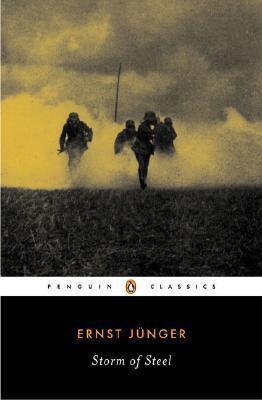
Bogdan Costea and Kostas Amiridis, ‘Ernst Jünger, total mobilization and the work of war’, Organization 24 (4) (2017) 475-490 – I keep encountering Jünger’s work, first when I was writing ‘The natures of war‘ (he served on the Western Front in the First World War: see his remarkable Storm of Steel, still available as a Penguin Classic in a greatly improved translation) and much more recently while preparing a new lecture on occupied Paris in the Second World War (he was stationed there for four years and confided a series of revealing and often critical observations to his diaries).  But his reflections on the ‘destruction line’ of modern war are no less interesting.  For parallel reflections, see:

Leo McCann, ‘Killing is our business and business is good”: The evolution of war managerialism from body counts to counterinsurgency’, Organization 24 (4) (2017) 491-515 – I’ve written about what Freeman Dyson called ‘the bureaucratization of homicide‘ before, in relation to aerial violence, but this essay provides a wider angle.

Laura Pitkanen, Matt Farish, ‘Nuclear landscapes’, Progress in human geography [Online First: 31 August 2017] (‘Places such as New Mexico’s Trinity Site have become iconic, at least in the United States, and a study of nuclear landscapes must consider the cultural force of spectacular weapons tests and related origin stories. But critical scholars have also looked beyond and below the distractions of mushroom clouds, to additional and alternative landscapes that are obscured by secrecy and relative banality’).

I’m still haunted by the reading I did for ‘Little Boys and Blue Skies‘, much of it inspired by Matt’s work (see especially here on ‘Atomic soldiers and the nuclear battlefield’); this essay should be read in conjunction with:

Becky Alexis-Martin and Thom Davis, ‘Towards nuclear geography: zones, bodies and communities’, Geography Compass [Online early: 5 September 2017] (‘We explore the diverse modes of interaction that occur between bodies and nuclear technology and point towards the scope for further research on nuclear geographies. We bring together different strands of this nascent discipline and, by doing so, highlight how nuclear technology interacts across a spectrum of geographic scales, communities, and bodies. Although nuclear geographies can be sensational and exceptionalising, such as the experiences of nuclear accident survivors and the creation of “exclusion zones,” they can also be mundane, everyday and largely unrecognised, such as the production of nuclear energy and the life-giving nature of radioactive medicine.’)

Simon Philpott, ‘Performing Mass Murder: constructing the perpetrator in documentary film’, International Political Sociology 11 (3) (2017) 257–272 – an insightful critique of Joshua Oppenheimer‘s The Act of Killing (see my posts here and here).

José Ciro Martinez and Brett Eng, ‘Struggling to perform the state: the politics of bread in the Syrian civil war’, International Political Sociology 11 (20 (2017) 130-147 – a wonderfully suggestive analysis that has the liveliest of implications for my own work on attacks on hospitals and health-care workers in Syria (notably: ‘The provision of bread to regime-controlled areas has gone hand in hand with targeted efforts to deprive rebel groups of the essential foodstuff and, by extension, their ability to perform the state. Since 2012, the regime has bombed nascent opposition-administered attempts to provide vital public services and subsistence goods, thereby presenting itself as the only viable source of such necessities.’)  But it also has far wider implications for debates about ‘performing the state’ and much else.  And in a similar vein:

Jeannie Sowers, Erika Weinthal and Neda Zawahiri, ‘Targeting environmental infrastructures, international law and civilians in the new Middle Eastern wars’, Security Dialogue 2017 [Online early] (”We focus on better understanding the conflict destruction of water, sanitation, waste, and energy infrastructures, which we term environmental infrastructures, by drawing on an author-compiled database of the post-2011 wars in the Middle East and North Africa… Comparatively analyzing the conflict zones of Libya, Syria, and Yemen, we show that targeting environmental infrastructure is an increasingly prevalent form of war-making in the MENA, with long-term implications for rebuilding states, sustaining livelihoods, and resolving conflicts.’)

Will Todman, ‘Isolating Dissent, Punishing the Masses: Siege Warfare as Counter-Insurgency,’ Syria Studies 9 (1) (2017) 1-32 – Syria Studies is an open-acess journal from the Centre for Syrian Studies at St Andrews.

Sarah El-Kazaz and Kevin Mazur, ‘The unexceptional Middle Eastern City’, City & Society 29 (1) (2017) 148-161 – a really useful introduction to a themed section, much on my mind as this term I’ll be doing my best to jolt my students out of lazy caricatures of ‘the Islamic city’ (‘The study of Middle Eastern cities has been constrained in its analytical and methodological focus by a genealogy shaped by a triad of regional exceptions–Islam, oil, and authoritarianism–and … this special section move[s] beyond those constraints in important ways. Focusing on geographical places and time periods that have remained peripheral to the study of Middle Eastern cities, the three articles ethnographically historicize the planned and unplanned processes through which cities in the region transform to transcend a genealogy of exceptionalism and the constraints it has created. They highlight the global and local connections that shape these processes to offer new perspectives on the study of scale, verticality and sensoriums in the shaping of urban transformation around the globe.’)

Rasul Baksh Rais, ‘Geopolitics on the Pakistan-Afghanistan borderland’, Geopolitics [online early: 11 August 2017] – a helpful historical review particularly for anyone interested in the exceptional construction of the Federally Administered Tribal Areas by both Washington and Islamabad.

Katharine Hall Kindervater, ‘Drone strikes, ephemeral sovereignty and changing conceptions of territory’, Territory, politics, governance (2017) 207-21 – Kate engages with her characteristic breadth of vision with some of the problems that preoccupied me in ‘Dirty dancing’ and urges a topological engagement with territory (DOWNLOADS tab) (‘This article examines the US legal frameworks for drone-targeting operations, and in particular the conceptions of territory they draw upon, to argue that contemporary strikes reflect less a disappearance of the importance of territory and sovereignty to justifications of the use of force than a reconfiguration of their meanings. Grounded in an understanding of territory that is more networked and dynamic, drone strikes reflect the emergence of a new landscape of mobile and ephemeral sovereignty.’)

Georgina Ramsay, ‘Incommensurable futures and displaced lives: sovereignty as control over time’, Public culture 29 (3) (2017) 515-38 (‘The recent mass displacement of refugees has been described internationally as a “crisis.” But crisis implies eventfulness: a distinct problem that can be solved. The urgency of solving this problem of displacement has seen the use of expansive techniques of sovereignty across Europe, the epicenter of the crisis. Focusing exclusively on the formation of sovereignty through the analytical locus of crisis continues, however, to reproduce the trope of the “refugee” as a category of exception. This essay considers the experiences of people who were resettled as refugees in Australia and whose displacement has ostensibly been resolved. Drawing attention to their continuing experiences of violence, it considers how the temporal framing of displacement is itself a way to conceal formations of sovereignty embedded in the very processes designed to resolve displacement. Doing so opens up new ways to think about control over time as a technique of sovereignty.’)

For an equally trenchant and invigorating critique of crisis-talk, see Joseph Masco‘s brilliant ‘The Crisis in Crisis’, Current Anthropology 58 Supplement 17 (2017) S65-S76, available on open access here. (‘In this essay I consider the current logics of crisis in American media cultures and politics. I argue that “crisis” has become a counterrevolutionary idiom in the twenty-first century, a means of stabilizing an existing condition rather than minimizing forms of violence across militarism, economy, and the environment. Assessing nuclear danger and climate danger, I critique and theorize the current standing of existential crisis as a mode of political mobilization and posit the contemporary terms for generating non-utopian but positive futurities.’)

Dima Saber and Paul Long, ‘”I will not leave, my freedom is more precious than my blood”: From affect to precarity – crowd-sourced citizen archives as memories of the Syrian war’, Archives and Records 38 (1) (2017) (‘Based on the authors’ mapping of citizen-generated footage from Daraa, the city where the Syria uprising started in March 2011, this article looks at the relation between crowd-sourced archives and processes of history making in times of war. It describes the ‘migrant journey’ of the Daraa archive, from its origins as an eyewitness documentation of the early days of the uprising, to its current status as a digital archive of the Syrian war. It also assesses the effects of digital technologies for rethinking the ways in which our societies bear witness and remember. By so doing, this article attempts to address the pitfalls attending the representation and narrativisation of an ongoing conflict, especially in the light of rising concerns on the precariousness and disappearance of the digital archives. Finally, by engaging with scholarship from archival studies, this article attempts to address the intellectual rift between humanities and archival studies scholars, and is conceived as a call for more collaboration between the two disciplines for a more constructive research on archival representations of conflict.’)

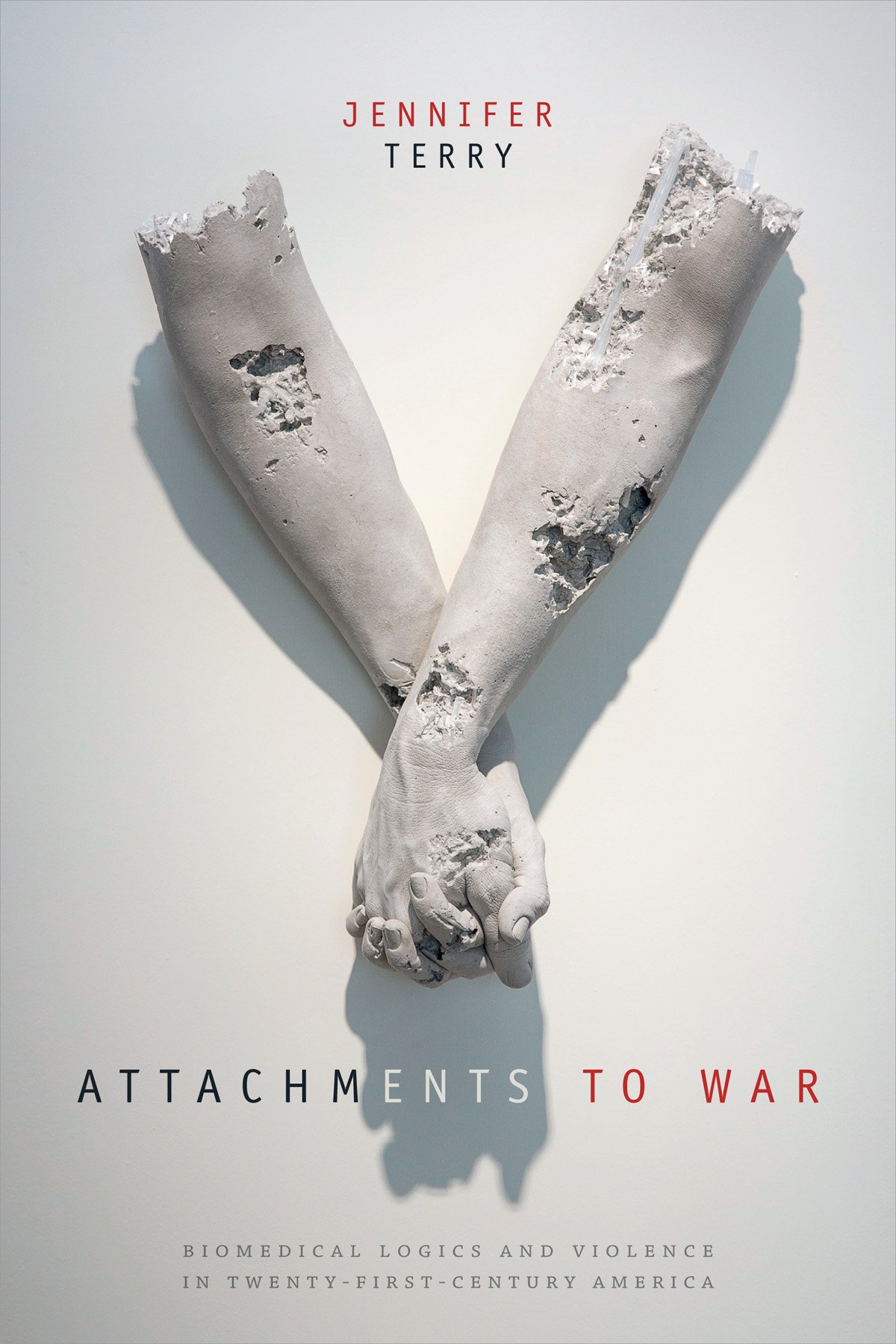
Attachments to War

And in lockstep with my last post and my continuing interest in the prosthetics of military violence…   A new book from Jennifer Terry, Attachments to War: biomedical logics and violence in twenty-first century America, also due from Duke University Press in November:

In Attachments to War Jennifer Terry traces how biomedical logics entangle Americans in a perpetual state of war. Focusing on the Afghanistan and Iraq wars between 2002 and 2014, Terry identifies the presence of a biomedicine-war nexus in which new forms of wounding provoke the continual development of complex treatment, rehabilitation, and prosthetic technologies. At the same time, the U.S. military rationalizes violence and military occupation as necessary conditions for advancing medical knowledge and saving lives. Terry examines the treatment of war-generated polytrauma, postinjury bionic prosthetics design, and the development of defenses against infectious pathogens, showing how the interdependence between war and biomedicine is interwoven with neoliberal ideals of freedom, democracy, and prosperity. She also outlines the ways in which military-sponsored biomedicine relies on racialized logics that devalue the lives of Afghan and Iraqi citizens and U.S. veterans of color. Uncovering the mechanisms that attach all Americans to war and highlighting their embeddedness and institutionalization in everyday life via the government, media, biotechnology, finance, and higher education, Terry helps lay the foundation for a more meaningful opposition to war.

Contents:

Introduction
1. The Biomedicine-War Nexus
2. Promises of Polytrauma: On Regenerative Medicine
3. We Can Enhance You: On Bionic Prosthetics
4. Pathogenic Threats: On Pharmaceutical War Profiteering
Epilogue

And here is the (equally brilliant) Laleh Khalili:

This brilliant book is a thoughtful and profoundly original study of how war becomes an object of attachment and support in the United States. Jennifer Terry’s discussion of wounding, injury, trauma, and prosthetics is one of the most fascinating, moving, and intensely generative studies I have read about how war is normalized, made everyday, and embedded in practices and beliefs and affect(ion)s of ordinary folks.

You can read the Introduction over at Catalyst: feminism, theory, technoscience here, and watch presentations on ‘Militarization, medicalization, responsibility’ (from 2015) by Jennifer and Nadia Abu el-Haj on You Tube here.

Solatia

Many readers will know Emily Gilbert‘s stunning work on the financialization of the battlespace through consolation payments made by the US and their allies to victims of military violence (‘solatia’).  If you’re not among them, see her ‘The gift of war: cash, counterinsurgency and “collateral damage“‘ in Security Dialogue 46 (2015) 403-21; also her essay on ‘Tracing military compensation’ available here.

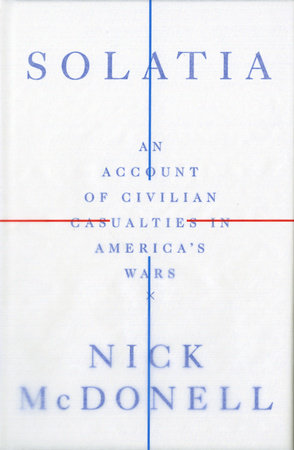
In a similar vein (I imagine) is a forthcoming book by journalist and novelist Nick McDonell: Solatia: an account of civilian casualties in America’s wars:

Since 2003, America’s wars in Iraq and Afghanistan have killed hundreds of thousands of civilians — by some counts, more than a million — and the number continues to grow. Of the many questions arising from these deaths — for which no one assumes responsibility, and which have been presented, historically, as unavoidable — perhaps the most fundamental question, for Americans, is this: if all men are created equal, why are we willing to kill foreign civilians?

Solatia (the term for money the U.S. pays to the families of civilian dead), sets out to answer that question. In all its wars, the United States both condemns and causes civilian casualties. But what exactly constitutes a civilian casualty? Why do they occur? What do our officials know of those reasons? How do they decide how many people they are willing to kill “by accident” — in a night raid, or drone strike, or invasion? And who, exactly, gets to decide?

Solatia is a globe-trotting, decade-spanning exploration into one of the most fundamental issues of our time. Following an array of officials, combatants, and civilians trying to survive — spies and senators, police chiefs and accountants caught in air strikes, orphaned street kids and widowed mothers, Iranian milita leaders, Taliban spokesmen and Marine special forces operators — Solatia confronts the U.S.’ darkest history abroad, illuminates its ongoing battles, and offers an original view of what it means to be a citizen of America at war.

It’s due in March from Penguin/Random House.

The final arbiter

There have been many interviews with ‘drone operators’ but most of them seem to have been with sensor operators serving with the US Air Force.  Some of the most cited have been ‘whistleblowers’ like Brandon Bryant while some reporters have described conversations with service members allowed to speak on the record during carefully conducted tours of airbases.  Some have even been captured on film – think of the interviews that frame so much of Sonia Kennebeck‘s  National Bird (though I think the interviews with the survivors of the Uruzgan drone strike are considerably more effective) – while others have been dramatised, notably in Omar Fast‘s 5,000 Feet is The Best.

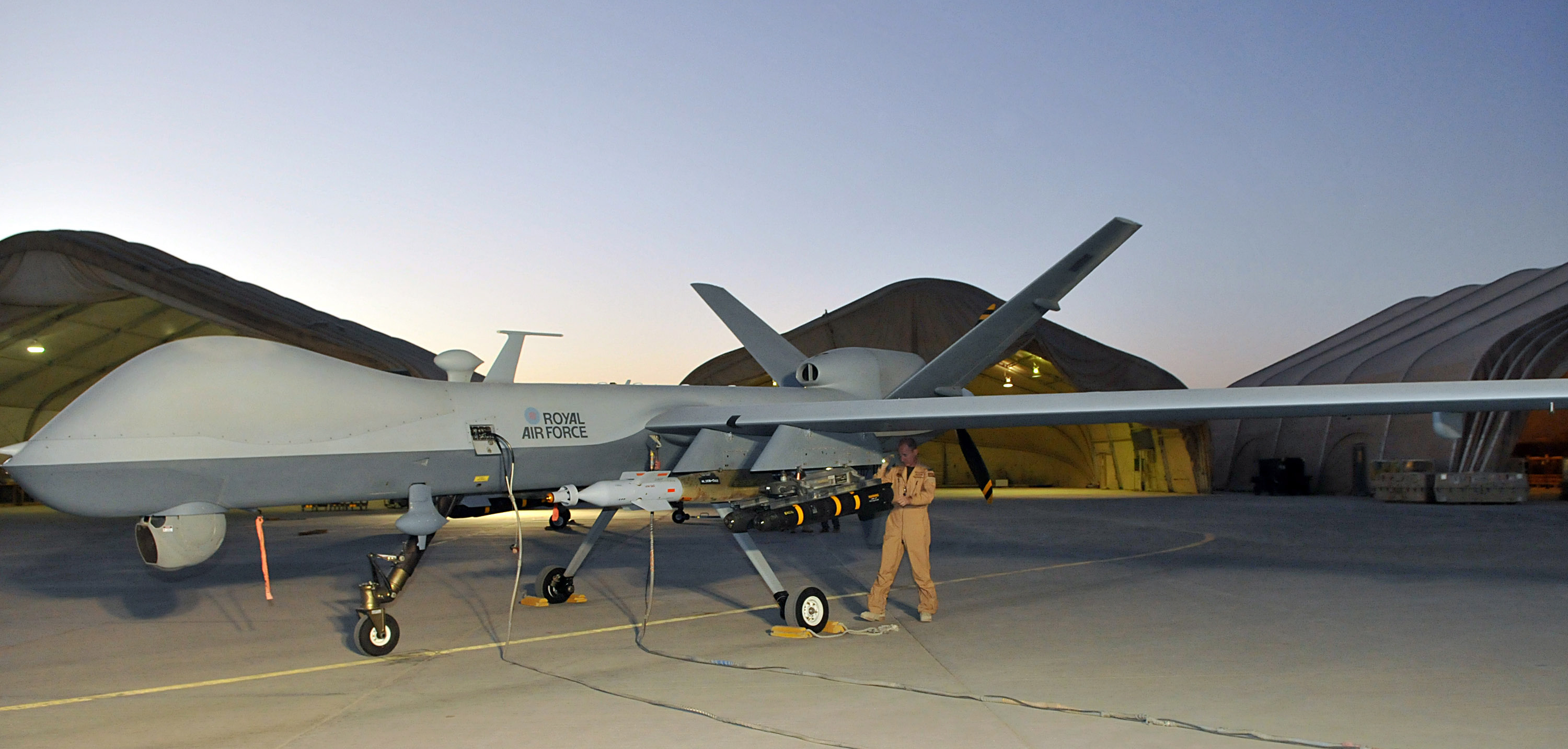
But over at Drone Wars UK Chris Cole has just released something different: a detailed transcript of an extended interview with “Justin Thompson“, a former British (Royal Air Force) pilot who flew Reapers over Afghanistan for three years from Creech Air Force Base in Nevada.  He also spent several months forward-deployed to Afghanistan as a member of the Launch and Recovery element: remember that missions are controlled from the continental United States – or now from RAF Waddington in Lincolnshire – but the Reapers have an operational range of 1, 850 km so they have to be launched in or near the theatre of operations.

He served as a pilot of conventional strike aircraft before switching to remote operations early in the program’s development – the RAF started flying Reapers over Afghanistan for ISR in October 2007; armed missions began the following May – which gives Justin considerable insight into the differences between the platforms:

“The real difference with UAVS is persistence. That’s the big advantage as it allows you to build up a very detailed picture of what is going on in a particular area. So if you are in a particular area and a need for kinetic action arises, generally speaking you have already got knowledge of the kind of things you would need to know to assist that to happen. That’s versus a fast jet that might be called in having been there only five minutes, with limited fuel and with limited information – what it can get from the guys on the ground – Boom, bang and he’s off to get some fuel. That’s a bit flippant. It’s not quite like that, but you see what I mean.

“The big difference is the amount of detail we are able to amass about a particular area, not just on one mission, but over time. If you are providing support in a particular area, you develop a great deal of detailed information, to the point where you can recall certain things from memory because you were looking at this last week and spent two weeks previously looking at it and you know generally what goes on in this particular area. The other thing this persistence gives you is a good sense if something has changed or if something is unusual. You go ‘Hang on, that wasn’t there last week, someone’s moved it. Let’s have a look to see what is going on here.’”

Later, having discussed the Reaper’s entanglement of ISR (intelligence, surveillance and reconnaissance) with lethal strike (‘kinetic’) capabilities, he returns to the theme:

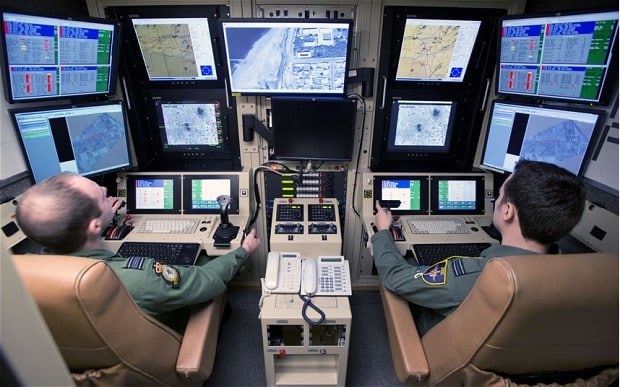
“If you are talking about kinetic action, I think essentially they [conventional aircraft and drones] are no different. It’s a platform in the air that has a sensor on board you are using to look at the ground. The picture you seen in a [Ground Control Station] is essentially the same as you would see in a fast jet. The sort of weapons you are delivering are exactly the same sort as you would be delivering from a fast jet. Essentially all of the principles are the same…

“A lot of things are significantly better in that you get much more extensive and much more detailed information on the area you are looking at and on any specific targets. That’s not because of any particular capability, it’s just because you can spend a hell of a lot more time looking at it.

“A fast jet pilot would, say, do a four month tour in some place. He’s got four months’ worth of knowledge and then he’ll be gone. He might come back in a year or two, but we are there for three years. Constantly, every day, building up massive amounts of knowledge and a detailed picture of what goes on. We come armed with so much information, and so much information is available to you, not just from your own knowledge, but from sources you can reach out to. You’ve got the text. You’ve got phones. You have got other people you can call on and drag into the GCS. You can get other people to look at the video feed. You can get many opinions and views….”

At times, he concedes, that can become an issue (sometimes called ‘helmet-fire’: too many voices in your head):

“If you want it, there can be a lot of other ‘eyes on’ and advice given to you. If you want something explained to you, if you want a second opinion on something, if you want something checked you can say “Guys, are you seeing this?” Or “What do you think that is?” And that is really useful. You can also reach out for command advice, for legal advice. The number of people who can get a long screwdriver into your GCS is incredible and it does happen that occasionally you have to say ‘Please can you get your long screwdriver out of my GCS’. But generally speaking, it’s well managed and people don’t interfere unless they think there is a reason to.”

He makes it clear that as an RAF pilot his was the final decision about whether to strike – he was ‘the final arbiter’ –  and discusses different situations where he over-ruled those other voices.

RAF Reaper strike in Afghanistan, 2010

Justin also talks about the ways his previous flying experience modulated his command of the Reaper (and here I think there are interesting parallels with Timothy Cullen‘s experience as an F-16 pilot and his important study of USAF Reaper crews: see also here):

“… [T]here is an idea that because you are not directly manipulating the control surfaces of an aircraft by being sat in it, that somehow lowers the skill level required in order to successfully operate one of these things. It may change some specifics in motor skills, but then so does an Airbus. Conceptually, you are wiggling a stick, pushing a peddle, turning a wheel. That gets converted into little ‘ones’ and ‘zeros’, sent down a wire to a computer that decides where to put the flying control surfaces and throttles the engines of the aircraft. It’s very similar, at least technically, in a modern airliner as in a Reaper. The level of skill required is similar. Piloting has only ever been 10% hand-flying skills, 90% is judgement and airmanship…

“For me, what I was seeing on the screen was very real. In addition to that for me it was more than just two-dimensional. My mind very easily perceived a three-dimensional scene that extended out of the side of the image. Whether that was because I was used to sitting in a cockpit and seeing that sort of picture I don’t know. Someone whose only background is flight simulators or playing computer games may have a different view. I relate it to sitting in an aircraft and flying it, others may relate it slightly differently…”

There’s much more in those packed 17 pages.  You can find Chris’s own commentary on the interview here, though his questions during the interview are, as  his regular readers would expect, also wonderfully perceptive and well-informed.

One cautionary note.  The time-frame is extremely important in commenting on remote operations, even if we limit ourselves to the technology involved.  The early Ground Control Stations were markedly different from those in use today, for example, while the quality of the video streams, their compression and resolution is also highly variable.  And there is, of course, much more than technology involved.

Seeing Civilians (or not)

Very welcome news from Christiane Wilke that her essay, ‘Seeing and Unmaking Civilians in Afghanistan: Visual Technologies and Contested Professional Visions‘, has just been published in Science, Technology and Human Values.

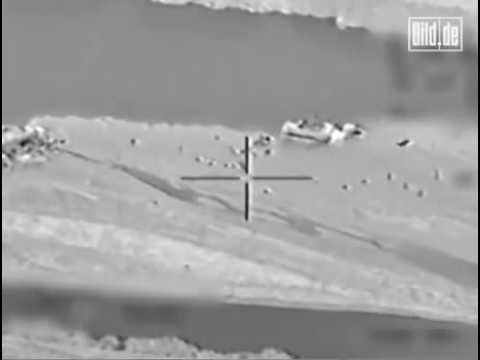
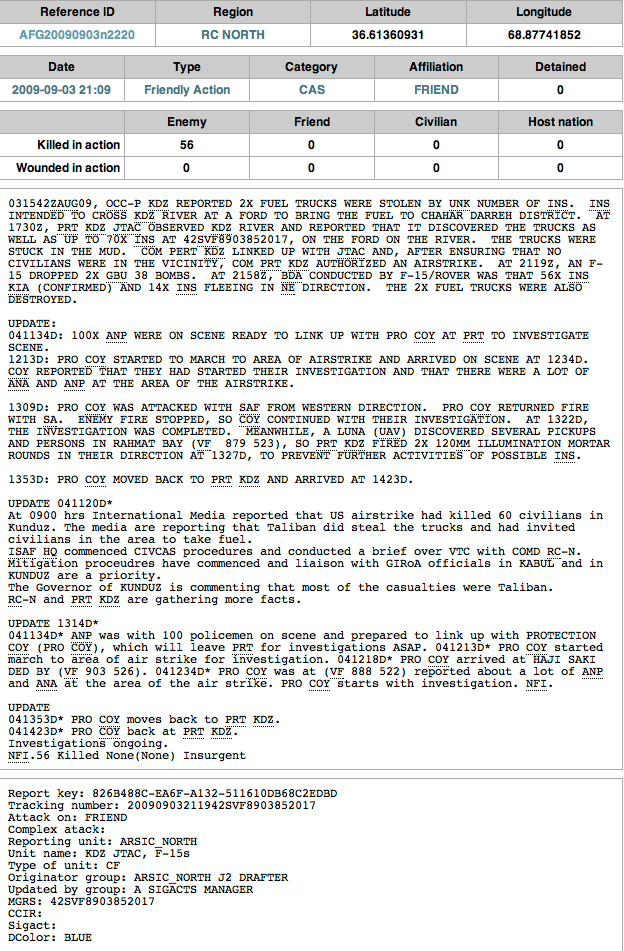
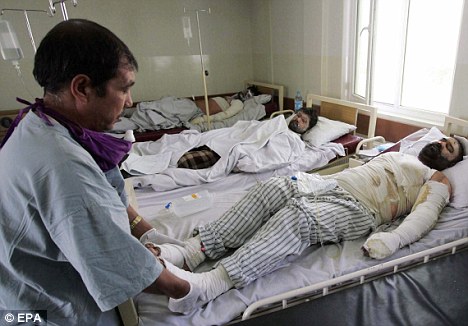
It’s an original, compelling and immensely important analysis of a US air strike on two tankers hijacked by the Taliban and beached on a river crossing near Kunduz (Afghanistan) in September 2009.  The strike was called in by a Bundeswehr officer who claimed – falsely – that he was facing what the military call ‘troops in contact’ which required immediate action; the two American pilots of the F-15s repeatedly questioned his decision but to no avail, and when the smoke cleared somewhere between 26 and 147 civilians who had been siphoning petrol from the stranded tankers had been killed.

I published a preliminary analysis of the attack, ‘Seeing like a military‘, and subsequently heard Christiane give an early version of her own argument at a conference in Lancaster in May 2014; we’ve had a lively dialogue about the strike since then.  Here is the abstract:

While the distinction between civilians and combatants is fundamental to international law, it is contested and complicated in practice. How do North Atlantic Treaty Organization (NATO) officers see civilians in Afghanistan? Focusing on 2009 air strike in Kunduz, this article argues that the professional vision of NATO officers relies not only on recent military technologies that allow for aerial surveillance, thermal imaging, and precise targeting but also on the assumptions, vocabularies, modes of attention, and hierarchies of knowledges that the officers bring to the interpretation of aerial surveillance images. Professional vision is socially situated and fre- quently contested with communities of practice. In the case of the Kunduz air strike, the aerial vantage point and the military visual technologies cannot fully determine what would be seen. Instead, the officers’ assumptions about Afghanistan, threats, and the gender of the civilian inform the vocabulary they use for coding people and places as civilian or noncivilian. Civilians are not simply “found,” they are produced through specific forms of professional vision.

And here is her key conclusion which clearly resonates far beyond Kunduz (see, for example, here and here; I’ve radically reworked the presentation from which those two posts derive, and you can get some sense of where I’m heading here):

In Afghanistan and in situations of armed conflict more generally, the distinction between civilians and noncivilians is a crucial dimension of seeing, intervening in, and responding to violence. The protection of civi- lians is an almost universally proclaimed goal; it is the centerpiece of the ISAF 2009 Tactical Directive. Yet without a reliable understanding of who counts as a civilian and how they can be recognized, the promise of civilian protection rings hollow. The category of the civilian, derived from specific Eurocentric understandings of armed conflict, had been grafted onto Afgha- nistan and Afghans who had to negotiate their security amidst conflict. Yet it is not clear what Afghans should do or avoid in order to be recognized as civilians. Those who shared the aerial viewpoint could not agree on the civilian status of the people near the trucks and neither could those who had extensive personal knowledge of the local social structures. Thus, a shift in perspective did not solve the problem that civilians are not clearly recogniz- able to those who have a mission to spare and protect them. At a deeper level, the lack of consensus about visually identifying civilians indicates a lack of agreement about who counts as a civilian. NATO officers consistently try to stabilize and shrink the category of civilian by juxtaposing it with a capacious category of noncivilians: insurgents, militants, supporters, and Taliban…

Yet civilians don’t simply exist. They are enacted and produced by, among other sites, socially situated interpretation of images produced with the aid of visual technologies. Sociocultural prisms of visibility not only produce counts of legitimate civilians but also legitimize the category of civilian as a workable and meaningful foundation of international law. The people who would like to be regarded as civilians bear the burden of distinguishing themselves from putative noncivilians according to criteria that they can never fully grasp because they don’t know which background knowledges and epistemes will be mobilized by those in charge of distinguishing civilians from combatants.

And – please note – this is not about drone strikes; not only have the vast majority of strikes in Afghanistan been carried out by conventional strike aircraft (why do so many of those who campaign against drones ignore other forms of aerial violence?) but no drones were involved in this particular attack either; the sharp point that Christiane makes applies to all airstrikes – and indeed, to militarised vision more generally.

Logistics in war

I’ve written about military logistics before – here and here (the last is also available under the DOWNLOADS tab as ‘Supplying the war in Afghanistan’) – and that early work, both historical and contemporary, intersects with my current work on casualty evacuation, so it’s good to find a new-ish blog on Logistics in War, managed by David Beaumont; its base is Australia but it casts its remit far and wide and, in a recent post, engages with Deb Cowen‘s work and my own.

It is the purpose of this blog to instigate and inspire, continue and create, a discussion on military logistics that is so often sorely lacking (or if it does occur, does so behind closed doors). Although the blog currently reflects an Australian and Army orientation, its vision is to become broadly applicable; to reflect the many different approaches to logistics as practiced by different military Services, the Joint domain, and militaries of all persuasions.

Furthermore, the blog will support the establishment of an international community of military logisticians that can share ideas, concepts and useful material in an insightful, courteous and professional manner which reflects the values of the militaries and Defence organisations that its readers may serve in. In time, guest posts will be added to the site, including from the international military logistics community.

‘Logistics in War’ aspires to provide life to a topic area that is generally dry, overly technical and grossly specialised. Its practical perspective serves the logistician and commander alike. Logistics is, after all, the conjunction of military strategy and operational concepts with the realities and practicalities of war. It deals with facts and the compromises of commanders who must shape their decisions upon the limitations and constraints of their force. As Thomas Kane, in the great Military logistics and strategic performance, puts it, logistics is an ‘arbiter’ in battle and in war. It is therefore well worth our while to understand it.

MOAB and the moral economy of bombing

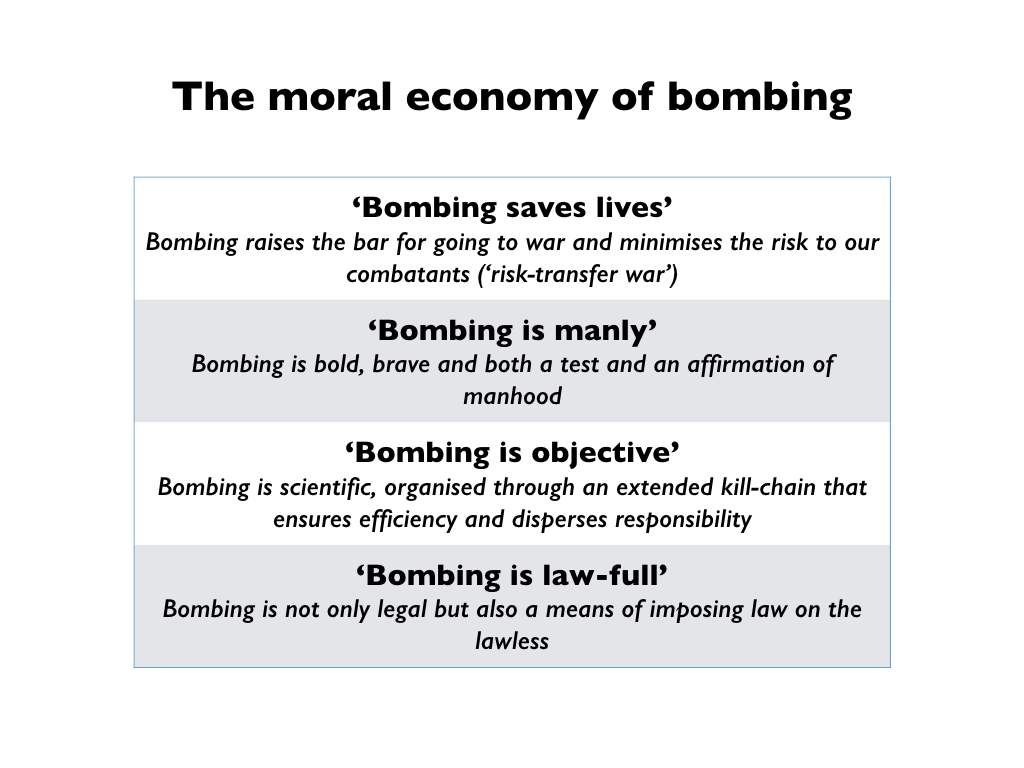
In Reach from the Sky, my Tanner Lectures which I’m presently preparing for publication, I sketched what I called a ‘moral economy of bombing’:

It’s the last of these claims that concerns me here: bombing represented as ‘law-full’.  In the lectures I discussed the legal armature of aerial violence – referring to the combined bomber offensive against Germany in the Second World War Air Chief Marshall Arthur Harris famously insisted that ‘In this matter of the use of aircraft in war there is, it so happens, no international law at all’, a claim that was, I suppose, literally true in so far as it applied to the specific application of air power; I tried to show what has (and has not) changed since then, not least through the development of international humanitarian law and the juridification of later modern war – and the insistence that air power is an effective means of imposing a legal order on the nominally ‘lawless’ (a claim registered through colonial ‘air policing’ and continued in the US and Pakistan air strikes on the Federally Administered Tribal Areas of Pakistan: see ‘Dirty Dancing’ (DOWNLOADS tab).

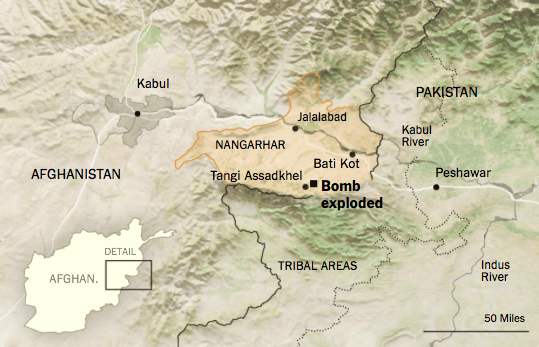
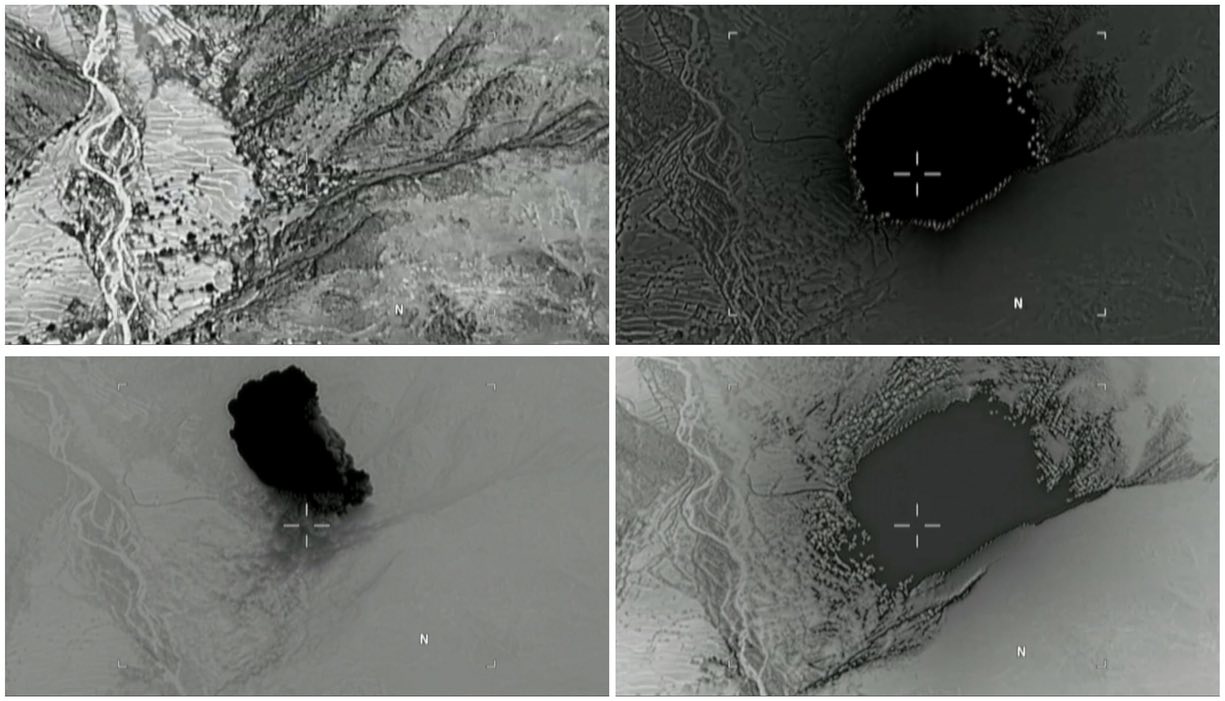
In the ghastly light of the Trump administration’s decision last month to drop (for the first time in combat) what the US Air Force calls ‘the Mother Of All Bombs‘ (MOAB), the GBU-43/B,  on an IS ‘tunnel complex’ in eastern Afghanistan, Michael Weinman has written an excellent essay for Public Seminar on ‘Ordnance as ordinance‘ that elaborates the second part of my claim about bombing being ‘law-full’:

[B]oth the decision to name this weapon MOAB and the decision to deploy it in Afghanistan is tightly linked with what Judith Butler called a “new military convention” begun by Colin Powell when he described the deployment of “smart bombs” during the first Iraq War as “the delivery of ordnance.” In “Contingent Foundations,” Butler noted that Powell “figures an act of violence as an act of law” by substituting “ordnance” (munitions, agents of destructive violence) for “ordinance” (a law or decree). Powell’s speech act, apparently delivered in an unscripted moment during a press conference in January 1991, is an important instance of the “illocutionary force” of language that Butler explores throughout the work she did in the late 1990s and early 2000s — her most impressive and important work in my view. This aerial bombardment of Iraqi installations with technologically advanced munitions, viewable in real time on network and cable TV for the first time, was itself a phenomenon. But it was the declaration that such a display in itself was an act of law enforcement that truly brought us into a new era. An era in which, thanks to Powell and the Bush (41) administration, the alignment of violence and law against a regime that violates international law figures state violence, even where it might be in contradiction of international agreements, as the very agent of law and legitimation. Watching the media response to the recent deployment of MOAB in Afghanistan, it is clear we still haven’t learned Butler’s lesson.

The deeper resonance of reading this particular ordnance as a form of ordinance requires that we attend to a different resonance of its chosen acronym, MOAB. Not the “Mother of All Bombs” nomenclature, which bespeaks its terrifying awesomeness — in the literal sense of the term “awesome,” connoting utter sublimity. That is part of the story too, but it is not the heart of it. Rather, continuing Butler’s pursuit of the line of thought by which Saddam (Hussein) was recast as (the Biblical) Sodom,[1] we must turn instead to the Biblical Moab, patriarch of the Moabites. Crucially, we must bear in mind that, within the Hebrew Bible, this people, whose lands lay across the Dead Sea, is cast as a hostile neighboring people — indeed, the Moabites are depicted as the neighboring tribe most inherently in conflict with the people of Israel. Viewed in this light, there is continuing power in Powell’s fantasy that the deliverance of ordnance is the way “we” publicly declare the ordinance that those who defy international law will be vanquished by the synthesis of law and force executed by the United States military as the leader the coalition of the willing. This vision remains the reigning principle behind the self-image of the United States as an actor on the international scene. And this is so because, deeply steeped in an “Old Testament morality” (a morality wherein the enemies of the United States are figured as the ancient enemies of the people of Israel), this vision justifies a view of America as the model exemplar of a “Judeo-Christian” civilization. A civilization that is — as it ever was — waging a war, engaging in a “clash of civilizations.” Of course we would name our most deadly non-nuclear weapon “Moab” (or M.O.A.B., if you like): what other name than that of the oldest and deepest “frenemy” of Israel could the United States military have possibly dreamt up?

There is more that could be said, I think, especially if one stays with Butler and thinks of this episode as a speech-act.  After all – and repeating a line that was repeated endlessly during the Rolling Thunder campaign against North Vietnam – MOAB was originally developed in 2002 for the ‘Shock and Awe’ campaign that heralded the US-led  invasion of Iraq, and the Pentagon claimed that deploying the MOAB was an act of communication (really): it sent ‘a very clear message’ to IS that it would be ‘annihilated‘.  (The message-in-a-bomb line shouldn’t be confused with the terse messages that ground crews have scrawled on bombs in war after war after war, and I suppose it is less grotesque than the description of bombing Syria as a form of ‘after-dinner entertainment‘ for the US President – which sends an even more terrifying message to anyone with a shred of decency or understanding).

If the bombing in Afghanistan did send a message to IS – and to state actors elsewhere in the world – it also sent a message to innocent others in the vicinity of the blast:

“There is no doubt that Isis are brutal and that they have committed atrocities against our people. But I don’t see why the bomb was dropped,” said the mayor of Achin, Naweed Shinwari. “It terrorised our people. My relatives thought the end of the world had come. Every day fighter jets, helicopters and drones are in the area.”

In that vein, and to return to the colonial genealogy I mentioned at the start, the use of the global South as a laboratory for weapons testing and demonstration has a long history, as Scott Beauchamp‘s report here documents:

…the most interesting commentary probably came from former Afghanistan president Hamid Karzai, who tweeted that “This is not the war on terror but the inhuman and most brutal misuse of our country as a testing grounds for new and dangerous weapons.”

He’s got a point. There is a dark history of Western military powers testing novel weapons and strategies on technologically overmatched non-Western (and non-white) populations. It’s a legacy that mixes the brutal arrogance of colonialism with the technological promise of an easy fix. There are of course numerous examples of this cruel dynamic at play in the centuries leading up to the 20th — conquistadors with dogs and swords, gunpowder in general — but the disparity that currently exists between the material advantages of Western countries and the technological capability of enemies abroad continues to be exploited in ways that conform to a recognizable pattern.

PS Much as I’ve enjoyed Michael’s essay, I think Stephen Fry also had a point.

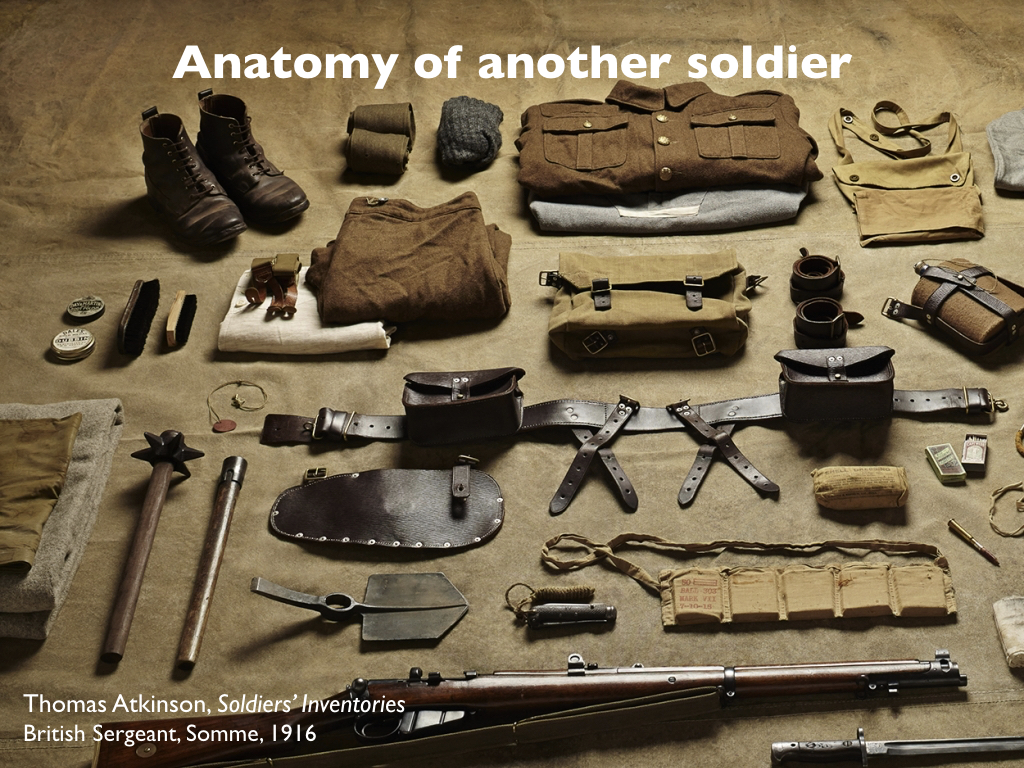
Anatomy of another soldier

I’ve drawn attention to Harry Parker‘s Anatomy of a soldier before: see here and here (and especially ‘Object lessons’: DOWNLOADS tab).  Most of the reviews of the novel were highly favourable, applauding Parker’s experimental attempt to tell the story of a soldier seriously wounded by an IED in Afghanistan through the objects with which he becomess entangled.

But writing in The Spectator Louis Amis saw it as an object lesson in ‘How not to tell a soldier’s story‘.  He complained that Parker’s device produced a narrative

‘as if the war were composed only of its inanimate processes, either accidental or inevitable. It’s a different planet to the bloody, profane, outlaw Iraq of [Phil] Klay’s Redeployment, radiating shame, PTSD and suicide, and the unbearable awkwardness of transmitting such truths to an alienated civilian world.

Parker’s device gestures aptly towards a spreading out of consciousness, a transmutation, the scattering of the individual along some plane at the threshold of death; the sensations of depersonalisation and hyper-perceptivity associated with traumatic experience; and the soothing quiddity of simple objects, as opposed to abstract thought, for a recovering victim. But it is also a method of averting the gaze from a war’s futility and waste, and worse — and probably, therefore, too, from the true nature of any saving grace.’

I do think Parker’s narrative accomplishes more than Amis allows. It succeeds in making the war in Afghanistan at once strange and familiar; and its strangeness comes not from the people of Afghanistan, that ‘exotic tableau of queerness’ exhibited in so many conventional accounts, but through the activation of objects saturated with the soldier’s sweat, blood and flesh.  It’s also instructive to read the novel alongside Jane Bennett‘s Vibrant matter: a political ecology of things or Robert Esposito‘s Persons and things, as I’ve done elsewhere, and to think through the corpo-materialities of modern war and its production of the battle space as an object-space: but neither of these has much to say about how their suggestive ideas might be turned to substantive account.

Still, Amis’s point remains a sharp one; Scottt Beauchamp says something very similar:

Harry Parker goes further than [Tim] O’Brien [in The things they carried] in giving equal narrative play to nonhuman things. Not only do they make the plot of Parker’s novel possible, they also bear semiconscious witness to our shared reality, corroborating it. Their inability to pass moral judgment comes off as a silent accusation. If this ontological shift toward objects is the most honest way we have of talking about war, it’s still limiting: it turned its weakness—its inability to fully articulate the moral significance of war—into a defining characteristic.

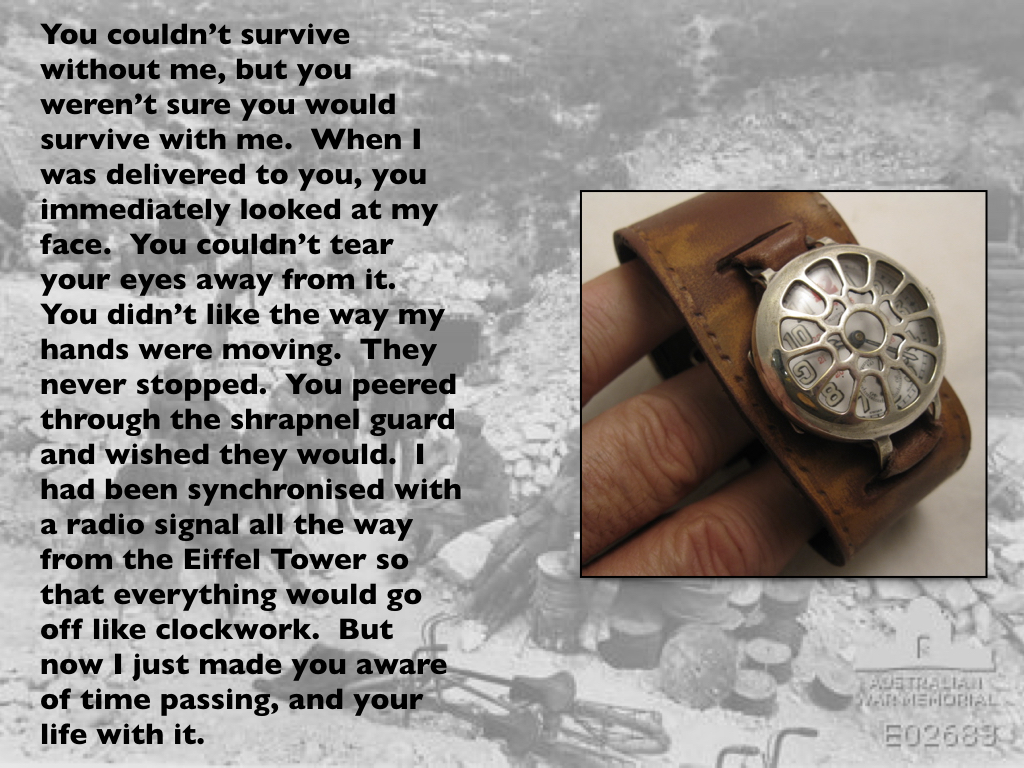
But I haven’t been able to let Parker’s experiment go.  So, for one of my presentations in Durham last month – on the parallels and differences between combat medical care and casualty evacuation on the Western Front in the First World War and Afghanistan a century later – I sketched out an Anatomy of another soldier.  It’s based on my ongoing archival work; earlier in the presentation I had used diaries, letters, memoirs, sketches and photographs to describe what Emily Mayhew calls the ‘precarious journey’ of British and colonial troops through the evacuation chain – you can see a preliminary version in ‘Divisions of life’ here – so this experiment was a supplement not a substitute.  But I wanted to see where it would take me.

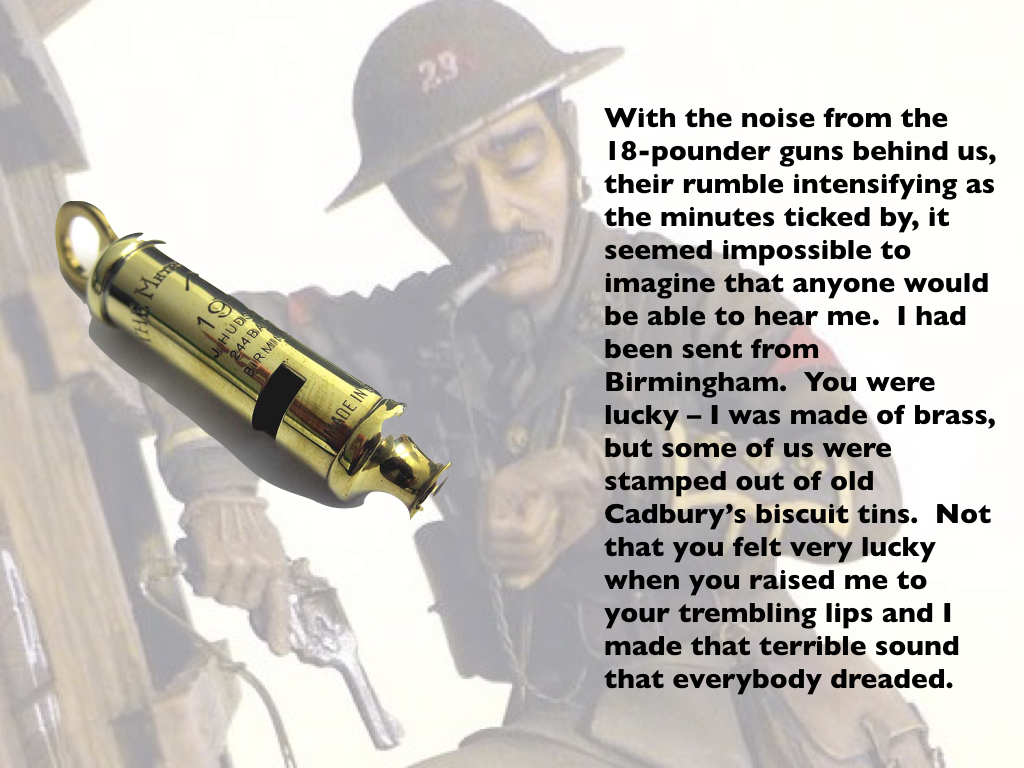
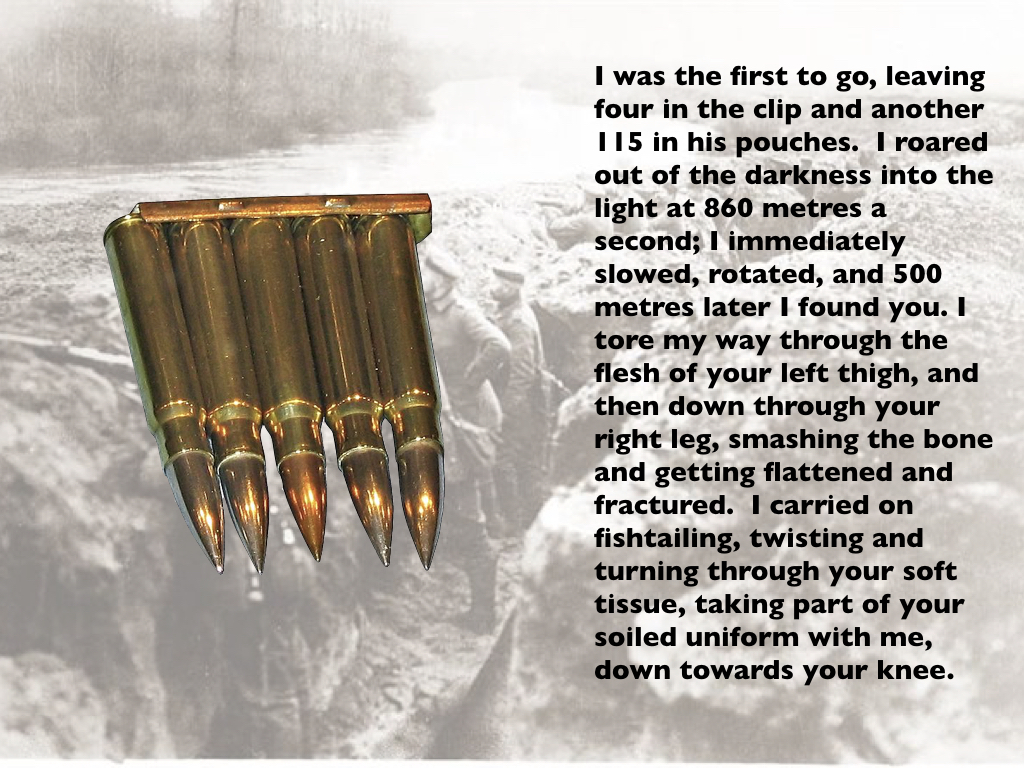
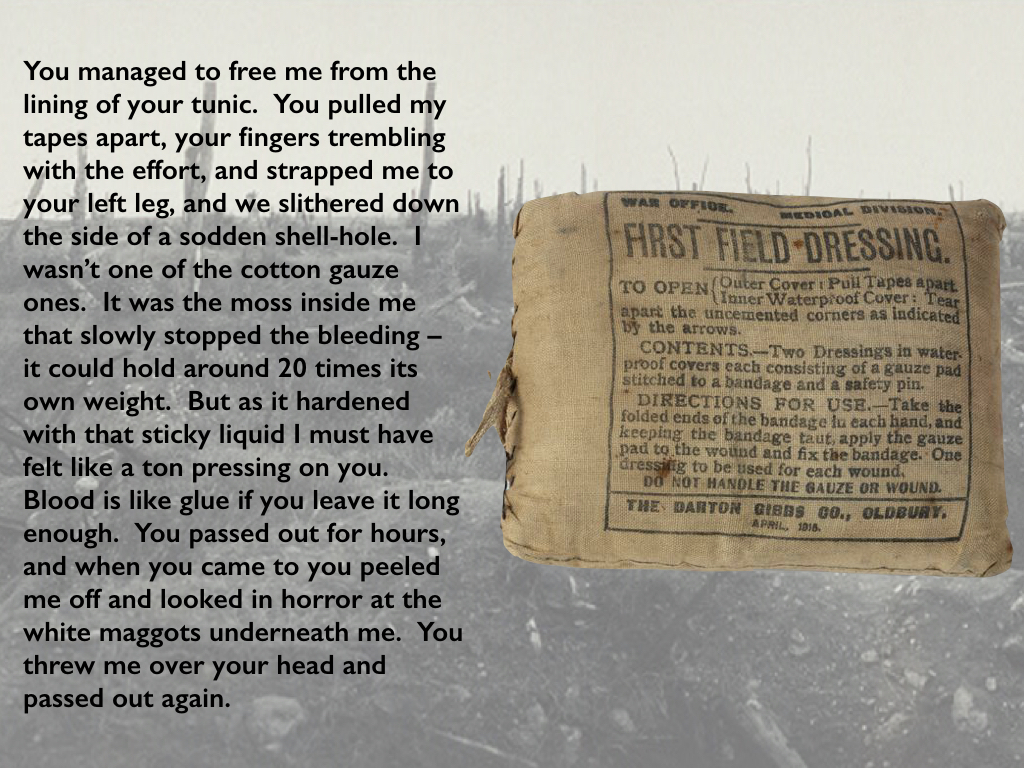
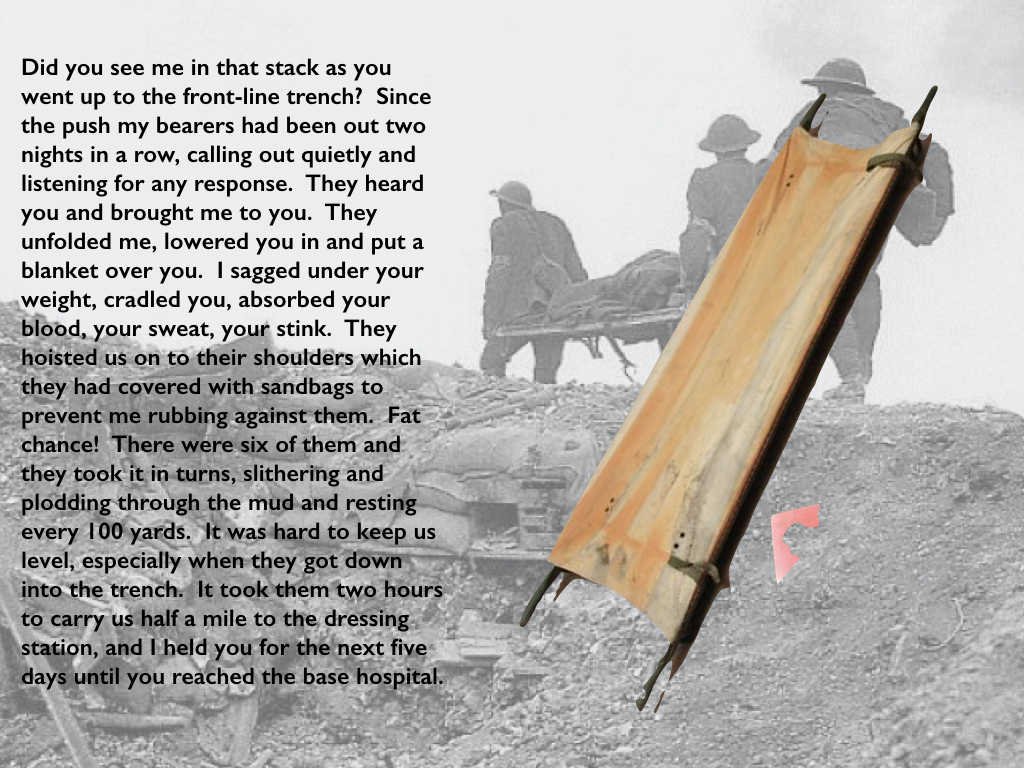
So here are the slides; they ought to be self-explanatory – or at any rate, sufficiently clear – but I’ve added some additional notes.  I should probably also explain that in each case the object in question appeared on the slide at the end of its associated narrative.

***
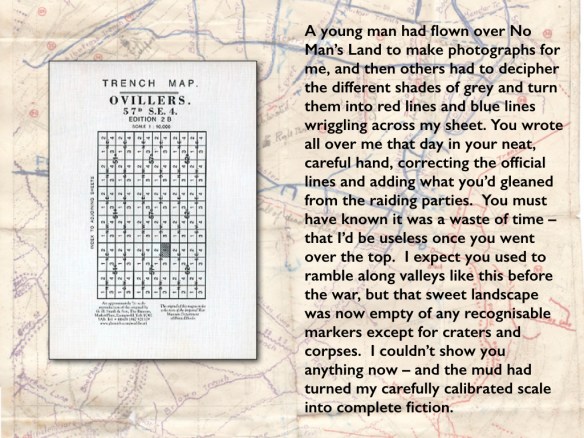
I discuss aerial photography and trench mapping on the Western Front – and the difficulty of navigating the shattered landscapes of trench warfare – in ‘Gabriel’s map: cartography and corpography in modern war’ (DOWNLOADS tab).

You can find a short account of the synchronisation of officers’ watches on the Western Front in ‘Homogeneous (war) time’ here.

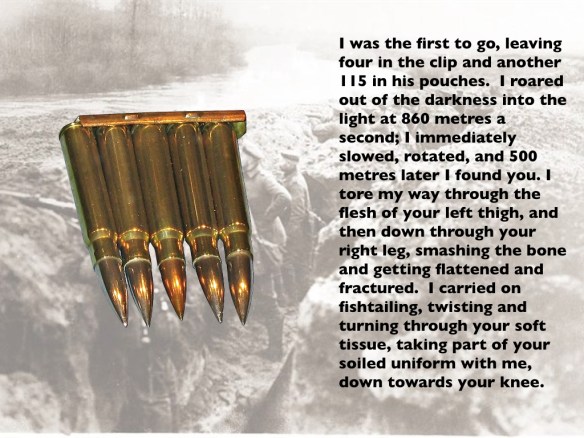
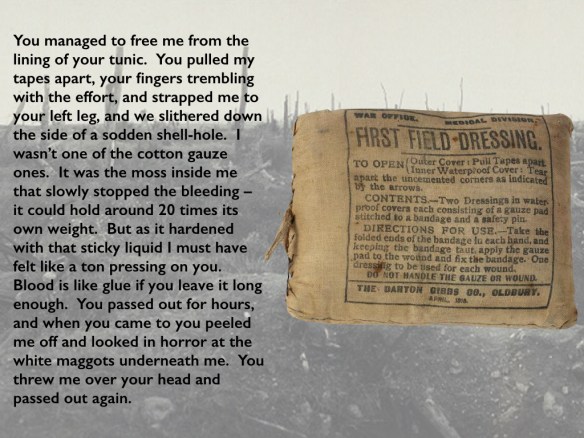
A shortage of cotton (combined with its relatively high cost) together with the extraordinary demand for wound dressings prompted the War Office to use sphagnum moss – the British were years behind the Germans and the French in appreciating its antiseptic and absorbent qualities, which also required dressings to be changed less often.  You can get the full story from Peter Ayres, ‘Wound dressing in World War I: the kindly sphagnum moss’, Field Bryology 110 (2013) 27-34 here.

But one RAMC veteran [in ‘Field Ambulance Sketches’, published in 1919] insisted on the restorative power of the white bandage, administered not by regimental stretcher bearers but by the experts of the Royal Army Medical Corps’s Field Ambulance:

The brown first field dressing, admirable as it is from a scientific point of view, always looks a desperate measure; and if it slips, as it generally does on a leg wound, it becomes for the patient merely a depressing reminder of his plight. A clean white dressing, though it may not be nearly so satisfactory in the surgeon’s eyes, seems to reassure a wounded man strangely. It makes him feel that he is being taken care of, gives him a kind of status, and stimulates his sense of personal responsibility. With a white bandage wound in a neat spiral round his leg, he will walk a distance which five minutes earlier, under the dismal suggestion of a first field dressing, he has declared to be utterly beyond his powers.

I borrowed the white maggots (and some of the other details of the wounds) from John Stafford‘s extraordinary, detailed recollection of being wounded on the Somme in August 1916 available here.
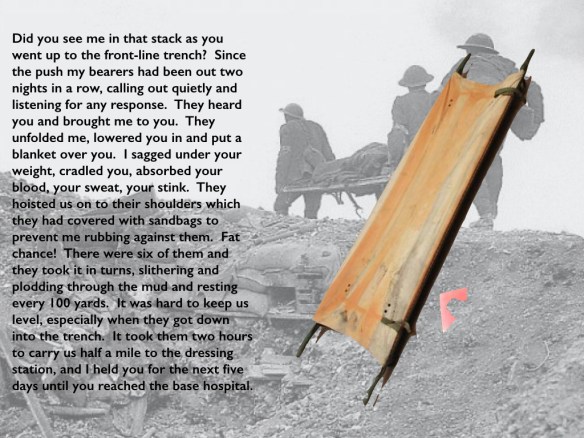
Carrying a stretcher across a mud-splattered, shell-blasted landscape was immensely tiring and it was all too easy to lose one’s bearings.  From ‘A stretcher-Bearer’s Diary’, 17 September 1916:

‘The shell fire, and the mud, are simply beyond description, and it is a miracle that any escape being hit. We have to carry the wounded shoulder high, the only way it can be done, because of the mud. Our shoulders are made raw by the chafing of the stretcher handles, although we wear folded sandbags under our shoulder straps. Sweat runs into our eyes, until we can hardly see. When a barrage comes we must keep on and take no notice, as even if we could find cover, there is none for the man on the stretcher….

‘…The rain has made the ground a sea of mud, and we have to carry the wounded three miles to the Dressing Stations, as the wheeled stretchers cannot be used at all. Two men using stretcher slings could not carry a man thirty yards, and I have seen four bearers up to their knees in mud, unable to move without further assistance.

By the time of the 3rd Battle of Ypres, it could take eight men to carry a stretcher half a mile to an aid post – and it could take them two hours to do it.

Even in ideal circumstances, manoeuvering a stretcher down a narrow, crowded trench was extremely difficult, ‘like trying to move a piano down an avenue of turnstiles.’  During major offensives a one-way system was in operation, and stretcher bearers were supposed to use only the ‘down’ trenches.  From the Aid Posts the RAMC stretcher-bearers of the Field Ambulance would take over from the regimental stretcher-bearers.  Here is one young novice, Private A.F. Young with the 2n3/4th London Field Ambulance:

Step by step we picked our way over the duckboards. It is useless to try and maintain the regulation broken step to avoid swaying the stretcher. Slowly we wind our way along the trenches, our only guide our feet, forcing ourselves through the black wall of night and helped occasionally by the flash of the torch in front. Soon our arms begin to grow tired and the whole weight is thrown on to the slings, which begin to bite into our shoulders; our shoulders sag forward, the sling finds its way on to the back of our necks; we feel half-suffocated. A twelve-stone man, rolled up in several blankets on a stretcher, is no mean load to carry, and on that very first trip we found that the job had little to do with the disciplined stretcher-bearing we had spent so many weary hours practising. We are automatons wound up and propelled by one fixed idea, the necessity of struggling forward. The form on the stretcher makes not a sound; the jolts, the shakings seem to have no effect on him. An injection of morphine has drawn the veil. Lucky for him.  

Stretcher-bearers changed – they worked in relays close to the front – but the stretcher remained the same.  Ideally the wounded soldier would remain on his stretcher only as far as the Casualty Clearing Station, from where used stretchers would be returned to dressing stations and aid posts by now empty ambulances.  

Twelve stretchers were supposed to be kept at every Regimental Aid Post, but supplies could easily run out.  When Major Sidney Greenfield was wounded, he remembered:

… the call ‘stretcher-bearers’, ‘stretcher-bearers’, the reply ‘No stretchers’. ‘Find one, it’s an officer.’

And it was not uncommon for those evacuated ‘in a rush’ to remain on their stretcher until the base hospital; and since ambulance trains heading to the coast were less urgent than troop trains and supply trains heading in the opposite direction the journey was usually a slow one.  If the nearest hospital turned out to be full, a not uncommon occurrence, the train would be sent on to the next available one, thus prolonging the journey still more.    

H.G. Hartnett recalled the sheer pleasure of finally being put to bed at the base hospital at Wimereux:

After being washed and changed into clean pyjamas I was lifted off the stretcher on which I had lain for five days and nights into a soft bed—between sheets.

The contrast, of course, was not only with the canvas stretcher but with sleeping in the trenches wrapped in a groundsheet.

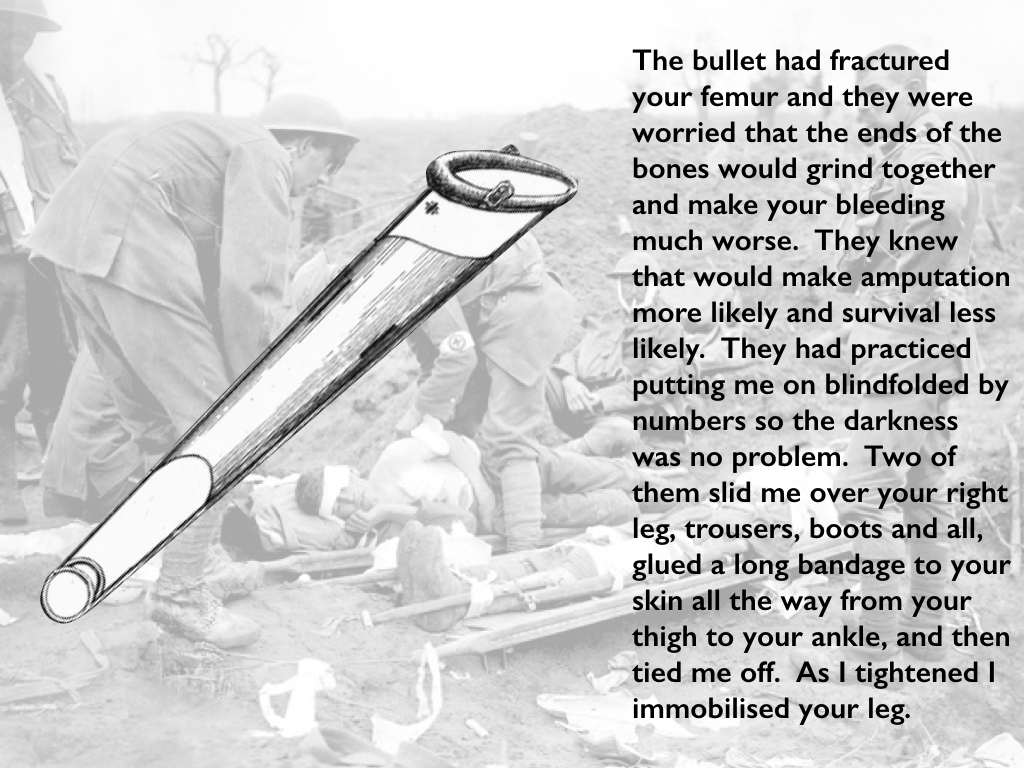
Before the widespread introduction of the Thomas splint (above), ordinary or even improvised splints were used.  Here is Sister Kate Luard on board an ambulance train in October 1914:

The compound-fractured femurs were put up with rifles and pick-handles for splints, padded with bits of kilts and straw; nearly all the men had more than one wound – some had ten; one man with a huge compound fracture above the elbow had tied on a bit of string with a bullet in it as a tourniquet above the wound himself.

A fractured femur would turn out to be one of the most common injuries, described by Robert Jones as ‘the tragedy of the war’: if fractures were not properly splinted the soldier would arrive at the Casualty Clearing Station in a state of shock caused by excessive blood loss and pain:

‘These men required radical surgery to save their limbs and lives… Entry and exit wounds would have to be extended widely, removing all dead skin and fat… The bone ends of the femur at the fracture site would then have to be pulled out of the wound and be inspected directly [for loose fragments of bone, clothing and debris]… Wounded soldiers arriving at casualty clearing stations with a weak pulse and low blood pressure secondary to excess blood loss due to inadequately splinted fractures would be unlikely to survive the major procedure’ – let alone the amputations that were often administered.

Mortality rates in such circumstances were around 50 per cent. The Thomas splint was specifically designed to immobilise a fractured femur, and by April/May 1917 its use during the battle of Arras had reduced the mortality rate to 15 per cent, and far fewer men lost their legs: see Thomas Scotland, ‘Developments in orthopaedic surgery’, in Thomas Scotland and Stephen Heys (eds) War surgery 1914-1918.

Stretcher bearers were trained to apply the splint in the field, as in this case, but one senior officer made it clear that in any event it had to be applied no later than the Regimental Aid Post:

The Thomas thigh splint should be applied with the boot and trousers on, the latter being cut at the seam to enable the wound to be dressed. The method of obtaining extension by means of a triangular bandage has been sketched and circulated to all MOs in the Divn. After the splint is adjusted it should be suspended both at the foot and at the ring by two tapes at either end tied to the iron supports one of which is fitted to the stretcher opposite the foot and one opposite the hip.

More information on this truly vital innovation: P.M. Robinson and M. J. O’Meara, ‘The Thomas splint: its origins and use in trauma’, Journal of bone and joint surgery 91 (2009) 540-3: never in my wildest dreams did I imagine reading or referencing such a journal – but it is an excellent and thoroughly accessible account.  See for yourself here.

It was vital not to leave a tourniquet on for long.  Here is one RAMC officer, Captain Maberly Esler, recalling his service on the Somme in June 1915:

If a limb had been virtually shot off and they were bleeding profusely you could stop the whole thing by putting a tourniquet on, but you couldn’t keep it on longer than an hour without them losing the leg altogether. So it was necessary to get the field ambulance as soon as possible so they could ligature the vessels, and the quicker that was done the better.

Lt Col Henderson‘s pencilled notes on the treatment of the wounded (1916-16) urged stretcher bearers to make every effort to stop bleeding with a compress or bandage: ‘ A tourniquet should only be applied if this response fails and where a tourniquet is applied the [Regimental Medical Officer] should be at once informed on the arrival of the case at the [Regimental Aid Post].’  By May 1916 Medical Officers were being warned ‘against too frequent use of the tourniquet, on the grounds that the dreaded gas bacillus (perfringens) is most likely to thrive in closed tissues.’

A tourniquet could aggravate damaged tissues and did indeed increase the risk of gangrene; 80 per cent of those whose limbs had a tourniquet applied for more than three hours required amputation.

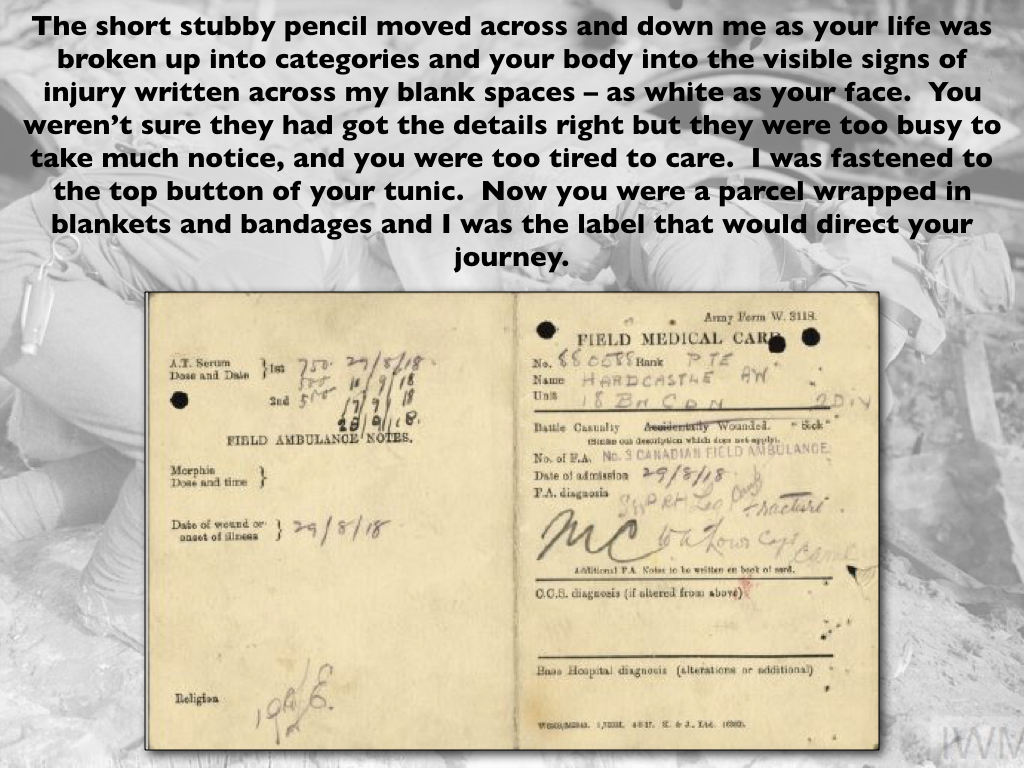
This was a major responsibility; sometimes the card was filled in at a Dressing Station, sometimes at the Casualty Clearing Station.  George Carter‘s diary entry for 31 August 1915 explains its importance:

‘My work consists of nailing every patient and getting his number, rank, name, initial, service, service in France, age, religion, battalion and company. That is usually fairly plain sailing, I find, but entails a certain amount of searching [extracting paybook or diary, for example] when a patient is too ill to be bothered with questions. Then I have to find out what is the matter with him, what treatment he has had, and what is going to be done with him… The reason for taking these particulars and making out forms is to prevent any man being lost sight of, whatever happens to him. If he finishes in England after taking a week on the journey, he has got all his partics on him, everywhere he has stopped, the RAMC have been able to see at a glance all about him and can turn up all about him if called on.’

But things could easily go awry.  Here is one young soldier, Henry Ogle:

I think it must have been here [at the CCS] that orderlies tied Casualty Labels on our top tunic buttons, and got mine wrong, though it may have been at Louvencourt or even Hébuterne. Wherever it had happened, it was here that I first noticed it and called the attention of an orderly to it. I had been wounded in the right calf by part of a rifle bullet which penetrated deeply and remained in but I had been labelled for superficial something or other, while Frank Wallsgrove was GSW for gunshot wound. I said, ‘Mine’s wrong, for we two were hit by the same bullet.’ ‘Can’t alter your label, chum. Anyhow it doesn’t matter. It’ll get proper attention.’ We were already being packed into a train so nothing could be done and I didn’t worry about it.

At the base hospital he tried again:

An orderly came along (it was then dark night) and threw a nightgown and a towel at me. ‘Bathroom. Down that passage. On the right. Any of them.’ ‘Don’t think I can get there. Can’t walk.’ ‘Let’s see your label.’ ‘Label’s wrong.’ ‘What do you know about that? Go on.’ ‘I know a bloody sight more about it than you do, chum, but I’ll see what I can do.’ It was not easy as the leg was quite out of action and my orderly friend had no time to watch…  On crawling back I found Frank tucked into bed. Our case-sheets were clipped to boards which hung on the wall behind our beds and, so far, the items from our tunic labels had been copied out on the case-sheets. The next morning the customary round of visits was made by the Medical Officer on duty with Matron and Sister of Ward and an orderly or two. I tried to explain that my label was wrong and Frank backed me up but we were simply ignored. My wound was dressed as a surface wound.

It was only after the swelling of his leg alarmed Matron that Henry was shipped off for an X-ray that revealed the need for an operation to remove the bullet.

‘T’ for anti-tetanus serum.  In the first weeks of the war tetanus threatened to become a serious problem: on 19 October 1915 Sister Kate Luard recorded ‘a great many deaths from tetanus’ in her diary, but two months later she was able to note ‘The anti-tetanus serum injection that every wounded man gets with his first dressing has done a great deal to keep the tetanus under.’  In A Surgeon in Khaki, published in 1915, Arthur Andersen Martin confirmed that ‘every man wounded in France or Flanders today gets an injection of this serum within twenty-four hours of the receipt of the wound’ – at least, if he had been recovered in that time – and ‘no deaths from tetanus have occurred since these measures were adopted.’

More information: Peter Cornelis Wever and Leo van Bergen, ‘Prevention of tetanus during the First World War’, Medical Humanities 38 (2012) 78-82.

Morphine was administered for pain relief, but it still awaits its medical-military historian (unless I’ve missed something).
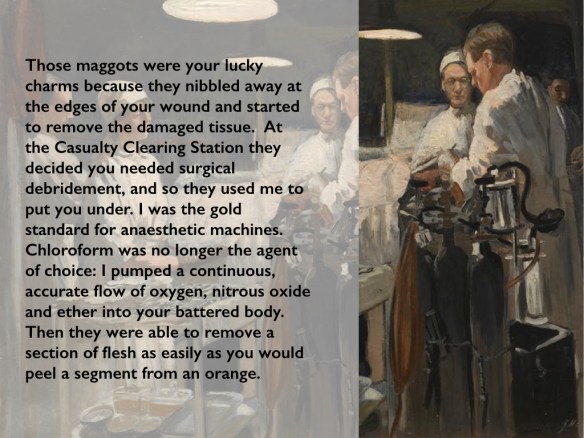
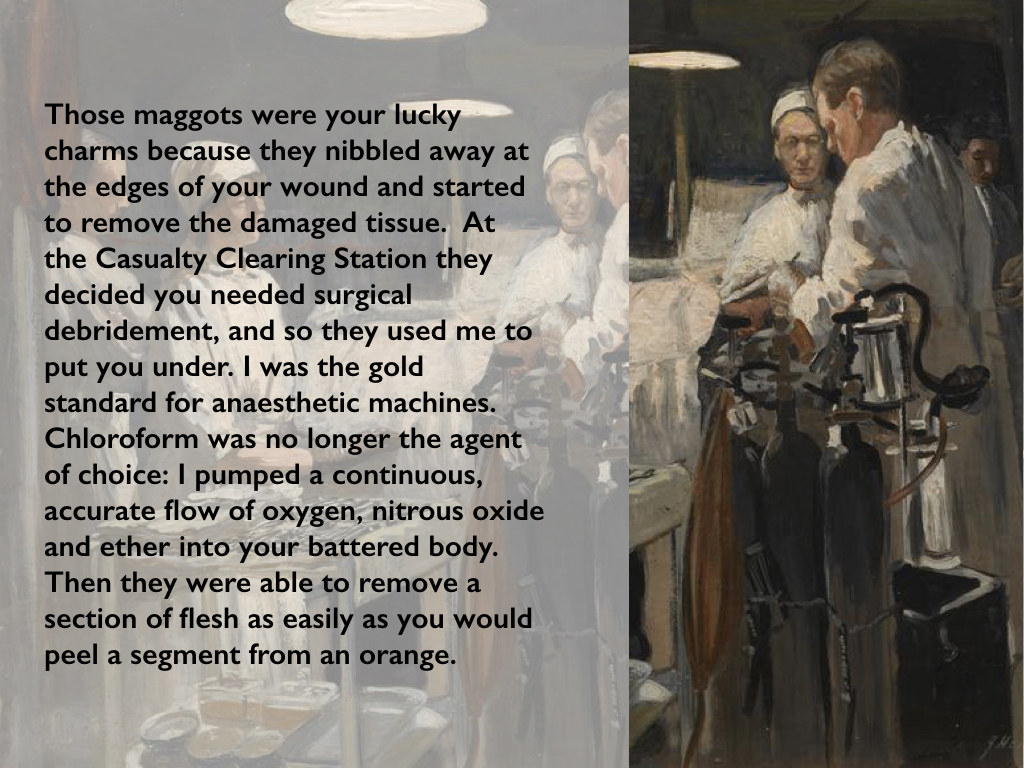
This was Boyle’s anaesthetic apparatus, but before the widespread availability of these machines a variety of systems was in use and, in the heat of the moment, the administration of anaesthesia was often far removed from the clinical, calibrated procedures the machine made possible. Here is a chaplain who served at No 44 Casualty Clearing Station:

I spent most of my time giving anaesthetics. I had no right to be doing this, of course, but we were simply so rushed. We couldn’t get the wounded into the hospital quickly enough, and the journey from the battlefield was terrible for these poor lads. It was a question of operating as quickly as possible. If they had had to wait their turn in the normal way, until the surgeon was able to perform an operation with another doctor giving the anaesthetic, it would have been too late for many of them. As it was, many died.

The most fortunate patients were those who had little or no recollection of the procedure.  Here is H.G. Hartnett on his experience at No 15 Casualty Clearing Station (the second occasion he was wounded):

 I was destined for surgery and lay in agony on my stretcher until near 9.00 pm, when orderlies carried me into a brilliantly lit operating theatre. I was placed on the centre one of three operating tables where I lay watching doctors and nurses completing an operation on another patient only a few feet from where I lay. When my turn came my wound was uncovered and a doctor placed a mask over my face. Then he asked me the name of the colonel of my battalion as he administered the anaesthetic. I remember no more about the operation or the theatre. When I returned to brief consciousness about 4.00 am the next morning I was lying on a stretcher on the ground in a large canvas marquee, in the third position on my side of it. Others had been carried in during the night, all from the operating theatre. The fumes of the anaesthetic from their clothes and blankets continued to put us off to sleep again. The day was well advanced when I finally returned to full consciousness.  

In the early years of the war anaesthesia was not a recognised speciality – and chloroform was the most widely used agent – but as the tide of wounded surged, operative care became more demanding and Casualty Clearing Stations assumed an increasing operative load so it became necessary to refine both its application and the skills of those who administered it.   In the British Army advances in anaesthesia were pioneered by Captain Geoffrey Marshall at No 17 Casualty Clearing Station at Remy Siding near Ypres from 1915.  By then nitrous oxide and oxygen were commonly used for short operations (which did not mean they were minor: they included guillotine amputations) but longer procedures typically relied on chloroform and ether.  A crucial disadvantage of chloroform was that it lowered blood pressure in patients who had often already lost a lot of blood.  ‘If chloroform be used,’ Marshall warned, ‘the patient’s condition will deteriorate during the administration, and he will not rally afterwards.’  And while ether would often produce an improvement during the operation, this was typically temporary: ‘the after-collapse [would be] more profound and more often fatal.’   His achievement was to show that a combination of nitrous oxide, oxygen and ether significantly improved survival rates for complex procedures – from 10 per cent to 75 per cent for leg amputations – and to have a machine made to regulate the combination of the three agents.  His design was copied and modified by Captain Henry Boyle, whose name became attached to the device.  

More information: Geoffrey Marshall, ‘The administration of anaesthetics at the front’, in British medicine in the war, 1914-1917N.H. Metcalfe, ‘The effect of the First World War (1914-1918) on the development of British anaesthesia’, European Journal of Anaesthesiology 24 (2007) 649-57; E. Ann Robertson, ‘Anaesthesia, shock and resuscitation’, in Thomas Scotland and Steven Heys (eds) War surgery, 1914-1918.
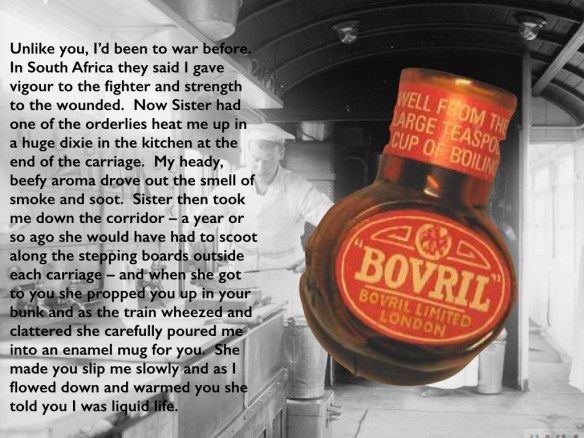
Bovril was advertised in all these ways; the company used a sketch of the Gallipoli campaign to claim that Bovril would ‘give strength to win’ and that it was a ‘bodybuilder of astonishing power’.  In 1916 the company even published an extract from a letter purported to come from the Western Front, accompanied by an image of an RAMC Field Ambulance tending a wounded soldier: 

But for a plentiful supply of Bovril I don’t know what we should have done.  During Neuve Chapelle and other engagements we had big cauldrons going over log fires, and as we collected and brought in the wounded we gave each man a good drink of hot Bovril and I cannot tell you how grateful they were.

Oxo seems to have been less popular, and least for any supposed medicinal or restorative properties, but it was often sent to soldiers by their families at home.  One advertising campaign enjoined them to ‘be sure to send Oxo’, and in one ad a Tommy writes home to say that when he returned to his billet to find the parcel, ‘the first thing I did was to make a cup of OXO and I and my chums declared on the spot this cup of OXO was the best drink we had ever tasted.’  
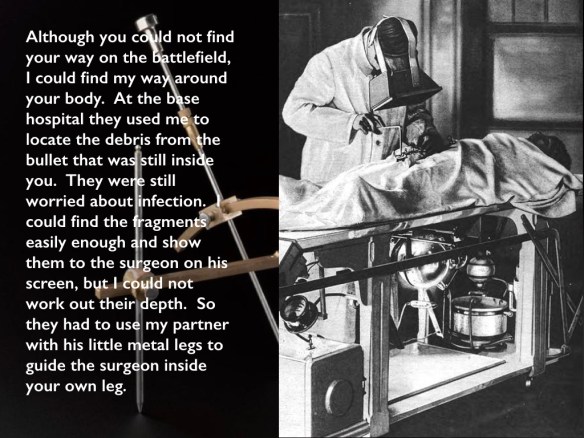
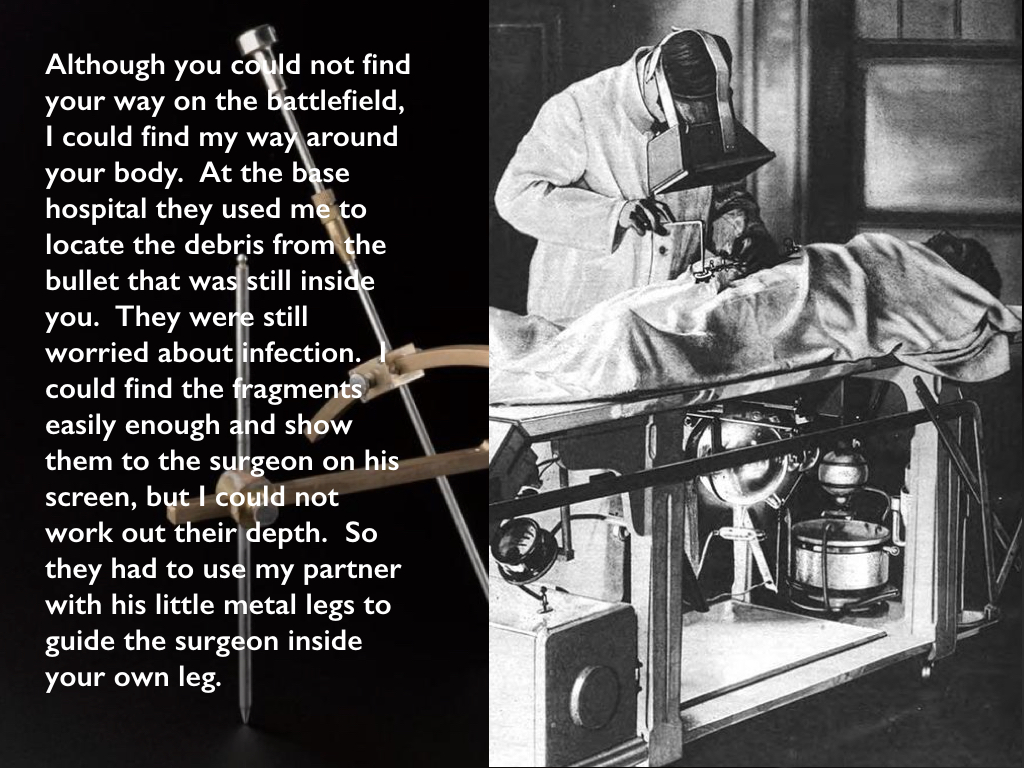
The image shows a surgeon using a fluoroscope to locate the fragments of the bullet:

An early Crookes x-ray tube visible under the table emits a beam of x-rays vertically through the patient’s body. The surgeon wears a large fluoroscope on his face, a screen coated with a fluorescent chemical such as calcium tungstate which glows when x-rays strike it. The x-ray image of the patient’s body appears on the screen, with the bullet fragments appearing dark.

The ‘partner’ referred to was the Hirtz compass (visible on the left of the image).  According to one standard military-medical history:

The essential feature of the H[i]rtz compass is the possibility of adjustment of the movable legs that support the instrument, so that when resting on fixed marks on the body of the patient the foreign body will be at the center of asphere, a meridian arc of which is carried by the compass. This arc is capable of adjustment in any position about a central axis. An indicating rod passes through a slider attached to the movable arc in such a way as to coincide in all positions with a radius of the sphere, and whether it actually reaches the center or not it is always directed toward that point. If its movement to the center of the sphere is obstructed by the body of the patient, the amount it lacks of reaching the center will be the depth of the projectile in the direction indicated by the pointer.

The value of the compass lies in its wide possibility as a surgical guide, in that it does not confine the attention of  the surgeon to a single point marked on the skin, with a possible uncertainty as to the direction in which he should proceed in order to reach the projectile, but gives him a wide latitude of approach and explicit information as to depth in a direction of his own selection.

The compass built on Gaston Contremoulins‘ attempts at ‘radiographic stereotaxis’; it could usually locate foreign objects to within 1-2 mm: much more than you could possibly want here.

The reassuring scientificity of all this is tempered by a cautionary observation from a wounded officer, Major Sidney Greenfield, who was X-rayed at a Casualty Clearing Station: 

My next recollection was the x-ray machine and two young fellows who were operating it. Apparently the operator had been killed the previous night by a bomb on the site and these two were standing in with little or no experience of an x-ray machine. Their conversation was far from encouraging and was roughly like this: ‘Now we have got to find where it is … is it this knob?’ ‘No.’ ‘Try that one.’ ‘Try turning that one.’ ‘No, that doesn’t seem to be right.’ ‘Ah, There it is.’ ‘Where’s the pencil. We must mark where it is. Now we have to find out how deep it is.’ After some time they seemed to be satisfied. In my condition and knowing little about electrical machines such as x-ray I wondered whether I should be electrocuted and was more relaxed when I was taken back to bed.

Incidentally, X-rays were called Roentgen rays (after the scientist Wilhelm Roentgen who discovered them in 1895) but the British antipathy towards all things German saw them re-named ‘X-rays’ from 1915: Alexander MacDonald, ‘X-Rays during the Great War’, in Thomas Scotland and Steven Heys (eds) War surgery, 1914-1918.
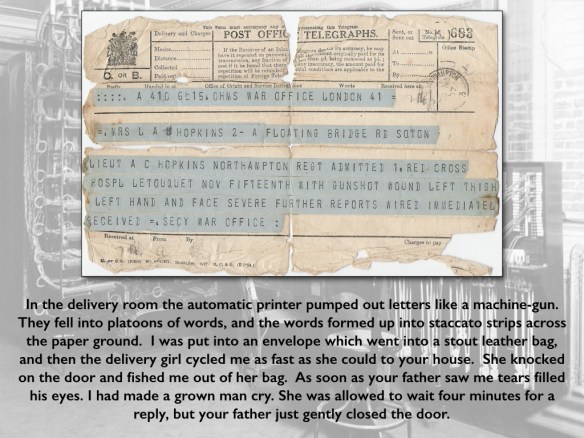
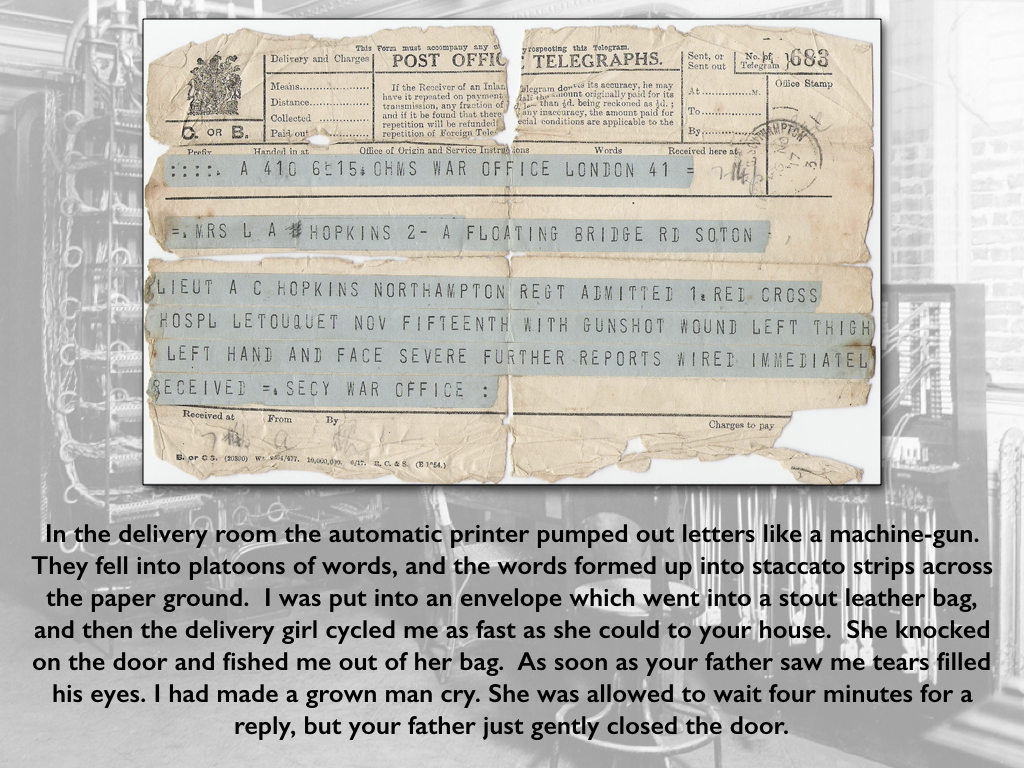
In addition to these terse communications, nurses and chaplains usually wrote to relatives on behalf of their patients. It was seen as a sacred duty, but it often seemed to be a never-ending task.  On 1 August 1917 Sister Kate Luard confided in her diary: ‘I don’t see how the “break-the-news” letters are going to be written, because the moment for sitting down literally never comes from 7 a.m. to midnight.’  In the case shown here, Sister Kathleen Mary Latham had written to Lt Hopkins’s wife on 12 November 1917 from a Casualty Clearing Station to say that

‘your husband has been brought to this hospital with wounds of the legs, arms, hand and face.  He has had an operation and is going on well. Unfortunately it was found necessary to remove the left eye as it was badly damaged, but he can see with the other though the lid is swollen and he cannot use it yet.  No bones are broken.  It will not be advisable for you to write to this address as he will probably be going on to the base in a day or two.’

The telegram from the War Office is dated three days later, by which time Hopkins had reached the base hospital at Le Touquet.  Sister Latham’s earlier account of her work at Casualty Clearing Station No. 3 at Poperinghe in 1915 is here.

***

In Durham, Louise Amoore pressed me on the anthropomorphism that seems inescapable in a narrative like this; it worries me too (I’ve always been leery of Bruno Latour‘s Aramis for that very reason).  I tried removing the ‘I’ and substituting an ‘it’ but I found doing so destroyed both the operative agency of the objects and, perhaps more important, the transient, enforced intimacy between them and the soldier’s body.  That intimacy was more than physical, I think.  I’ve already cited the reassurance provided by the prick of a needle, the whiteness of a new bandage; but the mundanity of objects could also be disorientating, intensifying an already intense sur-reality.  Here, for example, is Gabriel Chevallier recalling the moment when he and his comrades went over the top:

The feeling of being suddenly naked, the feeling that there is nothing to protect you. A rumbling vastness, a dark ocean with waves of earth and fire, chemical clouds that suffocate. Through it can be seen ordinary, everyday objects, a rifle, a mess tin, ammunition belts, a fence post, inexplicable presences in this zone of unreality.

Aramis also alerted me to another, and perhaps even more debilitating dilemma: a latent functionalism in which everything that is pressed into service works to carry the soldier through the evacuation chain.  That seems unavoidable in a narrative whose telos is precisely the base hospital and Blighty beyond.  Yet we know that, for all the Taylorist efficiency that was supposed to orchestrate the evacuation system in this profoundly industrial war, in many cases the chain was broken, another life was lost or permanently, devastatingly transformed.  As you can see, I’ve tried to do something about that with some of the objects I’ve selected.

I’ll probably add more objects: this is very much a work in progress, and I’m not sure where it will go – so as always, I’d welcome any constructive comments or suggestions.  Any written version would involve longer descriptions, I think, and would probably dispense with most of the scaffolding of notes I’ve erected here (though some of it could and probably should be incorporated into the descriptions).
A heavy reckoning

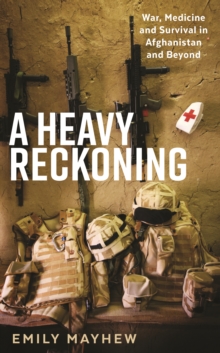
Emily Mayhew‘s Wounded was one of the catalysts for my present research project on medical care and casualty evacuation in war zones.  The original idea was to complete four case studies – the Western Front in the First World War, the deserts of North Africa in the Second, Vietnam and Afghanistan – but since then it has expanded to include a detailed analysis of attacks on hospitals and healthcare in Syria and elsewhere.  But running throughout these investigations is an interest in what Emily called ‘precarious journeys‘ – and a determination to break away from the usual academic voice (see here) –  so an announcement of her new book is extremely welcome.

It’s due from Profile in May:

What happens when you reach the threshold of life and death – and come back? As long as humans have lived together on the planet, there have been wars, and injured soldiers and civilians. But today, as we engage in wars across the globe with increasingly sophisticated technology, we are able to bring people back from ever closer encounters with death. But how do we do it, and what happens next? Here, historian Emily Mayhew explores the modern reality of medicine and injury in wartime, from the trenches of World War One to the dusty plains of Afghanistan and the rehabilitation wards of Headley Court in Surrey. Mixing vivid and compelling stories of unexpected survival and giving astonishing insights into the frontline of medicine, A Heavy Reckoning is a book about how far we have come in saving, healing and restoring the human body. But what are the costs involved in this hardest of journeys back from the brink? From the plastic surgeon battling to restore function to a blasted hand to the double amputee learning to walk again on prosthetic legs, Mayhew gives us a new understanding of the limits of human life and the extraordinary costs paid both physically and mentally by casualties all over the world in the twenty-first century.

The book is published in conjunction with the Wellcome Collection, and I should note that Emily has also co-curated the current exhibition Wounded: Conflict, Casualties and Care at London’s Science Museum (more information here and here).  I spent a fascinated couple of hours there when I was in London last month – it is well worth a visit, though the parallels it draws between the Western Front and Afghanistan were too abbreviated for me.

A landscape of interferences

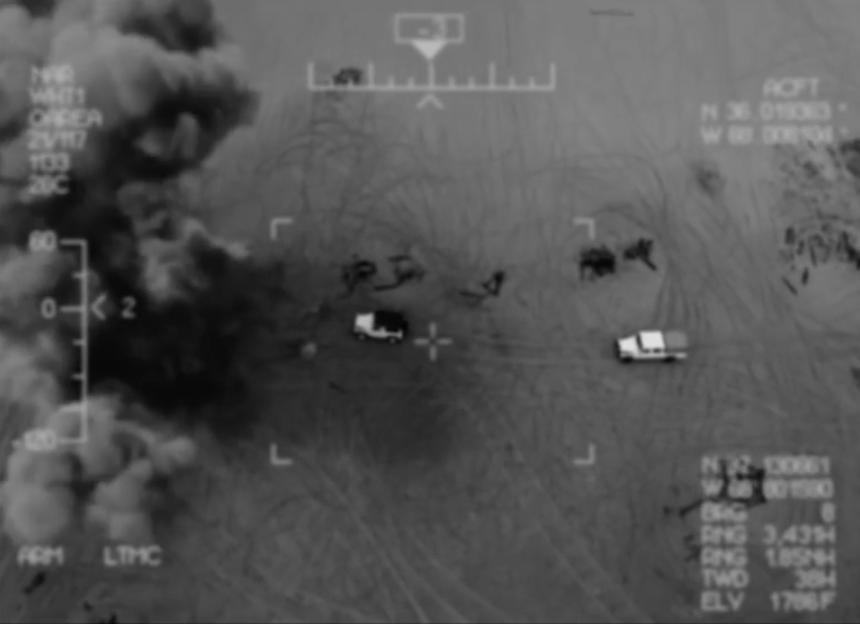
Uruzgan strike (National Bird reconstruction)

[Still image from NATIONAL BIRD © Ten Forward Films; the image is of the film’s re-enactment of the Uruzgan air strike based on the original transcript of the Predator crew’s radio traffic.]

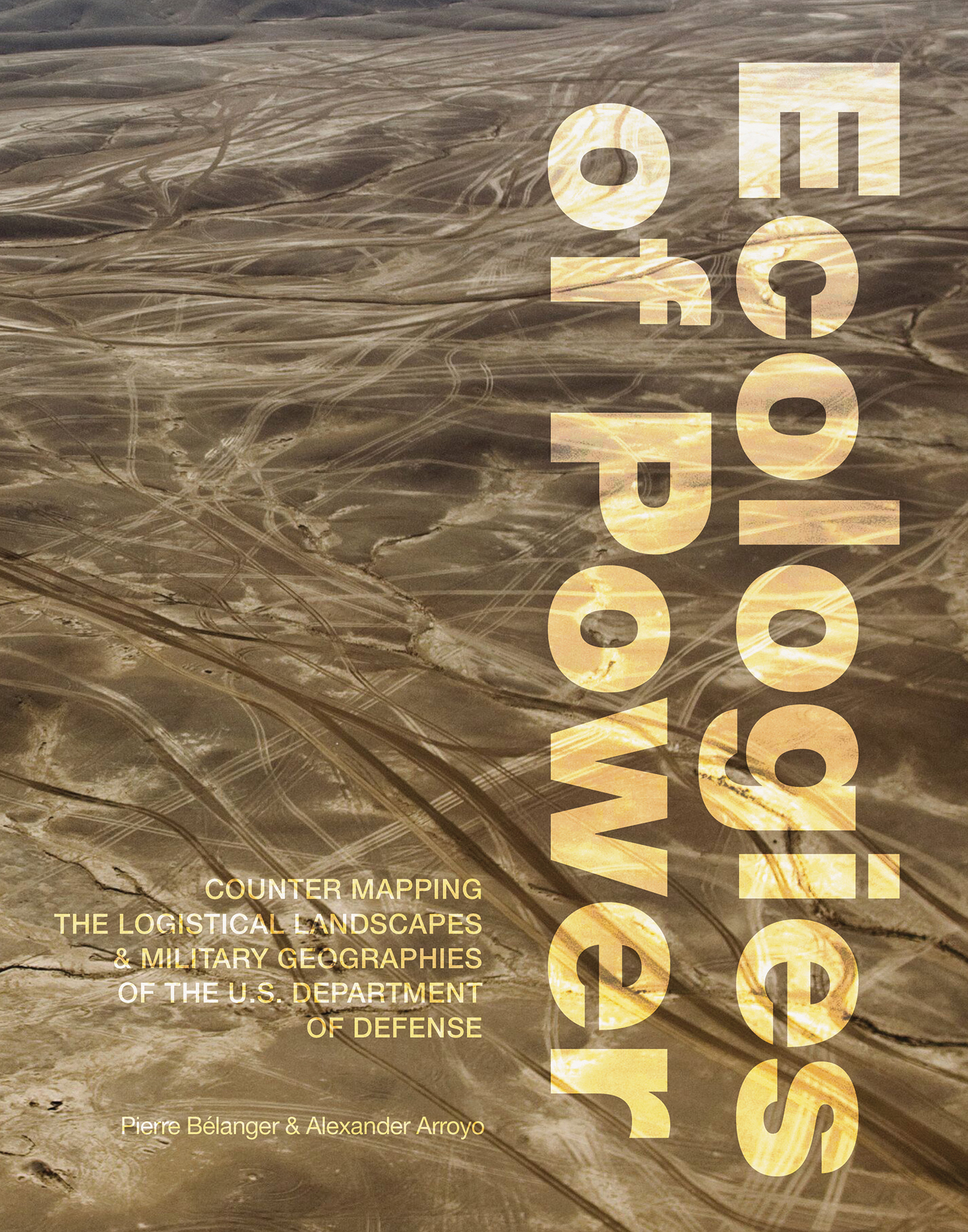
I’ve been reading the chapter in Pierre Bélanger and Alexander Arroyo‘s Ecologies of Power that provides a commentary on what has become the canonical US air strike in Uruzgan, Afghanistan in February 2010 (‘Unmanned Aerial Systems: Sensing the ecology of remote operational environments’, pp. 267-320).  In my own analysis of the strike I emphasised the production of

a de-centralised, distributed and dispersed geography of militarised vision whose fields of view expanded, contracted and even closed at different locations engaged in the administration of military violence. Far from being a concerted performance of Donna Haraway‘s ‘God-trick’ – the ability to see everything from nowhere – this version of networked war was one in which nobody had a clear and full view of what was happening.

Part of this can be attributed to technical issues – the different fields of view available on different platforms, the low resolution of infra-red imagery (which Andrew Cockburn claims registers a visual acuity of 20/200, ‘the legal definition of blindness in the United States’), transmission interruptions, and the compression of full-colour imagery to accommodate bandwidth pressure…

But it is also a matter of different interpretive fields. Peter Asaro cautions:

‘The fact that the members of this team all have access to high-resolution imagery of the same situation does not mean that they all ‘‘see’’ the same thing. The visual content and interpretation of the visual scene is the product of analysis and negotiation among the team, as well as the context given by the situational awareness, which is itself constructed.’

The point is a sharp one: different visualities jostle and collide, and in the transactions between the observers the possibility of any synoptic ‘God-trick’ disappears. But it needs to be sharpened, because different people have differential access to the distributed stream of visual feeds, mIRC and radio communications. Here the disposition of bodies combines with the techno-cultural capacity to make sense of what was happening to fracture any ‘common operating picture’.

ecologies-of-powerPierre and Alexander’s aim is to ‘disentangle’ the Electromagnetic Environment (EME), ‘the space and time in which communications occur and transmissions take place’, as a Hertzian landscape.  The term is, I think, William J. Mitchell‘s in Me++:

‘Every point on the surface of the earth is now part of the Hertzian landscape – the product of innumerable transmissions and of the reflections and obstructions of those transmissions… The electronic terrain that we have constructed is an intricate, invisible landscape.’

(Other writers – and artists – describe what Anthony Dunne called Hertzian space).

The Hertzian landscape is often advertised – I use the world deliberately – as an isotropic plane.  Here, for example, is how one commercial company describes its activations (and its own product placement within that landscape) in a scenario that, in part, parallels the Uruzgan strike:

A bobcat growls over the speaker, and Airmen from the 71st Expeditionary Air Control Squadron [at Al Udeid Air Base in Qatar] spring into action within the darkened confines of the Battlespace Command and Control (C2) Center, better known as ‘Pyramid Control.’

Keeping WatchThis single audio cue alerts the Weapons Director that an unplanned engagement with hostile force – referred to as Troops in Contact, or TIC – has occurred somewhere in Afghanistan. On the Weapons Director’s computer monitor a chat room window ashes to distinguish itself from the dozens of rooms he monitors continuously.

More than a thousand kilometers away, a Joint Terminal Attack Controller on the ground has called for a Close Air Support (CAS) aircraft to assist the friendly forces now under assault. The Weapons Director has minutes to move remotely piloted vehicles away from the CAS aircraft’s ight path, to de-conict the air support and ground re from other aircraft, and to provide an update on hostile activity to all concerned.

The Weapons Director has numerous communication methods at his disposal, including VoIP and tactical radio to quickly get the critical information to operators throughout southwest Asia and across the world, including communicating across differently classied networks. This enables key participants to assess the situation and to commence their portions of the mission in parallel.

You can find the US military’s view of the 71st here – it called the Squadron, since deactivated, its ‘eyes in the sky’ – and on YouTube here.

us-marines-command-ops-center-at-patrol-base-jaker-nawa-district-helmand-4-july-2009

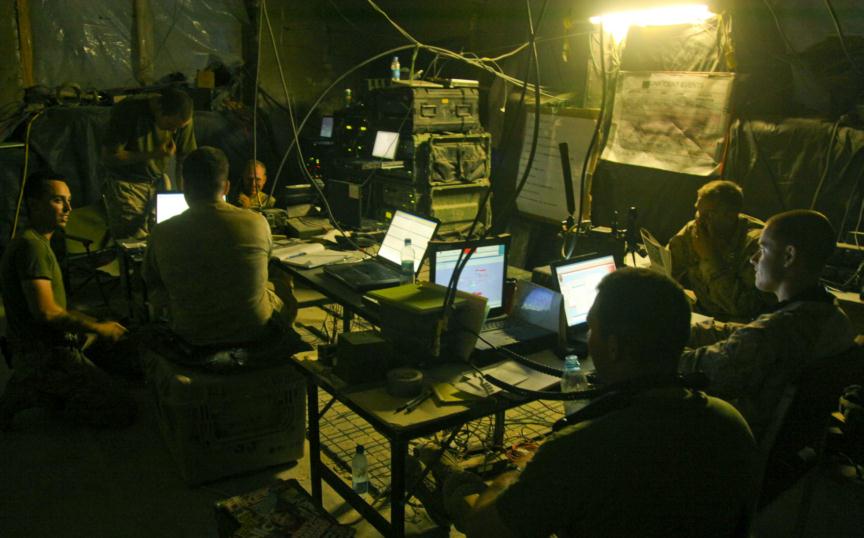
In practice, the Hertzian landscape is no isotropic plane.  Its heterogeneous in space and inconstant in time, and it has multiple, variable and even mobile terrestrial anchor points: some highly sophisticated and centralised (like the Combined Air Operations Center at Al Udeid), others improvisational, even jerry-rigged (see above), and yet others wholly absent (in the Uruzgan case the Joint Terminal Attack Controller with the Special Forces Detachment had no ROVER, a militarized laptop, and so he was unable to receive the video stream from the Predator).

Pierre and Alexander provide an ‘inventory of interferences’ that affected the Uruzgan strike:

‘Saturating the battlefield with multiple electro-magnetic signals from multiple sources, a Hertzian landscape begins to emerge in relief.  In this sense, it is interference – rather than clarity of signal – that best describes a synoptic and saturated environment according to the full repertoire of agencies and affects through which it is dynamically composed, transformed and reconstituted.’ (p. 276)

In fact, they don’t work with the ‘full repertoire of agencies’ because, like most commentators, their analysis is confined to the transcript of radio communications between the aircrews tracking the vehicles and the Joint Terminal Attack Controller on the ground.  Although this excludes testimony from the ground staff in superior command posts (‘operations centres’) in Kandahar and Bagram and from those analysing the video feeds in the continental United States, these actors were subject to the same interferences: but their effects were none the less different.  The catastrophic air strike, as Mitchell almost said, was ‘smeared across multiple sites’… a ‘smearing’ because the time and space in which it was produced was indistinct and inconstant, fractured and febrile.

Here, in summary form, are the interferences Pierre and Alexander identify, an inventory which they claim ‘renders the seemingly invisible and neutral space of the electromagnetic environment extremely social and deeply spatial’ (p. 319).  It does that for sure, but the the exchanges they extract from the transcripts do not always align with the general interferences they enumerate – and, as you’ll see, I’m not sure that all of them constitute ‘interferences’.

uruzgan-ac-130-002

uruzgan-ac-130-001

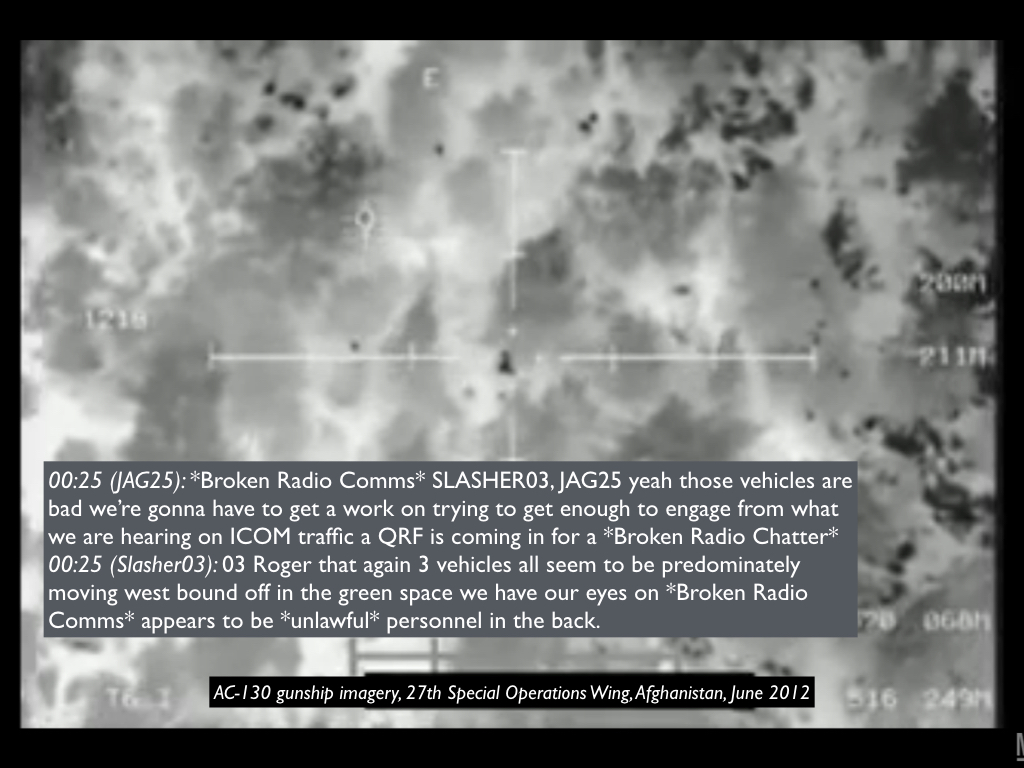
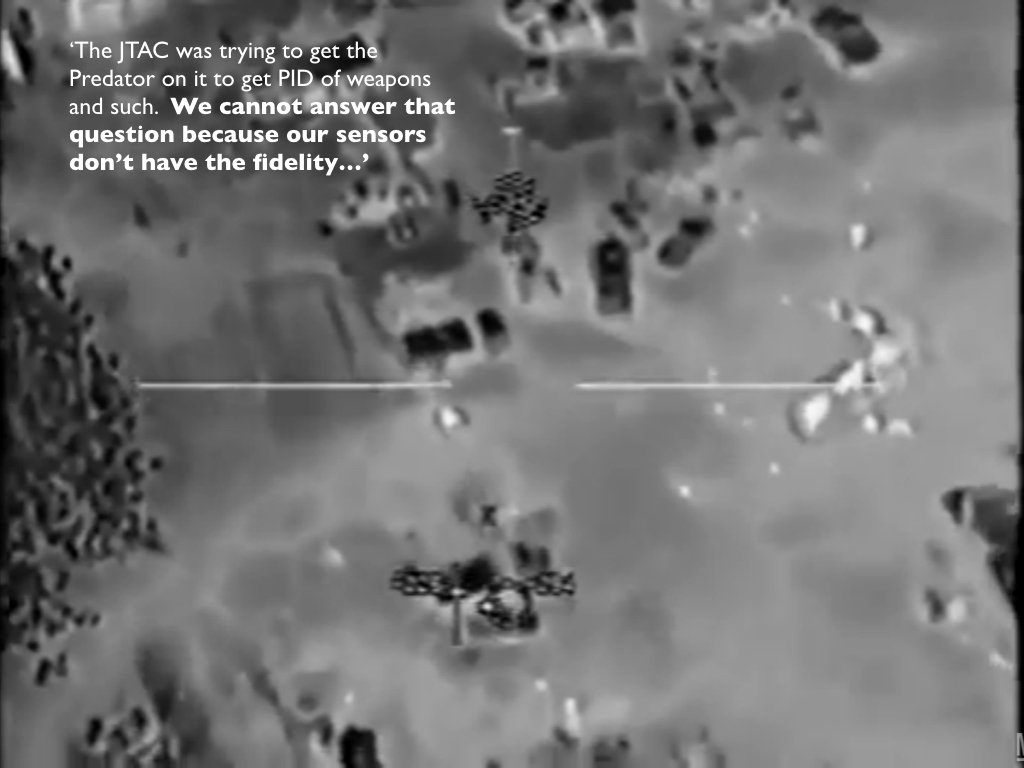
(1) Thermal interference:  The Predator started tracking the three vehicles while it was still dark and relied on infrared imagery to do so (so did the AC-130 which preceded them: see the images above).  Movement turns out to be ‘the key signature that differentiates an intensive landscape of thermal patterns into distinct contours and forces’, but it was not only the movement of the vehicles that mattered.  The crew also strained to identify the occupants of the vehicles and any possible weapons – hence the Sensor Operator’s complaint that ‘the only way I’ve ever been able to see a rifle is if they move them around when they’re holding them’ –  and the interpretation of the imagery introduced ‘novel semiotic complexities, discontinuities and indeterminacies’ (p. 280).

(2) Temporal interference: Times throughout the radio exchanges were standardised to GMT (‘Zulu time’), though this was neither the time at Creech Air Force Base in Nevada (-8 hours) nor in Uruzgan (+4 1/2 hours).  Hence all of those involved were juggling between multiple time zones, and the Sensor Operator flipped between IR and ‘full Day TV’.   ‘Yet this technical daylighting of the world [the recourse to Zulu time] is not always a smooth operation, always smuggling back in local, contingent temporalities into universal time from all sides’ (p. 281).

full-up-day-tv-001

(3) Electromagnetic interference: The participants were juggling multiple forms of communication too – the troops on the ground used multi-band radios (MBITRs), for example, while the aircrew had access to secure military chatrooms (mIRC) to communicate with bases in the continental United States and in Afghanistan and with other aircraft but not with the troops on the ground, while the screeners analysing the video stream had no access to the radio communications between the Ground Force Commander and the Predator crew – and the transcripts reveal multiple occasions when it proved impossible to maintain ‘multiple lines of communication across the spectrum against possible comms failure.’  But this was not simply a matter of interruption: it was also, crucially, a matter of information in one medium not being made available in another (though at one point, long before the strike, the Predator pilot thought he was on the same page as the screeners: ‘I’ll make a radio call and I’ll look over [at the chatroom] and they will have said the same thing.’)
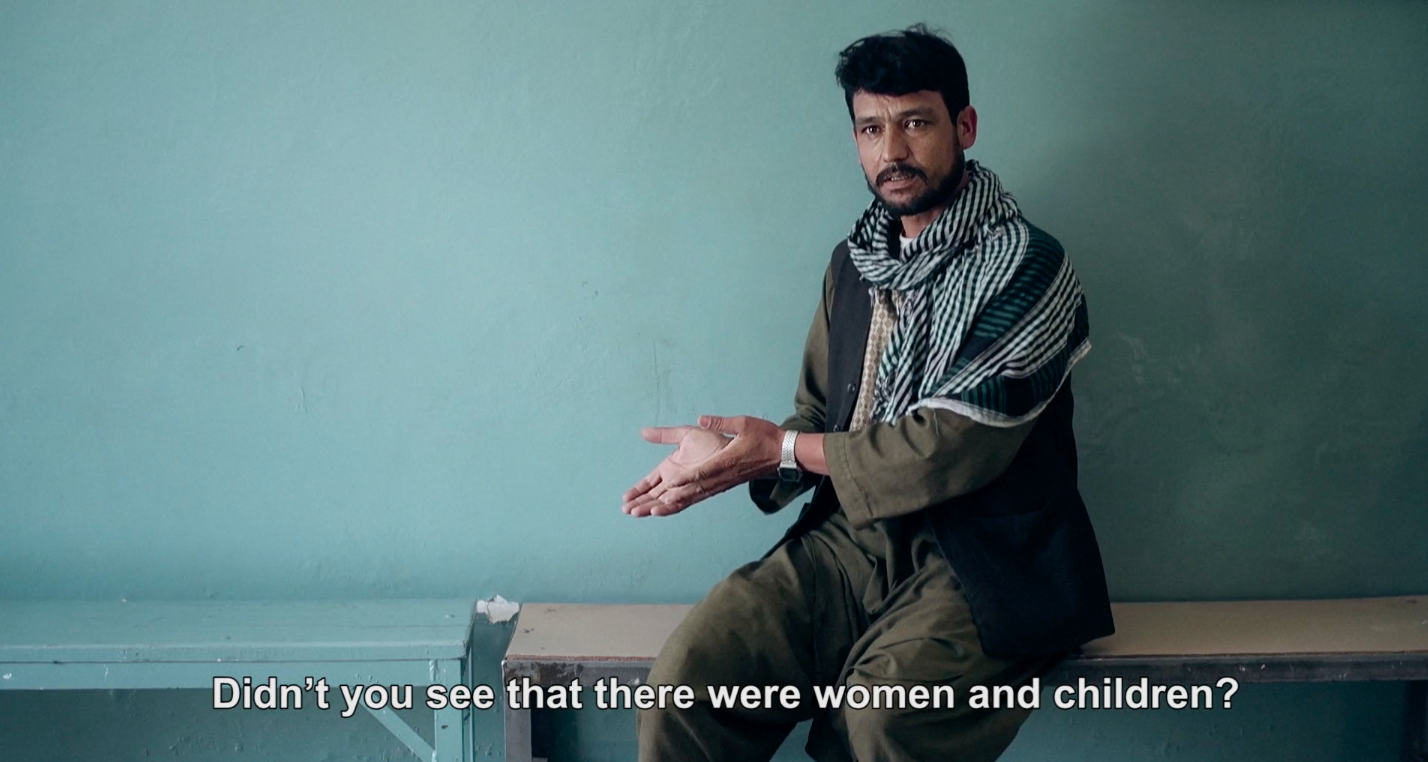
(4) Informational interference:  The transcript reveals multiple points of view on what was being seen – and once the analysis is extended beyond the transcript to those other operations centres the information overload (sometimes called ‘helmet fire’) is compounded.
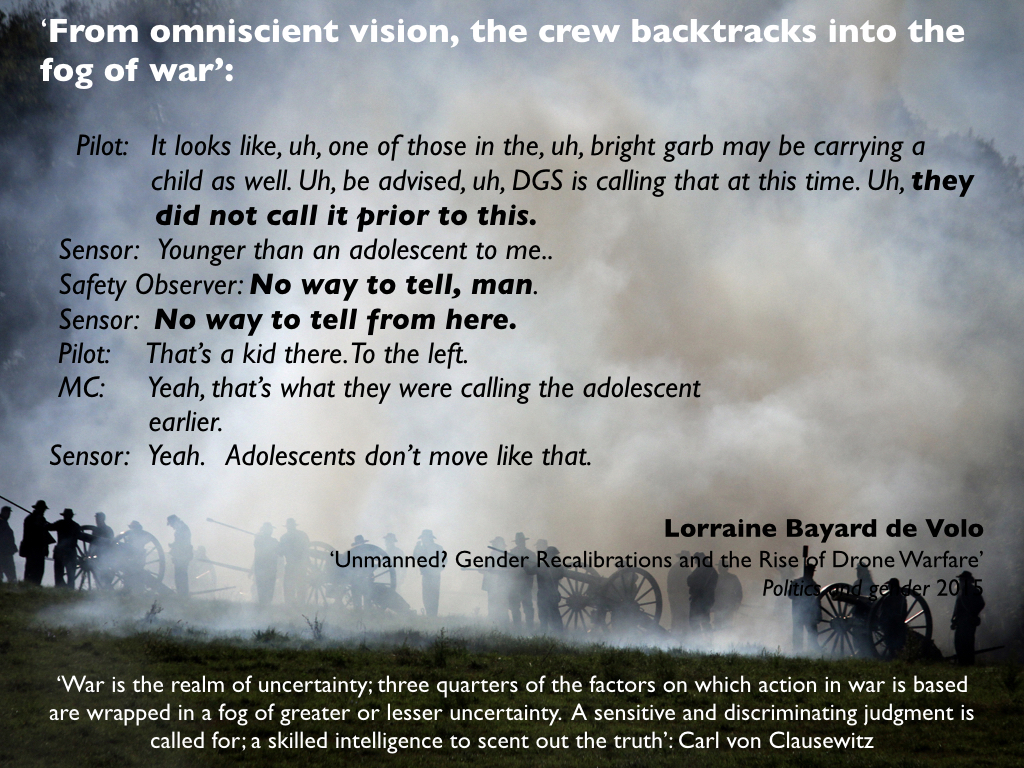
(5) Altitudinal, meteorologic interference:  The Predator’s altitude was not a constant but was changed to deconflict the airspace as other aircraft were moved into and out of the area; those changes were also designed to improve flight operations (remote platforms are notoriously vulnerable to changing weather conditions) and image quality.  There were thus ‘highly choreographed negotiations of and between contingently constituted spatial volumes – airspace – and [electro-magnetic] spectral spaces, both exploiting and avoiding the thickened electromagnetic atmospheres of communications systems and storms alike’ (p. 288).

(6) Sensorial interference:  When two strike aircraft (‘fast movers’) were sent to support the Special Forces, the Ground Force Commander ordered them out of the area in case they ‘burn’ (warn) the target; similarly, the OH-158 helicopters did not move in ‘low and slow’ to observe the three vehicles more closely in case that alerted their occupants.

 ‘While the acoustic space of [the Predator] personnel is characterised by speech and static, the occupation of spectral space generates another acoustic space for surface-bound targets of surveillance.  Each aircraft bears a particular acoustic signature … [and] in the absence of visual contact the whines, whirs and wails of encroaching aircraft warn targets of the content of communications… These disparate acoustic spaces reveal the asymmetry of sensory perception and heightened awareness between the graphic (visual) and acoustic channels’ (p. 289).

burning-the-target-001 burning-the-target-2-001

That asymmetry was accentuated because, as Nasser Hussain so brilliantly observed, the video feeds from the Predator were silent movies: none of those watching had access to the conversations between the occupants of the vehicles, and the only soundtrack was provided by those watching from afar.

(7) Orbital interference:  The crowded space of competing communications requires ‘specific orbital coordinations between patterns of  “orbiting” (circling) aircraft and satellites’ (p. 292), but this is of necessity improvisational, involving multiple relays and frequently imperfect – as this exchange cited by Pierre and Alexander indicates (it also speaks directly to (3) above):

02:27 (Mission Intelligence Coordinator MIC): Alright we need to relay that.

02:27 (Pilot): Jag that Serpent 12 can hear Fox 24 on sat in (muffled) flying

02:27 (Pilot): Jag 25 [JTAC on the ground], Kirk97 [Predator callsign]

02:27 (Unknown):..Low thirties, I don’t care if you burn it

02:27 (Sensor): “I don’t care if you burn it”? That really must have been the other guys talking [presumably the ‘fast movers’]

02:27 (JAG 25): Kirk 97, Jag 25

02:28 (Pilot): Kirk 97, go ahead

02:28 (Pilot): Jag 25, Kirk 97

02:28 (JAG 25):(static) Are you trying to contact me, over?

0228 (Pilot): Jag 25, Kirk97, affirm, have a relay from SOTF KAF [Special Operations Task Force at Kandahar Airfield] fires [Fires Officer], he wants you to know that he uhh cannot talk on SAT 102. Serpent 12 can hear Fox 24 on SATCOM, and is trying to reply. Also ,the AWT [Aerial Weapons Team] is spooling up, and ready for the engagement. How copy?

02:28 (JAG 25): Jag copies all

02:28(Pilot):K. Good.

02:29(Pilot): Can’t wait till this actually happens, with all this coordination and *expletive*

(agreement noises from crew)

02:29 (Pilot): Thanks for the help, you’re doing a good job relaying everything in (muffled), MC. Appreciate it

(8) Semantic interference:  To expedite communications the military relies on a series of acronyms and shorthands (‘brevity codes’), but as these proliferate they can obstruct communication and even provoke discussion about their meaning and implication (hence the Mission Intelligence Controller: ‘God, I forget all my acronyms’); sometimes, too, non-standard terms are introduced that add to the confusion and uncertainty.

(9) Strategic, tactical interference:  Different aerial platforms have different operational envelopes and these both conform to and extend ‘a strategic stratigraphy of airspace and spectral space alike’ (p. 296).  I confess I don’t see how this constitutes ‘interference’.

(10) Occupational interference:  The knowledge those viewing the Full Motion Video feeds bring to the screen is not confined to their professional competences but extends into vernacular knowledges (about the identification of the three vehicles, for example): ‘The casual fluency with which particular visuals signals are discussed, interpreted and mined for cultural information shows a broad base of vernacular technical knowledge’ (p. 297).  The example Pierre and Alexander give relates to a discussion over the makes of the vehicles they are tracking, but again I don’t see how this constitutes ‘interference’ – unless that vernacular knowledge collides with professional competences.  The most obvious examples of such a collision are not technical at all but reside in the assumptions and prejudices the crew brought to bear on the actions of those they were observing.  Some were ostensibly tactical – the investigation report noted that the crew ‘made or changed key assessments [about the intentions of those they were observing] that influenced the decision to destroy the vehicles’ and yet they had ‘neither the training nor the tactical expertise to make these assessments’  – while others were cultural (notably, a marked Orientalism).

(11) Physiological interference:  Here Pierre and Alexander cite the corporeality of those operating the Predator: the stresses of working long shifts (and the boredom), the rest breaks that interrupt the ‘unblinking stare’, and the like.

(12) Organizational interference:   At one point the Sensor Operator fantasised about having ‘a whole fleet of Preds up here… ripple firing missiles right and left’  but – seriously, ironically, grumpily: who knows? – adds ‘we’re not killers, we are ISR.’

were-not-killers-were-isr-001

Pierre and Alexander see a jibing of these two missions (though whether that justifies calling this ‘interference’ is another question): ‘Despite the blurry, hairline differences between [Intelligence, Surveillance and Reconnaissance] and kill-chain operations, the ontologies of informational and kinetic environments make for different occupational worlds altogether’ (p. 301).  I’m not sure about that; one of the key roles of Predators – as in this case – has been to mediate strikes carried out by other aircraft, and while those mediations are frequently complicated and fractured (as Pierre and Alexander’s inventory shows) I don’t think this amounts to occupying ‘different occupational worlds’ let alone provoking ‘interference’ between them.

(13) Geographic, altitudinal interference:  This refers to the problems of a crowded airspace and the need for deconfliction (hence the pilot’s call: ‘I got us new airspace so even if they do keep heading west we can track them’).

(14) Cognitive interference: Remote operations are characterised by long, uneventful periods of watching the screen interrupted by shorter periods of intense, focused strike activity – a cyclical process that Pierre and Alexander characterise as an ‘orbital tension of acceleration and deceleration [that] lies at the heart of the killchain’ that profoundly affects ‘cognitive processing in and of the volatile operational environment’ (p. 305).  For them, this is epitomised when the Mission Intelligence Coordinator typed ‘Killchain’ into mIRC and immediately cleared the chat window for all but essential, strike-related communications.

(15) Topographic, organizational interference: Pierre and Alexander claim that ‘the complex relief of the ground, that is terrain and topography, is magnified in remote-split operations’ – this is presumably a reference to the restricted field of view of those flying the platforms – and that this is paralleled by the different levels of command and control to which the crews are required to respond: ‘navigating competing command pyramids is taken in stride with maneuvering around mountains’  (p. 308).  These are important observations, but I don’t see what is gained by the juxtaposition; in the Uruzgan case the Predator was navigating mountainous terrain  (‘You got a mountain coming into view,’ the Safety Observer advises, ‘keep it in a turn’) but the crew was not responding to directives from multiple operations centres.  In fact, that was part of the problem: until the eleventh hour staff officers were content to watch and record but made no attempt to intervene in the operation.

(16) Demographic, physiologic interference:  Here Pierre and Alexander cite both the composition of the crews operating the remote platforms – predominantly young white men who, so they say, exhibit different inclinations to those of ‘conventional’ Air Force pilots – and the repeated identification of the occupants of the suspect vehicles as ‘Military-Aged Males (‘statistical stereotyping’) (p. 309).

uruzgan-survivor

[Still image from NATIONAL BIRD © Ten Forward Films]

(17) Motile interference: Pierre and Alexander treat the crew’s transition from a gung-ho desire to strike and an absolute confidence in target identification to confusion and disquiet once the possibility of civilian casualties dawns on them as a disjunctive moment in which they struggle to regain analytical and affective control: ‘The revelation of misinterpretation exposes the persistence of interference all along, and generates its own form of cognitive shock’ (p. 312).  This feeds directly into:

(18) Operational, ecological interference:  As the crew absorbed new information from the pilots of the attack helicopters about the presence of women and children in the vehicles they registered the possibility of a (catastrophic) mistake, and so returned to their ISR mission – taking refuge in their sensors, what they could and could not have seen, and bracketing the strike itself – in an attempt to screen out the discordant information: ‘The optic that initially occasioned the first identifiable instances of misinterpretation is re-activated as a kind of prosthetic inducer of cognitive distance’ (p. 313).  The exchange below (beautifully dissected by Lorraine de Volo) captures this almost therapeutic recalibration perfectly:

uruzgan-no-way-to-tell-from-here-001

(19) Political, epistemological interference:  Here the target is the cascade of redactions that runs through the unclassified version of the transcripts (and, by extension, the investigation report as a whole).  ‘That redaction and the strategic project it serves – secrecy in the form of classification – is not necessarily deployed electromagnetically does not mean its effects are limited to analog media’ since the objective is to command and control a whole ‘ecology of communication'(p. 316) (see my posts here and here).

This inventory is derived from a limited set of transactions, as I’ve said, but it’s also limited by the sensing and communication technology that was available to the participants at the time, so some caution is necessary in extrapolating these findings.  But the general (and immensely important) argument Pierre and Alexander make is that the catastrophic strike cannot be attributed to ‘miscommunication’ – or at any rate, not to miscommunication considered as somehow apart from and opposed to communication.  Hence their focus on interference:

‘Defined by moments of incoherence or interruption of a dominant signal that is itself a form of interference, interferences can take on different and often banal forms such as radio static, garbled signals, forgotten acronyms, misread gestures or even time lapses, which in the remote operational theaters of military missions result in disastrous actions.  Moreover, interference indexes the common media, forms, processes, and spaces connecting apparently disparate communication and signals across distinct material and operational environments.

In this sense, interference is not a subversion of communication but rather a constitutive and essential part of it.  Interference is thus both inhibitor and instigator.  Interference makes lines of communication read, alternatively, as field of interactions.  In this expanded field, interference may complexify by cancelling out communications, blocking or distorting signals, but conversely it may also amplify and augment both the content of sensed information and sensory receptions of the environment of communications.  Interference is what makes sensing ecologies make sense.’ (p. 318)

They also emphasise, more than most of us, that the ‘networks’ that enable drone strikes are three-dimensional (so reducing them to a planar map does considerable violence to the violence), that the connections and communications on which they rely are imperfect and inconstant in time and space, and that these extend far beyond any conventional (or even unconventional) ‘landscape’.  In general, I think, the critical analysis of drone warfare needs to be thickened in at least two directions: to address what happens on the ground, including the preparation of the ground, so to speak; and to reconstruct the fraught geopolitics of satellite communications and bandwidth that so materially shapes what is seen and not seen and what is heard and not heard.  More to come on both.