Theories and counter-theories of the drone

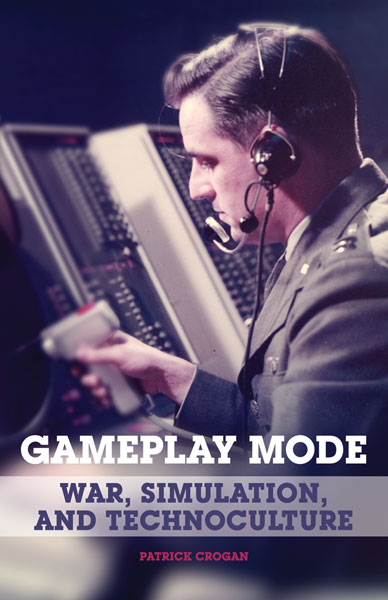
CROGAN Gameplay modeI expect many readers will know Patrick Crogan‘s Gameplay mode: war, simulation and technoculture (Minnesota, 2011).  He has now uploaded what I think is a draft of Drones and global technicity: automation and (dis)individuation at academia.  Here’s the extended abstract:

This paper (for General Organology conference [held last month at the University of Kent]) will explore the expansion of military drone usage by Western powers in the “war on terror” over the last decade or so in relation to Bernard Stiegler’s organological approach to questions concerning human historical, cultural and technological becoming.. Theorists approaching drones from different fields such as Grégoire Chamayou, Derek Gregory and Eyal Weizman have argued that the systematic and growing deployment of unmanned aerial vehicles should be understood as the “avant-garde” of a general movement toward remote and increasingly autonomous robotic systems by all branches of the armed forces of the U.S. and many of allies and competitors. These developments put into question all established cultural political, legal and ethical framings of war, peace, territory, civilian and soldier in the societies of the “advanced powers” on behalf of which these systems are deployed. Animating this indetermination is what Chamayou calls the “tendency inherent in the material development of drones” leading to this profound undoing of cultural and geopolitical moorings. I will explore the organological nature of this tendency inherent in drone materiality and technology, concentrating on the virtualizing, realtime digital developments in remotely controlled and increasingly automated robotic systems.

The projection of a simulational model of the contested space over the inhabited world is a constitutive part of this tendency. Indeed, the inhabitants of the spaces of concern in the war on terror—which in principle and increasingly in practice are everywhere—are better understood as environmental elements or “threats” in what simulation engineer and theorist Robert Sargent has called the “problem space” the computer simulation designer seeks to model conceptually in order to make the simulation serve as an effective solution. A specifically designed spatio-temporality is enacting a performative, “operational” and automated reinvention of the lived experience of both inhabiting and contesting the control of space in time.

If, as the above writers have shown, this projection of and over “enemy territory” has clear precedents in European colonialist strategies and procedures, what is unprecedented today is the digitally-enabled expansion and intensification of this spatio-temporal reanimation of the world. This reanimation must be understood as key contributor to a transformative and extremely problematic pathway toward the automation of military force projection across the globe. This essay will analyse the nature and implications of these transformative digital modellings of the enemy in and as milieu, a milieu as tiny as the space around a single ‘target’ and as large as the world, existing both in a brief “window of opportunity” and within a permanent realtime of preemptive pan-spectrum surveillance.

From an organological perspective developments in drone technics must also be approached as a particularly pressing political and ethical challenge of the global transformations of human technicity in the digital “epoch”—or rather, in the generalised crisis of epochality and spatio-temporal orientation that Stiegler sets out to thematise and respond to in his “philosophical activism”. If as Stiegler provocatively suggests in Technics and Time 1: The Fault of Epimetheus) human being had a “second origin” in the historical development of the West which achieved its culmination its “worldwide extension”, it is one whose epoch has led us tendentially and increasingly rapidly to the crisis of ethnocultural idiomatic differentiation and specificity (as he argues in Technics and Time 2: Disorientation). The history of Western techno-capitalist, imperial colonisations, wars and subsequent post-colonial globalisation is attaining its full extent and its exacerbation, readable in the above noted indeterminations of war, peace, sovereignty, citizenship and so on. What goes with this is a doubled movement (which Virilio termed “endocolonisation”) of intensification of the reorganisation of social and individual surveillance, control and regulation via realtime, pervasive digital technical regimes. The systematic deployment of computational abstraction, simulational virtualisation and anticipatory, realtime preemptive materialisation of this doubled movement is perceivable in all its cultural-political, conceptual and technological complexity in drone technics. Indeed, drones are a major driver of research and development in automation and AI for the spectrum of what the U.S.A.F calls the “perceive and act vector”, as well as for “big data” processing in realtime to handle ever-growing monitoring and surveillance feeds.

Today a voluntarist and cynical (and nihilist in Stiegler’s view) adoption of the automatising potentials of digital technics supports the rapid advances in drone systems (and I have proposed that an “elective naivety” sustains this in the academy, across scientific and humanities disciplinary contexts). From Stiegler’s organological perspective, I will argue that the autonomy of human agency is always composed with various automated functions that form part of our material, prosthetic conditions of existence. By addressing some of the inherent contradictions arising from the proposed development of fully autonomous military robotic systems, I hope to contribute toward the urgently needed “redoubling” of the first adoption of the possibilities of digital automation evidenced in drone technics (as the “logical” outcome in strategic-political terms of the latest advances of computer technology). To “re-double” technocultural becoming reflectively, critically, in the name of a less inhuman potential of automated digital technics is the responsibility of those able to read and write, to reflect and respond to the accelerating epochal transformation of the world in this “our” era of the permanent war on terror. This is the horizon in which “we” maintain the possibility of a non-inhuman future (or further “re-birth”) for contemporary humanity. For, as Stiegler has argued in What Makes Life Worth Living, this is a better way to think the present and future than that implied in the term “post-human”, for the human remains a project and a projection and not a superceded entity.
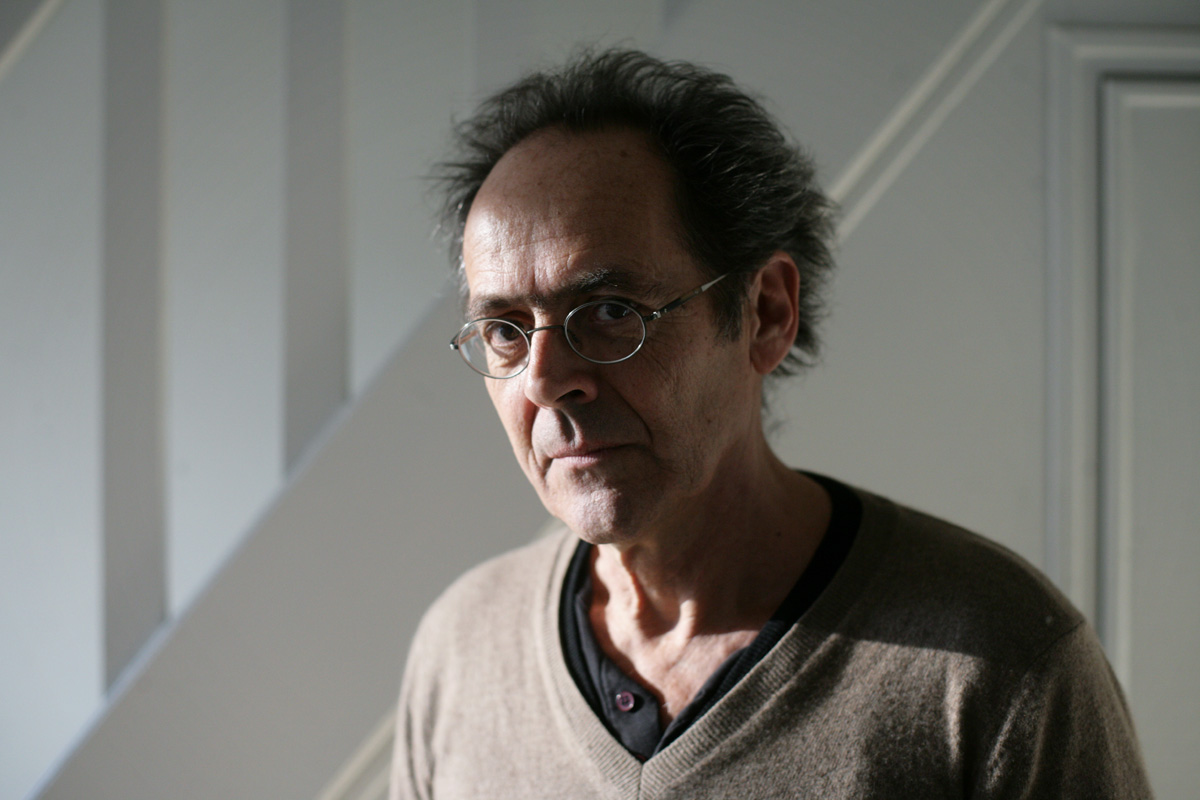
ac_bernard_stiegler_1200_02

Bernard Stiegler (above) was a keynote speaker at the conference, and if you want some tantalising glimpses into some of the other possibilities opened out by his ideas for the analysis of drones, I’d recommend James Ash, ‘Technology and affect: Towards a theory of inorganically organised objects’, Emotion, space and society (in press, 2014) – incidentally, James reviews Gameplay mode in Cultural politics 8 (3) (2012) 495-497 – and Sam Kinsley‘s ‘The matter of virtual geographies’, Progress in human geography (2014) 38 (3) (2014) 364-84.

As you can see from the abstract, Patrick also engages with my work and, crucially, Gregoire Chamayou‘s, and since the English-language translation of Theory of the drone is published at the end of this month I thought it might be helpful to list and link to my detailed commentaries on the book in one place, so here they are:

theory_of_the_drone_final

Theory of the drone 1: Genealogies

Theory of the drone 2: Hunting

Theory of the drone 3: Killing grounds

Theory of the drone 4: Pennies from heaven [on counterinsurgency/COIN]

 Theory of the drone 5: Vulnerabilities

Theory of the drone 6: Sacrifice, suicide and drones

Theory of the drone 7: Historical precedents and postcolonial amnesia

Theory of the drone 8: From invisibility to vulnerability

Theory of the drone 9: Psychopathologies of the drone

Theory of the drone 10: Killing at a distance
Theory of the drone 11: Necro-ethics

Theory of the drone 12: ‘Killing well’?

You can also find my essay on ‘Drone geographies’ from Radical Philosophy (2014) under the DOWNLOADS tab.

Jean-Baptiste Jeangène Vilmer‘s combative review of Theory of the drone, ‘Ideology of the drone’, is here and my extended commentary on that review is here.  Simon Labrecque provides another review here, invoking the USAF’s own description of its remote missions: ‘Projeter du pouvoir sans projeter de vulnérabilité.’

Meanwhile over at the Funambulist Papers, Stuart Elden suggested one way of wiring Grégoire’s previous book Manhunts to Theory of the drone here, while Grégoire’s own postscript (which suggests another route) is here.

Expect more commentary once the English edition is out.

Situation Rooms

I’m back from Europe at last, including a presentation of Angry Eyes at Hebbel am Ufer in Berlin.  It was a sort of Berlin Wall Exchange, and I had a wonderful time; my interlocutor was Martin Gak, who raised a series of probing and thoughtful questions about drones and military violence to which I plan to return, and I had some exhilarating conversations extending over two nights about HAU’s three performance spaces and in particular its investment in documentary drama.

gun_icon

Which brings me to Rimini Protokoll’s Situation Rooms playing at HAU 2 also as part of its Waffenlounge (‘Weapons Lounge’: its logo above uses a silhouette that must rank alongside the AK-47 as one of the most iconic – and in this case, of course, German – guns in the world; one of the aims of ‘Weapons Lounge’ is to drive home the point that, after the USA and Russia, Germany is the third largest arms exporter in the world).

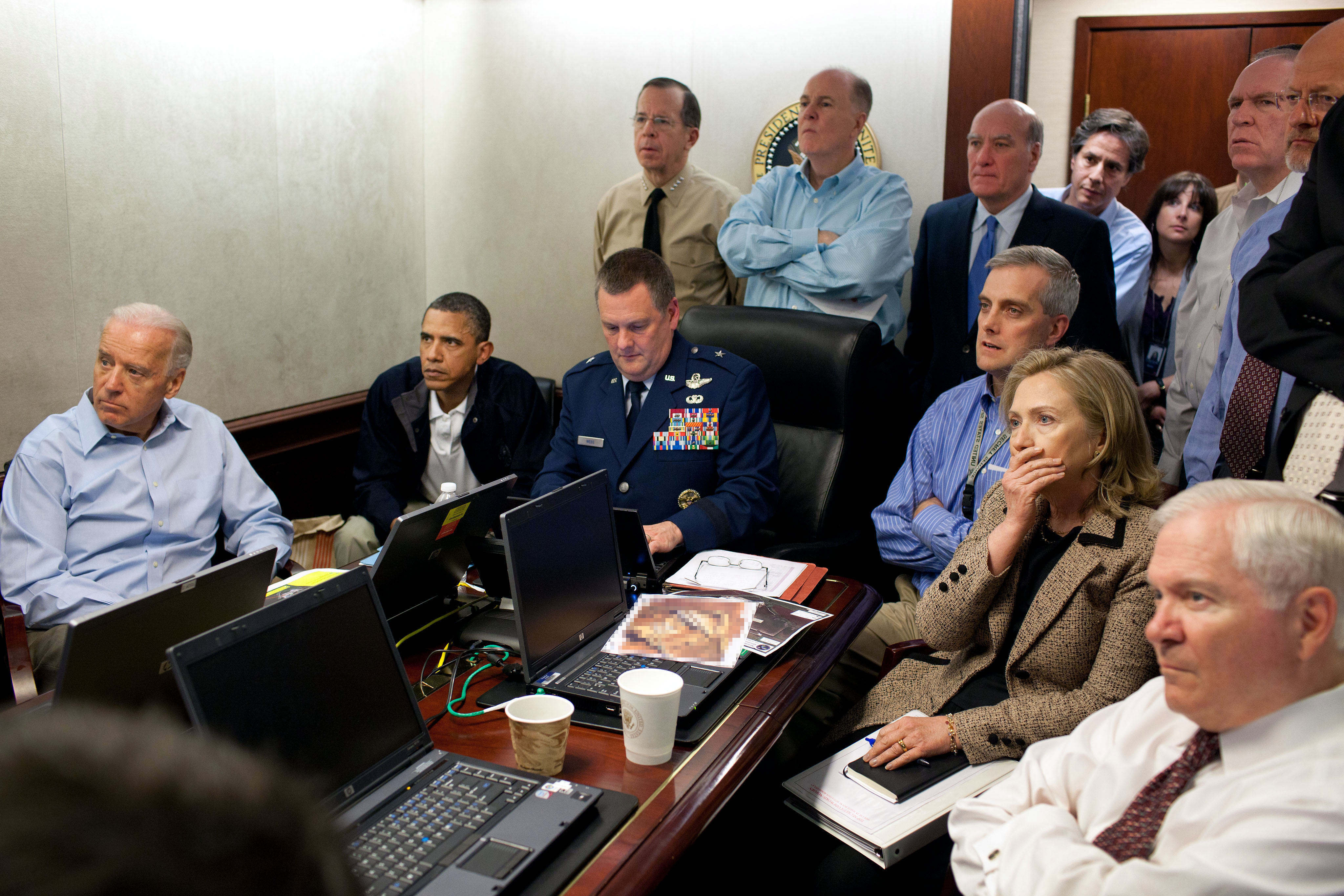
The title Situation Rooms is of course provoked by this famous image:

Obama_and_Biden_await_updates_on_bin_Laden

Here, incidentally, I recommend Keith Feldman‘s bravura reading in ‘Empire’s verticality: the Af/Pak frontier, visual culture and racialization from above‘ in Comparative American Studies 9 (4) (2011) 325-41; I’ll return to its relevance at the end.

But Situation Rooms provides an even more dispersed, global mapping of contemporary military violence:

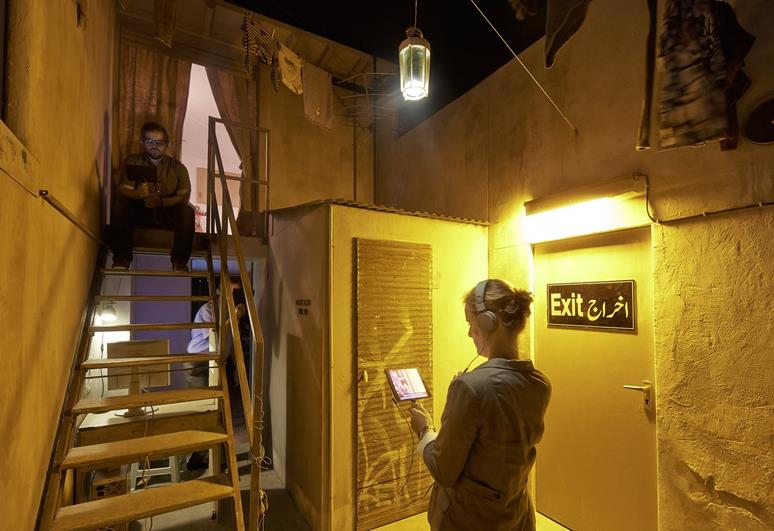
Situation Rooms gathers together from various continents 20 people whose biographies have been shaped by weapons in a film set that recreates the globalised world of pistols and rocket-propelled grenades, of assault rifles and drones, of rulers and refugees, becoming a parcours of unexpected neighbourhoods and intersections.

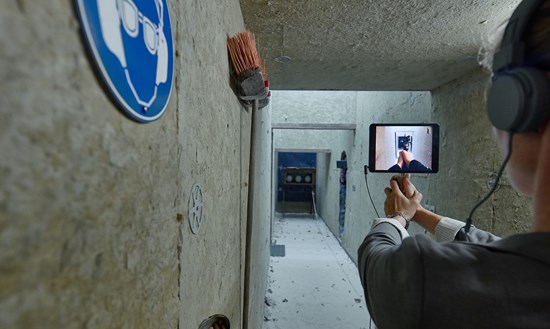
With the personal narratives of the ‘inhabitants’, the images start to move and the audience follows the individual trails of the cameras they have been given. They start to inhabit the building, while following what they see and hear on their equipment. The audience does not sit opposite the piece to watch and judge it from the outside; instead, the spectators ensnare themselves in a network of incidents, slipping into the perspectives of the protagonists, whose traces are followed by other spectators.
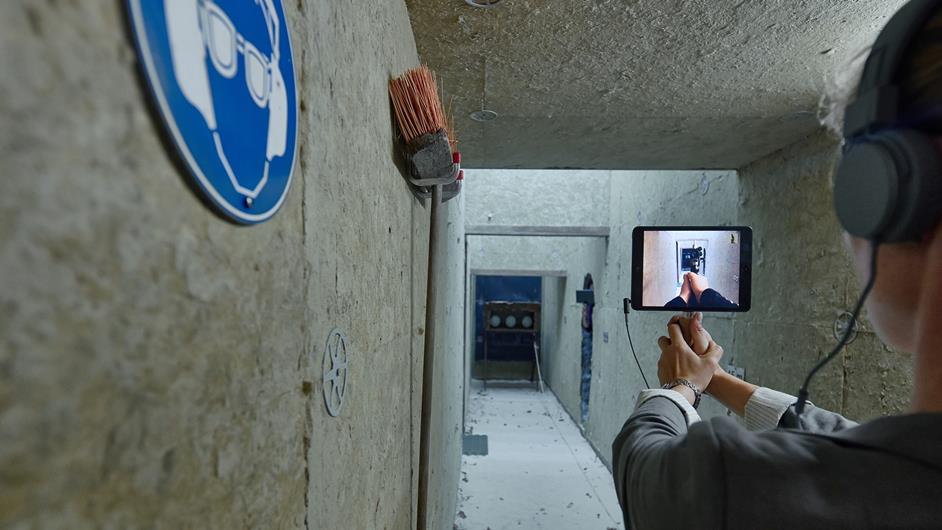
One spectator sits at the desk of a manager for defence systems. At the same time, another follows the film of a Pakistani lawyer representing victims of American drone attacks in a cramped room with surveillance monitors. On her way there, she sees a third spectator who follows his film into the shooting range of a Berlin gun club, listening Germany’s parcours shooting champion. Around the corner stands another spectator in the role of a doctor carrying out amputations in Sierra Leone, while in the room next door a press photographer sorts pictures of German army missions in Afghanistan, only to stand in the shooting range himself a little later to do exactly what he was able to observe in passing just a while ago, thereby becoming a subject for observation himself.

The audience gradually becomes entangled in the film set’s spatial and material labyrinth; each individual becoming part of the re-enactment of a complicatedly elaborated multi-perspective “shooting”.

rimini_protokoll_situation_rooms_3_jo_rg_baumann

As some readers will recognise, there are all sorts of formal parallels (as well as the obvious disjunctures) with Gerry Pratt and Caleb Johnston‘s  Nanay: a testimonial play – in staging, in evidentiary base – which was in fact performed at HAU in 2009 as well as in Vancouver and Manila.

You can read an extremely informative interview with Helgard Haug, Stefan Kaegi and Daniel Wetzel, the three architects of Rimini Protokoll, here, and what they have to say collectively about the politics of staging – about perspective, spectatorship and situation – is particularly illuminating:

‘We’re … creating a way to access what certain people, who have experience with weapons, arms trade, weapons use and war, have to say… It is not the experts that can be seen, but the situation in which they find themselves, from their perspective. That’s the shift. Instead of looking at a protagonist from outside, to a certain degree you look at an event “from inside”…

‘You hear their voices through headphones. On the iPad or as you walk through the rooms of the film set you see their typical work situations. The visitor is always following the path, so to speak, that the expert in each case has paved by narrating/filming. This kind of approach is quite different than it would be looking at these people from a comfortable theatre seat. The piece operates from the sentence that is often used to explain things in conflicts: Put yourself in my shoes! It is about creating a form of proximity that is also perhaps a bit disturbing…

‘You don’t look into a room from outside, but instead find yourself in it – in this case, although it’s theatre, there are four and not three walls. You also see the behaviour of other participants who are following the films of other experts. The 20 perspectives of the 20 experts collectively produce a sort of clockwork. The participant lands in a mechanism, and it has a certain rhythm. It jumps back to zero every 7 minutes. Then it moves the participant on into the perspective of a different expert, from which you can suddenly also observe the role that you had previously assumed.’

rimini_protokoll_situation_rooms_2_jo_rg_baumann-1

With good reason, this started me thinking about the multiple ‘situations’ folded into a single air strike orchestrated by a drone.  Daniel emphasises that the different situations are connected ‘through their lack of connectedness’, and yet what comes into view is precisely the dispersed, uneven and labile formation of what Foucault called a dispositif.  Daniel again:

‘First “you are” an off-duty general from the Indian Air Force. He sees drones as the military device of the future, a boon for humanity. Seven minutes later “you are” a Pakistani lawyer who represents victims of drone attacks and says that they trample on human rights…’

So the challenge for me, now, is to think about how I might stage the multiple situations that punctuate and animate the ‘incident’ in Afghanistan that I describe in Angry Eyes.… and, in particular, to incorporate the ‘situations’ of the Afghan victims who survived the attacks and who were treated in military hospitals for their awful injuries.

Thinking explicitly about how to stage all this is a way not only of presenting research differently but of conducting research differently.  Because once you start to think in these terms, you begin to see things that were otherwise at best at the very edges of your field of view.  Daniel insists that there is no overarching point of view, no ‘God trick’ (which, in a different register, is precisely what I sought to show in Angry Eyes):

‘The ten stories that everyone sees, the 20 stories [from which they are drawn], are also only a small excerpt from an infinite number of stories. What you see is an excerpt of an excerpt of an excerpt. What you don’t see, and the knowledge that there’s a lot that you don’t see – this is just as important as what you end up seeing. “Situation Rooms” is also a project at the interface of film and theatre.’

It’s also at the creative interface of the performing arts and critical research and I think offers another way of disclosing ‘Empire’s verticality’ and its imbrications with ‘Angry Eyes’…

Laboratories and assemblages

I’m on my way home from Bergen, where I was taking part in the Norsk Sakprosafestival (loosely, ‘Non-Fiction Festival’).  I gave a sawn-off version of ‘Angry eyes’, followed by a conversation with the ever-interesting Kristin Bergtora Sandvik, and took part in a panel discussion on ‘Freedom’ with Astri Suhrke, Kareem Amer, Jonny Steinberg, Ilan Pappe and Hilde Sandvik.  I had a marvellous time, and I’m deeply grateful to my hosts and especially Oyvind Vagnes for their warm welcome and generous hospitality.  This was the first time the festival has been held outside Oslo, and I hope it continues for many years to come.  It certainly deserves to do so.

the-lab-poster_for_internet

Over dinner, Ilan (whose new book is on ‘the largest prisons in the world’, Gaza and the West Bank) reminded me of an excellent film that I’d neglected to write about when it first came out – and given my previous post, and the horror of Gaza over the summer, it’s not too late to do so.

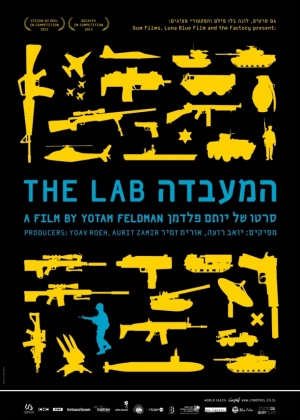
The film is Yotam Feldman‘s The Lab, which was released in North America in August.  Feldman writes:

The Lab is a cinematic investigation into the lure of Israeli weapons in the international arms trade. Why are countries all over the world lining up to buy Israeli arms? And how did such a small country become one of the biggest military exporters in the world? Israeli salesmen and executives in huge arms corporations seem eager to promote their products and pride themselves on their booming business. Profits have never been better — sales are doubling every year, and the potential seems unlimited.

But the product they are selling is unique. Rather than rifles, rockets or bombs, the Israeli companies sell their experience. The long-running conflict with the Palestinians has created a unique and unrivalled laboratory for testing technologies and ideas relating to “asymmetric warfare” — a conflict between a state and civil or irregular resistance. In this manner the Israeli conflict with the Palestinians may be seen as a national asset — rather than a burden…

While making the film, I witnessed the relationship between a network of military generals, politicians and private business; the use of current military operations as a promotional device for private business; the brutal employment of the Israeli experience, and the blurred lines between what is legitimate and forbidden in this line of business.

http://vimeo.com/65082874

You can read Jonathan Cook’s characteristically perceptive take on the film’s central argument here, from which I’ve taken the following extract:

The title relates to the film’s central argument: that Israel has rapidly come to rely on the continuing captivity of Palestinians in what are effectively the world’s largest open-air prisons.

The reason is that there are massive profits to be made from testing Israeli military innovations on the more than four million Palestinians in Gaza and the West Bank.

According to Feldman, that trend began with Operation Defensive Shield, Israel’s re-invasion of the West Bank and Gaza in 2002, which formally reversed the process of Israeli territorial withdrawals initiated by the Oslo accords.

Following that operation, many army officers went into private business, and starting in 2005 Israel’s arms industry started to break new records, at $2 billion a year.

But the biggest surge in sales followed Operation Cast Lead, Israel’s month-long assault on Gaza in winter 2008-09, which killed more than 1,400 Palestinians and 13 Israelis. Record sales in the wake of that attack reached $6 billion.

These military operations, including the most recent against Gaza, last year’s Pillar of Cloud, the film argues, serve as little more than laboratory-style experiments to evaluate and refine the effectiveness of new military approaches, both strategies and weaponry.

Gaza, in particular, has become the shop window for Israel’s military industries, allowing them to develop and market systems for long-term surveillance, control and subjugation of an “enemy” population.

But Feldman’s still sharper point is that this means that the claim ‘we are all Palestinians’ has a greater purchase than most of us realise:

The effects of Israeli theory and technology on other countries can hardly be overestimated. Forces choosing to employ Israeli-cultivated military techniques ultimately begin to alter their political and social circumstances. Therefore, countries all over the world are increasingly “Palestinizing” (or “Israelizing”) their conditions. Both sides — seller and buyer — become partners in the development of a form of future war between the state and civil resistance groups.

War, police and assemblages of intervention

This needs to be added to the mix when we (re)think about contemporary war/police assemblages – which is an appropriate note for me to cheer the publication today of War, police and assemblages of intervention, edited by Jan BachmannColleen Bell and Caroline Holmqvist.

This book reflects on the way in which war and police/policing intersect in contemporary Western-led interventions in the global South. The volume combines empirically oriented work with ground-breaking theoretical insights and aims to collect, for the first time, thoughts on how war and policing converge, amalgamate, diffuse and dissolve in the context both of actual international intervention and in understandings thereof.

The book uses the caption WAR:POLICE to highlight the distinctiveness of this volume in presenting a variety of approaches that share a concern for the assemblage of war-police as a whole. The volume thus serves to bring together critical perspectives on liberal interventionism where the logics of war and police/policing blur and bleed into a complex assemblage of WAR:POLICE. Contributions to this volume offer an understanding of police as a technique of ordering and collectively take issue with accounts of the character of contemporary war that argue that war is simply reduced to policing. In contrast, the contributions show how – both historically and conceptually – the two are ‘always already’ connected. Contributions to this volume come from a variety of disciplines including international relations, war studies, geography, anthropology, and law but share a critical/poststructuralist approach to the study of international intervention, war and policing.

Here’s what it contains (and you can see that The Lab adds a really important dimension to the discussion):

Assemblages of War:Police – An Introduction, Jan Bachmann, University of Gothenburg, Colleen Bell, University of Saskatchewan, Caroline Holmqvist, Swedish National Defence College

Part I: Ordering
1.The Police Power in Counterinsurgencies: Discretion, Patrolling, and Evidence, Colleen Bell, University of Saskatchewan

2. Policing Africa – The US Military and Visions of Crafting ‘Good Order’, Jan Bachmann, University of Gothenburg

3. Security Sector Reform (SSR) and the War:Police Assemblages of International Interventions, Marc Doucet, St. Mary’s University and Miguel de Larrinaga, University of Ottawa

Part II: Othering

4. The Enemy Live: A Genealogy, Laurence McFalls, University of Montreal and Mariella Pandolfi, University of Montreal

5. The Utility of Proxy Detentions in Counterinsurgencies, Laleh Khalili, School of Oriental and African Studies, University of London

6. Tribal Militias, Neo-Orientalism and the US Military’s Art of Coercion, Oliver Belcher, University of Oulu, Finland

7. Checkpoints and the Gendered Policing of ‘Civilized’ Nation-State Boundaries in Southern Thailand, Ruth Streicher, Free University of Berlin

Part III: Spatializing

8. A Mediterranean Police Assemblage, Barry J Ryan, Keele University

9. Air Power as Police Power, Mark Neocleous, Brunel University

10. Intervention and Ontological Politics: Security, Pathologization, and the Failed State Effect in Goma, Peer Schouten, University of Gothenburg and Kai Koddenbrock, University of Duisburg-Essen

Afterword: War and Crime, Military and Police: The Assemblage of Violence by Security? Didier Bigo, King’s College, University of London and Sciences Po

Wounding the world

BOURKE Wounding the world

Joanna Bourke‘s new book, Wounding the world, has just been published in the UK by Virago (the North American edition, re-titled Deep Violence: Military Violence, War Play, and the Social Life of Weapons, is due from Counterpoint early next year).

Wars are frequently justified ‘in our name’. Militarist values and practices co-opt us, permeating our language, invading our dream space, entertaining us at the movies or in front of game consoles. Our taxes pay for those war machines. Our loved ones are killed and maimed.

With killing now an integral part of the entertainment industry in video games and Hollywood films, war has become mainstream.

2014 marks the 100th anniversary of the declaration of the First World War, and with it comes a deluge of books, documentaries, feature films and radio programmes. We will hear a great deal about the horror of the battlefield. Bourke acknowledges wider truths: war is unending and violence is deeply entrenched in our society. But it doesn’t have to be this way. This book equips readers with an understanding of the history, culture and politics of warfare in order to interrogate and resist an increasingly violent world.

Here is the list of chapters:

PART ONE: WAR WITHOUT END

Introduction

PART TWO: THE SOCIAL LIFE OF WEAPONS

It’s only words

The circulation of violence

PART THREE: INCITEMENT TO MURDER

Kind-hearted Gunmen

Wounding the Innocent

The Dark Art of Ballistics

PART FOUR: MILITAINMENT

Playing War

Violent Gaming

PART FIVE: THE END OF WAR

Protest

You can read the introduction here, from which I’ve snipped this extract:

Our garrisons are maintained throughout the world and yet the military campaigns we wage abroad seem as real to most of us as the metaphorical wars on drugs or obesity. It is not uncommon to hear people waxing lyrical about the sanctity of life – including that of the two-cell embryo – while revering the troops on Remembrance Day. Militarist incursions into our ways of thinking, talking and enjoying ourselves are barely acknowledged. The blurring of entertainment and war, the infiltration of ‘violence-as-fun’ into the popular imagination (‘militainment’) and the advent of warbots – a generic term for drones, robotic weapons, unmanned vehicles, and suchlike – have led many of us to take for granted that war is without end and without borders. Unwittingly, we have effectively been turned into citizen-soldiers.

We have inherited a toxic genealogy. Its names are legion but its purpose is singular: violence. It is precisely its everyday nature – the way it creeps up on us by stealth – that makes it so powerful. But we are not merely passive observers, in thrall to a set of amorphous, militaristic ideologies or corrupting institutions. We are involved in the production of violence: it constitutes who we are and might be and, as such, can be resisted.

There is an early review by Yvonne Roberts in today’s Guardian here.

rimini_protokoll_situation_rooms_2_jo_rg_baumann

It’s a timely book in all sorts of ways, but I’m particularly pleased it’s available now because next month I’ll be in Berlin as part of Hebbel am Ufer’s Waffenlounge (Weapons Lounge):

After the USA and Russia, Germany is the third largest arms exporter in the world. The global market constantly demands better, more effective and ‘cleaner’ weapons. This month HAU Hebbel am Ufer is presenting a new production by Hans-Werner Kroesinger, “Exporting War,” as well as the Berlin premiere of “Situation Rooms,” a groundbreaking installation by Rimini Protokoll, created in co-production with HAU. Both works take up the paradoxical relationships that societies maintain to weapons, and both make use of personal biographies, current military conflicts as well as historical and political contexts. Under the motto “Weapons Lounge” HAU will also be presenting performances, installations, expert talks, and a project by the Houseclub with Kreuzberg pupils.

I’ll be talking about drones, but I’ve been thinking about what Joanna calls ‘the social life of weapons’ and also about the global arms trade (see my early post on ‘The death merchants’ here), so I’m looking forward to reading what she has to say.

Angry eyes

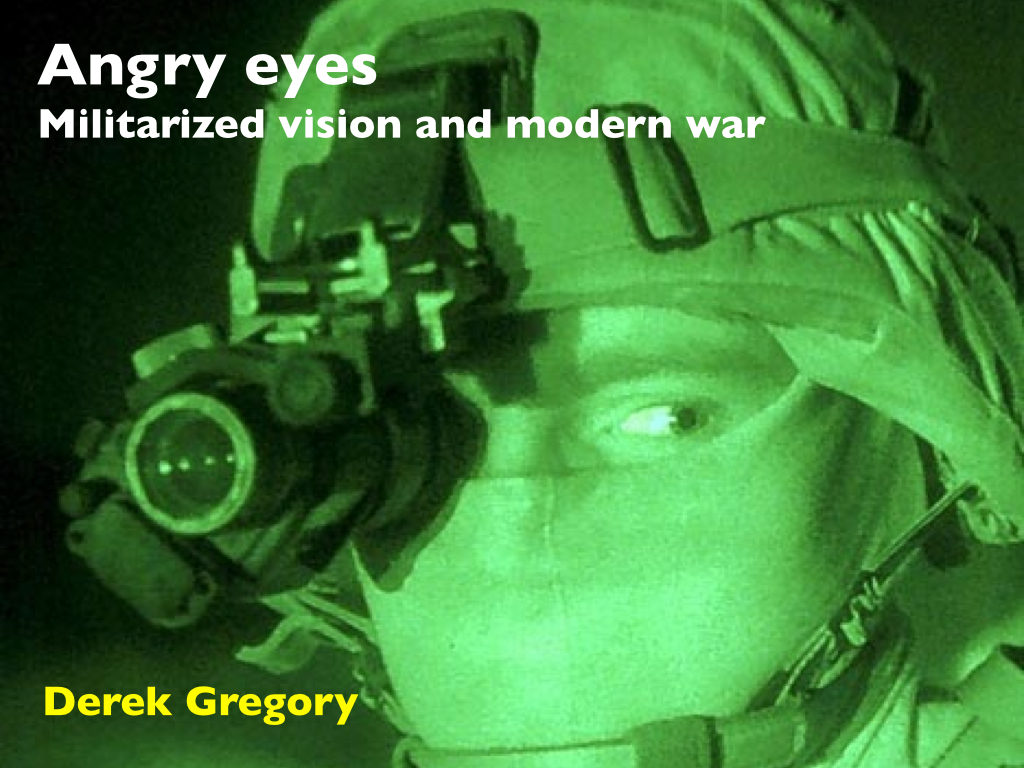
GREGORY Angry eyes JPEG.001

As part of my project on Militarized Vision I’ve been drawing together my work on two air strikes in Afghanistan in which the full motion video feeds from UAVs played a central role.  The first was an air strike in Uruzgan on 21 February 2010, which was carried out by two combat helicopters but mediated by video and commentary from a Predator and other eyes in the sky (the most thorough press account is by David Cloud here).  The second was a  ‘friendly fire’ incident in the Sangin valley on 5 April 2011 when a Predator strike claimed the lives of two US Marines (you can find an excellent summary account by David Cloud and David Zucchino here).

The two reports I’ve just cited were published in the LA TimesCombat by Camera series, but a close reading of the two official investigations – thousands of pages obtained through FOIA requests – inevitably shows that the stories were more complicated than the tag-line implies.  Still, for all the differences there are some remarkably close parallels between the two, and these have prompted me to revise (in radical ways) the analysis I originally offered in “From a view to a kill” (DOWNLOADS tab).

Searching for a title for the presentations I’m giving on this in October and November, I half-remembered a song called ‘Angry Eyes’.  When I tracked down the lyrics (by Kenny Loggins) I literally could not believe my eyes.  He obviously wasn’t writing about the US Air Force (or the Israeli), but it requires no great leap of the imagination to switch from love to violence:

Time, time and again
I’ve seen you starin’ out at me.

Now, then and again, I wonder
What it is that you see

[Chorus:]
With those Angry Eyes.
Well, I bet you wish you could
Cut me down with those Angry Eyes…

You want to believe that
I am not the same as you.
I can’t concieve, oh no,
What it is you’re tryin’ to do

[Chorus]

What a shot you could be if
You could shoot at me
With those Angry Eyes…

You tried to defend that
You are not the one to blame.

But I’m finding it hard, my friend,
When I’m in the deadly aim
Of those Angry Eyes.

So the presentations (here in Vancouver, and in Zurich and Bergen) will be called “‘Angry eyes’: militarized vision and modern war”.  As the image implies, there’s more to this than full motion video displays, and I’m also going to try to say something about the genealogy of what Paul K. Saint-Amour calls ‘optical war’ (and its distance from the corpographies of ‘boots on the ground‘).

More on all this later, when I’ve finished the essay that I am presently spinning off the presentations with the same title; it’s the last thing I have to do for “The everywhere war” (I hope).

Atlas wept

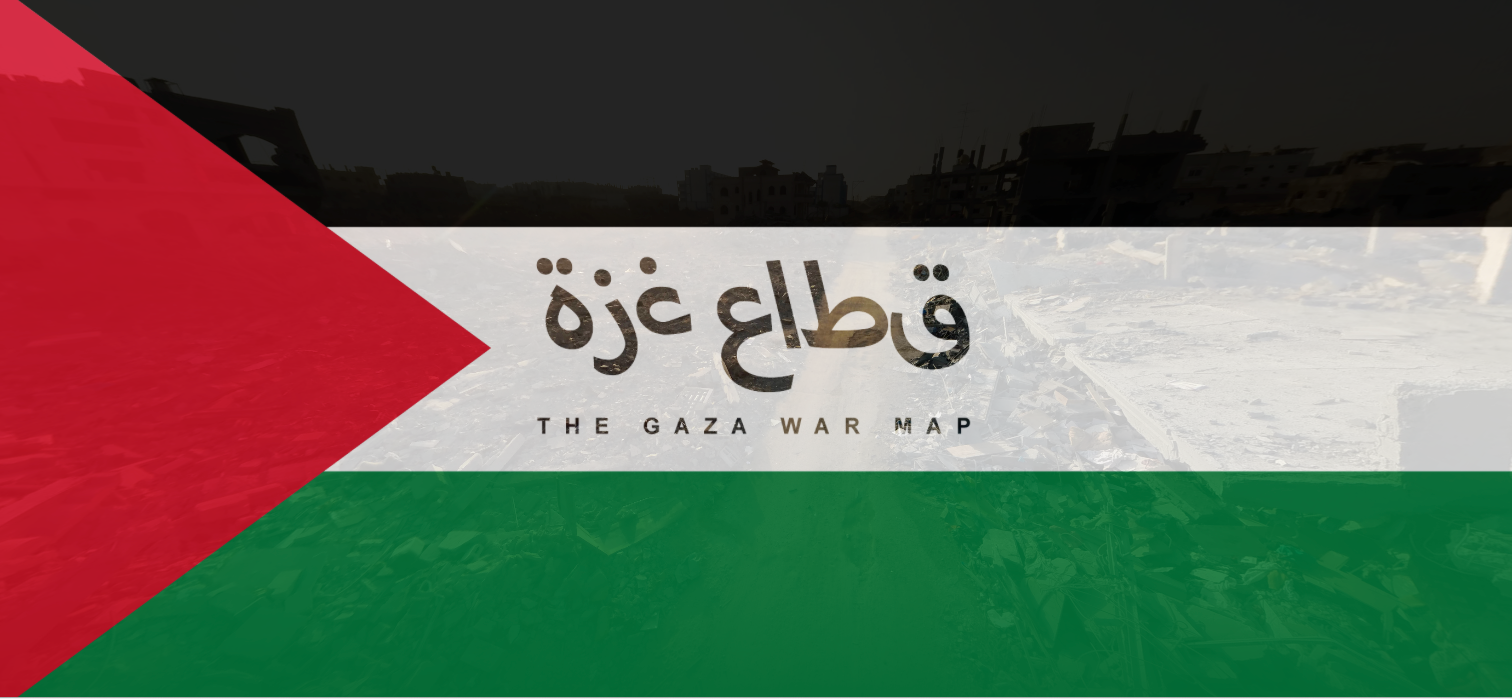
The Gaza War Map

To grasp the catastrophic scope of destruction in Gaza, there are three new resources of exceptional importance.  First, Lewis Whyld‘s The Gaza War Map: it’s an interactive map keyed to a series of panoramic images which transports you to 20 sites from Beit Hanoun south to Rafeh and it is, appropriately, devastating.

Gaza Crisis Atlas

Second, the UN’s Office for the Coordination of Humanitarian Affairs has released its Gaza Crisis Atlas: 110 pages of maps and high-resolution satellite imagery.  It’s a remarkably systematic survey, whose primary purpose is to assist aid and development agencies in planning and responding to the crisis, but it’s also an indispensable resource for anyone wanting to grasp the intensity of the prolonged Israeli assault on Gaza and its people.  The text and captions are available in eight languages, and you can zoom and print individual pages.

Finally, there’s MediaTown‘s drone-shot video of the destruction of Al-Shejaiya; its brevity does not sacrifice its impact:

Even hardened US military officers were stunned by the unrelenting and indiscriminate nature of the bombardment.  Throughout the offensive the Pentagon compiled reports twice a day on Israeli military operations, and according to a summary of the barrage on 20-21 July ’11 Israeli artillery battalions …  pumped at least 7,000 high explosive shells into the Gaza neighborhood, which included a barrage of some 4,800 shells during a seven-hour period at the height of the operation…’

That amounts to shelling Al-Shejaiya every six seconds FOR SEVEN HOURS (more from Kerry-anne Mendoza among the ruins of Al-Shejaiya here, and more imagery from Occupied Palestine here).

Al-Jazeera reports:

“Eleven battalions of IDF artillery is equivalent to the artillery we deploy to support two divisions of U.S. infantry,” a senior Pentagon officer with access to the daily briefings said. “That’s a massive amount of firepower, and it’s absolutely deadly.” Another officer, a retired artillery commander who served in Iraq, said the Pentagon’s assessment might well have underestimated the firepower the IDF brought to bear on Shujaiya. “This is the equivalent of the artillery we deploy to support a full corps,” he said. “It’s just a huge number of weapons.”

Artillery pieces used during the operation included a mix of Soltam M71 guns and U.S.-manufactured Paladin M109s (a 155-mm howitzer), each of which can fire three shells per minute. “The only possible reason for doing that is to kill a lot of people in as short a period of time as possible,” said the senior U.S. military officer. “It’s not mowing the lawn,” he added, referring to a popular IDF term for periodic military operations against Hamas in Gaza. “It’s removing the topsoil.”

“Holy bejeezus,” exclaimed retired Lt. Gen. Robert Gard when told the numbers of artillery pieces and rounds fired during the July 21 action. “That rate of fire over that period of time is astonishing. If the figures are even half right, Israel’s response was absolutely disproportionate.” A West Point graduate who is a veteran of two wars and is the chairman of the Center for Arms Control and Non-Proliferation in Washington, D.C., he added that even if Israeli artillery units fired guided munitions, it would have made little difference.’

Before I let Gard continue, it’s important to remember that the onslaught did not end that night.  Here is a remarkable video which shows the shelling of Shejaiya market on 30 July (more updates and images from #shejaia here).  Imagery of Shejaiya before and after the bombardment was distributed to Israeli soldiers in Brigade 828 as ‘a victory momento‘ and spur to maintain their ‘fighting spirit’.

Gard goes on to explain the circular error probable (CEP) of munitions and the blast and fragmentation or ‘kill radius’, which I’ve discussed here (scroll down for the ‘kill radius’):

Even the most sophisticated munitions have a circular area of probability, Gard explained, with a certain percentage of shells landing dozens or even hundreds of feet from intended targets. Highly trained artillery commanders know this and compensate for their misses by firing more shells. So if even 10 percent of the shells fired at combatants in Shujaiya landed close to but did not hit their targets — a higher than average rate of accuracy — that would have meant at least 700 lethal shells landing among the civilian population of Shujaiya during the night of July 20 into June 21. And the kill radius of even the most precisely targeted 155-mm shell is 164 feet. Put another way, as Gard said, “precision weapons aren’t all that precise.”

Senior U.S. officers who are familiar with the battle and Israeli artillery operations, which are modeled on U.S. doctrine, assessed that, given that rate of artillery fire into Shujaiya, IDF commanders were not precisely targeting Palestinian military formations as much as laying down an indiscriminate barrage aimed at cratering the neighborhood. The cratering operation was designed to collapse the Hamas tunnels discovered when IDF ground units came under fire in the neighborhood. Initially, said the senior Pentagon officer, Israel’s artillery used “suppressing fire to protect their forward units but then poured in everything they had, in a kind of walking barrage. Suppressing fire is perfectly defensible. A walking barrage isn’t.”

The implication of those closing remarks is that such an indiscriminate barrage is a clear violation of international humanitarian law: and the epic scale of that violation is made clear in the maps, imagery and video I’ve cited here.  It also amounts to collective punishment of a whole community, so it comes as no surprise to discover that the Israeli Supreme Court (‘sitting as the High Court of Justice’ – a phrase that has the same moral resonance as the Israeli Defence Force) has recently endorsed the ‘deterrent function’ of collective punishment (even though it too is prohibited under international humanitarian law).  But even the Court insisted that such a measure had to be ‘proportionate’.

All of this is much on my mind as I head to a meeting in Oulu, Finland, where I’ll be talking about ‘Trans-border transgressions: legal geographies and spaces of exception’.   The case studies on which I’ll draw are the Federally Administered Tribal Areas of Pakistan (mainly Waziristan) and Gaza.  More soon.

War comes home

martha_rosler_2

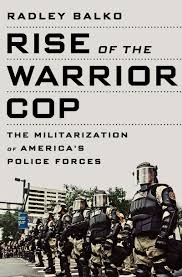
The debate over the militarisation of policing in the United States that has been sparked by the shooting of a young Afro-American by a white police officer in Ferguson, Missouri increasingly cites Radley Balko‘s Rise of the warrior cop: the militarisation of America’s police forces.  It was published last year to considerable acclaim, and last August the Wall Street Journal‘s Saturday Essay featured what was, in effect, Balko’s three-minute version.

BALKO Rise of the warrior copSince the 1960s, in response to a range of perceived threats, law-enforcement agencies across the U.S., at every level of government, have been blurring the line between police officer and soldier. Driven by martial rhetoric and the availability of military-style equipment – from bayonets and M-16 rifles to armored personnel carriers – American police forces have often adopted a mind-set previously reserved for the battlefield. The war on drugs and, more recently, post-9/11 antiterrorism efforts have created a new figure on the U.S. scene: the warrior cop – armed to the teeth, ready to deal harshly with targeted wrongdoers, and a growing threat to familiar American liberties.

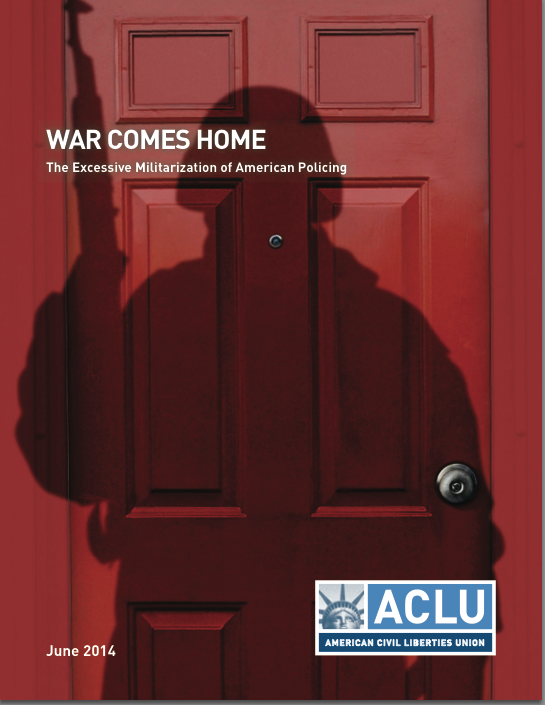
So far, so familiar – and by no means confined to the United States.  There the present debate seems to have been conducted in an intellectual vacuum.  When ‘Warrior cop’ was published, Glenn Greenwald wrote that ‘there is no vital trend in American society more overlooked than the militarization of our domestic police forces’, and he’s since repeated the claim (though he does acknowledge the ACLU report produced earlier this year, War Comes Home: the excessive militarization of American policing (see also Matthew Harwood‘s ‘One Nation Under SWAT’ here – he’s a senior writer/editor at the ACLU).

ACLU War comes home

I suspect the debate could be advanced, both politically and intellectually, by including two other (academic) voices that approach the situation from two different directions.  One is Steve Graham‘s Cities under siege: the new military urbanism (2010), which starts from new constellations of military violence, and the other is Mark Neocleous‘s War power, police power (2014), which starts from a wider conception of policing than has figured in the present discussion. Doing so would also enable the role of racialisation – which flickers in the margins of both accounts – to be given the greater prominence I think it deserves.  But it would also considerably sharpen talk of war ‘coming home’, as though it ever left

For now, though, let me make two further points.  One is about the need to enlarge the conventional conception of the military-industrial complex.  It has already been extended in all sorts of ways, of course – the Military-Industy-Media-Entertainment complex (MIME) and the Military-Academic-Industrial-Media complex (MAIM) to name just two – but it has become increasingly clear that the producers and designers of military equipment also have domestic police forces in their sights (sic).

It’s a complicated business, because on one side there is an active Department of Defense program that, since 1990, has channelled surplus military equipment to state and local police departments in the United States: more details from Shirley Li here.  The New York Times has a sequence of interactive maps showing the spread of everything from aircraft and armoured vehicles through grenade launchers and assault rifles to body armour and night vision goggles (the accompanying article is here).  The map below is just one example, showing the transfer of armoured vehicles:

Armoured vehicles transferred from US military to US police departments

On the other side, there’s also an active market for new equipment – and some of the latest ‘toys for the boys‘ (see also here) include drones (at present unarmed versions only for intelligence, surveillance and reconnaissance).  Jane’s, widely acknowledged as an indispensable global database on military equipment and platforms, now advertises a new guide dedicated to ‘Police and Homeland Security Equipment’:

Jane’s Police & Homeland Security Equipment delivers a comprehensive view of law enforcement and paramilitary equipment in production and service around the world, providing A&D businesses with the market intelligence that drives successful business development, strategy and product development activity, and providing military, security and government organizations with the critical technical intelligence that they need in order to develop and maintain an effective capability advantage….

Profiles of more than 2,200 types of law enforcement equipment and services around the world, including firearms, body armor, personal protection, riot and crowd control equipment, communications, security equipment and biometric solutions, make Jane’s Police & Homeland Security Equipment the most comprehensive and reliable source of police equipment technical and program intelligence.

There is a genealogy to all of this, of course, which means there is important work to be done in tracing the historical pathways through which both offensive and defensive materials have migrated from external uses (by the military) to internal uses (by the police).  This breaches one of the canonical divides of the liberal state, a rupture signalled by the hybrid term ‘security forces’, but it has been going on for a long time.

Anna FeigenbaumIn an excellent essay – a preview of her book, Tear Gas: 100 years in the making, due out from Verso next year – Anna Feigenbaum shows how tear gas drifted from the battlefields of France and Belgium onto streets around the world.  The French were the first to use toxic gas shells on a large scale – engins suffocants – which discharged tear gas; in most cases the effects were irritating rather than disabling, and when the Germans used similar shells against the British in October 1914 at Neuve Chapelle they too proved largely ineffective.

These were ‘Lilliputian efforts’, according to historian Peter Bull, and experiments by both sides with other systems were aimed at a greater and deadlier harvest.  You can find much more on the use of lethal gas on the battlefield from Ulrich Trumpener, ‘The road to Ypres’, Journal of modern history 47 (1975) 460-80; Tim Cook, No place to run: the Canadian Corps and gas warfare in the First World War (Vancouver: UBC Press, 1999) – which despite its title is much less Canuck-centric than it might appear; Jonathan Krause, ‘The origins of chemical warfare in the French Army’, War in history 20 (4) (2013) 545-56; and Edgar Jones, ‘Terror weapons: the British experience of gas and its treatment in the First World War’, War in history 21 (3) (2014) 355-75.

But many military officers realised that tear gas had other potential uses, and Anna shows that the process of repatriation and re-purposing began even before the First World War had ended:

By the end of the 1920s, police departments in New York, Philadelphia, Cleveland, San Francisco, and Chicago were all purchasing tear-gas supplies. Meanwhile, sales abroad included colonial territories in India, Panama, and Hawaii.

With this new demand for tear gas came new supply. Improved tear-gas cartridges replaced early explosive models that would often harm the police deploying them….

Leading American tear-gas manufacturers, including the Lake Erie Chemical Company founded by World War I veteran Lieutenant Colonel Byron “Biff” Goss, became deeply embroiled in the repression of political struggles. Sales representatives buddied up with business owners and local police forces. They followed news headlines of labor disputes and traveled to high-conflict areas, selling their products domestically and to countries such as Argentina, Bolivia, and Cuba. A Senate subcommittee investigation into industrial-munitions sales found that between 1933 and 1937, more than $1.25 million (about $21 million today) worth of “tear and sickening gas” had been purchased in the U.S. “chiefly during or in anticipation of strikes.”

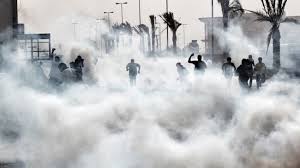
Tear gas against protesters in Bahrain

Anna continues the story through the Second World War and the Vietnam War (where in an unremarked irony tear gas was used against anti-war demonstrations) and down to the present, but you get the (horrible) idea.  She closes with the supreme irony:

Yet while tear gas remains banned from warfare under the Chemical Weapons Convention, its use in civilian policing grows. Tear gas remains as effective today at demoralizing and dispersing crowds as it was a century ago, turning the street from a place of protest into toxic chaos. It clogs the air, the one communication channel that even the most powerless can use to voice their grievances.

This brings me to my second point, and it’s one that both Steve and Mark sharpen in different ways: the militarization of policing is not only about weapons but also about the the practices in which they are embedded.  One place to start such an investigation would be the cross-over in what the military calls doctrine.  There’s many a slip between doctrine on the books and practice on the streets.  But Public Intelligence has recently published U.S. Army Techniques Publication 3-39.33: Civil Disturbances, which will now repay even closer reading.  The cross-overs between counterinsurgency, counter-terrorism and police operations against organised crime are now a matter of record – and I’ve discussed these on several occasions (see here and here) – but 3-39.33 is perhaps most revealing in its preamble:

ATP 3-39.33 provides discussion and techniques about civil disturbances and crowd control operations that occur in the continental United States (CONUS) and outside the continental United States (OCONUS)….Worldwide instability coupled with U.S. military participation in unified-action, peacekeeping, and related operations require that U.S. forces have access to the most current doctrine and techniques that are necessary to quell riots and restore public order.

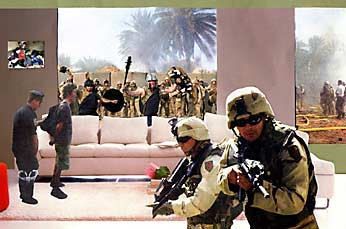
Which is where I came in…  These are just preliminary jottings, and there’s lots more to say – and lots more to consider (as the Martha Rosler photomontage at the top of this post implies: it’s from her 2004 series Bringing the War Home: House Beautiful, which carries an implicit plea to attend to their homes and their streets not just ‘ours’ ) – so watch this space.

UPDATE:  See Stuart Schrader‘s elegant short essay on ‘Policing Empire’ at Jacobin:

‘… we should be skeptical of calls for police reform, particularly when accompanied by cries that this (militarization) should not happen here. A close look at the history of US policing reveals that the line between foreign and domestic has long been blurry. Shipping home tactics and technologies from overseas theaters of imperial engagement has been a typical mode of police reform in the United States. When policing on American streets comes into crisis, law-enforcement leaders look overseas for answers. What transpired in Ferguson is itself a manifestation of reform.

From the Philippines to Guatemala to Afghanistan, the history of US empire is the history of policing experts teaching indigenous cops how to patrol and investigate like Americans. As a journalist observed in the late 1950s, “Americans in Viet-Nam very sincerely believe that in transplanting their institutions, they will immunize South Viet-Nam against Communist propaganda.” But the flow is not one-way: these institutions also return home transformed.’

Thanks to Alex Vasudevan for the tip.

Deadly improvisations

There is nothing refined about killing, but the war in Syria has shown that both sides have resorted to improvisational tactics.  I say ‘both sides’ as a short-hand: this is hardly a two-party conflict, since the anti-Assad forces are far from united and a number of external powers – not only Iran and Saudi Arabia – are plainly using the parties as players in a proxy war.

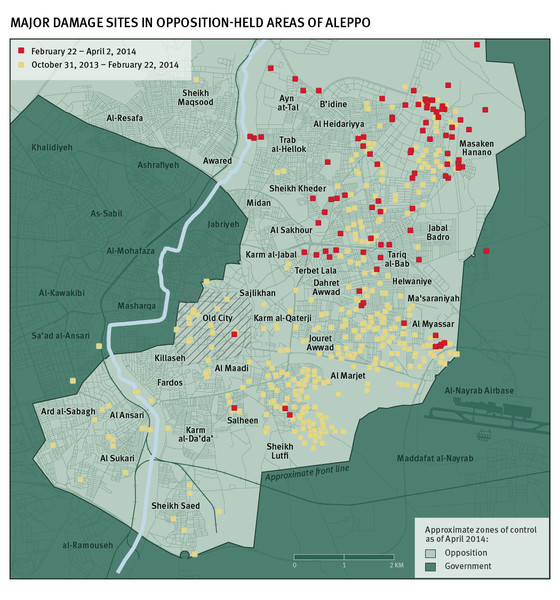
One of the first signs was the Syrian Air Force’s use of so-called ‘barrel bombs’: in effect, these are improvised explosive devices made from oil barrels filled with crude explosive and, on occasion, metal shrapnel and even chemicals like chlorine, which are then dropped from helicopters.  At first, they were dropped from low altitudes – which, according to Richard Lloyd at least, made them accurate enough to strike particular targets – but once the rebels were equipped with rocket-launchers (MANPADs) the helicopters had to fly much higher (near 7,000 feet) with a corresponding diminution in accuracy.  The first attacks took place against the city of Homs in August 2012, but the locus then shifted to rebel-held areas in Aleppo – the map below comes from Human Rights Watch‘s forensic analysis of strikes against that city between October 2013 and April 2014; some of the sites identified may have been struck by other munitions, HRW concedes, including conventional bombs, mortars and artillery shells, but the vast majority reveal the characteristic signature of the indiscriminate deployment of barrel bombs.  The Syrian National Council estimates that 20,000 people have been killed by barrel bombs thus far.

Aleppo Barrel Bombs (Human Rights Watch)

Since the Syrian Air Force has been supplied with conventional bombs by both Russia and Iran, many commentators have concluded that the recourse to crude barrel bombs is not the result of any munitions shortage but is rather a determined attempt to spread indiscriminate terror.  For we need to remember that there’s nothing special about barrel bombs; they are probably less effective – certainly less accurate – than conventional munitions.  In short, they are, as I’ve said, an improvisation – what the indefatigable Eliot Higgins (of Brown Moses fame: an absolutely indispensable source for all this) calls ‘a piece of crap’.  But they are also unequivocal evidence that the regime is ‘interested in no path forward other than by killing.’

The result has been captured in a sobering video from Syrian Zero, showing barrel bomb attacks on Darayya, a neighbourhood in Damascus during the last week of January (below; you can find a brief, helpful exposition and commentary on the video here).

Barrel bombs have also been used by the Sudanese Air Force in Southern Kordofan and Blue Nile states, and most recently by the Iraqi Air Force against Fallujah.

A second tactic used in Syria – this time by opposition forces – hearkens back to the First World War. Earlier this month, and in part as a counter to the crude air war against the rebel-held areas of Aleppo, the Islamic Front detonated a vast underground mine packed with explosives beneath the city’s Carlton Hotel, which was used as a base by the Syrian Army.  Video of the construction of the 75 metre tunnel had previously been uploaded to YouTube:

http://www.youtube.com/watch?v=iny_uVNz30Q

According to the BBC the explosion, just outside the Citadel, levelled the hotel and seriously damaged many surrounding buildings; there has been no official estimate of casualties, but it seems that dozens were killed or injured.  In the last few days  a much longer (850 metre) tunnel, which reportedly took 7 months to excavate, was used to detonate 60 tonnes of explosive packed under a Syrian Army base at Wadi al-Deif, also in the north of Syria.  The base, outside the town of Maarrat al-Nu’man, occupies a strategic location on the main route linking Damascus and Aleppo, and had been besieged by rebel forces for over a year.  Dozens of soldiers were killed in the attack.

http://www.youtube.com/watch?v=1f6_DMRageY

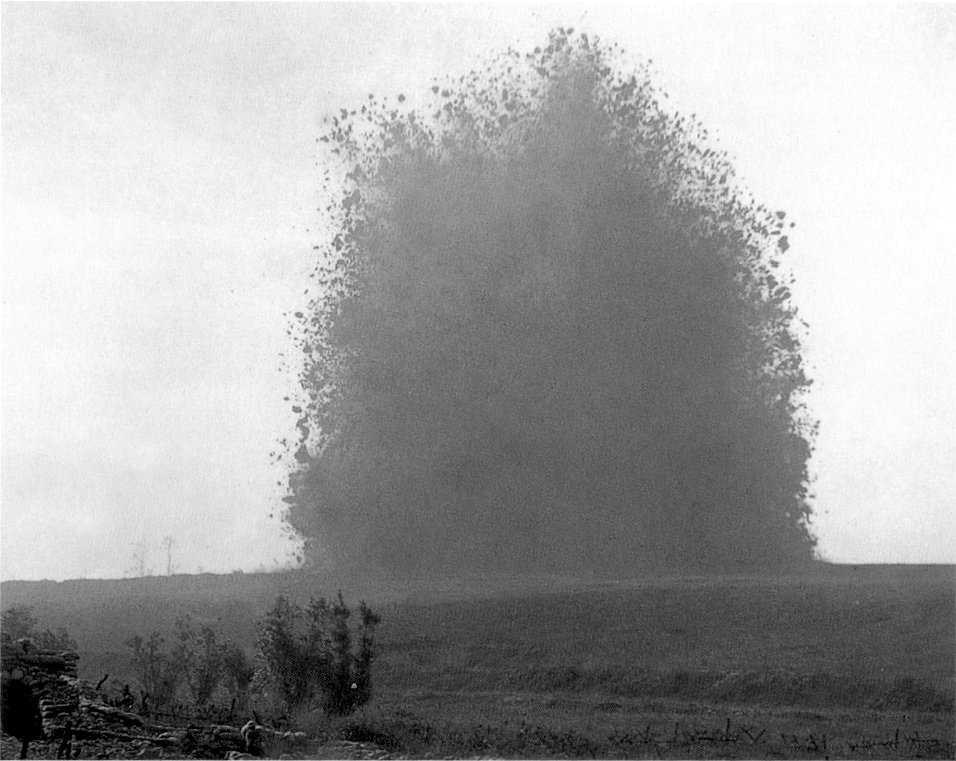
Tunnels, then, can be used not only to break sieges and blockades – as in those that keep the economy of Gaza supplied against the Israeli stranglehold: in effect, lifelines (if you want more on this, try the brilliant documentary Gaza: Tunnels to Nowhere and Nicolas Pelham, ‘Gaza’s tunnel phenomenon’, Journal of Palestine Studies 41 (4) 2012, pp. 6-31).  They can also be deathlines, dug for directly offensive purposes.  The tactic had been used to devastating effect on the Western Front, as I noted in a previous post on 3-D war: the image below is Ernest Brooks‘s famous photograph of the detonation of the British mine underneath the German lines at Hawthorn Ridge on the first day of the Battle of the Somme on 1 July 1916.  You can find video of the explosion here.

Hawthorn Ridge 1916

Then as now, as Jane Burgess argues in a dispatch from the frontlines of  ‘The Battle for Aleppo’, they are deadly improvisations in a war of attrition.

Both of these developments/reversions – the barrel bombs and the mines – obviously reinforce Stuart Elden‘s discussion of attempts to ‘secure the volume’.  But they also speak directly to a bleak politics of insecurity.

Scarry thoughts

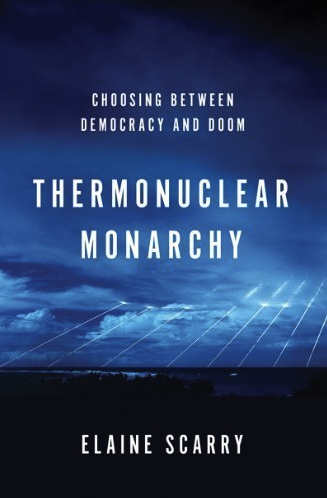
SCARRY Thermonuclear monarchyI imagine most readers will know Elaine Scarry‘s vital account of The Body in Pain.  She has produced several important books since then, of course, but Scarry explains that her latest book, Thermonuclear monarchy: choosing between democracy and doom, published last month by Norton, emerged directly from her first:

It directly emerged from “The Body in Pain,” which has a first chapter on torture and a second on war. I was trying to address the question why when people prohibit torture they make it an absolute prohibition, but when they make a prohibition on war, they always make exceptions.

I realized that nuclear weapons much more approximate the condition of torture than of war. Torture involves zero consent on the part of the injured, whereas conventional war allows many levels of consent. With nuclear weapons, there’s zero consent.

There is an excellent, wide-ranging conversation between Scarry and Sarah Gerard at The American Reader here that goes back as far as Hobbes (who turns out to be crucial for Scarry’s argument) and spools forward to today’s drone wars.  If you read just one thing this week, read that.

A new natural history of destruction?

Security by remote control conference

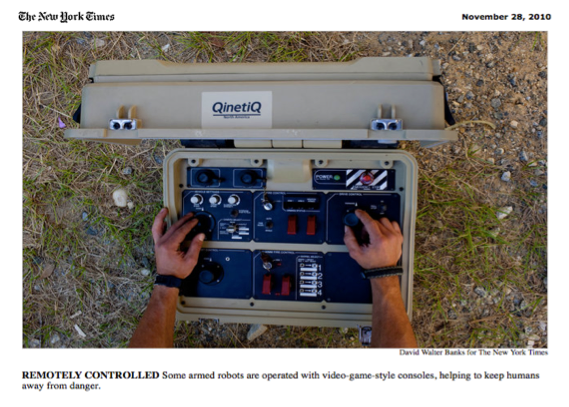
My work on drones has been invigorated by reading an outstandingly creative essay by Lucy Suchman on ‘Situational Awareness: deadly bioconvergence at the boundaries of bodies and machines’, forthcoming at the ever-interesting Mediatropes.  It’s sparked both an e-mail conversation and an invitation to speak at a symposium on Security by remote control: automation and autonomy in robot weapon systems at Lancaster University, 22-23 May.  Here is the call for papers:

Remotely operated and robotic systems are central to contemporary military operations. Robotic weapons can select targets and deliver lethal force with varying degrees of human control, and technologies for fully autonomous weapon systems are currently in development. Alongside military reconnaissance and the prospective configuration of ‘killer- robots,’ drone technologies are being deployed for ostensibly peaceful purposes, most notably surveillance of public space, private property and national borders. More generally, the frame offered by contemporary security discourses has redrawn previous boundaries regarding the use of state violence in the name of homeland protection. But despite an extended history of investment in technologies that promise to rationalise the conflict zone and accurately identify the imminent threat, the legitimacy and efficacy of actions taken in the name of security is increasingly in question.

The purpose of this symposium is to present and debate current scholarship on the ethics and legality of robotic systems in war and beyond. By robotic systems we mean networked devices with on-board algorithms that direct machine actions (in this case, tracking, targeting and deploying force) in varying configurations of pre-programmed operation and remote human control. The line between automation and autonomy has come under renewed debate in the context of contemporary developments in remotely controlled weapon systems, most prominently uninhabited aerial vehicles or drones. For 
example, in April of 2013 a coalition led by Human Rights Watch initiated a campaign in favour of a legally binding prohibition on the development, production and use of fully autonomous weapon systems. Simultaneously, some military and robotics experts emphasize the advantages of automated weapons and argue that equipping robots with the capacity to make ethical judgments is an achievable technological goal. Within these debates, the ‘human in the loop’ is posited alternately as the safeguard against illegitimate killing, or its source. Implicit across the debate is the premise of a moment of decision in which judgements of identification and appropriate response are made.

While emerging arms control strategies focus on the ‘red line’ that would prohibit the development and use of weapons that remove human judgment from the identification of targets and the decision to fire, the question remains to what extent human judgment and decision-making are already compromised by the intensifications of speed, and associated increase in forms and levels of automation, that characterise contemporary war-fighting, particularly in situations of remote control. Rather than attempting to establish one or the other of these concerns as correct, or even as more important than the other, we seek to focus our discussion on the troubling space between automation and autonomy, to understand more deeply their intimate relations, and the inherent contradictions that conjoin them.

To explore the key stakes and lines of argument in this debate, we invite contributions from scholars in the fields of security, peace and conflict studies, international human rights law, anthropology/sociology of science and technology, technoculture and technomilitarism, computing, simulation and cyber law. The ambition for this event is to stimulate ongoing cross-disciplinary discussion and further research on this topic, drawing on the resources of the Lancaster University centres that are its co-sponsors.

Confirmed Speakers:

Patrick Crogan, Senior Lecturer in Film Studies at the University of the West of England in Bristol, scholar of technoculture, videogames and military technoscience, author of Gameplay Mode: War, Simulation, and Technoculture (2011);

Derek Gregory, Peter Wall Distinguished Professor and Professor of Geography at the University of British Columbia in Vancouver, author of multiple works interrogating social and spatial dimensions of conflict, and currently completing a book titled The Everywhere War (forthcoming);

M. Shane Riza, command pilot and former instructor at the U.S. Air Force Weapons School, author of Killing Without Heart: Limits on Robotic Warfare in an Age of Persistent Conflict (2013);

Christiane Wilke, Associate Professor in Law and Legal Studies at Carleton University, Canada. She has been researching legal responses to state violence and is working on a project about visuality, photography, and international law.

To indicate your interest in participating, or for further information, please contact Lucy Suchman l.suchman@lancaster.ac.uk.

I’m really excited about this; I’m part way through Shane Riza’s book, and it’s already clear that I’m going to learn a lot from the meeting.

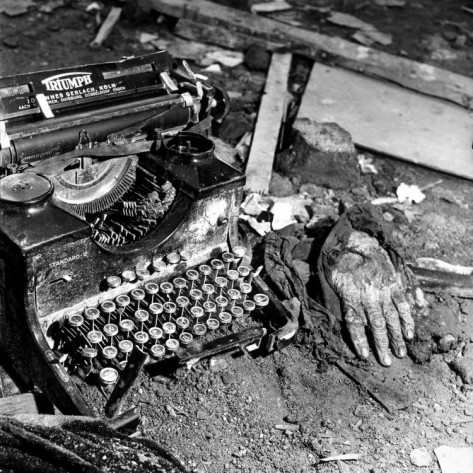
The image at the top of this post comes from the CFP, incidentally, but the image below is Margaret Bourke-White‘s classic photograph from the rubble of a bombed German city, which I use when I talk about the ways in which the trauma of air war dislocates the very sinews of language and the capacity to write and re-present (see ‘Doors in to nowhere’, an extended reflection on W.G. Sebald: DOWNLOADS tab).  Perhaps I’ll use my time at Lancaster (given the name, a peculiarly appropriate place) to join the dots between the two images and revisit ‘The natural history of destruction’ for the twenty-first century….

tumblr_m04iio5ICm1qbwvhpo1_500