Theory of the drone 12: ‘Killing well’?

This is the 12th in a series of extended posts on Grégoire Chamayou‘s Théorie du drone and covers the final chapter in Part III: Necro-ethics, called ‘Précisions’; in French the singular means accuracy, as you might expect, but the plural means ‘details’ – which is, of course, where the devil is to be found…

One of the most common claims advanced by those who defend the use of armed drones is that they reduce ‘collateral damage’ because they are so precise.  Following directly from his previous critique of Bradley Jay Strawser, Chamayou cites him again here: ‘Drones, for all their current and potential misuse, have the potential for tremendous moral improvement over the aerial bombardments of earlier eras.’  But he dismisses this as a misleading comparison: if Dresden or Hiroshima are taken as the yardstick against which accuracy is to be measured – or, for that matter, as the standard against which military ethics are to be judged – then virtually any subsequent military operation would pass both tests with flying colours.

The comparison confuses form with function.  Compared to Lancaster bombers and Flying Fortresses (even with their famous Norden bombsights: for Malcolm Gladwell on the ‘moral importance’ of the bombsight to Norden, a committed Christian, see here and here; for more on the bombsight, see here), the Predator and the Reaper are evidently more accurate.  But Chamayou insists that the real comparison ought to be with other tactical means currently available to achieve the same objective.
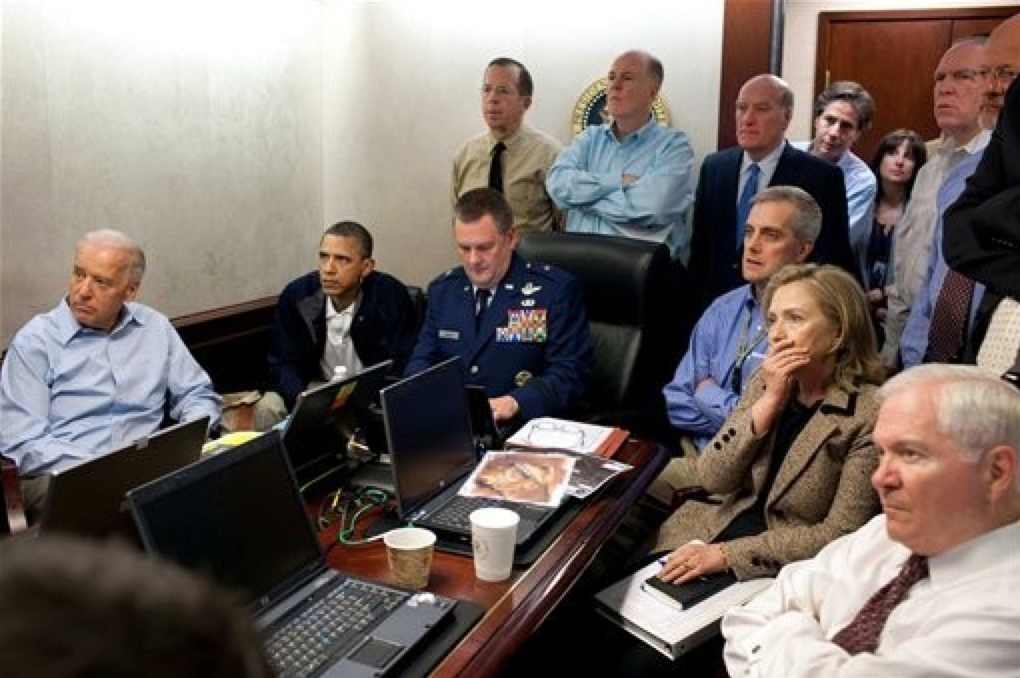
Situation Room

In the kill/capture raid against Osama Bin Laden on 1 May 2011 (assuming ‘capture’ was ever on the agenda), he argues that the choice was between drones and Special Forces not between drones and re-staging Dresden in Abbotabad.  This doesn’t quite work, since the raid was carried out by US Navy Seals who swept in from Bagram via Jalalabad by helicopter, but the mission also depended on real-time imagery from an RQ-170 stealth drone (‘the Beast of Kandahar’).  This was the source of the live video feed watched by Obama and members of his administration in the famous ‘Situation Room’ photograph [on which, see Keith Feldman on ‘Empire’s Verticality’ in Comparative American Studies 9 (4) (2011) 325-41].

The RQ-170 is an unarmed platform, but its role should remind us that drones are part of networked warfare – even when strikes are carried out by other means, the enhanced intelligence, surveillance and reconnaissance capabilities provided by the long dwell-times of these remote platforms mean that they are instrumental in the activation of the kill-chain.  This holds for military operations far beyond targeted killing: in Afghanistan between 2009 and 2011 drones were directly responsible for only 5-6 per cent of weapons released by the US Air Force, but they no doubt played a vital role in the release of many of the others.
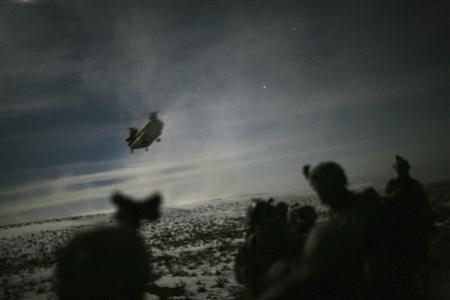
Night raidStill, Chamayou’s basic point is a sharp one – and I rehearsed similar arguments in my discussion of The politics of drone wars last year – but readers of Jeremy Scahill‘s Dirty Wars may still reasonably object that the civilian casualties resulting from JSOC’s infamous night raids in Afghanistan cast doubt on the precision and accuracy of ground forces too.  Gareth Porter has estimated that more than 1,500 civilians were killed in night raids in just ten months in 2010-11, making them ‘by far the largest cause of civilian casualties in the war in Afghanistan.’  Indeed, Afghan protests have frequently centred on the civilian toll exacted by drones and night raids.

Even if the appropriate comparison is between different modalities of military violence in the present, Chamayou argues that the discussion is bedevilled by another series of confusions about ‘accuracy’ or ‘precision’.   In fact, though he doesn’t say so, the the two terms aren’t interchangeable. Strictly speaking,  accuracy refers to the deviation from the aiming point, precision to the dispersion of the strike:

Accuracy and precision

CEP in the diagram above refers to the Circular Error Probable, once described by the Pentagon as ‘an indicator of the delivery accuracy of a weapon system’, which is a circle of radius n described around the aiming point.  Assuming a bivariate normal distribution, then – all other things being equal (which they rarely are) – 50% of the time a bomb, missile or round will land within the circle: which of course means that the other half of the time it won’t, even under ideal experimental conditions.  As this is a normal distribution, then 93 per cent should land within 2n and more than 99 per cent within 3n.

Chamayou doesn’t refer to the CEP directly, only briefly to the ‘accuracy of fire’,  but – to revert to the comparison he refuses – the CEP of bombing from the air has contracted dramatically since the Second World War when it was around 3,000 feet (though this improved over time): so much so that David Deptula, when he was USAF Deputy Chief of Staff for ISR, used to talk of crossing a ‘cultural divide of precision and information’.  The image below, taken from one of his presentations, shows the contraction (notice that the aim point is the Pentagon….).
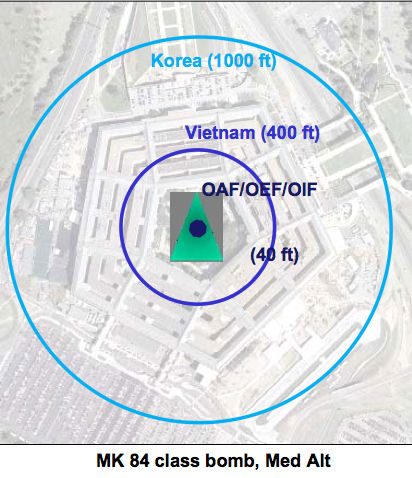
Target mensuration (USAF)

Interestingly, the most recent Joint Publication (3-60) from the Joint Chiefs of Staff on Targeting (January 2013) has explicitly removed the concept from its Terms and Definitions, citing as its authority the Department of Defense’s Dictionary of Military and Associated Terms (it was still there on 31 January 2011, but no longer).  I haven’t been able to discover the reasons for the change, though there is longstanding scepticism about the validity of the measure: see, for a specific example, Donald MacKenzie‘s classic discussion in Inventing accuracy: a historical sociology of nuclear missile guidance (1993, pp. 352-7).  I’ve seen several comments to the effect that the measure isn’t useful for ‘smart bombs’ because they don’t display the same spread as ‘dumb bombs’.  (There’s a quick primer on the emergence of smart bombs during the Vietnam War here, and an account of the evolution of ‘precision strike’ since then here; for more detail, try David Koplow‘s Death by moderation: the US military’s quest for useable weapons (2009)).

The MQ-1 Predator carries two AGM-114 Hellfire missiles [shown below, top; for acronyphiles, AGM designates an Air-to-Ground Missile, while the ‘Hellfire’ was originally developed as a ‘Helicopter-Launched Fire-and-Forget Missile’; its main platform is still an attack helicopter], while the MQ-9 Reaper can carry four AGM-114 Hellfire Missiles or replace two of them with GBU-12 Paveway II bombs [GBU = Guided Bomb Unit; shown below, bottom].
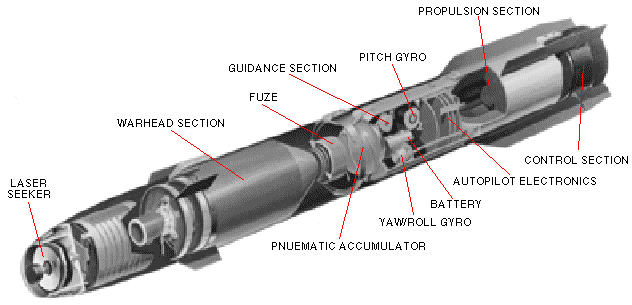

hellfire

GBU-12_xxl

Both weapons systems are laser-guided; the sensor operator, sitting beside the pilot in the Ground Control Station, uses a laser targeting marker (LTM) to ‘paint’ the target – this can also be done by ground troops in conventional combat zones – but its accuracy can be compromised by cloud, smoke, fog or dust.  (This is why the Air Force also uses GPS-guided weapons; they are less accurate but unaffected by these environmental conditions).  Once the necessary clearances have been obtained from mission commanders and military lawyers, the pilot fires the missile and the sensor operator guides it on to its target.

Omer Fast‘s interview with a sensor operator (‘Brandon’ –  whether this is a pseudonym or really Brandon Bryant is hard to know) for 5,000 Feet is the Best provides a series of insights into the operation in Afghanistan and Iraq.  You can’t see the beam with the naked eye, but American ground troops can see it with their infrared goggles.  According to ‘Brandon’, they call it the ‘Light of God’ (really); the image below is James Bridle‘s replication of the effect based on laser targeting night systems and a CC-licensed photograph of the Iraqi desert by Rob Bakker.
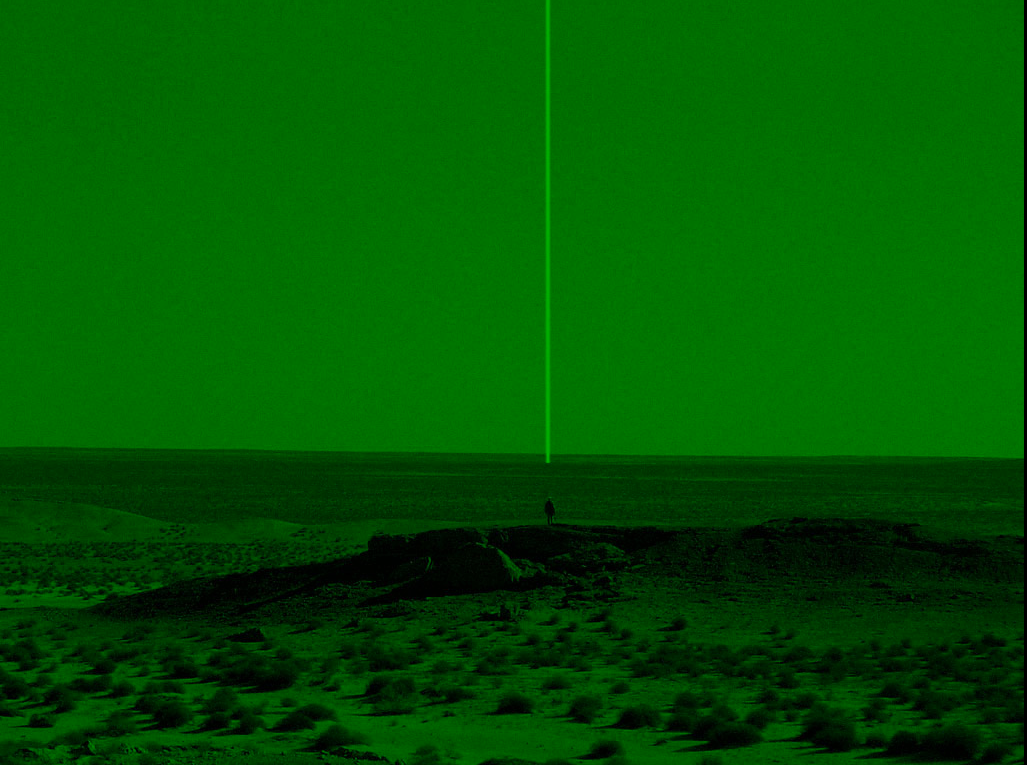
JAMES BRIDLE Light of God

‘Brandon’:

‘Usually the laser track is about half the size of this [hotel] room.  Poof!  By the time it hits the ground… a lot of times it turns into a square for some reason…  It could be anywhere from ten feet by ten feet to twenty feet by twenty feet… It starts off small and you watch it kind of open up’

This is not exactly putting ‘warheads on foreheads‘, but ‘Brandon’ explains that the crew is also required to identify a secondary ‘abort’ target.

‘… some of the contingencies we have to worry about are: if we’re firing at a building and somebody crosses – maybe – who knows, a group of children starts crossing in front of the building, we need a second site once that missile is already off the rails.  To go ahead and drop that missile so that we don’t harm the children  So usually we’ll choose an alternate site a couple hundred feet to a couple of hundred yards away.  It might be an empty field.  And we use that as the backup…

So let’s  say we get the missile off the rail and a group of kids comes into play: I call “abort” and I’ll start moving that laser over to an empty site so that we can detonate there and not cause any additional loss of life.’
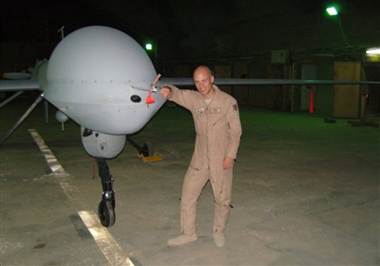
Predator and Brandon Bryant

Sounds good, but the real Brandon Bryant (above) has a different story to tell; it turns out that there is an eight-second window in which the missile can be diverted:

With seven seconds left to go, there was no one to be seen on the ground. Bryant could still have diverted the missile at that point. Then it was down to three seconds. Bryant felt as if he had to count each individual pixel on the monitor. Suddenly a child walked around the corner, he says.

Second zero was the moment in which Bryant’s digital world collided with the real one in a village between Baghlan and Mazar-e-Sharif.

Bryant saw a flash on the screen: the explosion. Parts of the building collapsed. The child had disappeared. Bryant had a sick feeling in his stomach.

“Did we just kill a kid?” he asked the man sitting next to him.

“Yeah, I guess that was a kid,” the pilot replied.

“Was that a kid?” they wrote into a chat window on the monitor.

Then, someone they didn’t know answered, someone sitting in a military command center somewhere in the world who had observed their attack. “No. That was a dog,” the person wrote.

They reviewed the scene on video. A dog on two legs?

Even then, think about that blossoming square, twenty feet by twenty feet.  Then factor in the Circular Error Probable of a Hellfire missile, which is usually calculated at between 9 and 24 feet. The ‘pinpoint’ accuracy of the missile is starting to blur and the ‘surgical’ strike beginning to blunt.  In fact, the development of the Hellfire missile suggests another narrative.  In 1991 the Pentagon was already advertising the Hellfire as capable of ‘pinpoint’ accuracy, and since then it has been upgraded more than half a dozen times, each version promising greater accuracy: as Matthew Nasuti asks in his catalogue of Hellfire errors, what can be more accurate than ‘pinpoint accurate’?

In any case, narrowing the discussion to the CEP misses two things.  First, as former USAAF officer Peter Goodrich points out in his discussion of ‘The surgical precision myth‘, this ‘totally disregards what happens after the bomb explodes’.  What Goodrich has in mind is the blast and fragmentation radius, which Chamayou calls ‘the kill radius’.  Fast’s ‘Brandon’ insists

‘All of us are taught about how far those Hellfire missiles go, how far their frag goes.  And “danger close” as we call it when you have troops that are very close or civilians that are present.  They’re just factors that  you have to work in to bring down the percentages of the harm that could be done.’

In the targeting cycle the US Air Force enters those ‘factors’ into both collateral damage estimation and ‘weaponeering’, modifying the missile or bomb to restrict its blast and fragmentation radius. Chamayou reports that the Hellfire missile has a ‘kill radius’ of 50 feet (15 metres) and a ‘wounding radius’ of 65 feet (20 metres); the GBU-12 Paveway II has a ‘casualty radius’ of between 200 and 300 feet (within which 50 per cent of people will be killed).   These calculations aren’t exactly equivalent – and it’s difficult to obtain precise and comparable figures – but nothing about this is as precise as the rhetoric  implies.  As Chamayou asks:

‘In what fictional world can killing an individual with an anti-tank missile [the Hellfire] that kills every living thing within a radius of 15 metres and wounds everyone else within a radius of 20 metres be seen as “more precise”?’

All those who are killed or wounded within the casualty radius are presumably guilty by proximity.

This is Chamayou’s second rider, which relates to what happens before the bomb or missile is released: to the production – the US military sometimes calls it the ‘prosecution’ – of the target.  In this sense, the technical considerations I’ve just described are beside the point (sic).  All of the calibrations I’ve set out in such detail apply to missiles and bombs irrespective of the platform used to deliver them; what is supposed to distinguish a Predator or a Reaper from a conventional strike aircraft or attack helicopter is that it combines ‘hunter’ and ‘killer’ in a single platform and, specifically, that its real-time full-motion video feeds enable crews (and others in the loop) to see what they are doing in unprecedented detail.

Signing a Hellfire missile attached to a MQ1-C (Gray Eagle) UAV at BagramDoes this political technology of vision make it possible, as advocates claim, to distinguish between combatants and civilians more effectively than ever before?  Here Chamayou rehearses common criticisms: that in standard US military practice ‘combatant’ morphs into ‘militant’, even ‘presumed militant’ and, at the hideous limit, into ‘military-aged male’ – counting ‘all military-age males in a strike zone as combatants … unless there is explicit intelligence posthumously proving them innocent’ – and that this process of (so to speak, performative) militantisation as Chamayou calls it is underwritten by a techno-judicial probabilisation (again his term) whose ‘epistemology of suspicion’ allows signature strikes that target un-named and unknown people on the basis of their ‘pattern of life‘.

But both these procedures and, indeed, the criticisms of them, obscure what is for Chamayou, the fundamental paradox, what he calls the ‘profound contradiction’.  International law defines a combatant and thus a legitimate target in terms of direct participation in hostilities and an imminent threat.  It’s more complicated than that, as I’ll show later, but this is enough for Chamayou to fire off two key questions: How can anyone be participating in hostilities if there is no longer any combat? How can there be any imminent threat if there are no troops on the ground?  The drone, praised for its forensic ability to distinguish between combatant and non-combatant, in fact abolishes the condition necessary for such a distinction: combat itself (p. 203; also p. 208).

It’s an artful claim, but it oversimplifies the situation.  Chamayou has (once again) confined the discussion to targeted killing but, as I’ve repeatedly emphasised, Predators and Reapers have also been used for other purposes in Iraq and Afghanistan, including the provision of ‘armed overwatch’ and close air support to ground troops.  Outside these war-zones – in the Federally Administered Tribal Areas of Pakistan, Yemen, Somalia and elsewhere – the critique is a powerful one (which is not to say that Obama’s lawyers have not claimed a legal warrant for their supposedly covert drone strikes in these areas: more on this later too).  Still, Chamayou’s argument loops back to earlier discussions about the intrinsic non-reciprocity of drone warfare.

And here Chamayou closes with a powerful argument.  If ethics is classically about how to live well and die well, he suggests that necro-ethics is a doctrine of ‘killing well’.  He notes that critics of the covert drone wars demand, time and time again, transparency.  They want to know the legal armature and adjudicative apparatus for the strikes, the rules and procedures that are followed, and the lists of casualties.  But he argues that their demands turn the issue into an arid juridico-administrative formalism endorsed by bureaucratic Reason.  In the kill zones, he says ruefully, there are no legal memoranda, no columns of numbers or ballistics reports (p. 207): these are the very formularies of necro-ethics.  And, as I’ve noted, there are no air-raid warnings, no anti-aircraft defences and no air-raid shelters either.

It’s in that spirit that Chamayou closes the chapter with an extended quotation from Madiha Tahir’s Louder than bombs‘:

Saudallah WazirWhat is the dream?

I dream that my legs have been cut off, that my eye is missing, that I can’t do anything … Sometimes, I dream that the drone is going to attack, and I’m scared. I’m really scared.

After the interview is over, Sadaullah Wazir pulls the pant legs over the stubs of his knees till they conceal the bone-colored prostheses.

The articles published in the days following the attack on September 7, 2009, do not mention, this poker-faced, slim teenage boy who was, at the time of those stories, lying in a sparse hospital in North Waziristan, his legs smashed to a pulp by falling debris, an eye torn out by shrapnel. nor is there a single word about the three other members of his family killed: his wheelchair-bound uncle, Mautullah Jan and his cousins Sabr-ud-Din Jan and Kadaanullah Jan.  All of them were scripted out of their own story till they tumbled off the edge of the page.

Did you hear it coming?

No.

What happened?

I fainted. I was knocked out.

As Sadaullah, unconscious, was shifted to a more serviceable hospital in Peshawar where his shattered legs would be amputated, the media announced that, in all likelihood, a senior al-Qaeda commander, Ilyas Kashmiri, had been killed in the attack. The claim would turn out to be spurious, the first of three times when Kashmiri would be reported killed.

Sadaullah and his relatives, meanwhile, were buried under a debris of words: “militant,” “lawless,” “counterterrorism,” “compound,” (a frigid term for a home). Move along, the American media told its audience, nothing to see here.

Some 15 days later, after the world had forgotten, Sadaullah awoke to a nightmare.

Do you recall the first time you realized your legs were not there?

I was in bed, and I was wrapped in bandages. I tried to move them, but I couldn’t, so I asked, “Did you cut off my legs?” They said no, but I kind of knew.

When you ask Sadaullah or Karim or S. Hussein and others like them what they want, they do not say “transparency and accountability.” They say they want the killing to stop. They want to stop dying. They want to stop going to funerals — and being bombed even as they mourn. Transparency and accountability, for them, are abstract problems that have little to do with the concrete fact of regular, systematic death.’
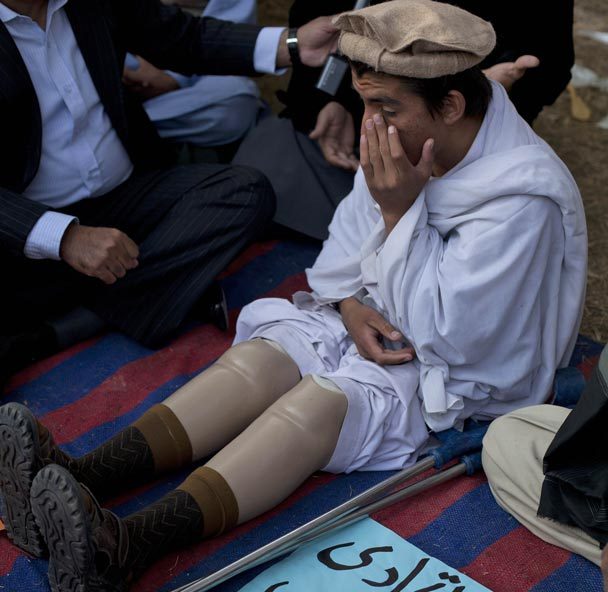
And Madiha adds this: ‘The technologies to kill them move faster than the bureaucracies that would keep more of them alive: a Hellfire missile moves at a thousand miles per hour; transparency and accountability do not.’

Indeed they don’t; Sadaullah died last year, Mirza Shahzad Akbar reports, ‘without receiving justice or even an apology.’  Not even killing well, then.
War from afar

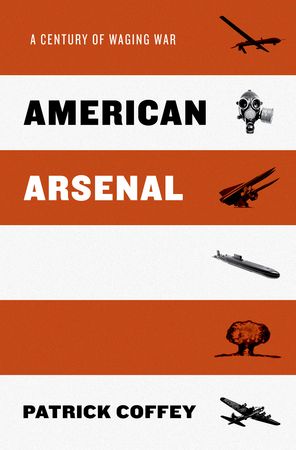
9780199959747_450My interest in tracking the history (or if you prefer, historical geography) of waging war at a distance – my ‘Deadly Embrace’ project, which will eventually produce a long-form essay for War material – has been given another boost by news of a new book from Patrick Coffey, Visiting Scholar in the Office for History of Science and Technology at the University of California, Berkeley: American Arsenal: a century of waging warfrom Oxford University Press, it’s out now in North America (at least as an e-book) and available elsewhere early next year.

When America declared war on Germany in 1917, the United States had only 200,000 men under arms, a twentieth of the German army’s strength, and its planes were no match for the Luftwaffe. Less than a century later, the United States today has by far the world’s largest military budget and provides over 40% of the world’s armaments.

In American Arsenal Patrick Coffey examines America’s military transformation from an isolationist state to a world superpower with a defense budget over $600 billion. Focusing on sixteen specific developments, Coffey illustrates the unplanned, often haphazard nature of this transformation, which has been driven by political, military, technological, and commercial interests. Beginning with Thomas Edison’s work on submarine technology, American Arsenal moves from World War I to the present conflicts in the Middle East, covering topics from chemical weapons, strategic bombing, and the nuclear standoff with the Soviet Union, to “smart” bombs, hand-held anti-aircraft missiles, and the Predator and other drone aircrafts. Coffey traces the story of each advance in weaponry from drawing board to battlefield, and includes fascinating portraits the men who invented and deployed them-Robert Oppenheimer, head of the Manhattan Project; Curtis LeMay, who sent the Enola Gray to drop the atom bomb on Hiroshima and Nagasaki; Herman Kahn, nuclear strategist and model for Stanley Kubrick’s Dr. Strangelove; Abraham Karem, inventor of the Predator and many others. Coffey also examines the increasingly detached nature of modern American warfare-the ultimate goal is to remove soldiers from the battlefield entirely-which limits casualties (211,454 in Vietnam and only 1,231 in the Gulf War) but also lessens the political and psychological costs of going to war.

I start the story much earlier – and so pay attention to other, older imperial powers too – but you can see the interest.  Here’s the Contents list:

Introduction
Edison at War
Gassing the Senator
Mitchell’s War in Three Dimensions
The Bombsight
Precision Bombing Tested
Napalm
The Switch
The Atomic Bomb
The Weapon Not Used
The Cold War and the Hydrogen Bomb
Missiles
War games
Four lessons from Vietnam
Star Wars
Smart Bombs and Drones
Epilogue

And you can read the last substantive chapter, or at any rate a version of it, at Salon here: ‘War from afar: How the Pentagon fell in love with drones‘.  Despite the title, the essay is about more than the history of drones, which Coffey links to the development of so-called ‘smart bombs’ (and yes, I do think all bombs are dumb bombs):

In the last years of the twentieth century, two weapons changed the way that America fights air wars: smart bombs (bombs that “see” a target using a television camera or a radiation sensor, or that head for a programmed location) and UAVs (unmanned aerial vehicles). Smart bombs came into their own in the first Gulf War. Reconnaissance UAVs proved their worth in Bosnia and Kosovo in the late 1990s, and offensive UAVs began firing missiles in Iraq, Afghanistan, Pakistan, and elsewhere a few years later.

The connection between the two is a tightrope on which both advocates and critics of today’s drone wars sway – as I’ll discuss in detail in my next post on Grégoire Chamayou‘s Théorie du drone.

Theory of the drone 11: Necro-ethics

This is the 11th in a series of extended posts on Grégoire Chamayou‘s Théorie du drone and covers the first two of three chapters that constitute Part III: Necro-ethics.

The title recalls Achille Mbembe‘s seminal essay on ‘Necropolitics’ [Public culture 15 (1) (2003) 11-40], where he cuts the umbilical cord between sovereignty and the state (and supranational institutions) and, inspired by Michel Foucault and Giorgio Agamben, argues that ‘the ultimate expression of sovereignty resides, to a large degree, in the power and the capacity to dictate who may live and who must die.’  Necropolitics is thus about ‘contemporary forms of subjugation of life to the power of death’ – and at the limit the creation of what Mbembe calls ‘death-worlds’.

AlexisLeran-AchilleMbembe5Mins658

Mbembe develops his thesis in part – and for good reason – in relation to the Israeli occupation of Palestine.  I imagine readers will know that the Israeli Defence Force (IDF) advertises itself, incredibly, as ‘the most moral army in the world’, and although Chamayou’s ultimate objectives are different he too begins with a critical interrogation of one version of that claim (you can find much more about it in Muhammad Ali Khalidi‘s fine essay on Gaza in the Journal of Palestine Studies 39 (3) (2010) available on open access here).

1: Combatant immunity

Chamayou argues that what distinguishes contemporary forms of imperial military violence is not so much the asymmetry of the conflict or the differential distribution of vulnerability which results as the norms that are invoked to regulate its conduct.  Towards the end of the twentieth century, he suggests, the ‘quasi-invulnerability’ of the dominant force was transformed into an over-arching politico-ethical framework.  This first came into view during NATO’s intervention in Kosovo in 1999 when force protection was established as the key consideration: not only was the NATO campaign largely confined to bombing from the air (so that, apart from Special Forces, there were few boots – and, more to the point, NATO bodies – on the ground) – but pilots were ordered not to fly below 15,000 feet.  This kept them safely beyond the range of anti-aircraft fire, even as it reduced the accuracy of air strikes and endangered the lives of those the intervention was supposed to save.

nato-bombs-convoy

This seems to violate conventional notions of a just or ethical war, effectively turning ‘humanitarian intervention’ on its head, but Chamayou claims that in fact it heralded the explicit formulation of a principle of ‘imperial combatant immunity’.  Enter the IDF, stage right.  This new doctrine was set out in detail in an essay by Asa Kasher  and Amos Yadlin, writing from the ‘Department of Professional Ethics and Philosophy of Practice’ at Tel Aviv University and the IDF College of National Defense, and published as ‘Military ethics of fighting terror: an Israeli perspective’, Journal of military ethics 4 (1) (2005) 3-32.  As their affiliation shows, this was not an abstract, academic discussion; Chamayou notes, in an artful twist on Yves Lacoste (La géographie, ça sert, d’abord, à faire la guerre), ‘What use is moral philosophy?  Among other things, to wage war…’ (‘A quoi sert la philosophie morale?  Entre autres choses, à faire la guerre’) (p. 184).

In that essay Kasher and Yadlin proposed a comprehensive reformulation of military ethics – and, by extension, international law – but Chamayou fastens on their reworking (or demolition) of  the established principle of distinction.  He cites their central thesis, thus:

One major issue is the priority given to the duty to minimize casualties among the combatants of the state when they are engaged in combat acts against terror.  According to the ordinary conception underlying the distinction between combatants and noncombatants, the former have a lighter package of state duties than the latter. Consequently, the duty to minimize casualties among combatants during combat is last on the list of priorities or next to last, if terrorists are excluded from the category of noncombatants. We reject such conceptions, because we consider them to be immoral. A combatant is a citizen in uniform. In Israel, quite often he is a conscript or on reserve duty. His blood is as red and thick as that of citizens who are not in uniform. His life is as precious as the life of anyone else. A democratic state may send him to a battlefront only because it has a duty to defend its citizens and it cannot do this without some of them defending the others, within the framework of a just system of conscription and reserve duty. The state ought to have a compelling reason for jeopardizing a citizen’s life, whether or not he or she is in uniform. The fact that persons involved in terror are depicted as noncombatants is not a reason for jeopardizing the combatant’s life in their pursuit. He has to fight against terrorists because they are involved in terror. They shoulder the responsibility for their encounter with the combatant and should therefore bear the consequences. 

(It turns out that there are limits to the privileges accorded to citizen-soldiers: more recently Ha’aretz reports that Kasher suggested in early 2012 that medical experiments can be carried out on them, even if they are not fully informed of the details, in order to ‘build the military force’, though Kasher has contested these accusations and insisted that his opinion stipulated a series of ‘conditions’ that had to be met).

I didn’t mention Lacoste casually, because part of Kasher and Yadlin’s argument turns on territory: on the duties imposed by belligerent occupation (‘when a person resides in a territory that is under effective control of the state’).  This is a Trojan Horse, needless to say, because they clearly have Gaza in their sights, and their proposal seeks to further the egregious fiction that Israel’s ‘withdrawal’ in 2005 meant that the Palestinians effectively imprisoned in Gaza are no longer subject to Israeli occupation (for more on ‘Gaza under siege’, see here).  Chamayou doesn’t dwell on this, but the emphasis on ‘effective control’ could – if you accept Kasher and Yadlin’s grotesque argument (which they insist is a general one) – be brought to bear on the US campaign of targeted killing in the Federally Administered Tribal Areas of Pakistan, in Yemen and in Somalia and be made to intersect with the usual rhetoric about ‘ungoverned spaces’ and ‘lawless zones’.

Kasher and Yadlin summarize their proposed hierarchy of privileges by setting out a tariff according to which militaries would administer injury in priority sequence:

(d.1) Minimum injury to the lives of citizens of the state who are not combatants during combat;

(d.2) Minimum injury to the lives of other persons (outside the state) who are not involved in terror, when they are under the effective control of the state;

(d.3) Minimum injury to the lives of the combatants of the state in the course of their combat operations;

(d.4) Minimum injury to the lives of other persons (outside the state) who are not involved in terror, when they are not under the effective control of the state;

(d.5) Minimum injury to the lives of other persons (outside the state) who are indirectly involved in terror acts or activities;

(d.6) Injury as required to the liberties or lives of other persons (outside the state) who are directly involved in terror acts or activities.

Chamayou concludes that the core principle they seek to advance involves replacing the distinction between civilians and combatants by a hierarchical distinction between citizens and aliens: an unbridled nationalism masquerading as ethics (p. 187).  In other words, within the frontier of state control  – Chamayou says ‘ state sovereignty’, but that’s not quite what Kasher and Yadlin say – some lives are more precious than others,  while beyond that line inferior lives (including those of what they call ‘bystanders’) are to be exposed to violence and ultimately sacrificed: as they put it, ‘the state should give priority to saving the life of a single citizen, even if the collateral damage caused in the course of protecting that citizen is much higher…’

nyrb051409Their proposals had a slow fuse but they eventually set off a firestorm of protest.  Responding to a shorter version of the main essay [‘Assassination and preventive killing’, SAIS Review of International Affairs 25 (1) (2005)  41-57] and writing in the New York Review of Books (14 May 2009), Avishai Margalit and Michael Walzer were unequivocally appalled:

‘Their claim, crudely put, is that in such a war the safety of “our” soldiers takes precedence over the safety of “their” civilians.  Our main contention is that this claim is wrong and dangerous. It erodes the distinction between combatants and noncombatants, which is critical to the theory of justice in war (jus in bello).’

They continued:

‘The point of just war theory is to regulate warfare, to limit its occasions, and to regulate its conduct and legitimate scope. Wars between states should never be total wars between nations or peoples. Whatever happens to the two armies involved, whichever one wins or loses, whatever the nature of the battles or the extent of the casualties, the two nations, the two peoples, must be functioning communities at the war’s end. The war cannot be a war of extermination or ethnic cleansing. And what is true for states is also true for state-like political bodies such as Hamas and Hezbollah, whether they practice terrorism or not. The people they represent or claim to represent are a people like any other.

The main attribute of a state is its monopoly on the legitimate use of violence. Fighting against a state is fighting against the human instruments of that monopoly—and not against anyone else….

The crucial means for limiting the scope of warfare is to draw a sharp line between combatants and noncombatants. This is the only morally relevant distinction that all those involved in a war can agree on. We should think of terrorism as a concerted effort to blur this distinction so as to turn civilians into legitimate targets. When fighting against terrorism, we should not imitate it.’

In contrast,

‘For Kasher and Yadlin, there no longer is a categorical distinction between combatants and noncombatants. But the distinction should be categorical, since its whole point is to limit wars to those—only those—who have the capacity to injure (or who provide the means to injure)….

‘This is the guideline we advocate: Conduct your war in the presence of noncombatants on the other side with the same care as if your citizens were the noncombatants. A guideline like that should not seem strange to people who are guided by the counterfactual line from the Passover Haggadah, “In every generation, a man must regard himself as if he had come out of Egypt.”

Menahem YaariTheir critique found vigorous support from Menahem Yaari, a theoretical economist whose work has addressed (amongst other things) questions of justice, uncertainty and risk, but who wrote in a subsequent issue (8 October 2009) in his capacity as President of the Israel Academy of Sciences and Humanities:

‘A military code of conduct that discriminates, in cases of hazards being inflicted upon innocent civilians, on the basis of whether these civilians are “ours” or “theirs” is all the more worrisome when viewed against a general background of growing ethnocentric and xenophobic attitudes in Israel’s traditional establishment. We see an ongoing drift from universalism and humanism toward parochialism and tribalism.’

Picking up from that last sentence, Chamayou believes that this drift has accelerated and that it is by no means confined to Israel’s ‘traditional establishment’.  In his view, the ‘evisceration’ of the core principles of international humanitarian law by a ‘nationalism of self-preservation’ has become ‘the primary guiding principle of the necro-ethics of the drone’ (p. 189).

2: Humanitarian weapon

Chamayou seeks to trace a line of descent from the previous arguments to those advanced more recently by academics who directly address (and defend) the US use of drones.  He has two men in mind: Avery Plaw, an Associate Professor of Political Science at UMass – Dartmouth, and Bradley Jay Strawser, an Assistant Professor of Philosophy in the Defense Analysis Department at the US Naval Postgraduate School at Monterey.

UMass_Drone-crop

Plaw has collaborated with several colleagues to track and evaluate drone strikes in Pakistan and is involved in the UMass DRONE project (I’ve commented on this before), but it’s an Op-Ed in the New York Times on 14 November 2012 that catches Chamayou’s attention.  ‘Drones save lives, American and others’ was the headline, and Chamayou is bemused: ‘How can an instrument of death save lives?’

The question seems to invite a biopolitical response – ‘killing in order to let live’, as Mbembe and others would no doubt have it, and Chamayou doesn’t quite provide that – but neither does Plaw quite say what the headline implies.  He suggests that ‘drone strikes are the best way to remove an all-too-real threat to American lives’ and that ‘there is evidence that drone strikes are less harmful to civilians than other means of reaching Al Qaeda and affiliates in remote, lawless regions’. Perhaps this amounts to the same thing, but it’s not quite the cold calculus that Chamayou attributes to Plaw.  And as I read his (brief) intervention, the ‘American lives’ that Plaw sees as being at risk are not those of, say, ground troops in Afghanistan but of civilians in the continental United States threatened by attacks from al-Qaeda and its affiliates  – though even then Plaw would have to explain how they are ‘saved’ by attacks on the Taliban and other militant groups which scarcely pose a trans-continental danger.

'Nobody dies' Popular Science November 1997

In any event, Chamayou challenges what he sees as the paradoxically vitalist claim that serves as the first principle of contemporary necro-ethics: drones are ‘humanitarian’ because they save lives – and specifically ‘our’ lives (p. 192), which he sees encapsulated even more succinctly than in Plaw’s Op-Ed by the tag-line in the image above (from Popular Science in November 1997): ‘Nobody dies – except the enemy.’

STRAWSER Killing by remote controlThis is where he turns to – and on – Strawser.  Like Plaw, he has had his views publicised in the media –see Rory Carroll on ‘The philosopher making the moral case for US drones’  in the Guardian here and Strawser’s hasty qualification here – but Chamayou directs his attention to Strawser’s essay ‘Moral Predators: the duty to employ uninhabited aerial vehicles’, Journal of military ethics 9 (4) (2010) 342-68.  More recently, by the way, he’s edited a collection of essays, Killing by remote control: the ethics of an unmanned military (Oxford University Press, 2013), which includes an essay by Plaw on ‘Counting the dead: the proportionality of predation in Pakistan’ and an exchange between Kasher and Plaw, in which the (I think substantial) differences between the two are clarified.  These centre on the principle of distinction: the requirement to discriminate between combatants and civilians.  Kasher makes no secret of what he calls his ‘negative attitude to the principle of distinction as it is commonly understood and practically applied’ (which doesn’t leave much room for a positive attitude).  ‘Humanitarian’, he insists, means ‘an attitude towards human beings as such, not toward a certain group of people’ – given the way in which the IDF treats Palestinians, this strikes me as pretty thick – so that the principle of distinction is really ‘civilarian’ (his term) and fails to respect ‘the human dignity of combatants in the broad sense of men and women in uniform’ (which isn’t a ‘broad sense’ at all, of course: Kasher’s combatants all wear uniform).  ‘A democratic state [sic] owes its citizens in military uniform a special justification for jeopardizing their life when they do it not for the relatively simple reason of defending their fellow citizens,’ he argues, ‘but when they are required to do it for the sake of saving the life of enemy citizens who are not combatants.’  The recourse to drones, he concludes, ‘circumvents such difficulties’.

Similarly, though not identically, Strawser regards the drone as not simply a morally permissible weapon but rather as a morally compulsory one.  He proposes a Principle of Unnecessary Risk , according to which ‘it is wrong to command someone to take on unnecessary potentially lethal risks in an effort to carry out a just action for some good’, and then extrapolates more or less directly to the compulsion to employ Unmanned Aerial Vehicles (UAVs):

‘We have a duty to protect an agent engaged in a justified act from harm to the greatest extent possible, so long as that protection does not interfere with the agent’s ability to act justly. UAVs afford precisely such protection. Therefore, we are obligated to employ UAV weapon systems if it can be shown that their use does not significantly reduce a warfighter’s operational capability.’

Strawser then qualifies his basic Principle: ‘the just warrior’s increased protection (which a UAV provides) should not be bought at an increased risk to noncombatants.’   In effect, Chamayou argues, Strawser makes Kasher and Yadlin’s principle of self-preservation subordinate to the minimisation of risks to non-combatants.  But when Strawser insists that ‘if using a UAV in place of an inhabited weapon platform in anyway whatsoever decreases the ability to adhere to jus in bello principles [of proportionality and distinction], then a UAV should not be used,’ Chamayou believes he is also playing his ‘get out of jail free’ card.  For Strawser claims that ‘there is good reason to think just the opposite is true: that UAV technology actually increases a pilot’s ability to discriminate’.   In support, Strawser cites an Israeli pilot –

‘The beauty of this seeker is that as the missile gets closer to the target, the picture gets clearer . . .The video image sent from the seeker via the fiber-optic link appears larger in our gunner’s display. And that makes it much easier to distinguish legitimate from non-legitimate targets’ 

– and Plaw’s analysis of drone strikes in Pakistan from 2004 to 2007.  Strawser concedes that the claim for enhanced distinction is an empirical one; Plaw’s analysis needs a fuller examination than I can provide in this post, but it’s important to note that 2007 is a significant cut-off.  As the chart below shows, from the splendid Bureau of Investigative Journalism, this is long before the Obama administration ramped up the attacks on the Federally Administered Tribal Areas.  Plaw’s chapter in Killing by remote control extends his analysis to 2011 and concludes that US drone strikes – particularly when weighed against casualties from insurgent attacks or Pakistan military operations in the region – most often meet the demands of proportionality; but the discussion doesn’t directly address discrimination.

All-Totals-Dash47

What Strawser does, Chamayou concludes, is offer a technical resolution of an ethical dilemma: it is not necessary to subordinate one principle to another – minimisation of risk to combatants (‘citizen-soldiers’) or minimisation of risk to non-combatants (‘alien’ or otherwise) – because this new technology of killing promises to satisfy both.  In effect, drones are supposed to introduce a new, intrinsically ethical symmetry to asymmetric warfare: they save ‘our’ lives and ‘their’ lives.  They combine the power to kill and to save, to wound and to care, a weapon at once humanitarian and military – ‘humilitaire’, as Chamayou has it.  (Others have made a case for the humanitarian uses of unarmed drones, but their arguments are a far cry from military applications).

Yet if this new military power saves lives, Chamayou demands, what is it saving them from?  His answer: from itself, from its own power to kill.  And if this seems the lesser evil, in Eyal Weizman‘s terms the ‘result of a field of calculations that seeks to compare, measure and evaluate different bad consequences’, then we need to remind ourselves, with Hannah Arendt, how quickly ‘those who choose the lesser evil forget … that they chose evil.’

Chamayou turns to Weizman deliberately; that ‘field of calculations’, the calculus that is focal to the construction through calibration of our ‘humanitarian present’, is the target of Chamayou’s next and final chapter in his critique of necro-ethics – of which more very soon.

UPDATE: Today’s Guardian has a video debate between Seumas Milne and Peter Lee (Portsmouth University): ‘Is the use of unmanned military drones ethical or criminal?’ Lee claims that, ‘used correctly’, this new technology and in particular the MQ-9 Reaper is ‘the most potentially ethical use of air power yet devised.’

Hard rain

Human Rights WatchSome more forensic geography from Human Rights Watch (I’ve long though that some of the very best human geography is produced by organisations like HRW).

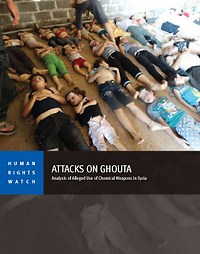
Attacks on Ghoutta (22 pp) analyses the chemical weapons attacks on the suburbs of Ghoutta on 21 August 2013.  Here is the Executive Summary:

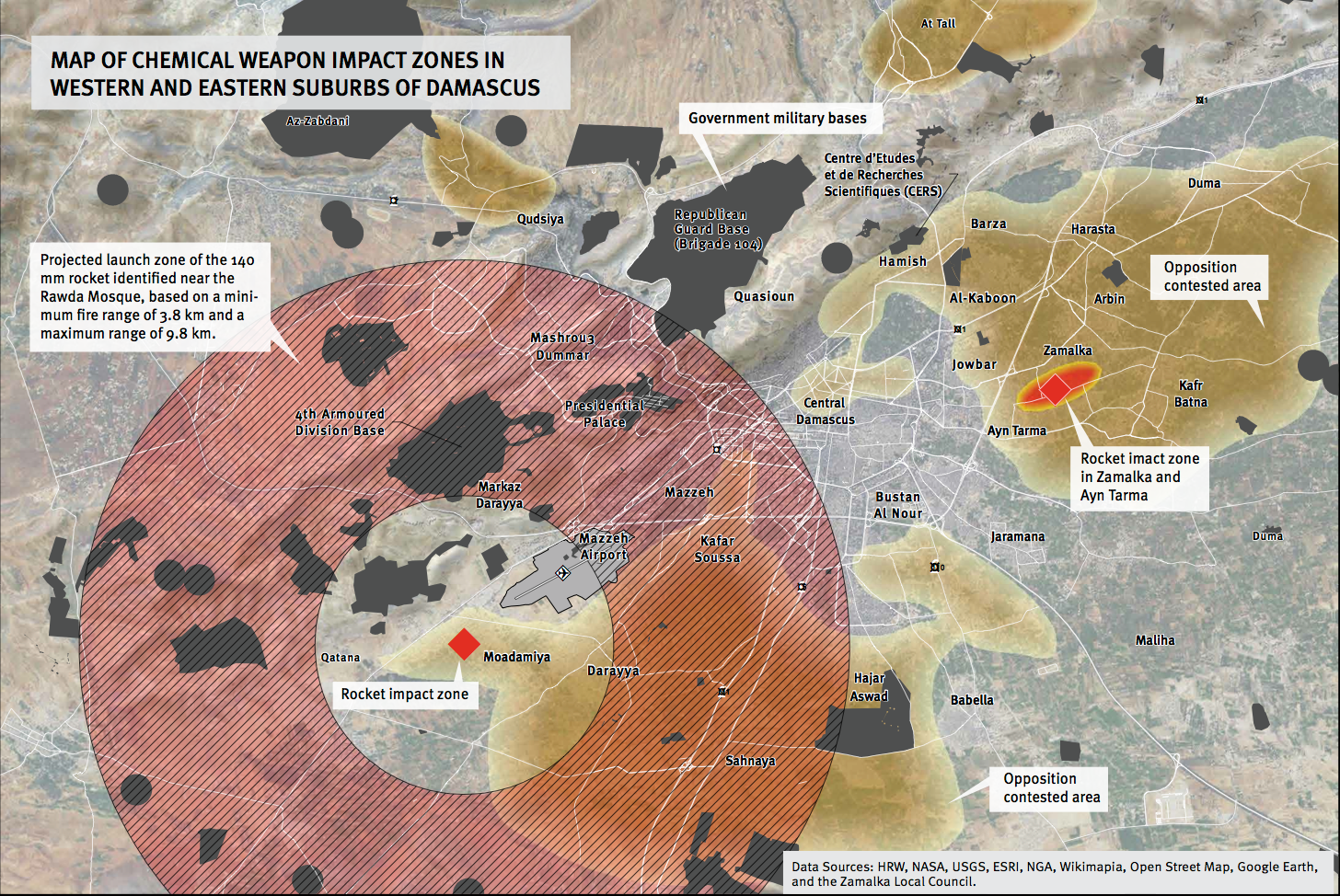
This report details two alleged chemical weapons attacks in Syria on the opposition-controlled Damascus suburbs of Eastern and Western Ghouta, located 16 kilometers apart, on the morning of August 21, 2013. The attacks killed hundreds of civilians, including large numbers of children. Human Rights Watch analyzed witness accounts of the rocket attacks, information on the likely source of the attacks, the physical remnants of the weapon systems used, and the medical symptoms exhibited by the victims of the attack as documented by medical staff.

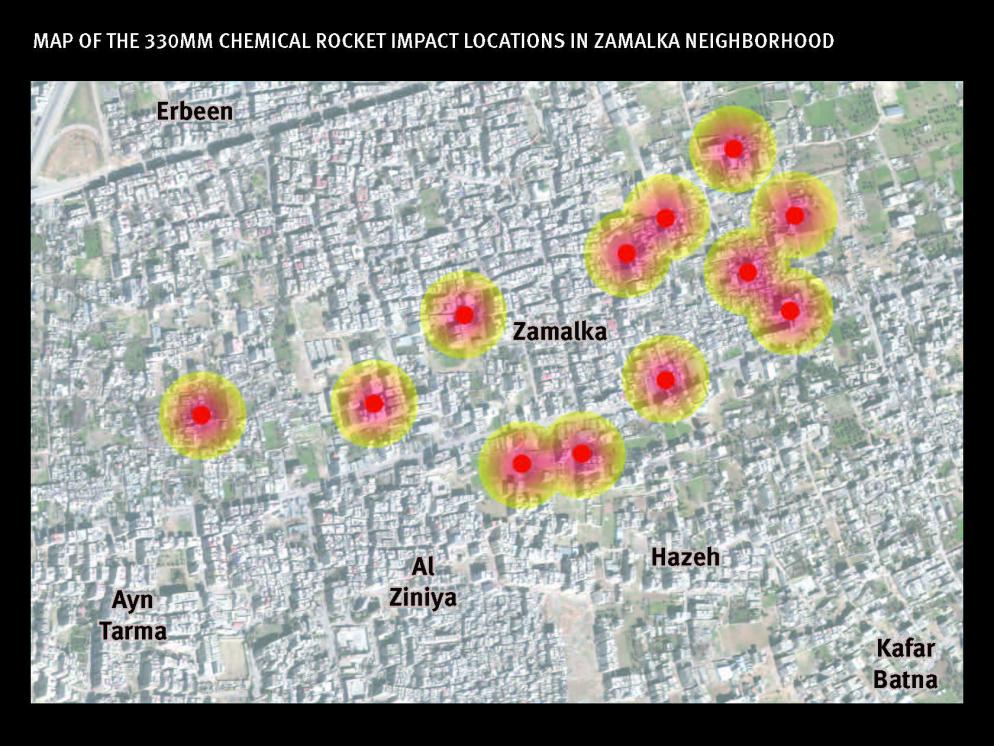
zamalaka_mapOur investigation finds that the August 21 attacks were likely chemical weapons attacks using a surface-to-surface rocket system of approximately 330mm in diameter—likely  Syrian-produced—and a Soviet-era 140mm surface-to-surface rocket system to deliver a nerve agent. Evidence suggests the agent was most likely Sarin or a similar weapons-grade nerve agent. Three local doctors told Human Rights Watch that victims of the attacks showed symptoms which are consistent with exposure to nerve gas, including suffocation; constricted, irregular, and infrequent breathing; involuntary muscle spasms; nausea; frothing at the mouth; fluid coming out of noses and eyes; convulsing; dizziness; blurred vision; and red and irritated eyes, and pin-point pupils.

The evidence concerning the type of rockets and launchers used in these attacks strongly suggests that these are weapon systems known and documented to be only in the possession of, and used by, Syrian government armed forces. Human Rights Watch and arms experts monitoring the use of weaponry in Syria have not documented Syrian opposition forces to be in the possession of the 140mm and 330mm rockets used in the attack, or their associated launchers.

The Syrian government has denied its responsibility for the attack, and has blamed opposition groups, but has presented no evidence to back up its claims. Based on the available evidence, Human Rights Watch finds that Syrian government forces were almost certainly responsible for the August 21 attacks, and that a weapons-grade nerve agent was delivered during the attack using specially designed rocket delivery systems. The scale and coordinated nature of the two attacks; against opposition-held areas; the presence of government-controlled potential launching sites within range of the targets; the pattern of other recent alleged chemical weapon attacks against opposition-held areas using the same 330mm rocket delivery system; and the documented possession of the 140mm and 330mm rocket systems able to deliver chemical weapons in the government arsenal—all point towards Syrian government responsibility for the attacks.

Human Rights Watch has investigated alternative claims that opposition forces themselves were responsible for the August 21 attacks, and has found such claims lacking in credibility and inconsistent with the evidence found at the scene. Claims that the August 21 deaths were caused by an accidental explosion by opposition forces mishandling chemical weapons in their possession are inconsistent with large numbers of deaths at two locations 16 kilometers apart, and documentation of rocket attacks on the sites that morning, as evidenced by witness accounts, the damage visible on the rockets themselves, and their impact craters.

Chemical weapon impact zones, Ghoutta (HRW)

Three quick observations.

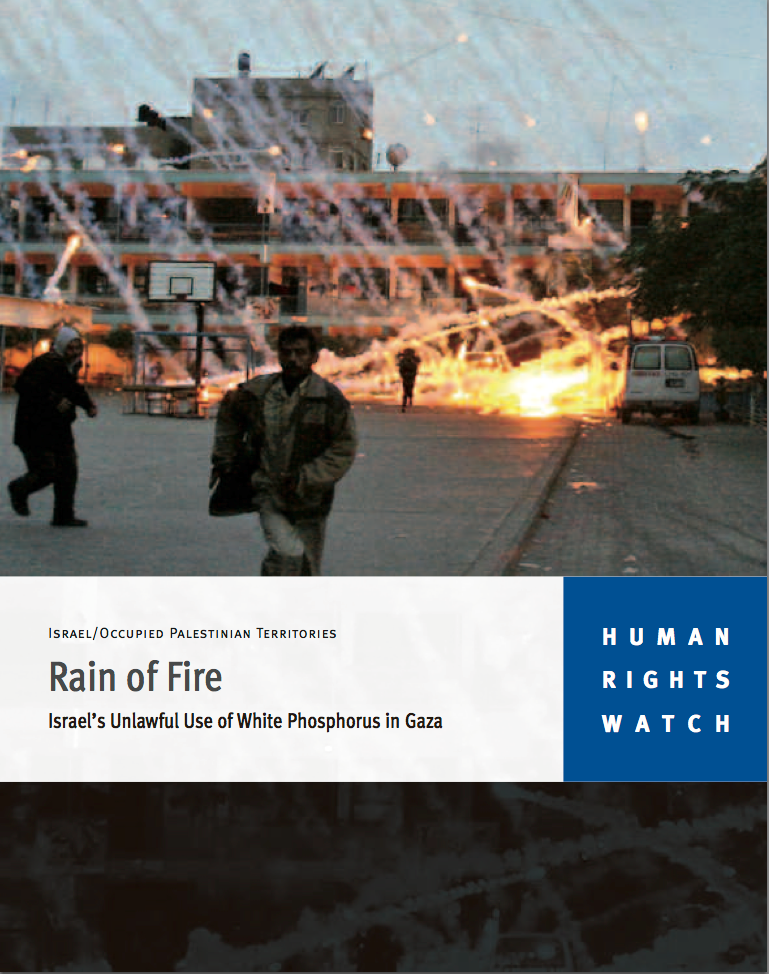
HRW Rain of FireHRW used a range of sources to conduct its analysis-from-a-distance, including Skype interviews, video and photographic footage, and satellite imagery, and consulted with scientific experts on chemical warfare, key analysts from its own Arms Division and independent arms experts. I rehearse all this because when HRW carried out its searching analysis of the unlawful use of white phosphorus by the Israel Defense Force in Gaza, Rain of Fire, a forensic analysis that was cited multiple times in the Goldstone report, the defenders of the IDF (there’s a phrase) unleashed a desperate campaign to discredit HRW’s expert Marc Garlasco.  You can find a discussion in Eyal Weizman‘s The least of all possible evils (see also here). This time round, of course, the government of Israel has joined the (I think convincing) chorus identifying the Syrian Army as the culprits: but it will be interesting to see whether it has also been magically converted to the propriety of HRW’s forensic analysis.

I link the two reports for a second reason, which is the disgracefully selective and self-serving nature of the ‘humanitarian’ condemnation of chemical weapons.  Here is President Obama speaking yesterday:

‘…the world saw in gruesome detail the terrible nature of chemical weapons, and why the overwhelming majority of humanity has declared them off-limits — a crime against humanity, and a violation of the laws of war.’

He conceded that this wasn’t always the case:

‘In World War I, American GIs were among the many thousands killed by deadly gas in the trenches of Europe. In World War II, the Nazis used gas to inflict the horror of the Holocaust. Because these weapons can kill on a mass scale, with no distinction between soldier and infant, the civilized world has spent a century working to ban them. And in 1997, the United States Senate overwhelmingly approved an international agreement prohibiting the use of chemical weapons, now joined by 189 governments that represent 98 percent of humanity.

On August 21st, these basic rules were violated, along with our sense of common humanity.’

But what a selective mobilisation of history, in which the US rises from victim to saviour.  Now I agree that the use of chemical weapons in Syria is vile – but so too was  Israel’s use of white phosphorus in Gaza ( in the same speech Obama reaffirmed the US’s “unshakable support” for Israel), the US-led coalition’s use of depleted uranium munitions in Iraq (which goes back to 1991; see also Omar Dewachi on ‘the toxicity of everyday life’ here), Iraq’s use of nerve gas against Iran in 1988 (in which we now have proof that the US was complicit), the US deployment of chemical herbicides in Vietnam, Laos and Cambodia… the list goes on and on.

And this brings me to my third (no less obvious) observation: showing who used chemical weapons is a far cry from knowing what to do about it – especially when the network of responsibility and complicity is so hideously extensive.

***

Update: I’ve been so busy trying to finish two desperately overdue essays and to prepare for the start of a new term (I’ve posted the new outlines for my undergraduate and graduate courses under the TEACHING tab) that I haven’t had a chance to return to my reading of Théorie du drone, but I’m determined to do so very soon.

Theory of the drone 6: Sacrifice, suicide and drones

This is the sixth in a series of posts on Grégoire Chamayou‘s Théorie du drone.  I had planned to cover Part II, Ethos and psyche, in a single post, but I’ve received several requests not to speed up, so I’m continuing chapter by chapter, with supplementary readings and comments as I go.

1.  Drones and kamikazes

Soon after Oliver Belcher started his research programme with me – and I’m delighted to say his thesis on ‘The afterlives of counterinsurgency’ has now been submitted – we had one of many rich conversations about what he called ‘the art of war in an age of digital reproduction’.  The reference, of course, was to Walter Benjamin‘s famous essay, usually translated as ‘The work of art in an age of mechanical reproduction.’  This seems to be widely regarded as the standard, even canonical version since its inclusion in the volume of Benjamin’s essays edited by Hannah Arendt and published as Illuminations.

But it has a more complicated history.  Here is Eric Larsen:

‘After fleeing the Nazi government in 1933, Benjamin moved to Paris, from where he published the first edition of “Work of Art” in 1936. This publication appeared in French translation under the direction of Raymond Aron in volume 5, no. 1 of the Zeitschrift für Sozialforschung. Benjamin subsequently rewrote the essay and after editorial work by Theodore and Margarethe Adorno it was posthumously published in its commonly recognized form in his Schriften of 1955.’

Benjamin Work of ArtIn fact there were four versions of the essay, and several critics regard the second version as the most daring of all (you can find the third version here).  In the third volume of Harvard’s Selected Writings this is translated as ‘The work of art in the age of its technological reproducibility’ (1936) – it’s also available separately in the little book shown on the left – and includes this remarkable passage in an expanded Section VI:

Compared to that of the machine age, of course, this [pre-historic] technology was undeveloped. But from a dialectical stand-point, the disparity is unimportant. What matters is the way the orientation and aims of that technology differ from those of ours. Whereas the former made the maximum possible use of human beings, the latter reduces their use to the minimum. The achievements of the first technology might be said to culminate in human sacrifice; those of the second, in the remote-controlled aircraft which needs no human crew. The results of the first technology are valid once and for all (it deals with irreparable lapse or sacrificial death, which holds good for eternity). The results of the second are wholly provisional (it operates by means of experiments and endlessly varied test procedures). The origin of the second technology lies at the point where, by an unconscious ruse, human beings first began to distance themselves from nature.  It lies, in other words, in play.

It’s extraordinary to read these words 75 or so years after Benjamin wrote them, and their intimations of armed drones and even the supposed ‘Playstation mentality’ that misguides those who operate them (though I think that argument misunderstands the extraordinary immersive capacity of videogames, but that’s another story that I’ve told elsewhere).

Chamayou starts his exploration of ‘Ethos and psyche’ by invoking yet another version of Benjamin’s iconic essay, but his basic point shines through the version I’ve quoted above.  His purpose is to juxtapose one technology or at least its limit-case, sacrifice, which engages the human in the most direct and intimate way possible, once and for all, to another, from which (so he says) the human is disengaged in a mechanical act that is, in principle, endlessly repeatable.

Yet it turns out that this isn’t an historical succession in any simple sense at all: what Chamayou sees instead are two different genealogies – the kamikaze pilot and suicide-bomber on one side and the drone on the other – entwined in a truly deadly embrace.

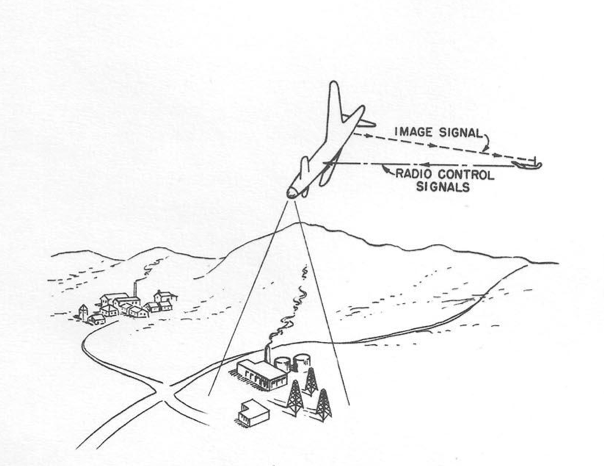
The linchpin of his argument is provided by a Russian emigré engineer working for RAC, Vladimir Zworykin. Apparently alarmed by press reports in 1934 that the Japanese were considering the formation of a ‘Suicide Corps to control surface and aerial torpedoes’, Zworkyin proposed to use technology to counter the threat.  Previous experiments with radio-controlled aerial torpedoes were all very well, but these were ‘blind weapons’ that inevitably lacked precision.  The Japanese proposed to solve the  problem by using human pilots to guide the explosive platform on to its target – Zworykin’s contrary solution was to guide the aerial torpedo through an ‘electric eye’ (a sort of proto-television).

Zworykin aerial torpedo

The torpedo would be a glider,

‘carried on an airplane to the proximity of where it is to be used, and released.  After it has been released the torpedo can be guided to its target with shortwave radio control, the operator being able to see the target through the “eye” [or Iconoscope] of the torpedo as it approaches.’

In 1935 Zworykin submitted a memorandum to the War and Navy Departments describing a television-controlled missile that could be guided beyond the line of sight, and five years later the US approved ‘Project Block‘ for RCA to develop TV-guided ‘assault drones’ in concert with the US Navy.  When the first Japanese kamikaze units were formed they were indeed deployed against naval targets – but this wasn’t until 1944, so I’m not sure about the source of those much earlier reports that fired Zworykin’s imagination.

I described some earlier experiments with aerial torpedoes here, and you can find much more about Zworykin here and in Alexander Magoun‘s Television: the life story of a technology, pp. 78-84.  He notes that the US Army Air Force was a latecomer to these experiments, and didn’t demonstrate a TV-controlled drone until October 1943, largely because its major investment was in heavy bombers capable of inflicting major destruction on cities and military-industrial targets.  Project Aphrodite did experiment with the use of television to guide war-weary Flying Fortresses filled with explosives and napalm on to targets in Germany, but the attempts were largely unsuccessful and singularly irrelevant to the strategic bombing campaigns of World War II.

Nevertheless, Chamayou argues that to some degree Zworykin had identified the core principle that would later be used to develop the smart bomb and the drone.  His sharper point is that the forerunner of the drone was an anti-kamikaze; sharper because this conceptual origin places the drone within a distinctive ethico-technical economy of life and death.

This ethico-technical economy can be read as an ethic of heroic sacrifice on one side and an ethic of auto-preservation on the other, each a mirror image of its other, ‘two visions of horror’.    Chamayou joins several other commentators to connect the kamikaze attacks of the Second World war to suicide-bombers today, and so argues that in the global North today the cardinal opposition is usually expressed as ‘defiance of death’ versus ‘love of life’: the frequently repeated claim, as at once an explanation and a condemnation of suicide-bombing, that ‘they’ don’t value life as much as ‘we’ do.  Yet, as Chamayou insists, it’s not ‘life in general’ that we value at all: it’s our lives that we cherish.

To develop this argument (which he will later elaborate in other dimensions), Chamayou cites Richard Cohen‘s editorial in the Washington Post on 6 October 2009:

As for the Taliban fighters, they not only don’t cherish life, they expend it freely in suicide bombings. It’s difficult to imagine an American suicide bomber.

He then uses anthropologist Hugh Gusterson‘s response to sharpen his point still further.  Gusterson wonders, with Jacqueline Rose,  why ‘dropping cluster bombs from the air is not only less repugnant [than suicide bombing]: it is somehow deemed, by Western leaders at least, to be morally superior.’  He then reverses the terms of the argument (and in going so prefigures Chamayou’s own argument about the substitution of hunting for combat in many areas of later modern warfare and about the colonial antecedents of drone strikes):

ASAD On suicide bombing[M]any people in the Middle East feel about U.S. drone attacks the way Richard Cohen feels toward suicide bombers. The drone attacks are widely perceived in the Middle East as cowardly, because the drone pilot is killing people on the ground from the safety of an air-conditioned pod in Nevada, where there is no chance that he can be killed by those he is attacking. He has turned combat into hunting. In this regard, the drone is the culmination of a long tradition of colonial war-fighting technologies — going back at least to the machine guns with which British and French colonial soldiers mowed down spear-carrying Africans –that ensure that the “natives” die, in an unfair fight, in considerably larger numbers than the colonial soldiers.

The drone operator is also a mirror image of the suicide bomber in that he too deviates, albeit in the opposite direction, from our paradigmatic image of combat as an encounter between warriors who meet as equals risking the wounding or killing of their own bodies while trying to wound or kill the others’ bodies. The honorable drama of combat lies in the symmetrical willingness of warriors to wager their bodies against each other for a cause. But now, in the words of the anthropologist Talal Asad, in his book On Suicide Bombing, U.S. “soldiers need no longer go to war expecting to die, but only to kill. In itself, this destabilizes the conventional understanding of war as an activity in which human dying and killing are exchanged.”

But there are two other twists to this story that Chamayou doesn’t pursue.

First, in his essay for the Bulletin of the Atomic Scientists Gusterson confounds Cohen’s difficulty in imagining ‘an American suicide bomber’ like this:

‘For decades loyal U.S. soldiers in nuclear missile silos have trained to launch their weapons in the expectation that they would be killed almost immediately afterwards in the ensuing nuclear war. I once interviewed a former special-forces officer who was trained to hike behind enemy lines with a tactical nuclear weapon on his back and place it near an important target. Although the weapon had a timer, he expected to die at ground zero.

If such men were the elite nuclear suicide bombers whose mission was prepared but never carried out, the Cold War turned the whole country into a suicide bomber rehearsing obsessively for the moment when we would “push the button” and take down millions of our enemies with us. Seen in this light, Americans trained for the biggest suicide bombing mission of all.’

Second, there have been ‘successful’ American suicide bombers.  To some historians the first candidate is Andrew Kehoe, who set off an explosion at a schoolhouse in Bath, Michigan in May 1927, killing 44 people, before setting off dynamite in his truck and killing himself and several other people.  Whether you count this as a suicide bombing in the modern sense of the term depends on the criteria you think appropriate.  Many commentators exclude Kehoe and identify three other, more recent American suicide bombers: Shirwa Ahmed, who drove a car bomb into a government compound in Puntland in October 2008, killing as many as 30 people; Farah Mohamed Beledi, who killed himself and three soldiers at a military checkpoint in Mogadishu in June 2011; and Abdisalan Hussein Ali, who attacked African Union troops in Mogadishu six months later.  All three were Somali-Americans who had lived in Minnesota and were recruited by al-Shabaab.

But to exclude Kehoe and claim that these three were not ‘really American’ is to immediately trigger one of Chamayou’s key arguments about the ways in which killing and dying in the age of the drone are racialized.  More soon.

ASBACoda:

As I finished up this post,  I discovered a young American performance artist, Ethan Fishbane, whose show American Suicide Bomber Association has been staged in New York and previously in Indonesia and South Africa.

Apparently he threw one of his stage ‘bombs’ into the garbage last week and unwittingly set off a bomb scare in Manhattan.

“I felt the response [by the police] was wholly appropriate,” he said. “Even if it’s just a prop for a theater piece, they were on top of it.”

Where Souls Dwell

Laila Shawa: Where souls dwell 4

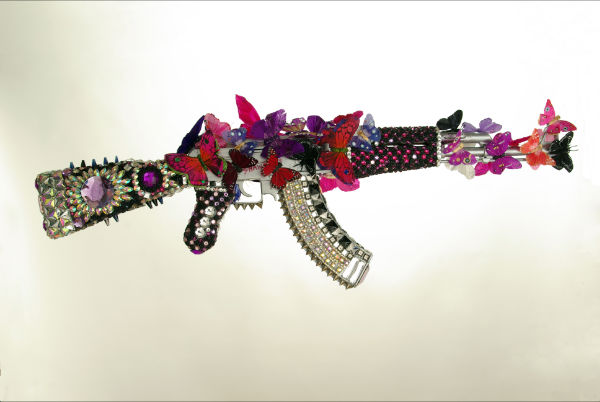
I’ve had a message from Laila Shawa, whose work I noted earlier, enclosing one of her latest projects (and generously allowing me to show her work here).  Where Souls Dwell (above) is from her Gun series and speaks directly to one of my very first posts (on the arms trade); it shows the AK-47, and Leila explains it like this:

Next to Drones, this gun is the biggest killing machine in the World. Due to its cheap production by everyone, it is in the hands of everyone, including children!! The Butterflies (in World mythology) represent the souls killed by this gun, and their return to the place (or cause) of their death.

I provided a brief bibliography of work on the AK-47 and the trade in ‘small arms’ in my original post, but I wasn’t aware of the way in which artists had engaged with this deadly weapon.  Last September Laila’s work was featured as part of the AKA Peace Exhibition at the Institute for Contemporary Art in London.

The exhibition was conceived by an ex-soldier who challenged 23 contemporary artists to incorporate decommissioned AK-47 assault rifles into their work. You can see some of the results, including those by Antony Gormley and Damien Hirst, here, here and here.  Laila adds:

“The challenge of altering and removing the raison d’êtres of an AK-47 is irresistible. I turned my guns into jewelled objects that can only be useless!!! In no way was I trying to glorify lethal weapons that are responsible for the death of hundreds of thousands of people.

I feel that artists must speak out against the arms race, wars, and the Arms Industry,which drives countries to create unnecessary wars.

According to mythology, the souls of people killed return as butterflies to the place where they were killed. The butterflies in this work represent those souls. 

My first AK-47, was commissioned by Peace One Day, a peace organization under the patronage of the United Nations, and was exhibited at the ICA London in October 2012 under the title ‘AKA Peace.’ Later it was sold in a public auction to raise money forPeace One Day. 20 British artists participated in this show amongst which were Damien Hirst, Anthony Gormley, Gavin Turk and the Chapman Brothers. The AK-47 (Kalashnikov) is the most produced gun in the world, in various versions. There are over 200 million AK-47s in circulation, quite often, and most irresponsibly, in the hands of children.”

There are many implications arising from all this – the most direct, of course, about these killing machines.  But these interventions also underscore the need for those of us working in the humanities and social sciences to engage with the work of creative artists, not only as critics and commentators but also as interlocutors interested in exploring other media in which to develop our arguments.

‘Stop, hey, what’s that sound?’

I’ve used this Buffalo Springfield song before

there’s something happenin’ here
what it is ain’t exactly clear
there’s a man with a gun over there…

stop, hey, what’s that sound?

– and I’ve posted about the sound of war before too, here and here.  This post is connected to both of them, but it also follows directly from my more recent post on bodies

McCARTHY CAn age ago Trevor Barnes recommended Tom McCarthy‘s novel C to me, and I’ve been re-reading it these last few days. There’s an extraordinary passage where McCarthy’s protagonist Serge, an observer with the Royal Flying Corps during World War I, is being driven to Nieppe when his truck  detours ‘to drop off some piano wire’ to a special unit in the woods north of Vitriers.

Inside the main [hut], he finds a huge square harp whose six strings are extended out beyond their wooden frame by finer wires that run through the hut’s air before breaching its boundary as well, cutting through little mouse-holes in the east-facing wall. In front of the harp, like an interrogation lamp, a powerful bulb shines straight onto it; behind it, lined up with each string, a row of prisms capture and deflect the light at right angles, through yet another hole cut in the hut’s wall, into an unlit room adjoining this one. There’s a noise coming from the adjoining room: sounds like a small propeller on a stalled plane turning from the wind’s pressure alone. “What is this place?” Serge asks. “You’re an observer, right?” the slender-fingered man says. Serge nods. “Well, you know how, when you’re doing Battery Location flights, you send down K.K. calls each time you see an enemy gun flash?” “Oh yes,” Serge answers. “I’ve always wondered why we have to do that …” “Wonder no more,” the man says with an elfin smile. “The receiving operator presses a relay button each time he gets one of those; this starts the camera in the next room rolling; and the camera captures the sound of the battery whose flash you’ve just K.K.’d to us. You with me?” “No,” Serge answers. “How can it do that?” “Each gun-boom, when it’s picked up by a mike, sends a current down the wires you just pissed on,” the man continues, “and the current makes the piano wire inside this room heat up and give a little kick, which gets diffracted through the prisms into the next room, and straight into the camera.” “So you’re filming sound?” Serge asks. “You could say that, I suppose,” the man concurs.

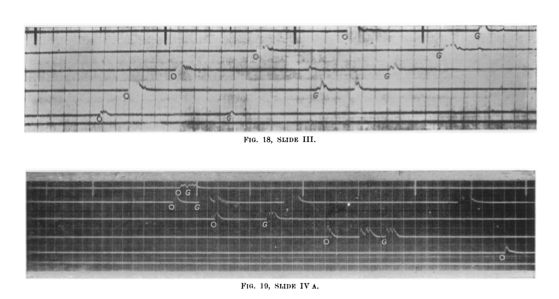
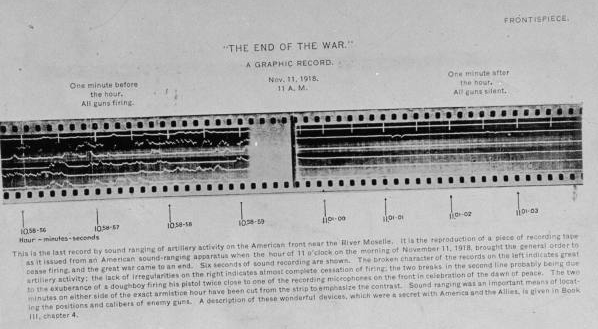
Sound ranging traces

Still puzzled, he follows the man into another hut:

The interior’s suffused with red light. At a trough propped up against the far wall, a man with rolled-up sleeves is dunking yards of film into developing liquid, then feeding it on from there into a fixing tank. As the film’s end emerges from this tank in turn, he holds it up, inspects it and tears off sections, clipping these with clothes pegs to a short stretch of washing line, from where they drip onto the discarded strips on the room’s floor below them. “Yuk,” Serge whispers beneath his breath. “What?” the slender-fingered man asks. “Nothing,” he replies. “Look here,” Serge’s guide says, unclipping a strip of the developed film and pointing at dark lines that run, lengthways and continuous, along its surface. The lines—six of them—are for the most part flat; occasionally, though, they erupt suddenly, and rise and fall in jagged waves, like some strange Persian script, for half an inch, before settling down and running flat again. On the film’s bottom edge, beside the punch-holes, a time-code is marked, one inch or so for every second. The jagged eruptions appear at different points along each line: staggered, each wave the same shape as the one on the line below it, but occurring a quarter of an inch (or three-tenths of a second) later. “So,” Serge’s elfin guide continues, “these kicks are made by the sound hitting each mike; and they get laid out on the film at intervals that correspond to each mike’s distance from the sound. You see them?” “Yes,” Serge answers. “But I still don’t—” “These ones ready to take through?” the guide asks the developer. The other man nods; with his piano-player’s fingers, the guide unclips the other drip-dried strips, then leads Serge out to yet another hut. This one’s wall has a large-scale map taped to it; stuck in the map in a neat semi-circle are six pins. Two men are going through a pile of torn-off, line-streaked film-strips, measuring the gaps between the kicks with lengths of string; then, moving the string over to the map slowly, careful to preserve the intervals, they transfer the latter onto its surface by fixing one end of the string to the pin and holding a pencil to the other, swinging it from side to side to mark a broad arc on the map. “Each pin’s a microphone,” the slender-fingered man explains. “Where the arcs intersect, the gun site must be.” “So the strings are time, or space?” Serge asks. “You could say either,” the man answers with a smile. “The film-strip knows no difference. The mathematical answer to your question, though, is that the strings represent the asymptote of the hyperbola on which the gun lies.”

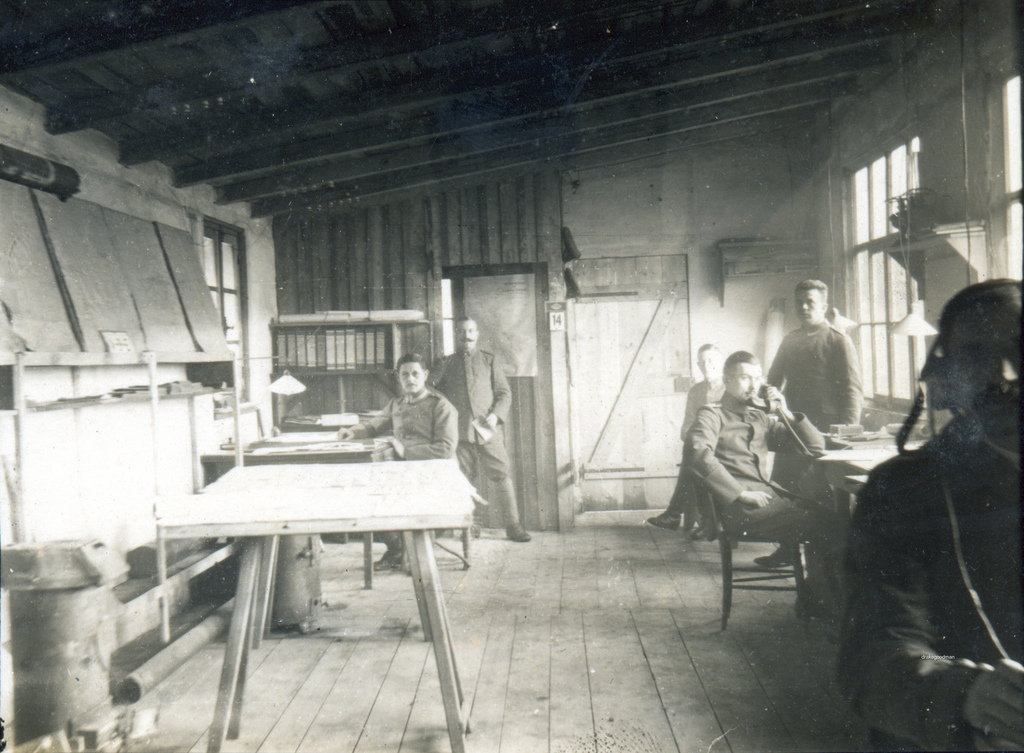
Serge has stumbled into what Peter Liddle called ‘the Manhattan Project of the 1914-18 war’: sound ranging.  It was a technique first developed by the French and German militaries  – a German sound ranging analysis section is shown below – taken up (warily) by the British (Berton claims their  old-school gunners at first thought it radical nonsense) and refined by the Canadians. As McCarthy’s brilliant reconstruction shows, it involved using sound to locate enemy artillery batteries.

The usual configuration was to have six ‘Tucker’ microphone stations at carefully surveyed intervals along an arc 4000 yards behind the front line with two observation posts in front of them, all linked to a recording station in the rear by 40 miles of wire.  When the observers saw a gun flash or heard its boom they sent a signal that activated the oscillograph and film recorder.  In the course of 1916 the British established eight of these sound-ranging sections, each plotting battery positions on base maps supplied by ‘Maps GHQ’.  In ideal conditions (which were rare) the operation could be completed for a single battery within three minutes (using graphical rather than computational methods) and with an accuracy of 25-100 yards (for more, see J.S. Finan and W.J. Hurley, ‘McNaughton and Canadian Operational Research at Vimy’, Jnl. of the Operational Research Society 48 (1) (1997) 10-14).

Analysis section of German sound ranging troop 1917

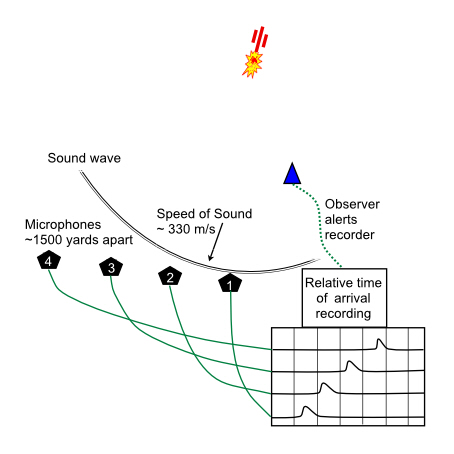
The single best source on this – though the title sounds like Flash Gordon – is John Innes‘s Flash spotters and sound rangers: how they lived, worked and fought in the Great War (1935), but Pierre Berton‘s Vimy (1986) has some useful summary pages on the Canadian role in its development. There is also a truly excellent survey that places sound-ranging in the wider context of the ‘battlefield laboratory’ in Roy MacLeod, ‘Sight and sound on the Western Front: surveyors, scientists and the “battlefield laboratory”, 1915-1918’, War & Society 18 (1) (2000) 23-46.  For more technical discussions, Peter Chasseaud‘s Artillery’s astrologers: a history of British survey and mapping on the Wester Front 1914-1918 (1999) is a key source, but there is also an exemplary (short) explanation here, from which I’ve borrowed the simplified summary diagram below.

Sound ranging

The Germans were evidently impressed by the efficacy of the Allied system, as this directive issued by General Ludendorff shows:

According to a captured English document the English have a well- developed system of sound-ranging which in theory corresponds to our own. Precautions are accordingly to be taken to camouflage the sound: e.g. registration when the wind is contrary, and when there is considerable artillery activity, many batteries firing at the same time, simultaneous firing from false positions, etc. The English have an objective method (self-recording apparatus). It is important to capture such an apparatus. The same holds good on the French front.

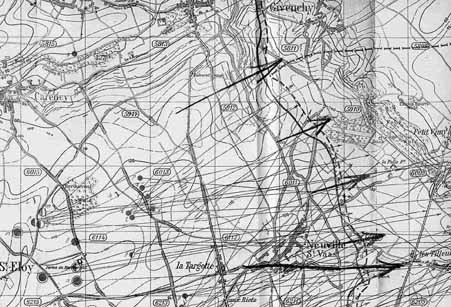
Since most of the killing and destruction was the work of the artillery, these counter-battery operations were a crucial part of the ground war.  Multiple sources were used, including aerial reconnaissance, balloon observation and flash spotting as well as sound ranging, and when combined these could eventually locate enemy guns to within 5-25 yards.  This map of German artillery intelligence for Vimy in March 1917 shows something of the power and complexity of this ‘acoustic cartography’:

German artiller intelligence map Enemy batteries known with certainty to be firing and spotted 15 to 22 March 1917 Vimy

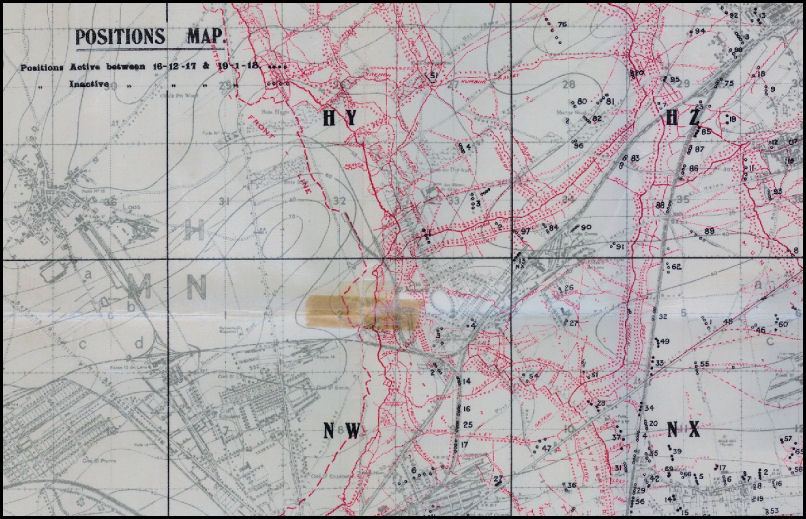
Maps showing the location of enemy batteries (‘Positions maps’ like the British one below) were issued on a regular and eventually even a daily basis.

Positions map. December 1917-January 1918

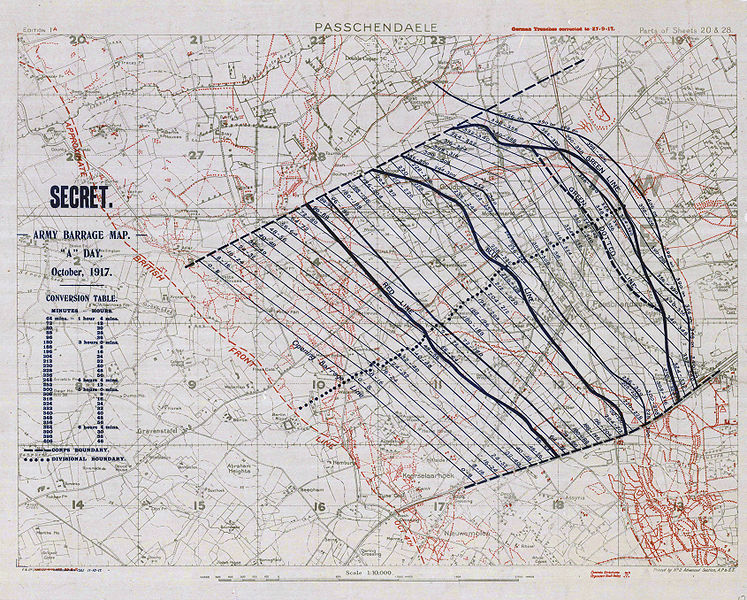
This was all part of a more general metricisation of the battlefield – hideously appropriate for the killing machine that was industrialized warfare – which you can also see in the ‘barrage maps’ that choreographed the moving curtain of artillery fire behind which troops were supposed to advance on the enemy lines.  John Keegan is very good on what he called ‘the mathematics of the barrage’ in his The Face of Battle, and from his aircraft high above No Man’s Land, Billy Bishop described it as ‘clockwork warfare’:

The waves of attacking infantry as they came out of their trenches and trudged forward behind the curtain of shells laid down by the artillery, were an amazing sight. The men seemed to wander across No Man’s Land, and into the enemy trenches, as if the battle was a great bore to them. From the air it looked as though they did not realise that they were at war and were taking it all entirely too quietly. That is the way with clock-work warfare. These troops had been drilled to move forward at a given pace. They had been timed over and over again in marching a certain distance, and from this timing the “creeping,” or rolling barrage which moved in front of them had been mathematically worked out.

BARRAGE MAP bataille-ypres-passchendaele-carte-secret

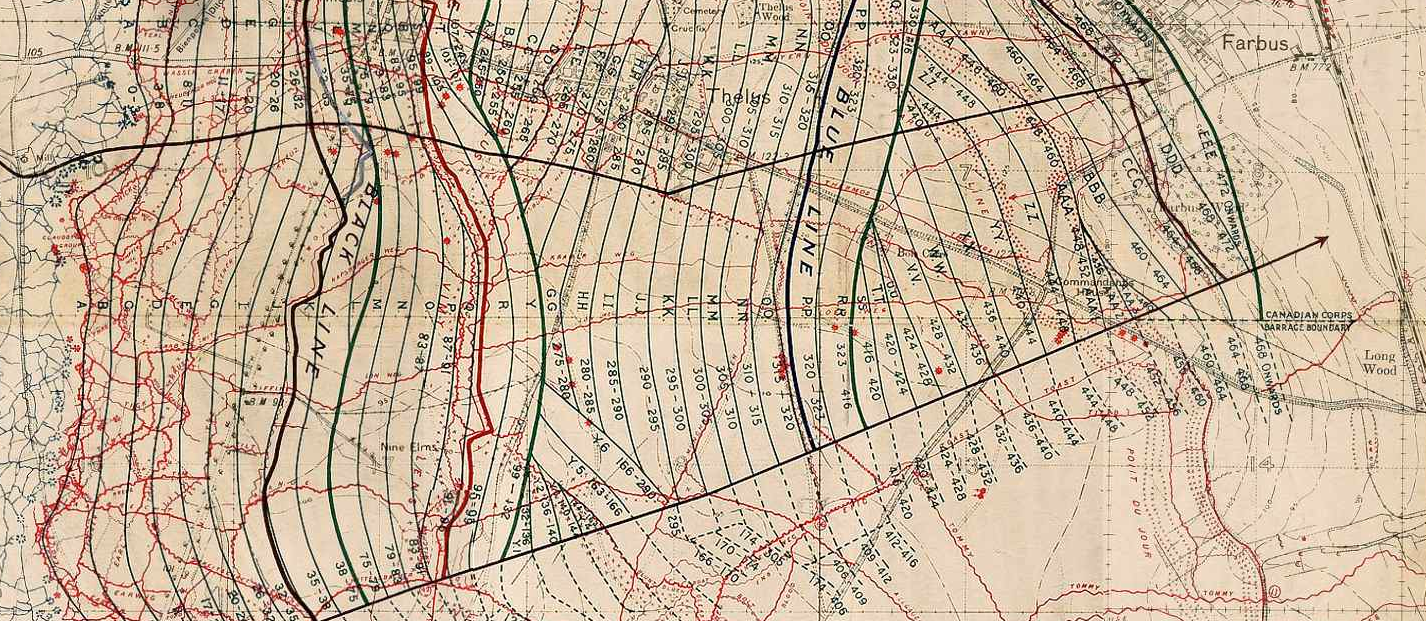
Here’s part of the barrage map for Vimy, which shows the calibration even more clearly:

Vimy barrage map 1917 (extract)

McCarthy captures this ‘clockwork’ movement perfectly when Serge looks down from his aircraft while spotting for artillery:

As the second-hand needle moves across the final quarter-segment of his watch’s face, Serge feels an almost sacred tingling, as though he himself had become godlike, elevated by machinery and signal code to a higher post within the overall structure of things, a vantage point from which the vectors and control lines linking earth and heaven, the hermetic language of the invocations, its very lettering and script, have become visible, tangible even, all concentrated at a spot just underneath the index finger of his right hand which is tapping out, right now, the sequence C3E MX12 G … Almost immediately, a white rip appears amidst the wood’s green cover on the English side. A small jet of smoke spills up into the air from this like cushion stuffing; out of it, a shell rises. It arcs above the trench-meshes and track-marked open ground, then dips and falls into the copse beneath Serge, blossoming there in vibrant red and yellow flame. A second follows it, then a third. The same is happening in the two-mile strip between Battery I and its target, and Battery M and its one, right on down the line: whole swathes of space becoming animated by the plumed trajectories of plans and orders metamorphosed into steel and cordite, speed and noise. Everything seems connected: disparate locations twitch and burst into activity like limbs reacting to impulses sent from elsewhere in the body, booms and jibs obeying levers at the far end of a complex set of ropes and cogs and relays. The salvos pause; Serge plots the points of impact on his clock-code chart, then sends adjustments back to Battery E, which fires new salvos that land slightly to the north of the first ones. 

There’s a lot more to say about this, which I plan to do in the full presentation, but what interests me at least as much is the way in which this precision (Gabriel’s ‘order and reasonableness’) – so clear and crystalline when plotted on maps or seen from the air – was confounded on the ground, not least by the shattered landscape of craters, trenches and barbed wire and by the vile agency of what Siegfried Sassoon called the ‘plastering slime’ that clawed and dragged at the soldiers’ bodies and which was erased from what Edmund Blunden called the ‘innocuous arrows’ and ‘matter-of-fact symbols’ of the maps and aerial photographs.

More particularly, I’m interested (here) in the production of an altogether more sensuous soundscape, part of the corpography that danced such a deadly gavotte with cartography that I sketched out in my previous post.  In Touch and intimacy Santanu Das argues that

‘The mechanised nature of the First World War severed the link between sight, space and danger, a connection that had traditionally been used to structure perception in wartime.  This disjunction resulted in an exaggerated investment in sound.’

The memoirs, letters and diaries from the Western Front confirm that the hideous noise of battle worked its way inside the very body of the soldier.  I’ve got pages of examples, but here is just one, Edward Lynch in Somme Mud (and, for that matter, in Somme mud):

‘The shells are missing us by a matter of yards.  Noise is everywhere.  We lie on the shuddering ground, rocking to the vibrations, under a shower of solid noise we feel we could reach out and touch.  The shells come, burst and are gone, but that invisible noise keeps on – now near, now far, now near, now far again.  Flat, unceasing noise.’

I’ve emphasised the passage that simply resonates with what I described previously as a haptic geography.  And so, not surprisingly, the same sources also show that, just as the landscape was inhabited, so too was knowledge of it; that knowing those deadly sounds – ‘knowing the score’, I suppose – was a vital part of staying alive.  Here is an extended passage from A.M. Burrage‘s War is war:

We are becoming acclimatised to trench warfare. We know by the singing of a shell when it is going to drop near us, when it is politic to duck and when one may treat the sound with contempt. We are becoming soldiers. We know the calibres of the shells which are sent over in search of us. The brute that explodes with a crash like that of much crockery being broken, and afterwards makes a “cheering” noise like the distant echoes of a football match, is a five-point-nine. The very sudden brute that you don’t hear until it has passed you, and rushes with the hiss of escaping steam, is a whizz-bang. For a perfect imitation of a whizz-bang, sit by the open window of a railway compartment and wait until an express train passes you at sixty miles an hour. The funny little chap who goes tonk-phew-bong is a little high-velocity shell which doesn’t do much harm. “Minnies” and “flying pigs” which are visible by day and night come sailing over like fat aunts turning slow somersaults in mid-air. Wherever one may be, and wherever they may be going to drop, they always look as if they are going to fall straight on top of one. They are visible at night because they have luminous tails, like comets. The thing which, without warning, suddenly utters a hissing sneeze behind us is one of our own trench-mortars. The dull bump which follows, and comes from the middle distance out in front, tells us that the ammunition is “dud.” The German shell which arrives with the sound of a woman with a hare-lip trying to whistle, and makes very little sound when it bursts, almost certainly contains gas.

 We know when to ignore machine-gun and rifle bullets and when to take an interest in them. A steady phew-phew-phew means that they are not dangerously near. When on the other hand we get a sensation of whips being slashed in our ears we know that it is time to seek the embrace of Mother Earth.

The end of the war was apprehended in both registers, and this frontispiece from Benedict Crowell’s Demobilization (1920) shows how an American sound-ranging station captured the moment the guns fell silent:

The end of the war: 11 a.m. on 11 November 1918

‘Stop, hey, what’s that sound?’

The death merchants

The opening sequence of Andrew Niccol’s Lord of War (2005), starring Nicholas Cage, provides one of the starkest visualizations of the arms trade as it follows the ‘life of a bullet’ – thousands and thousands of them and one in particular – from the point of view of the bullet itself.   You can watch it (and listen to the wonderful Buffalo Springfield) below:

Here is the script:

MOUNTED ON THE BACK OF A BULLET CASING – ILLUSTRATING THE LIFESPAN OF THE BULLET.

– Gunpowder is poured into a metal casing, lead slug mounted on top.

A BULLET is born.  A perfect 39mm.

– The BULLET travels along a conveyor belt with thousands of identical siblings in a Ukrainian factory so grey it’s monochrome.

– The BULLET, picked up by a ham-fisted UKRAINIAN FACTORY WORKER, is tossed into a crate.

– The BULLET, lying in its open crate, rolls down a chute where it’s inspected by a UKRAINIAN MILITARY OFFICER holding a manifest.  He seems to stare directly at our BULLET.

UKRAINIAN OFFICER (to his SUBORDINATE carrying a manifest, in Ukrainian) Call it “agricultural machinery”.

– The BULLET’s crate rattles around in an open-bed truck along an industrial road, passes a decapitated statue of LENIN. – The crate containing our BULLET is placed on a ship in the cold grey Odessa harbor.  A container door closes, plunging the bullet into darkness.

– The door re-opens.  The BULLET, still in its crate, now basks in bright, tropical sunshine, surrounded by an azure sea.

– The crate is removed by a pair of slim, dark hands, revealing a glimpse of the bustling, weathered port of Abidjan in the Ivory Coast.  The crate is one of dozens unloaded from the ship.

– BULLET’s POV from another open-air truck, now slogging through a mud-clogged road in lush rainforest.

– The BULLET is unloaded from the truck in Freetown, Sierra Leone – immediately grabbed by the young HAND of a RUF soldier.

– The BULLET is loaded into a 30-round magazine which is inserted into an AK-47 machine gun

– The BULLET waits – in the gloomy chamber.  Suddenly, from outside,the sound of raised voices and gunfire.

– The BULLET and its neighbors start to rise quickly up the magazine towards the chamber as the Kalashnikov is fired.

– Our hero BULLET is next.  Will it see action?

– Smack.  The gun’s bolt strikes the explosive cap, gunpowder ignited, the BULLET driven out of the barrel.

– Shed of its casing – now only a slug – the BULLET emerges into bright sunshine.  It is flying down the main street in Freetown.

– The BULLET gives us a perfect point-of-view of the bullet ahead of it.  They are both flying towards their intended target – a wild-eyed CHILD SOLDIER, a boy no more than twelve, firing an AK-47 almost as tall as he is.

– The leading bullet narrowly misses, whistles past the boy’s ear, striking the whitewashed wall behind – one more pock-mark in a building riddled with pock-marks.

– Our BULLET, following close behind, finds its mark, slamming into the boy’s forehead just above his left eye – his expression, oddly relieved.

– The BULLET carves through the lobes of the boy’s brain where it is enveloped in blood, finally plunged into darkness – the bullet’s final resting place.

CUT TO BLACK

I can imagine – I think – all sorts of ways in which today’s object-oriented philosopher-geographers might be interested in this sequence, but there’s also a much more obvious geography embedded in it.  Yet it turns out that it’s not so obvious after all.  One of the liveliest (sic) analyses of the global arms trade is Andrew Feinstein‘s The shadow world: inside the global arms trade (London: Hamish Hamilton, 2011); there are also trenchant analyses in Rachel Stohl and Suzette Grillot, The international arms trade (Cambridge: Polity, 2009).  But if you want to track those shadow geographies and their entanglements with the shifting geographies of military and paramilitary violence, then you have to look elsewhere.  And once you start looking you begin to realise why neither of these books includes any maps.

The Stockholm Institute for Peace Research has been tracking global military spending and the arms trade since 1967, and Ian Taylor has converted their recent tabulations into several maps, like the one below that plots military spending in 2011 as a proportion of GDP.

Armsflow has an animated sequence of global arms transfers from 1950 through to 2006, based on the SIPRI database.  And Worldmapper has some maps showing arms exports and arms imports, but these use data from 2003 only and exclude small arms and ammunition.  In fact most investigations of the global arms trade, until at least the end of the Cold War, were directed at major weapons systems – calibrating the ‘arms race’ – but since the 1990s there has been considerable interest in tracking small arms and light weapons (SALW); le monde diplomatique provided a map of small arms for 2002, but this was confined to the legal trade (though it did show the zones where illegal trafficking was most dense), and there is a visualization of the global distribution of small arms here.  In addition, the Norwegian Initiative on Small Arms Transfers (NISAT) has a series of maps ranking exporting and importing states.

But these maps are static and don’t show the flows involved. But now a new project between the Igarapé Institute in Brazil and Google’s Creative Lab team uses data from the Peace Research Institute in Oslo (one of NISAT’s three partners) to produce an interactive that charts the ‘government-authorised’ global trade in small arms from 1992 to 2010.  I’ve posted a screenshot below but this is an interactive and you really need to move through the image flow. The project claims that 60 per cent of violent deaths in the world are inflicted through the use of small arms and light weapons.  Note: You need Google Chrome to view the interactive.

The Geneva-based Small Arms Survey identifies the major exporters (excluding ammunition) thus:

Austria, Belgium, Brazil, Germany, Italy, and the United States routinely report annual exports of small arms, light weapons, their parts, accessories, and ammunition worth USD 100 million or more. The Small Arms Survey estimates that China and the Russian Federation also routinely achieve this level of activity although Beijing and Moscow do not report doing so. In 2007, customs data alone indicated that these eight countries, along with Canada, Switzerland, Turkey, and the United Kingdom, exceeded USD 100 million in exports.’

And the importers:

‘An analysis of customs data suggests that for the period 2001 to 2007 five countries—Canada, France, Germany, Saudi Arabia, and the United States—routinely imported small arms, light weapons, their parts, accessories, and ammunition worth USD 100 million or more per year. Customs data also suggests that eight additional countries imported at least USD 100 million or more in at least one year during this seven-year period: Australia, Cyprus, Egypt, Japan, the Netherlands, South Korea, Spain, and the United Kingdom. A review of customs data shows that Italy routinely imported more than USD 50 million per year from 2001 to 2007.  The United States is by far the biggest documented importer of small arms.

All this matters because, as C.J. Chivers – the author of a remarkable history of the AK-47, The Gun, notes in Foreign Affairs 90 (2011) 110-121 – small arms and ammunition play a central role in ‘fueling the forever war’.  And, as these fragmentary notes suggest, their cascading geographies also explain how they propel what I call ‘the everywhere war’ too. There are two vectors that need to be emphasized.  First – and Chivers is very good on this – there is a layered historical geography to the diffusion of small arms.  As state militaries spasmodically upgrade their stocks so their discarded models typically enter the arms bazaar in what Chivers calls ‘arms cascades’ – which explains how US Marines in Marja seized stocks of both Lee-Enfield bolt-action rifles and World War II ammunition and automatic Kalashnikovs.  What this example shows, too, is that there is no clear line dividing ‘white’  from ‘black’ (illicit) trade, what Mike Bourne – whose work I’ve just stumbled upon – calls an ‘upperworld’ and an ‘underworld’.   There may not be fifty shades of grey, but Bourne insists that there is ‘an important distinction between the greyness that occurs because of unclear or weakly enforced procedures or corrupt individuals and that which arises through covert arms supply by states’ [‘Controlling the shadow trade’, Contemporary security policy 32 (2011) 215-240].

Second, the geographies of small arms transfer are much more heterogeneous than the visualizations shown above imply: purely private black-market transfers are often intensely regionalized rather than globalized (again, Bourne’s Arming conflict: the proliferation of small arms (Palgrave-Macmillan, 2007) is very helpful here, and there is a clutch of revealing regional studies, notably of arms trafficking in sub-Saharan Africa.  I said something about this – all too briefly – in my ‘War and peace’ (see DOWNLOADS tab) but I need to think much more carefully about it.  My discussion of small arms trafficking in that essay was linked to the ‘new wars’ thesis, and Thomas Jackson has provided a much more incisive critique of the claim that the ‘globalization’ of arms supply feeds into intra-state conflicts, and of the importance of ‘domestic procurement’, in ‘From under their noses: rebel groups’ arms acquisition and the importance of leakages from state stockpiles’, International Studies Perspectives 11 (201) 131-147.  It’s a clunky title but an interesting argument: in Jackson’s view, only well organized non-state actors ‘have the organizational strength and external support to access the global arms market’.

But it’s Bourne’s contemplation of ‘an inglorious mess of hybrids and ever evolving assemblages’, and his continuing riffs on heterogeneity, that open up the most interesting theoretical and political possibilities, for me at any rate.  I recommend his reflections on ‘geopolitical imaginations’ (yes) and ‘netwar geopolitics’ [British journal of Politics and International Relations 13 (2011) 490-513] and (especially) ‘Guns don’t kill people, cyborgs do: a Latourian provocation for transformatory arms control and disarmament’ [Global change, peace and security 24 (2012) 141-163].  That last essay loops back to ways of re-envisaging the opening sequence of Lord of War with which I began…