Greenwashing war

KUPAR Hot spotter's reportComing next month from Minnesota, a new book from one of Allan Pred‘s most creative graduate students (and that’s saying something!).  Shiloh Krupar – a contemporary of the equally talented Trevor Paglen – is Assistant Professor of Culture and Politics at the Edmund A. Walsh School of Foreign Service at Georgetown University, and her Hot spotter’s report promises to add new dimensions to discussions of the biopolitics of militarism and the enlistment of ‘nature’ in the service of military violence:

Many nuclear and other U.S. military facilities from World War II and the Cold War are now being closed and remediated. Some of these sites have even been transformed into nature refuges and hailed as models of environmental stewardship. Yet, as Shiloh R. Krupar argues, these efforts are too often doing less to solve the environmental and health problems caused by military industrialism than they are acting to obscure the reality of ongoing contamination, occupational illnesses, and general conditions of exposure.

Using an unusual combination of empirical research, creative nonfiction, and fictional satire, Hot Spotter’s Report examines how the biopolitics of war promotes the idea of a postmilitary and postnuclear world, naturalizing toxicity and limiting human relations with the past and the land. The book’s case studies include the conversion of the Rocky Mountain Arsenal into a wildlife refuge, a project that draws on a green “creation story” to sanitize other histories of the site; the cleanup and management of the former plutonium factory Rocky Flats, where the supposed transfiguration of waste into wilderness allows the government to reduce the area it must manage; and a federal law intended to compensate ill nuclear bomb workers that has sometimes done more to benefit former weapons complexes.

Detecting and exposing such “hot spots” of contamination, in part by satirizing government reports, Hot Spotter’s Report seeks to cultivate irreverence, controversy, coalitional possibility, and ethical responses. The result is a darkly humorous but serious and powerful challenge to the biopolitics of war.

I’m sure, too, that it will have much to show us about ways of developing and conveying our arguments outside the conventions of formal academic prose. According to Bruce Braun, ‘Hot Spotter’s Report is at once a devastating indictment of ‘green war’ and a hopeful search for new conditions of existence in and beyond the toxic residues of militarism. Written with wit and passion, Krupar’s irreverent experiments with fable, satire, and creative non-fiction do much more than disrupt the ongoing sanitization of military violence; they open space for new coalitions and political imaginings in domestic landscapes marked by the legacies of imperial war.’

Contents:

Introduction
1. Where Eagles Dare: A Biopolitical Fable about the Rocky Mountain Arsenal National Wildlife Refuge
2. Alien Still Life: Managing the End of Rocky Flats
3. Hole in the Head Gang: The Reductio ad absurdum of Nuclear Worker Compensation (EEOICPA)
4. Transnatural Revue: Irreverent Counterspectacles of Mutant Drag and Nuclear Waste Sculpture
Conclusion: Hot Spotting

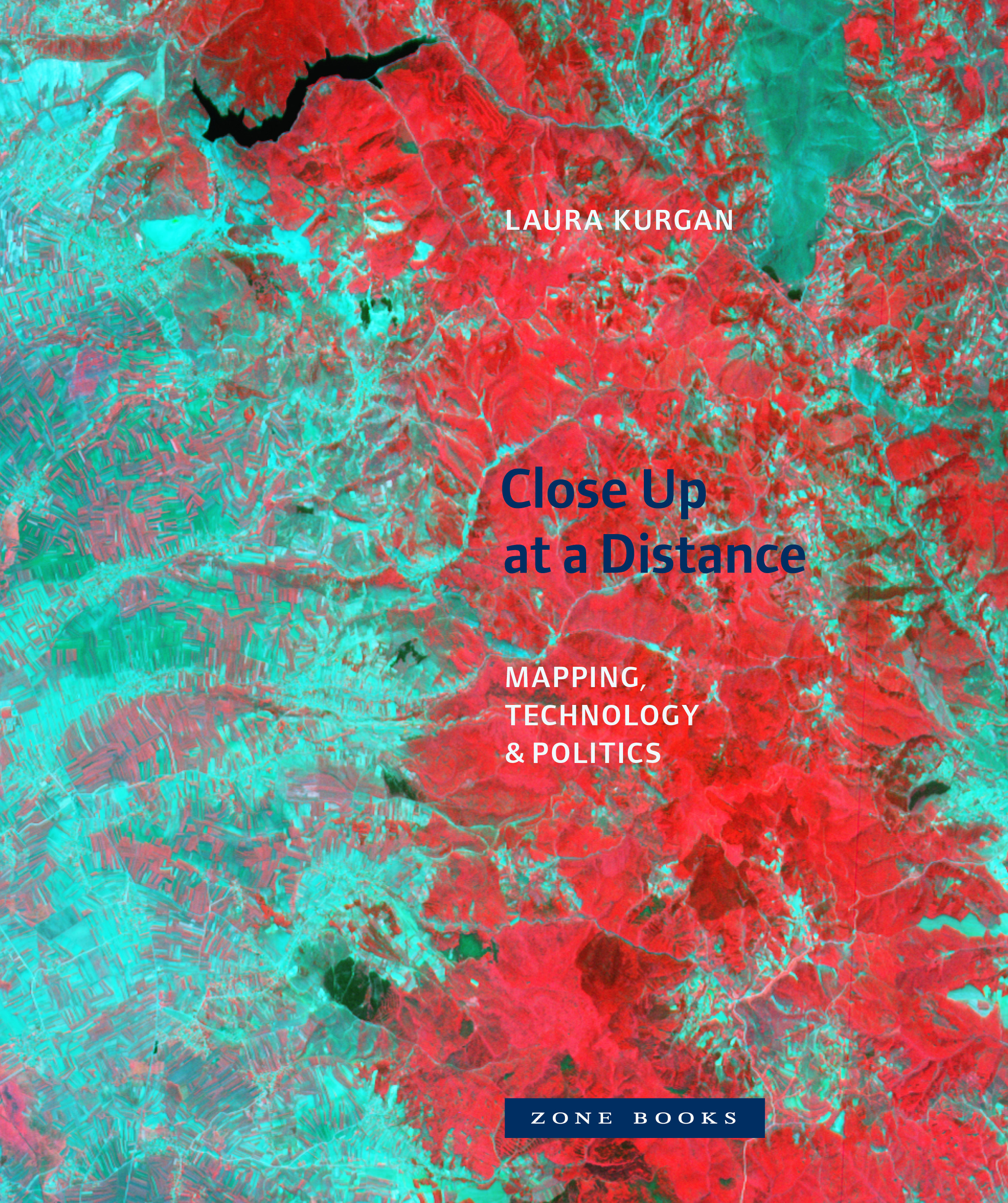
Close up at a distance

KURGAN Close up at a distanceStuart Elden trailed Laura Kurgan‘s Close up at a distance: mapping, technology and politics earlier this year, and it’ a sumptuous book.  The main title is a good summary of the techno-cultural field produced for drone strikes, but Kurgan’s focus is different: it’s on satellite imagery.  Now Trevor Paglen has provided a summary review for Bookforum:

Imaging technologies, explains Kurgan, “let us see too much, and hence blind us to what we cannot see, imposing a quiet tyranny of orientation that erases the possibility of disoriented discovery.” Part of the problem is a matter of perspective: The view from above is less an expansive panorama than a view through a keyhole. This vantage is also highly susceptible to ideological forces. When Colin Powell sat before the UN advocating the invasion of Iraq, he brought satellite images showing a handful of trucks and buildings. This data, he claimed, provided evidence of “active chemical munitions bunkers” operating outside Baghdad. “The facts speak for themselves,” he said. Of course, as Kurgan points out, the images did anything but that, and Powell needed to do a great deal of misleading speaking on their behalf to make them show anything close to what he claimed they did.

But Kurgan does not want to write off the “visual regime” of satellite imagery entirely. In fact, much of her work makes use of visual data culled from mapping, geolocation, and overhead-imaging technologies, and in Close Up at a Distance she argues that the need for interpretation is precisely what makes this kind of information so significant. For her, the “imaginative leaps” required to turn data into stories don’t always have to be carried out by the Colin Powells of the world: Such interpretive work can also advance movements for social justice or anti-imperial politics—such as when Pakistani journalists used Google Earth to document an unacknowledged American Predator-drone base in Baluchistan. In a series of deftly rendered case studies, Kurgan demonstrates how understanding satellite images—their production, interpretation, and distribution—is “a civic responsibility and a political obligation.”

Lisa Parks has travelled over much of the same ground and to brilliant effect, but Kurgan’s emphasis (she’s Director of the Spatial Information Design Lab at Columbia) is on a series of artistic re-workings of satellite imagery to produce radically new and insistently critical ways of seeing, of re-imagining what we see (and what we don’t) – which is why Trevor, as both artist and geographer, is such an apposite reviewer.


Just looking?

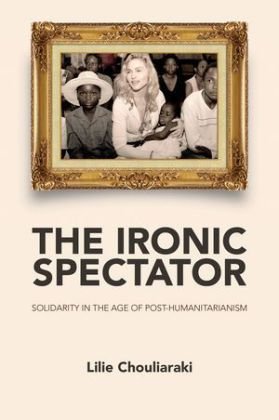
Most readers interested in the politics of humanitarianism and what Eyal Weizman calls ‘the humanitarian present‘ will know Lilie Chouliaraki‘s work, notably The spectatorship of Suffering (Sage, 2006).  She has a new book out now, The ironic spectator: solidarity in the age of post-humanitarianismCHOULIARAKI The ironic spectator (Polity, 2012/13):

This path-breaking book explores how solidarity towards vulnerable others is performed  in our media environment. It argues that stories where famine is described through our own experience of dieting  or or where solidarity with Africa translates into wearing a cool armband tell us about much more than the cause that they attempt to communicate. They tell us something about the ways in which we imagine the world outside ourselves.

By showing historical change in Amnesty International and Oxfam appeals, in the Live Aid and Live 8 concerts, in the advocacy of Audrey Hepburn and Angelina Jolie as well as in earthquake news on the BBC,  this far-reaching book shows how solidarity has today come to be not about conviction but choice, not vision but lifestyle, not others but ourselves – turning us into the ironic spectators of other people’s suffering.

This intersects with my own interest in the modern and late modern spectatorship of war, though in complex and far from straightforward ways (I have particularly in mind the contemporary ‘consumption’ of war), so I was excited to read this description of Lilie’s current research:

My current work focuses on the mediation of war, where I explore the various public genres through which war has been mundanely communicated in our culture, from photojournalism to films and from memoirs to news. The aim is to better understand how our collective imagination of the battlefield and its sufferings, what we may call our ‘war imaginary’, has been shaping the moral tissue of public life, in the course of the past century (1914-2012).

As part of this project, she has an essay forthcoming in Visual communication later this year, ‘The humanity of war: iconic photojournalism, 1914-2012’, which will also appear in extended form in  Nick Couldry, Mirca Madianou and Amit Pinchevski (eds) The Ethics of Media (Palgrave, 2013).

The Geopolitics of Dominion

SANSOM Dominion

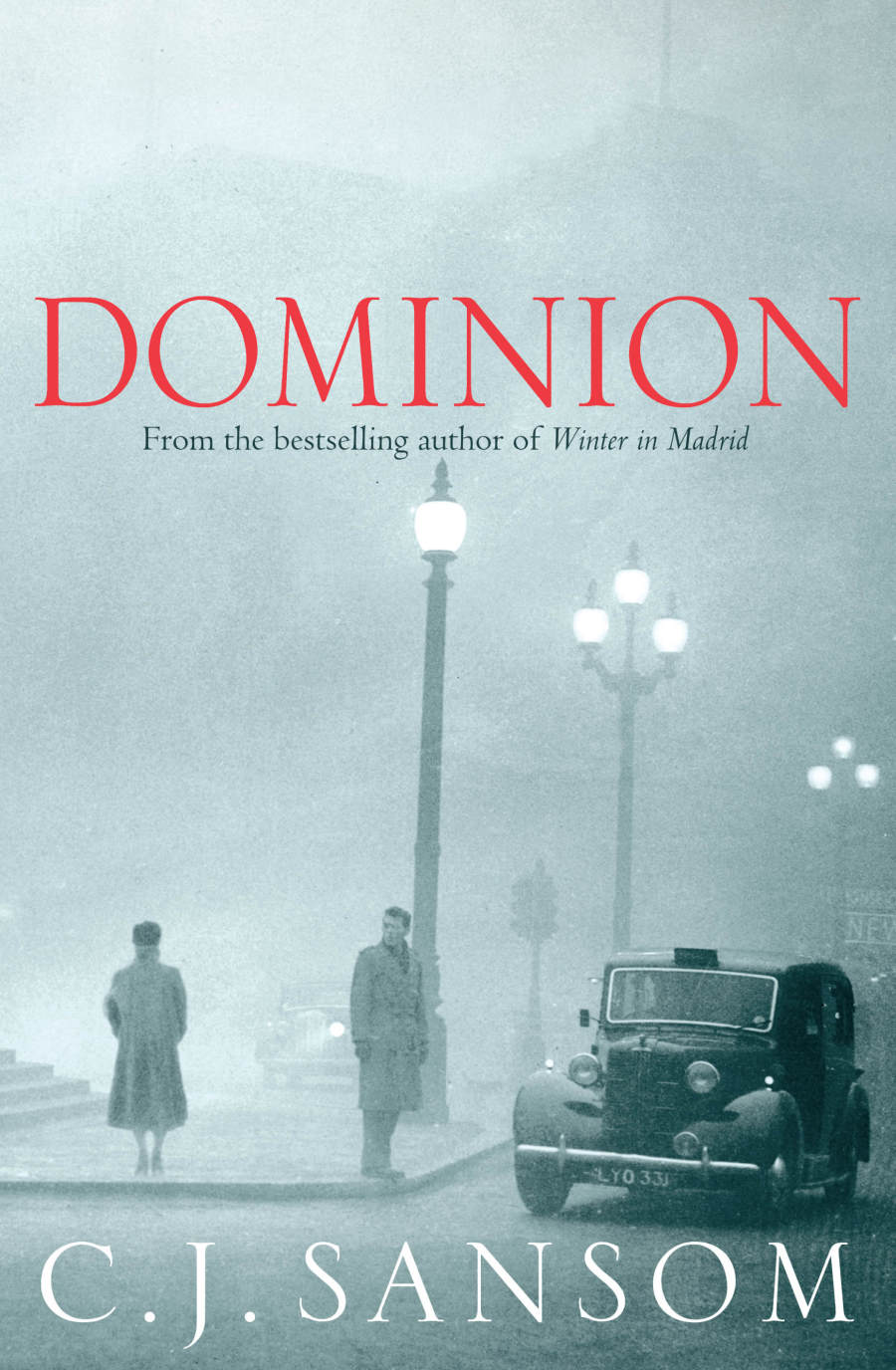
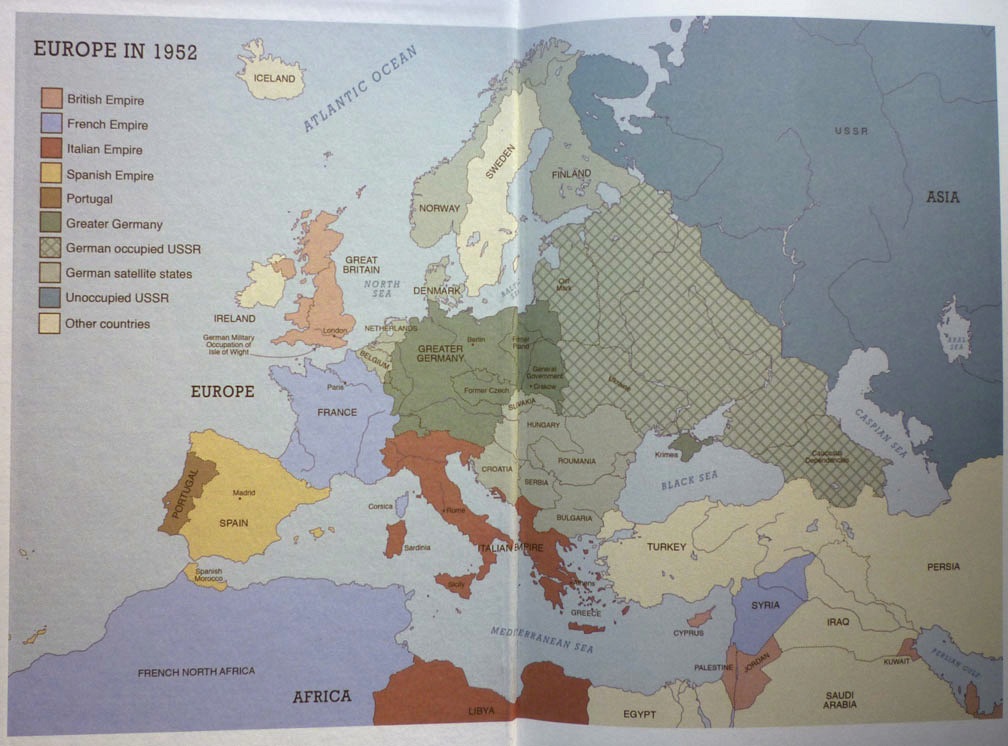
It’s been a long time since I read a novel with maps… and I don’t think I’ve ever read one that ends with an essay explaining its geopolitics.  I’ve just finished C.J. Sansom‘s Dominion (Pan/Macmillan, 2012), which is set in an alternative Britain in 1952.  The premiss is that Churchill never became Prime Minister in May 1940; instead, the British government under Lord Halifax sued for peace with Hitler.  In Sansom’s chillingly plausible vision, Britain became a German satellite state  but retained its nominal independence; it was not placed under military occupation but its government (and especially its police apparatus) became overwhelmingly fascist.  Germany was given carte blanche in Europe, and continued a relentless, remorseless but ultimately unwinnable war against what was left of the Soviet Union; Britain retained its Empire – which, apart from South Africa, became increasingly restive at the absolutist politics that festered at its heart – and the United States remained isolationist until the election of Adlai Stevenson in 1952.

Sansom_Dominion_map1

One of the pleasures of the book (and of Sansom’s closing essay) is his explanation for the historical figures he manoeuvres onto (and off) his stage and the political and geopolitical formations their movements bring into view: Beaverbrook (whom Clement Attlee described as the only evil person he had ever met) as the collaborationist Prime Minister, Oswald Moseley as Home Secretary, Rab Butler as Foreign Secretary, and Enoch Powell (who else?)  as Secretary for India; Churchill, together with Attlee and Harold Macmillan, as key figures in the Resistance; and the appearance of a host of minor figures in the world of ‘light entertainment’, dimly remembered from my childhood (I was born a year before Sansom): Isobel Barnett, Frankie Howerd and, a marvellous conceit, Fanny Craddock showing her audience how to cook sauerkraut….

It is in these minor-key details, in the richly imagined world of a post-war Britain in which – since the Blitz never took place – bomb shelters are relicts of an unrealized past, and everyday life re-assumes the drab mantle of the 1930s – that the genius of the novel lies.  Sansom conveys with a rare sensibility the banality of Fascism (and, yes, of evil): not only its grotesque monumentality (like Sansom I suspect, I take a grim satisfaction in the University of London’s Senate House becoming the new German Embassy), not only the vile exactions of anti-Semitism (a leitmotif of the book, flickering in and out of view in the smog that grips the capital, is the round-up of Britain’s Jews),  but the thousand and one accommodations and submissions made by ordinary people to the extraordinary.

All of this, perhaps inevitably, makes me wonder what I would have done in such circumstances: I’ve been thinking about this ever since I started my history/geography of bombing.  Would I have had the courage to join the RAF and bomb Germany?  Or would I have had the courage to refuse? But Sansom’s novel – which acknowledges its debt to Len Deighton’s SS-GB –  adds another dimension because Dominion is animated not only by its repugnance towards fascism but also, as that closing essay makes clear, by a studied contempt for European nationalisms.

‘A foreign field that is forever England’?

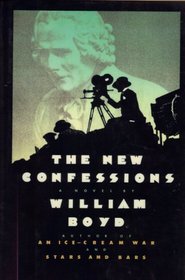
BOYD New ConfessionsI’ve already noted the effect that William Boyd‘s An Ice-Cream War (1982) had on me, but there’s another Boyd novel that also deals with the First World War – this time set on the Western Front rather than East Africa – that also offers much food for thought.

In the early sections of  The New Confessions (1987), an odyssey conducted in the obvious shadows of Rousseau, the protagonist John James Todd is serving in a Public School service battalion of the British Army just before Ypres.  In a chapter revealingly entitled ‘New geometries, new worlds’, Todd recalls the Ypres front in early June 1917 like this:

‘Take an idealized image of the English countryside – I always think of the Cotswolds in this connection…  Imagine you are walking along a country road.  You come to the crest of a gentle rise and there before you is a modest valley.  You know exactly the sort of view it provides.  A road, some hedgerowed lanes, a patchwork of fields, a couple of small villages – cottages, a post-office, a pub, a church – there a dovecote, there a farm and an old mill; here an embankment and a railway line; a wood to the left, copses and spinneys scattered randomly about.  The eye sweeps over these benign and neutral features unquestioningly.

‘Now place two armies on either side of this valley.  Have them dig in and construct a trench system.  Everything in between is suddenly invested with new sinister potential: that neat farm, the obliging drainage ditch, the village at the crossroads become key factors in strategy and survival.  Imagine running across those intervening fields in an attempt to capture positions on that gentle slope opposite so that you may advance one step into the valley beyond.  Which way will you go? What cover will you seek?  How swiftly will your legs carry you up that sudden gradient?  Will that culvert provide shelter from enfilading fire?  Is there an observation post in that barn?  Try it next time you are on a country stroll and see how the most tranquil scene can become instinct with violence.  It only requires a change in point of view.’

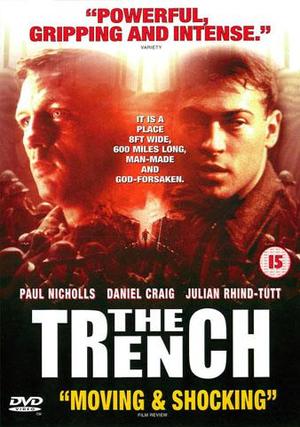
The TrenchLater Todd is recruited by the War Office Cinema Committee with strict instructions about what and may not be shown, and some ten years after he wrote the novel Boyd directed his own film, The Trench, set on the eve of the Battle of the Somme. But my point (for the moment) isn’t about photography or film but about the work of war artists on the Western Front.

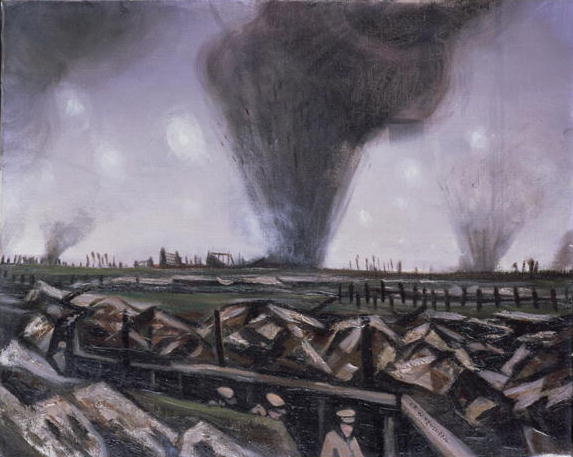
During the spring of 1916 Charles Masterman, the director of the British War Propaganda Bureau, was persuaded to appoint the first Official War Artist, Muirhead Bone.  Bone was a sketcher and watercolour artist, who was duly commissioned as an honorary Second Lieutenant and arrived in France during the Battle of the Somme.  He returned to England in October, and two hundred of his drawings were published in ten monthly parts, with an accompanying commentary by C.E. Montague.

A View in Flanders behind the Lines, Showing Locre and the Tops of Dug-Outs on the Scherpenber 1916 by Sir Muirhead Bone 1876-1953

‘For many people at home,’ Samuel Hynes remarks in A war imagined, ‘they must have been an important source of their notions of what the war looked like.’  But, he continues,

‘Bone and Montague agreed that what it looked like was England; both the drawings and the commentaries imagine the war in familiarizing English terms…  They made the war look familiar, and they provided images of it from which both the dead and the suffering living had been entirely excluded.’

BONE British troops marching to the Somme

When the first two weekly installments appeared, apparently to considerable public acclaim, Wilfred Owen called them ‘the laughing stock of the army’ because they presented such a pastoralized, picturesque and sanitized view of the war: ‘To call it England!’  Many of Bone’s drawings, like the two examples I’ve shown here, rendered the landscape in the idealized terms of Boyd’s ‘country stroll’.  (There were exceptions, but even when Bone turned to the desolation of the battlefield many of his sketches were devoid of human form, alive or dead.)  To be sure, most commentators noted that in the rear a working countryside persisted, and many of them made much of the shocking transition from a landscape that was indeed familiar, largely untouched by military violence, to something unlike any landscape on earth.

And it’s exactly that anti-landscape Owen wanted to be represented.  In The soldiers’ tale Hynes writes that

‘War turns landscape into anti-landscape, and everything in that landscape into grotesque, broken, useless rubbish – including human limbs.’

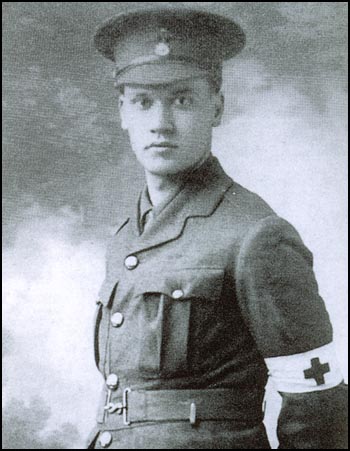
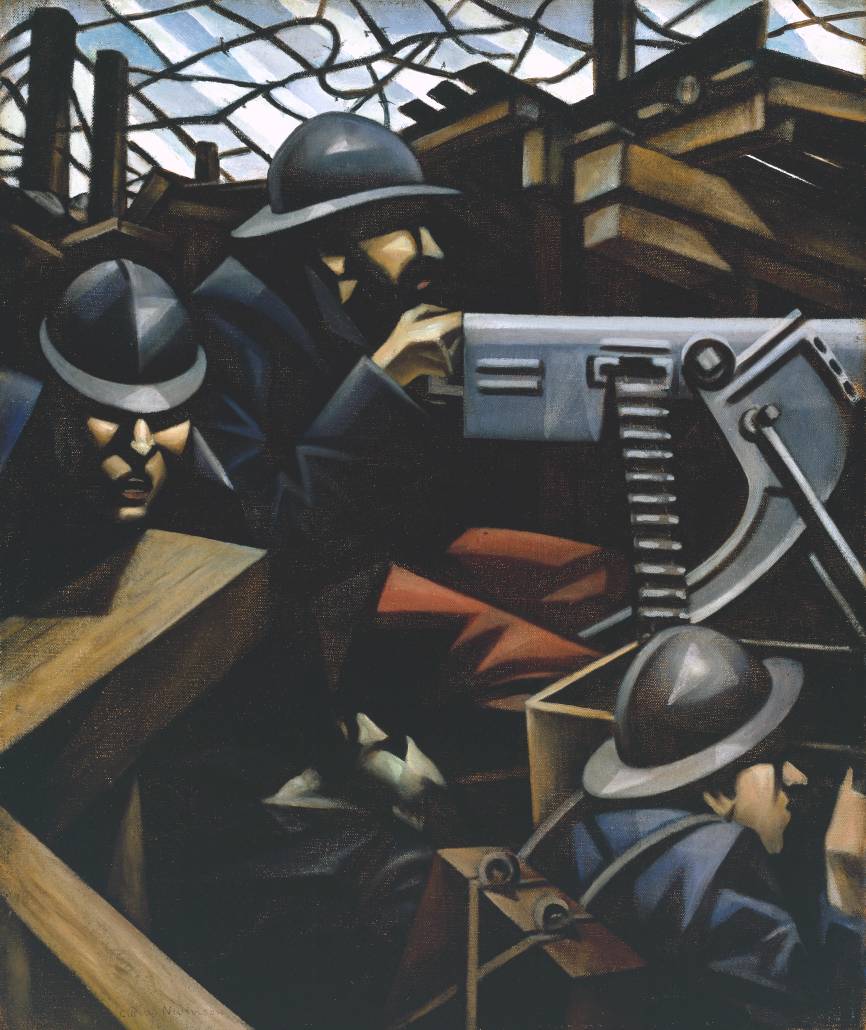
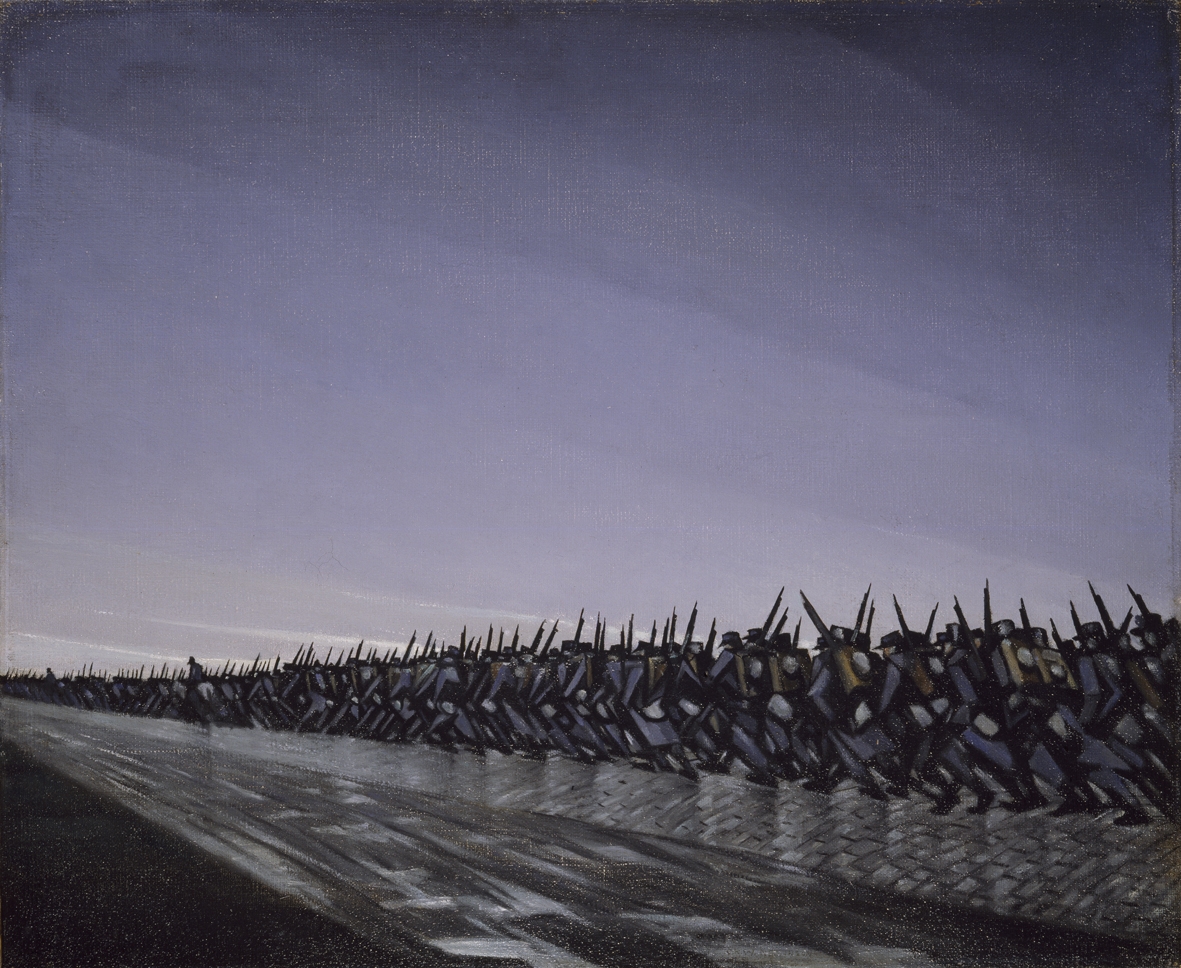
C.R.W. NevinsonAnd there were other artists who were developing Boyd’s ‘change in point of view’, a different visual vocabulary for these brutally new warscapes.  One of the most interesting, I think, is C.R.W. Nevinson.  Early in the war Nevinson served as an orderly with the Friends’ Ambulance Unit and then as an ambulance driver with the Royal Army Medical Corps.  He was invalided out in January 1916, a result of acute rheumatic fever, but in March 1916 he exhibited a series of Futurist paintings whose stark geometric planes and mechanised violence conveyed a radically different sensibility, one in which soldiers and machines were fused into shockingly new assemblages and where human bodies were caught up in and overwhelmed by the percussive force of the new military machine.  One of his most famous paintings, of a French machine-gune post, La Mitrailleuse (below), captures what Michael Walsh calls the ‘machinomorphic image’ of the war.

La Mitrailleuse 1915 by Christopher Richard Wynne Nevinson 1889-1946

Walter Sickert claimed that La Mitrailleuse ‘will probably remain the most authoritative and concentrated utterance on the war in the history of painting’, but other Nevinson paintings of this period capture other dimensions of the automations of the killing machine, as in Column on the march (1915):

Nevinson Column on the march 1915

They also captured, through what Claude Philips praised as their ‘cold, calculated violence’ and ‘cruel, metallic angularity’, what Henri Lefebvre once called ‘the overwhelming of the human body’, as in The strafing (1915):

NEVINSON The strafing

In invoking Lefebvre here, I have in mind this passage from The production of space where he describes a modern, abstract, geometric space:

‘… space has no social existence independently of an intensive, aggressive and repressive visualization. It is thus – not symbolically but in fact – a purely visual space. The rise of the visual realm entails a series of substitutions and displacements by means of which it overwhelms the whole body and usurps its role.

And yet, of course, the production of this extraordinarily violent space was literally shot through with corporeal investments.

Postcard from Nevinson to MarinettiI’ve described these artworks as Futurist, but two riders are necessary.  The first, and most obvious, is that Marinetti‘s own Manifesto of Futurism expressed a desire ‘to glorify War – the only health giver of the world’, and while Nevinson was fascinated by, even infatuated with Marinetti – he sent Marinetti a postcard (right) of him posing in front of his ambulance, without any discernible sense of irony – this was a claim that Nevinson eventually explicitly repudiated (in a column for the Daily Express called ‘Painter of Smells at the Western Front’).  Bone, incidentally, liked Nevinson’s work.

The second is more interesting.  Paul Saint-Amour has described aerial photography and interpretation on the Western Front not as an applied realism but as an applied modernism – and with good reason (some interpretation manuals described ‘Cubist’ and ‘Futurist’ landscapes) – and if we extend this insight then we might say that in these artworks Nevinson was recovering and reinscribing a scopic regime that was instrumental in the very violence he sought to subvert.

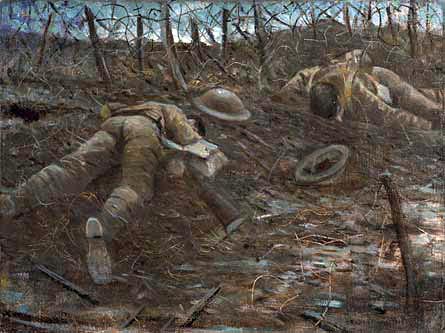
In March 1917 Nevinson was toying with the idea of putting his talents to work in the new camouflage section of the army, but by July he was back in France as an Official War Artist.  He went up in an observation balloon and claimed to be ‘the first man to paint in the air’; in fact he thought his ‘aeroplane pictures the finest work I have done’.  But in many of these later paintings he turned his back on Futurism and the machinations of the killing fields and restored the broken body to the art of war.  The most notable example is perhaps Paths of glory (1917).  Refused permission to exhibit the canvas at the Leicester Galleries in London by the War Office, Nevinson had it displayed with a brown paper sticker across the two dead bodies reading “Censored”…

NEVINSON Paths of glory

There is an excellent gallery of Nevinson’s work here, and for more discussion I recommend David Boyd Hancock, A crisis of brilliance: five young British artists and the Great War (2010); Michael Walsh, ‘C.R.W. Nevinson: conflict, contrast and controversy in paintings of war’, War in History 12 (2) (2005) 178-207, and his two books, C.R.W. Nevinson: This cult of violence (2002) and Hanging a rebel: the life of C.R.W. Nevinson (2008).

Big science – and small wars?

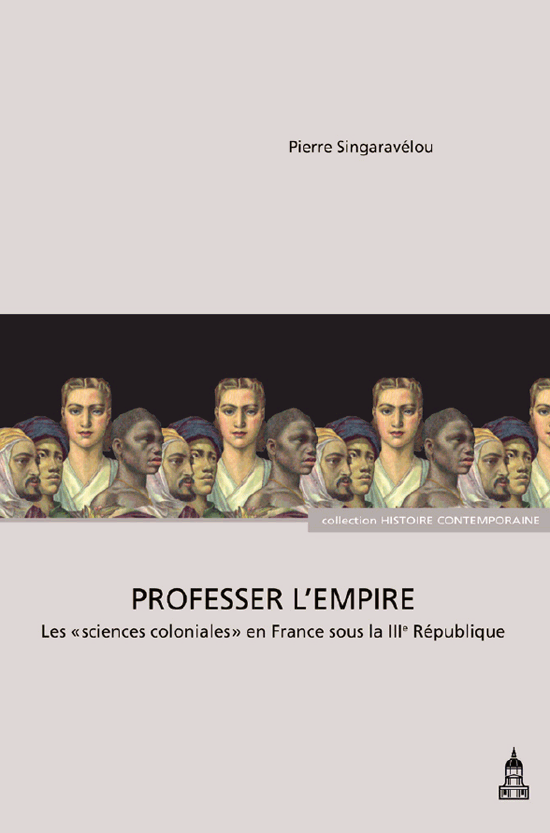
A fascinating review and preview by Alice Conklin of two books that promise to complicate the formation of ‘colonial science’: Helen Tilley‘s Africa as a living laboratory: Empire, Development, and the Problem of Scientific Knowledge, 1870-1950 (Chicago, 2011), and Pierre Singaravélou‘s Professer l’Empire: Les “sciences coloniales” en France sous la IIIe République (Sorbonne, 2011).

TILLEY Africa as a living laboratoryHelen Tilley will be known to most readers, I suspect, for her work on the history of ecology and the intersections between science, medicine and tropicality.  In Africa as a living laboratory, Conklin concludes,

‘Tilley’s case studies lead her to jettison the term “colonial science” altogether. The history of the African Survey [in the 1930s], she argues, proves that all scientific research circulates both locally and globally in ways that its producers cannot control – even when this research is sponsored by imperial governments seeking solutions to problems of colonial governance. From this perspective, defining any “science” as specifically “colonial” obscures more than it illuminates. Her point is not that “good” science triumphed over “bad” science in Britain’s African colonies, but that the outcome of the appeal to science was never absolutely predetermined by the fact of empire. Professionalizing scientists in the field could and often did maintain their distance from policy-making: their training encouraged them to they look for the very kind of complexity in human societies that overburdened administrators or their superiors did not have time to consider…’

Singaravelou Professer l'empireMost geographers will know Singaravélou’s edited collection, L’empire des géographes (which includes a characteristically incisive essay by Dan Clayton).  Conklin considers one of the most significant arguments in Professer l’Empire to be the claim that

‘…the world of teaching about the empire [in France] became a stimulating “place of encounters and exchanges between academics and administrators, politicians and advertisers”. Hovering on the fringes of the more orthodox disciplines of history, geography, law and political economy, and psychology, colonial scientists contributed new subjects (the comparative history of empires, legal anthropology, tropical geography) to their “parent” fields that would flourish after World War II; they were also among the first to practice interdisciplinarity, due to their long exiles in the field. As in Britain, their contributions have been lost from view because modern scholars have dismissed the “colonial sciences” as too tainted to be worth revisiting.

Taken together, Conklin concludes,

‘Singaravélou and Tilley make clear that without a complete picture of how all scientists functioned in the past, historians cannot understand – much less counter-act – the ideological and rhetorical power inherent in science itself. Considerable debate persists over the extent to which scientists facilitated colonialism, and colonialism facilitated science. While neither of these two richly contextualized books explores the question of how science translated into policy on the ground, they nevertheless remind us that there can be no foregone conclusion about the content of the scientific expertise promoted under colonialism. Both authors breathe new life into the history of dead white scientists attached to empire in the interwar era without in any way eulogizing or apologizing for them.’

My appreciation of these studies derives from my developing interest in the connections between scientific knowledges and military violence.  In my work on the metricisation of space on the Western Front in the First World War, for example, I’ve been impressed by Roy Macleod‘s studies of what he calls ‘the battlefield laboratory’ (in ‘Sight & Sound on the Western Front’, War & Society 18 (1) (2000)).  By early 1918, he writes, ‘the combined organisation of Field Survey Companies and “Maps, GHQ” had become almost an institute of advanced studies for cartographers, topographers, geographers and geologists’ and its ‘success in inter-disciplinary cooperation augured well for allied success in the last year of the war.’   It’s interesting to read this alongside Tilley’s opening, scene-setting chapter, ‘An Imperial Laboratory: Scientific Societies, Geopolitics, and Territorial Acquisitions’ – in which, of course, mapping is never far away – and then to think through the arc traced by what Steve Graham calls ‘Foucault’s boomerang’ across the killing fields of colonial Asia and Africa.  We know about the practices of counterinsurgency or colonial ‘air control’, to be sure, but we still need to know much more about the knowledges that are embedded within them.  And these two studies remind us that, on the field of Mars as elsewhere, the relations between knowledge and practice (or power) are rarely simple and never uni-directional.

Lears in the sky – with Diamond

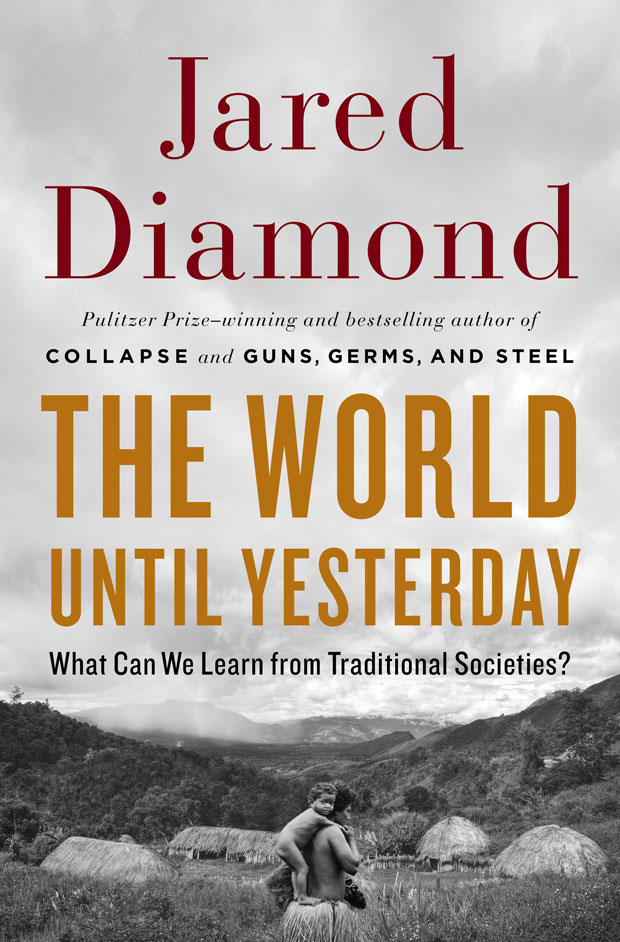
The world until yesterdayI know I’m not alone in my critical reaction to Jared Diamond‘s work, but two recent commentaries are particularly helpful.  Earlier this month the Guardian published a long review of The world until yesterday by Wade Davis – though most of the online comments will make you weep – and the latest issue of bookforum has an incisive commentary by Jackson Lears that nails what he calls Diamond’s ‘neo-liberal scientism’.  En passant, Lears has a riff on Diamond’s views on war:

 Anthropologists have claimed that war is just a game among traditional peoples; in fact, Diamond maintains, it is in deadly earnest. This is a persuasive argument, though it is coupled with Diamond’s less persuasive tendency to minimize European responsibility for the slaughter of indigenous people. Equally unconvincing are his suggestions that modern state-sponsored warfare is easier to manage and contain than traditional war. Surely this is a provincial American perspective, the product of a country that has yet to be laid waste by a distant enemy. And most troubling of all is his claim that modern state authority makes wars easier to stop—especially given the situation in the contemporary United States, where the national security state prosecutes endless wars around the globe, conducted in secret and without congressional authorization.

Teo Ballvé thinks we’ve ‘lost the war of position’ to writers like Jared Diamond and Robert Kaplan…. but maybe not.

Gaza in Ruins

An important post from Craig Jones about the capacity of the creative arts to respond to and even dislocate military violence that chimes beautifully with my previous post about War/Photography, and leads me into a notice of a research seminar at King’s College London (K2.29, Strand) at 6 p.m. on 5 February 2013:

‘i have come to everyday armageddon’: Spectacular and Slow Ruin in Gaza
Anna Bernard

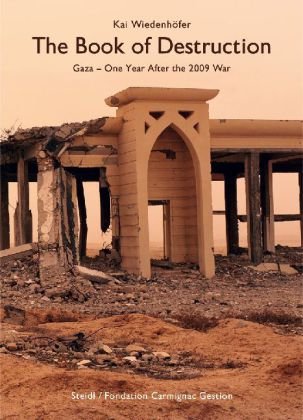
WIEDENHOFER Book of destructionThe Israeli military’s 22-day attack on Gaza in the winter of 2008-9 provoked international condemnation to a degree that the region’s daily deprivation since 2007 under Israeli and Egyptian blockade had not. After the assault, images of the ruins of Gaza – its collapsed buildings, its disabled and impoverished residents – circulated widely. Beyond recording the immediate destruction caused by the attacks, however, these representations also sought to convey a different kind of ruin: the ‘slow violence’ (Nixon 2011) of Gaza’s humanitarian crisis. Anna Bernard will explore some of the visual and narrative attempts since 2009 to draw attention to the full scale of Gaza’s devastation, including photography by Kai Wiedenhöfer and poetry by Suheir Hammad. [The title is taken from Suheir Hammad’s poem GAZA, and the video shows Wiedenhöfer’s exhibition at the Musée d’Art Moderne in Paris in 2010].

Anna Bernard works on literary and cultural representations of Israel/Palestine in international contexts. She is the author of Rhetorics of Belonging: Nation, Narration and Israel/Palestine, forthcoming from Liverpool University Press.

Ruins in Gaza – Reality and Representations
Ahmed Masoud

While the Gaza Strip is often associated with images of ruins and destruction as a result of the continuous Israeli bombardment, the rubble of destroyed buildings has also become closely associated with the national cause. In 2009, a young artist living in Jabalia Camp turned her bombed house into an installation of a tank. Her message was that holding on to living spaces was as powerful as any military machinery.

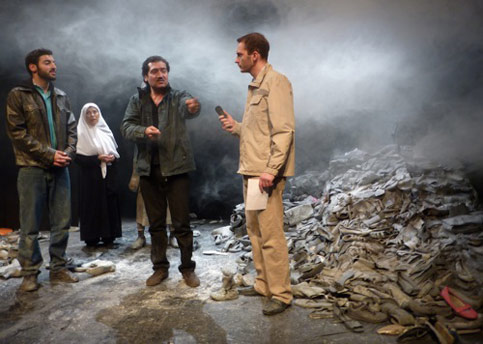
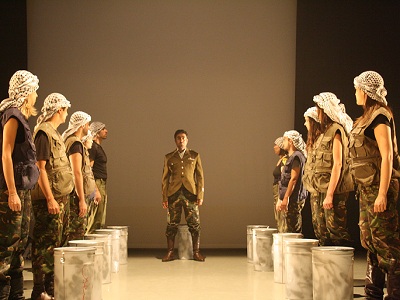
Go to Gaza drink the seaAhmed Masoud will discuss the representation of ruins in his plays Go to Gaza, Drink the Sea (2009) and Unto the Breach (2012). Working with various set designers, Ahmed chose to represent rubble using different materials. In Go to Gaza, Drink the Sea (left) destruction was represented through a mountain constructed out of thousands of old shoes, while the set of Unto the Breach compiled a collage of ripped clothes, palates, paint pails and other broken and recyclable materials. Both sets represent the hardships, but also the resourcefulness, of ordinary people living under siege. They also reflect the process of making the set and shows with a very limited budget.

Unto the breachAhmed Masoud is a Palestinian academic, writer and director. In 2005, he founded the Al Zaytouna Dance and Theatre Company. With Justin Butcher he co-wrote and directed the successful play Go to Gaza, Drink the Sea (2009), staged in London and at the Edinburgh Fringe Festival, and the BBC Radio 4 Play Escape from Gaza (January 2011). Ahmed also won the Muslim Writers Awards (sponsored by Penguin Books) in the unpublished novel category for his book Gaza Days. His latest show Unto the Breach (right) [a dance adaptation of Shakespeare’s Henry V] was performed at the Artsdepot Theatre in November 2012 and received critical acclaim.

***

All of this has prompted me to start serious work on a project I’ve had buzzing around my head for months now – a performance-work on bombing, past and present, using video, testimony, music, above all drama (and perhaps even dance).  The spur is partly my continuing frustration at conventional academic forms, partly admiration for my good friend Gerry Pratt‘s stunning drama-work Nanay (which has been performed in Vancouver and Berlin), now reinforced by Photog., and above all a desire to work on a collaborative project designed to engage the widest possible public.  Watch this space…

Of Bombs and Men

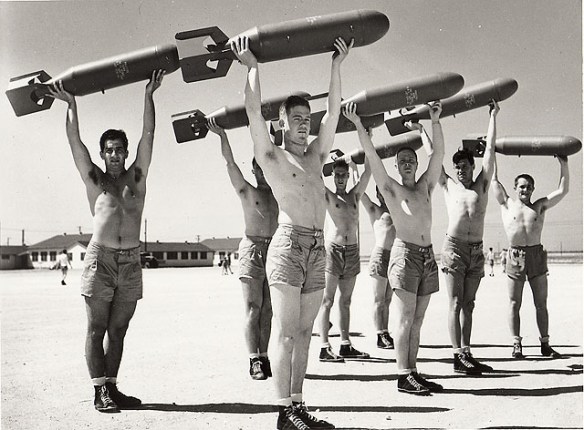
WWII Bombardier Calisthenics

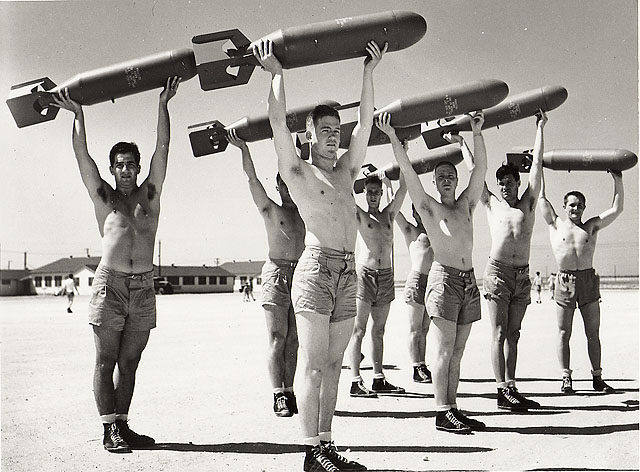
When Stanley Kubrick had Major Kong (Slim Pickens) straddle a nuclear bomb in Dr Strangelove (1964) and ride it exuberantly all the way down to its target – surely the most iconic image from the film – he was making an obvious visual point about masculinism, sexuality and military violence that, as the clean-limbed image above shows, takes many other, non-nuclear forms.  Here a group of US Army Air Force bombardiers in the Second World War practices calisthenics with 100 lb bombs.  A different sort of ‘love-charm of bombs‘, you might think.

Indeed, a contemporary account made much of the ‘hard and rigid training of members of a bomber crew’ – which was supposed to be just like a football or basketball team (‘This is really the Big League in the toughest game we have ever been up against, with the pennant the survival and future of the whole nation’) – and emphasised their collective virility and heteronormativity:

‘They will have played football or basketball, have competed in the field or on the track.  Many of them will have been ardent hunters or fishermen.  Because they are healthy young men they will like girls very well indeed.’

Hunting was important; readers were told to be thankful that ‘frightened civil authorities and specific Ladies Clubs have not managed to eradicate from the country the tradition of the possession and use of firearms’, which ensured that a young man would enter the Air Force ‘with the whole background of aerial gunnery in him before he starts.’

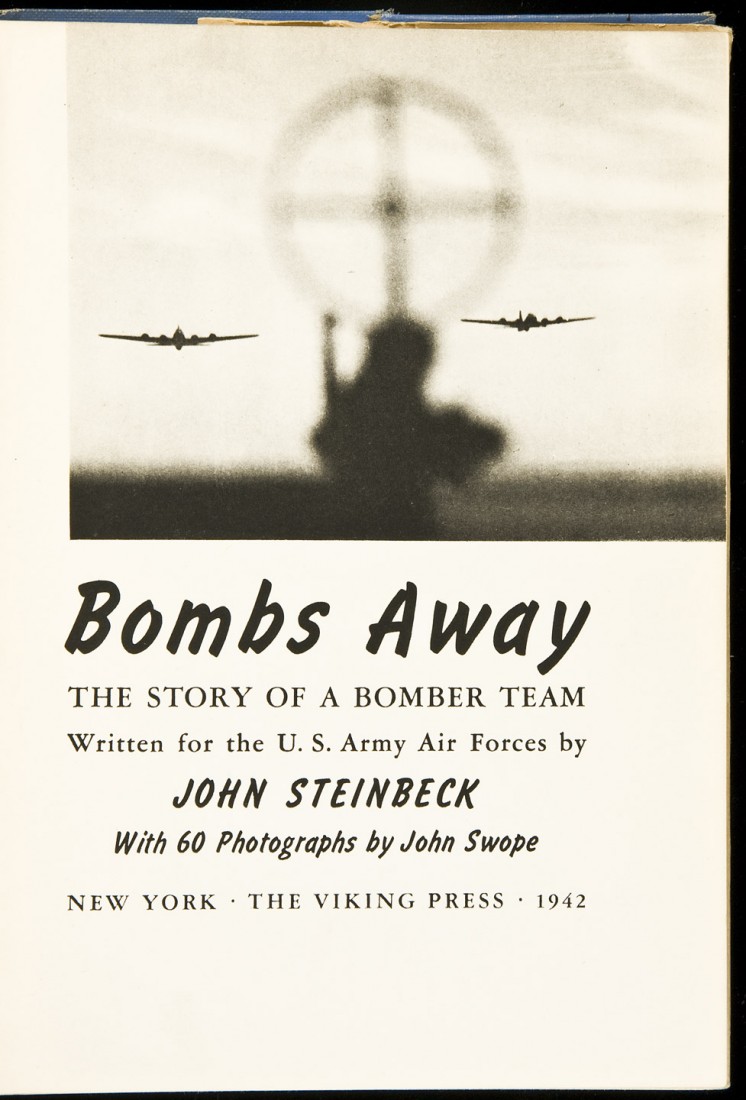
The author of all this was, astonishingly, John Steinbeck, and the book Bombs Away: the story of a bomber team, published in 1942.
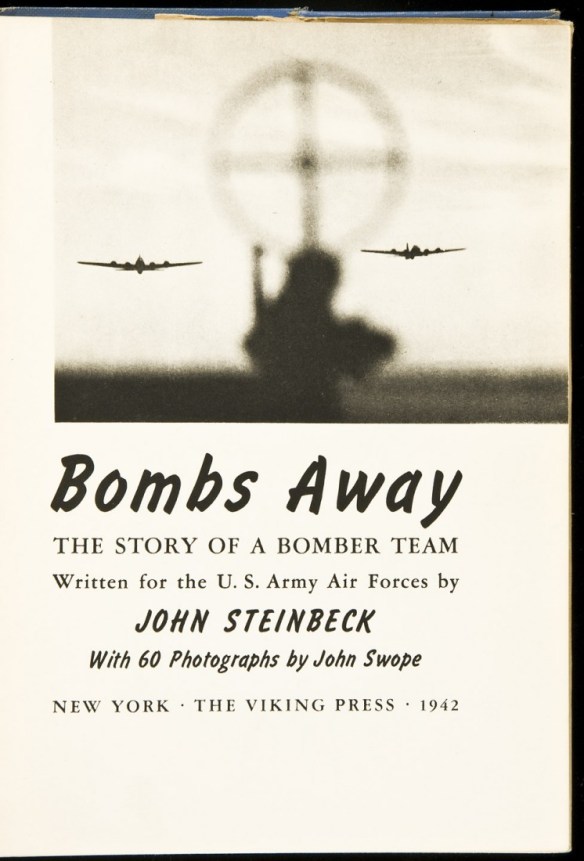
STEINBECK Bombs Away

In May 1942 Steinbeck had been summoned to Washington by General Henry A. “Hap” Arnold who explained what he had in mind – an account of the training of a bomber crew that would serve as a recruiting platform – and although Steinbeck was at first reluctant a meeting with President Roosevelt convinced him to accept the assignment.  He spent the summer on the road (in fact, much of the time in the air), travelling from airbase to airbase in the United States with Hollywood photographer John Swope, who provided 60 illustrations for Bombs Away.  Swope would later be tapped by First World War veteran Edward Steichen for his US Navy photographic unit covering the war in the Pacific, where he produced a remarkable photographic portfolio and the accompanying Letter from Japan in 1945.

Steinbeck was no stranger to working with photographers.  In 1937 Horace Bristol, a freelance photographer who regularly contributed to LIFE magazine,

‘proposed a story about migrant farm workers in Calfornia’s Central Valley—a project that would include accompanying text by novelist John Steinbeck. Though LIFE turned down the story, Bristol and Steinbeck agreed to collaborate on a book-length project, and the two men spent several weekends in labor camps during the winter of 1938. Bristol took hundreds of photographs of the suffering farm workers, only to have Steinbeck withdraw from the partnership to write the story as a novel, which became his masterpiece The Grapes of Wrath.’
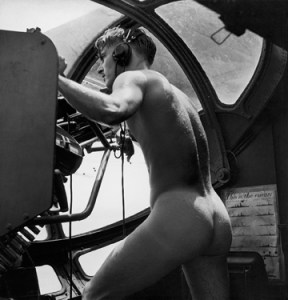
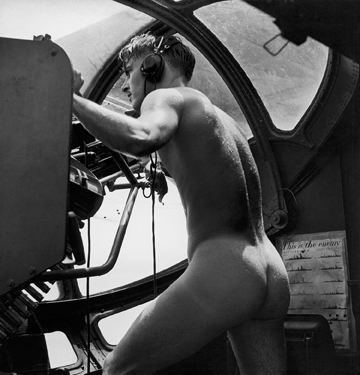
BRISTOL PBYBlisterGunnerBristol was also later recruited by Steichen, and some of his war photographs would not been out of place in Bombs Away: the image on the right, ‘RESCUE: PBY Blister Gunner’, was shot in a Catalina Flying Boat at Rabaul, Papua New Guinea, in 1944, which presumably explains the flying kit.

If Steinbeck’s collaboration with Swope turned out to be more congenial than that with Bristol, however, it was markedly less fruitful. Ernest Hemingway disliked Bombs Away so much that he famously observed that ‘I would rather cut off three fingers off my throwing hand than to have written it.’

He wasn’t alone.  A review in the New Republic declared that Bombs Away bore ‘about the same relationship to literature that a recruiting poster does to art.’  But of course it was supposed to be a recruiting poster, and it had to be written in double-quick time.

In the book Steinbeck assembles the bomber crew man by man, role by role – the bombardier, the aerial gunner, the navigator, the pilot, the aerial engineer/crew chief and the radio engineer – who together ‘must function like a fine watch’.  They are assigned a ‘ship’ – a B-17E Flying Fortress or a B-24 (‘Liberator’) – which will invariably become personalised and almost always feminized.  (There’s a considerable literature on the ‘nose art‘ of bombers, and Steinbeck will later declare that ‘Some of the best writing of the war has been on the noses of bombers’).  But it is the men that count, that constitute the elaborate clock-mechanism: ‘Men are the true weapons of the Air Force,’ Steinbeck insists, ‘and it is an understanding of this that makes our bomber crews what they are.’ Inevitably, he adds: ‘Living and working together too, they played together too.  On the beach in their free time they played football and swam in the warm water of the Gulf.’
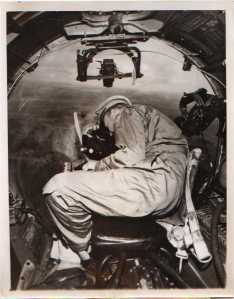
Norden bombsightSteinbeck knows, of course, that this is a deadly serious ‘game’: and one that, as he also labours to explain, is objective, scientific: ‘They knew the mathematics of destruction.’   Within this embodied, techno-cultural constellation the Norden bombsight (left) occupied a central place.

‘This bombsight has become the symbol of responsibility.  It is never left unguarded for a moment.  On the ground it is kept in a safe and under constant guard.  It is taken out of its safe only by a bombardier on mission and he never leaves it.  He is responsible not only for its safety but for its secrecy.’

I’ve noted before how often bombing depends on abstraction: on a technical division of labour within the kill-chain, on a rhetoric of scientificity (and, by extension, precision), and on a calculus that transforms places and people into the co-ordinates of a target.  Bombs Away shows this to perfection, but it shows something else even more clearly. For the ability to carry out these deadly missions also depends on an instilled and instinctive sociality (here, naturally, a homosociality) that is far from abstract.
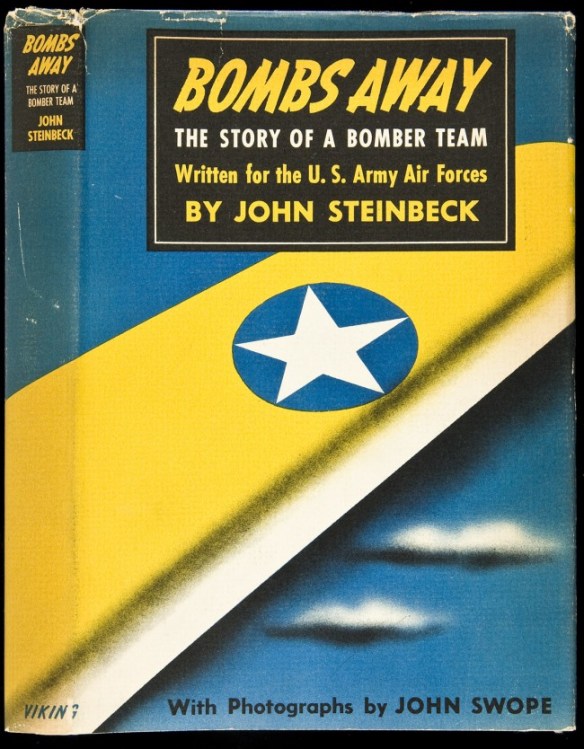
STEINBECK Bombs Away cover

And yet there is something abstract, or at least detached, about Bombs Away, because it ends just before the crew takes off on its first mission.  In the concluding chapter, ‘Missions’, Steinbeck explains that the men ‘looked so carefully at the newspapers, and what they found in the newspapers reassured them.’
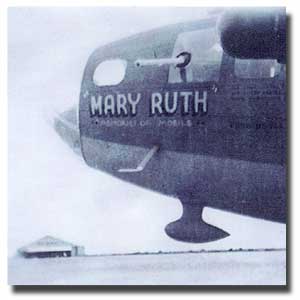
Mary Ruth nose artBut this paper knowledge turned out to be less than satisfactory.  Less than a year later, in June 1943, his request to become an air force intelligence officer refused by the draft board – a US Army intelligence report, mindful of the sympathies of Steinbeck’s pre-war novels, had concluded that there was ‘substantial doubt’ about his ‘loyalty and discretion’ and recommended that he not be offered a commission – Steinbeck was at RAF Bassingbourn (USAAF Station 121) in Cambridgeshire as a war correspondent for the New York Herald Tribune.

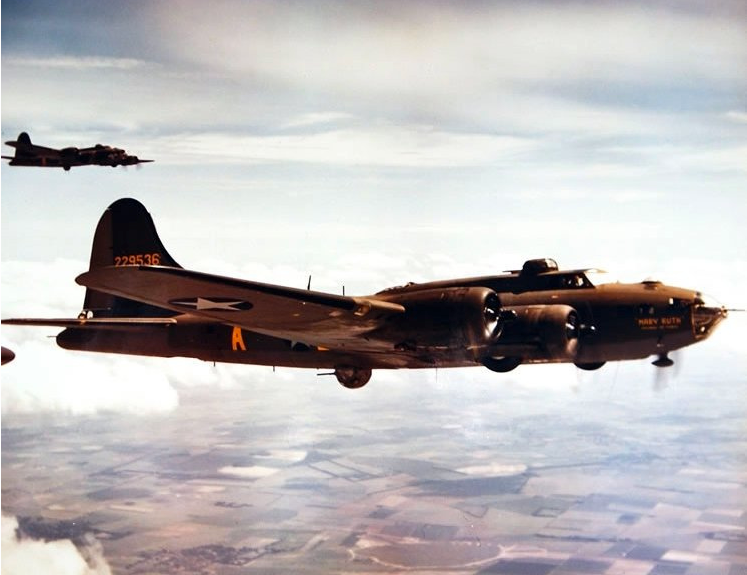
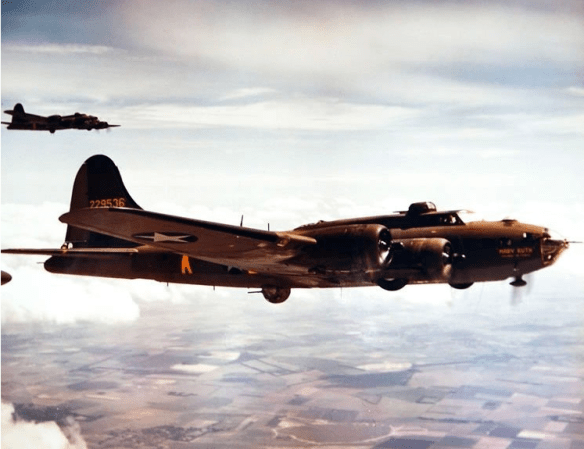
An old friend of his, in fact a literary agent before the war, Staff Sergeant Henry (“Maurice”) Crain was stationed there, and Steinbeck wrote nine articles centred on the crew of Crain’s ship, the “Mary Ruth: Memoirs of Mobile“, a Flying Fortress of the 91st Bomb Group of VII Bomber Command.  ‘The closer you get to the action,’ he reports Crain (the ball-turret gunner) saying, ‘the less you read the papers and war news’:

‘I remember before I joined up I used to know everything that was happening… I even had maps with pins and I drew out campaigns with colored pencils. Now I haven’t looked at a paper in two weeks.’

And when the crew did, as often as not they didn’t recognise what they saw.  The waist-gunner had read a newspaper from home:

‘It seems to me that the folks at home are fighting one war and we’re fighting another one. They’ve got theirs nearly won and we’ve just got started on ours. I wish they’d get in the same war we’re in. I wish they’d print the casualties and tell them what it’s like.’
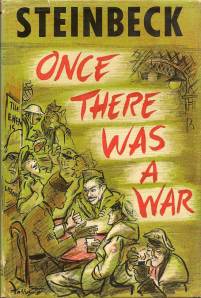
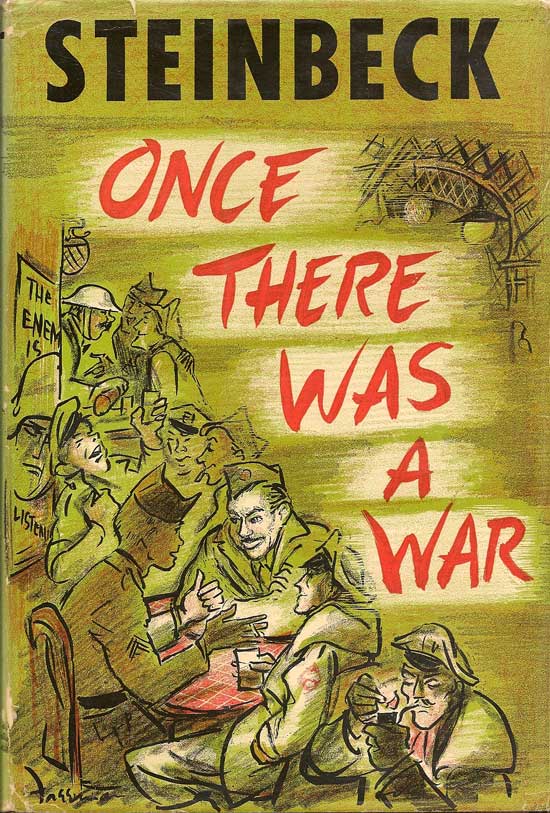
STEINBECK Once there was a warThis is a far cry from the brimming, boastful confidence of Bombs Away, and Steinbeck is clearly concerned not only to change the tone but also to surmount the limitations of his new, temporary profession (some of his despatches were republished in 1958 in Once there was a war).  He does so by invoking the the technical, instrumental armature of the mission: the precision of the briefing (‘The incredible job of getting so many ships to a given point at a given time means almost split-second timing’), the complicated process of kitting up (‘During the process the men have got bigger and bigger as layer on layer of equipment is put on; they walk stiffly, like artificial men’), and the meticulous work of the ground crews who ‘scurry about like rabbits’ as they prepare the aircraft and load the bombs.  But here too it is above all the sociality, the camaraderie that drives and dominates the narrative.
Mary Ruth

And it’s the end of this that brings Steinbeck’s reports to an abrupt end.  He had had in mind a series of 25 articles, but this was cut short when the ‘Mary Ruth’ (shown above) failed to return from a bombing raid on the Ruhr.

But this was not the end of Steinbeck’s interest in (and enthusiasm for) the US military in general and bombing in particular.  He was a vocal supporter of the Vietnam War, and in fact visited the South in December 1966-January 1967.  In private he wrote that ‘I wish the bombing weren’t necessary, but I suspect our people on the ground know more about that than I do’ , and he refused all requests to sign petitions against President Johnson’s Rolling Thunder campaign.  [For more on Steinbeck’s involvement in the two wars, see Thomas Barden, ‘John Steinbeck and the Vietnam War’, Steinbeck Review 5 (1) (2008) 11-24].

Note: Most of the crew of the ‘Mary Ruth’ survived (including Crain) and were taken prisoner of war.  The most detailed account describes the ‘Mary Ruth’ being shot down by a fighter aircraft on 22 June 1943; Steinbeck’s reports for the New York Herald Tribune begin to appear on 26 June. The discrepancy is presumably explained by a combination of the time taken for his despatches to cross the Atlantic and wartime censorship.  Both Bombs Away and Once there was a war are still available as Penguin editions, the latter with an enthusiastic foreword by Mark Bowden.
‘Dirty Wars’ and the everywhere war

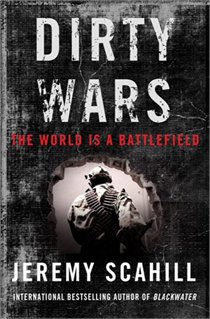
'Dirty Wars' - Jeremy Scahill filmDirty wars: the world is a battlefield, a new film by the Nation‘s brilliant investigative reporter  Jeremy Scahill and directed by Rick Rowley (of Big Noise Films) has won this year’s Sundance Film Festival Prize for best cinematography in a US documentary.  The film, which goes on release later this year, focuses on the CIA’s Special Activities Division, Joint Special Operations Command and other covert forces in waging undeclared wars around the globe.  More information and updates here.  Here’s the ‘long synopsis’:

Dirty Wars follows investigative reporter Jeremy Scahill, author of the international bestseller Blackwater, into the heart of America’s covert wars, from Afghanistan to Yemen, Somalia and beyond. With a strong cinematic style, the film unfolds through Scahill’s investigation and personal journey as he chases down the most important human rights story of our time.

Along the way we meet two parallel casts of characters. The CIA agents, shooters, military generals, and Special Forces operators who populate the dark side of American wars go on camera and on the record—many for the first time. The human victims of this unaccountable violence are also heard. Seeing and hearing directly from survivors of night raids and drone strikes and victims of torture in “black” detention sites shows the human lives caught in these wars.

Tracing the rise of Joint Special Operations Command (JSOC), the most secret and elite fighting force in U.S. history, Dirty Wars reveals covert operations unknown to the public and carried out across the globe by men who do not exist on paper and will never appear before Congress. In military jargon, JSOC teams “find, fix, and finish” their targets: anyone, without due process. No target is off limits for the “kill list,” including U.S. citizens.

Dirty Wars takes viewers to remote corners of the globe to see first-hand wars fought in their name and offers a behind-the-scenes look at a high-stakes investigation. We are left with questions about freedom and war, justice and democracy.

SCAHILL Dirty warsThe accompanying – monumental (512 pp) – book (under the same title) will be published by Nation Books in April.

In an early review for Variety, Rob Nelson praises the film’s power and politics:

Filed from the frontlines of the war on terror, documentarian Richard Rowley’s astonishingly hard-hitting “Dirty Wars” renders the investigative work of journalist Jeremy Scahill in the form of a ’70s-style conspiracy thriller. A reporter for the Nation, Scahill follows a blood-strewn trail from a remote corner of Afghanistan, where covert night raids have claimed the lives of innocents, to the Joint Special Operations Command (JSOC), a shadowy outfit empowered by the current White House to assassinate those on an ever-expanding “kill list,” including at least one American. This jaw-dropping, persuasively researched pic has the power to pry open government lockboxes.

Doggedly questioning the logic and morality of waging a war with no accountability and no end in sight, Rowley and Scahill are shrewd enough to recognize that one of the strongest weapons in their own arsenal is entertainment. This isn’t to say that “Dirty Wars” is fun by any stretch, but that it takes pains to make the political personal, forging the viewer’s identification with Scahill by making persistent use of his voiceover narration and keeping him oncamera throughout. Scahill is no Redford or Hoffman, but one follows his train of thought and ultimately fears for his safety.

There’s also an excellent interview (including some riveting, spine-chilling detail) with Amy Goodman, together with some clips from the film, at Democracy Now:

If you’re in a hurry, the transcript is here.  As Amy notes in the Guardian (and as the interview confirms)the film is a much-needed antidote to Zero Dark Thirty, and speaks directly to what I’ve called ‘the everywhere war’:

 ‘Sadly it proves the theater of war is everywhere, or, as its subtitle puts it: “The World is a Battlefield.” As Scahill told me: “You’re going to see a very different reality, and you’re going to see the hellscape that has been built by a decade of covert war.”