‘Imagination bodies forth…’

Following from my previous post, I’ve been thinking a lot about bodies recently, and for two reasons.
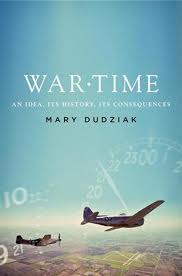
DUDZIAK War-timeThe first is the workshop on War & Medicine I attended in Paris just before Christmas.  It became very clear early on how difficult it is to determine when military violence comes to an end; Mary Dudziak has recently written about this in her War time: an idea, its history, its consequences (Oxford, 2012), largely from a legal point of view (and not without criticism), but it’s worth emphasising that the effects of violence continue long after any formal end to combat.  This ought to be obvious, but it’s astonishing how often it’s ignored or glossed over.

Think, for example, of the continuing toll of the conflicts in Afghanistan and Iraq, recovered in detail by Catherine Lutz (who was part of the workshop) and her colleagues at the Costs of War project, which shows how ‘the human and economic costs of these wars will continue for decades’.
NIXON Slow violenceOr think of  the toxic environments produced by ecological warfare, by the use of depleted uranium in munitions, and by the continued deployment of land mines and cluster bombs – what Rob Nixon brilliantly calls the ‘slow violence’ produced by ‘ecologies of the aftermath’ (more on this in a later post):

 ‘In our age of depleted-uranium warfare, we have an ethical obligation to challenge the military body counts that consistently underestimate (in advance and in retrospect) the true toll of waging high-tech wars.  Who is counting the staggered deaths that civilians and soldiers suffer from depleted uranium ingested or blown across the desert?  Who is counting the belated fatalities from unexploded cluster bombs that lie in wait for months of years, metastasizing into landmines?  Who is counting deaths from chemical residues left behind by so-called pinpoint bombing, residues that turn into foreign insurgents, infiltrating native rivers and poisoning the food chains?  Who is counting the victims of genetic deterioration – the stillborn, malformed infants conceived by parents whose DNA has been scrambled by war’s toxins?’

(If you think we are winning the war on land-mines, especially in you are in Canada, read this).

These two contributions – and the conversations we had in Paris – rapidly displaced the lazy assumption of a politics of care in which the left mourns civilian casualties and the right military casualties. That there is a politics of care is clear enough, but there’s also a political geography: that’s written in to the biopolitical projects that are contained within so many late modern wars, and in Paris Omar Dewachi and Ghassan Abu-Sitta described how ‘care’ has become a means of controlling populations in wars in Iraq, Libya and Syria – a rather different sense of ‘surgical warfare’ from the one we’re used to – with states like Saudi Arabia and Qatar also funding the transfer of thousands of injured people from the war zones for treatment in hospitals in Egypt, Jordan and Lebanon.

And two brilliant medical anthropologists, Ken Macleish and Zoe Wool, brought with them vivid, carefully wrought ethnographies of injured soldiers’ bodies.  The American soldier may appear a figure of unprecedented invulnerabilty and astonishing violence – what Ken calls a figure of ‘technological magic’ produced by a ‘phantasmagoric technological empowerment of the body’ – but, as he and Zoe reminded us, soldiers are not only ‘the agents and instruments of sovereign violence’ but also its objects.  Their studies took me to places I’ve never been and rarely thought about, but I’ve been thinking about two other dimensions of their work that combined to produce my second reason for thinking about bodies.

One is the historicity that is embedded in this process.  Ken paraphrased Walter Benjamin‘s observation in the wake of the First World War – ‘the technological progress evident in modern warfare does not ensure the protection of the human body so much as it subjects it to previously unimaginable forms of harm and exposure’ – and linked it to John Keegan‘s claim in The face of battle that the military history of the twentieth-century was distinguished by the rise of ‘”thing-killing’ as opposed to man-killing weapons’ (the example he had in mind was heavy artillery).  The other is the corporeality of the combat zone.  Ken again:  ‘You need not only knowledge of what the weapons and armor can do for you and to you but a kind of bodily habitus as well – an ability to take in the sensory indications of danger and act on them without having to think too hard about it first.’  In an essay ‘On movement’ forthcoming in Ethnos, Zoe develops this insight through an artful distinction between carnality and corporeality (which may require me to revise my vocabulary):

‘The analytics of movement is a turning toward emergent carnality, flesh, and the way it is seen and felt; proprioception and those other senses of sight, sound, touch, and taste through which a body and a space enact a meaningful, sensible articulation; visceral experiences forged and diagnosed through the trauma of war which also exceed its limits.’ 
an-ice-cream-warAnd so to my second reason for thinking about bodies. Later this month I’m giving a lecture in the University of Kentucky’s annual Social Theory series.  The theme this year is Mapping, and my title is ‘Gabriel’s Map‘.  This is a riff on a phase from William Boyd‘s novel, An Ice-Cream War, that has haunted me ever since I first read it:

‘Gabriel thought maps should be banned.  They gave the world an order and reasonableness it didn’t possess.’

The occasion for the remark is a spectacularly unsuccessful British attempt to defeat a much smaller German force in November 1914 at Tanga in German East Africa; the young subaltern, Gabriel, rapidly discovers that there is a world of difference between what Clausewitz once called ‘paper war’ – a plan of attack plotted on the neat, stable lines of a map – and ‘real war’.   What I plan (sic) to do is arc back from this exceptionally brutal campaign – which lasted two weeks longer than the war in Europe – to the western front.  The two were strikingly different: the war in Africa was a war of movement and manoeuvre fought with the most meagre of military intelligence, whereas the central years of the war in Europe were distinguished by stasis and attrition and involved an extraordinary effort to maintain near real-time mapping of the disposition of forces.

The point here is to explore a dialectic between cartography and what I think I’m going to call corpography.

FINNEGAN Shooting The FrontThe first of these has involved working out the intimate relationship between mapping and aerial reconnaissance (what the Royal Flying Corps called ‘shooting the front’).  There is a marvellously rich story to be told here which, among other things, shows that the stasis of trench warfare was Janus-faced: it was produced by a myriad of micro-movements – advances and withdrawals, raids and repulses – whose effectiveness depended not on the fixity of the map at all but on its more or less constant updating (which in turn means that this capacity isn’t the unique preserve of twenty-first century ‘digital navigation’).  So here I’ll show how a casaced of millions of trench maps and aerial photographs was produced, distributed and then incorporated into the field of action through copies, re-drawings, sketches and annotations by front-line soldiers.  I have wonderful, telling examples, like this one (look carefully at the annotations):
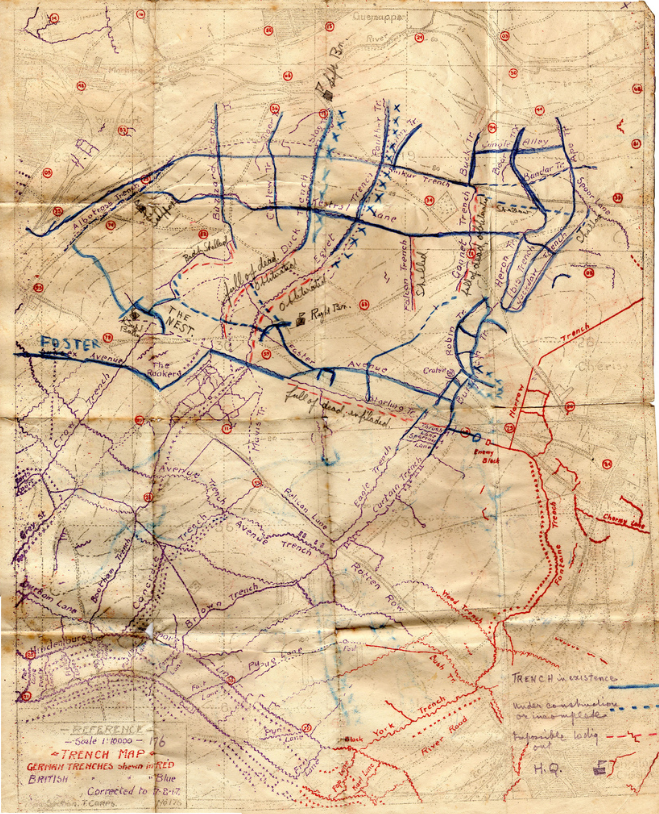
Trench map annotated

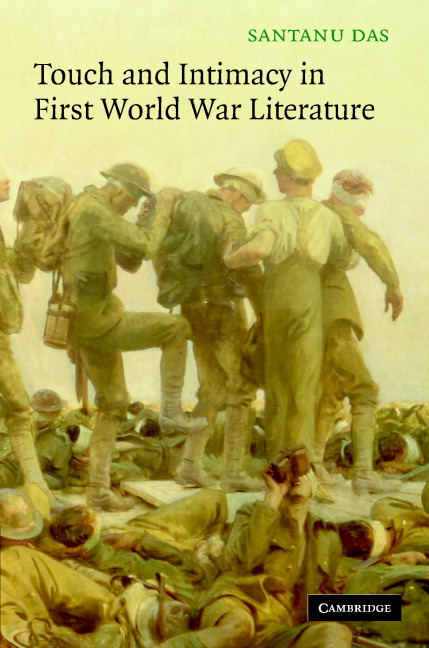
Santanu DAS: Touch an dintimacy in First World War literatureBut I also want to show (as the map above implies: all those “full of dead” annotations) how, for these men, the battlefield was also literally a field: a vile, violent medium to be known not only (or even primarily) through sight but through touch, smell and sound: what Santanu Das memorably calls a ‘slimescape’ which was also a soundscape.  This was a close-in terrain that was known through the physicality of the body as a sensuous, haptic geography:

‘Amidst the dark, muddy, subterranean world of the trenches, the soldiers navigated space … not through the safe distance of the gaze but rather through the clumsy immediacy of their bodies: “crawl” is a recurring verb in trench narratives, showing the shift from the visual to the tactile.’

This was a ‘mapping’ of sorts – as Becca Weir suggests in  ‘“Degrees in nothingness”: battlefield topography in the First World War’, Critical Quarterly 49 (4) (2007) 40-55 – and there is a dialectic between cartography and corpography.

I’ve been working my way through a series of diaries, memoirs and letters to flesh out its performance in detail, but the most vivid illustration of the entanglements of cartography and corpography that I’ve found – and that I suspect I shall ever find – is this extract from a ‘body density map’ for part of the Somme.  This shows the standard trench map above a contemporary satellite photograph; each carefully ruled square is overprinted with the number of dead soldiers found buried in the first sweep after the war (between March and April 1919)…
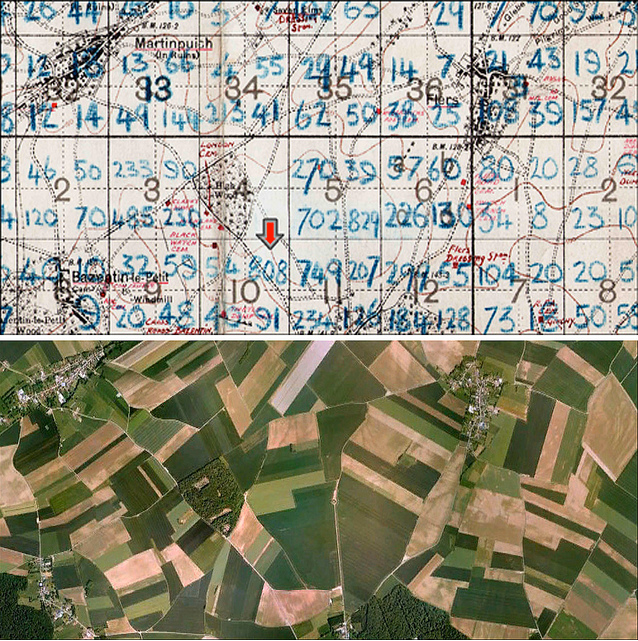
Body Density Map, High Wood, Somme image by shipscompass on flickr

I won’t say more at present because I need to keep my powder dry for Kentucky, but I hope it will be clear by the end that, even though I’ll be  talking about the First World War, I will also have been talking about the wars conducted in the shadows of the Twin Towers and the Pentagon.

Gaza, stripped: the deconstruction of the battlefield?

Frédéric Mégret has frequently drawn attention to the peculiar social and legal status of the battlefield:

‘[W]hilst war may and will rage, what distinguishes it from random violence is the fact that it unfolds in discreet spaces insulated from the rest of society, confining military violence to a confrontation between specialized forces whose operation should minimally disrupt surrounding life…. In that respect, the laws of war do not merely seek to regulate the battlefield. They are also part of its symbolic maintenance and even construction as a particular space defined by the norms that apply to it. In other words, the battlefield does not predate norms on warfare; rather it has always been subtly coterminous with them. The laws of war are, therefore, a crucial foundation for understanding the evolution of the battlefield and, conversely, the evolution of the battlefield is a key way in which the evolution of the laws of war can be understood.’ 

For Mégret, the deconstruction of the battlefield is now well advanced: starting in the nineteenth century, with transformations in firepower that constantly extended the range over which lethal force could be deployed, dramatically accelerated with the rise of airpower annulling the distinction between the spaces of combatants and civilians, given a further twist by remote operations conducted over vast distances from unmanned aerial systems like the Predator and the Reaper, and aggravated by the renewed significance of insurgency and counter-insurgency struggles (‘war among the people’), the relations between the spatiality of war and its legal armature have been radically transformed.  (For a visual rendering, see Mégret’s Prezi on ‘Where is the battlefield?’).

These are important ideas, but there are other dimensions that need to be taken into account when considering Israel’s latest attack on Gaza.  This is a conflict that is fully coterminous with what Helga Tawil-Souri calls Israel’s ‘digital occupation’ of Gaza.  As she writes in a superb essay in the Journal of Palestine Studies 41 (2) (2012) 27-43:

‘Disengagement has not meant the end of Israeli occupation. Rather, Israel’s balancing act “of maximum control and minimum responsibility” has meant that the occupation of Gaza has become increasingly technologized. Unmanned aerial reconnaissance and attack drones, remote-controlled machine guns, closed-circuit television, sonic imagery, gamma-radiation detectors, remote- controlled bulldozers and boats, electrified fences, among many other examples, are increasingly used for control and surveillance One way to conceptualize disengagement, then, is to recognize it as a moment marking Israel’s move from a traditional military occupation toward a high-tech one.

Rooted in Israel’s increasingly globalized security-military-high-tech industry, the technological sealing of Gaza is part of the transformation of the mechanics of Israeli occupation toward “frictionless” control that began with the first intifada and the ensuing “peace process,” which marked the shift toward the segregation of Gaza. “Frictionless” is, of course, metaphoric and purposefully ambiguous, evoking a sense of abstraction and lack of responsibility…

While high technology has become one of the means through which Israeli occupation continues, the high-tech infrastructure in the Gaza Strip — that which is used by Palestinians as opposed to the Israeli regime— is also a space of control. Technology infrastructures form part of the appa- ratus of Israeli control over Gazans. A telephone call made on a land-line, even between Gaza City and Khan Yunis, is physically routed through Israel. Internet traffic is routed through switches located outside the Gaza Strip. Even on the ubiquitous cellular phones, calls must touch the Israeli backbone at some point. Like much else about the Gaza Strip, telecommunication infrastructures are limited by Israeli policies. Geographic mobility, economic growth, political mobilization, and territory are contained, but so are digital flows: Gazans live under a regime of digital occupation.’ 

It should come as no surprise, therefore, that Israel also fights in digital space.  This takes many forms, and at the limit extends into the domain of cyberwarfare (where, as the joint US/Israeli cyber-attack on Iran’s nuclear program showed, Israel possesses advanced capabilities), but in its more mundane version it can be no less effective.

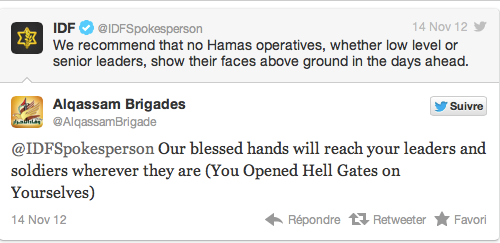
One of the characteristic features of late modern war is its mediatization, and the Israeli Defense Forces have used (even ‘weaponized‘) an array of social media platforms to shape the public construction of the battlespace.  This is a far cry from its faltering efforts during the previous assault on Gaza in 2008-9, Operation Cast Lead.  Soon after the IDF assassination that sparked the renewed air campaign this month, the IDF tweeted a headshot of the dead man, Hamas military commander Ahmed al-Jabari, with “eliminated” stamped across it, and immediately followed up with a video uploaded to its YouTube channel showing the drone strike (I’m not going to do the IDF’s job for it, but if you want to see stills and screenshots you can find them here).  The IDF continued to tweet, announcing its airstrikes in 140-character containers, and also turned to Facebook, Pinterest and Tumblr to post images and infographics (or, more accurately, propagandagraphics).

The object of the exercise has been three-fold.

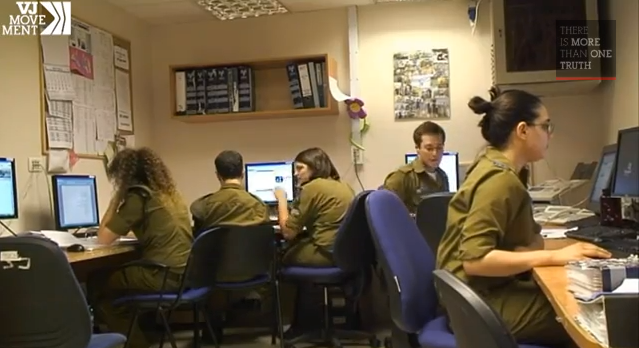
First, the IDF has been seeking direct – which is not to say unmediated: the clips, tweets and the rest follow an artfully pre-arranged script – and real-time access to domestic, regional and international publics.  The officer commanding the IDF’s 30-strong New Media desk (which is shown in the image on the left), Lt. Col. Avital Leibovich, explained that she wanted ‘to convey our message without the touch of an editor’ and to reach those who don’t turn to print media or TV for their news.

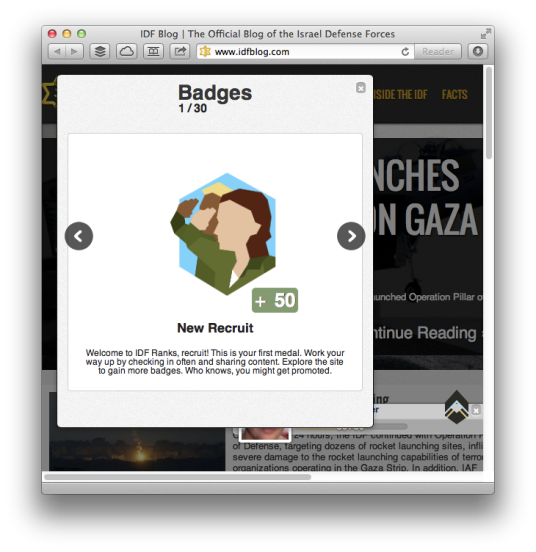
Second, the IDF has been aggressively mobilising its supporters, inside and outside Israel, encouraging them to retweet and to post their support on Facebook: using social media to puncture what Israel routinely describes as its ‘isolation’. Time reported that the IDF had activated additional ‘gamification’ features on its blog that allowed visitors ‘to rack up “points” for repeat visits or numerous tweets’: see the image on the right; more here.

Third, the IDF apparently believes that social media can send ‘a message of deterrence’ – though its tweets have surely been as likely to provoke as to intimidate.  The campaign sparked a series of responses and counter-measures – in Gaza, Hamas and its supporters, and in particular the Al-Qassam Brigades led by al-Jabari, took to social media platforms too, though Israel’s digital occupation plainly made that a vulnerable strategy, and the cyberactivist group Anonymous claimed to have defaced or disrupted nearly 700 Israeli political, military and commercial websites – so that al Jazeera described this as a ‘mass cyber-war‘ (I think that’s wrong: it’s been a social media war, but not one that has directly produced destruction – though, as I’ll suggest in a moment, it has certainly invited it).

More on the IDF’s New Media desk from Fast Company here and from the VJ Movement below:

It’s hard to know how effective this social media blitz has been: certainly, many people have been repulsed by the way the IDF ‘cheerily live-tweets infanticide’ and ‘the apparent glee with which the IDF carries out its job.’  As John Mitchell complained, ‘Innocent people are dying on all sides, and the IDF wants to reward people for tweeting about it.’  In doing so, the contemporary rendering of war as spectacle and entertainment has been turned into something at once banal and grotesque.  Alex Kantrowitz put this well:

When a military at war asks its Twitter followers to “Please Retweet,” or check out its Tumblr, or posts an image of a rocket hooking a Prime Minister’s undergarments, it is hard not to sense a disconnect between that messaging and the bombing taking place in real life. As The Verge’s Joseph L. Flatley put it, “One liveblogs award shows or CES keynotes, not armed conflict.”

When Matt Buchanan calls this live-tweeting of military and paramilitary violence ‘the most meaningful change in our consumption of war in over 20 years’ – my emphasis – then this is war reduced to consumerism: how long before military commanders start worrying that if their ratings aren’t high enough, their audience penetration too low, their war will be cancelled?  (Not such a bad idea, you might think, until they are driven to find ways to increase their market share….) Buchanan may think this is ‘How to Wage War on the Internet’, but Michael Koplow is nearer the mark: it’s precisely How Not to Wage War on the Internet.

In fact, several commentators worry that the trash-talking between the two sides, the verbal violence of response and counter-response on Twitter, was an open invitation to extend the war beyond the words:


‘This is a new reality of war,’ Heather Hurlburt noted, ‘and I worry that it’s going to make it harder to stand down.’  The digital exchanges were immediate – not the language of reflection or diplomacy – and, whatever else they were about, were clearly intended to taunt the other side: Hamas and the IDF were both targeting audiences in Gaza (and the West Bank) and in Israel, by turns rallying their supporters and goading the enemy.  In short, here as elsewhere, there are crucial connections between the physical and virtual worlds that, in this case, may work to inflame the violence.

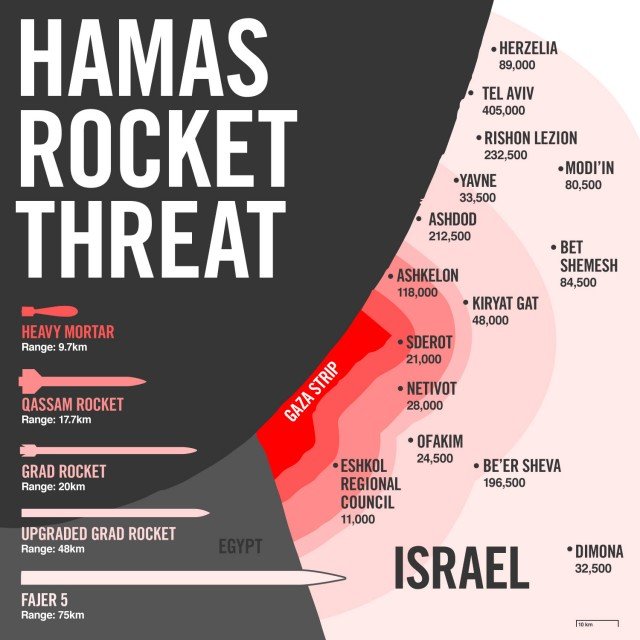
Yet for all this the digital battlespace can work to reinstate the traditional battlefield – at least virtually and rhetorically.   This is one of the maps circulated through the IDF’s social media platforms:

And here is the equivalent map published online by the New York Times, updated yesterday:

Here the map speaks power to truth: the ‘battlefield’ has been radically extended so that, as always, the terms of an an intensely asymmetric struggle are radically reversed.  The disproportionate concentration of Israeli firepower on Gaza is erased, while virtually all of Israel – including, as we have been endlessly reminded, for the very first time Jerusalem – is threatened by Hamas.

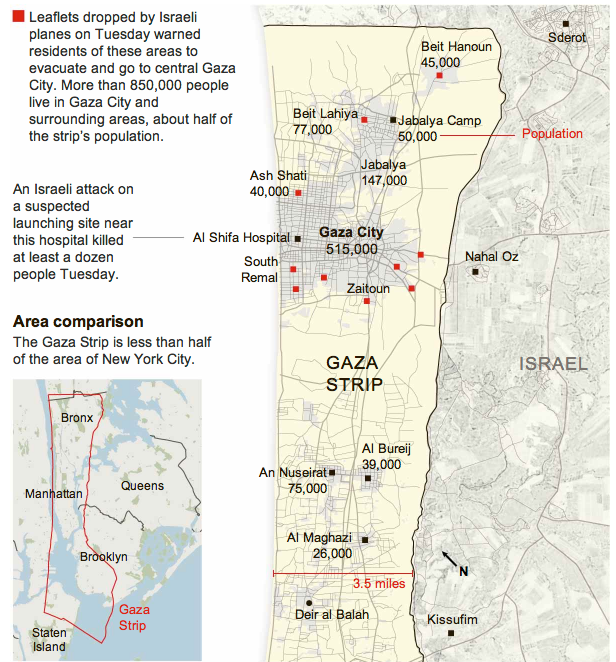
The Times did at least include this, separate map of Gaza:

The map plots (in red) the sites of IDF leaflet drops (really).  So we have one map showing Hamas rocket ranges and ‘cities taking enemy fire’, and the other showing paper dropped on a captive population…

UPDATE: More on this from Craig Jones here.

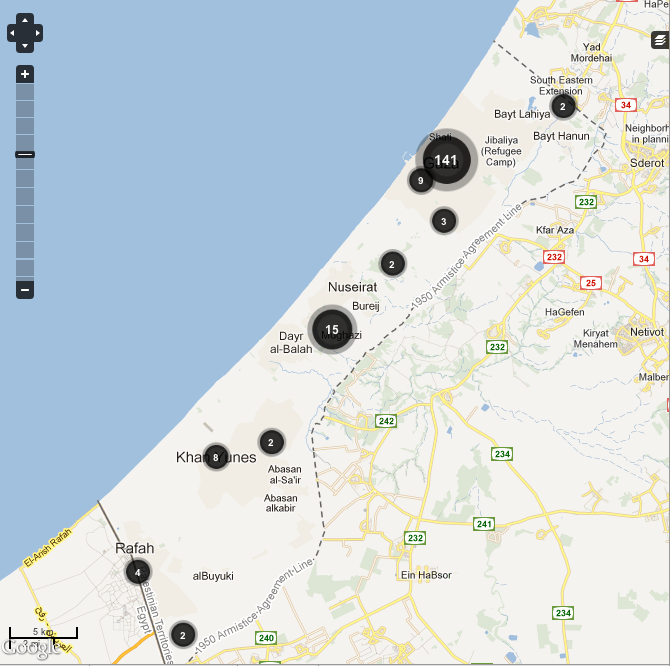
If you want to find more meaningful maps that take in both Israel and Gaza, including air strikes and rocket attacks, deaths and casualties on both sides, you can find them at al Jazeera here.  I’ve pasted an extract from the plot of air strikes below.

Seen like this, I’ll leave the last words to Helga Tawil-Souri:

“The underlying reasons of Israel’s propaganda are to silence the enemy, gain international support and justify wars… Their goal has not fundamentally changed over the years, only the platforms on which these are disseminated.” 

Bethlehem to Baghdad

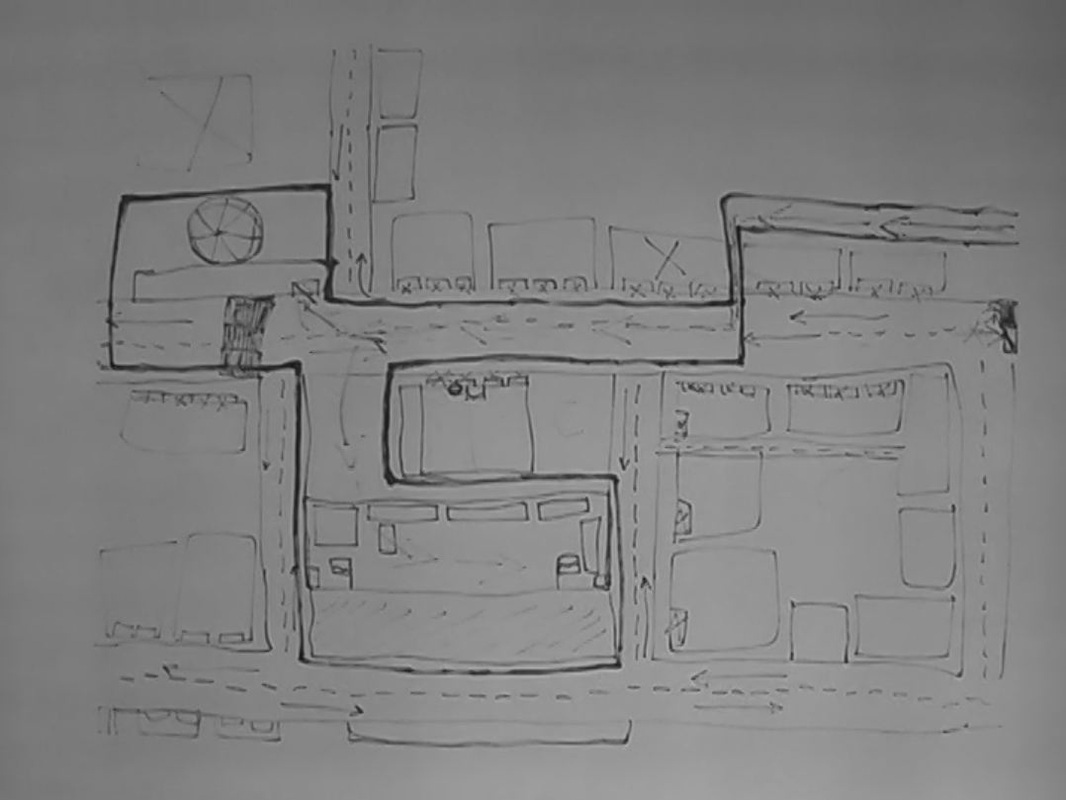
In 2008 the artist Till Roeskens – who describes himself as an ‘amateur of applied geography’ – produced a ‘videocartography’ or ‘videomapping’ based on interviews at the Aida refugee camp in occupied Palestine.  Roeskens explains: ‘I asked residents of the camp to draw with big ink pens so the marks would go through the paper. I filmed from the other side, as they drew, so I didn’t see the person while they were drawing and speaking; I saw only the white screen with the light coming from behind me.’  The mappings, together with the stories told by those who drew them, were recorded on video, and ‘as the film progresses, the viewer is increasingly hemmed in by a complex network of lines, until the reality of the occupation is fully realized on screen’.      There is a revealing interview with the artist at Words without borders here, and you can watch some extracts here (and there are others on YouTube and vimeo).

« On screen: nothing but another screen. At first untouched, a blank sheet of paper is slowly being filled with more or less straight lines. Then these lines grow, push and cross each other, to finally form a drawing, a layout; they unfold a topography, mark places, build houses, give directions, describe in great detail tangles of roads and obstacles. In fact, they are laying down flat biographies. Six sheets slowly come to life that way, one after another, following the rhythm of stories told by children, women or men voices, of people we never get to see. Where are these voices? Behind the sheets. Of course, but where else? Nowhere: that is precisely what the voices are trying to say. Or rather, because even nowhere persists on taking up some space, they say that they are in Palestine. (…) »

Inspired by Rosekens’ work, Antonio Ottomannelli transposed the technique to Baghdad.  The project was carried out between November 2011 and February 2012 with students at the Fine Arts Faculty of the University of Baghdad.  Ottomannelli:

‘Baghdad is a hidden city.  Everything is placed behind anti-explosion walls, from one checkpoint to the next. … The latest map of Baghdad was made by the US military in 2003 for military and strategic purposes…  There is no civilian map of the current configuration… Inspired by the work of Till Roeskens on Palestine, Mapping Identity tries to tell about the city – the whole of it – from the inside.  A snapshot of the ordinary, a minor “Giacometti portrait”, as Baghdad is concealed…’

More details here, and a videomap here (more on vimeo).

These projects are political-artistic versions of the ‘mental maps’ that captured the imagination of many human geographers in the 1960s and 70s – an interest which is usually traced back to Kevin Lynch’s experiments with The image of the city (1960) and that probably climaxed in Peter Gould and Rodney White’s classic little book, Mental maps, originally published in 1974 – but what makes these projects so compelling is their emphasis on the process of mapping (through their use of video) rather than a fixation on the map as finished object.  One of the criticisms of the original ‘mental mapping’ projects was that respondents drew maps only because they were asked to: that this was not how people found their way around their neighbourhoods, which usually turned out to be a much more pragmatic, improvisational practice responding to cues and following routines rather than relying on some imaginary point of overview.  But these two projects are ways of narrating a space – of telling what Michel de Certeau would call ‘spatial stories’ – that are also interventions in (and subversions of) larger narratives of military violence and military occupation.

Counterinsurgency and the humanitarian present

Laleh Khalili – whose work on the new and old classics of counterinsurgency,  on the gendering of counterinsurgency, and on the location of Palestine in global counterinsurgency – is indispensable, has just alerted me to the fate (Fate?) of one of its principal architects, David Kilcullen.

In The accidental guerilla and other writings, Kilcullen – Petraeus’s Senior Counterinsurgency Adviser in Iraq – repeatedly turned to bio-medical analogies to advance a bio-political vision of counterinsurgency: insurgency as a ‘social pathology’ whose prognosis can be traced through the stages of infection, contagion, intervention and rejection (‘immune response’).  In an interview with Fast Company, Kilcullen now explains that he

“came out of Iraq with a real conviction that we tend to think that a bunch of white guys turning up with a solution fixes all the problems. It doesn’t work like that. You actually have to really build a collaborative relationship with the people on the ground if you want to have any hope of understanding what’s going on.”

Kilcullen’s contract ended when the Obama administration came into office, and he founded Caerus Associates.  The company advertises itself as ‘a strategy and design firm’ that works to ‘help governments, global enterprises, and local communities thrive in complex, frontier environments.’  It claims to ‘bring the system into focus’ by providing ‘strategic design for a world of overlapping forces — urbanization, new market horizons, resource scarcity and conflict — to build resilience and capacity.’   The company explains its ‘strategic design process’ here, and Kilcullen’s vision of systems analysis is sketched here.  This may sound like the rapid-fire buzz-words that corporate start-ups typically shoot at their clients, but Kilcullen provides Fast Company with a sawn-off version (it’s really hard to avoid these metaphors…):

“We’re two-thirds tech, one-thirds social science, with a dash of special operations… We can go out in a community and say, ‘Let’s map who owns what land,’ or ‘Let’s map who owes the local warlord money,’ or ‘Let’s map the areas in the city where you don’t feel safe.'”

This chimes with Kilcullen’s famous description of contemporary counterinsurgency as ‘armed social work’, and in an interview with the International Review of the Red Cross published in September 2011 Kilcullen extended his vision of ‘military humanism’ beyond insurgency thus:

‘The methods and techniques used by illegal armed groups of all kinds are very similar, irrespective of their political objectives. So whether you’re talking about a gang in the drug business in Latin America, or organized crime in the gun-running or human smuggling business, or whether you’re talking about an insurgency or perhaps even a civil war involving tribes, you will see very similar approaches and techniques being used on the part of those illegal armed groups. That’s one of the reasons why I believe counter-insurgency isn’t a very good concept for the work that the international community is trying to do. I think that the idea of complex humanitarian emergencies is actually a lot closer to the reality on the ground. You almost never see just one insurgent group fighting an insurgency against the government anymore. What you typically see is a complex, overlapping series of problems, which includes one or more or dozens of armed groups. And the problem is one of stabilizing the environment and helping communities to generate peace at the grassroots level – a bottom-up peace-building process. And that’s not a concept that really fits very well with traditional counter-insurgency, which is about defeating an insurgent movement and is a top-down, state-based approach. What you have to do is create an environment where existing conflicts can be dealt with in a non-violent way.’

This is a remarkable passage for several reasons: the focus on ‘techniques’ not ‘objectives’, which works to de-politicize and de-contextualize a range of different situations in order to generalize about them, the appeal to a collective “international community” whose only interest is a generic “peace”, and hence the passage to what Eyal Weizman calls ‘the humanitarian present’. I think that’s also a colonial present, not surprisingly: ‘humanitarianism’ was often the velvet glove wrapped around the iron fist of colonialism.  But what Weizman sees as novel about the present is the way in which its ‘economy of violence is calculated and managed’ by a series of moral technologies (the term is Adi Ophir‘s) that work to continue and legitimize its operation.  In other words, there is today an intimate collusion of the ‘technologies of humanitarianism, human rights and humanitarian law with military and political powers’.

Despite  the reference to ‘special operations’ in the Fast Company interview – something which makes me think that Obama would have found Kilcullen’s continued advice invaluable – Kilcullen insists that it’s a collaborative process:

“We specialize in working with communities that are under the threat of violence in frontier environments, and I think to some extent that distinguishes us a little bit from other people. Sure we can give a slick presentation in a hotel room, but what we can also do is walk the street in dangerous places, engage with communities, and figure out what needs to happen. It’s not us figuring it out, it’s them telling us, but often we find that no one’s ever been there and asked them before.”

‘Dangerous places’, ‘frontiers’: this is still the language of adventurism.  It recalls Zygmunt Bauman‘s ‘planetary frontierland’, and even more Mark Duffield on the ‘global borderlands’:

‘The idea of the borderlands … does not reflect an empirical reality.  It is a metaphor for an imagined geographical space where, in the eyes of many metropolitan actors and agencies, the characteristics of brutality, excess and breakdown predominate.  It is a terrain that has been mapped and re-mapped in innumerable aid and academic reports where wars occur through greed and sectarian gain, social fabric is destroyed and developmental gains reversed, non-combatants killed, humanitarian assistance abused and all civility abandoned.’

It’s not surprising, then, that in the IRC interview Kilcullen should make so much of establishing ‘the rule of law’: ‘It’s a set of rules which has predictable consequences and allows the population to feel safe, and helps them know what they need to do in order to be in a safe place.’  He makes it clear that, in many (perhaps most) circumstances ‘bottom-up, community-based law, which can be transitional justice, or customary law, applied by traditional courts or religious courts, is as effective and possibly even more effective in the initial stages than central-state structures.’   But this ignores the multiple ways in which law (including international humanitarian law) is not apart from conflict but is almost always a part of conflict: as Weizman has it, ‘international law develops through its violation.  In modern war, violence legislates.’

One could say much the same about maps.  Mapping is not a neutral, objective exercise; mapping is performative and its material effects depend on the constellation of powers and practices within which it is deployed. Kilcullen’s injunction – “Let’s map” – glosses over who the ‘us’ is, who is included and who is excluded, and the process through which some mappings are accorded legitimacy while others are disavowed.  This is also one of Weizman’s central claims, not least in his exposure of the torturous mappings that issued in the  Hollow Land of occupied Palestine.

Weizman’s particular focus in his discussion of the humanitarian present is Gaza, and this winds me back to Laleh Khalili’s work which brilliantly re-reads counterinsurgency in occupied Palestine contrapuntally with US counterinsurgency practices elsewhere.  Her Essential Reading on Counterinsurgency was published by Jadaliyya, and her forthcoming book, Time in the shadows: Confinement in Counterinsurgencies (Stanford University Press, October 2012),  engages with a Medusa’s raft of counterinsurgency adviser-survivors, including Kilcullen and Andrew Exum (Abu Muqawama).

And so a final question: how would ‘strategic design’ and a ‘collaborative process’ help the people of Gaza?  Whose ‘rule of law’ is to be established?  And which maps chart a road not only to peace but to justice for the people of Palestine?

Vancouver as the centre of the world

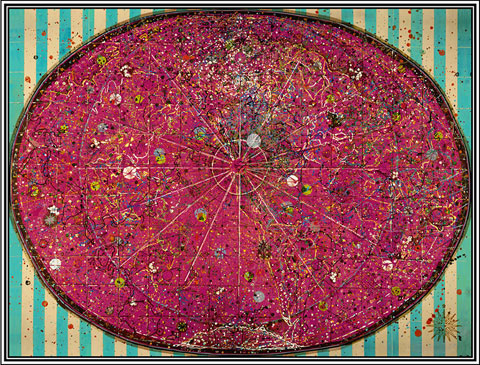
No, I know it isn’t – though many people who live here evidently think otherwise – but on the first full day of the London Olympics it seems appropriate to re-visit Landon Mackenzie’s Vancouver as the centre of the world, a remarkable (and huge) work commissioned by the Vancouver 2010 Cultural Olympiad.


This may seem a world away from my current preoccupations, but it isn’t – in all sorts of ways. Robin Laurence described the work ‘as a complex metaphor of power, place and ethnocentricity, the painting throbs with meaning. Throbs with menace, too. Those wine-red splatters look a lot like blood.’

‘On first viewing, Vancouver as the Centre of the World looks abstract—an enormous red oval floating on a ground of blue-green and sandy-ochre stripes. In fact, the work is highly representational, its variously translucent and opaque washes of colour inter-layered with subtle forms and ambiguous lines. Alluding to the formal problems posed by creating a two-dimensional map of our three-dimensional planet, and the weirdly distorting cultural biases of cartographers past and present, the painting folds references to moons, satellites, time zones, Internet cables, shipping lanes and airline traffic into its teeming surface. It also focuses us on the geopolitical forces that shape our vision of the world.

‘“It’s about the creation of a complex fiction,” Mackenzie says, pointing to the midden-like heap of maps that went into the painting’s making. Oceans and landforms shift and merge, national boundaries are erased, and cities like Buenos Aires, Hong Kong and Timbuktu rotate around the place that was once the end of the Earth.’

There’s also an excellent interview here with Didier Bigo, from Cultures et conflits, in which Mackenzie talks about her cartographic obsessions:

I liked the idea of this presentation because in reality all maps are a construction and a kind of fiction. In the late nineteenth century the Olympics became re-organized under nation states and so to erase national boundaries symbolically was a simple way of commenting on this relationship in contrast to most maps or globes which show a colourful spectrum of individualized territories.’

My own cartographic obsessions are rather different, as I’ll explain in another post, but I’m particularly interested in these marchlands between cartography and art.  Alan Ingram’s more general work on art, geography and war – he explains the inclusion of the middle term here – is exemplary.  In my own case, ever since I encountered elin o’Hara slavick’s “Bomb after Bomb” (see ‘Doors into nowhere’ in DOWNLOADS), I’ve been drawn to the work of artists who, like her, work to both reveal and subvert the spatial-visual logics that make possible the targeting that is the dead centre of military violence.  I’m most interested in ‘aerial works’, and I now have a long list that includes Martin Dammann [the Überdeutschland series], Joyce Kozloff [‘Targets’], Raquel Maulwurf, Gerhard Richter, and Nurit Gur-Lavy, and I’ll say more about them shortly.   But if anyone else has others I ought to include, I’d be very pleased to know of their work.