Digital airstrikes and physical casualties

Afghanistan

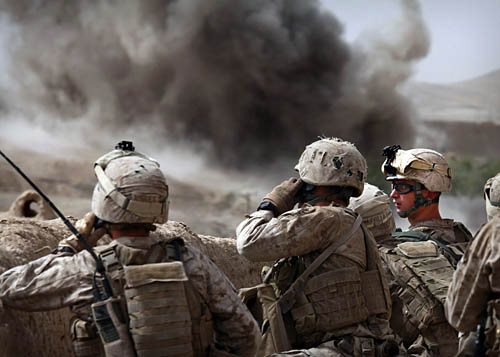
The US military defines Close Air Support (CAS) as ‘air action by fixed-wing and rotary-wing aircraft against hostile targets that are in close proximity to friendly forces, and [it] requires detailed integration of each air mission with the fire and movement of those forces.’  It’s a difficult and dangerous business, and not only for the intended targets.

The technologies of CAS have been transformed but, according to the the Defense Advanced Research Projects Agency, its fundamentals haven’t changed since the First World War.

‘Pilots and dismounted ground agents must ensure they hit only the intended target using just voice directions and, if they’re lucky, a common paper map. It can often take up to an hour to confer, get in position and strike—time in which targets can attack first or move out of reach.’

To achieve what is in effect the time-space compression of the kill-chain, DARPA is developing its Persistent Close Air Support program to provide an all-digital system.  The system ‘lets a Joint Tactical Air Controller call up CAS from a variety of sources, such as aircraft or missile platforms, to engage multiple, moving and simultaneous targets,’ explains David Szondy (from whom I’ve borrowed the short-hand ‘digital airstrikes’). ‘By eliminating all the radio chatter and map fumbling, the exercise is much faster and more accurate with reduced risk of friendly fire incidents.’  The program manifesto, for want of a better word, includes these aims and specifications:

The program seeks to leverage advances in computing and communications technologies to fundamentally increase CAS effectiveness, as well as improve the speed and survivability of ground forces engaged with enemy forces.

The program envisions numerous benefits, including:

  • Reducing the time from calling in a strike to the weapon hitting the target by a factor of 10, from up to 60 minutes down to just 6 minutes 
  • Direct coordination of airstrikes by a ground agent from manned or unmanned air vehicles
  • Improved speed and survivability of ground forces engaged with enemy forces
  • Use of smaller, more precise munitions against smaller and moving targets in degraded visual environments
  • Graceful degradation of services—if one piece of the system fails, warfighters would still retain CAS capability
PCAS_ProgramPage_Image

PCAS has two components:

The first is PCAS-Air, which … involves the use of internal guidance systems, weapons and engagement management systems, and communications using either the Ethernet or aircraft networks for high-speed data transmission and reception. PCAS-Air processes the data received, and provides aircrews via aircraft displays or tablets with the best travel routes to the target, which weapons to use, and how best to use them.

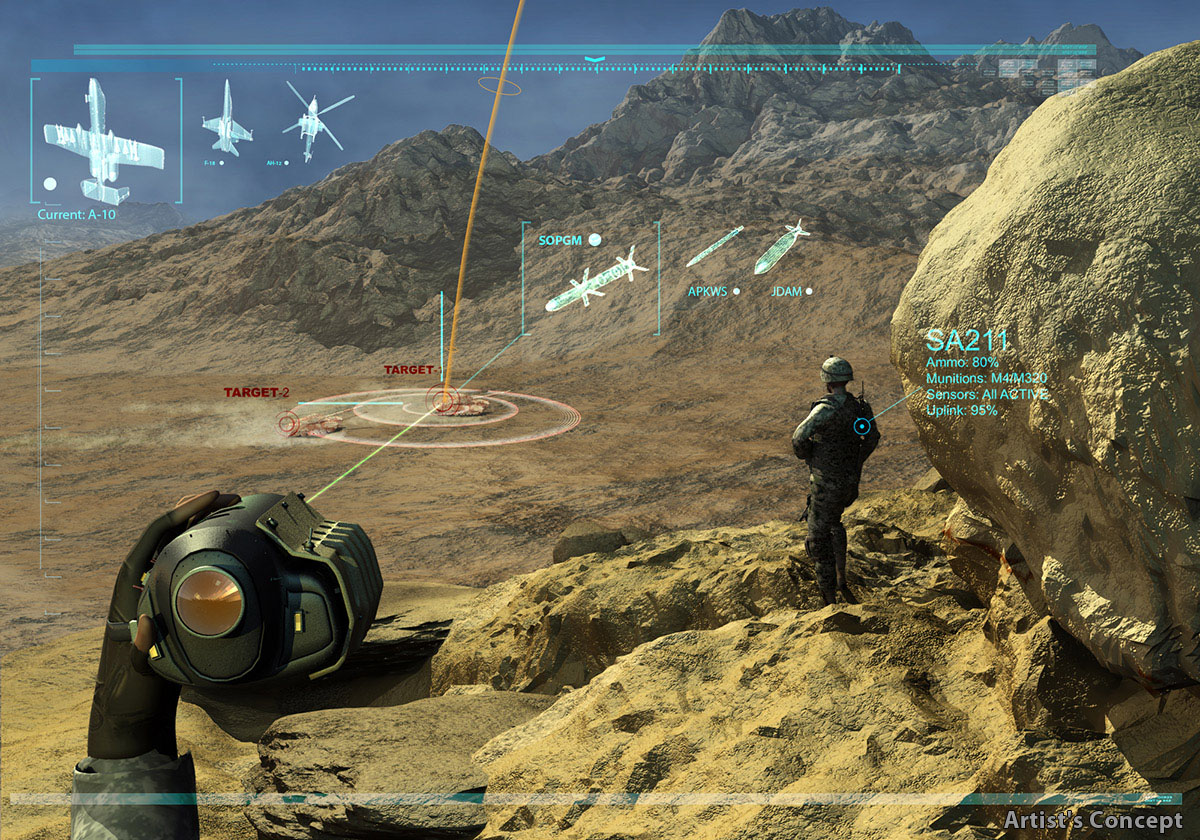
The other half is PCAS-Ground, intended for improved mobility, situational awareness and communications for fire coordination. Soldiers on the ground can use an HUD eyepiece wired to a tablet that displays tactical imagery, maps, digital terrain elevation data, and other information [the image above is an artist’s impression of the Heads-Up Display]. This means they can receive tactical data from PCAS without having to keep looking at a computer screen.

PCAS-Ground has been deployed in Afghanistan since December 2012.  The original plan, as the emphasis on ‘persistent’ implies, was to integrate the system with drones, but after the cancellation of the US Air Force’s MQ-X (‘Avenger’) program Raytheon announced that PCAS would be developed using a conventional A-10 Thunderbolt.

There is of course a long history to the digitisation and automation of the battlespace, and that reference to the First World War was not an anachronism.  There were such intimate links between mapping, aerial photography and artillery ranging on the Western Front – whose cascade of updated imagery and intelligence underwrote the seeming stasis of trench warfare – that Peter Chasseaud described the result as ‘a sophisticated three-dimensional fire-control data base’ through which ‘in effect, the battlefield had been digitised.’  It was also, in a sense, automated; I discuss this in detail in ‘Gabriel’s Map’, but it’s captured perfectly in Tom McCarthy‘s novel C.

More obvious way stations to the present include the Vietnam-era Electronic Battlefield, whose sensor-shooter system I described in ‘Lines of descent’ (DOWNLOADS tab) as a vital precursor to today’s remote operations:

Another was the development of the PowerScene digital terrain simulation that was used to identify target imagery transmitted by proto-Predators over Bosnia-Hercegovina and to rehearse NATO bombing missions.
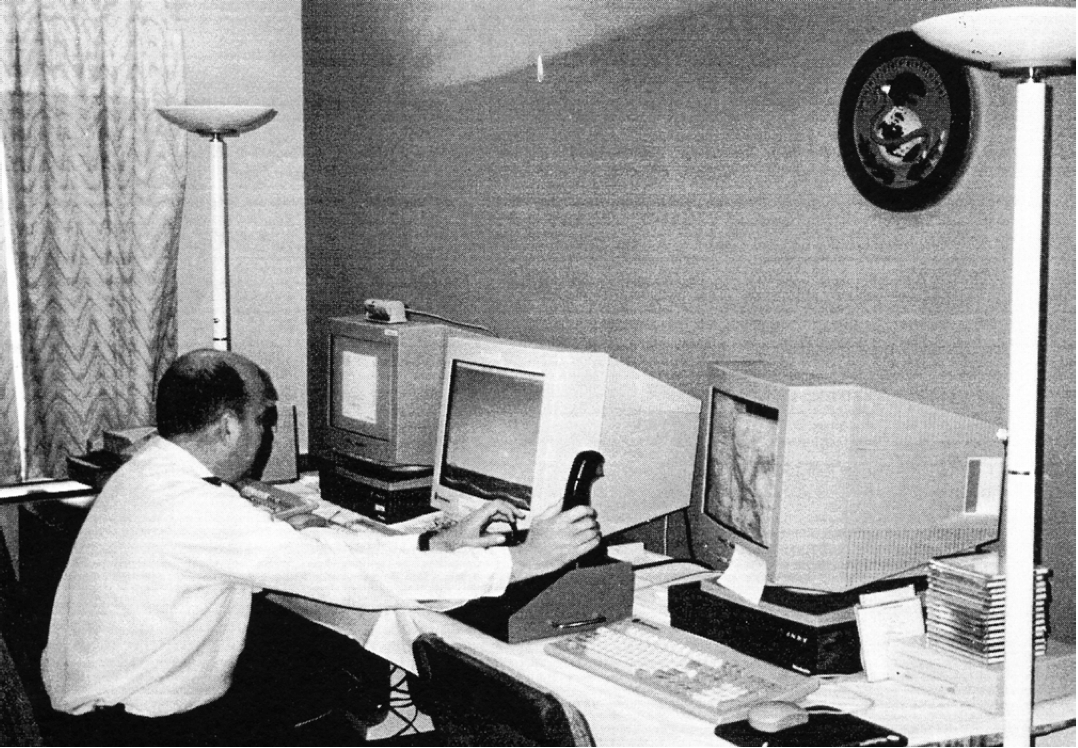
PowerScene at Wright-Dayton AFBRemarkably, it was also used at Wright-Patterson Air Force Base during the negotiations that led to the Dayton peace accords. As one US officer explained:  ‘It’s an instrument of war but we’ll use it for peace because you are willing to come to the table’.  The system was used to explore proposals for potential boundaries, but the sub-text was clear: if agreement could not be reached, NATO had a detailed military knowledge of terrain and targets.  (For more, see James Hasik‘s Arms and innovation: entrepreneurship and alliances in the twenty-first century defense industry (2008) Ch. 6: ‘Mountains Miles Apart’; Richard Johnson‘s ‘Virtual Diplomacy’ report here; and a precocious paper by Mark Corson and Julian Minghi here, from which I’ve taken the image on the left).
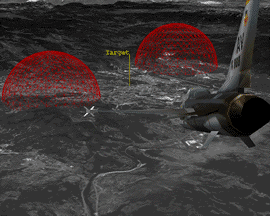
powerscene2PowerScene was later used by USAF pilots rehearsing simulated bombing missions against Baghdad in the 1990s (see right) – the system fixed target co-ordinates and red ‘bubbles’ displayed threats calibrated on the range of surface-to-air missile systems – and when Anteon Corporation and Lockheed Martin introduced TopScene air strikes over Afghanistan in 2001 were also rehearsed over digital terrain.

But there is another side to all this, because digital platforms can also be used to enable others to display and interrogate the geography of air strikes.  I’ve discussed this before in relation to the CIA-directed program of targeted killing in Pakistan here and here, but impressive progress has also been made in plotting air strikes across the border in Afghanistan.

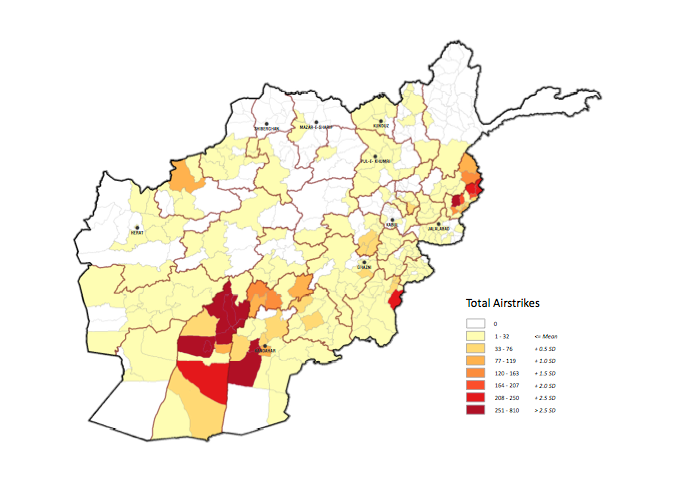
The most remarkable use of USAF/ISAF data that I know is Jason Lyall‘s work in progress on what he calls ‘Dynamic coercion in civil wars’ – ‘Are airstrikes an effective tool of coercion against insurgent organizations?’ – which focuses on air strikes in Afghanistan between 2006 and 2011. This is part of a book project, Death from above: the effects of airpower in small wars; the most recent version of the relevant analysis is here.  The map below is Jason’s summary of air strikes in Afghanistan 2006-11, but as I’ll explain in a moment, it gives little idea of the critical digital power that lies behind it.
JASON LYALL Air strikes in Afghanistan 2006-2011

First, the original USAF/ISAF data was in digital form, but transforming it into a coherent and consistent geo-coded database has involved a truly extraordinary enterprise:

We draw on multiple sources to construct a dataset of nearly 23,000 airstrikes and shows of force in Afghanistan during 2006-11. The bulk of the dataset stems from newly-declassified data from the Air Forces Central’s (AFCENT) Combined Air Operations Center (CAOC) in Southwest Asia, which recorded the location, date, platform, and type/number of bombs dropped for January 2008 to December 2011 in Afghanistan. These data required extensive cleaning to ensure that a consistent standard for each type of air operation was maintained and duplicates dropped. These data were supplemented by declassified data from the International Security Assistance Force’s (ISAF) Combined Information Data Exchange Network (CIDNE) for the January 2006 to December 2011 time period. Finally, additional records from press releases by the Air Force’s Public Affairs Office (the “Daily Airpower Summary,” or DAPS) were also incorporated. … Each air operations’ intended target was confirmed using at least two independent coders drawing on publicly available satellite imagery. Merging of these records was extremely labor intensive, not least because of the near total absence of overlap between CAOC, CIDNE, and DAPS records. Only 448 events were found in all three datasets, underscoring the problems inherent in single-sourcing data, even official data, in conflict settings (my emphasis).

Second, to get the full visual effect of Jason’s analysis you absolutely need to see the animation that he’s made available on his website here; the image below is just a screenshot for September 2009 (I’ll explain why I chose that month in my next post).
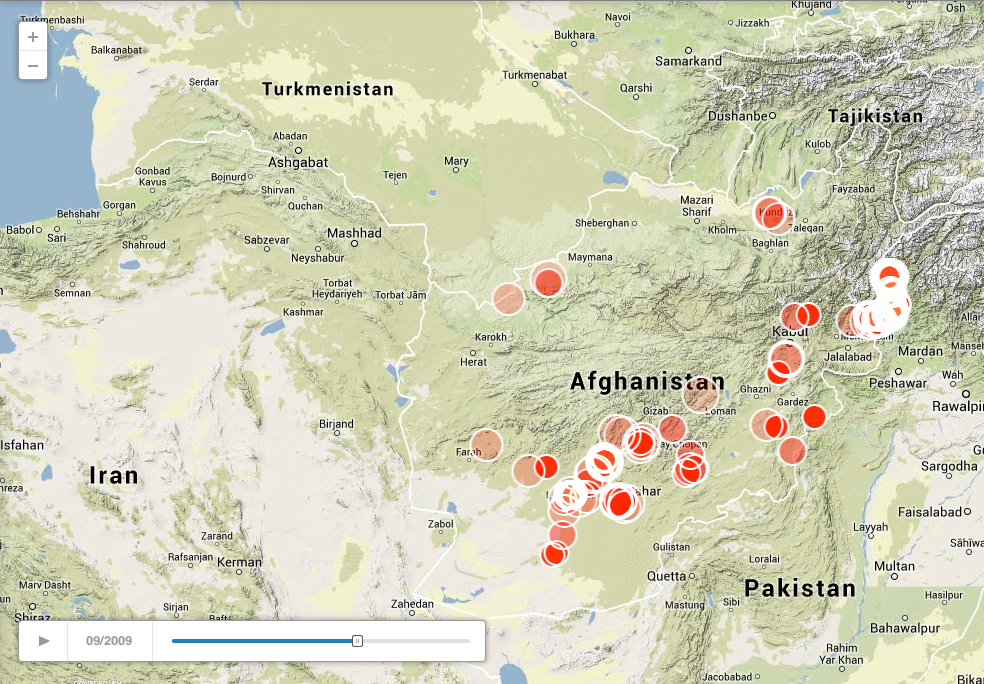
JASON LYALL Air strikes in Afghanistan 09:2009

But what about casualty figures?  Josh includes a summary map of 216 air strikes involving acknowledged civilian casualties, taken from the same military databases (with all their limitations), and in January 2011 the US military released its data on ‘CIVCAS’ for the previous two years to the journal Science.  They included casualties from all parties to the conflict:

The numbers show that 2,537 Afghans civilians were killed and 5,594 were wounded in the past two years. Most of the deaths – 80 percent – are attributed to insurgents, with 12 percent caused by coalition forces, a 26 percent drop.

Here is Science‘s visualization of the CIVCAS data, designed to capture the time-space rhythms of violence from multiple causes:
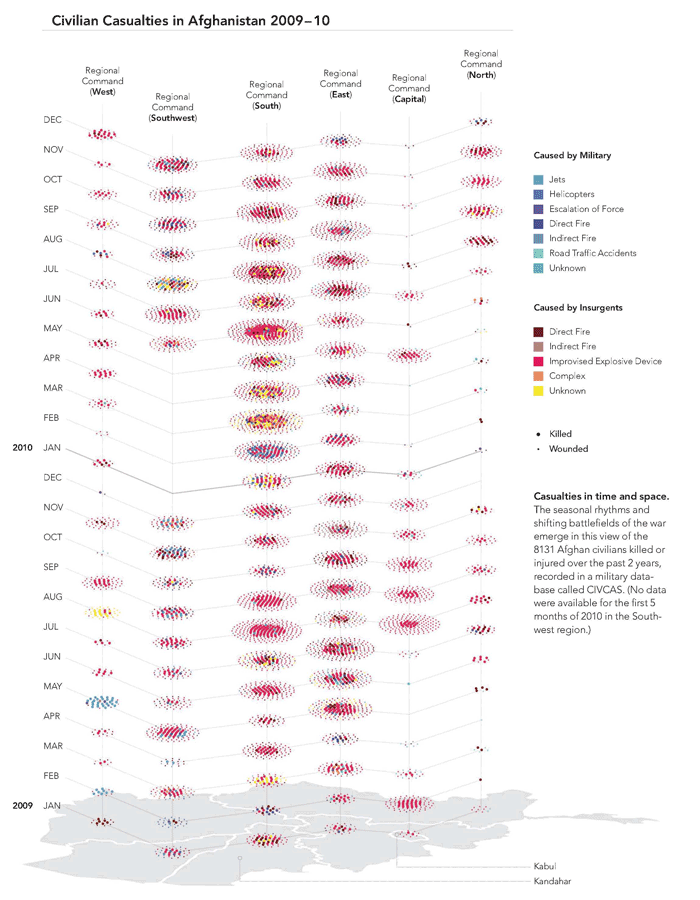
F2.medium

You can access the interactive version here.

But other sources (notably the Afghan Rights Monitor and the UN Mission in Afghanistan, UNAMA, which produces six-monthly Reports on the protection of civilians in armed conflict) using different methodologies came up with much higher figures; here is a graph from the most recent UNAMA report showing casualties from air strikes 2009-13:
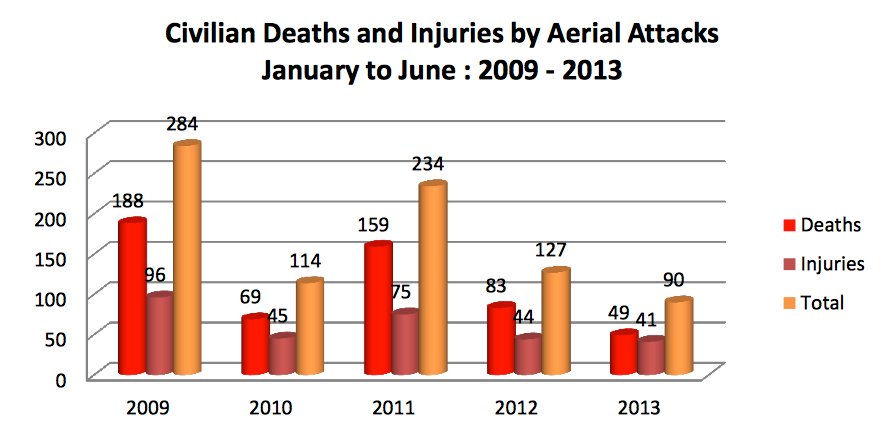
UNAMA Civilian casualties from air attacks 2009-13

UNAMA added this comment:

UNAMA welcomes the reduction in civilian casualties from aerial operations but reiterates its concern regarding several operations that caused disproportionate loss of civilian life and injury. UNAMA also raises concerns with the lack of transparency and accountability about several aerial operations carried out by international military forces that resulted in civilian casualties.

You can find the full analysis by John Bohannon, which includes a discussion of both databases, at Science (open access) here.

To be sure, counting casualties is always a contentious (and often dangerous) affair.  Getting information from the government of Afghanistan isn’t any more straightforward, as Nick Turse has shown: as he adds, ‘neither is it cheap’.  But he persevered, and the wonderful Pitch Interactive (a data visualization studio that also produced the haunting representation of deaths from drone strikes in Pakistan) collaborated with The Nation to produce a stunning interactive of ‘civilian deaths that have occurred in Afghanistan as a result of war-related actions by the United States, its allies and Afghan government forces.’  Here’s a screenshot:
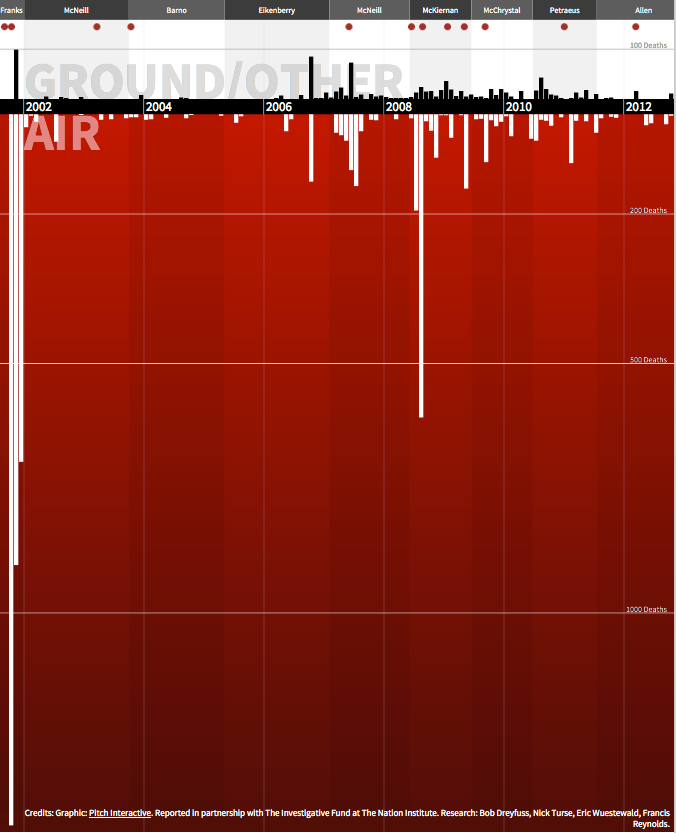
Civilian fatalities in Afghanistan 2001-2012

You will see running along the top the military commanders during each period; the red dots mark major events.  It’s common knowledge – or should be – that the US-led invasion of Afghanistan in 2001 was spearheaded by an intensive high-level bombing campaign (I described this in The Colonial Present), shown along that desperately deep left margin.  But I suspect fewer people have grasped the reliance that ISAF has continued to place on air power.  What stands out from the image above, clearly, is the disproportionate (sic) number of deaths attributed to air strikes (5, 622) compared with ground operations (794) throughout the period: the UNAMA data above suggest that this only started to change in 2013. You can read more about this in the essay by Bob Dreyfuss and Nick Turse that accompanied the interactive, ‘America’s Afghan victims’, here, and – as always – the tireless work of Marc Herold is indispensable.

And to forestall a stream of comments, my title is not intended to suggest that digital technologies or the airstrikes they facilitate are somehow ‘immaterial’; nothing could be further from the truth.  Or the killing fields.
Theory of the drone 12: ‘Killing well’?

This is the 12th in a series of extended posts on Grégoire Chamayou‘s Théorie du drone and covers the final chapter in Part III: Necro-ethics, called ‘Précisions’; in French the singular means accuracy, as you might expect, but the plural means ‘details’ – which is, of course, where the devil is to be found…

One of the most common claims advanced by those who defend the use of armed drones is that they reduce ‘collateral damage’ because they are so precise.  Following directly from his previous critique of Bradley Jay Strawser, Chamayou cites him again here: ‘Drones, for all their current and potential misuse, have the potential for tremendous moral improvement over the aerial bombardments of earlier eras.’  But he dismisses this as a misleading comparison: if Dresden or Hiroshima are taken as the yardstick against which accuracy is to be measured – or, for that matter, as the standard against which military ethics are to be judged – then virtually any subsequent military operation would pass both tests with flying colours.

The comparison confuses form with function.  Compared to Lancaster bombers and Flying Fortresses (even with their famous Norden bombsights: for Malcolm Gladwell on the ‘moral importance’ of the bombsight to Norden, a committed Christian, see here and here; for more on the bombsight, see here), the Predator and the Reaper are evidently more accurate.  But Chamayou insists that the real comparison ought to be with other tactical means currently available to achieve the same objective.

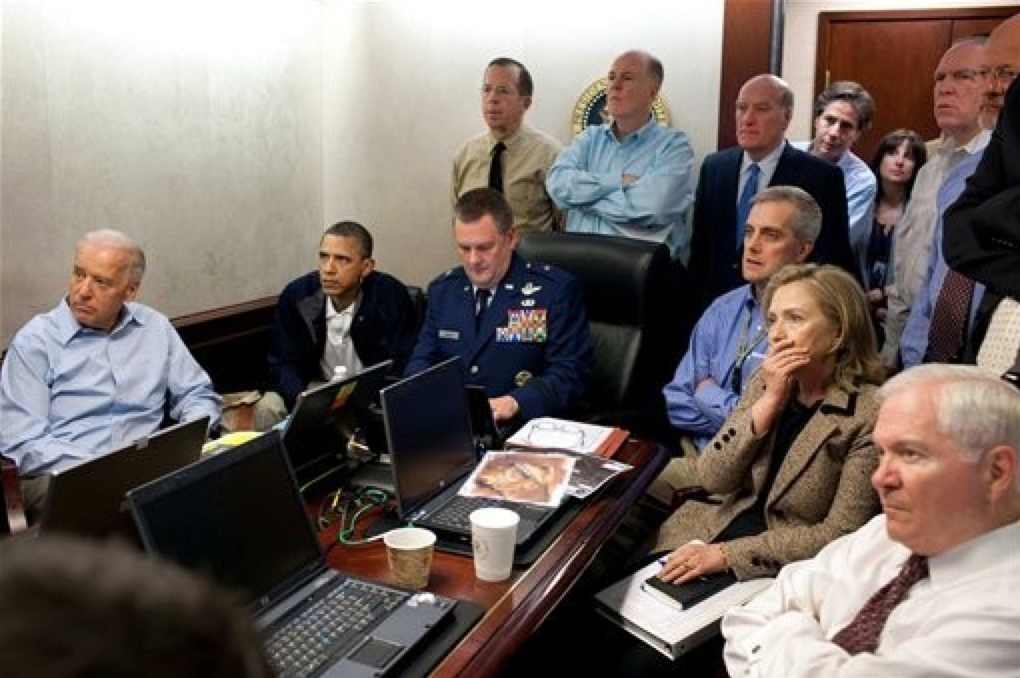
Situation Room

In the kill/capture raid against Osama Bin Laden on 1 May 2011 (assuming ‘capture’ was ever on the agenda), he argues that the choice was between drones and Special Forces not between drones and re-staging Dresden in Abbotabad.  This doesn’t quite work, since the raid was carried out by US Navy Seals who swept in from Bagram via Jalalabad by helicopter, but the mission also depended on real-time imagery from an RQ-170 stealth drone (‘the Beast of Kandahar’).  This was the source of the live video feed watched by Obama and members of his administration in the famous ‘Situation Room’ photograph [on which, see Keith Feldman on ‘Empire’s Verticality’ in Comparative American Studies 9 (4) (2011) 325-41].

The RQ-170 is an unarmed platform, but its role should remind us that drones are part of networked warfare – even when strikes are carried out by other means, the enhanced intelligence, surveillance and reconnaissance capabilities provided by the long dwell-times of these remote platforms mean that they are instrumental in the activation of the kill-chain.  This holds for military operations far beyond targeted killing: in Afghanistan between 2009 and 2011 drones were directly responsible for only 5-6 per cent of weapons released by the US Air Force, but they no doubt played a vital role in the release of many of the others.

Night raidStill, Chamayou’s basic point is a sharp one – and I rehearsed similar arguments in my discussion of The politics of drone wars last year – but readers of Jeremy Scahill‘s Dirty Wars may still reasonably object that the civilian casualties resulting from JSOC’s infamous night raids in Afghanistan cast doubt on the precision and accuracy of ground forces too.  Gareth Porter has estimated that more than 1,500 civilians were killed in night raids in just ten months in 2010-11, making them ‘by far the largest cause of civilian casualties in the war in Afghanistan.’  Indeed, Afghan protests have frequently centred on the civilian toll exacted by drones and night raids.

Even if the appropriate comparison is between different modalities of military violence in the present, Chamayou argues that the discussion is bedevilled by another series of confusions about ‘accuracy’ or ‘precision’.   In fact, though he doesn’t say so, the the two terms aren’t interchangeable. Strictly speaking,  accuracy refers to the deviation from the aiming point, precision to the dispersion of the strike:

Accuracy and precision

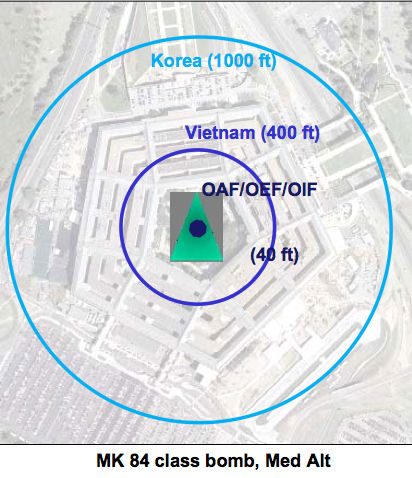
CEP in the diagram above refers to the Circular Error Probable, once described by the Pentagon as ‘an indicator of the delivery accuracy of a weapon system’, which is a circle of radius n described around the aiming point.  Assuming a bivariate normal distribution, then – all other things being equal (which they rarely are) – 50% of the time a bomb, missile or round will land within the circle: which of course means that the other half of the time it won’t, even under ideal experimental conditions.  As this is a normal distribution, then 93 per cent should land within 2n and more than 99 per cent within 3n.

Chamayou doesn’t refer to the CEP directly, only briefly to the ‘accuracy of fire’,  but – to revert to the comparison he refuses – the CEP of bombing from the air has contracted dramatically since the Second World War when it was around 3,000 feet (though this improved over time): so much so that David Deptula, when he was USAF Deputy Chief of Staff for ISR, used to talk of crossing a ‘cultural divide of precision and information’.  The image below, taken from one of his presentations, shows the contraction (notice that the aim point is the Pentagon….).

Target mensuration (USAF)

Interestingly, the most recent Joint Publication (3-60) from the Joint Chiefs of Staff on Targeting (January 2013) has explicitly removed the concept from its Terms and Definitions, citing as its authority the Department of Defense’s Dictionary of Military and Associated Terms (it was still there on 31 January 2011, but no longer).  I haven’t been able to discover the reasons for the change, though there is longstanding scepticism about the validity of the measure: see, for a specific example, Donald MacKenzie‘s classic discussion in Inventing accuracy: a historical sociology of nuclear missile guidance (1993, pp. 352-7).  I’ve seen several comments to the effect that the measure isn’t useful for ‘smart bombs’ because they don’t display the same spread as ‘dumb bombs’.  (There’s a quick primer on the emergence of smart bombs during the Vietnam War here, and an account of the evolution of ‘precision strike’ since then here; for more detail, try David Koplow‘s Death by moderation: the US military’s quest for useable weapons (2009)).

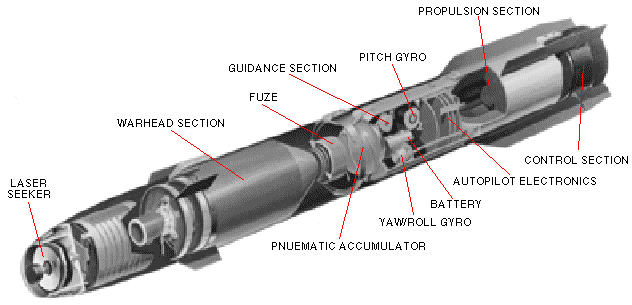
The MQ-1 Predator carries two AGM-114 Hellfire missiles [shown below, top; for acronyphiles, AGM designates an Air-to-Ground Missile, while the ‘Hellfire’ was originally developed as a ‘Helicopter-Launched Fire-and-Forget Missile’; its main platform is still an attack helicopter], while the MQ-9 Reaper can carry four AGM-114 Hellfire Missiles or replace two of them with GBU-12 Paveway II bombs [GBU = Guided Bomb Unit; shown below, bottom].

hellfire

GBU-12_xxl

Both weapons systems are laser-guided; the sensor operator, sitting beside the pilot in the Ground Control Station, uses a laser targeting marker (LTM) to ‘paint’ the target – this can also be done by ground troops in conventional combat zones – but its accuracy can be compromised by cloud, smoke, fog or dust.  (This is why the Air Force also uses GPS-guided weapons; they are less accurate but unaffected by these environmental conditions).  Once the necessary clearances have been obtained from mission commanders and military lawyers, the pilot fires the missile and the sensor operator guides it on to its target.

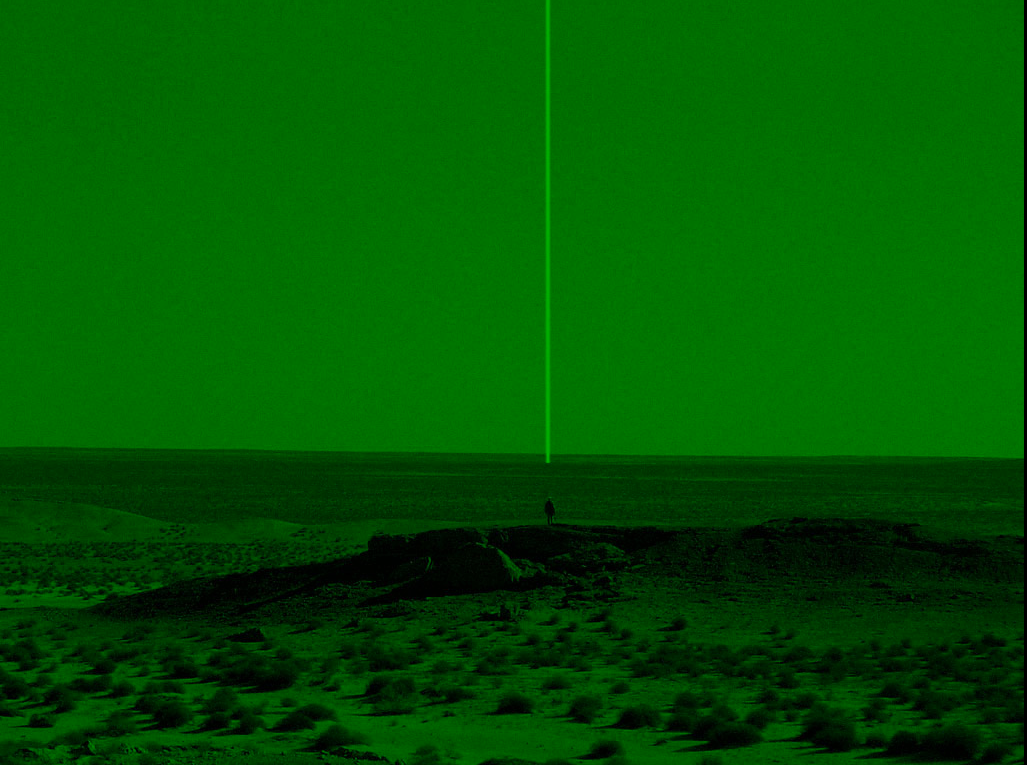
Omer Fast‘s interview with a sensor operator (‘Brandon’ –  whether this is a pseudonym or really Brandon Bryant is hard to know) for 5,000 Feet is the Best provides a series of insights into the operation in Afghanistan and Iraq.  You can’t see the beam with the naked eye, but American ground troops can see it with their infrared goggles.  According to ‘Brandon’, they call it the ‘Light of God’ (really); the image below is James Bridle‘s replication of the effect based on laser targeting night systems and a CC-licensed photograph of the Iraqi desert by Rob Bakker.

JAMES BRIDLE Light of God

‘Brandon’:

‘Usually the laser track is about half the size of this [hotel] room.  Poof!  By the time it hits the ground… a lot of times it turns into a square for some reason…  It could be anywhere from ten feet by ten feet to twenty feet by twenty feet… It starts off small and you watch it kind of open up’

This is not exactly putting ‘warheads on foreheads‘, but ‘Brandon’ explains that the crew is also required to identify a secondary ‘abort’ target.

‘… some of the contingencies we have to worry about are: if we’re firing at a building and somebody crosses – maybe – who knows, a group of children starts crossing in front of the building, we need a second site once that missile is already off the rails.  To go ahead and drop that missile so that we don’t harm the children  So usually we’ll choose an alternate site a couple hundred feet to a couple of hundred yards away.  It might be an empty field.  And we use that as the backup…

So let’s  say we get the missile off the rail and a group of kids comes into play: I call “abort” and I’ll start moving that laser over to an empty site so that we can detonate there and not cause any additional loss of life.’

Predator and Brandon Bryant

Sounds good, but the real Brandon Bryant (above) has a different story to tell; it turns out that there is an eight-second window in which the missile can be diverted:

With seven seconds left to go, there was no one to be seen on the ground. Bryant could still have diverted the missile at that point. Then it was down to three seconds. Bryant felt as if he had to count each individual pixel on the monitor. Suddenly a child walked around the corner, he says.

Second zero was the moment in which Bryant’s digital world collided with the real one in a village between Baghlan and Mazar-e-Sharif.

Bryant saw a flash on the screen: the explosion. Parts of the building collapsed. The child had disappeared. Bryant had a sick feeling in his stomach.

“Did we just kill a kid?” he asked the man sitting next to him.

“Yeah, I guess that was a kid,” the pilot replied.

“Was that a kid?” they wrote into a chat window on the monitor.

Then, someone they didn’t know answered, someone sitting in a military command center somewhere in the world who had observed their attack. “No. That was a dog,” the person wrote.

They reviewed the scene on video. A dog on two legs?

Even then, think about that blossoming square, twenty feet by twenty feet.  Then factor in the Circular Error Probable of a Hellfire missile, which is usually calculated at between 9 and 24 feet. The ‘pinpoint’ accuracy of the missile is starting to blur and the ‘surgical’ strike beginning to blunt.  In fact, the development of the Hellfire missile suggests another narrative.  In 1991 the Pentagon was already advertising the Hellfire as capable of ‘pinpoint’ accuracy, and since then it has been upgraded more than half a dozen times, each version promising greater accuracy: as Matthew Nasuti asks in his catalogue of Hellfire errors, what can be more accurate than ‘pinpoint accurate’?

In any case, narrowing the discussion to the CEP misses two things.  First, as former USAAF officer Peter Goodrich points out in his discussion of ‘The surgical precision myth‘, this ‘totally disregards what happens after the bomb explodes’.  What Goodrich has in mind is the blast and fragmentation radius, which Chamayou calls ‘the kill radius’.  Fast’s ‘Brandon’ insists

‘All of us are taught about how far those Hellfire missiles go, how far their frag goes.  And “danger close” as we call it when you have troops that are very close or civilians that are present.  They’re just factors that  you have to work in to bring down the percentages of the harm that could be done.’

In the targeting cycle the US Air Force enters those ‘factors’ into both collateral damage estimation and ‘weaponeering’, modifying the missile or bomb to restrict its blast and fragmentation radius. Chamayou reports that the Hellfire missile has a ‘kill radius’ of 50 feet (15 metres) and a ‘wounding radius’ of 65 feet (20 metres); the GBU-12 Paveway II has a ‘casualty radius’ of between 200 and 300 feet (within which 50 per cent of people will be killed).   These calculations aren’t exactly equivalent – and it’s difficult to obtain precise and comparable figures – but nothing about this is as precise as the rhetoric  implies.  As Chamayou asks:

‘In what fictional world can killing an individual with an anti-tank missile [the Hellfire] that kills every living thing within a radius of 15 metres and wounds everyone else within a radius of 20 metres be seen as “more precise”?’

All those who are killed or wounded within the casualty radius are presumably guilty by proximity.

This is Chamayou’s second rider, which relates to what happens before the bomb or missile is released: to the production – the US military sometimes calls it the ‘prosecution’ – of the target.  In this sense, the technical considerations I’ve just described are beside the point (sic).  All of the calibrations I’ve set out in such detail apply to missiles and bombs irrespective of the platform used to deliver them; what is supposed to distinguish a Predator or a Reaper from a conventional strike aircraft or attack helicopter is that it combines ‘hunter’ and ‘killer’ in a single platform and, specifically, that its real-time full-motion video feeds enable crews (and others in the loop) to see what they are doing in unprecedented detail.

Signing a Hellfire missile attached to a MQ1-C (Gray Eagle) UAV at BagramDoes this political technology of vision make it possible, as advocates claim, to distinguish between combatants and civilians more effectively than ever before?  Here Chamayou rehearses common criticisms: that in standard US military practice ‘combatant’ morphs into ‘militant’, even ‘presumed militant’ and, at the hideous limit, into ‘military-aged male’ – counting ‘all military-age males in a strike zone as combatants … unless there is explicit intelligence posthumously proving them innocent’ – and that this process of (so to speak, performative) militantisation as Chamayou calls it is underwritten by a techno-judicial probabilisation (again his term) whose ‘epistemology of suspicion’ allows signature strikes that target un-named and unknown people on the basis of their ‘pattern of life‘.

But both these procedures and, indeed, the criticisms of them, obscure what is for Chamayou, the fundamental paradox, what he calls the ‘profound contradiction’.  International law defines a combatant and thus a legitimate target in terms of direct participation in hostilities and an imminent threat.  It’s more complicated than that, as I’ll show later, but this is enough for Chamayou to fire off two key questions: How can anyone be participating in hostilities if there is no longer any combat? How can there be any imminent threat if there are no troops on the ground?  The drone, praised for its forensic ability to distinguish between combatant and non-combatant, in fact abolishes the condition necessary for such a distinction: combat itself (p. 203; also p. 208).

It’s an artful claim, but it oversimplifies the situation.  Chamayou has (once again) confined the discussion to targeted killing but, as I’ve repeatedly emphasised, Predators and Reapers have also been used for other purposes in Iraq and Afghanistan, including the provision of ‘armed overwatch’ and close air support to ground troops.  Outside these war-zones – in the Federally Administered Tribal Areas of Pakistan, Yemen, Somalia and elsewhere – the critique is a powerful one (which is not to say that Obama’s lawyers have not claimed a legal warrant for their supposedly covert drone strikes in these areas: more on this later too).  Still, Chamayou’s argument loops back to earlier discussions about the intrinsic non-reciprocity of drone warfare.

And here Chamayou closes with a powerful argument.  If ethics is classically about how to live well and die well, he suggests that necro-ethics is a doctrine of ‘killing well’.  He notes that critics of the covert drone wars demand, time and time again, transparency.  They want to know the legal armature and adjudicative apparatus for the strikes, the rules and procedures that are followed, and the lists of casualties.  But he argues that their demands turn the issue into an arid juridico-administrative formalism endorsed by bureaucratic Reason.  In the kill zones, he says ruefully, there are no legal memoranda, no columns of numbers or ballistics reports (p. 207): these are the very formularies of necro-ethics.  And, as I’ve noted, there are no air-raid warnings, no anti-aircraft defences and no air-raid shelters either.

It’s in that spirit that Chamayou closes the chapter with an extended quotation from Madiha Tahir’s Louder than bombs‘:

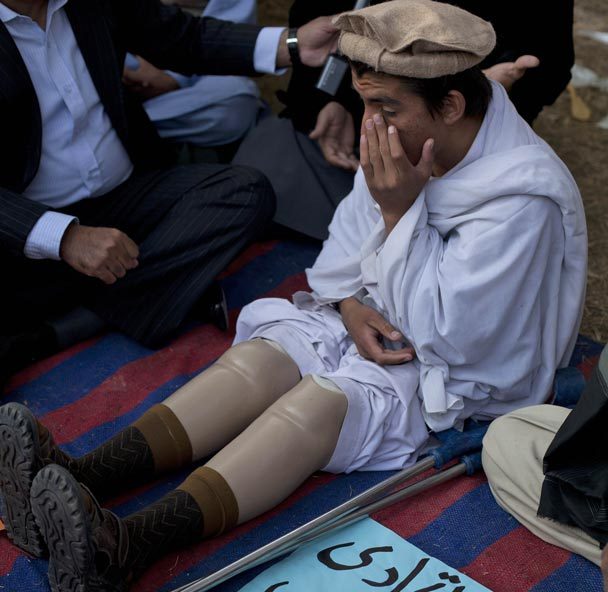
Saudallah WazirWhat is the dream?

I dream that my legs have been cut off, that my eye is missing, that I can’t do anything … Sometimes, I dream that the drone is going to attack, and I’m scared. I’m really scared.

After the interview is over, Sadaullah Wazir pulls the pant legs over the stubs of his knees till they conceal the bone-colored prostheses.

The articles published in the days following the attack on September 7, 2009, do not mention, this poker-faced, slim teenage boy who was, at the time of those stories, lying in a sparse hospital in North Waziristan, his legs smashed to a pulp by falling debris, an eye torn out by shrapnel. nor is there a single word about the three other members of his family killed: his wheelchair-bound uncle, Mautullah Jan and his cousins Sabr-ud-Din Jan and Kadaanullah Jan.  All of them were scripted out of their own story till they tumbled off the edge of the page.

Did you hear it coming?

No.

What happened?

I fainted. I was knocked out.

As Sadaullah, unconscious, was shifted to a more serviceable hospital in Peshawar where his shattered legs would be amputated, the media announced that, in all likelihood, a senior al-Qaeda commander, Ilyas Kashmiri, had been killed in the attack. The claim would turn out to be spurious, the first of three times when Kashmiri would be reported killed.

Sadaullah and his relatives, meanwhile, were buried under a debris of words: “militant,” “lawless,” “counterterrorism,” “compound,” (a frigid term for a home). Move along, the American media told its audience, nothing to see here.

Some 15 days later, after the world had forgotten, Sadaullah awoke to a nightmare.

Do you recall the first time you realized your legs were not there?

I was in bed, and I was wrapped in bandages. I tried to move them, but I couldn’t, so I asked, “Did you cut off my legs?” They said no, but I kind of knew.

When you ask Sadaullah or Karim or S. Hussein and others like them what they want, they do not say “transparency and accountability.” They say they want the killing to stop. They want to stop dying. They want to stop going to funerals — and being bombed even as they mourn. Transparency and accountability, for them, are abstract problems that have little to do with the concrete fact of regular, systematic death.’

And Madiha adds this: ‘The technologies to kill them move faster than the bureaucracies that would keep more of them alive: a Hellfire missile moves at a thousand miles per hour; transparency and accountability do not.’

Indeed they don’t; Sadaullah died last year, Mirza Shahzad Akbar reports, ‘without receiving justice or even an apology.’  Not even killing well, then.

Survivable life

Just back from St Andrews – the video of the Neil Smith Lecture will be available online shortly, and I’ll post a notice when it’s ready – and so much to catch up on it’s not easy to work out where to start.

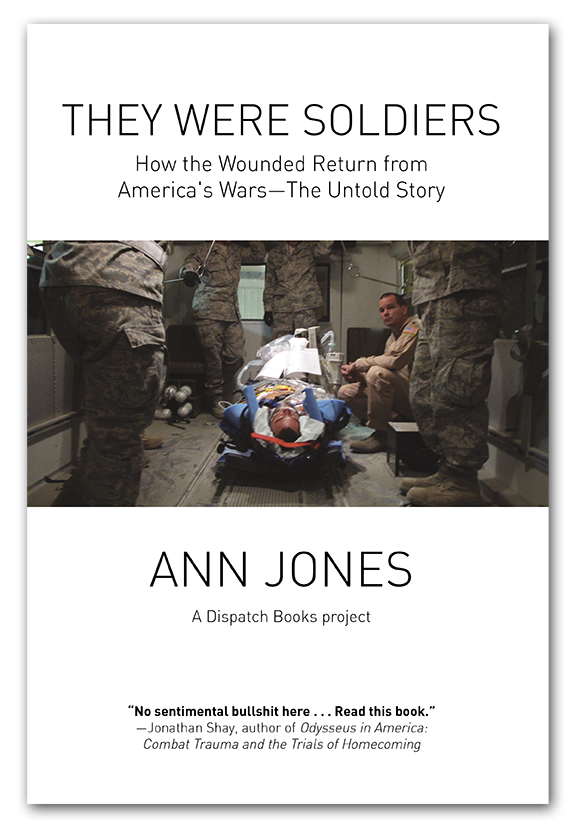
THEY-WERE-SOLDIERS_by-Ann-Jones_72

But this is as good a place as any: Ann Jones‘s new book, They were soldiers: how the wounded return from America’s wars (Haymarket, 2013):

After the American invasion of Afghanistan in 2001, Ann Jones spent a good part of a decade there working with Afghan civilians—especially women—and writing about the impact of war on their lives: the subject of Kabul in Winter (2006). That book revealed the yawning chasm between America’s promises to Afghans and its actual performance in the country. Meanwhile, Jones was pondering another evident contradiction: between the U.S. military’s optimistic progress reports to Americans and its costly, clueless failures in Afghanistan as well as Iraq. In 2010-2011, she decided to see for herself what that “progress” in Afghanistan was costing American soldiers. She borrowed some body armor and embedded with U.S. troops. On forward operating bases she saw the row of photographs of “fallen” soldiers hung on the headquarters’ wall lengthen day by day.

At the trauma hospital at Bagram Air Base she watched the grievously wounded carried from medevac helicopters to the emergency room and witnessed the toll that life-saving surgeries took on the doctors who performed them. She accompanied the wounded on medevac flights from Bagram to Landstuhl Regional Medical Center in Germany, then on to Walter Reed Hospital in Washington, and finally—for those who made it—back to all-American homes where, often enough, more troubles followed: violence against wives, girlfriends, children, and fellow soldiers; Big Pharma-induced drug addiction; murder, suicide, and the terrible sorrow of caretaker moms and dads who don’t know what happened to their kids. They Were Soldiers is a powerful account of how official American promises—this time to “Support Our Troops”—fall victim to the true costs of war.

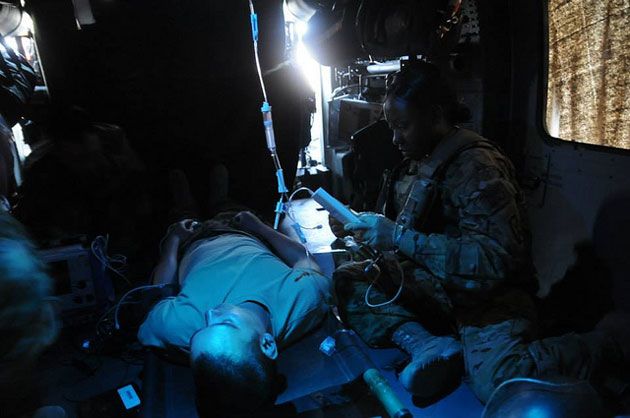
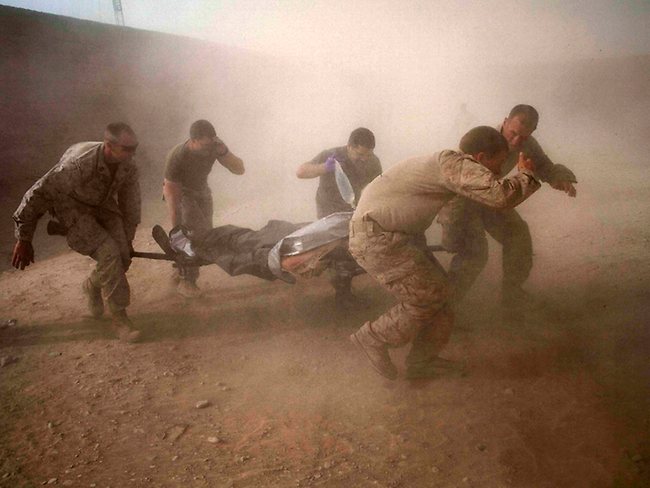
Medevac

This dovetails perfectly with what I hope will be my new research project on caring for those wounded by war – combatants and civilians – between 1914 and 2014 and their precarious journeys away from the killing zones (see DOWNLOADS tab and scroll down).  As I’ve noted before, much of the critical commentary on modern war has been preoccupied with those killed – which is of course important – but the other casualties of war have all too often been marginalised.  It’s high time to supplement inquiries into what Judith Butler calls the constitution of  a ‘grievable life’ with others into the constitution of a ‘survivable life’.

Hence the vital importance of Ann’s book.  There’s an interview with Amy Goodman at Democracy Now here, and another with Truthout here, in which she deftly rejects the lazy politics in which the left supposedly cares only for ‘their’ civilians while the right cares for ‘our’ troops:

We worry – if at all – about how vets are treated when they return because of our mistaken notion that Vietnam vets suffered mightily from not being greeted as heroes. What Vietnam veterans truly suffered from was not their reception, but the war. That fact we tend to forget. Consequently, we think we can resolve all the possible nasty consequences of war by waving flags at airports as troops return. The deeper problem is that none of these veterans of the wars of choice in Iraq and Afghanistan – not one of them – should ever have been sent to war. But without a draft that can potentially strike any family in the country, those who have no fear that a family member may be compelled to serve are free to ignore the whole political and public relations process by which leaders drag the country into war and carry it on. War can be left to a supposedly “all volunteer” standing army – those poor kids with no job options or a shot at college – which is precisely what the founding fathers warned against, believing that a standing army would be used by autocrats to destroy democracy. That volunteer army, of course, is shadowed by a larger privatized for-profit army of mercenary contractors. The standing army of the poor and patriotic is alienated from the general public and left at the mercy of the president. Our recent presidents and their cronies, who hold a nearly unblemished record of evading military service, have thrown kids into war with an enthusiasm undampened by any real knowledge of what war is, while the most influential segments of the general public, feeling both grateful and guilty that their kids are safe, make no effort to restrain those war-loving leaders.

You can read an extract from They were soldiers, with a very helpful prefatory note from Nick Turse, at TomDispatch here:

In 2010, I began to follow U.S. soldiers down a long trail of waste and sorrow that led from the battle spaces of Afghanistan to the emergency room of the trauma hospital at Bagram Air Base, where their catastrophic wounds were surgically treated and their condition stabilized.  Then I accompanied some of them by cargo plane to Ramstein Air Base in Germany for more surgeries at Landstuhl Regional Medical Center, or LRMC (pronounced Larm-See), the largest American hospital outside the United States.

Once stabilized again, those critical patients who survived would be taken by ambulance a short distance back to Ramstein, where a C-17 waited to fly them across the Atlantic to Dover Air Base in Delaware. There, tall, multilayered ambulances awaited the wounded for the last leg of their many-thousand-mile journey to Walter Reed Army Medical Center in Washington D.C. or the Naval Hospital at Bethesda, Maryland, where, depending upon their injuries, they might remain for a year or two, or more.

Now, we are in Germany, halfway home.  This evening, the ambulance from LRMC heading for the flight line at Ramstein will be full of critical-care patients, so I leave the hospital early and board the plane to watch the medical teams bring them aboard.  They’ve done this drill many times a week since the start of the Afghan War.  They are practiced, efficient, and fast, and so we are soon in the air again. This time, with a full load.

 Two rows of double bunks flank an aisle down the center of the C-17, all occupied by men tucked under homemade patchwork quilts emblazoned with flags and eagles, the handiwork of patriotic American women. Along the walls of the fuselage, on straight-backed seats of nylon mesh, sit the ambulatory casualities from the Contingency Aeromedical Staging Facility (CASF), the holding ward for noncritical patients just off the flight line at Ramstein.
At the back of the plane, slung between stanchions, are four litters with critical care patients, and there among them is the same three-man CCAT (Critical Care Air Transport) team I accompanied on the flight from Afghanistan. They’ve been back and forth to Bagram again since then, but here they are in fresh brown insulated coveralls, clean shaven, calm, cordial, the doctor busy making notes on a clipboard, the nurse and the respiratory therapist checking the monitors and machines on the SMEEDs. (A SMEED, or Special Medical Emergency Evacuation Device, is a raised aluminum table affixed to a patient’s gurney.) Designed to bridge the patient’s lower legs, a SMEED is now often used in the evacuation of soldiers who don’t have any.
Here again is Marine Sergeant Wilkins, just as he was on the flight from Afghanistan: unconscious, sedated, intubated, and encased in a vacuum spine board. The doctor tells me that the staff at LRMC removed Wilkins’s breathing tube, but they had to put it back. He remains in cold storage, like some pod-person in a sci-fi film. You can hardly see him in there, inside the black plastic pod. You can’t determine if he is alive or dead without looking at the little needles on the dials of the machines on the SMEED. Are they wavering? Hard to tell.

They were soldiers is available as an e-book if, like me, you can’t wait.

Medical-military machines and casualties of war 1914-2014

SABER, Desert Rat Sketchbook

As promised, I’ve added the outline of my proposed new research programme on the casualties of war to the DOWNLOADS page (scroll way down).  I’ve omitted all the pages in the formal application that drove me to distraction – knowledge mobilisation plan (sic), budget justification, ‘expected outcomes’ and the rest – but if you do look at this ‘Detailed Description’ (as it has to be called), please bear in mind that:

(a) this is still very preliminary, and my work is in the earliest of stages (this is a grant application, after all);

(b) everything had to fit into a prescribed, very limited space (leaving no room for nuance); and

(c) I was more or less required to use the Harvard reference system, the enemy of all good writing.

I’ve added a few lines of clarification and a series of illustrations to liven things up (no room for those in the original), but I hope this gives you some idea of what I’m up to.  And, as always, I’d welcome any comments or suggestions – preferably by e-mail to avoid the spam filters.

In working on this, I’ve stumbled into a series of unusually rich primary sources and secondary literatures, and since I’ve mentioned good writing I want to flag two texts that have kept me going throughout this process.

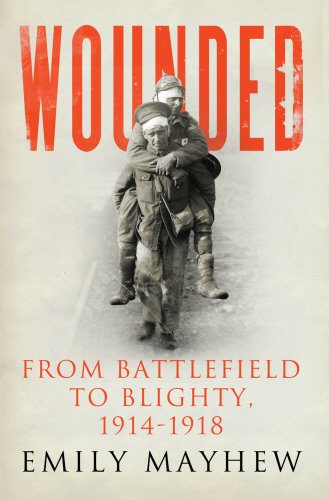
MAYHEW WoundedThe first is Emily Mayhew‘s Wounded: from Battlefield to Blighty 1914-1918, which I noted in an earlier post; for editions outside the UK the subtitle becomes A new history of the Western Front.  I’ve now read it, and admire its substance but also its style enormously.  It’s based on painstaking research, literally so, and yet the main chapters read like a novel, and the analytical-bibliographic apparatus has been artfully moved to the Notes where it becomes a model of clear, concise and thought-provoking commentary rather than a cage that hobbles the narrative.

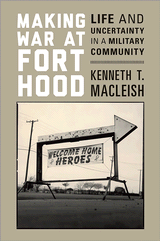
MacLeish Making war at Fort HoodThe second is Ken MacLeish‘s Making war at Fort Hood: life and uncertainty in a military community.  I met Ken at a workshop in Paris last year, and if you read anything better this year – in style and substance – than his Chapter 2 (‘Heat, weight, metal, gore, exposure’) I’ d like to know about it.  The combination of ethnographic sensitivity, elegant prose, and a theoretical sensibility that Ken wears with confidence and displays with the lightest of touch is simply stunning.

Since I’m off to York next week I’ll be spending the next few days preparing a new presentation on ‘Drones and the everywhere war’.  I hope this will also give me  time to return to my posts on Grégoire Chamayou‘s Théorie du drone which I had to put on hold while I trekked from Flanders to Afghanistan for my grant application…

A different sort of hell

I’ve been in Grant Writing Hell for most of last week and right through this long week-end. Everything has to be in by tomorrow morning, and I’ll post the final version of what has become Medical-military machines and casualties of war 1914-2014 once it’s done and I am in recovery (for an early preview see here).  If only I could track down whoever persuaded the Social Science and Humanities Research Council (and the rest of the world for that matter) that drop-down menus achieve consistency and save time… They don’t; apart from the time taken to scroll through endless lists the pre-selected categories never seem to quite fit so you have to click “Other” AND THEN TYPE IT IN ANYWAY.

SACCO The Great War

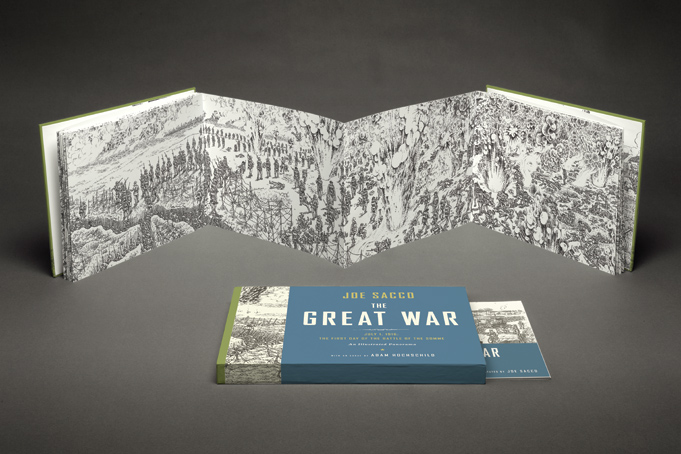
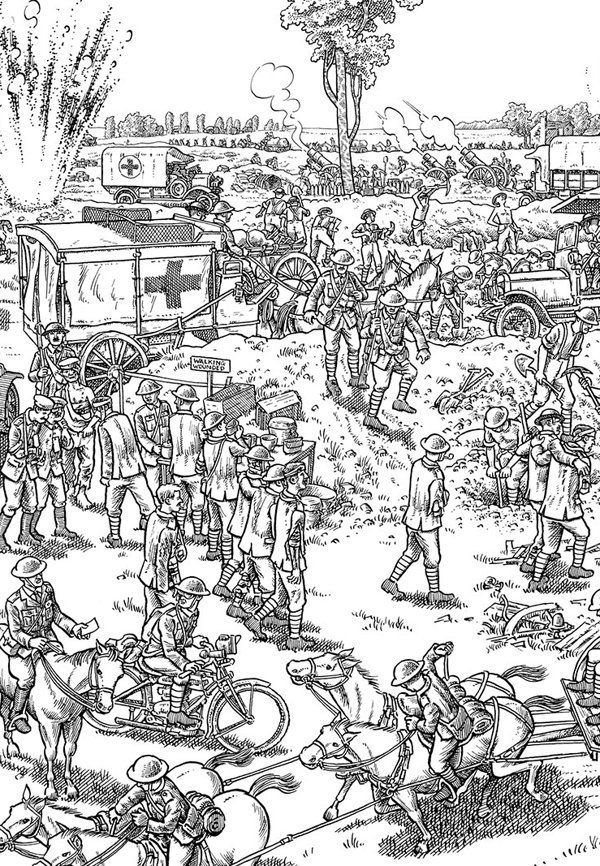
But I must stick my head above the parapet to notice Joe Sacco‘s forthcoming book The Great War, July 1, 1916, due out at the end of this month/early next.  It depicts the first day of the Battle of the Somme, which for Sacco represents ‘the point where the common man could have no more illusions about the nature of modern warfare’, and I’ve selected (below) panels that speak directly to Medical-military machines.  Writing in the Guardian, Steve Rose explains:

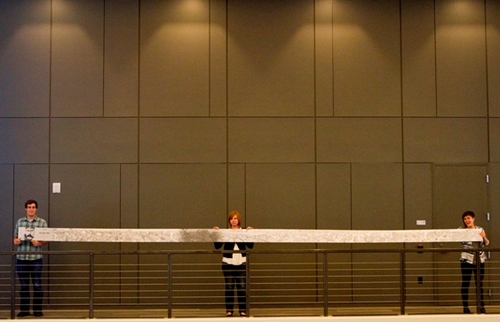
Technically it’s not a book at all: The Great War is actually one continuous drawing, a 24ft-long panorama narrating the British forces’ experience of 1 July 1916, spatially and chronologically, from orderly morning approach to chaotic battlefield engagement to grim aftermath. There are no boxes of text or speech bubbles, no individuated characters, instead Sacco portrays a mass event in painstaking, monochrome, almost technical detail. It’s like a cross between Hergé and the Chapman brothers; the Bayeux Tapestry as a silent movie.

SACCO The Great War

It took Sacco eight months, working in part from photographs held at the Imperial War Museum in London.  ‘When you’re drawing,’ he told Rose,

‘it makes you experience things at a deeper level. Because you kind of inhabit the whole scene … You inhabit each person you draw. You have to give some individuality to each figure, no matter how small they are. I’m leading them to war, and in a way I’m killing them. It’s a very intimate experience.’

In  a departure from Sacco’s previous works there are no words – remember Walter Benjamin: ‘I have nothing to say only to show’ (though he was writing about literary montage) – though there is an accompanying essay by historian Adam Hochschil (adapted from his own book, To end all wars).  In an author’s note Sacco explains:

The Great War is modeled in part on Mateo Pericoli‘s wordless Manhattan Unfurled, a beautiful, accordion-style foldout drawing of the city’s skyline. As a comic book artist, however, I felt impelled to provide a narrative, so the Bayeux Tapestry, which tells the story of the Norman invasion of England, was my touchstone. In the interest of making the drawing compact, I referenced medieval art in other, stylistic ways, namely by dispensing with realistic perspective and proportion. Thus a few inches in the drawing might represent a hundred yards or a mile of reality. However, I have tried to get the details — the field kitchens, the horse ambulances — right.

Making The Great War wordless made it impossible to indict the high command or laud the sacrifice of the soldiers. It was a relief not to do these things. All I could do was show what happened between the general and the grave, and hope that even after a hundred years the bad taste has not been washed from our mouths.

He’s also cited other influences – the late Joe Colquhoun‘s Charley’s War [there’s an excellent and probably unique interview here], Jacques Tardi‘s It was the war of the trenches (see here).

The physical scale of the project is extraordinary – a day a foot, you might say – and NPR unfolded the panorama in its newsroom:

NPR unfolds Sacco

Here it is in a jerky video from Vimeo:

http://vimeo.com/71895305

Laura Sneddon has an interesting report from Sacco’s appearance at the Edinburgh International Book Festival earlier this year, where he situated The Great War in relation to his previous work (notably, for me anyway, Palestine and Footnotes in Gaza) and described his take on his combination of listening-drawing-reporting.

I like the description of Sacco as a graphic journalist, and if you want to know more about his work there’s a short overview by Hannah Sender, a thoughtful review of Sacco’s Journalism by Rob Clough at The Comics Journal,  and a fine short article by Reed Johnson published by the Los Angeles Times to coincide with Footnotes.  In it, Sacco said he was at the point of thinking it was time ‘to walk away from battlefields…’  I’m glad he didn’t.

If you’re in London later this month he’s appearing at the LRB Bookshop on Monday 28 October  in conversation with David Boyd Hancock.

SACCO The Great War 2

Perhaps I should have drawn my application…

‘Collateral damage’ and accountability

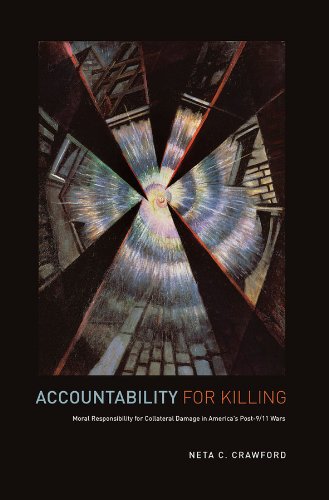
CRAWFORD Accountability for killingToo much of the discussion around killing in times of war focuses on accountancy not accountability; the numbers are important (and so too are the names), but Neta Crawford‘s new book, Accountability for Killing: moral responsibility for collateral damage in America’s post 9/11 wars – just published by Oxford University Press  (at least in digital form) – is indispensable reading.

Here’s the blurb:

In May 2009, American B-1B bombers dropped 2,000-pound and 500-pound bombs in the village of Garani, Afghanistan following a Taliban attack. The dead included anywhere from twenty five to over one hundred civilians. The U.S. military went into damage control mode, making numerous apologies to the Afghan government and the townspeople. Afterward, the military announced that it would modify its aerial support tactics. This episode was hardly an anomaly. As anyone who has followed the Afghanistan war knows, these types of incidents occur with depressing regularity. Indeed, as Neta Crawford shows in Accountability for Killing, they are intrinsic to the American way of warfare today. While the military has prioritized reducing civilian casualties, it has not come close to eliminating them despite significant progress in recent years, for a very simple reason: American reliance on airpower and, increasingly, drone technology, which is intended to reduce American casualties. Yet the long distance from targets, the power of the explosives, and the frequency of attacks necessarily produces civilian casualties over the course of a long war. 

Working from these basic facts, Crawford offers a sophisticated and intellectually powerful analysis of culpability and moral responsibility in war. The dominant paradigm of legal and moral responsibility in war today stresses both intention and individual accountability. Deliberate killing of civilians is outlawed and international law blames individual soldiers and commanders for such killing. But also under international law, civilian killing may be forgiven if it was unintended and incidental to a militarily necessary operation. Given the nature of contemporary war, though, Crawford contends that this argument is no longer satisfactory. As she demonstrates, ‘unintended’ deaths of civilians are too often dismissed as unavoidable, inevitable, and accidental. Yet essentially, the very law that protects noncombatants from deliberate killing allows unintended killing. An individual soldier may be sentenced life in prison or death for deliberately killing even a small number of civilians, but the large scale killing of dozens or even hundreds of civilians may be forgiven if it was unintentional-‘incidental’ to a military operation. She focuses on the causes of these many episodes of foreseeable collateral damage and the moral responsibility for them. Why was there so much unintended killing of civilians in the U.S. wars zones in Afghanistan, Iraq and Pakistan? Is ‘collateral damage’ simply an unavoidable consequence of all wars? Why, when the U.S. military tries so hard to limit collateral damage, does so much of it seem to occur? Trenchant, original, and ranging across security studies, international law, ethics, and international relations, Accountability for Killing will reshape our understanding of the ethics of contemporary war.

And here is the Contents list:

Introduction

PART I: THE SCOPE AND SCALE OF COLLATERAL DAMAGE

1. Moral Grammar and Military Vocabulary

2. How They Die: US doctrine and trends in civilian deaths

3. Norms in Tension: Military necessity, proportionality and double effect

PART II: PRIMARY MORAL RESPONSIBILITY

4. When Soldiers Snap: Bad applies, mad apples and individual moral responsibility

5. Command Responsibility, due care and moral courage

6. Organizational Responsibility: military institutions as moral agents

PART III: SECONDARY MORAL RESPONSIBILITY

7. Public conscience and responsibility for war

8. Public Responsibility

9.  Collateral damage and frameworks of moral responsibility

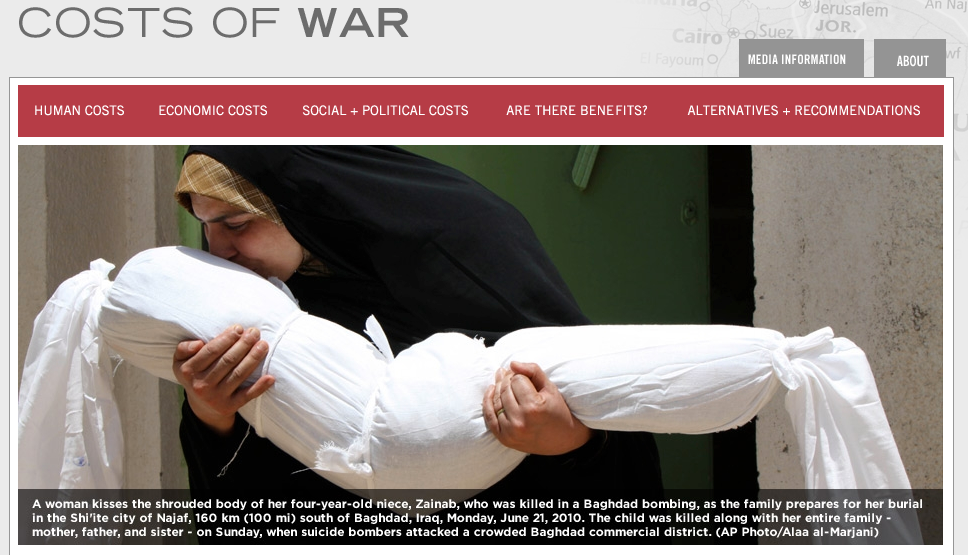
Neta estimates that 22,000 ‘collateral damage deaths’ occurred in Afghanistan and Iraq between 2001 and late 2012, and if Pakistan and Yemen are included then the total rises to 38,000.  Her book unpacks that awful term, ‘collateral damage’; she is co-director of the Costs of War study which, as you’ll see, is also about much more than accountancy:

COSTS OF WAR

Incidentally, if you are looking for historical context on the legal distinction between combatants and civilians, I recommend Helen Kinsella‘s The image before the weapon: a critical history of the distinction between combatant and civilian (Cornell University Press, 2011), and on the history of civilian casualties in America’s wars more generally,  John Tirman‘s The deaths of others: the fate of civilians in America’s wars (also OUP; 2011), which starts on the American Frontier and works though the Second World War, Korea and Vietnam down to Afghanistan and Iraq.

More unfinished business: haunting Waziristan

I’m just finishing up a new essay on drones and later modern war – “Moving targets and violent geographies” – and I’ll post the draft as soon as I’m done (this weekend, I hope).

Next up is the essay version of my various posts and presentations on air strikes in Pakistan’s Federally Administered Tribal Areas, past and present, by the US and by the Pakistan Air Force [see here and here], so I was heartened by news from Madiha Tahir [see my post here] of progress with her short documentary film, Wounds of Waziristan (they are down to the final edits):

More about the project and crowd-sourcing here, and you can find more information at the film’s website, which includes an image gallery and opens with some of the most hauntingly beautiful music composed by André Barros (shades of Arvo Part‘s Spiegel im Spiegel):

Haunting indeed.  In a report for Delhi’s Sunday Guardian, Tanishree Bhasin writes:

When Barack Obama finally admitted to the needless loss of life in Pakistan’s Waziristan area due to American drone attacks, he spoke about how the death of innocents would haunt him forever. Interrogating this notion of ‘haunting’ and what it means for those affected by these attacks is Pakistani filmmaker Madiha Tahir in her film Wounds of Waziristan….

With Wounds of Waziristan, Tahir tries to foreground the people who materially experience loss and absence — not as abstract body counts, but as the absence of a brother or a niece or a wife. “Haunting is the insistence by the dead that they be acknowledged, that the social conditions that brought about their demise be made known and rectified. So, haunting is about unfinished business. And, it’s thoroughly social and political. This film focuses on the people who live in Waziristan and who live among loss. Material conditions, whether it’s the rubble after a drone attack or the grave of one’s kin, persist in reminding the living of what they have lost,” she explains.

GORDON Ghostly matters

On her blog, Madiha wryly notes that her interest in the question of haunting may show ‘my academic side coming out’ – as well as an independent journalist she’s also a graduate  from NYU and Columbia, where she’s currently working on her PhD – and human geographers will probably be no strangers to the idea, from research by Steve Pile and Karen Till and most recently Alison Mountz‘s analysis of detention centres and Akin Akinwumi‘s work on Truth and Reconciliation Commissions.

Much of this has been indebted to Avery Gordon‘s by now classic study, Ghostly matters:

‘Haunting is one way in which abusive systems of power make themselves known and their impacts felt in everyday life, especially when they are supposedly over and done with or when their oppressive nature is denied… Haunting is not the same as being exploited, traumatized, or oppressed, although it usually involves these experiences or is produced by them. I used the term haunting to describe those singular yet repetitive instances when home becomes unfamiliar, when your bearings on the world lose direction, when the over-and-done-with comes alive, when what’s been in your blind spot comes into view.’

It’s not difficult to see how this applies to air strikes in Waziristan – the sense of familiarity unmoored by the devastations of state violence – but Madiha’s starting point is a two-page note Max Horkheimer and Theodor Adorno appended to Dialectic of Enlightenment, ‘On the theory of ghosts’, that also figured briefly in Gordon’s book (where she described it as an ‘unfilled promissory note’):

Only the conscious horror of destruction creates the correct relationship with the dead: unity with them because we, like them, are the victims of the same condition and the same disappointed hope.

It’s that first clause that animates Madiha’s work:

Only the conscious horror of destruction creates the correct relationship with the dead.

Legitimate TargetShe notes that so much (too much) of the contemporary debate about drones is framed by the language of international law and its grammar of execution that is deeply embedded in military violence: as operational law has become a central discourse in the animation and legitimation of the kill-chain, so it turns targeted killing into a quasi-juridical process.  In consequence, as she says with a nod to Eyal Weizman, ‘international law is caught up in constructing the proper order of violence.’

And as a journalist she is dismayed at the complicity of journalists in popularizing law

‘as the only frame through which we can talk about drone attacks and moral standards. Journalists regularly fail to look beyond the usual “experts” in policy and legal circles to other fields that may have an alternative to offer. We are becoming vulgar empiricists who seem to think that a truth not attached to a number (say, the number of “militants” vs. “civilians” killed), or a legal rule (for example: whether an action does/does not violate international law) is no truth at all.’

So Madiha proposes haunting as an alternative frame ‘through which one can re-direct the conversation from issues of legal standards to the lives lived and lives lost under the drones in Waziristan and elsewhere’:

‘The questions then turn on the material conditions and the loss suffered – not as evidence for legal arguments but as queries about what it does to a person to live in such conditions. The question is not, ‘Do I stick him in the “militant” or “civilian” column?’ but instead, who survives him? How do they deal with that loss? What is it like to live among the rubble?

It isn’t through legal standards but though trying to understand the horror of the destruction that we create the correct relationship — with the dead, yes — but with the living, too.’

This matters so much – and reappears in a different form in ‘Moving targets’ – because the contemporary individuation of ‘war’ (if it is war) works to sanitize the battlefield: to confine attention to the individual-as-target (which is itself a technical artefact separated from the exploded fleshiness that flickers briefly on the Predator’s video screens) and to foreclose the way in which every death ripples across a family, a community, a district and beyond [see my brief discussion with Ian Shaw here].

Fahim Qureshi Attack date 23 January 2009

And, as Madiha explained to the Sunday Guardian, these effects ripple across time as well as space, tearing the very fabric of history:

Speaking about her experiences while making this film, she explained that it’s not just a question of life being lost, but also the obliteration of history. “When drone attacks destroy homes — as they often do — they erase entire family histories. Homes in this area are built over time as families grow. There may be as many as 50 members of a family living in one house. When you destroy structures like that, you not only destroy people, you also destroy their history. The rubble that’s left in the wake of an attack is a living memory of what happened there. It embodies loss. The people in Waziristan have to live around this loss, near it, in it. They have to live among ghosts,” says Tahir.

Precarious journeys

Much of last week was taken up with working out a new project for the next round of the Social Science and Humanities Research Council’s Insight Grant programme.  A ‘Notification of Intent’ to apply is required (I’m deliberately not saying ‘needed’) before you can actually apply in October – but since the NOI requires a plain-language summary and a figure for the total budget most of the planning has to be done months before the application.  I could fill a whole blog – and other non-digital receptacles – about the sense in all that; suffice to say I hit the button ten seconds (sic) before the electronic shutters came down.

The application is for a project called Medical-Military Machines and the Casualties of War: Genealogies and Geographies of Care.

859084-dust-off-inside-afghanistan-039-s-medevac

One of the central claims made by protagonists of later modern war is that its conduct is accurate and proportionate, legal and ethical, thereby raising the bar for ‘just’ or, as James Der Derian has it, ‘virtuous’ war (and as most readers will know, he would insist on those scare-quotes).  It has done so, its advocates argue, by limiting casualties through new modes of intelligence, surveillance and reconnaissance, new weapons systems, and new modes of accountability.  I explore these issues in my ongoing SSHRC project, Killing Space (DOWNLOADS tab)not least through my continuing study of drones (much more to come!) and this project maps its other, vitally important dimension – a sort of ‘Caring Space’ – in order to provide an indispensable substantive test for these claims.

The project concerns the provision of medical care for those wounded by military and paramilitary violence, casualties who are often overlooked in vexed but vital debates over ‘body counts’ and what constitutes (following Judith Butler) a grievable life.  I’m not going to ignore those matters, far from it, but my main concern will be on the survivors of military violence.  As I’ll explain in a moment, I want to analyse both combatant and civilian casualties, and so confound the simplistic politics in which the right is supposed to care about the one and the left about the other.

The project will involve both genealogy and geography.  I’m using ‘genealogy’ in something like the Foucauldian sense, but all I’ll say here is that historical depth is plainly essential to specify what is (and is not) novel about the ways in which advanced militaries wage war.  So the project will involve four case studies focusing on the United States and its allies.  The first three are the Western Front in World War I, North Africa in World War II, and South Vietnam (1963-1975) .  In this traverse from ‘total war’ to James Gibson’s ‘techno-war’ I’m planning to leverage my work on ‘The natures of war’.  While researching that presentation and long-form essay – which will eventually appear in War Material – I found  a treasure-trove of sources that I want to explore in much more depth and detail for this new project.  The fourth case study will involve the cluster of wars in the Greater Middle East post 9/11, and while much of this has been familiar ground for me ever since I started writing The colonial present, there are many new issues to address – including the deliberate targeting of hospitals and medical doctors by some factions and what Omar Dewachti calls the ‘therapeutic geographies’ involved in the transnational movement of war casualties from (say) Iraq, Libya and Syria to hospitals in Lebanon, Jordan and India.

The project has three components that address different geographies of casualty care.

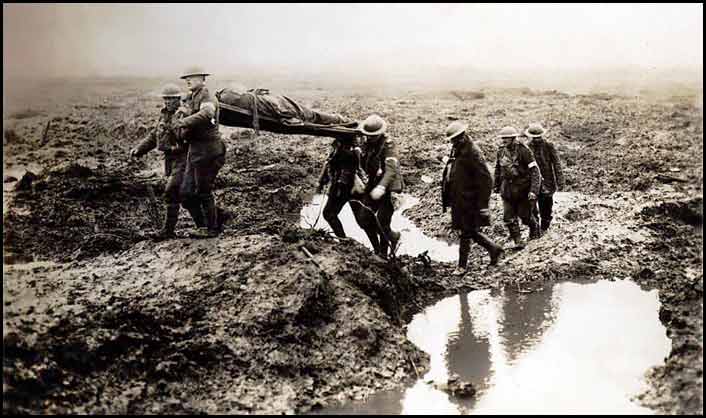
Stretcher-bearers

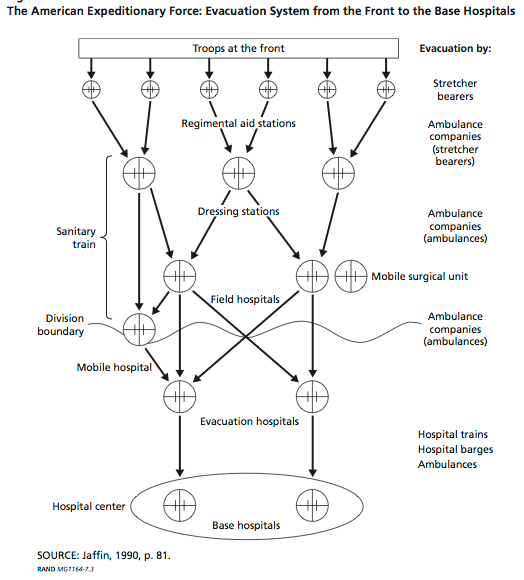
MAYHEW Wounded(1) Modern military medicine has sought to provide immediate care for troops injured in combat as close to the site of the injury as possible by deploying medical personnel and equipment in forward positions, and establishing evacuation routes for more seriously injured patients to higher-order medical facilities in the rear.  These systems have been transformed by technical advances designed to increase the time-space compression of treatment: the more widespread use of motorized ambulances in the Western Desert, for example, and helicopters for medical evacuation (‘dust-off’) in Vietnam and later conflicts. I plan to reconstruct these networks and their transnational extensions and to calibrate the changing transit times, and then to turn these skeletal geometries into human geographies through diaries, letters and, as we near the present, interviews, that I hope will bring into view the multiple people involved in these precarious, fleshy, and profoundly intimate journeys.  My inspiration for this is a series of thought-provoking essays in the Journal of the Royal Army Medical Corps (really), which provide a way in to the geometries and networks, and (very different) Emily Mayhew‘s Wounded: from Battlefield to Blighty, 1914-1918, due out next month, which uses the idea of a ‘journey’ in what could develop into a sort of phenomenology of care; I’ll say some more about some of this in a later post.

AEF Evacuation system WWI

The other two components follow from a remark made by Michel Foucault in ‘The Eye of Power’.  There he suggested that ‘doctors, along with the military, were the first managers of collective space’, but he assigned them to different spaces (‘campaigns’ versus ‘habitations’). Instead I want to explore what happens when military and medicine are called upon to imagine and manage the same space and install what, following the example of Mark Harrison, I’m calling a ‘medical-military machine’ in a war-zone.  So I’ll be following two tracks that are usually kept separate – civilian and combatant casualties (and here I want to extend the ongoing debates over their distinction from an abstract legal to a substantive therapeutic terrain) – and tracing the junctions where they intersect, in order to establish two other, complementary and sometimes countervailing geographies of care.

Medevac

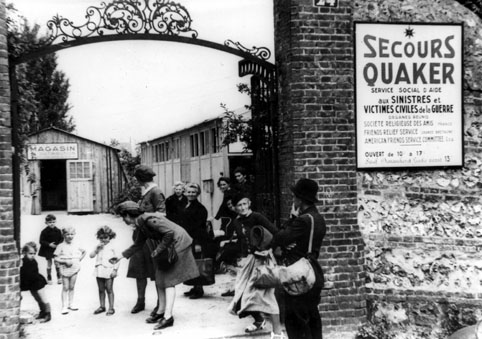
(2) There is an important sense in which modern war has always been ‘war amongst the people’: this is not a late twentieth-century preoccupation.  Images of ‘No Man’s Land’ on the Western Front distract attention from the injuries suffered by civilian populations who continued to inhabit houses and work farms behind the front lines, for example, while ground and air offensives in South Vietnam produced hundreds of thousands of civilian casualties.  So a second question is this: in what ways and in what places have militaries assumed medical responsibility for civilian casualties before and beyond the parameters of the Medical Civic Action Programs of contemporary counterinsurgency?

Secours Quaker

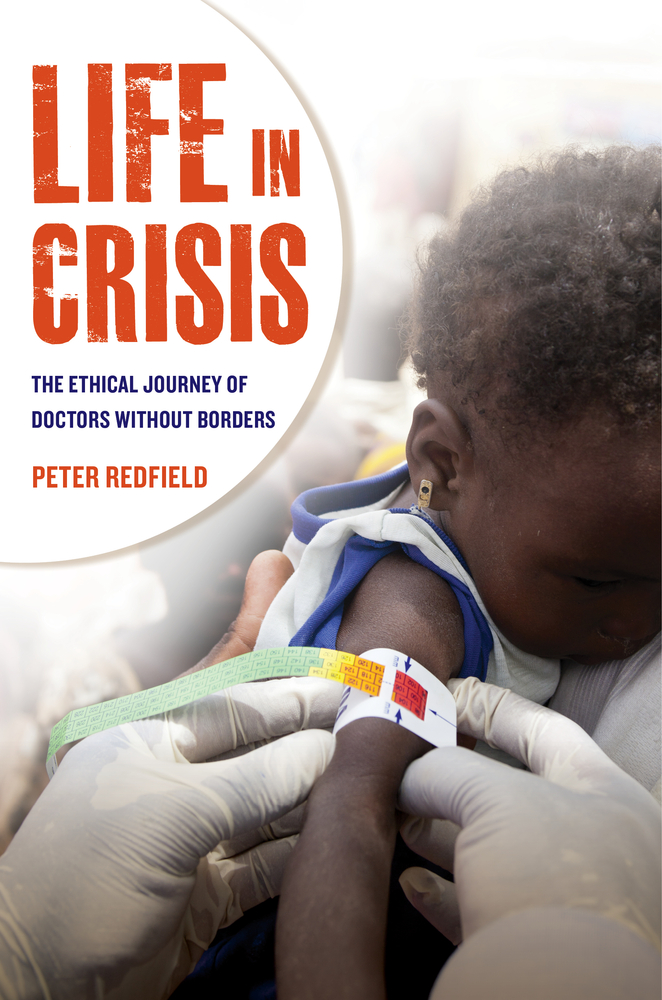
REDFIELD Life in Crisis MSF(3) Conversely, the military has not been the only agency making medical interventions in war-zones, and this is not a late twentieth century development either.  Civilian hospitals are increasingly important in today’s urban wars (where they often become targets too), but I want to pay particular attention to the work of international agencies.  I plan to analyse two voluntary organisations, the Friends’ Ambulance Unit and the American Field Service in the two world wars, and (I hope) two contemporary NGOs, the most obvious candidates being the International Committee of the Red Cross and Médecins sans Frontières.  I’m not assuming any direct filiations, and I’ll no doubt find all sorts of differences between them (particularly between the earlier and the later ones), but I’m particularly interested in the tensions between what at the moment I see as a common, more or less cosmopolitan engagement and the imperative to provide place-specific casualty care (and the logistics of doing so).   So a third question revolves around the rise of a ‘militarized humanism’ and the emergence of what Didier Fassin calls  ‘humanitarian reason’ as, perhaps, a form of governmentality.

http://vimeo.com/66342865

This really is just a bare-bones summary, and since I have another two months to flesh it out I’d really welcome any advice, suggestions or criticisms.  As I’ve described the project here you can see, I hope, that my case-studies and the questions I think they’ll enable me to address arise at the intersections of medical and military geography but also involve political, cultural and legal geographies.  And, as ever, those geographies all have a stubbornly little g: this really isn’t a disciplinary project.