Saviours and victims

Bhakti Shringarpure has a wide-ranging conversation with Mahmood Mamdani over at Warscarpes.  It covers a lot of ground, but one of the central threads is Mamdani’s insistence on conducting a ‘history of violence’, which is to say a history of the present (Darfur, Ruanda) in ways that disclose the historical context for today’s horrors.

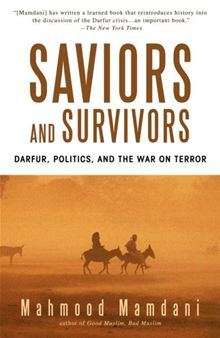
MAMDANI Saviors and survivorsHence Saviors and Survivors: Darfur, Politics and the War on Terror, in which Mamdani argued that the crisis in Darfur had to be read as a vicious gavotte of insurgency and counterinsurgency rather than genocide (as many commentators in the West insist).  Explaining his insistence on a dispersed, situated agency, Mamdani sets himself against what he calls the ‘new’ narrative of human rights:

‘The conventional approach, the approach used by the contemporary human rights movement, has been to document the atrocities, [to take] testimony, to identify perpetrators, to name and shame. The perpetrator is portrayed as someone with all the agency in the world. The victim is someone with no agency. That’s the narrative….  The old human rights movement, which was born with the French revolution – human rights of man, the citizen – it sought to empower the victim and to focus on issues. This new one seeks to empower saviors to salvage this helpless victim.’

He also talks about the politics of writing (and about the part his Harvard room-mate, Michael Ignatieff, played in the development of his own style), about audiences and public intellectuals, about the book through which I first came to know his work, Good Muslim, Bad Muslim: America, the Cold War and the roots of terror, the role Edward Said had in its publication, and his own ‘voyage in’, and he ends with this reflection on teaching at Columbia:

The downside of American students is this thing which runs through – seems to run through – the Western experience, but seems particularly crystallized in the American case, which is this notion that you can save the world. And this determination to save the world. This conviction that they know what’s good for the world, and they know what’s good for you, better than you know. So it’s almost like the medieval Christians who burnt people to save their souls.

They can be like the modern counterpart of the missionaries. They are not particularly interested in the problem: They are there to give you the solution. By the time they leave the university, they are imbued with the sense of what should be the solution. I always tell them that, before you get unleashed upon the world, let me have a chance to talk to you. Get them to realize that the real question is not, “What’s the solution?” – it’s “What’s the problem?” And the elements of any sustainable solution have to be found inside the problem.

But it’s not a peculiarly American conceit.  One of the characteristic gestures of modern colonialism and imperialism has been, precisely, to insist on its mission to bring ‘order’ from the outside to save those souls who would otherwise be condemned to their own chronic ‘disorder’.  This has been on view most recently in Tony Blair’s athletic support for the military intervention in Egypt: ‘Bringing about stability in the Middle East is not somebody else’s job, it’s ours.’  Perhaps it’s time somebody wrote Good Christian, Bad Christian.

‘It sounds like a whisper’

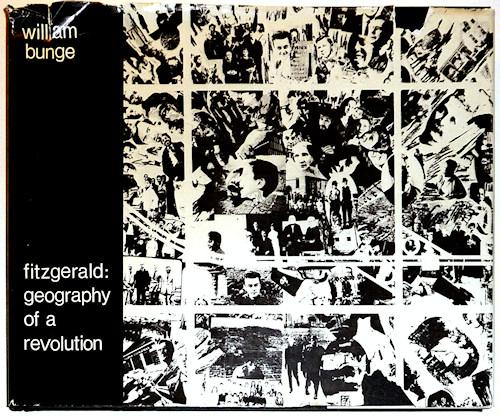
BUNGE Fitzgerald 1st edn

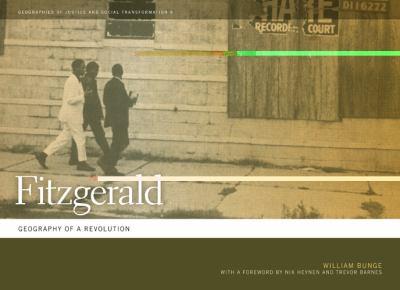
BUNGE Fitzgerald 2nd ednRemember Bill Bunge‘s Fitzgerald: geography of a revolution (1971)?   Trevor Barnes and Nick Heynen celebrated its republication in 2011 by the University of Georgia Press:

‘Forty years after its publication, Fitzgerald remains fresh, energetic, compelling, and relevant. One of Bunge’s purposes in Fitzgerald was to do human geography differently. He pushed the discipline in a new direction, helping to transform it into something else. If we see Fitzgerald differently now compared to when it was written it is because the discipline in which we gave become socialised has significantly altered. Fitzgerald helped to change it. We all contain, perhaps more than we would like to think, perhaps more than we would like to know, a little bit of Bunge, a little bit of Fitzgerald.’

You can find the full set of commentaries in Progress in human geography 35 (5) (2011).  What distinguished Fitzgerald, apart from its driving, passionate narrative, was a series of remarkable, original and imaginative maps of the Detroit neighbourhood where Bunge made his home.  These were not decorations – many of them were deeply troubling – but an indispensable means of driving the argument home.

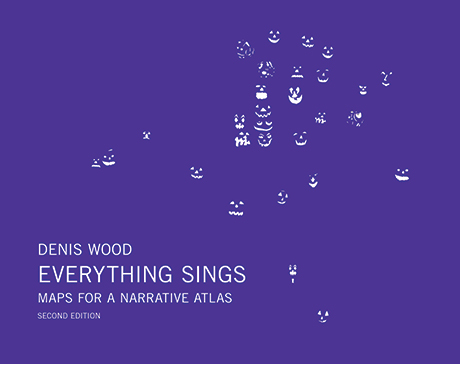
Now Denis Wood has followed in Bunge’s footsteps – readers will surely know The power of maps (which he wrote and later re-thought with John Fels) – using maps to tell a series of exquisitely layered stories about Boylan Heights in Raleigh, North Carolina in Everything sings: maps for a narrative atlas (2013).  His publisher Siglio explains:

Iconoclastic geographer Denis Wood has created an atlas unlike any other. He surveys his small, century-old neighborhood in Raleigh, North Carolina by first paring away the inessential “map crap” (scale, orientation, street grids), then by locating the revelatory in the unmapped and unmappable: radio waves permeating the air, the paperboy’s route in space and time, the light cast by street lamps, Halloween pumpkins on porches. His joyful subversion of the traditional notions of mapmaking forge new ways of seeing not only this particular place, but also the very nature of place itself.

DENIS WOOD Everything Sings

In a long and lively interview about the book, re-published today on Guernica, Denis argues:

Maps are just nude pictures of reality, so they don’t look like arguments. They look like “Oh my god, that’s the real world.” That’s one of the places where they get their kick-ass authority.

If you’re having trouble explaining the politics of ‘deconstructing the map’, then this may be a good place to start.  And do click on the thumbnails above the interview for a selection of 20 images from the expanded edition of Everything sings.  More on Denis’s work and access to his writing (and much more besides) at his website here.

WAINWRIGHT GeopiracyOf course other, markedly ugly narratives can be inscribed on the world through maps.  Fitzgerald was a collaborative project, and it drew on the work of the Detroit Geographical Expedition.  But there have been other, decidedly invasive ‘geographical expeditions’ – like the American Geographical Society’s Bowman Expedition (Zoltan Grossman provides a rich series of sources here, and Joel Wainwright‘s Geopiracy: Oaxaca, militant empiricism and geographical thought (2012) is indispensable).  So it’s good to know that Denis is currently completing another book (with Joe Bryan), Weaponizing Maps: bringing the conquest home, which is an incisive analysis of military mapping of indigenous populations in Canada, Colombia, Honduras, Mexico and Nicaragua and the imbrications of cartographic Reason with contemporary counterinsurgency.

I expect both Bill Bunge and Tracy Chapman would agree there’s a revolution needed there too.

Dirty wars and private eyes

Dirty Wars/Sundance Festival

There’s a wonderful line (well, hundreds of wonderful lines) in Simon Gray‘s play Butley, where the eponymous university lecturer waspishly declares “You know how it exhausts me to teach books I haven’t read…”

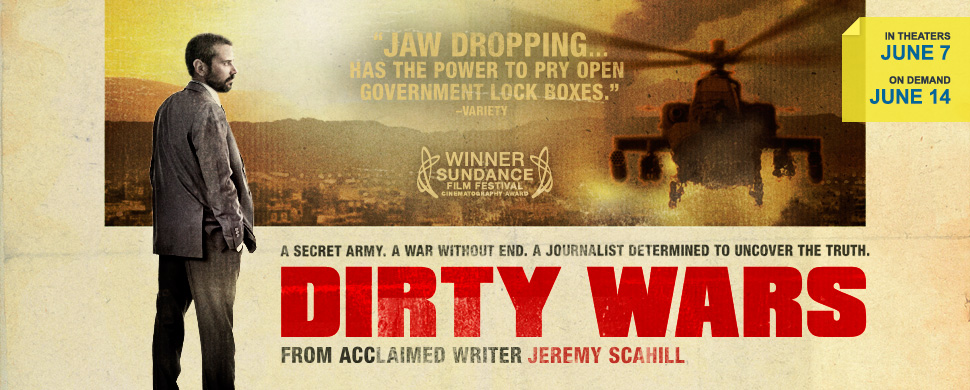
So it’s with some trepidation that I return to the Rick Rowley/Jeremy Scahill/David Riker film of Scahill’s book “Dirty Wars: the world is a battlefield“, since although I’ve read the book I haven’t seen the film (it opens Friday 14 June in Vancouver [Cineplex Odeon International Village]).

But Gerard Toal has, and has posted an interesting reflection at Critical Geopolitics:

‘Scahill’s world is that of the investigative reporter. He’s focused on the facts, details and lines of connection that reveal abuse of power and extra-constitutional excess. Don’t expect to have Agamben cited. That is the power and value of his work. It gets under the skin of the conventional wisdom and general consensus on the war on terror. It disturbs. With the journalistic revelations of the last week (and there’s a lot more coming from what Scahill indicated; he also mentioned how journalists are now changing their digital behavior in big ways), the whole everywhere endless terror security surveillance state is cracking open before our eyes.’

David Harvey dedicated Social Justice and the City ‘to all good committed investigative journalists everywhere’, but the figure of Scahill in the film has attracted less generous commentary.  Mike Hogan notes, like many other critics, that the film is structured like a noir crime story in which Scahill becomes the gumshoe we follow

‘from the lawless hinterlands of Afghanistan, where he interviews the surviving members of the family of a U.S.-trained police chief decimated in a secret night raid; to Yemen, where he inspects the wreckage of a drone strike and meets the father of Anwar al-Awlaki, one of four American citizens to be assassinated abroad by the U.S. (al-Awlaki’s 16-year-old son was another); to Somalia, where he tags along with Somali war lords on the U.S. payroll, who brag of committing war crimes as they rampage through the rubble of Mogadishu.’

In Hogan’s interview Scahill talks about his initial reluctance to have the film revolve around him since ‘I don’t write articles in the first person and I don’t tend to talk about myself when I’m reporting.’

‘Rick [Rowley], the director of the film, was driving me insane by constantly filming me when I wasn’t supposed to be the character — and I think somewhere he knew that he wanted to do this. We had cut a version of the film where I was not me, I was just sort of like a tour guide through the archipelago of these covert war sites. And then when we started to change the way we were going to tell the story, we went back to the cutting room, and all the s**t that I told Rick not to film became the stuff that made the film possible…. I can see myself in the movie where I’m in a car, and it might look like I’m really tense about something, but it’s just that I’ve just yelled at Rick and told him to get the f**king camera out of my face. I’m like, “I’m trying to file my story, man, leave me alone.” I still have trouble watching it, to be honest.’

VALENTINE The Phoenix ProgramSo, it seems, did Douglas Valentine.  He castigates the film for its lack of historical context: its failure to acknowledge the long history of ‘dirty wars’ waged by the CIA (Valentine himself is the author of a brilliant book on The Phoenix Program in Vietnam).  It’s a serious criticism, and it applies to the book too (though to be fair it already comes in at more than 650 pages).

I do think it’s important to trace what is new and what isn’t about today’s wars fought in the shadows of 9/11,  which is in part why I constructed The colonial present as I did and why my analysis of today’s ‘drone wars’ is situated within the wider arc of the histories and geographies of bombing from the air. That said, I also think that Scahill’s stream of stories has done more than most other journalists reporting from the war zones to illuminate the contemporary reach of military and paramilitary violence.  As he says, ‘the world is a battlefield’.

But Valentine doesn’t care for the way Scahill bestrides that battlefield – look at the posters I’ve reproduced here – and he reserves his most withering fire for the starring role played in the film by Scahill himself:

Dirty Wars is a post-modern film by Jeremy Scahill, about himself, starring himself in many poses.The film owes more to Sergio Leone and Kathryn Bigelow than Constantinos Gavras…. 

The endless close-ups artfully convey the feeling that our hero is utterly alone, on some mythic journey of self-discovery, without a film crew or interpreters. There is no evidence that anyone went to Gardez to make sure everyone was waiting and not toiling in the fields or tending the flocks, or whatever they do. And we’ll never find out what the victims do.  The stage isn’t big enough for JS and anyone else.

This is a major theme throughout the story – JS is doing all this alone and the isolation preys on him…. 

Initially, there is no mention that journalist Jerome Starkey reported what happened in Gardez.  JS is too busy establishing himself as the courageous super-sleuth.  As we drive along the road, he reminds us how much danger he is in…. In my drinking days, we referred to this type of behavior as grandiosity.’ 

Dirty-Wars1Valentine dismisses this as ‘the cinema of self-indulgence’, and readers may remember other critical commentaries on academic appropriations of the stylistics of film noir and the figure of the detective: I’m thinking of Rosalyn Deutsche‘s scathing review of ‘Watching the Detectives’ (aka the Critical Theory Gang) in the late twentieth-century American city: ‘Chinatown Part Four? What Jake forgets about Downtown’, assemblage (1993) available here; Matt Farish subsequently provided a more extensive discussion here and Kristin Ross a still more recent take here.

Now one of my private pleasures is serious crime fiction, but taken together these commentaries raise a series of questions about the debt most academics working in and around war and military violence owe to the work of  investigative journalists and about the masculinist privileges both may assume in exposing ‘dirty wars’.  And what happens, stylistically and analytically, when the story moves from the ‘mean streets’ of the city, from chasing down criminal gangs, urban warfare and the entanglements between the two, and out into killing fields that extend far beyond the concrete jungle?  There’s something else too: perhaps it’s not surprising that investigative journalists should adopt the persona of the private detective when they are tracking down state-sponsored operations that move so seamlessly between the legal and the illegal?

Scahill Dirty Wars

Coda: If you want an excellent academic commentary on the rise of Joint Special Operations Command – which, as Valentine implies, is the focus of Scahill’s investigations (it certainly is in the book) – then I thoroughly recommend Steve Niva, ‘Disappearing violence: JSOC and the Pentagon’s new cartography of networked warfare’, Security Dialogue 44 (3) (2013) 185-202: it’s a clear, cogent and remarkably insightful analysis, completed before – and so far as I can see without any reference to – Scahill’s work.  Here’s the abstract:

Joint Special Operations Command In the twilight of the USA’s ground wars in Iraq and Afghanistan, there has been an expanding shadow war of targeted killings and drone strikes outside conventional war zones, where violence is largely disappeared from media coverage and political accountability.While many attribute the growth in these shadowy operations to the use of new technologies and platforms such as drones, this article argues that the central transformation enabling these operations is the increasing emergence of network forms of organization within and across the US military and related agencies after 2001. Drawing upon evidence from unclassified reports, academic studies, and the work of investigative journalists, this article will show that elements within the US military and related agencies developed in the decade after 2001 a form of shadow warfare in which hybrid blends of hierarchies and networks combine through common information and self-synchronization to mount strike operations across transnational battle spaces. But, rather than a top-down transformation towards networks, this article will show how it was the evolution of the Joint Special Operations Command (JSOC) from an elite strike force into a largely autonomous networked command that has been central to this process.Although drone strikes have received the bulk of critical attention in relation to this expanding shadow war of targeted killing, this often-lethal networked warfare increasingly resembles a global and possibly permanent policing operation in which targeted operations are used to manage populations and threats in lieu of addressing the social and political problems that produce the threats in the first place.

No Agamben here either, incidentally.

I don’t mean any of this to disparage Scahill’s book – as I say, I haven’t seen the film so must reserve judgement – and if you want a detailed summary of the book then head over to Understanding Empire where Ian Shaw has started to share his reading notes.

Sim Cities and theatres of war

When I wrote “Rush to the intimate” (DOWNLOADS tab), a discussion of the ‘cultural turn’ in US counterinsurgency, I was fascinated by a rich and rapidly expanding literature on pre-deployment training and Mission Rehearsal Exercises in simulated “Afghanistans” and “Iraqs” across the United States and beyond in what Steve Graham later called, in Cities under siege, a ‘theme-park archipelago’:

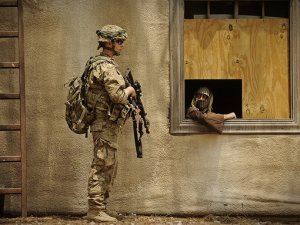
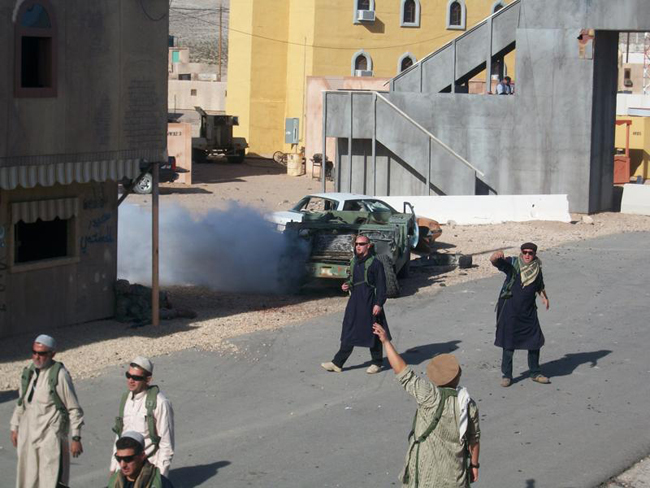
fort-polk‘US troops prepare for deployment in Afghanistan and Iraq by rotating through major Combat Training Centers.  The arc of these ‘theatres of war’ runs from the United States through Europe to Jordan and Kuwait, but the main Mission Rehearsal Exercises are conducted at the Joint Readiness Training Center at Fork Polk, Louisiana; the National Training Center at Fort Irwin, California; and the US Marine Corps Air Ground Combat Training Center at Twentynine Palms, California.  Each includes prefabricated villages and small towns to train troops in urban operations.  … There is little attempt at morphological similitude.  In fact, the same physical structures serve for Afghanistan and Iraq, as though the two are indistinguishable and interchangeable, and the buildings are rudimentary approximations.  One journalist described the crude architecture of ‘Wadi al Sahara’ at Twentynine Palms as being ‘like an impressionist painting’.  From the surrounding hills it could be mistaken for part of Basra or Fallujah, but ‘a walk through its dusty streets shows it to be only a vast collection of shipping containers.’ This too is not without its performative consequences.  Shipping containers are an improvement on poker chips and Lego bricks, but reducing living spaces to metal boxes and studio flats conveys a silent message about the sort of people who live in them.

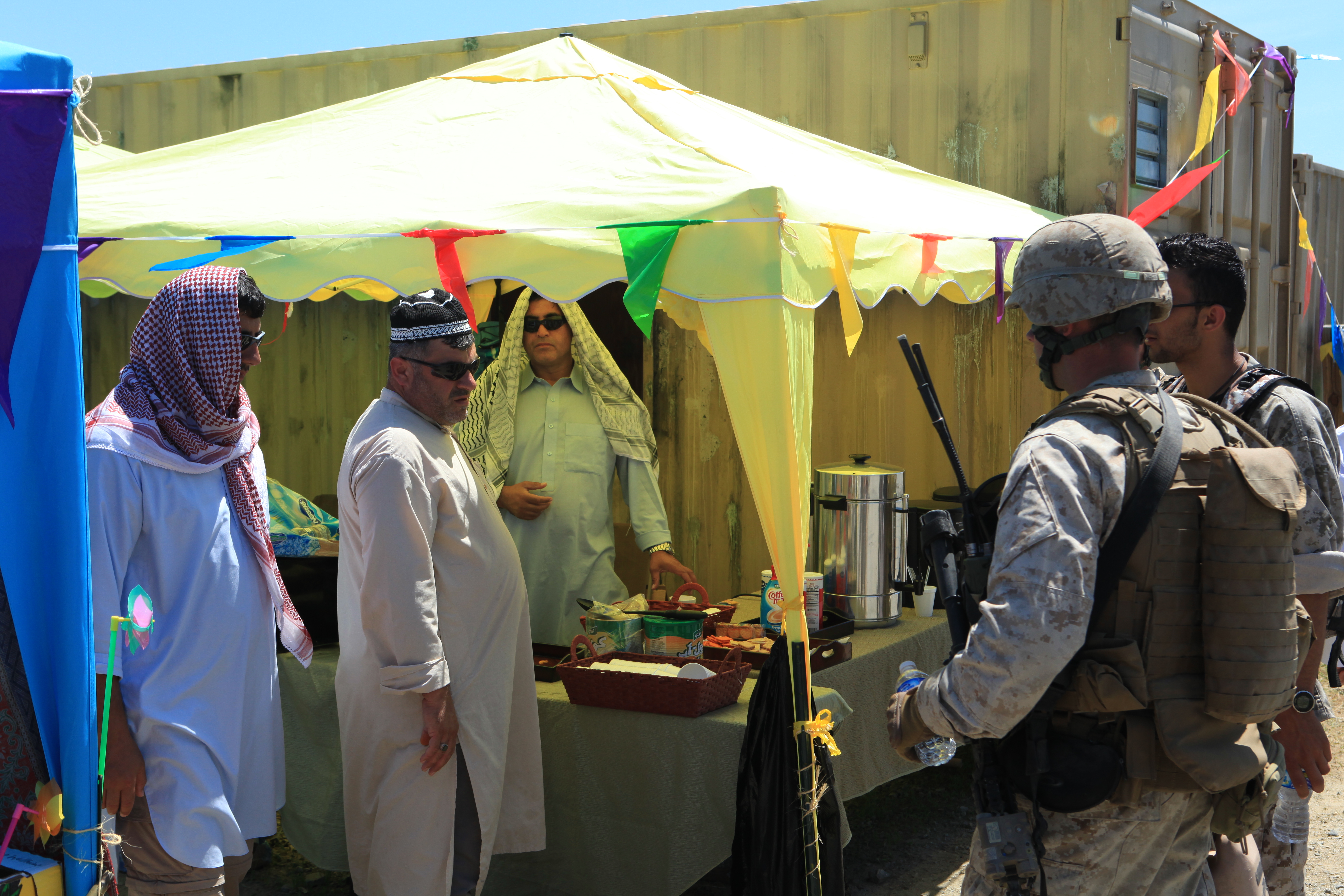
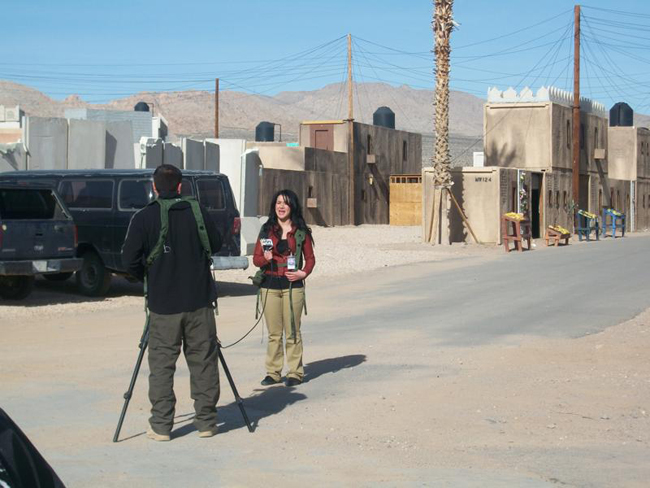
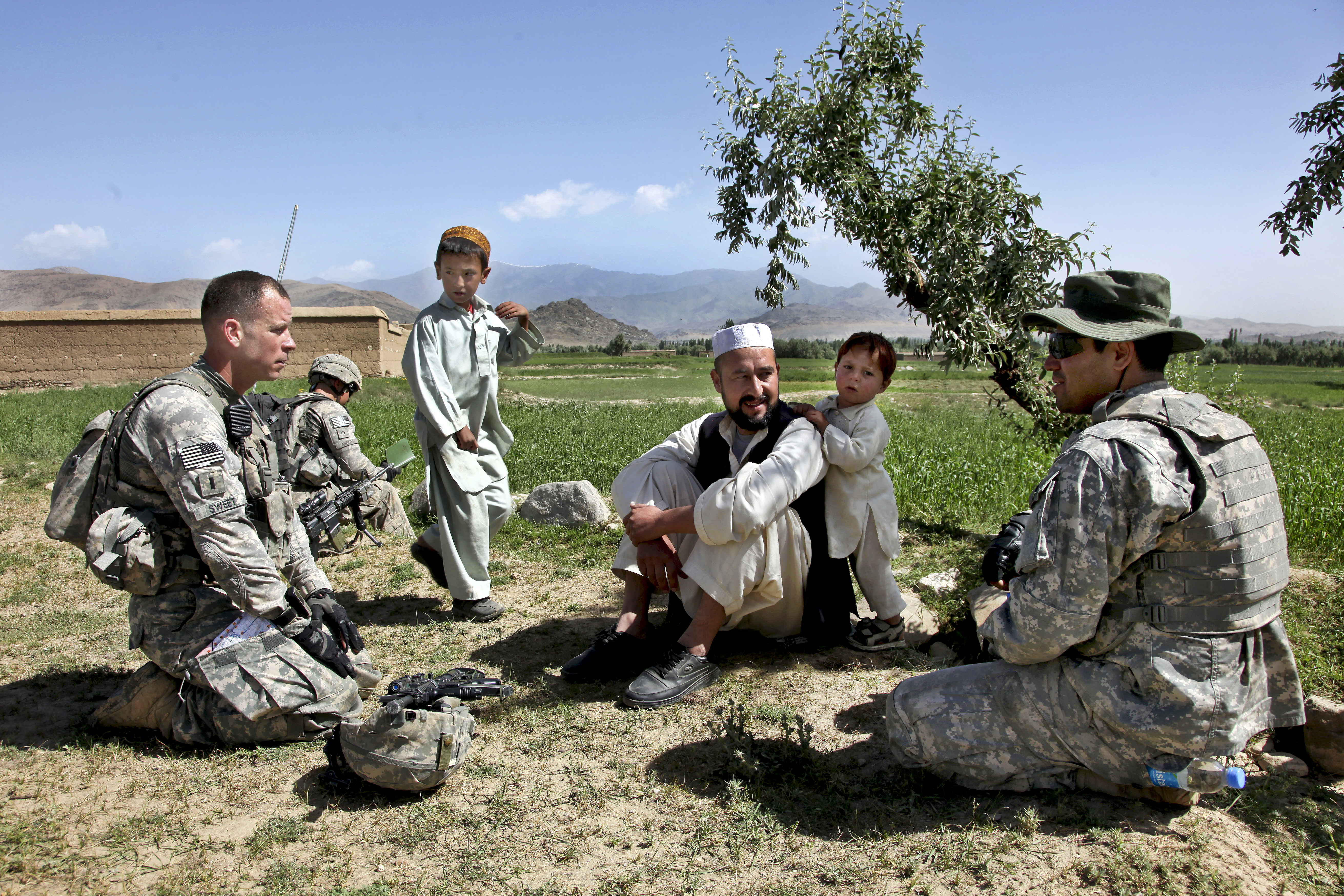
Realistic Urban Training‘The focus at all the training centres is on interactive realism, and the cultural turn has transformed the terms of engagement.  In the early stages of the ‘war on terror’, the emphasis was on kinetic operations and on state-of-the-art special effects that drew on the visual and pyrotechnic skills of Hollywood and theme-park designers.  When one reporter visited Fort Polk in January 2003, she described troops calling in air strikes, securing roads and bridges on the perimeter of a town, and dealing with ambushes staged by insurgents played by soldiers from the base. Her story repeated the physical imagery of the Handbook for Joint Urban Operations issued the previous fall with precision: ‘From sewers to rooftops, cities are multi-layered, like three-dimensional chess boards.’  Civilians appeared only as casualties, and then only in the very last paragraph, where one soldier admitted that he had ‘no clear answer’: ‘“What can you do?”’ The cultural turn is supposed to provide the answer to that question, and from 2006 a flurry of media reports described a new emphasis on military-civilian interaction.  Exercises still include kinetic operations, though these are now more likely to focus on combating IEDs and suicide bombings, but the main objective is no longer scoring kills but ‘gaining the trust of the locals.’  The deployment of Civilian (sometimes called Cultural) Role Players has expanded dramatically.  More than 1,000 are on call at Fort Polk alone, including 250 Arabic speakers, many of them recruited from the Iraqi diaspora in Atlanta, Houston, Memphis and as far away as Michigan.  Their very presence has changed the imaginative geography.  One corporal noted that his previous training had never incorporated civilians ‘wondering what’s going on, and looking around, and doing everyday things.  So when we got there and there were other people besides the enemy, it kind of threw us on our heels.  You know, all we trained for was that the enemy are the only ones on the streets.’  But these Civilian Role Players are not extras, figures to be bypassed, and their roles are carefully scripted.  They play community leaders, police chiefs, clerics, shopkeepers, aid workers, and journalists, and new scenarios require troops to understand the meaning of cultural transactions and to conduct negotiations with local people.  Careful tallies are kept of promises made by US commanders, and the immediate consequences of civilian casualties are dramatized in depth.  Mock newscasts by teams representing CNN and al Jazeera remind troops that local actions can have far-reaching consequences.  Even the special effects have become more intimate; in one Gothic gesture, amputees are used to simulate the effects of suicide bombs (though not, I suspect, US air strikes).  ‘It is no longer close in and destroy the enemy,’ one Marine officer explained: ‘We have to build relationships with Iraqis in the street.’

At the time the richest reports were these (and the quotations above were taken from them): Dexter Filkins and John Burns, ‘Mock Iraqi villages in Mojave prepare troops for battle’, New York Times, 1 May 2006; Wells Tower, ‘Letter from Talatha: Under the God Gun’, Harper’s Magazine, January 2006; Vince Beiser, ‘Baghdad, USA’, Wired Magazine 14.06 (June 2006); Tony Perry, ‘“Mojave Viper” sessions reflect situations in Iraq’, Los Angeles Times, 24 July 2006; Guy Rez, ‘Simulated city preps Marines for reality of Iraq’, National Public Radio, 13 April 2007.

I now need to re-visit all of this for The everywhere war.  My good friend, the ever-enterprising Oliver Belcher, visited Muscatatuk Urban Training Center in Indiana in September 2010 as part of his PhD research, so I had some idea of what had changed in the interim (and what had not).

NTC Fort Irwin exercise

Now Geoff Manaugh (of BldgBlog fame) has provided a sumptuously illustrated account (also on his blog here and at Venue here) of his recent visit to the simulated Afghan town of Ertebat Shar at Fort Irwin in the Mojave Desert (above); when US troops were training for Iraq it was Medina Wasl, and the basic geometry was imported from satellite photographs of Baghdad.
‘… at the most basic level, soldiers will use Fort Irwin’s facsimile villages to practice clearing structures and navigating unmapped, roofed alleyways through cities without clear satellite communications links. However, at least in the training activities accessible to public visitors, the architecture is primarily a stage set for the theater of human relations: a backdrop for meeting and befriending locals (again, paid actors), controlling crowds (actors), rescuing casualties (Fort Irwin’s roster of eight amputees are its most highly paid actors, we learned, in recompense for being literally dragged around during simulated combat operations), and, ultimately, locating and eliminating the bad guys (the Blackhorse regiment [a 120-strong insurgent force drawn from the 11th Armored]).’

Other recent images and video-essays can be found here and here.

Two things in particular stand out for me from Geoff’s immensely interesting essay.

First, the site and at least some of its training exercises are now regularly open to the public – NTC ‘Box Tours’ run twice a month and can be booked no more than 30 days in advance: see here for details – so special dispensations are no longer needed.  As this implies, the sense of public scrutiny has evidently been dramatically heightened since 2007, though even then national media seemed to be all over the place, and this now extends to the incorporation of the visitors themselves.  Geoff reports:

‘In the series of set-piece training exercises that take place within the village, the action is coordinated from above by a ring of walkie-talkie connected scenographers, including an extensive internal media presence, who film all of the simulations for later replay in combat analysis. The sense of being on an elaborate, extremely detailed film set is here made explicit. In fact, visitors are openly encouraged to participate in this mediation of the events: We were repeatedly urged to take as many photographs as possible and to share the resulting images on Facebook, Twitter, and more.’

NTC Fort Irwin media

As I’ve argued before, this sense of reflexivity – attention to the conduct of conduct – is focal to later modern war (though it extends far beyond multiple media platforms and includes, crucially, the lawyering-up of the kill-chain).

Second, the wounds of war have become ever more elaborately scripted.  Wells Tower‘s brilliant ‘Letter from Talatha’ (cited above) was very good on this, but now Geoff reproduces
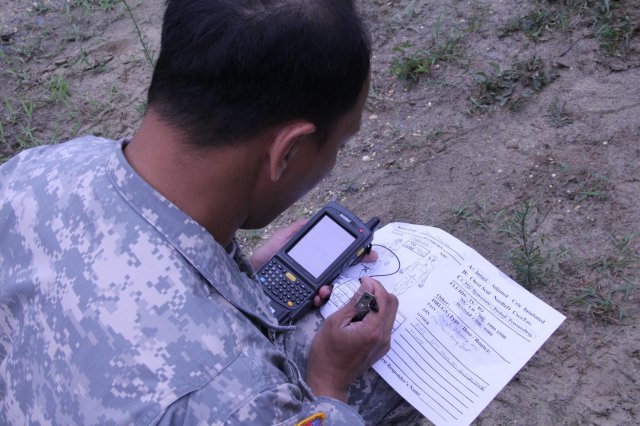
‘an extraordinary collection of injury cards handed out to fallen soldiers and civilians. These detail the specific rules given for role-playing a suite of symptoms and behavior — a kind of design fiction of military injury.’

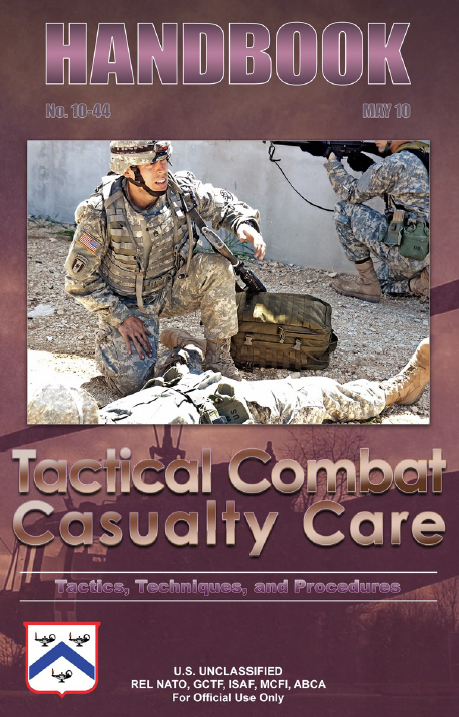
US ArmyTactical Combat Casualty CareScanning these cards raises a series of questions about other, more visceral geographies that lie behind the fiction: the (selective) geographies of care that extend from a war-zone back to hospitals in the United States. The US military has developed an elaborate system of recording and removing its own casualties (as part of what it usually calls ‘tactical combat casualty care‘).

Tactical telemedicineThe geography of this process is acutely physical. The delays imposed by time and space can kill, which is why the US military is currently exploring what it calls ‘tactical telemedicine’ (see the simulation report here; image on right).

The military casualty system is the product of a long historical geography: there’s a useful review of the US experience up to World War II by Bernard Rostker here, and I’m starting to wonder – with another good friend, Craig Jones – and as part of our joint interest in ‘geographies of the kill-chain’ how to explore the changing political and cultural geographies of injury and trauma that radiate from military violence.  There are vital comparative aspects to this, involving not only the (differential) treatment of combatants and civilians by different actors but also the different capacities of military and civilian medicine in war-zones and beyond.  All other dimensions of the theatre of war.

On the road – and off it

I’ll be travelling for the next several weeks so postings will probably be light until the end of the month. I’ll be spending most of my time in North Africa and Eastern Europe, with a stop-over at King’s College London for a seminar in Geography & War Studies (another outing for “Gabriel’s Map”, and I’m really looking forward to the discussion).

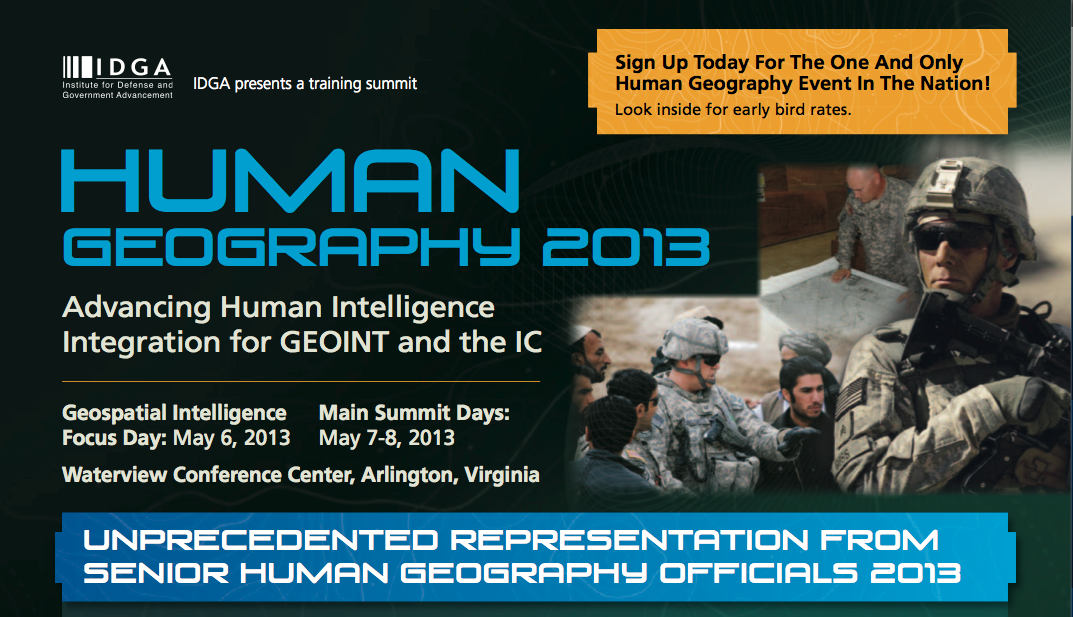
This means I’ll miss the Annual Meeting of the Association of American Geographers which starts today, but I thought readers would like to know about an event billed as “the one and only Human Geography event in the nation“… Really.  It takes place in Arlington, Virginia next month, and like its counterpart last year is organised by the Institute for Defense & Government Advancement.

IDGA Human Geography 2013:1

The letter of invitation from Tyler Baylis, IDGA’s Program Director, explains:

With an annual operating budget of $18 billion, DoD Military Intelligence programs have been instrumental in the war on terror. Human Geography has been at the forefront of these intelligence programs, often embodied in the Human Terrain Systems program which, with successful implementation, has recently increased from 22-31 operating teams in Afghanistan. In order for the US Military to operate in theatres where conventional warfare is not effective, Human Geography must be readily understood and utilized.

In advancing Human Geography, we must look too increased socio-cultural and language training to provide accurate and reliable data generated by on-the- ground research on the specific social groups in the supported unit’s operating environment. IDGA holds this event to service as a platform for you to learn about these areas through expert presentations from the CENTCOM, USMC Center for Irregular Warfare and the Air Force Culture and Language Center and as well as many other key players in the field.

Human Geography 2013 will deliver: • Unparalleled access to the latest SOCOM and Intelligence perspectives • Insights from former Human Terrain Analysts, and anecdotal success stories • Exclusive look into the future of Human Geography’s technological capabilities Plus, presentations and round table discussions will cover Human Terrain Systems, Big Data and Cloud Solutions, HUMINT and GEOINT, Advanced Socio-Cultural Training, Foreign Language Training, the Future of Human Geography in the Intelligence Community and more.

It’s an interesting and innovative time in the implementation of human geography into the Intelligence Community and Special Operations Warfare. Come participate in defining the future of the US military, and establish yourself in this exciting field at the only Human Geography event this year.

More information and the full brochure here.  For readers concerned at the escalating costs of conferences, an all-access pass for this three-day event comes in at $1, 498.

As I said last year, another meeting, and for the most part another geography.  But I do recognise one speaker, Alex Murphy, who is down to lead a session on ‘Using GEOINT for mapping and battlefield visualization’.

Dirty dancing and spaces of exception in Pakistan

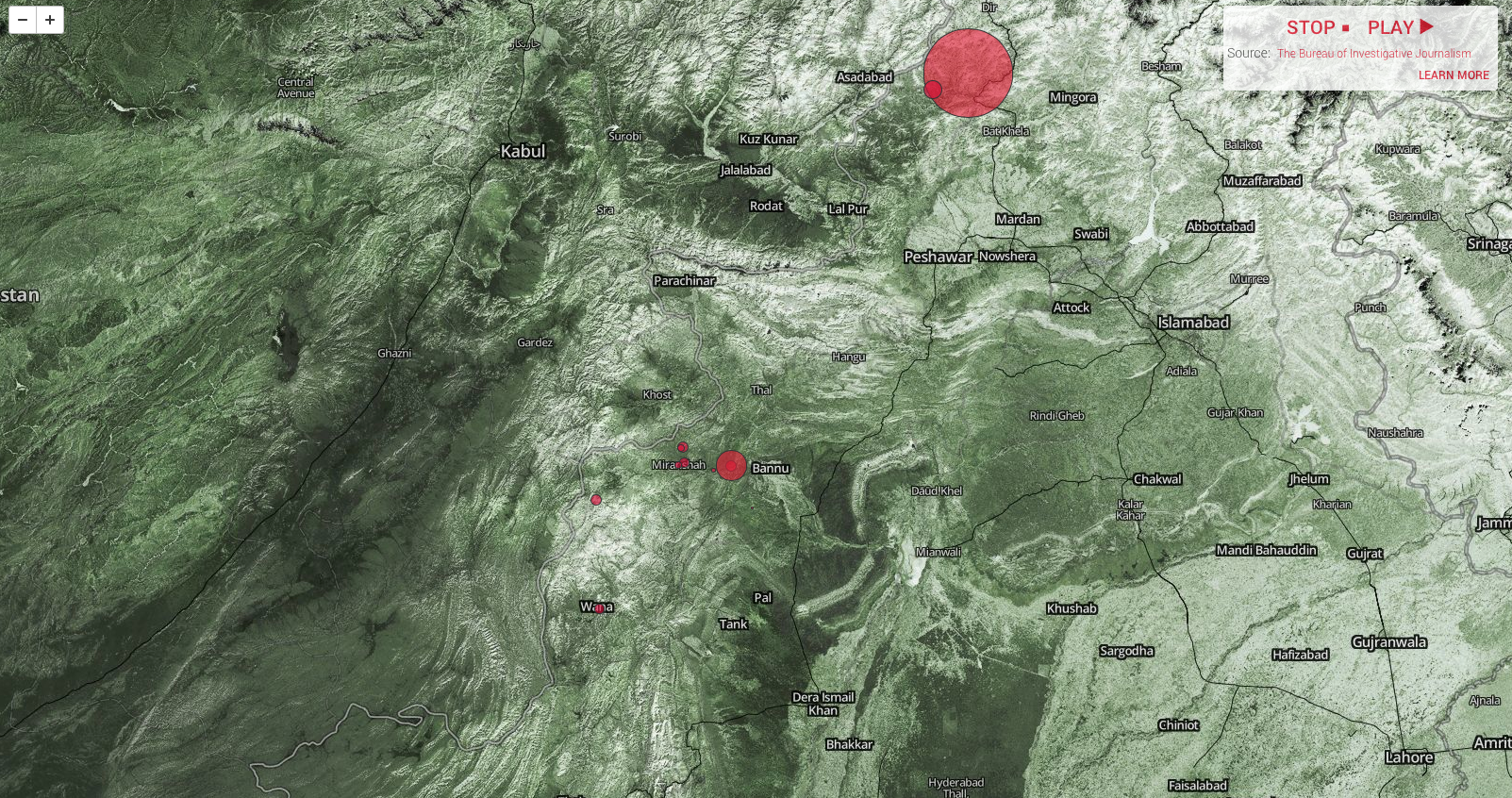
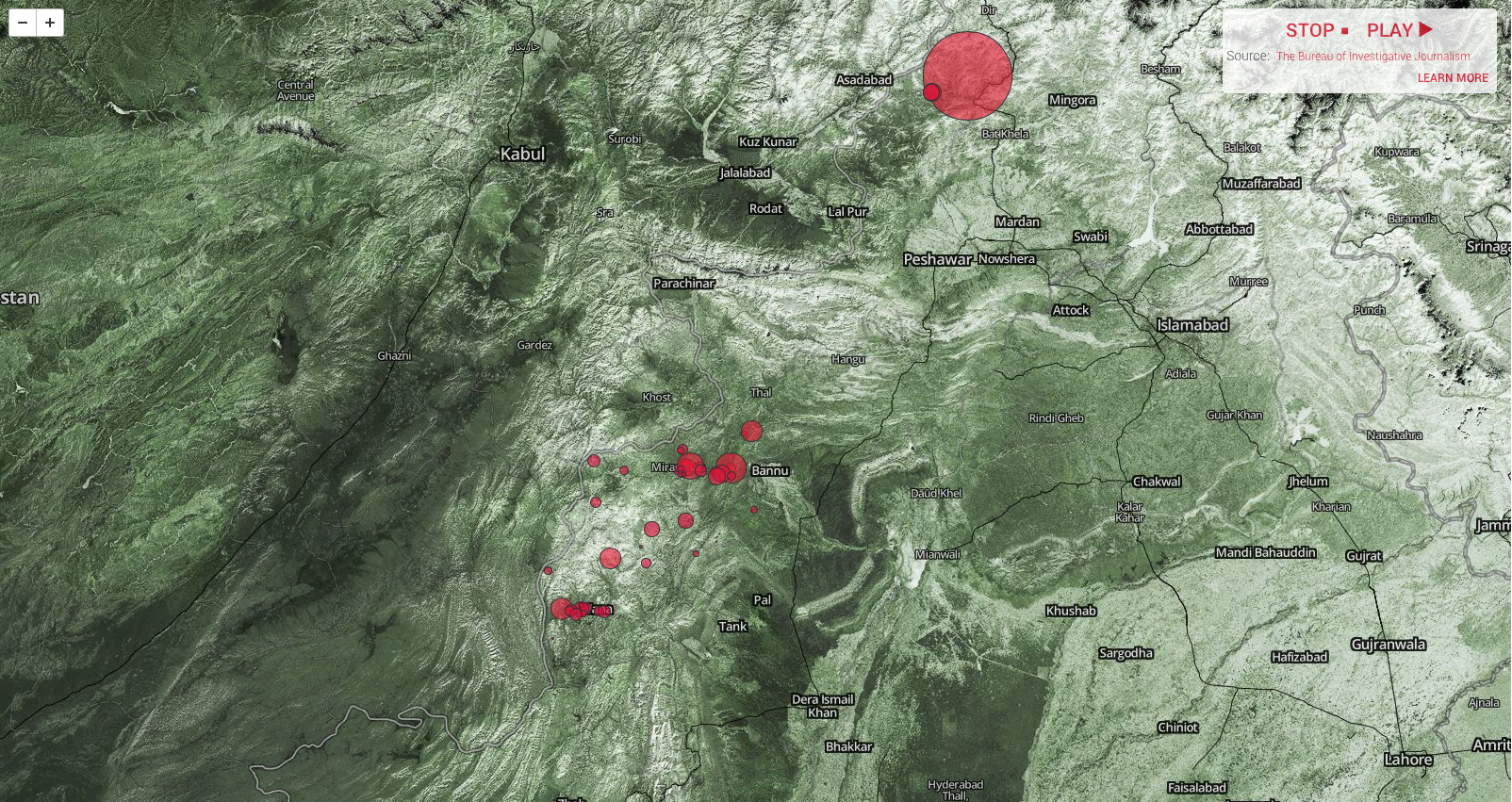
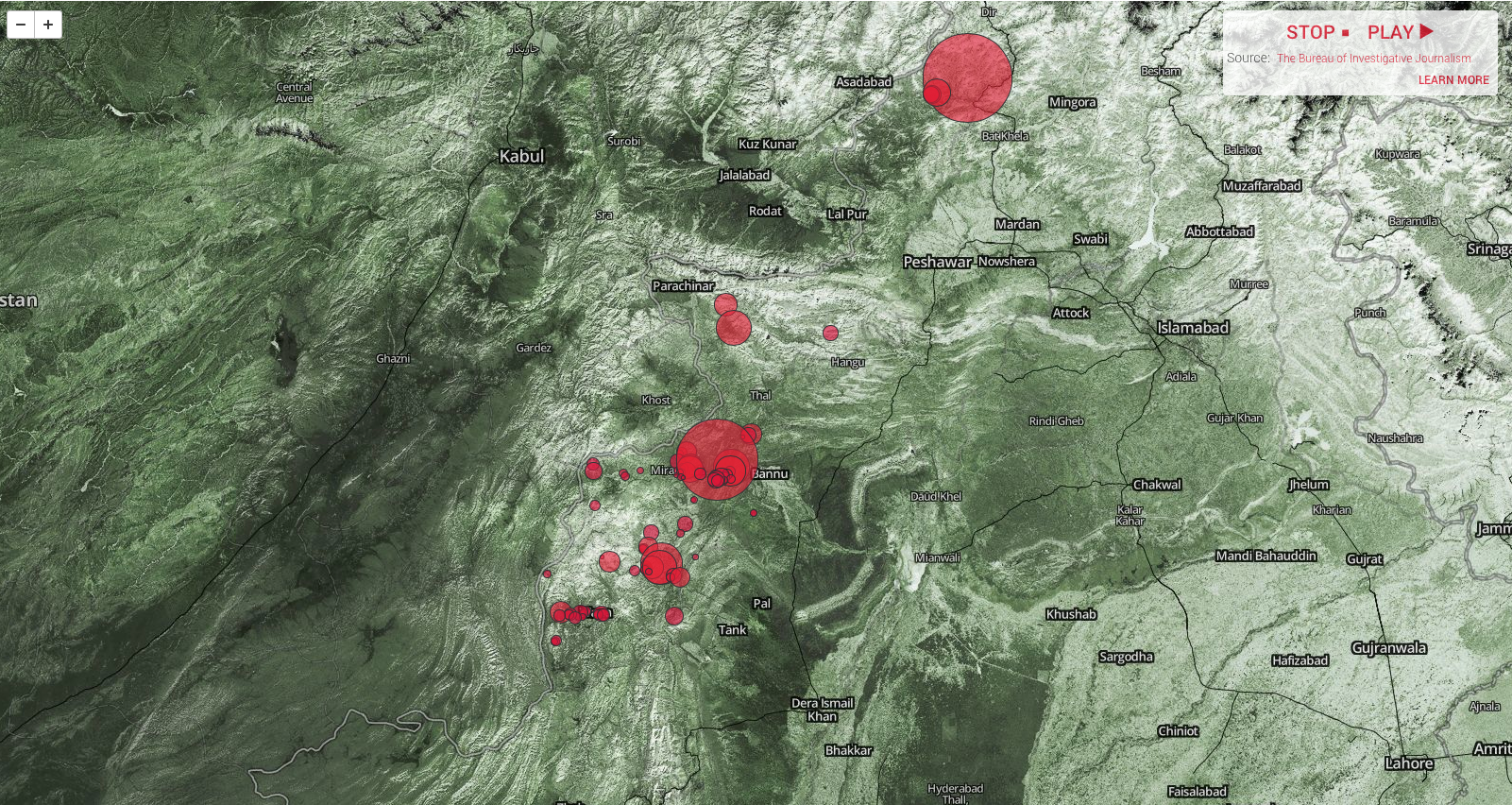
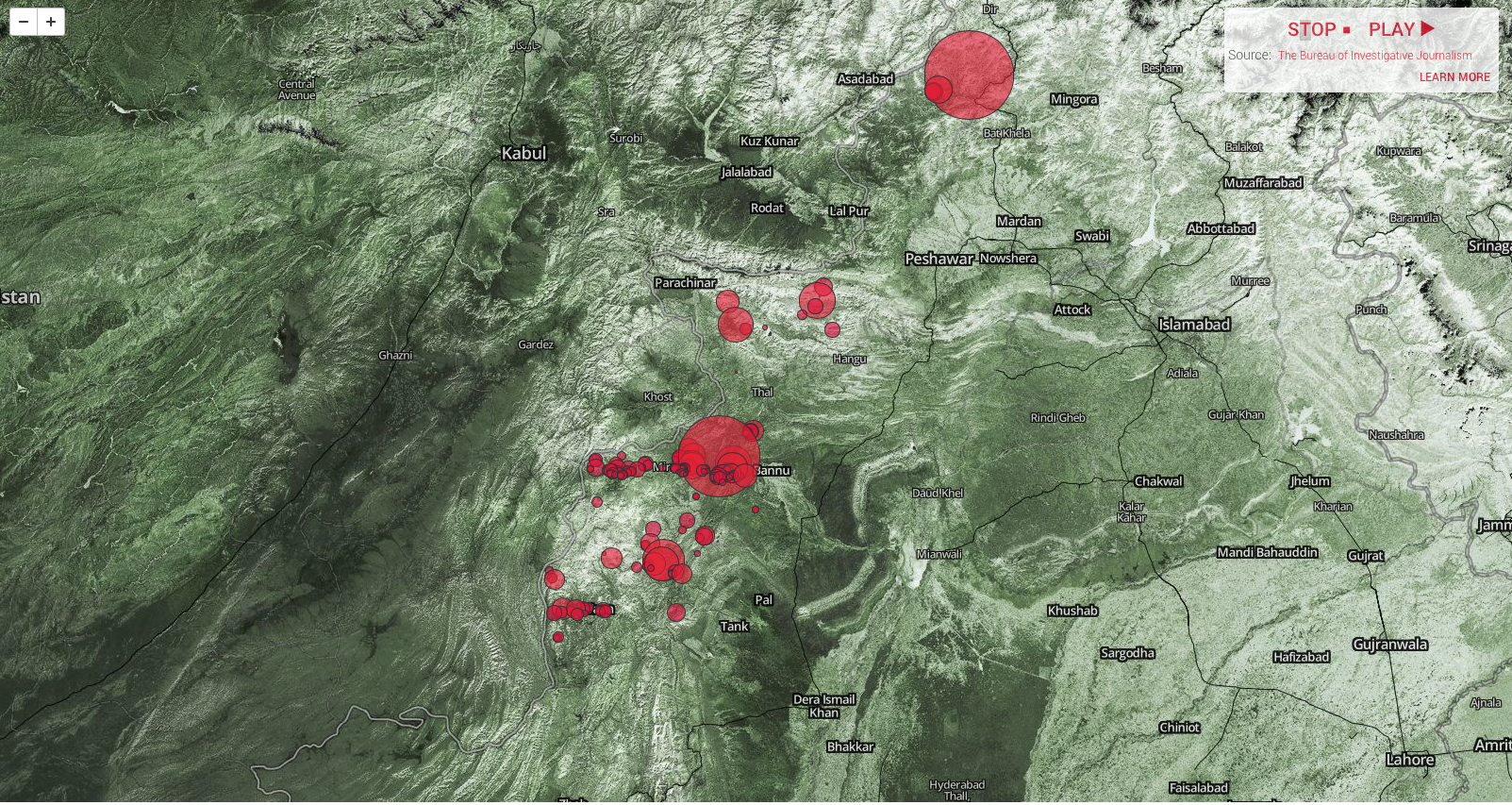
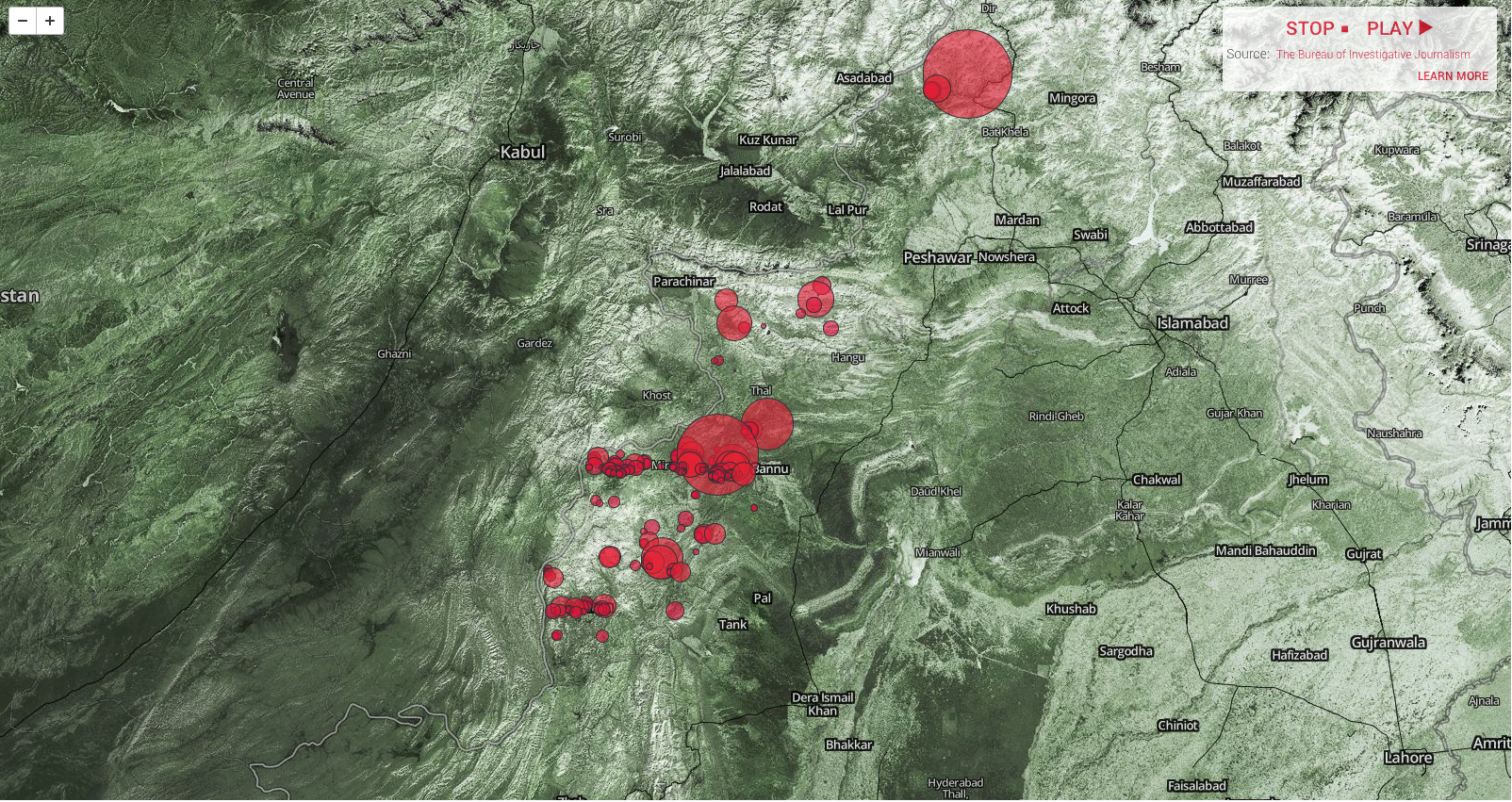
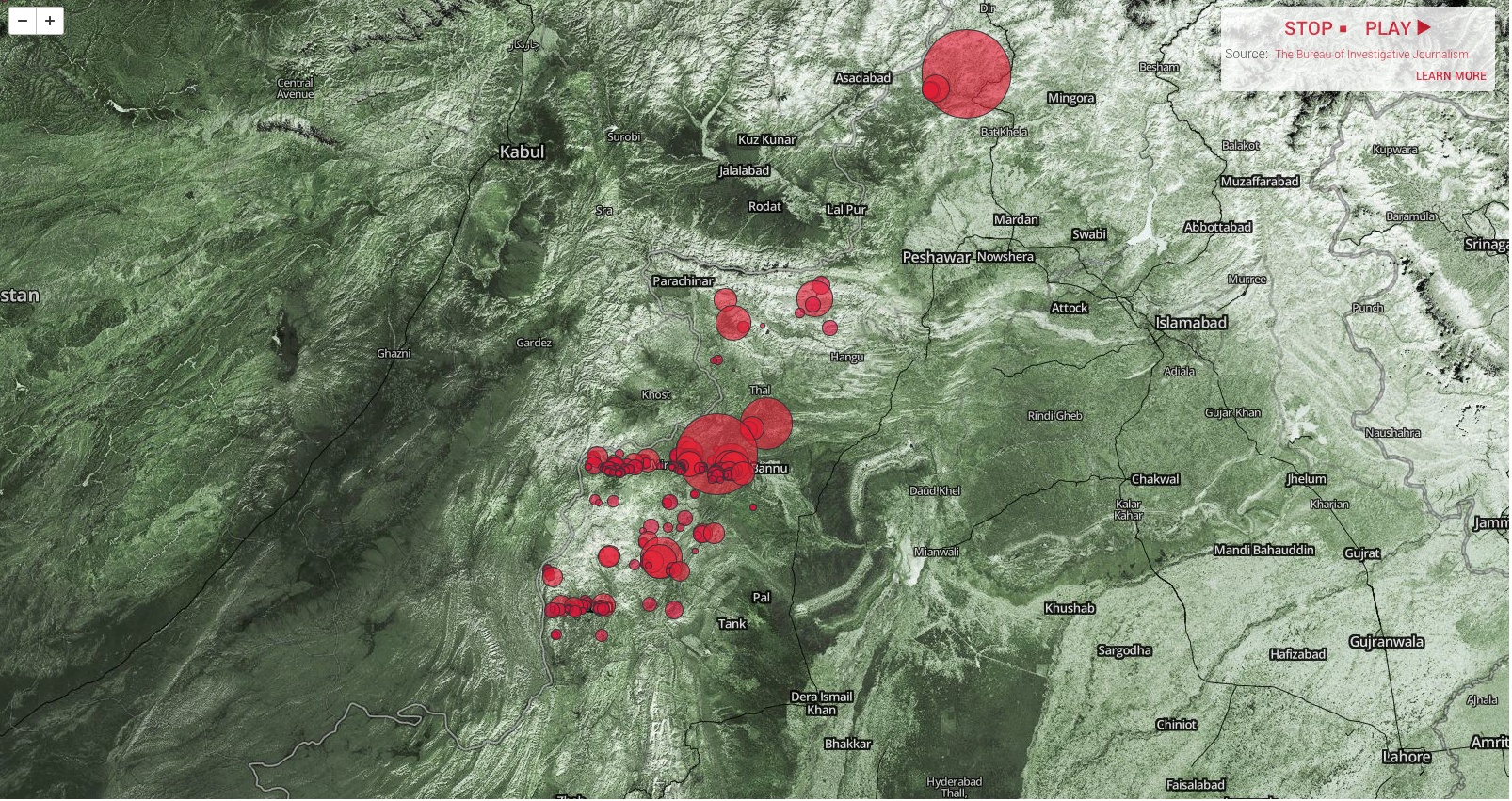
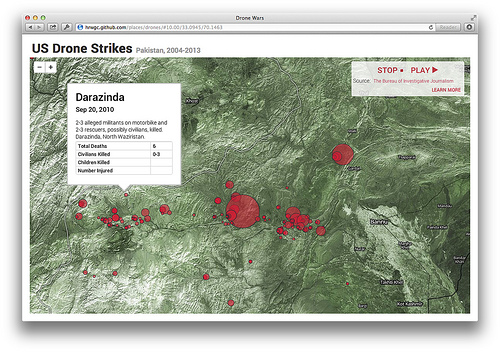
Following up my post on the air campaigns waged by the United States and by Pakistan inside the Federally Administered Tribal Territories and the North-West Frontier Province (now Khyber Pakhtunkhwa), here are some screenshots from Chris Herwig‘s remarkable cartographic animation of casualties from US drone strikes from 2004 through to the present (data from the Bureau of Investigative Journalism):
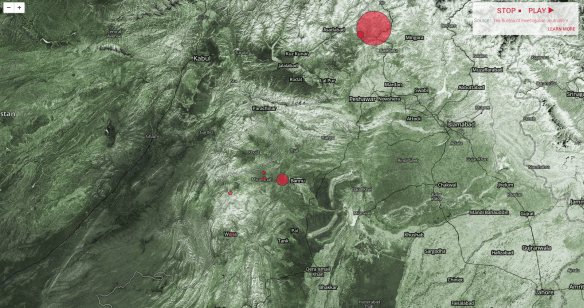
Casualties from US drone strikes to end December 2007
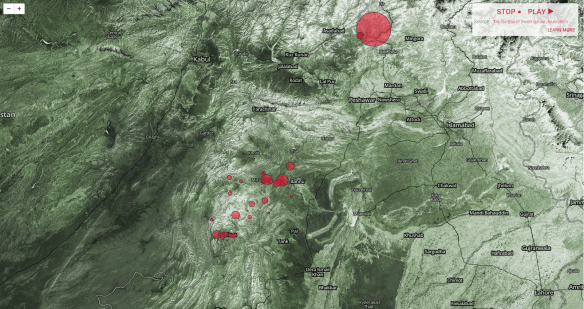
Casualties from US drone strikes to end December 2007

Casualties from US drone strikes to end December 2008
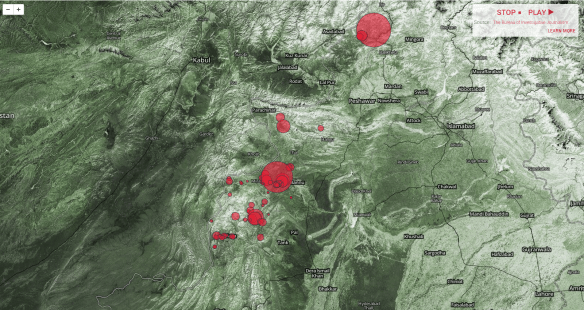
Casualties from US drone strikes to end December 2008

Casualties from US drone strikes to end December 2009
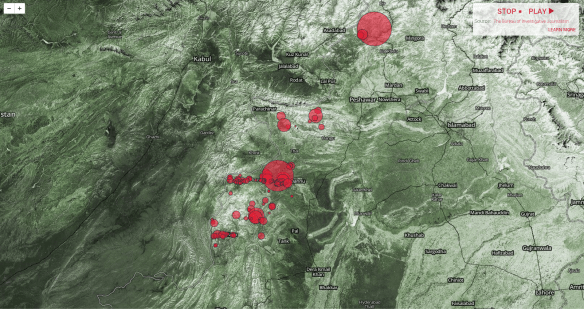
Casualties from US drone strikes to end December 2009

Casualties from US drone strikes to end December 2010
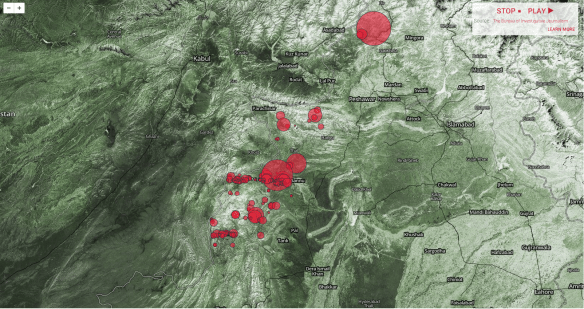
Casualties from US drone strikes to end December 2010

Casualties from US drone strikes to end December 2011
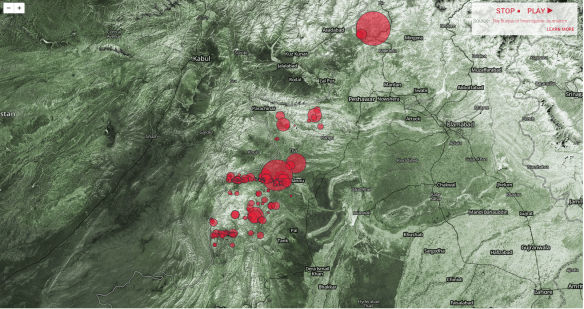
Casualties from US drone strikes to end December 2011

Casualties from US drone strikes to end December 2012

Casualties from US drone strikes to end December 2012

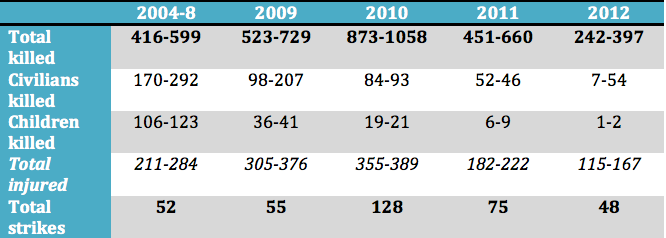
You can see the rapid escalation of strikes in 2009-2010 and their contraction in 2011-2012.  There is also a tendency for later strikes to cause fewer casualties; the Bureau suggests that this may have been the result of a deliberate decision to limit civilian casualties (the CIA was already reported to be using new, smaller missiles with a restricted blast field and minimal shrapnel by the spring of 2010, so the later change is likely to be down to a mix of better intelligence and greater circumspection) and, more recently, of a switch away from ‘signature strikes’ – the two are of course related – and John Brennan, who was one of the main boosters of the programme’s expansion, now claims that drone strikes are a weapon ‘of last resort’.  Maybe; most sources agree that even as the numbers of deaths dwindled, so too did their tactical significance.  By February 2011 it was clear that fewer and fewer were so-called ‘high-value targets’ and more and more were simply foot-soldiers.

Here are the Bureau’s raw figures:
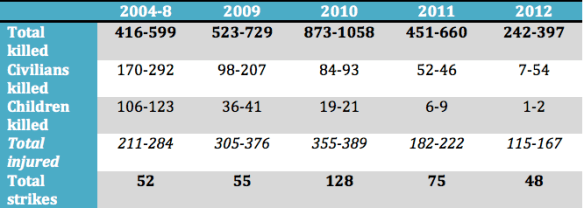
Drone strikes in Pakistan (BoJ)

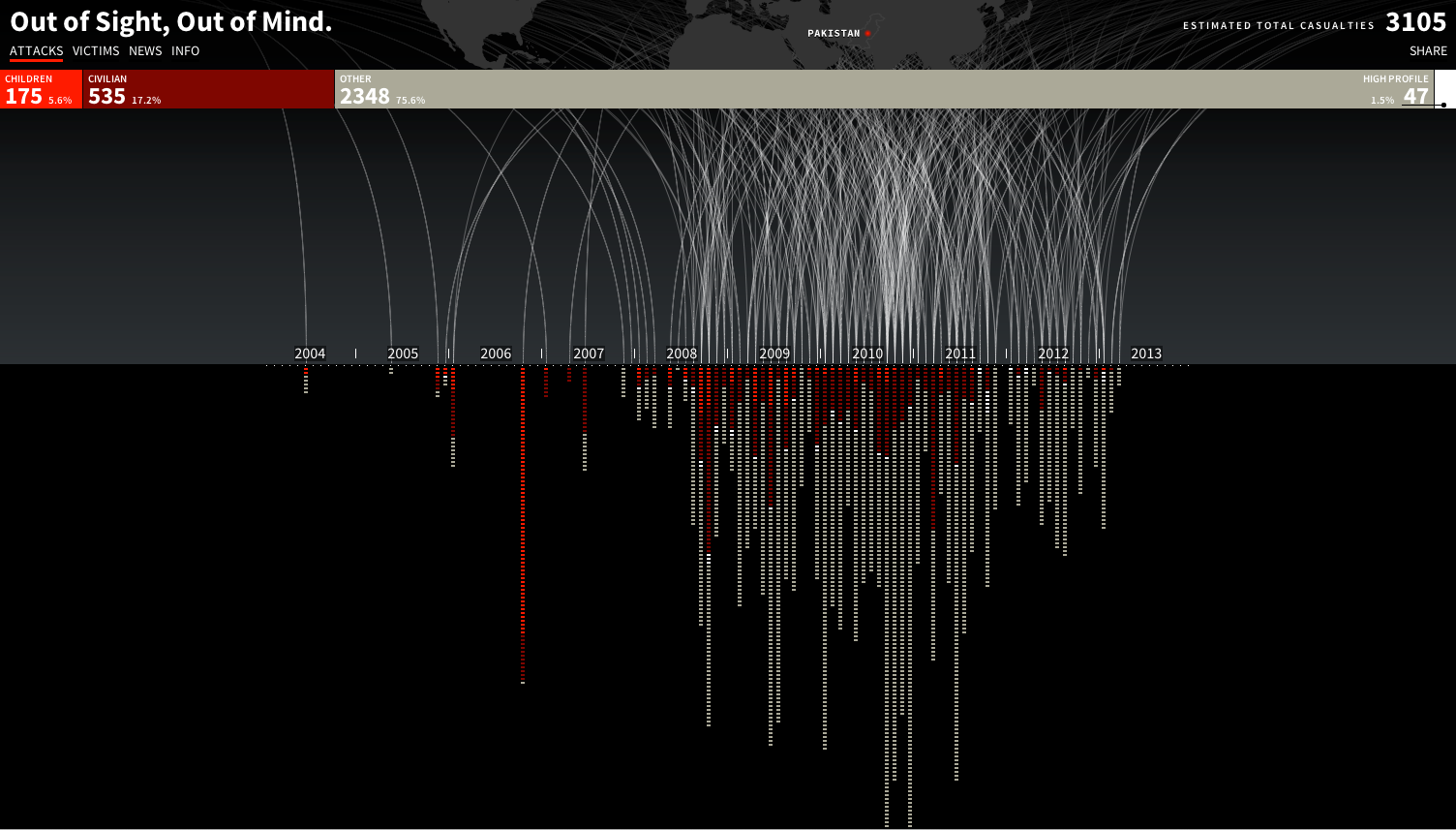
You can find an interactive animation of the Bureau’s tabulations from Pitch Interactive here (thanks to Steve Legg for the tip); the screenshot below doesn’t do justice to the political-aesthetic effect of seeing this in full motion (or of clicking on each strike for the details):
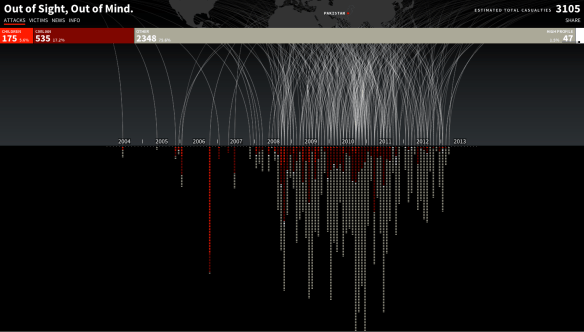
Drone strikes in Pakistan PITCH INTERACTIVE

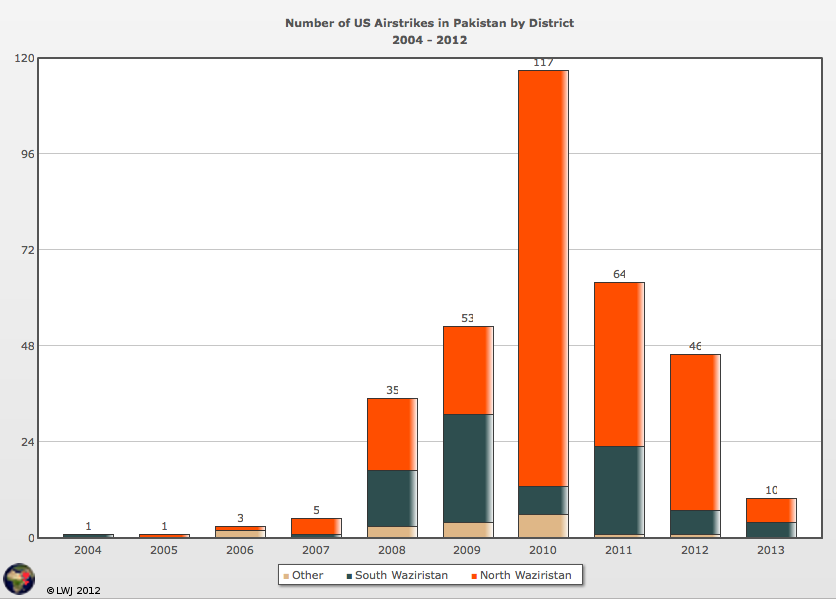
The maps also show that the strikes have been concentrated on North Waziristan, increasingly so since 2010, the locus of the Haqqani Network (which is a longstanding ally of Pakistan’s Inter Services Intelligence), with a secondary concentration on South Waziristan (a key locus of Tehrik-i-Taliban).  Here’s a tabulation from the Long War Journal, and although the strike numbers are marginally different from the Bureau’s the geographical concentration is clear:
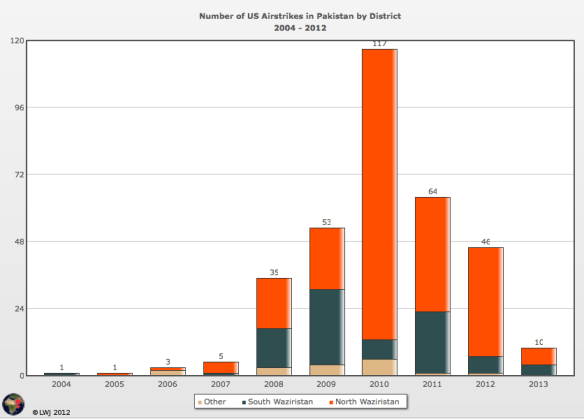
US air strikes in FATA by district

What the maps can’t convey is the intricate, inconstant gavotte between Pakistan’s various military campaigns and US air strikes in the borderlands since 2004.  In the wake of 9/11 and the US-led invasion of Afghanistan, and in response to increasing pressure from Washington, the Pakistan Army launched a number of offensives against militants in the Federally Administered Tribal Areas (FATA).  In April 2004, after fierce fighting in the mountains of South Waziristan, Islamabad concluded a peace accord with Nek Muhammad, a key militant leader in the agency.  But he was killed just two months later, the first casualty of a US drone strike in Pakistan, and the agreement immediately collapsed.   In 2005 similar, fragile agreements were negotiated with Baitullah Mehsud, Nek’s successor, and other militant leaders, but these were soon broken.  Accords were also signed in North Waziristan in 2006 and 2007 but these too were short-lived.  In 2008 a peace accord was signed with the Tehrik-i-Taliban but heavy fighting continued, with major ground and air operations in the agencies to the north of the Khyber Pass.  In 2009 Pakistan’s military campaign became even more aggressive. Much of its effort was focused on the northern districts, especially around the Swat Valley, but attention then switched back to South Waziristan.  During the summer the Pakistan Air Force carried out regular air strikes in the region; in August 2009 Baitullah Mehsud was killed in a US drone strike.  In October 30,000 ground troops entered the region, and US drone strikes in South Waziristan immediately juddered to a (temporary) halt.  These operations drove large numbers of militants into Orakzai, which in recent years has been a major target of air strikes by the Pakistan Air Force.

The previous paragraph is little more than a caricature of a highly complex and evolving battlespace, but the gavotte I’ve described has been artfully – if intermittently – choreographed by the US and by Pakistan in fraught concert: so much so that Joshua Foust writes of the ‘Islamabad drone dance’.

This may surprise some readers; earlier this month Ben Emmerson QC, the UN Special Rapporteur on Counterterrorism and Human Rights, concluded a three-day visit to Pakistan by reaffirming what he described as ‘the position of the government of Pakistan’ that drone strikes in the FATA ‘are a violation of Pakistan’s sovereignty and territorial integrity.’  Emmerson met with officials from the Ministry of Foreign Affairs, the Ministry of Defence and the Secretariat of the FATA – but not, significantly, with anyone from the military or the ISI – who told him that ‘reports of continuing tacit consent by Pakistan to the use of drones on its territory by any other State are false’ and that ‘a thorough search of Government records had revealed no indication of such consent having been given.’ Certainly, the government has repeatedly protested the strikes in public, and the National Assembly passed resolutions in May 2011 and April 2012 condemning them.  But Foust insists that Emmerson has been an unwitting participant in the dance.

We know, from the Wikileaks cache of diplomatic cables from the US Embassy in Islamabad, that in August 2008 Prime Minister Yousaf Raza Gillani told the Ambassador that he approved of the drone strikes as part of ongoing offensives in the FATA – ‘I don’t care if they do it as long as they get the right people’ – and that ‘We’ll protest it in the National Assembly and then ignore it.’  But this was more than ‘tacit consent’.  Foust reminds us that, until comparatively recently, US drones were being launched or supported from at least six different air bases inside Pakistan, shown below, including Islamabad, Jacobabad, Peshawar, Quetta and Tarbela Ghazi; the US was ordered to leave Shamsi and had its lease terminated in December 2011.
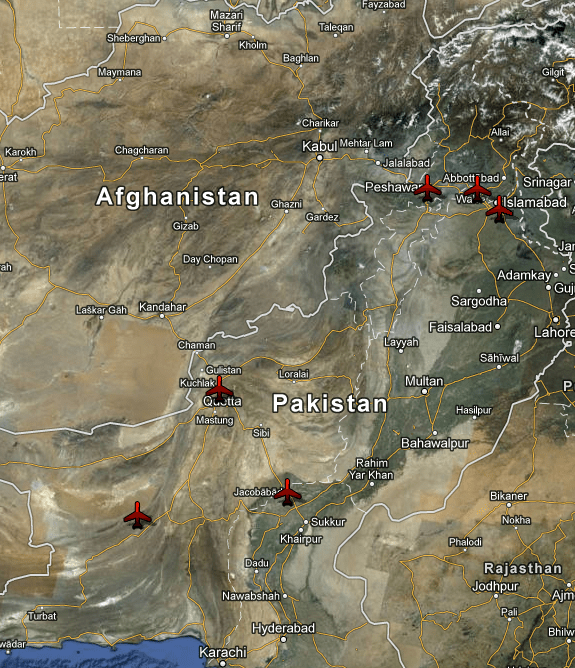
US bases inside Pakistan

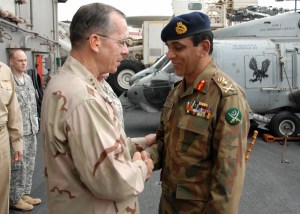
Admiral Mullen greets General Kayani, August 2008But there’s more. Pakistan had agreed that the focus of the US strikes would be North and South Waziristan.  Earlier that same year, March 2008, the Chairman of the Joint Chiefs of Staff Admiral Mullen asked General Kayani, Pakistan’s Chief of Army Staff,  for help in approving ‘a third Restricted Operating Zone for US aircraft over the FATA’, and writing in the Washington Post in November 2010 Greg Miller confirmed that these ‘flight boxes’ were confined to North and South Waziristan (although the US had unsuccessfully pressed for permission to extend the flights over Quetta, outside the FATA).  The geometry of those boxes is not known, though it would not be difficult to superimpose two likely rectangles over the previous map sequence. Operational details are, not surprisingly, far from clear.  According to a report in the Wall Street Journal on 26 September 2012, the CIA sends a fax to the ISI every month detailing strike zones and intended targets – replies apparently stopped early last year, but the US interprets the silence as ‘tacit consent’ since Pakistan immediately de-conflicts the air space to allow the Predators to carry out their surveillance – and a report in the New York Times earlier this month claimed that the US still provides the Pakistan military with 30 minutes notice of an imminent strike in South Waziristan (but no advance notice for strikes in North Waziristan because the Haqqani Network enjoys such close ties with the ISI that the CIA fears their targets would be warned of the attack).

The focus on the FATA follows not only from the militant groups that are based there; it also derives from the exceptional legal status of the borderlands.  Under British colonial rule, this was a buffer zone whose inhabitants were allowed a measure of nominal autonomy; colonial power was exercised indirectly through the authority vested in tribal leaders (who received subsidies from the British), and the special Frontier Crimes Regulations – in practice corrupt and draconian – were codified by Lord Curzon in 1901.  After partition and independence in 1947 Pakistan retained the 1901 Regulations, so that the President – who has direct executive control of the FATA – appoints a Political Agent for each agency who has absolute authority to adjudicate criminal and civil affairs; ordinary Acts of Parliament do not apply to the FATA unless the President expressly declares that they do. Limited reforms were introduced in August 2011, including the right to political mobilisation, but some commentators raised doubts about their implementation.  Preventive detention and collective punishment remain in force and the writ of the courts is still severely restricted.
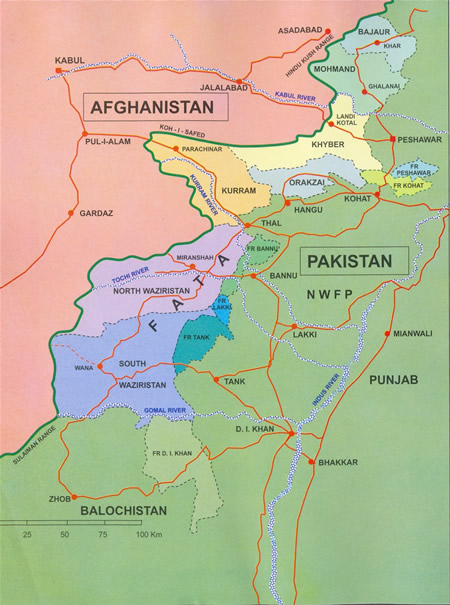
FATA and NWFP map

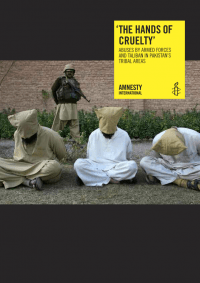
AMNESTY The Hands of Cruelty Abuses by Armed Forces and Taliban in Pakistan s Tribal AreasThese special measures were reinforced by the simultaneous passage of the Actions (in Aid of Civil Power) Regulations in 2011, a quid pro quo demanded by the military, which allowed the Pakistan Armed Forces to carry out ‘law enforcement duties [and] to conduct law enforcement operations’, granted them sweeping powers of pre-emptive arrest and detention without charge, and forbade the high court from intervening.  According to one local politician, these new Regulations are ‘even more dangerous’ than the Frontier Crimes Regulations: ‘It is a system of martial law over the Tribal Areas.’  A new report from Amnesty International (from which I’ve taken these accounts) borrows its title, The Hands of Cruelty, from a despairing claim made by a lawyer from Peshawar: ‘The hands of cruelty extend to the Tribal Areas, but the hands of justice cannot reach that far.’

(Given the – I think abusive – attack on Amnesty’s report by Abdullah Mansoor at Global Research as ‘malicious’ and ‘misinformation’ that virtually ignores the violence perpetrated by the Taliban and other militant groups, I should also draw readers’ (and his) attention to Amnesty’s previous report, As if Hell fell on me, which provides a detailed indictment of exactly that).

In short, the FATA constitute a space of exception in precisely the sense given to that term by Giorgio Agamben: the normal rights and protections under the law are withdrawn from a section of the population by the law.  To see what this has to do with the geography of US drone strikes we can turn to an attack on 19 November 2008 on a residential compound in Indi Khel, 22 miles outside Bannu and about two hours by road from Peshawar.  Five alleged militants were killed and four civilians injured: not a large toll compared to other strikes, and yet the public reaction across Pakistan was extraordinary.
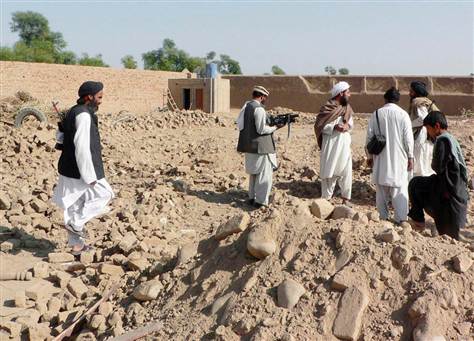
Drone strike at Indi Khel, Bannu, 19 November 2008

A diplomatic cable from US Ambassador Anne Patterson on 24 November explained the widening gap between what she called ‘private GOP [Government of Pakistan] acquiescence and public condemnation for U.S. action’:

‘According to local press, the alleged U.S. strike in Bannu on November 19 marked the first such attack in the settled areas of the Northwest Frontier Province, outside of the tribal areas. The strike drew a new round of condemnation by Prime Minister Gilani, coalition political parties, opposition leaders, and the media.

‘According to Pakistani press, the strike killed four people, including a senior Al-Qaida member, and injured five others. The first strike within “Pakistan proper” is seen as a watershed event, and the media is suggesting this could herald the spread of attacks to Peshawar or Islamabad. Even politicians who have no love lost for a dead terrorist are concerned by strikes within what is considered mainland Pakistan.’

The language is truly extraordinary, with its distinction between the FATA and ‘Pakistan proper’, even ‘mainland Pakistan’. In short: (imaginative) geography matters.  Not for nothing are the FATA known in Urdu as ilaqa ghair, which means ‘alien’ or ‘foreign’ lands.

The plight of the people in the FATA is exacerbated by the forceful imposition of a second, transnational legal regime: the right asserted by the United States to carry its fight against al Qaeda and its war against the Taliban across the border from the ‘hot’ zone in Afghanistan into militant sanctuaries in Pakistan.  This is part of a larger argument about the advanced deconstruction of the traditional, bounded battlefield – here Frédéric Megret‘s work is indispensable – and the production of a global battlespace, processes that have been accelerated by the remote operations permitted by drones.  But it remains both an assertion and an argument.  Although international law is not a deus ex machina, a neutral court of appeal above the fray, it nonetheless has a developed body of precepts that are supposed to regulate armed conflicts between states, and there are also protocols and tribunals that govern armed conflicts between governments and non-state actors within the territorial boundaries of a state (the former Yugoslavia or Ruanda, for example).  But conflicts between states and transnational non-state actors pose new and difficult questions, and perhaps even map a ‘legal void’.  Significantly, as Eyal Benvenisti points out in the Duke Journal of International and Comparative Law,

Concurrently with the successful efforts to impose restraints on intra-state asymmetric warfare, we have been witnessing efforts by the same powerful countries that pressed for intra-state conflict regulation to deregulate inter-state asymmetric warfare or what may be called “transnational” warfare.

I will leave a review of these debates, at once legal and political, for another day; among the most relevant recent contributions are Kenneth Anderson, ‘Targeted killing and drone warfare: how we came to debate whether there is a legal geography of war’ (2011), available here; Laurie Blank, ‘Defining the battlefield in contemporary conflict and counterterrorism: understanding the parameters of the zone of combat’, Georgia Journal of International and Comparative Law 39  (1) (2010-11), available here; Jennifer Daskal, ‘The geography of the battlefield: a framework for detention and targeting outside the “hot” conflict zone’ (2012), available here;  Noam Lubell and Nathan Derejko, ‘A global battlefield? Drones and the geographical scope of armed conflict’, Journal of International Criminal Justice 11 (1) (2013) 65-88 (abstract here).  In this twilight zone, where Washington at once admits its actions through a never-ending string of off-the-record briefings and yet denies any responsibility for their collateral outcomes, there are no inquiries into ‘mistakes’, no culpability for wrong-doing, and no compensation or restitution for the innocent victims.

Whatever you make of the rights and wrongs of all this, what matters for my present purposes is that these two legal regimes, one national and the other transnational, work in concert to expose the people of the Federally Administered Tribal Areas to military and paramilitary violence and, ultimately, death.

It’s more than a matter of law, of course (and in any case we shouldn’t confuse legality with legitimacy).  Within these exceptional spaces there has been active, tactical collaboration between the US and Pakistan.  Another diplomatic cable reported a meeting on 22 January 2008 with General Kayani, who asked US Central Command to provide ‘continuous Predator coverage of the conflict area’ in South Waziristan, but was offered only Joint Terminal Attack Controllers to direct PAF air strikes by F-16s – an offer which was refused because of a reluctance to allow US ground forces to operate inside Pakistan.  But in September and October 2009 small teams of US Special Forces were deployed to provide intelligence, surveillance and reconnaissance (ISR) support to the Pakistan Army, which included a ‘live downlink of unmanned aerial vehicle (UAV) full motion video.’ (What is interesting about all these exchanges is the degree of collaboration they reveal not only between the US and Pakistan but also between the CIA and the US military, especially Joint Special Operations Command; this is not surprising, given the hybridisation of military and paramilitary violence and the close involvement of the military in supplying, servicing and even flying the drones used in CIA-directed strikes).

There have been several reports of continuing collaboration between American and Pakistani intelligence operatives working on the ground in Pakistan, and one source – who purported to run a network of agents and ‘spotters’ in North and South Waziristan – told Reuters in January 2012 that ‘Our working relationship is a bit different from our political relationship.  It’s more productive.’  He claimed that the US and Pakistan agreed priority target lists between them, and that it took little more than two or three hours between the location of a targeted individual and the firing of missiles.  These claims are impossible to verify, but the emphasis on a working relationship rings true.
FATA flagPerhaps the most chilling of the Wikileaks cables is this (redacted) message sent from Islamabad in February 2009, reporting a discussion with a senior member of the FATA Secretariat, who enthusiastically recommended the practice of ‘double tap‘ – follow-up strikes targeting rescuers – and endorses the rationale for signature strikes against unknown, un-named targets:

9.  (S)  XXXXXXXXXXXX remains a strong advocate of U.S. strikes. In fact, he suggested to PO that the U.S. consider follow-on attacks immediately after an initial strike.  He explained that after a strike, the terrorists seal off the area to collect the bodies; in the first 10-24 hours after an attack, the only people in the area are terrorists, so “you should hit them again-there are no innocents there at that time.”  His sources report that the reported September 29 strike in South Waziristan had been particularly successful; “you will see that you hit more than has been reported in the press both in terms of quantity and quality.”  XXXXXXXXXXXX also drew a diagram essentially laying out the rationale for signature strikes…

Here you can see two perspectives on administrative killing, one from Pakistan and the other from the United States, converging onto a single target.

The cables from which I’ve quoted are all four or five years old, but this reflects the shutters coming down after the subsequent assault on Wikileaks and the arrest of  Bradley Manning – the reports from seasoned investigative journalists are much more recent.  I suppose you might conclude that none of them contradicts that artful word that does so much silent work in the official statement repeated by Emmerson, in which Pakistan denies reports of continuing tacit consent.  But given what I’ve shown about the deadly dance over those five years, do you really think the music has stopped?
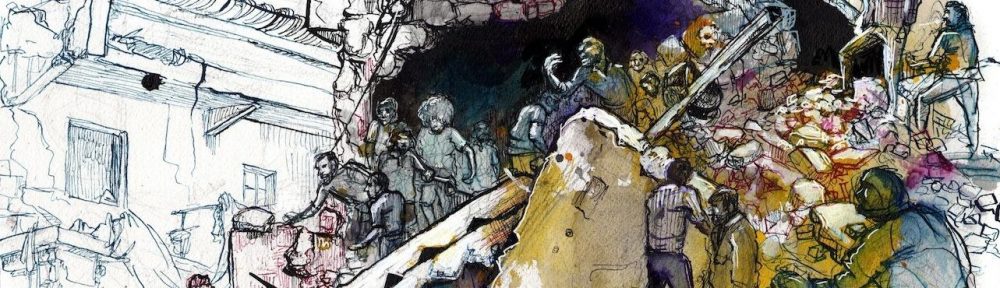
Air strikes in Pakistan’s borderlands

I’m speaking about Drone strikes and the matrix of violence in Pakistan at a conference in Vancouver at the week-end – a presentation which will form part of The everywhere war – and to set some of the parameters I’ve been revisiting the changing geography of air strikes in the Federally Administered Tribal Areas.  It’s a formidably difficult question given the extraordinary dangers facing journalists, Pakistani or foreign, seeking to report from the FATA: for an incisive discussion of the media landscape inside the FATA see Sadaf Baig‘s Reporting from the frontlines.

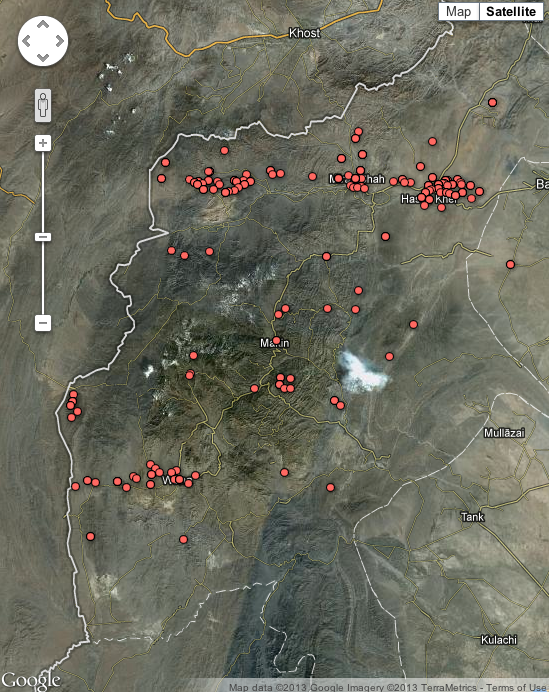
In my view, the most thorough if necessarily imperfect tabulations of US-directed strikes are those provided by the Bureau of Investigative JournalismThere have been several attempts to map this database, including the Bureau’s own use of Google maps (see below and here; but be careful: zooming in is a product of the digital platform and will give a misleading sense of the resolution level of the data).

BOJ US drone strikes in FATA

One of the most thoughtful (and dynamic) representations comes from Chris Herwig.  He described the technical basis of his mapping over at MapBox here, and you can visit his microsite here.  Go here to see the animation running (with annotations).

8448237526_92002912de

Chris’s project has also been featured on PBS here, where he also responds to several criticisms of the data and his visualizations.

Over at Slate, Chris Kirk has produced an interactive that tries to show the maximum number of estimated casualties from each strike, but the data are drawn from the New America Foundation database which has been criticised for underestimating casualties; one (to October 2012) version is here, and another (to February 2013), using a different cartographic design, is here.  More generally, Forensic Architecture‘s Unmanned Aerial Violence team is working to produce an online visualization of drone strikes not only over Pakistan but also over Afghanistan,Yemen, Somalia and Palestine. but it’s not yet operational).

But the problem doesn’t end with the cartographic piercing of the veil of semi-secrecy the White House, the CIA and JSOC cast over their remote operations, though I’ve noted before how their collective teasing of American journalists over the legal and administrative protocols they supposedly follow – especially the so-called “disposition matrix” –  works to (mis)direct attention towards Washington and away from the sites that Chris and others have struggled to map.

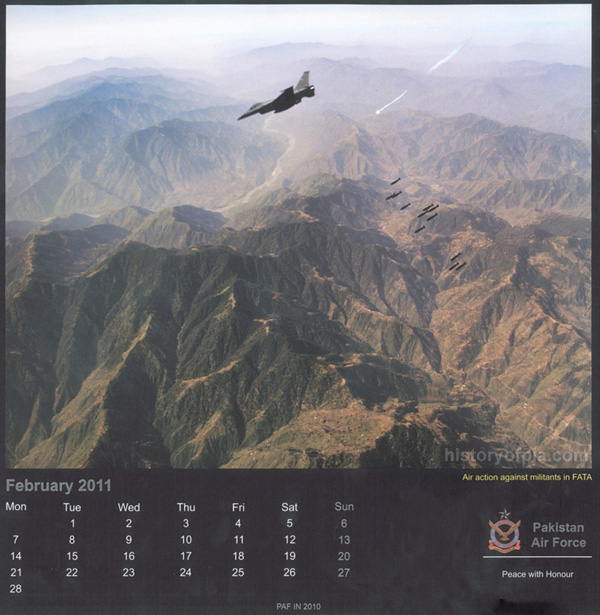
I say this because the US is not the only state carrying out air strikes in the region.  Soon after 9/11 and the US-led invasion of Afghanistan, largely in response to pressure from Washington, the Pakistan military moved into the FATA.  According to Zahid Ali Khan, Pakistan’s Frontier Corps was deployed in December 2001, but by May 2002 it was decided that a much heavier hand was needed and the Pakistan Army was ordered into the borderlands for the first time in the nation’s history.  Local people requested that military operations be limited to ground forces, but by 2004 this agreement was in shreds and – as the image below shows – ever since the Pakistan Air Force has made no secret of its continuing air strikes on the FATA.

PAF air strike in FATA

Again, there is no public tabulation, but the American Enterprise Institute‘s Critical Threats daily Pakistan Security Brief – I know, I know, it’s a neoconservative think-tank – culls this (needless to say, approving) record from reports in Pakistan media in the first two months of this year alone:

25 February PAF kills 10 TTP militants in Tirah [Kurram/Khyber, FATA]

21 February PAF bombs militants in Orakzai [NWF Province] killing 29

19-20 February PAF jets bomb TTP hideouts in Orakzai

11 February PAF jets kill 8 militants in the Tirah Valley

8 February Jets kill 9 militants in Orakzai

7 February PAF targets militants in Orakzai

6 February Jets kill 8 in Orakzai

30 January PAF kills 23 militants in Tirah Valley and 8 in Orakzai agency

28 January Pakistani jets bomb militants in Orakzai

4 January Gunships kill 3, injure more in North Waziristan retaliation

It’s a bare bones summary, clearly, and I suspect the readiness of the AEI to trust local media to report PAF strikes is in stark contrast to their attitude to local reports of US drone strikes.  I’ve also deliberately retained the original phrasing: conspicuously, there is no record of  civilian casualties. Like the United States, Pakistan routinely plays these down or denies them altogether.  Here, for example, is a typical report via the Long War Journal on 25 March 2010:

‘Pakistani fighter-bombers struck a series of targets in the Mamuzai region in [Orakzai] today. Sixty-one Taliban fighters were killed, Pakistani intelligence officials told The Associated Press. The military claimed that no civilians were killed in the attacks. The targets included a madrassa, a mosque, and a seminary run by the Tablighi Jamaat. Pakistani officials said that Taliban leaders were meeting at the Tablighi seminary.’

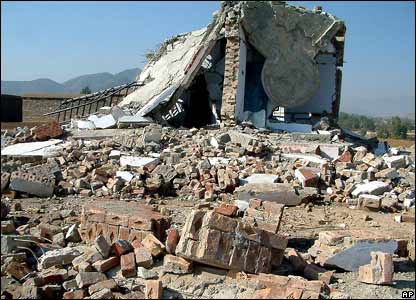
PAF air strike, Orakzai

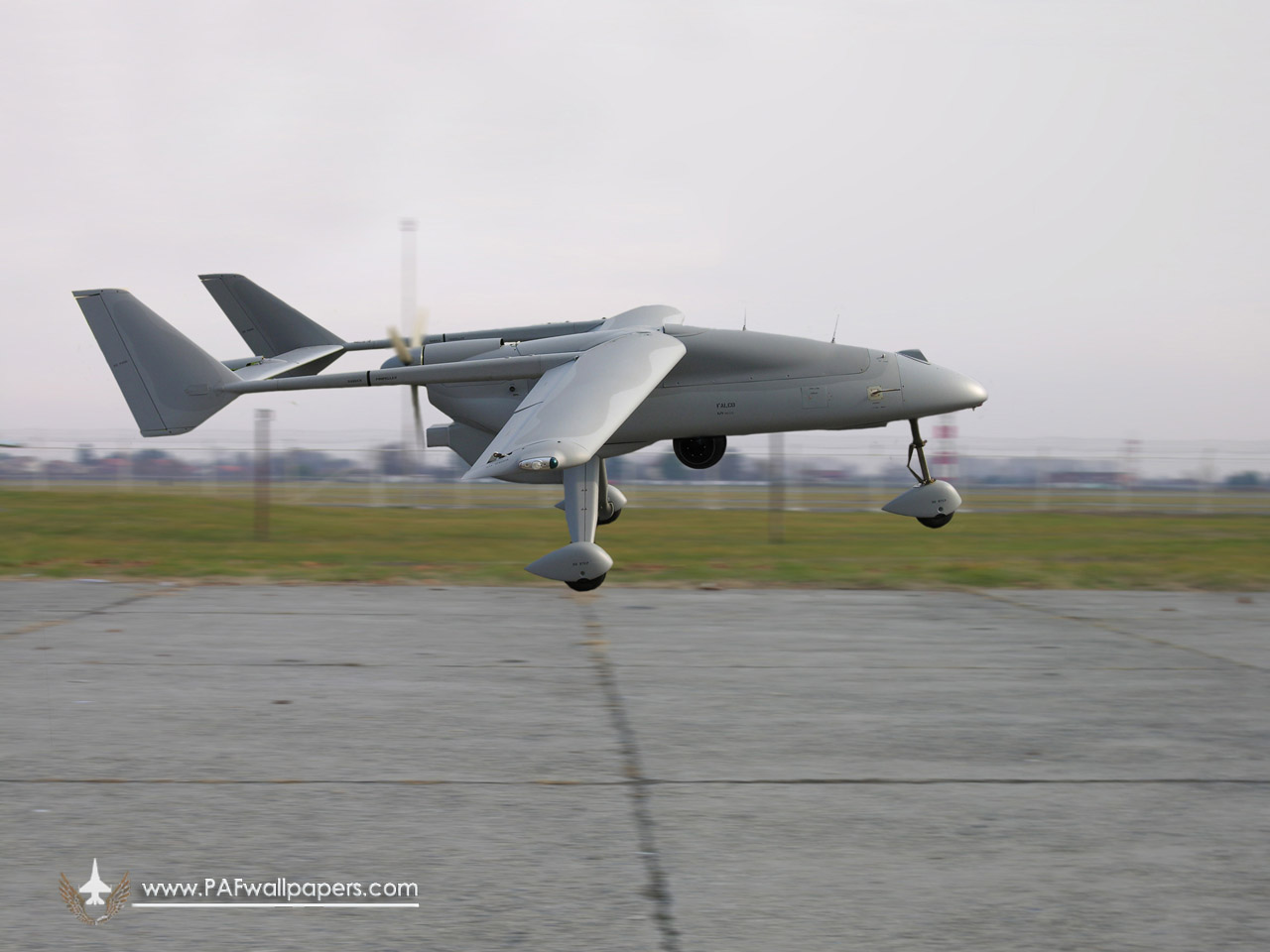
It’s unlikely that civilians were unscathed.  For the first four years at least the accuracy of the Air Force’s strikes was compromised by what Irfan Ahmad described as  its ‘lack of real time electronic intelligence and inferior technical means for command, control and communications’, by deficiencies in the targeting pods used by the PAF’s  ageing F-16 aircraft, and by the use of laser-guided missiles whose precision was reduced by clouds or poor visibility.  From 2008 new electro-optical targeting pods and sensors were being retrofitted and new ground and air capabilities for image exploitation put in place.  In 2009 the Air Force was also the launch customer for the Anglo-Italian Falco reconnaissance drone (see below), which is now co-produced in Pakistan; five systems were soon in use over the FATA, each comprising four aircraft with one held in reserve, and the Air Force was already anticipating arming them ‘with the most modern and lethal payloads’. More recently, the PAF has upgraded its F-16 fleet with new Block 52 versions and installed advanced avionics.  Throughout this period, as the military offensive periodically intensified, hundreds of thousands, perhaps millions of people were displaced from the borderlands.

falco_uav_galileo_avionica_paf_pakistan_air_force_01

It’s difficult to provide a detailed accounting of the air strikes, but in a rare admission former Air Chief Marshall Rao Qamar Suleiman claimed that the Pakistan Air Force carried out 5,000 strike sorties and dropped 11,600 bombs on 4,600 targets in the FATA between May 2008 and November 2011.  Unlike US air strikes in the region, PAF strikes are rarely ‘stand-alone’ affairs but are co-ordinated with ground forces (which is also the case with most drone strikes in Afghanistan, which operate in close concert with troops and conventional strike aircraft).

My object is recording all this is (I hope obviously) emphatically not to say that it is perfectly acceptable for the US to launch air strikes in the FATA because Pakistan is doing the same. Rather, the co-existence of the two air campaigns explains, in part, how it is possible for each party to accuse the other of carrying out an attack, as reported earlier this month.  More importantly, it also emphasises the ever-present horizon of danger within which the inhabitants of the borderlands are forced to live.  They are not only Living under drones.

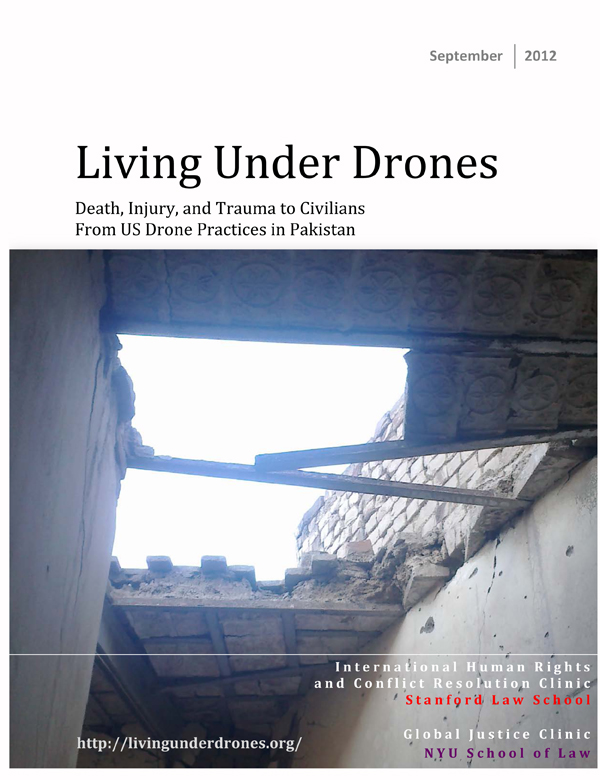
Living Under Drones

The same point was sharpened by CIVIC – now the Center for Civilians in Conflict – in their (I think vital) report Civilian harm and conflict in North West Pakistan, published in October 2010. That report also details the violence meted out to civilians by militant groups in the region; for a detailed survey of the political geography of the borderlands, see Brian Fishman‘s The Battle for Pakistan: militancy and conflict across the FATA and NWFP, produced for the New America Foundation in 2010; there’s also much to think about in Daanish Mustafa and Katherine Brown, ‘Spaces of performative politics and terror in Pakistan‘, and in the same authors’ ‘The Taliban, Public Space and terror in Pakistan‘.

The existence of the two air campaigns also shows that the FATA are produced as a space of exception not only through Washington’s strenuous juggling with the Authorisation to Use Military Force and with international law (to validate the extension of its ‘global battlefield’) – whether it does so with or without Islamabad’s covert consent remains an open question – but also through Islamabad’s continued determination to treat the borderlands as legally anomalous territories for its own assertion of military violence.

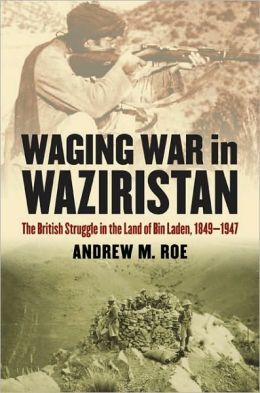
ROE Waging war in WaziristanThe last is a doubled colonial legacy.  Not only is the legal geography that structures the FATA’s relations with the Pakistani state a relict from Britain’s imperial decision to treat them as a space to be ‘excepted from state and society for the purposes of war’, as Ian Shaw and Majed Akhter put it in Antipode recently.

So too is the decision to continue to use the FATA as a laboratory for what the British called ‘air control’. Andrew Roe has provided a series of detailed discussions in the RAF’s invaluable Air Power Review, here and here and here, and brought much of his research together in Waging war in Waziristan (2010).

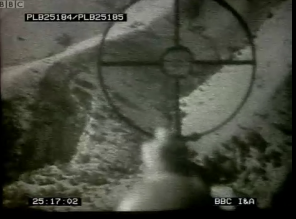
But for a rapid and sobering sense of how these campaigns were viewed from the air in the 1930s you need to watch this BBC interview with Group Captain Robert Lister, Wings over Waziristan, which includes extraordinary cine footage showing what he calls ‘tribal operations from the air’.  Lister was posted to Peshawar in 1935, and soon after he arrived both the Army and the Air Force were ordered to put down ‘a tribal insurrection or rebellion’ in Waziristan.  Their preferred method was to destroy villages by setting fire to individual houses, blowing them up, or bombing them from the air ‘to make them say “Right, it’s not worthwhile – come to terms.”‘  Listen as Lister says, in cut-glass tones, ‘It was a fair and just way of dealing with it: they started these troubles and had to be dealt with.’

Waziristan:Lister:Here's an attack being carried out

And if you want to discover a different dimension to ‘unmanning’ aerial vehicles, listen from 08.00-08.40.

UPDATE: I’ve just discovered another film shot over Waziristan in 1937 by Leonard de Ville Chisman, which covers the air and ground war against the Faqir of Ipi described by Lister.  It contains a number of strikingly similar shots, though there is of course no commentary: you can access it via Colonial Film: Moving Images of the British Empire here.  On that remarkably informative site, Francis Gooding writes:

The official record of NWFP operations during 1936-7 – a thick volume, its size indicating the scale and seriousness of the conflict – contains full details about the manner in which aircraft were employed. The flag marches of November that sparked the revolt were accompanied by aircraft reconnaissance, and the record notes that ‘air reconnaissance requirements were met by one flight of No. 5 (Army Co-operation) Squadron’ (Govt of India, op.cit., 15), and the RAF also provided close cover for troops, and this pattern – reconnaissance with close support against the enemy – was repeated throughout the operations.

Reels 14 and 15 of the Chisman collection record precisely these kinds of encounters and air operations, with footage of bombing raids and the dropping of supplies to forward positions by parachute taken from within flying aircraft. Aircraft were also used to disseminate information and warnings about future punitive action (again, this was a tried and tested method, typical of colonial air policing; see Omissi, 1990, 154-5). On 27 August 1937, for instance, ‘notices were dropped over the Shawal area warning the inhabitants that until the Faqir submitted to Government, any tribe sheltering him would be liable for punishment’ (Govt. of India, op.cit., 179), and reel 15 contains a sequence showing a pilot unfurling a large leaflet, with text in Pashto and Urdu. The following sequences show air-drops of these leaflets over hill country. There are also scenes showing armoured cars and tanks on the move, and a sequence apparently shot during a battle, with a line of artillery opening fire on hill positions. 

The Faqir’s uprising was arguably the most serious colonial insurgency of the inter-war imperial period, and the films are remarkable in that they record scenes of action from a poorly remembered but major guerrilla conflict. Beyond this historical importance they have another significance, for they offer scenes of something only very rarely captured on film, despite its regular occurrence throughout the Empire – the recourse to the punitive deployment of heavy weaponry against subject peoples in revolt.

Torture, drones and detention


Hajjar and Khalili
Lisa Bhungalia writes with the welcome news that Jadaliyya has audio of a conversation between Laleh Khalili and Lisa Hajjar on ‘Torture, drones and detention’ at SOAS earlier this month.

The publication of Laleh’s Time in the shadows: confinement in counterinsurgencies (Stanford, 2012) and Lisa’s Torture: a sociology of human rights and violence (Routledge, 2012) is the occasion for a wide-ranging discussion of ‘the vagaries of liberal warfare’, including the intimacies between humanitarianism  (indeed, the very idea of the human) and war.

Lost in translation

US Army translation in Afghanistan, 2010

The power of coincidence.  Just after I finished posting about the fog (and friction) of war, I opened an e-mail from Vince Rafael, who was at UBC a year or so ago to present a paper on counterinsurgency on which I’d been asked to comment.  He’s now sent me the published version, ‘Targeting translation: counterinsurgency and the weaponization of languiage’, which appears in the latest issue of Social Text 30 (4) (2012) 55-80.  It’s a characteristically elegant, original and powerful argument:

The chronic failure of counterinsurgency to convert language, whether its own, English, or the other’s, into a weapon, that is, into a standing reserve that could be switched, secured, and deployed, tends to generate catastrophic effects. Targets are missed or misconstrued, accidents abound, death proliferates, while no one is held accountable. As I have been suggesting, the resistance of language to weaponization is not incidental but structurally built into the very discourse and practices of counterinsurgency. That counterinsurgency harbors the very elements of its own undoing can be understood in at least two ways. On the one hand, as military leaders and engineers tend to think of it, the intractability of language could be regarded as a kind of noise that adds to the friction of war: merely a technical problem that can be fixed with greater application of resources, financial and technological, and a strengthening of political will. On the other hand, we could think of the insurgency of language as evidence of the possibility of another kind of translation practice at work. Operating in between the lines of imperial commands, it would be a kind of translation that evades targeting, spurring instead the emergence of forms of life at variance with the biopolitical prescriptions of counterinsurgency.

It’s an argument that not only extends the standard critique of ‘the weaponization of culture’ directly into the domain of language but also explores, in Vince’s brilliant coda ‘Translating otherwise’, the confounding capacities of language to refuse the reduction of the life of the Other to a target.

The Lincoln Brigade

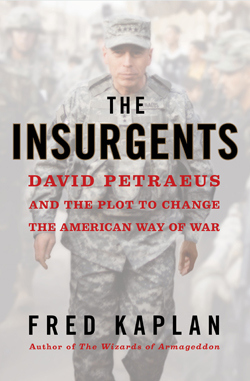
FRED KAPLAN The insurgentsIn a previous post on what I called ‘the martial Arts‘ I commented on the teaching of humanities at the US Military Academy at West Point.  Now NBC has posted an extract from Slate columnist Fred Kaplan‘s new book, The insurgents: David Petraeus and the plot to change the American way of war (Simon & Schuster, 2013) that speaks directly to the role of the Department of Social Sciences (“Sosh”) in the reformulation of US counterinsurgency doctrine.
I’ve grown weary – and sceptical – of the constant placing of David Petraeus front and centre in these discussions, since I think that much of the effort was de-centred, emerging through pragmatic experiments by different commanders on the ground at different places in Afghanistan and particularly Iraq, but Kaplan provides an interesting gloss on the history of the social sciences at West Point – and in particular the attempt to produce ‘a sense of separate space for critical inquiry’ – and the reach of its interpersonal network of alumni who called themselves ‘the Lincoln Brigade’.

SOSHThe social sciences program at West Point owed its power to General George ‘Abe’ Lincoln – who, astonishingly, insisted on a demotion to Colonel in order to take up a position at West Point – who, in the wake of the Second World War, envisaged a new kind of staff officer, one ‘with three heads’: one military, one political and one economic.  (The current course catalog is here: it emphasises American Politics, Comparative Politics, International Relations and Economics).
Over the years, a network of Lincoln’s acolytes—and the acolytes of those acolytes—emerged and expanded. They called themselves the “Lincoln Brigade” (an inside joke on their left-wing stereotype, referring to the Abraham Lincoln Brigade, the group of American leftists who, in the 1930s, had gone off to fight against fascists in the Spanish Civil War). Over the years, when these alumni-officers were appointed to high-level positions, they’d usually phone Colonel Lincoln—or, later on, his successors as department chairmen—and ask for the new crop of top Sosh cadets, or the most promising junior faculty members, to come work as their assistants.

I can imagine that Petraeus on the cover – or between the covers – is a strong selling-point (the revelation of Petraeus’s affair pushed up the book’s publication from February), but Kaplan has used e-mails, documents and interviews to bring into sharper focus the role of men like John Nagl, H.R. McMaster and Peter Chiarelli in reformulating ‘the American way of war’.

Janet Maslin‘s New York Times review here, and Eliot Spitzer’s interview with Kaplan here (where he emphasises Petraeus’s skill at building a myth about himself….).