Urban guerrillas

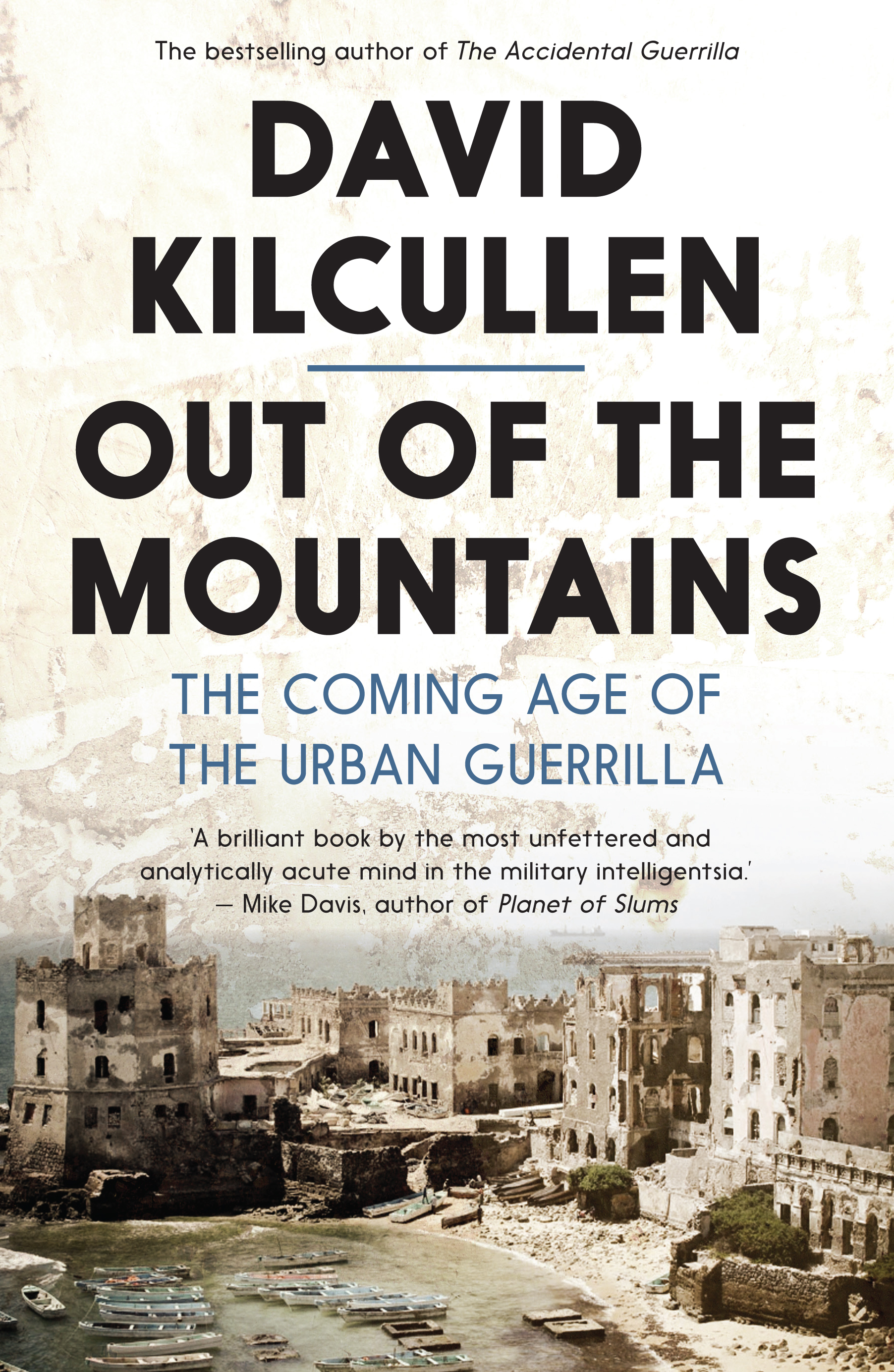
I’ve noted David Kilcullen‘s adventures into geography before, and the entanglement of his vision of counterinsurgency with the humanitarian present – here and here – and over at Gizmodo Geoff Manaugh (of the always interesting and enviably imaginative BLDGBLOG) has an interesting commentary on Kilcullen’s new book, Out of the Mountains: the coming age of the urban guerrilla (Hurst/Oxford University Press USA, 2013.  An extended excerpt is available here, if you scroll down, and a presentation on “The city as a system: future conflict and urban resilience” from last year is available here.

KILCULLEN Out of the mountains

Back to Geoff:

Kilcullen’s overall thesis is a compelling one: remote desert battlegrounds and impenetrable mountain tribal areas are not, in fact, where we will encounter the violence of tomorrow. For Kilcullen—indeed, for many military theorists writing today—the war in Afghanistan was not the new normal, but a kind of geographic fluke, an anomaly in the otherwise clear trend for conflicts of an increasingly urban nature.

The very title of Kilcullen’s book—Out of the Mountains—suggests this. War is coming down from the wild edges of the world, driving back toward our lights and buildings from the unstructured void of the desert, and arriving, at full force, in the hearts of our cities, in our markets and streets. There, conflict erupts amongst already weak or non-existent governments, in the shadow of brittle infrastructure, and what Mike Davis calls “the nightmare of endless warfare in the slums of the world” in his blurb for Kilcullen’s work, becomes uncomfortably close to reality.

Strictly speaking, Geoff’s commentary derives from a talk Kilcullen gave at the World Policy Institute, one of a large number of public appearances to promote the book on both sides of the Atlantic; here is a transcript of his talk at Chatham House, and here is his presentation to the New America Foundation last month, introduced by Peter Bergen:

Geoff is not completely convinced by it.  Some of the themes will be familiar to most readers – the bleeding of war into crime has been a staple of the ‘new wars’ thesis, for example – and you can hear distant echoes of Saskia Sassen‘s ideas about cities and later modern war.  More particularly, Steve Graham‘s brilliant work on the new military urbanism addresses many of the same issues Kilcullen raises – as Kilcullen notes himself – though he does so in a markedly different vocabulary: Geoff and I have crossed swords over this before, but while he describes “feral cities” as ‘one of my favorite phrases of all time’ I think it’s dehumanizing – though I do understand that’s exactly not Geoff’s intention).

Geoff is also (I think rightly) sceptical about the aerial-algorithmic intervention that Kilcullen touted at the WPI:

‘During the Q&A, Kilcullen briefly mentioned the work of Crisis Mappers, who have developed tools for visually analyzing urban form using satellite photos. According to Kilcullen, they are able to do this with an astonishing degree of accuracy, diagnosing what parts of cities seem most prone to failure. Whether this is due to empty lots and abandoned buildings or to infrastructural isolation from the rest of the city, the factors that determine “ferality” in the built environment is a kind of aerial application of the Broken Windows theory.

The implication—conceptually fascinating, but by no means convincing, at least for me—was that we could, in theory, develop a visual algorithm for identifying environments tending toward failure, and thus find a way to intervene before things truly fall apart. Teams of architects with their own dedicated satellites could thus scan the cities of the world from above, algorithmically identifying urban regions prone to collapse, then intervening with a neighborhood redesign.’

Have we learned nothing from almost a decade of remote-surveillance ISR and algorithmic counterinsurgency in which maps and metrics substitute for meaning?  And while the attacks in Nairobi confirm the city as a continuing arena of military and paramilitary violence in the twenty-first century, they surely can’t be directly assimilated to a ‘feral city’ thesis (though Kilcullen does his best here)?  We’ll see: I’m part way through the book, and will post a more considered response when I’m done.

The individuation of warfare?

chamayou-manhuntsBefore I resume my reading of Grégoire Chamayou‘s Théorie du drone, I want to approach his thesis from a different direction. As I’ve noted, much of his argument turns on the reduction of later modern war to ‘man-hunting’: the profoundly asymmetric pursuit of individuals by activating the hunter-killer capacities of the Predator or the Reaper in a new form of networked (para)military violence. He describes this as a ‘state doctrine of non-conventional violence’ that combines elements of military and police operations without fully corresponding to either: ‘hybrid operations, monstrous offspring [enfants terribles] of the police and the military, of war and peace’.

These new modalities increase the asymmetry of war – to the point where it no longer looks like or perhaps even qualifies as war – because they preclude what Joseph Pugliese describes as ‘“a general system of exchange” [the reference is to Achille Mbembe’s necropolitics] between the hunter-killer apparatus ‘and its anonymous and unsuspecting victims, who have neither a right of reply nor recourse to judicial procedure.’

Pugliese insists that drones materialise what he calls a ‘prosthetics of law’, and the work of jurists and other legal scholars provides a revealing window into the constitution of later modern war and what, following Michael Smith, I want to call its geo-legal armature. To date, much of this discussion has concerned the reach of international law – the jurisdiction of international law within (Afghanistan) and beyond (Pakistan, Yemen and Somalia) formal zones of conflict – and the legal manoeuvres deployed by the United States to sanction its use of deadly force in ‘self-defence’ that violates the sovereignty of other states (which includes both international law and domestic protocols like the Authorization for the Use of Military Force and various executive orders issued after 9/11) . These matters are immensely consequential, and bear directly on what Frédéric Mégret callsthe deconstruction of the battlefield’.

HIPPLER Bombing the PeopleIt’s important to understand that the ‘battlefield’ is more than a physical space; it’s also a normative space – the site of ‘exceptional norms’ within whose boundaries it is permissible to kill other human beings (subject to particular codes, rules and laws). Its deconstruction is not a new process. Modern military violence has rarely been confined to a champ de mars insulated from the supposedly safe spaces of civilian life. Long-range strategic bombing radically re-wrote the geography of war. This was already clear by the end of the First World War, and in 1921 Giulio Douhet could already confidently declare that

‘By virtue of this new weapon, the repercussions of war are no longer limited by the farthest artillery range of guns, but can be felt directly for hundreds and hundreds of miles… The battlefield will be limited only by the boundaries of the nations at war, and all of their citizens will become combatants, since all of them will be exposed to the aerial offensives of the enemy. There will be no distinction any longer between soldiers and civilians.’

The laboratory for these experimental geographies before the Second World War was Europe’s colonial (dis)possessions – so-called ‘air control’ in North Africa, the Middle East and along the North-West Frontier – but colonial wars had long involved ground campaigns fought with little or no distinction between combatants and civilians.

What does seem to be novel about more recent deconstructions, so Mégret argues, is ‘a deliberate attempt to manipulate what constitutes the battlefield and to transcend it in ways that liberate rather than constrain violence.’

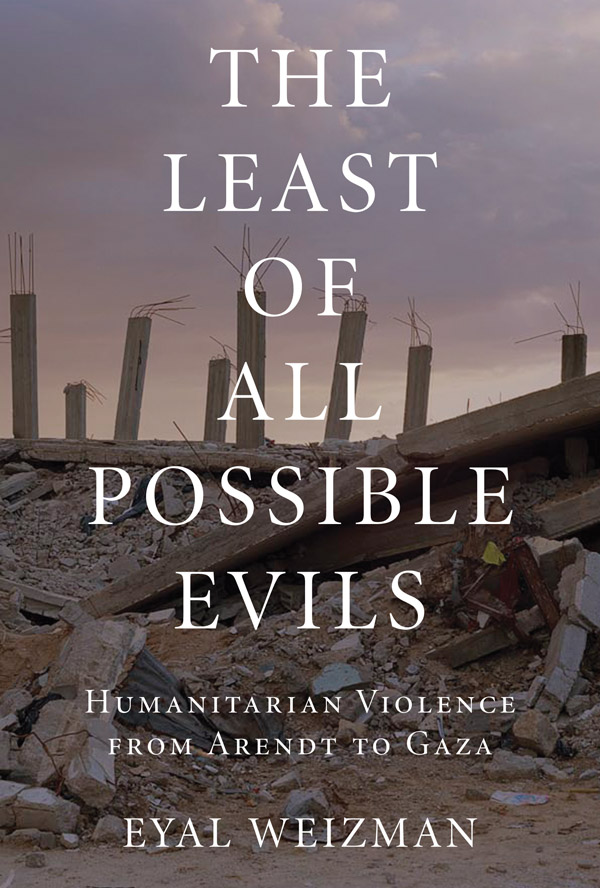
9781844676477 Least of All Possible EvilsThis should not surprise us. Law is not a deus ex machina that presides over war as impartial tribune. Law, Michel Foucault reminds us, ‘is born of real battles, victories, massacres and conquests’; law ‘is born in burning towns and ravaged fields.’ Today so-called ‘operational law’ has incorporated military lawyers into the kill-chain, moving them closer to the tip of the spear, but law also moves in the rear of military violence: in Eyal Weizman’s phrase, ‘violence legislates.’ In the case that most concerns him, that of the Israel Defense Force, military lawyers work in the grey zone between ‘the black’ (forbidden) and ‘the white’ (permitted) and actively seek to turn the grey into the white: to use military violence to extend the permissive envelope of the law.

The liber(alis)ation of violence that Mégret identifies transforms the very meaning of war. In conventional wars combatants are authorised to kill on the basis of what Paul Kahn calls their corporate identity:

‘…the combatant has about him something of the quality of the sacred. His acts are not entirely his own….

‘The combatant is not individually responsible for his actions because those acts are no more his than ours…. [W]arfare is a conflict between corporate subjects, inaccessible to ordinary ideas of individual responsibility, whether of soldier or commander. The moral accounting for war [is] the suffering of the nation itself – not a subsequent legal response to individual actors.’

The exception, Kahn continues, which also marks the boundary of corporate agency, is a war crime, which is ‘not attributable to the sovereign body, but only to the individual.’ Within that boundary, however, the enemy can be killed no matter what s/he is doing (apart from surrendering). There is no legal difference between killing a general and killing his driver, between firing a missile at a battery that is locking on to your aircraft and dropping a bomb on a barracks at night. ‘The enemy is always faceless,’ Kahn explains, ‘because we do not care about his personal history any more than we care about his hopes for the future.’ Combatants are vulnerable to violence not only because they are its vectors but also because they are enrolled in the apparatus that authorizes it: they are killed not as individuals but as the corporate bearers of a contingent (because temporary) enmity.

It is precisely this model that contemporary military violence now challenges through the prosthetics of law embodied and embedded in drone warfare – and this, Kahn insists, has transformed the political imaginary of warfare (You can find his full argument here: ‘Imagining warfare’, European journal of international law 24 (1) (2013) 199-216).

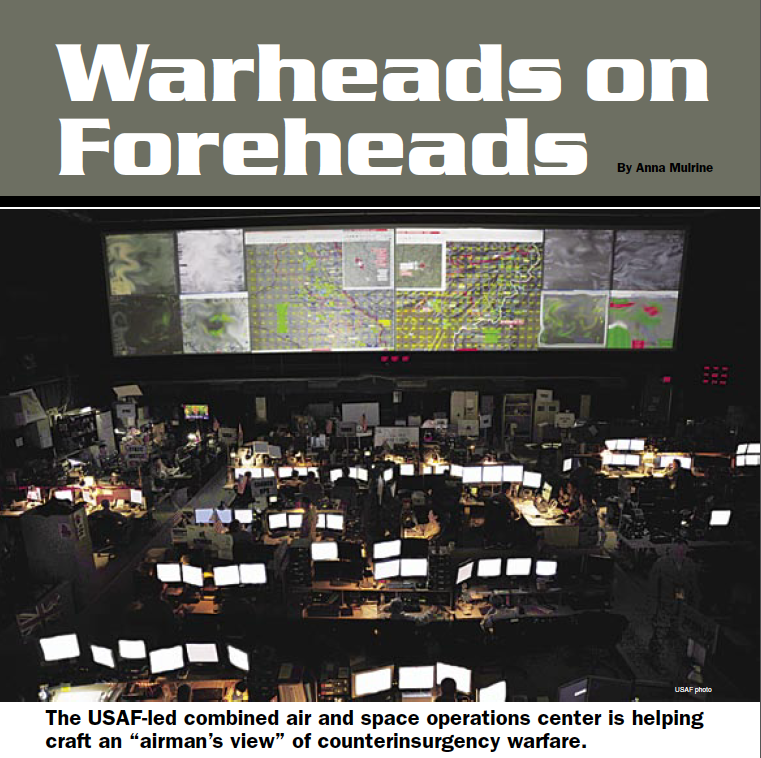
Warheads on foreheads

In a parallel argument, Samuel Issacharoff and Richard Pildes describe this development as the individuation of military force, driven in part by the affordances and dispositions of drone warfare which makes it possible to put ‘warheads on foreheads.’  Targets are no longer whole areas of cities – like Cologne or Hamburg in the Second World War – or extensive target boxes like those ravaged by B-52 ‘Arc Light’ strikes over the rainforest of Vietnam.  The targets are individuals and, since the United States claims the right to target them wherever they are found, this partly explains the dispersed geography of what I’ve called ‘the everywhere war’.   What interests Issacharoff and Pildes, like Kahn, is not so much the technology that makes this possible as the apparatus that makes it permissible.

Their presentation wavers uncertainly between counterinsurgency and counter-terrorism, and they also write more generally of ‘the new face of warfare’ and the use of ‘military force’, so that (as now happens in practice) the distinctions between the US military and the CIA become blurred.  But their core argument is that military force is now directed against specific individuals on the basis of determinate acts that they have committed or, by pre-emptive extension, are likely to commit.  In Kahn’s terms, this inaugurates a radically different (though in his eyes, highly unstable) political subjectivity through which the enemy is transformed into the criminal.  ‘The criminal is always an individual,’ Kahn explains; ‘the enemy is not.’

For Issacharoff and Pildes this new state of affairs requires an ‘adjudicative apparatus’ to positively identify, detect and prosecute the individual-as-target, which drives the military system ever closer to the judicial system:

 ‘As the fundamental transformation in the practice of the uses of military force moves, even implicitly, toward an individuated model of responsibility, military force inevitably begins to look justified in similar terms to the uses of punishment in the criminal justice system. That is, to the extent that someone can be targeted for the use of military force (capture, detention, killing) only because of the precise, specific acts in which he or she as an individual participated, military force now begins to look more and more like an implicit “adjudication” of individual responsibility.’

They suggest that this makes it inevitable that the boundaries between the military system and the judicial system ‘will become more permeable’ – a confirmation of the active constitution of the war/police assemblage (on which see Colleen Bell, Jan Bachmann and Caroline Holmqvist’s forthcoming collection, The New Interventionism: perspectives on war-police assemblages).

Kahn is, I think, much more troubled by this than Issacharoff and Pildes.  He concludes (like Chamayou):

‘Political violence is no longer between states with roughly symmetrical capacities to injure each other; violence no longer occurs on a battlefield between masses of uniformed combatants; and those involved no longer seem morally innocent. The drone is both a symbol and a part of the dynamic destruction of what had been a stable imaginative structure. It captures all of these changes: the engagement occurs in a normalized time and space, the enemy is not a state, the target is not innocent, and there is no reciprocity of risk. We can call this situation ‘war’, but it is no longer clear exactly what that means.

‘The use of drones signals a zone of exception to law that cannot claim the sovereign warrant. It represents statecraft as the administration of death. Neither warfare nor law enforcement, this new form of violence is best thought of as the high-tech form of a regime of disappearance. States have always had reasons to eliminate those who pose a threat. In some cases, the victims doubtlessly got what they deserved. There has always been a fascination with these secret acts of state, but they do not figure in the publicly celebrated narrative of the state. Neither Clausewitz nor Kant, but Machiavelli is our guide in this new war on terror.’

He is thoroughly alarmed at the resuscitation of what he calls ‘the history of administrative death’, whereas Issacharoff and Pildes – ironically, given what I take to be their geopolitical sympathies –treat the institution and development of an ‘adjudicative apparatus’ within the US programme of targeted killings as a vindication of their execution (sic).

I want to set aside other contributions to the emerging discussion over the ‘individuation’ of warfare – like Gabriella Blum‘s depiction of an ‘individual-centred regime’ of military conduct, which pays close attention to its unstable movement between nationalism and cosmopolitanism – in order to raise some questions about the selectivity of ‘individuation’ as a techno-legal process.  I intend that term to connote three things.

Target phase

(1) First, and most obviously, Issacharoff and Pildes fasten on the technical procedures that have been developed to administer targeted killings – which include both the ‘disposition matrix’ [see here] and its derivatives and the more directly instrumental targeting cycle [the diagram above shows the ‘Target’ phase of the Find-Fix-Track-Target-Engage-Assess cycle] , both of which admit legal opinions and formularies – that convert targeted killing into what Adi Ophir calls a quasi-juridical process.  This encoding works to contract the ethical horizon to the legal-juridical (see here for a critical commentary) while simultaneously diverting attention from the substantive practice – which, as I showed in ‘Lines of descent’ (DOWNLOADS tab), is shot through with all sorts of limitations that confound the abstract calculations of the targeting cycle (see, for example, Gregory McNeal here, who turns ‘accountability’ into accountancy).

(2) Second, ‘individuation’ refers to the production of the individual as a technical artefact of targeting.  S/he is someone who is apprehended as a screen image and a network trace;  s/he may be named in the case of a ‘personality strike’ but this serves only as an identifier in a target file, and the victims of ‘signature strikes‘ are not accorded even this limited status.  Others who are killed in the course of the strike almost always remain unidentified by those responsible for their deaths – ‘collateral damage’ whose anonymity confirms on them no individuality but only a collective ascription.  (For more, see Thomas Gregory, ‘Potential lives, impossible deaths: Afghanistan, civilian casualties and the politics of intelligibility’, International Feminist Journal of Politics 14 (3) (2012) 327-47; and ‘Naming names’ here).

(3) Third, the adjudication of ‘individual responsibility’ bears directly on the production of the target but not, so it seems, on the producers of the target.  Lucy Suchmann captures this other side – ‘our’ side – in a forthcoming essay in Mediatropes (‘Situational awareness: deadly bioconvergence at the boundaries of bodies and machines’):

‘A corollary to the configuration of “their” bodies as targets to be killed is the specific way in which “our” bodies are incorporated into war fighting assemblages as operating agents, at the same time that the locus of agency becomes increasingly ambiguous and diffuse. These are twin forms of contemporary bioconvergence, as all bodies are locked together within a wider apparatus characterized by troubling lacunae and unruly contingencies.’

Caroline Holmqvist, sharpens the same point in ‘Undoing war: war ontologies and the materiality of drone warfare’, Millennium (1 May 2013) d.o.i. 10.1177/0305829813483350); so too, and more directly relevant to the operations of a techno-legal process,  does Joseph Pugliese‘s figure of drone crews as ’embodied prostheses of the law of war grafted on to their respective technologies’.

These various contributions identify a dispersion of responsibility across the network in which the drone crews are embedded and through which they are constituted.  The technical division of labour is also a social division of labour – so that no individual bears the burden of killing another individual – but the social division of labour is also a technical division of labour through which ‘agency’ is conferred upon what Pugliese calls its prostheses:

‘Articulated in this blurring of lines of accountability is a complex network of prostheticised and tele-techno mediated relations and relays that can no longer be clearly demarcated along lines of categorical divisibility: such is precisely the logic of the prosthetic. As the military now attempts to grapple with this prostheticised landscape of war, it inevitably turns to technocratic solutions to questions of accountability concerning lethal drone strikes that kill the wrong targets.’

If the mandated technical procedures (1 above) fail to execute a sanctioned target (2 above) and if this triggers an investigation, the typical military response is to assign responsibility to the improper performance of particular individuals (which protects the integrity of the process) and/or to technical malfunctions or inefficiencies in the network and its instruments (which prompts technical improvements).  What this does not do – is deliberately designed not to do – is to probe the structure of this ‘techno-legal economy of war at a distance’ (Pugliese’s phrase) that turns, as I’ve tried to suggest, on a highly particular sense of individuation.  Still less do these inquiries disclose the ways in which, to paraphrase Weizman, ‘drones legislate’ by admitting or enrolling into this techno-legal economy particular subjectivities and forcefully excluding others .

More to come.

***

Note: Here are the citations for Issacharoff and Pildes’ full argument(s); the first is excerpted from the second, which deals with ‘capture’ (detention) as well as killing:

Samuel Issacharoff and Richard Pildes, ‘Drones and the dilemma of modern warfare’, in Peter Bergen and Daniel Rothenberg (eds) Drone wars: the transformation of armed conflict and the promise of law (Cambridge University Press, 2013); available here as NYU School of Law, Public Law & Legal Theory Research Paper Series Working Paper No. 13-34, June 2013

Samuel Ischaroff and Richard Pildes, ‘Targeted warfare: individuating enemy responsibility’, NYU School of Law, Public Law & Legal Theory Working Papers 343 (April 2013); available here.

Dronework

Some recent open access work on drones that intersects with my ongoing reading of Grégoire Chamayou‘s Théorie du drone.

Theorie du droneFirst, Philippe Theophanidis, a PhD student at the Université de Montréal, writes with the welcome news that he’s developed an online bibliography of English and French language materials, Grégoire Chamayou: bodies, manhunts and drones, available here.

Philippe’s own research concerns the theory of community in Jean-Luc Nancy and Roberto Esposito.  He adds:

‘I’m especially preoccupied by the fact that our contemporary mode of being-together paradoxically takes the form of destructive interactions. For that reason, I’m interested about war and space in general, and more precisely about “global civil war” (Schmitt) or war in the time of globalization. That’s why Chamayou’s new book caught my attention when it came out.’

Second, another contribution to the ramifying genealogy of drones that I’ve addressed in several previous posts (for example here and here): at OSU’s Origins: current events in historical perspective, Kenneth Hough provides an extended essay on what he calls ‘the long cultural history of drones’.  He adds some interesting material, most of it about the ways in which drones have been registered in American popular culture:

Since their emergence in the late nineteenth century, Americans have regarded unmanned aerial systems as four basic cultural phenomena: heralds of human accomplishment and hope for the future, signs of inhuman depravity portending society’s doom, mechanical misfires that are both ineffective and humorous, and transcendent machines that spark existential questions about war and society, tapping into what David Nye calls our “fundamental hopes and fears.”

But his long cultural history turns out to be a remarkably narrow cultural geography in which – apart from an excursus on V-1 rockets in the Second World War – experimental laboratories outside the United States (notably Britain and Israel) disappear from view.  For all that, I’m surprised that James Cameron‘s Avatar isn’t on his cultural hit list (though I know Cameron’s Canadian): to see what I mean, and for a more general cultural critique, check out Patrick Lichty‘s interesting essay, Drone: camera, weapon, toy on ‘the aestheticization of dark technology’.

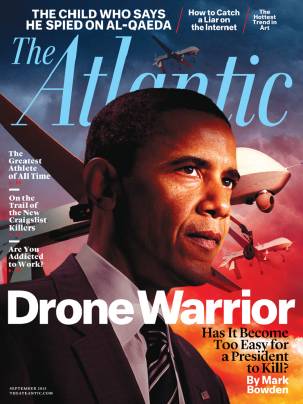
The Atlantic September 2013 Drone warriorWhich brings me to my last sighting: Mark Bowden‘s cover essay in the latest (September) issue of Atlantic on ‘The Killing Machines: how to think about drones‘.  Despite the subtitle, much of Bowden’s extended essay asks how we should feel about drones.

Anyone familiar with his previous work (from Black Hawk Down on) probably won’t be surprised by his ultimate take on matters, and the early online comments show that he’s set off a firestorm of protest by what several writers call his ‘apologia’.

As a matter of fact, I think the essay is more complicated than that, and Bowden does address one of the central issues that Chamayou returns to again and again, the ways in which remote (split) operations transform the very nature of ‘combat’:

Drone strikes are a far cry from the atomic vaporizing of whole cities, but the horror of war doesn’t seem to diminish when it is reduced in scale. If anything, the act of willfully pinpointing a human being and summarily executing him from afar distills war to a single ghastly act.

One day this past January, a small patrol of marines in southern Afghanistan was working its way at dusk down a dirt road not far from Kandahar, staying to either side to avoid planted bombs, when it unexpectedly came under fire. The men scattered for cover. A battered pickup truck was closing in on them and popping off rounds from what sounded like a big gun.

Continents away, in a different time zone, a slender 19-year-old American soldier sat at a desk before a large color monitor, watching this action unfold in startlingly high definition. He had never been near a battlefield. He had graduated from basic training straight out of high school, and was one of a select few invited to fly Predators. This was his first time at the controls, essentially a joystick and the monitor. The drone he was flying was roughly 15,000 feet above the besieged patrol, each member marked clearly in monochrome on his monitor by an infrared uniform patch. He had been instructed to watch over the patrol, and to “stay frosty,” meaning: Whatever happens, don’t panic. No one had expected anything to happen. Now something was happening.

The young pilot zoomed in tight on the approaching truck. He saw in its bed a .50-caliber machine gun, a weapon that could do more damage to an army than a platoon of Goliaths.

A colonel, watching over his shoulder, said, “They’re pinned down pretty good. They’re gonna be screwed if you don’t do something.”

The colonel told the pilot to fix on the truck. A button on the joystick pulled up a computer-generated reticle, a grid displaying exact ground coordinates, distance, direction, range, etc. Once the computer locked on the pickup, it stayed zeroed in on the moving target.

“Are you ready to help?” the colonel asked.

An overlay on the grid showed the anticipated blast radius of an AGM-114 Hellfire missile—the drone carried two. Communicating via a digital audio link, the colonel instructed the men on the ground to back away, then gave them a few seconds to do so.

The pilot scrutinized the vehicle. Those who have seen unclassified clips of aerial attacks have only a dim appreciation of the optics available to the military and the CIA.

“I could see exactly what kind of gun it was in back,” the pilot told me later. “I could see two men in the front; their faces were covered. One was in the passenger seat and one was in the driver’s seat, and then one was on the gun, and I think there was another sitting in the bed of the truck, but he was kind of obscured from my angle.”

On the radio, they could hear the marines on the ground shouting for help.

“Fire one,” said the colonel.

The Hellfire is a 100-pound antitank missile, designed to destroy an armored vehicle. When the blast of smoke cleared, there was only a smoking crater on the dirt road.

“I was kind of freaked out,” the pilot said. “My whole body was shaking. It was something that was completely different. The first time doing it, it feels bad almost. It’s not easy to take another person’s life. It’s tough to think about. A lot of guys were congratulating me, telling me, ‘You protected them; you did your job. That’s what you are trained to do, supposed to do,’ so that was good reinforcement. But it’s still tough.”

One of the things that nagged at him, and that was still bugging him months later, was that he had delivered this deathblow without having been in any danger himself. The men he killed, and the marines on the ground, were at war. They were risking their hides. Whereas he was working his scheduled shift in a comfortable office building, on a sprawling base, in a peaceful country. It seemed unfair. He had been inspired to enlist by his grandfather’s manly stories of battle in the Korean War. He had wanted to prove something to himself and to his family, to make them as proud of him as they had been of his Pop-Pop.

“But this was a weird feeling,” he said. “You feel bad. You don’t feel worthy. I’m sitting there safe and sound, and those guys down there are in the thick of it, and I can have more impact than they can. It’s almost like I don’t feel like I deserve to be safe.”

I’ve described this identification with troops on the ground before, what one of Bowden’s correspondents calls ‘a very visceral connection to operations on the ground’.  And Bowden is stacking the deck by starting with what the US military calls ‘Troops in Contact‘ in Afghanistan rather than CIA-directed targeted killing in Pakistan: only later will he turn to the legal and quasi-legal landscape through which those strikes pass (more on this in a later post) .  But he then adds this:

If the soldier who pulls the trigger in safety feels this, consider the emotions of those on the receiving end, left to pick up the body parts of their husbands, fathers, brothers, friends. Where do they direct their anger? When the wrong person is targeted, or an innocent bystander is killed, imagine the sense of impotence and rage. How do those who remain strike back? No army is arrayed against them, no airfield is nearby to be attacked. If they manage to shoot down a drone, what have they done but disable a small machine? No matter how justified a strike seems to us, no matter how carefully weighed and skillfully applied, to those on the receiving end it is profoundly arrogant, the act of an enemy so distant and superior that he is untouchable.

As I say, more to come…

Theory of the drone 4: Pennies from Heaven

This is the fourth in a series of posts on Grégoire Chamayou‘s Théorie du drone.

7: Counter-insurgency from the air

The focus of the new US Army /US Marine Corps Counterinsurgency Manual FM 3-24 that was issued in 2006 was, naturally enough, on ground operations in which the Army and the Marine Corps would take the lead.  To the anger of many Air Force officers, air operations were relegated to a supporting role outlined in the last appendix, the last five pages of 335, which acknowledged the contribution of intelligence, surveillance and reconnaissance (ISR) from ‘air- mounted collection platforms’ and (in certain circumstances) the ‘enormous value’ of ‘precision air attacks’.
MEILINGER COIN from above

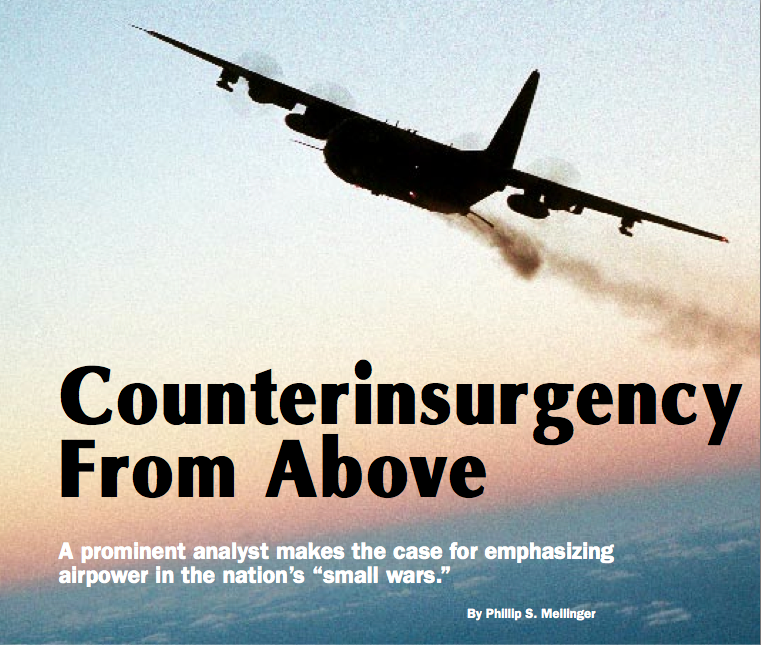
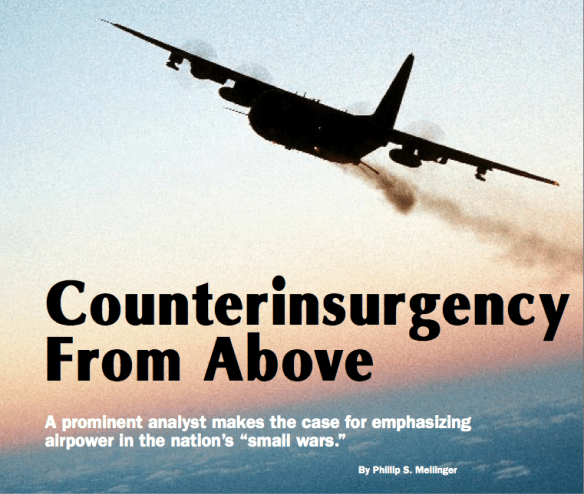
And yet in practice, as Chamayou argues, the balance was already being reversed; the incorporation of drones into counterinsurgency (COIN) was soon so advanced that there were calls (from air power advocates) for the promulgation of an official doctrine reflecting the new intrinsically three-dimensional reality.  So – to take the example Chamayou gives – Phillip Meilinger, a retired command pilot and former Dean of the School of Advanced Airpower Studies at the USAF’s Air University at Maxwell AFB, complained that the Field Manual had already been overtaken by events:

The role for airpower in COIN is generally seen as providing airlift, ISR capabilities, and precision strike. This outdated paradigm is too nar- rowly focused and relegates airpower to the support role while ground forces perform the “real” work. Worse, marginalizing airpower keeps it in support of ground-centric strategies that have proved unsuccessful.

He called for the Pentagon to

‘re-examine the paradigm that was so successful in Bosnia, Kosovo, Afghanistan, and Iraq. That was the use of air and space power, combined with [Special Operations Forces], indigenous ground forces, and overwhelming ISR. Given the outstanding results already demonstrated, an air-centric joint COIN model should be one of the first options for America’s military and political leaders.’

As the image heading his article makes clear, Meilinger – a gifted military historian – was not limiting the role of airpower to drones; far from it.  But his repeated references to the Air Force’s ‘more sophisticated and effective sensor aircraft and satellites’ signalled their indispensable importance in the transformation of counterinsurgency from a ground-centric to an air-centric model.

fm-3-24-counterinsurgency_500A similar salvo was fired at more or less the same time by Charles Dunlap, Deputy Judge Advocate General for the USAF, who castigated FM 3-24 for conceiving air power ‘as aerial artillery’ whose weapons were ‘somehow more inaccurate than other kinds of fires.’

‘In perhaps no other area has the manual been proven more wrong by the events of 2007…. [T]he profound changes in airpower’s capabilities have so increased its utility that it is now often the weapon of first recourse in COIN operations, even in urban environments.’

Dunlap was quick to say that this myopia wasn’t the result of inter-service rivalry (‘parochialism’):

‘Rather, FM 3-24 draws many of its lessons from counterinsurgency operations dating from the 1950s through the 1970s. While this approach is remarkably effective in many respects, it inherently undervalues airpower. The revolutions in airpower capabilities that would prove so effective during 2007 were unavailable to counterinsurgents in earlier eras.’ 

Those ‘revolutions’ – what Dunlap identified as ‘the precision and persistence revolutions’ – placed armed drones at the leading edge of counterinsurgency and, as Chamayou glosses these arguments, consigned previous objections to the dustbin of history.

Recalling my post yesterday about ‘pattern of life’ analysis, Dunlap argued that ‘visual observations have a grammar all their own’, and he cited with approval this paragraph from journalist Mark Benjamin‘s Killing “Bubba” from the skies’:

‘The Air Force recently watched one man in Iraq for more than five weeks, carefully recording his habits—where he lives, works, and worships, and whom he meets . The military may decide to have such a man arrested, or to do nothing at all. Or, at any moment they could decide to blow him to smithereens.’

It’s a revealing essay that accords closely with Chamayou’s central thesis: Benjamin reported that, from the Combined Air Operations Center in Qatar, ‘they are stalking prey’ and that the US Air Force had turned the art of searching for individuals into a science.

But Dunlap cooly added: ‘The last statement may be more insightful than perhaps even Benjamin realized.’  For it was not only a matter of killing, ‘blowing a man to smithereens’, and what Dunlap had in mind was not only persistent presence but also persistent threat: the ability to ‘dislocate the psychology of the insurgents’ who now never knew where or when they might be attacked.

For this reason Chamayou suggests that the drone effects a sort of détournement on the strategies and weapons of the insurgent-terrorist – the skirmish and the ambush, the IED and the suicide bomb – to become what he calls, through this radical reversal, ‘the weapon of State terrorism’.  Its short-lived engagements happen without warning and target individuals without compunction.

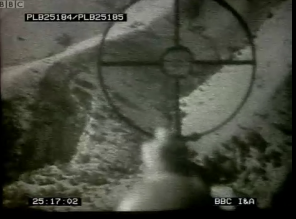
And yet, for all its technological sophistication, Chamayou insists that this is not a new strategy. Military historians ought to look further back, he suggests, to the policies of colonial ‘air control’ developed in the inter-war period (the image below shows a bomb dropped by the RAF on Sulaimaniyah in Iraq on 27 May 1924: more here).  He develops this argument in a later chapter, where he describes the drone as ‘the weapon of an amnesiac post-colonial violence’ (p. 136): a postcolonialism that has forgotten – or suppressed – its own wretched history.

British bomb dropped on Sulaimaniyah, Iraq, 1924

Indeed it has.  The twenty-first century version of counterinsurgency has made much of the iconic, inspirational figure of ‘Lawrence of Arabia’.  But as I’ve argued in ‘DisOrdering the Orient’ (DOWNLOADS tab):

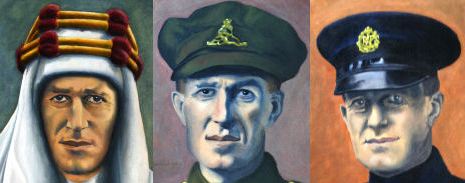
‘… long before he resigned his Army commission and re-enlisted in the Royal Air Force as Aircraftsman Ross, [Lawrence] had been drawn to the wide open spaces of the sky as well as those of the desert. Patrick Deer suggests that in Lawrence’s personal mythology ‘air control in the Middle East offered a redemptive postscript to his role in the Arab Revolt of 1916-18’. He imagined the Arab Revolt ‘as a kind of modernist vortex,’ Deer argues, fluid and dynamic, ‘without front or back,’ and in Seven Pillars he recommended ‘not disclosing ourselves till we attack.’ To Lawrence, and to many others at the time, the intimation of a nomadic future war gave air power a special significance. ‘What the Arabs did yesterday,’ he wrote, ‘the Air Forces may do tomorrow – yet more swiftly.’  As Priya Satia has shown, this rested not only on a military Orientalism that distinguished different ways of war but also on a cultural Orientalism that represented bombing as signally appropriate to the people of these lands. This was, minimally, about intelligence, surveillance and reconnaissance. ‘According to this perverse logic’, Satia explains, ‘the RAF’s successful persecution of a village testified to their intimacy with the people on the ground, without which they would not have been able to strike it accurately.’ More than this, however, ‘the claim to empathy ultimately underwrote the entire air control system with its authoritative reassurances that bombardment was a tactic that would be respected and expected in this unique land.’ From this perspective, Satia continues, Arabs saw bombing as ‘pulling the strings of fate from the sky.’ They understood it ‘not as punishment,’ Lawrence informed his readers, ‘but as misfortune from heaven striking the community.’ And if women and children were killed in the process that was supposedly of little consequence to them: what mattered were the deaths of ‘the really important men.’’
JONGBLOED Lawrence triptych

As far as I know, Lawrence has not been invoked by any of the contemporary advocates of airpower in counterinsurgency – though he has been called ‘Lawrence of Airpower‘ – but many of these formulations and their successors, translated into an ostensibly more scientific vocabulary, reappear in contemporary debates about the deployment of drones in counterinsurgency.

In fact, Meilinger had conceded the relevance of these historical parallels. ‘It would be useful to revisit the “air control” operations employed by the Royal Air Force in the Middle East in the 1920s and 1930s,’ he wrote. ‘These operations were not always successful in objective military terms, but they were unusually successful in political terms, in part because they carried a low cost in both financial and casualty terms’ (my emphasis).

That is an extraordinary sentence, although Chamayou doesn’t quote it, because what is missing from the air power advocates’ view (so Chamayou argues) is – precisely – an apprehension of the politics of counterinsurgency in general and air strikes in particular.  Indeed, when the imaginary conjured up by Lawrence and his successors reappears in contemporary debates it is entered on both sides of the ledger: not only as economical and effective but also as cowardly and counter-productive.   Here is Colonel Keen, complaining about the bombing of Pashtun villages on the North West Frontier in 1923:

‘By driving the inhabitants of the bombarded area from their homes in a state of exasperation, dispersing them among neighbouring clans and tribes with hatred in their hearts at what they consider ‘‘unfair’’ methods of warfare … [these attacks] bring about the exact political results which it is so important in our own interests to avoid, viz., the permanent embitterment and alienation of the frontier tribes.’ 

Both Chamayou and I cite this passage, and you can find more about the colonial bombing of Waziristan in a previous post (scroll down).

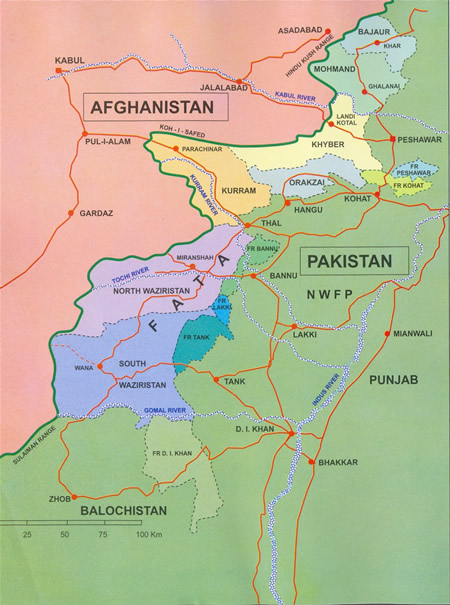
This sentiment reappeared in different form in the critique of drone strikes in Pakistan’s Federally Administered Tribal Areas  – the same region described by Keen – published by David Kilcullen and Andrew Exum in the New York Times in 2009, ‘Death from above, Outrage down below‘. Their core argument was that the campaign was making the cardinal mistake of ‘personalizing’ the struggle against al-Qaeda and the Taliban – going after individuals – while causing considerable civilian casualties: ‘every one of these dead noncombatants represents an alienated family, a new desire for revenge, and more recruits for a militant movement that has grown exponentially even as drone strikes have increased.’

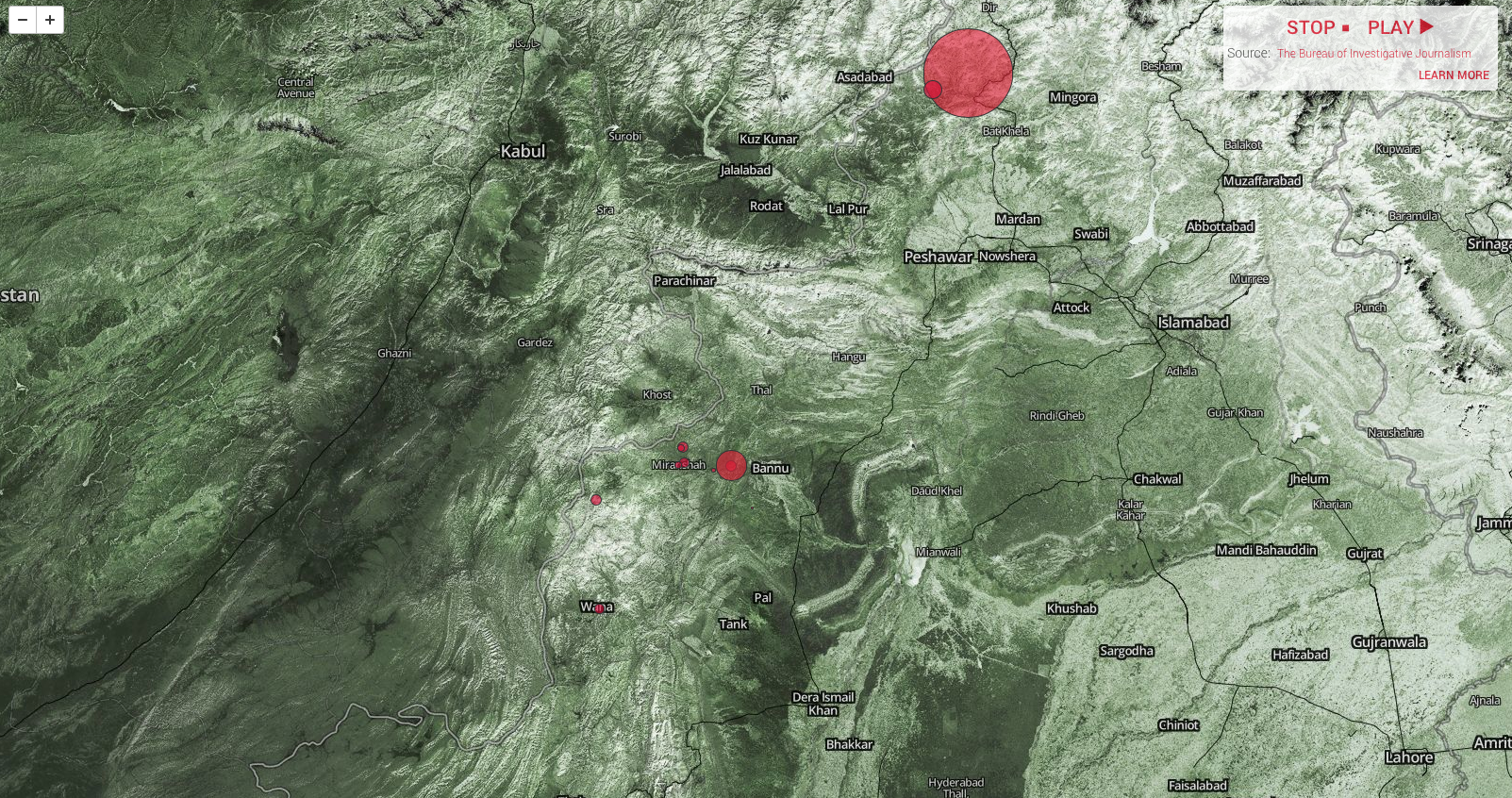
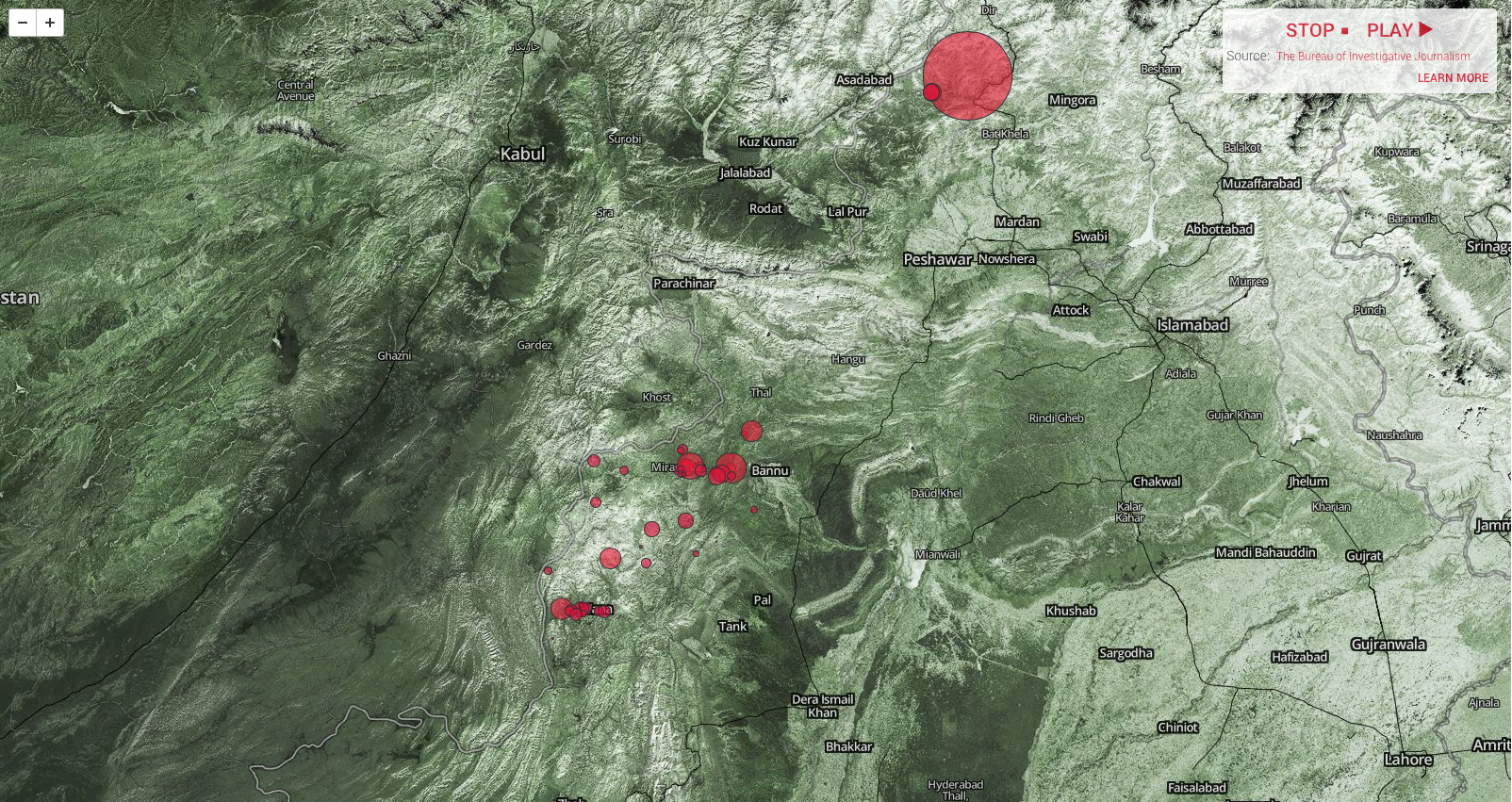
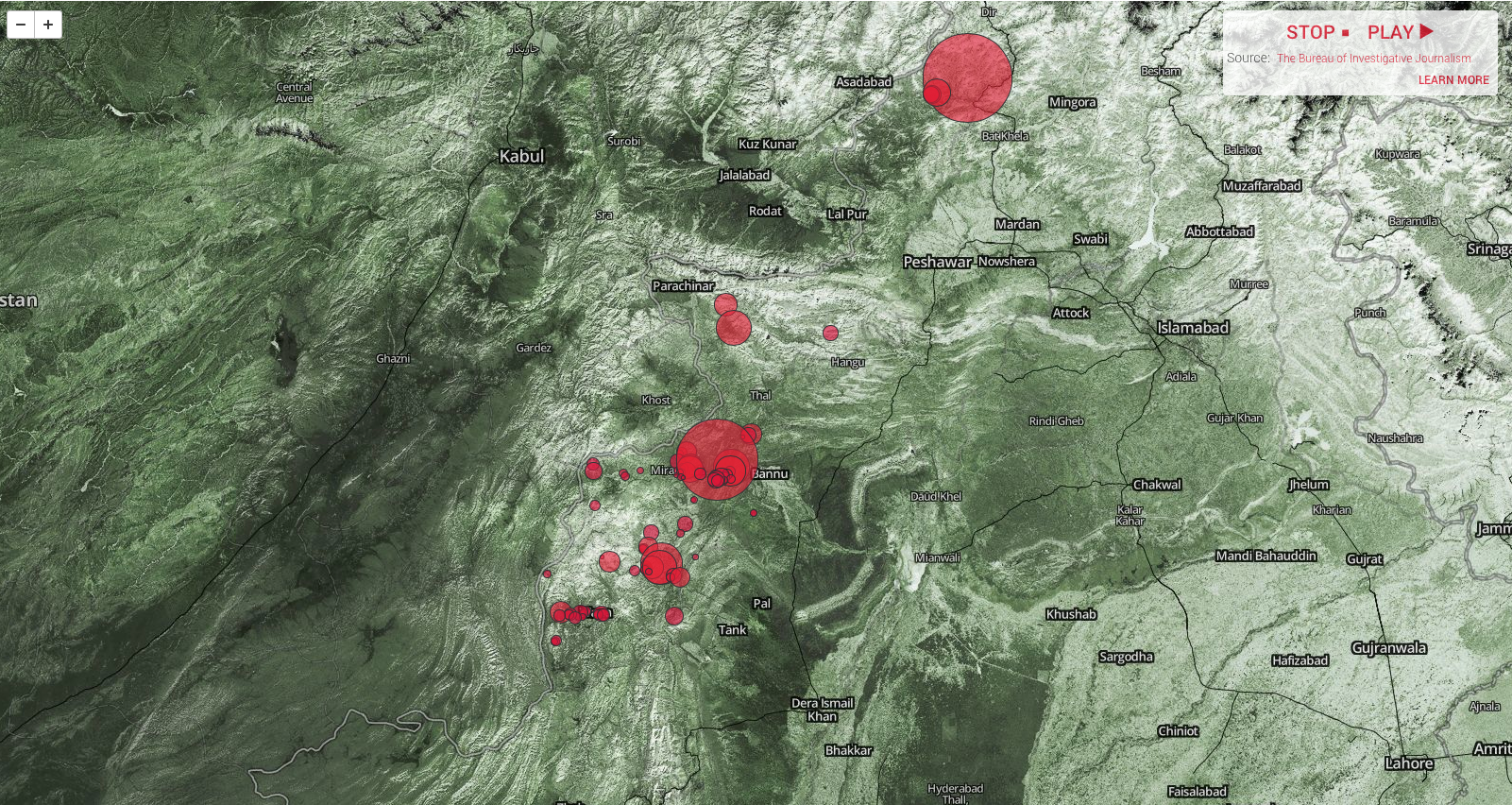
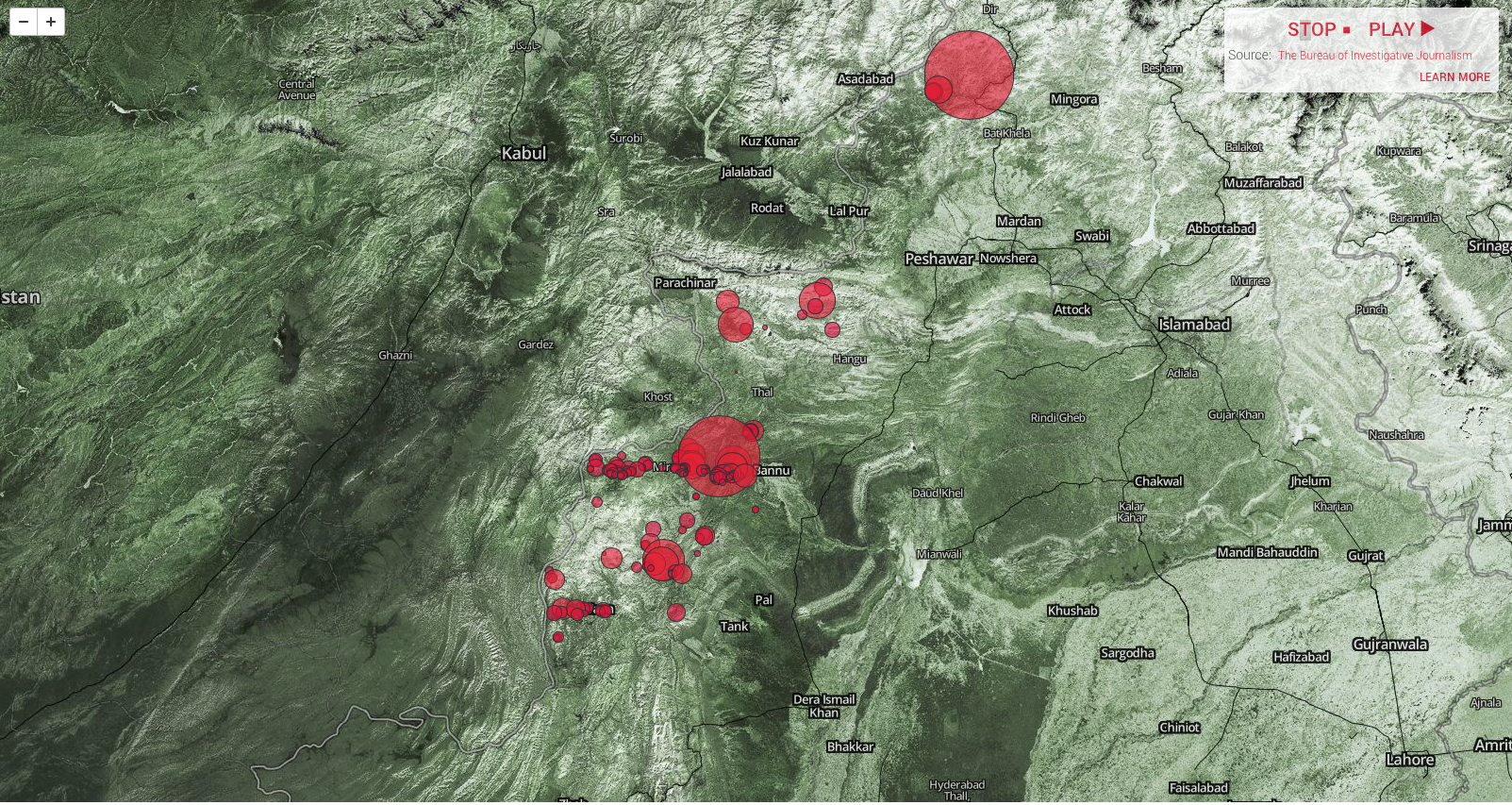
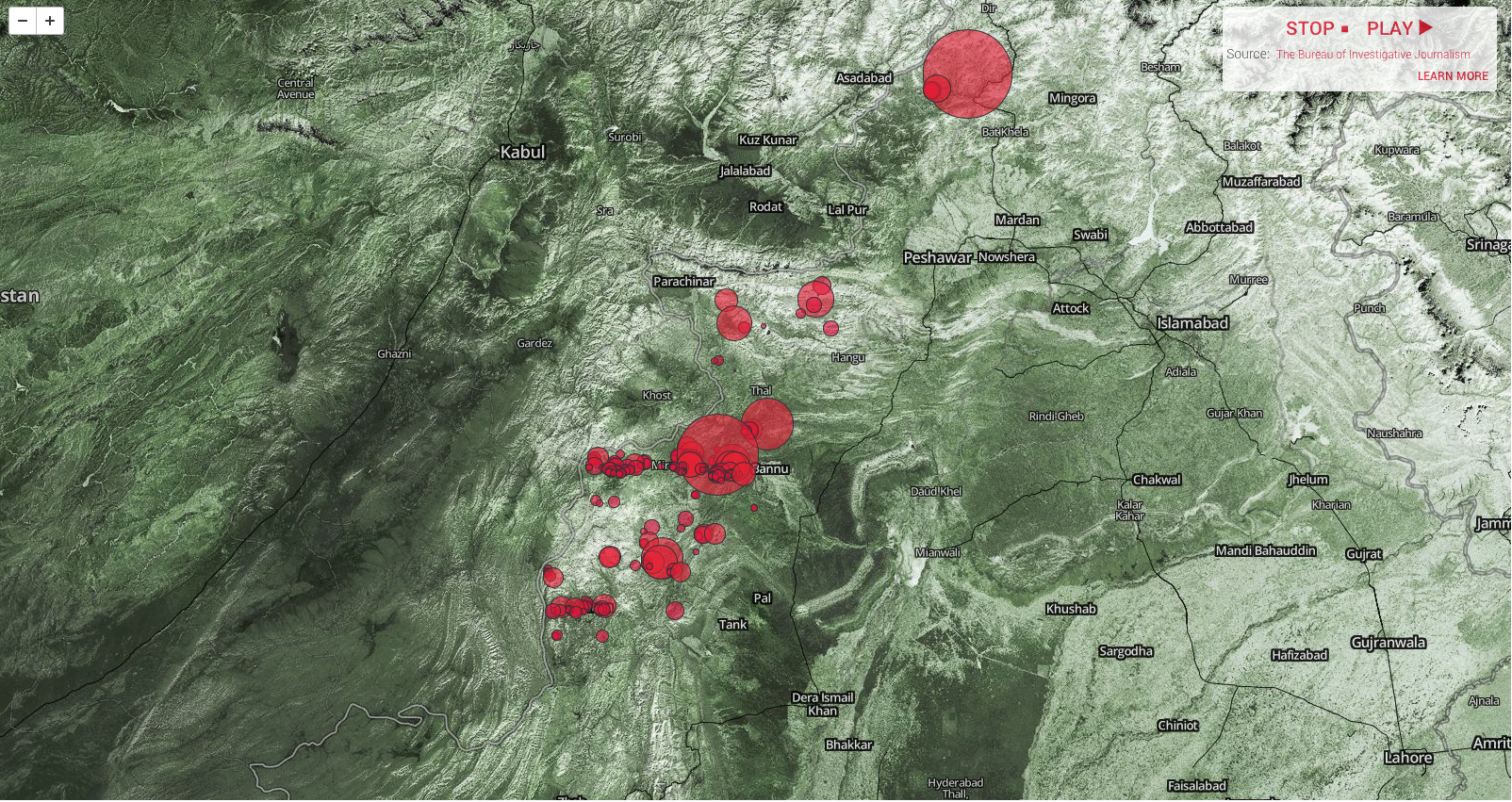
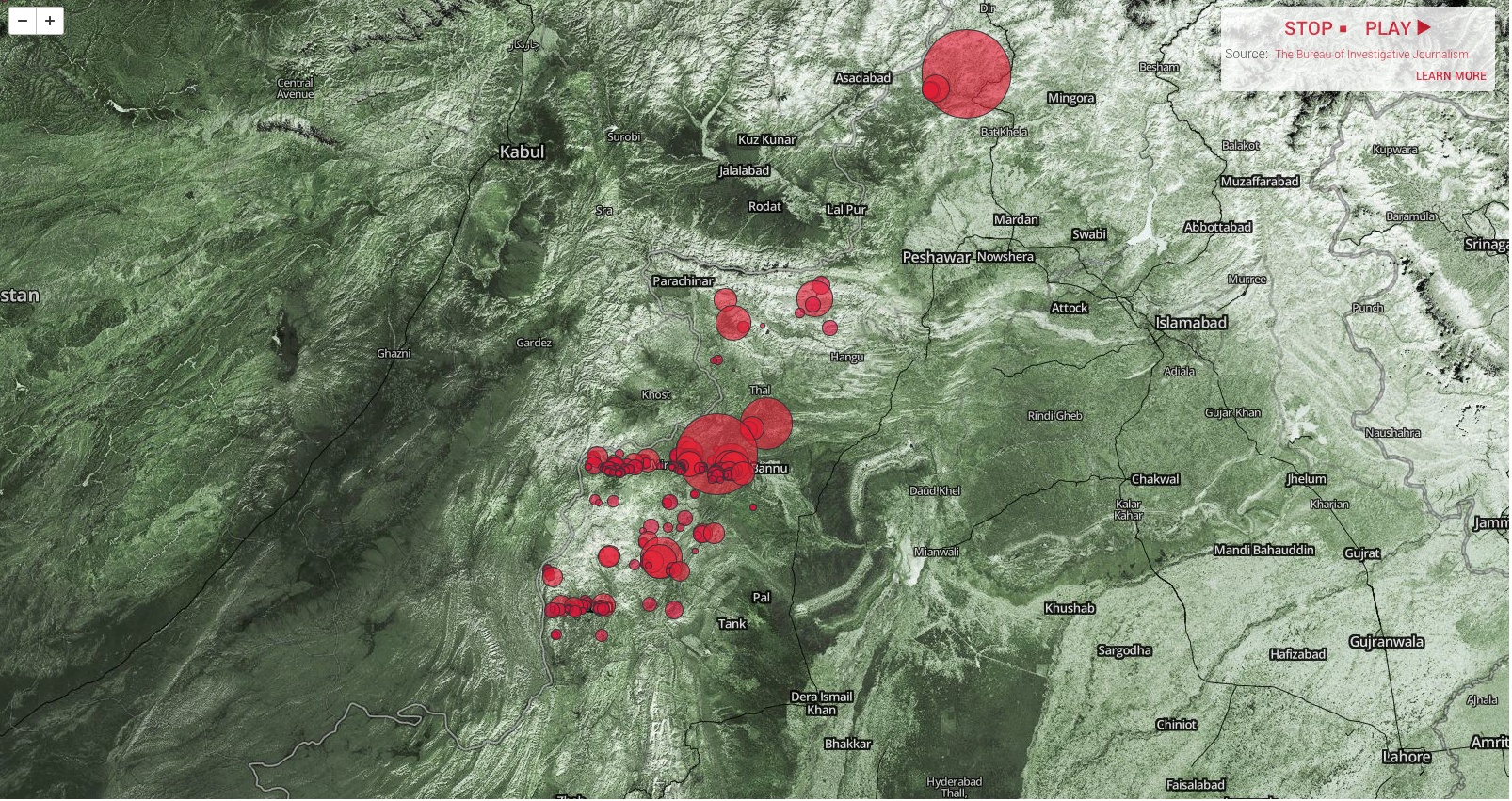
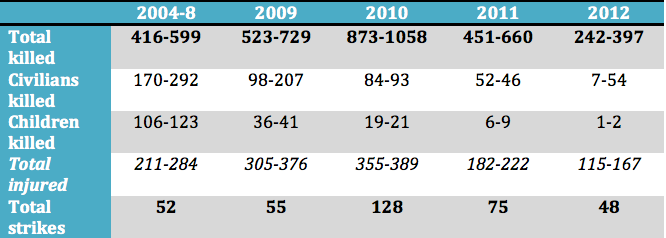
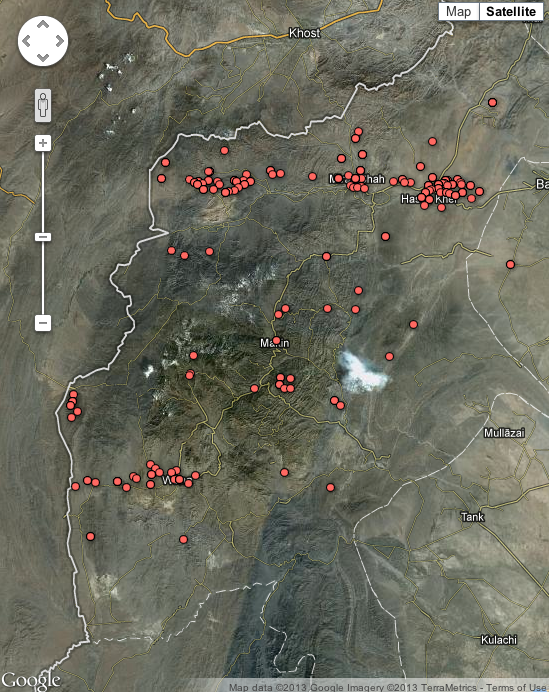
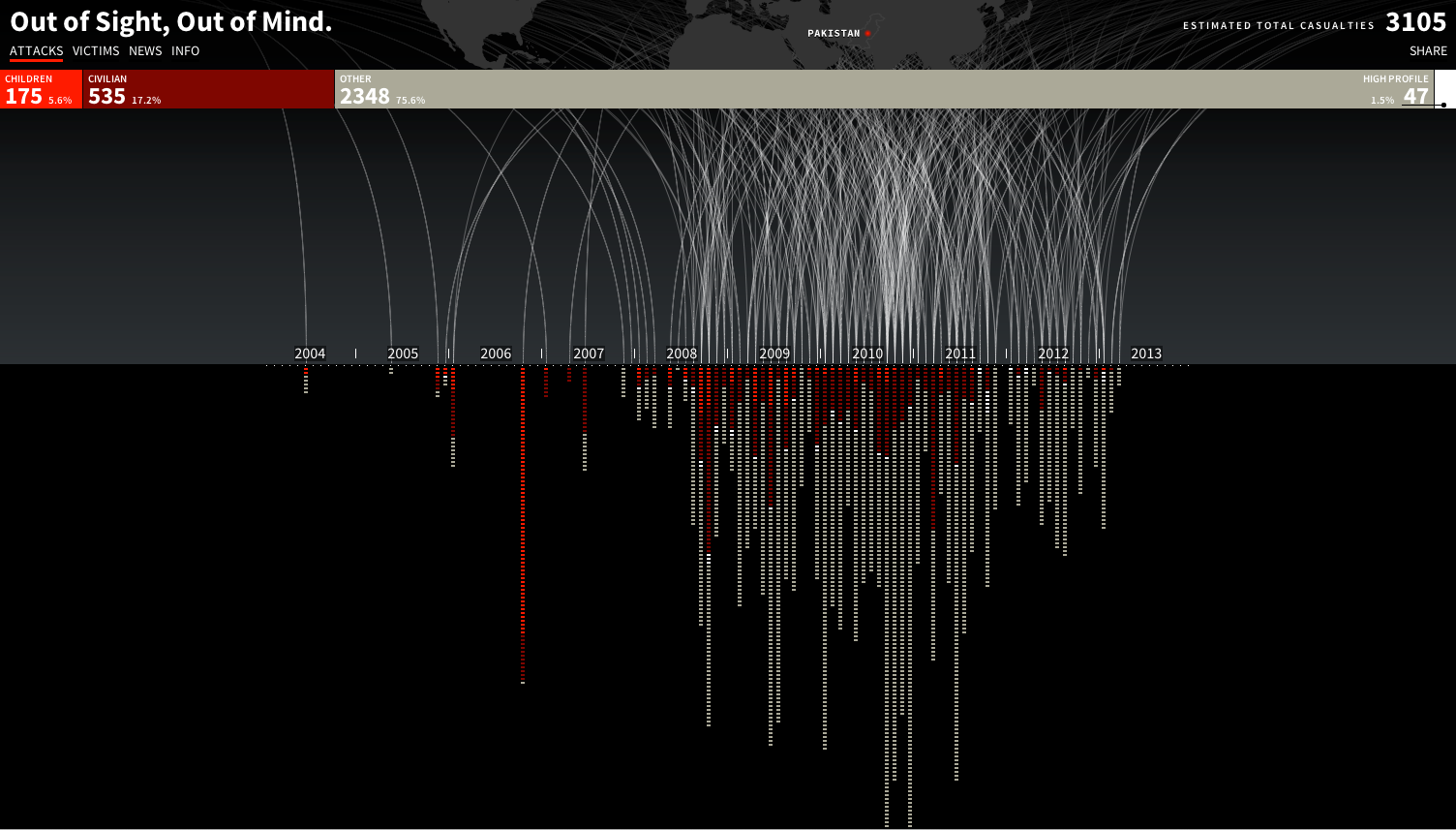
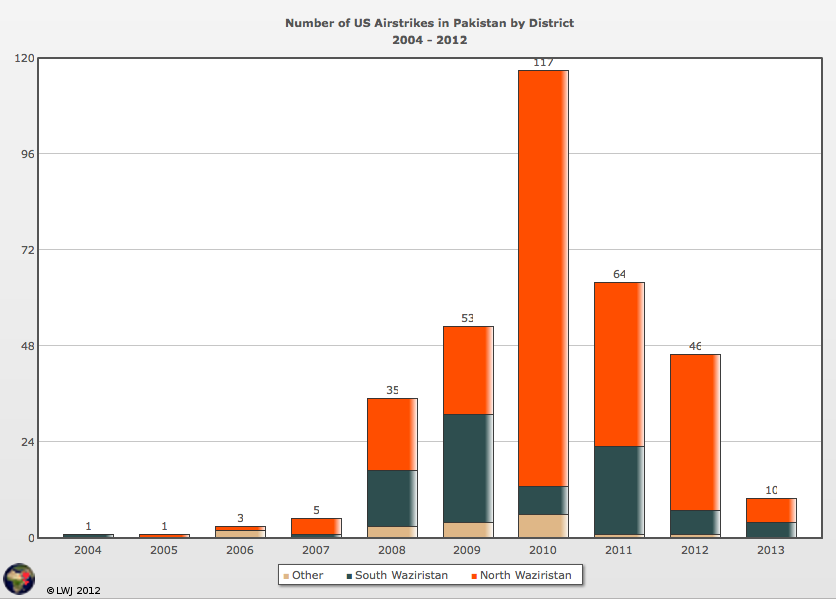
Estimates of combatant and civilian casualties remain contentious, of course, including those used by Kilcullen and Exum; Chamayou doesn’t discuss this in any detail, but most sources (including the Bureau of Investigate Journalism) suggest that civilian casualties in Pakistan have fallen from their peak in 2009-10.  Others have argued that drone strikes are more effective than their critics claim.  Their confidence typically rests on a combination of assertion and anecdote, but a recent quantitative study by Patrick Johnston and Anoop Sarbahi (from which I’ve borrowed the map below) purports to show that, contrary to Kilcullen and Exum’s original claim, US drone strikes between January 2007 and September 2011 reduced the incidence of militant activity in the FATA.

JOHNSTON and SARBAHI Figure 1 Drone strikes and militant activity in FATA

I mention these qualifications neither to adjudicate them nor to blunt Chamayou’s argument: simply to note that the situation is far from static or settled. Chamayou uses the Kilcullen-Exum critique, in conjunction with Kilcullen’s other, more extended contributions, to leverage two linked claims:

(1) counterinsurgency is a politico-military strategy that depends, for its effectiveness, on a sustained presence amongst a population: a politics of verticality (described in my previous post) cannot substitute for, and usually confounds, a properly population-centric campaign, which can only be won on the ground.

(2) the ‘dronisation’ of US military operations signals a shift away from counterinsurgency and towards counter-terrorism, which is a police-security strategy that prioritises an individual-centric campaign.

Chamayou owes the distinction to Kilcullen [‘Countering global insurgency’, Journal of strategic studies 28 (2005) 597-617]:

‘Under this [counter-terrorism] paradigm … terrorists are seen as unrepresentative aberrant individuals, misfits within society. Partly because they are unrepresentative, partly to discourage emulation, ‘we do not negotiate with terrorists’. Terrorists are criminals, whose methods and objectives are both unacceptable. They use violence partly to shock and influence populations and governments, but also because they are psychologically or morally flawed (‘evil’) individuals. In this paradigm, terrorism is primarily a law enforcement problem, and we therefore adopt a case-based approach where the key objective is to apprehend the perpetrators of terrorist attacks…

‘The insurgency paradigm is different. Under this approach, insurgents are regarded as representative of deeper issues or grievances within society. We seek to defeat insurgents through ‘winning the hearts and minds’ of the population, a process that involves compromise and negotiation. We regard insurgents’ methods as unacceptable, but their grievances are often seen as legitimate, provided they are pursued peacefully… We see insurgents as using violence within an integrated politico-military strategy, rather than as psychopaths. In this paradigm, insurgency is a whole-of-government problem rather than a military or law enforce- ment issue. Based on this, we adopt a strategy-based approach to counterinsurgency, where the objective is to defeat the insurgent’s strategy, rather than to ‘apprehend the perpetrators’ of specific acts.’

in Chamayou’s terms, ‘manhunting by drones’ represents the triumph, at once doctrinal and practical, of counter-terrorism over counterinsurgency.  In this optic, a space of representation substitutes for lived space: ‘The body count, the list of hunting trophies, substitutes for the strategic evaluation of the political effects of military violence.  Success is turned into statistics.  Their evaluation is disconnected from effects on the ground.’

It’s an engaging argument, but I think it’s over-stated for several reasons.

First, contemporary counterinsurgency clearly has not ceded the statistical battleground to anyone. Under David Petraeus in particular, cascades of PowerPoint slides sluiced a tidal wave of metrics over military and public audiences, and these too were often disconnected from events on the ground.  As I showed in “Seeing Red” (DOWNLOADS tab), for example, at the height of the violence in Baghdad military briefers preferred the virtual-cartographic to the visceral-physical city, ‘walking’ reporters through maps of the capital because, for all their upbeat assessments, it was far too dangerous to walk them through the real city that lay beyond the Green Zone.  And so far it has proved impossible to obtain any figures of fatalities from drone strikes in the FATA from Obama’s otherwise garrulous ‘off-the-record’ (and, remarkably, never prosecuted) officials.

Second, contemporary counterinsurgency is not only about deploying ‘soft power’ and exploiting the humanitarian-military nexus; this is a one-sided view.  Kilcullen himself conceded that ‘there’s always a lot of killing, one way or another’, in counterinsurgency, but in the wake of the nightmare that was Abu Ghraib the publicity campaign that surrounded the release of FM 3-24 directed attention to ‘hearts and minds’ – to a kinder, gentler, culturally-informed and compassionate military – rather than to bullets and bombs.   But as Petraeus reminded Noah Schachtman in November 2007,  the manual

‘doesn’t say that the best weapons don’t shoot. It says sometimes the best weapons don’t shoot. Sometimes the best weapons do shoot.”

As I showed in “The rush to the intimate” (DOWNLOADS tab), more often than one might think. Chamayou is perfectly correct to say that ‘drones are excellent at crushing bodies from a distance, but they are perfectly  inappropriate for winning “hearts and minds”‘: but counterinsurgency, even in its supposedly radically new form, involves both.

Third, for that very reason counterinsurgency has continued to incorporate air power into its operations, and ground troops and commanders in Afghanistan continue to clamour for Predators and Reapers to provide close air support.  In October 2009 the Joint Chiefs of Staff issued Joint Publication 3-24 on Counterinsurgency Operations, which was far more positive about air power than the Field Manual three years earlier:

‘Video downlink and datalink technology have revolutionized real-time air to ground employment allowing air assets to seamlessly integrate into and support the ground commander’s scheme of maneuver. Armed overwatch missions provide ground forces with the critical situational awareness, flexibility, and immediate fire support necessary to succeed in the dynamic COIN environment.’

Fourth, later modern war is intrinsically hybrid, and military operations under its sign are likely to involve an unstable and often contradictory mix of counterinsurgency and counter-terrorism. Writing a year or so into Obama’s first term, Colleen Bell and Brad Evans [in ‘Terrorism to insurgency: Mapping the post-intervention security terrain’, Journal of intervention and statebuilding 4 (4) (2010) 371-390] described a reverse movement from counter-terrorism to counterinsurgency in Afghanistan:

‘Counterterrorist interventionism has, until relatively recently, been principally rooted in an exterminatory logic that demands a sovereign commitment to the violent excision of enemies. The shift towards the problem of insurgency, however, is more expansive. It demonstrates a strategic focus on political opposition as embedded within besieged, illiberal and underdeveloped populations…. [The] focus on insurgency in terms of population represents a break from the preoccupation with terrorism as a form of incalculable danger to the mobilization of a different rationality of risk, that of insurance, which seeks to govern the future on the basis of the collective probabilities emanating from within host societies today.’
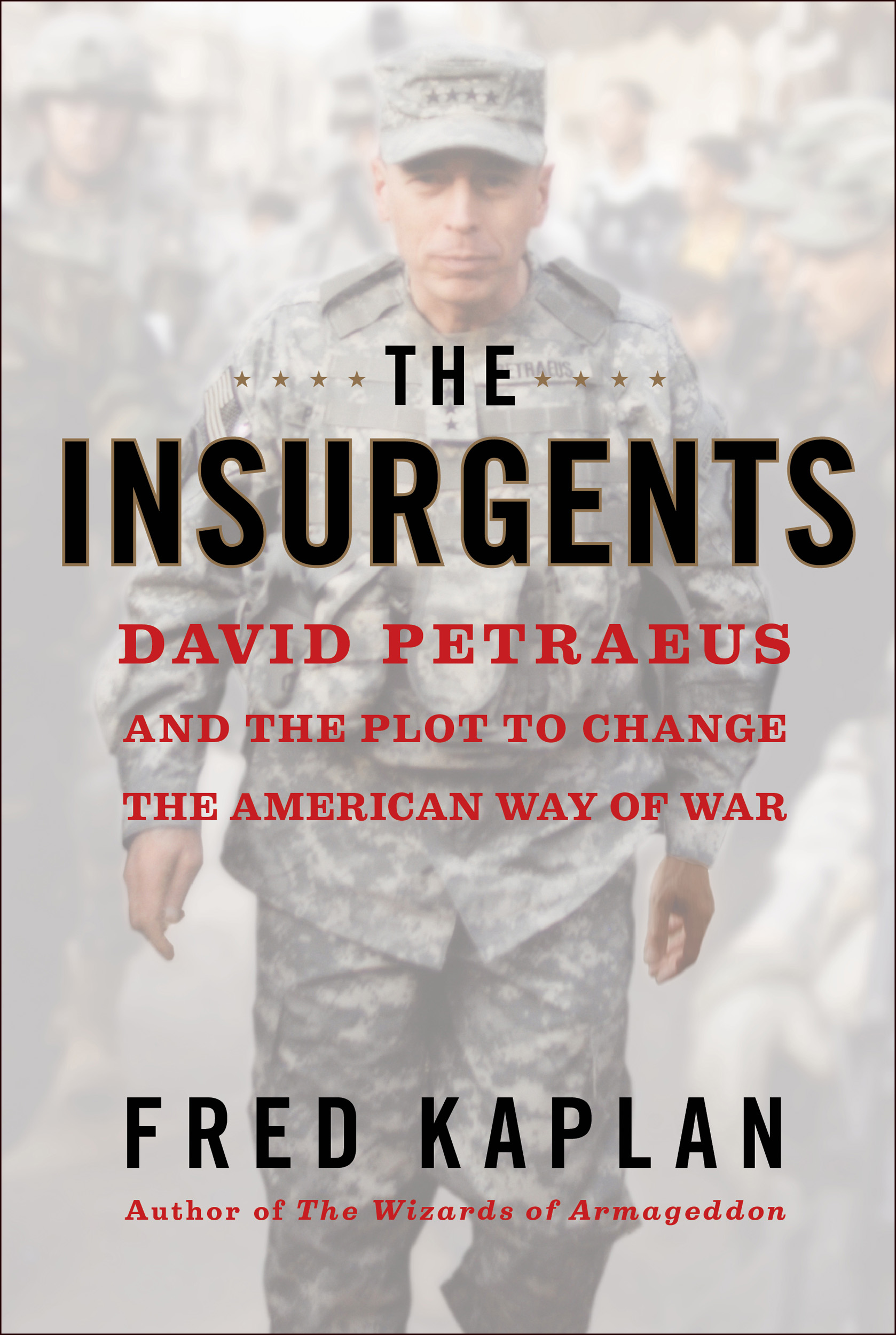
kaplan_the-insurgents_cover-finalThey treat this as a transformation of what Chamayou would call the ‘logics’ of intervention: from ‘a conventional struggle to eliminate adversaries’ to a ‘productive reconstitution of the life of a population’ (which requires ‘marking out what qualities the “good” life must possess, whilst in the process positively rendering dangerous all “other” life which does not comply with the productive remit).  In other words (their words), a switch from sovereign power to bio-power.  I have my reservations about the theoretical argument, but in any case the transformation was far from stable or straightforward.  In December 2009 Obama committed thousands of extra ground troops as part of a revitalized counterinsurgency campaign in Afghanistan; they were supported by a continued increase in drone operations. And Obama had also authorised a dramatic increase in CIA-directed drone strikes in Pakistan.  But in June 2011 he announced the withdrawal of those additional troops: as Fred Kaplan puts in The insurgents, ‘pulling the plug on COIN.’  All of this va-et-vient was, as Kaplan shows in exquisite detail, more than a philosophico-logical affair: it was also profoundly political, and included considerations of domestic US politics, concerns over the Afghan state in general and the re-election of Hamid Karzai in particular, and no doubt calculations of advantage within the US military.  In short, while Chamayou is surely right to accentuate the politics of military violence this is not confined to the ‘inside’ of counterinsurgency – COIN as ‘applied social work’, as Kilcullen once described it – because politics also provides one of its activating armatures. (I’ve discussed Kaplan’s view of drone strikes and what he sees as an emerging imaginary of ‘the world as free-fire zone’ here).

For all that, Chamayou’s dissection of the ‘reverse logics’ of these particular forms of counterinsurgency and counter-terrorism is analytically helpful, and adds another dimension to his argument about the transformation of war from battlefields to hunting grounds and from armies to individuals.   He insists that the commitment to targeted killing (by drone or, I would add, Special Forces) is a commitment to ‘an infinite eradicationism’ in which it becomes impossible to kill leaders (‘High Value Targets’) faster than they can be replaced. In his vivid image, the hydra constantly regenerates itself as a direct response  to the very strikes that seek to decapitate it.

‘Advocates for the drone as the privileged weapon against terrorism promise a war without loss or defeat.  They fail to note that this will also be war without victory’ (p. 108).
Theory of the drone 1: Genealogies

Grégoire ChamayouThis is the first of a series of posts as I work my way through Grégoire Chamayou‘s Théorie du drone (2013), which has finally arrived on my desk.  I’ve loosely summarised the project and its relation to Chamayou’s previous work before, and in these notes I’ll combine a summary of his argument with some extended readings and excerpts from his sources and some comments of my own.  I hope readers will find these useful; they are an aide-memoire for me, and a way of working out some of my own ideas too, but do let me know if all this is helpful (especially for those with no French).
I’m pleased to say that he draws on several of my essays about drone warfare, including ‘From a view to a kill’, ‘Lines of descent’, and even ‘The everywhere war’ (all available under the DOWNLOADS tab), so I won’t re-trace in any detail our (considerable) common ground.
The first section of Theory of the drone is devoted to Techniques and Tactics and, as I noted previously, it’s good to read a philosopher engaging with the materialities and corporealities of contemporary war in such close detail.  I’ll start with the first two chapters, which read together provide some more lines of flight for today’s remote operations.  I don’t call these ‘genealogies’ lightly: as you’ll see next time, there are definite and deliberate echoes of Foucault in the argument (though Chamayou is no disciple).

1: ‘Methodologies for hostile environments’

It’s become a truism to say that drones are ideally suited for ‘dirty, dangerous or difficult’ tasks, and Chamayou begins with an interesting article written by John W. Clark for the New Scientist in 1964 on ‘Remote control in hostile environments’.

Clark described the development of technologies ‘of manipulation at a distance – what he called ‘telechirics’ (a term that Chamayou appropriates for his own purposes, from the Greek tele meaning ‘distance’ and kheir meaning ‘hand’) – so that people no longer had to expose themselves to danger to earn a living: from the extremes of outer space, exposure to nuclear radiation and deep ocean exploration to more mundane, everyday projects like fire-fighting, tunnelling, or mining. The key advance was the use of ‘a vehicle operating in the hostile environment under remote control by a man in a safe environment’.

Clark emphasised the remoteness – ‘there is no direct connection between the operator and his machine’ – because in his view the system depended on the capacity of the human operator ‘to “identify himself” with his remotely-controlled machine, even though it may be completely non-anthropomorphic in appearance and configuration’. In effect, Clark wrote, ‘his consciousness is transferred to an invulnerable mechanical body’ which implies, in turn, that ‘systems of this type are no substitutes for human judgment’. (For this reason, while Clark believed that a ‘telechiric system’ could be provided with a variety of sensors, vision – ‘by far our most valuable sense’ – was typically provided through a single-channel, closed-circuit television system). Indeed, the capacity for judgment is enhanced by partitioning space, as Chamayou notes, placing the operator in a ‘safe zone’ outside the ‘danger zone’.  The danger zone is a site of surveillance and intervention (‘by a cable or by a radio-link’), Chamayou underlines, but not a site of habitation.

It’s not difficult to see how these propositions can be carried over to the use of  combat drones.  Interestingly, Clark had been employed by the Hughes Aircraft Company where he originally developed his ideas on ‘remote handing’ (what he then called mobotry). He had noted that ‘the electronic techniques which have been developed in recent years, primarily in connection with guided missiles and radar, are finding increasing application in connection with remotely controlled systems for accomplishing physical operations within areas which are uninhabitable due to the presence of a hostile environment’, and in the closing section of the research paper he noted that ‘a remotely-controlled street-sweeper employing television for guiding and steering and a simple frequency coded command system has recently completed successful tests.’

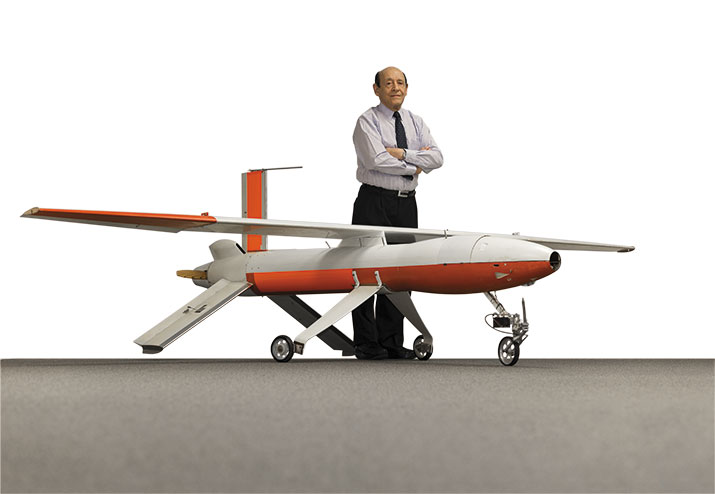
Where? The Air Force Special Weapons Center in Albuquerque, which was dedicated to R& D of atomic and other ‘unconventional’ weapns (which was presumably not especially interested in keeping the streets clean).  And at the end of the 1980s Clark’s old employer, Hughes Aircraft, would buy a fledgling drone manufacturing company, Leading Systems, from Abe Karem (‘the dronefather‘), and then promptly sell it on to General Atomics which, with Karem’s assistance, became the company responsible for the Predator.

These details are not included in Chamayou’s discussion – and I don’t mean this as a criticism: I admire both the brevity and the clarity of his account – and in fact no links to the military appeared in the New Scientist article. But Chamayou has found a subsequent, anonymous and remarkably telling comment on the article. Among the scenarios canvassed by Clark, this contributor wrote, one was conspicuous by its absence:

‘The minds of telechiricists are grappling with the problems of employing remotely-controlled machines to do the peaceful work of man amid the hazards of heat, radiation, space and the ocean floor. Have they got their priorities right? Should not their first efforts towards human safety be aimed at mankind’s most hazardous employment – the industry of war?… Why should twentieth-century men continue to be stormed at by shot and shell when a telechiric Tommy Atkins could take his place? ‘All conventional wars might eventually be conducted telechirically, armies of military robots battling it out be remote control, victory and defeat being calculated and apportioned by neutral computers, while humans sit safely at home watching on TV the lubricating oil staining the sand in sensible simile of their own blood.’

Sand? Chamayou doesn’t mention it [‘sand’ in his French translation becomes ‘dust’], but in fact the anonymous author opened his commentary by noting that the publication of Clark’s original article ‘coincided with the flare-up in the Yemen…’  The ‘flare-up’ was part of a civil war in Yemen, in which royalists (supported by Saudi Arabia) were pitted against republicans (supported by Egypt) and Britain was engaged in a series of irregular, covert operations that were repeatedly denied in Parliament.

And so it’s no accident, I think, that the anonymous contributor goes on to emphasize the importance of telechirics for asymmetric warfare:

‘Far-flung imperial conquests which were ours because we had the Maxim gun and they had the knobkerrie will be recalled by new bloodless triumphs coming our way because we have telechiric yeomanry and they, poor fuzzy-wuzzies, have only napalm and nerve-gas.’

By this means, Chamayou concludes, asymmetric warfare becomes unilateral: people still die, to be sure, but on one side only.  And, as those hideous remarks I’ve just quoted make plain, the divide is profoundly racialized.

2: Genealogy of the Predator

My own inclination would be to make that plural – genealogies – and to identify multiple lines of descent, some of which (I think plausibly) can be traced back to the early twentieth century.

But Chamayou excludes many of them, including ‘target drones’ and – more directly relevant – various ‘aerial torpedoes’, which he sees as forerunners of the cruise missile (which can only be launched once) rather than the combat drone (which can be used many times over). This distinction is useful, but it’s complicated by Project Aphrodite’s experiments with explosive-filled US bombers in the dog days of the Second World War, whose use of remote control and visual links – they’ve sometimes been called ‘video bombers’ – anticipates key elements of today’s remote operations (see also herehere, here and here).

Chamayou does notice the American use of drones for aerial surveillance over North Vietnam – though he makes nothing of other elements, including the development of ‘pattern of life’ analysis and the installation of the sensor-shooter systems of the ‘electronic battlefield’ along the Ho Chi Minh Trail, both of which (as I argued in ‘Lines of descent’) were key elements in the much later development of unmanned aerial systems.

But these developments came to nothing, Chamayou contends, and in the 1970s the development of military drones was virtually abandoned by the US: it was Israel that showed the way to the future.

During the Yom Kippur War of 1973 the Israelis used ‘decoy drones’ to draw the fire of missile batteries and then sent in conventional strike aircraft before the Egyptians could re-load: Chamayou doesn’t note it, but those drones were designed and built in under a month by Abe Karem and his team.  In 1982 the IDF repeated the tactic against Syrian batteries defending Palestinian strongholds in the Bekaa Valley.

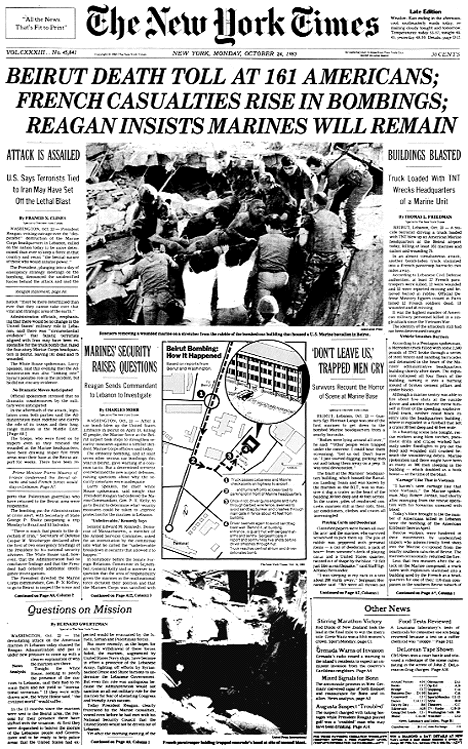
NYT Beirut barracks bombing 1983But Israel literally showed the US the way to the future in another, much more remarkable incident in 1983. Here is the original account (by Jim Schechter) on which Chamayou draws from Popular Science in October 1987:

‘Two days after a terrorist bomb destroyed the [US] Marine barracks in Beirut in October 1983, Marine Commandant Gen. P. X. Kelley secretly flew to the scene. No word of his arrival was leaked. Hours later in Tel Aviv the Israelis played back the tape for the shocked Marine general. The scene, they explained, was transmitted by a Mastiff RPV circling out of sight above the barracks.’

Peter Hellman in ‘The little airplane that could’ (in Discover, February 1987) fills in some of the details.  Kelley ‘had been photographed during his outdoor movements in Beirut — his head targeted in cross hairs‘ (my emphasis).  He explains:

‘Unobserved by the Marines, a miniaturized Israeli RPV (remotely piloted vehicle) called Mastiff had circled 5,000 feet overhead during Kelley’s visit. Despite its twelve-foot wing span (just a shade longer than a California condor’s), at that altitude the Mastiff couldn’t be seen by the naked eye. And with its fiber-glass body, it was almost impossible to detect by radar. Nor could the putt-putt of its two-cylinder 22-horsepower engine be heard. But a zoom-lensed video camera peering down from a clear plastic bubble in its belly had a splendid view of the touring general. On a signal from controllers more than 50 miles away, the mini-RPV left as furtively as it had come, and flew into a net set up outside its mobile ground station.

As Schechter laconically put it, the Americans got the message, and in the 1980s their interest in developing remotely piloted aircraft for ISR (intelligence, surveillance and reconnaissance) dramatically increased.

There are all sorts of other connections between the US and Israel when it comes to both the development of UAVs and their later use for targeted killing.  What Chamayou is most interested in is precisely the development of UAVs as hunter-killers, which (as I’ll explain in my next post in the series) he links to the transformation of warfare into man-hunting.  And, as I’ll try to show, that’s when things start to get extremely interesting…

Drones and ‘the world as free-fire zone’

Fred Kaplan has an interesting essay on the history and use of armed drones by the United States at MIT Technology Review: ‘The world as free-fire zone‘ (June 2013).  Kaplan provides a telling critique of Obama’s May statement about the conduct of targeted killings (though that doesn’t of course exhaust what the military uses UAVs for), but his discussion is muddied by what he says about Vietnam – and what he doesn’t.

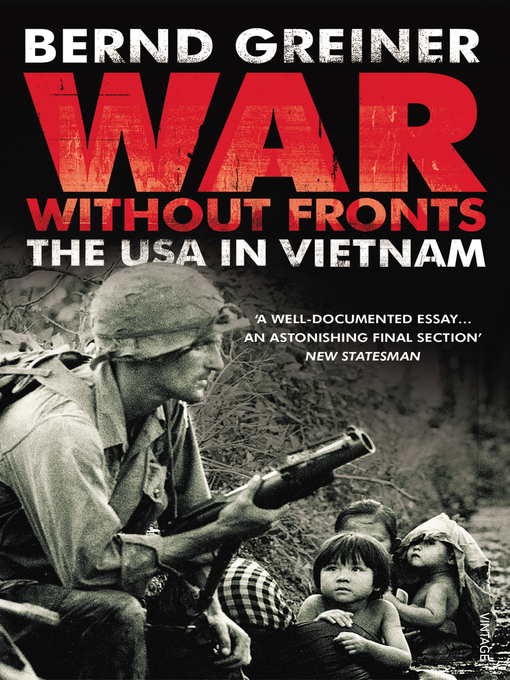
GREINER War without frontsThe title of the essay invokes a notorious tactic deployed by the United States in South Vietnam: the creation of free-fire, free-strike or what the Air Force called free-bomb zones (the name was changed in 1967  to ‘specified fire zones’ for PR purposes, though what was specified was the zone not the fire).  This is how historian Bernd Greiner summarises the policy in War without fronts: the USA in Vietnam (2007, trans. 2009):

‘License to destroy and annihilate on a large-scale applied unrestrictedly in the so-called “Free Fire Zones”.  Set by the South Vietnamese authorities – either the civil administration or the commanders of an Army corps or division – the US forces operated within them as though outside the law: “Prior to entrance into the area we as soldiers were told all that was left in the area after civilian evacuation were Viet Cong and thus fair game.” Virtually all recollections of the war contain such a statement or something similar, simultaneously referring to the fact that anyone who did not want to be evacuated had forfeited the right to protection, since in the Free Fire Zones the distinction between combatant and non-combatant was a prior lifted.’

Matters were not quite so simple, at least in principle, since (as Nick Turse notes in Kill anything that moves: the real American war in Vietnam (2013)), ‘the “free-fire” label was not quite an unlimited license to kill, since the laws of war still applied in these areas.’  And yet, as both Greiner and Turse show in considerable detail (and I’ll have more to say about this in another post), in practice those laws and the rules of engagement were serially violated.  Whatever the situation in Vietnam, however, it’s surely difficult to extend this – as Kaplan wants to do – to US policy on targeted killings.  Invoking the Authorization for Use of Military Force passed by Congress on 14 September 2001 (as Obama does himself), Kaplan writes:

‘This language is strikingly broad. Nothing is mentioned about geography. The premise is that al-Qaeda and its affiliates threaten U.S. security; so the president can attack its members, regardless of where they happen to be. Taken literally, the resolution turns the world into a free-fire zone‘ (my emphasis).

A couple of years ago Tom Engelhardt also wrote about Obama hardening George W. Bush’s resolve to create a ‘global free-fire zone’.  Kaplan’s criticism of the conditions that the Obama administration now claims restrict counter-terrorism strikes is, I think, fair – though much of what he says derives directly from a draft Department of Justice memorandum dated 8 November 2011 on ‘the use of lethal force in a foreign country outside the area of active hostilities against a U.S. citizen who is a senior operational leader of al-Qa’ida or an associated force’ rather than Obama’s wider speech on counter-terrorism on 23 May 2013 or the ‘fact sheet on policy standards and procedures’ that accompanied it.  But they are closely connected, and Kaplan’s objections have real substance.

First, the Obama administration insists that the threat posed to the United States must be ‘imminent’, yet since the threat is also deemed to be continuing ‘a broader concept of imminence’ is required that effectively neuters the term.

Second, apprehension of the suspect must be unfeasible, yet the constant nature of the threat means that the ‘window of opportunity’ can always be made so narrow that ‘kill’ trumps ‘capture’.

But what of Obama’s third condition: that ‘before any strike is taken, there must be near-certainty that no civilians will be killed or injured’?  Kaplan accepts that this is a ‘real restriction’.  Critics of the programme differ on how successful it has been in practice, and supporters like Amitai Etzioni have turned ‘civilian’ into a weasel word that means whatever they want it to mean (which is not very much).  Still, the most authoritative record of casualties – which I take to be the Bureau of Investigative Journalism in London – clearly shows that civilian deaths in Pakistan (at least) have fallen considerably from their dismal peak in 2009-10.  Whatever one makes of all this, however, it hardly turns the world into a ‘free-fire zone’.  The war machine will continue to be unleashed outside declared war zones (or what Obama also called ‘areas of active hostilities’, which may or may not mean the same thing), and Obama and his generals will continue to conjure a battlespace that is global in extent.  But if we take the President at his word – and I understand the weight that conditional has to bear – military violence may occur everywhere but not anywhere: ‘We must define our effort not as a boundless “global war on terror” – but rather as a series of persistent, targeted efforts to dismantle specific networks of violent extremists that threaten America.’

The question is whether we can take the President at his word.  As Glenn Greenwald points out, ‘Obama’s speeches have very little to do with Obama’s actions’.  Tom Junod says much the same about what he continues to call the Lethal Presidency: ‘When a man is as successful in fusing morality and rhetoric as Barack Obama, there’s always a tendency to think that the real man exists in his words, and all he has to do is find a way to live up to them.’  Performativity is not only conditional, as it always is, but in this case also discretionary.

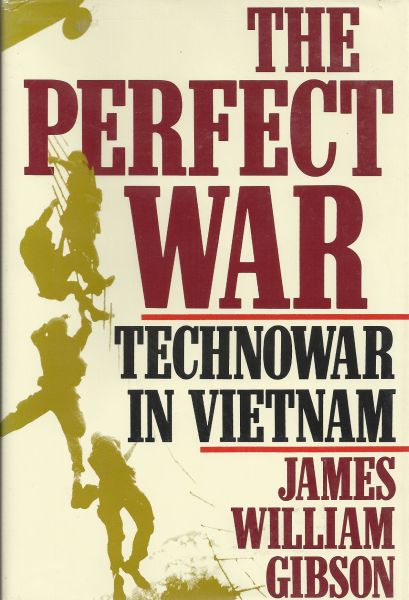
GIBSON The perfect warKaplan also refers to a notorious metric from the Vietnam war: the body-count.  As James Gibson patiently explains in his brilliant critique of The perfect war: technowar in Vietnam (1986), this was one of the central mechanisms in US Secretary of Defense Robert McNamara’s attempt to wage an appropriately Fordist war (he went to the Pentagon from being President of the Ford Motor Company).  The body-count can be traced back to the Korean War, but it came into its own in Vietnam where it was supposed to be the key metric of success – bizarrely, even of productivity – in a ‘war without fronts’ where progress could not be measured by territory gained.  Here too Turse is illuminating on the appalling culture that grew up around it, including the inflation (and even invention) of numbers, the body-count competitions, and the scores and rewards for what today would no doubt be called ‘excellence in killing’.

But what Kaplan has in mind is not quite this, but the central, absurdist assumption that there is a direct relationship between combatants killed and military success:

‘It is worth recalling the many times a drone has reportedly killed a “number 3 leader of al-Qaeda.” There was always some number 4 leader of al-Qaeda standing by to take his place. It’s become a high-tech reprise of the body-count syndrome from the Vietnam War — the illusion that there’s a relationship between the number of enemy killed and the proximity to victory.’

How else can we interpret John Nagl‘s tangled celebration (on Frontline’s ‘Kill/Capture’) of the importance of targeted killing for counterinsurgency and counter-terrorism?

‘We’re getting so good at various electronic means of identifying, tracking, locating members of the insurgency that we’re able to employ this almost industrial-scale counterterrorism killing machine that has been able to pick out and take off the battlefield not just the top level al Qaeda-level insurgents, but also increasingly is being used to target mid-level insurgents.’

Peter Scheer draws a distinction between the two moments in Nagl’s statement that helps clarify what he presumably intended (though Scheer is writing more generally):

‘The logic of warfare and intelligence have flipped, each becoming the mirror image of the other. Warfare has shifted from the scaling of military operations to the selective targeting of individual enemies. Intelligence gathering has shifted from the selective targeting of known threats to wholesale data mining for the purpose of finding hidden threats.’

In other words, the scale of intelligence has become industrial (or more accurately perhaps, post-industrial: see here), far exceeding the scale of intelligence available in Vietnam [though see here for a discussion of the connections between McNamara’s data-driven war and today’s obsession with Big Data, and here and here for an outline of the ‘security-industrial complex’], whereas the scale of killing has clearly contracted from what most certainly was industrial-scale killing in Vietnam.   Yet the networked connections between the two reveal the instantiation of the same driving logic of technowar in a radically new ‘war without fronts’.

For all these intimation of Vietnam, however, the genealogy of the drone with which Kaplan begins his essay is resolutely post-Vietnam (or at any rate outside it).  And this, I think, is a mistake.

Technological history is shot through with multiple sources of inspiration and no end of false starts, and usually has little difficulty in assembling a cast of pioneers, precursors and parallels, so I’m not trying to locate a primary origin.  Ian Shaw‘s account of the rise of the Predator (more from J.P. Santiago here) homes in on the work of Israeli engineer Abraham Karem, who built his first light-weight, radio-controlled ‘Albatross’ (sic) in his garage in Los Angeles in 1981.

Karem's Albatross (Chad Slattery)

He may have built the thing in his garage, but Karem was no hobbyist; he was a former engineering officer in the Israeli Air Force who had worked for Israel Aircraft Industries, and by 1971 he had set up his own company to design UAVs.  Neither the Israeli government nor the Israeli Air Force was interested, so Karem emigrated to the United States.  The Albatross was swiftly followed by the Amber, which was also radio-controlled, and by 1988 with DARPA seed-funding Karem’s prototype was capable of remaining aloft at several thousand feet for 40 hours or more. But fitting hi-tech sensor systems into such a small, light aircraft proved difficult and both the US Navy and the Army balked at the project.  Karem set about developing a bigger, heavier and in many ways less advanced version for a putative export market: the GNAT-750.

GNAT-750

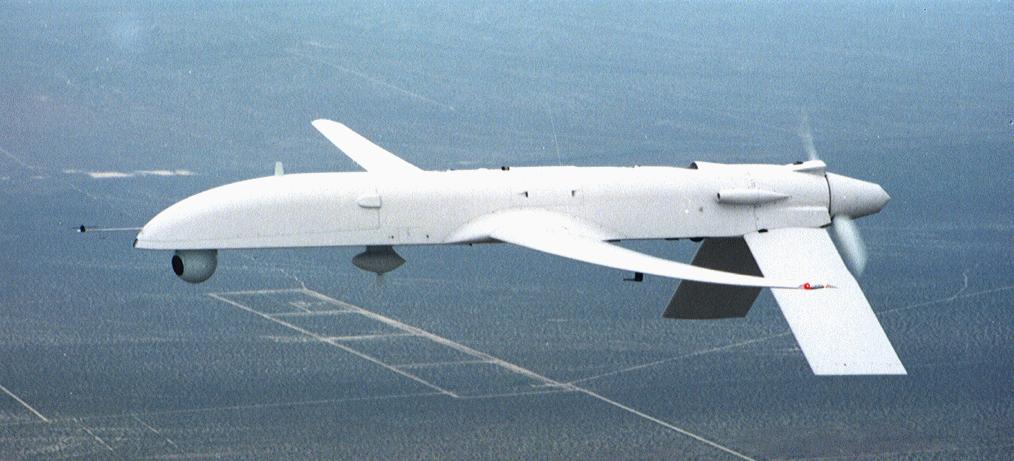
This was a desperate commercial strategy that didn’t save Karem’s company, Leading Systems Inc., from bankruptcy.  But it was a sound technical strategy.  In 1990 General Atomics bought the company and the development team, and when the CIA was tasked with monitoring the rapidly changing situation in the Balkans it purchased two GNAT-750s (above) for the job.  They were modified to allow for remote control via a satellite link (the first reconnaissance missions over Bosnia in 1995 were managed by the Air Force and controlled from Albania): the new aircraft was re-named the Predator.

It’s a good story – and you can find a much more detailed account by Richard Whittle in ‘The man who invented the Predator’ at Air & Space Magazine (April 2013) here – but in this form it leaves out much of the political in-fighting.  The second part of Ian’s narrative turns to the role of the Predator in the development of the CIA’s counter-terrorism campaign, and while he notes the enlistment of the US Air Force – ‘ultimately, the CIA arranged for Air Force teams trained by the Eleventh Reconnaissance Squadron at Nellis Air Force Base [Indian Springs, now Creech AFB] to operate the agency’s clandestine drones’ – he doesn’t dwell on the ‘arranging’ or the attitude of the USAF to aircraft without pilots on board.

Kaplan does, and his story starts earlier and elsewhere:

‘The drone as we know it today was the brainchild of John Stuart Foster Jr., a nuclear physicist, former head of the Lawrence Livermore National Laboratory (then called the Lawrence Radiation Laboratory), and — in 1971, when the idea occurred to him — the director of defense research and engineering, the top scientific post in the Pentagon.’

Foster was a hobbyist – he loved making model aircraft – and thought it ought to be possible to capitalise on his passion: ‘take an unmanned, remote-controlled airplane, strap a camera to its belly, and fly it over enemy targets to snap pictures or shoot film; if possible, load it with a bomb and destroy the targets, too.’  Two years later DARPA had overseen the production of two prototypes, Praeire [from the Latin, meaning both precede and dictate] and Caler [I have no idea], which were capable of staying aloft for 2 hours carrying a 28 lb payload.  At more or less the same time, the Pentagon commissioned a study from Albert Wohlstetter, a former RAND strategist, to identify new technologies that would enable the US to respond to a Soviet invasion of Western Europe without pressing the nuclear button. ‘Wohlstetter proposed putting the munitions on Foster’s pilotless planes and using them to hit targets deep behind enemy lines, Kaplan explains, ‘Soviet tank echelons, air bases, ports.’  By the end of the decade the Pentagon was testing ‘Assault Breaker’ and according to Kaplan ‘something close to Foster’s vision finally materialized in the mid-1990s, during NATO’s air war over the Balkans, with an unmanned aerial vehicle (UAV) called the Predator.’

But the use of the mid-altitude, long-endurance (‘MALE’ – really) drones remained largely the preserve of the CIA because the senior officer corps of the Air Force was hostile to their incorporation:

‘All this changed in 2006, when Bush named Robert Gates to replace Donald Rumsfeld as secretary of defense. Gates came into the Pentagon with one goal: to clean up the mess in Iraq… He was particularly appalled by the Air Force generals’ hostility toward drones. Gates boosted production; the generals slowed down delivery. He accelerated delivery; they held up deployment. He fired the Air Force chief of staff, General T. Michael Moseley (ostensibly for some other act of malfeasance but really because of his resistance to UAVs), and appointed in his place General Norton Schwartz, who had risen as a gunship and cargo-transport pilot in special operations forces… and over the next few years, he turned the drone-joystick pilots into an elite cadre of the Air Force.’

These are both important narratives, which help to delineate multiple lines of descent, but my own inclination is to push the story back and to move it outside the North Atlantic.  It’s not difficult to find precedents for UAVs around the time of the First World War – I’ve discussed some of them here – and towards the end of the Second World War America attempted to develop remote-controlled bombers to use against Germany (see ‘Project Aphrodite’ here and here).  But if we focus less on the object – the aircraft – and more on its dispositions and the practices mobilised through the network in which it is embedded (as Kaplan’s references to ‘free-fire zones’ and ‘body counts’ imply) then I think here Vietnam is the place to look.  For as I’ve argued in ‘Lines of descent’ (DOWNLOADS tab), not only did the Air Force experiment with surveillance drones over North Vietnam, as Ian briefly notes in his own account, but the US military developed a version of ‘pattern of life analysis’ and a sensor-shooter system that would prove to be indispensable to today’s remote operations.  Seen like this, they confirm that we are witnessing a new phase of technowar in exactly the sense that Gibson used the term: except that now it has been transformed into post-Fordist war and, to paraphrase David Harvey, ‘flexible annihilation’.

Dirty wars and private eyes

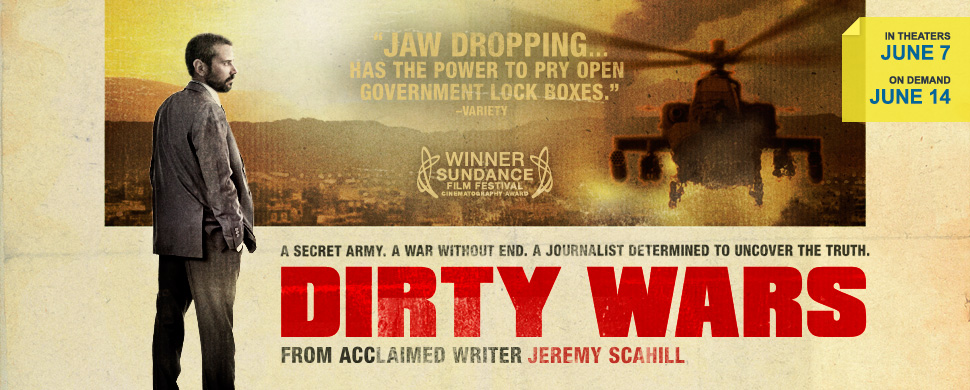
Dirty Wars/Sundance Festival

There’s a wonderful line (well, hundreds of wonderful lines) in Simon Gray‘s play Butley, where the eponymous university lecturer waspishly declares “You know how it exhausts me to teach books I haven’t read…”

So it’s with some trepidation that I return to the Rick Rowley/Jeremy Scahill/David Riker film of Scahill’s book “Dirty Wars: the world is a battlefield“, since although I’ve read the book I haven’t seen the film (it opens Friday 14 June in Vancouver [Cineplex Odeon International Village]).

But Gerard Toal has, and has posted an interesting reflection at Critical Geopolitics:

‘Scahill’s world is that of the investigative reporter. He’s focused on the facts, details and lines of connection that reveal abuse of power and extra-constitutional excess. Don’t expect to have Agamben cited. That is the power and value of his work. It gets under the skin of the conventional wisdom and general consensus on the war on terror. It disturbs. With the journalistic revelations of the last week (and there’s a lot more coming from what Scahill indicated; he also mentioned how journalists are now changing their digital behavior in big ways), the whole everywhere endless terror security surveillance state is cracking open before our eyes.’

David Harvey dedicated Social Justice and the City ‘to all good committed investigative journalists everywhere’, but the figure of Scahill in the film has attracted less generous commentary.  Mike Hogan notes, like many other critics, that the film is structured like a noir crime story in which Scahill becomes the gumshoe we follow

‘from the lawless hinterlands of Afghanistan, where he interviews the surviving members of the family of a U.S.-trained police chief decimated in a secret night raid; to Yemen, where he inspects the wreckage of a drone strike and meets the father of Anwar al-Awlaki, one of four American citizens to be assassinated abroad by the U.S. (al-Awlaki’s 16-year-old son was another); to Somalia, where he tags along with Somali war lords on the U.S. payroll, who brag of committing war crimes as they rampage through the rubble of Mogadishu.’

In Hogan’s interview Scahill talks about his initial reluctance to have the film revolve around him since ‘I don’t write articles in the first person and I don’t tend to talk about myself when I’m reporting.’

‘Rick [Rowley], the director of the film, was driving me insane by constantly filming me when I wasn’t supposed to be the character — and I think somewhere he knew that he wanted to do this. We had cut a version of the film where I was not me, I was just sort of like a tour guide through the archipelago of these covert war sites. And then when we started to change the way we were going to tell the story, we went back to the cutting room, and all the s**t that I told Rick not to film became the stuff that made the film possible…. I can see myself in the movie where I’m in a car, and it might look like I’m really tense about something, but it’s just that I’ve just yelled at Rick and told him to get the f**king camera out of my face. I’m like, “I’m trying to file my story, man, leave me alone.” I still have trouble watching it, to be honest.’

VALENTINE The Phoenix ProgramSo, it seems, did Douglas Valentine.  He castigates the film for its lack of historical context: its failure to acknowledge the long history of ‘dirty wars’ waged by the CIA (Valentine himself is the author of a brilliant book on The Phoenix Program in Vietnam).  It’s a serious criticism, and it applies to the book too (though to be fair it already comes in at more than 650 pages).

I do think it’s important to trace what is new and what isn’t about today’s wars fought in the shadows of 9/11,  which is in part why I constructed The colonial present as I did and why my analysis of today’s ‘drone wars’ is situated within the wider arc of the histories and geographies of bombing from the air. That said, I also think that Scahill’s stream of stories has done more than most other journalists reporting from the war zones to illuminate the contemporary reach of military and paramilitary violence.  As he says, ‘the world is a battlefield’.

But Valentine doesn’t care for the way Scahill bestrides that battlefield – look at the posters I’ve reproduced here – and he reserves his most withering fire for the starring role played in the film by Scahill himself:

Dirty Wars is a post-modern film by Jeremy Scahill, about himself, starring himself in many poses.The film owes more to Sergio Leone and Kathryn Bigelow than Constantinos Gavras…. 

The endless close-ups artfully convey the feeling that our hero is utterly alone, on some mythic journey of self-discovery, without a film crew or interpreters. There is no evidence that anyone went to Gardez to make sure everyone was waiting and not toiling in the fields or tending the flocks, or whatever they do. And we’ll never find out what the victims do.  The stage isn’t big enough for JS and anyone else.

This is a major theme throughout the story – JS is doing all this alone and the isolation preys on him…. 

Initially, there is no mention that journalist Jerome Starkey reported what happened in Gardez.  JS is too busy establishing himself as the courageous super-sleuth.  As we drive along the road, he reminds us how much danger he is in…. In my drinking days, we referred to this type of behavior as grandiosity.’ 

Dirty-Wars1Valentine dismisses this as ‘the cinema of self-indulgence’, and readers may remember other critical commentaries on academic appropriations of the stylistics of film noir and the figure of the detective: I’m thinking of Rosalyn Deutsche‘s scathing review of ‘Watching the Detectives’ (aka the Critical Theory Gang) in the late twentieth-century American city: ‘Chinatown Part Four? What Jake forgets about Downtown’, assemblage (1993) available here; Matt Farish subsequently provided a more extensive discussion here and Kristin Ross a still more recent take here.

Now one of my private pleasures is serious crime fiction, but taken together these commentaries raise a series of questions about the debt most academics working in and around war and military violence owe to the work of  investigative journalists and about the masculinist privileges both may assume in exposing ‘dirty wars’.  And what happens, stylistically and analytically, when the story moves from the ‘mean streets’ of the city, from chasing down criminal gangs, urban warfare and the entanglements between the two, and out into killing fields that extend far beyond the concrete jungle?  There’s something else too: perhaps it’s not surprising that investigative journalists should adopt the persona of the private detective when they are tracking down state-sponsored operations that move so seamlessly between the legal and the illegal?

Scahill Dirty Wars

Coda: If you want an excellent academic commentary on the rise of Joint Special Operations Command – which, as Valentine implies, is the focus of Scahill’s investigations (it certainly is in the book) – then I thoroughly recommend Steve Niva, ‘Disappearing violence: JSOC and the Pentagon’s new cartography of networked warfare’, Security Dialogue 44 (3) (2013) 185-202: it’s a clear, cogent and remarkably insightful analysis, completed before – and so far as I can see without any reference to – Scahill’s work.  Here’s the abstract:

Joint Special Operations Command In the twilight of the USA’s ground wars in Iraq and Afghanistan, there has been an expanding shadow war of targeted killings and drone strikes outside conventional war zones, where violence is largely disappeared from media coverage and political accountability.While many attribute the growth in these shadowy operations to the use of new technologies and platforms such as drones, this article argues that the central transformation enabling these operations is the increasing emergence of network forms of organization within and across the US military and related agencies after 2001. Drawing upon evidence from unclassified reports, academic studies, and the work of investigative journalists, this article will show that elements within the US military and related agencies developed in the decade after 2001 a form of shadow warfare in which hybrid blends of hierarchies and networks combine through common information and self-synchronization to mount strike operations across transnational battle spaces. But, rather than a top-down transformation towards networks, this article will show how it was the evolution of the Joint Special Operations Command (JSOC) from an elite strike force into a largely autonomous networked command that has been central to this process.Although drone strikes have received the bulk of critical attention in relation to this expanding shadow war of targeted killing, this often-lethal networked warfare increasingly resembles a global and possibly permanent policing operation in which targeted operations are used to manage populations and threats in lieu of addressing the social and political problems that produce the threats in the first place.

No Agamben here either, incidentally.

I don’t mean any of this to disparage Scahill’s book – as I say, I haven’t seen the film so must reserve judgement – and if you want a detailed summary of the book then head over to Understanding Empire where Ian Shaw has started to share his reading notes.

Renditions rendered

Many readers will know of various attempts made, several years ago, to map the CIA’s extraordinary rendition programme.  One of the most innovative was artist-geographer Trevor Paglen‘s Terminal Air project (and the idea of (de)basing the travel agency in this way was taken up, in a different register, by Adel Abidin: see here).

Trevor and his collaborators produced a series of visualizations of the flight network between Guantanamo and various black sites, some in digital form (like Terminal Air) — the image below is a screenshot of a remarkable animated sequence —

Terminal Air interactive screenshot

— and others displayed on physical billboards, like this one:

PAGLEN:EMERSON CIA FLIGHTS 2001-6

Today the Guardian publishes the results of a three-year programme of ESRC-funded collaborative research between Ruth Blakeley at the University of Kent and Sam Raphael at Kingston University in association with Reprieve into the system of extraordinary rendition and its associated practices.  This is of more than historical interest; they write:

The Rendition Project aims to analyse the emergence, development and operation of the global system of rendition and secret detention in the years since 9/11. In doing so, it aims to bring together as much of the publicly-available information as possible on the detainees who have been held in secret, the detention sites in which they have been held, and the methods and timings of their transfers.

With this data in place, we will seek to identify specific ‘key moments’ that have shaped the operation of rendition and secret detention, both regionally and in a global context. We are particularly interested in the contest between the executive, the judiciary, and the human rights community (comprising human rights lawyers, human rights NGOs, and some academics), over whether and how domestic and international law applies to those detainees held within the system. A key aim of the project is therefore to identify how rendition and secret detention have evolved within the context of this struggle to defend basic human rights.

The Rendition Project also examines the ways in which this system has evolved over time, including during the Obama administration. While President Obama has ordered the closure of CIA-run secret prisons (the so-called ‘black sites’), and revoked authorisation for use by US agents of ‘enhanced interrogation techniques’, many thousands of detainees in the ‘War on Terror’ continue to be held beyond the bounds of US and international law. Moreover, continued rendition and proxy detention have not been ruled out by the US Government, and may still form a central plank of counterterrorism policy.

The Rendition Project

The website for The Rendition Project includes testimony, profiles and documentation together with a detailed database and an interactive map (produced in collaboration with Craig Bloodworth from The Information Lab).

The composite map is daunting, as befits the terrifying scale of the process itself:

The Rendition Project composite map

But the ability to disentangle the threads and to interrogate the database changes the terms of the engagement, making it possible to track the experience of individual victims and to identify the major circuits and the global network of complicities in which they were enmeshed.

Chillingly brilliant work.

Dirty dancing and spaces of exception in Pakistan

Following up my post on the air campaigns waged by the United States and by Pakistan inside the Federally Administered Tribal Territories and the North-West Frontier Province (now Khyber Pakhtunkhwa), here are some screenshots from Chris Herwig‘s remarkable cartographic animation of casualties from US drone strikes from 2004 through to the present (data from the Bureau of Investigative Journalism):

Casualties from US drone strikes to end December 2007

Casualties from US drone strikes to end December 2007

Casualties from US drone strikes to end December 2008

Casualties from US drone strikes to end December 2008

Casualties from US drone strikes to end December 2009

Casualties from US drone strikes to end December 2009

Casualties from US drone strikes to end December 2010

Casualties from US drone strikes to end December 2010

Casualties from US drone strikes to end December 2011

Casualties from US drone strikes to end December 2011

Casualties from US drone strikes to end December 2012

Casualties from US drone strikes to end December 2012

You can see the rapid escalation of strikes in 2009-2010 and their contraction in 2011-2012.  There is also a tendency for later strikes to cause fewer casualties; the Bureau suggests that this may have been the result of a deliberate decision to limit civilian casualties (the CIA was already reported to be using new, smaller missiles with a restricted blast field and minimal shrapnel by the spring of 2010, so the later change is likely to be down to a mix of better intelligence and greater circumspection) and, more recently, of a switch away from ‘signature strikes’ – the two are of course related – and John Brennan, who was one of the main boosters of the programme’s expansion, now claims that drone strikes are a weapon ‘of last resort’.  Maybe; most sources agree that even as the numbers of deaths dwindled, so too did their tactical significance.  By February 2011 it was clear that fewer and fewer were so-called ‘high-value targets’ and more and more were simply foot-soldiers.

Here are the Bureau’s raw figures:

Drone strikes in Pakistan (BoJ)

You can find an interactive animation of the Bureau’s tabulations from Pitch Interactive here (thanks to Steve Legg for the tip); the screenshot below doesn’t do justice to the political-aesthetic effect of seeing this in full motion (or of clicking on each strike for the details):

Drone strikes in Pakistan PITCH INTERACTIVE

The maps also show that the strikes have been concentrated on North Waziristan, increasingly so since 2010, the locus of the Haqqani Network (which is a longstanding ally of Pakistan’s Inter Services Intelligence), with a secondary concentration on South Waziristan (a key locus of Tehrik-i-Taliban).  Here’s a tabulation from the Long War Journal, and although the strike numbers are marginally different from the Bureau’s the geographical concentration is clear:

US air strikes in FATA by district

What the maps can’t convey is the intricate, inconstant gavotte between Pakistan’s various military campaigns and US air strikes in the borderlands since 2004.  In the wake of 9/11 and the US-led invasion of Afghanistan, and in response to increasing pressure from Washington, the Pakistan Army launched a number of offensives against militants in the Federally Administered Tribal Areas (FATA).  In April 2004, after fierce fighting in the mountains of South Waziristan, Islamabad concluded a peace accord with Nek Muhammad, a key militant leader in the agency.  But he was killed just two months later, the first casualty of a US drone strike in Pakistan, and the agreement immediately collapsed.   In 2005 similar, fragile agreements were negotiated with Baitullah Mehsud, Nek’s successor, and other militant leaders, but these were soon broken.  Accords were also signed in North Waziristan in 2006 and 2007 but these too were short-lived.  In 2008 a peace accord was signed with the Tehrik-i-Taliban but heavy fighting continued, with major ground and air operations in the agencies to the north of the Khyber Pass.  In 2009 Pakistan’s military campaign became even more aggressive. Much of its effort was focused on the northern districts, especially around the Swat Valley, but attention then switched back to South Waziristan.  During the summer the Pakistan Air Force carried out regular air strikes in the region; in August 2009 Baitullah Mehsud was killed in a US drone strike.  In October 30,000 ground troops entered the region, and US drone strikes in South Waziristan immediately juddered to a (temporary) halt.  These operations drove large numbers of militants into Orakzai, which in recent years has been a major target of air strikes by the Pakistan Air Force.

The previous paragraph is little more than a caricature of a highly complex and evolving battlespace, but the gavotte I’ve described has been artfully – if intermittently – choreographed by the US and by Pakistan in fraught concert: so much so that Joshua Foust writes of the ‘Islamabad drone dance’.

This may surprise some readers; earlier this month Ben Emmerson QC, the UN Special Rapporteur on Counterterrorism and Human Rights, concluded a three-day visit to Pakistan by reaffirming what he described as ‘the position of the government of Pakistan’ that drone strikes in the FATA ‘are a violation of Pakistan’s sovereignty and territorial integrity.’  Emmerson met with officials from the Ministry of Foreign Affairs, the Ministry of Defence and the Secretariat of the FATA – but not, significantly, with anyone from the military or the ISI – who told him that ‘reports of continuing tacit consent by Pakistan to the use of drones on its territory by any other State are false’ and that ‘a thorough search of Government records had revealed no indication of such consent having been given.’ Certainly, the government has repeatedly protested the strikes in public, and the National Assembly passed resolutions in May 2011 and April 2012 condemning them.  But Foust insists that Emmerson has been an unwitting participant in the dance.

We know, from the Wikileaks cache of diplomatic cables from the US Embassy in Islamabad, that in August 2008 Prime Minister Yousaf Raza Gillani told the Ambassador that he approved of the drone strikes as part of ongoing offensives in the FATA – ‘I don’t care if they do it as long as they get the right people’ – and that ‘We’ll protest it in the National Assembly and then ignore it.’  But this was more than ‘tacit consent’.  Foust reminds us that, until comparatively recently, US drones were being launched or supported from at least six different air bases inside Pakistan, shown below, including Islamabad, Jacobabad, Peshawar, Quetta and Tarbela Ghazi; the US was ordered to leave Shamsi and had its lease terminated in December 2011.

US bases inside Pakistan

Admiral Mullen greets General Kayani, August 2008But there’s more. Pakistan had agreed that the focus of the US strikes would be North and South Waziristan.  Earlier that same year, March 2008, the Chairman of the Joint Chiefs of Staff Admiral Mullen asked General Kayani, Pakistan’s Chief of Army Staff,  for help in approving ‘a third Restricted Operating Zone for US aircraft over the FATA’, and writing in the Washington Post in November 2010 Greg Miller confirmed that these ‘flight boxes’ were confined to North and South Waziristan (although the US had unsuccessfully pressed for permission to extend the flights over Quetta, outside the FATA).  The geometry of those boxes is not known, though it would not be difficult to superimpose two likely rectangles over the previous map sequence. Operational details are, not surprisingly, far from clear.  According to a report in the Wall Street Journal on 26 September 2012, the CIA sends a fax to the ISI every month detailing strike zones and intended targets – replies apparently stopped early last year, but the US interprets the silence as ‘tacit consent’ since Pakistan immediately de-conflicts the air space to allow the Predators to carry out their surveillance – and a report in the New York Times earlier this month claimed that the US still provides the Pakistan military with 30 minutes notice of an imminent strike in South Waziristan (but no advance notice for strikes in North Waziristan because the Haqqani Network enjoys such close ties with the ISI that the CIA fears their targets would be warned of the attack).

The focus on the FATA follows not only from the militant groups that are based there; it also derives from the exceptional legal status of the borderlands.  Under British colonial rule, this was a buffer zone whose inhabitants were allowed a measure of nominal autonomy; colonial power was exercised indirectly through the authority vested in tribal leaders (who received subsidies from the British), and the special Frontier Crimes Regulations – in practice corrupt and draconian – were codified by Lord Curzon in 1901.  After partition and independence in 1947 Pakistan retained the 1901 Regulations, so that the President – who has direct executive control of the FATA – appoints a Political Agent for each agency who has absolute authority to adjudicate criminal and civil affairs; ordinary Acts of Parliament do not apply to the FATA unless the President expressly declares that they do. Limited reforms were introduced in August 2011, including the right to political mobilisation, but some commentators raised doubts about their implementation.  Preventive detention and collective punishment remain in force and the writ of the courts is still severely restricted.

FATA and NWFP map

AMNESTY The Hands of Cruelty Abuses by Armed Forces and Taliban in Pakistan s Tribal AreasThese special measures were reinforced by the simultaneous passage of the Actions (in Aid of Civil Power) Regulations in 2011, a quid pro quo demanded by the military, which allowed the Pakistan Armed Forces to carry out ‘law enforcement duties [and] to conduct law enforcement operations’, granted them sweeping powers of pre-emptive arrest and detention without charge, and forbade the high court from intervening.  According to one local politician, these new Regulations are ‘even more dangerous’ than the Frontier Crimes Regulations: ‘It is a system of martial law over the Tribal Areas.’  A new report from Amnesty International (from which I’ve taken these accounts) borrows its title, The Hands of Cruelty, from a despairing claim made by a lawyer from Peshawar: ‘The hands of cruelty extend to the Tribal Areas, but the hands of justice cannot reach that far.’

(Given the – I think abusive – attack on Amnesty’s report by Abdullah Mansoor at Global Research as ‘malicious’ and ‘misinformation’ that virtually ignores the violence perpetrated by the Taliban and other militant groups, I should also draw readers’ (and his) attention to Amnesty’s previous report, As if Hell fell on me, which provides a detailed indictment of exactly that).

In short, the FATA constitute a space of exception in precisely the sense given to that term by Giorgio Agamben: the normal rights and protections under the law are withdrawn from a section of the population by the law.  To see what this has to do with the geography of US drone strikes we can turn to an attack on 19 November 2008 on a residential compound in Indi Khel, 22 miles outside Bannu and about two hours by road from Peshawar.  Five alleged militants were killed and four civilians injured: not a large toll compared to other strikes, and yet the public reaction across Pakistan was extraordinary.

Drone strike at Indi Khel, Bannu, 19 November 2008

A diplomatic cable from US Ambassador Anne Patterson on 24 November explained the widening gap between what she called ‘private GOP [Government of Pakistan] acquiescence and public condemnation for U.S. action’:

‘According to local press, the alleged U.S. strike in Bannu on November 19 marked the first such attack in the settled areas of the Northwest Frontier Province, outside of the tribal areas. The strike drew a new round of condemnation by Prime Minister Gilani, coalition political parties, opposition leaders, and the media.

‘According to Pakistani press, the strike killed four people, including a senior Al-Qaida member, and injured five others. The first strike within “Pakistan proper” is seen as a watershed event, and the media is suggesting this could herald the spread of attacks to Peshawar or Islamabad. Even politicians who have no love lost for a dead terrorist are concerned by strikes within what is considered mainland Pakistan.’

The language is truly extraordinary, with its distinction between the FATA and ‘Pakistan proper’, even ‘mainland Pakistan’. In short: (imaginative) geography matters.  Not for nothing are the FATA known in Urdu as ilaqa ghair, which means ‘alien’ or ‘foreign’ lands.

The plight of the people in the FATA is exacerbated by the forceful imposition of a second, transnational legal regime: the right asserted by the United States to carry its fight against al Qaeda and its war against the Taliban across the border from the ‘hot’ zone in Afghanistan into militant sanctuaries in Pakistan.  This is part of a larger argument about the advanced deconstruction of the traditional, bounded battlefield – here Frédéric Megret‘s work is indispensable – and the production of a global battlespace, processes that have been accelerated by the remote operations permitted by drones.  But it remains both an assertion and an argument.  Although international law is not a deus ex machina, a neutral court of appeal above the fray, it nonetheless has a developed body of precepts that are supposed to regulate armed conflicts between states, and there are also protocols and tribunals that govern armed conflicts between governments and non-state actors within the territorial boundaries of a state (the former Yugoslavia or Ruanda, for example).  But conflicts between states and transnational non-state actors pose new and difficult questions, and perhaps even map a ‘legal void’.  Significantly, as Eyal Benvenisti points out in the Duke Journal of International and Comparative Law,

Concurrently with the successful efforts to impose restraints on intra-state asymmetric warfare, we have been witnessing efforts by the same powerful countries that pressed for intra-state conflict regulation to deregulate inter-state asymmetric warfare or what may be called “transnational” warfare.

I will leave a review of these debates, at once legal and political, for another day; among the most relevant recent contributions are Kenneth Anderson, ‘Targeted killing and drone warfare: how we came to debate whether there is a legal geography of war’ (2011), available here; Laurie Blank, ‘Defining the battlefield in contemporary conflict and counterterrorism: understanding the parameters of the zone of combat’, Georgia Journal of International and Comparative Law 39  (1) (2010-11), available here; Jennifer Daskal, ‘The geography of the battlefield: a framework for detention and targeting outside the “hot” conflict zone’ (2012), available here;  Noam Lubell and Nathan Derejko, ‘A global battlefield? Drones and the geographical scope of armed conflict’, Journal of International Criminal Justice 11 (1) (2013) 65-88 (abstract here).  In this twilight zone, where Washington at once admits its actions through a never-ending string of off-the-record briefings and yet denies any responsibility for their collateral outcomes, there are no inquiries into ‘mistakes’, no culpability for wrong-doing, and no compensation or restitution for the innocent victims.

Whatever you make of the rights and wrongs of all this, what matters for my present purposes is that these two legal regimes, one national and the other transnational, work in concert to expose the people of the Federally Administered Tribal Areas to military and paramilitary violence and, ultimately, death.

It’s more than a matter of law, of course (and in any case we shouldn’t confuse legality with legitimacy).  Within these exceptional spaces there has been active, tactical collaboration between the US and Pakistan.  Another diplomatic cable reported a meeting on 22 January 2008 with General Kayani, who asked US Central Command to provide ‘continuous Predator coverage of the conflict area’ in South Waziristan, but was offered only Joint Terminal Attack Controllers to direct PAF air strikes by F-16s – an offer which was refused because of a reluctance to allow US ground forces to operate inside Pakistan.  But in September and October 2009 small teams of US Special Forces were deployed to provide intelligence, surveillance and reconnaissance (ISR) support to the Pakistan Army, which included a ‘live downlink of unmanned aerial vehicle (UAV) full motion video.’ (What is interesting about all these exchanges is the degree of collaboration they reveal not only between the US and Pakistan but also between the CIA and the US military, especially Joint Special Operations Command; this is not surprising, given the hybridisation of military and paramilitary violence and the close involvement of the military in supplying, servicing and even flying the drones used in CIA-directed strikes).

There have been several reports of continuing collaboration between American and Pakistani intelligence operatives working on the ground in Pakistan, and one source – who purported to run a network of agents and ‘spotters’ in North and South Waziristan – told Reuters in January 2012 that ‘Our working relationship is a bit different from our political relationship.  It’s more productive.’  He claimed that the US and Pakistan agreed priority target lists between them, and that it took little more than two or three hours between the location of a targeted individual and the firing of missiles.  These claims are impossible to verify, but the emphasis on a working relationship rings true.

FATA flagPerhaps the most chilling of the Wikileaks cables is this (redacted) message sent from Islamabad in February 2009, reporting a discussion with a senior member of the FATA Secretariat, who enthusiastically recommended the practice of ‘double tap‘ – follow-up strikes targeting rescuers – and endorses the rationale for signature strikes against unknown, un-named targets:

9.  (S)  XXXXXXXXXXXX remains a strong advocate of U.S. strikes. In fact, he suggested to PO that the U.S. consider follow-on attacks immediately after an initial strike.  He explained that after a strike, the terrorists seal off the area to collect the bodies; in the first 10-24 hours after an attack, the only people in the area are terrorists, so “you should hit them again-there are no innocents there at that time.”  His sources report that the reported September 29 strike in South Waziristan had been particularly successful; “you will see that you hit more than has been reported in the press both in terms of quantity and quality.”  XXXXXXXXXXXX also drew a diagram essentially laying out the rationale for signature strikes…

Here you can see two perspectives on administrative killing, one from Pakistan and the other from the United States, converging onto a single target.

The cables from which I’ve quoted are all four or five years old, but this reflects the shutters coming down after the subsequent assault on Wikileaks and the arrest of  Bradley Manning – the reports from seasoned investigative journalists are much more recent.  I suppose you might conclude that none of them contradicts that artful word that does so much silent work in the official statement repeated by Emmerson, in which Pakistan denies reports of continuing tacit consent.  But given what I’ve shown about the deadly dance over those five years, do you really think the music has stopped?

Air strikes in Pakistan’s borderlands

I’m speaking about Drone strikes and the matrix of violence in Pakistan at a conference in Vancouver at the week-end – a presentation which will form part of The everywhere war – and to set some of the parameters I’ve been revisiting the changing geography of air strikes in the Federally Administered Tribal Areas.  It’s a formidably difficult question given the extraordinary dangers facing journalists, Pakistani or foreign, seeking to report from the FATA: for an incisive discussion of the media landscape inside the FATA see Sadaf Baig‘s Reporting from the frontlines.

In my view, the most thorough if necessarily imperfect tabulations of US-directed strikes are those provided by the Bureau of Investigative JournalismThere have been several attempts to map this database, including the Bureau’s own use of Google maps (see below and here; but be careful: zooming in is a product of the digital platform and will give a misleading sense of the resolution level of the data).

BOJ US drone strikes in FATA

One of the most thoughtful (and dynamic) representations comes from Chris Herwig.  He described the technical basis of his mapping over at MapBox here, and you can visit his microsite here.  Go here to see the animation running (with annotations).

8448237526_92002912de

Chris’s project has also been featured on PBS here, where he also responds to several criticisms of the data and his visualizations.

Over at Slate, Chris Kirk has produced an interactive that tries to show the maximum number of estimated casualties from each strike, but the data are drawn from the New America Foundation database which has been criticised for underestimating casualties; one (to October 2012) version is here, and another (to February 2013), using a different cartographic design, is here.  More generally, Forensic Architecture‘s Unmanned Aerial Violence team is working to produce an online visualization of drone strikes not only over Pakistan but also over Afghanistan,Yemen, Somalia and Palestine. but it’s not yet operational).

But the problem doesn’t end with the cartographic piercing of the veil of semi-secrecy the White House, the CIA and JSOC cast over their remote operations, though I’ve noted before how their collective teasing of American journalists over the legal and administrative protocols they supposedly follow – especially the so-called “disposition matrix” –  works to (mis)direct attention towards Washington and away from the sites that Chris and others have struggled to map.

I say this because the US is not the only state carrying out air strikes in the region.  Soon after 9/11 and the US-led invasion of Afghanistan, largely in response to pressure from Washington, the Pakistan military moved into the FATA.  According to Zahid Ali Khan, Pakistan’s Frontier Corps was deployed in December 2001, but by May 2002 it was decided that a much heavier hand was needed and the Pakistan Army was ordered into the borderlands for the first time in the nation’s history.  Local people requested that military operations be limited to ground forces, but by 2004 this agreement was in shreds and – as the image below shows – ever since the Pakistan Air Force has made no secret of its continuing air strikes on the FATA.

PAF air strike in FATA

Again, there is no public tabulation, but the American Enterprise Institute‘s Critical Threats daily Pakistan Security Brief – I know, I know, it’s a neoconservative think-tank – culls this (needless to say, approving) record from reports in Pakistan media in the first two months of this year alone:

25 February PAF kills 10 TTP militants in Tirah [Kurram/Khyber, FATA]

21 February PAF bombs militants in Orakzai [NWF Province] killing 29

19-20 February PAF jets bomb TTP hideouts in Orakzai

11 February PAF jets kill 8 militants in the Tirah Valley

8 February Jets kill 9 militants in Orakzai

7 February PAF targets militants in Orakzai

6 February Jets kill 8 in Orakzai

30 January PAF kills 23 militants in Tirah Valley and 8 in Orakzai agency

28 January Pakistani jets bomb militants in Orakzai

4 January Gunships kill 3, injure more in North Waziristan retaliation

It’s a bare bones summary, clearly, and I suspect the readiness of the AEI to trust local media to report PAF strikes is in stark contrast to their attitude to local reports of US drone strikes.  I’ve also deliberately retained the original phrasing: conspicuously, there is no record of  civilian casualties. Like the United States, Pakistan routinely plays these down or denies them altogether.  Here, for example, is a typical report via the Long War Journal on 25 March 2010:

‘Pakistani fighter-bombers struck a series of targets in the Mamuzai region in [Orakzai] today. Sixty-one Taliban fighters were killed, Pakistani intelligence officials told The Associated Press. The military claimed that no civilians were killed in the attacks. The targets included a madrassa, a mosque, and a seminary run by the Tablighi Jamaat. Pakistani officials said that Taliban leaders were meeting at the Tablighi seminary.’

PAF air strike, Orakzai

It’s unlikely that civilians were unscathed.  For the first four years at least the accuracy of the Air Force’s strikes was compromised by what Irfan Ahmad described as  its ‘lack of real time electronic intelligence and inferior technical means for command, control and communications’, by deficiencies in the targeting pods used by the PAF’s  ageing F-16 aircraft, and by the use of laser-guided missiles whose precision was reduced by clouds or poor visibility.  From 2008 new electro-optical targeting pods and sensors were being retrofitted and new ground and air capabilities for image exploitation put in place.  In 2009 the Air Force was also the launch customer for the Anglo-Italian Falco reconnaissance drone (see below), which is now co-produced in Pakistan; five systems were soon in use over the FATA, each comprising four aircraft with one held in reserve, and the Air Force was already anticipating arming them ‘with the most modern and lethal payloads’. More recently, the PAF has upgraded its F-16 fleet with new Block 52 versions and installed advanced avionics.  Throughout this period, as the military offensive periodically intensified, hundreds of thousands, perhaps millions of people were displaced from the borderlands.

falco_uav_galileo_avionica_paf_pakistan_air_force_01

It’s difficult to provide a detailed accounting of the air strikes, but in a rare admission former Air Chief Marshall Rao Qamar Suleiman claimed that the Pakistan Air Force carried out 5,000 strike sorties and dropped 11,600 bombs on 4,600 targets in the FATA between May 2008 and November 2011.  Unlike US air strikes in the region, PAF strikes are rarely ‘stand-alone’ affairs but are co-ordinated with ground forces (which is also the case with most drone strikes in Afghanistan, which operate in close concert with troops and conventional strike aircraft).

My object is recording all this is (I hope obviously) emphatically not to say that it is perfectly acceptable for the US to launch air strikes in the FATA because Pakistan is doing the same. Rather, the co-existence of the two air campaigns explains, in part, how it is possible for each party to accuse the other of carrying out an attack, as reported earlier this month.  More importantly, it also emphasises the ever-present horizon of danger within which the inhabitants of the borderlands are forced to live.  They are not only Living under drones.

Living Under Drones

The same point was sharpened by CIVIC – now the Center for Civilians in Conflict – in their (I think vital) report Civilian harm and conflict in North West Pakistan, published in October 2010. That report also details the violence meted out to civilians by militant groups in the region; for a detailed survey of the political geography of the borderlands, see Brian Fishman‘s The Battle for Pakistan: militancy and conflict across the FATA and NWFP, produced for the New America Foundation in 2010; there’s also much to think about in Daanish Mustafa and Katherine Brown, ‘Spaces of performative politics and terror in Pakistan‘, and in the same authors’ ‘The Taliban, Public Space and terror in Pakistan‘.

The existence of the two air campaigns also shows that the FATA are produced as a space of exception not only through Washington’s strenuous juggling with the Authorisation to Use Military Force and with international law (to validate the extension of its ‘global battlefield’) – whether it does so with or without Islamabad’s covert consent remains an open question – but also through Islamabad’s continued determination to treat the borderlands as legally anomalous territories for its own assertion of military violence.

ROE Waging war in WaziristanThe last is a doubled colonial legacy.  Not only is the legal geography that structures the FATA’s relations with the Pakistani state a relict from Britain’s imperial decision to treat them as a space to be ‘excepted from state and society for the purposes of war’, as Ian Shaw and Majed Akhter put it in Antipode recently.

So too is the decision to continue to use the FATA as a laboratory for what the British called ‘air control’. Andrew Roe has provided a series of detailed discussions in the RAF’s invaluable Air Power Review, here and here and here, and brought much of his research together in Waging war in Waziristan (2010).

But for a rapid and sobering sense of how these campaigns were viewed from the air in the 1930s you need to watch this BBC interview with Group Captain Robert Lister, Wings over Waziristan, which includes extraordinary cine footage showing what he calls ‘tribal operations from the air’.  Lister was posted to Peshawar in 1935, and soon after he arrived both the Army and the Air Force were ordered to put down ‘a tribal insurrection or rebellion’ in Waziristan.  Their preferred method was to destroy villages by setting fire to individual houses, blowing them up, or bombing them from the air ‘to make them say “Right, it’s not worthwhile – come to terms.”‘  Listen as Lister says, in cut-glass tones, ‘It was a fair and just way of dealing with it: they started these troubles and had to be dealt with.’

Waziristan:Lister:Here's an attack being carried out

And if you want to discover a different dimension to ‘unmanning’ aerial vehicles, listen from 08.00-08.40.

UPDATE: I’ve just discovered another film shot over Waziristan in 1937 by Leonard de Ville Chisman, which covers the air and ground war against the Faqir of Ipi described by Lister.  It contains a number of strikingly similar shots, though there is of course no commentary: you can access it via Colonial Film: Moving Images of the British Empire here.  On that remarkably informative site, Francis Gooding writes:

The official record of NWFP operations during 1936-7 – a thick volume, its size indicating the scale and seriousness of the conflict – contains full details about the manner in which aircraft were employed. The flag marches of November that sparked the revolt were accompanied by aircraft reconnaissance, and the record notes that ‘air reconnaissance requirements were met by one flight of No. 5 (Army Co-operation) Squadron’ (Govt of India, op.cit., 15), and the RAF also provided close cover for troops, and this pattern – reconnaissance with close support against the enemy – was repeated throughout the operations.

Reels 14 and 15 of the Chisman collection record precisely these kinds of encounters and air operations, with footage of bombing raids and the dropping of supplies to forward positions by parachute taken from within flying aircraft. Aircraft were also used to disseminate information and warnings about future punitive action (again, this was a tried and tested method, typical of colonial air policing; see Omissi, 1990, 154-5). On 27 August 1937, for instance, ‘notices were dropped over the Shawal area warning the inhabitants that until the Faqir submitted to Government, any tribe sheltering him would be liable for punishment’ (Govt. of India, op.cit., 179), and reel 15 contains a sequence showing a pilot unfurling a large leaflet, with text in Pashto and Urdu. The following sequences show air-drops of these leaflets over hill country. There are also scenes showing armoured cars and tanks on the move, and a sequence apparently shot during a battle, with a line of artillery opening fire on hill positions. 

The Faqir’s uprising was arguably the most serious colonial insurgency of the inter-war imperial period, and the films are remarkable in that they record scenes of action from a poorly remembered but major guerrilla conflict. Beyond this historical importance they have another significance, for they offer scenes of something only very rarely captured on film, despite its regular occurrence throughout the Empire – the recourse to the punitive deployment of heavy weaponry against subject peoples in revolt.