Game of Drones

theory_of_the_drone_finalJean-Baptiste Jeangène Vilmer writes to say that his review of Grégoire Chamayou‘s Théorie du drone has just appeared in English translation over at Books & Ideas here.

It’s a combative review, literally so:

When Chamayou was asked what motivated him to write the book, he replied that “some philosophers in the United States and in Israel work hand in hand with the military to elaborate what I call a ‘necro-ethics’ that tries to justify targeted assassinations. So it is urgent to respond. When ethics is brought into a war, philosophy becomes a battlefield.” 

A bit like Plato looking upon his Socratic dialogues as the philosopher’s responses to the sophists – i.e. to false philosophers – Chamayou presents his Theory of the Drone as a response to the traitorous philosophers who collaborate with the military. I am myself one of this low species: I teach ethics and the law of war to officer students at the French Military Academy of Saint-Cyr, and I often work with the military (without however being “enlisted” to justify anything whatsoever). Therefore I can testify that, when you take an interest in military matters, it is helpful to work with them, to increase your precision and to avoid some clichés and factual errors.

I provided some background to Vilmer’s work and discussed his critique here.

An excellent English translation of Theory of the Drone is due from the New Press in December.

While I’m on the subject of translations, French versions of my ‘Drone geographies’ from Radical Philosophy (DOWNLOADS tab) are now available as ‘Géographes du drone’ in Jef Klak: critique sociale et experiences littéraires 1 (2014) 262-277 and in Décadrages: Cinéma, à travers champs 26-27 (2014) 129-150.

Eye in the Sky

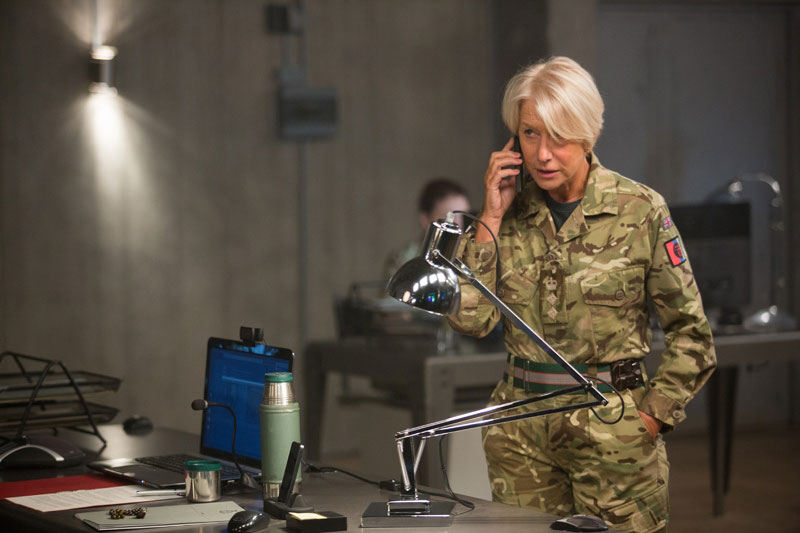
Several years ago I met Guy Hibbert in a London hotel to discuss his draft script for a BBC drama about a targeted killing by a British drone in East Africa.  It was a clever script and an interesting conversation – and I hope a helpful one – but in the interim I heard no more about it and assumed that the BBC had shelved the project.

eye-in-the-sky-image-helen-mirren

Now I see that Eye in the Sky is in production as a feature film directed by Gavin Hood and starring Helen Mirren (swoon).  As First Showing reports,

An American drone pilot (Aaron Paul) finds himself at a crossroads when a 9-year-old girl enters the kill zone his drone operation, under the command of military intelligence officer Col. Katherine Powell (Helen Mirren) is poised to destroy after they learn their targets are planning a suicide mission. What follows is a climb up the “kill chain” of command, weighing the legality and morality of action and inaction.

Eye in the Sky is scheduled for release next year.

UPDATE: Guy has written to say that shooting in Cape Town finishes this week, and then it’s nine months of post-production for a September 2015 première.

Under American Skies

I’ll be in Berlin in December for a conversation with James Bridle about drone wars and related issues, and I’m already looking forward to it since I’m a great admirer of his work. I particularly admire the way in which he challenges so many of our assumptions about ‘looking’ through his presentations about militarised vision and violence, and I’ve noted before the filiations between his various projects and Josh Begley‘s.

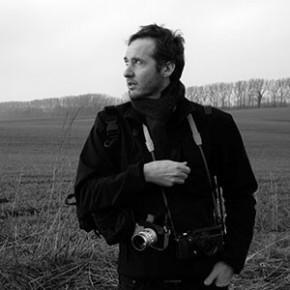
Tomas van HoutryveSo I was interested to read about photographer Tomas van Houtryves (right) project Blue Sky Days.  He begins with an arresting observation with which both James and Josh would be only too familiar:

‘Although a huge amount of [full motion video] footage has been collected [by US drones], the program is classified, and few people have ever seen images of the drone war and its casualties. This seems like a paradox in our thoroughly media-connected age. How can America be involved in a decade-long war where the sky is buzzing with cameras, and yet the public remains totally in the dark?’

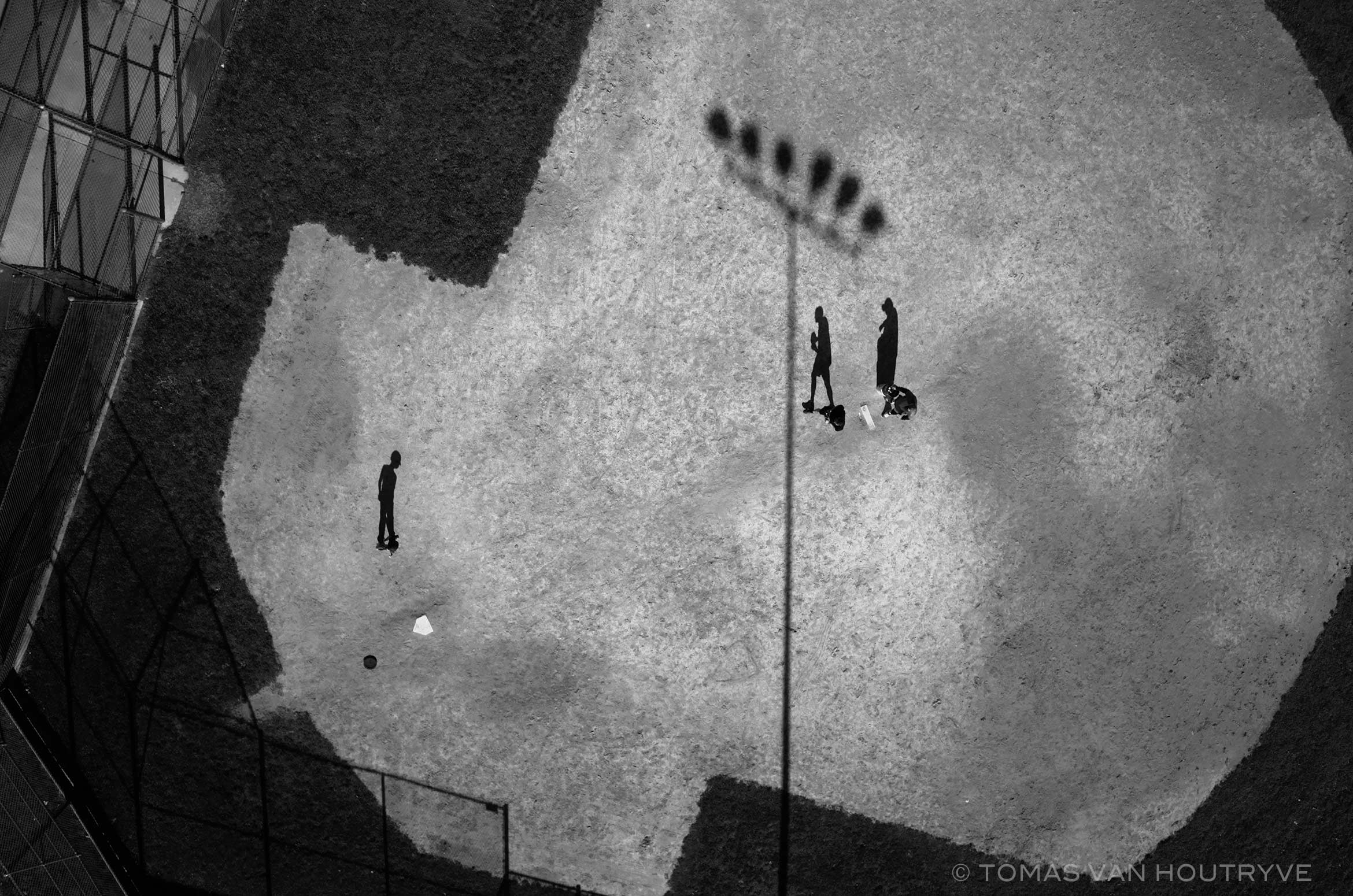
But his response to the question is distinctly different: he repatriates the drone wars from Pakistan to the United States (here the most appropriate comparison is with Omar Fast‘s 5,000 Feet is the Best).

Tomas van Houtryve 1

To do so, Tomas travelled across America with a small quadcopter drone bought from Amazon.com attached to his camera.  His concept was simple, Rena Silverman explains in the New York Times:

Take the idea of foreign drone strikes and instead target similar domestic situations, putting them under surveillance using his drone in public spaces. He made a list of hundreds of different strike reports, gleaning as many details about the circumstances…

He rented a black car with tinted windows and placed himself, his drones, his batteries and lists in the car. He spent six weeks in late 2013 averaging between seven and 10 drone flights daily, sleeping in a different town every night. He would pull the car into an empty lot, get out, launch the drone for about five to 10 minutes — about as long as its power lasted — take footage, land the drone, drive away and recharge the batteries while en route to the next location…

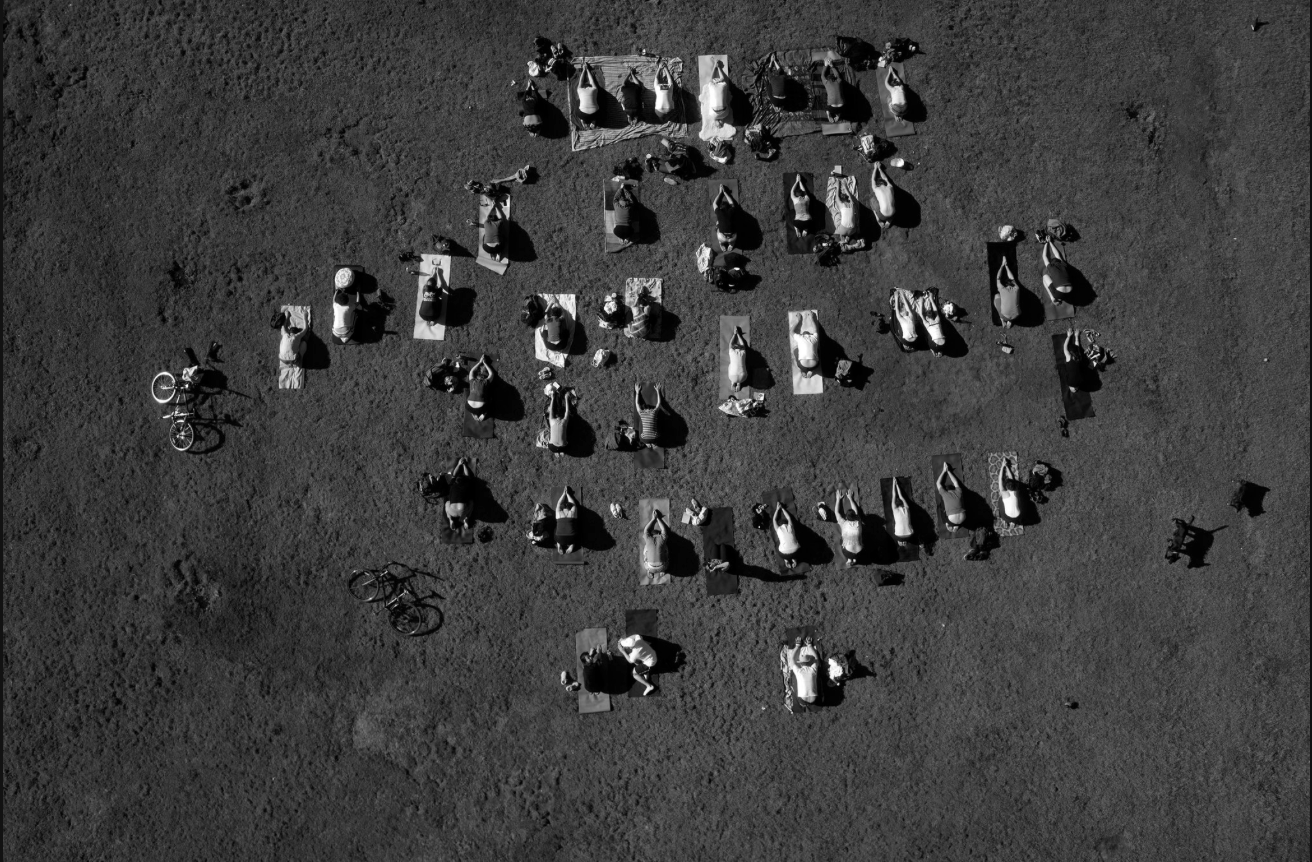
He followed his list carefully, trying to imitate “signature strikes,” referring to a May 2012 New York Times article in which some State Department officials complained about the lax criteria for identifying a terrorist “signature.” The joke was that “three guys doing jumping jacks” could be enough suspicious activity for the C.I.A. to conclude it could be a terrorist training camp. In other words, targeting people based on behavior rather than identity.

Tomas van Houtryve 2 copy

He photographed people exercising in Philadelphia, their shadows long and pinned against the grid of a park. He noticed more “signature” behavior while driving through San Francisco, where he encountered a group doing yoga [above]. When Mr. van Houtryve recently printed the image, he asked viewers if they thought the subjects were praying or exercising. It was a toss-up.

Although these images are not quite ‘what drone attacks in America would look like’, as Pete Brook suggested in WIRED – Tomas’s drone was flying much lower (‘only about six stories high’) and these images are pin-point sharp: there’s none of the ambiguity of infra-red heat signatures here – none the less that last sentence really says it all.  Images do not speak for themselves and interpretation counts for everything – which is why, as I’ve repeatedly argued, it matters so much what pilots, sensor operators and image analysts are pre-disposed to see.

It turns out that a particular incident provoked Tomas’s project – the murder of Mamana Bibi at Ghunda Kala in North Waziristan on 24 October 2012, which I described here –  and also gives it its title.

Zubair RehmanIn October 2012, a drone strike in northeast Pakistan killed a 67-year-old woman picking okra outside her house. At a briefing held in 2013 in Washington, DC, the woman’s 13-year-old grandson, Zubair Rehman, spoke to a group of five lawmakers. “I no longer love blue skies,” said Rehman, who was injured by shrapnel in the attack. “In fact, I now prefer gray skies. The drones do not fly when the skies are gray.”

There’s more from Tomas at Harper’s here, which originally co-sponsored the project with the Pulitzer Center, and you can see more of his drone’s eye view images at the National Geographic here.

There’s also a revealing interview conducted by Bard College’s Center for the Study of the Drone here; it contains all sorts of interesting observations, but one in particular resonated.  Asked about the tension between the beauty of his photographic compositions and the horror of what he is seeking to convey, Tomas says this:

‘The base subject that I’m trying to raise awareness about and get people to think about in less abstract terms is the foreign drone war. If you take the time to read through the particular airstrikes, a lot of them are quite horrifying. But on the other hand, as a photographer, I know that beauty is one of the tools that we use to get people to look at a picture. Beauty has a lot of power, so there’s a tension between trying to seduce people with the language of photography, which is beautiful composition, and trying to reveal something that might be uncomfortable or difficult to digest, once people fully grasp it.’

Another of my art icons, elin o’Hara slavick, says something very similar about her mesmerising sequence of aerial images of places bombed by the US, Bomb after bomb (see also Brian Howe‘s discussion here and my own in ‘Doors in to Nowhere’ [DOWNLOADS tab], from which I’ve taken this passage):

‘She adopts an aerial view—the position of the bombers—in order to stage and to subvert the power of aerial mastery. The drawings are made beautiful “to seduce the viewer,” she says, to draw them into the deadly embrace of the image only to have their pleasure disrupted when they take a closer look. “Like an Impressionist or Pointillist painting,” slavick explains, “I wish for the viewer to be captured by the colors and lost in the patterns and then to have their optical pleasure interrupted by the very real dots or bombs that make up the painting.”’

A tart reminder that there are multiple ways of ‘just looking‘.

Predator View

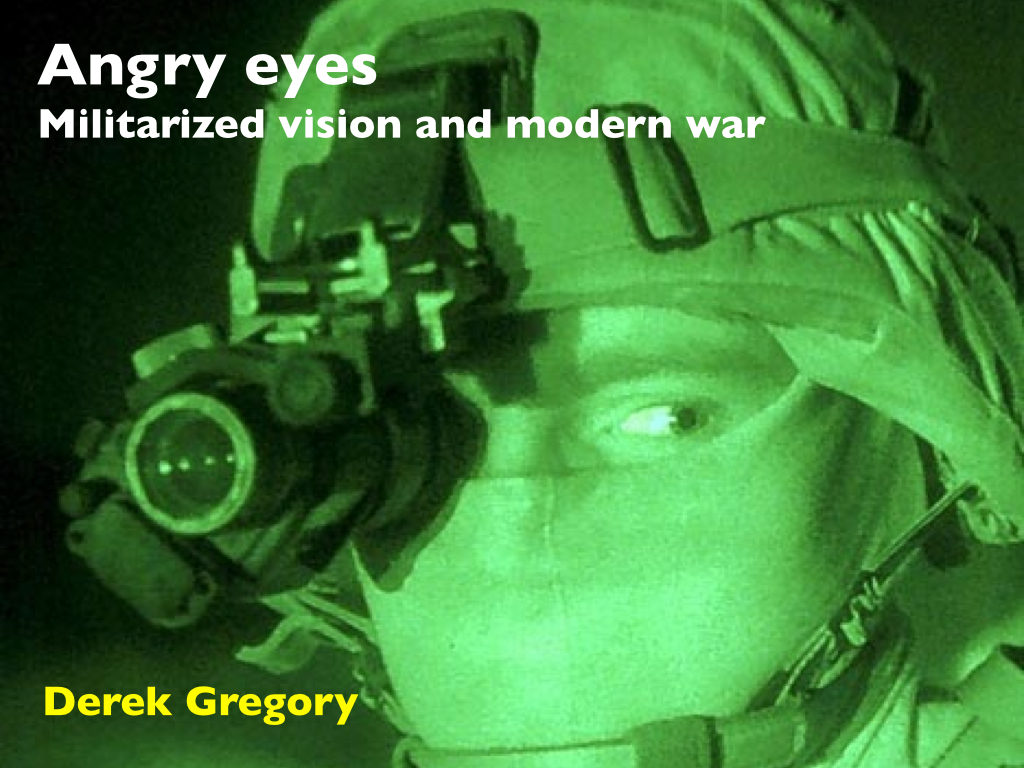
I’m in Zurich – many thanks to Benedikt Korf for the invitation and the wonderful hospitality – for a seminar with Benedikt’s doctoral students on the long form version of ‘The Natures of War’ (they have what I hope is the penultimate draft; I’ll post the final version once I’ve reworked it after the seminar) and then a public lecture: ‘Angry eyes: the militarization of vision and modern war’.

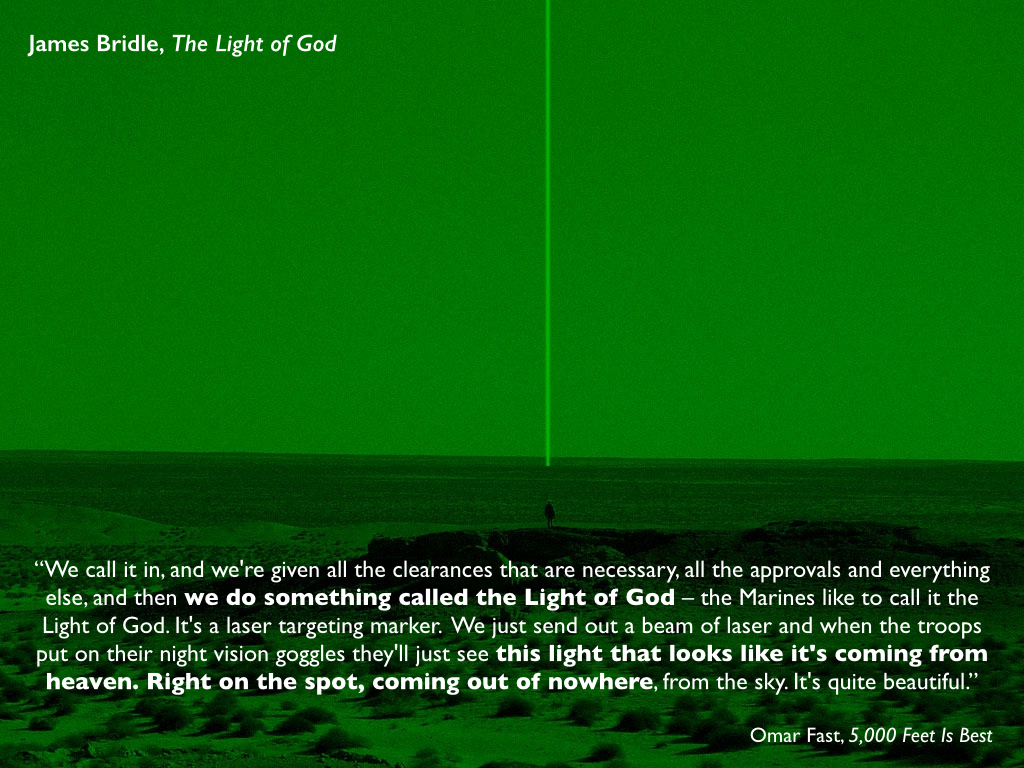
Part of my argument in the lecture is about the narrowness of ‘Predator View’, so let me explain what I mean.  My starting point is the illusion that the use of the intelligence, surveillance and reconnaissance capabilities of remote platforms like the MQ-1 Predator or the MQ-9 Reaper produces a transparent battlespace: in effect, a version of Donna Haraway‘s ‘God-trick’, the ability to see everything from nowhere in particular.  The most succinct version of this is the treatment of laser targeting as ‘the eye of God’:

Eye of God.001

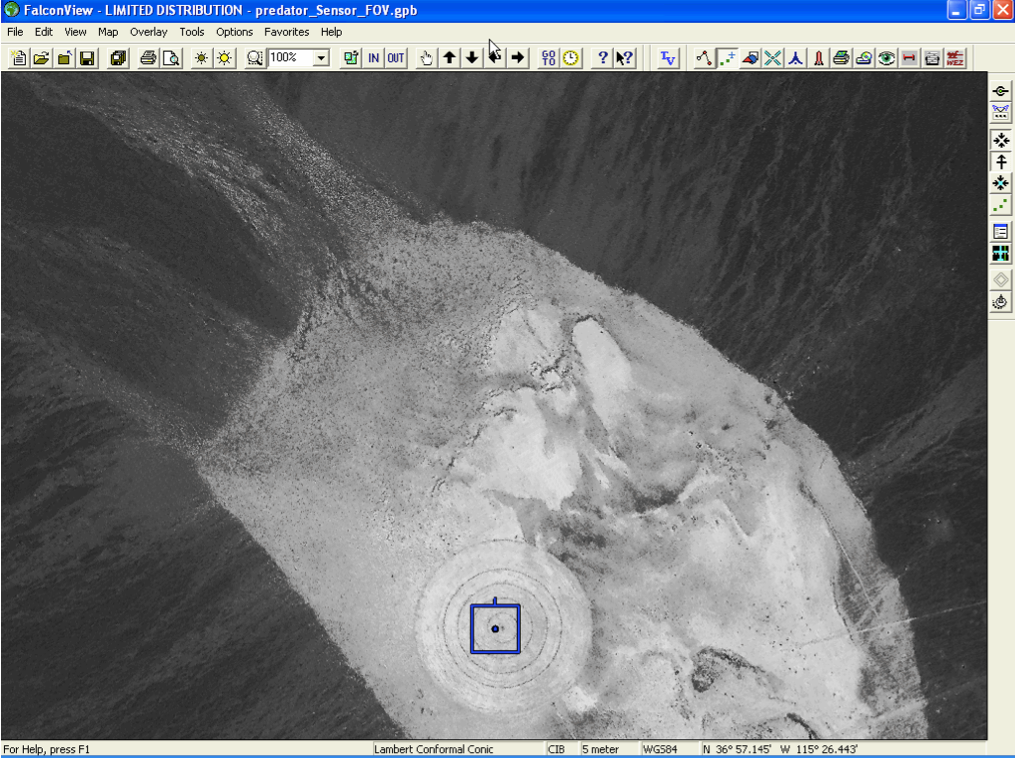
In fact, ‘Predator View’ is remarkably narrow. First, and most directly, a common complaint is that the view provided by its Full Motion Video is literally too narrow – ‘like looking through a soda straw’.  It’s for this reason that pilots and sensor operators also use FalconView, a Windows-based mapping tool that is supposed to provide them with situational awareness.  I’ve taken the image below from a presentation by Lt Col Paul Hastert (USAF) on ‘Spiral development in wartime’ – the screenshot is the FalconView image, the small square the field of view from a Predator – but the most detailed account of FalconView is Jon Lindsay‘s ‘”War upon the map”‘: User innovation in American military software’, Technology and culture 51 (3) (2010) 619-51.

FALCONVIEW and Predator FOV

There have been several later releases of FalconView, and a version is now even open source, so it’s probably not surprising that the US military also uses Google Earth.  In fact, in two of the air strikes I consider in detail it was, in part, juggling these different views that contributed to wrong targeting decisions.  (There are projects that provide a wider field of view – the nine-camera suite of Gorgon Stare is in operation and its second increment is already in use in Afghanistan – and others that integrate imagery from multiple sources, like Raytheon’s Zeus, which is intended to supplant FalconView as the ‘primary mission execution tool‘).

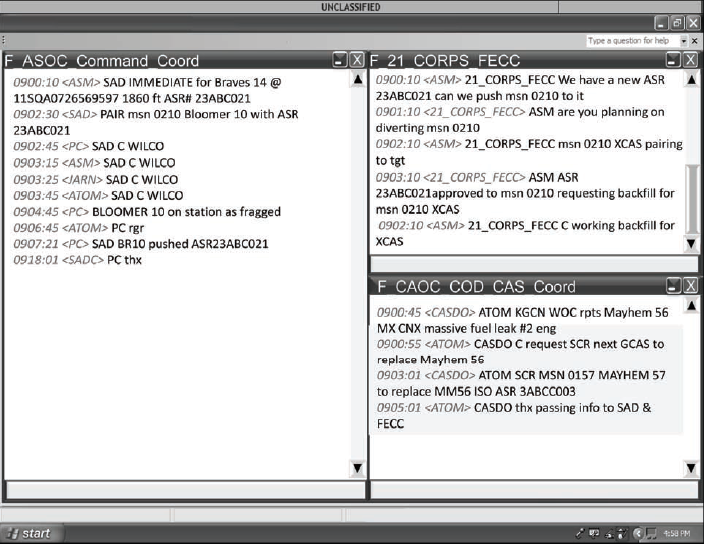
But in the air strikes that I consider those involved in these networked operations are also busy communicating via radio and – crucially – via the typed messages displayed in mIRC‘s online chat windows.  The image below is taken from the US military’s multi-service manual on Tactical Chat (see also the discussion at Public Intelligence here).

mIRC 3 chatrooms

In the case of the ‘friendly fire’ incident in the Sangin Valley in 2011, the pilot and sensor operator were unaware of crucial entries made by image analysts in mIRC and of private (or ‘whisper’) chats to the Mission Intelligence Co-ordiator.  That’s not entirely surprising.  Once permission has been given to engage a target, ‘KILL CHAIN” is typed into the room to minimise extraneous chatter that might otherwise visually distract and so ‘degrade’ the strike.  According to the Mission Intelligence Controller for the Sangin incident:

‘When we got a standby for a 9-line [strike briefing] we put [KILLCHAIN] in the mIRC room to shut down chatter so we can be heads down supporting the pilot and the sensor … as they are getting ready for a possible Hellfire shot our whatever action… That’s our job, to be their third set of eyes…’

That third set of eyes is vital, though of little use if its responses are shut down.  In this case the pilot was paying no attention to mIRC because he was fully occupied:

‘I did not see the chat in the main mission room after seeing muzzle flashes. From that point on, my focus was clear concise communications with the [Joint Terminal Attack Controller] and ensuing [Close Air Support] comms, 9 line etc. At this point I was also focused on keeping the aircraft in position to maintain FMV on the individuals. I was also getting the aircraft into the [Weapons Engagement Zone]. Winds were 30 knots out of the west so I had to make sure I kept the aircraft position and direction in cross check.’

All of this suggests that it is unduly narrow to focus the analytical gaze on the Full Motion Video feeds.

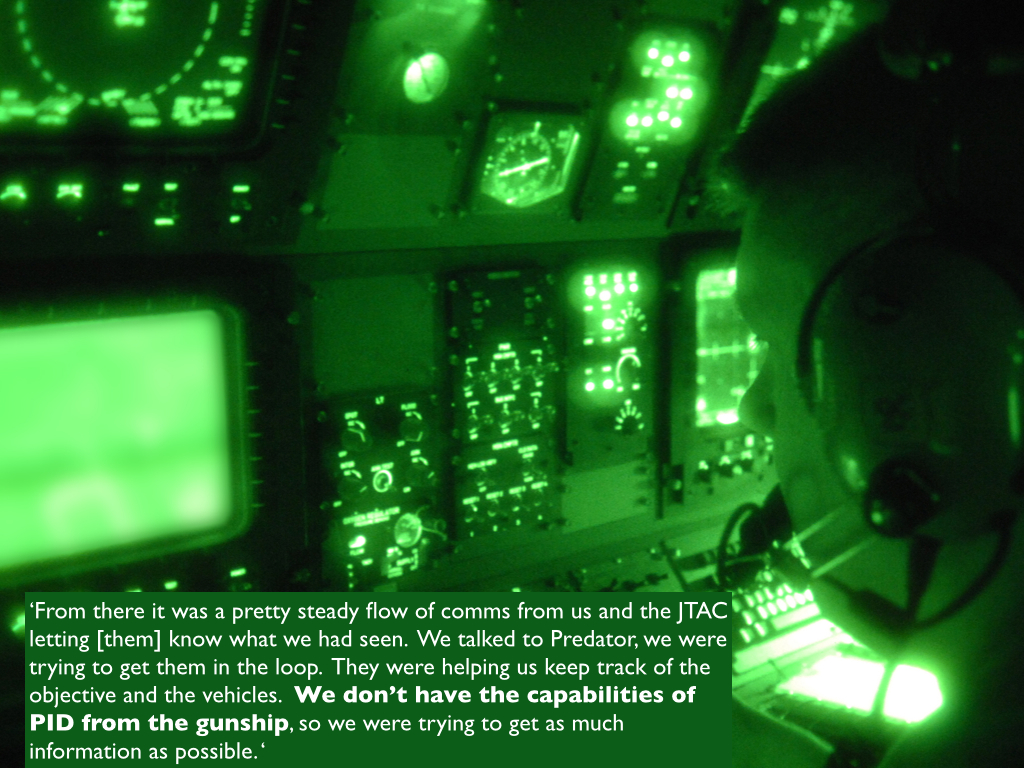
But there’s more.  Militarised vision is not limited to Predators and their successors, and it’s important to consider the clarity and resolution of the imagery captured and transmitted from other, conventional aircraft like the AC-130 (first image below), the B-1 bomber, F-15E strike aircraft or attack helicopters (second image below)  – again, this was important in two of the strikes I consider in detail.

AC-10 Uruzgan.001

MMS from attack helicopter - Uruzgan.001

This leads me to two other senses in which the critical emphasis on ‘Predator View’ is too narrow.  It’s a mistake to fasten on one incident – even what has become the iconic ‘signature strike’ coordinated by a Predator on three civilian trucks in Uruzgan – because that misses the continuities, repetitions and transformations in Close Air Support (which is where most of the mistakes are made).

Better, I think, to widen the analytical gaze, which is why I examine the Kunduz air strike on 4 September 2009 (in which no remote platform was involved), the Uruzgan air strike of 21 February 2010 (which was co-ordinated by a Predator but carried out by two attack helicopters), and the Sangin Valley air strike of 6 April 2011 (which was executed by a Predator).  The Granai strike is included because it trigged McChrystal’s Tactical Directive of 6 July 2009 to minimise civilian casualties: ‘‘We must avoid the trap of winning tactical victories – but suffering strategic defeats – by causing civilian casualties or excessive damage and thus alienating the people.’  In all three cases I’ve worked through thousands of pages of official investigations – one by the German Bundestag since the ISAF report remains classified (Kunduz), and the others by the US Army and US Air Force (Uruzgan) and the US Marine Corps (Sangin Valley).

4 US air strikes in Afghanistan.001

And finally, it is also necessary to consider the multiple viewing positions involved in networked military violence.  There is a de-centralised, distributed and dispersed geography of militarised vision whose fields of view expand, contract and even close at different locations engaged in the administration of military violence.  And in all three incidents it turns out that vital mistakes in the interpretation of imagery were made at operations centres in theatre on the ground.

This has prompted me to radically revise the argument I originally set out in ‘From a view to a kill’ (DOWNLOADS tab).  There my focus was on the geography shown in the first map below – like every other commentator I’ve read, incidentally – but I’ve now widened the angle to take in the geography shown in the second map and this substantially changes the story.

Dispersed vision Uruzgan (1).001

Dispersed vision Uruzgan (2).001

It was what happened at the operations centres at Special Operations Task Force 12 in Kandahar and Combined Joint Special Operations Task Force in Bagram that turned out to be every bit as important as the Predator crew’s obvious desire to ‘go kinetic’.

I make similar arguments about Kunduz, where the F-15E pilots were clearly reluctant to strike and the ground commander and JTAC at the Forward Operating Base overrode their objections.

Sangin is even more instructive, because the official investigation of this ‘friendly fire’ incident that resulted in the deaths of two Marines largely exonerated both the Predator crew and the ground commander and JTAC at the operations centre – but a detailed, spirited counter-memorandum from the US Marines commandant refuted the findings line by line, castigated the attempt to pin the blame for what happened on the young, inexperienced lieutenant leading the patrol, and excoriated the ground commander and JTAC back at the patrol base.  More on this soon.

The (long!) essay on these  strikes is the last chapter I need to complete for The everywhere war. There is a strong sense, so I shall argue, in which it was the view ‘on the ground’ that mattered much more than any ‘light of God’ from above.  And as for transparency….

Good Kill

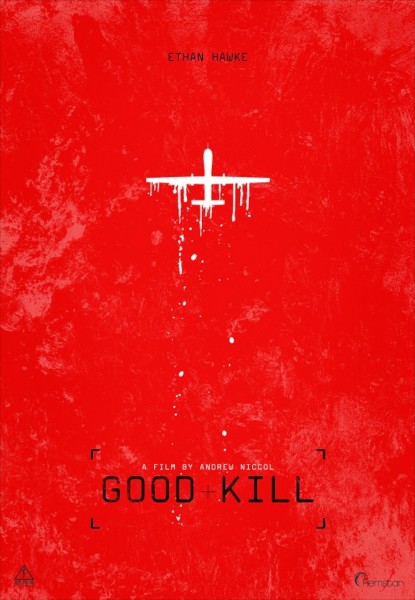
good-kill-poster-415x600Early in this blog’s short history I talked about the opening sequence in Andrew Niccol‘s Lord of War (2005) and what its opening sequence – the ‘life of a bullet’ – had to say about the global arms trade.

Now Niccol is back with Good Kill (2014), which was previewed at the Toronto International Film Festival earlier this month:

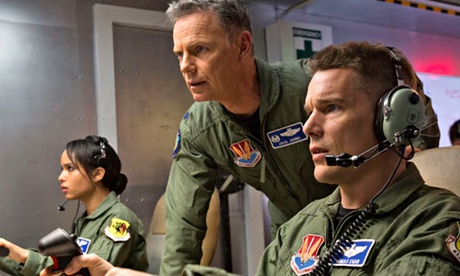
In an air-conditioned shipping container somewhere in the Nevada desert, a war is being waged. Behind a door that reads “YOU ARE NOW LEAVING THE USA,” five flight-suited US Air Force officers operate drones that hover above “zones of interest” in the Middle East. At the press of a button, tiny targets viewed on computer screens vanish in plumes of smoke, as in a videogame. “I blew up six Taliban in Pakistan today,” Major Thomas Egan (Ethan Hawke) tells a convenience store clerk. “Now I’m going home to barbecue.”

So far, so familiar; there is no shortage of similar presentations of drone warfare in pop culture more generally (I’m thinking in particular of Omar Fast‘s video 5,000 feet is Best and George Brant‘s play Grounded).

There’s a thoughtful review of Good Kill from the Guardian‘s Henry Barnes here:

Cinematographer Amir Mokri (director of photography on Lord of War, Niccol’s satire on the international arms trade) shoots the Vegas desert in a harsh, sterile light. The Las Vegas suburbs, shot from the sky, look as dusty and alien as the places Egan sees on his monitor. It plays into Egan’s isolation. He is distant from his wife (Mad Men’s January Jones) and drinks too much since he lost his flying privileges. He’s got the creeping feeling that drone warfare is cowardly and misses the fear of being in danger. “We’ve got no skin in the game,” he says. His wife says she’s glad to have him home with the kids. Egan zones out and stares at the sky.

Niccol creates an atmosphere that is airless and dull, an unusual tone for a modern war film, but one that fits the subject matter perfectly. That would have been enough, but the director feels the need to make his polemic on drone warfare plain. He sets up the team as an ethics debate meet. On one side is Egan and Suarez (Zoë Kravitz), a young female recruit with a conscience. On the other are two knuckleheads with kill boners. They ridicule the idea that they’re doing anything but protecting their country from terrorist threat. Niccol’s script goes too far in singling them out as the idiots. Kravitz’s character, more left-wing and articulate on post-9/11 military mandate, also comes across as one-dimensional.

Good Kill

The Telegraph‘s Robbie Colin caught an earlier screening at Venice, and was more impressed:

Niccol’s film … is a searching, timely drama about the dehumanising effects of waging war at a distance – the way that guilt can still stain at 11,000 miles, far outside the blast zone of blood and rubble. It looks again at one of the central themes of his script for The Truman Show: the intoxicating, corruptive power of the God’s-eye view.

As Egan’s eyes scan the monitors, he sees with astonishing clarity the faces of the men – and sometimes, unavoidably, the women and children – he is about to execute. Over time, he gets to understand their daily routines, watching them eat, stroll and sweep. The difference is this story isn’t science-fiction, but you’re left with the sickening sense that it should be.

You can also find an interesting roundtable interview with Niccol and Hawke recorded at TIFF here: thanks to Robert Bridi for the tip.

One last thing: I haven’t seen the film yet, but from the reviews and trailers I have seen it seems that, as in so many other registers, popular culture continues to be preoccupied with what happens in Nevada – and what happens on the ground is left shrouded in so many shades of grey.

Angry eyes

GREGORY Angry eyes JPEG.001

As part of my project on Militarized Vision I’ve been drawing together my work on two air strikes in Afghanistan in which the full motion video feeds from UAVs played a central role.  The first was an air strike in Uruzgan on 21 February 2010, which was carried out by two combat helicopters but mediated by video and commentary from a Predator and other eyes in the sky (the most thorough press account is by David Cloud here).  The second was a  ‘friendly fire’ incident in the Sangin valley on 5 April 2011 when a Predator strike claimed the lives of two US Marines (you can find an excellent summary account by David Cloud and David Zucchino here).

The two reports I’ve just cited were published in the LA TimesCombat by Camera series, but a close reading of the two official investigations – thousands of pages obtained through FOIA requests – inevitably shows that the stories were more complicated than the tag-line implies.  Still, for all the differences there are some remarkably close parallels between the two, and these have prompted me to revise (in radical ways) the analysis I originally offered in “From a view to a kill” (DOWNLOADS tab).

Searching for a title for the presentations I’m giving on this in October and November, I half-remembered a song called ‘Angry Eyes’.  When I tracked down the lyrics (by Kenny Loggins) I literally could not believe my eyes.  He obviously wasn’t writing about the US Air Force (or the Israeli), but it requires no great leap of the imagination to switch from love to violence:

Time, time and again
I’ve seen you starin’ out at me.

Now, then and again, I wonder
What it is that you see

[Chorus:]
With those Angry Eyes.
Well, I bet you wish you could
Cut me down with those Angry Eyes…

You want to believe that
I am not the same as you.
I can’t concieve, oh no,
What it is you’re tryin’ to do

[Chorus]

What a shot you could be if
You could shoot at me
With those Angry Eyes…

You tried to defend that
You are not the one to blame.

But I’m finding it hard, my friend,
When I’m in the deadly aim
Of those Angry Eyes.

So the presentations (here in Vancouver, and in Zurich and Bergen) will be called “‘Angry eyes’: militarized vision and modern war”.  As the image implies, there’s more to this than full motion video displays, and I’m also going to try to say something about the genealogy of what Paul K. Saint-Amour calls ‘optical war’ (and its distance from the corpographies of ‘boots on the ground‘).

More on all this later, when I’ve finished the essay that I am presently spinning off the presentations with the same title; it’s the last thing I have to do for “The everywhere war” (I hope).

The American way of bombing

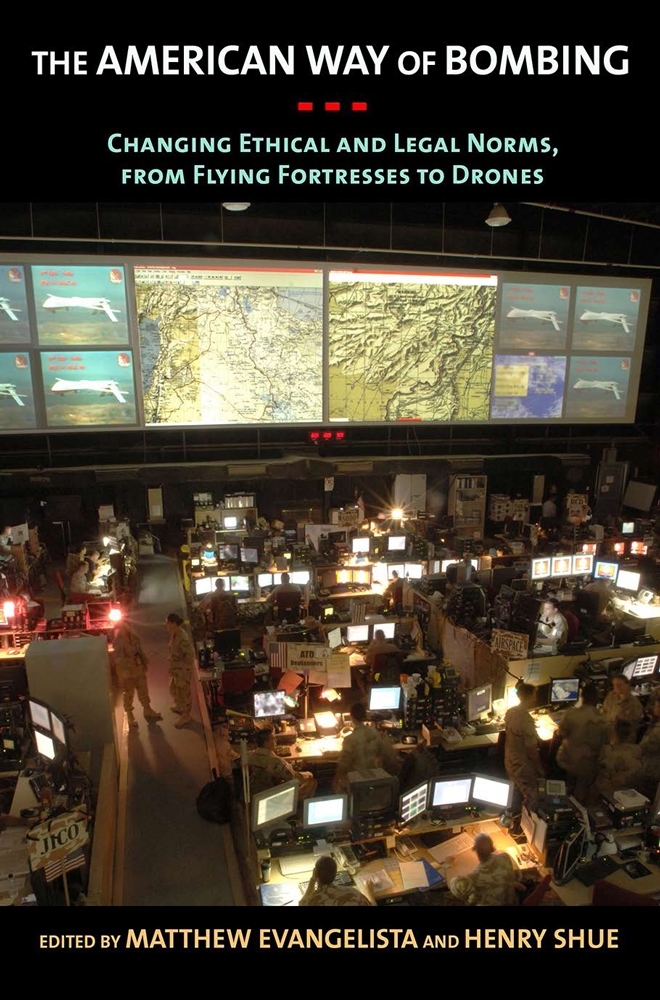
I’ve argued elsewhere (in ‘Lines of Descent’ [DOWNLOADS tab] and in ‘The American way of bombing?‘) that it’s important to situate any critical account of drones in a much longer history of air war, and a new book just out from Cornell University Press promises to do just that: The American Way of Bombing: changing ethical and legal norms from Flying Fortresses to drones, edited by Matthew Evangelista and Henry Shue.  And unlike rip-off academic-commercial publishers (most of them in the UK), this is available as an e-edition (Kindle, etc) at a perfectly reasonable price.

Here are the details:

Aerial bombardment remains important to military strategy, but the norms governing bombing and the harm it imposes on civilians have evolved. The past century has seen everything from deliberate attacks against rebellious villagers by Italian and British colonial forces in the Middle East to scrupulous efforts to avoid “collateral damage” in the counterinsurgency and antiterrorist wars of today. The American Way of Bombing brings together prominent military historians, practitioners, civilian and military legal experts, political scientists, philosophers, and anthropologists to explore the evolution of ethical and legal norms governing air warfare.

Focusing primarily on the United States—as the world’s preeminent military power and the one most frequently engaged in air warfare, its practice has influenced normative change in this domain, and will continue to do so—the authors address such topics as firebombing of cities during World War II; the atomic attacks on Hiroshima and Nagasaki; the deployment of airpower in Iraq, Afghanistan, and Libya; and the use of unmanned drones for surveillance and attacks on suspected terrorists in Pakistan, Yemen, Sudan, Somalia, and elsewhere.

American way of bombing

Introduction: The American Way of Bombing
by Matthew Evangelista

Part I. Historical and Theoretical Perspectives

1. Strategic Bombardment: Expectation, Theory, and Practice in the Early Twentieth Century
by Tami Davis Biddle

2. Bombing Civilians after World War II: The Persistence of Norms against Targeting Civilians in the Korean War
by Sahr Conway-Lanz

3. Targeting Civilians and U.S. Strategic Bombing Norms: Plus ça change, plus c’est la même chose?
by Neta C. Crawford

4. The Law Applies, But Which Law?: A Consumer Guide to the Laws of War
by Charles Garraway

Part II. Interpreting, Criticizing, and Creating Legal Restrictions

5. Clever or Clueless?: Observations about Bombing Norm Debates
by Charles J. Dunlap Jr.

6. The American Way of Bombing and International Law: Two Logics of Warfare in Tension
by Janina Dill

7. Force Protection, Military Advantage, and “Constant Care” for Civilians: The 1991 Bombing of Iraq
by Henry Shue

8. Civilian Deaths and American Power: Three Lessons from Iraq and Afghanistan
by Richard W. Miller

Part III. Constructing New Norms

9. Proportionality and Restraint on the Use of Force: The Role of Nongovernmental Organizations
by Margarita H. Petrova

10. Toward an Anthropology of Drones: Remaking Space, Time, and Valor in Combat
by Hugh Gusterson

11. What’s Wrong with Drones?: The Battlefield in International Humanitarian Law
by Klem Ryan

12. Banning Autonomous Killing: The Legal and Ethical Requirement That Humans Make Near-Time Lethal Decisions
by Mary Ellen O’Connell

Scoping Afghanistan

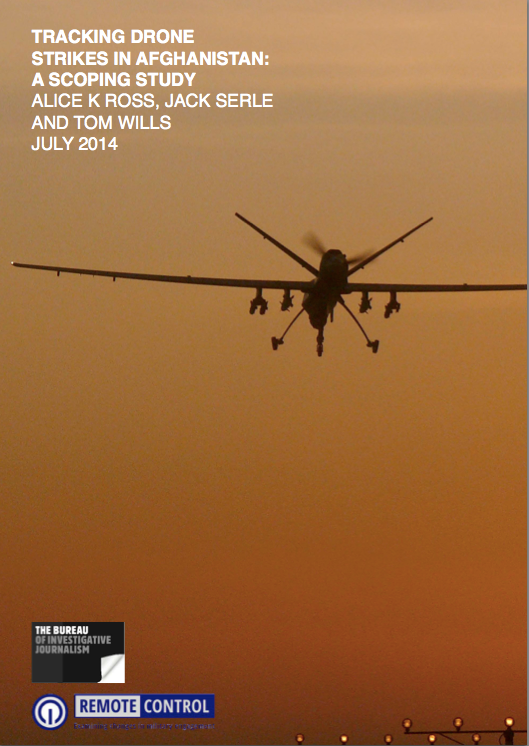
BOIJ Tracking drone strikes in AfghanistanThe marvellous Bureau of Investigative Journalism has just published a preliminary report on its new study  of drone strikes in Afghanistan, ‘the most heavily drone-bombed country in the world.’  The study, carried out with the support of the Remote Control Project, has been prompted by analyses which show that ISAF has persistently under-estimated civilian casualties from its strikes (‘“We only count that which we see… You can do a tremendous amount of forensics … [but] seldom do we see the actual bodies.”)

I have my doubts about the wisdom of severing ‘drone strikes’ from air strikes carried out by conventional aircraft that are networked in to ISR feeds from drones; I’ve elaborated this before, and it is a crucial part of my own work on militarised vision, where I’m working through the military investigations into air strikes in Kunduz, Sangin and Uruzgan.  I’ll start posting about this work next month.

The irony, I think, is not (quite) that we know so little about the ostensibly ‘public’ strikes in Afghanistan compared with the ‘covert’ campaigns in Pakistan, Yemen, Somalia and elsewhere: it is, rather, that we know a lot about how the USAF (though not the RAF) conducts strikes in Afghanistan but remarkably little about the victims, whereas in Pakistan we know much less about how the strikes are carried out (apart from the bureaucratisation of ‘kill lists’ in Washington) and, thanks to the work of the Bureau, much more about the victims.

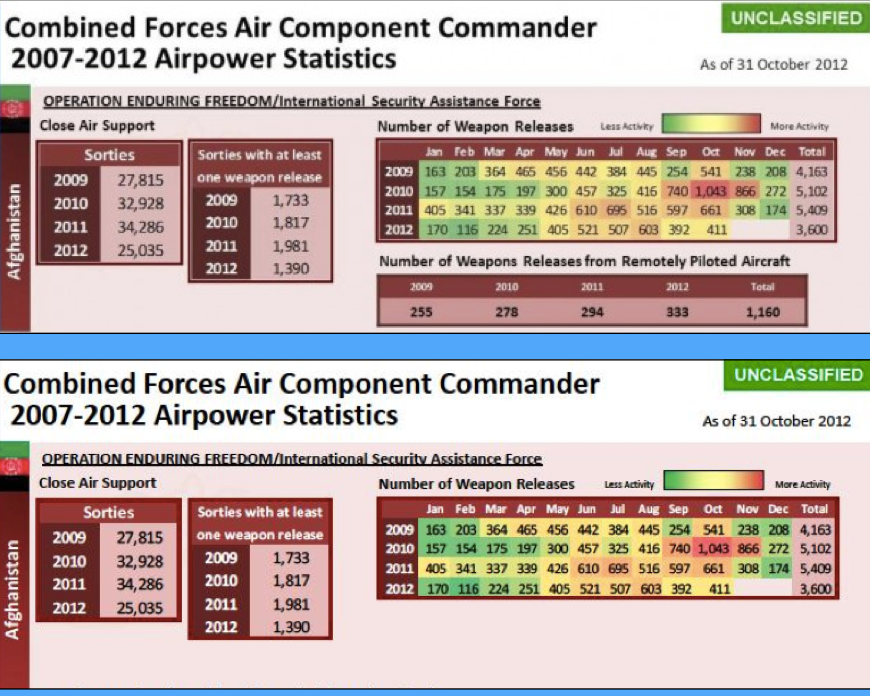
It is true, though, that while the official US military investigations released through FOIA requests are often immensely informative, even in redacted form (more on this next month), there is often also a remarkable reluctance to release even basic information to the public.  Spot the difference between these two tables; the first release (on top) was subsequently overwritten by the second (below)…

Airpower statistics 2007-2012

As I say, more to come.  In the meantime, the ‘scoping study ‘ from the Bureau is here, and well worth reading.

Drones, battlefields and later modern war

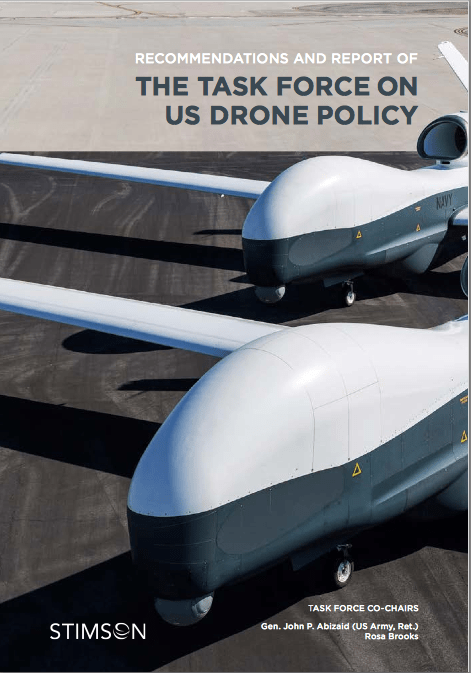
STIMSON Drone report 2014

This morning the Stimson Center issued an 81-page Recommendations and Report of the Task Force on US Drone Policy: you can access it online via the New York Times here or download it as a pdf here; Mark Mazetti‘s report for the Times is here.

Founded in 1989, the Stimson Center is a Washington-based ‘non-profit and non-partisan’ think-tank that prides itself on providing ’25 years of pragmatic solutions to global security’.  It’s named after Henry Stimson, who served Presidents Taft, Roosevelt and Truman as Secretary of War and President Hoover as Secretary of State.  The Center established its 10-member Task Force on drones a year ago, with retired General John Abizaid (former head of US Central Command, 2003-2007) and Rosa Brooks (Professor of Law at Georgetown) as co-chairs; the Task Force was aided by three Working Groups – on Ethics and Law; Military Utility, National Security and Economics; and Export Control and Regulatory Challenges – each of which is preparing more detailed reports to be published later this year.  The present Report focuses on

‘key current and emerging issues relating to the development and use of lethal UAVs outside the United States for national security purposes. In particular, we focus extensively on the use of UAVs for targeted counterterrorism strikes, for the simple reason that this has generated significant attention, controversy and concern.’

But this focus repeats and compounds the myopia of both conventional wisdom and contemporary debate.  The Report summarily (and I think properly) rejects a number of misconceptions about the use of drones, insisting that their capacity to strike from a distance is neither novel nor unique; noting that the vast majority of UAVs in the US arsenal are non-weaponized (‘less than 1 percent of … UAVs carry operational weapons at any given time’ – though their intelligence, surveillance and reconnaissance functions are of course closely tied to the deployment of weapons by conventional strike aircraft or ground forces); and arguing that ‘UAVs do not turn killing into “a video game”‘. These counter-claims are unexceptional and the Task Force presents them with clarity and conviction.

But the Report also accepts that the integration of UAVs into later modern war on ‘traditional’ or ‘hot’ battlefields [more about those terms in a moment] is, by and large, unproblematic.  Thus:

‘UAVs have substantial value for a wide range of military and intelligence tasks. On the battlefield, both weaponized and non-weaponized UAVs can protect and aid soldiers in a variety of ways. They can be used for reconnaissance purposes, for instance, and UAVs also have the potential to assist in the detection of chemical, biological, radiological and nuclear weapons, as well as ordinary explosives. Weaponized UAVs can be used to provide close air support to soldiers engaged in combat.’

A footnote expands on that last sentence:

‘In the past, warfighters on the ground under imminent threat would have to navigate a complicated command hierarchy to call for air support. The soldier on the ground would have to relay coordinates to a Forward Air Controller (FAC), who would then talk the pilot’s eyes onto a target in an extremely hostile environment. These missions have always been very dangerous for the pilot, who has to fly low and avoid multiple threats, and also for people on the ground. It is a human-error rich environment, and even today, it is not uncommon for the wrong coordinates to be relayed, resulting in the deaths of friendlies or innocent civilians. To ease these difficulties, DARPA is currently investigating how to replace the FAC and the pilot by a weaponized UAV that will be commanded by the soldier on the ground with a smartphone.’

And subsequently the Report commends the ‘robust’ targeting process put in place by the US military and the incorporation of military lawyers (JAGs) into the kill-chain:

‘The Department of Defense has a robust procedure for targeting, with outlined authorities and steps, and clear checks on individual targets. The authorization of a UAV strike by the military follows the traditional process in place for all weapons systems (be they MQ-9 Reaper drones or F-16 fighter jets). Regardless of whether particular strikes are acknowledged, the Pentagon has stated that UAV strikes, like strikes from manned aircraft, are subject to the military’s pre-strike target development procedures and post-strike assessment.

‘The process of determining and executing a strike follows a specific set of steps to ensure fidelity in target selection, strike and post-strike review.’

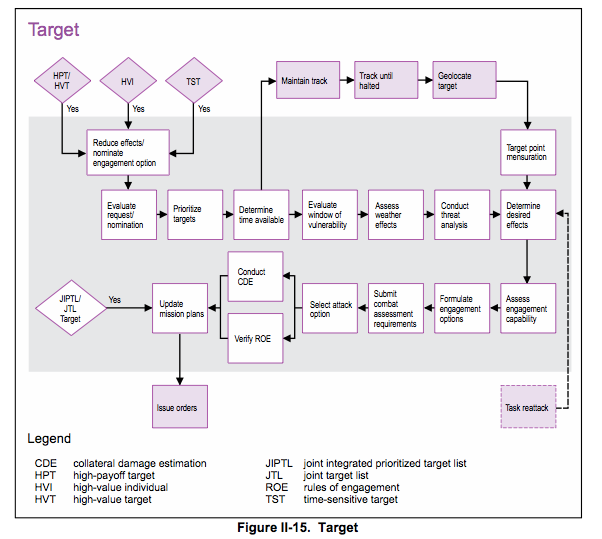
Targeting cycle

Both Craig Jones and I have discussed the targeting cycle [the figure above shows one of six steps in the ‘find-fix-track-target-engage-assess’ cycle, taken from JP 3-60 on Joint Targeting, issued in January 2013] and the role of operational law within it (Craig in much more detail than me), and these are all important considerations.  But the Report glosses over the fragilities of the process, which in practice is not as ‘robust’ as the authors imply.  They concede:

‘No weapons system is perfect, and targeting decisions — whether for UAV strikes or for any other weapons delivery system — are only as good as the intelligence on which they are based. We do not doubt that some US UAV strikes have killed innocent civilians. Nonetheless, the empirical evidence suggests that the number of civilians killed is small compared to the civilian deaths typically associated with other weapons delivery systems (including manned aircraft).’
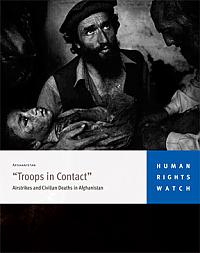
cover_646That last sentence is not unassailable, but in addition I’ve repeatedly argued that it is a mistake to abstract strikes carried out by UAVs from the wider network of military violence in which their ISR capabilities are put to use:  hence my ongoing work on the Uruzgan airstrike in Afghanistan, for example, and on ‘militarised vision’ more generally.  What these studies confirm is that civilian casualties are far more likely when close air support is provided – by UAVs directly or by conventional strike aircraft – to ‘troops in contact’ (even more so when, as in both the Kunduz and Uruzgan airstrikes, it turns out that troops calling in CAS were not ‘in contact’ at all).

In short, while it’s perhaps understandable that a Task Force that included both General Abizaid and Lt-Gen David Barno (former head of Combined Forces Command – Afghanistan from 2003-2005) should regard the use of UAVs on ‘traditional’ battlefields as unproblematic, I think it regrettable that their considerable expertise did not result in a more searching evaluation of remote operations in Afghanistan and Iraq.

But what, then, of those ‘non-traditional’ battlefields?  A footnote explains:

‘Throughout this report, we distinguish between the use of UAV strikes on “traditional” or “hot” battlefields and their use in places such as Pakistan, Yemen and Somalia. These are terms with no fixed legal meaning; rather, they are merely descriptive terms meant to acknowledge that the US of UAV strikes has not been particularly controversial when it is ancillary to large-scale, open, ongoing hostilities between US or allied ground forces and manned aerial vehicles, on the one hand, and enemy combatants, on the other. In Afghanistan and Iraq, the United States deployed scores of thousands of ground troops and flew a range of close air support and other aerial missions as part of Operation Enduring Freedom, and UAV strikes occurred in that context. In Libya, US ground forces did not participate in the conflict, but US manned aircraft and UAVs both operated openly to destroy Libyan government air defenses and other military targets during a period of large scale, overt ground combat between the Qaddafi regime and Libyan rebel groups. In contrast, the use of US UAV strikes in Yemen, Pakistan and elsewhere has been controversial precisely because the strikes have occurred in countries where there are no US ground troops or aerial forces openly engaged in large scale combat.’
0202megret0

A major focus of the report is on what Frédéric Mégret (above) has called ‘the deconstruction of the battlefield‘ and the countervailing legal geographies that provide an essential armature for later modern war (though it’s surprising that the Report makes so little use of academic research on UAVs and contemporary conflicts).  The authors ‘disagree with those critics who have declared that US targeted killings [in Pakistan, Yemen and Somalia] are “illegal”’ – no surprise there either, incidentally, since one of the Working Groups included Kenneth Anderson, Charles Dunlap and Christine Fair: I’m not sure in what universe that counts as ‘non-partisan’) but they also accept that these remote operations move in a grey zone (and in the shadows):

‘The law of armed conflict and the international legal rules governing the use of force by states arose in an era far removed from our own. When the Geneva Conventions of 1949 were drafted, for instance, it was assumed that most conflicts would be between states with uniformed, hierarchically organized militaries, and that the temporal and geographic boundaries of armed conflicts would be clear.

‘The paradigmatic armed conflict was presumed to have a clear beginning (a declaration of war) and a clear end (the surrender of one party, or a peace treaty); it was also presumed the armed conflict to be confined geographically to specific, identifiable states and territories. What’s more, the law of armed conflict presumes that it is a relatively straightforward matter to identify “combatants” and distinguish them from “civilians,” who are not targetable unless they participate directly in hostilities. The assumption is that it is also a straightforward matter to define “direct participation in hostilities.”

‘The notion of “imminent attack” at the heart of international law rules relating to the use of force in state self-defense was similarly construed narrowly: traditionally, “imminent” was understood to mean “instant, overwhelming, and leaving no choice of means, and no moment for deliberation.”

‘But the rise of transnational non-state terrorist organizations confounds these preexisting legal categories. The armed conflict with al-Qaida and its associated forces can, by definition, have no set geographical boundaries, because al-Qaida and its associates are not territorially based and move easily across state borders. The conflict also has no temporal boundaries — not simply because we do not know the precise date on which the conflict will end, but because there is no obvious means of determining the “end” of an armed conflict with an inchoate, non-hierarchical network.

‘In a conflict so sporadic and protean — a conflict with enemies who wear no uniforms, operate in secret and may not use traditional “weapons” — the process of determining where and when the law of armed conflict applies, who should be considered a com- batant and what counts as “hostilities” inevitably is fraught with difficulty…

‘While the legal norms governing armed conflicts and the use of force look clear on paper, the changing nature of modern conflicts and security threats has rendered them almost incoherent in practice. Basic categories such as “battlefield,” “combatant” and “hostilities” no longer have a clear or stable meaning. And when this happens, the rule of law is threatened.’

These too are important considerations, but they are surely not confined to counter-terrorism operations in Pakistan, Yemen and Somalia: they also apply with equal force to counterinsurgency operations in Afghanistan and Iraq, and intersect with a wider and much more fraught debate over the very idea of ‘the civilian’.

There is a particularly fine passage in the Report:

‘Consider US targeted strikes from the perspective of individuals in — for instance — Pakistan or Yemen. From the perspective of a Yemeni villager or a Pakistani living in the Federally Administered Tribal Areas (FATA), life is far from secure. Death can come from the sky at any moment, and the instability and incoherence of existing legal categories means that there is no way for an individual to be certain whether he is considered targetable by the United States. (Would attending a meeting or community gathering also attended by an al-Qaida member make him targetable? Would renting a building or selling a vehicle to a member of an “associated” force render him targetable? What counts as an “associated force?” Would accepting financial or medical aid from a terrorist group make him a target? Would extending hospitality to a relative who is affiliated with a terrorist group lead the United States to consider him a target?).

‘From the perspective of those living in regions that have been affected by US UAV strikes, this uncertainty makes planning impossible, and makes US strikes appear arbitrary. What’s more, individuals in states such as Pakistan or Yemen have no ability to seek clarification of the law or their status from an effective or impartial legal system, no ability to argue that they have been mistakenly or inappropriately targeted or that the intelligence that led to their inclusion on a “kill list” was flawed or fabricated, and no ability to seek redress for injury. Their national laws and courts can offer no assistance in the face of foreign power, and far from protecting their fundamental rights and freedoms, their own states may in fact be deceiving them about their knowledge of and cooperation with US strikes. Meanwhile, geography and finances make it impossible to access US courts, and a variety of legal barriers — such as the state secrets privilege, the political question doctrine, and issues of standing, ripeness and mootness — in any case would prevent meaningful access to justice.’

This is one of the clearest summaries of the case for transparency and accountability I’ve seen, but the same scenario has also played out in Afghanistan (and in relation to the Taliban, which appears only once in the body of the Report) time and time again.  There are differences, to be sure, but the US military has also carried out its own targeted killings in Afghanistan, working from its Joint Prioritized Effects List.  The Report notes that ‘in practice, the military and CIA generally work together quite closely when planning and engaging in targeted UAV strikes: few strikes are “all military” or “all CIA”’ – which is true in other senses too – and this applies equally in Afghanistan.

In sum, then, this is a valuable and important Report – but it would have been far more incisive had its critique of ‘US drone policy’ cast its net wider to provide a more inclusive account of remote operations.  The trans-national geographies of what I’ve called ‘the everywhere war’ do not admit of any simple distinction between ‘traditional’ and ‘non-traditional’ battlefields, and trying to impose one on such a tangled field of military and paramilitary violence ultimately confuses rather than clarifies.  I realise that this is usually attempted as an exercise in what we might call legal cartography, but I also still think William Boyd‘s Gabriel was right when, in An Ice-Cream War, he complained that maps give the world ‘an order and reasonableness’ it doesn’t possess.  And we all also know that maps – like the law – are instruments of power, and that both are intimately entangled with the administration of military violence.

The Federal Administration of Military Violence

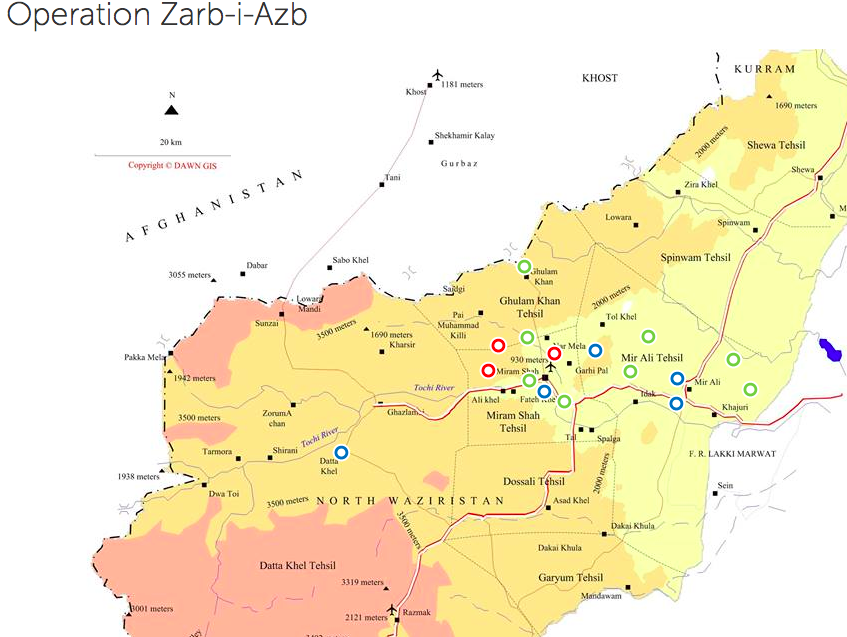
On 15 June – one week after the attack on Karachi’s international airport by the Pakistan Taliban (Tehrik-i-Taliban or TTP) and the Islamic Movement of Uzbekistan (UMI) – the Pakistan military announced its ‘comprehensive’ Operation Zarb-i-Azb in the Federally Administered Tribal Areas (FATA).  From their bases in North Waziristan, the statement announced, militants had ‘waged a war against the state of Pakistan’ and the military had been ‘tasked to eliminate these terrorists regardless of hue and color, along with their sanctuaries.’  Although the press release insisted that ‘these enemies of the state will be denied space anywhere across the country’ the epicentre of the operation was and remains North Waziristan.

NWA_PakMil_locations_all_1200

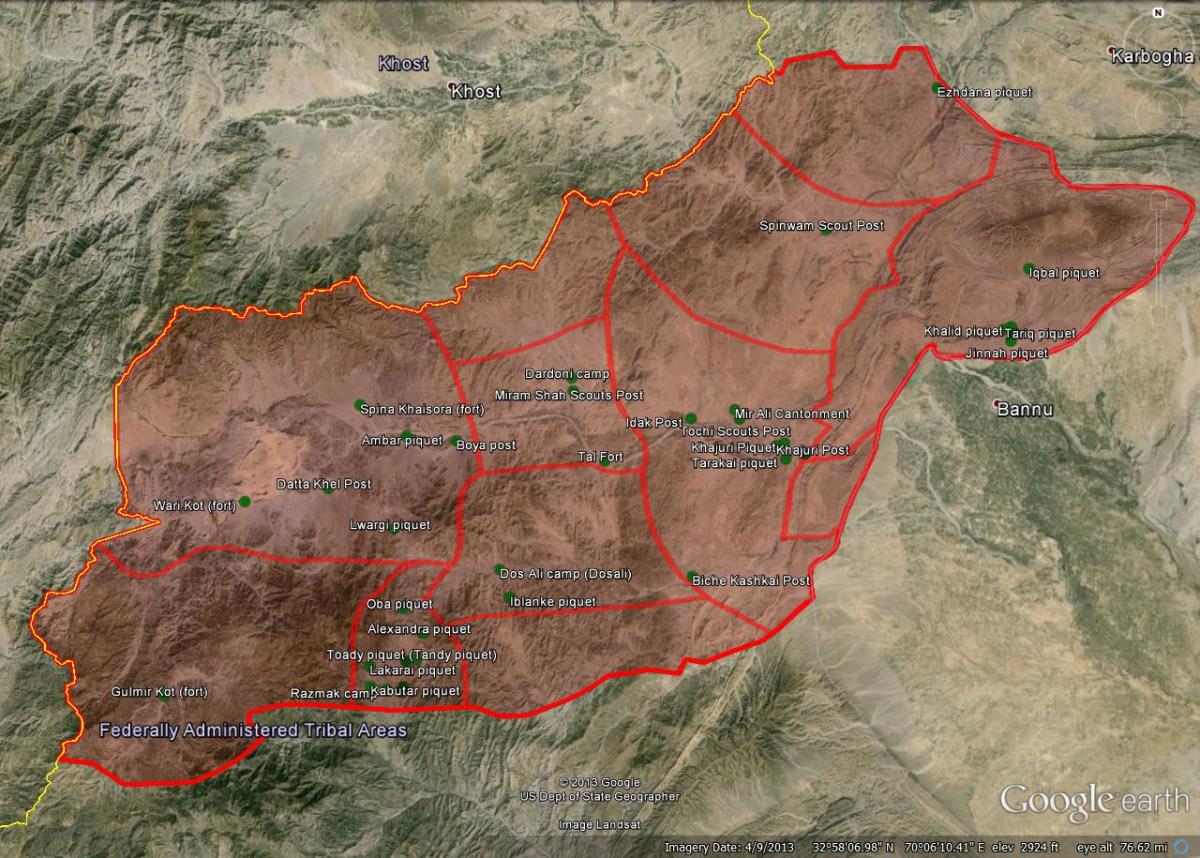
There are reportedly 60,000 troops in the region, and the main Pakistan military installations in North Waziristan are shown on the map above (taken from the AEI spinoff site, Critical Threats), but the prelude to ground operations was a concerted attack by the Pakistan Air Force on eight targets linked to planning the assault on Karachi airport.

Green Ground Red Drones Blue PAF strikes DAWN 20 June 2014

‘Operation Zarb-i-Azb’ refers to Mohammed’s sword, and its political imagery is artfully dissected by Afiya Shehrbano Zia:

‘It refers to the (‘sharp/cutting’) sword of the prophet of Islam and is a brilliant usurpation of the religious metaphor. It upstages the religious imaginary for which the Tehreek e Taliban Pakistan (TTP) claim to be fighting. After all, who would dare to vanquish the Prophet’s metaphorical sword? The appellation justifies its cause for the defense of the Islamic state, and quells the lesser purpose of the Taliban in one fell swoop. As in all cases in the instrumentalisation of religion as a propaganda tool, it also excites nationalists and seeks to rationalise another round of military operations, killings and displacements that will follow.’

There’s much more of value in her commentary, but – as Zia also acknowledges – the genealogy and geography of the offensive is no less complicated (my map comes from Dawn, 20 June 2014; green circles are Pakistan military land operations; blue are Pakistan Air Force strikes; red are US drone strikes).

First, it’s not clear whether the Pakistan military finally has the Afghan Taliban in its sights too – regarded by Islamabad as the ‘good Taliban’ because, far from threatening the state of Pakistan, it has long been used by both the military and (particularly) the intelligence service as a counter to any Indian influence over Kabul once US and ISAF forces complete their withdrawal.  And it is of course the Afghan Taliban (along with the Haqqani network) which is the principal concern of the United States.

Second, the Pakistan military – and especially the Air Force – has a long history of offensive operations in the FATA, as I’ve discussed in detail before: see here and here.  Now other commentators have noticed this: the Bureau of Investigative Journalism has tracked 15 Pakistan Air Force strikes carried out by helicopter gunships and F-16 fighters between 19 December 2013 and 15 June 2014, which killed 291-540 people (including 16-112 civilians).

The significance of this is not only that it precedes the current offensive but also that it coincides with the so-called ‘pause’ in CIA-directed drone strikes against targets in the FATA.  Chris Woods notes that PAF strikes are ‘generating casualties far in excess of any caused by CIA drones strikes’, and one resident of Mir Ali recited a grim military timetable:

“It’s like doomsday for people in Mir Ali, where death is everywhere since Saturday… They start the day with artillery shelling early in the morning. Gunship helicopters come for shelling during the day and jets strike at around 2:00-2:30 in the night.”

The military denies all reports of civilian casualties but this beggars belief, and the Bureau reports that some residents have even concluded that the drone strikes were preferable:

‘The difference between the drone strikes and the military strikes is that drones target specifically who they want to target… the wanted terrorists… people are saying that drone attacks were good compared to the military strikes.  Personally I agree, because I have seen drones, they are in the air 24 hours and they don’t attack as randomly… the place of the attack was always an area where the Taliban or terrorists were living.’

But whatever one makes of this – a calculation that would imply that the CIA had abandoned its anonymous ‘signature strikes’ – drones have not been absent from the skies over Waziristan. Pakistan has its own reconnaissance drones, and they have repeatedly been used to direct strike aircraft onto their targets (though with what accuracy it is impossible to know) and to support ground operations: the PAF boasted of their use in May, when hundreds of houses and shops were destroyed in Machis Camp and in the bazaar at Mir Ali.  And – the third complication – the US resumed its drone war on 11 and 12 June when two UAVs fired six missiles at compounds near Miram Shah, supposedly killing ten members of UMI and the Haqqani network, and again on 18 June when three compounds near Dargah Mandi were hit.  Whether these strikes were co-ordinated with Pakistan is unclear – the Foreign Office has issued its ritual denial, but it’s difficult to believe they were not connected to Pakistan’s own military operations, and here too there is a long history of what I’ve called ‘dirty dancing‘ between Washington and Islamabad that continued until at least the end of 2011.  It seems highly unlikely that the dance has ended.

_75732447_75732446

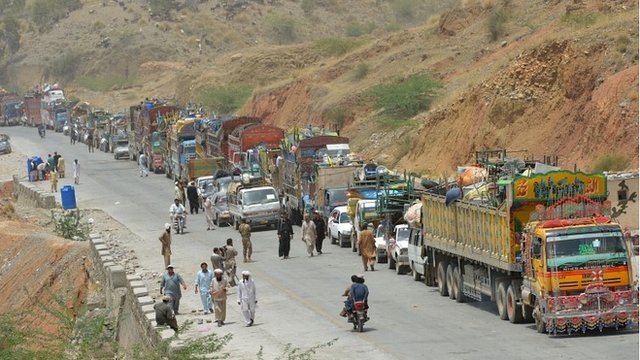
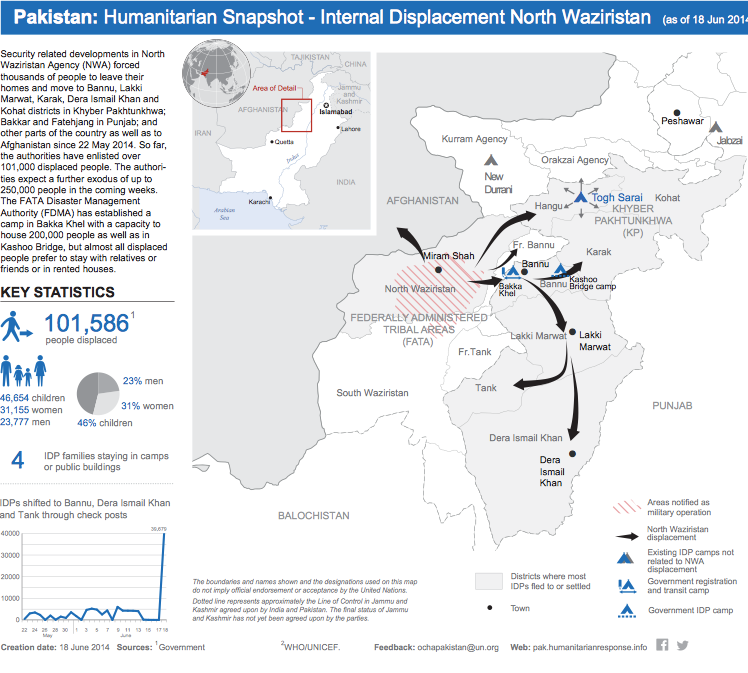
Finally, the shock waves from these various operations ripple far beyond their ostensible targets. Hundreds of thousands of people have fled, some in advance of military operations (which had been telegraphed for months), many more when the military temporarily loosened its curfew on the region. As on previous occasions, most of them fled to Bannu, some to government camps (‘Only the poorest of the poor would go to a camp in such hot and humid weather‘) but the majority to stay with family members, while some refugees have even crossed into Khost in Afghanistan to seek sanctuary. The map below is an early trace (18 June), and it shows only those who are officially registered so it excludes those lodging with their extended families; but even this anticipates hundreds of thousands more displaced people to come.

Pakistan Displaced Persons June 2014

There is also the real fear that, as Ismail Khan and Declan Walsh reported earlier this month, Taliban reprisals will focus on the Punjab, the electoral base of Prime Minister Nawaz Sharif.

All of this suggests the importance of unravelling the intimate connections between the political constitution of the Federally Administered Tribal Areas and the administration of military violence there.  This is clearly not limited to CIA-directed drone strikes, and here Zia’s reflections on a question posed by a feminist friend are worth repeating:

‘She wonders, “why this obsession with drones?” Obviously, the interest is due to a host of factors, but her query reflects the difference in modes of analysis. Her position reflects the views of women’s rights/human rights groups who consider specific military operations in one part of Pakistan as just one cog in a broader narrative about the source of the conflict. For them, this has been the cosy nexus and mutually beneficial relationship between the military establishment and the jihadi groups.

Those like Imran Khan, who foreground drones in their analysis of ‘conflict’, consider US intervention and occupation of Afghanistan as the drivers of conflict in Pakistan. But local progressive groups argue that even if militants in FATA are subdued, or US interventions are resisted, unless the policy of patronage and nurturing of jihadi groups in the rest of Pakistan is dismantled and buried, conflict at all levels will never end – drones or no drones.

This doesn’t mean that military technologies are unimportant nor that drone strikes are of marginal concern (inside or outside an ‘area of active hostilities‘): it means that we need to direct our attention to the larger matrix of political and military violence within which they are deployed, transnational and national, and to its genealogies and geographies.