Law, ethics and drone warfare

SCHELLER Kill-chain

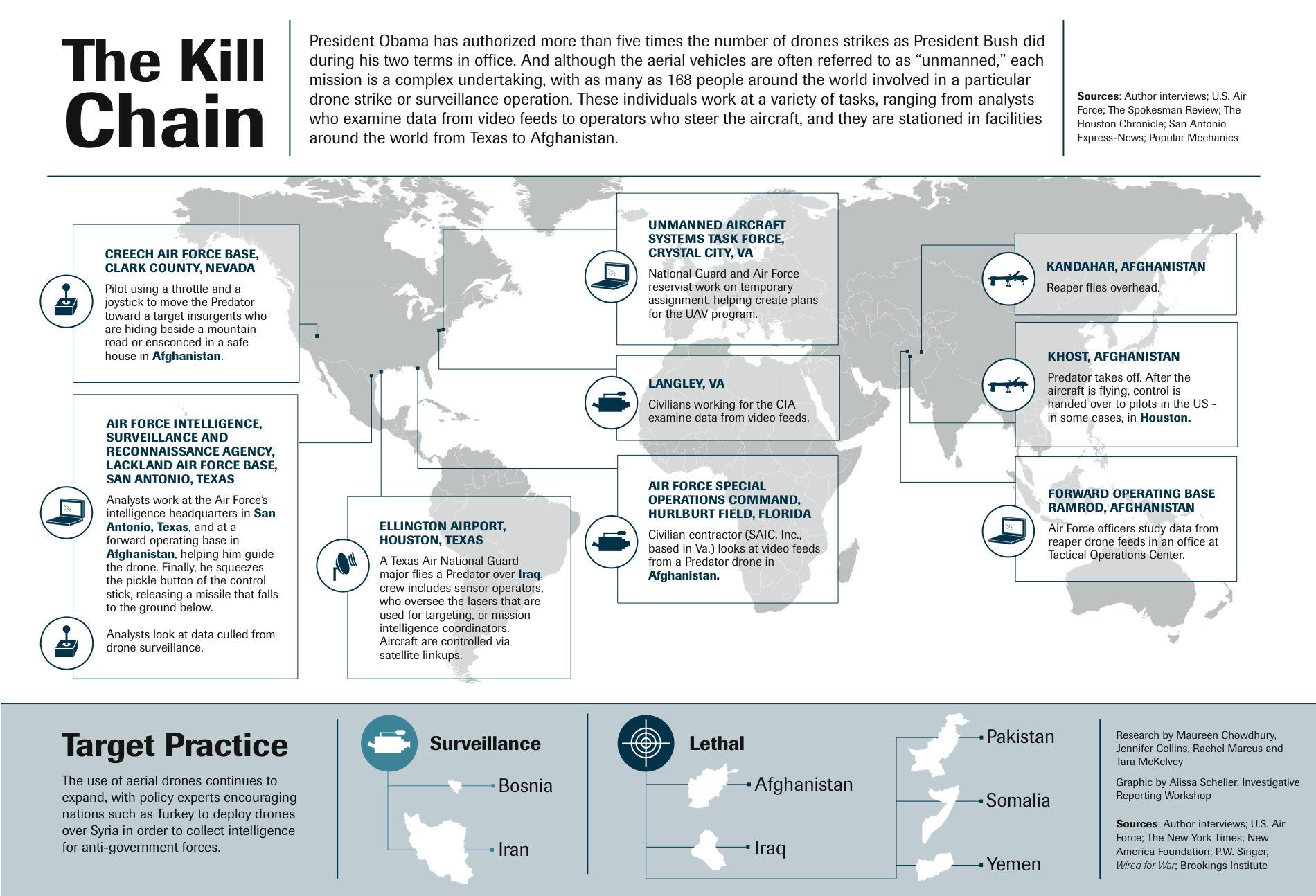
The infographic above was produced by Alissa Scheller for an Investigative Reporting Workshop on Drones, and specifically an article by Tara McKelvey on Harold Koh and the legal armature that the Obama administration has sought for its nominally covert program of targeted killing.

Since then (2012) there has been a cascade of essays around these legal and ethical issues; much of the spikiest writing is to be found on the indispensable ssrn, but here are some other essays I’ve just caught up with that readers might also find helpful:

Special issue: ‘Legal and ethical implications of drone warfare’, in International Journal of Human Rights 19 (2) (2015) including:

Michael J. Boyle, ‘The legal and ethical implications of drone warfare’ (pp 105-126)

Stephanie Carvin, ‘Getting drones wrong’ (pp. 127-141)

Craig Martin, ‘A means-methods paradox and the legality of drone strikes in armed combat’ (pp. 142-175)

Daniel R. Brunstetter & Arturo Jimenez-Bacardi, ‘Clashing over drones: the legal and normative gap between the United States and the human rights community’ (pp. 176-198)

David Whetham, ‘Drones to protect’ (pp. 199-210)

Caroline Kennedy & James I. Rogers, ‘Virtuous drones?’ (pp. 210-227)

Symposium: ‘Towards a drone accountability regime‘, in Ethics and International Affairs 1 (2015) with a major contribution from Allen Buchanan and Robert O. Keohane

From a moral standpoint, lethal drones are intrinsically no worse as a means of warfare than bombing or sending commandos to kill enemies. From the perspective of their users, they have six major advantages over more conventional weapons: they are often cheaper; their use can be more readily concealed; they allow for more precise targeting, with the potential for less “collateral damage”; their use can involve less serious infringements of sovereignty than invasion by troops; and they may be less likely to provoke widespread hostile reactions by the population of the country in which they are used than military operations involving troops on the ground. But these advantages generate three major risks: of violating sovereignty, of over-using the military option, and of making it more difficult to identify violations of constraints against targeting noncombatants. To deal with these risks, a Drone Accountability Regime is needed that imposes obligations on states, which in turn would be required to impose them on their agents. Since it would be infeasible to negotiate a treaty-based legal regime at present and for the foreseeable future, the Drone Accountability Regime should be informal and should involve transnational actors as well as states. Its key principle should be transparency, helping enable civil society to hold states accountable, and its central agent would be an Ombudsperson with broad authority to investigate situations and publicize her findings. No institution can ensure that states, or operators, are held fully accountable to appropriate standards of conduct, but such a regime could increase the degree of accountability for the use of lethal drones.

— and critical responses from Neta Crawford, Janina Dill, and David Whetham.

Bianca Baggiarini, ‘Drone warfare and the limits of sacrifice’, Journal of international political theory 11 (1) (2015) 128-44

M.J. Boyle, ‘The race for drones’, Orbis 59 (1) (2015) 76-94

Lindsay Cohn-Warrior, ‘Drones and targeted killing: costs, accountability and US Civil-Military relations’, Orbis 59 (1) (2015) 95-110

Jelena Pejic, ‘Extraterritorial targeting by means of armed drones: some legal implications’, International review of the Red Cross (2015) (online early)

Lauren Wilcox, ‘Drone warfare and making bodies out of place’, Critical studies on security 3 (1) (2015) 127-131

John Williams, ‘Distant intimacy: space, drones and Just War’, Ethics and International Affairs 1 (2015) 93-110

And to widen the discussion and give it substantive depth, see Craig Jones, ‘Lawfare and the juridification of late modern war‘, Progress in human geography (2015) (Online First):

Processes of juridification are a defining feature of late modern war. But geographic accounts of war have generally not considered the role that law plays in shaping its conduct. This paper explores the juridification of war using the concept of lawfare. Lawfare may signal an intensification and shift in the relationship between war and law, but I argue that understanding the nature and extent of these changes requires a careful examination of the historical geographies of war, law and lawfare. Drawing from critical legal approaches I offer a preliminary geographical and historical theorization of lawfare so that we may better understand the relationship between war and law today.

Inhumanned

Drones_Poster_cropped

Better late than never…  I talked about Robert Greenwald‘s Unmanned before – the video documentary he produced to accompany the Stanford/NYU report Living under Drones – and I’ve now discovered you can still watch all 61 minutes here.

Beginning at 39:08 there is a harrowing account of the murder of Mamana Bibi in Waziristan on 24 October 2012.  There is a detailed investigation in Amnesty’s Will I be next? and its forensic detail is compelling, but watching and listening to the surviving members of her family adds a new dimension to the horror.

So too, though in a radically different way, does reading C. Christine Fair‘s partisan dismissal of both the Amnesty report and the testimony of the Rehman family here.  It was published under the title ‘Ethical and methodological issues in assessing drones’ civilian impacts in Pakistan’ – without a trace of irony – but for once the comments below the line give me hope…

FOOTNOTE:  I’ve been asked to elaborate that last paragraph.  Fair suggests – on the flimsiest of bases – that the strike was carried out by the Pakistan Air Force, and clumsily attempts to discredit both Reprieve and Amnesty’s research.  I’ve written before about the PAF’s repeated assaults on the FATA – here and here for example – but here is part of a report from the Guardian on the murder of Mamana Bibi that describes how Amnesty’s local researcher Mustafa Qadri went about his work:

Qadri reached out to trusted sources in North Waziristan. The family members and their neighbors were interviewed independently on multiple occasions, unaware that a human-rights group was behind the questions they were asked. Over the course of many weeks, Qadri found the family’s account to be consistent. He determined it was highly unlikely that any militants were present at the time of the strike and that the missiles were likely fired by a US drone.

“It was a number of things,” Qadri told the Guardian. “We got the missiles, the large fragments that the family has that we got analyzed by [an] expert who says this is very likely to be a Hellfire missile. We also had family members who saw drones physically. We also have the eyewitness of the family who said they heard the noise of missiles fired from the sky and then separate noises of missiles impacting on the ground. We have the evidence of a double sound, with each single strike.”

I doubt that he needs any lessons on ethics or methodology.

Crossing the line

435px-Atlas_frontview_2013News from Lucy Suchman of an important essay she’s just completed with Jutta Weber on Human-Machine Autonomies, available from Academia.edu here.

This is how they begin:

This paper takes up the question of how we might think about the increasing automation of military systems not as an inevitable ‘advancement’ of which we are the interested observers, but as an effect of particular world-making practices in which we need urgently to intervene. We begin from the premise that the foundation of the legality of killing in situations of war is the possibility of discrimination between combatants and non-combatants. At a time when this defining form of situational awareness seems increasingly problematic, military investments in the automation of weapon systems are growing. The trajectory of these investments, moreover, is towards the development and deployment of lethal autonomous weapons; that is, weapon systems in which the identification of targets and initiation of fire is automated in ways that preclude deliberative human intervention. Challenges to these developments underscore the immorality and illegality of delegating responsibility for the use of force against human targets to machines, and the requirements of International Humanitarian Law that there be (human) accountability for acts of killing. In these debates, the articulation of differences between humans and machines is key.

Our aim in this paper is to strengthen arguments against the increasing automation of weapon systems, by expanding the frame or unit of analysis that informs these debates. We begin by tracing the genealogy of concepts of autonomy within the philosophical traditions that inform Artificial Intelligence (AI), with a focus on the history of early cybernetics and contemporary approaches to machine learning in behaviour-based robotics. We argue that while cybernetics and behaviour-based robotics challenge the premises of individual agency, cognition, communication and action that comprise the Enlightenment tradition, they also reiterate aspects of that tradition in the design of putatively intelligent, autonomous machines. This argument is made more concrete through a close reading of the United States Department of Defense Unmanned Systems Integrated Roadmap: FY2013-2038, particularly with respect to plans for future autonomous weapon systems. With that reading in mind, we turn to resources for refiguring agency and autonomy provided by recent scholarship in science and technology studies (STS) informed by feminist theory. This work suggests a shift in conceptions of agency and autonomy, from attributes inherent in entities, to effects of discourses and material practices that variously conjoin and/or delineate differences between humans and machines. This shift leads in turn to a reconceptualization of autonomy and responsibility as always enacted within, rather than as separable from, particular human- machine configurations. We close by considering the implications of these reconceptualizations for questions of responsibility in relation to automated/autonomous weapon systems. Taking as a model feminist projects of deconstructing categorical distinctions while also recognising those distinctions’ cultural-historical effects, we argue for simultaneous attention to the inseparability of human-machine agencies in contemporary war fighting, and to the necessity of delineating human agency and responsibility within political, legal and ethical/moral regimes of accountability.

LRASM (Lockheed-Martin photo) PNG

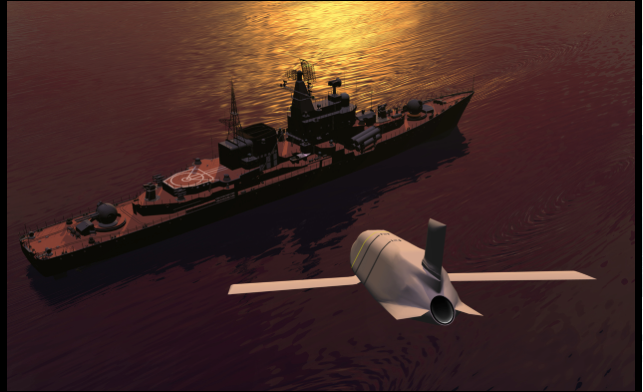
It’s a must-read, I think, especially in the light of a report from the New York Times of the Long Range Anti-Ship Missile (above) developed for the US military by Lockheed Martin:

On a bright fall day last year off the coast of Southern California, an Air Force B-1 bomber launched an experimental missile that may herald the future of warfare.

Initially, pilots aboard the plane directed the missile, but halfway to its destination, it severed communication with its operators. Alone, without human oversight, the missile decided which of three ships to attack, dropping to just above the sea surface and striking a 260-foot unmanned freighter…

The Pentagon argues that the new antiship missile is only semiautonomous and that humans are sufficiently represented in its targeting and killing decisions. But officials at the Defense Advanced Research Projects Agency, which initially developed the missile, and Lockheed declined to comment on how the weapon decides on targets, saying the information is classified.

“It will be operating autonomously when it searches for the enemy fleet,” said Mark A. Gubrud, a physicist and a member of the International Committee for Robot Arms Control, and an early critic of so-called smart weapons. “This is pretty sophisticated stuff that I would call artificial intelligence outside human control.”

Paul Scharre, a weapons specialist now at the Center for a New American Security who led the working group that wrote the Pentagon directive, said, “It’s valid to ask if this crosses the line.”

And the Israeli military and armaments industry, for whom crossing any line is second nature, are developing what they call a ‘suicide drone’ (really).  At Israel Unmanned Systems 2014, a trade fair held in Tel Aviv just three weeks after Israel’s latest assault on Gaza, Dan Cohen reported:

Lieutenant Colonel Itzhar Jona, who heads Israel Aerospace Industries, spoke about “loitering munitions” — what he called a “politically correct” name for Suicide Drones. They are a hybrid of drone and missile technology that have “autonomous and partially autonomous” elements, and are “launched like a missile, fly like an UAV [unmanned aerial vehicle],” and once they identify a target, revert to “attack like a missile.” Jona called the Suicide Drone a “UAV that thinks and decides for itself,” then added, “If you [the operator] aren’t totally clear on the logic, it can even surprise you.”

Jona praised the advantage of the Suicide Drone because the operator “doesn’t have to bring it home or deal with all sorts of dilemmas.” The Suicide Drone will quickly find a target using its internal logic, which Jona explained in this way: “It carries a warhead that eventually needs to explode. There needs to be a target at the end that will want to explode. Or it won’t want to and we will help it explode.”

So thoughtful to protect ‘the operator’ from any stress (even if s/he might be a little ‘surprised’).  Here is Mondoweiss‘s subtitled clip from the meeting, which opens with a short discussion of the major role played by UAVs in the air and ground attacks on Gaza, and then Jona describes how ‘we always live on the border’:

‘Just looking’? Remote violence and surveillant witnessing

herscher_bookI’m sure many readers will know Andrew Herscher‘s Violence taking place: the architecture of the Kosovo conflict (Stanford, 2010) – not least for its compelling discussion of what Andrew called ‘warchitecture’ [for a summary see his ‘Warchitectural theory‘, Journal of architectural education (2008) 35-43] and his supplement on ‘the architecture of humanitarian war’.

It’s a book which seems to me to become ever more relevant, and also connects in all sorts of ways with Eyal Weizman‘s Forensic Architecture project.

If you don’t know it, there’s a helpful interview with Andrew at Rorotoko here:

What if the destruction of architecture was understood to be just as complicated, just as culturally resonant, and just as open to interpretation as architecture itself—or, indeed, as any other cultural form? This is the question that Violence Taking Place considers.

The salience of the question emerges from dominant perspectives on destruction, in public culture and the social sciences alike, which often insist on it as either a simple rational act, reducible to the intentions of its author, or an irrational act, completely escaping interpretation at all. What these perspectives each block, in equal but opposites ways, is consideration of the cultural labor that destruction performs—as a social performance, a spatial practice, an object of narrative and a figure of collective imagination.

Of particular relevance to my own work, is this passage:

Much of Violence Taking Place appears to be dedicated to violence “over there,” apparently far away—politically if not geographically—from most readers in the Global North.

But in one section of the book, a supplement on NATO’s 1999 air war against Serbia, I suggest that architecture functioned in that war in just the same way as it functioned on the ground in Kosovo—as a way to make manifest otherwise inchoate or invisible presences. For NATO, those presences were the Serbian “war machine,” “command-and-control system,” “military network,” and “infrastructure”—the explicit targets of NATO’s violence. Yet those targets were made available to NATO and subject to destruction by representing them architecturally, as the different sorts of buildings which came to be included in NATO’s every-expanding “target set.”

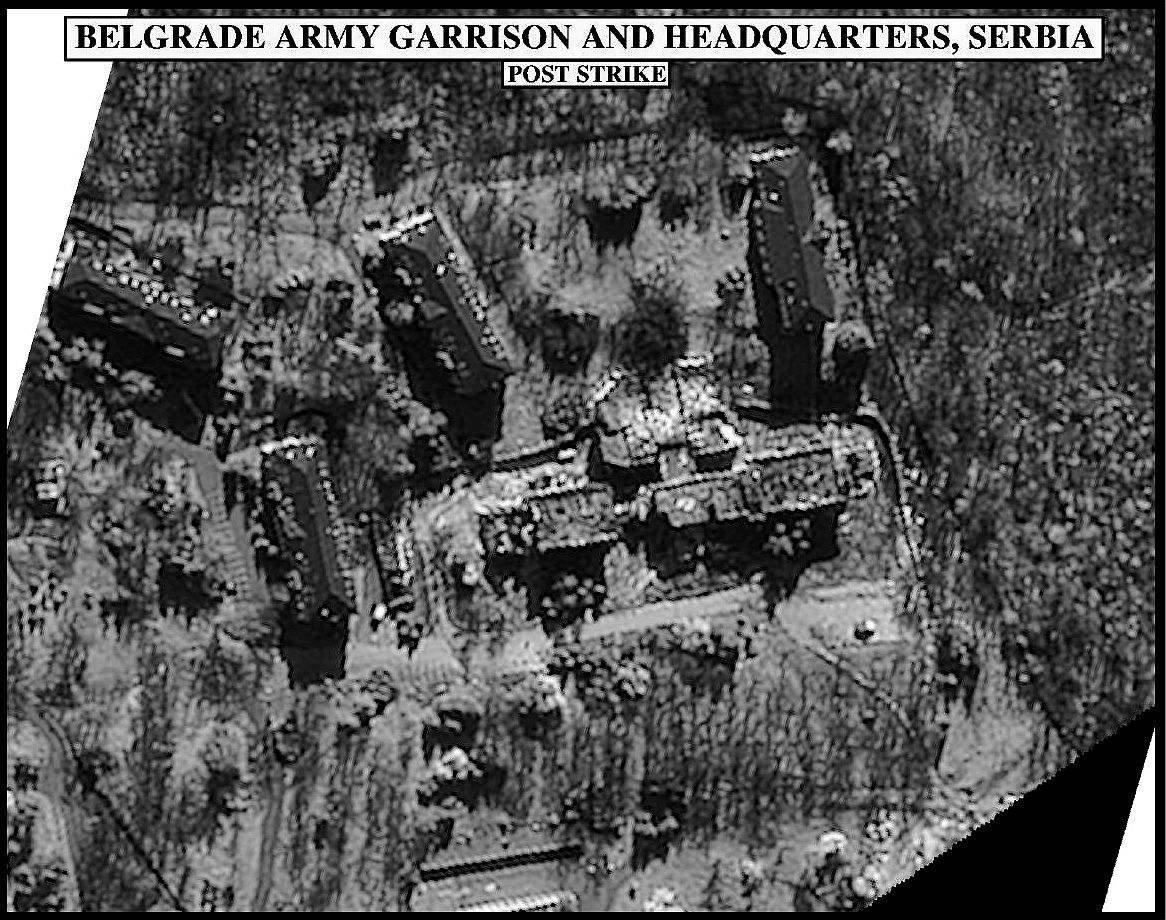
At the same time, the representation of targets as architecture and not as human beings allowed NATO to leave the human targets of its bombing campaign—both members of Serbian armed forces and civilians alike—unrepresented. NATO represented its war by images like videos shot by cameras mounted on precision-guided weapons or by surveillance photographs that showed buildings before and after they were attacked.

But these images displaced other images and even knowledge of other destruction, inflicted on human beings whose injury or death was only noted as “collateral damage.” Human bodies were often violated in the course of violating buildings; in these cases, then, the videos shot by precision-guided weaponry were snuff films screened as architectural studies.

Think about that last clause… and compare it with the unruffled commentary on US satellite imagery (1960-1999) from the National Security Archive here, which focuses on the ‘burdens’ imposed on image interpreters and the degradation of the images when released to the public (see below).

13

I rehearse all this because Andrew has returned to these and related issues around militarised vision in a spell-binding essay in Public Culture 26: 3 (2014) 46-500: ‘Surveillant witnessing: satellite imagery and the visual politics of human rights’.

I’ve written about ‘remote witnessing’ before – see here and here – and argued that it ‘requires difficult, painstaking work in multiple registers because the imagery does not speak for itself’ and that it must become ‘a multi-modal, highly mediated structure of testimony, inference and evidence: always situated, inescapably precarious, and absolutely vital.’  Without that, there is the ever-present danger that, in Andrew’s words, the act of remote witnessing becomes ‘action without acting’.

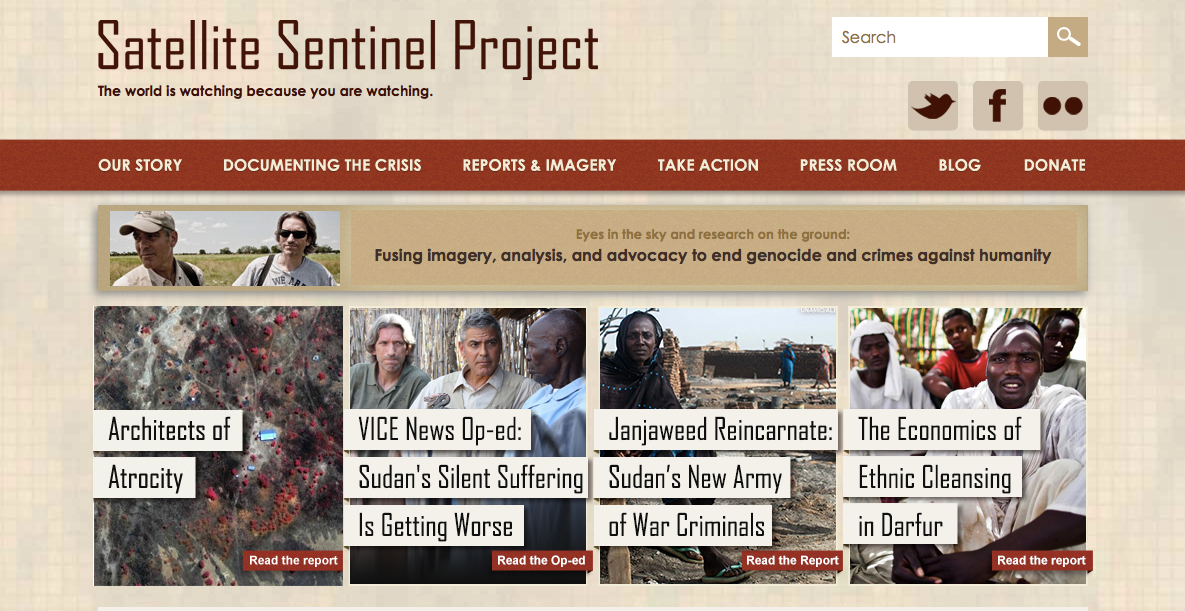
Satellite Sentinel Project

I based these claims, in part, on the Satellite Sentinel Project, which is also one of Andrew’s foci, but he places it in a carefully constructed genealogy that opens up the complicities between the surveillance state and human rights geo-witnessing.

One of Andrew’s most provocative arguments concerns what he calls the ‘imaginative geography’ performed and sanctioned through satellite imaging:

Human rights satellite imaging takes place within a geography of closed territories and open skies—the geography of a world in which repressive regimes can prevent reporting of any human rights abuse and surveillance satellites can report freely on every such abuse….

The binary opposition that underlies such accounts— closed territory / open sky — speaks to what Edward Said (1978) called an imaginative geography. In human rights advocacy, this is a geography in which the satellite gaze makes a place for itself by negating the gaze of on-the-ground witnesses—the same geography, of course, that underlay satellite surveillance from the Cold War through the Iraq War. On one side, this geography ignores the local and sometimes transnational or international human rights organizations whose reports provide the basis for satellite examination in the first place. These reports evince the human rights issues that satellite imagery is recruited to corroborate. Satellite images themselves, then, do not reveal or expose secret spaces: they revisualize a prior revelation. The secrecy that the satellite image dispels is therefore only partial or fragmented—it’s a secrecy that exists for certain publics and not for others.

On the other side, this geography ignores the status of satellite imagery as at once corporate property and the subject of a dense constellation of national laws and policies. In the United States, the government has attempted to maintain control of commercial satellite imagery by reserving a right to “shutter control,” or to restrict imagery, in order to protect “national security” or “foreign policy interests”; by instituting various time restrictions determining the release of imagery; by denying commercial licenses for certain sorts of high-resolution imagery; and by maintaining the right to “censorship by contract,” or the purchase of all output from a satellite for a specified period of time (Campbell 2008: 23). A geography of closed territories and open skies thus denies both the openings to repressive states made by on-the-ground human rights advocates and the closures of the sky structured by corporate practice and national law and policy. Both denials serve to stage the surveillance witnessing conducted by satellite imaging systems as a privileged view on human rights abuses, providing a monopoly on the discursive construction of the human rights abuse to those human rights organizations with access to satellite imagery.

Here Andrew’s analysis intersects with another excellent essay: Jeremy Crampton, Susan Roberts and Ate Poorthuis, ‘The new political economy of geographical intelligence’, Annals of the Association of American Geographers 104 (1) (2014) 196-214.

But I wonder if it really is the case that the satellite gaze necessarily ‘negates the gaze of on-the-ground witnesses’?  It may well, of course, and Andrew is right to draw our attention to the way in which the framing of these images works to interpellate the viewer.  In particular, he suggests that the seeming objectivity of satellite imagery – or at any rate its politico-technical erasure of ‘subjectivity’ – is part of its extraordinary panoptical power that can simultaneously produce an apolitical viewing subject.

But this is conditional – see, for example, my discussion of Human Rights Watch‘s report on chemical weapons attacks in Damascus; equally, Forensic Architecture‘s brilliant work with satellite imagery surely shows that there is nothing necessary about these reductions (though constant vigilance is clearly the order of the day).

That said, Andrew’s root concern is that ‘in the current global order, violence inflicted in the name of human rights can look similar or identical to violence whose infliction is categorized as a human rights abuse.’  And that is perhaps the most important sentence in an extremely important essay.

Lives, damned lives and statistics

The New Statesman is carrying a ‘reply‘ from a Professor Alan Johnson (Edge Hill University: it’s not clear to me if he’s still there) to a post by Jason Cowley on Gaza.  He doesn’t address Cowley’s substantive points about Gaza, but ends like this:

Today, there are forms of anti-Zionism that demonise Israel and fuel hate, from the academic theory of Judith Butler and Gianni Vattimo to the historiography of Shlomo Sand, from the popular street phenomenon of the “quenelle” to the ugly rise of “Holocaust inversion”.

To link Butler, Vattimo and Sand to fascist gestures like the quenelle is a lazy and offensive manoeuvre.  I leave the other scholars he mentions to those who know their work better than me: Johnson presumably has this interview with Vattimo in his sights, which is indeed reprehensible though scarcely representative of his corpus as a whole, but Sand is a distinguished historian whose counter-narrative to Zionism cannot be gratuitously dismissed, even if Johnson and his friends at the British Israel Communications and Research Centre don’t like it.

9781844675449-frontcover-01d22beb799d6fe99f8cd54193ff10f5But to suggest that ‘the academic theory of Judith Butler‘ somehow ‘demonises Israel and fuel[s] hate’ is intellectually vacuous.  What part of her ‘theory’ does Johnson have in mind? Her work on gender and subjectivity?  Her discussions of performativity? Her careful, ethical arguments about what constitutes a ‘grievable life’ in Precarious lives and Frames of war?

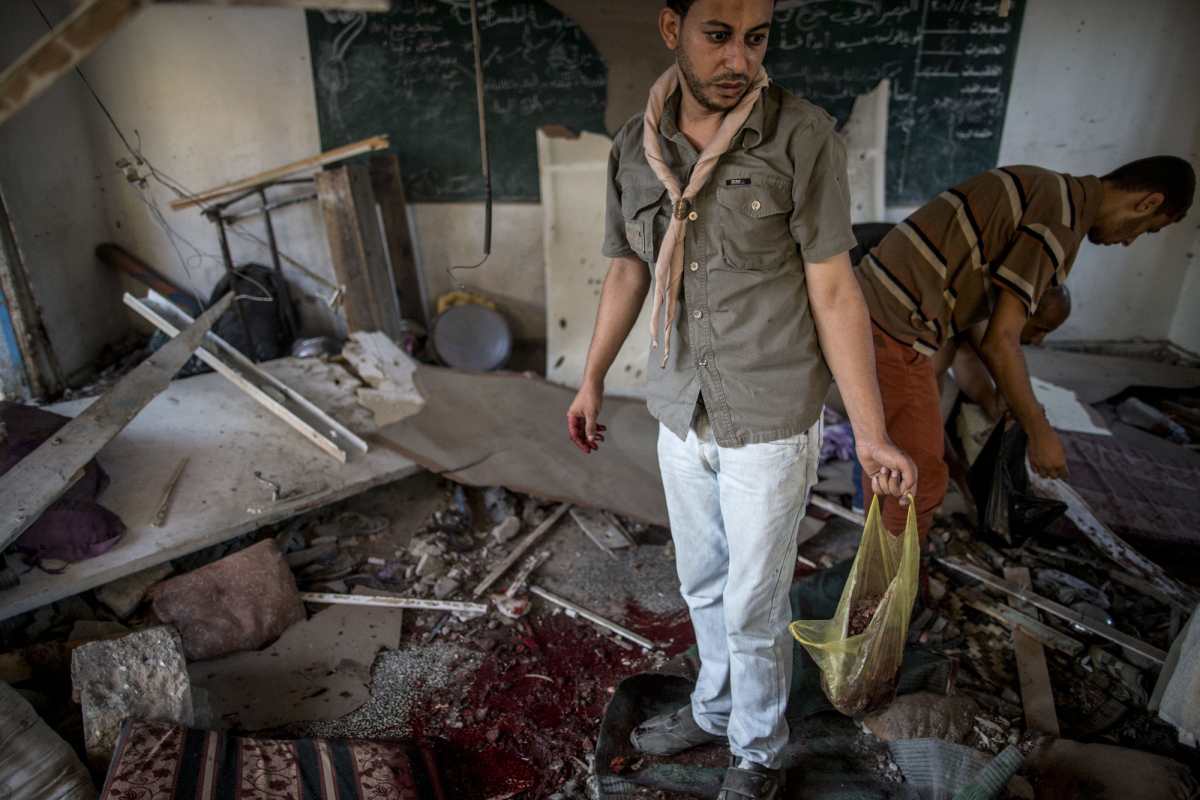
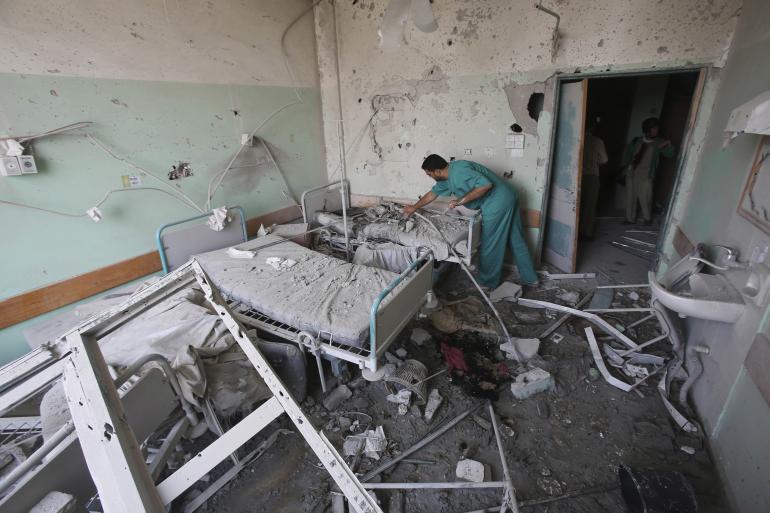
Those last two books do bear directly on the asymmetric horror that is being visited on the people of Gaza.  Readers may have seen the video of UNRWA spokesman Chris Gunness dissolving into tears as he tries to talk about the Israeli shelling of Jabalia Elementary Girls School early on Wednesday morning, when children were killed as they slept next to their parents.  We should pause here to acknowledge the extraordinarily brave and vital work the men and women of UNWRA perform day after day and night after night under the most exacting conditions (and if we are to talk about ‘demonisation’ we should certainly talk about the abuse hurled at UNWRA by the Israeli right). During the attack on the school, at least 15 people were killed and more than 100 wounded.  The location of the school and its humanitarian re-purposing as shelter for more than 3,000 people forced from their homes by the offensive had been communicated to the Israeli military 17 times before the attack. After the interview, Chris composed himself and had this to say:

“My feelings pale into insignificance compared to the enormity of the tragedy confronting each and every other person in Gaza at this time.

“It’s important to humanise the statistics and to realise that there is a human being with a heart and soul behind each statistic and that the humanity that lies behind these statistics should never be forgotten.”

This is a perfect expression of what Butler has in mind, and urges us to have in mind.  There’s no ‘hate’ there, and there isn’t in Butler’s work either: just a caring expression for grievable lives so cruelly lost.

TOPSHOTS-PALESTINIANS-ISRAEL-CONFLICT-GAZA

What Butler has provided, on several occasions, is a thoughtful, measured critique of political Zionism and of the policies and practices of successive Israeli governments that have diminished, dispossessed and, yes, demonised the Palestinian people (see a previous, brief post here). I suspect Johnson would see this as the work of a ‘self-hating Jew’, an old canard, but what then would her critics accept as a legitimate criticism of Israel?  And if we have to resurrect that line of argument, might not actions like the shelling of a school crowded with refugees be the work of a self-demonising state?

BUTLER Parting waysButler’s reflections have been brought together in her Parting ways: Jewishness and the critique of Zionism (2012), which is a principled statement of an oppositional – not defamatory – ethics and politics.  As it happens, Society and Space has just published an exceptionally thoughtful review of the book by Lisa Bhungalia which explicitly connects Butler’s vision of ‘co-habitation‘, which Butler sees as not only consistent with but arising from an indelibly Jewish tradition, to the latest Israeli attack on Gaza (where her sharpening of the concept of precarity is also surely crucial: see also ‘Precarious life and the obligations of cohabitation’, a lecture Butler delivered at Stockholm’s Nobel Museum in May 2011: you can download it here).

There are, as Lisa notes, dangers in turning ‘resistance to Zionism into a “Jewish” value’, as Butler herself acknowledges, but in the end

‘Butler puts forth a compelling political vision for Palestine/Israel predicated on an acknowledgment of historical injustice and the instatement of new polity that would presuppose an end to settler colonialism – yet at the same time, this vision is derived, in large part, from a Jewish philosophical tradition. Justice still remains a Jewish value.’

Words understandably failed Chris Gunness this week.  And when a Jewish scholar who works so respectfully with the writings of Hannah Arendt, Walter Benjamin, Martin Buber, Primo Levi and Emmanuel Levinas is accused of ‘fuelling hate’ and so egregiously linked to the rise of popular fascism then all possibility of critical engagement seems lost.

And yet. Butler talks about being critical as being ‘willing to examine what we sometimes presuppose in our way of thinking, and that gets in the way of making a more livable world.’  She has done precisely that in Parting ways.  Perhaps Professor Johnson, instead of recycling the hasbara formularies of the Israeli military, might do the same.

The American way of bombing

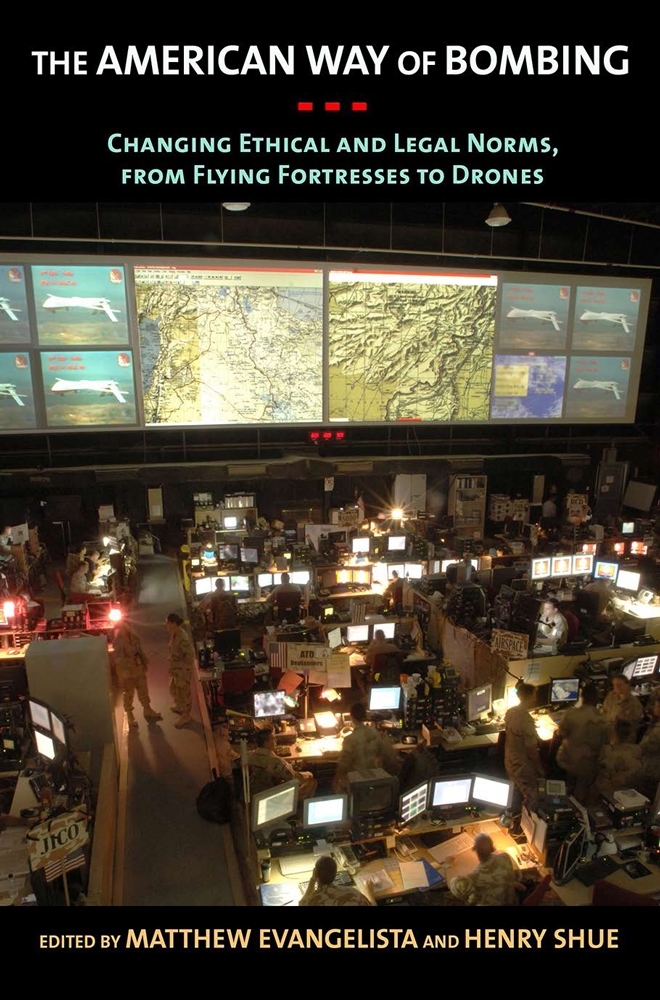
I’ve argued elsewhere (in ‘Lines of Descent’ [DOWNLOADS tab] and in ‘The American way of bombing?‘) that it’s important to situate any critical account of drones in a much longer history of air war, and a new book just out from Cornell University Press promises to do just that: The American Way of Bombing: changing ethical and legal norms from Flying Fortresses to drones, edited by Matthew Evangelista and Henry Shue.  And unlike rip-off academic-commercial publishers (most of them in the UK), this is available as an e-edition (Kindle, etc) at a perfectly reasonable price.

Here are the details:

Aerial bombardment remains important to military strategy, but the norms governing bombing and the harm it imposes on civilians have evolved. The past century has seen everything from deliberate attacks against rebellious villagers by Italian and British colonial forces in the Middle East to scrupulous efforts to avoid “collateral damage” in the counterinsurgency and antiterrorist wars of today. The American Way of Bombing brings together prominent military historians, practitioners, civilian and military legal experts, political scientists, philosophers, and anthropologists to explore the evolution of ethical and legal norms governing air warfare.

Focusing primarily on the United States—as the world’s preeminent military power and the one most frequently engaged in air warfare, its practice has influenced normative change in this domain, and will continue to do so—the authors address such topics as firebombing of cities during World War II; the atomic attacks on Hiroshima and Nagasaki; the deployment of airpower in Iraq, Afghanistan, and Libya; and the use of unmanned drones for surveillance and attacks on suspected terrorists in Pakistan, Yemen, Sudan, Somalia, and elsewhere.

American way of bombing

Introduction: The American Way of Bombing
by Matthew Evangelista

Part I. Historical and Theoretical Perspectives

1. Strategic Bombardment: Expectation, Theory, and Practice in the Early Twentieth Century
by Tami Davis Biddle

2. Bombing Civilians after World War II: The Persistence of Norms against Targeting Civilians in the Korean War
by Sahr Conway-Lanz

3. Targeting Civilians and U.S. Strategic Bombing Norms: Plus ça change, plus c’est la même chose?
by Neta C. Crawford

4. The Law Applies, But Which Law?: A Consumer Guide to the Laws of War
by Charles Garraway

Part II. Interpreting, Criticizing, and Creating Legal Restrictions

5. Clever or Clueless?: Observations about Bombing Norm Debates
by Charles J. Dunlap Jr.

6. The American Way of Bombing and International Law: Two Logics of Warfare in Tension
by Janina Dill

7. Force Protection, Military Advantage, and “Constant Care” for Civilians: The 1991 Bombing of Iraq
by Henry Shue

8. Civilian Deaths and American Power: Three Lessons from Iraq and Afghanistan
by Richard W. Miller

Part III. Constructing New Norms

9. Proportionality and Restraint on the Use of Force: The Role of Nongovernmental Organizations
by Margarita H. Petrova

10. Toward an Anthropology of Drones: Remaking Space, Time, and Valor in Combat
by Hugh Gusterson

11. What’s Wrong with Drones?: The Battlefield in International Humanitarian Law
by Klem Ryan

12. Banning Autonomous Killing: The Legal and Ethical Requirement That Humans Make Near-Time Lethal Decisions
by Mary Ellen O’Connell

Footnotes to Gaza 101

gazajuly23

Updates on Gaza 101 (at the risk of stating the obvious, the title for this post is a riff on Joe Sacco‘s brilliant Footnotes in Gaza [2009])

(1) Another powerful interview with Dr Mads Gilbert from al-Shifa Hospital, the main trauma centre in Gaza, and an excellent question:

“What would have happened if Palestinian fighters had bombed an Israeli hospital and killed five patients?  The world would have turned upside down. What is this second-hand, or even third-hand or fourth-hand citizenship in the world for the Palestinians?”

And in Gaza it’s way more than five (though that is clearly how so many governments around the world, including Canada, rank Palestinian citizenship).

Palestinian child deaths

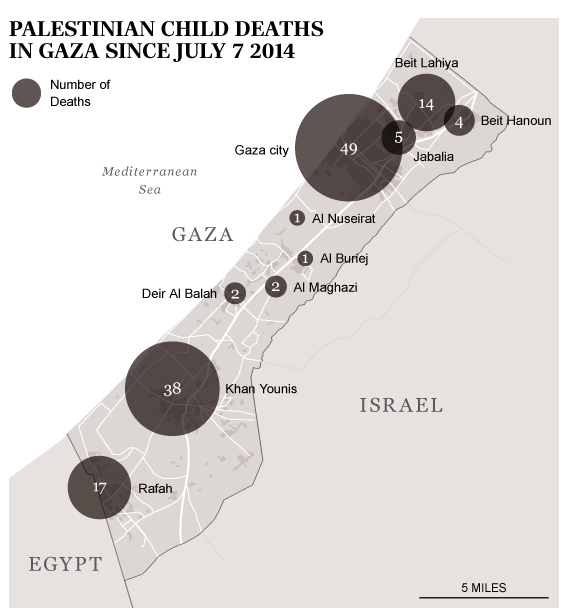
(2)  By ‘citizenship in the world’ Gilbert is getting at the differential calculus that constitutes what Judith Butler calls ‘a grievable life’, and here Maya Mikdashi sharpens a (different) point I’ve made in relation to air strikes in the Federally Administered Tribal Areas and elsewhere: that not only the dead and injured women and children [see the map above, also available here] but also the dead and injured men are worthy of our grief.

Palestine men and women and children are one people— and they are a people living under siege and within settler colonial conditions. They should not be separated in death according to their genitalia, a separation that reproduces a hierarchy of victims and mournable deaths. Jewish Israelis (including soldiers and settlers) occupy the highest rungs of this macabre ladder, Palestinian men the lowest. This hierarchy is both racialized and gendered, a twinning that allows Palestinian womenandchildren to emerge and be publicly and internationally mourned only in spectacles of violence, or “war”—but never in the slow and muted deaths under settler colonial conditions—the temporality of the “ceasefire.” To insist on publicly mourning all of the Palestinian dead, men and women and children—at moments of military invasion and during the every day space of occupation and colonization— is to insist on their right to have been alive in the first place.

(3) Finally – if only it were the end to all this – here is the splendid Richard Falk on the chronic failure of international law to protect – let alone provide justice for – the Palestinian people.  This is how he begins:

What has been happening in Gaza cannot usefully be described as “warfare”. The daily reports of atrocities situate this latest Israeli assault on common humanity within the domain of what the great Catholic thinker and poet, Thomas Merton, caIled “the unspeakable”. Its horror exceeds our capacity to render the events through language.

Up to  a point; I said something similar but much less eloquently in ‘Gaza 101’.  Trauma ruptures language, to be sure, but these words from Ann Jones are also worth reflecting on (they come from her They were soldiers):

The worst we can say of war is that it is “unspeakable,” which in fact it is not. But we don’t speak of it because that would involve so many nasty words we don’t want to use and elicit so many things we don’t want to know, so many things we think we can’t do anything about now that the government answers only to the powerful few…


Security by remote control

Security by remote control

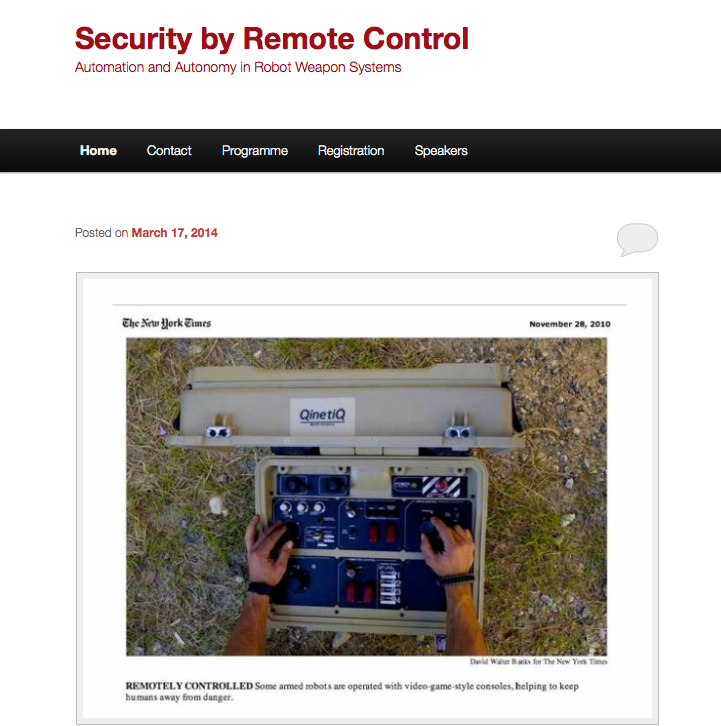
News from Lucy Suchman that the website for the Security by Remote Control conference at Lancaster, 22-23 May, is now live here.  It will be enhanced and updated as the symposium approaches – including programme details: I’m still thinking over what I might present – but registration is open now.

Despite investment in new technologies, the legitimacy and efficacy of actions taken in the name of security is increasingly in question. In April of 2013 a coalition led by Human Rights Watch initiated a campaign in favour of a legally binding prohibition on the development, production and use of fully autonomous weapon systems. Simultaneously, some military and robotics experts argue that equipping robots with the capacity to make ethical judgments is an achievable technological goal. Within these debates, the ‘human in the loop’ is posited alternately as the safeguard against illegitimate killing, or its source. Implicit across the debate is the premise of a moment of decision in which judgements of identification and appropriate response are made. This symposium will focus on on the troubling space between automation and autonomy, to understand more deeply their intimate relations, and the inherent contradictions that conjoin them.

Theory of the drone 11: Necro-ethics

This is the 11th in a series of extended posts on Grégoire Chamayou‘s Théorie du drone and covers the first two of three chapters that constitute Part III: Necro-ethics.

The title recalls Achille Mbembe‘s seminal essay on ‘Necropolitics’ [Public culture 15 (1) (2003) 11-40], where he cuts the umbilical cord between sovereignty and the state (and supranational institutions) and, inspired by Michel Foucault and Giorgio Agamben, argues that ‘the ultimate expression of sovereignty resides, to a large degree, in the power and the capacity to dictate who may live and who must die.’  Necropolitics is thus about ‘contemporary forms of subjugation of life to the power of death’ – and at the limit the creation of what Mbembe calls ‘death-worlds’.

AlexisLeran-AchilleMbembe5Mins658

Mbembe develops his thesis in part – and for good reason – in relation to the Israeli occupation of Palestine.  I imagine readers will know that the Israeli Defence Force (IDF) advertises itself, incredibly, as ‘the most moral army in the world’, and although Chamayou’s ultimate objectives are different he too begins with a critical interrogation of one version of that claim (you can find much more about it in Muhammad Ali Khalidi‘s fine essay on Gaza in the Journal of Palestine Studies 39 (3) (2010) available on open access here).

1: Combatant immunity

Chamayou argues that what distinguishes contemporary forms of imperial military violence is not so much the asymmetry of the conflict or the differential distribution of vulnerability which results as the norms that are invoked to regulate its conduct.  Towards the end of the twentieth century, he suggests, the ‘quasi-invulnerability’ of the dominant force was transformed into an over-arching politico-ethical framework.  This first came into view during NATO’s intervention in Kosovo in 1999 when force protection was established as the key consideration: not only was the NATO campaign largely confined to bombing from the air (so that, apart from Special Forces, there were few boots – and, more to the point, NATO bodies – on the ground) – but pilots were ordered not to fly below 15,000 feet.  This kept them safely beyond the range of anti-aircraft fire, even as it reduced the accuracy of air strikes and endangered the lives of those the intervention was supposed to save.

nato-bombs-convoy

This seems to violate conventional notions of a just or ethical war, effectively turning ‘humanitarian intervention’ on its head, but Chamayou claims that in fact it heralded the explicit formulation of a principle of ‘imperial combatant immunity’.  Enter the IDF, stage right.  This new doctrine was set out in detail in an essay by Asa Kasher  and Amos Yadlin, writing from the ‘Department of Professional Ethics and Philosophy of Practice’ at Tel Aviv University and the IDF College of National Defense, and published as ‘Military ethics of fighting terror: an Israeli perspective’, Journal of military ethics 4 (1) (2005) 3-32.  As their affiliation shows, this was not an abstract, academic discussion; Chamayou notes, in an artful twist on Yves Lacoste (La géographie, ça sert, d’abord, à faire la guerre), ‘What use is moral philosophy?  Among other things, to wage war…’ (‘A quoi sert la philosophie morale?  Entre autres choses, à faire la guerre’) (p. 184).

In that essay Kasher and Yadlin proposed a comprehensive reformulation of military ethics – and, by extension, international law – but Chamayou fastens on their reworking (or demolition) of  the established principle of distinction.  He cites their central thesis, thus:

One major issue is the priority given to the duty to minimize casualties among the combatants of the state when they are engaged in combat acts against terror.  According to the ordinary conception underlying the distinction between combatants and noncombatants, the former have a lighter package of state duties than the latter. Consequently, the duty to minimize casualties among combatants during combat is last on the list of priorities or next to last, if terrorists are excluded from the category of noncombatants. We reject such conceptions, because we consider them to be immoral. A combatant is a citizen in uniform. In Israel, quite often he is a conscript or on reserve duty. His blood is as red and thick as that of citizens who are not in uniform. His life is as precious as the life of anyone else. A democratic state may send him to a battlefront only because it has a duty to defend its citizens and it cannot do this without some of them defending the others, within the framework of a just system of conscription and reserve duty. The state ought to have a compelling reason for jeopardizing a citizen’s life, whether or not he or she is in uniform. The fact that persons involved in terror are depicted as noncombatants is not a reason for jeopardizing the combatant’s life in their pursuit. He has to fight against terrorists because they are involved in terror. They shoulder the responsibility for their encounter with the combatant and should therefore bear the consequences. 

(It turns out that there are limits to the privileges accorded to citizen-soldiers: more recently Ha’aretz reports that Kasher suggested in early 2012 that medical experiments can be carried out on them, even if they are not fully informed of the details, in order to ‘build the military force’, though Kasher has contested these accusations and insisted that his opinion stipulated a series of ‘conditions’ that had to be met).

I didn’t mention Lacoste casually, because part of Kasher and Yadlin’s argument turns on territory: on the duties imposed by belligerent occupation (‘when a person resides in a territory that is under effective control of the state’).  This is a Trojan Horse, needless to say, because they clearly have Gaza in their sights, and their proposal seeks to further the egregious fiction that Israel’s ‘withdrawal’ in 2005 meant that the Palestinians effectively imprisoned in Gaza are no longer subject to Israeli occupation (for more on ‘Gaza under siege’, see here).  Chamayou doesn’t dwell on this, but the emphasis on ‘effective control’ could – if you accept Kasher and Yadlin’s grotesque argument (which they insist is a general one) – be brought to bear on the US campaign of targeted killing in the Federally Administered Tribal Areas of Pakistan, in Yemen and in Somalia and be made to intersect with the usual rhetoric about ‘ungoverned spaces’ and ‘lawless zones’.

Kasher and Yadlin summarize their proposed hierarchy of privileges by setting out a tariff according to which militaries would administer injury in priority sequence:

(d.1) Minimum injury to the lives of citizens of the state who are not combatants during combat;

(d.2) Minimum injury to the lives of other persons (outside the state) who are not involved in terror, when they are under the effective control of the state;

(d.3) Minimum injury to the lives of the combatants of the state in the course of their combat operations;

(d.4) Minimum injury to the lives of other persons (outside the state) who are not involved in terror, when they are not under the effective control of the state;

(d.5) Minimum injury to the lives of other persons (outside the state) who are indirectly involved in terror acts or activities;

(d.6) Injury as required to the liberties or lives of other persons (outside the state) who are directly involved in terror acts or activities.

Chamayou concludes that the core principle they seek to advance involves replacing the distinction between civilians and combatants by a hierarchical distinction between citizens and aliens: an unbridled nationalism masquerading as ethics (p. 187).  In other words, within the frontier of state control  – Chamayou says ‘ state sovereignty’, but that’s not quite what Kasher and Yadlin say – some lives are more precious than others,  while beyond that line inferior lives (including those of what they call ‘bystanders’) are to be exposed to violence and ultimately sacrificed: as they put it, ‘the state should give priority to saving the life of a single citizen, even if the collateral damage caused in the course of protecting that citizen is much higher…’
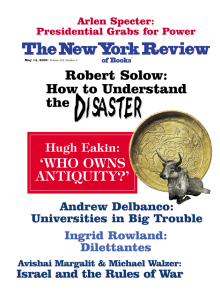
nyrb051409Their proposals had a slow fuse but they eventually set off a firestorm of protest.  Responding to a shorter version of the main essay [‘Assassination and preventive killing’, SAIS Review of International Affairs 25 (1) (2005)  41-57] and writing in the New York Review of Books (14 May 2009), Avishai Margalit and Michael Walzer were unequivocally appalled:

‘Their claim, crudely put, is that in such a war the safety of “our” soldiers takes precedence over the safety of “their” civilians.  Our main contention is that this claim is wrong and dangerous. It erodes the distinction between combatants and noncombatants, which is critical to the theory of justice in war (jus in bello).’

They continued:

‘The point of just war theory is to regulate warfare, to limit its occasions, and to regulate its conduct and legitimate scope. Wars between states should never be total wars between nations or peoples. Whatever happens to the two armies involved, whichever one wins or loses, whatever the nature of the battles or the extent of the casualties, the two nations, the two peoples, must be functioning communities at the war’s end. The war cannot be a war of extermination or ethnic cleansing. And what is true for states is also true for state-like political bodies such as Hamas and Hezbollah, whether they practice terrorism or not. The people they represent or claim to represent are a people like any other.

The main attribute of a state is its monopoly on the legitimate use of violence. Fighting against a state is fighting against the human instruments of that monopoly—and not against anyone else….

The crucial means for limiting the scope of warfare is to draw a sharp line between combatants and noncombatants. This is the only morally relevant distinction that all those involved in a war can agree on. We should think of terrorism as a concerted effort to blur this distinction so as to turn civilians into legitimate targets. When fighting against terrorism, we should not imitate it.’

In contrast,

‘For Kasher and Yadlin, there no longer is a categorical distinction between combatants and noncombatants. But the distinction should be categorical, since its whole point is to limit wars to those—only those—who have the capacity to injure (or who provide the means to injure)….

‘This is the guideline we advocate: Conduct your war in the presence of noncombatants on the other side with the same care as if your citizens were the noncombatants. A guideline like that should not seem strange to people who are guided by the counterfactual line from the Passover Haggadah, “In every generation, a man must regard himself as if he had come out of Egypt.”

Menahem YaariTheir critique found vigorous support from Menahem Yaari, a theoretical economist whose work has addressed (amongst other things) questions of justice, uncertainty and risk, but who wrote in a subsequent issue (8 October 2009) in his capacity as President of the Israel Academy of Sciences and Humanities:

‘A military code of conduct that discriminates, in cases of hazards being inflicted upon innocent civilians, on the basis of whether these civilians are “ours” or “theirs” is all the more worrisome when viewed against a general background of growing ethnocentric and xenophobic attitudes in Israel’s traditional establishment. We see an ongoing drift from universalism and humanism toward parochialism and tribalism.’

Picking up from that last sentence, Chamayou believes that this drift has accelerated and that it is by no means confined to Israel’s ‘traditional establishment’.  In his view, the ‘evisceration’ of the core principles of international humanitarian law by a ‘nationalism of self-preservation’ has become ‘the primary guiding principle of the necro-ethics of the drone’ (p. 189).

2: Humanitarian weapon

Chamayou seeks to trace a line of descent from the previous arguments to those advanced more recently by academics who directly address (and defend) the US use of drones.  He has two men in mind: Avery Plaw, an Associate Professor of Political Science at UMass – Dartmouth, and Bradley Jay Strawser, an Assistant Professor of Philosophy in the Defense Analysis Department at the US Naval Postgraduate School at Monterey.

UMass_Drone-crop

Plaw has collaborated with several colleagues to track and evaluate drone strikes in Pakistan and is involved in the UMass DRONE project (I’ve commented on this before), but it’s an Op-Ed in the New York Times on 14 November 2012 that catches Chamayou’s attention.  ‘Drones save lives, American and others’ was the headline, and Chamayou is bemused: ‘How can an instrument of death save lives?’

The question seems to invite a biopolitical response – ‘killing in order to let live’, as Mbembe and others would no doubt have it, and Chamayou doesn’t quite provide that – but neither does Plaw quite say what the headline implies.  He suggests that ‘drone strikes are the best way to remove an all-too-real threat to American lives’ and that ‘there is evidence that drone strikes are less harmful to civilians than other means of reaching Al Qaeda and affiliates in remote, lawless regions’. Perhaps this amounts to the same thing, but it’s not quite the cold calculus that Chamayou attributes to Plaw.  And as I read his (brief) intervention, the ‘American lives’ that Plaw sees as being at risk are not those of, say, ground troops in Afghanistan but of civilians in the continental United States threatened by attacks from al-Qaeda and its affiliates  – though even then Plaw would have to explain how they are ‘saved’ by attacks on the Taliban and other militant groups which scarcely pose a trans-continental danger.

'Nobody dies' Popular Science November 1997

In any event, Chamayou challenges what he sees as the paradoxically vitalist claim that serves as the first principle of contemporary necro-ethics: drones are ‘humanitarian’ because they save lives – and specifically ‘our’ lives (p. 192), which he sees encapsulated even more succinctly than in Plaw’s Op-Ed by the tag-line in the image above (from Popular Science in November 1997): ‘Nobody dies – except the enemy.’

STRAWSER Killing by remote controlThis is where he turns to – and on – Strawser.  Like Plaw, he has had his views publicised in the media –see Rory Carroll on ‘The philosopher making the moral case for US drones’  in the Guardian here and Strawser’s hasty qualification here – but Chamayou directs his attention to Strawser’s essay ‘Moral Predators: the duty to employ uninhabited aerial vehicles’, Journal of military ethics 9 (4) (2010) 342-68.  More recently, by the way, he’s edited a collection of essays, Killing by remote control: the ethics of an unmanned military (Oxford University Press, 2013), which includes an essay by Plaw on ‘Counting the dead: the proportionality of predation in Pakistan’ and an exchange between Kasher and Plaw, in which the (I think substantial) differences between the two are clarified.  These centre on the principle of distinction: the requirement to discriminate between combatants and civilians.  Kasher makes no secret of what he calls his ‘negative attitude to the principle of distinction as it is commonly understood and practically applied’ (which doesn’t leave much room for a positive attitude).  ‘Humanitarian’, he insists, means ‘an attitude towards human beings as such, not toward a certain group of people’ – given the way in which the IDF treats Palestinians, this strikes me as pretty thick – so that the principle of distinction is really ‘civilarian’ (his term) and fails to respect ‘the human dignity of combatants in the broad sense of men and women in uniform’ (which isn’t a ‘broad sense’ at all, of course: Kasher’s combatants all wear uniform).  ‘A democratic state [sic] owes its citizens in military uniform a special justification for jeopardizing their life when they do it not for the relatively simple reason of defending their fellow citizens,’ he argues, ‘but when they are required to do it for the sake of saving the life of enemy citizens who are not combatants.’  The recourse to drones, he concludes, ‘circumvents such difficulties’.

Similarly, though not identically, Strawser regards the drone as not simply a morally permissible weapon but rather as a morally compulsory one.  He proposes a Principle of Unnecessary Risk , according to which ‘it is wrong to command someone to take on unnecessary potentially lethal risks in an effort to carry out a just action for some good’, and then extrapolates more or less directly to the compulsion to employ Unmanned Aerial Vehicles (UAVs):

‘We have a duty to protect an agent engaged in a justified act from harm to the greatest extent possible, so long as that protection does not interfere with the agent’s ability to act justly. UAVs afford precisely such protection. Therefore, we are obligated to employ UAV weapon systems if it can be shown that their use does not significantly reduce a warfighter’s operational capability.’

Strawser then qualifies his basic Principle: ‘the just warrior’s increased protection (which a UAV provides) should not be bought at an increased risk to noncombatants.’   In effect, Chamayou argues, Strawser makes Kasher and Yadlin’s principle of self-preservation subordinate to the minimisation of risks to non-combatants.  But when Strawser insists that ‘if using a UAV in place of an inhabited weapon platform in anyway whatsoever decreases the ability to adhere to jus in bello principles [of proportionality and distinction], then a UAV should not be used,’ Chamayou believes he is also playing his ‘get out of jail free’ card.  For Strawser claims that ‘there is good reason to think just the opposite is true: that UAV technology actually increases a pilot’s ability to discriminate’.   In support, Strawser cites an Israeli pilot –

‘The beauty of this seeker is that as the missile gets closer to the target, the picture gets clearer . . .The video image sent from the seeker via the fiber-optic link appears larger in our gunner’s display. And that makes it much easier to distinguish legitimate from non-legitimate targets’ 

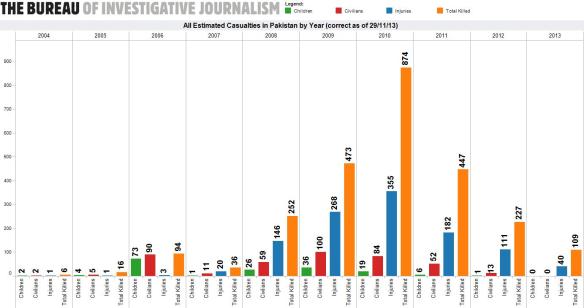
– and Plaw’s analysis of drone strikes in Pakistan from 2004 to 2007.  Strawser concedes that the claim for enhanced distinction is an empirical one; Plaw’s analysis needs a fuller examination than I can provide in this post, but it’s important to note that 2007 is a significant cut-off.  As the chart below shows, from the splendid Bureau of Investigative Journalism, this is long before the Obama administration ramped up the attacks on the Federally Administered Tribal Areas.  Plaw’s chapter in Killing by remote control extends his analysis to 2011 and concludes that US drone strikes – particularly when weighed against casualties from insurgent attacks or Pakistan military operations in the region – most often meet the demands of proportionality; but the discussion doesn’t directly address discrimination.
All-Totals-Dash47

What Strawser does, Chamayou concludes, is offer a technical resolution of an ethical dilemma: it is not necessary to subordinate one principle to another – minimisation of risk to combatants (‘citizen-soldiers’) or minimisation of risk to non-combatants (‘alien’ or otherwise) – because this new technology of killing promises to satisfy both.  In effect, drones are supposed to introduce a new, intrinsically ethical symmetry to asymmetric warfare: they save ‘our’ lives and ‘their’ lives.  They combine the power to kill and to save, to wound and to care, a weapon at once humanitarian and military – ‘humilitaire’, as Chamayou has it.  (Others have made a case for the humanitarian uses of unarmed drones, but their arguments are a far cry from military applications).

Yet if this new military power saves lives, Chamayou demands, what is it saving them from?  His answer: from itself, from its own power to kill.  And if this seems the lesser evil, in Eyal Weizman‘s terms the ‘result of a field of calculations that seeks to compare, measure and evaluate different bad consequences’, then we need to remind ourselves, with Hannah Arendt, how quickly ‘those who choose the lesser evil forget … that they chose evil.’

Chamayou turns to Weizman deliberately; that ‘field of calculations’, the calculus that is focal to the construction through calibration of our ‘humanitarian present’, is the target of Chamayou’s next and final chapter in his critique of necro-ethics – of which more very soon.

UPDATE: Today’s Guardian has a video debate between Seumas Milne and Peter Lee (Portsmouth University): ‘Is the use of unmanned military drones ethical or criminal?’ Lee claims that, ‘used correctly’, this new technology and in particular the MQ-9 Reaper is ‘the most potentially ethical use of air power yet devised.’
A call to arms

LACOSTE La géographie ça sert d'abord à faire la guerreI expect most readers will be familiar with the debate in anthropology over its contemporary militarization:  the incorporation and appropriation of anthropologists and anthropological knowledge in the service of military power, most notably through ‘Human Terrain Teams’.

But it’s a much wider debate that isn’t limited by the military’s ‘cultural turn’ and what I once called ‘the rush to the intimate’ (see DOWNLOADS tab), and recent ‘Human Geography Summits‘ have repeatedly drawn attention to the strategic and tactical significance of geo-spatial intelligence and geographical modelling in apprehending (and appropriating) that ‘human terrain’ (for the 2013 meeting see here).

And now, over at Antipode, there is a must-read open-access column by Joel Wainwright:  ‘“A remarkable disconnect”: On violence, military research, and the AAG’ .  As you’ll see, it’s about much more than the wretched Bowman Expeditions to Central America, important as they are and indispensable as Joel’s critique in Geopiracy has been (see also my brief commentary on different ‘expeditions’ here).

The first part of Joel’s argument, ‘Misunderstanding militarized’, is available at the Public Political Ecology Lab here.