What does war sound like now?

Vanessa Barford‘s BBC essay – ‘What does war sound like now?‘ – complete with sound clips adds more dimensions to my previous post on the sounds of war:

Particular noises are associated with particular conflicts, both by those who watch the news and soldiers and civilians who experience it firsthand….  Some sounds – the silence of shock, the pain of the wounded and the cries of bereaved relatives – unite all wars. But others, in many ways, help define a conflict.’

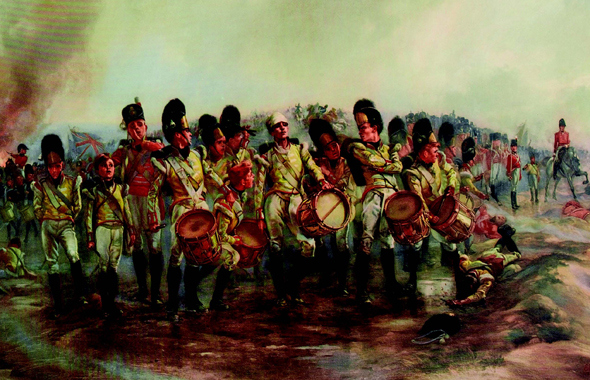
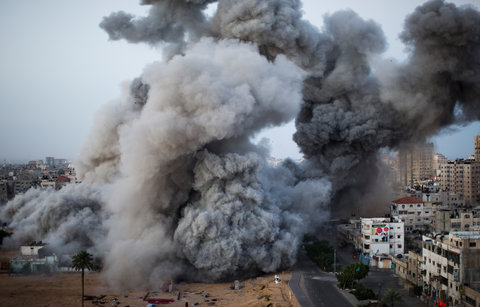
The short report travels from the drumbeats and bugle calls that were used to control the battlefield of the eighteenth century to the sounds of drones, missiles and shells over Gaza.

Writing in the New Yorker, Wasseem el Sarraj provides a much more detailed (and far more harrowing) account of the soundscape of Gaza City:

In our house we have become military experts, specializing in the sounds of Israeli and Palestinian weapons. We can distinguish with ease the sound of Apaches, F-16 missiles, drones, and the Fajr rockets used by Hamas. When Israeli ships shell the coast, it’s a distinct and repetitive thud, marked by a one-second delay between the launch and the impact. The F-16s swoop in like they are tearing open the sky, lock onto their target and with devastating precision destroy entire apartment blocks. Drones: in Gaza, they are called zananas, meaning a bee’s buzz. They are the incessant, irritating creatures. They are not always the harbingers of destruction; instead they remain omnipresent, like patrolling prison guards. Fajr rockets are absolutely terrifying because they sound like incoming rockets. You hear them rarely in Gaza City and thus we often confuse them for low-flying F-16s. It all creates a terrifying soundscape, and at night we lie in our beds hoping that the bombs do not drop on our houses, that glass does not shatter onto our children’s beds. Sometimes, we move from room to room in an attempt to feel some sense of safety. The reality is that there is no escape, neither inside the house nor from the confines of Gaza.

And this from Catherine Charrett in Gaza via Critical Legal Thinking:

A war on Gaza is com­plete with all of Israel’s latest tech­no­lo­gical killing inven­tions. “The drone” flies high in the sky, filling the airy space with a con­stant deep buzz­ing, which does not sub­side the entire night. His buddy, “the F-​16” flies lower down mak­ing a most ter­ri­fy­ing roar­ing sound which tears out the heart and car­ries it down the lane, and which is always fol­lowed by the sound of a bomb blast­ing. “The Bomb”, which crashes down, breaks the sky, rattles the win­dows, moves the chairs, pierces the ear, stops the heart and causes a deep feel­ing of sor­row and pro­found fear. The bomb that we know is always fol­lowed by death.

UPDATE: Rana Baker‘s recordings (for the Electronic Intifada) of the sound of Israeli attacks on Gaza can be heard here.

From hotels to hostilities

I’m just back from a wonderful time at Ohio State giving the Taafe Lecture, and still trying to catch my breath: lots of good conversation and good company.  More on this later – as always, I learned much from the discussions, and I’m particularly grateful to Mat Coleman, Kevin Cox, Nancy Ettlinger, Ed Malecki, Becky Mansfield, Kendra McSweeney, Mary Thomas, Joel Wainwright and a stimulating crowd of graduate students for the warmth of their welcome and the range of their questions.

While I’ve been on the road, I learned of two new blogs whose most recent posts, when read together, prompt me to think about the multiple, terrible connections between military violence in Beirut and in Gaza – not least through the IDF’s so-called Dahiyah Doctrine, named after Beirut’s southern suburb that was devastated in the summer of 2006 , which calls for the use of overwhelming and disproportionate force and the deliberate targeting of government and civilian infrastructure (more on the legal armature from Richard Falk and Raji Sourani here).

Sara Fregonese and Adam Ramadan have started Everyday Geopolitics – it’s been running since October but I’ve only just caught up, and Sara’s most recent post on Beirut is a front-line report on her work on hotels and geopolitics.  If that seems a strange combination – and it isn’t – then check out her comments and photographs, and her essay ‘Between a refuge and a battleground: Beirut’s discrepant cosmopolitanisms’, Geographical Review, 102 (2012) 316–336.

Craig Jones has started War, Law and Space that opens with an important reflection on the ongoing Israeli assault on Gaza, the parallels with ‘Operation Cast Lead‘ in 2008, and the differential granting of the ‘right to self-defence’.

Incidentally, for anyone who thinks Israel ‘withdrew’ from Gaza in 2005, I particularly recommend the following:

Lori Allen, ‘The scales of occupation: Operation Cast Lead and the targeting of the Gaza Strip’, Critique of anthropology 32 (2012) 261-84;

Lisa Bhungalia, ‘Im/mobilities in a “Hostile Territory”: Managing the Red line’, Geopolitics 17 (2012) 256-75;

Shane Darcy and John Reynolds, ‘An enduring occupation: the status of the Gaza Strip from the perspective of International Humanitarian Law’, Journal of conflict and security law 15 (2010) 211-43;

Darryl Li, ‘The Gaza Strip as laboratory: notes in the wake of disengagement’, Journal of Palestine Studies 35 (2) (2006) 38-55;

Helga Tawil-Souri, ‘Digital occupation: Gaza’s hi-tech enclosure’, Journal of Palestine Studies 41 (2) (2012) 27-43.

If you don’t have time, then at least read Samera Esmeir on ‘Colonial experiments in Gaza’ at Jadaliyya here.  In the midst of the latest, horrific attacks, it’s vitally important to realise that violence can take many forms, and that Israel’s assaults on Gaza run even deeper than the overt and spectacular violence it metes out in its spasmodic military operations.  More on this soon too, and on Israel’s ongoing air strikes.

Art and atrocity

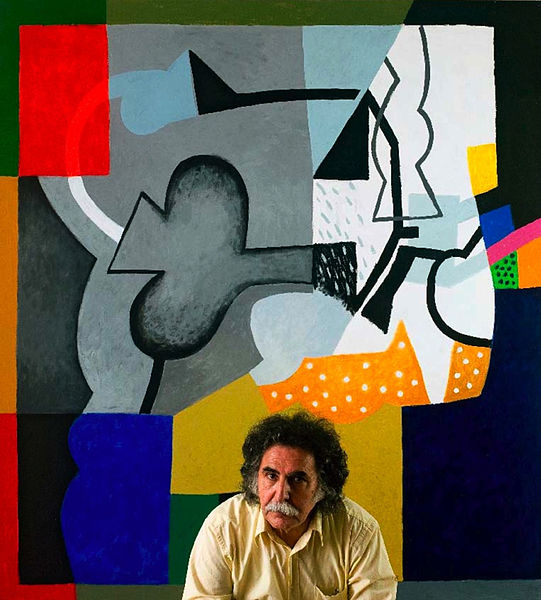
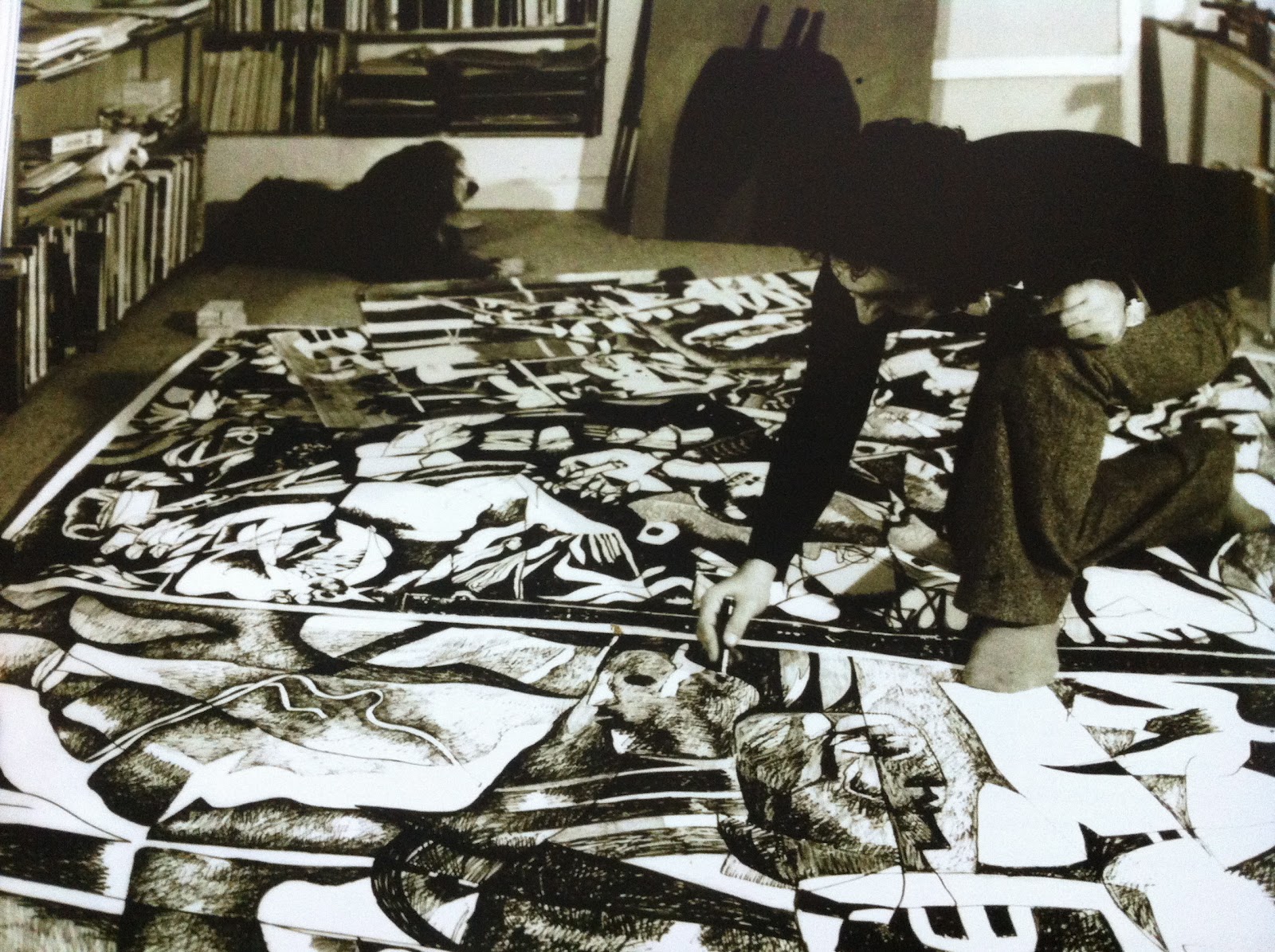
Since I read it yesterday I’ve been mesmerized by Maymanah Farwat‘s fine short essay at Jadaliyya on Baghdad-born artist Dia al-Azzawi‘s (pictured left) Sabra and Shatila Massacre currently on view at Tate Modern in London.

The artwork itself is copyright, and the Tate online pages describe but don’t display it, but if you click on the link to Jadaliyya above you can see it; it’s also – vividly – here, and there’s also a detail here and more here. The vast four-panelled work is a response to the massacre of Palestinians in two refugee camps in Lebanon in 1982 by Phalangist militias under the eyes of the Israeli Defense Force commanded by Ariel Sharon.

Within a labyrinth of death and the mundane (the remnants of domestic structures), the artist is relentless in his indictment, what he refers to as “a manifesto of dismay and anger.” Areas of white, where the eye would normally rest in a monochromatic composition, ignite horror, become corpses. Instances of Cubism are employed not to convey the dynamic movement of form but as a system of measure through which to count out cyclical disaster.

The artist started work on the project the day after the killings:

‘I had at that time a roll of paper and, without any preparatory sketches, the idea for the work came to me. I tried to visualize my previous experience of walking through this camp, with its small rooms separated by a narrow road, in the early 1970s.

But this vast composition is more than a memory work: Dia al-Azzawi was also inspired by Jean Genet‘s Quatre heures à Chatila (‘Four Hours in Shatila’) (available in the Journal of Palestine Studies 12 (3) (1983) 3-22).  As Ahdaf Soueif tells the story:

‘[Genet] was, it seems, one of the first foreigners to enter the Palestinian refugee camp of Shatila after the Christian Lebanese Phalange, with the compliance of the Israeli command, tortured and murdered hundreds of its inhabitants. There, pushing open doors wedged shut by dead bodies, Genet memorised the features, the position, the clothing, the wounds of each corpse till three soldiers from the Lebanese army drove him at gun point to their officer: “‘Have you just been there?’ [the officer] pointed to Shatila. ‘Yes.’ – ‘And did you see?’ — ‘Yes.’ — ‘Are you going to write about it?’ — ‘Yes.'”

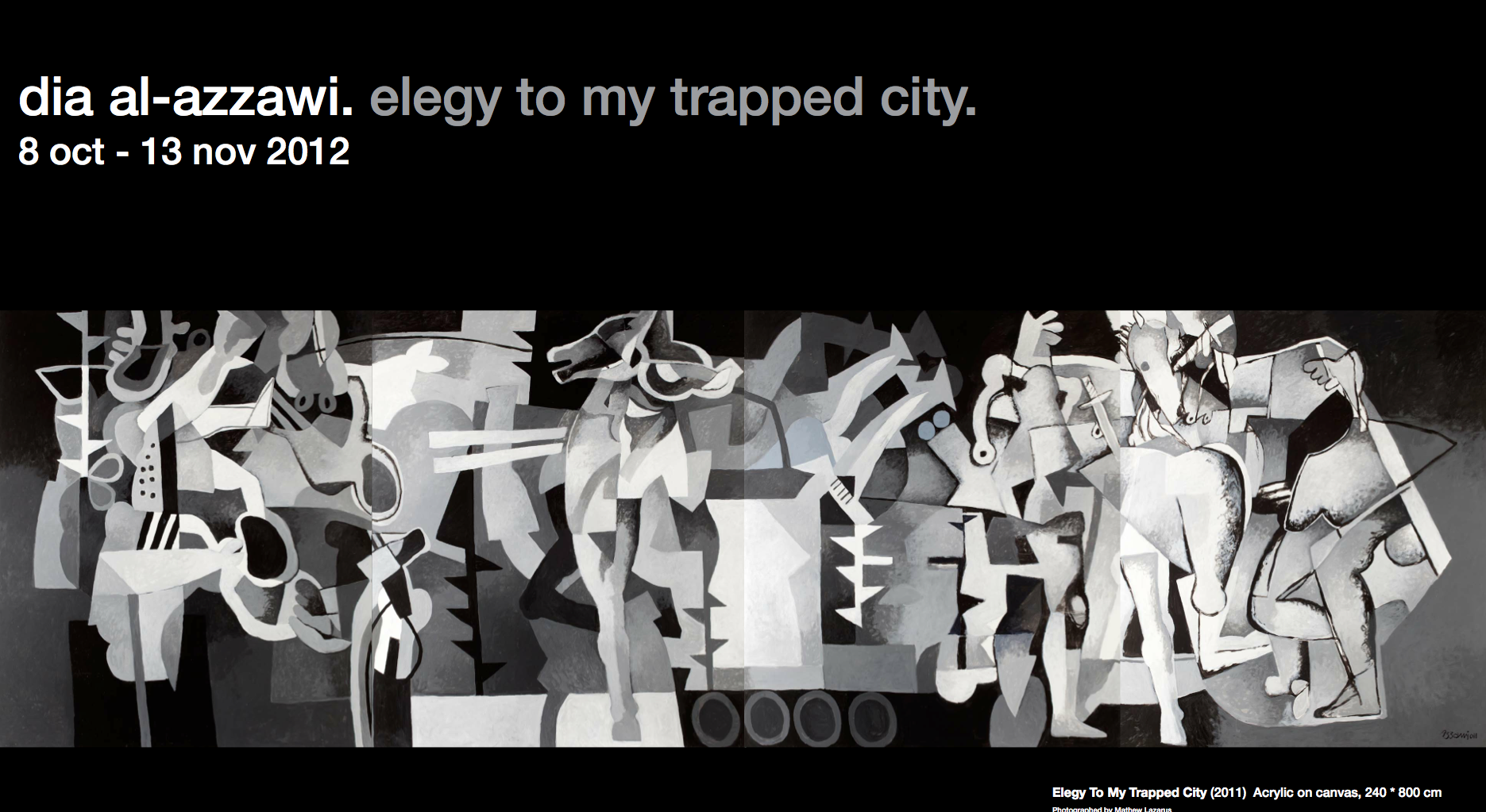
Sabra and Shatila Massacre retains that extraordinary, forensic attention to detail – to the wretched remnants of the ordinary – and it’s often compared to another, equally epic rendering of horror, Picasso‘s giant Guernica. (You can also see the parallels, I think, in the same artist’s Elegy to my trapped city (2011) below).

There’s more on the to-and-fro between the textual and the visual in relation to Sabra and Shatila in  Zahra A. Hussein Ali, ‘Aesthetics of memorialization’, Criticism 51 (2010) 589-621.  And Vimeo has an English-language version of Carlos Lapeña‘s film (2005) Four hours in Chatila inspired by Genet’s testimonial:

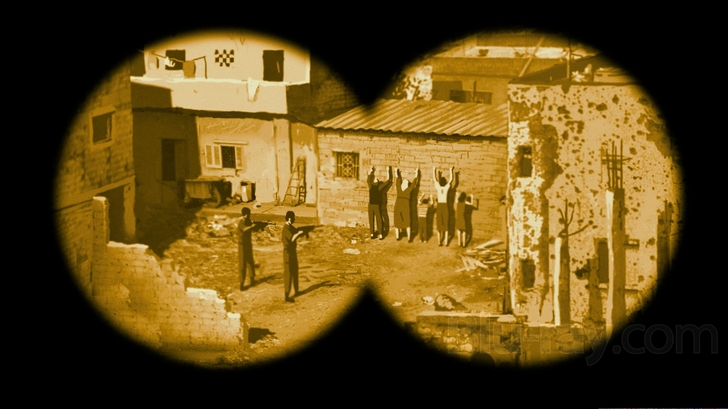
But if memory-work haunts these visualizations, then a film to watch in conjunction with and counterpoint to Lapeña’s is Ari Folman‘s ‘animated documentary’ Waltz with Bashir (2008) – described by Peter Bradshaw in the Guardian as ‘a military sortie into the past’ – in which the director tries to come to terms with his non-memory of being a young Israeli soldier in Lebanon in 1982 and, in so doing, converts Sabra and Shatila into lieux de mémoire.

Among the many thoughtful critical responses to the film, Natasha Mansfield‘s open-access essay on ‘Loss and mourning’ at Wide Screen 2 (1) (2010) deals with the differential distance between camera and animation (Ohad Landesman and Roy Bendor develop this in more detail in animation 6 (3) (2011) 353-70), Katrina Schlunke in ‘Animated documentary and the scene of death’ in South Atlantic Quarterly 110 (2011) 949-62 treats the final cut from animation to documented images of the massacre, while  in ‘War Fantasies’, Modern Jewish Studies 9 (2010) 311-26 Raz Yosef – who also discusses these themes – objects to Folman’s focus on the Israeli ‘victim’ and its equation with the otherwise marginalised Palestinian victim.

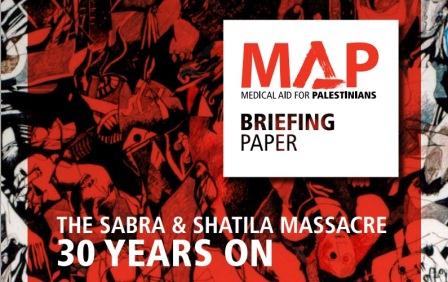
The last is particularly troubling – see also Naira Antoun at electronic intifada and Ursula Lindsey at MERIP (‘Shooting film and crying’). For reflections on the thirtieth anniversary of the massacre, I recommend Seth Anziska in the New York Times (who documents US involvement), Zeina Azzam at Jadaliyya, and Habib Battah at al Jazeera.  There’s also a moving briefing paper from Medical Aid for Palestinians here whose cover is based on Dia al-Azzawi’s artwork.

And although it doesn’t address the visual – it’s an artful ‘misreading’ of Palestinian poet Mahmoud Darwish‘s memoir of Beirut via the Goldstone report on the Israeli assault on Gaza in 2009 – Barbara Harlow‘s ‘The geography and the event’, Interventions 14 (2012) 13-23 amplifies those contemporary resonances in ways that are worth attending to:

New ‘events’ – whether Operation Peace for Galilee (Beirut, 1982) or Operation Cast Lead (Gaza, 2009) – perhaps call, after all, for new ‘geographies’, such as universal jurisdiction, a principle in international law according to which states are allowed to claim criminal jurisdiction for actions – deemed heinous and to be crimes against humanity – committed outside their boundaries.

Droning on

Here’s a selection of recent reports on drone strikes from around the web plus commentary:

Craig Whitlock completes the Washington Post‘s three-part series on ‘Permanent War’ – started by Greg Miller‘s report on the US ‘disposition matrix‘ for targeted killing – with a remarkable account of what he calls ‘the US military’s first permanent drone war base’ at Camp Lemonnier, just (barely) outside Djibouti City.  It’s ‘the busiest Predator drone base outside the Afghan war zone’, from which Predators are launched around the clock, sixteen times a day, to conduct missions in Somalia and Yemen.  Nominally overseen by US Africa Command (AFRICOM) – ‘the primary base of operations for US Africa Command in the Horn of Africa‘ – Whitlock mades it clear that it’s Joint Special Operations Command (JSOC) that calls the shots.  What is remarkable about Whitlock’s report is his artful piecing together of a jigsaw of information from construction solicitations, contracts and plans, submissions to Congress, planning memoranda, Air Force journals, and Predator accident investigation reports, some in the public domain and countless others obtained through FOI requests.  More on drone wars in East Africa from Somalia Report (which also provided the image of Camp Lemonnier below) and on what David Axe calls ‘America’s secret drone war in Africa’ from Wired‘s Danger Room.

Alex Kane at Mondoweiss reprises the Columbia report on Counting Drone Strike Deaths issued earlier this month – which is sharply critical of the estimates of civilian casualties in Pakistan reported by both the New America Foundation and the Long War Journal and endorses those provided by the Bureau of Investigative Journalism – and then follows up with an interview with Naureen Shah, Acting Director of the Human Rights Clinic and the Associate Director of the Counter-terrorism and Human Rights Project at Columbia:

… all of these estimates, including our estimate, are just based on news reports, news reports filed in that region where journalists have very limited access to the scene of the crime, if you will.

It’s not like journalists, for the most part, are going to where the drone strike happened and talking to witnesses, doing a bit of, almost a forensic analysis, being able to see what happened with their own eyes. This [Pakistan’s Federally Administered Tribal Areas] is a region where few journalists, even Pakistani journalists, can really get there. We’re talking about media reports that are often based on the word of anonymous, Pakistani government officials who have an interest in telling a story of, “drone strikes kill only militants.” We’re not going to see anonymous government officials admitting that many of the people killed are civilians. So it’s a stacked deck.’

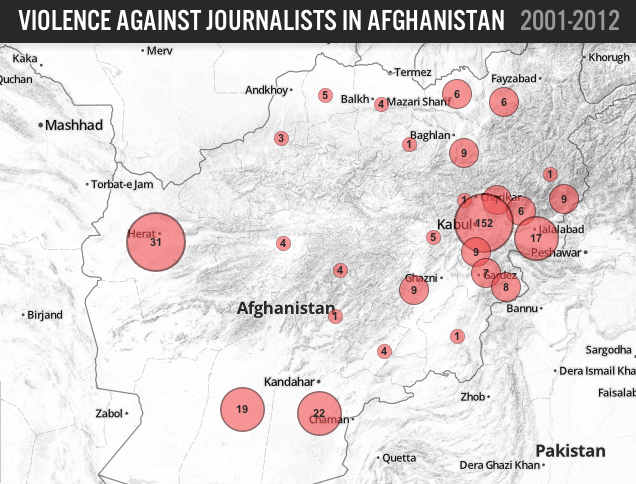
All true.  But there is a striking geographical absence from the kerfuffle over civilian casualties caused by drone strikes: Afghanistan.  The situation there is no less fraught: as the map below shows, journalists in Afghanistan also work in highly dangerous circumstances. (More on the map here and more from the Committee to Protect Journalists here).

The politico-technical matrix is also more complicated: in Afghanistan Predators and Reapers are part of an extended network in which aircraft are linked to ground forces and through which remote operators carry out persistent surveillance while, on occasion, leaving attacks to conventional strike aircraft (though they certainly also launch them from their own platforms too).  This makes it more difficult to disentangle drones from the wider apparatus of military violence – but why on earth should they be?  Afghanistan is part of a recognised ‘war zone’ – but does that make civilian casualties there any less grievable than those that take place across the border?

In the Mondoweiss interview Shah draws attention to the perpetual fear induced by the persistent presence of the drones:

We’re talking about planes hovering over head for hours every single day, and really the casualty of that, the human casualty, is peace of mind for the people who live there. We see reports that parents don’t want to send their kids out to school, that people don’t know what’s going to get them killed by a drone strike. Imagine living in that kind of fear, and we’re talking about communities that are already ravaged by war.

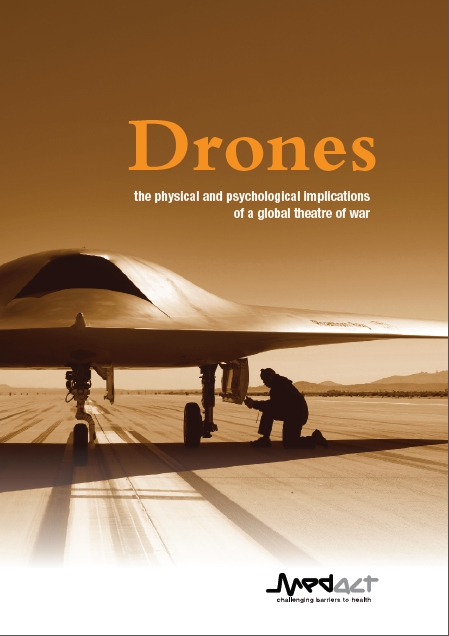
For more on this, turn to UK-based Medact’s report on Drones: the physical and psychological implications of a global theatre of war, also issued earlier this month.  Free download here.

Women are disproportionately affected by drones. What little control they have over their lives is further eroded by a weapon they know could strike at any time. Their lives and those of the children they try to protect are under constant threat. While men can sublimate their grief and anger to some degree by becoming fighters – one of the terrible consequences of drone warfare – women have no such outlet. And if their menfolk are killed in a drone strike, they may have to endure the continuing presence of the drone just overhead.

The report is a survey of surveys, short and to the point, but it adds a British dimension to the debate – important at a time when the RAF is doubling its Reaper fleet and moving control from Creech AFB in Nevada to RAF Waddington in Lincolnshire – and too briefly brings Israel’s use of drones in Gaza into the general discussion.  That last point desperately needs to be sharpened, given the global prominence of the Israeli drone industry and the filiations between US and Israeli practices of targeted killing.  Another depressing blank on the drone debate map.

(I hadn’t heard of Medact before, but it claims to speak out ‘for countless people across the globe whose health, wellbeing and access to proper health care are severely compromised by the effects of war, poverty and environmental damage’, and it’s associated with the journal Medicine, conflict and survival – a source which deserves close attention).

Haymarket Books has just published (pb and e-book versions) a collection of Nick Turse‘s columns on drones and Obama’s other signature modes of warfare, The changing face of empire: see here for an adapted version of the conclusion (extract below) and here for the book.

Several times this year, [General Martin Dempsey], the other joint chiefs, and regional war-fighting commanders have assembled at the Marine Corps Base in Quantico to conduct a futuristic war-game-meets-academic-seminar about the needs of the military in 2017. There, a giant map of the world, larger than a basketball court, was laid out so the Pentagon’s top brass could shuffle around the planet — provided they wore those scuff-preventing shoe covers — as they thought about “potential U.S. national military vulnerabilities in future conflicts” (so one participant told the New York Times). The sight of those generals with the world underfoot was a fitting image for Washington’s military ambitions, its penchant for foreign interventions, and its contempt for (non-U.S.) borders and national sovereignty.

And lastly, on an almost lighter note, Teo Ballvé at Territorial Masquerades has an artful post on ‘Writing like a drone’.  Following up on the ‘New Aesthetic‘, he describes a robotic graffiti writer that can write text massages ‘on such high risk/high profile targets as the U.S. Capitol Building’ and ‘can be deployed in any highly controlled space or public event from a remote location.’  It’s the remoteness that presumably prompts Teo to call this a ‘graffiti drone’, but there are two other (remote) connections to the real thing.

The project comes from the Institute for Applied Autonomy, which also hosts Trevor Paglen‘s captivating (sic) Terminal Air, a satirical version of the CIA’s extraordinary rendition flights –  the ‘capture’ side of the kill/capture regime that uses drones for the ‘kill’.

Former US Ambassador Kurt Volker adds a gloss to this in an Op-Ed in the Washington Post following up the ‘Permanent War’ reports:

More people have been killed in U.S. drone attacks than were ever incarcerated at Guantanamo Bay. Can we be certain there were no cases of mistaken identity or innocent deaths? Those detained at Guantanamo at least had a chance to establish their identities, to be reviewed by an oversight panel and, in most cases, to be released. Those who remain at Guantanamo have been vetted and will ultimately face some form of legal proceeding. Those killed in drone strikes, whoever they were, are gone. Period.

What he doesn’t quite say is that most of those incarcerated at Guantanamo were, on the US government’s own admission, never al Qaeda fighters.  More on the implications of these intelligence failures for the US targeted killing programme from the Stanford/NYU report on Living under drones here (scroll down).

Finally, back to Theo’s ‘graffiti drone’:  one of several synonyms for graffiti writing – particularly at night – is bombing…

The two security-state solution

So Mitt Romney insists that ‘the Palestinians have no interest whatsoever in establishing peace‘…. Given the scale of illegal Israeli settlement in the West Bank (see the meticulous reports from the Foundation for Middle East Peace), the brutality of the Israeli occupation, and the chokehold Israel maintains on Gaza, Palestinians have no interest in peace??

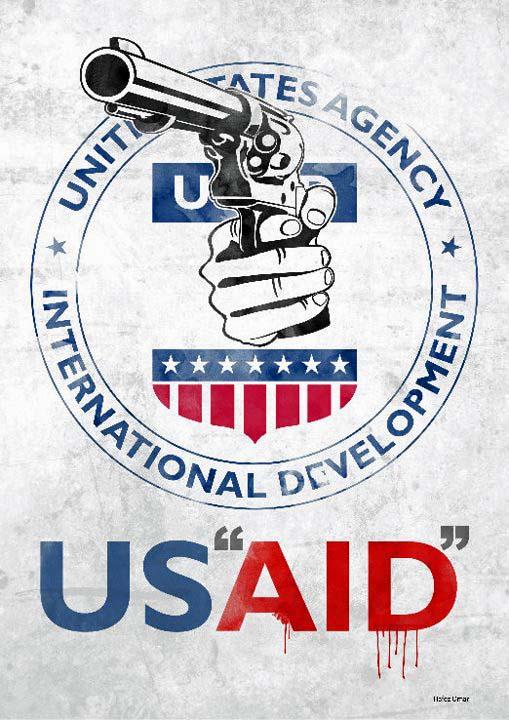
The contours of the Israeli security state’s impress on the Palestinian people ought to be well known – though evidently they aren’t – but hard on the tawdry heels of Romney’s offensive assertion comes a brilliant essay at Jadailiyya from Lisa Bhungalia that details the operation of the American security state in Palestine.

Invoking Laleh Khalili‘s work on occupied Palestine’s position within global counterinsurgency – I’ve drawn attention to this before – Lisa examines ‘the ways in which practices of colonial subjugation and management are being mobilized through the less sensational, seemingly mundane spaces and practices of aid governance’: to be precise, through the United States Agency for International Development (USAID).  She shows how its elaborate certification of NGOs and private agencies works not just to channel financial assistance but also to channel information back to the US and Israeli governments. Like collateral damage estimation in military targeting, this civilian regime works through an extended chain of calculation-calibration-certification. This is Eyal Weizman‘s ‘humanitarian present’ with a vengeance: ‘If a decision to accept USAID funds is undertaken, one must fundamentally operate within a framework that affords little flexibility in terms of negotiating the security priorities set out by Washington and Tel Aviv.’

It is also part of the tightening development-security nexus:

‘What we are seeing, in effect, is a proliferation of sites and diversity of means through which US political and economic power is being articulated. Alongside its military and diplomatic interventions, the US is simultaneously extending its reach through a host of “development experts,” humanitarian agents and “democracy promoters” charged with filtering, sorting and policing the Palestinian civilian population. While taking a new and perhaps more sophisticated form, these contemporary practices and strategies must not be dissociated from a longer history of counterinsurgency in Palestine…. The aid regime that has taken form in recent decades is part and parcel of the refinement and evolution of techniques that Khalili speaks of.’

The poster above is the work of Hafez Omar here and here, and Lisa’s essay derives from her doctoral research whose working title is ‘Negotiating a Colonial Present: Aid and its fragmentary states in Palestine’ .

Sight-seeing: war and extreme tourism

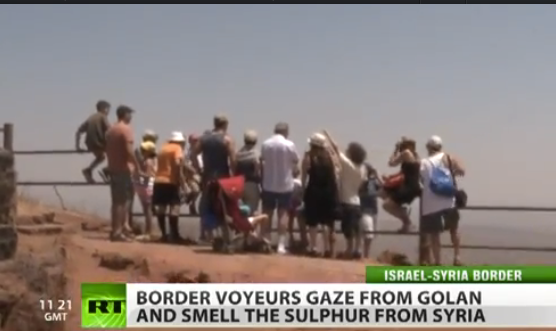
For the last several months there have been dispiriting reports of Israeli tourists travelling to the Golan Heights to gaze across the war zone in Syria: as Allison Good put it over at Foreign Policy, “Many Israelis are foregoing the pool or the beach, flocking instead to the Israel-Syria border for a little action.”

There was a thoughtful response to this voyeurism from Paul Woodward at War in Context – make no mistake, this is spectatorship not witnessing, as the video that prefaces his commentary makes clear – in which he suggested a series of ways in which he thought Israelis watching the war through binoculars was significantly different from Americans watching the war on television:

For Israelis the spectacle of regional violence is self-affirming.

It reinforces the idea that Israel is justifiably obsessed with its own security because it is surrounded by a ‘dangerous neighborhood.’

It confirms Ehud Barak’s racist notion that Israel is a villa in a jungle and that tranquility inside this villa can only be afforded by high walls.

It defines neighbors on the basis of their otherness and legitimizes indifference in preference to empathy.

I’m not so sure; there are, sadly, also American constituencies who surely see things the same way.

There are also close parallels between the voyeurs on the Golan Heights (or in this case Lows) and the ‘hill of shame’ from which the international media looked on at the Israeli attack on Gaza in 2009.  Here too the media were joined by Israeli tourists with cameras, binoculars and picnics: ‘bombing as spectator sport’, as two angry commentators described it.  There’s another personal, passionate report here.  For more on watching Gaza, see Peter Lagerquist, ‘Heard on the Hill of Shame’, at MERIP and – absolutely vital, this – David Campbell‘s  take, ‘Constructed visibility: photographing the catastrophe of Gaza (2009)’, which can be downloaded through his blog here. And Craig Jones has an excellent article culled from his MA thesis on ‘Shooting Gaza: Israel’s visual war’ in Human Geography 4 (1) (2011): abstract here.

There is also now a developing discussion of the wider, militarized landscape of ‘extreme tourism’ in Israel from Matt Carr at Ceasefire.  He pays close attention to the growth of tour companies run by former military officers and settlers, to the inclusion of the illegal settlements on the West Bank in their itineraries, and to the shooting ranges where tourists are encouraged to role play:

The sight of these ignorant, gimlet-eyed tourists in sunglasses and shorts, living out their paramilitary fantasies and teaching even young children to kill imaginary terrorists in a land under Israeli military occupation, is not the most edifying spectacle. But Caliber 3 does not only aim to thrill. Its activities are intended to combine ‘the values of Zionism with the excitement and enjoyment of shooting which makes the activity more meaningful.’ As the school’s director puts it ‘What is key here is not just shooting at targets, but hearing how we fight every day to protect the Jewish state.’

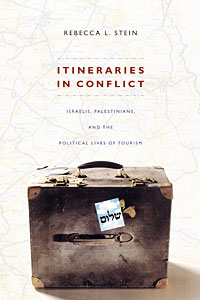
This can all be embedded in an emerging literature on ‘battlefield tourism’ or ‘war tourism’ – Richard Butler and Wantanee Suntikul have an edited collection, Tourism and war, out from Routledge this summer – but I think it’s more usefully connected to Rebecca Steins pathbreaking work on the politics of tourism, especially her book Itineraries in Conflict: Israelis, Palestinians and the political lives of tourism (Duke University Press, 2008). You can find a more recent report from her, ‘An All-Consuming Occupation’, on the fourth Jerusalem Festival of Light in June 2012 and the wretched history of tourism that was concealed in its glare, at MERIP.  She’s also provided an incisive examination of Israeli media coverage of the Gaza war – most eyes have been directed at international coverage –  in ‘Impossible witness: Israeli visuality, Palestinian testimony and the Gaza war’, Journal of cultural research 16 (2-3) (2012) 135-53.

Finally, for faint flickers of hope, there’s Caryn Aviv‘s essay on ‘The emergence of alternative Jewish tourism’, European Review of History 18 (1) (2011) 33-43.  Here’s the abstract:

This article explores the emergence of ‘alternative Jewish travel’ to the West Bank and within Israel. One programme, aimed at diaspora Jews, reframes religious, cultural, and ethnic Jewish identity to include non-violence and solidarity with Palestinians as part of what it means to be Jewish. Another programme, aimed at Israeli citizens (both Jews and non-Jews), reframes Israeli national identity to include post-Zionist solidarity with Palestinians, but is not necessarily Jewish in any religious or ethnic sense. Alternative Jewish travel programme tours explore complicated questions of justice and nationalism in different ways that reflect their simultaneously local and global positions, who organises them, and how they define Jewishness differently.

In Frames of War: when is life grievable? (2009) Judith Butler offered a series of reflections on other, no less violent visualities than those I have discussed here, but Aviv’s essay is worth reading alongside Butler’s response to the Jewish critics of her richly deserved award of the Adorno Prize by the city of Frankfurt: grace under fire.

Forensic architecture

Both Stuart Elden and I have drawn attention to Eyal Weizman‘s Forensic Architecture project – sketched in outline in his The least of all possible evils and the subject of his Society & Space lecture – but for those who want more…

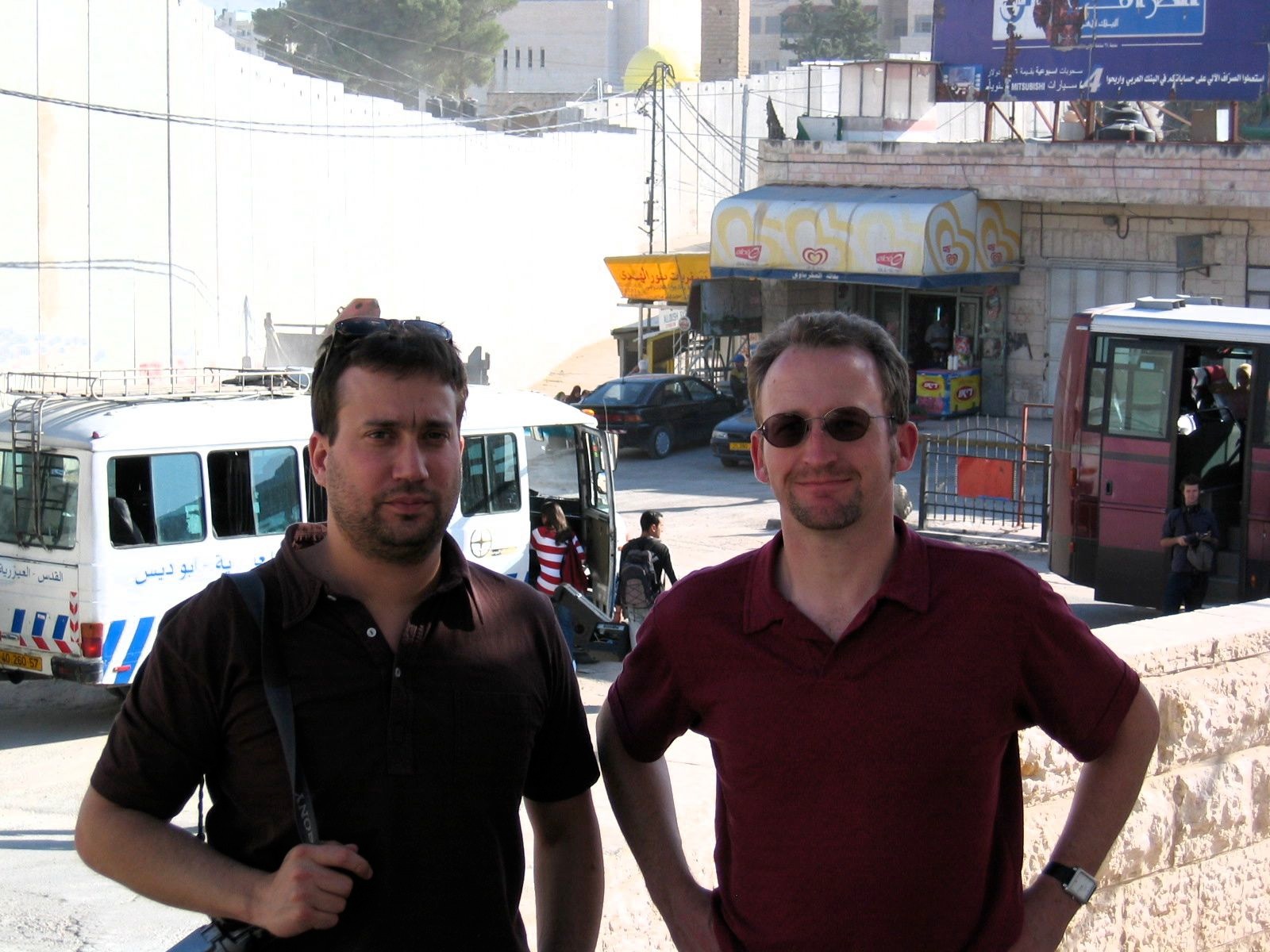
Eyal Weizman (L) and Steve Graham (R) in the occupied West Bank [Derek Gregory]

Michael Schapira and Carla Hung interview Eyal in “Thinking the Present” at  Full Stop. Here’s an extract where Eyal summarises his project:

‘Forensic Architecture is grounded in both field-work and forum-work; fields are the sites of investigation and analysis and forums the political spaces in which analysis is presented and contested. Each of theses sites presents a host of architectural and political problems.

In fields, lets say starting with Territories, I attempted to engage a kind of “archeology” of present conditions as they could be read, or misread, in architecture. This archeology is not always undertaken by direct contact with the materiality under analysis, but with images of it. The spaces that we debate, analyze, or make claims on behalf of, are very often media products. Similarly, drawing a map includes synthesizing satellite and aerial images as well as images from the ground. Some images are created by optics and some by different sensors that register spectrums beyond the visible. One needs sensors to read sensors.

So this is a kind of archaeology of spaces as they are captured in these different forms of capture and registration. You read details, speckles, pixels and patterns, connect them to larger forces, or at least you understand the impossibility of doing so, often noting paradoxes and misrepresentations. We have done this very close reading of aerial images of colonies in the West Bank, we have read almost all elements from architectural through infrastructural archaeological to horticultural ones visible in these images as a set of tools in a battlefield.

Then there is the forum: a site of interpretation, verification, argumentation and decision. International courtrooms, tribunals, and human rights councils are of course the most obvious sites of contemporary forensics. But there are other political and professional forums.

Each forum is different. The third component of forensics, beyond the architectural and aesthetic, is what you need in order to stand between that “thing” and the forum: an “interpreter.” In ancient Rome it would be the orator; in our days it is perhaps the scientist, or the architect, or the geographer — the “expert witness” that translates from the language of space to the language of the forum. This definition of forensics might help expand the meaning of the term from the legal context to all sorts of others. Politics, as it is undertaken, around the problems of space and its interpretations, is a “forensic politics” as far I understand it.

Each of the multiple political and legal forums in use today — professional, scientific, parliamentary or legal — operates by a different set of protocols of representation and debate. They each have another frame of analysis. Each embodies dominant political forces and ideologies — that is to say that each instrumentalizes forensics as a part of a different ideological structure. In the turbulence of a changing world, there are also informal, subversive and ad-hoc and crisis forms of gathering: pop-up assemblies of protest and revolt in which the debate of financial, architectural (the housing or mortgage crisis), and geopolitical issues are often articulated.

Forensic architecture should thus be understood not only as dealing with the interpretation of past events as they register in spatial products, but about the construction of new forums. It is both an act of claim-making on the bases of spatial research and potentially an act of forum-building.’

Eyal edited a special section of Cabinet magazine (#43) on “Forensics”, and there’s an early lecture (May 2010) on ‘Forensic Architecture’ here and an image-rich conversation with Open Democracy’s wonderful Rosemary Belcher on ‘Forensic Architecture and the speech of things’ here.

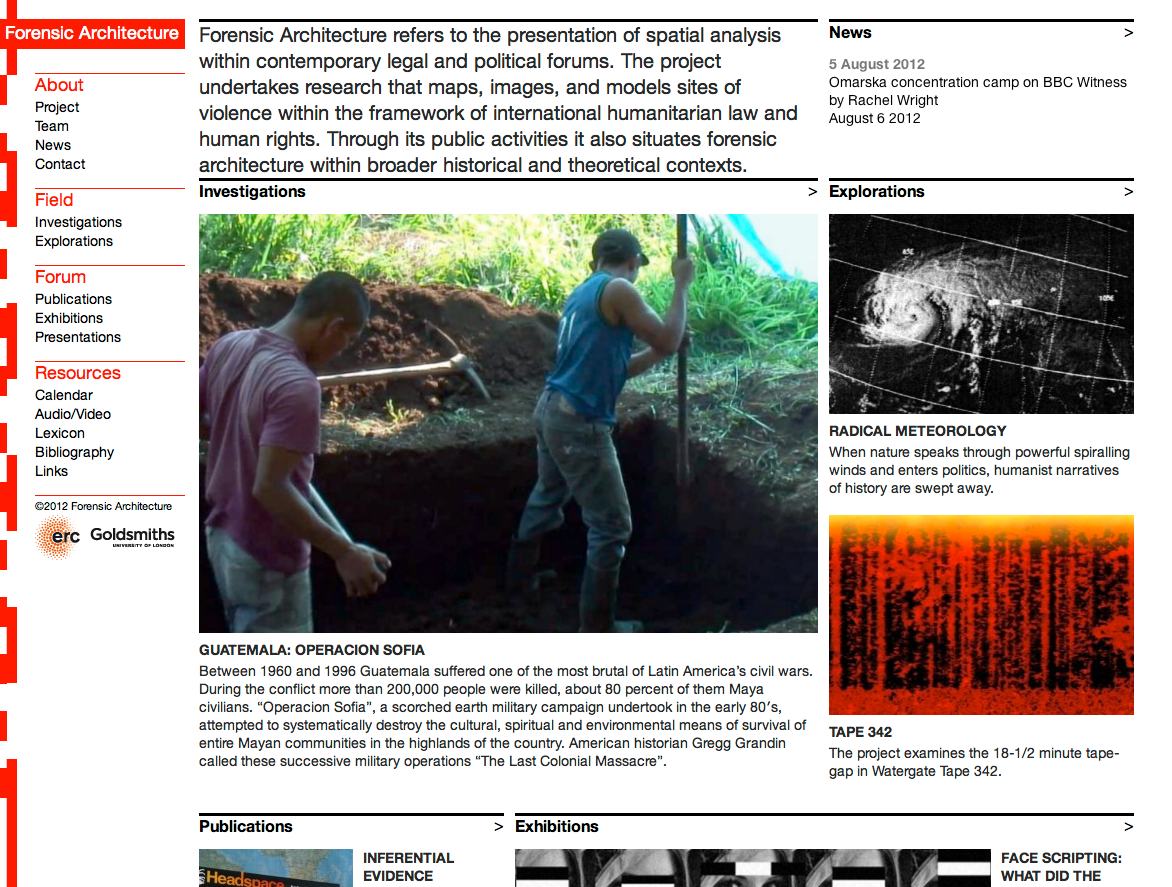
There is also a truly excellent website for the project, which is hosted by the Centre for Research Architecture at Goldsmiths University of London within the Department of Visual Cultures.

Highlights for me include:

under Investigations, Forensic Oceanography (probing the deaths of more than 1500 people fleeing Libya across the Mediterranean in 2011, including a downloadable report), a report on the effects of airborne White Phosphorus munitions in densely populated urban areas like Gaza, and a challenging (I imagine preliminary) commentary on ways of recording and investigating deaths from drone strikes in Pakistan’s Federally Administered Tribal Areas:

‘The near complete prohibition upon carrying recording equipment into this region of Pakistan, coupled with the non-existence of local maps has made the task of locating and representing the sites and consequences of drone attacks extremely difficult. This inability to produce corroborating evidence has, in turn, severely hampered the pursuit of legal claims. Forensic Architecture is working with human rights and legal justice organisations in both Pakistan and the UK to develop an alternate mapping system that can meet the unique challenges posed by the dilemma of creating accurate maps without relying upon technologies of exact recording, but only upon haptic techniques of observation and recall, or what has been called “transparency cameras”. This system needs to be matched, in turn, with a post-production methodology of transcription and interpretation of recollection data. Survivors and witnesses of drone strikes are typically brought to safe zones outside of Northwest Pakistan in cities such as Islamabad, where they are interviewed by legal staff and their stories cross-referenced and collated.’

under Explorations, a sketch of what the project calls ‘Video-to-space analysis’ derived from the recognition that ‘remote controlled vision machines (satellites and drones) and the handheld devices of citizen journalists working independently of news-desks marks a shift in the ways in which human rights violations will increasingly be charted and mapped and the ways in which the spaces of conflict themselves will increasingly become known or offer up information.’ 

under Presentations, a record of a seminar in March 2012 with Bruno Latour  who comments on a series of investigations (Paulo Tavares, “The Earth-Political”; Nabil Ahmed, “Radical Meteorology'”; John Palmesino, “North – The architecture of a territory open on all sides”): ‘Forensics is the production of public proof’ (with some interesting asides about ‘geopolitics’ and what he calls ‘politics of the earth’), and a tantalising glimpse of a conference presentation by Susan Schuppli under the title ‘War Dialling: Image Transmissions from Saigon’, which discussed the modalities through which, on June 8 1972, ‘a portable picture transmitter, took 14 minutes to relay a series of audio signals from Saigon to Tokyo and then onwards to the US where they were reassembled into a B&W image to reveal a young Vietnamese girl [Kim Phúc] running out of the inferno of an erroneous napalm attack.’

These reflect my own preoccupations, but there’s lots more – it’s a treasure trove of imagination and insight.  Oh – and a reading list.

Bethlehem to Baghdad

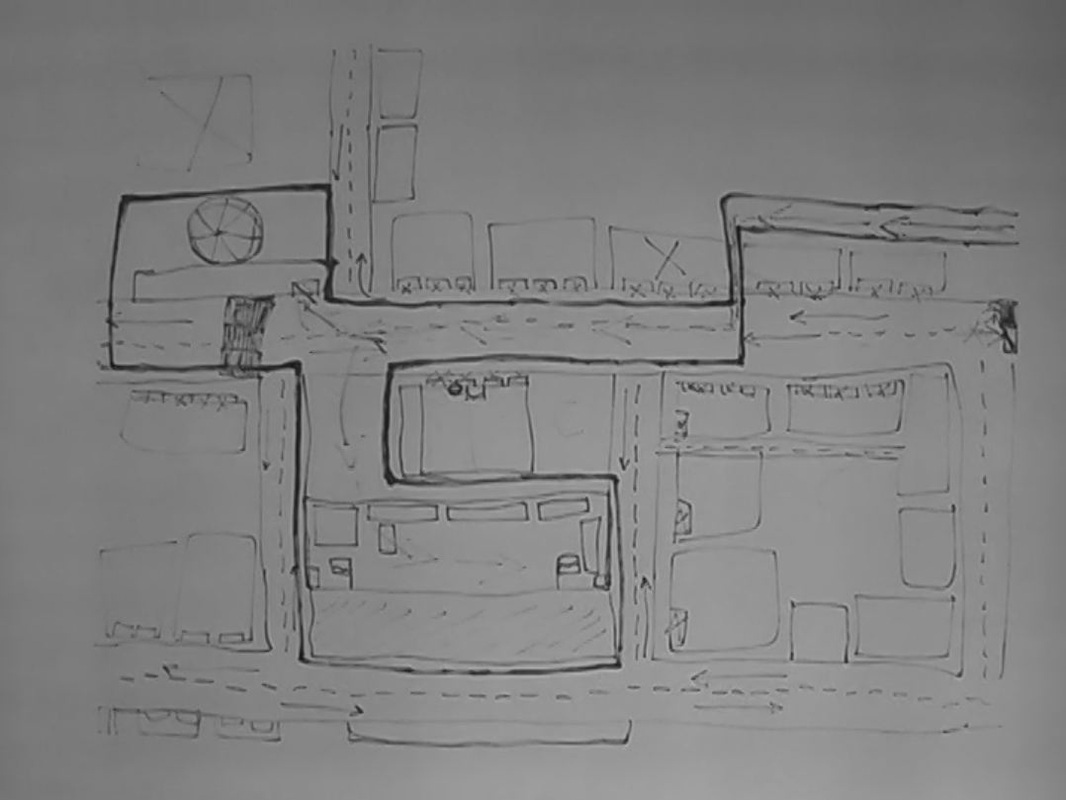
In 2008 the artist Till Roeskens – who describes himself as an ‘amateur of applied geography’ – produced a ‘videocartography’ or ‘videomapping’ based on interviews at the Aida refugee camp in occupied Palestine.  Roeskens explains: ‘I asked residents of the camp to draw with big ink pens so the marks would go through the paper. I filmed from the other side, as they drew, so I didn’t see the person while they were drawing and speaking; I saw only the white screen with the light coming from behind me.’  The mappings, together with the stories told by those who drew them, were recorded on video, and ‘as the film progresses, the viewer is increasingly hemmed in by a complex network of lines, until the reality of the occupation is fully realized on screen’.      There is a revealing interview with the artist at Words without borders here, and you can watch some extracts here (and there are others on YouTube and vimeo).

« On screen: nothing but another screen. At first untouched, a blank sheet of paper is slowly being filled with more or less straight lines. Then these lines grow, push and cross each other, to finally form a drawing, a layout; they unfold a topography, mark places, build houses, give directions, describe in great detail tangles of roads and obstacles. In fact, they are laying down flat biographies. Six sheets slowly come to life that way, one after another, following the rhythm of stories told by children, women or men voices, of people we never get to see. Where are these voices? Behind the sheets. Of course, but where else? Nowhere: that is precisely what the voices are trying to say. Or rather, because even nowhere persists on taking up some space, they say that they are in Palestine. (…) »

Inspired by Rosekens’ work, Antonio Ottomannelli transposed the technique to Baghdad.  The project was carried out between November 2011 and February 2012 with students at the Fine Arts Faculty of the University of Baghdad.  Ottomannelli:

‘Baghdad is a hidden city.  Everything is placed behind anti-explosion walls, from one checkpoint to the next. … The latest map of Baghdad was made by the US military in 2003 for military and strategic purposes…  There is no civilian map of the current configuration… Inspired by the work of Till Roeskens on Palestine, Mapping Identity tries to tell about the city – the whole of it – from the inside.  A snapshot of the ordinary, a minor “Giacometti portrait”, as Baghdad is concealed…’

More details here, and a videomap here (more on vimeo).

These projects are political-artistic versions of the ‘mental maps’ that captured the imagination of many human geographers in the 1960s and 70s – an interest which is usually traced back to Kevin Lynch’s experiments with The image of the city (1960) and that probably climaxed in Peter Gould and Rodney White’s classic little book, Mental maps, originally published in 1974 – but what makes these projects so compelling is their emphasis on the process of mapping (through their use of video) rather than a fixation on the map as finished object.  One of the criticisms of the original ‘mental mapping’ projects was that respondents drew maps only because they were asked to: that this was not how people found their way around their neighbourhoods, which usually turned out to be a much more pragmatic, improvisational practice responding to cues and following routines rather than relying on some imaginary point of overview.  But these two projects are ways of narrating a space – of telling what Michel de Certeau would call ‘spatial stories’ – that are also interventions in (and subversions of) larger narratives of military violence and military occupation.

Counterinsurgency and the humanitarian present

Laleh Khalili – whose work on the new and old classics of counterinsurgency,  on the gendering of counterinsurgency, and on the location of Palestine in global counterinsurgency – is indispensable, has just alerted me to the fate (Fate?) of one of its principal architects, David Kilcullen.
In The accidental guerilla and other writings, Kilcullen – Petraeus’s Senior Counterinsurgency Adviser in Iraq – repeatedly turned to bio-medical analogies to advance a bio-political vision of counterinsurgency: insurgency as a ‘social pathology’ whose prognosis can be traced through the stages of infection, contagion, intervention and rejection (‘immune response’).  In an interview with Fast Company, Kilcullen now explains that he

“came out of Iraq with a real conviction that we tend to think that a bunch of white guys turning up with a solution fixes all the problems. It doesn’t work like that. You actually have to really build a collaborative relationship with the people on the ground if you want to have any hope of understanding what’s going on.”

Kilcullen’s contract ended when the Obama administration came into office, and he founded Caerus Associates.  The company advertises itself as ‘a strategy and design firm’ that works to ‘help governments, global enterprises, and local communities thrive in complex, frontier environments.’  It claims to ‘bring the system into focus’ by providing ‘strategic design for a world of overlapping forces — urbanization, new market horizons, resource scarcity and conflict — to build resilience and capacity.’   The company explains its ‘strategic design process’ here, and Kilcullen’s vision of systems analysis is sketched here.  This may sound like the rapid-fire buzz-words that corporate start-ups typically shoot at their clients, but Kilcullen provides Fast Company with a sawn-off version (it’s really hard to avoid these metaphors…):

“We’re two-thirds tech, one-thirds social science, with a dash of special operations… We can go out in a community and say, ‘Let’s map who owns what land,’ or ‘Let’s map who owes the local warlord money,’ or ‘Let’s map the areas in the city where you don’t feel safe.'”

This chimes with Kilcullen’s famous description of contemporary counterinsurgency as ‘armed social work’, and in an interview with the International Review of the Red Cross published in September 2011 Kilcullen extended his vision of ‘military humanism’ beyond insurgency thus:

‘The methods and techniques used by illegal armed groups of all kinds are very similar, irrespective of their political objectives. So whether you’re talking about a gang in the drug business in Latin America, or organized crime in the gun-running or human smuggling business, or whether you’re talking about an insurgency or perhaps even a civil war involving tribes, you will see very similar approaches and techniques being used on the part of those illegal armed groups. That’s one of the reasons why I believe counter-insurgency isn’t a very good concept for the work that the international community is trying to do. I think that the idea of complex humanitarian emergencies is actually a lot closer to the reality on the ground. You almost never see just one insurgent group fighting an insurgency against the government anymore. What you typically see is a complex, overlapping series of problems, which includes one or more or dozens of armed groups. And the problem is one of stabilizing the environment and helping communities to generate peace at the grassroots level – a bottom-up peace-building process. And that’s not a concept that really fits very well with traditional counter-insurgency, which is about defeating an insurgent movement and is a top-down, state-based approach. What you have to do is create an environment where existing conflicts can be dealt with in a non-violent way.’

This is a remarkable passage for several reasons: the focus on ‘techniques’ not ‘objectives’, which works to de-politicize and de-contextualize a range of different situations in order to generalize about them, the appeal to a collective “international community” whose only interest is a generic “peace”, and hence the passage to what Eyal Weizman calls ‘the humanitarian present’. I think that’s also a colonial present, not surprisingly: ‘humanitarianism’ was often the velvet glove wrapped around the iron fist of colonialism.  But what Weizman sees as novel about the present is the way in which its ‘economy of violence is calculated and managed’ by a series of moral technologies (the term is Adi Ophir‘s) that work to continue and legitimize its operation.  In other words, there is today an intimate collusion of the ‘technologies of humanitarianism, human rights and humanitarian law with military and political powers’.

Despite  the reference to ‘special operations’ in the Fast Company interview – something which makes me think that Obama would have found Kilcullen’s continued advice invaluable – Kilcullen insists that it’s a collaborative process:

“We specialize in working with communities that are under the threat of violence in frontier environments, and I think to some extent that distinguishes us a little bit from other people. Sure we can give a slick presentation in a hotel room, but what we can also do is walk the street in dangerous places, engage with communities, and figure out what needs to happen. It’s not us figuring it out, it’s them telling us, but often we find that no one’s ever been there and asked them before.”

‘Dangerous places’, ‘frontiers’: this is still the language of adventurism.  It recalls Zygmunt Bauman‘s ‘planetary frontierland’, and even more Mark Duffield on the ‘global borderlands’:

‘The idea of the borderlands … does not reflect an empirical reality.  It is a metaphor for an imagined geographical space where, in the eyes of many metropolitan actors and agencies, the characteristics of brutality, excess and breakdown predominate.  It is a terrain that has been mapped and re-mapped in innumerable aid and academic reports where wars occur through greed and sectarian gain, social fabric is destroyed and developmental gains reversed, non-combatants killed, humanitarian assistance abused and all civility abandoned.’

It’s not surprising, then, that in the IRC interview Kilcullen should make so much of establishing ‘the rule of law’: ‘It’s a set of rules which has predictable consequences and allows the population to feel safe, and helps them know what they need to do in order to be in a safe place.’  He makes it clear that, in many (perhaps most) circumstances ‘bottom-up, community-based law, which can be transitional justice, or customary law, applied by traditional courts or religious courts, is as effective and possibly even more effective in the initial stages than central-state structures.’   But this ignores the multiple ways in which law (including international humanitarian law) is not apart from conflict but is almost always a part of conflict: as Weizman has it, ‘international law develops through its violation.  In modern war, violence legislates.’

One could say much the same about maps.  Mapping is not a neutral, objective exercise; mapping is performative and its material effects depend on the constellation of powers and practices within which it is deployed. Kilcullen’s injunction – “Let’s map” – glosses over who the ‘us’ is, who is included and who is excluded, and the process through which some mappings are accorded legitimacy while others are disavowed.  This is also one of Weizman’s central claims, not least in his exposure of the torturous mappings that issued in the  Hollow Land of occupied Palestine.
Weizman’s particular focus in his discussion of the humanitarian present is Gaza, and this winds me back to Laleh Khalili’s work which brilliantly re-reads counterinsurgency in occupied Palestine contrapuntally with US counterinsurgency practices elsewhere.  Her Essential Reading on Counterinsurgency was published by Jadaliyya, and her forthcoming book, Time in the shadows: Confinement in Counterinsurgencies (Stanford University Press, October 2012),  engages with a Medusa’s raft of counterinsurgency adviser-survivors, including Kilcullen and Andrew Exum (Abu Muqawama).
And so a final question: how would ‘strategic design’ and a ‘collaborative process’ help the people of Gaza?  Whose ‘rule of law’ is to be established?  And which maps chart a road not only to peace but to justice for the people of Palestine?