Red Cross-Fire

Yet more on violations of medical neutrality in contemporary conflicts (see my posts here, herehere and here).  Over at Afghan Analysts Network Kate Clark provides a grim review of (un)developments in Afghanistan, Clinics under fire? Health workers caught up in the Afghan conflict.

Those providing health care in contested areas in Afghanistan say they are feeling under increasing pressure from all sides in the war. There have been two egregious attacks on medical facilities in the last six months: the summary execution of two patients and a carer taken from a clinic in Wardak by Afghan special forces in mid-February – a clear war crime – and the United States bombing of the Médecins Sans Frontières (MSF) hospital in Kunduz in October 2015, which left dozens dead and injured – an alleged war crime. Health professionals have told AAN of other violations, by both pro and anti-government forces. Perhaps most worryingly, reports AAN Country Director Kate Clark, have been comments by government officials, backing or defending the attacks on the MSF hospital and Wardak clinic [see image below].
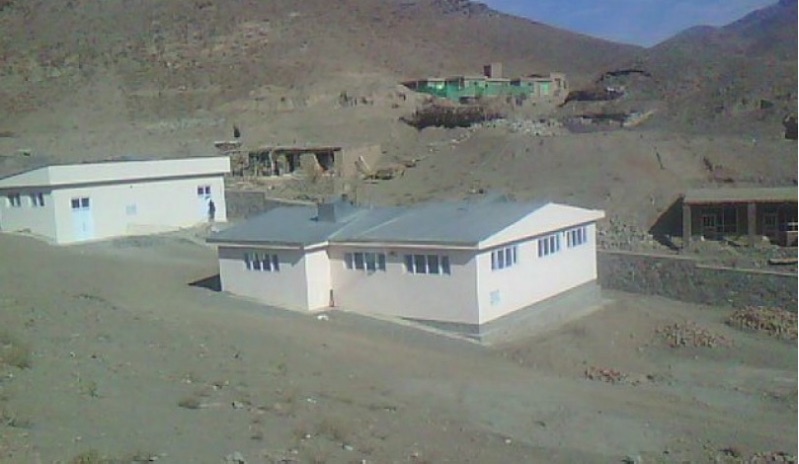
SCA Wardak clinic JPEG

So, for example:

Afghan government reactions to the news of the Wardak killings [at Tangi Sedan during the night of 17/18 February 2016; see also here] came largely at the provincial level, from officials who saw no problem in those they believed were Taleban – wounded or otherwise – being taken from a clinic and summarily executed. Head of the provincial council, Akhtar Muhammad Tahiri, was widely quoted, saying: “The Afghan security forces raided the hospital as the members of the Taliban group were being treated there.” Spokesperson for the provincial governor, Toryalay Hemat, said, “They were not patients, but Taliban,” and “The main target of the special forces was the Taliban fighters, not the hospital.” Spokesman for Wardak’s police chief, Abdul Wali Noorzai, said “Those killed in the hospital were all terrorists,” adding he was “happy that they were killed.”

Yet, the killings were a clear war crime. The Laws of Armed Conflict, also known as International Humanitarian Law, give special protection to medical facilities, staff and patients during war time – indeed, this is the oldest part of the Geneva Conventions. The Afghan special forces’ actions in Wardak involved numerous breaches: forcibly entering a medical clinic, harming and detaining staff and killing patients.  The two boys and the man who were summarily executed were, in any case, protected either as civilians (the caretaker clearly, the two patients possibly – they had claimed to have been injured in a motorbike accident) or as fighters who were hors d’combat (literally ‘out of the fight’) because they were wounded and also then detained.  Anyone who is hors d’combat is a protected person under International Humanitarian Law and cannot be harmed, the rationale being that they can no longer defend themselves. It is worth noting that, for the staff at the clinic to have refused to treat wounded Taleban would also have been a breach of medical neutrality: International Humanitarian Law demands that medical staff treat everyone according to medical need only.

That the Wardak provincial officials endorsed a war crime is worrying enough, but their words echoed reactions from more senior government officials to the US military’s airstrikes on a hospital belonging to the NGO Médecins Sans Frontières on 3 October 2015. Then, ministers and other officials appeared to defend the attack by saying it had targeted Taleban whom they said were in the hospital (conveniently forgetting that, until the fall of Kunduz city became imminent when the government evacuated all of its wounded from the hospital except the critically ill, the hospital had largely treated government soldiers). The Ministry of Interior spokesman, for example, said, “10 to 15 terrorists were hiding in the hospital last night and it came under attack. Well, they are all killed. All of the terrorists were killed. But we also lost doctors. We will do everything we can to ensure doctors are safe and they can do their jobs.”

MSF denied there were any armed men in the hospital. However, even if there had been, International Humanitarian Law would still have protected patients and medical staff: they would still have had to have been evacuated and warnings given before the hospital could have been legally attacked.

Not surprisingly heads of various humanitarian agencies all reported that the situation was worsening:

“General abuses against medical staff and facilities are on the rise from all parties to the conflict,” said one head of agency, while another said, “We have a good reputation with all sides, but we have still had threats from police, army and insurgents.” The head of a medical NGO described the situation as “messy, really difficult”:

All health facilities are under pressure. We have had some unpleasant experiences, The ALP [Afghan Local Police] are not professional, not disciplined. If the ALP or Taleban take over a clinic, we rely on local elders [to try to sort out the situation]. We are between the two parties.

He described the behaviour of overstretched Afghan special forces as “quite desperate,” adding, “They are struggling, trying to be everywhere and get very excited when there’s fighting.” Most of them, he said, were northerners speaking little or no Pashto, which can make things “difficult for our clinics in the south.”

The head of another agency listed the problems his staff are facing:

“We have seen the presence of armed men in medical facilities, turning them into targets. We have seen violations by the ANSF [Afghan National Security Forces], damage done to health facilities that were taken over as bases to conceal themselves and fight [the insurgents] from. We have seen checkpoints located close to health centres. Why? So that in case of hostilities, forces can take shelter in the concrete building. We have seen looting. We have seen ANSF at checkpoints deliberately causing delays, especially in the south, including blocking patients desperately needing to get to a health facility. We can never be certain that [such a delay] was the cause of death, but we believe it has been.”

He said his medical staff had been threatened by “ANSF intervening in medical facilities at the triage stage, forcing doctors to stop the care of other patients and treat their own soldiers, in disregard of medical priorities.” Less commonly, but more dangerously for the doctors themselves, he said, was the threat of Taleban abduction. He described a gathering of surgeons in which all reported having been abducted from their homes at least once and brought to the field to attend wounded fighters “with all the dangers you can imagine along the road.” He said the surgeons were “forced to operate without proper equipment and forced to abandon their own patients in clinics because the abduction would last days.”

Locally, medical staff often try to mitigate threats from both government forces and insurgents by seeking protection first from the local community. One head of agency described their strategy:

“When we open a clinic, our first interlocutors are the elders. Everyone wants a clinic in their area, but we decide the location and make the elders responsible for the clinic… They have to give us a building – three to four rooms. All those who work in the clinic – the ambulance driver, the owner of the vehicle, everyone – come from the area. We also need the elders to deal with the parties… If the ALP or Taleban take over clinic, we always start with the elders [who negotiate with whoever has taken over the clinic].”

However, this tactic puts a burden on community elders who may not be able to negotiate if the ANSF, ALP or insurgents are also threatening them.

***

I’ve delayed following up my previous commentaries on the US airstrike on the MSF Trauma Center in Kunduz (here and here) because I had hoped the full report of the internal investigation carried out by the US military would be released: apparently it runs to 3,000-odd pages.  I don’t for a minute believe that it would settle matters, but in any event nothing has emerged so far – though I’m sure it’s subject to multiple FOIA requests and, if and when it is released, will surely have been redacted.
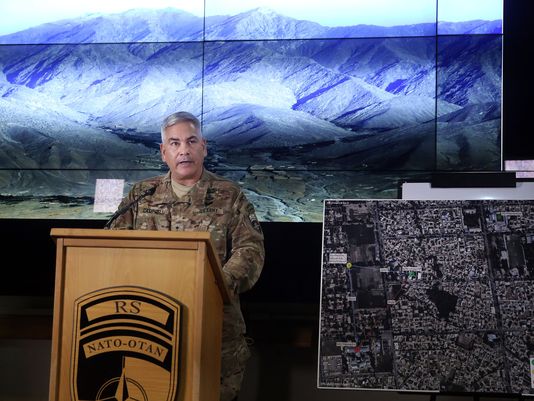
CAMBELL Press conference

All we have is an official statement by General John Campbell on 25 November 2015 (above), which described the airstrike as ‘a tragic, but avoidable accident caused primarily by human error’, and a brief Executive Summary of the findings of the Combined Civilian Casualty Assessment Team (made up of representatives from NATO and the Afghan government) which emphasised that those errors were ‘compounded by failures of process and procedure, and malfunctions of technical equipment.’

The parallel investigations identified a series of cumulative, cascading errors and malfunctions:

(1) The crew of the AC-130 gunship that carried out the attack set out without a proper mission brief or a list of ‘no-strike’ targets; the aircraft had been diverted from its original mission, to provide close air support to ‘troops in contact’, and was unprepared for this one (which was also represented as ‘troops in contact’, a standard designation meaning that troops are under hostile fire).

(2) Communications systems on the aircraft failed, including – crucially – the provision of video feeds to ground force commanders and the transmission of electronic messages (the AC-130 has a sophisticated sensor and communications suite  – or ‘battle management center’ –on board, staffed by two sensor operators, a navigator, a fire control officer, and an electronic warfare officer, and many messages are sent via classified chat rooms).
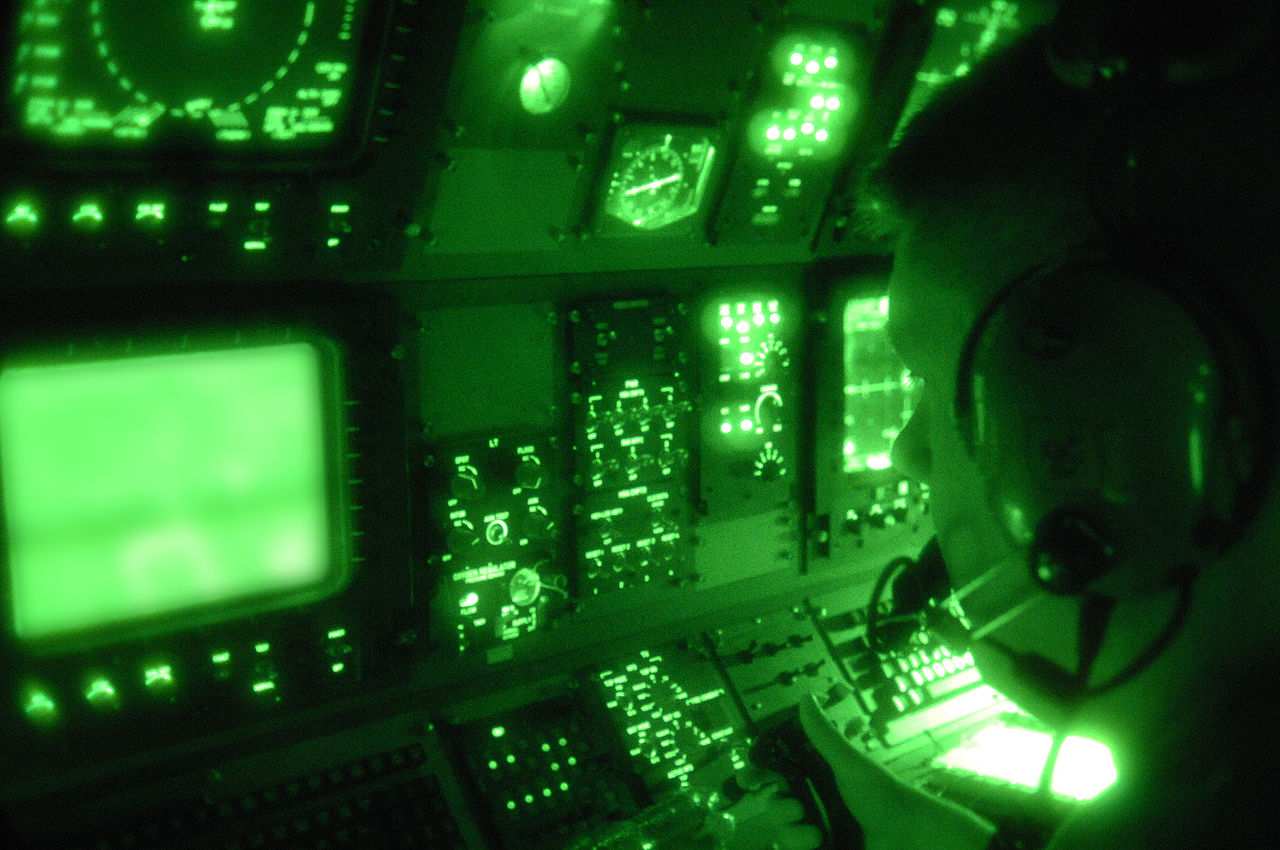
AC-130U_Sensor_Operator

The problem was apparently a jerry-rigged antenna that was supposed to link the AC-130 to the ground.  Here is how General Bradley Heithold explained it to Defense One:

“Today, we pump full-motion video into the airplane and out of the airplane. So we have a Ku-band antenna on the airplane … the U-model….  On our current legacy airplanes, the solution we used was rather scabbed on: take the overhead escape hatch out, put an antenna on, stick it back up there, move the beams around. We’ve had some issues, but we’re working with our industry partners to resolve that issue.”

He added, “99.9 percent of the time we’ve had success with it. These things aren’t perfect; they’re machines.”

Heithold said that dedicated Ku-band data transfer is now standard on later models of the AC-130, which should make data transfer much more reliable.

(3)  Afghan Special Forces in Kunduz had requested close air support for a clearing operation in the vicinity of the former National Directorate of Security compound, which they believed was now a Taliban ‘command and control node’.  The commander of US Special Forces on the ground agreed and provided the AC-130 crew with the co-ordinates for the NDS building.  He could see neither the target nor the MSF Trauma Center from his location but this is not a requirement for authorising a strike; he was also working from a map that apparently did not mark the MSF compound as a medical facility.  According to AP, he had been given the coordinates of the hospital two days before but said he didn’t recall seeing them.  The targeting system onboard the AC-130 was degraded and directed the aircraft to an empty field and so the crew relied on a visual identification of the target using a description provided by Afghan Special Forces – and they continued to rely on their visual fix even when the targeting system had been re-aligned (‘the crew remained fixated on the physical description of the facility’) and, as David Cloud points out, even though there was no visible sign of ‘troops in contact’ in the vicinity of the Trauma Center (‘An AC-130 is normally equipped with infrared surveillance cameras capable of detecting gunfire on the ground’):

MSF Kunduz attack

Sundarsan Raghaven adds that ‘Not long before the attack on the hospital, a U.S. airstrike pummeled an empty warehouse across the street from the Afghan intelligence headquarters. How U.S. personnel could have confused its location only a few hours later is not clear…’  More disturbingly, two US Special Forces troops have claimed that their Afghan counterparts told their commander that it was the Trauma Center that was being used as the ‘command and control node’, and that the Taliban ‘had already removed and ransomed the foreign doctors, and they had fired on partnered personnel from there.’

(4) The aircrew cleared the strike with senior commanders at the Joint Operations Center at Bagram and provided them with the co-ordinates of the intended target.  Those commanders failed to recognise that these were the co-ordinates of the MSF hospital which was indeed on the ‘no-strike’ list; ‘this confusion was exacerbated by the lack of video and electronic communications between the headquarters and the aircraft, caused by the earlier malfunction, and a belief at the headquarters that the force on the ground required air support as a matter of immediate force protection’;

(5) The strike continued even after MSF notified all the appropriate authorities that their clinic was under attack; no explanation was offered, though the US military claims the duration was shorter (29 minutes) than the 60-minutes reported by those on the ground.

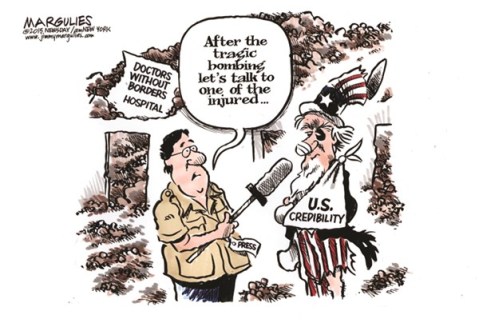
Campbell announced that those ‘most closely associated’ with the incident had been suspended from duty for violations of the Rules of Engagement – those ‘who requested the strike and those who executed it from the air did not undertake the appropriate measures to verify that the facility was a legitimate military target’ – though he gave no indication how far up the chain of command responsibility would be extended; in January it was reported that US Central Command was weighing disciplinary action against unspecified individuals.  In the meantime, solatia payments had been made to the families of the killed ($6,000) and injured ($3,000).
doctors-without-borders-us-credibility

Not surprisingly, MSF reacted angrily to Campbell’s summary: according to Christopher Stokes,

‘The U.S. version of events presented today leaves MSF with more questions than answers.  The frightening catalog of errors outlined today illustrates gross negligence on the part of U.S. forces and violations of the rules of war.’

Joanne Liu, MSF’s President, subsequently offered a wider reflection on war in today’s ‘barbarian times’, prompted by further attacks on other hospitals and clinics in Afghanistan, Syria, Yemen and elsewhere:

“The unspoken thing, the elephant in the room, is the war against terrorism, it’s tainting everything,” she said. “People have real difficulty, saying: ‘Oh, you were treating Taliban in your hospital in Kunduz?’ I said we have been treating everyone who is injured, and it will have been Afghan special forces, it will have been the Taliban, yes we are treating everybody.”

She added: “People have difficulty coming around to it. It’s the core, stripped-down-medical-ethics duty as a physician. If I’m at the frontline and refuse to treat a patient, it’s considered a crime. As a physician this is my oath, I’m going to treat everyone regardless.”

Kate Clark‘s forensic response to the US investigation of the Kunduz attack is here; she insists, I think convincingly, that

‘… rather than a simple string of human errors, this seems to have been a string of reckless decisions, within a larger system that failed to provide the legally proscribed safeguards when using such firepower. There were also equipment failures that compounded the problem but, again, if the forces on the ground and in the air had followed their own rules of engagement, the attack would have been averted.’

This is what just-in-time war looks like, but it’s not enough to blame all this on what General Campbell called a ‘high operational tempo’.  As a minimum, we need to be able to read the transcripts of the ground/air communications – which are recorded as a matter of course, no matter what the tempo, and which are almost always crucial in any civilian casualty incident resulting from ‘troops in contact’ (see, for another vivid example, my discussion here) – to make sense of the insensible.
Targeted killings

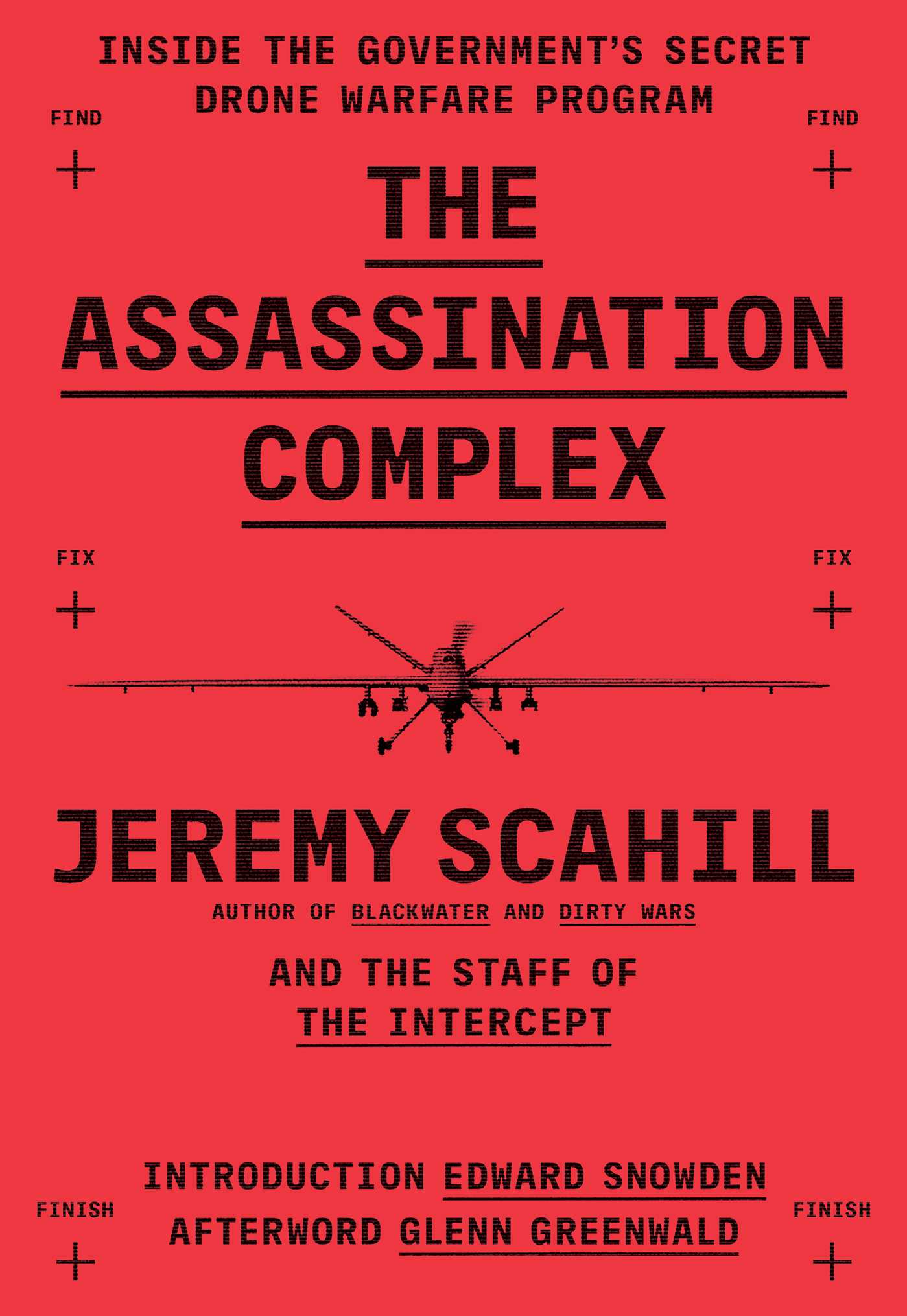
Coming from Simon and Schuster in May, a new book by Jeremy Scahill and his team at The InterceptThe Assassination Complex: Inside the Government’s Secret Drone Warfare Program.

the-assassination-complex-9781501144134_hrMajor revelations about the US government’s drone program—bestselling author Jeremy Scahill and his colleagues at the investigative website The Intercept expose stunning new details about America’s secret assassination policy.

When the US government discusses drone strikes publicly, it offers assurances that such operations are a more precise alternative to troops on the ground and are authorized only when an “imminent” threat is present and there is “near certainty” that the intended target will be killed. The implicit message on drone strikes from the Obama administration has been trust, but don’t verify.

The online magazine The Intercept exploded this secrecy when it obtained a cache of secret slides that provide a window into the inner workings of the US military’s kill/capture operations in Afghanistan, Yemen, and Somalia. Whether through the use of drones, night raids, or new platforms yet to be employed, these documents show assassination to be central to US counterterrorism policy.

The classified documents reveal that Washington’s fourteen-year targeted killing campaign suffers from an overreliance on flawed signals intelligence, an apparently incalculable civilian toll, and an inability to extract potentially valuable intelligence from terror suspects. This campaign, carried out by two presidents through four presidential terms, has been deliberately obscured from the public and insulated from democratic debate. The Assassination Complex allows us to understand at last the circumstances under which the US government grants itself the right to sentence individuals to death without the established checks and balances of arrest, trial, and appeal.

The book will include original contributions from Glenn Greenwald and Edward Snowden.

From NYU Press in July, a collection of essays edited by Kerstin Fisk and Jennifer Ramos that connects drone warfare to the Obama administration’s doctrine of ‘preventive force’ and the tangled legal armature that surrounds it: Preventive Force: Drones, Targeted Killing, and the Transformation of Contemporary Warfare.

Preventive ForceMore so than in the past, the US is now embracing the logic of preventive force: using military force to counter potential threats around the globe before they have fully materialized. While popular with individuals who seek to avoid too many “boots on the ground,” preventive force is controversial because of its potential for unnecessary collateral damage. Who decides what threats are ‘imminent’? Is there an international legal basis to kill or harm individuals who have a connection to that threat? Do the benefits of preventive force justify the costs? And, perhaps most importantly, is the US setting a dangerous international precedent?

In Preventive Force, editors Kerstin Fisk and Jennifer Ramos bring together legal scholars, political scientists, international relations scholars, and prominent defense specialists to examine these questions, whether in the context of full-scale preventive war or preventive drone strikes. In particular, the volume highlights preventive drones strikes, as they mark a complete transformation of how the US understands international norms regarding the use of force, and could potentially lead to a ‘slippery slope’ for the US and other nations in terms of engaging in preventive warfare as a matter of course. A comprehensive resource that speaks to the contours of preventive force as a security strategy as well as to the practical, legal, and ethical considerations of its implementation, Preventive Force is a useful guide for political scientists, international relations scholars, and policymakers who seek a thorough and current overview of this essential topic.

Contents are listed here.

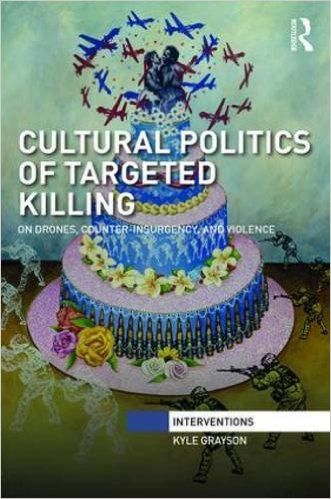
That same month comes the book I most want to read – but the eye-popping price from Routledge makes me wonder whether some mega-publishers see books as anything other than commodities.  It’s Kyle Grayson‘s Cultural Politics of Targeted Killing: On Drones, Counter-Insurgency, and Violence (hardcover only: madness).

GRAYSON Cultural politics of targeted killingThe deployment of remotely piloted air platforms (RPAs) – or drones – has become a defining feature of contemporary counter-insurgency operations. Scholarly analysis and public debate has primarily focused on two issues: the legality of targeted killing and whether the practice is effective at disrupting insurgency networks, and the intensive media and activist scrutiny of the policy processes through which targeted killing decisions have been made. While contributing to these ongoing discussions, this book aims to determine how targeted killing has become possible in contemporary counter-insurgency operations undertaken by liberal regimes.

Each chapter is oriented around a problematisation that has shaped the cultural politics of the targeted killing assemblage. Grayson argues that in order to understand how specific forms of violence become prevalent, it is important to determine how problematisations that enable them are shaped by a politico-cultural system in which culture operates in conjunction with technological, economic, governmental, and geostrategic elements. The book also demonstrates that the actors involved – what they may be attempting to achieve through the deployment of this form of violence, how they attempt to achieve it, and where they attempt to achieve it – are also shaped by culture.

The book demonstrates how the current social relations prevalent in liberal societies contain the potential for targeted killing as a normal rather than extraordinary practice.

Contents:

Chapter One: The Cultural Politics of the Targeted Killing Assemblage

Chapter Two: Beyond the Exception: The Legal Problematisation of Targeted Killing

Chapter Three: The Politics of Targeted Killing

Chapter Four: Science, Capitalism, and the RPA

Chapter Five: The Aesthetic Subjects of Targeted Killing

Chapter Six: The Quotidian Geopolitics of Targeted Killing Strikes

Chapter Seven: Concluding Remarks on the Cultural Politics of Targeted Killing

(Amazon says July, but the publisher says ‘2017’ so perhaps somebody in Taylor & Francis’s counting-house might have a serious think between now and publication; they clearly take ‘making a killing’ all too seriously).

Drone observations

I’m just back from a lovely week at Dartmouth, so there’s lots to catch up on.  This post is confined to (yet more) notes on writing about drones.  It’s selective, partly because I’m sure I’ve missed all sorts of important recent contributions – and if I have please let me know – but partly because so many supposedly critical interventions retrace familiar steps unburdened by substantive research.

This is far from the case with this one.  Part of the purpose of my stay in Dartmouth was to spend time with Kate Kindervater, one of the first cohort of five post-docs at Dartmouth’s new Society of Fellows (selected from 1700 applicants!).   She completed her PhD at the University of Minnesota last year on ‘Lethal Surveillance: Drones and the Geo-History of Modern War‘.

Interdisciplinary both in scope and method, my dissertation, Lethal Surveillance: Drones and the Geo-History of Modern War, examines the history of drone technology from the start of the 20th century to the present in order to understand the significance of the increasing centrality of drones to current American military engagements and security practices more generally. Much of the scholarship on drones and many other contemporary military technologies tends to view the technology as radically new, missing both the historical development of these objects as well as the perspectives and rationalities that are embedded in their use. For this research, I focused on three main periods of drone research and development: the early years of World War I and II in the UK, the Cold War, and the 1990s. In studying this history of the drone, I found that two key trends emerge as significant: the increasing importance of information to warfare under the rubric of intelligence, reconnaissance and surveillance; and a shift toward more dynamic, speedier, and individualized targeting practices. I argue that the widespread use of drones today thus represents the culmination of attempts in war to effectively link these two trends, creating a practice I call lethal surveillance — with the armed Predator effectively closing the loop between identifying and killing targets. The concept of lethal surveillance, which in my dissertation I place squarely within the histories of modern scientific thinking and Western liberal governance, allows us to see how techniques of Western state power and knowledge production are merging with practices of killing and control in new ways, causing significant changes to both the operations of the state and to practices of war. Framing the drone through the lens of lethal surveillance, therefore, allows us to see the longer histories the drone is embedded in as well as other security practices it is connected to.

We had lots of really good conversation, and while I was at Dartmouth Kate had a paper published at Security dialogue, drawing from her thesis: ‘The emergence of lethal surveillance: Watching and killing in the history of drone technology’:

This article examines the history of the development of drone technology to understand the longer histories of surveillance and targeting that shape contemporary drone warfare. Drawing on archival research, the article focuses on three periods in the history of the drone: the early years during World Wars I and II, the Cold War, and the 1990s. The history of the drone reveals two key trends in Western warfare: the increasing importance of intelligence, surveillance, and reconnaissance (ISR) and the development of dynamic targeting. These trends converge today in a practice of lethal surveillance where ISR capabilities are directly linked to targeted killing, effectively merging mechanisms of surveillance and knowledge production with decisions on life and death. Taking this history of lethal surveillance into account not only reframes current debates on drone warfare, but also connects the drone to other practices of security and control.

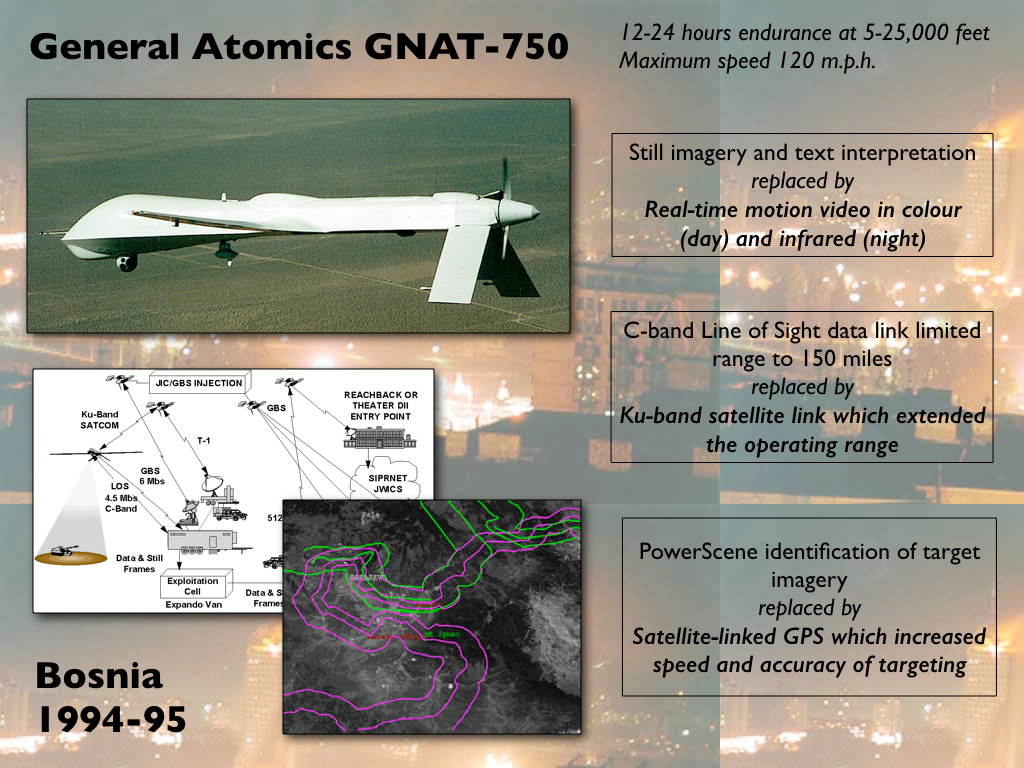
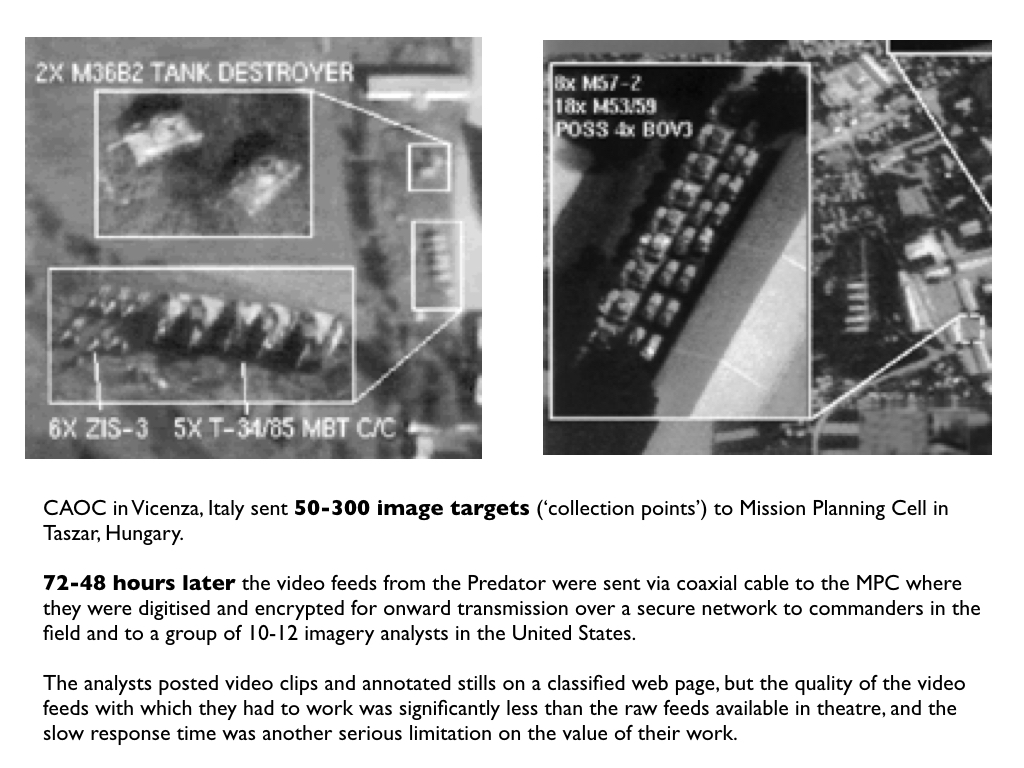
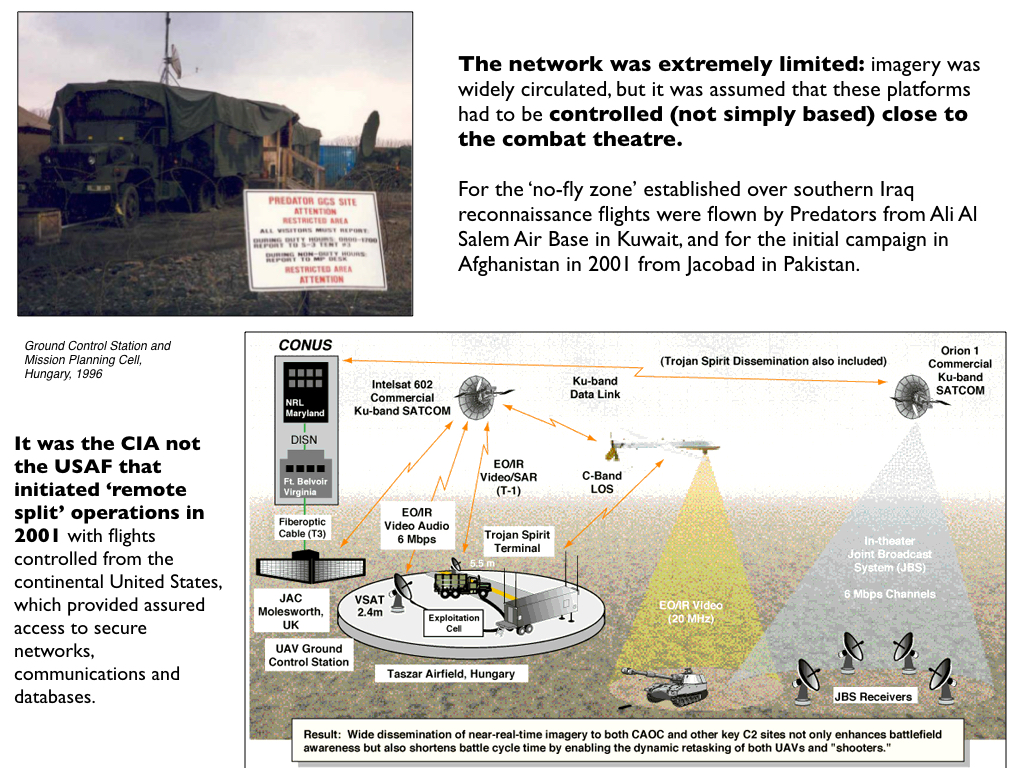
Kate is absolutely right to trace through the trajectories of ISR and dynamic targeting, and I applaud the way in which she doesn’t move directly from colonial ‘air policing’ and ‘pilotless bombing’ (in the case that interests her the most, in Iraq in the 1920s) to today’s remote operations but insists on the pivotal importance of the Cold War and, post-1989, Kosovo.  Kosovo is particularly interesting, I think, and here is my own summary take on developments there:

Predator precedents in Bosnia.001 Predator precedents in Bosnia.002 Predator precedents in Bosnia.003

Another exceptionally interesting paper is Cara Daggett‘s ‘Drone disorientations: how unmanned weapons queer the experience of killing in war’, which appeared in the International journal of feminist politics 17 (3) (2015) 361-379:

Killing with drones produces queer moments of disorientation. Drawing on queer phenomenology, I show how militarized masculinities function as spatiotemporal landmarks that give killing in war its “orientation” and make it morally intelligible. These bearings no longer make sense for drone warfare, which radically deviates from two of its main axes: the home–combat and distance–intimacy binaries. Through a narrative methodology, I show how descriptions of drone warfare are rife with symptoms of an unresolved disorientation, often expressed as gender anxiety over the failure of the distance–intimacy and home–combat axes to orient killing with drones. The resulting vertigo sparks a frenzy of reorientation attempts, but disorientation can lead in multiple and sometimes surprising directions – including, but not exclusively, more violent ones. With drones, the point is that none have yet been reliably secured, and I conclude by arguing that, in the midst of this confusion, it is important not to lose sight of the possibility of new paths, and the “hope of new directions.”

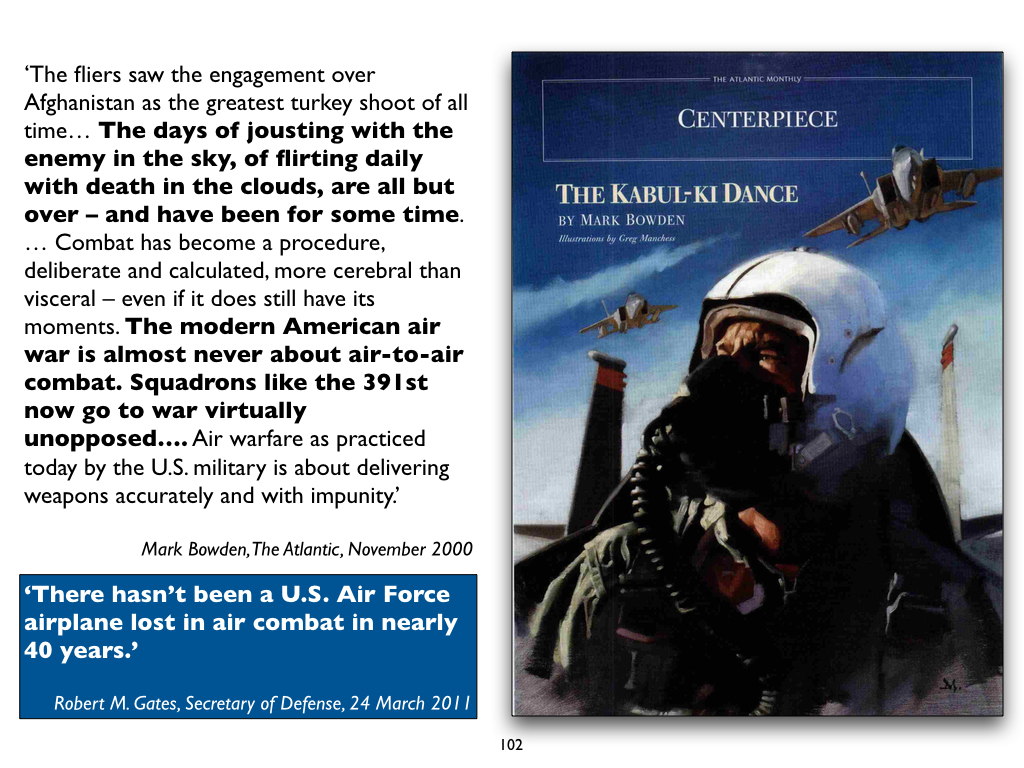
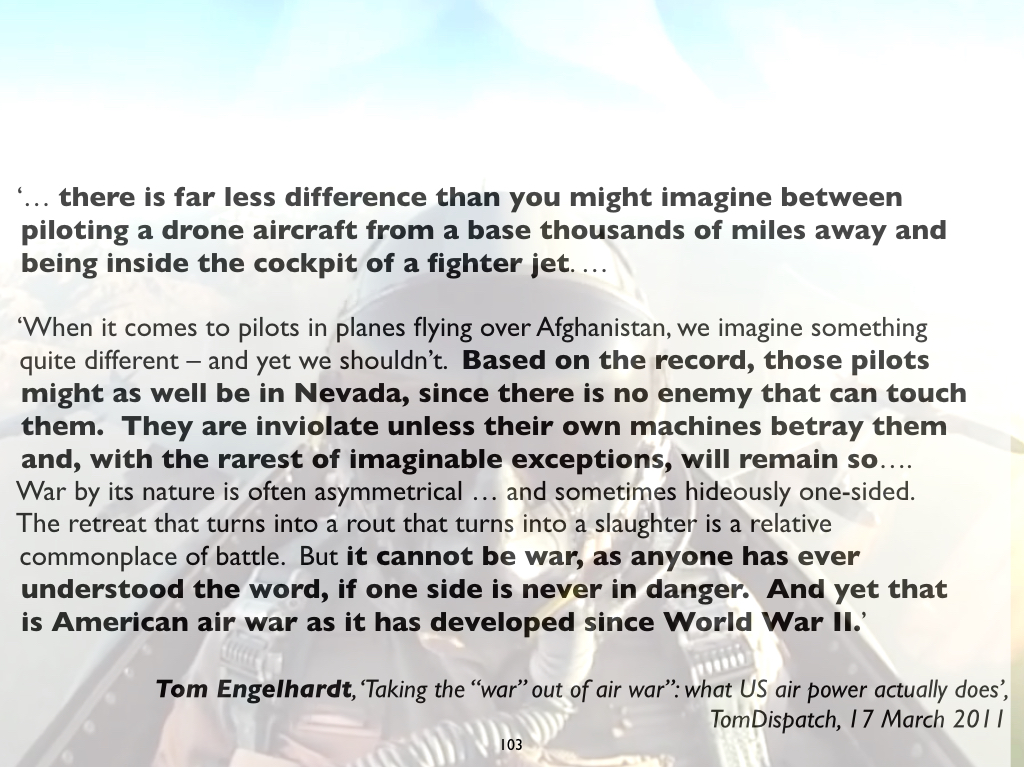
There have been several commentaries that take the ‘un-manning’ of remote operations literally and seriously, and I drew on several of them in accounting for the moral economy of bombing in my Tanner Lectures last month: the (hideous) claim that bombing is, in all sorts of ways, virile and manly – so that, by extension, those who fly today’s Predators and Reapers are neither since they are never in harm’s way.  It’s an alarming argument, since it inadvertently legitimates (and even celebrates) the masculinism of conventional bombing, misses the new reality of today’s air wars, and ignores a crucial observation made by Robert Gates [the slides below are from my Tanner Lectures]:

Unopposed air war.001Unopposed air war 2.001

Cara’s argument is much more artful than that, and well worth thinking through.

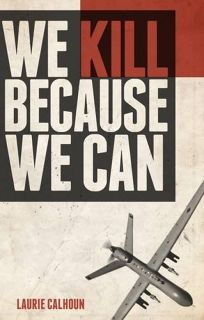
As both writers know, the use of military drones is not confined to targeted killing (though so many continue to write as though that were the case).  That said, Laurie Calhoun‘s We kill because we can: from soldiering to assassination in the drone age (Zed Books, 2015) is as deft an examination of the issues that you can find:

Welcome to the Drone Age. Where self-defense has become naked aggression. Where courage has become cowardice. Where black ops have become standard operating procedure. In this remarkable and often shocking book, Laurie Calhoun dissects the moral, psychological and cultural impact of remote-control killing in the twenty-first century. Can a drone operator conducting a targeted killing be likened to a mafia hitman? What difference, if any, is there between the Trayvon Martin case and the drone killing of a teen in Yemen? We Kill Because We Can takes a scalpel to the dark heart of Western foreign policy in order to answer these and many other troubling questions.

CALHOUN We kill because we canPreface
Introduction

Part I: Find
1. Drone Nation
2. From Black Ops to Standard Operating Procedure
3. The Logic of Targeted Killing
4. Lethal Creep

Part II: Fix
5. Strike First, Suppress Questions Later
6. The New Banality of Killing
7. The Operators
8. From Conscience to Oblivion

Part III: Finish
9. Death and Politics
10. Death and Taxes
11. The Death of Military Virtue
12. Tyrants Are as Tyrants Do

Conclusion
Postface
Appendix: Drone Killing and Just War Theory

You can find an extended interview with Laurie here.

Finally – and as you’ll soon see from an upcoming post – I can’t seem to stop wandering through the nuclear wastelands.  I described the role that drones played in the early development of Strategic Air Command (through its “Project Brass Ring”) and in monitoring US atomic tests in the Marshall Islands in my “Little Boys and Blue Skies” presentation at Toronto last fall (see DOWNLOADS tab and the extended post here), which I reworked for one of my presentations at Dartmouth.  Over at Bard College’s Center for the Study of the Drone, Dan Gettinger replays the same little-known story – though he doesn’t play it forward to the atomic tests that took place at the Nevada Proving Grounds and the role of Indian Springs as a base for those early drone missions in the continental United States.  Indian Springs is now Creech Air Force Base, of course, one of the central nodes for today’s remote operations.

Bodies at risk

This is far more than a post-script to my last post.  In writing ‘The Natures of War’ I started to develop the concept of a corpography (see also ‘Corpographies’ DOWNLOADS tab) because I became keenly interested in the ways in which the entanglements between military violence and ‘nature’ were registered on and through the body.

I had an appreciative message from Eileen Rositzka, following my Neil Smith Lecture at St Andrews, and I’ve finally caught up with a marvellous, exquisitely illustrated essay she has co-written with Robert Burgoyne: ‘Goya on his Shoulder: Tim Hetherington, Genre Memory, and the Body at Risk.’  It was published in Frames Cinema Journal 7 (2015) and is available open access here.

The figure of the body in narratives of war has long served to crystallize ideas about collective violence and the value or futility of sacrifice, often functioning as a symbol of historical transformation and renewal or, contrastingly, as a sign of utter degeneration and waste. As a number of recent studies have shown, the power of somatic imagery to shape cultural perceptions of war has had a decisive impact on the way wars have been regarded in history, and has sometimes influenced the conduct of war as it unfolds.

Following my good friend Gastón Gordillo‘s exemplary lead, I’ve been thinking about extending my original analysis from the mud of the Western Front in the First World War, the deserts of North Africa in the Second, and the rainforests of Vietnam into Afghanistan (for the book-version of the essay), and ‘Goya on his shoulder’ is full of all sorts of ideas on how to do exactly that.  Gastón has made much of Sebastian Junger/Tim Hetherington‘s extraordinary film Restrepo – see here and especially here – and Robert and Eileen add all sorts of insights to the mix and, in particular, provide an illuminating visual genealogy of the issues at stake:

With their concentrated focus on the body in war, Restrepo and Infidel also mark an intervention into contemporary debates in the emerging doctrine of “bodiless war” or virtual war – what is known in war policy circles as the “Revolution in Military Affairs” (RMA). In contrast to the decorporealised, bloodless war culture promoted and even celebrated in many contemporary theories of war, Restrepo and Infidel implicitly dramatise the limitations of so called “optical war” in many current conflict zones, emphasising the body of the soldier as a critical site of representation and meaning.

Their journey takes them from photography of the American Civil War through Edward Steichen‘s mesmerising project to capture what they call ‘bodies at risk’ in the Pacific theatre of the Second World War to Afghanistan today.  As it happens, I’ve spent the last several weeks immersed in Steichen’s project for my ‘Reach from the skies’ lectures: Steichen was one of the foremost architects of aerial photography on the Western Front during the First World War, and the photographs taken of US sailors taken under his direction during the Second have much to show us about the entanglements between military violence, masculinism and the body (the slide below is taken from my discussion in ‘Reach from the sky’).

RFTS Masculinism and military violence.001

And so to Restrepo:

‘… the work of Hetherington and Junger marks an intervention in the contemporary cultural imaginary of war, dramatizing the limitations of so called “optical war” or “bodiless war” in the conflict zones of Afghanistan. The concentrated attention to the touchscape of modern war in their work, moreover, provides a fresh perspective on older traditions of visual representation, illuminating the genre codes of war photography and film in a new way. The visual and acoustic design of Restrepo, in particular, captures the haptic geography of combat in a remote mountain outpost in the Korengal Valley. The film highlights the concentrated experience of sound and touch, providing a first-person account of the way the body inhabits contested space, the way the intensities of war confuse and overwrite the sensory codes of vision, and the compensatory drive of somatic mastery, which is projected in vivid displays of masculine athleticism in the relative safety of the enclosure.

What Steichen called “the machinery of war” is all but absent in these images. Like Steichen, Hetherington expresses the brotherhood of the men in directly physical, gestural forms – in close physical contact, in the “bloodying” of new men, and in the tattoos they give each other with a tattoo gun they have brought up to the camp…

Depictions of war in Restrepo and Infidel revolve around touch – the heat, cold, and dirt, the intense exertion, the texture of skin. Although Hetherington’s images of white, muscular soldiers may be compared to the displays of imperial masculinity celebrated by Edison in his War-Graph actualities, and by Roosevelt in his appeal to the brave “game boys” of military adventure, they also relay the heightened sensuality of Steichen’s World War II sailors to a contemporary war setting. Scenes that contain a high quotient of violence – the firefights with insurgents, the roughhousing, the bloodying of new recruits – are here juxtaposed with shots of soldiers sleeping and other scenes of quiet reflection…

Foregrounding the body of the soldier as a medium of sensory experience and as a body at risk, their work recalls the long history of war photography, painting, and film, dramatizing the importance of the figure of the body in narratives of war, and the power of somatic imagery to shape cultural perceptions of conflict. In Restrepo and Infidel, haptic experience and embodied vulnerability unfold as the central fact of war, the heart of warfare. Here too, however, a certain cultural imaginary is invoked, visible in Junger’s discussion of “young men in war” and of the “hard wiring” of young men for the violence of war, a theme that sacrifices any consideration of context, as if war was an existential constant. Nonetheless, in this framing of contemporary western war, centred on the haptic geography of combat, we can see an initial sketch, an introduction, to a critical understanding of the corpography of war in the current period.

My extracts don’t do justice to the range and depth of the essay, and it really does repay close reading.

Still reaching from the skies…

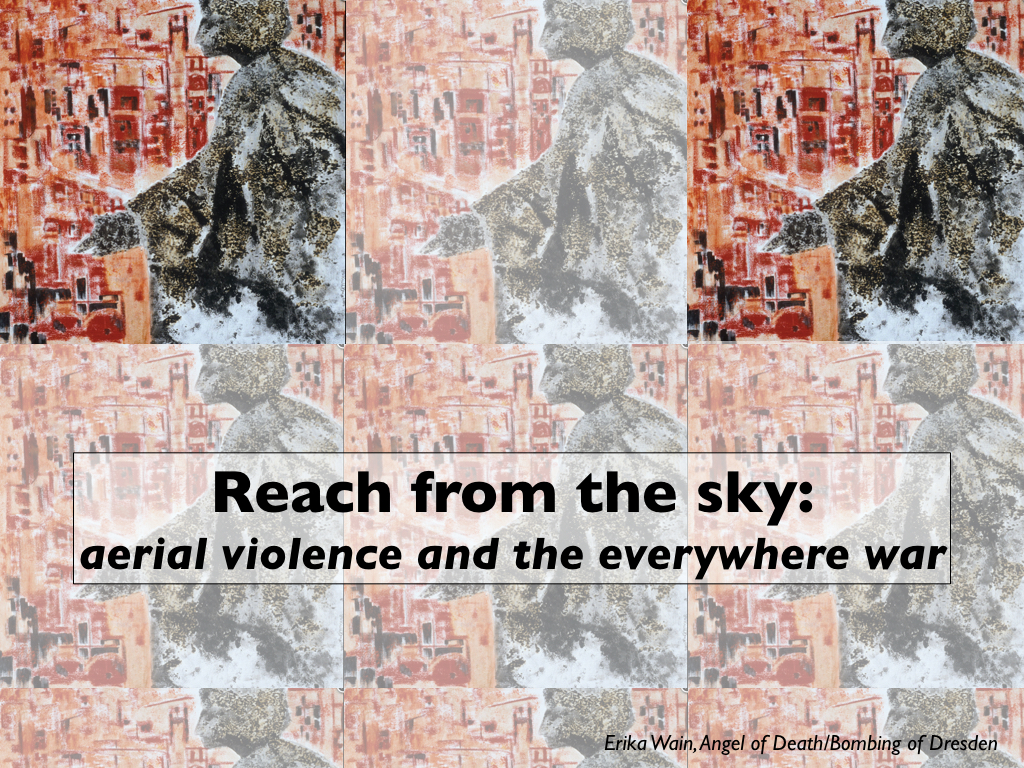
Sorry for the long silence – I’ve had my head down since soon after Christmas preparing the Tanner Lectures which I gave this past week in Cambridge [‘Reach from the sky: aerial violence and the everywhere war’].  The lectures were recorded and the video will be available on the Clare Hall website in a fortnight or so: more when I know more.

In outline – and after a rare panic attack the night before, which had me working until 2.30 in the morning –  I organised the two Lectures like this:

ONE

Prelude: The historical geography of bombing

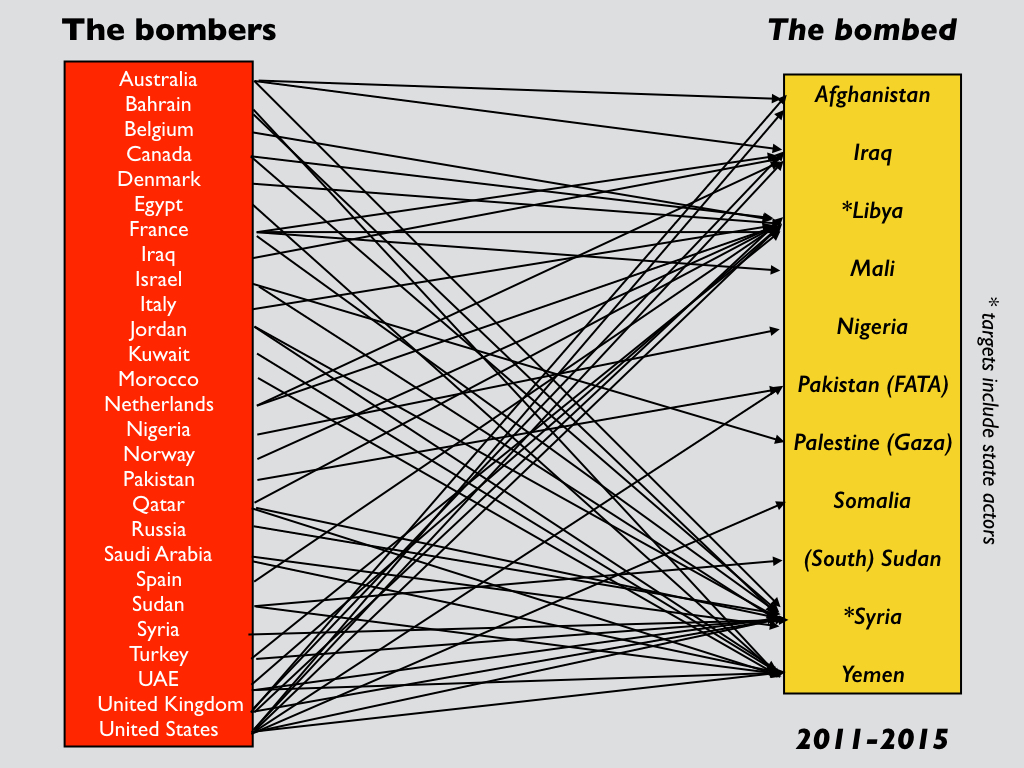
Bombing is back in the headlines but it never really left – and yet those who remain advocates of aerial violence don’t seem to have learned from its dismal history.  They also ignore the geographies that have been intrinsic to its execution, both the division between ‘the bombers and the bombed’ (the diagram below is an imperfect and fragmentary example of what I have in mind) and the pulsating spaces through which bombing is performed.

The bombers and the bombed.001

Good bomb, bad bomb

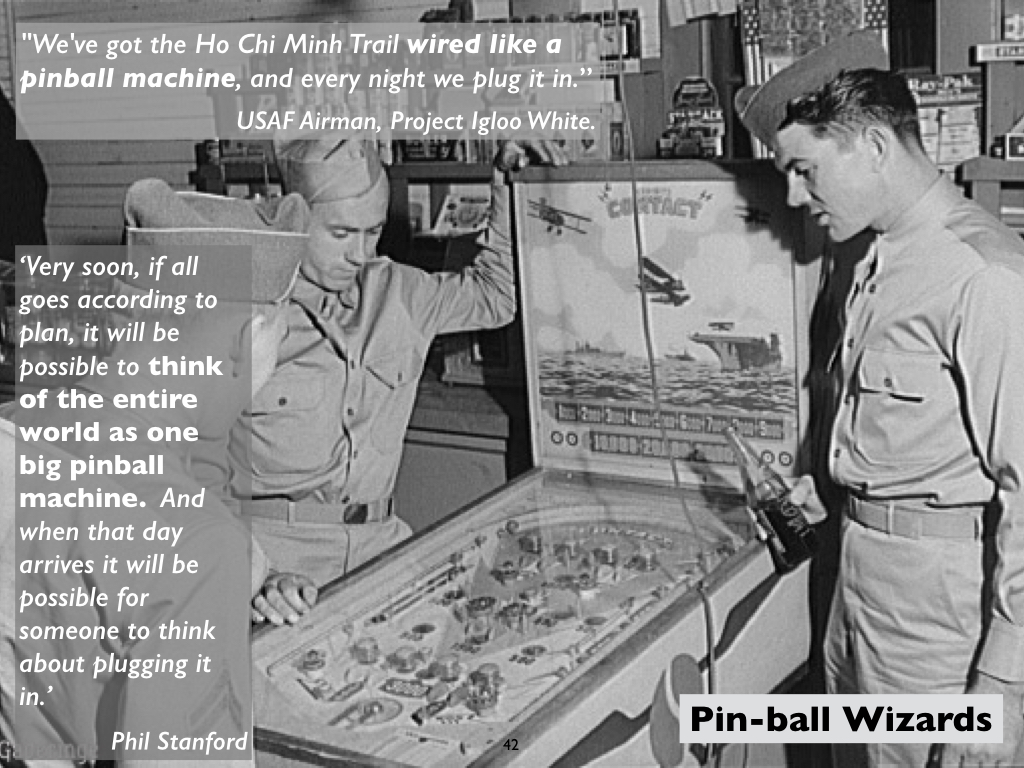
(with apologies to Mahmood Mamdani….)  In the first part I traced The machinery of bombing from before the First World War through to today’s remote operations.  Even though most early commentators believed that the primary role of military aircraft would be in reconnaissance, it was not long before they were being used to orchestrate artillery fire and to conduct bombing from the air. This sequence parallels the development of the Predator towards the end of the twentieth century.  In fact, almost as soon as the dream of flight had been realised the possibility of ‘unmanned flight’ took to the air.  Perhaps the most significant development, though, because it directs our attention to the wider matrix within which aerial violence takes place, was the development of the electronic battlefield in Laos and Cambodia. I’ve written about this in detail in ‘Lines of Descent‘ (DOWNLOADS tab); the electronic battlefield was important not because of what it did – the interdiction program on the Ho Chi Minh Trail was a spectacular failure (something which too many historians have failed to recognise)  – but because of what it showed: it conjured up an imaginative landscape, an automated killing field, in which sensors and shooters were linked through computer systems and automatic relays.  Contemporaries described the system as a vast ‘pinball machine’ (see the image below: you can have no idea how long it took me to track it down…).

Pinball wizards.001

The analogy allowed me to segue into the parallel but wholly inadequate characterisation of today’s remote operations as reducing military violence to a video game.

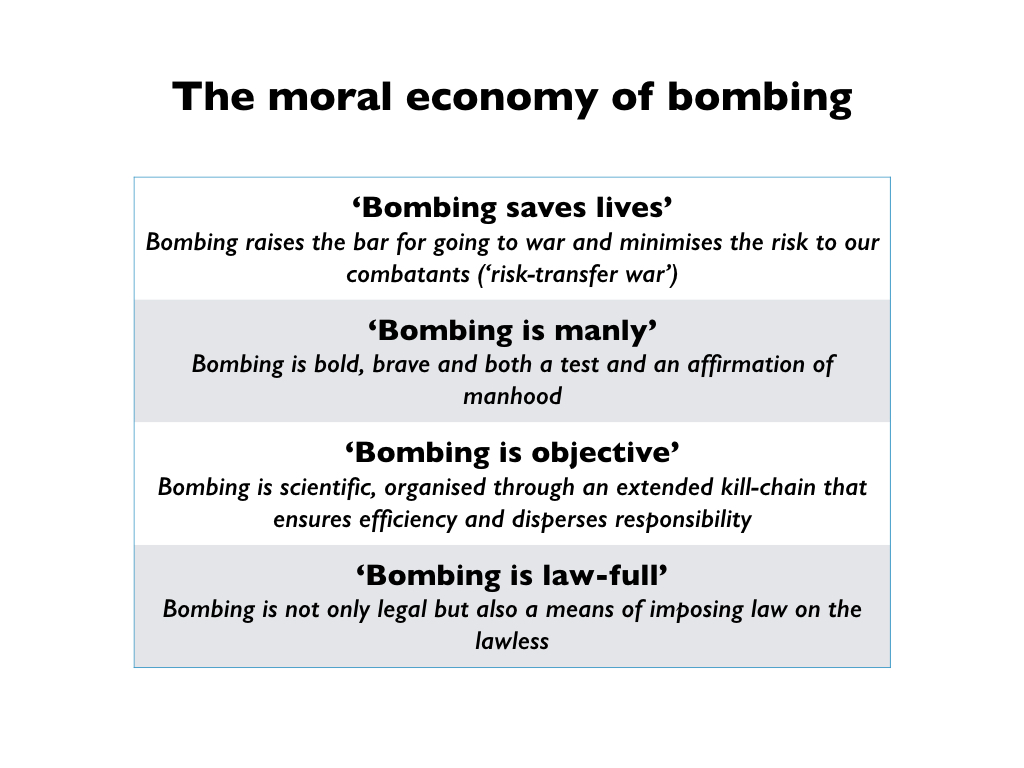
That is an avowedly ethical objection, of course, so I then turned to The moral economy of bombing.  Here I dissected four of the main ways in which bombing has been justified.  These have taken different forms at different times, and they intersect and on occasion even collide.  But they have been remarkable persistent, so in each case I tracked the arguments involved and showed how they have been radicalised or compromised by the development of Predators and Reapers.

Moral economy of bombing.001

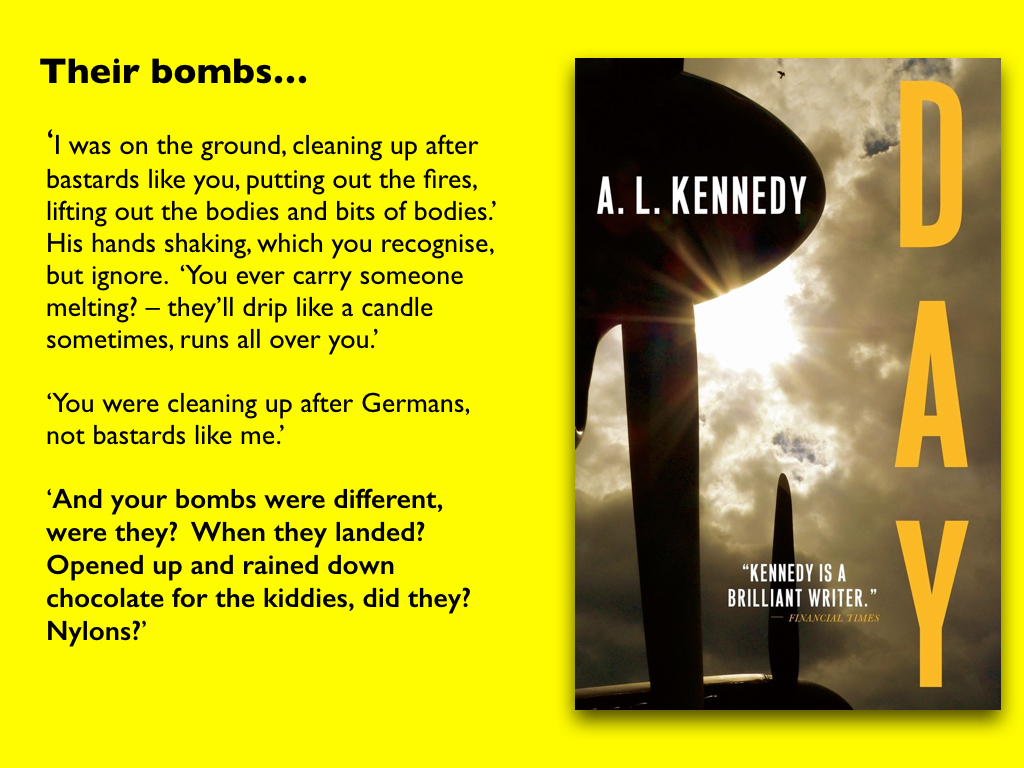
All of these justifications applied to ‘our bombs’, needless to say, which become ‘good bombs’, not to ‘their bombs’ – the ‘bad bombs’.

Their bombs.001

TWO

Killing Space

Phillips' Aerial Torpedo.001

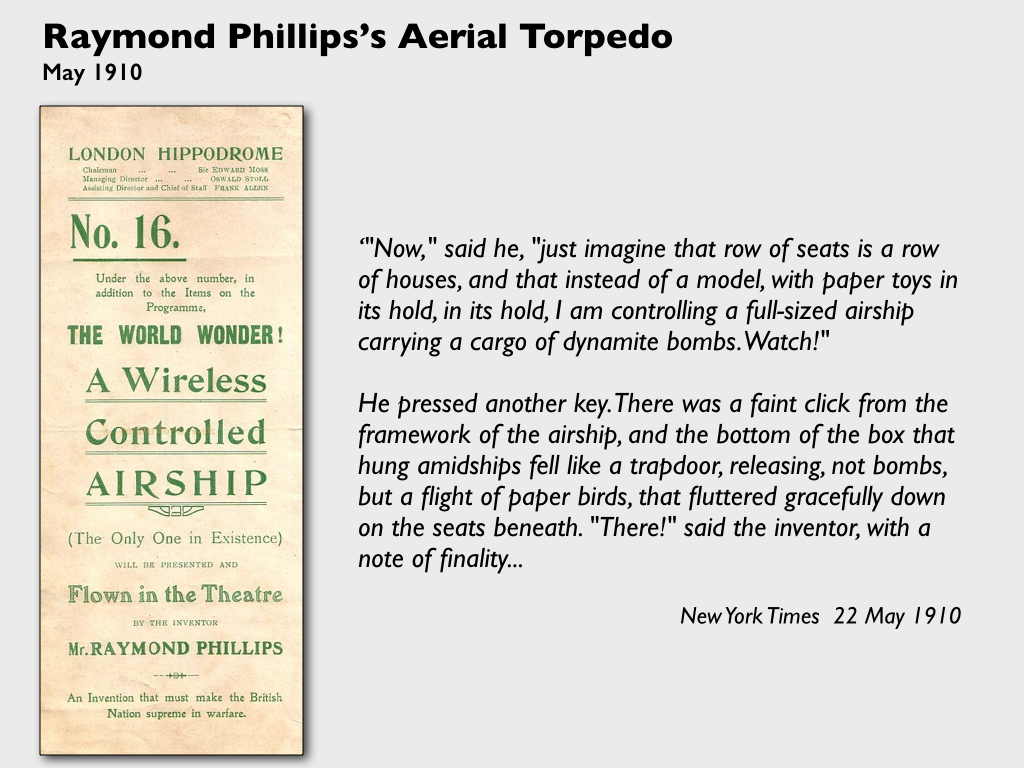
I started the second lecture by discussing The deconstruction of the battlefield; the wonder of Raymond Phillips’s fantasies of ‘aerial torpedoes‘ before the First World War was not so much their promise of ‘bomb-dropping by wireless’ but the targets:

Phillips' bomb-dropping by wireless.001

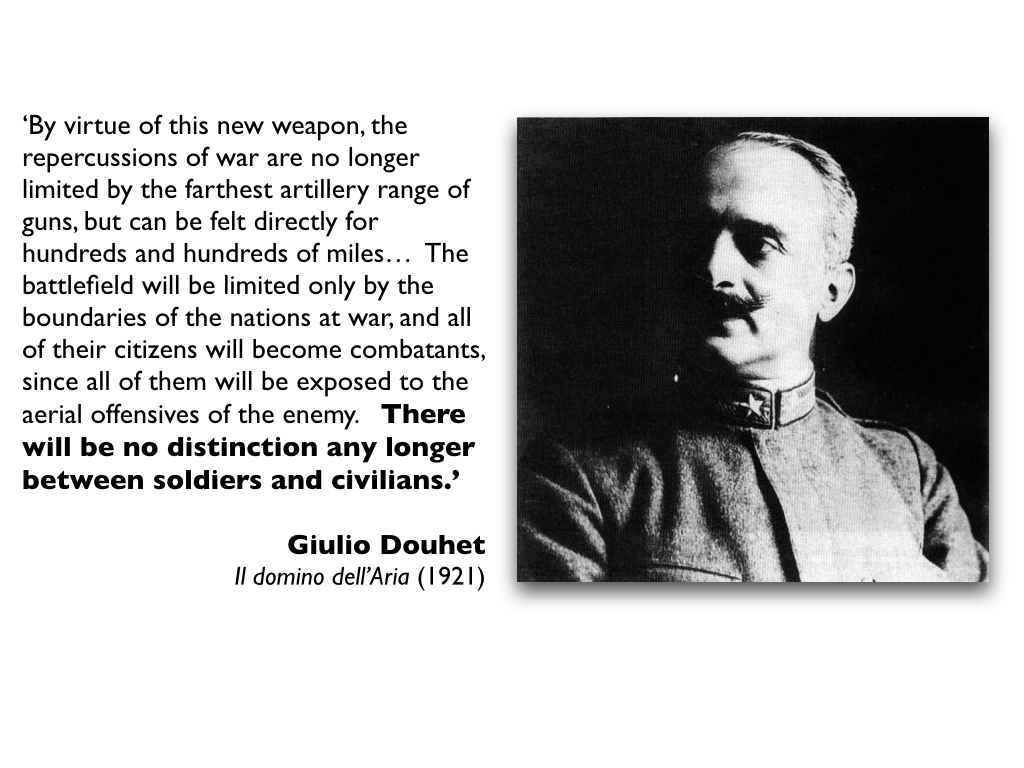
It was this radical extension of the battle space that counted.  In the event,  it was not British airships that dropped bombs on Berlin but German Zeppelins that bombed London and Paris, but the lesson was clear:

Douhet.001

To explore the formations and deformations of the battlespace in more detail, I used the image of The dark heart of bombing to describe a battlespace that alternately expanded and contracted.  So Allied bombing in the Second World war extended its deadly envelope beyond Germany, Italy and Japan into Belgium, Bulgaria, Denmark, France, the Netherlands, Norway and Romania; later the United States would bomb North Vietnam but reserved most of its ordnance for South Vietnam, Laos and Cambodia; and US air strikes in Afghanistan and Iraq would eventually spill over into Pakistan, Syria and elsewhere.  In the course of those air wars, the accuracy of targeting improved until it was possible to aim (if not always to hit) point-targets – individual buildings and eventually individual people – but this contraction of the killing space was accompanied by its expansion.  These ‘point-targets’ were selected because they were vital nodes that made possible the degradation or even destruction of an entire network.  Hence, for example, the Israeli attack on the Gaza power station (more in a previous post here):

Gaza Power Strip.001

A similar argument can be made about the US Air Force’s boast that it can now put ‘warheads on foreheads’, and I linked the so-called individuation of warfare to the US determination to target individuals wherever they go – to what Jeremy Scahill and others describe as the production of a newly expanded ‘global battlefield’.  What lies behind this is more than the drone, of course, since these killing fields rely on a global system of surveillance orchestrated by the NSA, and I sketched its contours and showed how they issued in the technical production of an ‘individual’ not as a fleshy, corporeal person but as a digital-statistical-spatial artefact (what Ian Hacking once called ‘making people up’ and what Grégoire Chamayou calls ‘schematic bodies‘).

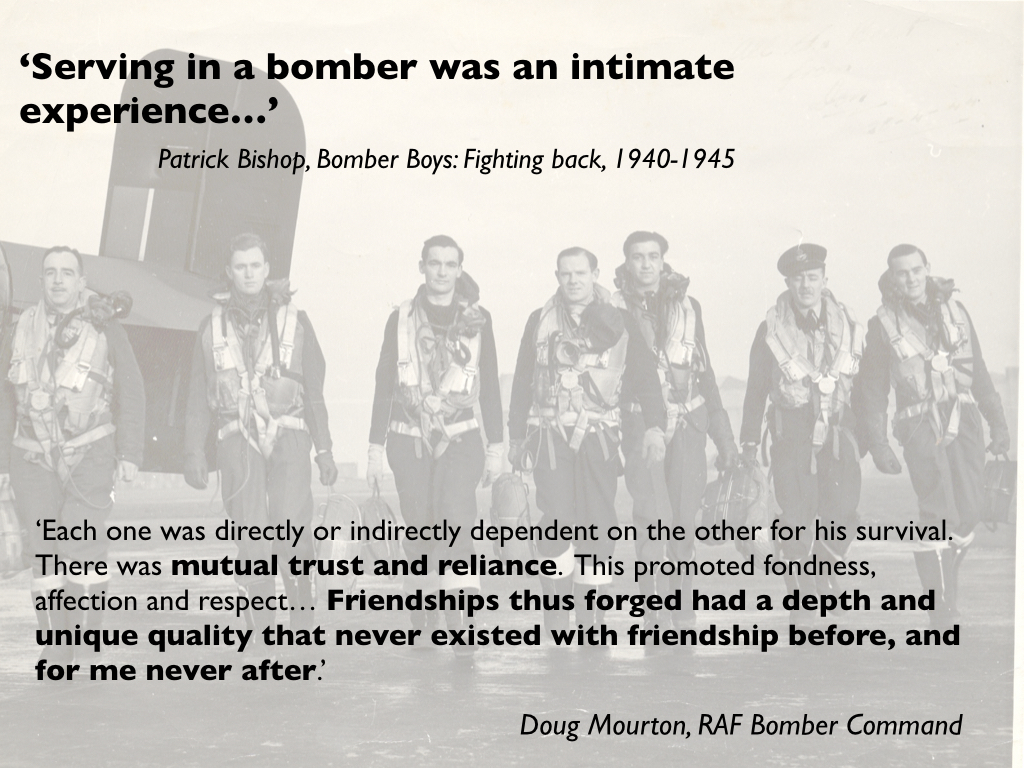
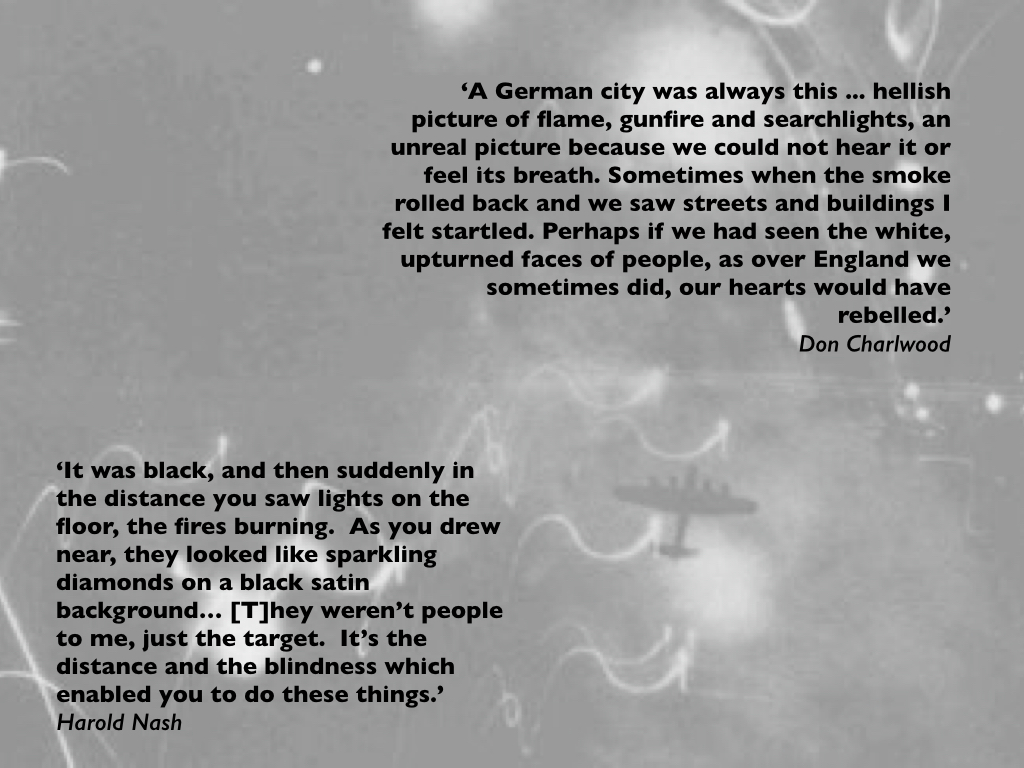
Next I explored a different dialectical geography of the battlespace: Remote splits: intimacy and detachment.  I started with RAF Bomber Command and traced in detail the contrast between the intimacy between members of bomber crews (a mutual dependence reinforced by the bio-convergence between their bodies and the machinery of the bomber itself) and the distance and detachment through which they viewed their targets.

Bioconvergence and the bomber crew.001

Intimacy in Bomber Command.001

The Good Wife.001

Cockpit dials.001

Distance and blindness.001

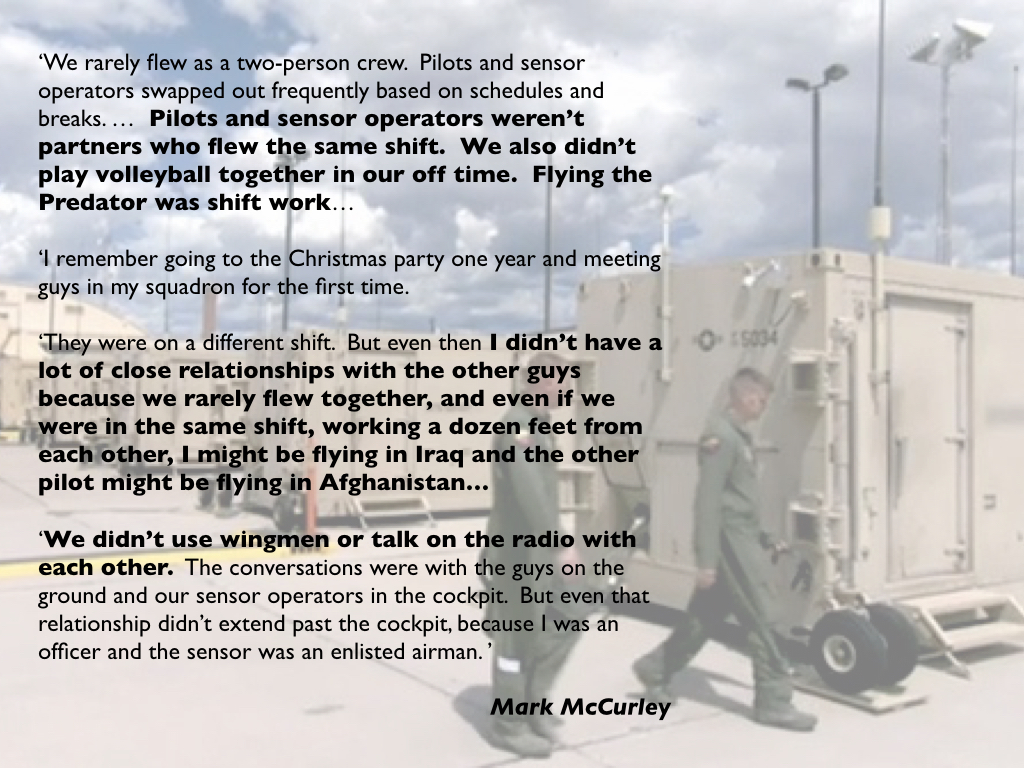
There’s much more on this in ‘Doors into nowhere‘ (DOWNLOADS tab), though I think my discussion in the Lectures breaks new ground. All of this is in stark contrast to today’s remote operations, where – as Lucy Suchman reminds us – there remains a remarkable (though different) degree of bioconvergence and yet now a persistent isolation and anomie is felt by many pilots and sensor operators who work in shifts:

Anomie and the drone.001

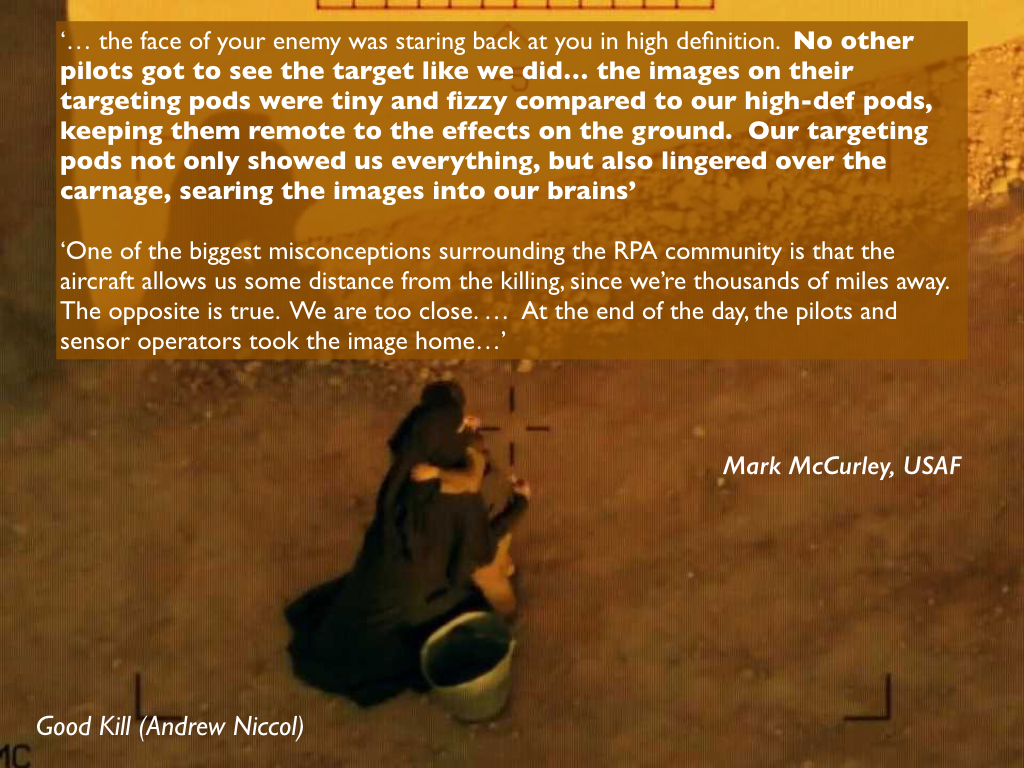
This is thrown into relief by the closeness remote operators feel to the killing space itself, an immersion made possible through the near real-time full-motion video feeds, the internet relay chatter and the radio communications with troops on the ground (where there are any). In contrast to the bomber crews of the Second World War – or those flying over the rainforests of Vietnam, Laos and Cambodia – there is a repeated insistence on a virtualized proximity to the target.

Good Kill in high-definition.001

But I used a discussion of Andrew Niccol‘s Good Kill to raise a series of doubts about what drone crews really can see, as a way into the next section, Sweet target, which provided an abbreviated presentation of the US air strike in Uruzgan I discuss in much more (I hope forensic) detail in Angry Eyes (see here and here).  That also allowed me to bring together many of the key themes I had isolated in the course of the two lectures.

As I approached my conclusion, I invoked Thomas Hippler‘s Le gouvernement du ciel: Histoire globale des bombardements aériens, (I’ve just discovered that Verso will publish the English-language version later this year or early next: Governing from the skies: a global history of aerial bombing):

Hippler Neo-douhetism.001

I’m not convinced that the military and paramilitary violence being visited on people today is all ‘low-intensity’ (Gaza? Afghanistan? Iraq? Syria? Yemen?).  But neither do I think it’s ‘de-territorialised’, unless the word is flattened into a conventionally Euclidean frame.  Hence, following Stuart Elden‘s lead, I treated territory as a political-juridical technology whose calibrations and enclosures assert, enable and enforce a claim over bodies-in-spaces.  And it was those ‘bodies-on-spaces’ that brought me, finally, to The loneliest space of all:  the irreducible, truly dreadful loneliness of death and grief:

Counting the dead.001

Behind the body-counts and the odious euphemisms of collateral damage and the rest lies the raw, inconsolable loss so exquisitely, painfully rendered in ‘Sky of Horoshima‘…

In the coming days I’ll post some of the key sections of the Lectures in more detail, which I’ll eventually develop into long-form essays.

I learned a lot from the expert and wonderfully constructive commentaries after the Lectures from Grégoire Chamayou, Jochen von Bernstorff and Chris Woods, and I’ll do my best to incorporate their suggestions into the final version.

In his response Grégoire traced my project on military violence in general and bombing/drones in particular back to a series of arguments I’d developed in Geographical imaginations in 1994 about vision, violence and corporeality; I had overlooked these completely, full of the conceit that my work had never stood still…. I shall go back, re-read and think about that some more, since some of the ideas that Grégoire recovered (and elaborated) may be even more helpful to me now.  Jochen and Chris also gave me much food for thought, so I shall be busy in the coming months, and I’m immensely grateful to all three of them.

Citizen Ex

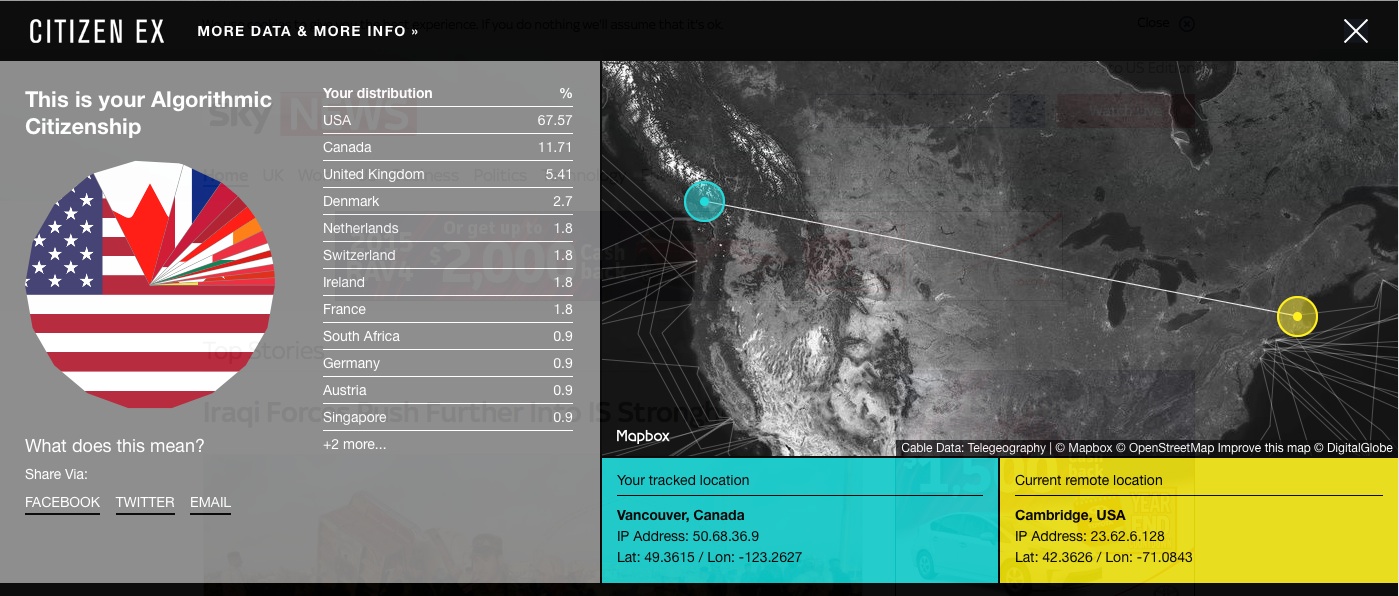
Algorithmic citizenship JPEG

I’m late to this, so apologies, but if you are either weary of web-surfing or can’t get off your digital board, check out James Bridle‘s Citizen Ex project on ‘algorithmic citizenship’:

Algorithmic Citizenship is a form of citizenship which is not assigned at birth, or through complex legal documents, but through data. Like other computerised processes, it can happen at the speed of light, and it can happen over and over again, constantly revising and recalculating. It can split a single citizenship into an infinite number of sub-citizenships, and count and weight them over time to produce combinations of affiliations to different states.

Citizen Ex calculates your Algorithmic Citizenship based on where you go online. Every site you visit is counted as evidence of your affiliation to a particular place, and added to your constantly revised Algorithmic Citizenship. Because the internet is everywhere, you can go anywhere – but because the internet is real, this also has consequences.

The basic idea is derived from an essay by John Cheney-Lippold in Theory, culture and society here:

Marketing and web analytic companies have implemented sophisticated algorithms to observe, analyze, and identify users through large surveillance networks online. These computer algorithms have the capacity to infer categories of identity upon users based largely on their web-surfing habits. In this article I will first discuss the conceptual and theoretical work around code, outlining its use in an analysis of online categorization practices. The article will then approach the function of code at the level of the category, arguing that an analysis of coded computer algorithms enables a supplement to Foucauldian thinking around biopolitics and biopower, of what I call soft biopower and soft biopolitics. These new conceptual devices allow us to better understand the workings of biopower at the level of the category, of using computer code, statistics and surveillance to construct categories within populations according to users’ surveilled internet history. Finally, the article will think through the nuanced ways that algorithmic inference works as a mode of control, of processes of identification that structure and regulate our lives online within the context of online marketing and algorithmic categorization.

From James’s Citizen Ex site you can download (from the banner, top left) an extension to your browser which – after you’ve browsed some more – will calculate, in a very rough and ready way, your own algorithmic citizenship.  Mine (from today’s little effort) is shown at the head of this post.

This may look like an entertaining distraction, but what lies behind it is of course deadly serious: read, for example, James’s (short) stories on Libya and Syria.

Created as a browser plug-in, Citizen Ex shows us the true physical locations of the sites we visit and the territories that govern our actions as we traverse the web. In this reality, every mouse click leaves a trace, as our personal data is collected and stored in locations around the globe. It is with this information that governments and corporations construct a notional vision of our lives. This is our ‘algorithmic citizenship’ — the way we appear to the network. This programmatic fluidity is far removed from the true complexity of human identity. It reduces it to something calculable, which has profound implications for our understanding of privacy, citizenship and the self.

It also has profound implications for surveillance and the digital production of the killing spaces of later modern war.  Read this alongside Louise Amoore‘s brilliant work on The politics of possibility and you can perhaps see where I’m going:

‘[W]hat comes to count as the actionable intelligence behind a sovereign decision is a mosaic of overwhelmingly ordinary fragments of a life that become, once arrayed together, secret and sensitive evidence…

‘Drawing some elements of past activities into the calculation, the mosaic nonetheless moves over the surface of multiple past subjects and events in order to imagine a future unknown subject.’

It’s not difficult to divine (sic) how ‘Citizen Ex’ becomes ‘Citizen-Ex’.

Reach from the Sky


Reach from the sky JPEG.001

I now have more details to share about my Tanner Lectures in Cambridge next month, Reach from the sky: aerial violence and the everywhere war.

First, here is a preliminary summary (not an easy thing to provide, since the two presentations are still very much in formation: but it will give you a rough idea of what I want to address).

Bombing is back in the headlines – but then it never really left. Over the last hundred years, bombing has become the preferred military option for many states, but it has supposedly been radically transformed over the last decade or so by the introduction of unmanned aerial vehicles (‘drones’). Their use has sparked a vigorous debate, inside and outside military circles, but commentators have rarely situated Predators, Reapers and other drones within the longer history of aerial violence or the larger matrix of armed conflict within which they have been deployed.

These lectures seek to fill both those gaps by addressing two fundamental questions. The first lecture, Good bomb, bad bomb, asks how people – both those who carry out air strikes and those publics who endorse them – have been persuaded of the propriety of aerial violence. Four responses run like red threads throughout the long history of bombing from the air: bombing saves lives, especially when compared with ‘boots on the ground’; bombing is bold, brave and ‘separates the men from the boys’; bombing is scientific, objective and precise, organised through an extended ‘kill-chain’ that ensures efficiency and disperses responsibility; and bombing is ‘law-full’, not only legal but also a means of imposing law on those who lack its ordering. These claims only apply to our bombs of course, not theirs, and these arguments and the practices that lie behind them have been substantially re-worked by today’s drone wars.

The second lecture, Killing space, asks what spaces have been produced through the changing ‘destruction line’ that has animated military targeting and military violence. Here there are two issues of crucial importance. One concerns the locus of targeting: in particular the range of aerial violence, the emergence of ‘wars without fronts’ and the extension of military violence beyond any demarcated battlefield, and the subsequent ‘individuation of warfare’ in which targets have contracted from areas and boxes to groups and individuals even as they have expanded through their location within networks that transmit and amplify the effects of individual strikes. The other concerns the grammar of targeting: in particular the reification and abstraction of targets, the rise of dynamic targeting and the incorporation of real-time intelligence, surveillance and reconnaissance, and the increased reliance on digital signatures for the cultivation of the killing fields.

Answers to these questions have much to tell us about the changing contours of modern war and the adjudication of what is to count as a ‘grievable life’ in the twenty-first century.

The lectures draw on a series of presentations, essays (most of them available under the DOWNLOADS tab) and posts, but they will also break new ground – and lots of it.  I’ll be going back to the origins of bombing before the First World War, tracing some of the parallels between bombing on the Western Front and the late modern deployment of Predators and Reapers, tracking the development of drones since the Second World War, and coming right up to the multiple forms of aerial violence currently being visited on Afghanistan, Iraq, Syria and elsewhere.  The lectures will also be packed with images (and even poetry).

The format: I’ll give two 50-minute presentations starting at 5 p.m. on Wednesday 13 January, separated by a refreshment break (!) and followed by a reception.  Then at 5 p.m. on Thursday 14 January a panel of four respondents – which will include Chris Woods, (author of Sudden Justice: America’s secret drone wars), Grégoire Chamayou (author of A theory of the drone/Drone theory) and Jochen von Bernstorff, (Professor of Constitutional Law, Public International Law and Human Rights in Tübingen) will provide their reactions and comments, to be followed by a general discussion and debate.

The place: The lectures are organised by Clare Hall but will be given at the Robinson College Auditorium.  Admission is free but you will need a ticket from:

tannerbookings@clarehall.cam.ac.uk (Tel: 01223 761247)

I’m told that the tickets are going fast (really).  I’ll post updates on my progress; after the event I’ll post the presentation slides, and there will also be a published version at a later date.

“What is that sound high in the air?”

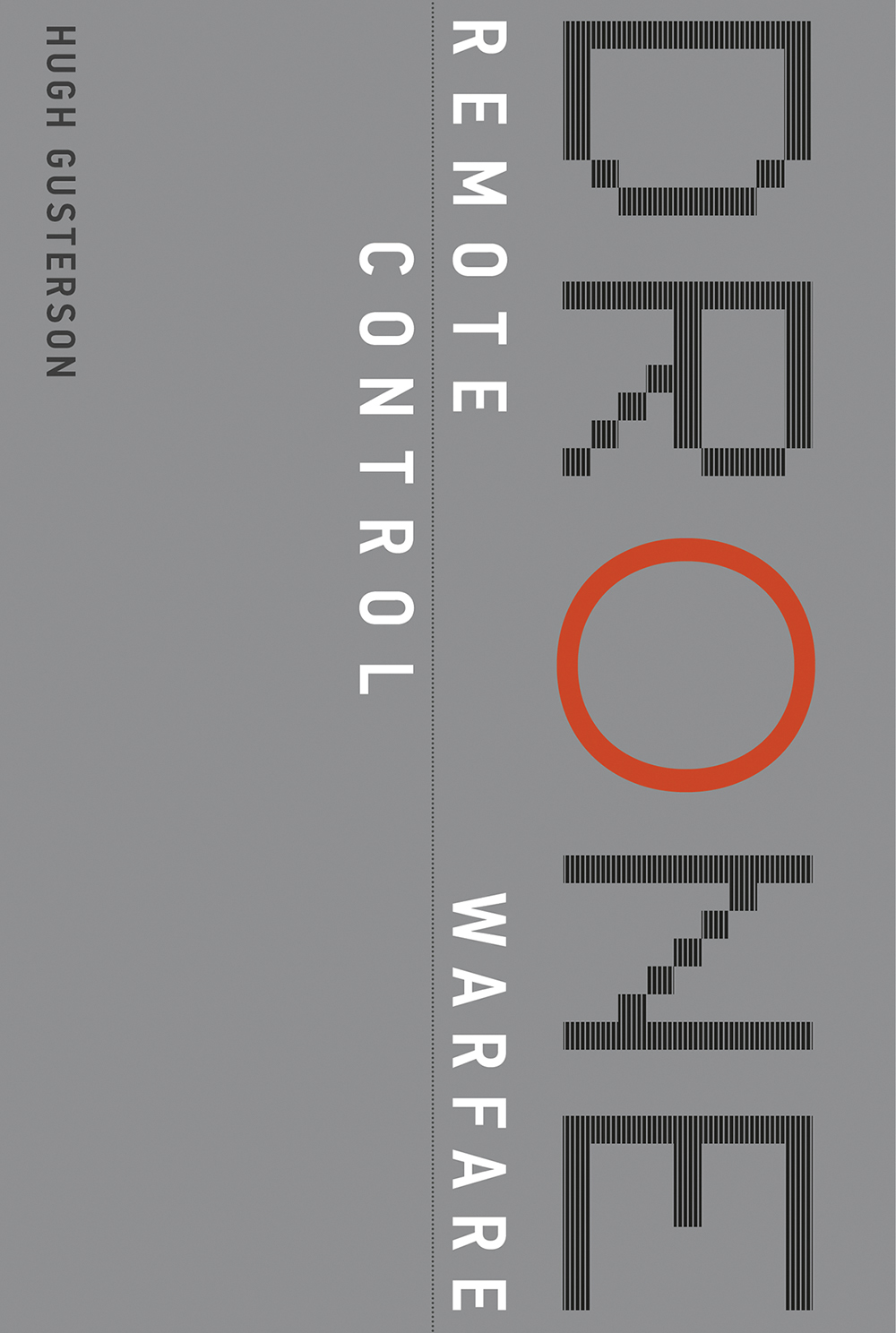
Coming from MIT in April next year, a new book by the ever-creative anthropologist Hugh Gusterson, Drone: remote control warfare.

GUSTERSON DroneDrones are changing the conduct of war. Deployed at presidential discretion, they can be used in regular war zones or to kill people in such countries as Yemen and Somalia, where the United States is not officially at war. Advocates say that drones are more precise than conventional bombers, allowing warfare with minimal civilian deaths while keeping American pilots out of harm’s way. Critics say that drones are cowardly and that they often kill innocent civilians while terrorizing entire villages on the ground. In this book, Hugh Gusterson explores the significance of drone warfare from multiple perspectives, drawing on accounts by drone operators, victims of drone attacks, anti-drone activists, human rights activists, international lawyers, journalists, military thinkers, and academic experts.

Gusterson examines the way drone warfare has created commuter warriors and redefined the space of the battlefield. He looks at the paradoxical mix of closeness and distance involved in remote killing: is it easier than killing someone on the physical battlefield if you have to watch onscreen? He suggests a new way of understanding the debate over civilian casualties of drone attacks. He maps “ethical slippage” over time in the Obama administration’s targeting practices. And he contrasts Obama administration officials’ legal justification of drone attacks with arguments by international lawyers and NGOs.

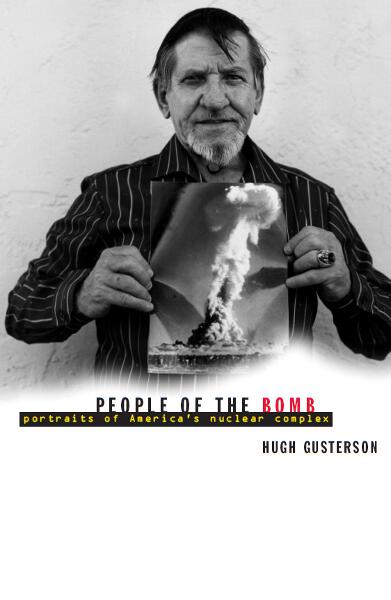
People of the bombI met Hugh at a conference on Orientalism and War in Oxford several years ago, and I’ve recently been reading his Nuclear Rites: a weapons laboratory and the end of the Cold War and People of the Bomb: Portraits of America’s Nuclear Complex as I continue my wanderings through the nuclear wastelands.

The coincidence between Hugh’s previous projects and his new one intersects with my presentation on “Little Boys and Blue Skies” in Toronto last week – see here and here – which sketched out a series of entanglements between drones and the nuclear wastelands (hence the Eliot quotation which serves as my title for this post).

The nuclear wastelands and cyberwar

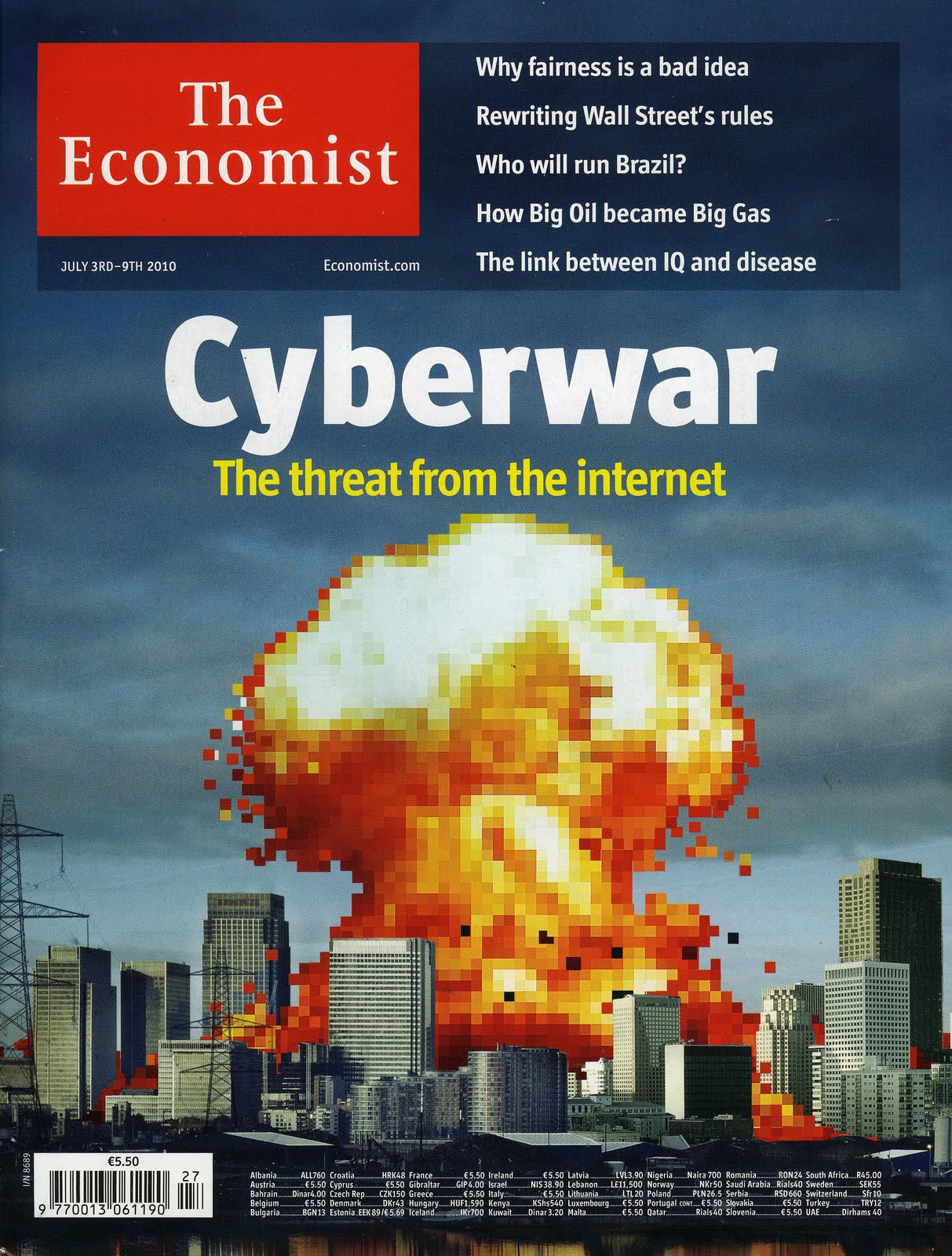
I’m in Toronto, enjoying ‘Through Post-Atomic Eyes‘ enormously: wide-ranging yet focused, creative and critical, and above all wonderfully welcoming.  I’m also relieved – I’ve only been wandering in the nuclear wastelands for a matter of months, and being surrounded by scholars and artists who know so much more about these vexed issues has been truly invigorating.  I’ll post the slides from my presentation shortly – in the meantime, see here and here – but while I was searching for images I re-discovered this cover from The Economist:

economist_cyberwar

Since my own presentation tried to sort out the entangled geographies of nuclear weapons and drones, I would be the very last person to object to the continuity conjured up by The Economist‘s apocalyptic vision: in fact yesterday both Joseph Masco and James Bridle in two sparkling presentations emphasised the intimacy of  the connections between computing, nuclear testing and the security state.

So it seems appropriate that my  e-flânerie should also have led me to a special issue of CyberOrient, edited by Helga Tawil-Souri, is appropriately online now (and open access), devoted to cyberwarfare:

This special issue of CyberOrient engages with the relationships between “cyber” and “real” battlespaces, the mediatization of war, the need to expand our definition of warzones, and the importance of asking who participates in wars, to what ends, using what kinds of technologies, and for what purposes. Taken together, the five essays demonstrate the expansion and blurring of the spaces of war. As importantly, they highlight that even warfare that is “only” fought in the virtual realm is laced with violent intents and real-life repercussions. Not only can we not separate the cyber from the real so neatly, but we must not overlook that no matter how we wish to classify “new” or cyber wars, it is citizens, along with their ways of life and their cultural records, that continue to be by far the largest losers.

fp

Contents:

Helga Tawil-Souri, Problematizing Cyberwarfare

Donatella Della Ratta, Violence and visibility in contemporary Syria: an ethnography of the “expanded places

Ruth Tsuria, Islamophobia in online Arab media

Emily Fekete, The shifting nature of cyberwarfare in Middle Eastern states

Attila Kovacs, Visual representation, propaganda and cyberspace: the case of the Palestinian Islamist movements

Christoph Günter, Presenting the glossy look of warfare in cyberspace – the Islamic State’s magazine Dabiq

Archives of the Insensible

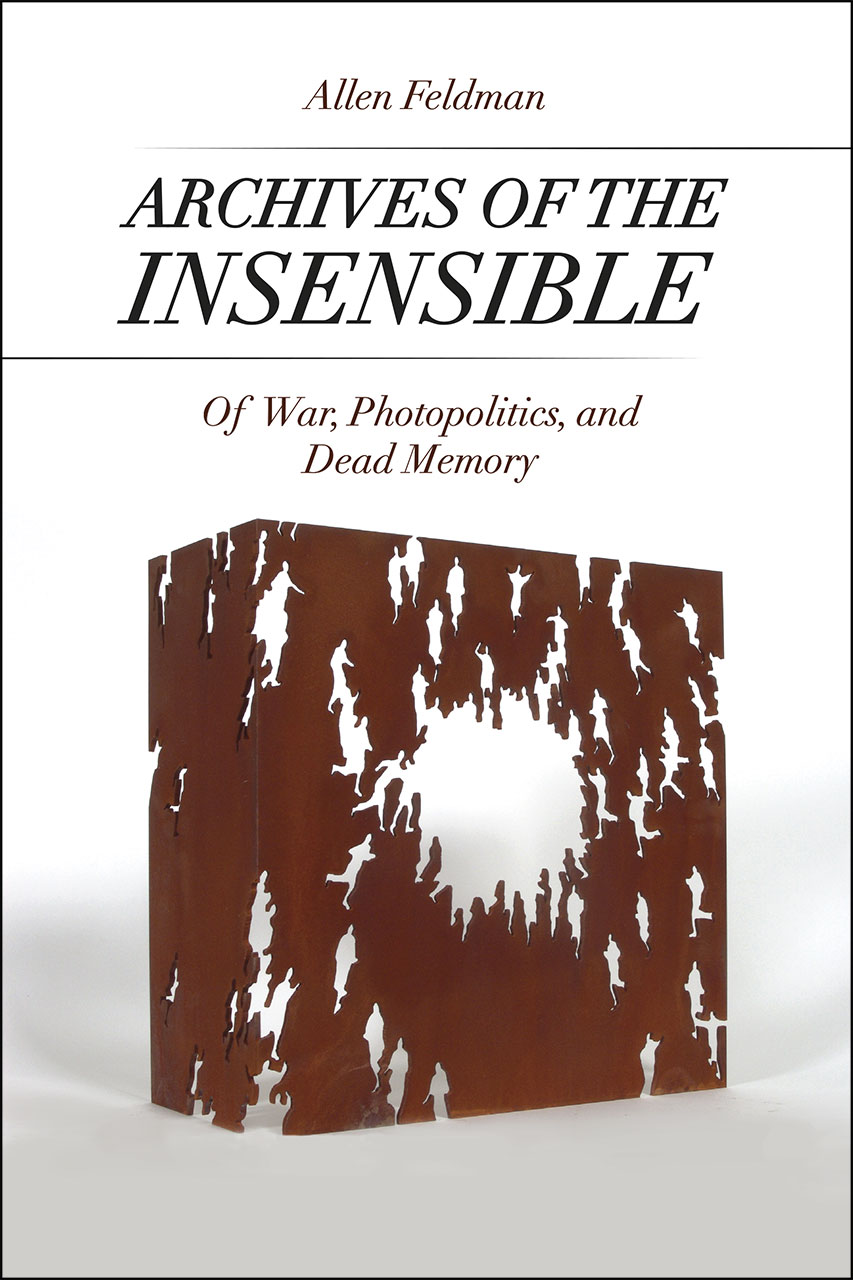
9780226277332News from the ever interesting Allen Feldman of his new book, Archives of the Insensible: of war, photopolitics and dead memory, coming from Chicago in December:

In this jarring look at contemporary warfare and political visuality, renowned anthropologist of violence Allen Feldman provocatively argues that contemporary sovereign power mobilizes asymmetric, clandestine, and ultimately unending war as a will to truth. Whether responding to the fantasy of weapons of mass destruction or an existential threat to civilization, Western political sovereignty seeks to align justice, humanitarian right, and democracy with technocratic violence and visual dominance. Connecting Guantánamo tribunals to the South African Truth and Reconciliation Commission, American counterfeit killings in Afghanistan to the Baader-Meinhof paintings of Gerhard Richter, and the video erasure of Rodney King to lynching photography and political animality, among other scenes of terror, Feldman contests sovereignty’s claims to transcendental right — whether humanitarian, neoliberal, or democratic—by showing how dogmatic truth is crafted and terror indemnified by the prosecutorial media and materiality of war.

Excavating a scenography of trials —formal or covert, orchestrated or improvised, criminalizing or criminal — Feldman shows how the will to truth disappears into the very violence it interrogates. He maps the sensory inscriptions and erasures of war, highlighting war as a media that severs factuality from actuality to render violence just. He proposes that war promotes an anesthesiology that interdicts the witness of a sensory and affective commons that has the capacity to speak truth to war. Feldman uses layered deconstructive description to decelerate the ballistical tempo of war to salvage the embodied actualities and material histories that war reduces to the ashes of collateral damage, the automatism of drones, and the opacities of black sites. The result is a penetrating work that marries critical visual theory, political philosophy, anthropology, and media archeology into a trenchant dissection of emerging forms of sovereignty and state power that war now makes possible.
Here is the wonderful Talal Asad on the book:

Archives of the Insensible is a remarkable diagnosis of our time, tracing with great subtlety the multiple ways in which violence is transformed into justice and justice gives birth to destruction. This is a startling book written with passion and insight, and a valuable contribution to our understanding of the relationship of violence to international law in the contemporary world.

You can see why I’m so interested…