The individuation of warfare?

chamayou-manhuntsBefore I resume my reading of Grégoire Chamayou‘s Théorie du drone, I want to approach his thesis from a different direction. As I’ve noted, much of his argument turns on the reduction of later modern war to ‘man-hunting’: the profoundly asymmetric pursuit of individuals by activating the hunter-killer capacities of the Predator or the Reaper in a new form of networked (para)military violence. He describes this as a ‘state doctrine of non-conventional violence’ that combines elements of military and police operations without fully corresponding to either: ‘hybrid operations, monstrous offspring [enfants terribles] of the police and the military, of war and peace’.

These new modalities increase the asymmetry of war – to the point where it no longer looks like or perhaps even qualifies as war – because they preclude what Joseph Pugliese describes as ‘“a general system of exchange” [the reference is to Achille Mbembe’s necropolitics] between the hunter-killer apparatus ‘and its anonymous and unsuspecting victims, who have neither a right of reply nor recourse to judicial procedure.’

Pugliese insists that drones materialise what he calls a ‘prosthetics of law’, and the work of jurists and other legal scholars provides a revealing window into the constitution of later modern war and what, following Michael Smith, I want to call its geo-legal armature. To date, much of this discussion has concerned the reach of international law – the jurisdiction of international law within (Afghanistan) and beyond (Pakistan, Yemen and Somalia) formal zones of conflict – and the legal manoeuvres deployed by the United States to sanction its use of deadly force in ‘self-defence’ that violates the sovereignty of other states (which includes both international law and domestic protocols like the Authorization for the Use of Military Force and various executive orders issued after 9/11) . These matters are immensely consequential, and bear directly on what Frédéric Mégret callsthe deconstruction of the battlefield’.
HIPPLER Bombing the PeopleIt’s important to understand that the ‘battlefield’ is more than a physical space; it’s also a normative space – the site of ‘exceptional norms’ within whose boundaries it is permissible to kill other human beings (subject to particular codes, rules and laws). Its deconstruction is not a new process. Modern military violence has rarely been confined to a champ de mars insulated from the supposedly safe spaces of civilian life. Long-range strategic bombing radically re-wrote the geography of war. This was already clear by the end of the First World War, and in 1921 Giulio Douhet could already confidently declare that

‘By virtue of this new weapon, the repercussions of war are no longer limited by the farthest artillery range of guns, but can be felt directly for hundreds and hundreds of miles… The battlefield will be limited only by the boundaries of the nations at war, and all of their citizens will become combatants, since all of them will be exposed to the aerial offensives of the enemy. There will be no distinction any longer between soldiers and civilians.’

The laboratory for these experimental geographies before the Second World War was Europe’s colonial (dis)possessions – so-called ‘air control’ in North Africa, the Middle East and along the North-West Frontier – but colonial wars had long involved ground campaigns fought with little or no distinction between combatants and civilians.

What does seem to be novel about more recent deconstructions, so Mégret argues, is ‘a deliberate attempt to manipulate what constitutes the battlefield and to transcend it in ways that liberate rather than constrain violence.’
9781844676477 Least of All Possible EvilsThis should not surprise us. Law is not a deus ex machina that presides over war as impartial tribune. Law, Michel Foucault reminds us, ‘is born of real battles, victories, massacres and conquests’; law ‘is born in burning towns and ravaged fields.’ Today so-called ‘operational law’ has incorporated military lawyers into the kill-chain, moving them closer to the tip of the spear, but law also moves in the rear of military violence: in Eyal Weizman’s phrase, ‘violence legislates.’ In the case that most concerns him, that of the Israel Defense Force, military lawyers work in the grey zone between ‘the black’ (forbidden) and ‘the white’ (permitted) and actively seek to turn the grey into the white: to use military violence to extend the permissive envelope of the law.

The liber(alis)ation of violence that Mégret identifies transforms the very meaning of war. In conventional wars combatants are authorised to kill on the basis of what Paul Kahn calls their corporate identity:

‘…the combatant has about him something of the quality of the sacred. His acts are not entirely his own….

‘The combatant is not individually responsible for his actions because those acts are no more his than ours…. [W]arfare is a conflict between corporate subjects, inaccessible to ordinary ideas of individual responsibility, whether of soldier or commander. The moral accounting for war [is] the suffering of the nation itself – not a subsequent legal response to individual actors.’

The exception, Kahn continues, which also marks the boundary of corporate agency, is a war crime, which is ‘not attributable to the sovereign body, but only to the individual.’ Within that boundary, however, the enemy can be killed no matter what s/he is doing (apart from surrendering). There is no legal difference between killing a general and killing his driver, between firing a missile at a battery that is locking on to your aircraft and dropping a bomb on a barracks at night. ‘The enemy is always faceless,’ Kahn explains, ‘because we do not care about his personal history any more than we care about his hopes for the future.’ Combatants are vulnerable to violence not only because they are its vectors but also because they are enrolled in the apparatus that authorizes it: they are killed not as individuals but as the corporate bearers of a contingent (because temporary) enmity.

It is precisely this model that contemporary military violence now challenges through the prosthetics of law embodied and embedded in drone warfare – and this, Kahn insists, has transformed the political imaginary of warfare (You can find his full argument here: ‘Imagining warfare’, European journal of international law 24 (1) (2013) 199-216).
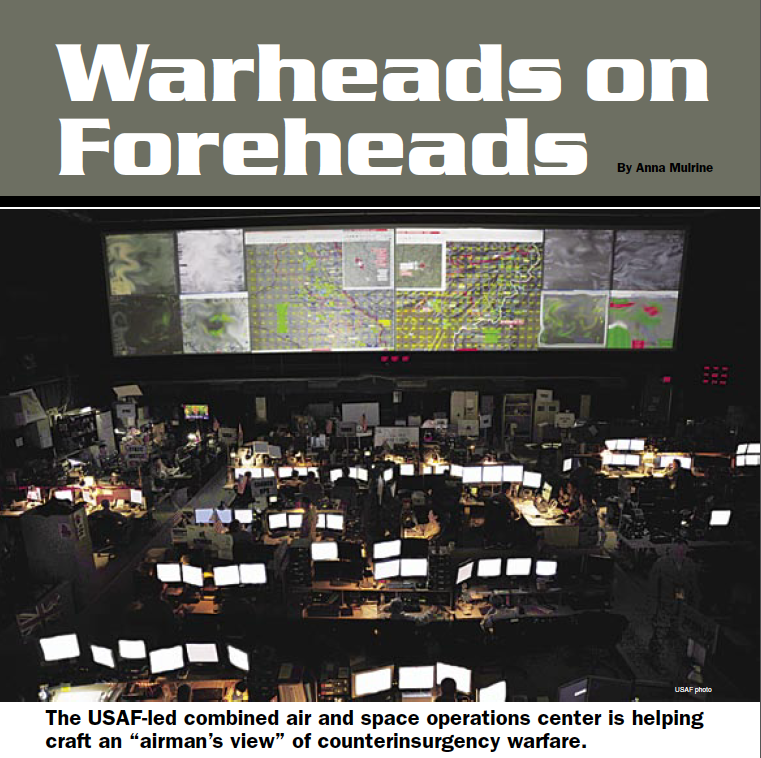
Warheads on foreheads

In a parallel argument, Samuel Issacharoff and Richard Pildes describe this development as the individuation of military force, driven in part by the affordances and dispositions of drone warfare which makes it possible to put ‘warheads on foreheads.’  Targets are no longer whole areas of cities – like Cologne or Hamburg in the Second World War – or extensive target boxes like those ravaged by B-52 ‘Arc Light’ strikes over the rainforest of Vietnam.  The targets are individuals and, since the United States claims the right to target them wherever they are found, this partly explains the dispersed geography of what I’ve called ‘the everywhere war’.   What interests Issacharoff and Pildes, like Kahn, is not so much the technology that makes this possible as the apparatus that makes it permissible.

Their presentation wavers uncertainly between counterinsurgency and counter-terrorism, and they also write more generally of ‘the new face of warfare’ and the use of ‘military force’, so that (as now happens in practice) the distinctions between the US military and the CIA become blurred.  But their core argument is that military force is now directed against specific individuals on the basis of determinate acts that they have committed or, by pre-emptive extension, are likely to commit.  In Kahn’s terms, this inaugurates a radically different (though in his eyes, highly unstable) political subjectivity through which the enemy is transformed into the criminal.  ‘The criminal is always an individual,’ Kahn explains; ‘the enemy is not.’

For Issacharoff and Pildes this new state of affairs requires an ‘adjudicative apparatus’ to positively identify, detect and prosecute the individual-as-target, which drives the military system ever closer to the judicial system:

 ‘As the fundamental transformation in the practice of the uses of military force moves, even implicitly, toward an individuated model of responsibility, military force inevitably begins to look justified in similar terms to the uses of punishment in the criminal justice system. That is, to the extent that someone can be targeted for the use of military force (capture, detention, killing) only because of the precise, specific acts in which he or she as an individual participated, military force now begins to look more and more like an implicit “adjudication” of individual responsibility.’

They suggest that this makes it inevitable that the boundaries between the military system and the judicial system ‘will become more permeable’ – a confirmation of the active constitution of the war/police assemblage (on which see Colleen Bell, Jan Bachmann and Caroline Holmqvist’s forthcoming collection, The New Interventionism: perspectives on war-police assemblages).

Kahn is, I think, much more troubled by this than Issacharoff and Pildes.  He concludes (like Chamayou):

‘Political violence is no longer between states with roughly symmetrical capacities to injure each other; violence no longer occurs on a battlefield between masses of uniformed combatants; and those involved no longer seem morally innocent. The drone is both a symbol and a part of the dynamic destruction of what had been a stable imaginative structure. It captures all of these changes: the engagement occurs in a normalized time and space, the enemy is not a state, the target is not innocent, and there is no reciprocity of risk. We can call this situation ‘war’, but it is no longer clear exactly what that means.

‘The use of drones signals a zone of exception to law that cannot claim the sovereign warrant. It represents statecraft as the administration of death. Neither warfare nor law enforcement, this new form of violence is best thought of as the high-tech form of a regime of disappearance. States have always had reasons to eliminate those who pose a threat. In some cases, the victims doubtlessly got what they deserved. There has always been a fascination with these secret acts of state, but they do not figure in the publicly celebrated narrative of the state. Neither Clausewitz nor Kant, but Machiavelli is our guide in this new war on terror.’

He is thoroughly alarmed at the resuscitation of what he calls ‘the history of administrative death’, whereas Issacharoff and Pildes – ironically, given what I take to be their geopolitical sympathies –treat the institution and development of an ‘adjudicative apparatus’ within the US programme of targeted killings as a vindication of their execution (sic).

I want to set aside other contributions to the emerging discussion over the ‘individuation’ of warfare – like Gabriella Blum‘s depiction of an ‘individual-centred regime’ of military conduct, which pays close attention to its unstable movement between nationalism and cosmopolitanism – in order to raise some questions about the selectivity of ‘individuation’ as a techno-legal process.  I intend that term to connote three things.

Target phase

(1) First, and most obviously, Issacharoff and Pildes fasten on the technical procedures that have been developed to administer targeted killings – which include both the ‘disposition matrix’ [see here] and its derivatives and the more directly instrumental targeting cycle [the diagram above shows the ‘Target’ phase of the Find-Fix-Track-Target-Engage-Assess cycle] , both of which admit legal opinions and formularies – that convert targeted killing into what Adi Ophir calls a quasi-juridical process.  This encoding works to contract the ethical horizon to the legal-juridical (see here for a critical commentary) while simultaneously diverting attention from the substantive practice – which, as I showed in ‘Lines of descent’ (DOWNLOADS tab), is shot through with all sorts of limitations that confound the abstract calculations of the targeting cycle (see, for example, Gregory McNeal here, who turns ‘accountability’ into accountancy).

(2) Second, ‘individuation’ refers to the production of the individual as a technical artefact of targeting.  S/he is someone who is apprehended as a screen image and a network trace;  s/he may be named in the case of a ‘personality strike’ but this serves only as an identifier in a target file, and the victims of ‘signature strikes‘ are not accorded even this limited status.  Others who are killed in the course of the strike almost always remain unidentified by those responsible for their deaths – ‘collateral damage’ whose anonymity confirms on them no individuality but only a collective ascription.  (For more, see Thomas Gregory, ‘Potential lives, impossible deaths: Afghanistan, civilian casualties and the politics of intelligibility’, International Feminist Journal of Politics 14 (3) (2012) 327-47; and ‘Naming names’ here).

(3) Third, the adjudication of ‘individual responsibility’ bears directly on the production of the target but not, so it seems, on the producers of the target.  Lucy Suchmann captures this other side – ‘our’ side – in a forthcoming essay in Mediatropes (‘Situational awareness: deadly bioconvergence at the boundaries of bodies and machines’):

‘A corollary to the configuration of “their” bodies as targets to be killed is the specific way in which “our” bodies are incorporated into war fighting assemblages as operating agents, at the same time that the locus of agency becomes increasingly ambiguous and diffuse. These are twin forms of contemporary bioconvergence, as all bodies are locked together within a wider apparatus characterized by troubling lacunae and unruly contingencies.’

Caroline Holmqvist, sharpens the same point in ‘Undoing war: war ontologies and the materiality of drone warfare’, Millennium (1 May 2013) d.o.i. 10.1177/0305829813483350); so too, and more directly relevant to the operations of a techno-legal process,  does Joseph Pugliese‘s figure of drone crews as ’embodied prostheses of the law of war grafted on to their respective technologies’.

These various contributions identify a dispersion of responsibility across the network in which the drone crews are embedded and through which they are constituted.  The technical division of labour is also a social division of labour – so that no individual bears the burden of killing another individual – but the social division of labour is also a technical division of labour through which ‘agency’ is conferred upon what Pugliese calls its prostheses:

‘Articulated in this blurring of lines of accountability is a complex network of prostheticised and tele-techno mediated relations and relays that can no longer be clearly demarcated along lines of categorical divisibility: such is precisely the logic of the prosthetic. As the military now attempts to grapple with this prostheticised landscape of war, it inevitably turns to technocratic solutions to questions of accountability concerning lethal drone strikes that kill the wrong targets.’

If the mandated technical procedures (1 above) fail to execute a sanctioned target (2 above) and if this triggers an investigation, the typical military response is to assign responsibility to the improper performance of particular individuals (which protects the integrity of the process) and/or to technical malfunctions or inefficiencies in the network and its instruments (which prompts technical improvements).  What this does not do – is deliberately designed not to do – is to probe the structure of this ‘techno-legal economy of war at a distance’ (Pugliese’s phrase) that turns, as I’ve tried to suggest, on a highly particular sense of individuation.  Still less do these inquiries disclose the ways in which, to paraphrase Weizman, ‘drones legislate’ by admitting or enrolling into this techno-legal economy particular subjectivities and forcefully excluding others .

More to come.

***

Note: Here are the citations for Issacharoff and Pildes’ full argument(s); the first is excerpted from the second, which deals with ‘capture’ (detention) as well as killing:

Samuel Issacharoff and Richard Pildes, ‘Drones and the dilemma of modern warfare’, in Peter Bergen and Daniel Rothenberg (eds) Drone wars: the transformation of armed conflict and the promise of law (Cambridge University Press, 2013); available here as NYU School of Law, Public Law & Legal Theory Research Paper Series Working Paper No. 13-34, June 2013

Samuel Ischaroff and Richard Pildes, ‘Targeted warfare: individuating enemy responsibility’, NYU School of Law, Public Law & Legal Theory Working Papers 343 (April 2013); available here.

Theory of the drone 3: Killing grounds

This is the third in a series of posts on Grégoire Chamayou‘s Théorie du drone, in which I provide a detailed summary of his argument, links to some of his key sources, and reflections drawn from my soon-to-be-completed The everywhere war (and I promise to return to it as soon as I’ve finished this marathon).

5: Pattern of life analysis

Chamayou begins with the so-called ‘Terror Tuesdays‘ when President Obama regularly approves the ‘kill list’ (or disposition matrix) that authorises ‘personality strikes’ against named individuals: ‘the drones take care of the rest’.

a0018519784_2

But Chamayou immediately acknowledges that most strikes are ‘signature strikes‘ against individuals whose names are unknown but for whom a ‘pattern of life analysis‘ has supposedly detected persistent anomalies in normal rhythms of activity, which are read as signs (‘signatures’) of imminent threat.  I’ve described this as a militarized rhthmanalysis, even a weaponized time-geography, in ‘From a view to a kill’ (DOWNLOADS tab), and Chamayou also notes the conjunction of human geography and social analysis to produce a forensic mapping whose politico-epistemological status is far from secure.

The principal limitation – and the grave danger – lies in mistaking form for substance.  Image-streams are too imprecise and monotonic to allow for  fine-grained interpretation, Chamayou argues, and supplementing them by equally distant measures, like telephone contacts, often compounds the problem.  Hence Gareth Porter‘s objection, which both Chamayou and I fasten upon:

‘The phone numbers and call histories from those phones go into the database which is used to “map the networks.” But the link analysis methodology employed by intelligence analysis is incapable of qualitative distinctions among relationships depicted on their maps of links among “nodes.” It operates exclusively on quantitative data – in this case, the number of phone calls to or visits made to an existing JPEL target or to other numbers in touch with that target. The inevitable result is that more numbers of phones held by civilian noncombatants show up on the charts of insurgent networks. If the phone records show multiple links to numbers already on the “kill/capture” list, the individual is likely to be added to the list.’

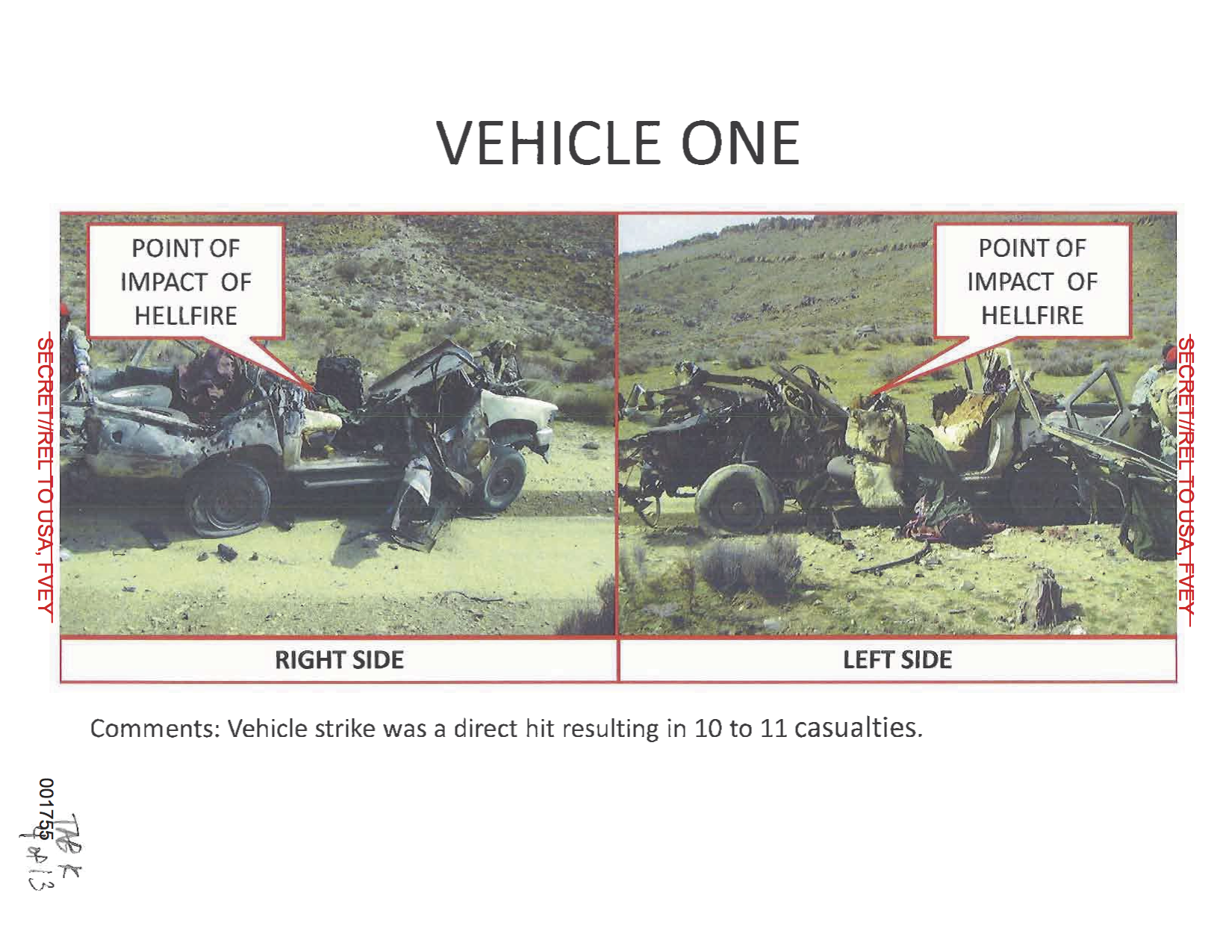
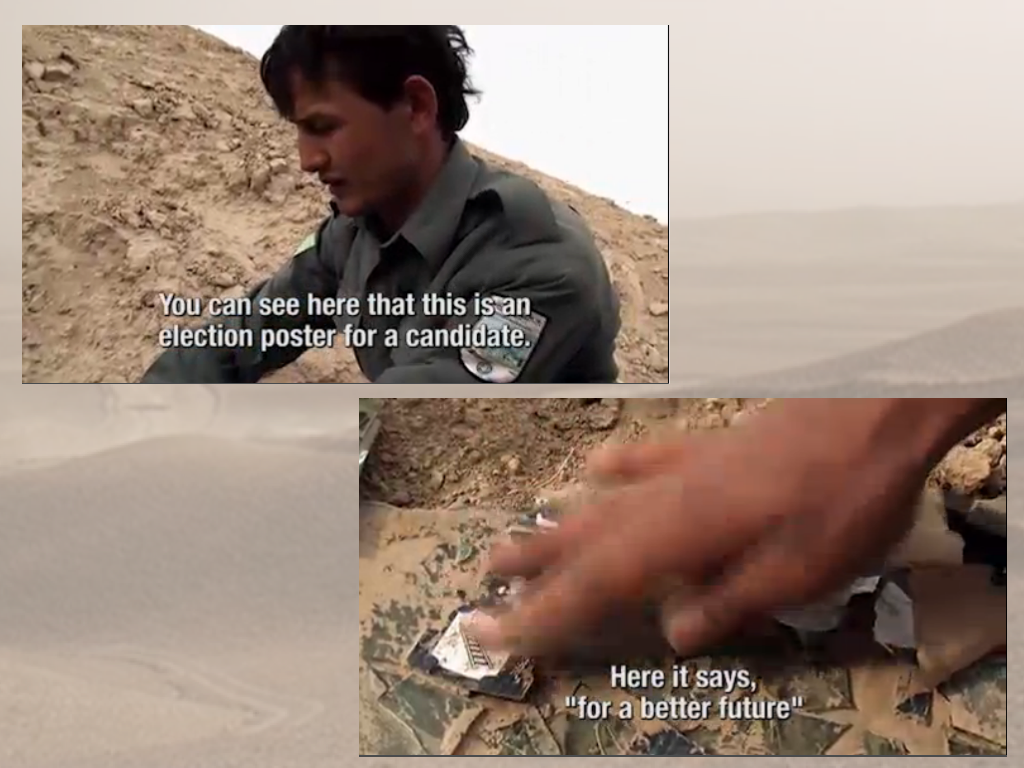
This is exactly what happened in the Takhar attack in Afghanistan on 2 September 2010 that I’ve discussed elsewhere, relying on the fine investigative work of Kate Clark, and Chamayou draws attention to it too.   The general assumption, as Kate was told by one officer, seems to be that ‘”If we decide he’s a bad person, the people with him are also bad.”

Takhar For a better future.001

These necro-methodologies raise two questions that Chamayou doesn’t address here.

The first, as Porter notes, is that ‘guilt by association’ is ‘clearly at odds with the criteria used in [international] humanitarian law to distinguish between combatants and civilians.’  You can find a much more detailed assessment of the legality of signature strikes (and what he calls their ‘evidential adequacy’)  in Kevin Jon Heller‘s fine essay, ”One hell of a killing machine”: Signature strikes and international law’ [Journal of international criminal justice 11 (2013) 89-119; I discussed a pre-publication version here].

The geo-legal ramifications of these attacks reach far beyond the killing grounds.  Earlier this month in the High Court in London one man who lost five relatives in the air strike in Takhar (as you can see on the slide above, on an election convoy) challenged the legality of the alleged involvement of Britain’s Serious and Organised Crimes Agency (SOCA) in drawing up the kill-list, the Joint Prioritized Effects List, used by the military to authorise the attack: more herehere and here. (It was the presence of names on the list that triggered the faulty network analysis).

The second is the imaginary conjured up by the very idea of a ‘pattern of life’ analysis.  I’ve written before about the way in which the screen on which the full-motion video feeds from the Predators and Reapers are displayed interpellates those who watch what is happening on the ground from thousands of miles away, and I’ve emphasised that this isn’t a purely optical affair:  that it is an embodied, techno-culturally mediated process that involves a series of structured dispositions to view the other as Other (and often dangerous Other).   But these dispositions also reside in what we might think of as a grammar of execution.  To see what I mean, here is Micah Zenko:

‘Recently, I spoke to a military official with extensive and wide-ranging experience in the special operations world, and who has had direct exposure to the targeted killing program. To emphasize how easy targeted killings by special operations forces or drones has become, this official flicked his hand back over and over, stating: “It really is like swatting flies. We can do it forever easily and you feel nothing. But how often do you really think about killing a fly?”’

Hence, of course, ‘Bugsplat’ [according to Rolling Stone, ‘the military slang for a man killed by a drone strike is “bug splat,” since viewing the body through a grainy-green video image gives the sense of an insect being crushed’], and a host of other predatory terms (see also here) that distinguish between this mere (bare) life and what Judith Butler calls ‘a life that qualifies for recognition’.

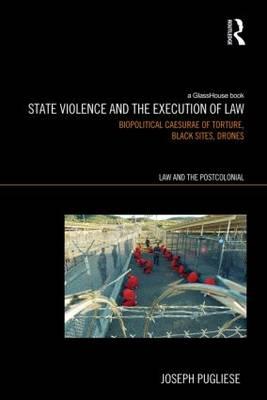
state-violence-and-the-execution-of-lawBut the same result is achieved through the nominally neutral, technical-scientific vocabulary deployed in these strikes. Joseph Pugliese captures the grammar of execution with acute insight in another fine essay, ‘Prosthetics of law and the anomic violence of drones’, [Griffith Law Review 20 (4) (2011) 931-961; you can also find it in his excellent new book State violence and the execution of law]:

‘The term ‘heat signature’ works to reduce the targeted human body to an anonymous heat-emitting entity that merely radiates signs of life. This clinical process of reducing human subjects to purely biological categories of radiant life is further elaborated by the US military’s use of the term ‘pattern of life’…

‘The military term ‘pattern of life’ is inscribed with two intertwined systems of scientific conceptuality: algorithmic and biological. The human subject detected by drone’s surveillance cameras is, in the first scientific schema, transmuted algorithmically into a patterned sequence of numerals: the digital code of ones and zeros. Converted into digital data coded as a ‘pattern of life’, the targeted human subject is reduced to an anonymous simulacrum that flickers across the screen and that can effectively be liquidated into a ‘pattern of death’ with the swivel of a joystick. Viewed through the scientific gaze of clinical biology, ‘pattern of life’ connects the drone’s scanning technologies to the discourse of an instrumentalist science, its constitutive gaze of objectifying detachment and its production of exterminatory violence. Patterns of life are what are discovered and analysed in the Petri dish of the laboratory…

‘Analogically, the human subjects targeted as suspect yet anonymous ‘patterns of life’ by the drones become equivalent to forms of pathogenic life. The operators of the drones’ exterminatory attacks must, in effect, be seen to conduct a type of scientific ethnic cleansing of pathogenic ‘life forms’. In the words of one US military officer: “Our major role is to sanitize the battlefield.”’

Later modern war more generally works through relays of biological-medical metaphors – equally obviously in counterinsurgency, as I’ve described in “Seeing Red” and other essays (DOWNLOADS tab), where the collective enemy becomes a ‘cancer’ that can only be removed by a therapeutic ‘killing to make live’ (including ‘surgical strikes’) – and Colleen Bell has provided an illuminating series of reflections in ‘Hybrid warfare and its metaphors’ [in Humanity 3 (2) (2012) 225-247] and ‘War and the allegory of medical intervention’ [International Political Sociology 6 (3) (2012) 325-8].

This immunitary logic is clearly bio-political, and its speech-acts just as plainly performative, and Pugliese draws the vital conclusion:

‘As mere patterns of pathogenic life, these targeted human subjects effectively are reduced to what Giorgio Agamben would term ‘a kind of absolute biopolitical substance’ that can killed with no concern about the possibility of juridical accountability: they are ‘bare life’ that can be killed with absolute impunity. Anonymous ‘patterns of life’ signify in contradistinction to legally named persons; they exemplify the ‘ontological hygiene’ legislated by US government policy in order to secure the reproduction of the ‘principle of scarcity with respect to agency and personhood’.

‘Situated in this Agambenian context of the extermination of human life with absolute impunity, the Predator drones must be seen as instantiating mobile ‘zones of exception’…’

Which artfully brings me to Chamayou’s next chapter…

6: Kill-box

Chamayou notes that the ‘war on terror’ loosed the dogs of war from their traditional boundaries in time and in space: at once ‘permanent war’ and, as he notes, ‘everywhere war’.

But for Chamayou it is more accurate to speak of the world turned into a ‘hunting ground’ rather than a battlefield, and this matters because two different geographies (his term) are involved.  War is defined by combat, he explains, hunting by pursuit.  Combat happens where opposing forces engage, but hunting tracks the prey, so that the place of military violence is no longer defined by a delimited space (‘the battlefield’) but by the presence of the enemy-prey who carries with him, as it were, his own mobile halo of a zone of personal hostilities.

To escape, the quarry must make itself undetectable or inaccessible – and the ability to do so depends not only on physical geography (terrain) but also on political and legal geography.  For this reason, Chamayou argues, the US has rendered contingent the sovereignty of Pakistan because it (for the most part unwillingly) provides sanctuary to those fleeing across the border from Afghanistan.  In such circumstances, what becomes crucial for the hunter is not the military occupation of territory but the ability to control trans-border spaces from a distance through the instantiation of what Eyal Weizman called the politics of verticality that has since captured the attention of Stuart Elden [“Secure the volume: vertical geopolitics and the depth of power”, Political Geography 34 (2013) 35-51], Steve Graham [“Vertical geopolitics: Baghdad and after”, Antipode 36 (1) (2004) 12-23] and others.  For this to work, as Weizman shows in the case of occupied Palestine, air power is indispensable.

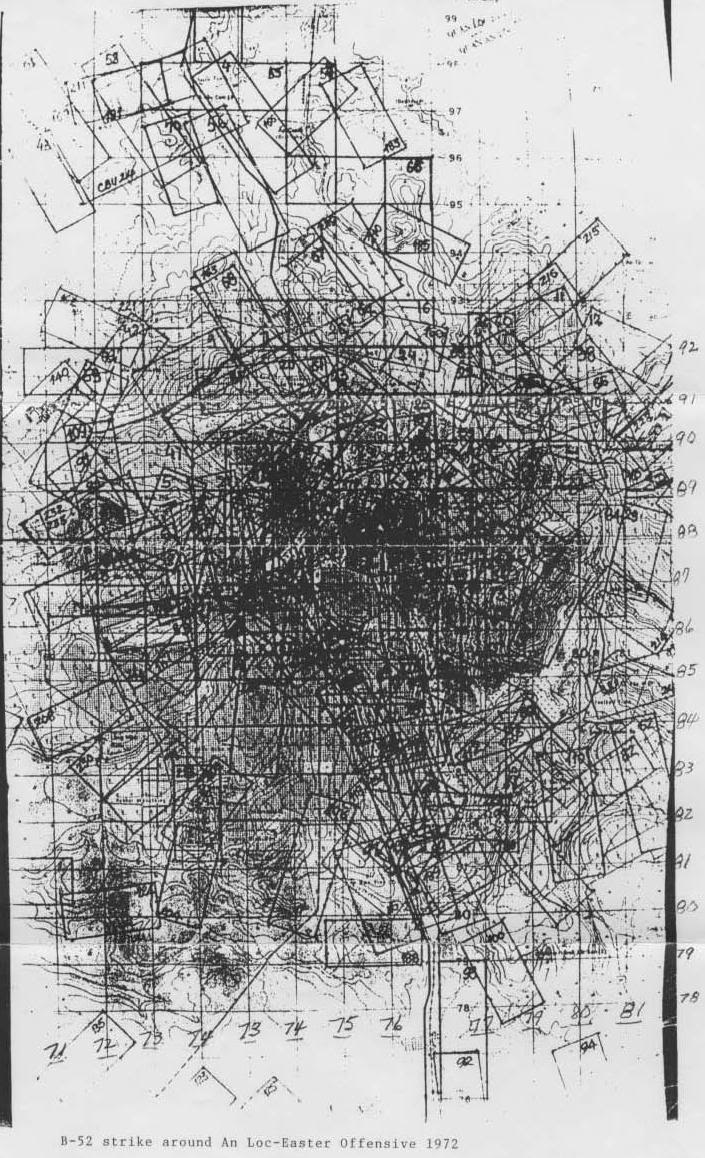
Chamayou suggests that the US has refined this capacity – in effect, finely calibrated the time and space of the hunt – through the concept of the kill-box.  I’m not so sure about this; the lineage of the ‘kill-box’ goes back to the USAF’s ‘target boxes’ [target boxes around An Loc in Vietnam in 1972 are shown below] – and two or three specified ‘boxes’ or ‘Restricted Operating Zones‘ were used to define the Predato’s’  ‘hunting grounds’ over North and South Waziristan that were tacitly endorsed by the Pakistan state.

Target boxes around An Loc 1972

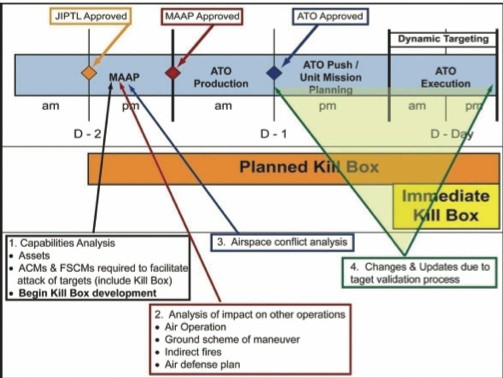
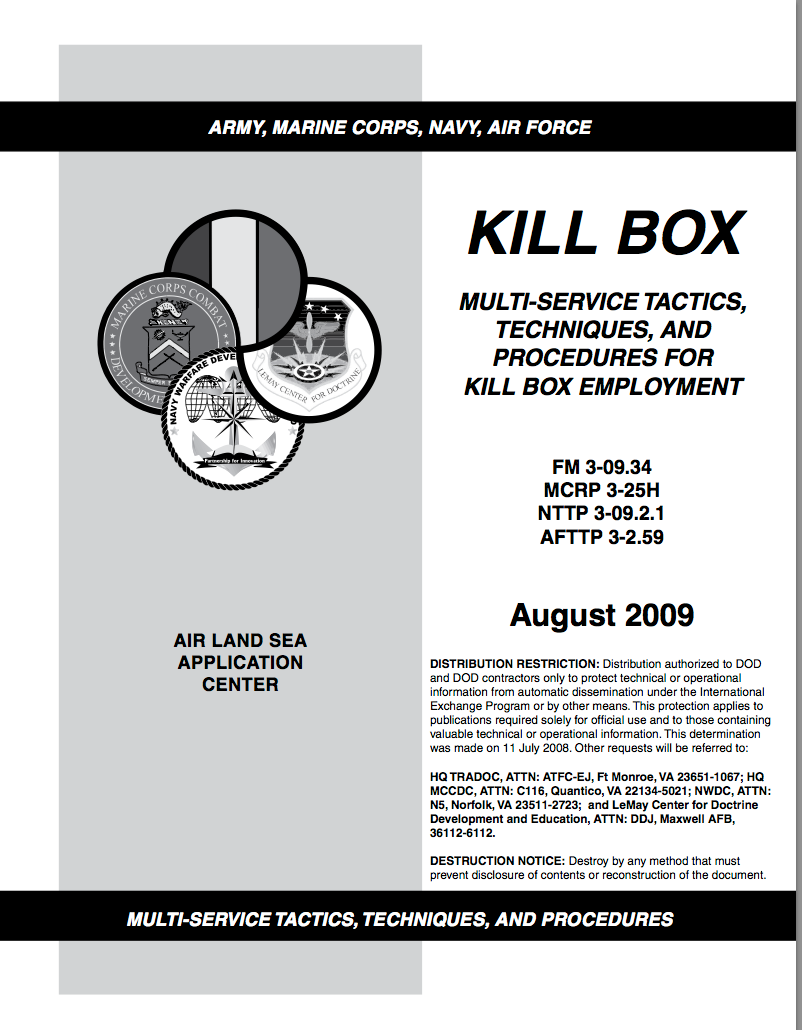
The concept of the ‘kill box’ was formalised as a joint operations doctrine in the 1990s as part of the established targeting cycle: what Henry Nash famously described in another context as ‘the bureaucratization of homicide’.  Nash worked for the USAF Air Targets Division in the 1950s and 60s, identifying targets in the USSR for nuclear attack by US Strategic Air Command, but I doubt that Chamayou would dissent from using either the verb or the noun to describe the contemporary, non-nuclear kill-chain.  (In a later post I’ll explain how this technical division of labour feeds in to what Chamayou castigates as a ‘setting aside’, a dispersal of responsibility, which functions to separate an action from its consequences: this is aggravated by the remote-split operations in which drones are embedded, and is central to Chamayou’s critique).  Here is how the relevant military manuals incorporated the development of the kill box into the targeting cycle in 2009 (ATO = Air Tasking Order):

Kill Box Development

You can find more on kill-boxes and their operationalisation here.

Kill Box TTP

Chamayou doesn’t track the development of the concept, but since then the ‘kill-box’ has been supplanted or at least supplemented by the ‘Joint Fires Area’ as a way of continuing to co-ordinate the deployment of lethal force and allowing targets to be engaged without additional communication.  Within the grid of the JFA (shown below, taken from an essay by Major James Mullin on ‘redefining the kill box’) permission to fire in specified cells is established in advance; areas are defined, targeting intervals stipulated, and the time-space cells can be opened and closed as operations proceed.

It is this capacity that Chamayou seizes upon: within the kill box targets can be engaged at will, so that the kill box, he writes, ‘is an autonomous zone of temporary killing’ (cf. the ‘free fire/specified fires zone’ in Vietnam: see my discussion of Fred Kaplan‘s recent essay, ‘The world as a free-fire zone‘).

3-D representation of Joint Fires Area using Global Area Reference System

Chamayou implies that the schema has been further refined in contemporary counterinsurgency and counter-terrorism operations: the fact that the kill-box and its successor allow for dynamic targeting across a series of scales is crucial, he says, because its improvisational, temporary nature permits targeting to be extended beyond a declared zone of conflict. The scale of the JFA telescopes down from the cell shown on the right of the figure below through the quadrant in the centre to the micro-scale ‘keypad’ (sic) on the right.

Global Area Reference System

This is more than a grid, though; the JFA is, in effect, a performative space that authorises, schedules and triggers lethal action.  Chamayou: ‘Temporary micro-cubes of lethal exception can be opened anywhere in the world, according to the contingencies of the moment, once an individual who qualifies as a legitimate target has been located.’  Thus, even as the target becomes ever more individuated – so precisely specified that air strikes no longer take the form of the area bombing of cities in World War II  or the carpet bombing of the rainforest of Vietnam – the hunting ground becomes, by virtue of the nature of the pursuit and the remote technology that activates the strike, global.

KAPLAN World as Free-Fire Zone

The system I’ve described here is one adopted by the US military, and how far its procedures are used by other agencies outside established conflict zones is unknown to me and doubtless to Chamayou too.  Are these micro-cells used to specify individual compounds or rooms, as Chamayou suggests in a thought-experiment?  For him, however, it’s the imperative logic that matters, and here Kaplan’s tag-line (above) can provide the key explanatory exhibit: ‘to kill a particular person anywhere on the planet.’   The doubled process of time-space calibration and individuation is what allows late modern war to become the everywhere (but, contra Kaplan,  not the anywhere, because specified) war.

On the one side, then, a principle of what Chamayou calls precision or specification:  ‘The zone of armed conflict, fragmented into micro-scale kill boxes, reduces itself in the ideal-typical case to the single body of the enemy-prey: the body as the field of battle.’  Yet on the other side, a principle of globalisation or homogenisation: ‘Because we can target our quarry with precision, the military and the CIA say in effect, we can strike them wherever we see fit, even outside a war zone.’

This paradoxical articulation has sparked fierce debates among legal scholars – Chamayou cites Kenneth Anderson, Michael Lewis, and Mary Ellen O’Connell – over whether the ‘zone of armed conflict’ should be geo-centred (as in the conventional battlefield) or target-centred (‘attached to the body of the enemy-prey’). Jurists are thus in the front line of the battle over the extension of the hunting ground, he writes, and ‘applied ontology’ is the ground on which they fight.  I’ll have more to say about this on my own account in a later post.

Theory of the drone 2: Hunting

This is the second in a series of posts on Grégoire Chamayou‘s Théorie du drone.

3: Theoretical principles of man-hunting

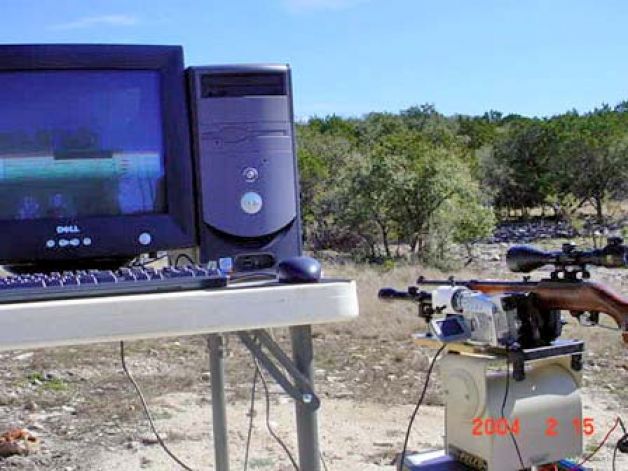
Chamayou opens his discussion with a revealing vignette.  In 2005 Texas entrepreneur John Lockwood developed a website, Live-shot.com, which promised a ‘real-time on-line hunting and shooting experience’.  The cyber-hunter was after deer and other game kept for the purpose on a 300-acre ranch near San Antonio.

LiveShot

You might think that a more relevant example would be Wafaa Bilal’s Domestic Tension described in his Shoot an Iraqi: art, life and resistance under the gun:

‘For one month, Bilal lived alone in a prison cell-sized room in the line of fire of a remote-controlled paintball gun and a camera that connected him to internet viewers around the world. Visitors to the gallery and a virtual audience that grew by the thousands could shoot at him 24 hours a day.’

Wafaa Bilal, Domestic Tension

There is a wonderful discussion of the project and its wider implications for experimental geopolitics by Alan Ingram [‘Experimental geopolitics: Wafaa Bilal’s Domestic Tension‘] in the Geographical Journal 1788 (2) (2012) 123-133.  He explains that Bilal conceived Domestic Tension as a commentary on ‘remote control warfare’ after his brother had been killed in a strike by a US helicopter gunship called in by commanders watching a video feed from a Predator in the skies over Kufa.

But Lockwood’s venture is even more revealing, particularly when juxtaposed with Domestic Tension, because it involved real-time killing (of captive deer, antelope and other animals) and after a public outcry it was eventually banned.  A full report from the Washington Post is here. Even the National Rifle Association was up in – er – arms: its spokesperson declared,  ‘We believe that hunting should be outdoors and that sitting in front of a computer three states away doesn’t qualify as hunting.’  Chamayou’s translation of one police officer’s condemnation – “It’s not hunting.  It’s killing’ – becomes ‘It’s not hunting.  It’s murder’, which artfully raises the stakes, but you get the point, which is about the hue and cry that attended killing animals on line while ‘man-hunting by remote control’ attracted considerably less public attention: then, anyway.

Live Shot

To be fair, there were critics like Dale Jamieson who saw Live Shot as symptomatic of a wider issue:

“If you look at this as being kind of a continuum or slippery slope,” said Jamieson, “you have people who enjoy the act of killing and destruction in video games, you have people who enjoy killing animals over the Internet…. But of course the next step in this is that people start killing people over the Internet. That’s the worry.”

California state Senator Debra Brown was equally forthright in her condemnation:

“What happens if this technology gets expanded to other uses?” she said. “It’s actually pretty scary. What’s the line between real life and a video game? It has all the video game feel: It’s remote, it’s disconnected from the reality of it, the hunter doesn’t have to deal with any blood or wounding or tracking.”

Chamayou doesn’t track these responses, which surely sharpen his point, but he doesn’t really need to: I haven’t been able to find any critics who drew attention to the remote killings of people that were already taking place under the unblinking eye of US Predators in Pakistan and Yemen. (Incidentally, this chapter is illustrated by an image of a Predator firing a Hellfire missile; the photograph is all over the web – for example here – but, as James Bridle has shown, this now canonical image is in fact a Photo-shopped fake, ‘a computer-generated rendering of a drone … flying over an abstracted landscape’).

For Chamayou those targeted killings are the effects of an apparatus that he describes as militarized man-hunting.  He invokes George W. Bush’s line (in a speech at the FBI in February 2003) about the ‘war on terror’ being a ‘different kind of war’ that ‘requires us to be on an international manhunt’ to argue that that within a decade what seemed to most commentators at the time to be just a folksy Texan cowboy phrase had been converted into a state doctrine of non-conventional violence that combines elements of military and police operations  without fully corresponding to either.

He suggests that US Secretary of Defense Donald Rumsfeld was already playing with the possibilities of what Eyal Weizman has called thanatotactics. Rumsfeld was convinced that ‘Israeli techniques for dealing with Palestinian resistance could be simply scaled up.’  If the IDF had turned Gaza into a laboratory for targeted killing from the air, however, how could this be done by the Pentagon on the global scale?  And – for some Pentagon insiders at least – how could this be done without having a new Phoenix program rise from the flames of what one adviser was already calling ‘preventive manhunting’?

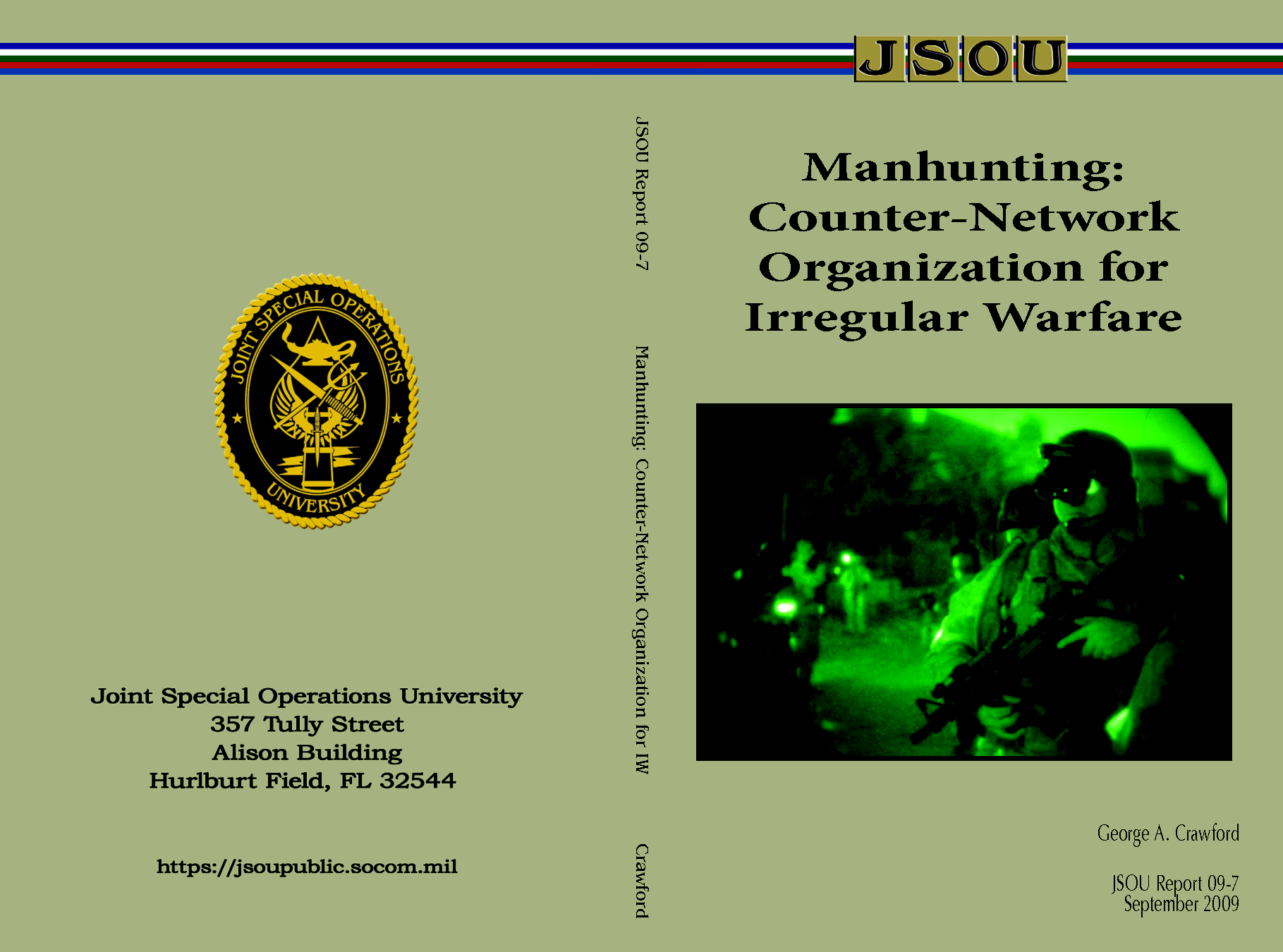
CRAWFORD ManhuntingThis is where those ‘theoretical principles’ start to emerge.  Some of the most difficult issues concern the provision of a legal armature, as I’ll discuss in a later post (and it is these that interest me the most), but what Chamayou has more directly in mind here is the formulation of a military (rather than policing: the difference, as we’ll see, is crucial) doctrine to guide these operations.  He suggests that its most developed form drew upon the work of a private-sector consultant, George Crawford, who published Manhunting: reversing the polarity of warfare in 2008 and a subsequent report for the Joint Special Operations University, Manhunting: counter-network organization for irregular warfare  in 2009.

CRAWFORD Manhunting 2

Crawford’s report included a ‘chronology of American manhunting operations’, and out of that remarkably long history Chamayou fastens on the Pancho Villa Expedition in 1916.  This was a massive (and spectacularly unsuccessful) ground operation across the US/Mexico border, in which thousands of US troops under the command of General Pershing penetrated deep into Mexico in an effort to capture the Mexican revolutionary leader Pancho Villa (who had conducted a series of cross-border raids into New Mexico).

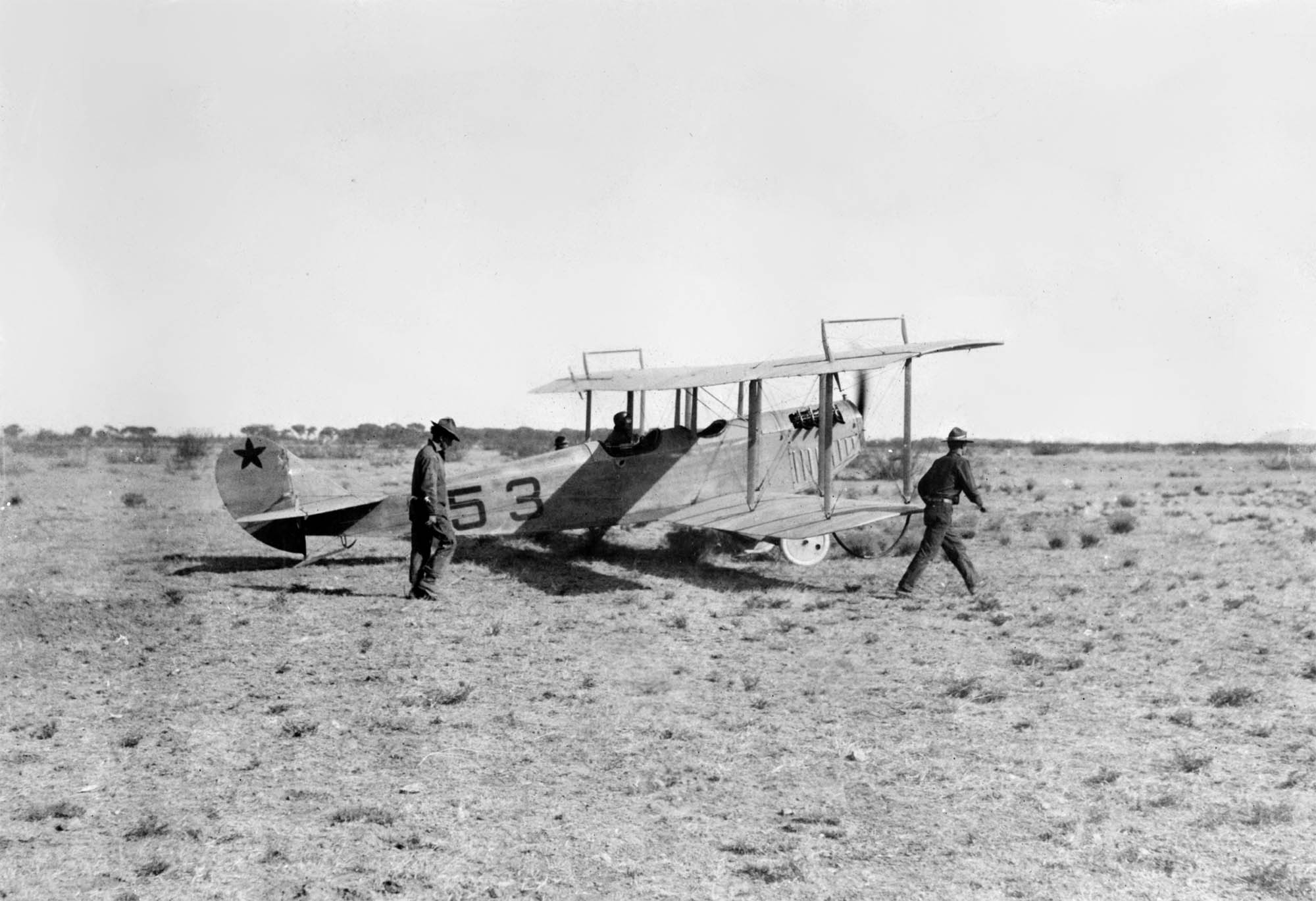
Chamayou doesn’t mention it, perhaps because it would complicate the clean lines of his narrative, but the expedition included air support from the eight planes of the 1st Aero Squadron (below) in what was to become ‘the first combat engagement of American Army pilots and airplanes’ (more here and here).  Their principal function, as with the use of military aircraft on the Western Front, was reconnaissance, but if this was a distant forerunner of US aerial surveillance of the southern border it was a dismal failure.  According to Pershing:

“[T]he aeroplanes have been of no material benefit so far, either in scouting or as a means of communication.  They have not at all met my expectations.  The further south Villa goes into the mountains the more difficult will be their tasks, and I have no doubt we shall soon be compelled to abandon them for either scouting the enemy or keeping in touch with the advance columns.”

HighFlight-1stAeroSqn9-1

But the entire expedition was a failure, and the crucial lesson, spelled out by Crawford and repeated by Chamayou, was the imperative to reverse the polarity: instead of deploying large numbers of ‘boots on the ground’ – what Crawford ridiculed as using an elephant gun to swat ‘the terrorist mosquito’ – operations against non-state actors should be conducted by small teams networked into a targeted killing operation.  This changes the terms of war not so much because the conflict is asymmetric, or even because it’s not about territorial gain, but rather because war is transformed from the classical paradigm of a duel into something quite other: ‘a hunter who advances, and a prey who flees or hides’.

The (tactical) rules of the game are quite different; the hunter must engage to win, while the fugitive must evade to win.  Crawford:

Firepower becomes less significant in terms of mass, while the precision and discretion with which firepower is employed takes on tremendous significance, especially during influence operations. Why drop a bomb when effects operations or a knife might do? Maneuver adopts new concept and form. In manhunting, friendly forces seek to engage the enemy. Like a lone insurgent, the enemy seeks to avoid the allied force, biding time until he has an opportunity to strike at vulnerable, unprotected, or noncombat assets.

The first task is thus not to immobilise but to identify and locate the enemy, which implies an apparatus of detection.  ‘Man-hunting’ thus becomes, in Crawford’s eyes at any rate, an intelligence-based operation directed towards identifying pivotal nodes (which is to say key leaders or ‘High Value Targets’) in the virtual and physical spaces of social networks.  Here Chamayou cites John Dodson‘s attempt – one of countless others – to provide a statistical methodology for ‘man-hunting’:

‘Nexus Topography is an extension of the common practice of Social Network Analysis (SNA) used to develop profiles of [High Value Targets]. Currently, SNA examines the links in a social group, whereas, Nexus Topography is a template that can be used to construct a map of relationships in different social environments. Nexus Topography maps social forums or environments, which bind individuals together (this can be extended to include Dark Networks and Small Worlds).

Network analysis, in multiple forms, is a staple of geo-spatial intelligence and contemporary counterinsurgency and counter-terrorism.  But how far Crawford’s specific proposals directly informed US military operations is another question, and one Chamayou doesn’t address.  I suspect their influence was at best indirect.  Even so, pursuing their logic enables Chamayou to conclude that militarized man-hunting is not about responding to specific attacks but instead providing ‘pre-emptive security’ against emergent threats.  On this new terrain ‘war’ becomes a vast campaign of extra-judicial killing, for which (as he says) the ‘Predator’ and the ‘Reaper’ live up to their names.  Hence the next chapter,which traces the next set of principles:

4: Surveillance and annihilation

FOUCAULT Surveillir et punirThe English translation doesn’t capture Chamayou’s substitution, which is a play on the French title of Michel Foucault‘s Discipline and punish: Surveillir et punir.

The reference to Foucault is entirely apposite.  Chamayou’s central point here is that, within the apparatus of militarized man-hunting, ‘detection’ is above all a visual modality (and much of Foucault’s work involved a sustained interrogation of the gaze). Chamayou argues that drones promise something like a ‘God’s eye view’; their protagonists claim that their near real-time, full-motion and increasingly high-definition video feeds have revolutionised the capacity to provide a constant view of the enemy.

This is all familiar ground, to me at any rate, and in this chapter Chamayou draws on my own work (and others’) to tease out six core principles.  I discuss all of them in ‘From a view to a kill’ and ‘Lines of descent’ [DOWNLOADS tab], so here I will simply list them in summary form:

1: Persistent stare or permanent watch – Predators and Reapers have long ‘dwell-times’ and in principle permit protracted surveillance;

2: Totalisation of perspectives or synoptic view – ‘wide-area surveillance’  promises to be able to ‘quilt’ multiple images together;

3: Complete archive – the question of data retrieval and analysis is immensely difficult, which is why the US Air Force has consistently worried about ‘swimming in sensors, drowning in data’, and why specialist image analysts have experimented with TV/video archival and retrieval techniques;

4: Data fusion from multiple sensors;

5: ‘Pattern of life’ analysis;

6: Detection of anomalies and pre-emption.

The classical names given to these new political technologies of vision – like Gorgon Stare and Argus (in Greek mythology the hundred-eyed giant, which in DARPA-speak becomes Autonomous Real-time Ground Ubiquitous Surveillance) – confirm the premium placed on visibility or even hypervisibility.

Gorgon Stare

But Chamayou argues that this political technology is far more ‘economical’ than Bentham’s Panopticon, which Foucault uses so powerfully to figure modern surveillance, because it requires neither spatial partitions nor architectural demarcations. It is what Zygmunt Bauman might call a ‘liquid’ technology, since it needs only airspace to function (though the current interest in A2/AD (‘anti-access/areal denial’) is a sharp reminder that at present – and even for the foreseeable future – Predators and Reapers can only hunt in uncontested air space).

And even more unlike the Panopticon, this political technology is not directed towards enclosure or confinement.  Just as the Gorgon’s stare petrified its enemies to death, turning them into stone, so this too is a deadly gaze. Video feeds trigger missile launches: ‘No longer surveillir et punir but surveiller et anéantir’ (annihilation) (p. 67).

(Incidentally, how far the US will continue to fund some of these systems is unclear: recent reports suggest that the Pentagon is scaling back its funding for the Gorgon Stare, but the Air Force is still promoting the ARGUS-IS as its next-generation sensor technology).

Living Under DronesThe shadows cast by these capacities are far longer than the supposedly ‘precision strikes’ they facilitate: they impose a new landscape of threat and dread. Here Chamayou invokes the Stanford/NYU report Living under drones (2012) to conclude that the presence of Predators and Reapers terrifies whole populations who live under them (see also my commentary here).  Above and beyond the deaths and physical injuries they inflict, and the rubble, the rage and the bereavements they produce, Chamayou concludes that drones also produce ‘a psychic enclosure whose boundaries are no longer defined by bars, barriers or walls but by the invisible circles described overhead by the ceaseless gyrations of these flying sentinels’ (literally, ‘watch-towers’).

As Chamayou’s patient excavation of these various principles proceeds, it becomes clear that the ‘doctrine’ that is coming in to view is much more than doctrine as the military understands the term.  For the Pentagon, doctrine consists of those ‘fundamental principles by which the military forces or elements thereof guide their actions in support of national objectives. It is authoritative but requires judgment in application.’  The appeal to its authoritative status is significant, of course, and speaks directly to (or rather from) from the military chain of command.

CHAMAYOU ManhuntsBut what Chamayou is after in what elsewhere he calls ‘the manhunt doctrine‘ is something that transcends the military (this form of ‘man-hunting’ deliberately blurs the distinctions between conventional military and police operations to produce what Chamayou calls ‘hybrid operations, monstrous offspring [enfants terribles] of the police and the military, of war and peace’) and seeks to expose the political technologies, the discursive systems and the scopic regimes from which it derives its wider authority and through which it exercises its powers.

In doing so it follows directly from his previous work, Les chasses à l’homme (in English, Manhunts), which promises a philosophical history – or, as I said in my previous post, a genealogy.  But Théorie du drone is more than the next chapter, because it has much to say about the transformation of ‘techno-war’ into something radically different, a modality of later modern war that is focused more than ever on the identification, pursuit and elimination of individuals.

To be continued.

Drones and civilian casualties in Afghanistan

I’ve been urging for some time now that the debate over drone strikes must not neglect what has been happening in Afghanistan: hence “From a view to a kill” (DOWNLOADS tab) and the much longer version to appear in The everywhere war.  According to a report on the Guardian website posted late on Tuesday by the resourceful Spencer Ackerman, ex-Danger Room (now sadly itself an ex-site), ‘A study conducted by a US military adviser has found that drone strikes in Afghanistan during a year of the protracted conflict caused 10 times more civilian casualties than strikes by manned fighter aircraft.’  The period under analysis (from mid-2010 to mid-2011) followed a series of measures announced by General Stanley McChrystal to reduce civilian casualties from air operations, and coincided with a dramatic increase in the number of drone strikes (which continued to increase through 2012).

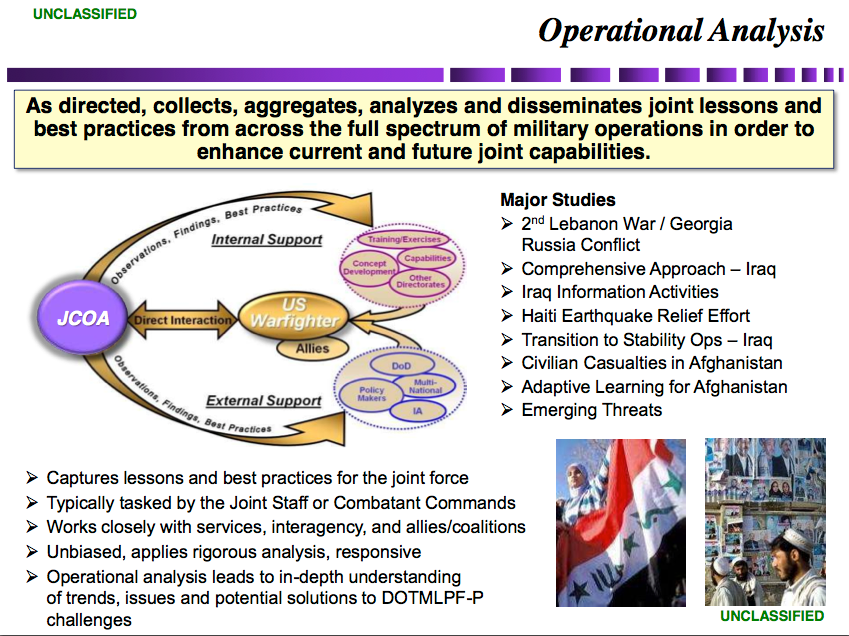
The study in question was carried out by Larry Lewis for the Joint Coalition and Operational Analysis (JCOA), a division of the Joint Staff J7 whose work is summarised in the following slide (which comes not from Edward Snowden‘s cache but from here):

JCOA

Notice ‘Civilian casualties in Afghanistan’ is #6 on the list of major studies.  The completed study is called Drone Strikes: Civilian Casualty Considerations and, apart from the Executive Summary that was published on 18 June, remains classified.  The opening paragraph is the primary source for Spencer’s story, and here it is:

‘The US government has described drone airstrikes in operations outside declared theaters of armed conflict as surgical and causing minimal civilian casualties. Analysis of air operations in Afghanistan, combined with a review of open-source reports for drone strikes in Pakistan, suggest that these fell short of intended goals. Specifically, drone strikes in Afghanistan were seen to have close to the same number of civilian casualties per incident as manned aircraft, and were an order of magnitude more likely to result in civilian casualties per engagement. Specific causal factors were identified that contributed to the relative propensity of drones to cause civilian casualties. Tailored training that addresses these causal factors could aid in reducing civilian casualties in engagements involving drones. While processes and operating forces in Afghanistan can differ from those in operations outside declared theaters of armed conflict, the factors above suggest that a dedicated analysis of civilian casualties in such operations would be worthwhile.’

The key sentence is in bold, and a version of it reappears in an essay, ‘Changing of the Guard: civilian protection for an evolving military’, that Lewis wrote with Sarah Holewinski, Executive Director of the Center for Civilians in Conflict and which appears in the latest issue of PRISM 4 (2) (2013), a journal of the Center for Complex Operations at the National Defense University (the press release from Civilians in Conflict is here).  The authors’ central concern is that ‘as Washington shifts its focus from counter-insurgency to counterterrorism, and from large-scale ground operations to more discrete and oftentimes-unmanned operations, the progress U.S. forces have made on preventing and mitigating civilian harm may soon be lost.’

They consider the risks attendant upon the increased reliance on Special Operations Forces – something that readers of Jeremy Scahill‘s Dirty Wars will need no warning of –  but also those that are likely to flow from an increased use of Unmanned Aerial Systems (UAS):

‘America’s use of force will increasing rely on new technologies, including air force capabilities to penetrate enemy defenses and strike over long distances. Unmanned Aerial Systems, sometimes referred to as “drones,” saw major use in Iraq and Afghanistan, and are slated for a big leap in funding. The Pentagon called for a nearly one-third increase in its fleet in the years ahead.

‘The use of UAS can have military advantages for avoiding civilian casualties in armed conflict, if used with that intent in mind. Their systems feature precision weapons, their sensors have increasingly high-resolution imagery to assess the ground situation, and back in the control room, trained imagery analysts scrutinize a target area prior to engaging, which isn’t always possible in a full ground operation.’

They list a series of familiar objections to the use of these remote platforms in areas outside ‘traditional combat theaters’, but they are also critical of  claims about their forensic capacity inside war-zones:

‘The assumption that UAS strikes are surgical in nature is … belied by research on recent combat operations in Afghanistan. There, UAS operations were statistically more likely to cause civilian casualties than were operations conducted by manned air platforms. One reason was limited training for UAS operators and analysts in how to minimize civilian harm. adding or improving training on civilian casualty prevention is a resource decision in direct tension with the increasing demand for more uaS and more operations, since additional training on civilian protection means time must be taken from somewhere else including the mission itself.’

They don’t say much about the reasons for this, except that they then criticise the ‘clandestine use of UAS by the US government’ because it raises ‘significant concerns that civilian casualties will not be properly monitored or investigated and thus called into question’ and then, several paragraphs later, they note that non-covert operations in Afghanistan ‘are replete with examples where all the engaged individuals were believed to be combatants, but a later investigation found many or all were civilians misidentified as combatants.’

Attachment TAB A (Part 22 of 28) FOIA 10-0218 Uruzgan - Pages 1751-1800 (dragged) 1

A key issue, then appears to be misidentification, and in my examination of one hideous incident in Uruzgan province in Afghanistan in February 2010 (in “From a view to a kill”; see also the image above) – an analysis I develop in my more detail in The everywhere war – I suggested that the high-resolution video feeds from these remote platforms engender an intimacy with ground troops that belies the physical remoteness of the drone operators.  They routinely claim to be not 7,500 miles from the battlespace but just 18 inches – the distance from eye to screen – and this immersive capacity (which these feeds do indeed share with videogames) predisposes them to view virtually every proximate Afghan action as hostile:

‘… the greater incidence of civilian casualties when close air support is provided to ‘troops in contact’ may result not only from time-critical targeting and its correspondingly ‘fewer checks to determine if there is a civilian presence’ … but also from the persistent presence of the [UAS] and its video feeds immersing its remote operators in, and to some substantial degree rendering them responsible for the evolving situation on the ground. This predicament, in which proximity not distance becomes the problem, cannot be resolved by tinkering with the Rules of Engagement; high-resolution imagery is not a uniquely technical capacity but part of a techno-cultural system that renders ‘our’ space familiar even in ‘their’ space – which remains obdurately Other.’

I don’t know if this forms part of the classified report, of course, but in an earlier report, Reducing and mitigating civilian casualties: enduring lessons (dated April 2013) Lewis emphasised the importance of using ‘discrimination tools’ in ‘situations where forces need to discern whether an individual is demonstrating hostile intent’ – but what he seemed to have in mind was another technological fix, ‘higher-resolution imagery or night vision devices’, whereas the root of the problem may well not be the power to see but the capacity to make sense of what is seen.

In any event two other questions remain.

First, during the period under analysis drone strikes accounted for around 5 – 6 per cent of total weapon releases by all aircraft in Afghanistan, but many of the conventional strikes nevertheless relied on persistent surveillance of targets from Predators or Reapers and then attacks by helicopters or fighter-bombers (which was the case in the Uruzgan attack).  Does Lewis’s statistical analysis shed any light on the difference (I assume there is one) between a UAS acting as a ‘hunter-killer’ and a UAS providing only real-time ISR as part of a networked operation?

Second, what is the difference between ‘an incident’ and an ‘engagement’ in the first extract I’ve quoted?  This is a substantive issue of considerable moment: if drone strikes produce a roughly similar number of civilian casualties as conventional strike aircraft ‘per incident’ but ten times the number ‘per engagement’, it’s vital to know the difference. Protagonists of remote operations will undoubtedly seize on the first, critics on the second.

I’m trying to chase down the difference. To be continued…

Black spots and blank spots

Over at Guernica, Trevor Paglen has a short essay on the rise of what he calls ‘the terror state’ that connects the dots between several recent posts:

For more than a decade, we’ve seen the rise of what we might call a “Terror State,” of which the NSA’s surveillance capabilities represent just one part. Its rise occurs at a historical moment when state agencies and programs designed to enable social mobility, provide economic security and enhance civic life have been targeted for significant cuts. The last three decades, in fact, have seen serious and consistent attacks on social security, food assistance programs, unemployment benefits and education and health programs. As the social safety net has shrunk, the prison system has grown. The United States now imprisons its own citizens at a higher rate than any other country in the world.

While civic parts of the state have been in retreat, institutions of the Terror State have grown dramatically. In the name of an amorphous and never-ending “war on terror,” the Department of Homeland Security was created, while institutions such as the CIA, FBI and NSA, and darker parts of the military like the Joint Special Operations Command (JSOC) have expanded considerably in size and political influence. The world has become a battlefield—a stage for extralegal renditions, indefinite detentions without trial, drone assassination programs and cyberwarfare. We have entered an era of secret laws, classified interpretations of laws and the retroactive “legalization” of classified programs that were clearly illegal when they began. Funding for the secret parts of the state comes from a “black budget” hidden from Congress—not to mention the people—that now tops $100 billion annually. Finally, to ensure that only government-approved “leaks” appear in the media, the Terror State has waged an unprecedented war on whistleblowers, leakers and journalists. All of these state programs and capacities would have been considered aberrant only a short time ago. Now, they are the norm.

This ought to be depressingly familiar stuff, though it is important to connect those dots.  I highlight Trevor’s argument here (which radiates far beyond the paragraphs I’ve extracted above) for two reasons.

PAGLEN BLank Spots on the MapFirst, the practices that Trevor disentangles work through distinctively different geographies, at once material and virtual. Trevor’s own work addresses different dimensions of what he’s also called the Blank Spots on the Map – here definitely be dragons! though there’s a delicious irony in the US finding Edward Snowden’s whereabouts (at least this morning) to be one of them. There’s some small comfort to be had in the raging impotence of the state apparatus, which is evidently neither all-seeing nor all-knowing.  As part of his project, Trevor has done much to bring into (sometimes long-distance) focus the prying eyes of the ‘terror state’ – see for example here – but I’m particularly interested in the differential modalities of ‘watching’ and ‘acting’.  The US Air Force has become preoccupied with the predicament of ‘swimming in sensors, drowning in data‘, for example, which makes it exceptionally difficult to convert its enhanced capacity for intelligence, surveillance and reconnaissance into focused strikes and, as I noted earlier, this is only one version of a wider divergence outlined by Peter Scheer:

The logic of warfare and intelligence have flipped, each becoming the mirror image of the other. Warfare has shifted from the scaling of military operations to the selective targeting of individual enemies. Intelligence gathering has shifted from the selective targeting of known threats to wholesale data mining for the purpose of finding hidden threats.

The resulting paradigms, in turn, go a long way to account for our collective discomfort with the government’s activities in these areas. Americans are understandably distressed over the targeted killing of suspected terrorists because the very individualized nature of the drone attacks converts acts of war into de facto executions — and that in turn gives rise to demands for high standards of proof and adjudicative due process.

Similarly, intelligence activities that gather data widely, without fact-based suspicions about specific individuals to whom the data pertain, are seen as intrusive and subject to abuse.

TREVOR PAGLEN Keyhole 12-3 Optical reconnaissance satelliteThis is an interesting suggestion, a simple schematic to think with, and at present I’m working through its implications (and complications) for other dimensions of later modern war – specifically the geographies of cyberwarfare that I briefly outlined in my early essay on ‘The everywhere war’ (DOWNLOADS tab).  So for the book I’m splicing  cyberwarfare into the now explosive debate over surveillance in cyberspace, and the transformation of James Gibson‘s Fordist version of ‘Technowar’ into its post-Fordist incarnation.  In a report for Vanity Fair Michael Joseph Gross calls cyberwarfare ‘silent war’ and ‘war you cannot see’, and yet it too (as Trevor’s work implies) is material as well as virtual, not only in its consequences but also in its very architecture: see, for example, here and here (and the wonderful graphic that accompanies the report).  So, with patience, skill and effort, it can indeed be seen.  And, contrary to Thomas Rid‘s Cyber war will not take place (2013), there is a crucial sense – one which my dear friend Allan Pred constantly emphasised – in which these capacities and activities do indeed take place… More soon.

There’s a second reason for noting Trevor’s essay (he was, not incidentally, a student of Allan’s): it originates from Creative Time Reports edited by Marisa Mazria Katz:

Creative Time Reports strives to be a global leader in publishing the unflinching and provocative perspectives of artists on the most challenging issues of our times. We distribute this content to the public and media free of charge.

Asserting that culture and the free exchange of ideas are at the core of a vibrant democracy, Creative Time Reports aims to publish dispatches that speak truth to power and upend traditional takes on current issues. We believe that artists play a crucial role as thought leaders in society, and are uniquely capable of inspiring and encouraging a more engaged and informed public, whether they are addressing elections or climate change, censorship or immigration, protest movements or politically motivated violence.

In an era of unprecedented interconnectedness, Creative Time Reports provides artists with a space to voice analysis and commentary on issues too often overlooked by mainstream media. We believe in the importance of highlighting cultural producers’ distinctive viewpoints on world events and urgent issues of social justice to ensure a livelier, more nuanced and more imaginative public debate.

Given everything I’ve said about the importance of the arts to creative critical research the relevance of this will, I hope, be obvious: art not simply as a means to represent the results of research but rather as a medium through which to conduct research.  Good to think with, as Lévi-Strauss might have said, but also good to act with.  (More on Creative Time here; they are holding a ‘summit’ on Art, Place and Dislocation in the 21st Century City in New York, 25-26 October 2013).

Dirty wars and private eyes

Dirty Wars/Sundance Festival

There’s a wonderful line (well, hundreds of wonderful lines) in Simon Gray‘s play Butley, where the eponymous university lecturer waspishly declares “You know how it exhausts me to teach books I haven’t read…”

So it’s with some trepidation that I return to the Rick Rowley/Jeremy Scahill/David Riker film of Scahill’s book “Dirty Wars: the world is a battlefield“, since although I’ve read the book I haven’t seen the film (it opens Friday 14 June in Vancouver [Cineplex Odeon International Village]).

But Gerard Toal has, and has posted an interesting reflection at Critical Geopolitics:

‘Scahill’s world is that of the investigative reporter. He’s focused on the facts, details and lines of connection that reveal abuse of power and extra-constitutional excess. Don’t expect to have Agamben cited. That is the power and value of his work. It gets under the skin of the conventional wisdom and general consensus on the war on terror. It disturbs. With the journalistic revelations of the last week (and there’s a lot more coming from what Scahill indicated; he also mentioned how journalists are now changing their digital behavior in big ways), the whole everywhere endless terror security surveillance state is cracking open before our eyes.’

David Harvey dedicated Social Justice and the City ‘to all good committed investigative journalists everywhere’, but the figure of Scahill in the film has attracted less generous commentary.  Mike Hogan notes, like many other critics, that the film is structured like a noir crime story in which Scahill becomes the gumshoe we follow

‘from the lawless hinterlands of Afghanistan, where he interviews the surviving members of the family of a U.S.-trained police chief decimated in a secret night raid; to Yemen, where he inspects the wreckage of a drone strike and meets the father of Anwar al-Awlaki, one of four American citizens to be assassinated abroad by the U.S. (al-Awlaki’s 16-year-old son was another); to Somalia, where he tags along with Somali war lords on the U.S. payroll, who brag of committing war crimes as they rampage through the rubble of Mogadishu.’

In Hogan’s interview Scahill talks about his initial reluctance to have the film revolve around him since ‘I don’t write articles in the first person and I don’t tend to talk about myself when I’m reporting.’

‘Rick [Rowley], the director of the film, was driving me insane by constantly filming me when I wasn’t supposed to be the character — and I think somewhere he knew that he wanted to do this. We had cut a version of the film where I was not me, I was just sort of like a tour guide through the archipelago of these covert war sites. And then when we started to change the way we were going to tell the story, we went back to the cutting room, and all the s**t that I told Rick not to film became the stuff that made the film possible…. I can see myself in the movie where I’m in a car, and it might look like I’m really tense about something, but it’s just that I’ve just yelled at Rick and told him to get the f**king camera out of my face. I’m like, “I’m trying to file my story, man, leave me alone.” I still have trouble watching it, to be honest.’

VALENTINE The Phoenix ProgramSo, it seems, did Douglas Valentine.  He castigates the film for its lack of historical context: its failure to acknowledge the long history of ‘dirty wars’ waged by the CIA (Valentine himself is the author of a brilliant book on The Phoenix Program in Vietnam).  It’s a serious criticism, and it applies to the book too (though to be fair it already comes in at more than 650 pages).

I do think it’s important to trace what is new and what isn’t about today’s wars fought in the shadows of 9/11,  which is in part why I constructed The colonial present as I did and why my analysis of today’s ‘drone wars’ is situated within the wider arc of the histories and geographies of bombing from the air. That said, I also think that Scahill’s stream of stories has done more than most other journalists reporting from the war zones to illuminate the contemporary reach of military and paramilitary violence.  As he says, ‘the world is a battlefield’.

But Valentine doesn’t care for the way Scahill bestrides that battlefield – look at the posters I’ve reproduced here – and he reserves his most withering fire for the starring role played in the film by Scahill himself:

Dirty Wars is a post-modern film by Jeremy Scahill, about himself, starring himself in many poses.The film owes more to Sergio Leone and Kathryn Bigelow than Constantinos Gavras…. 

The endless close-ups artfully convey the feeling that our hero is utterly alone, on some mythic journey of self-discovery, without a film crew or interpreters. There is no evidence that anyone went to Gardez to make sure everyone was waiting and not toiling in the fields or tending the flocks, or whatever they do. And we’ll never find out what the victims do.  The stage isn’t big enough for JS and anyone else.

This is a major theme throughout the story – JS is doing all this alone and the isolation preys on him…. 

Initially, there is no mention that journalist Jerome Starkey reported what happened in Gardez.  JS is too busy establishing himself as the courageous super-sleuth.  As we drive along the road, he reminds us how much danger he is in…. In my drinking days, we referred to this type of behavior as grandiosity.’ 

Dirty-Wars1Valentine dismisses this as ‘the cinema of self-indulgence’, and readers may remember other critical commentaries on academic appropriations of the stylistics of film noir and the figure of the detective: I’m thinking of Rosalyn Deutsche‘s scathing review of ‘Watching the Detectives’ (aka the Critical Theory Gang) in the late twentieth-century American city: ‘Chinatown Part Four? What Jake forgets about Downtown’, assemblage (1993) available here; Matt Farish subsequently provided a more extensive discussion here and Kristin Ross a still more recent take here.

Now one of my private pleasures is serious crime fiction, but taken together these commentaries raise a series of questions about the debt most academics working in and around war and military violence owe to the work of  investigative journalists and about the masculinist privileges both may assume in exposing ‘dirty wars’.  And what happens, stylistically and analytically, when the story moves from the ‘mean streets’ of the city, from chasing down criminal gangs, urban warfare and the entanglements between the two, and out into killing fields that extend far beyond the concrete jungle?  There’s something else too: perhaps it’s not surprising that investigative journalists should adopt the persona of the private detective when they are tracking down state-sponsored operations that move so seamlessly between the legal and the illegal?

Scahill Dirty Wars

Coda: If you want an excellent academic commentary on the rise of Joint Special Operations Command – which, as Valentine implies, is the focus of Scahill’s investigations (it certainly is in the book) – then I thoroughly recommend Steve Niva, ‘Disappearing violence: JSOC and the Pentagon’s new cartography of networked warfare’, Security Dialogue 44 (3) (2013) 185-202: it’s a clear, cogent and remarkably insightful analysis, completed before – and so far as I can see without any reference to – Scahill’s work.  Here’s the abstract:

Joint Special Operations Command In the twilight of the USA’s ground wars in Iraq and Afghanistan, there has been an expanding shadow war of targeted killings and drone strikes outside conventional war zones, where violence is largely disappeared from media coverage and political accountability.While many attribute the growth in these shadowy operations to the use of new technologies and platforms such as drones, this article argues that the central transformation enabling these operations is the increasing emergence of network forms of organization within and across the US military and related agencies after 2001. Drawing upon evidence from unclassified reports, academic studies, and the work of investigative journalists, this article will show that elements within the US military and related agencies developed in the decade after 2001 a form of shadow warfare in which hybrid blends of hierarchies and networks combine through common information and self-synchronization to mount strike operations across transnational battle spaces. But, rather than a top-down transformation towards networks, this article will show how it was the evolution of the Joint Special Operations Command (JSOC) from an elite strike force into a largely autonomous networked command that has been central to this process.Although drone strikes have received the bulk of critical attention in relation to this expanding shadow war of targeted killing, this often-lethal networked warfare increasingly resembles a global and possibly permanent policing operation in which targeted operations are used to manage populations and threats in lieu of addressing the social and political problems that produce the threats in the first place.

No Agamben here either, incidentally.

I don’t mean any of this to disparage Scahill’s book – as I say, I haven’t seen the film so must reserve judgement – and if you want a detailed summary of the book then head over to Understanding Empire where Ian Shaw has started to share his reading notes.

Theory of the drone

Theorie du droneI’ve been contacted by L’actualité for an interview on drones, which led me to a new book by French philosopher Grégoire Chamayou (CNRS): Théorie du drone (La fabrique, 2013).  I’ve only just ordered it, so this post is advance notice, the product of some rummaging around the web, and I’ll post a considered discussion as soon as I’ve read it.

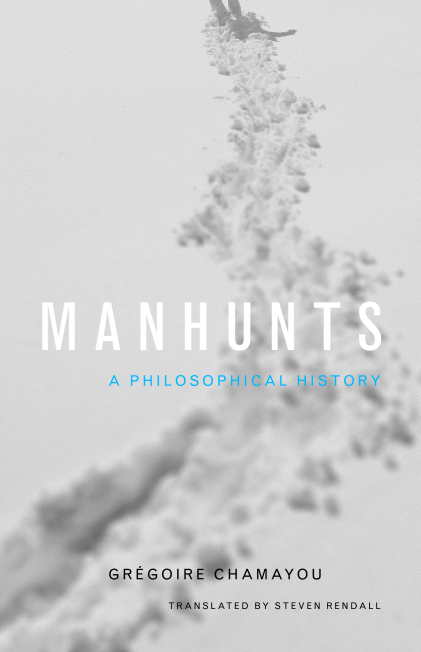
Chamayou has translated Clausewitz into French, and readers may know one of his earlier texts, I think the only one to be translated into English thus far, Manhunts: a philosophical history (Princeton 2012; original French publication, Les chasses à l’homme: histoire et philosophie du pouvoir cynegetique (La fabrique, 2010); reviewed in English translation at Books & Ideas here).  If you want a good sense of Chamayou’s style, check out this video of a lecture in New York in 2011, ‘Hunter vs. Hunted’, artfully organised around film clips.

Manhunts doesn’t address targeted killing and drone warfare, but you can read a related essay from Radical Philosophy (169/2011) on ‘The manhunt doctrine’ that does here:

George W. Bush had warned us early on: the United States has launched itself into a new kind of war, a ‘war that requires us to be on an international manhunt’… The doctrine of the manhunt breaks with conventional warfare, which rests on the concepts of fronts, linear battles and face-to-face opposition. In 1916, General Pershing launched a large military offensive on Mexican territory to seize the revolutionary Pancho Villa. The massive deployment of force drew a blank. For the American strategists who cite this historic precedent as a counter-example, it is a question of reversing the polarity: faced with the ‘asymmetrical extremes’ posed by small mobile groups of ‘non-state actors’, one must employ small flexible units in a logic of targeted attacks. Contrary to Clausewitz’s classic definition, such cynegetic war is not, in its fundamental structure, a duel. The structure does not involve two fighters facing off, but something else: a hunter who advances and a prey who flees or who hides…

The prey who wants to escape his pursuers tries to become undetectable or inaccessible. But inaccessibility is not only a function of physical geography – such as an inextricable bush or deep crevice. The theorists of manhunting remind us that the ‘political and legal restrictions, especially in the form of jurisdictional boundaries’, are an eminent part of the ‘set of constraints that shape the rules of the game’. From this point of view, it is clear that ‘sovereign borders are among the greatest allies’ that a fugitive can have. The hunter’s power has no regard for borders. It allows itself the right of universal trespassing, in defiance of territorial integrity of sovereign states. It is an invasive power which, unlike the imperial manoeuvres of the past, is based less on a notion of right of conquest than of a right of pursuit….

In cynegetic war, armed violence seeks to pursue the prey wherever it might be. The place of hostilities is no longer defined by the locatable space of an effective combat zone, but by the simple presence of the hunted individual who carries with him everywhere a kind of little halo denoting a personal hostility zone. In this way of thinking, the very notion of armed conflict occurring in a distinct geographical space tends to vanish. Here, on the one hand, the combat zone tends to be reduced to the body of the enemy, which must then, according to the principle of distinction, be the only space that is targeted; but, on the other hand, it is believed that this mobile micro-space can be targeted wherever it happens to be. The paradox is that the principle of targeting is accompanied by a limitless virtual extension of the conflict zone: the world becomes the battlefield. Thus the classical distinction is erased between armed conflict zones, in which the use of weapons of war is allowed, and other zones in which they are not allowed…

Cynegetic war bears an ideal of non-confrontation with death, and of domination without real combat. While a duel involves a reciprocal relation of exposure to death – each participant bearing his chest to the enemy – in the hunt, on the contrary, the master barely ever confronts his prey directly. He uses intermediaries, beaters or the pack. Everything is done so that his life is never in danger, to assure him maximum protection. The use of predator drones and of Hellfire missiles, operated at a distance from American soil, illustrates this principle of absolute preservation of the life of the hunter by the mediation of hunting auxiliaries.

So far, so familiar. Chamayou treats the drone as ‘the emblem of contemporary cynegetic war’, which is to say war that ‘bears an ideal of non-confrontation with death, and of domination without real combat’: hence the new book which, like my own work, explores the complex field of death at a distance and, in a direct line of descent from Manhunts, embeds the drone into the apparatus of a new predatory state (Etat-chasseur) emphasised in this review in Le Devoir.  Here is a listing of the contents:

Theory of the drone

Prelude  — 9
Introduction — 21

I. Techniques and tactics — 33

Methodologies in a hostile environment — 35
Genealogy of the Predator— 41
Theoretical principles of the manhunt— 47
To watch and to annihilate — 57
Pattern of life analysis — 69
Kill box — 79
Counterinsurgency from the air — 91
Vulnerabilities— 109

II. Ethos et psyche— 119

Drones and the kamikazi (suicide attacks) — 121
‘That others should die’ — 131
A crisis in military ethics— 137
Psycho-pathologies of the drone— 151
Killing at a distance— 162

III. Necro-ethics — 177

Combatant immunity— 179
The humanitarian weapon — 190
Precision — 197

IV. Legal philosophy of killing— 211

Thoughtless assassins — 213
War without combat — 220
Licence to kill — 231

V. Political bodies— 241

In war and in peace — 243
Democratic militarism— 254
The essence of warriors — 269
The production of political robots — 285

Epilogue. War, at a distance — 309

21 February 2010 Uruzgan CIVCASYou can find a short extract from Théorie du drone here. This is of particular interest to me since it includes a transcript of an air strike mediated but not directly carried out by a Predator crew and its associated network/assemblage in Uruzgan province, Afghanistan on 21 February 2010, which killed 23 civilians and wounded 8 others.  It’s the mediation that is crucial, though I’m not (yet) sure that what Chayamou means by ‘intermediaries’ in the passage from RP above is quite what I have in mind: we’ll see.  In any event, I discussed the strike and Major General Timothy McHale’s subsequent investigation in ‘From a view to a kill’ (DOWNLOADS tab) and I’ve now provided a much more detailed discussion, with longer extracts from the transcript Chamayou uses here, in The everywhere war (due to be finished, please God, this summer). Chamayou uses this incident as a Prelude to his main argument which – unlike so much philosophical reflection on later modern war, and as he makes clear in his Introduction is in part inspired by the example of Simone Weil – evidently engages directly with the material conduct of military violence.

There’s another extract from the book available here. There are also many  interviews with Chamayou available, but a succinct yet wide-ranging one is available here in which, amongst other things, he assails those American and Israeli philosophers who have defended the use of drones as ‘ethical’, ‘humane’, and even as vehicles for a newly humanitarian mode of war.  He doesn’t name them, but one of those he surely has in his sights is Bradley Jay Strawser (see here,  here and here), whose edited collection on Killing by remote control: the ethics of an unmanned military was published last month by Oxford University Press.  Appropriately, you can buy a Kindle edition from Amazon in just one click.
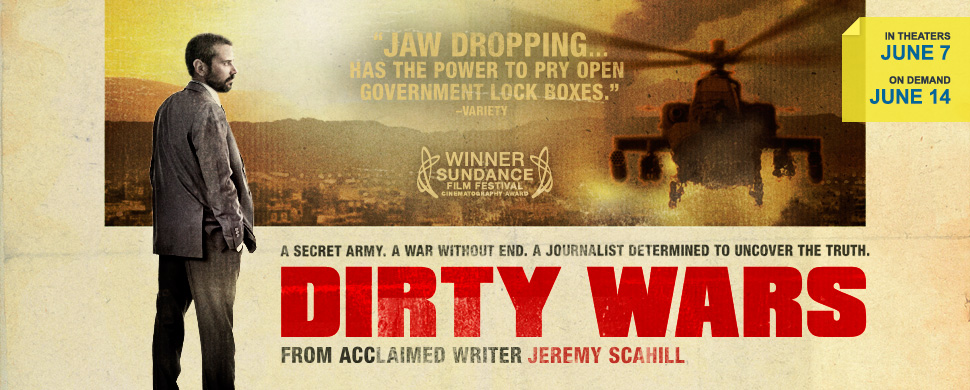
UPDATE:  For a succinct overview of Chamayou’s work, see Kieran Aarons, ‘Cartographies of capture’, Theory & Event 16 (2) (2013).

The vision machine

Vision Machine

News this morning from Roger Stahl of a wonderful new resource and site, The vision machine: media, war, peace.  I’ve admired Roger’s work for an age, and his Militainment Inc.: war, media and popular culture has been an indispensable source for my own work on military violence in its various forms; you can find his blog here.
But the new, collective project (for which Roger is a co-director) is even more ambitious; the subject obviously speaks directly to my own concerns, but so too does the format – see the last paragraph below.

TheVisionMachine is a scholarly platform for critically engaging the intersection of war, peace, and media. Using a multimedia approach, the site incorporates pod/vodcasts, media analysis, documentary clips, and links to larger bodies of work. The site is operated by a global group of scholars in the fields of International Relations, Media Production, and Communication Studies.

Thematically, TheVisionMachine is comprised of three components. The first is historical, focusing on the dual development of colonial and media empires from early days of the panorama, photography, print media, radio, TV, to today’s Internet (web 2.0), and social media – thus covering the history of and evolution from old to new digital media. The second is theoretical, using classical and critical theory to examine media as the product and instrument of cultural, economic and political struggles, resistance and revolt. The third is practical, using media production such a micro-documentaries, regular pod/vodcasts, and interactive social media to disseminate research, generate interactive debate, and raise public awareness. As one might guess, The Vision Machine takes direct inspiration from Paul Virilio’s book by the same name, though the site is certainly not limited to his style of thought.

TheVisionMachine is…

1. A Multimedia Journal. TheVisionMachine seeks contributions from a range of prominent thinkers, from academics to activists, media producers, military professionals, journalists, public intellectuals, and more. These contributions range from audio/video profile interviews to short-form original pieces of criticism, theory, observational essays, and documentary work. The driving impulse of the site is to provide a venue for airing cutting-edge ideas and exposing work to larger audiences. If you are interested in becoming involved, please contact us here.
2. A Discussion Platform. TheVisionMachine operates as a hub for an ongoing community conversation. The site hosts a social networking function, discussion boards geared around specific topics, and comment clouds for individual exhibits. Subscribers are encouraged not only to partake of the various articles and micro-documentaries featured on the site, but also to contribute to an expanding range of expertise and perspectives.

3. A Media Production Clearing House. One of the ultimate goals of TheVisionMachine is to operate as a media center, a place for creative collaboration and media production. The structure of the site provides opportunities to “crowdsource” material for larger projects. These could range from academic endeavors to the production of documentary films on relevant subjects. TheVisionMachine is partner with the University of Queensland Media Lab, a $180,000 media monitoring and recording facility, one of the first of its kind housed in a non-corporate, non-military institution.

TheVisionMachine is driven by an explicit attempt to rethink and revamp archaic academic practices of knowledge creation and dissemination. The site aims to move from the average global readership of academic articles in the social sciences (which currently stands at 4.5 readers per published journal article!) to actively engaging a wider public through digital new media. TheVisionMachine is designed as a truly interactive multiplatform space where those with an interest in the infotech/war/peace complex can participate in debates through discussion threads, audio/video postings, and micro-documentary production. Thereby, TheVisionMachine aspires to be a rosetta stone to the complex contemporary global media environment, a tool for interfacing a world where satellite, Internet, cell phone, and other recent technologies directly affect questions of war and peace, control and resistance.

If you need to find the site without using the link above, you should note that there are several ‘vision machines’ on the web – but only one is ‘thevisionmachine.com‘.  Note, too, that the site takes its title from Paul Virilio‘s book (which is available here) but isn’t limited to his style of thought…

Sim Cities and theatres of war

When I wrote “Rush to the intimate” (DOWNLOADS tab), a discussion of the ‘cultural turn’ in US counterinsurgency, I was fascinated by a rich and rapidly expanding literature on pre-deployment training and Mission Rehearsal Exercises in simulated “Afghanistans” and “Iraqs” across the United States and beyond in what Steve Graham later called, in Cities under siege, a ‘theme-park archipelago’:

fort-polk‘US troops prepare for deployment in Afghanistan and Iraq by rotating through major Combat Training Centers.  The arc of these ‘theatres of war’ runs from the United States through Europe to Jordan and Kuwait, but the main Mission Rehearsal Exercises are conducted at the Joint Readiness Training Center at Fork Polk, Louisiana; the National Training Center at Fort Irwin, California; and the US Marine Corps Air Ground Combat Training Center at Twentynine Palms, California.  Each includes prefabricated villages and small towns to train troops in urban operations.  … There is little attempt at morphological similitude.  In fact, the same physical structures serve for Afghanistan and Iraq, as though the two are indistinguishable and interchangeable, and the buildings are rudimentary approximations.  One journalist described the crude architecture of ‘Wadi al Sahara’ at Twentynine Palms as being ‘like an impressionist painting’.  From the surrounding hills it could be mistaken for part of Basra or Fallujah, but ‘a walk through its dusty streets shows it to be only a vast collection of shipping containers.’ This too is not without its performative consequences.  Shipping containers are an improvement on poker chips and Lego bricks, but reducing living spaces to metal boxes and studio flats conveys a silent message about the sort of people who live in them.

Realistic Urban Training‘The focus at all the training centres is on interactive realism, and the cultural turn has transformed the terms of engagement.  In the early stages of the ‘war on terror’, the emphasis was on kinetic operations and on state-of-the-art special effects that drew on the visual and pyrotechnic skills of Hollywood and theme-park designers.  When one reporter visited Fort Polk in January 2003, she described troops calling in air strikes, securing roads and bridges on the perimeter of a town, and dealing with ambushes staged by insurgents played by soldiers from the base. Her story repeated the physical imagery of the Handbook for Joint Urban Operations issued the previous fall with precision: ‘From sewers to rooftops, cities are multi-layered, like three-dimensional chess boards.’  Civilians appeared only as casualties, and then only in the very last paragraph, where one soldier admitted that he had ‘no clear answer’: ‘“What can you do?”’ The cultural turn is supposed to provide the answer to that question, and from 2006 a flurry of media reports described a new emphasis on military-civilian interaction.  Exercises still include kinetic operations, though these are now more likely to focus on combating IEDs and suicide bombings, but the main objective is no longer scoring kills but ‘gaining the trust of the locals.’  The deployment of Civilian (sometimes called Cultural) Role Players has expanded dramatically.  More than 1,000 are on call at Fort Polk alone, including 250 Arabic speakers, many of them recruited from the Iraqi diaspora in Atlanta, Houston, Memphis and as far away as Michigan.  Their very presence has changed the imaginative geography.  One corporal noted that his previous training had never incorporated civilians ‘wondering what’s going on, and looking around, and doing everyday things.  So when we got there and there were other people besides the enemy, it kind of threw us on our heels.  You know, all we trained for was that the enemy are the only ones on the streets.’  But these Civilian Role Players are not extras, figures to be bypassed, and their roles are carefully scripted.  They play community leaders, police chiefs, clerics, shopkeepers, aid workers, and journalists, and new scenarios require troops to understand the meaning of cultural transactions and to conduct negotiations with local people.  Careful tallies are kept of promises made by US commanders, and the immediate consequences of civilian casualties are dramatized in depth.  Mock newscasts by teams representing CNN and al Jazeera remind troops that local actions can have far-reaching consequences.  Even the special effects have become more intimate; in one Gothic gesture, amputees are used to simulate the effects of suicide bombs (though not, I suspect, US air strikes).  ‘It is no longer close in and destroy the enemy,’ one Marine officer explained: ‘We have to build relationships with Iraqis in the street.’

At the time the richest reports were these (and the quotations above were taken from them): Dexter Filkins and John Burns, ‘Mock Iraqi villages in Mojave prepare troops for battle’, New York Times, 1 May 2006; Wells Tower, ‘Letter from Talatha: Under the God Gun’, Harper’s Magazine, January 2006; Vince Beiser, ‘Baghdad, USA’, Wired Magazine 14.06 (June 2006); Tony Perry, ‘“Mojave Viper” sessions reflect situations in Iraq’, Los Angeles Times, 24 July 2006; Guy Rez, ‘Simulated city preps Marines for reality of Iraq’, National Public Radio, 13 April 2007.

I now need to re-visit all of this for The everywhere war.  My good friend, the ever-enterprising Oliver Belcher, visited Muscatatuk Urban Training Center in Indiana in September 2010 as part of his PhD research, so I had some idea of what had changed in the interim (and what had not).

NTC Fort Irwin exercise

Now Geoff Manaugh (of BldgBlog fame) has provided a sumptuously illustrated account (also on his blog here and at Venue here) of his recent visit to the simulated Afghan town of Ertebat Shar at Fort Irwin in the Mojave Desert (above); when US troops were training for Iraq it was Medina Wasl, and the basic geometry was imported from satellite photographs of Baghdad.
‘… at the most basic level, soldiers will use Fort Irwin’s facsimile villages to practice clearing structures and navigating unmapped, roofed alleyways through cities without clear satellite communications links. However, at least in the training activities accessible to public visitors, the architecture is primarily a stage set for the theater of human relations: a backdrop for meeting and befriending locals (again, paid actors), controlling crowds (actors), rescuing casualties (Fort Irwin’s roster of eight amputees are its most highly paid actors, we learned, in recompense for being literally dragged around during simulated combat operations), and, ultimately, locating and eliminating the bad guys (the Blackhorse regiment [a 120-strong insurgent force drawn from the 11th Armored]).’

Other recent images and video-essays can be found here and here.
Two things in particular stand out for me from Geoff’s immensely interesting essay.

First, the site and at least some of its training exercises are now regularly open to the public – NTC ‘Box Tours’ run twice a month and can be booked no more than 30 days in advance: see here for details – so special dispensations are no longer needed.  As this implies, the sense of public scrutiny has evidently been dramatically heightened since 2007, though even then national media seemed to be all over the place, and this now extends to the incorporation of the visitors themselves.  Geoff reports:

‘In the series of set-piece training exercises that take place within the village, the action is coordinated from above by a ring of walkie-talkie connected scenographers, including an extensive internal media presence, who film all of the simulations for later replay in combat analysis. The sense of being on an elaborate, extremely detailed film set is here made explicit. In fact, visitors are openly encouraged to participate in this mediation of the events: We were repeatedly urged to take as many photographs as possible and to share the resulting images on Facebook, Twitter, and more.’

NTC Fort Irwin media

As I’ve argued before, this sense of reflexivity – attention to the conduct of conduct – is focal to later modern war (though it extends far beyond multiple media platforms and includes, crucially, the lawyering-up of the kill-chain).

Second, the wounds of war have become ever more elaborately scripted.  Wells Tower‘s brilliant ‘Letter from Talatha’ (cited above) was very good on this, but now Geoff reproduces
‘an extraordinary collection of injury cards handed out to fallen soldiers and civilians. These detail the specific rules given for role-playing a suite of symptoms and behavior — a kind of design fiction of military injury.’

US ArmyTactical Combat Casualty CareScanning these cards raises a series of questions about other, more visceral geographies that lie behind the fiction: the (selective) geographies of care that extend from a war-zone back to hospitals in the United States. The US military has developed an elaborate system of recording and removing its own casualties (as part of what it usually calls ‘tactical combat casualty care‘).

Tactical telemedicineThe geography of this process is acutely physical. The delays imposed by time and space can kill, which is why the US military is currently exploring what it calls ‘tactical telemedicine’ (see the simulation report here; image on right).

The military casualty system is the product of a long historical geography: there’s a useful review of the US experience up to World War II by Bernard Rostker here, and I’m starting to wonder – with another good friend, Craig Jones – and as part of our joint interest in ‘geographies of the kill-chain’ how to explore the changing political and cultural geographies of injury and trauma that radiate from military violence.  There are vital comparative aspects to this, involving not only the (differential) treatment of combatants and civilians by different actors but also the different capacities of military and civilian medicine in war-zones and beyond.  All other dimensions of the theatre of war.
War crimes

GOW War and war crimesWhile we’re on the subject of war crimes – and, as you’ll see shortly, my visit to Poland and the Czech Republic gave me new opportunities to reflect on the enormity of violence  – news of a new book from James Gow, Professor of International Peace and Security at King’s College London, War and War Crimes: the military, legitimacy and success in armed conflict (Hurst, April 2013):

The laws of war have always been concerned with issues of necessity and proportionality, but how are these principles applied in modern warfare? What are the pressures on practitioners where an increasing emphasis on legality is the norm? Where do such boundaries lie in the contexts, means and methods of contemporary war? What is wrong, or right, in the view of military-political practitioners, in how those concepts relate to today’s means and methods of war? These are among the issues addressed by James Gow in his compelling analysis of war and war crimes, which draws upon research conducted over many years with defence professionals from all over the world. Today more than ever, military strategy has to embrace justice and law, with both being deemed essential prerequisites for achieving success on the battlefield. And in a context where legitimacy defines success in warfare, but is a fragile and contested concept, no group has a greater interest in responding to these pressures and changes positively than the military. It is they who have the greatest need and desire to foster legitimacy in war by getting the politics-law-strategy nexus right, as well as developing a clear understanding of the relationship between war and war crimes, and calibrating where war becomes a war crime.

There is a considerable literature on war crimes, both general discussions of international law and tribunals and specific accounts of serial violations, but Gow’s book promises to open up a different dimension. One of the diagnostic features of later modern war is its reflexivity, a keen interest in monitoring the conduct of conduct and a close attention to public attention, twin developments which help to account for the close involvement of military lawyers in the ‘prosecution of the target’ and the rapid growth of ‘media operations’ across a range of social platforms.  So I’m interested in this plaudit from Jeremy Jarvis at the Royal College of Defence Studies:

‘At the heart of this authoritative examination of the legitimacy of war and its conduct in the twenty-first century, James Gow refreshingly gives voice to the military judgment of professionals from around the world, as military officers themselves best understand the moral dilemmas they face and can best explain the context, at the strategic and tactical levels, which is so crucial to determining whether war crimes have been committed.’

I think there’s rather more to it than that, needless to say, but it’s certainly important to understand how the kill-chain has been ‘lawyered up’: much more on all this from Craig Jones at War, law and space.

Crimes of War

If you want an easily accessible resource then Crimes of War, a collaboration between lawyers journalists and scholars provides both an A-Z Guide and a Commentary on current events.  It’s indispensable, as are the provocative posts (which address a wider range of topics than war crimes) at Lawfare and Opinio Juris.