Asymmetric law

1425285643_9e0a120e-3716-468a-ba00-e976b29db2851421848906

Breaking the Silence has just published a major report into the Israeli military’s tactics during its most recent offensive against Gaza and its people, so-called ‘Operation Protective Edge’ (see my posts herehere, here and here).

Based on interviews with 65 IDF soldiers, the report includes Background, Testimonies (‘This is how we fought in Gaza‘), and a media gallery.

Writing in today’s Guardian, Peter Beaumont reports:

Describing the rules that meant life and death in Gaza during the 50-day war – a conflict in which 2,200 Palestinians were killed – the interviews shed light for the first time not only on what individual soldiers were told but on the doctrine informing the operation.

Despite the insistence of Israeli leaders that it took all necessary precautions to protect civilians, the interviews provide a very different picture. They suggest that an overarching priority was the minimisation of Israeli military casualties even at the risk of Palestinian civilians being harmed….

Post-conflict briefings to soldiers suggest that the high death toll and destruction were treated as “achievements” by officers who judged the attrition would keep Gaza “quiet for five years”.

The tone, according to one sergeant, was set before the ground offensive into Gaza that began on 17 July last year in pre-combat briefings that preceded the entry of six reinforced brigades into Gaza.

“[It] took place during training at Tze’elim, before entering Gaza, with the commander of the armoured battalion to which we were assigned,” recalled a sergeant, one of dozens of Israeli soldiers who have described how the war was fought last summer in the coastal strip.

“[The commander] said: ‘We don’t take risks. We do not spare ammo. We unload, we use as much as possible.’”

“The rules of engagement [were] pretty identical,” added another sergeant who served in a mechanised infantry unit in Deir al-Balah. “Anything inside [the Gaza Strip] is a threat.  The area has to be ‘sterilised,’ empty of people – and if we don’t see someone waving a white flag, screaming: “I give up” or something – then he’s a threat and there’s authorisation to open fire … The saying was: ‘There’s no such thing there as a person who is uninvolved.’ In that situation, anyone there is involved.”

“The rules of engagement for soldiers advancing on the ground were: open fire, open fire everywhere, first thing when you go in,” recalled another soldier who served during the ground operation in Gaza City. The assumption being that the moment we went in [to the Gaza Strip], anyone who dared poke his head out was a terrorist.”

1425285424_2bdb2aee-c3f8-4679-a375-d6682afb701a1421848849

You can find an impassioned, detailed commentary on the report by Neve Gordon – who provides vital context, not least about the asymmetric ethics pursued by supposedly ‘the most ethical army in the world’ – over at the London Review of Books here, and a shorter commentary by Kevin Jon Heller at Opinio Juris here.  Kevin notes:

The soldiers’ descriptions are disturbingly reminiscent of the notorious “free fire” zones in Vietnam and the US government’s well-documented (and erroneous) belief that signature strikes directed against “military-age men in an area of known terrorist activity” comply with IHL’s principle of distinction. The testimonials are, in a word, stunning — and put the lie to oft-repeated shibboleths about the IDF being “the most moral army in the world.” As ever, the stories told by the IDF and the Israeli government are contradicted by the soldiers who actually have to do the killing and dying.

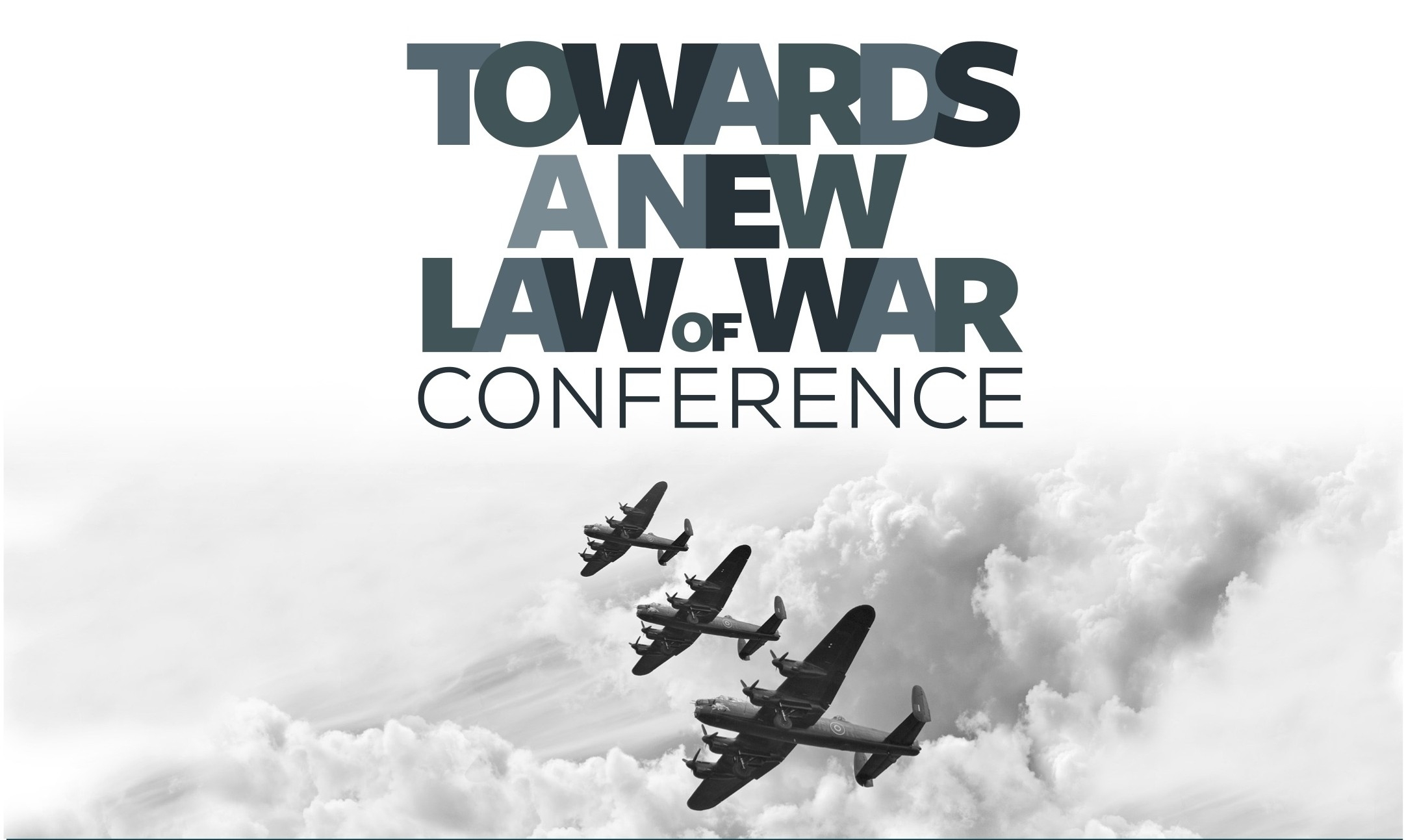
The legal and ethical framework pursued by the Israeli military – and ‘pursued’ is the mot (in)juste, since its approach to international law and ethics is one of aggressive intervention – is in full view at a conference to be held in Jerusalem this week: ‘Towards a New Law of War‘.
poster-A2_3-2480x35071-e1427212477619-2164x1293

‘The goal of the law of war conference,’ say the organisers, ‘is to influence the direction of legal discourse concerning issues critical to Israel and her ability to defend herself. The law of war is mainly unwritten and develops on the basis of state practice.’

You can find the full program here, dominated by speakers from Israel and the US, but notice in particular the session on ‘Proportionality: Crossing the line on civilian casualties‘:

CIvilian Casualties

As this makes clear, and as Ben White reports in the Middle East Monitor, law has become the target (see also my post here):

After ‘Operation Cast Lead’, Daniel Reisner, former head of the international law division (ILD) in the Military Advocate General’s Office, was frank about how he hoped things would progress.

If you do something for long enough, the world will accept it. The whole of international law is now based on the notion that an act that is forbidden today becomes permissible if executed by enough countries….International law progresses through violations.

Similarly, in a “moral evaluation” of the 2008/’09 Gaza massacre, Asa Kasher, author of the IDF’s ‘Code of Ethics’, expressed his hope that “our doctrine” will ultimately “be incorporated into customary international law.” How?

The more often Western states apply principles that originated in Israel to their own non-traditional conflicts in places like Afghanistan and Iraq, then the greater the chance these principles have of becoming a valuable part of international law.

Now Israel’s strategy becomes clearer… Israel’s assault on the laws of war takes aim at the core, guiding principles in IHL – precaution, distinction, and proportionality – in order to strip them of their intended purpose: the protection of civilians during armed conflict. If successful, the victims of this assault will be in the Occupied West Bank and Gaza Strip, Lebanon – and in occupations and war zones around the world.

Dirty Dancing online

I had a wonderful time at the Balsillie School at Waterloo last week – good company, constructive conversations and endless hospitality – and I’m truly grateful to Simon Dalby, Jasmin Habib and all the graduate students who made my visit so enjoyable.  I finished by giving one of the Centre for Global Governance Innovation (CIGI)’s Signature Lectures.

This was the latest (and near-final) version of “Dirty dancing: drones and death in the borderlands”.   The argument has developed considerably since my first presentations; I’ll upload the written version once it’s finished, but CIGI has posted the lecture and Q&A online here.  I’ve also embedded the YouTube version below, but if that doesn’t work try here.

My thanks to the AV technicians who made this possible: their help with the production followed by their assured and rapid-fire editing beats anything I’ve encountered anywhere.

In this version, I begin with two CIA-directed drone strikes in Pakistan’s Federally Administered Tribal Areas, one on Baitullah Mehsud (the leader of Tehrik-i-Taliban) and the other on ‘Mamana’ Bibi, an innocent grandmother and midwife, and ask what it is that makes strikes like these – which is to say strikes as unlike these – possible.  My answer turns on the kinds of space the FATA been made out to be: in particular, a space of exception in which people are knowingly and deliberately exposed to death, and a territory conceived as a political technology through which power lays claim to bodies-in-space.

Unlike Giorgio Agamben‘s original formulation, though, my discussion of the space of exception focuses not on violence authorised through the suspension of the law but rather violence that operates inside the law: so I look at the legal regimes, both international and national, that affect military and paramilitary violence in the FATA.  A further difference is that this exceptional state of affairs is provoked not by an event but by a margin: by the construction of the FATA as a liminal zone, borderlands that are outside ‘Pakistan proper’ or ‘mainland Pakistan’.  Many commentators (including me) trace the origin of aerial violence to the British Raj, its Frontier Crimes Regulations and its ‘policing’ of the North-West Frontier.  This is important, but the line of descent to today’s air strikes is not direct.  In particular, it is important to bring into view the cross-border incursions made by Soviet and Afghan aircraft during the occupation of Afghanistan.  Thousands of people were killed and injured during these attacks, and this constitutes an important horizon of memory, but no less important is the response of the Pakistan Air Force: their US-supplied jets intercepted incoming aircraft and either escorted them out of Pakistani air space or, towards the end of the 1980s, engaged them in combat.  This begs an obvious question: if Pakistan objects to the US strikes – carried out by drones that are slow, noisy and sluggish – why does its Air Force not shoot them down?  Since today’s drones cannot be used in contested air space – bluntly, they can only be used against defenceless people – why does Pakistan elect to render the people of FATA defenceless?  This immediately brings into view the other source of aerial violence in the borderlands: the ongoing offensives in the FATA launched by the Pakistan Air Force (in concert with large-scale ground operations).  Even though the Pakistan Air Force has its own reconnaissance drones, some of which are now armed, these are not attempts to put ‘warheads on foreheads’, as the US Air Force would have it, but wide-area assaults conducted by conventional strike aircraft and attack helicopters – as I show in the case of Mir Ali and Miran Shah during Operation Zarb-i-Azb (see here and here and here).

To complete the sequence and add the US drone strikes, I trace the intimate collaboration between both the CIA and the US Air Force and between Washington and Islamabad.  The diplomatic cables released by Wikileaks show time and time again that many of the negotiations about access to ‘flight boxes’ over North and South Waziristan were conducted by the Chairman of the Joint Chiefs of Staff and the commander of US Central Command.  I show, too, how the collaboration between Washington and Islamabad continued until at least 2013.

Hacking.001

In order for the CIA-directed strikes to be possible, however, the FATA must also be turned into a territory in something like the sense proposed by Stuart Elden.  So I describe the multiple ways in which data is harvested by the NSA and other agencies to produce what Rob Kitchin and Martin Dodge call code/space: the algorithmic combination of sensors, traces and intercepts to summon into being a body-as-target (for more, see here: scroll down), and to produce the space of the target where fleshy bodies disappear and are replaced by codes, co-ordinates and cross-hairs.  This is another version of what Ian Hacking calls ‘making up people’: there is an important sense, then, in which the supposed ‘individuation’ of later modern war depends on the selective and active production (and destruction) of an ‘individual’.

The questions and comments after the lecture were immensely helpful, and as I turn this into its final, written version I’d be grateful for any further comments if you watch the video.

Law, ethics and drone warfare

SCHELLER Kill-chain

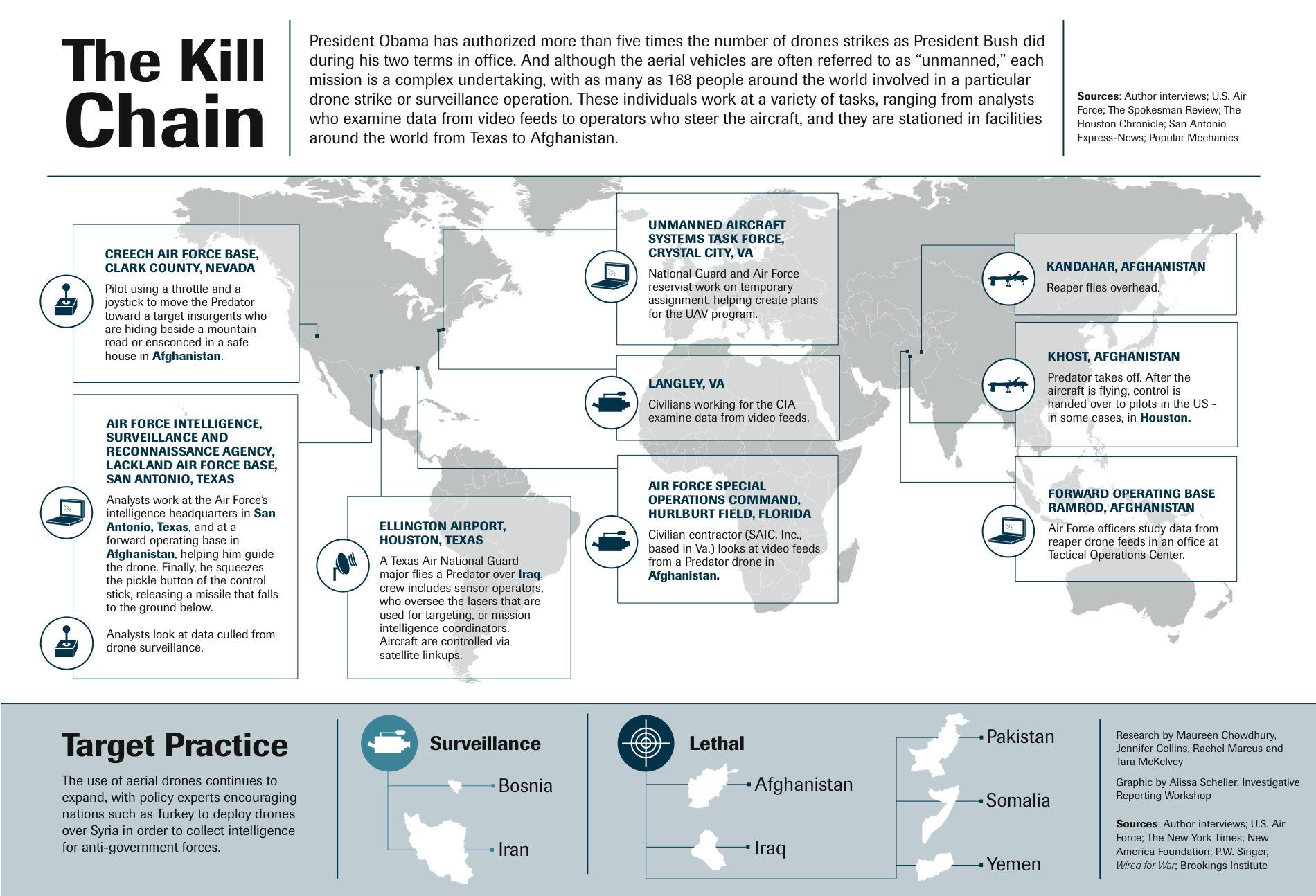
The infographic above was produced by Alissa Scheller for an Investigative Reporting Workshop on Drones, and specifically an article by Tara McKelvey on Harold Koh and the legal armature that the Obama administration has sought for its nominally covert program of targeted killing.

Since then (2012) there has been a cascade of essays around these legal and ethical issues; much of the spikiest writing is to be found on the indispensable ssrn, but here are some other essays I’ve just caught up with that readers might also find helpful:

Special issue: ‘Legal and ethical implications of drone warfare’, in International Journal of Human Rights 19 (2) (2015) including:

Michael J. Boyle, ‘The legal and ethical implications of drone warfare’ (pp 105-126)

Stephanie Carvin, ‘Getting drones wrong’ (pp. 127-141)

Craig Martin, ‘A means-methods paradox and the legality of drone strikes in armed combat’ (pp. 142-175)

Daniel R. Brunstetter & Arturo Jimenez-Bacardi, ‘Clashing over drones: the legal and normative gap between the United States and the human rights community’ (pp. 176-198)

David Whetham, ‘Drones to protect’ (pp. 199-210)

Caroline Kennedy & James I. Rogers, ‘Virtuous drones?’ (pp. 210-227)

Symposium: ‘Towards a drone accountability regime‘, in Ethics and International Affairs 1 (2015) with a major contribution from Allen Buchanan and Robert O. Keohane

From a moral standpoint, lethal drones are intrinsically no worse as a means of warfare than bombing or sending commandos to kill enemies. From the perspective of their users, they have six major advantages over more conventional weapons: they are often cheaper; their use can be more readily concealed; they allow for more precise targeting, with the potential for less “collateral damage”; their use can involve less serious infringements of sovereignty than invasion by troops; and they may be less likely to provoke widespread hostile reactions by the population of the country in which they are used than military operations involving troops on the ground. But these advantages generate three major risks: of violating sovereignty, of over-using the military option, and of making it more difficult to identify violations of constraints against targeting noncombatants. To deal with these risks, a Drone Accountability Regime is needed that imposes obligations on states, which in turn would be required to impose them on their agents. Since it would be infeasible to negotiate a treaty-based legal regime at present and for the foreseeable future, the Drone Accountability Regime should be informal and should involve transnational actors as well as states. Its key principle should be transparency, helping enable civil society to hold states accountable, and its central agent would be an Ombudsperson with broad authority to investigate situations and publicize her findings. No institution can ensure that states, or operators, are held fully accountable to appropriate standards of conduct, but such a regime could increase the degree of accountability for the use of lethal drones.

— and critical responses from Neta Crawford, Janina Dill, and David Whetham.

Bianca Baggiarini, ‘Drone warfare and the limits of sacrifice’, Journal of international political theory 11 (1) (2015) 128-44

M.J. Boyle, ‘The race for drones’, Orbis 59 (1) (2015) 76-94

Lindsay Cohn-Warrior, ‘Drones and targeted killing: costs, accountability and US Civil-Military relations’, Orbis 59 (1) (2015) 95-110

Jelena Pejic, ‘Extraterritorial targeting by means of armed drones: some legal implications’, International review of the Red Cross (2015) (online early)

Lauren Wilcox, ‘Drone warfare and making bodies out of place’, Critical studies on security 3 (1) (2015) 127-131

John Williams, ‘Distant intimacy: space, drones and Just War’, Ethics and International Affairs 1 (2015) 93-110

And to widen the discussion and give it substantive depth, see Craig Jones, ‘Lawfare and the juridification of late modern war‘, Progress in human geography (2015) (Online First):

Processes of juridification are a defining feature of late modern war. But geographic accounts of war have generally not considered the role that law plays in shaping its conduct. This paper explores the juridification of war using the concept of lawfare. Lawfare may signal an intensification and shift in the relationship between war and law, but I argue that understanding the nature and extent of these changes requires a careful examination of the historical geographies of war, law and lawfare. Drawing from critical legal approaches I offer a preliminary geographical and historical theorization of lawfare so that we may better understand the relationship between war and law today.

Unlawful combatants

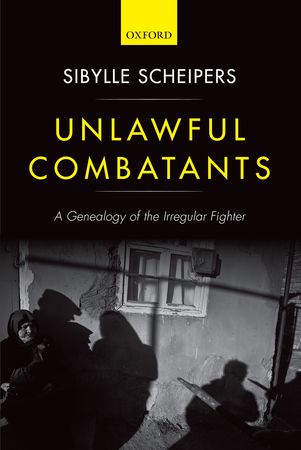
Unlawful combatantsI know several friends are interested (critically) in Carl Schmitt‘s Theory of the Partisan (see also Jan-Werner Müller‘s commentary here), but Sibylle Scheipers has now provided an indispensable genealogy of these often shadowy figures and their late modern incarnations: Unlawful Combatants: a genealogy of the irregular fighter (Oxford, 2015).

Unlawful Combatants brings the study of irregular warfare back into the centre of war studies. The experience of recent and current wars in Afghanistan, Iraq, Libya, and Syria showed that the status and the treatment of irregular fighters is one of the most central and intricate practical problems of contemporary warfare. Yet, the current literature in strategic studies and international relations more broadly does not problematize the dichotomy between the regular and the irregular. Rather, it tends to take it for granted and even reproduces it by depicting irregular warfare as a deviation from the norm of conventional, inter-state warfare. In this context, irregular warfare is often referred to as the ‘new wars’ and is associated with the erosion of statehood and sovereignty more generally. This obscures the fact that irregulars such as rebels, guerrillas, insurgents and terrorist groups have a far more ambiguous relationship to the state than the dichotomy between the state and ‘non-state’ actors implies. They often originate from states, are supported by states and/or aspire to statehood themselves.

The ambiguous relationship between irregular fighters and the state is the focus of the book. It explores how the category of the irregular fighter evolved as the conceptual opposite of the regular armed forces, and how this emergence was tied to the evolution of the nation state and its conscripted mass armies at the end of the eighteenth century. It traces the development of the dichotomy of the irregular and the regular, which found its foremost expression in the modern law of armed conflict, into the twenty-first century and provides a critique of the concept of the ‘unlawful combatant’ as it emerged in the framework of the ‘war on terror’.

Here is the Contents list:

1: Introduction
2: The Making of the Irregular Fighter, 1740-1815
3: The Nineteenth Century: Rebels, Rifles, and the Laws of War
4: The Second World War: Anti-Partisan Warfare, Genocide, and the Rebirth of the Auxiliary Fighter
5: Wars in the Colonies: Orientalism and the Social Production of Colonial Subjects
6: Irregular Fighters in the Twenty-first Century: Between ‘Unlawful Combatants’ and ‘Rebel’ Auxiliaries
7: Conclusion

The book is a product of the Changing Character of War programme at the University of Oxford, where Sibylle was Director of Studies until she moved to St Andrews in 2011.

No Safe Place

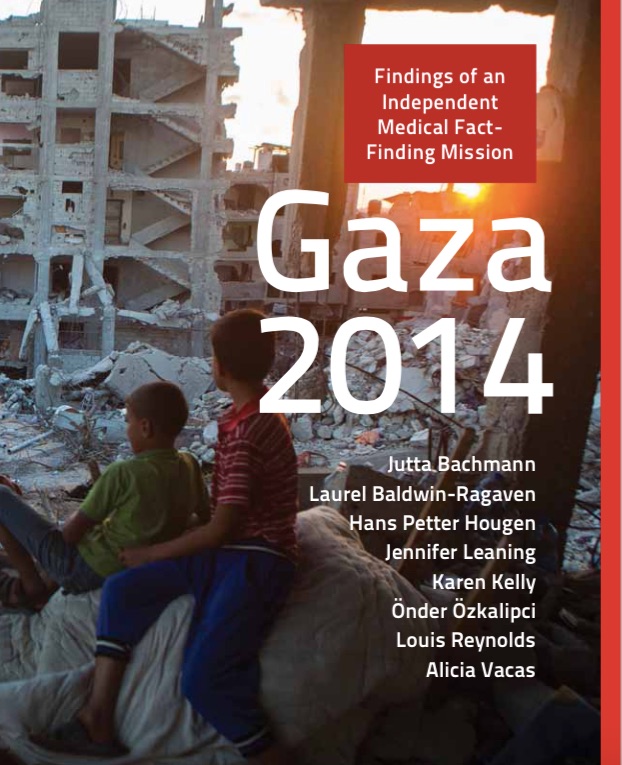
PHR Gaza 2014

Physicians for Human Rights has published a ‘First Experts’ report on Israel’s military assault on Gaza last summer, Gaza 2014: No Safe Place.  It provides a much more detailed accounting of the attacks on the medical infrastructure of Gaza than I was able to do in Gaza 101 and subsequent posts.  Here is PHR’s description of the mission:

On 8 July 2014, Israel initiated a military offensive in the Gaza Strip. Although accounts vary, most estimates put the number of residents of Gaza killed in the 50-day armed conflict at over 2,100, of whom at least 70% were civilians, including over 500 children. Over 11,000 were wounded and over 100,000 made homeless. According to Israeli official accounts, 73 Israelis were killed: 67 soldiers and 6 civilians, including one child and one migrant worker. 469 soldiers and 255 civilians were wounded.

Questions arose regarding violations of international human rights and humanitarian law in the course of the conflict. In July 2014, following discussions with Al-Mezan, Physicians for Human Rights-Israel (PHR-Israel) commissioned a fact-finding mission (hereafter ‘FFM’) to Gaza, whose aim was to gather evidence and draw preliminary conclusions regarding types, causes and patterns of injuries and attacks; attacks on medical teams and facilities; evacuation; impact of the conflict on the healthcare system; and longer-term issues including rehabilitation of the wounded, mental health, public health and displacement.

PHR-Israel recruited 8 independent international medical experts, unaffiliated with Israeli or Palestinian parties involved in the conflict: four with special expertise in the fields of forensic medicine and pathology; and four experts in emergency medicine, public health, paediatrics and paediatric intensive care, and health and human rights.

The team made three visits to Gaza between August and November last year:

Meetings and site visits were held in medical facilities and in the community, and included interviews with victims, witnesses, healthcare professionals and human rights workers, officials from the Gaza Ministries of Health and Justice, and representatives of international health organisations in Gaza and the West Bank. Wherever possible, forensic, medical and other material evidence was collected to support oral testimonies.

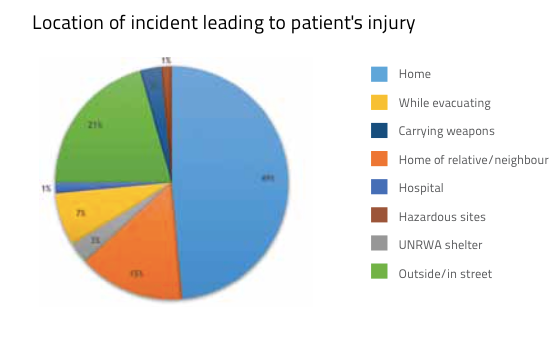
They interviewed 68 patients, and the chart below (from p. 36 of the report) explains why there was indeed ‘no safe place’ in Gaza.  As I argued previously, the Israeli military turned Gaza into a vast death zone extending far beyond the so-called ‘restricted areas’:

Location of incident leading to patient's injury PNG

Here are the summary conclusions from the report [the emphases are mine]:

The attacks were characterised by heavy and unpredictable bombardments of civilian neighbourhoods in a manner that failed to discriminate between legitimate targets and protected populations and caused widespread destruction of homes and civilian property. Such indiscriminate attacks, by aircraft, drones, artillery, tanks and gunships, were unlikely to have been the result of decisions made by individual soldiers or commanders; they must have entailed approval from top-level decision-makers in the Israeli military and/or government.

The initiators of the attacks, despite giving some prior warnings of these attacks, failed to take the requisite precautions that would effectively enable the safe evacuation of the civilian population, including provision of safe spaces and routes. As a result, there was no guaranteed safe space in the Gaza Strip, nor were there any safe escape routes from it.

In numerous cases double or multiple consecutive strikes on a single location [double tap] led to multiple civilian casualties and to injuries and deaths among rescuers.

Coordination of medical evacuation was often denied and many attacks on medical teams and facilities were reported. It is not clear whether such contravention of medical neutrality was the result of a policy established by senior decision-makers, a general permissive atmosphere leading to the flouting of norms, or the result of individual choices made on the ground during armed clashes.

In Khuza’a, the reported conduct of specific troops in the area is indicative of additional serious violations of international human rights and humanitarian law.

Ha’aretz‘s English-language coverage of the report is here.

Crossing the line

435px-Atlas_frontview_2013News from Lucy Suchman of an important essay she’s just completed with Jutta Weber on Human-Machine Autonomies, available from Academia.edu here.

This is how they begin:

This paper takes up the question of how we might think about the increasing automation of military systems not as an inevitable ‘advancement’ of which we are the interested observers, but as an effect of particular world-making practices in which we need urgently to intervene. We begin from the premise that the foundation of the legality of killing in situations of war is the possibility of discrimination between combatants and non-combatants. At a time when this defining form of situational awareness seems increasingly problematic, military investments in the automation of weapon systems are growing. The trajectory of these investments, moreover, is towards the development and deployment of lethal autonomous weapons; that is, weapon systems in which the identification of targets and initiation of fire is automated in ways that preclude deliberative human intervention. Challenges to these developments underscore the immorality and illegality of delegating responsibility for the use of force against human targets to machines, and the requirements of International Humanitarian Law that there be (human) accountability for acts of killing. In these debates, the articulation of differences between humans and machines is key.

Our aim in this paper is to strengthen arguments against the increasing automation of weapon systems, by expanding the frame or unit of analysis that informs these debates. We begin by tracing the genealogy of concepts of autonomy within the philosophical traditions that inform Artificial Intelligence (AI), with a focus on the history of early cybernetics and contemporary approaches to machine learning in behaviour-based robotics. We argue that while cybernetics and behaviour-based robotics challenge the premises of individual agency, cognition, communication and action that comprise the Enlightenment tradition, they also reiterate aspects of that tradition in the design of putatively intelligent, autonomous machines. This argument is made more concrete through a close reading of the United States Department of Defense Unmanned Systems Integrated Roadmap: FY2013-2038, particularly with respect to plans for future autonomous weapon systems. With that reading in mind, we turn to resources for refiguring agency and autonomy provided by recent scholarship in science and technology studies (STS) informed by feminist theory. This work suggests a shift in conceptions of agency and autonomy, from attributes inherent in entities, to effects of discourses and material practices that variously conjoin and/or delineate differences between humans and machines. This shift leads in turn to a reconceptualization of autonomy and responsibility as always enacted within, rather than as separable from, particular human- machine configurations. We close by considering the implications of these reconceptualizations for questions of responsibility in relation to automated/autonomous weapon systems. Taking as a model feminist projects of deconstructing categorical distinctions while also recognising those distinctions’ cultural-historical effects, we argue for simultaneous attention to the inseparability of human-machine agencies in contemporary war fighting, and to the necessity of delineating human agency and responsibility within political, legal and ethical/moral regimes of accountability.

LRASM (Lockheed-Martin photo) PNG

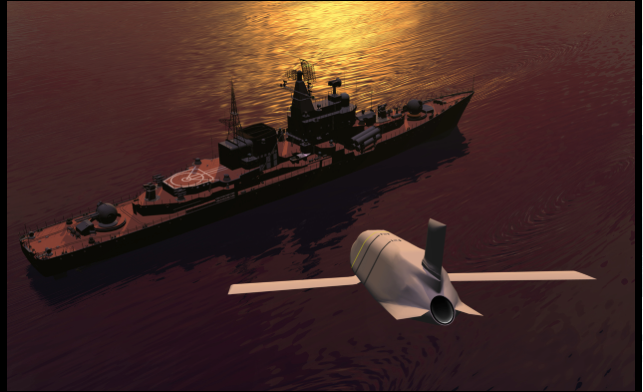
It’s a must-read, I think, especially in the light of a report from the New York Times of the Long Range Anti-Ship Missile (above) developed for the US military by Lockheed Martin:

On a bright fall day last year off the coast of Southern California, an Air Force B-1 bomber launched an experimental missile that may herald the future of warfare.

Initially, pilots aboard the plane directed the missile, but halfway to its destination, it severed communication with its operators. Alone, without human oversight, the missile decided which of three ships to attack, dropping to just above the sea surface and striking a 260-foot unmanned freighter…

The Pentagon argues that the new antiship missile is only semiautonomous and that humans are sufficiently represented in its targeting and killing decisions. But officials at the Defense Advanced Research Projects Agency, which initially developed the missile, and Lockheed declined to comment on how the weapon decides on targets, saying the information is classified.

“It will be operating autonomously when it searches for the enemy fleet,” said Mark A. Gubrud, a physicist and a member of the International Committee for Robot Arms Control, and an early critic of so-called smart weapons. “This is pretty sophisticated stuff that I would call artificial intelligence outside human control.”

Paul Scharre, a weapons specialist now at the Center for a New American Security who led the working group that wrote the Pentagon directive, said, “It’s valid to ask if this crosses the line.”

And the Israeli military and armaments industry, for whom crossing any line is second nature, are developing what they call a ‘suicide drone’ (really).  At Israel Unmanned Systems 2014, a trade fair held in Tel Aviv just three weeks after Israel’s latest assault on Gaza, Dan Cohen reported:

Lieutenant Colonel Itzhar Jona, who heads Israel Aerospace Industries, spoke about “loitering munitions” — what he called a “politically correct” name for Suicide Drones. They are a hybrid of drone and missile technology that have “autonomous and partially autonomous” elements, and are “launched like a missile, fly like an UAV [unmanned aerial vehicle],” and once they identify a target, revert to “attack like a missile.” Jona called the Suicide Drone a “UAV that thinks and decides for itself,” then added, “If you [the operator] aren’t totally clear on the logic, it can even surprise you.”

Jona praised the advantage of the Suicide Drone because the operator “doesn’t have to bring it home or deal with all sorts of dilemmas.” The Suicide Drone will quickly find a target using its internal logic, which Jona explained in this way: “It carries a warhead that eventually needs to explode. There needs to be a target at the end that will want to explode. Or it won’t want to and we will help it explode.”

So thoughtful to protect ‘the operator’ from any stress (even if s/he might be a little ‘surprised’).  Here is Mondoweiss‘s subtitled clip from the meeting, which opens with a short discussion of the major role played by UAVs in the air and ground attacks on Gaza, and then Jona describes how ‘we always live on the border’:

Scorched Earth

(c) Mr Russell Falkingham; Supplied by The Public Catalogue Foundation

In ‘The Natures of War’ (DOWNLOADS tab) I didn’t have space to address the legal dimensions of militarized natures, but Bronwyn Leebaw provides a helpful review in ‘Scorched Earth: Environmental War Crimes and International Justice‘ in the latest issue of Perspectives on Politics (12 [4] (2014) 770-788.  From the abstract:

Environmental devastation is not only a byproduct of war, but has also been a military strategy since ancient times. How have the norms and laws of war addressed the damage that war inflicts on the environment? How should “environmental war crimes” be defined and addressed? I address these questions by critically examining the way that distinctions between legitimate and illegitimate wartime environmental destruction have been drawn in debates on just war theory and the laws of war. I identify four distinctive formulations for framing the wartime significance of nature that appear in such debates and analyze how each is associated with distinctive claims regarding what constitutes “humaneness” in times of war: nature as property; nature as combatant; nature as Pandora’s Box; and nature as victim.

In the text she elaborates on those four formulations like this:

First, in early debates and documents, as well as contemporary interpretations of humanitarian law, a prominent approach to analyzing wartime destruction of nature has been to evaluate it in relation to claims regarding property protections in times of war. Humaneness, in this formulation, has been defined in relationship to dominion, ownership, discipline, and control, as defined against “wanton” or undisciplined actions. Second, in debates that influenced provisions of humanitarian law regarding chemical and biological weapons, nature has also been framed as a combatant. In this context, humaneness is associated with the use of technically superior weapons and the close identification of human agency with scientific mastery in response to anthropomorphized “enemies” in nature. Third, provisions of humanitarian law that aim to define and address the crime of ecocide emerged in response to the massive herbicidal campaign carried out by the US in Vietnam. Debates on the crime of ecocide were not only influenced by an ecological view of nature and humanity as interdependent, but also by a new formulation that positioned nature as a kind of Pandora’s Box, filled with creative and destructive forces that humanity has the power to unleash, yet not control. Finally, with the rise of international justice institutions, the expansion of the environmental movement as well as the human rights movement, nature has also been framed as a victim, or potential victim, of war crimes. In this formulation, humaneness and human agency are defined in relation to the criminal justice binary of guilt and innocence.

The last three all appear, in various forms, in ‘The Natures of War’, though – as I’ve tried to show, and as others know far better than me – questions of ‘human-ness’ are far from straightforward.

Flesh on the Bones

Skeleton RoadOne of my pleasures is good – and I mean seriously good – crime fiction, and I’ve just finished Val McDermid‘s latest, Skeleton Road.  It’s a finely wrought reflection on the wars that destroyed the former Yugoslavia, notably the conflict between Serbia and Croatia, but it’s also shot through with ferociously smart insights into geopolitics.

In fact, the epigraph is from Gerard Toal‘s Critical Geopolitics (the book not the blog) and in her acknowledgements Val thanks both Linda McDowell and Jo Sharp.

I was particularly taken by the way in which the shadows (and lights) of international law and human geography fall across its pages. Neither becomes an abstraction; both are fully embodied.  Two of the protagonists are lawyers working for the International Criminal Tribunal for the Former Yugoslavia and another is a Professor of Geography at Oxford (who ‘forced herself to consider the entries she was due to contribute to the forthcoming Dictionary of Human Geography‘ – a perfectly reasonable motive for murder).

All of which may explain my favourite quotation from what is now one of my favourite novels.  I’ve always despaired of those approaches to ‘geography and literature’ that gut novels by ripping out the supposedly ‘geographical’ bits, so I hope I’ll be forgiven for this autopsic deviation.  This is Maggie Blake, Professor of Geography, describing the results of her fieldwork in Dubrovnik:

‘The work I ended up doing on the region and its wars … is rooted, as human geography should be, in an embodiment of the conflict.’

Legal geographies and the assault on international law

I suspect anyone interested in international/transnational legal geographies will know of Jens David Ohlin‘s work already (he’s Professor of Law at Cornell and recently co-edited Targeted Killings: Law and Morality in an Asymmetrical World [Oxford, 2012]).  If not, check out his page on ssrn for recent papers; I’ve found three particularly helpful in thinking about US air strikes in Afghanistan and Pakistan and, more recently, the Israeli offensive against Gaza (more on this and the space of exception soon, I promise):

Targeting and the concept of intent (2013); Acting as a sovereign versus acting as a belligerent (2014); and The combatant’s privilege in asymmetric and covert conflicts (2014)

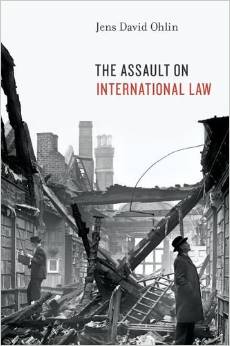
I’ve just received news of his new book out early in the New Year, whose relevance will be apparent from its title: The assault on international law.

OHLIN Assault of international lawInternational law presents a conceptual riddle. Why comply with it when there is no world government to enforce it? The United States has a long history of skepticism towards international law, but 9/11 ushered in a particularly virulent phase of American exceptionalism. Torture became official government policy, President Bush denied that the Geneva Conventions applied to the war against al-Qaeda, and the US drifted away from international institutions like the International Criminal Court and the United Nations.

Although American politicians and their legal advisors are often the public face of this attack, the root of this movement is a coordinated and deliberate attack by law professors hostile to its philosophical foundations, including Eric Posner, Jack Goldsmith, Adrian Vermeule, and John Yoo. In a series of influential writings they have claimed that since states are motivated primarily by self-interest, compliance with international law is nothing more than high-minded talk. Theses abstract arguments then provide a foundation for dangerous legal conclusions: that international law is largely irrelevant to determining how and when terrorists can be captured or killed; that the US President alone should be directing the War on Terror without significant input from Congress or the judiciary; that US courts should not hear lawsuits alleging violations of international law; and that the US should block any international criminal court with jurisdiction over Americans. Put together, these polemical accounts had an enormous impact on how politicians conduct foreign policy and how judges decide cases – ultimately triggering America’s pernicious withdrawal from international cooperation.

In The Assault on International Law, Jens Ohlin exposes the mistaken assumptions of these ‘New Realists,’ in particular their impoverished utilization of rational choice theory. In contrast, he provides an alternate vision of international law based on a truly innovative theory of human rationality. According to Ohlin, rationality requires that agents follow through on their plans even when faced with opportunities for defection. Seen in this light, international law is the product of nation-states cooperating to escape a brutish State of Nature–a result that is not only legally binding but also in each state’s self-interest.

Michael Sfard

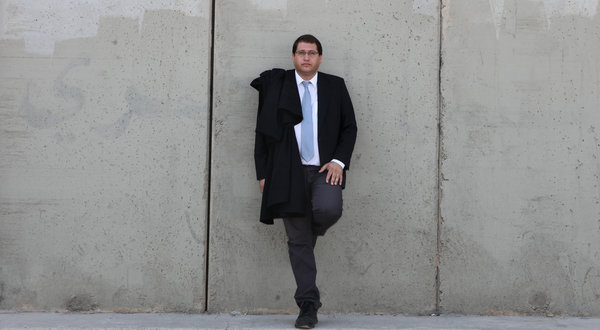
But not all assaults on international law derive from the United States and from professors hostile to its philosophical foundations.  I urge you to read Michael Sfard‘s coruscating Op-Ed from Ha’artez on 4 August, ‘A “targeted assassination” of international law‘ (which is also available here if it disappears behind a paywall).  Michael is an Israeli human rights lawyer, specializing in international humanitarian law and dealing directly with the Israeli occupation of Palestine, and he is also the legal adviser to Yesh Din: Volunteers for Human Rights:

Israelis are surprised. Did I say surprised? Downright shocked. Even before the dust from the fighting has settled, even before this “most just of all wars” has ended, even as the most moral army in the world is still mired in Gaza – there is already talk of war crimes and an international investigation.

We, who didn’t carpet-bomb even though we could have, who dropped fliers and made phone calls and knocked on the roof; we, who agreed to the humanitarian cease-fire that Hamas violated; we, who took more precautions than any other nation would have done – we are once again being accused of war crimes. Once again, the same old song is being sung: decisions about opening an international investigation, talk of the International Criminal Court, fear of arrests in Europe. And we don’t understand why we deserve all this.

It is possible to console ourselves by accepting the explanation that the television journalists keep repeating to us: that the world is anti-Semitic and two-faced and supports Hamas. But this would constitute a regrettable evasion of the tough questions. It would constitute an effort to flee the pointed discussion Israeli society ought to be holding about the way we have waged armed conflicts with our enemies over the last decade.

Since the Second Lebanon War of 2006, the Israel Defense Forces has adopted an extremely problematic combat doctrine for conflicts that take place in urban areas with dense civilian populations, and in which the enemy is seen as an illegitimate terrorist entity (Hezbollah in Lebanon and Hamas in Gaza). This combat doctrine is supported by a legal theory developed by the IDF’s international legal division, which interprets the laws of war in a manner that is shockingly different from their accepted interpretation by experts in the field worldwide. Its direct result is massive civilian casualties and the destruction of civilian neighborhoods.

This combat doctrine consists of two elements, each of which is a declaration of war against the fundamental principles of the laws of armed combat. The first element redefines what constitutes a legitimate target for attack, such that it now includes not only classic military targets (bases, combatants, weapons stockpiles and so forth), but also facilities and objects whose connection to the enemy organization is nonmilitary in nature….

The second element is even more far-reaching: It holds that when fighting in urban areas, we are entitled to treat the entire area as a legitimate target and bombard it via air strikes or artillery shelling – as long as we first warn all the residents of our intention to do so and give them time to leave. The IDF first used this method in Beirut’s Dahiya neighborhood during the Second Lebanon War. Before bombing, the army dropped fliers telling the residents to leave. Then the bombs were dropped, and most of Dahiya’s houses were destroyed.

This doctrine was applied, to varying degrees, in Operations Cast Lead and Protective Edge as well, primarily in Gaza City’s Shujaiyeh neighborhood. It does not take into consideration the question of whether the prior warning given the population is effective – i.e., whether the population can in fact leave, whether solutions have been found for the elderly, the ill and the children. Nor is it accompanied by the creation of a safe corridor through which people can flee to someplace that won’t be fired on, and where civilians have what they need to survive.

The terrifying result of this combat doctrine, in both Cast Lead and Protective Edge, was piles of bodies of women, children and men who weren’t involved in the fighting….

The IDF’s lawyers, who provide legal support for this combat doctrine, are conducting a “targeted assassination” of the principles of international law: the principle of distinction, which requires differentiation between military targets (which are legitimate) and civilian targets (which aren’t); the principle of proportionality, which forbids attacking even a legitimate target if the anticipated harm to civilians is excessive in comparison to the military benefit from the target’s destruction; and the need to take effective, rather than merely symbolic, precautions.

More soon.

Legitimate targets?

I’ve been thinking about the description of Gaza as a space of exception in my last post, and I will elaborate (and qualify) that discussion shortly: in many ways the Israeli offensive against Gaza reinforces Achille Mbembe‘s arguments about necropolitics but, as I’ll try to show, suggests the need for a reworking of Giorgio Agamben‘s claims about the exception.

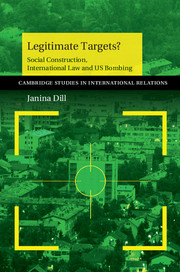
En route, I’ve been greatly taken by the work of Janina Dill (Politics and International Relations, Oxford) – particularly her discussion of Israel’s development of ‘Lawfare 2.0’ in relation to Gaza – and, as I say, I’ll have much more to say about that shortly.  But I’ve also discovered she has a book due out from Cambridge in the fall which, like her (I imagine summary) chapter in The American Way of Bombing, speaks to my own work on genealogies and geographies of bombing: Legitimate Targets? Social construction, international law and US bombing.

DILL Legitimate targets?Based on an innovative theory of international law, Janina Dill’s book investigates the effectiveness of international humanitarian law (IHL) in regulating the conduct of warfare. Through a comprehensive examination of the IHL defining a legitimate target of attack, Dill reveals a controversy among legal and military professionals about the ‘logic’ according to which belligerents ought to balance humanitarian and military imperatives: the logics of sufficiency or efficiency. Law prescribes the former, but increased recourse to IHL in US air warfare has led to targeting in accordance with the logic of efficiency. The logic of sufficiency is morally less problematic, yet neither logic satisfies contemporary expectations of effective IHL or legitimate warfare. Those expectations demand that hostilities follow a logic of liability, which proves impracticable. This book proposes changes to international law, but concludes that according to widely shared normative beliefs on the twenty-first-century battlefield there are no truly legitimate targets.

Introduction
Part I. A Constructivist Theory of International Law:
1. The challenge
2. The theory
Part II. The Definition of a Legitimate Target of Attack in International Law:
3. Positive law
4. Customary law
Part III. An Empirical Study of International Law in War:
5. The rise of international law in US air warfare
6. The changing logic of US air warfare
7. The behavioural relevance of international law in US air warfare
Part IV. An Evaluation of International Law in War:
8. The lack of normative success of international law in US air warfare
9. The impossibility of normative success for international law in war
Conclusion.