War Material

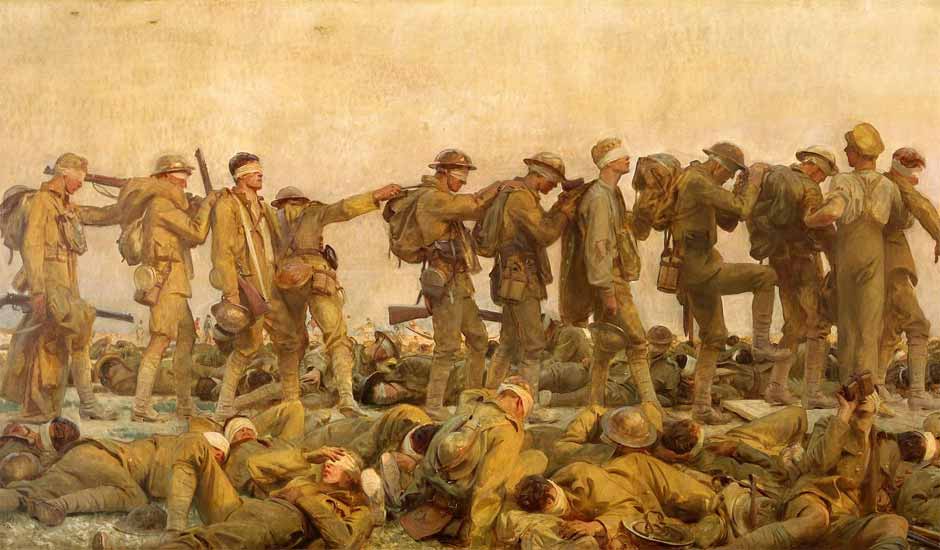
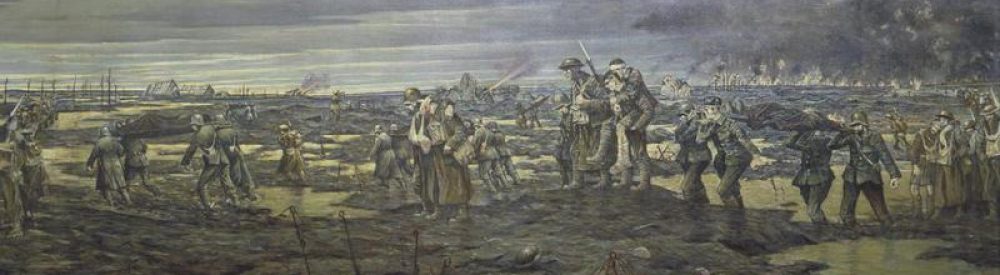
SARGENT Two soldiers at Arras

I’m thrilled to say that the (very!) long-form version of The Natures of War, the 1st Neil Smith Lecture which I gave at the University of St Andrews in November 2013, is now online (‘Early View’) at Antipode, all 54 pages of it.

Here is the abstract:

“Nature” is more than a resource bank whose riches can trigger armed conflict and finance its depredations; it is also a medium through which military and paramilitary violence is conducted. The militarisation of nature is part of a dialectic in which earthy, vibrant matter shapes the contours of conflict and leaves its marks on the bodies of soldiers who are both vectors and victims of military violence. Three case studies identify some of the central bio-physical formations that became entangled with armed conflict in the twentieth century: the mud of the Western Front in the First World War, the deserts of North Africa in the Second World War, and the rainforests of Vietnam. Taken together, these reveal vital connections between the materiality and corporeality of modern war and their continued relevance to its contemporary transformations.

You can still find the original, non-Harvard style version under the DOWNLOADS tab – and I’m truly grateful to Andy Kent for relieving me of the task of converting my original MS into the Harvard system.

The image above, incidentally, is John Singer Sargent‘s Two soldiers at Arras (1917), and is a perfect illustration of this passsage from the essay:

In the face of these horrors, some soldiers came to regard themselves as having become as “un-natural” as the militarised, industrialised natures in which they were embedded. The Tommy “will soon be like nothing on earth”, wrote one officer on the Somme in January 1916. “If only we could be clothed in rubber all over and fed through a tube I think some real progress in our equipment might have been made”. He was only half-joking. The next phase in the emergence of this cyborg warrior can be seen in the tank battles that raged across the deserts of North Africa during the Second World War. But, as I must now show, even in the midst of this more fully mechanised warfare, bio-physical entanglements remained immensely powerful—and the human body intensely vulnerable.

I then do the same for Vietnam.

My plan is to rework this version: to incorporate as many of the images I used in the Vietnam extracts I posted online here and here (together with others from the Western Front and the Western Desert), to add a fourth case study of Afghanistan, and to include the revised version in a new book of essays that I’m calling War material.

The plan looks like this (in each case the original essays, apart from the intro, are available under the DOWNLOADS tab too; I’m re-working those versions, planing away any overlaps, and adding more images):

Chapter 1: War material

Chapter 2: Gabriel’s map

Chapter 3: The Natures of War

Chapter 4: Doors into Nowhere

Chapter 5: Lines of Descent

These are all more or less ready to go, apart from the introduction, but I’m debating whether to add a sixth chapter, called ‘Wounds of war’, which would parallel ‘The Natures of War’ in many ways and chart the changing geographies of casualty evacuation from war zones, 1914-2014.

Each of the essays in the book, even in their present form, has something to say about the way in which the conduct of modern war has – and has not – changed over the last hundred years, but the title also tilts at those who seem to think that everything we need to know about modern military violence was uncannily anticipated by Michel Foucault in his (I too think brilliant) Paris lectures in the 1970s so that this absolves them of the need for any research or even reading into the materialities of war (a strangely non-Foucauldian assumption, given his own frequent immersion in the archive and his densely empirical way of working).

I’d be grateful for any comments or suggestions.

There’s something in the air…

Gas attack Somme

In ‘The Natures of War’ I include a brief discussion of the ways in which chemical gas attacks on the Western Front militarised the atmosphere:

Gas warfare turned the very air the soldier breathed into a potential enemy and, to Peter Sloterdijk, inaugurated a ‘new “ecologized” war’, a battle ‘conducted in the atmospheric environment [that] was about conquering the respiratory “potentials” of hostile parties’.  Here the French and the Germans led the way. The French were the first to use toxic gas shells on a large scale but these discharged tear gas which in most cases was not lethal, and when the Germans used similar shells against the British in October 1914 at Neuve Chapelle they too proved largely ineffective.  These were ‘Lilliputian efforts’, according to Peter Bull, and experiments by both sides with other systems were aimed at a greater harvest.

They yielded their first (poisoned) fruit on 22 April when the Germans launched the first lethal gas attack at Ypres. Unlike those earlier attempts this did not involve artillery – which is how the High Command persuaded themselves they were not violating the 1899 Hague agreement that prohibited the ‘use of projectiles the sole use of which is the diffusion of asphyxiating or noxious gases’  – and instead released chlorine gas from specially adapted industrial storage containers hidden in the German trenches and then relied on the wind to disperse the gas cloud. On that first, fateful evening more than 5,000 cylinders discharged 150 tons of chlorine gas. It billowed into a yellow-green cloud nearly six kilometres wide and 600-900 meters deep, which was then carried on a north-easterly wind towards two French divisions at 2-3 meters a second. The gas attacked the bronchial tubes and victims suffocated by drowning in their own fluids. German infantry advanced behind the gas cloud which had breached the French lines, and while they did not press home their advantage all sides concluded that gas was the way ‘to break the “riddle of the trenches”’ by flushing troops from cover and ending ‘the stalemate that had confounded all.’  But the reliance on wind as a dispersal vector was risky, not least because the prevailing wind on the Front was from the west – the initial attack had been postponed time and time again until conditions were favourable – and on 25 September the British launched their own gas cloud attack at Loos. This too went awry as a result of changing wind direction, and soon both sides had reverted to artillery delivery systems. They also developed deadlier agents (all derived from chlorine), and from 1916 gas of more than 60 types was in every engagement by artillery on all sides for both offensive and defensive purposes.

These gases affected more than the surface environment because they were all heavier than air. Chlorine and the far more deadly phosgene seeped into craters and shell holes, ‘corrupting the very areas of relative safety where men took refuge’. Mustard gas lingered even longer. It was designed to disable not kill – a blistering agent, it burned the skin and caused (usually temporary) blindness [see John Singer Sargent‘s famous Gassed, below] – and repeated intermittent exposure deadened the sense of smell so a man could no longer detect it. Since mustard gas remained dormant for days, it ‘consigned the soldier to a state of permanent unease’ in which ‘every puddle [became] an imagined trap’; in the winter of 1917-1918 there were reports of soldiers tracking frozen mud contaminated with mustard gas into their dugouts where it melted and gassed their companions.  Here too, the psychological effects of this militarised nature were as significant as their physiological ones. Gas turned out not to be the decisive weapon of the war; it accounted for around 1 per cent of British deaths but caused disproportionately more casualties. One of its main purposes, Tim Cook concludes, became disruption: spreading surprise, uncertainty, and fear on the battlefield. By 1918 gas made up 20-40 per cent of all shells within the artillery dumps on both sides and ‘all soldiers on the Western Front lived in an environment where gas was a daily fact of life…’

John Singer Sergeant, Gassed (1919)

The bibliographic references are in the draft text under the DOWNLOADS tab, but I rehearse all this because Sarah Everts has a richly illustrated and informative new essay on ‘When chemicals became weapons of war’ here – it’s an excellent survey.

The nature(s) of war and biomimetic war

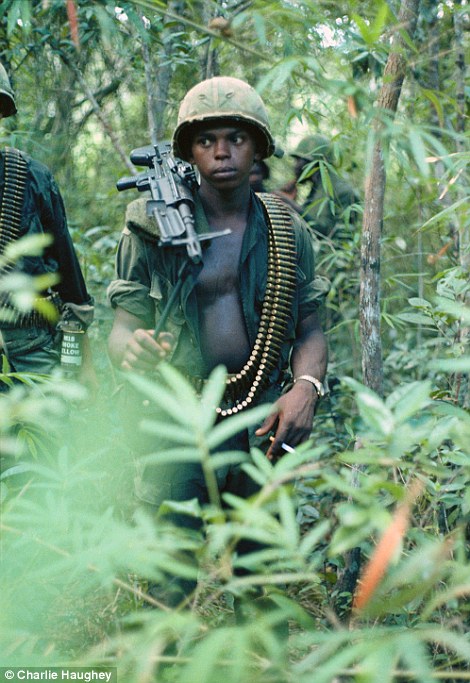
Charlie Haughey, VietnamOne of my tasks this past week has been to complete the revisions to ‘The Natures of War’ which, to my delight, Antipode has agreed to publish in its entirety (and with a handful of illustrations too).  I’ve added a discussion of the ways in which the narratives on which I draw – for the Western Front, the deserts of North Africa, and Vietnam – were all, for various reasons, ‘white boy’s stories’.  I had made it clear that there were troops from other continents fighting and dying on the Western Front, for whom the militarized nature of trench warfare in Europe would have been doubly strange (see also here), and I had also explained that in Vietnam there were at least two other stories to be told: most of the US memoirs were written by white soldiers so that the experiences of African-Americans were written out of the narrative, and the (not so different, as it happens) experiences of Vietnamese fighters only flickered in the footnotes.  I now address all these issues in the body of the text, and the racism of military violence – the racism within militaries ad coalitions as well as racial violence directed at ‘the enemy’ – speaks directly to racializations of nature, and I plan to write another essay drawing on the few extant and relevant memoirs from the People’s Army of North Vietnam and their ancillaries (for a taster, see here: scroll down).

But Juanita Sundberg has raised an altogether different though related question, about the ways in which non-white and (post)colonial subjects construed violence and, indeed, experienced it as quotidian.  In short, is war itself – in so far as its dominant conceptions privilege Europe and North America – seen from the position of a white subject, which is then confounded by the ‘intemperate natures’ of desert and rainforest?

The unrevised draft is still under the DOWNLOADS tab.  More soon.

***

While I’ve been rooting around with these questions, I discovered another way of thinking about ‘The Nature of War’.  Not sure how I missed this, but over at the Vision Machine Roger Stahl previews an essay on ‘The Nature of War’ and the ways in which

‘the discourse of “war” in news, pop culture, and weapons industry PR has taken on a host of biological metaphors. I call this discourse “biomimetic war,” and it is one that, in the end, tacitly extends military jurisdiction to the governance of life itself…

13sd1Of course, biological metaphors have been a part of war/security discourse for a while. Consider the fact that “drone” came from a WWII experiment in unmanned flight that relied on a control center called the “Queen Bee.” Surveillance, especially during the Cold War, has been rife with “bugs” and “flies on the wall.” In the post-9/11 period, however, the biological has edged toward the center as ultimate object of military power. War has gone ecological. Here, terrorism fuses with the natural disaster, Homeland Security responds to disease outbreak and domestic bombing alike, and the specter of biological weapons haunts the public imagination. In such a discursive environment, the contest we call “war” has effectively been mapped onto the biosphere as a permanent and ubiquitous condition determined less by the policing of national boundaries than policing life systems. ‘

You can download the full essay, ‘Life is War: the rhetoric of biomimesis and the future military’ at Democratic Communique 26 (2) (2014) 122-137 here.

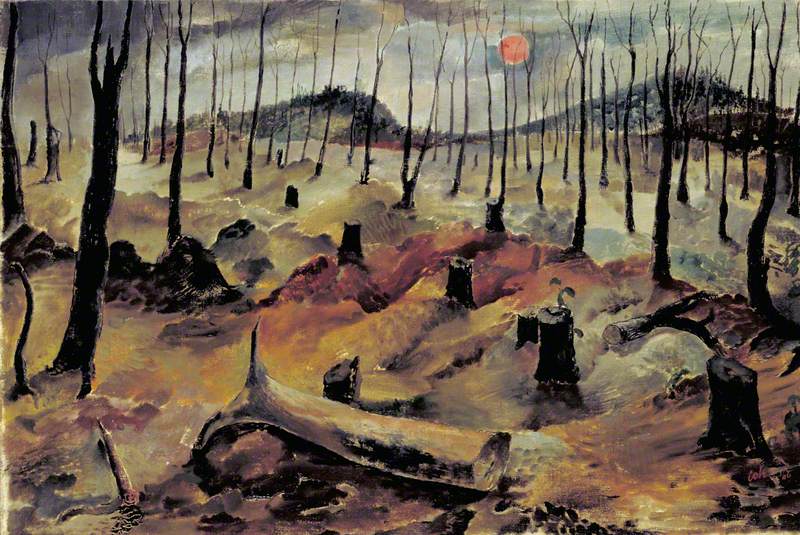
Scorched Earth

(c) Mr Russell Falkingham; Supplied by The Public Catalogue Foundation

In ‘The Natures of War’ (DOWNLOADS tab) I didn’t have space to address the legal dimensions of militarized natures, but Bronwyn Leebaw provides a helpful review in ‘Scorched Earth: Environmental War Crimes and International Justice‘ in the latest issue of Perspectives on Politics (12 [4] (2014) 770-788.  From the abstract:

Environmental devastation is not only a byproduct of war, but has also been a military strategy since ancient times. How have the norms and laws of war addressed the damage that war inflicts on the environment? How should “environmental war crimes” be defined and addressed? I address these questions by critically examining the way that distinctions between legitimate and illegitimate wartime environmental destruction have been drawn in debates on just war theory and the laws of war. I identify four distinctive formulations for framing the wartime significance of nature that appear in such debates and analyze how each is associated with distinctive claims regarding what constitutes “humaneness” in times of war: nature as property; nature as combatant; nature as Pandora’s Box; and nature as victim.

In the text she elaborates on those four formulations like this:

First, in early debates and documents, as well as contemporary interpretations of humanitarian law, a prominent approach to analyzing wartime destruction of nature has been to evaluate it in relation to claims regarding property protections in times of war. Humaneness, in this formulation, has been defined in relationship to dominion, ownership, discipline, and control, as defined against “wanton” or undisciplined actions. Second, in debates that influenced provisions of humanitarian law regarding chemical and biological weapons, nature has also been framed as a combatant. In this context, humaneness is associated with the use of technically superior weapons and the close identification of human agency with scientific mastery in response to anthropomorphized “enemies” in nature. Third, provisions of humanitarian law that aim to define and address the crime of ecocide emerged in response to the massive herbicidal campaign carried out by the US in Vietnam. Debates on the crime of ecocide were not only influenced by an ecological view of nature and humanity as interdependent, but also by a new formulation that positioned nature as a kind of Pandora’s Box, filled with creative and destructive forces that humanity has the power to unleash, yet not control. Finally, with the rise of international justice institutions, the expansion of the environmental movement as well as the human rights movement, nature has also been framed as a victim, or potential victim, of war crimes. In this formulation, humaneness and human agency are defined in relation to the criminal justice binary of guilt and innocence.

The last three all appear, in various forms, in ‘The Natures of War’, though – as I’ve tried to show, and as others know far better than me – questions of ‘human-ness’ are far from straightforward.

The Natures of War

Frank-Hurley-2008-Photographing-the-First-World-War-Hurley-Document-Name-06-copy sm

I have – at last – uploaded what I hope is the final version of ‘The Natures of War’ (DOWNLOADS tab).  It’s the long-form version of the first Neil Smith Lecture I gave at St Andrew’s (Neil’s alma mater) almost exactly a year ago (you can access the online video here).  The basic argument remains the same, but the written version is substantively different (and much longer).  If you do have any comments or suggestions, or you spot any egregious errors, please let me know.  Here’s the introduction:

***

In his too short life, Neil Smith had much to say about both nature and war: from his seminal discussion of ‘the production of nature’ in his first book, Uneven development, to his dissections of war in the twentieth and early twenty-first centuries in American Empire – where he identified the end of the First World World and the end of the Second as crucial punctuations in the modern genealogy of globalisation – and its coda, The endgame of globalization, a critique of America’s wars conducted in the shadows of 9/11. And yet, surprisingly, he never linked the two. He was of course aware of their connections. He always insisted that the capitalist production of nature, like that of space, was never – could not be – a purely domestic matter, and he emphasised that the modern projects of colonialism and imperialism depended upon often spectacular displays of military violence. But he did not explore those relations in any systematic or substantive fashion.

He was not alone. The great Marxist critic Raymond Williams once famously identified ‘nature’ as ‘perhaps the most complex word in the [English] language.’ Since he wrote, countless commentators have elaborated on its complexities, but few of them have paused to note that ‘war’ was not one of Williams’s keywords (though ‘violence’ – ‘often now a difficult word’ – was). Williams was radicalised by the rise of European fascism; he joined the British Army in 1941 and served as a tank commander during the Second World War. Yet at its end he found the world had turned, and it was for that very reason that he sought to find the terms for a post-war world in which, seemingly, ‘war’ had no place.

‘In 1945, after the ending of the wars with Germany and Japan, I was released from the Army to return to Cambridge. University term had already begun, and many relationships and groups had been formed. It was in any case strange to travel from an artillery regiment on the Kiel Canal to a Cambridge college. I had been away only four and a half years, but in the movements of war had lost touch with all my university friends. Then, after many strange days, I met a man I had worked with in the first year of the war, when the formations of the 1930s, though under pressure, were still active. He too had just come out of the Army. We talked eagerly, but not about the past. We were too much preoccupied with this new and strange world around us. Then we both said, in effect simultaneously: ‘the fact is, they just don’t speak the same language’.’

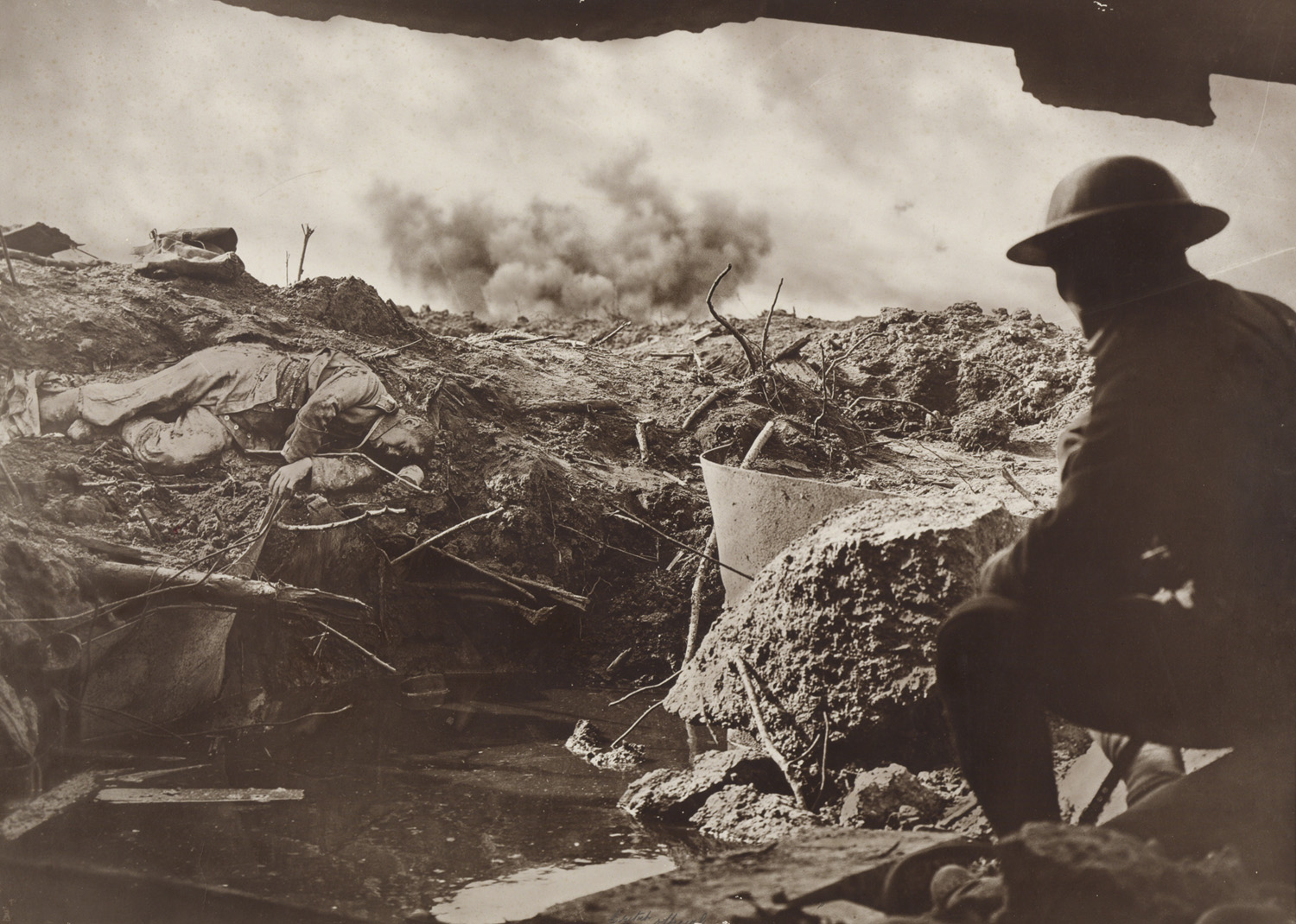
I want to track backwards and forwards from Williams’s war-time experience to trace three different co-productions of nature and military violence: the soiled earth of the Western Front during the First World War, the deserts of North Africa during the Second World War (an armoured campaign very different from the European theatre in which Williams served), and the rainforests of Vietnam. My accounts can only be sketches, but they share a way of thinking of ‘nature’ (in all its complexity) as a modality that is intrinsic to the execution of military and paramilitary violence. In much the same way that ‘space’ is not only a terrain over which wars are waged – the fixation on territory that remains at the heart of modern geopolitics – but also a medium through which military and paramilitary violence is conducted, so ‘nature’ is more than a resource bank whose riches can trigger armed conflict and finance its depredations: the problematic of resource wars and conflict commodities. The spoils of war include the short-term bludgeoning of landscapes and the long-term toxicity of contamination (what Rob Nixon calls ‘slow violence’), but it is also important to trace the bio-physical formations – the conditions, provided the term is understood in the most active of senses – that are centrally involved in the militarisation of ‘nature’. For nature too is a medium through which military and paramilitary violence is conducted.

I speak of ‘co-productions’ and ‘formations’ in order to signal in advance three issues that will reappear across all three studies. First, each of these wars was in large measure what Paul Saint-Amour calls, in relation to the first of them, an optical war: they depended on geo-spatial intelligence, surveillance and reconnaissance which in its various forms provided the essential basis for the maps, plans and orders that activated the war machine. And yet the remote orderings of military violence were never autonomous projections onto a pure plane; they also depended on the bodies of soldiers whose apprehension of the battle space was always more than visual. In part, this was a matter of affect, but it was also a matter of knowledge – of a corpography rather than a cartography – whose materialities also inflected imaginative geographies of militarised nature. Second, those diverse stocks of knowledge about the battle space were invested in the co-production of a ‘trickster nature’. It was commonplace to describe the Western Front as a surreally empty landscape in which the capacity for military violence was hidden from view once men withdrew into the troglodyte world of the trenches. But I have in mind a more pervasive sense of uncertainty instilled by a militarised nature: one where the earth and air could kill through an infected wound, a buried mine or a cloud of gas, and whose camouflaged landscapes could wreak havoc with the military gaze to dissemble and distract, lure and entrap. Third, this was a hideously hybrid ‘cyborg nature’ whose terrain and life-forms were saturated with the debris of violent conflict: burned-out vehicles and bombed-out buildings, barbed wire and exploded munitions, discarded weapons and abandoned supplies, toxic residues and body parts. So far so familiar, except that none of these entanglements was inert; they shaped the military operations that took place through them. In all three ways each of these battle spaces was composed of ‘vibrant matter’ that was often also deadly matter.

***

This version is so long I’ve cut all the illustrations, but I have uploaded the original lecture slides too (DOWNLOADS tab); I’ve already posted early versions of some of the sections – and those were illustrated – here and here.

Quagmire

I’ve received several e-mails asking for “Boots on the Ground” to be continued.  So here is the rest of my discussion of militarised nature in Vietnam, extracted from the long-form version of “The natures of war“.  It follows on directly from that earlier post, but please bear in mind that this is still only a draft – in particular, I need to add a discussion of malaria, somehow, somewhere – and that I’ve excised the footnotes and references from this version.

***
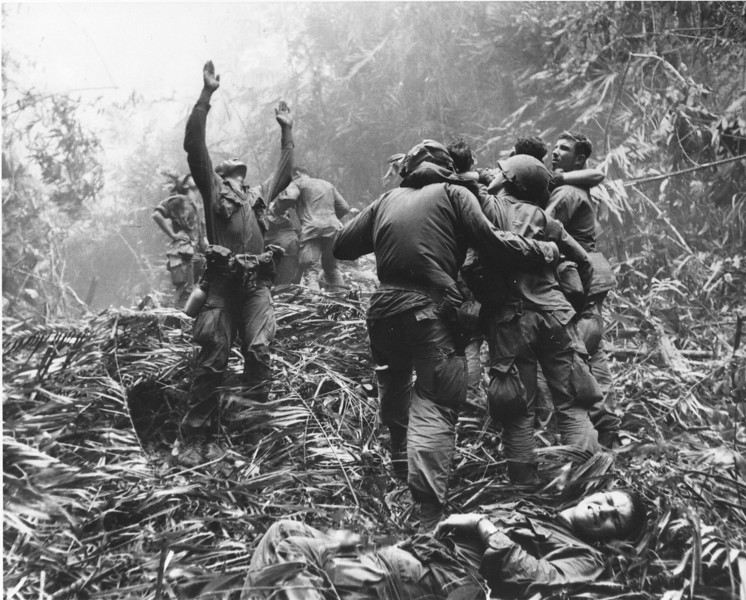
p01219_002

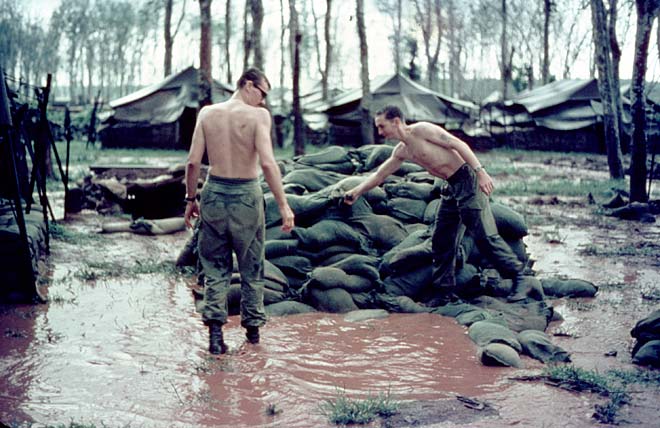
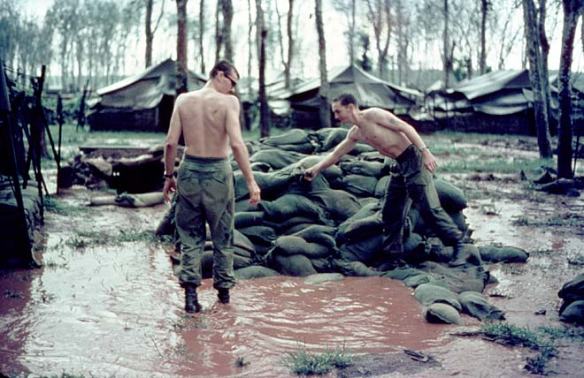
Even the weather seemed out to get them. The tropical heat and humidity were so enervating that they appeared to possess their own monstrous agency. ‘There were moments when I could not think of it as heat,’ Caputo confessed, ‘rather it seemed to be a thing malevolent and alive.’ Dehydration and heatstroke were constant concerns, and the monsoon only compounded their misery. ‘It rained like it had been waiting ten thousand years to rain,’ one lieutenant said when the monsoon broke, and John Ketwig described rain drops ‘as large as marbles and driven with enough force to sting when they hit you.’ The ground was turned into a sea of mud, and even the ‘rear-echelon motherfuckers’ on the permanent bases had to contend with their bunkers and foxholes filling with water, and roads becoming ‘ribbons of churned slop’. Ketwig again:

‘There were areas of shallow mud and areas of deep mud, but there were no areas without mud. Most of our world was under water, and you had to know where to step. The huge trucks we worked with would often sink up to the frame. The driver would try four-wheel-drive, spin the cleated duals at the rear, and dig himself in deeper. The rule was, the driver who “lost” a truck had to swim down and attach the tow chains. Swim is an accurate term for the depth of the mud, but hardly describes the frenzied mucking about in zero-visibility goo.’

One Marine newly arrived at a base near the DMZ in the middle of the monsoon was advised that the best way to navigate the ‘boot sucking slurry’ was to ‘walk in the tank tracks’: ‘The mud is only an inch deep there … Plus if we take incoming [fire], you can lay down in the track and you’re five inches lower.’ Vietnam was often more than a metaphorical quagmire.

The irony was that the billowing storm clouds limited air reconnaissance and so made ground patrols all the more important. They also constrained the logistical and medical support that could be provided to them:

‘There were many days when aircraft could not fly in such all-consuming cloudy conditions. Hence we were not always assured that we would be re-supplied, or that we could get choppers in to take out our wounded or dead, and on one occasion we were compelled to sleep with our dead, and then awake in the morning and carry our dead along with us, while waiting for an opportunity to clear an LZ (landing zone) so that choppers could come in and lift our comrades out of the jungle for their final journey home.’

For those out beyond the wire the monsoon wreaked havoc. Jack Estes describes one tropical storm ‘ripping, ravaging and slapping through the jungle’ and ‘howling like a monstrous beast.’ Soldiers were drenched to the skin, their uniforms chafed, their packs became heavier as they absorbed the water, and thick, cloying mud clung to their boots and weighed down their every step. ‘The mud was ground into my letters’, wrote one Marine.

‘The mud was ground into everything. The mud was in our ears and mouths. Our c-rats [C-rations] tasted like the mud we lived in… We were brown men. Even the black men were brown men.’
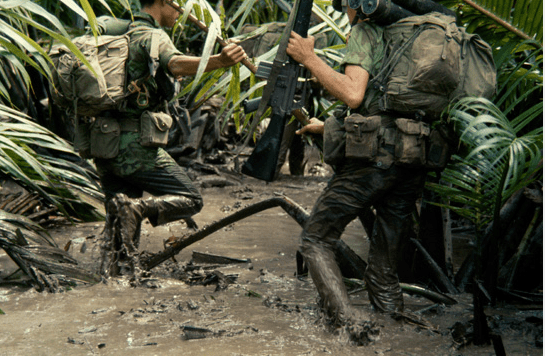
Mud in Vietnam

It was all desperately invasive, and Lawrence said he felt ‘persistently violated by the soaking wetness’. There was no let-up when darkness fell and they dug in for the night. ‘Sleep was measured in minutes at a time on the rainy nights’ and ‘muscles were constantly drawn tight against the cold.’ One Marine admitted that one night it was so miserable that ‘after a while we were hugging like young lovers’ just to stay warm. But usually the combination of cold and wet was utterly debilitating.

‘The rain comes in sheets all through the night and when I am relieved I remain standing with the Marine that has relieved me. Soon we realize that nearly the entire team is standing to escape the flooded ground. As the rain intensifies, I surrender to the cold deluge; wrapping myself into the wet, muddy plastic, I try to sleep. Before daylight, I wake shivering and half submerged in a deep puddle of cold rainwater, the edges of my poncho floating beside me. I pray that I am dreaming. Leeches cover my legs, their bodies filled to the point of bursting, gorged with type “O” Positive. The crotch of my jungle trousers is caked with blood; a leech has fed on my groin. My wrinkled fingers struggle with the bottle of insect repellant and as I squirt it on their membrane-like skin, I vent my rage on them with frantic curses that are filled with disgust. As I watch them fall off in agony, I scratch at the wounds to maintain the flow of rich, clean blood that will hopefully prevent infection; the repellent burns deep into each wound.’

Aching muscles, pus-filled skin sores and scabs (‘jungle rot’) and even leeches were the least of their worries. The infantry still marched on its feet as well as its stomach – for the grunts at least, ‘the war was fought with the feet and legs’ – and constant immersion invited the return of an old adversary. When Delezen hauled off one of his soaking boots he was taken aback:
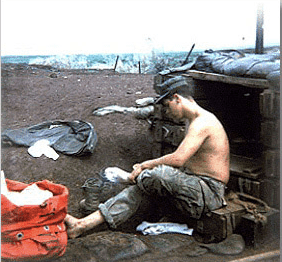
Vietnam feet‘[T]he foot is a wrinkled mass of putrid milk-white flesh and is badly cracked and bleeding. With the ragged boot in one hand and my weapon in the other, I crawl through the matted bamboo to the Corpsman [Marine medical specialist]; after a quick glance he tells me that there is nothing that he can do, his feet are in the same condition. It is immersion foot; trench foot was what our grandfathers called it in France. One by one each of my teammates removes one boot at a time and stares in repulsion at the condition of their feet… I try to dry the foot but I have nothing that is not waterlogged. Finally, in desperation, I place the wet socks under the shoulder holster; perhaps my body heat will dry them. There is nothing more that I can do so I pull the muddy jungle boot back on, lace it up, and try to forget about my ravaged feet.’

These physical sensations of exhaustion and pain were registered in a sensorium in which the usual hierarchy of senses was scrambled. As on the Western Front and in the Western Desert, sight was compromised in the rainforest. Visibility was limited by the dense vegetation and the filtered light. With a patrol strung out in single file five metres apart, it was all too easy to lose sight of the man in front – O’Brien said they each followed him ‘like a blind man after his dog’ – and at night ‘it was like walking inside a black velvet bag.’ Everyone’s eyes ached ‘from the constant strain of searching through the layers of jungle.’ In the middle of this ‘war of plant life’, wrote Caputo, ’it was difficult to see much of anything through the vines and trees, tangled together in a silent, savage struggle for light and air’. And yet, for that very reason, they had an almost palpable ‘sense of being surrounded by something we could not see.’ ‘It was the inability to see that vexed us most,’ he continued. ‘In that lies the jungle’s power to cause fear: it blinds.’ Not surprisingly, he concluded that ‘in Vietnam the best soldiers were unimaginative men.’ Once again, O’Brien spells out the consequences: ‘What we could not see, we imagined.’
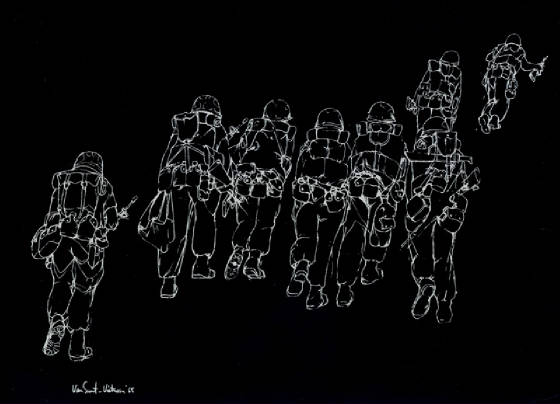
TOM VAN SANT Night_Patrol_Vietnam_68.jpg.w560h404

As sight lost its primacy the other senses were heightened, particularly hearing. Noise was literally a dead giveaway – ‘sound was death in the jungle’ – and the jingle of equipment had to be minimised. Before setting out, Delezen explained, ‘each of us, donning our heavy equipment, jumps up and down listening attentively for the slightest sound; there can be no exception. What may be considered an insignificant rattle will become amplified in the silent bush.’ Sounds also seemed to travel farther at night. ‘Shortly after sunset the jungle became as black as tar, and our sense of hearing came to predominate over our sense of sight.’ Other noises filled the canopy – ‘the croaking of tree frogs, the clicking of gecko lizards like sticks of bamboo banging together, the drone of myriad insects, and the occasional screech of a monkey’ – and these played cruel tricks with the imagination. In isolation they could sound a false alarm, and it was common for rookies to wake their companions because they had heard something, only to be reassured ‘there was nothing out there.’ But together, as a sort of green noise, they could ‘lull you into somnambulance … [and] numb your sense of hearing and smell and sight until you start seeing things in the night.’

All of these burdens, physiological and psychological, convinced many soldiers that their greatest danger was from Nature itself. What exercised them most about the jungle was not the prospect of an encounter with a wild animal; their accounts mention bamboo vipers, whose bite was horribly painful but not deadly, and even the occasional tiger, but they repeatedly tell themselves that ‘all the bombing and artillery have driven the wildlife up into Cambodia.’ Neither was it the thought of being killed or wounded in an ambush: ‘Contact with the enemy was very sporadic’, John Nesser explained, and instead ‘it was the day-to-day miseries in the bush that got to us.’ It would be wrong to minimise the dangers of being killed or wounded, which surely preyed on soldiers’ minds. But what they clearly came to loathe with a passion was their intimate, intensely corporeal violation by the jungle itself. ‘There it is you motherfuckers,’ crows Corporal Jancowitz in Karl Marlantes’ Matterhorn: ‘Another inch of the green dildo.’ The image is part of a long tradition of ‘porno-tropicality’ that is hardly peculiar to the US military, but during the Vietnam war it has a particular resonance for what it implies about violence, masculinity and the ‘un-manning’ of American soldiers.

Its power turns on the militarisation of nature in an altogether different register: one in which the jungle becomes terrifyingly alive, and its militant agency is made to account for the degradation of soldiers caught in its poisonous embrace and to justify its own destruction. There is a scene in Stephen Wright’s Meditations in Green in which a photo-interpreter on a large US airbase is advised to sit on top of a bunker and stare at the jungle.
WRIGHT Meditations in Green‘“You have to concentrate because if you blink or look away for even a moment you might miss it, they aren’t dumb despite what you may think, they’re clever enough to take only an inch or two at a time. The movement is slow but inexorable, irresistible, maybe finally unstoppable. A serious matter.”

“What movement, what are you are you talking about?”

“The trees, of course, the fucking shrubs. And one day we’ll look up and there they’ll be, branches reaching in, jamming our M-60s, curling around our waists.”

“Like Birnam Wood, huh?”

“Actually, I was thinking more of triffids.”’

The scene is fiction but not entirely fanciful – one platoon leader called it ‘the magic hour when men begin to look like bushes, and bushes begin to move’ – and many came to see the jungle as capricious and even wilfully obstructive. Caputo complained that ‘cord-like “wait-a-minute” vines coiled around our arms, rifles and canteen tops with a tenacity that seemed almost human.’ A radio operator humped the set on his chest not his back because otherwise ‘the vines constantly change the frequency by spinning the knobs of the radio top.’ ‘Perhaps it is the bush that is the enemy’, wondered Delezen:

‘[T]he jungle is a “cat’s cradle” of twisted vines that seem alive, as if reaching for me. Sometimes, even when not moving, I find myself held in their grasp, it as if they silently attack when I am not looking, as though they are thinking organisms. When moving, the only way to pass through the vines is to become a vine; it is impossible to push through the jungle, forcing, fighting, and struggling. The bush must be negotiated with and each vine must be silently dealt with as an individual. Stealth and quiet is all that prevents our destruction from the ever-present enemy. We have learned that we must become a part of the bush, always searching for the passage that lies hidden through the entanglement…’

In this passage the young Marine moves from being attacked by the vines – ‘held in their grasp’ – to becoming one, ‘a part of the bush’, and the precarious relation between the two had to be constantly renegotiated if the men were to survive. ‘At times I am certain that it is possible for our team to be consumed by the enveloping walls of foliage,’ Delezen continues, ‘without a trace we could easily disappear forever, absorbed into the tangled mass.’ This was more than the spectral fear of getting lost, though that was ever present; more too than losing your grip in what O’Brien called ‘a botanist’s madhouse’. For many soldiers it was also an existential threat that emanated from a diabolical Nature. ‘The Puritan belief that Satan dwelt in Nature could have been born here,’ Herr wrote in an extraordinary passage:

‘Even on the coldest, freshest mountaintops you could smell jungle and that tension between rot and genesis that all jungles give off. It is ghost-story country… Oh, that terrain! The bloody, maddening uncanniness of it!’

Downs too was taken aback by the pervasive sensation of rot. ‘Covering everything was the smell of slimy, rotting vegetation’, he recalled. ‘Our clothes and our bodies were beginning the rotting process of the jungle.’ He recognised this as a physical danger – ‘every scratch was a breeding spot for bacteria which could result in the rapid growth of jungle rot’ – and one that involved constant physical degradation: as one Marine officer put it, ‘it is a different way to live, and it is not a state of grace.’ Downs also saw this as a profoundly moral danger. ‘Every day we spent in the jungle eroded a little more of our humanity away.’ For him and for countless others the rot set in as the deeply sedimented Enlightenment distinctions between nature and culture dissolved in the jungle. ‘Everything rotted and corroded quickly over there,’ Caputo agreed, ‘bodies, boot leather, canvas, morals’:

‘Scorched by the sun, wracked by the wind and rain of the monsoon, fighting in alien swamps and jungles, our humanity rubbed off of us as the protective bluing rubbed off the barrels of our rifles.’

To him, it was ‘an ethical as well as a geographical wilderness. Out there, lacking restraints, sanctioned to kill, confronted by a hostile country and a relentless enemy, we sank into a brutish state.’

Admissions like these reappear throughout the letters, diaries and memoirs that I have read, sometimes explicitly and sometimes implicitly (the cleansing shower when a patrol returns from the field can sometimes be more than a matter of physical hygiene). They invite questions about how far the imprecations of nature – its assault not only on the human body but also on the humanity of the soldier – functioned for some of them as a more or less unconscious alibi for atrocity, so that those who committed acts of indiscriminate or unnecessary violence believed they had somehow been reduced to a ‘state of nature’ by nature. Its plausibility must have been heightened by the common dehumanisation of the Vietnamese (‘gooks’) and the reduction of the enemy and the civilian population to creatures of nature. Bernd Greiner says as much in his detailed analysis of atrocities in the far north and south of Vietnam: ‘Nature, the elements, literally everything took on the form of the enemy.’

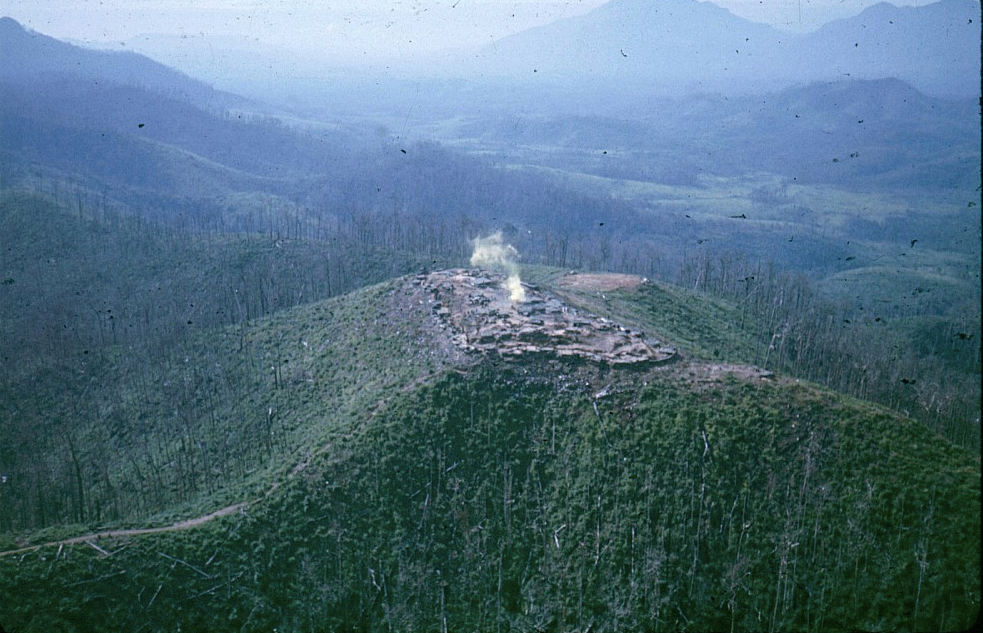
The same imaginary also licensed a war on nature. The B-52 strikes, the napalm and the artillery bombardments all shattered the landscape (and the lives of many of those within it) but, as Wright’s Griffin is told in Meditations in Green, ‘it’s not as if [the] bushes were innocent.’ Griffin’s job was to assess the effects of the spraying of Agent Orange on the rainforest, the mangroves and the paddy fields by examining time series of air photographs:

‘It was all special effects out there. Crops aged overnight, roots shrivelled, stalks collapsed where they stood into the common unmarked grave of poisoned earth. Trees turned in their uniforms, their weapons, and were mustered out, skeletal limbs too weak to assume the position of attention… Griffin sat on his stool and watched the land die around him.’
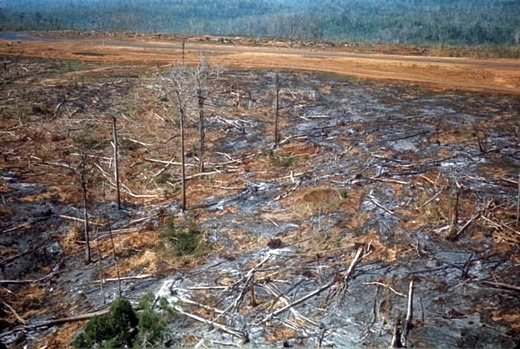
Effects of Agent Orange on the ground

Wright was not alone in imaginatively enlisting the trees in the enemy’s battalions. This was the logic behind Operation Hades – a differently diabolical militarisation of nature – that was soon re-named Operation Ranch Hand. Its objective was to spray the forests with herbicides and deny their cover to the North Vietnamese Army and the Viet Cong. In so far as the intention was, as David Zierler reports, to create ‘a no man’s land across which the guerrillas cannot move’ then at least some American officials were perturbed at the spectre of the Western Front being let loose once again: ‘Defoliation is just too reminiscent of gas warfare.’ Their objections were dismissed, however, and the US Air Force expressed considerable satisfaction at the results: ‘herbicide operations in the Republic of Vietnam have proved to be very useful as a tactical weapon.’ Those on the ground had a different view. ‘We didn’t know anything about Agent Orange beyond the fact that it was a failure,’ declared Nathaniel Tripp. The brute fact was that removing the forest cover made movement more difficult for American troops too. Agent Orange turned the surviving vegetation into a slimescape and, worse, allowed the hated vines to multiply:

‘During the year or two that had elapsed since [Agent Orange] had been sprayed on the woods, the “wait-a-minute” vines seemed to have developed a liking for the stuff and taken over like a kudzu horror movie. The long, prickly vines hung in festoons from the stark skeletons of poisoned trees and covered the ground with a shoulder-high thicket. Sometimes it would take an hour to move forward a kilometer, hacking through the vines while the sun beat down unmercifully. Extra water was frequently dropped by helicopter between stream crossings, but men kept collapsing from heat exhaustion nonetheless, and we all had to stop and wait again while they were medevaced out’.
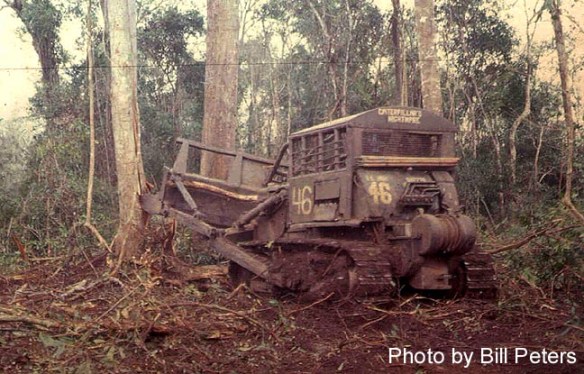
03_Plowinthecutpackmule

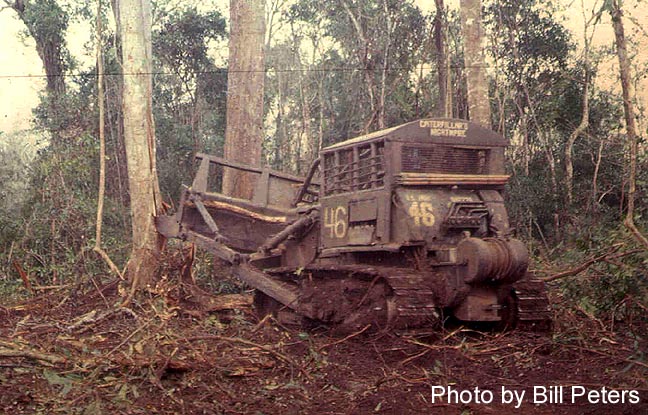
And clearing the rainforest exposed American patrols to more than the sun’s harsh rays. Later Tripp and his platoon were part of a division tasked with securing a route used to supply a detachment of forty Rome Plows – giant armoured bulldozers – that were busy ‘flattening mile after mile of woods’. ‘It was something to see from the air,’ he recalled, ‘like battalions of tornadoes had just passed through leaving nothing but a shattered tangle of mud and tree trunks and root masses.’ But again, the ground provided a different perspective:

‘Digging in was all but impossible, but we did the best we could in the pouring rain. The ground was covered everywhere with a mat of logs and branches, all interwoven and compacted, three to five feet thick and mixed with gummy gray clay. Surely, America had triumphed over the woods at last, and created a place that was impossible for anyone to hide in. Now, we were trying to hide in it, while the Viet Cong watched from the dark woods just meters away on both sides of the swath.’

And yet, even in this ‘landscape of hopelessness’, as Tripp called it, there were precious moments of relief and even of redemption. Jacobs knew that ‘war destroys everything it touches’, but sometimes he found himself marvelling at ‘the natural beauty that surrounded us.’ Just when Delezen was in despair – ‘There is no beauty here, only destruction’ – he found a wild flower near an abandoned, half-filled fighting hole. ‘Like a rare jewel, it seems misplaced; there is no place for beauty here.’ But then:

‘I remove the sweat soaked leather bush glove from my hand and drop to one knee to touch the delicate petals. My hand is caked with slippery mud, a mixture of red dust from Route 9 and sweat; the hand seems filthy and crude against the soft purple and white flower. I decide not to touch it; I do not want to spoil this last bit of beauty and purity that has somehow escaped the Devil’s grasp.

‘I look toward the team that continues to move on without me; I am reluctant to leave the petite blossom unprotected. Quickly, I gather a small pile of rusty ration cans and place them around the frail green stem. Perhaps the cans will offer protection; the team is looking back at me, I have to rejoin them. I want to take the flower with me but it will only wither and die in the heat. I have done all that I can to protect it from the madness. For a brief moment, I have escaped the hell of war and entered a peaceful sanctuary where care and compassion still exist…. As I move away from the little pile of rusty cans, occasionally I look back; with each glance the soft colors of the flower fade until they blend into the dry-green of the tortured vegetation.’

It’s an affecting passage in which Delezen joins his forebears on the Western Front in affirming the stubborn persistence of a pastoral nature, even in a tropical rainforest, but the most elegiac moment I know comes towards the end of Matterhorn. Marlantes’ young lieutenant thinks of the jungle ‘already regrowing around him to cover the scars they had created’:

‘Mellas felt a slight breeze from the mountains rustling across the grass valley below him to the north. He was acutely aware of the natural world. He imagined the jungle, pulsing with life, quickly enveloping Matterhorn, Eiger, and all the other shorn hilltops, covering everything. All around him the mountains and the jungle whispered and moved, as if they were aware of his presence but indifferent to it.’
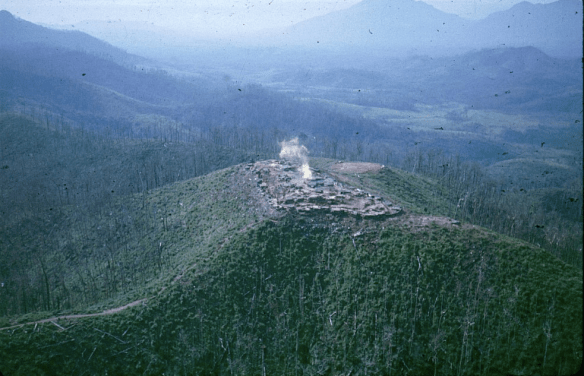
Firebase 6 Dak To Vietnam 1971

In speaking so directly to the recuperative, regenerative capacity of even a militarised nature, I suspect Marlantes is also expressing a desperate hope that those who have brutalised so many of its life-forms might find redemption too.
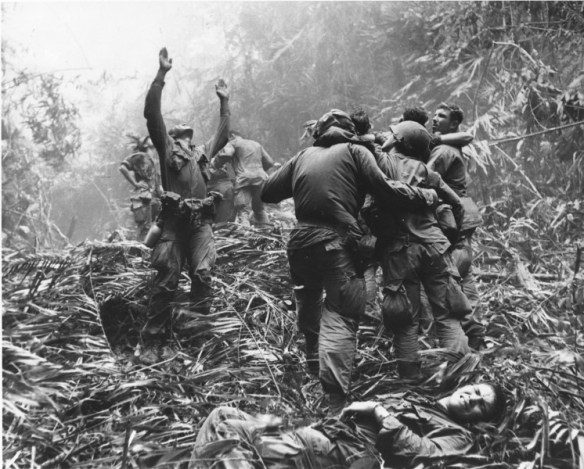
DEU 1968 Jahrestag


Theatre of Operations

I am at last back in Vancouver after what seemed at times like a marathon on the road (even though part of it was vacation), and there’s much to catch up on and much to report.

But I’m going to ease myself in gently with news of a forthcoming book by Joseph Masco.  Many readers will know his previous book, The Nuclear Borderlands: the Manhattan Project in post-Cold War New Mexico (Princeton, 2006), a tour de force – appropriately enough – that carried off a string of major prizes. (If you don’t know it, you can get a taste in his ‘Desert modernism’, available as a pdf from Cabinet 13 (2004) here).

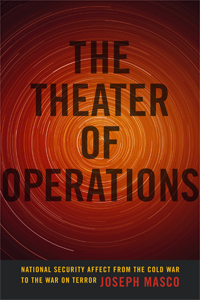
MASCO Theater of OperationsHis new book, due out from Duke University Press in November, is The Theater of Operations: National security affect from the Cold War to the war on terror:

How did the most powerful nation on earth come to embrace terror as the organizing principle of its security policy? In The Theater of Operations, Joseph Masco locates the origins of the present-day U.S. counterterrorism apparatus in the Cold War’s “balance of terror.” He shows how, after the attacks of 9/11, the U.S. Global War on Terror mobilized a wide range of affective, conceptual, and institutional resources established during the Cold War to enable a new planetary theater of operations. Tracing how specific aspects of emotional management, existential danger, state secrecy, and threat awareness have evolved as core aspects of the American social contract, he draws on archival, media, and ethnographic resources to offer a new portrait of American national security culture. Undemocratic and unrelenting, this counterterror state prioritizes speculative practices over facts, and ignores everyday forms of violence across climate, capital, and health in an unprecedented effort to anticipate and eliminate terror threats – real, imagined, and emergent.

I’ve commented on the idea of a ‘theatre of war’ on several occasions (see here and here) and in his new book Masco seems to be excavating its performative/manipulative dimensions to explore the constitution of ‘a new, planetary theatre of operations’ – something else to take into account as I race towards completing The everywhere war.  I’m also greatly taken by a genealogy that begins not with 9/11, which is emphatically not the moment when ‘everything changed’, but with the Cold War…

The Theater of Operations has won advance praise from another of my favourite authors, Peter Galison:

“We know that in the Cold War transportation infrastructures boomed, electronic infrastructures had to be hardened. We know about weapons and counter-weapons; we even have learned about the astonishing proliferation of security mechanisms put in place during the War on Terror. What Joseph Masco shows us in The Theater of Operations is an entire affective structure—the management of anxiety, resilience, steadfastness, sacrifice—that is demanded of every citizen. Alert to liquid containers above 2.4 ounces, hypervigilant to abandoned bags, suspicious loitering, or the detonation of a thermonuclear weapon—we learn to live our lives aware of tiny and apocalyptic things. With an anthropologist’s eye long attuned to life in the para-wartime state, Masco is the perfect guide to the theater of our lives in the security state.”

Joseph MascoEvidently not a person to stand still for long, Masco is already at work on a book on environmental crisis: you can dip a toe into the water at the excellent somatosphere (on science, medicine and anthropology) here, or dig out his chapter on ‘Bad weather: the time of planetary crisis’ in Martin Holbraad and Morten Axel Pedersen (eds), Times of security: ethnographies of fear, protest and the future, which came out from Routledge last summer.  The abstract (below), together with a link to an earlier essay on ‘Building the Bunker Society’ (available as a pdf), is here:

How, and when, does it become possible to conceptualize a truly planetary crisis? The Cold War nuclear arms race installed one powerful concept of planetary crisis in American culture. The science enabling the US nuclear arsenal, however, also produced unintended byproducts: notably, a radical new investment in the earth sciences. Cold War nuclear science ultimately produced not only bombs, but also a new understanding of the earth as biosphere. Thus, the image of planetary crisis in the US was increasingly doubled during the Cold War – the immediacy of nuclear threat matched by concerns about rapid environmental change and the cumulative effects of industrial civilization on a fragile biosphere. This paper examines the evolution of (and competition between) two ideas of planetary crisis since 1945: nuclear war and climate change. In doing so, the paper offers an alternative history of the nuclear age and considers the US national security implications of a shift in the definition of planetary crisis from warring states to a warming biosphere.

And while we are on the subject of ‘bad weather’, climate change and national security, the GAO recently released a report on the implications of global climate change for US military infrastructure. You can read a summary review here, which points out that while the Pentagon evidently takes climate change very seriously indeed – there has been a string of seminars, workshops and conferences testifying to that – the die-hards in the Republican Party continue to do everything they can to block even military-sponsored research into climate change.  As Representative David McKinley put it:

Our climate is obviously changing; it has always been changing. With all the unrest around the global [sic], why should Congress divert funds from the mission of our military and national security to support a political ideology? This amendment will ensure we maximize our military might without diverting funds for a politically motivated agenda.

The engorgement of ‘military might’ severed from a ‘politically motivated agenda’: you can’t make this stuff up.  Even for the theatre.

In the literary trenches

Barbusse2

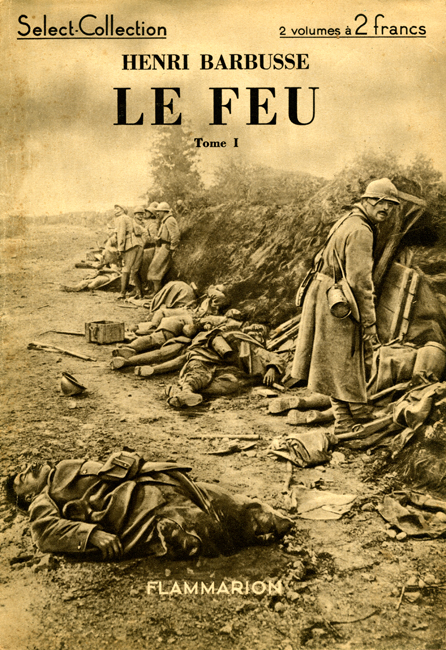
Until now, my knowledge of the French experience on the Western Front has been largely confined to Henri Barbusse’s Under Fire.  I was particularly taken by his striking evocation of the materiality of war – of the ‘slimescape’ – which features in ‘Gabriel’s Map’ and ‘The Natures of War’ (both soon to be available in written form):

The earth! It is a vast and water-logged desert that begins to take shape under the long-drawn desolation of daybreak. There are pools and gullies where the bitter breath of earliest morning nips the water and sets it a-shiver; tracks traced by the troops and the convoys of the night in these barren fields, the lines of ruts that glisten in the weak light like steel rails, mud-masses with broken stakes protruding from them, ruined trestles, and bushes of wire in tangled coils. With its slime-beds and puddles, the plain might be an endless gray sheet that floats on the sea and has here and there gone under. Though no rain is falling, all is drenched, oozing, washed out and drowned, and even the wan light seems to flow. Now you can make out a network of long ditches where the lave of the night still lingers. It is the trench. It is carpeted at bottom with a layer of slime that liberates the foot at each step with a sticky sound; and by each dug-out it smells of the night’s excretions. The holes themselves, as you stoop to peer in, are foul of breath. I see shadows coming from these sidelong pits and moving about, huge and misshapen lumps, bear-like, that flounder and growl. They are “us.”

Or again:

We begin to flow again in one direction. No doubt it is a movement planned up there, back yonder, by the chiefs. We trample soft bodies underfoot, some of which are moving and slowly altering their position; rivulets and cries come from them. Like posts and heaps of rubbish, corpses are piled anyhow on the wounded, and press them down, suffocate them, strangle them. So that I can get by, I must push at a slaughtered trunk of which the neck is a spring of gurgling blood.

The ground is so full of dead that the earth-falls uncover places that bristle with feet, with half-clothed skeletons, and with ossuaries of skulls placed side by side on the steep slope like porcelain globe-jars. In the ground here there are several strata of dead and in many places the delving of the shells has brought out the oldest and set them out in display on the top of the new ones. The bottom of the ravine is completely carpeted with debris of weapons, clothing, and implements. One tramples shell fragments, old iron, loaves and even biscuits that have fallen from knapsacks and are not yet dissolved by the rain. Mess-tins, pots of jam, and helmets are pierced and riddled by bullets—the scrapings and scum of a hell-broth; and the dislocated posts that survive are stippled with holes.

It’s a clunky old translation, but the power of Barbusse’s prose still shines through.  Small wonder that he later confided: ‘I once used to think that the worst hell in war was the flame of shells; and then for long I thought it was the suffocation of the caverns which eternally confine us. But it is neither of these. Hell is water.’ (If you want more on these imaginative geographies, incidentally, I recommend Susan Grayzel‘s short essay on Barbusse and, more generally, Claire Keith‘s ‘Pilgrims in a toxic land: Writing the Trenches of the French Great War’ in Jeff Persels‘s collection, The environment in French and Francophone Literature and Film (2013) pp. 69-85).

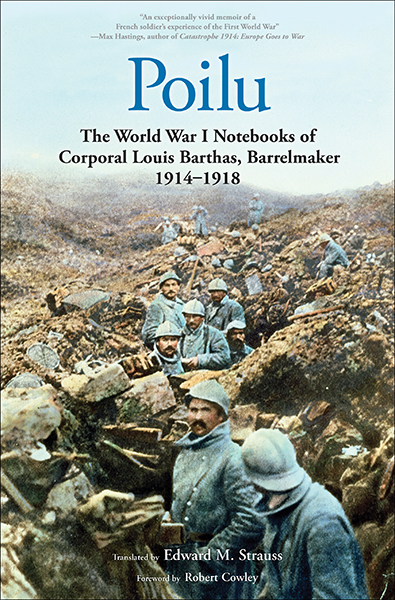
BARTHAS Poilu

I’ve spent the last several days reading two other accounts by French authors.  The first, Louis Barthas‘s Poilu, has only recently been made available in English translation (it was first published in France in 1978).  ‘Poilu’ means ‘hairy one’, but probably the closest English-language equivalent is the much more recent ‘grunt’, for Poilu presents  the view of the (not so) common soldier.  It’s a carefully assembled account, as Robert Cowley explains in his helpful introduction:

‘Few documents from the Great War are as remarkable as the war notebooks of Louis Barthas, published in English for the first time in Edward M. Strauss’s fine translation. They are special for a number of reasons. Their author left a record of four years of service at the front, an unusual span of survival. He was not an officer but a common soldier, a corporal, a man approaching middle age who in civilian life had been a barrelmaker from the Languedoc region of France, a wine-growing center…. After he was mustered out in February 1919, Barthas began to assemble a narrativeRead more at describing his time on the Western Front that would eventually run to nineteen notebooks. He would work on it after he finished a long day of barrel-making, fleshing out the original diaries with quotes from letters home, official reports and orders that he had kept, and accounts by fellow soldiers that he had written down at the time, as well as with ephemera such as postcards and newspaper clippings. Those sources he put together in the book you read here, one that is part diary, part memoir.’

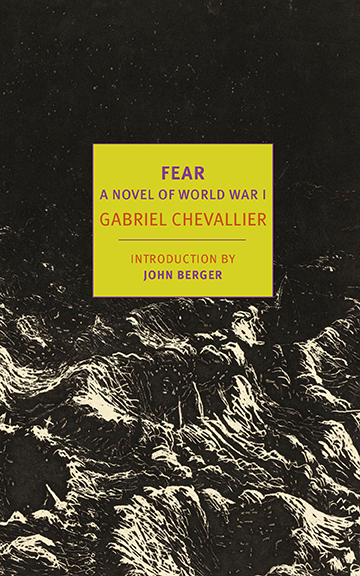
It’s been praised to the skies – see, for example, this review in the New York Times and this review at the Daily Beast – and Barthas’s spirited socialism and pacifism make it all the more interesting.  But, for me at least, it doesn’t capture the slimescape with the same intensity as my second book: Gabriel Chevallier‘s Fear.

CHEVALLIER Fear

I confess to being taken aback by its very existence.  In another life – in grammar school – my French teacher, a wonderful man called Robert Bratcher, recommended Chevallier’s Clochemerle as a way, I now suspect, of teaching us what ‘Rabelaisian’ meant without actually having to read Rabelais.  It’s a brilliantly comic novel (or at least it seemed so to this fifteen year-old), shot through with word play, artful phrases and visually, almost viscerally immediate staging in which the body – and the fear of/fascination with  its functions – loomed large.

It turns out that the same sensibilities run through Fear, which is a novelisation grounded in Chavellier’s own experiences. Malcolms Imrie‘s fine translation was made available in the UK in 2012, but the New York Times is now publishing a US edition.  ‘At times,’ Neil Fitzgerald wrote in the TLS (in a review tellingly entitled ‘When the body takes charge’),

reading Fear feels like being led through the damnation panel of Bosch’s “The Garden of Earthly Delights”, the front line “blazing like some infernal factory where monstrous crucibles melted human flesh into a bloody lava”. There are wince-inducing close-ups of mutilated men and corpses. Chevallier’s turn of phrase, brilliantly rendered in Malcolm Imrie’s translation, makes this distant war feel horrifying and close. Dartemont’s ultimate triumph, beside surviving, is in never having allowed himself to become dehumanized.

It turns out that others were also taken aback by its very existence.  Fear was originally published in 1930, as Tobias Grey explains, and the French officer class rose up against Chevallier’s merciless assault (which you can also find in Barthas):

Subsequent criticism of “Fear” meant that it was withdrawn from circulation in France on the eve of World War II and did not reappear until 1951. Chevallier, who had scored a big hit with his satirical novel “Clochemerle” (1934) in the meantime, declined to kick up a fuss. “Once war has come, the time has passed for warning that it is a disastrous venture with unforeseeable consequences,” Chevallier reasoned in the preface of “Fear.” “That is something that must be understood earlier, and acted on accordingly.” When “Fear” was recently re-published in France after many years out of print, one critic still felt it necessary to point out that pages like the ones he had just read “would have had the author shot during the war.”

As I’ve indicated, central to Chevallier’s account is the human body and the hapticity of war: its sensual, physical apprehension and its corporeal inscription.  Grey concludes:

… above all “Fear” is a novel whose most indelible passages describe the sensory degradation of war on the human body. These baroque descriptions are generously translated into English by Malcolm Imrie without a hint of stiltedness [in fact, Imrie won the Scott Moncrieff Prize for his translation]. A face is described as seeming to “acquire a dull, gray coating, as if someone had forgotten to dust it, and the beard, drawing strength from the compost of unhealthy flesh, spread rapidly, seeming to drive out life, like ivy takes light from the front of a house.” It is the kind of powerful prose that helps to make Chevallier’s long-neglected novel one of the most effective indictments of war ever written.

All of this reading is in part preparation for a trip later this month with an old friend to the battlefields of the Western Front (we’re still arguing over which of us is Blackadder and which is Baldrick, but it’s really no contest): watch this space for a report.

The Natures of War online

20130921-124524

St Andrews has just posted the video of my Neil Smith Lecture on “The Natures of War” online here, and I’ve also embedded it below.  We lowered the lights so that the slides would pop, so it may seem a little dim (or perhaps I do) at the start, but each of the slides has been spliced in separately and they are crystal clear.

http://vimeo.com/81610023

I started out by talking about Neil’s work and, as you’ll see, lost it; it’s never happened to me before, but then I’ve never given a lecture named after a close friend before.  I’d intended to return to Neil and the ‘production of nature’ at the end, but decided to leave that for the long-form version so I could at least carry on through the Q&A.  The focus is on ‘nature’ not as an arena on which military violence is staged, the trigger for resource wars and conflict commodities, but as a medium through which military violence takes place.  I develop the argument through three case studies: the Western Front of World War I, the Western Desert of World War II, and the rainforest of Vietnam.

My warmest thanks to everyone at St Andrews, and especially to Joe Doherty, who opened the event with a moving account of Neil’s career and contributions (as you can see above, this is included in the video), and to my good friend Dan Clayton for putting everything (including me) together so well.

Droning on

Sorry for the long silence – I’ve been prepping for my trip to St Andrews, where this afternoon I’ll be giving the Neil Smith Lecture.  Over the years I’ve given lots of lectures named after people I knew (if I knew them at all) only through their writings, and this is the first time I’ve given one named after someone I knew – and cared so much about.  There is a wonderful phrase in a commentary on Marx’s humanism (and humanity) and his critique of alienation, which talks about ‘man in the whole wealth of his being, man richly and deeply mentally alive’.  Needless to say I can’t track down the source when I need it – Ollman, maybe? – but I’ve never forgotten those words (or at least their force) since I read them years and years ago.  I can think of no other phrase that captures Neil so perfectly.

GREGORY The natures of war

Still lots to do, but I have added the final version of my general essay on drones, ‘Moving targets and violent geographies’, to the DOWNLOADS tab.  It will appear in an edited collection in honour of Allan Pred, edited by Lisa Hoffman and Heather Merrill, but I’ll also re-work it (and no doubt extend it) for The everywhere war so, as usual, I’d value any comments – preferably by e-mail to avoid the spam filters.  I’m flattered by those e-marketeers who think that my blog is a likely medium to flog everything from Viagra (well, not quite so flattered at that) to Louis Vuitton luggage, but thanks to those filters they – and perhaps you, dear reader – are out of luck…

And while I am channelling Del-Boy, another wordpress service lists the search terms that people use to navigate their way to the blog, and I’d particularly like to know what the person who was searching for – how do I put this? – a highly specialised type of basket apparently made in Vietnam made of Geographical imaginations.  I don’t expect they’d have found it on Louis Vuitton either.