Writing at a dead-line

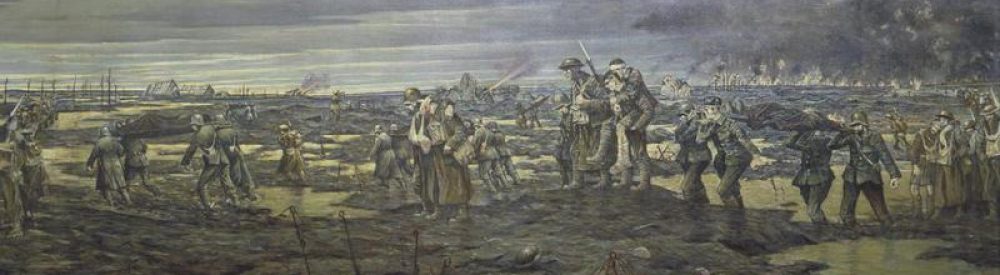
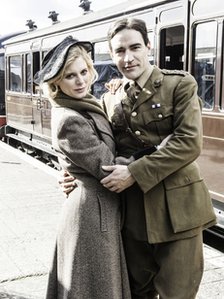
BBC2 The Wipers TimesBack in the trenches again, revising “Gabriel’s Map”, and I see that the former President of the Royal Geographical Society – rather better known as Michael Palin (“This President is no more!  He has ceased to be…. This is an EX-PRESIDENT!!”) – appears in a new BBC2 drama [also starring Ben Chaplin and Emilia Fox, left] based on the story of The Wipers Times, a trench newspaper written and printed on the Western Front during the First World War.

This is Palin’s first dramatic role in twenty years (other then being President of the RGS).  Many readers will no doubt immediately think of the far from immortal Captain Blackadder in Blackadder Goes Forth (in which case see this extract from J.F. RobertsThe true history the Blackadder – according to Rowan Atkinson, “Of all the periods we covered it was the most historically accurate” – and compare it with this interview with Pierre Purseigle).

But since the script for The Wipers Times has been co-written by Ian Hislop (with Nick Newman) the Times is inevitably being described as a sort of khaki Private Eye: Cahal Milmo in the Independent says that ‘its rough-and-ready first edition was a masterclass in the use of comedy against industrialised death and military officialdom.’

So it was, but the appropriate critical comparison is with Punch, which Esther MacCallum-Stewart pursues in ingenious depth here.  The French satirical magazine Le canard enchaîné (which is in many ways much closer to the Eye) started publication in 1915 and was much more critical.  But for most of the war, MacCullum-Stewart says, Punch enforced ‘a strict code of “comedy as usual” interspersed by patriotic statements which hardly pastiched anything except an enduring capacity for the British to show a stiff upper lip to all comers.’

That soon wore thin on the Western Front, and when Captain Fred Roberts – played by Chaplin – found a printing-press amongst the rubble of Ypres (“Wipers”) in February 1916 the Times was born (though a shortage of vowels meant that only one page could be set up and printed at a time).
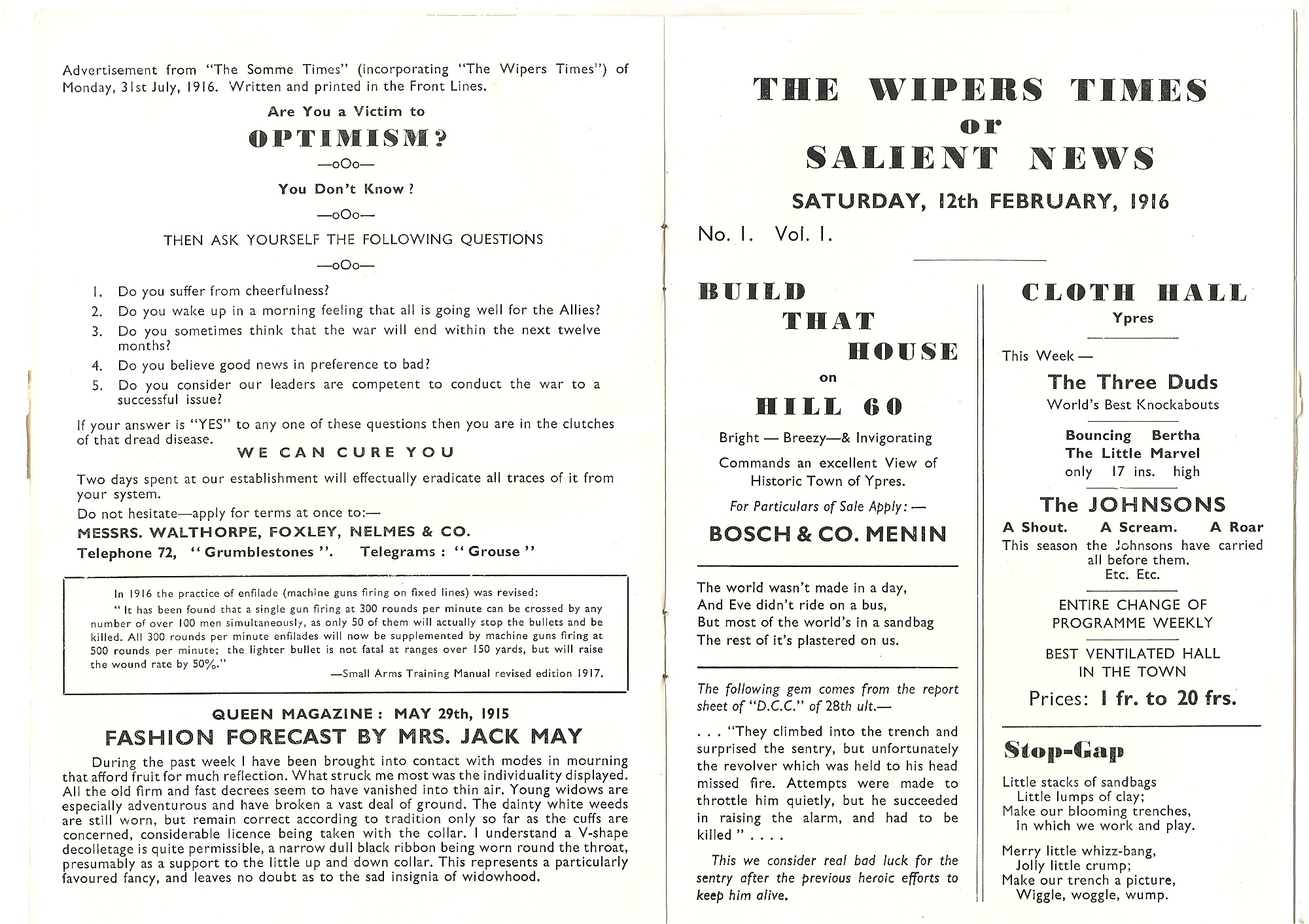
Wipers Times No 1

The title of the paper changed as the Division was re-deployed time and time(s) again.  It had many targets in its sights, including the warrior poets:

‘We regret to announce that an insidious disease is affecting the Division, and the result is a hurricane of poetry. Subalterns have been seen with a notebook in one hand, and bombs in the other absently walking near the wire in deep communication with their muse.’

This is one of the most widely quoted passages in the paper, but MacCallum-Stewart explains that this is precisely because it could be squared with the mythology of the war which so many other contributions worked to undermine.

You can find other extracts here but my favourite – given how mud works its way into a central place in “Gabriel’s Map” and into one of the vignettes in “The nature of war” – is this satirical version of Rudyard Kipling‘s If (Kipling wrote the original in 1909 as advice to his son –”If you can keep your head when all about you are losing theirs…”: celebrated by the Daily Mail here):

If you can drink the beer the Belgians sell you,
And pay the price they ask with ne’er a grouse,
If you believe the tales that some will tell you,
And live in mud with ground sheet for a house,
If you can live on bully and a biscuit.
And thank your stars that you’ve a tot of rum,
Dodge whizzbangs with a grin, and as you risk it
Talk glibly of the pretty way they hum,
If you can flounder through a C.T. nightly
That’s three-parts full of mud and filth and slime,
Bite back the oaths and keep your jaw shut tightly,
While inwardly you’re cursing all the-time,
If you can crawl through wire and crump-holes reeking
With feet of liquid mud, and keep your head
Turned always to the place which you are seeking,
Through dread of crying you will laugh instead,
If you can fight a week in Hell’s own image,
And at the end just throw you down and grin,
When every bone you’ve got starts on a scrimmage,
And for a sleep you’d sell your soul within,
If you can clamber up with pick and shovel,
And turn your filthy crump hole to a trench,
When all inside you makes you itch to grovel,
And all you’ve had to feed on is a stench,
If you can hang on just because you’re thinking
You haven’t got one chance in ten to live,
So you will see it through, no use in blinking
And you’re not going to take more than you give,
If you can grin at last when handing over,
And finish well what you had well begun,
And think a muddy ditch’ a bed of clover,
You’ll be a soldier one day, then, my son.
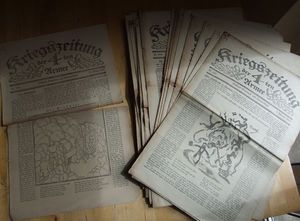
Wipers_Times_4 German 4th Army trench newspapers

There were many other trench newspapers produced by the different armies on both sides. On the Allied side there were 100 or so British ones, for example, and perhaps four times as many French ones; there were perhaps 30 Canadian ones, and more Australian ones. Graham Seal has just published the first full-length study of Allied trench newspapers: The soldier’s press: Trench journals in the First World War (Palgrave-Macmillan 2013); you can sneak an extensive peak on Google Books (though contrary to what it says there, an e-edition is available at a ruinous price).  As you can see from the image above, there were also trench newspapers on the other side too: see Robert Nelson, German soldiers newspapers of the First World War (Cambridge University Press, 2011).  He also wrote a more general and thoroughly accessible survey of trench newspapers in War & History [2010] which is available here.

In the final edition of the Times, published after the end of the war, Roberts – by then a Lieutenant-Colonel – wrote this:

“Although some may be sorry it’s over, there is little doubt that the linemen are not, as most of us have been cured of any little illusions we may have had about the pomp and glory of war, and know it for the vilest disaster that can befall mankind.”
Terror and terrain

Over at Space and Politics my friend and colleague Gaston Gordillo has a long post, ‘Opaque zones of empire’, in which he seeks to examine ‘the panoptic regime of hyper-visibility by focusing not on the prying cameras of drones and satellites but on the rugged topographies they permanently scrutinize; not on what the panoptic regime sees but on what it cannot see, or what it cannot see clearly.’

This is the paper he gave as part of the Space and Violence sessions at the Association of American Geographers conference in L.A. earlier this year, and it’s the draft of a longer article in progress.  It’s also a remarkably ambitious exercise, in which Gaston artfully tracks between Stuart Elden, Eyal Weizman, Henri Lefebvre, Alain Badiou, Allan Feldman and a host of others.

But it’s the conclusion that has given me most pause for thought.  Here Gaston conjures the opacity inherent in the three-dimensionality of terrain (the central concept in the essay) apprehended by military vision and violence:

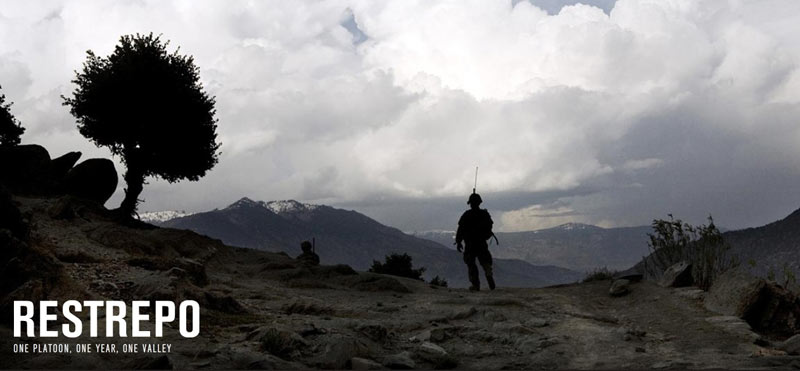
‘Badiou argues that the figure of the pure multiplicity of being, precisely because its multiplicity cannot be represented, is the void. The void is, indeed, the figure of the terrain. This void should be read not as an abstraction but in its spatial and bodily immanence: through the vertigo that the vast, opaque, three-dimensional, and not fully visible geographies of the planet create in the human body. This is the void graphically represented, for instance, on Tim Hetherington’s documentary Restrepo, where US soldiers stationed in an outpost in the Korengal Valley in eastern Afghanistan felt haunted by the terrain they were immersed in. In the film, those soldiers make it clear that those opaque mountains, forests, and valleys were for them a hostile immensity that turned insurgents into a ghostly presence. Those mountains constitute a tangible void within Empire: one of the countless outsides of a world without outside.

Restrepo

I’m particularly taken by this image (which I think is much clearer in the film than in Sebastian Junger‘s War) because it’s helped me think about how my work on ‘the natures of war’ intersects with my work on later modern war in the mountains of Afghanistan and Pakistan.

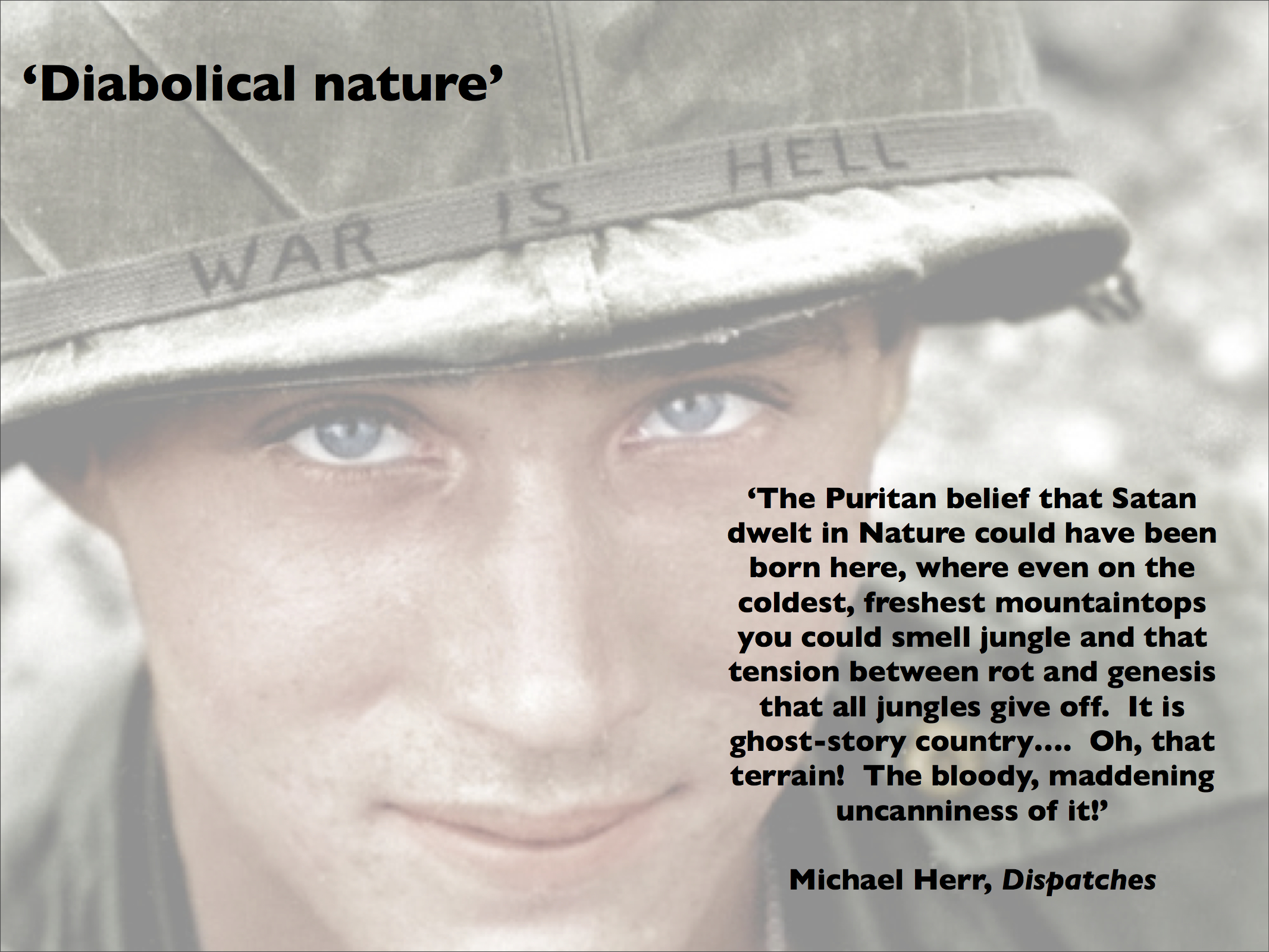
I only have room for one example.  To US infantry in the rainforest and highlands of Vietnam, terrain was not only (or even primarily) apprehended visually: in contrast to staff officers poring over maps and air photographs and to the crews of combat helicopters and strike aircraft flying over the jungle, terrain was made known – a knowledge that was always precarious, that could always become undone – through the body itself and all its senses, including hearing, touch and smell. Terrain is more than a visual construct, especially in its three-dimensionality, and there is nothing ‘dead, passive, fixed’ about it. Michael Herr captured something of what I have in mind in a passage that loops back to Gaston’s coda:

Diabolical nature

This unheimlich nature, ‘diabolical nature’ in what Gaston calls its ‘hostile immensity’, had a Janus-face.  On the one side it was a cyborg nature, no longer wholly ‘natural’ (even as the rainforest was rendered excessive or fallen through the standard tropes of tropicality) because it had been mined, booby-trapped and honeycombed with tunnels.  In The natures of war I develop this argument in more depth than I can here, in relation not only to the ‘jungle’ but also to the mud of the Western Front in World War I and to the sand and stone of the Western Desert in World War II, which both became cyborg natures or, if you prefer, techno-natures.  Here are two slides from that presentation, which summarise what I mean about the corporeality of knowledge and the techno-nature of the war in Vietnam:

Cyborg nature Vietnam


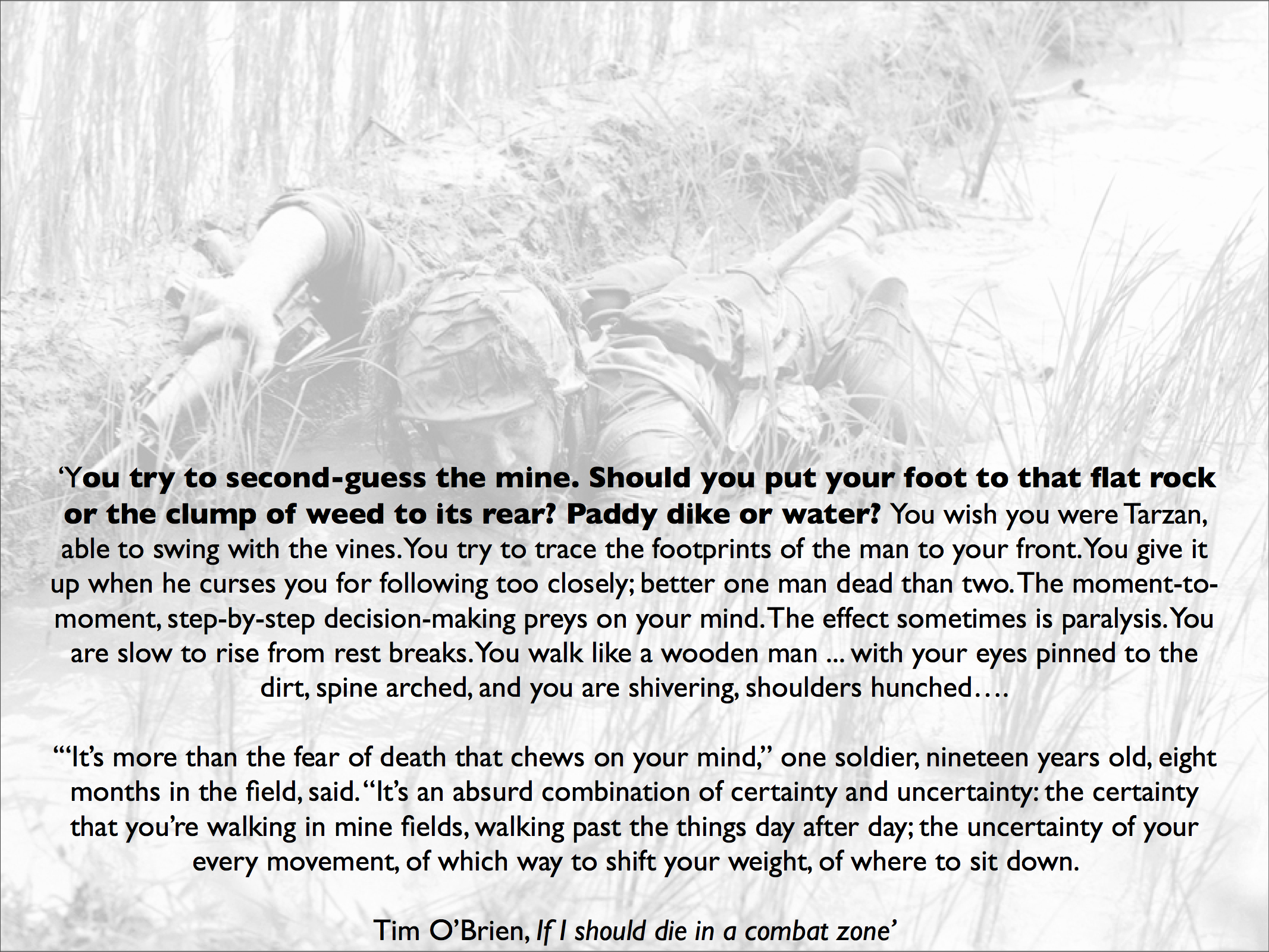
Certainty and uncertainty Vietnam

Yet on the other side there was also something exculpatory about it all.  Recalling a similar argument developed by Michael Taussig in a different context in Shamanism, colonialism and the wild man, here’s Philip Caputo again:

‘Scorched by the sun, wracked by the wind and rain of the monsoon, fighting in alien swamps and jungles, our humanity rubbed off of us as the protective bluing rubbed off the barrels of our rifles.We were fighting in the crudest kind of conflict, a people’s war. It was no orderly campaign, as in Europe, but a war for survival waged in a wilderness without rules or laws.’

And again, in a passage that makes the geography of this hostile terrain clear (and also speaks directly to Gaston’s argument about Restrepo – and even to Carl Schmitt):

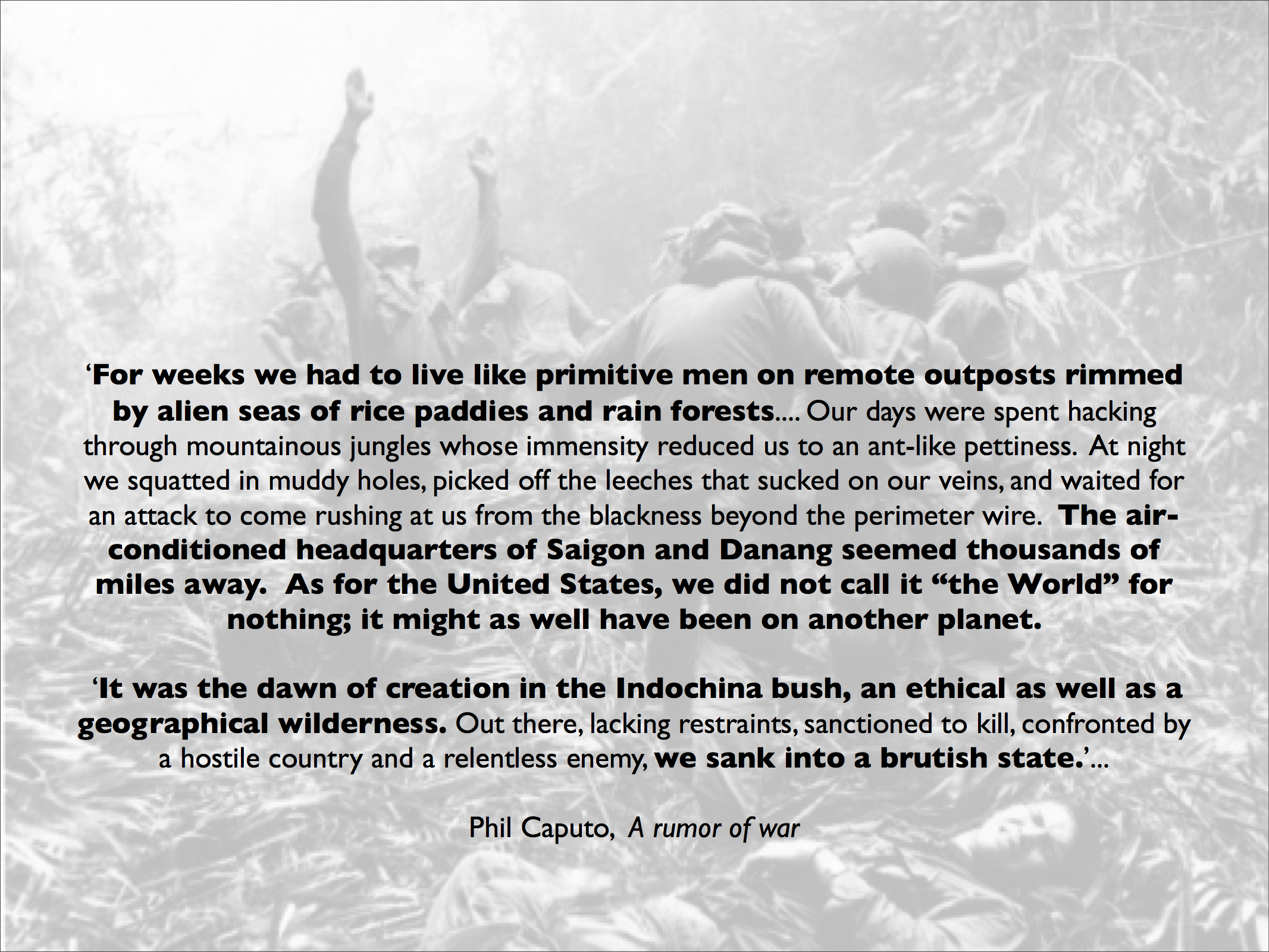
Ethical wilderness Vietnam

In that last slide I’ve deliberately juxtaposed Caputo’s apologia with Art Greenspon‘s famous photograph of soldiers from the 101st Airborne waiting to be evacuated by helicopter after a five-day patrol near Hue, South Vietnam in April 1968 because – as those upheld arms imply – this confession carries buried within it a promise of redemption too.  Forgive me, for this fallen nature has cast me down.  And help me escape back into The World.  Yet, as Taussig showed, this too was a thoroughly imperialist catechism: primeval nature fouling our civilised, ‘second nature’, seducing and destroying our very humanity, when in so many ways it was our own ‘second nature’ and its technowar that was laying waste to the rainforest.

These are complex arguments, and a post like this inevitably runs the risk of caricature.  But I hope I’ve said enough to suggest some of the other ways in which the ‘opaque zones of empire’ extend beyond the horizon of vision.  And in case I haven’t been clear, I should add that I think Gaston is absolutely right to make terrain central to the analysis, not least because this makes it possible to invest two other master-concepts (sic), ‘space’ and ‘nature’, with corporeal and material depth.

The Jungle Books

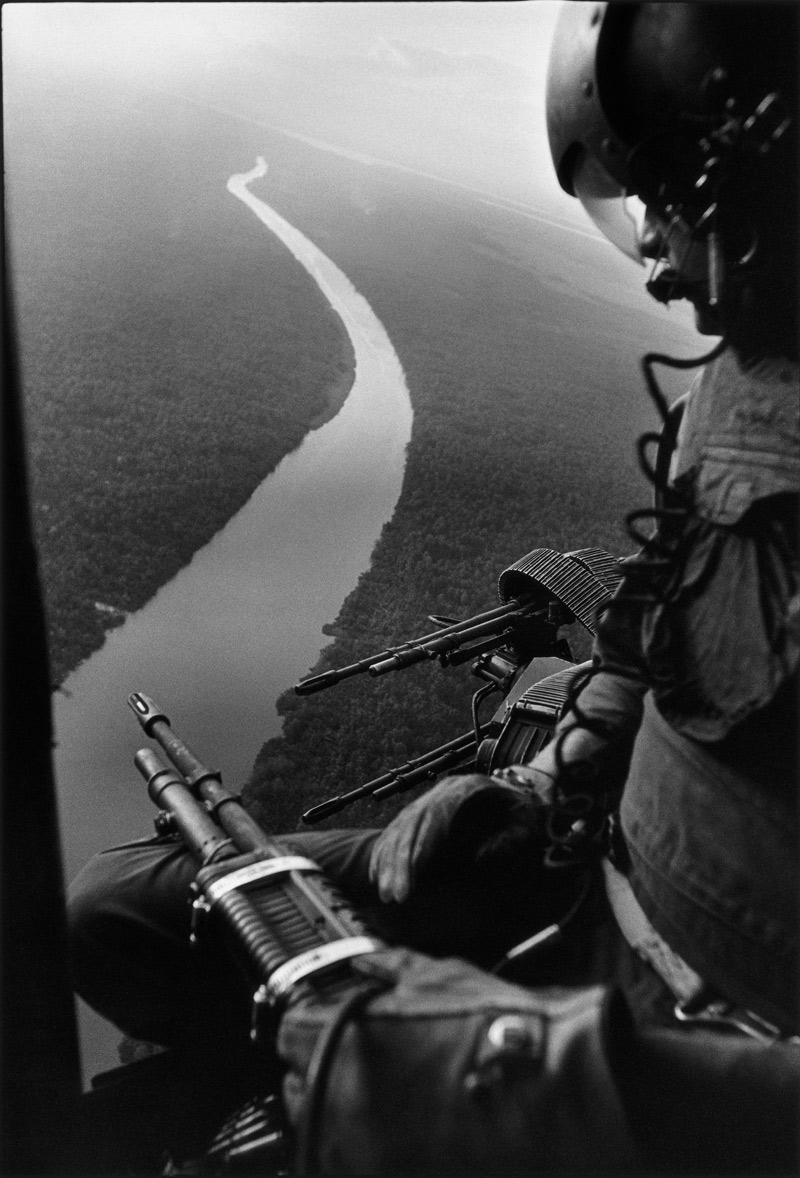
Gilles CARON Vietnam 1967In his classic memoir, A rumor of war, Philip Caputo recalled reading a series of US Army manuals about what was in store before he deployed to Vietnam.  Once there, flying over the rainforest,

‘Looking at the green immensity below, I could only conclude that those manuals had been written by men whose idea of a jungle was the Everglades National Park. There was nothing friendly about the Vietnamese bush; it was one of the last of the dark regions on earth…’

I’ve been reading those Field Manuals on Jungle Warfare too, but in the illuminating light of Dan Clayton‘s wonderfully suggestive essay on ‘Militant tropicality’ [Transactions of the Institute of British Geographers 38 (2013) 180-192], and three thematics have emerged so far.

First, the manuals worked to displace pre-existing imaginative geographies: in effect, they reassured the young soldier, ‘it’s all in the mind’.  The strategy was already in place in the dog-days of the Second World War.  FM 72-20 on Jungle Warfare, issued in October 1944, had this to say:

‘As in any area where physical hardship is the rule, there are accompanying psychological reactions to the jungle. These reactions take the form of magnifying the physical hardships and the inherent dangers of warfare. Limited visibility increases the feeling of insecurity, strange noises assume an increased importance, and men tend to be­come jumpy and panicky. The dull, shaded light and, in many areas at certain periods of the day, the gloomy, drifting mists of jungle areas have a morose and eerie effect which further adds to the feeling of insecurity.’

By 1965 the new FM 31-30 on Jungle training and operations, was still warning against ‘prevalent misconceptions’ (over-imaginative geographies, I suppose):

‘The soldier who is not familiar with the jungle will suffer from conditioned fears and apprehensions when faced with the prospect of living and fighting in a jungle environment. Popular representation of the jungle as being a veritable green hell of large trees and dense underbrush growing over vast expanses of flat, swampy ground and inhabited by thousands of animals, snakes, and insects which are hostile to man, cause this fear. Before such individuals even set foot in the jungle they are appalled at the prospect of doing so. Certainly the foreboding appearance of the jungle, the oppressive humidity and heat, the unfamiliar noises, and the abject feeling of loneliness that one feels when entering the jungle intensify the already existing fear of the unknown. It cannot be denied that the jungle presents some most unpleasant aspects. But the individual must, through systematic and thorough training and acclimation, learn to know the jungle for what it actually is and not for what it is supposed to be or what it might be. Once this knowledge is acquired, the soldier will respect the jungle, not fear it.’

Second, the manuals encouraged soldiers – as Caputo noted – to see that ‘the jungle can be your friend’.  Again, the terrain had been prepared by FM 72-20:

‘In jungle warfare, the soldier often fights two enemies: man and nature. The elimination of nature as an enemy and the use of the jungle itself as an ally are training objectives fully as important as the elimination of the human enemy. The soldier must be trained not to fight the jungle; he must be capable of living successfully in it and making it work for him against the human enemy.’

By 1965, the manual exuded a breezy self-confidence.  While it conceded that ‘the jungle itself is an obstacle’ to visibility (so the soldier must ‘develop his senses of smell, hearing and touch to a high degree’) and to movement (‘vines that entangle and trip even 
the most careful person, steep stream banks with
slippery soils, shrubs and trees with thorns that 
penetrate and tear clothes, grasses with knife-like
and saw-toothed edges that cut the skin’), it also affirmed that ‘no obstacle is insurmountable or impenetrable.’  If this sounds uncomfortably close to Monty Python’s cheerful enjoinder to ‘Always Look on the Bright Side of Life‘, the manual did indeed go to considerable pains to minimise the snares and dangers of the rainforest:

‘Most animals in the jungle will not attack man unless they are frightened… The widespread terror of “the snake-
infested jungle” prevalent in the minds of most 
peoples is an imaginary mental image. It is true that the number and variety of snakes are high in 
the wet tropics; however, the incidence of poisonous 
snakes is no higher than in some of the swamp areas 
of the Temperate Zone.

Presumably including Caputo’s Everglades.

This all went hand-in-hand with an enthusiastic maximisation of the super-abundance of tropical nature, one of the key motifs of tropicality more generally.  Dozens of pages were devoted to living off and finding shelter in the jungle, with instructions and diagrams that would not have been out of place in the Boy Scouts of America:

31-30 Coconuts as expedient flotation devices

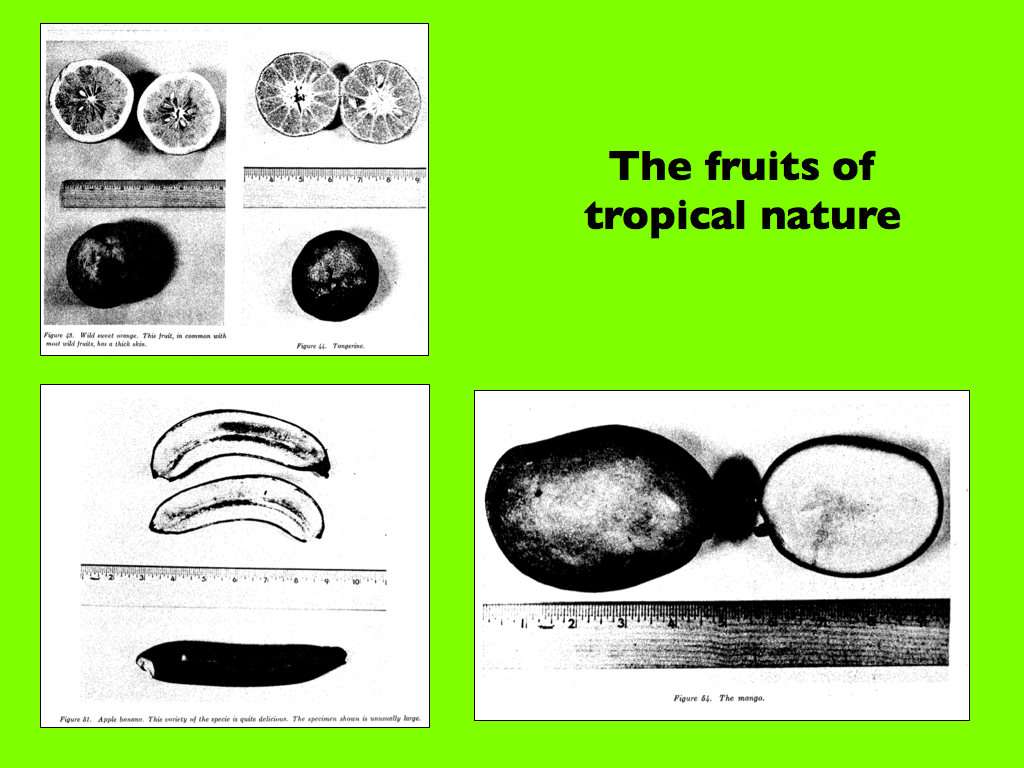
The fruits of tropical nature.001

There were also endless photographs of pineapples tangerines, mangoes, limes, bananas, papayas and avocados (see above).

cluster-bombs full load

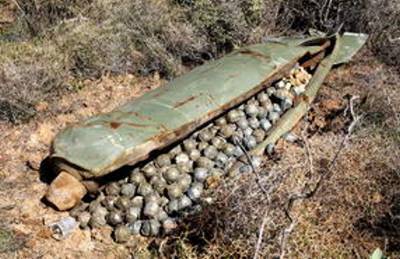
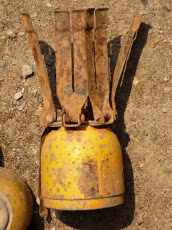
P1010303In fact, however, the US military sowed different and deadly tropical fruit.  The BLU-3 bomblet, a container filled with 250 steel pellets, was known as a ‘pineapple’ (left); a B-52 bomber could drop 1,000 of them across a 400-yard area, and as they burst open, Nick Turse reports, ‘250,000 lethal ball bearings would tear through everything in their path.’  Another cluster bomb, the CBU-24, was called a ‘guava’, loaded with more than 600 separate bomblets and capable of sending ‘200,000 steel fragments shooting in all directions.’  From 1964 to 1971, Turse reports, the US military ordered at least 37 million pineapples and from 1964 to 1971 at least 285 million guavas. (His key source is Eric Prokosch, The technology of killing: a military and political history of anti-personnel weapons; for one attempt to clear these munitions [from Laos], see Project Pineapple here).

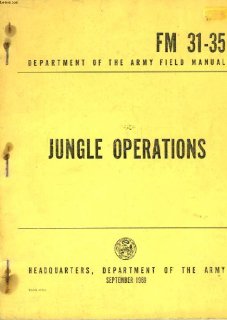
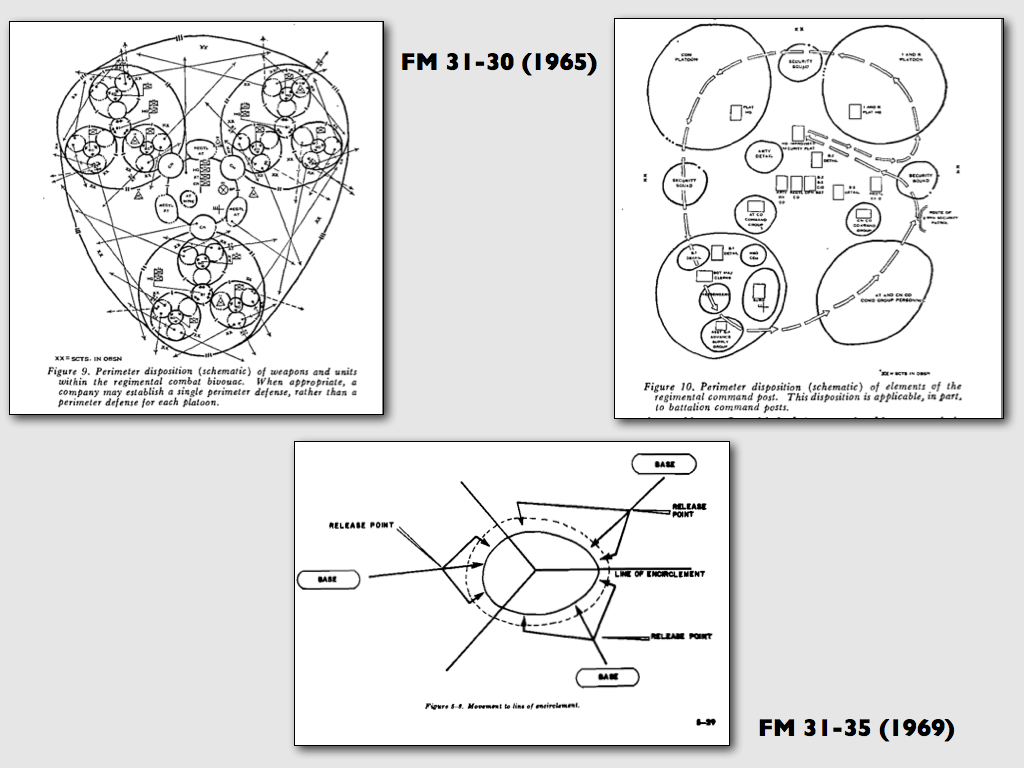
Jungle Operations FM 1969This brings me to the third strategy: disciplining nature through the imposition of military Reason.  By 1969 the – edible – ‘fruits of the jungle’ had disappeared from the manuals.  After a review of different types of jungle, including ‘Oriental jungles’,  the discussion immediately turned to weapons, armour and artillery, air support and chemical and biological warfare, so that ‘nature’ was militarised and subjected to military (re)ordering much earlier in the revised manual.  The emphasis was on ‘modification’ of Standard Operating Procedures, which had also been a key element four years earlier, and a continued move away from the tangle of the jungle – what Tim O’Brien would later call in Going after Cacciato ‘a botanist’s madhouse’ – to the superimposition of ordered combat geometries like those I’ve extracted below.

Combat geometries in jungle warfare.001

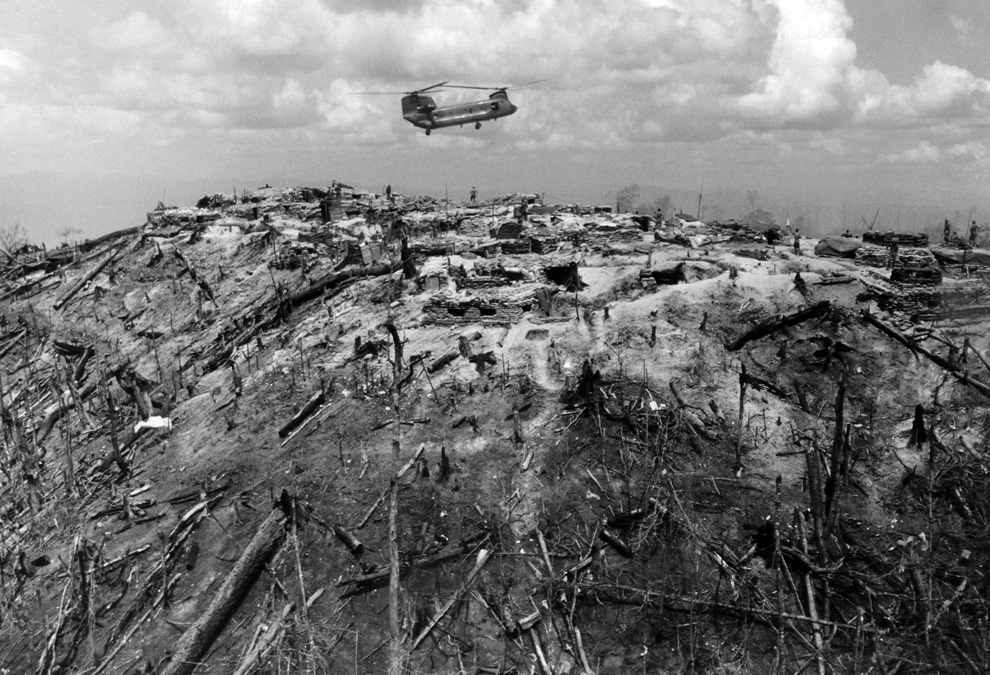
In effect, the military sought to plane away ‘Nature’ and reduce it to an abstract ‘Space’. Of course, the imposition of military Reason on what was now (de)constructed as a militantly ‘un-natural Nature’ was more than a paper affair, and it was invariably violent.  In his Matterhorn: a novel of the Vietnam War, Karl Marlantes describes the construction of a fire support base on a mountain top so that an artillery unit, helicoptered in, could range its fires over the rainforest below:

‘The defensive lines grew more distinguishable. No longer were they made up of holes that blended in with the earth and the mass of torn limbs and brush. The holes had been transformed into naked, angular structures, stark against the denuded hillside, looking like sturdy little boxes poking out from the slope.’

There was an elaborate, constantly changing network of these bases, but here is what this could look like; this is Fire Support Base 29, Dak To, in the Central Highlands in June 1968:

Fire Support Base 29, Dak To, central highlands, 3 June1968jpg

To be sure, ecological destruction took many forms beyond the Rome plow (there’s a video of its deployment in land-clearing operations here) and violent explosions from artillery and aircraft.  The widespread spraying of herbicides like Agent Orange is well known; remember that the slogan of Operation Ranch Hand was ‘We prevent forests’…

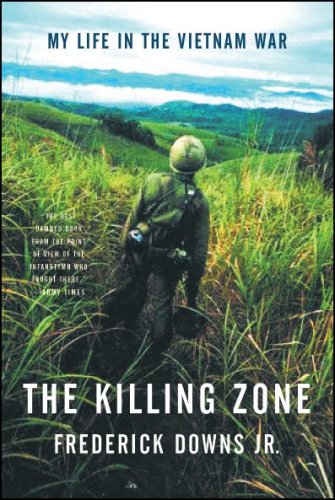
And yet, if Vietnam was McNamara’s prized ‘techno-war’, it emphatically did not see the triumph of American science and technology, still less that of their transmutation into an operative military Reason, over an alien ‘Nature’.  As Dan Clayton says, ‘an omniscient American war machine was [not] bearing down on a transparent, knowable or compliant battlefield.’  There’s a passage in Frederic Downs‘s The killing zone that captures and counterposes the geometric violence of the war and the resilience of the rainforest to great effect:

DOWNS Killing zoneThe coordinates for that location and the time for firing would be relayed to the gun crews.  At the specified time, the gun crews would be awakened. Perhaps it would be just after midnight. As the minutes ticked closer to a time set by an unknown intelligence the men would load the artillery pieces, anticipating the release of their impersonal death into a grid square. The gun commander would give the order to fire and the night would explode with man’s lightning and thunder.  After the prescribed rounds, the guns would cease, the cleanup would begin, and the men would go back to their bunks.  Thinking what? Within the range of those guns, within a specified area, the Central Highlands had for a brief moment changed from the jungle it had been for thousands of years into the particular insanity of man.  As the gun crews wandered back to their bunkers to settle down for the night, the jungle would also begin settling down for the night to begin healing the new wounds.

I’ll have more to say about this in later posts, but for now here’s a passage from Stephen Wright’s novel, Meditations in Green, that sets the scene for the argument I’m developing in ‘The natures of war’:

Brostowits Come a little closer  1997(Vietnam)“Of course, it’s not as if bushes were innocent … Sit on top of a bunker, stare at the tree line for a while. You have to concentrate because if you blink or look away for even a moment you might miss it, they aren’t dumb despite what you may think, they’re clever enough to take only an inch or two at a time. The movement is slow but inexorable, irresistible, maybe finally unstoppable. A serious matter.”
“What movement, what are you are you talking about?”

“The trees, of course, the fucking shrubs. And one day we’ll look up and there they’ll be, branches reaching in, jamming our M-60s, curling around our waists.”

“Like Birnam Wood, huh?”

“Actually, I was thinking more of triffids.”

These other jungle books have a lot to tell us about war too.

War and peace in an age of ecological conflict

Bruno LATOURAdvance notice (hence the image on the left):  after a show-stopping performance by my friend and colleague Brett Finlay at last night’s Wall Exchange at the Vogue Theatre  in Vancouver – not only a wry and pointed lecture on Bugs R Us but some excellent jazz to warm us (and our bugs) up – the next Wall Exchange will be on Monday 23 September when Bruno Latour, professor at Sciences Po in Paris and winner of this year’s Holberg International Prize, will give a public lecture on ‘War and peace in an age of ecological conflict’.  Full details will eventually be posted here.

This will be Bruno’s second visit to UBC, and we are looking forward to his return; the first was organised by the Department of Geography several years ago, when he announced that, rather like Molière’s M. Jourdain, he now realised he had always been a geographer without realising it.

You can get a foretaste of the argument from his penultimate Gifford Lecture delivered at the University of Edinburgh earlier this year: an extended version of the text of the lectures, Facing Gaia, is here.  They were dedicated to Peter Sloterdijk, the darling of at least some of today’s geographers, but they begin with an homage to Elisée Reclus.

UPDATE:  Booking is now open online here.

Greenwashing war

KUPAR Hot spotter's reportComing next month from Minnesota, a new book from one of Allan Pred‘s most creative graduate students (and that’s saying something!).  Shiloh Krupar – a contemporary of the equally talented Trevor Paglen – is Assistant Professor of Culture and Politics at the Edmund A. Walsh School of Foreign Service at Georgetown University, and her Hot spotter’s report promises to add new dimensions to discussions of the biopolitics of militarism and the enlistment of ‘nature’ in the service of military violence:

Many nuclear and other U.S. military facilities from World War II and the Cold War are now being closed and remediated. Some of these sites have even been transformed into nature refuges and hailed as models of environmental stewardship. Yet, as Shiloh R. Krupar argues, these efforts are too often doing less to solve the environmental and health problems caused by military industrialism than they are acting to obscure the reality of ongoing contamination, occupational illnesses, and general conditions of exposure.

Using an unusual combination of empirical research, creative nonfiction, and fictional satire, Hot Spotter’s Report examines how the biopolitics of war promotes the idea of a postmilitary and postnuclear world, naturalizing toxicity and limiting human relations with the past and the land. The book’s case studies include the conversion of the Rocky Mountain Arsenal into a wildlife refuge, a project that draws on a green “creation story” to sanitize other histories of the site; the cleanup and management of the former plutonium factory Rocky Flats, where the supposed transfiguration of waste into wilderness allows the government to reduce the area it must manage; and a federal law intended to compensate ill nuclear bomb workers that has sometimes done more to benefit former weapons complexes.

Detecting and exposing such “hot spots” of contamination, in part by satirizing government reports, Hot Spotter’s Report seeks to cultivate irreverence, controversy, coalitional possibility, and ethical responses. The result is a darkly humorous but serious and powerful challenge to the biopolitics of war.

I’m sure, too, that it will have much to show us about ways of developing and conveying our arguments outside the conventions of formal academic prose. According to Bruce Braun, ‘Hot Spotter’s Report is at once a devastating indictment of ‘green war’ and a hopeful search for new conditions of existence in and beyond the toxic residues of militarism. Written with wit and passion, Krupar’s irreverent experiments with fable, satire, and creative non-fiction do much more than disrupt the ongoing sanitization of military violence; they open space for new coalitions and political imaginings in domestic landscapes marked by the legacies of imperial war.’

Contents:

Introduction
1. Where Eagles Dare: A Biopolitical Fable about the Rocky Mountain Arsenal National Wildlife Refuge
2. Alien Still Life: Managing the End of Rocky Flats
3. Hole in the Head Gang: The Reductio ad absurdum of Nuclear Worker Compensation (EEOICPA)
4. Transnatural Revue: Irreverent Counterspectacles of Mutant Drag and Nuclear Waste Sculpture
Conclusion: Hot Spotting

The natures of war

Natures of War

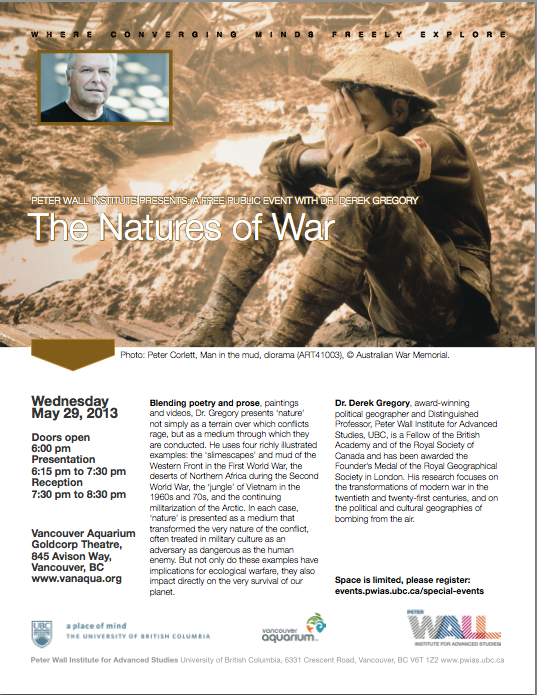
Just about to leave the High Atlas and Morocco, so something like normal service will resume once I’m back in London on Wednesday.  I’ve just received a near-final draft of the poster (above) for my Vancouver talk next month, “The natures of war“.  I’ll explain more of what I’m trying to work out in this presentation in a later post.  You’ll see that the venue is sort of appropriate – though I’ll leave my flippers at home.

More information and registration details here.

The Anthropocene Project

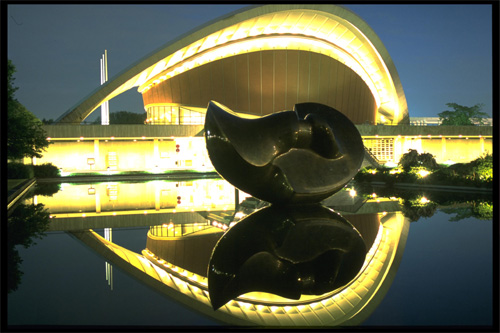
hkw_nachtThe dazzling Haus der Kulturen der Welt in Berlin (left) has posted a series of videos from its January 2013 series, The Anthropocene Project, here.  The list includes a series of dialogues/conversations (including Michael Taussig) and four keynotes:

Will Steffen, The Anthropocene: where are we going?

As one of the major proponents of the Anthropocene hypothesis, Will Steffen explores in his talk the origins of and scientific basis for the Anthropocene. From humanity’s hunter-gatherer beginnings to the previous century’s post-war global acceleration of populations, technologies, and consumption habits, the main question this lecture addresses is: where is all of this leading? Is the Great Acceleration the “new normal,” or will the earth system force the Anthropocenic era into a different direction? Steffen proposes an evaluation of the planetary future’s possibilities, asking: are we on the road to global sustainability or are we poised for global collapse? 

Dipesh Chakrabarty, History on an expanded canvas: the Anthropocene’s invitation

If climate scientists have become social historians, how can one translate their findings and construct an aggregate, common narrative that is not only legible to both localized sociologies and planetary geophysics, but effectively integrates both these positions? Post-colonial theorist and historian Dipesh Chakrabarty reflects on potentialities of past and future narratives within the Anthropocene. What kinds of empowerment and disempowerment do these collaborative and multifaceted storytellings imply for the Anthropocene? Chakrabarty engages with the proposed necessity of associating the histories of the earth and that of humans in order to effectively open up intellectual pathways towards the dissolution of modernity’s misunderstandings concerning human agency and capitalistic freedom. 

Elizabeth Povinelli, Geontologies: a requiem to late liberalism

Much critical theory has attempted to think life out-sideof the “human,” yet most applications of the Anthropocene have focused on how humanity might find a way to keep its way of life without loosing the “human.” Is the Anthropocene, then, a framework for humanizing or environmentalizing capitalism without losing capitalism? Departing from the premise that Western political theory is rooted in the carbon cycle, where life is seen as a metabolic ring of growth, reproduction, and degeneration, Povinelli tackles the “carbon imaginary” of biopolitics. She considers the diverse local arrangements of “life” in relation to the technological procedures of maintenance and renewal. What forms of being are privileged to lay claim to life or to preserve the earth’s being-processes? 

John Tresch, Cosmograms, or how to do things with worlds

Each culture has had means to conceptualize and address the nature and composition of the universe, frequently creating representations of the order of all that exists, also known as “cosmograms.” The concept of a cosmogram can be expanded to apply to all knowledge about “natural” and “human” worlds, as well as the interactions between them. Departing from the Anthropocene thesis’ conception of nature as a malleable entity, historian John Tresch takes a culturally and historically comparative perspective to consider instances of cosmo-pragmatics, or how cosmograms have been used to foster intervention upon the world. His talk addresses a variety of exemplary phenomena, from 19th century Romanticism and the Industrial Revolution to today’s ecological discourse and the fragility of our cosmic order. 

I hope there’s more to come, since the programme – a detailed pdf with abstracts is here – also included a performance by Taussig, a lecture from Rem Koolhaas,  and contributions from Lorraine Daston, John Law, Paolo Tavares, Eyal Weizman, Cary Wolfe and a host of others.  I very much like the idea of bringing the visual and performing arts into the discussion and transcending the conventional dull boundaries of the humanities and (especially) the ‘natural’ and ‘social’ sciences (to see something of what I mean, go here and scroll down to the image of John Law and Xavier Le Roy…)

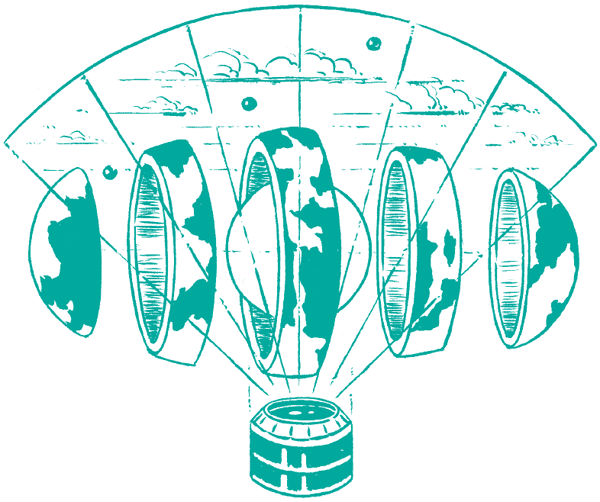
das_anthropozaen_eine_eroeffnung

Illustration: (c) Benedikt Rugar 2012

“The Anthropocene Project” is an initiative of Haus der Kulturen der Welt in cooperation with the Max-Planck-Gesellschaft, Deutsches Museum, the Rachel Carson Center for Environment and Society, Munich and the Institute for Advanced Sustainability Studies, Potsdam.  It’s a two-year project advertised thus:

Our notion of nature is now out of date. Humanity forms nature. This is the core premise of the Anthropocene thesis, announcing a paradigm shift in the natural sciences as well as providing new models for culture, politics, and everyday life. In a two-year project, HKW will explore the hypothesis’ manifold implications for the sciences and arts.  The “Anthropocene” is the new geological “age of mankind” as proposed by the Earth sciences. Popularized by Nobel Prize winner Paul J. Crutzen around the turn of the millenium, the term now stands for one of the most trailblazing scientific concepts of the present. The transdisciplinary Anthropocene Project explores this concept, using research and presentation methods from the arts and sciences. If the opposition between humanity and nature is now suspended, how do we change our perspectives and perception? Is it still possible to think in concepts like “artificial” and “natural?”  What does it mean for our anthropocentric understanding and our future if nature is man-made? What impact does the notion of global changes has on political decision-making? Which image of humanity appears if nature is shaped by mankind?

Good questions, though – since I’m still in thrall to Nigel Clark‘s Inhuman nature – I’m not so sure about the anthropocentric weight in this paragraph and, perhaps, more generally; it’s Nigel’s work that, in part, drives my interest in ‘nature’ as a medium through which (rather than merely ‘over which’) war is conducted.

3-D War

It’s strange how things sometimes come together….  News of the online publication of Stuart Elden‘s paper, ‘Secure the volume: vertical geopolitics and the depth of power‘, coincides with a short post from Jasper Humphreys at the Marjan Centre, ‘Shape shifting in Flanders‘, which describes the war on the Western Front as the first 3-D war.  What Jasper has in mind is the combination of aerial reconnaissance (and artillery spotting) with the elaborate tunnelling under enemy lines to detonate huge explosions.  But if we extend the terrain beyond the Western Front then the claim becomes a more general and I think an even more powerful one, with the bombing of civilian targets far beyond the front lines by airships and aircraft and the unrestricted use of that ‘ungentlemanly weapon’, the submarine. (Stuart cites Paul Virilio‘s Bunker Archaeology, which identifies the emergence of ‘volumetric’, deep three-dimensional warfare with the Second World War, but the genealogy is clearly older than that).

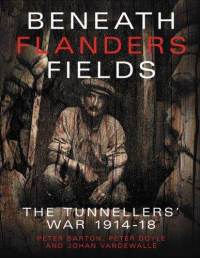
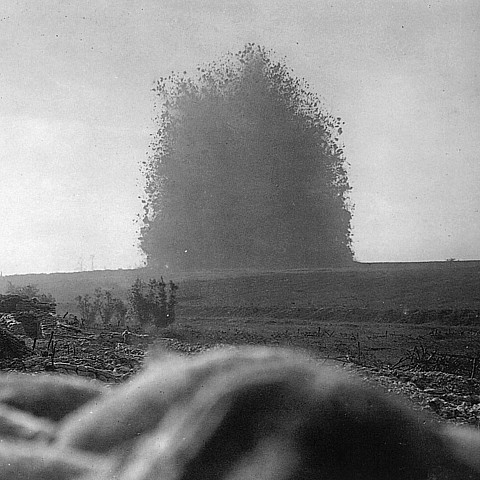
BARTON et al Beneath Flanders FieldsIt’s the underground war – the tunnellers’ war – that captures Jasper’s attention.  He focuses on the mining of Messines Ridge in June 1917, which (as he notes) appears in Sebastian Faulkes‘s Birdsong, but the tactic was a general one that not only scarred the landscape but also left an indelible impression on everyone who witnessed it, even by proxy: the detonation of the mine beneath Hawthorn Ridge in July 1916 was filmed by Geoffrey Malins for The Battle of the Somme (below).

Mining had started with the onset of trench warfare, and was dominated by the Germans during 1914 and 1915: ‘Although Germany had rejected military mining by 1914,’ Simon Jones notes, ‘it was nevertheless able quickly to revive its capability through the availability of fortress troops which could be attached ot its field army.  There seemed no alternative but to mine on the Western Front as a means of breaking the strong field defences.’  For the British and their allies mining evolved, if that’s the right verb, into three main phases: the Somme in 1916, Arras in April 1917 and – though its efficacy was by then undermined by the German strategy of defence-in-depth – Messines in June 1917.

Hawthorne Ridge mine

Hill 60 on the Messines Ridge had been mined in 1915, but the re-mining in June 1917 – as part of ‘the largest mining attack in the history of warfare’ (Jones) – was hugely spectacular:

‘The artillery preparations which for days had been intense had died down and the night was comparatively quiet…  Suddenly, all hell broke loose.  It was indescribable.  In the pale light it appeared as if the whole enemy line had begun to dance, then, one after another, huge tongues of flame shot hundreds of feet into the air, followed by dense columns of smoke which flattened out at the top like gigantic mushrooms.  From some craters were discharged tremendous showers of sparks, rivalling everything ever conceived in the way of fireworks.’

I’ve taken this from an essay by Roy MacLeod, ‘Phantom soldiers’, which provides an excellent discussion of Australian tunnellers in the underground war and emphasizes that theirs was a profoundly scientific campaign that involved knowledge of geology, engineering and – crucial for counter-mining – acoustics.  If it was science, it was doubly hellish science, both for the conditions endured by the tunnellers and for the consequences on the surface. In Underground warfare Simon Jones includes this report from a British artillery officer:

‘At exactly 3.10 a.m. Armageddon began.  The timing of all the batteries in the area was so wonderful and to a second every gun roared in one awful salvo.  At the same moment the two greatest mines in history were blown up…  First there was a double shock that shook the earth here 15,000 yards away like a gigantic earthquake.  I was nearly flung off my feet.  Then an immense wall of fire that seemed to go half-way up to heaven.  The whole country was lit with a red light like a photographic dark-room… The noise surpasses even the Somme; it is terrific, magnificent, overwhelming.  It makes one almost drunk with exhilaration…’

Barely two months later photographer Frank Hurley peered down at the huge crater in horror:

‘After, we climbed to the crest of hill 60, where we had an awesome view over the battlefield to the German lines. What an awful scene of desolation! Everything has been swept away: only stumps of trees stick up here & there & the whole field has the appearance of having been recently ploughed. Hill 60 long delayed our infantry advance, owing to its commanding position & the almost impregnable concrete emplacements & shelters constructed by the Bosch. We eventually won it by tunnelling underground, & then exploding three enormous mines, which practically blew the whole hill away & killed all the enemy on it. It’s the most awful & appalling sight I have ever seen. The exaggerated machinations of hell are here typified. Everywhere the ground is littered with bits of guns, bayonets, shells & men. Way down in one of these mine craters was an awful sight. There lay three hideous, almost skeleton decomposed fragments of corpses of German gunners. Oh the frightfulness of it all. To think that these fragments were once sweethearts, may be, husbands or loved sons, & this was the end. Almost back again to their native element but terrible. Until my dying day I shall never forget this haunting glimpse down into the mine crater on hill 60, – & this is but one tragedy of similar thousands…’

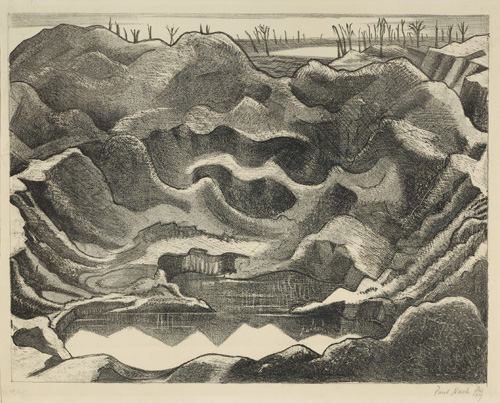
The nightmare scene was also the subject of Paul Nash‘s famous sketch, completed in November:

NASH The Crater

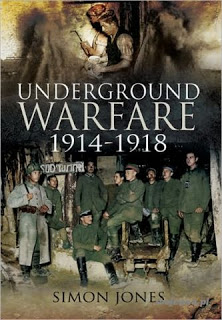
JONES Underground warfareThe BBC has a gallery of images of the underground war, which includes two maps of trenches and tunnels, here, and there’s a fascinating report of contemporary archaeological excavations of the same site here.  There are also helpful discussions and diagrams here. But the most comprehensive discussion is undoubtedly Simon Jones‘s Underground warfare 1914-1918 (2010), which includes compelling first-hand accounts from the tunnellers and countless others.

In the course of his own discussion, Jasper makes two other observations that also intersect with some of my current preoccupations.  The first is about the familiarization of the landscape of war by the first artists despatched to the front, though I’m less interested in the pastoral aesthetic than in subsequent, thoroughly modernist attempts to capture the ‘anti-landscape’ of the war.

The second is about the earthy, material medium through which the war was fought:

‘No war in history has combined such a vast theatre of operations fought in such proximity to the forces of Nature: firstly the elements of wind, rain, storms and snow created the all-pervasive mud and water – sometimes referred to metaphorically as ‘slime’ – along with the horses, mules, dogs and canaries, as well as rats and mice, all sharing the hell of the trenches with humans. Secondly, the geography and topography dominated the fighting: every small hill, river or indentation that would provide even a tiny advantage was a battle-ground.’

I’ve posted about these ‘slimescapes‘ before, and they loom large in my presentation on ‘Gabriel’s map’, but earlier this year I agreed to give a new public presentation this May (at the Vancouver Aquarium – where else?) on ‘The natures of war’ in which I develop the argument in more – er – depth.   I won’t be confining myself to the First World War, though I expect to have much to say about trench and tunnel warfare, and in particular I want to think through ‘nature’ less as the arena over which conflicts are fought (‘conflict commodities’, ‘resource wars’, and the rest) and more about nature as the medium through which conflict is conducted.  I’m assuming we can all agree that ‘nature’ is just as complex as Raymond Williams said it is, and that here it’s just a shorthand that will need very careful unpacking – or perhaps excavating.  More soon…

Danger on the shore

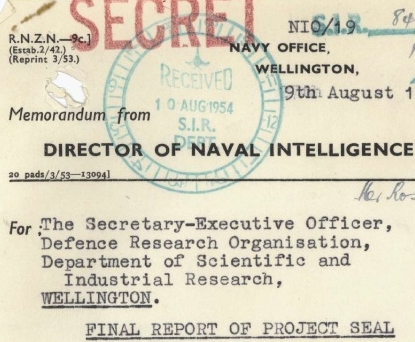
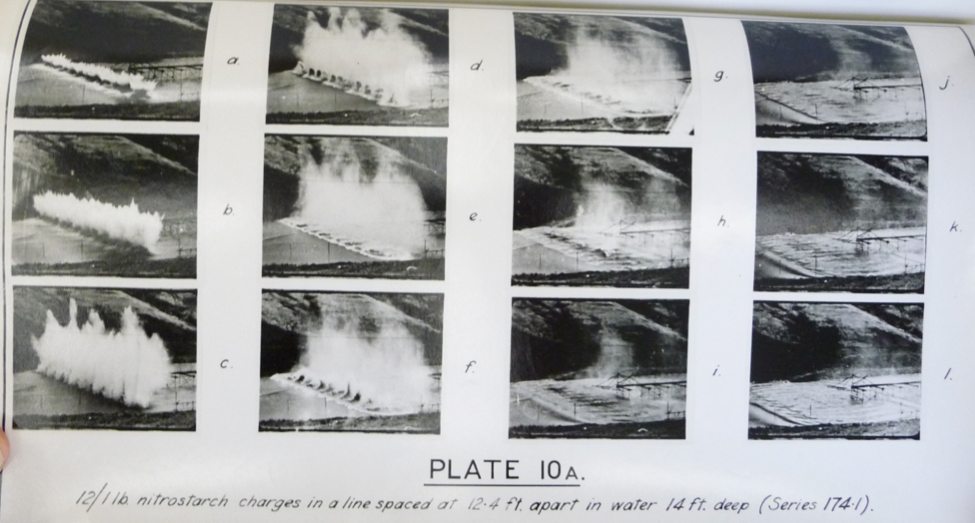
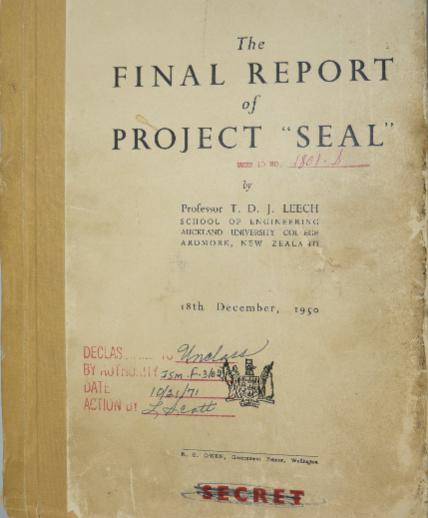
Project Seal DNIAmong other things, I’m still collecting materials about the militarisation of nature (I’m not going to put it in scare-quotes, though it scares me — but we all know that Raymond Williams considered ‘nature’ to be perhaps the most complex word in the English language).  So I was interested to read about a secret US-New Zealand programme to develop a ‘tsunami bomb’ to be used against Japan during the Second World War (the official report talks of ‘an investigation into the potentialities of offensive inundation by waves generated by means of explosives’).

Under the codename Project Seal, the New Zealand Army, working in close cooperation with the Air Force, Navy and the US Navy, set off a series of underwater explosions that triggered tidal waves along the coast of New Caledonia and then the Whangaparaoa Peninsula near Auckland in New Zealand between June 1944 and January 1945.  Some 3,700 bombs (mainly TNT) were detonated during the experiments, and preliminary experimental results suggested that  a cascade of 10 large blasts (two thousand tons in total, 5 miles from the shore) would be sufficient to generate a 30–40 foot tsunami capable of inundating a small coastal city.

Project Seal experiments

Project SealThe project was directed by Professor Thomas Leech, Dean of Engineering at Auckland University, who was seconded to the military for the purpose of developing the bomb.  The final report was released in 1950, and the New Zealand Herald reported that its author’s work was considered sufficiently important for plans to be made for Leech to be sent to observe the US nuclear tests off Bikini Atoll in 1946 and to make direct comparisons between the two (the project was seen by some as a potential rival to the atomic bomb).

The report was declassified in 1999 and reported in New Zealand, but it was picked up by conspiracy theorists in the wake of the Indian Ocean tsunami in 2004 and the Japanese tsunami following the earthquake in 2011 (‘It is unprecedented in recorded history for two major tidal waves to occur less than seven years apart’; more here) and by news media in Britain and the US at the beginning of this year.  More here.

UPDATE: The United States continued to experiment with the possibilities of ‘explosion-generated waves’ in the 1960s, and the Office of Naval Research – which was busily sponsoring all sorts of research projects in spatial science at the same time – cooperated with the Scripps Institution of Oceanography, which initiated the compilation of this handbook-review and its presentation of a ‘procedure for wave predictions based upon the state-of-the-art in the field of explosion-generated waves’.  The review included experimental reports from high-explosive blasts at Mono Lake, field observations in Hawaii and elaborate mathematical modelling.

Interestingly, though, the language of the report – on those occasions when it turns to ‘operational considerations’ – is ostensibly defensive not offensive:

… any prediction method must consider each critical area of the coastline independently, and calculate enough different situations so as to be sure to bracket all critical conditions, before general statements can be made about susceptibility to wave attack from large explosions. Aside from the direct effects of run-up on the shore, large explosions can, under appropriate circumstances, produce very large waves in deep water, which may break upon the continental shelf many miles from shore. Since the wave spectrum for large explosions is peaked at wave periods substantially longer than the longest prevailing swell or surf, the net result is the creation of a breaker zone covering a very large area, and which can persist for several hours. Such waves could pose unusual and potentially severe problems to coastal navigation, not only through direct dynamic effects, but also because of cumulative effects such as inducement of resonant harbor oscillations and the scouring or deposition of sediment in regions ordinarily immune to normal storm conditions.’

Of course, the scenario can be reversed: if the US coast were potentially vulnerable to these effects (the threat of nuclear attack is the ever-present horizon of the report), so too were enemy coasts.  Unlike the earlier experiments, however, the danger now was less that of widespread coastal inundation and more of disruption to naval operations in the vicinity of the blast:

‘The first problem systematically attacked was that of coastal damage due to large explosion-generated waves, since, by analogy with the well-known phenomena of tsunami waves generated by earthquakes, it was initially hypothesized that the explosion of large atomic weapons at sea could result in considerable coastal damage by wave run-up and/or flooding. Later, as theoretical and experimental studies revealed the relatively inefficient wave making potential of large explosions, and that in many cases most wave energy is dissipated by breaking on the continental shelf before reaching shore, concern over run-up per se was replaced by the realization that other more serious wave problems exist. Accordingly, recent emphasis has been directed towards assessing the nature of the breaking wave regime offshore and its implications on the vulnerability of ships and undersea structures to breaking waves in relatively deep water (100 feet). These studies, in turn, have indicated more refined secondary problems. These include harbor oscillations induced by cumulative wave action offshore, and anomalous wave-induced clogging or erosion of harbor entrance channels by sediment transport.’

I suppose this may account for the interest in Hawaii, in which case Japan re-enters the scenario in spectral form, through the prospect of another Pearl Harbor…

Popeye the Weatherman

On 18 March 1971 most readers of the Washington Post were taken aback by Jack Anderson‘s latest column:

‘Air Force rainmakers, operating secretly in the skies over the Ho Chi Minh Trail, have succeeded in turning the weather against the North Vietnamese.  These strange weather warriors seed the clouds during the monsoons in an attempt to concentrate more rainfall on the trails and wash them out…

‘Their monthly reports, stamped “Top Secret (Specat)” (Special Category), have claimed success in creating man-made cloudbursts over the trail complex.  These assertedly have caused flooding conditions along the trails, making them impassable…

‘The same cloudbursts that have flooded the Ho Chi Minh Trail reportedly also have washed out some Laotian villages.  This is the reason, presumably, that the air force has kept its weather-making triumphs in Indochina so secret.’

Among the Post‘s astonished readers was Dennis Doolin, Deputy Assistant Secretary of Defense for East Asia and Pacific Affairs.  Three years later he testified before a subcommittte of the Senate Committee on Foreign Relations that this was the first he had heard of the operation.  When he asked about it he had been assured that it had not affected agriculture in ‘friendly countries’ in the region, and told not to pursue the matter: information ‘was held in a special channel and access was very, very limited’ as a result of the ‘sensitivity of the operation.’

In fact Secretary for Defense Melvin Laird had categorically denied Anderson’s ‘wild tales’, but rumours continued to circulate and on 3 July 1972 the New York Times splashed Seymour Hersh‘s detailed report over its first two pages: ‘Rainmaking is used as Weapon by U.S.’  Based on ‘an extensive series of interviews’ with officials who declined to be named – sounds familiar, no? – Hersh claimed that the experiments had been initiated by the CIA in 1963 and that by 1967 the Air Force had been drawn in (though ‘the agency was calling all the shots’).  And if that sounds familiar too, then so will the cautious, even critical response of the State Department: its officials protested that the program would be illegal if it caused ‘unusual suffering or disproportionate damage’, and that its wider political and ecological consequences had been left unexamined.  Undeterred, advocates demanded: ‘What’s worse – dropping bombs or rain?’

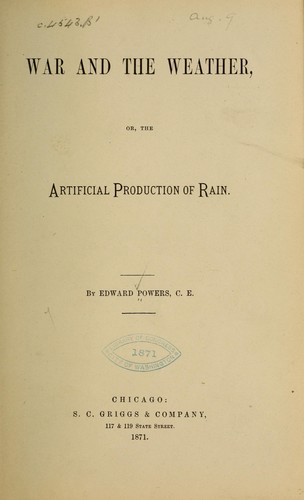
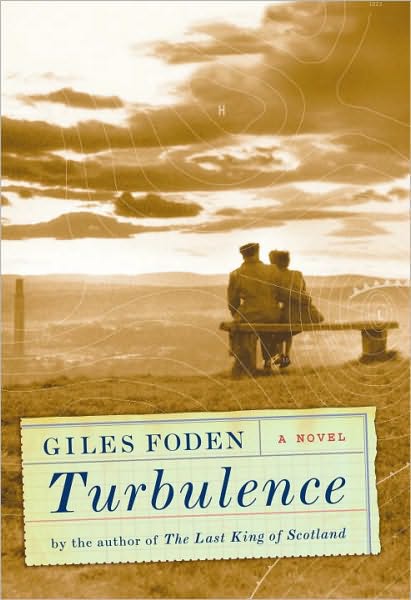
Although Hersh claimed that the program – which he identified as Operation Popeye – was ‘the first confirmed use of meteorological warfare’ there was a back-story and a history. In 1872 the US Congress authorised the Secretaries of War and the Navy to test the relationship between artillery fire and rain propagation proposed by Edward Powers in his War and the weather (1871). Experiments in rainmaking continued into the twentieth century, but the military interest in weather and war was primarily concerned with the adverse effects of the one on the other: most famously in planning the D-Day invasion of Normandy (see here and here, and Giles Foden‘s novel, Turbulence).

But after the Second World War the prospect of ‘weaponising the weather’ re-enchanted the US military.  James Rodger Fleming (‘The pathological history of weather and climate modification’, Historical studies in the physical and biological sciences 37 (1) (2006) 3-25; see also here, and his Fixing the sky: the checkered history of weather and climate control (Columbia University Press, 2010)) describes how research on cloud seeding at the General Electric Research Laboratory in Schenectady, New York had been transferred to the US military in 1946:

‘Planners generated scenarios that included hindering the enemyʼs military campaigns by causing heavy rains or snows to fall along lines of troop movement and on vital airfields, taming the winds in the service of an all-weather air force, or, on a larger scale, perhaps disrupting (or improving) the agricultural economy of nations and altering the global climate for strategic purposes. Other possibilities included dissipating cloud decks to enable visual bombing attacks on targets, opening airfields closed by low clouds or fog, relieving aircraft icing conditions, or using controlled precipitation as a delivery system for chemical, biological, or radiological agents. The military regarded cloud seeding as the trigger that could release the violence of the atmosphere against an enemy or tame the winds in the service of an all-weather air force.’

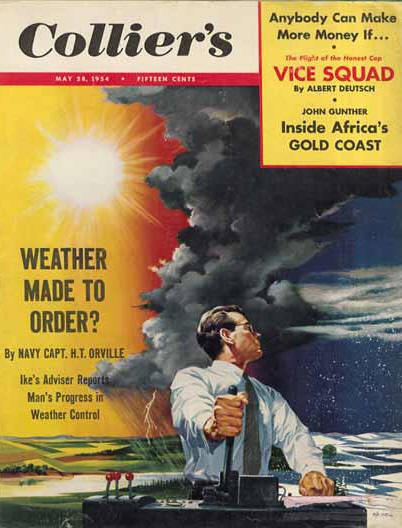
In May 1954 Howard Orville, who had been the US Navy’s chief weather officer during the Second World War and was now chairman of President Eisenhower’s newly formed Advisory Committee on Weather Control, went public with the implications of the research in an article in Collier’s:

‘It is even conceivable that we could use weather as a weapon of war, creating storms or dissipating them as the tactical situation demands.  We might deluge an enemy with rain tp hamper a military movement or strike at his food supplies by withholding needed rain from his crops.’

Not surprisingly, results were at best equivocal, but Fleming argues that ‘weather modification took a macro-pathological turn between 1967 and 1972 in the jungles over North and South Vietnam, Laos and Cambodia’.

It was part of what John Prados (The bloody road: the Ho Chi Minh Trail and the Vietnam War, Wiley, 1998) calls the ‘wizard war’ waged by the United States to disrupt the main supply lines running from North Vietnam along the Ho Chi Minh Trail (or Duong Truong Road) through Laos and Cambodia to South Vietnam; other projects included the ‘electronic battlefield’ whose acoustic and seismic sensors detected movement along the trail network and triggered air strikes on target boxes (see ‘Lines of descent’, DOWNLOADS tab).

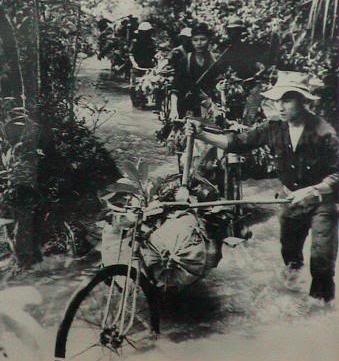
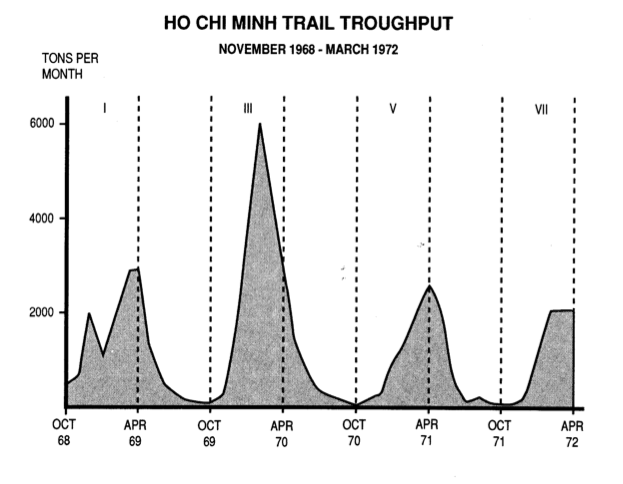
The Trail was in reality a complex, braiding network of roads and tracks, paths and trails, of which perhaps 3,500 kilometres was ‘motorable’.  Although the system was maintained by 40-50,000 engineers, drivers and labourers, who used heavy equipment and gravel and corduroy surfaces to smooth the passage for trucks, most of the roads were dirt and virtually impassable during the south-west monsoon (May-September), so that the supply chain was highly seasonal:

(Image from Herman Gilster, The air war in southeast Asia, Air University Press, 1993)

By 1966 it was becoming clear that efforts to interdict movement along the trail through conventional bombing had been unsuccessful (though this did little to halt the bombing).  Pentagon scientists realised that if they could increase rainfall in selected areas this would not only soften roads, trigger landslides and wash out river crossings but also – the object of the exercise – continue these effects over an extended saturation period.  From transcripts of a classified hearing by a subcommittee of the Senate Committee on Foreign Relations in March 1974 we know that the US Office of Defense Research and Engineering initiated an experimental cloud-seeding program over the Laos panhandle in October 1966.  Intelligence briefings blithely insisted that this would impose little or no additional hardship on the civilian population:

‘The sparsely populated areas over which seeding was to occur had a population very experienced in coping with the seasonal heavy rainfall conditions.  Houses in the area are built on stilts, and about everyone owns a small boat.  The desired effects of rainfall on lines of communication are naturally produced during the height of the monsoon season just by natural rainfall.  The objective was to extend these effects over a longer period.’

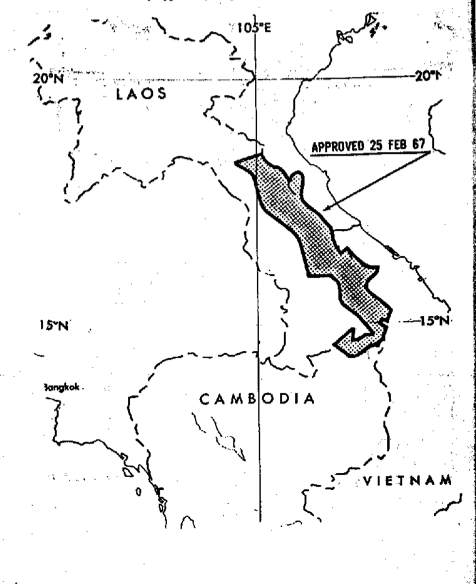
56 pilot ‘seedings’ were carried out as Operation Popeye, and the military concluded that this was such a ‘valuable tactical weapon’ that the program should be continued over a wider area. According to Milton Leitenberg, in an unpublished study of Military R&D and Weapons Development prepared for Sweden’s Ministry of Foreign Affairs, in November President Johnson’s Scientific Advisory Committee came down against the military use of rainmaking techniques for both technical reasons (the results were inconclusive) and political ones (using meteorological techniques as weapons might jeopardise international scientific collaboration).

But in December the Joint Chiefs of Staff submitted three plans for future military operations in Indochina to the President, and all three involved extending Operation Popeye to ‘reduce trafficability along infiltration routes’.

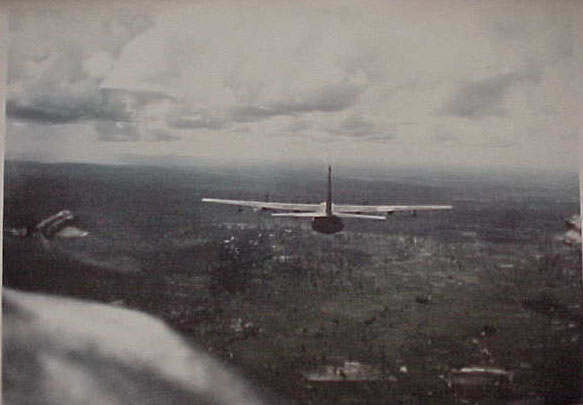
The operational phase (sometimes referred to as ‘Motorpool‘) began in March 1967, using three WC-130 aircraft – one of which is shown above, returning to Udorn Air Force Base in Thailand – and two RF-4C aircraft, all fitted with silver iodide ejectors.  The aircraft displayed the standard Southeast Asia camouflage colours and markings but no unit identifiers, presumably because the operation was top secret.  Although the missions were flown by the USAF’s Air Weather Service, and logged as standard ‘weather reconnaissance flights’, secret reports were forwarded to the Pentagon and the crews all had special clearance.  Here is Howard Kidwell:

 I kept hearing the call sign “Motorpool” used by two of crews in the 14th. When I inquired what they did, I got the usual reply that it was Top Secret and no one knew. I knew the crews and they wouldn’t say zip. This grows on a guy, and I had to find out what was going on. So, dummy me, I volunteered. Well, in a little while I was interviewed and told they would get a higher security clearance for me. In a few short weeks and I was told to come to Motorpool Ops for a briefing. (I found out later that friends and relatives in the states were contacted about me).  The Lt Col in charge said the room had been swept for monitoring devices, etc., and I had one last chance to withdraw my volunteer statement.  I had fleeting thoughts of flying over China, working for the CIA, you name it… but what the heck.  I signed the statement and found out that I was going to make rain!  Geez!  I thought they were kidding!

Leitenberg claims that responsibility for the program was assigned to the office of the Special Assistant for Counterinsurgency and Special Activities, an agency with close operating links to the CIA (in fact U Dorn was also the operating base for the CIA’s Air America that supported covert operations in Indochina). Consistent with this security classification, the governments of Thailand and Laos were not informed about the operations: Doolin testified that the Lao government ‘had given approval for interdiction efforts against the trail system and we considered this to be part of the interdiction effort.’

By June the US Ambassador to Laos was enthusiastically reporting that:

‘Vehicle traffic has ground virtually to a halt… Our road-watch teams report that in many stretches … ground water has already reached saturation point and standing water has covered roads.’

By then, Motorpool had been  joined by another covert operation, Commando Lava, described as an ‘experiment in soil destabilisation’.  C-130 aircraft dropped pallet-loads of chelating compounds (’emulsifiers’) at choke points along the Trail in Laos to magnify the effect of the rains and, again, to extend the saturation period.  The Ambassador was thrilled.  Convinced that this ‘could prove a far more effective road interdictive device (at least in rainy season) than iron bombs and infinitely less costly’,  he cabled Washington:

‘If we could combine these techniques with techniques of Operation Popeye, we might be able to make enemy movement among the cordillera of the Annamite chain almost prohibitive.  In short, chelation may prove better than escalation.  Make mud, not war!’

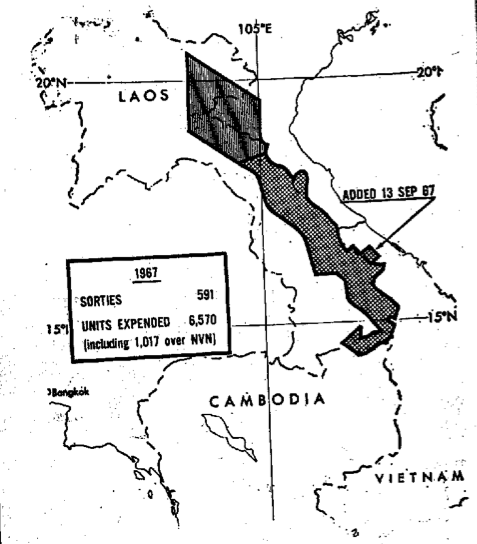
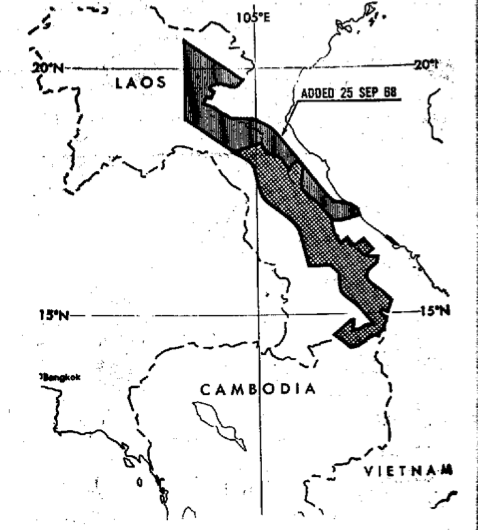
But Commando Lava was a failure, and Westmoreland cancelled it in October.  The results for Popeye/Motorpool were far from conclusive either – the Defense Intelligence Agency later estimated that rainfall may have been increased by up to 30 per cent in limited areas – but the mission was regularly extended.  Its coverage was constantly adjusted, and all seeding above North Vietnam was ended on 1 November 1968 when Johnson called a halt to the Rolling Thunder bombing campaign:

Initial area of operations, 1967

Expanded area of operations, 1967

Area of operations, 1968

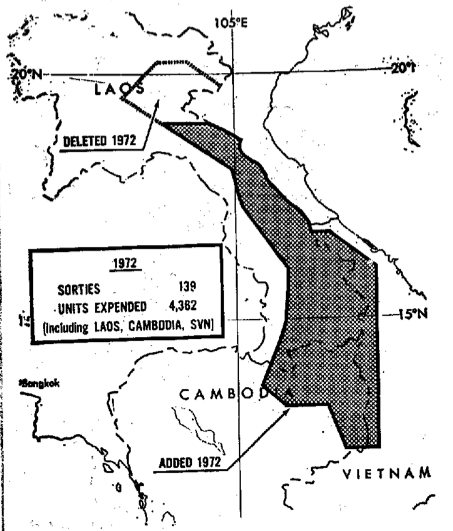
Area of operations, 1972

By the time the operation was ended 2,602 individual sorties had been flown.  Prompted in part by a Senate resolution in 1973 that urged the US government to secure an international agreement outlawing ‘any use of an environmental or geophysical modification activity as a weapon of war’, and by the public release of the transcript of the secret Congressional hearings in 1974, the UN General Assembly adopted the Convention on the Prohibition of Military or Any Other Hostile Use of Environmental Modification Techniques (or ENMOD) in 1976.  It came into force in October 1978: more here and here.

There were, of course, other, better known and hideously more effective versions of ecological warfare in Indochina: defoliating huge swathes of mangrove and rainforest with Agent Orange and other chemical sprays, and bombing the dikes in North Vietnam.  But these weather operations, which combined minimum success with scandalous recklessness, now have a renewed significance.  As late as 1996 the US Air Force was still describing weather as a ‘force multiplier’ and, by 2025, planning to deploy UAVs for ‘weather modification operations’ at the micro- and meso-scale so that the United States could ‘own’ the weather (strikingly, there is no discussion of any legal restrictions).

But today the equation has been reversed, and the US military has to contend not only with its projected capacity to change the weather but also – as I’ll discuss in a later post – with the effects of global climate change on its operations.