Boundless Informant and the everyware war

As part of my presentation on “Drones and the everywhere war” at York, I decided to unpack this extraordinary claim made by John Nagl, one of the architects of the US military’s revised counterinsurgency doctrine:

We’re getting so good at various electronic means of identifying, tracking, locating members of the insurgency that we’re able to employ this extraordinary machine, an almost industrial-scale counterterrorism killing machine that has been able to pick out and take off the battlefield not just the top level al Qaeda-level insurgents, but also increasingly is being used to target mid-level insurgents.

It’s a remark I’ve discussed several times before.  Nagl’s ‘killing machine’ is not limited to drone strikes, of course, but subsumes the ‘night raids’  and other Special Forces operations detailed in Jeremy Scahill‘s Dirty Wars.  But at York I wanted to explore how those ‘electronic means of identifying, tracking and locating’ fed into drone strikes in Pakistan: and, thanks to Edward Snowden and Glenn Greenwald, I was able to get much closer to the belly of the beast.

Drones+ app

I’d started the presentation with a riff on Josh Begley‘s attempt to persuade Apple to include his Drones+ app in the App store.  Apple decided, for several contradictory and spurious reasons, to reject the app, and at his thesis defence Josh asked:

 ‘Do we really want to be as connected to our foreign policy as we are to our smart phones… Do we really want these things to be the site of how we experience remote war?’

Apple’s answer was ‘no’, clearly, but it turns out that others are intimately connected to drone strikes through their phones and e-mails, and it was this that I fastened on.

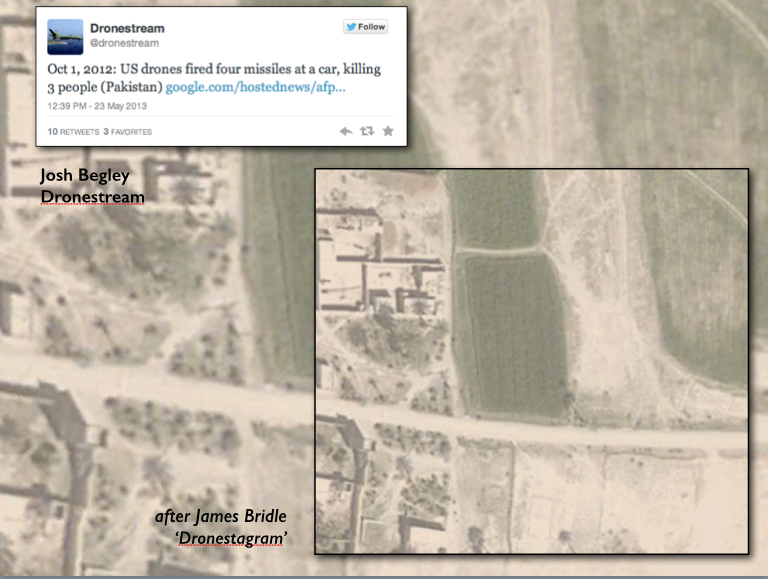
Josh, undeterred by Apple, went on to launch the Dronestream platform, from which he tweeted details of every known US drone strike.  I combined one of Josh’s tweets for 1 October 2012 with a version of James Bridle‘s Dronestagram, which uses Instagram to post images of the location of drone strikes (I say ‘a version’ because Dronestagram was launched too late for this particular strike, so this is a mock-up; in any case, it’s difficult to pinpoint the locations from available reports with much precision, but the details for this strike are available via the Bureau of Investigative Journalism, as the second slide below shows):

1 October 2012 Dronestream and Dronestagram

Bureau of Investigative Journalism 1 October 2012 strike

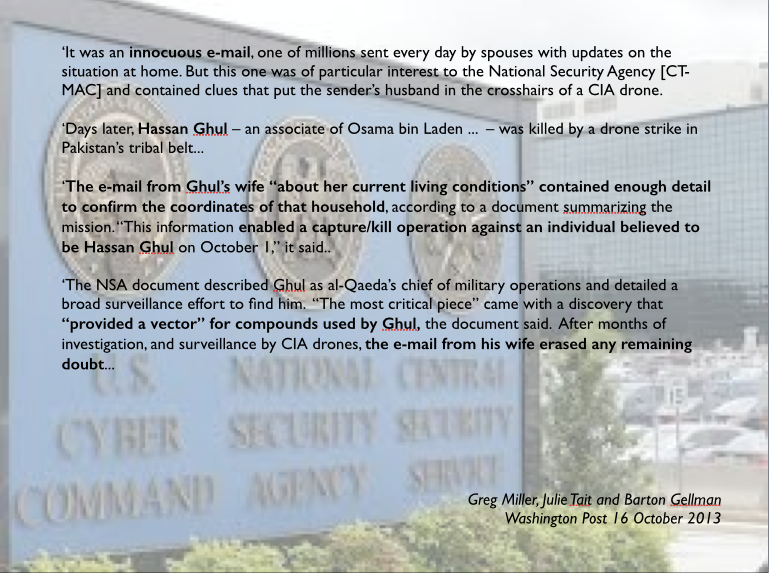
We now know that this strike was made possible as a result of interceptions made by the National Security Agency’s Counter-Terrorism Mission-Aligned Cell (CT-MAC).  Writing in the Washington Post on 16 October 2013 Greg Miller, Julie Tait and Barton Gellman explained how this strike had targeted Hassan Ghul:

Hassan Ghul NSA intercepts

Not quite ‘any doubt’; as they went on to note, ‘Although the attack was aimed at “an individual believed to be” the correct target, the outcome wasn’t certain until later, when “through SIGINT [signals intelligence] it was confirmed that Hassan Ghul was killed.”‘

So how did the intercept work?  Not surprisingly, we don’t know for sure; but the map below of NSA’s ‘Boundless Informant‘ – another dimension of what I’ve been calling ‘the everywhere war’ – offers some clues.  I’ve taken it from a report in the Guardian by Glenn Greenwald and Ewen MacAskill:

Boundless Informant March 2013 heat map

This is six months later, but it shows that Pakistan was, after Iran, the major focus of NSA’s surveillance and data mining operations (Miller and his colleagues had noted that “NSA threw the kitchen sink at FATA’, the Federally Administered Tribal Areas).  It would be wrong to assume that the targeted killing of Ghul was the result of a simple hack into hotmail, and the Post report details the multiple methods used by NSA.

Still, the geography of covert surveillance shown on the map is revealing.  Yesterday Greenwald returned to Boundless Informant and rebutted the charge that he had misinterpreted the meaning of this and other slides, and in doing so quoted from NSA’s own explanation of the system:

BOUNDLESSINFORMANT is a GAO [Global Access Operations, a branch of the NSA] prototype tool for a self-documenting SIGINT system. . . BOUNDLESSINFORMANT provides the ability to dynamically describe GAO’s collection capabilities (through metadata record counts) with no human intervention and graphically display the information in a map view, bar chart, or simple table. . . .
By extracting information from every DNI and DNR metadata record, the tool is able to create a near real-time snapshot of GAO’s collection capability at any given moment. The tool allows users to select a country on a map and view the metadata volume and select details about the collection against that country. The tool also allows users to view high level metrics by organization and then drill down to a more actionable level – down to the program and cover term.

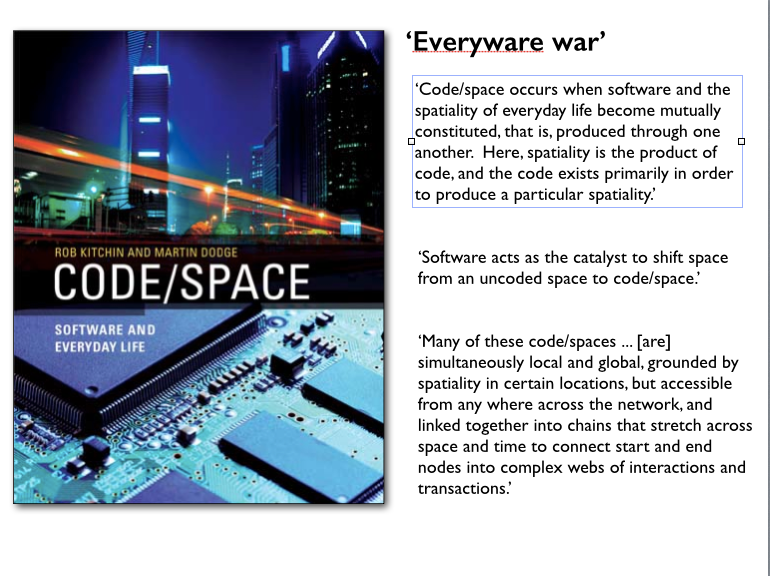
It’s not too difficult to connect the dots and draw two more general conclusions.  The first is that this is another, darker dimension to the ‘code/space’ and ‘everyware’ discussed in such impressive detail by Rob Kitchen and Martin Dodge:

Everyware war

My slide is just short-hand, of course, but you can see where I’m going, I hope – and, as we know from this week’s harrowing testimony on Capitol Hill about the murder of Mamana Bibi in Waziristan and Amnesty International’s report, Will I Be Next?, these operations and their algorithms work to turn ‘everyday life’ into everyday death.  So I’ll be thinking more carefully about code/space and its implication in the individuation of later modern war, paying closer attention to the technical production of ‘individuals’ as artefacts and algorithms as well as the production of the space of the target: more to come.

The second general conclusion I leave to Peter Scheer, who provides a more refined (and critical) gloss on John Nagl’s comment with which I began:

SCHEER Connecting the dots

I’m incorporating these and other developments into the revised and extended version of “Moving targets and violent geographies” which will appear in The everywhere war, but I hope this bare-bones account (and that first draft, available under the DOWNLOADS tab) shows that my posts are more connected than they must sometimes appear…  The slides were pulled together on the day I gave the presentation, so forgive any rough edges.

Unmanned and unmoored

Robert Greenwald‘s feature-length documentary film Unmanned: America’s drone wars is being released on 30 October: it will be streaming online for a limited time, but if you sign up here you will be able to watch it thanks to Brave New Foundation free of charge (and no, this isn’t piracy).  Thanks to Jorge Amigo and Sara Koopman for the heads-up.

As I noted last summer, Greenwald prepared the video to accompany the Stanford/NYU report Living under Drones, and you can find more about the background to the film in George Zornick‘s article for the Nation here.  Like the crew that made Madiha Tahir‘s Wounds of Waziristan, Greenwald travelled to Pakistan, but the twist here is that Greenwald is bringing some of the witnesses to Capitol Hill this week:

“What we’ve been able to do is put a face to policy. Bring over living, breathing, human beings who can look the camera, or the congresspeople, or reporters, in the eye and say, ‘Yes, my grandmother was in the field. She was killed by a drone,’ ” he explained. “ ‘My mother, who I miss every day, was killed by a drone. How could she possibly, under any set of circumstances, be called a terrorist?’”

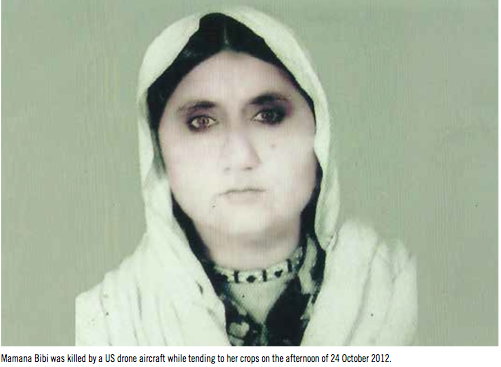
For more details on the project to bring them to the United States and the horrors that they witnessed, see Ryan Devereux‘s chilling report here about the murder of Mamana Bibi.

Mamana Bibi

Zubair, now 13, said the sky was clear the day his grandmother died. He had just returned home from school. Everyone had been in high spirits for the holiday, Zubair said, though above their heads aircraft were circling. Not airplanes or helicopters, Zubair said.

“I know the difference,” Zubair said, explaining the different features and sounds the vehicles make. “I am certain that it was a drone.” Zubair recalled a pair of “fireballs” tearing through the clear blue sky, after he stepped outside. After the explosion there was darkness, he said, and a mix of smoke and debris.

“When it first hit, it was like everyone was just going crazy. They didn’t know what to make of it,” Zubair said. “There was madness.” A piece of shrapnel ripped into the boy’s left leg, just above his kneecap. A scar approximately four inches in length remains. “I felt like I was on fire,” he said. The injury would ultimately require a series of costly operations.

Nabeela, the little girl, was collecting okra when the missiles struck. “My grandma was teaching me how you can tell if the okra is ready to be picked,” she said. “All of the sudden there was a big noise. Like a fire had happened.

“I was scared. I noticed that my hand was hurting, that there was something that had hit my hand and so I just started running. When I was running I noticed that there was blood coming out of my hand.”

Nabeela continued running. The bleeding would not stop. She was eventually scooped up by her neighbors. “I had seen my grandmother right before it had happened but I couldn’t see her after. It was just really dark but I could hear [a] scream when it had hit her.”

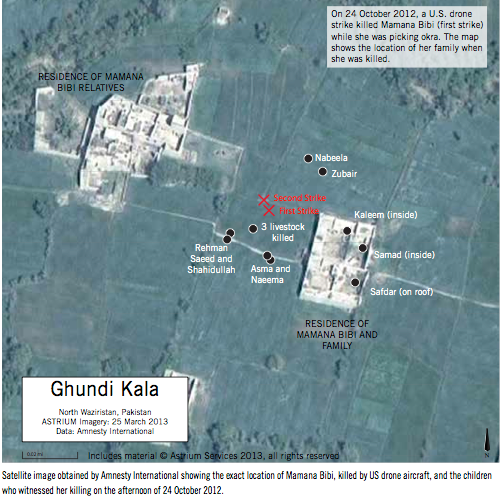
This is the same attack detailed in Amnesty’s report, Will I be next? last week.  Amnesty’s account of the strike, on Ghundi Kala in North Waziristan on 24 October 2012, included this photograph showing the position of Mamana Bibi‘s family when the drone struck while she was working in the fields:

Ghundi Kala drone killing October 2012

This is exactly that I meant when I said that all these targeted killings – and this was one which surely went hideously wrong (though I’m not sure what going right would look like) – have effects that reach far beyond the individual victim.  The ‘individuation of warfare‘ is never confined to an individual; and in this case, like so many others, it’s not warfare either.

More soon.

UPDATE:  The Independent carries an early report of the testimony of Mamana Bibi’s son here and the Guardian here (‘Bibi’ simply means ‘grandmother’ and is an honorific – the family name is Rehman).

“Nobody has ever told me why my mother was targeted that day,” Rehman said, through a translator. “Some media outlets reported that the attack was on a car, but there is no road alongside my mother’s house. Others reported that the attack was on a house. But the missiles hit a nearby field, not a house. All of them reported that three, four, five militants were killed.”

Instead, he said, only one person was killed that day: “Not a militant but my mother.”

“In urdu we have a saying: aik lari main pro kay rakhna. Literally translated, it means the string that holds the pearls together. That is what my mother was. She was the string that held our family together. Since her death, the string has been broken and life has not been the same. We feel alone and we feel lost.”

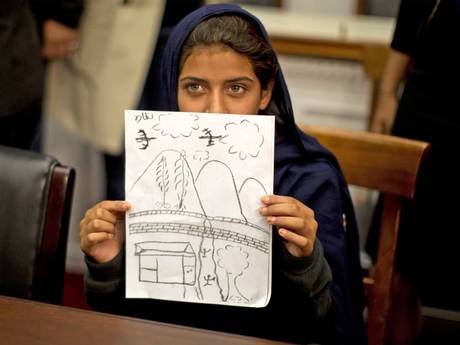
In the image below, her grand-daughter is holding her drawing of the attack.

Nabila Rehman

Read this alongside Kenneth Anderson and Benjamin Wittes here – with their double-act doublespeak of Amnesty International’s ‘coyness’ and its ‘blithe claims’ (do they know what these words mean??) – and retch.


Ghosts of Bagram

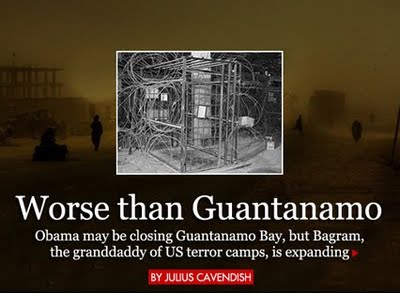
bagram_worse_than_guantanamo

I’ve written about ‘haunting’ before, but Asim Rafiqui has an elegaic photo-essay over at Warscapes on The Ghosts of Bagram that adds other dimensions and deserves the widest audience.  Over the last several months I’ve been compiling what has turned into a fat dossier to help me revise my essay on Guantanamo, “The Black Flag” (DOWNLOADS tab), for The everywhere war; in particular, I’m determined to  incorporate other sites in the global war prison – notably Bagram in Afghanistan – because the (in)constant attention focused on Guantanamo artfully distracts the public gaze from these other sites.

No doubt Obama will say he is as ‘haunted‘ by his failure to close Guantanamo as he is by the killing of civilians by US drones in Waziristan.  But here is Rafiqui on the other ghosts from Pakistan:

‘They are ghosts, and I have spent nearly two months trying to find any evidence of them. They are the 40 Pakistani men who remain imprisoned, without charge or evidence, by the Americans at the Bagram Air Base in Afghanistan. They have not been see or heard by anyone other than their immediate families who are granted carefully monitored and heavily censored telephone and internet video call access. Some of the men have been in Bagram, often called one of America’s most notorious prisons, for over 11 years. Denied access to the press, human rights organizations, and legal representation, these men have been silenced and erased, the evidence and rationale for their incarceration beyond the eyes, ears and focus of the public and the media. This is intentional and part of a process of systemic dehumanization that enables the unjust detention and cruel prison conditions the men face. Until 2012, their own government refused to recognize them as citizens of Pakistan. I have spent two months traveling across Pakistan trying to discover something, anything, about them.’

In 2008 the US Supreme Court in Boumedienne vs. Bush extended the right of habeas corpus protections to non-citizens detained at Guantanamo.  But those incarcerated at Bagram, many of them not only from Afghanistan and Pakistan but also from Iraq, central Africa and south east Asia, are beyond the reach of the writ: see Andrew Tutt on ‘Boumedienne’s wake’ here and, for a more comprehensive analysis,  Janet Cooper Alexander on ‘The law free zone and back again’ here.   If you need background on Bagram, try Lisa Hajjar on Bagram as ‘Obama’s GITMO’ here, and for the global war prison more generally Laleh Khalili‘s Time in the Shadows.

Precarious life

Just back from a wonderful trip to Toronto and York, where (among other things) I gave a new presentation on “Drones and the everywhere war“.  It turned out to have been timely: there’s been a flurry of revelations and reports about the US campaign of targeted killing in Pakistan and Yemen, and I managed to incorporate some of them into the argument.

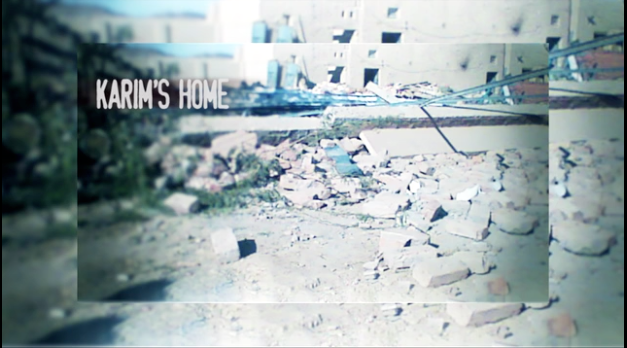
Karim's Home

I’ll be posting about all this shortly, but in the meantime – and directly related – news from Madiha Tahir that Wounds of Waziristan premieres on VICE Motherboard on line for a limited period today.

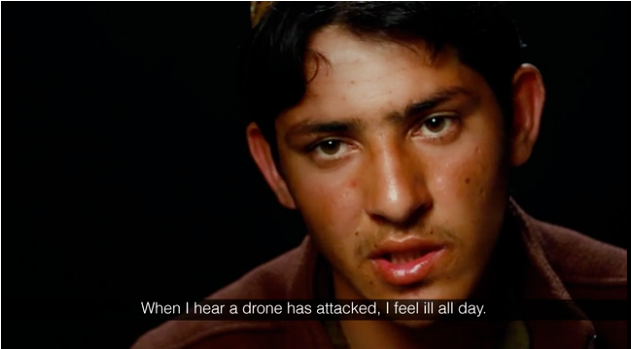
It’s smart and stunning, and addresses a swath of vital issues about the drone strikes in just 25 minutes: from their colonial antecedents in ‘air policing’ and the special laws imposed on the Federally Administered Tribal Areas by the British state through extraordinary testimony from survivors to the collusion between the US and Pakistan in exposing the population of FATA to military violence.

Waziristan I feel sick all day

The testimony should be read alongside the reports from Amnesty International [“WIll I Be Next? Drone strikes in Pakistan“] and Human Rights Watch [“Between a drone and al-Qaeda“, on Yemen]  issued earlier this week.  There’s a short video from AI on their report:

Reading and thinking about these testimonies has helped convince me that the root problem with drones is not that they enable killing from a distance: as I’ve said before, if you object to killing someone 7,500 miles away, over what distance do you think it is acceptable?   In fact, although Predators and Reapers are controlled from the continental United States they have to be deployed close to their targets: these are not weapons of global reach.  One of the most fundamental issues is that they can only be used in uncontested air space, so that they are limited to haunting the skies over some of the most vulnerable and marginal populations on earth, whose own governments care little about them and where the distinction between a combatant and a civilian is made to count for precious little.  One of my next tasks is to revise “Moving targets and violent geographies” (DOWNLOADS tab) to incorporate these reports and to emphasise this conclusion.

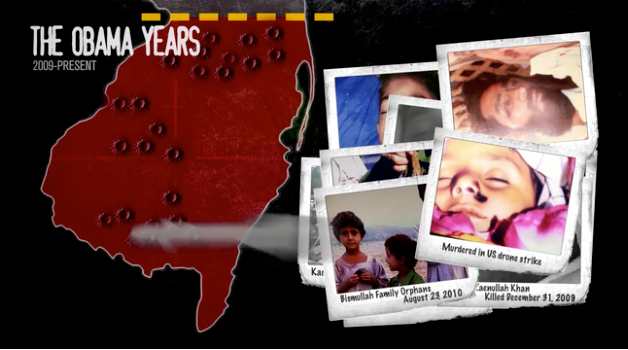
In one sequence, repeating a tactic which has been used by other artists in Iraq in particular, “Wounds” projects US drone strikes in Waziristan onto a map of Madiha’s home state, New Jersey:

Obama Years

Madiha also appears on a panel on “Life Under Drones” at the Drones & Aerial Robotics Conference in New York earlier this month, with Wazhmah Osman, Chris Rogers and Tara McKelvey, also now up at YouTube:

Reporting from FATA

An update to my post about Wounds of Waziristan: there’s an excellent long-form interview with Madiha Tahir here (and a sawn-off version of the same discussion at Counterpunch).  As you would expect, she is very good indeed about Pakistan’s politics, the complexity of the situation in the Federally Administered Tribal Areas (FATA) and Pakistani attitudes to US drone strikes, but she also has some sharp observations about how these are read in the United States:

Paul Gottinger: Can you talk about how the issue of drones is debated on the left in the U.S.?

Madiha Tahir: I was there when the Code Pink marched in Pakistan in October. Code Pink went with the Pakistani politician Imran Khan. We marched to South Waziristan, and we met some survivors and families of victims. Medea Benjamin, the founder of Code Pink, published an article in which she talks about her discomfort that Karim Khan, whose brother and son were killed by drones in December 2009, seeks a desire for revenge.  According to her article, several people in the delegation were uncomfortable with his desire for revenge. I find that very strange. It seems like the right wants the drone victims to be completely evil, and the left wants them to be pure. Both ways of seeing the victims is dehumanizing.

BAIG Reporting from the FrontlinesIn the background of all this is the extraordinary difficulty and danger involved in reporting from FATA.  There is a general survey of the ‘media landscape’ of FATA here and an excellent monthly review from Borderbuzz here, but I’ve found other, more personal sources to be more informative.  The Bureau of Investigative Journalism has addressed the issue directly and explained how its outstanding coverage of drone strikes in North and South Waziristan has been indebted to skilled local reporters like Mushtaq Yusufzai.

Some analysts claim that reporting from the tribal areas is often unreliable. Yusufzai is inclined to agree: ’There is some truth to it. Reporting can be very, very poor and if you rely on your local stringers and journalists they may never ever tell you the truth, because they’re rarely paid, they don’t want to risk upsetting people. The Taliban or security officials or local people might blame him for doing his job. So sometimes it’s easier for him to say nothing – or the wrong thing,’ he says.

Despite the risks, the militant groups can be an important source of information: ’There are a number of people who know, among the Taliban’s leadership, among the fighters, what’s actually happening. So I tell them that I want to write a story about these things if they can help. To some extent they will allow you, but if it’s related to their senior people, to the commanders, they may not allow you to do it and tell you instead to use their public statements.’

State sources such as the military and Pakistan’s powerful intelligence service, the ISI, can be less well-informed. ’Often they don’t themselves have access to those areas,’ says Yusufzai.

Journalists are at risk of interference from the army and ISI. Yusufzai assumes that his phone is often listened to, which he believes can put journalists in danger. ’Sometimes it becomes very dangerous, and the Taliban suspect it is possible you are working for spy agencies, for the government.’

In fact local journalists are afforded little protection by the state – and even local residents are denied access to information – as this short documentary Theater of Conflict – reporting from FATA makes clear:

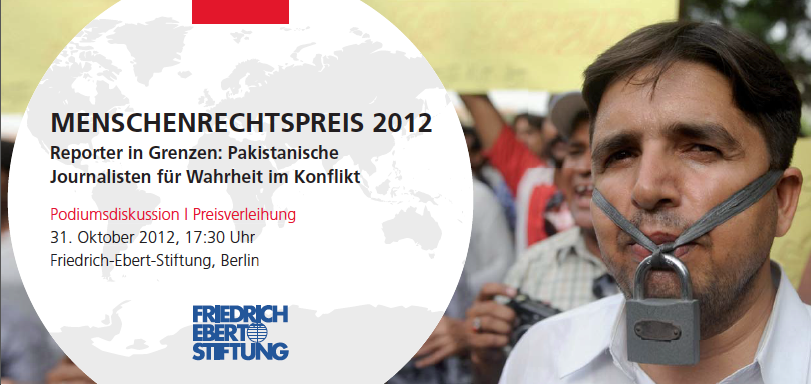
Last year the Tribal Union of Journalists was awarded the Friedrich Ebert Stiftung Human Rights Award; watch the video and you’ll see why.

Friedrich-Ebert-Stiftung 2012

How we kill in war

Afghanistan Living With Drones

A new CBC Ideas program, How we kill in war, airs tonight at 9 p.m.

With every evolution in military technology comes a shift in military tactics. And each shift in tactics pushes our understanding of what is permissible and what is ethical behaviour in war. The American military’s use of drones brings with it uncomfortable moral questions. Journalist Naheed Mustafa visits Pakistan and explores the dilemmas posed by drone warfare.

Participants include:

Karim Khan – Journalist with Al Jazeera. Currently suing the CIA for the drone killing of his son and brother.

Marvi Sirmed – Democracy promoter and human rights activist.

Shahzad Akbar – Lawyer, currently representing victims of American drone strikes.

Derek Gregory – Peter Wall Distinguished Professor and Professor of Geography at University of British Columbia.

John Kaag – Associate Professor of Philosophy, University of Massachusetts at Lowell.

Bradley Strawser – Assistant Professor of Philosophy in the Defense Analysis Department, US Naval Postgraduate School.

I had an extended phone conversation with Naheed to prep for this, and then an hour-long interview (don’t worry: the extracts used are much shorter!).  She really does know her stuff, and the programme includes interviews with some of those who live under the shadow of drone attacks in the Federally Administered Tribal Areas.

You can listen in online here.

More unfinished business: haunting Waziristan

I’m just finishing up a new essay on drones and later modern war – “Moving targets and violent geographies” – and I’ll post the draft as soon as I’m done (this weekend, I hope).

Next up is the essay version of my various posts and presentations on air strikes in Pakistan’s Federally Administered Tribal Areas, past and present, by the US and by the Pakistan Air Force [see here and here], so I was heartened by news from Madiha Tahir [see my post here] of progress with her short documentary film, Wounds of Waziristan (they are down to the final edits):

More about the project and crowd-sourcing here, and you can find more information at the film’s website, which includes an image gallery and opens with some of the most hauntingly beautiful music composed by André Barros (shades of Arvo Part‘s Spiegel im Spiegel):

Haunting indeed.  In a report for Delhi’s Sunday Guardian, Tanishree Bhasin writes:

When Barack Obama finally admitted to the needless loss of life in Pakistan’s Waziristan area due to American drone attacks, he spoke about how the death of innocents would haunt him forever. Interrogating this notion of ‘haunting’ and what it means for those affected by these attacks is Pakistani filmmaker Madiha Tahir in her film Wounds of Waziristan….

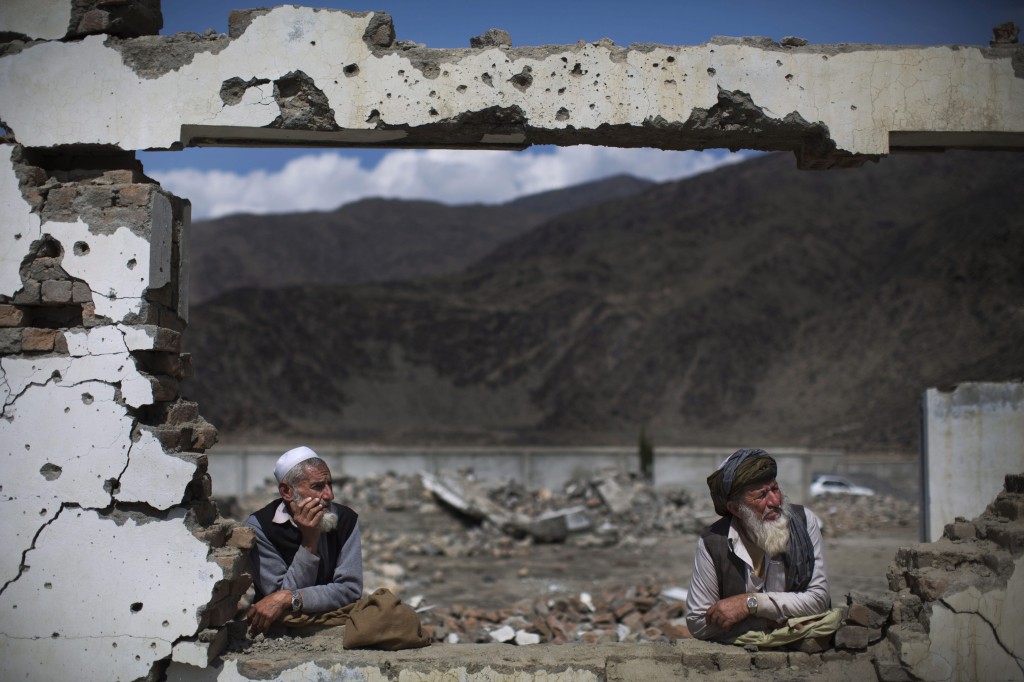
With Wounds of Waziristan, Tahir tries to foreground the people who materially experience loss and absence — not as abstract body counts, but as the absence of a brother or a niece or a wife. “Haunting is the insistence by the dead that they be acknowledged, that the social conditions that brought about their demise be made known and rectified. So, haunting is about unfinished business. And, it’s thoroughly social and political. This film focuses on the people who live in Waziristan and who live among loss. Material conditions, whether it’s the rubble after a drone attack or the grave of one’s kin, persist in reminding the living of what they have lost,” she explains.

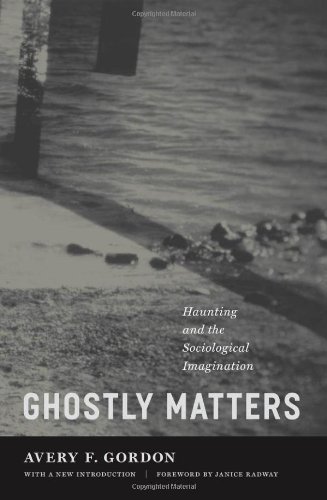
GORDON Ghostly matters

On her blog, Madiha wryly notes that her interest in the question of haunting may show ‘my academic side coming out’ – as well as an independent journalist she’s also a graduate  from NYU and Columbia, where she’s currently working on her PhD – and human geographers will probably be no strangers to the idea, from research by Steve Pile and Karen Till and most recently Alison Mountz‘s analysis of detention centres and Akin Akinwumi‘s work on Truth and Reconciliation Commissions.

Much of this has been indebted to Avery Gordon‘s by now classic study, Ghostly matters:

‘Haunting is one way in which abusive systems of power make themselves known and their impacts felt in everyday life, especially when they are supposedly over and done with or when their oppressive nature is denied… Haunting is not the same as being exploited, traumatized, or oppressed, although it usually involves these experiences or is produced by them. I used the term haunting to describe those singular yet repetitive instances when home becomes unfamiliar, when your bearings on the world lose direction, when the over-and-done-with comes alive, when what’s been in your blind spot comes into view.’

It’s not difficult to see how this applies to air strikes in Waziristan – the sense of familiarity unmoored by the devastations of state violence – but Madiha’s starting point is a two-page note Max Horkheimer and Theodor Adorno appended to Dialectic of Enlightenment, ‘On the theory of ghosts’, that also figured briefly in Gordon’s book (where she described it as an ‘unfilled promissory note’):

Only the conscious horror of destruction creates the correct relationship with the dead: unity with them because we, like them, are the victims of the same condition and the same disappointed hope.

It’s that first clause that animates Madiha’s work:

Only the conscious horror of destruction creates the correct relationship with the dead.

Legitimate TargetShe notes that so much (too much) of the contemporary debate about drones is framed by the language of international law and its grammar of execution that is deeply embedded in military violence: as operational law has become a central discourse in the animation and legitimation of the kill-chain, so it turns targeted killing into a quasi-juridical process.  In consequence, as she says with a nod to Eyal Weizman, ‘international law is caught up in constructing the proper order of violence.’

And as a journalist she is dismayed at the complicity of journalists in popularizing law

‘as the only frame through which we can talk about drone attacks and moral standards. Journalists regularly fail to look beyond the usual “experts” in policy and legal circles to other fields that may have an alternative to offer. We are becoming vulgar empiricists who seem to think that a truth not attached to a number (say, the number of “militants” vs. “civilians” killed), or a legal rule (for example: whether an action does/does not violate international law) is no truth at all.’

So Madiha proposes haunting as an alternative frame ‘through which one can re-direct the conversation from issues of legal standards to the lives lived and lives lost under the drones in Waziristan and elsewhere’:

‘The questions then turn on the material conditions and the loss suffered – not as evidence for legal arguments but as queries about what it does to a person to live in such conditions. The question is not, ‘Do I stick him in the “militant” or “civilian” column?’ but instead, who survives him? How do they deal with that loss? What is it like to live among the rubble?

It isn’t through legal standards but though trying to understand the horror of the destruction that we create the correct relationship — with the dead, yes — but with the living, too.’

This matters so much – and reappears in a different form in ‘Moving targets’ – because the contemporary individuation of ‘war’ (if it is war) works to sanitize the battlefield: to confine attention to the individual-as-target (which is itself a technical artefact separated from the exploded fleshiness that flickers briefly on the Predator’s video screens) and to foreclose the way in which every death ripples across a family, a community, a district and beyond [see my brief discussion with Ian Shaw here].

Fahim Qureshi Attack date 23 January 2009

And, as Madiha explained to the Sunday Guardian, these effects ripple across time as well as space, tearing the very fabric of history:

Speaking about her experiences while making this film, she explained that it’s not just a question of life being lost, but also the obliteration of history. “When drone attacks destroy homes — as they often do — they erase entire family histories. Homes in this area are built over time as families grow. There may be as many as 50 members of a family living in one house. When you destroy structures like that, you not only destroy people, you also destroy their history. The rubble that’s left in the wake of an attack is a living memory of what happened there. It embodies loss. The people in Waziristan have to live around this loss, near it, in it. They have to live among ghosts,” says Tahir.

‘Un-Manning’

I don’t imagine that anyone who has seen it will ever forget the cockpit video of US Apache attack helicopters mowing down two Reuters journalists and ten other civilians in Baghdad in July 2007.  It was part of the cache that the principled and courageous Bradley Manning gave to Wikileaks, which released the full, unedited clip as Collateral Murder in 2010, and earlier this month Manning’s lawyers opened their defence with a showing of the same video.

The transcript of the video is here, and a redacted copy of the US Army’s investigation report (with annotated video stills) is here.

The incident has been the subject of two short documentary films, linked by a common figure, Ethan McCord, a US soldier who arrived at the scene minutes after the shooting began (more here).

The first is Shuchen Tan‘s Permission to engage, which won the Prix Europa for the best European TV investigation in 2012.  Here’s the trailer:

http://www.youtube.com/watch?v=6PlsG0p-PQA

And here is the full (brilliant) film:

http://www.youtube.com/watch?v=YnF5X7xF8zc

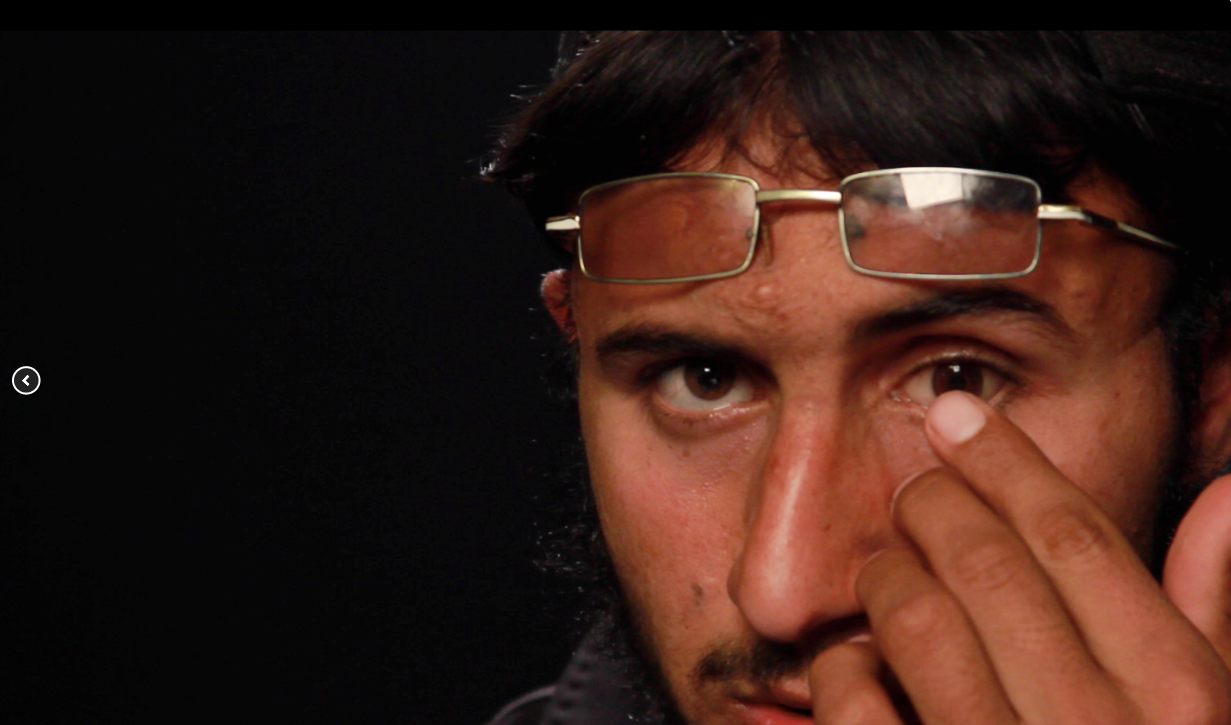
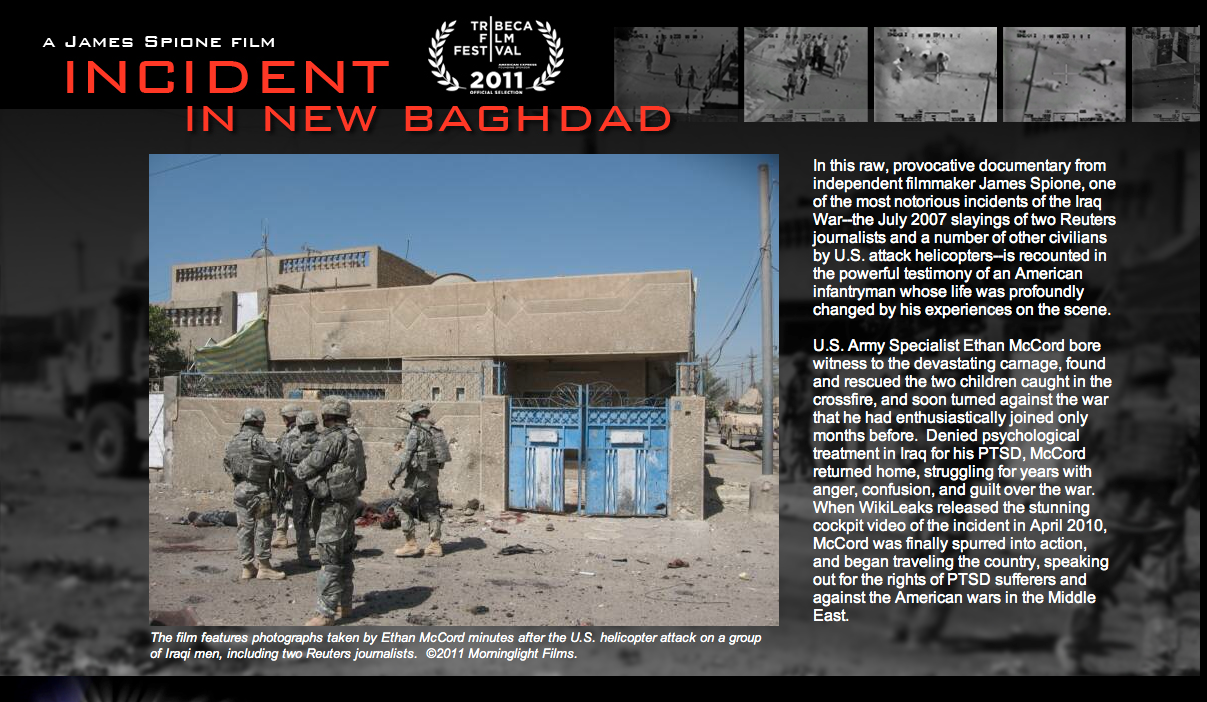
The second is James Spione‘s  Incident in New Baghdad, which won the prize for the best documentary short at the Tribeca Film Festival in 2011 and for best picture and best documentary short at the Fargo Film Festival in 2012.

Incident in New Baghdad

This is how Spione introduces his film:

Psychologists call it “psychic numbing.” Tell someone that tens of thousands of civilians have been killed in the Iraq conflict, or that thousands of U.S. veterans of our Mideast wars suffer from crippling PTSD, and their eyes will likely glaze over. Most people simply cannot comprehend the meaning of such vast numbers, nor are they likely to show any particular concern. Conversely, however, the tale of a single tragic incident can create great empathy in the same person–and greater understanding of the wider effects of war.

On April 5th, 2010, the controversial website WikiLeaks released a grainy black-and-white video that stunned the world. Recorded from the gunsight camera of an U.S. Army attack
helicopter during one of the most chaotic and deadly periods of the Iraq War, the footage depicts the violent deaths of two Iraqi journalists, Namir Noor-Eldeen and Saeed Chmagh,
along with at least eight other mostly unarmed individuals on the streets of Baghdad in July 2007. Minutes later on the video, when the driver of a passing van attempts to come to the aid of the mortally wounded Chmagh, a second helicopter attack occurs that destroys the van and kills several more people, wounding two small children in the process…

My short film INCIDENT IN NEW BAGHDAD examines what happened that day from the first-hand perspective of an American infantryman whose life was profoundly changed by his experiences on the scene. U.S. Army Specialist Ethan McCord bore witness to the devastating carnage, found and rescued the two children caught in the crossfire, and soon turned against the war that he had enthusiastically joined only months before. Denied psychological treatment in Iraq for his PTSD, McCord returned home, struggling for years with anger, confusion, and guilt over the war. When Wikileaks released the video of the incident, McCord was finally spurred into action, and began traveling the country, speaking out for the rights of PTSD sufferers and against the American wars in the Middle East.

However, there is so much more to the story, and I am now developing a more in-depth, feature-length examination of this incident that will include the perspectives of many more people involved in this incident: the infantry on the ground; the families of both Noor-Eldeen and Chmagh; the children, whose father was killed in front of them in the van, as well as their mother; and if possible, the 1-8 Cavalry Airborne gunner who pulled the trigger. My hope is that, by hearing from all of the first-hand participants of this tragic event, we may come to better understand the profoundly damaging consequences that ripple out through the lives of survivors over many years from just one so-called “engagement” in a war. And when we learn from all involved that this incident was not an aberration, but a commonplace occurrence over the course of many years, perhaps then we will start to understand those mind-numbing statistics, and feel the true moral scale of the damage, the wounds, the folly of a war of choice that never needed to happen.

I rehearse all this now for two reasons other than the shadow of sentencing that now hangs over Manning (though that is reason enough) .

First, the video at the dark heart of this incident – and these films – was not captured by a Predator or Reaper thousands of feet in the air and fed back to pilots, screeners and commanders thousands of miles away in the continental United States: this was close-in and immediate, and this raises important questions about scopic regimes and military violence that spiral far beyond the usual (and I think narrowly framed) debate over drones.

Approximate Target

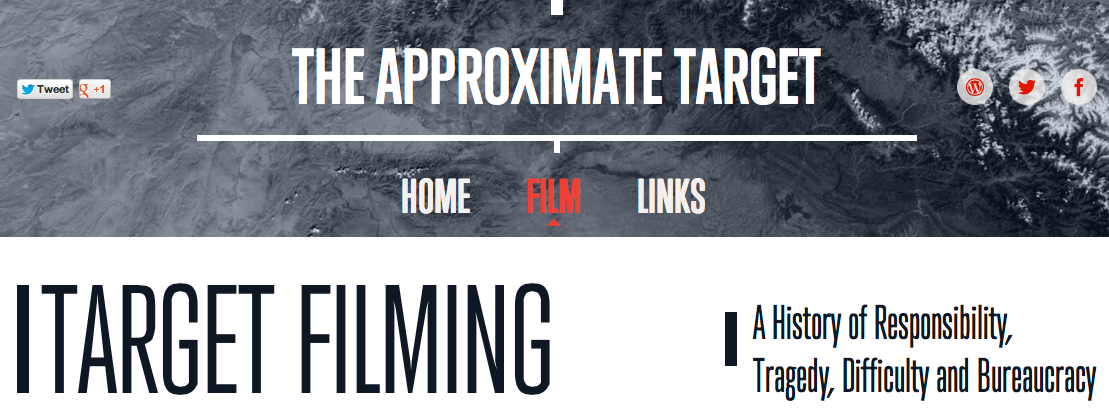
Second, Incident in New Baghdad was part-financed by Carol Grayson, who became one of the film’s executive producers.  She is clearly a remarkable woman in all sorts of ways, not least because she has spent much (I suspect most) of her time since then working on a new documentary film project, The Approximate Target that charts ‘the human cost of remote control killing, the dangers of covert government policy and unaccountability in modern warfare.’  It’s been a long, difficult and continuing journey with seemingly no end of obstacles and obstructions: you can read more on her blog here.

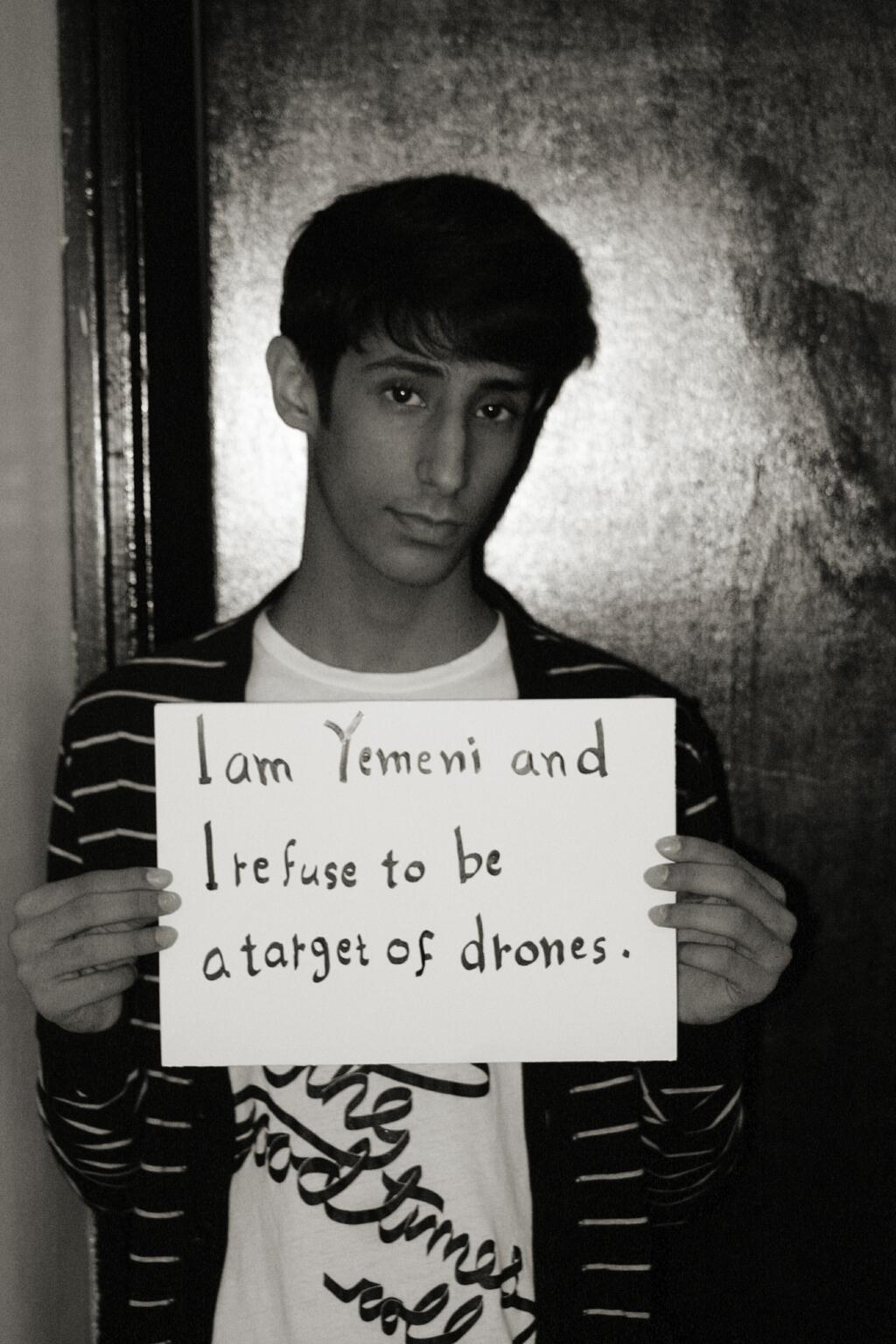
BJCiq-vCMAAgpWe-1From what I’ve been able to discover – which is not as much as I’d like – the focus of the The Approximate Target appears to be on CIA-directed strikes in Waziristan.  But Carol’s most recent posting (today) includes a letter from a Yemeni civilian to President Obama and Yemen’s President Hamadi on the eve of their meeting at the White House.  The letter was released today by Reprieve.  In it, Faisal bin Ali Jabera,  young engineer who lost two of his relatives in a drone strike on Hadhramout last summer, writes:

Our family are not your enemy. In fact, the people you killed had strongly and publicly opposed al-Qa’ida. Salem was an imam. The Friday before his death, he gave a guest sermon in the Khashamir mosque denouncing al-Qa’ida’s hateful ideology. It was not the first of these sermons, but regrettably, it was his last…

Our town was no battlefield. We had no warning – our local police were never asked to make any arrest. My young cousin Waleed was a policeman, before the strike cut short his life…

Your silence in the face of these injustices only makes matters worse. If the strike was a mistake, the family – like all wrongly bereaved families of this secret air war – deserve a formal apology. To this day I wish no vengeance against the United States or Yemeni governments. But not everyone in Yemen feels the same. Every dead innocent swells the ranks of those you are fighting.

Theory of the drone 3: Killing grounds

This is the third in a series of posts on Grégoire Chamayou‘s Théorie du drone, in which I provide a detailed summary of his argument, links to some of his key sources, and reflections drawn from my soon-to-be-completed The everywhere war (and I promise to return to it as soon as I’ve finished this marathon).

5: Pattern of life analysis

Chamayou begins with the so-called ‘Terror Tuesdays‘ when President Obama regularly approves the ‘kill list’ (or disposition matrix) that authorises ‘personality strikes’ against named individuals: ‘the drones take care of the rest’.

a0018519784_2

But Chamayou immediately acknowledges that most strikes are ‘signature strikes‘ against individuals whose names are unknown but for whom a ‘pattern of life analysis‘ has supposedly detected persistent anomalies in normal rhythms of activity, which are read as signs (‘signatures’) of imminent threat.  I’ve described this as a militarized rhthmanalysis, even a weaponized time-geography, in ‘From a view to a kill’ (DOWNLOADS tab), and Chamayou also notes the conjunction of human geography and social analysis to produce a forensic mapping whose politico-epistemological status is far from secure.

The principal limitation – and the grave danger – lies in mistaking form for substance.  Image-streams are too imprecise and monotonic to allow for  fine-grained interpretation, Chamayou argues, and supplementing them by equally distant measures, like telephone contacts, often compounds the problem.  Hence Gareth Porter‘s objection, which both Chamayou and I fasten upon:

‘The phone numbers and call histories from those phones go into the database which is used to “map the networks.” But the link analysis methodology employed by intelligence analysis is incapable of qualitative distinctions among relationships depicted on their maps of links among “nodes.” It operates exclusively on quantitative data – in this case, the number of phone calls to or visits made to an existing JPEL target or to other numbers in touch with that target. The inevitable result is that more numbers of phones held by civilian noncombatants show up on the charts of insurgent networks. If the phone records show multiple links to numbers already on the “kill/capture” list, the individual is likely to be added to the list.’

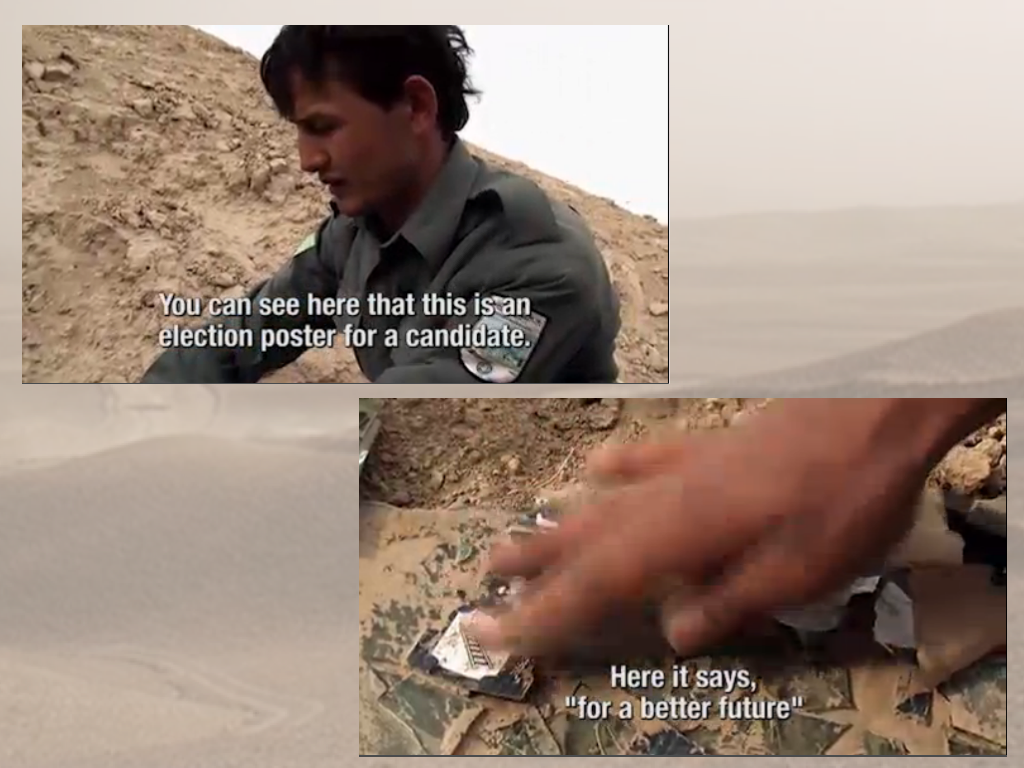
This is exactly what happened in the Takhar attack in Afghanistan on 2 September 2010 that I’ve discussed elsewhere, relying on the fine investigative work of Kate Clark, and Chamayou draws attention to it too.   The general assumption, as Kate was told by one officer, seems to be that ‘”If we decide he’s a bad person, the people with him are also bad.”

Takhar For a better future.001

These necro-methodologies raise two questions that Chamayou doesn’t address here.

The first, as Porter notes, is that ‘guilt by association’ is ‘clearly at odds with the criteria used in [international] humanitarian law to distinguish between combatants and civilians.’  You can find a much more detailed assessment of the legality of signature strikes (and what he calls their ‘evidential adequacy’)  in Kevin Jon Heller‘s fine essay, ”One hell of a killing machine”: Signature strikes and international law’ [Journal of international criminal justice 11 (2013) 89-119; I discussed a pre-publication version here].

The geo-legal ramifications of these attacks reach far beyond the killing grounds.  Earlier this month in the High Court in London one man who lost five relatives in the air strike in Takhar (as you can see on the slide above, on an election convoy) challenged the legality of the alleged involvement of Britain’s Serious and Organised Crimes Agency (SOCA) in drawing up the kill-list, the Joint Prioritized Effects List, used by the military to authorise the attack: more herehere and here. (It was the presence of names on the list that triggered the faulty network analysis).

The second is the imaginary conjured up by the very idea of a ‘pattern of life’ analysis.  I’ve written before about the way in which the screen on which the full-motion video feeds from the Predators and Reapers are displayed interpellates those who watch what is happening on the ground from thousands of miles away, and I’ve emphasised that this isn’t a purely optical affair:  that it is an embodied, techno-culturally mediated process that involves a series of structured dispositions to view the other as Other (and often dangerous Other).   But these dispositions also reside in what we might think of as a grammar of execution.  To see what I mean, here is Micah Zenko:

‘Recently, I spoke to a military official with extensive and wide-ranging experience in the special operations world, and who has had direct exposure to the targeted killing program. To emphasize how easy targeted killings by special operations forces or drones has become, this official flicked his hand back over and over, stating: “It really is like swatting flies. We can do it forever easily and you feel nothing. But how often do you really think about killing a fly?”’

Hence, of course, ‘Bugsplat’ [according to Rolling Stone, ‘the military slang for a man killed by a drone strike is “bug splat,” since viewing the body through a grainy-green video image gives the sense of an insect being crushed’], and a host of other predatory terms (see also here) that distinguish between this mere (bare) life and what Judith Butler calls ‘a life that qualifies for recognition’.
state-violence-and-the-execution-of-lawBut the same result is achieved through the nominally neutral, technical-scientific vocabulary deployed in these strikes. Joseph Pugliese captures the grammar of execution with acute insight in another fine essay, ‘Prosthetics of law and the anomic violence of drones’, [Griffith Law Review 20 (4) (2011) 931-961; you can also find it in his excellent new book State violence and the execution of law]:

‘The term ‘heat signature’ works to reduce the targeted human body to an anonymous heat-emitting entity that merely radiates signs of life. This clinical process of reducing human subjects to purely biological categories of radiant life is further elaborated by the US military’s use of the term ‘pattern of life’…

‘The military term ‘pattern of life’ is inscribed with two intertwined systems of scientific conceptuality: algorithmic and biological. The human subject detected by drone’s surveillance cameras is, in the first scientific schema, transmuted algorithmically into a patterned sequence of numerals: the digital code of ones and zeros. Converted into digital data coded as a ‘pattern of life’, the targeted human subject is reduced to an anonymous simulacrum that flickers across the screen and that can effectively be liquidated into a ‘pattern of death’ with the swivel of a joystick. Viewed through the scientific gaze of clinical biology, ‘pattern of life’ connects the drone’s scanning technologies to the discourse of an instrumentalist science, its constitutive gaze of objectifying detachment and its production of exterminatory violence. Patterns of life are what are discovered and analysed in the Petri dish of the laboratory…

‘Analogically, the human subjects targeted as suspect yet anonymous ‘patterns of life’ by the drones become equivalent to forms of pathogenic life. The operators of the drones’ exterminatory attacks must, in effect, be seen to conduct a type of scientific ethnic cleansing of pathogenic ‘life forms’. In the words of one US military officer: “Our major role is to sanitize the battlefield.”’

Later modern war more generally works through relays of biological-medical metaphors – equally obviously in counterinsurgency, as I’ve described in “Seeing Red” and other essays (DOWNLOADS tab), where the collective enemy becomes a ‘cancer’ that can only be removed by a therapeutic ‘killing to make live’ (including ‘surgical strikes’) – and Colleen Bell has provided an illuminating series of reflections in ‘Hybrid warfare and its metaphors’ [in Humanity 3 (2) (2012) 225-247] and ‘War and the allegory of medical intervention’ [International Political Sociology 6 (3) (2012) 325-8].

This immunitary logic is clearly bio-political, and its speech-acts just as plainly performative, and Pugliese draws the vital conclusion:

‘As mere patterns of pathogenic life, these targeted human subjects effectively are reduced to what Giorgio Agamben would term ‘a kind of absolute biopolitical substance’ that can killed with no concern about the possibility of juridical accountability: they are ‘bare life’ that can be killed with absolute impunity. Anonymous ‘patterns of life’ signify in contradistinction to legally named persons; they exemplify the ‘ontological hygiene’ legislated by US government policy in order to secure the reproduction of the ‘principle of scarcity with respect to agency and personhood’.

‘Situated in this Agambenian context of the extermination of human life with absolute impunity, the Predator drones must be seen as instantiating mobile ‘zones of exception’…’

Which artfully brings me to Chamayou’s next chapter…

6: Kill-box

Chamayou notes that the ‘war on terror’ loosed the dogs of war from their traditional boundaries in time and in space: at once ‘permanent war’ and, as he notes, ‘everywhere war’.

But for Chamayou it is more accurate to speak of the world turned into a ‘hunting ground’ rather than a battlefield, and this matters because two different geographies (his term) are involved.  War is defined by combat, he explains, hunting by pursuit.  Combat happens where opposing forces engage, but hunting tracks the prey, so that the place of military violence is no longer defined by a delimited space (‘the battlefield’) but by the presence of the enemy-prey who carries with him, as it were, his own mobile halo of a zone of personal hostilities.

To escape, the quarry must make itself undetectable or inaccessible – and the ability to do so depends not only on physical geography (terrain) but also on political and legal geography.  For this reason, Chamayou argues, the US has rendered contingent the sovereignty of Pakistan because it (for the most part unwillingly) provides sanctuary to those fleeing across the border from Afghanistan.  In such circumstances, what becomes crucial for the hunter is not the military occupation of territory but the ability to control trans-border spaces from a distance through the instantiation of what Eyal Weizman called the politics of verticality that has since captured the attention of Stuart Elden [“Secure the volume: vertical geopolitics and the depth of power”, Political Geography 34 (2013) 35-51], Steve Graham [“Vertical geopolitics: Baghdad and after”, Antipode 36 (1) (2004) 12-23] and others.  For this to work, as Weizman shows in the case of occupied Palestine, air power is indispensable.

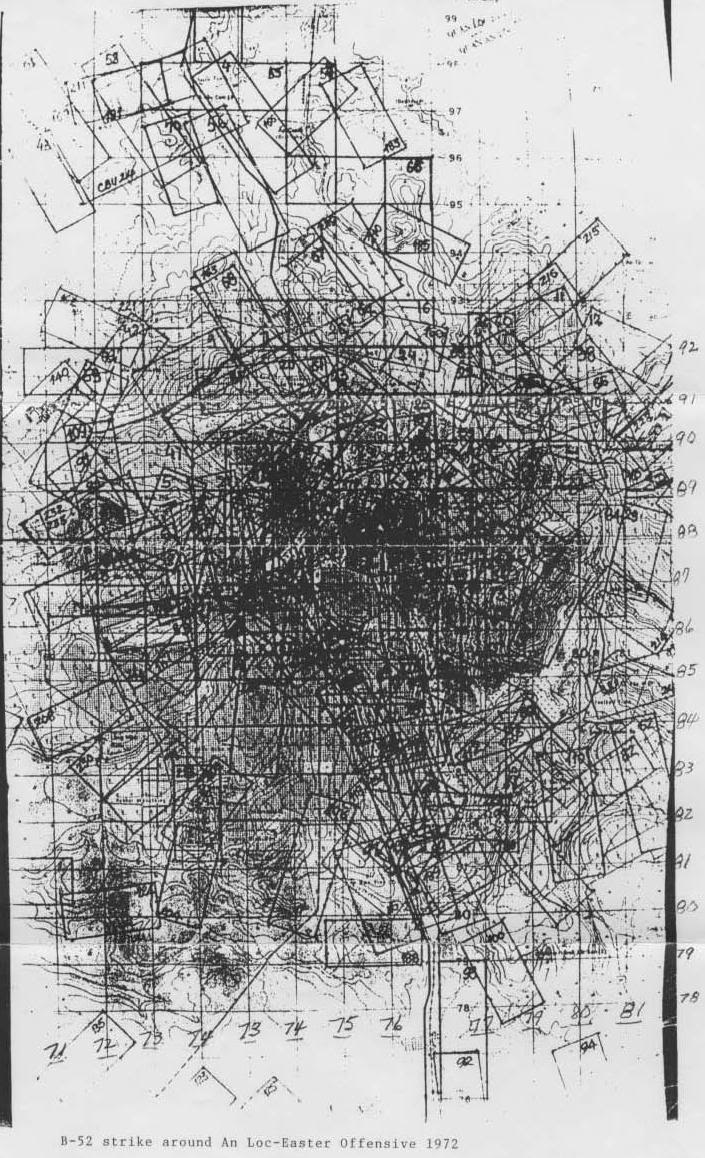
Chamayou suggests that the US has refined this capacity – in effect, finely calibrated the time and space of the hunt – through the concept of the kill-box.  I’m not so sure about this; the lineage of the ‘kill-box’ goes back to the USAF’s ‘target boxes’ [target boxes around An Loc in Vietnam in 1972 are shown below] – and two or three specified ‘boxes’ or ‘Restricted Operating Zones‘ were used to define the Predato’s’  ‘hunting grounds’ over North and South Waziristan that were tacitly endorsed by the Pakistan state.

Target boxes around An Loc 1972

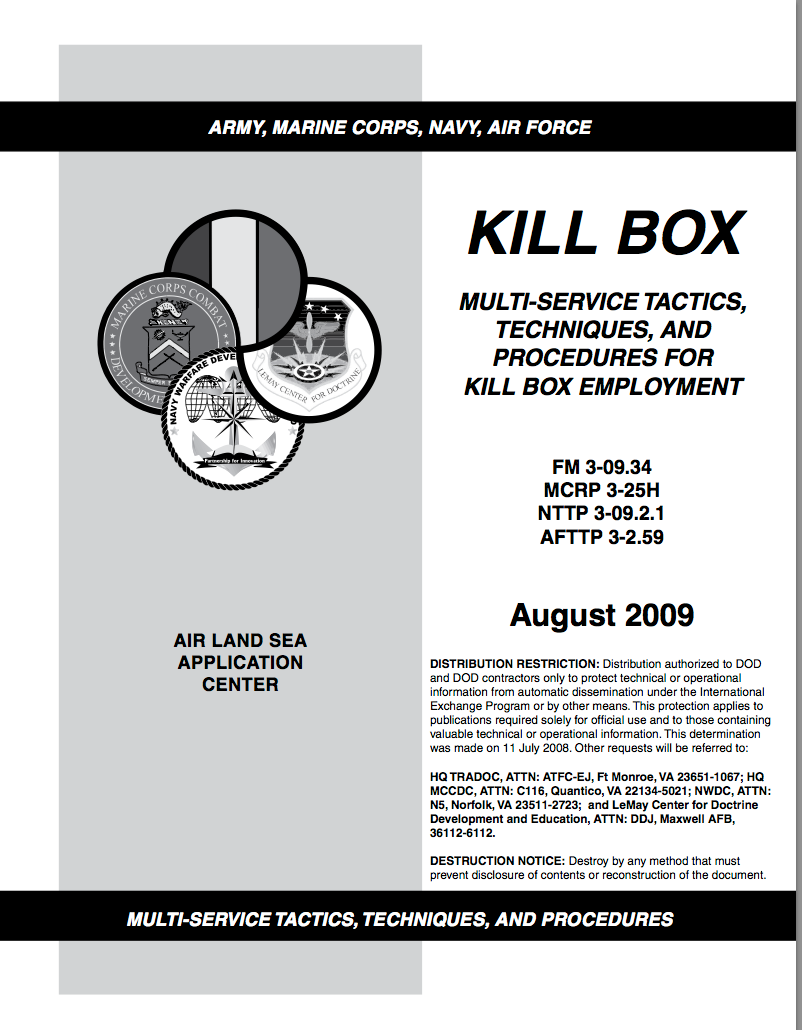
The concept of the ‘kill box’ was formalised as a joint operations doctrine in the 1990s as part of the established targeting cycle: what Henry Nash famously described in another context as ‘the bureaucratization of homicide’.  Nash worked for the USAF Air Targets Division in the 1950s and 60s, identifying targets in the USSR for nuclear attack by US Strategic Air Command, but I doubt that Chamayou would dissent from using either the verb or the noun to describe the contemporary, non-nuclear kill-chain.  (In a later post I’ll explain how this technical division of labour feeds in to what Chamayou castigates as a ‘setting aside’, a dispersal of responsibility, which functions to separate an action from its consequences: this is aggravated by the remote-split operations in which drones are embedded, and is central to Chamayou’s critique).  Here is how the relevant military manuals incorporated the development of the kill box into the targeting cycle in 2009 (ATO = Air Tasking Order):
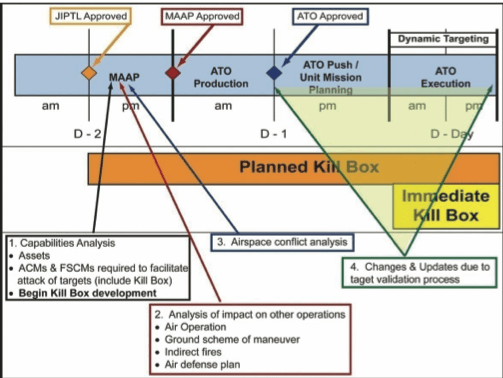
Kill Box Development

You can find more on kill-boxes and their operationalisation here.

Kill Box TTP

Chamayou doesn’t track the development of the concept, but since then the ‘kill-box’ has been supplanted or at least supplemented by the ‘Joint Fires Area’ as a way of continuing to co-ordinate the deployment of lethal force and allowing targets to be engaged without additional communication.  Within the grid of the JFA (shown below, taken from an essay by Major James Mullin on ‘redefining the kill box’) permission to fire in specified cells is established in advance; areas are defined, targeting intervals stipulated, and the time-space cells can be opened and closed as operations proceed.

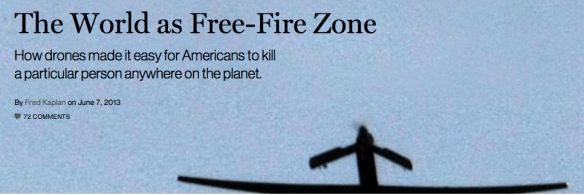
It is this capacity that Chamayou seizes upon: within the kill box targets can be engaged at will, so that the kill box, he writes, ‘is an autonomous zone of temporary killing’ (cf. the ‘free fire/specified fires zone’ in Vietnam: see my discussion of Fred Kaplan‘s recent essay, ‘The world as a free-fire zone‘).
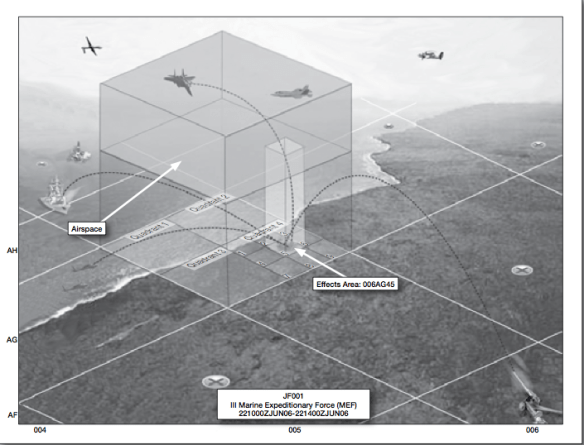
3-D representation of Joint Fires Area using Global Area Reference System

Chamayou implies that the schema has been further refined in contemporary counterinsurgency and counter-terrorism operations: the fact that the kill-box and its successor allow for dynamic targeting across a series of scales is crucial, he says, because its improvisational, temporary nature permits targeting to be extended beyond a declared zone of conflict. The scale of the JFA telescopes down from the cell shown on the right of the figure below through the quadrant in the centre to the micro-scale ‘keypad’ (sic) on the right.
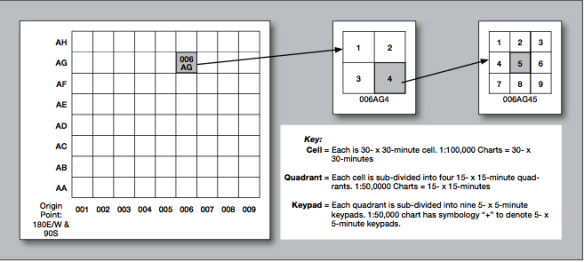
Global Area Reference System

This is more than a grid, though; the JFA is, in effect, a performative space that authorises, schedules and triggers lethal action.  Chamayou: ‘Temporary micro-cubes of lethal exception can be opened anywhere in the world, according to the contingencies of the moment, once an individual who qualifies as a legitimate target has been located.’  Thus, even as the target becomes ever more individuated – so precisely specified that air strikes no longer take the form of the area bombing of cities in World War II  or the carpet bombing of the rainforest of Vietnam – the hunting ground becomes, by virtue of the nature of the pursuit and the remote technology that activates the strike, global.
KAPLAN World as Free-Fire Zone

The system I’ve described here is one adopted by the US military, and how far its procedures are used by other agencies outside established conflict zones is unknown to me and doubtless to Chamayou too.  Are these micro-cells used to specify individual compounds or rooms, as Chamayou suggests in a thought-experiment?  For him, however, it’s the imperative logic that matters, and here Kaplan’s tag-line (above) can provide the key explanatory exhibit: ‘to kill a particular person anywhere on the planet.’   The doubled process of time-space calibration and individuation is what allows late modern war to become the everywhere (but, contra Kaplan,  not the anywhere, because specified) war.

On the one side, then, a principle of what Chamayou calls precision or specification:  ‘The zone of armed conflict, fragmented into micro-scale kill boxes, reduces itself in the ideal-typical case to the single body of the enemy-prey: the body as the field of battle.’  Yet on the other side, a principle of globalisation or homogenisation: ‘Because we can target our quarry with precision, the military and the CIA say in effect, we can strike them wherever we see fit, even outside a war zone.’

This paradoxical articulation has sparked fierce debates among legal scholars – Chamayou cites Kenneth Anderson, Michael Lewis, and Mary Ellen O’Connell – over whether the ‘zone of armed conflict’ should be geo-centred (as in the conventional battlefield) or target-centred (‘attached to the body of the enemy-prey’). Jurists are thus in the front line of the battle over the extension of the hunting ground, he writes, and ‘applied ontology’ is the ground on which they fight.  I’ll have more to say about this on my own account in a later post.
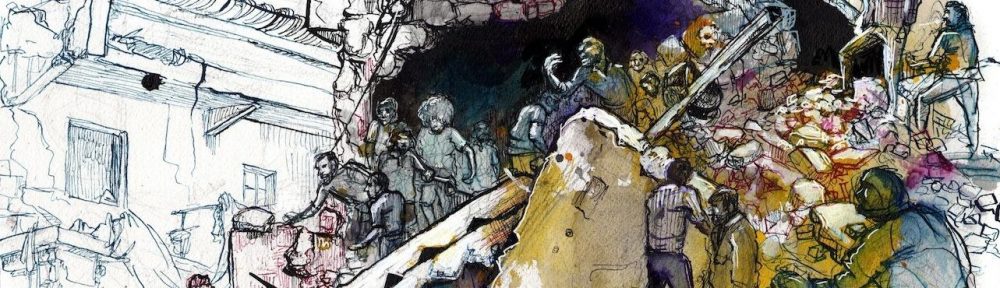
Predators over the FATA

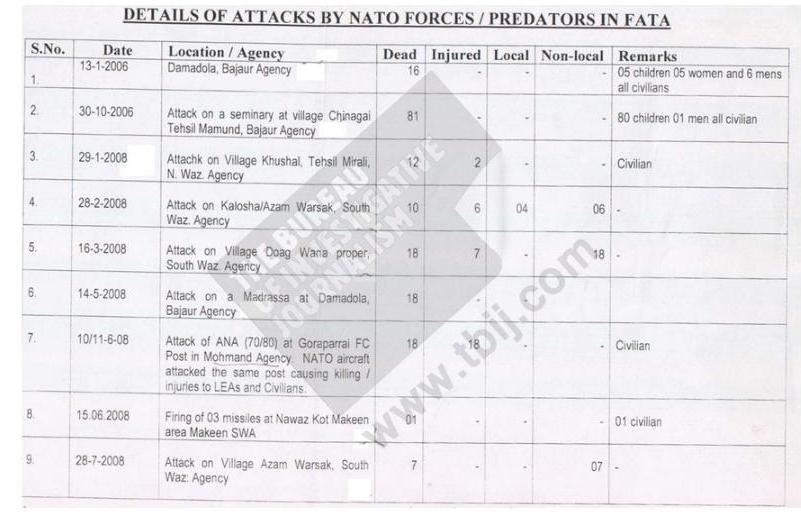
The Bureau of Investigative Journalism in London has published a confidential reportDetails of Attacks by NATO Forces/Predators in FATA, whose tabulations cover more than 70 drone strikes in Pakistan’s Federally Administered Tribal Areas between January 2006 and October 2009.

The tabulations are significant because they are not based on press reports – the standard and highly imperfect source – but on reports prepared for the FATA Secretariat and transmitted to Islamabad by government agents in the field (who rely on their own observations, and reports from the tribal police and other informants).  According to one well-placed observer, ‘There was no benefit in officials “cooking the books” here, since this document was clearly never intended to be seen outside the civilian administration.’

Predator/NATO strikes in FATA

It’s an incomplete list – the Bureau has a more comprehensive tabulation – but of the 746 deaths from these air strikes 147 (20 per cent) are identified as civilians (including 94 children).

Still, the Bureau notes some puzzling (even troubling) omissions.  In particular, reports of civilian deaths virtually disappear from the record after Obama took office: ‘In part this is because officials occasionally note that “details of casualties are yet to be ascertained.” But many credible reports of civilian deaths are simply missing. The Bureau’s own research shows that civilian deaths have been credibly reported in at least 17 of the 53 CIA drone strikes in Obama’s first year in office. Yet FATA officials report civilian deaths in only three incidents in 2009.’

There have been rumours of more comprehensive tabulations, but the Bureau acknowledges that much also depends on information provided by the Pakistani military.  And it would be interesting to see a comparable list of casualties resulting from Pakistan’s own air strikes in the FATA.