Viewing Eyes in the Sky


This image released by Bleecker Street shows Phoebe Fox, left, and Aaron Paul in a scene from "Eye In the Sky." (Keith Bernstein/Bleecker Street via AP)

This image released by Bleecker Street shows Phoebe Fox, left, and Aaron Paul in a scene from “Eye In the Sky.” (Keith Bernstein/Bleecker Street via AP)

The New York Review of Books has a characteristically thoughtful response by David Cole to Gavin Hood‘s newly released Eye in the Sky: ‘Killing from the Conference Room‘.

The film traces the arc of a joint US/UK drone strike in Nairobi, told from the viewpoints of those charged with authorising and executing the kill.  The nominal target is a safehouse, and the two al-Shabab leaders inside (conveniently one American citizen and one British citizen); less conveniently, after the strike has been authorised a young girl sets up a bread stand in front of the house.

It’s a more complicated scenario than the serial drone strikes dramatized in Andrew Niccol‘s  Good Kill – because here the politicians are brought into the frame too – and David sees it as a twenty-first century version of the ‘trolley-problem’:

Eye in the SkyIn the classic version of the problem, a runaway train is hurtling down a track on which five people are tied; they will die if the train is not diverted. By pulling a lever, you can switch the train to an alternate track, but doing so will kill one person on that track. Should you pull the switch and be responsible for taking a human life, or do nothing and let five people die?

In Eye in the Sky, the question is whether to [use a drone to] strike the compound, thereby preventing an apparent terrorist attack and potentially saving many lives, though the strike itself might kill the young girl as well as the suspected terrorists. If the operation is delayed to try to avoid endangering the girl, the terrorists may leave the compound, and it may become impossible to prevent the suicide mission. But it’s also possible that the girl will finish selling her bread and leave the danger zone before the suspects depart. If the terrorists leave the compound, an opportunity to capture or kill them without harming others may arise. And of course, the suicide mission itself might fail. As a Danish proverb holds, predictions are hazardous, especially about the future. But a decision must nonetheless be made, and the clock is ticking.

As he points out, there’s no right, neat answer:

There are only competing intuitions, based on utilitarian calculations, the difference, or lack thereof, between act and omission, and the like. In Eye in the Sky, and all the more so in the real world, the choices are never as clearly delineated as in the “trolley problem”; decisions must be made in the face of multiple unknowns. The girl may die and the terrorists may get away and kill many more. But what the film makes clear is that, notwithstanding today’s most sophisticated technology, which allows us to see inside a compound in Africa from half a world away, to confirm positive identifications with facial imaging technology, to make joint real-time decision about life and death across several continents, and then to pinpoint a strike to reduce significantly the danger to innocent bystanders, the dilemmas remain. Technology cannot solve the moral and ethical issues; it only casts them into sharper relief.

Consider, for example, the implications of the purported accuracy of armed drones. The fact that it is possible to conduct “surgical” strikes and to maintain distance surveillance for extended periods of time increases the moral and legal obligation to avoid killing innocents. When the only way to counter an imminent threat was with more blunt explosives or by sending in ground forces, attacks entailing substantial harm to civilians were nonetheless sometimes warranted. As technology makes it increasingly feasible to strike with precision, risks to civilian lives that were once inescapable can now be avoided. And if they can be avoided, mustn’t they be? Thus, when President Barack Obama in May 2013 announced a standard for targeted killings away from traditional battlefields, he said he would authorize such strikes only when there was a “near-certainty that no civilians will be killed or injured—the highest standard we can set.” Precisely because they are so discriminating, drones may demand such a standard. Yet as the film shows, that standard can be very difficult to uphold, even under the best of circumstances.

Given my own interest in the film, I’ll share my thoughts as soon as I’ve seen it.

Note: In the most recent US strike against al-Shabab on 5 March, in which drones and conventional strike aircraft were used to kill perhaps 150 people (or perhaps not) at a training camp 120 miles north of Mogadishu, it seems clear that few doubts were entertained (but see Glenn Greenwald here).

Intelligence designed

LIMN 6

The latest issue of Limn is on ‘The total archive‘:

Vast accumulations of data, documents, records, and samples saturate our world: bulk collection of phone calls by the NSA and GCHQ; Google, Amazon or Facebook’s ambitions to collect and store all data or know every preference of every individual; India’s monumental efforts to give everyone a number, and maybe an iris scan; hundreds of thousands of whole genome sequences; seed banks of all existing plants, and of course, the ancient and on-going ambitions to create universal libraries of books, or their surrogates.

Just what is the purpose of these optimistically total archives – beyond their own internal logic of completeness? Etymologically speaking, archives are related to government—the site of public records, the town hall, the records of the rulers (archons). Governing a collective—whether people in a territory, consumers of services or goods, or victims of an injustice—requires keeping and consulting records of all kinds; but this practice itself can also generate new forms of governing, and new kinds of collectives, by its very execution. Thinking about our contemporary obsession with vast accumulations through the figure of the archive poses questions concerning the relationships between three things: (1) the systematic accumulation of documents, records, samples or data; (2) a form of government and governing; and (3) a particular conception of a collectivity or collective kind. (1) What kinds of collectivities are formed by contemporary accumulations? What kind of government or management do they make possible? And who are the governors, particularly in contexts where those doing the accumulation are not agents of a traditional government?

This issue of Limn asks authors to consider the way the archive—as a figure for a particular mode of government—might shed light on the contemporary collections, indexes, databases, analytics, and surveillance, and the collectives implied or brought into being by them.

The issue includes an essay by Stephen J. Collier and Andrew Lakoff on the US Air Force’s Bombing Encyclopedia of the World.  I’ve discussed the Encyclopedia in detail before, but they’ve found a source that expands that discussion, a series of lectures delivered in 1946-48 to the Air War College by Dr. James T. Lowe, the Director of Research for the Strategic Vulnerability Branch of the U.S. Army’s Air Intelligence Division. The Branch was established in 1945 and charged with conducting what Lowe described as a ‘pre-analysis of the vulnerability of the U.S.S.R. to strategic air attack and to carry that analysis to the point where the right bombs could be put on the right targets concomitant with the decision to wage the war without any intervening time period whatsoever.’

Bombing Encylopedia Coding Form

The project involved drawing together information from multiple sources, coding and geo-locating the nominated targets, and then automating the data-management system.

What interests the authors is the way in which this transformed what was called  ‘strategic vulnerability analysis’: the data stream could be interrogated through different ‘runs’, isolating different systems, in order to identify the ‘key target system’:

‘… the data could be flexibly accessed: it would not be organized through a single, rigid system of classification, but could be queried through “runs” that would generate reports about potential target systems based on selected criteria such as industry and location. As Lowe explained, “[b]y punching these cards you can get a run of all fighter aircraft plants” near New York or Moscow. “Or you can punch the cards again and get a list of all the plants within a geographical area…. Pretty much any combination of industrial target information that is required can be obtained—and can be obtained without error” (Lowe 1946:13-14).’

Their central point is that the whole project was the fulcrum for a radical transformation of knowledge production:

‘The inventory assembled for the Encyclopedia was not a record of the past; rather, it was a catalog of the elements comprising a modern military-industrial economy. The analysis of strategic vulnerability did not calculate the regular occurrence of events and project the series of past events into the future, based on the assumption that the future would resemble the past. Rather, it examined interdependencies among these elements to generate a picture of vital material flows and it anticipated critical economic vulnerabilities by modeling the effects of a range of possible future contingencies. It generated a new kind of knowledge about collective existence as a collection of vital systems vulnerable to catastrophic disruption.’

And so, not surprisingly, the same analysis could be turned inwards – to detect and minimise sites of strategic vulnerability within the United States.

All of this intersects with the authors’ wider concerns about vital systems security: see in particular their ‘Vital Systems Security: Reflexive biopolitics and the government of emergency‘, in Theory, Culture and Society 32(2) (2015):19–51:

This article describes the historical emergence of vital systems security, analyzing it as a significant mutation in biopolitical modernity. The story begins in the early 20th century, when planners and policy-makers recognized the increasing dependence of collective life on interlinked systems such as transportation, electricity, and water. Over the following decades, new security mechanisms were invented to mitigate the vulnerability of these vital systems. While these techniques were initially developed as part of Cold War preparedness for nuclear war, they eventually migrated to domains beyond national security to address a range of anticipated emergencies, such as large-scale natural disasters, pandemic disease outbreaks, and disruptions of critical infrastructure. In these various contexts, vital systems security operates as a form of reflexive biopolitics, managing risks that have arisen as the result of modernization processes. This analysis sheds new light on current discussions of the government of emergency and ‘states of exception’. Vital systems security does not require recourse to extraordinary executive powers. Rather, as an anticipatory technology for mitigating vulnerabilities and closing gaps in preparedness, it provides a ready-to-hand toolkit for administering emergencies as a normal part of constitutional government.

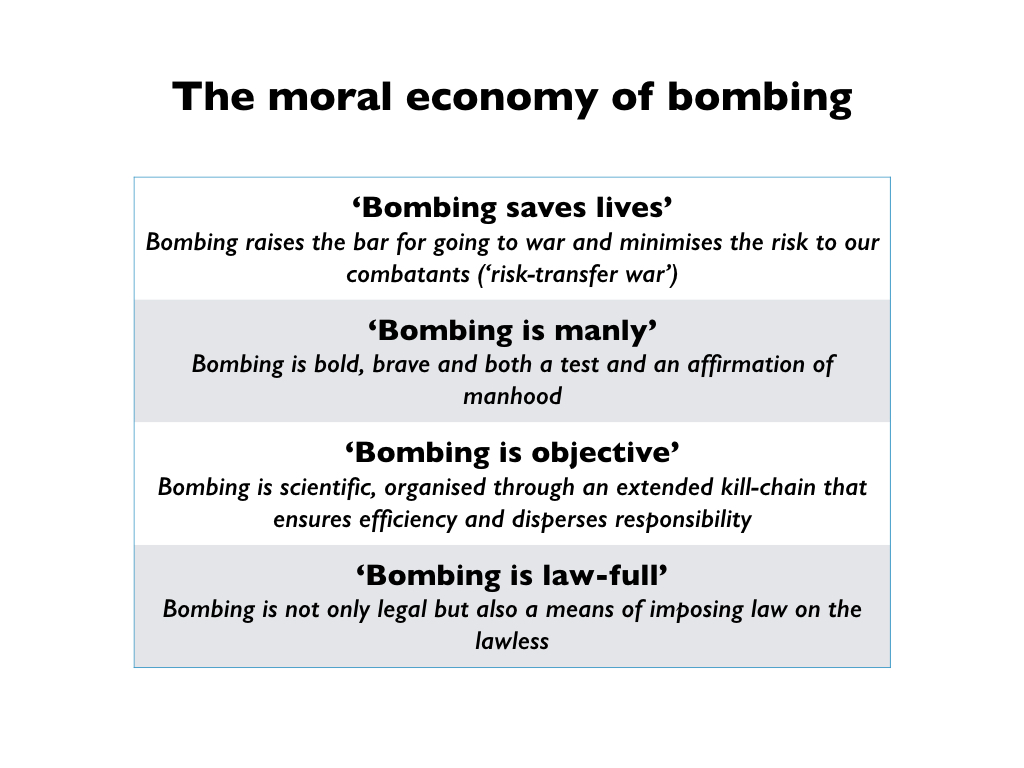
It’s important to add two riders to the discussion of the Bombing Encyclopedia, both of which concern techno-politics rather than biopolitics.  Although those responsible for targeting invariably represent it as a technical-analytical process – in fact, one of the most common elements in the moral economy of bombing is that it is ‘objective’, as I showed in my Tanner Lectures – it is always also intrinsically political; its instrumentality resides in its function as an irreducibly political technology.

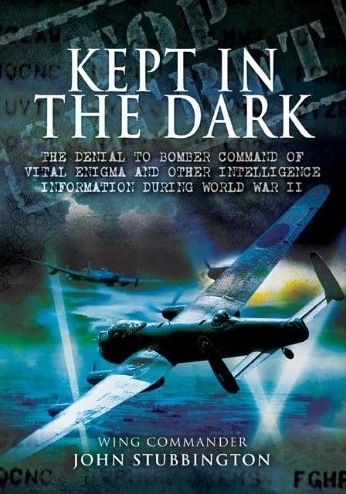
KeptDark1As Stephen and Andrew make clear, the emphasis on key target systems emerged during the Combined Bomber Offensive against Germany in the Second World War, when it was the subject of heated debate.  This went far beyond Arthur Harris‘s vituperative dismissals of Solly Zuckerman‘s arguments against area bombing in favour of economic targets (‘panacea targets’, Harris called them: see my discussion in ‘Doors into nowhere’: DOWNLOADS tab).  You can get some sense of its wider dimensions from John Stubbington‘s intricate Kept in the Dark (2010), which not only provides a robust critique of the Ministry of Economic Warfare’s contributions to target selection but also claims that vital signals intelligence – including ULTRA decrypts – was withheld from Bomber Command.  Administrative and bureaucratic rivalries within and between intelligence agencies did not end with the war, and you can find a suggestive discussion of the impact of this infighting on US targeting in Eric Schmidt‘s admirably clear (1993) account of the development of Targeting Organizations here.

Any targeting process produces not only targets (it’s as well to remember that we don’t inhabit a world of targets: they have to be identified, nominated, activated – in a word, produced) but also political subjects who are interpellated through the positions they occupy within the kill-chain.  After the Second World War, Freeman Dyson reflected on what he had done and, by implication, what it had done to him:

FREEMAN DYSON

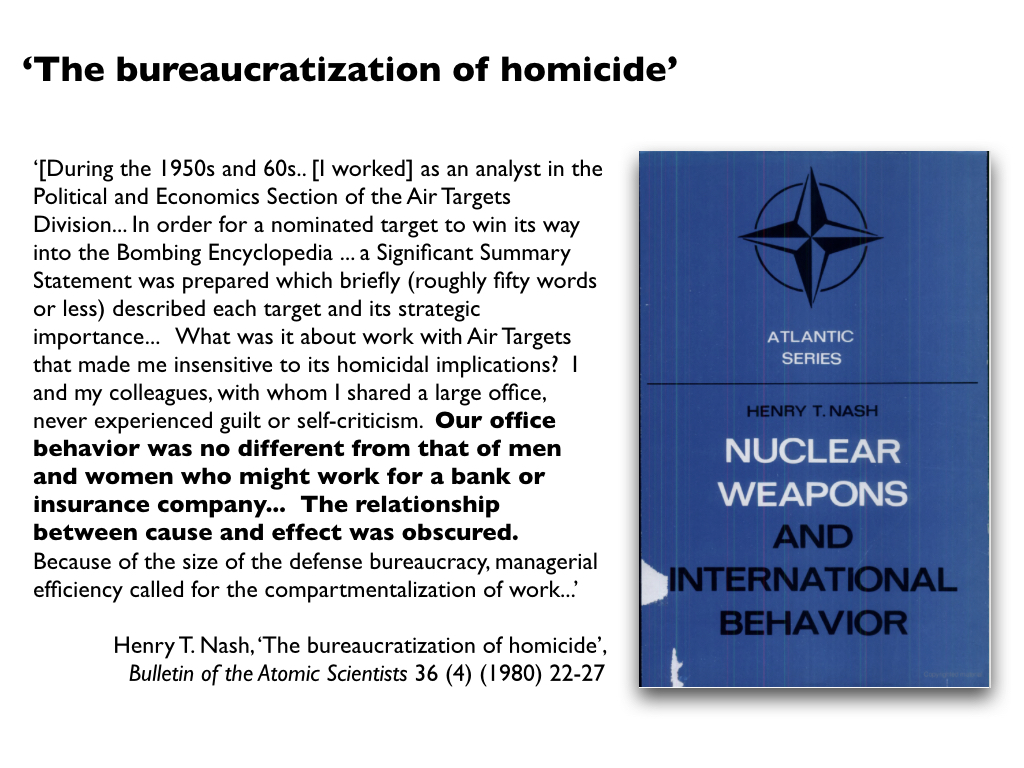
But data-management had been in its infancy.  With the Bombing Encyclopedia, Lowe argued, ‘the new “machine methods” of information management made it possible “to operate with a small fraction of the number of people in the target business that would normally be required.”‘  But there were still very large numbers involved, and Henry Nash –who worked on the Bombing Encyclopedia – was even more blunt about what he called ‘the bureaucratization of homicide‘:

HENRY NASH

This puts a different gloss on that prescient remark of Michel Foucault‘s: ‘People know what they do; frequently they know why they do what they do; but what they don’t know is what what they do does.’

Nash began his essay with a quotation from a remarkable book by Richard J. Barnet, The roots of war (1972).  Barnet said this (about the Vietnam War, but his point was a general one):

‘The essential characteristic of bureaucratic homicide is division of labor. In general, those who plan do not kill and those who kill do not plan. The scene is familiar. Men in blue, green and khaki tunics and others in three-button business suits sit in pastel offices and plan complex operations in which thousands of distant human beings will die. The men who planned the saturation bombings, free fire zones, defoliation, crop destruction, and assassination programs in the Vietnam War never personally killed anyone.

BarnetRichard‘The bureaucratization of homicide is responsible for the routine character of modern war, the absence of passion and the efficiency of mass-produced death. Those who do the killing are following standing orders…

‘The complexity and vastness of modern bureaucratic government complicates the issue of personal responsibility. At every level of government the classic defense of the bureaucratic killer is available: “I was just doing my job!” The essence of bureaucratic government is emotional coolness, orderliness, implacable momentum, and a dedication to abstract principle. Each cog in the bureaucratic machine does what it is supposed to do.

‘The Green Machine, as the soldiers in Vietnam called the military establishment, kills cleanly, and usually at a distance. America’s highly developed technology makes it possible to increase the distance between killer and victim and hence to preserve the crucial psychological fiction that the objects of America’s lethal attention are less than human.’

Barnet was the co-founder of the Institute for Policy Studies; not surprisingly, he ended up on Richard Nixon‘s ‘enemies list‘ (another form of targeting).

I make these points because there has been an explosion – another avalanche – of important and interesting essays on databases and algorithms, and the part they play in the administration of military and paramilitary violence.  I’m thinking of Susan Schuppli‘s splendid essay on ‘Deadly algorithms‘, for example, or the special issue of Society & Space on the politics of the list – see in particular the contributions by Marieke de Goede and Gavin Sullivan (‘The politics of security lists‘), Jutta Weber (‘On kill lists‘) and Fleur Johns (on the pairing of list and algorithm) – and collectively these have provided essential insights into what these standard operating procedures do.  But I’d just add that they interpellate not only their victims but also their agents: these intelligence systems are no more ‘unmanned’ than the weapons systems that prosecute their targets.  They too may be ‘remote’ (Barnet’s sharp point) and they certainly disperse responsibility, but the role of the political subjects they produce cannot be evaded.  Automation and AI undoubtedly raise vital legal and ethical questions – these will become ever more urgent and are by no means confined to ‘system failure‘ – but we must not lose sight of the politics articulated through their activation.  And neither should we confuse accountancy with accountability.

Illegalities and undemocracies

121102-bds-oranges_-EI_Vredesactie

A postscript to my previous post about Palestine, solidarity and BDS.  Over at Books & IdeasBenjamin Ferron has a review essay on Ingrid Nyström and Patricia Vendramin, Le boycott (2015): Globalisation and the art of boycotting.

There’s some succinct historical context, tracing the politics of boycotts back to the late seventeenth century, but then this about the current Boycott, Disinvest, Sanctions movement:

‘Launched in 2005 at the request of Palestinian intellectuals and academics, and supported by 172 Palestinian civil society organisations, it calls for an economic, academic, cultural and political boycott of the state of Israel to protest against the colonisation and occupation of Palestinian territories, the construction of the Wall of separation and annexation, and campaign in favour of the equality of Israeli Arab and Jewish citizens, and the acknowledgement of the Palestinian refugees’ right of return. The penalisation of these actions in Israel and in France (through the so-called Alliot-Marie circular) shows that this mode of action is threatening to the intended targets or their allies.’

I knew about moves by the Cameron government in the UK and the now mercifully extinct Harper government in Canada to outlaw BDS – the irony of the former Prime Minister threatening to use ‘hate laws’ against anyone with whom he disagreed is wholly unexceptional –   but I now realise that their authoritarian response is much wider than I had imagined, and for the reasons supplied by those last eight words in the quotation.

Of particular relevance to the upcoming plenary at the AAG is this report from Glenn Greenwald at The Intercept that details attempts in the US to suppress pro-Palestinian voices and peaceful actions: ‘Greatest Threat to Free Speech in the West: Criminalizing Activism Against Israeli Occupation‘.

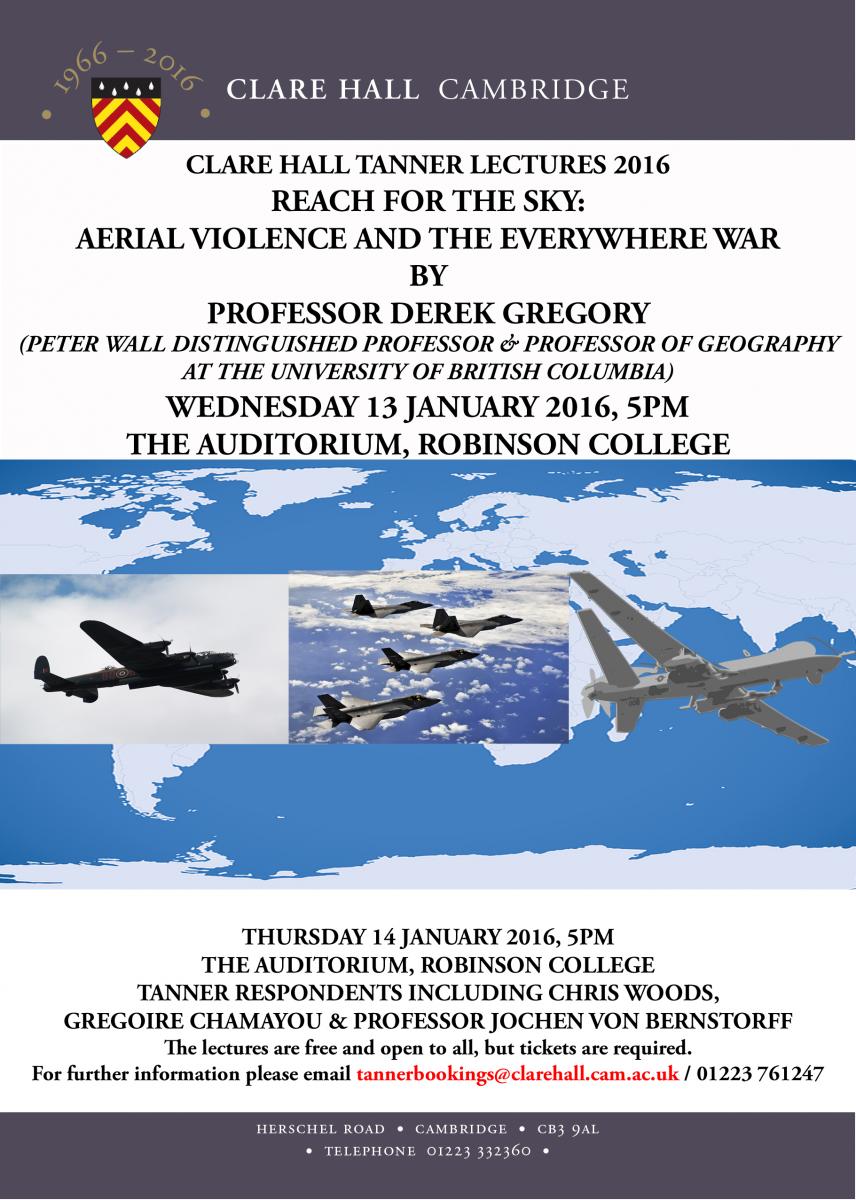
‘Reach from the sky’ ONLINE

Tanner_Lecture_2016_FINAL

The video of my two Tanner Lectures, Reach from the sky: aerial violence and the everywhere war, delivered in Cambridge last month, is now available on the Clare Hall website.  The first, ‘Good bomb, bad bomb’ is here, and the second, ‘Killing Space’, is here, while the responses from Grégoire Chamayou, Jochen von Bernstorff and Chris Woods are here.

I’m immensely grateful to the video team, who were exceptionally helpful and remarkably accomplished.

I’m now hard at work on the long-form version…  And yes, I have – just! – notice the mistake on the poster.  It was indeed ‘Reach from the sky.’  Per ardua….

There’s also a short and kind reflection on the lectures from Alex Jeffrey over at Placing Law here.

Still reaching from the skies…

Sorry for the long silence – I’ve had my head down since soon after Christmas preparing the Tanner Lectures which I gave this past week in Cambridge [‘Reach from the sky: aerial violence and the everywhere war’].  The lectures were recorded and the video will be available on the Clare Hall website in a fortnight or so: more when I know more.

In outline – and after a rare panic attack the night before, which had me working until 2.30 in the morning –  I organised the two Lectures like this:

ONE

Prelude: The historical geography of bombing

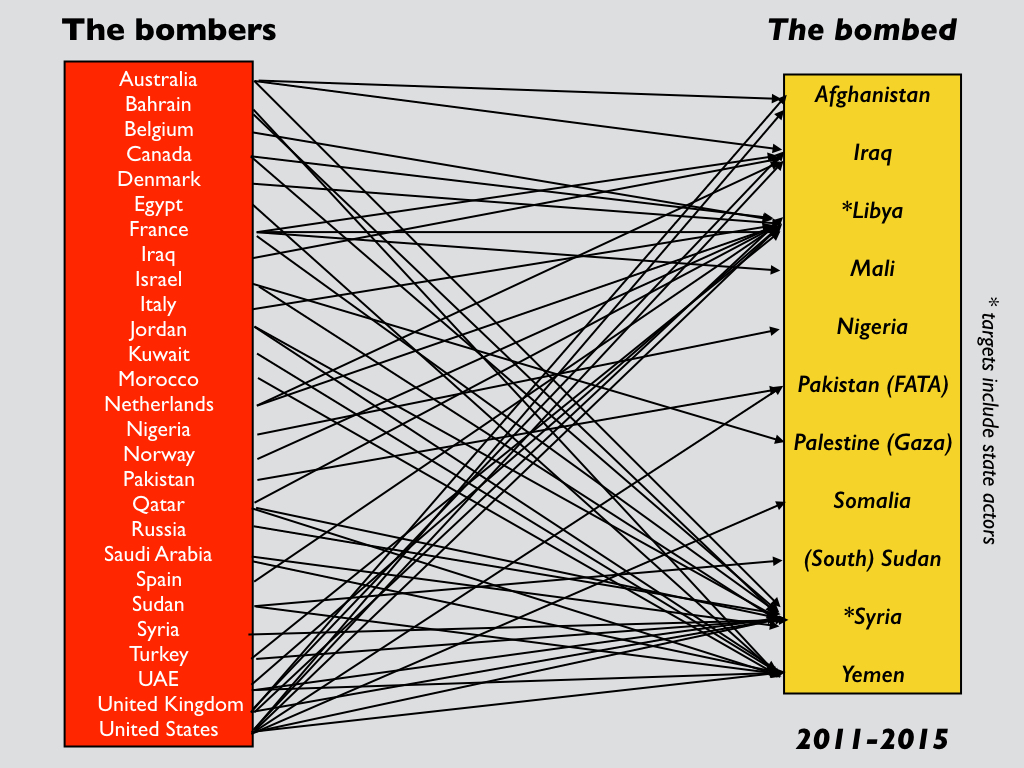
Bombing is back in the headlines but it never really left – and yet those who remain advocates of aerial violence don’t seem to have learned from its dismal history.  They also ignore the geographies that have been intrinsic to its execution, both the division between ‘the bombers and the bombed’ (the diagram below is an imperfect and fragmentary example of what I have in mind) and the pulsating spaces through which bombing is performed.
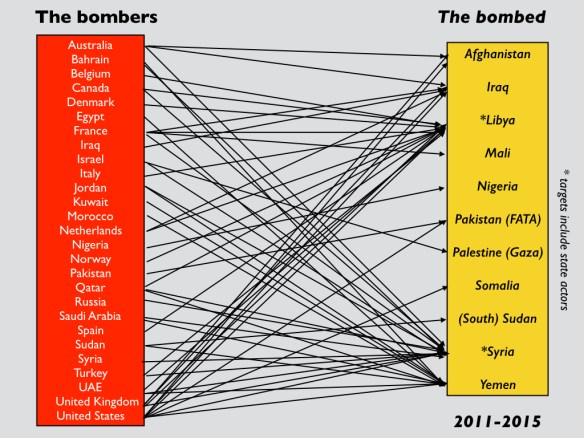
The bombers and the bombed.001

Good bomb, bad bomb

(with apologies to Mahmood Mamdani….)  In the first part I traced The machinery of bombing from before the First World War through to today’s remote operations.  Even though most early commentators believed that the primary role of military aircraft would be in reconnaissance, it was not long before they were being used to orchestrate artillery fire and to conduct bombing from the air. This sequence parallels the development of the Predator towards the end of the twentieth century.  In fact, almost as soon as the dream of flight had been realised the possibility of ‘unmanned flight’ took to the air.  Perhaps the most significant development, though, because it directs our attention to the wider matrix within which aerial violence takes place, was the development of the electronic battlefield in Laos and Cambodia. I’ve written about this in detail in ‘Lines of Descent‘ (DOWNLOADS tab); the electronic battlefield was important not because of what it did – the interdiction program on the Ho Chi Minh Trail was a spectacular failure (something which too many historians have failed to recognise)  – but because of what it showed: it conjured up an imaginative landscape, an automated killing field, in which sensors and shooters were linked through computer systems and automatic relays.  Contemporaries described the system as a vast ‘pinball machine’ (see the image below: you can have no idea how long it took me to track it down…).

Pinball wizards.001

The analogy allowed me to segue into the parallel but wholly inadequate characterisation of today’s remote operations as reducing military violence to a video game.

That is an avowedly ethical objection, of course, so I then turned to The moral economy of bombing.  Here I dissected four of the main ways in which bombing has been justified.  These have taken different forms at different times, and they intersect and on occasion even collide.  But they have been remarkable persistent, so in each case I tracked the arguments involved and showed how they have been radicalised or compromised by the development of Predators and Reapers.
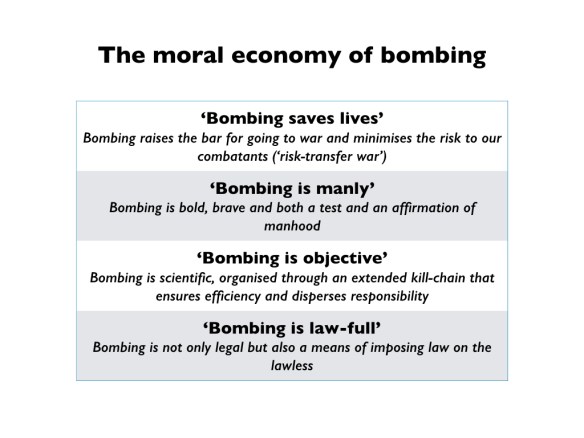
Moral economy of bombing.001

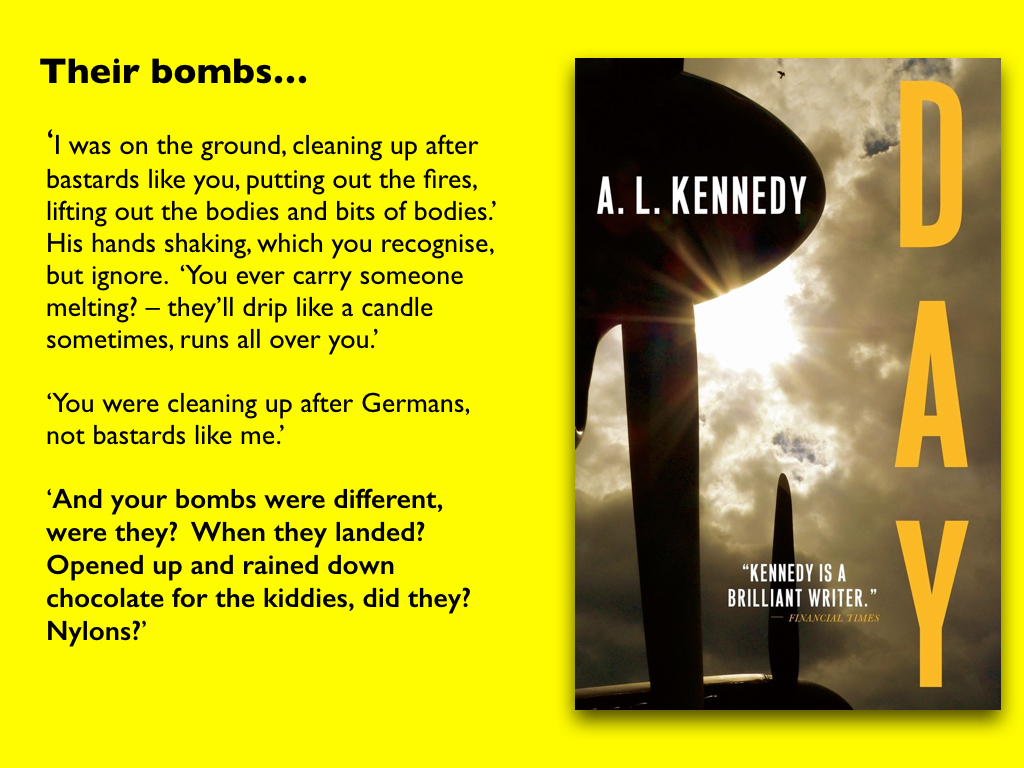
All of these justifications applied to ‘our bombs’, needless to say, which become ‘good bombs’, not to ‘their bombs’ – the ‘bad bombs’.

Their bombs.001

TWO

Killing Space

Phillips' Aerial Torpedo.001

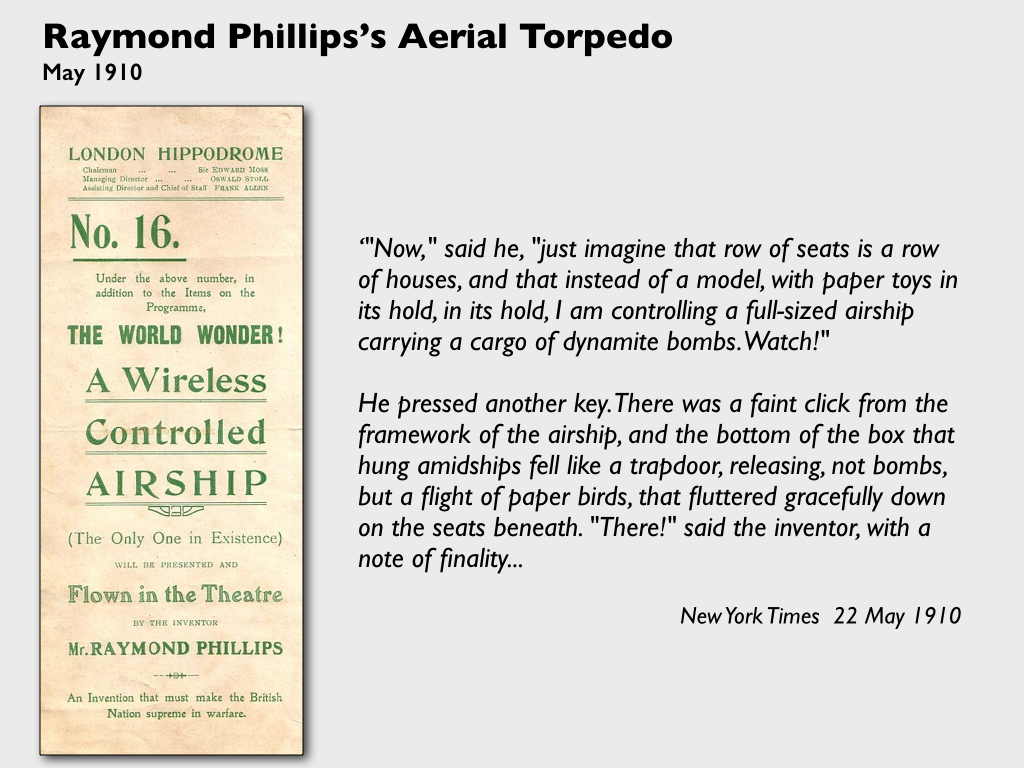
I started the second lecture by discussing The deconstruction of the battlefield; the wonder of Raymond Phillips’s fantasies of ‘aerial torpedoes‘ before the First World War was not so much their promise of ‘bomb-dropping by wireless’ but the targets:
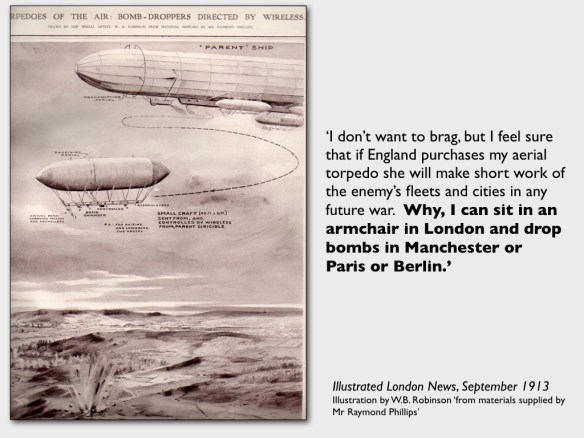
Phillips' bomb-dropping by wireless.001

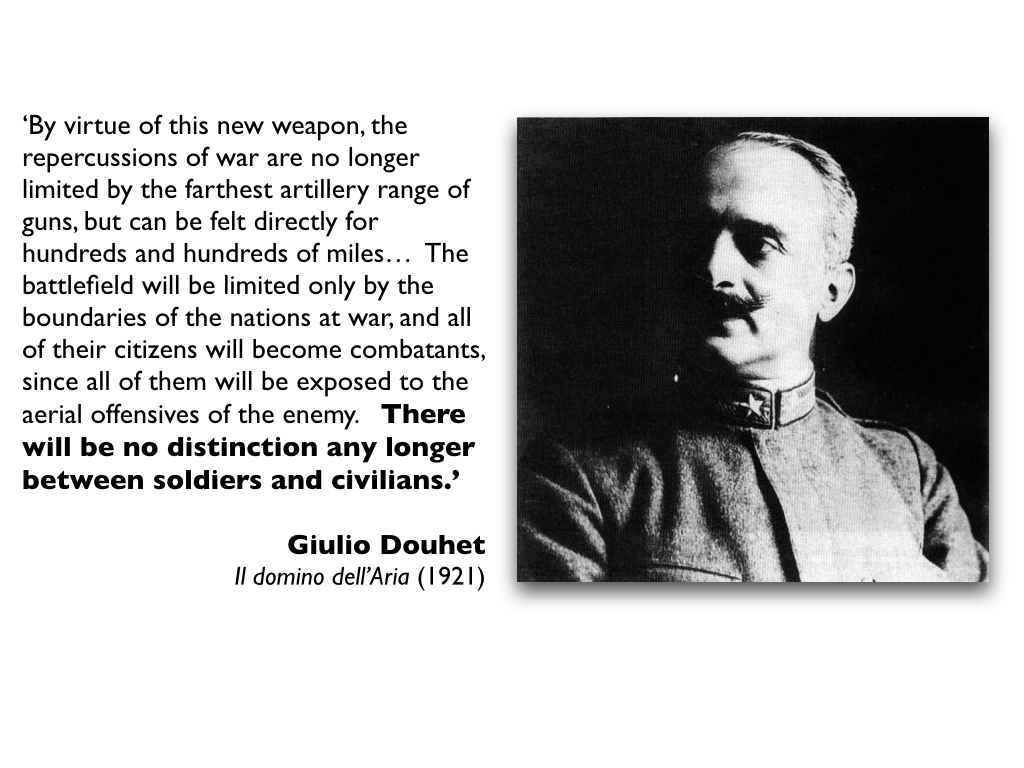
It was this radical extension of the battle space that counted.  In the event,  it was not British airships that dropped bombs on Berlin but German Zeppelins that bombed London and Paris, but the lesson was clear:
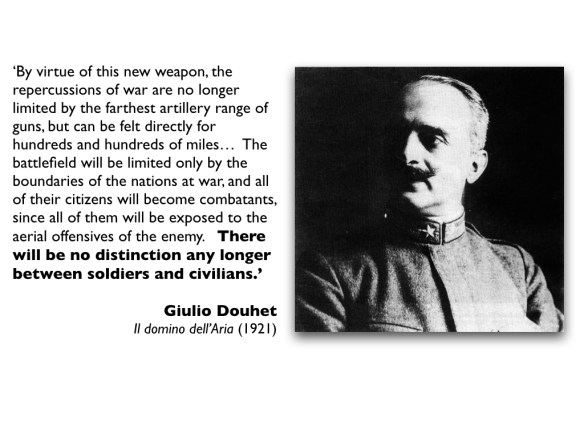
Douhet.001

To explore the formations and deformations of the battlespace in more detail, I used the image of The dark heart of bombing to describe a battlespace that alternately expanded and contracted.  So Allied bombing in the Second World war extended its deadly envelope beyond Germany, Italy and Japan into Belgium, Bulgaria, Denmark, France, the Netherlands, Norway and Romania; later the United States would bomb North Vietnam but reserved most of its ordnance for South Vietnam, Laos and Cambodia; and US air strikes in Afghanistan and Iraq would eventually spill over into Pakistan, Syria and elsewhere.  In the course of those air wars, the accuracy of targeting improved until it was possible to aim (if not always to hit) point-targets – individual buildings and eventually individual people – but this contraction of the killing space was accompanied by its expansion.  These ‘point-targets’ were selected because they were vital nodes that made possible the degradation or even destruction of an entire network.  Hence, for example, the Israeli attack on the Gaza power station (more in a previous post here):
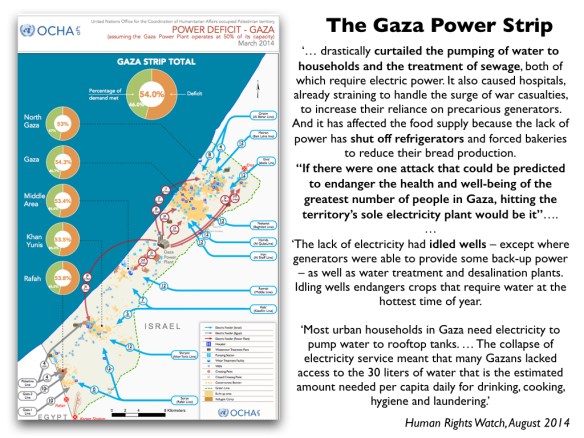
Gaza Power Strip.001

A similar argument can be made about the US Air Force’s boast that it can now put ‘warheads on foreheads’, and I linked the so-called individuation of warfare to the US determination to target individuals wherever they go – to what Jeremy Scahill and others describe as the production of a newly expanded ‘global battlefield’.  What lies behind this is more than the drone, of course, since these killing fields rely on a global system of surveillance orchestrated by the NSA, and I sketched its contours and showed how they issued in the technical production of an ‘individual’ not as a fleshy, corporeal person but as a digital-statistical-spatial artefact (what Ian Hacking once called ‘making people up’ and what Grégoire Chamayou calls ‘schematic bodies‘).

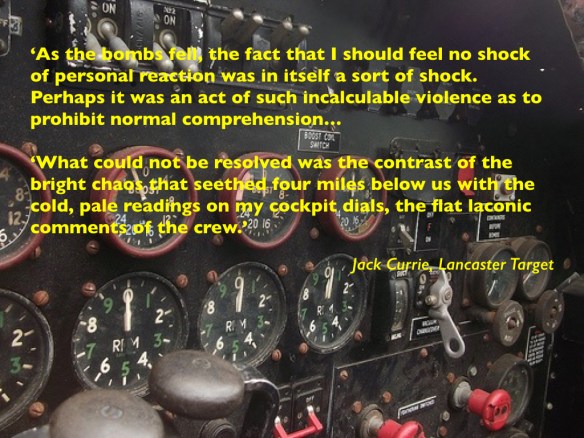
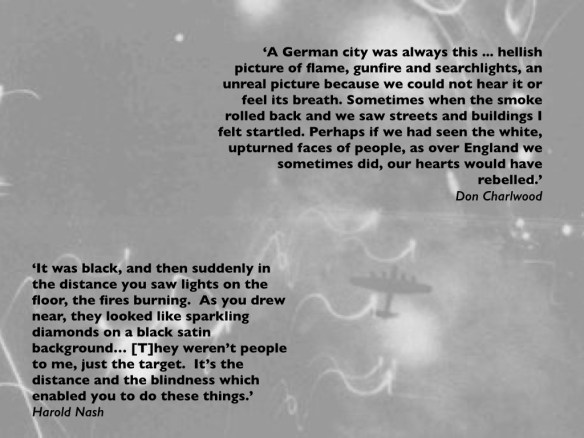
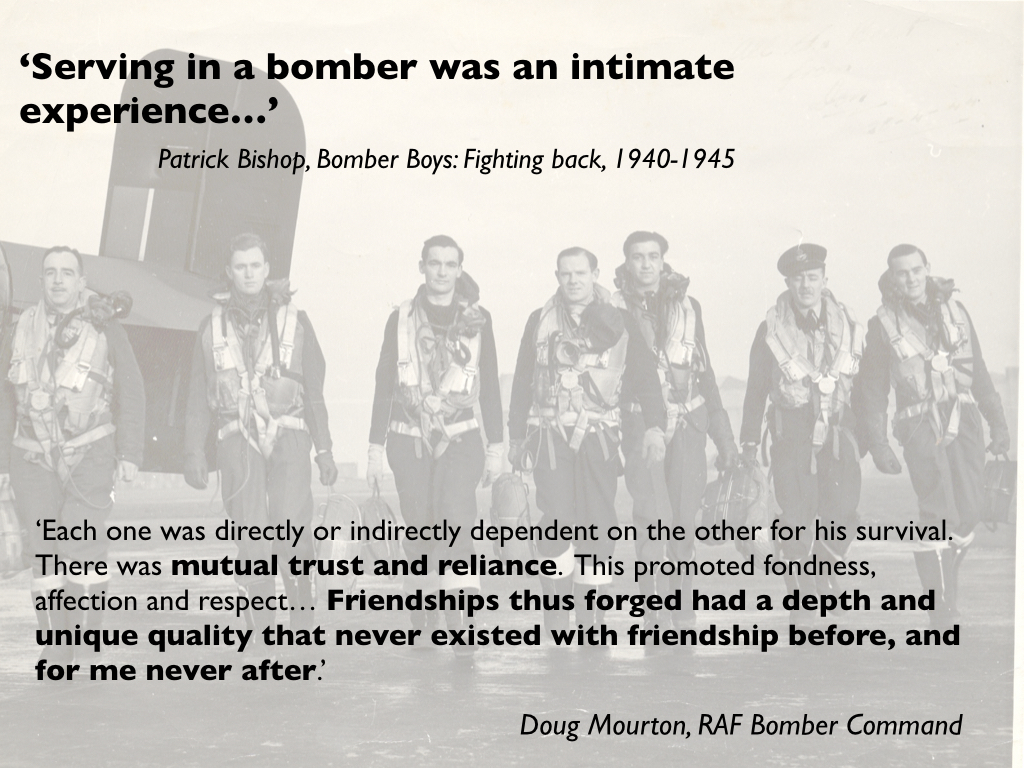
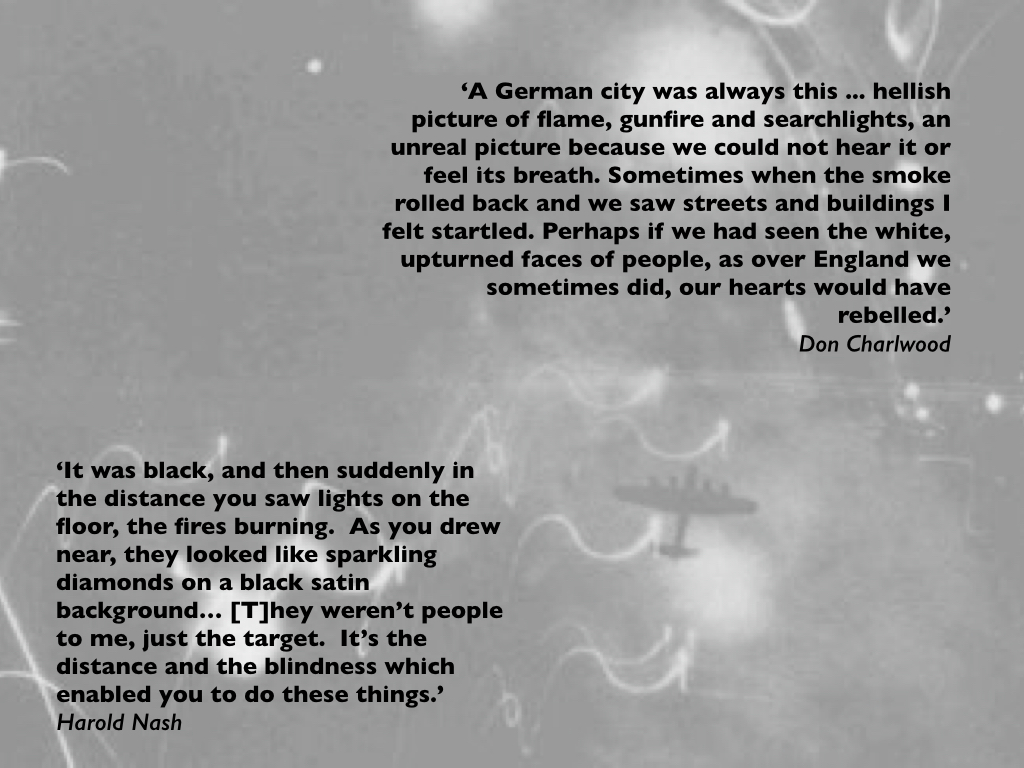
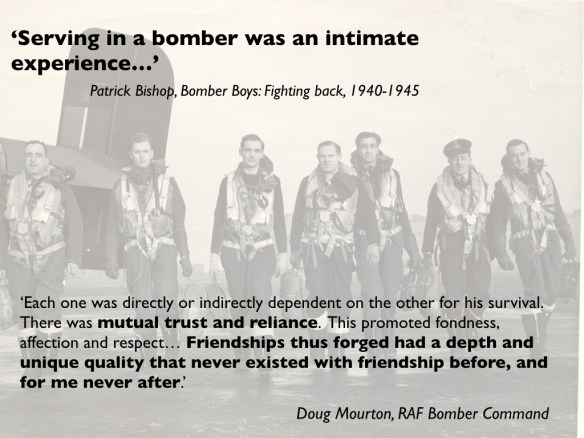
Next I explored a different dialectical geography of the battlespace: Remote splits: intimacy and detachment.  I started with RAF Bomber Command and traced in detail the contrast between the intimacy between members of bomber crews (a mutual dependence reinforced by the bio-convergence between their bodies and the machinery of the bomber itself) and the distance and detachment through which they viewed their targets.
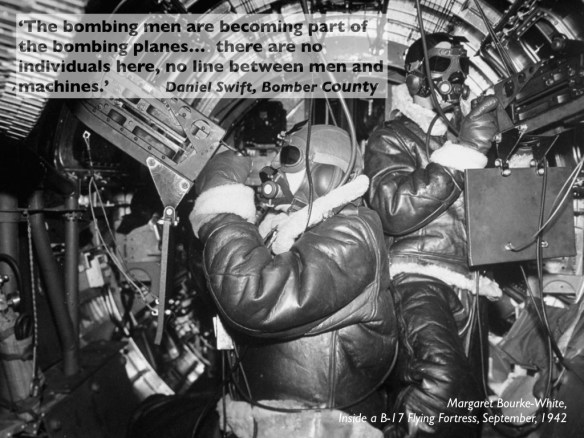
Bioconvergence and the bomber crew.001

Intimacy in Bomber Command.001

The Good Wife.001

Cockpit dials.001

Distance and blindness.001

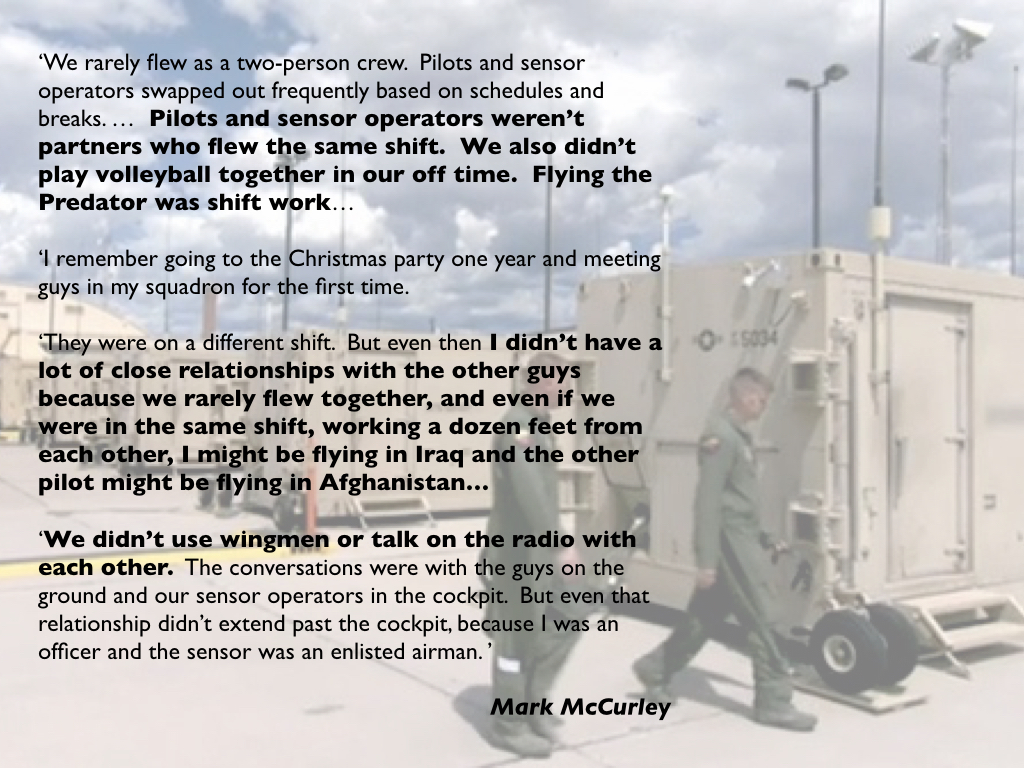
There’s much more on this in ‘Doors into nowhere‘ (DOWNLOADS tab), though I think my discussion in the Lectures breaks new ground. All of this is in stark contrast to today’s remote operations, where – as Lucy Suchman reminds us – there remains a remarkable (though different) degree of bioconvergence and yet now a persistent isolation and anomie is felt by many pilots and sensor operators who work in shifts:
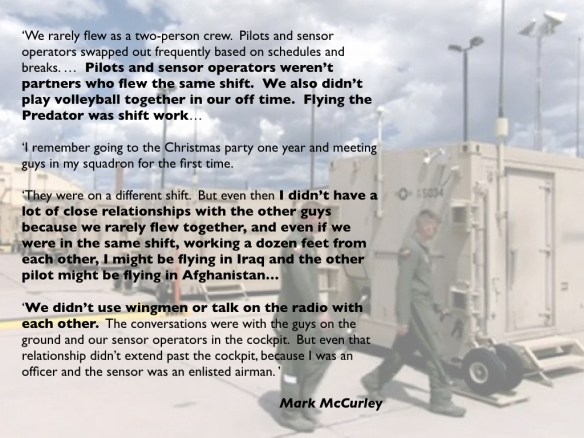
Anomie and the drone.001

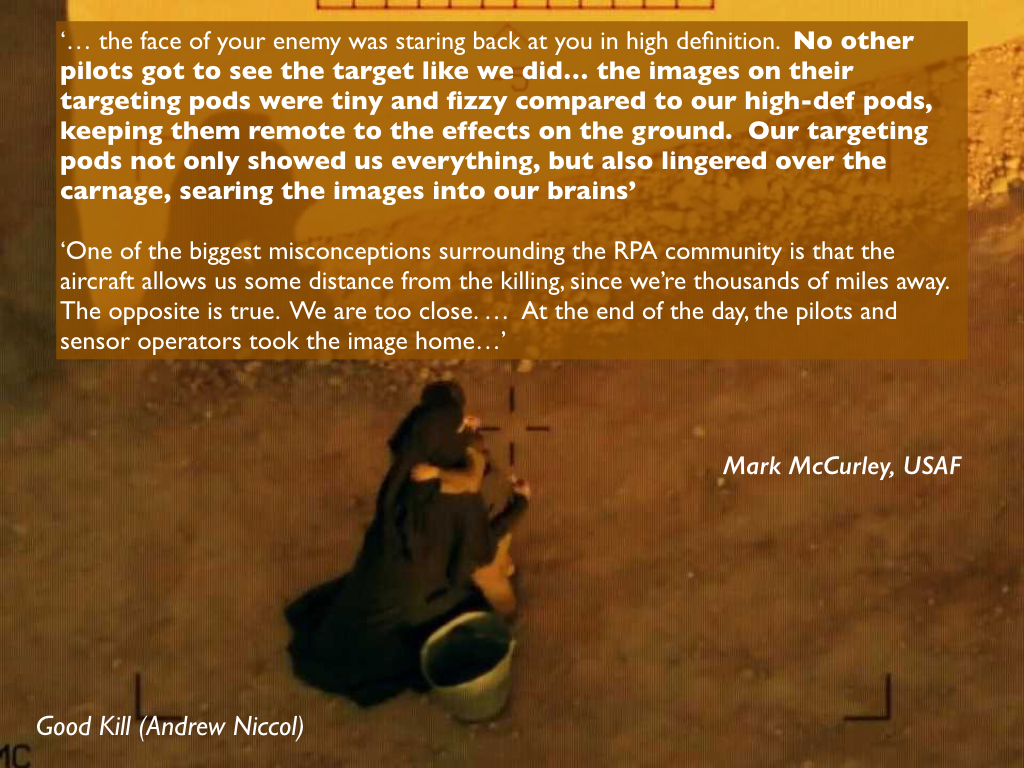
This is thrown into relief by the closeness remote operators feel to the killing space itself, an immersion made possible through the near real-time full-motion video feeds, the internet relay chatter and the radio communications with troops on the ground (where there are any). In contrast to the bomber crews of the Second World War – or those flying over the rainforests of Vietnam, Laos and Cambodia – there is a repeated insistence on a virtualized proximity to the target.
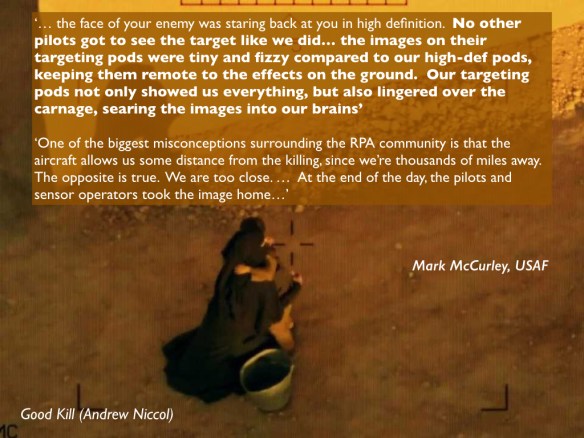
Good Kill in high-definition.001

But I used a discussion of Andrew Niccol‘s Good Kill to raise a series of doubts about what drone crews really can see, as a way into the next section, Sweet target, which provided an abbreviated presentation of the US air strike in Uruzgan I discuss in much more (I hope forensic) detail in Angry Eyes (see here and here).  That also allowed me to bring together many of the key themes I had isolated in the course of the two lectures.

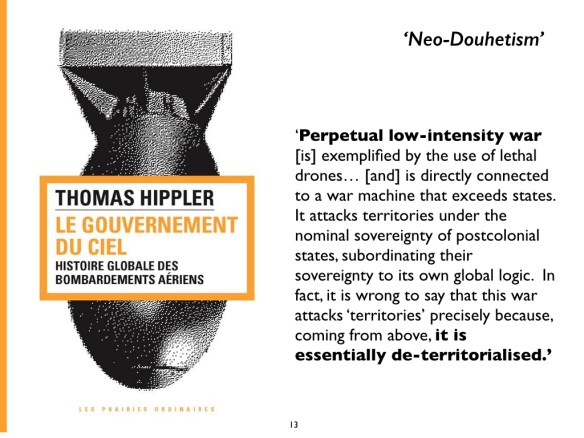
As I approached my conclusion, I invoked Thomas Hippler‘s Le gouvernement du ciel: Histoire globale des bombardements aériens, (I’ve just discovered that Verso will publish the English-language version later this year or early next: Governing from the skies: a global history of aerial bombing):
Hippler Neo-douhetism.001

I’m not convinced that the military and paramilitary violence being visited on people today is all ‘low-intensity’ (Gaza? Afghanistan? Iraq? Syria? Yemen?).  But neither do I think it’s ‘de-territorialised’, unless the word is flattened into a conventionally Euclidean frame.  Hence, following Stuart Elden‘s lead, I treated territory as a political-juridical technology whose calibrations and enclosures assert, enable and enforce a claim over bodies-in-spaces.  And it was those ‘bodies-on-spaces’ that brought me, finally, to The loneliest space of all:  the irreducible, truly dreadful loneliness of death and grief:

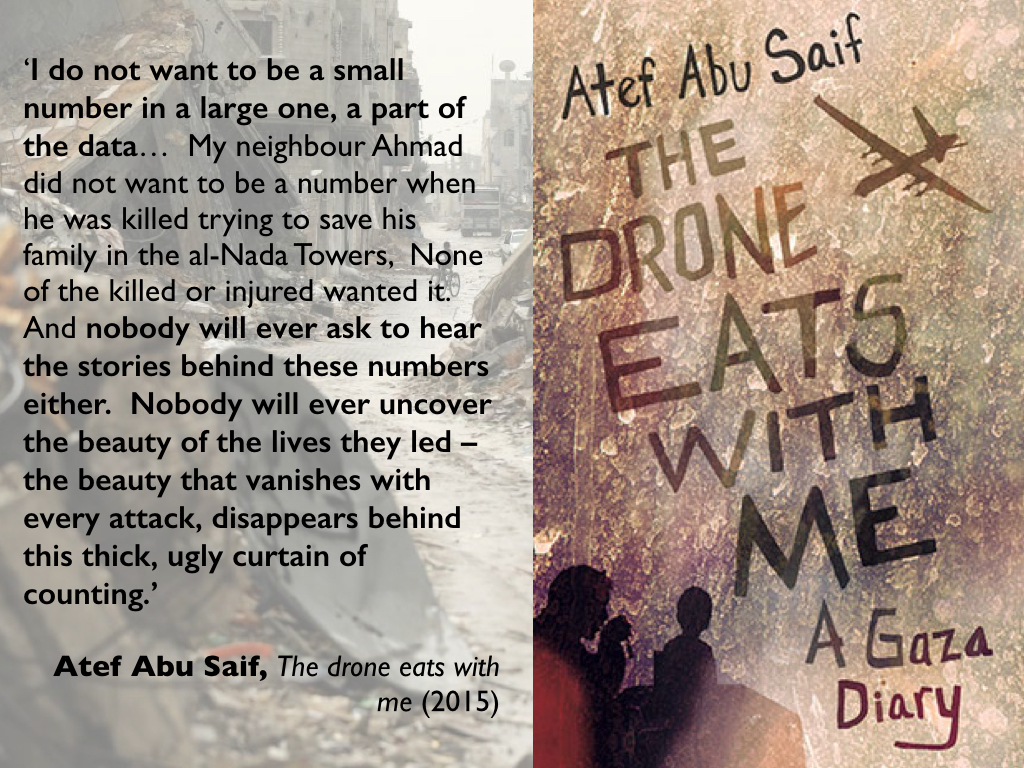
Counting the dead.001

Behind the body-counts and the odious euphemisms of collateral damage and the rest lies the raw, inconsolable loss so exquisitely, painfully rendered in ‘Sky of Horoshima‘…

In the coming days I’ll post some of the key sections of the Lectures in more detail, which I’ll eventually develop into long-form essays.

I learned a lot from the expert and wonderfully constructive commentaries after the Lectures from Grégoire Chamayou, Jochen von Bernstorff and Chris Woods, and I’ll do my best to incorporate their suggestions into the final version.

In his response Grégoire traced my project on military violence in general and bombing/drones in particular back to a series of arguments I’d developed in Geographical imaginations in 1994 about vision, violence and corporeality; I had overlooked these completely, full of the conceit that my work had never stood still…. I shall go back, re-read and think about that some more, since some of the ideas that Grégoire recovered (and elaborated) may be even more helpful to me now.  Jochen and Chris also gave me much food for thought, so I shall be busy in the coming months, and I’m immensely grateful to all three of them.

A lack of intelligence

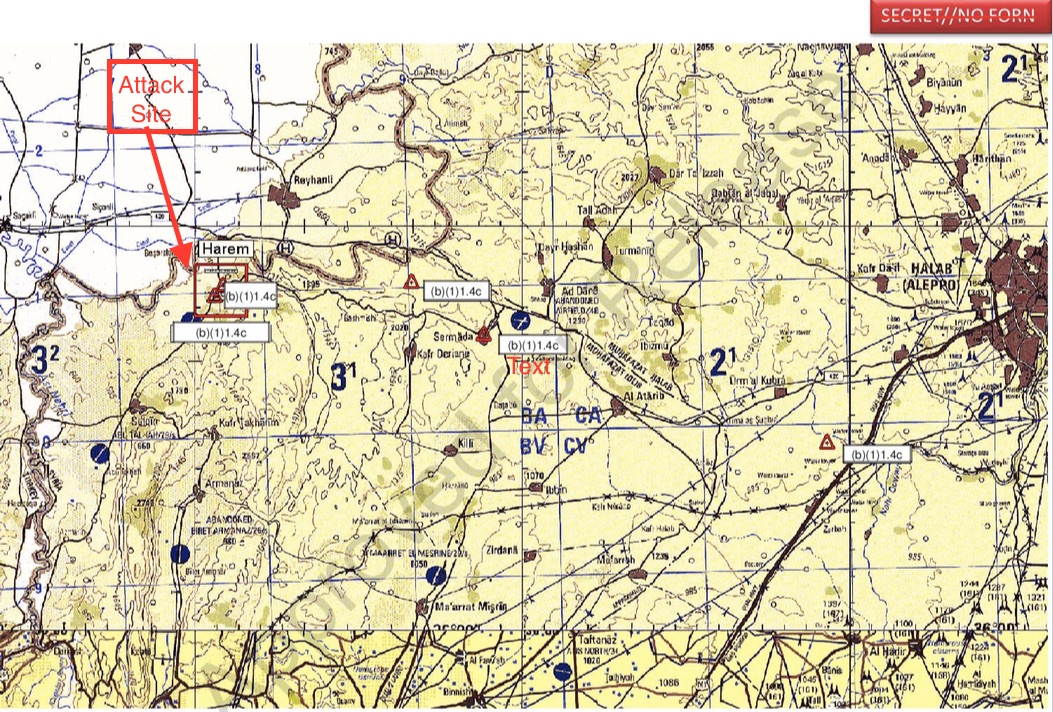
Harim Air Strike MAP annotated

The second of the three recent US air strikes I’ve been looking at took place near Harim [Harem on the map above] in Syria on the night of 5-6 November 2014.  The report of the military investigation into allegations of civilian casualties is here.

The aircraft launched multiple strikes against two compounds which had been identified as sites used as meeting places for named (though redacted) terrorists and sites for the manufacture and storage of explosives by the al-Qaeda linked ‘Khorasan Group’ (if the scare-quotes puzzle you, compare here and here).

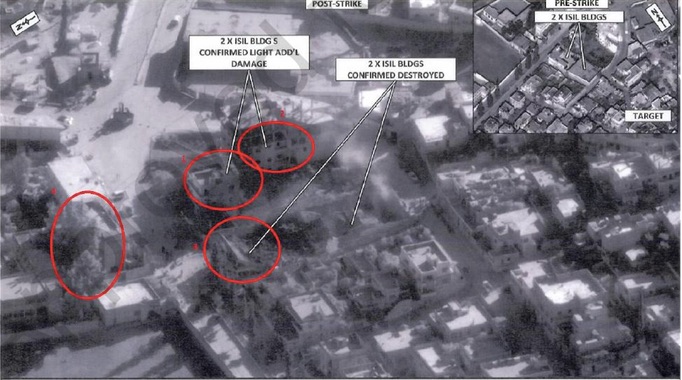
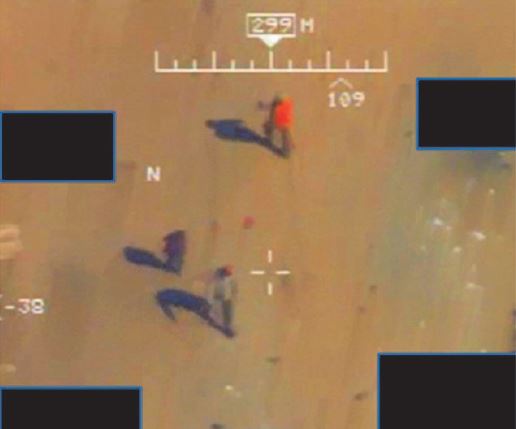
The compounds each contained several buildings and had previously been on a No Strike List under a category that includes civilian housing; they lost their protected status when ‘they were assessed as being converted to military use’ but ‘other residential and commercial structures were situated around both targets’.  An annotated image of the attack on the first compound is shown below:

Harim Air Strike on Compound 001

Although the report argues that ‘the targets were engaged in the early morning hours when the risk to civilians was minimized’ – a strange statement, since most civilians would have been asleep inside those ‘residential structures’ – US Central Command subsequently received open-source reports of from three to six civilian casualties, together with still and video imagery.  By the end of December 2014 the Combined Joint Task Force conducting ‘Operation Inherent Resolve’ had completed a preliminary ‘credibility assessment’ of the claims and found sufficient evidence to establish a formal investigation into the allegations of civilian casualties.  The investigating officer delivered his final report on 13 February 2015.

He also had access to a report from the Syrian Network for Human Rights that provided a ground-level perspective (including video) unavailable to the US military.  Its narrative is different from US Central Command, identifying the targets as being associated with An-Nussra:

The warplanes launched, at first, four missiles that hit three military points, which are located next to each other, in the northeast of the town:

1 – The Agricultural Bank, which is used by An-Nussra front as a center.
2 – The central prison checkpoint, where An-Nussra fighters were stationed.
3 – An ammunition depot in the same area.

The shelling destroyed and burned the Agricultural Bank’s building completely in addition to damaging a number of building nearby. Furthermore, a number of cars were burned while a series of explosions occurred after an explosion in the ammunition depot..
Afterwards, the warplanes targeted a fourth center with two missiles. [This target] was a building by an old deserted gas station located near the industrial school in the south of the town. The shelling destroyed the center completely as well as the gas station in addition to severely damaging the surrounding buildings. Harem residents were aided by the civil-defense teams to save people from underneath the rubble.

SNHR documented the killing of two young girls; one could not be unidentified but the other was Daniya, aged 5, who was killed along with her father who was said to be one of the An-Nussra fighters living in a house near the Agricultural Bank.  Daniya’s mother and her brother Saeed, aged 7, were seriously wounded.

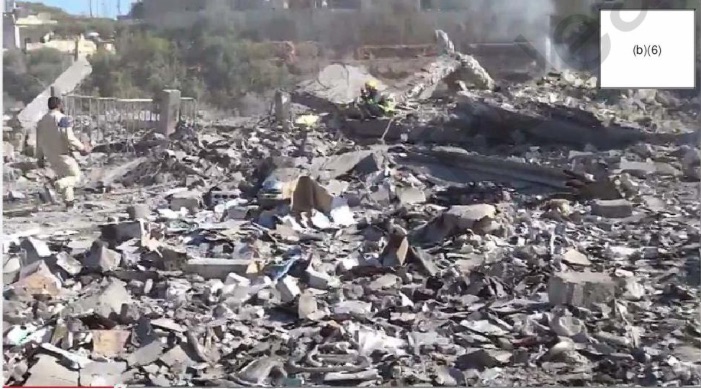
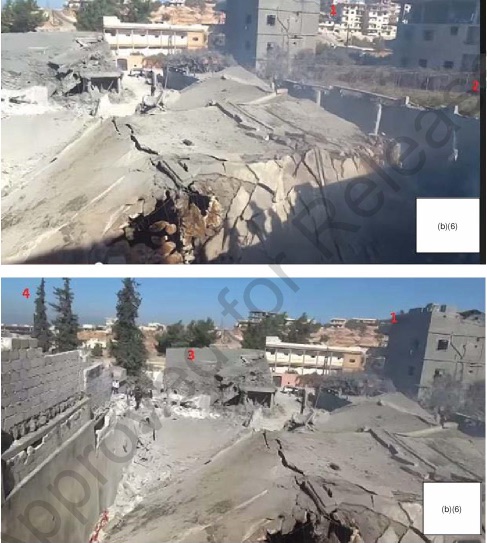
The report also included post-strike imagery from YouTube videos and Twitter feeds:

Harim VIDEO 1 jpeg

Harim VIDEO 2 jpeg

In contrast to the report on the air strike in Iraq I discussed in my previous post, this one includes no details of the attack, nor the procedures through which it was authorised and conducted – though we do know that there is a considerable military bureaucracy behind all these strikes, especially in the administration of what in this case was clearly a pre-planned rather than emergent target.  For more on the bureaucratisation of targeting, incidentally, see  Astrid Nordin and Dan Öberg, ‘Targeting the ontology of war: From Clausewitz to Baudrillard’, Millennium 43 (2) (2015) 392-410; analytically it’s right on the mark, I think, and I’ll be advancing similar arguments in my Tanner Lectures – though stripped of any reference to Baudrillard…

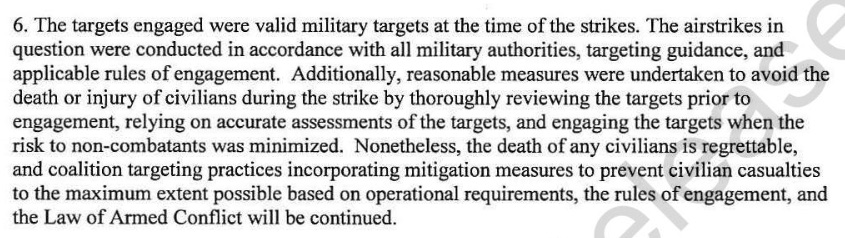
But there is one revealing sentence in the report.  Although the investigating officer had no doubt that the Harim strikes were perfectly legal, everything worked like clockwork and nothing need be changed –

Harim conclusion

– there is nevertheless a recommendation for ‘sustained ISR [intelligence, surveillance and reconnaissance] whenever practicable based on operational requirements, to ensure that no civilians are entering or exiting a facility.’  The clear implication is that these strikes – pre-planned, remember: these were not fleeting targets of opportunity – were not supported by real-time ISR.  When you add to that the reliance placed by the investigation on ground imagery from YouTube and Twitter, you begin to realise how little the US military and its allies must know about many of the targets they strike in Iraq and Syria.  (I might add that the US has not been averse to using Twitter feeds for targeting too: see Robert Gregory‘s compelling discussion in Clean bombs and dirty wars: air power in Kosovo and Libya, where he describes the central role played by Twitter feeds from Libyan rebels in identifying targets for the US Air Force and its NATO allies: by the closing months of the campaign France was deriving 80 per cent of its intelligence from social media contacts on the ground).

All this gives the lie to the cheery ‘let ’em have it’ guff from Robert Caruso, commenting on US air strikes in Syria last September:

By relying so heavily on drones in our recent counter-terror campaigns we’ve been fighting with one hand tied behind our back. But a key to the success of Monday’s strikes was the use of manned aircraft with pilots who can seek out enemy targets and make on-the-spot decisions…

it’s time to drop the drone fetish, and the limitations it imposed, and go back to using manned airpower, which is more powerful and better suited to hunting down elusive targets like ISIS.

Regular readers will know that I’m not saying that drones are the answer, or that their ability to provide persistent, real-time, full-motion video feeds in high definition makes the battlespace transparent; on the contrary (see my ‘Angry Eyes’ posts here and especially here: more to come soon).

But the absence of their ISR capability can only make a bad situation worse.  In February, the director of the National Counterterrorism Center conceded that that US had not ‘closed the gap on where we need to be in terms of our understanding, with granularity, about what is going on on the ground in Syria.’  Indeed, during the first four months of this year ‘nearly 75 percent of U.S. bombing runs targeting the Islamic State in Iraq and Syria [a total of more than 7,000 sorties] returned to base without firing any weapons’, and reports claimed that aircrews held their fire ‘mainly because of a lack of ground intelligence.’

Full-motion video cannot compensate for that absence, of course, and in any case there are serious limitations on the number of ISR orbits that are possible over Iraq and Syria given the demands for drones over Afghanistan and elsewhere: each orbit requires three to four aircraft to provide 24/7 coverage, and the global maximum the US Air Force can provide using its Predators and Reapers varies between 55 and 65 orbits (or ‘combat air patrols’).

In late August 2014 Obama authorised both manned and unmanned ISR flights over Syria, and since then the United States has been joined by the UK and France in deploying MQ-9 Reapers over Iraq and Syria, where their video feeds have helped to orchestrate missions carried out by conventional strike aircraft (see, for example, here).  In August 2015 France claimed that all its air strikes in Iraq had to be validated by ISR provided by a drone:

reaper-20150508

But that was in August, before Hollande threw caution to the winds and ramped up French air strikes in response to the Paris attacks in November – an escalation that relied on targeting packages supplied by the United States.

In any case, Predators and Reapers are also armed and in their ‘hunter-killer’ role they had executed around one quarter of all airstrikes conducted by the United States in Iraq and Syria by June 2015 and more than half the air strikes conducted by the UK in Iraq.  Although the UK only extended its bombing campaign against Islamic State to Syria this month, its Reapers had been entering Syrian airspace in steadily increasing numbers since November 2014 to provide ISR (in part, presumably, to enable the United States to orchestrate its air strikes) and in September 2015 it used one of them to carry out the UK’s first acknowledged targeted killing near Raqqa (see also here and here); the United States has also routinely used the aircraft in the extension of its multi-sited targeted killing program to Syria (see also here).

All this bombing, all this blood: and yet strategically remarkably little to show for it.   And all for a lack of intelligence…

Reach from the Sky

Tanner_V2

I’ve been invited to give the annual Tanner Lectures in Cambridge on 13-14 January 2016. The Lectures are given in parallel at nine universities in the UK and the USA: Cambridge, Oxford, Harvard, Princeton, Stanford, Yale, Berkeley, Michigan and Utah.

Appointment as a Tanner lecturer is a recognition for uncommon achievement and outstanding abilities in the field of human values. The lecturers may be elicited from philosophy, religion, the humanities, the sciences, the creative arts, and learned professions, or from leadership in public or private affairs. The lectureships are international and intercultural and transcend ethnic, national, religious, and ideological distinctions.

The purpose of the Tanner Lectures is to advance and reflect upon the scholarly and scientific learning relating to human values. This intention embraces the entire range of values pertinent to the human condition, interest, behavior, and aspiration. The lectures are published in an annual volume.

The Tanner Lectures were established by the American scholar, industrialist, and philanthropist, Obert Clark Tanner. In creating the lectureships, Professor Tanner said, “I hope these lectures will contribute to the intellectual and moral life of mankind. I see them simply as a search for a better understanding of human behavior and human values. This understanding may be pursued for its own intrinsic worth, but it may also eventually have practical consequences for the quality of personal and social life.”

It’s a huge honour, and thoroughly intimidating when I look at the roster of previous speakers and those delivering the other lectures in 2015-16, and I’m thrilled – though so far I’ve only got as far as a title: ‘Reach from the Sky: aerial violence and the everywhere war‘.  The clock is ticking, so watch this space for progress reports…

Doomsday Books

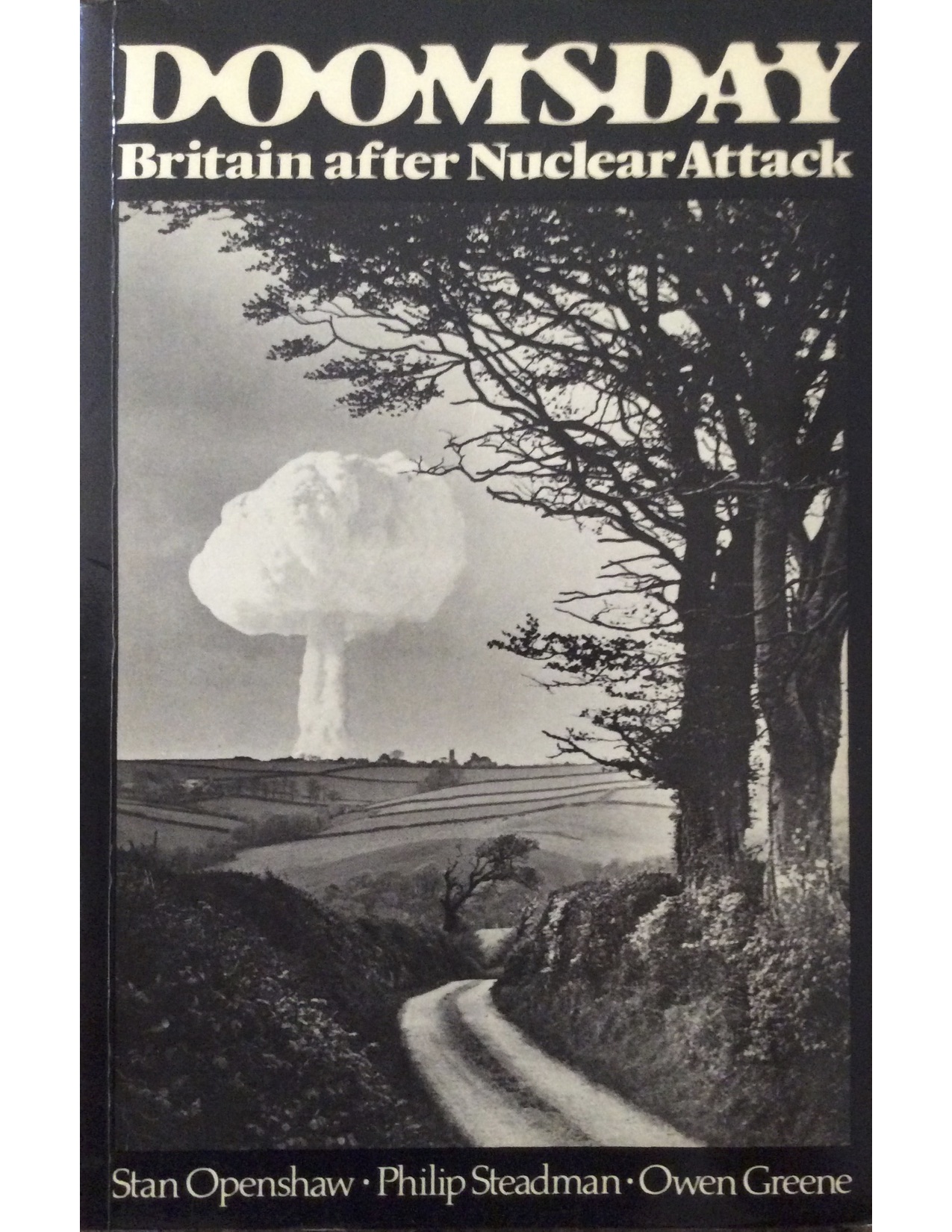
DOOMSDAYStill wandering through the nuclear wastelands… (see also here, here and here).  Not surprisingly, there is a considerable literature on the United States and nuclear war, but much less on the UK.  I still have my tattered copy of Doomsday:  Britain after nuclear attack by Stan Openshaw, Philip Steadman and Owen Greene, published more than thirty years ago.  Those were heady days: the authors were members of Scientists Against Nuclear Arms, and the book was put together soon after the European Nuclear Disarmament Appeal launched by E. P. Thompson (who famously announced he had “left his desk” to further the campaign), Mary Kaldor, Dan Smith and Ken Coates.

Next to Doomsday is my equally battered and well-thumbed copy of a book of essays edited by two other British geographers, David Pepper and Alan Jenkins, The geography of peace and war, which appeared in 1985.  It was in three Parts, ‘The geography of the Cold War and the arms race’, ‘The geography of nuclear war’ (which included an update from Stan and Philip) and ‘The geography of peace’ (with an essay on nuclear weapon free zones).

Fast forward twenty years, and these emphases are in stark contrast to Colin Flint‘s edited collection, Geography of war and peace, in which nuclear war receives just passing mention(s).  The same is true of Audrey Kobayashi‘s still more recent Geography of peace and armed conflict – apart from one brief chapter concerned with Iran.

HOGG British Nuclear CultureAll of this will explain why I am looking forward to the publication of Jonathan Hogg‘s British Nuclear Culture: official and unofficial narratives in the long 20th century, coming from Bloomsbury in January:

The advent of the atomic bomb, the social and cultural impact of nuclear science, and the history of the British nuclear state after 1945 is a complex and contested story. British Nuclear Culture is an important survey that offers a new interpretation of the nuclear century by tracing the tensions between ‘official’ and ‘unofficial’ nuclear narratives in British culture.

In this book, Jonathan Hogg argues that nuclear culture was a pervasive and persistent aspect of British life, particularly in the years following 1945. This idea is illustrated through detailed analysis of various primary source materials, such as newspaper articles, government files, fictional texts, film, music and oral testimonies. The book introduces unfamiliar sources to students of nuclear and cold war history, and offers in-depth and critical reflections on the expanding historiography in this area of research.

Chronologically arranged, British Nuclear Culture reflects upon, and returns to, a number of key themes throughout, including nuclear anxiety, government policy, civil defence, ‘nukespeak’ and nuclear subjectivity, individual experience, protest and resistance, and the influence of the British nuclear state on everyday life. The book contains illustrations, individual case studies, a select bibliography, a timeline, and a list of helpful online resources for students of nuclear history.

Joseph Masco – author of The nuclear borderlands: The Manhattan Project in post-Cold War New Mexico and The theater of operations: National security affect from the Cold War to the War on Terror  – likes it, which is more than enough for me:

We know the atomic bomb fundamentally transformed modern life, but Jonathan Hogg shows us that it did not do so in the same way everywhere. This is a important contribution to nuclear studies as it takes both nation and region seriously in the production of a nuclear culture. Hogg does not just follow expert concerns or defense policy debates, he also attends to the vernacular forms of local activisms across British cities and generations. British Nuclear Culture leads the way to a new comparative nuclear studies, and with it, a deeper understanding of the nuclear revolution.

Here is the Contents List:

Introduction
1. Early Nuclear Culture
2. The Manhattan Project
3. 1945 – 1950: Early Responses to the Bomb
4. 1950 – 1958: Maturing Responses
5. 1958 – 1979: Radicalised and Realist Responses
6. 1979 – 1989: Extreme Realism
7. 1989 – 2011: The Persistence of Nuclear Culture
8. Conclusion

For those who don’t think it surprising that – apart from people like Michael Curry, Matt FarishScott Kirsch and Fraser MacDonald– human geographers should have turned away from a critical scrutiny of atomic geographies so speedily with the presumptive waning of the Cold War, notice the title of Chapter 7…

Eyes opening

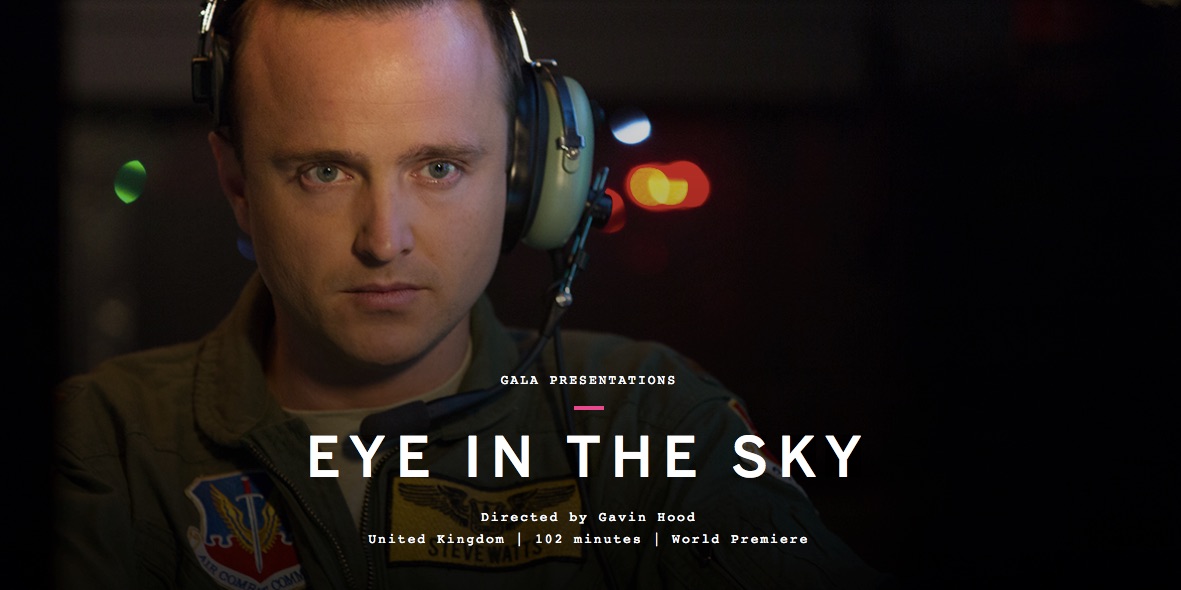
Eye in the sky JPEG

Guy Hibbert writes to say that Gavin Hood‘s Eye in the Sky has its world première at the Toronto International Film Festival later this month (see also my earlier post here).

A fascinating look at how our leaders wage war now, Eye in the Sky takes us into the control rooms and shipping containers where military personnel make decisions that could result in the deaths of people thousands of miles away. Featuring Helen Mirren, Aaron Paul, and Alan Rickman, the latest from Tsotsi director Gavin Hood is enormously pertinent and eerily entertaining.

The goal of British-led Operation Cobra is the capture of Aisha Al Hady (Lex King), a radicalized British citizen who has joined the Somali terrorist group Al Shabab. But their “capture” objective is changed to “kill” when the indomitable Colonel Katherine Powell (Mirren), who has been tracking Al Hady for years, learns that Al Shabab is planning suicide attacks. Nevada-based drone operator Steve Watts (Paul) targets Al Shabab’s Nairobi safehouse but reports back to London that a nine-year-old girl has entered the kill zone. Given the value of the target, could a civilian child be chalked up to collateral damage? Is the potential political fallout worth the risk?

Written by Guy Hibbert with an unerring ear for military doublespeak, Eye in the Sky becomes blackly comic as the officers’ concern with optics sparks a protracted game of bureaucratic pass-the-buck, with everyone “referring up” the chain of command, through the UK Foreign Secretary (who has food poisoning) and the US Foreign Secretary (busy attending a ping pong tournament in China) all the way up to the Prime Minister. Shades of Dr. Strangelove abound — though, as with the Kubrick classic, Eye in the Sky is only as funny as it is because the truths it arrives at are so very grave and resonant.

Full details are here.

Oikological warfare

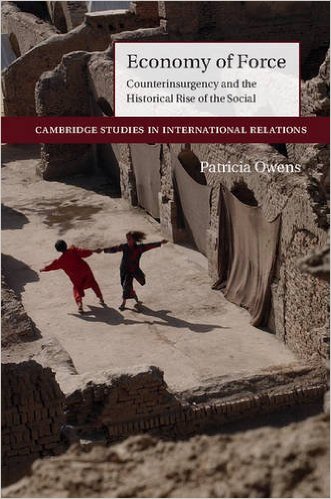
OWENS Counterinsurgency

A new book from the ever-innnovative Patricia Owens, Economy of Force: counterinsurgency and the historical rise of the Social (Cambridge University Press, 2015).

There’s an excellent interview with Patricia at e-IR here, which includes her own summary of the book:

The book retrieves the older, but surprisingly neglected, language of household governance, oikonomia, to show how the techniques and domestic ideologies of household administration are highly portable and play a remarkably central role in international and imperial relations. In contrast to the ahistorical and anachronistic adoption of social language across IR, I think there is an important story to be told of when, where, and why the social realm first emerged as the domain through which human life could be intervened in and transformed. Economy of Force tells this story in terms of modern transformations in and violent crises of household forms of rule. In two late-colonial British emergencies in Malaya (1948-1960) and Kenya (1952-1960), US counterinsurgency in Vietnam (1954-1975), and US-led campaigns in Afghanistan (2001-2014) and Iraq (2003-2011), so-called ‘armed social work’ policies were the continuation of oikonomia – not politics – by other means. Though never wholly succeeding, counterinsurgents drew on and innovated different forms of household governance to create units of rule in which local populations were domesticated. Military strategists conceived population control as sociological warfare because the social realm itself and distinctly social forms of thought are modern forms of oikonomikos, the art and science of household rule.

The argument has big implications for international theory, as well as the history and theory of counterinsurgency. Rather than objective theories of modern society and their interrelations, various forms of liberalism, political realism, social constructivism, and Marxism need to be situated within the history of the rise and violent transformation of the social realm. They are fragments of competing paradigms of social regulation. Ironically, the dominance of distinctly social forms of thought has obscured the household ontology of the modern social realm. Each of the major traditions is explicitly based on, or implicitly accepts, the erroneous notion that modern capitalism destroyed large-scale forms of household rule. So the book not only offers a new history and theory of counterinsurgency. It offers a new history of the rise of the social realm and political history and theory of household governance.

Research for the book was supported by a yearlong fellowship at the Radcliffe Institute for Advanced Study at Harvard University. There’ll be a symposium on Economy of Force at Disorder of Things later in 2015.

Here’s the Contents list:

1. Introduction: oikonomia in the use of force
2. The really real? A history of ‘social’ and ‘society’
3. Out of the confines of the household?
4. The colonial limits of society
5. ‘More than concentration camps’: the battle for hearths in two late-colonial emergencies
6. Society itself is at war: new model pacification in Vietnam
7. Oikonomia by other means: counterinsurgency in Afghanistan and Iraq
8. Conclusion: ‘it’s the oikos, stupid’.

Among the many pre-publication plaudits, here’s Didier Fassin‘s:

“Through a combination of historical perspective on the colonial world and contemporary inquiry into the imperial enterprise, Economy of Force invites us to rethink the laws of warfare and politics of counterinsurgency by paying attention to the pacification of local populations understood as a form of domestication. It thus unveils the genealogy of the blurred line between military and humanitarian interventions.”

You can get a taste of Patricia’s argument (particularly if you shrink from CUP’s extortionate pricing, even for the e-edition) in her ‘Human security and the rise of the social’, Review of International Studies 38 (2012) 547-567 and ‘From Bismarck to Petraeus:the question of the social and the social question in counterinsurgency’, European journal of international relations 19 (1) (2013) 139-161.

I’ve just heard from Patricia, who tells me that CUP will publish Economy of Force next year in paperback (which ought to make it much more accessible); she’s also made available the proofs of the Introduction on her academia.edu page here.