Afterwar(d)s

I’ve been working my way through the proofs of ‘The natures of war’, in which (among other things) I try to show that soldiers are not only vectors of military violence but also victims of it.  My analysis fastens on the Western Front in the First World War, Northern Africa in the Second World War, and Vietnam – the final draft is under the DOWNLOADS tab and the published version should be up on the Antipode website later this month – but I hope it will be clear to readers that the implications of this claim , and the others in the essay, extend into our own present.  They also intersect with my current research on casualty evacuation from war zones, 1914-2014.

So I’ve been interested in three recent contributions that detail the aftermath of war for those who fight them.

First, Veterans for Peace UK have worked with Darren Cullen to produce a short film, Action Man: Battlefield Casualties [see the clip above] in an attempt, as Charlie Gilmour explains over at Vice,

‘to show the shit beneath the shine of polished army propaganda. Featuring PTSD Action Man (“with thousand-yard stare action”), Paralysed Action Man (“legs really don’t work”) and Dead Action Man (“coffin sold separately”)…’ [see also my post on ‘The prosthetics of military violence‘]
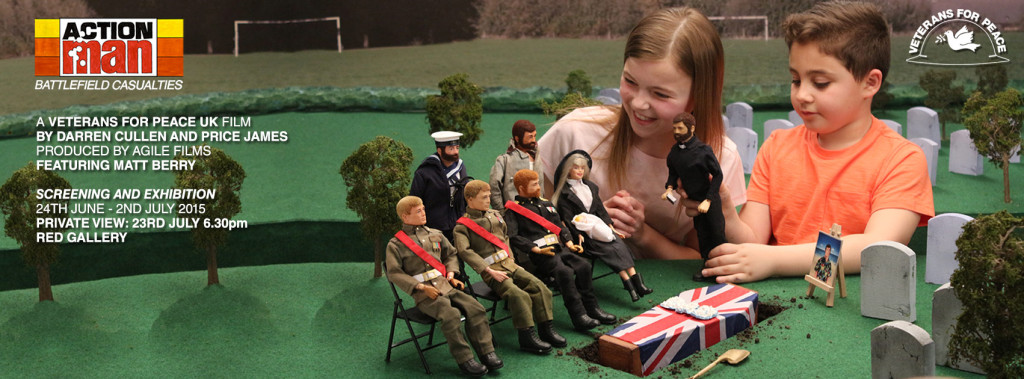
Actionman-1024x379

In keeping with the project’s authors, Charlie insists – I think properly – that many of those who were sent to Afghanistan from the UK were child soldiers (and here I also recommend Owen Sheers‘ brilliant Pink Mist for an unforgettable portrayal of what happens when boys who grow up ‘playing war’ end up fighting it: see also here and here).  As the project’s web site notes:

The UK is one of only nineteen countries worldwide, and the only EU member, that still recruits 16 year olds into its armed forces, (other nations include Iran and North Korea). The vast majority of countries only recruit adults aged 18 and above, but British children, with the consent of their parents, can begin the application process to join the army aged just 15…

It is the poorest regions of Britain that supply large numbers of these child recruits. The army has said that it looks to the youngest recruits to make up shortfalls in the infantry, by far the most dangerous part of the military. The infantry’s fatality rate in Afghanistan has been seven times that of the rest of the armed forces.

Forces Watch JPEG

Child Soldiers International JPEG

A study by human rights groups ForcesWatch and Child Soldiers International in 2013 found that soldiers who enlisted at 16 and completed training were twice as likely to die in Afghanistan as those who enlisted aged 18 or above, even though younger recruits are, for the most part, not sent to war until they are 18.
You can find another thoughtful reflection on child soldiers by Malcolm Harris over at the indispensable Aeon here. He doesn’t include the British Army in his discussion, but once you do you can see that the implications of this passage extend beyond its ostensible locus (Nigeria):

But can a child truly volunteer to join an army? Even when they enlist by choice, child soldiers do so under a set of constraining circumstances. UNICEF makes the choices sound easy: war or dancing, war or games, war or be a doctor. No rational child would pick the former for themselves, and that’s posed as evidence that their freedom has been taken from them. But when the choice is ‘soldier or victim’, voluntarism takes on a different meaning.
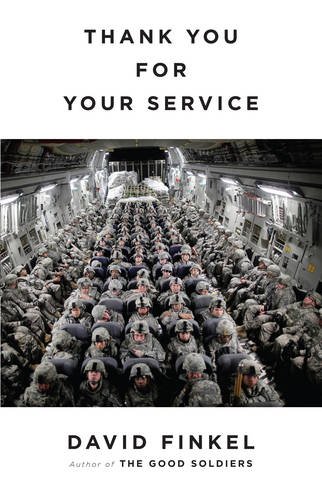
FINKEL Thank you for your service

Second, moving across the Atlantic and providing an extended riff on the ‘thank you for your service’ gesture, the latest issue of New Left Review includes an essay by Joan Wypijewski, ‘Home Alone‘, that describes the journey home faced by many US veterans.  She begins by putting David Finkel‘s compelling book in context:

The term ‘Thank You for Your Service’ developed early on in the long wars. Like ‘Support the Troops’, it was a way for a sheltered people to perform unity. In towns across America yellow ribbons, yellow lawn signs, balloons and car decals sprouted like team colours on game day. War would be a sport, the people spectators, and ‘Thank you for your service’ the high-five to combatants after quick and decisive victory. When that proved a vain hope, team spirit settled into the rhythms of commerce. ‘Support the Troops’ appeared the way ‘Buy American’ once had—a slogan on shop windows, billboards, bumper stickers. War was an enterprise, security its product, the people consumers, the soldiers trained workers and ‘Thank you for your service’ a kind of tip. As the enterprise (though hardly the business) failed, the signs faded, sometimes replaced by an image of folded hands, ‘Pray for Our Troops’. War had become a problem, the soldiers exhausted, the people clueless and ‘Thank you for your service’ a bit of empty etiquette, or a penance. By the time Finkel was writing [his book was published in October 2013], what remained among civilians was a desire to move on, and among soldiers, bitterness. ‘They wouldn’t be fucking thanking me if they knew what I did’, many would say, in almost exactly the same words.

Joan works her way through Finkel’s account, and then turns to Laurent Bécue-Renard’s Of Men and War, a documentary film – five years in the making, and the second instalment in a trilogy devoted to a ‘genealogy of wrath‘ – of Trauma Group sessions at a treatment centre in the Napa Valley:

‘What we have is embarrassing as shit’, a thick, tight young white man says in the Trauma Group. ‘You feel small—you feel defective.’ And so it goes, and so men trained for toughness talk of being weak and scared and monstrous, or just diligent. Of working in Mortuary Affairs: ‘breaking the rigour down’ to get the corpse of a 19-year-old who killed himself flat enough for a body bag, or untangling the remains of a group of faceless soldiers burned in a truck who are fused ‘like a bunch of rope’. They talk of their dreams, of their frightened wives. Maybe she moved out and got a restraining order before he came home, or maybe she has the divorce papers but is holding back as long as he’s getting help. ‘I have no clue what it’s like to be a woman married to a man twice your size and that’s lethal, in the military, and takes his rage out on you—someone that’s supposed to love you’, a former medic says. He is slim, white, deer-like. You don’t know his war story yet, and you don’t know when you’ll find out, if you’ll find out, but you listen as he and one after another after another deals with a world of pain. And maybe men balk, and maybe they storm out of the room, and maybe Gusman, whom you’ve also never really met but who is always there, has to remind them that ‘being a hostage to the war zone is not a life’. You follow them out of the room, taking smokes, meditating, visiting their wives or parents, calling on locals, trying to be well or pass for well, knowing they’re not. You watch their children doing typical childlike things, running, laughing in a high-pitched scream, and you feel anxious for everyone in the room. You itch to get back to the Trauma Group and, amazingly, don’t feel like a voyeur, because this isn’t war porn; this is the shit, as they say.

It isn’t beautiful or horrible, it just is. And you don’t like all of these people, but that isn’t the point. They are all struggling to be human again, and you have to ask yourself if you know what that means.

Not so much dressing but ‘addressing their wounds is a revolution’, Bécue-Renard insists, and you can see – literally so – what he means.  Joan’s commentary ends with other, perhaps also revolutionary reflections.  In America, she argues,

… there has been no serious debate on, let alone demand for, a universal draft as a democratic check against offensive war. We talk against empire, but are beneficiaries of the imperial state’s professional and technological adjustments to the anti-war movement’s past victories. We talk about the invisible draft but, perhaps encouraged by the bravery of Iraq Veterans Against the War, still hope that soldiers whose food, clothing, shelter, families and identity depend on the job of war-fighting will mutiny en masse. We talk, from time to time, about the culture of abuse in basic training and on military posts, but are silent on the regimens of discipline that are being hyper-enforced in anticipation of downsizing, in other words layoffs. And for the one thing the military, however twistedly, provides—belonging, solidarity, a sense of honour and family-feeling as against loneliness—we have no alternatives at all.

Finally, Duke University Press has announced that Zoe Wool‘s book, After War: the weight of life at Walter Reed, will be out soon:

In After War Zoë H. Wool explores how the American soldiers most severely injured in the Iraq and Afghanistan wars struggle to build some kind of ordinary life while recovering at Walter Reed Army Medical Center from grievous injuries like lost limbs and traumatic brain injury. Between 2007 and 2008, Wool spent time with many of these mostly male soldiers and their families and loved ones in an effort to understand what it’s like to be blown up and then pulled toward an ideal and ordinary civilian life in a place where the possibilities of such a life are called into question. Contextualizing these soldiers within a broader political and moral framework, Wool considers the soldier body as a historically, politically, and morally laden national icon of normative masculinity. She shows how injury, disability, and the reality of soldiers’ experiences and lives unsettle this icon and disrupt the all-too-common narrative of the heroic wounded veteran as the embodiment of patriotic self-sacrifice. For these soldiers, the uncanny ordinariness of seemingly extraordinary everyday circumstances and practices at Walter Reed create a reality that will never be normal.
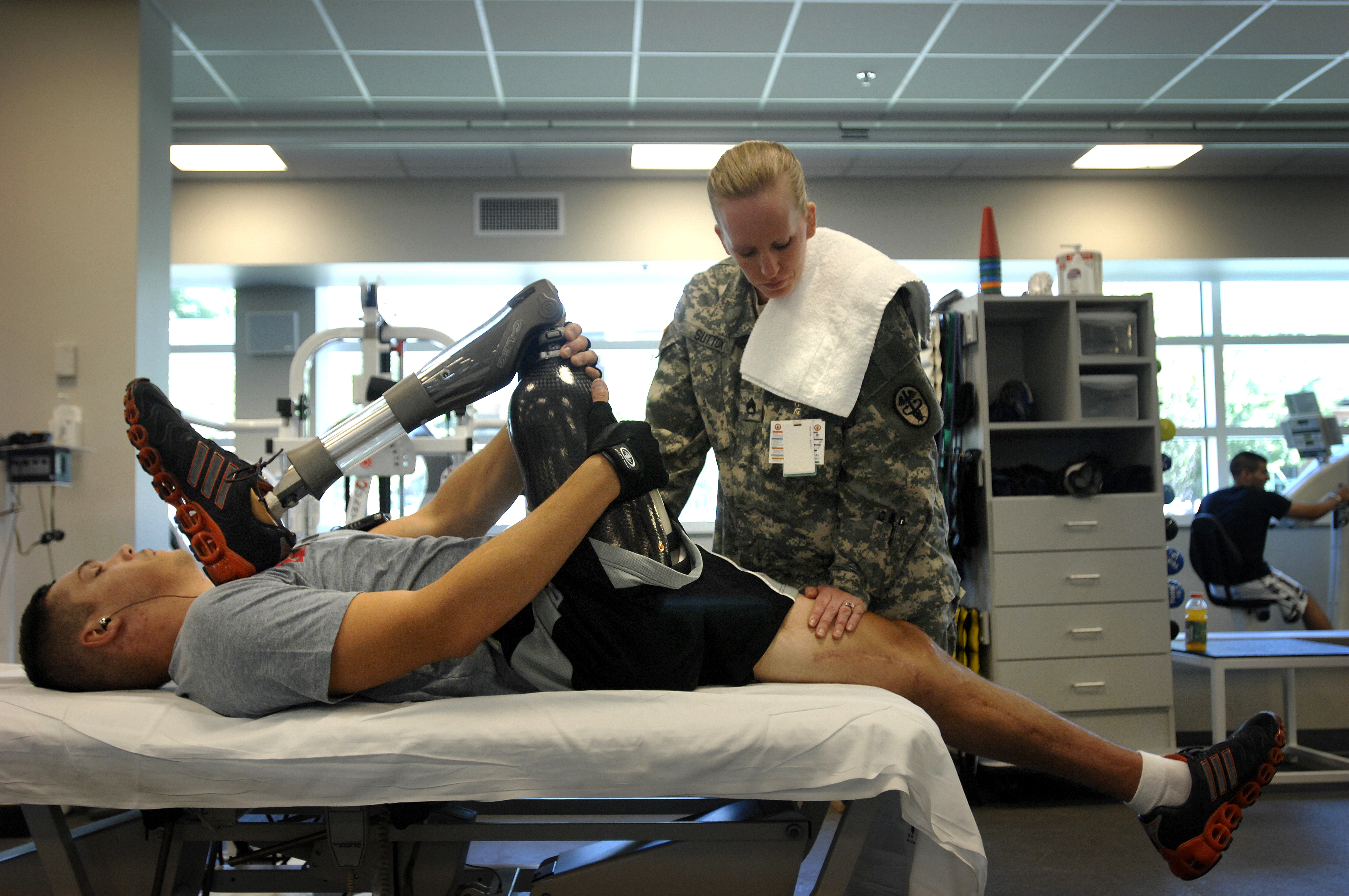
20080721-D-1852B-014

Here are two of the endorsements:

“Hollywood films and literary memoirs tend to transform wounded veterans into tragic heroes or cybernetic supercrips. Zoë H. Wool knows better. In her beautifully written and deeply empathic study of veterans of Iraq and Afghanistan at Walter Reed, Wool shows us the long slow burn of convalescence and how the ordinary textures of domestic life unfold in real time. An important and timely intervention.” — David Serlin, author of Replaceable You: Engineering the Body in Postwar America.

“This brilliant and absorbing ethnography reveals how the violence of war is rendered simultaneously enduring and ephemeral for wounded American soldiers. Zoë H. Wool accounts for the frankness of embodiment and the unstable yet ceaseless processes through which the ordinary work of living is accomplished in the aftermath of serious injury. After War is a work of tremendous clarity and depth opening new sightlines in disability and the critical politics of the human body.” — Julie Livingston, author of Improvising Medicine: An African Oncology Ward in an Emerging Cancer Epidemic.
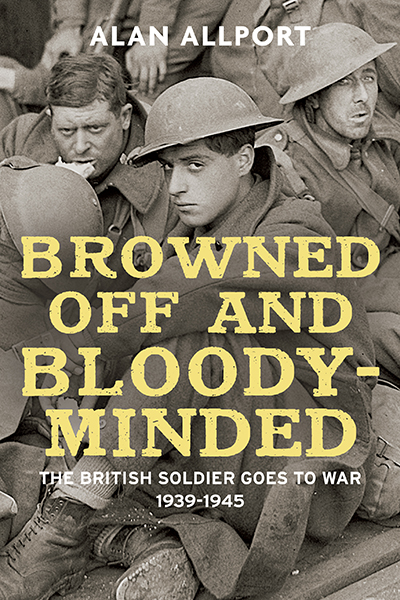
Browned Off and Bloody Minded

Browned Off and Bloody Minded

Not me: a new book by Alan Allport from Yale University Press: Browned-Off and Bloody Minded: the British soldier goes to war 1939-1945:

More than three-and-a-half million men served in the British Army during the Second World War, the vast majority of them civilians who had never expected to become soldiers and had little idea what military life, with all its strange rituals, discomforts, and dangers, was going to be like. Alan Allport’s rich and luminous social history examines the experience of the greatest and most terrible war in history from the perspective of these ordinary, extraordinary men, who were plucked from their peacetime families and workplaces and sent to fight for King and Country. Allport chronicles the huge diversity of their wartime trajectories, tracing how soldiers responded to and were shaped by their years with the British Army, and how that army, however reluctantly, had to accommodate itself to them. Touching on issues of class, sex, crime, trauma, and national identity, through a colorful multitude of fresh individual perspectives, the book provides an enlightening, deeply moving perspective on how a generation of very modern-minded young men responded to the challenges of a brutal and disorienting conflict.

Here is the Contents List:

Introduction

PART ONE: REGULARS

Colonel Lawrence and Colonel Blimp

Gentlemen and Old Sweats

Strange Defeat

PART TWO: CIVVIES

Army of Shopkeepers

Britain Blancoes while Russia Bleeds

Get some service in

PART THREE: CRUSADERS

Into the Blue

Come to Sunny Italy

Fighting Bloody Nature

Second Front

PART FOUR: KILLERS

Teeth and Tail

The Grammar of War

Categories of Courage

PART FIVE: CITIZENS

Them and Us

“What a colossal waste of time war is”

Here is a video preview:

There’s also a perceptive review by Victoria Harris here:

Allport’s latest work is far more than a revolutionary narrative of the (British) war effort. It is a window into the psyche of Britain – male Britain, it has to be said – and into the clashes between the classes, generations and masculinities that comprised it and attempted to defend their particular version of it. The British patrician class’ aversion to training the lower classes as officers, Winston Churchill’s disparaging view of the enlisted generation as weak and effeminate, tired soldiers with 300 days of continuous battle under their belts deserting en masse before D-Day; all of this is a “shock to us today”, we who have been fed a near-exclusive diet of a meritocracy fighting for democracy, backed by a prime minister confident in the toughness of this “greatest generation”. But the muddy, frustrated, sometimes downright incompetent reality Allport presents us with is far more powerful, revealing as it does how a diverse, independent-minded group of men fought, whether in a trench or at a depot or from behind a desk, despite immense fear or through tears, not from a nebulous sense of righteousness but out of a deeply human love for the man beside them.

If there is a criticism to be made of Browned Off and Bloody-Minded, it is how male and front line orientated this story remains…

I’m interested in approaches like Alan’s not least because they intersect with what I’ve tried to do in ‘The Natures of War’ (DOWNLOADS tab).  I’ve read endless first-hand accounts written by those who served on the Western Front in the First World War – and will be reading even more for my current work on casualty evacuation – but there seems to have been less interest in recovering the experiences of soldiers in the Second World War.  Alan’s work has involved excavating the archives in the Imperial War Museum, where I will be heading soon.  This time I will be switching gears to explore the lifeworlds of those who fought in the deserts of North Africa (‘the Blue’ of Part Three above).  Again, I made some headway on this in ‘The Natures of War’  – here too Part Three is of exceptional interest for me – but now I need to know much more about casualty evacuation.

Bodies on the line

The more I think about corpography (see also ‘Corpographies under the DOWNLOADS tab) – especially as part of my project on casualty evacuation from war zones – the more I wonder about Grégoire Chamayou‘s otherwise artful claim that with the advent of armed drones the ‘body becomes the battlefield’.  He means something very particular by this, of course, as I’ve explained before (see also here).

But let me describe the journey I’ve been taking in the last week or so that has prompted this post. Later this month I’m speaking on ‘Wounds of war, 1914-2014‘, where I plan to sketch a series of comparisons between casualty evacuation on the Western Front (1914-18) and casualty evacuation from Afghanistan.  I’ve already put in a lot of work on the first of these, which will appear on these pages in the weeks and months ahead, but it was time to find out more about the second.

800px-Medical_Emergency_Response_Team_Recovers_a_Casualty_in_Afghanistan_MOD_45151884

En route I belatedly discovered the truly brilliant work of David Cotterrell who is, among many other things, an installation artist and Professor of Fine Art at Sheffield Hallam University.  He became interested in documenting the British military casualty evacuation chain from Afghanistan, and in 2007 secured access to the Joint Medical Forces’ operations at Camp Bastion in Helmand.  He underwent basic training, a course in even more basic battlefield first-aid, and then found himself on an RAF transport plane to Bastion.  The Role 3 Hospital was, as he notes, a staging-ground. ‘Field hospitals are islands between contrasting environments,’ he wrote in his diary, ‘between the danger and dirt of the Forward Operating Bases and the order and convention of civilian healthcare.’  You can read a long, illustrated extract from the diary (3 – 26 November 2007) here, follow the photo-essay as a slideshow here, and explore David’s many other projects on his own website here.

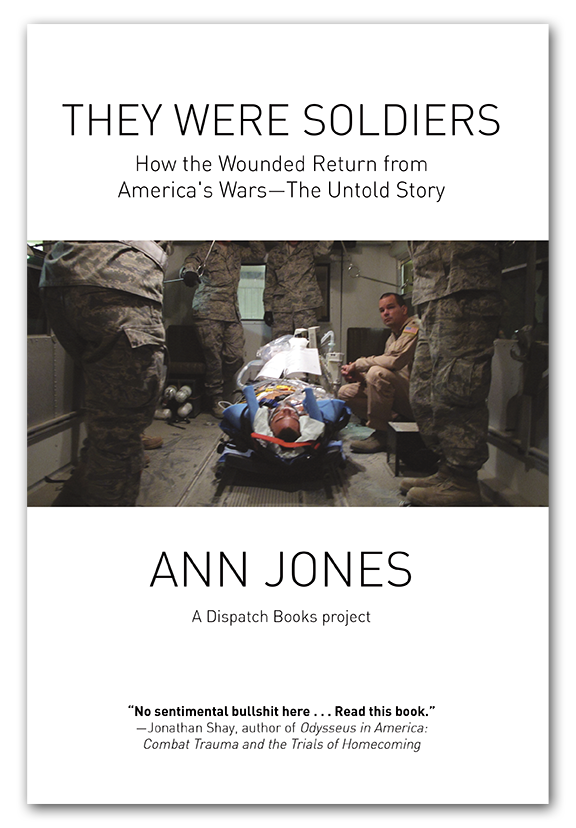
THEY-WERE-SOLDIERS_by-Ann-Jones_72The diary is immensely interesting and informative in its own right, not least about the exceptional personal and professional difficulties involved in documenting the evacuation process.  Here there’s a helpful comparison to be made with journalist Ann Jones‘s no less brilliant They were soldiers: how the wounded return from America’s wars (more on this in a later post), which starts at the US military’s own Level III Trauma Center, the Craig Joint Theater Hospital at Bagram, and moves via Landstuhl Regional Medical Center in Germany, the largest US hospital outside the United States, to the Walter Reed Army Medical Center in Washington DC.

David’s visual record is even more compelling, as you would expect from a visual artist, not only in its documentary dimension but also in the installations that have been derived from it.  In Serial Loop, for example, we are confronted with a looped film showing the endless arrival of casualties at Bastion: ‘The sound of a continuously arriving and departing Chinook helicopter accompanies images of a bleak and wasted landscape; the banality of the film’s fixed perspective masks the dramas that unfold within the ambulances as they travel to triage.’

9-liner explores what David calls ‘the abstraction of experience within conflict’:

9-Liner explores the dislocation between the parallel experiences of casualties within theatre. It is a quiet study of a dramatic event: the attempt to bring an injured soldier to the tented entrance of the desert field hospital. The screens show apparently unrelated information. JCHAT – a silent scrolling codified message – runs on a central screen. Our interpretation of it is enabled through its relationship between one of two radically different but equally accurate views of the same event. To the left we see the Watchkeeper – a soldier manning phones and reading computer screens in a crowded office. On the right we view the MERT flight – the journey of the Medical Emergency Response Team in a Chinook helicopter.

SHU’s REF submission includes this summary of David’s work (one of the very few useful things to come out of that otherwise absurdist exercise):

The research made clear that soldiers recovering from life-changing injuries had limited means of reconstructing the narrative of their transformative experiences. From the time of wounding through to secondary operations in the UK, many soldiers remained sedated or unconscious for a period of up to five days. The radical physical transformation that had occurred during this period was not adequately reconciled through medical notes, and the embargo on photographic documentation of incident and subsequent medical procedures served further to obscure this period of lost memory.

A culture of secrecy meant that medical professionals were unable to access documentation of the expanded care pathway with which they, and their colleagues, were engaged. This fragmentation of experience and understanding within the process of evacuation, treatment and rehabilitation meant that the assessment of the contradictions and disorientation experienced by casualties and medical practitioners was denied to front-line staff.

Family members, colleagues and members of the public outside the immediate environment of the military were unable to visualise or understand the transformative effects of conflict on directly affected civilians and soldiers. Partly as a result, the scope for public debate to engage meaningfully with the longer term societal cost of contemporary conflict was limited.

The submission goes on to list an impressive series of debriefings, presentations to military and medical professionals, major exhibitions, and follow-through research in Birmingham.

5-soldiers_header

And it’s one of those follow-throughs that prompted me to think some more about corpographies.  I’d noted the connection between corpography and choreography in my original post, but David’s extraordinary collaboration with choreographer Rosie Kay and her dance company gives that a much sharper edge.  Again, there’s a comparison to be drawn – this time with Owen Sheers‘s impressively researched and executed body of work, not only the astonishing Pink Mist but also The Two Worlds of Charlie F (2012)which was a stage play based on the experiences of wounded soldiers who also made up the majority of the cast (see my discussion of these two projects here).

5 Soldiers started life as a stage presentation in 2010 (watch some extracts here):

A dance theatre work with 5 dancers, it looks at how the human body is essential to, and used in, warfare. 5 SOLDIERS explores the physical training that prepares you for war, as well as the possible effects on the body, and the injury caused by warfare.

Featuring Kay’s trademark intense physicality and athleticism, 5 SOLDIERS weaves a journey of physical transformation, helping us understand how soldiers are made and how war affects them.

5 SOLDIERS is a unique collaboration between award-winning choreographer Rosie Kay, visual artist David Cotterrell and theatre director Walter Meierjohann. It follows an intense period of research, where Rosie learnt battle training with The 4th Battalion The Rifles and David spent time in Helmand Province with the Joint Forces Medical Group.

Rosie explained her commitment to the project (and her training with The Rifles) like this:

“I wanted to look at how the physicality of a soldier’s job defines them –like a dancer, the soldier is drilled, trained, their responses becoming automatic, but can anything prepare you for the realities of war? It is young soldiers and their bodies that are the ultimate weapon in war – their strength and weaknesses may win or lose a battle, their ability to harm or injure others is key to victory. While war is surrounded with weaponry, uniforms, history and ceremony, the real business is human, dirty, messy, painful and happening right now.”

(She is, not coincidentally, an affiliate of the School of Anthropology at Oxford).

5 Soldiers installation PNG

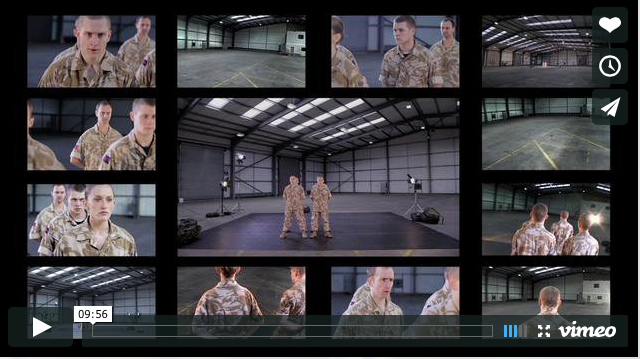
And now there’s a film version that works as a multi-screen installation (screen shot above).

Instead of just creating a short film, the team wanted the web user to get a truly interactive way to watch dance, and actually feel that they can go inside the minds and the body of the work. The 80-minute work was cut to just 10 minutes long, and the company spent one week filming in a huge aircraft hangar at Coventry Airport…

Using a variety of cutting edge filming techniques, the collaborative team have created a 13 angle edit that takes you into the heart of the work, follows each of the dancers, and zooms out so that the performers appear to be like ants in a huge empty landscape.

You can see the interactive, multi-perspectival version here.  This relied on helmetcams, and there’s a fine, more general commentary on this in Kevin McSorley‘s ‘Helmetcams, militarized sensation and “somatic war”‘ here.  But here’s the short, ‘director’s cut’ version:

And look at the tag-line: ‘The body is the frontline’.  It’s not only drones that make it so.

Emergency Response

I’ve been catching up on a stream of publications by Pete Adey and Ben Anderson on emergencies, including ‘Affect and security: exercising emergency in UK “civil contingencies”‘, Society & Space 29(6) (2011) 1092-1109; ‘Anticipating emergencies: Technologies of preparedness and the matter of security’, Security dialogue 43 (2) (2012) 99-117; and ‘Governing events and life: “Emergency” in UK Civil Contingencies’, Political Geography 31 (1) (2012) 24-33.

This has been prompted by a continuing conversation with Theo Price about a series of political/artistic interventions under the rubric of COBRA RES, in which he’s invited me to take part. COBRA, as many readers will know, is

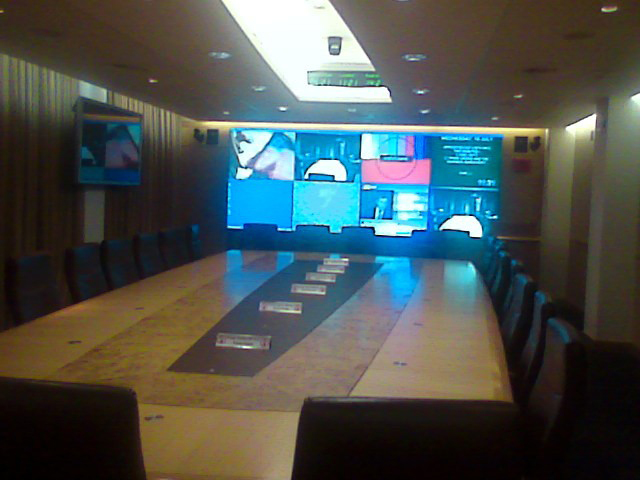
the British Government’s emergency response committee set up to respond to a national or regional crisis. Standing for Cabinet Office Briefing Room A [below], the COBRA Committee comes together in moments of perceived crisis under the chairmanship of either the Prime Minister or the Home Secretary. At COBRA meetings, decisions and a possible response, sometimes simply a press conference, are made under real or imagined conditions of emergency and/or crisis. 

Cabinet_Office_Briefing_Room

The committee can evoke emergency powers such as suspending Parliament or restricting movement. Such emergency-based responses have ranged from tackling Ash Dieback disease to the deployment of military hardware on civilian rooftops during the London Olympics.  Emergency and crisis-based politics are becoming increasingly common as modes of contemporary governance in an age of hyped terrorism and economic and environmental crises.

COBRA RES is a critical response, holding up a mirror to COBRA ‘as a way of producing different information, new perspectives and alternative narratives, while existing in a mimetic relationship to the emergency Committee itself and the situation it is responding to.’

COBRA RES aims to re-frame the response from an aesthetic perspective, while operating as an active-archive that follows, traces and maps the constantly changing tide of emergency politics. COBRA RES is a collective of artists and writers who aim to ask critical questions of COBRA through a series of creative responses. Reflecting and mimicking the structure of the COBRA Committee, the artists, writers and filmmakers are chosen for their relevance to the given context of the COBRA meeting.

The artists and writers are given nine days from the initial COBRA meeting in which to respond to either COBRA or the context it is meeting under. For the process to work, it is important that pressure is applied to the artists and writers so as prevent too much consideration, with limited facts available, in an attempt to re-create a parallel action of response. 

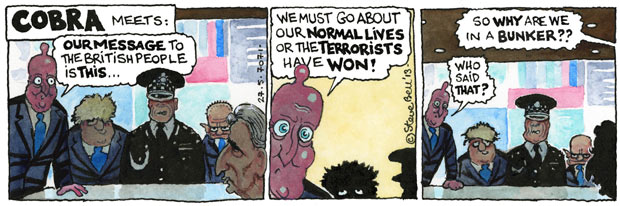
Steve Bell's If …

You can read more from Theo about the project in ‘Art in an Emergency’ here:

Art allows a certain freedom to explore and reimagine politics, offering a reflective surface on which to review the distorted image projected by the state in moments of crisis. But in recent years, it is politics that has increased its use of aesthetics to help manipulate and develop – often in a favourable light – its own agenda.

This image-based politics is a politics of presentation, of appearance and constructed images that tell a certain story, often a moral story of good v evil, of citizen v terrorist. Such morals are created through aesthetic and performative means to convince the general public that not only is the government protecting them, but that new terror legislation is necessary and justified. This approach is not new, but when political spin is used in ’emergency’ events, from which new terror legislation may then emerge, surely it is better to deal in fact than gesture.

Not all political situations invite an artistic response, but the government’s Cobra committee, and the ’emergencies’ prompting its meetings, offer a wide array of unknown variables that leave an open space for interpretation and imagination. Often Cobra closes this gap with its publicly announced meeting – we aim to re-open it.

As politics and society become increasingly brand-aware, with digital images and presentation the preferred power-tools to promote a political position, art becomes the obvious medium through which to ask questions. Art can only respond to the world around it and if politics and politicians increasingly attempt to define, promote and manipulate their position by aesthetic and performative means, art must reflect, mimic and respond in kind.

1a807d_1af2366c17ff43d3af3e28a47d5764b1.jpg_srz_144_51_75_22_0.50_1.20_0.00_jpg_srz

COBRA and thus COBRA RES have met five times since January 2013:

COBRA 1.0 Our first response was an exhibition after COBRA had met when hostages had been held in the Tiguentourine gas plant in Algeria.

COBRA 1.1 The second response was a book of artistic and written responses to the COBRA meeting following the killing of soldier Lee Rigby in Woolwich, south London.

Artists: Steve Bell, Hugh Jordan, Kennardphillipps, Nima Esmailpour, Nicolas Hausdorf, & Alex Goller ( H+Corp), Frida Go, Chie Konishi, Samuel Stevens, Theodore Price, Adam Ferguson, Jenny Richards, Richard Wilson, Robert Malt  Writers: Iain Boal (foreword), Nicolas Hausdorf, Theodore Price, Philip Howe, Samuel Stevens

COBRA 1.2 Responding to the situation in Nairobi shopping centre, secret postal responses were submitted to COBRA RES by a selection of artists. This work will not be viewed or opened until the final COBRA RES exhibition in 2018.

COBRA 1.3 DVD of artist films with accompanying book of texts, which responded to the extensive flooding to hit large parts of the United Kingdom.

Artists: Adam Chodzko, Stephen Connolly, Alison Ballard, Margaret Dickinson, John Jordan, Theodore Price, Stina Wirfelt, Samuel Stevens, Rose Butler, Nabli Ahmed, Daniel Shanken, Oliver Bancroft, James Connelly, Stevie Deas, Wonderland Collective  Writers: Nina Power ( Lead Essay) Christopher Collier, Jenny Richards, Nicolas Hausdorf, John Jordan, Isabelle Fremeaux, Theodore Price, Samuel Stevens, Stephen Connolly.

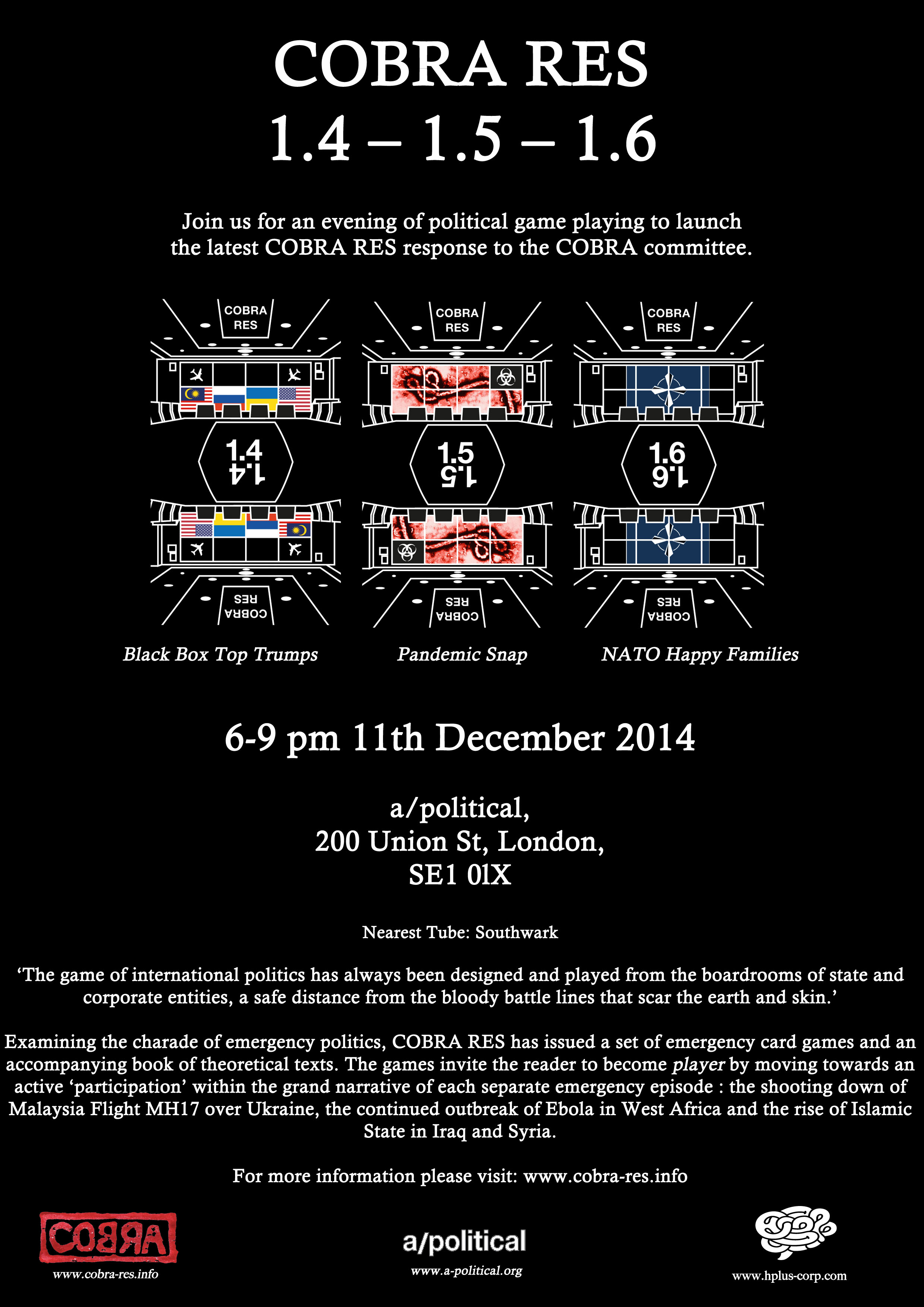
COB1.4_1.6_invite

The most recent (fifth) COBRA RES production (see above) is in response to three COBRA meetings in July and August 2014:

18th July 2014 in response to the shooting down of Malaysia Airlines Flight MH17 over Ukraine (Chaired by Prime Minister David Cameron)

30th July 2014 in response to the continued outbreak of Ebola in West Africa (Chaired by newly appointed Foreign Secretary Philip Hammond)

8th August 2014 in response to Islamic State forcing thousands to flee their homes and take refuge on Mount Sinjar, Iraq (Chaired by newly appointed Defence Secretary Michel Fallon)

Examining the inter-play of emergency politics, COBRA RES has issued a set of emergency card games and an accompanying book of theoretical texts. The games invite the reader to become player by moving towards an active ‘participation’ within the grand narrative of each separate emergency episode.

Cards by: COBRA RES and H+Corp  Texts by: Richard Barbrook, Roland Bleiker, David Campbell, Derek Gregory, Nicolas Hausdorf, Emma Hutchinson, Theodore Price and Strategic Optimism Football Club.

The book accompanying the latest COBRA RES includes my ‘Drone geographies’ (see DOWNLOADS tab) and my post on ‘The war on Ebola‘ (artfully and graciously re-crafted by Theo),

Wounding the world

BOURKE Wounding the world

Joanna Bourke‘s new book, Wounding the world, has just been published in the UK by Virago (the North American edition, re-titled Deep Violence: Military Violence, War Play, and the Social Life of Weapons, is due from Counterpoint early next year).

Wars are frequently justified ‘in our name’. Militarist values and practices co-opt us, permeating our language, invading our dream space, entertaining us at the movies or in front of game consoles. Our taxes pay for those war machines. Our loved ones are killed and maimed.

With killing now an integral part of the entertainment industry in video games and Hollywood films, war has become mainstream.

2014 marks the 100th anniversary of the declaration of the First World War, and with it comes a deluge of books, documentaries, feature films and radio programmes. We will hear a great deal about the horror of the battlefield. Bourke acknowledges wider truths: war is unending and violence is deeply entrenched in our society. But it doesn’t have to be this way. This book equips readers with an understanding of the history, culture and politics of warfare in order to interrogate and resist an increasingly violent world.

Here is the list of chapters:

PART ONE: WAR WITHOUT END

Introduction

PART TWO: THE SOCIAL LIFE OF WEAPONS

It’s only words

The circulation of violence

PART THREE: INCITEMENT TO MURDER

Kind-hearted Gunmen

Wounding the Innocent

The Dark Art of Ballistics

PART FOUR: MILITAINMENT

Playing War

Violent Gaming

PART FIVE: THE END OF WAR

Protest

You can read the introduction here, from which I’ve snipped this extract:

Our garrisons are maintained throughout the world and yet the military campaigns we wage abroad seem as real to most of us as the metaphorical wars on drugs or obesity. It is not uncommon to hear people waxing lyrical about the sanctity of life – including that of the two-cell embryo – while revering the troops on Remembrance Day. Militarist incursions into our ways of thinking, talking and enjoying ourselves are barely acknowledged. The blurring of entertainment and war, the infiltration of ‘violence-as-fun’ into the popular imagination (‘militainment’) and the advent of warbots – a generic term for drones, robotic weapons, unmanned vehicles, and suchlike – have led many of us to take for granted that war is without end and without borders. Unwittingly, we have effectively been turned into citizen-soldiers.

We have inherited a toxic genealogy. Its names are legion but its purpose is singular: violence. It is precisely its everyday nature – the way it creeps up on us by stealth – that makes it so powerful. But we are not merely passive observers, in thrall to a set of amorphous, militaristic ideologies or corrupting institutions. We are involved in the production of violence: it constitutes who we are and might be and, as such, can be resisted.

There is an early review by Yvonne Roberts in today’s Guardian here.

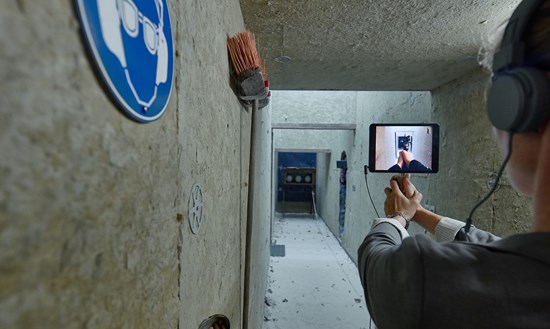
rimini_protokoll_situation_rooms_2_jo_rg_baumann

It’s a timely book in all sorts of ways, but I’m particularly pleased it’s available now because next month I’ll be in Berlin as part of Hebbel am Ufer’s Waffenlounge (Weapons Lounge):

After the USA and Russia, Germany is the third largest arms exporter in the world. The global market constantly demands better, more effective and ‘cleaner’ weapons. This month HAU Hebbel am Ufer is presenting a new production by Hans-Werner Kroesinger, “Exporting War,” as well as the Berlin premiere of “Situation Rooms,” a groundbreaking installation by Rimini Protokoll, created in co-production with HAU. Both works take up the paradoxical relationships that societies maintain to weapons, and both make use of personal biographies, current military conflicts as well as historical and political contexts. Under the motto “Weapons Lounge” HAU will also be presenting performances, installations, expert talks, and a project by the Houseclub with Kreuzberg pupils.

I’ll be talking about drones, but I’ve been thinking about what Joanna calls ‘the social life of weapons’ and also about the global arms trade (see my early post on ‘The death merchants’ here), so I’m looking forward to reading what she has to say.

Britain’s Reapers

UK Remote Control

As Craig Jones has discussed in detail, it’s been much easier to get information about the ways in which the United States has incorporated drones into its military and paramilitary operations than to prise open the door of UK operations (see also Chris Cole on ‘five basic facts we are simply not allowed to know here).

But the House of Commons Defence Committee has just published a two-volume report, Remote Control: remotely piloted air systems – current and future UK use.

Volume 1, the report and formal minutes (58 pp), can be downloaded as a pdf here, and Volume II, written evidence (130 pp), is available here.  The second volume includes submissions from the Ministry of Defence, Northrop Grumman, and General Atomics together with critical submissions from Drone Wars UK, Reprieve, the Network for Social Change’s Remote Control project, and the Bureau of Investigative Journalism.

Over at the Bureau, Alice Ross has a first response and summary here, while Chris Cole has a trenchant critique at Drone Wars UK here.

I’m still working my way through all this, but here are some key passages.

First, on the ‘double proximity’ of drone operations – as I’ve said before, even though these platforms can be controlled from thousands of miles away they are not weapons of global reach:

‘The MoD told us that in order to utilise unmanned air systems in the most efficient manner, they should be based as close as possible to the target area of interest to allow for the longest loiter time possible. In a “non-permissive” or hostile environment this would be “extremely difficult”.’

The other side of this is the invocation of a new (though, as I’ve also emphasised, thoroughly conditional and technologically mediated) quasi-intimacy:

‘It was very clear from the visit to XIII Squadron and discussions with Reaper aircrew that all were experienced professional personnel with a clear purpose and keen understanding of the Rules of Engagement which govern their operations. Despite being remote from the battle space they exhibited a strong sense of connection to the life and death decisions they are sometimes required to take. This was in stark contrast to the image portrayed by some commentators of “drone” pilots as video gaming “warrior geeks”.’

RAF Reaper

Again, as I’ve argued elsewhere, that ‘sense of connection’ is much more highly developed in relation to troops on the ground than to others who are in (or beyond) the field of view, and who are inevitably shut out from audio or online communications, which in part accounts for the risk to non-combatants whenever troops are ‘in contact’ with the Taliban and other fighters.

Second, the report seeks to draw a line between the US program of targeted killing and UK military operations in Afghanistan:

‘We acknowledge that over the last few years there has been a growing concern in relation to the sharing of intelligence with allies and the uses to which such data may contribute. While the issues raised by Reprieve stray beyond the terms of reference for our inquiry and indeed the remit of the Defence Committee, we do believe that there should be greater transparency in relation to safeguards and limitations the UK Government has in place for the sharing of intelligence…

‘We consider that it is of vital importance that a clear distinction be drawn between the actions of UK Armed Forces operating remotely piloted air systems in Afghanistan and those of other States elsewhere… In Afghanistan UAS provide intelligence in support of our ground commanders, enabling them to stay one step ahead of the enemy. Whether for targeting the Taliban or supporting troops on patrol, their ability to loiter over and survey areas for enemy activity and then feed back images and video in real time means they are an invaluable asset to our forces on the ground. Together, the UK’s fleet of UAS have carried out over 160,000 hours of ISR operations.

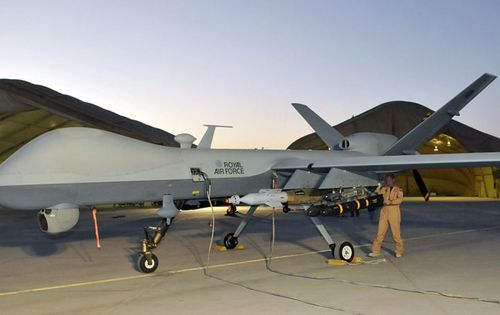
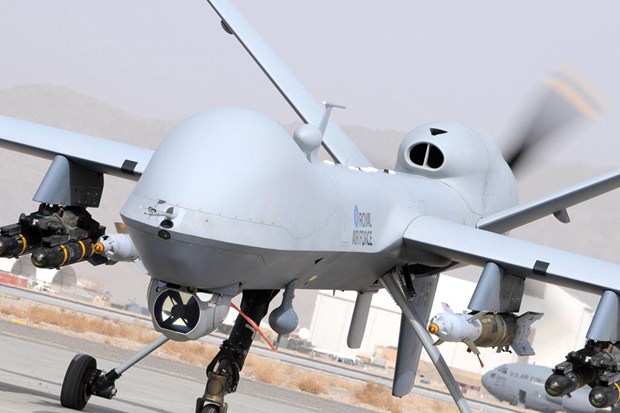
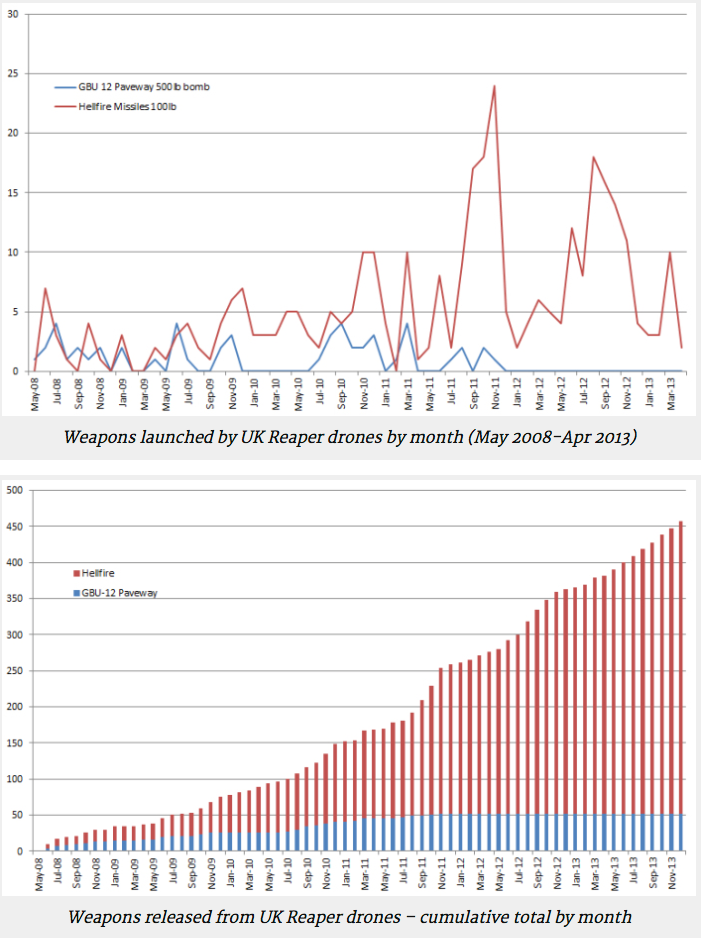
‘The General Atomics MQ-9 Reaper operated by the RAF is the UK’s only armed remotely piloted air system. The RAF fleet rose to ten in early 2014 as an additional five aircraft were accepted into service. RAF Reapers provide persistent intelligence, surveillance, target acquisition and reconnaissance (ISTAR) for ISAF forces in Afghanistan, mostly in support of UK forces in Helmand province…. Since May 2008, UK Reaper aircraft have been armed with precision-guided weapons—Hellfire laser guided air-to-ground missiles and GBU-12 Paveway 500lb laser guided bombs… By 31 August 2013, UK operated Reaper aircraft had flown over 50,000 hours on operations in the ISR role with 418 weapons fired in the same period.’

RAF Reaper and weapons

Here are the raw figures released to Drone Wars UK last month, following a FoI Request to the Ministry of Defence:

Weapons released by UK Reapers in Afghanistan 2008-2013 (Drone Wars UK)

Chris Cole is not convinced by the Committee’s (and, by extension, the Ministry’s) attempt to draw the line:

‘The report also argues that it is “of vital importance” that a clear distinction be draw between the use of drones by UK armed forces and what it discreetly calls “those of other States elsewhere.” It urges the MoD to continue its PR campaign – what the committee calls a “public awareness programme” – in order to “aid public understanding and acceptance.” PR it seems trumps transparency.’

Third, and closely connected to Chris’s misgivings, the report restates without examination the legal armature for UK military operations:

‘…the MoD told us that UK remotely piloted aircraft operate within the constraints of UK rules of engagement (ROE) and policy, even where operational control is assigned to a Coalition Commander, such as the Commander of ISAF. The MoD also stated that UK policy relating to targeting by remotely piloted aircraft is exactly the same as that for manned aircraft (and land and maritime weapons where applicable):

‘It is entirely compliant with International Humanitarian Law. Targets are always positively identified as legitimate military objectives and both pattern of life assessment and collateral damage estimate conducted. Strikes are carried out in accordance with the Law of Armed Conflict.

‘Personnel were keen for the public to know more and understand better what it is they do and to dispel some myths that have grown up about Reaper operations in particular. One pilot commented that the public needed to know that remotely piloted aircraft are “not robots, they’re not autonomous and we spend an awful lot of time training to fly them”. This training emphasised all aspects of the RAF rules of engagement such as whether a strike is necessary, whether any civilians are nearby, and what instructions have been received from the ground commander. Reaper aircrew were firmly of the view that the loiter time of remotely piloted aircraft allowed more informed decisions to be made and consequently the risk of civilian casualties was reduced should a missile strike be required….

Fourth, on civilian casualties and transparency:

‘The MoD told us that it was aware of only one incident involving an armed UK remotely piloted air system Reaper, which had resulted in the deaths of civilians:

‘On 25 March 2011 [three years ago to the day!] an attack on two pick-up trucks resulted in the destruction of a significant quantity of explosives and the death of two insurgents. Sadly, four Afghanistan civilians were also killed. In line with current ISAF procedures, an ISAF investigation was conducted to establish if any lessons could be learned or if any errors in operational procedures could be identified. In that case, the report concluded that the actions of the Reaper crew had been in accordance with extant procedures and rules of engagement.

…We note the conclusion of the UN Special Rapporteur [Ben Emmerson] that in any case in which civilians have been, or appear to have been, killed, there is an obligation on the State responsible to conduct a prompt, independent and impartial fact-finding inquiry and to provide a detailed public explanation. We recognise that this is not a simple and straightforward request as to do so could seriously jeopardise continuing operations. Nonetheless, we recommend that, to the extent that it is operationally secure to do so, following an event which has resulted in confirmed civilian casualties the MoD should seek to publish details about the incident and any lessons learned from the review process…’

For a good discussion of the UK’s definition of ‘civilian’ in such cases, see Dapo Akande at the European Journal of International Law here.

To be continued.