Novel wars

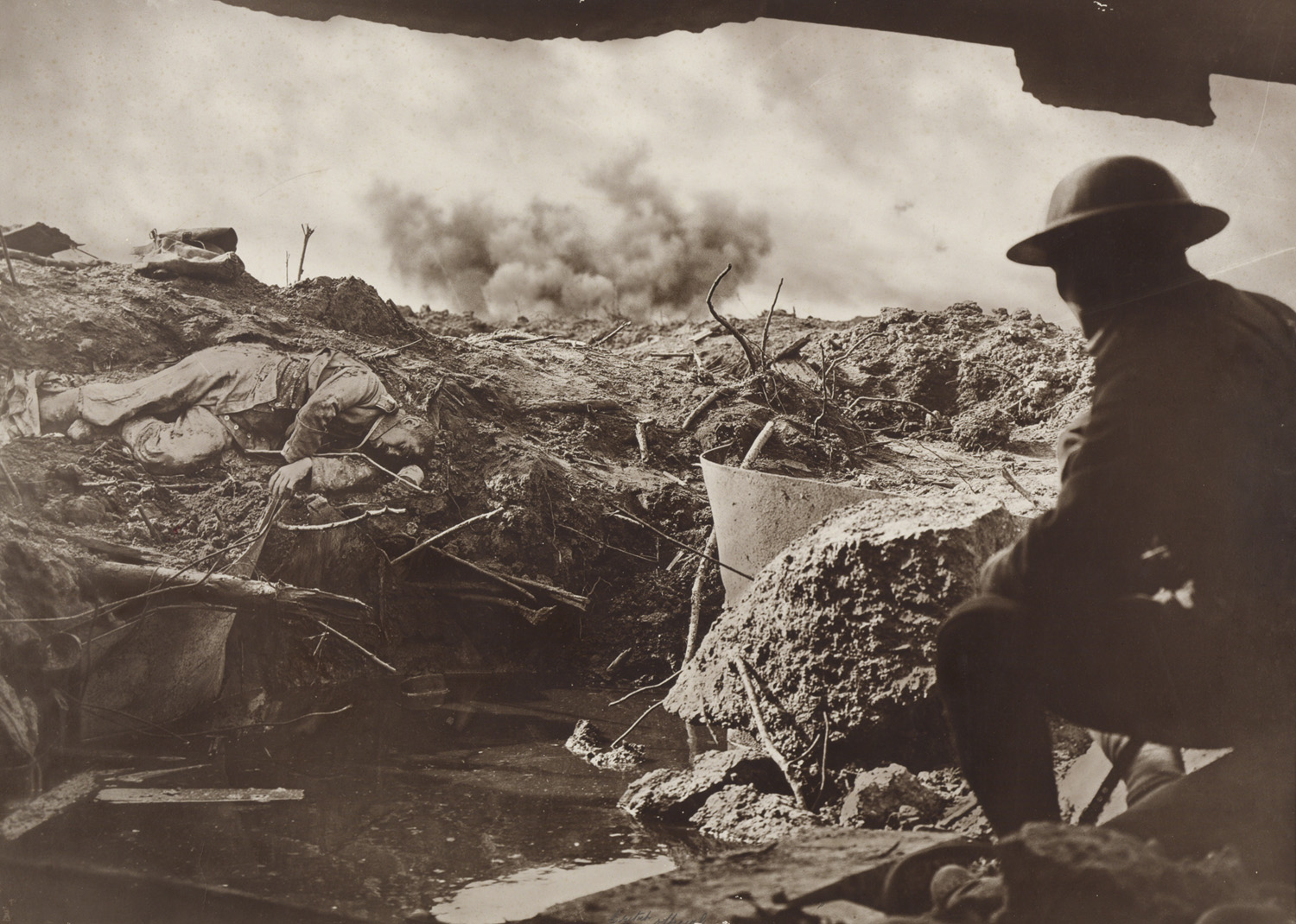
Since I added ‘The Natures of War’ to the DOWNLOADS section several people have asked me about my use of novels, especially in relation to Vietnam, while others have asked me to recommend writings – both novels and memoirs – that treat contemporary conflicts, especially Afghanistan.

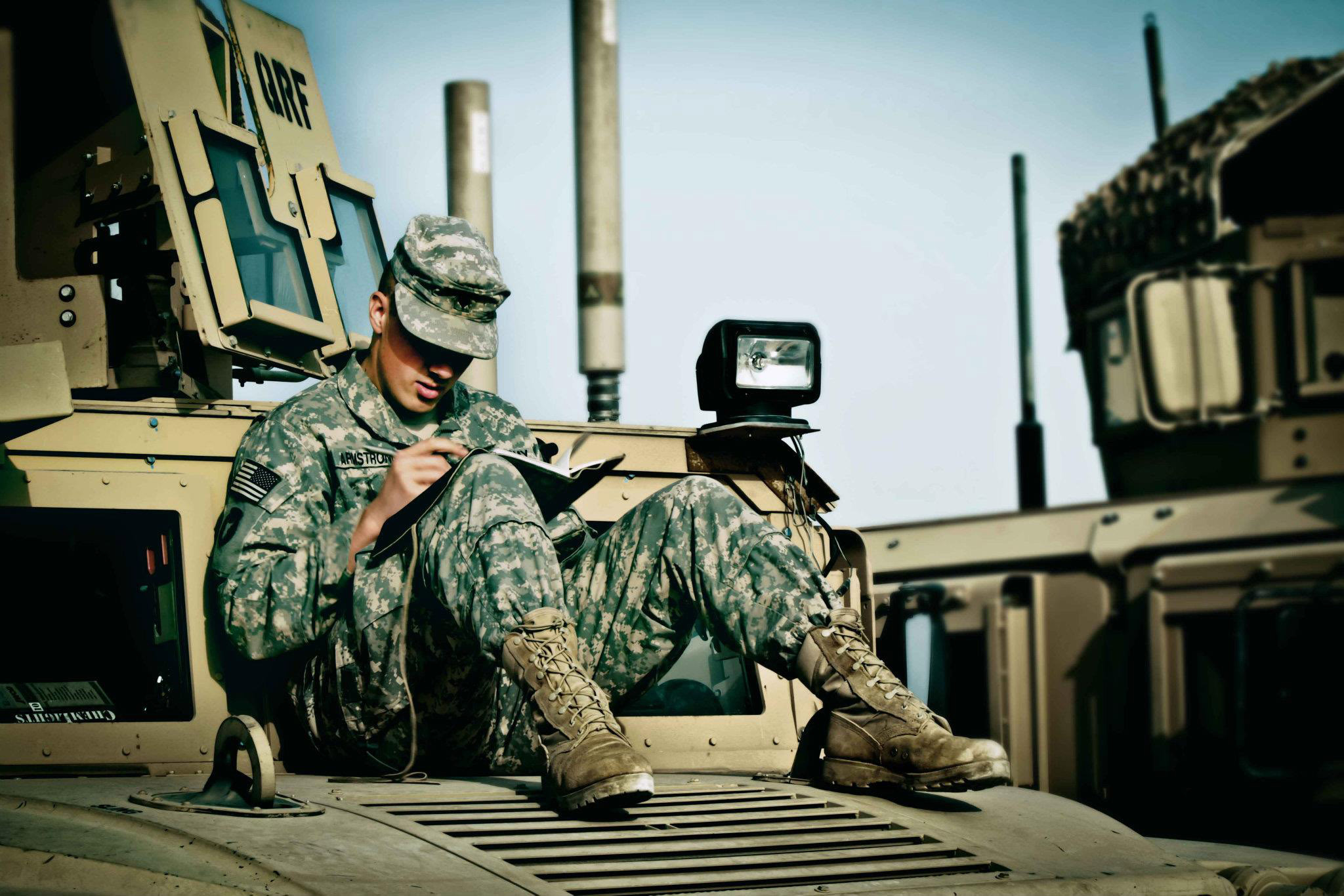
Writing letters to home

The first part is easy.  To say things too quickly, I think the usual distinction between ‘fiction’ and ‘non-fiction’ is much more problematic than it seems (don’t we all know this? and in any case where exactly do you place a ‘memoir’ in such a strangely bifurcated landscape?).  I also believe that there are some insights – truths, if you prefer – that are best conveyed in ostensibly fictional form.  For that reason I suspect it’s significant that it’s my appeal to (for example) Karl Marlantes‘s magnificent Matterhorn in the Vietnam section that seems to trouble some readers much more than my use of poetry in the section on the Western Desert in the Second World War.  Yet both emerged through their authors’ reflections on their experiences of modern war in those places.  That doesn’t mean that one can ignore literary conventions or linguistic devices – no text is a transparent reflection of the world, after all – but this surely also holds for nominally factual accounts too (and that goes for military blogs, which have created their own conventions).  In other ‘fictional’ cases I can think of – like Tom McCarthy‘s C, which I drew upon in ‘Gabriel’s Map’ to characterise the battlefields of the Western Front  – the narrative is clearly embedded in intensive and immensely thoughtful research.  In fact, I’d push this further: hence my interest in documentary drama as part of – not simply a product of – the research process.

The second question is more difficult, but there are some recent guides which might help.  A good place to start is George Packer‘s ‘Home Fires: how soldiers write their wars‘ which appeared in the New Yorker last spring.  Packer tries to pin down what is distinctive about writing that seeks to capture the wars fought in the shadows of 9/11:

‘The first wave of literature by American combatants in these long, inconclusive wars has begun to appear—poems, memoirs, short stories, novels. Their concerns are the same as in all war writing: bravery and fear, the thin line between survival and brutality, the maddening unknowability of the enemy, tenderness, brotherhood, alienation from a former self, the ghosts of the past, the misfit of home.

But Iraq was also different from other American wars… Without a draft, without the slightest sacrifice asked of a disengaged public, Iraq put more mental distance between soldiers and civilians than any war of its duration that I can think of. The war in Iraq, like the one in Vietnam, wasn’t popular; but the troops, at least nominally, were—wildly so. (Just watch the crowd at a sports event if someone in uniform is asked to stand and be acknowledged.) Both sides of the relationship, if they were being honest, felt its essential falseness.’

Given this disconnect, he concludes, ‘it’s not surprising that the new war literature is intensely interested in the return home.’  But when it deals with the soldiers’ experience of war, he continues,

‘It deals in particulars, which is where the heightened alertness of combatants has to remain, and it’s more likely to notice things. To most foreign observers, the landscape of Iraq is relentlessly empty and ugly, like a physical extension of the country’s trauma. But in the poetry and the prose of soldiers and marines the desert comes to life with birdsong and other noises, the moonlit sand breeds dreams and hallucinations.’

It’s that struggle to turn the experience of land into its evocation that interests me.  But Packer makes surprisingly little of it, and his gaze is focused almost unwaveringly on Iraq rather than Afghanistan (not surprising, given his own war reporting).

Writing in the New York TimesMichiko Kakutani identifies a series of writings on the human costs of what Dexter Filkins called ‘the forever war’:

‘War cracks people’s lives apart, unmasks the most extreme emotions, fuels the deepest existential questions. Even as the wars in Iraq and Afghanistan morph into shapeless struggles with no clear ends in sight, they have given birth to an extraordinary outpouring of writing that tries to make sense of it all: journalism that has unraveled the back story of how and why America went to war, and also a profusion of stories, novels, memoirs and poems that testify to the day-to-day realities and to the wars’ ever-unspooling human costs.

‘All war literature, across the centuries, bears witness to certain eternal truths: the death and chaos encountered, minute by minute; the bonds of love and loyalty among soldiers; the bad dreams and worse anxieties that afflict many of those lucky enough to return home. And today’s emerging literature … both reverberates with those timeless experiences and is imprinted with the particularities of the conflicts in Afghanistan and Iraq: changes in technology, the increased presence of female soldiers and, most importantly, the all-volunteer military, which has opened a chasm between soldiers (“the other 1 percent”) and civilians.’

Here too there is an attempt to see how today’s writing differs from the established canon of war literature.  En route, Kakutani makes some good suggestions for reading, but she says very little about the differences – those dense ‘particulars’ again – between Iraq and Afghanistan.

afghan1

She leaves that to Brian Castner‘s outstanding essay for the LA Review of Books, ‘Afghanistan: a stage without a play.’

Castner did two tours in Iraq, and his own account of that experience (and, just as important, what followed) in The Long Walk is a tour de force in every sense of the phrase.  But he is also remarkably perceptive in his readings of Afghanistan (‘the Undescribed War’, he calls it) and – of particular interest to me, given my interest in ‘the natures of war’ or what my good friend Gastón Gordillo would prefer me to call ‘terrain‘ – its land and landscapes.  Castner also draws several illuminating comparisons with Vietnam (not least through a double parallel with the US’s ‘Indian Wars’ of the nineteenth century).

Kevin Maurer covered both wars, and always found

“Afghanistan far more riveting than Iraq because it’s a whole different world. Baghdad is a Middle Eastern city, but it is a modern city. In Afghanistan that barely exists. I’ve always been able to turn my brain into Afghanistan mode and out, while Iraq blurs.”

The influence of the terrain, especially its beauty, is clear: while a few descriptions of colorful Iraqi skies creep into the literature, it was mostly an ugly urban war fought along the New York State Thruway, rest stop to rest stop. “Afghanistan always had that Vietnam vibe to it,” Maurer said, “because you can go get lost in Afghanistan, you can be on some hill on some outpost. In Iraq you were never that far out.”

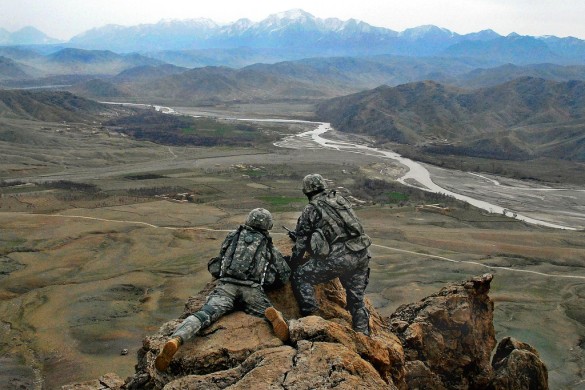
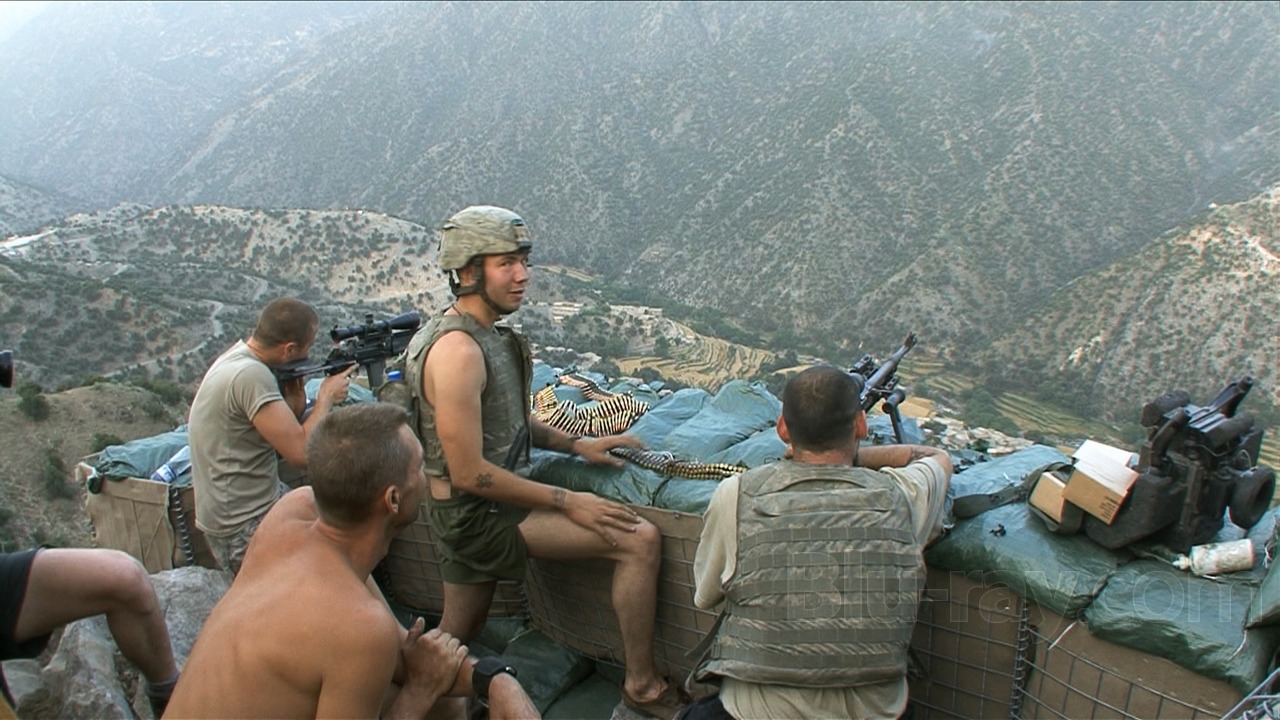
Korengal

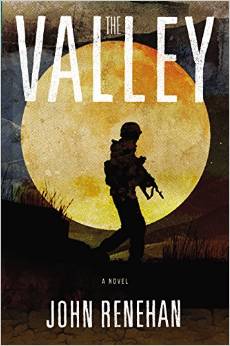
And for that very reason the terrain was always more than beautiful.  You can see that in a film like Restrepo – and even more clearly in Koregal (above) – but according to Castner you can also see it in John Renehan’s forthcoming novel, The Valley.  And here too Vietnam continues to haunt the imaginative landscape:

RENEHAN The ValleyThe landscape acts as an omnipresent consciousness, an apparition always in the corner of [Lieutenant] Black’s eye, and Renehan attaches to it layers of reverence and dread and unknowable quasi-mysticism; the valley is capable of anything. This infection spreads slowly for the reader, and Renehan says his writing process followed a similar path. “I more or less thought I was setting out to write a mystery story that happened to be set in a war. But as I started writing it I realized it was growing into something different in my mind, and it changed on paper too.” A detective story becomes a heroin- and concussion-fueled dreamscape that crosses genres. “Going After Cacciato gave me comfort in writing the parts of The Valley that become almost surreal,” Renehan said. “It reassured me that this sort of thing is okay, because it’s a war novel, right?”

What I need to think more about – the process I started in ‘Gabriel’s Map’ and continued in ‘The Natures of War’ – is how, despite Castner’s title, the stage is always part of the play.  And novels and poems will continue to help me do so.

POSTSCRIPT  Just after I finished drafting this post, I stumbled across ‘s Peter Molin‘s excellent blog: Time Now: the Iraq and Afghan wars in art, film and literature which also discusses the three reviews I list here.  Peter is a US Army officer who served in Afghanistan in 2008-9, and his posts are rich in ideas, insights and resources: well worth bookmarking.

The Natures of War

Frank-Hurley-2008-Photographing-the-First-World-War-Hurley-Document-Name-06-copy sm

I have – at last – uploaded what I hope is the final version of ‘The Natures of War’ (DOWNLOADS tab).  It’s the long-form version of the first Neil Smith Lecture I gave at St Andrew’s (Neil’s alma mater) almost exactly a year ago (you can access the online video here).  The basic argument remains the same, but the written version is substantively different (and much longer).  If you do have any comments or suggestions, or you spot any egregious errors, please let me know.  Here’s the introduction:

***

In his too short life, Neil Smith had much to say about both nature and war: from his seminal discussion of ‘the production of nature’ in his first book, Uneven development, to his dissections of war in the twentieth and early twenty-first centuries in American Empire – where he identified the end of the First World World and the end of the Second as crucial punctuations in the modern genealogy of globalisation – and its coda, The endgame of globalization, a critique of America’s wars conducted in the shadows of 9/11. And yet, surprisingly, he never linked the two. He was of course aware of their connections. He always insisted that the capitalist production of nature, like that of space, was never – could not be – a purely domestic matter, and he emphasised that the modern projects of colonialism and imperialism depended upon often spectacular displays of military violence. But he did not explore those relations in any systematic or substantive fashion.

He was not alone. The great Marxist critic Raymond Williams once famously identified ‘nature’ as ‘perhaps the most complex word in the [English] language.’ Since he wrote, countless commentators have elaborated on its complexities, but few of them have paused to note that ‘war’ was not one of Williams’s keywords (though ‘violence’ – ‘often now a difficult word’ – was). Williams was radicalised by the rise of European fascism; he joined the British Army in 1941 and served as a tank commander during the Second World War. Yet at its end he found the world had turned, and it was for that very reason that he sought to find the terms for a post-war world in which, seemingly, ‘war’ had no place.

‘In 1945, after the ending of the wars with Germany and Japan, I was released from the Army to return to Cambridge. University term had already begun, and many relationships and groups had been formed. It was in any case strange to travel from an artillery regiment on the Kiel Canal to a Cambridge college. I had been away only four and a half years, but in the movements of war had lost touch with all my university friends. Then, after many strange days, I met a man I had worked with in the first year of the war, when the formations of the 1930s, though under pressure, were still active. He too had just come out of the Army. We talked eagerly, but not about the past. We were too much preoccupied with this new and strange world around us. Then we both said, in effect simultaneously: ‘the fact is, they just don’t speak the same language’.’

I want to track backwards and forwards from Williams’s war-time experience to trace three different co-productions of nature and military violence: the soiled earth of the Western Front during the First World War, the deserts of North Africa during the Second World War (an armoured campaign very different from the European theatre in which Williams served), and the rainforests of Vietnam. My accounts can only be sketches, but they share a way of thinking of ‘nature’ (in all its complexity) as a modality that is intrinsic to the execution of military and paramilitary violence. In much the same way that ‘space’ is not only a terrain over which wars are waged – the fixation on territory that remains at the heart of modern geopolitics – but also a medium through which military and paramilitary violence is conducted, so ‘nature’ is more than a resource bank whose riches can trigger armed conflict and finance its depredations: the problematic of resource wars and conflict commodities. The spoils of war include the short-term bludgeoning of landscapes and the long-term toxicity of contamination (what Rob Nixon calls ‘slow violence’), but it is also important to trace the bio-physical formations – the conditions, provided the term is understood in the most active of senses – that are centrally involved in the militarisation of ‘nature’. For nature too is a medium through which military and paramilitary violence is conducted.

I speak of ‘co-productions’ and ‘formations’ in order to signal in advance three issues that will reappear across all three studies. First, each of these wars was in large measure what Paul Saint-Amour calls, in relation to the first of them, an optical war: they depended on geo-spatial intelligence, surveillance and reconnaissance which in its various forms provided the essential basis for the maps, plans and orders that activated the war machine. And yet the remote orderings of military violence were never autonomous projections onto a pure plane; they also depended on the bodies of soldiers whose apprehension of the battle space was always more than visual. In part, this was a matter of affect, but it was also a matter of knowledge – of a corpography rather than a cartography – whose materialities also inflected imaginative geographies of militarised nature. Second, those diverse stocks of knowledge about the battle space were invested in the co-production of a ‘trickster nature’. It was commonplace to describe the Western Front as a surreally empty landscape in which the capacity for military violence was hidden from view once men withdrew into the troglodyte world of the trenches. But I have in mind a more pervasive sense of uncertainty instilled by a militarised nature: one where the earth and air could kill through an infected wound, a buried mine or a cloud of gas, and whose camouflaged landscapes could wreak havoc with the military gaze to dissemble and distract, lure and entrap. Third, this was a hideously hybrid ‘cyborg nature’ whose terrain and life-forms were saturated with the debris of violent conflict: burned-out vehicles and bombed-out buildings, barbed wire and exploded munitions, discarded weapons and abandoned supplies, toxic residues and body parts. So far so familiar, except that none of these entanglements was inert; they shaped the military operations that took place through them. In all three ways each of these battle spaces was composed of ‘vibrant matter’ that was often also deadly matter.

***

This version is so long I’ve cut all the illustrations, but I have uploaded the original lecture slides too (DOWNLOADS tab); I’ve already posted early versions of some of the sections – and those were illustrated – here and here.

Vietnam, Vietnam

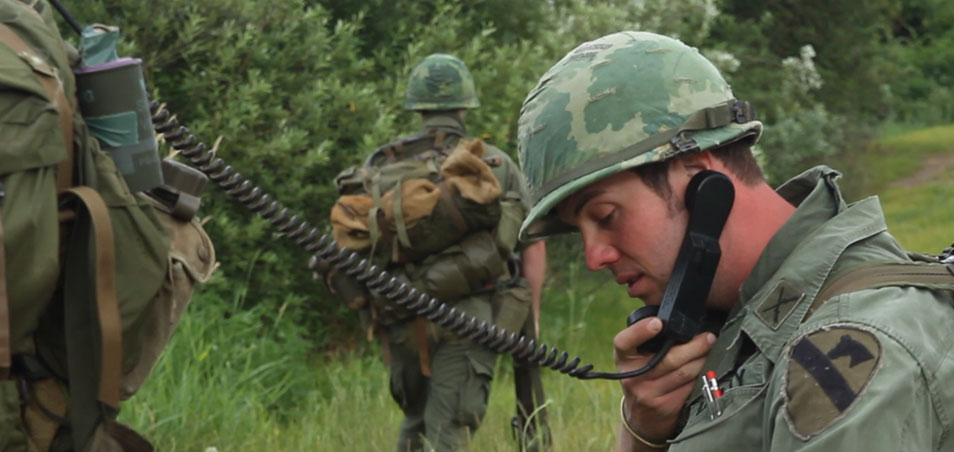
Travis_Radio

The New York Times has a fascinating clip from a longer documentary by Mike Attie and Meghan O’Hara called In Country, about a group in Oregon that re-enacts scenes from the Vietnam War:

IN COUNTRY is a feature documentary that follows 2/5 1st Cav (Reenacted), a “platoon” of hardcore Vietnam War re-enactors. Weaving together verité footage of the reenactments with flashbacks to the characters’ real lives and archival footage from the Vietnam War, IN COUNTRY blurs the boundaries between reality and fantasy, past and present to tell a story about men trying to access the past.

The question at the center of IN COUNTRY is why? Why would these men – many of them combat veterans of Vietnam, Iraq and Afghanistan haunted by their own experiences on the frontline – try to recreate a war that so many have tried to forget?

The film-makers give part of their answer in the NYT:

Unlike most war re-enactments, the pretend battles they stage are private, free of spectators and created for the experience of the participants alone. Outfitted in authentic period military gear, the men hike through the woods for days at a time, sleep on the ground, eat canned rations and carry actual Vietnam-era weapons (loaded with blanks). They do not stage battles but rather attempt to find and “kill” a group of Vietcong re-enactors waiting to ambush them.

Most remarkable perhaps is how this unusual hobby brings combat veterans from Iraq and Afghanistan together with civilians and veterans of Vietnam. They work collectively to create a fascinating space where real emotions and memories mix with history and fantasy. Their reasons for participating vary: Some seek the camaraderie they experienced in their deployment, while others want to relive a vital time in their life. And for all of the veterans involved, it is an event at which their service is acknowledged and respected.

They elaborate in an interview with PBS here, and in a You Tube clip from IFF Boston here.

For my part, there have been many comparisons between Afghanistan and Vietnam, but from the clips I’ve seen (and the clean uniforms) I don’t think the literal meaning of quagmire is re-staged in the Oregon woods very often…

The War Corps

The US Congressional Research Service recently released a report, Instances of Use of United States Armed Forces Abroad, 1798-2014:

The instances differ greatly in number of forces, purpose, extent of hostilities, and legal authorization. Eleven times in its history the United States has formally declared war against foreign nations. These 11 U.S. war declarations encompassed 5 separate wars: the war with Great Britain declared in 1812; the war with Mexico declared in 1846; the war with Spain declared in 1898; the First World War, during which the United States declared war with Germany and with Austria-Hungary during 1917; and World War II, during which the United States declared war against Japan, Germany, and Italy in 1941, and against Bulgaria, Hungary, and Rumania in 1942.

Some of the instances were extended military engagements that might be considered undeclared wars. These include the Undeclared Naval War with France from 1798 to 1800; the First Barbary War from 1801 to 1805; the Second Barbary War of 1815; the Korean War of 1950-1953; the Vietnam War from 1964 to 1973; the Persian Gulf War of 1991; global actions against foreign terrorists after the September 11, 2001, attacks on the United States; and the war with Iraq in 2003. With the exception of the Korean War, all of these conflicts received congressional authorization in some form short of a formal declaration of war. Other, more recent instances often involve deployment of U.S. military forces as part of a multinational operation associated with NATO or the United Nations.

Barbara Salazar Torreon, who compiled the report, adds:

The list does not include covert actions or numerous instances in which U.S. forces have been stationed abroad since World War II in occupation forces or for participation in mutual security organizations, base agreements, or routine military assistance or training operations. Because of differing judgments over the actions to be included, other lists may include more or fewer instances.

5875790-1x1-700x700

abc news has now provided an interactive that maps the data set here, together with a discussion of the original report.

‘Life is a rock but the radio rolled me…’

tumblr_nb88ij9V0e1qivon6o1_1280

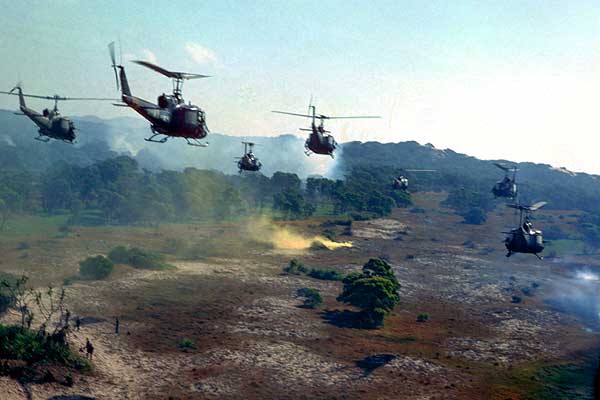
The war in Vietnam was often heralded as ‘a new kind of war’, one that reached its awful climax in what James Gibson brilliantly criticised as ‘technowar’.  It had many dimensions, including the reintroduction of chemical warfare (Agent Orange and all the other herbicides) and the development of the ‘electronic battlefield’.

But at the time the US Army made the most of its commitment to what it called ‘air mobility’.

As you can see from this contemporary Army video, the concept was claimed as revolutionary (and, in its way of course, counter-revolutionary).  ‘An entirely new concept of warfare known as heli-borne or air mobile operations has been developed by the United States Army,’ claims the commentator, ‘and has been successfully employed to meet the problems posed by South East Asia’s hostile wilderness and bye enemy who hides there.’

http://www.youtube.com/watch?v=gvtrVYk38vg

In fact, it wasn’t invented in Vietnam, but it was a dominant mode of army operations there: you can download the US Army’s historical report on Air mobility 1961-1971 here, for example, the Vietnam Center and Archive has a helpful page on ‘The helicopter war’ here, and you can read an extract from Walter Boyne‘s How the helicopter changed modern warfare here.  There is also a considerable literature on ‘dust-off‘ that I’m working through for my new research project on casualty evacuation in war zones.

Airmobility 1961-1971

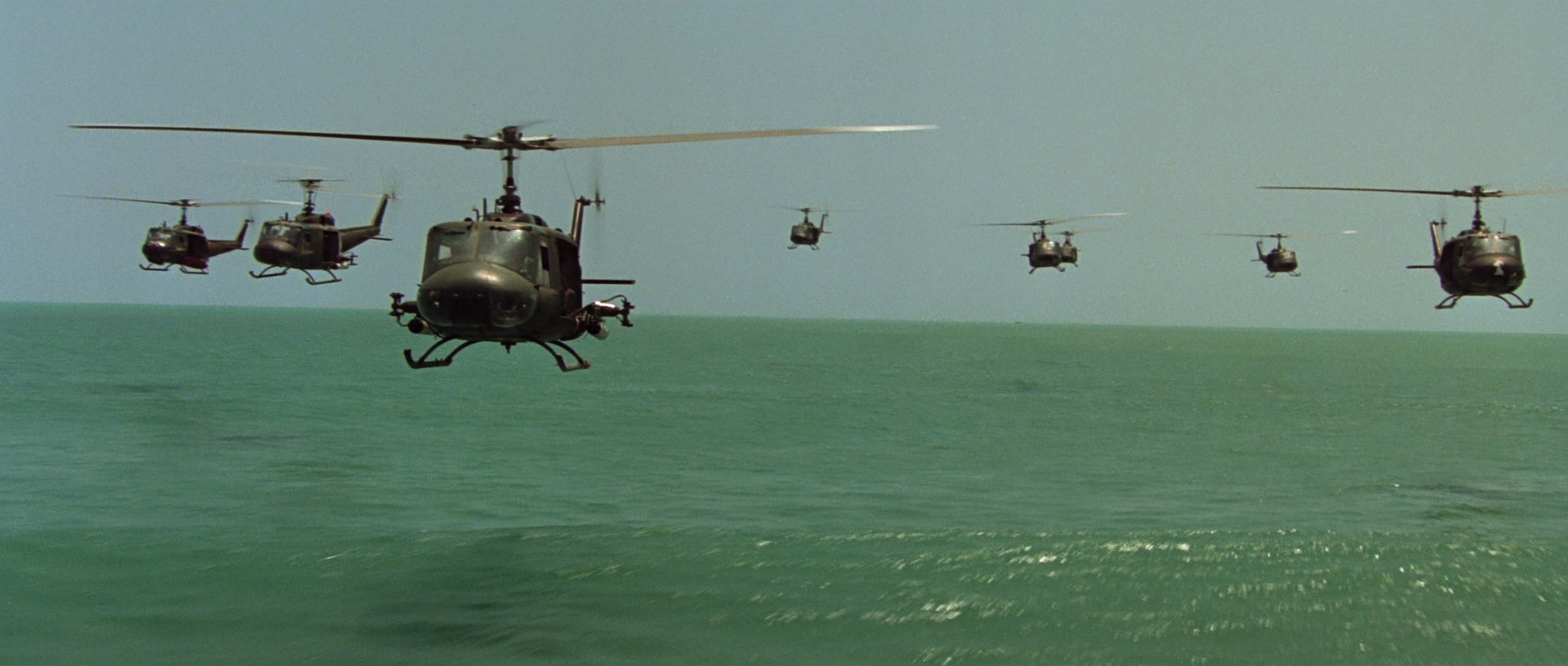
And don’t forget its role in popular culture.  The helicopter loomed large in the iconography of Francis Ford Coppola‘s Apocalypse Now (1979):

apocalypsenowbdcap4_original

More recently Pete Adey provided a summary of a more general concept of ‘aeromobilities’ [Geography Compass 2/5 (2008) 1318-1336] though his emphasis, perhaps not surprisingly, is on vision.

What interests me here, though, is another capacity, and one without which the potential of air mobility would have remained unrealised.

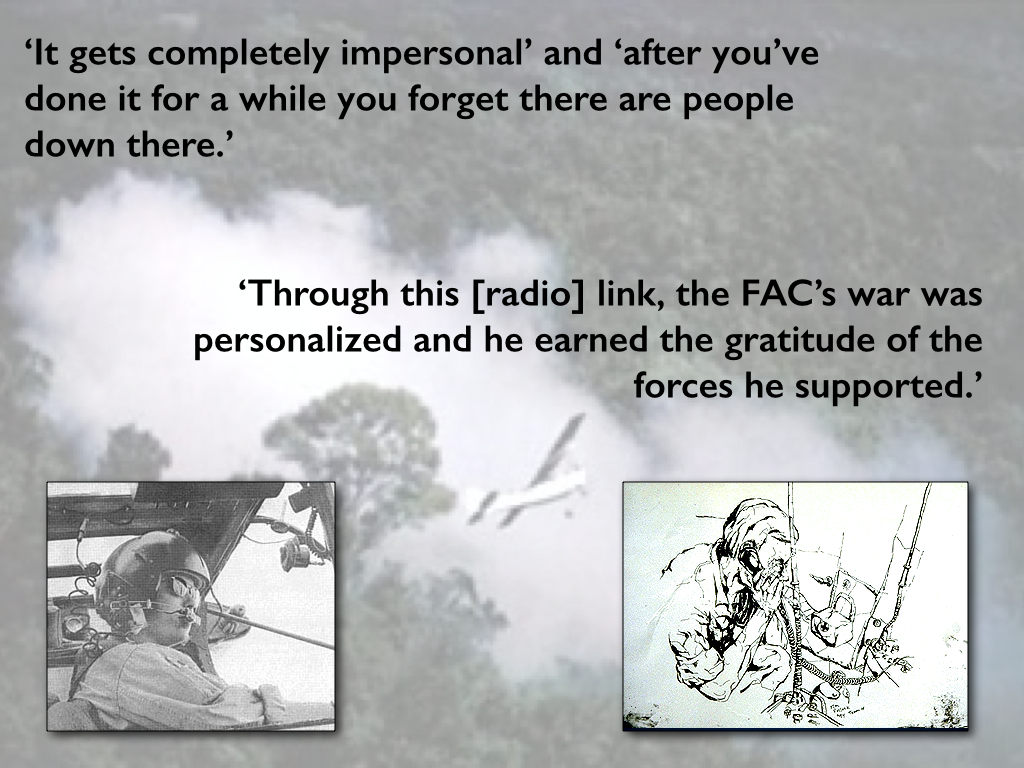
I’m talking about the voice on the radio.  I’ve written about the role of the forward air controller before, and the parallels between the air strikes they directed in Vietnam and today’s remote operations in Afghanistan (see ‘Lines of descent’, DOWNLOADS tab).

GREGORY From a view to a kill Shock and Awe Extract.001

This destructive power was captured with extraordinary economy by Phil Caputo in A Rumor of War:

Simply by speaking a few words into a two-way radio, I had performed magical feats of destruction. Summoned by my voice, jet fighters appeared in the sky to loose their lethal droppings on villages and men. High-explosive bombs blasted houses to fragments, napalm sucked air from lungs and turned human flesh to ashes. All this just by saying a few words into a radio transmitter. Like magic.

But the radio was part of a much wider network of military violence and military logistics in Vietnam.  Here is Frederick Downs in The killing zone:

With the radio, we grunts could make use of modern weapons. Without it, everything stayed put. We used the radio to call in artillery, naval gun support if it was close enough, air strikes, gunships, dustoffs, Puff the Magic Dragon [the AC-47 gunship], mortars, tanks, APCs and other rifle platoons. The radio kept us supplied. One day our order went in; the next day the chopper flew out with a delivery. We found each other by using grid coordinates and radioing them back and forth. A pilot knew he had the right location when we popped smoke and he identified it over the radio. By this method, we received C rations, ammo, new weapons, grenades, parts for our equipment, shoes, new clothes, underwear, socks, medicine, personnel replacements, beer, iodine tablets for use in the water, mail, and once in a while even a chaplain. To complete the cycle, the radio was used to extract us from trouble. Saving a life was often a matter of seconds. The radio was also a comfort at night. The periodic radio checks assured us that friends and help were always near.

Here too, incidentally, there are lessons for contemporary analysis: satellite imagery is clearly of vital significance for today’s advanced militaries, but so too are satellite communications.  I’ll discuss this is another post, but without those communication links there would be no full-motion video-feeds from all those Predators and Reapers – and their operating range would be dramatically constricted.  Ground operations in Afghanistan and elsewhere would also be virtually impossible without their radio links.

The-new-RTO

From 1965 the main field radio in Vietnam was the PRC-25 (‘Prick 25’).  You can find a detailed technical specification here, but here are the key passages:

‘The PRC-25 was about the size and weight of a case of soda. With its battery “can” included, call it a case of soda sitting on top of a six-pack. (It actually weighed slightly more than that, 23.5 pounds) There was a handle on each side at the top to carry it. The radio consisted of two parts, both in metal boxes, called “cans.” The upper can held the radio itself, the lower can held its battery pack. Metal buckles held the two together. The radio was tough and would easily survive a 50 foot fall from a helicopter onto a metal-planked runway. You could throw the whole thing in the water for an hour, completely submerged, then pull it out and expect it to work…

‘The radio antenna was exactly like a metal tape measure, but the bottom foot or so was a round flexible tube that screwed into the radio. There were actually two antennas, a regular one and a long-range antenna, carried in a canvas bag strapped to the side of the radio The radio had a transmission range, with the short antenna, of about 3-4 miles, but various terrain factors could influence this, of course. It helped to be higher up. The long range antenna was supposed to be good for up to 18 miles.

The rule of thumb was that the battery was good for about a day of casual operation, listening mostly, some occasional transmissions. In a period of intense use, transmitting/receiving all the time, it was good for perhaps 2-3 hours. The way the LRRPs [Long Range Reconnaissance Patrols] and SF [Special Forces] used it, shutting it off and only coming up at scheduled times to briefly transmit or listen, it was good for perhaps four days. Spare batteries were usually kept in a spare .30 caliber ammo can. When expended, the battery pack had to be physically destroyed. Inside were flashlight-type batteries which the Viet Cong could use in booby traps or to ignite bombardment rockets.’

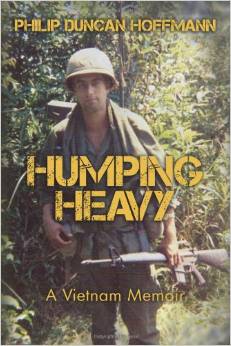
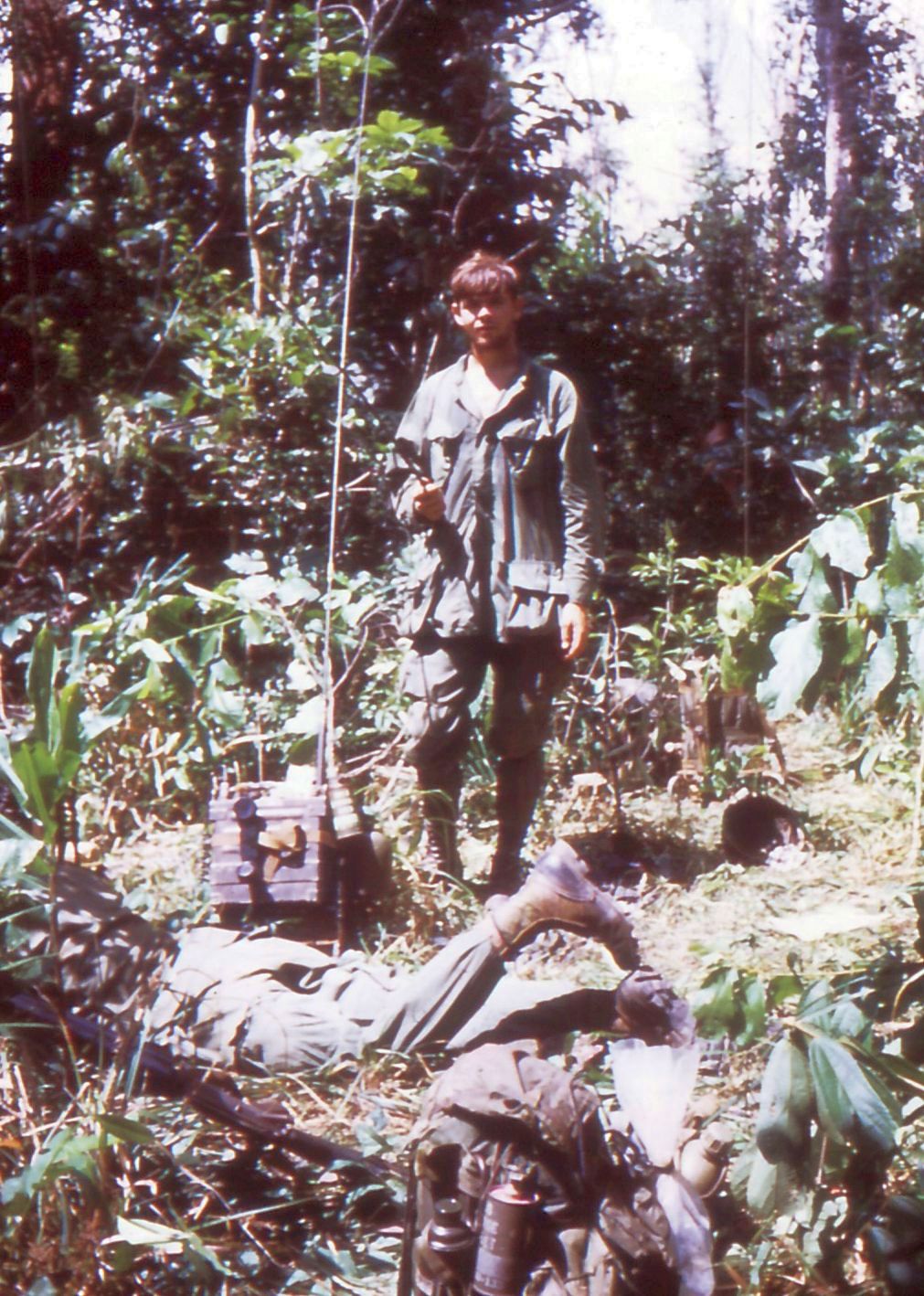
Hoffman Humping HeavyNotice first the extraordinary weight of the thing.  I’ve detailed the loads humped by soldiers and Marines in Vietnam before, but you can see from this that the radio operator (RTO) was even more heavily burdened.  He also had to contend with a difficult load distribution: according to Rodger Jacobs ‘radiomen had to wear their radios on their chests because if worn on their backs the thickness of the jungle and the vines would constantly catch on the controls and change the frequencies.’  The best account of the trials and tribulations of an RTO that I know is Phillip Hoffman‘s appropriately titled Humping Heavy (right).

RTO2

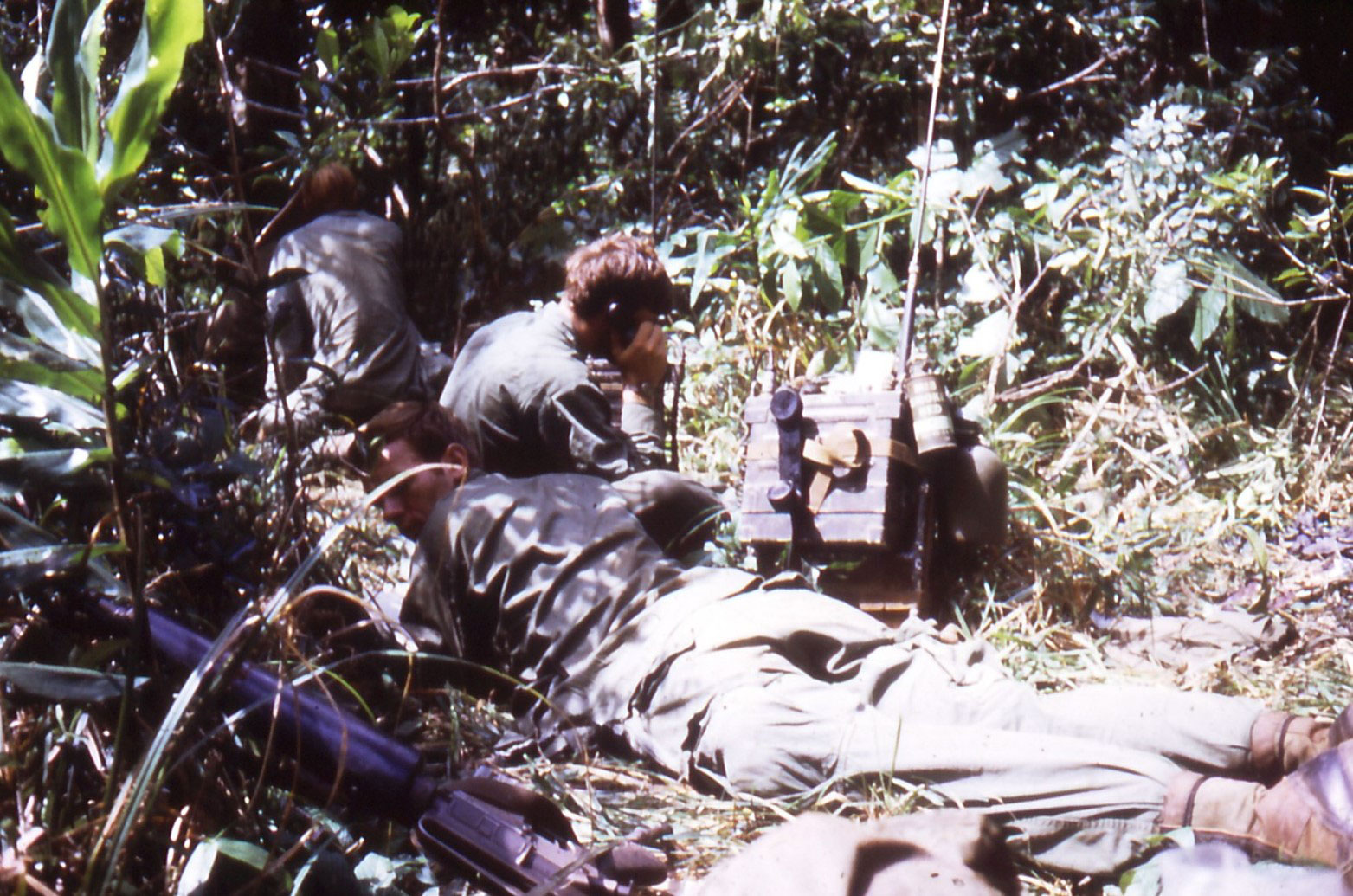
Then notice the size of the aerial (above); RTOs carried a ten-feet rigid mast in sections but much of the time used a three-feet whip antenna.  This made the RTO extremely vulnerable: not only was he a marked target, but he was always close to the platoon or patrol commander and so both were hi-vis priorities in an enemy attack or ambush.   For that reason the most prized possession of many RTOs was a North Vietnamese Army rucksack: ‘They’re better than anything the Corps has,’ Jeff Kelly was told.  ‘It’ll hang lower on your back and won’t catch on branches. But the big thing is you won’t be giving off that radioman silhouette.’  Most RTOs taped the antenna down, but Hoffman made the mistake of questioning the wisdom:

Right away he demanded I stuff the flexible, three-foot whip antenna down my shirt to limit me (and by extension him) as a target. He knew a priority of the enemy was to knock out communication, and our commo was located on my back. I complied with his directive but made the mistake of telling him our signal strength would suffer. In no uncertain words he told me never to question him again.

Even with a network of relay stations and airborne retransmissions, communications were uneven and intermittent: the terrain could block signals, especially in the Central Highlands, and rain (especially during the monsoon) could play havoc with reception.  At night even a whisper was dangerous; here is John Edmund Delezen:

Hourly situation reports are sent to the radio relay atop of Hill 950 some three kilometers north of the Khe Sanh airstrip. The “sit-reps” are not sent in the form of words-we dare not speak in the black void; when the relay asks us to acknowledge his call, there are just the two distinct pauses in the constant squelch as the handset is keyed twice. The two small audible clicks are all that connects us with the world, and all that assures the relay that we have not disappeared into the liquid black night.

Artillery fire direction center Vietnam

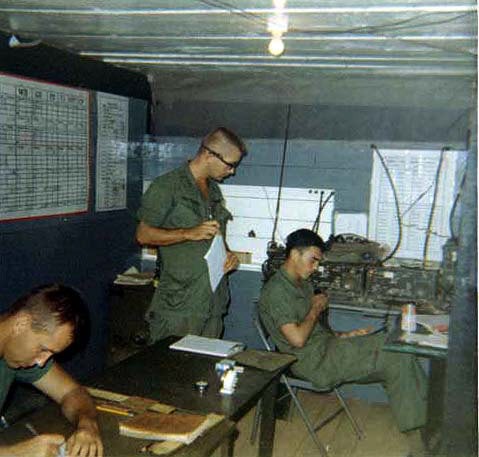
It could be strangely remote for those receiving the transmissions too (above, an artillery fire support center).  Kenneth Sympson, an artillery officer, explained:

‘Our only contact with the men of the patrols was from radio transmissions—the infrequent call-in at a checkpoint or request for fire on some pretargeted location on their route. They were a noise on the radio and a trace on a map of the region. When you fired an artillery round in support, it was almost as if you were simply throwing it into the night and it just disappeared. It would later strike a place on the map, but there was no life there; there was only some representation for crossing trails or the contour lines indicative of the slope of a hill or a pin hole named Registration Point 3.’

Downs says much the same, describing gun crews anticipating ‘the release of their impersonal death into a grid square.’

But for those beyond the wire those staccato messages were far from abstract or impersonal.  ‘The radio was our link with literally everything outside our platoon,’ said Downs, ‘from supplies to survival’.  And without it, as he also said, ‘everything stayed put.’

Hence my title: and for those too young (or too old) to remember it, listen to this (YouTube).

Quagmire

I’ve received several e-mails asking for “Boots on the Ground” to be continued.  So here is the rest of my discussion of militarised nature in Vietnam, extracted from the long-form version of “The natures of war“.  It follows on directly from that earlier post, but please bear in mind that this is still only a draft – in particular, I need to add a discussion of malaria, somehow, somewhere – and that I’ve excised the footnotes and references from this version.

***
p01219_002

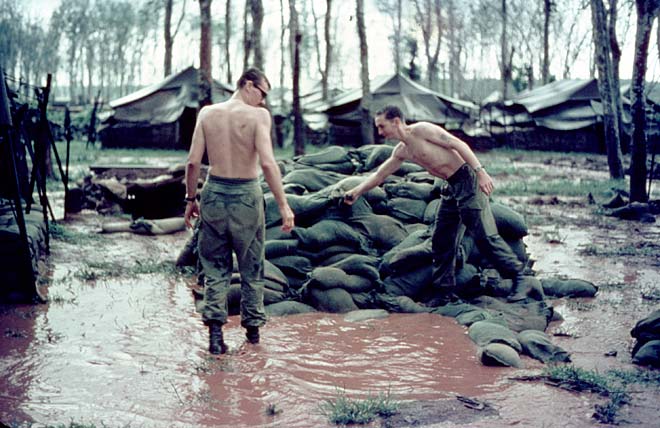
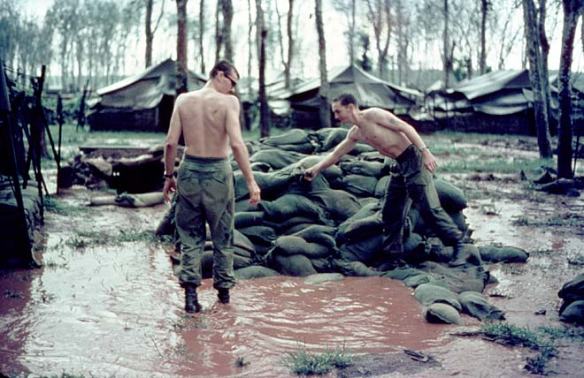
Even the weather seemed out to get them. The tropical heat and humidity were so enervating that they appeared to possess their own monstrous agency. ‘There were moments when I could not think of it as heat,’ Caputo confessed, ‘rather it seemed to be a thing malevolent and alive.’ Dehydration and heatstroke were constant concerns, and the monsoon only compounded their misery. ‘It rained like it had been waiting ten thousand years to rain,’ one lieutenant said when the monsoon broke, and John Ketwig described rain drops ‘as large as marbles and driven with enough force to sting when they hit you.’ The ground was turned into a sea of mud, and even the ‘rear-echelon motherfuckers’ on the permanent bases had to contend with their bunkers and foxholes filling with water, and roads becoming ‘ribbons of churned slop’. Ketwig again:

‘There were areas of shallow mud and areas of deep mud, but there were no areas without mud. Most of our world was under water, and you had to know where to step. The huge trucks we worked with would often sink up to the frame. The driver would try four-wheel-drive, spin the cleated duals at the rear, and dig himself in deeper. The rule was, the driver who “lost” a truck had to swim down and attach the tow chains. Swim is an accurate term for the depth of the mud, but hardly describes the frenzied mucking about in zero-visibility goo.’

One Marine newly arrived at a base near the DMZ in the middle of the monsoon was advised that the best way to navigate the ‘boot sucking slurry’ was to ‘walk in the tank tracks’: ‘The mud is only an inch deep there … Plus if we take incoming [fire], you can lay down in the track and you’re five inches lower.’ Vietnam was often more than a metaphorical quagmire.

The irony was that the billowing storm clouds limited air reconnaissance and so made ground patrols all the more important. They also constrained the logistical and medical support that could be provided to them:

‘There were many days when aircraft could not fly in such all-consuming cloudy conditions. Hence we were not always assured that we would be re-supplied, or that we could get choppers in to take out our wounded or dead, and on one occasion we were compelled to sleep with our dead, and then awake in the morning and carry our dead along with us, while waiting for an opportunity to clear an LZ (landing zone) so that choppers could come in and lift our comrades out of the jungle for their final journey home.’

For those out beyond the wire the monsoon wreaked havoc. Jack Estes describes one tropical storm ‘ripping, ravaging and slapping through the jungle’ and ‘howling like a monstrous beast.’ Soldiers were drenched to the skin, their uniforms chafed, their packs became heavier as they absorbed the water, and thick, cloying mud clung to their boots and weighed down their every step. ‘The mud was ground into my letters’, wrote one Marine.

‘The mud was ground into everything. The mud was in our ears and mouths. Our c-rats [C-rations] tasted like the mud we lived in… We were brown men. Even the black men were brown men.’
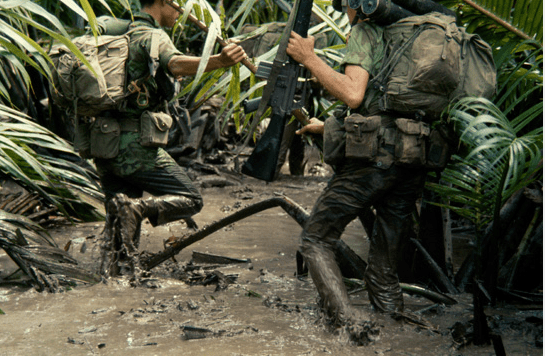
Mud in Vietnam

It was all desperately invasive, and Lawrence said he felt ‘persistently violated by the soaking wetness’. There was no let-up when darkness fell and they dug in for the night. ‘Sleep was measured in minutes at a time on the rainy nights’ and ‘muscles were constantly drawn tight against the cold.’ One Marine admitted that one night it was so miserable that ‘after a while we were hugging like young lovers’ just to stay warm. But usually the combination of cold and wet was utterly debilitating.

‘The rain comes in sheets all through the night and when I am relieved I remain standing with the Marine that has relieved me. Soon we realize that nearly the entire team is standing to escape the flooded ground. As the rain intensifies, I surrender to the cold deluge; wrapping myself into the wet, muddy plastic, I try to sleep. Before daylight, I wake shivering and half submerged in a deep puddle of cold rainwater, the edges of my poncho floating beside me. I pray that I am dreaming. Leeches cover my legs, their bodies filled to the point of bursting, gorged with type “O” Positive. The crotch of my jungle trousers is caked with blood; a leech has fed on my groin. My wrinkled fingers struggle with the bottle of insect repellant and as I squirt it on their membrane-like skin, I vent my rage on them with frantic curses that are filled with disgust. As I watch them fall off in agony, I scratch at the wounds to maintain the flow of rich, clean blood that will hopefully prevent infection; the repellent burns deep into each wound.’

Aching muscles, pus-filled skin sores and scabs (‘jungle rot’) and even leeches were the least of their worries. The infantry still marched on its feet as well as its stomach – for the grunts at least, ‘the war was fought with the feet and legs’ – and constant immersion invited the return of an old adversary. When Delezen hauled off one of his soaking boots he was taken aback:
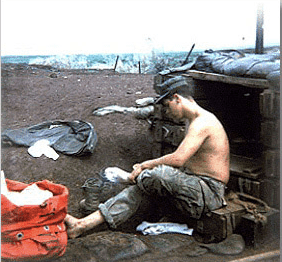
Vietnam feet‘[T]he foot is a wrinkled mass of putrid milk-white flesh and is badly cracked and bleeding. With the ragged boot in one hand and my weapon in the other, I crawl through the matted bamboo to the Corpsman [Marine medical specialist]; after a quick glance he tells me that there is nothing that he can do, his feet are in the same condition. It is immersion foot; trench foot was what our grandfathers called it in France. One by one each of my teammates removes one boot at a time and stares in repulsion at the condition of their feet… I try to dry the foot but I have nothing that is not waterlogged. Finally, in desperation, I place the wet socks under the shoulder holster; perhaps my body heat will dry them. There is nothing more that I can do so I pull the muddy jungle boot back on, lace it up, and try to forget about my ravaged feet.’

These physical sensations of exhaustion and pain were registered in a sensorium in which the usual hierarchy of senses was scrambled. As on the Western Front and in the Western Desert, sight was compromised in the rainforest. Visibility was limited by the dense vegetation and the filtered light. With a patrol strung out in single file five metres apart, it was all too easy to lose sight of the man in front – O’Brien said they each followed him ‘like a blind man after his dog’ – and at night ‘it was like walking inside a black velvet bag.’ Everyone’s eyes ached ‘from the constant strain of searching through the layers of jungle.’ In the middle of this ‘war of plant life’, wrote Caputo, ’it was difficult to see much of anything through the vines and trees, tangled together in a silent, savage struggle for light and air’. And yet, for that very reason, they had an almost palpable ‘sense of being surrounded by something we could not see.’ ‘It was the inability to see that vexed us most,’ he continued. ‘In that lies the jungle’s power to cause fear: it blinds.’ Not surprisingly, he concluded that ‘in Vietnam the best soldiers were unimaginative men.’ Once again, O’Brien spells out the consequences: ‘What we could not see, we imagined.’
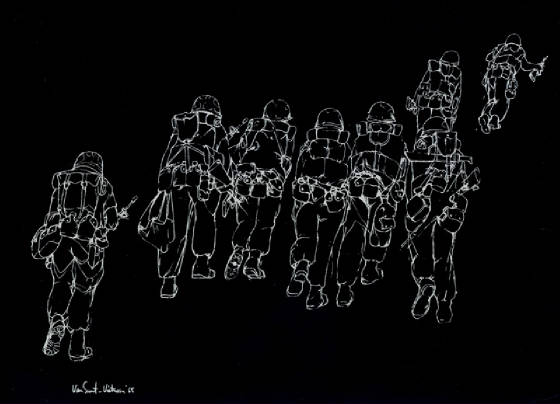
TOM VAN SANT Night_Patrol_Vietnam_68.jpg.w560h404

As sight lost its primacy the other senses were heightened, particularly hearing. Noise was literally a dead giveaway – ‘sound was death in the jungle’ – and the jingle of equipment had to be minimised. Before setting out, Delezen explained, ‘each of us, donning our heavy equipment, jumps up and down listening attentively for the slightest sound; there can be no exception. What may be considered an insignificant rattle will become amplified in the silent bush.’ Sounds also seemed to travel farther at night. ‘Shortly after sunset the jungle became as black as tar, and our sense of hearing came to predominate over our sense of sight.’ Other noises filled the canopy – ‘the croaking of tree frogs, the clicking of gecko lizards like sticks of bamboo banging together, the drone of myriad insects, and the occasional screech of a monkey’ – and these played cruel tricks with the imagination. In isolation they could sound a false alarm, and it was common for rookies to wake their companions because they had heard something, only to be reassured ‘there was nothing out there.’ But together, as a sort of green noise, they could ‘lull you into somnambulance … [and] numb your sense of hearing and smell and sight until you start seeing things in the night.’

All of these burdens, physiological and psychological, convinced many soldiers that their greatest danger was from Nature itself. What exercised them most about the jungle was not the prospect of an encounter with a wild animal; their accounts mention bamboo vipers, whose bite was horribly painful but not deadly, and even the occasional tiger, but they repeatedly tell themselves that ‘all the bombing and artillery have driven the wildlife up into Cambodia.’ Neither was it the thought of being killed or wounded in an ambush: ‘Contact with the enemy was very sporadic’, John Nesser explained, and instead ‘it was the day-to-day miseries in the bush that got to us.’ It would be wrong to minimise the dangers of being killed or wounded, which surely preyed on soldiers’ minds. But what they clearly came to loathe with a passion was their intimate, intensely corporeal violation by the jungle itself. ‘There it is you motherfuckers,’ crows Corporal Jancowitz in Karl Marlantes’ Matterhorn: ‘Another inch of the green dildo.’ The image is part of a long tradition of ‘porno-tropicality’ that is hardly peculiar to the US military, but during the Vietnam war it has a particular resonance for what it implies about violence, masculinity and the ‘un-manning’ of American soldiers.

Its power turns on the militarisation of nature in an altogether different register: one in which the jungle becomes terrifyingly alive, and its militant agency is made to account for the degradation of soldiers caught in its poisonous embrace and to justify its own destruction. There is a scene in Stephen Wright’s Meditations in Green in which a photo-interpreter on a large US airbase is advised to sit on top of a bunker and stare at the jungle.
WRIGHT Meditations in Green‘“You have to concentrate because if you blink or look away for even a moment you might miss it, they aren’t dumb despite what you may think, they’re clever enough to take only an inch or two at a time. The movement is slow but inexorable, irresistible, maybe finally unstoppable. A serious matter.”

“What movement, what are you are you talking about?”

“The trees, of course, the fucking shrubs. And one day we’ll look up and there they’ll be, branches reaching in, jamming our M-60s, curling around our waists.”

“Like Birnam Wood, huh?”

“Actually, I was thinking more of triffids.”’

The scene is fiction but not entirely fanciful – one platoon leader called it ‘the magic hour when men begin to look like bushes, and bushes begin to move’ – and many came to see the jungle as capricious and even wilfully obstructive. Caputo complained that ‘cord-like “wait-a-minute” vines coiled around our arms, rifles and canteen tops with a tenacity that seemed almost human.’ A radio operator humped the set on his chest not his back because otherwise ‘the vines constantly change the frequency by spinning the knobs of the radio top.’ ‘Perhaps it is the bush that is the enemy’, wondered Delezen:

‘[T]he jungle is a “cat’s cradle” of twisted vines that seem alive, as if reaching for me. Sometimes, even when not moving, I find myself held in their grasp, it as if they silently attack when I am not looking, as though they are thinking organisms. When moving, the only way to pass through the vines is to become a vine; it is impossible to push through the jungle, forcing, fighting, and struggling. The bush must be negotiated with and each vine must be silently dealt with as an individual. Stealth and quiet is all that prevents our destruction from the ever-present enemy. We have learned that we must become a part of the bush, always searching for the passage that lies hidden through the entanglement…’

In this passage the young Marine moves from being attacked by the vines – ‘held in their grasp’ – to becoming one, ‘a part of the bush’, and the precarious relation between the two had to be constantly renegotiated if the men were to survive. ‘At times I am certain that it is possible for our team to be consumed by the enveloping walls of foliage,’ Delezen continues, ‘without a trace we could easily disappear forever, absorbed into the tangled mass.’ This was more than the spectral fear of getting lost, though that was ever present; more too than losing your grip in what O’Brien called ‘a botanist’s madhouse’. For many soldiers it was also an existential threat that emanated from a diabolical Nature. ‘The Puritan belief that Satan dwelt in Nature could have been born here,’ Herr wrote in an extraordinary passage:

‘Even on the coldest, freshest mountaintops you could smell jungle and that tension between rot and genesis that all jungles give off. It is ghost-story country… Oh, that terrain! The bloody, maddening uncanniness of it!’

Downs too was taken aback by the pervasive sensation of rot. ‘Covering everything was the smell of slimy, rotting vegetation’, he recalled. ‘Our clothes and our bodies were beginning the rotting process of the jungle.’ He recognised this as a physical danger – ‘every scratch was a breeding spot for bacteria which could result in the rapid growth of jungle rot’ – and one that involved constant physical degradation: as one Marine officer put it, ‘it is a different way to live, and it is not a state of grace.’ Downs also saw this as a profoundly moral danger. ‘Every day we spent in the jungle eroded a little more of our humanity away.’ For him and for countless others the rot set in as the deeply sedimented Enlightenment distinctions between nature and culture dissolved in the jungle. ‘Everything rotted and corroded quickly over there,’ Caputo agreed, ‘bodies, boot leather, canvas, morals’:

‘Scorched by the sun, wracked by the wind and rain of the monsoon, fighting in alien swamps and jungles, our humanity rubbed off of us as the protective bluing rubbed off the barrels of our rifles.’

To him, it was ‘an ethical as well as a geographical wilderness. Out there, lacking restraints, sanctioned to kill, confronted by a hostile country and a relentless enemy, we sank into a brutish state.’

Admissions like these reappear throughout the letters, diaries and memoirs that I have read, sometimes explicitly and sometimes implicitly (the cleansing shower when a patrol returns from the field can sometimes be more than a matter of physical hygiene). They invite questions about how far the imprecations of nature – its assault not only on the human body but also on the humanity of the soldier – functioned for some of them as a more or less unconscious alibi for atrocity, so that those who committed acts of indiscriminate or unnecessary violence believed they had somehow been reduced to a ‘state of nature’ by nature. Its plausibility must have been heightened by the common dehumanisation of the Vietnamese (‘gooks’) and the reduction of the enemy and the civilian population to creatures of nature. Bernd Greiner says as much in his detailed analysis of atrocities in the far north and south of Vietnam: ‘Nature, the elements, literally everything took on the form of the enemy.’

The same imaginary also licensed a war on nature. The B-52 strikes, the napalm and the artillery bombardments all shattered the landscape (and the lives of many of those within it) but, as Wright’s Griffin is told in Meditations in Green, ‘it’s not as if [the] bushes were innocent.’ Griffin’s job was to assess the effects of the spraying of Agent Orange on the rainforest, the mangroves and the paddy fields by examining time series of air photographs:

‘It was all special effects out there. Crops aged overnight, roots shrivelled, stalks collapsed where they stood into the common unmarked grave of poisoned earth. Trees turned in their uniforms, their weapons, and were mustered out, skeletal limbs too weak to assume the position of attention… Griffin sat on his stool and watched the land die around him.’
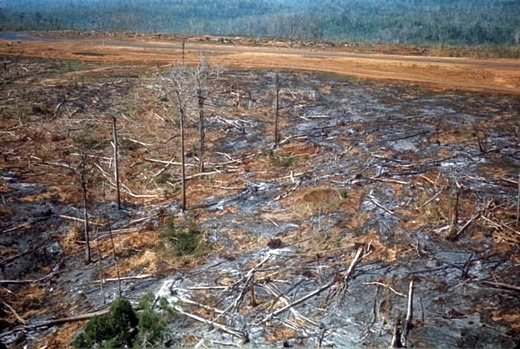
Effects of Agent Orange on the ground

Wright was not alone in imaginatively enlisting the trees in the enemy’s battalions. This was the logic behind Operation Hades – a differently diabolical militarisation of nature – that was soon re-named Operation Ranch Hand. Its objective was to spray the forests with herbicides and deny their cover to the North Vietnamese Army and the Viet Cong. In so far as the intention was, as David Zierler reports, to create ‘a no man’s land across which the guerrillas cannot move’ then at least some American officials were perturbed at the spectre of the Western Front being let loose once again: ‘Defoliation is just too reminiscent of gas warfare.’ Their objections were dismissed, however, and the US Air Force expressed considerable satisfaction at the results: ‘herbicide operations in the Republic of Vietnam have proved to be very useful as a tactical weapon.’ Those on the ground had a different view. ‘We didn’t know anything about Agent Orange beyond the fact that it was a failure,’ declared Nathaniel Tripp. The brute fact was that removing the forest cover made movement more difficult for American troops too. Agent Orange turned the surviving vegetation into a slimescape and, worse, allowed the hated vines to multiply:

‘During the year or two that had elapsed since [Agent Orange] had been sprayed on the woods, the “wait-a-minute” vines seemed to have developed a liking for the stuff and taken over like a kudzu horror movie. The long, prickly vines hung in festoons from the stark skeletons of poisoned trees and covered the ground with a shoulder-high thicket. Sometimes it would take an hour to move forward a kilometer, hacking through the vines while the sun beat down unmercifully. Extra water was frequently dropped by helicopter between stream crossings, but men kept collapsing from heat exhaustion nonetheless, and we all had to stop and wait again while they were medevaced out’.
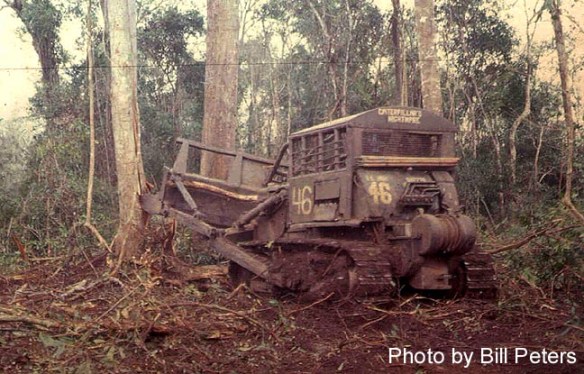
03_Plowinthecutpackmule

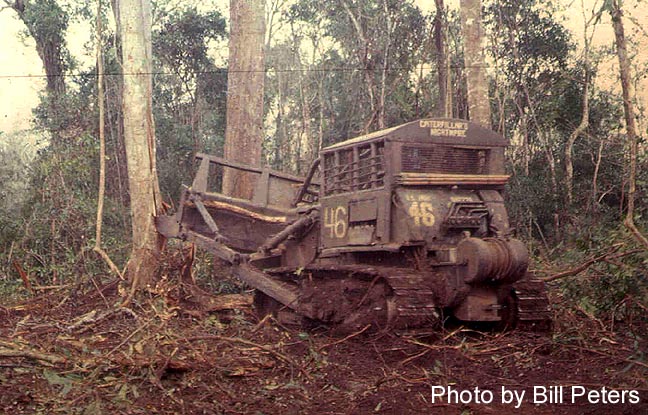
And clearing the rainforest exposed American patrols to more than the sun’s harsh rays. Later Tripp and his platoon were part of a division tasked with securing a route used to supply a detachment of forty Rome Plows – giant armoured bulldozers – that were busy ‘flattening mile after mile of woods’. ‘It was something to see from the air,’ he recalled, ‘like battalions of tornadoes had just passed through leaving nothing but a shattered tangle of mud and tree trunks and root masses.’ But again, the ground provided a different perspective:

‘Digging in was all but impossible, but we did the best we could in the pouring rain. The ground was covered everywhere with a mat of logs and branches, all interwoven and compacted, three to five feet thick and mixed with gummy gray clay. Surely, America had triumphed over the woods at last, and created a place that was impossible for anyone to hide in. Now, we were trying to hide in it, while the Viet Cong watched from the dark woods just meters away on both sides of the swath.’

And yet, even in this ‘landscape of hopelessness’, as Tripp called it, there were precious moments of relief and even of redemption. Jacobs knew that ‘war destroys everything it touches’, but sometimes he found himself marvelling at ‘the natural beauty that surrounded us.’ Just when Delezen was in despair – ‘There is no beauty here, only destruction’ – he found a wild flower near an abandoned, half-filled fighting hole. ‘Like a rare jewel, it seems misplaced; there is no place for beauty here.’ But then:

‘I remove the sweat soaked leather bush glove from my hand and drop to one knee to touch the delicate petals. My hand is caked with slippery mud, a mixture of red dust from Route 9 and sweat; the hand seems filthy and crude against the soft purple and white flower. I decide not to touch it; I do not want to spoil this last bit of beauty and purity that has somehow escaped the Devil’s grasp.

‘I look toward the team that continues to move on without me; I am reluctant to leave the petite blossom unprotected. Quickly, I gather a small pile of rusty ration cans and place them around the frail green stem. Perhaps the cans will offer protection; the team is looking back at me, I have to rejoin them. I want to take the flower with me but it will only wither and die in the heat. I have done all that I can to protect it from the madness. For a brief moment, I have escaped the hell of war and entered a peaceful sanctuary where care and compassion still exist…. As I move away from the little pile of rusty cans, occasionally I look back; with each glance the soft colors of the flower fade until they blend into the dry-green of the tortured vegetation.’

It’s an affecting passage in which Delezen joins his forebears on the Western Front in affirming the stubborn persistence of a pastoral nature, even in a tropical rainforest, but the most elegiac moment I know comes towards the end of Matterhorn. Marlantes’ young lieutenant thinks of the jungle ‘already regrowing around him to cover the scars they had created’:

‘Mellas felt a slight breeze from the mountains rustling across the grass valley below him to the north. He was acutely aware of the natural world. He imagined the jungle, pulsing with life, quickly enveloping Matterhorn, Eiger, and all the other shorn hilltops, covering everything. All around him the mountains and the jungle whispered and moved, as if they were aware of his presence but indifferent to it.’
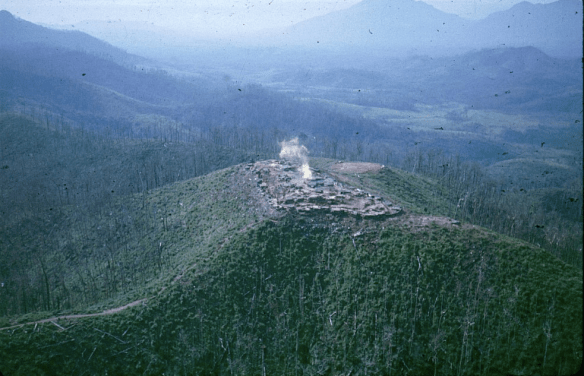
Firebase 6 Dak To Vietnam 1971

In speaking so directly to the recuperative, regenerative capacity of even a militarised nature, I suspect Marlantes is also expressing a desperate hope that those who have brutalised so many of its life-forms might find redemption too.
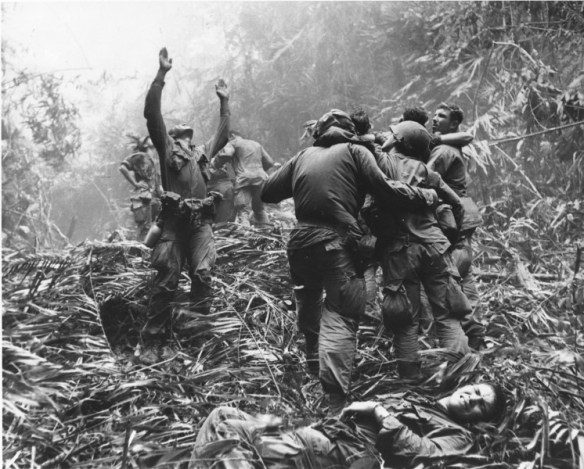
DEU 1968 Jahrestag


Boots on the ground

?????????????????????????????????????????????????????????????????????????????????????????????????????????????????????????????????????????????????????????????????????????????????????????????????????????????????????????????????????????????????????????????????????????????????????????????????????????????????????????????????????????????????????????????????????????????????????????????????????????????????????????????????

One of the most shop-soiled phrases of the past several weeks and months is “boots on the ground” (or the lack of them).  You can find historical and contemporary discussions from the US military here and here, but the most recent – and recurrent – instance is President Obama’s insistence that, whatever else the United States will do in Iraq and Syria to counter the aggressive advance of the Islamic State, it won’t involve “boots on the ground”.  The reasons are not difficult to discern, and they involve the substitution of “boots on the ground” for “bodies in bags” (on which, see the American Friends Service Committee exhibition, “Eyes Wide Open“: also the Burning Man version here).

But they also involve an extraordinary (but, again, by no means unprecedented) restriction of what constitutes armed combat.  Mark Landler has a very good discussion of this in the New York Times:

American advisers could be sent to the front lines alongside Iraqi and Kurdish troops, and could even call in airstrikes, without directly engaging the enemy. It is a definition rejected by virtually every military expert.

“Calling in airstrikes is just as much combat as firing a rifle at someone,” said John A. Nagl, a retired lieutenant colonel who served in a tank battalion in Iraq and helped write the Army’s counterinsurgency field manual. “What that guy really is doing is painting a house with a laser designator that results in that house being vaporized.”

The American advisers are armed, and if they are shot at by the enemy, they are authorized to return fire. In a close combat advisory role in a city, experts said, the American troops would tell Iraqi commanders which house to hit, how much ammunition to use in an assault, and how to organize medical evacuation for their troops…

“If you’re trying to deploy a military effect on the ground, you’re in combat,” said Paul D. Eaton, a retired Army general who helped train Iraqi troops and is now an adviser to the National Security Network. “You may not be in direct combat, but it’s a combat mission.”

There are also not very muffled  echoes of Vietnam and the US Military Assistance Command.

This is very much on my mind, because I’ve been busy finishing the long-form version of “The Natures of War”, and in the process radically re-working my discussion of the ground war in Vietnam.  This has given me a new insight into what “boots on the ground” means – with an emphasis on the “ground”, or what my good friend Gastón Gordillo prefers to call terrain – and here is an extract (I’ll post the full draft next week, which will include the references and the footnotes).

***

GI Vietnam LIFE

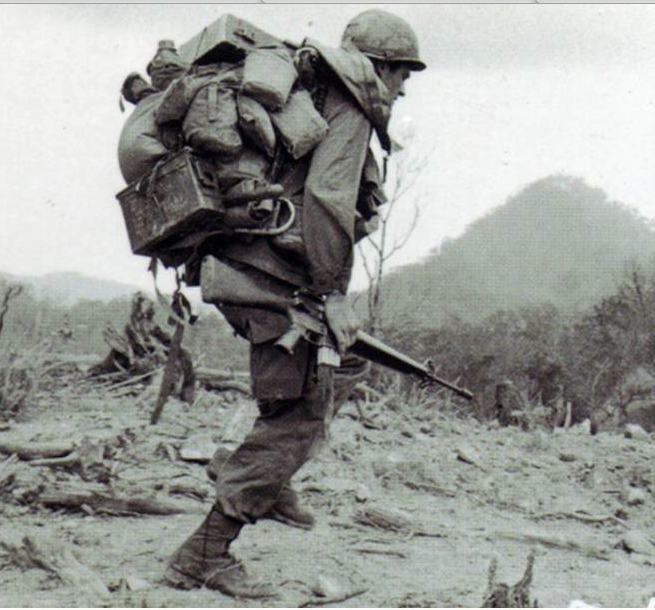
Then as now the scale of support involved in combat operations meant that many soldiers never left their bases – in Vietnam the ratio of support to combat troops was roughly 10 to 1 [this is the ratio cited by most historians, but the US Army prefers a much lower “Tooth to Tail” ratio: see here] – but those that did had to carry their world on their backs. On a long patrol they might be resupplied by helicopter, but that could never be guaranteed. In addition to a rifle, most men carried at least 60 pounds: multiple quart canteens of water (at least two and sometimes as many as eight: ‘There is never, ever enough water’) and canned C-rations; ammunition and grenades; and a poncho or half-shelter which doubled as a stretcher or a shroud if they were hit. In addition, radio operators carried a PRC-25 field radio, which weighed 23 pounds, and spare batteries, while mortar crews lugged a firing tube and base plate weighing around 40 pounds, and their bearers carried four mortar rounds (which added 32 pounds of dead weight to their load). This mattered because, as one newly arrived lieutenant soon realised, ‘the jungle would exact a toll for every ounce I carried.’ ‘We dumped everything we didn’t absolutely need,’ one GI explained, but still the rucksack frame and webbing rubbed and cut so ‘our waists and shoulders were covered with “saddle sores” that were kept raw by sweat and dirt and cartridge belts and packs.’ Everyone, he said ‘was in a constant world of hurt.’

Combat Infantryman Vietnam

It was just as tough on the legs. Tim O’Brien translates the equipment list – ‘the things they carried’ – into its impact on the lower body:

‘We walked along. Forward with the left leg, plant the foot, lock the knee, arch the ankle. Push the leg into the paddy, stiffen the spine. Let the war rest there atop the left leg: the rucksack, the radio, the hand grenades, the magazines of golden ammo, the rifle, the steel helmet, the jingling dog-tags, the body’s own fat and water and meat, the whole contingent of warring artefacts and flesh. Let it all perch there, rocking on top of the left leg, fastened and tied and anchored by latches and zippers and snaps and nylon cord. Packhorse for the soul.’

Soldier in paddy field An Thi S Vietnam- Jan 1966Skinner

O’Brien was describing a patrol moving through rice paddies, and these imposed their own burdens on soldiers. Out in the open they were vulnerable to attack or sniper fire, and they avoided the dikes which were often mined or booby-trapped.

‘Instead, we struggled through the sucking mud of the paddies. The banks of the streams were especially treacherous. Each step through the soft muck was torture, and every few steps a man would sink in mud up to his crotch. The gnarled roots of the mangroves could twist an ankle or a knee in a second. The putrid stench of rotting vegetation permeated the stifling humid air, and canteens were emptied quickly.’

‘The water in these pestilential miasmas was stagnant, muddy and fetid,’ explained one lieutenant, ‘with all kinds of flotsam, including mosquito larvae and water buffalo faeces applied as fertiliser’. Beneath the murky water lurked the menace of punji stakes made of split bamboo that could pierce a boot and put a soldier out of action; worse, the wound could become infected from the dung-laden water, and air evacuation was often imperative. Then there were the leeches: ‘When we reached the other side of the rice paddies,’ the lieutenant continued, ‘my men dropped their pants and burned the already engorged leeches off their ankles and penises with lit cigarettes; even the non-smokers carried cigarettes for this purpose.’

photo5

In the Central Highlands soldiers had to fight their way through triple-canopied jungle and up thickly forested mountain sides. Like their comrades in the paddy-fields, they learned to avoid the beaten track. They rarely used trails, which were notorious for mines and booby-traps that, as Philip Caputo explained, turned ‘an infantryman’s world upside down’:

‘The foot soldier has a special feeling for the ground. He walks on it, fights on it, sleeps and eats on it; the ground shelters him under fire; he digs his home in it. But mines and booby traps transform that friendly, familiar earth into a thing of menace, a thing to be feared as much as machine guns or mortar shells. The infantryman knows that any moment the ground he is walking on can erupt and kill him; kill him if he’s lucky. If he’s unlucky, he will be turned into a blind, deaf, emasculated, legless shell.’

He might have been talking about the cyborg natures of the Western Front or the Western Desert, but in Vietnam’s guerrilla war there were few fixed minefields beyond the Demilitarized Zone. Base perimeters were systematically mined by the US and its allies, and the North Vietnamese often mined clearings that could be used as helicopter landing zones. But it was the transience of mining by the North Vietnamese Army and the Viet Cong – its improvisational, opportunistic nature – that was so threatening. ‘The NVA were so good at moving mines around that they would put the minefield out at dusk along a patrol route and take it in before dawn’ so that ‘you could clear one area and there would be mines there the next night.’ Booby-traps could be anywhere: ‘They hang from trees. They nestle in shrubbery. They lie under the sand.’ Denied the trails, soldiers had to hack a path with their machetes or Ka-Bars or more often, to muffle the sound of their painfully slow progress, they threaded their way between the trees and the choking vines:

‘Up ridges, down ridges, over ridges, wading through rocky streams, hacking at jungle growth, breathing in and hopefully breathing out some of the constant bugs that continuously swarmed around our heads, watching our skin as it quickly deteriorated from the numerous bites, scrapes, cuts, tears, thorns, and other abuses of the environment that attempted to beat our bodies into submission. The clothes and boots forming the inanimate part of our body protection were quickly drenched with sweat, dirt, mashed bugs, and the mixed blood and juices from both the bugs’ bodies and our own.’

In the Highlands they encountered other cyborg natures. Devastating Arc Light strikes by B-52 bombers produced a surreal, cratered moonscape whose blasted terrain was even more difficult to negotiate than pristine rainforest:

‘The jungle had been torn to smithereens by the big bombs. Trees had been ripped from the ground forming an abatis of twisted, interattached splintered branches, vines, and roots that was more impenetrable than the worst the natural jungle had to offer.’

US Soldier Wearing Helmet with Message

The craters would be ‘littered with huge pieces of bomb shrapnel’ and unexploded bombs that had not burrowed into the soft earth: their ‘green shapes that protrude menacingly from the red dirt add yet another facet of terror for us to deal with.’ It was impossible to avoid the deep craters: ‘They are too congested; the muddy holes sap our strength as we slide down into their depths, wade through the stagnant green rainwater and then climb fifteen feet up to the slope to the opposite rim.’ If the bombs had found their target then the patrols faced more than a physical barrier, because the bomb field would also contain decomposed corpses, animal and human, and body parts. Delezen continued:

‘[T]he heavy smell of death is around us and is growing stronger as we move. Soon I discover that the source of the overpowering stench is a shallow bomb crater positioned along our path; the crater was probably gouged into the earth by a five hundred pound bomb. There is a naked leg sticking out of the dark hole; on the foot is a rubber sandal made from a discarded truck tire. It looks as though the crater is moving … the movement is rats. In the dusk it looks like a blackish gray carpet covering the mangled, bloated bodies that the grunts have thrown into the hole. The bottom of the hole is full of large maggots that create the illusion that the crater is shimmering. I determine that there are at least twelve enemy bodies that lay intertwined in the crater. The huge rats are snapping at each other as they feed on the dead soldiers; this has to be the entrance to hell itself. The smell is overwhelming; it is so strong that I can taste it.’

B-52s and long-range artillery were not the only means of ravaging the land. It was also impregnated with the residues of napalm and other chemical toxins, and long after an air strike these could still irritate your eyes, make you gag and burn your skin. They also turned any vertical movement into a dangerous glissade:

‘[T]he mountain that we are now climbing has been attacked by countless sorties of Phantom jets delivering “snake and nape.” The splintered, tortured tree trunks are black and charred from the napalm and the oily gel that did not ignite has mixed with the red mud, turning it into a texture similar to axle grease. My pack and ammo belt are waterlogged and have picked up extra weight from the greasy mud.

‘The mud has clogged the lug soles of our jungle boots and it is difficult not to slip; we know that if we lose our footing we will end up at the bottom of the mountain. I use my weapon to climb, digging the stock into the mud as a brace while I grab the next bomb-blasted tree trunk. The oily napalm has lubricated the entire mountain, it has soaked into the burned trees; we have to grasp each splintered trunk in a hug. The black M-16 no longer resembles a rifle; it is encased within a shapeless red blob of sticky mud. After a while, I have to use my Ka-Bar to climb with. I stab the earth ahead and then pull myself up; the deep, soft mud soon renders this effort useless.’

***

 There’s much, much more, as the full post will show, but I’ve said enough to convey some of the ways in which “boots on the ground” are involved in my developing interest in corpography and war.  This extract also raises two other issues that I can’t develop in any detail in the essay.

red-plateau-memoir-north-vietnamese-soldier-john-edmund-delezen-paperback-cover-artThe first turns on the parallel experience of the National Liberation Front [the ‘Viet Cong”] and the North Vietnamese Army.  The Americans assumed that their enemies were creatures of the jungle (in more ways than one), but many of them were recruited from towns and cities and had little or no experience of the rainforest and no idea of the privations that jungle warfare would impose on them.  This is made clear in Truon Nhu Tang‘s A Viet Cong memoir, which is widely cited, but the best and most directly relevant account that I know is the truly remarkable collaboration between John Edmund Delezen and Nguyen Van Tuan, Red Plateau, which describes a North Vietnamese battalion ‘comprised of boys from towns and farms and most knew very little about the forest-enshrouded mountains’.  I cite Delezen in the extract above – his Eye of the tiger is one of the very best personal accounts I’ve read – but his collaboration with his erstwhile enemy is just as compelling.  Here is Nguyen Van Tuan’s inventory of the things carried by the NVA:

‘As dark nears we once again move onto the path and begin our trek south, I curse my pack; if not for this burden I would move effortlessly. Each pack contains an extra uniform and one pair of pajamas, a rain-sheet, a ground cloth, a shovel, ammunition, grenades, explosives, a small medical kit, B-40 rockets for the RPG crews or boxes of machine gun ammunition for the  crews and toilet articles which are for the most part extremely minimal. In addition to this loaded pack, we each carry our individual weapon with ammunition vest, knife and canteen of water. The heavy weapon crews and mortar teams suffer worse…much worse, the load they carry is unimaginable….

‘When we pause to fill canteens from a stream, we try to rearrange the loads we are burdened with; it is a futile task, there is no relief, each arrangement brings its own torment. The loads we bear begin to increase as the supplies carried by those who fall prey to fever and those who carry the litters must be redistributed; our packs remain things that we continue to curse.’

The second issue is the genealogy of “the things they carried”, and Tom Atkinson (really; not quite “Tommy Atkins” but close enough) has provided an extremely interesting visual reconstruction of what he calls “Soldiers’ Inventories” here (you can also find more here and here).  His 13 images extend from the Battle of Hastings (1066) through the Somme in 1916 and the Battle of Arnhem in 1944 to Helmand in 2014 (shown below), though since this is an inventory of British soldiers there’s no trace of Vietnam.  (Interestingly, though, a common complaint from US soldiers and especially Marines in Vietnam was that much of their equipment was outdated and derived from the Second World War – including, on occasion, their canned rations).

Helmand_2996025b

Here’s the key for a close-support sapper, Royal Engineers, Helmland Province, 2014:

1 Silva compass – used for basic navigation and fire control orders
2 Karabiner – used for securing kit and equipment to the vehicles
3 Osprey body armour shoulder and neck attachments – the armour increases protection but can be very restrictive so these parts are detachable depending on the threat assessment
4 Osprey body armour; can be fitted with pouches to carry everything from ammunition, water, first aid kits and grenade or with plates and protective attachments (as shown)
5 Notebook
6 Warm weather hat
7 Spare clothing including underwear trousers, UBAS (Under body Armour Shirt) and normal shirt
8 Dog tags
9 A desert issued belt
10 Beret – used for repatriation ceremonies, vigils and large parades
11 Shemagh – to soak up sweat and also a dust guard
12 Gloves
13 Sandals – issued kit, as soldiers may need to run for cover even while showering
14 Boots
15 Multi tool
16 Washkit
17 GSR – general service respirator
18 A housewife – a basic sewing kit; a soldier has to repair his own rips and tears on the ground
19 Socks, scarf, wristwatch
20 Camel pack – drinking water pack
21 Cooker and mug and tea making kit
22 Rations – quantity will depend on the task but soldiers normally carry about 24 hours worth
23 First aid kit including the (black) tourniquet and (grey) first field dressing
24 Ballistic protection – used to protect the groin from IED blast
25 Knee pads – offer protection to a soldier whilst “taking a knee” from the heat of the ground or rocky areas
26 Sleeping bag with an inflatable roll mat
27 Camera, cigarettes
28 Radio – BOWMAN Radio system (HF, VHF or even SAT Comms), daysack could also be fitted with ECM (Electronic counter measures)
29 Personal role radio – used for line of sight communications within a small patrol
30 Magazine
31 Envelopes
32 Mine extraction kit fitted with a mine prodder, instruction and mine marking kit
33 Weapon cleaning kit
34 Holster
35 Pistol – used as a second weapon system and in confined spaces or where a “long” weapon is unsuitable. Sig and Glock have mostly replaced the Browning 9mm calibre
36 Bar mine – anti-tank landmine
37 Head torch – can be fitted with coloured lenses for more tactical situations
38 Bayonet and bayonet scabbard
39 SA80 A2 fitted with a desert hand guard, upgraded flash eliminator and bipod, all issued for Afghanistan and a SUSAT sight system. It is 5.56 calibre and is here issued with 6 magazines which can hold 30 rounds each
40 Ballistic eye protection – normally goggles or sunglasses
41 Mk 6 Helmet fitted with Helmet mounted night vision systems
42 iPad – personal effect for down time
43 Poncho

I’ll leave the least word to Karl Marlantes, whose splendid Vietnam novel Matterhorn I’ve recommended before.  This comes from his What it is like to go to war (2011), and in so many ways returns us to where I came in:

I am not saying that the infantry today has it easy. Certainly the communications with home have changed, but the field conditions, such as filth, cold, heat, fatigue, and lack of sleep, have not changed since the infantry was using rocks. However, the trend is clear. Robots are already being deployed for fighting in cities. And soon they will be able to be controlled from Nevada.

Peace in our time

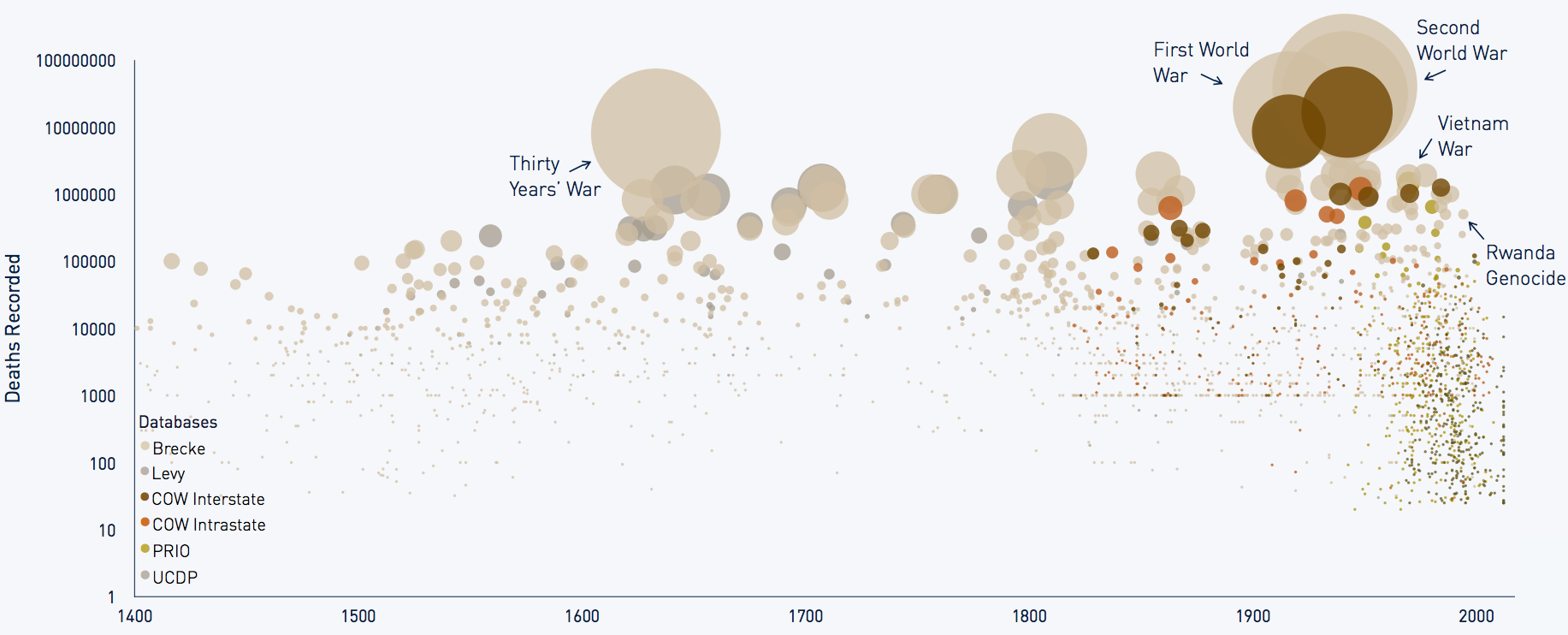
I’ve talked about charting armed conflict around the world before.  Max Rosen has a series of data visualisations – ‘Our World in Data‘ – including several on war and peace.  They include this one, drawn from multiple sources and collated (and designed) by the Hague Centre for Strategic Studies, showing global war deaths – the size of the bubble refers to the proportion of the world population killed:

ourworldindata_global-war-deaths-1400-today-size-of-the-bubble-shows-percentage-of-world-population-killed-–-the-hague-centre-for-strategic-studies0

There are of course all sorts of problems in this sort of exercise – calculating ‘war deaths’ is a political and intellectual minefield of its own – but you can find the sources used for the graphic here (click on the button on the right).

You can also download the Hague Centre’s graphics in a single pdf, ‘Peace and Conflict across time’, here (again, click on the button on the right): the display arranges the graphics into two sets – ‘Decline of Conflict’ and ‘Drivers of Peace’.  No doubt Stephen Pinker would approve.

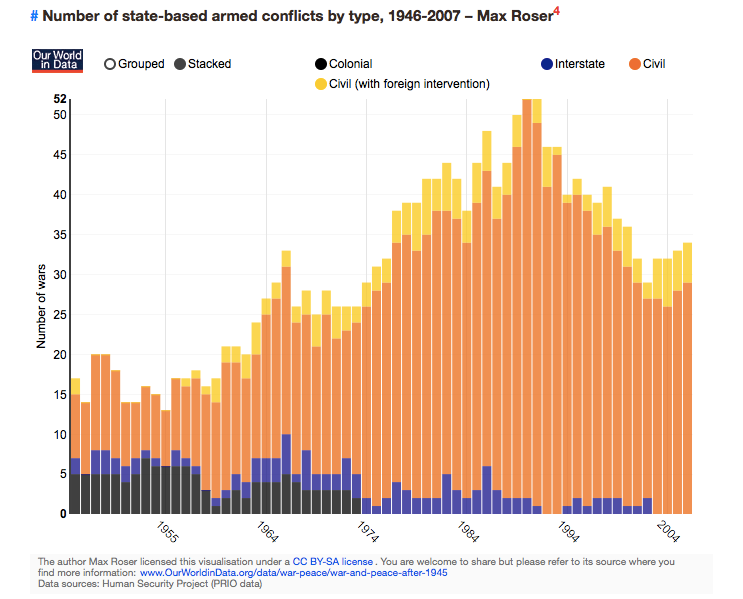
Max provides a more detailed analysis of conflicts post-1945 here, including this image (which extends only to 2004), and which is precisely the sort of thing that has licensed the debates over the decline of inter-state wars and the rise of (often transnational) ‘new wars’:

State-based armed conflicts

Before cheering the demise of inter-state war, however, we need to reflect on the multiple ways in which states and their advanced militaries are able to inflict violence by stealth (including cyber-attack), by proxy and by other other means (including economic warfare)…

Style wars

One of these days I’ll set out the advice I give to students about writing essays – and when I do I’ll also include what I wish published authors would avoid too (me included) – but in the meantime you might be interested in these trenchant words of advice:

Keep the language crisp and pungent; prefer the forthright to the pompous and ornate.
Do not stray from the subject; omit the extraneous, no matter how brilliant it may seem or even be.
Favor the active voice and shun streams of polysyllables and prepositional phrases.
Keep sentences and paragraphs short, and vary the structure of both.
Be frugal in the use of adjectives and adverbs; let nouns and verbs show their own power.

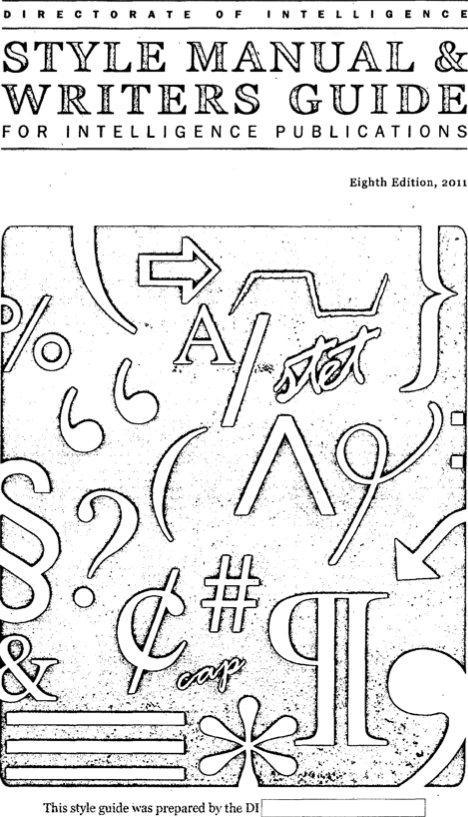
They are taken from the CIA’s detailed Style Manual & Writers Guide for Intelligence Publications issued in 2011; you can find Michael Silverberg‘s commentary at Quartz here.

CIA Style Guide

What particularly caught my eye was this admonition:

Do not uppercase the w in Korean war, which was “undeclared”; the same logic applies to Vietnam war and Falklands war, and a similar convention (if not logic) to the Iran-Iraq war.

Shadow-Warfare_FINALHidden in plain sight here is the remarkable fact that the United States has not formally declared war since 1941.  You may think that not much depends on a formal declaration, and you would be right, except that this reluctance says much about executive authority and, crucially, what Larry Hancock and Stuart Wexler call, in their excellent Shadow Warfare (Counterpoint, 2014), ‘the history of America’s undeclared wars’.

In a sense, their book provides the back-story to Jeremy Scahill‘s Dirty Wars:

Contrary to their contemporary image, deniable covert operations are not something new. Such activities have been ordered by every president and every administration since World War II. Clandestine operations have often relied on surrogates, with American personnel involved only at a distance, insulated by layers of deniability.

Shadow Warfare traces the evolution of these covert operations, detailing the tactics and tools used from the Truman era through those of the contemporary Obama administration. It also explores the personalities and careers of many of the most noted shadow warriors of the past sixty years, tracing the decades-long relationship between the CIA and the military.

Shadow Warfare offers a balanced, non-polemic exploration of American concealed warfare, detailing its patterns, consequences, and collateral damage, and presenting its successes as well as its failures. Hancock and Wexler explore why every president, from Franklin Roosevelt on, felt compelled to turn to secret, deniable military action. It also delves into the political dynamic of the president’s relationship with Congress, and the fact that despite decades of warfare, Congress has chosen not to exercise its responsibility to declare a single state of war—even for extended and highly visible combat.

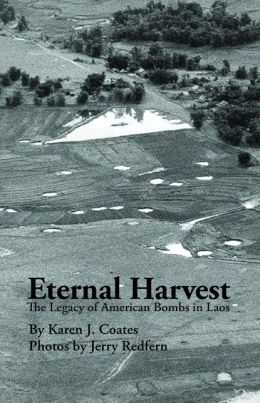
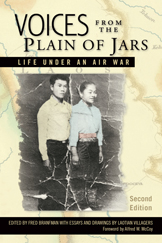
Eternal Harvest

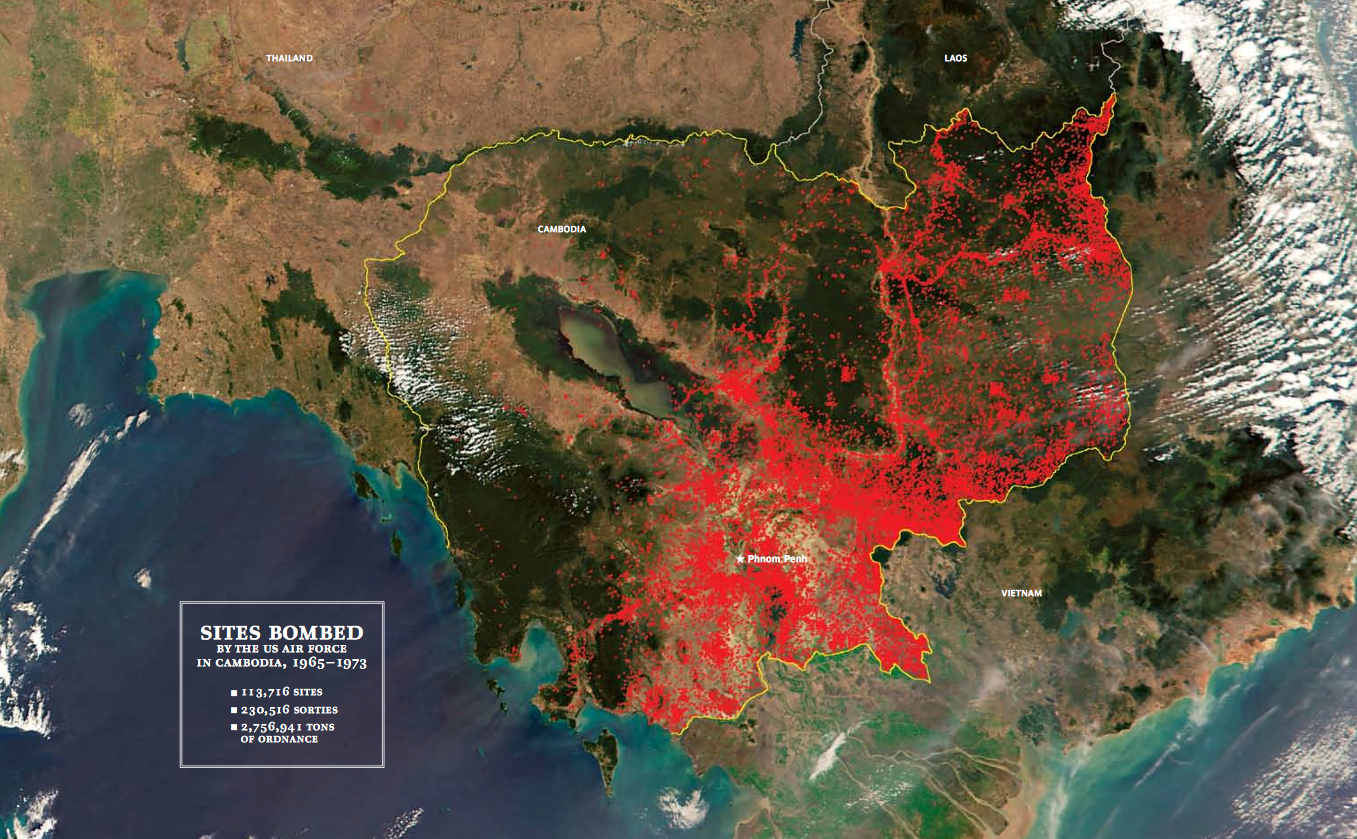
Many readers will know the remarkable work that’s been done to reconstruct the US bombing of Cambodia during the ‘Vietnam’ War: I’m thinking of Taylor Owen and Ben Kiernan‘s ‘Bombs over Cambodia’ which appeared in The Walrus in 2006: available here and here.

The still-incomplete database (it has several “dark” periods) reveals that from October 4, 1965, to August 15, 1973, the United States dropped far more ordnance on Cambodia than was previously believed: 2,756,941 tons’ worth, dropped in 230,516 sorties on 113,716 sites. Just over 10 percent of this bombing was indiscriminate, with 3,580 of the sites listed as having “unknown” targets and another 8,238 sites having no target listed at all. The database also shows that the bombing began four years earlier than is widely believed—not under Nixon, but under Lyndon Johnson. The impact of this bombing, the subject of much debate for the past three decades, is now clearer than ever. Civilian casualties in Cambodia drove an enraged populace into the arms of an insurgency that had enjoyed relatively little support until the bombing began, setting in motion the expansion of the Vietnam War deeper into Cambodia, a coup d’état in 1970, the rapid rise of the Khmer Rouge, and ultimately the Cambodian genocide.

US bombing of Cambodia

The contemporary significance of these air strikes includes, of course, what Rob Nixon calls the ‘slow violence’ of the unexploded ordnance that still haunts the Cambodian landscape today.  But they also have implications for recent bombing campaigns in Afghanistan, as Ben and Taylor discuss in ‘Roots of U.S. Troubles in Afghanistan: Civilian Bombing Casualties and the Cambodian Precedent’  here, and for today’s cross-border (though rather less covert) drone strikes in Pakistan, as Henry Grabar argued last year in The Atlantic here.

Eternal HarvestThe conflict in Vietnam spilled across into Laos too, and a new book by Karen Coates (with photographs by Jerry Redfern) documents the effects of this even more shocking campaign in depth and detail: Eternal Harvest: the legacy of American bombs in Laos.  The short animation below, just 98 seconds of your time, prepared by Jerry for Mother Jones, shows each bombing run:

The nearly 600,000 bombing runs delivered a staggering amount of explosives: The equivalent of a planeload of bombs every eight minutes for nine years, or a ton of bombs for every person in the country—more than what American planes unloaded on Germany and Japan combined during World War II. Laos remains, per capita, the most heavily bombed country on earth.

There’s a much longer version at vimeo here, which comes with this rider:

This video shows the US Air Force bombing campaign in Laos, from 1965 to 1973. The data comes from the website of the National Regulatory Authority of Lao PDR (NRA), which oversees UXO clearance in that country. They received the data from the US Embassy in Vientiane in 2000, from records originally created by the Department of Defense and stored at the National Archives.

The NRA data sets include information on the number and types of aircraft flown, types of bombs dropped, target conditions and after-action reports. For this graphic, only the dates, latitude and longitude, and the number of bombs dropped per mission are used.

The US Air Force began bombing Laos in June 1964. Many branches of the US, Thai, Lao, South Vietnamese and other forces also conducted aerial missions. But this graphic reflects only bombing missions noted in the NRA data, which show US Air Force missions beginning on October 1, 1965.

There’s much more information, plus photographs from the book, at the website that accompanies the book.

COVER MAKER 5.5X8.25.inddIf you want a quick overview of the geography of bombing Laos, Peter Larson also has a useful survey which includes some helpful maps here; he’s constructed his own animation here.

‘Animation’ is hardly the verb for such appalling carnage, I realise; the classic English-language account giving voices to the survivors (and victims) is Fred Branfman‘s brilliant Voices from the Plain of Jars: life under an air war, first published in 1972 and republished last year with an introduction by Alfred McCoy and available as an e-book.