The blue sky of Hiroshima

1946_08_31_001_CV1__xx_KA-880-1

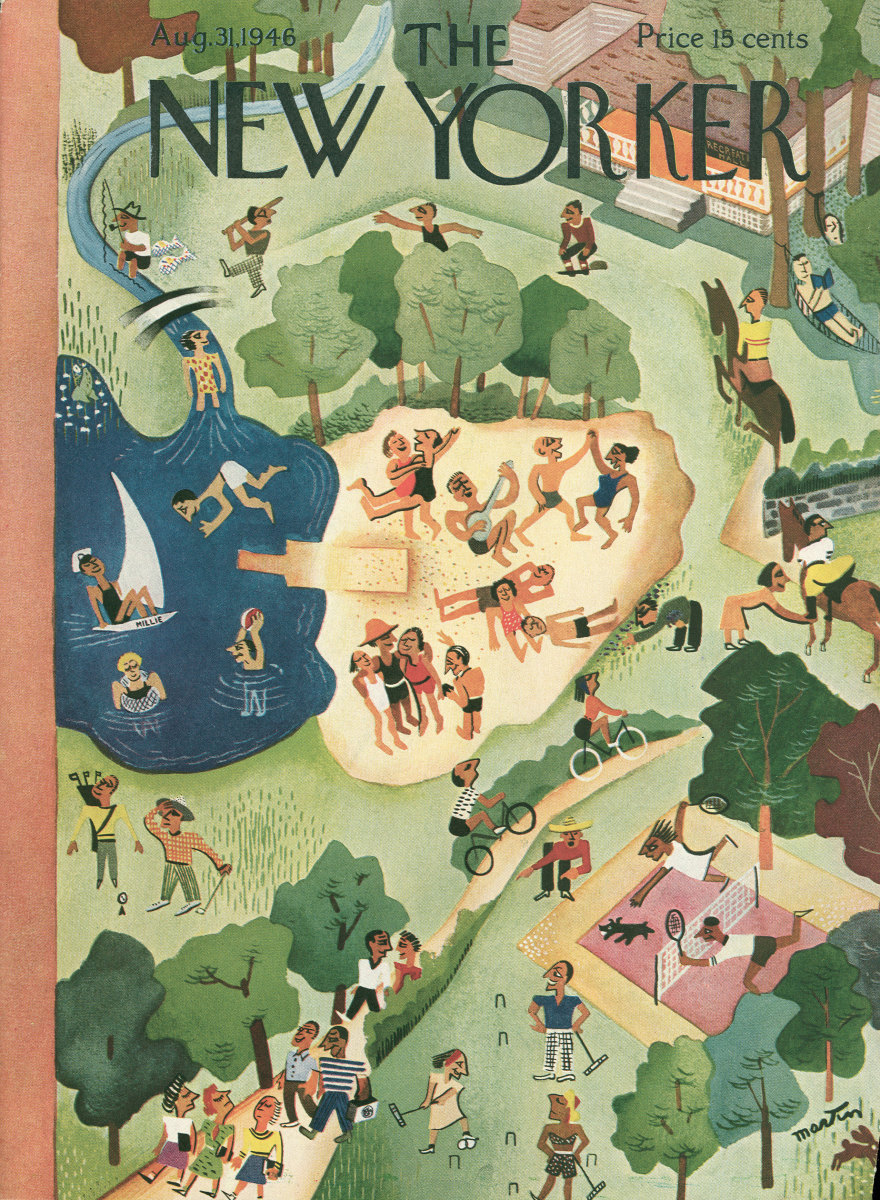
It’s the bleakest of anniversaries – the bombing of Hiroshima 70 years ago today – and there is no shortage of commentary (see, for example, here and here).  John Hersey‘s book-length essay on Hiroshima, which filled most of  the 31 August 1946 issue of the New Yorker and has been republished online here.

At exactly fifteen minutes past eight in the morning, on August 6, 1945, Japanese time, at the moment when the atomic bomb flashed above Hiroshima, Miss Toshiko Sasaki, a clerk in the personnel department of the East Asia Tin Works, had just sat down at her place in the plant office and was turning her head to speak to the girl at the next desk. At that same moment, Dr. Masakazu Fujii was settling down cross-legged to read the Osaka Asahi on the porch of his private hospital, overhanging one of the seven deltaic rivers which divide Hiroshima; Mrs. Hatsuyo Nakamura, a tailor’s widow, stood by the window of her kitchen, watching a neighbor tearing down his house because it lay in the path of an air-raid-defense fire lane; Father Wilhelm Kleinsorge, a German priest of the Society of Jesus, reclined in his underwear on a cot on the top floor of his order’s three-story mission house, reading a Jesuit magazine, Stimmen der Zeit; Dr. Terufumi Sasaki, a young member of the surgical staff of the city’s large, modern Red Cross Hospital, walked along one of the hospital corridors with a blood specimen for a Wassermann test in his hand; and the Reverend Mr. Kiyoshi Tanimoto, pastor of the Hiroshima Methodist Church, paused at the door of a rich man’s house in Koi, the city’s western suburb, and prepared to unload a handcart full of things he had evacuated from town in fear of the massive B-29 raid which everyone expected Hiroshima to suffer. A hundred thousand people were killed by the atomic bomb, and these six were among the survivors. They still wonder why they lived when so many others died. Each of them counts many small items of chance or volition—a step taken in time, a decision to go indoors, catching one streetcar instead of the next—that spared him. And now each knows that in the act of survival he lived a dozen lives and saw more death than he ever thought he would see. At the time, none of them knew anything.

It’s worth comparing this with the opening scene of Kamila Shamsie‘s brilliant novel Burnt Shadows which imagines the second atomic bomb dropped on Nagasaki three days later.  Given the map I reproduce below, it’s also worth reading her short essay on the effect of using Google Earth to ‘map’ the bombing here; and since Nagasaki too often disappears from critical view, try Susan Southard‘s recently published Nagasaki: life after nuclear war (Viking/Penguin, 2015) – you can read a long extract here and here.
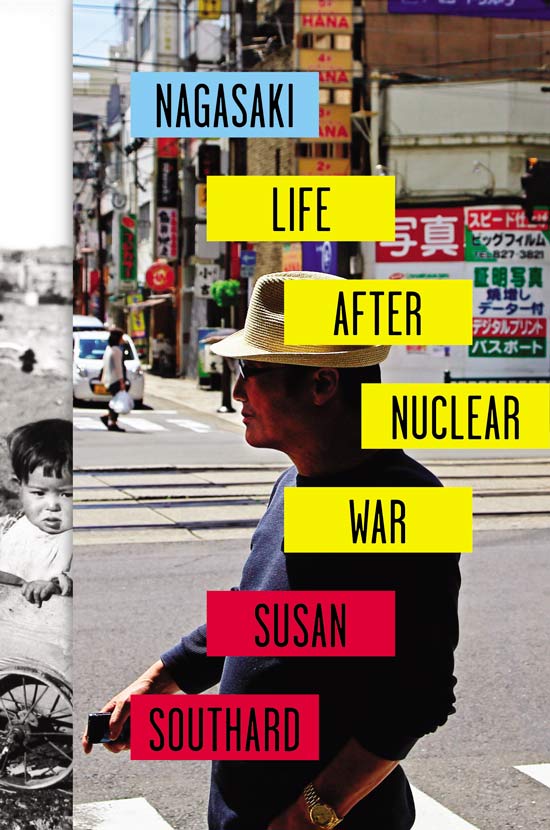
Nagasaki-Cover

For a brave attempt to bring the the two bombings into the same narrative frame, see Paul Ham‘s Hiroshima Nagasaki (2012/2014): there’s a helpful review essay by H. Bruce Franklin here, and The Atlantic has just published an extract, ‘The bureaucrats who singled out Hiroshima for destruction’ here.

Joyce C. Stearns, a scientist representing the Air Force, named the four shortlisted targets in order of preference: Kyoto, Hiroshima, Yokohama, and Kokura. They were all “large urban areas of more than three miles in diameter;” “capable of being effectively damaged by the blast;” and “likely to be unattacked by next August.”… Tokyo had been struck from the list because it was already “rubble,” the minutes noted…

Captain William “Deak” Parsons, associate director of Los Alamos’s Ordnance Division, gave another reason to drop the bomb on a city center: “The human and material destruction would be obvious.” An intact urban area would show off the bomb to great effect. Whether the bomb hit soldiers, ordnance, and munitions factories, while desirable from a publicity point of view, was incidental to this line of thinking—and did not influence the final decision.

(You’ll have to read the extract to see why Kyoto was eventually removed from the list).

hiroshima-nagasaki

For subsequent analysis, a good place to start is Alex Wellerstein‘s Restricted Data: the nuclear secrecy blog, which includes a series of excellent posts on sources and visualizations, on the Manhattan Project and what happened at Los Alamos, and most recently an essay which asks ‘Where there alternatives to the atomic bombings?‘ and gives lots of background to those terrible events.

Among Alex’s visualizations is NUKEMAP, which simulates the dropping of ‘Little Boy’ on other towns and cities.  Here is downtown Vancouver (for a discussion of airbursts, see Alex’s post here).
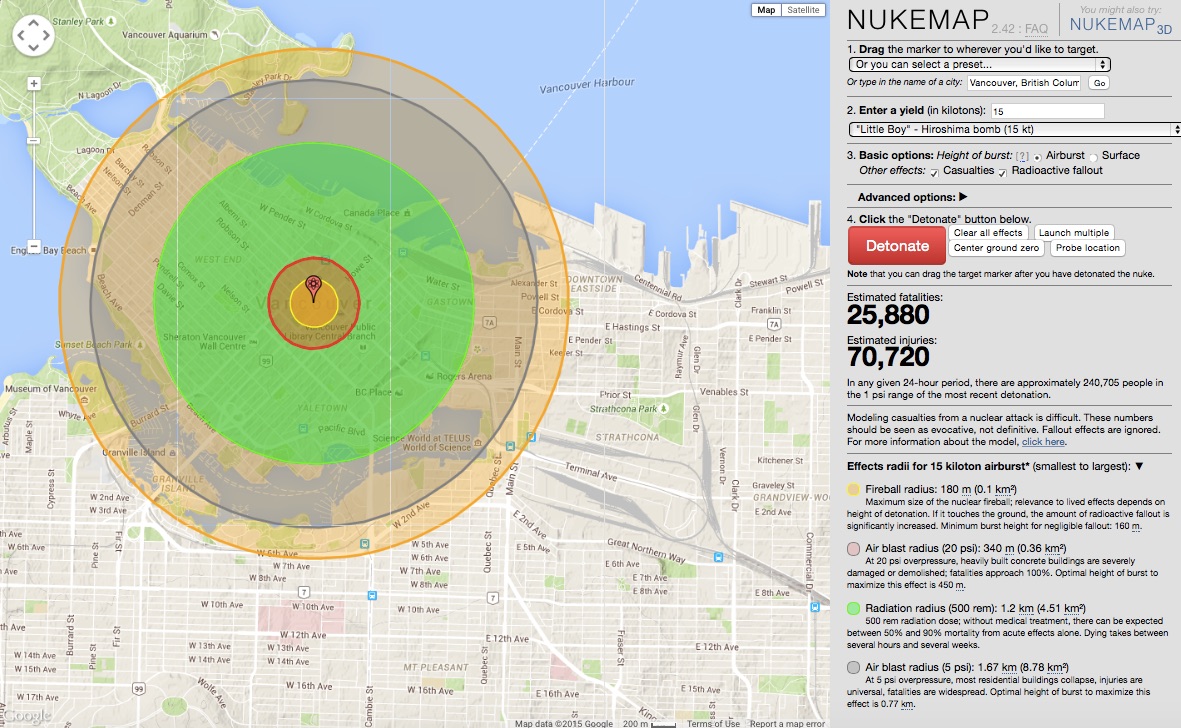
Little Boy VANCOUVER JPEG

Elsewhere, there’s a special issue of Critical Military Studies on the anniversary, and all the articles are open access:

The most modern city in the world: Isamu Noguchi’s cenotaph controversy and Hiroshima’s city of peace: Ran Zwigenberg
Unbearable light/ness of the bombing: normalizing violence and banalizing the horror of the atomic bomb experiences: Yuki Miyamoto
Remembering nukes: collective memories and countering state history: Stefanie Fishel
Contested spaces of ethnicity: zainichi Korean accounts of the atomic bombings: Erik Ropers
Hiroshima and two paradoxes of Japanese nuclear perplexity: Thomas E. Doyle II
Re-imagining Hiroshima in Japan: elin o’Hara slavik
Memory and survival in everyday textures – Ishiuchi Miyako’s Here and Now: Atomic Bomb Artifacts, ひろしま/ Hiroshima 1945/2007: Makeda Best
Nagasaki Re-Imagined: the last shall be first: Kathleen Sullivan

There’s also a special issue of Thesis Eleven, (August 2015: 129 (1)) edited by Brad Evans and Keith Tester in association with the Histories of Violence ‘Disposable Life’ project; articles include:

Susan Neiman, Forgetting Hiroshima, remembering Auschwitz: Tales of two exhibits
Keith Tester, Hiroshima: Remembering and forgetting, everything and nothing
Michael J Shapiro, Hiroshima temporalities
Maja Zehfuss, (Nuclear) war and the memory of Nagasaki: Thinking at the (impossible) limit
Hiro Saito, The A-bomb victims’ plea for cosmopolitan commemoration: Toward reconciliation and world peace
Arne Johan Vetlesen, Post-Hiroshima reflections on extinction
Henry A Giroux, Hiroshima and the responsibility of intellectuals: Crisis, catastrophe, and the neoliberal disimagination machine

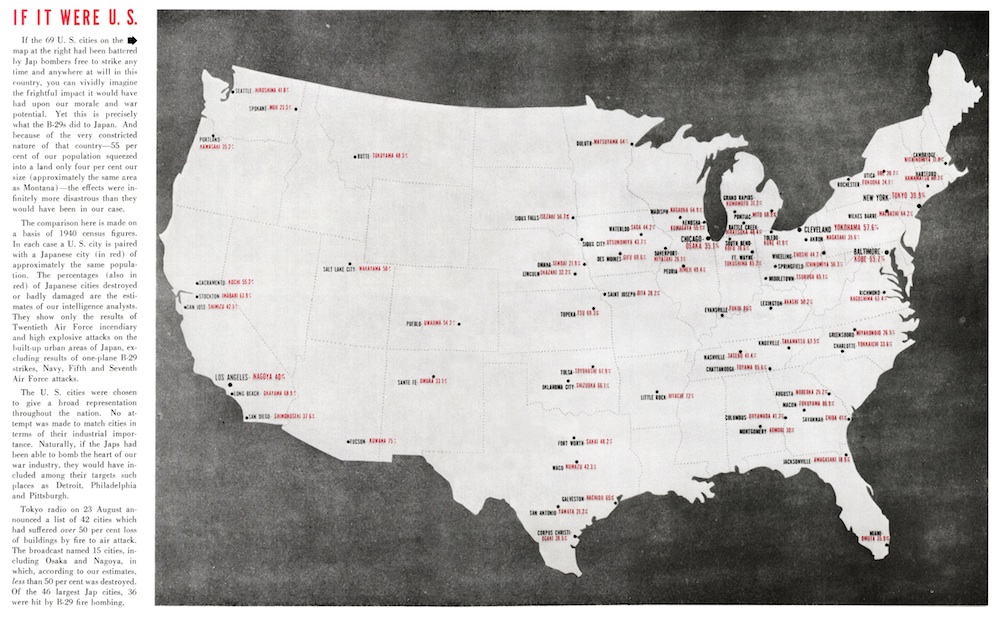
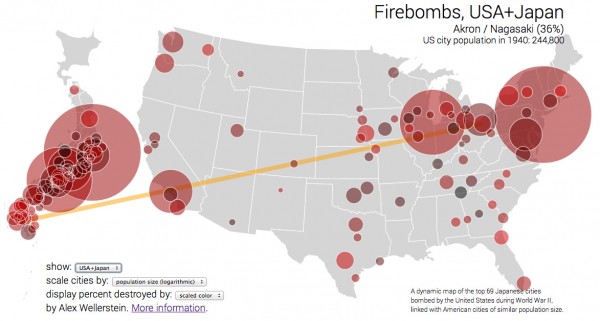
I have just two things to add.  The first is to draw attention to the firebombing of Japanese cities that preceded Hiroshima and Nagasaki (Alex compares them in an interesting commentary here and provides a series of compelling comparative interactives here: I’ve pasted an example below, and provided a short commentary here).
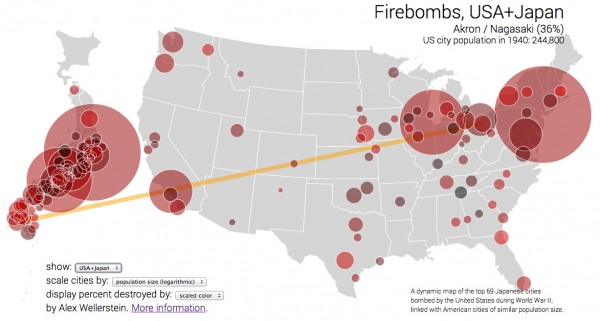
firebombs-usa-interactive-600x321

In fact, as my quotation from Paul Ham reveals, Hiroshima and Nagasaki were targeted precisely because they had been left alone during the previous attacks and would provide effective laboratories to test the effects of nuclear blasts.  On the firebombing campaign, see the painstaking work of Cary Karacas and his colleagues here (my commentaries on the project are here and here; see also their essay on the firebombing of Tokyo and its legacy here); their website includes both a Hiroshima archive and a Nagasaki archive.

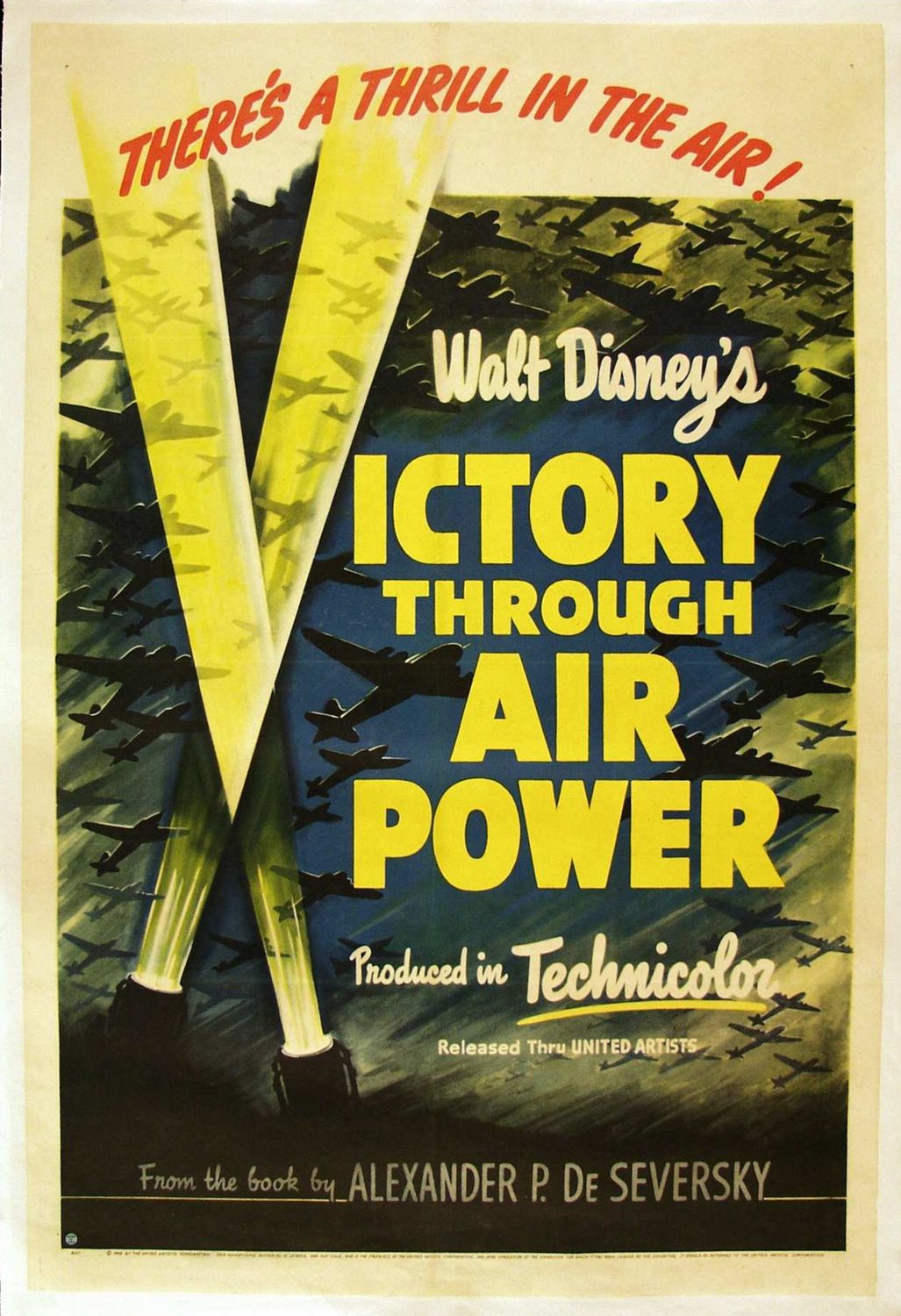
Second, I’ve emphasised the comparative effort to ‘bring the war home’, to imagine the effects of Little Boy and Fat Man on other cities around the world.  There are obvious dangers in such an exercise – is our capacity for empathy so limited than we have to rely on a sort of critical narcissism: ‘imagine if it happened to us‘? – but perhaps the most significant objection is that such cartographic conceits can erase not only the bodies incinerated and maimed (through the very abstraction of cartography) but also the racialization of these unmarked bodies.  In the characteristically thoughtful introduction to his new book, Tense Future: Modernism, Total War, Encyclopedic Form (2015), Paul K. Saint Amour writes about ‘traumatic earliness’ – about the sense of anticipation, foreboding or bukimi that gripped the people of Hiroshima in the months before their collective deaths: that ‘uneasy combination of continued good fortune [escaping the firebombing] and expectation of catastrophe’.  But the ground had already been prepared in the United States, not only scientifically – the endless calculations, calibrations and experiments at Los Alamos – but also culturally.
Victory_through_air_power_xlg

Michael Sherry‘s The rise of American Air Power: the creation of Armageddon (1987) and Paul Williams‘s Race, ethnicity and nuclear war (2011) are indispensable here – and there’s a sharp, contemporary commentary from Arthur Chu here –  but a vivid example is provided by Alex de Seversky‘s Victory through Air Power (1942) and, in particular, its celebration in Walt Disney‘s film version released in 1943.  For Disney, there was not only ‘a thrill in the air’ but an exuberant delight at death and destruction on the Japanese ground.  You can watch the whole thing below (or on YouTube) but to see what I mean start at 1.07 and watch right through the bombing to the anthropomorphism of the American eagle and the Japanese octopus that follows it.  There’s also a short commentary by Henry Giroux here.

Note: My title is taken from this poem by Yukiko Hayashi; if you click on nothing else, please click on this.
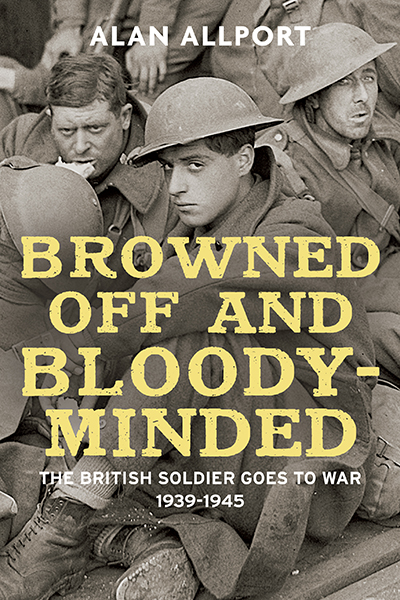
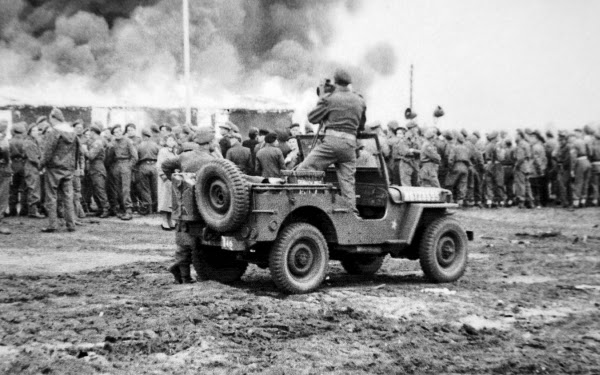
Browned Off and Bloody Minded

Browned Off and Bloody Minded

Not me: a new book by Alan Allport from Yale University Press: Browned-Off and Bloody Minded: the British soldier goes to war 1939-1945:

More than three-and-a-half million men served in the British Army during the Second World War, the vast majority of them civilians who had never expected to become soldiers and had little idea what military life, with all its strange rituals, discomforts, and dangers, was going to be like. Alan Allport’s rich and luminous social history examines the experience of the greatest and most terrible war in history from the perspective of these ordinary, extraordinary men, who were plucked from their peacetime families and workplaces and sent to fight for King and Country. Allport chronicles the huge diversity of their wartime trajectories, tracing how soldiers responded to and were shaped by their years with the British Army, and how that army, however reluctantly, had to accommodate itself to them. Touching on issues of class, sex, crime, trauma, and national identity, through a colorful multitude of fresh individual perspectives, the book provides an enlightening, deeply moving perspective on how a generation of very modern-minded young men responded to the challenges of a brutal and disorienting conflict.

Here is the Contents List:

Introduction

PART ONE: REGULARS

Colonel Lawrence and Colonel Blimp

Gentlemen and Old Sweats

Strange Defeat

PART TWO: CIVVIES

Army of Shopkeepers

Britain Blancoes while Russia Bleeds

Get some service in

PART THREE: CRUSADERS

Into the Blue

Come to Sunny Italy

Fighting Bloody Nature

Second Front

PART FOUR: KILLERS

Teeth and Tail

The Grammar of War

Categories of Courage

PART FIVE: CITIZENS

Them and Us

“What a colossal waste of time war is”

Here is a video preview:

There’s also a perceptive review by Victoria Harris here:

Allport’s latest work is far more than a revolutionary narrative of the (British) war effort. It is a window into the psyche of Britain – male Britain, it has to be said – and into the clashes between the classes, generations and masculinities that comprised it and attempted to defend their particular version of it. The British patrician class’ aversion to training the lower classes as officers, Winston Churchill’s disparaging view of the enlisted generation as weak and effeminate, tired soldiers with 300 days of continuous battle under their belts deserting en masse before D-Day; all of this is a “shock to us today”, we who have been fed a near-exclusive diet of a meritocracy fighting for democracy, backed by a prime minister confident in the toughness of this “greatest generation”. But the muddy, frustrated, sometimes downright incompetent reality Allport presents us with is far more powerful, revealing as it does how a diverse, independent-minded group of men fought, whether in a trench or at a depot or from behind a desk, despite immense fear or through tears, not from a nebulous sense of righteousness but out of a deeply human love for the man beside them.

If there is a criticism to be made of Browned Off and Bloody-Minded, it is how male and front line orientated this story remains…

I’m interested in approaches like Alan’s not least because they intersect with what I’ve tried to do in ‘The Natures of War’ (DOWNLOADS tab).  I’ve read endless first-hand accounts written by those who served on the Western Front in the First World War – and will be reading even more for my current work on casualty evacuation – but there seems to have been less interest in recovering the experiences of soldiers in the Second World War.  Alan’s work has involved excavating the archives in the Imperial War Museum, where I will be heading soon.  This time I will be switching gears to explore the lifeworlds of those who fought in the deserts of North Africa (‘the Blue’ of Part Three above).  Again, I made some headway on this in ‘The Natures of War’  – here too Part Three is of exceptional interest for me – but now I need to know much more about casualty evacuation.

Overlooking Auschwitz

To mark the 70th anniversary of the liberation of Auschwitz-Birkenau concentration camp, there has been widespread interest in a haunting video shot for the BBC using a commercial drone:

For once, the emptiness of the scene – just buildings, fences and railway tracks – is desperately affecting.   It’s surely impossible to watch this without thinking of the millions of people whose lives were so brutally effaced by the murderous regime of the Third Reich.  The only sign of a human presence in the video is a glimpse over the wall of trucks racing by: a reminder that Auschwitz was (and disconcertingly remains) at the centre of a small town (see also my post on Auschwitz here).

There are at least two other films that ought to be seen too.

Night Will Fall 2

The first is a documentary commissioned in 1945 by the Psychological Warfare Film Section of the Supreme Headquarters Allied Expeditionary Force to document the liberation of Bergen-Belsen.  The producer was Sidney Bernstein, for Britain’s Ministry of Information; Alfred Hitchcock was drafted in as a ‘treatment adviser’.  The working title was German Concentration Camps: Factual Survey; it was never shown in its entirety (though Billy Wilder turned the footage into a short, Death Mills), and the Imperial War Museum notes:

From the start of the project, there were a number of problems including the practical difficulties of international co-operation and the realities of post-war shortages. These issues delayed the film long enough to be overtaken by other events including the completion of two other presentations of concentration camp footage to the German people and the evolution of occupation policy, where the authorities no longer considered a one-hour compilation of atrocity material appropriate. The last official action on the film was a screening of an incomplete rough-cut on 29 September 1945, after which the film was shelved, unfinished.

The footage has now been incorporated into a stunning HBO documentary, Night Will Fall, directed by André Singer, who was an Executive Producer for Act of Killing (see my posts here, here and here).

NIGHT-WILL-FALL-POSTER-2

There are all sorts of stories about why the full version was never shown – see the Guardian‘s report here – but the fullest discussions are Kay Gladstone‘s ‘Separate intentions’ in Toby Haggith and Joanna Newman (eds) Holocaust and the moving image (2005) (see also Haggith’s ‘Filming the liberation of Bergen-Belsen here) and her ‘Memory of the Camps: the rescue of an abandoned film’, in Griselda Pollock and Max Silverman (eds) Concentrationary cinema (2011).

The second film returns to the aerial view and to Auschwitz: Harun Farocki’s Images of the world and the Inscription of War.  Shockingly and sadly, Farocki died last summer at the age of 70, and Images is widely regarded as his masterpiece (see Thomas Voltzenlogel‘s wide-ranging and appreciative discussion of ‘Dialectics in images’ here).  The central motif is an image taken from a series of aerial photographs of Auschwitz shot by the Allies between April 1944 and January 1945 (see also here and here).

1389.3 Holocaust E

This image was taken on 4 April 1944 by Lt Charles Barry flying a Mosquito from 60 Photo Reconnaissance Squadron of the South African Air Force.  From the film’s commentary [available in Discourse 5(3) (1993) 78-92]:

American aircraft had taken off in Foggia, Italy, and flown towards targets in Silesia – factories for synthetic petrol and rubber – known as Buna.

On the flightover the IG Farben company factory still under construction, a pilot clicked his camera shutter and took photographs of the Auschwitz concentration camp.

First picture of Auschwitz taken at 7,000 meters altitude.

The pictures taken in April 1944 in Silesia arrived for evaluation in Medmenham, England [the RAF’s Central Intelligence Unit concerned with air photograph interpretation].

The analysts discovered a power station, a carbide factory, a factory under construction for Buna and another for petrol hydrogenation.

They were not under orders to look for the Auschwitz camp, and thus they did not find it.

How close the one is to the other: the industry – the camp.

It was not until 1977 that two employees of the CIA [Dino Brugioni and Robert Poirer: see their detailed report here] went through the archives to find and evaluate the photographs of Auschwitz. It was not until thirty-three years later that the following words were inscribed:

Tower and Commandant’s house and

Registration Building and Headquarters and Administration and

Fence and execution wall and Block 11 and the word “Gas chamber” was inscribed.

tumblr_n6e9sd1riY1rxmv4io1_500

Kaja Silverman adds this gloss [‘What is a camera?’ Discourse 5 (30 (1993) 3-56]:

Not only does the camera here manifestly “apprehend” what the human eye cannot, but the latter seems strikingly handicapped by its historical and institutional placement, as if to suggest that military control attempts to extend beyond behavior, speech, dress,and bodily posture to the very sensory organs themselves. This sequence indicates, in other words,that military discipline and the logic of warfare function to hyperbolize the distance separating look from gaze and to subordinate the former completely to the latter.

These are similar issues that haunt my own discussions of the video feeds from Predators and Reapers over Afghanistan and Iraq.  In another commentary, Christa Blümingler writes:

The vanishing point of Images of The World is the conceptual image of the ‘blind spot’ of the evaluators of aerial footage of the IG Farben industrial plant taken by the Americans in 1944. Commentaries and notes on the photographs show that it was only decades later that the CIA noticed what the Allies hadn’t wanted to see [my emphasis]: that the Auschwitz concentration camp is depicted next to the industrial bombing target.

Bombing of AuschwitzThe claim that the ‘Allies didn’t want to see’ spirals through an important debate about whether the Allies could or should have bombed Auschwitz (see, in addition to the symposium on the right, here and here).  In fact, as Christa observes later,

In … 1944, the allies bombed not Auschwitz, but the IG Farben factory nearby the death camp. Drawing on analyses of these events, how and why the allies didn’t act on their knowledge of the mass destruction of the Jews, Farocki … decodes a host of military images, focusing on two visual dispositives: American pilots in 1944 and CIA agents in 1977 offering two different [readings] of the aerial photographs of Auschwitz.

In this instance, Farocki developed an epistemological field of technological history — measurement and surveillance in a period of rapid automatization. At the end of the film, a blind spot in the photographic act, referring back to the reality of the concentration camp, becomes visible.

The final shots further emphasize details of the American pilots’ aerial photos, which are picked up in the sweep of the film several times, framed and arranged in different ways. At the end of the film, through a permutative movement of cuts, the extreme enlargement of the photographs reminds us once again of their materiality. Farocki shows these images in precisely the spaces where visual thought takes place, and in connection to specific techniques of reproduction and distribution (in albums, archives, institutions). Whenever he used marginal and hard-to-access image materials from specialized archives, he sought to consider these conditions of visibility in his analysis.

Farocki2

What particularly interests me, and the reason I juxtapose these two films, is an interview with Chris Darke in 2003 in which Farocki artfully tracks between the eye-witness and the aerial shot:

Chris Darke: In Images of the World and the Inscription of War there is this repeated phrase: “Beside the real world there is a second world, a world of pure military fiction”. I was very strongly reminded of Colin Powell at the UN Security Council presenting degraded military surveillance images as proof and justification for military action.

HF: Yes, it reminded me so much of the Auschwitz sequences in Images of the World, the way they involved aerial reconnaissance images that you had to be a specialist to read. Who knows what they are telling you? Who knows what happened there? What is so interesting is that the personal witness of two people who had escaped from the camps was so important. It was the way that traditional history was always written. You need an eye-witness, a narrative, otherwise you’ll never believe in it. And it turns out that our imaginative minds are still very old-fashioned. We don’t understand modernist strategies such as those used by the Americans in the first Gulf War. You really want to see these terrible, dirty images of burning streets and wounded people in the same way that psychoanalysis knows that you need dirty thoughts for the imagination, just as for love you need dirty images. The audience is not prepared for this automatically recorded history that more or less happens already, where everything is recorded; so there has to be an old-fashioned drama made out of it.

There are at least two other detailed commentaries on the film that address the question of visuality in depth: Thomas Keenan‘s ‘Light weapons’, in Documents 1/2 (1992) 147-58 and Nora Alter‘s ‘The political im/perceptible in the essay film:  Farocki’s Images of the world and the inscription of war‘, in New German Critique 68 (1996). More generally, I also recommend the special issue of e-flux on Farocki’s work here, including a commentary by Trevor Paglen on Farocki’s ‘operative images’, and David Cox‘s brief commentary here.

Note:  Belinda Gomez writes (in relation to the commentary for Images of the World):

“Fence and execution wall and Block 11 and the word “Gas chamber” was inscribed….” But that’s not quite accurate. Brugioni and Poirier didn’t write that in 1977. The gas chamber didn’t have a sign. That they were able to locate the gas chamber and crematoria was due to their superior technology and they knew what they were looking for. The pilot/photographers in 1944 took photos of the factory and what was taken as a workers camp. To say that they didn’t see Auschwitz because they weren’t told to look for it is more of a hind-sight interpretation.

The trauma hero

wwi-trauma

Following up my earlier post on novels, memoirs and narratives of war, there’s a thoughtful discussion by Roy Scranton at the LA Review of Books on what he calls ‘the myth of the trauma hero’.

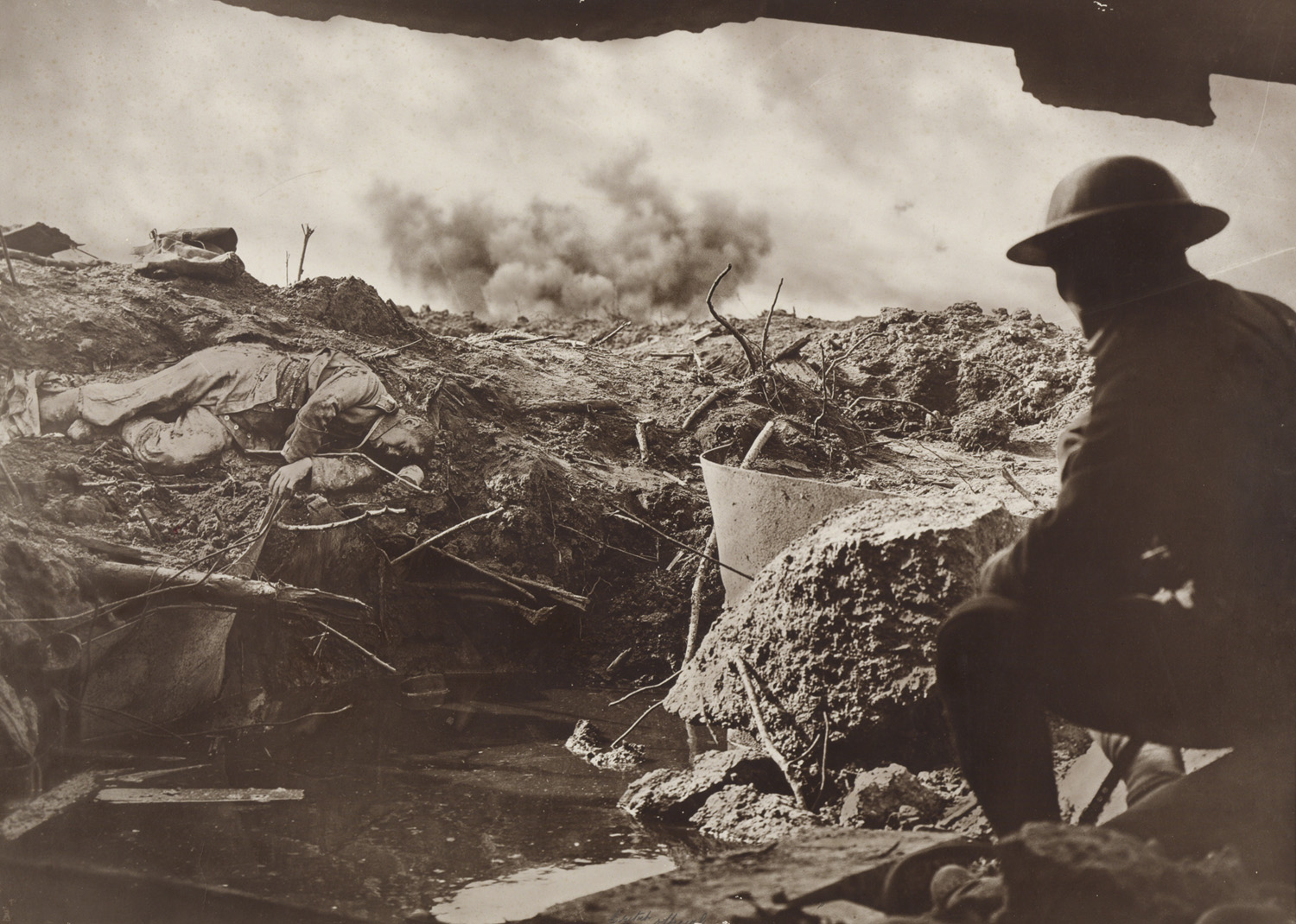
A boy goes to war, his head full of romantic visions of glory, courage, and sacrifice, his heart yearning to achieve heroic deeds, but on the field of battle he finds only death and horror. He sees, suffers, and causes brutal and brutalizing violence. Such violence wounds the soldier’s very soul.

After the war the boy, now a veteran and a man, returns to the world of peace haunted by his experience, wracked by the central compulsion of trauma and atrocity: the struggle between the need to bear witness to his shattering encounter with violence, and the compulsion to repress it. The veteran tries to make sense of his memory but finds it all but impossible. Most people don’t want to hear the awful truths that war has taught him, the political powers that be want to cover up the shocking reality of war, and anybody who wasn’t there simply can’t understand what it was like.

The truth of war, the veteran comes to learn, is a truth beyond words, a truth that can only be known by having been there, an unspeakable truth he must bear for society.

This is probably the place to say that Roy served in the US Army in Iraq 2002-2006, studied at the New School for Social Research, and in 2010 embarked on a doctorate in English at Princeton – although, as you will soon see, this runs the very real risk of claiming that ‘he knows what he writes’ by virtue of these experiences.

Roy traces the myth of the trauma hero to eighteenth-century European Romanticism, and argues that it achieved its mature form in the twentieth century.  Accordingly he follows its development through Wilfred Owen in the First World War, Ernest Hemingway in the Second and Tim O’Brien in Vietnam until he reaches its contemporary form in Afghanistan and Iraq – and, in our own immediate present, in a film like Eastwood’s American Sniper.

It’s a beautifully composed contribution, and it’s made me re-think the basis for my ‘Gabriel’s Map’ and ‘Natures of War’ essays (DOWNLOADS tab) because Roy’s central thesis turns on a critique of the sacralization of trauma in ways that, at first sight, collide with my own attempts to develop what I’ve called a corpography (also DOWNLOADS tab) that can make us attentive to the corporeality and materiality of modern war:

‘Most Americans seem to believe that war can only be known through direct, physical, sensory experience on the battlefield, such as the moment of vision Owen describes in “Dulce et Decorum Est.” Ernest Hemingway, who in contrast to Owen’s long front-line service lasted only a few weeks as a noncombatant before being wounded and returning to the US, stands in American letters as the high priest of combat gnosticism. In Hemingway’s work, the emphasis on physicality, embodiment, and materiality we see in Owen’s representations of the soldier’s truth opens into a metaphysical bias against representation itself.’

d34387b998ba1136a34e9cc9e03515eeIn effect, Roy suggests, ‘being there’ becomes a privileged position from which truth cannot be communicated – only felt, and so only shared between those who were there.  The assertion of ethnographic privilege run through multiple fields from anthropology to journalism, of course, and it bedevils any attempt at historical reconstruction, but here it is heightened by the appeal to the supposedly inexpressible experience of trauma.  This could be developed still further through the reflections of, say, Elaine Scarry or Giorgio Agamben.  I take this very seriously, and yet if you work your way through the letters, diaries and memoirs of those who returned from the wars there is, I think, a sustained (and diverse) attempt to convey the corporeal – viscerally traumatising – experience of military violence.

But Roy’s point, I take it, is that this dilemma can function – can even be invoked – to exclude commentary and criticism.  And he concludes by emphasising the work that the ‘trauma hero’ continues to perform hors de combat:

‘[The most troubling consequence of our faith in the revelatory truth of combat experience and our sanctification of the trauma hero [is] that by focusing so insistently on the psychological trauma American soldiers have had to endure, we allow ourselves to forget the death and destruction those very soldiers are responsible for… Understanding the problem of American political violence demands recognizing soldiers as agents of national power, and understanding what kind of work the trauma hero is doing when he comes bearing witness in his bloody fatigues.’

I understand this concern too; there are – as I’ve argued in ‘The Natures of War’ – moments in many memoirs, novel and poems that reach towards the redemptive, even the exculpatory.  But I’ve also been deeply affected by those that disclose a more complex sense of the soldier as victim and vector of military violence: one of the recurrent motifs of the texts from the Western Front that I’ve worked with, for example, is the description of the fighting as ‘murder’.

So, much to think about – not least for the ways in which Roy’s ideas about the contemporary trauma hero complicate theses about a supposed transition to ‘post-heroic war’.  Those claims have a special resonance in the drone debates where, as I’ve noted elsewhere, Grégoire Chamayou has suggested that the trauma reportedly suffered by drone operators is ‘being mobilised to restore to war the ethico-heroic temper [critics] insisted it had lost through trauma’.

Evil Hours Cover Final

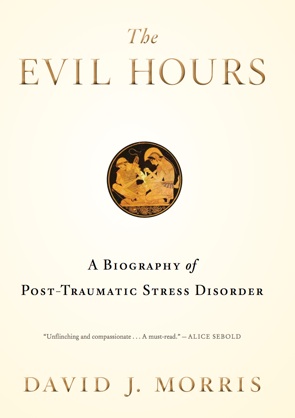
If you want to know more about the genealogy of post-traumatic stress, I recommend David J. Morris, The evil hours: a biography of post-traumatic stress disorder (Eamon Dolan/Houghton Mifflin Harcourt, 2015).   You can read an extract over at Salon here.  The book is particularly relevant to this discussion because it suggests that where trauma was once mediated through philosophy and literature it is now constituted through psychology and psychiatry.  David is very good on the arguments that raged over ‘shell-shock’ during the First World War, but if you want a ‘biography’ of that then you should turn to Michèle Barratt‘s Casualty figures: how five men survived the First World War (Verso, 2007).

Finally, Roy’s Learning to die in the Anthropocene is due from City Lights in the fall; you can get a taste of it from his essay in the New York Times with the same title here; this was the final installment of a five-part series on War and the city in which Roy retraced his footsteps from civilian to soldier to civilian.

The Natures of War

Frank-Hurley-2008-Photographing-the-First-World-War-Hurley-Document-Name-06-copy sm

I have – at last – uploaded what I hope is the final version of ‘The Natures of War’ (DOWNLOADS tab).  It’s the long-form version of the first Neil Smith Lecture I gave at St Andrew’s (Neil’s alma mater) almost exactly a year ago (you can access the online video here).  The basic argument remains the same, but the written version is substantively different (and much longer).  If you do have any comments or suggestions, or you spot any egregious errors, please let me know.  Here’s the introduction:

***

In his too short life, Neil Smith had much to say about both nature and war: from his seminal discussion of ‘the production of nature’ in his first book, Uneven development, to his dissections of war in the twentieth and early twenty-first centuries in American Empire – where he identified the end of the First World World and the end of the Second as crucial punctuations in the modern genealogy of globalisation – and its coda, The endgame of globalization, a critique of America’s wars conducted in the shadows of 9/11. And yet, surprisingly, he never linked the two. He was of course aware of their connections. He always insisted that the capitalist production of nature, like that of space, was never – could not be – a purely domestic matter, and he emphasised that the modern projects of colonialism and imperialism depended upon often spectacular displays of military violence. But he did not explore those relations in any systematic or substantive fashion.

He was not alone. The great Marxist critic Raymond Williams once famously identified ‘nature’ as ‘perhaps the most complex word in the [English] language.’ Since he wrote, countless commentators have elaborated on its complexities, but few of them have paused to note that ‘war’ was not one of Williams’s keywords (though ‘violence’ – ‘often now a difficult word’ – was). Williams was radicalised by the rise of European fascism; he joined the British Army in 1941 and served as a tank commander during the Second World War. Yet at its end he found the world had turned, and it was for that very reason that he sought to find the terms for a post-war world in which, seemingly, ‘war’ had no place.

‘In 1945, after the ending of the wars with Germany and Japan, I was released from the Army to return to Cambridge. University term had already begun, and many relationships and groups had been formed. It was in any case strange to travel from an artillery regiment on the Kiel Canal to a Cambridge college. I had been away only four and a half years, but in the movements of war had lost touch with all my university friends. Then, after many strange days, I met a man I had worked with in the first year of the war, when the formations of the 1930s, though under pressure, were still active. He too had just come out of the Army. We talked eagerly, but not about the past. We were too much preoccupied with this new and strange world around us. Then we both said, in effect simultaneously: ‘the fact is, they just don’t speak the same language’.’

I want to track backwards and forwards from Williams’s war-time experience to trace three different co-productions of nature and military violence: the soiled earth of the Western Front during the First World War, the deserts of North Africa during the Second World War (an armoured campaign very different from the European theatre in which Williams served), and the rainforests of Vietnam. My accounts can only be sketches, but they share a way of thinking of ‘nature’ (in all its complexity) as a modality that is intrinsic to the execution of military and paramilitary violence. In much the same way that ‘space’ is not only a terrain over which wars are waged – the fixation on territory that remains at the heart of modern geopolitics – but also a medium through which military and paramilitary violence is conducted, so ‘nature’ is more than a resource bank whose riches can trigger armed conflict and finance its depredations: the problematic of resource wars and conflict commodities. The spoils of war include the short-term bludgeoning of landscapes and the long-term toxicity of contamination (what Rob Nixon calls ‘slow violence’), but it is also important to trace the bio-physical formations – the conditions, provided the term is understood in the most active of senses – that are centrally involved in the militarisation of ‘nature’. For nature too is a medium through which military and paramilitary violence is conducted.

I speak of ‘co-productions’ and ‘formations’ in order to signal in advance three issues that will reappear across all three studies. First, each of these wars was in large measure what Paul Saint-Amour calls, in relation to the first of them, an optical war: they depended on geo-spatial intelligence, surveillance and reconnaissance which in its various forms provided the essential basis for the maps, plans and orders that activated the war machine. And yet the remote orderings of military violence were never autonomous projections onto a pure plane; they also depended on the bodies of soldiers whose apprehension of the battle space was always more than visual. In part, this was a matter of affect, but it was also a matter of knowledge – of a corpography rather than a cartography – whose materialities also inflected imaginative geographies of militarised nature. Second, those diverse stocks of knowledge about the battle space were invested in the co-production of a ‘trickster nature’. It was commonplace to describe the Western Front as a surreally empty landscape in which the capacity for military violence was hidden from view once men withdrew into the troglodyte world of the trenches. But I have in mind a more pervasive sense of uncertainty instilled by a militarised nature: one where the earth and air could kill through an infected wound, a buried mine or a cloud of gas, and whose camouflaged landscapes could wreak havoc with the military gaze to dissemble and distract, lure and entrap. Third, this was a hideously hybrid ‘cyborg nature’ whose terrain and life-forms were saturated with the debris of violent conflict: burned-out vehicles and bombed-out buildings, barbed wire and exploded munitions, discarded weapons and abandoned supplies, toxic residues and body parts. So far so familiar, except that none of these entanglements was inert; they shaped the military operations that took place through them. In all three ways each of these battle spaces was composed of ‘vibrant matter’ that was often also deadly matter.

***

This version is so long I’ve cut all the illustrations, but I have uploaded the original lecture slides too (DOWNLOADS tab); I’ve already posted early versions of some of the sections – and those were illustrated – here and here.

The War Corps

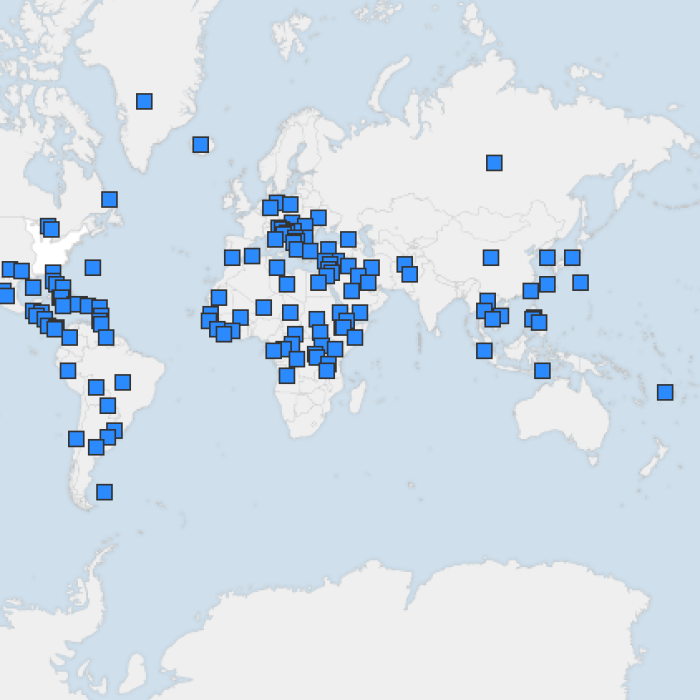
The US Congressional Research Service recently released a report, Instances of Use of United States Armed Forces Abroad, 1798-2014:

The instances differ greatly in number of forces, purpose, extent of hostilities, and legal authorization. Eleven times in its history the United States has formally declared war against foreign nations. These 11 U.S. war declarations encompassed 5 separate wars: the war with Great Britain declared in 1812; the war with Mexico declared in 1846; the war with Spain declared in 1898; the First World War, during which the United States declared war with Germany and with Austria-Hungary during 1917; and World War II, during which the United States declared war against Japan, Germany, and Italy in 1941, and against Bulgaria, Hungary, and Rumania in 1942.

Some of the instances were extended military engagements that might be considered undeclared wars. These include the Undeclared Naval War with France from 1798 to 1800; the First Barbary War from 1801 to 1805; the Second Barbary War of 1815; the Korean War of 1950-1953; the Vietnam War from 1964 to 1973; the Persian Gulf War of 1991; global actions against foreign terrorists after the September 11, 2001, attacks on the United States; and the war with Iraq in 2003. With the exception of the Korean War, all of these conflicts received congressional authorization in some form short of a formal declaration of war. Other, more recent instances often involve deployment of U.S. military forces as part of a multinational operation associated with NATO or the United Nations.

Barbara Salazar Torreon, who compiled the report, adds:

The list does not include covert actions or numerous instances in which U.S. forces have been stationed abroad since World War II in occupation forces or for participation in mutual security organizations, base agreements, or routine military assistance or training operations. Because of differing judgments over the actions to be included, other lists may include more or fewer instances.

5875790-1x1-700x700

abc news has now provided an interactive that maps the data set here, together with a discussion of the original report.

The optics of urban ruination

Ishikawa Kōyō

News from David Fedman of a new article co-authored with Cary Karacas, ‘The optics of urban ruination‘, which complements their previous, vital work on the cartographic imaginary of bombing.  It’s published in the Journal of Urban History but you can access it here.

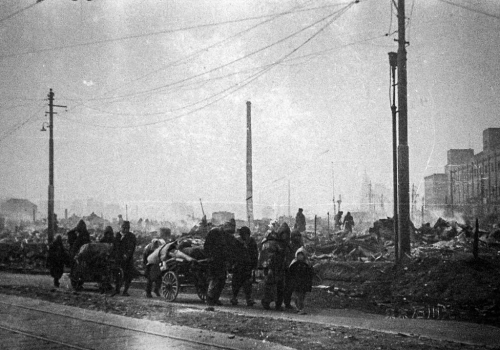
World War II yielded many photographs of bombed-out cities. In this paper we telescope between two sets and scales of images that represent the principal frames through which the American and Japanese publics have memorialized the incendiary bombings that laid waste to urban Japan: aerial photographs taken by the US Army Air Forces during its wartime planning, prosecution, and assessment of the raids; and the ground-level images captured by Ishikawa Kōyō, a photographer working on behalf of the Tokyo Metropolitan Police. By means of a detailed examination of the production, circulation, and consumption of these photographs— what some scholars have called an “archaeological approach” to images of ruination—we explore not only the visual rhetoric and reality of the destruction of Japan’s cities, but also how that destruction is situated in history, memory, and visual culture.

As always with their work, it’s exquisitely written, intellectually savvy and a very powerful argument.  They juxtapose the photographic ‘view from above’ that was instrumental in the planning and execution of the American air raids with Ishikawa Kōyō’s ground-level perspective.  His work is virtual unknown outside Japan and yet, as they say, has become ‘the principal visual testimony in Japan for public memory of the incendiary air raids as they were experienced on the ground’:

What followed were, according to Ishikawa, scenes from hell. His detailed account of that evening indeed repeatedly invokes infernal metaphors to describe Tokyo’s destruction. The “demon’s wings”(akuma no tsubasa) rained fire that carbonized corpses which “flowed through the streets like rapids.”  The elements also conspired against the city to whip up the red winds (akakaze) that fanned the firestorms: “immense incandescent vortices,” he wrote, “rose in a number of places, swirling, flattening, sucking whole blocks of houses into a maelstrom of fire.”

Widespread chaos, intense heat, and the realization of the need to save his own life pre-vented Ishikawa from taking any photographs. His Chevrolet destroyed by flames, he slowly made his way on foot back to the Metropolitan Police Headquarters. After resting his fatigued body, at around 2 P.M. on March 10 Ishikawa set out to document the aftermath. He saw bodies “piled like mountains” (shitai no yama o kizuiteita) and corpses burnt to the point that “you could no longer discern the sex of the body” (danjyo no kubetsu mo tsukanai shitai).

Ishikawa first told himself not to photograph such upsetting images, but then, recalling his responsibilities to capture the “reality of the scenes,” he began to snap the shutter.That day Ishikawa took thirty-three photographs of the aftermath of what came to be called the Great Tokyo Air Raid.

You can find more at Japan Air Raids, a brilliant bilingual archive, and a (harrowing) selection of Ishikawa’s images here.  If you do click on that link, heed their warning:

While photographs such as [these] provide an intimate sense of the bodily pain that was inflicted by the firebombing, they also require much of the viewer. It is one thing to look at such photographs; it is another thing altogether to comprehend or attach meaning to the actual suffering it exposes.

And – do I have to say this? – it’s worth thinking about other scenes of urban ruination.

Peace in our time

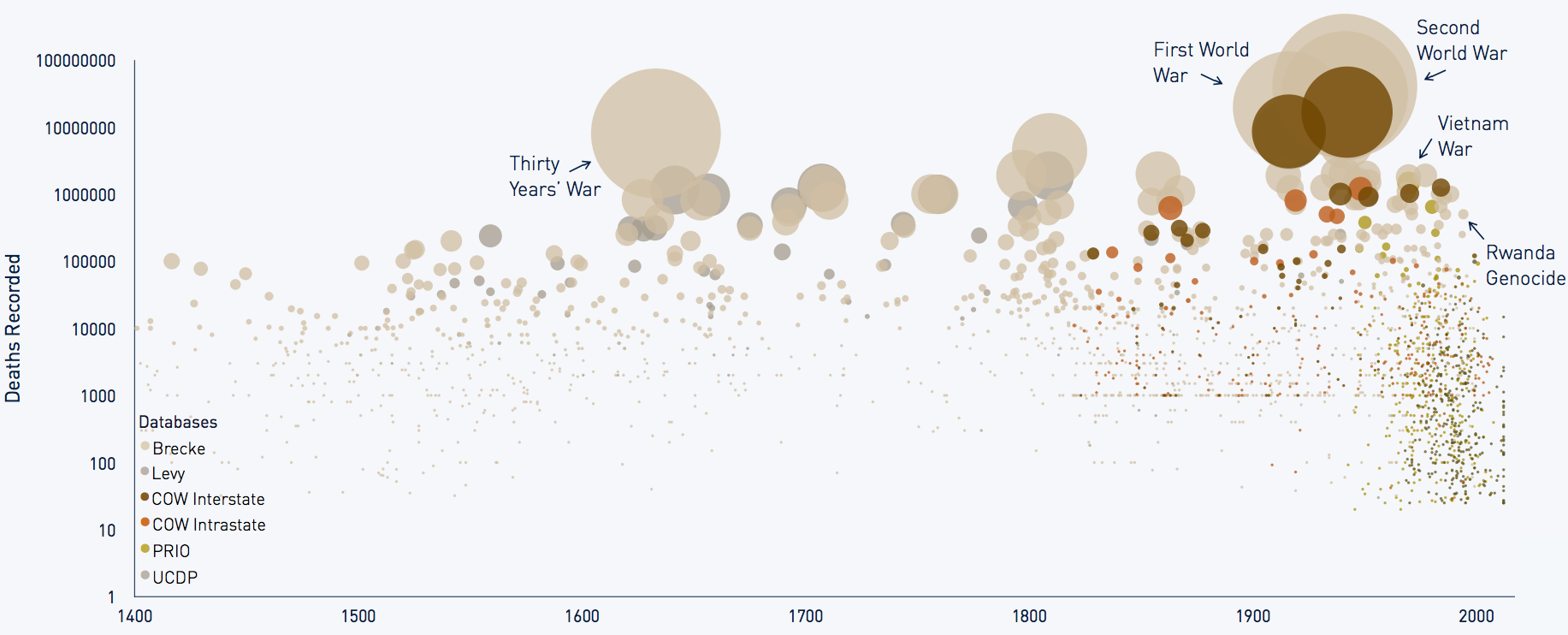
I’ve talked about charting armed conflict around the world before.  Max Rosen has a series of data visualisations – ‘Our World in Data‘ – including several on war and peace.  They include this one, drawn from multiple sources and collated (and designed) by the Hague Centre for Strategic Studies, showing global war deaths – the size of the bubble refers to the proportion of the world population killed:

ourworldindata_global-war-deaths-1400-today-size-of-the-bubble-shows-percentage-of-world-population-killed-–-the-hague-centre-for-strategic-studies0

There are of course all sorts of problems in this sort of exercise – calculating ‘war deaths’ is a political and intellectual minefield of its own – but you can find the sources used for the graphic here (click on the button on the right).

You can also download the Hague Centre’s graphics in a single pdf, ‘Peace and Conflict across time’, here (again, click on the button on the right): the display arranges the graphics into two sets – ‘Decline of Conflict’ and ‘Drivers of Peace’.  No doubt Stephen Pinker would approve.

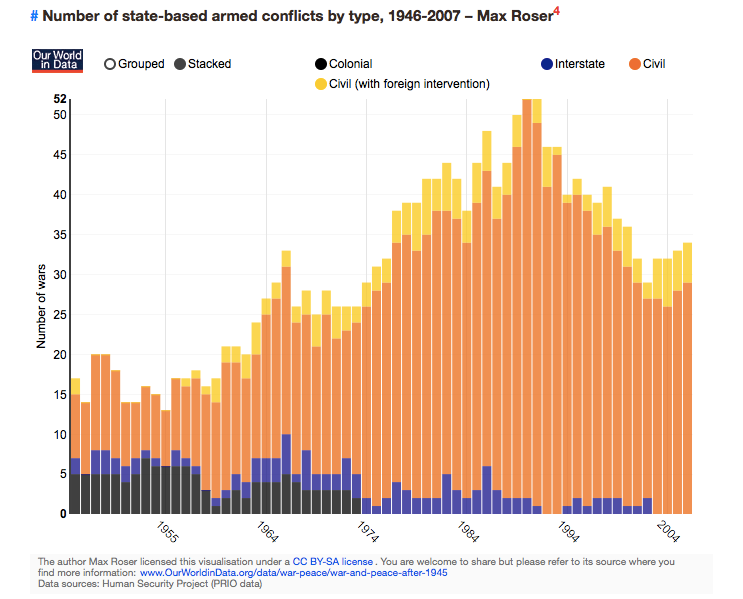
Max provides a more detailed analysis of conflicts post-1945 here, including this image (which extends only to 2004), and which is precisely the sort of thing that has licensed the debates over the decline of inter-state wars and the rise of (often transnational) ‘new wars’:

State-based armed conflicts

Before cheering the demise of inter-state war, however, we need to reflect on the multiple ways in which states and their advanced militaries are able to inflict violence by stealth (including cyber-attack), by proxy and by other other means (including economic warfare)…

Corpographies

I’ve been scribbling some notes for a short essay Léopold Lambert has invited me to write for his Funambulist Papers.  The brief is to write ‘something about the body – nothing too complicated’, so I’ve decided to say something more about the idea of corpography I sketched in ‘Gabriel’s Map’ (DOWNLOADS tab), which will in turn – so I hope – prepare the ground for the long-form version of ‘The nature(s) of war’ for a special issue of Antipode devoted to the work of Neil Smith [next on my to-do list].

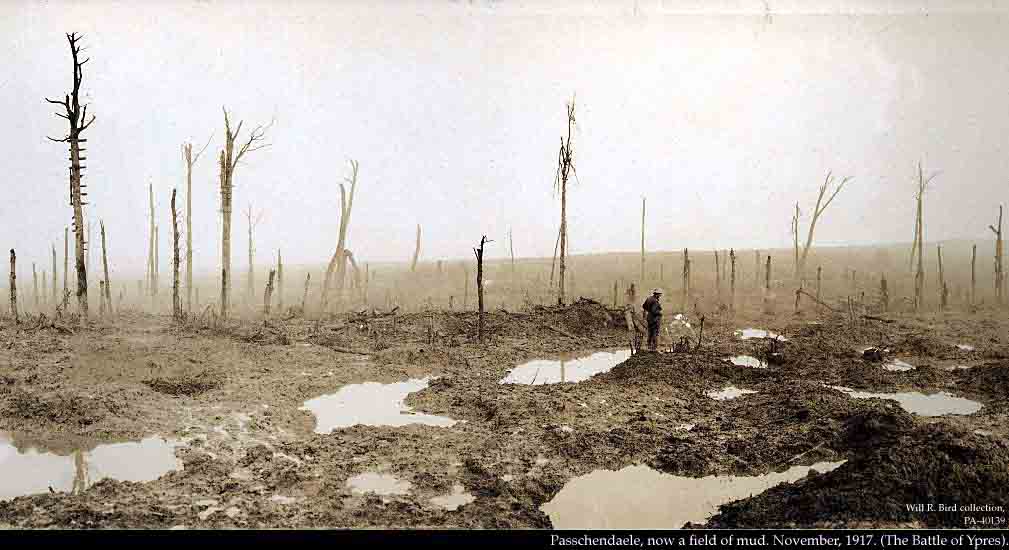
In ‘Gabriel’s Map’ (and in a preliminary sketch here) I contrasted the cartographic imaginary within which so much of the First World War was planned with a corpography improvised by soldiers caught up in the maelstrom of military violence on the ground; unlike the ‘optical war’ that relied, above all, on aerial reconnaissance, projected onto the geometric order of the map and the mechanical cadence of the military timetable – a remarkably abstract space, though its production was of course profoundly embodied – this was a way of apprehending the battle space through the body as an acutely physical field in which the senses of sound, smell and touch were increasingly privileged in the construction of a profoundly haptic or somatic geography.

passchendale1917vj0

This is hardly original; you can find intimations of all this in classics like Eric Leed‘s No Man’s Land, and once you start digging in to the accounts left by soldiers you find supporting evidence on page after page.  What I’ve tried to do is show that this constituted more than a different way of experiencing war: it was also a different way of knowing and ordering (or, as Allan Pred would surely have said, of re-cognising) the space of military violence.  These knowledges were situated and embodied – ‘local’, even – but they were also transmissable and mobile.

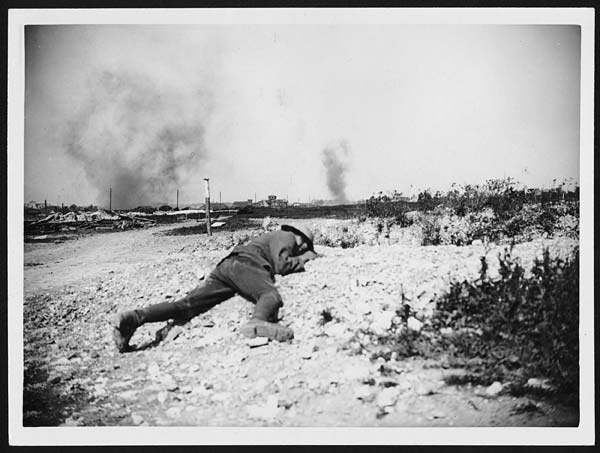
On the Western front, corpographies were at once an instinctive, jarring, visceral response to military violence –

‘When sound is translated into a blow on the nape of the neck, and light into a flash so bright that it actually scorches the skin, when feeling is lost in one disintegrating jar of every nerve and fibre … the mind, at such moments, is like a compass when the needle has been jolted from its pivot’ [‘A Corporal’, Field Ambulance Sketches (1919)]

– and an improvisational, learned accommodation to it:

‘We know by the singing of a shell when it is going to drop near us, when it is politic to duck and when one may treat the sound with contempt. We are becoming soldiers. We know the calibres of the shells which are sent over in search of us. The brute that explodes with a crash like that of much crockery being broken, and afterwards makes a “cheering” noise like the distant echoes of a football match, is a five-point-nine.The very sudden brute that you don’t hear until it has passed you, and rushes with the hiss of escaping steam, is a whizz-bang… The funny little chap who goes tonk-phew-bong is a little high-velocity shell which doesn’t do much harm… The thing which, without warning, suddenly utters a hissing sneeze behind us is one of our own trench-mortars. The dull bump which follows, and comes from the middle distance out in front, tells us that the ammunition is “dud.” The German shell which arrives with the sound of a woman with a hare-lip trying to whistle, and makes very little sound when it bursts, almost certainly contains gas.

‘We know when to ignore machine-gun and rifle bullets and when to take an interest in them. A steady phew-phew-phew means that they are not dangerously near. When on the other hand we get a sensation of whips being slashed in our ears we know that it is time to seek the embrace of Mother Earth’ [A.M. Burrage, War is war]

National Library of Scotland (Tom Aitken)

This was not so much a re-setting of the compass, as the anonymous stretcher-bearer had it, as the formation of a different bodily instrument altogether.  As Burrage’s last sentence shows, corpographies were at once re-cognitions of a butchered landscape – one that seemed to deny all sense – and reaffirmations of an intimate, intensely sensible bond with the earth:

‘To no man does the earth mean so much as to the soldier. When he presses himself down upon her, long and powerfully, when he buries his face and his limbs deep in her from the fear of death by shell-fire, then she is his only friend, his brother, his mother; he stifles his terror and his cries in her silence and her security…. ’ [Erich Remarque, All quiet on the Western Front]

And corpographies were not only a means through which militarised subjects accommodated themselves to the warscape – providing a repertoire of survival of sorts – but also a way of resisting at least some its impositions and affirming, in the midst of what so many of them insisted was ‘murder not war’, what Santanu Das calls a ‘tactile tenderness’ between men.  This, he argues,

‘must be seen as a celebration of life, of young men huddled against long winter nights, rotting corpses, and falling shells. Physical contact was a transmission of the wonderful assurance of being alive, and more sex-specific eroticism, though concomitant, was subsidiary. In a world of visual squalor, little gestures – closing a dead comrade’s eyes, wiping his brow, or holding him in one’s arms – were felt as acts of supreme beauty that made life worth living.’

grimsbychums

A hundred years later, I have no doubt that much the same is true in Afghanistan, Iraq, Syria and elsewhere, and so my interest in corpography is also part of my refusal to acquiesce to the thoroughly disingenuous de-corporealization of today’s ‘virtuous war’.

In fleshing out these ideas I’ve been indebted to a stream of work on the body in human geography. Most of it has been remarkably silent about war, even though Kirsten Simonsen once wrote about ‘the body as battlefield‘, but it’s now difficult for me to read her elegant essay ‘In quest of a new humanism: Embodiment, experience and phenomenology as critical geography’ [Progress in human geography 37 (1) (2013): open access here] – especially Part III where she discusses ‘Thinking the body’ and ‘Orientation and disorientation’ – without peopling it with bodies in khaki, blue or field grey tramping towards the front-line trenches, clambering over the top, or crawling from shell-hole to shell-hole in No Man’s Land.

That is partly down to the suggestiveness of Kirsten’s prose, but it’s also the result of my debt to the work of Santanu Das [Touch and intimacy in First World War literature], Ken MacLeish [especially Chapter 2 of his Making War at Fort Hood; the dissertation version is here] and Kevin McSorley [whose introduction to War and the body is here] which directly addresses military violence.  I wish I’d been able to attend the Sensing War conference that Kevin co-organised in London last month; I had to turn down the invitation because I was marooned on my mountaintop in Umbria, but the original Call For Papers captured some of the ways in which the materialities and corporealities of war in the early twentieth century continue to inhabit later modern war:

War is a crucible of sensory experience and its lived affects radically transform ways of being in the world. It is prosecuted, lived and reproduced through a panoply of sensory apprehensions, practices and ‘sensate regimes of war’ (Butler 2012) – from the tightly choreographed rhythms of patrol to the hallucinatory suspicions of night vision; from the ominous mosquito buzz of drones to the invasive scrape of force-feeding tubes; from the remediation of visceral helmetcam footage to the anxious tremors of the IED detector; from the desperate urgencies of triage to the precarious intimacies of care; from the playful grasp of children’s war-toys to the feel of cold sweat on a veteran’s skin.

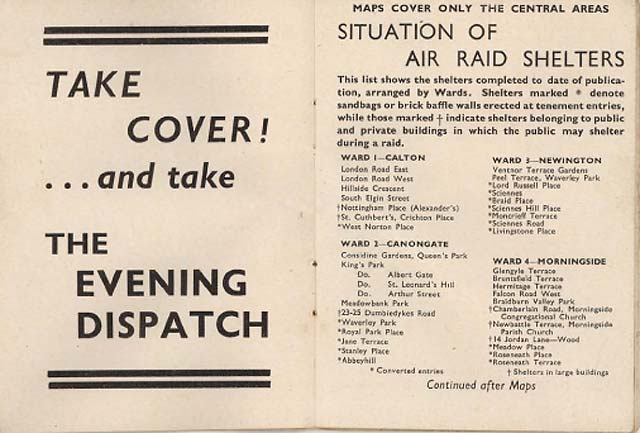
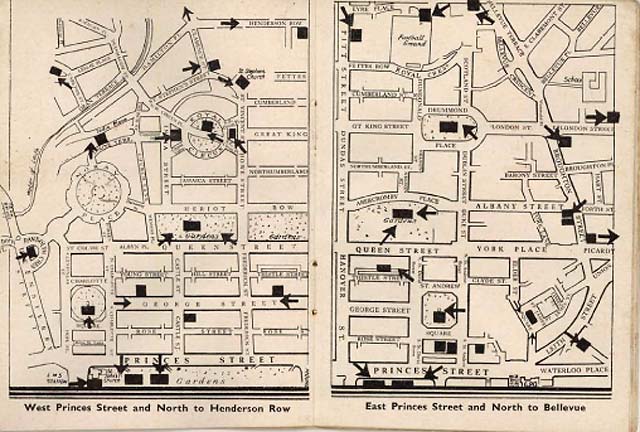
Thus far, like most of the writers I’ve drawn from here, I’ve been thinking about corpographies in relation to the soldier’s body, but as the (in)distinctions between combatant and civilian multiply I’ve started to think about the knowledges that sustain civilians caught up in military and paramilitary violence too. Some of them are undoubtedly cartographic – formal and informal maps of shelters (the images below are for Edinburgh during the Second World War), camps, checkpoints and roadblocks – and some of them rely on visual markers of territory: barriers and wires, posters and graffiti. Today much of this information is shared by social media (as the battle space has become both digital and physical).

Guide to Edinburgh Air Raid Shelters WW2


0_books_-_edinburgh_air_raid_shelters_p12+p13

But much of this knowledge is also, as it has always been, corpographic.  Pete Adey once wrote – beautifully – about what he called ‘the private life of an air raid’, drawing on the files of Mass Observation during the Second World War to sketch a geography of ‘stillness’ even as the urban landscape was being violently ‘un-made’.  ‘Stillness in this sense,’ he explained,

‘denotes apprehending and anticipating spaces and events in ways that sees the body enveloped within the movement of the environment around it; bobbing along intensities that course their way through it; positioned towards pasts and futures that make themselves felt, and becoming capable of intense forms of experience and thought.’

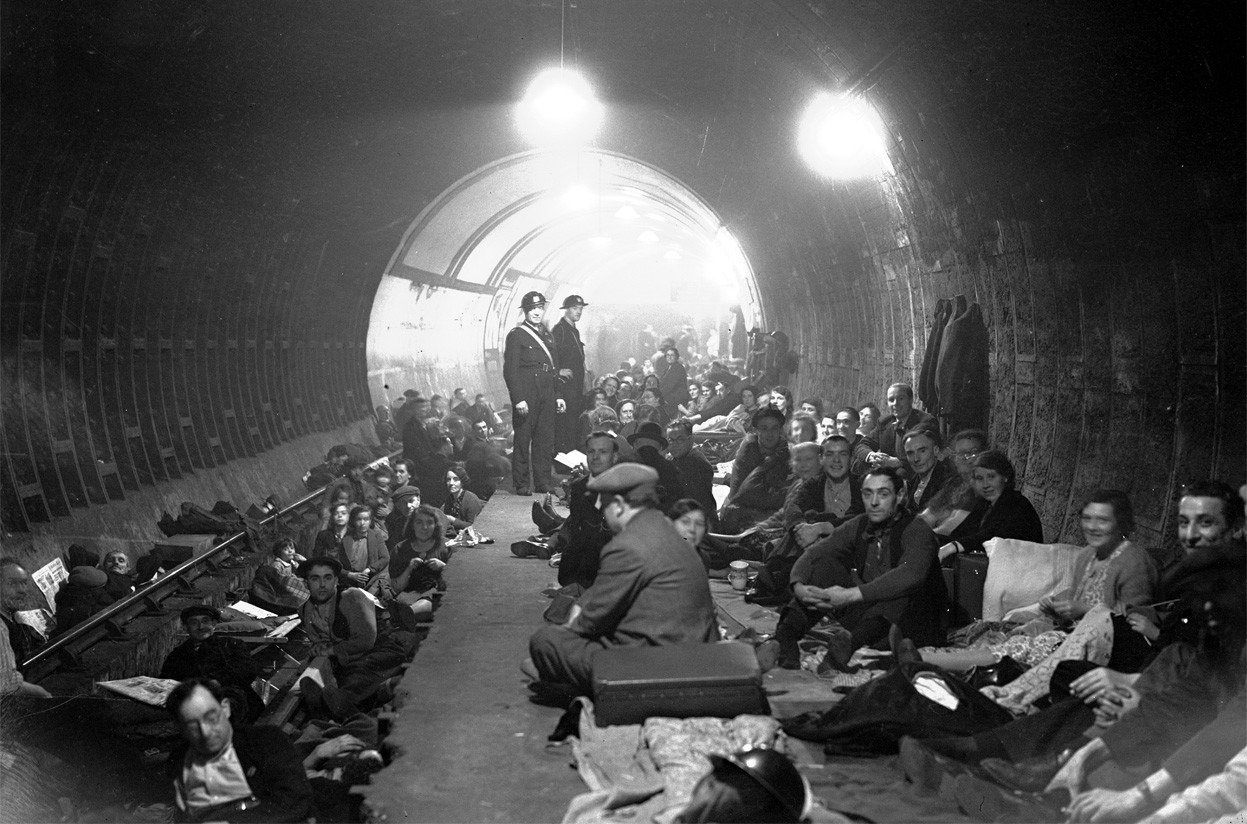
This was a corpo-reality, and one in which – as he emphasised – sound played a vital role: ‘Waves of sound disrupted fragile tempers as they passed through the waiting bodies in the physical language of tensed muscles and gritted teeth.’  But, as he also concedes, this was also a ‘not-so private’ life – there was also a social life under the bombs – and we need to think about how these experiences were shared by and with other bodies.  These apprehensions of military violence, then as now, were not only modalities of being but also modes of knowing: as Elizabeth Dauphinée suggests, in a different but closely related context, ‘pain is not an invisible interior geography’ but rather ‘a mode of knowing (in) the world – of knowing and making known’  [‘The politics of the body in pain’, Security dialogue 38 (2) (2007) 139-55]. During an air raid these knowledges could be shared by talking with others – the common currency of comfort and despair, advice and rumour – but they also arose from making cognitive sense of physical sensations: the hissing and roaring of the bombs, the suction and compression from the blast, the stench of ruptured gas mains or sewage pipes.

London air raid shelter

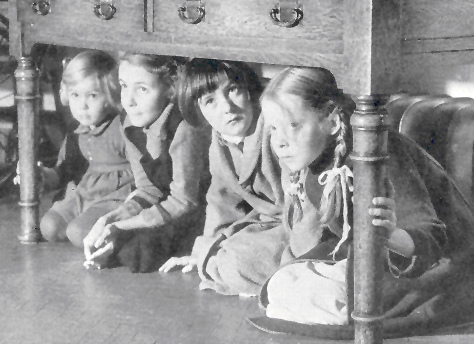
Steven Connor once suggested that air raids involve a ‘grotesquely widened bifurcation of visuality and hearing’, in which the optical-visual production of a target contrasts with ‘the absolute deprivation of sight for the victims of the air raid on the ground, compelled as they are to rely on hearing to give them information about the incoming bombs.’  Those crouching beneath the bombs have ‘to learn new skills of orientating themselves in this deadly auditory field without clear coordinates or dimensions but in which the tiniest variation in pitch and timbre can mean obliteration.’  What then can you know – and how can you know – when your world contracts to a room, a cellar, the space under the bed?  When you can’t go near a window in case it shatters and your body is sliced by the splinters?  When all you have to go on, all you can trust, are your ears parsing the noise or your fingers scrabbling at the rubble?

Air raid drill in children's home WW2

Here too none of this is confined to the past, and so I start to think about the thanatosonics of Israel’s air strikes on Gaza.  Sound continues to function as sensory assault; here is Mohammed Omer:

‘At just 3 months old, my son Omar cries, swaddled in his crib. It’s dark. The electricity and water are out. My wife frantically tries to comfort him, shield him and assure him as tears stream down her face. This night Omar’s lullaby is Israel’s rendition of Wagner’s Ride of the Valkyries, with F-16s forming the ground-pounding percussion, Hellfire missiles leading the winds and drones representing the string section. All around us crashing bombs from Israeli gunships and ground-based mortars complete the symphony, their sound as distinct as the infamous Wagner tubas…. Above, the ever-present thwup-thwup of hovering Apache helicopters rock Omar’s cradle through vibration. Warning sirens pierce the night—another incoming missile from an Israeli warship.’

And, as before, sound can also be a source of knowledge.  Here is Wasseem el Sarraj, writing from Gaza in November 2012:

In our house we have become military experts, specializing in the sounds of Israeli and Palestinian weapons. We can distinguish with ease the sound of Apaches, F-16 missiles, drones, and the Fajr rockets used by Hamas. When Israeli ships shell the coast, it’s a distinct and repetitive thud, marked by a one-second delay between the launch and the impact. The F-16s swoop in like they are tearing open the sky, lock onto their target and with devastating precision destroy entire apartment blocks. Drones: in Gaza, they are called zananas, meaning a bee’s buzz. They are the incessant, irritating creatures. They are not always the harbingers of destruction; instead they remain omnipresent, like patrolling prison guards. Fajr rockets are absolutely terrifying because they sound like incoming rockets. You hear them rarely in Gaza City and thus we often confuse them for low-flying F-16s. It all creates a terrifying soundscape, and at night we lie in our beds hoping that the bombs do not drop on our houses, that glass does not shatter onto our children’s beds. Sometimes, we move from room to room in an attempt to feel some sense of safety. The reality is that there is no escape, neither inside the house nor from the confines of Gaza.

The last haunting sentences are a stark reminder that knowledge, cartographic or corpographic, is no guarantee of safety. But military and paramilitary violence is always more than a mark on a map or a trace on a screen, and the ability to re-cognise its more-than-optical dimensions can be a vital means of navigating the wastelands of war.  As in the past, so today rescue from the rubble often involves a heightened sense of sound and smell, and survival is often immeasurably enhanced by the reassuring touch of another’s body.  And these fleshy affordances – which you can find in accounts of air raids from Guernica to Gaza – are also a powerful locus for critique.

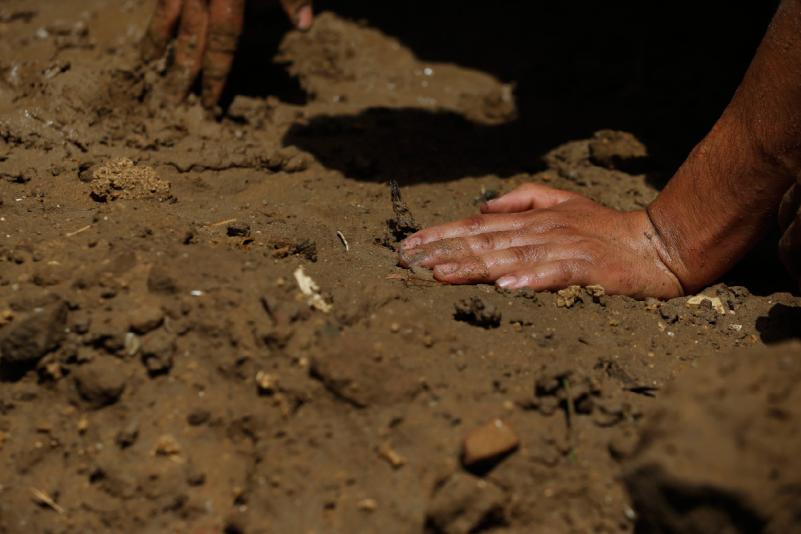
Gaza Hands and Grave

So: corpographies.  I thought I’d made the word up, but as I completed ‘Gabriel’s Map’ I discovered that Joseph Pugliese uses ‘geocorpographies’ to designate ‘the violent enmeshment of the flesh and blood of the body within the geopolitics of war and empire’ in his State violence and the execution of law (New York: Routledge, 2013; p. 86). This complements my own study, though I’ve used the term to confront the optical privileges of cartography through an appeal to the corporeal (and to the corpses of those who were killed in the names of war and empire).

And I’ve since discovered that the term has a longer history and multiple meanings that intersect, in various ways, with what I’m trying to work out.  Perhaps not surprisingly, it also serves as a medical term: cranio-corpography is a procedure devised by Claus-Frenzen Claussen in 1968 to capture in a visual trace the longitudinal and lateral movements of a patient’s body in order to detect and calibrate disorders of the ‘equilibrium function’.  More recently, corpography has also been used by dance theorists and practitioners, including Francesca Cataldi and Sebastian Prantl, to describe a critical, creative practice: a ‘dance of things’ in which the body is thoroughly immersed as a’ land.body.scape’, as Prantl puts it.  Meanwhile, Allan Parsons has proposed a ‘psycho-corpography’ – explicitly not a psycho-geography – as a way of ‘tracing the experience of living-a-body’.  Elsewhere,  Alex Chase attends to specific bodies-in-the-world, those of cultural ‘figures’ (Artaud, Bataille, Foucault, Genet, Jarman and Mishima among them), that resist normalization – hence emphatically  ‘queer’ bodies – and which figure bodies as events.  ‘I hope to develop a methodology of “corpography”,’ he says, ‘which would write between biography and textual analysis, material lived bodies and fictional work, life and representation, in order to work through other queer concepts such as temporality, space, and ethics.’

It would of course be absurd to summon all of these different usages onto a single conceptual terrain. But they do take me back to Kirsten’s essay (and to long-ago memories of an enthralling seminar in Roskilde which she introduced through her dance teacher), to ways of apprehending the danse macabre on the Western Front as both a cartography and a corpography whose junction was to be found, perhaps, in a choreography, and to think about the ways in which the sentient bodies of soldiers were at once habituated to and resisted the forceful normalizations of military violence.  They also make me wonder about civilian corpographies – about the multiple ways in which violence is inflicted on the body and yet may be resisted through the body – and in doing so they direct my steps from the past to the present and to the fragile bodies that continue to lie at the heart of today’s conflicts.  If that is to speak with Walter Benjamin, I want to insist that the ‘tiny, fragile human body’ does not only lie ‘in a field of force of destructive torrents and explosions’, as he wrote in 1936: for the body is a vector as well as a victim of military and paramilitary violence.  And it can also be a means of undoing its effects.

I suspect that these ideas will eventually thread their way into my new project on the evacuation of combatant and civilian casualties (and the sick) from war zones, 1914-2014, where it’s already clear to me that cartography and corpography are tightly locked together.  All of this is highly provisional, as you’ll realise, and as always I would welcome comments and suggestions.

When war comes home

After the US invasion of Iraq there were all sorts of artistic interventions that sought to bring home to Americans what was happening in Baghdad.  I described some of them in ‘War and peace’ (DOWNLOADS tab), noting that many of them seemed to take their cue from Martha Rosler‘s double photomontage of ‘Bringing the war home’, in which she re-staged first Vietnam and then the Iraq war in American domestic interiors:

Captives are paraded around gleaming kitchens on leashes, combat troops stalk in living rooms, while beyond the drapes fires flicker, a grieving woman slumps on the deck, and an Army patrol files by. Domestic critics have frequently noted the interchange between security regimes inside and outside the United States; they insist that the ‘war on terror’ ruptures the divide between inside and outside, and draw attention to its impact not only ‘there’ but also ‘here’. But Rosler’s sharper point is to goad her audience beyond what sometimes trembles on the edge of a critical narcissism (‘we are vulnerable too’) to recognise how often ‘our’ wars violate ‘their’ space: her work compels us to see that what she makes seem so shocking in ‘our’ space is all too terrifyingly normal in ‘theirs’.

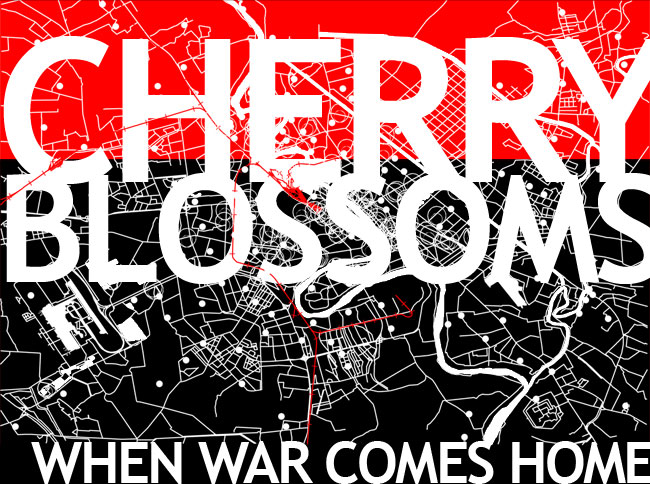
Several projects made cartographic transpositions or mash-ups: superimposing the bombing of Baghdad on San Francisco (Paula Levine‘s Shadows from another place) or Boston (Alyssa Wright‘s Cherry Blossoms), for example, or choreographing a situationist tour of Baghdad in Brooklyn.  I’ve been more hesitant about these interventions; I know that these three projects were linked to – and in the last case depended on – ground performances, and I know too that it’s possible to undo the abstractness of conventional cartography, to turn it against itself (here I’m thinking of elin o’Hara slavick‘s brilliant Bomb after bomb).

WRIGHT Cherry Blossoms

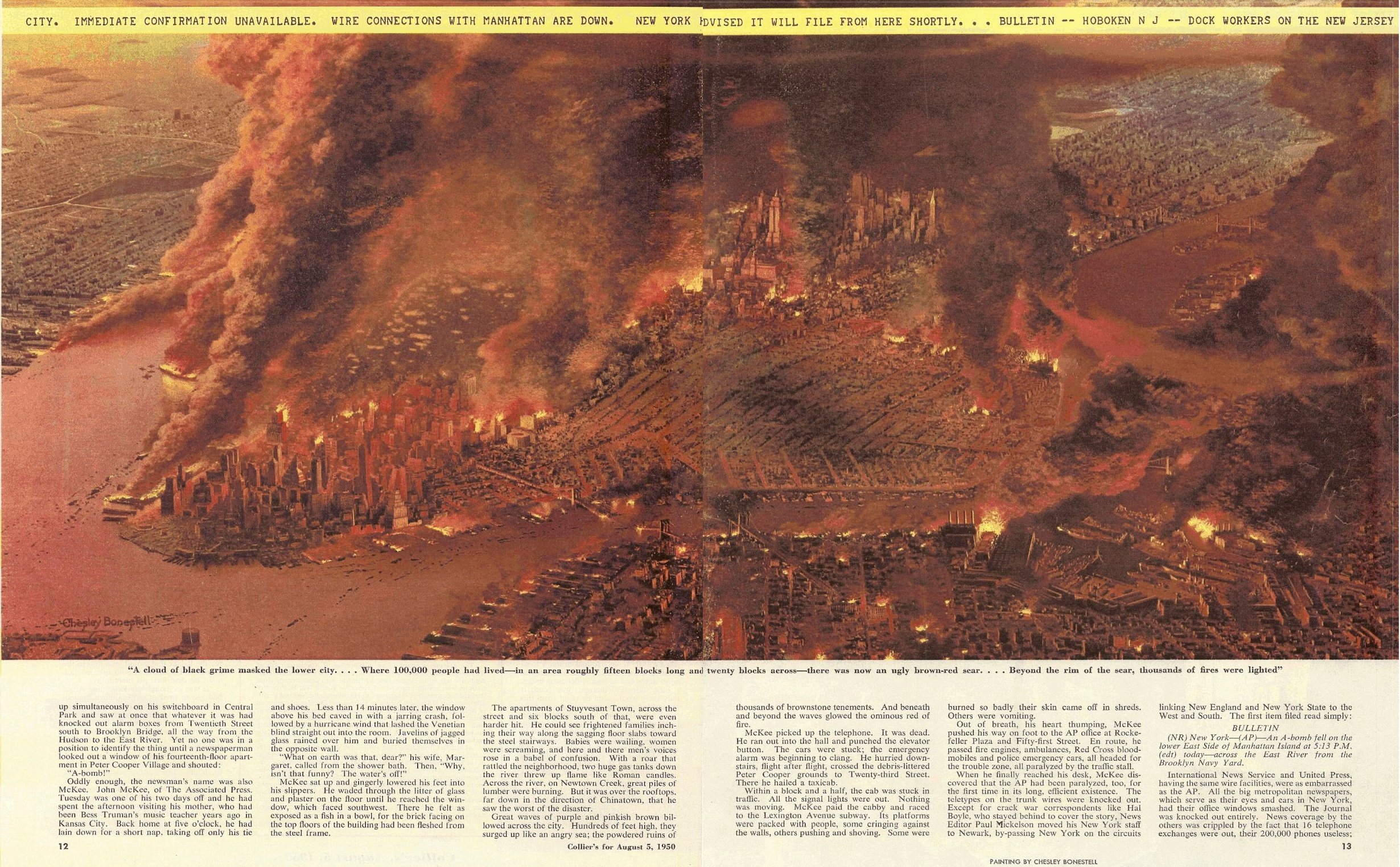
I’ve now seen a different cartographic transposition that dramatizes the firebombing of Japan during the Second World War by juxtaposing a map of the United States with a map of Japan.  Almost as soon as the war was over there were several visualizations of a nuclear attack on US cities.  The image below comes from Collier’s Magazine in 1950, for a cover story called ‘Hiroshima, USA’; you can access the original here and read more here.  But projects like these still deflect the critical gaze from the horror of what happened there to the horror of what might happen here.  Indeed, that was precisely the point, as Joseph Masco shows in his brilliant essay, ‘”Survival is Your Business”: Engineering ruins and affect in nuclear America’, Cultural Anthropology 23:2 (2008) 361-98; reprinted in Ann Laura Stoler (ed), Imperial debris: on ruins and ruination (Duke, 2013).

Colliers-03-04-1

The problem is redoubled in the case of Hiroshima and Nagasaki, because those two hideous mushroom clouds have so often blocked our view of the firebombing of Japanese cities that preceded the two nuclear attacks.  Here the work of David Fedman and Cary Karacas on bombing Japan is indispensable, not least for its illuminating discussion of the central role of cartography (see Cary’s bilingual historical archive here).

In fact in 1945 the United States Air Force produced a map in which the earlier bombing campaign was projected on to a map of the United States:

FirebombsMapFinal-1.jpg.CROP.original-original

And this was the starting-point for Alex Wellerstein‘s remarkable intervention, whose critical force comes precisely from its juxtaposition (rather than simple superimposition) of the two maps: what happened in Japan is visibly there, magnified rather than marginalized through the map of the continental United States.  In fact, when you click on the interactive a line appears linking an American city to its equivalent target-city in Japan:

Firebombs-USA-interactive-600x321